<?xml version="1.0" encoding="ISO-8859-1"?><article xmlns:mml="http://www.w3.org/1998/Math/MathML" xmlns:xlink="http://www.w3.org/1999/xlink" xmlns:xsi="http://www.w3.org/2001/XMLSchema-instance">
<front>
<journal-meta>
<journal-id>0872-1904</journal-id>
<journal-title><![CDATA[Portugaliae Electrochimica Acta]]></journal-title>
<abbrev-journal-title><![CDATA[Port. Electrochim. Acta]]></abbrev-journal-title>
<issn>0872-1904</issn>
<publisher>
<publisher-name><![CDATA[Sociedade Portuguesa de Electroquímica]]></publisher-name>
</publisher>
</journal-meta>
<article-meta>
<article-id>S0872-19042012000200001</article-id>
<article-id pub-id-type="doi">10.4152/pea.201202081</article-id>
<title-group>
<article-title xml:lang="en"><![CDATA[Na+ Ion Conducting Hot-pressed Nano Composite Polymer Electrolytes]]></article-title>
</title-group>
<contrib-group>
<contrib contrib-type="author">
<name>
<surname><![CDATA[Chandra]]></surname>
<given-names><![CDATA[Angesh]]></given-names>
</name>
<xref ref-type="aff" rid="A01"/>
</contrib>
<contrib contrib-type="author">
<name>
<surname><![CDATA[Chandra]]></surname>
<given-names><![CDATA[Archan]]></given-names>
</name>
<xref ref-type="aff" rid="A01"/>
</contrib>
<contrib contrib-type="author">
<name>
<surname><![CDATA[Thakurb]]></surname>
<given-names><![CDATA[Kiran]]></given-names>
</name>
<xref ref-type="aff" rid="A02"/>
</contrib>
</contrib-group>
<aff id="A01">
<institution><![CDATA[,Shri Shankaracharya Institute of Professional Management & Technology Department of Applied Physics ]]></institution>
<addr-line><![CDATA[Raipur ]]></addr-line>
<country>India</country>
</aff>
<aff id="A02">
<institution><![CDATA[,Raipur Institute of Technology Department of Applied Chemistry ]]></institution>
<addr-line><![CDATA[Raipur ]]></addr-line>
<country>India</country>
</aff>
<pub-date pub-type="pub">
<day>00</day>
<month>03</month>
<year>2012</year>
</pub-date>
<pub-date pub-type="epub">
<day>00</day>
<month>03</month>
<year>2012</year>
</pub-date>
<volume>30</volume>
<numero>2</numero>
<fpage>81</fpage>
<lpage>88</lpage>
<copyright-statement/>
<copyright-year/>
<self-uri xlink:href="http://scielo.pt/scielo.php?script=sci_arttext&amp;pid=S0872-19042012000200001&amp;lng=en&amp;nrm=iso"></self-uri><self-uri xlink:href="http://scielo.pt/scielo.php?script=sci_abstract&amp;pid=S0872-19042012000200001&amp;lng=en&amp;nrm=iso"></self-uri><self-uri xlink:href="http://scielo.pt/scielo.php?script=sci_pdf&amp;pid=S0872-19042012000200001&amp;lng=en&amp;nrm=iso"></self-uri><abstract abstract-type="short" xml:lang="en"><p><![CDATA[Synthesis, characterization and polymeric battery studies of Na+ ion conducting Nano- Composite Polymer Electrolyte (NCPE) membranes: (1-x) [75PEO: 25NaPO3]: x SiO2, where x = 0 - 15 wt. (%), has been reported. NCPE membranes have been casted using a novel hot-press technique in place of the traditional solution cast method. The dispersal of SiO2 in SPE host: (75PEO: 25NaPO3), a conductivity enhancement of an order of magnitude achieved in NCPE film: [93 (75PEO: 25NaPO3): 7 SiO2]. This has been referred to as Optimum Conducting Composition (OCC). Material characterizations have been done with the help of XRD, SEM and DSC techniques. The ion transport behaviour in hot-pressed NCPEs has been discussed on the basis of experimental measurements on some basic ionic parameters viz. conductivity (&#963;), ionic mobility (&#956;), mobile ion concentration (n) and ionic transference number (t ion). The temperature dependent conductivity studies have been done to compute the activation energy (Ea) values from the 'log s - 1/T' Arrhenius plots. The ion conducting solid state polymeric battery was fabricated and cell-potential discharge characteristics have been studied at different load conditions.]]></p></abstract>
<kwd-group>
<kwd lng="en"><![CDATA[nano-composite polymer electrolyte]]></kwd>
<kwd lng="en"><![CDATA[ionic conductivity]]></kwd>
<kwd lng="en"><![CDATA[X-ray diffraction]]></kwd>
<kwd lng="en"><![CDATA[differential scanning calorimetry (DSC)]]></kwd>
<kwd lng="en"><![CDATA[polymeric battery]]></kwd>
</kwd-group>
</article-meta>
</front><body><![CDATA[ 

    <p><b>Na<sup>+</sup> Ion Conducting Hot-pressed Nano Composite Polymer Electrolytes</b></p>

    <p><b>Angesh Chandra<sup>1,<a href="#0">*<a/></sup>, Archan Chandra<sup>1</sup> and Kiran Thakurb<sup>2</sup></b></p>

    <p><sup>1</sup><i> Department of Applied Physics, Shri Shankaracharya Institute of Professional Management &amp; Technology, Raipur - 492015, C. G., India</i></p>

    <p><sup>2</sup><i> Department of Applied Chemistry, Raipur Institute of Technology, Raipur-492101, C.G., India</i></p>


    <p>&nbsp;</p>
    <p>doi: 10.4152/pea.201202081</p>


    <p>&nbsp;</p>
    <p><b>Abstract</b></p>

    <p>Synthesis, characterization and polymeric battery studies of Na<sup>+</sup> ion conducting Nano-
Composite Polymer Electrolyte (NCPE) membranes: (1-x) [75PEO: 25NaPO3]: x SiO<sub>2</sub>, 
where x = 0 - 15 wt. (%), has been reported. NCPE membranes have been casted using 
a novel hot-press technique in place of the traditional solution cast method. The 
dispersal of SiO<sub>2</sub> in SPE host: (75PEO: 25NaPO3), a conductivity enhancement of an 
order of magnitude achieved in NCPE film: [93 (75PEO: 25NaPO3): 7 SiO<sub>2</sub>]. This has 
been referred to as Optimum Conducting Composition (OCC). Material 
characterizations have been done with the help of XRD, SEM and DSC techniques. The 
ion transport behaviour in hot-pressed NCPEs has been discussed on the basis of 
experimental measurements on some basic ionic parameters viz. conductivity (&sigma;), ionic 
mobility (&mu;), mobile ion concentration (n) and ionic transference number (t<sub>ion</sub>). The 
temperature dependent conductivity studies have been done to compute the activation 
energy (E<sub>a</sub>) values from the 'log s - 1/T' Arrhenius plots. The ion conducting solid 
state polymeric battery was fabricated and cell-potential discharge characteristics have 
been studied at different load conditions.</p>

    ]]></body>
<body><![CDATA[<p><b><i>Keywords:</i></b> nano-composite polymer electrolyte, ionic conductivity, X-ray diffraction, 
differential scanning calorimetry (DSC), polymeric battery.</p>


    <p>&nbsp;</p>
    <p><b>Introduction</b></p>

    <p>The development of new ion conducting nano-composite polymer electrolytes 
(NCPEs) is one of the important areas of research in the last 30 years. The 
NCPEs show tremendous technological potential to develop flexible solid state 
polymeric batteries over the solid polymer electrolytes (SPEs). The main 
advantages of NCPEs are their mechanical properties, ease of fabrication of 
desirable shapes/sizes, and they are also important for improving the proper 
contact between electrode-electrolyte in polymeric batteries [1-8]. In the recent 
past, several PEO-based polymer electrolytes have been widely investigated 
because of their potential application in polymeric batteries. Polymer electrolyte 
films are formed, in general, via solution-cast and sol-gel routes. However, 
recently, an alternate hot-press technique has been developed for casting 
completely dry polymer electrolyte films [7-10]. The sodium salt has several 
advantages over lithium. Sodium is much more abundant and less expensive over 
lithium [6, 10, 11]. In the present investigation, the author reported synthesis, 
characterization and polymeric battery application of Na<sup>+</sup> ion conducting hot-
pressed nano-composite polymer electrolytes (NCPEs): (1-x) [75 PEO: 
25 NaPO3]: x SiO<sub>2</sub>, where x = 0 - 15 wt. (%). The materials characterization and 
ion transport studies have been carried out with the help of various experimental 
techniques. Based on these NCPE, a new solid state polymeric battery has been 
fabricated and their discharge characteristics are studied under different load 
conditions.</p>


    <p>&nbsp;</p>
    <p><b>Experimental</b></p>

    <p>Dry powders of AR grade chemicals: poly (ethylene oxide) PEO (105 MW, 
Aldrich, USA), NaPO3 (purity > 98%, Merck, India) and SiO<sub>2</sub> (> 99.8%, particle 
size ~ 8 nm, Sigma, USA) have been used for casting of NCPEs: (1-x) [75PEO: 
25NaPO3]: x SiO<sub>2</sub>, where x = 0 -15 wt. (%). The detail related to casting of SPE/ 
NCPEs by hot-press method has been discussed in detail in our earlier papers [8 - 10]. 
The ionic conductivity has been measured with the help of LCR bridge 
[HIOKI: 3520-01, Japan]. The ionic mobility (&mu;) and ionic transference number 
(tion) were evaluated by using dc polarization technique [12]. The activation 
energy (E<sub>a</sub>) values were also computed from the 'log s - 1/T' Arrhenius plots. 
The XRD studies of NaPO3, PEO, SPE host and NCPE OCC were carried out 
with the help of a Shimadzu diffractometer at Cu-K&alpha; 
radiation. The surface 
morphology of SPE host and NCPE OCC were recorded with the help of 
Scanning Electron Micrograph [SEM: JEOL, JXA-8100, Japan]. The thermal 
properties of PEO, SPE host and NCPE OCC were studied by using Differential 
Scanning Calorimetry [DSC: Perkin Elmer]. Solid state polymeric battery has 
been fabricated with the following configuration:</p>

    <p>&nbsp;</p>
<img src="/img/revistas/pea/v30n2/30n2a01s1.jpg">
    
<p>&nbsp;</p>

    <p>The discharge characteristics were studied under 100 and 50 k&Omega; 
loads and 
important cell-parameters were calculated from the discharge curve. The ionic 
transference number (tion) of NCPE OCC was also calculated using the 
electrochemical cell-potential method.</p>


    ]]></body>
<body><![CDATA[<p>&nbsp;</p>
    <p><b>Results and discussion</b></p>

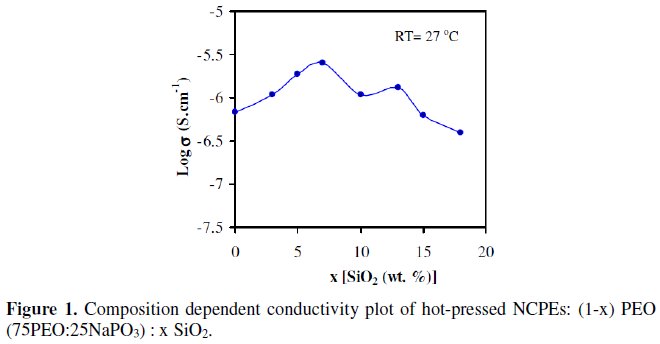
    <p>Fig. 1 shows the room temperature conductivity (&sigma;) variation as a function of salt 
concentration for the hot-pressed nano-composite polymer electrolytes (NCPEs): 
(1-x) [75PEO: 25NaPO3]: x SiO<sub>2</sub>, where x = 0 -15 wt. (%).</p>


    <p>&nbsp;</p>
<img src="/img/revistas/pea/v30n2/30n2a01f1.jpg">
    
<p>&nbsp;</p>


    <p>The NCPE films beyond 15 % filler SiO<sub>2</sub> concentration were unstable and brittle. One can clearly 
note from the figure that the two conductivity maxima were obtained at 7 and 13 
wt. (%) of SiO<sub>2</sub>, and then decreased on further addition of filler. A conductivity 
enhancement of more than one order of magnitude (&sigma; ~ 2.5 x 10<sup>-6</sup> S.cm<sup>-16</sup>) was 
achieved at room temperature for SPE host complexed with 7 wt% of nano-size 
filler SiO<sub>2</sub>. This NCPE film composition: 93 [75 PEO: 25 NaPO3] : 7 SiO<sub>2</sub> has 
been referred to as Optimum Conducting Composition (OCC), as mentioned. The 
increase in conductivity is due to the increase in degree of amorphousity and/ or 
space charge double layer effect, which can be explained by the various models 
[13, 14]. Another possible mechanism for conductivity enhancement could be the 
creation of additional hopping sites and favorable conducting path ways for 
migrating ionic species through Lewis acid-base interactions between ionic 
species and O/ OH sites on the filler grain surface.</p>

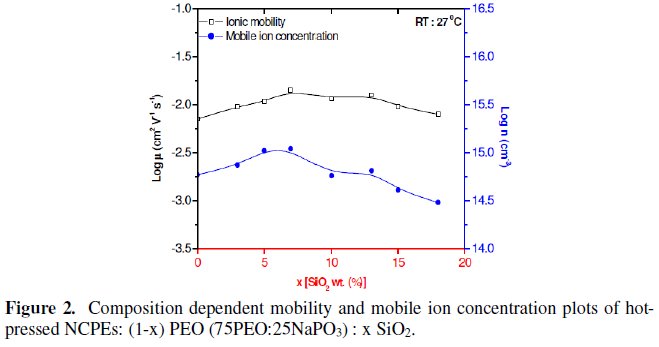
    <p>To characterize the ion conductance behavior in NCPEs, the ionic mobility (&mu;), 
mobile ion concentration (n) and ionic transference number (t<sub>ion</sub>) were 
determined at room temperature employing a dc polarization TIC technique, as 
mentioned in Section 2. Fig. 2 shows 'log &mu; - x' and 'log n - x' plots for NCPEs 
films: (1-x) [75PEO: 25NaPO3]: x SiO<sub>2</sub>.</p>


    <p>&nbsp;</p>
<img src="/img/revistas/pea/v30n2/30n2a01f2.jpg">
    
<p>&nbsp;</p>


    <p>It is obvious from the figure that both 
the variations are almost analogous to 'log &sigma; 
- x' and the highest values of '&mu;' 
and 'n' at room temperature were obtained at x = 7 wt. (%). These results clearly 
indicated the fact that the increase in room temperature conductivity of OCC 
NCPE film is also due to the increase in '&mu;' &amp; 'n' both. The ionic transference 
number (tion) ~ 0.95, was obtained for OCC NCPE which is very close to unity.</p>

    ]]></body>
<body><![CDATA[<p>This, in turn, indicated the fact that the hot-press synthesized NCPE is purely an 
ion conducting system with Na<sup>+</sup> ions as the sole charge carriers. The increase in 
'n' would be due to the availability of loosely entangled Na<sup>+</sup> ions with the 
polymer chains, while increase in '&mu;' would be a consequence of increased 
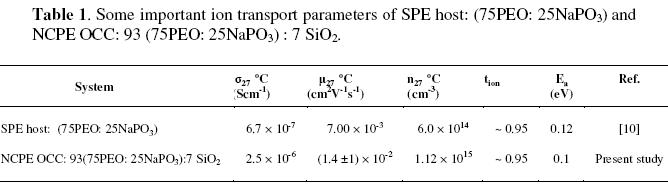
degree of amorphousity in SPE host. Table 1 lists the room temperature values of 
&sigma;, &mu;, n &amp; t<sub>ion</sub> obtained for the solid polymer electrolyte (SPE) host and nanocomposite 
polymer electrolyte (NCPE) OCC films.</p>

    <p>&nbsp;</p>
<img src="/img/revistas/pea/v30n2/30n2a01t1.jpg">
    
<p>&nbsp;</p>

    <p>The magnitude of ionic transference number (t<sub>ion</sub> ~ 0.95), obtained for both SPE host & NCPE OCC, 
revealed the fact that majority of available Na<sup>+</sup> ions do take part in the 
conduction process.</p>

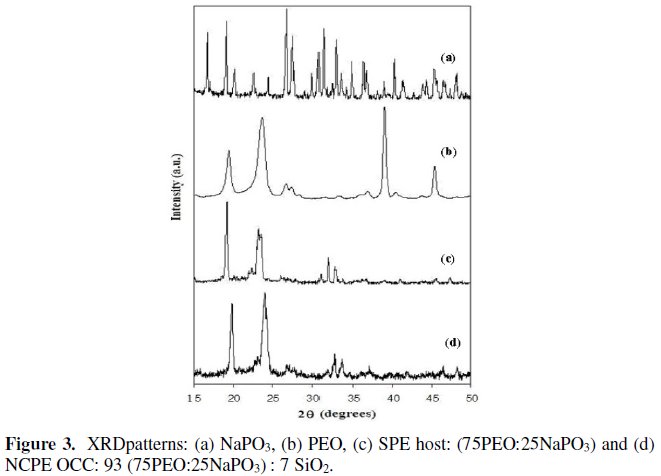
    <p>Fig. 3 shows the XRD analysis of NCPE OCC: 93 [75PEO: 25NaPO3] : 7 SiO<sub>2</sub> 
as well as SPE host: 75PEO: 25NaPO3 and pure PEO to confirmation of 
polymer-salt/ filler complexation.</p>


    <p>&nbsp;</p>
<img src="/img/revistas/pea/v30n2/30n2a01f3.jpg">
    
<p>&nbsp;</p>


    <p>On a closer inspection, it can be clearly noted 
that some of the peaks of pure PEO became relatively broader as well as less-
prominent/ feeble after salt complexation/ SiO<sub>2</sub> dispersal. This is usually 
attributed to the increase in the degree of amorphousity and also confirmed the 
salt complexation as well as to some extent, dispersal of filler SiO<sub>2</sub> in the SPE 
host.</p>

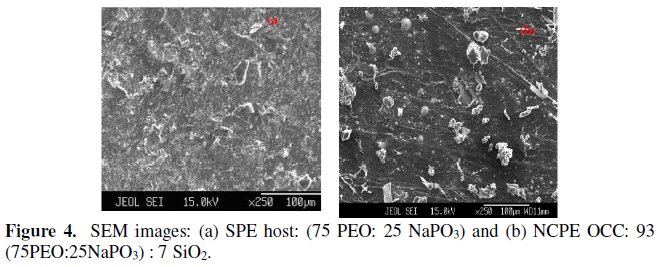
    <p>The surface morphology of SPE host and NCPE OCC were observed by 
scanning electron micrograph (SEM), as shown in Fig. 4.</p>


    <p>&nbsp;</p>
<img src="/img/revistas/pea/v30n2/30n2a01f4.jpg">
    
]]></body>
<body><![CDATA[<p>&nbsp;</p>


    <p>The smooth surface morphology of NCPE OCC is clearly indication of uniform distribution of SiO<sub>2</sub> 
and reduction in the crystallinity of pure host after adding filler SiO<sub>2</sub> at 7 wt.%.</p>

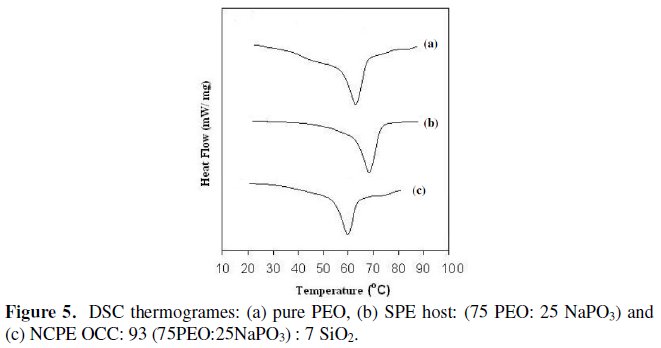
    <p>Fig. 5 shows the DSC thermogrames for the pure PEO, SPE host and NCPE 
OCC. The broad endothermic peak was observed in polymeric films at ~ 65-70 
&deg;C and it is corresponding to the melting point temperature of pure PEO.</p>


    <p>&nbsp;</p>
<img src="/img/revistas/pea/v30n2/30n2a01f5.jpg">
    
<p>&nbsp;</p>


    <p>The slightly shifting in the melting point temperature towards higher side in SPE host 
is also indicative of the confirmation of polymer-salt complexation and the 
slightly shifting in the melting point towards lower side in NCPE OCC is due to 
the increase in the amorphousity, which is also indicative of the formation of 
NCPE membrane. A possible mechanism for this behavior could be the creation 
of additional hopping sites and favorable conducting pathways for ionic 
migration.</p>

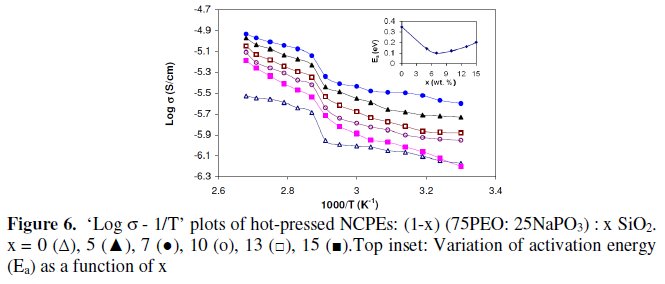
    <p>To evaluate the activation energy (E<sub>a</sub>), the temperature dependent conductivity 
measurements were carried out in all the NCPEs: (1-x) [75PEO: 25NaPO3]: x 
SiO<sub>2</sub>. Fig. 6 shows 'log &sigma; - 1/T' plots for the films of different filler 
concentrations (x).</p>


    <p>&nbsp; <a name="top.f6"></a> </p>
<img src="/img/revistas/pea/v30n2/30n2a01f6.jpg">
    
<p>&nbsp;</p>


    <p>The increase in conductivity with temperature can be 
interpreted as a hopping mechanism between coordinating sites, local structural 
relaxation and segmental motions of the polymer electrolytes complexes [15]. All 
the plots exhibited thermally activated Arrhenius variations and can be expressed 
by following linear equation:</p>

    ]]></body>
<body><![CDATA[<p>&nbsp;</p>
<img src="/img/revistas/pea/v30n2/30n2a01e1.jpg">
    
<p>&nbsp;</p>

    <p>where E<sub>a</sub> is the activation energy (in eV), involved in the thermally activated 
process. The activation energy (E<sub>a</sub>) values, for all the compositions, were 
computed from linear least square fitting of the above equation and plotted as a 
function of x. 'E<sub>a</sub> - x' plot is shown as top-inset in <a href="#top.f6">Fig. 6</a>.</p>

    <p>It can be clearly noticed that for NCPE OCC film, the activation energy E<sub>a</sub> ~ 0.1 eV is lowest as 
compared to other films. Low 'E<sub>a</sub>' is indicative of relatively easier ion migration 
in the newly synthesized hot-pressed NCPE material.</p>

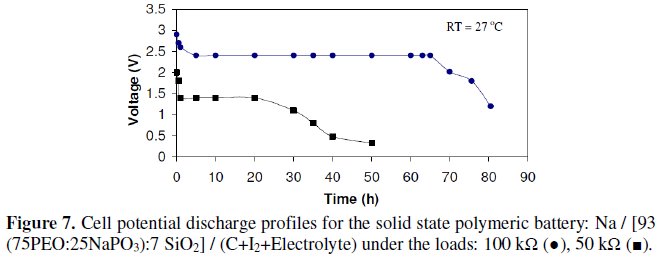
    <p>Fig. 7 shows the cell potential discharge profiles for polymeric cell under 
different loads viz. 100 kW, 50 kW at room temperature.</p>


    <p>&nbsp;</p>
<img src="/img/revistas/pea/v30n2/30n2a01f7.jpg">
    
<p>&nbsp;</p>


    <p>The Open Circuit Voltage (OCV) ~ 2.75 V was obtained for the cell. It can be clearly noticed that 
except for the initial potential drop, OCV value remained practically stable for ~ 
75 h. when discharged through 100 kW (i.e. during a low current drain state). 
However, the cell potential decreased relatively faster when discharge through 50 
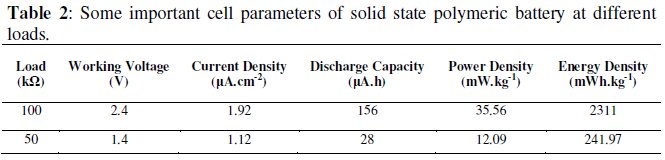
kW load (i.e. during higher current drain states). Table 2 lists some important cell 
parameters for polymeric cell, calculated in the plateau regions of the discharge 
profiles.</p>

    <p>&nbsp;</p>
<img src="/img/revistas/pea/v30n2/30n2a01t2.jpg">
    
<p>&nbsp;</p>

    ]]></body>
<body><![CDATA[<p>On the basis of these studies, it can be inferred that the above cell, based on this 
newly synthesized Na<sup>+</sup> ion conducting NCPE, performed fairly satisfactorily 
especially during low current drains. The ionic transference number (tion) for the 
newly synthesized NCPE OCC was also determined employing electrochemical 
cell potential method using the following equation:</p>

    <p>&nbsp;</p>
<img src="/img/revistas/pea/v30n2/30n2a01e2.jpg">
    
<p>&nbsp;</p>

    <p>where E' and E are the measured and theoretical values of OCV, respectively. On 
substituting E &amp; E' values in the above equation, t<sub>ion</sub> ~ 0.95 was observed for the 
NCPE electrolyte system which is exactly similar to what was obtained earlier 
using dc polarization method. t<sub>ion</sub> ~ 0.95 is indicative of the fact that Na<sup>+</sup> ions are 
the sole charge carriers in the solid electrolyte system with negligibly small 
electronic contribution to the total conductivity.</p>


    <p>&nbsp;</p>
    <p><b>Conclusion</b></p>

    <p>A hot-pressed Na<sup>+</sup> ion conducting nano-composite polymer electrolyte (NCPE): 
[93 (75PEO: 25NaPO3): 7 SiO<sub>2</sub>] (wt. %) has been investigated. XRD, SEM and 
DSC studies have confirmed the polymer-salt complexation and formation of 
nano-composite polymer electrolyte. The ion conduction mechanism in NCPE 
has been explained on the basis of experimental studies on basic ion transport 
parameters viz. &sigma;, &mu;, n, tion and Ea. Using the NCPE film, a solid-state polymeric 
battery has been fabricated and its discharge characteristics were studied under 
varying load conditions. The cell performed quit satisfactorily under low current 
drains.</p>


    <p>&nbsp;</p>
    <p><b>References</b></p>

    <p>1. G.B. Appetecchi, F. Croce, L. Persi et all, Electrochim. Acta 45 (2000) 1481.</p>
    ]]></body>
<body><![CDATA[<!-- ref --><p>2. B. Scrosati, F. Croce, L. Persi, J. Electrochem. Soc. 147 (2000) 1718.    &nbsp;&nbsp;&nbsp;&nbsp;&nbsp;&nbsp;&nbsp;&nbsp;[&#160;<a href="javascript:void(0);" onclick="javascript: window.open('/scielo.php?script=sci_nlinks&ref=000073&pid=S0872-1904201200020000100002&lng=','','width=640,height=500,resizable=yes,scrollbars=1,menubar=yes,');">Links</a>&#160;]<!-- end-ref --></p>
    <p>3. G.B. Apptecchi, F. Alessandrini, R.G. Duan et all, J. Power Sources 1 (2001) 4335.</p>
    <!-- ref --><p>4. J.H. Ahn, G.X. Wang, H.U. Liu, S.X. Dou, J. Power Sources 422 (2003) 119.    &nbsp;&nbsp;&nbsp;&nbsp;&nbsp;&nbsp;&nbsp;&nbsp;[&#160;<a href="javascript:void(0);" onclick="javascript: window.open('/scielo.php?script=sci_nlinks&ref=000076&pid=S0872-1904201200020000100004&lng=','','width=640,height=500,resizable=yes,scrollbars=1,menubar=yes,');">Links</a>&#160;]<!-- end-ref --></p>
    <!-- ref --><p>5. C.W. Lin, C.L. Hung, M. Venkateswarlu, B.J. Hwang, J. Power Sources 146 (2005) 397.    &nbsp;&nbsp;&nbsp;&nbsp;&nbsp;&nbsp;&nbsp;&nbsp;[&#160;<a href="javascript:void(0);" onclick="javascript: window.open('/scielo.php?script=sci_nlinks&ref=000078&pid=S0872-1904201200020000100005&lng=','','width=640,height=500,resizable=yes,scrollbars=1,menubar=yes,');">Links</a>&#160;]<!-- end-ref --></p>
    <!-- ref --><p>6. A. Bhide, K. Hariharan, J. Power Sources 159 (2006) 1450.    &nbsp;&nbsp;&nbsp;&nbsp;&nbsp;&nbsp;&nbsp;&nbsp;[&#160;<a href="javascript:void(0);" onclick="javascript: window.open('/scielo.php?script=sci_nlinks&ref=000080&pid=S0872-1904201200020000100006&lng=','','width=640,height=500,resizable=yes,scrollbars=1,menubar=yes,');">Links</a>&#160;]<!-- end-ref --></p>
    <p>7. G.B. Appetecchi, F. Croce, J. Hasson et all, J. Power Sources 114 (2003) 105.</p>
    ]]></body>
<body><![CDATA[<!-- ref --><p>8. R.C. Agrawal, A. Chandra, A. Bhatt, Y.K. Mahipal, New J. Physics 10 (2008) 043023.    &nbsp;&nbsp;&nbsp;&nbsp;&nbsp;&nbsp;&nbsp;&nbsp;[&#160;<a href="javascript:void(0);" onclick="javascript: window.open('/scielo.php?script=sci_nlinks&ref=000083&pid=S0872-1904201200020000100008&lng=','','width=640,height=500,resizable=yes,scrollbars=1,menubar=yes,');">Links</a>&#160;]<!-- end-ref --></p>
    <!-- ref --><p>9. A. Chandra, R.C. Agrawal, Y.K. Mahipal, J. Phys. D: Appl. Phys. 42 (2009) 135107.    &nbsp;&nbsp;&nbsp;&nbsp;&nbsp;&nbsp;&nbsp;&nbsp;[&#160;<a href="javascript:void(0);" onclick="javascript: window.open('/scielo.php?script=sci_nlinks&ref=000085&pid=S0872-1904201200020000100009&lng=','','width=640,height=500,resizable=yes,scrollbars=1,menubar=yes,');">Links</a>&#160;]<!-- end-ref --></p>
    <!-- ref --><p>10. A. Chandra, Eur. Phys. J. Appl. Phys. 50 (2010) 21103.    &nbsp;&nbsp;&nbsp;&nbsp;&nbsp;&nbsp;&nbsp;&nbsp;[&#160;<a href="javascript:void(0);" onclick="javascript: window.open('/scielo.php?script=sci_nlinks&ref=000087&pid=S0872-1904201200020000100010&lng=','','width=640,height=500,resizable=yes,scrollbars=1,menubar=yes,');">Links</a>&#160;]<!-- end-ref --></p>
    <!-- ref --><p>11. S. Chandra, S.K. Tolpadi, S.A. Hashmai, Materials Sci. and Engg. B 34 (1995) 18.    &nbsp;&nbsp;&nbsp;&nbsp;&nbsp;&nbsp;&nbsp;&nbsp;[&#160;<a href="javascript:void(0);" onclick="javascript: window.open('/scielo.php?script=sci_nlinks&ref=000089&pid=S0872-1904201200020000100011&lng=','','width=640,height=500,resizable=yes,scrollbars=1,menubar=yes,');">Links</a>&#160;]<!-- end-ref --></p>
    <!-- ref --><p>12. S. Chandra, S.K. Tolpadi, S.A. Hashmai, Solid State Ionics 28-30 (1988) 651.    &nbsp;&nbsp;&nbsp;&nbsp;&nbsp;&nbsp;&nbsp;&nbsp;[&#160;<a href="javascript:void(0);" onclick="javascript: window.open('/scielo.php?script=sci_nlinks&ref=000091&pid=S0872-1904201200020000100012&lng=','','width=640,height=500,resizable=yes,scrollbars=1,menubar=yes,');">Links</a>&#160;]<!-- end-ref --></p>
    ]]></body>
<body><![CDATA[<!-- ref --><p>13. A. Bunde, W. Dietrich, E. Roman, Phys. Rev. Lett. 55 (1985) 5.    &nbsp;&nbsp;&nbsp;&nbsp;&nbsp;&nbsp;&nbsp;&nbsp;[&#160;<a href="javascript:void(0);" onclick="javascript: window.open('/scielo.php?script=sci_nlinks&ref=000093&pid=S0872-1904201200020000100013&lng=','','width=640,height=500,resizable=yes,scrollbars=1,menubar=yes,');">Links</a>&#160;]<!-- end-ref --></p>
    <!-- ref --><p>14. N. Lakshmi, S. Chandra, J. Mat. Sci. 37 (2002) 249.    &nbsp;&nbsp;&nbsp;&nbsp;&nbsp;&nbsp;&nbsp;&nbsp;[&#160;<a href="javascript:void(0);" onclick="javascript: window.open('/scielo.php?script=sci_nlinks&ref=000095&pid=S0872-1904201200020000100014&lng=','','width=640,height=500,resizable=yes,scrollbars=1,menubar=yes,');">Links</a>&#160;]<!-- end-ref --></p>
    <!-- ref --><p>15. M. J. Reddy, T. Sreekanth, U.V.S. Rao, Solid State Ionics 126 (1999) 55.    &nbsp;&nbsp;&nbsp;&nbsp;&nbsp;&nbsp;&nbsp;&nbsp;[&#160;<a href="javascript:void(0);" onclick="javascript: window.open('/scielo.php?script=sci_nlinks&ref=000097&pid=S0872-1904201200020000100015&lng=','','width=640,height=500,resizable=yes,scrollbars=1,menubar=yes,');">Links</a>&#160;]<!-- end-ref --></p>


    <p>&nbsp;</p>

    <p><b>Acknowledgement</b></p>

    <p>The authors express their sincere thanks to DST, New Delhi for providing financial 
assistance through the 'Fast Track Young Scientist Research Project (No. SR/ FTP/ PS23/ 2009).</p>

    <p>&nbsp;</p>

    ]]></body>
<body><![CDATA[<p><a name=0><sup><a href="#top">*</sup></a>Corresponding author. E-mail address: <a href="mailto:chandrassi@gmail.com">chandrassi@gmail.com</a></p>

    <p>Received 6 February 2012; accepted 30 April 2012</p>

    <p><a href="http://www.peacta.org" target="_blank">www.peacta.org</a> </p>


     ]]></body><back>
<ref-list>
<ref id="B1">
<label>1</label><nlm-citation citation-type="journal">
<person-group person-group-type="author">
<name>
<surname><![CDATA[Appetecchi]]></surname>
<given-names><![CDATA[G.B.]]></given-names>
</name>
<name>
<surname><![CDATA[Croce]]></surname>
<given-names><![CDATA[F.]]></given-names>
</name>
</person-group>
<source><![CDATA[Electrochim. Acta]]></source>
<year>2000</year>
<volume>45</volume>
<page-range>1481</page-range></nlm-citation>
</ref>
<ref id="B2">
<label>2</label><nlm-citation citation-type="journal">
<person-group person-group-type="author">
<name>
<surname><![CDATA[Scrosati]]></surname>
<given-names><![CDATA[B.]]></given-names>
</name>
<name>
<surname><![CDATA[Croce]]></surname>
<given-names><![CDATA[F.]]></given-names>
</name>
<name>
<surname><![CDATA[Persi]]></surname>
<given-names><![CDATA[L.]]></given-names>
</name>
</person-group>
<source><![CDATA[J. Electrochem. Soc.]]></source>
<year>2000</year>
<volume>147</volume>
<page-range>1718</page-range></nlm-citation>
</ref>
<ref id="B3">
<label>3</label><nlm-citation citation-type="journal">
<person-group person-group-type="author">
<name>
<surname><![CDATA[Apptecchi]]></surname>
<given-names><![CDATA[G.B.]]></given-names>
</name>
<name>
<surname><![CDATA[Alessandrini]]></surname>
<given-names><![CDATA[F.]]></given-names>
</name>
</person-group>
<source><![CDATA[J. Power Sources]]></source>
<year>2001</year>
<volume>1</volume>
<page-range>4335</page-range></nlm-citation>
</ref>
<ref id="B4">
<label>4</label><nlm-citation citation-type="journal">
<person-group person-group-type="author">
<name>
<surname><![CDATA[Ahn]]></surname>
<given-names><![CDATA[J.H.]]></given-names>
</name>
<name>
<surname><![CDATA[Wang]]></surname>
<given-names><![CDATA[G.X.]]></given-names>
</name>
</person-group>
<source><![CDATA[J. Power Sources]]></source>
<year>2003</year>
<volume>422</volume>
<page-range>119</page-range></nlm-citation>
</ref>
<ref id="B5">
<label>5</label><nlm-citation citation-type="journal">
<person-group person-group-type="author">
<name>
<surname><![CDATA[Lin]]></surname>
<given-names><![CDATA[C.W.]]></given-names>
</name>
<name>
<surname><![CDATA[Hung]]></surname>
<given-names><![CDATA[C.L.]]></given-names>
</name>
<name>
<surname><![CDATA[Venkateswarlu]]></surname>
<given-names><![CDATA[M.]]></given-names>
</name>
<name>
<surname><![CDATA[Hwang]]></surname>
<given-names><![CDATA[B.J.]]></given-names>
</name>
</person-group>
<source><![CDATA[J. Power Sources]]></source>
<year>2005</year>
<volume>146</volume>
<page-range>397</page-range></nlm-citation>
</ref>
<ref id="B6">
<label>6</label><nlm-citation citation-type="journal">
<person-group person-group-type="author">
<name>
<surname><![CDATA[Bhide]]></surname>
<given-names><![CDATA[A.]]></given-names>
</name>
<name>
<surname><![CDATA[Hariharan]]></surname>
<given-names><![CDATA[K.]]></given-names>
</name>
</person-group>
<source><![CDATA[J. Power Sources]]></source>
<year>2006</year>
<volume>159</volume>
<page-range>1450</page-range></nlm-citation>
</ref>
<ref id="B7">
<label>7</label><nlm-citation citation-type="journal">
<person-group person-group-type="author">
<name>
<surname><![CDATA[Appetecchi]]></surname>
<given-names><![CDATA[G.B.]]></given-names>
</name>
<name>
<surname><![CDATA[Croce]]></surname>
<given-names><![CDATA[F.]]></given-names>
</name>
</person-group>
<source><![CDATA[J. Power Sources]]></source>
<year>2003</year>
<volume>114</volume>
<page-range>105</page-range></nlm-citation>
</ref>
<ref id="B8">
<label>8</label><nlm-citation citation-type="journal">
<person-group person-group-type="author">
<name>
<surname><![CDATA[Agrawal]]></surname>
<given-names><![CDATA[R.C.]]></given-names>
</name>
<name>
<surname><![CDATA[Chandra]]></surname>
<given-names><![CDATA[A.]]></given-names>
</name>
<name>
<surname><![CDATA[Bhatt]]></surname>
<given-names><![CDATA[A.]]></given-names>
</name>
<name>
<surname><![CDATA[Mahipal]]></surname>
<given-names><![CDATA[Y.K.]]></given-names>
</name>
</person-group>
<source><![CDATA[New J. Physics]]></source>
<year>2008</year>
<volume>10</volume>
<page-range>043023</page-range></nlm-citation>
</ref>
<ref id="B9">
<label>9</label><nlm-citation citation-type="journal">
<person-group person-group-type="author">
<name>
<surname><![CDATA[Chandra]]></surname>
<given-names><![CDATA[A.]]></given-names>
</name>
<name>
<surname><![CDATA[Agrawal]]></surname>
<given-names><![CDATA[R.C.]]></given-names>
</name>
<name>
<surname><![CDATA[Mahipal]]></surname>
<given-names><![CDATA[Y.K.]]></given-names>
</name>
</person-group>
<source><![CDATA[J. Phys. D: Appl. Phys.]]></source>
<year>2009</year>
<volume>42</volume>
<page-range>135107</page-range></nlm-citation>
</ref>
<ref id="B10">
<label>10</label><nlm-citation citation-type="journal">
<person-group person-group-type="author">
<name>
<surname><![CDATA[Chandra]]></surname>
<given-names><![CDATA[A.]]></given-names>
</name>
</person-group>
<source><![CDATA[Eur. Phys. J. Appl. Phys.]]></source>
<year>2010</year>
<volume>50</volume>
<page-range>21103</page-range></nlm-citation>
</ref>
<ref id="B11">
<label>11</label><nlm-citation citation-type="journal">
<person-group person-group-type="author">
<name>
<surname><![CDATA[Chandra]]></surname>
<given-names><![CDATA[S.]]></given-names>
</name>
<name>
<surname><![CDATA[Tolpadi]]></surname>
<given-names><![CDATA[S.K.]]></given-names>
</name>
<name>
<surname><![CDATA[Hashmai]]></surname>
<given-names><![CDATA[S.A.]]></given-names>
</name>
</person-group>
<source><![CDATA[Materials Sci. and Engg. B]]></source>
<year>1995</year>
<volume>34</volume><volume>18</volume>
</nlm-citation>
</ref>
<ref id="B12">
<label>12</label><nlm-citation citation-type="journal">
<person-group person-group-type="author">
<name>
<surname><![CDATA[Chandra]]></surname>
<given-names><![CDATA[S.]]></given-names>
</name>
<name>
<surname><![CDATA[Tolpadi]]></surname>
<given-names><![CDATA[S.K.]]></given-names>
</name>
<name>
<surname><![CDATA[Hashmai]]></surname>
<given-names><![CDATA[S.A.]]></given-names>
</name>
</person-group>
<source><![CDATA[Solid State Ionics]]></source>
<year>1988</year>
<volume>28-30</volume>
<page-range>651</page-range></nlm-citation>
</ref>
<ref id="B13">
<label>13</label><nlm-citation citation-type="journal">
<person-group person-group-type="author">
<name>
<surname><![CDATA[Bunde]]></surname>
<given-names><![CDATA[A.]]></given-names>
</name>
<name>
<surname><![CDATA[Dietrich]]></surname>
<given-names><![CDATA[W.]]></given-names>
</name>
<name>
<surname><![CDATA[Roman]]></surname>
<given-names><![CDATA[E.]]></given-names>
</name>
</person-group>
<source><![CDATA[Phys. Rev. Lett.]]></source>
<year>1985</year>
<volume>55</volume>
<page-range>5</page-range></nlm-citation>
</ref>
<ref id="B14">
<label>14</label><nlm-citation citation-type="journal">
<person-group person-group-type="author">
<name>
<surname><![CDATA[Lakshmi]]></surname>
<given-names><![CDATA[N.]]></given-names>
</name>
<name>
<surname><![CDATA[Chandra]]></surname>
<given-names><![CDATA[S.]]></given-names>
</name>
</person-group>
<source><![CDATA[J. Mat. Sci.]]></source>
<year>2002</year>
<volume>37</volume>
<page-range>249</page-range></nlm-citation>
</ref>
<ref id="B15">
<label>15</label><nlm-citation citation-type="journal">
<person-group person-group-type="author">
<name>
<surname><![CDATA[Reddy]]></surname>
<given-names><![CDATA[M. J.]]></given-names>
</name>
<name>
<surname><![CDATA[Sreekanth]]></surname>
<given-names><![CDATA[T.]]></given-names>
</name>
<name>
<surname><![CDATA[Rao]]></surname>
<given-names><![CDATA[U.V.S.]]></given-names>
</name>
</person-group>
<source><![CDATA[Solid State Ionics]]></source>
<year>1999</year>
<volume>126</volume>
<page-range>55</page-range></nlm-citation>
</ref>
</ref-list>
</back>
</article>