<?xml version="1.0" encoding="ISO-8859-1"?><article xmlns:mml="http://www.w3.org/1998/Math/MathML" xmlns:xlink="http://www.w3.org/1999/xlink" xmlns:xsi="http://www.w3.org/2001/XMLSchema-instance">
<front>
<journal-meta>
<journal-id>0872-1904</journal-id>
<journal-title><![CDATA[Portugaliae Electrochimica Acta]]></journal-title>
<abbrev-journal-title><![CDATA[Port. Electrochim. Acta]]></abbrev-journal-title>
<issn>0872-1904</issn>
<publisher>
<publisher-name><![CDATA[Sociedade Portuguesa de Electroquímica]]></publisher-name>
</publisher>
</journal-meta>
<article-meta>
<article-id>S0872-19042012000200002</article-id>
<article-id pub-id-type="doi">10.4152/pea.201202089</article-id>
<title-group>
<article-title xml:lang="en"><![CDATA[Investigation of Benzothiazole Derivatives as Corrosion Inhibitors for Mild Steel]]></article-title>
</title-group>
<contrib-group>
<contrib contrib-type="author">
<name>
<surname><![CDATA[Parameswari]]></surname>
<given-names><![CDATA[K.]]></given-names>
</name>
<xref ref-type="aff" rid="A01"/>
</contrib>
<contrib contrib-type="author">
<name>
<surname><![CDATA[Chitra]]></surname>
<given-names><![CDATA[S.]]></given-names>
</name>
<xref ref-type="aff" rid="A01"/>
</contrib>
<contrib contrib-type="author">
<name>
<surname><![CDATA[Selvaraj]]></surname>
<given-names><![CDATA[A.]]></given-names>
</name>
<xref ref-type="aff" rid="A02"/>
</contrib>
<contrib contrib-type="author">
<name>
<surname><![CDATA[Brindha]]></surname>
<given-names><![CDATA[S.]]></given-names>
</name>
<xref ref-type="aff" rid="A01"/>
</contrib>
<contrib contrib-type="author">
<name>
<surname><![CDATA[Menaga]]></surname>
<given-names><![CDATA[M.]]></given-names>
</name>
<xref ref-type="aff" rid="A01"/>
</contrib>
</contrib-group>
<aff id="A01">
<institution><![CDATA[,PSGR Krishnammal College for Women  ]]></institution>
<addr-line><![CDATA[Coimbatore ]]></addr-line>
<country>India</country>
</aff>
<aff id="A02">
<institution><![CDATA[,CBM College  ]]></institution>
<addr-line><![CDATA[Tamil Nadu ]]></addr-line>
<country>India</country>
</aff>
<pub-date pub-type="pub">
<day>00</day>
<month>03</month>
<year>2012</year>
</pub-date>
<pub-date pub-type="epub">
<day>00</day>
<month>03</month>
<year>2012</year>
</pub-date>
<volume>30</volume>
<numero>2</numero>
<fpage>89</fpage>
<lpage>98</lpage>
<copyright-statement/>
<copyright-year/>
<self-uri xlink:href="http://scielo.pt/scielo.php?script=sci_arttext&amp;pid=S0872-19042012000200002&amp;lng=en&amp;nrm=iso"></self-uri><self-uri xlink:href="http://scielo.pt/scielo.php?script=sci_abstract&amp;pid=S0872-19042012000200002&amp;lng=en&amp;nrm=iso"></self-uri><self-uri xlink:href="http://scielo.pt/scielo.php?script=sci_pdf&amp;pid=S0872-19042012000200002&amp;lng=en&amp;nrm=iso"></self-uri><abstract abstract-type="short" xml:lang="en"><p><![CDATA[The influence of benzothiazole derivatives on corrosion inhibition of mild steel in 1 M H2SO4 was studied by weight loss, potentiodynamic polarization and AC-impedance techniques. The synergistic effect by the addition of halide ions had been studied. The experimental results showed that the inhibition efficiency increases with increasing inhibitor concentration, but decreases with increasing temperature; potentiodynamic polarization curves showed that benzothiazole derivatives acted as cathodic inhibitors in 1 M H2SO4. This was supported by the impedance measurements which showed a change in the charge transfer resistance and double layer capacitance, indicating adsorption of Benzothiazole derivatives on the mild steel surface. Atomic absorption spectroscopy studies showed that the inhibition efficiency increases with increasing inhibitor concentration.]]></p></abstract>
<kwd-group>
<kwd lng="en"><![CDATA[benzothiazoles]]></kwd>
<kwd lng="en"><![CDATA[AC-impedance]]></kwd>
<kwd lng="en"><![CDATA[potentiodynamic polarization]]></kwd>
<kwd lng="en"><![CDATA[corrosion inhibitor]]></kwd>
</kwd-group>
</article-meta>
</front><body><![CDATA[ 

    <p><b>Investigation of Benzothiazole Derivatives as Corrosion Inhibitors for Mild Steel</b></p>

    <p><b>K. Parameswari<sup>1,<a href="#0">*<a/></sup>, S. Chitra<sup>1</sup>, A. Selvaraj<sup>2</sup>, S. Brindha<sup>1</sup> and M. Menaga<sup>1</sup></b></p>

    <p><sup>1</sup><i> PSGR Krishnammal College for Women, Coimbatore, India</i></p>

    <p><sup>2</sup><i> CBM College, Coimbatore, Tamil Nadu, India</i></p>


    <p>&nbsp;</p>
    <p>doi: 10.4152/pea.201202089</p>


    <p>&nbsp;</p>
    <p><b>Abstract</b></p>

    <p>The influence of benzothiazole derivatives on corrosion inhibition of mild steel in 1 M 
H<sub>2</sub>SO<sub>4</sub> was studied by weight loss, potentiodynamic polarization and AC-impedance 
techniques. The synergistic effect by the addition of halide ions had been studied. The 
experimental results showed that the inhibition efficiency increases with increasing 
inhibitor concentration, but decreases with increasing temperature; potentiodynamic 
polarization curves showed that benzothiazole derivatives acted as cathodic inhibitors 
in 1 M H<sub>2</sub>SO<sub>4</sub>. This was supported by the impedance measurements which showed a 
change in the charge transfer resistance and double layer capacitance, indicating 
adsorption of Benzothiazole derivatives on the mild steel surface. Atomic absorption 
spectroscopy studies showed that the inhibition efficiency increases with increasing 
inhibitor concentration.</p>

    ]]></body>
<body><![CDATA[<p><b><i>Keywords:</i></b> benzothiazoles, AC-impedance, potentiodynamic polarization, corrosion inhibitor.</p>


    <p>&nbsp;</p>
    <p><b>Introduction</b></p>

    <p>Use of inhibitors is one of the most universal and economical measures to 
combat corrosion of metals. When present in small quantities in an aggressive 
medium they retard corrosion by bringing about changes in the surface condition 
of a metal. This work deals with the synthesis of hydrazino benzothiazole 
derivatives and evaluation of their antI<sub>corr</sub>osive performance for mild steel in 
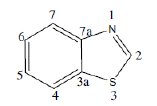
acid medium. Benzothiazole consists of a 5-membered-1,3-thiazole ring fused to 
a benzene ring. The atoms of the bicycle and the attached substituents are 
coplanar,</p>

    <p>&nbsp;</p>
<img src="/img/revistas/pea/v30n2/30n2a02s1.jpg">
    
<p>&nbsp;</p>

    <p>This heterocyclic scaffold can be readily substituted at the unique methyne centre 
in the thiaozle ring. It is thermally stable and has numerous applications in dyes 
such as thioflavin. Some drugs contain this group, eg. riluzole. A derivative of 
benzothiazole is the light emitting component of luciferin in fireflies.</p>

    <p>The benzothiazole ring is a potential component in non-linear optics [1]. Many 
benzothiazole derivatives have been used as photostabilisers and metal 
complexing agents [2] and are non-toxic. Singh et al., [3] have reported that urea 
and thiourea derivatives are potential corrosion inhibitors. Therefore it is thought 
worth while to combine the two moieties viz, benzothiazole and thiourea/urea to 
get some novel, potential corrosion inhibitors for metals.</p>

    <p>The aim of this work is to study the influence on the corrosion inhibition of mild 
steel in acid solutions of benzothiazole derivatives, which possess sulphur and 
nitrogen atoms in the heterocyclic structure. Weight loss measurements, effect of 
temperature, potentiodynamic polarization, and AC-impedance studies were 
carried out to evaluate the mechanism of corrosion inhibition. Synergistic effect 
of halide ions has also been studied.</p>


    <p>&nbsp;</p>
    ]]></body>
<body><![CDATA[<p><b>Experimental</b></p>

    <p>Mild steel strips with the composition C = 0.084%, Mn = 0.369%, Si = 0.129%, 
P = 0.025%, S = 0.027%, Cr = 0.022%, Mo = 0.011%, Ni = 0.013%, Fe = Rest% and size 
of 3&times;1&times;0.05 cm were used for weight loss studies. The electrode was polished 
using a sequence of emery papers of different grades and then degreased with 
acetone. 1,3-benzothiazol-2-amine was synthesized by reported method [4] and 
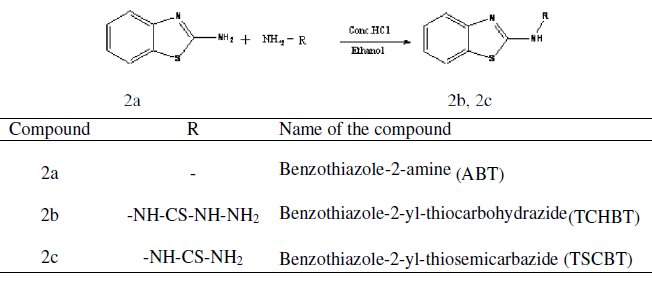
purified by recrystalization. 2-substituted benzothiazole derivatives (2b,2c) were 
prepared by refluxing 1,3-benzothiazol-2-amine with hydrazine derivatives in 
presence of hydrochloric acid in ethanol for 2 hours. The fine crystalline solid 
was washed with water and recrystallised from ethanol.</p>

    <p>&nbsp;</p>
<img src="/img/revistas/pea/v30n2/30n2a02s2.jpg">
    
<p>&nbsp;</p>

    <p>The synthesized compounds were characterized by IR spectroscopy. The acid 
solution (1 M H<sub>2</sub>SO<sub>4</sub>) was prepared by dilution of analytical grade H<sub>2</sub>SO<sub>4</sub> with 
distilled water. Mild steel specimens weighed previously were suspended in 100 
mL of inhibited and uninhibited acid solutions for 3 hours. At the end of the 
period, specimens were taken out, well washed with running water, dried and 
finally weighed. Inhibition efficiency was calculated from the weight losses of 
specimens in the absence and presence of the inhibitor. The loss in weight was 
calculated at different temperatures from 303-333 K.</p>

    <p>The electrochemical studies were carried out using a three electrode cell 
assembly at room temperature. Mild steel rod embedded in Teflon with exposed 
bottom area of 0.785 cm<sup>2</sup> was used for electrochemical measurements. Platinum 
was used as counter electrode and saturated calomel electrode as reference 
electrode. The electrochemical measurements were carried out using a 
PARSTAT Electrochemical Analyser Model (2273). The impedance 
measurements were carried out in the frequency range of 10 KHz to 0.01Hz with 
signal amplitude of 10 mV. The double layer capacitance (C<sub>dl</sub>) and charge 
transfer resistance (R<sub>ct</sub>) were obtained from Nyquist plots. The Tafel polarization 
measurements were made after EIS for a potential range of -200 mV to +200 mV 
with respect to open circuit potential at a scan rate of 1 mV/sec.; the I<sub>corr</sub>, E<sub>corr</sub>, 
Tafel slopes ba and bc were obtained from the Tafel plots.</p>


    <p>&nbsp;</p>
    <p><b>Results and discussion</b></p>

    <p><b><i>Weight loss measurements</i></b></p>

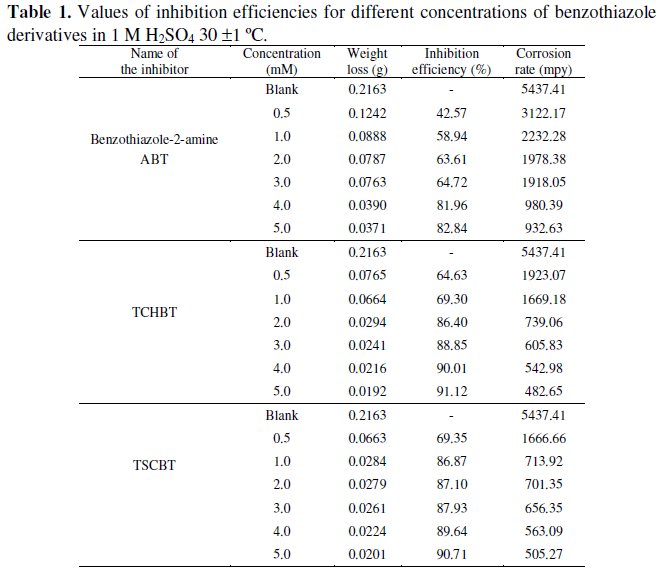
    <p>Table 1 gives the values of inhibition efficiency for different concentration of 
benzothiazole derivatives in 1 M H<sub>2</sub>SO<sub>4</sub>.</p>

    ]]></body>
<body><![CDATA[<p>&nbsp;</p>
<img src="/img/revistas/pea/v30n2/30n2a02t1.jpg">
    
<p>&nbsp;</p>

    <p>It can be seen from the table that 
benzothiazole derivatives efficiently inhibit the corrosion of mild steel in 1 M 
H<sub>2</sub>SO<sub>4</sub> solution. This is due to the presence of heteroatoms like sulphur and 
nitrogen. Weight loss measurements revealed that corrosion inhibition efficiency 
of the benzothiazole derivatives increases on increasing the concentration.</p>


    <p><b><i>Influence of temperature and thermodynamic parameters</i></b></p>

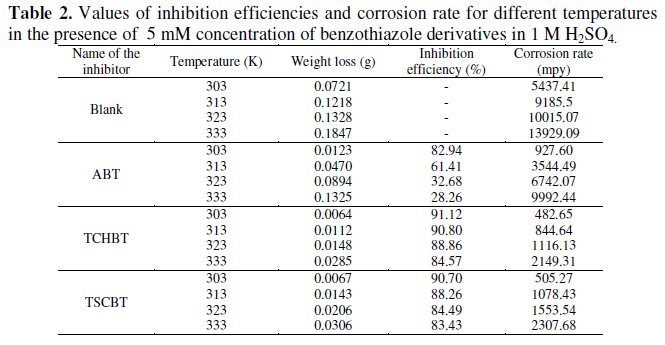
    <p>Table 2 gives the inhibition efficiency values obtained by weight loss method at 
various temperatures.</p>

    <p>&nbsp;</p>
<img src="/img/revistas/pea/v30n2/30n2a02t2.jpg">
    
<p>&nbsp;</p>

    <p>It is evident that inhibition efficiency decreases with 
temperature. But with TCHBT and TSCBT the inhibition efficiency does not fall 
much and they display about 80% efficiency even at 333 K. For the present set of 
compounds the decrease in inhibition efficiency may be attributed to desorption 
and dissolution of inhibitors in the aggressive medium. Higher inhibition 
efficiency of sulphur compound is due to the strong affinity of these compounds 
for transition metal surfaces and their limited solubility in the acid solution at 
higher temperature.</p>

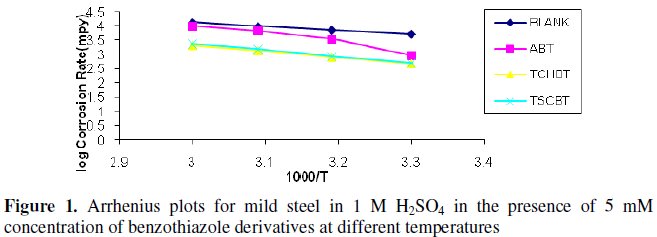
    <p>The Arrhenius plots for the corrosion rate of mild steel with and without the 
inhibitors in 1 M H<sub>2</sub>SO<sub>4</sub> are shown in Fig. 1.</p>


    <p>&nbsp;</p>
<img src="/img/revistas/pea/v30n2/30n2a02f1.jpg">
    
]]></body>
<body><![CDATA[<p>&nbsp;</p>


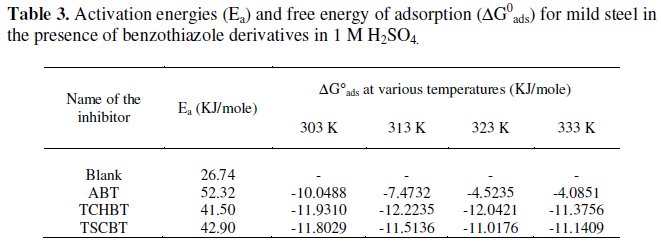
    <p>The E<sub>a</sub> values (calculated using Arrhenius plots) for the inhibited solutions are 
higher than those for uninhibited solution indicating that the corrosion reaction of 
mild steel is retarded by the benzothiazole derivatives. The free energy of 
adsorption process &Delta;G<sup>0</sup> values were calculated using the standard equation [5]. 
The results are given in Table 3.</p>

    <p>&nbsp;</p>
<img src="/img/revistas/pea/v30n2/30n2a02t3.jpg">
    
<p>&nbsp;</p>

    <p>It was found that the &Delta;G<sup>0</sup> value is less than -20 kJ/mol, indicating that the 
benzothiazole derivatives are physically adsorbed on the metal surface [6]. The 
negative value of &Delta;G<sup>0</sup> shows a strong interaction of inhibitor molecules and 
spontaneous adsorption of inhibitors on the surface of the mild steel.</p>


    <p><b><i>EIS measurements</i></b></p>

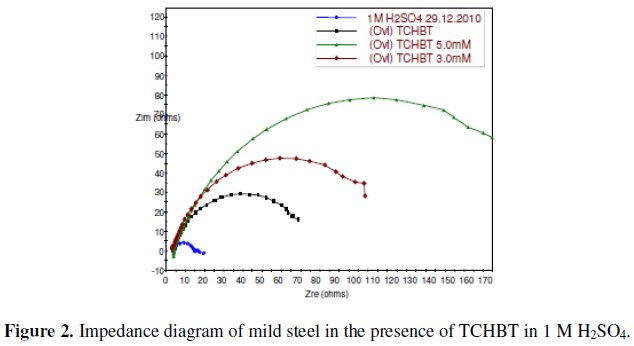
    <p>The corrosion behavior of mild steel in 1 M H<sub>2</sub>SO<sub>4</sub> in the absence and presence 
of various concentrations of the inhibitors was investigated by EIS technique. 
The Nyquist plot for TCHBT is shown in Fig. 2.</p>


    <p>&nbsp;</p>
<img src="/img/revistas/pea/v30n2/30n2a02f2.jpg">
    
<p>&nbsp;</p>


    <p>The existence of a single 
semicircle in each plots shows that there was only a single charge transfer 
process controlling the corrosion. As can be seen from the figure the Nyquist 
plots are not perfect semicircles as expected from the theory of EIS and the 
difference can be explained as reported by Ozcan et al. [7]. In corrosion system 
the double layer formed at metal/solution interface can be represented by the 
electronic equivalent circuit diagram. The double layer is accepted to be 
equivalent to a condenser of capacity C. The electronic circuits which are 
especially designed that fit the equivalent circuit models yield perfect 
semicircular Nyquist plots and on these cells charge distribution is controlled by 
electrons. On the other hand, the Nyquist plots obtained for the corroding metal 
solution interface, charge distribution is controlled by electrons on the metal side 
and by ions on the solution side. Since ions are much larger than electrons, the 
equivalent ions to the charge on the metal will occupy quite a large volume on 
the solution side.</p>

    ]]></body>
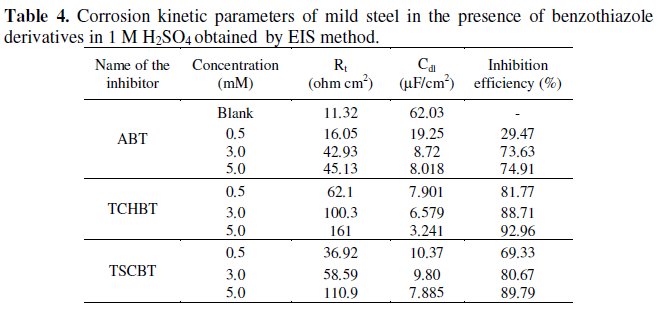
<body><![CDATA[<p>The impedance parameters such as R<sub>t</sub> and C<sub>dl</sub> are given in Table 4.</p>

    <p>&nbsp;</p>
<img src="/img/revistas/pea/v30n2/30n2a02t4.jpg">
    
<p>&nbsp;</p>

    <p>R<sub>t</sub> value increases with concentration of the inhibitor. C<sub>dl</sub> value decreases with addition of 
inhibitor. Decreases in C<sub>dl</sub> are attributed to an increase in thickness of the 
electrical double layer with increase in concentration of the inhibitor.</p>


    <p><b><i>Tafel polarization</i></b></p>

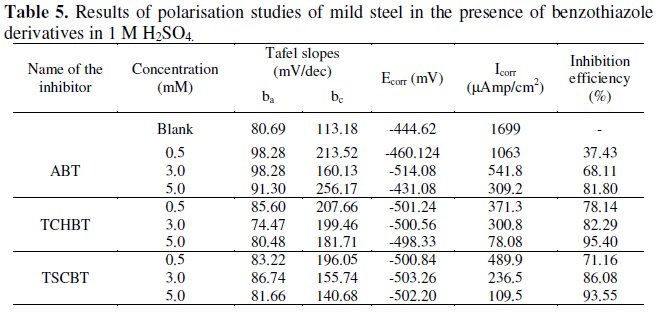
    <p>The electrochemical parameters for the corrosion of the experimental mild steel 
in 1 M H<sub>2</sub>SO<sub>4</sub> containing the benzothiazole derivatives in various concentrations 
are given in Table 5.</p>

    <p>&nbsp;</p>
<img src="/img/revistas/pea/v30n2/30n2a02t5.jpg">
    
<p>&nbsp;</p>

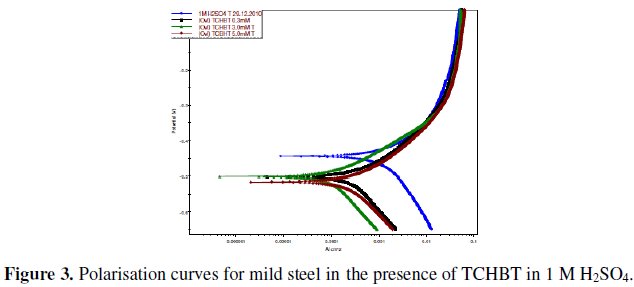
    <p>Shifting of corrosion potential E<sub>corr</sub> towards more negative 
side indicated that these inhibitors act on the cathodic sites. Potentiodynamic 
polarization curves for the inhibitor TCHBT are given in Fig. 3, which reveals 
the shifting of I<sub>corr</sub> to lower current at higher concentration level (5mM), 
indicating more adsorption of the inhibitors and better inhibition performance.</p>


    <p>&nbsp;</p>
<img src="/img/revistas/pea/v30n2/30n2a02f3.jpg">
    
]]></body>
<body><![CDATA[<p>&nbsp;</p>


    <p>Analysis of the values of Tafel slopes (&beta;<sub>a</sub> and &beta;<sub>c</sub>) shows that there is significant 
increase in the values of cathodic Tafel slopes &beta;<sub>c</sub>, which indicates that these 
compounds are mixed type inhibitors, predominantly under cathodic control.</p>

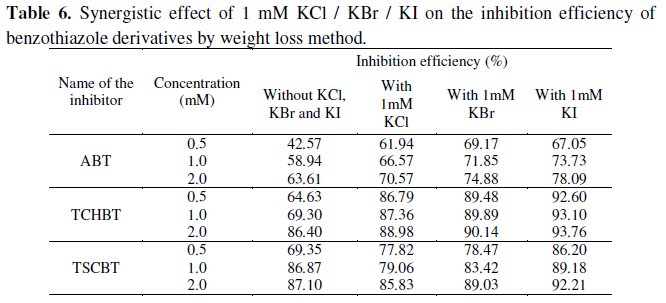
    <p>The benzothiazole compounds reported in this work have 40-70% inhibition 
efficiency at 0.5 mM concentration. In order to enhance the inhibition efficiency 
at lower concentration, KCl, KBr, KI (1 mM) were added and the performance 
was evaluated by weight loss technique. The results are given in Table 6 which 
reveals that the inhibition efficiency of the benzothiazoles increased by about 20-25% 
on the addition of all the three halides.</p>

    <p>&nbsp;</p>
<img src="/img/revistas/pea/v30n2/30n2a02t6.jpg">
    
<p>&nbsp;</p>

    <p>This behavior is attributed to the 
synergistic effect between added halide ions and the benzothiazoles. This 
synergistic effect may be due to co-adsorption of halide ions and the inhibitors 
which may be either competitive or co-operative. In competitive adsorption, the 
cation and anion are adsorbed at different sites on the surface. In co-operative 
adsorption, the anion is chemisorbed on the surface and the cation is adsorbed on 
a layer of the anion. Hence a close packed triple layer will form on the metal 
surface and inhibits the entry of iron ions to the solution. The benzothiazoles 
containing 'N' atoms are readily protonated in aqueous acid medium. Since iron 
is positively charged in H<sub>2</sub>SO<sub>4</sub> solution, the adsorption of protonated inhibitors is 
less. Hence in the absence of halide ions the benzothiazoles are adsorbed on the 
surface through their delocalized &pi;-electrons, resulting in moderate inhibition 
efficiency. When halide ions are added, they are chemisorbed on the surface 
forming oriented dipoles with the negative end towards solution, thus increasing 
the adsorption of cationic inhibitors. The synergism is thus co-operative.</p>

    <p>The synergism of halide ions with the benzothiazoles is found to be in the order I<sup>-</sup> > 
Cl<sup>-</sup> > Br<sup>-</sup>. The reason for better synergism with I<sup>-</sup> ions may be due to the large 
size and ease of polarizability of I<sup>-</sup> ions which facilitates electron pair bonding 
with iron surface [8].</p>

    <p>Comparison of IE of the compounds by all the techniques shows the following 
order:</p>

    <p>&nbsp;</p>
<img src="/img/revistas/pea/v30n2/30n2a02s3.jpg">
    
<p>&nbsp;</p>

    ]]></body>
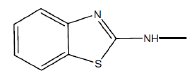
<body><![CDATA[<p>All the compounds have,</p>

    <p>&nbsp;</p>
<img src="/img/revistas/pea/v30n2/30n2a02s4.jpg">
    
<p>&nbsp;</p>

    <p>as common moiety. The variation in IE could therefore be due to the groups 
attached to the NH-nitrogen.</p>

    <p>The parent benzothiazole ABT shows 82% efficiency (weight loss method). 
The thiocarbonyl derivatives TCHBT and TSCBT display excellent inhibition 
properties even at low concentration. It has been considered that in thio 
compounds, the active centre is the S atom even if nitrogen atoms are present. 
Adsorption through sulphur could be predicted on the basis of 'Hard and Soft 
Acid Base' principle. The metal surface having Fe<sup>0</sup> is a soft acid and S 
compounds are soft bases. An electrostatic attraction leading to a type of bonding 
occurs between Fe<sup>0</sup> and S compound and is more favorable than the bonding 
between soft acid Fe<sup>0</sup> and hard bases such as O and N centres.</p>

    <p>According to Hoar and Holliday [9] the adsorption of an inhibitor on the surface 
will induce a partial negative charge at the point of attraction. There are two main 
ways by which the intensity of negative charge on the metal atom can be 
reduced: (i) back donation to sulphur atom, (ii) redistribution of charge at some 
cathodic sites. Donnelly et al. [10] have attributed the higher inhibition efficiency 
of S compounds to be due to presence of 'd' orbitals of symmetry compatible 
with some of the 'd' orbitals of metal atoms; overlapping occurs forming a partial 
d<sub>&pi;</sub>-d<sub>&pi;</sub> bond decreasing the residual positive charge on S and negative charge on 
Fe and strengthening the original electrostatic bond. Similar explanations can be 
given for the higher inhibition efficiency of TCHBT.</p>

    <p>In TCHBT C=S group acts as additional anchoring site for adsorption leading to 
stronger bond with metal surface and greater inhibiton.</p>

    <p>These facts were also supported by the reports of Ozcan et al. [11] based on 
quantum chemical calculations. According to them, the highest value of the 
HOMO density were found in the vicinity of the sulphur atom, clearly indicating 
that the nucleophilic centre is 'S' atom. Thus the bond with metal and S will be 
easily formed rather than with N or C atoms.</p>


    <p>&nbsp;</p>
    <p><b>Conclusion</b></p>

    ]]></body>
<body><![CDATA[<p>Benzothiazole derivatives have been found to be good inhibitors for mild steel 
corrosion in sulphuric acid media. Inhibition efficiency varies linearly with 
concentration. The optimum concentration of the inhibitor is 5 mM. The 
inhibitors act predominantly as cathodic type. The results obtained from weight 
loss, polarization and EIS methods match one another. The inhibitors obey 
Langmuir adsorption isotherm.</p>


    <p>&nbsp;</p>
    <p><b>References</b></p>

    <p>1. P. Hrobarik, I. Sigmundova, P. Zahradnik et all, J.Phys. Chem. C 114 (2010) 22289.</p>
    <!-- ref --><p>2. E. Yousif, H. Adil, Y. Farina, J. Appl. Sci. Research 6 (2010) 879.    &nbsp;&nbsp;&nbsp;&nbsp;&nbsp;&nbsp;&nbsp;&nbsp;[&#160;<a href="javascript:void(0);" onclick="javascript: window.open('/scielo.php?script=sci_nlinks&ref=000087&pid=S0872-1904201200020000200002&lng=','','width=640,height=500,resizable=yes,scrollbars=1,menubar=yes,');">Links</a>&#160;]<!-- end-ref --></p>
    <!-- ref --><p>3. A. Gupta, M.M. Singh, Port. Electrochim. Acta 17 (1999) 21.    &nbsp;&nbsp;&nbsp;&nbsp;&nbsp;&nbsp;&nbsp;&nbsp;[&#160;<a href="javascript:void(0);" onclick="javascript: window.open('/scielo.php?script=sci_nlinks&ref=000089&pid=S0872-1904201200020000200003&lng=','','width=640,height=500,resizable=yes,scrollbars=1,menubar=yes,');">Links</a>&#160;]<!-- end-ref --></p>
    <p>4. V. Kumar, R.K. Roy, V. Kumar et all, J. Ind. Chem. Soc. 85 (2003) 333.</p>
    <p>5. A. Yurt, A. Balaban, S.U. Kandemir et all, Mat. Chem. Phy. 85 (2004) 420.</p>
    ]]></body>
<body><![CDATA[<!-- ref --><p>6. A.K. Singh, M.A. Quraishi, Corros. Sci. 52 (2010) 1529.    &nbsp;&nbsp;&nbsp;&nbsp;&nbsp;&nbsp;&nbsp;&nbsp;[&#160;<a href="javascript:void(0);" onclick="javascript: window.open('/scielo.php?script=sci_nlinks&ref=000093&pid=S0872-1904201200020000200006&lng=','','width=640,height=500,resizable=yes,scrollbars=1,menubar=yes,');">Links</a>&#160;]<!-- end-ref --></p>
    <!-- ref --><p>7. M. Ozcan, I. Dehri, M. Erbil, Appl. Surf. Sci. 236 (2004) 155.    &nbsp;&nbsp;&nbsp;&nbsp;&nbsp;&nbsp;&nbsp;&nbsp;[&#160;<a href="javascript:void(0);" onclick="javascript: window.open('/scielo.php?script=sci_nlinks&ref=000095&pid=S0872-1904201200020000200007&lng=','','width=640,height=500,resizable=yes,scrollbars=1,menubar=yes,');">Links</a>&#160;]<!-- end-ref --></p>
    <!-- ref --><p>8. C. Jeyaprabha, S. Sathiyanarayanan, G. Venkatachari, Electrochimica Acta 5 (2006) 4080.    &nbsp;&nbsp;&nbsp;&nbsp;&nbsp;&nbsp;&nbsp;&nbsp;[&#160;<a href="javascript:void(0);" onclick="javascript: window.open('/scielo.php?script=sci_nlinks&ref=000097&pid=S0872-1904201200020000200008&lng=','','width=640,height=500,resizable=yes,scrollbars=1,menubar=yes,');">Links</a>&#160;]<!-- end-ref --></p>
    <!-- ref --><p>9. T.P. Hoar, R.D. Holliday, J. Appl. Chem. 3 (1953) 502.    &nbsp;&nbsp;&nbsp;&nbsp;&nbsp;&nbsp;&nbsp;&nbsp;[&#160;<a href="javascript:void(0);" onclick="javascript: window.open('/scielo.php?script=sci_nlinks&ref=000099&pid=S0872-1904201200020000200009&lng=','','width=640,height=500,resizable=yes,scrollbars=1,menubar=yes,');">Links</a>&#160;]<!-- end-ref --></p>
    <!-- ref --><p>10. B. Donnelly, T.C. Downie, R. Grzeskowiak, Corros. Sci. 14 (1974) 597.    &nbsp;&nbsp;&nbsp;&nbsp;&nbsp;&nbsp;&nbsp;&nbsp;[&#160;<a href="javascript:void(0);" onclick="javascript: window.open('/scielo.php?script=sci_nlinks&ref=000101&pid=S0872-1904201200020000200010&lng=','','width=640,height=500,resizable=yes,scrollbars=1,menubar=yes,');">Links</a>&#160;]<!-- end-ref --></p>
    ]]></body>
<body><![CDATA[<!-- ref --><p>11. M. Ozcan, I. Dehri, Prog. Org. Coatings 51 (2004) 181.    &nbsp;&nbsp;&nbsp;&nbsp;&nbsp;&nbsp;&nbsp;&nbsp;[&#160;<a href="javascript:void(0);" onclick="javascript: window.open('/scielo.php?script=sci_nlinks&ref=000103&pid=S0872-1904201200020000200011&lng=','','width=640,height=500,resizable=yes,scrollbars=1,menubar=yes,');">Links</a>&#160;]<!-- end-ref --></p>


    <p>&nbsp;</p>

    <p><a name=0><sup><a href="#top">*</sup></a>Corresponding author. E-mail address: <a href="mailto:parampps@yahoo.co.in">parampps@yahoo.co.in</a></p>

    <p>Received 2 February 2012; accepted 30 April 2012</p>

    <p><a href="http://www.peacta.org" target="_blank">www.peacta.org</a> </p>


     ]]></body><back>
<ref-list>
<ref id="B1">
<label>1</label><nlm-citation citation-type="journal">
<person-group person-group-type="author">
<name>
<surname><![CDATA[Hrobarik]]></surname>
<given-names><![CDATA[P.]]></given-names>
</name>
<name>
<surname><![CDATA[Sigmundova]]></surname>
<given-names><![CDATA[I.]]></given-names>
</name>
</person-group>
<source><![CDATA[J. Phys. Chem. C]]></source>
<year>2010</year>
<volume>114</volume>
<page-range>22289</page-range></nlm-citation>
</ref>
<ref id="B2">
<label>2</label><nlm-citation citation-type="journal">
<person-group person-group-type="author">
<name>
<surname><![CDATA[Yousif]]></surname>
<given-names><![CDATA[E.]]></given-names>
</name>
<name>
<surname><![CDATA[Adil]]></surname>
<given-names><![CDATA[H.]]></given-names>
</name>
<name>
<surname><![CDATA[Farina]]></surname>
<given-names><![CDATA[Y.]]></given-names>
</name>
</person-group>
<source><![CDATA[J. Appl. Sci. Research]]></source>
<year>2010</year>
<volume>6</volume>
<page-range>879</page-range></nlm-citation>
</ref>
<ref id="B3">
<label>3</label><nlm-citation citation-type="journal">
<person-group person-group-type="author">
<name>
<surname><![CDATA[Gupta]]></surname>
<given-names><![CDATA[A.]]></given-names>
</name>
<name>
<surname><![CDATA[Singh]]></surname>
<given-names><![CDATA[M.M.]]></given-names>
</name>
</person-group>
<source><![CDATA[Port. Electrochim. Acta]]></source>
<year>1999</year>
<volume>17</volume>
<page-range>21</page-range></nlm-citation>
</ref>
<ref id="B4">
<label>4</label><nlm-citation citation-type="journal">
<person-group person-group-type="author">
<name>
<surname><![CDATA[Kumar]]></surname>
<given-names><![CDATA[V.]]></given-names>
</name>
<name>
<surname><![CDATA[Roy]]></surname>
<given-names><![CDATA[R.K.]]></given-names>
</name>
</person-group>
<source><![CDATA[J. Ind. Chem. Soc.]]></source>
<year>2003</year>
<volume>85</volume>
<page-range>333</page-range></nlm-citation>
</ref>
<ref id="B5">
<label>5</label><nlm-citation citation-type="journal">
<person-group person-group-type="author">
<name>
<surname><![CDATA[Yurt]]></surname>
<given-names><![CDATA[A.]]></given-names>
</name>
<name>
<surname><![CDATA[Balaban]]></surname>
<given-names><![CDATA[A.]]></given-names>
</name>
</person-group>
<source><![CDATA[Mat. Chem. Phy.]]></source>
<year>2004</year>
<volume>85</volume>
<page-range>420</page-range></nlm-citation>
</ref>
<ref id="B6">
<label>6</label><nlm-citation citation-type="journal">
<person-group person-group-type="author">
<name>
<surname><![CDATA[Singh]]></surname>
<given-names><![CDATA[A.K.]]></given-names>
</name>
<name>
<surname><![CDATA[Quraishi]]></surname>
<given-names><![CDATA[M.A.]]></given-names>
</name>
</person-group>
<source><![CDATA[Corros. Sci.]]></source>
<year>2010</year>
<volume>52</volume>
<page-range>1529</page-range></nlm-citation>
</ref>
<ref id="B7">
<label>7</label><nlm-citation citation-type="journal">
<person-group person-group-type="author">
<name>
<surname><![CDATA[Ozcan]]></surname>
<given-names><![CDATA[M.]]></given-names>
</name>
<name>
<surname><![CDATA[Dehri]]></surname>
<given-names><![CDATA[I.]]></given-names>
</name>
<name>
<surname><![CDATA[Erbil]]></surname>
<given-names><![CDATA[M.]]></given-names>
</name>
</person-group>
<source><![CDATA[Appl. Surf. Sci.]]></source>
<year>2004</year>
<volume>236</volume>
<page-range>155</page-range></nlm-citation>
</ref>
<ref id="B8">
<label>8</label><nlm-citation citation-type="journal">
<person-group person-group-type="author">
<name>
<surname><![CDATA[Jeyaprabha]]></surname>
<given-names><![CDATA[C.]]></given-names>
</name>
<name>
<surname><![CDATA[Sathiyanarayanan]]></surname>
<given-names><![CDATA[S.]]></given-names>
</name>
<name>
<surname><![CDATA[Venkatachari]]></surname>
<given-names><![CDATA[G.]]></given-names>
</name>
</person-group>
<source><![CDATA[Electrochimica Acta]]></source>
<year>2006</year>
<volume>5</volume>
<page-range>4080</page-range></nlm-citation>
</ref>
<ref id="B9">
<label>9</label><nlm-citation citation-type="journal">
<person-group person-group-type="author">
<name>
<surname><![CDATA[Hoar]]></surname>
<given-names><![CDATA[T.P.]]></given-names>
</name>
<name>
<surname><![CDATA[Holliday]]></surname>
<given-names><![CDATA[R.D.]]></given-names>
</name>
</person-group>
<source><![CDATA[J. Appl. Chem.]]></source>
<year>1953</year>
<volume>3</volume>
<page-range>502</page-range></nlm-citation>
</ref>
<ref id="B10">
<label>10</label><nlm-citation citation-type="journal">
<person-group person-group-type="author">
<name>
<surname><![CDATA[Donnelly]]></surname>
<given-names><![CDATA[B.]]></given-names>
</name>
<name>
<surname><![CDATA[Downie]]></surname>
<given-names><![CDATA[T.C.]]></given-names>
</name>
<name>
<surname><![CDATA[Grzeskowiak]]></surname>
<given-names><![CDATA[R.]]></given-names>
</name>
</person-group>
<source><![CDATA[Corros. Sci.]]></source>
<year>1974</year>
<volume>14</volume>
<page-range>597</page-range></nlm-citation>
</ref>
<ref id="B11">
<label>11</label><nlm-citation citation-type="journal">
<person-group person-group-type="author">
<name>
<surname><![CDATA[Ozcan]]></surname>
<given-names><![CDATA[M.]]></given-names>
</name>
<name>
<surname><![CDATA[Dehri]]></surname>
<given-names><![CDATA[I.]]></given-names>
</name>
</person-group>
<source><![CDATA[Prog. Org. Coatings]]></source>
<year>2004</year>
<volume>51</volume>
<page-range>181</page-range></nlm-citation>
</ref>
</ref-list>
</back>
</article>