<?xml version="1.0" encoding="ISO-8859-1"?><article xmlns:mml="http://www.w3.org/1998/Math/MathML" xmlns:xlink="http://www.w3.org/1999/xlink" xmlns:xsi="http://www.w3.org/2001/XMLSchema-instance">
<front>
<journal-meta>
<journal-id>0872-1904</journal-id>
<journal-title><![CDATA[Portugaliae Electrochimica Acta]]></journal-title>
<abbrev-journal-title><![CDATA[Port. Electrochim. Acta]]></abbrev-journal-title>
<issn>0872-1904</issn>
<publisher>
<publisher-name><![CDATA[Sociedade Portuguesa de Electroquímica]]></publisher-name>
</publisher>
</journal-meta>
<article-meta>
<article-id>S0872-19042012000300001</article-id>
<article-id pub-id-type="doi">10.4152/pea.201203145</article-id>
<title-group>
<article-title xml:lang="en"><![CDATA[Behavior of Electrogalvanized Steel Pre-Treated with Cr(III)-Based Baths and Exposed to 0.5 M Na2SO4 Solution]]></article-title>
</title-group>
<contrib-group>
<contrib contrib-type="author">
<name>
<surname><![CDATA[Tomachuk]]></surname>
<given-names><![CDATA[C.R.]]></given-names>
</name>
<xref ref-type="aff" rid="A01"/>
</contrib>
<contrib contrib-type="author">
<name>
<surname><![CDATA[Elsner]]></surname>
<given-names><![CDATA[C.I.]]></given-names>
</name>
<xref ref-type="aff" rid="A02"/>
</contrib>
<contrib contrib-type="author">
<name>
<surname><![CDATA[Di Sarli]]></surname>
<given-names><![CDATA[A.R.]]></given-names>
</name>
<xref ref-type="aff" rid="A03"/>
</contrib>
</contrib-group>
<aff id="A01">
<institution><![CDATA[,CCTM IPEN/CNEN-SP Energy and Nuclear Research Institute]]></institution>
<addr-line><![CDATA[São Paulo SP]]></addr-line>
<country>Brazil</country>
</aff>
<aff id="A02">
<institution><![CDATA[,CCT CONICET LA PLATA CICPBA Research and Development Centre in Paint Technology]]></institution>
<addr-line><![CDATA[La Plata ]]></addr-line>
<country>Argentina</country>
</aff>
<aff id="A03">
<institution><![CDATA[,National University of La Plata Engineering School ]]></institution>
<addr-line><![CDATA[La Plata ]]></addr-line>
<country>Argentina</country>
</aff>
<pub-date pub-type="pub">
<day>00</day>
<month>05</month>
<year>2012</year>
</pub-date>
<pub-date pub-type="epub">
<day>00</day>
<month>05</month>
<year>2012</year>
</pub-date>
<volume>30</volume>
<numero>3</numero>
<fpage>145</fpage>
<lpage>162</lpage>
<copyright-statement/>
<copyright-year/>
<self-uri xlink:href="http://scielo.pt/scielo.php?script=sci_arttext&amp;pid=S0872-19042012000300001&amp;lng=en&amp;nrm=iso"></self-uri><self-uri xlink:href="http://scielo.pt/scielo.php?script=sci_abstract&amp;pid=S0872-19042012000300001&amp;lng=en&amp;nrm=iso"></self-uri><self-uri xlink:href="http://scielo.pt/scielo.php?script=sci_pdf&amp;pid=S0872-19042012000300001&amp;lng=en&amp;nrm=iso"></self-uri><abstract abstract-type="short" xml:lang="en"><p><![CDATA[As Cr (VI) compounds used to formulate conversion layers provide enhanced anticorrosive protection to zinc coatings, but they are produced using hazardous chemicals, the development of ''green'' technologies is a paramount purpose. Consequently, the corrosion behavior of zinc coatings subjected to a Cr3+ based passivating treatment, with and without sealing, was studied through EIS measurements in 0.5 M Na2SO4 solution. The analyses of the experimental data allowed inferring that the Cr3+-based conversion treatment with an adequate sealer provides good corrosion resistance and, coupled to an adequate painting system, could be a suitable alternative to traditional chromate coatings.]]></p></abstract>
<kwd-group>
<kwd lng="en"><![CDATA[corrosion]]></kwd>
<kwd lng="en"><![CDATA[trivalent chromium]]></kwd>
<kwd lng="en"><![CDATA[conversion layer]]></kwd>
<kwd lng="en"><![CDATA[sealing treatment]]></kwd>
<kwd lng="en"><![CDATA[electrogalvanized steel]]></kwd>
</kwd-group>
</article-meta>
</front><body><![CDATA[ 

    <p><b>Behavior of Electrogalvanized Steel Pre-Treated with Cr(III)-Based Baths and Exposed to 0.5 M Na<sub>2</sub>SO<sub>4</sub> Solution</b></p>

    <p><b>C.R. Tomachuk<sup>1</sup>, C.I. Elsner<sup>2,3</sup> and A.R. Di Sarli<sup>3,<a href="#0">*<a/></sup></b></p>

    <p><sup>1</sup><i> Energy and Nuclear Research Institute, IPEN/CNEN-SP, CCTM, Av. Prof. Lineu Prestes, 2242, CEP 05508-000, S&atilde;o Paulo, SP, Brazil.</i></p>

    <p><sup>2</sup><i> CIDEPINT: Research and Development Centre in Paint Technology (CICPBA-CCT CONICET LA PLATA); Av. 52 s/n entre 121 y 122. CP. B1900AYB, La Plata-Argentina</i></p>

    <p><sup>3</sup><i> Engineering School, National University of La Plata, Av. 1 esq. 47. CP. B1900TAG, La Plata-Argentina.</i></p>


<!--     <p>&nbsp;</p>
    <p>doi: 10.4152/pea.201203145</p> -->


    <p>&nbsp;</p>
    <p><b>Abstract</b></p>

    ]]></body>
<body><![CDATA[<p>As Cr (VI) compounds used to formulate conversion layers provide enhanced 
anticorrosive protection to zinc coatings, but they are produced using hazardous 
chemicals, the development of ''green'' technologies is a paramount purpose. 
Consequently, the corrosion behavior of zinc coatings subjected to a Cr<sup>3+</sup> based 
passivating treatment, with and without sealing, was studied through EIS measurements 
in 0.5 M Na<sub>2</sub>SO<sub>4</sub> solution. The analyses of the experimental data allowed inferring that 
the Cr<sup>3+</sup>-based conversion treatment with an adequate sealer provides good corrosion 
resistance and, coupled to an adequate painting system, could be a suitable alternative to 
traditional chromate coatings.</p>

    <p><b><i>Keywords:</i></b> corrosion, trivalent chromium, conversion layer, sealing treatment, electrogalvanized steel.</p>


    <p>&nbsp;</p>
    <p><b>Introduction</b></p>

    <p>The corrosion of galvanized steel is one of the major problems in industry. The 
material could become more resistant to corrosion if a protective conversion 
coating is applied on top of the zinc layer. The term ''conversion coating'', as 
used in the metal-finishing industry, refers to the conversion of a metal surface 
into a surface that will more easily accept applied coatings and/or provide a more 
corrosion resistant surface [1]. Conversion coatings for zinc have been in use 
since the early 1920's and there are a number of different products on the market 
[2]. The chromatation layer is one of the most important of these products, 
performing both as an anodic inhibitor, forming a passive layer lowering the zinc 
dissolution rate and, as an efficient cathodic inhibitor, lowering the rate of the 
oxygen reduction reaction on the metal surface and avoiding the formation of 
blisters in painted surfaces [3].</p>

    <p>Responding to increasingly more rigorous environmental protection activities, 
recent years have shown progressive advances in order to reduce the use of 
environmentally-hazardous materials. In line with this purpose, the development 
of various kinds of chromate-free coated steel sheets, to be used in industries 
such as food, automotive, appliances, etc., is being extensively explored all over 
the world. In this sense, the most common transitional alternative to Cr<sup>6+</sup> is Cr<sup>3+</sup>, 
which is used since the mid 1970's [4-8]. The first-generation of trivalent chrome 
conversion processes was based on fairly stable Cr<sup>3+</sup> complexes, which slowed 
their reactivity rates even at high temperatures. They produced film thicknesses 
of 20 to 30 nm with limited corrosion resistance. To produce thicker passivating 
layers, a second-generation of trivalent passivating process was developed. It 
incorporates accelerators, modified complexes, and is operated at higher 
concentration and temperature to drive the reaction kinetics to a faster rate. When 
applied as recommended, film thicknesses of 300 to 380 nm, i.e. equivalent to 
those produced from yellow Cr<sup>6+</sup> passivating solutions, were obtained. The film 
in this case consists of an insoluble barrier layer free of hexavalent chrome. 
The main advantage of Cr<sup>3+</sup> plating baths is that these ions are non-toxic and, 
therefore, environmentally benign alternatives. However, their corrosion 
resistance is generally less than that of the Cr<sup>6+</sup> [10-12]. Consequently, many 
recent studies have focused on improving the corrosion resistance of the Cr<sup>3+</sup> based 
conversion layers, subjecting them to a sealing treatment. Bellezze et al. 
[10] reported that the corrosion resistance of the Cr<sup>3+</sup> layer increased 
dramatically with a Si based sealing treatment, making it equivalent to that of the 
Cr<sup>6+</sup>-based conversion layer. According to Fonte et al. [13], the Cr<sup>3+</sup> conversion 
layer formed in a bath containing transition metal ions such us Co<sup>2+</sup>, Ni<sup>2+</sup> and 
Fe<sup>2+</sup> showed higher corrosion resistance than those formed in absence of them. 
This finding was confirmed by Tomachuk et al. [14, 15].</p>

    <p>Concerning the formation of the protective layer on zinc, it was demonstrated 
that the passive layer contains Zn (II) and Cr (III) oxides/hydroxides [16]. 
Nevertheless, other authors [3] stated that the chromate layer does not contain a 
significant amount of zinc, it is permeable to zinc dissolution and its main 
component is Cr(OH)<sub>3</sub>.2H<sub>2</sub>O.</p>

    <p>Taking into account that the requirements for Cr(IV)-free coatings on 
electrogalvanized steel sheets are high due to their potential great extent of uses, 
the aim of this work was to study the behavior of Cr(III)-based passivating pre-
treatments applied on electrogalvanized steel panels and used as the only coating 
layer. After passivated, some samples were subjected to sealing treatments, 
which led to form layers of Si compounds in prevalently organic or inorganic 
matrices. By covering the passivating layer pores and cracks, these treatments 
improve its corrosion performance. The study of the samples' evolution during 
their immersion in 0.5 M Na<sub>2</sub>SO<sub>4</sub> solution was accomplished by electrochemical 
impedance spectroscopy.</p>


    <p>&nbsp;</p>
    <p><b>Experimental details</b></p>

    ]]></body>
<body><![CDATA[<p><b><i>Samples preparation</i></b></p>

    <p>AISI 1010 steel sheets (7.5&times;10&times;0.1 cm) were industrially electrogalvanized using 
a cyanide-free alkaline bath containing Zn<sup>2+</sup> 12 g L<sup>-1</sup>, KOH 130-140 g L<sup>-1</sup>, K<sub>2</sub>CO<sub>3</sub> 
50 g L<sup>-1</sup> and commercial addition agents; the operating conditions were cathodic 
current density 2 A dm<sup>-2</sup>, and temperature 25 &deg;C. Immediately after finishing the 
zinc electrodeposition step, each sample was coated with the make up described 
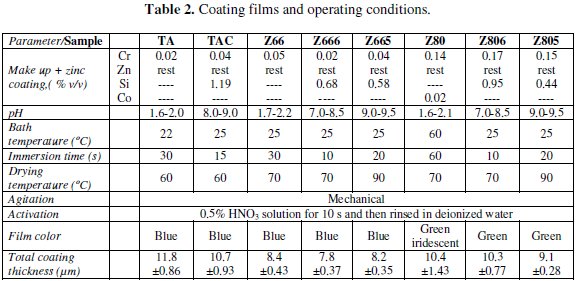
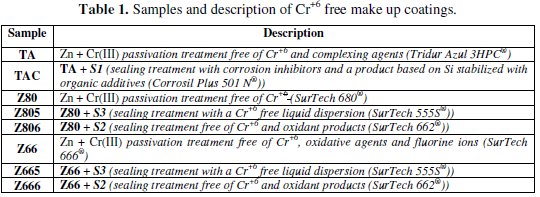
in <a href="#t1">Table 1</a>, and following the supplier recommendations, <a href="#t2">Table 2</a>.</p>

    <p>&nbsp;</p>
<a name="t1">
<img src="/img/revistas/pea/v30n3/30n3a01t1.jpg">
    
<p>&nbsp;</p>
<a name="t2">
<img src="/img/revistas/pea/v30n3/30n3a01t2.jpg">
    
<p>&nbsp;</p>

    <p>At the end of this step, samples were rinsed with deionized water, and then dried. The sealing 
treatment 1 (S1) was applied on TA samples (for obtaining TAC samples), the 
sealing treatment 2 (S2) on Z66 and Z80 samples (for obtaining Z666 and Z806 
samples, respectively), and the sealing treatment 3 (S3) on Z66 and Z80 samples 
(for obtaining Z665 and Z805 samples, respectively).</p>


    <p><b><i>Thickness measurements</i></b></p>

    <p>Coating thickness was measured with a Helmut Fischer DUALSCOPE MP40 
according to the ASTM B499-09 standard.</p>


    <p><b><i>EIS measurements</i></b></p>

    <p>The electrochemical measurements were performed by using the conventional 
three electrode cell. In it, a Pt-Rh mesh and a saturated calomel electrode (SCE) 
served respectively as counter and reference electrodes, while the pre-treated 
electrogalvanized steel samples, with an exposed area of 15.9 cm<sup>2</sup>, acted as 
working electrode.</p>

    ]]></body>
<body><![CDATA[<p>EIS measurements, as a function of the exposure time in quiescent and open to 
air 0.5 M Na<sub>2</sub>SO<sub>4</sub> solution, were conducted using a Solartron 1255 Frequency 
Response Analyzer coupled to a Solartron 1286 Potentiostat/Galvanostat (both 
controlled by the ZPlot program&reg;). A small potential perturbation (sinusoidal 
signal of 10 mV peak to peak in amplitude around the open circuit potential and 
ten measurements/decade) was applied within a frequency range of 10<sup>-2</sup> < f(Hz) 
< 10<sup>5</sup>. Despite ten points/decade were measured, only some of them were plotted 
to make simpler the visualization of the Bode diagrams.</p>

    <p>The experimental impedance spectra were fitted and interpreted on the basis of 
equivalent electrical circuit models using the software developed by Boukamp 
[17]. All the measurements were performed at laboratory temperature (22 &pm; 
3 &deg;C), and with the electrochemical cell inside a Faraday cage to reduce external 
interferences as much as possible. The sample integrity was checked by 
measuring the corrosion potential after each test to confirm that the change from 
the initial value was no higher than &pm; 5 mV.</p>

    <p>Taking into account that the corrosion behavior of passivated, painted and/or 
multi coated materials strictly depends on the production procedure, all the tests 
were carried out on three replicates of each sample type and the average results 
obtained for them are the reported in the following Tables and Figures.</p>


    <p>&nbsp;</p>
    <p><b>Results and discussion</b></p>

    <p><a href="#t2">Table 2</a> reports the samples identification, chemical composition and coating 
thickness prior to exposure. In it, the dispersion of the coating thickness values 
was mainly attributed to the fact that the steel sheets electrogalvanization as well 
as the conversion layers deposit were carried out in a continuous galvanizing 
line, where this type of dispersions commonly occur. On the other hand, although 
information related to the conversion layers thickness could not be obtained, it 
was possible to observe that they were uniform and bright throughout the entire 
surface [14].</p>


    <p><b><i>Electrochemical behavior</i></b></p>

    <p>Corrosion potential and EIS measurements carried out on electrogalvanized steel 
surfaces protected by different conversion treatments but exposed to the same 
aqueous electrolyte provide an opportunity to better analyze the evolution of their 
electrochemical behavior. When the overall coating system is considered, it 
should be noted that, being the thin conversion layer the outermost one, 
electrochemical interactions between this layer and its environment starts just 
after getting into contact, particularly if the medium is a saline solution. For that 
reason, the Cr (III)-based conversion coating plays a paramount role in delaying 
zinc dissolution, acting as a barrier layer to the diffusion of corrosion inducing 
species towards the underlying zinc film and/or inhibiting the oxygen reduction 
reaction by polarizing the cathodic areas. However, as the protective 
effectiveness of each thin Cr (III)-based conversion layer depends not only on its 
chemical composition but also on its compactness and lack of defects, desirable 
protective properties are only obtained if an adequate sealant is used.</p>


    <p><b><i>Corrosion potential evolution</i></b></p>

    <p>At the beginning of the immersion test, the corrosion potential (Ecorr) values of all 
the coated panels ranged between -1.02 and -1.04 V/SCE. As the time elapsed, 
these values did not vary by more than &pm; 0.020 V from their initial ones.</p>


    ]]></body>
<body><![CDATA[<p><b><i>Bode plots</i></b></p>

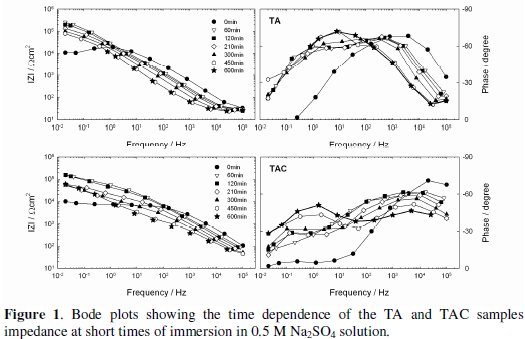
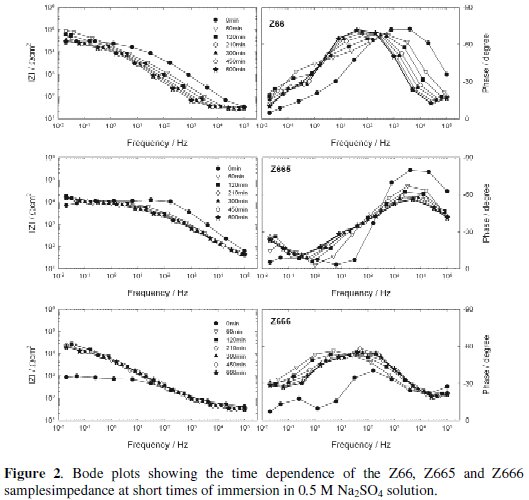
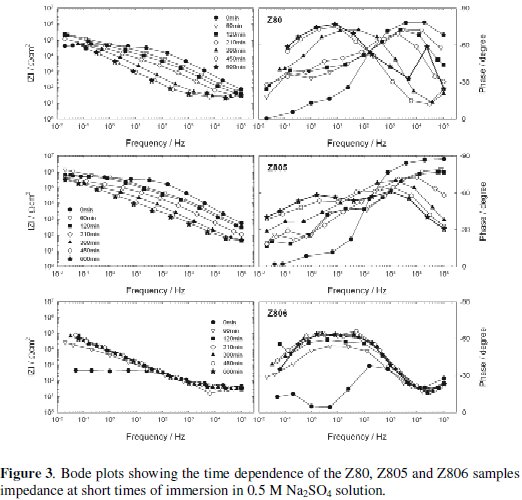
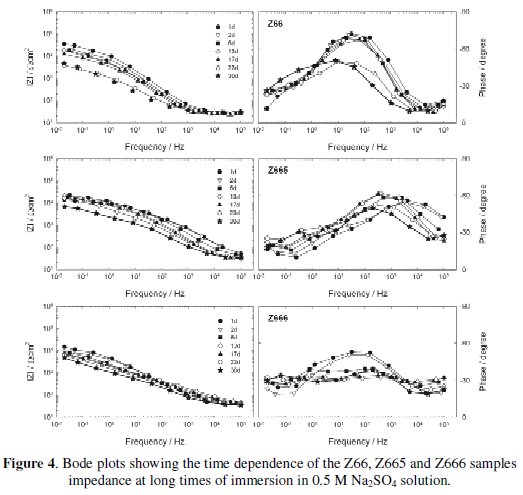
    <p>The impedance modulus (|Z|) and phase angle curves as a function of the 
exposure time to 0.5 M Na<sub>2</sub>SO<sub>4</sub> solution are shown in Figs. <a href="#f1">1</a> and <a href="#f2">2</a> for short 
immersion times, and Figs. <a href="#f3">3</a> and <a href="#f4">4</a> for long immersion times.</p>

    <p>&nbsp;</p>
<a name="f1">
<img src="/img/revistas/pea/v30n3/30n3a01f1.jpg">
    
<p>&nbsp;</p>
<a name="f2">
<img src="/img/revistas/pea/v30n3/30n3a01f2.jpg">
    
<p>&nbsp;</p>
<a name="f3">
<img src="/img/revistas/pea/v30n3/30n3a01f3.jpg">
    
<p>&nbsp;</p>
<a name="f4">
<img src="/img/revistas/pea/v30n3/30n3a01f4.jpg">
    
<p>&nbsp;</p>

    <p>A first qualitative analysis of these plots shows that the shape of all the experimental diagrams was 
quite similar. The Phase vs. Frequency plots clearly show the presence of at least 
two time constants, one at low frequencies and another at high frequencies, 
which, in some cases, seem to be three due to the appearance of another at 
intermediate frequencies. As well, in the considered frequencies range is clear 
that the |Z|-time oblique lines mostly shifted towards the regions of high to low 
frequencies, which indicates that the Bode plot is sensitive to the coating damage 
and the dynamic of the corrosion process.</p>

    <p>As seen in <a href="#f1">Fig. 1</a>, between 0 and 60 min of exposure, the |Z| values at the low 
frequency range increased almost one order of magnitude (10<sup>4</sup> to 10<sup>5</sup> &Omega; cm<sup>2</sup>) for 
the TA and TAC samples.</p>

    <p>Such increase was probably due to the barrier effect 
contribution offered by the corrosion products gathered at the localized coating 
defects. Then, the total resistance showed a slight decrease but their values were 
always higher than those corresponding to t = 0. On the other hand, the low 
impedance values measured at the high frequency range suggest the existence of 
electrochemical activity in parts of the zinc layer exposed to Na<sub>2</sub>SO<sub>4</sub> solution 
through defects in the pre-treatment one [18]. This behavior was confirmed by 
the phase angle evolution towards slightly more capacitive values at the low 
frequency range, and the displacement of its maximum value towards lower 
frequencies.</p>

    ]]></body>
<body><![CDATA[<p><a href="#f2">Fig. 2</a> shows that the shape of the impedance spectra corresponding to the Z66, 
Z665 and Z666 samples did not differ much from the above described but also 
that the |Z| values at the low frequency range were lower during the test.</p>

    <p>The anomalous fact that the Z66 sample's impedance was slightly greater than those 
corresponding to the Z665 and Z666 samples means that in both cases the 
respective Cr(III)-based conversion layers were not effectively sealed by the S3 
and S2 products, reason by which the cathodic/anodic areas relationship 
increased and, consequently, the corrosion rate of the underlaying zinc layer. 
Again, the slight increase of |Z| and Phase values during the first hour of 
exposure was ascribed to the corrosion products gathered at the bottom and/or 
within the coating defects, which enhanced the coating barrier protection. On the 
other hand, the slight decreased of |Z| values at medium and low frequencies 
showed by the three types of samples pointed out the presence of an 
electrochemically active interface.</p>

    <p>With regard to the Z80, Z805 and Z806 samples, <a href="#f3">Fig. 3</a>, it can be seen that, as 
occurred with the TA and Z66 samples series, the initial |Z| at low frequencies 
began low, but then increased a few K&Omega; for the Z80 and Z805 samples, and at 
least two orders of magnitude for the Z806 samples.</p>

    <p>From 60 min of exposure, and up to the end of the test, the |Z| values at medium and low frequencies 
decreased, more in Z805 and in Z80 than in Z806 samples, suggesting that in all 
them there were electrochemically active areas.</p>

    <p>The above-depicted performance could be explained assuming that the thin 
conversion layer can not avoid an initially fast and localized attack of the zinc 
substrate, whose white corrosion products deposited at the bottom and/or within 
the coating defects contributed to increase the samples impedance. The fact that 
the initial attack to the zinc substrate was localized could be attributable to the 
conversion layer pores and/or cracks acting as an electrical shunt. As the 
exposure time went on, it is possible that certain equilibrium between the rate of 
both the corrosion products development and their diffusion towards the 
electrolyte was reached and, consequently, the impedance fluctuations become 
small.</p>

    <p>At longer immersion times, the impedance spectra of most the samples showed 
minor changes, consequently only the corresponding to Z66, Z665 and Z666 
samples were used to illustrate the <a href="#f4">Fig. 4</a>.</p>

    <p>As can be seen, the more important 
change took place on Z66 samples whose initial total impedance at low 
frequencies, about 4.104 &Omega; cm<sup>2</sup>, decreased almost one order of magnitude after 30 
days of exposure. Moreover, by comparing the performance of all the samples 
during the short and long exposure times, it can be inferred that: 1) independent 
of the overall coating composition, the greater and better defined changes took 
place within the first 24 h of immersion; and 2) under the present exposure 
conditions, the barrier resistance afforded by the conversion layers, without or 
with sealant, was not so effective as to avoid the development of at least a minor 
electrochemical activity at the conversion layer/zinc interface.</p>


    <p><b><i>Impedance data treatment</i></b></p>

    <p>One of the more important difficulties for analyzing the EIS data from the 
impedance spectra deconvolution is, in general, to find an electrical equivalent 
circuit model and/or the parameters to explain the corrosion behavior of each 
analyzed system. Some authors have reported circuit models used to simulate 
EIS data coming from measurements on Cr and Mo-based conversion layers [1922], 
while others [23-26] accounted for partial analysis based on Bode or Nyquist 
diagrams. As well, it was reported that the capacitance of the coating and 
corrosion layer could be distinguished from different frequency range in the 
Bode plots of the conversion layers [27].</p>

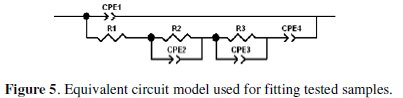
    <p>In this paper, the impedance data were well described either by the complete or 
partial version of the equivalent circuit proposed in <a href="#f5">Fig. 5</a>.</p>


    ]]></body>
<body><![CDATA[<p>&nbsp;</p>
<a name="f5">
<img src="/img/revistas/pea/v30n3/30n3a01f5.jpg">
    
<p>&nbsp;</p>


    <p>In it, the resistive and capacitive components associated to the physicochemical processes taking place 
in each reactive and complex interface were fitted according to the respective 
sample's impedance spectrum.</p>

    <p>Throughout the test, the time constants exhibited some Cole-Cole type dispersion 
[28] determined by the value of the corresponding n<sub>i</sub> parameter (0 &lt; n<sub>i</sub> &le; 1).</p>

    <p>Furthermore, distortions observed in those resistive-capacitive contributions 
indicate a deviation from the theoretical models in terms of a time constant's 
distribution due to either lateral penetration of the electrolyte at the metal/coating 
interface (usually started at the base of intrinsic or artificial coating defects), 
underlying metallic surface heterogeneity (topological, chemical composition, 
surface energy), and/or diffusional processes that could take place during the test. 
Since all these factors make the impedance/frequency relationship be non-linear, 
they are taken into consideration by replacing one or more capacitive 
components (Ci) of the equivalent circuit by the corresponding constant phase 
element (CPEi) [17].</p>

    <p>In the proposed circuit, where the constant phase element (CPE) is given by [17, 
29, 30]:</p>

    <p>&nbsp;</p>
<a name="e1">
<img src="/img/revistas/pea/v30n3/30n3a01e1.jpg">
    
<p>&nbsp;</p>

    <p>the time constant (R<sub>1</sub>CPE<sub>1</sub>) at high frequencies was associated to the resistive 
(R<sub>1</sub>) and capacitive (CPE<sub>1</sub>) contribution of the conversion layer to the overall 
impedance [20-23]. As the frequency values diminish, and taking into account 
that the corrosion-inducing chemicals (water, oxygen and ionic species) reach the 
electrochemically active areas of the zinc layer through the conversion layer 
defects, it is reasonable to assume that the corrosion process developing at the 
zinc surface should be placed in series with R<sub>1</sub>. The R<sub>2</sub> and CPE<sub>2</sub> parameters 
model the charge transfer resistance and the electrochemical double layer 
capacitance of the corrosion process. As a result of the zinc dissolution, the 
corrosion products accumulate in the coating defects affecting the size and shape 
of the system impedance by acting partially as a barrier. Such contribution is 
taken into account through the resistive, R<sub>3</sub>, and capacitive, CPE<sub>3</sub>, parameters. 
The diffusional component CPE<sub>4</sub> &equiv; Zd obtained at certain exposure times was 
associated to the oxygen diffusion-controlled reaction usually found in zinc 
corrosion [26, 31-36].</p>

    <p>Difficulties were sometimes found while attempting to provide an accurate 
physical description of the processes. In such cases, a standard deviation (&Chi;<sup>2</sup>) &le; 
5.10<sup>-4</sup> was used as a final criterion by considering that the smaller this value 
becomes, the closer the fit is to the experimental data [17]. According to the 
impedance data dispersion, the fitting process was performed using the CPE<sub>i</sub> or 
the dielectric capacitance (C<sub>i</sub>). However, this last parameter was used in all the 
following plots to facilitate the results visualization and interpretation.</p>

    ]]></body>
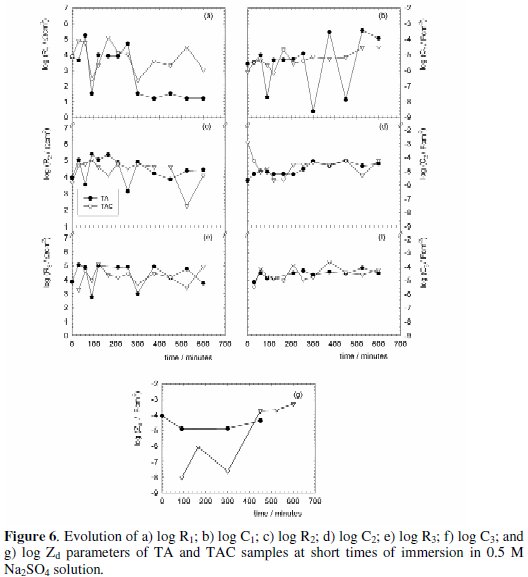
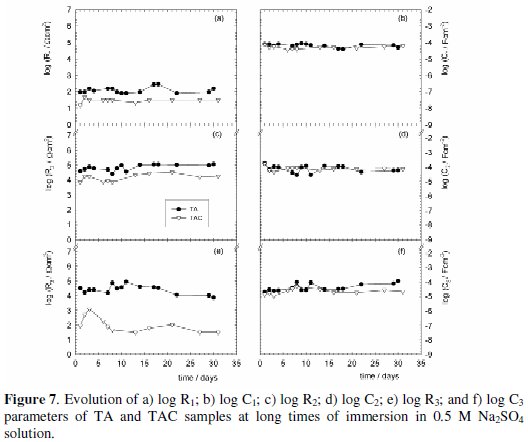
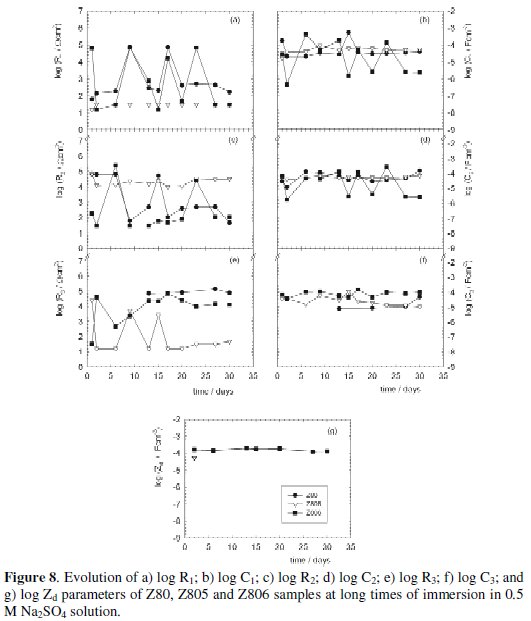
<body><![CDATA[<p>The trend of each parameter contributing to the system impedance, i.e. R<sub>1</sub>, C<sub>1</sub>, 
R<sub>2</sub>, C<sub>2</sub>, R<sub>3</sub>, C<sub>3</sub> and/or Z<sub>d</sub> is reported due to space limitations only for some 
samples in <a href="#f6">Fig. 6a-g</a> for short, and <a href="#f7">Figs. 7a-f</a> and <a href="#f8">Fig. 8a-g</a> for long immersion 
times.</p>


    <p>&nbsp;</p>
<a name="f6">
<img src="/img/revistas/pea/v30n3/30n3a01f6.jpg">
    
<p>&nbsp;</p>
<a name="f7">
<img src="/img/revistas/pea/v30n3/30n3a01f7.jpg">
    
<p>&nbsp;</p>
<a name="f8">
<img src="/img/revistas/pea/v30n3/30n3a01f8.jpg">
    
<p>&nbsp;</p>


    <p>As result of the dynamic behavior shown by the surface properties due to 
the conversion layer deterioration, zinc corrosion process, and/or heterogeneous 
morphology of the zinc corrosion products, a high variation of their associated 
time constant values was observed during the immersion test.</p>


    <p><b><i>Time dependence of the impedance resistive and capacitive components</i></b></p>

    <p>The chemically stables Cr(III) oxides/hydroxides forming the outermost layer of 
the tested samples can act as a barrier layer able to inhibit the zinc corrosion 
process by lowering the rate of the oxygen reduction reaction at the cathodic 
areas and/or the arrival of the corrosion inducing chemicals to the zinc coating. 
The TA and TAC samples plots (<a href="#f6">Fig. 6a-g</a>) clearly indicate that the resistance of 
the conversion layer (R<sub>1</sub>), the zinc corrosion (R<sub>2</sub>), and the corrosion products (R<sub>3</sub>) 
increased within the first hour of immersion, but then presented a rather 
fluctuating evolution up to the end of the test. Such fluctuations were certainly 
abrupt in some cases and indicatives of localized development of conversion 
layer defects (R<sub>1</sub>), pitting corrosion of the underlaying zinc coating (R<sub>2</sub>), and/or 
changes in the barrier effect of the white corrosion products (R<sub>3</sub>). It is seen that 
the R<sub>1</sub> and R<sub>2</sub> values were mostly greater for TAC than those for TA samples, 
while the corresponding R<sub>3</sub> values were quite similar for both sample types. This 
anomalous behavior could be attributed to the presence of small surface defects 
on the TA samples which can act as an electrical shunt; on prolonging the 
immersion, these pits were occluded and the resistances increased. This process 
continued until the protective properties of the conversion layer without sealant 
were totally lost. At the same time, the coating capacitance (C<sub>1</sub>) corresponding to 
TA samples showed much higher fluctuations than that of the TAC samples 
whose values remained almost constant and close to the initial ones. This trend 
indicates a high deterioration of the conversion layer in the TA samples, while 
slight damage was revealed in the TAC samples.</p>

    <p>With regard to the C<sub>2</sub> and C<sub>3</sub> curves for both sample types, they showed not only 
similar but also stabilized values, &asymp; 10<sup>-4</sup> - 10<sup>-5</sup> F cm<sup>-2</sup>, during the immersion test. 
Both results are indicative of small changes in variables such as thickness, area 
and/or dielectric constant affecting the faradic process and white corrosion 
products behavior within and/or at the bottom of the micro-cracks.</p>

    <p>Taking into account that the resistive (Ri) and capacitive (Ci) parameters depend 
directly or inversely on a series of specific (chemical composition, resistivity, 
dielectric constant) as well as geometric (layer thickness, intact and/or flawed 
areas) variables, it is difficult to explain accurately all the interface changes 
leading to the different trends shown by the samples evolution during the 
immersion test. However, if within certain limits is considered that most of the 
above mentioned variables have equal or very similar values, it may also be 
reasonable to think that the main distinction between the TA and TAC samples 
are the sealing treatment and the area that could be involved in the 
physicochemical process associated to a given time constant. Then, the 
aforementioned evolution trends were ascribed to both factors which could be 
influencing the coupled resistive and capacitive components of the impedance in 
such a way that these must be affected by different areas [37] instead of the 
whole electrode area commonly used when the corresponding value is expressed 
per square centimeter.</p>

    ]]></body>
<body><![CDATA[<p>Additional evidence showing that in these samples the sealing treatment 
improved the protective properties of the conversion layer was found by 
observing the Zd evolution, <a href="#f6">Fig. 6g</a>. In it, the time elapsed before the appearance 
of the diffusion process for the TAC was longer than for the TA samples due to 
the slower corrosion rate of those. Accordingly, a longer induction time (about 
100 min of exposure) was necessary before the thickness of the corrosion 
product's layer could delay the oxygen arrival to the reaction areas making that 
the cathodic reaction (oxygen reduction) was the rate determining step (rds) of 
the localized zinc corrosion process [38-40].</p>

    <p>The not shown (due to space limitations) electrochemical response derived from 
fitting the impedance data of the Z66, Z665, Z666 and Z80, Z805, Z806 samples 
was qualitatively similar but quantitatively different between them and also of 
those obtained for the TA and TAC samples. Such results indicated that different 
process occurred on those samples; nevertheless, in general terms may be 
established that on passing from the conversion layers without sealants (Z66 and 
Z80) to those with sealant (Z665, Z666, and Z805, Z806 samples), the parameter 
values indicated that, like occurred for TA and TAC samples, the whole coating 
damages were faster and more significant in the absence of the sealant. Such 
effect was particularly observed in the Z66 series and Z806 samples owing to the 
null (Z66) or lower (Z665, Z666 and Z806 samples) Si content in the respective 
conversion layer. Whereas, the null Si content in Z80 samples was compensated 
by the presence of Co in the conversion layer, which improved its corrosion 
resistance [41].</p>

    <p>For all the coatings, the not shown values of the exponent n, included in equation 
(1), slightly decreased with time and ranged between 1 and 0.5. This means that 
as the exposure test elapsed, each layer forming part of the coated steel system 
behaved like a pure capacitor (n = 1), a capacitor with loss (0.5 &lt; n &lt; 1), or a 
diffusion element (n = 0.5) [17].</p>

    <p>According to results reported by other authors [42, 43], the capacitance (C<sub>2</sub>) 
increase was correlated with the corrosion initiation by the pitting mechanism. 
The size of the pits observed in this investigation correlated well with the 
increase in the C<sub>2</sub>-time plots, indicating that the pitting corrosion can be revealed 
by the C<sub>2</sub> increase, and also that when its values decrease the pits become partial 
or completely occluded by the corrosion products.</p>

    <p>It is important to point out that, independent of the conversion layer structure and 
composition, with all the tested coatings there was either higher or lower but 
almost continuous zinc electrochemical activity. Regarding this, the dynamic 
behavior of the processes taking place at these interfaces is reflected by the 
changing values of the resistive-capacitive parameters associated to the time 
constants feasible to be deconvoluted, as well as by the rds of the zinc dissolution 
reaction, which was mostly under diffusion control at short immersion times. 
With regard to the barrier protection offered by the conversion layer in the TA 
and TAC samples at long exposure times, <a href="#f7">Fig. 7a-f</a>, it can be seen that the 
coating resistance (R<sub>1</sub>) remained constantly low but with slightly higher values 
for the TA (&asymp; 100  &Omega; cm<sup>2</sup>) than for the TAC (&asymp; 
60-80 &Omega; cm<sup>2</sup>) samples. This 
behavior was similar for R<sub>2</sub> and R<sub>3</sub> and it may be interpreted assuming that the 
initial faster zinc dissolution, due to the thin thickness of the conversion layer 
and low chromium content enabled to produce more compact and stable 
corrosion products that blocked the conversion layer defects. In addition, as the 
evolution of the C<sub>1</sub>, C<sub>2</sub> and C<sub>3</sub> values (&asymp; 
10<sup>-4</sup> - 10<sup>-5</sup> F cm<sup>-2</sup>) was quite similar and 
constant, it was inferred that, after the significant changes occurred during the 
first 24 h of immersion, only minor variations of the electrochemically active 
areas and the overall zinc corrosion process took place during the remaining 30 
days of testing.</p>

    <p>On the other hand, the evolution of the resistive-capacitive values for the Z66, 
Z665 and Z666 samples as a function of the immersion time in 0.5 M Na<sub>2</sub>SO<sub>4</sub> 
solution did not exhibit great differences. Perhaps the main discrepancy was that 
the rds of the corrosion reaction for the Z66 samples was always under activated 
control while for the Z665 and Z666 samples it was controlled by the mass 
transport process. Despite this, the R<sub>2</sub> values were rather similar (mostly 10<sup>3</sup> - 10<sup>4</sup> 
 &Omega; cm<sup>2</sup>) in these three samples. Differences found in the rds were ascribed to the 
fact that after the fast attack and development of zinc white corrosion products at 
the beginning of the exposure, the barrier effect hindering the mass transport 
towards the areas where the cathodic reaction happened, i.e. the (Cr(III)-based 
conversion layer, as well as towards the zinc substrate was more effective in the 
sealed than in the not sealed samples. This may be indicative that, under the 
present exposure conditions, a sealed conversion layer was more effective 
inhibiting the cathodic (oxygen reduction) than the anodic (zinc dissolution) 
reactions.</p>

    <p>As seen in <a href="#f8">Fig. 8a and c</a>, the coating (R<sub>1</sub>) and charge transfer (R<sub>2</sub>) resistance 
values corresponding to the Z805 samples, &asymp; 50  &Omega; cm<sup>2</sup> and 2.10<sup>4</sup> &Omega; cm<sup>2</sup>, 
respectively, remained almost unchanged during the immersion test. At the same 
time, the resistance (R<sub>3</sub>), <a href="#f8">Fig. 8e</a>, provided by the white corrosion products 
deposited within and/or at the bottom of the conversion layer defects stayed very 
low (&asymp; 30  &Omega; cm<sup>2</sup>), but stable. 
With regard to the Z80 and Z806 samples, the evolution of R<sub>1</sub> and R<sub>2</sub> showed 
strong oscillations (almost three orders of magnitude) with some periods of 
stability, while the component R<sub>3</sub> corresponding to the Z80 samples did not 
appear up to 13 days of immersion and its value was very similar to that of the 
Z806 samples. Besides, the R<sub>3</sub> values for these two samples type were mostly 
greater than for the Z805 samples. Changes in the C<sub>1</sub>, C<sub>2</sub>, and C<sub>3</sub> were in line 
with those described for their associated resistive components. Nevertheless, in 
order to explain differences observed in the plots illustrating the evolution of 
coupled RiCi components, it was also assumed that at long immersion times the 
resistive and capacitive components defining the physicochemical process 
associated to each time constant are affected by different areas [37]. In Z80 and 
Z805 samples, the rds was under activated control throughout the test, while in 
Z806 samples, the corrosion reaction was always under diffusion control. 
These results were interpreted as follows: despite of having the lowest coating 
resistance (R<sub>1</sub>) value, the best anticorrosive behavior (greater R<sub>2</sub> values mean 
lower corrosion rates) shown by the Z805 samples was attributed to their higher 
Cr content in the conversion layer and Si content in the applied sealant. In 
addition, the lowest R<sub>3</sub> values indicated that the gathered white corrosion 
products were not enough to delay the oxygen transport towards the cathodic 
areas, reason by which the rds was under active control. A similar effect probably 
occurred with the Z80 samples, but in this case, provoked by the presence of Co 
ions in the conversion layer acting as a partial inhibitor of the zinc dissolution 
reaction. As happened in the Z665 and Z666 samples, the rds in the Z806 
samples was always under diffusion control; therefore, it is rational to assume 
that the same interpretation is applicable.</p>


    <p>&nbsp;</p>
    <p><b>Conclusions</b></p>

    <p>The corrosion behavior of zinc coatings subjected to Cr(III)-based passivation 
treatments, with and without sealing, was studied. The investigations were 
performed by EIS test in quiescent aerated 0.5 M Na<sub>2</sub>SO<sub>4</sub> solution.</p>

    ]]></body>
<body><![CDATA[<p>The analysis of the EIS data allowed providing an equivalent electrical circuit 
model capable of completely describe the corrosion behavior of 
steel/zinc/conversion layer/0.5 M Na<sub>2</sub>SO<sub>4</sub> systems during the overall testing 
period considering both the micro-defects in the conversion layers and the 
corrosion products deposited at the bottom and/or within them. Besides, for the 
Cr (III) treated electrogalvanized steel the impedance data reproducibility was 
good.</p>

    <p>The behavior of the Cr(III)-based conversion layer was explained by the 
variation of its coating resistance (R<sub>1</sub>) as a function of the immersion time. The 
increase in R<sub>1</sub> indicates an increase in the amount of white corrosion products 
covering the micro-defects and, therefore, working as a barrier to the diffusion of 
oxygen and ionic species through the conversion layer. However, with further 
increasing immersion time, the corrosion products transport towards the bulk of 
the electrolyte takes place, the zinc dissolution at the bottom of the micro-defects 
becomes more severe and an increase of the defects amount occurs.</p>

    <p>Consequently, R<sub>1</sub> decreases due to the corrosion products cannot act as a 
diffusion barrier. As this is a cyclic process, it continues until the protection 
offered by the conversion layer is totally lost.</p>

    <p>The Cr(III)-based layer acted not only as a barrier layer hindering the corrosive 
species transport towards the zinc substrate but also diminishing the rate of the 
oxygen reduction reaction in such a way that this reaction was the rate 
determining step of the underlying zinc corrosion.</p>

    <p>Only in some Cr(III)-based conversion layers, the sealing treatment revealed to 
be effective in increasing the corrosion resistance. Thus, the here obtained 
experimental results indicated that such effectiveness depended not only upon the 
protective properties of the conversion layer without sealant, but also on the 
applied sealant to improve the corrosion protection offered to the zinc substrate. 
When this is the case, the respective conversion layer could be considered as a 
suitable alternative to the traditional chromating treatment.</p>

    <p>In line with this proposal, and taking as contrast parameter the corrosion 
resistance values shown by all the tested samples after 30 days of immersion in 
0.5 M Na<sub>2</sub>SO<sub>4</sub> solution, the more acceptable performance was offered by the TA, 
Z66 (despite their initial high corrosion rates), TAC and Z805 (R<sub>2</sub> &asymp; 
10<sup>4</sup> - 10<sup>5</sup> &Omega; cm<sup>2</sup>), while the worst corresponded to the 
Z80 and Z806 samples (R<sub>2</sub> &asymp; 10<sup>1</sup> - 10<sup>2</sup> &Omega; cm<sup>2</sup>).</p>

    <p>The low coating resistance afforded by the new types of tested conversion layers 
would need further studies to improve their overall protective properties, 
although they are currently satisfactory for some applications. In line with this 
conclusion, it must be taken into account that, when long term durability is 
required, the conversion layer is designed as an internal component of the steel 
protection system and, therefore, unless the painting system fails, it seldom 
comes in direct contact with the environment. This implies that the corrosion 
protection given by the Cr(III)-based pre-treatments may still be adequate for a 
variety of applications, especially when the main function of the coating is to 
improve the adhesion of paints and organic layers. Accordingly, together with the 
above mentioned studies, the here characterized products also form part of the 
starting point to formulate proper painting systems which will be applied on pretreated 
electro-as well as hot dip-galvanized steel surfaces and experimentally 
evaluated through laboratory and field tests.</p>


    <p>&nbsp;</p>
    <p><b>References</b></p>

    <!-- ref --><p>1. Definitions committee, Federation Society for Coatings Technology. Philadelphia; 1978. P. 177.    &nbsp;&nbsp;&nbsp;&nbsp;&nbsp;&nbsp;&nbsp;&nbsp;[&#160;<a href="javascript:void(0);" onclick="javascript: window.open('/scielo.php?script=sci_nlinks&ref=000102&pid=S0872-1904201200030000100001&lng=','','width=640,height=500,resizable=yes,scrollbars=1,menubar=yes,');">Links</a>&#160;]<!-- end-ref --></p>
    <!-- ref --><p>2. Bibber J. Met Finishing. 2002;100:98-102.    &nbsp;&nbsp;&nbsp;&nbsp;&nbsp;&nbsp;&nbsp;&nbsp;[&#160;<a href="javascript:void(0);" onclick="javascript: window.open('/scielo.php?script=sci_nlinks&ref=000104&pid=S0872-1904201200030000100002&lng=','','width=640,height=500,resizable=yes,scrollbars=1,menubar=yes,');">Links</a>&#160;]<!-- end-ref --></p>
    <p>3. Gabrielli C, Keddam M, Minouflet-Laurent F, Ogle K, Perrot H. Electrochim Acta. 2003;48(8):965-976.</p>
    <!-- ref --><p>4. Kendig M, Bucheit R. Proceedings of Corrosion 2000, NACE; 2000 March; Orlando, USA.    &nbsp;&nbsp;&nbsp;&nbsp;&nbsp;&nbsp;&nbsp;&nbsp;[&#160;<a href="javascript:void(0);" onclick="javascript: window.open('/scielo.php?script=sci_nlinks&ref=000107&pid=S0872-1904201200030000100004&lng=','','width=640,height=500,resizable=yes,scrollbars=1,menubar=yes,');">Links</a>&#160;]<!-- end-ref --></p>
    <p>5. Meisel W, Mohs F, Guttman HJ, GÃ¼tlich P. Corros Sci. 1983;23(5):465471.</p>
    <!-- ref --><p>6. Szklarska-Smialowska Z, Staehle RW. J Electrochem Soc. 1974;121(9):1146-1154.    &nbsp;&nbsp;&nbsp;&nbsp;&nbsp;&nbsp;&nbsp;&nbsp;[&#160;<a href="javascript:void(0);" onclick="javascript: window.open('/scielo.php?script=sci_nlinks&ref=000110&pid=S0872-1904201200030000100006&lng=','','width=640,height=500,resizable=yes,scrollbars=1,menubar=yes,');">Links</a>&#160;]<!-- end-ref --></p>
    <!-- ref --><p>7. Mayne JEO, Ridgway P. Brit. Corros J. 1974;9(3):177-180.    &nbsp;&nbsp;&nbsp;&nbsp;&nbsp;&nbsp;&nbsp;&nbsp;[&#160;<a href="javascript:void(0);" onclick="javascript: window.open('/scielo.php?script=sci_nlinks&ref=000112&pid=S0872-1904201200030000100007&lng=','','width=640,height=500,resizable=yes,scrollbars=1,menubar=yes,');">Links</a>&#160;]<!-- end-ref --></p>
    <!-- ref --><p>8. Von Katen G. Galvanotechnik. 1999;90(3):650-653.    &nbsp;&nbsp;&nbsp;&nbsp;&nbsp;&nbsp;&nbsp;&nbsp;[&#160;<a href="javascript:void(0);" onclick="javascript: window.open('/scielo.php?script=sci_nlinks&ref=000114&pid=S0872-1904201200030000100008&lng=','','width=640,height=500,resizable=yes,scrollbars=1,menubar=yes,');">Links</a>&#160;]<!-- end-ref --></p>
    <!-- ref --><p>9. Gianelos L. Plat Surf Finishing. 1979;66(5):56-60.    &nbsp;&nbsp;&nbsp;&nbsp;&nbsp;&nbsp;&nbsp;&nbsp;[&#160;<a href="javascript:void(0);" onclick="javascript: window.open('/scielo.php?script=sci_nlinks&ref=000116&pid=S0872-1904201200030000100009&lng=','','width=640,height=500,resizable=yes,scrollbars=1,menubar=yes,');">Links</a>&#160;]<!-- end-ref --></p>
    <!-- ref --><p>10. Bellezze T, Roventi G, Fratessi R. Surf Coat Technol. 2002;155(2-3):221230.    &nbsp;&nbsp;&nbsp;&nbsp;&nbsp;&nbsp;&nbsp;&nbsp;[&#160;<a href="javascript:void(0);" onclick="javascript: window.open('/scielo.php?script=sci_nlinks&ref=000118&pid=S0872-1904201200030000100010&lng=','','width=640,height=500,resizable=yes,scrollbars=1,menubar=yes,');">Links</a>&#160;]<!-- end-ref --></p>
    <p>11. Zhang X, van den Bos C, Sloof WG, Terryn H, Hovestad A, de Wit JHW. Surf Eng. 2004;20:244-250.</p>
    <p>12. Zhang X, van den Bos C, Sloof WG, Hovestad A, Terryn H, de Wit JHW. Surf Coat Technol. 2005;199(1):92-104.</p>
    <!-- ref --><p>13. Da Fonte Jr B, Mich MC. US Patent 4.359.345, 1982.    &nbsp;&nbsp;&nbsp;&nbsp;&nbsp;&nbsp;&nbsp;&nbsp;[&#160;<a href="javascript:void(0);" onclick="javascript: window.open('/scielo.php?script=sci_nlinks&ref=000122&pid=S0872-1904201200030000100013&lng=','','width=640,height=500,resizable=yes,scrollbars=1,menubar=yes,');">Links</a>&#160;]<!-- end-ref --></p>
    <!-- ref --><p>14. Tomachuk CR, Elsner CI, di Sarli AR. Mat Chem Physics. 2009;119(12):19-29.    &nbsp;&nbsp;&nbsp;&nbsp;&nbsp;&nbsp;&nbsp;&nbsp;[&#160;<a href="javascript:void(0);" onclick="javascript: window.open('/scielo.php?script=sci_nlinks&ref=000124&pid=S0872-1904201200030000100014&lng=','','width=640,height=500,resizable=yes,scrollbars=1,menubar=yes,');">Links</a>&#160;]<!-- end-ref --></p>
    <!-- ref --><p>15. Tomachuk CR, Elsner CI, di Sarli AR. J Coat Technol Research. 2010;7(4):493-502.    &nbsp;&nbsp;&nbsp;&nbsp;&nbsp;&nbsp;&nbsp;&nbsp;[&#160;<a href="javascript:void(0);" onclick="javascript: window.open('/scielo.php?script=sci_nlinks&ref=000126&pid=S0872-1904201200030000100015&lng=','','width=640,height=500,resizable=yes,scrollbars=1,menubar=yes,');">Links</a>&#160;]<!-- end-ref --></p>
    <!-- ref --><p>16. Townsend HE, Hart RG. J Electrochem Soc. 1984;131(6):1345-1348.    &nbsp;&nbsp;&nbsp;&nbsp;&nbsp;&nbsp;&nbsp;&nbsp;[&#160;<a href="javascript:void(0);" onclick="javascript: window.open('/scielo.php?script=sci_nlinks&ref=000128&pid=S0872-1904201200030000100016&lng=','','width=640,height=500,resizable=yes,scrollbars=1,menubar=yes,');">Links</a>&#160;]<!-- end-ref --></p>
    <!-- ref --><p>17. Boukamp A. Equivalent circuit. The Netherlands: University of Twente; 1989. Report NÂº.:CT88/265/128, CT89/214/128.    &nbsp;&nbsp;&nbsp;&nbsp;&nbsp;&nbsp;&nbsp;&nbsp;[&#160;<a href="javascript:void(0);" onclick="javascript: window.open('/scielo.php?script=sci_nlinks&ref=000130&pid=S0872-1904201200030000100017&lng=','','width=640,height=500,resizable=yes,scrollbars=1,menubar=yes,');">Links</a>&#160;]<!-- end-ref --></p>
    <!-- ref --><p>18. Martyak NM, McCaskie JE, Harrison L. Met Finish. 1996;94:65-67.    &nbsp;&nbsp;&nbsp;&nbsp;&nbsp;&nbsp;&nbsp;&nbsp;[&#160;<a href="javascript:void(0);" onclick="javascript: window.open('/scielo.php?script=sci_nlinks&ref=000132&pid=S0872-1904201200030000100018&lng=','','width=640,height=500,resizable=yes,scrollbars=1,menubar=yes,');">Links</a>&#160;]<!-- end-ref --></p>
    <!-- ref --><p>19. Almeida E, Fedrizzi L, Diamantino TC. Surf Coat Technol. 1998;105(12):97-101.    &nbsp;&nbsp;&nbsp;&nbsp;&nbsp;&nbsp;&nbsp;&nbsp;[&#160;<a href="javascript:void(0);" onclick="javascript: window.open('/scielo.php?script=sci_nlinks&ref=000134&pid=S0872-1904201200030000100019&lng=','','width=640,height=500,resizable=yes,scrollbars=1,menubar=yes,');">Links</a>&#160;]<!-- end-ref --></p>
    <p>20. Lengyel B, Baroti-Labar Zs, Kahan R. Mater Chem. 1982;7(2):183-193.</p>
    <!-- ref --><p>21. Pirnat A, Meszaros L, Lengyel B. ACH-Models in Chemistry. 1995;132:647-651.    &nbsp;&nbsp;&nbsp;&nbsp;&nbsp;&nbsp;&nbsp;&nbsp;[&#160;<a href="javascript:void(0);" onclick="javascript: window.open('/scielo.php?script=sci_nlinks&ref=000137&pid=S0872-1904201200030000100021&lng=','','width=640,height=500,resizable=yes,scrollbars=1,menubar=yes,');">Links</a>&#160;]<!-- end-ref --></p>
    <!-- ref --><p>22. Ende D, Kessler W, Oelkrug D, Fuchs R. Electrochim Acta. 1993;38(17):2577-2580.    &nbsp;&nbsp;&nbsp;&nbsp;&nbsp;&nbsp;&nbsp;&nbsp;[&#160;<a href="javascript:void(0);" onclick="javascript: window.open('/scielo.php?script=sci_nlinks&ref=000139&pid=S0872-1904201200030000100022&lng=','','width=640,height=500,resizable=yes,scrollbars=1,menubar=yes,');">Links</a>&#160;]<!-- end-ref --></p>
    <!-- ref --><p>23. Zeller III RL, Savinell RF. Corros Sci. 1986;26(5):389-399.    &nbsp;&nbsp;&nbsp;&nbsp;&nbsp;&nbsp;&nbsp;&nbsp;[&#160;<a href="javascript:void(0);" onclick="javascript: window.open('/scielo.php?script=sci_nlinks&ref=000141&pid=S0872-1904201200030000100023&lng=','','width=640,height=500,resizable=yes,scrollbars=1,menubar=yes,');">Links</a>&#160;]<!-- end-ref --></p>
    ]]></body>
<body><![CDATA[<!-- ref --><p>24. Hazan J, Coddet C. J Appl Electrochem. 1996;26(2):203-209.    &nbsp;&nbsp;&nbsp;&nbsp;&nbsp;&nbsp;&nbsp;&nbsp;[&#160;<a href="javascript:void(0);" onclick="javascript: window.open('/scielo.php?script=sci_nlinks&ref=000143&pid=S0872-1904201200030000100024&lng=','','width=640,height=500,resizable=yes,scrollbars=1,menubar=yes,');">Links</a>&#160;]<!-- end-ref --></p>
    <!-- ref --><p>25. Barcelo G, Sarret M, Muller C, Pregonas J. Electrochim Acta. 1998;43(12):13-20.    &nbsp;&nbsp;&nbsp;&nbsp;&nbsp;&nbsp;&nbsp;&nbsp;[&#160;<a href="javascript:void(0);" onclick="javascript: window.open('/scielo.php?script=sci_nlinks&ref=000145&pid=S0872-1904201200030000100025&lng=','','width=640,height=500,resizable=yes,scrollbars=1,menubar=yes,');">Links</a>&#160;]<!-- end-ref --></p>
    <p>26. Fedrizzi L, Ciaghi L, Bonora PL, Fratesi R, Roventi G. J Appl Electrochem. 1992;22:247-254.</p>
    <p>27. Zheludkevich MI, Serra R, Montemor MF, Yasakau KA, Miranda Salvado IM, Ferreira MGS. Electrochim Acta. 2005;51(2):208-217.</p>
    <!-- ref --><p>28. Cole KS, Cole R. J Chem Phys. 1941;9:341-351.    &nbsp;&nbsp;&nbsp;&nbsp;&nbsp;&nbsp;&nbsp;&nbsp;[&#160;<a href="javascript:void(0);" onclick="javascript: window.open('/scielo.php?script=sci_nlinks&ref=000149&pid=S0872-1904201200030000100028&lng=','','width=640,height=500,resizable=yes,scrollbars=1,menubar=yes,');">Links</a>&#160;]<!-- end-ref --></p>
    <!-- ref --><p>29. del Amo B, Veleva L, Di Sarli AR, Elsner CI. Prog Org Coat. 2004;50(3):179-192.    &nbsp;&nbsp;&nbsp;&nbsp;&nbsp;&nbsp;&nbsp;&nbsp;[&#160;<a href="javascript:void(0);" onclick="javascript: window.open('/scielo.php?script=sci_nlinks&ref=000151&pid=S0872-1904201200030000100029&lng=','','width=640,height=500,resizable=yes,scrollbars=1,menubar=yes,');">Links</a>&#160;]<!-- end-ref --></p>
    ]]></body>
<body><![CDATA[<!-- ref --><p>30. van Westing EPM, Ferrari GM, Geenen FM, de Wit JHW. Prog Org Coat. 1993;23(1):89-103.    &nbsp;&nbsp;&nbsp;&nbsp;&nbsp;&nbsp;&nbsp;&nbsp;[&#160;<a href="javascript:void(0);" onclick="javascript: window.open('/scielo.php?script=sci_nlinks&ref=000153&pid=S0872-1904201200030000100030&lng=','','width=640,height=500,resizable=yes,scrollbars=1,menubar=yes,');">Links</a>&#160;]<!-- end-ref --></p>
    <!-- ref --><p>31. Deflorian F, Rossi S, Fedrizzi L, Bonora PL. Prog Org Coat. 2005;52(4):271-279.    &nbsp;&nbsp;&nbsp;&nbsp;&nbsp;&nbsp;&nbsp;&nbsp;[&#160;<a href="javascript:void(0);" onclick="javascript: window.open('/scielo.php?script=sci_nlinks&ref=000155&pid=S0872-1904201200030000100031&lng=','','width=640,height=500,resizable=yes,scrollbars=1,menubar=yes,');">Links</a>&#160;]<!-- end-ref --></p>
    <!-- ref --><p>32. Rangel CM, Cruz LF. Corros Sci. 1992;33(9):1479-1493.    &nbsp;&nbsp;&nbsp;&nbsp;&nbsp;&nbsp;&nbsp;&nbsp;[&#160;<a href="javascript:void(0);" onclick="javascript: window.open('/scielo.php?script=sci_nlinks&ref=000157&pid=S0872-1904201200030000100032&lng=','','width=640,height=500,resizable=yes,scrollbars=1,menubar=yes,');">Links</a>&#160;]<!-- end-ref --></p>
    <!-- ref --><p>33. Cachet C, Wiart R. J Electroana. Chem. 1980;111(2-3):235-246;    &nbsp;&nbsp;&nbsp;&nbsp;&nbsp;&nbsp;&nbsp;&nbsp;[&#160;<a href="javascript:void(0);" onclick="javascript: window.open('/scielo.php?script=sci_nlinks&ref=000159&pid=S0872-1904201200030000100033&lng=','','width=640,height=500,resizable=yes,scrollbars=1,menubar=yes,');">Links</a>&#160;]<!-- end-ref --><!-- ref --> Cachet C, Wiart R. J Electroana. Chem. 1981;129(1-2):103-114.    &nbsp;&nbsp;&nbsp;&nbsp;&nbsp;&nbsp;&nbsp;&nbsp;[&#160;<a href="javascript:void(0);" onclick="javascript: window.open('/scielo.php?script=sci_nlinks&ref=000160&pid=S0872-1904201200030000100034&lng=','','width=640,height=500,resizable=yes,scrollbars=1,menubar=yes,');">Links</a>&#160;]<!-- end-ref --></p>
    <!-- ref --><p>34. Amirudin A, Thierry D. Prog Org Coat. 1995;26(1):1-28.    &nbsp;&nbsp;&nbsp;&nbsp;&nbsp;&nbsp;&nbsp;&nbsp;[&#160;<a href="javascript:void(0);" onclick="javascript: window.open('/scielo.php?script=sci_nlinks&ref=000162&pid=S0872-1904201200030000100035&lng=','','width=640,height=500,resizable=yes,scrollbars=1,menubar=yes,');">Links</a>&#160;]<!-- end-ref --></p>
    <p>35. Abreu CM, Izquierdo M, Keddam M, Novoa XR, Takenouti H. Electrochim Acta. 1996;41(15):2405-2415.</p>
    <!-- ref --><p>36. Bonora PL, Deflorian F, Fedrizzi L. Electrochim Acta. 1996;41(7-8):10731082.    &nbsp;&nbsp;&nbsp;&nbsp;&nbsp;&nbsp;&nbsp;&nbsp;[&#160;<a href="javascript:void(0);" onclick="javascript: window.open('/scielo.php?script=sci_nlinks&ref=000165&pid=S0872-1904201200030000100037&lng=','','width=640,height=500,resizable=yes,scrollbars=1,menubar=yes,');">Links</a>&#160;]<!-- end-ref --></p>
    <!-- ref --><p>37. do Nascimento GG, Mattos OR, dos Santos JLC, Margarit ICP. J Appl Electrochem. 1999;29(3):383-392.    &nbsp;&nbsp;&nbsp;&nbsp;&nbsp;&nbsp;&nbsp;&nbsp;[&#160;<a href="javascript:void(0);" onclick="javascript: window.open('/scielo.php?script=sci_nlinks&ref=000167&pid=S0872-1904201200030000100038&lng=','','width=640,height=500,resizable=yes,scrollbars=1,menubar=yes,');">Links</a>&#160;]<!-- end-ref --></p>
    <!-- ref --><p>38. Turgoose S. In: Clubey BG, editor. Chemical inhibitors for corrosion control. Manchester:The Royal Society of Chemistry; 1990.    &nbsp;&nbsp;&nbsp;&nbsp;&nbsp;&nbsp;&nbsp;&nbsp;[&#160;<a href="javascript:void(0);" onclick="javascript: window.open('/scielo.php?script=sci_nlinks&ref=000169&pid=S0872-1904201200030000100039&lng=','','width=640,height=500,resizable=yes,scrollbars=1,menubar=yes,');">Links</a>&#160;]<!-- end-ref --></p>
    <!-- ref --><p>39. Nevison DCH. Corrosion. ASM Handbook, 9th Ed. Vol 13. ASM International, The Materials Information Society; 1987.    &nbsp;&nbsp;&nbsp;&nbsp;&nbsp;&nbsp;&nbsp;&nbsp;[&#160;<a href="javascript:void(0);" onclick="javascript: window.open('/scielo.php?script=sci_nlinks&ref=000171&pid=S0872-1904201200030000100040&lng=','','width=640,height=500,resizable=yes,scrollbars=1,menubar=yes,');">Links</a>&#160;]<!-- end-ref --></p>
    ]]></body>
<body><![CDATA[<!-- ref --><p>40. Duarte RG, Bastos AC, Castela AS, Ferreira MGS. Prog Org Coat. 2005;52(4):320-327.    &nbsp;&nbsp;&nbsp;&nbsp;&nbsp;&nbsp;&nbsp;&nbsp;[&#160;<a href="javascript:void(0);" onclick="javascript: window.open('/scielo.php?script=sci_nlinks&ref=000173&pid=S0872-1904201200030000100041&lng=','','width=640,height=500,resizable=yes,scrollbars=1,menubar=yes,');">Links</a>&#160;]<!-- end-ref --></p>
    <!-- ref --><p>41. Fratesi R, Roventi G, Giuliani G, Tomachuk CR. J Appl Electrochem. 1997;27(9):1088-1094.    &nbsp;&nbsp;&nbsp;&nbsp;&nbsp;&nbsp;&nbsp;&nbsp;[&#160;<a href="javascript:void(0);" onclick="javascript: window.open('/scielo.php?script=sci_nlinks&ref=000175&pid=S0872-1904201200030000100042&lng=','','width=640,height=500,resizable=yes,scrollbars=1,menubar=yes,');">Links</a>&#160;]<!-- end-ref --></p>
    <!-- ref --><p>42. Shih H, Mansfeld F. Corrosion. 1989;45(8):610-614.    &nbsp;&nbsp;&nbsp;&nbsp;&nbsp;&nbsp;&nbsp;&nbsp;[&#160;<a href="javascript:void(0);" onclick="javascript: window.open('/scielo.php?script=sci_nlinks&ref=000177&pid=S0872-1904201200030000100043&lng=','','width=640,height=500,resizable=yes,scrollbars=1,menubar=yes,');">Links</a>&#160;]<!-- end-ref --></p>
    <p>43. Mansfeld F, Wang Y, Lin SH, Xiao H, Shih H. In: Scully JR, Silverman DC, Kending MW, editors. Electrochemical impedance, analysis and 
interpretation, ASTM STP 1188. Philadelphia; 1993. P. 297-312.</p>


    <p>&nbsp;</p>

    <p><b>Acknowledgements</b></p>

    <p>This research was financed by CAPES/MINCyT (Process 158/09 of Brazil and 
BR/08/04 of Argentina), and Comisi&oacute;n de Investigaciones Cient&iacute;ficas de la Provincia de 
Buenos Aires (CICPBA), Consejo Nacional de Investigaciones Cient&iacute;ficas y T&eacute;cnicas 
(CONICET) and Universidad Nacional de La Plata of Argentina.</p>

    ]]></body>
<body><![CDATA[<p><a name=0><sup><a href="#top">*</sup></a>Corresponding author. E-mail address: <a href="mailto:ardisarli@cidepint.gov.ar">ardisarli@cidepint.gov.ar</a></p>

    <p>Received 6 February 2012; accepted 30 June 2012</p>

    <p><a href="http://www.peacta.org" target="_blank">www.peacta.org</a> </p>


     ]]></body><back>
<ref-list>
<ref id="B1">
<label>1</label><nlm-citation citation-type="journal">
<collab>Federation Society for Coatings Technology^dDefinitions committee</collab>
<source><![CDATA[Philadelphia]]></source>
<year>1978</year>
<page-range>177</page-range></nlm-citation>
</ref>
<ref id="B2">
<label>2</label><nlm-citation citation-type="journal">
<person-group person-group-type="author">
<name>
<surname><![CDATA[Bibber]]></surname>
<given-names><![CDATA[J]]></given-names>
</name>
</person-group>
<source><![CDATA[Met Finishing]]></source>
<year>2002</year>
<volume>100</volume>
<page-range>98-102</page-range></nlm-citation>
</ref>
<ref id="B3">
<label>3</label><nlm-citation citation-type="journal">
<person-group person-group-type="author">
<name>
<surname><![CDATA[Gabrielli]]></surname>
<given-names><![CDATA[C]]></given-names>
</name>
<name>
<surname><![CDATA[Keddam]]></surname>
<given-names><![CDATA[M]]></given-names>
</name>
<name>
<surname><![CDATA[Minouflet-Laurent]]></surname>
<given-names><![CDATA[F]]></given-names>
</name>
</person-group>
<source><![CDATA[Electrochim Acta]]></source>
<year>2003</year>
<volume>48</volume>
<numero>8</numero>
<issue>8</issue>
<page-range>965-976</page-range></nlm-citation>
</ref>
<ref id="B4">
<label>4</label><nlm-citation citation-type="confpro">
<person-group person-group-type="author">
<name>
<surname><![CDATA[Kendig]]></surname>
<given-names><![CDATA[M]]></given-names>
</name>
<name>
<surname><![CDATA[Bucheit]]></surname>
<given-names><![CDATA[R]]></given-names>
</name>
</person-group>
<source><![CDATA[]]></source>
<year></year>
<conf-name><![CDATA[ Corrosion 2000]]></conf-name>
<conf-date>2000 March</conf-date>
<conf-loc>Orlando </conf-loc>
</nlm-citation>
</ref>
<ref id="B5">
<label>5</label><nlm-citation citation-type="journal">
<person-group person-group-type="author">
<name>
<surname><![CDATA[Meisel]]></surname>
<given-names><![CDATA[W]]></given-names>
</name>
<name>
<surname><![CDATA[Mohs]]></surname>
<given-names><![CDATA[F]]></given-names>
</name>
<name>
<surname><![CDATA[Guttman]]></surname>
<given-names><![CDATA[HJ]]></given-names>
</name>
<name>
<surname><![CDATA[Gutlich]]></surname>
<given-names><![CDATA[P]]></given-names>
</name>
</person-group>
<source><![CDATA[Corros Sci.]]></source>
<year>1983</year>
<volume>23</volume>
<numero>5</numero>
<issue>5</issue>
<page-range>465-471</page-range></nlm-citation>
</ref>
<ref id="B6">
<label>6</label><nlm-citation citation-type="journal">
<person-group person-group-type="author">
<name>
<surname><![CDATA[Szklarska-Smialowska]]></surname>
<given-names><![CDATA[Z]]></given-names>
</name>
<name>
<surname><![CDATA[Staehle]]></surname>
<given-names><![CDATA[RW]]></given-names>
</name>
</person-group>
<source><![CDATA[J Electrochem Soc.]]></source>
<year>1974</year>
<volume>121</volume>
<numero>9</numero>
<issue>9</issue>
<page-range>1146-1154</page-range></nlm-citation>
</ref>
<ref id="B7">
<label>7</label><nlm-citation citation-type="journal">
<person-group person-group-type="author">
<name>
<surname><![CDATA[Mayne]]></surname>
<given-names><![CDATA[JEO]]></given-names>
</name>
<name>
<surname><![CDATA[Ridgway]]></surname>
<given-names><![CDATA[P]]></given-names>
</name>
</person-group>
<source><![CDATA[Brit. Corros J.]]></source>
<year>1974</year>
<volume>9</volume>
<numero>3</numero>
<issue>3</issue>
<page-range>177-180</page-range></nlm-citation>
</ref>
<ref id="B8">
<label>8</label><nlm-citation citation-type="journal">
<person-group person-group-type="author">
<name>
<surname><![CDATA[Von Katen]]></surname>
<given-names><![CDATA[G]]></given-names>
</name>
</person-group>
<source><![CDATA[Galvanotechnik]]></source>
<year>1999</year>
<volume>90</volume>
<numero>3</numero>
<issue>3</issue>
<page-range>650-653</page-range></nlm-citation>
</ref>
<ref id="B9">
<label>9</label><nlm-citation citation-type="journal">
<person-group person-group-type="author">
<name>
<surname><![CDATA[Gianelos]]></surname>
<given-names><![CDATA[L]]></given-names>
</name>
</person-group>
<source><![CDATA[Plat Surf Finishing.]]></source>
<year>1979</year>
<volume>66</volume><volume>5</volume>
<page-range>56-60</page-range></nlm-citation>
</ref>
<ref id="B10">
<label>10</label><nlm-citation citation-type="journal">
<person-group person-group-type="author">
<name>
<surname><![CDATA[Bellezze]]></surname>
<given-names><![CDATA[T]]></given-names>
</name>
<name>
<surname><![CDATA[Roventi]]></surname>
<given-names><![CDATA[G]]></given-names>
</name>
<name>
<surname><![CDATA[Fratessi]]></surname>
<given-names><![CDATA[R]]></given-names>
</name>
</person-group>
<source><![CDATA[Surf Coat Technol.]]></source>
<year>2002</year>
<volume>155</volume>
<numero>2-3</numero>
<issue>2-3</issue>
<page-range>221-230</page-range></nlm-citation>
</ref>
<ref id="B11">
<label>11</label><nlm-citation citation-type="journal">
<person-group person-group-type="author">
<name>
<surname><![CDATA[Zhang]]></surname>
<given-names><![CDATA[X]]></given-names>
</name>
<name>
<surname><![CDATA[van den Bos]]></surname>
<given-names><![CDATA[C]]></given-names>
</name>
<name>
<surname><![CDATA[Sloof]]></surname>
<given-names><![CDATA[WG]]></given-names>
</name>
</person-group>
<source><![CDATA[Surf Eng.]]></source>
<year>2004</year>
<volume>20</volume>
<page-range>244-250</page-range></nlm-citation>
</ref>
<ref id="B12">
<label>12</label><nlm-citation citation-type="journal">
<person-group person-group-type="author">
<name>
<surname><![CDATA[Zhang]]></surname>
<given-names><![CDATA[X]]></given-names>
</name>
<name>
<surname><![CDATA[van den Bos]]></surname>
<given-names><![CDATA[C]]></given-names>
</name>
<name>
<surname><![CDATA[Sloof]]></surname>
<given-names><![CDATA[WG]]></given-names>
</name>
</person-group>
<source><![CDATA[Surf Coat Technol.]]></source>
<year>2005</year>
<volume>199</volume>
<numero>1</numero>
<issue>1</issue>
<page-range>92-104</page-range></nlm-citation>
</ref>
<ref id="B13">
<label>13</label><nlm-citation citation-type="">
<person-group person-group-type="author">
<name>
<surname><![CDATA[Da Fonte]]></surname>
<given-names><![CDATA[Jr B]]></given-names>
</name>
<name>
<surname><![CDATA[Mich]]></surname>
<given-names><![CDATA[MC.]]></given-names>
</name>
</person-group>
<source><![CDATA[US Patent 4.359.345]]></source>
<year>1982</year>
</nlm-citation>
</ref>
<ref id="B14">
<label>14</label><nlm-citation citation-type="journal">
<person-group person-group-type="author">
<name>
<surname><![CDATA[Tomachuk]]></surname>
<given-names><![CDATA[CR]]></given-names>
</name>
<name>
<surname><![CDATA[Elsner]]></surname>
<given-names><![CDATA[CI]]></given-names>
</name>
<name>
<surname><![CDATA[di Sarli]]></surname>
<given-names><![CDATA[AR]]></given-names>
</name>
</person-group>
<source><![CDATA[Mat Chem Physics]]></source>
<year>2009</year>
<volume>119</volume>
<numero>12</numero>
<issue>12</issue>
<page-range>19-29</page-range></nlm-citation>
</ref>
<ref id="B15">
<label>15</label><nlm-citation citation-type="journal">
<person-group person-group-type="author">
<name>
<surname><![CDATA[Tomachuk]]></surname>
<given-names><![CDATA[CR]]></given-names>
</name>
<name>
<surname><![CDATA[Elsner]]></surname>
<given-names><![CDATA[CI]]></given-names>
</name>
<name>
<surname><![CDATA[di Sarli]]></surname>
<given-names><![CDATA[AR]]></given-names>
</name>
</person-group>
<source><![CDATA[J Coat Technol Research]]></source>
<year>2010</year>
<volume>7</volume>
<numero>4</numero>
<issue>4</issue>
<page-range>493-502</page-range></nlm-citation>
</ref>
<ref id="B16">
<label>16</label><nlm-citation citation-type="journal">
<person-group person-group-type="author">
<name>
<surname><![CDATA[Townsend]]></surname>
<given-names><![CDATA[HE]]></given-names>
</name>
<name>
<surname><![CDATA[Hart]]></surname>
<given-names><![CDATA[RG]]></given-names>
</name>
</person-group>
<source><![CDATA[J Electrochem Soc]]></source>
<year>1984</year>
<volume>131</volume>
<numero>6</numero>
<issue>6</issue>
<page-range>1345-1348</page-range></nlm-citation>
</ref>
<ref id="B17">
<label>17</label><nlm-citation citation-type="book">
<person-group person-group-type="author">
<name>
<surname><![CDATA[Boukamp]]></surname>
<given-names><![CDATA[A]]></given-names>
</name>
</person-group>
<source><![CDATA[Equivalent circuit]]></source>
<year>1989</year>
<publisher-name><![CDATA[University of Twente]]></publisher-name>
</nlm-citation>
</ref>
<ref id="B18">
<label>18</label><nlm-citation citation-type="journal">
<person-group person-group-type="author">
<name>
<surname><![CDATA[Martyak]]></surname>
<given-names><![CDATA[NM]]></given-names>
</name>
<name>
<surname><![CDATA[McCaskie]]></surname>
<given-names><![CDATA[JE]]></given-names>
</name>
<name>
<surname><![CDATA[Harrison]]></surname>
<given-names><![CDATA[L]]></given-names>
</name>
</person-group>
<source><![CDATA[Met Finish]]></source>
<year>1996</year>
<volume>94</volume>
<page-range>65-67</page-range></nlm-citation>
</ref>
<ref id="B19">
<label>19</label><nlm-citation citation-type="journal">
<person-group person-group-type="author">
<name>
<surname><![CDATA[Almeida]]></surname>
<given-names><![CDATA[E]]></given-names>
</name>
<name>
<surname><![CDATA[Fedrizzi]]></surname>
<given-names><![CDATA[L]]></given-names>
</name>
<name>
<surname><![CDATA[Diamantino]]></surname>
<given-names><![CDATA[TC]]></given-names>
</name>
</person-group>
<source><![CDATA[Surf Coat Technol]]></source>
<year>1998</year>
<volume>105</volume>
<numero>12</numero>
<issue>12</issue>
<page-range>97-101</page-range></nlm-citation>
</ref>
<ref id="B20">
<label>20</label><nlm-citation citation-type="journal">
<person-group person-group-type="author">
<name>
<surname><![CDATA[Lengyel]]></surname>
<given-names><![CDATA[B]]></given-names>
</name>
<name>
<surname><![CDATA[Baroti-Labar]]></surname>
<given-names><![CDATA[Z]]></given-names>
</name>
<name>
<surname><![CDATA[Kahan]]></surname>
<given-names><![CDATA[R]]></given-names>
</name>
</person-group>
<source><![CDATA[Mater Chem]]></source>
<year>1982</year>
<volume>7</volume>
<numero>2</numero>
<issue>2</issue>
<page-range>183-193</page-range></nlm-citation>
</ref>
<ref id="B21">
<label>21</label><nlm-citation citation-type="journal">
<person-group person-group-type="author">
<name>
<surname><![CDATA[Pirnat]]></surname>
<given-names><![CDATA[A]]></given-names>
</name>
<name>
<surname><![CDATA[Meszaros]]></surname>
<given-names><![CDATA[L]]></given-names>
</name>
<name>
<surname><![CDATA[Lengyel]]></surname>
<given-names><![CDATA[B]]></given-names>
</name>
</person-group>
<source><![CDATA[ACH-Models in Chemistry]]></source>
<year>1995</year>
<volume>132</volume>
<page-range>647-651</page-range></nlm-citation>
</ref>
<ref id="B22">
<label>22</label><nlm-citation citation-type="journal">
<person-group person-group-type="author">
<name>
<surname><![CDATA[Ende]]></surname>
<given-names><![CDATA[D]]></given-names>
</name>
<name>
<surname><![CDATA[Kessler]]></surname>
<given-names><![CDATA[W]]></given-names>
</name>
<name>
<surname><![CDATA[Oelkrug]]></surname>
<given-names><![CDATA[D]]></given-names>
</name>
<name>
<surname><![CDATA[Fuchs]]></surname>
<given-names><![CDATA[R]]></given-names>
</name>
</person-group>
<source><![CDATA[Electrochim Acta]]></source>
<year>1993</year>
<volume>38</volume>
<numero>17</numero>
<issue>17</issue>
<page-range>2577-2580</page-range></nlm-citation>
</ref>
<ref id="B23">
<label>23</label><nlm-citation citation-type="journal">
<person-group person-group-type="author">
<name>
<surname><![CDATA[Zeller III]]></surname>
<given-names><![CDATA[RL]]></given-names>
</name>
<name>
<surname><![CDATA[Savinell]]></surname>
<given-names><![CDATA[RF]]></given-names>
</name>
</person-group>
<source><![CDATA[Corros Sci]]></source>
<year>1986</year>
<volume>26</volume>
<numero>5</numero>
<issue>5</issue>
<page-range>389-399</page-range></nlm-citation>
</ref>
<ref id="B24">
<label>24</label><nlm-citation citation-type="journal">
<person-group person-group-type="author">
<name>
<surname><![CDATA[Hazan]]></surname>
<given-names><![CDATA[J]]></given-names>
</name>
<name>
<surname><![CDATA[Coddet]]></surname>
<given-names><![CDATA[C]]></given-names>
</name>
</person-group>
<source><![CDATA[J Appl Electrochem]]></source>
<year>1996</year>
<volume>26</volume>
<numero>2</numero>
<issue>2</issue>
<page-range>203-209</page-range></nlm-citation>
</ref>
<ref id="B25">
<label>25</label><nlm-citation citation-type="journal">
<person-group person-group-type="author">
<name>
<surname><![CDATA[Barcelo]]></surname>
<given-names><![CDATA[G]]></given-names>
</name>
<name>
<surname><![CDATA[Sarret]]></surname>
<given-names><![CDATA[M]]></given-names>
</name>
<name>
<surname><![CDATA[Muller]]></surname>
<given-names><![CDATA[C]]></given-names>
</name>
<name>
<surname><![CDATA[Pregonas]]></surname>
<given-names><![CDATA[J]]></given-names>
</name>
</person-group>
<source><![CDATA[Electrochim Acta]]></source>
<year>1998</year>
<volume>43</volume>
<numero>12</numero>
<issue>12</issue>
<page-range>13-20</page-range></nlm-citation>
</ref>
<ref id="B26">
<label>26</label><nlm-citation citation-type="journal">
<person-group person-group-type="author">
<name>
<surname><![CDATA[Fedrizzi]]></surname>
<given-names><![CDATA[L]]></given-names>
</name>
<name>
<surname><![CDATA[Ciaghi]]></surname>
<given-names><![CDATA[L]]></given-names>
</name>
<name>
<surname><![CDATA[Bonora]]></surname>
<given-names><![CDATA[PL]]></given-names>
</name>
</person-group>
<source><![CDATA[J Appl Electrochem]]></source>
<year>1992</year>
<volume>22</volume>
<page-range>247-254</page-range></nlm-citation>
</ref>
<ref id="B27">
<label>27</label><nlm-citation citation-type="journal">
<person-group person-group-type="author">
<name>
<surname><![CDATA[Zheludkevich]]></surname>
<given-names><![CDATA[MI]]></given-names>
</name>
<name>
<surname><![CDATA[Serra]]></surname>
<given-names><![CDATA[R]]></given-names>
</name>
<name>
<surname><![CDATA[Montemor]]></surname>
<given-names><![CDATA[MF]]></given-names>
</name>
</person-group>
<source><![CDATA[Electrochim Acta]]></source>
<year>2005</year>
<volume>51</volume>
<numero>2</numero>
<issue>2</issue>
<page-range>208-217</page-range></nlm-citation>
</ref>
<ref id="B28">
<label>28</label><nlm-citation citation-type="journal">
<person-group person-group-type="author">
<name>
<surname><![CDATA[Cole]]></surname>
<given-names><![CDATA[KS]]></given-names>
</name>
<name>
<surname><![CDATA[Cole]]></surname>
<given-names><![CDATA[R]]></given-names>
</name>
</person-group>
<source><![CDATA[J Chem Phys]]></source>
<year>1941</year>
<volume>9</volume>
<page-range>341-351</page-range></nlm-citation>
</ref>
<ref id="B29">
<label>29</label><nlm-citation citation-type="journal">
<person-group person-group-type="author">
<name>
<surname><![CDATA[del Amo]]></surname>
<given-names><![CDATA[B]]></given-names>
</name>
<name>
<surname><![CDATA[Veleva]]></surname>
<given-names><![CDATA[L]]></given-names>
</name>
<name>
<surname><![CDATA[Di Sarli]]></surname>
<given-names><![CDATA[AR]]></given-names>
</name>
<name>
<surname><![CDATA[Elsner]]></surname>
<given-names><![CDATA[CI]]></given-names>
</name>
</person-group>
<source><![CDATA[Prog Org Coat]]></source>
<year>2004</year>
<volume>50</volume>
<page-range>179-192</page-range></nlm-citation>
</ref>
<ref id="B30">
<label>30</label><nlm-citation citation-type="journal">
<person-group person-group-type="author">
<name>
<surname><![CDATA[van Westing]]></surname>
<given-names><![CDATA[EPM]]></given-names>
</name>
<name>
<surname><![CDATA[Ferrari]]></surname>
<given-names><![CDATA[GM]]></given-names>
</name>
<name>
<surname><![CDATA[Geenen]]></surname>
<given-names><![CDATA[FM]]></given-names>
</name>
<name>
<surname><![CDATA[de Wit]]></surname>
<given-names><![CDATA[JHW]]></given-names>
</name>
</person-group>
<source><![CDATA[Prog Org Coat]]></source>
<year>1993</year>
<volume>23</volume>
<numero>1</numero>
<issue>1</issue>
<page-range>89-103</page-range></nlm-citation>
</ref>
<ref id="B31">
<label>31</label><nlm-citation citation-type="journal">
<person-group person-group-type="author">
<name>
<surname><![CDATA[Deflorian]]></surname>
<given-names><![CDATA[F]]></given-names>
</name>
<name>
<surname><![CDATA[Rossi]]></surname>
<given-names><![CDATA[S]]></given-names>
</name>
<name>
<surname><![CDATA[Fedrizzi]]></surname>
<given-names><![CDATA[L]]></given-names>
</name>
<name>
<surname><![CDATA[Bonora]]></surname>
<given-names><![CDATA[PL]]></given-names>
</name>
</person-group>
<source><![CDATA[Prog Org Coat]]></source>
<year>2005</year>
<volume>52</volume>
<numero>4</numero>
<issue>4</issue>
<page-range>271-279</page-range></nlm-citation>
</ref>
<ref id="B32">
<label>32</label><nlm-citation citation-type="journal">
<person-group person-group-type="author">
<name>
<surname><![CDATA[Rangel]]></surname>
<given-names><![CDATA[CM]]></given-names>
</name>
<name>
<surname><![CDATA[Cruz]]></surname>
<given-names><![CDATA[LF]]></given-names>
</name>
</person-group>
<source><![CDATA[Corros Sci.]]></source>
<year>1992</year>
<volume>33</volume>
<numero>9</numero>
<issue>9</issue>
<page-range>1479-1493</page-range></nlm-citation>
</ref>
<ref id="B33">
<label>33</label><nlm-citation citation-type="journal">
<person-group person-group-type="author">
<name>
<surname><![CDATA[Cachet]]></surname>
<given-names><![CDATA[C]]></given-names>
</name>
<name>
<surname><![CDATA[Wiart]]></surname>
<given-names><![CDATA[R]]></given-names>
</name>
</person-group>
<source><![CDATA[J Electroana. Chem]]></source>
<year>1980</year>
<volume>111</volume>
<numero>2-3</numero>
<issue>2-3</issue>
<page-range>235-246</page-range></nlm-citation>
</ref>
<ref id="B34">
<nlm-citation citation-type="journal">
<person-group person-group-type="author">
<name>
<surname><![CDATA[Cachet]]></surname>
<given-names><![CDATA[C]]></given-names>
</name>
<name>
<surname><![CDATA[Wiart]]></surname>
<given-names><![CDATA[R]]></given-names>
</name>
</person-group>
<source><![CDATA[J Electroana. Chem]]></source>
<year>1981</year>
<volume>129</volume>
<numero>1-2</numero>
<issue>1-2</issue>
<page-range>103-114</page-range></nlm-citation>
</ref>
<ref id="B35">
<label>34</label><nlm-citation citation-type="journal">
<person-group person-group-type="author">
<name>
<surname><![CDATA[Amirudin]]></surname>
<given-names><![CDATA[A]]></given-names>
</name>
<name>
<surname><![CDATA[Thierry]]></surname>
<given-names><![CDATA[D]]></given-names>
</name>
</person-group>
<source><![CDATA[Prog Org Coat]]></source>
<year>1995</year>
<volume>26</volume>
<numero>1</numero>
<issue>1</issue>
<page-range>1-28</page-range></nlm-citation>
</ref>
<ref id="B36">
<label>35</label><nlm-citation citation-type="journal">
<person-group person-group-type="author">
<name>
<surname><![CDATA[Abreu]]></surname>
<given-names><![CDATA[CM]]></given-names>
</name>
<name>
<surname><![CDATA[Izquierdo]]></surname>
<given-names><![CDATA[M]]></given-names>
</name>
<name>
<surname><![CDATA[M]]></surname>
<given-names><![CDATA[Keddam]]></given-names>
</name>
</person-group>
<source><![CDATA[Electrochim Acta]]></source>
<year>1996</year>
<volume>41</volume>
<numero>15</numero>
<issue>15</issue>
<page-range>2405-2415</page-range></nlm-citation>
</ref>
<ref id="B37">
<label>36</label><nlm-citation citation-type="journal">
<person-group person-group-type="author">
<name>
<surname><![CDATA[Bonora]]></surname>
<given-names><![CDATA[PL]]></given-names>
</name>
<name>
<surname><![CDATA[Deflorian]]></surname>
<given-names><![CDATA[F]]></given-names>
</name>
<name>
<surname><![CDATA[Fedrizzi]]></surname>
<given-names><![CDATA[L]]></given-names>
</name>
</person-group>
<source><![CDATA[Electrochim Acta]]></source>
<year>1996</year>
<volume>41</volume>
<numero>7-8</numero>
<issue>7-8</issue>
<page-range>1073-1082</page-range></nlm-citation>
</ref>
<ref id="B38">
<label>37</label><nlm-citation citation-type="journal">
<person-group person-group-type="author">
<name>
<surname><![CDATA[do Nascimento]]></surname>
<given-names><![CDATA[GG]]></given-names>
</name>
<name>
<surname><![CDATA[Mattos]]></surname>
<given-names><![CDATA[OR]]></given-names>
</name>
<name>
<surname><![CDATA[dos Santos]]></surname>
<given-names><![CDATA[JLC]]></given-names>
</name>
<name>
<surname><![CDATA[Margarit]]></surname>
<given-names><![CDATA[ICP]]></given-names>
</name>
</person-group>
<source><![CDATA[J Appl Electrochem]]></source>
<year>1999</year>
<volume>29</volume>
<numero>3</numero>
<issue>3</issue>
<page-range>383-392</page-range></nlm-citation>
</ref>
<ref id="B39">
<label>38</label><nlm-citation citation-type="book">
<person-group person-group-type="author">
<name>
<surname><![CDATA[Turgoose]]></surname>
<given-names><![CDATA[S]]></given-names>
</name>
</person-group>
<source><![CDATA[Chemical inhibitors for corrosion control]]></source>
<year>1990</year>
<publisher-loc><![CDATA[Manchester ]]></publisher-loc>
<publisher-name><![CDATA[The Royal Society of Chemistry]]></publisher-name>
</nlm-citation>
</ref>
<ref id="B40">
<label>39</label><nlm-citation citation-type="book">
<person-group person-group-type="author">
<name>
<surname><![CDATA[Nevison]]></surname>
<given-names><![CDATA[DCH]]></given-names>
</name>
</person-group>
<source><![CDATA[Corrosion. ASM Handbook]]></source>
<year>1987</year>
<volume>13</volume>
<edition>9</edition>
<publisher-name><![CDATA[ASM International]]></publisher-name>
</nlm-citation>
</ref>
<ref id="B41">
<label>40</label><nlm-citation citation-type="journal">
<person-group person-group-type="author">
<name>
<surname><![CDATA[Duarte]]></surname>
<given-names><![CDATA[RG]]></given-names>
</name>
<name>
<surname><![CDATA[Bastos]]></surname>
<given-names><![CDATA[AC]]></given-names>
</name>
<name>
<surname><![CDATA[Castela]]></surname>
<given-names><![CDATA[AS]]></given-names>
</name>
<name>
<surname><![CDATA[Ferreira]]></surname>
<given-names><![CDATA[MGS]]></given-names>
</name>
</person-group>
<source><![CDATA[Prog Org Coat]]></source>
<year>2005</year>
<volume>52</volume>
<numero>4</numero>
<issue>4</issue>
<page-range>320-327</page-range></nlm-citation>
</ref>
<ref id="B42">
<label>41</label><nlm-citation citation-type="journal">
<person-group person-group-type="author">
<name>
<surname><![CDATA[Fratesi]]></surname>
<given-names><![CDATA[R]]></given-names>
</name>
<name>
<surname><![CDATA[Roventi]]></surname>
<given-names><![CDATA[G]]></given-names>
</name>
<name>
<surname><![CDATA[Giuliani]]></surname>
<given-names><![CDATA[G]]></given-names>
</name>
<name>
<surname><![CDATA[Tomachuk]]></surname>
<given-names><![CDATA[CR]]></given-names>
</name>
</person-group>
<source><![CDATA[J Appl Electrochem]]></source>
<year>1997</year>
<volume>27</volume>
<numero>9</numero>
<issue>9</issue>
<page-range>1088-1094</page-range></nlm-citation>
</ref>
<ref id="B43">
<label>42</label><nlm-citation citation-type="journal">
<person-group person-group-type="author">
<name>
<surname><![CDATA[Shih]]></surname>
<given-names><![CDATA[H]]></given-names>
</name>
<name>
<surname><![CDATA[Mansfeld]]></surname>
<given-names><![CDATA[F]]></given-names>
</name>
</person-group>
<source><![CDATA[Corrosion]]></source>
<year>1989</year>
<volume>45</volume>
<numero>8</numero>
<issue>8</issue>
<page-range>610-614</page-range></nlm-citation>
</ref>
<ref id="B44">
<label>43</label><nlm-citation citation-type="book">
<person-group person-group-type="author">
<name>
<surname><![CDATA[Mansfeld]]></surname>
<given-names><![CDATA[F]]></given-names>
</name>
<name>
<surname><![CDATA[Wang]]></surname>
<given-names><![CDATA[Y]]></given-names>
</name>
<name>
<surname><![CDATA[Lin]]></surname>
<given-names><![CDATA[SH]]></given-names>
</name>
</person-group>
<person-group person-group-type="editor">
<name>
<surname><![CDATA[Scully]]></surname>
<given-names><![CDATA[JR]]></given-names>
</name>
<name>
<surname><![CDATA[Silverman]]></surname>
<given-names><![CDATA[DC]]></given-names>
</name>
<name>
<surname><![CDATA[Kending]]></surname>
<given-names><![CDATA[MW]]></given-names>
</name>
</person-group>
<source><![CDATA[Electrochemical impedance, analysis and interpretation]]></source>
<year>1993</year>
<page-range>297-312</page-range><publisher-loc><![CDATA[Philadelphia ]]></publisher-loc>
<publisher-name><![CDATA[ASTM]]></publisher-name>
</nlm-citation>
</ref>
</ref-list>
</back>
</article>