<?xml version="1.0" encoding="ISO-8859-1"?><article xmlns:mml="http://www.w3.org/1998/Math/MathML" xmlns:xlink="http://www.w3.org/1999/xlink" xmlns:xsi="http://www.w3.org/2001/XMLSchema-instance">
<front>
<journal-meta>
<journal-id>0872-1904</journal-id>
<journal-title><![CDATA[Portugaliae Electrochimica Acta]]></journal-title>
<abbrev-journal-title><![CDATA[Port. Electrochim. Acta]]></abbrev-journal-title>
<issn>0872-1904</issn>
<publisher>
<publisher-name><![CDATA[Sociedade Portuguesa de Electroquímica]]></publisher-name>
</publisher>
</journal-meta>
<article-meta>
<article-id>S0872-19042012000300003</article-id>
<article-id pub-id-type="doi">10.4152/pea.201203177</article-id>
<title-group>
<article-title xml:lang="en"><![CDATA[Application of Membrane-Selective Electrodes for the Determination of Naftidrofuryl Oxalate in the Presence of Its Alkaline Degradant in Tablets and Plasma]]></article-title>
</title-group>
<contrib-group>
<contrib contrib-type="author">
<name>
<surname><![CDATA[Abbas]]></surname>
<given-names><![CDATA[Samah S.]]></given-names>
</name>
<xref ref-type="aff" rid="A01"/>
</contrib>
<contrib contrib-type="author">
<name>
<surname><![CDATA[Zaazaa]]></surname>
<given-names><![CDATA[Hala E.]]></given-names>
</name>
<xref ref-type="aff" rid="A01"/>
</contrib>
<contrib contrib-type="author">
<name>
<surname><![CDATA[El-Ghobashy]]></surname>
<given-names><![CDATA[Mohamed R.]]></given-names>
</name>
<xref ref-type="aff" rid="A01"/>
</contrib>
<contrib contrib-type="author">
<name>
<surname><![CDATA[Fayez]]></surname>
<given-names><![CDATA[Yasmin M.]]></given-names>
</name>
<xref ref-type="aff" rid="A01"/>
</contrib>
<contrib contrib-type="author">
<name>
<surname><![CDATA[Fattah]]></surname>
<given-names><![CDATA[Soheir A.]]></given-names>
</name>
<xref ref-type="aff" rid="A01"/>
</contrib>
</contrib-group>
<aff id="A01">
<institution><![CDATA[,Cairo University Faculty of Pharmacy Analytical Chemistry Department]]></institution>
<addr-line><![CDATA[Cairo ]]></addr-line>
<country>Egypt</country>
</aff>
<pub-date pub-type="pub">
<day>00</day>
<month>05</month>
<year>2012</year>
</pub-date>
<pub-date pub-type="epub">
<day>00</day>
<month>05</month>
<year>2012</year>
</pub-date>
<volume>30</volume>
<numero>3</numero>
<fpage>177</fpage>
<lpage>188</lpage>
<copyright-statement/>
<copyright-year/>
<self-uri xlink:href="http://scielo.pt/scielo.php?script=sci_arttext&amp;pid=S0872-19042012000300003&amp;lng=en&amp;nrm=iso"></self-uri><self-uri xlink:href="http://scielo.pt/scielo.php?script=sci_abstract&amp;pid=S0872-19042012000300003&amp;lng=en&amp;nrm=iso"></self-uri><self-uri xlink:href="http://scielo.pt/scielo.php?script=sci_pdf&amp;pid=S0872-19042012000300003&amp;lng=en&amp;nrm=iso"></self-uri><abstract abstract-type="short" xml:lang="en"><p><![CDATA[Membrane selective electrodes were used to determine Naftidrofuryl Oxalate (NFL) in presence of its alkaline degradate (I). The membrane selective electrodes include construction of water insoluble ion-association complexes. These are NFL-tetraphenyl borate (NFL-TPB), NFL-reinikate (NFL-R). These complexes are used as electroactive materials, in poly-vinyl chloride (PVC) matrix membrane sensors, for the determination of NFL. The performance characteristics of these sensors, evaluated according to IUPAC recommendations, reveal fast, stable and linear response for NFL. The sensors are used for determination of NFL in plasma. The suggested method was used to determine NFL in synthetic mixtures and in commercial tablets. The obtained results were statistically compared with official HPLC method, showing no significant difference with respect to accuracy and precision.]]></p></abstract>
<kwd-group>
<kwd lng="en"><![CDATA[naftidrofuryl oxalate]]></kwd>
<kwd lng="en"><![CDATA[PVC membranes]]></kwd>
<kwd lng="en"><![CDATA[ion selective electrode]]></kwd>
</kwd-group>
</article-meta>
</front><body><![CDATA[ 

    <p><b>Application of Membrane-Selective Electrodes for the Determination of Naftidrofuryl Oxalate in the Presence of Its Alkaline Degradant in Tablets and Plasma</b></p>

    <p><b>Samah S. Abbas, Hala E. Zaazaa, Mohamed R. El-Ghobashy<sup><a href="#0">*<a/></sup>, Yasmin M. Fayez and Soheir A. Fattah</b></p>

    <p><i> Analytical Chemistry Department, Faculty of Pharmacy, Cairo University, Kasr El-Aini St.,11562, Cairo, Egypt</i></p>


<!--     <p>&nbsp;</p>
    <p>doi: 10.4152/pea.201203177</p> -->


    <p>&nbsp;</p>
    <p><b>Abstract</b></p>

    <p>Membrane selective electrodes were used to determine Naftidrofuryl Oxalate (NFL) in 
presence of its alkaline degradate (I). The membrane selective electrodes include 
construction of water insoluble ion-association complexes. These are NFL-tetraphenyl 
borate (NFL-TPB), NFL-reinikate (NFL-R). These complexes are used as electroactive 
materials, in poly-vinyl chloride (PVC) matrix membrane sensors, for the determination 
of NFL. The performance characteristics of these sensors, evaluated according to 
IUPAC recommendations, reveal fast, stable and linear response for NFL. The sensors 
are used for determination of NFL in plasma. 
The suggested method was used to determine NFL in synthetic mixtures and in 
commercial tablets. 
The obtained results were statistically compared with official HPLC method, showing 
no significant difference with respect to accuracy and precision.</p>

    <p><b><i>Keywords:</i></b> naftidrofuryl oxalate, PVC membranes, ion selective electrode.</p>


    ]]></body>
<body><![CDATA[<p>&nbsp;</p>
    <p><b>Introduction</b></p>

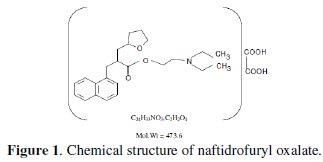
    <p>Naftidrofuryl oxalate is tetrahydro-&alpha;-(1-naphthalenylmethyl)-2-furanpropanoic 
acid 2-(di-ethylamino) ethyl ester acid oxalate, as shown in <a href="#f1">Fig. 1</a> [1].</p>


    <p>&nbsp;</p>
<a name="f1">
<img src="/img/revistas/pea/v30n3/30n3a03f1.jpg">
    
<p>&nbsp;</p>


    <p>Several methods have been recommended for the determination of NFL; these include 
titrimetric method (1), HPLC (2-5), capillary zone electrophoresis (6), 
electrochemical method (7) and phosphorimetry (8-12). The NFL is an official 
drug in BP. It is desirable to develop a simple and fast procedure that could be 
applied in quality control laboratories for the selective determination of NFL in 
the presence of its degradate. The utility of the developed methods to determine 
the content of drug in its pharmaceutical dosage form is also demonstrated. 
The suggested method is simple, rapid and from the economical point of view, all 
analytical reagents used are inexpensive, have excellent shelf life and are 
available in any analytical laboratory.</p>


    <p>&nbsp;</p>
    <p><b>Experimental</b></p>

    <p><b><i>Instruments</i></b></p>

    <p>Potentiometric measurements were made at 30 &pm;1 &deg;C with a Hanna (Model 
211) pH/mV meter. A double junction silver reference electrode (Model 
HI 5412) was used in conjunction with the drug sensor. A WPA pH 
combined glass electrode Model CD 740 was used for pH measurements. 
Ultrasonic, Bandelin electronic, Sonorex RK51OS, HF-Frequency 35 
KHz (10 liter capacity), Germany.</p>

    ]]></body>
<body><![CDATA[<p><b><i>Reagents and solvents</i></b></p>

    <p>All reagents used throughout this work were of analytical pure grade, and 
solvents were of spectroscopic grade. 
Methanol, water, chloroform (HPLC grade). 
Tetrahydrofuran (THF) 99% (Lab Scan). 
High molecular weight (10000) polyvinyl chloride (PVC) powder, sodium 
tetraphenyl borate (Na TPB) and 2-nitrophenyl octyl ether (NPOE) (Aldrich). 
Dibutylsebathete, sodium reineckate (R) and dioctyl phthalate (DOP); Sigma. 
Polyvinyl chloride carboxylated (PVC-COOH) and &beta;-cyclodextrin (&beta;-CD); 
(Fluka chemie GmbH Germany). 
Sodium hydroxide, 1 M aqueous solution and hydrochloric acid, 1 M aqueous 
solution; Prolabo. 
Phosphate buffer pH 2.5, 4 and 4.5 were prepared (1).</p>


    <p><b><i>Samples</i></b></p>

    <p><i>Pure standard</i></p>

    <p>NFL was kindly supplied by MINAPHARM-Egypt under license of MERK 
France, having a purity of 100.28 &pm; 1.119 (1).</p>

    <p><i>Pharmaceutical dosage form</i></p>

    <p>Praxilene&reg; film coated tablets (MINAPHARM-Egypt under license of MERK 
France) labeled to contain 200 mg of NFL per tablet, batch number 6IE1312.</p>

    <p><i>Degraded sample</i></p>

    <p>Preparation of alkaline degradate of NFL 
It was prepared by dissolving 25 mg of NFL in 9 mL water, then 10 mL 
methanol were added followed by 4 mL of 1 N NaOH and refluxing for 4 hours. 
The solution was neutralized, evaporated to dryness on hot plate and then the 
residue was dissolved in 20 mL methanol. The obtained solution was filtered into 
25 mL volumetric flask and the volume was completed with methanol to have a 
concentration of 1 mg ml<sup>-1</sup>.</p>


    <p><b><i>Standard stock and working solutions</i></b></p>

    ]]></body>
<body><![CDATA[<p>Standard stock solution of NFL (10<sup>-2</sup> M) in water and acetate buffer (pH 2.5, 4 &amp; 
4.5).</p>

    <p>Standard stock solution of alkaline degradate (10<sup>-2</sup> M) in acetate buffer (pH 2.5, 4 
&amp; 4.5).</p>

    <p>Working standard solution of NFL and alkaline degradate (10<sup>-6</sup>-10<sup>-3</sup> M) of each 
in acetate buffer (pH 2.5, 4 &amp; 4.5).</p>

    <p>Laboratory prepared mixtures of different ratios from 10 to 90% of NFL alkaline 
degradate and NFL.</p>


    <p><b><i>Procedures</i></b></p>

    <p><i>Preparation of naftidrofuryl PVC membrane sensors</i></p>

    <p><u>Preparation of NFL-TPB membrane sensor (sensor 1)</u></p>

    <p>10 mL of 10<sup>-2</sup> M aqueous solution of NFL were mixed with 10 mL of a saturated 
aqueous solution of sodium tetraphenyl borate. The resulting precipitate was 
filtered, washed with cold water, allowed to dry at room temperature and 
grounded to fine powder, forming the ion-pair complex. In a glass Petri dish (5 
cm diameter), 10 mg of the ion pair complex were mixed with 0.35 mL of 
dibutylsebathete, then 0.19 g of PVC were added. The mixture was dissolved in 
tetrahydrofuran (THF). The Petri dish was covered with a filter paper and 
allowed to stand overnight, thus a master membrane with 0.1 mm thickness was 
obtained. Sensor was assembled using a punched circular membrane (about 8 
mm). This was conditioned by soaking for 24 hours into 10<sup>-2</sup> M aqueous drug 
solution and stored in the same solution when not in use.</p>


    <p><u>Preparation of NFL-R membrane sensor (sensor 2)</u></p>

    <p>10 mL of 10<sup>-2</sup> M aqueous solution of NFL were mixed with 10 mL of a saturated 
aqueous solution of sodium reinekete. The resulting precipitate was filtered, 
washed with cold water, allowed to dry at room temperature and grounded to fine 
powder, forming the ion-pair complex.</p>

    ]]></body>
<body><![CDATA[<p>In a three glass Petri dishes (5 cm diameter), 10 mg of the ion pair complex were 
mixed with 0.35 mL of dioctyl phthalate (sensor 2a), dibutylsebathete (sensor 
2b) and NPOE (sensor 2c), separately, then 0.19 g of PVC were added to each 
one. The mixture was dissolved in tetrahydrofuran (THF).</p>

    <p>The Petri dishes were covered with a filter paper and allowed to stand overnight, 
thus three master membranes with 0.1 mm thickness were obtained.</p>

    <p>Sensors were assembled using a punched circular membrane (about 8 mm). This 
was conditioned by soaking for 24 hours into 10<sup>-2</sup> M aqueous drug solution and 
stored in the same solution when not in use. 


    <p><u>Preparation of NFL-&beta;-CD/PVC-COOH membrane sensor (sensor 3)</u></p>

    <p>In a glass Petri dish (5 cm diameter), mix 0.04 g &beta;-CD with 0.4 g of DOP, then 
0.19 g of PVC-COOH were added. The mixture was dissolved in tetrahydrofuran 
(THF). The Petri dish was covered with a filter paper and allowed to stand 
overnight, thus a master membrane with 0.1 mm thickness was obtained. 
The sensor was assembled using a punched circular membrane (about 8 mm). 
This was conditioned by soaking for 24 hours into 10<sup>-2</sup> M aqueous drug solution 
and stored in the same solution when not in use.</p>


    <p><i>Sensor calibration</i></p>

    <p>The sensor and double junction silver reference electrode were immersed in drug 
solution in acetate buffer (pH 2.5, 4 &amp; 4.5) in the range of 10<sup>-6</sup>-10<sup>-2</sup> M. They 
were allowed to equilibrate within &pm; 1 mV. Between measurements the 
membrane sensor was washed with water. The mV-concentration profile was 
plotted. The regression equation for the linear part of the curve was computed 
and used for subsequent determination of unknown NFL concentration.</p>


    <p><i>Selectivity measurements</i></p>

    <p>Potentiometry selectivity coefficients (K<sup>Pot</sup><sub>A,B</sub>) were evaluated according to 
IUPAC guidelines using the separate solutions method (13, 14) where A refers to 
(Drug ions) and B refers to (interfering ion).</p>

    <p>The emf for A and B are measured values (Ea and Eb), respectively. Different 
interfering anions at a concentration of 1&times;10<sup>-4</sup> M at a suitable pH were utilized 
and the results were obtained using the equation</p>

    ]]></body>
<body><![CDATA[<p>&nbsp;</p>
<a name="e1">
<img src="/img/revistas/pea/v30n3/30n3a03e1.jpg">
    
<p>&nbsp;</p>

    <p>where K<sup>Pot</sup><sub>A,B</sub> is the potentiometric selectivity coefficient, S is slope of the 
calibration plot, aA is the activity of drug, and ZA and ZB are the charges on 
drug and interfering ion, respectively.</p>


    <p><i>Application of laboratory prepared mixtures</i></p>

    <p>The membrane sensors were immersed in conjunction with the double junction 
silver reference electrode in the different laboratory prepared mixtures. The 
membrane sensors were washed with water between measurements. The emf 
produced for each mixture was measured by the proposed electrode, and then the 
concentration of NFL was determined from the corresponding regression 
equation.</p>


    <p><i>Application of pharmaceutical formulation</i></p>

    <p>Ten tablets were weighed and powdered. Two different quantities of the 
powdered tablets were transferred to two separate 25-mL volumetric flask, 
completed to the mark with acetate buffer (pH 2.5, 4 &amp; 4.5) to prepare 10<sup>-4</sup>-10<sup>-3</sup> M 
of NFL. The emf produced by immersing the prepared electrode in 
conjunction with double junction silver reference electrode in the prepared 
solutions was determined, and then the concentration of NFL was calculated 
from the regression equation of the corresponding electrode.</p>


    <p><i>Application to plasma samples</i></p>

    <p>4.5 mL of plasma were placed into 4 Stoppard shaking tubes, and then 0.5 mL of 
10<sup>-3</sup> M NFL were added separately and shacked. The membrane sensor was 
immersed in conjunction with the double junction silver reference electrode in 
these solutions. The membrane sensor was washed with water between 
measurements. The emf produced for each solution was measured by the two 
proposed electrodes, and then the concentration of NFL was determined from the 
corresponding regression equations.</p>


    <p>&nbsp;</p>
    ]]></body>
<body><![CDATA[<p><b>Results and discussion</b></p>

    <p>The stability of NFL was studied according to the ICH guidelines for: 
Stress, acid and alkaline: reflux with 0.1 N HCl /0.1 N NaOH for 8 hours, 1 N 
HCl for 12 hours, 2 N HCl for 24 hours, finally 6 N HCl for 24 hours. 
Oxidative condition: reflux with 3% H<sub>2</sub>O<sub>2</sub> for 24 hours and 10% H<sub>2</sub>O<sub>2</sub> for 24 
hours.</p>

    <p>The degradation process under the previously mentioned conditions was 
followed using TLC and the compound was found to be stable under acidic and 
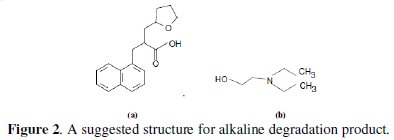
oxidative conditions, but it is liable to degradation in alkaline condition, giving 
one component which is confirmed with a previous study on stability of NFL (6). 
This work is concerned with the determination of NFL in presence of its alkaline 
degradate.</p>

    <p>To detect the complete degradation of NFL, a TLC procedure was suggested. 
Different systems were tried, where complete separation of NFL from its alkaline 
degradate was achieved using methanol-chloroform (20:80, v,v) as the mobile 
phase. The Rf values were 0.79 for NFL and 0.71 for its alkaline degradate. 
Using other systems such as methanol-chloroform-ammonia and butanol
chloroform-ammonia, butanol-ethyl acetate-ammonia, methanol-ethyl acetate-
ammonia and methanol-ethyl acetate-acetic acid in different ratios, were not 
successful for separating NFL from its alkaline degradate, except methanol-ethyl 
acetate-ammonia in the ratio (5:5:0.1, by volume) and methanol-chloroform in 
the ratio (2:8, v,v). Spotting of 5 Î¼L at different successive times of reflux and 
after evaporation, showed complete alkaline degradation after four hours and the 
obtained degradate unaffected during evaporation. It was one component in case 
of alkaline degradate as indicated by the appearance of one spot of alkaline 
degradate after complete degradation and also confirmed by IR.</p>

    <p>A suggested structure for alkaline degradate is shown in <a href="#f2">Fig. 2</a> (6).</p>


    <p>&nbsp;</p>
<a name="f2">
<img src="/img/revistas/pea/v30n3/30n3a03f2.jpg">
    
<p>&nbsp;</p>


    <p>The development and application of ion selective electrode continue to be of 
interest for pharmaceutical analysis because this sensor offers the advantages of 
simple design, reasonable selectivity and fast response. The advantages of the 
suggested potentiometric sensors are their low cost, wide pH working range, 
wide concentration range and applicability to turbid and colored solutions (15). 
The present investigation is based on the fact that NFL behaves as a cation in 
acidic medium, due to the presence of the amino group. This property suggests 
the use of anionic type of ion exchanger, sodium tetraphenyl borate with low 
solubility product and suitable grain size, which are functions of precipitation 
technique. They are physically compatible with the matrix and play the role of 
rapid ion exchanger for NFL at the membrane-sample interface.</p>

    <p>In case of cyclodextrin (CD), cooperative binding with certain guest molecules 
has been mostly attributed to intermolecular hydrogen bonding between the CD 
molecules, while intermolecular interactions between both the host and guest 
molecules, hydrogen bonds, hydrophobic interactions and Van der Waals forces, 
contribute to cooperative binding processes when synthetic CDs are used. 
Although the size and geometry of the guest mainly govern the binding strength, 
it is possible to influence the host-guest interactions by modification of the three 
hydroxyl groups on each glucose unit, hence the use of 2-hydroxypropyl &beta;cyclodextrin 
proved to enhance the interaction properties between host and guest 
molecules.</p>

    <p>NFL forms stable 1:1 water insoluble ion association complexes. This ratio was 
confirmed by the elemental analysis data and by the Nernstian response of the 
suggested sensor which was about 60 mV, the typical value for monovalent drug 
(14).</p>

    ]]></body>
<body><![CDATA[<p>PVC acts as standard support matrix and as traps for the sensed ions. It has the 
advantages of chemical inertness, high tensile strength and low cost, but its use 
makes a need for a plasticizer (16).</p>

    <p>DOP was found to be with poor selectivity as it is non-polar, NPOE improves 
the results obtained by using dibutylsebathete, so it was the plasticizer of choice. 
The membrane constituents were dissolved in THF that was slowly evaporated at 
room temperature leading to the membrane formation.</p>

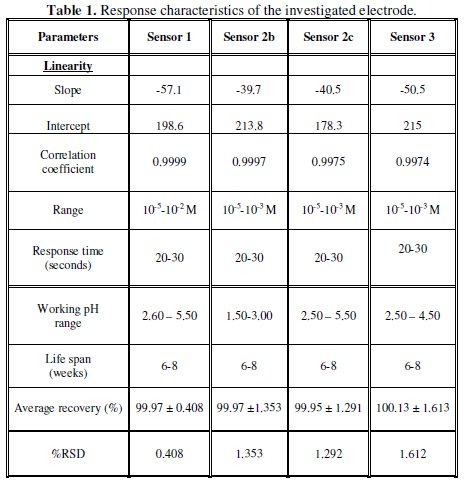
    <p>Electrochemical performance characteristics of the proposed sensor were 
evaluated according to the IUPAC recommendation data (14), <a href="#t1">Table 1</a>.</p>

    <p>&nbsp;</p>
<a name="t1">
<img src="/img/revistas/pea/v30n3/30n3a03t1.jpg">
    
<p>&nbsp;</p>

    <p>It was found that the electrodes displayed constant and stable potential readings within 
2 mV from day-to-day and the calibration slopes did not change by more than 2 
mV per decade over a period of 1 month.</p>

    <p>The response time of the electrode was tested for concentrations of NFL from 10<sup>-6</sup>-
10<sup>-2</sup> M. The measurements were characterized by a fast stable response within 
20-30 seconds for concentrations less than 10<sup>-4</sup> M and 10-20 seconds for 
concentrations more than 10<sup>-4</sup> M.</p>

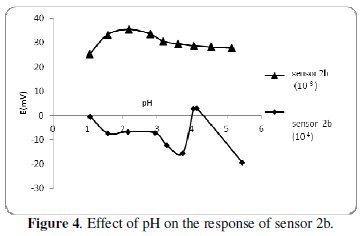
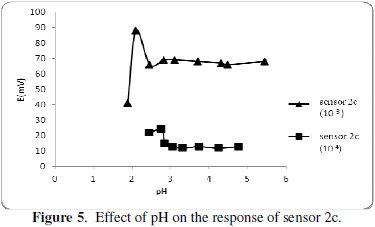
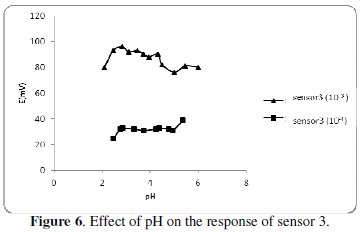
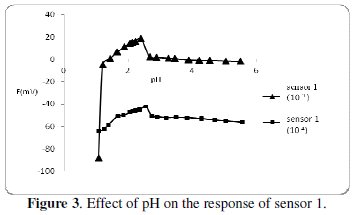
    <p>The pH effect was studied to be optimized from the point of view of both sensor 
function and chemical form of the test substance. It was apparent from the 
potential-pH profiles, <a href="#f3">Fig. 3-6</a>, that the sensor responses are fairly steady over pH 
2.6-5.5 for sensor 1, pH 1.5 - 3.0 for sensor 2b , pH 2.5 - 5.5 for sensor 2c and 
pH 2.5 - 4.5 for sensor 3 (acetate buffer).</p>


    <p>&nbsp;</p>
<a name="f3">
<img src="/img/revistas/pea/v30n3/30n3a03f3.jpg">
    
<p>&nbsp;</p>
<a name="f4">
<img src="/img/revistas/pea/v30n3/30n3a03f4.jpg">
    
]]></body>
<body><![CDATA[<p>&nbsp;</p>
<a name="f5">
<img src="/img/revistas/pea/v30n3/30n3a03f5.jpg">
    
<p>&nbsp;</p>
<a name="f6">
<img src="/img/revistas/pea/v30n3/30n3a03f6.jpg">
    
<p>&nbsp;</p>


    <p>Within this range, the drug cations 
were completely ionized, dissociated and therefore they become sensible; above 
and below this pH range, the potentials displayed by the electrodes were noisy. 
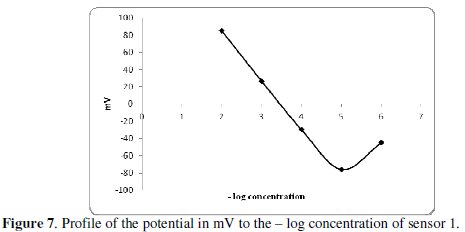
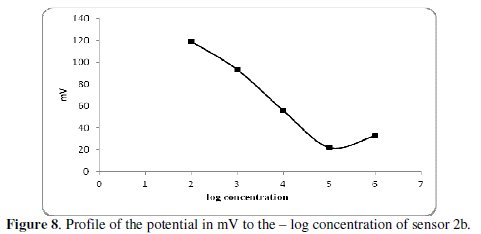
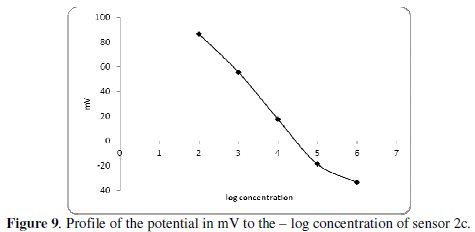
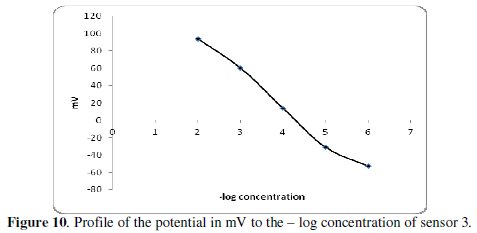
The potentiometric response of the four electrodes at the optimum pH was linear 
with constant slopes over a drug concentration range 10<sup>-5</sup>-10<sup>-2</sup> M for sensor 1, 
and 10<sup>-5</sup>-10<sup>-3</sup> M for sensors 2b , 2c and 3, as shown in <a href="#f7">Fig. 7-10</a>.</p>


    <p>&nbsp;</p>
<a name="f7">
<img src="/img/revistas/pea/v30n3/30n3a03f7.jpg">
    
<p>&nbsp;</p>
<a name="f8">
<img src="/img/revistas/pea/v30n3/30n3a03f8.jpg">
    
<p>&nbsp;</p>
<a name="f9">
<img src="/img/revistas/pea/v30n3/30n3a03f9.jpg">
    
<p>&nbsp;</p>
<a name="f10">
<img src="/img/revistas/pea/v30n3/30n3a03f10.jpg">
    
<p>&nbsp;</p>


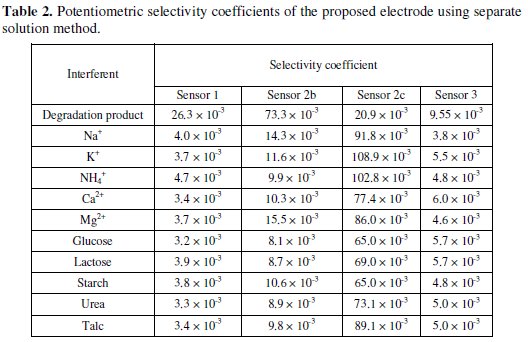
    <p><a href="#t2">Table 2</a> shows the potentiometric selectivity coefficients of the proposed sensors 
in the presence of tablet excipients, degradate, organic and inorganic related 
substances; the results revealed that the proposed membrane sensors displayed 
high selectivity, and that no significant interference was observed from 
interfering species.</p>

    ]]></body>
<body><![CDATA[<p>&nbsp;</p>
<a name="t2">
<img src="/img/revistas/pea/v30n3/30n3a03t2.jpg">
    
<p>&nbsp;</p>

    <p>Also, they revealed that sensor 2b displayed greater 
selectivity of potential for degradate I than that of sensors 1, 2c and 3.</p>

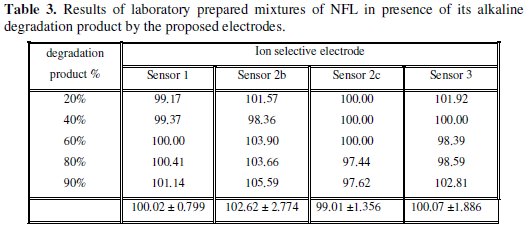
    <p>Results of <a href="#t3">Table 3</a> show that the proposed method is valid and applicable for 
determination of NFL in different laboratory prepared mixtures with mean 
percentage recoveries of 100.02&pm;0.799, 102.62&pm;2.774 , 99.01&pm;1.356 and 100.07 
&pm;1.886 for NFL by sensors 1, 2b, 2c and 3, respectively.</p>

    <p>&nbsp;</p>
<a name="t3">
<img src="/img/revistas/pea/v30n3/30n3a03t3.jpg">
    
<p>&nbsp;</p>

    <p>The sensors can be successfully used for determination of NFL in the presence of up to 90% of 
degradate I, and this proved the specificity of the method.</p>

    <p>Pharmaceutical additives, diluents and ingredients commonly used in drug 
formulations such as lactose, sucrose, magnesium sulphate, talc and methyl 
cellulose, did not show any interference. Thus, the analysis was carried out 
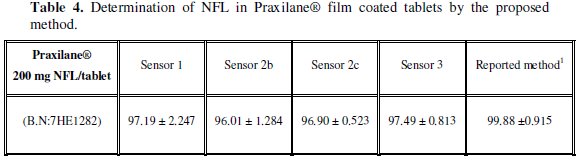
without prior treatment or extraction. The method was successfully used for the 
determination of NFL in praxilane tablets, as shown in <a href="#t4">Table 4</a>.</p>

    <p>&nbsp;</p>
<a name="t4">
<img src="/img/revistas/pea/v30n3/30n3a03t4.jpg">
    
<p>&nbsp;</p>

    ]]></body>
<body><![CDATA[<p>On application to the biological fluids, it has been found that the four electrodes 
gave stable results, as revealed by high precision and accuracy of recoveries of 
the spiked plasma samples indicating no interference from plasma electrolytes, as 
shown in <a href="#t5">Table 5</a>.</p>

    <p>&nbsp;</p>
<a name="t5">
<img src="/img/revistas/pea/v30n3/30n3a03t5.jpg">
    
<p>&nbsp;</p>

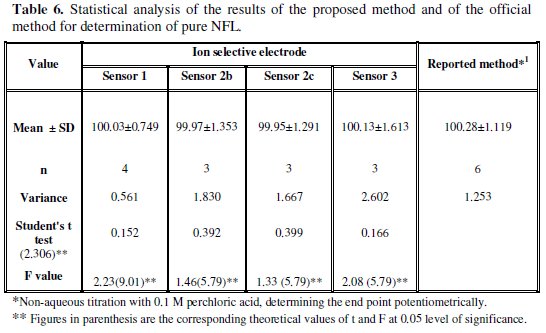
    <p>The results obtained by applying the proposed methods were statistically 
compared with the official method (1) and no significant difference was found 
regarding accuracy and precision, as shown in <a href="#t6">Table 6</a>.</p>

    <p>&nbsp;</p>
<a name="t6">
<img src="/img/revistas/pea/v30n3/30n3a03t6.jpg">
    
<p>&nbsp;</p>


    <p>&nbsp;</p>
    <p><b>References</b></p>

    <!-- ref --><p>1. British Pharmacopoeia. London: Her Majesty's Stationary Office; 2004.    &nbsp;&nbsp;&nbsp;&nbsp;&nbsp;&nbsp;&nbsp;&nbsp;[&#160;<a href="javascript:void(0);" onclick="javascript: window.open('/scielo.php?script=sci_nlinks&ref=000111&pid=S0872-1904201200030000300001&lng=','','width=640,height=500,resizable=yes,scrollbars=1,menubar=yes,');">Links</a>&#160;]<!-- end-ref --></p>
    ]]></body>
<body><![CDATA[<p>2. Brodie RR, Chasseaud LF, Taylor T, Hunter JO, Ciclitira PJ. J Chromatogr B. 1979;164:534-540.</p>
    <!-- ref --><p>3. Garrett ER, Barbhaiya R. J Pharm Sci. 1981;70:39-45.    &nbsp;&nbsp;&nbsp;&nbsp;&nbsp;&nbsp;&nbsp;&nbsp;[&#160;<a href="javascript:void(0);" onclick="javascript: window.open('/scielo.php?script=sci_nlinks&ref=000114&pid=S0872-1904201200030000300003&lng=','','width=640,height=500,resizable=yes,scrollbars=1,menubar=yes,');">Links</a>&#160;]<!-- end-ref --></p>
    <!-- ref --><p>4. Walmsley LM, Wilkinson PA, Brodie RR, Chasseaud LF. J Chromatogr. 1985;338:433-437.    &nbsp;&nbsp;&nbsp;&nbsp;&nbsp;&nbsp;&nbsp;&nbsp;[&#160;<a href="javascript:void(0);" onclick="javascript: window.open('/scielo.php?script=sci_nlinks&ref=000116&pid=S0872-1904201200030000300004&lng=','','width=640,height=500,resizable=yes,scrollbars=1,menubar=yes,');">Links</a>&#160;]<!-- end-ref --></p>
    <!-- ref --><p>5. Stehlik P, Houbova H. Cesk Farm. 1990;39:394-399.    &nbsp;&nbsp;&nbsp;&nbsp;&nbsp;&nbsp;&nbsp;&nbsp;[&#160;<a href="javascript:void(0);" onclick="javascript: window.open('/scielo.php?script=sci_nlinks&ref=000118&pid=S0872-1904201200030000300005&lng=','','width=640,height=500,resizable=yes,scrollbars=1,menubar=yes,');">Links</a>&#160;]<!-- end-ref --></p>
    <!-- ref --><p>6. Wang F, Dowling T, Bicker G, Wyvratt J. J Sep Sci. 2001;24:378-384.    &nbsp;&nbsp;&nbsp;&nbsp;&nbsp;&nbsp;&nbsp;&nbsp;[&#160;<a href="javascript:void(0);" onclick="javascript: window.open('/scielo.php?script=sci_nlinks&ref=000120&pid=S0872-1904201200030000300006&lng=','','width=640,height=500,resizable=yes,scrollbars=1,menubar=yes,');">Links</a>&#160;]<!-- end-ref --></p>
    <!-- ref --><p>7. Ionescu MS, Badea V, Baiulescu GE, Cosofret W. Talanta. 1986;33:101-103.    &nbsp;&nbsp;&nbsp;&nbsp;&nbsp;&nbsp;&nbsp;&nbsp;[&#160;<a href="javascript:void(0);" onclick="javascript: window.open('/scielo.php?script=sci_nlinks&ref=000122&pid=S0872-1904201200030000300007&lng=','','width=640,height=500,resizable=yes,scrollbars=1,menubar=yes,');">Links</a>&#160;]<!-- end-ref --></p>
    <p>8. de la Pena M, Mansilla E, Pulgarin M, Molina A, Lopez F. Analyst. 1998;123:2285-2290.</p>
    <!-- ref --><p>9. Pulgarin M, Molina A, Lopez F. Anal Chim Acta. 1999;382:77-85.    &nbsp;&nbsp;&nbsp;&nbsp;&nbsp;&nbsp;&nbsp;&nbsp;[&#160;<a href="javascript:void(0);" onclick="javascript: window.open('/scielo.php?script=sci_nlinks&ref=000125&pid=S0872-1904201200030000300009&lng=','','width=640,height=500,resizable=yes,scrollbars=1,menubar=yes,');">Links</a>&#160;]<!-- end-ref --></p>
    <p>10. Carretero S, Blanco C, Diaz C, Sanchez F, Gutierrez F. Anal Chim Acta. 2000;417:19-30.</p>
    <!-- ref --><p>11. Blanco C, Carretero S, Sanchez F, Gutierrez F. J Pharm Biomed Anal. 2000;23:845-850.    &nbsp;&nbsp;&nbsp;&nbsp;&nbsp;&nbsp;&nbsp;&nbsp;[&#160;<a href="javascript:void(0);" onclick="javascript: window.open('/scielo.php?script=sci_nlinks&ref=000128&pid=S0872-1904201200030000300011&lng=','','width=640,height=500,resizable=yes,scrollbars=1,menubar=yes,');">Links</a>&#160;]<!-- end-ref --></p>
    <!-- ref --><p>12. Li W, Cao LX, Li GR, Jin WJ. Guangpuxue Yu Guangpu Fenxi. 2002;22:518522.    &nbsp;&nbsp;&nbsp;&nbsp;&nbsp;&nbsp;&nbsp;&nbsp;[&#160;<a href="javascript:void(0);" onclick="javascript: window.open('/scielo.php?script=sci_nlinks&ref=000130&pid=S0872-1904201200030000300012&lng=','','width=640,height=500,resizable=yes,scrollbars=1,menubar=yes,');">Links</a>&#160;]<!-- end-ref --></p>
    <p>13. T.S. Ma and S.S.M. Hassan, Organic Analysis Using Ion Selective Electrodes, vol. 1 and 2, Academic Press, London 1982.</p>
    ]]></body>
<body><![CDATA[<!-- ref --><p>14. IUPAC Analytical Chemistry Division, Commission on Analytical Nomenclature. Pure Appl Chem. 2000;72:1852.    &nbsp;&nbsp;&nbsp;&nbsp;&nbsp;&nbsp;&nbsp;&nbsp;[&#160;<a href="javascript:void(0);" onclick="javascript: window.open('/scielo.php?script=sci_nlinks&ref=000133&pid=S0872-1904201200030000300014&lng=','','width=640,height=500,resizable=yes,scrollbars=1,menubar=yes,');">Links</a>&#160;]<!-- end-ref --></p>
    <!-- ref --><p>15. Cosofret VV. Membrane electrodes in drug substances analysis. Oxford (UK): Pergamon Press; 1982.    &nbsp;&nbsp;&nbsp;&nbsp;&nbsp;&nbsp;&nbsp;&nbsp;[&#160;<a href="javascript:void(0);" onclick="javascript: window.open('/scielo.php?script=sci_nlinks&ref=000135&pid=S0872-1904201200030000300015&lng=','','width=640,height=500,resizable=yes,scrollbars=1,menubar=yes,');">Links</a>&#160;]<!-- end-ref --></p>
    <!-- ref --><p>16. Zyka J. Instrumentaion in Analytical Chemistry. Chichester (UK):Ellis Horwood; 1994. (vol 2).    &nbsp;&nbsp;&nbsp;&nbsp;&nbsp;&nbsp;&nbsp;&nbsp;[&#160;<a href="javascript:void(0);" onclick="javascript: window.open('/scielo.php?script=sci_nlinks&ref=000137&pid=S0872-1904201200030000300016&lng=','','width=640,height=500,resizable=yes,scrollbars=1,menubar=yes,');">Links</a>&#160;]<!-- end-ref --></p>


    <p>&nbsp;</p>

    <p><a name=0><sup><a href="#top">*</sup></a>Corresponding author. E-mail address: <a href="mailto:mohamedrefaat73@yahoo.com">mohamedrefaat73@yahoo.com</a></p>

    <p>Received 11 March 2012; accepted 30 June 2012</p>

    <p><a href="http://www.peacta.org" target="_blank">www.peacta.org</a> </p>


    ]]></body>
<body><![CDATA[ ]]></body><back>
<ref-list>
<ref id="B1">
<label>1</label><nlm-citation citation-type="book">
<source><![CDATA[British Pharmacopoeia]]></source>
<year>2004</year>
<publisher-loc><![CDATA[London ]]></publisher-loc>
<publisher-name><![CDATA[Her Majesty's Stationary Office]]></publisher-name>
</nlm-citation>
</ref>
<ref id="B2">
<label>2</label><nlm-citation citation-type="journal">
<person-group person-group-type="author">
<name>
<surname><![CDATA[Brodie]]></surname>
<given-names><![CDATA[RR]]></given-names>
</name>
<name>
<surname><![CDATA[Chasseaud]]></surname>
<given-names><![CDATA[LF]]></given-names>
</name>
<name>
<surname><![CDATA[Taylor]]></surname>
<given-names><![CDATA[T]]></given-names>
</name>
</person-group>
<source><![CDATA[J Chromatogr B]]></source>
<year>1979</year>
<volume>164</volume>
<page-range>534-540</page-range></nlm-citation>
</ref>
<ref id="B3">
<label>3</label><nlm-citation citation-type="journal">
<person-group person-group-type="author">
<name>
<surname><![CDATA[Garrett]]></surname>
<given-names><![CDATA[ER]]></given-names>
</name>
<name>
<surname><![CDATA[Barbhaiya]]></surname>
<given-names><![CDATA[R]]></given-names>
</name>
</person-group>
<source><![CDATA[J Pharm Sci]]></source>
<year>1981</year>
<volume>70</volume>
<page-range>39-45</page-range></nlm-citation>
</ref>
<ref id="B4">
<label>4</label><nlm-citation citation-type="journal">
<person-group person-group-type="author">
<name>
<surname><![CDATA[Walmsley]]></surname>
<given-names><![CDATA[LM]]></given-names>
</name>
<name>
<surname><![CDATA[Wilkinson]]></surname>
<given-names><![CDATA[PA]]></given-names>
</name>
<name>
<surname><![CDATA[Brodie]]></surname>
<given-names><![CDATA[RR]]></given-names>
</name>
<name>
<surname><![CDATA[Chasseaud]]></surname>
<given-names><![CDATA[LF]]></given-names>
</name>
</person-group>
<source><![CDATA[J Chromatogr]]></source>
<year>1985</year>
<volume>338</volume>
<page-range>433-437</page-range></nlm-citation>
</ref>
<ref id="B5">
<label>5</label><nlm-citation citation-type="journal">
<person-group person-group-type="author">
<name>
<surname><![CDATA[Stehlik]]></surname>
<given-names><![CDATA[P]]></given-names>
</name>
<name>
<surname><![CDATA[Houbova]]></surname>
<given-names><![CDATA[H]]></given-names>
</name>
</person-group>
<source><![CDATA[Cesk Farm]]></source>
<year>1990</year>
<volume>39</volume>
<page-range>394-399</page-range></nlm-citation>
</ref>
<ref id="B6">
<label>6</label><nlm-citation citation-type="journal">
<person-group person-group-type="author">
<name>
<surname><![CDATA[Wang]]></surname>
<given-names><![CDATA[F]]></given-names>
</name>
<name>
<surname><![CDATA[Dowling]]></surname>
<given-names><![CDATA[T]]></given-names>
</name>
<name>
<surname><![CDATA[Bicker]]></surname>
<given-names><![CDATA[G]]></given-names>
</name>
<name>
<surname><![CDATA[Wyvratt]]></surname>
<given-names><![CDATA[J]]></given-names>
</name>
</person-group>
<source><![CDATA[J Sep Sci]]></source>
<year>2001</year>
<volume>24</volume>
<page-range>378-384</page-range></nlm-citation>
</ref>
<ref id="B7">
<label>7</label><nlm-citation citation-type="journal">
<person-group person-group-type="author">
<name>
<surname><![CDATA[Ionescu]]></surname>
<given-names><![CDATA[MS]]></given-names>
</name>
<name>
<surname><![CDATA[Badea]]></surname>
<given-names><![CDATA[V]]></given-names>
</name>
<name>
<surname><![CDATA[Baiulescu]]></surname>
<given-names><![CDATA[GE]]></given-names>
</name>
<name>
<surname><![CDATA[Cosofret]]></surname>
<given-names><![CDATA[W]]></given-names>
</name>
</person-group>
<source><![CDATA[Talanta]]></source>
<year>1986</year>
<volume>33</volume>
<page-range>101-103</page-range></nlm-citation>
</ref>
<ref id="B8">
<label>8</label><nlm-citation citation-type="journal">
<person-group person-group-type="author">
<name>
<surname><![CDATA[de la Pena]]></surname>
<given-names><![CDATA[M]]></given-names>
</name>
<name>
<surname><![CDATA[Mansilla]]></surname>
<given-names><![CDATA[E]]></given-names>
</name>
<name>
<surname><![CDATA[Pulgarin]]></surname>
<given-names><![CDATA[M]]></given-names>
</name>
</person-group>
<source><![CDATA[Analyst]]></source>
<year>1998</year>
<volume>123</volume>
<page-range>2285-2290</page-range></nlm-citation>
</ref>
<ref id="B9">
<label>9</label><nlm-citation citation-type="">
<person-group person-group-type="author">
<name>
<surname><![CDATA[Pulgarin]]></surname>
<given-names><![CDATA[M]]></given-names>
</name>
<name>
<surname><![CDATA[Molina]]></surname>
<given-names><![CDATA[A]]></given-names>
</name>
<name>
<surname><![CDATA[Lopez]]></surname>
<given-names><![CDATA[F]]></given-names>
</name>
</person-group>
<source><![CDATA[]]></source>
<year>1999</year>
<volume>Anal Chim Acta</volume><volume>382</volume>
<page-range>77-85</page-range></nlm-citation>
</ref>
<ref id="B10">
<label>10</label><nlm-citation citation-type="journal">
<person-group person-group-type="author">
<name>
<surname><![CDATA[Carretero]]></surname>
<given-names><![CDATA[S]]></given-names>
</name>
<name>
<surname><![CDATA[Blanco]]></surname>
<given-names><![CDATA[C]]></given-names>
</name>
<name>
<surname><![CDATA[Diaz]]></surname>
<given-names><![CDATA[C]]></given-names>
</name>
</person-group>
<source><![CDATA[Anal Chim Acta]]></source>
<year>2000</year>
<volume>417</volume>
<page-range>19-30</page-range></nlm-citation>
</ref>
<ref id="B11">
<label>11</label><nlm-citation citation-type="journal">
<person-group person-group-type="author">
<name>
<surname><![CDATA[Blanco]]></surname>
<given-names><![CDATA[C]]></given-names>
</name>
<name>
<surname><![CDATA[Carretero]]></surname>
<given-names><![CDATA[S]]></given-names>
</name>
<name>
<surname><![CDATA[Sanchez]]></surname>
<given-names><![CDATA[F]]></given-names>
</name>
<name>
<surname><![CDATA[Gutierrez]]></surname>
<given-names><![CDATA[F]]></given-names>
</name>
</person-group>
<source><![CDATA[J Pharm Biomed Anal]]></source>
<year>2000</year>
<volume>23</volume>
<page-range>845-850</page-range></nlm-citation>
</ref>
<ref id="B12">
<label>12</label><nlm-citation citation-type="journal">
<person-group person-group-type="author">
<name>
<surname><![CDATA[Li]]></surname>
<given-names><![CDATA[W]]></given-names>
</name>
<name>
<surname><![CDATA[Cao]]></surname>
<given-names><![CDATA[LX]]></given-names>
</name>
<name>
<surname><![CDATA[Li]]></surname>
<given-names><![CDATA[GR]]></given-names>
</name>
<name>
<surname><![CDATA[Jin]]></surname>
<given-names><![CDATA[WJ]]></given-names>
</name>
</person-group>
<source><![CDATA[Guangpuxue Yu Guangpu Fenxi]]></source>
<year>2002</year>
<volume>22</volume>
<page-range>518-522</page-range></nlm-citation>
</ref>
<ref id="B13">
<label>13</label><nlm-citation citation-type="book">
<person-group person-group-type="author">
<name>
<surname><![CDATA[Ma]]></surname>
<given-names><![CDATA[TS]]></given-names>
</name>
<name>
<surname><![CDATA[Hassan]]></surname>
<given-names><![CDATA[SSM]]></given-names>
</name>
</person-group>
<source><![CDATA[Organic Analysis Using Ion Selective Electrodes]]></source>
<year>1982</year>
<volume>1 and 2</volume>
<publisher-loc><![CDATA[London ]]></publisher-loc>
<publisher-name><![CDATA[Academic Press]]></publisher-name>
</nlm-citation>
</ref>
<ref id="B14">
<label>14</label><nlm-citation citation-type="journal">
<collab>Commission on Analytical Nomenclature^dIUPAC Analytical Chemistry Division</collab>
<source><![CDATA[Pure Appl Chem]]></source>
<year>2000</year>
<volume>72</volume>
<page-range>1852</page-range></nlm-citation>
</ref>
<ref id="B15">
<label>15</label><nlm-citation citation-type="book">
<person-group person-group-type="author">
<name>
<surname><![CDATA[Cosofret]]></surname>
<given-names><![CDATA[VV]]></given-names>
</name>
</person-group>
<source><![CDATA[Membrane electrodes in drug substances analysis]]></source>
<year>1982</year>
<publisher-loc><![CDATA[Oxford ]]></publisher-loc>
<publisher-name><![CDATA[Pergamon Press]]></publisher-name>
</nlm-citation>
</ref>
<ref id="B16">
<label>16</label><nlm-citation citation-type="book">
<person-group person-group-type="author">
<name>
<surname><![CDATA[Zyka]]></surname>
<given-names><![CDATA[J]]></given-names>
</name>
</person-group>
<source><![CDATA[Instrumentaion in Analytical Chemistry]]></source>
<year>1994</year>
<volume>2</volume>
<publisher-loc><![CDATA[Chichester ]]></publisher-loc>
<publisher-name><![CDATA[Ellis Horwood]]></publisher-name>
</nlm-citation>
</ref>
</ref-list>
</back>
</article>