<?xml version="1.0" encoding="ISO-8859-1"?><article xmlns:mml="http://www.w3.org/1998/Math/MathML" xmlns:xlink="http://www.w3.org/1999/xlink" xmlns:xsi="http://www.w3.org/2001/XMLSchema-instance">
<front>
<journal-meta>
<journal-id>0872-1904</journal-id>
<journal-title><![CDATA[Portugaliae Electrochimica Acta]]></journal-title>
<abbrev-journal-title><![CDATA[Port. Electrochim. Acta]]></abbrev-journal-title>
<issn>0872-1904</issn>
<publisher>
<publisher-name><![CDATA[Sociedade Portuguesa de Electroquímica]]></publisher-name>
</publisher>
</journal-meta>
<article-meta>
<article-id>S0872-19042012000300004</article-id>
<article-id pub-id-type="doi">10.4152/pea.201203189</article-id>
<title-group>
<article-title xml:lang="en"><![CDATA[Corrosion Inhibition and Adsorption of Anthocleista Djalonesis Leaf Extract on the Acid Corrosion of Mild Steel]]></article-title>
</title-group>
<contrib-group>
<contrib contrib-type="author">
<name>
<surname><![CDATA[Ogukwe]]></surname>
<given-names><![CDATA[C.E.]]></given-names>
</name>
<xref ref-type="aff" rid="A01"/>
</contrib>
<contrib contrib-type="author">
<name>
<surname><![CDATA[Akalezi]]></surname>
<given-names><![CDATA[C.O.]]></given-names>
</name>
<xref ref-type="aff" rid="A01"/>
</contrib>
<contrib contrib-type="author">
<name>
<surname><![CDATA[Chidiebere]]></surname>
<given-names><![CDATA[M. A.]]></given-names>
</name>
<xref ref-type="aff" rid="A01"/>
</contrib>
<contrib contrib-type="author">
<name>
<surname><![CDATA[Oguzie]]></surname>
<given-names><![CDATA[K.L.]]></given-names>
</name>
<xref ref-type="aff" rid="A02"/>
</contrib>
<contrib contrib-type="author">
<name>
<surname><![CDATA[Iheabunike]]></surname>
<given-names><![CDATA[Z.O.]]></given-names>
</name>
<xref ref-type="aff" rid="A01"/>
</contrib>
<contrib contrib-type="author">
<name>
<surname><![CDATA[Oguziea]]></surname>
<given-names><![CDATA[E.E.]]></given-names>
</name>
<xref ref-type="aff" rid="A01"/>
</contrib>
</contrib-group>
<aff id="A01">
<institution><![CDATA[,Federal University of Technology Owerri Department of Chemistry Electrochemistry and Materials Science Research Laboratory]]></institution>
<addr-line><![CDATA[Owerri ]]></addr-line>
<country>Nigeria</country>
</aff>
<aff id="A02">
<institution><![CDATA[,Federal University of Technology Owerri Department of Environmental Technology ]]></institution>
<addr-line><![CDATA[Owerri ]]></addr-line>
<country>Nigeria</country>
</aff>
<pub-date pub-type="pub">
<day>00</day>
<month>05</month>
<year>2012</year>
</pub-date>
<pub-date pub-type="epub">
<day>00</day>
<month>05</month>
<year>2012</year>
</pub-date>
<volume>30</volume>
<numero>3</numero>
<fpage>189</fpage>
<lpage>202</lpage>
<copyright-statement/>
<copyright-year/>
<self-uri xlink:href="http://scielo.pt/scielo.php?script=sci_arttext&amp;pid=S0872-19042012000300004&amp;lng=en&amp;nrm=iso"></self-uri><self-uri xlink:href="http://scielo.pt/scielo.php?script=sci_abstract&amp;pid=S0872-19042012000300004&amp;lng=en&amp;nrm=iso"></self-uri><self-uri xlink:href="http://scielo.pt/scielo.php?script=sci_pdf&amp;pid=S0872-19042012000300004&amp;lng=en&amp;nrm=iso"></self-uri><abstract abstract-type="short" xml:lang="en"><p><![CDATA[Aqueous extracts of the leaves of Anthocleista djalonesis (AD) have been investigated as non toxic corrosion inhibitors for mild steel in acidic environments (1 M HCl and 0.5 M H2SO4, respectively). Corrosion rates were evaluated at 30 °C using the weight loss, electrochemical impedance spectroscopy and potentiodynamic polarization techniques. AD extract was found to inhibit mild steel corrosion in both acidic media via adsorption of the extract organic matter on the metal/solution interface. Polarization data indicate that the extract functioned via a mixed inhibition mechanism, affecting both the cathodic and anodic partial reactions of the corrosion process. Molecular dynamics (MD) simulations were performed to illustrate the adsorption process of some specific components of the extract.]]></p></abstract>
<kwd-group>
<kwd lng="en"><![CDATA[corrosion inhibition]]></kwd>
<kwd lng="en"><![CDATA[biomass extract]]></kwd>
<kwd lng="en"><![CDATA[Anthocleista djalonesis]]></kwd>
<kwd lng="en"><![CDATA[adsorption]]></kwd>
<kwd lng="en"><![CDATA[molecular dynamics simulations]]></kwd>
</kwd-group>
</article-meta>
</front><body><![CDATA[ 

    <p><b>Corrosion Inhibition and Adsorption of Anthocleista Djalonesis Leaf Extract on the Acid Corrosion of Mild Steel</b></p>

    <p><b>C.E. Ogukwe<sup>1</sup>, C.O. Akalezi<sup>1</sup>, M. A. Chidiebere<sup>1</sup>, K.L. Oguzie<sup>2</sup>, Z.O. Iheabunike<sup>1</sup>, and E.E. Oguziea<sup>1,<a href="#0">*<a/></sup></b></p>

    <p><sup>1</sup><i> Electrochemistry and Materials Science Research Laboratory, Department of Chemistry, Federal University of Technology Owerri, PMB 1526 Owerri, Nigeria</i></p>

    <p><sup>2</sup><i> Department of Environmental Technology, Federal University of Technology Owerri, PMB 1526 Owerri, Nigeria</i></p>


<!--     <p>&nbsp;</p>
    <p>doi: 10.4152/pea.201203189</p> -->


    <p>&nbsp;</p>
    <p><b>Abstract</b></p>

    <p>Aqueous extracts of the leaves of Anthocleista djalonesis (AD) have been investigated 
as non toxic corrosion inhibitors for mild steel in acidic environments (1 M HCl and 0.5 
M  H<sub>2</sub>SO<sub>4</sub>, respectively). Corrosion rates were evaluated at 30 &deg;C using the weight loss, 
electrochemical impedance spectroscopy and potentiodynamic polarization techniques. 
AD extract was found to inhibit mild steel corrosion in both acidic media via adsorption 
of the extract organic matter on the metal/solution interface. Polarization data indicate 
that the extract functioned via a mixed inhibition mechanism, affecting both the 
cathodic and anodic partial reactions of the corrosion process. Molecular dynamics 
(MD) simulations were performed to illustrate the adsorption process of some specific 
components of the extract.</p>

    ]]></body>
<body><![CDATA[<p><b><i>Keywords:</i></b> corrosion inhibition, biomass extract, Anthocleista djalonesis, adsorption, molecular dynamics simulations.</p>


    <p>&nbsp;</p>
    <p><b>Introduction</b></p>

    <p>The corrosion of metals by acids is a major dilemma encountered in numerous 
industrial processes. A significant method to protect the metals from corrosion is 
the addition of species to the solution in contact with the surface in order to 
inhibit the corrosion reaction and reduce the corrosion rate. To this end, the use 
of organic compounds containing nitrogen, oxygen, or sulphur as inhibitors to 
reduce corrosion attack has received detailed attention [1-11]. These compounds 
act at the interphase created by the corrosion product between the metal and the 
aqueous aggressive solution, and their interaction with the corroding metal 
surface, usually via adsorption, often leads to a modification in either the 
mechanism of the electrochemical process at the double layer or in the surface 
available to the process.</p>

    <p>Owing to increasing ecological awareness and strict environmental regulations, 
attention is now focusing on the development of substitute environmentally 
friendly alternatives to hazardous chemical processes. Such development will 
ultimately rely on the only practical sustainable source of materials - plant 
(biomass) extracts - and provoke more ingenious utilization of these extracts as 
sources of alternative benign chemical substances. With this in mind, we have 
over time investigated the possibility of applying biomass extracts directly in 
solving materials corrosion problems and as potential replacements for the costly 
and toxic chemicals in use presently. The key hypothesis here is that some 
phytochemical constituents of plant extracts including tannins, proteins, 
polysaccharides, polycarboxylic acids, alkaloids, etc., possess electronic 
structures akin to those of conventional organic corrosion inhibitors and some 
have actually been reported to function as inhibitors of metal corrosion [12-20]. 
The leaf extract Anthocleista djalonesis (AD) has been studied in this work for its 
inhibiting effect on mild steel corrosion in aqueous acidic environments. The 
plant is of West African origin and is used extensively in traditional medicine for 
treatment of various diseases due to its acclaimed antipyretic, stomachic, 
analgesic and purgative action. Chemical compounds isolated from the leaves 
include an iridoid glucoside (djalonenoside), which is the major constituent of 
the plant, a dibenzo-&alpha;-pyrone (djalonensone), ursolic acid, 3-oxo-&Delta;<sup>4,5</sup>-sitosterone, 
etc. [21,22]. Corrosion rates in the absence and presence of the extract have been 
determined using the gravimetric and electrochemical techniques, while density 
functional theory (DFT) based quantum chemical computation was employed to 
model the electronic and adsorption structures of some active components of the 
extract.</p>


    <p>&nbsp;</p>
    <p><b>Experimental</b></p>

    <p><b><i>Materials preparation</i></b></p>

    <p>Tests were performed on carbon steel specimens with weight percentage 
composition as follows; C-0.05; Mn-0.6; P-0.36; Si-0.3 and the balance Fe. The 
blank corrodents were respectively 1.0 M HCl and 0.5 M  H<sub>2</sub>SO<sub>4</sub> solutions. Stock 
solutions of AD extract were prepared by boiling 20 g of the dried and ground 
leaves under reflux for 3 h in 1.0 M HCl and 0.5 M  H<sub>2</sub>SO<sub>4</sub> solutions, 
respectively. The resulting solutions were cooled then triple filtered. The amount 
of material extracted into solution was quantified by comparing the weight of the 
dried residue with the initial weight of the dried plant material before extraction. 
Inhibitor test solutions were prepared in the concentration range 100-1000 mg/L 
from the respective stock solutions.</p>

    <p><b><i>Gravimetric experiments</i></b></p>

    ]]></body>
<body><![CDATA[<p>Gravimetric experiments were conducted on test coupons of dimension 3 cm &times; 3 
cm &times; 0.14 cm. These coupons were wet-polished with silicon carbide abrasive 
paper (from grade #400 to #1000), rinsed with distilled water, and dried in 
acetone and warm air, weighed and stored in a moisture-free desiccator prior to 
use. The pre-cleaned and weighed coupons were subsequently suspended in 
beakers containing the test solutions using glass hooks and rods. Tests were 
conducted under total immersion conditions in 300 mL of the aerated and 
unstirred test solutions. To determine the weight loss, coupons were retrieved 
from test solutions after 6 h, appropriately cleaned, dried and re-weighed. The 
weight loss was taken to be the difference between the initial and final weights of 
the coupons. All tests were run in triplicate and the data showed good 
reproducibility. Average values for each experiment were obtained and used in 
subsequent calculations.</p>

    <p><b><i>Electrochemical measurements</i></b></p>

    <p>Test metal samples for electrochemical experiments were machined into 
rectangular specimens and fixed in polytetrafluoroethylene (PTFE) rods by 
epoxy resin in such a way that only one surface of area 1 cm<sup>2</sup> was left uncovered. 
The exposed surface was also cleaned as described above. Electrochemical 
experiments were conducted in a three-electrode corrosion cell using a 
VERSASTAT 400 Complete DC Voltammetry and Corrosion System, with V3 
Studio software. A graphite rod was used as counter electrode and a saturated 
calomel electrode (SCE) as reference electrode. The latter was connected via a 
Luggin's capillary. Measurements were performed in aerated and unstirred 
solutions at the end of 1 h of immersion at 30 &pm; 1 &deg;C. Impedance measurements 
were made at corrosion potentials (E<sub>corr</sub>) over a frequency range of 100 kHz - 10 
mHz, with a signal amplitude perturbation of 5 mV. Potentiodynamic 
polarization studies were carried out in the potential range &pm; 
250 mV versus corrosion potential at a scan rate of 0.333 mV s<sup>-1</sup>. Each test was run in triplicate 
to verify the reproducibility of the data.</p>

    <p>All theoretical calculations were performed using the DFT electronic structure 
programs Forcite and DMol3 as contained in the Materials Studio 4.0 software.</p>


    <p>&nbsp;</p>
    <p><b>Results and discussion</b></p>

    <p><b><i>Weight losses and corrosion rates</i></b></p>

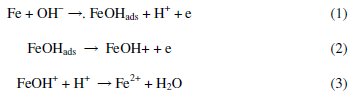
    <p>The anodic dissolution of iron in acidic solutions is known to proceed via a 
hydroxyl ion catalyzed mechanism [23]:</p>

    <p>&nbsp;</p>
<a name="e1">
<img src="/img/revistas/pea/v30n3/30n3a04e1.jpg">
    
<p>&nbsp;</p>

    ]]></body>
<body><![CDATA[<p>As a consequence of these reactions, including the high solubility of the 
corrosion products, the metal loses weight in the solution. The corrosion rates of 
the mild steel test coupons in 1 M HCl and 0.5 M  H<sub>2</sub>SO<sub>4</sub> in the absence and 
presence of AD extract were therefore assessed by weight loss measurements.</p>

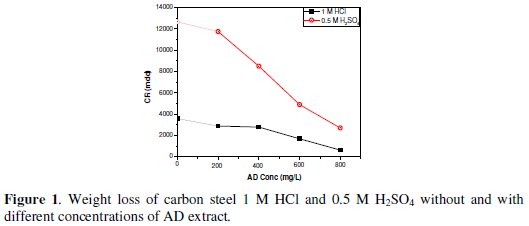
    <p><a href="#f1">Fig. 1</a> shows the corrosion rates of the mild steel coupons in 1 M HCl and 0.5 M 
 H<sub>2</sub>SO<sub>4</sub> without and with different concentrations of AD. The data presented are 
means of triplicate determinations, with standard deviation ranging from 0 - 
0.00054.</p>


    <p>&nbsp;</p>
<a name="f1">
<img src="/img/revistas/pea/v30n3/30n3a04f1.jpg">
    
<p>&nbsp;</p>


    <p>The fact that the metal specimen manifests higher corrosion 
susceptibility in 0.5 M  H<sub>2</sub>SO<sub>4</sub> is evidence that the acid anions influence the 
corrosion process in different ways. The lower corrosion rates of the metal 
specimens in 1 M HCl is attributable to the ability of chloride ions to replace 
hydroxyl ions adsorbed on the metal surface, thus reducing the catalytic effect.</p>

    <p><a href="#f1">Fig. 1</a> also clearly reveals a general reduction in corrosion rates in both 1 M HCl 
and 0.5 M  H<sub>2</sub>SO<sub>4</sub> due to AD addition, suggesting a corrosion inhibiting effect of 
the extract. The inhibiting effect becomes more pronounced with increasing AD 
concentration, implying a dependence of the inhibition process on the amount of 
inhibiting species present in the system.</p>

    <p>Quantitative characterization of the effect of AD extract on the free corrosion of 
mild steel in the different acid solutions was carried out by an assessment of the 
inhibition efficiency (&eta;%), obtained by comparing the corrosion rates in the 
absence (CRblank) and presence (CRinh) of AD extract using the equation:</p>

    <p>&nbsp;</p>
<a name="e4">
<img src="/img/revistas/pea/v30n3/30n3a04e4.jpg">
    
<p>&nbsp;</p>

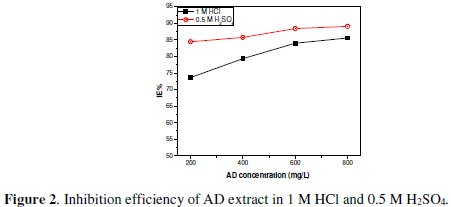
    <p><a href="#f2">Fig. 2</a> shows the obtained &eta;% values at different AD concentration in 1 M HCl 
and 0.5 M  H<sub>2</sub>SO<sub>4</sub>.</p>


    ]]></body>
<body><![CDATA[<p>&nbsp;</p>
<a name="f2">
<img src="/img/revistas/pea/v30n3/30n3a04f2.jpg">
    
<p>&nbsp;</p>


    <p>Efficiency is actually comparable in both acid media and 
generally increased with AD concentration.</p>

    <p>The protective action of biomass extracts is often attributed to their 
phytochemical constituents, with molecular and electronic structures similar to 
organic corrosion inhibitors. Organic inhibitors function by adsorption on the 
corroding metal surface and subsequent displacement of pre-adsorbed water 
molecules.</p>

    <p>&nbsp;</p>
<a name="e5">
<img src="/img/revistas/pea/v30n3/30n3a04e5.jpg">
    
<p>&nbsp;</p>

    <p>The resulting adsorption film then isolates the metal surface from the corrosive 
medium to an extent depending on the degree of the surface coverage. The 
observed increase in inhibition efficiency with AD concentration thus results 
from increased adsorption of the extract organic matter on the mild steel surface, 
thereby reducing the surface area available for the corrosion reaction. The 
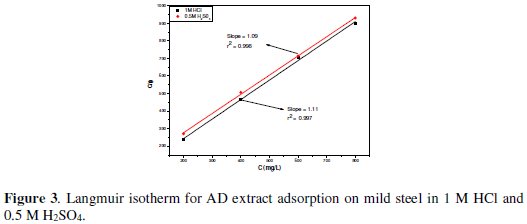
proposed adsorption of the extract constituents is substantiated by the data fit to 
the Langmuir adsorption isotherm, as depicted in <a href="#f3">Fig. 3</a>.</p>


    <p>&nbsp;</p>
<a name="f3">
<img src="/img/revistas/pea/v30n3/30n3a04f3.jpg">
    
<p>&nbsp;</p>


    <p><b><i>Electrochemical measurements</i></b></p>

    ]]></body>
<body><![CDATA[<p>Since corrosion is an electrochemical process, electrochemical techniques are 
best suited for mechanistic studies of corrosion systems. Polarization 
measurements are particularly appropriate for monitoring the progress and 
mechanisms of the anodic and cathodic partial reactions as well as identifying the 
effect of an additive on the cathodic and anodic partial reactions, whereas 
impedance measurements provide insight into the corrosion mechanism at the 
metal/corrodent interface in absence and presence at additives. Measurements 
were therefore also undertaken to understudy the inhibiting effect of AD from an 
electrochemical perspective in order to gain insights into the electrochemical 
mechanisms of the corrosion inhibition process. The highest concentration of AD 
studied (800 mg/L) was chosen for the electrochemical measurements.</p>


    <p><b><i>Electrochemical impedance spectroscopy</i></b></p>

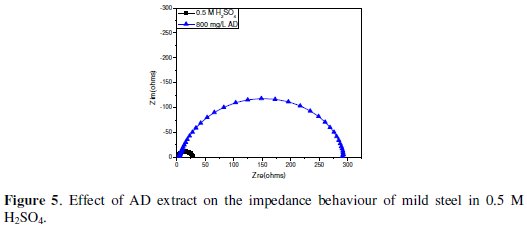
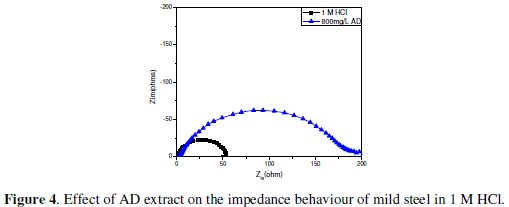
    <p>Impedance experiments were undertaken to afford insight into the characteristics 
and kinetics of electrochemical processes ocurring at the mild steel/1 M HCl 
and mild steel/0.5 M  H<sub>2</sub>SO<sub>4</sub> interfaces in absence and presence of AD. The 
impedance responses of these systems are presented as Nyquist plots in <a href="#f4">Fig. 4</a> 
and <a href="#f5">Fig. 5</a>, respectively.</p>


    <p>&nbsp;</p>
<a name="f4">
<img src="/img/revistas/pea/v30n3/30n3a04f4.jpg">
    
<p>&nbsp;</p>
<a name="f5">
<img src="/img/revistas/pea/v30n3/30n3a04f5.jpg">
    
<p>&nbsp;</p>


    <p>The Nyquist plots show single depressed semicircles for 
all systems over the frequency range studied. The observed depression of the 
Nyquist semicircle with center under the real axis is typical for solid metal 
electrodes that show frequency dispersion of the impedance data. The high 
frequency intercept with the real axis in the Nyquist plots is assigned to the 
solution resistance (Rs) and the low frequency intercept with the real axis 
ascribed to the charge transfer resistance (R<sub>ct</sub>). The impedance spectra were 
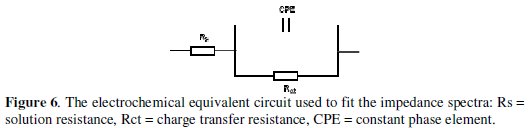
analyzed by fitting to the equivalent circuit model in <a href="#f6">Fig. 6</a> [Rs(QdlR<sub>ct</sub>)], which 
has been used previously to adequately model the mild steel/acid interface [24,25].</p>


    <p>&nbsp;</p>
<a name="f6">
<img src="/img/revistas/pea/v30n3/30n3a04f6.jpg">
    
<p>&nbsp;</p>


    <p>In this equivalent circuit, the solution resistance is shorted by a constant 
phase element (CPE) that is placed in parallel to the charge transfer resistance. 
The CPE is used in place of a capacitor to compensate for deviations from ideal 
dielectric behavior arising from the inhomogeneous nature of the electrode 
surfaces. The impedance of the CPE is given by [24]:</p>

    ]]></body>
<body><![CDATA[<p>&nbsp;</p>
<a name="e6">
<img src="/img/revistas/pea/v30n3/30n3a04e6.jpg">
    
<p>&nbsp;</p>

    <p>where Q and n stand for the CPE constant and exponent respectively, j = (-1)<sup>1/2</sup> is 
an imaginary number, &omega; is the angular frequency in rad s<sup>-1</sup>, (&omega; = 2&pi; f) when f is the frequency in Hz.</p>

    <p>Addition of AD increased R<sub>ct</sub> values from 52.8 &Omega; cm<sup>2</sup> to 192.7 &Omega; cm<sup>2</sup> in 1 M 
HCl and from 32.9 W-cm to 286.3 &Omega; cm<sup>2</sup> in 0.5 M  H<sub>2</sub>SO<sub>4</sub>. Such enhancement of 
R<sub>ct</sub> corresponds to an increase in the diameter of the Nyquist semicircle, 
confirming the corrosion inhibiting effect of the extract. Inhibition efficiency 
from the impedance data (&eta;R%) was estimated by comparing the values of the 
charge transfer resistance in the absence (R<sub>ct,bl</sub>) and presence of inhibitor (R<sub>ct,inh</sub>) 
as follows:</p>

    <p>&nbsp;</p>
<a name="e7">
<img src="/img/revistas/pea/v30n3/30n3a04e7.jpg">
    
<p>&nbsp;</p>

    <p>The obtained values are 72.6% (in 1 M HCl) and 88.7% (0.5 M  H<sub>2</sub>SO<sub>4</sub>).</p>

    <p>The values of the double layer capacitance (C<sub>dl</sub>), obtained at the frequency 
wherein the imaginary component of the impedance is a maximum (-Z<sub>im,max</sub>) 
according to <a href="#e8">Eq. (8)</a> were also modified by the extract, decreasing from 39.4 
&mu;F cm<sup>-2</sup> to 14.4 &mu;F cm<sup>-2</sup> in 1 M HCl and from 37.6 &mu;F cm<sup>-2</sup> to 10.7 &mu;F cm<sup>-2</sup> in 0.5 M 
 H<sub>2</sub>SO<sub>4</sub>.</p>

    <p>&nbsp;</p>
<a name="e8">
<img src="/img/revistas/pea/v30n3/30n3a04e8.jpg">
    
<p>&nbsp;</p>

    ]]></body>
<body><![CDATA[<p>Such reduction, according to the Helmholtz model (<a href="#e9">Eq. 9</a>), normally results from 
a decrease in the dielectric constant (e) or an increase in the double layer 
thickness (&delta;) due to species adsorption at the double layer:</p>

    <p>&nbsp;</p>
<a name="e9">
<img src="/img/revistas/pea/v30n3/30n3a04e9.jpg">
    
<p>&nbsp;</p>

    <p>where &epsilon;o is the vacuum permittivity and A is the electrode. Since adsorption of an 
organic inhibitor on a metal surface involves the replacement of water molecules 
pre-adsorbed on the surface, the smaller dielectric constant of organics compared 
to water as well as the increased thickness of the double layer due to inhibitor 
adsorption act simultaneously to reduce the interfacial capacitance. This provides 
experimental evidence of adsorption of the extract organic matter on the 
corroding mild steel surface.</p>


    <p><b><i>Potentiodynamic polarization</i></b></p>

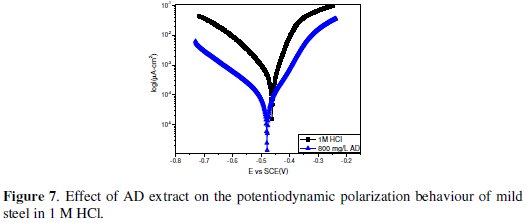
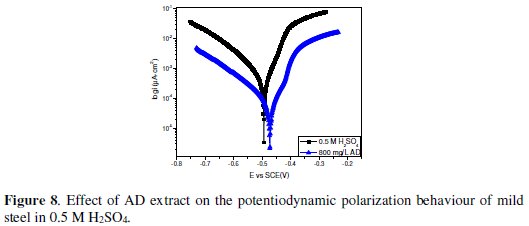
    <p>Potentiodynamic polarization experiments were undertaken in order to gain some 
mechanistic insight on the effect of AD on the anodic and cathodic reactions of 
mild steel in both environments. The resulting polarization curves in 1 M HCl 
and 0.5 M  H<sub>2</sub>SO<sub>4</sub> are given in <a href="#f7">Fig. 7</a> and <a href="#f8">Fig. 8</a>, respectively.</p>


    <p>&nbsp;</p>
<a name="f7">
<img src="/img/revistas/pea/v30n3/30n3a04f7.jpg">
    
<p>&nbsp;</p>
<a name="f8">
<img src="/img/revistas/pea/v30n3/30n3a04f8.jpg">
    
<p>&nbsp;</p>


    <p>Again the net effect of AD extract on the corrosion process in both environments appears quite 
similar as the anodic and cathodic reactions are inhibited, while E<sub>corr</sub> was not 
altered to any significant extent. This implies that the corrosion inhibition 
process is under mixed control. A closer look at the polarization curves however 
reveals that the cathodic inhibiting effect was more pronounced in 1 M HCl, 
where the extract reduced the corrosion current (icorr) from 2184 &mu;A cm<sup>-2</sup> to 399.3 
&mu;A cm<sup>-2</sup> while the anodic inhibiting effect was more prominent in 0.5 M  H<sub>2</sub>SO<sub>4</sub>, 
with a corresponding decrease in icorr from 2388 &mu;A cm<sup>-2</sup> to 339.1 &mu;A cm<sup>-2</sup>.</p>

    ]]></body>
<body><![CDATA[<p>The values of the corrosion current density in the absence (icorr,bl) and presence of 
the inhibitor (icorr,inh) were used to estimate the inhibition efficiency from 
polarization data (&eta;i%) as follows:</p>

    <p>&nbsp;</p>
<a name="e10">
<img src="/img/revistas/pea/v30n3/30n3a04e10.jpg">
    
<p>&nbsp;</p>

    <p>The calculated values were 81.7 % and 85.8 % in 1 M HCl and 0.5 M  H<sub>2</sub>SO<sub>4</sub> 
respectively.</p>


    <p><b><i>Theoretical considerations</i></b></p>

    <p>As it is often the case with biomass extracts, the multi component nature of AD 
extract makes it rather difficult to ascribe the observed inhibiting effect to any 
particular constituents. Nevertheless, since corrosion inhibiting action is often 
linked with the presence of polar heteroatoms, pi-bond conjugation, aromaticity, 
electron delocalization regions, etc., it is possible to qualitatively predict the 
adsorption behaviour of extract components having chemical structures similar to 
those of conventional organic molecules with previously established efficacy. 
Based on this consideration, the chemical structures of djalonenoside (DJN) and 
its HCl/MeOH hydrolysis product DJN-hyd recommend them for theoretical 
assessment of corrosion inhibiting potential. The quantum chemical 
computations are not necessarily intended to provide detailed description of the 
adsorption of the extract. Instead, the idea is to recognize the relative 
contributions of the different extract components through their individual 
adsorption strengths and mechanisms.</p>

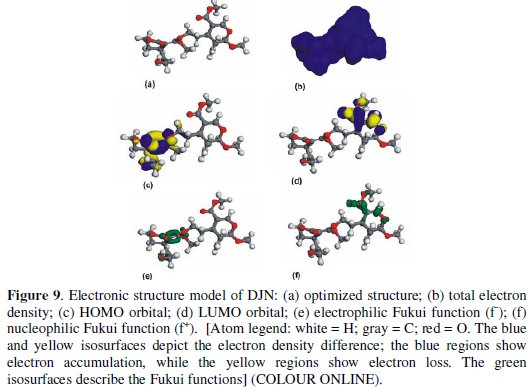
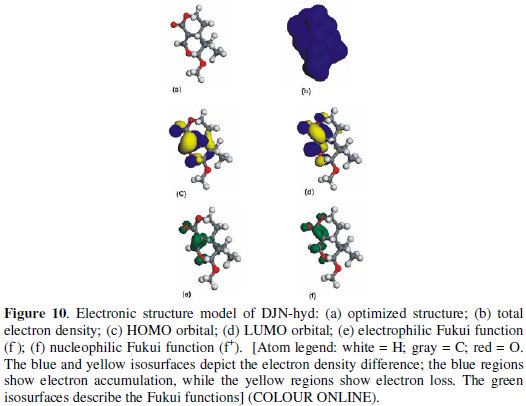
    <p>DFT-based quantum chemical computations were undertaken to model the 
electronic and adsorption structures of DJN and DJN-hyd. The calculations were 
performed by means of the DFT electronic structure program DMol3 using a 
Mulliken population analysis [26,27]. Electronic parameters for the simulation 
include restricted spin polarization using the DND basis set and the Perdew 
Wang (PW) local correlation density functional. The molecular structures were 
first subjected to geometry optimization using COMPASS force field and the 
Smart minimize method by high-convergence criteria and then the distribution of 
frontier molecular orbitals including the highest &deg;Ccupied molecular orbital 
(HOMO) and the lowest unoccupied molecular orbital (LUMO) determined. The 
HOMO regions are the sites at which electrophiles attack and represent the active 
centers, with the utmost ability to bond to the metal surface, whereas the LUMO 
orbital can accept the electrons from the d-orbital of the metal (Fe) using 
antibonding orbitals to form feedback bonds [28-31]. The local reactivity of the 
molecules was analyzed by means of the Fukui indices (FI) to assess reactive 
regions in terms of nucleophilic (f+) and electrophilic attack (f -).</p>

    <p>The model structures are presented in Figs. <a href="#f9">9</a> and <a href="#f10">10</a> for DJN and DJN-hyd 
respectively.</p>


    <p>&nbsp;</p>
<a name="f9">
<img src="/img/revistas/pea/v30n3/30n3a04f9.jpg">
    
<p>&nbsp;</p>
<a name="f10">
<img src="/img/revistas/pea/v30n3/30n3a04f10.jpg">
    
]]></body>
<body><![CDATA[<p>&nbsp;</p>


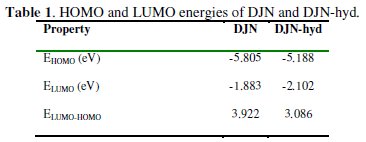
    <p><a href="#t1">Table 1</a> provides some quantum-chemical parameters related to the 
molecular electronic structure of the most stable conformation of the molecules.</p>

    <p>&nbsp;</p>
<a name="t1">
<img src="/img/revistas/pea/v30n3/30n3a04t1.jpg">
    
<p>&nbsp;</p>

    <p>High values of the HOMO energy (E<sub>HOMO</sub>) indicate a tendency of the molecule to 
donate electrons to an appropriate acceptor molecule with low energy or an 
empty electron orbital, in this case vacancies in the 3d orbital of the Fe atom. The 
energy of the LUMO characterizes the susceptibility of molecules towards 
nucleophilic attack [31-36]. Low values of the energy of the gap &Delta;E = E<sub>LUMO - HOMO</sub 
imply that the energy to remove an electron from the last &deg;Ccupied orbital 
will be minimized, corresponding to improved inhibition efficiencies.</p>

    <p>The local reactivity of the molecules as assessed from the Fukui indices (FI) 
shows that the f -sites for all the molecules correspond with the HOMO locations, 
while the f+ sites correspond with the LUMO locations, indicating the zones 
through which the molecule would likely interact with the Fe surface. The E<sub>HOMO</sub>, 
E<sub>LUMO</sub> and &Delta;E values do not vary very significantly for DJN and DJN-hyd, which 
means that any observed differences in their adsorption strengths would result 
from molecular size parameters rather than from electronic structure parameters. 
The seemingly high values of &Delta;E (> 3 eV) suggest a dearth of electron transfer 
processes in the interaction of the molecules with the metal surface.</p>

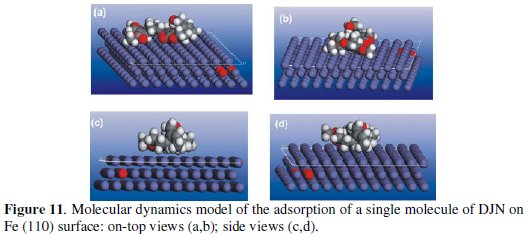
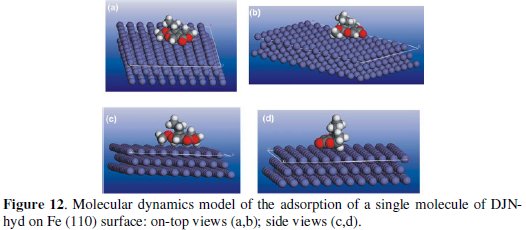
    <p>Molecular dynamics (MD) simulations were undetaken to model the adsorption 
of the molecules on the metal surface at a molecular level. This was achieved 
using Forcite quench molecular dynamics in the MS Modeling 4.0 software to 
sample many different low energy configurations and identify the low energy 
minima [37,38]. Optimized structures of DJN and DJN-hyd and the Fe surface 
were used for the simulation. Calculations were carried out in an 11 &times; 9 supercell 
using the COMPASS force field and the Smart algorithm. The Fe crystal was 
cleaved along the (110) plane. Temperature was fixed at 350 K, with NVE 
(microcanonical) ensemble. The time step was 1fs and simulation time 5ps. The 
system was quenched every 250 steps. The optimized (lowest energy) adsorption 
models for single molecules of DJN and DJN-hyd respectively on the Fe (110) 
surface from our simulation are shown in Figs. <a href="#f11">11</a> and <a href="#f12">12</a>.</p>


    <p>&nbsp;</p>
<a name="f11">
<img src="/img/revistas/pea/v30n3/30n3a04f11.jpg">
    
<p>&nbsp;</p>
<a name="f12">
<img src="/img/revistas/pea/v30n3/30n3a04f12.jpg">
    
<p>&nbsp;</p>


    ]]></body>
<body><![CDATA[<p>The molecules can be 
seen to maintain a flat-lying adsorption orientation on the Fe surface, with the 
regions of high HOMO density acting as the adsorption sites. Using the quench 
molecular dynamics method above, we calculated the binding energy (EBind) of 
each molecule on the Fe surface using the following equation:</p>

    <p>&nbsp;</p>
<a name="e11">
<img src="/img/revistas/pea/v30n3/30n3a04e11.jpg">
    
<p>&nbsp;</p>

    <p>EMol, EFe and Etotal correspond respectively to the total energies of the molecule, 
Fe (110) slab and the adsorbed Mol/Fe (110) couple. In each case the potential 
energies were calculated by averaging the energies of the five structures of 
lowest energy, and a negative value of Eads corresponds to a stable adsorption 
structure. The obtained values of the binding energy were -190 kcal/mol and 
99.1 kcal/mol for DJN and DJN-hyd, respectively. The higher stability of the 
adsorbed DJN compared with DJN-hyd is attributable to the larger size of the 
DJN molecule, which makes a greater contribution to the observed inhibiting 
effect of AD extract.</p>


    <p>&nbsp;</p>
    <p><b>Conclusion</b></p>

    <p>The Anthocleista djalonesis extract inhibited mild steel corrosion in 1 M HCl and 
0.5 M  H<sub>2</sub>SO<sub>4</sub> solutions. The inhibition efficiency was found to increase with 
increased inhibitor concentration. Impedance results revealed that the extract 
functioned via adsorption of the organic matter on the metal/solution interface. 
Polarization measurements show that the adsorbed organic matter extract 
inhibited the corrosion process via mixed-inhibition mechanism, affecting both 
the anodic metal dissolution reaction and the cathodic hydrogen evolution 
reaction. DFT based quantum chemical computations of parameters associated 
with the electronic structures of two components of the extract, djalonenoside 
(DJN) and its hydrolysis product DJN-hyd, confirmed their inhibiting potential, 
which was further corroborated by molecular dynamics modeling of the 
adsorption of the single molecules on the metal surface.</p>


    <p>&nbsp;</p>
    <p><b>References</b></p>

    <!-- ref --><p>1. Gunasekaran G, Chauhan LR. Electrochim Acta. 2004;49:4387.    &nbsp;&nbsp;&nbsp;&nbsp;&nbsp;&nbsp;&nbsp;&nbsp;[&#160;<a href="javascript:void(0);" onclick="javascript: window.open('/scielo.php?script=sci_nlinks&ref=000112&pid=S0872-1904201200030000400001&lng=','','width=640,height=500,resizable=yes,scrollbars=1,menubar=yes,');">Links</a>&#160;]<!-- end-ref --></p>
    <!-- ref --><p>2. El-Etre AY. Corros Sci. 2003;45:2485.    &nbsp;&nbsp;&nbsp;&nbsp;&nbsp;&nbsp;&nbsp;&nbsp;[&#160;<a href="javascript:void(0);" onclick="javascript: window.open('/scielo.php?script=sci_nlinks&ref=000114&pid=S0872-1904201200030000400002&lng=','','width=640,height=500,resizable=yes,scrollbars=1,menubar=yes,');">Links</a>&#160;]<!-- end-ref --></p> 
    <!-- ref --><p>3. Abdallah M. Corros Sci. 2004;46:1981.    &nbsp;&nbsp;&nbsp;&nbsp;&nbsp;&nbsp;&nbsp;&nbsp;[&#160;<a href="javascript:void(0);" onclick="javascript: window.open('/scielo.php?script=sci_nlinks&ref=000116&pid=S0872-1904201200030000400003&lng=','','width=640,height=500,resizable=yes,scrollbars=1,menubar=yes,');">Links</a>&#160;]<!-- end-ref --></p>
    <!-- ref --><p>4. Li Y, Zhao P, Liaqng Q, Hou B. Appl Surf Sci. 2005;252:1245.    &nbsp;&nbsp;&nbsp;&nbsp;&nbsp;&nbsp;&nbsp;&nbsp;[&#160;<a href="javascript:void(0);" onclick="javascript: window.open('/scielo.php?script=sci_nlinks&ref=000118&pid=S0872-1904201200030000400004&lng=','','width=640,height=500,resizable=yes,scrollbars=1,menubar=yes,');">Links</a>&#160;]<!-- end-ref --></p>
    <!-- ref --><p>5. El-Etre AY, Abdallah M, El-Tantawy ZE. Corros Sci. 2005;47:385.    &nbsp;&nbsp;&nbsp;&nbsp;&nbsp;&nbsp;&nbsp;&nbsp;[&#160;<a href="javascript:void(0);" onclick="javascript: window.open('/scielo.php?script=sci_nlinks&ref=000120&pid=S0872-1904201200030000400005&lng=','','width=640,height=500,resizable=yes,scrollbars=1,menubar=yes,');">Links</a>&#160;]<!-- end-ref --></p>
    <!-- ref --><p>6. Chauhan LR, Gunasekaran G. Corros Sci. 2007;49:1143.    &nbsp;&nbsp;&nbsp;&nbsp;&nbsp;&nbsp;&nbsp;&nbsp;[&#160;<a href="javascript:void(0);" onclick="javascript: window.open('/scielo.php?script=sci_nlinks&ref=000122&pid=S0872-1904201200030000400006&lng=','','width=640,height=500,resizable=yes,scrollbars=1,menubar=yes,');">Links</a>&#160;]<!-- end-ref --></p>
    <!-- ref --><p>7. Raja PB, Sethuraman M, Mater Lett. 2008;62:2922.    &nbsp;&nbsp;&nbsp;&nbsp;&nbsp;&nbsp;&nbsp;&nbsp;[&#160;<a href="javascript:void(0);" onclick="javascript: window.open('/scielo.php?script=sci_nlinks&ref=000124&pid=S0872-1904201200030000400007&lng=','','width=640,height=500,resizable=yes,scrollbars=1,menubar=yes,');">Links</a>&#160;]<!-- end-ref --></p>
    <!-- ref --><p>8. Oguzie EE. Corros Sci. 2008;50:2993.    &nbsp;&nbsp;&nbsp;&nbsp;&nbsp;&nbsp;&nbsp;&nbsp;[&#160;<a href="javascript:void(0);" onclick="javascript: window.open('/scielo.php?script=sci_nlinks&ref=000126&pid=S0872-1904201200030000400008&lng=','','width=640,height=500,resizable=yes,scrollbars=1,menubar=yes,');">Links</a>&#160;]<!-- end-ref --></p>
    <p>9. Okafor PC, Ikpi ME, Uwah IE, Ebenso EE, Ekpe UJ, Umoren SA. Corros Sci. 2008;50:2310.</p>
    <p>10. Abdel-Gaber AM, Abd-El-Nabey BA, Sidahmed IM, El-Zayady AM, Saadawy M. Corros Sci. 2006;48:2765.</p>
    <!-- ref --><p>11. Moretti G, Guidi F, Grion G. Corros Sci. 2004;46:387.    &nbsp;&nbsp;&nbsp;&nbsp;&nbsp;&nbsp;&nbsp;&nbsp;[&#160;<a href="javascript:void(0);" onclick="javascript: window.open('/scielo.php?script=sci_nlinks&ref=000130&pid=S0872-1904201200030000400011&lng=','','width=640,height=500,resizable=yes,scrollbars=1,menubar=yes,');">Links</a>&#160;]<!-- end-ref --></p>
    <!-- ref --><p>12. Oguzie EE, Port Electrochim Acta. 2008;26:303.    &nbsp;&nbsp;&nbsp;&nbsp;&nbsp;&nbsp;&nbsp;&nbsp;[&#160;<a href="javascript:void(0);" onclick="javascript: window.open('/scielo.php?script=sci_nlinks&ref=000132&pid=S0872-1904201200030000400012&lng=','','width=640,height=500,resizable=yes,scrollbars=1,menubar=yes,');">Links</a>&#160;]<!-- end-ref --></p>
    <!-- ref --><p>13. Rosliza R, Wan Nik WB. Curr Appl Phys. 2010;10:221.    &nbsp;&nbsp;&nbsp;&nbsp;&nbsp;&nbsp;&nbsp;&nbsp;[&#160;<a href="javascript:void(0);" onclick="javascript: window.open('/scielo.php?script=sci_nlinks&ref=000134&pid=S0872-1904201200030000400013&lng=','','width=640,height=500,resizable=yes,scrollbars=1,menubar=yes,');">Links</a>&#160;]<!-- end-ref --></p>
    <!-- ref --><p>14. Abiola OK, James AO. Corros Sci. 2010;52:661.    &nbsp;&nbsp;&nbsp;&nbsp;&nbsp;&nbsp;&nbsp;&nbsp;[&#160;<a href="javascript:void(0);" onclick="javascript: window.open('/scielo.php?script=sci_nlinks&ref=000136&pid=S0872-1904201200030000400014&lng=','','width=640,height=500,resizable=yes,scrollbars=1,menubar=yes,');">Links</a>&#160;]<!-- end-ref --></p>
    <!-- ref --><p>15. Oguzie EE, Onuchukwu AI, Corros Rev. 2007;25:355.    &nbsp;&nbsp;&nbsp;&nbsp;&nbsp;&nbsp;&nbsp;&nbsp;[&#160;<a href="javascript:void(0);" onclick="javascript: window.open('/scielo.php?script=sci_nlinks&ref=000138&pid=S0872-1904201200030000400015&lng=','','width=640,height=500,resizable=yes,scrollbars=1,menubar=yes,');">Links</a>&#160;]<!-- end-ref --></p>
    <p>16. Ostovari A, Hoseinieh SM, Peikari M, Shadizadeh SR, Hashemi SJ. Corros Sci. 2009;51:1935.</p>
    <p>17. Satapathy AK, Gunasekaran G, Sahoo SC, Amit K, Rodrigues PV. Corros Sci. 2009;51:2848.</p>
    <!-- ref --><p>18. Cardozo da Rocha J, Gomes JCP, D'Elia E. Corros Sci. 2010;52:2341.    &nbsp;&nbsp;&nbsp;&nbsp;&nbsp;&nbsp;&nbsp;&nbsp;[&#160;<a href="javascript:void(0);" onclick="javascript: window.open('/scielo.php?script=sci_nlinks&ref=000142&pid=S0872-1904201200030000400018&lng=','','width=640,height=500,resizable=yes,scrollbars=1,menubar=yes,');">Links</a>&#160;]<!-- end-ref --></p>
    <p>19. Okafor PC, Ikpi ME, Uwah IE, Ebenso EE, Ekpe UJ, Umoren SA. Corros Sci. 2008;50:2310.</p>
    <p>20. Oguzie EE, Enenebeaku CK, Akalezi CO, Okoro SC, Ayuk AA, Ejike EN, J Colloid Interface Sci. 2010;349:283.</p>
    <!-- ref --><p>21. Okwu DE, Ighodaro BU. Int J Drug Dev Res. 2009;1:117.    &nbsp;&nbsp;&nbsp;&nbsp;&nbsp;&nbsp;&nbsp;&nbsp;[&#160;<a href="javascript:void(0);" onclick="javascript: window.open('/scielo.php?script=sci_nlinks&ref=000146&pid=S0872-1904201200030000400021&lng=','','width=640,height=500,resizable=yes,scrollbars=1,menubar=yes,');">Links</a>&#160;]<!-- end-ref --></p>
    <p>22. Obame LC, Edou P, Bassole HN, Koudou J, Agnaniet A, Eba F, Traore AS. African J Microbiol Res. 2008;2:148.</p>
    <!-- ref --><p>23. Bockris JO'M, Drazic D. Electrochim Acta. 1962;7:293.    &nbsp;&nbsp;&nbsp;&nbsp;&nbsp;&nbsp;&nbsp;&nbsp;[&#160;<a href="javascript:void(0);" onclick="javascript: window.open('/scielo.php?script=sci_nlinks&ref=000149&pid=S0872-1904201200030000400023&lng=','','width=640,height=500,resizable=yes,scrollbars=1,menubar=yes,');">Links</a>&#160;]<!-- end-ref --></p>
    <!-- ref --><p>24. Popova A, Sokolova E, Raicheva S, Christov M. Corros Sci. 2003;45:33.    &nbsp;&nbsp;&nbsp;&nbsp;&nbsp;&nbsp;&nbsp;&nbsp;[&#160;<a href="javascript:void(0);" onclick="javascript: window.open('/scielo.php?script=sci_nlinks&ref=000151&pid=S0872-1904201200030000400024&lng=','','width=640,height=500,resizable=yes,scrollbars=1,menubar=yes,');">Links</a>&#160;]<!-- end-ref --></p>
    ]]></body>
<body><![CDATA[<!-- ref --><p>25. Khaled KF, Hackerman N, Electrochim Acta. 2003;48:2715.    &nbsp;&nbsp;&nbsp;&nbsp;&nbsp;&nbsp;&nbsp;&nbsp;[&#160;<a href="javascript:void(0);" onclick="javascript: window.open('/scielo.php?script=sci_nlinks&ref=000153&pid=S0872-1904201200030000400025&lng=','','width=640,height=500,resizable=yes,scrollbars=1,menubar=yes,');">Links</a>&#160;]<!-- end-ref --></p>
    <!-- ref --><p>26. Delley B. J Chem Phys. 1990;92:508.    &nbsp;&nbsp;&nbsp;&nbsp;&nbsp;&nbsp;&nbsp;&nbsp;[&#160;<a href="javascript:void(0);" onclick="javascript: window.open('/scielo.php?script=sci_nlinks&ref=000155&pid=S0872-1904201200030000400026&lng=','','width=640,height=500,resizable=yes,scrollbars=1,menubar=yes,');">Links</a>&#160;]<!-- end-ref --></p>
    <!-- ref --><p>27. Delley B. J Chem Phys. 2000;113:7756.    &nbsp;&nbsp;&nbsp;&nbsp;&nbsp;&nbsp;&nbsp;&nbsp;[&#160;<a href="javascript:void(0);" onclick="javascript: window.open('/scielo.php?script=sci_nlinks&ref=000157&pid=S0872-1904201200030000400027&lng=','','width=640,height=500,resizable=yes,scrollbars=1,menubar=yes,');">Links</a>&#160;]<!-- end-ref --></p>
    <!-- ref --><p>28. Martinez S, Stagljar I. Theochem. 2003;640:167.    &nbsp;&nbsp;&nbsp;&nbsp;&nbsp;&nbsp;&nbsp;&nbsp;[&#160;<a href="javascript:void(0);" onclick="javascript: window.open('/scielo.php?script=sci_nlinks&ref=000159&pid=S0872-1904201200030000400028&lng=','','width=640,height=500,resizable=yes,scrollbars=1,menubar=yes,');">Links</a>&#160;]<!-- end-ref --></p>
    <!-- ref --><p>29. Khaled KF, Babic-Samardzija K, Hackerman N, Electrochim Acta. 2005;50:2515.    &nbsp;&nbsp;&nbsp;&nbsp;&nbsp;&nbsp;&nbsp;&nbsp;[&#160;<a href="javascript:void(0);" onclick="javascript: window.open('/scielo.php?script=sci_nlinks&ref=000161&pid=S0872-1904201200030000400029&lng=','','width=640,height=500,resizable=yes,scrollbars=1,menubar=yes,');">Links</a>&#160;]<!-- end-ref --></p>
    ]]></body>
<body><![CDATA[<!-- ref --><p>30. Cruz J, Garcia-Ochoa E, Castro M, J Electrochem Soc. 2003;150:26.    &nbsp;&nbsp;&nbsp;&nbsp;&nbsp;&nbsp;&nbsp;&nbsp;[&#160;<a href="javascript:void(0);" onclick="javascript: window.open('/scielo.php?script=sci_nlinks&ref=000163&pid=S0872-1904201200030000400030&lng=','','width=640,height=500,resizable=yes,scrollbars=1,menubar=yes,');">Links</a>&#160;]<!-- end-ref --></p>
    <!-- ref --><p>31. Obot IB, Obi-Egbedi NO, Corros Sci. 2010;52:198.    &nbsp;&nbsp;&nbsp;&nbsp;&nbsp;&nbsp;&nbsp;&nbsp;[&#160;<a href="javascript:void(0);" onclick="javascript: window.open('/scielo.php?script=sci_nlinks&ref=000165&pid=S0872-1904201200030000400031&lng=','','width=640,height=500,resizable=yes,scrollbars=1,menubar=yes,');">Links</a>&#160;]<!-- end-ref --></p>
    <!-- ref --><p>32. Fu J, Li S, Wang Y, Cao L, Lu L, J Mater Sci. 2010;45:6255.    &nbsp;&nbsp;&nbsp;&nbsp;&nbsp;&nbsp;&nbsp;&nbsp;[&#160;<a href="javascript:void(0);" onclick="javascript: window.open('/scielo.php?script=sci_nlinks&ref=000167&pid=S0872-1904201200030000400032&lng=','','width=640,height=500,resizable=yes,scrollbars=1,menubar=yes,');">Links</a>&#160;]<!-- end-ref --></p>
    <p>33. Rodriguez-Valdez LM, Villamisar W, Casales M, Gonzalez-Rodriguez JG, Martinez-Villafane A, Martinez L, Glossman-Mitnik D, Corros Sci. 2006;48:4053.</p>
    <!-- ref --><p>34. Gece G, Corros Sci. 2008;52:2981.    &nbsp;&nbsp;&nbsp;&nbsp;&nbsp;&nbsp;&nbsp;&nbsp;[&#160;<a href="javascript:void(0);" onclick="javascript: window.open('/scielo.php?script=sci_nlinks&ref=000170&pid=S0872-1904201200030000400034&lng=','','width=640,height=500,resizable=yes,scrollbars=1,menubar=yes,');">Links</a>&#160;]<!-- end-ref --></p>
    <!-- ref --><p>35. Gece G, Bilgic S. Corros Sci. 2010;52:3435.    &nbsp;&nbsp;&nbsp;&nbsp;&nbsp;&nbsp;&nbsp;&nbsp;[&#160;<a href="javascript:void(0);" onclick="javascript: window.open('/scielo.php?script=sci_nlinks&ref=000172&pid=S0872-1904201200030000400035&lng=','','width=640,height=500,resizable=yes,scrollbars=1,menubar=yes,');">Links</a>&#160;]<!-- end-ref --></p>
    <!-- ref --><p>36. Oguzie EE, Wang SG, Li Y, Wang FH, J Phys Chem C. 2009;113:8420.    &nbsp;&nbsp;&nbsp;&nbsp;&nbsp;&nbsp;&nbsp;&nbsp;[&#160;<a href="javascript:void(0);" onclick="javascript: window.open('/scielo.php?script=sci_nlinks&ref=000174&pid=S0872-1904201200030000400036&lng=','','width=640,height=500,resizable=yes,scrollbars=1,menubar=yes,');">Links</a>&#160;]<!-- end-ref --></p> 
    <!-- ref --><p>37. Casewit CJ, Colwell KS, Rappe AK, J Am Chem Soc. 1992;114:10035.    &nbsp;&nbsp;&nbsp;&nbsp;&nbsp;&nbsp;&nbsp;&nbsp;[&#160;<a href="javascript:void(0);" onclick="javascript: window.open('/scielo.php?script=sci_nlinks&ref=000176&pid=S0872-1904201200030000400037&lng=','','width=640,height=500,resizable=yes,scrollbars=1,menubar=yes,');">Links</a>&#160;]<!-- end-ref --></p> 
    <!-- ref --><p>38. Casewit CJ, Colwell KS, Rappe AK, J Am Chem Soc. 1992;114:10046.    &nbsp;&nbsp;&nbsp;&nbsp;&nbsp;&nbsp;&nbsp;&nbsp;[&#160;<a href="javascript:void(0);" onclick="javascript: window.open('/scielo.php?script=sci_nlinks&ref=000178&pid=S0872-1904201200030000400038&lng=','','width=640,height=500,resizable=yes,scrollbars=1,menubar=yes,');">Links</a>&#160;]<!-- end-ref --></p>


    <p>&nbsp;</p>
    <p><b>Acknowledgements</b></p>

    <p>This project is supported by TWAS, the Academy of Sciences for the developing 
World, under the TWAS Grants for Research Units in Developing Countries Program 
(TWAS-RGA08-005) and the Education Trust Fund (ETF); under batch one of ETF 
2009/2010 research projects intervention for the Federal University of Technology 
Owerri.</p>

    ]]></body>
<body><![CDATA[<p>&nbsp;</p>
    <p><a name=0><sup><a href="#top">*</sup></a>Corresponding author. E-mail address: <a href="mailto:eeoguzie@imr.ac.cn">eeoguzie@imr.ac.cn</a></p>

    <p>Received 18 January 2012; accepted 30 June 2012</p>

    <p><a href="http://www.peacta.org" target="_blank">www.peacta.org</a> </p>


     ]]></body><back>
<ref-list>
<ref id="B1">
<label>1</label><nlm-citation citation-type="journal">
<person-group person-group-type="author">
<name>
<surname><![CDATA[Gunasekaran]]></surname>
<given-names><![CDATA[G]]></given-names>
</name>
<name>
<surname><![CDATA[Chauhan]]></surname>
<given-names><![CDATA[LR]]></given-names>
</name>
</person-group>
<source><![CDATA[Electrochim Acta]]></source>
<year>2004</year>
<volume>49</volume>
<page-range>4387</page-range></nlm-citation>
</ref>
<ref id="B2">
<label>2</label><nlm-citation citation-type="journal">
<person-group person-group-type="author">
<name>
<surname><![CDATA[El-Etre]]></surname>
<given-names><![CDATA[AY]]></given-names>
</name>
</person-group>
<source><![CDATA[Corros Sci]]></source>
<year>2003</year>
<volume>45</volume>
<page-range>2485</page-range></nlm-citation>
</ref>
<ref id="B3">
<label>3</label><nlm-citation citation-type="journal">
<person-group person-group-type="author">
<name>
<surname><![CDATA[Abdallah]]></surname>
<given-names><![CDATA[M]]></given-names>
</name>
</person-group>
<source><![CDATA[Corros Sci]]></source>
<year>2004</year>
<volume>46</volume>
<page-range>1981</page-range></nlm-citation>
</ref>
<ref id="B4">
<label>4</label><nlm-citation citation-type="journal">
<person-group person-group-type="author">
<name>
<surname><![CDATA[Li]]></surname>
<given-names><![CDATA[Y]]></given-names>
</name>
<name>
<surname><![CDATA[Zhao]]></surname>
<given-names><![CDATA[P]]></given-names>
</name>
<name>
<surname><![CDATA[Liaqng]]></surname>
<given-names><![CDATA[Q]]></given-names>
</name>
<name>
<surname><![CDATA[Hou]]></surname>
<given-names><![CDATA[B]]></given-names>
</name>
</person-group>
<source><![CDATA[Appl Surf Sci]]></source>
<year>2005</year>
<volume>252</volume>
<page-range>1245</page-range></nlm-citation>
</ref>
<ref id="B5">
<label>5</label><nlm-citation citation-type="journal">
<person-group person-group-type="author">
<name>
<surname><![CDATA[El-Etre]]></surname>
<given-names><![CDATA[AY]]></given-names>
</name>
<name>
<surname><![CDATA[Abdallah]]></surname>
<given-names><![CDATA[M]]></given-names>
</name>
<name>
<surname><![CDATA[El-Tantawy]]></surname>
<given-names><![CDATA[ZE]]></given-names>
</name>
</person-group>
<source><![CDATA[Corros Sci]]></source>
<year>2005</year>
<volume>47</volume>
<page-range>385</page-range></nlm-citation>
</ref>
<ref id="B6">
<label>6</label><nlm-citation citation-type="journal">
<person-group person-group-type="author">
<name>
<surname><![CDATA[Chauhan]]></surname>
<given-names><![CDATA[LR]]></given-names>
</name>
<name>
<surname><![CDATA[Gunasekaran]]></surname>
<given-names><![CDATA[G]]></given-names>
</name>
</person-group>
<source><![CDATA[Corros Sci]]></source>
<year>2007</year>
<volume>49</volume>
<page-range>1143</page-range></nlm-citation>
</ref>
<ref id="B7">
<label>7</label><nlm-citation citation-type="journal">
<person-group person-group-type="author">
<name>
<surname><![CDATA[Raja]]></surname>
<given-names><![CDATA[PB]]></given-names>
</name>
<name>
<surname><![CDATA[Sethuraman]]></surname>
<given-names><![CDATA[M]]></given-names>
</name>
</person-group>
<source><![CDATA[Mater Lett]]></source>
<year>2008</year>
<volume>62</volume>
<page-range>2922</page-range></nlm-citation>
</ref>
<ref id="B8">
<label>8</label><nlm-citation citation-type="journal">
<person-group person-group-type="author">
<name>
<surname><![CDATA[Oguzie]]></surname>
<given-names><![CDATA[EE]]></given-names>
</name>
</person-group>
<source><![CDATA[Corros Sci]]></source>
<year>2008</year>
<volume>50</volume>
<page-range>2993</page-range></nlm-citation>
</ref>
<ref id="B9">
<label>9</label><nlm-citation citation-type="journal">
<person-group person-group-type="author">
<name>
<surname><![CDATA[Okafor]]></surname>
<given-names><![CDATA[PC]]></given-names>
</name>
<name>
<surname><![CDATA[Ikpi]]></surname>
<given-names><![CDATA[ME]]></given-names>
</name>
<name>
<surname><![CDATA[Uwah]]></surname>
<given-names><![CDATA[IE]]></given-names>
</name>
</person-group>
<source><![CDATA[Corros Sci]]></source>
<year>2008</year>
<volume>50</volume>
<page-range>2310</page-range></nlm-citation>
</ref>
<ref id="B10">
<label>10</label><nlm-citation citation-type="journal">
<person-group person-group-type="author">
<name>
<surname><![CDATA[Abdel-Gaber]]></surname>
<given-names><![CDATA[AM]]></given-names>
</name>
<name>
<surname><![CDATA[Abd-El-Nabey]]></surname>
<given-names><![CDATA[BA]]></given-names>
</name>
<name>
<surname><![CDATA[Sidahmed]]></surname>
<given-names><![CDATA[IM]]></given-names>
</name>
</person-group>
<source><![CDATA[Corros Sci]]></source>
<year>2006</year>
<volume>48</volume>
<page-range>2765</page-range></nlm-citation>
</ref>
<ref id="B11">
<label>11</label><nlm-citation citation-type="journal">
<person-group person-group-type="author">
<name>
<surname><![CDATA[Moretti]]></surname>
<given-names><![CDATA[G]]></given-names>
</name>
<name>
<surname><![CDATA[Guidi]]></surname>
<given-names><![CDATA[F]]></given-names>
</name>
<name>
<surname><![CDATA[Grion]]></surname>
<given-names><![CDATA[G]]></given-names>
</name>
</person-group>
<source><![CDATA[Corros Sci]]></source>
<year>2004</year>
<volume>46</volume>
<page-range>387</page-range></nlm-citation>
</ref>
<ref id="B12">
<label>12</label><nlm-citation citation-type="journal">
<person-group person-group-type="author">
<name>
<surname><![CDATA[Oguzie]]></surname>
<given-names><![CDATA[EE]]></given-names>
</name>
</person-group>
<source><![CDATA[Port Electrochim Acta]]></source>
<year>2008</year>
<volume>26</volume>
<page-range>303</page-range></nlm-citation>
</ref>
<ref id="B13">
<label>13</label><nlm-citation citation-type="journal">
<person-group person-group-type="author">
<name>
<surname><![CDATA[Rosliza]]></surname>
<given-names><![CDATA[R]]></given-names>
</name>
<name>
<surname><![CDATA[Wan Nik]]></surname>
<given-names><![CDATA[WB]]></given-names>
</name>
</person-group>
<source><![CDATA[Curr Appl Phys]]></source>
<year>2010</year>
<volume>10</volume>
<page-range>221</page-range></nlm-citation>
</ref>
<ref id="B14">
<label>14</label><nlm-citation citation-type="journal">
<person-group person-group-type="author">
<name>
<surname><![CDATA[Abiola]]></surname>
<given-names><![CDATA[OK]]></given-names>
</name>
<name>
<surname><![CDATA[James]]></surname>
<given-names><![CDATA[AO]]></given-names>
</name>
</person-group>
<source><![CDATA[Corros Sci]]></source>
<year>2010</year>
<volume>52</volume>
<page-range>661</page-range></nlm-citation>
</ref>
<ref id="B15">
<label>15</label><nlm-citation citation-type="journal">
<person-group person-group-type="author">
<name>
<surname><![CDATA[Oguzie]]></surname>
<given-names><![CDATA[EE]]></given-names>
</name>
<name>
<surname><![CDATA[Onuchukwu]]></surname>
<given-names><![CDATA[AI]]></given-names>
</name>
</person-group>
<source><![CDATA[Corros Rev]]></source>
<year>2007</year>
<volume>25</volume>
<page-range>355</page-range></nlm-citation>
</ref>
<ref id="B16">
<label>16</label><nlm-citation citation-type="journal">
<person-group person-group-type="author">
<name>
<surname><![CDATA[Ostovari]]></surname>
<given-names><![CDATA[A]]></given-names>
</name>
<name>
<surname><![CDATA[Hoseinieh]]></surname>
<given-names><![CDATA[SM]]></given-names>
</name>
<name>
<surname><![CDATA[Peikari]]></surname>
<given-names><![CDATA[M]]></given-names>
</name>
</person-group>
<source><![CDATA[Corros Sci]]></source>
<year>2009</year>
<volume>51</volume>
<page-range>1935</page-range></nlm-citation>
</ref>
<ref id="B17">
<label>17</label><nlm-citation citation-type="journal">
<person-group person-group-type="author">
<name>
<surname><![CDATA[Satapathy]]></surname>
<given-names><![CDATA[AK]]></given-names>
</name>
<name>
<surname><![CDATA[Gunasekaran]]></surname>
<given-names><![CDATA[G]]></given-names>
</name>
<name>
<surname><![CDATA[Sahoo]]></surname>
<given-names><![CDATA[SC]]></given-names>
</name>
</person-group>
<source><![CDATA[Corros Sci]]></source>
<year>2009</year>
<volume>51</volume>
<page-range>2848</page-range></nlm-citation>
</ref>
<ref id="B18">
<label>18</label><nlm-citation citation-type="journal">
<person-group person-group-type="author">
<name>
<surname><![CDATA[Cardozo da Rocha]]></surname>
<given-names><![CDATA[J]]></given-names>
</name>
<name>
<surname><![CDATA[Gomes]]></surname>
<given-names><![CDATA[JCP]]></given-names>
</name>
<name>
<surname><![CDATA[D'Elia]]></surname>
<given-names><![CDATA[E]]></given-names>
</name>
</person-group>
<source><![CDATA[Corros Sci]]></source>
<year>2010</year>
<volume>52</volume>
<page-range>2341</page-range></nlm-citation>
</ref>
<ref id="B19">
<label>19</label><nlm-citation citation-type="journal">
<person-group person-group-type="author">
<name>
<surname><![CDATA[Okafor]]></surname>
<given-names><![CDATA[PC]]></given-names>
</name>
<name>
<surname><![CDATA[Ikpi]]></surname>
<given-names><![CDATA[ME]]></given-names>
</name>
<name>
<surname><![CDATA[Uwah]]></surname>
<given-names><![CDATA[IE]]></given-names>
</name>
</person-group>
<source><![CDATA[Corros Sci]]></source>
<year>2008</year>
<volume>50</volume>
<page-range>2310</page-range></nlm-citation>
</ref>
<ref id="B20">
<label>20</label><nlm-citation citation-type="journal">
<person-group person-group-type="author">
<name>
<surname><![CDATA[Oguzie]]></surname>
<given-names><![CDATA[EE]]></given-names>
</name>
<name>
<surname><![CDATA[Enenebeaku]]></surname>
<given-names><![CDATA[CK]]></given-names>
</name>
<name>
<surname><![CDATA[Akalezi]]></surname>
<given-names><![CDATA[CO]]></given-names>
</name>
</person-group>
<source><![CDATA[J Colloid Interface Sci]]></source>
<year>2010</year>
<volume>349</volume>
<page-range>283</page-range></nlm-citation>
</ref>
<ref id="B21">
<label>21</label><nlm-citation citation-type="journal">
<person-group person-group-type="author">
<name>
<surname><![CDATA[Okwu]]></surname>
<given-names><![CDATA[DE]]></given-names>
</name>
<name>
<surname><![CDATA[Ighodaro]]></surname>
<given-names><![CDATA[BU]]></given-names>
</name>
</person-group>
<source><![CDATA[Int J Drug Dev Res]]></source>
<year>2009</year>
<volume>1</volume>
<page-range>117</page-range></nlm-citation>
</ref>
<ref id="B22">
<label>22</label><nlm-citation citation-type="journal">
<person-group person-group-type="author">
<name>
<surname><![CDATA[Obame]]></surname>
<given-names><![CDATA[LC]]></given-names>
</name>
<name>
<surname><![CDATA[Edou]]></surname>
<given-names><![CDATA[P]]></given-names>
</name>
<name>
<surname><![CDATA[Bassole]]></surname>
<given-names><![CDATA[HN]]></given-names>
</name>
</person-group>
<source><![CDATA[African J Microbiol Res]]></source>
<year>2008</year>
<volume>2</volume>
<page-range>148</page-range></nlm-citation>
</ref>
<ref id="B23">
<label>23</label><nlm-citation citation-type="journal">
<person-group person-group-type="author">
<name>
<surname><![CDATA[Bockris]]></surname>
<given-names><![CDATA[JO'M]]></given-names>
</name>
<name>
<surname><![CDATA[Drazic]]></surname>
<given-names><![CDATA[D]]></given-names>
</name>
</person-group>
<source><![CDATA[Electrochim Acta]]></source>
<year>1962</year>
<volume>7</volume>
<page-range>293</page-range></nlm-citation>
</ref>
<ref id="B24">
<label>24</label><nlm-citation citation-type="journal">
<person-group person-group-type="author">
<name>
<surname><![CDATA[Popova]]></surname>
<given-names><![CDATA[A]]></given-names>
</name>
<name>
<surname><![CDATA[Sokolova]]></surname>
<given-names><![CDATA[E]]></given-names>
</name>
<name>
<surname><![CDATA[Raicheva]]></surname>
<given-names><![CDATA[S]]></given-names>
</name>
<name>
<surname><![CDATA[Christov]]></surname>
<given-names><![CDATA[M]]></given-names>
</name>
</person-group>
<source><![CDATA[Corros Sci]]></source>
<year>2003</year>
<volume>45</volume>
<page-range>33</page-range></nlm-citation>
</ref>
<ref id="B25">
<label>25</label><nlm-citation citation-type="journal">
<person-group person-group-type="author">
<name>
<surname><![CDATA[Khaled]]></surname>
<given-names><![CDATA[KF]]></given-names>
</name>
<name>
<surname><![CDATA[Hackerman]]></surname>
<given-names><![CDATA[N]]></given-names>
</name>
</person-group>
<source><![CDATA[Electrochim Acta]]></source>
<year>2003</year>
<volume>48</volume>
<page-range>2715</page-range></nlm-citation>
</ref>
<ref id="B26">
<label>26</label><nlm-citation citation-type="journal">
<person-group person-group-type="author">
<name>
<surname><![CDATA[Delley]]></surname>
<given-names><![CDATA[B]]></given-names>
</name>
</person-group>
<source><![CDATA[J Chem Phys]]></source>
<year>1990</year>
<volume>92</volume>
<page-range>508</page-range></nlm-citation>
</ref>
<ref id="B27">
<label>27</label><nlm-citation citation-type="journal">
<person-group person-group-type="author">
<name>
<surname><![CDATA[Delley]]></surname>
<given-names><![CDATA[B]]></given-names>
</name>
</person-group>
<source><![CDATA[J Chem Phys]]></source>
<year>2000</year>
<volume>113</volume>
<page-range>7756</page-range></nlm-citation>
</ref>
<ref id="B28">
<label>28</label><nlm-citation citation-type="journal">
<person-group person-group-type="author">
<name>
<surname><![CDATA[Martinez]]></surname>
<given-names><![CDATA[S]]></given-names>
</name>
<name>
<surname><![CDATA[Stagljar]]></surname>
<given-names><![CDATA[I]]></given-names>
</name>
</person-group>
<source><![CDATA[Theochem]]></source>
<year>2003</year>
<volume>640</volume>
<page-range>167</page-range></nlm-citation>
</ref>
<ref id="B29">
<label>29</label><nlm-citation citation-type="journal">
<person-group person-group-type="author">
<name>
<surname><![CDATA[Khaled]]></surname>
<given-names><![CDATA[KF]]></given-names>
</name>
<name>
<surname><![CDATA[Babic-Samardzija]]></surname>
<given-names><![CDATA[K]]></given-names>
</name>
<name>
<surname><![CDATA[Hackerman]]></surname>
<given-names><![CDATA[N]]></given-names>
</name>
</person-group>
<source><![CDATA[Electrochim Acta]]></source>
<year>2005</year>
<volume>50</volume>
<page-range>2515</page-range></nlm-citation>
</ref>
<ref id="B30">
<label>30</label><nlm-citation citation-type="journal">
<person-group person-group-type="author">
<name>
<surname><![CDATA[Cruz]]></surname>
<given-names><![CDATA[J]]></given-names>
</name>
<name>
<surname><![CDATA[Garcia-Ochoa]]></surname>
<given-names><![CDATA[E]]></given-names>
</name>
<name>
<surname><![CDATA[Castro]]></surname>
<given-names><![CDATA[M]]></given-names>
</name>
</person-group>
<source><![CDATA[J Electrochem Soc]]></source>
<year>2003</year>
<volume>150</volume>
<page-range>26</page-range></nlm-citation>
</ref>
<ref id="B31">
<label>31</label><nlm-citation citation-type="journal">
<person-group person-group-type="author">
<name>
<surname><![CDATA[Obot]]></surname>
<given-names><![CDATA[IB]]></given-names>
</name>
<name>
<surname><![CDATA[Obi-Egbedi]]></surname>
<given-names><![CDATA[NO]]></given-names>
</name>
</person-group>
<source><![CDATA[Corros Sci]]></source>
<year>2010</year>
<volume>52</volume>
<page-range>198</page-range></nlm-citation>
</ref>
<ref id="B32">
<label>32</label><nlm-citation citation-type="journal">
<person-group person-group-type="author">
<name>
<surname><![CDATA[Fu]]></surname>
<given-names><![CDATA[J]]></given-names>
</name>
<name>
<surname><![CDATA[Li]]></surname>
<given-names><![CDATA[S]]></given-names>
</name>
<name>
<surname><![CDATA[Wang]]></surname>
<given-names><![CDATA[Y]]></given-names>
</name>
<name>
<surname><![CDATA[Cao]]></surname>
<given-names><![CDATA[L]]></given-names>
</name>
<name>
<surname><![CDATA[Lu]]></surname>
<given-names><![CDATA[L]]></given-names>
</name>
</person-group>
<source><![CDATA[J Mater Sci]]></source>
<year>2010</year>
<volume>45</volume>
<page-range>6255</page-range></nlm-citation>
</ref>
<ref id="B33">
<label>33</label><nlm-citation citation-type="journal">
<person-group person-group-type="author">
<name>
<surname><![CDATA[Rodriguez-Valdez]]></surname>
<given-names><![CDATA[LM]]></given-names>
</name>
<name>
<surname><![CDATA[Villamisar]]></surname>
<given-names><![CDATA[W]]></given-names>
</name>
<name>
<surname><![CDATA[Casales]]></surname>
<given-names><![CDATA[M]]></given-names>
</name>
</person-group>
<source><![CDATA[Corros Sci]]></source>
<year>2006</year>
<volume>48</volume>
<page-range>4053</page-range></nlm-citation>
</ref>
<ref id="B34">
<label>34</label><nlm-citation citation-type="journal">
<person-group person-group-type="author">
<name>
<surname><![CDATA[Gece]]></surname>
<given-names><![CDATA[G]]></given-names>
</name>
</person-group>
<source><![CDATA[Corros Sci]]></source>
<year>2008</year>
<volume>52</volume>
<page-range>2981</page-range></nlm-citation>
</ref>
<ref id="B35">
<label>35</label><nlm-citation citation-type="journal">
<person-group person-group-type="author">
<name>
<surname><![CDATA[Gece]]></surname>
<given-names><![CDATA[G]]></given-names>
</name>
<name>
<surname><![CDATA[Bilgic]]></surname>
<given-names><![CDATA[S]]></given-names>
</name>
</person-group>
<source><![CDATA[Corros Sci]]></source>
<year>2010</year>
<volume>52</volume>
<page-range>3435</page-range></nlm-citation>
</ref>
<ref id="B36">
<label>36</label><nlm-citation citation-type="journal">
<person-group person-group-type="author">
<name>
<surname><![CDATA[Oguzie]]></surname>
<given-names><![CDATA[EE]]></given-names>
</name>
<name>
<surname><![CDATA[Wang]]></surname>
<given-names><![CDATA[SG]]></given-names>
</name>
<name>
<surname><![CDATA[Li]]></surname>
<given-names><![CDATA[Y]]></given-names>
</name>
<name>
<surname><![CDATA[Wang]]></surname>
<given-names><![CDATA[FH]]></given-names>
</name>
</person-group>
<source><![CDATA[J Phys Chem C]]></source>
<year>2009</year>
<volume>113</volume>
<page-range>8420</page-range></nlm-citation>
</ref>
<ref id="B37">
<label>37</label><nlm-citation citation-type="journal">
<person-group person-group-type="author">
<name>
<surname><![CDATA[Casewit]]></surname>
<given-names><![CDATA[CJ]]></given-names>
</name>
<name>
<surname><![CDATA[Colwell]]></surname>
<given-names><![CDATA[KS]]></given-names>
</name>
<name>
<surname><![CDATA[Rappe]]></surname>
<given-names><![CDATA[AK]]></given-names>
</name>
</person-group>
<source><![CDATA[J Am Chem Soc]]></source>
<year>1992</year>
<volume>114</volume>
<page-range>10035</page-range></nlm-citation>
</ref>
<ref id="B38">
<label>38</label><nlm-citation citation-type="journal">
<person-group person-group-type="author">
<name>
<surname><![CDATA[Casewit]]></surname>
<given-names><![CDATA[CJ]]></given-names>
</name>
<name>
<surname><![CDATA[Colwell]]></surname>
<given-names><![CDATA[KS]]></given-names>
</name>
<name>
<surname><![CDATA[Rappe]]></surname>
<given-names><![CDATA[AK]]></given-names>
</name>
</person-group>
<source><![CDATA[J Am Chem Soc]]></source>
<year>1992</year>
<volume>114</volume>
<page-range>10046</page-range></nlm-citation>
</ref>
</ref-list>
</back>
</article>