<?xml version="1.0" encoding="ISO-8859-1"?><article xmlns:mml="http://www.w3.org/1998/Math/MathML" xmlns:xlink="http://www.w3.org/1999/xlink" xmlns:xsi="http://www.w3.org/2001/XMLSchema-instance">
<front>
<journal-meta>
<journal-id>0872-1904</journal-id>
<journal-title><![CDATA[Portugaliae Electrochimica Acta]]></journal-title>
<abbrev-journal-title><![CDATA[Port. Electrochim. Acta]]></abbrev-journal-title>
<issn>0872-1904</issn>
<publisher>
<publisher-name><![CDATA[Sociedade Portuguesa de Electroquímica]]></publisher-name>
</publisher>
</journal-meta>
<article-meta>
<article-id>S0872-19042012000400001</article-id>
<article-id pub-id-type="doi">10.4152/pea.201204235</article-id>
<title-group>
<article-title xml:lang="en"><![CDATA[Joint Effect of Anogessius Leocarpus Gum (AL Gum) Exudate and Halide Ions on the Corrosion of Mild Steel in 0.1 M HCl]]></article-title>
</title-group>
<contrib-group>
<contrib contrib-type="author">
<name>
<surname><![CDATA[Ameh]]></surname>
<given-names><![CDATA[Paul O.]]></given-names>
</name>
<xref ref-type="aff" rid="A01"/>
</contrib>
<contrib contrib-type="author">
<name>
<surname><![CDATA[Odiongenyi]]></surname>
<given-names><![CDATA[Anduang O.]]></given-names>
</name>
<xref ref-type="aff" rid="A02"/>
</contrib>
<contrib contrib-type="author">
<name>
<surname><![CDATA[Eddy]]></surname>
<given-names><![CDATA[Nnabuk O.]]></given-names>
</name>
<xref ref-type="aff" rid="A01"/>
</contrib>
</contrib-group>
<aff id="A01">
<institution><![CDATA[,Ahmadu Bello University Department of Chemistry ]]></institution>
<addr-line><![CDATA[Zaria ]]></addr-line>
<country>Nigeria</country>
</aff>
<aff id="A02">
<institution><![CDATA[,Akwa Ibom State University Department of Chemistry ]]></institution>
<addr-line><![CDATA[Uyo Akwa Ibom State]]></addr-line>
<country>Nigeria</country>
</aff>
<pub-date pub-type="pub">
<day>00</day>
<month>07</month>
<year>2012</year>
</pub-date>
<pub-date pub-type="epub">
<day>00</day>
<month>07</month>
<year>2012</year>
</pub-date>
<volume>30</volume>
<numero>4</numero>
<fpage>235</fpage>
<lpage>245</lpage>
<copyright-statement/>
<copyright-year/>
<self-uri xlink:href="http://scielo.pt/scielo.php?script=sci_arttext&amp;pid=S0872-19042012000400001&amp;lng=en&amp;nrm=iso"></self-uri><self-uri xlink:href="http://scielo.pt/scielo.php?script=sci_abstract&amp;pid=S0872-19042012000400001&amp;lng=en&amp;nrm=iso"></self-uri><self-uri xlink:href="http://scielo.pt/scielo.php?script=sci_pdf&amp;pid=S0872-19042012000400001&amp;lng=en&amp;nrm=iso"></self-uri><abstract abstract-type="short" xml:lang="en"><p><![CDATA[In an attempt to improve the corrosion inhibition potential of Anogessius leocarpus gum exudates for mild steel in solutions of HCl, corrosion inhibition efficiencies of the gum, KI, KCl, and KBr were determined experimentally using weight loss and gasometric methods. 0.05 M KI, 0.05 M KBr and 0.05 M KCl were combined with various concentrations of Anogessius leocarpus gum and their combined inhibition efficiencies were used in computing synergistic parameters for the respective combinations. The results obtained indicated that combination of 0.4 and 0.5 g/L of AL gum with 0.05 M solutions of KI and KBr, respectively, enhanced inhibition efficiency of the gum. However, for all concentrations of AL gum, combinations with 0.05 M KCl recorded a remarkable increase in inhibition efficiency, but calculated values of the synergistic parameter indicated that the adsorption of AL gum on mild steel surface is antagonized by the presence of Cl-. Theory of competitive and co-operative adsorption has been used to explain the co-adsorption of the gum and the halides. From calculated values of activation energy (< 80 kJ/mol), free energy of adsorption (< -40 kJ/mol) and the variation of inhibition efficiency with temperature, the adsorption characteristics of the gum, halides and that of gum-halide mixtures were found to be consistent with the mechanism of physical adsorption. The adsorption was also found to be endothermic, spontaneous and favored the Langmuir adsorption model.]]></p></abstract>
<kwd-group>
<kwd lng="en"><![CDATA[corrosion]]></kwd>
<kwd lng="en"><![CDATA[inhibition]]></kwd>
<kwd lng="en"><![CDATA[adsorption]]></kwd>
<kwd lng="en"><![CDATA[Anogessius leocarpus gum]]></kwd>
<kwd lng="en"><![CDATA[synergism]]></kwd>
<kwd lng="en"><![CDATA[potassium halides]]></kwd>
</kwd-group>
</article-meta>
</front><body><![CDATA[ 

    <p><b>Joint Effect of Anogessius Leocarpus Gum (AL Gum) Exudate and Halide Ions on the Corrosion of Mild Steel in 0.1 M HCl</b></p>

    <p><b>Paul O. Ameh<sup>1</sup>, Anduang O. Odiongenyi<sup>2</sup> and Nnabuk O. Eddy<sup>1,2,<a href="#0">*<a/></sup></b></p>

    <p><sup>1</sup><i> Department of Chemistry, Ahmadu Bello University, Zaria, Nigeria</i></p>

    <p><sup>2</sup><i> Department of Chemistry, Akwa Ibom State University, Ikot Akpaeden, P. M. B. 1167, Uyo, Akwa Ibom State, Nigeria</i></p>


<!--     <p>&nbsp;</p>
    <p>doi: 10.4152/pea.201204235</p> -->


    <p>&nbsp;</p>
    <p><b>Abstract</b></p>

    <p>In an attempt to improve the corrosion inhibition potential of Anogessius leocarpus gum 
exudates for mild steel in solutions of HCl, corrosion inhibition efficiencies of the gum, 
KI, KCl, and KBr were determined experimentally using weight loss and gasometric 
methods. 0.05 M KI, 0.05 M KBr and 0.05 M KCl were combined with various 
concentrations of Anogessius leocarpus gum and their combined inhibition efficiencies 
were used in computing synergistic parameters for the respective combinations. The 
results obtained indicated that combination of 0.4 and 0.5 g/L of AL gum with 0.05 M 
solutions of KI and KBr, respectively, enhanced inhibition efficiency of the gum. 
However, for all concentrations of AL gum, combinations with 0.05 M KCl recorded a 
remarkable increase in inhibition efficiency, but calculated values of the synergistic 
parameter indicated that the adsorption of AL gum on mild steel surface is antagonized 
by the presence of Cl<sup>-</sup>. Theory of competitive and co-operative adsorption has been 
used to explain the co-adsorption of the gum and the halides. From calculated values of 
activation energy (&lt; 80 kJ/mol), free energy of adsorption (&lt; -40 kJ/mol) and the 
variation of inhibition efficiency with temperature, the adsorption characteristics of the 
gum, halides and that of gum-halide mixtures were found to be consistent with the 
mechanism of physical adsorption. The adsorption was also found to be endothermic, 
spontaneous and favored the Langmuir adsorption model.</p>

    ]]></body>
<body><![CDATA[<p><b><i>Keywords:</i></b> corrosion, inhibition, adsorption, Anogessius leocarpus gum, synergism, 
potassium halides.</p>


    <p>&nbsp;</p>
    <p><b>Introduction</b></p>

    <p>Corrosion is the deterioration of materials by chemical interaction with their 
environment. The consequences of corrosion are many and varied and its effects 
on the safe, reliable and efficient operation of equipment or structures are severe.</p>

    <p>Most corrosion inhibitors are synthetic chemicals that are expensive and 
hazardous to the environment [1]. The use of natural products (green corrosion 
inhibitors) has been given extensive research interest because most of them are 
easily available, less expensive, less toxic and biodegradable [2-14]. In our 
research group, we have found that some natural polymers are effective corrosion 
inhibitors and can compete with green corrosion inhibitors [15]. According to 
Eddy et al. [15], polymers are effective corrosion inhibitors because through their 
functional groups they form complexes with metal ions and on the metal surface. 
These complexes occupy a large surface area that can blanket the metal surface 
and protect it against corrosion [16-17].</p>

    <p>In spite of their numerous advantages as corrosion inhibitors, some natural 
polymers are found to be characterized with low values of inhibition efficiency. 
Therefore, it could be beneficial to work out efforts that can be adopted to 
improve upon their inhibition potentials. One of the ways of achieving this is 
through synergism [18]. Synergism has become one of the most important 
effects in inhibition processes and serves as the basis for all modern corrosion 
inhibitor formulations. It is an effective method to improve the inhibitive 
performance, to decrease the amount of usage, and to diversify the application of 
the inhibitor in acidic media [19]. Eddy et al. [3,20] stated that addition of Br<sup>-</sup> 
and I<sup>-</sup> ions to <i>Lasianthera Africana</i> and <i>Gnetum African</i> leaves extract 
antagonized their inhibition potentials for mild steel in solutions of H<sub>2</sub>SO<sub>4</sub>, while 
Cl<sup>-</sup> exerted synergistic effect in the same media. Synergistic inhibition effect 
between iodide ion and natural exudate gums of Raphia hookeri [20] and 
Pachylobus edulis [21] for mild steel in acidic media has been reported. In view 
of the high favourable composition of Anogessius leocarpus gum exudates and 
their low corrosion inhibition potential [15], the objective of the present study is 
to investigate the effect of halide ions (KI, KCl and KBr) on the enhancement of 
the corrosion inhibition potential of Anogessius leocarpus gum exudates.</p>


    <p>&nbsp;</p>
    <p><b>Materials and methods</b></p>

    <p><b><i>Materials</i></b></p>

    <p>Materials used for this study were mild steel sheets of composition (wt %, as 
determined by quantiometric method): Mn (0.6), P (0.36), C (0.15), Si (0.03) and 
Fe (99.01). The sheets were mechanically cut into different coupons, each of 
dimensions 5 &times; 4 &times; 0.11 cm. Each coupon was degreased by washing with 
ethanol, cleaned with acetone and allowed to dry in the air before preservation in 
a desiccator. All reagents used for the study were analar grade and double 
distilled water was used in preparing the required solutions. The Anogessus 
leocarpus gum exudates used for the studies were obtained from the Anogessius 
leocarpus tree, purified and concentrated using the method reported in our last 
work [15].</p>

    ]]></body>
<body><![CDATA[<p><b><i>Weight loss measurement</i></b></p>

    <p>In the gravimetric experiment, a previously weighed metal (mild steel) coupon 
was completely immersed in 250 mL of the test solution in an open beaker. The 
beaker was covered with aluminium foil and inserted into a water bath 
maintained at 303 K. After every 24 hours, in order to remove the corrosion 
product, each coupon was withdrawn and washed with a solution containing 50 
% NaOH and 100 g L<sup>-1</sup> of zinc dust. The washed coupon was rinsed in acetone 
and dried in the air before re-weighing. The experiment was repeated at 333 K. 
In each case, the difference in weight for a period of 168 hours was taken as the 
total weight loss. From the average weight loss (mean of three replicate analysis) 
results, the inhibition efficiency (%I) of the inhibitor, the degree of surface 
coverage (q) and the corrosion rate of mild steel (CR) were calculated using 
equations <a href="#e1">1</a>, <a href="#e2">2</a> and <a href="#e3">3</a>, respectively,</p>


    <p>&nbsp;</p>
<a name="e1">
<img src="/img/revistas/pea/v30n4/30n4a01e1.jpg">
    
<p>&nbsp;</p>
<a name="e2">
<img src="/img/revistas/pea/v30n4/30n4a01e2.jpg">
    
<p>&nbsp;</p>
<a name="e3">
<img src="/img/revistas/pea/v30n4/30n4a01e3.jpg">
    
<p>&nbsp;</p>


    <p>where CR is the corrosion rate of mild steel in g/cm<sup>2</sup>/h, W1 and W2 are the 
weight losses (g) for mild steel in the absence and presence of the inhibitor, &Theta; is 
the degree of surface coverage of the inhibitor, A is the area of the mild steel 
coupon (in cm<sup>2</sup>), t is the period of immersion (in hours).</p>


    <p>&nbsp;</p>
    <p><b>Results and discussion</b></p>

    <p><b><i>Effect of AL gum and halides</i></b></p>

    ]]></body>
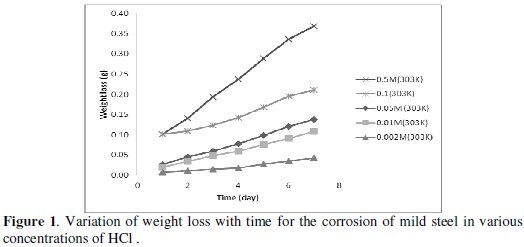
<body><![CDATA[<p><a href="#f1">Fig. 1</a> shows the variation of weight loss with time for the corrosion of mild steel 
in various concentrations of HCl at 303 K.</p>


    <p>&nbsp;</p>
<a name="f1">
<img src="/img/revistas/pea/v30n4/30n4a01f1.jpg">
    
<p>&nbsp;</p>


    <p>The figure indicates that the rate of 
corrosion of mild steel in HCl increases with increase in concentration. The 
corrosion rate of mild steel in solutions of HCl was also found to increase with 
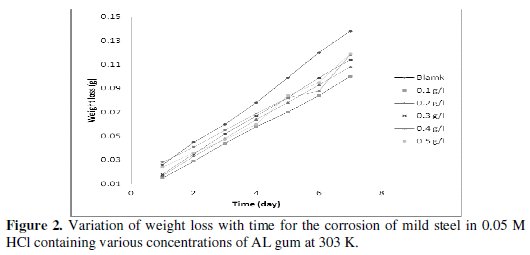
increase in temperature (figure not shown). <a href="#f2">Fig. 2</a> shows the variation of weight 
loss of mild steel in solution of HCl containing various concentrations of AL 
gum as an additive at 303 K.</p>


    <p>&nbsp;</p>
<a name="f2">
<img src="/img/revistas/pea/v30n4/30n4a01f2.jpg">
    
<p>&nbsp;</p>


    <p>The figure depicts that weight loss of mild steel in 
the blank is higher than those measured for solutions of HCl containing various 
concentrations of AL gum. This indicates that AL gum retarded the rate of 
corrosion of mild steel in solutions of HCl and that AL gum is an inhibitor for the 
corrosion of mild steel in solutions of HCl. At higher temperature (333 K), 
weight loss of mild steel in solution of HCl was found to follow similar pattern. 
However, at higher temperature (333 K), measured values of weight loss were 
higher than those obtained at a lower temperature (303 K).</p>

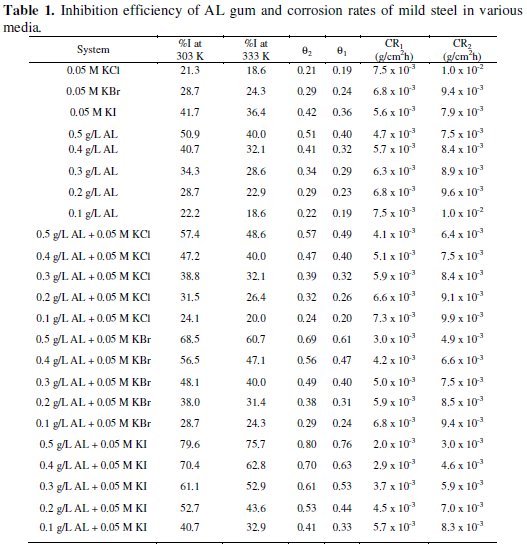
    <p>From the calculated values of corrosion rate of mild steel and of the inhibition efficiency of AL gum 
(<a href="#t1">Table 1</a>), it can be seen that the inhibition efficiency of AL gum for mild steel in 
solutions of HCl increases with increase in the concentration of the inhibitor, but 
decreases with increasing temperature, indicating that AL gum is an adsorption 
inhibitor for the corrosion of mild steel in solutions of HCl and that the 
adsorption of AL gum favours the mechanism of physical adsorption.</p>


    <p>&nbsp;</p>
<a name="t1">
<img src="/img/revistas/pea/v30n4/30n4a01t1.jpg">
    
<p>&nbsp;</p>


    ]]></body>
<body><![CDATA[<p>Calculated values of inhibition efficiency for AL gum are relatively low when 
compared to those obtained for some good green corrosion inhibitors. Therefore, 
in order to enhance the inhibition potential of AL gum for mild steel in solutions 
of HCl, synergistic effects of AL gum and halides (KI, KBr and KCl) were 
studied. Fixed concentration of the halides (0.005 M) in combination with 
various concentrations of Al gum was used for synergistic studies. According to 
Eddy et al. [19], synergism occurs when the combined inhibition efficiency of 
two or more inhibitors is greater than the sum of the inhibition efficiencies of the 
individual inhibitors, and that synergism of the corrosion inhibitor is due to the 
interaction between the components of the inhibitors, or the inhibitor and one of 
the ions present in aqueous solution. <a href="#t2">Table 2</a> presents values of the corrosion rate 
of mild steel and of the inhibition efficiency of various concentrations of KI, 
KBr, KCl, Al gum in combination with halides.</p>


    <p>&nbsp;</p>
<a name="t2">
<img src="/img/revistas/pea/v30n4/30n4a01t2.jpg">
    
<p>&nbsp;</p>


    <p>From the results obtained, it is 
evident that there is a significant enhancement of the inhibition efficiency of AL 
gum by potassium halides. Synergistic combination of AL gum with 0.005 M 
KCl, 0.005 M KBr and 0.005 M KI is found to increase the inhibition efficiency 
of AL gum, indicating that these halides have the potential of modifying the 
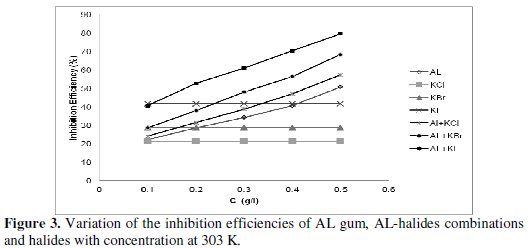
adsorption of AL gum on mild steel surface. In <a href="#f3">Fig. 3</a>, plots showing the 
variation of the inhibition efficiencies of AL gum and those of halides and AL-
halides mixtures with concentration of AL gum are presented.</p>


    <p>&nbsp;</p>
<a name="f3">
<img src="/img/revistas/pea/v30n4/30n4a01f3.jpg">
    
<p>&nbsp;</p>


    <p>From the figure, it 
is significant to note that inhibition efficiencies of the respective AL-halide 
mixture are higher than those of the corresponding halides and that of AL-gum. 
From the plots, it is evident that the increase in inhibition efficiency of AL gum 
as due to interaction with potassium halides is consistent with the following 
trend, KI &gt; KBr &gt; KCl.</p>

    <p>In order to ascertain synergistic, antagonistic and non effect of halides on the 
adsorption of AL gum, synergistic parameters, S, were calculated for various 
combinations of the inhibitor and fixed concentrations of the halides (KI, KCl 
and KBr) using the following equation [19],</p>


    <p>&nbsp;</p>
<a name="e4">
<img src="/img/revistas/pea/v30n4/30n4a01e4.jpg">
    
<p>&nbsp;</p>


    ]]></body>
<body><![CDATA[<p>where I<sub>A</sub> and I<sub>B</sub> are inhibition efficiencies of compound A and B, respectively, 
and I<sub>AB</sub> is the inhibition efficiency of a combination of the two inhibitors. 
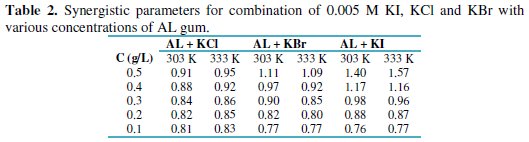
Calculated values of S are presented in <a href="#t2">Table 2</a>.</p>

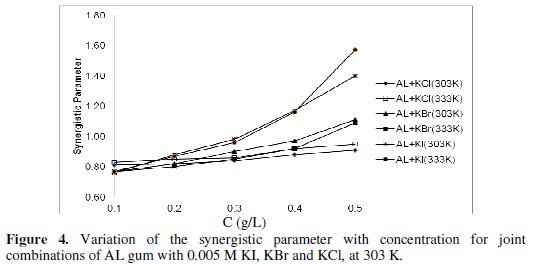
    <p>The results indicate that the synergistic parameters for combinations of various 
concentrations of AL gum with 0.005 M KI, 0.005 M KBr and 0.005 M KCl tend 
to increase with increase in the concentration of AL gum, as shown in <a href="#f4">Fig. 4</a>.</p>


    <p>&nbsp;</p>
<a name="f4">
<img src="/img/revistas/pea/v30n4/30n4a01f4.jpg">
    
<p>&nbsp;</p>


    <p>Consequently, calculated values of the synergistic parameters were greater than 
unity at AL concentration of 0.5 g/L when the inhibitor was co-employed with 
0.005 M KI and KBr, respectively. Also S values calculated for combination of 
0.4 and 0.5 g/L of AL gum inhibitor and 0.005 M KI were greater than unity. 
Therefore, at these concentrations, adsorption of AL gum on mild steel surface is 
enhanced by synergistic combination of KI and KBr at concentrations &ge; 0.4 g/L 
and &ge; 0.5 g/L, respectively. Below these critical concentrations and for all 
concentrations of Al gum in combination with KCl, calculated values of the 
synergistic parameter were less than unity, indicating that the adsorption of AL 
gum on mild steel is antagonized by the presence of KCl. The synergistic effect 
observed for iodide and bromide ions may be due to co-adsorption of iodide or 
bromide with the inhibitors' cations. It has been found that co-adsorption can be 
either competitive (in which the anion and the cation are adsorbed at different 
sites on the metal) or co-operative adsorption, in which the anion is chemisorbed 
on the surface of the metal and the cation on the layer of the anion [23]. 
However, it is possible to have both types of adsorption.</p>


    <p><b><i>Effect of temperature</i></b></p>

    <p>The effect of temperature on the corrosion of mild steel in solutions of HCl 
containing various concentrations of AL was studied using the Arrhenius 
equation, which can be written as follows [24]:</p>


    <p>&nbsp;</p>
<a name="e5">
<img src="/img/revistas/pea/v30n4/30n4a01e5.jpg">
    
<p>&nbsp;</p>


    <p>where CR is the corrosion rate of mild steel in a given medium, A is the 
Arrhenius or pre-exponential factor, Ea is the activation energy, R is the gas 
constant and T is the temperature. If the corrosion rates of mild steel at two 
temperatures [T<sub>1</sub> (303 K) and T<sub>2</sub> (333 K)] are assumed to be CR<sub>1</sub> and CR<sub>2</sub>, 
respectively, then <a href="#e5">equation 5</a> can be simplified and written as follows,</p>


    ]]></body>
<body><![CDATA[<p>&nbsp;</p>
<a name="e6">
<img src="/img/revistas/pea/v30n4/30n4a01e6.jpg">
    
<p>&nbsp;</p>


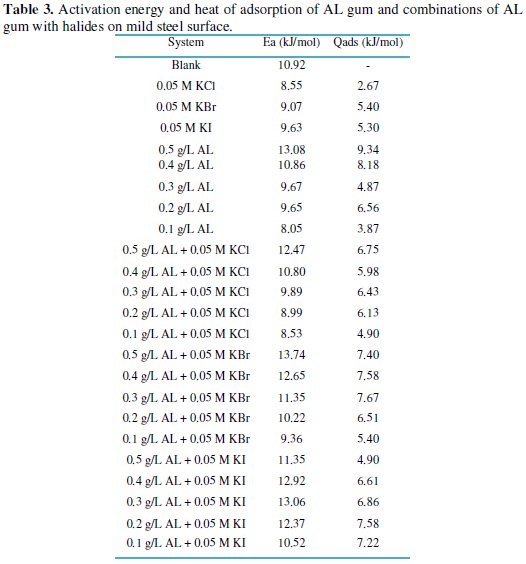
    <p>The activation energies calculated from <a href="#e6">equation 6</a> are presented in <a href="#t3">Table 3</a>.</p>


    <p>&nbsp;</p>
<a name="t3">
<img src="/img/revistas/pea/v30n4/30n4a01t3.jpg">
    
<p>&nbsp;</p>


    <p>From the results obtained, it can be seen that the activation energies are less than 
the threshold value required for chemical adsorption (80 kJ/mol), indicating that 
the adsorption of AL gum and those of AL gum-halides mixtures are consistent 
with the mechanism of charge transfer from the charged inhibitor to the charged 
metal surface, which indicates physisorption. The results also revealed that there 
is an improvement in the adsorption of AL gum due to synergism, which was 
observed for the following systems: 0.5 g/L AL + 0.05 M KI, 0.5 g/L AL + 0.05 
M KI and 0.05 M KBr + 0.5 g/L KBr. This also implies that at higher 
concentration of AL gum, enhancement of inhibition efficiency through 
synergistic combinations with KI or KBr can be achieved through improved 
adsorption.</p>


    <p><b><i>Heat of adsorption</i></b></p>

    <p>The heat of adsorption of AL gum and for various combinations of AL gum with 
halides were estimated using the following equation [15],</p>


    <p>&nbsp;</p>
<a name="e7">
<img src="/img/revistas/pea/v30n4/30n4a01e7.jpg">
    
<p>&nbsp;</p>


    ]]></body>
<body><![CDATA[<p>where Q<sub>ads</sub> is the heat of adsorption, R is the gas constant, q<sub>1</sub> and q<sub>2</sub> are the 
degrees of surface coverage for the inhibitor or inhibitor-halide combination at 
the temperatures T<sub>1</sub> (303 K) and T<sub>2</sub> (333 K), respectively. Values of Qads 
calculated from <a href="#e7">equation 7</a> are also recorded in <a href="#t3">Table 3</a>. The results obtained 
indicate that the adsorption of AL gum, KI, KBr, KI, as well as joint adsorption 
of AL with halides, is endothermic.</p>


    <p><b><i>Adsorption/thermodynamic studies</i></b></p>

    <p>Adsorption characteristics of an inhibitor can be studied using adsorption 
isotherm. Several adsorption isotherms have been defined for various inhibitors 
including Temkin, Langmuir, Flory-Huggins, Frumkin and Freundlich adsorption 
isotherms [25]. Values obtained for the degree of surface coverage of the 
inhibitor (including combinations of AL gum and halides) at various 
temperatures and concentrations were used to fit curves for different adsorption 
isotherms. The test revealed that the best adsorption isotherm that describes the 
adsorption characteristics of Al gum is the Langmuir adsorption isotherm, which 
can be expressed as follows [26],</p>


    <p>&nbsp;</p>
<a name="e8">
<img src="/img/revistas/pea/v30n4/30n4a01e8.jpg">
    
<p>&nbsp;</p>


    <p>where b is the equilibrium constant of adsorption and is related to the standard 
Gibb free energy of adsorption (&Delta;G<sub>ads</sub>) according to the following equation,</p>


    <p>&nbsp;</p>
<a name="e9">
<img src="/img/revistas/pea/v30n4/30n4a01e9.jpg">
    
<p>&nbsp;</p>


    <p>where R is the universal gas constant, T is the absolute temperature and 55.5 is 
the concentration of water in solution (mol L<sup>-1</sup>) .Simplification of <a href="#e9">equation 9</a> 
yields <a href="#e10">equation 10</a> and from the logarithm of both side of <a href="#e10">equation 10</a>, 
<a href="#e11">equation 11</a> was obtained</p>


    <p>&nbsp;</p>
<a name="e10">
<img src="/img/revistas/pea/v30n4/30n4a01e10.jpg">
    
]]></body>
<body><![CDATA[<p>&nbsp;</p>
<a name="e11">
<img src="/img/revistas/pea/v30n4/30n4a01e11.jpg">
    
<p>&nbsp;</p>


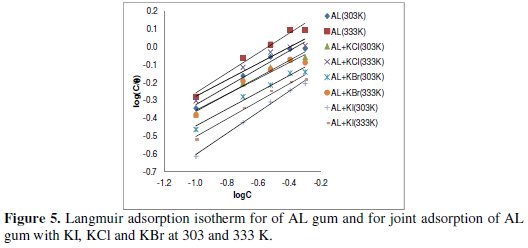
    <p>From <a href="#e11">equation 11</a>, a plot of log(C/q) versus logC should be expected to give a 
straight line with intercept equal to -log b. <a href="#f5">Fig. 5</a> presents the Langmuir 
adsorption isotherm for AL gum and for co-adsorption of AL gum-halides 
mixture.</p>


    <p>&nbsp;</p>
<a name="f5">
<img src="/img/revistas/pea/v30n4/30n4a01f5.jpg">
    
<p>&nbsp;</p>


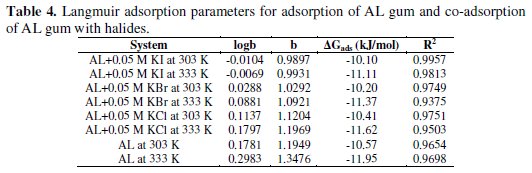
    <p>Values of Langmuir parameters obtained from the plots are presented in 
<a href="#t4">Table 4</a>.</p>


    <p>&nbsp;</p>
<a name="t4">
<img src="/img/revistas/pea/v30n4/30n4a01t4.jpg">
    
<p>&nbsp;</p>


    <p>The results reveal that R<sup>2</sup> values are very close to unity, which indicates 
that the adsorption of AL gum and co-adsorption of AL gum-halide mixtures 
obeyed the Langmuir adsorption model. 'b' value indicates the strength of 
adsorption. The higher the value of 'b', the better is the adsorption. Recorded 
values of 'b' were deduced from the intercepts of the Langmuir plots for the 
various systems, and by substitution into <a href="#e9">equation 9</a>, the free energy associated 
with the adsorption of the inhibitor was also computed (<a href="#t4">Table 4</a>). The free 
energies are negatively less than the threshold value of -40 kJ/mol expected for 
the mechanism of chemical adsorption; therefore, the adsorption of AL gum and 
co-adsorption of AL gum with KI, KCl and KBr is spontaneous and supports the 
mechanism of physical adsorption.</p>


    <p>&nbsp;</p>
    ]]></body>
<body><![CDATA[<p><b>Conclusions</b></p>

    <p>The findings of the present study indicate that the inhibition efficiency of AL 
gum can be improved through co-adsorption with KI and KBr. However, critical 
concentrations of AL gum that allowed for the synergism with the halides are 0.5 
g/L and 0.4 g/L for KBr and KI, respectively. The adsorption of Al gum and coadsorption 
of the gum with the halides is consistent with the mechanism of 
physical adsorption. The adsorption is also spontaneous and can best be 
described by the Langmuir adsorption model.</p>


    <p>&nbsp;</p>
    <p><b>References</b></p>

    <!-- ref --><p>1. Ameh PO, Magaji L, Salihu T. Afri J Pure Appl Chem. 2012;6(7):100-106.    &nbsp;&nbsp;&nbsp;&nbsp;&nbsp;&nbsp;&nbsp;&nbsp;[&#160;<a href="javascript:void(0);" onclick="javascript: window.open('/scielo.php?script=sci_nlinks&ref=000097&pid=S0872-1904201200040000100001&lng=','','width=640,height=500,resizable=yes,scrollbars=1,menubar=yes,');">Links</a>&#160;]<!-- end-ref --></p>

    <!-- ref --><p>2. Acharya S, Upadhyay SN. Trans Indian Inst Metals. 2004;57(3):297-306.    &nbsp;&nbsp;&nbsp;&nbsp;&nbsp;&nbsp;&nbsp;&nbsp;[&#160;<a href="javascript:void(0);" onclick="javascript: window.open('/scielo.php?script=sci_nlinks&ref=000099&pid=S0872-1904201200040000100002&lng=','','width=640,height=500,resizable=yes,scrollbars=1,menubar=yes,');">Links</a>&#160;]<!-- end-ref --></p>

    <!-- ref --><p>3. Eddy NO, Odoemelam SA, Odiongenyi AO. Green Chemistry Letter Rev. 2009;2(2):111-119.    &nbsp;&nbsp;&nbsp;&nbsp;&nbsp;&nbsp;&nbsp;&nbsp;[&#160;<a href="javascript:void(0);" onclick="javascript: window.open('/scielo.php?script=sci_nlinks&ref=000101&pid=S0872-1904201200040000100003&lng=','','width=640,height=500,resizable=yes,scrollbars=1,menubar=yes,');">Links</a>&#160;]<!-- end-ref --></p>

    ]]></body>
<body><![CDATA[<p>4. Ebenso EE, Ibok UJ, Ekpe UJ, Umoren S, Abiola OK, Oforka NC, Martinez S. Trans SAEST. 2004;39(4):117-123.</p>

    <p>5. Ebenso EE, Okafor PC, Ibok UJ, Ekpe UJ, Onuchukwu AI. J Chem Soc Nigeria. 2004;29(2):15-25.</p>

    <!-- ref --><p>6. Elayyoubi SB, Hammouti S, Kertit HO, Maarouf EB. Rev Met Paris. 2004;2:153-157.    &nbsp;&nbsp;&nbsp;&nbsp;&nbsp;&nbsp;&nbsp;&nbsp;[&#160;<a href="javascript:void(0);" onclick="javascript: window.open('/scielo.php?script=sci_nlinks&ref=000105&pid=S0872-1904201200040000100006&lng=','','width=640,height=500,resizable=yes,scrollbars=1,menubar=yes,');">Links</a>&#160;]<!-- end-ref --></p>

    <!-- ref --><p>7. Acharya S, Upadhyay SN. Trans Indian Inst Metals. 2004;57(3):297-306.    &nbsp;&nbsp;&nbsp;&nbsp;&nbsp;&nbsp;&nbsp;&nbsp;[&#160;<a href="javascript:void(0);" onclick="javascript: window.open('/scielo.php?script=sci_nlinks&ref=000107&pid=S0872-1904201200040000100007&lng=','','width=640,height=500,resizable=yes,scrollbars=1,menubar=yes,');">Links</a>&#160;]<!-- end-ref --></p>

    <!-- ref --><p>8. Ita BI. Proceedings of the Chemical Society of Nigeria;2004.    &nbsp;&nbsp;&nbsp;&nbsp;&nbsp;&nbsp;&nbsp;&nbsp;[&#160;<a href="javascript:void(0);" onclick="javascript: window.open('/scielo.php?script=sci_nlinks&ref=000109&pid=S0872-1904201200040000100008&lng=','','width=640,height=500,resizable=yes,scrollbars=1,menubar=yes,');">Links</a>&#160;]<!-- end-ref --></p>

    <!-- ref --><p>9. Ita BI. Bulletin Electrochem. 2004;20(8):363-370.    &nbsp;&nbsp;&nbsp;&nbsp;&nbsp;&nbsp;&nbsp;&nbsp;[&#160;<a href="javascript:void(0);" onclick="javascript: window.open('/scielo.php?script=sci_nlinks&ref=000111&pid=S0872-1904201200040000100009&lng=','','width=640,height=500,resizable=yes,scrollbars=1,menubar=yes,');">Links</a>&#160;]<!-- end-ref --></p>

    ]]></body>
<body><![CDATA[<!-- ref --><p>10. Ita BI. Bulletin Electrochem. 2005;21(7):219-323.    &nbsp;&nbsp;&nbsp;&nbsp;&nbsp;&nbsp;&nbsp;&nbsp;[&#160;<a href="javascript:void(0);" onclick="javascript: window.open('/scielo.php?script=sci_nlinks&ref=000113&pid=S0872-1904201200040000100010&lng=','','width=640,height=500,resizable=yes,scrollbars=1,menubar=yes,');">Links</a>&#160;]<!-- end-ref --></p>

    <!-- ref --><p>11. Ita BI, Offiong OE. Mater Chem Phys. 1997;51:203-210.    &nbsp;&nbsp;&nbsp;&nbsp;&nbsp;&nbsp;&nbsp;&nbsp;[&#160;<a href="javascript:void(0);" onclick="javascript: window.open('/scielo.php?script=sci_nlinks&ref=000115&pid=S0872-1904201200040000100011&lng=','','width=640,height=500,resizable=yes,scrollbars=1,menubar=yes,');">Links</a>&#160;]<!-- end-ref --></p>

    <!-- ref --><p>12. Khavasfar A, Iran M. Paper of the 5th International Surface Engineering Congress; 2006 May 16. Seattle, Washington.    &nbsp;&nbsp;&nbsp;&nbsp;&nbsp;&nbsp;&nbsp;&nbsp;[&#160;<a href="javascript:void(0);" onclick="javascript: window.open('/scielo.php?script=sci_nlinks&ref=000117&pid=S0872-1904201200040000100012&lng=','','width=640,height=500,resizable=yes,scrollbars=1,menubar=yes,');">Links</a>&#160;]<!-- end-ref --></p>

    <!-- ref --><p>13. Rajendran S, Joany MR, Apparao BV, Palaniswamy N. Trans SAEST. 2000;35(3,4):113-117.    &nbsp;&nbsp;&nbsp;&nbsp;&nbsp;&nbsp;&nbsp;&nbsp;[&#160;<a href="javascript:void(0);" onclick="javascript: window.open('/scielo.php?script=sci_nlinks&ref=000119&pid=S0872-1904201200040000100013&lng=','','width=640,height=500,resizable=yes,scrollbars=1,menubar=yes,');">Links</a>&#160;]<!-- end-ref --></p>

    <!-- ref --><p>14. Zuchi F, Trabanelli G, Gullari G. Electrochem Mater. 1978;34:407-419.    &nbsp;&nbsp;&nbsp;&nbsp;&nbsp;&nbsp;&nbsp;&nbsp;[&#160;<a href="javascript:void(0);" onclick="javascript: window.open('/scielo.php?script=sci_nlinks&ref=000121&pid=S0872-1904201200040000100014&lng=','','width=640,height=500,resizable=yes,scrollbars=1,menubar=yes,');">Links</a>&#160;]<!-- end-ref --></p>

    ]]></body>
<body><![CDATA[<!-- ref --><p>15. Eddy NO, Ameh P, Gimba CE, Ebenso EE. Int J Electrochem Sci. 2011;6:5815-5829.    &nbsp;&nbsp;&nbsp;&nbsp;&nbsp;&nbsp;&nbsp;&nbsp;[&#160;<a href="javascript:void(0);" onclick="javascript: window.open('/scielo.php?script=sci_nlinks&ref=000123&pid=S0872-1904201200040000100015&lng=','','width=640,height=500,resizable=yes,scrollbars=1,menubar=yes,');">Links</a>&#160;]<!-- end-ref --></p>

    <!-- ref --><p>16. Ameh PO, Gimba CE, Eddy NO, Ebenso EE. Int J Electrochem Sci. 2012;7. In press.    &nbsp;&nbsp;&nbsp;&nbsp;&nbsp;&nbsp;&nbsp;&nbsp;[&#160;<a href="javascript:void(0);" onclick="javascript: window.open('/scielo.php?script=sci_nlinks&ref=000125&pid=S0872-1904201200040000100016&lng=','','width=640,height=500,resizable=yes,scrollbars=1,menubar=yes,');">Links</a>&#160;]<!-- end-ref --></p>

    <p>17. S. Rajendran, M. Sivakumar, R. Subadevi, M. Nirmala, Physica B 2004;348:73-78.</p>

    <!-- ref --><p>18. Eddy NO, Ebenso EE, Ibok UJ. J Appl Electrochem. 2010;40:445-456.    &nbsp;&nbsp;&nbsp;&nbsp;&nbsp;&nbsp;&nbsp;&nbsp;[&#160;<a href="javascript:void(0);" onclick="javascript: window.open('/scielo.php?script=sci_nlinks&ref=000128&pid=S0872-1904201200040000100018&lng=','','width=640,height=500,resizable=yes,scrollbars=1,menubar=yes,');">Links</a>&#160;]<!-- end-ref --></p>

    <p>19. Li SL, Wang YG, Chen SH, Yu R, Lei SB, Ma HY, Liu DX. Corr Sci. 1999;41:1273-1287.</p>

    <!-- ref --><p>20. Eddy NO, Odoemelam SA, Odiongenyi AO, J Appl Electrochem. 2009;39(6):849-857.    &nbsp;&nbsp;&nbsp;&nbsp;&nbsp;&nbsp;&nbsp;&nbsp;[&#160;<a href="javascript:void(0);" onclick="javascript: window.open('/scielo.php?script=sci_nlinks&ref=000131&pid=S0872-1904201200040000100020&lng=','','width=640,height=500,resizable=yes,scrollbars=1,menubar=yes,');">Links</a>&#160;]<!-- end-ref --></p>

    ]]></body>
<body><![CDATA[<!-- ref --><p>21. Umoren SA, Ebenso EE. Pigment Resin Tech. 2008;37(3):173-182.    &nbsp;&nbsp;&nbsp;&nbsp;&nbsp;&nbsp;&nbsp;&nbsp;[&#160;<a href="javascript:void(0);" onclick="javascript: window.open('/scielo.php?script=sci_nlinks&ref=000133&pid=S0872-1904201200040000100021&lng=','','width=640,height=500,resizable=yes,scrollbars=1,menubar=yes,');">Links</a>&#160;]<!-- end-ref --></p>

    <!-- ref --><p>22. Umoren SA, Obot IB, Ebenso EE. Electronic J Chem. 2008;5(2):355-364.    &nbsp;&nbsp;&nbsp;&nbsp;&nbsp;&nbsp;&nbsp;&nbsp;[&#160;<a href="javascript:void(0);" onclick="javascript: window.open('/scielo.php?script=sci_nlinks&ref=000135&pid=S0872-1904201200040000100022&lng=','','width=640,height=500,resizable=yes,scrollbars=1,menubar=yes,');">Links</a>&#160;]<!-- end-ref --></p>

    <!-- ref --><p>23. Okafor PC, Zheng Y. Corr Sci. 2009;51:850-859.    &nbsp;&nbsp;&nbsp;&nbsp;&nbsp;&nbsp;&nbsp;&nbsp;[&#160;<a href="javascript:void(0);" onclick="javascript: window.open('/scielo.php?script=sci_nlinks&ref=000137&pid=S0872-1904201200040000100023&lng=','','width=640,height=500,resizable=yes,scrollbars=1,menubar=yes,');">Links</a>&#160;]<!-- end-ref --></p>

    <!-- ref --><p>24. Eddy NO. J Adv Research. 2010;2:35-47.    &nbsp;&nbsp;&nbsp;&nbsp;&nbsp;&nbsp;&nbsp;&nbsp;[&#160;<a href="javascript:void(0);" onclick="javascript: window.open('/scielo.php?script=sci_nlinks&ref=000139&pid=S0872-1904201200040000100024&lng=','','width=640,height=500,resizable=yes,scrollbars=1,menubar=yes,');">Links</a>&#160;]<!-- end-ref --></p>

    <!-- ref --><p>25. Eddy NO, Ita BI. Int J Quantum Chem. 2011;111(14):3456-3473.    &nbsp;&nbsp;&nbsp;&nbsp;&nbsp;&nbsp;&nbsp;&nbsp;[&#160;<a href="javascript:void(0);" onclick="javascript: window.open('/scielo.php?script=sci_nlinks&ref=000141&pid=S0872-1904201200040000100025&lng=','','width=640,height=500,resizable=yes,scrollbars=1,menubar=yes,');">Links</a>&#160;]<!-- end-ref --></p>

    ]]></body>
<body><![CDATA[<!-- ref --><p>26. Mohana KN, Badiea AM. Corr Sci. 2008;50:2939-2947.    &nbsp;&nbsp;&nbsp;&nbsp;&nbsp;&nbsp;&nbsp;&nbsp;[&#160;<a href="javascript:void(0);" onclick="javascript: window.open('/scielo.php?script=sci_nlinks&ref=000143&pid=S0872-1904201200040000100026&lng=','','width=640,height=500,resizable=yes,scrollbars=1,menubar=yes,');">Links</a>&#160;]<!-- end-ref --></p>


    <p>&nbsp;</p>
    <p><a name=0></a><sup><a href="#top">*</a></sup>Corresponding author. E-mail address: <a href="mailto:nabukeddy@yahoo.com">nabukeddy@yahoo.com</a></p>

    <p>Received 2 May 2012; accepted 31 August 2012</p>

    <p><a href="http://www.peacta.org" target="_blank">www.peacta.org</a> </p>


     ]]></body><back>
<ref-list>
<ref id="B1">
<label>1</label><nlm-citation citation-type="journal">
<person-group person-group-type="author">
<name>
<surname><![CDATA[Ameh]]></surname>
<given-names><![CDATA[PO]]></given-names>
</name>
<name>
<surname><![CDATA[Magaji]]></surname>
<given-names><![CDATA[L]]></given-names>
</name>
<name>
<surname><![CDATA[Salihu]]></surname>
<given-names><![CDATA[T]]></given-names>
</name>
</person-group>
<source><![CDATA[Afri J Pure Appl Chem]]></source>
<year>2012</year>
<volume>6</volume>
<numero>7</numero>
<issue>7</issue>
<page-range>100-106</page-range></nlm-citation>
</ref>
<ref id="B2">
<label>2</label><nlm-citation citation-type="journal">
<person-group person-group-type="author">
<name>
<surname><![CDATA[Acharya]]></surname>
<given-names><![CDATA[S]]></given-names>
</name>
<name>
<surname><![CDATA[Upadhyay]]></surname>
<given-names><![CDATA[SN]]></given-names>
</name>
</person-group>
<source><![CDATA[Trans Indian Inst Metals]]></source>
<year>2004</year>
<volume>57</volume>
<numero>3</numero>
<issue>3</issue>
<page-range>297-306</page-range></nlm-citation>
</ref>
<ref id="B3">
<label>3</label><nlm-citation citation-type="journal">
<person-group person-group-type="author">
<name>
<surname><![CDATA[Eddy]]></surname>
<given-names><![CDATA[NO]]></given-names>
</name>
<name>
<surname><![CDATA[Odoemelam]]></surname>
<given-names><![CDATA[SA]]></given-names>
</name>
<name>
<surname><![CDATA[Odiongenyi]]></surname>
<given-names><![CDATA[AO]]></given-names>
</name>
</person-group>
<source><![CDATA[Green Chemistry Letter Rev]]></source>
<year>2009</year>
<volume>2</volume>
<numero>2</numero>
<issue>2</issue>
<page-range>111-119</page-range></nlm-citation>
</ref>
<ref id="B4">
<label>4</label><nlm-citation citation-type="journal">
<person-group person-group-type="author">
<name>
<surname><![CDATA[Ebenso]]></surname>
<given-names><![CDATA[EE]]></given-names>
</name>
<name>
<surname><![CDATA[Ibok]]></surname>
<given-names><![CDATA[UJ]]></given-names>
</name>
<name>
<surname><![CDATA[Ekpe]]></surname>
<given-names><![CDATA[UJ]]></given-names>
</name>
</person-group>
<source><![CDATA[Trans SAEST]]></source>
<year>2004</year>
<volume>39</volume>
<numero>4</numero>
<issue>4</issue>
<page-range>117-123</page-range></nlm-citation>
</ref>
<ref id="B5">
<label>5</label><nlm-citation citation-type="journal">
<person-group person-group-type="author">
<name>
<surname><![CDATA[Ebenso]]></surname>
<given-names><![CDATA[EE]]></given-names>
</name>
<name>
<surname><![CDATA[Okafor]]></surname>
<given-names><![CDATA[PC]]></given-names>
</name>
<name>
<surname><![CDATA[Ibok]]></surname>
<given-names><![CDATA[UJ]]></given-names>
</name>
</person-group>
<source><![CDATA[J Chem Soc Nigeria]]></source>
<year>2004</year>
<volume>29</volume>
<numero>2</numero>
<issue>2</issue>
<page-range>15-25</page-range></nlm-citation>
</ref>
<ref id="B6">
<label>6</label><nlm-citation citation-type="journal">
<person-group person-group-type="author">
<name>
<surname><![CDATA[Elayyoubi]]></surname>
<given-names><![CDATA[SB]]></given-names>
</name>
<name>
<surname><![CDATA[Hammouti]]></surname>
<given-names><![CDATA[S]]></given-names>
</name>
<name>
<surname><![CDATA[Kertit]]></surname>
<given-names><![CDATA[HO]]></given-names>
</name>
<name>
<surname><![CDATA[Maarouf]]></surname>
<given-names><![CDATA[EB]]></given-names>
</name>
</person-group>
<source><![CDATA[Rev Met Paris]]></source>
<year>2004</year>
<volume>2</volume>
<page-range>153-157</page-range></nlm-citation>
</ref>
<ref id="B7">
<label>7</label><nlm-citation citation-type="journal">
<person-group person-group-type="author">
<name>
<surname><![CDATA[Acharya]]></surname>
<given-names><![CDATA[S]]></given-names>
</name>
<name>
<surname><![CDATA[Upadhyay]]></surname>
<given-names><![CDATA[SN]]></given-names>
</name>
</person-group>
<source><![CDATA[Trans Indian Inst Metals]]></source>
<year>2004</year>
<volume>57</volume>
<numero>3</numero>
<issue>3</issue>
<page-range>297-306</page-range></nlm-citation>
</ref>
<ref id="B8">
<label>8</label><nlm-citation citation-type="">
<person-group person-group-type="author">
<name>
<surname><![CDATA[Ita]]></surname>
<given-names><![CDATA[BI]]></given-names>
</name>
</person-group>
<source><![CDATA[]]></source>
<year>2004</year>
</nlm-citation>
</ref>
<ref id="B9">
<label>9</label><nlm-citation citation-type="journal">
<person-group person-group-type="author">
<name>
<surname><![CDATA[Ita]]></surname>
<given-names><![CDATA[BI]]></given-names>
</name>
</person-group>
<source><![CDATA[Bulletin Electrochem]]></source>
<year>2004</year>
<volume>20</volume>
<numero>8</numero>
<issue>8</issue>
<page-range>363-370</page-range></nlm-citation>
</ref>
<ref id="B10">
<label>10</label><nlm-citation citation-type="journal">
<person-group person-group-type="author">
<name>
<surname><![CDATA[Ita]]></surname>
<given-names><![CDATA[BI]]></given-names>
</name>
</person-group>
<source><![CDATA[Bulletin Electrochem]]></source>
<year>2005</year>
<volume>21</volume>
<numero>7</numero>
<issue>7</issue>
<page-range>219-323</page-range></nlm-citation>
</ref>
<ref id="B11">
<label>11</label><nlm-citation citation-type="journal">
<person-group person-group-type="author">
<name>
<surname><![CDATA[Ita]]></surname>
<given-names><![CDATA[BI]]></given-names>
</name>
<name>
<surname><![CDATA[Offiong]]></surname>
<given-names><![CDATA[OE]]></given-names>
</name>
</person-group>
<source><![CDATA[Mater Chem Phys]]></source>
<year>1997</year>
<volume>51</volume>
<page-range>203-210</page-range></nlm-citation>
</ref>
<ref id="B12">
<label>12</label><nlm-citation citation-type="confpro">
<person-group person-group-type="author">
<name>
<surname><![CDATA[Khavasfar]]></surname>
<given-names><![CDATA[A]]></given-names>
</name>
<name>
<surname><![CDATA[Iran]]></surname>
<given-names><![CDATA[M]]></given-names>
</name>
</person-group>
<source><![CDATA[]]></source>
<year></year>
<conf-name><![CDATA[ 5th International Surface Engineering Congress]]></conf-name>
<conf-date>2006</conf-date>
<conf-loc>Seattle Washington</conf-loc>
</nlm-citation>
</ref>
<ref id="B13">
<label>13</label><nlm-citation citation-type="journal">
<person-group person-group-type="author">
<name>
<surname><![CDATA[Rajendran]]></surname>
<given-names><![CDATA[S]]></given-names>
</name>
<name>
<surname><![CDATA[Joany]]></surname>
<given-names><![CDATA[MR]]></given-names>
</name>
<name>
<surname><![CDATA[Apparao]]></surname>
<given-names><![CDATA[BV]]></given-names>
</name>
<name>
<surname><![CDATA[Palaniswamy]]></surname>
<given-names><![CDATA[N]]></given-names>
</name>
</person-group>
<source><![CDATA[Trans SAEST]]></source>
<year>2000</year>
<volume>35</volume>
<numero>3,4</numero>
<issue>3,4</issue>
<page-range>113-117</page-range></nlm-citation>
</ref>
<ref id="B14">
<label>14</label><nlm-citation citation-type="journal">
<person-group person-group-type="author">
<name>
<surname><![CDATA[Zuchi]]></surname>
<given-names><![CDATA[F]]></given-names>
</name>
<name>
<surname><![CDATA[Trabanelli]]></surname>
<given-names><![CDATA[G]]></given-names>
</name>
<name>
<surname><![CDATA[Gullari]]></surname>
<given-names><![CDATA[G]]></given-names>
</name>
</person-group>
<source><![CDATA[Electrochem Mater]]></source>
<year>1978</year>
<volume>34</volume>
<page-range>407-419</page-range></nlm-citation>
</ref>
<ref id="B15">
<label>15</label><nlm-citation citation-type="journal">
<person-group person-group-type="author">
<name>
<surname><![CDATA[Eddy]]></surname>
<given-names><![CDATA[NO]]></given-names>
</name>
<name>
<surname><![CDATA[Ameh]]></surname>
<given-names><![CDATA[P]]></given-names>
</name>
<name>
<surname><![CDATA[Gimba]]></surname>
<given-names><![CDATA[CE]]></given-names>
</name>
<name>
<surname><![CDATA[Ebenso]]></surname>
<given-names><![CDATA[EE]]></given-names>
</name>
</person-group>
<source><![CDATA[Int J Electrochem Sci]]></source>
<year>2011</year>
<volume>6</volume>
<page-range>5815-5829</page-range></nlm-citation>
</ref>
<ref id="B16">
<label>16</label><nlm-citation citation-type="journal">
<person-group person-group-type="author">
<name>
<surname><![CDATA[Ameh]]></surname>
<given-names><![CDATA[PO]]></given-names>
</name>
<name>
<surname><![CDATA[Gimba]]></surname>
<given-names><![CDATA[CE]]></given-names>
</name>
<name>
<surname><![CDATA[Eddy]]></surname>
<given-names><![CDATA[NO]]></given-names>
</name>
<name>
<surname><![CDATA[Ebenso]]></surname>
<given-names><![CDATA[EE]]></given-names>
</name>
</person-group>
<source><![CDATA[Int J Electrochem Sci]]></source>
<year>2012</year>
<volume>7</volume>
</nlm-citation>
</ref>
<ref id="B17">
<label>17</label><nlm-citation citation-type="journal">
<person-group person-group-type="author">
<name>
<surname><![CDATA[Rajendran]]></surname>
<given-names><![CDATA[S]]></given-names>
</name>
<name>
<surname><![CDATA[Sivakumar]]></surname>
<given-names><![CDATA[M]]></given-names>
</name>
<name>
<surname><![CDATA[Subadevi]]></surname>
<given-names><![CDATA[R]]></given-names>
</name>
<name>
<surname><![CDATA[Nirmala]]></surname>
<given-names><![CDATA[M]]></given-names>
</name>
</person-group>
<source><![CDATA[Physica B]]></source>
<year>2004</year>
<volume>348</volume>
<page-range>73-78</page-range></nlm-citation>
</ref>
<ref id="B18">
<label>18</label><nlm-citation citation-type="journal">
<person-group person-group-type="author">
<name>
<surname><![CDATA[Eddy]]></surname>
<given-names><![CDATA[NO]]></given-names>
</name>
<name>
<surname><![CDATA[Ebenso]]></surname>
<given-names><![CDATA[EE]]></given-names>
</name>
<name>
<surname><![CDATA[Ibok]]></surname>
<given-names><![CDATA[UJ]]></given-names>
</name>
</person-group>
<source><![CDATA[J Appl Electrochem]]></source>
<year>2010</year>
<volume>40</volume>
<page-range>445-456</page-range></nlm-citation>
</ref>
<ref id="B19">
<label>19</label><nlm-citation citation-type="journal">
<person-group person-group-type="author">
<name>
<surname><![CDATA[Li]]></surname>
<given-names><![CDATA[SL]]></given-names>
</name>
<name>
<surname><![CDATA[Wang]]></surname>
<given-names><![CDATA[YG]]></given-names>
</name>
<name>
<surname><![CDATA[Chen]]></surname>
<given-names><![CDATA[SH]]></given-names>
</name>
</person-group>
<source><![CDATA[Corr Sci]]></source>
<year>1999</year>
<volume>41</volume>
<page-range>1273-1287</page-range></nlm-citation>
</ref>
<ref id="B20">
<label>20</label><nlm-citation citation-type="journal">
<person-group person-group-type="author">
<name>
<surname><![CDATA[Eddy]]></surname>
<given-names><![CDATA[NO]]></given-names>
</name>
<name>
<surname><![CDATA[Odoemelam]]></surname>
<given-names><![CDATA[SA]]></given-names>
</name>
<name>
<surname><![CDATA[Odiongenyi]]></surname>
<given-names><![CDATA[AO]]></given-names>
</name>
</person-group>
<source><![CDATA[J Appl Electrochem]]></source>
<year>2009</year>
<volume>39</volume>
<numero>6</numero>
<issue>6</issue>
<page-range>849-857</page-range></nlm-citation>
</ref>
<ref id="B21">
<label>21</label><nlm-citation citation-type="journal">
<person-group person-group-type="author">
<name>
<surname><![CDATA[Umoren]]></surname>
<given-names><![CDATA[SA]]></given-names>
</name>
<name>
<surname><![CDATA[Ebenso]]></surname>
<given-names><![CDATA[EE]]></given-names>
</name>
</person-group>
<source><![CDATA[Pigment Resin Tech]]></source>
<year>2008</year>
<volume>37</volume>
<numero>3</numero>
<issue>3</issue>
<page-range>173-182</page-range></nlm-citation>
</ref>
<ref id="B22">
<label>22</label><nlm-citation citation-type="journal">
<person-group person-group-type="author">
<name>
<surname><![CDATA[Umoren]]></surname>
<given-names><![CDATA[SA]]></given-names>
</name>
<name>
<surname><![CDATA[Obot]]></surname>
<given-names><![CDATA[IB]]></given-names>
</name>
<name>
<surname><![CDATA[Ebenso]]></surname>
<given-names><![CDATA[EE]]></given-names>
</name>
</person-group>
<source><![CDATA[Electronic J Chem]]></source>
<year>2008</year>
<volume>5</volume>
<numero>2</numero>
<issue>2</issue>
<page-range>355-364</page-range></nlm-citation>
</ref>
<ref id="B23">
<label>23</label><nlm-citation citation-type="journal">
<person-group person-group-type="author">
<name>
<surname><![CDATA[Okafor]]></surname>
<given-names><![CDATA[PC]]></given-names>
</name>
<name>
<surname><![CDATA[Zheng]]></surname>
<given-names><![CDATA[Y]]></given-names>
</name>
</person-group>
<source><![CDATA[Corr Sci.]]></source>
<year>2009</year>
<volume>51</volume>
<page-range>850-859</page-range></nlm-citation>
</ref>
<ref id="B24">
<label>24</label><nlm-citation citation-type="journal">
<person-group person-group-type="author">
<name>
<surname><![CDATA[Eddy]]></surname>
<given-names><![CDATA[NO]]></given-names>
</name>
</person-group>
<source><![CDATA[J Adv Research]]></source>
<year>2010</year>
<volume>2</volume>
<page-range>35-47</page-range></nlm-citation>
</ref>
<ref id="B25">
<label>25</label><nlm-citation citation-type="journal">
<person-group person-group-type="author">
<name>
<surname><![CDATA[Eddy]]></surname>
<given-names><![CDATA[NO]]></given-names>
</name>
<name>
<surname><![CDATA[Ita]]></surname>
<given-names><![CDATA[BI]]></given-names>
</name>
</person-group>
<source><![CDATA[Int J Quantum Chem]]></source>
<year>2011</year>
<volume>111</volume>
<numero>14</numero>
<issue>14</issue>
<page-range>3456-3473</page-range></nlm-citation>
</ref>
<ref id="B26">
<label>26</label><nlm-citation citation-type="journal">
<person-group person-group-type="author">
<name>
<surname><![CDATA[Mohana]]></surname>
<given-names><![CDATA[KN]]></given-names>
</name>
<name>
<surname><![CDATA[Badiea]]></surname>
<given-names><![CDATA[AM]]></given-names>
</name>
</person-group>
<source><![CDATA[Corr Sci]]></source>
<year>2008</year>
<volume>50</volume>
<page-range>2939-2947</page-range></nlm-citation>
</ref>
</ref-list>
</back>
</article>