<?xml version="1.0" encoding="ISO-8859-1"?><article xmlns:mml="http://www.w3.org/1998/Math/MathML" xmlns:xlink="http://www.w3.org/1999/xlink" xmlns:xsi="http://www.w3.org/2001/XMLSchema-instance">
<front>
<journal-meta>
<journal-id>0872-1904</journal-id>
<journal-title><![CDATA[Portugaliae Electrochimica Acta]]></journal-title>
<abbrev-journal-title><![CDATA[Port. Electrochim. Acta]]></abbrev-journal-title>
<issn>0872-1904</issn>
<publisher>
<publisher-name><![CDATA[Sociedade Portuguesa de Electroquímica]]></publisher-name>
</publisher>
</journal-meta>
<article-meta>
<article-id>S0872-19042012000400002</article-id>
<article-id pub-id-type="doi">10.4152/pea.201204247</article-id>
<title-group>
<article-title xml:lang="en"><![CDATA[Evaluation of Nicotiana Leaves Extract as Corrosion Inhibitor for Steel in Acidic and Neutral Chloride Solutions]]></article-title>
</title-group>
<contrib-group>
<contrib contrib-type="author">
<name>
<surname><![CDATA[Abd-El-Khalek]]></surname>
<given-names><![CDATA[D.E.]]></given-names>
</name>
<xref ref-type="aff" rid="A01"/>
</contrib>
<contrib contrib-type="author">
<name>
<surname><![CDATA[Abd-El-Nabeyb]]></surname>
</name>
<xref ref-type="aff" rid="A02"/>
</contrib>
<contrib contrib-type="author">
<name>
<surname><![CDATA[Abdel-Gaberb]]></surname>
<given-names><![CDATA[A.M.]]></given-names>
</name>
<xref ref-type="aff" rid="A02"/>
</contrib>
</contrib-group>
<aff id="A01">
<institution><![CDATA[,National Institute of Oceanography and Fisheries Marine Chemistry Department ]]></institution>
<addr-line><![CDATA[Alexandri ]]></addr-line>
<country>Egypt</country>
</aff>
<aff id="A02">
<institution><![CDATA[,Alexandria University Faculty of Science Chemistry Department]]></institution>
<addr-line><![CDATA[Alexandria ]]></addr-line>
<country>Egypt</country>
</aff>
<pub-date pub-type="pub">
<day>00</day>
<month>07</month>
<year>2012</year>
</pub-date>
<pub-date pub-type="epub">
<day>00</day>
<month>07</month>
<year>2012</year>
</pub-date>
<volume>30</volume>
<numero>4</numero>
<fpage>247</fpage>
<lpage>259</lpage>
<copyright-statement/>
<copyright-year/>
<self-uri xlink:href="http://scielo.pt/scielo.php?script=sci_arttext&amp;pid=S0872-19042012000400002&amp;lng=en&amp;nrm=iso"></self-uri><self-uri xlink:href="http://scielo.pt/scielo.php?script=sci_abstract&amp;pid=S0872-19042012000400002&amp;lng=en&amp;nrm=iso"></self-uri><self-uri xlink:href="http://scielo.pt/scielo.php?script=sci_pdf&amp;pid=S0872-19042012000400002&amp;lng=en&amp;nrm=iso"></self-uri><abstract abstract-type="short" xml:lang="en"><p><![CDATA[The inhibition of steel corrosion in hydrochloric acid and sodium chloride solutions by Nicotiana leaves extract was investigated by potentiodynamic polarization and electrochemical impedance spectroscopy measurements. Polarization curves showed that the extract behaves as a mixed type inhibitor in acidic medium, while it acts as anodic type in neutral medium. Impedance measurements indicated that the size of the semicircles obtained increased with increasing the concentration of the extract and decreasing the chloride ion concentration. Nicotiana leaves extract was found to be more effective in controlling corrosion of steel in acidic solution than in neutral one. The activation parameters of the corrosion reaction of steel in acid media in absence and presence of nicotiana leaves extract were also calculated and discussed.]]></p></abstract>
<kwd-group>
<kwd lng="en"><![CDATA[steel]]></kwd>
<kwd lng="en"><![CDATA[corrosion]]></kwd>
<kwd lng="en"><![CDATA[acid]]></kwd>
<kwd lng="en"><![CDATA[neutral]]></kwd>
<kwd lng="en"><![CDATA[extract]]></kwd>
</kwd-group>
</article-meta>
</front><body><![CDATA[ 

    <p><b>Evaluation of Nicotiana Leaves Extract as Corrosion Inhibitor for Steel in Acidic and Neutral Chloride Solutions</b></p>

    <p><b>D.E. Abd-El-Khalek<sup>1,<a href="#0">*<a/></sup>, Abd-El-Nabeyb<sup>2</sup> and A.M. Abdel-Gaberb<sup>2</sup></b></p>

    <p><sup>1</sup><i> Marine Chemistry Department, National Institute of Oceanography and Fisheries, Elanfoshy, Alexandri, Egypt</i></p>

    <p><sup>2</sup><i> Chemistry Department, Faculty of Science, Alexandria University, Ibrahimia, P.O. Box 426, Alexandria 21321, Egypt</i></p>


<!--     <p>&nbsp;</p>
    <p>doi: 10.4152/pea.201204247</p> -->


    <p>&nbsp;</p>
    <p><b>Abstract</b></p>

    <p>The inhibition of steel corrosion in hydrochloric acid and sodium chloride solutions by 
Nicotiana leaves extract was investigated by potentiodynamic polarization and 
electrochemical impedance spectroscopy measurements. Polarization curves showed 
that the extract behaves as a mixed type inhibitor in acidic medium, while it acts as 
anodic type in neutral medium. Impedance measurements indicated that the size of the 
semicircles obtained increased with increasing the concentration of the extract and 
decreasing the chloride ion concentration. Nicotiana leaves extract was found to be 
more effective in controlling corrosion of steel in acidic solution than in neutral one. 
The activation parameters of the corrosion reaction of steel in acid media in absence and 
presence of nicotiana leaves extract were also calculated and discussed.</p>

    ]]></body>
<body><![CDATA[<p><b><i>Keywords:</i></b> steel, corrosion, acid, neutral, extract.</p>


    <p>&nbsp;</p>
    <p><b>Introduction</b></p>

    <p>Inhibitors are generally used to reduce corrosion of metallic material in different 
media. Several chemical compounds have been investigated as corrosion 
inhibitors for mild steel in acid and neutral media [1-7]. The use of chemical 
inhibitors has been limited because of the environmental threat. Recently, due to 
environmental regulations, plant extracts have again become important because 
they are environmentally acceptable, readily available and a renewable source for 
a wide range of needed inhibitors. Plant extracts are viewed as an incredibly rich 
source of naturally synthesized chemical compounds that can be extracted by 
simple procedures with low cost. As new trend, several researchers used natural 
products as corrosion inhibitors. Abdel-Gaber et al. [8] investigated the effect of 
extracts of some plants on the corrosion of steel in aqueous 1 M sulphuric acid by 
electrochemical impedance spectroscopy (EIS) and potentiodynamic polarization 
techniques. Oguzie [9] studied also the corrosion inhibition of mild steel in 2 M 
hydrochloric acid and 1 M sulphuric acid by extracts of selected plants using a 
gasometric technique at temperatures of 30 and 60 &deg;C. The studied plant 
materials include leaf extracts of <i>Occimum viridis</i>, <i>Telferia occidentalis</i>, 
<i>Azadirachta indica</i> and <i>Hibiscus sabdariffa</i>, as well as extracts from the seeds of 
<i>Garcinia kola</i>. The effect of lupine and damsissa extracts on the corrosion of 
steel in 0.5 M Na<sub>2</sub>SO<sub>4</sub> solution free from and containing 0.01 or 0.1 M NaCl 
were examined by potentiodynamic and electrochemical impedance spectroscopy 
techniques [10]. Also, olive leaves extract was studied as scale and corrosion 
inhibitor for steel surface in brine solution [11]. Earlier et al. [12] showed that the 
actual inhibitors in the plant extracts are usually alkaloids and other organic 
nitrogen bases, as well as carbohydrates, proteins and their acid hydrolysis 
products.</p> 

    <p>Nicotiana glauca is a much branched shrub or small tree often reaching 25 feet in 
nature. It is distributed in warm temperate, arid and subtropical, dry and moist 
regions, beside roadsides and along riverbanks. The plant is used for a variety of 
medicinal purposes and smoked by Native American groups. It is being 
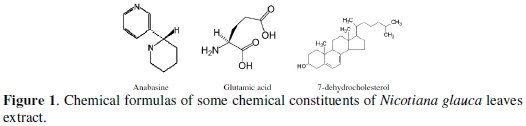
investigated for use as a biofuel. The chemical constituents in <i>Nicotiana glauca</i> 
are shown in <a href="#f1">Fig. 1</a>; anabasine is the principal alkaloid of <i>Nicotiana glauca</i>.</p>


    <p>&nbsp;</p>
<a name="f1">
<img src="/img/revistas/pea/v30n4/30n4a02f1.jpg">
    
<p>&nbsp;</p>


    <p>It also contains many amino acids (glutamic acid and aspartic acid) and organic 
acids (malice acid)[13]. Additionally, another study indicates that 7-dehydrocholesterol 
is found in <i>Nicotiana glauca</i> [14].</p>
 
    <p>This work aims to investigate Nicotiana glauca extract as corrosion inhibitor of 
mild steel in acidic and neutral solutions.</p>


    <p>&nbsp;</p>
    ]]></body>
<body><![CDATA[<p><b>Experimental</b></p>

    <p><b><i>Electrochemical tests</i></b></p>

    <p>Electrochemical impedance and polarization curve measurements were achieved 
using a Gill AC instrument. The frequency range for EIS measurements was 0.1 &le; f &le; 1 &times; 10<sup>3</sup> Hz with applied potential signal amplitude of 10 mV around the rest 
potential. The data were obtained in a three-electrode mode; platinum sheet and 
saturated calomel electrodes were used as counter and reference electrodes 
respectively. The material used for constructing the working electrode was steel 
with the following chemical composition (wt.%): C, 0.21; S, 0.04; Mn, 2.5; P, 
0.04; Si, 0.35; balance Fe. The steel was encapsulated in epoxy resin in such a 
way that only one surface was left uncovered. The exposed area (1 cm<sup>2</sup>) was 
mechanically abraded with a series of emery papers of variable grades, starting 
with a coarse one and proceeding in steps to the finest (800) grade. The samples 
were then washed thoroughly with double distilled water, followed with A.R. 
ethanol and finally with distilled water, just before insertion in the cell. Before 
polarization and EIS measurements, the working electrode was introduced into 
the test solution and left for 10 min at the open circuit potential. Polarization 
curve measurements were obtained at a scan rate of 20 mV/min starting from 
cathodic potential (Ecorr -250 mV) going to anodic direction. To test the 
reliability and reproducibility of the measurements, duplicate experiments were 
performed in each case at the same conditions.</p>

    <p><b><i>Solutions preparation</i></b></p>

    <p>Double distilled water and analytical reagent-grade NaCl and HCl were used for 
preparing the solutions. Stock solution of the plant extracts was obtained by 
drying the plant for 1 h in an oven at 70 &deg;C and grinding to powdery form. A 10 g 
sample of the powder was refluxed in 100 mL double distilled water for 1 h. The 
refluxed solution was filtered to remove any contamination. The concentration of 
the stock solution was determining by evaporating 10 mL of the filtrate and 
weighing the residue.</p>


    <p>&nbsp;</p>
    <p><b>Results and discussion</b></p>

    <p><b><i>Acidic solution</i></b></p>

    <p><i>Potentiodynamic polarization results</i></p>

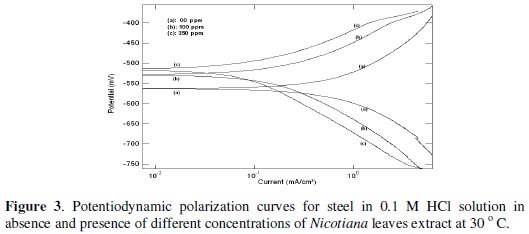
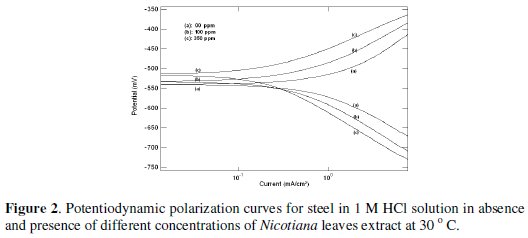
    <p>Typical potentiodynamic polarization curves for steel in 1 and 0.1 M HCl 
solutions in the absence and presence of different <i>Nicotiana</i> leaves extract 
concentrations are shown in Figs. <a href="#f2">2</a> and <a href="#f3">3</a>, respectively.</p>


    ]]></body>
<body><![CDATA[<p>&nbsp;</p>
<a name="f2">
<img src="/img/revistas/pea/v30n4/30n4a02f2.jpg">
    
<p>&nbsp;</p>
<a name="f3">
<img src="/img/revistas/pea/v30n4/30n4a02f3.jpg">
    
<p>&nbsp;</p>


    <p>As seen, addition of <i>Nicotiana</i> leaves extract affects both anodic dissolution of steel and cathodic 
reduction reactions, indicating that the extract could be classified as a mixed-type 
inhibitor. The corrosion current density was calculated from the intersection of 
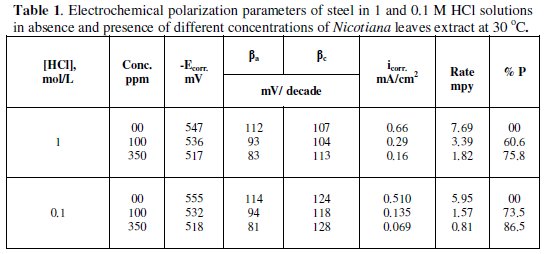
cathodic and anodic Tafel lines. The values of the electrochemical parameters for 
different plant extract concentrations are given in <a href="#t1">Table 1</a>.</p>


    <p>&nbsp;</p>
<a name="t1">
<img src="/img/revistas/pea/v30n4/30n4a02t1.jpg">
    
<p>&nbsp;</p>


    <p>The displayed data 
show that increasing plant extract concentration decreases the corrosion current 
density (i<sub>corr</sub>) and shifts the corrosion potential (E<sub>corr</sub>) to more noble values. The 
percentage of inhibition efficiency (%P) was calculated from polarization 
measurements using the relation</p>


    <p>&nbsp;</p>
<a name="e1">
<img src="/img/revistas/pea/v30n4/30n4a02e1.jpg">
    
<p>&nbsp;</p>


    <p>where i<sub>o</sub> and i are the corrosion current density in the absence and presence of 
plant extract, respectively. The slight variations in anodic and cathodic Tafel 
slopes (&beta;a and &beta;c) indicate that the inhibiting action is taking place by the simple 
blocking of the available cathodic and anodic sites on the metal surface.</p>

    ]]></body>
<body><![CDATA[<p>The data displayed also that decreasing the concentration of HCl increases the 
inhibition action of the extract, which can be explained on the basis that 
increasing the concentration of chloride ion at the metal surface hinder the 
adsorption of extract species on the metal.</p>


    <p><i>Electrochemical impedance spectroscopy results</i></p>

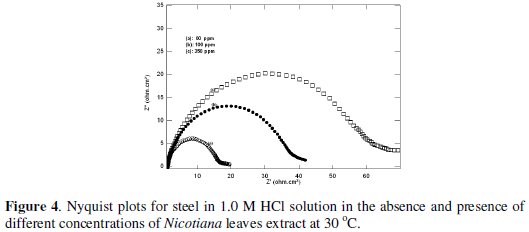
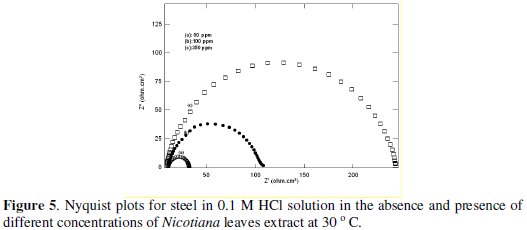
    <p>The Nyquist plots for steel in 1.0 and 0.1 M HCl solutions in the absence and 
presence of different <i>Nicotiana</i> extract concentrations are shown in Fig <a href="#f4">4</a> and <a href="#f5">5</a>.</p>


    <p>&nbsp;</p>
<a name="f4">
<img src="/img/revistas/pea/v30n4/30n4a02f4.jpg">
    
<p>&nbsp;</p>
<a name="f5">
<img src="/img/revistas/pea/v30n4/30n4a02f5.jpg">
    
<p>&nbsp;</p>


    <p>These plots indicate that the dissolution process occurs under activation control. 
The impedance response consisted of characteristic semicircles. These 
semicircles are of a capacitive type whose size increases with increasing 
Nicotiana leaves extract concentration.</p>

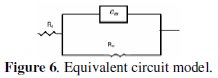
    <p>The impedance spectra for different Nyquist plots were analyzed by fitting the 
experimental data to a simple equivalent circuit model (<a href="#f6">Fig. 6</a>) which includes 
the solution resistance Rs and the double layer capacitance (C<sub>dl</sub>), which is placed 
in parallel to charge transfer resistance element, Rct.</p>


    <p>&nbsp;</p>
<a name="f6">
<img src="/img/revistas/pea/v30n4/30n4a02f6.jpg">
    
<p>&nbsp;</p>


    ]]></body>
<body><![CDATA[<p>The R<sub>ct</sub> value is a measure 
of electron transfer across the surface and it is inversely proportional to the 
corrosion rate.</p>

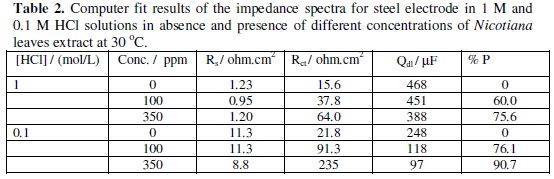
    <p>The values of R<sub>ct</sub> and C<sub>dl</sub> for steel in 0.1 and 1 M HCl containing different 
<i>Nicotiana</i> leaves extract concentrations are shown in <a href="#t2">Table 2</a>.</p>


    <p>&nbsp;</p>
<a name="t2">
<img src="/img/revistas/pea/v30n4/30n4a02t2.jpg">
    
<p>&nbsp;</p>


    <p>The data indicate that the increasing of the charge transfer resistance is associated with a decrease 
in the double layer capacitance. The decrease in the C<sub>dl</sub> values could be attributed 
to the adsorption of the chemical constituents of Nicotiana leaves extract at the 
metal surface. It has been reported that the adsorption process on the metal 
surface is characterized by a decrease in C<sub>dl</sub> [15].</p>
 
    <p>The % P were calculated from impedance measurements using the relation</p>


    <p>&nbsp;</p>
<a name="e2">
<img src="/img/revistas/pea/v30n4/30n4a02e2.jpg">
    
<p>&nbsp;</p>


    <p>where R<sub>ct0</sub> and R<sub>ct</sub> are the charge transfer resistances in the absence and presence 
of the plant extract.</p>
 
    <p>The values of % P are in quite good agreement with the results obtained 
previously from polarization measurements (<a href="#t1">Table 1</a>).</p>


    ]]></body>
<body><![CDATA[<p><i>Activation parameters</i></p>

    <p>The effect of temperature on the corrosion rate of steel and inhibition efficiency 
of Nicotiana extract has been studied in HCl solutions. The activation parameters 
for the system were calculated from the Arrhenius-type plots and transition state 
equations. It has been pointed out by a number of authors [16-18] that the 
logarithm of the corrosion rate (k) is a linear function with 1/T (Arrhenius 
equation):</p>


    <p>&nbsp;</p>
<a name="e3">
<img src="/img/revistas/pea/v30n4/30n4a02e3.jpg">
    
<p>&nbsp;</p>


    <p>where Ea is the apparent effective activation energy, T the absolute temperature, 
R the universal gas constant and A the Arrhenius pre-exponential factor. 
An alternative formulation of the Arrhenius equation is the transition state 
equation:</p>


    <p>&nbsp;</p>
<a name="e4">
<img src="/img/revistas/pea/v30n4/30n4a02e4.jpg">
    
<p>&nbsp;</p>


    <p>where N is the Avogadro's number, h the Plank's constant, &Delta;H* the enthalpy of 
activation and &Delta;S* is the entropy of activation.</p>

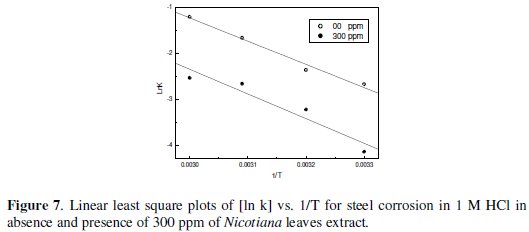
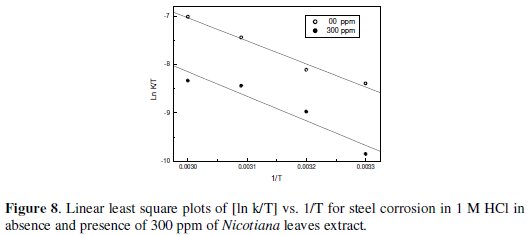
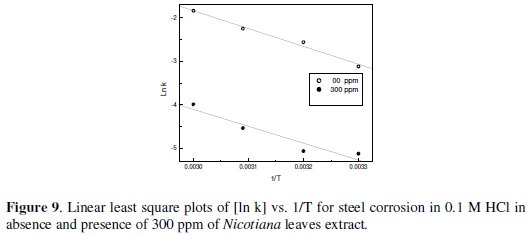
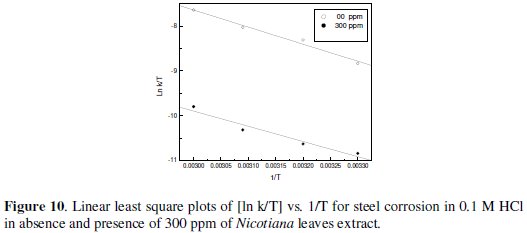
    <p>Figs <a href="#f7">7-10</a> give least square plots of [ln k] versus 1/T and [ln (k/T)] versus 1/T 
data for steel dissolution in 1.0 and 0.1 M HCl in the absence and in the presence 
of 300 ppm of <i>Nicotiana</i> leaves extract, from which the values of the activation 
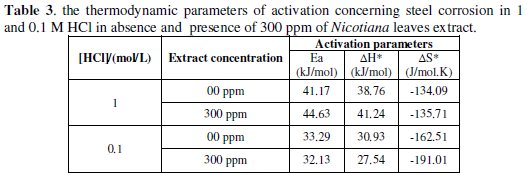
parameters Ea, &Delta;H* and &Delta;S* are calculated and produced in <a href="#t3">Table 3</a>.</p>


    <p>&nbsp;</p>
<a name="f7">
<img src="/img/revistas/pea/v30n4/30n4a02f7.jpg">
    
]]></body>
<body><![CDATA[<p>&nbsp;</p>
<a name="f8">
<img src="/img/revistas/pea/v30n4/30n4a02f8.jpg">
    
<p>&nbsp;</p>
<a name="f9">
<img src="/img/revistas/pea/v30n4/30n4a02f9.jpg">
    
<p>&nbsp;</p>
<a name="f10">
<img src="/img/revistas/pea/v30n4/30n4a02f10.jpg">
    
<p>&nbsp;</p>
<a name="t3">
<img src="/img/revistas/pea/v30n4/30n4a02t3.jpg">
    
<p>&nbsp;</p>


    <p>The higher values of Ea and &Delta;H* in presence of Nicotiana extract than those obtained for 
pure 1 M HCl indicated that, when the temperature was raised, a decrease in 
protection efficiency was obtained [18]. On the other hand, the slight decrease in 
their values in presence of the extract in 0.1 M HCl solution indicates that the 
effectiveness of this extract at higher temperature is not affected [19].The 
negative value of &Delta;S* implies that the activated complex represents an 
association rather than a dissociation step, meaning that a decrease in disordering 
takes place on going from reactants to the activated complex [20,21]. It is 
reported that the rate-determining step for the hydrogen evolution reaction on 
iron is the recombination of the adsorbed hydrogen atom to form H2 molecules 
[22-24].</p>

    <p>Therefore, the transition state of the rate-determining recombination step 
represents a more orderly arrangement relative to the initial state, and, hence, a 
negative value of the entropy of activation is obtained in absence or presence of 
the extract. The value of &Delta;S* is nearly the same in presence of the extract in 1 
M HCl, while higher negative value of &Delta;S* is obtained in 0.1 M HCl, which
indicates that more ordered recombination step is obtained in presence of the 
extract molecules in low acid concentration rather than in high concentration.</p>


    <p><b><i>Neutral medium</i></b></p>

    <p><i>Potentiodynamic polarization results</i></p>

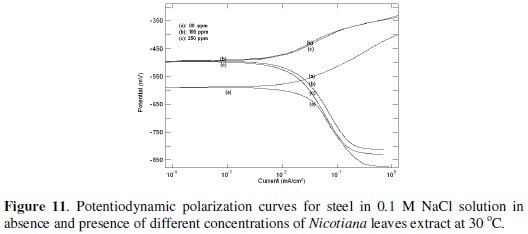
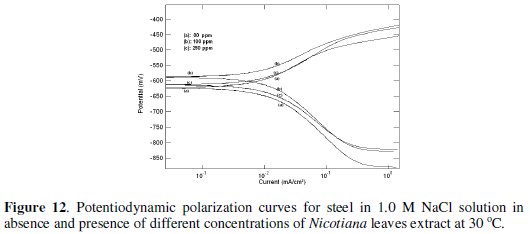
    <p>Fig. <a href="#f11">11</a> and <a href="#f12">12</a> show the potentiodynamic polarization curves for steel in 0.1 and 
1 M NaCl solutions in the absence and presence of different <i>Nicotiana</i> leaves 
extract concentrations.</p>


    ]]></body>
<body><![CDATA[<p>&nbsp;</p>
<a name="f11">
<img src="/img/revistas/pea/v30n4/30n4a02f11.jpg">
    
<p>&nbsp;</p>
<a name="f12">
<img src="/img/revistas/pea/v30n4/30n4a02f12.jpg">
    
<p>&nbsp;</p>


    <p>The figures clarify that the addition of the extract shifts 
the corrosion potential (Ecorr.) into less negative values, indicating that this extract 
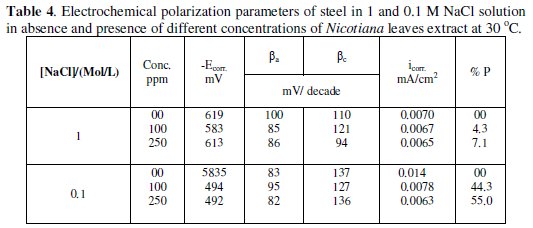
acts as an anodic type inhibitor. The values of the electrochemical parameters 
obtained from these curves are given in <a href="#t4">Table 4</a>.</p>


    <p>&nbsp;</p>
<a name="t4">
<img src="/img/revistas/pea/v30n4/30n4a02t4.jpg">
    
<p>&nbsp;</p>


    <p>The data clarify that the addition 
of plant extract decreases the corrosion current density (icorr) and shifts the 
corrosion potential (Ecorr) to less negative values, especially in 0.1 M NaCl. The 
values of anodic and cathodic Tafel slopes (&beta;a and &beta;c) are slightly changed with 
the addition of Nicotiana extract, indicating that the inhibition process occurs 
without changing the mechanism [11]. As in acid medium, the inhibition 
efficiency of Nicotiana increases in 0.1 M solution more than in 1 M due to the 
effect of chloride ion concentration.</p>


    <p><i>Electrochemical impedance spectroscopy results</i></p>

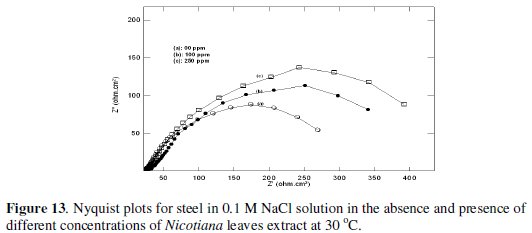
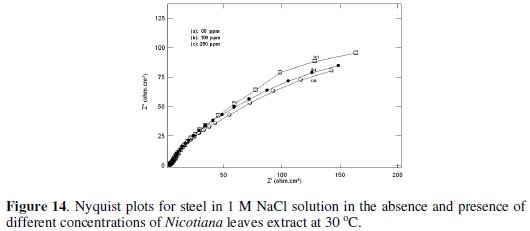
    <p>Fig. <a href="#f13">13</a> and <a href="#f14">14</a> show Nyquist plots for steel in 0.1 and 1 M NaCl solution in the 
absence and presence of different Nicotiana leaves extract concentrations.</p>


    <p>&nbsp;</p>
<a name="f13">
<img src="/img/revistas/pea/v30n4/30n4a02f13.jpg">
    
]]></body>
<body><![CDATA[<p>&nbsp;</p>
<a name="f14">
<img src="/img/revistas/pea/v30n4/30n4a02f14.jpg">
    
<p>&nbsp;</p>


    <p>The impedance response consisted of a distorted loop of a capacitive type whose size 
increases with increasing plant extract concentrations, which is indicative of 
increasing inhibitive efficiency of the extract with increasing its concentration. 
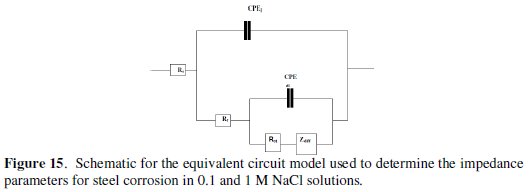
The impedance spectra of different Nyquist plots were analyzed by fitting the 
experimental data to the equivalent circuit shown in <a href="#f15">Fig. 15</a>, where CPE is the 
constant phase element which is defined by two values, Q and n.</p>


    <p>&nbsp;</p>
<a name="f15">
<img src="/img/revistas/pea/v30n4/30n4a02f15.jpg">
    
<p>&nbsp;</p>


    <p>The impedance, Z, of CPE is presented by</p>


    <p>&nbsp;</p>
<a name="e5">
<img src="/img/revistas/pea/v30n4/30n4a02e5.jpg">
    
<p>&nbsp;</p>


    <p>where, i = (-1)<sup>1/2</sup>, &omega; is the frequency in rad s<sup>-1</sup>, &omega; = 2&pi;f and f is the frequency in 
Hz. If n equals one, then <a href="#e1">equation 1</a> is identical to that of a capacitor, Z<sub>C</sub>=(i&omega;C)<sup>-1</sup>, 
where C is the ideal capacitance. For a non-homogeneous system, n values range 
0.9-1. If n equals 0.5, a 45 degree line is produced on the complex-plane graph. 
A CPE with n value of 0.5 can be used to produce a Warburg element. A 
Warburg element occurs when charge carrier diffuses through a material [25]. 
Z<sub>dif</sub> is the diffusion impedance through the layer of products formed during 
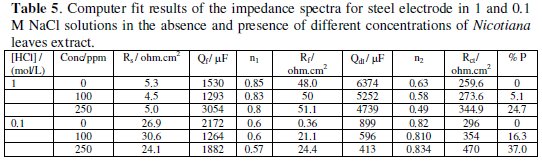
immersion. Computer fit results of the impedance spectra obtained in absence 
and presence of different Nicotiana leaves extract concentrations are given in 
<a href="#t5">Table 5</a>.</p>


    <p>&nbsp;</p>
<a name="t5">
<img src="/img/revistas/pea/v30n4/30n4a02t5.jpg">
    
]]></body>
<body><![CDATA[<p>&nbsp;</p>


    <p>The data show that the charge transfer resistance increases by increasing 
the concentration of the extract, which indicates that the extract acts as a 
corrosion inhibitor for steel in 0.1 M NaCl rather than in 1 M solution. Moreover, 
increasing R<sub>f</sub> and R<sub>ct</sub> is accompanied by decreasing in the none ideal double 
layer capacitance values, Q<sub>dl</sub>, suggesting that inhibition process takes place 
through adsorption of the chemical constituents of Nicotiana extracts on the 
metallic surface.</p>

    <p>The polarization and impedance measurements indicated that the extract inhibits 
the corrosion processes by blocking the available cathodic and/or anodic sites of 
the metal surface through adsorption of the extract chemical constituents on the 
metal/solution interface. This phenomenon could take place via [26]: (i) 
electrostatic attraction between the positively charged protonated nitrogen atom 
and negatively charged mild steel surface (cathodic sites), (ii) dipole-type 
interaction between unshared electron pairs of oxygen atom or &pi; electrons
interaction with the vacant, low energy d-orbitals of Fe surface atoms (anodic 
sites), and (iii) a combination of all of the above (mixed type). The lower 
inhibition efficiency of Nicotiana extract in high chloride concentration solutions 
can be explained on the basis that increasing the concentration of chloride ion 
hinders the adsorption of extract molecules on the metal surface.</p> 


    <p>&nbsp;</p>
    <p><b>Conclusions</b></p>

    <p>The corrosion of mild steel in HCl and NaCl solutions is significantly reduced 
upon the addition of Nicotiana leaves extract. The inhibition efficiency increased 
with increasing the concentration of the extract and decreasing chloride ion 
concentration.</p>

    <p>The results of potentiodynamic polarization measurements demonstrate that the 
Nicotiana leaves extract behaves as a mixed type inhibitor in acidic medium, 
while it acts as anodic type in neutral medium. The extract was found to be more 
effective in controlling corrosion of steel in acid solution than in neutral one. 
At low acid concentration, protection efficiency of Nicotiana extract is not 
affected by raising the temperature and extract molecules increase the ordering of 
recombination step. On the other hand, in high acid concentration, the efficiency 
of the extract decreases with raising the temperature and the recombination step 
ordering is not affected.</p> 


    <p>&nbsp;</p>
    <p><b>References</b></p>

    <!-- ref --><p>1. Shukla SK, Quraishi MA. Corros Sci. 2010;52:314.    &nbsp;&nbsp;&nbsp;&nbsp;&nbsp;&nbsp;&nbsp;&nbsp;[&#160;<a href="javascript:void(0);" onclick="javascript: window.open('/scielo.php?script=sci_nlinks&ref=000112&pid=S0872-1904201200040000200001&lng=','','width=640,height=500,resizable=yes,scrollbars=1,menubar=yes,');">Links</a>&#160;]<!-- end-ref --></p>

    <!-- ref --><p>2. Aljourani J, Raeissi K, Golozar MA. Corros Sci. 2009;51:1836.    &nbsp;&nbsp;&nbsp;&nbsp;&nbsp;&nbsp;&nbsp;&nbsp;[&#160;<a href="javascript:void(0);" onclick="javascript: window.open('/scielo.php?script=sci_nlinks&ref=000114&pid=S0872-1904201200040000200002&lng=','','width=640,height=500,resizable=yes,scrollbars=1,menubar=yes,');">Links</a>&#160;]<!-- end-ref --></p>

    <!-- ref --><p>3. Achary G, Sachin HP, Naik YA, Venkatesha TV. Mater Chem Phys. 2008;107:44.    &nbsp;&nbsp;&nbsp;&nbsp;&nbsp;&nbsp;&nbsp;&nbsp;[&#160;<a href="javascript:void(0);" onclick="javascript: window.open('/scielo.php?script=sci_nlinks&ref=000116&pid=S0872-1904201200040000200003&lng=','','width=640,height=500,resizable=yes,scrollbars=1,menubar=yes,');">Links</a>&#160;]<!-- end-ref --></p>

    <!-- ref --><p>4. Saremi M, Dehghanian C, Mohammadi SM. Corros Sci. 2006;48:1404.    &nbsp;&nbsp;&nbsp;&nbsp;&nbsp;&nbsp;&nbsp;&nbsp;[&#160;<a href="javascript:void(0);" onclick="javascript: window.open('/scielo.php?script=sci_nlinks&ref=000118&pid=S0872-1904201200040000200004&lng=','','width=640,height=500,resizable=yes,scrollbars=1,menubar=yes,');">Links</a>&#160;]<!-- end-ref --></p>

    <!-- ref --><p>5. Wanga X, Yanga H, Wanga F. Corros Sci. 2011;53:113.    &nbsp;&nbsp;&nbsp;&nbsp;&nbsp;&nbsp;&nbsp;&nbsp;[&#160;<a href="javascript:void(0);" onclick="javascript: window.open('/scielo.php?script=sci_nlinks&ref=000120&pid=S0872-1904201200040000200005&lng=','','width=640,height=500,resizable=yes,scrollbars=1,menubar=yes,');">Links</a>&#160;]<!-- end-ref --></p>

    <!-- ref --><p>6. Mahdaviana M, Naderib R. Corros Sci. 2011;53:1194.    &nbsp;&nbsp;&nbsp;&nbsp;&nbsp;&nbsp;&nbsp;&nbsp;[&#160;<a href="javascript:void(0);" onclick="javascript: window.open('/scielo.php?script=sci_nlinks&ref=000122&pid=S0872-1904201200040000200006&lng=','','width=640,height=500,resizable=yes,scrollbars=1,menubar=yes,');">Links</a>&#160;]<!-- end-ref --></p>

    <!-- ref --><p>7. Obi-Egbedia NO, Obot IB. Corros Sci. 2011;53:263.    &nbsp;&nbsp;&nbsp;&nbsp;&nbsp;&nbsp;&nbsp;&nbsp;[&#160;<a href="javascript:void(0);" onclick="javascript: window.open('/scielo.php?script=sci_nlinks&ref=000124&pid=S0872-1904201200040000200007&lng=','','width=640,height=500,resizable=yes,scrollbars=1,menubar=yes,');">Links</a>&#160;]<!-- end-ref --></p>

    <p>8. Abdel-Gaber AM, Abd-El-Nabey BA, Sidahmed IM, El-Zayady AM, Saadawy M. Corros Sci. 2006;48:2765.</p>

    <!-- ref --><p>9. Oguzie EE. Corros Sci. 2008;50:2992.    &nbsp;&nbsp;&nbsp;&nbsp;&nbsp;&nbsp;&nbsp;&nbsp;[&#160;<a href="javascript:void(0);" onclick="javascript: window.open('/scielo.php?script=sci_nlinks&ref=000127&pid=S0872-1904201200040000200009&lng=','','width=640,height=500,resizable=yes,scrollbars=1,menubar=yes,');">Links</a>&#160;]<!-- end-ref --></p>

    <!-- ref --><p>10. Abdel-Gaber AM, Abdel-Nabey BA, Saadawy M. Mater Corros. 2010;61:9999.    &nbsp;&nbsp;&nbsp;&nbsp;&nbsp;&nbsp;&nbsp;&nbsp;[&#160;<a href="javascript:void(0);" onclick="javascript: window.open('/scielo.php?script=sci_nlinks&ref=000129&pid=S0872-1904201200040000200010&lng=','','width=640,height=500,resizable=yes,scrollbars=1,menubar=yes,');">Links</a>&#160;]<!-- end-ref --></p>

    <!-- ref --><p>11. Abdel-Gaber AM, Abdel-Nabey BA, Khamis E, Abd-El-Khalek DE. Desalination. 2011;278:337.    &nbsp;&nbsp;&nbsp;&nbsp;&nbsp;&nbsp;&nbsp;&nbsp;[&#160;<a href="javascript:void(0);" onclick="javascript: window.open('/scielo.php?script=sci_nlinks&ref=000131&pid=S0872-1904201200040000200011&lng=','','width=640,height=500,resizable=yes,scrollbars=1,menubar=yes,');">Links</a>&#160;]<!-- end-ref --></p>

    ]]></body>
<body><![CDATA[<!-- ref --><p>12. Barannik VP, Putilova IN. Uch Zap Mosk gosud Univ. 1945;78.    &nbsp;&nbsp;&nbsp;&nbsp;&nbsp;&nbsp;&nbsp;&nbsp;[&#160;<a href="javascript:void(0);" onclick="javascript: window.open('/scielo.php?script=sci_nlinks&ref=000133&pid=S0872-1904201200040000200012&lng=','','width=640,height=500,resizable=yes,scrollbars=1,menubar=yes,');">Links</a>&#160;]<!-- end-ref --></p>

    <!-- ref --><p>13. Tso TC, Burk LG, Sorokin TP, Engelhaupt ME. Plant Physiology. 1962;37:257.    &nbsp;&nbsp;&nbsp;&nbsp;&nbsp;&nbsp;&nbsp;&nbsp;[&#160;<a href="javascript:void(0);" onclick="javascript: window.open('/scielo.php?script=sci_nlinks&ref=000135&pid=S0872-1904201200040000200013&lng=','','width=640,height=500,resizable=yes,scrollbars=1,menubar=yes,');">Links</a>&#160;]<!-- end-ref --></p>

    <p>14. Skliar M, Curino A, Milanesi L, Benassati S, Boland R. Plant Science. 2000;156:193.</p>

    <!-- ref --><p>15. Aramaki K, Hagiwara M, Nishihara H. Corros Sci. 1987;5:487.    &nbsp;&nbsp;&nbsp;&nbsp;&nbsp;&nbsp;&nbsp;&nbsp;[&#160;<a href="javascript:void(0);" onclick="javascript: window.open('/scielo.php?script=sci_nlinks&ref=000138&pid=S0872-1904201200040000200015&lng=','','width=640,height=500,resizable=yes,scrollbars=1,menubar=yes,');">Links</a>&#160;]<!-- end-ref --></p>

    <!-- ref --><p>16. Lyberatos G, Kobotiatis L. Corrosion. 1991;47:820.    &nbsp;&nbsp;&nbsp;&nbsp;&nbsp;&nbsp;&nbsp;&nbsp;[&#160;<a href="javascript:void(0);" onclick="javascript: window.open('/scielo.php?script=sci_nlinks&ref=000140&pid=S0872-1904201200040000200016&lng=','','width=640,height=500,resizable=yes,scrollbars=1,menubar=yes,');">Links</a>&#160;]<!-- end-ref --></p>

    <!-- ref --><p>17. Abd El-Rehim SS, Ibrahim MAM, Khaled KF. J Appl Electrochem. 1999;29:593.    &nbsp;&nbsp;&nbsp;&nbsp;&nbsp;&nbsp;&nbsp;&nbsp;[&#160;<a href="javascript:void(0);" onclick="javascript: window.open('/scielo.php?script=sci_nlinks&ref=000142&pid=S0872-1904201200040000200017&lng=','','width=640,height=500,resizable=yes,scrollbars=1,menubar=yes,');">Links</a>&#160;]<!-- end-ref --></p>

    <!-- ref --><p>18. Putilova IN, Balezin SA, Barannik VP. Metallic Corrosion Inhibitors. Oxford, UK: Pergamon Press; 1960.    &nbsp;&nbsp;&nbsp;&nbsp;&nbsp;&nbsp;&nbsp;&nbsp;[&#160;<a href="javascript:void(0);" onclick="javascript: window.open('/scielo.php?script=sci_nlinks&ref=000144&pid=S0872-1904201200040000200018&lng=','','width=640,height=500,resizable=yes,scrollbars=1,menubar=yes,');">Links</a>&#160;]<!-- end-ref --></p>

    <!-- ref --><p>19. Abdel-Gaber AM. Int J Appl Chem. 2007;3:231.    &nbsp;&nbsp;&nbsp;&nbsp;&nbsp;&nbsp;&nbsp;&nbsp;[&#160;<a href="javascript:void(0);" onclick="javascript: window.open('/scielo.php?script=sci_nlinks&ref=000146&pid=S0872-1904201200040000200019&lng=','','width=640,height=500,resizable=yes,scrollbars=1,menubar=yes,');">Links</a>&#160;]<!-- end-ref --></p>

    <!-- ref --><p>20. Abd-El-Nabey BA, Khamis E, Ramadan MSh, El-Gindy A. Corrosion. 1996;52:671.    &nbsp;&nbsp;&nbsp;&nbsp;&nbsp;&nbsp;&nbsp;&nbsp;[&#160;<a href="javascript:void(0);" onclick="javascript: window.open('/scielo.php?script=sci_nlinks&ref=000148&pid=S0872-1904201200040000200020&lng=','','width=640,height=500,resizable=yes,scrollbars=1,menubar=yes,');">Links</a>&#160;]<!-- end-ref --></p>

    <!-- ref --><p>21. Gomma MK, Wahdan MH. Mater Chem Phys. 1995;39:209.    &nbsp;&nbsp;&nbsp;&nbsp;&nbsp;&nbsp;&nbsp;&nbsp;[&#160;<a href="javascript:void(0);" onclick="javascript: window.open('/scielo.php?script=sci_nlinks&ref=000150&pid=S0872-1904201200040000200021&lng=','','width=640,height=500,resizable=yes,scrollbars=1,menubar=yes,');">Links</a>&#160;]<!-- end-ref --></p>

    <!-- ref --><p>22. Grigoryev VP, Eklik VU. Prot Met. 1968;4:517.    &nbsp;&nbsp;&nbsp;&nbsp;&nbsp;&nbsp;&nbsp;&nbsp;[&#160;<a href="javascript:void(0);" onclick="javascript: window.open('/scielo.php?script=sci_nlinks&ref=000152&pid=S0872-1904201200040000200022&lng=','','width=640,height=500,resizable=yes,scrollbars=1,menubar=yes,');">Links</a>&#160;]<!-- end-ref --></p>

    <!-- ref --><p>23. Grigoryev VP, Osipov OA. 3rd Europ Symp Corrosion Inhibitors; University of Ferrara, Italy. Ferrara; 1970. P. 473.    &nbsp;&nbsp;&nbsp;&nbsp;&nbsp;&nbsp;&nbsp;&nbsp;[&#160;<a href="javascript:void(0);" onclick="javascript: window.open('/scielo.php?script=sci_nlinks&ref=000154&pid=S0872-1904201200040000200023&lng=','','width=640,height=500,resizable=yes,scrollbars=1,menubar=yes,');">Links</a>&#160;]<!-- end-ref --></p>

    <!-- ref --><p>24. Antropov LI, Suvgira YA. Prot Met. 1967;3:597.    &nbsp;&nbsp;&nbsp;&nbsp;&nbsp;&nbsp;&nbsp;&nbsp;[&#160;<a href="javascript:void(0);" onclick="javascript: window.open('/scielo.php?script=sci_nlinks&ref=000156&pid=S0872-1904201200040000200024&lng=','','width=640,height=500,resizable=yes,scrollbars=1,menubar=yes,');">Links</a>&#160;]<!-- end-ref --></p>

    <!-- ref --><p>25. ZView2 help, Scribner Associates, 2000.    &nbsp;&nbsp;&nbsp;&nbsp;&nbsp;&nbsp;&nbsp;&nbsp;[&#160;<a href="javascript:void(0);" onclick="javascript: window.open('/scielo.php?script=sci_nlinks&ref=000158&pid=S0872-1904201200040000200025&lng=','','width=640,height=500,resizable=yes,scrollbars=1,menubar=yes,');">Links</a>&#160;]<!-- end-ref --></p>

    <!-- ref --><p>26. Schweinsgberg D, George G, Nishihara H. J Electrochem Soc. 1990;137:1354.    &nbsp;&nbsp;&nbsp;&nbsp;&nbsp;&nbsp;&nbsp;&nbsp;[&#160;<a href="javascript:void(0);" onclick="javascript: window.open('/scielo.php?script=sci_nlinks&ref=000160&pid=S0872-1904201200040000200026&lng=','','width=640,height=500,resizable=yes,scrollbars=1,menubar=yes,');">Links</a>&#160;]<!-- end-ref --></p>


    <p>&nbsp;</p>
    ]]></body>
<body><![CDATA[<p><a name=0></a><sup><a href="#top">*</a></sup>Corresponding author. E-mail address: <a href="mailto:dalia1282002@yahoo.com">dalia1282002@yahoo.com</a></p>

    <p>Received 27 February 2012; accepted 31 August 2012</p>

    <p><a href="http://www.peacta.org" target="_blank">www.peacta.org</a> </p>


     ]]></body><back>
<ref-list>
<ref id="B1">
<label>1</label><nlm-citation citation-type="journal">
<person-group person-group-type="author">
<name>
<surname><![CDATA[Shukla]]></surname>
<given-names><![CDATA[SK]]></given-names>
</name>
<name>
<surname><![CDATA[Quraishi]]></surname>
<given-names><![CDATA[MA]]></given-names>
</name>
</person-group>
<source><![CDATA[Corros Sci]]></source>
<year>2010</year>
<volume>52</volume>
<page-range>314</page-range></nlm-citation>
</ref>
<ref id="B2">
<label>2</label><nlm-citation citation-type="journal">
<person-group person-group-type="author">
<name>
<surname><![CDATA[Aljourani]]></surname>
<given-names><![CDATA[J]]></given-names>
</name>
<name>
<surname><![CDATA[Raeissi]]></surname>
<given-names><![CDATA[K]]></given-names>
</name>
<name>
<surname><![CDATA[Golozar]]></surname>
<given-names><![CDATA[MA]]></given-names>
</name>
</person-group>
<source><![CDATA[Corros Sci]]></source>
<year>2009</year>
<volume>51</volume>
<page-range>1836</page-range></nlm-citation>
</ref>
<ref id="B3">
<label>3</label><nlm-citation citation-type="journal">
<person-group person-group-type="author">
<name>
<surname><![CDATA[Achary]]></surname>
<given-names><![CDATA[G]]></given-names>
</name>
<name>
<surname><![CDATA[Sachin]]></surname>
<given-names><![CDATA[HP]]></given-names>
</name>
<name>
<surname><![CDATA[Naik]]></surname>
<given-names><![CDATA[YA]]></given-names>
</name>
<name>
<surname><![CDATA[Venkatesha]]></surname>
<given-names><![CDATA[TV]]></given-names>
</name>
</person-group>
<source><![CDATA[Mater Chem Phys]]></source>
<year>2008</year>
<volume>107</volume>
<page-range>44</page-range></nlm-citation>
</ref>
<ref id="B4">
<label>4</label><nlm-citation citation-type="journal">
<person-group person-group-type="author">
<name>
<surname><![CDATA[Saremi]]></surname>
<given-names><![CDATA[M]]></given-names>
</name>
<name>
<surname><![CDATA[Dehghanian]]></surname>
<given-names><![CDATA[C]]></given-names>
</name>
<name>
<surname><![CDATA[Mohammadi]]></surname>
<given-names><![CDATA[SM]]></given-names>
</name>
</person-group>
<source><![CDATA[Corros Sci]]></source>
<year>2006</year>
<volume>48</volume>
<page-range>1404</page-range></nlm-citation>
</ref>
<ref id="B5">
<label>5</label><nlm-citation citation-type="journal">
<person-group person-group-type="author">
<name>
<surname><![CDATA[Wanga]]></surname>
<given-names><![CDATA[X]]></given-names>
</name>
<name>
<surname><![CDATA[Yanga]]></surname>
<given-names><![CDATA[H]]></given-names>
</name>
<name>
<surname><![CDATA[Wanga]]></surname>
<given-names><![CDATA[F]]></given-names>
</name>
</person-group>
<source><![CDATA[Corros Sci]]></source>
<year>2011</year>
<volume>53</volume>
<page-range>113</page-range></nlm-citation>
</ref>
<ref id="B6">
<label>6</label><nlm-citation citation-type="journal">
<person-group person-group-type="author">
<name>
<surname><![CDATA[Mahdaviana]]></surname>
<given-names><![CDATA[M]]></given-names>
</name>
<name>
<surname><![CDATA[Naderib]]></surname>
<given-names><![CDATA[R]]></given-names>
</name>
</person-group>
<source><![CDATA[Corros Sci]]></source>
<year>2011</year>
<volume>53</volume>
<page-range>1194</page-range></nlm-citation>
</ref>
<ref id="B7">
<label>7</label><nlm-citation citation-type="journal">
<person-group person-group-type="author">
<name>
<surname><![CDATA[Obi-Egbedia]]></surname>
<given-names><![CDATA[NO]]></given-names>
</name>
<name>
<surname><![CDATA[Obot]]></surname>
<given-names><![CDATA[IB]]></given-names>
</name>
</person-group>
<source><![CDATA[Corros Sci]]></source>
<year>2011</year>
<volume>53</volume>
<page-range>263</page-range></nlm-citation>
</ref>
<ref id="B8">
<label>8</label><nlm-citation citation-type="journal">
<person-group person-group-type="author">
<name>
<surname><![CDATA[Abdel-Gaber]]></surname>
<given-names><![CDATA[AM]]></given-names>
</name>
<name>
<surname><![CDATA[Abd-El-Nabey]]></surname>
<given-names><![CDATA[BA]]></given-names>
</name>
<name>
<surname><![CDATA[Sidahmed]]></surname>
<given-names><![CDATA[IM]]></given-names>
</name>
</person-group>
<source><![CDATA[Corros Sci]]></source>
<year>2006</year>
<volume>48</volume>
<page-range>2765</page-range></nlm-citation>
</ref>
<ref id="B9">
<label>9</label><nlm-citation citation-type="journal">
<person-group person-group-type="author">
<name>
<surname><![CDATA[Oguzie]]></surname>
<given-names><![CDATA[EE]]></given-names>
</name>
</person-group>
<source><![CDATA[Corros Sci]]></source>
<year>2008</year>
<volume>50</volume>
<page-range>2992</page-range></nlm-citation>
</ref>
<ref id="B10">
<label>10</label><nlm-citation citation-type="journal">
<person-group person-group-type="author">
<name>
<surname><![CDATA[Abdel-Gaber]]></surname>
<given-names><![CDATA[AM]]></given-names>
</name>
<name>
<surname><![CDATA[Abdel-Nabey]]></surname>
<given-names><![CDATA[BA]]></given-names>
</name>
<name>
<surname><![CDATA[Saadawy]]></surname>
<given-names><![CDATA[M]]></given-names>
</name>
</person-group>
<source><![CDATA[Mater Corros]]></source>
<year>2010</year>
<volume>61</volume>
<page-range>9999</page-range></nlm-citation>
</ref>
<ref id="B11">
<label>11</label><nlm-citation citation-type="journal">
<person-group person-group-type="author">
<name>
<surname><![CDATA[Abdel-Gaber]]></surname>
<given-names><![CDATA[AM]]></given-names>
</name>
<name>
<surname><![CDATA[Abdel-Nabey]]></surname>
<given-names><![CDATA[BA]]></given-names>
</name>
<name>
<surname><![CDATA[Khamis]]></surname>
<given-names><![CDATA[E]]></given-names>
</name>
<name>
<surname><![CDATA[Abd-El-Khalek]]></surname>
<given-names><![CDATA[DE]]></given-names>
</name>
</person-group>
<source><![CDATA[Desalination]]></source>
<year>2011</year>
<volume>278</volume>
<page-range>337</page-range></nlm-citation>
</ref>
<ref id="B12">
<label>12</label><nlm-citation citation-type="journal">
<person-group person-group-type="author">
<name>
<surname><![CDATA[Barannik]]></surname>
<given-names><![CDATA[VP]]></given-names>
</name>
<name>
<surname><![CDATA[Putilova]]></surname>
<given-names><![CDATA[IN]]></given-names>
</name>
</person-group>
<source><![CDATA[Uch Zap Mosk gosud Univ]]></source>
<year>1945</year>
<page-range>78</page-range></nlm-citation>
</ref>
<ref id="B13">
<label>13</label><nlm-citation citation-type="journal">
<person-group person-group-type="author">
<name>
<surname><![CDATA[Tso]]></surname>
<given-names><![CDATA[TC]]></given-names>
</name>
<name>
<surname><![CDATA[Burk]]></surname>
<given-names><![CDATA[LG]]></given-names>
</name>
<name>
<surname><![CDATA[Sorokin]]></surname>
<given-names><![CDATA[TP]]></given-names>
</name>
<name>
<surname><![CDATA[Engelhaupt]]></surname>
<given-names><![CDATA[ME]]></given-names>
</name>
</person-group>
<source><![CDATA[Plant Physiology]]></source>
<year>1962</year>
<volume>37</volume>
<page-range>257</page-range></nlm-citation>
</ref>
<ref id="B14">
<label>14</label><nlm-citation citation-type="journal">
<person-group person-group-type="author">
<name>
<surname><![CDATA[Skliar]]></surname>
<given-names><![CDATA[M]]></given-names>
</name>
<name>
<surname><![CDATA[Curino]]></surname>
<given-names><![CDATA[A]]></given-names>
</name>
<name>
<surname><![CDATA[Milanesi]]></surname>
<given-names><![CDATA[L]]></given-names>
</name>
</person-group>
<source><![CDATA[Plant Science]]></source>
<year>2000</year>
<volume>156</volume>
<page-range>193</page-range></nlm-citation>
</ref>
<ref id="B15">
<label>15</label><nlm-citation citation-type="journal">
<person-group person-group-type="author">
<name>
<surname><![CDATA[Aramaki]]></surname>
<given-names><![CDATA[K]]></given-names>
</name>
<name>
<surname><![CDATA[Hagiwara]]></surname>
<given-names><![CDATA[M]]></given-names>
</name>
<name>
<surname><![CDATA[Nishihara]]></surname>
<given-names><![CDATA[H]]></given-names>
</name>
</person-group>
<source><![CDATA[Corros Sci]]></source>
<year>1987</year>
<volume>5</volume>
<page-range>487</page-range></nlm-citation>
</ref>
<ref id="B16">
<label>16</label><nlm-citation citation-type="journal">
<person-group person-group-type="author">
<name>
<surname><![CDATA[Lyberatos]]></surname>
<given-names><![CDATA[G]]></given-names>
</name>
<name>
<surname><![CDATA[Kobotiatis]]></surname>
<given-names><![CDATA[L]]></given-names>
</name>
</person-group>
<source><![CDATA[Corrosion]]></source>
<year>1991</year>
<volume>47</volume>
<page-range>820</page-range></nlm-citation>
</ref>
<ref id="B17">
<label>17</label><nlm-citation citation-type="journal">
<person-group person-group-type="author">
<name>
<surname><![CDATA[Abd El-Rehim]]></surname>
<given-names><![CDATA[SS]]></given-names>
</name>
<name>
<surname><![CDATA[Ibrahim]]></surname>
<given-names><![CDATA[MAM]]></given-names>
</name>
<name>
<surname><![CDATA[Khaled]]></surname>
<given-names><![CDATA[KF]]></given-names>
</name>
</person-group>
<source><![CDATA[J Appl Electrochem]]></source>
<year>1999</year>
<volume>29</volume>
<page-range>593</page-range></nlm-citation>
</ref>
<ref id="B18">
<label>18</label><nlm-citation citation-type="book">
<person-group person-group-type="author">
<name>
<surname><![CDATA[Putilova]]></surname>
<given-names><![CDATA[IN]]></given-names>
</name>
<name>
<surname><![CDATA[Balezin]]></surname>
<given-names><![CDATA[SA]]></given-names>
</name>
<name>
<surname><![CDATA[Barannik]]></surname>
<given-names><![CDATA[VP]]></given-names>
</name>
</person-group>
<source><![CDATA[Metallic Corrosion Inhibitors]]></source>
<year>1960</year>
<publisher-loc><![CDATA[Oxford ]]></publisher-loc>
<publisher-name><![CDATA[Pergamon Press]]></publisher-name>
</nlm-citation>
</ref>
<ref id="B19">
<label>19</label><nlm-citation citation-type="journal">
<person-group person-group-type="author">
<name>
<surname><![CDATA[Abdel-Gaber]]></surname>
<given-names><![CDATA[AM]]></given-names>
</name>
</person-group>
<source><![CDATA[Int J Appl Chem]]></source>
<year>2007</year>
<volume>3</volume>
<page-range>231</page-range></nlm-citation>
</ref>
<ref id="B20">
<label>20</label><nlm-citation citation-type="journal">
<person-group person-group-type="author">
<name>
<surname><![CDATA[Abd-El-Nabey]]></surname>
<given-names><![CDATA[BA]]></given-names>
</name>
<name>
<surname><![CDATA[Khamis]]></surname>
<given-names><![CDATA[E]]></given-names>
</name>
<name>
<surname><![CDATA[Ramadan]]></surname>
<given-names><![CDATA[MSh]]></given-names>
</name>
<name>
<surname><![CDATA[El-Gindy]]></surname>
<given-names><![CDATA[A]]></given-names>
</name>
</person-group>
<source><![CDATA[Corrosion]]></source>
<year>1996</year>
<volume>52</volume>
<page-range>671</page-range></nlm-citation>
</ref>
<ref id="B21">
<label>21</label><nlm-citation citation-type="journal">
<person-group person-group-type="author">
<name>
<surname><![CDATA[Gomma]]></surname>
<given-names><![CDATA[MK]]></given-names>
</name>
<name>
<surname><![CDATA[Wahdan]]></surname>
<given-names><![CDATA[MH]]></given-names>
</name>
</person-group>
<source><![CDATA[Mater Chem Phys]]></source>
<year>1995</year>
<volume>39</volume>
<page-range>209</page-range></nlm-citation>
</ref>
<ref id="B22">
<label>22</label><nlm-citation citation-type="journal">
<person-group person-group-type="author">
<name>
<surname><![CDATA[Grigoryev]]></surname>
<given-names><![CDATA[VP]]></given-names>
</name>
<name>
<surname><![CDATA[Eklik]]></surname>
<given-names><![CDATA[VU]]></given-names>
</name>
</person-group>
<source><![CDATA[Prot Met]]></source>
<year>1968</year>
<volume>4</volume>
<page-range>517</page-range></nlm-citation>
</ref>
<ref id="B23">
<label>23</label><nlm-citation citation-type="confpro">
<person-group person-group-type="author">
<name>
<surname><![CDATA[Grigoryev]]></surname>
<given-names><![CDATA[VP]]></given-names>
</name>
<name>
<surname><![CDATA[Osipov]]></surname>
<given-names><![CDATA[OA]]></given-names>
</name>
</person-group>
<source><![CDATA[]]></source>
<year></year>
<conf-name><![CDATA[3rd Europ Symp Corrosion Inhibitors]]></conf-name>
<conf-date>1970</conf-date>
<conf-loc>Ferrara </conf-loc>
</nlm-citation>
</ref>
<ref id="B24">
<label>24</label><nlm-citation citation-type="journal">
<person-group person-group-type="author">
<name>
<surname><![CDATA[Antropov]]></surname>
<given-names><![CDATA[LI]]></given-names>
</name>
<name>
<surname><![CDATA[Suvgira]]></surname>
<given-names><![CDATA[YA]]></given-names>
</name>
</person-group>
<source><![CDATA[Prot Met]]></source>
<year>1967</year>
<volume>3</volume>
<page-range>597</page-range></nlm-citation>
</ref>
<ref id="B25">
<label>25</label><nlm-citation citation-type="book">
<source><![CDATA[ZView2 help]]></source>
<year>2000</year>
<publisher-name><![CDATA[Scribner Associates]]></publisher-name>
</nlm-citation>
</ref>
<ref id="B26">
<label>26</label><nlm-citation citation-type="journal">
<person-group person-group-type="author">
<name>
<surname><![CDATA[Schweinsgberg]]></surname>
<given-names><![CDATA[D]]></given-names>
</name>
<name>
<surname><![CDATA[George]]></surname>
<given-names><![CDATA[G]]></given-names>
</name>
<name>
<surname><![CDATA[Nishihara]]></surname>
<given-names><![CDATA[H]]></given-names>
</name>
</person-group>
<source><![CDATA[J Electrochem Soc]]></source>
<year>1990</year>
<volume>137</volume>
<page-range>1354</page-range></nlm-citation>
</ref>
</ref-list>
</back>
</article>