<?xml version="1.0" encoding="ISO-8859-1"?><article xmlns:mml="http://www.w3.org/1998/Math/MathML" xmlns:xlink="http://www.w3.org/1999/xlink" xmlns:xsi="http://www.w3.org/2001/XMLSchema-instance">
<front>
<journal-meta>
<journal-id>0872-1904</journal-id>
<journal-title><![CDATA[Portugaliae Electrochimica Acta]]></journal-title>
<abbrev-journal-title><![CDATA[Port. Electrochim. Acta]]></abbrev-journal-title>
<issn>0872-1904</issn>
<publisher>
<publisher-name><![CDATA[Sociedade Portuguesa de Electroquímica]]></publisher-name>
</publisher>
</journal-meta>
<article-meta>
<article-id>S0872-19042012000400003</article-id>
<article-id pub-id-type="doi">10.4152/pea.201204261</article-id>
<title-group>
<article-title xml:lang="en"><![CDATA[Hot-pressed Ag+ Ion Conducting Glass-Polymer Electrolytes: Synthesis and Battery Application]]></article-title>
</title-group>
<contrib-group>
<contrib contrib-type="author">
<name>
<surname><![CDATA[Chandra]]></surname>
<given-names><![CDATA[Angesh]]></given-names>
</name>
<xref ref-type="aff" rid="A01"/>
</contrib>
</contrib-group>
<aff id="A01">
<institution><![CDATA[,Shri Shankaracharya Institute of Professional Management & Technology Department of Applied Physics ]]></institution>
<addr-line><![CDATA[Raipur C.G.]]></addr-line>
<country>India</country>
</aff>
<pub-date pub-type="pub">
<day>00</day>
<month>07</month>
<year>2012</year>
</pub-date>
<pub-date pub-type="epub">
<day>00</day>
<month>07</month>
<year>2012</year>
</pub-date>
<volume>30</volume>
<numero>4</numero>
<fpage>261</fpage>
<lpage>266</lpage>
<copyright-statement/>
<copyright-year/>
<self-uri xlink:href="http://scielo.pt/scielo.php?script=sci_arttext&amp;pid=S0872-19042012000400003&amp;lng=en&amp;nrm=iso"></self-uri><self-uri xlink:href="http://scielo.pt/scielo.php?script=sci_abstract&amp;pid=S0872-19042012000400003&amp;lng=en&amp;nrm=iso"></self-uri><self-uri xlink:href="http://scielo.pt/scielo.php?script=sci_pdf&amp;pid=S0872-19042012000400003&amp;lng=en&amp;nrm=iso"></self-uri><abstract abstract-type="short" xml:lang="en"><p><![CDATA[Synthesis of new Ag+ ion conducting glass-polymer electrolytes (GPEs): (1-x) PEO: x &#91;0.75(0.75AgI:0.25AgCl):0.25(Ag2O:P2O5)&#93;, where 0 < x < 50 wt. (%), are reported. GPEs have been casted using hot-press techniques. The highest conducting composition 70 PEO: 30 &#91;0.75(0.75AgI:0.25AgCl):0.25(Ag2O:P2O5)&#93;, with conductivity (&#963;) &#8764; 6.0 × 10⁻⁶ S cm-1, was identified from the compositional dependent conductivity studies and this has been referred to as the Optimum Conducting Composition (OCC). Approximately three orders of conductivity enhancement have been achieved in GPE OCC from that of the pure polymer PEO. The glass-polymer complexation has been confirmed by SEM and DSC analysis. Ion transport parameters viz. ionic conductivity (&#963;), ionic mobility (&#956;), mobile ion concentration (n) and ionic transference number (tion) have been characterized using different experimental techniques. Solid-state polymeric batteries were fabricated using GPE OCC as electrolyte and the cell-potential discharge characteristics were studied under different load conditions at room temperature.]]></p></abstract>
<kwd-group>
<kwd lng="en"><![CDATA[glass polymer electrolytes]]></kwd>
<kwd lng="en"><![CDATA[hot-press method]]></kwd>
<kwd lng="en"><![CDATA[SEM]]></kwd>
<kwd lng="en"><![CDATA[DSC]]></kwd>
<kwd lng="en"><![CDATA[polymer battery]]></kwd>
</kwd-group>
</article-meta>
</front><body><![CDATA[ 

    <p><b>Hot-pressed Ag<sup>+</sup> Ion Conducting Glass-Polymer Electrolytes: Synthesis and Battery Application</b></p>

    <p><b>Angesh Chandra<sup><a href="#0">*<a/></sup></b></p>

    <p><i> Department of Applied Physics, Shri Shankaracharya Institute of Professional Management & Technology, Raipur - 492015, C.G., India</i></p>


<!--     <p>&nbsp;</p>
    <p>doi: 10.4152/pea.201204261</p> -->


    <p>&nbsp;</p>
    <p><b>Abstract</b></p>

    <p>Synthesis of new Ag<sup>+</sup> ion conducting glass-polymer electrolytes (GPEs): (1-x) PEO: x 
[0.75(0.75AgI:0.25AgCl):0.25(Ag2O:P<sub>2</sub>O<sub>5</sub>)], where 0 &lt; x &lt; 50 wt. (%), are reported. 
GPEs have been casted using hot-press techniques. The highest conducting composition 
70 PEO: 30 [0.75(0.75AgI:0.25AgCl):0.25(Ag2O:P<sub>2</sub>O<sub>5</sub>)], with conductivity (&sigma;) ~ 6.0 &times; 10<sup>-6</sup> S cm<sup>-1</sup>,
 was identified from the compositional dependent conductivity studies and 
this has been referred to as the Optimum Conducting Composition (OCC). 
Approximately three orders of conductivity enhancement have been achieved in GPE 
OCC from that of the pure polymer PEO. The glass-polymer complexation has been 
confirmed by SEM and DSC analysis. Ion transport parameters viz. ionic conductivity 
(&sigma;), ionic mobility (&mu;), mobile ion concentration (n) and ionic transference number (tion) 
have been characterized using different experimental techniques. Solid-state polymeric 
batteries were fabricated using GPE OCC as electrolyte and the cell-potential discharge 
characteristics were studied under different load conditions at room temperature.</p>

    <p><b><i>Keywords:</i></b> glass polymer electrolytes, hot-press method, SEM, DSC, polymer battery.</p>


    ]]></body>
<body><![CDATA[<p>&nbsp;</p>
    <p><b>Introduction</b></p>

    <p>The development of new solid-state dry electrolytes with both high conductivity 
and limited reactivity with electrodes are of great attention recently [1, 2]. After 
the demonstration of the first solid polymer battery in 1979 [3], a large number of 
solid polymer electrolytes (SPEs), involving different mobile ions viz. Li<sup>+</sup>, Na<sup>+</sup>, 
K<sup>+</sup>, Ag<sup>+</sup>, etc., have been investigated. Among the known electrolytes, solid 
polymer electrolytes (SPEs) based on high molecular weight dielectric polymer 
hosts, generally polyethylene oxide (PEO), seem the most suitable electrolytes 
for solid state device applications. Their ether groups solvate lithium-ions in the 
same manner as crown ethers, and confer low reactivity, increasing safety. 
However, the room temperature conductivities of PEO-based polymer 
electrolytes are in the range of 10<sup>-7</sup> to 10<sup>-8</sup> S cm<sup>-1</sup> because of low effective carrier 
mobility in the largely crystalline material below the transition temperature [4, 
5]. The PEO-based flexible solid polymer electrolytes (SPEs)/ glass-polymer 
electrolytes (GPEs) show tremendous technological potential to develop ion 
conducting devices viz. polymer batteries, sensors, smart windows and other 
electrochemical devices. In a recent work, a number of glass polymer electrolytes 
(GPEs) have been developed for solid state device applications, which show high 
ionic conductivity by stabilizing the highly conductive amorphous phase, 
improve the electrode-electrolyte interfacial stability by trapping residual 
impurities, extend shelf-life by decreasing PEO recrystallization rate and increase 
in ion-transference number [5-8]. SPE/ NCPE/ GPE films are prepared, in 
general, by a traditional solution-cast method. However, recently a novel hot-
press technique has been developed for casting SPE/ NCPE films [9-13]. 
In the present paper, we report the synthesis of a new Ag<sup>+</sup> ion conducting PEO-
based glass polymer electrolyte (GPEs): (1-x) PEO: x [0.75(0.75AgI:0.25AgCl): 
0.25(Ag2O:P<sub>2</sub>O<sub>5</sub>)], where 0 &lt; x &lt; 50 wt. (%), using the hot-press method. The 
glass-polymer complexation and materials characterization are also reported with 
the help of SEM and DSC analysis.</p>


    <p>&nbsp;</p>
    <p><b>Experimental</b></p>

    <p>The AR grade precursor chemicals: poly (ethylene oxide) PEO (105 Mw, Aldrich, 
USA), AgI (purity >98%, Reidel India), AgC1 (>99%, Reidel India), Ag2O 
(>98%, Reidel India) and P<sub>2</sub>O<sub>5</sub> (>99%, Reidel India) have been used for 
synthesis of new Glass Polymer Electrolytes (GPEs): (1-x) PEO: x 
[0.75(0.75AgI:0.25AgCl): 0.25(Ag2O:P<sub>2</sub>O<sub>5</sub>)], where 0<x<50 in wt. (%). Firstly, 
the Ag<sup>+</sup> ion conducting phosphate glass 0.8(0.75AgI:0.25AgCl):0.2(Ag2O:P<sub>2</sub>O<sub>5</sub>) 
has been prepared using the melt-quenching technique [14]. This phosphate glass 
was used as a host salt for synthesis of GPEs. The dry powders of pure polymer 
PEO and salt in appropriate wt. (%) ratios were homogeneously mixed for ~ 30 
min at room temperature, then heated separately at ~ 70 &deg;C (close to the melting 
point of PEO) for ~ 30 min with mixing continued. It resulted into a soft lump/ 
slurry which was then pressed (~ 1.25 ton/ cm<sup>2</sup>) between two SS-cold blocks, 
giving rise to a uniform film of thickness ~ 0.013 cm. The details related to hot-
press casting of other SPEs/ NCPEs have been given elsewhere in the literature 
[10-13]. Material characterizations were done with the help of SEM (model: 
JEOL, JXA-8100, Japan) and DSC (model: Perkin Elmer) techniques. The 
conductivity (&sigma;)-measurements were carried out on different samples at a fixed 
frequency (i.e., 5 kHz) using an LCR-bridge (model: HIOKI 3520-01, Japan). 
The ionic transference number (t<sub>ion</sub>) measurements were also carried out by using 
dc polarization technique at room temperature [15].</p>
 
    <p>A new Ag<sup>+</sup> ion conducting solid-state polymeric battery was also fabricated in 
the following cell configuration:</p>


    <p>&nbsp;</p>
<a name="s1">
<img src="/img/revistas/pea/v30n4/30n4a03s1.jpg">
    
<p>&nbsp;</p>


    <p>The cell performances were studied under different load conditions at room 
temperature.</p>


    ]]></body>
<body><![CDATA[<p>&nbsp;</p>
    <p><b>Results and discussion</b></p>

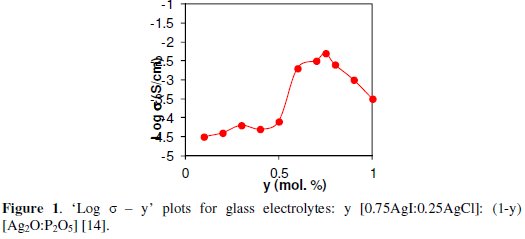
    <p><a href="#f1">Fig. 1</a> shows the compositional dependence of room temperature conductivity for 
the silver phosphate glass electrolytes: [y (0.75AgI:0.25AgCl)+(1-y) 
(Ag2O:P<sub>2</sub>O<sub>5</sub>)], where y is expressed in mol. wet. %, and it is synthesized by the 
melt-quenching technique [14].</p>


    <p>&nbsp;</p>
<a name="f1">
<img src="/img/revistas/pea/v30n4/30n4a03f1.jpg">
    
<p>&nbsp;</p>


    <p>The conductivity of the glass system increased 
initially and attained a peak value of x = 0.75, then decreased. The highest 
conducting composition: 0.75 [0.75AgI: 0.25AgCl]: 0.25 [Ag2O: P<sub>2</sub>O<sub>5</sub>], with 
room temperature conductivity s ~ 5.5 &times; 10<sup>-3</sup> S cm<sup>-1</sup>, has been used as a host salt 
for synthesis of glass polymer electrolytes (GPEs): (1-x) PEO: x 
[0.75(0.75AgI:0.25AgCl): 0.25(Ag2O: P<sub>2</sub>O<sub>5</sub>)], where 0 &lt; x &lt; 50 in wt. (%).</p>

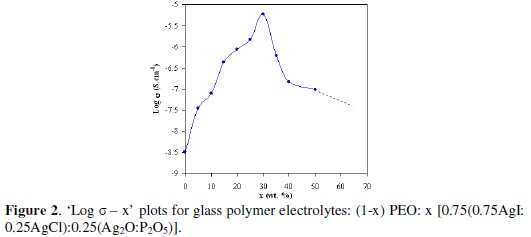
    <p><a href="#f2">Fig. 2</a> shows the room temperature conductivity (&sigma;) variation with different salt 
concentrations for hot-pressed GPEs. The conductivity (&sigma;) increased abruptly 
(~10<sup>3</sup> times) after the addition of the salt in the host polymer.</p>


    <p>&nbsp;</p>
<a name="f2">
<img src="/img/revistas/pea/v30n4/30n4a03f2.jpg">
    
<p>&nbsp;</p>


    <p>However, a moderate sized &sigma;-maxima appears at x = 30 wt.(%) and then decreases on further 
addition of salts. The GPE films beyond 50 wt. (%) salt concentration were 
conductivity (&sigma; ~ 6 &times; 10<sup>-6</sup> S cm<sup>-1</sup>), exhibited optimum conductivity and this has 
brittle and appeared physically less stable. The GPE film: 70PEO: 
30[0.75(0.75AgI:0.25AgCl): 0.25(Ag<sub>2</sub>O:P<sub>2</sub>O<sub>5</sub>)], with room temperature 
been referred to as Optimum Conducting Composition (OCC). The three orders 
of conductivity enhancement in GPE OCC are due to the increase in the degree 
of amorphousity/ decrease in degree of crystallinity from that of the pure PEO.</p>

    ]]></body>
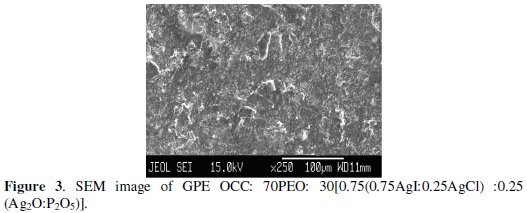
<body><![CDATA[<p>The surface morphology of GPE OCC was observed by scanning electron 
micrograph (SEM), as shown in <a href="#f3">Fig. 3</a>.</p>


    <p>&nbsp;</p>
<a name="f3">
<img src="/img/revistas/pea/v30n4/30n4a03f3.jpg">
    
<p>&nbsp;</p>


    <p>The smooth surface morphology of GPE 
OCC is clearly indication of increase in the degree of amorphousity/ reduction in 
the crystallinity of pure PEO after salt complexation. This is due to the cross-
linking with the polymer and the host glassy salts. The thermal properties of 
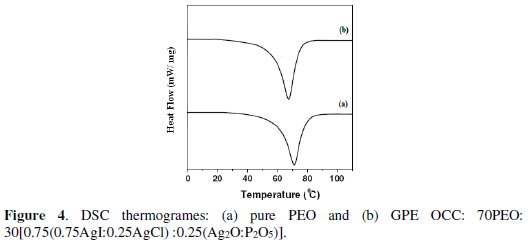
GPE OCC and pure PEO have been characterized with the help of very useful 
DSC technique. <a href="#f4">Fig. 4</a> shows the DSC thermogrames for the pure PEO and GPE 
OCC.</p>


    <p>&nbsp;</p>
<a name="f4">
<img src="/img/revistas/pea/v30n4/30n4a03f4.jpg">
    
<p>&nbsp;</p>


    <p>The broad endothermic peak was observed in SPE OCC at ~ 65-67 &deg;C and 
it corresponds to the melting point temperature of pure PEO. The slightly shifting 
in the melting point temperature towards lower side is due to the complexation of 
Ag<sup>+</sup> ion to the ether oxygen of pure PEO and it is also indicative of the formation 
of GPEs.</p>

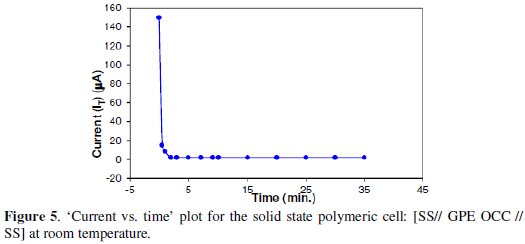
    <p>To explain the ionic nature of the present GPE system, the ionic transference 
number (tion) measurement was also carried out at room temperature, as 
mentioned in Experimental Section. <a href="#f5">Fig. 5</a> shows the 'current versus time' plot 
for the solid state GPE cell: [SS// GPE OCC// SS], at room temperature.</p>


    <p>&nbsp;</p>
<a name="f5">
<img src="/img/revistas/pea/v30n4/30n4a03f5.jpg">
    
<p>&nbsp;</p>


    ]]></body>
<body><![CDATA[<p>The t<sub>ion</sub> of GPE OCC was calculated with the help of the following equation:</p>


    <p>&nbsp;</p>
<a name="e1">
<img src="/img/revistas/pea/v30n4/30n4a03e1.jpg">
    
<p>&nbsp;</p>


    <p>where I<sub>e</sub> is the electronic current and I<sub>T</sub> is the total current of the cell: [SS / GPE 
OCC / SS]. tion ~ 0.98 has been obtained by using the above equation and it 
indicated that the majority of the charge carriers (~ 98 %) are cation Ag<sup>+</sup>, with 
only a very small contribution (~ 2 %) of the others. tion is close to unity and 
hence the present GPE systems are very much suitable for the preparation of 
solid-state electrochemical cells and other ion conducting devices.</p>

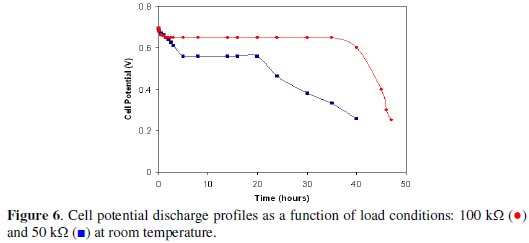
    <p><a href="#f6">Fig. 6</a> shows the cell potential discharge profiles for the solid state polymeric cell 
under different loads viz. 100 kW, 50 kW at room temperature, as mentioned in 
Section 2.</p>


    <p>&nbsp;</p>
<a name="f6">
<img src="/img/revistas/pea/v30n4/30n4a03f6.jpg">
    
<p>&nbsp;</p>


    <p>The Open Circuit Voltage (OCV) ~ 0.68 V has been obtained for both 
the cells. It can be clearly noticed that except for the initial potential drop, OCV 
value remained practically stable for ~ 35 and ~ 15 hrs. when discharged through 
100 & 50 kW, respectively (i.e., during a low current drain state). However, the 
cell potential decreased relatively faster when discharged through 50 kW load 
(i.e., during higher current drain states). Hence, a GPE based newly polymer 
battery, performed fairly satisfactorily especially under low current drains.</p>
 

    <p>&nbsp;</p>
    <p><b>Conclusions</b></p>

    ]]></body>
<body><![CDATA[<p>A new Ag<sup>+</sup> ion conducting glass-polymer electrolyte: 70PEO: 30[0.75 
(0.75AgI:0.25AgCl):0.25(Ag2O:P<sub>2</sub>O<sub>5</sub>)] has been synthesized using a novel hot-
press technique. Three orders of conductivity enhancement were observed in the 
GPE from that of the pure polymer. Materials characterization has been done by 
SEM and DSC analysis. A solid state polymer battery was fabricated and 
discharge characteristics were studied at room temperature. The GPE battery 
performed satisfactorily under low current drains.</p>


    <p>&nbsp;</p>
    <p><b>References</b></p>

    <p>1. Scrosati B, Croce F, Persi L. J. Electrochem. Soc. 147 (2000) 1718.</p>

    <p>2. Sun HY, Sohn H-J, Yamamoto O, Takeda Y, Imanishi N. J Electrochem Soc. 1999;146:1672.</p>

    <!-- ref --><p>3. Armand MB, Chabgano JM, Mundy M, Shenoy GK. Fast Ion Transport in Solids. North Holland; 1979.    &nbsp;&nbsp;&nbsp;&nbsp;&nbsp;&nbsp;&nbsp;&nbsp;[&#160;<a href="javascript:void(0);" onclick="javascript: window.open('/scielo.php?script=sci_nlinks&ref=000058&pid=S0872-1904201200040000300003&lng=','','width=640,height=500,resizable=yes,scrollbars=1,menubar=yes,');">Links</a>&#160;]<!-- end-ref --></p>

    <p>4. Persi L, Croce F, Scrosati B, Plichta E, Hendrickson MA. J Electrochem Soc. 2002;149:A212.</p>

    <p>5. Appetecchi GB, Croce F, Dautzenberg G, Mastragostino M, Ronci F, Scrosati B, Soavi F, Zaneli A, Alessandrini F, Prosini PP. J Electrochem Soc. 1998;145:4126.</p>

    <!-- ref --><p>6. Kumar B, Schaffer JD, Nookala M, Scanlon LG. J Power Sources. 1994;47:63.    &nbsp;&nbsp;&nbsp;&nbsp;&nbsp;&nbsp;&nbsp;&nbsp;[&#160;<a href="javascript:void(0);" onclick="javascript: window.open('/scielo.php?script=sci_nlinks&ref=000062&pid=S0872-1904201200040000300006&lng=','','width=640,height=500,resizable=yes,scrollbars=1,menubar=yes,');">Links</a>&#160;]<!-- end-ref --></p>

    <!-- ref --><p>7. Cho J, Liu M. Electrochimica Acta. 1997;42:1481.    &nbsp;&nbsp;&nbsp;&nbsp;&nbsp;&nbsp;&nbsp;&nbsp;[&#160;<a href="javascript:void(0);" onclick="javascript: window.open('/scielo.php?script=sci_nlinks&ref=000064&pid=S0872-1904201200040000300007&lng=','','width=640,height=500,resizable=yes,scrollbars=1,menubar=yes,');">Links</a>&#160;]<!-- end-ref --></p>

    <p>8. Zhang XW, Wang C, Appleby AJ, Little FE. J. Power Sources 112 (2002) 209.</p>

    <p>9. Appetecchi GB, Croce F, Hassoun J, Scrosati B, Salomon M, Cassel F. J. Power Sources. 2003;114:105.</p>

    <!-- ref --><p>10. Agrawal RC, Chandra A. J Phys D Appl Phys. 2007;40:7024.    &nbsp;&nbsp;&nbsp;&nbsp;&nbsp;&nbsp;&nbsp;&nbsp;[&#160;<a href="javascript:void(0);" onclick="javascript: window.open('/scielo.php?script=sci_nlinks&ref=000068&pid=S0872-1904201200040000300010&lng=','','width=640,height=500,resizable=yes,scrollbars=1,menubar=yes,');">Links</a>&#160;]<!-- end-ref --></p>

    <!-- ref --><p>11. Chandra A, Chandra A. Hot-Pressed Polymer Electrolytes: Synthesis and Characterization. Germany; Lambert Academic Publisher; 2010.    &nbsp;&nbsp;&nbsp;&nbsp;&nbsp;&nbsp;&nbsp;&nbsp;[&#160;<a href="javascript:void(0);" onclick="javascript: window.open('/scielo.php?script=sci_nlinks&ref=000070&pid=S0872-1904201200040000300011&lng=','','width=640,height=500,resizable=yes,scrollbars=1,menubar=yes,');">Links</a>&#160;]<!-- end-ref --></p>

    <!-- ref --><p>12. Chandra A, Chandra A, Thakur K. Port Electrochim Acta. 2012;30(2):81.    &nbsp;&nbsp;&nbsp;&nbsp;&nbsp;&nbsp;&nbsp;&nbsp;[&#160;<a href="javascript:void(0);" onclick="javascript: window.open('/scielo.php?script=sci_nlinks&ref=000072&pid=S0872-1904201200040000300012&lng=','','width=640,height=500,resizable=yes,scrollbars=1,menubar=yes,');">Links</a>&#160;]<!-- end-ref --></p>

    <!-- ref --><p>13. Chandra A, Chandra A, Bhatt A, Thakur K. Int J Chemistry. 2012;1(2):209.    &nbsp;&nbsp;&nbsp;&nbsp;&nbsp;&nbsp;&nbsp;&nbsp;[&#160;<a href="javascript:void(0);" onclick="javascript: window.open('/scielo.php?script=sci_nlinks&ref=000074&pid=S0872-1904201200040000300013&lng=','','width=640,height=500,resizable=yes,scrollbars=1,menubar=yes,');">Links</a>&#160;]<!-- end-ref --></p>

    <p>14. Agrawal RC, Gupta RK, Bhatt A, Verma ML, Chandra A. Ionics. 2004;10:126.</p>

    <!-- ref --><p>15. Chandra S, Tolpadi SK, Hashmai SA. Solid State Ionics. 1988;28-30:651.    &nbsp;&nbsp;&nbsp;&nbsp;&nbsp;&nbsp;&nbsp;&nbsp;[&#160;<a href="javascript:void(0);" onclick="javascript: window.open('/scielo.php?script=sci_nlinks&ref=000077&pid=S0872-1904201200040000300015&lng=','','width=640,height=500,resizable=yes,scrollbars=1,menubar=yes,');">Links</a>&#160;]<!-- end-ref --></p>


    <p>&nbsp;</p>
    <p><a name=0></a><sup><a href="#top">*</a></sup>Corresponding author. E-mail address: <a href="mailto:chandrassi@gmail.com">chandrassi@gmail.com</a></p>

    <p>Received 24 November 2012; accepted 22 December 2012</p>

    <p><a href="http://www.peacta.org" target="_blank">www.peacta.org</a> </p>


    ]]></body>
<body><![CDATA[ ]]></body><back>
<ref-list>
<ref id="B1">
<label>1</label><nlm-citation citation-type="journal">
<person-group person-group-type="author">
<name>
<surname><![CDATA[Scrosati]]></surname>
<given-names><![CDATA[B]]></given-names>
</name>
<name>
<surname><![CDATA[Croce]]></surname>
<given-names><![CDATA[F]]></given-names>
</name>
<name>
<surname><![CDATA[Persi]]></surname>
<given-names><![CDATA[L]]></given-names>
</name>
</person-group>
<source><![CDATA[J Electrochem Soc]]></source>
<year>2000</year>
<volume>147</volume>
<page-range>1718</page-range></nlm-citation>
</ref>
<ref id="B2">
<label>2</label><nlm-citation citation-type="journal">
<person-group person-group-type="author">
<name>
<surname><![CDATA[Sun]]></surname>
<given-names><![CDATA[HY]]></given-names>
</name>
<name>
<surname><![CDATA[Sohn]]></surname>
<given-names><![CDATA[H-J]]></given-names>
</name>
<name>
<surname><![CDATA[Yamamoto]]></surname>
<given-names><![CDATA[O]]></given-names>
</name>
</person-group>
<source><![CDATA[J Electrochem Soc]]></source>
<year>1999</year>
<volume>146</volume>
<page-range>1672</page-range></nlm-citation>
</ref>
<ref id="B3">
<label>3</label><nlm-citation citation-type="book">
<person-group person-group-type="author">
<name>
<surname><![CDATA[Armand]]></surname>
<given-names><![CDATA[MB]]></given-names>
</name>
<name>
<surname><![CDATA[Chabgano]]></surname>
<given-names><![CDATA[JM]]></given-names>
</name>
<name>
<surname><![CDATA[Mundy]]></surname>
<given-names><![CDATA[M]]></given-names>
</name>
<name>
<surname><![CDATA[Shenoy]]></surname>
<given-names><![CDATA[GK]]></given-names>
</name>
</person-group>
<source><![CDATA[Fast Ion Transport in Solids]]></source>
<year>1979</year>
<publisher-name><![CDATA[North Holland]]></publisher-name>
</nlm-citation>
</ref>
<ref id="B4">
<label>4</label><nlm-citation citation-type="journal">
<person-group person-group-type="author">
<name>
<surname><![CDATA[Persi]]></surname>
<given-names><![CDATA[L]]></given-names>
</name>
<name>
<surname><![CDATA[Croce]]></surname>
<given-names><![CDATA[F]]></given-names>
</name>
<name>
<surname><![CDATA[Scrosati]]></surname>
<given-names><![CDATA[B]]></given-names>
</name>
</person-group>
<source><![CDATA[J Electrochem Soc]]></source>
<year>2002</year>
<volume>149</volume>
<page-range>A212</page-range></nlm-citation>
</ref>
<ref id="B5">
<label>5</label><nlm-citation citation-type="journal">
<person-group person-group-type="author">
<name>
<surname><![CDATA[Appetecchi]]></surname>
<given-names><![CDATA[GB]]></given-names>
</name>
<name>
<surname><![CDATA[Croce]]></surname>
<given-names><![CDATA[F]]></given-names>
</name>
<name>
<surname><![CDATA[Dautzenberg]]></surname>
<given-names><![CDATA[G]]></given-names>
</name>
</person-group>
<source><![CDATA[J Electrochem Soc]]></source>
<year>1998</year>
<volume>145</volume>
<page-range>4126</page-range></nlm-citation>
</ref>
<ref id="B6">
<label>6</label><nlm-citation citation-type="journal">
<person-group person-group-type="author">
<name>
<surname><![CDATA[Kumar]]></surname>
<given-names><![CDATA[B]]></given-names>
</name>
<name>
<surname><![CDATA[Schaffer]]></surname>
<given-names><![CDATA[JD]]></given-names>
</name>
<name>
<surname><![CDATA[Nookala]]></surname>
<given-names><![CDATA[M]]></given-names>
</name>
<name>
<surname><![CDATA[Scanlon]]></surname>
<given-names><![CDATA[LG]]></given-names>
</name>
</person-group>
<source><![CDATA[J Power Sources]]></source>
<year>1994</year>
<volume>47</volume>
<page-range>63</page-range></nlm-citation>
</ref>
<ref id="B7">
<label>7</label><nlm-citation citation-type="journal">
<person-group person-group-type="author">
<name>
<surname><![CDATA[Cho]]></surname>
<given-names><![CDATA[J]]></given-names>
</name>
<name>
<surname><![CDATA[Liu]]></surname>
<given-names><![CDATA[M]]></given-names>
</name>
</person-group>
<source><![CDATA[Electrochimica Acta]]></source>
<year>1997</year>
<volume>42</volume>
<page-range>1481</page-range></nlm-citation>
</ref>
<ref id="B8">
<label>8</label><nlm-citation citation-type="journal">
<person-group person-group-type="author">
<name>
<surname><![CDATA[Zhang]]></surname>
<given-names><![CDATA[XW]]></given-names>
</name>
<name>
<surname><![CDATA[Wang]]></surname>
<given-names><![CDATA[C]]></given-names>
</name>
<name>
<surname><![CDATA[Appleby]]></surname>
<given-names><![CDATA[AJ]]></given-names>
</name>
<name>
<surname><![CDATA[Little]]></surname>
<given-names><![CDATA[FE]]></given-names>
</name>
</person-group>
<source><![CDATA[J Power Sources]]></source>
<year>2002</year>
<volume>112</volume>
<page-range>209</page-range></nlm-citation>
</ref>
<ref id="B9">
<label>9</label><nlm-citation citation-type="journal">
<person-group person-group-type="author">
<name>
<surname><![CDATA[Appetecchi]]></surname>
<given-names><![CDATA[GB]]></given-names>
</name>
<name>
<surname><![CDATA[Croce]]></surname>
<given-names><![CDATA[F]]></given-names>
</name>
<name>
<surname><![CDATA[Hassoun]]></surname>
<given-names><![CDATA[J]]></given-names>
</name>
</person-group>
<source><![CDATA[J Power Sources]]></source>
<year>2003</year>
<volume>114</volume>
<page-range>105</page-range></nlm-citation>
</ref>
<ref id="B10">
<label>10</label><nlm-citation citation-type="journal">
<person-group person-group-type="author">
<name>
<surname><![CDATA[Agrawal]]></surname>
<given-names><![CDATA[RC]]></given-names>
</name>
<name>
<surname><![CDATA[Chandra]]></surname>
<given-names><![CDATA[A]]></given-names>
</name>
</person-group>
<source><![CDATA[J Phys D Appl Phys]]></source>
<year>2007</year>
<volume>40</volume>
<page-range>7024</page-range></nlm-citation>
</ref>
<ref id="B11">
<label>11</label><nlm-citation citation-type="book">
<person-group person-group-type="author">
<name>
<surname><![CDATA[Chandra]]></surname>
<given-names><![CDATA[A]]></given-names>
</name>
<name>
<surname><![CDATA[Chandra]]></surname>
<given-names><![CDATA[A]]></given-names>
</name>
</person-group>
<source><![CDATA[Hot-Pressed Polymer Electrolytes: Synthesis and Characterization]]></source>
<year>2010</year>
<publisher-name><![CDATA[Lambert Academic Publisher]]></publisher-name>
</nlm-citation>
</ref>
<ref id="B12">
<label>12</label><nlm-citation citation-type="journal">
<person-group person-group-type="author">
<name>
<surname><![CDATA[Chandra]]></surname>
<given-names><![CDATA[A]]></given-names>
</name>
<name>
<surname><![CDATA[Chandra]]></surname>
<given-names><![CDATA[A]]></given-names>
</name>
<name>
<surname><![CDATA[Thakur]]></surname>
<given-names><![CDATA[K]]></given-names>
</name>
</person-group>
<source><![CDATA[Port Electrochim Acta]]></source>
<year>2012</year>
<volume>30</volume>
<numero>2</numero>
<issue>2</issue>
<page-range>81</page-range></nlm-citation>
</ref>
<ref id="B13">
<label>13</label><nlm-citation citation-type="journal">
<person-group person-group-type="author">
<name>
<surname><![CDATA[Chandra]]></surname>
<given-names><![CDATA[A]]></given-names>
</name>
<name>
<surname><![CDATA[Chandra]]></surname>
<given-names><![CDATA[A]]></given-names>
</name>
<name>
<surname><![CDATA[Bhatt]]></surname>
<given-names><![CDATA[A]]></given-names>
</name>
<name>
<surname><![CDATA[Thakur]]></surname>
<given-names><![CDATA[K]]></given-names>
</name>
</person-group>
<source><![CDATA[Int J Chemistry]]></source>
<year>2012</year>
<volume>1</volume>
<numero>2</numero>
<issue>2</issue>
<page-range>209</page-range></nlm-citation>
</ref>
<ref id="B14">
<label>14</label><nlm-citation citation-type="journal">
<person-group person-group-type="author">
<name>
<surname><![CDATA[Agrawal]]></surname>
<given-names><![CDATA[RC]]></given-names>
</name>
<name>
<surname><![CDATA[Gupta]]></surname>
<given-names><![CDATA[RK]]></given-names>
</name>
<name>
<surname><![CDATA[Bhatt]]></surname>
<given-names><![CDATA[A]]></given-names>
</name>
</person-group>
<source><![CDATA[Ionics]]></source>
<year>2004</year>
<volume>10</volume>
<page-range>126</page-range></nlm-citation>
</ref>
<ref id="B15">
<label>15</label><nlm-citation citation-type="journal">
<person-group person-group-type="author">
<name>
<surname><![CDATA[Chandra]]></surname>
<given-names><![CDATA[S]]></given-names>
</name>
<name>
<surname><![CDATA[Tolpadi]]></surname>
<given-names><![CDATA[SK]]></given-names>
</name>
<name>
<surname><![CDATA[Hashmai]]></surname>
<given-names><![CDATA[SA]]></given-names>
</name>
</person-group>
<source><![CDATA[Solid State Ionics]]></source>
<year>1988</year>
<volume>28-30</volume>
<page-range>651</page-range></nlm-citation>
</ref>
</ref-list>
</back>
</article>