<?xml version="1.0" encoding="ISO-8859-1"?><article xmlns:mml="http://www.w3.org/1998/Math/MathML" xmlns:xlink="http://www.w3.org/1999/xlink" xmlns:xsi="http://www.w3.org/2001/XMLSchema-instance">
<front>
<journal-meta>
<journal-id>0872-1904</journal-id>
<journal-title><![CDATA[Portugaliae Electrochimica Acta]]></journal-title>
<abbrev-journal-title><![CDATA[Port. Electrochim. Acta]]></abbrev-journal-title>
<issn>0872-1904</issn>
<publisher>
<publisher-name><![CDATA[Sociedade Portuguesa de Electroquímica]]></publisher-name>
</publisher>
</journal-meta>
<article-meta>
<article-id>S0872-19042012000400004</article-id>
<article-id pub-id-type="doi">10.4152/pea.201204267</article-id>
<title-group>
<article-title xml:lang="en"><![CDATA[Inhibitive Action of Argan Press Cake Extract on the Corrosion of Steel in Acidic Media]]></article-title>
</title-group>
<contrib-group>
<contrib contrib-type="author">
<name>
<surname><![CDATA[Afia]]></surname>
<given-names><![CDATA[L.]]></given-names>
</name>
<xref ref-type="aff" rid="A01"/>
</contrib>
<contrib contrib-type="author">
<name>
<surname><![CDATA[Salghi]]></surname>
<given-names><![CDATA[R.]]></given-names>
</name>
<xref ref-type="aff" rid="A01"/>
</contrib>
<contrib contrib-type="author">
<name>
<surname><![CDATA[Zarrouk]]></surname>
<given-names><![CDATA[A.]]></given-names>
</name>
<xref ref-type="aff" rid="A02"/>
</contrib>
<contrib contrib-type="author">
<name>
<surname><![CDATA[Zarrok]]></surname>
<given-names><![CDATA[H.]]></given-names>
</name>
<xref ref-type="aff" rid="A03"/>
</contrib>
<contrib contrib-type="author">
<name>
<surname><![CDATA[Benali]]></surname>
<given-names><![CDATA[O.]]></given-names>
</name>
<xref ref-type="aff" rid="A04"/>
</contrib>
<contrib contrib-type="author">
<name>
<surname><![CDATA[Hammouti]]></surname>
<given-names><![CDATA[B.]]></given-names>
</name>
<xref ref-type="aff" rid="A02"/>
</contrib>
<contrib contrib-type="author">
<name>
<surname><![CDATA[Al-Deyab]]></surname>
<given-names><![CDATA[S.S.]]></given-names>
</name>
<xref ref-type="aff" rid="A05"/>
</contrib>
<contrib contrib-type="author">
<name>
<surname><![CDATA[Chakir]]></surname>
<given-names><![CDATA[A.]]></given-names>
</name>
<xref ref-type="aff" rid="A06"/>
</contrib>
<contrib contrib-type="author">
<name>
<surname><![CDATA[Bazzi]]></surname>
<given-names><![CDATA[L.]]></given-names>
</name>
<xref ref-type="aff" rid="A07"/>
</contrib>
</contrib-group>
<aff id="A01">
<institution><![CDATA[,Ecole Nationale des Sciences Appliquées Equipe Génie de l'Environnement et de Biotechnologie ]]></institution>
<addr-line><![CDATA[Agadir ]]></addr-line>
<country>Morocco</country>
</aff>
<aff id="A02">
<institution><![CDATA[,Université Mohammed Premier Faculté des Sciences LCAE-URAC18]]></institution>
<addr-line><![CDATA[Oujda ]]></addr-line>
<country>Morocco</country>
</aff>
<aff id="A03">
<institution><![CDATA[,Faculté des Sciences Laboratoire des procèdes de séparation ]]></institution>
<addr-line><![CDATA[Kénitra ]]></addr-line>
<country>Morocco</country>
</aff>
<aff id="A04">
<institution><![CDATA[,Université de Tahar Moulay Saida Département de biologie ]]></institution>
<addr-line><![CDATA[ ]]></addr-line>
<country>Algérie</country>
</aff>
<aff id="A05">
<institution><![CDATA[,King Saud University College of Science Department of Chemistry]]></institution>
<addr-line><![CDATA[Riaydh ]]></addr-line>
<country>Saudi Arabia</country>
</aff>
<aff id="A06">
<institution><![CDATA[,Université de Reims Faculté des Sciences Laboratoire de Chimie-Physique]]></institution>
<addr-line><![CDATA[ ]]></addr-line>
<country>France</country>
</aff>
<aff id="A07">
<institution><![CDATA[,Université Ibn Zohr Faculté des Sciences Laboratoire Matériaux & Environnement]]></institution>
<addr-line><![CDATA[Agadir ]]></addr-line>
<country>Morocco</country>
</aff>
<pub-date pub-type="pub">
<day>00</day>
<month>07</month>
<year>2012</year>
</pub-date>
<pub-date pub-type="epub">
<day>00</day>
<month>07</month>
<year>2012</year>
</pub-date>
<volume>30</volume>
<numero>4</numero>
<fpage>267</fpage>
<lpage>279</lpage>
<copyright-statement/>
<copyright-year/>
<self-uri xlink:href="http://scielo.pt/scielo.php?script=sci_arttext&amp;pid=S0872-19042012000400004&amp;lng=en&amp;nrm=iso"></self-uri><self-uri xlink:href="http://scielo.pt/scielo.php?script=sci_abstract&amp;pid=S0872-19042012000400004&amp;lng=en&amp;nrm=iso"></self-uri><self-uri xlink:href="http://scielo.pt/scielo.php?script=sci_pdf&amp;pid=S0872-19042012000400004&amp;lng=en&amp;nrm=iso"></self-uri><abstract abstract-type="short" xml:lang="en"><p><![CDATA[The inhibitive action of the Argan press cake extract (ACE) against corrosion of C38 steel in a 1 M HCl solution was investigated using potentiodynamic polarization curves, electrochemical impedance spectroscopy (EIS) and weight loss measurements. The inhibition efficiency increases with increasing extract concentration and decreases with temperature. The kinetic parameters (activation energy, pre-exponential factor, enthalpy of activation and entropy of activation) were calculated and discussed. The Argan press cake extract acted as a mixed-type inhibitor with predominant cathodic effectiveness. The Nyquist plots showed that on increasing ACE concentration, increases charge transfer resistance and decreases double layer capacitance. The adsorption of components of the the Argan press cake extract (ACE) on the surface of the C38 steel follows the Langmuir adsorption isotherm. E (%) values obtained from various methods used are in good agreement.]]></p></abstract>
<kwd-group>
<kwd lng="en"><![CDATA[Argan press cake extract]]></kwd>
<kwd lng="en"><![CDATA[inhibition]]></kwd>
<kwd lng="en"><![CDATA[steel]]></kwd>
<kwd lng="en"><![CDATA[weight loss]]></kwd>
<kwd lng="en"><![CDATA[potentiodynamic polarization]]></kwd>
</kwd-group>
</article-meta>
</front><body><![CDATA[ 

    <p><b>Inhibitive Action of Argan Press Cake Extract on the Corrosion of Steel in Acidic Media</b></p>

    <p><b>L. Afia<sup>1</sup>, R. Salghi<sup>1,<a href="#0">*<a/></sup>, A. Zarrouk<sup>2</sup>, H. Zarrok<sup>3</sup>, O. Benali<sup>4</sup>, B. Hammouti<sup>5</sup>, S.S. Al-Deyab<sup>6</sup>, A. Chakir<sup>7</sup> and L. Bazzi<sup>8</sup></b></p>

    <p><sup>1</sup><i> Ecole Nationale des Sciences Appliqu&eacute;es, Equipe G&eacute;nie de l'Environnement et de Biotechnologie, B.P 1136, 80000 Agadir, Morocco.</i></p>

    <p><sup>2</sup><i> LCAE-URAC18, Facult&eacute; des Sciences, Universit&eacute; Mohammed Premier, B.P. 4808, 60046 Oujda, Morocco.</i></p>

    <p><sup>3</sup><i> Laboratoire des proc&egrave;des de s&eacute;paration, Facult&eacute; des Sciences, K&eacute;nitra, Morocco.</i></p>

    <p><sup>4</sup><i> D&eacute;partement de biologie, Universit&eacute; de Tahar Moulay Saida, Alg&eacute;rie.</i></p>

    <p><sup>5</sup><i> LCAE-URAC18, Facult&eacute; des Sciences, Universit&eacute; Mohammed Premier, B.P. 4808, 60046 Oujda, Morocco.</i></p>

    <p><sup>6</sup><i> Department of Chemistry, College of Science, King Saud University, B.O. 2455, Riaydh 11451, Saudi Arabia.</i></p>

    <p><sup>7</sup><i> GSMA UMR CNRS 6089, Laboratoire de Chimie-Physique, Facult&eacute; des Sciences, Universit&eacute; de Reims, UMR 6089, BP 1039, France.</i></p>

    ]]></body>
<body><![CDATA[<p><sup>8</sup><i> Laboratoire Mat&eacute;riaux & Environnement, Facult&eacute; des Sciences, Universit&eacute; Ibn Zohr, BP 8106, Agadir, Morocco.</i></p>


<!--     <p>&nbsp;</p>
    <p>doi: 10.4152/pea.201204267</p> -->


    <p>&nbsp;</p>
    <p><b>Abstract</b></p>

    <p>The inhibitive action of the Argan press cake extract (ACE) against corrosion of C38 
steel in a 1 M HCl solution was investigated using potentiodynamic polarization curves, 
electrochemical impedance spectroscopy (EIS) and weight loss measurements. The 
inhibition efficiency increases with increasing extract concentration and decreases with 
temperature. The kinetic parameters (activation energy, pre-exponential factor, enthalpy 
of activation and entropy of activation) were calculated and discussed. The Argan press 
cake extract acted as a mixed-type inhibitor with predominant cathodic effectiveness. 
The Nyquist plots showed that on increasing ACE concentration, increases charge 
transfer resistance and decreases double layer capacitance. The adsorption of 
components of the the Argan press cake extract (ACE) on the surface of the C38 steel 
follows the Langmuir adsorption isotherm. E (%) values obtained from various methods 
used are in good agreement.</p>

    <p><b><i>Keywords:</i></b> Argan press cake extract, inhibition, steel, weight loss, potentiodynamic polarization.</p>


    <p>&nbsp;</p>
    <p><b>Introduction</b></p>

    <p>Steel is widely used in most industries because of its low cost and availability 
for the manufacture of reaction vessels such as cooling tower reservoirs, 
pipelines, etc. [1]. Large numbers of organic compounds were studied and are 
being studied to investigate their corrosion inhibition potential. All these 
studies reveal that organic compounds, especially those with N, S and O, 
showed significant inhibition efficiency [2-12]. But, unfortunately most of 
these compounds are not only expensive but also toxic to living beings. It is 
needless to point out the importance of cheap, safe inhibitors of corrosion. 
Plant extracts are environmentally friendly, bio-degradable, non-toxic, easily 
available and of potentially low cost. Most of the naturally occurring 
substances are safe and can be extracted by simple procedures. Recent 
literature is full of researches which test different extracts for corrosion 
inhibition applications. The examples are numerous such as <i>Argan Hulls</i> [13], 
<i>Thymus capitatus</i> [14-15], <i>Fenugreek</i> [16], <i>Artemisia</i> [17], <i>Hibiscus sabdariffa</i> 
[18], <i>Oxandra asbeckii</i> [19], <i>Citrus paradise</i> [20] and <i>Anacyclus pyrethrum L.</i> 
[21].</p>

    ]]></body>
<body><![CDATA[<p>This study examines the action of Argan press cake extract as corrosion 
inhibitor of steel in acid medium with various concentrations. The kinetics of 
corrosion of steel in acid medium has been identified by electrochemical and 
weight loss measurements.</p>


    <p>&nbsp;</p>
    <p><b>Materials and methods</b></p>

    <p><b><i>Weight loss measurements</i></b></p>

    <p>Coupons were cut into (20 &times; 20 &times; 0.8) mm dimensions having composition 
(0.179% C, 0.165% Si, 0.439% Mn, 0.203% Cu, 0.034% S and Fe balance) 
and have been used for weight loss measurements. Prior to all measurements, 
the exposed area was mechanically abraded with 180, 320, 800, 1200 grades of 
emery papers. The specimens were washed thoroughly with bidistilled water, 
degreased and dried with ethanol. Gravimetric measurements were carried out 
in a double walled glass cell equipped with a thermostated cooling condenser. 
The solution volume is 80 cm3. The immersion time for the weight loss is 6 h 
at 298 K.</p>


    <p><b><i>Electrochemical tests</i></b></p>

    <p>The electrochemical study was carried out using a potentiostat PGZ100 piloted 
by Voltamaster software. This potentiostat is connected to a cell with three 
electrode thermostats with double wall (Tacussel Standard CEC/TH). A 
saturated calomel electrode (SCE) and a platinum electrode were used as 
reference and auxiliary electrodes, respectively. The material used for 
constructing the working electrode was the same used for gravimetric 
measurements. The surface area exposed to the electrolyte is 0.056 cm<sup>2</sup>. 
Potentiodynamic polarization curves were plotted at a polarization scan rate of 
0.5 mV/s. Before all experiments, the potential was stabilized at free potential 
during 30 min. The polarization curves have been obtained from -800 mV to 
-400 mV at 298 K. The solution test is used after being de-aerated by bubbling 
nitrogen. Gas bubbling is maintained prior and through the experiments. In 
order to investigate the effects of temperature and immersion time on the 
inhibitor performance, some tests were carried out in a temperature range 298- 
328 K.</p>

    <p>The electrochemical impedance spectroscopy (EIS) measurements were carried 
out with the electrochemical system (Tacussel), which included a digital 
potentiostat model Voltalab PGZ100 computer at E<sub>corr</sub> after immersion in 
solution without bubbling. After the determination of steady-state current at a 
corrosion potential, the signals of sine wave voltage (10 mV) peak to peak, at 
frequencies between 100 kHz and 10 mHz are superimposed on the rest 
potential. Computer programs automatically controlled the measurements 
performed at rest potentials after 30 min of exposure at 298 K. The impedance 
diagrams are given in the Nyquist representation. Experiments are repeated 
three times to ensure the reproducibility.</p>


    <p><b><i>Solutions preparation</i></b></p>

    <p>A sample of Argan press cake was collected from the area of Biougra (located 
at Chtouka Ait Baha). Dried and pulping fruits were crushed. Stock solution of 
the Argan press cake extract was prepared by stirring cold weighed for 24 h in 
1 M HCl solution (a 1 M HCl solution was prepared by dilution of analytical 
grade 37% HCl with double distilled water). The resulting solution was 
filtered. This extract was used to study the corrosion inhibition properties and 
to prepare the required concentrations. The test solutions are freshly prepared 
before each experiment.</p>


    ]]></body>
<body><![CDATA[<p>&nbsp;</p>
    <p><b>Results and discussion</b></p>

    <p><b><i>Polarization curves</i></b></p>

    <p>Evaluation of the inhibition efficiencies can be performed through 
electrochemical experiments which consist of the determination of current 
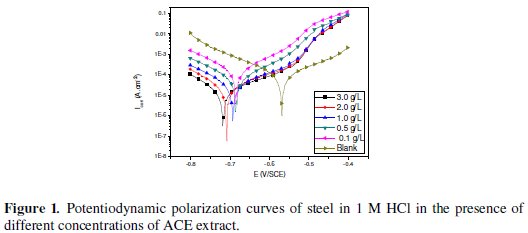
density/potential curves. <a href="#f1">Fig. 1</a> shows the dc polarization curves of C38 steel in 1 
M hydrochloric acid without and with Argan press cake extract (ACE) 
concentrations at 298K.</p>


    <p>&nbsp;</p>
<a name="f1">
<img src="/img/revistas/pea/v30n4/30n4a04f1.jpg">
    
<p>&nbsp;</p>


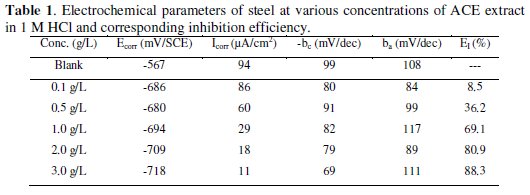
    <p>Electrochemical kinetic parameters (corrosion potential 
(E<sub>corr</sub>), corrosion current density (I<sub>corr</sub>) cathodic and anodic Tafel slopes (bc and 
ba), determined from these experiments by extrapolation method, are reported in 
<a href="#t1">Table 1</a>.</p>


    <p>&nbsp;</p>
<a name="t1">
<img src="/img/revistas/pea/v30n4/30n4a04t1.jpg">
    
<p>&nbsp;</p>


    <p>The inhibition efficiency (EI %) is given in <a href="#e1">equation 1</a>.</p>


    ]]></body>
<body><![CDATA[<p>&nbsp;</p>
<a name="e1">
<img src="/img/revistas/pea/v30n4/30n4a04e1.jpg">
    
<p>&nbsp;</p>


    <p>where I<sub>corr</sub> and I'<sub>corr</sub> are corrosion current densities in absence and presence of 
Argan press cake extract.</p>
 
    <p>It is clear from the electrochemical polarisation results that the addition of 
inhibitor causes a decrease of the current density. The values I<sub>corr</sub> of C38 steel in 
the inhibited solution are smaller than those for the inhibitor free solution (<a href="#t1">Table 1</a>). 
The parallel cathodic Tafel plots obtained in <a href="#f1">Fig. 1</a> indicate that the hydrogen 
evolution is activation-controlled and the reduction mechanism is not affected by 
the presence of the inhibitor. The anodic branches are slightly affected in the 
presence of this inhibitor. However, a shift of corrosion potential (E<sub>corr</sub>) towards 
cathodic side i.e -567 to -718 mV was established. The classification of a 
compound as an anodic or cathodic inhibitor is feasible when the corrosion 
potential displacement is at least 85 mV in relation to that one measured for the 
blank solution [22]. In our case the displacement is greater than 120 mV, so we 
can classify our inhibitor as mixed inhibitor with predominant cathodic 
effectiveness. On the other hand, for anodic polarization, it can be seen from <a href="#f1">Fig. 1</a> 
that, in the presence of ACE at different concentrations, two linear portions 
were observed. When the anodic potentials increase, the anodic current increases 
at a slope of ba1 in the low polarization potential region. After passing a certain 
potential Eu, the anodic current increases rapidly and dissolves at a slope of ba2 in 
the high polarization region. The rapid increase of anodic current after Eu may 
be due to desorption of ACE molecules adsorbed on the electrode. This means 
that the inhibition mode of ACE extract depends on the electrode potential. In 
this case, the observed inhibition phenomenon is generally described as corrosion 
inhibition of the interface associated with the formation of a bidimensional layer 
of adsorbed inhibitor species at the electrode surface [23-24]. Note that the 
potential Eu is also denoted E1 in Bartos and Hackerman's paper [25].</p>


    <p><b><i>Electrochemical impedance spectroscopy measurements</i></b></p>

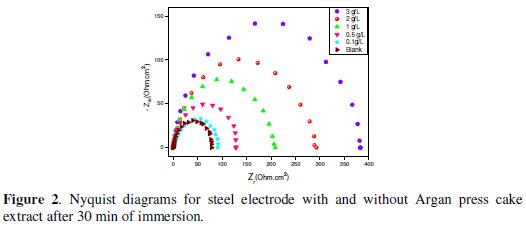
    <p><a href="#f2">Fig. 2</a> shows the Nyquist plots for C38 steel in 1 M HCl solution in the absence 
and presence of different concentrations of the ACE extract at 298K.</p>


    <p>&nbsp;</p>
<a name="f2">
<img src="/img/revistas/pea/v30n4/30n4a04f2.jpg">
    
<p>&nbsp;</p>


    <p>The obtained Nyquist impedance diagrams in most cases do not show perfect 
semicircles, generally attributed to the frequency dispersion as a result of 
roughness and inhomogenates of the electrode surface. The data reveal that each 
impedance diagram consists of a large capacitive loop with low frequencies 
dispersion (inductive arc).</p>

    <p>This inductive arc is generally attributed to anodic adsorbed intermediates 
controlling the anodic process [26-27].</p>

    ]]></body>
<body><![CDATA[<p>The circuit consists of a constant phase element (CPE) Q, in parallel with a 
resistor R<sub>t</sub>. The use of CPE-type impedance has been extensively described in 
[21, 28-29]:</p>


    <p>&nbsp;</p>
<a name="e2">
<img src="/img/revistas/pea/v30n4/30n4a04e2.jpg">
    
<p>&nbsp;</p>


    <p>The above equation provides information about the degree of non-ideality in 
capacitance behaviour. Its value makes it possible to differentiate between the 
behavior of an ideal capacitor (n = 1) and of a CPE (n &lt; 1). Considering that a 
CPE may be considered as a parallel combination of a pure capacitor and a 
resistor that is inversely proportional to the angular frequency, the value of 
capacitance, C<sub>dl</sub>, can thus be calculated for a parallel circuit composed of a CPE 
(Q) and a resistor (R<sub>t</sub>), according to the following formula [30, 31]:</p>


    <p>&nbsp;</p>
<a name="e3">
<img src="/img/revistas/pea/v30n4/30n4a04e3.jpg">
    
<p>&nbsp;</p>


    <p>The impedance spectra were analyzed by using the circuit in <a href="#f3">Fig. 3</a>, and the 
double layer capacitance (C<sub>dl</sub>) was calculated in terms of <a href="#e3">Eq. 3</a>.</p>


    <p>&nbsp;</p>
<a name="f3">
<img src="/img/revistas/pea/v30n4/30n4a04f3.jpg">
    
<p>&nbsp;</p>


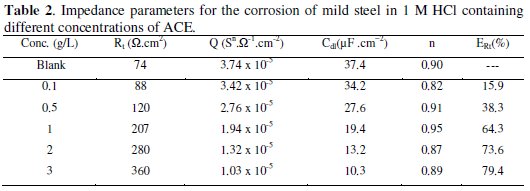
    <p>Values of elements of the circuit corresponding to different corrosion 
systems, including values of C<sub>dl</sub>, are listed in <a href="#t2">Table 2</a>.</p>


    ]]></body>
<body><![CDATA[<p>&nbsp;</p>
<a name="t2">
<img src="/img/revistas/pea/v30n4/30n4a04t2.jpg">
    
<p>&nbsp;</p>


    <p>The inhibition efficiency obtained from the impedance measurements is defined 
by the following relation:</p>


    <p>&nbsp;</p>
<a name="e4">
<img src="/img/revistas/pea/v30n4/30n4a04e4.jpg">
    
<p>&nbsp;</p>


    <p>where R'<sub>t</sub> and R<sub>t</sub> are the charge transfer resistance in the absence and presence 
of different concentrations of the inhibitor, respectively.</p>
    <p>The examination of the results of <a href="#t2">Table 2</a> enables us to deduce the following 
points:</p>

    <p>&bull; The R<sub>t</sub> values increased with the increasing concentration of the inhibitor, 
indicating that more inhibitor molecules adsorb on the metal surface at higher 
concentration and form a protective film on the metal-solution interface [3233].</p>

    <p>&bull; C<sub>dl</sub> value decreased with increasing inhibitor concentration. Decrease of C<sub>dl</sub> 
may be caused by a reduction in local dielectric constant and/or by an increase 
in the thickness of the electrical double layer. These results indicate that the 
inhibitor acts by adsorption on the metal/solution interface [34, 35]. These 
observations suggest that ACE inhibitor functions by adsorption on the metal 
surface, thereby causing a decrease in the C<sub>dl</sub> values and an increase in the R<sub>t</sub> 
values.</p>

    <p>&bull; The value of n grows as well (0.82-0.95), when compared to that obtained in 
pure HCl. This can be attributed to a certain decrease of the initial surface 
inhomogeneity resulting from the inhibitor's adsorption on the most active 
centers [29].</p>

    ]]></body>
<body><![CDATA[<p>&bull; The inhibiting effectiveness increases with the concentration of the inhibitor to 
reach a maximum value of 79.6% at 3 g/L.</p>


    <p><b><i>Gravimetric measurements (effect of concentration)</i></b></p>

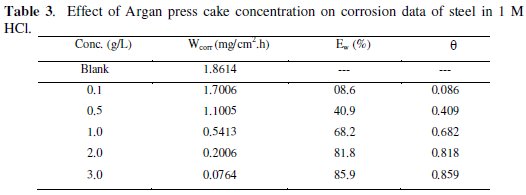
    <p>Weight loss data of C38 steel in 1 M HCl in the absence and presence of various 
concentrations of inhibitor were obtained and are given in <a href="#t3">Table 3</a>. From the 
weight loss results, the inhibition efficiency (Ew%) of the inhibitor and degree of 
surface coverage (&theta;) were calculated using equations <a href="#e5">5</a> and <a href="#e6">6</a> [36];</p>


    <p>&nbsp;</p>
<a name="e5">
<img src="/img/revistas/pea/v30n4/30n4a04e5.jpg">
    
<p>&nbsp;</p>
<a name="e6">
<img src="/img/revistas/pea/v30n4/30n4a04e6.jpg">
    
<p>&nbsp;</p>


    <p>where W<sub>corr</sub> and W<sup>0</sup><sub>corr</sub> are the weight losses for C38 steel in the presence and 
absence of the extract in HCl solution, and &theta; is the degree of surface coverage of 
the inhibitor.</p>

    <p>From <a href="#t3">Table 3</a> it has also been observed that the inhibition efficiency for this 
compound increases with the increase in concentration.</p>


    <p>&nbsp;</p>
<a name="t3">
<img src="/img/revistas/pea/v30n4/30n4a04t3.jpg">
    
<p>&nbsp;</p>


    ]]></body>
<body><![CDATA[<p>Maximum E<sub>w</sub> (%) for 
this compound was achieved at 3 g /L and a further increase in concentration did 
not cause any appreciable change in the performance of the inhibitor (gravimetric 
measurement). The corrosion inhibition can be attributed to the adsorption of this 
compound at the C38 steel / acid solution interface. The corrosion rate decreases 
with the concentration of the inhibitor and in turn the inhibition efficiency 
evaluated from weight loss measurements increases to attain 85.9 % for 3 g L<sup>-1</sup>.</p>


    <p><b><i>Adsorption isotherm and thermodynamic activation parameters</i></b></p>

    <p>It is well established that the first step in corrosion inhibition of metals and 
alloys is the adsorption of organic inhibitor molecules at the metal/solution 
interface and that the adsorption depends on the molecule's chemical 
composition, the temperature, and the electrochemical potential at the 
metal/solution interface. In fact, the solvent water molecules could also adsorb at 
the metal/solution interface. So, the adsorption of organic inhibitor molecules 
from the aqueous solution can be regarded as a quasi-substitution process 
between the organic compounds in the aqueous phase [Org<sub>(sol)</sub>] and water 
molecules at the electrode surface [H<sub>2</sub>O<sub>(ads)</sub>] [37].</p>


    <p>&nbsp;</p>
<a name="s1">
<img src="/img/revistas/pea/v30n4/30n4a04s1.jpg">
    
<p>&nbsp;</p>


    <p>where Org<sub>(sol)</sub> and Org<sub>(ads)</sub> are the organic species dissolved in the aqueous 
solution and adsorbed onto the metallic surface, respectively, H<sub>2</sub>O<sub>(ads)</sub> is the water 
molecule adsorbed on the metallic surface, and n is the size ratio representing the 
number of water molecules replaced by one organic adsorbate. Basic information
on the adsorption of the inhibitors on the metal surface can be provided by 
adsorption isotherm. In order to obtain the isotherm, the fractional surface 
coverage values (&theta;) as a function of the inhibitor concentration must be obtained. 
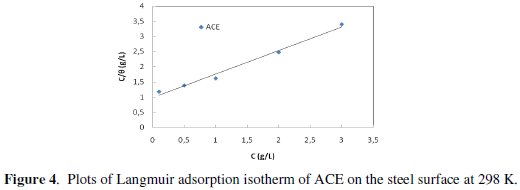
The values of &theta; can be easily determined from weight loss measurements by the 
ratio EW % / 100, where EW% is the inhibition efficiency obtained by weight loss 
method. So, it is necessary to determine empirically which isotherm fits best to 
the adsorption of the inhibitor on the steel surface. Several adsorption isotherms 
(viz., Frumkin, Langmuir, Temkin, Freundlich) were tested, and the Langmuir 
adsorption isotherm was found to provide the best description of the adsorption 
behaviour of this inhibitor. The Langmuir isotherm is given by the following 
equation [38]:</p>


    <p>&nbsp;</p>
<a name="e7">
<img src="/img/revistas/pea/v30n4/30n4a04e7.jpg">
    
<p>&nbsp;</p>


    <p>where C is the concentration of inhibitor, K<sub>ads</sub> is the equilibrium constant of the 
adsorption process, and &theta; is the surface coverage.</p>

    <p>Plot C/&theta; versus C yields a straight line (<a href="#f4">Fig. 4</a>) with regression coefficient, R<sup>2</sup>, 
almost equal to 1.</p>


    ]]></body>
<body><![CDATA[<p>&nbsp;</p>
<a name="f4">
<img src="/img/revistas/pea/v30n4/30n4a04f4.jpg">
    
<p>&nbsp;</p>


    <p>This suggests that the extract in the present study obeyed the 
Langmuir isotherm and that the interaction between the adsorbed molecules is 
negligible.</p>

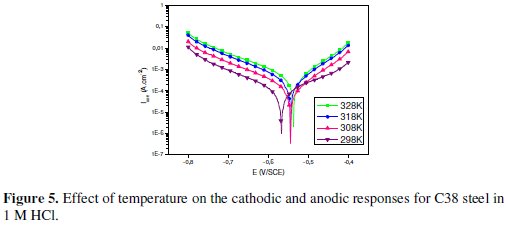
    <p>Generally, the corrosion rate of steel in acidic solution increases with rising the 
temperature. This is due to the decrease of hydrogen evolution overpotential [39]. 
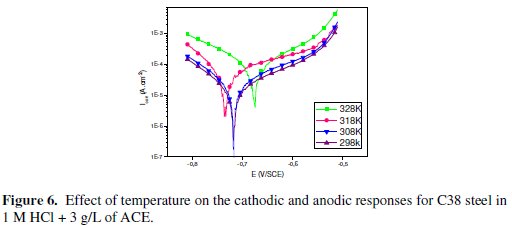
In order to understand more about the performance of Argan press cake extract 
(ACE) with the nature of adsorption and activation processes, the effect of 
temperature is studied. For this purpose, the potentiodynamic polarizations are 
being employed with the range of temperature 298, 308, 318 and 328 K for 30 
min of immersion, in the absence and presence of 3 g/L of the inhibitor (Figs. <a href="#f5">5</a> 
and <a href="#f6">6</a>).</p>


    <p>&nbsp;</p>
<a name="f5">
<img src="/img/revistas/pea/v30n4/30n4a04f5.jpg">
    
<p>&nbsp;</p>
<a name="f6">
<img src="/img/revistas/pea/v30n4/30n4a04f6.jpg">
    
<p>&nbsp;</p>


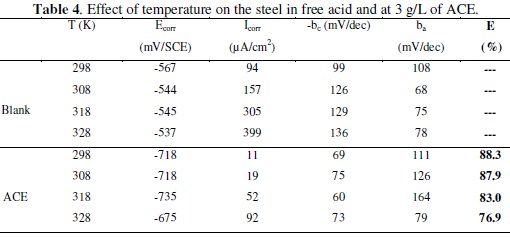
    <p>Corresponding data are given in <a href="#t4">Table 4</a>.</p>


    <p>&nbsp;</p>
<a name="t4">
<img src="/img/revistas/pea/v30n4/30n4a04t4.jpg">
    
<p>&nbsp;</p>


    ]]></body>
<body><![CDATA[<p>It has been observed that the corrosion current density (I<sub>corr</sub>) increased with the 
increase in ACE temperature. It is seen also that the argan press cake extract 
investigated has inhibiting properties at all temperatures studied and the values of 
inhibition efficiency decrease with temperature increase. We were interested in 
exploring the activation energy of the corrosion process and the thermodynamics 
of adsorption of ACE. This was accomplished by investigating the temperature 
dependence of the corrosion current, obtained using Tafel extrapolation method.</p>

    <p>The corrosion reaction can be regarded as an Arrhenius-type process; the rate is 
given by:</p>


    <p>&nbsp;</p>
<a name="e8">
<img src="/img/revistas/pea/v30n4/30n4a04e8.jpg">
    
<p>&nbsp;</p>


    <p>where E<sub>a</sub> is the apparent activation corrosion energy, T is the absolute 
temperature, A is the Arrhenius pre-exponential constant and R is the universal 
gas constant. This equation can be used to calculate the E<sub>a</sub> values of the 
corrosion reaction without and with ACE. Plotting the natural logarithm of the 
corrosion current density versus 1/T, the activation energy can be calculated from 
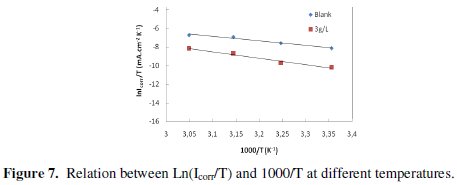
the slope. The temperature dependence of C38 steel dissolution in 1 M HCl and 
in the presence of the inhibitor is presented in Arrhenius co-ordinates in <a href="#f7">Fig. 7</a>.</p>


    <p>&nbsp;</p>
<a name="f7">
<img src="/img/revistas/pea/v30n4/30n4a04f7.jpg">
    
<p>&nbsp;</p>


    <p>The calculated values of the apparent activation corrosion energy in the absence 
and presence of ACE are listed in the <a href="#t4">Table 4</a>. All the linear regression 
coefficients were close to one. The value of E<sub>a</sub> found for ACE is higher than that 
obtained for 1 M HCl solution. The increase in the apparent activation energy 
may be interpreted as physical adsorption that occurs in the first stage [40]. 
Szauer and Brand [41] explained that the increase in activation energy can be 
attributed to an appreciable decrease in the adsorption of the inhibitor on the C38 
steel surface with increase in temperature. As adsorption decreases more 
desorption of the inhibitor molecules occurs because these two opposite 
processes are in equilibrium. Due to more desorption of inhibitor molecules at 
higher temperatures, an important surface of C38 steel comes in contact with 
aggressive environment, resulting increased corrosion rates with increase in 
temperature [41].</p>

    <p>An alternative formulation of Arrhenius equation is [42]:</p>


    <p>&nbsp;</p>
<a name="e9">
<img src="/img/revistas/pea/v30n4/30n4a04e9.jpg">
    
]]></body>
<body><![CDATA[<p>&nbsp;</p>


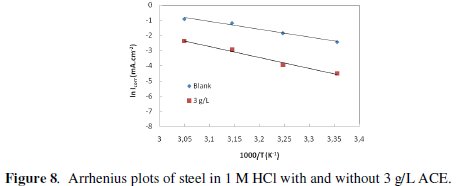
    <p>where h is Planck's constant, N is Avogadro's number, &Delta;S<sub>a</sub>* is the entropy of 
activation and &Delta;H<sub>a</sub>* is the enthalpy of activation. <a href="#f8">Fig. 8</a> shows a plot of 
Ln (I<sub>corr</sub>/T) vs. 1/T. Straight lines are obtained with a slope of &Delta;H<sub>a</sub>*/R and an intercept 
of Ln (R/Nh) + &Delta;S<sub>a</sub>*/R from which the values of &Delta;H<sub>a</sub>* and &Delta;H<sub>a</sub>* are calculated and are 
given in <a href="#t4">Table 4</a>.</p>

    <p>&nbsp;</p>
<a name="f8">
<img src="/img/revistas/pea/v30n4/30n4a04f8.jpg">
    
<p>&nbsp;</p>


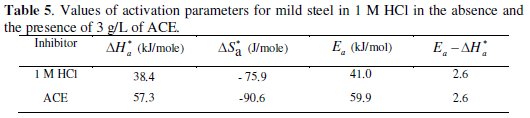
    <p>Inspection of these data revealed that the thermodynamic 
parameters (&Delta;H<sub>a</sub>* and &Delta;S<sub>a</sub>*) for dissolution reaction of C38 steel in 1 M HCl in 
the presence of the inhibitor are higher than those obtained in the absence of the 
inhibitor. The positive sign of &Delta;H<sub>a</sub>* reflects the endothermic nature of the C38 
steel dissolution process, suggesting that the dissolution of C38 steel is slow [43] 
in the presence of the inhibitor. On comparing the values of the entropy of 
activation &Delta;S<sub>a</sub>* given in <a href="#t4">Table 4</a>, it is clear that the entropy of activation 
decreases more negatively in the presence of argan press cake extract than in the 
absence of inhibitor, which reflects the formation of an ordered stable layer of 
the inhibitor on the steel surface [44].</p>

    <p>We remark that E<sub>a</sub> and &Delta;H<sub>a</sub>* values vary in the same way (<a href="#t5">Table 5</a>).</p>


    <p>&nbsp;</p>
<a name="t5">
<img src="/img/revistas/pea/v30n4/30n4a04t5.jpg">
    
<p>&nbsp;</p>


    <p>This result permit to verify the known thermodynamic reaction between the E<sub>a</sub> and 
&Delta;H<sub>a</sub>* as shown in <a href="#t5">Table 5</a> [45]:</p>


    <p>&nbsp;</p>
<a name="e10">
<img src="/img/revistas/pea/v30n4/30n4a04e10.jpg">
    
]]></body>
<body><![CDATA[<p>&nbsp;</p>


    <p>&nbsp;</p>
    <p><b>Conclusions</b></p>

    <p>ACE examined acted as an efficient corrosion inhibitor in 1 M HCl. Polarization 
studies showed that ACE was a mixed-type inhibitor with predominant cathodic 
effectiveness and its inhibition efficiency increased with the inhibitor 
concentration but decreases with rise in temperature. Impedance method 
indicates that ACE adsorbs on the C38 steel surface with increasing transfer 
resistance and decreasing of the double-layer capacitance. The adsorption of 
ACE on the C38 steel in 1 M HCl solution obeys Langmuir adsorption isotherm 
with high correlation coefficient. The adsorption process is a spontaneous and 
exothermic process. The inhibitor efficiencies determined by electrochemical 
polarisation, electrochemical impedance spectroscopy and gravimetric methods 
are in good agreement.</p>


    <p>&nbsp;</p>
    <p><b>References</b></p>

    <!-- ref --><p>1. Ramesh S, Rajeswari S, Maruthamuthu S. Mater Lett. 2003;57:4547.    &nbsp;&nbsp;&nbsp;&nbsp;&nbsp;&nbsp;&nbsp;&nbsp;[&#160;<a href="javascript:void(0);" onclick="javascript: window.open('/scielo.php?script=sci_nlinks&ref=000129&pid=S0872-1904201200040000400001&lng=','','width=640,height=500,resizable=yes,scrollbars=1,menubar=yes,');">Links</a>&#160;]<!-- end-ref --></p>

    <p>2. Zarrok H, Oudda H, Zarrouk A, Salghi R, Hammouti B, Bouachrine M. Der Pharm Chem. 2011;3:576.</p>

    <p>3. Mihit M, Laarej K, Abou El Makarim H, Bazzi L, Salghi R, Hammouti B. Arab J Chem. 2010;3:55.</p>

    ]]></body>
<body><![CDATA[<p>4. Mihit M, Bazzi L, Salghi R, Hammouti B, El Issami S, Ait Addi E. ISJAEE. 2008;62:173.</p>

    <p>5. Barouni K, Bazzi L, Salghi R, Mihit M, Hammouti B, Albourine A, El Issami S. Mater Lett. 2008;62:3325.</p>

    <p>6. El Issami S, Bazzi L, Mihit M, Hammouti B, Kertit S, Ait Addi E, Salghi R. Pig Res Tech. 2007;36:161.</p>

    <p>7. Mihit M, Salghi R, El Issami S, Bazzi L, Hammouti B, Ait Addi E, Kertit S. Pig Res Tech. 2006;35:151.</p>

    <p>8. Mihit M, El Issami S, Bouklah M, Bazzi L, Hammouti B, Ait Addi E, Salghi R, Kertit S. Appl Surf Sci. 2006;252:2389.</p>

    <p>9. El Issami S, Bazzi L, Mihit M, Hilali M, Salghi R, Ait Addi El. J Phys IV. 2005;123:307.</p>

    <p>10. El Issami S, Bazzi L, Hilali M, Salghi R, Kertit S. Ann Chim Sci Mat. 2002;27:63.</p>

    <!-- ref --><p>11. Salghi R, Bazzi L, Hammouti B, Kertit S. Bull Electrochem. 2000;16:272.    &nbsp;&nbsp;&nbsp;&nbsp;&nbsp;&nbsp;&nbsp;&nbsp;[&#160;<a href="javascript:void(0);" onclick="javascript: window.open('/scielo.php?script=sci_nlinks&ref=000140&pid=S0872-1904201200040000400011&lng=','','width=640,height=500,resizable=yes,scrollbars=1,menubar=yes,');">Links</a>&#160;]<!-- end-ref --></p>

    <!-- ref --><p>12. Hammouti B, Salghi R, Kertit S. J. Electrochem Soc India. 1998;47:31.    &nbsp;&nbsp;&nbsp;&nbsp;&nbsp;&nbsp;&nbsp;&nbsp;[&#160;<a href="javascript:void(0);" onclick="javascript: window.open('/scielo.php?script=sci_nlinks&ref=000142&pid=S0872-1904201200040000400012&lng=','','width=640,height=500,resizable=yes,scrollbars=1,menubar=yes,');">Links</a>&#160;]<!-- end-ref --></p>

    <p>13. Afia L, Salghi R, Bazzi E, Zarrouk A, Hammouti B, Bouri M, Zarrouk H, Bazzi L, Bammou L. Res Chem Intermed. In press. DOI 10.1007/s11164012-0496-y (2012).</p>

    <p>14. M El Ouariachi El, Paolini J, Bouyanzer A, Tomi P, Hammouti B, Salghi R, Majidi L, Costa J. J Med Plants Res. 2011;5:5773.</p>

    <!-- ref --><p>15 Chetouani A, Hammouti B. Bull Electrochem. 2004;20:343.    &nbsp;&nbsp;&nbsp;&nbsp;&nbsp;&nbsp;&nbsp;&nbsp;[&#160;<a href="javascript:void(0);" onclick="javascript: window.open('/scielo.php?script=sci_nlinks&ref=000146&pid=S0872-1904201200040000400015&lng=','','width=640,height=500,resizable=yes,scrollbars=1,menubar=yes,');">Links</a>&#160;]<!-- end-ref --></p>

    <!-- ref --><p>16 Bouyanzer A, Hammouti B, Majidi L, Haloui B. Port Electrochim Acta. 2010;28:165.    &nbsp;&nbsp;&nbsp;&nbsp;&nbsp;&nbsp;&nbsp;&nbsp;[&#160;<a href="javascript:void(0);" onclick="javascript: window.open('/scielo.php?script=sci_nlinks&ref=000148&pid=S0872-1904201200040000400016&lng=','','width=640,height=500,resizable=yes,scrollbars=1,menubar=yes,');">Links</a>&#160;]<!-- end-ref --></p>

    <!-- ref --><p>17. Bouklah M, Hammouti B. Port Electrochim Acta. 2006;24:457.    &nbsp;&nbsp;&nbsp;&nbsp;&nbsp;&nbsp;&nbsp;&nbsp;[&#160;<a href="javascript:void(0);" onclick="javascript: window.open('/scielo.php?script=sci_nlinks&ref=000150&pid=S0872-1904201200040000400017&lng=','','width=640,height=500,resizable=yes,scrollbars=1,menubar=yes,');">Links</a>&#160;]<!-- end-ref --></p>

    <!-- ref --><p>18. Emeka EO. Port Electrochim Acta. 2008;26:303.    &nbsp;&nbsp;&nbsp;&nbsp;&nbsp;&nbsp;&nbsp;&nbsp;[&#160;<a href="javascript:void(0);" onclick="javascript: window.open('/scielo.php?script=sci_nlinks&ref=000152&pid=S0872-1904201200040000400018&lng=','','width=640,height=500,resizable=yes,scrollbars=1,menubar=yes,');">Links</a>&#160;]<!-- end-ref --></p>

    <!-- ref --><p>19. Lebrini M, Robert F, Lecante A, Roos C. Corros Sci. 2011;53:687.    &nbsp;&nbsp;&nbsp;&nbsp;&nbsp;&nbsp;&nbsp;&nbsp;[&#160;<a href="javascript:void(0);" onclick="javascript: window.open('/scielo.php?script=sci_nlinks&ref=000154&pid=S0872-1904201200040000400019&lng=','','width=640,height=500,resizable=yes,scrollbars=1,menubar=yes,');">Links</a>&#160;]<!-- end-ref --></p>

    <!-- ref --><p>20. Olusegun AK, Oforka NC, Ebenso EE. J Corros Sci Eng. 2004;8:1.    &nbsp;&nbsp;&nbsp;&nbsp;&nbsp;&nbsp;&nbsp;&nbsp;[&#160;<a href="javascript:void(0);" onclick="javascript: window.open('/scielo.php?script=sci_nlinks&ref=000156&pid=S0872-1904201200040000400020&lng=','','width=640,height=500,resizable=yes,scrollbars=1,menubar=yes,');">Links</a>&#160;]<!-- end-ref --></p>

    <p>21. Selles C, Benali O, Tabti B, Larabi L, Harek Y. J Mater Environ Sci. 2012;3(1):206-219.</p>

    <!-- ref --><p>22. Riggs Jr OL., In: Nathan CC, editor. Corrosion Inhibitors. Houston, TX, USA: The National Association of Corrosion Engineers (NACE); 1973. p.2-27.    &nbsp;&nbsp;&nbsp;&nbsp;&nbsp;&nbsp;&nbsp;&nbsp;[&#160;<a href="javascript:void(0);" onclick="javascript: window.open('/scielo.php?script=sci_nlinks&ref=000159&pid=S0872-1904201200040000400022&lng=','','width=640,height=500,resizable=yes,scrollbars=1,menubar=yes,');">Links</a>&#160;]<!-- end-ref --></p>

    <!-- ref --><p>23. Lorentz WJ, Mansfeld F. Corros Sci. 1986;31:467.    &nbsp;&nbsp;&nbsp;&nbsp;&nbsp;&nbsp;&nbsp;&nbsp;[&#160;<a href="javascript:void(0);" onclick="javascript: window.open('/scielo.php?script=sci_nlinks&ref=000161&pid=S0872-1904201200040000400023&lng=','','width=640,height=500,resizable=yes,scrollbars=1,menubar=yes,');">Links</a>&#160;]<!-- end-ref --></p>

    ]]></body>
<body><![CDATA[<!-- ref --><p>24. Benali O, Larabi L, Tabti B, Harek Y. Anti-corr Meth Mater. 2005;52:280.    &nbsp;&nbsp;&nbsp;&nbsp;&nbsp;&nbsp;&nbsp;&nbsp;[&#160;<a href="javascript:void(0);" onclick="javascript: window.open('/scielo.php?script=sci_nlinks&ref=000163&pid=S0872-1904201200040000400024&lng=','','width=640,height=500,resizable=yes,scrollbars=1,menubar=yes,');">Links</a>&#160;]<!-- end-ref --></p>

    <!-- ref --><p>25. Bartos M, Hackerman N. J Electrochem Soc. 2000;139:3428.    &nbsp;&nbsp;&nbsp;&nbsp;&nbsp;&nbsp;&nbsp;&nbsp;[&#160;<a href="javascript:void(0);" onclick="javascript: window.open('/scielo.php?script=sci_nlinks&ref=000165&pid=S0872-1904201200040000400025&lng=','','width=640,height=500,resizable=yes,scrollbars=1,menubar=yes,');">Links</a>&#160;]<!-- end-ref --></p>

    <p>26. Caprani A, Epelboin I, Morel P. In: Corros Inhibitors. Ferrara, Italy; 1975. p.571.</p>

    <!-- ref --><p>27. Bessone J, Mayer C, Tuttner K, Lorenz WJ. Electrochim. Acta. 1983;28:171.    &nbsp;&nbsp;&nbsp;&nbsp;&nbsp;&nbsp;&nbsp;&nbsp;[&#160;<a href="javascript:void(0);" onclick="javascript: window.open('/scielo.php?script=sci_nlinks&ref=000168&pid=S0872-1904201200040000400027&lng=','','width=640,height=500,resizable=yes,scrollbars=1,menubar=yes,');">Links</a>&#160;]<!-- end-ref --></p>

    <!-- ref --><p>28. Benali O, Larabi L, Mekelleche SM, Harek Y. J Mater Sci. 2006;41:7064.    &nbsp;&nbsp;&nbsp;&nbsp;&nbsp;&nbsp;&nbsp;&nbsp;[&#160;<a href="javascript:void(0);" onclick="javascript: window.open('/scielo.php?script=sci_nlinks&ref=000170&pid=S0872-1904201200040000400028&lng=','','width=640,height=500,resizable=yes,scrollbars=1,menubar=yes,');">Links</a>&#160;]<!-- end-ref --></p>

    <!-- ref --><p>29. Benali O, Larabi L, Harek Y. J Appl Electrochem. 2009;39:769.    &nbsp;&nbsp;&nbsp;&nbsp;&nbsp;&nbsp;&nbsp;&nbsp;[&#160;<a href="javascript:void(0);" onclick="javascript: window.open('/scielo.php?script=sci_nlinks&ref=000172&pid=S0872-1904201200040000400029&lng=','','width=640,height=500,resizable=yes,scrollbars=1,menubar=yes,');">Links</a>&#160;]<!-- end-ref --></p>

    <!-- ref --><p>30. Merah S, Larabi L, Benali O, Harek Y. Pig Res Tech. 2008;37(5):291.    &nbsp;&nbsp;&nbsp;&nbsp;&nbsp;&nbsp;&nbsp;&nbsp;[&#160;<a href="javascript:void(0);" onclick="javascript: window.open('/scielo.php?script=sci_nlinks&ref=000174&pid=S0872-1904201200040000400030&lng=','','width=640,height=500,resizable=yes,scrollbars=1,menubar=yes,');">Links</a>&#160;]<!-- end-ref --></p>

    <p>31. Ma H, Chen S, Yin B, Zhao S, Liu X. Corros Sci. 2003;45:867.</p>

    <!-- ref --><p>32. Bentiss F, Traisnel M, Lagrenee M. Corros Sci. 2000;42:127.    &nbsp;&nbsp;&nbsp;&nbsp;&nbsp;&nbsp;&nbsp;&nbsp;[&#160;<a href="javascript:void(0);" onclick="javascript: window.open('/scielo.php?script=sci_nlinks&ref=000177&pid=S0872-1904201200040000400032&lng=','','width=640,height=500,resizable=yes,scrollbars=1,menubar=yes,');">Links</a>&#160;]<!-- end-ref --></p>

    <!-- ref --><p>33. Murlidharan S, Phani KLN, Pitchumani S, Ravichandran S. J Electrochem Soc. 1995;142:1478.    &nbsp;&nbsp;&nbsp;&nbsp;&nbsp;&nbsp;&nbsp;&nbsp;[&#160;<a href="javascript:void(0);" onclick="javascript: window.open('/scielo.php?script=sci_nlinks&ref=000179&pid=S0872-1904201200040000400033&lng=','','width=640,height=500,resizable=yes,scrollbars=1,menubar=yes,');">Links</a>&#160;]<!-- end-ref --></p>

    <p>34. Abdel Rehim SS, Hazzazi OA, Amin MA, Khaled FK. Corros Sci. 2008;50:2258.</p>

    <p>35. Ashassi Sorkhabi H, Seifzadeh D, Hosseini MG. Corros Sci. 2008;50:3363.</p>

    ]]></body>
<body><![CDATA[<!-- ref --><p>36. Emregul KC, Akay AA, Atakol O. Mater Chem Phys. 2005;93:325.    &nbsp;&nbsp;&nbsp;&nbsp;&nbsp;&nbsp;&nbsp;&nbsp;[&#160;<a href="javascript:void(0);" onclick="javascript: window.open('/scielo.php?script=sci_nlinks&ref=000183&pid=S0872-1904201200040000400036&lng=','','width=640,height=500,resizable=yes,scrollbars=1,menubar=yes,');">Links</a>&#160;]<!-- end-ref --></p>

    <!-- ref --><p>37. Sahin M, Bilgic S, Yilmaz H. Appl Surf Sci. 2002;195:1.    &nbsp;&nbsp;&nbsp;&nbsp;&nbsp;&nbsp;&nbsp;&nbsp;[&#160;<a href="javascript:void(0);" onclick="javascript: window.open('/scielo.php?script=sci_nlinks&ref=000185&pid=S0872-1904201200040000400037&lng=','','width=640,height=500,resizable=yes,scrollbars=1,menubar=yes,');">Links</a>&#160;]<!-- end-ref --></p>

    <!-- ref --><p>38. Bilgic S, Caliskan N. Appl Surf Sci. 1999;152:107.    &nbsp;&nbsp;&nbsp;&nbsp;&nbsp;&nbsp;&nbsp;&nbsp;[&#160;<a href="javascript:void(0);" onclick="javascript: window.open('/scielo.php?script=sci_nlinks&ref=000187&pid=S0872-1904201200040000400038&lng=','','width=640,height=500,resizable=yes,scrollbars=1,menubar=yes,');">Links</a>&#160;]<!-- end-ref --></p>

    <!-- ref --><p>39. Popova A, Sokolova E, Raicheva S, Christov M. Corros Sci. 2003;45:33.    &nbsp;&nbsp;&nbsp;&nbsp;&nbsp;&nbsp;&nbsp;&nbsp;[&#160;<a href="javascript:void(0);" onclick="javascript: window.open('/scielo.php?script=sci_nlinks&ref=000189&pid=S0872-1904201200040000400039&lng=','','width=640,height=500,resizable=yes,scrollbars=1,menubar=yes,');">Links</a>&#160;]<!-- end-ref --></p>

    <!-- ref --><p>40. Martinez S, Stern I. Appl Surf Sci. 2002;199:83.    &nbsp;&nbsp;&nbsp;&nbsp;&nbsp;&nbsp;&nbsp;&nbsp;[&#160;<a href="javascript:void(0);" onclick="javascript: window.open('/scielo.php?script=sci_nlinks&ref=000191&pid=S0872-1904201200040000400040&lng=','','width=640,height=500,resizable=yes,scrollbars=1,menubar=yes,');">Links</a>&#160;]<!-- end-ref --></p>

    ]]></body>
<body><![CDATA[<!-- ref --><p>41. Szauer T, Brand A. Electrochim Acta. 1981;26:1219.    &nbsp;&nbsp;&nbsp;&nbsp;&nbsp;&nbsp;&nbsp;&nbsp;[&#160;<a href="javascript:void(0);" onclick="javascript: window.open('/scielo.php?script=sci_nlinks&ref=000193&pid=S0872-1904201200040000400041&lng=','','width=640,height=500,resizable=yes,scrollbars=1,menubar=yes,');">Links</a>&#160;]<!-- end-ref --></p>

    <!-- ref --><p>42. Bochris J.O'M, Reddy AKN. Modern Electrochemistry. New York: Plenum Press; 1977. (vol 2).    &nbsp;&nbsp;&nbsp;&nbsp;&nbsp;&nbsp;&nbsp;&nbsp;[&#160;<a href="javascript:void(0);" onclick="javascript: window.open('/scielo.php?script=sci_nlinks&ref=000195&pid=S0872-1904201200040000400042&lng=','','width=640,height=500,resizable=yes,scrollbars=1,menubar=yes,');">Links</a>&#160;]<!-- end-ref --></p>

    <!-- ref --><p>43. Guan NM, Xueming L, Fei L. Mater Chem Phys. 2004;86:59.    &nbsp;&nbsp;&nbsp;&nbsp;&nbsp;&nbsp;&nbsp;&nbsp;[&#160;<a href="javascript:void(0);" onclick="javascript: window.open('/scielo.php?script=sci_nlinks&ref=000197&pid=S0872-1904201200040000400043&lng=','','width=640,height=500,resizable=yes,scrollbars=1,menubar=yes,');">Links</a>&#160;]<!-- end-ref --></p>

    <p>44. Yurt A, Balaban A, Kandemir SU, Bereket G, Erk B. Mater Chem Phys. 2004;85:420.</p>

    <p>45. Benali O, Larabi L, Traisnel M, Gengembre L, Harek Y. Appl Surf Sci. 2007;253:6130.</p>


    <p>&nbsp;</p>
    <p><b>Acknowledgements</b></p>

    ]]></body>
<body><![CDATA[<p>The authors wish to thank the Volubilis program MA/10/226 for supporting this work. 
Prof. S.S. Deyab and Prof. B. Hammouti extend their appreciation to the Deanship of 
Scientific Research at King Saud University for funding the work through the research 
group project.</p>


    <p>&nbsp;</p>
    <p><a name=0></a><sup><a href="#top">*</a></sup>Corresponding author. E-mail address: <a href="mailto:r_salghi@yahoo.fr">r_salghi@yahoo.fr</a></p>  

    <p>Received 13 May 2012; accepted 31 August 2012</p>

    <p><a href="http://www.peacta.org" target="_blank">www.peacta.org</a> </p>


     ]]></body><back>
<ref-list>
<ref id="B1">
<label>1</label><nlm-citation citation-type="journal">
<person-group person-group-type="author">
<name>
<surname><![CDATA[Ramesh]]></surname>
<given-names><![CDATA[S]]></given-names>
</name>
<name>
<surname><![CDATA[Rajeswari]]></surname>
<given-names><![CDATA[S]]></given-names>
</name>
<name>
<surname><![CDATA[Maruthamuthu]]></surname>
<given-names><![CDATA[S]]></given-names>
</name>
</person-group>
<source><![CDATA[Mater Lett]]></source>
<year>2003</year>
<volume>57</volume>
<page-range>4547</page-range></nlm-citation>
</ref>
<ref id="B2">
<label>2</label><nlm-citation citation-type="journal">
<person-group person-group-type="author">
<name>
<surname><![CDATA[Zarrok]]></surname>
<given-names><![CDATA[H]]></given-names>
</name>
<name>
<surname><![CDATA[Oudda]]></surname>
<given-names><![CDATA[H]]></given-names>
</name>
<name>
<surname><![CDATA[Zarrouk]]></surname>
<given-names><![CDATA[A]]></given-names>
</name>
</person-group>
<source><![CDATA[Der Pharm Chem]]></source>
<year>2011</year>
<volume>3</volume>
<page-range>576</page-range></nlm-citation>
</ref>
<ref id="B3">
<label>3</label><nlm-citation citation-type="journal">
<person-group person-group-type="author">
<name>
<surname><![CDATA[Mihit]]></surname>
<given-names><![CDATA[M]]></given-names>
</name>
<name>
<surname><![CDATA[Laarej]]></surname>
<given-names><![CDATA[K]]></given-names>
</name>
<name>
<surname><![CDATA[El-Makarim]]></surname>
<given-names><![CDATA[HA]]></given-names>
</name>
</person-group>
<source><![CDATA[Arab J Chem]]></source>
<year>2010</year>
<volume>3</volume>
<page-range>55</page-range></nlm-citation>
</ref>
<ref id="B4">
<label>4</label><nlm-citation citation-type="journal">
<person-group person-group-type="author">
<name>
<surname><![CDATA[Mihit]]></surname>
<given-names><![CDATA[M]]></given-names>
</name>
<name>
<surname><![CDATA[Bazzi]]></surname>
<given-names><![CDATA[L]]></given-names>
</name>
<name>
<surname><![CDATA[Salghi]]></surname>
<given-names><![CDATA[R]]></given-names>
</name>
</person-group>
<source><![CDATA[ISJAEE]]></source>
<year>2008</year>
<volume>62</volume>
<page-range>173</page-range></nlm-citation>
</ref>
<ref id="B5">
<label>5</label><nlm-citation citation-type="journal">
<person-group person-group-type="author">
<name>
<surname><![CDATA[Barouni]]></surname>
<given-names><![CDATA[K]]></given-names>
</name>
<name>
<surname><![CDATA[Bazzi]]></surname>
<given-names><![CDATA[L]]></given-names>
</name>
<name>
<surname><![CDATA[Salghi]]></surname>
<given-names><![CDATA[R]]></given-names>
</name>
</person-group>
<source><![CDATA[Mater Lett]]></source>
<year>2008</year>
<volume>62</volume>
<page-range>3325</page-range></nlm-citation>
</ref>
<ref id="B6">
<label>6</label><nlm-citation citation-type="journal">
<person-group person-group-type="author">
<name>
<surname><![CDATA[El Issami]]></surname>
<given-names><![CDATA[S]]></given-names>
</name>
<name>
<surname><![CDATA[Bazzi]]></surname>
<given-names><![CDATA[L]]></given-names>
</name>
<name>
<surname><![CDATA[Mihit]]></surname>
<given-names><![CDATA[M]]></given-names>
</name>
</person-group>
<source><![CDATA[Pig Res Tech]]></source>
<year>2007</year>
<volume>36</volume>
<page-range>161</page-range></nlm-citation>
</ref>
<ref id="B7">
<label>7</label><nlm-citation citation-type="journal">
<person-group person-group-type="author">
<name>
<surname><![CDATA[Mihit]]></surname>
<given-names><![CDATA[M]]></given-names>
</name>
<name>
<surname><![CDATA[Salghi]]></surname>
<given-names><![CDATA[R]]></given-names>
</name>
<name>
<surname><![CDATA[El Issami]]></surname>
<given-names><![CDATA[S]]></given-names>
</name>
</person-group>
<source><![CDATA[Pig Res Tech]]></source>
<year>2006</year>
<volume>35</volume>
<page-range>15</page-range></nlm-citation>
</ref>
<ref id="B8">
<label>8</label><nlm-citation citation-type="journal">
<person-group person-group-type="author">
<name>
<surname><![CDATA[Mihit]]></surname>
<given-names><![CDATA[M]]></given-names>
</name>
<name>
<surname><![CDATA[El Issami]]></surname>
<given-names><![CDATA[S]]></given-names>
</name>
<name>
<surname><![CDATA[Bouklah]]></surname>
<given-names><![CDATA[M]]></given-names>
</name>
</person-group>
<source><![CDATA[Appl Surf Sci]]></source>
<year>2006</year>
<volume>252</volume>
<page-range>2389</page-range></nlm-citation>
</ref>
<ref id="B9">
<label>9</label><nlm-citation citation-type="journal">
<person-group person-group-type="author">
<name>
<surname><![CDATA[El Issami]]></surname>
<given-names><![CDATA[S]]></given-names>
</name>
<name>
<surname><![CDATA[Bazzi]]></surname>
<given-names><![CDATA[L]]></given-names>
</name>
<name>
<surname><![CDATA[Mihit]]></surname>
<given-names><![CDATA[M]]></given-names>
</name>
</person-group>
<source><![CDATA[J Phys IV]]></source>
<year>2005</year>
<volume>123</volume>
<page-range>307</page-range></nlm-citation>
</ref>
<ref id="B10">
<label>10</label><nlm-citation citation-type="journal">
<person-group person-group-type="author">
<name>
<surname><![CDATA[El Issami]]></surname>
<given-names><![CDATA[S]]></given-names>
</name>
<name>
<surname><![CDATA[Bazzi]]></surname>
<given-names><![CDATA[L]]></given-names>
</name>
<name>
<surname><![CDATA[Hilali]]></surname>
<given-names><![CDATA[M]]></given-names>
</name>
</person-group>
<source><![CDATA[Ann Chim Sci Mat]]></source>
<year>2002</year>
<volume>27</volume>
<page-range>63</page-range></nlm-citation>
</ref>
<ref id="B11">
<label>11</label><nlm-citation citation-type="journal">
<person-group person-group-type="author">
<name>
<surname><![CDATA[Salghi]]></surname>
<given-names><![CDATA[R]]></given-names>
</name>
<name>
<surname><![CDATA[Bazzi]]></surname>
<given-names><![CDATA[L]]></given-names>
</name>
<name>
<surname><![CDATA[Hammouti]]></surname>
<given-names><![CDATA[B]]></given-names>
</name>
<name>
<surname><![CDATA[Kertit]]></surname>
<given-names><![CDATA[S]]></given-names>
</name>
</person-group>
<source><![CDATA[Bull Electrochem]]></source>
<year>2000</year>
<volume>16</volume>
<page-range>272</page-range></nlm-citation>
</ref>
<ref id="B12">
<label>12</label><nlm-citation citation-type="journal">
<person-group person-group-type="author">
<name>
<surname><![CDATA[Hammouti]]></surname>
<given-names><![CDATA[B]]></given-names>
</name>
<name>
<surname><![CDATA[Salghi]]></surname>
<given-names><![CDATA[R]]></given-names>
</name>
<name>
<surname><![CDATA[Kertit]]></surname>
<given-names><![CDATA[S]]></given-names>
</name>
</person-group>
<source><![CDATA[J Electrochem Soc India]]></source>
<year>1998</year>
<volume>47</volume>
<page-range>31</page-range></nlm-citation>
</ref>
<ref id="B13">
<label>13</label><nlm-citation citation-type="journal">
<person-group person-group-type="author">
<name>
<surname><![CDATA[Afia]]></surname>
<given-names><![CDATA[L]]></given-names>
</name>
<name>
<surname><![CDATA[Salghi]]></surname>
<given-names><![CDATA[R]]></given-names>
</name>
<name>
<surname><![CDATA[Bazzi]]></surname>
<given-names><![CDATA[E]]></given-names>
</name>
</person-group>
<source><![CDATA[Res Chem Intermed]]></source>
<year>2012</year>
</nlm-citation>
</ref>
<ref id="B14">
<label>14</label><nlm-citation citation-type="journal">
<person-group person-group-type="author">
<name>
<surname><![CDATA[El Ouariachi]]></surname>
<given-names><![CDATA[EM]]></given-names>
</name>
<name>
<surname><![CDATA[Paolini]]></surname>
<given-names><![CDATA[J]]></given-names>
</name>
<name>
<surname><![CDATA[Bouyanzer]]></surname>
<given-names><![CDATA[A]]></given-names>
</name>
</person-group>
<source><![CDATA[J Med Plants Res]]></source>
<year>2011</year>
<volume>5</volume>
<page-range>5773</page-range></nlm-citation>
</ref>
<ref id="B15">
<label>15</label><nlm-citation citation-type="journal">
<person-group person-group-type="author">
<name>
<surname><![CDATA[Chetouani]]></surname>
<given-names><![CDATA[A]]></given-names>
</name>
<name>
<surname><![CDATA[Hammouti]]></surname>
<given-names><![CDATA[B]]></given-names>
</name>
</person-group>
<source><![CDATA[Bull Electrochem]]></source>
<year>2004</year>
<volume>20</volume>
<page-range>343</page-range></nlm-citation>
</ref>
<ref id="B16">
<label>16</label><nlm-citation citation-type="journal">
<person-group person-group-type="author">
<name>
<surname><![CDATA[Bouyanzer]]></surname>
<given-names><![CDATA[A]]></given-names>
</name>
<name>
<surname><![CDATA[Hammouti]]></surname>
<given-names><![CDATA[B]]></given-names>
</name>
<name>
<surname><![CDATA[Majidi]]></surname>
<given-names><![CDATA[L]]></given-names>
</name>
<name>
<surname><![CDATA[Haloui]]></surname>
<given-names><![CDATA[B]]></given-names>
</name>
</person-group>
<source><![CDATA[Port Electrochim Acta]]></source>
<year>2010</year>
<volume>28</volume>
<page-range>165</page-range></nlm-citation>
</ref>
<ref id="B17">
<label>17</label><nlm-citation citation-type="journal">
<person-group person-group-type="author">
<name>
<surname><![CDATA[Bouklah]]></surname>
<given-names><![CDATA[M]]></given-names>
</name>
<name>
<surname><![CDATA[Hammouti]]></surname>
<given-names><![CDATA[B]]></given-names>
</name>
</person-group>
<source><![CDATA[Port Electrochim Acta]]></source>
<year>2006</year>
<volume>24</volume>
<page-range>457</page-range></nlm-citation>
</ref>
<ref id="B18">
<label>18</label><nlm-citation citation-type="journal">
<person-group person-group-type="author">
<name>
<surname><![CDATA[Emeka]]></surname>
<given-names><![CDATA[EO]]></given-names>
</name>
</person-group>
<source><![CDATA[Port Electrochim Acta]]></source>
<year>2008</year>
<volume>26</volume>
<page-range>303</page-range></nlm-citation>
</ref>
<ref id="B19">
<label>19</label><nlm-citation citation-type="journal">
<person-group person-group-type="author">
<name>
<surname><![CDATA[Lebrini]]></surname>
<given-names><![CDATA[M]]></given-names>
</name>
<name>
<surname><![CDATA[Robert]]></surname>
<given-names><![CDATA[F]]></given-names>
</name>
<name>
<surname><![CDATA[Lecante]]></surname>
<given-names><![CDATA[A]]></given-names>
</name>
<name>
<surname><![CDATA[Roos]]></surname>
<given-names><![CDATA[C]]></given-names>
</name>
</person-group>
<source><![CDATA[Corros Sci]]></source>
<year>2011</year>
<volume>53</volume>
<page-range>687</page-range></nlm-citation>
</ref>
<ref id="B20">
<label>20</label><nlm-citation citation-type="journal">
<person-group person-group-type="author">
<name>
<surname><![CDATA[Olusegun]]></surname>
<given-names><![CDATA[AK]]></given-names>
</name>
<name>
<surname><![CDATA[Oforka]]></surname>
<given-names><![CDATA[NC]]></given-names>
</name>
<name>
<surname><![CDATA[Ebenso]]></surname>
<given-names><![CDATA[EE]]></given-names>
</name>
</person-group>
<source><![CDATA[J Corros Sci Eng]]></source>
<year>2004</year>
<volume>8</volume>
<page-range>1</page-range></nlm-citation>
</ref>
<ref id="B21">
<label>21</label><nlm-citation citation-type="journal">
<person-group person-group-type="author">
<name>
<surname><![CDATA[Selles]]></surname>
<given-names><![CDATA[C]]></given-names>
</name>
<name>
<surname><![CDATA[Benali]]></surname>
<given-names><![CDATA[O]]></given-names>
</name>
<name>
<surname><![CDATA[Tabti]]></surname>
<given-names><![CDATA[B]]></given-names>
</name>
</person-group>
<source><![CDATA[J Mater Environ Sci]]></source>
<year>2012</year>
<volume>3</volume>
<numero>1</numero>
<issue>1</issue>
<page-range>206</page-range></nlm-citation>
</ref>
<ref id="B22">
<label>22</label><nlm-citation citation-type="book">
<person-group person-group-type="author">
<name>
<surname><![CDATA[Riggs Jr]]></surname>
<given-names><![CDATA[OL]]></given-names>
</name>
<name>
<surname><![CDATA[Nathan]]></surname>
<given-names><![CDATA[CC]]></given-names>
</name>
</person-group>
<source><![CDATA[Corrosion Inhibitors]]></source>
<year>1973</year>
<page-range>2</page-range><publisher-loc><![CDATA[Houston^eTX TX]]></publisher-loc>
<publisher-name><![CDATA[The National Association of Corrosion Engineers (NACE)]]></publisher-name>
</nlm-citation>
</ref>
<ref id="B23">
<label>23</label><nlm-citation citation-type="journal">
<person-group person-group-type="author">
<name>
<surname><![CDATA[Lorentz]]></surname>
<given-names><![CDATA[WJ]]></given-names>
</name>
<name>
<surname><![CDATA[Mansfeld]]></surname>
<given-names><![CDATA[F]]></given-names>
</name>
</person-group>
<source><![CDATA[Corros Sci]]></source>
<year>1986</year>
<volume>31</volume>
<page-range>467</page-range></nlm-citation>
</ref>
<ref id="B24">
<label>24</label><nlm-citation citation-type="journal">
<person-group person-group-type="author">
<name>
<surname><![CDATA[Benali]]></surname>
<given-names><![CDATA[O]]></given-names>
</name>
<name>
<surname><![CDATA[Larabi]]></surname>
<given-names><![CDATA[L]]></given-names>
</name>
<name>
<surname><![CDATA[Tabti]]></surname>
<given-names><![CDATA[B]]></given-names>
</name>
<name>
<surname><![CDATA[Harek]]></surname>
<given-names><![CDATA[Y]]></given-names>
</name>
</person-group>
<source><![CDATA[Anti-corr Meth Mater]]></source>
<year>2005</year>
<volume>52</volume>
<page-range>280</page-range></nlm-citation>
</ref>
<ref id="B25">
<label>25</label><nlm-citation citation-type="journal">
<person-group person-group-type="author">
<name>
<surname><![CDATA[Bartos]]></surname>
<given-names><![CDATA[M]]></given-names>
</name>
<name>
<surname><![CDATA[Hackerman]]></surname>
<given-names><![CDATA[N]]></given-names>
</name>
</person-group>
<source><![CDATA[J Electrochem Soc]]></source>
<year>2000</year>
<volume>139</volume>
<page-range>3428</page-range></nlm-citation>
</ref>
<ref id="B26">
<label>26</label><nlm-citation citation-type="">
<person-group person-group-type="author">
<name>
<surname><![CDATA[Caprani]]></surname>
<given-names><![CDATA[A]]></given-names>
</name>
<name>
<surname><![CDATA[Epelboin]]></surname>
<given-names><![CDATA[I]]></given-names>
</name>
<name>
<surname><![CDATA[Morel]]></surname>
<given-names><![CDATA[P]]></given-names>
</name>
</person-group>
<source><![CDATA[Corros Inhibitors]]></source>
<year>1975</year>
<page-range>571</page-range><publisher-loc><![CDATA[Ferrara ]]></publisher-loc>
</nlm-citation>
</ref>
<ref id="B27">
<label>27</label><nlm-citation citation-type="journal">
<person-group person-group-type="author">
<name>
<surname><![CDATA[Bessone]]></surname>
<given-names><![CDATA[J]]></given-names>
</name>
<name>
<surname><![CDATA[Mayer]]></surname>
<given-names><![CDATA[C]]></given-names>
</name>
<name>
<surname><![CDATA[Tuttner]]></surname>
<given-names><![CDATA[K]]></given-names>
</name>
<name>
<surname><![CDATA[Lorenz]]></surname>
<given-names><![CDATA[WJ]]></given-names>
</name>
</person-group>
<source><![CDATA[Electrochim Acta]]></source>
<year>1983</year>
<volume>28</volume>
<page-range>171</page-range></nlm-citation>
</ref>
<ref id="B28">
<label>28</label><nlm-citation citation-type="journal">
<person-group person-group-type="author">
<name>
<surname><![CDATA[Benali]]></surname>
<given-names><![CDATA[O]]></given-names>
</name>
<name>
<surname><![CDATA[Larabi]]></surname>
<given-names><![CDATA[L]]></given-names>
</name>
<name>
<surname><![CDATA[Mekelleche]]></surname>
<given-names><![CDATA[SM]]></given-names>
</name>
<name>
<surname><![CDATA[Harek]]></surname>
<given-names><![CDATA[Y]]></given-names>
</name>
</person-group>
<source><![CDATA[J Mater Sci]]></source>
<year>2006</year>
<volume>41</volume>
<page-range>7064</page-range></nlm-citation>
</ref>
<ref id="B29">
<label>29</label><nlm-citation citation-type="journal">
<person-group person-group-type="author">
<name>
<surname><![CDATA[Benali]]></surname>
<given-names><![CDATA[O]]></given-names>
</name>
<name>
<surname><![CDATA[Larabi]]></surname>
<given-names><![CDATA[L]]></given-names>
</name>
<name>
<surname><![CDATA[Harek]]></surname>
<given-names><![CDATA[Y]]></given-names>
</name>
</person-group>
<source><![CDATA[J Appl Electrochem]]></source>
<year>2009</year>
<volume>39</volume>
<page-range>769</page-range></nlm-citation>
</ref>
<ref id="B30">
<label>30</label><nlm-citation citation-type="journal">
<person-group person-group-type="author">
<name>
<surname><![CDATA[Merah]]></surname>
<given-names><![CDATA[S]]></given-names>
</name>
<name>
<surname><![CDATA[Larabi]]></surname>
<given-names><![CDATA[L]]></given-names>
</name>
<name>
<surname><![CDATA[Benali]]></surname>
<given-names><![CDATA[O]]></given-names>
</name>
<name>
<surname><![CDATA[Harek]]></surname>
<given-names><![CDATA[Y]]></given-names>
</name>
</person-group>
<source><![CDATA[Pig Res Tech]]></source>
<year>2008</year>
<volume>37</volume>
<numero>5</numero>
<issue>5</issue>
<page-range>291</page-range></nlm-citation>
</ref>
<ref id="B31">
<label>31</label><nlm-citation citation-type="journal">
<person-group person-group-type="author">
<name>
<surname><![CDATA[Ma]]></surname>
<given-names><![CDATA[H]]></given-names>
</name>
<name>
<surname><![CDATA[Chen]]></surname>
<given-names><![CDATA[S]]></given-names>
</name>
<name>
<surname><![CDATA[Yin]]></surname>
<given-names><![CDATA[B]]></given-names>
</name>
</person-group>
<source><![CDATA[Corros Sci]]></source>
<year>2003</year>
<volume>45</volume>
<page-range>867</page-range></nlm-citation>
</ref>
<ref id="B32">
<label>32</label><nlm-citation citation-type="journal">
<person-group person-group-type="author">
<name>
<surname><![CDATA[Bentiss]]></surname>
<given-names><![CDATA[F]]></given-names>
</name>
<name>
<surname><![CDATA[Traisnel]]></surname>
<given-names><![CDATA[M]]></given-names>
</name>
<name>
<surname><![CDATA[Lagrenee]]></surname>
<given-names><![CDATA[M]]></given-names>
</name>
</person-group>
<source><![CDATA[Corros Sci]]></source>
<year>2000</year>
<volume>42</volume>
<page-range>127</page-range></nlm-citation>
</ref>
<ref id="B33">
<label>33</label><nlm-citation citation-type="journal">
<person-group person-group-type="author">
<name>
<surname><![CDATA[Murlidharan]]></surname>
<given-names><![CDATA[S]]></given-names>
</name>
<name>
<surname><![CDATA[Phani]]></surname>
<given-names><![CDATA[KLN]]></given-names>
</name>
<name>
<surname><![CDATA[Pitchumani]]></surname>
<given-names><![CDATA[S]]></given-names>
</name>
<name>
<surname><![CDATA[Ravichandran]]></surname>
<given-names><![CDATA[S]]></given-names>
</name>
</person-group>
<source><![CDATA[J Electrochem Soc]]></source>
<year>1995</year>
<volume>142</volume>
<page-range>1478</page-range></nlm-citation>
</ref>
<ref id="B34">
<label>34</label><nlm-citation citation-type="journal">
<person-group person-group-type="author">
<name>
<surname><![CDATA[Rehim]]></surname>
<given-names><![CDATA[SSA]]></given-names>
</name>
<name>
<surname><![CDATA[Hazzazi]]></surname>
<given-names><![CDATA[OA]]></given-names>
</name>
<name>
<surname><![CDATA[Amin]]></surname>
<given-names><![CDATA[MA]]></given-names>
</name>
<name>
<surname><![CDATA[Khaled]]></surname>
<given-names><![CDATA[FK]]></given-names>
</name>
</person-group>
<source><![CDATA[Corros Sci]]></source>
<year>2008</year>
<volume>50</volume>
<page-range>2258</page-range></nlm-citation>
</ref>
<ref id="B35">
<label>35</label><nlm-citation citation-type="journal">
<person-group person-group-type="author">
<name>
<surname><![CDATA[Sorkhabi]]></surname>
<given-names><![CDATA[HA]]></given-names>
</name>
<name>
<surname><![CDATA[Seifzadeh]]></surname>
<given-names><![CDATA[D]]></given-names>
</name>
<name>
<surname><![CDATA[Hosseini]]></surname>
<given-names><![CDATA[MG]]></given-names>
</name>
</person-group>
<source><![CDATA[Corros Sci]]></source>
<year>2008</year>
<volume>50</volume>
<page-range>3363</page-range></nlm-citation>
</ref>
<ref id="B36">
<label>36</label><nlm-citation citation-type="journal">
<person-group person-group-type="author">
<name>
<surname><![CDATA[Emregul]]></surname>
<given-names><![CDATA[KC]]></given-names>
</name>
<name>
<surname><![CDATA[Akay]]></surname>
<given-names><![CDATA[AA]]></given-names>
</name>
<name>
<surname><![CDATA[Atakol]]></surname>
<given-names><![CDATA[O]]></given-names>
</name>
</person-group>
<source><![CDATA[Mater Chem Phys]]></source>
<year>2005</year>
<volume>93</volume>
<page-range>325</page-range></nlm-citation>
</ref>
<ref id="B37">
<label>37</label><nlm-citation citation-type="journal">
<person-group person-group-type="author">
<name>
<surname><![CDATA[Sahin]]></surname>
<given-names><![CDATA[M]]></given-names>
</name>
<name>
<surname><![CDATA[Bilgic]]></surname>
<given-names><![CDATA[S]]></given-names>
</name>
<name>
<surname><![CDATA[Yilmaz]]></surname>
<given-names><![CDATA[H]]></given-names>
</name>
</person-group>
<source><![CDATA[Appl Surf Sci]]></source>
<year>2002</year>
<volume>195</volume>
<page-range>1</page-range></nlm-citation>
</ref>
<ref id="B38">
<label>38</label><nlm-citation citation-type="journal">
<person-group person-group-type="author">
<name>
<surname><![CDATA[Bilgic]]></surname>
<given-names><![CDATA[S]]></given-names>
</name>
<name>
<surname><![CDATA[Caliskan]]></surname>
<given-names><![CDATA[N]]></given-names>
</name>
</person-group>
<source><![CDATA[Appl Surf Sci]]></source>
<year>1999</year>
<volume>152</volume>
<page-range>107</page-range></nlm-citation>
</ref>
<ref id="B39">
<label>39</label><nlm-citation citation-type="journal">
<person-group person-group-type="author">
<name>
<surname><![CDATA[Popova]]></surname>
<given-names><![CDATA[A]]></given-names>
</name>
<name>
<surname><![CDATA[Sokolova]]></surname>
<given-names><![CDATA[E]]></given-names>
</name>
<name>
<surname><![CDATA[Raicheva]]></surname>
<given-names><![CDATA[S]]></given-names>
</name>
<name>
<surname><![CDATA[Christov]]></surname>
<given-names><![CDATA[M]]></given-names>
</name>
</person-group>
<source><![CDATA[Corros Sci]]></source>
<year>2003</year>
<volume>45</volume>
<page-range>33</page-range></nlm-citation>
</ref>
<ref id="B40">
<label>40</label><nlm-citation citation-type="journal">
<person-group person-group-type="author">
<name>
<surname><![CDATA[Martinez]]></surname>
<given-names><![CDATA[S]]></given-names>
</name>
<name>
<surname><![CDATA[Stern]]></surname>
<given-names><![CDATA[I]]></given-names>
</name>
</person-group>
<source><![CDATA[Appl Surf Sci]]></source>
<year>2002</year>
<volume>199</volume>
<page-range>83</page-range></nlm-citation>
</ref>
<ref id="B41">
<label>41</label><nlm-citation citation-type="journal">
<person-group person-group-type="author">
<name>
<surname><![CDATA[Szauer]]></surname>
<given-names><![CDATA[T]]></given-names>
</name>
<name>
<surname><![CDATA[Brand]]></surname>
<given-names><![CDATA[A]]></given-names>
</name>
</person-group>
<source><![CDATA[Electrochim Acta]]></source>
<year>1981</year>
<volume>26</volume>
<page-range>1219</page-range></nlm-citation>
</ref>
<ref id="B42">
<label>42</label><nlm-citation citation-type="book">
<person-group person-group-type="author">
<name>
<surname><![CDATA[Bochris]]></surname>
<given-names><![CDATA[J.O'M]]></given-names>
</name>
<name>
<surname><![CDATA[Reddy]]></surname>
<given-names><![CDATA[AKN]]></given-names>
</name>
</person-group>
<source><![CDATA[Modern Electrochemistry]]></source>
<year>1977</year>
<volume>2</volume>
<publisher-loc><![CDATA[New York ]]></publisher-loc>
<publisher-name><![CDATA[Plenum Press]]></publisher-name>
</nlm-citation>
</ref>
<ref id="B43">
<label>43</label><nlm-citation citation-type="journal">
<person-group person-group-type="author">
<name>
<surname><![CDATA[Guan]]></surname>
<given-names><![CDATA[NM]]></given-names>
</name>
<name>
<surname><![CDATA[Xueming]]></surname>
<given-names><![CDATA[L]]></given-names>
</name>
<name>
<surname><![CDATA[Fei]]></surname>
<given-names><![CDATA[L]]></given-names>
</name>
</person-group>
<source><![CDATA[Mater Chem Phys]]></source>
<year>2004</year>
<volume>86</volume>
<page-range>59</page-range></nlm-citation>
</ref>
<ref id="B44">
<label>44</label><nlm-citation citation-type="journal">
<person-group person-group-type="author">
<name>
<surname><![CDATA[Yurt]]></surname>
<given-names><![CDATA[A]]></given-names>
</name>
<name>
<surname><![CDATA[Balaban]]></surname>
<given-names><![CDATA[A]]></given-names>
</name>
<name>
<surname><![CDATA[Kandemir]]></surname>
<given-names><![CDATA[SU]]></given-names>
</name>
</person-group>
<source><![CDATA[Mater Chem Phys]]></source>
<year>2004</year>
<volume>85</volume>
<page-range>420</page-range></nlm-citation>
</ref>
<ref id="B45">
<label>45</label><nlm-citation citation-type="journal">
<person-group person-group-type="author">
<name>
<surname><![CDATA[Benali]]></surname>
<given-names><![CDATA[O]]></given-names>
</name>
<name>
<surname><![CDATA[Larabi]]></surname>
<given-names><![CDATA[L]]></given-names>
</name>
<name>
<surname><![CDATA[Traisnel]]></surname>
<given-names><![CDATA[M]]></given-names>
</name>
</person-group>
<source><![CDATA[Appl Surf Sci]]></source>
<year>2007</year>
<volume>253</volume>
<page-range>6130</page-range></nlm-citation>
</ref>
</ref-list>
</back>
</article>