<?xml version="1.0" encoding="ISO-8859-1"?><article xmlns:mml="http://www.w3.org/1998/Math/MathML" xmlns:xlink="http://www.w3.org/1999/xlink" xmlns:xsi="http://www.w3.org/2001/XMLSchema-instance">
<front>
<journal-meta>
<journal-id>0872-1904</journal-id>
<journal-title><![CDATA[Portugaliae Electrochimica Acta]]></journal-title>
<abbrev-journal-title><![CDATA[Port. Electrochim. Acta]]></abbrev-journal-title>
<issn>0872-1904</issn>
<publisher>
<publisher-name><![CDATA[Sociedade Portuguesa de Electroquímica]]></publisher-name>
</publisher>
</journal-meta>
<article-meta>
<article-id>S0872-19042012000500003</article-id>
<article-id pub-id-type="doi">10.4152/pea.201205329</article-id>
<title-group>
<article-title xml:lang="en"><![CDATA[Determination of Half-wave Potentials of Selected Chlorophenols]]></article-title>
</title-group>
<contrib-group>
<contrib contrib-type="author">
<name>
<surname><![CDATA[Iwunze]]></surname>
<given-names><![CDATA[M.O.]]></given-names>
</name>
<xref ref-type="aff" rid="A01"/>
</contrib>
<contrib contrib-type="author">
<name>
<surname><![CDATA[Abel]]></surname>
<given-names><![CDATA[B.]]></given-names>
</name>
<xref ref-type="aff" rid="A01"/>
</contrib>
</contrib-group>
<aff id="A01">
<institution><![CDATA[,Morgan State University Department of Chemistry ]]></institution>
<addr-line><![CDATA[Baltimore ]]></addr-line>
<country>USA</country>
</aff>
<pub-date pub-type="pub">
<day>00</day>
<month>09</month>
<year>2012</year>
</pub-date>
<pub-date pub-type="epub">
<day>00</day>
<month>09</month>
<year>2012</year>
</pub-date>
<volume>30</volume>
<numero>5</numero>
<fpage>329</fpage>
<lpage>334</lpage>
<copyright-statement/>
<copyright-year/>
<self-uri xlink:href="http://scielo.pt/scielo.php?script=sci_arttext&amp;pid=S0872-19042012000500003&amp;lng=en&amp;nrm=iso"></self-uri><self-uri xlink:href="http://scielo.pt/scielo.php?script=sci_abstract&amp;pid=S0872-19042012000500003&amp;lng=en&amp;nrm=iso"></self-uri><self-uri xlink:href="http://scielo.pt/scielo.php?script=sci_pdf&amp;pid=S0872-19042012000500003&amp;lng=en&amp;nrm=iso"></self-uri><abstract abstract-type="short" xml:lang="en"><p><![CDATA[Cyclic voltammetry was used in cetyltrimethylammonium bromide (CTAB) micellar solution to determine the half-wave potentials of selected chlorophenols, CPs. It is observed that all the electrochemical parameters of the studied CPs decrease with an increase in the number of chlorine atom(s) attached to the parent compound. The mathematical relationship between the obtained E1/2 and the number of chlorine atoms in the parent compound is given. The formal potentials, E0', of the CPs are approximated from the obtained half-wave potentials.]]></p></abstract>
<kwd-group>
<kwd lng="en"><![CDATA[cyclic voltammetry]]></kwd>
<kwd lng="en"><![CDATA[half-wave]]></kwd>
<kwd lng="en"><![CDATA[potential]]></kwd>
<kwd lng="en"><![CDATA[formal]]></kwd>
<kwd lng="en"><![CDATA[chlorophenols]]></kwd>
<kwd lng="en"><![CDATA[electrochemical]]></kwd>
<kwd lng="en"><![CDATA[parameters]]></kwd>
</kwd-group>
</article-meta>
</front><body><![CDATA[ 

    <p><b>Determination of Half-wave Potentials of Selected Chlorophenols</b></p>

    <p><b>M.O. Iwunze<sup><a href="#0">*<a/></sup> and B. Abel</b></p>

    <p><i> Department of Chemistry, Morgan State University, Baltimore, MD 21251, USA</i></p>


<!--     <p>&nbsp;</p>
    <p>doi: 10.4152/pea.201205329</p> -->


    <p>&nbsp;</p>
    <p><b>Abstract</b></p>

    <p>Cyclic voltammetry was used in cetyltrimethylammonium bromide (CTAB) micellar 
solution to determine the half-wave potentials of selected chlorophenols, CPs. It is 
observed that all the electrochemical parameters of the studied CPs decrease with an 
increase in the number of chlorine atom(s) attached to the parent compound. The 
mathematical relationship between the obtained E<sub>1/2</sub> and the number of chlorine atoms 
in the parent compound is given. The formal potentials, E<sup>0'</sup>, of the CPs are approximated 
from the obtained half-wave potentials.</p>

    <p><b><i>Keywords:</i></b> cyclic voltammetry, half-wave, potential, formal, chlorophenols, electrochemical, parameters.</p>


    ]]></body>
<body><![CDATA[<p>&nbsp;</p>
    <p><b>Introduction</b></p>

    <p>Chlorophenols (CPs) are halogenated phenols. They are used not only as 
herbicides and bactericides but also in wood preservatives and pharmaceuticals. 
As a result of their numerous uses, they are eventually released to the 
environment. They are known to be toxic and listed as toxic chemicals [1]. The 
EPA has subsequently listed them as carcinogenic [2, 3]. These 
toxic/carcinogenic chemicals require analytical technique in detecting and 
detoxifying them. One of the major analytical methods used for detecting and 
characterizing the CPs is electrochemistry [4-12]. The parameter that is often 
used is the half-wave potential (E<sub>1/2</sub>) [4-6]. This parameter has been used in 
quantitative structure-property relationship (QSPR) [13-15] and in correlation 
with the physical and chemical properties of other compounds [16-19]. E<sub>1/2</sub> has 
also been predicted using the quantitative structure-electrochemistry relationship 
(QSER) [20, 21]. However, to the authors' knowledge, the E<sub>1/2</sub> has not been used 
in characterizing the CPs. It is the theme therefore of this work to determine the 
influence of chloride ion attached to the parent compound, phenol, on the E<sub>1/2</sub> of 
selected CPs for their characterization. Most CPs are not soluble in water, the 
experiment in this work is therefore conducted in a micellar solution of 1.0 mM 
cetyltrimethylammonium bromide (CTAB).</p>


    <p>&nbsp;</p>
    <p><b>Experimental</b></p>

    <p><b><i>Chemical</i></b></p>

    <p>All the CPs used in this work were all purchased from Aldrich Chemical Co. 
They are 99.0 % pure or are the purest grade from the manufacturer. A 99.0 % 
pure CTAB was obtained from Acros Organics. ACS reagent grade potassium 
chloride (KCl) was obtained from Fisher Scientific Co.</p>


    <p><b><i>Apparatus</i></b></p>

    <p>All electrochemical experiments were conducted using a three-electrode system 
comprising of the working electrode (1.0 mm diameter) Glassy Carbon Electrode 
(GCE) obtained from Cypress Systems, a wound platinum wire as the counter 
electrode and a commercial calomel electrode as the reference electrode which 
was obtained from Fisher Scientific in a 1-compactment electrochemical cell. A 
computer-controlled electrochemical analyzer system supplied by Cypress 
Systems, Model CS-10190 was used to obtain the requisite voltammograms of 
the CPs. The polisher, Metaserv&reg;200, a brown polishing cloth, to resurface the 
electrode surface and 0.05 micron &alpha;-aluminum powder, used in conjunction with 
the polishing cloth were obtained from Buehler Ltd.</p>


    <p><b><i>Methodology</i></b></p>

    ]]></body>
<body><![CDATA[<p>Different amounts of the congeners of cps were weighed into four respective 
10.0 mL volumetric flasks containing 0.0110g KCl. The content of the flasks 
were dissolved and diluted to mark with 1.0 &times; 10<sup>-3</sup> M CTAB. The concentration 
of each congener was 1.0 &times; 10<sup>-3</sup> M and the concentration of the KCl was 0.15 M. 
These flasks were then gently sonicated to make the resulting solutions 
homogeneous before transferring them to the electrochemical cell where they are 
scanned from 0.0 to 1.2 V. After each scan the electrode surface was renewed by 
polishing. The CTAB solution was prepared with triply distilled water obtained 
from Reagent Grade Water System obtained from Photronix. 
All the reagents were used as received and the measurements were performed at 
room temperature, 25 &pm; 0.2 &deg;C.</p>


    <p>&nbsp;</p>
    <p><b>Results and discussion</b></p>

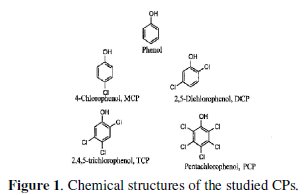
    <p><a href="#f1">Fig. 1</a> shows the chemical structure of the CPs studied in this work and the parent 
compound.</p>


    <p>&nbsp;</p>
<a name="f1">
<img src="/img/revistas/pea/v30n5/30n5a03f1.jpg">
    
<p>&nbsp;</p>


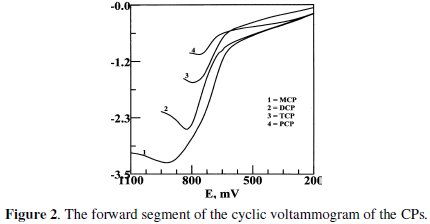
    <p><a href="#f2">Fig. 2</a> is the forward segment of the cyclic voltammogram of the CPs.</p>


    <p>&nbsp;</p>
<a name="f2">
<img src="/img/revistas/pea/v30n5/30n5a03f2.jpg">
    
<p>&nbsp;</p>


    <p>As can be seen in this figure, the peak potential and the peak current of the 
studied CPs are decreasing with an increase in the number of chlorine atoms in 
each congener. This observation is in accord with what is observed by other 
workers [22, 23].</p>

    ]]></body>
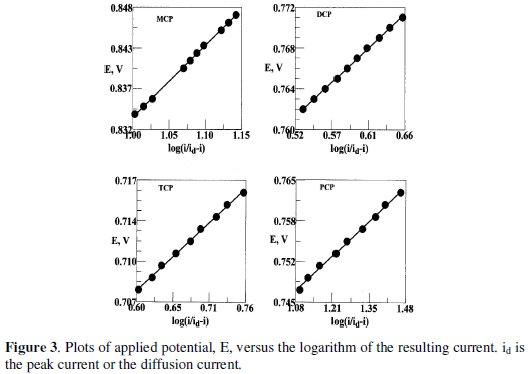
<body><![CDATA[<p>We show in <a href="#f3">Fig. 3</a> the usual electrochemical plot of applied potential, E versus 
log(i/id-i) for the respective congeners which were used in determining the 
requisite E<sub>1/2</sub> following the conventional electrochemical technique as given in 
<a href="#e1">equation 1</a>.</p>


    <p>&nbsp;</p>
<a name="f3">
<img src="/img/revistas/pea/v30n5/30n5a03f3.jpg">
    
<p>&nbsp;</p>
<a name="e1">
<img src="/img/revistas/pea/v30n5/30n5a03e1.jpg">
    
<p>&nbsp;</p>


    <p>In this equation R and T are the universal gas constant and temperature in Kelvin 
scale, respectively. &alpha;, n and F are the electron transfer coefficient, the number of 
electron(s) involved in the reaction and Faraday's constant, respectively. i is the 
observed current and id is the diffusion or peak current. The plots gave intercepts 
which were taken as E<sub>1/2</sub>.</p>

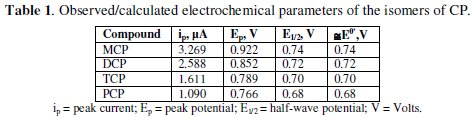
    <p><a href="#t1">Table 1</a> lists the observed peak potential, peak current and the E<sub>1/2</sub> of the 
respective congener of the CPs.</p>


    <p>&nbsp;</p>
<a name="t1">
<img src="/img/revistas/pea/v30n5/30n5a03t1.jpg">
    
<p>&nbsp;</p>


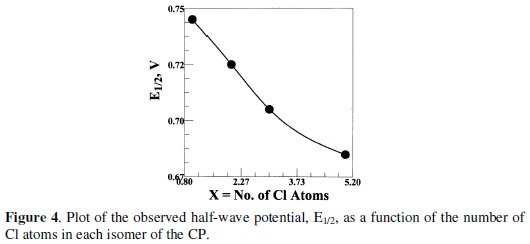
    <p>The observed parameters decrease as the number 
of chlorine atoms in the phenol is increased. A plot of E<sub>1/2</sub> versus the number of 
chlorine atoms is shown in <a href="#f4">Fig. 4</a>.</p>


    <p>&nbsp;</p>
<a name="f4">
<img src="/img/revistas/pea/v30n5/30n5a03f4.jpg">
    
]]></body>
<body><![CDATA[<p>&nbsp;</p>


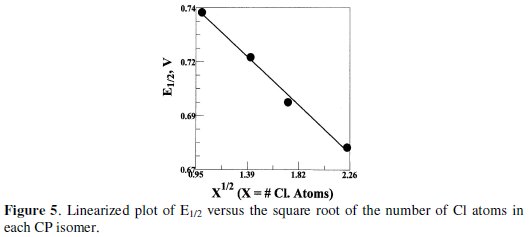
    <p>However, this plot is polynomial. We tried several mathematical equations that 
would be suitable to make the plot linear, in other make the data easy to interpret 
and its application easier and simpler. We found a good linearity between the 
E<sub>1/2</sub> of the respective congener with the square root of the chlorine atoms attached 
to phenol. Therefore, a plot of E<sub>1/2</sub> as a function of the square root of the number 
of chlorine atoms was made (<a href="#f5">Fig. 5</a>).</p>


    <p>&nbsp;</p>
<a name="f5">
<img src="/img/revistas/pea/v30n5/30n5a03f5.jpg">
    
<p>&nbsp;</p>


    <p>As can be seen, the plot is quite linear with 
the coefficient of determination, r<sup>2</sup>, of 0.9926 and a regression coefficient, r, of 
99.63 %. From this plot a useful mathematical relationship that describes the 
obtained E<sub>1/2</sub> of the CPs is:</p>


    <p>&nbsp;</p>
<a name="e2">
<img src="/img/revistas/pea/v30n5/30n5a03e2.jpg">
    
<p>&nbsp;</p>


    <p>The X in <a href="#e2">equation 2</a> is the number of chlorine atoms. The validity of this 
relationship can be substantiated by inserting zero for X. When this is done, the 
E<sub>1/2</sub> that is obtained in the CTAB solution is 0.79, which is the E<sub>1/2</sub> for phenol. 
This value, within an experimental error (uncertainty &pm; 0.054), is in agreement 
with what is observed by Yuan and his co-workers (0.799) [14] using the 
Multiple Linear Regression (MLR) program.</p> 

    <p>The obtained E<sub>1/2</sub> values of the CPs could be used to approximate their formal 
potential, E<sup>0'</sup>, in accordance with <a href="#e3">equation 3</a> [24]</p>


    <p>&nbsp;</p>
<a name="e3">
<img src="/img/revistas/pea/v30n5/30n5a03e3.jpg">
    
]]></body>
<body><![CDATA[<p>&nbsp;</p>


    <p>In this equation the ratio of the diffusion coefficient of the oxidized specie, D<sup>O</sup>, 
and the reduced species, D<sup>R</sup>, is usually unity and E<sub>1/2</sub> is then approximated to E<sup>0'</sup> 
[24]. The E<sup>0'</sup> thus calculated is also listed in <a href="#t1">Table 1</a>.</p>


    <p>&nbsp;</p>
    <p><b>Conclusion</b></p>

    <p>CPs, which are known to be toxic and potentially carcinogenic are insoluble in 
water, but are relatively soluble in surfactant medium. The surfactant used in this 
work is cetyltrimethylammonium bromide, CTAB. We have shown in this work 
that the half-wave potential, E<sub>1/2</sub>, of CPs obtained by cyclic voltammetry in this 
medium decreases with an increase in the number of chlorine atom(s) attached to 
the parent compound. A linear mathematical relationship between the observed 
E<sub>1/2</sub> of the chlorine content of each isomer of the studied CPs is given and the 
formal potential, E<sup>0'</sup>, of the CPs is consequently approximated in accordance with 
the literature.</p>


    <p>&nbsp;</p>
    <p><b>References</b></p>

    <!-- ref --><p>1. <a href="http://www.atsdr.cdc.gov/az/c.html" target="_blank">www.atsdr.cdc.gov/az/c.html</a>&nbsp;&nbsp;&nbsp;&nbsp;&nbsp;&nbsp;&nbsp;&nbsp;[&#160;<a href="javascript:void(0);" onclick="javascript: window.open('/scielo.php?script=sci_nlinks&ref=000060&pid=S0872-1904201200050000300001&lng=','','width=640,height=500,resizable=yes,scrollbars=1,menubar=yes,');">Links</a>&#160;]<!-- end-ref --><!-- ref --><p>2. US Environmental Protection Agency April 1979 National Recommended Water Quality Criteria - EPA 822-Z-99-001&nbsp;&nbsp;&nbsp;&nbsp;&nbsp;&nbsp;&nbsp;&nbsp;[&#160;<a href="javascript:void(0);" onclick="javascript: window.open('/scielo.php?script=sci_nlinks&ref=000061&pid=S0872-1904201200050000300002&lng=','','width=640,height=500,resizable=yes,scrollbars=1,menubar=yes,');">Links</a>&#160;]<!-- end-ref --><!-- ref --><p>3. Keith LH, Telliard WA. Env Sci Tech. 1979;13:416.    &nbsp;&nbsp;&nbsp;&nbsp;&nbsp;&nbsp;&nbsp;&nbsp;[&#160;<a href="javascript:void(0);" onclick="javascript: window.open('/scielo.php?script=sci_nlinks&ref=000062&pid=S0872-1904201200050000300003&lng=','','width=640,height=500,resizable=yes,scrollbars=1,menubar=yes,');">Links</a>&#160;]<!-- end-ref --></p>
    <!-- ref --><p>4. Lund H. Acta Chem Scand. 1957;11:1323.    &nbsp;&nbsp;&nbsp;&nbsp;&nbsp;&nbsp;&nbsp;&nbsp;[&#160;<a href="javascript:void(0);" onclick="javascript: window.open('/scielo.php?script=sci_nlinks&ref=000064&pid=S0872-1904201200050000300004&lng=','','width=640,height=500,resizable=yes,scrollbars=1,menubar=yes,');">Links</a>&#160;]<!-- end-ref --></p>
    <!-- ref --><p>5. Yang H, Hou H, Fan Y. Inorg Chimica Acta. 2009;362:2418&nbsp;&nbsp;&nbsp;&nbsp;&nbsp;&nbsp;&nbsp;&nbsp;[&#160;<a href="javascript:void(0);" onclick="javascript: window.open('/scielo.php?script=sci_nlinks&ref=000066&pid=S0872-1904201200050000300005&lng=','','width=640,height=500,resizable=yes,scrollbars=1,menubar=yes,');">Links</a>&#160;]<!-- end-ref --><!-- ref --><p>6. Elving PJ. IUPAC. 1963;7:423.    &nbsp;&nbsp;&nbsp;&nbsp;&nbsp;&nbsp;&nbsp;&nbsp;[&#160;<a href="javascript:void(0);" onclick="javascript: window.open('/scielo.php?script=sci_nlinks&ref=000067&pid=S0872-1904201200050000300006&lng=','','width=640,height=500,resizable=yes,scrollbars=1,menubar=yes,');">Links</a>&#160;]<!-- end-ref --></p>
    <!-- ref --><p>7. Zutshi K. Introduction to Polarography and Allied Techniques. India: New Age International; 2006.    &nbsp;&nbsp;&nbsp;&nbsp;&nbsp;&nbsp;&nbsp;&nbsp;[&#160;<a href="javascript:void(0);" onclick="javascript: window.open('/scielo.php?script=sci_nlinks&ref=000069&pid=S0872-1904201200050000300007&lng=','','width=640,height=500,resizable=yes,scrollbars=1,menubar=yes,');">Links</a>&#160;]<!-- end-ref --></p>
    <p>8. Terashima C, Rao TN, Saarada BV, Tryk DA, Fujishima A. Anal Chem 2002;74:895.</p>
    <!-- ref --><p>9. Peeters K, De Wael K, Bogaert D, Adriens A. Sens Actuat B 2008;128:494.    &nbsp;&nbsp;&nbsp;&nbsp;&nbsp;&nbsp;&nbsp;&nbsp;[&#160;<a href="javascript:void(0);" onclick="javascript: window.open('/scielo.php?script=sci_nlinks&ref=000072&pid=S0872-1904201200050000300009&lng=','','width=640,height=500,resizable=yes,scrollbars=1,menubar=yes,');">Links</a>&#160;]<!-- end-ref --></p>
    <!-- ref --><p>10. Sorrells CA, Shaikh AU, Samokyszyn VM. J Arkansas Acad Sci. 2002;56:169.    &nbsp;&nbsp;&nbsp;&nbsp;&nbsp;&nbsp;&nbsp;&nbsp;[&#160;<a href="javascript:void(0);" onclick="javascript: window.open('/scielo.php?script=sci_nlinks&ref=000074&pid=S0872-1904201200050000300010&lng=','','width=640,height=500,resizable=yes,scrollbars=1,menubar=yes,');">Links</a>&#160;]<!-- end-ref --></p>
    <!-- ref --><p>11. Rodgers JD, Jedral W, Bunce NJ. Env Sci Technol. 1999;33:1453.    &nbsp;&nbsp;&nbsp;&nbsp;&nbsp;&nbsp;&nbsp;&nbsp;[&#160;<a href="javascript:void(0);" onclick="javascript: window.open('/scielo.php?script=sci_nlinks&ref=000076&pid=S0872-1904201200050000300011&lng=','','width=640,height=500,resizable=yes,scrollbars=1,menubar=yes,');">Links</a>&#160;]<!-- end-ref --></p>
    <p>12. Liu H, Wen Y, Luan F, Gao Y, Li X. Eur J Chem. 2009;7031:439.</p>
    <p>13. Yuan S, Xiao M, Zheng G, Tian M, Lu X. SAR QSAR Environ.. Res. 2006;17:473.</p>
    <!-- ref --><p>14. Engineering Science Paper Quantitative Structure Property Relationship and Its Application in Capillary Electrophoresis. <a href="http://www.engpapers.com/66924.html" target="_blank">www.engpapers.com/66924.html</a>; 2012.    &nbsp;&nbsp;&nbsp;&nbsp;&nbsp;&nbsp;&nbsp;&nbsp;[&#160;<a href="javascript:void(0);" onclick="javascript: window.open('/scielo.php?script=sci_nlinks&ref=000080&pid=S0872-1904201200050000300014&lng=','','width=640,height=500,resizable=yes,scrollbars=1,menubar=yes,');">Links</a>&#160;]<!-- end-ref --></p>
    <!-- ref --><p>15. Chen YM, Guo LH. J Env Sci. 2009;21:373.    &nbsp;&nbsp;&nbsp;&nbsp;&nbsp;&nbsp;&nbsp;&nbsp;[&#160;<a href="javascript:void(0);" onclick="javascript: window.open('/scielo.php?script=sci_nlinks&ref=000082&pid=S0872-1904201200050000300015&lng=','','width=640,height=500,resizable=yes,scrollbars=1,menubar=yes,');">Links</a>&#160;]<!-- end-ref --></p>
    <!-- ref --><p>16. Loutfy RO, Loutfy RO. Can J Chem. 1976;54:1454.    &nbsp;&nbsp;&nbsp;&nbsp;&nbsp;&nbsp;&nbsp;&nbsp;[&#160;<a href="javascript:void(0);" onclick="javascript: window.open('/scielo.php?script=sci_nlinks&ref=000084&pid=S0872-1904201200050000300016&lng=','','width=640,height=500,resizable=yes,scrollbars=1,menubar=yes,');">Links</a>&#160;]<!-- end-ref --></p>
    <!-- ref --><p>17. Ruoff RS, Kadish KM, Boulas P, Chen ECM. J Phys Chem. 1995;99:8843.    &nbsp;&nbsp;&nbsp;&nbsp;&nbsp;&nbsp;&nbsp;&nbsp;[&#160;<a href="javascript:void(0);" onclick="javascript: window.open('/scielo.php?script=sci_nlinks&ref=000086&pid=S0872-1904201200050000300017&lng=','','width=640,height=500,resizable=yes,scrollbars=1,menubar=yes,');">Links</a>&#160;]<!-- end-ref --></p>
    <!-- ref --><p>18. Loutfy RO, Loutfy RO. J Phys Chem. 1972;76:1650.    &nbsp;&nbsp;&nbsp;&nbsp;&nbsp;&nbsp;&nbsp;&nbsp;[&#160;<a href="javascript:void(0);" onclick="javascript: window.open('/scielo.php?script=sci_nlinks&ref=000088&pid=S0872-1904201200050000300018&lng=','','width=640,height=500,resizable=yes,scrollbars=1,menubar=yes,');">Links</a>&#160;]<!-- end-ref --></p>
    <!-- ref --><p>19. Mohammadhosseini M, Nekoei M. 6th Annual Seminar of Electrochemistry of Iran Kish International Convention Center; 2009 Oct 9-11: Iran.    &nbsp;&nbsp;&nbsp;&nbsp;&nbsp;&nbsp;&nbsp;&nbsp;[&#160;<a href="javascript:void(0);" onclick="javascript: window.open('/scielo.php?script=sci_nlinks&ref=000090&pid=S0872-1904201200050000300019&lng=','','width=640,height=500,resizable=yes,scrollbars=1,menubar=yes,');">Links</a>&#160;]<!-- end-ref --></p>
    <!-- ref --><p>20. Nekoei M, Kohammadhosseini M, Gharahbagh AA. Anal Bioanal Electrochem. 2009;1:159.    &nbsp;&nbsp;&nbsp;&nbsp;&nbsp;&nbsp;&nbsp;&nbsp;[&#160;<a href="javascript:void(0);" onclick="javascript: window.open('/scielo.php?script=sci_nlinks&ref=000092&pid=S0872-1904201200050000300020&lng=','','width=640,height=500,resizable=yes,scrollbars=1,menubar=yes,');">Links</a>&#160;]<!-- end-ref --></p>
    <!-- ref --><p>21. Peng Y, He S, Wang J, Gong W. Radiation Phys Chem. 2012;81:1629.    &nbsp;&nbsp;&nbsp;&nbsp;&nbsp;&nbsp;&nbsp;&nbsp;[&#160;<a href="javascript:void(0);" onclick="javascript: window.open('/scielo.php?script=sci_nlinks&ref=000094&pid=S0872-1904201200050000300021&lng=','','width=640,height=500,resizable=yes,scrollbars=1,menubar=yes,');">Links</a>&#160;]<!-- end-ref --></p>
    <!-- ref --><p>22. Schmid S, Krajnik P, Quint RM, Solar S. Radiat. Phys. Chem. 1997;50:493.    &nbsp;&nbsp;&nbsp;&nbsp;&nbsp;&nbsp;&nbsp;&nbsp;[&#160;<a href="javascript:void(0);" onclick="javascript: window.open('/scielo.php?script=sci_nlinks&ref=000096&pid=S0872-1904201200050000300022&lng=','','width=640,height=500,resizable=yes,scrollbars=1,menubar=yes,');">Links</a>&#160;]<!-- end-ref --></p>
    <!-- ref --><p>23. Ezerskis Z, Jusys Z. Pure Appl Chem. 2001;73:1929.    &nbsp;&nbsp;&nbsp;&nbsp;&nbsp;&nbsp;&nbsp;&nbsp;[&#160;<a href="javascript:void(0);" onclick="javascript: window.open('/scielo.php?script=sci_nlinks&ref=000098&pid=S0872-1904201200050000300023&lng=','','width=640,height=500,resizable=yes,scrollbars=1,menubar=yes,');">Links</a>&#160;]<!-- end-ref --></p>
    <!-- ref --><p>24. Bard AJ, Faulkner LR. Electrochemical Methods: Fundamentals and Applications. 2nd ed. New York: John Wiley & Son; 2001.    &nbsp;&nbsp;&nbsp;&nbsp;&nbsp;&nbsp;&nbsp;&nbsp;[&#160;<a href="javascript:void(0);" onclick="javascript: window.open('/scielo.php?script=sci_nlinks&ref=000100&pid=S0872-1904201200050000300024&lng=','','width=640,height=500,resizable=yes,scrollbars=1,menubar=yes,');">Links</a>&#160;]<!-- end-ref --></p>


    <p>&nbsp;</p>
    ]]></body>
<body><![CDATA[<p><b>Acknowledgements</b></p>

    <p>The authors are grateful to the chemistry department of Morgan State University for 
support for this work.</p>


    <p>&nbsp;</p>
    <p><a name=0></a><sup><a href="#top">*</a></sup>Corresponding author. E-mail address: <a href="mailto:maurice.iwunze@morgan.edu">maurice.iwunze@morgan.edu</a></p>

    <p>Received 22 October 2012; accepted 31 October 2012</p>

    <p><a href="http://www.peacta.org" target="_blank">www.peacta.org</a> </p>


     ]]></body><back>
<ref-list>
<ref id="B1">
<label>1</label><nlm-citation citation-type="">
<source><![CDATA[]]></source>
<year></year>
</nlm-citation>
</ref>
<ref id="B2">
<label>2</label><nlm-citation citation-type="">
<collab>US Environmental Protection Agency</collab>
<source><![CDATA[National Recommended Water Quality Criteria]]></source>
<year>Apri</year>
<month>l </month>
<day>19</day>
</nlm-citation>
</ref>
<ref id="B3">
<label>3</label><nlm-citation citation-type="journal">
<person-group person-group-type="author">
<name>
<surname><![CDATA[Keith]]></surname>
<given-names><![CDATA[LH]]></given-names>
</name>
<name>
<surname><![CDATA[Telliard]]></surname>
<given-names><![CDATA[WA]]></given-names>
</name>
</person-group>
<source><![CDATA[Env Sci Tech]]></source>
<year>1979</year>
<volume>13</volume>
<page-range>416</page-range></nlm-citation>
</ref>
<ref id="B4">
<label>4</label><nlm-citation citation-type="journal">
<person-group person-group-type="author">
<name>
<surname><![CDATA[Lund]]></surname>
<given-names><![CDATA[H]]></given-names>
</name>
</person-group>
<source><![CDATA[Acta Chem Scand]]></source>
<year>1957</year>
<volume>11</volume>
<page-range>1323</page-range></nlm-citation>
</ref>
<ref id="B5">
<label>5</label><nlm-citation citation-type="journal">
<person-group person-group-type="author">
<name>
<surname><![CDATA[Yang]]></surname>
<given-names><![CDATA[H]]></given-names>
</name>
<name>
<surname><![CDATA[Hou]]></surname>
<given-names><![CDATA[H]]></given-names>
</name>
<name>
<surname><![CDATA[Fan]]></surname>
<given-names><![CDATA[Y]]></given-names>
</name>
</person-group>
<source><![CDATA[Inorg Chimica Acta]]></source>
<year>2009</year>
<volume>362</volume>
<page-range>2418</page-range></nlm-citation>
</ref>
<ref id="B6">
<label>6</label><nlm-citation citation-type="journal">
<person-group person-group-type="author">
<name>
<surname><![CDATA[Elving]]></surname>
<given-names><![CDATA[PJ]]></given-names>
</name>
</person-group>
<source><![CDATA[IUPAC]]></source>
<year>1963</year>
<volume>7</volume>
<page-range>423</page-range></nlm-citation>
</ref>
<ref id="B7">
<label>7</label><nlm-citation citation-type="book">
<person-group person-group-type="author">
<name>
<surname><![CDATA[Zutshi]]></surname>
<given-names><![CDATA[K]]></given-names>
</name>
</person-group>
<source><![CDATA[Introduction to Polarography and Allied Techniques]]></source>
<year>2006</year>
<publisher-name><![CDATA[New Age International]]></publisher-name>
</nlm-citation>
</ref>
<ref id="B8">
<label>8</label><nlm-citation citation-type="journal">
<person-group person-group-type="author">
<name>
<surname><![CDATA[Terashima]]></surname>
<given-names><![CDATA[C]]></given-names>
</name>
<name>
<surname><![CDATA[Rao]]></surname>
<given-names><![CDATA[TN]]></given-names>
</name>
<name>
<surname><![CDATA[Saarada]]></surname>
<given-names><![CDATA[BV]]></given-names>
</name>
</person-group>
<source><![CDATA[Anal Chem]]></source>
<year>2002</year>
<volume>74</volume>
<page-range>895</page-range></nlm-citation>
</ref>
<ref id="B9">
<label>9</label><nlm-citation citation-type="journal">
<person-group person-group-type="author">
<name>
<surname><![CDATA[Peeters]]></surname>
<given-names><![CDATA[K]]></given-names>
</name>
<name>
<surname><![CDATA[De Wael]]></surname>
<given-names><![CDATA[K]]></given-names>
</name>
<name>
<surname><![CDATA[Bogaert]]></surname>
<given-names><![CDATA[D]]></given-names>
</name>
<name>
<surname><![CDATA[Adriens]]></surname>
<given-names><![CDATA[A]]></given-names>
</name>
</person-group>
<source><![CDATA[Sens Actuat B]]></source>
<year>2008</year>
<volume>128</volume>
<page-range>494</page-range></nlm-citation>
</ref>
<ref id="B10">
<label>10</label><nlm-citation citation-type="journal">
<person-group person-group-type="author">
<name>
<surname><![CDATA[Sorrells]]></surname>
<given-names><![CDATA[CA]]></given-names>
</name>
<name>
<surname><![CDATA[Shaikh]]></surname>
<given-names><![CDATA[AU]]></given-names>
</name>
<name>
<surname><![CDATA[Samokyszyn]]></surname>
<given-names><![CDATA[VM]]></given-names>
</name>
</person-group>
<source><![CDATA[J Arkansas Acad Sci]]></source>
<year>2002</year>
<volume>56</volume>
<page-range>169</page-range></nlm-citation>
</ref>
<ref id="B11">
<label>11</label><nlm-citation citation-type="journal">
<person-group person-group-type="author">
<name>
<surname><![CDATA[Rodgers]]></surname>
<given-names><![CDATA[JD]]></given-names>
</name>
<name>
<surname><![CDATA[Jedral]]></surname>
<given-names><![CDATA[W]]></given-names>
</name>
<name>
<surname><![CDATA[Bunce]]></surname>
<given-names><![CDATA[NJ]]></given-names>
</name>
</person-group>
<source><![CDATA[Env Sci Technol]]></source>
<year>1999</year>
<volume>33</volume>
<page-range>1453</page-range></nlm-citation>
</ref>
<ref id="B12">
<label>12</label><nlm-citation citation-type="journal">
<person-group person-group-type="author">
<name>
<surname><![CDATA[Liu]]></surname>
<given-names><![CDATA[H]]></given-names>
</name>
<name>
<surname><![CDATA[Wen]]></surname>
<given-names><![CDATA[Y]]></given-names>
</name>
<name>
<surname><![CDATA[Luan]]></surname>
<given-names><![CDATA[F]]></given-names>
</name>
</person-group>
<source><![CDATA[Eur J Chem]]></source>
<year>2009</year>
<volume>7031</volume>
<page-range>439</page-range></nlm-citation>
</ref>
<ref id="B13">
<label>13</label><nlm-citation citation-type="journal">
<person-group person-group-type="author">
<name>
<surname><![CDATA[Yuan]]></surname>
<given-names><![CDATA[S]]></given-names>
</name>
<name>
<surname><![CDATA[Xiao]]></surname>
<given-names><![CDATA[M]]></given-names>
</name>
<name>
<surname><![CDATA[Zheng]]></surname>
<given-names><![CDATA[G]]></given-names>
</name>
</person-group>
<source><![CDATA[Environ Res]]></source>
<year>2006</year>
<volume>17</volume>
<page-range>473</page-range></nlm-citation>
</ref>
<ref id="B14">
<label>14</label><nlm-citation citation-type="">
<source><![CDATA[Engineering Science Paper Quantitative Structure Property Relationship and Its Application in Capillary Electrophoresis]]></source>
<year>2012</year>
</nlm-citation>
</ref>
<ref id="B15">
<label>15</label><nlm-citation citation-type="journal">
<person-group person-group-type="author">
<name>
<surname><![CDATA[Chen]]></surname>
<given-names><![CDATA[YM]]></given-names>
</name>
<name>
<surname><![CDATA[Guo]]></surname>
<given-names><![CDATA[LH]]></given-names>
</name>
</person-group>
<source><![CDATA[J Env Sci]]></source>
<year>2009</year>
<volume>21</volume>
<page-range>373</page-range></nlm-citation>
</ref>
<ref id="B16">
<label>16</label><nlm-citation citation-type="journal">
<person-group person-group-type="author">
<name>
<surname><![CDATA[Loutfy]]></surname>
<given-names><![CDATA[RO]]></given-names>
</name>
<name>
<surname><![CDATA[Loutfy]]></surname>
<given-names><![CDATA[RO]]></given-names>
</name>
</person-group>
<source><![CDATA[Can J Chem]]></source>
<year>1976</year>
<volume>54</volume>
<page-range>1454</page-range></nlm-citation>
</ref>
<ref id="B17">
<label>17</label><nlm-citation citation-type="journal">
<person-group person-group-type="author">
<name>
<surname><![CDATA[Ruoff]]></surname>
<given-names><![CDATA[RS]]></given-names>
</name>
<name>
<surname><![CDATA[Kadish]]></surname>
<given-names><![CDATA[KM]]></given-names>
</name>
<name>
<surname><![CDATA[Boulas]]></surname>
<given-names><![CDATA[P]]></given-names>
</name>
<name>
<surname><![CDATA[Chen]]></surname>
<given-names><![CDATA[ECM]]></given-names>
</name>
</person-group>
<source><![CDATA[J Phys Chem]]></source>
<year>1995</year>
<volume>99</volume>
<page-range>8843</page-range></nlm-citation>
</ref>
<ref id="B18">
<label>18</label><nlm-citation citation-type="journal">
<person-group person-group-type="author">
<name>
<surname><![CDATA[Loutfy]]></surname>
<given-names><![CDATA[RO]]></given-names>
</name>
<name>
<surname><![CDATA[Loutfy]]></surname>
<given-names><![CDATA[RO]]></given-names>
</name>
</person-group>
<source><![CDATA[J Phys Chem]]></source>
<year>1972</year>
<volume>76</volume>
<page-range>1650</page-range></nlm-citation>
</ref>
<ref id="B19">
<label>19</label><nlm-citation citation-type="confpro">
<person-group person-group-type="author">
<name>
<surname><![CDATA[Mohammadhosseini]]></surname>
<given-names><![CDATA[M]]></given-names>
</name>
<name>
<surname><![CDATA[Nekoei]]></surname>
<given-names><![CDATA[M]]></given-names>
</name>
</person-group>
<source><![CDATA[]]></source>
<year></year>
<conf-name><![CDATA[6th Annual Seminar of Electrochemistry of Iran]]></conf-name>
<conf-date>2009 Oct 9-11</conf-date>
<conf-loc> </conf-loc>
</nlm-citation>
</ref>
<ref id="B20">
<label>20</label><nlm-citation citation-type="journal">
<person-group person-group-type="author">
<name>
<surname><![CDATA[Nekoei]]></surname>
<given-names><![CDATA[M]]></given-names>
</name>
<name>
<surname><![CDATA[Kohammadhosseini]]></surname>
<given-names><![CDATA[M]]></given-names>
</name>
<name>
<surname><![CDATA[Gharahbagh]]></surname>
<given-names><![CDATA[AA]]></given-names>
</name>
</person-group>
<source><![CDATA[Anal Bioanal Electrochem]]></source>
<year>2009</year>
<volume>1</volume>
<page-range>159</page-range></nlm-citation>
</ref>
<ref id="B21">
<label>21</label><nlm-citation citation-type="journal">
<person-group person-group-type="author">
<name>
<surname><![CDATA[Peng]]></surname>
<given-names><![CDATA[Y]]></given-names>
</name>
<name>
<surname><![CDATA[He]]></surname>
<given-names><![CDATA[S]]></given-names>
</name>
<name>
<surname><![CDATA[Wang]]></surname>
<given-names><![CDATA[J]]></given-names>
</name>
<name>
<surname><![CDATA[Gong]]></surname>
<given-names><![CDATA[W]]></given-names>
</name>
</person-group>
<source><![CDATA[Radiation Phys Chem]]></source>
<year>2012</year>
<volume>81</volume>
<page-range>1629</page-range></nlm-citation>
</ref>
<ref id="B22">
<label>22</label><nlm-citation citation-type="journal">
<person-group person-group-type="author">
<name>
<surname><![CDATA[Schmid]]></surname>
<given-names><![CDATA[S]]></given-names>
</name>
<name>
<surname><![CDATA[Krajnik]]></surname>
<given-names><![CDATA[P]]></given-names>
</name>
<name>
<surname><![CDATA[Quint]]></surname>
<given-names><![CDATA[RM]]></given-names>
</name>
<name>
<surname><![CDATA[Solar]]></surname>
<given-names><![CDATA[S]]></given-names>
</name>
</person-group>
<source><![CDATA[Radiat Phys Chem]]></source>
<year>1997</year>
<volume>50</volume>
<page-range>493</page-range></nlm-citation>
</ref>
<ref id="B23">
<label>23</label><nlm-citation citation-type="journal">
<person-group person-group-type="author">
<name>
<surname><![CDATA[Ezerskis]]></surname>
<given-names><![CDATA[Z]]></given-names>
</name>
<name>
<surname><![CDATA[Jusys]]></surname>
<given-names><![CDATA[Z]]></given-names>
</name>
</person-group>
<source><![CDATA[Pure Appl Chem]]></source>
<year>2001</year>
<volume>73</volume>
<page-range>1929</page-range></nlm-citation>
</ref>
<ref id="B24">
<label>24</label><nlm-citation citation-type="book">
<person-group person-group-type="author">
<name>
<surname><![CDATA[Bard]]></surname>
<given-names><![CDATA[AJ]]></given-names>
</name>
<name>
<surname><![CDATA[Faulkner]]></surname>
<given-names><![CDATA[LR.]]></given-names>
</name>
</person-group>
<source><![CDATA[Electrochemical Methods: Fundamentals and Applications]]></source>
<year>2001</year>
<edition>2nd</edition>
<publisher-loc><![CDATA[New York ]]></publisher-loc>
<publisher-name><![CDATA[John Wiley & Son]]></publisher-name>
</nlm-citation>
</ref>
</ref-list>
</back>
</article>