<?xml version="1.0" encoding="ISO-8859-1"?><article xmlns:mml="http://www.w3.org/1998/Math/MathML" xmlns:xlink="http://www.w3.org/1999/xlink" xmlns:xsi="http://www.w3.org/2001/XMLSchema-instance">
<front>
<journal-meta>
<journal-id>0872-1904</journal-id>
<journal-title><![CDATA[Portugaliae Electrochimica Acta]]></journal-title>
<abbrev-journal-title><![CDATA[Port. Electrochim. Acta]]></abbrev-journal-title>
<issn>0872-1904</issn>
<publisher>
<publisher-name><![CDATA[Sociedade Portuguesa de Electroquímica]]></publisher-name>
</publisher>
</journal-meta>
<article-meta>
<article-id>S0872-19042012000500004</article-id>
<article-id pub-id-type="doi">10.4152/pea.201205335</article-id>
<title-group>
<article-title xml:lang="en"><![CDATA[Comparative Study of Different Plasticized Membrane Electrodes for the Stability-indicative Determination of Torsemide]]></article-title>
</title-group>
<contrib-group>
<contrib contrib-type="author">
<name>
<surname><![CDATA[Zaazaa]]></surname>
<given-names><![CDATA[H.E.]]></given-names>
</name>
<xref ref-type="aff" rid="A01"/>
</contrib>
<contrib contrib-type="author">
<name>
<surname><![CDATA[Abbas]]></surname>
<given-names><![CDATA[S.S.]]></given-names>
</name>
<xref ref-type="aff" rid="A01"/>
</contrib>
<contrib contrib-type="author">
<name>
<surname><![CDATA[Essam]]></surname>
<given-names><![CDATA[Hebat A.M.]]></given-names>
</name>
<xref ref-type="aff" rid="A01"/>
</contrib>
<contrib contrib-type="author">
<name>
<surname><![CDATA[El-Bardicy]]></surname>
<given-names><![CDATA[M. G.]]></given-names>
</name>
<xref ref-type="aff" rid="A01"/>
</contrib>
</contrib-group>
<aff id="A01">
<institution><![CDATA[,Cairo University Faculty of Pharmacy Analytical Chemistry Department]]></institution>
<addr-line><![CDATA[Cairo ]]></addr-line>
<country>Egypt</country>
</aff>
<pub-date pub-type="pub">
<day>00</day>
<month>09</month>
<year>2012</year>
</pub-date>
<pub-date pub-type="epub">
<day>00</day>
<month>09</month>
<year>2012</year>
</pub-date>
<volume>30</volume>
<numero>5</numero>
<fpage>335</fpage>
<lpage>350</lpage>
<copyright-statement/>
<copyright-year/>
<self-uri xlink:href="http://scielo.pt/scielo.php?script=sci_arttext&amp;pid=S0872-19042012000500004&amp;lng=en&amp;nrm=iso"></self-uri><self-uri xlink:href="http://scielo.pt/scielo.php?script=sci_abstract&amp;pid=S0872-19042012000500004&amp;lng=en&amp;nrm=iso"></self-uri><self-uri xlink:href="http://scielo.pt/scielo.php?script=sci_pdf&amp;pid=S0872-19042012000500004&amp;lng=en&amp;nrm=iso"></self-uri><abstract abstract-type="short" xml:lang="en"><p><![CDATA[Four torsemide-selective electrodes all on solid state graphite support were developed and characterized in polyvinylchloride matrices. Precipitation-based technique with tetraphenylborate (TPB) as an electroactive material in polyvinylchloride (PVC) matrix was used for sensor 1 fabrication without incorporation of an ionophore. 2hydroxypropyl- &#946;-cyclodextrin (HP-&#946;-CD) based technique with tetraphenylborate and either dioctyl phatalate (DOP), dibutyl sebasate (DBS) or 2-nitrophenyl octyl ether (o- NPOE) as plastisizer in carboxylated polyvinylchloride (PVC-COOH) matrix were used for sensor 2, 3 and 4 fabrications, respectively. Fast and stable Nernstian responses were evaluated according to IUPAC recommendations in the concentration ranges from 1 × 10⁻⁵ to 1 × 10⁻³ M for sensor 1 , from 1 × 10⁻⁵ to 1 × 10⁻² M for sensor 2, from 1 × 10⁻⁶ to 1 × 10⁻⁴ M for sensor 3, and from 1 × 10⁻⁶ to 1 × 10⁻³ M for sensor 4. The sensors show good selectivity to the drug in presence of a variety of inorganic and organic interferents including acid degradation product of torsemide, related substances and pharmaceutical excipients. Validation of the method showed the suitability of the proposed electrodes for the use in the quality control assessment of the drug. Furthermore, statistical comparison between the results obtained by the proposed method and the official method of the drug was performed and no significant difference was found.]]></p></abstract>
<kwd-group>
<kwd lng="en"><![CDATA[Torsemide-selective electrode]]></kwd>
<kwd lng="en"><![CDATA[graphite electrode]]></kwd>
<kwd lng="en"><![CDATA[2-hydroxy propyl-&#946;cyclodextrin]]></kwd>
<kwd lng="en"><![CDATA[stability indicating study]]></kwd>
<kwd lng="en"><![CDATA[pharmaceutical dosage form]]></kwd>
</kwd-group>
</article-meta>
</front><body><![CDATA[ 

    <p><b>Comparative Study of Different Plasticized Membrane Electrodes for the Stability-indicative Determination of Torsemide</b></p>

    <p><b>H.E. Zaazaa, S.S. Abbas, Hebat A.M. Essam<sup><a href="#0">*<a/></sup> and M. G. El-Bardicy</b></p>

    <p><i> Analytical Chemistry Department, Faculty of Pharmacy-Cairo University, Kasr El-Aini Street, 11562 Cairo, Egypt</i></p>


<!--     <p>&nbsp;</p>
    <p>doi: 10.4152/pea.201205335</p> -->


    <p>&nbsp;</p>
    <p><b>Abstract</b></p>

    <p>Four torsemide-selective electrodes all on solid state graphite support were developed 
and characterized in polyvinylchloride matrices. Precipitation-based technique with 
tetraphenylborate (TPB) as an electroactive material in polyvinylchloride (PVC) matrix 
was used for sensor 1 fabrication without incorporation of an ionophore. 2hydroxypropyl-
&beta;-cyclodextrin (HP-&beta;-CD) based technique with tetraphenylborate and 
either dioctyl phatalate (DOP), dibutyl sebasate (DBS) or 2-nitrophenyl octyl ether (o-
NPOE) as plastisizer in carboxylated polyvinylchloride (PVC-COOH) matrix were 
used for sensor 2, 3 and 4 fabrications, respectively. Fast and stable Nernstian responses 
were evaluated according to IUPAC recommendations in the concentration ranges from 
1 &times; 10<sup>-5</sup> to 1 &times; 10<sup>-3</sup> M for sensor 1 , 
from 1 &times; 10<sup>-5</sup> to 1 &times; 10<sup>-2</sup> M for sensor 2, from 1 &times; 10<sup>-6</sup> to 
1 &times; 10<sup>-4</sup> M for sensor 3, and from 1 &times; 10<sup>-6</sup> to 1 &times; 10<sup>-3</sup> M for sensor 4. The sensors show 
good selectivity to the drug in presence of a variety of inorganic and organic interferents 
including acid degradation product of torsemide, related substances and pharmaceutical 
excipients. Validation of the method showed the suitability of the proposed electrodes 
for the use in the quality control assessment of the drug.</p>
 
    <p>Furthermore, statistical comparison between the results obtained by the proposed 
method and the official method of the drug was performed and no significant difference 
was found.</p>

    ]]></body>
<body><![CDATA[<p><b><i>Keywords:</i></b> Torsemide-selective electrode; graphite electrode; 2-hydroxy propyl-&beta;cyclodextrin; stability indicating study; pharmaceutical dosage form.</p>


    <p>&nbsp;</p>
    <p><b>Introduction</b></p>

    <p>Torsemide (TOR) is a sulfonylurea derivative, used as a loop diuretic, for 
treatment of oedema associated with heart failure, renal and hepatic disorders, 
also used in the treatment of hypertension, either alone or with other 
antihypertensives [1]. Chemically it is N-[{(1 methylethyl) amino} carbonyl]-4[(
3-methylphenyl) amino]-3-pyridinesulfonamide [2]. Torsemide was determined 
by pharmacopeial and non pharmacopeial methods where it is assayed in the 
British pharmacopoeia via non-aqueous titration [3], while assayed in the USP 
pharmacopeia by HPLC method [4]. The non pharmacopeial methods used for 
determination of TOR include HPLC [5-15], LC/MS [6-21], GC/MS [22, 23], 
CZE [24], spectrophotometry [25-29], multivariate optimization of CZE [30], 
voltammetric determination using carbon past electrode [31] and dropping Hg 
electrode [32] and TLC-densitometry [33]. Stability-indicating HPTLC [34] and 
HPLC [35] methods for analysis of TOR has been recently reported.</p>

    <p>Modern techniques based on material transport across a specific membrane as ion 
selective electrodes (ISEs) are now widely used in the determination of trace 
amounts of analytes as well as drugs in pure form and pharmaceutical dosage 
forms [36]. The material transport includes both neutral and charged complex 
species, and simple ions [37, 38]. The high selectivity of these electrodes imparts 
a great advantage over other techniques [39]. Analytes in colored, turbid or 
viscous samples can be determined accurately. They show rapid responses to 
changes in the concentration. Furthermore, they may be used for measurement 
over a wide concentration range. ISEs are generally tolerant of small pH changes. 
A further advantage is that they are relatively cheap and simple to develop, set up 
and run with no need for sophisticated apparatus compared with other published 
TLC or HPLC methods. Moreover, the chemical design of the electrodes has 
been developed to give superior selectivity and response [40]. The scientific 
novelty of this work is the use of ISEs which has several advantages for the 
determination of TOR in the presence of its degradation products in powder 
form, laboratory prepared mixtures and in pharmaceutical formulation.</p>


    <p>&nbsp;</p>
    <p><b>Experimental</b></p>

    <p><b><i>Instruments</i></b></p>

    <p>Jenway digital ion analyzer model 3330 (UK) with Ag/AgCl double junction 
reference electrode No. Z113107-1EAPW (Aldrich Chemical Co.) was used. The 
influence of pH on the response of the electrodes was studied using a pH glass 
electrode Jenway (Jenway, UK) No. 924005-BO3-Q11C. The determination of 
the samples occurred using a Magnetic stirrer, Bandelin Sonorox, Rx510S 
(Budapest,Hungaria).</p>


    <p>&nbsp;</p>
    ]]></body>
<body><![CDATA[<p><b><i>Materials and reagents</i></b></p>

    <p><i>Pure standard</i></p>

    <p>Standard TOR was kindly supplied by Multi-Apex pharma, Badr City, Cairo, 
Egypt. It was assayed for its purity according to the USP method [4] and found to 
contain 99.77%.</p>


    <p><i>Pharmaceutical formulation</i></p>

    <p>Examide&reg; tablets, manufactured by Multi-Apex pharma, Badr City, Cairo, Egypt. 
Batch No. 1230311 & 1240311, labelled to contain 10 & 20 mg of torsemide/ 
tablet, respectively.</p>


    <p><i>Degraded sample</i></p>

    <p>Accelerated acid-degradation was performed by dissolving 25 mg of pure TOR 
powder in 25 mL of 2 N hydrochloric acid, then the solution was refluxed for 4 
hrs. The solution was neutralized to pH 7.0 by 2 N sodium hydroxide and 
complete degradation was followed by TLC using acetone-chloroform-ethyl 
acetate (40: 40: 20, by volume) as developing system. The neutralized solution 
was evaporated under vacuum nearly to dryness, then the degradation product 
was re-crystallized from methanol. The obtained degradation product was 
elucidated and confirmed by IR and mass spectrometry.</p>


    <p>&nbsp;</p>
    <p><b><i>Chemicals and reagents</i></b></p>

    <p>All chemicals and solvents used were of analytical grade (double-distilled water 
was used).</p>
 
    ]]></body>
<body><![CDATA[<p>Polyvinylchloride (PVC), high molecular weight, polyvinylchloride carboxylated 
(PVC-COOH) and 2-hydroxypropyl-&beta;-cyclodextrin (HP-&beta;-CD) were purchased 
from Fluka chemie (GmbH Germany). Tetrahydrofuran (THF) was purchased 
from BDH (limited Poole, England), while 2-nitrophenyl octyl ether (o-NPOE), 
dioctyl phthalate (DOP), dibutyl sebasate (DBS) and tetraphenylborate (TPB) 
were from Sigma/Aldrich (St.Louis, MO). Sodium hydroxide, 2 M aqueous 
solution and hydrochloric acid, 2 M aqueous solution, were prepared and 
obtained from Prolabo (VWR International, West Chester, PA). Also, Britton-
Robinson buffer (BRB) (pH 2-11) [41] was prepared by mixing different 
volumes of 0.04 M acetic acid, 0.04 M phosphoric acid, 0.04 M boric acid and 
0.2 M sodium hydroxide.</p>


    <p><i>Standard solutions</i></p>

    <p>(a) Torsemide stock solution (1 &times; 10<sup>-1</sup> M). It was freshly prepared daily by 
transferring 3.48 g of TOR into a 100-mL volumetric flask, then dissolving 
in 90-mL double-distilled water; 0.4-mL of concentrated HCl were added till 
clear solution and the volume was completed with water. The stability of the 
prepared solution was studied, and it has been found to be stable with no 
apparent degradation at least for 24 h at 25 &deg;C.</p>

    <p>(b) Torsemide working solutions (1 &times; 10<sup>-6</sup> to 1 &times; 10<sup>-2</sup> M). It was freshly prepared 
by suitable dilution from its stock solution using BRB pH 5.</p>

    <p>(c) Working standard solution of the acid degradation products (1 &times; 10<sup>-2</sup> M) 
derived from complete degradation of 10-mL of (1 &times; 10<sup>-1</sup> M) standard solution 
of TOR in 2 N HCl. The degraded solution was neutralised, then transferred 
quantitatively into a 100 mL volumetric flask and completed to volume with 
BRB pH 5.</p>


    <p>&nbsp;</p>
    <p><b><i>Procedures</i></b></p>

    <p><i>Fabrication of membrane sensors</i></p>

    <p>(a) Precipitation-based technique for the preparation of PVC-membrane sensor (sensor 1)</p>

    <p>Ten milliliters of 1 &times; 10<sup>-2</sup> M aqueous solution of TOR were mixed with 10 mL of a 
saturated aqueous solution of 1 &times; 10<sup>-2</sup> TPB solution. The resulting precipitate was 
filtered using Whatman (Florham Park, NJ) No. 42 paper, washed with cold 
water, allowed to dry at room temperature and grounded to fine powder, forming 
the ion-pair association complex where elemental analysis of the formed 
complex was performed. In a glass Petri dish (5 cm diameter), 10 mg of the 
previous association complex were mixed with 0.4 mL of DOP, then 0.19 gm of 
PVC were added. The mixture was dissolved in 5 mL THF, and then the Petri 
dish was covered with a filter paper and left to stand for one hour to allow slow 
evaporation of the solvent, producing a thick homogeneous master coating PVC 
solution.</p>

    ]]></body>
<body><![CDATA[<p>A rod of spectrographic graphite (5 mm in diameter and 15 mm in length) was 
inserted in a polyethylene sleeve, and about 3 mm of the other end of the 
protruded rod served as a measuring surface. This end of the rod was washed 
with acetone, dried in air for 3 hrs, and dipped rapidly into the previously 
prepared PVC solution.</p>

    <p>The solvent was allowed to evaporate in air after each dipping, and the dipping 
process was repeated 6-8 times to produce a uniform membrane on the surface of 
the graphite rod. One drop of mercury was added in the polyethylene sleeve to 
ensure electrical contact with the connection cable. The coated graphite rod was 
conditioned by soaking in a 1 &times; 10<sup>-2</sup> M TOR solution for 2 hrs, and stored in the 
same solution when not in use.</p>

    <p>(b) Hydroxypropyl-&beta;-cyclodextrin-based technique for the preparation of PVCCOOH-
membrane sensors (sensors 2, 3 and 4)</p>

    <p>In a glass Petri dish (5 cm diameter), 10 mg of TPB and 0.04 g of HP-&beta;-CD were 
mixed thoroughly with 0.4 mL of DOP, DBS or o-NPOE and 0.19 g PVC-COOH 
for the preparation of sensors 2, 3 and 4, respectively. The mixture was dissolved 
in 5 mL THF, and then the Petri dish was covered with a filter paper and left to 
stand for one hour to allow slow evaporation of the solvent, producing a thick 
homogeneous master coating PVC-COOH solution, and the procedure was
completed as under the same conditions of sensor 1.</p>


    <p><i>Sensors calibration</i></p>

    <p>The conditioned sensors were calibrated by separately transferring 50 mL
aliquots of solution covering the concentration range of 1&times;10<sup>-6</sup> to 1&times;10<sup>-2</sup> M drug 
into a series of 100-mL beakers; the electrode system was immersed in each 
solution in conjunction with an Ag/AgCl reference electrode. The emf within &pm;1 
mV readings were recorded after equilibrate while stirring. The membrane sensor 
was stored in deionized bidistilled water between measurements; the electrode 
potential was plotted versus each negative logarithmic concentration of drug. The 
obtained calibration plot was used for subsequent measurements of unknown 
samples of TOR.</p>


    <p><i>Effect of pH</i></p>

    <p>The effect of pH on the response of the investigated electrodes was studied using 
1 &times; 10<sup>-4</sup> and 1 &times; 10<sup>-5</sup> M solutions of TOR in BRB with pH ranging from 2 to 11.</p>


    <p><i>Sensors selectivity</i></p>

    <p>The potentiometric selectivity coefficients (K<sub>A.B</sub>)<sup>pot</sup> of the proposed sensors 
towards different substances were evaluated according to IUPAC guidelines 
using the separate solution method [42], by applying the following equation:</p>


    ]]></body>
<body><![CDATA[<p>&nbsp;</p>
<a name="e1">
<img src="/img/revistas/pea/v30n5/30n5a04e1.jpg">
    
<p>&nbsp;</p>


    <p>where (K<sub>A.B</sub>)<sup>pot</sup> is the potentiometric selectivity coefficient, E<sub>1</sub> and E<sub>2</sub> are the 
potential readings recorded after exposing the electrode to the same 
concentration of the studied drug and the interferent, respectively, Z<sub>A</sub> and Z<sub>B</sub> are 
the charges of TOR and interfering ion, respectively, a<sub>A</sub> is the activity of the drug 
and 2.303RT/Z<sub>A</sub>F represents the slope of the investigated sensors 
(mV/concentration decade).</p>


    <p><i>Determination of torsemide in pharmaceutical formulation (Examide&reg; tablet)</i></p>

    <p>Twenty tablets of each Examide&reg; 10 & 20 mg were weighed and finely 
powdered in a small dish. Amounts of the powdered tablets equivalent to 1.74 
mg TOR, were accurately transferred into two 50-mL measuring flasks and the 
volumes were completed to the mark with BRB pH 5 to prepare a 1 &times; 10<sup>-4</sup> M 
aqueous solution of TOR. The potential readings produced by immersing the 
prepared electrodes in conjunction with the double junction Ag/AgCl reference 
electrode in the prepared solution were recorded and compared with the 
calibration graphs.</p>


    <p><i>Determination of torsemide in the presence of its acid degradation product</i></p>

    <p>In a series of 100-mL volumetric flasks, different aliquots (1, 2, 3, 4, 5, &hellip; 9 mL) 
of TOR solution (1 &times; 10<sup>-4</sup> M) were quantitatively and separately transferred. 
Complementary aliquots from the corresponding degradation product solution 
(1 &times; 10<sup>-4</sup> M) were added, to prepare mixtures containing 9:1, 8:2, 7:3, 6:4, 5:5, 4:6, 
3:7, 2:8, 1:9 TOR: degradation product, respectively. The emf values of these 
laboratory-prepared mixtures were recorded and the results were compared with 
the calibration plot.</p>


    <p>&nbsp;</p>
    <p><b>Results and discussion</b></p>

    <p>The stability of TOR was studied according to ICH guidelines Q1A (R2) [43] 
for:</p>

    ]]></body>
<body><![CDATA[<p>(a) Stress acid and alkaline: 1 M HCl/1 M NaOH for 5 hrs, 2 M HCl/2 M NaOH 
for 4 hrs.</p>

    <p>(b) Oxidative condition: 3% H2O2 for 2 hrs, 4 hrs and 6 hrs. 
The degradation process under the previously mentioned conditions was 
followed using TLC and the compound was found to be liable to degradation 
under acidic, basic and oxidative conditions giving the same two degradation 
products; one of them (deg 1) is among the impurities stated in USP, while the 
other degradation product is an aliphatic fragment with no UV absorption (deg 
2). Acid stress condition was the stress condition of choice for preparing the 
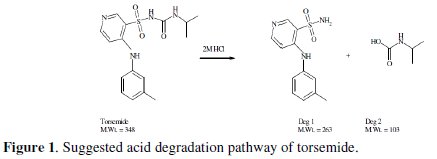
degradation products as it provides the least drastic condition, (<a href="#f1">Fig. 1</a>).</p>


    <p>&nbsp;</p>
<a name="f1">
<img src="/img/revistas/pea/v30n5/30n5a04f1.jpg">
    
<p>&nbsp;</p>


    <p>Since this work was concerned with the development of stability-indicating 
methods for the determination of TOR, the degradation products were prepared 
in laboratory, as mentioned in the section of degraded sample. The structure of 
the isolated acid degradation product was confirmed using IR and MS 
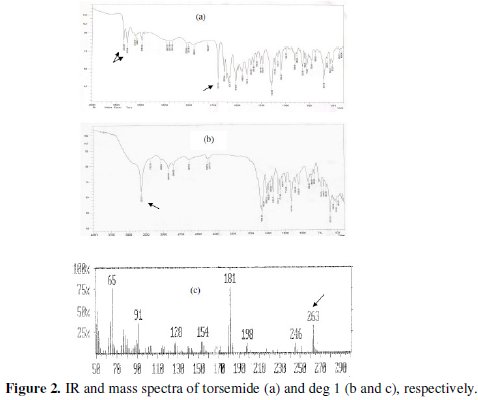
spectroscopy, (<a href="#f2">Fig. 2a-c</a>).</p>


    <p>&nbsp;</p>
<a name="f2">
<img src="/img/revistas/pea/v30n5/30n5a04f2.jpg">
    
<p>&nbsp;</p>


    <p>The assignment of TOR degradation product was based 
on comparison of IR spectral data for the separated compound with that of the 
intact drug. The IR spectrum of the degradation product showed disappearance of 
NH-amide peak at 3278.99 cm<sup>-1</sup> and C=O-amide at 1697 cm<sup>-1</sup> in the parent 
compound and appearance of a new sharp and intense peak of -NH-and -NH2 
groups at 3313 cm-1, which indicates the breaking of amide linkage, (<a href="#f2">Fig. 2 a & 
b</a>). Moreover, the mass spectrum of deg1 showed a molecular ion peak at m/z 
263 (<a href="#f2">Fig. 2c</a>). This finding suggests the degradation pathway and indicates the 
structure of the degradation product of TOR, as illustrated in (<a href="#f1">Fig. 1</a>). 
The inclusion complexation and molecular recognition are of current interest in 
host-guest and supramolecular chemistry and offer a promising approach to 
chemical sensing [44, 45]. The use of selective inclusion complexation and 
complementary ionic or hydrogen bonding are two main strategies for preparing 
synthetic host molecules, which recognise the structure of guest molecules [46]. 
Natural or synthetic modified cyclodextrins (CD) are viewed as molecular 
receptors. In the case of natural CD, cooperative binding with certain guest 
molecules was mostly attributed to intermolecular hydrogen bonding between the 
CD molecules, while intermolecular interactions between the host and guest 
molecules (hydrogen bonds, hydrophobic interactions and Van der Waals forces) 
contributed to cooperative binding processes when synthetic CDs were used [47]. 
Although the size and geometry of the guest mainly govern the binding strength, 
it is possible to modifying the host-guest interactions through the three hydroxyl 
groups on each glucose unit. Indeed, the use of 2-hydroxypropyl-&beta;-cyclodextrin 
enhanced the interaction properties between host and guest molecules [48].</p>

    <p>This work originates from the fact that torsemide behaves as cation, due to the 
presence of the secondary amine functional group. This fact suggests the use of 
anionic type of ion exchangers, forming water insoluble ion association 
complexes. Tetraphenylborate as an anionic exchanger was used for construction 
of water insoluble ion-association complex with TOR(sensor 1), while sensors 24 
utilized hydroxypropyl-&beta;-cyclodextrin -based technique using graphite 
microelectrode in all sensors, which are characterized by their small physical size 
that allows exploration of microscopic domains, such as biological systems, their 
fast response time, due to the reduced diffusion layer, allows rapid scan rates to 
be used and their low susceptibility to ohmic loss, due to the small currents 
produced, enables their uses in highly resistive biological media [49]. These 
microelectrodes behave as two interface devices, membrane/electrolyte interface 
and membrane/ metal interface [50]. Performance characteristics of these 
electrodes (sensors 2-4) reveal low detection limit, high sensitivity, good 
selectivity, fast response, long life span, and applicability for accurate 
determination of torsemide in presence of its acid degradation products and in 
dosage form.</p>

    <p>The fact that TOR can behave as a cation suggests the use of anionic ion 
exchangers. It has been found that TPB was optimum anionic exchanger for the 
studied drug, because of the low solubility of its reaction product and its suitable 
grain size [37, 51]. Torsemide reacted with TPB to form a water insoluble 1:2 
drug-ion association complex, as confirmed by elemental analysis. This 
indicates that the drug behaves as a divalent species. The complex was prepared, 
characterized, and incorporated with a suitable solvent mediator in PVC matrix 
membranes.</p>


    ]]></body>
<body><![CDATA[<p><b><i>Fabrication and performance characteristics of the sensors</i></b></p>

    <p>It has been reported that PVC matrix is a regular support and reproducible trap 
for ion association complexes in ISEs. Nevertheless, its use creates a need for 
plasticization and places a constraint on the choice of the mediator [52]. In this 
study, PVC was used in the fabrication of sensor 1, while PVC-COOH with HP
&beta;-CD and different plasticizers were used in fabrication of the other proposed 
sensors. Cyclodextrins are optically active oligosaccharides that form inclusion 
compounds in aqueous and in solid states with organic molecules. HP-&beta;-CDbased 
sensors showed accurate results in both response and selectivity. Also, the 
improved stability and selectivity are attributed to the increase in the acidity of 
the carboxylate group of PVC-COOH and hence, interacting with the drug.</p>

    <p>Plasticizers play an important role in the behaviour of polymeric membrane ion 
selective electrodes. For a plasticizer to be adequate for its use in polymeric 
membrane ion selective electrodes, it should gather certain properties and 
characteristics such as having high lipophilicity, high molecular weight, and low 
tendency for exudation from the polymeric matrix [53]. The introduction of polar 
or polarisable groups into membranes reduces the rate of exudation and therefore 
the loss of membrane components by their migration to the aqueous phase which 
reduces the selectivity of membranes. Additionally, plasticizer viscosity and 
dielectric constant should be adequate.</p>

    <p>It is well known that the sensitivity and selectivity of ion-selective electrodes 
strongly depend on the membrane compositions and the nature of the plasticizer 
used [54-56]. The nature of the plasticizer influences the dielectric constant of 
the membrane phase, the mobility of the ionophore molecules, and the forms of 
the ligands [57, 58]. To investigate the effect of plasticizers, PVC-COOH 
membranes with different plasticizers DOP, DBS and o-NPOE were prepared 
using TPB as the sensing membrane components. The electrochemical 
performance characteristics of the sensors were systematically evaluated 
according to IUPAC recommendations [42]; the potentiometric responses and 
results including slope, response time and working concentration range are 
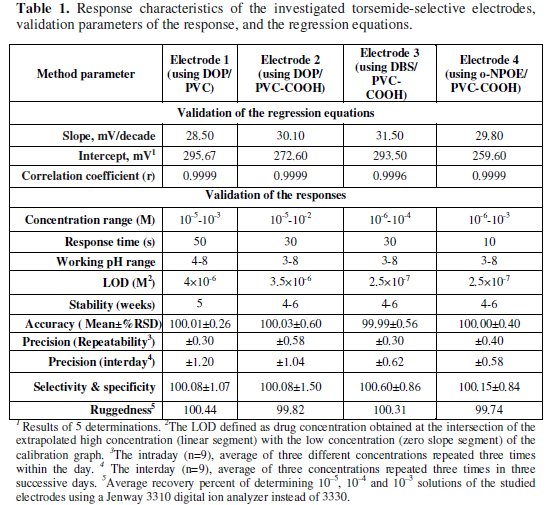
summarized in <a href="#t1">Table 1</a>.</p>


    <p>&nbsp;</p>
<a name="t1">
<img src="/img/revistas/pea/v30n5/30n5a04t1.jpg">
    
<p>&nbsp;</p>


    <p>According to the data presented in <a href="#t1">Table 1</a>, o-NPOE is 
the most effective of the three different plasticizers used in sensors 2-4. This 
indicates that o-NPOE plasticizes the membrane and adjusts both the membrane 
permittivity and the mobility of the ion-exchanger sites to facilitate the inclusion 
of organic molecules by competitive inclusion and give the optimal selectivity 
and sensitivity [59].</p>

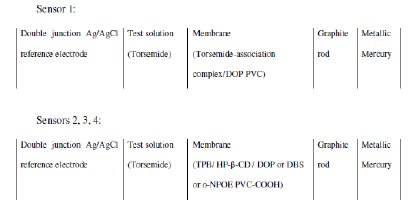
    <p>The electrochemical cell of the suggested membrane electrodes for the 
determination of TOR can be illustrated diagrammatically as follows:</p>


    <p>&nbsp;</p>
<a name="s1">
<img src="/img/revistas/pea/v30n5/30n5a04s1.jpg">
    
<p>&nbsp;</p>


    ]]></body>
<body><![CDATA[<p><b><i>Calibration and dynamic response time of sensors</i></b></p>

    <p>The potential displayed by the 4 proposed electrodes for constructive 
measurements of standard drug solutions in the same day and from day-to-day 
did not vary by more than &pm;1 mV. Calibration slopes did not change by more 
than &pm;2 mV/decade concentration over a period of 4-6 weeks for electrodes 1-4, 
<a href="#t1">Table 1</a>. The dynamic response times for the electrodes to reach values within &pm; 
1 mV of the final equilibrium potential after increasing the drug concentration 
10-fold were found to be 50, 30, 30 and 10 s for electrodes 1, 2, 3 and 4, 
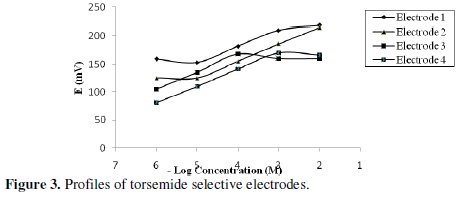
respectively, <a href="#t1">Table 1</a>. The slopes of the calibration graphs were 28.5, 30.10, 
31.50, and 29.80 mV/concentration decade for electrodes 1, 2, 3 and 4, 
respectively. These are typical values of divalent substances; torsemide behaves 
as divalent cation via its 2 amino groups. <a href="#f3">Fig. 3</a> shows a decrease in the negative 
potential as the concentration increases due to the decrease in the negative charge 
on the membrane.</p>


    <p>&nbsp;</p>
<a name="f3">
<img src="/img/revistas/pea/v30n5/30n5a04f3.jpg">
    
<p>&nbsp;</p>


    <p>Deviation from the ideal Nernstian slope (30 mV/decade), 
stems from the fact that the electrodes respond to the activity of the drug rather 
than its concentration. The investigated electrodes exhibit fast response time (10 
- 50 s) and fair stability (4 - 6 weeks). The fabricated ISEs gave a Nernstian 
response within a 1 &times; 10<sup>-6</sup> - 1 &times; 10<sup>-2</sup> M concentration range. 


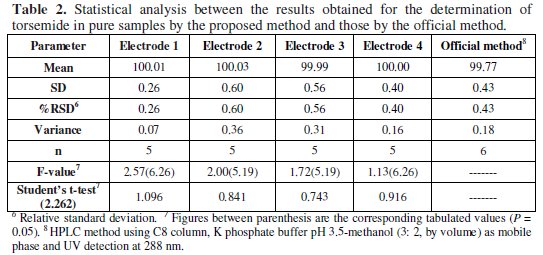
The proposed method was compared with the USP HPLC method [4] and no 
significant difference was observed, as seen in <a href="#t2">Table 2</a>.</p>


    <p>&nbsp;</p>
<a name="t2">
<img src="/img/revistas/pea/v30n5/30n5a04t2.jpg">
    
<p>&nbsp;</p>


    <p><b><i>Temperature and pH of the sensors</i></b></p>

    <p>For quantitative measurements with ISEs, studies were performed to reach the 
optimum experimental conditions. The pH effect was optimized from the point of 
view of both sensor function and chemical form of the test substances. It is 
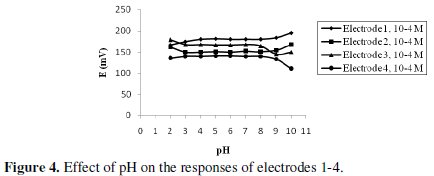
apparent that the investigated electrodes gave a useful pH range from 3-8. Above 
and below this range, the potential displayed by the electrodes was noisy. Above 
pH 8, the potential showed a sharp decrease due to the formation of 
nonprotonated amino group of TOR. Below pH 3, the membranes may extract 
H<sup>+</sup>, leading to noisy responses, <a href="#f4">Fig. 4</a>.</p>


    <p>&nbsp;</p>
<a name="f4">
<img src="/img/revistas/pea/v30n5/30n5a04f4.jpg">
    
]]></body>
<body><![CDATA[<p>&nbsp;</p>


    <p>The effect of temperature was also studied by monitoring the potential response 
displayed by the electrodes as a function of -log of the drug concentration at 20, 
30, and 35 &deg;C. It was found that the suggested electrodes exhibited a gradual 
increase in their potentials as the temperature increased in the range of 20 - 35 
&deg;C; however, the calibration graphs obtained at different temperatures were 
parallel. In spite of this, the limit of detection and response time did not 
significantly vary with changes of temperature, indicating reasonable thermal 
stability of TOR membranes up to 35 &deg;C.</p>


    <p><b><i>Selectivity of sensors</i></b></p>

    <p>The influence of various basic substances as amino compounds of biological 
interest (urea, glycine, and hydroxylamine) and other inorganic cations (K<sup>+</sup>, Na<sup>+</sup>, 
NH<sub>4</sub><sup>+</sup>, Mg<sup>2+</sup>, and Ca<sup>2+</sup>) that are usually found in biological fluids on the response 
of sensors was investigated by measuring the potentiometric influence of some 
potentially interfering speci es. The selectivity coefficients were calculated by the 
separate solution method [60], in which potentials were measured for 1 &times; 10<sup>-4</sup> M 
aqueous drug solution, and then for 1 &times; 10<sup>-4</sup> M aqueous interferent solution, 
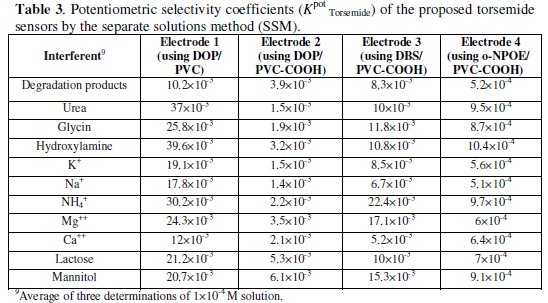
separately. The results in <a href="#t3">Table 3</a> reveal that all investigated sensors display high 
selectivity, but sensors 2 - 4 are at least 10 - 100 times more selective than sensor 1.</p>


    <p>&nbsp;</p>
<a name="t3">
<img src="/img/revistas/pea/v30n5/30n5a04t3.jpg">
    
<p>&nbsp;</p>


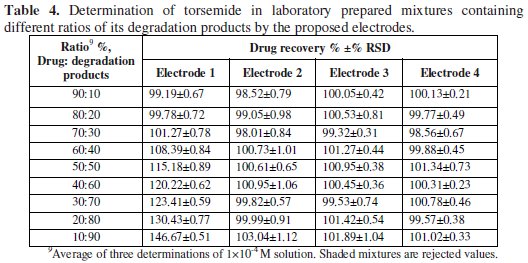
    <p>Moreover, sensor 4 displays higher selectivity and lower response for the 
potentially interfering species than sensors 2 & 3. <a href="#t4">Table 4</a> shows the results 
obtained upon analysis of synthetic mixtures containing different ratios of intact 
drug and degraded samples varying from 10:90 to 90:10.</p>


    <p>&nbsp;</p>
<a name="t4">
<img src="/img/revistas/pea/v30n5/30n5a04t4.jpg">
    
<p>&nbsp;</p>


    <p>The results show that 
sensors 2 - 4 can be successfully used for selective determination of intact drug 
in the presence of up to 80% of its degradation products. Sensor 1 suffers from 
high interference when the degradation products concentration reaches about 
30%. Thus, sensors 2 - 4 are recommended for use in stability-indicating 
methods. This can be attributed to the preferential interaction between the TOR 
cation and very polar OH-groups present in the HP-&beta;-CD structure and the 
acidic group in PVC-COOH in presence of a plasticizer with high dielectric 
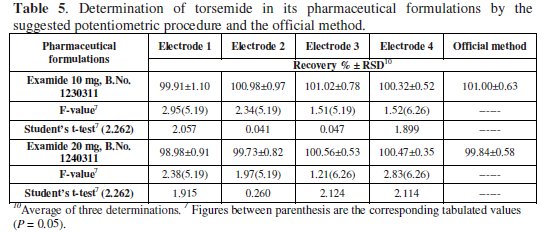
constant, as o-NPOE. <a href="#t5">Table 5</a> shows the results obtained for the determination of 
TOR in its pharmaceutical formulations, proving the applicability of the method.</p>


    ]]></body>
<body><![CDATA[<p>&nbsp;</p>
<a name="t5">
<img src="/img/revistas/pea/v30n5/30n5a04t5.jpg">
    
<p>&nbsp;</p>


    <p>Linearity was assessed by the determination of the same concentration range as 
the calibration graph. The precision and mean accuracies are given in <a href="#t1">Table 1</a>. To 
evaluate precision, 3 concentrations within the linear range (1 &times; 10<sup>-5</sup>, 1 &times; 10<sup>-4</sup>, and 
1 &times; 10<sup>-3</sup> M solutions of TOR) were chosen. Three solutions of each concentration 
were prepared and analyzed in triplicate (repeatability assay). This assay was 
repeated on 3 different days (intermediate assay). To study the method 
ruggedness, 1 &times; 10<sup>-5</sup>, 1 &times; 10<sup>-4</sup>, and 1 &times; 10<sup>-3</sup> M solutions of TOR were analyzed by the 
4 studied electrodes using a Jenway 3310 digital ion analyzer instead of the 
Model 3330; the results were stable upon change of the instrument. In summary, 
changes of variables and apparatus did not affect the accuracy of the results 
(<a href="#t1">Table 1</a>).</p>
 
    <p>Validation of the proposed potentiometric method for determining TOR drug was 
made by measuring range, limit of detection (LOD), accuracy, precision, 
repeatability, intermediate precision, linearity, sensitivity, and ruggedness. 
Results obtained are depicted in <a href="#t1">Table 1</a>. These data indicate that the proposed 
method is applicable for the quality control of the drug formulations.</p>


    <p>&nbsp;</p>
    <p><b>Conclusions</b></p>

    <p>The described sensors are sufficiently simple and selective for the quantitative 
determination of TOR in pure form, pharmaceutical formulations, and in the 
presence of its degradation products. The utility of PVC-COOH as polymer has a 
significant influence on increasing both membrane sensitivity and selectivity of 
sensors 2, 3 and 4. Electrode 4 was faster than the others, thus the response time 
was more or less instantaneous (10 min for electrode 4), while those of 1, 2 and 3 
were about 0.5-1 min. The precision of sensors 2 and 4 was higher than that of 
sensors 1 and 3 (less than one). The use of the proposed sensors offers 
advantages over chromatographic techniques, providing fast response, 
elimination of drug pretreatment and separation steps, lacking of expensive and 
sophisticated apparatus; furthermore, there is no need of expensive and special 
grade solvents. They can therefore, be used for routine analysis of TOR in quality 
control laboratories.</p>


    <p>&nbsp;</p>
    <p><b>References</b></p>

    <!-- ref --><p>1. Sweetman SC, editor. Martindale The Complete Drug Reference. 36th ed. London, UK: Pharmaceutical Press; 2009.    &nbsp;&nbsp;&nbsp;&nbsp;&nbsp;&nbsp;&nbsp;&nbsp;[&#160;<a href="javascript:void(0);" onclick="javascript: window.open('/scielo.php?script=sci_nlinks&ref=000112&pid=S0872-1904201200050000400001&lng=','','width=640,height=500,resizable=yes,scrollbars=1,menubar=yes,');">Links</a>&#160;]<!-- end-ref --></p>
    <!-- ref --><p>2. Moffat AC, Osselton MD, Widdop B. Clarke's Analysis of Drugs and Poisons in Pharmaceuticals, Body Fluids and Post-mortem Materials. 3rd ed. 
London: Pharmaceutical Press; 2004. P. 1652.    &nbsp;&nbsp;&nbsp;&nbsp;&nbsp;&nbsp;&nbsp;&nbsp;[&#160;<a href="javascript:void(0);" onclick="javascript: window.open('/scielo.php?script=sci_nlinks&ref=000114&pid=S0872-1904201200050000400002&lng=','','width=640,height=500,resizable=yes,scrollbars=1,menubar=yes,');">Links</a>&#160;]<!-- end-ref --></p>
    <!-- ref --><p>3. British Pharmacopoeia. London, UK: The Stationery Office on Behalf of the MHRA; 2010. II:2124-2125.    &nbsp;&nbsp;&nbsp;&nbsp;&nbsp;&nbsp;&nbsp;&nbsp;[&#160;<a href="javascript:void(0);" onclick="javascript: window.open('/scielo.php?script=sci_nlinks&ref=000116&pid=S0872-1904201200050000400003&lng=','','width=640,height=500,resizable=yes,scrollbars=1,menubar=yes,');">Links</a>&#160;]<!-- end-ref --></p>
    <!-- ref --><p>4. The U.S. Pharmacopeia. 30th ed. Rockville, MD: US Pharmacopeial Convention; 2007. P. 3385-3386.    &nbsp;&nbsp;&nbsp;&nbsp;&nbsp;&nbsp;&nbsp;&nbsp;[&#160;<a href="javascript:void(0);" onclick="javascript: window.open('/scielo.php?script=sci_nlinks&ref=000118&pid=S0872-1904201200050000400004&lng=','','width=640,height=500,resizable=yes,scrollbars=1,menubar=yes,');">Links</a>&#160;]<!-- end-ref --></p>
    <p>5. Barroso MB, Alonso RM, R.M. Jimenez RM. J Liq Chromatogr Related Technol. 1996;19:179-186.</p>
    <!-- ref --><p>6. Barroso MB, Alonso RM, Jimenez RM. J Chromatogr Sci. 2001;39:491496.    &nbsp;&nbsp;&nbsp;&nbsp;&nbsp;&nbsp;&nbsp;&nbsp;[&#160;<a href="javascript:void(0);" onclick="javascript: window.open('/scielo.php?script=sci_nlinks&ref=000121&pid=S0872-1904201200050000400006&lng=','','width=640,height=500,resizable=yes,scrollbars=1,menubar=yes,');">Links</a>&#160;]<!-- end-ref --></p>
    ]]></body>
<body><![CDATA[<p>7. Qin Y, Zhu ST, Wang C, Zhao M, Peng SQ. Fenxi Ceshi Xuebao. 2002;21:85-87.</p>
    <!-- ref --><p>8. Engelhardt S, Meineke I, Brockmoeller J. J Chromatogr B: Anal Technol Biomed Life Sci. 2006;831:31-35.    &nbsp;&nbsp;&nbsp;&nbsp;&nbsp;&nbsp;&nbsp;&nbsp;[&#160;<a href="javascript:void(0);" onclick="javascript: window.open('/scielo.php?script=sci_nlinks&ref=000124&pid=S0872-1904201200050000400008&lng=','','width=640,height=500,resizable=yes,scrollbars=1,menubar=yes,');">Links</a>&#160;]<!-- end-ref --></p>
    <p>9. Liu KH, Lee YK, Ryu JY, Lee DJ, Kang W, Lee SS, Yoon YR, Shin JG. Chromatographia. 2004;60:639-643.</p>
    <p>10. Qin Y, Wang XB, Wang C, Zhao M, Wu MT, Xu YX, Peng SQ. J Chromatogr B: Anal Technol Biomed Life Sci. 2003;794:193-203.</p>
    <p>11. Qin Y, Zhu ST, Wang C, Ming ZO, Peng SQ. Fenxi Ceshi Xuebao. 2003;22:41-44.</p>
    <p>12. Thieme D, Grosse J, Lang R, Mueller RK, Wahl A. J Chromatogr B: Biomed App. 2001;757:49-57.</p>
    <!-- ref --><p>13. Hu M, Liu YA, Du AZ. Yaowu Fenxi Zazhi. 2001;21:197-198.    &nbsp;&nbsp;&nbsp;&nbsp;&nbsp;&nbsp;&nbsp;&nbsp;[&#160;<a href="javascript:void(0);" onclick="javascript: window.open('/scielo.php?script=sci_nlinks&ref=000130&pid=S0872-1904201200050000400013&lng=','','width=640,height=500,resizable=yes,scrollbars=1,menubar=yes,');">Links</a>&#160;]<!-- end-ref --></p>
    <!-- ref --><p>14. Karnes HT, Farthing D, Besenfelder E. J Liq Chromatogr Related Technol. 1989;12:1809-1818.    &nbsp;&nbsp;&nbsp;&nbsp;&nbsp;&nbsp;&nbsp;&nbsp;[&#160;<a href="javascript:void(0);" onclick="javascript: window.open('/scielo.php?script=sci_nlinks&ref=000132&pid=S0872-1904201200050000400014&lng=','','width=640,height=500,resizable=yes,scrollbars=1,menubar=yes,');">Links</a>&#160;]<!-- end-ref --></p>
    <!-- ref --><p>15. Besenfelder E. J Pharm Biomed Anal. 1987;5:259-266.    &nbsp;&nbsp;&nbsp;&nbsp;&nbsp;&nbsp;&nbsp;&nbsp;[&#160;<a href="javascript:void(0);" onclick="javascript: window.open('/scielo.php?script=sci_nlinks&ref=000134&pid=S0872-1904201200050000400015&lng=','','width=640,height=500,resizable=yes,scrollbars=1,menubar=yes,');">Links</a>&#160;]<!-- end-ref --></p>
    <!-- ref --><p>16. Deventer K, Van Eenoo P, Delbeke FT. Rapid Comm Mass Spect. 2005;19:90-98.    &nbsp;&nbsp;&nbsp;&nbsp;&nbsp;&nbsp;&nbsp;&nbsp;[&#160;<a href="javascript:void(0);" onclick="javascript: window.open('/scielo.php?script=sci_nlinks&ref=000136&pid=S0872-1904201200050000400016&lng=','','width=640,height=500,resizable=yes,scrollbars=1,menubar=yes,');">Links</a>&#160;]<!-- end-ref --></p>
    <p>17. March C, Farthing D, Wells B, Besenfelder E, Karnes HT. J Pharm Sci. 1990;79:453-457.</p>
    <!-- ref --><p>18. Carda-Broch S, Torres-Lapasio JR, Esteve-Romero JS, Garcia-Alvarez-Coque MC, J Chromatogr. 2000;893:321-337.    &nbsp;&nbsp;&nbsp;&nbsp;&nbsp;&nbsp;&nbsp;&nbsp;[&#160;<a href="javascript:void(0);" onclick="javascript: window.open('/scielo.php?script=sci_nlinks&ref=000139&pid=S0872-1904201200050000400018&lng=','','width=640,height=500,resizable=yes,scrollbars=1,menubar=yes,');">Links</a>&#160;]<!-- end-ref --></p>
    <!-- ref --><p>19. Deventer K, Delbeke FT, Roels K, Van Eenoo P. Biomed Chromatogr. 2002;16:529-535.    &nbsp;&nbsp;&nbsp;&nbsp;&nbsp;&nbsp;&nbsp;&nbsp;[&#160;<a href="javascript:void(0);" onclick="javascript: window.open('/scielo.php?script=sci_nlinks&ref=000141&pid=S0872-1904201200050000400019&lng=','','width=640,height=500,resizable=yes,scrollbars=1,menubar=yes,');">Links</a>&#160;]<!-- end-ref --></p>
    ]]></body>
<body><![CDATA[<!-- ref --><p>20. Kolmonen M, Leinonen A, Pelander A, Ojanpera I. Anal Chim Acta. 2007;585:94-102.    &nbsp;&nbsp;&nbsp;&nbsp;&nbsp;&nbsp;&nbsp;&nbsp;[&#160;<a href="javascript:void(0);" onclick="javascript: window.open('/scielo.php?script=sci_nlinks&ref=000143&pid=S0872-1904201200050000400020&lng=','','width=640,height=500,resizable=yes,scrollbars=1,menubar=yes,');">Links</a>&#160;]<!-- end-ref --></p>
    <!-- ref --><p>21. Goebel C, Trout GJ, Kazlauskas R. Anal Chim Acta. 2004;502:65-74.    &nbsp;&nbsp;&nbsp;&nbsp;&nbsp;&nbsp;&nbsp;&nbsp;[&#160;<a href="javascript:void(0);" onclick="javascript: window.open('/scielo.php?script=sci_nlinks&ref=000145&pid=S0872-1904201200050000400021&lng=','','width=640,height=500,resizable=yes,scrollbars=1,menubar=yes,');">Links</a>&#160;]<!-- end-ref --></p>
    <p>22. Barroso MB, Meiring HD, deJong A, Alonso RM, Jimenez RM. J Chromatogr B: Biomed App. 1997;690:105-113.</p>
    <!-- ref --><p>23. Beyer J, Bierl A, Peters FT, Maurer HH. Therapeutic Drug Monit. 2005;27:509-520.    &nbsp;&nbsp;&nbsp;&nbsp;&nbsp;&nbsp;&nbsp;&nbsp;[&#160;<a href="javascript:void(0);" onclick="javascript: window.open('/scielo.php?script=sci_nlinks&ref=000148&pid=S0872-1904201200050000400023&lng=','','width=640,height=500,resizable=yes,scrollbars=1,menubar=yes,');">Links</a>&#160;]<!-- end-ref --></p>
    <!-- ref --><p>24. Akesolo U, Gonzalez L, Jimenez RM, Alonso RM. Electrophoresis. 2002;23:230-236.    &nbsp;&nbsp;&nbsp;&nbsp;&nbsp;&nbsp;&nbsp;&nbsp;[&#160;<a href="javascript:void(0);" onclick="javascript: window.open('/scielo.php?script=sci_nlinks&ref=000150&pid=S0872-1904201200050000400024&lng=','','width=640,height=500,resizable=yes,scrollbars=1,menubar=yes,');">Links</a>&#160;]<!-- end-ref --></p>
    <!-- ref --><p>25. Shashikant BB, Sanjay KP. Int J Pharm Quality Assurance. 2010;2:52-55.    &nbsp;&nbsp;&nbsp;&nbsp;&nbsp;&nbsp;&nbsp;&nbsp;[&#160;<a href="javascript:void(0);" onclick="javascript: window.open('/scielo.php?script=sci_nlinks&ref=000152&pid=S0872-1904201200050000400025&lng=','','width=640,height=500,resizable=yes,scrollbars=1,menubar=yes,');">Links</a>&#160;]<!-- end-ref --></p>
    <p>26. Marothu V, Dannana G, E-J Chem. 2008;5:473-478.</p>
    <!-- ref --><p>27. Jatin G, Gaurav K, Vishal Y, Wakode SR. J Chem Pharm Res. 2010;2:513-517.    &nbsp;&nbsp;&nbsp;&nbsp;&nbsp;&nbsp;&nbsp;&nbsp;[&#160;<a href="javascript:void(0);" onclick="javascript: window.open('/scielo.php?script=sci_nlinks&ref=000155&pid=S0872-1904201200050000400027&lng=','','width=640,height=500,resizable=yes,scrollbars=1,menubar=yes,');">Links</a>&#160;]<!-- end-ref --></p>
    <!-- ref --><p>28. Sankar DG, Babu PJ, Sujatha N, Latha PVM, Asian J Chem. 2006;18:3247-3248.    &nbsp;&nbsp;&nbsp;&nbsp;&nbsp;&nbsp;&nbsp;&nbsp;[&#160;<a href="javascript:void(0);" onclick="javascript: window.open('/scielo.php?script=sci_nlinks&ref=000157&pid=S0872-1904201200050000400028&lng=','','width=640,height=500,resizable=yes,scrollbars=1,menubar=yes,');">Links</a>&#160;]<!-- end-ref --></p>
    <!-- ref --><p>29. Krishna MV, Sankar DG. Acta Ciencia Indica Chem. 2006;32:355-358.    &nbsp;&nbsp;&nbsp;&nbsp;&nbsp;&nbsp;&nbsp;&nbsp;[&#160;<a href="javascript:void(0);" onclick="javascript: window.open('/scielo.php?script=sci_nlinks&ref=000159&pid=S0872-1904201200050000400029&lng=','','width=640,height=500,resizable=yes,scrollbars=1,menubar=yes,');">Links</a>&#160;]<!-- end-ref --></p>
    <!-- ref --><p>30. Akesolo U, Gonzalez LJimenez RM, Alonso RM. J Chromatogr. 2003;990:271-279.    &nbsp;&nbsp;&nbsp;&nbsp;&nbsp;&nbsp;&nbsp;&nbsp;[&#160;<a href="javascript:void(0);" onclick="javascript: window.open('/scielo.php?script=sci_nlinks&ref=000161&pid=S0872-1904201200050000400030&lng=','','width=640,height=500,resizable=yes,scrollbars=1,menubar=yes,');">Links</a>&#160;]<!-- end-ref --></p>
    ]]></body>
<body><![CDATA[<!-- ref --><p>31. Barroso MB, Alonso RM, Jimenez RM. The Analyst .1994;119:2359-2362.    &nbsp;&nbsp;&nbsp;&nbsp;&nbsp;&nbsp;&nbsp;&nbsp;[&#160;<a href="javascript:void(0);" onclick="javascript: window.open('/scielo.php?script=sci_nlinks&ref=000163&pid=S0872-1904201200050000400031&lng=','','width=640,height=500,resizable=yes,scrollbars=1,menubar=yes,');">Links</a>&#160;]<!-- end-ref --></p>
    <!-- ref --><p>32. Fernandez M, Alonso RM, Jimenez RM, Legorburu MJ. The Analyst. 1994;119:319-322.    &nbsp;&nbsp;&nbsp;&nbsp;&nbsp;&nbsp;&nbsp;&nbsp;[&#160;<a href="javascript:void(0);" onclick="javascript: window.open('/scielo.php?script=sci_nlinks&ref=000165&pid=S0872-1904201200050000400032&lng=','','width=640,height=500,resizable=yes,scrollbars=1,menubar=yes,');">Links</a>&#160;]<!-- end-ref --></p>
    <!-- ref --><p>33. Sharma MC, Sharmaa S, Kohlib DV, Sharmac AD. Der Pharma Chemica. 2010;2:121-126.    &nbsp;&nbsp;&nbsp;&nbsp;&nbsp;&nbsp;&nbsp;&nbsp;[&#160;<a href="javascript:void(0);" onclick="javascript: window.open('/scielo.php?script=sci_nlinks&ref=000167&pid=S0872-1904201200050000400033&lng=','','width=640,height=500,resizable=yes,scrollbars=1,menubar=yes,');">Links</a>&#160;]<!-- end-ref --></p>
    <!-- ref --><p>34. Kakde R, Chaudhary N, Barsagade A, Kale D. Acta Chromatographia. 2011;23:145-155.    &nbsp;&nbsp;&nbsp;&nbsp;&nbsp;&nbsp;&nbsp;&nbsp;[&#160;<a href="javascript:void(0);" onclick="javascript: window.open('/scielo.php?script=sci_nlinks&ref=000169&pid=S0872-1904201200050000400034&lng=','','width=640,height=500,resizable=yes,scrollbars=1,menubar=yes,');">Links</a>&#160;]<!-- end-ref --></p>
    <!-- ref --><p>35. Patel HB, Mohan A, Joshi HS, J AOAC Int. 2011;94:143-149.    &nbsp;&nbsp;&nbsp;&nbsp;&nbsp;&nbsp;&nbsp;&nbsp;[&#160;<a href="javascript:void(0);" onclick="javascript: window.open('/scielo.php?script=sci_nlinks&ref=000171&pid=S0872-1904201200050000400035&lng=','','width=640,height=500,resizable=yes,scrollbars=1,menubar=yes,');">Links</a>&#160;]<!-- end-ref --></p>
    ]]></body>
<body><![CDATA[<!-- ref --><p>36. Metwally FH. Yakugaku Zasshi. 2007;8:1267-1273.    &nbsp;&nbsp;&nbsp;&nbsp;&nbsp;&nbsp;&nbsp;&nbsp;[&#160;<a href="javascript:void(0);" onclick="javascript: window.open('/scielo.php?script=sci_nlinks&ref=000173&pid=S0872-1904201200050000400036&lng=','','width=640,height=500,resizable=yes,scrollbars=1,menubar=yes,');">Links</a>&#160;]<!-- end-ref --></p>
    <!-- ref --><p>37. Elsaharty Y, Metwally FH, El-Khateeb SZR. J Pharm Biomed Anal. 2006;41:720-724.    &nbsp;&nbsp;&nbsp;&nbsp;&nbsp;&nbsp;&nbsp;&nbsp;[&#160;<a href="javascript:void(0);" onclick="javascript: window.open('/scielo.php?script=sci_nlinks&ref=000175&pid=S0872-1904201200050000400037&lng=','','width=640,height=500,resizable=yes,scrollbars=1,menubar=yes,');">Links</a>&#160;]<!-- end-ref --></p>
    <!-- ref --><p>38. Mostafa GA, Al-Majed A. J Pharm Biomed Anal. 2008;48:57-61.    &nbsp;&nbsp;&nbsp;&nbsp;&nbsp;&nbsp;&nbsp;&nbsp;[&#160;<a href="javascript:void(0);" onclick="javascript: window.open('/scielo.php?script=sci_nlinks&ref=000177&pid=S0872-1904201200050000400038&lng=','','width=640,height=500,resizable=yes,scrollbars=1,menubar=yes,');">Links</a>&#160;]<!-- end-ref --></p>
    <!-- ref --><p>39. Conway BA. Ion Selective Electrodes. 1995;3:41.    &nbsp;&nbsp;&nbsp;&nbsp;&nbsp;&nbsp;&nbsp;&nbsp;[&#160;<a href="javascript:void(0);" onclick="javascript: window.open('/scielo.php?script=sci_nlinks&ref=000179&pid=S0872-1904201200050000400039&lng=','','width=640,height=500,resizable=yes,scrollbars=1,menubar=yes,');">Links</a>&#160;]<!-- end-ref --></p>
    <!-- ref --><p>40. Hassan SS, Mahmoud WH, Othman AM. Talanta. 1997;44:1087.    &nbsp;&nbsp;&nbsp;&nbsp;&nbsp;&nbsp;&nbsp;&nbsp;[&#160;<a href="javascript:void(0);" onclick="javascript: window.open('/scielo.php?script=sci_nlinks&ref=000181&pid=S0872-1904201200050000400040&lng=','','width=640,height=500,resizable=yes,scrollbars=1,menubar=yes,');">Links</a>&#160;]<!-- end-ref --></p>
    ]]></body>
<body><![CDATA[<!-- ref --><p>41. Vogel's Text Book of Quantitative Inorganic Analysis including elementary instrumental analysis. 4th ed. ELBS; 1978.    &nbsp;&nbsp;&nbsp;&nbsp;&nbsp;&nbsp;&nbsp;&nbsp;[&#160;<a href="javascript:void(0);" onclick="javascript: window.open('/scielo.php?script=sci_nlinks&ref=000183&pid=S0872-1904201200050000400041&lng=','','width=640,height=500,resizable=yes,scrollbars=1,menubar=yes,');">Links</a>&#160;]<!-- end-ref --></p>
    <!-- ref --><p>42. IUPAC Analytical Chemistry Division -Commission on Analytical Nomenclature. Pure Appl Chem. 2000;72:1851.    &nbsp;&nbsp;&nbsp;&nbsp;&nbsp;&nbsp;&nbsp;&nbsp;[&#160;<a href="javascript:void(0);" onclick="javascript: window.open('/scielo.php?script=sci_nlinks&ref=000185&pid=S0872-1904201200050000400042&lng=','','width=640,height=500,resizable=yes,scrollbars=1,menubar=yes,');">Links</a>&#160;]<!-- end-ref --></p>
    <!-- ref --><p>43. ICH, Q1A (R2), Stability Testing of New Drug Substances and Products, International Conference on Harmonization, IFPMA. Geneva, Switzerland; 
2003.    &nbsp;&nbsp;&nbsp;&nbsp;&nbsp;&nbsp;&nbsp;&nbsp;[&#160;<a href="javascript:void(0);" onclick="javascript: window.open('/scielo.php?script=sci_nlinks&ref=000187&pid=S0872-1904201200050000400043&lng=','','width=640,height=500,resizable=yes,scrollbars=1,menubar=yes,');">Links</a>&#160;]<!-- end-ref --></p>
    <p>44. Mittal SK, Kumar A, Gupta N, Kaur S, Kuma S. Anal Chim Acta. 2007;585:161.</p>
    <!-- ref --><p>45. Zanganeh AR, Amini MK. Sens Actuators B Chem. 2008;135:358.    &nbsp;&nbsp;&nbsp;&nbsp;&nbsp;&nbsp;&nbsp;&nbsp;[&#160;<a href="javascript:void(0);" onclick="javascript: window.open('/scielo.php?script=sci_nlinks&ref=000190&pid=S0872-1904201200050000400045&lng=','','width=640,height=500,resizable=yes,scrollbars=1,menubar=yes,');">Links</a>&#160;]<!-- end-ref --></p>
    <p>46. Gorski L, Matusevich A, Parzuchowski P, Luciuk I, Malinowska E. Anal Chim Acta. 2010;665:39.</p>
    ]]></body>
<body><![CDATA[<!-- ref --><p>47. Sideris EE. Eur J Pharm Sci. 1999;7:271.    &nbsp;&nbsp;&nbsp;&nbsp;&nbsp;&nbsp;&nbsp;&nbsp;[&#160;<a href="javascript:void(0);" onclick="javascript: window.open('/scielo.php?script=sci_nlinks&ref=000193&pid=S0872-1904201200050000400047&lng=','','width=640,height=500,resizable=yes,scrollbars=1,menubar=yes,');">Links</a>&#160;]<!-- end-ref --></p>
    <!-- ref --><p>48. Flink S, van Veggel FCJM, Reinhoudt DN. Adv Mater. 2000;12:1315.    &nbsp;&nbsp;&nbsp;&nbsp;&nbsp;&nbsp;&nbsp;&nbsp;[&#160;<a href="javascript:void(0);" onclick="javascript: window.open('/scielo.php?script=sci_nlinks&ref=000195&pid=S0872-1904201200050000400048&lng=','','width=640,height=500,resizable=yes,scrollbars=1,menubar=yes,');">Links</a>&#160;]<!-- end-ref --></p>
    <!-- ref --><p>49. Moody G, Thomas J. Selective Ion Sensitive Electrode. Merrow Technical Library; 1979. Chap 1.    &nbsp;&nbsp;&nbsp;&nbsp;&nbsp;&nbsp;&nbsp;&nbsp;[&#160;<a href="javascript:void(0);" onclick="javascript: window.open('/scielo.php?script=sci_nlinks&ref=000197&pid=S0872-1904201200050000400049&lng=','','width=640,height=500,resizable=yes,scrollbars=1,menubar=yes,');">Links</a>&#160;]<!-- end-ref --></p>
    <!-- ref --><p>50. James H, Carmack G, Freiser H. Anal Chem. 1972;44:856-861.    &nbsp;&nbsp;&nbsp;&nbsp;&nbsp;&nbsp;&nbsp;&nbsp;[&#160;<a href="javascript:void(0);" onclick="javascript: window.open('/scielo.php?script=sci_nlinks&ref=000199&pid=S0872-1904201200050000400050&lng=','','width=640,height=500,resizable=yes,scrollbars=1,menubar=yes,');">Links</a>&#160;]<!-- end-ref --></p>
    <!-- ref --><p>51. Hassan SSM, Abou-Sekkina MM, El-Ries MA, Wassel AA. J Pharm Biomed Anal. 2003;32:175-180.    &nbsp;&nbsp;&nbsp;&nbsp;&nbsp;&nbsp;&nbsp;&nbsp;[&#160;<a href="javascript:void(0);" onclick="javascript: window.open('/scielo.php?script=sci_nlinks&ref=000201&pid=S0872-1904201200050000400051&lng=','','width=640,height=500,resizable=yes,scrollbars=1,menubar=yes,');">Links</a>&#160;]<!-- end-ref --></p>
    ]]></body>
<body><![CDATA[<!-- ref --><p>52. Ber A, Moody G, Thomas J. The Analyst. 1976;101:179.    &nbsp;&nbsp;&nbsp;&nbsp;&nbsp;&nbsp;&nbsp;&nbsp;[&#160;<a href="javascript:void(0);" onclick="javascript: window.open('/scielo.php?script=sci_nlinks&ref=000203&pid=S0872-1904201200050000400052&lng=','','width=640,height=500,resizable=yes,scrollbars=1,menubar=yes,');">Links</a>&#160;]<!-- end-ref --></p>
    <p>53. Eugster R, Rosatzin T, Rusterholz B, Aebersold B, Pedrazza U, Ruegg D, Schmid A, Spichinger UA, Simon W. Anal Chim Acta. 1994;289:1-13.</p>
    <!-- ref --><p>54. Bakker E, Buhlmann P, Pretsch E. Electroanalysis. 1999;11:915.    &nbsp;&nbsp;&nbsp;&nbsp;&nbsp;&nbsp;&nbsp;&nbsp;[&#160;<a href="javascript:void(0);" onclick="javascript: window.open('/scielo.php?script=sci_nlinks&ref=000206&pid=S0872-1904201200050000400054&lng=','','width=640,height=500,resizable=yes,scrollbars=1,menubar=yes,');">Links</a>&#160;]<!-- end-ref --></p>
    <p>55. Ammann E, Pretsch P, Simon W, Lindner E, Bezegh A, Pungor E. Anal Chim Acta. 1991;171:1380.</p>
    <!-- ref --><p>56. Bakker E, Buhlmann P, Pretsch E. Chem Rev. 1997;97:3083.    &nbsp;&nbsp;&nbsp;&nbsp;&nbsp;&nbsp;&nbsp;&nbsp;[&#160;<a href="javascript:void(0);" onclick="javascript: window.open('/scielo.php?script=sci_nlinks&ref=000209&pid=S0872-1904201200050000400056&lng=','','width=640,height=500,resizable=yes,scrollbars=1,menubar=yes,');">Links</a>&#160;]<!-- end-ref --></p>
    <p>57. Yang X, Kumar N, Chi H, Hibbert DD, Alexander PNW. Electroanalysis. 1997;9:549.</p>
    <!-- ref --><p>58. Ganjali MR, Norouzi P, Alizadeh T, Adib M. Anal Chim Acta. 2006;576:275.    &nbsp;&nbsp;&nbsp;&nbsp;&nbsp;&nbsp;&nbsp;&nbsp;[&#160;<a href="javascript:void(0);" onclick="javascript: window.open('/scielo.php?script=sci_nlinks&ref=000212&pid=S0872-1904201200050000400058&lng=','','width=640,height=500,resizable=yes,scrollbars=1,menubar=yes,');">Links</a>&#160;]<!-- end-ref --></p>
    <!-- ref --><p>59. Gupta VK, Singh AK, Mehtab S, Gupta B. Anal Chim Acta. 2006;566:5.    &nbsp;&nbsp;&nbsp;&nbsp;&nbsp;&nbsp;&nbsp;&nbsp;[&#160;<a href="javascript:void(0);" onclick="javascript: window.open('/scielo.php?script=sci_nlinks&ref=000214&pid=S0872-1904201200050000400059&lng=','','width=640,height=500,resizable=yes,scrollbars=1,menubar=yes,');">Links</a>&#160;]<!-- end-ref --></p>
    <!-- ref --><p>60. Ma TS, Hassan SSM. Organic Analysis Using Ion Selective Electrodes. London, UK: Academic Press; 1982. vols 1 and 2.    &nbsp;&nbsp;&nbsp;&nbsp;&nbsp;&nbsp;&nbsp;&nbsp;[&#160;<a href="javascript:void(0);" onclick="javascript: window.open('/scielo.php?script=sci_nlinks&ref=000216&pid=S0872-1904201200050000400060&lng=','','width=640,height=500,resizable=yes,scrollbars=1,menubar=yes,');">Links</a>&#160;]<!-- end-ref --></p>


    <p>&nbsp;</p>
    <p><b>Acknowledgements</b></p>

    <p>The authors are thankful to Dr. Mohamed K. Abd El-Rahman, lecturer at the Analytical 
Chemistry Department, Faculty of Pharmacy, Cairo University, Egypt, for his helpful, 
effective and supportive instructions. </p>


    <p>&nbsp;</p>
    <p><a name=0></a><sup><a href="#top">*</a></sup>Corresponding author. E-mail address: <a href="mailto:Heba_essam80@hotmail.com">Heba_essam80@hotmail.com</a></p>

    ]]></body>
<body><![CDATA[<p>Received 2 June 2012; accepted 31 October 2012</p>

    <p><a href="http://www.peacta.org" target="_blank">www.peacta.org</a> </p>


     ]]></body><back>
<ref-list>
<ref id="B1">
<label>1</label><nlm-citation citation-type="book">
<person-group person-group-type="author">
<name>
<surname><![CDATA[Sweetman]]></surname>
<given-names><![CDATA[SC]]></given-names>
</name>
</person-group>
<source><![CDATA[Martindale The Complete Drug Reference]]></source>
<year>2009</year>
<edition>36</edition>
<publisher-loc><![CDATA[London ]]></publisher-loc>
<publisher-name><![CDATA[Pharmaceutical Press]]></publisher-name>
</nlm-citation>
</ref>
<ref id="B2">
<label>2</label><nlm-citation citation-type="book">
<person-group person-group-type="author">
<name>
<surname><![CDATA[Moffat]]></surname>
<given-names><![CDATA[AC]]></given-names>
</name>
<name>
<surname><![CDATA[Osselton]]></surname>
<given-names><![CDATA[MD]]></given-names>
</name>
<name>
<surname><![CDATA[Widdop]]></surname>
<given-names><![CDATA[B]]></given-names>
</name>
</person-group>
<source><![CDATA[Clarke's Analysis of Drugs and Poisons in Pharmaceuticals, Body Fluids and Post-mortem Materials]]></source>
<year>2004</year>
<edition>3</edition>
<page-range>1652</page-range><publisher-loc><![CDATA[London ]]></publisher-loc>
<publisher-name><![CDATA[Pharmaceutical Press]]></publisher-name>
</nlm-citation>
</ref>
<ref id="B3">
<label>3</label><nlm-citation citation-type="book">
<source><![CDATA[British Pharmacopoeia]]></source>
<year>2010</year>
<volume>II</volume>
<page-range>2124-2125</page-range><publisher-loc><![CDATA[London ]]></publisher-loc>
<publisher-name><![CDATA[The Stationery Office on Behalf of the MHRA]]></publisher-name>
</nlm-citation>
</ref>
<ref id="B4">
<label>4</label><nlm-citation citation-type="book">
<source><![CDATA[The U.S. Pharmacopeia]]></source>
<year>2007</year>
<edition>30</edition>
<page-range>3385-3386</page-range><publisher-loc><![CDATA[Rockville^eMD MD]]></publisher-loc>
<publisher-name><![CDATA[US Pharmacopeial Convention]]></publisher-name>
</nlm-citation>
</ref>
<ref id="B5">
<label>5</label><nlm-citation citation-type="journal">
<person-group person-group-type="author">
<name>
<surname><![CDATA[Barroso]]></surname>
<given-names><![CDATA[MB]]></given-names>
</name>
<name>
<surname><![CDATA[Alonso]]></surname>
<given-names><![CDATA[RM]]></given-names>
</name>
<name>
<surname><![CDATA[Jimenez]]></surname>
<given-names><![CDATA[RM]]></given-names>
</name>
</person-group>
<source><![CDATA[J Liq Chromatogr Related Technol]]></source>
<year>1996</year>
<volume>19</volume>
<page-range>179-186</page-range></nlm-citation>
</ref>
<ref id="B6">
<label>6</label><nlm-citation citation-type="journal">
<person-group person-group-type="author">
<name>
<surname><![CDATA[Barroso]]></surname>
<given-names><![CDATA[MB]]></given-names>
</name>
<name>
<surname><![CDATA[Alonso]]></surname>
<given-names><![CDATA[RM]]></given-names>
</name>
<name>
<surname><![CDATA[Jimenez]]></surname>
<given-names><![CDATA[RM]]></given-names>
</name>
</person-group>
<source><![CDATA[J Chromatogr Sci]]></source>
<year>2001</year>
<volume>39</volume>
<page-range>491-496</page-range></nlm-citation>
</ref>
<ref id="B7">
<label>7</label><nlm-citation citation-type="journal">
<person-group person-group-type="author">
<name>
<surname><![CDATA[Qin]]></surname>
<given-names><![CDATA[Y]]></given-names>
</name>
<name>
<surname><![CDATA[Zhu]]></surname>
<given-names><![CDATA[ST]]></given-names>
</name>
<name>
<surname><![CDATA[Wang]]></surname>
<given-names><![CDATA[C]]></given-names>
</name>
</person-group>
<source><![CDATA[Fenxi Ceshi Xuebao]]></source>
<year>2002</year>
<volume>21</volume>
<page-range>85-87</page-range></nlm-citation>
</ref>
<ref id="B8">
<label>8</label><nlm-citation citation-type="journal">
<person-group person-group-type="author">
<name>
<surname><![CDATA[Engelhardt]]></surname>
<given-names><![CDATA[S]]></given-names>
</name>
<name>
<surname><![CDATA[Meineke]]></surname>
<given-names><![CDATA[I]]></given-names>
</name>
<name>
<surname><![CDATA[Brockmoeller]]></surname>
<given-names><![CDATA[J]]></given-names>
</name>
</person-group>
<source><![CDATA[J Chromatogr B: Anal Technol Biomed Life Sci]]></source>
<year>2006</year>
<volume>831</volume>
<page-range>31-35</page-range></nlm-citation>
</ref>
<ref id="B9">
<label>9</label><nlm-citation citation-type="journal">
<person-group person-group-type="author">
<name>
<surname><![CDATA[Liu]]></surname>
<given-names><![CDATA[KH]]></given-names>
</name>
<name>
<surname><![CDATA[Lee]]></surname>
<given-names><![CDATA[YK]]></given-names>
</name>
<name>
<surname><![CDATA[Ryu]]></surname>
<given-names><![CDATA[JY]]></given-names>
</name>
</person-group>
<source><![CDATA[Chromatographia]]></source>
<year>2004</year>
<volume>60</volume>
<page-range>639-643</page-range></nlm-citation>
</ref>
<ref id="B10">
<label>10</label><nlm-citation citation-type="journal">
<person-group person-group-type="author">
<name>
<surname><![CDATA[Qin]]></surname>
<given-names><![CDATA[Y]]></given-names>
</name>
<name>
<surname><![CDATA[Wang]]></surname>
<given-names><![CDATA[XB]]></given-names>
</name>
<name>
<surname><![CDATA[Wang]]></surname>
<given-names><![CDATA[C]]></given-names>
</name>
</person-group>
<source><![CDATA[J Chromatogr B: Anal Technol Biomed Life Sci]]></source>
<year>2003</year>
<volume>794</volume>
<page-range>193-203</page-range></nlm-citation>
</ref>
<ref id="B11">
<label>11</label><nlm-citation citation-type="journal">
<person-group person-group-type="author">
<name>
<surname><![CDATA[Qin]]></surname>
<given-names><![CDATA[Y]]></given-names>
</name>
<name>
<surname><![CDATA[Zhu]]></surname>
<given-names><![CDATA[ST]]></given-names>
</name>
<name>
<surname><![CDATA[Wang]]></surname>
<given-names><![CDATA[C]]></given-names>
</name>
</person-group>
<source><![CDATA[Fenxi Ceshi Xuebao]]></source>
<year>2003</year>
<volume>22</volume>
<page-range>41-44</page-range></nlm-citation>
</ref>
<ref id="B12">
<label>12</label><nlm-citation citation-type="journal">
<person-group person-group-type="author">
<name>
<surname><![CDATA[Thieme]]></surname>
<given-names><![CDATA[D]]></given-names>
</name>
<name>
<surname><![CDATA[Grosse]]></surname>
<given-names><![CDATA[J]]></given-names>
</name>
<name>
<surname><![CDATA[Lang]]></surname>
<given-names><![CDATA[R]]></given-names>
</name>
</person-group>
<source><![CDATA[J Chromatogr B: Biomed App]]></source>
<year>2001</year>
<volume>757</volume>
<page-range>49-57</page-range></nlm-citation>
</ref>
<ref id="B13">
<label>13</label><nlm-citation citation-type="journal">
<person-group person-group-type="author">
<name>
<surname><![CDATA[Hu]]></surname>
<given-names><![CDATA[M]]></given-names>
</name>
<name>
<surname><![CDATA[Liu]]></surname>
<given-names><![CDATA[YA]]></given-names>
</name>
<name>
<surname><![CDATA[Du]]></surname>
<given-names><![CDATA[AZ]]></given-names>
</name>
</person-group>
<source><![CDATA[Yaowu Fenxi Zazhi]]></source>
<year>2001</year>
<volume>21</volume>
<page-range>197-198</page-range></nlm-citation>
</ref>
<ref id="B14">
<label>14</label><nlm-citation citation-type="journal">
<person-group person-group-type="author">
<name>
<surname><![CDATA[Karnes]]></surname>
<given-names><![CDATA[HT]]></given-names>
</name>
<name>
<surname><![CDATA[Farthing]]></surname>
<given-names><![CDATA[D]]></given-names>
</name>
<name>
<surname><![CDATA[Besenfelder]]></surname>
<given-names><![CDATA[E]]></given-names>
</name>
</person-group>
<source><![CDATA[J Liq Chromatogr Related Technol]]></source>
<year>1989</year>
<volume>12</volume>
<page-range>1809-1818</page-range></nlm-citation>
</ref>
<ref id="B15">
<label>15</label><nlm-citation citation-type="journal">
<person-group person-group-type="author">
<name>
<surname><![CDATA[Besenfelder]]></surname>
<given-names><![CDATA[E]]></given-names>
</name>
</person-group>
<source><![CDATA[J Pharm Biomed Anal]]></source>
<year>1987</year>
<volume>5</volume>
<page-range>259-266</page-range></nlm-citation>
</ref>
<ref id="B16">
<label>16</label><nlm-citation citation-type="journal">
<person-group person-group-type="author">
<name>
<surname><![CDATA[Deventer]]></surname>
<given-names><![CDATA[K]]></given-names>
</name>
<name>
<surname><![CDATA[Van Eenoo]]></surname>
<given-names><![CDATA[P]]></given-names>
</name>
<name>
<surname><![CDATA[Delbeke]]></surname>
<given-names><![CDATA[FT]]></given-names>
</name>
</person-group>
<source><![CDATA[Rapid Comm Mass Spect]]></source>
<year>2005</year>
<volume>19</volume>
<page-range>90-98</page-range></nlm-citation>
</ref>
<ref id="B17">
<label>17</label><nlm-citation citation-type="journal">
<person-group person-group-type="author">
<name>
<surname><![CDATA[March]]></surname>
<given-names><![CDATA[C]]></given-names>
</name>
<name>
<surname><![CDATA[Farthing]]></surname>
<given-names><![CDATA[D]]></given-names>
</name>
<name>
<surname><![CDATA[Wells]]></surname>
<given-names><![CDATA[B]]></given-names>
</name>
</person-group>
<source><![CDATA[J Pharm Sci]]></source>
<year>1990</year>
<volume>79</volume>
<page-range>453-457</page-range></nlm-citation>
</ref>
<ref id="B18">
<label>18</label><nlm-citation citation-type="journal">
<person-group person-group-type="author">
<name>
<surname><![CDATA[Carda-Broch]]></surname>
<given-names><![CDATA[S]]></given-names>
</name>
<name>
<surname><![CDATA[Torres-Lapasio]]></surname>
<given-names><![CDATA[JR]]></given-names>
</name>
<name>
<surname><![CDATA[Esteve-Romero]]></surname>
<given-names><![CDATA[JS]]></given-names>
</name>
<name>
<surname><![CDATA[Garcia-Alvarez-Coque]]></surname>
<given-names><![CDATA[MC]]></given-names>
</name>
</person-group>
<source><![CDATA[J Chromatogr]]></source>
<year>2000</year>
<volume>893</volume>
<page-range>321-337</page-range></nlm-citation>
</ref>
<ref id="B19">
<label>19</label><nlm-citation citation-type="journal">
<person-group person-group-type="author">
<name>
<surname><![CDATA[Deventer]]></surname>
<given-names><![CDATA[K]]></given-names>
</name>
<name>
<surname><![CDATA[Delbeke]]></surname>
<given-names><![CDATA[FT]]></given-names>
</name>
<name>
<surname><![CDATA[Roels]]></surname>
<given-names><![CDATA[K]]></given-names>
</name>
<name>
<surname><![CDATA[Van Eenoo]]></surname>
<given-names><![CDATA[P]]></given-names>
</name>
</person-group>
<source><![CDATA[Biomed Chromatogr]]></source>
<year>2002</year>
<volume>16</volume>
<page-range>529-535</page-range></nlm-citation>
</ref>
<ref id="B20">
<label>20</label><nlm-citation citation-type="journal">
<person-group person-group-type="author">
<name>
<surname><![CDATA[Kolmonen]]></surname>
<given-names><![CDATA[M]]></given-names>
</name>
<name>
<surname><![CDATA[Leinonen]]></surname>
<given-names><![CDATA[A]]></given-names>
</name>
<name>
<surname><![CDATA[Pelander]]></surname>
<given-names><![CDATA[A]]></given-names>
</name>
<name>
<surname><![CDATA[Ojanpera]]></surname>
<given-names><![CDATA[I]]></given-names>
</name>
</person-group>
<source><![CDATA[Anal Chim Acta]]></source>
<year>2007</year>
<volume>585</volume>
<page-range>94-102</page-range></nlm-citation>
</ref>
<ref id="B21">
<label>21</label><nlm-citation citation-type="journal">
<person-group person-group-type="author">
<name>
<surname><![CDATA[Goebel]]></surname>
<given-names><![CDATA[C]]></given-names>
</name>
<name>
<surname><![CDATA[Trout]]></surname>
<given-names><![CDATA[GJ]]></given-names>
</name>
<name>
<surname><![CDATA[Kazlauskas]]></surname>
<given-names><![CDATA[R]]></given-names>
</name>
</person-group>
<source><![CDATA[Anal Chim Acta]]></source>
<year>2004</year>
<volume>502</volume>
<page-range>65-74</page-range></nlm-citation>
</ref>
<ref id="B22">
<label>22</label><nlm-citation citation-type="journal">
<person-group person-group-type="author">
<name>
<surname><![CDATA[Barroso]]></surname>
<given-names><![CDATA[MB]]></given-names>
</name>
<name>
<surname><![CDATA[Meiring]]></surname>
<given-names><![CDATA[HD]]></given-names>
</name>
<name>
<surname><![CDATA[deJong]]></surname>
<given-names><![CDATA[A]]></given-names>
</name>
</person-group>
<source><![CDATA[J Chromatogr B: Biomed App]]></source>
<year>1997</year>
<volume>690</volume>
<page-range>105-113</page-range></nlm-citation>
</ref>
<ref id="B23">
<label>23</label><nlm-citation citation-type="journal">
<person-group person-group-type="author">
<name>
<surname><![CDATA[Beyer]]></surname>
<given-names><![CDATA[J]]></given-names>
</name>
<name>
<surname><![CDATA[Bierl]]></surname>
<given-names><![CDATA[A]]></given-names>
</name>
<name>
<surname><![CDATA[Peters]]></surname>
<given-names><![CDATA[FT]]></given-names>
</name>
<name>
<surname><![CDATA[Maurer]]></surname>
<given-names><![CDATA[HH]]></given-names>
</name>
</person-group>
<source><![CDATA[Therapeutic Drug Monit]]></source>
<year>2005</year>
<volume>27</volume>
<page-range>509-520</page-range></nlm-citation>
</ref>
<ref id="B24">
<label>24</label><nlm-citation citation-type="journal">
<person-group person-group-type="author">
<name>
<surname><![CDATA[Akesolo]]></surname>
<given-names><![CDATA[U]]></given-names>
</name>
<name>
<surname><![CDATA[Gonzalez]]></surname>
<given-names><![CDATA[L]]></given-names>
</name>
<name>
<surname><![CDATA[Jimenez]]></surname>
<given-names><![CDATA[RM]]></given-names>
</name>
<name>
<surname><![CDATA[Alonso]]></surname>
<given-names><![CDATA[RM]]></given-names>
</name>
</person-group>
<source><![CDATA[Electrophoresis]]></source>
<year>2002</year>
<volume>23</volume>
<page-range>230-236</page-range></nlm-citation>
</ref>
<ref id="B25">
<label>25</label><nlm-citation citation-type="journal">
<person-group person-group-type="author">
<name>
<surname><![CDATA[Shashikant]]></surname>
<given-names><![CDATA[BB]]></given-names>
</name>
<name>
<surname><![CDATA[Sanjay]]></surname>
<given-names><![CDATA[KP]]></given-names>
</name>
</person-group>
<source><![CDATA[Int J Pharm Quality Assurance]]></source>
<year>2010</year>
<volume>2</volume>
<page-range>52-55</page-range></nlm-citation>
</ref>
<ref id="B26">
<label>26</label><nlm-citation citation-type="journal">
<person-group person-group-type="author">
<name>
<surname><![CDATA[Marothu]]></surname>
<given-names><![CDATA[V]]></given-names>
</name>
<name>
<surname><![CDATA[Dannana]]></surname>
<given-names><![CDATA[G]]></given-names>
</name>
</person-group>
<source><![CDATA[Eu J Chem]]></source>
<year>2008</year>
<volume>5</volume>
<page-range>473-478</page-range></nlm-citation>
</ref>
<ref id="B27">
<label>27</label><nlm-citation citation-type="journal">
<person-group person-group-type="author">
<name>
<surname><![CDATA[Jatin]]></surname>
<given-names><![CDATA[G]]></given-names>
</name>
<name>
<surname><![CDATA[Gaurav]]></surname>
<given-names><![CDATA[K]]></given-names>
</name>
<name>
<surname><![CDATA[Vishal]]></surname>
<given-names><![CDATA[Y]]></given-names>
</name>
<name>
<surname><![CDATA[Wakode]]></surname>
<given-names><![CDATA[SR]]></given-names>
</name>
</person-group>
<source><![CDATA[J Chem Pharm Res]]></source>
<year>2010</year>
<volume>2</volume>
<page-range>513-517</page-range></nlm-citation>
</ref>
<ref id="B28">
<label>28</label><nlm-citation citation-type="journal">
<person-group person-group-type="author">
<name>
<surname><![CDATA[Sankar]]></surname>
<given-names><![CDATA[DG]]></given-names>
</name>
<name>
<surname><![CDATA[Babu]]></surname>
<given-names><![CDATA[PJ]]></given-names>
</name>
<name>
<surname><![CDATA[Sujatha]]></surname>
<given-names><![CDATA[N]]></given-names>
</name>
<name>
<surname><![CDATA[Latha]]></surname>
<given-names><![CDATA[PVM]]></given-names>
</name>
</person-group>
<source><![CDATA[Asian J Chem]]></source>
<year>2006</year>
<volume>18</volume>
<page-range>3247-3248</page-range></nlm-citation>
</ref>
<ref id="B29">
<label>29</label><nlm-citation citation-type="journal">
<person-group person-group-type="author">
<name>
<surname><![CDATA[Krishna]]></surname>
<given-names><![CDATA[MV]]></given-names>
</name>
<name>
<surname><![CDATA[Sankar]]></surname>
<given-names><![CDATA[DG]]></given-names>
</name>
</person-group>
<source><![CDATA[Acta Ciencia Indica Chem]]></source>
<year>2006</year>
<volume>32</volume>
<page-range>355-358</page-range></nlm-citation>
</ref>
<ref id="B30">
<label>30</label><nlm-citation citation-type="journal">
<person-group person-group-type="author">
<name>
<surname><![CDATA[Akesolo]]></surname>
<given-names><![CDATA[U]]></given-names>
</name>
<name>
<surname><![CDATA[Gonzalez]]></surname>
<given-names><![CDATA[L]]></given-names>
</name>
<name>
<surname><![CDATA[Jimenez]]></surname>
<given-names><![CDATA[RM]]></given-names>
</name>
<name>
<surname><![CDATA[Alonso]]></surname>
<given-names><![CDATA[RM]]></given-names>
</name>
</person-group>
<source><![CDATA[J Chromatogr]]></source>
<year>2003</year>
<volume>990</volume>
<page-range>271-279</page-range></nlm-citation>
</ref>
<ref id="B31">
<label>31</label><nlm-citation citation-type="journal">
<person-group person-group-type="author">
<name>
<surname><![CDATA[Barroso]]></surname>
<given-names><![CDATA[MB]]></given-names>
</name>
<name>
<surname><![CDATA[Alonso]]></surname>
<given-names><![CDATA[RM]]></given-names>
</name>
<name>
<surname><![CDATA[Jimenez]]></surname>
<given-names><![CDATA[RM]]></given-names>
</name>
</person-group>
<source><![CDATA[The Analyst]]></source>
<year>1994</year>
<volume>119</volume>
<page-range>2359-2362</page-range></nlm-citation>
</ref>
<ref id="B32">
<label>32</label><nlm-citation citation-type="journal">
<person-group person-group-type="author">
<name>
<surname><![CDATA[Fernandez]]></surname>
<given-names><![CDATA[M]]></given-names>
</name>
<name>
<surname><![CDATA[Alonso]]></surname>
<given-names><![CDATA[RM]]></given-names>
</name>
<name>
<surname><![CDATA[Jimenez]]></surname>
<given-names><![CDATA[RM]]></given-names>
</name>
<name>
<surname><![CDATA[Legorburu]]></surname>
<given-names><![CDATA[MJ]]></given-names>
</name>
</person-group>
<source><![CDATA[The Analyst]]></source>
<year>1994</year>
<volume>119</volume>
<page-range>319-322</page-range></nlm-citation>
</ref>
<ref id="B33">
<label>33</label><nlm-citation citation-type="journal">
<person-group person-group-type="author">
<name>
<surname><![CDATA[Sharma]]></surname>
<given-names><![CDATA[MC]]></given-names>
</name>
<name>
<surname><![CDATA[Sharmaa]]></surname>
<given-names><![CDATA[S]]></given-names>
</name>
<name>
<surname><![CDATA[Kohlib]]></surname>
<given-names><![CDATA[DV]]></given-names>
</name>
<name>
<surname><![CDATA[Sharmac]]></surname>
<given-names><![CDATA[AD]]></given-names>
</name>
</person-group>
<source><![CDATA[Der Pharma Chemica]]></source>
<year>2010</year>
<volume>2</volume>
<page-range>121-126</page-range></nlm-citation>
</ref>
<ref id="B34">
<label>34</label><nlm-citation citation-type="journal">
<person-group person-group-type="author">
<name>
<surname><![CDATA[Kakde]]></surname>
<given-names><![CDATA[R]]></given-names>
</name>
<name>
<surname><![CDATA[Chaudhary]]></surname>
<given-names><![CDATA[N]]></given-names>
</name>
<name>
<surname><![CDATA[Barsagade]]></surname>
<given-names><![CDATA[A]]></given-names>
</name>
<name>
<surname><![CDATA[Kale]]></surname>
<given-names><![CDATA[D]]></given-names>
</name>
</person-group>
<source><![CDATA[Acta Chromatographia]]></source>
<year>2011</year>
<volume>23</volume>
<page-range>145-155</page-range></nlm-citation>
</ref>
<ref id="B35">
<label>35</label><nlm-citation citation-type="journal">
<person-group person-group-type="author">
<name>
<surname><![CDATA[Patel]]></surname>
<given-names><![CDATA[HB]]></given-names>
</name>
<name>
<surname><![CDATA[Mohan]]></surname>
<given-names><![CDATA[A]]></given-names>
</name>
<name>
<surname><![CDATA[Joshi]]></surname>
<given-names><![CDATA[HS]]></given-names>
</name>
</person-group>
<source><![CDATA[J AOAC Int]]></source>
<year>2011</year>
<volume>94</volume>
<page-range>143-149</page-range></nlm-citation>
</ref>
<ref id="B36">
<label>36</label><nlm-citation citation-type="journal">
<person-group person-group-type="author">
<name>
<surname><![CDATA[Metwally]]></surname>
<given-names><![CDATA[FH]]></given-names>
</name>
</person-group>
<source><![CDATA[Yakugaku Zasshi]]></source>
<year>2007</year>
<volume>8</volume>
<page-range>1267-1273</page-range></nlm-citation>
</ref>
<ref id="B37">
<label>37</label><nlm-citation citation-type="journal">
<person-group person-group-type="author">
<name>
<surname><![CDATA[Elsaharty]]></surname>
<given-names><![CDATA[Y]]></given-names>
</name>
<name>
<surname><![CDATA[Metwally]]></surname>
<given-names><![CDATA[FH]]></given-names>
</name>
<name>
<surname><![CDATA[El-Khateeb]]></surname>
<given-names><![CDATA[SZR]]></given-names>
</name>
</person-group>
<source><![CDATA[J Pharm Biomed Anal]]></source>
<year>2006</year>
<volume>41</volume>
<page-range>720-724</page-range></nlm-citation>
</ref>
<ref id="B38">
<label>38</label><nlm-citation citation-type="journal">
<person-group person-group-type="author">
<name>
<surname><![CDATA[Mostafa]]></surname>
<given-names><![CDATA[GA]]></given-names>
</name>
<name>
<surname><![CDATA[Al-Majed]]></surname>
<given-names><![CDATA[A]]></given-names>
</name>
</person-group>
<source><![CDATA[J Pharm Biomed Anal]]></source>
<year>2008</year>
<volume>48</volume>
<page-range>57-61</page-range></nlm-citation>
</ref>
<ref id="B39">
<label>39</label><nlm-citation citation-type="">
<person-group person-group-type="author">
<name>
<surname><![CDATA[Conway]]></surname>
<given-names><![CDATA[BA]]></given-names>
</name>
</person-group>
<source><![CDATA[Ion Selective Electrodes]]></source>
<year>1995</year>
<volume>3</volume>
<page-range>41</page-range></nlm-citation>
</ref>
<ref id="B40">
<label>40</label><nlm-citation citation-type="journal">
<person-group person-group-type="author">
<name>
<surname><![CDATA[Hassan]]></surname>
<given-names><![CDATA[SS]]></given-names>
</name>
<name>
<surname><![CDATA[Mahmoud]]></surname>
<given-names><![CDATA[WH]]></given-names>
</name>
<name>
<surname><![CDATA[Othman]]></surname>
<given-names><![CDATA[AM]]></given-names>
</name>
</person-group>
<source><![CDATA[Talanta]]></source>
<year>1997</year>
<volume>44</volume>
<page-range>1087</page-range></nlm-citation>
</ref>
<ref id="B41">
<label>41</label><nlm-citation citation-type="book">
<source><![CDATA[Vogel's Text Book of Quantitative Inorganic Analysis including elementary instrumental analysis]]></source>
<year>1978</year>
<edition>4</edition>
<publisher-name><![CDATA[ELBS]]></publisher-name>
</nlm-citation>
</ref>
<ref id="B42">
<label>42</label><nlm-citation citation-type="journal">
<collab>IUPAC^dAnalytical Chemistry Division</collab>
<source><![CDATA[Pure Appl Chem]]></source>
<year>2000</year>
<volume>72</volume>
<page-range>1851</page-range></nlm-citation>
</ref>
<ref id="B43">
<label>43</label><nlm-citation citation-type="confpro">
<collab>ICH</collab>
<article-title xml:lang="en"><![CDATA[Q1A (R2): Stability Testing of New Drug Substances and Products]]></article-title>
<source><![CDATA[]]></source>
<year></year>
<conf-name><![CDATA[ International Conference on Harmonization]]></conf-name>
<conf-date>2003</conf-date>
<conf-loc>Geneva </conf-loc>
</nlm-citation>
</ref>
<ref id="B44">
<label>44</label><nlm-citation citation-type="journal">
<person-group person-group-type="author">
<name>
<surname><![CDATA[Mittal]]></surname>
<given-names><![CDATA[SK]]></given-names>
</name>
<name>
<surname><![CDATA[Kumar]]></surname>
<given-names><![CDATA[A]]></given-names>
</name>
<name>
<surname><![CDATA[Gupta]]></surname>
<given-names><![CDATA[N]]></given-names>
</name>
</person-group>
<source><![CDATA[Anal Chim Acta]]></source>
<year>2007</year>
<volume>585</volume>
<page-range>161</page-range></nlm-citation>
</ref>
<ref id="B45">
<label>45</label><nlm-citation citation-type="journal">
<person-group person-group-type="author">
<name>
<surname><![CDATA[Zanganeh]]></surname>
<given-names><![CDATA[AR]]></given-names>
</name>
<name>
<surname><![CDATA[Amini]]></surname>
<given-names><![CDATA[MK]]></given-names>
</name>
</person-group>
<source><![CDATA[Sens Actuators B Chem]]></source>
<year>2008</year>
<volume>135</volume>
<page-range>358</page-range></nlm-citation>
</ref>
<ref id="B46">
<label>46</label><nlm-citation citation-type="journal">
<person-group person-group-type="author">
<name>
<surname><![CDATA[Gorski]]></surname>
<given-names><![CDATA[L]]></given-names>
</name>
<name>
<surname><![CDATA[Matusevich]]></surname>
<given-names><![CDATA[A]]></given-names>
</name>
<name>
<surname><![CDATA[Parzuchowski]]></surname>
<given-names><![CDATA[P]]></given-names>
</name>
</person-group>
<source><![CDATA[Anal Chim Acta]]></source>
<year>2010</year>
<volume>665</volume>
<page-range>39</page-range></nlm-citation>
</ref>
<ref id="B47">
<label>47</label><nlm-citation citation-type="journal">
<person-group person-group-type="author">
<name>
<surname><![CDATA[Sideris]]></surname>
<given-names><![CDATA[EE]]></given-names>
</name>
</person-group>
<source><![CDATA[Eur J Pharm Sci]]></source>
<year>1999</year>
<volume>7</volume>
<page-range>271</page-range></nlm-citation>
</ref>
<ref id="B48">
<label>48</label><nlm-citation citation-type="journal">
<person-group person-group-type="author">
<name>
<surname><![CDATA[Flink]]></surname>
<given-names><![CDATA[S]]></given-names>
</name>
<name>
<surname><![CDATA[van Veggel]]></surname>
<given-names><![CDATA[FCJM]]></given-names>
</name>
<name>
<surname><![CDATA[Reinhoudt]]></surname>
<given-names><![CDATA[DN]]></given-names>
</name>
</person-group>
<source><![CDATA[Adv Mater]]></source>
<year>2000</year>
<volume>12</volume>
<page-range>1315</page-range></nlm-citation>
</ref>
<ref id="B49">
<label>49</label><nlm-citation citation-type="book">
<person-group person-group-type="author">
<name>
<surname><![CDATA[Moody]]></surname>
<given-names><![CDATA[G]]></given-names>
</name>
<name>
<surname><![CDATA[Thomas]]></surname>
<given-names><![CDATA[J]]></given-names>
</name>
</person-group>
<source><![CDATA[Selective Ion Sensitive Electrode]]></source>
<year>1979</year>
<publisher-name><![CDATA[Merrow Technical Library]]></publisher-name>
</nlm-citation>
</ref>
<ref id="B50">
<label>50</label><nlm-citation citation-type="journal">
<person-group person-group-type="author">
<name>
<surname><![CDATA[James]]></surname>
<given-names><![CDATA[H]]></given-names>
</name>
<name>
<surname><![CDATA[Carmack]]></surname>
<given-names><![CDATA[G]]></given-names>
</name>
<name>
<surname><![CDATA[Freiser]]></surname>
<given-names><![CDATA[H]]></given-names>
</name>
</person-group>
<source><![CDATA[Anal Chem]]></source>
<year>1972</year>
<volume>44</volume>
<page-range>856-861</page-range></nlm-citation>
</ref>
<ref id="B51">
<label>51</label><nlm-citation citation-type="journal">
<person-group person-group-type="author">
<name>
<surname><![CDATA[Hassan]]></surname>
<given-names><![CDATA[SSM]]></given-names>
</name>
<name>
<surname><![CDATA[Abou-Sekkina]]></surname>
<given-names><![CDATA[MM]]></given-names>
</name>
<name>
<surname><![CDATA[El-Ries]]></surname>
<given-names><![CDATA[MA]]></given-names>
</name>
<name>
<surname><![CDATA[Wassel]]></surname>
<given-names><![CDATA[AA]]></given-names>
</name>
</person-group>
<source><![CDATA[J Pharm Biomed Anal]]></source>
<year>2003</year>
<volume>32</volume>
<page-range>175-180</page-range></nlm-citation>
</ref>
<ref id="B52">
<label>52</label><nlm-citation citation-type="journal">
<person-group person-group-type="author">
<name>
<surname><![CDATA[Ber]]></surname>
<given-names><![CDATA[A]]></given-names>
</name>
<name>
<surname><![CDATA[Moody]]></surname>
<given-names><![CDATA[G]]></given-names>
</name>
<name>
<surname><![CDATA[Thomas]]></surname>
<given-names><![CDATA[J]]></given-names>
</name>
</person-group>
<source><![CDATA[The Analyst]]></source>
<year>1976</year>
<volume>101</volume>
<page-range>179</page-range></nlm-citation>
</ref>
<ref id="B53">
<label>53</label><nlm-citation citation-type="journal">
<person-group person-group-type="author">
<name>
<surname><![CDATA[Eugster]]></surname>
<given-names><![CDATA[R]]></given-names>
</name>
<name>
<surname><![CDATA[Rosatzin]]></surname>
<given-names><![CDATA[T]]></given-names>
</name>
<name>
<surname><![CDATA[Rusterholz]]></surname>
<given-names><![CDATA[B]]></given-names>
</name>
</person-group>
<source><![CDATA[Anal Chim Acta]]></source>
<year>1994</year>
<volume>289</volume>
<page-range>1-13</page-range></nlm-citation>
</ref>
<ref id="B54">
<label>54</label><nlm-citation citation-type="journal">
<person-group person-group-type="author">
<name>
<surname><![CDATA[Bakker]]></surname>
<given-names><![CDATA[E]]></given-names>
</name>
<name>
<surname><![CDATA[Buhlmann]]></surname>
<given-names><![CDATA[P]]></given-names>
</name>
<name>
<surname><![CDATA[Pretsch]]></surname>
<given-names><![CDATA[E]]></given-names>
</name>
</person-group>
<source><![CDATA[Electroanalysis]]></source>
<year>1999</year>
<volume>11</volume>
<page-range>915</page-range></nlm-citation>
</ref>
<ref id="B55">
<label>55</label><nlm-citation citation-type="journal">
<person-group person-group-type="author">
<name>
<surname><![CDATA[Ammann]]></surname>
<given-names><![CDATA[E]]></given-names>
</name>
<name>
<surname><![CDATA[Pretsch]]></surname>
<given-names><![CDATA[P]]></given-names>
</name>
<name>
<surname><![CDATA[Simon]]></surname>
<given-names><![CDATA[W]]></given-names>
</name>
</person-group>
<source><![CDATA[Anal Chim Acta]]></source>
<year>1991</year>
<volume>171</volume>
<page-range>1380</page-range></nlm-citation>
</ref>
<ref id="B56">
<label>56</label><nlm-citation citation-type="journal">
<person-group person-group-type="author">
<name>
<surname><![CDATA[Bakker]]></surname>
<given-names><![CDATA[E]]></given-names>
</name>
<name>
<surname><![CDATA[Buhlmann]]></surname>
<given-names><![CDATA[P]]></given-names>
</name>
<name>
<surname><![CDATA[Pretsch]]></surname>
<given-names><![CDATA[E]]></given-names>
</name>
</person-group>
<source><![CDATA[Chem Rev]]></source>
<year>1997</year>
<volume>97</volume>
<page-range>3083</page-range></nlm-citation>
</ref>
<ref id="B57">
<label>57</label><nlm-citation citation-type="journal">
<person-group person-group-type="author">
<name>
<surname><![CDATA[Yang]]></surname>
<given-names><![CDATA[X]]></given-names>
</name>
<name>
<surname><![CDATA[Kumar]]></surname>
<given-names><![CDATA[N]]></given-names>
</name>
<name>
<surname><![CDATA[Chi]]></surname>
<given-names><![CDATA[H]]></given-names>
</name>
</person-group>
<source><![CDATA[Electroanalysis]]></source>
<year>1997</year>
<volume>9</volume>
<page-range>549</page-range></nlm-citation>
</ref>
<ref id="B58">
<label>58</label><nlm-citation citation-type="journal">
<person-group person-group-type="author">
<name>
<surname><![CDATA[Ganjali]]></surname>
<given-names><![CDATA[MR]]></given-names>
</name>
<name>
<surname><![CDATA[Norouzi]]></surname>
<given-names><![CDATA[P]]></given-names>
</name>
<name>
<surname><![CDATA[Alizadeh]]></surname>
<given-names><![CDATA[T]]></given-names>
</name>
<name>
<surname><![CDATA[Adib]]></surname>
<given-names><![CDATA[M]]></given-names>
</name>
</person-group>
<source><![CDATA[Anal Chim Acta]]></source>
<year>2006</year>
<volume>576</volume>
<page-range>275</page-range></nlm-citation>
</ref>
<ref id="B59">
<label>59</label><nlm-citation citation-type="journal">
<person-group person-group-type="author">
<name>
<surname><![CDATA[Gupta]]></surname>
<given-names><![CDATA[VK]]></given-names>
</name>
<name>
<surname><![CDATA[Singh]]></surname>
<given-names><![CDATA[AK]]></given-names>
</name>
<name>
<surname><![CDATA[Mehtab]]></surname>
<given-names><![CDATA[S]]></given-names>
</name>
<name>
<surname><![CDATA[Gupta]]></surname>
<given-names><![CDATA[B]]></given-names>
</name>
</person-group>
<source><![CDATA[Anal Chim Acta]]></source>
<year>2006</year>
<volume>566</volume>
<page-range>5</page-range></nlm-citation>
</ref>
<ref id="B60">
<label>60</label><nlm-citation citation-type="book">
<person-group person-group-type="author">
<name>
<surname><![CDATA[Ma]]></surname>
<given-names><![CDATA[TS]]></given-names>
</name>
<name>
<surname><![CDATA[Hassan]]></surname>
<given-names><![CDATA[SSM]]></given-names>
</name>
</person-group>
<source><![CDATA[Organic Analysis Using Ion Selective Electrodes]]></source>
<year>1982</year>
<publisher-loc><![CDATA[London ]]></publisher-loc>
<publisher-name><![CDATA[Academic Press]]></publisher-name>
</nlm-citation>
</ref>
</ref-list>
</back>
</article>