<?xml version="1.0" encoding="ISO-8859-1"?><article xmlns:mml="http://www.w3.org/1998/Math/MathML" xmlns:xlink="http://www.w3.org/1999/xlink" xmlns:xsi="http://www.w3.org/2001/XMLSchema-instance">
<front>
<journal-meta>
<journal-id>0872-1904</journal-id>
<journal-title><![CDATA[Portugaliae Electrochimica Acta]]></journal-title>
<abbrev-journal-title><![CDATA[Port. Electrochim. Acta]]></abbrev-journal-title>
<issn>0872-1904</issn>
<publisher>
<publisher-name><![CDATA[Sociedade Portuguesa de Electroquímica]]></publisher-name>
</publisher>
</journal-meta>
<article-meta>
<article-id>S0872-19042012000500005</article-id>
<article-id pub-id-type="doi">10.4152/pea.201205351</article-id>
<title-group>
<article-title xml:lang="en"><![CDATA[Kinetic Study of the Electrochemical Oxidation of Methylene Blue with Pt Electrode]]></article-title>
</title-group>
<contrib-group>
<contrib contrib-type="author">
<name>
<surname><![CDATA[Hassan]]></surname>
<given-names><![CDATA[M.A. El Hajj]]></given-names>
</name>
<xref ref-type="aff" rid="A01"/>
</contrib>
<contrib contrib-type="author">
<name>
<surname><![CDATA[El Jamal]]></surname>
<given-names><![CDATA[M.M.]]></given-names>
</name>
<xref ref-type="aff" rid="A01"/>
</contrib>
</contrib-group>
<aff id="A01">
<institution><![CDATA[,Lebanese University Faculty of Sciences Chemistry Department]]></institution>
<addr-line><![CDATA[El Hadath ]]></addr-line>
<country>Lebanon</country>
</aff>
<pub-date pub-type="pub">
<day>00</day>
<month>09</month>
<year>2012</year>
</pub-date>
<pub-date pub-type="epub">
<day>00</day>
<month>09</month>
<year>2012</year>
</pub-date>
<volume>30</volume>
<numero>5</numero>
<fpage>351</fpage>
<lpage>359</lpage>
<copyright-statement/>
<copyright-year/>
<self-uri xlink:href="http://scielo.pt/scielo.php?script=sci_arttext&amp;pid=S0872-19042012000500005&amp;lng=en&amp;nrm=iso"></self-uri><self-uri xlink:href="http://scielo.pt/scielo.php?script=sci_abstract&amp;pid=S0872-19042012000500005&amp;lng=en&amp;nrm=iso"></self-uri><self-uri xlink:href="http://scielo.pt/scielo.php?script=sci_pdf&amp;pid=S0872-19042012000500005&amp;lng=en&amp;nrm=iso"></self-uri><abstract abstract-type="short" xml:lang="en"><p><![CDATA[Kinetic study of the indirect oxidation of methylene blue on Pt electrode in presence of several strong electrolytes is undertaken. Different operating conditions that affected the treatment process were studied in order to find the best conditions. The order with respect to methylene blue is zero order in presence of chloride, but it is second order in presence of bromide. The oxidation rate was affected by current density, halide concentration (KCl, KBr), nature of supporting electrolyte and initial pH. However, the initial dye concentration and temperature did not show a significant effect. The oxidation of methylene blue in presence of iodide, fluoride and sulfate is absent, but it is important in presence of chloride and bromide. The product of the indirect oxidation is the chloronated (bromonated) methylene violet bernthsen.]]></p></abstract>
<kwd-group>
<kwd lng="en"><![CDATA[Pt electrode]]></kwd>
<kwd lng="en"><![CDATA[indirect oxidation]]></kwd>
<kwd lng="en"><![CDATA[methylene blue]]></kwd>
<kwd lng="en"><![CDATA[effect of supporting electrolyte]]></kwd>
</kwd-group>
</article-meta>
</front><body><![CDATA[ 

    <p><b>Kinetic Study of the Electrochemical Oxidation of Methylene Blue with Pt Electrode</b></p>

    <p><b>M.A. El Hajj Hassan and M.M. El Jamal<sup><a href="#0">*<a/></sup></b></p>

    <p><i> Lebanese University, Faculty of Sciences (I), Chemistry Department, El Hadath, Lebanon</i></p>


<!--     <p>&nbsp;</p>
    <p>doi: 10.4152/pea.201205351</p> -->


    <p>&nbsp;</p>
    <p><b>Abstract</b></p>

    <p>Kinetic study of the indirect oxidation of methylene blue on Pt electrode in presence of 
several strong electrolytes is undertaken. Different operating conditions that affected the 
treatment process were studied in order to find the best conditions. The order with 
respect to methylene blue is zero order in presence of chloride, but it is second order in 
presence of bromide. The oxidation rate was affected by current density, halide 
concentration (KCl, KBr), nature of supporting electrolyte and initial pH. However, the 
initial dye concentration and temperature did not show a significant effect. The 
oxidation of methylene blue in presence of iodide, fluoride and sulfate is absent, but it is 
important in presence of chloride and bromide. The product of the indirect oxidation is 
the chloronated (bromonated) methylene violet bernthsen.</p>

    <p><b><i>Keywords:</i></b> Pt electrode, indirect oxidation, methylene blue, effect of supporting electrolyte.</p>


    ]]></body>
<body><![CDATA[<p>&nbsp;</p>
    <p><b>Introduction</b></p>

    <p>Methylene Blue (MB<sup>+</sup>) has many uses in a range of different fields such as 
biology and chemistry. Photosensitizer for singlet oxygen generation, antioxidant 
and antiseptic, stain for fixed and living tissues, antidote to cyanide and nitrate 
poisoning [1]. MB<sup>+</sup> is used as optical oxygen sensors in the food industry [1, 2]. 
It is an organic dye usually used to dye cotton, wool, acrylic, and silk. When it is 
used recklessly, it can cause serious illness such as vomiting, hard breathing, 
mental disorder and sweating. Different methods are being developed to carry 
out the elimination of toxic compounds from wastewater [3, 4]. These include 
biological and physicochemical methods such as flocculation combined with 
flotation, adsorption, membrane filtration, coagulation, and ion exchange. The 
literature is rich in articles about the kinetic studies of the reduction and 
oxidation of MB<sup>+</sup> chemically [5-8].</p>

    <p>In recent years, electrochemical technologies have caused great interest because 
they offer effective means to solve environmental problems related to industrial 
processes and are more adaptable to a wide range of dye wastewaters [9-12]. 
Electrochemical treatment of textile wastewater with a high chloride 
concentration employing Ti/RuO<sub>2</sub>, Ti/Pt and Ti/Pt/Ir electrodes was investigated 
by Polacro et al. [13]. Electrochemical methods for wastewater treatment mainly 
involve the direct and indirect electrochemical oxidation [14]. By indirect 
electrolysis, organic pollutants can be degraded by generating in situ strong 
oxidative intermediates that convert these pollutants into less hazardous products 
[15, 16]. The main oxidizing agents are active chlorine compounds, such as 
gaseous chlorine, hypochlorous acid, which are produced from original chlorides 
present in the wastewater [17]. The chemical and physical properties of chlorine 
in function of temperature, such as solubility and viscosity, are well studied [18]. 
Chlorine can electrochemically oxidize organic molecules quickly and 
irreversibly due to its intense oxidative activity. However, gaseous chlorine and 
hypochlorous acid can be easily interacted with organic molecules to form 
carcinogenic halogen compounds [19,20].</p>

    <p>The efficiency of electrochemical oxidation is a function of electrode materials 
and supporting medium [14,17,19]. A brief review about the use of Boron Doped 
Diamond (BDD) in electrochemical oxidation provides total mineralization with 
high current efficiency of different organic molecules in real wastewaters [21]. 
The experimental results have indicated that the efficiency of electrochemical 
oxidation in chloride-mediated wastewaters is higher than that in chloride-free 
wastewaters for most of the electrodes [14]. The indirect oxidation of (MB<sup>+</sup>) 
using chloride resistant mixed oxide metal occurs by replacement of one of 
dimetylamino groups by oxygen accompanied by chlorination of the aromatic 
rings [19]. However, using other electrodes such as BDD, PbO<sub>2</sub>/TiO<sub>2</sub> and 
TiRuO<sub>2</sub>/Ti oxide leads to total mineralization and decolorization of MB<sup>+</sup> solution 
[14,17,22].</p>

    <p>Therefore, in this work, a full kinetic study of the indirect oxidation of methylene 
blue using platinum anode in the presence of different supporting electrolytes 
was undertaken to know the product of the reaction in such conditions and to find 
the best conditions of the MB<sup>+</sup> oxidation.</p>


    <p>&nbsp;</p>
    <p><b>Experimental</b></p>

    <p>All chemical reagents used were of analytical grade. Methylene blue (MB<sup>+</sup>Cl -) is 
used as purchased from BDH (82 %, C<sub>16</sub>H<sub>18</sub>N<sub>3</sub>SCl, MW: 319.85 g). Stock 
solution of MB<sup>+</sup> was prepared by dissolving 100 mg in one liter of distilled 
water. The most electrolysis experiments are done at room temperature (293 K), 
in presence of 10 mg L<sup>-1</sup> MB<sup>+</sup>, 0.1 M KX (supporting electrolyte), where X is 
Cl<sup>-</sup>, Br<sup>-</sup>, with 10 mA, at pH 2. The experiments were carried out in a single 
combined electrolytic cell. The electrolysis is performed on 100 mL solution 
prepared by mixing 10 mL of 100 mg L<sup>-1</sup> of MB<sup>+</sup>, 10 mL of 0.1 M H<sub>2</sub>SO<sub>4</sub>, 10 mL 
of 1 M halide salt and 70 mL H<sub>2</sub>O.</p>

    <p>The cover of the cell is designed to hold multiple electrodes. The anode and the 
cathode are Pt wire from Taccusel. Each electrode measured 1.2 cm length and 
0.15 cm diameter. The distance between the two electrodes was 5 cm. The 
electrolysis is done with a Chrono-Amperostat, type CEAMD-6, from Taccusel. 
The rate of the indirect oxidation of MB<sup>+</sup> was followed by measuring the 
absorbance at 662 nm (max. wavelength of MB<sup>+</sup>). Absorption spectra were 
recorded on a double beam UV-Vis Specord 200 spectrometer, Analytic Jena 
AG (Germany). Measurements of pH were carried out using a Schott Gerate CG 
819 pH-meter.</p>

    ]]></body>
<body><![CDATA[<p>In order to determine the effect of the experimental parameters on the observed 
rate constant (Kobs) and the order with respect to MB<sup>+</sup>, the absorbance (A) of the 
solution was recorded after a predetermined time of electrolysis, during 10 
minutes at 662 nm. The plot of A, Ln A and 1/A vs. time allows to determine the 
best order.</p>

    <p>The indirect oxidation of MB<sup>+</sup> was studied in function of several parameters such 
as initial pH (addition of diluted solutions of H<sub>2</sub>SO<sub>4</sub> or NaOH), nature of 
electrolyte, concentration of MB<sup>+</sup>, temperature, current, and ionic force. 
Electrochemical oxidation efficiency of MB<sup>+</sup> was determined in the presence of 
several strong electrolytes such as Na<sub>2</sub>SO<sub>4</sub>, NaF, KCl, KBr, KI. No variation of 
pH occurred during the experiments.</p>


    <p>&nbsp;</p>
    <p><b>Results and discussions</b></p>

    <p><b><i>Visible spectroscopy analysis</i></b></p>

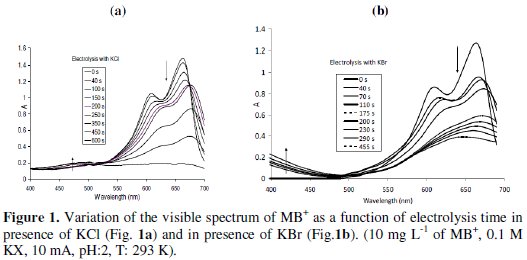
    <p>The indirect oxidation of MB<sup>+</sup> at several initial pH (2 and 8) in presence of 
Na<sub>2</sub>SO<sub>4</sub> is absent, but it occurred with high efficiency in presence of chloride (or 
bromide) (<a href="#f1">Fig. 1a, 1b</a>).</p>


    <p>&nbsp;</p>
<a name="f1">
<img src="/img/revistas/pea/v30n5/30n5a05f1.jpg">
    
<p>&nbsp;</p>


    <p>The variation of the visible spectrum with electrolysis 
time showed i) a decrease in the absorbance at 662 nm and a slight increase in 
the absorbance in the region between 450 and 500 nm, ii) a shift in &lambda;<sub>max</sub> from 662 
nm to 676 nm in the first step, then the absorbance continued decreasing with 
time without any shift in &lambda;<sub>max</sub>. The presence of an isobestic point at 676 nm and 
the shift in &lambda;<sub>max</sub>, prove the chlorination of the aromatic ring [23, 24]. 
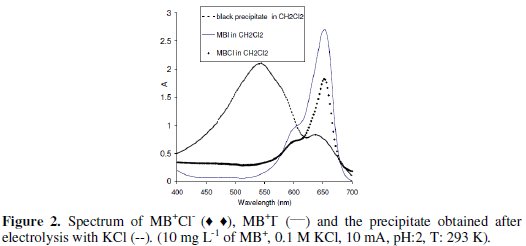
Finally, the MB<sup>+</sup> solution became darker with the appearance of tiny black 
particles in solution. The addition of CH<sub>2</sub>Cl<sub>2</sub> or toluene to the aqueous solution 
let it clear and turns the organic phase pink (&lambda;<sub>max</sub>: 544 nm) (<a href="#f2">Fig. 2</a>).</p>


    <p>&nbsp;</p>
<a name="f2">
<img src="/img/revistas/pea/v30n5/30n5a05f2.jpg">
    
]]></body>
<body><![CDATA[<p>&nbsp;</p>


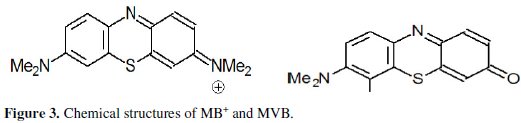
    <p>Probably the tiny black particles correspond to the chlorinated methylene violet 
bernthsen (MVBCl<sub>2</sub>) soluble in organic solvent but insoluble in water (uncharged 
compound) (<a href="#f3">Fig. 3</a>) [25].</p>


    <p>&nbsp;</p>
<a name="f3">
<img src="/img/revistas/pea/v30n5/30n5a05f3.jpg">
    
<p>&nbsp;</p>


    <p>The indirect oxidation of MB<sup>+</sup> leads to the replacement 
of one dimethylamino groups of MB<sup>+</sup> with oxygen (<a href="#f3">Fig. 3</a>). MVB is also the 
main product of the nucleophile attack of MB<sup>+</sup> by OH<sup>-</sup> [26, 27]. The addition of 
acetone at the end the of electrolysis dissolves the dark precipitate and returns the 
slight black solution blue (&lambda;<sub>max</sub>: 610 nm). Probably redox reaction occurred 
between the electrolysis product and acetone.</p>

    <p>The proposed mechanism is in line with that proposed by Donaldson et al. who 
confirmed by several techniques (XR and LC-MS) the formation of 
C10H10Cl<sub>2</sub>N2OS (MVBCl<sub>2</sub>) during the anodic oxidation of MB<sup>+</sup> [19]. In the 
present case, the indirect oxidation of MB<sup>+</sup> did not lead to total mineralization of 
MB<sup>+</sup> as in the case with modified TiO<sub>2</sub> electrode [22], and TiRuO<sub>2</sub> [17], but it 
produces other toxic compounds.</p>


    <p><b><i>Kinetic Study</i></b></p>

    <p>The order with respect to MB<sup>+</sup> is done in presence of a large excess of (KCl), 
source of chlorine compounds. The rate of the reaction can be expressed as:</p>


    <p>&nbsp;</p>
<a name="e1">
<img src="/img/revistas/pea/v30n5/30n5a05e1.jpg">
    
<p>&nbsp;</p>


    ]]></body>
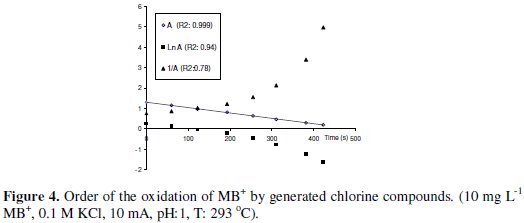
<body><![CDATA[<p>The plots of A (zero order), Ln A (1<sup>st</sup> order) and 1/A (2<sup>nd</sup> order) vs. time allow to 
determine the order according to the best R<sup>2</sup> value. The experimental data are 
well fitted to zero-order (<a href="#f4">Fig. 4</a>).</p>


    <p>&nbsp;</p>
<a name="f4">
<img src="/img/revistas/pea/v30n5/30n5a05f4.jpg">
    
<p>&nbsp;</p>


    <p>The oxidation at different concentrations of 
MB<sup>+</sup> follows the same behavior and the slope of the line A vs. time remains 
approximately constant, so the order with respect to MB<sup>+</sup> is zero, which means 
that the velocity of the reaction is independent of MB<sup>+</sup> concentration.</p>


    <p><b><i>Effect of strong electrolyte</i></b></p>

    <p>The effect of the type of conductive electrolyte used in the electro degradation of 
toxic compounds affects strongly the efficiency of the process [22, 28]. The 
chloride salts give the best results since chloride plays in fact two roles: as strong 
electrolyte and as oxidant [29, 30]. It is interesting to study the effect of the 
nature of the strong electrolyte added on the oxidation rate. The electrolysis is 
done in presence of 0.1 M of the following supporting electrolytes: Na<sub>2</sub>SO<sub>4</sub>, NaF, 
KCl, KBr and KI (added separately). The results show that the decolorization in 
presence of Na<sub>2</sub>SO<sub>4</sub> and NaF is absent. These results are expected since Na<sub>2</sub>SO<sub>4</sub> 
and NaF are non-electro active in the conditions of the experiment, and confirm 
the absence of the direct oxidation of MB<sup>+</sup> on Pt electrode.</p>

    <p>The addition of KI to MB<sup>+</sup> solution provokes directly its precipitation. The 
discoloration of MB<sup>+</sup> solution is proportional to the volume of 1 M KI added,
accompanied by the formation of a violet precipitate (MB). The dissolution of 
the obtained precipitate in CH<sub>2</sub>Cl<sub>2</sub> gives light blue solution and has the same 
visible spectrum as MB<sup>+</sup>Cl<sup>-</sup> in CH<sub>2</sub>Cl<sub>2</sub> with &lambda;<sub>max</sub> at 652 nm (<a href="#f3">Figure 3</a>). The FTIR of the violet precipitate is similar to that of MB<sup>+</sup>Cl<sup>-</sup>. In this case the electro 
oxidation of MB<sup>+</sup> can not be done.</p>

    <p>The indirect oxidation of MB<sup>+</sup> in presence of KBr is efficient and fast as with 
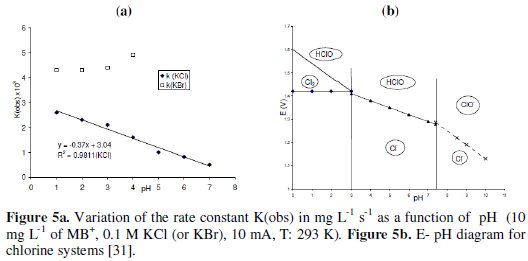
KCl (<a href="#f1">Fig. 1b</a>). The main differences between KCl and KBr are: i) the order with 
respect to MB<sup>+</sup> in presence of KBr is 2 instead zero (in presence of KCl), ii) the 
rate constant k(obs) in presence of KBr remained constant for pH &lt; 4 (<a href="#f5">Fig. 5a</a>).</p>


    <p>&nbsp;</p>
<a name="f5">
<img src="/img/revistas/pea/v30n5/30n5a05f5.jpg">
    
<p>&nbsp;</p>


    ]]></body>
<body><![CDATA[<p>As industrial wastewater contains already high amount of chloride, and the 
oxidation product in presence of KBr is similar to that in presence of KCl, we 
focused our study in the last part on the oxidation of MB<sup>+</sup> in presence of KCl.</p>


    <p><b><i>Effect of pH</i></b></p>

    <p>pH is one of the important factors that affect the performance of the 
electrochemical process. The effect of initial pH (pHo) on the decolorization rate 
of MB<sup>+</sup> showed that the rate constant k(obs) increased linearly with decreasing in 
pHo for pH &lt; 7 (<a href="#f5">Fig. 5a</a>). Similar results are obtained during the degradation of 
azo dye [16] and reactive textile dyes [32]. The reason is due to the increase in 
HClO/Cl<sub>2</sub> amount in acidic medium, having the HClO/Cl<sub>2</sub> system higher 
standard potential than that of (ClO<sup>-</sup>/Cl<sup>-</sup>) (<a href="#f5">Fig. 5b</a>). In basic medium (7 &lt; pH &lt; 9) 
the discoloration of MB<sup>+</sup> is slower than that in acidic medium. For higher pH 
(~12) the discoloration (much slower) is due to the nucleophilic attack of OH<sup>-</sup>.</p>


    <p><b><i>Effect of KCl concentration</i></b></p>

    <p>Several references confirmed that the concentration of the electrolyte had a 
pronounced effect on the cell performance [30, 32]. The effect of KCl 
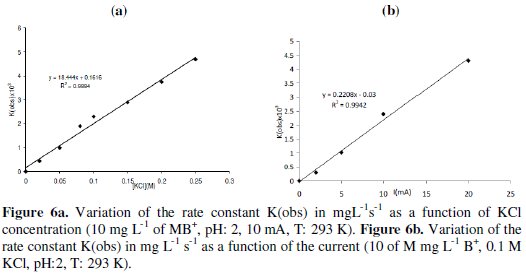
concentration on the decolorization rate is undertaken. Linear relation is observed 
between KCl concentration and the rate constant (<a href="#f6">Fig. 6a</a>).</p>


    <p>&nbsp;</p>
<a name="f6">
<img src="/img/revistas/pea/v30n5/30n5a05f6.jpg">
    
<p>&nbsp;</p>


    <p>This result confirms 
the decolorization of the organic compounds via the generated chlorine 
compounds [29, 30].</p>


    <p><b><i>Effect of current intensity</i></b></p>

    <p>Current density is an important variable in electrochemical engineering. In this 
part, the indirect electro oxidation was done in acidic medium (pHo: 2) and in 
presence of 0.1 M KCl, at several constant currents ranging from 1 mA to 20 
mA. The results show that the decolorization rate or the oxidation rate of MB<sup>+</sup> 
increase linearly with the increase in current (<a href="#f6">Fig. 6b</a>). The linearity is also 
observed with other organic compounds [20, 28, 30]. The increase in rate 
constant with the applied current is mainly the increased production of active 
chlorine products at the anode [17, 29].</p>


    ]]></body>
<body><![CDATA[<p><b><i>Effect of ionic force</i></b></p>

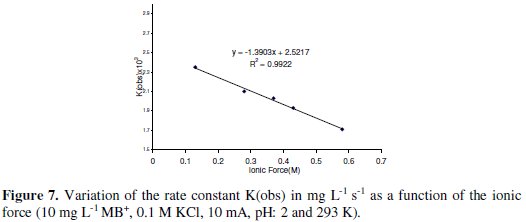
    <p>The effect of the ionic force on the oxidation of MB<sup>+</sup> was investigated by varying 
the concentration of Na<sub>2</sub>SO<sub>4</sub> in the medium. The result showed that the rate 
constant of the reaction decreases with the increase in the ionic force (<a href="#f7">Fig. 7</a>).</p>


    <p>&nbsp;</p>
<a name="f7">
<img src="/img/revistas/pea/v30n5/30n5a05f7.jpg">
    
<p>&nbsp;</p>


    <p>This behavior can be explained by the decrease in chlorine solubility with the 
increase of salt concentration [18]. Similar result is also observed with the 
discoloration of MB<sup>+</sup> in presence of sulfite [25].</p>


    <p><b><i>Effect of temperature</i></b></p>

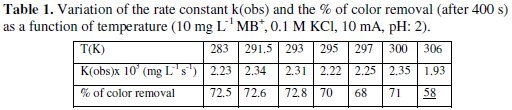
    <p><a href="#t1">Table 1</a> presents the percent of color removal and the rate constant at different 
operating temperatures.</p>


    <p>&nbsp;</p>
<a name="t1">
<img src="/img/revistas/pea/v30n5/30n5a05t1.jpg">
    
<p>&nbsp;</p>


    <p>It is clear that the variation of the rate of removal of 
color is negligible between 283 and 300 K; however, the reaction temperature 
above 303 K showed a decrease in the rate of color removal. The same result is 
observed with other dyes [20, 22]. The decrease in Cl<sub>2</sub> (g) solubility for T &gt; 303 K 
is the major reason for the decolorization decrease [18]. Another reason may be 
the mass transport controlled reduction of hypochlorite according to the 
following cathodic loss reaction [32]:</p>


    ]]></body>
<body><![CDATA[<p>&nbsp;</p>
<a name="e2">
<img src="/img/revistas/pea/v30n5/30n5a05e2.jpg">
    
<p>&nbsp;</p>


    <p>&nbsp;</p>
    <p><b>Conclusions</b></p>

    <p>The discoloration of MB<sup>+</sup> by electrochemical oxidation was affected by the 
operating conditions such as pH, nature of strong electrolyte and many other 
parameters. The order with respect to MB<sup>+</sup> follows zero order in presence of 
chloride, but it is second order in presence of bromide. The efficiency of the 
electrochemical oxidation of MB<sup>+</sup> was proportional to chloride concentration and 
current density, but inversely proportional to the initial pH and ionic force. No 
significant effect of temperature and MB<sup>+</sup> concentration on the rate constant has 
been detected under the experimental conditions. No direct oxidation of MB<sup>+</sup> on 
Pt electrode in presence of Na<sub>2</sub>SO<sub>4</sub> and NaF. The oxidation of MB<sup>+</sup> by electro 
generated chlorine and bromine produced uncharged compound which probably 
corresponds to chlorinate or brominate methylene blue.</p>


    <p>&nbsp;</p>
    <p><b>References</b></p>

    <!-- ref --><p>1. Parry RT. In: Parry RT editor. Principles and Applications of Modified Atmosphere Packaging of Foods. London. Blackie Academic Press: 1993.    &nbsp;&nbsp;&nbsp;&nbsp;&nbsp;&nbsp;&nbsp;&nbsp;[&#160;<a href="javascript:void(0);" onclick="javascript: window.open('/scielo.php?script=sci_nlinks&ref=000080&pid=S0872-1904201200050000500001&lng=','','width=640,height=500,resizable=yes,scrollbars=1,menubar=yes,');">Links</a>&#160;]<!-- end-ref --></p>
    <!-- ref --><p>2. <a href="http://en.wikipedia.org/wiki/Methylene blue" target="_blank">http://en.wikipedia.org/wiki/Methylene blue</a>&nbsp;&nbsp;&nbsp;&nbsp;&nbsp;&nbsp;&nbsp;&nbsp;[&#160;<a href="javascript:void(0);" onclick="javascript: window.open('/scielo.php?script=sci_nlinks&ref=000082&pid=S0872-1904201200050000500002&lng=','','width=640,height=500,resizable=yes,scrollbars=1,menubar=yes,');">Links</a>&#160;]<!-- end-ref --><!-- ref --><p>3. Robinson T, McMullan G, Marchant R, Nigam P. Bioresour Technol. 2001;77:247.    &nbsp;&nbsp;&nbsp;&nbsp;&nbsp;&nbsp;&nbsp;&nbsp;[&#160;<a href="javascript:void(0);" onclick="javascript: window.open('/scielo.php?script=sci_nlinks&ref=000083&pid=S0872-1904201200050000500003&lng=','','width=640,height=500,resizable=yes,scrollbars=1,menubar=yes,');">Links</a>&#160;]<!-- end-ref --></p>
    <p>4. Ong S-T, Keng P-S, Lee W-N, Ha S-T, Hung Y-T. Water. 2011;3:157.</p>
    <!-- ref --><p>5. Katafias A, Kita P, Wrzeszcz G. Trans Metal Chem. 2006;32:31.    &nbsp;&nbsp;&nbsp;&nbsp;&nbsp;&nbsp;&nbsp;&nbsp;[&#160;<a href="javascript:void(0);" onclick="javascript: window.open('/scielo.php?script=sci_nlinks&ref=000086&pid=S0872-1904201200050000500005&lng=','','width=640,height=500,resizable=yes,scrollbars=1,menubar=yes,');">Links</a>&#160;]<!-- end-ref --></p>
    <p>6. Pande S, Ghosh SK, Nath S, Praharaj S, Jana S, Panigrahi S, Basu S, Pal T. J Colloid Interface Sci. 2006;299:421.</p>
    <!-- ref --><p>7. Pietkiewicz-Graczyk A, Impert O, Katafias A, Kita P. Polish J Chem. 2003;77:475.    &nbsp;&nbsp;&nbsp;&nbsp;&nbsp;&nbsp;&nbsp;&nbsp;[&#160;<a href="javascript:void(0);" onclick="javascript: window.open('/scielo.php?script=sci_nlinks&ref=000089&pid=S0872-1904201200050000500007&lng=','','width=640,height=500,resizable=yes,scrollbars=1,menubar=yes,');">Links</a>&#160;]<!-- end-ref --></p>
    <p>8. Impert O, Katafias A, Kita P, Mills A, Pietkiewicz-Graczyk A, Wrzeszcz G. Dalton Trans. 2003:348.</p>
    <p>9. Santos V, Morao A, Pacheco MJ, Ciriaco L, Lopes A. J Environ Eng Manage. 2008;18:193.</p>
    ]]></body>
<body><![CDATA[<!-- ref --><p>10. Martinez-Huitle CA, Ferro S. Chem Soc Rev. 2006;35:1324.    &nbsp;&nbsp;&nbsp;&nbsp;&nbsp;&nbsp;&nbsp;&nbsp;[&#160;<a href="javascript:void(0);" onclick="javascript: window.open('/scielo.php?script=sci_nlinks&ref=000093&pid=S0872-1904201200050000500010&lng=','','width=640,height=500,resizable=yes,scrollbars=1,menubar=yes,');">Links</a>&#160;]<!-- end-ref --></p>
    <!-- ref --><p>11. Peralta-Hernandez JM, Mejia S, Godinez LA, Meas-Vong Y. Environ Research. M. Palomar, editor. India: Research Signpost, Kerala; 2005.    &nbsp;&nbsp;&nbsp;&nbsp;&nbsp;&nbsp;&nbsp;&nbsp;[&#160;<a href="javascript:void(0);" onclick="javascript: window.open('/scielo.php?script=sci_nlinks&ref=000095&pid=S0872-1904201200050000500011&lng=','','width=640,height=500,resizable=yes,scrollbars=1,menubar=yes,');">Links</a>&#160;]<!-- end-ref --></p>
    <p>12. Palma-Goyes RE, Guzmn-Duque FL, Peuela G, Gonzlez I, Nava JL, Torres-Palma RA. Chemosphere. 2010;81:26.</p>
    <!-- ref --><p>13. Polacro M, Palmas S, Renoldi F, Mascia M. J Appl Electrochem. 1999;29:147.    &nbsp;&nbsp;&nbsp;&nbsp;&nbsp;&nbsp;&nbsp;&nbsp;[&#160;<a href="javascript:void(0);" onclick="javascript: window.open('/scielo.php?script=sci_nlinks&ref=000098&pid=S0872-1904201200050000500013&lng=','','width=640,height=500,resizable=yes,scrollbars=1,menubar=yes,');">Links</a>&#160;]<!-- end-ref --></p>
    <p>14. Wu M, Zhao G, Li M, Liu L, Li D. J Haz Mat. 2009;163:26.</p>
    <!-- ref --><p>15. Abu Ghalwaa NM, Abdel-Latif MS. J Iranian Chem Soc. 2005;2:238.    &nbsp;&nbsp;&nbsp;&nbsp;&nbsp;&nbsp;&nbsp;&nbsp;[&#160;<a href="javascript:void(0);" onclick="javascript: window.open('/scielo.php?script=sci_nlinks&ref=000101&pid=S0872-1904201200050000500015&lng=','','width=640,height=500,resizable=yes,scrollbars=1,menubar=yes,');">Links</a>&#160;]<!-- end-ref --></p>
    ]]></body>
<body><![CDATA[<!-- ref --><p>16. Alameddine I, El Jamal MM. J Univ Technol Metall (Sofia). 2009;44:127.    &nbsp;&nbsp;&nbsp;&nbsp;&nbsp;&nbsp;&nbsp;&nbsp;[&#160;<a href="javascript:void(0);" onclick="javascript: window.open('/scielo.php?script=sci_nlinks&ref=000103&pid=S0872-1904201200050000500016&lng=','','width=640,height=500,resizable=yes,scrollbars=1,menubar=yes,');">Links</a>&#160;]<!-- end-ref --></p>
    <!-- ref --><p>17. Panizza M, Barbucci A, Ricotti R, Cerisola G. Sep Purif Technol. 2007;54:382.    &nbsp;&nbsp;&nbsp;&nbsp;&nbsp;&nbsp;&nbsp;&nbsp;[&#160;<a href="javascript:void(0);" onclick="javascript: window.open('/scielo.php?script=sci_nlinks&ref=000105&pid=S0872-1904201200050000500017&lng=','','width=640,height=500,resizable=yes,scrollbars=1,menubar=yes,');">Links</a>&#160;]<!-- end-ref --></p>
    <p>18. Schmittinger P. Chlorine. In: Ullmann's Encyclopaedia, vol. 6A. Weinheim: VCH; 1986. P. 399.</p>
    <p>19. Donaldson JD, Grimes SM, Yasri NG, Wheals B, Parrickand J, Errington WE. J Chem Technol Biotechnol. 2002;77:756.</p>
    <!-- ref --><p>20. Raidan RI, Tabbara A, El Zant AA, El Jamal MM. J Univ Tech Metall (Sofia). 2009;44:79.    &nbsp;&nbsp;&nbsp;&nbsp;&nbsp;&nbsp;&nbsp;&nbsp;[&#160;<a href="javascript:void(0);" onclick="javascript: window.open('/scielo.php?script=sci_nlinks&ref=000109&pid=S0872-1904201200050000500020&lng=','','width=640,height=500,resizable=yes,scrollbars=1,menubar=yes,');">Links</a>&#160;]<!-- end-ref --></p>
    <p>21. Peralta-Hernandez JM, Mendez-Tovar M, Guerra-Sanchez R, Martinez-Huitle CA, Nava JL. Int J Electrochem. 2012:Article ID 154316.</p>
    <!-- ref --><p>22. Abu Ghalwa NM, Zaggout FR. J Environ Sci Health A. 2006;41:2271.    &nbsp;&nbsp;&nbsp;&nbsp;&nbsp;&nbsp;&nbsp;&nbsp;[&#160;<a href="javascript:void(0);" onclick="javascript: window.open('/scielo.php?script=sci_nlinks&ref=000112&pid=S0872-1904201200050000500022&lng=','','width=640,height=500,resizable=yes,scrollbars=1,menubar=yes,');">Links</a>&#160;]<!-- end-ref --></p>
    <!-- ref --><p>23. Korbahti BK, Tanyolac A. Water Res. 2003;37:1505.    &nbsp;&nbsp;&nbsp;&nbsp;&nbsp;&nbsp;&nbsp;&nbsp;[&#160;<a href="javascript:void(0);" onclick="javascript: window.open('/scielo.php?script=sci_nlinks&ref=000114&pid=S0872-1904201200050000500023&lng=','','width=640,height=500,resizable=yes,scrollbars=1,menubar=yes,');">Links</a>&#160;]<!-- end-ref --></p>
    <!-- ref --><p>24. Plater MJ. Arkivoc. 2003:37.    &nbsp;&nbsp;&nbsp;&nbsp;&nbsp;&nbsp;&nbsp;&nbsp;[&#160;<a href="javascript:void(0);" onclick="javascript: window.open('/scielo.php?script=sci_nlinks&ref=000116&pid=S0872-1904201200050000500024&lng=','','width=640,height=500,resizable=yes,scrollbars=1,menubar=yes,');">Links</a>&#160;]<!-- end-ref --></p>
    <!-- ref --><p>25. Mills A, Wang J. J Photochem Photobiol A. 1999;127:123.    &nbsp;&nbsp;&nbsp;&nbsp;&nbsp;&nbsp;&nbsp;&nbsp;[&#160;<a href="javascript:void(0);" onclick="javascript: window.open('/scielo.php?script=sci_nlinks&ref=000118&pid=S0872-1904201200050000500025&lng=','','width=640,height=500,resizable=yes,scrollbars=1,menubar=yes,');">Links</a>&#160;]<!-- end-ref --></p>
    <!-- ref --><p>26. Katafias A, Kita P, Wrzeszcz G. Trans Metal Chem. 2006;32:31.    &nbsp;&nbsp;&nbsp;&nbsp;&nbsp;&nbsp;&nbsp;&nbsp;[&#160;<a href="javascript:void(0);" onclick="javascript: window.open('/scielo.php?script=sci_nlinks&ref=000120&pid=S0872-1904201200050000500026&lng=','','width=640,height=500,resizable=yes,scrollbars=1,menubar=yes,');">Links</a>&#160;]<!-- end-ref --></p>
    <!-- ref --><p>27. Zaggout FR, Abu Ghalwa N. J Environ Manag. 2008;86:291.    &nbsp;&nbsp;&nbsp;&nbsp;&nbsp;&nbsp;&nbsp;&nbsp;[&#160;<a href="javascript:void(0);" onclick="javascript: window.open('/scielo.php?script=sci_nlinks&ref=000122&pid=S0872-1904201200050000500027&lng=','','width=640,height=500,resizable=yes,scrollbars=1,menubar=yes,');">Links</a>&#160;]<!-- end-ref --></p>
    <!-- ref --><p>28. Parsa JB, Abbasi M. Acta Chim Slov. 2007;54:792.    &nbsp;&nbsp;&nbsp;&nbsp;&nbsp;&nbsp;&nbsp;&nbsp;[&#160;<a href="javascript:void(0);" onclick="javascript: window.open('/scielo.php?script=sci_nlinks&ref=000124&pid=S0872-1904201200050000500028&lng=','','width=640,height=500,resizable=yes,scrollbars=1,menubar=yes,');">Links</a>&#160;]<!-- end-ref --></p>
    <p>29. Zaviska F, Drogui P, Blais J-F, Mercier G. J Appl Electrochem. 39 (2009) 2397.</p>
    <p>30. Maurice M, Desbarres J, Colin C, Jardy A, Bauer D. Chimie des solutions. Techniques et Documentation; 1990.</p>
    <!-- ref --><p>31. Kariyajjanavar P, Jogttappa N, Nayaka YA. J Haz Mat. 2011;190:952.    &nbsp;&nbsp;&nbsp;&nbsp;&nbsp;&nbsp;&nbsp;&nbsp;[&#160;<a href="javascript:void(0);" onclick="javascript: window.open('/scielo.php?script=sci_nlinks&ref=000128&pid=S0872-1904201200050000500031&lng=','','width=640,height=500,resizable=yes,scrollbars=1,menubar=yes,');">Links</a>&#160;]<!-- end-ref --></p>
    <!-- ref --><p>32. Rajkumar D, Kim JG. J Haz Mat. 2006;B136:203.    &nbsp;&nbsp;&nbsp;&nbsp;&nbsp;&nbsp;&nbsp;&nbsp;[&#160;<a href="javascript:void(0);" onclick="javascript: window.open('/scielo.php?script=sci_nlinks&ref=000130&pid=S0872-1904201200050000500032&lng=','','width=640,height=500,resizable=yes,scrollbars=1,menubar=yes,');">Links</a>&#160;]<!-- end-ref --></p>


    <p>&nbsp;</p>
    ]]></body>
<body><![CDATA[<p><b>Acknowledgements</b></p>

    <p>The authors wish to thank the ''Ecole Doctorale de Sciences et Technologie'' in 
Lebanese University for its help.</p>


    <p>&nbsp;</p>
    <p><a name=0></a><sup><a href="#top">*</a></sup>Corresponding author. E-mail address: <a href="mailto:mjamal@ul.edu.lb">mjamal@ul.edu.lb</a></p>

    <p>Received 21 October 2012; accepted 31 October 2012</p>

    <p><a href="http://www.peacta.org" target="_blank">www.peacta.org</a> </p>


     ]]></body><back>
<ref-list>
<ref id="B1">
<label>1</label><nlm-citation citation-type="book">
<person-group person-group-type="author">
<name>
<surname><![CDATA[Parry]]></surname>
<given-names><![CDATA[RT.]]></given-names>
</name>
</person-group>
<person-group person-group-type="editor">
<name>
<surname><![CDATA[Parry]]></surname>
<given-names><![CDATA[RT]]></given-names>
</name>
</person-group>
<source><![CDATA[Principles and Applications of Modified Atmosphere Packaging of Foods]]></source>
<year>1993</year>
<publisher-loc><![CDATA[London ]]></publisher-loc>
<publisher-name><![CDATA[Blackie Academic Press]]></publisher-name>
</nlm-citation>
</ref>
<ref id="B2">
<label>2</label><nlm-citation citation-type="">
<source><![CDATA[]]></source>
<year></year>
</nlm-citation>
</ref>
<ref id="B3">
<label>3</label><nlm-citation citation-type="journal">
<person-group person-group-type="author">
<name>
<surname><![CDATA[Robinson]]></surname>
<given-names><![CDATA[T]]></given-names>
</name>
<name>
<surname><![CDATA[McMullan]]></surname>
<given-names><![CDATA[G]]></given-names>
</name>
<name>
<surname><![CDATA[Marchant]]></surname>
<given-names><![CDATA[R]]></given-names>
</name>
<name>
<surname><![CDATA[Nigam]]></surname>
<given-names><![CDATA[P]]></given-names>
</name>
</person-group>
<source><![CDATA[Bioresour Technol]]></source>
<year>2001</year>
<volume>77</volume>
<page-range>247</page-range></nlm-citation>
</ref>
<ref id="B4">
<label>4</label><nlm-citation citation-type="journal">
<person-group person-group-type="author">
<name>
<surname><![CDATA[Ong]]></surname>
<given-names><![CDATA[S-T]]></given-names>
</name>
<name>
<surname><![CDATA[Keng]]></surname>
<given-names><![CDATA[P-S]]></given-names>
</name>
<name>
<surname><![CDATA[Lee]]></surname>
<given-names><![CDATA[W-N]]></given-names>
</name>
</person-group>
<source><![CDATA[Water]]></source>
<year>2011</year>
<volume>3</volume>
<page-range>157</page-range></nlm-citation>
</ref>
<ref id="B5">
<label>5</label><nlm-citation citation-type="journal">
<person-group person-group-type="author">
<name>
<surname><![CDATA[Katafias]]></surname>
<given-names><![CDATA[A]]></given-names>
</name>
<name>
<surname><![CDATA[Kita]]></surname>
<given-names><![CDATA[P]]></given-names>
</name>
<name>
<surname><![CDATA[Wrzeszcz]]></surname>
<given-names><![CDATA[G]]></given-names>
</name>
</person-group>
<source><![CDATA[Trans Metal Chem]]></source>
<year>2006</year>
<volume>32</volume>
<page-range>31</page-range></nlm-citation>
</ref>
<ref id="B6">
<label>6</label><nlm-citation citation-type="journal">
<person-group person-group-type="author">
<name>
<surname><![CDATA[Pande]]></surname>
<given-names><![CDATA[S]]></given-names>
</name>
<name>
<surname><![CDATA[Ghosh]]></surname>
<given-names><![CDATA[SK]]></given-names>
</name>
<name>
<surname><![CDATA[Nath]]></surname>
<given-names><![CDATA[S]]></given-names>
</name>
</person-group>
<source><![CDATA[J Colloid Interface Sci]]></source>
<year>2006</year>
<volume>299</volume>
<page-range>421</page-range></nlm-citation>
</ref>
<ref id="B7">
<label>7</label><nlm-citation citation-type="journal">
<person-group person-group-type="author">
<name>
<surname><![CDATA[Pietkiewicz-Graczyk]]></surname>
<given-names><![CDATA[A]]></given-names>
</name>
<name>
<surname><![CDATA[Impert]]></surname>
<given-names><![CDATA[O]]></given-names>
</name>
<name>
<surname><![CDATA[Katafias]]></surname>
<given-names><![CDATA[A]]></given-names>
</name>
<name>
<surname><![CDATA[Kita]]></surname>
<given-names><![CDATA[P]]></given-names>
</name>
</person-group>
<source><![CDATA[Polish J Chem]]></source>
<year>2003</year>
<volume>77</volume>
<page-range>475</page-range></nlm-citation>
</ref>
<ref id="B8">
<label>8</label><nlm-citation citation-type="journal">
<person-group person-group-type="author">
<name>
<surname><![CDATA[Impert]]></surname>
<given-names><![CDATA[O]]></given-names>
</name>
<name>
<surname><![CDATA[Katafias]]></surname>
<given-names><![CDATA[A]]></given-names>
</name>
<name>
<surname><![CDATA[Kita]]></surname>
<given-names><![CDATA[P]]></given-names>
</name>
</person-group>
<source><![CDATA[Dalton Trans]]></source>
<year>2003</year>
<page-range>348</page-range></nlm-citation>
</ref>
<ref id="B9">
<label>9</label><nlm-citation citation-type="journal">
<person-group person-group-type="author">
<name>
<surname><![CDATA[Santos]]></surname>
<given-names><![CDATA[V]]></given-names>
</name>
<name>
<surname><![CDATA[Morao]]></surname>
<given-names><![CDATA[A]]></given-names>
</name>
<name>
<surname><![CDATA[Pacheco]]></surname>
<given-names><![CDATA[MJ]]></given-names>
</name>
</person-group>
<source><![CDATA[J Environ Eng Manage]]></source>
<year>2008</year>
<volume>18</volume>
<page-range>193</page-range></nlm-citation>
</ref>
<ref id="B10">
<label>10</label><nlm-citation citation-type="journal">
<person-group person-group-type="author">
<name>
<surname><![CDATA[Martinez-Huitle]]></surname>
<given-names><![CDATA[CA]]></given-names>
</name>
<name>
<surname><![CDATA[Ferro]]></surname>
<given-names><![CDATA[S]]></given-names>
</name>
</person-group>
<source><![CDATA[Chem Soc Rev]]></source>
<year>2006</year>
<volume>35</volume>
<page-range>1324</page-range></nlm-citation>
</ref>
<ref id="B11">
<label>11</label><nlm-citation citation-type="">
<person-group person-group-type="author">
<name>
<surname><![CDATA[Peralta-Hernandez]]></surname>
<given-names><![CDATA[JM]]></given-names>
</name>
<name>
<surname><![CDATA[Mejia]]></surname>
<given-names><![CDATA[S]]></given-names>
</name>
<name>
<surname><![CDATA[Godinez]]></surname>
<given-names><![CDATA[LA]]></given-names>
</name>
<name>
<surname><![CDATA[Meas-Vong]]></surname>
<given-names><![CDATA[Y]]></given-names>
</name>
</person-group>
<source><![CDATA[Environ Research]]></source>
<year>2005</year>
<publisher-loc><![CDATA[Kerala ]]></publisher-loc>
</nlm-citation>
</ref>
<ref id="B12">
<label>12</label><nlm-citation citation-type="journal">
<person-group person-group-type="author">
<name>
<surname><![CDATA[Palma-Goyes]]></surname>
<given-names><![CDATA[RE]]></given-names>
</name>
<name>
<surname><![CDATA[Guzmn-Duque]]></surname>
<given-names><![CDATA[FL]]></given-names>
</name>
<name>
<surname><![CDATA[Peuela]]></surname>
<given-names><![CDATA[G]]></given-names>
</name>
</person-group>
<source><![CDATA[Chemosphere]]></source>
<year>2010</year>
<volume>81</volume>
<page-range>26</page-range></nlm-citation>
</ref>
<ref id="B13">
<label>13</label><nlm-citation citation-type="journal">
<person-group person-group-type="author">
<name>
<surname><![CDATA[Polacro]]></surname>
<given-names><![CDATA[M]]></given-names>
</name>
<name>
<surname><![CDATA[Palmas]]></surname>
<given-names><![CDATA[S]]></given-names>
</name>
<name>
<surname><![CDATA[Renoldi]]></surname>
<given-names><![CDATA[F]]></given-names>
</name>
<name>
<surname><![CDATA[Mascia]]></surname>
<given-names><![CDATA[M]]></given-names>
</name>
</person-group>
<source><![CDATA[J Appl Electrochem]]></source>
<year>1999</year>
<volume>29</volume>
<page-range>147</page-range></nlm-citation>
</ref>
<ref id="B14">
<label>14</label><nlm-citation citation-type="journal">
<person-group person-group-type="author">
<name>
<surname><![CDATA[Wu]]></surname>
<given-names><![CDATA[M]]></given-names>
</name>
<name>
<surname><![CDATA[Zhao]]></surname>
<given-names><![CDATA[G]]></given-names>
</name>
<name>
<surname><![CDATA[Li]]></surname>
<given-names><![CDATA[M]]></given-names>
</name>
</person-group>
<source><![CDATA[J Haz Mat]]></source>
<year>2009</year>
<volume>163</volume>
<page-range>26</page-range></nlm-citation>
</ref>
<ref id="B15">
<label>15</label><nlm-citation citation-type="journal">
<person-group person-group-type="author">
<name>
<surname><![CDATA[Abu Ghalwaa]]></surname>
<given-names><![CDATA[NM]]></given-names>
</name>
<name>
<surname><![CDATA[Abdel-Latif]]></surname>
<given-names><![CDATA[MS]]></given-names>
</name>
</person-group>
<source><![CDATA[J Iranian Chem Soc]]></source>
<year>2005</year>
<volume>2</volume>
<page-range>238</page-range></nlm-citation>
</ref>
<ref id="B16">
<label>16</label><nlm-citation citation-type="journal">
<person-group person-group-type="author">
<name>
<surname><![CDATA[Alameddine]]></surname>
<given-names><![CDATA[I]]></given-names>
</name>
<name>
<surname><![CDATA[El Jamal]]></surname>
<given-names><![CDATA[MM]]></given-names>
</name>
</person-group>
<source><![CDATA[J Univ Technol Metall (Sofia)]]></source>
<year>2009</year>
<volume>44</volume>
<page-range>127</page-range></nlm-citation>
</ref>
<ref id="B17">
<label>17</label><nlm-citation citation-type="journal">
<person-group person-group-type="author">
<name>
<surname><![CDATA[Panizza]]></surname>
<given-names><![CDATA[M]]></given-names>
</name>
<name>
<surname><![CDATA[Barbucci]]></surname>
<given-names><![CDATA[A]]></given-names>
</name>
<name>
<surname><![CDATA[Ricotti]]></surname>
<given-names><![CDATA[R]]></given-names>
</name>
<name>
<surname><![CDATA[Cerisola]]></surname>
<given-names><![CDATA[G]]></given-names>
</name>
</person-group>
<source><![CDATA[Sep Purif Technol]]></source>
<year>2007</year>
<volume>54</volume>
<page-range>382</page-range></nlm-citation>
</ref>
<ref id="B18">
<label>18</label><nlm-citation citation-type="book">
<person-group person-group-type="author">
<name>
<surname><![CDATA[Chlorine]]></surname>
<given-names><![CDATA[SP]]></given-names>
</name>
</person-group>
<source><![CDATA[Ullmann's Encyclopaedia]]></source>
<year>1986</year>
<volume>6A</volume>
<page-range>399</page-range><publisher-loc><![CDATA[Weinheim ]]></publisher-loc>
<publisher-name><![CDATA[VCH]]></publisher-name>
</nlm-citation>
</ref>
<ref id="B19">
<label>19</label><nlm-citation citation-type="journal">
<person-group person-group-type="author">
<name>
<surname><![CDATA[Donaldson]]></surname>
<given-names><![CDATA[JD]]></given-names>
</name>
<name>
<surname><![CDATA[Grimes]]></surname>
<given-names><![CDATA[SM]]></given-names>
</name>
<name>
<surname><![CDATA[Yasri]]></surname>
<given-names><![CDATA[NG]]></given-names>
</name>
</person-group>
<source><![CDATA[J Chem Technol Biotechnol]]></source>
<year>2002</year>
<volume>77</volume>
<page-range>756</page-range></nlm-citation>
</ref>
<ref id="B20">
<label>20</label><nlm-citation citation-type="journal">
<person-group person-group-type="author">
<name>
<surname><![CDATA[Raidan]]></surname>
<given-names><![CDATA[RI]]></given-names>
</name>
<name>
<surname><![CDATA[Tabbara]]></surname>
<given-names><![CDATA[A]]></given-names>
</name>
<name>
<surname><![CDATA[El Zant]]></surname>
<given-names><![CDATA[AA]]></given-names>
</name>
<name>
<surname><![CDATA[El Jamal]]></surname>
<given-names><![CDATA[MM]]></given-names>
</name>
</person-group>
<source><![CDATA[J Univ Tech Metall (Sofia)]]></source>
<year>2009</year>
<volume>44</volume>
<page-range>79</page-range></nlm-citation>
</ref>
<ref id="B21">
<label>21</label><nlm-citation citation-type="journal">
<person-group person-group-type="author">
<name>
<surname><![CDATA[Peralta-Hernandez]]></surname>
<given-names><![CDATA[JM]]></given-names>
</name>
<name>
<surname><![CDATA[Mendez-Tovar]]></surname>
<given-names><![CDATA[M]]></given-names>
</name>
<name>
<surname><![CDATA[Guerra-Sanchez]]></surname>
<given-names><![CDATA[R]]></given-names>
</name>
</person-group>
<source><![CDATA[Int J Electrochem]]></source>
<year>2012</year>
</nlm-citation>
</ref>
<ref id="B22">
<label>22</label><nlm-citation citation-type="journal">
<person-group person-group-type="author">
<name>
<surname><![CDATA[Abu Ghalwa]]></surname>
<given-names><![CDATA[NM]]></given-names>
</name>
<name>
<surname><![CDATA[Zaggout]]></surname>
<given-names><![CDATA[FR]]></given-names>
</name>
</person-group>
<source><![CDATA[J Environ Sci Health A]]></source>
<year>2006</year>
<volume>41</volume>
<page-range>2271</page-range></nlm-citation>
</ref>
<ref id="B23">
<label>23</label><nlm-citation citation-type="journal">
<person-group person-group-type="author">
<name>
<surname><![CDATA[Korbahti]]></surname>
<given-names><![CDATA[BK]]></given-names>
</name>
<name>
<surname><![CDATA[Tanyolac]]></surname>
<given-names><![CDATA[A]]></given-names>
</name>
</person-group>
<source><![CDATA[Water Res]]></source>
<year>2003</year>
<volume>37</volume>
<page-range>1505</page-range></nlm-citation>
</ref>
<ref id="B24">
<label>24</label><nlm-citation citation-type="journal">
<person-group person-group-type="author">
<name>
<surname><![CDATA[Plater]]></surname>
<given-names><![CDATA[MJ]]></given-names>
</name>
</person-group>
<source><![CDATA[Arkivoc]]></source>
<year>2003</year>
<page-range>37</page-range></nlm-citation>
</ref>
<ref id="B25">
<label>25</label><nlm-citation citation-type="journal">
<person-group person-group-type="author">
<name>
<surname><![CDATA[Mills]]></surname>
<given-names><![CDATA[A]]></given-names>
</name>
<name>
<surname><![CDATA[Wang]]></surname>
<given-names><![CDATA[J]]></given-names>
</name>
</person-group>
<source><![CDATA[J Photochem Photobiol A]]></source>
<year>1999</year>
<volume>127</volume>
<page-range>123</page-range></nlm-citation>
</ref>
<ref id="B26">
<label>26</label><nlm-citation citation-type="journal">
<person-group person-group-type="author">
<name>
<surname><![CDATA[Katafias]]></surname>
<given-names><![CDATA[A]]></given-names>
</name>
<name>
<surname><![CDATA[Kita]]></surname>
<given-names><![CDATA[P]]></given-names>
</name>
<name>
<surname><![CDATA[Wrzeszcz]]></surname>
<given-names><![CDATA[G]]></given-names>
</name>
</person-group>
<source><![CDATA[Trans Metal Chem]]></source>
<year>2006</year>
<volume>32</volume>
<page-range>31</page-range></nlm-citation>
</ref>
<ref id="B27">
<label>27</label><nlm-citation citation-type="journal">
<person-group person-group-type="author">
<name>
<surname><![CDATA[Zaggout]]></surname>
<given-names><![CDATA[FR]]></given-names>
</name>
<name>
<surname><![CDATA[Abu Ghalwa]]></surname>
<given-names><![CDATA[N]]></given-names>
</name>
</person-group>
<source><![CDATA[J Environ Manag]]></source>
<year>2008</year>
<volume>86</volume>
<page-range>291</page-range></nlm-citation>
</ref>
<ref id="B28">
<label>28</label><nlm-citation citation-type="journal">
<person-group person-group-type="author">
<name>
<surname><![CDATA[Parsa]]></surname>
<given-names><![CDATA[JB]]></given-names>
</name>
<name>
<surname><![CDATA[Abbasi]]></surname>
<given-names><![CDATA[M]]></given-names>
</name>
</person-group>
<source><![CDATA[Acta Chim Slov]]></source>
<year>2007</year>
<volume>54</volume>
<page-range>792</page-range></nlm-citation>
</ref>
<ref id="B29">
<label>29</label><nlm-citation citation-type="journal">
<person-group person-group-type="author">
<name>
<surname><![CDATA[Zaviska]]></surname>
<given-names><![CDATA[F]]></given-names>
</name>
<name>
<surname><![CDATA[Drogui]]></surname>
<given-names><![CDATA[P]]></given-names>
</name>
<name>
<surname><![CDATA[Blais]]></surname>
<given-names><![CDATA[J-F]]></given-names>
</name>
<name>
<surname><![CDATA[Mercier]]></surname>
<given-names><![CDATA[G]]></given-names>
</name>
</person-group>
<source><![CDATA[J Appl Electrochem]]></source>
<year>2009</year>
<volume>39</volume>
<page-range>2397</page-range></nlm-citation>
</ref>
<ref id="B30">
<label>30</label><nlm-citation citation-type="">
<person-group person-group-type="author">
<name>
<surname><![CDATA[Maurice]]></surname>
<given-names><![CDATA[M]]></given-names>
</name>
<name>
<surname><![CDATA[Desbarres]]></surname>
<given-names><![CDATA[J]]></given-names>
</name>
<name>
<surname><![CDATA[Colin]]></surname>
<given-names><![CDATA[C]]></given-names>
</name>
</person-group>
<source><![CDATA[Chimie des solutions. Techniques et Documentation]]></source>
<year>1990</year>
</nlm-citation>
</ref>
<ref id="B31">
<label>31</label><nlm-citation citation-type="journal">
<person-group person-group-type="author">
<name>
<surname><![CDATA[Kariyajjanavar]]></surname>
<given-names><![CDATA[P]]></given-names>
</name>
<name>
<surname><![CDATA[Jogttappa]]></surname>
<given-names><![CDATA[N]]></given-names>
</name>
<name>
<surname><![CDATA[Nayaka]]></surname>
<given-names><![CDATA[YA]]></given-names>
</name>
</person-group>
<source><![CDATA[J Haz Mat]]></source>
<year>2011</year>
<volume>190</volume>
<page-range>952</page-range></nlm-citation>
</ref>
<ref id="B32">
<label>32</label><nlm-citation citation-type="journal">
<person-group person-group-type="author">
<name>
<surname><![CDATA[Rajkumar]]></surname>
<given-names><![CDATA[D]]></given-names>
</name>
<name>
<surname><![CDATA[Kim]]></surname>
<given-names><![CDATA[JG]]></given-names>
</name>
</person-group>
<source><![CDATA[J Haz Mat]]></source>
<year>2006</year>
<volume>B136</volume>
<page-range>203</page-range></nlm-citation>
</ref>
</ref-list>
</back>
</article>