<?xml version="1.0" encoding="ISO-8859-1"?><article xmlns:mml="http://www.w3.org/1998/Math/MathML" xmlns:xlink="http://www.w3.org/1999/xlink" xmlns:xsi="http://www.w3.org/2001/XMLSchema-instance">
<front>
<journal-meta>
<journal-id>0872-1904</journal-id>
<journal-title><![CDATA[Portugaliae Electrochimica Acta]]></journal-title>
<abbrev-journal-title><![CDATA[Port. Electrochim. Acta]]></abbrev-journal-title>
<issn>0872-1904</issn>
<publisher>
<publisher-name><![CDATA[Sociedade Portuguesa de Electroquímica]]></publisher-name>
</publisher>
</journal-meta>
<article-meta>
<article-id>S0872-19042012000600003</article-id>
<article-id pub-id-type="doi">10.4152/pea.201206395</article-id>
<title-group>
<article-title xml:lang="en"><![CDATA[Metronidazole: A Corrosion Inhibitor for Mild Steel in Aqueous Environment]]></article-title>
</title-group>
<contrib-group>
<contrib contrib-type="author">
<name>
<surname><![CDATA[Megalai]]></surname>
<given-names><![CDATA[S.M.]]></given-names>
</name>
<xref ref-type="aff" rid="A01"/>
</contrib>
<contrib contrib-type="author">
<name>
<surname><![CDATA[Manjula]]></surname>
<given-names><![CDATA[Y. P.]]></given-names>
</name>
<xref ref-type="aff" rid="A02"/>
</contrib>
<contrib contrib-type="author">
<name>
<surname><![CDATA[Manonmani]]></surname>
<given-names><![CDATA[K.N.]]></given-names>
</name>
<xref ref-type="aff" rid="A03"/>
</contrib>
<contrib contrib-type="author">
<name>
<surname><![CDATA[Kavitha]]></surname>
<given-names><![CDATA[N.]]></given-names>
</name>
<xref ref-type="aff" rid="A01"/>
</contrib>
<contrib contrib-type="author">
<name>
<surname><![CDATA[Baby]]></surname>
<given-names><![CDATA[N.]]></given-names>
</name>
<xref ref-type="aff" rid="A04"/>
</contrib>
</contrib-group>
<aff id="A01">
<institution><![CDATA[,Arulmigu Palaniandavar College of Arts & Culture PG and Research Department of Chemistry ]]></institution>
<addr-line><![CDATA[Palani Tamilnadu]]></addr-line>
<country>India</country>
</aff>
<aff id="A02">
<institution><![CDATA[,Arulmigu Palaniandavar College for Women  ]]></institution>
<addr-line><![CDATA[Palani Tamilnadu]]></addr-line>
<country>India</country>
</aff>
<aff id="A03">
<institution><![CDATA[,Sri Subramaniya College of Engineering & Technology  ]]></institution>
<addr-line><![CDATA[Palani Tamilnadu]]></addr-line>
<country>India</country>
</aff>
<aff id="A04">
<institution><![CDATA[,Christian College of Engineering  ]]></institution>
<addr-line><![CDATA[Oddanchathiram Tamilnadu]]></addr-line>
<country>India</country>
</aff>
<pub-date pub-type="pub">
<day>00</day>
<month>11</month>
<year>2012</year>
</pub-date>
<pub-date pub-type="epub">
<day>00</day>
<month>11</month>
<year>2012</year>
</pub-date>
<volume>30</volume>
<numero>6</numero>
<fpage>395</fpage>
<lpage>403</lpage>
<copyright-statement/>
<copyright-year/>
<self-uri xlink:href="http://scielo.pt/scielo.php?script=sci_arttext&amp;pid=S0872-19042012000600003&amp;lng=en&amp;nrm=iso"></self-uri><self-uri xlink:href="http://scielo.pt/scielo.php?script=sci_abstract&amp;pid=S0872-19042012000600003&amp;lng=en&amp;nrm=iso"></self-uri><self-uri xlink:href="http://scielo.pt/scielo.php?script=sci_pdf&amp;pid=S0872-19042012000600003&amp;lng=en&amp;nrm=iso"></self-uri><abstract abstract-type="short" xml:lang="en"><p><![CDATA[The inhibition efficiency (IE) of metronidazole (MZ)-Zn(II) system in controlling corrosion of mild steel in aqueous solution containing 60 ppm of Cl- ion has been evaluated by weight loss method. Weight loss study reveals that the formulation consisting of 140 ppm of MZ and 50 ppm of Zn(II) has 84% inhibition efficiency in controlling corrosion of mild steel immersed in aqueous solution containing 60 ppm of Cl- ion. Polarization study reveals that this system as a mixed type of inhibitor controlling the cathodic and anodic reaction to an equal extent. AC impedance reveals that a protective film is formed on the metal surface. The FTIR spectra revealed that the protective film consists of Fe(II)-MZ complex.]]></p></abstract>
<kwd-group>
<kwd lng="en"><![CDATA[metronidazole drug]]></kwd>
<kwd lng="en"><![CDATA[mild steel]]></kwd>
<kwd lng="en"><![CDATA[corrosion inhibition]]></kwd>
<kwd lng="en"><![CDATA[weight loss]]></kwd>
<kwd lng="en"><![CDATA[polarization]]></kwd>
<kwd lng="en"><![CDATA[AC impedance]]></kwd>
</kwd-group>
</article-meta>
</front><body><![CDATA[ 

    <p><b>Metronidazole: A Corrosion Inhibitor for Mild Steel in Aqueous Environment</b></p>

    <p><b>S.M. Megalai<sup>1,<a href="#0">*<a/></sup>, Y. P. Manjula<sup>2</sup>, K.N. Manonmani<sup>3</sup>, N. Kavitha<sup>1</sup> and N. Baby<sup>4</sup></b></p>

    <p><sup>1</sup><i> PG and Research Department of Chemistry, Arulmigu Palaniandavar College of Arts & Culture, Palani-624601, Tamilnadu, India</i></p>

    <p><sup>2</sup><i> Arulmigu Palaniandavar College for Women, Palani-624601, Tamilnadu, India.</i></p>

    <p><sup>3</sup><i> Sri Subramaniya College of Engineering & Technology, Palani-624601, Tamilnadu, India.</i></p>

    <p><sup>4</sup><i> Christian College of Engineering, Oddanchathiram, Tamilnadu, India.</i></p>


<!--     <p>&nbsp;</p>
    <p>doi: 10.4152/pea.201206395</p> -->


    <p>&nbsp;</p>
    ]]></body>
<body><![CDATA[<p><b>Abstract</b></p>

    <p>The inhibition efficiency (IE) of metronidazole (MZ)-Zn(II) system in controlling 
corrosion of mild steel in aqueous solution containing 60 ppm of Cl<sup>-</sup> ion has been 
evaluated by weight loss method. Weight loss study reveals that the formulation 
consisting of 140 ppm of MZ and 50 ppm of Zn(II) has 84% inhibition efficiency in 
controlling corrosion of mild steel immersed in aqueous solution containing 60 ppm of 
Cl<sup>-</sup> ion. Polarization study reveals that this system as a mixed type of inhibitor 
controlling the cathodic and anodic reaction to an equal extent. AC impedance reveals 
that a protective film is formed on the metal surface. The FTIR spectra revealed that the 
protective film consists of Fe(II)-MZ complex.</p>

    <p><b><i>Keywords:</i></b> metronidazole drug, mild steel, corrosion inhibition, weight loss, 
polarization and AC impedance.</p>


    <p>&nbsp;</p>
    <p><b>Introduction</b></p>

    <p>Corrosion inhibition of mild steel is a matter of theoretical as well as practical 
importance [1]. It has been widely used in industries such as pickling, cleaning, 
descaling, etc., and because of their aggressiveness, inhibitors are used to reduce 
the dissolution of metals. Many organic hetero cyclic compounds containing N, 
S, O, & P have been reported as inhibitors [2-6].</p>

    <p>A large number of organic compounds have been used as corrosion inhibitors for 
mild steel and most of them are highly toxic to both human beings and 
environment. Due to the increasing environmental awareness and the negative 
effects of some chemicals, research activities in recent times are geared towards 
developing the less toxic and environmentally safe corrosion inhibitors [7-12].</p>

    <p>It has been investigated [13] that some drugs like tryptamine, succinic acid, L-
ascorbic acid, sulfamethaxazole, cefratrexyl, cefradroxil and alpendazole were 
effective and eco-friendly inhibitors for acid environments. The inhibitive effect 
in acidic media through complex formation on metal surfaces by anti-bacterial 
drugs, namely ampicillin, cloxacillin, flucloxacillin and amoxicillin on 
controlling corrosion of Al was investigated [14].</p>

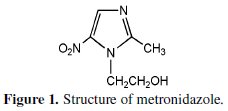
    <p>Metronidazole is the commercial name for 2-methyl-5-nitro-imidazole-1-ethanol 
having molecular formula C<sub>6</sub>H<sub>9</sub>O<sub>3</sub>N<sub>2</sub>. Molecular weight of the 
metronidazole is 171.16. It is one of the azole group of anti-microbial agent and 
chemical structure as shown in <a href="#f1">Fig. 1</a>, which is effective against anerobic 
microorganisms including gram positive, gram - negative, cocci and bacilli [15].</p>

    <p>&nbsp;</p>
<a name="f1">
<img src="/img/revistas/pea/v30n6/30n6a03f1.jpg">
    
]]></body>
<body><![CDATA[<p>&nbsp;</p>

    <p>Metronidazole has been widely used in the treatment of trichomoniasis, 
amoebiasis, giardiasis, vincent infections and eradications of cysts. 
Many literature reviews revealed the corrosion inhibitive effect on mild steel in 
acidic media. Even though many drugs have been used as corrosion inhibitors, 
the mechanistic aspects of corrosion inhibition in aqueous media have not been 
studied in detail. The present work is undertaken a) to evaluate the inhibition 
efficiency (IE) of metronidazole in controlling the corrosion of mild steel in 
aqueous solution containing 60 ppm of Cl<sup>-</sup> ion in the absence and presence of 
Zn<sup>2+</sup>  ion, b) to examine the influence of pH and duration of immersion on the IE 
of MZ drug, c) to analyze the protective film formed on the mild steel by FTIR 
spectra, d) to understand the mechanistic aspects of corrosion inhibition by 
potentiodynamic polarization and AC impedance analysis.</p>


    <p>&nbsp;</p>
    <p><b>Experimental methods</b></p>

    <p><b><i>Inhibitor</i></b></p>

    <p>Stock solution of metronidazole in ppm level was made in DD water and used as 
corrosion inhibitor in the present study.</p>


    <p><b><i>Preparation of the specimens</i></b></p>

    <p>Mild steel specimens (0.026% S, 0.06% P, 0.4% Mn, 0.1% C and rest iron) of the 
dimensions 1.0&times;4.0&times;0.2 cm were polished to a mirror finish, degreased with 
trichloroethylene, and used for the weight-loss method and surface examination 
studies.</p>


    <p><b><i>Weight-loss method</i></b></p>

    <p>Mild steel specimens were immersed in 100 mL of a solution containing 60 ppm 
of Cl<sup>-</sup> ion and various concentrations of the inhibitor in the presence and absence 
of Zn<sup>2+</sup>  ion for a period of one day. The weights of the specimens before and 
after immersion were determined using a balance, Schimadzu AY62 model. The 
inhibition efficiency (IE) was then calculated using the formula,</p>

    ]]></body>
<body><![CDATA[<p>&nbsp;</p>
<a name="e1">
<img src="/img/revistas/pea/v30n6/30n6a03e1.jpg">
    
<p>&nbsp;</p>

    <p>where W1=corrosion rate in absence of the inhibitor and W2=corrosion rate in 
presence of the inhibitor.</p>


    <p><b><i>Potentiodynamic polarization study</i></b></p>

    <p>This study was carried out using a CHI 660A electro chemical impedance 
analyzer model. A three-electrode cell assembly was used. The working 
electrode used was mild steel with 1 cm 2 exposed area. A saturated calomel 
electrode (SCE) was used as reference electrode. A rectangular platinum foil was 
used as the counter electrode. Polarization curves were recorded after doing iR 
compensation. The parameters such as Tafel slopes, ICorr and Ecorr were 
calculated.</p>


    <p><b><i>AC impedance measurements</i></b></p>

    <p>A CHI 660A electro chemical impedance analyzer was used to record AC 
impedance measurements. The cell set up was the same as that used for 
polarization measurements. The real part (Z') and imaginary part (Z'') of the cell 
impedance were measured in Ohms for various frequencies. The Rt (charge 
transfer resistance) and C<sub>dl</sub> (double layer capacitance) were calculated.</p>


    <p><b><i>Surface examination study</i></b></p>

    <p>The mild steel specimens were immersed in various test solutions for a period of 
one day. After one day, the specimens were taken out and dried. The nature of 
the film formed on the surface of the metal specimens were analysed by surface 
analysis techniques such as FTIR spectra. The FTIR spectra were recorded with a 
Perkin-Elmer 1600 Spectrophotometer. The FTIR spectrum of the protective 
film was recorded by carefully removing the film mixing it with KBr and making 
the pellet.</p>


    <p>&nbsp;</p>
    ]]></body>
<body><![CDATA[<p><b>Results and discussion</b></p>

    <p><b><i>Analysis of the results of weight-loss study</i></b></p>

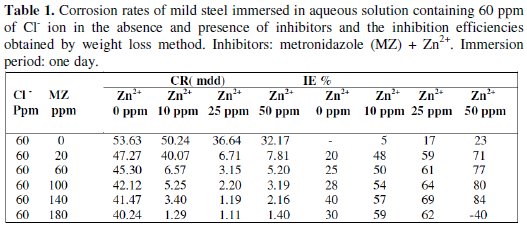
    <p>The inhibition efficiency (IE) of metronidazole (MZ) drug, in controlling 
corrosion of mild steel in aqueous solution containing 60 ppm of Cl<sup>-</sup> ion has 
been evaluated by weight-loss method .The results are given in <a href="#t1">Table 1</a>.</p>

    <p>&nbsp;</p>
<a name="t1">
<img src="/img/revistas/pea/v30n6/30n6a03t1.jpg">
    
<p>&nbsp;</p>

    <p>It is seen from <a href="#t1">Table 1</a> that when the mild 
steel is immersed in aqueous solution containing 
60 ppm of Cl<sup>-</sup> ion, the corrosion rate is 53.63 mdd, whereas when 20 ppm of MZ 
drug solution are added, the corrosion rate is reduced to 47.27 mdd and the IE is 
found to be 20 % due to the antagonistic effect of Cl<sup>-</sup> ions. Upon addition of 
various concentrations (60 ppm, 100 ppm, 140 ppm and 180 ppm) of MZ drug, 
IE increases due to the complex (Fe<sup>2+</sup>-active principle in MZ drug) formation on 
the metal surface. When Zn<sup>2+</sup>  is added to the MZ drug, the IE increases to a great 
extent because of the synergistic effect between the MZ-Zn<sup>2+</sup> system. For 
example, when 10 ppm of Zn<sup>2+</sup>  are added to 20 ppm of MZ drug, the IE increases 
from 20% to 48%. However, it is observed that when the concentration of Zn<sup>2+</sup>  
increases from 10 ppm to 50 ppm, the IE increases from 57% to 84%.</p>

    <p>Experimental results proved that the best inhibitor system for mild steel consists 
of 60 ppm of Cl<sup>-</sup> + 140 ppm of MZ drug + 50 ppm of Zn<sup>2+</sup>.</p>


    <p><b><i>Influence of the immersion time on the inhibition efficiency of MZ -Zn<sup>2+</sup> system</i></b></p>

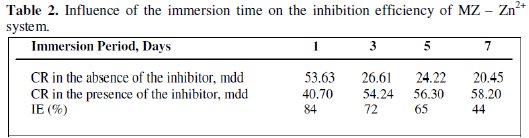
    <p>The influence of the immersion time on the inhibition efficiency of the Zn<sup>2+</sup>-MZ 
system is given in <a href="#t2">Table 2</a>.</p>

    <p>&nbsp;</p>
<a name="t2">
<img src="/img/revistas/pea/v30n6/30n6a03t2.jpg">
    
]]></body>
<body><![CDATA[<p>&nbsp;</p>

    <p>It is observed that as the duration of immersion 
increases, the inhibition efficiency decreases. This is due to the fact that as the 
time of immersion increases, the protective film formed on the metal surface is 
not able to withstand the attack of Cl<sup>-</sup>. The inhibitive film is broken and hence 
the IE decreases [16,17].</p>


    <p><b><i>Influence of pH on IE of metrinidazole -Zn<sup>2+</sup>  system</i></b></p>

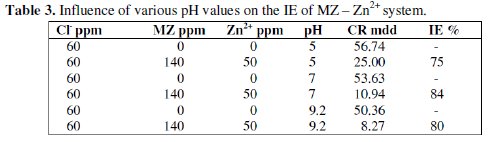
    <p>It is seen from <a href="#t3">Table 3</a> that at pH 7, the metronidazole (MZ) (140ppm) - Zn<sup>2+</sup>  
(50ppm) and Cl<sup>-</sup> (60 ppm) system has 84% IE.</p>

    <p>&nbsp;</p>
<a name="t3">
<img src="/img/revistas/pea/v30n6/30n6a03t3.jpg">
    
<p>&nbsp;</p>

    <p>When pH is lowered to 5 by 
addition of dilute sulphuric acid, the IE decreased to 75%. This is due to the fact 
that when the acid is added the protective film is broken by the aggressive H+ 
ions present in the acid. When the pH is increased to 9.2 by addition of diluted 
sodium hydroxide solution, the IE increased to 80% when compared to an acidic 
medium. However, this 80% IE in basic medium (pH 9.2) is lower than the IE of 
84% in neutral medium. This is due to the fact that when NaOH is added, a 
portion of Zn<sup>2+</sup>  is precipitated as Zn(OH)<sub>2</sub> in the bulk of the solution and hence 
not available for the complex formation.</p>


    <p><b><i>Analysis of potentiodynamic polarization study</i></b></p>

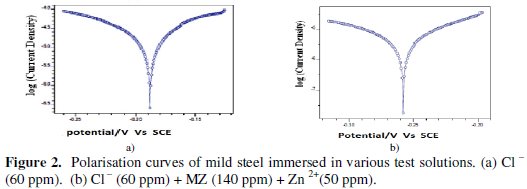
    <p>Potentiodynamic polarization studies have been used to detect the formation of 
protective film on the metal surface [18-26] .The potentiodynamic polarization 
curves of mild steel immersed in various test solutions are shown in <a href="#f2">Fig. 2</a>.</p>

    <p>&nbsp;</p>
<a name="f2">
<img src="/img/revistas/pea/v30n6/30n6a03f2.jpg">
    
]]></body>
<body><![CDATA[<p>&nbsp;</p>

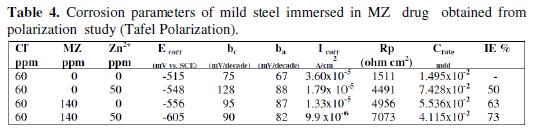
    <p>The corrosion parameters, namely corrosion potential (Ecorr), Tafel slopes (bc 
=cathodic; ba=anodic), corrosion current (Icorr), Rp, Crate and IE are given in <a href="#t4">Table 4</a>.</p>

    <p>&nbsp;</p>
<a name="t4">
<img src="/img/revistas/pea/v30n6/30n6a03t4.jpg">
    
<p>&nbsp;</p>

    <p>When mild steel is immersed in aqueous solution containing 60 ppm of Cl ion, 
the corrosion potential is -515 mV vs. SCE. The formulation consisting of 
140 ppm of MZ and 50 ppm of Zn<sup>2+</sup>  shifts the corrosion potential to -605mV vs. 
SCE suggesting that the reaction is predominantly catholically controlled. The 
Rp value increases from 1511 ohm cm<sup>2</sup> to 7073 ohm cm<sup>2</sup>. This suggests that a 
protective film is formed on the metal surface. Further, the corrosion current 
decreases from 3.60 &times; 10<sup>-5</sup> A/cm<sup>2</sup> to 9.9 &times; 10<sup>-6</sup> A/cm<sup>2</sup>. The IE calculated from 
corrosion current data is 73%. This value is lower than the IE obtained by weight 
loss method (84%). The discrepancy may be explained by the fact that in electro 
chemical process, the instantaneous corrosion current is measured. However, in 
the case of weight loss method, IE is calculated after a long time. The protective 
film formed is strengthened as the duration of immersion increases. In the 
presence of inhibitors, the cathodic and anodic Tafel slopes are more or less 
equal. This indicates that the formulation consisting of MZ-Zn<sup>2+</sup>  system as a 
mixed type of inhibitor controlled by both the cathodic and anodic reaction to an 
equal extent. In several investigations, acidic media of some drugs such as 
Albendazole and Ketorol [27, 28] has been reported as a mixed type but 
predominantly cathodic inhibitor.</p>


    <p><b><i>Analysis of AC impedance study</i></b></p>

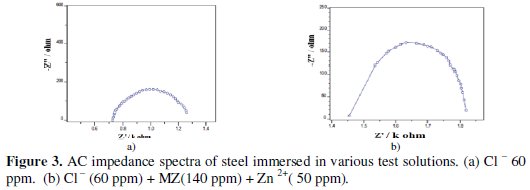
    <p>The impedance behavior of mild steel in aqueous solution with and without 
addition of various concentrations of metronidazole (MZ) is presented as 
complex impedance plot (Nyquist plot) in <a href="#f3">Fig. 3</a>.</p>

    <p>&nbsp;</p>
<a name="f3">
<img src="/img/revistas/pea/v30n6/30n6a03f3.jpg">
    
<p>&nbsp;</p>

    <p>The appearance of a 
single semi-circle shows the single charge transfer process during dissolution 
which is unaffected by the presence of the inhibitor molecule. Deviation from 
perfect circular shape is often referred to the frequency dispersion of interfacial 
impedance.</p>

    ]]></body>
<body><![CDATA[<p>This anomalous behavior is generally attributed to the inhomogeneity of the 
metal surface arising from surface roughness or interfacial phenomena [29-31]. It 
is seen that the addition of inhibitor, increases the value of charge transfer 
resistance (Rct) and reduces the double layer capacitance (C<sub>dl</sub>). A depressed semicircle 
is mostly referred to as frequency dispersion which could be attributed to 
different physical phenomena such as roughness and inhomogeneities of the solid 
surfaces, impurities, grain boundaries and distribution of the surface active sites 
[32]. The decrease in C<sub>dl</sub> is attributed to increase in the thickness of the 
electronic double layer [33]. The increase in Rct value is ascribed to the 
formation of a protective film on the metal/solution interface [34]. These 
observations suggest that metronidazole drug molecules function by adsorption at 
metal surface thereby causing the decrease in C<sub>dl</sub> values and increase in Rct 
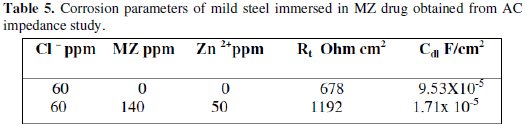
values. The charge transfer resistance (Rct) and the interfacial double layer 
capacitance (C<sub>dl</sub>) derived from these curves are given in <a href="#t5">Table 5</a>.</p>

    <p>&nbsp;</p>
<a name="t5">
<img src="/img/revistas/pea/v30n6/30n6a03t5.jpg">
    
<p>&nbsp;</p>

    <p>In this study, 
when mild steel is immersed in aqueous solution containing 60 ppm of Cl<sup>-</sup> ion, 
the Rt value is 678 ohm cm<sup>2</sup> and the C<sub>dl</sub> value is 9.53 &times; 10<sup>-5</sup> F/cm<sup>2</sup>. When MZ 
drug and Zn<sup>2+</sup>  are added, the Rt value increases from 678 ohm cm<sup>2</sup> to 1192 
ohm cm<sup>2</sup> and C<sub>dl</sub> decreases from 9.53 &times; 10<sup>-5</sup> F/cm<sup>2</sup> to 1.71 &times; 10<sup>-5</sup> F/cm<sup>2</sup>. This suggests that a protective film is formed on the surface of the metal. This 
accounts for the good IE of MZ-Zn<sup>2+</sup>  system.</p>


    <p><b><i>Analysis of FTIR spectra</i></b></p>

    <p>The active principle in metronidazole (MZ) is given as follows.</p>

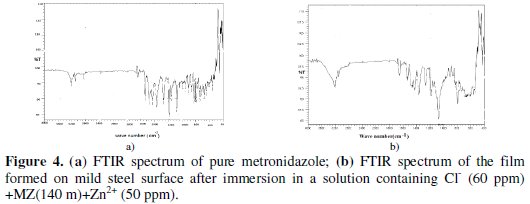
    <p>a) The FTIR spectrum of pure metronidazole (MZ) is shown in <a href="#f4">Fig. 4 (a)</a>.</p>

    <p>&nbsp;</p>
<a name="f4">
<img src="/img/revistas/pea/v30n6/30n6a03f4.jpg">
    
<p>&nbsp;</p>

    <p>The saturated carbon of C-H stretching frequency appears at 2845.13 cm<sup>-1</sup>. The 
alkene mono substituted C-H stretching frequency appears at 3098.78 cm<sup>-1</sup>. 
The band due to intra molecular hydrogen bonding of O-H stretching appears 
at 3218.37 cm<sup>-1</sup>. The peak at 1533.47 cm<sup>-1</sup> is due to the C-NO2. The C = N 
stretching frequency appears at 1654.25 cm<sup>-1</sup>. Thus the structure of 
metronidazole is confirmed by FTIR spectrum.</p>

    ]]></body>
<body><![CDATA[<p>b) The FTIR spectrum of the protective film formed on the surface of the metal 
after immersion in the solution containing 60 ppm of Cl<sup>-</sup> ion, 50 ppm of Zn<sup>2+</sup>  
and 140 ppm of metronidazole (MZ) is shown in <a href="#f4">Fig. 4 (b)</a>. It is found that 
the saturated carbon of C-H stretching frequency has shifted from 2845.13 to 
2834.87 cm<sup>-1</sup>. The alkene carbon of C-H stretching frequency has shifted 
from 3098.78 cm<sup>-1</sup> to 3097.81 cm<sup>-1</sup>. The intra molecular hydrogen bonding of 
O-H stretching has shifted from 3218.37 cm<sup>-1</sup> to 3216.44 cm<sup>-1</sup>. The C-NO2 
stretching has shifted from 1533.47 cm<sup>-1</sup> to 1531.52 cm<sup>-1</sup>. The C = N 
stretching frequency shifts from 1654.25 cm<sup>-1</sup> to 1651.14 cm<sup>-1</sup>. These shifts 
confirm the formation of Fe<sup>2+</sup>-MZ complex on the anodic sites on the metal 
surface. The peak at 1365.66 cm<sup>-1</sup> is due to Zn(OH)<sub>2</sub> formed on the cathodic 
sites of the metal surface [35,36].</p>

    <p>This confirms the presence of Fe<sup>2+</sup>-MZ complex on the metal surface. Fe<sup>2+</sup> has 
coordinated with the O-atom of the -OH group, N atom of the hetero cyclic ring 
and O-atom of the -NO2 group. The formation of Fe<sup>3+</sup> cannot be ruled out.</p>


    <p>&nbsp;</p>
    <p><b>Conclusions</b></p>

    <p>The present study leads to the following conclusions:</p>

    <p>&bull; the inhibition efficiency (IE) of metronidazole ( MZ)-Zn<sup>2+</sup>  system in 
controlling corrosion of mild steel in aqueous solution containing 60 ppm of 
Cl<sup>-</sup> ion has been evaluated by weight loss method. Weight loss study reveals 
that the formulation consisting of 140 ppm of MZ and 50 ppm of Zn<sup>2+</sup>  has 
84% inhibition efficiency;</p>

    <p>&bull; polarization study reveals that this system functions as a mixed type inhibitor, 
controlling the cathodic and anodic reaction to an equal extent;

    <p>&bull; AC impedance study reveals that a protective film is formed on the metal 
surface;</p>

    <p>&bull; the FTIR spectra reveal 
the formation of a protective film consisting of Fe<sup>2+</sup> metronidazole 
(MZ) complex and Zn(OH)<sub>2</sub>.</p>


    <p>&nbsp;</p>
    ]]></body>
<body><![CDATA[<p><b>References</b></p>

    <!-- ref --><p>1. Ali SA, Saeed MT, Rahman SV. Corros Sci. 2003;45:253-266.    &nbsp;&nbsp;&nbsp;&nbsp;&nbsp;&nbsp;&nbsp;&nbsp;[&#160;<a href="javascript:void(0);" onclick="javascript: window.open('/scielo.php?script=sci_nlinks&ref=000094&pid=S0872-1904201200060000300001&lng=','','width=640,height=500,resizable=yes,scrollbars=1,menubar=yes,');">Links</a>&#160;]<!-- end-ref --></p>
    <p>2. Lagrenee M, Mernari B, Bouanis M, Traisnel M, Bentiss F. Corros Sci. 2002;44:573-588.</p>
    <!-- ref --><p>3. Quraishi MA, Sardar R. Corrosion. 2002;58.748-755.    &nbsp;&nbsp;&nbsp;&nbsp;&nbsp;&nbsp;&nbsp;&nbsp;[&#160;<a href="javascript:void(0);" onclick="javascript: window.open('/scielo.php?script=sci_nlinks&ref=000097&pid=S0872-1904201200060000300003&lng=','','width=640,height=500,resizable=yes,scrollbars=1,menubar=yes,');">Links</a>&#160;]<!-- end-ref --></p>
    <!-- ref --><p>4. Quraishi MA, Athar M, Ali H. Br Corrosion J. 2002;37:155-163.    &nbsp;&nbsp;&nbsp;&nbsp;&nbsp;&nbsp;&nbsp;&nbsp;[&#160;<a href="javascript:void(0);" onclick="javascript: window.open('/scielo.php?script=sci_nlinks&ref=000099&pid=S0872-1904201200060000300004&lng=','','width=640,height=500,resizable=yes,scrollbars=1,menubar=yes,');">Links</a>&#160;]<!-- end-ref --></p>
    <!-- ref --><p>5. Quraishi MA, Ansari FA. J Appl Electrochem. 2003;33:233-238.    &nbsp;&nbsp;&nbsp;&nbsp;&nbsp;&nbsp;&nbsp;&nbsp;[&#160;<a href="javascript:void(0);" onclick="javascript: window.open('/scielo.php?script=sci_nlinks&ref=000101&pid=S0872-1904201200060000300005&lng=','','width=640,height=500,resizable=yes,scrollbars=1,menubar=yes,');">Links</a>&#160;]<!-- end-ref --></p>
    ]]></body>
<body><![CDATA[<!-- ref --><p>6. Quraishi MA, Khan S. J Appl Electrochem. 2006;36:539-544.    &nbsp;&nbsp;&nbsp;&nbsp;&nbsp;&nbsp;&nbsp;&nbsp;[&#160;<a href="javascript:void(0);" onclick="javascript: window.open('/scielo.php?script=sci_nlinks&ref=000103&pid=S0872-1904201200060000300006&lng=','','width=640,height=500,resizable=yes,scrollbars=1,menubar=yes,');">Links</a>&#160;]<!-- end-ref --></p>
    <!-- ref --><p>7. Shukla SK, Quraishi MA. Mater Chem Phys. 2010;120:142-147.    &nbsp;&nbsp;&nbsp;&nbsp;&nbsp;&nbsp;&nbsp;&nbsp;[&#160;<a href="javascript:void(0);" onclick="javascript: window.open('/scielo.php?script=sci_nlinks&ref=000105&pid=S0872-1904201200060000300007&lng=','','width=640,height=500,resizable=yes,scrollbars=1,menubar=yes,');">Links</a>&#160;]<!-- end-ref --></p>
    <!-- ref --><p>8. Shukla SK, Quraishi MA. Corros Sci. 2010;52:314-321.    &nbsp;&nbsp;&nbsp;&nbsp;&nbsp;&nbsp;&nbsp;&nbsp;[&#160;<a href="javascript:void(0);" onclick="javascript: window.open('/scielo.php?script=sci_nlinks&ref=000107&pid=S0872-1904201200060000300008&lng=','','width=640,height=500,resizable=yes,scrollbars=1,menubar=yes,');">Links</a>&#160;]<!-- end-ref --></p>
    <p>9. Morad MS. Corros. Sci. 50 (2008) 436-448.</p>
    <!-- ref --><p>10. Shukla SK, Quraishi MA. Corros Sci. 2009;51:1007-1011.    &nbsp;&nbsp;&nbsp;&nbsp;&nbsp;&nbsp;&nbsp;&nbsp;[&#160;<a href="javascript:void(0);" onclick="javascript: window.open('/scielo.php?script=sci_nlinks&ref=000110&pid=S0872-1904201200060000300010&lng=','','width=640,height=500,resizable=yes,scrollbars=1,menubar=yes,');">Links</a>&#160;]<!-- end-ref --></p>
    <!-- ref --><p>11. Shukla SK, Singh AK, Ahamed I, Quraishi MA. Mater Lett. 2009;63:819-822.    &nbsp;&nbsp;&nbsp;&nbsp;&nbsp;&nbsp;&nbsp;&nbsp;[&#160;<a href="javascript:void(0);" onclick="javascript: window.open('/scielo.php?script=sci_nlinks&ref=000112&pid=S0872-1904201200060000300011&lng=','','width=640,height=500,resizable=yes,scrollbars=1,menubar=yes,');">Links</a>&#160;]<!-- end-ref --></p>
    <!-- ref --><p>12. Abdallah M. Corros Sci. 2004;46:1981-1986.    &nbsp;&nbsp;&nbsp;&nbsp;&nbsp;&nbsp;&nbsp;&nbsp;[&#160;<a href="javascript:void(0);" onclick="javascript: window.open('/scielo.php?script=sci_nlinks&ref=000114&pid=S0872-1904201200060000300012&lng=','','width=640,height=500,resizable=yes,scrollbars=1,menubar=yes,');">Links</a>&#160;]<!-- end-ref --></p>
    <!-- ref --><p>13. Naqvi I, Saleemi AR, Naveed S. Int J Electrochem Sci. 2011;6:146-161.    &nbsp;&nbsp;&nbsp;&nbsp;&nbsp;&nbsp;&nbsp;&nbsp;[&#160;<a href="javascript:void(0);" onclick="javascript: window.open('/scielo.php?script=sci_nlinks&ref=000116&pid=S0872-1904201200060000300013&lng=','','width=640,height=500,resizable=yes,scrollbars=1,menubar=yes,');">Links</a>&#160;]<!-- end-ref --></p>
    <!-- ref --><p>14. Abdallah M. Corros Sci. 2004;46:1981-1986.    &nbsp;&nbsp;&nbsp;&nbsp;&nbsp;&nbsp;&nbsp;&nbsp;[&#160;<a href="javascript:void(0);" onclick="javascript: window.open('/scielo.php?script=sci_nlinks&ref=000118&pid=S0872-1904201200060000300014&lng=','','width=640,height=500,resizable=yes,scrollbars=1,menubar=yes,');">Links</a>&#160;]<!-- end-ref --></p>
    <!-- ref --><p>15. Al-Sebea N. AJPS. 2008;5:16-25.    &nbsp;&nbsp;&nbsp;&nbsp;&nbsp;&nbsp;&nbsp;&nbsp;[&#160;<a href="javascript:void(0);" onclick="javascript: window.open('/scielo.php?script=sci_nlinks&ref=000120&pid=S0872-1904201200060000300015&lng=','','width=640,height=500,resizable=yes,scrollbars=1,menubar=yes,');">Links</a>&#160;]<!-- end-ref --></p>
    <!-- ref --><p>16. Anbarasi CM, Rajendran S. J Electrochem Soc India. 2011;60:115-122.    &nbsp;&nbsp;&nbsp;&nbsp;&nbsp;&nbsp;&nbsp;&nbsp;[&#160;<a href="javascript:void(0);" onclick="javascript: window.open('/scielo.php?script=sci_nlinks&ref=000122&pid=S0872-1904201200060000300016&lng=','','width=640,height=500,resizable=yes,scrollbars=1,menubar=yes,');">Links</a>&#160;]<!-- end-ref --></p>
    <p>17. Sangeetha M, Rajendran S, Sathiyabama J, Krishnaveni A, Shanthy P, Manimaran N, Shyamaladevi B. Port Electrochim Acta. 2011;29:429-444.</p>
    <!-- ref --><p>18. Sherine B, Nasser AJA, Rajendran S. Int J Eng Sci Tech. 2010;2:341-357.    &nbsp;&nbsp;&nbsp;&nbsp;&nbsp;&nbsp;&nbsp;&nbsp;[&#160;<a href="javascript:void(0);" onclick="javascript: window.open('/scielo.php?script=sci_nlinks&ref=000125&pid=S0872-1904201200060000300018&lng=','','width=640,height=500,resizable=yes,scrollbars=1,menubar=yes,');">Links</a>&#160;]<!-- end-ref --></p>
    <!-- ref --><p>19. Thangam YY, Kalanith M, Anbarasi CM, Rajendran S. Arabian J Sci Eng. 2009;34:49-60.    &nbsp;&nbsp;&nbsp;&nbsp;&nbsp;&nbsp;&nbsp;&nbsp;[&#160;<a href="javascript:void(0);" onclick="javascript: window.open('/scielo.php?script=sci_nlinks&ref=000127&pid=S0872-1904201200060000300019&lng=','','width=640,height=500,resizable=yes,scrollbars=1,menubar=yes,');">Links</a>&#160;]<!-- end-ref --></p>
    <!-- ref --><p>20. Sathiyabama J, Rajendran S, Sundari JJ, Shyamaladevi B. J Eng Sci Tech Rev. 2010;3:27-31.    &nbsp;&nbsp;&nbsp;&nbsp;&nbsp;&nbsp;&nbsp;&nbsp;[&#160;<a href="javascript:void(0);" onclick="javascript: window.open('/scielo.php?script=sci_nlinks&ref=000129&pid=S0872-1904201200060000300020&lng=','','width=640,height=500,resizable=yes,scrollbars=1,menubar=yes,');">Links</a>&#160;]<!-- end-ref --></p>
    <!-- ref --><p>21. Narayanasamy B, Rajendran S. Prog Org Coat. 2010;67:246-254.    &nbsp;&nbsp;&nbsp;&nbsp;&nbsp;&nbsp;&nbsp;&nbsp;[&#160;<a href="javascript:void(0);" onclick="javascript: window.open('/scielo.php?script=sci_nlinks&ref=000131&pid=S0872-1904201200060000300021&lng=','','width=640,height=500,resizable=yes,scrollbars=1,menubar=yes,');">Links</a>&#160;]<!-- end-ref --></p>
    ]]></body>
<body><![CDATA[<p>22. Rajendran S, Sumithra P, Devi BS, Jeyasundari J. Zastita Materijala. 2009;50:223-226.</p>
    <!-- ref --><p>23. Sherine HB, Mani RK, Rajendran S. J Electrochem Soc India. 2008;57:67-73.    &nbsp;&nbsp;&nbsp;&nbsp;&nbsp;&nbsp;&nbsp;&nbsp;[&#160;<a href="javascript:void(0);" onclick="javascript: window.open('/scielo.php?script=sci_nlinks&ref=000134&pid=S0872-1904201200060000300023&lng=','','width=640,height=500,resizable=yes,scrollbars=1,menubar=yes,');">Links</a>&#160;]<!-- end-ref --></p>
    <p>24. Rajendran S, Uma V, Krishnaveni A, Jeyasundari J, Shyamaladevi B, Manivannan M. Arabian J Sci Eng. 2010;34:147-158.</p>
    <!-- ref --><p>25. Kanimozhi SA, Rajendran S. Arabian J Sci Eng. 2009;35:41-52.    &nbsp;&nbsp;&nbsp;&nbsp;&nbsp;&nbsp;&nbsp;&nbsp;[&#160;<a href="javascript:void(0);" onclick="javascript: window.open('/scielo.php?script=sci_nlinks&ref=000137&pid=S0872-1904201200060000300025&lng=','','width=640,height=500,resizable=yes,scrollbars=1,menubar=yes,');">Links</a>&#160;]<!-- end-ref --></p>
    <p>26. Rathish RJ, Rajendran S, Christy JL, Devi BS, Johnmary S, Manivannan M, Rajam K, Rengan P. Open Corros J. 2010;3:38-44.</p>
    <!-- ref --><p>27. Ahamed I, Prasad R, Ebenso EE, Quraishi MA, Int J Electrochem. Sci. 2012;7:3436-3452.    &nbsp;&nbsp;&nbsp;&nbsp;&nbsp;&nbsp;&nbsp;&nbsp;[&#160;<a href="javascript:void(0);" onclick="javascript: window.open('/scielo.php?script=sci_nlinks&ref=000140&pid=S0872-1904201200060000300027&lng=','','width=640,height=500,resizable=yes,scrollbars=1,menubar=yes,');">Links</a>&#160;]<!-- end-ref --></p>
    <!-- ref --><p>28. Quraishi MA, Sugheer, Ebenso EE. Int J Electrochem Sci. 2012;7:9920-9932.    &nbsp;&nbsp;&nbsp;&nbsp;&nbsp;&nbsp;&nbsp;&nbsp;[&#160;<a href="javascript:void(0);" onclick="javascript: window.open('/scielo.php?script=sci_nlinks&ref=000142&pid=S0872-1904201200060000300028&lng=','','width=640,height=500,resizable=yes,scrollbars=1,menubar=yes,');">Links</a>&#160;]<!-- end-ref --></p>
    <!-- ref --><p>29. Shih H, Mansfeld H. Corros Sci. 1989;29:1235-1240.    &nbsp;&nbsp;&nbsp;&nbsp;&nbsp;&nbsp;&nbsp;&nbsp;[&#160;<a href="javascript:void(0);" onclick="javascript: window.open('/scielo.php?script=sci_nlinks&ref=000144&pid=S0872-1904201200060000300029&lng=','','width=640,height=500,resizable=yes,scrollbars=1,menubar=yes,');">Links</a>&#160;]<!-- end-ref --></p>
    <!-- ref --><p>30. Mansfeld M, Martinez S. J Appl Electrochem. 2003;33:1137-1142.    &nbsp;&nbsp;&nbsp;&nbsp;&nbsp;&nbsp;&nbsp;&nbsp;[&#160;<a href="javascript:void(0);" onclick="javascript: window.open('/scielo.php?script=sci_nlinks&ref=000146&pid=S0872-1904201200060000300030&lng=','','width=640,height=500,resizable=yes,scrollbars=1,menubar=yes,');">Links</a>&#160;]<!-- end-ref --></p>
    <!-- ref --><p>31. Elayyachy M, Idrissi AE, Hammouti B. Corros Sci. 2006;48:2470-2479.    &nbsp;&nbsp;&nbsp;&nbsp;&nbsp;&nbsp;&nbsp;&nbsp;[&#160;<a href="javascript:void(0);" onclick="javascript: window.open('/scielo.php?script=sci_nlinks&ref=000148&pid=S0872-1904201200060000300031&lng=','','width=640,height=500,resizable=yes,scrollbars=1,menubar=yes,');">Links</a>&#160;]<!-- end-ref --></p>
    <!-- ref --><p>32. Singh A, Ebenso EE, Quraishi MA. Int J Electrochem Sci. 2012;7:4766-4779.    &nbsp;&nbsp;&nbsp;&nbsp;&nbsp;&nbsp;&nbsp;&nbsp;[&#160;<a href="javascript:void(0);" onclick="javascript: window.open('/scielo.php?script=sci_nlinks&ref=000150&pid=S0872-1904201200060000300032&lng=','','width=640,height=500,resizable=yes,scrollbars=1,menubar=yes,');">Links</a>&#160;]<!-- end-ref --></p>
    <!-- ref --><p>33. Hosseini MG, Ehteshamzadeh M, Shahrabi T. Electrochim Acta. 2007;52:3680-3685.    &nbsp;&nbsp;&nbsp;&nbsp;&nbsp;&nbsp;&nbsp;&nbsp;[&#160;<a href="javascript:void(0);" onclick="javascript: window.open('/scielo.php?script=sci_nlinks&ref=000152&pid=S0872-1904201200060000300033&lng=','','width=640,height=500,resizable=yes,scrollbars=1,menubar=yes,');">Links</a>&#160;]<!-- end-ref --></p>
    <!-- ref --><p>34. Bentiss F, Traisnel M, Laggrenee M. Corros Sci. 2000;42:127-146.    &nbsp;&nbsp;&nbsp;&nbsp;&nbsp;&nbsp;&nbsp;&nbsp;[&#160;<a href="javascript:void(0);" onclick="javascript: window.open('/scielo.php?script=sci_nlinks&ref=000154&pid=S0872-1904201200060000300034&lng=','','width=640,height=500,resizable=yes,scrollbars=1,menubar=yes,');">Links</a>&#160;]<!-- end-ref --></p>
    <!-- ref --><p>35. Francis RMS, Bassler GC, Morrill TC. Spectrometric identification for organic compounds. New York: John Wiley & Sons, 1986.    &nbsp;&nbsp;&nbsp;&nbsp;&nbsp;&nbsp;&nbsp;&nbsp;[&#160;<a href="javascript:void(0);" onclick="javascript: window.open('/scielo.php?script=sci_nlinks&ref=000156&pid=S0872-1904201200060000300035&lng=','','width=640,height=500,resizable=yes,scrollbars=1,menubar=yes,');">Links</a>&#160;]<!-- end-ref --></p>
    <!-- ref --><p>36. Sekine I, Hirakawa Y. Corrosion 1986;42:272-277.    &nbsp;&nbsp;&nbsp;&nbsp;&nbsp;&nbsp;&nbsp;&nbsp;[&#160;<a href="javascript:void(0);" onclick="javascript: window.open('/scielo.php?script=sci_nlinks&ref=000158&pid=S0872-1904201200060000300036&lng=','','width=640,height=500,resizable=yes,scrollbars=1,menubar=yes,');">Links</a>&#160;]<!-- end-ref --></p>


    <p>&nbsp;</p>
    <p><a name=0></a><sup><a href="#top">*</a></sup>Corresponding author. E-mail address: <a href="mailto:mani_megalai22@yahoo.in">mani_megalai22@yahoo.in</a></p>

    <p>Received 2 November 2012; accepted 23 December 2012</p>

    ]]></body>
<body><![CDATA[<p><a href="http://www.peacta.org" target="_blank">www.peacta.org</a> </p>


     ]]></body><back>
<ref-list>
<ref id="B1">
<label>1</label><nlm-citation citation-type="journal">
<person-group person-group-type="author">
<name>
<surname><![CDATA[Ali]]></surname>
<given-names><![CDATA[SA]]></given-names>
</name>
<name>
<surname><![CDATA[Saeed]]></surname>
<given-names><![CDATA[MT]]></given-names>
</name>
<name>
<surname><![CDATA[Rahman]]></surname>
<given-names><![CDATA[SV]]></given-names>
</name>
</person-group>
<source><![CDATA[Corros Sci]]></source>
<year>2003</year>
<volume>45</volume>
<page-range>253-266</page-range></nlm-citation>
</ref>
<ref id="B2">
<label>2</label><nlm-citation citation-type="journal">
<person-group person-group-type="author">
<name>
<surname><![CDATA[Lagrenee]]></surname>
<given-names><![CDATA[M]]></given-names>
</name>
<name>
<surname><![CDATA[B]]></surname>
<given-names><![CDATA[Mernari]]></given-names>
</name>
<name>
<surname><![CDATA[Bouanis]]></surname>
<given-names><![CDATA[M]]></given-names>
</name>
</person-group>
<source><![CDATA[Corros Sci]]></source>
<year>2002</year>
<volume>44</volume>
<page-range>573-588</page-range></nlm-citation>
</ref>
<ref id="B3">
<label>3</label><nlm-citation citation-type="journal">
<person-group person-group-type="author">
<name>
<surname><![CDATA[Quraishi]]></surname>
<given-names><![CDATA[MA]]></given-names>
</name>
<name>
<surname><![CDATA[Sardar]]></surname>
<given-names><![CDATA[R]]></given-names>
</name>
</person-group>
<source><![CDATA[Corrosion]]></source>
<year>2002</year>
<volume>58</volume>
<page-range>748-755</page-range></nlm-citation>
</ref>
<ref id="B4">
<label>4</label><nlm-citation citation-type="journal">
<person-group person-group-type="author">
<name>
<surname><![CDATA[Quraishi]]></surname>
<given-names><![CDATA[MA]]></given-names>
</name>
<name>
<surname><![CDATA[Athar]]></surname>
<given-names><![CDATA[M]]></given-names>
</name>
<name>
<surname><![CDATA[Ali]]></surname>
<given-names><![CDATA[H]]></given-names>
</name>
</person-group>
<source><![CDATA[Br Corrosion J]]></source>
<year>2002</year>
<volume>37</volume>
<page-range>155-163</page-range></nlm-citation>
</ref>
<ref id="B5">
<label>5</label><nlm-citation citation-type="journal">
<person-group person-group-type="author">
<name>
<surname><![CDATA[Quraishi]]></surname>
<given-names><![CDATA[MA]]></given-names>
</name>
<name>
<surname><![CDATA[Ansari]]></surname>
<given-names><![CDATA[FA]]></given-names>
</name>
</person-group>
<source><![CDATA[J Appl Electrochem]]></source>
<year>2003</year>
<volume>33</volume>
<page-range>233-238</page-range></nlm-citation>
</ref>
<ref id="B6">
<label>6</label><nlm-citation citation-type="journal">
<person-group person-group-type="author">
<name>
<surname><![CDATA[Quraishi]]></surname>
<given-names><![CDATA[MA]]></given-names>
</name>
<name>
<surname><![CDATA[Khan]]></surname>
<given-names><![CDATA[S]]></given-names>
</name>
</person-group>
<source><![CDATA[J Appl Electrochem]]></source>
<year>2006</year>
<volume>36</volume>
<page-range>539-544</page-range></nlm-citation>
</ref>
<ref id="B7">
<label>7</label><nlm-citation citation-type="journal">
<person-group person-group-type="author">
<name>
<surname><![CDATA[Shukla]]></surname>
<given-names><![CDATA[SK]]></given-names>
</name>
<name>
<surname><![CDATA[Quraishi]]></surname>
<given-names><![CDATA[MA]]></given-names>
</name>
</person-group>
<source><![CDATA[Mater Chem Phys]]></source>
<year>2010</year>
<volume>120</volume>
<page-range>142-147</page-range></nlm-citation>
</ref>
<ref id="B8">
<label>8</label><nlm-citation citation-type="journal">
<person-group person-group-type="author">
<name>
<surname><![CDATA[Shukla]]></surname>
<given-names><![CDATA[SK]]></given-names>
</name>
<name>
<surname><![CDATA[Quraishi]]></surname>
<given-names><![CDATA[MA]]></given-names>
</name>
</person-group>
<source><![CDATA[Corros Sci]]></source>
<year>2010</year>
<volume>52</volume>
<page-range>314-321</page-range></nlm-citation>
</ref>
<ref id="B9">
<label>9</label><nlm-citation citation-type="journal">
<person-group person-group-type="author">
<name>
<surname><![CDATA[Morad]]></surname>
<given-names><![CDATA[MS]]></given-names>
</name>
</person-group>
<source><![CDATA[Corros. Sci]]></source>
<year>2008</year>
<volume>50</volume>
<page-range>436-448</page-range></nlm-citation>
</ref>
<ref id="B10">
<label>10</label><nlm-citation citation-type="journal">
<person-group person-group-type="author">
<name>
<surname><![CDATA[Shukla]]></surname>
<given-names><![CDATA[SK]]></given-names>
</name>
<name>
<surname><![CDATA[Quraishi]]></surname>
<given-names><![CDATA[MA]]></given-names>
</name>
</person-group>
<source><![CDATA[Corros Sci]]></source>
<year>2009</year>
<volume>51</volume>
<page-range>1007-1011</page-range></nlm-citation>
</ref>
<ref id="B11">
<label>11</label><nlm-citation citation-type="journal">
<person-group person-group-type="author">
<name>
<surname><![CDATA[Shukla]]></surname>
<given-names><![CDATA[SK]]></given-names>
</name>
<name>
<surname><![CDATA[Singh]]></surname>
<given-names><![CDATA[AK]]></given-names>
</name>
<name>
<surname><![CDATA[Ahamed]]></surname>
<given-names><![CDATA[I]]></given-names>
</name>
<name>
<surname><![CDATA[Quraishi]]></surname>
<given-names><![CDATA[MA]]></given-names>
</name>
</person-group>
<source><![CDATA[Mater Lett]]></source>
<year>2009</year>
<volume>63</volume>
<page-range>819-822</page-range></nlm-citation>
</ref>
<ref id="B12">
<label>12</label><nlm-citation citation-type="journal">
<person-group person-group-type="author">
<name>
<surname><![CDATA[Abdallah]]></surname>
<given-names><![CDATA[M]]></given-names>
</name>
</person-group>
<source><![CDATA[Corros Sci]]></source>
<year>2004</year>
<volume>46</volume>
<page-range>1981-1986</page-range></nlm-citation>
</ref>
<ref id="B13">
<label>13</label><nlm-citation citation-type="journal">
<person-group person-group-type="author">
<name>
<surname><![CDATA[Naqvi]]></surname>
<given-names><![CDATA[I]]></given-names>
</name>
<name>
<surname><![CDATA[Saleemi]]></surname>
<given-names><![CDATA[AR]]></given-names>
</name>
<name>
<surname><![CDATA[Naveed]]></surname>
<given-names><![CDATA[S]]></given-names>
</name>
</person-group>
<source><![CDATA[Int J Electrochem Sci]]></source>
<year>2011</year>
<volume>6</volume>
<page-range>146-161</page-range></nlm-citation>
</ref>
<ref id="B14">
<label>14</label><nlm-citation citation-type="journal">
<person-group person-group-type="author">
<name>
<surname><![CDATA[Abdallah]]></surname>
<given-names><![CDATA[M]]></given-names>
</name>
</person-group>
<source><![CDATA[Corros Sci]]></source>
<year>2004</year>
<volume>46</volume>
<page-range>1981-1986</page-range></nlm-citation>
</ref>
<ref id="B15">
<label>15</label><nlm-citation citation-type="journal">
<person-group person-group-type="author">
<name>
<surname><![CDATA[Al-Sebea]]></surname>
<given-names><![CDATA[N]]></given-names>
</name>
</person-group>
<source><![CDATA[AJPS]]></source>
<year>2008</year>
<volume>5</volume>
<page-range>16-25</page-range></nlm-citation>
</ref>
<ref id="B16">
<label>16</label><nlm-citation citation-type="journal">
<person-group person-group-type="author">
<name>
<surname><![CDATA[Anbarasi]]></surname>
<given-names><![CDATA[CM]]></given-names>
</name>
<name>
<surname><![CDATA[Rajendran]]></surname>
<given-names><![CDATA[S]]></given-names>
</name>
</person-group>
<source><![CDATA[J Electrochem Soc India]]></source>
<year>2011</year>
<volume>60</volume>
<page-range>115-122</page-range></nlm-citation>
</ref>
<ref id="B17">
<label>17</label><nlm-citation citation-type="journal">
<person-group person-group-type="author">
<name>
<surname><![CDATA[Sangeetha]]></surname>
<given-names><![CDATA[M]]></given-names>
</name>
<name>
<surname><![CDATA[Rajendran]]></surname>
<given-names><![CDATA[S]]></given-names>
</name>
<name>
<surname><![CDATA[Sathiyabama]]></surname>
<given-names><![CDATA[J]]></given-names>
</name>
</person-group>
<source><![CDATA[Port Electrochim Acta]]></source>
<year>2011</year>
<volume>29</volume>
<page-range>429-444</page-range></nlm-citation>
</ref>
<ref id="B18">
<label>18</label><nlm-citation citation-type="journal">
<person-group person-group-type="author">
<name>
<surname><![CDATA[Sherine]]></surname>
<given-names><![CDATA[B]]></given-names>
</name>
<name>
<surname><![CDATA[Nasser]]></surname>
<given-names><![CDATA[AJA]]></given-names>
</name>
<name>
<surname><![CDATA[Rajendran]]></surname>
<given-names><![CDATA[S]]></given-names>
</name>
</person-group>
<source><![CDATA[Int J Eng Sci Tech]]></source>
<year>2010</year>
<volume>2</volume>
<page-range>341-357</page-range></nlm-citation>
</ref>
<ref id="B19">
<label>19</label><nlm-citation citation-type="journal">
<person-group person-group-type="author">
<name>
<surname><![CDATA[Thangam]]></surname>
<given-names><![CDATA[YY]]></given-names>
</name>
<name>
<surname><![CDATA[Kalanith]]></surname>
<given-names><![CDATA[M]]></given-names>
</name>
<name>
<surname><![CDATA[Anbarasi]]></surname>
<given-names><![CDATA[CM]]></given-names>
</name>
<name>
<surname><![CDATA[Rajendran]]></surname>
<given-names><![CDATA[S]]></given-names>
</name>
</person-group>
<source><![CDATA[Arabian J Sci Eng]]></source>
<year>2009</year>
<volume>34</volume>
<page-range>49-60</page-range></nlm-citation>
</ref>
<ref id="B20">
<label>20</label><nlm-citation citation-type="journal">
<person-group person-group-type="author">
<name>
<surname><![CDATA[Sathiyabama]]></surname>
<given-names><![CDATA[J]]></given-names>
</name>
<name>
<surname><![CDATA[Rajendran]]></surname>
<given-names><![CDATA[S]]></given-names>
</name>
<name>
<surname><![CDATA[Sundari]]></surname>
<given-names><![CDATA[JJ]]></given-names>
</name>
<name>
<surname><![CDATA[Shyamaladevi]]></surname>
<given-names><![CDATA[B]]></given-names>
</name>
</person-group>
<source><![CDATA[J Eng Sci Tech Rev]]></source>
<year>2010</year>
<volume>3</volume>
<page-range>27-31</page-range></nlm-citation>
</ref>
<ref id="B21">
<label>21</label><nlm-citation citation-type="journal">
<person-group person-group-type="author">
<name>
<surname><![CDATA[Narayanasamy]]></surname>
<given-names><![CDATA[B]]></given-names>
</name>
<name>
<surname><![CDATA[Rajendran]]></surname>
<given-names><![CDATA[S]]></given-names>
</name>
</person-group>
<source><![CDATA[Prog Org Coat]]></source>
<year>2010</year>
<volume>67</volume>
<page-range>246-254</page-range></nlm-citation>
</ref>
<ref id="B22">
<label>22</label><nlm-citation citation-type="journal">
<person-group person-group-type="author">
<name>
<surname><![CDATA[Rajendran]]></surname>
<given-names><![CDATA[S]]></given-names>
</name>
<name>
<surname><![CDATA[Sumithra]]></surname>
<given-names><![CDATA[P]]></given-names>
</name>
<name>
<surname><![CDATA[Devi]]></surname>
<given-names><![CDATA[BS]]></given-names>
</name>
</person-group>
<source><![CDATA[J Eng Sci Tech Rev]]></source>
<year>2009</year>
<volume>50</volume>
<page-range>223-226</page-range></nlm-citation>
</ref>
<ref id="B23">
<label>23</label><nlm-citation citation-type="journal">
<person-group person-group-type="author">
<name>
<surname><![CDATA[Sherine]]></surname>
<given-names><![CDATA[HB]]></given-names>
</name>
<name>
<surname><![CDATA[Mani]]></surname>
<given-names><![CDATA[RK]]></given-names>
</name>
<name>
<surname><![CDATA[Rajendran]]></surname>
<given-names><![CDATA[S]]></given-names>
</name>
</person-group>
<source><![CDATA[J Electrochem Soc India]]></source>
<year>2008</year>
<volume>57</volume>
<page-range>67-73</page-range></nlm-citation>
</ref>
<ref id="B24">
<label>24</label><nlm-citation citation-type="journal">
<person-group person-group-type="author">
<name>
<surname><![CDATA[Rajendran]]></surname>
<given-names><![CDATA[S]]></given-names>
</name>
<name>
<surname><![CDATA[Uma]]></surname>
<given-names><![CDATA[V]]></given-names>
</name>
<name>
<surname><![CDATA[Krishnaveni]]></surname>
<given-names><![CDATA[A]]></given-names>
</name>
</person-group>
<source><![CDATA[Arabian J Sci Eng]]></source>
<year>2010</year>
<volume>34</volume>
<page-range>147-158</page-range></nlm-citation>
</ref>
<ref id="B25">
<label>25</label><nlm-citation citation-type="journal">
<person-group person-group-type="author">
<name>
<surname><![CDATA[Kanimozhi]]></surname>
<given-names><![CDATA[SA]]></given-names>
</name>
<name>
<surname><![CDATA[Rajendran]]></surname>
<given-names><![CDATA[S]]></given-names>
</name>
</person-group>
<source><![CDATA[Arabian J Sci Eng]]></source>
<year>2009</year>
<volume>35</volume>
<page-range>41-52</page-range></nlm-citation>
</ref>
<ref id="B26">
<label>26</label><nlm-citation citation-type="journal">
<person-group person-group-type="author">
<name>
<surname><![CDATA[Rathish]]></surname>
<given-names><![CDATA[RJ]]></given-names>
</name>
<name>
<surname><![CDATA[Rajendran]]></surname>
<given-names><![CDATA[S]]></given-names>
</name>
<name>
<surname><![CDATA[Christy]]></surname>
<given-names><![CDATA[JL]]></given-names>
</name>
</person-group>
<source><![CDATA[Open Corros J]]></source>
<year>2010</year>
<volume>3</volume>
<page-range>38-44</page-range></nlm-citation>
</ref>
<ref id="B27">
<label>27</label><nlm-citation citation-type="journal">
<person-group person-group-type="author">
<name>
<surname><![CDATA[Ahamed]]></surname>
<given-names><![CDATA[I]]></given-names>
</name>
<name>
<surname><![CDATA[Prasad]]></surname>
<given-names><![CDATA[R]]></given-names>
</name>
<name>
<surname><![CDATA[Ebenso]]></surname>
<given-names><![CDATA[EE]]></given-names>
</name>
<name>
<surname><![CDATA[Quraishi]]></surname>
<given-names><![CDATA[MA]]></given-names>
</name>
</person-group>
<source><![CDATA[Int J Electrochem. Sci]]></source>
<year>2012</year>
<volume>7</volume>
<page-range>3436-3452</page-range></nlm-citation>
</ref>
<ref id="B28">
<label>28</label><nlm-citation citation-type="journal">
<person-group person-group-type="author">
<name>
<surname><![CDATA[Quraishi]]></surname>
<given-names><![CDATA[MA]]></given-names>
</name>
<name>
<surname><![CDATA[Sugheer]]></surname>
</name>
<name>
<surname><![CDATA[Ebenso]]></surname>
<given-names><![CDATA[EE]]></given-names>
</name>
</person-group>
<source><![CDATA[Int J Electrochem Sci]]></source>
<year>2012</year>
<volume>7</volume>
<page-range>9920-9932</page-range></nlm-citation>
</ref>
<ref id="B29">
<label>29</label><nlm-citation citation-type="journal">
<person-group person-group-type="author">
<name>
<surname><![CDATA[Shih]]></surname>
<given-names><![CDATA[H]]></given-names>
</name>
<name>
<surname><![CDATA[Mansfeld]]></surname>
<given-names><![CDATA[H]]></given-names>
</name>
</person-group>
<source><![CDATA[Corros Sci]]></source>
<year>1989</year>
<volume>29</volume>
<page-range>1235-1240</page-range></nlm-citation>
</ref>
<ref id="B30">
<label>30</label><nlm-citation citation-type="journal">
<person-group person-group-type="author">
<name>
<surname><![CDATA[Mansfeld]]></surname>
<given-names><![CDATA[M]]></given-names>
</name>
<name>
<surname><![CDATA[Martinez]]></surname>
<given-names><![CDATA[S]]></given-names>
</name>
</person-group>
<source><![CDATA[J Appl Electrochem]]></source>
<year>2003</year>
<volume>33</volume>
<page-range>1137-1142</page-range></nlm-citation>
</ref>
<ref id="B31">
<label>31</label><nlm-citation citation-type="journal">
<person-group person-group-type="author">
<name>
<surname><![CDATA[Elayyachy]]></surname>
<given-names><![CDATA[M]]></given-names>
</name>
<name>
<surname><![CDATA[Idrissi]]></surname>
<given-names><![CDATA[AE]]></given-names>
</name>
<name>
<surname><![CDATA[Hammouti]]></surname>
<given-names><![CDATA[B]]></given-names>
</name>
</person-group>
<source><![CDATA[Corros Sci]]></source>
<year>2006</year>
<volume>48</volume>
<page-range>2470-2479</page-range></nlm-citation>
</ref>
<ref id="B32">
<label>32</label><nlm-citation citation-type="journal">
<person-group person-group-type="author">
<name>
<surname><![CDATA[Singh]]></surname>
<given-names><![CDATA[A]]></given-names>
</name>
<name>
<surname><![CDATA[Ebenso]]></surname>
<given-names><![CDATA[EE]]></given-names>
</name>
<name>
<surname><![CDATA[Quraishi]]></surname>
<given-names><![CDATA[MA]]></given-names>
</name>
</person-group>
<source><![CDATA[Int J Electrochem Sci]]></source>
<year>2012</year>
<volume>7</volume>
<page-range>4766-4779</page-range></nlm-citation>
</ref>
<ref id="B33">
<label>33</label><nlm-citation citation-type="journal">
<person-group person-group-type="author">
<name>
<surname><![CDATA[Hosseini]]></surname>
<given-names><![CDATA[MG]]></given-names>
</name>
<name>
<surname><![CDATA[Ehteshamzadeh]]></surname>
<given-names><![CDATA[M]]></given-names>
</name>
<name>
<surname><![CDATA[Shahrabi]]></surname>
<given-names><![CDATA[T]]></given-names>
</name>
</person-group>
<source><![CDATA[Electrochim Acta]]></source>
<year>2007</year>
<volume>52</volume>
<page-range>3680-3685</page-range></nlm-citation>
</ref>
<ref id="B34">
<label>34</label><nlm-citation citation-type="journal">
<person-group person-group-type="author">
<name>
<surname><![CDATA[Bentiss]]></surname>
<given-names><![CDATA[F]]></given-names>
</name>
<name>
<surname><![CDATA[Traisnel]]></surname>
<given-names><![CDATA[M]]></given-names>
</name>
<name>
<surname><![CDATA[Laggrenee]]></surname>
<given-names><![CDATA[M]]></given-names>
</name>
</person-group>
<source><![CDATA[Corros Sci]]></source>
<year>2000</year>
<volume>42</volume>
<page-range>127-146</page-range></nlm-citation>
</ref>
<ref id="B35">
<label>35</label><nlm-citation citation-type="book">
<person-group person-group-type="author">
<name>
<surname><![CDATA[Francis]]></surname>
<given-names><![CDATA[RMS]]></given-names>
</name>
<name>
<surname><![CDATA[Bassler]]></surname>
<given-names><![CDATA[GC]]></given-names>
</name>
<name>
<surname><![CDATA[Morrill]]></surname>
<given-names><![CDATA[TC]]></given-names>
</name>
</person-group>
<source><![CDATA[Spectrometric identification for organic compounds]]></source>
<year></year>
<publisher-loc><![CDATA[New York ]]></publisher-loc>
<publisher-name><![CDATA[John Wiley & Sons]]></publisher-name>
</nlm-citation>
</ref>
<ref id="B36">
<label>36</label><nlm-citation citation-type="journal">
<person-group person-group-type="author">
<name>
<surname><![CDATA[Sekine]]></surname>
<given-names><![CDATA[I]]></given-names>
</name>
<name>
<surname><![CDATA[Hirakawa]]></surname>
<given-names><![CDATA[Y]]></given-names>
</name>
</person-group>
<source><![CDATA[Corrosion]]></source>
<year>1986</year>
<volume>42</volume>
<page-range>272-277</page-range></nlm-citation>
</ref>
</ref-list>
</back>
</article>