<?xml version="1.0" encoding="ISO-8859-1"?><article xmlns:mml="http://www.w3.org/1998/Math/MathML" xmlns:xlink="http://www.w3.org/1999/xlink" xmlns:xsi="http://www.w3.org/2001/XMLSchema-instance">
<front>
<journal-meta>
<journal-id>0872-1904</journal-id>
<journal-title><![CDATA[Portugaliae Electrochimica Acta]]></journal-title>
<abbrev-journal-title><![CDATA[Port. Electrochim. Acta]]></abbrev-journal-title>
<issn>0872-1904</issn>
<publisher>
<publisher-name><![CDATA[Sociedade Portuguesa de Electroquímica]]></publisher-name>
</publisher>
</journal-meta>
<article-meta>
<article-id>S0872-19042012000600004</article-id>
<article-id pub-id-type="doi">10.4152/pea.201206405</article-id>
<title-group>
<article-title xml:lang="en"><![CDATA[A Combined Experimental and Theoretical Study on the Corrosion Inhibition and Adsorption Behaviour of Quinoxaline Derivative During Carbon Steel Corrosion in Hydrochloric Acid]]></article-title>
</title-group>
<contrib-group>
<contrib contrib-type="author">
<name>
<surname><![CDATA[Zarrok]]></surname>
<given-names><![CDATA[H.]]></given-names>
</name>
<xref ref-type="aff" rid="A01"/>
</contrib>
<contrib contrib-type="author">
<name>
<surname><![CDATA[Zarrouk]]></surname>
<given-names><![CDATA[A.]]></given-names>
</name>
<xref ref-type="aff" rid="A02"/>
</contrib>
<contrib contrib-type="author">
<name>
<surname><![CDATA[Salghi]]></surname>
<given-names><![CDATA[R.]]></given-names>
</name>
<xref ref-type="aff" rid="A03"/>
</contrib>
<contrib contrib-type="author">
<name>
<surname><![CDATA[Oudda]]></surname>
<given-names><![CDATA[H.]]></given-names>
</name>
<xref ref-type="aff" rid="A01"/>
</contrib>
<contrib contrib-type="author">
<name>
<surname><![CDATA[Hammouti]]></surname>
<given-names><![CDATA[B.]]></given-names>
</name>
<xref ref-type="aff" rid="A02"/>
</contrib>
<contrib contrib-type="author">
<name>
<surname><![CDATA[Touhami]]></surname>
<given-names><![CDATA[M. Ebn]]></given-names>
</name>
<xref ref-type="aff" rid="A04"/>
</contrib>
<contrib contrib-type="author">
<name>
<surname><![CDATA[Bouachrinee]]></surname>
<given-names><![CDATA[M.]]></given-names>
</name>
<xref ref-type="aff" rid="A05"/>
</contrib>
<contrib contrib-type="author">
<name>
<surname><![CDATA[Boukhris]]></surname>
<given-names><![CDATA[S.]]></given-names>
</name>
<xref ref-type="aff" rid="A06"/>
</contrib>
</contrib-group>
<aff id="A01">
<institution><![CDATA[,Université Ibn Tofail Faculté des Sciences Laboratoire des procèdes de séparation]]></institution>
<addr-line><![CDATA[Kénitra ]]></addr-line>
<country>Morocco</country>
</aff>
<aff id="A02">
<institution><![CDATA[,Université Mohammed Ier Faculté des Sciences LCAE-URAC18]]></institution>
<addr-line><![CDATA[Oujda ]]></addr-line>
<country>Morocco</country>
</aff>
<aff id="A03">
<institution><![CDATA[,Université Ibn Zohr ENSA Equipe de Génie de l'Environnement et de Biotechnologie]]></institution>
<addr-line><![CDATA[Agadir ]]></addr-line>
<country>Morocco</country>
</aff>
<aff id="A04">
<institution><![CDATA[,Université Ibn Tofail Faculté des Sciences Laboratoire d'électrochimie, de corrosion et d'environnement]]></institution>
<addr-line><![CDATA[Kenitra ]]></addr-line>
<country>Morocco</country>
</aff>
<aff id="A05">
<institution><![CDATA[,University Moulay Ismail ESTM ]]></institution>
<addr-line><![CDATA[Meknès ]]></addr-line>
<country>Morocco</country>
</aff>
<aff id="A06">
<institution><![CDATA[,Université Ibn Tofail Faculté des Sciences Equipe de Synthèse Organique, Organométallique et d'Agrochimie]]></institution>
<addr-line><![CDATA[Keénitra ]]></addr-line>
<country>Morocco</country>
</aff>
<pub-date pub-type="pub">
<day>00</day>
<month>11</month>
<year>2012</year>
</pub-date>
<pub-date pub-type="epub">
<day>00</day>
<month>11</month>
<year>2012</year>
</pub-date>
<volume>30</volume>
<numero>6</numero>
<fpage>405</fpage>
<lpage>417</lpage>
<copyright-statement/>
<copyright-year/>
<self-uri xlink:href="http://scielo.pt/scielo.php?script=sci_arttext&amp;pid=S0872-19042012000600004&amp;lng=en&amp;nrm=iso"></self-uri><self-uri xlink:href="http://scielo.pt/scielo.php?script=sci_abstract&amp;pid=S0872-19042012000600004&amp;lng=en&amp;nrm=iso"></self-uri><self-uri xlink:href="http://scielo.pt/scielo.php?script=sci_pdf&amp;pid=S0872-19042012000600004&amp;lng=en&amp;nrm=iso"></self-uri><abstract abstract-type="short" xml:lang="en"><p><![CDATA[The corrosion inhibitive effects of 2-(4-methylphenyl)-1,4-dihydroquinoxaline (Q1) on carbon steel surface in hydrochloric acid solution was studied using weight loss measurements, electrochemical impedance spectroscopy (EIS), Tafel polarization techniques and quantum chemical approach, using the density functional theory (DFT). Inhibition efficiency increased with increase in concentration of the inhibitor. The degree of surface coverage of the adsorbed inhibitor was determined by weight loss technique, and it was found that the results obeyed Langmuir adsorption isotherm. Tafel polarization data indicated that this inhibitor is of mixed type. EIS shows that charge- transfer resistance increases and the capacitance of double layer decreases with the inhibitor concentration, confirming the adsorption process mechanism. Trends in the calculated molecular properties (e.g., dipole moment, HOMO and LUMO energies) were compared with trends in the experimentally determined inhibition efficiency. The results show that trends in the quantum chemical descriptors are in agreement with the experimentally determined inhibition efficiencies.]]></p></abstract>
<kwd-group>
<kwd lng="en"><![CDATA[quinoxaline]]></kwd>
<kwd lng="en"><![CDATA[steel]]></kwd>
<kwd lng="en"><![CDATA[corrosion inhibition]]></kwd>
<kwd lng="en"><![CDATA[electrochemical techniques]]></kwd>
<kwd lng="en"><![CDATA[DFT]]></kwd>
</kwd-group>
</article-meta>
</front><body><![CDATA[ <p><b>A Combined Experimental and Theoretical Study on the Corrosion Inhibition and Adsorption Behaviour of Quinoxaline Derivative During Carbon Steel Corrosion in Hydrochloric Acid</b></p>      <p><b>H. Zarrok<sup>1</sup>, A. Zarrouk<sup>2,<a href="#0">*</a><a name="top0"></a></sup>,    R. Salghi<sup>3</sup>, H. Oudda<sup>1</sup>, B. Hammouti<sup>2</sup>, M. Ebn    Touhami<sup>4</sup>, M. Bouachrinee<sup>5</sup> and S. Boukhris<sup>6</sup></b></p>      <p><sup>1</sup><i> Laboratoire des proc&egrave;des de s&eacute;paration, Facult&eacute; des Sciences, Universit&eacute; Ibn Tofail BP 242, 14000 K&eacute;nitra, Morocco.</i></p>      <p><sup>2</sup><i> LCAE-URAC18, Facult&eacute; des Sciences, Universit&eacute; Mohammed Ier B.P. 717, 60000 Oujda, Morocco.</i></p>      <p><sup>3</sup><i> Equipe de G&eacute;nie de l'Environnement et de Biotechnologie, ENSA, Universit&eacute; Ibn Zohr, BP 1136 Agadir, Morocco.</i></p>      <p><sup>4</sup><i> Laboratoire d'&eacute;lectrochimie, de corrosion et d'environnement, Facult&eacute; des Sciences, Universit&eacute; Ibn Tofail BP 242, 14000 Kenitra, Morocco.</i></p>      <p><sup>5</sup><i> ESTM, University Moulay Ismail, BP 3130, Toulal, Mekn&egrave;s, Morocco.</i></p>      <p><sup>6</sup><i> Equipe de Synth&egrave;se Organique, Organom&eacute;tallique et d'Agrochimie, Facult&eacute; des Sciences, Universit&eacute; Ibn Tofail, B.P. 133, 14000 Ke&eacute;nitra, Morocco.</i></p>   <!--     <p>&nbsp;</p>     <p>doi: 10.4152/pea.201206405</p> -->       ]]></body>
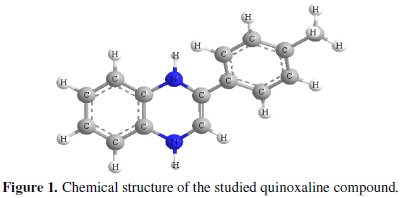
<body><![CDATA[<p>&nbsp;</p>     <p><b>Abstract</b></p>      <p>The corrosion inhibitive effects of 2-(4-methylphenyl)-1,4-dihydroquinoxaline (Q1) on  carbon steel surface in hydrochloric acid solution was studied using weight loss  measurements, electrochemical impedance spectroscopy (EIS), Tafel polarization  techniques and quantum chemical approach, using the density functional theory (DFT).  Inhibition efficiency increased with increase in concentration of the inhibitor. The  degree of surface coverage of the adsorbed inhibitor was determined by weight loss  technique, and it was found that the results obeyed Langmuir adsorption isotherm. Tafel  polarization data indicated that this inhibitor is of mixed type. EIS shows that charge- transfer resistance increases and the capacitance of double layer decreases with the  inhibitor concentration, confirming the adsorption process mechanism. Trends in the  calculated molecular properties (e.g., dipole moment, HOMO and LUMO energies)  were compared with trends in the experimentally determined inhibition efficiency. The  results show that trends in the quantum chemical descriptors are in agreement with the  experimentally determined inhibition efficiencies.</p>      <p><b><i>Keywords:</i></b> quinoxaline, steel, corrosion inhibition, electrochemical techniques, DFT.</p>       <p>&nbsp;</p>     <p><b>Introduction</b></p>      <p>Hydrochloric acid is generally used in industry as chemical cleaning, oil well  cleaning, descaling, and pickling for the removal of undesirable scale and rust  from the metallic surfaces. The corrosion of steel is an important concern that has  received a considerable amount of attention [1-4]. Using inhibitors is an  important method of protecting materials against acid attack, reducing the metal  dissolution and the consumption of acid. The efficiency of an organic compound  as an inhibitor is mainly dependent on its ability to get adsorbed on metal. These  inhibitors contain oxygen, nitrogen, sulfur heteroatoms, and multiple bonds. This  phenomenon is influenced by the nature and surface charge of the metallic  surface, testing media, and chemical structure of inhibitors [5-22]. Investigating  and exploring new corrosion inhibitor for steel corrosion in acid solutions are  important for its practical application.</p>  </a>    <p><a href="#0">Quinoxaline derivatives as important N-heterocyclic compounds are easy to  synthesize and readily available. Their ring moiety constitutes part of the  chemical structures of various antibiotics such as echinomycin, levomycin and  actinoleucin [23,24]. Abboud et al. [25] have studied the inhibition effect of 2,3-quinoxalinedione  on the corrosion of mild steel in 1.0 M HCl solution. More  recently [18], we have reported on the effectiveness of 2-(4-methylphenyl)-1,4dihydroquinoxaline  as inhibitor of copper corrosion in 2.0 M HNO3. The results  obtained for the two studies showed that quinoxaline derivatives are excellent  inhibitors for copper and steel in acidic media. In continuation of our study on  quinoxaline derivatives as inhibitors of carbon steel corrosion in acidic media,  we report the inhibitive properties of 2-(4-methylphenyl)-1,4-dihydroquinoxaline  as carbon steel corrosion inhibitor in 1.0 M HCl using weight loss technique,  potentiokinetic polarization methods, electrochemical impedance spectroscopy  (EIS) and quantum chemical calculations. The choice of this compound was  based on the consideration that it contains many &pi;-electrons and two N atoms  which induce greater adsorption of the inhibitor compared with compounds  containing only one N atom. The chemical structure of the studied quinoxaline  derivative is given in </a><a href="#f1">Fig. 1</a>.</p>      <p>&nbsp;</p> <a name="f1"></a> <img src="/img/revistas/pea/v30n6/30n6a04f1.jpg">     
<p>&nbsp;</p>       ]]></body>
<body><![CDATA[<p>&nbsp;</p>     <p><b>Experimental method</b></p>      <p><b><i>Materials</i></b></p>      <p>The steel used in this study is a carbon steel (CS) (Euronorm: C35E carbon steel  and US specification: SAE 1035) with a chemical composition (in wt%) of 0.370  % C, 0.230 % Si, 0.680 % Mn, 0.016 % S, 0.077 % Cr, 0.011 % Ti, 0.059 % Ni,  0.009 % Co, 0.160 % Cu and the rest being iron (Fe).</p>       <p><b><i>Solutions</i></b></p>      <p>The aggressive solutions of 1.0 M HCl were prepared by dilution of analytical  grade 37% HCl with distilled water. The concentration range of 2-(4 methylphenyl)-1,4-dihydroquinoxaline (Q1) used was 10<sup>-6</sup> M to 10<sup>-3</sup> M.</p>       <p><b><i>Weight loss measurements</i></b></p>      <p>The carbon steel (CS) sheets of 1.6 &times; 1.6 &times; 0.07 cm were abraded with a series of  emery papers SiC (120, 600 and 1200) and then washed with distilled water and  acetone. After weighing accurately, the specimens were immersed in an 80 mL  beaker containing 50 mL 1.0 M HCl solution with and without addition of  different concentrations of Q1. All the aggressive acid solutions were open to air.  After 6 h the specimens were taken out, washed, dried, and weighed accurately.  In order to get good reproducibility experiments were carried out in triplicate.  The average weight loss of three parallel CS sheets was obtained. The tests were  repeated at 308 K. The corrosion rate (&nu;) and the inhibition efficiency (&eta;<sub>WL</sub>) were  calculated by the following equations [26]:</p>      <p>&nbsp;</p> <a name="e1"></a> <img src="/img/revistas/pea/v30n6/30n6a04e1.jpg">     
<p>&nbsp;</p> <a name="e2"></a> <img src="/img/revistas/pea/v30n6/30n6a04e2.jpg">     
]]></body>
<body><![CDATA[<p>&nbsp;</p>      <p>where W is the three-experiment average weight loss of the carbon steel, S is the  total surface area of the specimen, t is the immersion time and &nu;0 and &nu; are values  of the corrosion rate without and with addition of the inhibitor, respectively.</p>       <p><b><i>Electrochemical impedance spectroscopy</i></b></p>      <p>The electrochemical measurements were carried out using a Volta lab (Tacussel- Radiometer PGZ 100) potentiostate and controlled by Tacussel corrosion  analysis software model (Voltamaster 4) at under static condition. The corrosion  cell used had three electrodes. The reference electrode was a saturated calomel  electrode (SCE). A platinum electrode was used as auxiliary electrode of surface  area of 1 cm<sup>2</sup>. The working electrode was carbon steel. All potentials given in  this study were referred to this reference electrode. The working electrode was  immersed in test solution for 30 minutes to a establish steady state open circuit  potential (Eocp). After measuring the Eocp, the electrochemical measurements  were performed. All electrochemical tests have been performed in aerated  solutions at 308 K. The EIS experiments were conducted in the frequency range  with high limit of 100 kHz and different low limit 0.1 Hz at open circuit  potential, with 10 points per decade, at the rest potential, after 30 min of acid  immersion, by applying 10 mV ac voltage peak-to-peak. Nyquist plots were  made from these experiments. The best semicircle can be fit through the data  points in the Nyquist plot using a non-linear least square fit so as to give the  intersections with the x-axis.</p>      <p>The inhibition efficiency of the inhibitor was calculated from the charge transfer  resistance values using the following equation [27]:</p>      <p>&nbsp;</p> <a name="e3"></a> <img src="/img/revistas/pea/v30n6/30n6a04e3.jpg">     
<p>&nbsp;</p>      <p>where, R<sup>0</sup><sub>ct</sub> and R<sup>i</sup><sub>ct</sub> are  the charge transfer resistance in absence and in presence of  inhibitor, respectively.</p>       <p><b><i>Potentiodynamic polarization</i></b></p>      <p>The electrochemical behaviour of carbon steel sample in inhibited and  uninhibited solution was studied by recording anodic and cathodic  potentiodynamic polarization curves. Measurements were performed in the 1.0 M  HCl solution containing different concentrations of the tested inhibitor by  changing the electrode potential automatically from -800 to -100 mV versus  corrosion potential at a scan rate of 1 mV s<sup>-1</sup>. The linear Tafel segments of anodic  and cathodic curves were extrapolated to corrosion potential to obtain corrosion  current densities (I<sub>corr</sub>). From the polarization curves obtained, the corrosion  current (I<sub>corr</sub>) was calculated by curve fitting using the equation:</p>      ]]></body>
<body><![CDATA[<p>&nbsp;</p> <a name="e4"></a> <img src="/img/revistas/pea/v30n6/30n6a04e4.jpg">     
<p>&nbsp;</p>      <p>The inhibition efficiency was evaluated from the measured I<sub>corr</sub> values using the  relationship:</p>      <p>&nbsp;</p> <a name="e5"></a> <img src="/img/revistas/pea/v30n6/30n6a04e5.jpg">     
<p>&nbsp;</p>      <p>where, I<sup>0</sup><sub>corr</sub> and I<sup>i</sup><sub>corr</sub> are  the corrosion current density in absence and presence of  inhibitor, respectively.</p>       <p><b><i>Quantum chemical calculations</i></b></p>      <p>All theoretical calculations were performed using DFT (density functional  theory) with the Beck's three parameter exchange functional along with the Lee- Yang-Parr nonlocal correlation functional (B3LYP) [28-30] with 6-31G* basis  set is implemented in Gaussian 03 program package [31]. This approach is  shown to yield favorable geometries for a wide variety of systems. The following  quantum chemical parameters were calculated from the obtained optimized  molecular structure: the energy of the highest occupied molecular orbital  (E<sub>HOMO</sub>), the energy of the lowest unoccupied molecular orbital (E<sub>LUMO</sub>), the  energy band gap (&Delta;E<sub>gap</sub> = E<sub>HOMO</sub> - E<sub>LUMO</sub>), the dipole moment (&mu;) and total  energy (TE).</p>       <p>&nbsp;</p>     <p><b>Results and discussion</b></p>      ]]></body>
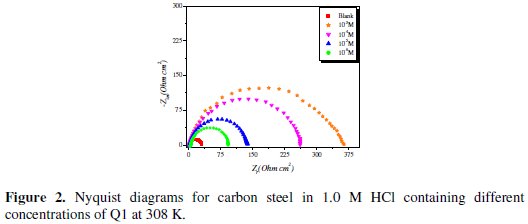
<body><![CDATA[<p><b><i>Electrochemical impedance spectroscopy</i></b></p>      <p>Nyquist plots for carbon steel in 1.0 M HCl solution in the absence and presence  of the inhibitor at various concentrations (at 308 K) are shown in <a href="#f2">Fig. 2</a>.</p>      <p>&nbsp;</p> <a name="f2"></a> <img src="/img/revistas/pea/v30n6/30n6a04f2.jpg">     
<p>&nbsp;</p>      <p>The semicircle Nyquist plots can be modeled by a simple ''Randles'' circuit, including  the ''charge-transfer resistance'' (R<sub>ct</sub>) parallel with the double layer capacitance  (C<sub>dl</sub>) in series with the solution resistance (Rs). As shown in <a href="#f2">Fig. 2</a>, the Nyquist  plots for carbon steel in 1.0 M HCl for the inhibitor were not perfect semicircles.  This difference can be explained by the non-ideal behavior of the double layer as  a capacitor. Therefore, it is necessary to use a constant phase element (CPE)  instead of the double layer capacity to account for non-ideal behavior.</p>      <p>The appearance of the CPE element is often related to the electrode roughness or  to the inhomogeneity in the conductance or dielectric constant [32,33]. The CPE  can be modeled as follows [34]:</p>      <p>&nbsp;</p> <a name="e6"></a> <img src="/img/revistas/pea/v30n6/30n6a04e6.jpg">     
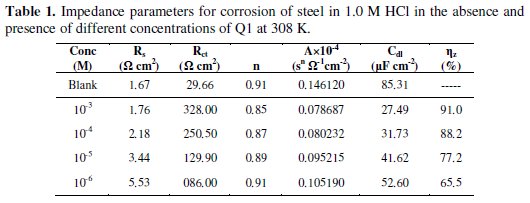
<p>&nbsp;</p>      <p>here A is the CPE constant (in &Omega;<sup>-1</sup> S<sup>n</sup> cm<sup>-2</sup>), &omega;  is the sine wave modulation  angular frequency (in rad s<sup>-1</sup>), i<sup>2</sup> = -1 is an imaginary number, and n is an  empirical exponent (0 &leq; n &leq; 1) which measures the deviation from the ideal  capacitive bahaviour [35]. The quantitative results of impedance measurements  (calculated by Zview program) for the Q1 are given in <a href="#t1">Table 1</a>.</p>      <p>&nbsp;</p> <a name="t1"></a> <img src="/img/revistas/pea/v30n6/30n6a04t1.jpg">     
]]></body>
<body><![CDATA[<p>&nbsp;</p>      <p>For the appraisal of the experimental Nyquist plots, equivalent circuit models,  which physically correctly represent the systems under investigation, must be  applied. The simplest model consists of the solution resistance (R<sub>s</sub>) in series with  the parallel combination of the constant phase element (CPE) in place of the  double-layer capacitance (C<sub>dl</sub>), and charge-transfer resistance (R<sub>ct</sub>) was used.</p>      <p>Such equivalent circuit (<a href="#f3">Fig. 3</a>) has been used previously to model the carbon  steel/acid interface [36].</p>      <p>&nbsp;</p> <a name="f3"></a> <img src="/img/revistas/pea/v30n6/30n6a04f3.jpg">     
<p>&nbsp;</p>      <p>Inspection of the data in <a href="#f2">Fig. 2</a> and <a href="#t1">Table 1</a> reveals that the corrosion of carbon  steel was decreased in the presence of the inhibitor because the charge-transfer  resistance of carbon steel was significantly increased. <a href="#t1">Table 1</a> shows that the  addition of the quinoxaline into the corrosive solution caused an increase in the  inhibition efficiency and in the charge-transfer resistance, and a decrease in the  double-layer capacitance (C<sub>dl</sub>) given as [37]</p>      <p>&nbsp;</p> <a name="e7"></a> <img src="/img/revistas/pea/v30n6/30n6a04e7.jpg">     
<p>&nbsp;</p>      <p>where &epsilon;0 is the vacuum dielectric constant, &epsilon;  is the local dielectric constant, d is  the thickness of the double layer, and A is the surface area of the electrode.</p>      <p>According to <a href="#e3">Eq. 3</a>, a decrease in C<sub>dl</sub> can happen if the inhibitor molecules (low  dielectric constant) replace the adsorbed water molecules (high dielectric  constant) on the carbon steel surface. The capacitance is inversely proportional to  the thickness of the double layer. Thus, decrease in the C<sub>dl</sub> values could be  attributed to the adsorption of Q1 on the metal surface. Decrease in the  capacitance, which can result from a decrease in the local dielectric constant  and/or an increase in the thickness of the electrical double layer, strongly  suggests that the inhibitor molecules adsorbed at the metal / solution interface. In  the absence and in the presence of inhibitor, phase-shift value remains more or  less identical; this indicates that the charge-transfer process controls the  dissolution mechanism [38] of carbon steel in 1.0 M HCl solution.</p>      ]]></body>
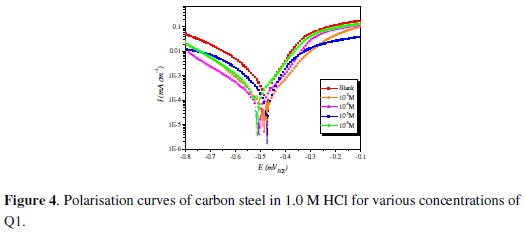
<body><![CDATA[<p>In acidic solutions, it is known that inhibitor molecules can be protonated. Thus,  in solution, both neutral molecule and cationic forms of inhibitor exist [39]. It is  assumed that Cl<sup>-</sup> ion is first adsorbed onto the positively charged metal surface  by coulombic attraction and then inhibitor molecules can be absorbed through  electrostatic interactions between the positively charged molecules and the  negatively charged metal surface [39]. These adsorbed molecules interact with  (FeCl<sup>-</sup>)<sub>ads</sub> species to form monomolecular layers (by forming a complex) on the  steel surface. These layers protect the carbon steel surface from attack by  chloride ions. Thus, the oxidation of (FeCl<sup>-</sup>)<sub>ads</sub> into Fe<sup>++</sup> can be prevented. On the  other hand, the protonated inhibitor molecules are also adsorbed at cathodic sites  in competition with hydrogen ions reducing hydrogen evolution. Inhibition  performance of Q1 for carbon steel/ 1.0 M HCl interface depends on several  factors such as the number of adsorption sites, molecular size, mode of  interaction with the metal surface, and extent of formation of metallic complexes  [40]. The adsorption of Q1 at the carbon steel surface can take place through its  two nitrogen polar atoms in addition to &pi;-electron interaction of the benzene  rings with unshared d electrons of iron atoms.</p>       <p><b><i>Potentiodynamic polarization study</i></b></p>      <p><a href="#f4">Fig. 4</a> shows the influence of Q1 concentration on the cathodic and anodic  potentiodynamic polarization curves of steel in 1.0 M HCl.</p>      <p>&nbsp;</p> <a name="f4"></a> <img src="/img/revistas/pea/v30n6/30n6a04f4.jpg">     
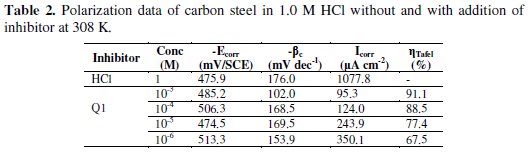
<p>&nbsp;</p>      <p>Electrochemical corrosion parameters such as corrosion potential (E<sub>corr</sub>),  cathodic Tafel slops (&beta;<sub>c</sub>),  corrosion current density (I<sub>corr</sub>) and the inhibition efficiency values are collected  in <a href="#t2">Table 2</a>.</p>      <p>&nbsp;</p> <a name="t2"></a> <img src="/img/revistas/pea/v30n6/30n6a04t2.jpg">     
<p>&nbsp;</p>      <p><a href="#f4">Fig. 4</a> and <a href="#t2">Table 2</a> show that the I<sub>corr</sub> values decrease considerably  with the increase of Q1 concentration. No definite trend was observed in the shift  of E<sub>corr</sub> values, in the presence of various concentrations of this inhibitor, in  acidic media. The presence of the inhibitor lowers the cathodic Tafel slope values  probably by blocking the metal surface. For potentials higher than -420 mV vs.  SCE, the presence of Q1 did not change the current vs. the potential. This  potential can be defined as the desorption potential. For the inhibited system, if  the displacement in E<sub>corr</sub> value is greater than 85 mV relative to the uninhibited  system, then the inhibitor is classified as cathodic or anodic type  [41, 42]. In our case, the maximum displacement of E<sub>corr</sub> value is 37.4 mV, hence  the 2-(4-methylphenyl)-1,4-dihydroquinoxaline is classified as a mixed-type  inhibitor.</p>       <p><b><i>Weight loss measurements</i></b></p>      ]]></body>
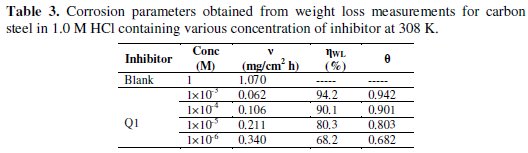
<body><![CDATA[<p><a href="#t3">Table 3</a> gives the values of inhibition efficiency obtained from the weight loss  measurements for different concentrations of Q1 in 1.0 M HCl at 308 K after 6 h  immersion.</p>      <p>&nbsp;</p> <a name="t3"></a> <img src="/img/revistas/pea/v30n6/30n6a04t3.jpg">     
<p>&nbsp;</p>      <p>The inhibition efficiency increases with increasing the inhibitor  concentration. The optimum concentration required to achieve an efficiency of  94.2% was found to be 10<sup>-3</sup> M. The inhibition by Q1 can be explained in terms of  adsorption on the metal surface. The compound can be adsorbed by the  interaction between the lone pair of electrons of the nitrogen atom of the  quinoxaline and the metal surface. This process is facilitated by the presence of &pi;  vacant orbitals of low energy in the iron atom, as observed in transition group  metals. Moreover, the formation of positively charged protonated Q1 species in  acidic solutions facilitates the adsorption of the compound on the metal surface  through electrostatic interactions between the organic molecules and the metal  surface.</p>       <p><b><i>Adsorption isotherm and thermodynamic parameters</i></b></p>      <p>It is well established that the first step in corrosion inhibition of metals and alloys  is the adsorption of organic inhibitor molecules at the metal/solution interface  and that the adsorption depends on the molecule's chemical composition, the  temperature and the electrochemical potential at the metal/solution interface. In  fact, the solvent water molecules could also adsorb at metal/solution interface. So  the adsorption of organic inhibitor molecules from the aqueous solution can be  regarded as a quasi-substitution process between the organic compounds in the  aqueous phase [Org<sub>(sol)</sub>] and water molecules at the electrode surface [H<sub>2</sub>O<sub>(ads)</sub>]</p>      <p>&nbsp;</p> <a name="e8"></a> <img src="/img/revistas/pea/v30n6/30n6a04e8.jpg">     
<p>&nbsp;</p>      <p>where x, the size ratio, is the number of water molecules displaced by one  molecule of organic inhibitor. x is assumed to be independent of coverage or  charge on the electrode [44].</p>      <p>Basic information on the interaction between the inhibitor and the alloy surface  can be provided by the adsorption isotherm. In order to obtain the isotherm, the  fractional coverage values &Theta; as a function of inhibitor concentration (C<sub>inh</sub>) must  be obtained. It is well known that &Theta; can be obtained from the &eta;<sub>WL</sub>%/100 ratio.</p>      ]]></body>
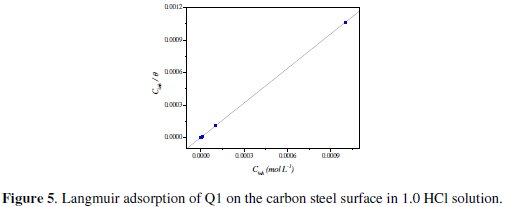
<body><![CDATA[<p>Attempts were made to fit the &Theta; values to various isotherms, including Langmuir,  Temkin, Frumkin and Flory-Huggins. Many adsorption isotherms were plotted  and the Langmuir adsorption isotherm was found to be the best description of the  adsorption behavior of the studied inhibitors. According to this isotherm, &Theta;  is related to equilibrium adsorption constant (K<sub>ads</sub>) and C<sub>inh</sub> by the relation  obtained. The value of the regression coefficient (R<sup>2</sup>) confirmed the validity of</p>      <p>&nbsp;</p> <a name="e9"></a> <img src="/img/revistas/pea/v30n6/30n6a04e9.jpg">     
<p>&nbsp;</p>      <p><a href="#f5">Fig. 5</a> shows the plot of C<sub>inh</sub>/&Theta;  vs. C<sub>inh</sub> and the expected linear relationship is  this approach.</p>      <p>&nbsp;</p> <a name="f5"></a> <img src="/img/revistas/pea/v30n6/30n6a04f5.jpg">     
<p>&nbsp;</p>      <p>The slope of this straight line is 1.06, suggesting that adsorbed  inhibitor molecules form monolayer on the carbon steel surface and that there is  no interaction among the adsorbed inhibitor molecules. On the other hand, the  equilibrium constant of adsorption is related to the standard energy of adsorption  ( &Delta;G<sup>0</sup><sub>ads</sub> ) by the relation [45]</p>      <p>&nbsp;</p> <a name="e10"></a> <img src="/img/revistas/pea/v30n6/30n6a04e10.jpg">     
<p>&nbsp;</p>      <p>where R is the gas constant, T is the absolute temperature of experiment, and the  constant value of 55.5 is the concentration of water in solution in mol L<sup>-1</sup> [46].</p>      ]]></body>
<body><![CDATA[<p>The values of thermodynamic parameters are listed in <a href="#t4">Table 4</a>.</p>      <p>&nbsp;</p> <a name="t4"></a> <img src="/img/revistas/pea/v30n6/30n6a04t4.jpg">     
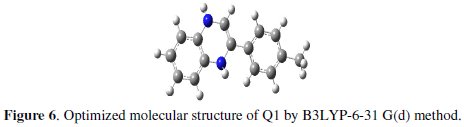
<p>&nbsp;</p>      <p>The values of K<sub>ads</sub> and &Delta;G<sup>0</sup><sub>ads</sub>  increase with increasing the inhibitor concentration, suggesting  stronger interaction between the inhibitor molecules and the iron surface atoms.  The high value of these parameters indicates that stronger and more stable  adsorbed layer is formed at carbon steel/acid solution interface, which results in  the higher inhibition efficiency [47]. Furthermore, the values of &Delta;G<sup>0</sup><sub>ads</sub> for the  quinoxaline compound is negative (<a href="#t4">Table 4</a>) and this value is consistent with the  spontaneity of the adsorption process and the stability of the adsorbed layer on  the carbon steel surface [48]. Generally, &Delta;G<sub>ads</sub>values of -20 kJ mol<sup>-1</sup> or higher  are associated with an electrostatic interaction between charged molecules and  charged metal surface (physisorption); those of -40 kJ moL<sup>-1</sup> or lower involve  charge sharing or transfer from the inhibitor molecules to the metal surface to  form a coordinate covalent bond, (chemisorption) [49]. &Delta;G<sup>0</sup><sub>ads</sub> is equal to -43.02  kJ moL<sup>-1</sup>; this high value shows that in the presence of 1.0 M HCl chemisorption  of Q1 may occur.</p>       <p><b><i>Theoretical calculations</i></b></p>      <p>The major thrust of quantum chemical research is to understand and explain the  functions of these heterocyclic compounds in molecular terms. In order to  support experimental data, theoretical calculations were conducted in order to  provide molecular-level understanding of the observed experimental behaviour.  Among quantum chemical methods for evaluation of corrosion inhibitors, DFT  has shown significant promise [50] and appears to be adequate for pointing out  the changes in the electronic structure responsible for the inhibitory action. In  recent years, a hybrid version of DFT/HF methods, i.e., B3LYP has been applied  successfully to model systems containing transition metal atoms [51]. Briefly,  this method uses a Becke's three parameter functional (B3) and includes a  mixture of HF with DFT exchange terms associated with the gradient corrected  correlation functional of Lee, Yang and Parr (LYP) [30]. The molecular structure  in the most stable conformation found was optimized and the HOMO and the  LUMO energies calculated employing B3LYP functional with the 6-31g(d) basis  set. The optimized structures are shown in <a href="#f6">Fig. 6</a>.</p>      <p>&nbsp;</p> <a name="f6"></a> <img src="/img/revistas/pea/v30n6/30n6a04f6.jpg">     
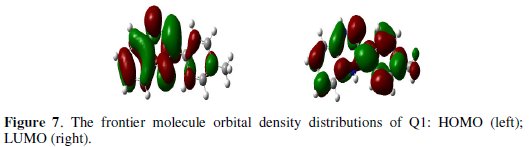
<p>&nbsp;</p>      <p>From <a href="#f7">Fig. 7</a>, it can be observed  that both HOMO and LUMO are mainly distributed on the area of the  quinoxaline and phenol ring in the studied compound, indicating that these rings  are main adsorption centers of the quinoxaline derivative.</p>      <p>&nbsp;</p> <a name="f7"></a> <img src="/img/revistas/pea/v30n6/30n6a04f7.jpg">     
]]></body>
<body><![CDATA[<p>&nbsp;</p>      <p><a href="#t5">Table 5</a> shows some of the key quantum chemical parameters computed using  DFT method.</p>      <p>&nbsp;</p> <a name="t5"></a> <img src="/img/revistas/pea/v30n6/30n6a04t5.jpg">     
<p>&nbsp;</p>      <p>These are mainly the energies of the highest occupied (E<sub>HOMO</sub>) and  lowest unoccupied (E<sub>LUMO</sub>) molecular orbitals, energy of the gap, &Delta;E (E<sub>LUMO</sub> - E<sub>HOMO</sub>)  and dipole moment (&mu;). These quantum chemical parameters were  obtained after geometric optimization with respect to all nuclear coordinates. It  has been reported that E<sub>HOMO</sub> is often associated with the electron donating  ability of a molecule, whereas E<sub>LUMO</sub> indicates its ability to accept electrons. The  high values of E<sub>HOMO</sub> (-4.0708 eV) are likely to indicate a tendency of the  molecule to donate electrons to appropriate acceptor molecules with low energy  and empty molecular orbital, whereas the value of E<sub>LUMO</sub> (-0.5269 eV) indicates  its ability of the molecule to accept electrons. Consequently, the value of &Delta;E<sub>gap</sub>  provides a measure for the stability of the formed complex on the metal surface.  The total energy of the quinoxaline is equal to -689.5219132 eV. This result  indicated that quinoxaline is favourably adsorbed through the active centers of  adsorption. Lower values of dipole moment (&mu;) will favour accumulation of the  inhibitor in the surface layer and therefore higher inhibition efficiency [52].</p>        <p>&nbsp;</p>     <p><b>Conclusions</b></p>      <p>2-(4-methylphenyl)-1,4-dihydroquinoxaline is a good inhibitor (94.2% inhibition  efficiency observed at 10<sup>-3</sup> M) for carbon steel in 1.0 M HCl.  Polarization curves indicated that Q1 is a mixed-type inhibitor. The inhibition  efficiencies obtained from polarization and EIS were in good agreement.  The adsorption of inhibitor molecules on the carbon steel surface in 1.0 M HCl  solution followed Langmuir adsorption isotherm.</p>       <p>The values obtained for &Delta;G<sub>ads</sub> showed chemisorption.  The calculated quantum chemical parameters such as HOMO-LUMO gap (&Delta;E<sub>L-H</sub>),  E<sub>HOMO</sub>, E<sub>LUMO</sub>, dipole moment (&mu;) and total energy (TE) were found to give  reasonably good correlation with the efficiency of the corrosion inhibition.</p>        <p>&nbsp;</p>     ]]></body>
<body><![CDATA[<p><b>References</b></p>      <!-- ref --><p>1. Singh AK, Chaudhary V, Sharma A. Port Electrochim Acta. 2012;30:99.    &nbsp;&nbsp;&nbsp;&nbsp;&nbsp;&nbsp;&nbsp;&nbsp;[&#160;<a href="javascript:void(0);" onclick="javascript: window.open('/scielo.php?script=sci_nlinks&ref=000124&pid=S0872-1904201200060000400001&lng=','','width=640,height=500,resizable=yes,scrollbars=1,menubar=yes,');">Links</a>&#160;]<!-- end-ref --></p>     <!-- ref --><p>2. Prajila M, Sam J, Bincy J, Abraham J. J Mater Environ Sci. 2012;3:1045.    &nbsp;&nbsp;&nbsp;&nbsp;&nbsp;&nbsp;&nbsp;&nbsp;[&#160;<a href="javascript:void(0);" onclick="javascript: window.open('/scielo.php?script=sci_nlinks&ref=000126&pid=S0872-1904201200060000400002&lng=','','width=640,height=500,resizable=yes,scrollbars=1,menubar=yes,');">Links</a>&#160;]<!-- end-ref --></p>     <!-- ref --><p>3. Naik UJ, Panchal VA, Patel AS, Shah NK. J Mater Environ Sci. 2012;3:935.    &nbsp;&nbsp;&nbsp;&nbsp;&nbsp;&nbsp;&nbsp;&nbsp;[&#160;<a href="javascript:void(0);" onclick="javascript: window.open('/scielo.php?script=sci_nlinks&ref=000128&pid=S0872-1904201200060000400003&lng=','','width=640,height=500,resizable=yes,scrollbars=1,menubar=yes,');">Links</a>&#160;]<!-- end-ref --></p>     <!-- ref --><p>4. Zarrouk A, Zarrok H, Salghi R et al. J Mater Environ Sci. 2013;4: 177.    &nbsp;&nbsp;&nbsp;&nbsp;&nbsp;&nbsp;&nbsp;&nbsp;[&#160;<a href="javascript:void(0);" onclick="javascript: window.open('/scielo.php?script=sci_nlinks&ref=000130&pid=S0872-1904201200060000400004&lng=','','width=640,height=500,resizable=yes,scrollbars=1,menubar=yes,');">Links</a>&#160;]<!-- end-ref --></p>     <!-- ref --><p>5. Zarrok H, Oudda H, Zarrouk A et al. Der Pharm Chem. 2011;3:576.    &nbsp;&nbsp;&nbsp;&nbsp;&nbsp;&nbsp;&nbsp;&nbsp;[&#160;<a href="javascript:void(0);" onclick="javascript: window.open('/scielo.php?script=sci_nlinks&ref=000132&pid=S0872-1904201200060000400005&lng=','','width=640,height=500,resizable=yes,scrollbars=1,menubar=yes,');">Links</a>&#160;]<!-- end-ref --></p>     <!-- ref --><p>6. Zarrok H, Salghi R, Zarrouk A et al. Der Pharm Chem. 2012;4:407.    &nbsp;&nbsp;&nbsp;&nbsp;&nbsp;&nbsp;&nbsp;&nbsp;[&#160;<a href="javascript:void(0);" onclick="javascript: window.open('/scielo.php?script=sci_nlinks&ref=000134&pid=S0872-1904201200060000400006&lng=','','width=640,height=500,resizable=yes,scrollbars=1,menubar=yes,');">Links</a>&#160;]<!-- end-ref --></p>     <!-- ref --><p>7. Zarrok H, Al-Deyab SS, Zarrouk A et al. Int J Electrochem Sci. 2012;7:4047.    &nbsp;&nbsp;&nbsp;&nbsp;&nbsp;&nbsp;&nbsp;&nbsp;[&#160;<a href="javascript:void(0);" onclick="javascript: window.open('/scielo.php?script=sci_nlinks&ref=000136&pid=S0872-1904201200060000400007&lng=','','width=640,height=500,resizable=yes,scrollbars=1,menubar=yes,');">Links</a>&#160;]<!-- end-ref --></p>     <!-- ref --><p>8. Hmamou DB, Salghi R, Zarrouk A et al. Int J Electrochem Sci. 2012;7:5716.    &nbsp;&nbsp;&nbsp;&nbsp;&nbsp;&nbsp;&nbsp;&nbsp;[&#160;<a href="javascript:void(0);" onclick="javascript: window.open('/scielo.php?script=sci_nlinks&ref=000138&pid=S0872-1904201200060000400008&lng=','','width=640,height=500,resizable=yes,scrollbars=1,menubar=yes,');">Links</a>&#160;]<!-- end-ref --></p>     <!-- ref --><p>9. Zarrouk A, Hammouti B, Al-Deyab SS et al. Int J Electrochem Sci. 2012;7:5997.    &nbsp;&nbsp;&nbsp;&nbsp;&nbsp;&nbsp;&nbsp;&nbsp;[&#160;<a href="javascript:void(0);" onclick="javascript: window.open('/scielo.php?script=sci_nlinks&ref=000140&pid=S0872-1904201200060000400009&lng=','','width=640,height=500,resizable=yes,scrollbars=1,menubar=yes,');">Links</a>&#160;]<!-- end-ref --></p>     <p>10. Zarrouk A, Zarrok H, Salghi R et al. Int J Electrochem Sci. 2012;7:6353.</p>     ]]></body>
<body><![CDATA[<!-- ref --><p>11. Zarrouk A, Messali M, Zarrok H et al. Int J Electrochem Sci. 2012;7:6998.    &nbsp;&nbsp;&nbsp;&nbsp;&nbsp;&nbsp;&nbsp;&nbsp;[&#160;<a href="javascript:void(0);" onclick="javascript: window.open('/scielo.php?script=sci_nlinks&ref=000143&pid=S0872-1904201200060000400011&lng=','','width=640,height=500,resizable=yes,scrollbars=1,menubar=yes,');">Links</a>&#160;]<!-- end-ref --></p>     <!-- ref --><p>12. Zarrok H, Zarrouk A, Salghi R et al. Int J Electrochem Sci. 2012;7:8958.    &nbsp;&nbsp;&nbsp;&nbsp;&nbsp;&nbsp;&nbsp;&nbsp;[&#160;<a href="javascript:void(0);" onclick="javascript: window.open('/scielo.php?script=sci_nlinks&ref=000145&pid=S0872-1904201200060000400012&lng=','','width=640,height=500,resizable=yes,scrollbars=1,menubar=yes,');">Links</a>&#160;]<!-- end-ref --></p>     <!-- ref --><p>13. Hmamou DB, Salghi R, Zarrouk A et al. Int J Electrochem Sci. 2012;7:8988.    &nbsp;&nbsp;&nbsp;&nbsp;&nbsp;&nbsp;&nbsp;&nbsp;[&#160;<a href="javascript:void(0);" onclick="javascript: window.open('/scielo.php?script=sci_nlinks&ref=000147&pid=S0872-1904201200060000400013&lng=','','width=640,height=500,resizable=yes,scrollbars=1,menubar=yes,');">Links</a>&#160;]<!-- end-ref --></p>     <!-- ref --><p>14. Zarrouk A, Messali M, Aouad MR et al. J Chem Pharm Res. 2012;4:3427.    &nbsp;&nbsp;&nbsp;&nbsp;&nbsp;&nbsp;&nbsp;&nbsp;[&#160;<a href="javascript:void(0);" onclick="javascript: window.open('/scielo.php?script=sci_nlinks&ref=000149&pid=S0872-1904201200060000400014&lng=','','width=640,height=500,resizable=yes,scrollbars=1,menubar=yes,');">Links</a>&#160;]<!-- end-ref --></p>     <!-- ref --><p>15. Hmamou DB, Aouad MR, Salghi R et al. J Chem Pharm Res. 2012;4:3489.    &nbsp;&nbsp;&nbsp;&nbsp;&nbsp;&nbsp;&nbsp;&nbsp;[&#160;<a href="javascript:void(0);" onclick="javascript: window.open('/scielo.php?script=sci_nlinks&ref=000151&pid=S0872-1904201200060000400015&lng=','','width=640,height=500,resizable=yes,scrollbars=1,menubar=yes,');">Links</a>&#160;]<!-- end-ref --></p>     ]]></body>
<body><![CDATA[<!-- ref --><p>16. Zarrok H, Oudda H, El Midaoui A et al. Res Chem Intermed. In press.    &nbsp;&nbsp;&nbsp;&nbsp;&nbsp;&nbsp;&nbsp;&nbsp;[&#160;<a href="javascript:void(0);" onclick="javascript: window.open('/scielo.php?script=sci_nlinks&ref=000153&pid=S0872-1904201200060000400016&lng=','','width=640,height=500,resizable=yes,scrollbars=1,menubar=yes,');">Links</a>&#160;]<!-- end-ref --> DOI: 10.1007/s11164-012-0525-x</p>     <!-- ref --><p>17. Zarrouk A, Hammouti B, Zarrok H et al. Der Pharm Chem. 2012;4:337.    &nbsp;&nbsp;&nbsp;&nbsp;&nbsp;&nbsp;&nbsp;&nbsp;[&#160;<a href="javascript:void(0);" onclick="javascript: window.open('/scielo.php?script=sci_nlinks&ref=000155&pid=S0872-1904201200060000400017&lng=','','width=640,height=500,resizable=yes,scrollbars=1,menubar=yes,');">Links</a>&#160;]<!-- end-ref --></p>     <!-- ref --><p>18. Zarrouk A, Dafali A, Hammouti B et al. Int J Electrochem Sci. 2010;5:46.    &nbsp;&nbsp;&nbsp;&nbsp;&nbsp;&nbsp;&nbsp;&nbsp;[&#160;<a href="javascript:void(0);" onclick="javascript: window.open('/scielo.php?script=sci_nlinks&ref=000157&pid=S0872-1904201200060000400018&lng=','','width=640,height=500,resizable=yes,scrollbars=1,menubar=yes,');">Links</a>&#160;]<!-- end-ref --></p>     <p>19. Zarrouk A, T. Chelfi, A. Dafali et al. Int. J. Electrochem. Sci. 5 (2010) 696.</p>     <!-- ref --><p>20. Zarrouk A, Warad I, Hammouti B et al. Int J Electrochem Sci. 2010;5:1516.    &nbsp;&nbsp;&nbsp;&nbsp;&nbsp;&nbsp;&nbsp;&nbsp;[&#160;<a href="javascript:void(0);" onclick="javascript: window.open('/scielo.php?script=sci_nlinks&ref=000160&pid=S0872-1904201200060000400020&lng=','','width=640,height=500,resizable=yes,scrollbars=1,menubar=yes,');">Links</a>&#160;]<!-- end-ref --></p>     <!-- ref --><p>21. Zarrouk A, Hammouti B, Touzani R et al. Int J Electrochem Sci. 2011;6:4939.    &nbsp;&nbsp;&nbsp;&nbsp;&nbsp;&nbsp;&nbsp;&nbsp;[&#160;<a href="javascript:void(0);" onclick="javascript: window.open('/scielo.php?script=sci_nlinks&ref=000162&pid=S0872-1904201200060000400021&lng=','','width=640,height=500,resizable=yes,scrollbars=1,menubar=yes,');">Links</a>&#160;]<!-- end-ref --></p>     <!-- ref --><p>22. Zarrouk A, Hammouti B, Zarrok H et al. Int J Electrochem Sci. 2011;6:6261.    &nbsp;&nbsp;&nbsp;&nbsp;&nbsp;&nbsp;&nbsp;&nbsp;[&#160;<a href="javascript:void(0);" onclick="javascript: window.open('/scielo.php?script=sci_nlinks&ref=000164&pid=S0872-1904201200060000400022&lng=','','width=640,height=500,resizable=yes,scrollbars=1,menubar=yes,');">Links</a>&#160;]<!-- end-ref --></p>     <!-- ref --><p>23. Dell A, William DH, Morris HR et al. J Am Chem Soc. 1975;97:2497.    &nbsp;&nbsp;&nbsp;&nbsp;&nbsp;&nbsp;&nbsp;&nbsp;[&#160;<a href="javascript:void(0);" onclick="javascript: window.open('/scielo.php?script=sci_nlinks&ref=000166&pid=S0872-1904201200060000400023&lng=','','width=640,height=500,resizable=yes,scrollbars=1,menubar=yes,');">Links</a>&#160;]<!-- end-ref --></p>     <!-- ref --><p>24. Bailly C, Echepare S, Gago F, Waring MJ. J Anticancer Drug Des. 1999;15:291.    &nbsp;&nbsp;&nbsp;&nbsp;&nbsp;&nbsp;&nbsp;&nbsp;[&#160;<a href="javascript:void(0);" onclick="javascript: window.open('/scielo.php?script=sci_nlinks&ref=000168&pid=S0872-1904201200060000400024&lng=','','width=640,height=500,resizable=yes,scrollbars=1,menubar=yes,');">Links</a>&#160;]<!-- end-ref --></p>     <!-- ref --><p>25. Abboud Y, Abourriche A, Saffaj T et al. Mater Chem Phys. 2007;105:1.    &nbsp;&nbsp;&nbsp;&nbsp;&nbsp;&nbsp;&nbsp;&nbsp;[&#160;<a href="javascript:void(0);" onclick="javascript: window.open('/scielo.php?script=sci_nlinks&ref=000170&pid=S0872-1904201200060000400025&lng=','','width=640,height=500,resizable=yes,scrollbars=1,menubar=yes,');">Links</a>&#160;]<!-- end-ref --></p>     <!-- ref --><p>26. Li XH, Deng SD, Fu H et al. Appl Surf Sci. 2008;254:5574.    &nbsp;&nbsp;&nbsp;&nbsp;&nbsp;&nbsp;&nbsp;&nbsp;[&#160;<a href="javascript:void(0);" onclick="javascript: window.open('/scielo.php?script=sci_nlinks&ref=000172&pid=S0872-1904201200060000400026&lng=','','width=640,height=500,resizable=yes,scrollbars=1,menubar=yes,');">Links</a>&#160;]<!-- end-ref --></p>     <!-- ref --><p>27. Zarrok H, Zarrouk A, Hammouti B et al. Corros Sci. 2012;64:243.    &nbsp;&nbsp;&nbsp;&nbsp;&nbsp;&nbsp;&nbsp;&nbsp;[&#160;<a href="javascript:void(0);" onclick="javascript: window.open('/scielo.php?script=sci_nlinks&ref=000174&pid=S0872-1904201200060000400027&lng=','','width=640,height=500,resizable=yes,scrollbars=1,menubar=yes,');">Links</a>&#160;]<!-- end-ref --></p>     <!-- ref --><p>28. Becke AD. J Chem Phys. 1992;96:9489.    &nbsp;&nbsp;&nbsp;&nbsp;&nbsp;&nbsp;&nbsp;&nbsp;[&#160;<a href="javascript:void(0);" onclick="javascript: window.open('/scielo.php?script=sci_nlinks&ref=000176&pid=S0872-1904201200060000400028&lng=','','width=640,height=500,resizable=yes,scrollbars=1,menubar=yes,');">Links</a>&#160;]<!-- end-ref --></p>     <!-- ref --><p>29. Becke AD. J Chem Phys. 1993;98:1372.    &nbsp;&nbsp;&nbsp;&nbsp;&nbsp;&nbsp;&nbsp;&nbsp;[&#160;<a href="javascript:void(0);" onclick="javascript: window.open('/scielo.php?script=sci_nlinks&ref=000178&pid=S0872-1904201200060000400029&lng=','','width=640,height=500,resizable=yes,scrollbars=1,menubar=yes,');">Links</a>&#160;]<!-- end-ref --></p>     <!-- ref --><p>30. Lee C, Yang W, Parr RG. Phys Rev B. 1988;37:785.    &nbsp;&nbsp;&nbsp;&nbsp;&nbsp;&nbsp;&nbsp;&nbsp;[&#160;<a href="javascript:void(0);" onclick="javascript: window.open('/scielo.php?script=sci_nlinks&ref=000180&pid=S0872-1904201200060000400030&lng=','','width=640,height=500,resizable=yes,scrollbars=1,menubar=yes,');">Links</a>&#160;]<!-- end-ref --></p>     <!-- ref --><p>31. Gaussian 03, Revision B.01, Frisch MJ et al. Gaussian, Inc., Pittsburgh, PA; 2003.    &nbsp;&nbsp;&nbsp;&nbsp;&nbsp;&nbsp;&nbsp;&nbsp;[&#160;<a href="javascript:void(0);" onclick="javascript: window.open('/scielo.php?script=sci_nlinks&ref=000182&pid=S0872-1904201200060000400031&lng=','','width=640,height=500,resizable=yes,scrollbars=1,menubar=yes,');">Links</a>&#160;]<!-- end-ref --></p>     <!-- ref --><p>32. Avci G. Colloids Surf A. 2008;317:730.    &nbsp;&nbsp;&nbsp;&nbsp;&nbsp;&nbsp;&nbsp;&nbsp;[&#160;<a href="javascript:void(0);" onclick="javascript: window.open('/scielo.php?script=sci_nlinks&ref=000184&pid=S0872-1904201200060000400032&lng=','','width=640,height=500,resizable=yes,scrollbars=1,menubar=yes,');">Links</a>&#160;]<!-- end-ref --></p>     <!-- ref --><p>33. Rammelt U, Koehler S, Reinhard G. Corros Sci. 2008;50:1659.    &nbsp;&nbsp;&nbsp;&nbsp;&nbsp;&nbsp;&nbsp;&nbsp;[&#160;<a href="javascript:void(0);" onclick="javascript: window.open('/scielo.php?script=sci_nlinks&ref=000186&pid=S0872-1904201200060000400033&lng=','','width=640,height=500,resizable=yes,scrollbars=1,menubar=yes,');">Links</a>&#160;]<!-- end-ref --></p>     <!-- ref --><p>34. Bentiss F, Traisnel M, Gengembre L et al. Appl Surf Sci. 1999;152:237.    &nbsp;&nbsp;&nbsp;&nbsp;&nbsp;&nbsp;&nbsp;&nbsp;[&#160;<a href="javascript:void(0);" onclick="javascript: window.open('/scielo.php?script=sci_nlinks&ref=000188&pid=S0872-1904201200060000400034&lng=','','width=640,height=500,resizable=yes,scrollbars=1,menubar=yes,');">Links</a>&#160;]<!-- end-ref --></p>     <p>35. Macdonald R, Franceschetti DR. In: Impedance spectroscopy. Macdonald JR, editor. New York: Wiley; 1987. P. 96.</p>     <!-- ref --><p>36. Growcock FB, Jasinski JH. J Electrochem Soc. 1989;136:2310.    &nbsp;&nbsp;&nbsp;&nbsp;&nbsp;&nbsp;&nbsp;&nbsp;[&#160;<a href="javascript:void(0);" onclick="javascript: window.open('/scielo.php?script=sci_nlinks&ref=000191&pid=S0872-1904201200060000400036&lng=','','width=640,height=500,resizable=yes,scrollbars=1,menubar=yes,');">Links</a>&#160;]<!-- end-ref --></p>     ]]></body>
<body><![CDATA[<!-- ref --><p>37. Oguzie EE, Li Y, Wang FH. Electrochim Acta. 2007;53:909.    &nbsp;&nbsp;&nbsp;&nbsp;&nbsp;&nbsp;&nbsp;&nbsp;[&#160;<a href="javascript:void(0);" onclick="javascript: window.open('/scielo.php?script=sci_nlinks&ref=000193&pid=S0872-1904201200060000400037&lng=','','width=640,height=500,resizable=yes,scrollbars=1,menubar=yes,');">Links</a>&#160;]<!-- end-ref --></p>     <!-- ref --><p>38. Hermas AA, Morad MS, Wahdan MH. J Appl Electrochem. 2004;34:95.    &nbsp;&nbsp;&nbsp;&nbsp;&nbsp;&nbsp;&nbsp;&nbsp;[&#160;<a href="javascript:void(0);" onclick="javascript: window.open('/scielo.php?script=sci_nlinks&ref=000195&pid=S0872-1904201200060000400038&lng=','','width=640,height=500,resizable=yes,scrollbars=1,menubar=yes,');">Links</a>&#160;]<!-- end-ref --></p>     <!-- ref --><p>39. Quraishi MA, Rafiquee MZA, Khan S, Saxena N. J Appl Electrochem. 2007;37:1153.    &nbsp;&nbsp;&nbsp;&nbsp;&nbsp;&nbsp;&nbsp;&nbsp;[&#160;<a href="javascript:void(0);" onclick="javascript: window.open('/scielo.php?script=sci_nlinks&ref=000197&pid=S0872-1904201200060000400039&lng=','','width=640,height=500,resizable=yes,scrollbars=1,menubar=yes,');">Links</a>&#160;]<!-- end-ref --></p>     <!-- ref --><p>40. Bentiss F, Bouanis M, Mernari B et al. Appl Surf Sci. 2007;253:3696.    &nbsp;&nbsp;&nbsp;&nbsp;&nbsp;&nbsp;&nbsp;&nbsp;[&#160;<a href="javascript:void(0);" onclick="javascript: window.open('/scielo.php?script=sci_nlinks&ref=000199&pid=S0872-1904201200060000400040&lng=','','width=640,height=500,resizable=yes,scrollbars=1,menubar=yes,');">Links</a>&#160;]<!-- end-ref --></p>     <!-- ref --><p>41. Musa AY, Kadhum AAH, Mohamad AB, Takriff MS. Corros Sci. 2010;52:3331.    &nbsp;&nbsp;&nbsp;&nbsp;&nbsp;&nbsp;&nbsp;&nbsp;[&#160;<a href="javascript:void(0);" onclick="javascript: window.open('/scielo.php?script=sci_nlinks&ref=000201&pid=S0872-1904201200060000400041&lng=','','width=640,height=500,resizable=yes,scrollbars=1,menubar=yes,');">Links</a>&#160;]<!-- end-ref --></p>     ]]></body>
<body><![CDATA[<!-- ref --><p>42. Zhang J, Gong XL, Yu HH, Du M. Corros Sci. 2011;53:3324.    &nbsp;&nbsp;&nbsp;&nbsp;&nbsp;&nbsp;&nbsp;&nbsp;[&#160;<a href="javascript:void(0);" onclick="javascript: window.open('/scielo.php?script=sci_nlinks&ref=000203&pid=S0872-1904201200060000400042&lng=','','width=640,height=500,resizable=yes,scrollbars=1,menubar=yes,');">Links</a>&#160;]<!-- end-ref --></p>     <!-- ref --><p>43. Sahin M, Bilgic S, Yilmaz H. Appl Surf Sci. 2002;195:1.    &nbsp;&nbsp;&nbsp;&nbsp;&nbsp;&nbsp;&nbsp;&nbsp;[&#160;<a href="javascript:void(0);" onclick="javascript: window.open('/scielo.php?script=sci_nlinks&ref=000205&pid=S0872-1904201200060000400043&lng=','','width=640,height=500,resizable=yes,scrollbars=1,menubar=yes,');">Links</a>&#160;]<!-- end-ref --></p>     <!-- ref --><p>44. Migahed MA, Farag AA, Elsaed SM et al. Mater Chem Phys. 2011;125:125.    &nbsp;&nbsp;&nbsp;&nbsp;&nbsp;&nbsp;&nbsp;&nbsp;[&#160;<a href="javascript:void(0);" onclick="javascript: window.open('/scielo.php?script=sci_nlinks&ref=000207&pid=S0872-1904201200060000400044&lng=','','width=640,height=500,resizable=yes,scrollbars=1,menubar=yes,');">Links</a>&#160;]<!-- end-ref --></p>     <!-- ref --><p>45. Kaminski M, Szklarska-Smialowska Z. Corros Sci. 1973;13:557.    &nbsp;&nbsp;&nbsp;&nbsp;&nbsp;&nbsp;&nbsp;&nbsp;[&#160;<a href="javascript:void(0);" onclick="javascript: window.open('/scielo.php?script=sci_nlinks&ref=000209&pid=S0872-1904201200060000400045&lng=','','width=640,height=500,resizable=yes,scrollbars=1,menubar=yes,');">Links</a>&#160;]<!-- end-ref --></p>     <!-- ref --><p>46. Olivares O, Likhanova NV, Gomez B et al. Appl Surf Sci. 2006;252:2894.    &nbsp;&nbsp;&nbsp;&nbsp;&nbsp;&nbsp;&nbsp;&nbsp;[&#160;<a href="javascript:void(0);" onclick="javascript: window.open('/scielo.php?script=sci_nlinks&ref=000211&pid=S0872-1904201200060000400046&lng=','','width=640,height=500,resizable=yes,scrollbars=1,menubar=yes,');">Links</a>&#160;]<!-- end-ref --></p>     ]]></body>
<body><![CDATA[<!-- ref --><p>47. Hammouti B, Zarrouk A, Al-Deyab SS, Warad I. Orient J Chem. 2011;27:23.    &nbsp;&nbsp;&nbsp;&nbsp;&nbsp;&nbsp;&nbsp;&nbsp;[&#160;<a href="javascript:void(0);" onclick="javascript: window.open('/scielo.php?script=sci_nlinks&ref=000213&pid=S0872-1904201200060000400047&lng=','','width=640,height=500,resizable=yes,scrollbars=1,menubar=yes,');">Links</a>&#160;]<!-- end-ref --></p>     <!-- ref --><p>48. Fouda AS, Heakal FE, Radwan MS. J Appl Electrochem. 2009;39:391.    &nbsp;&nbsp;&nbsp;&nbsp;&nbsp;&nbsp;&nbsp;&nbsp;[&#160;<a href="javascript:void(0);" onclick="javascript: window.open('/scielo.php?script=sci_nlinks&ref=000215&pid=S0872-1904201200060000400048&lng=','','width=640,height=500,resizable=yes,scrollbars=1,menubar=yes,');">Links</a>&#160;]<!-- end-ref --></p>     <!-- ref --><p>49. Hosseini M, Mertens SFL, Arshadi MR. Corros Sci. 2003;45:1473.    &nbsp;&nbsp;&nbsp;&nbsp;&nbsp;&nbsp;&nbsp;&nbsp;[&#160;<a href="javascript:void(0);" onclick="javascript: window.open('/scielo.php?script=sci_nlinks&ref=000217&pid=S0872-1904201200060000400049&lng=','','width=640,height=500,resizable=yes,scrollbars=1,menubar=yes,');">Links</a>&#160;]<!-- end-ref --></p>     <!-- ref --><p>50. Lopez N, Illas F. J Phys Chem B. 1998;102:1430.    &nbsp;&nbsp;&nbsp;&nbsp;&nbsp;&nbsp;&nbsp;&nbsp;[&#160;<a href="javascript:void(0);" onclick="javascript: window.open('/scielo.php?script=sci_nlinks&ref=000219&pid=S0872-1904201200060000400050&lng=','','width=640,height=500,resizable=yes,scrollbars=1,menubar=yes,');">Links</a>&#160;]<!-- end-ref --></p>     <!-- ref --><p>51. Ignaczak A, Gomes JANF. Chem Phys Lett. 1996;257:609.    &nbsp;&nbsp;&nbsp;&nbsp;&nbsp;&nbsp;&nbsp;&nbsp;[&#160;<a href="javascript:void(0);" onclick="javascript: window.open('/scielo.php?script=sci_nlinks&ref=000221&pid=S0872-1904201200060000400051&lng=','','width=640,height=500,resizable=yes,scrollbars=1,menubar=yes,');">Links</a>&#160;]<!-- end-ref --></p>     ]]></body>
<body><![CDATA[<!-- ref --><p>52. Khalil N. Electrochim Acta. 2003;48:2635.    &nbsp;&nbsp;&nbsp;&nbsp;&nbsp;&nbsp;&nbsp;&nbsp;[&#160;<a href="javascript:void(0);" onclick="javascript: window.open('/scielo.php?script=sci_nlinks&ref=000223&pid=S0872-1904201200060000400052&lng=','','width=640,height=500,resizable=yes,scrollbars=1,menubar=yes,');">Links</a>&#160;]<!-- end-ref --></p>        <p>&nbsp;</p>     <p><a name=0></a><sup><a href="#top">*</a></sup>Corresponding author. E-mail address: <a href="mailto:azarrouk@gmail.com">azarrouk@gmail.com</a></p>      <p>Received 23 November 2012; accepted 23 December 2012</p>      <p><a href="http://www.peacta.org" target="_blank">www.peacta.org</a> </p>        ]]></body><back>
<ref-list>
<ref id="B1">
<label>1</label><nlm-citation citation-type="journal">
<person-group person-group-type="author">
<name>
<surname><![CDATA[Singh]]></surname>
<given-names><![CDATA[AK]]></given-names>
</name>
<name>
<surname><![CDATA[Chaudhary]]></surname>
<given-names><![CDATA[V]]></given-names>
</name>
<name>
<surname><![CDATA[Sharma]]></surname>
<given-names><![CDATA[A]]></given-names>
</name>
</person-group>
<source><![CDATA[Port Electrochim Acta]]></source>
<year>2012</year>
<volume>30</volume>
<page-range>99</page-range></nlm-citation>
</ref>
<ref id="B2">
<label>2</label><nlm-citation citation-type="journal">
<person-group person-group-type="author">
<name>
<surname><![CDATA[Prajila]]></surname>
<given-names><![CDATA[M]]></given-names>
</name>
<name>
<surname><![CDATA[Sam]]></surname>
<given-names><![CDATA[J]]></given-names>
</name>
<name>
<surname><![CDATA[Bincy]]></surname>
<given-names><![CDATA[J]]></given-names>
</name>
<name>
<surname><![CDATA[Abraham]]></surname>
<given-names><![CDATA[J]]></given-names>
</name>
</person-group>
<source><![CDATA[J Mater Environ Sci]]></source>
<year>2012</year>
<volume>3</volume>
<page-range>1045</page-range></nlm-citation>
</ref>
<ref id="B3">
<label>3</label><nlm-citation citation-type="journal">
<person-group person-group-type="author">
<name>
<surname><![CDATA[Naik]]></surname>
<given-names><![CDATA[UJ]]></given-names>
</name>
<name>
<surname><![CDATA[Panchal]]></surname>
<given-names><![CDATA[VA]]></given-names>
</name>
<name>
<surname><![CDATA[Patel]]></surname>
<given-names><![CDATA[AS]]></given-names>
</name>
<name>
<surname><![CDATA[Shah]]></surname>
<given-names><![CDATA[NK]]></given-names>
</name>
</person-group>
<source><![CDATA[J Mater Environ Sci]]></source>
<year>2012</year>
<volume>3</volume>
<page-range>935</page-range></nlm-citation>
</ref>
<ref id="B4">
<label>4</label><nlm-citation citation-type="journal">
<person-group person-group-type="author">
<name>
<surname><![CDATA[Zarrouk]]></surname>
<given-names><![CDATA[A]]></given-names>
</name>
<name>
<surname><![CDATA[Zarrok]]></surname>
<given-names><![CDATA[H]]></given-names>
</name>
<name>
<surname><![CDATA[Salghi]]></surname>
<given-names><![CDATA[R]]></given-names>
</name>
</person-group>
<source><![CDATA[J Mater Environ Sci]]></source>
<year>2013</year>
<volume>4</volume>
<page-range>177</page-range></nlm-citation>
</ref>
<ref id="B5">
<label>5</label><nlm-citation citation-type="journal">
<person-group person-group-type="author">
<name>
<surname><![CDATA[Zarrok]]></surname>
<given-names><![CDATA[H]]></given-names>
</name>
<name>
<surname><![CDATA[Oudda]]></surname>
<given-names><![CDATA[H]]></given-names>
</name>
<name>
<surname><![CDATA[Zarrouk]]></surname>
<given-names><![CDATA[A]]></given-names>
</name>
</person-group>
<source><![CDATA[Der Pharm Chem]]></source>
<year>2011</year>
<volume>3</volume>
<page-range>576</page-range></nlm-citation>
</ref>
<ref id="B6">
<label>6</label><nlm-citation citation-type="journal">
<person-group person-group-type="author">
<name>
<surname><![CDATA[Zarrok]]></surname>
<given-names><![CDATA[H]]></given-names>
</name>
<name>
<surname><![CDATA[Salghi]]></surname>
<given-names><![CDATA[R]]></given-names>
</name>
<name>
<surname><![CDATA[Zarrouk]]></surname>
<given-names><![CDATA[A]]></given-names>
</name>
</person-group>
<source><![CDATA[Der Pharm Chem]]></source>
<year>2012</year>
<volume>4</volume>
<page-range>407</page-range></nlm-citation>
</ref>
<ref id="B7">
<label>7</label><nlm-citation citation-type="journal">
<person-group person-group-type="author">
<name>
<surname><![CDATA[Zarrok]]></surname>
<given-names><![CDATA[H]]></given-names>
</name>
<name>
<surname><![CDATA[Al-Deyab]]></surname>
<given-names><![CDATA[SS]]></given-names>
</name>
<name>
<surname><![CDATA[Zarrouk]]></surname>
<given-names><![CDATA[A]]></given-names>
</name>
</person-group>
<source><![CDATA[Int J Electrochem Sci]]></source>
<year>2012</year>
<volume>7</volume>
<page-range>4047</page-range></nlm-citation>
</ref>
<ref id="B8">
<label>8</label><nlm-citation citation-type="journal">
<person-group person-group-type="author">
<name>
<surname><![CDATA[Hmamou]]></surname>
<given-names><![CDATA[DB]]></given-names>
</name>
<name>
<surname><![CDATA[Salghi]]></surname>
<given-names><![CDATA[R]]></given-names>
</name>
<name>
<surname><![CDATA[Zarrouk]]></surname>
<given-names><![CDATA[A]]></given-names>
</name>
</person-group>
<source><![CDATA[Int J Electrochem Sci]]></source>
<year>2012</year>
<volume>7</volume>
<page-range>5716</page-range></nlm-citation>
</ref>
<ref id="B9">
<label>9</label><nlm-citation citation-type="journal">
<person-group person-group-type="author">
<name>
<surname><![CDATA[Zarrouk]]></surname>
<given-names><![CDATA[A]]></given-names>
</name>
<name>
<surname><![CDATA[Hammouti]]></surname>
<given-names><![CDATA[B]]></given-names>
</name>
<name>
<surname><![CDATA[Al-Deyab]]></surname>
<given-names><![CDATA[SS]]></given-names>
</name>
</person-group>
<source><![CDATA[Int J Electrochem Sci]]></source>
<year>2012</year>
<volume>7</volume>
<page-range>5997</page-range></nlm-citation>
</ref>
<ref id="B10">
<label>10</label><nlm-citation citation-type="journal">
<person-group person-group-type="author">
<name>
<surname><![CDATA[Zarrouk]]></surname>
<given-names><![CDATA[A]]></given-names>
</name>
<name>
<surname><![CDATA[Zarrouk]]></surname>
<given-names><![CDATA[H]]></given-names>
</name>
<name>
<surname><![CDATA[Salghi]]></surname>
<given-names><![CDATA[R]]></given-names>
</name>
</person-group>
<source><![CDATA[Int J Electrochem Sci]]></source>
<year>2012</year>
<volume>7</volume>
<page-range>6353</page-range></nlm-citation>
</ref>
<ref id="B11">
<label>11</label><nlm-citation citation-type="journal">
<person-group person-group-type="author">
<name>
<surname><![CDATA[Zarrouk]]></surname>
<given-names><![CDATA[A]]></given-names>
</name>
<name>
<surname><![CDATA[Messali]]></surname>
<given-names><![CDATA[M]]></given-names>
</name>
<name>
<surname><![CDATA[Zarrok]]></surname>
<given-names><![CDATA[H]]></given-names>
</name>
</person-group>
<source><![CDATA[Int J Electrochem Sci]]></source>
<year>2012</year>
<volume>7</volume>
<page-range>6998</page-range></nlm-citation>
</ref>
<ref id="B12">
<label>12</label><nlm-citation citation-type="journal">
<person-group person-group-type="author">
<name>
<surname><![CDATA[Zarrok]]></surname>
<given-names><![CDATA[H]]></given-names>
</name>
<name>
<surname><![CDATA[Zarrouk]]></surname>
<given-names><![CDATA[A]]></given-names>
</name>
<name>
<surname><![CDATA[Salghi]]></surname>
<given-names><![CDATA[R]]></given-names>
</name>
</person-group>
<source><![CDATA[Int J Electrochem Sci]]></source>
<year>2012</year>
<volume>7</volume>
<page-range>8958</page-range></nlm-citation>
</ref>
<ref id="B13">
<label>13</label><nlm-citation citation-type="journal">
<person-group person-group-type="author">
<name>
<surname><![CDATA[Hmamou]]></surname>
<given-names><![CDATA[DB]]></given-names>
</name>
<name>
<surname><![CDATA[Salghi]]></surname>
<given-names><![CDATA[R]]></given-names>
</name>
<name>
<surname><![CDATA[Zarrouk]]></surname>
<given-names><![CDATA[A]]></given-names>
</name>
</person-group>
<source><![CDATA[Int J Electrochem Sci]]></source>
<year>2012</year>
<volume>7</volume>
<page-range>8988</page-range></nlm-citation>
</ref>
<ref id="B14">
<label>14</label><nlm-citation citation-type="journal">
<person-group person-group-type="author">
<name>
<surname><![CDATA[Zarrouk]]></surname>
<given-names><![CDATA[A]]></given-names>
</name>
<name>
<surname><![CDATA[Messali]]></surname>
<given-names><![CDATA[M]]></given-names>
</name>
<name>
<surname><![CDATA[Aouad]]></surname>
<given-names><![CDATA[MR]]></given-names>
</name>
</person-group>
<source><![CDATA[J Chem Pharm Res]]></source>
<year>2012</year>
<volume>4</volume>
<page-range>3427</page-range></nlm-citation>
</ref>
<ref id="B15">
<label>15</label><nlm-citation citation-type="journal">
<person-group person-group-type="author">
<name>
<surname><![CDATA[Hmamou]]></surname>
<given-names><![CDATA[DB]]></given-names>
</name>
<name>
<surname><![CDATA[Aouad]]></surname>
<given-names><![CDATA[MR]]></given-names>
</name>
<name>
<surname><![CDATA[Salghi]]></surname>
<given-names><![CDATA[R]]></given-names>
</name>
</person-group>
<source><![CDATA[J Chem Pharm Res]]></source>
<year>2012</year>
<volume>4</volume>
<page-range>3489</page-range></nlm-citation>
</ref>
<ref id="B16">
<label>16</label><nlm-citation citation-type="journal">
<person-group person-group-type="author">
<name>
<surname><![CDATA[Zarrok]]></surname>
<given-names><![CDATA[H]]></given-names>
</name>
<name>
<surname><![CDATA[Oudda]]></surname>
<given-names><![CDATA[H]]></given-names>
</name>
<name>
<surname><![CDATA[El Midaoui]]></surname>
<given-names><![CDATA[A]]></given-names>
</name>
</person-group>
<source><![CDATA[Res Chem Intermed]]></source>
<year></year>
</nlm-citation>
</ref>
<ref id="B17">
<label>17</label><nlm-citation citation-type="journal">
<person-group person-group-type="author">
<name>
<surname><![CDATA[Zarrouk]]></surname>
<given-names><![CDATA[A]]></given-names>
</name>
<name>
<surname><![CDATA[Hammouti]]></surname>
<given-names><![CDATA[B]]></given-names>
</name>
<name>
<surname><![CDATA[Zarrok]]></surname>
<given-names><![CDATA[H]]></given-names>
</name>
</person-group>
<source><![CDATA[Der Pharm Chem]]></source>
<year>2012</year>
<volume>4</volume>
<page-range>337</page-range></nlm-citation>
</ref>
<ref id="B18">
<label>18</label><nlm-citation citation-type="journal">
<person-group person-group-type="author">
<name>
<surname><![CDATA[Zarrouk]]></surname>
<given-names><![CDATA[A]]></given-names>
</name>
<name>
<surname><![CDATA[Dafali]]></surname>
<given-names><![CDATA[A]]></given-names>
</name>
<name>
<surname><![CDATA[Hammouti]]></surname>
<given-names><![CDATA[B]]></given-names>
</name>
</person-group>
<source><![CDATA[Int J Electrochem Sci]]></source>
<year>2010</year>
<volume>5</volume>
<page-range>46</page-range></nlm-citation>
</ref>
<ref id="B19">
<label>19</label><nlm-citation citation-type="journal">
<person-group person-group-type="author">
<name>
<surname><![CDATA[Zarrouk]]></surname>
<given-names><![CDATA[A]]></given-names>
</name>
<name>
<surname><![CDATA[Chelfi]]></surname>
<given-names><![CDATA[T]]></given-names>
</name>
<name>
<surname><![CDATA[Dafali]]></surname>
<given-names><![CDATA[A]]></given-names>
</name>
</person-group>
<source><![CDATA[Int. J. Electrochem. Sci]]></source>
<year>2010</year>
<volume>5</volume>
<page-range>696</page-range></nlm-citation>
</ref>
<ref id="B20">
<label>20</label><nlm-citation citation-type="journal">
<person-group person-group-type="author">
<name>
<surname><![CDATA[Zarrouk]]></surname>
<given-names><![CDATA[A]]></given-names>
</name>
<name>
<surname><![CDATA[Warad]]></surname>
<given-names><![CDATA[I]]></given-names>
</name>
<name>
<surname><![CDATA[Hammouti]]></surname>
<given-names><![CDATA[B]]></given-names>
</name>
</person-group>
<source><![CDATA[Int J Electrochem Sci]]></source>
<year>2010</year>
<volume>5</volume>
<page-range>1516</page-range></nlm-citation>
</ref>
<ref id="B21">
<label>21</label><nlm-citation citation-type="journal">
<person-group person-group-type="author">
<name>
<surname><![CDATA[Zarrouk]]></surname>
<given-names><![CDATA[A]]></given-names>
</name>
<name>
<surname><![CDATA[Hammouti]]></surname>
<given-names><![CDATA[B]]></given-names>
</name>
<name>
<surname><![CDATA[Touzani]]></surname>
<given-names><![CDATA[R]]></given-names>
</name>
</person-group>
<source><![CDATA[Int J Electrochem Sci]]></source>
<year>2011</year>
<volume>6</volume>
<page-range>4939</page-range></nlm-citation>
</ref>
<ref id="B22">
<label>22</label><nlm-citation citation-type="journal">
<person-group person-group-type="author">
<name>
<surname><![CDATA[Zarrouk]]></surname>
<given-names><![CDATA[A]]></given-names>
</name>
<name>
<surname><![CDATA[Hammouti]]></surname>
<given-names><![CDATA[B]]></given-names>
</name>
<name>
<surname><![CDATA[Zarrok]]></surname>
<given-names><![CDATA[H]]></given-names>
</name>
</person-group>
<source><![CDATA[Int J Electrochem Sci]]></source>
<year>2011</year>
<volume>6</volume>
<page-range>6261</page-range></nlm-citation>
</ref>
<ref id="B23">
<label>23</label><nlm-citation citation-type="journal">
<person-group person-group-type="author">
<name>
<surname><![CDATA[Dell]]></surname>
<given-names><![CDATA[A]]></given-names>
</name>
<name>
<surname><![CDATA[William]]></surname>
<given-names><![CDATA[DH]]></given-names>
</name>
<name>
<surname><![CDATA[Morris]]></surname>
<given-names><![CDATA[HR]]></given-names>
</name>
</person-group>
<source><![CDATA[J Am Chem Soc]]></source>
<year>1975</year>
<volume>97</volume>
<page-range>2497</page-range></nlm-citation>
</ref>
<ref id="B24">
<label>24</label><nlm-citation citation-type="journal">
<person-group person-group-type="author">
<name>
<surname><![CDATA[Bailly]]></surname>
<given-names><![CDATA[C]]></given-names>
</name>
<name>
<surname><![CDATA[Echepare]]></surname>
<given-names><![CDATA[S]]></given-names>
</name>
<name>
<surname><![CDATA[Gago]]></surname>
<given-names><![CDATA[F]]></given-names>
</name>
<name>
<surname><![CDATA[Waring]]></surname>
<given-names><![CDATA[MJ]]></given-names>
</name>
</person-group>
<source><![CDATA[J Anticancer Drug Des]]></source>
<year>1999</year>
<volume>15</volume>
<page-range>291</page-range></nlm-citation>
</ref>
<ref id="B25">
<label>25</label><nlm-citation citation-type="journal">
<person-group person-group-type="author">
<name>
<surname><![CDATA[Abboud]]></surname>
<given-names><![CDATA[Y]]></given-names>
</name>
<name>
<surname><![CDATA[Abourriche]]></surname>
<given-names><![CDATA[A]]></given-names>
</name>
<name>
<surname><![CDATA[Saffaj]]></surname>
<given-names><![CDATA[T]]></given-names>
</name>
</person-group>
<source><![CDATA[Mater Chem Phys]]></source>
<year>2007</year>
<volume>105</volume>
<page-range>1</page-range></nlm-citation>
</ref>
<ref id="B26">
<label>26</label><nlm-citation citation-type="journal">
<person-group person-group-type="author">
<name>
<surname><![CDATA[Li]]></surname>
<given-names><![CDATA[XH]]></given-names>
</name>
<name>
<surname><![CDATA[Deng]]></surname>
<given-names><![CDATA[SD]]></given-names>
</name>
<name>
<surname><![CDATA[Fu]]></surname>
<given-names><![CDATA[H]]></given-names>
</name>
</person-group>
<source><![CDATA[Appl Surf Sci]]></source>
<year>2008</year>
<volume>254</volume>
<page-range>5574</page-range></nlm-citation>
</ref>
<ref id="B27">
<label>27</label><nlm-citation citation-type="journal">
<person-group person-group-type="author">
<name>
<surname><![CDATA[Zarrok]]></surname>
<given-names><![CDATA[H]]></given-names>
</name>
<name>
<surname><![CDATA[Zarrouk]]></surname>
<given-names><![CDATA[A]]></given-names>
</name>
<name>
<surname><![CDATA[Hammouti]]></surname>
<given-names><![CDATA[B]]></given-names>
</name>
</person-group>
<source><![CDATA[Corros Sci]]></source>
<year>2012</year>
<volume>64</volume>
<page-range>243</page-range></nlm-citation>
</ref>
<ref id="B28">
<label>28</label><nlm-citation citation-type="journal">
<person-group person-group-type="author">
<name>
<surname><![CDATA[Becke]]></surname>
<given-names><![CDATA[AD]]></given-names>
</name>
</person-group>
<source><![CDATA[J Chem Phys]]></source>
<year>1992</year>
<volume>96</volume>
<page-range>9489</page-range></nlm-citation>
</ref>
<ref id="B29">
<label>29</label><nlm-citation citation-type="journal">
<person-group person-group-type="author">
<name>
<surname><![CDATA[Becke]]></surname>
<given-names><![CDATA[AD]]></given-names>
</name>
</person-group>
<source><![CDATA[J Chem Phys]]></source>
<year>1993</year>
<volume>98</volume>
<page-range>1372</page-range></nlm-citation>
</ref>
<ref id="B30">
<label>30</label><nlm-citation citation-type="journal">
<person-group person-group-type="author">
<name>
<surname><![CDATA[Lee]]></surname>
<given-names><![CDATA[C]]></given-names>
</name>
<name>
<surname><![CDATA[Yang]]></surname>
<given-names><![CDATA[W]]></given-names>
</name>
<name>
<surname><![CDATA[Parr]]></surname>
<given-names><![CDATA[RG]]></given-names>
</name>
</person-group>
<source><![CDATA[Phys Rev B]]></source>
<year>1988</year>
<volume>37</volume>
<page-range>785</page-range></nlm-citation>
</ref>
<ref id="B31">
<label>31</label><nlm-citation citation-type="book">
<person-group person-group-type="author">
<name>
<surname><![CDATA[Frisch]]></surname>
<given-names><![CDATA[MJ]]></given-names>
</name>
</person-group>
<source><![CDATA[Gaussian 03: Revision B.01]]></source>
<year>2003</year>
<publisher-loc><![CDATA[Pittsburgh^ePA PA]]></publisher-loc>
<publisher-name><![CDATA[Gaussian, Inc]]></publisher-name>
</nlm-citation>
</ref>
<ref id="B32">
<label>32</label><nlm-citation citation-type="journal">
<person-group person-group-type="author">
<name>
<surname><![CDATA[Avci]]></surname>
<given-names><![CDATA[G]]></given-names>
</name>
</person-group>
<source><![CDATA[Colloids Surf A]]></source>
<year>2008</year>
<volume>317</volume>
<page-range>730</page-range></nlm-citation>
</ref>
<ref id="B33">
<label>33</label><nlm-citation citation-type="journal">
<person-group person-group-type="author">
<name>
<surname><![CDATA[Rammelt]]></surname>
<given-names><![CDATA[U]]></given-names>
</name>
<name>
<surname><![CDATA[Koehler]]></surname>
<given-names><![CDATA[S]]></given-names>
</name>
<name>
<surname><![CDATA[Reinhard]]></surname>
<given-names><![CDATA[G]]></given-names>
</name>
</person-group>
<source><![CDATA[Corros Sci]]></source>
<year>2008</year>
<volume>50</volume>
<page-range>1659</page-range></nlm-citation>
</ref>
<ref id="B34">
<label>34</label><nlm-citation citation-type="journal">
<person-group person-group-type="author">
<name>
<surname><![CDATA[Bentiss]]></surname>
<given-names><![CDATA[F]]></given-names>
</name>
<name>
<surname><![CDATA[Traisnel]]></surname>
<given-names><![CDATA[M]]></given-names>
</name>
<name>
<surname><![CDATA[Gengembre]]></surname>
<given-names><![CDATA[L]]></given-names>
</name>
</person-group>
<source><![CDATA[Appl Surf Sci]]></source>
<year>1999</year>
<volume>152</volume>
<page-range>237</page-range></nlm-citation>
</ref>
<ref id="B35">
<label>35</label><nlm-citation citation-type="book">
<person-group person-group-type="author">
<name>
<surname><![CDATA[Macdonald]]></surname>
<given-names><![CDATA[R]]></given-names>
</name>
<name>
<surname><![CDATA[Franceschetti]]></surname>
<given-names><![CDATA[DR]]></given-names>
</name>
</person-group>
<person-group person-group-type="editor">
<name>
<surname><![CDATA[Macdonald JR]]></surname>
</name>
</person-group>
<source><![CDATA[Impedance spectroscopy]]></source>
<year>1987</year>
<page-range>96</page-range><publisher-loc><![CDATA[New York ]]></publisher-loc>
<publisher-name><![CDATA[Wiley]]></publisher-name>
</nlm-citation>
</ref>
<ref id="B36">
<label>36</label><nlm-citation citation-type="journal">
<person-group person-group-type="author">
<name>
<surname><![CDATA[Growcock]]></surname>
<given-names><![CDATA[FB]]></given-names>
</name>
<name>
<surname><![CDATA[Jasinski]]></surname>
<given-names><![CDATA[JH]]></given-names>
</name>
</person-group>
<source><![CDATA[J Electrochem Soc]]></source>
<year>1989</year>
<volume>136</volume>
<page-range>2310</page-range></nlm-citation>
</ref>
<ref id="B37">
<label>37</label><nlm-citation citation-type="journal">
<person-group person-group-type="author">
<name>
<surname><![CDATA[Oguzie]]></surname>
<given-names><![CDATA[EE]]></given-names>
</name>
<name>
<surname><![CDATA[Li]]></surname>
<given-names><![CDATA[Y]]></given-names>
</name>
<name>
<surname><![CDATA[Wang]]></surname>
<given-names><![CDATA[FH]]></given-names>
</name>
</person-group>
<source><![CDATA[Electrochim Acta]]></source>
<year>2007</year>
<volume>53</volume>
<page-range>909</page-range></nlm-citation>
</ref>
<ref id="B38">
<label>38</label><nlm-citation citation-type="journal">
<person-group person-group-type="author">
<name>
<surname><![CDATA[Hermas]]></surname>
<given-names><![CDATA[AA]]></given-names>
</name>
<name>
<surname><![CDATA[Morad]]></surname>
<given-names><![CDATA[MS]]></given-names>
</name>
<name>
<surname><![CDATA[Wahdan]]></surname>
<given-names><![CDATA[MH]]></given-names>
</name>
</person-group>
<source><![CDATA[J Appl Electrochem]]></source>
<year>2004</year>
<volume>34</volume>
<page-range>95</page-range></nlm-citation>
</ref>
<ref id="B39">
<label>39</label><nlm-citation citation-type="journal">
<person-group person-group-type="author">
<name>
<surname><![CDATA[Quraishi]]></surname>
<given-names><![CDATA[MA]]></given-names>
</name>
<name>
<surname><![CDATA[Rafiquee]]></surname>
<given-names><![CDATA[MZA]]></given-names>
</name>
<name>
<surname><![CDATA[Khan]]></surname>
<given-names><![CDATA[S]]></given-names>
</name>
<name>
<surname><![CDATA[Saxena]]></surname>
<given-names><![CDATA[N]]></given-names>
</name>
</person-group>
<source><![CDATA[J Appl Electrochem]]></source>
<year>2007</year>
<volume>37</volume>
<page-range>1153</page-range></nlm-citation>
</ref>
<ref id="B40">
<label>40</label><nlm-citation citation-type="journal">
<person-group person-group-type="author">
<name>
<surname><![CDATA[Bentiss]]></surname>
<given-names><![CDATA[F]]></given-names>
</name>
<name>
<surname><![CDATA[Bouanis]]></surname>
<given-names><![CDATA[M]]></given-names>
</name>
<name>
<surname><![CDATA[Mernari]]></surname>
<given-names><![CDATA[B]]></given-names>
</name>
</person-group>
<source><![CDATA[Appl Surf Sci]]></source>
<year>2007</year>
<volume>253</volume>
<page-range>3696</page-range></nlm-citation>
</ref>
<ref id="B41">
<label>41</label><nlm-citation citation-type="journal">
<person-group person-group-type="author">
<name>
<surname><![CDATA[Musa]]></surname>
<given-names><![CDATA[AY]]></given-names>
</name>
<name>
<surname><![CDATA[Kadhum]]></surname>
<given-names><![CDATA[AAH]]></given-names>
</name>
<name>
<surname><![CDATA[Mohamad]]></surname>
<given-names><![CDATA[AB]]></given-names>
</name>
<name>
<surname><![CDATA[Takriff]]></surname>
<given-names><![CDATA[MS]]></given-names>
</name>
</person-group>
<source><![CDATA[Corros Sci]]></source>
<year>2010</year>
<volume>52</volume>
<page-range>3331</page-range></nlm-citation>
</ref>
<ref id="B42">
<label>42</label><nlm-citation citation-type="journal">
<person-group person-group-type="author">
<name>
<surname><![CDATA[Zhang]]></surname>
<given-names><![CDATA[J]]></given-names>
</name>
<name>
<surname><![CDATA[Gong]]></surname>
<given-names><![CDATA[XL]]></given-names>
</name>
<name>
<surname><![CDATA[Yu]]></surname>
<given-names><![CDATA[HH]]></given-names>
</name>
<name>
<surname><![CDATA[Du]]></surname>
<given-names><![CDATA[M]]></given-names>
</name>
</person-group>
<source><![CDATA[Corros Sci]]></source>
<year>2011</year>
<volume>53</volume>
<page-range>3324</page-range></nlm-citation>
</ref>
<ref id="B43">
<label>43</label><nlm-citation citation-type="journal">
<person-group person-group-type="author">
<name>
<surname><![CDATA[Sahin]]></surname>
<given-names><![CDATA[M]]></given-names>
</name>
<name>
<surname><![CDATA[Bilgic]]></surname>
<given-names><![CDATA[S]]></given-names>
</name>
<name>
<surname><![CDATA[Yilmaz]]></surname>
<given-names><![CDATA[H]]></given-names>
</name>
</person-group>
<source><![CDATA[Appl Surf Sci]]></source>
<year>2002</year>
<volume>195</volume>
<page-range>1</page-range></nlm-citation>
</ref>
<ref id="B44">
<label>44</label><nlm-citation citation-type="journal">
<person-group person-group-type="author">
<name>
<surname><![CDATA[Migahed]]></surname>
<given-names><![CDATA[MA]]></given-names>
</name>
<name>
<surname><![CDATA[Farag]]></surname>
<given-names><![CDATA[AA]]></given-names>
</name>
<name>
<surname><![CDATA[Elsaed]]></surname>
<given-names><![CDATA[SM]]></given-names>
</name>
</person-group>
<source><![CDATA[Mater Chem Phys]]></source>
<year>2011</year>
<volume>125</volume>
<page-range>125</page-range></nlm-citation>
</ref>
<ref id="B45">
<label>45</label><nlm-citation citation-type="journal">
<person-group person-group-type="author">
<name>
<surname><![CDATA[Kaminski]]></surname>
<given-names><![CDATA[M]]></given-names>
</name>
<name>
<surname><![CDATA[Szklarska-Smialowska]]></surname>
<given-names><![CDATA[Z]]></given-names>
</name>
</person-group>
<source><![CDATA[Corros Sci]]></source>
<year>1973</year>
<volume>13</volume>
<page-range>557</page-range></nlm-citation>
</ref>
<ref id="B46">
<label>46</label><nlm-citation citation-type="journal">
<person-group person-group-type="author">
<name>
<surname><![CDATA[Olivares]]></surname>
<given-names><![CDATA[O]]></given-names>
</name>
<name>
<surname><![CDATA[Likhanova]]></surname>
<given-names><![CDATA[NV]]></given-names>
</name>
<name>
<surname><![CDATA[Gomez]]></surname>
<given-names><![CDATA[B]]></given-names>
</name>
</person-group>
<source><![CDATA[Appl Surf Sci]]></source>
<year>2006</year>
<volume>252</volume>
<page-range>2894</page-range></nlm-citation>
</ref>
<ref id="B47">
<label>47</label><nlm-citation citation-type="journal">
<person-group person-group-type="author">
<name>
<surname><![CDATA[Hammouti]]></surname>
<given-names><![CDATA[B]]></given-names>
</name>
<name>
<surname><![CDATA[Zarrouk]]></surname>
<given-names><![CDATA[A]]></given-names>
</name>
<name>
<surname><![CDATA[Al-Deyab]]></surname>
<given-names><![CDATA[SS]]></given-names>
</name>
<name>
<surname><![CDATA[Warad]]></surname>
<given-names><![CDATA[I]]></given-names>
</name>
</person-group>
<source><![CDATA[Orient J Chem]]></source>
<year>2011</year>
<volume>27</volume>
<page-range>23</page-range></nlm-citation>
</ref>
<ref id="B48">
<label>48</label><nlm-citation citation-type="journal">
<person-group person-group-type="author">
<name>
<surname><![CDATA[Fouda]]></surname>
<given-names><![CDATA[AS]]></given-names>
</name>
<name>
<surname><![CDATA[Heakal]]></surname>
<given-names><![CDATA[FE]]></given-names>
</name>
<name>
<surname><![CDATA[Radwan]]></surname>
<given-names><![CDATA[MS]]></given-names>
</name>
</person-group>
<source><![CDATA[J Appl Electrochem]]></source>
<year>2009</year>
<volume>39</volume>
<page-range>391</page-range></nlm-citation>
</ref>
<ref id="B49">
<label>49</label><nlm-citation citation-type="journal">
<person-group person-group-type="author">
<name>
<surname><![CDATA[Hosseini]]></surname>
<given-names><![CDATA[M]]></given-names>
</name>
<name>
<surname><![CDATA[Mertens]]></surname>
<given-names><![CDATA[SFL]]></given-names>
</name>
<name>
<surname><![CDATA[Arshadi]]></surname>
<given-names><![CDATA[MR]]></given-names>
</name>
</person-group>
<source><![CDATA[Corros Sci]]></source>
<year>2003</year>
<volume>45</volume>
<page-range>1473</page-range></nlm-citation>
</ref>
<ref id="B50">
<label>50</label><nlm-citation citation-type="journal">
<person-group person-group-type="author">
<name>
<surname><![CDATA[Lopez]]></surname>
<given-names><![CDATA[N]]></given-names>
</name>
<name>
<surname><![CDATA[Illas]]></surname>
<given-names><![CDATA[F]]></given-names>
</name>
</person-group>
<source><![CDATA[J Phys Chem B]]></source>
<year>1998</year>
<volume>102</volume>
<page-range>1430</page-range></nlm-citation>
</ref>
<ref id="B51">
<label>51</label><nlm-citation citation-type="journal">
<person-group person-group-type="author">
<name>
<surname><![CDATA[Ignaczak]]></surname>
<given-names><![CDATA[A]]></given-names>
</name>
<name>
<surname><![CDATA[Gomes]]></surname>
<given-names><![CDATA[JANF]]></given-names>
</name>
</person-group>
<source><![CDATA[Chem Phys Lett]]></source>
<year>1996</year>
<volume>257</volume>
<page-range>609</page-range></nlm-citation>
</ref>
<ref id="B52">
<label>52</label><nlm-citation citation-type="journal">
<person-group person-group-type="author">
<name>
<surname><![CDATA[Khalil]]></surname>
<given-names><![CDATA[N]]></given-names>
</name>
</person-group>
<source><![CDATA[Electrochim Acta]]></source>
<year>2003</year>
<volume>48</volume>
<page-range>2635</page-range></nlm-citation>
</ref>
</ref-list>
</back>
</article>