<?xml version="1.0" encoding="ISO-8859-1"?><article xmlns:mml="http://www.w3.org/1998/Math/MathML" xmlns:xlink="http://www.w3.org/1999/xlink" xmlns:xsi="http://www.w3.org/2001/XMLSchema-instance">
<front>
<journal-meta>
<journal-id>0872-1904</journal-id>
<journal-title><![CDATA[Portugaliae Electrochimica Acta]]></journal-title>
<abbrev-journal-title><![CDATA[Port. Electrochim. Acta]]></abbrev-journal-title>
<issn>0872-1904</issn>
<publisher>
<publisher-name><![CDATA[Sociedade Portuguesa de Electroquímica]]></publisher-name>
</publisher>
</journal-meta>
<article-meta>
<article-id>S0872-19042013000100001</article-id>
<article-id pub-id-type="doi">10.4152/pea.201301001</article-id>
<title-group>
<article-title xml:lang="en"><![CDATA[Investigations of the Inhibition of Aluminum Corrosion in 1 M NaOH Solution by Lupinus varius l. Extract]]></article-title>
</title-group>
<contrib-group>
<contrib contrib-type="author">
<name>
<surname><![CDATA[Irshedat]]></surname>
<given-names><![CDATA[Muna K.]]></given-names>
</name>
<xref ref-type="aff" rid="A01"/>
</contrib>
<contrib contrib-type="author">
<name>
<surname><![CDATA[Nawafleh]]></surname>
<given-names><![CDATA[Eyad M.]]></given-names>
</name>
<xref ref-type="aff" rid="A01"/>
</contrib>
<contrib contrib-type="author">
<name>
<surname><![CDATA[Bataineh]]></surname>
<given-names><![CDATA[Tareq T.]]></given-names>
</name>
<xref ref-type="aff" rid="A01"/>
</contrib>
<contrib contrib-type="author">
<name>
<surname><![CDATA[Muhaidat]]></surname>
<given-names><![CDATA[Riyadh]]></given-names>
</name>
<xref ref-type="aff" rid="A02"/>
</contrib>
<contrib contrib-type="author">
<name>
<surname><![CDATA[Al-Qudah]]></surname>
<given-names><![CDATA[Mahmoud A.]]></given-names>
</name>
<xref ref-type="aff" rid="A01"/>
</contrib>
<contrib contrib-type="author">
<name>
<surname><![CDATA[Alomary]]></surname>
<given-names><![CDATA[Ahmed A.]]></given-names>
</name>
<xref ref-type="aff" rid="A02"/>
</contrib>
</contrib-group>
<aff id="A01">
<institution><![CDATA[,Yarmouk University Faculty of Science Department of Chemistry]]></institution>
<addr-line><![CDATA[Irbid ]]></addr-line>
<country>Jordan</country>
</aff>
<aff id="A02">
<institution><![CDATA[,Yarmouk University Faculty of Science Department of Biology]]></institution>
<addr-line><![CDATA[Irbid ]]></addr-line>
<country>Jordan</country>
</aff>
<pub-date pub-type="pub">
<day>00</day>
<month>01</month>
<year>2013</year>
</pub-date>
<pub-date pub-type="epub">
<day>00</day>
<month>01</month>
<year>2013</year>
</pub-date>
<volume>31</volume>
<numero>1</numero>
<fpage>1</fpage>
<lpage>10</lpage>
<copyright-statement/>
<copyright-year/>
<self-uri xlink:href="http://scielo.pt/scielo.php?script=sci_arttext&amp;pid=S0872-19042013000100001&amp;lng=en&amp;nrm=iso"></self-uri><self-uri xlink:href="http://scielo.pt/scielo.php?script=sci_abstract&amp;pid=S0872-19042013000100001&amp;lng=en&amp;nrm=iso"></self-uri><self-uri xlink:href="http://scielo.pt/scielo.php?script=sci_pdf&amp;pid=S0872-19042013000100001&amp;lng=en&amp;nrm=iso"></self-uri><abstract abstract-type="short" xml:lang="en"><p><![CDATA[The effect of the extract of Lupinus varius l. on corrosion of Al in 1 M NaOH solution using the weight loss technique was investigated. Lupinus varius l. extract inhibited the corrosion of Al in 1 M NaOH solution and the inhibition efficiency increased with increasing the concentration of the extract and decreased with increasing temperature. The adsorption of the inhibitor molecules on Al surface was in accordance with Langmuir and Temkin adsorption isotherms. A first-order kinetic relationship with respect to Al was obtained with and without the extract from the kinetics treatment of the data.]]></p></abstract>
<kwd-group>
<kwd lng="en"><![CDATA[aluminum]]></kwd>
<kwd lng="en"><![CDATA[Lupinus varius l.]]></kwd>
<kwd lng="en"><![CDATA[inhibition efficiency]]></kwd>
<kwd lng="en"><![CDATA[basic corrosion]]></kwd>
<kwd lng="en"><![CDATA[weight loss technique]]></kwd>
</kwd-group>
</article-meta>
</front><body><![CDATA[ 

    <p><b>Investigations of the Inhibition of Aluminum Corrosion in 1 M NaOH Solution by Lupinus varius l. Extract</b></p>

    <p><b>Muna K. Irshedat<sup>1,<a href="#0">*<a/></sup>, Eyad M. Nawafleh<sup>1</sup>, Tareq T. Bataineh<sup>1</sup>, Riyadh Muhaidat<sup>2</sup>, Mahmoud A. Al-Qudah<sup>1</sup> and Ahmed A. Alomary<sup>2</sup></b></p>

    <p><sup>1</sup><i> Department of Chemistry, Faculty of Science, Yarmouk University, Irbid, Jordan</i></p>

    <p><sup>2</sup><i> Department of Biology, Faculty of Science, Yarmouk University, Irbid, Jordan</i></p>


<!--     <p>&nbsp;</p>
    <p>doi: 10.4152/pea.201301001</p> -->


    <p>&nbsp;</p>
    <p><b>Abstract</b></p>

    <p>The effect of the extract of Lupinus varius l. on corrosion of Al in 1 M NaOH solution 
using the weight loss technique was investigated. Lupinus varius l. extract inhibited the 
corrosion of Al in 1 M NaOH solution and the inhibition efficiency increased with 
increasing the concentration of the extract and decreased with increasing temperature. 
The adsorption of the inhibitor molecules on Al surface was in accordance with 
Langmuir and Temkin adsorption isotherms. A first-order kinetic relationship with 
respect to Al was obtained with and without the extract from the kinetics treatment of 
the data.</p>

    ]]></body>
<body><![CDATA[<p><b><i>Keywords:</i></b> aluminum, Lupinus varius l., inhibition efficiency, basic corrosion, weight 
loss technique.</p>


    <p>&nbsp;</p>
    <p><b>Introduction</b></p>

    <p>Several previous studies showed that naturally occurring substances of plant 
origin are successfully used as inhibitors of corrosion [1-7]. Previously, the 
corrosion of Al in alkaline solution has been investigated in the presence of 
organic and inorganic compounds [6-11], and in the presence of some plants 
extract, such as Gum Arabic [12], Pachylobus edulis and Raphia hookeri [13]. 
This work aims to studying the effect of Lupinus varius l. extract on the 
corrosion of Al in alkaline solution. Lupinus varius l. belongs to the family of 
Leguminosae. L. varius L. ssp. orientalis Franco et Silva (=Lupinusdigitatus 
Forssk, Lupinus pilosus L., Lupinus hispanicus and Lupinusmicroanthus) is an 
annual herb, growing in the Mediterranean, North Africa, South Europe, West 
Syria, and Palestine region [14,15]. Previous investigations of this species 
revealed the presence of several quinolizidine as well as dipiperidine alkaloids 
[16,17]. It has been shown that the inhibitory action of some plants solution 
extract is due to the presence of tannin, organic acids, amino acids, alkaloids and 
pigments in their chemical constiutions [18]. Alkaloids such as papaverine, 
strychnine, quinine and nicotine, were studied as corrosion inhibitors in 
acidic medium [5]. It has been shown that the inhibitive effect of the extract of 
some plants is due to the adsorption of molecules of phytochemicals present in 
the plant on the surface of the metal [19-21]; theses extract protect the metal 
surface and thus do not permit the corrosion process to take place.</p>

    <p>Weight loss measurement was used to calculate the inhibition efficiency of the L. 
varius l. extract. The effect of temperature on the corrosion reaction rate in free 
and inhibited basic solutions was also investigated.</p>


    <p>&nbsp;</p>
    <p><b>Experimental</b></p>

    <p><b><i>Preparation of specimen</i></b></p>

    <p>The weight loss measurements were carried out in a test tube placed in a 
thermostat water bath. The solution volume was 10 mL. Test specimens of 
99.96% aluminium foil (length = 2 cm, width = 1 cm, thickness = 0.03 cm), were 
degreased in acetone, chemically polished for 30 s in a solution containing 85 % 
conc. H<sub>3</sub>PO<sub>4</sub> and 15 % conc. HNO<sub>3</sub> at 85 &deg;C, rinsed well in deionized water, 
etched for 20 s in a solution containing 40 gL-1 sodium hydroxide at 40 &deg;C, rinsed 
again and immersed for 20 s in 1:1 v/v HNO<sub>3</sub> at room temperature. After rinsing 
in deionized water and drying in a stream of air at room temperature, the 
specimens were kept in a desiccator.</p>


    <p><b><i>Inhibitor material</i></b></p>

    ]]></body>
<body><![CDATA[<p>A stock solution of the inhibitor material was prepared by refluxing 15.0 g of dry 
L.varius l. Powder with 250 mL of 1 M NaOH for 3 hours. The refluxed solution 
was allowed to stand overnight and filtered through ordinary filter paper. From 
this solution, different concentrations of inhibitor solutions ranging from 20 to 
100% were diluted.</p>


    <p><b><i>Weight loss method</i></b></p>

    <p>Pre-weighed aluminium specimens (in triplicate) were suspended for 1 hour in 1 
M NaOH with and without the inhibitor in different volume ranging from 2 to 10 
mL of extract. After the specified time, the coupons were removed from test 
solution, thoroughly washed with acetone solution and deionised water, dried 
well and then reweighed.</p>


    <p>&nbsp;</p>
    <p><b>Results and discussion</b></p>

    <p>The weight loss recorded to the nearest 0.0001 g. The weight loss of the metal in 
the corrosive solution is given by <a href="#e1">equation 1</a>. 

    <p>&nbsp;</p>
<a name="e1">
<img src="/img/revistas/pea/v31n1/31n1a01e1.jpg">
    
<p>&nbsp;</p>

 
    <p>where W<sub>B</sub> and W<sub>A</sub> are the weights of metal before and after exposure to the 
corrosive solution, respectively.</p>

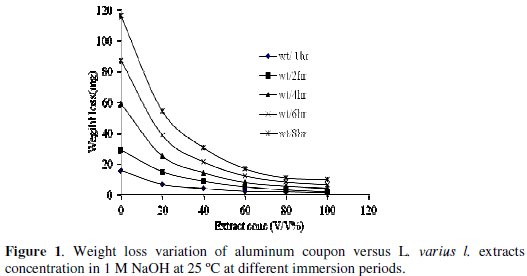
    <p><a href="#f1">Fig. 1</a> shows the variation of the weight loss (mg) of Al due to corrosion with the 
immersion time in 1 M NaOH solution of various concentrations of L. varius l. 
extract at 25 &deg;C</a>.</p>


    ]]></body>
<body><![CDATA[<p>&nbsp;</p>
<a name="f1">
<img src="/img/revistas/pea/v31n1/31n1a01f1.jpg">
    
<p>&nbsp;</p>

 
    <p>The rate of reaction of Al 1 M NaOH decreases with time.</p>

    <p>Weight loss of aluminum was determined, at various time intervals, in the 
absence and presence of different concentrations of L. varius l. extract. The 
curves in <a href="#f1">Fig. 1</a> show that the weight loss values (mg) of Al in 1 M NaOH 
solution containing L. varius l. extract decreased as the concentration of the 
inhibitors increased, i.e., the corrosion inhibition strengthened with the increase 
of the surfactant concentration. This trend, it may result from the fact that 
adsorption amount and the coverage of surfactants on the Al surface increase 
with the increase of the concentration, thus the Al surface is efficiently separated 
from the medium [12].</p>

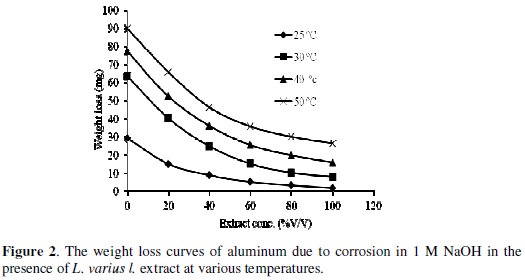
    <p>The weight loss curves of the Al with the addition of the inhibitors in different 
concentrations at various temperatures in 1 M NaOH are shown in <a href="#f2">Fig. 2</a>.</p>


    <p>&nbsp;</p>
<a name="f2">
<img src="/img/revistas/pea/v31n1/31n1a01f2.jpg">
    
<p>&nbsp;</p>


    <p>The effect of temperature on the corrosion of Al in 1 M NaOH over the temperature 
range of (25-50  &deg;C) in the absence and presence of different concentrations of 
the L varius l. extract has been studied. The weight loss is found to increase with 
increasing temperature.</p>

    <p>The percentage inhibition efficiency (%I) and the degree of surface coverage (&Theta;) 
of the investigated L. varius l. extract were computed from the following 
equations:</p>


    <p>&nbsp;</p>
<a name="e2">
<img src="/img/revistas/pea/v31n1/31n1a01e2.jpg">
    
]]></body>
<body><![CDATA[<p>&nbsp;</p>
<a name="e3">
<img src="/img/revistas/pea/v31n1/31n1a01e3.jpg">
    
<p>&nbsp;</p>

 
    <p>where &Delta;W<sub>free</sub> and &Delta;W<sub>inh</sub> are weight losses of metal in the absence and presence of 
inhibitor, respectively.</p>

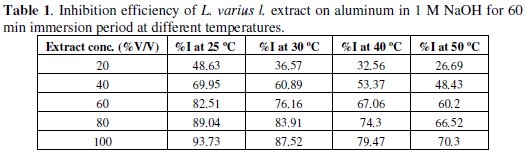
    <p><a href="#t1">Table 1</a> shows the percentage inhibition efficiency of the inhibitors at various 
concentrations in 1 M NaOH for 60 min immersion period at different 
temperatures (25-50 &deg;C).</p>


    <p>&nbsp;</p>
<a name="t1">
<img src="/img/revistas/pea/v31n1/31n1a01t1.jpg">
    
<p>&nbsp;</p>


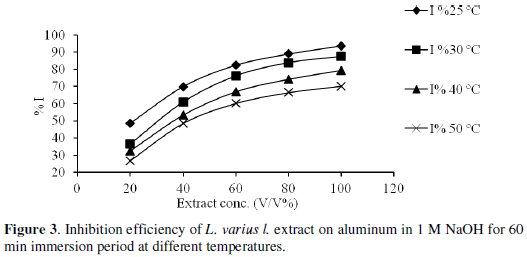
    <p>The results showed that inhibition efficiency increased 
as the concentration of inhibitor increases from 20% to 100% of the extract used 
(<a href="#f3">Fig. 3</a>).</p>


    <p>&nbsp;</p>
<a name="f3">
<img src="/img/revistas/pea/v31n1/31n1a01f3.jpg">
    
<p>&nbsp;</p>


    <p>The maximum inhibition efficiency was observed at 25  &deg;C for 100% of 
extract, probably due to an increase in the metal surface area covered by the 
exudates. From <a href="#t1">Table 1</a>, it is seen that inhibition efficiency of L. varius l. 
extract decreases with increase in temperature. Decrease in inhibition 
efficiency with increase in temperature is suggestive of physical adsorption 
mechanism.</p>

    ]]></body>
<body><![CDATA[<p>The inhibitive effect of the L. varius l. extract could be attributed to the presence 
of some phytochemical constituents in the extract. Previous studies have shown 
that the L. varius l. extract contains alkaloids, tannin, oligosaccharides, 
polysaccharides and glucoproteins as part of its phytochemical composition [20-23].</p>

    <p>The presence of volatile monoterpenes and related oxygenated 
sesquiterpenes has been reported [24]. These compounds contain oxygen and 
nitrogen atoms which are the centers of adsorption.</p>

    <p>Therefore it could be assumed that the extract gums establish their inhibitive 
action via adsorption of these phytochemical component molecules on the metal 
surface. This adsorption process creates a barrier between the metal and the 
corrosive medium leading to inhibition of corrosion. Consequently, inhibition 
efficiency increases as the metal surface area covered by the adsorbed molecules 
increases, the later is in turn increased as the extract concentration increases.</p>


Effect of temperature and activation parameters of inhibition process 

The corrosion rate of Al is determined by using the relation:</p>


    <p>&nbsp;</p>
<a name="e4">
<img src="/img/revistas/pea/v31n1/31n1a01e4.jpg">
    
<p>&nbsp;</p>

 
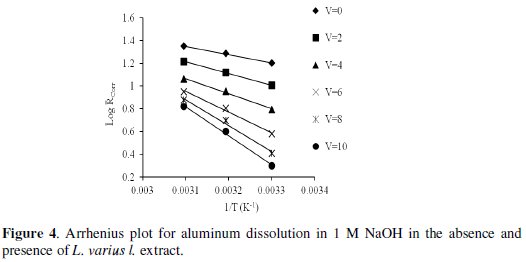
    <p>where &Delta;W is the mass loss, A the area and t the immersion period. The plot of 
logarithm of the corrosion rate versus the reciprocal of absolute temperature 
gives straight lines according to Arrhenius equation, <a href="#f4">Fig. 4</a>:</p>


    <p>&nbsp;</p>
<a name="f4">
<img src="/img/revistas/pea/v31n1/31n1a01f4.jpg">
    
<p>&nbsp;</p>
<a name="e5">
<img src="/img/revistas/pea/v31n1/31n1a01e5.jpg">
    
<p>&nbsp;</p>

 
    <p>where R is the corrosion rate, A is the constant frequency factor and Ea is the 
apparent activation energy.</p>
 
    ]]></body>
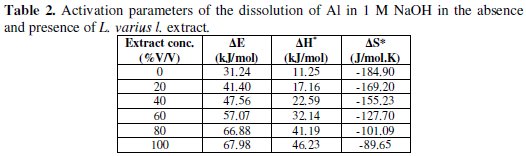
<body><![CDATA[<p>The values of Ea were calculated and found to be 
31.24 and 67.98 kJ/mol for corrosion reactions in free and inhibited extract, 
respectively (<a href="#t2">Table 2</a>).</p>


    <p>&nbsp;</p>
<a name="t2">
<img src="/img/revistas/pea/v31n1/31n1a01t2.jpg">
    
<p>&nbsp;</p>

 
    <p>It is clear that, the activation energy increases in presence 
of L. varius l. extract and consequently the rate of corrosion reaction is 
decreased.</p>

    <p>An alternative formulation of the Arrhenius equation is the transition state 
equation [25]:</p>


    <p>&nbsp;</p>
<a name="e6">
<img src="/img/revistas/pea/v31n1/31n1a01e6.jpg">
    
<p>&nbsp;</p>

 
    <p>where h is Planck's constant, N is Avogadro's number, &Delta;S* is the entropy of 
activation and &Delta;H* is the enthalpy of activation.</p>

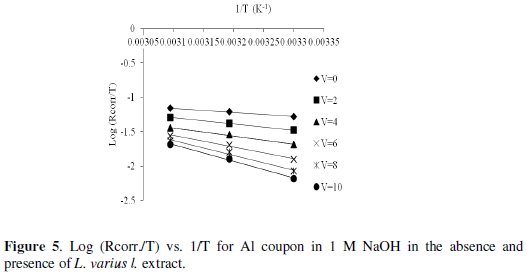
    <p><a href="#f5">Fig. 5</a> shows a plot of log (Rate/T) against (1/T).</p>


    <p>&nbsp;</p>
<a name="f5">
<img src="/img/revistas/pea/v31n1/31n1a01f5.jpg">
    
]]></body>
<body><![CDATA[<p>&nbsp;</p>

 
    <p>Straight lines are obtained with 
a slope of (-&Delta;H*/2.303R) and an intercept of (log R/Nh + &Delta;S*/2.303R) from 
which the values of &Delta;H* and &Delta;S* are calculated and listed in <a href="#t2">Table 2</a>. The values 
of &Delta;H* are presented in <a href="#t2">Table 2</a>. Enthalpy of activation of absolute values lower 
than 41.86 kJmol<sup>-l</sup> indicates physical adsorption, and values approaching 100 
kJmol<sup>-l</sup> indicate chemical adsorption [25]. In this study, the values of &Delta;H* are 
lower than 41.86 kJmol<sup>-l</sup> confirming physical adsorption. The values of &Delta;S* in 
the presence and absence of the inhibitors are negative. This implies that the 
activation complex is the rate determining step representing association rather 
than dissociation, indicating that a decrease in disorder takes place on going from 
reactant to the activated complex [20].</p>


    <p><b><i>Adsorption studies</i></b></p>

    <p>The values of Qads on aluminum specimen in the presence of the inhibitor is 
arrived by the following <a href="#e7">equation (7)</a></p>


    <p>&nbsp;</p>
<a name="e7">
<img src="/img/revistas/pea/v31n1/31n1a01e7.jpg">
    
<p>&nbsp;</p>

 
    <p>where R is the gas constant, &Theta;1and &Theta;2 are the degree of surface coverage at 
temperatures T1 and T2, respectively.</p>

    <p>The calculated Qads values are ranged from -58.84 to -113.80 kJ/mol. This 
negative value indicates that the adsorption of L. varius l. extract on the surface 
of Al metal is exothermic [15].</p>

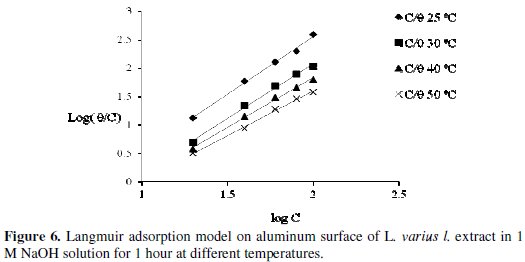
    <p><a href="#f6">Fig. 6</a> also confirms that the inhibition process is due to adsorption of the 
active organic compounds on the metal surface.</p>


    <p>&nbsp;</p>
<a name="f6">
<img src="/img/revistas/pea/v31n1/31n1a01f6.jpg">
    
]]></body>
<body><![CDATA[<p>&nbsp;</p>

 
    <p>This is because a straight 
line is obtained when Log(C/&Theta;) is plotted against logC and the linear 
correlation coefficient of the fitted data is very close to 1. This indicates 
that the adsorption of L. varius l. extract molecules obeys the Langmuir 
adsorption model [10,18] expressed as</p>


    <p>&nbsp;</p>
<a name="e8">
<img src="/img/revistas/pea/v31n1/31n1a01e8.jpg">
    
<p>&nbsp;</p>

 
    <p>where C is the inhibitor concentration and K is the equilibrium constant 
for the adsorption/desorption process of the inhibitor molecules on the 
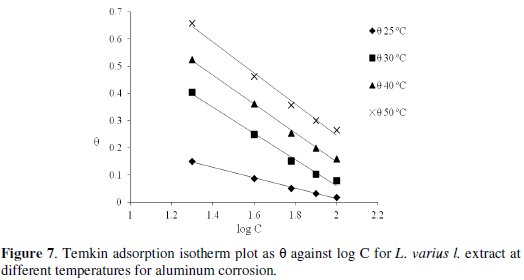
metal surface. The inhibitor also obeys Temkin adsorption isotherm which is 
represented in <a href="#f7">Fig. 7</a>, <a href="#e9">equation 9</a>.</p>


    <p>&nbsp;</p>
<a name="f7">
<img src="/img/revistas/pea/v31n1/31n1a01f7.jpg">
    
<p>&nbsp;</p>
<a name="e9">
<img src="/img/revistas/pea/v31n1/31n1a01e9.jpg">
    
<p>&nbsp;</p>

 
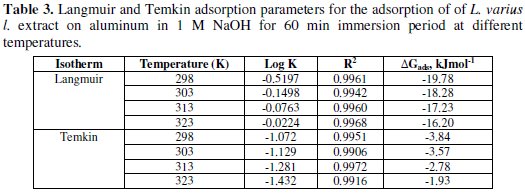
    <p>Values of adsorption parameters deduced from 
the plots are recorded on <a href="#t3">Table 3</a>.</p>


    <p>&nbsp;</p>
<a name="t3">
<img src="/img/revistas/pea/v31n1/31n1a01t3.jpg">
    
]]></body>
<body><![CDATA[<p>&nbsp;</p>

 
    <p>The relationship between the equilibrium constant, K, of adsorption and the free 
energy of adsorption, &Delta;G<sub>ads</sub>, is given by the following expression [3, 16]</p>


    <p>&nbsp;</p>
<a name="e10">
<img src="/img/revistas/pea/v31n1/31n1a01e10.jpg">
    
<p>&nbsp;</p>

 
    <p>Values of free energy of adsorption calculated from <a href="#e10">equation (10)</a> using K 
values obtained from the Langmuir adsorption and Temkin adsorption 
isotherm are presented in <a href="#t3">Table 3</a>. The values are negative and less than -40 
kJmol<sup>-1</sup>. This implies that the adsorption of the inhibitor on aluminum surface is 
spontaneous and confirms physical adsorption mechanism [16].</p>

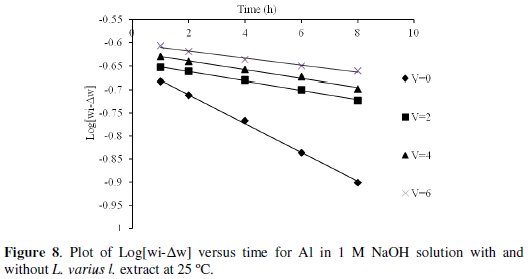
    <p>As shown in <a href="#f8">Fig. 8</a>, the corrosion data fit the first-order reaction rate law as 
expressed in <a href="#e11">Equation (11)</a></p>


    <p>&nbsp;</p>
<a name="f8">
<img src="/img/revistas/pea/v31n1/31n1a01f8.jpg">
    
<p>&nbsp;</p>
<a name="e11">
<img src="/img/revistas/pea/v31n1/31n1a01e11.jpg">
    
<p>&nbsp;</p>

 
    <p>where Wi is the initial weight of aluminum specimen, &Delta;W is the weight loss of 
aluminum specimen at time t, [Wi - &Delta;W] is the residual weight of aluminum 
coupon at time t and k is the first-order rate constant. The linear plots obtained 
with correlation coefficients close to 1 confirm a first-order kinetics for the 
corrosion of aluminum in 1 M NaOH solution in the presence and absence of 
Lupinus varius l. extract.</p>


    ]]></body>
<body><![CDATA[<p>&nbsp;</p>
    <p><b>Conclusions</b></p>

    <p>From the experimental results obtained in the present study, the following 
conclusions could be drawn:</p>

    <p>1. L. varius l. extract acts as inhibitor for aluminum corrosion in NaOH solution.</p>

    <p>2. Inhibition efficiency increased with increase in concentration of the L. varius l. 
extract but decreased with increase in temperature. Phytochemical constituents in 
the extract play a very vital role in the inhibiting action.</p>

    <p>3. Activation energies were higher in the presence of the exudates gum 
suggesting physisorption mechanism.</p>

    <p>4. The present study provides new information on the inhibiting characteristic of 
a L. varius l. extract under the specified conditions. The adsorption of L. varius l. 
extract fits into Langmuir isotherm and Temkin isotherm models and a first-order 
kinetics relationship was obtained from the kinetics treatment of the data of 
weight loss measurements.</p>


    <p>&nbsp;</p>
    <p><b>References</b></p>

    <!-- ref --><p>1. Abiola OK, Otaigbe JOE. Corros Sci.2008;50:242.    &nbsp;&nbsp;&nbsp;&nbsp;&nbsp;&nbsp;&nbsp;&nbsp;[&#160;<a href="javascript:void(0);" onclick="javascript: window.open('/scielo.php?script=sci_nlinks&ref=000112&pid=S0872-1904201300010000100001&lng=','','width=640,height=500,resizable=yes,scrollbars=1,menubar=yes,');">Links</a>&#160;]<!-- end-ref --></p>
    <!-- ref --><p>2. Yazdzad AR, Shahrabi T, Hosseini MG. Mater Chem Phys. 2008;109:199.    &nbsp;&nbsp;&nbsp;&nbsp;&nbsp;&nbsp;&nbsp;&nbsp;[&#160;<a href="javascript:void(0);" onclick="javascript: window.open('/scielo.php?script=sci_nlinks&ref=000114&pid=S0872-1904201300010000100002&lng=','','width=640,height=500,resizable=yes,scrollbars=1,menubar=yes,');">Links</a>&#160;]<!-- end-ref --></p>
    <!-- ref --><p>3. Doche ML, Rameau JJ, Durand R, Novel-Cattin F. Corros Sci. 2007;41:805.    &nbsp;&nbsp;&nbsp;&nbsp;&nbsp;&nbsp;&nbsp;&nbsp;[&#160;<a href="javascript:void(0);" onclick="javascript: window.open('/scielo.php?script=sci_nlinks&ref=000116&pid=S0872-1904201300010000100003&lng=','','width=640,height=500,resizable=yes,scrollbars=1,menubar=yes,');">Links</a>&#160;]<!-- end-ref --></p>
    <!-- ref --><p>4. Onuchukwu AI., Mater Chem Phys. 1990;24:337-341.    &nbsp;&nbsp;&nbsp;&nbsp;&nbsp;&nbsp;&nbsp;&nbsp;[&#160;<a href="javascript:void(0);" onclick="javascript: window.open('/scielo.php?script=sci_nlinks&ref=000118&pid=S0872-1904201300010000100004&lng=','','width=640,height=500,resizable=yes,scrollbars=1,menubar=yes,');">Links</a>&#160;]<!-- end-ref --></p>
    <!-- ref --><p>5. Gunasekaran SG, Chauhan LR. Electrochim Acta. 2004;49:4387.    &nbsp;&nbsp;&nbsp;&nbsp;&nbsp;&nbsp;&nbsp;&nbsp;[&#160;<a href="javascript:void(0);" onclick="javascript: window.open('/scielo.php?script=sci_nlinks&ref=000120&pid=S0872-1904201300010000100005&lng=','','width=640,height=500,resizable=yes,scrollbars=1,menubar=yes,');">Links</a>&#160;]<!-- end-ref --></p>
    <!-- ref --><p>6. Mazhar AA, Arab ST, Noor EA. Bulletin Electrochem. 2001;17:449.    &nbsp;&nbsp;&nbsp;&nbsp;&nbsp;&nbsp;&nbsp;&nbsp;[&#160;<a href="javascript:void(0);" onclick="javascript: window.open('/scielo.php?script=sci_nlinks&ref=000122&pid=S0872-1904201300010000100006&lng=','','width=640,height=500,resizable=yes,scrollbars=1,menubar=yes,');">Links</a>&#160;]<!-- end-ref --></p>
    <!-- ref --><p>7. Baumgaertner M, Kaesche H. Corros Sci. 1990;31:231.    &nbsp;&nbsp;&nbsp;&nbsp;&nbsp;&nbsp;&nbsp;&nbsp;[&#160;<a href="javascript:void(0);" onclick="javascript: window.open('/scielo.php?script=sci_nlinks&ref=000124&pid=S0872-1904201300010000100007&lng=','','width=640,height=500,resizable=yes,scrollbars=1,menubar=yes,');">Links</a>&#160;]<!-- end-ref --></p>
    <!-- ref --><p>8. El-Shafei AA, Abd El-Maksoud SA, Fouda AS. Corros Sci. 2004;46:579.    &nbsp;&nbsp;&nbsp;&nbsp;&nbsp;&nbsp;&nbsp;&nbsp;[&#160;<a href="javascript:void(0);" onclick="javascript: window.open('/scielo.php?script=sci_nlinks&ref=000126&pid=S0872-1904201300010000100008&lng=','','width=640,height=500,resizable=yes,scrollbars=1,menubar=yes,');">Links</a>&#160;]<!-- end-ref --></p>
    <!-- ref --><p>9. Muller B. Corros Sci. 2006;46:159.    &nbsp;&nbsp;&nbsp;&nbsp;&nbsp;&nbsp;&nbsp;&nbsp;[&#160;<a href="javascript:void(0);" onclick="javascript: window.open('/scielo.php?script=sci_nlinks&ref=000128&pid=S0872-1904201300010000100009&lng=','','width=640,height=500,resizable=yes,scrollbars=1,menubar=yes,');">Links</a>&#160;]<!-- end-ref --></p>
    <!-- ref --><p>10. Emeregul KC, Aksut AA. Corros Sci. 2000;42:2051.    &nbsp;&nbsp;&nbsp;&nbsp;&nbsp;&nbsp;&nbsp;&nbsp;[&#160;<a href="javascript:void(0);" onclick="javascript: window.open('/scielo.php?script=sci_nlinks&ref=000130&pid=S0872-1904201300010000100010&lng=','','width=640,height=500,resizable=yes,scrollbars=1,menubar=yes,');">Links</a>&#160;]<!-- end-ref --></p>
    <!-- ref --><p>11. Zhang J, Klasky M, Letellier BC. J Nuclear Mater. 2009;384:175.    &nbsp;&nbsp;&nbsp;&nbsp;&nbsp;&nbsp;&nbsp;&nbsp;[&#160;<a href="javascript:void(0);" onclick="javascript: window.open('/scielo.php?script=sci_nlinks&ref=000132&pid=S0872-1904201300010000100011&lng=','','width=640,height=500,resizable=yes,scrollbars=1,menubar=yes,');">Links</a>&#160;]<!-- end-ref --></p>
    <!-- ref --><p>12. Umoren SA, Obot IB, Ebenso EE et al. Anti-Corros Methods Mater. 2006;53:277.    &nbsp;&nbsp;&nbsp;&nbsp;&nbsp;&nbsp;&nbsp;&nbsp;[&#160;<a href="javascript:void(0);" onclick="javascript: window.open('/scielo.php?script=sci_nlinks&ref=000134&pid=S0872-1904201300010000100012&lng=','','width=640,height=500,resizable=yes,scrollbars=1,menubar=yes,');">Links</a>&#160;]<!-- end-ref --></p>
    <!-- ref --><p>13. Umoren SA., Obot IB, Ebenso EE, Okafor PC. Port Electrochim Acta. 2008;26:267.    &nbsp;&nbsp;&nbsp;&nbsp;&nbsp;&nbsp;&nbsp;&nbsp;[&#160;<a href="javascript:void(0);" onclick="javascript: window.open('/scielo.php?script=sci_nlinks&ref=000136&pid=S0872-1904201300010000100013&lng=','','width=640,height=500,resizable=yes,scrollbars=1,menubar=yes,');">Links</a>&#160;]<!-- end-ref --></p>
    <!-- ref --><p>14. Tackholm V. Students Flora of Egypt. 2nd ed. Cairo: Cairo University Press; 1974. P. 224.    &nbsp;&nbsp;&nbsp;&nbsp;&nbsp;&nbsp;&nbsp;&nbsp;[&#160;<a href="javascript:void(0);" onclick="javascript: window.open('/scielo.php?script=sci_nlinks&ref=000138&pid=S0872-1904201300010000100014&lng=','','width=640,height=500,resizable=yes,scrollbars=1,menubar=yes,');">Links</a>&#160;]<!-- end-ref --></p>
    <!-- ref --><p>15. Wink M, Meibner C, Witte L. Phytochemistry. 1995;38:139.    &nbsp;&nbsp;&nbsp;&nbsp;&nbsp;&nbsp;&nbsp;&nbsp;[&#160;<a href="javascript:void(0);" onclick="javascript: window.open('/scielo.php?script=sci_nlinks&ref=000140&pid=S0872-1904201300010000100015&lng=','','width=640,height=500,resizable=yes,scrollbars=1,menubar=yes,');">Links</a>&#160;]<!-- end-ref --></p>
    <!-- ref --><p>16. Peterson J. Aust. J Exp Biol Med Sci. 1963;41:903.    &nbsp;&nbsp;&nbsp;&nbsp;&nbsp;&nbsp;&nbsp;&nbsp;[&#160;<a href="javascript:void(0);" onclick="javascript: window.open('/scielo.php?script=sci_nlinks&ref=000142&pid=S0872-1904201300010000100016&lng=','','width=640,height=500,resizable=yes,scrollbars=1,menubar=yes,');">Links</a>&#160;]<!-- end-ref --></p>
    <!-- ref --><p>17. Abdel-Halim OB, El-Gammal AA, Abdel-Fattah H, Takeya K. Phytochemistry. 1995;41:5.    &nbsp;&nbsp;&nbsp;&nbsp;&nbsp;&nbsp;&nbsp;&nbsp;[&#160;<a href="javascript:void(0);" onclick="javascript: window.open('/scielo.php?script=sci_nlinks&ref=000144&pid=S0872-1904201300010000100017&lng=','','width=640,height=500,resizable=yes,scrollbars=1,menubar=yes,');">Links</a>&#160;]<!-- end-ref --></p>
    <!-- ref --><p>18. Amitha Rani BE, Bharathi Bai J. Int J Corrosion. In press.    &nbsp;&nbsp;&nbsp;&nbsp;&nbsp;&nbsp;&nbsp;&nbsp;[&#160;<a href="javascript:void(0);" onclick="javascript: window.open('/scielo.php?script=sci_nlinks&ref=000146&pid=S0872-1904201300010000100018&lng=','','width=640,height=500,resizable=yes,scrollbars=1,menubar=yes,');">Links</a>&#160;]<!-- end-ref --></p>
    <!-- ref --><p>19. Umoren SA, Obot IB, Ebenso EE. E-J. Chem. 2008;5:355.    &nbsp;&nbsp;&nbsp;&nbsp;&nbsp;&nbsp;&nbsp;&nbsp;[&#160;<a href="javascript:void(0);" onclick="javascript: window.open('/scielo.php?script=sci_nlinks&ref=000148&pid=S0872-1904201300010000100019&lng=','','width=640,height=500,resizable=yes,scrollbars=1,menubar=yes,');">Links</a>&#160;]<!-- end-ref --></p>
    <!-- ref --><p>20. Valek L, Martinez S. Mater Lett. 2007;61:148.    &nbsp;&nbsp;&nbsp;&nbsp;&nbsp;&nbsp;&nbsp;&nbsp;[&#160;<a href="javascript:void(0);" onclick="javascript: window.open('/scielo.php?script=sci_nlinks&ref=000150&pid=S0872-1904201300010000100020&lng=','','width=640,height=500,resizable=yes,scrollbars=1,menubar=yes,');">Links</a>&#160;]<!-- end-ref --></p>
    <!-- ref --><p>21. Obot IB, Obi-Egbedi NO. Port Electrochim Acta. 2009;27:517.    &nbsp;&nbsp;&nbsp;&nbsp;&nbsp;&nbsp;&nbsp;&nbsp;[&#160;<a href="javascript:void(0);" onclick="javascript: window.open('/scielo.php?script=sci_nlinks&ref=000152&pid=S0872-1904201300010000100021&lng=','','width=640,height=500,resizable=yes,scrollbars=1,menubar=yes,');">Links</a>&#160;]<!-- end-ref --></p>
    <!-- ref --><p>22. Tarasova NS, Khachaturyan MA, Nikolaev LA. Russ J Phys Chem. 1984;58:628.    &nbsp;&nbsp;&nbsp;&nbsp;&nbsp;&nbsp;&nbsp;&nbsp;[&#160;<a href="javascript:void(0);" onclick="javascript: window.open('/scielo.php?script=sci_nlinks&ref=000154&pid=S0872-1904201300010000100022&lng=','','width=640,height=500,resizable=yes,scrollbars=1,menubar=yes,');">Links</a>&#160;]<!-- end-ref --></p>
    <!-- ref --><p>23. Sosnina NA, Mironov VF, Karaseva AN et al. Chem Natural Compounds. 2000;36:40.    &nbsp;&nbsp;&nbsp;&nbsp;&nbsp;&nbsp;&nbsp;&nbsp;[&#160;<a href="javascript:void(0);" onclick="javascript: window.open('/scielo.php?script=sci_nlinks&ref=000156&pid=S0872-1904201300010000100023&lng=','','width=640,height=500,resizable=yes,scrollbars=1,menubar=yes,');">Links</a>&#160;]<!-- end-ref --></p>
    <!-- ref --><p>24. Al-Qudah MA. Arab J Chem. In press.    &nbsp;&nbsp;&nbsp;&nbsp;&nbsp;&nbsp;&nbsp;&nbsp;[&#160;<a href="javascript:void(0);" onclick="javascript: window.open('/scielo.php?script=sci_nlinks&ref=000158&pid=S0872-1904201300010000100024&lng=','','width=640,height=500,resizable=yes,scrollbars=1,menubar=yes,');">Links</a>&#160;]<!-- end-ref --></p>
    <!-- ref --><p>25. Awad MI. J Appl Electrochem. 2006;36:1163.    &nbsp;&nbsp;&nbsp;&nbsp;&nbsp;&nbsp;&nbsp;&nbsp;[&#160;<a href="javascript:void(0);" onclick="javascript: window.open('/scielo.php?script=sci_nlinks&ref=000160&pid=S0872-1904201300010000100025&lng=','','width=640,height=500,resizable=yes,scrollbars=1,menubar=yes,');">Links</a>&#160;]<!-- end-ref --></p>


    <p>&nbsp;</p>
    ]]></body>
<body><![CDATA[<p><b>Acknowledgement</b></p>

    <p>The authors would like to thank the Yarmouk University-faculty of graduate studies 
and scientific research for providing financial support.</p>


    <p>&nbsp;</p>
    <p><a name=0></a><sup><a href="#top">*</a></sup>Corresponding author. E-mail address: <a href="mailto:rshaidatm@yahoo.com">rshaidatm@yahoo.com</a></p>

    <p>Received 1 August 2012; accepted 15 January 2013</p>

    <p><a href="http://www.peacta.org" target="_blank">www.peacta.org</a> </p>


     ]]></body><back>
<ref-list>
<ref id="B1">
<label>1</label><nlm-citation citation-type="journal">
<person-group person-group-type="author">
<name>
<surname><![CDATA[Abiola]]></surname>
<given-names><![CDATA[O K]]></given-names>
</name>
<name>
<surname><![CDATA[Otaigbe]]></surname>
<given-names><![CDATA[J O E]]></given-names>
</name>
</person-group>
<source><![CDATA[Corros Sci]]></source>
<year>2008</year>
<volume>50</volume>
<page-range>242</page-range></nlm-citation>
</ref>
<ref id="B2">
<label>2</label><nlm-citation citation-type="journal">
<person-group person-group-type="author">
<name>
<surname><![CDATA[Yazdzad]]></surname>
<given-names><![CDATA[A R]]></given-names>
</name>
<name>
<surname><![CDATA[Shahrabi]]></surname>
<given-names><![CDATA[T]]></given-names>
</name>
<name>
<surname><![CDATA[Hosseini]]></surname>
<given-names><![CDATA[M G]]></given-names>
</name>
</person-group>
<source><![CDATA[Mater Chem Phys]]></source>
<year>2008</year>
<volume>109</volume>
<page-range>199</page-range></nlm-citation>
</ref>
<ref id="B3">
<label>3</label><nlm-citation citation-type="journal">
<person-group person-group-type="author">
<name>
<surname><![CDATA[Doche]]></surname>
<given-names><![CDATA[M L]]></given-names>
</name>
<name>
<surname><![CDATA[Rameau]]></surname>
<given-names><![CDATA[JJ]]></given-names>
</name>
<name>
<surname><![CDATA[Durand]]></surname>
<given-names><![CDATA[R]]></given-names>
</name>
<name>
<surname><![CDATA[Novel-Cattin]]></surname>
<given-names><![CDATA[F]]></given-names>
</name>
</person-group>
<source><![CDATA[Corros Sci]]></source>
<year>2007</year>
<volume>41</volume>
<page-range>805</page-range></nlm-citation>
</ref>
<ref id="B4">
<label>4</label><nlm-citation citation-type="journal">
<person-group person-group-type="author">
<name>
<surname><![CDATA[Onuchukwu]]></surname>
<given-names><![CDATA[A I]]></given-names>
</name>
</person-group>
<source><![CDATA[Mater Chem Phys]]></source>
<year>1990</year>
<volume>24</volume>
<page-range>337</page-range></nlm-citation>
</ref>
<ref id="B5">
<label>5</label><nlm-citation citation-type="journal">
<person-group person-group-type="author">
<name>
<surname><![CDATA[Gunasekaran]]></surname>
<given-names><![CDATA[S G]]></given-names>
</name>
<name>
<surname><![CDATA[Chauhan]]></surname>
<given-names><![CDATA[L R]]></given-names>
</name>
</person-group>
<source><![CDATA[Electrochim Acta]]></source>
<year>2004</year>
<volume>49</volume>
<page-range>4387</page-range></nlm-citation>
</ref>
<ref id="B6">
<label>6</label><nlm-citation citation-type="journal">
<person-group person-group-type="author">
<name>
<surname><![CDATA[Mazhar]]></surname>
<given-names><![CDATA[A A]]></given-names>
</name>
<name>
<surname><![CDATA[Arab]]></surname>
<given-names><![CDATA[S T]]></given-names>
</name>
<name>
<surname><![CDATA[Noor]]></surname>
<given-names><![CDATA[E A]]></given-names>
</name>
</person-group>
<source><![CDATA[Bulletin Electrochem]]></source>
<year>2001</year>
<volume>17</volume>
<page-range>449</page-range></nlm-citation>
</ref>
<ref id="B7">
<label>7</label><nlm-citation citation-type="journal">
<person-group person-group-type="author">
<name>
<surname><![CDATA[Baumgaertner]]></surname>
<given-names><![CDATA[M]]></given-names>
</name>
<name>
<surname><![CDATA[Kaesche]]></surname>
<given-names><![CDATA[H]]></given-names>
</name>
</person-group>
<source><![CDATA[Corros Sci]]></source>
<year>1990</year>
<volume>31</volume>
<page-range>231</page-range></nlm-citation>
</ref>
<ref id="B8">
<label>8</label><nlm-citation citation-type="journal">
<person-group person-group-type="author">
<name>
<surname><![CDATA[El-Shafei]]></surname>
<given-names><![CDATA[A A]]></given-names>
</name>
<name>
<surname><![CDATA[Abd El-Maksoud]]></surname>
<given-names><![CDATA[S A]]></given-names>
</name>
<name>
<surname><![CDATA[Fouda]]></surname>
<given-names><![CDATA[A S]]></given-names>
</name>
</person-group>
<source><![CDATA[Corros Sci]]></source>
<year>2004</year>
<volume>46</volume>
<page-range>579</page-range></nlm-citation>
</ref>
<ref id="B9">
<label>9</label><nlm-citation citation-type="journal">
<person-group person-group-type="author">
<name>
<surname><![CDATA[Muller]]></surname>
<given-names><![CDATA[B]]></given-names>
</name>
</person-group>
<source><![CDATA[Corros Sci]]></source>
<year>2006</year>
<volume>46</volume>
<page-range>159</page-range></nlm-citation>
</ref>
<ref id="B10">
<label>10</label><nlm-citation citation-type="journal">
<person-group person-group-type="author">
<name>
<surname><![CDATA[Emeregul]]></surname>
<given-names><![CDATA[K C]]></given-names>
</name>
<name>
<surname><![CDATA[Aksut]]></surname>
<given-names><![CDATA[A A]]></given-names>
</name>
</person-group>
<source><![CDATA[Corros Sci]]></source>
<year>2000</year>
<volume>42</volume>
<page-range>2051</page-range></nlm-citation>
</ref>
<ref id="B11">
<label>11</label><nlm-citation citation-type="journal">
<person-group person-group-type="author">
<name>
<surname><![CDATA[Zhang]]></surname>
<given-names><![CDATA[J]]></given-names>
</name>
<name>
<surname><![CDATA[Klasky]]></surname>
<given-names><![CDATA[M]]></given-names>
</name>
<name>
<surname><![CDATA[Letellier]]></surname>
<given-names><![CDATA[B C]]></given-names>
</name>
</person-group>
<source><![CDATA[J Nuclear Mater]]></source>
<year>2009</year>
<volume>384</volume>
<page-range>175</page-range></nlm-citation>
</ref>
<ref id="B12">
<label>12</label><nlm-citation citation-type="journal">
<person-group person-group-type="author">
<name>
<surname><![CDATA[Umoren]]></surname>
<given-names><![CDATA[S A]]></given-names>
</name>
<name>
<surname><![CDATA[Obot]]></surname>
<given-names><![CDATA[I B]]></given-names>
</name>
<name>
<surname><![CDATA[Ebenso]]></surname>
<given-names><![CDATA[E E]]></given-names>
</name>
</person-group>
<source><![CDATA[Anti-Corros Methods Mater]]></source>
<year>2006</year>
<volume>53</volume>
<page-range>277</page-range></nlm-citation>
</ref>
<ref id="B13">
<label>13</label><nlm-citation citation-type="journal">
<person-group person-group-type="author">
<name>
<surname><![CDATA[Umoren]]></surname>
<given-names><![CDATA[S A]]></given-names>
</name>
<name>
<surname><![CDATA[Obot]]></surname>
<given-names><![CDATA[I B]]></given-names>
</name>
<name>
<surname><![CDATA[Ebenso]]></surname>
<given-names><![CDATA[E E]]></given-names>
</name>
<name>
<surname><![CDATA[Okafor]]></surname>
<given-names><![CDATA[P C]]></given-names>
</name>
</person-group>
<source><![CDATA[Port Electrochim Acta]]></source>
<year>2008</year>
<volume>26</volume>
<page-range>267</page-range></nlm-citation>
</ref>
<ref id="B14">
<label>14</label><nlm-citation citation-type="book">
<person-group person-group-type="author">
<name>
<surname><![CDATA[Tackholm]]></surname>
<given-names><![CDATA[V]]></given-names>
</name>
</person-group>
<source><![CDATA[Students Flora of Egypt]]></source>
<year>1974</year>
<edition>2</edition>
<page-range>224</page-range><publisher-loc><![CDATA[Cairo ]]></publisher-loc>
<publisher-name><![CDATA[Cairo University Press]]></publisher-name>
</nlm-citation>
</ref>
<ref id="B15">
<label>15</label><nlm-citation citation-type="journal">
<person-group person-group-type="author">
<name>
<surname><![CDATA[Wink]]></surname>
<given-names><![CDATA[M]]></given-names>
</name>
<name>
<surname><![CDATA[Meibner]]></surname>
<given-names><![CDATA[C]]></given-names>
</name>
<name>
<surname><![CDATA[Witte]]></surname>
<given-names><![CDATA[L]]></given-names>
</name>
</person-group>
<source><![CDATA[Phytochemistry]]></source>
<year>1995</year>
<volume>38</volume>
<page-range>139</page-range></nlm-citation>
</ref>
<ref id="B16">
<label>16</label><nlm-citation citation-type="journal">
<person-group person-group-type="author">
<name>
<surname><![CDATA[Peterson]]></surname>
<given-names><![CDATA[J]]></given-names>
</name>
</person-group>
<source><![CDATA[Aust. J Exp Biol Med Sci]]></source>
<year>1963</year>
<volume>41</volume>
<page-range>903</page-range></nlm-citation>
</ref>
<ref id="B17">
<label>17</label><nlm-citation citation-type="journal">
<person-group person-group-type="author">
<name>
<surname><![CDATA[Abdel-Halim]]></surname>
<given-names><![CDATA[O B]]></given-names>
</name>
<name>
<surname><![CDATA[El-Gammal]]></surname>
<given-names><![CDATA[A A]]></given-names>
</name>
<name>
<surname><![CDATA[Abdel-Fattah]]></surname>
<given-names><![CDATA[H]]></given-names>
</name>
<name>
<surname><![CDATA[Takeya]]></surname>
<given-names><![CDATA[K]]></given-names>
</name>
</person-group>
<source><![CDATA[Phytochemistry]]></source>
<year>1995</year>
<volume>41</volume>
<page-range>5</page-range></nlm-citation>
</ref>
<ref id="B18">
<label>18</label><nlm-citation citation-type="journal">
<person-group person-group-type="author">
<name>
<surname><![CDATA[Amitha Rani]]></surname>
<given-names><![CDATA[B E]]></given-names>
</name>
<name>
<surname><![CDATA[Bharathi Bai]]></surname>
<given-names><![CDATA[J]]></given-names>
</name>
</person-group>
<source><![CDATA[Int J Corrosion]]></source>
<year></year>
</nlm-citation>
</ref>
<ref id="B19">
<label>19</label><nlm-citation citation-type="journal">
<person-group person-group-type="author">
<name>
<surname><![CDATA[Umoren]]></surname>
<given-names><![CDATA[S A]]></given-names>
</name>
<name>
<surname><![CDATA[Obot]]></surname>
<given-names><![CDATA[I B]]></given-names>
</name>
<name>
<surname><![CDATA[Ebenso]]></surname>
<given-names><![CDATA[E E]]></given-names>
</name>
</person-group>
<source><![CDATA[E-J. Chem]]></source>
<year>2008</year>
<volume>5</volume>
<page-range>355</page-range></nlm-citation>
</ref>
<ref id="B20">
<label>20</label><nlm-citation citation-type="journal">
<person-group person-group-type="author">
<name>
<surname><![CDATA[Valek]]></surname>
<given-names><![CDATA[L]]></given-names>
</name>
<name>
<surname><![CDATA[Martinez]]></surname>
<given-names><![CDATA[S]]></given-names>
</name>
</person-group>
<source><![CDATA[Mater Lett]]></source>
<year>2007</year>
<volume>61</volume>
<page-range>148</page-range></nlm-citation>
</ref>
<ref id="B21">
<label>21</label><nlm-citation citation-type="journal">
<person-group person-group-type="author">
<name>
<surname><![CDATA[Obot]]></surname>
<given-names><![CDATA[I B]]></given-names>
</name>
<name>
<surname><![CDATA[Obi-Egbedi]]></surname>
<given-names><![CDATA[N O]]></given-names>
</name>
</person-group>
<source><![CDATA[Port Electrochim Acta]]></source>
<year>2009</year>
<volume>27</volume>
<page-range>517</page-range></nlm-citation>
</ref>
<ref id="B22">
<label>22</label><nlm-citation citation-type="journal">
<person-group person-group-type="author">
<name>
<surname><![CDATA[Tarasova]]></surname>
<given-names><![CDATA[NS]]></given-names>
</name>
<name>
<surname><![CDATA[Khachaturyan]]></surname>
<given-names><![CDATA[M A]]></given-names>
</name>
<name>
<surname><![CDATA[Nikolaev]]></surname>
<given-names><![CDATA[L A]]></given-names>
</name>
</person-group>
<source><![CDATA[Russ J Phys Chem]]></source>
<year>1984</year>
<volume>58</volume>
<page-range>628</page-range></nlm-citation>
</ref>
<ref id="B23">
<label>23</label><nlm-citation citation-type="journal">
<person-group person-group-type="author">
<name>
<surname><![CDATA[Sosnina]]></surname>
<given-names><![CDATA[N A]]></given-names>
</name>
<name>
<surname><![CDATA[Mironov]]></surname>
<given-names><![CDATA[V F]]></given-names>
</name>
<name>
<surname><![CDATA[Karaseva]]></surname>
<given-names><![CDATA[A N]]></given-names>
</name>
</person-group>
<source><![CDATA[Chem Natural Compounds]]></source>
<year>2000</year>
<volume>36</volume>
<page-range>40</page-range></nlm-citation>
</ref>
<ref id="B24">
<label>24</label><nlm-citation citation-type="journal">
<person-group person-group-type="author">
<name>
<surname><![CDATA[Al-Qudah]]></surname>
<given-names><![CDATA[M A]]></given-names>
</name>
</person-group>
<source><![CDATA[Arab J Chem]]></source>
<year></year>
</nlm-citation>
</ref>
<ref id="B25">
<label>25</label><nlm-citation citation-type="journal">
<person-group person-group-type="author">
<name>
<surname><![CDATA[Awad]]></surname>
<given-names><![CDATA[M I]]></given-names>
</name>
</person-group>
<source><![CDATA[J Appl Electrochem]]></source>
<year>2006</year>
<volume>36</volume>
<page-range>1163</page-range></nlm-citation>
</ref>
</ref-list>
</back>
</article>