<?xml version="1.0" encoding="ISO-8859-1"?><article xmlns:mml="http://www.w3.org/1998/Math/MathML" xmlns:xlink="http://www.w3.org/1999/xlink" xmlns:xsi="http://www.w3.org/2001/XMLSchema-instance">
<front>
<journal-meta>
<journal-id>0872-1904</journal-id>
<journal-title><![CDATA[Portugaliae Electrochimica Acta]]></journal-title>
<abbrev-journal-title><![CDATA[Port. Electrochim. Acta]]></abbrev-journal-title>
<issn>0872-1904</issn>
<publisher>
<publisher-name><![CDATA[Sociedade Portuguesa de Electroquímica]]></publisher-name>
</publisher>
</journal-meta>
<article-meta>
<article-id>S0872-19042013000100003</article-id>
<article-id pub-id-type="doi">10.4152/pea.201301021</article-id>
<title-group>
<article-title xml:lang="en"><![CDATA[Corrosion Behaviour of 18%Ni M250 Grade Maraging Steel under Welded Condition in Hydrochloric Acid Medium]]></article-title>
</title-group>
<contrib-group>
<contrib contrib-type="author">
<name>
<surname><![CDATA[Kumar]]></surname>
<given-names><![CDATA[Pradeep]]></given-names>
</name>
<xref ref-type="aff" rid="A01"/>
</contrib>
<contrib contrib-type="author">
<name>
<surname><![CDATA[Shetty]]></surname>
<given-names><![CDATA[A. Nityananda]]></given-names>
</name>
<xref ref-type="aff" rid="A01"/>
</contrib>
</contrib-group>
<aff id="A01">
<institution><![CDATA[,National Institute of Technology Karnataka Department of Chemistry ]]></institution>
<addr-line><![CDATA[Mangalore Karnataka]]></addr-line>
<country>India</country>
</aff>
<pub-date pub-type="pub">
<day>00</day>
<month>01</month>
<year>2013</year>
</pub-date>
<pub-date pub-type="epub">
<day>00</day>
<month>01</month>
<year>2013</year>
</pub-date>
<volume>31</volume>
<numero>1</numero>
<fpage>21</fpage>
<lpage>32</lpage>
<copyright-statement/>
<copyright-year/>
<self-uri xlink:href="http://scielo.pt/scielo.php?script=sci_arttext&amp;pid=S0872-19042013000100003&amp;lng=en&amp;nrm=iso"></self-uri><self-uri xlink:href="http://scielo.pt/scielo.php?script=sci_abstract&amp;pid=S0872-19042013000100003&amp;lng=en&amp;nrm=iso"></self-uri><self-uri xlink:href="http://scielo.pt/scielo.php?script=sci_pdf&amp;pid=S0872-19042013000100003&amp;lng=en&amp;nrm=iso"></self-uri><abstract abstract-type="short" xml:lang="en"><p><![CDATA[The corrosion behaviour of welded maraging steel in hydrochloric acid solutions was studied over a range of acid concentration and solution temperature by electrochemical techniques like Tafel extrapolation method and electrochemical impedance spectroscopy. The corrosion rate of welded maraging steel increases with the increase in temperature and concentration of hydrochloric acid in the medium. The energies of activation, enthalpy of activation and entropy of activation for the corrosion process were calculated. The surface morphology of the corroded sample was evaluated by surface examination using scanning electron microscopy (SEM) and energy dispersive X-ray spectroscopy (EDS).]]></p></abstract>
<kwd-group>
<kwd lng="en"><![CDATA[maraging steel]]></kwd>
<kwd lng="en"><![CDATA[EIS]]></kwd>
<kwd lng="en"><![CDATA[polarization]]></kwd>
<kwd lng="en"><![CDATA[SEM]]></kwd>
<kwd lng="en"><![CDATA[EDS]]></kwd>
</kwd-group>
</article-meta>
</front><body><![CDATA[ 

    <p><b>Corrosion Behaviour of 18%Ni M250 Grade Maraging Steel under Welded Condition in Hydrochloric Acid Medium</b></p>

    <p><b>Pradeep Kumar and A. Nityananda Shetty<sup><a href="#0">*<a/></sup></b></p>

    <p><i> Department of Chemistry, National Institute of Technology Karnataka, Surathkal, Srinivasnagar, Mangalore 575025, Karnataka, India</i></p>


<!--     <p>&nbsp;</p>
    <p>doi: 10.4152/pea.201301021</p> -->


    <p>&nbsp;</p>
    <p><b>Abstract</b></p>

    <p>The corrosion behaviour of welded maraging steel in hydrochloric acid solutions was 
studied over a range of acid concentration and solution temperature by electrochemical 
techniques like Tafel extrapolation method and electrochemical impedance 
spectroscopy. The corrosion rate of welded maraging steel increases with the increase in 
temperature and concentration of hydrochloric acid in the medium. The energies of 
activation, enthalpy of activation and entropy of activation for the corrosion process 
were calculated. The surface morphology of the corroded sample was evaluated by 
surface examination using scanning electron microscopy (SEM) and energy dispersive 
X-ray spectroscopy (EDS).</p>

    <p><b><i>Keywords:</i></b> maraging steel, EIS, polarization, SEM, EDS.</p>


    ]]></body>
<body><![CDATA[<p>&nbsp;</p>
    <p><b>Introduction</b></p>

    <p>Over past decades, a growing interest has been observed in the study of 
electrochemical and corrosion behaviour of metals and alloys in acidic media. 
Maraging steel, the most widely used engineering material, corrode in many 
circumstances, especially in some industrial processes, such as acid cleaning, 
acid descaling and oil well acidizing. The alloy is a low carbon steel that 
classically contains about 18 wt % Ni, substantial amounts of Co and Mo 
together with small additions of Ti. However, depending on the demands 
dedicated by the application, the composition of the material can be modified [1]. 
For many of the applications of maraging steels, welding is the important means 
of fabrication. The unique property of being weldable in the solutionised 
condition followed by a low temperature (480 &deg;C) post weld maraging treatment 
makes these steels attractive for fabrication of large structures [2]. According to 
available literature, atmospheric exposure of 18 Ni maraging steel leads to 
corrosion in a uniform manner and becomes completely rust covered [3,4]. 
Maraging steels were found to be less susceptible to hydrogen embrittlement than 
common high strength steels due to significantly low diffusion of hydrogen in 
them [5]. Bellanger et al. [6] have studied the effect of slightly acid pH with or 
without chloride in radioactive water on the corrosion of maraging steel and have 
reported that corrosion behaviour of maraging steel at the corrosion potential 
depends on pH and intermediates remaining on maraging steel surface in the 
active region favouring the passivity. Here an attempt has been made to study the 
corrosion behaviour of welded maraging steel in different concentrations of 
hydrochloric acid at different temperatures.</p>


    <p>&nbsp;</p>
    <p><b>Experimental</b></p>

    <p><b><i>Preparation of specimen</i></b></p>

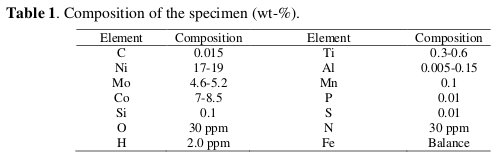
    <p>The corrosion tests were performed with specimen of welded maraging steel 
(18% Ni M250 grade). Percentage composition of 18% Ni M250 grade maraging 
steel sample is given in <a href="#t1">Table 1</a>.</p>


    <p>&nbsp;</p>
<a name="t1">
<img src="/img/revistas/pea/v31n1/31n1a03t1.jpg">
    
<p>&nbsp;</p>


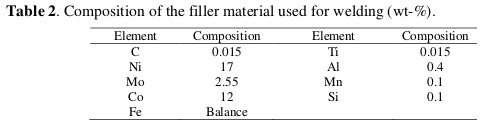
    <p>The maraging steel plate was welded by 
GTAW-DCSP, by using filler material of composition as given in <a href="#t2">Table 2</a>.</p>


    ]]></body>
<body><![CDATA[<p>&nbsp;</p>
<a name="t2">
<img src="/img/revistas/pea/v31n1/31n1a03t2.jpg">
    
<p>&nbsp;</p>


    <p>The working electrode was in the form of a rod machined into a cylindrical form 
embedded in epoxy resin leaving an open surface area of 0.646 cm<sup>2</sup>. This coupon 
was abraded as per standard metallographic practice, belt grinding followed by 
polishing on emery papers of different grades, finally on polishing wheel using 
legated alumina abrasive to obtain mirror finish, degreased with acetone and 
dried before immersing in the medium.</p>


    <p><i>Test solution</i></p>

    <p>Analytical grade of hydrochloric acid and doubly distilled water were used for 
preparing the test solutions having concentrations 0.1 M, 0.5 M, 1 M, 1.5 M and 
2 M. Experiments were carried out in a calibrated thermostat at temperatures of 
30 &deg;C, 35 &deg;C, 40 &deg;C, 45 &deg;C and 50 &deg;C (&pm;0.5 &deg;C).</p>


    <p><i>Potentiodynamic polarization studies</i></p>

    <p>Electrochemical analyses were performed in a conventional three-electrode 
system by using an electrochemical work station, Gill AC having ACM 
instrument Version 5 software. Tafel plot measurements were carried out using a 
conventional three electrode Pyrex glass cell with a platinum foil as counter 
electrode and a saturated calomel electrode as reference electrode. Finely 
polished welded maraging steel sealed by epoxy resin with exposure surface of 
0.646 cm<sup>2</sup> as working electrode was exposed to corrosion medium of different 
concentrations of hydrochloric acid (0.1 M to 2.0 M) at different temperatures 
(30 &deg;C to 50 &deg;C) for 30 minutes and allowed to establish a steady state open 
circuit potential. The potentiodynamic current-potential curves were recorded by 
polarizing the specimen to -250 mV cathodically and +250 mV anodically with 
respect to the open circuit potential (OCP) at a scan rate of 1 mV s<sup>-1</sup>.</p>


    <p><i>Electrochemical impedance spectroscopy studies (EIS)</i></p>

    <p>Electrochemical impedance spectroscopy (EIS), which gives early information 
about the electrochemical processes, at the metal solution interface, has been 
used in many reports on the corrosion studies [7]. EIS measurement was 
carried out on steady open circuit potential (OCP), disturbed with an amplitude 
of 10 mV ac sine wave at frequencies from 100 KHz to 10 mHz; and the 
impedance data were analyzed using Nyquist plots. The charge transfer 
resistance, Rct was extracted from the diameter of the semicircle in Nyquist plot. 
In all the above measurements, at least three similar results were considered and 
their average values are reported.</p>

    <p>The scanning electron microscope images were recorded to establish the 
interaction of acid medium with the metal surface using a JEOL JSM-6380LA 
analytical scanning electron microscope.</p>


    ]]></body>
<body><![CDATA[<p>&nbsp;</p>
    <p><b>Results and discussion</b></p>

    <p><b><i>Tafel polarization measurements</i></b></p>

    <p>The effect of hydrochloric acid concentration and solution temperature on the 
corrosion rate of welded samples of maraging steel was studied using Tafel 
polarization technique. The anodic and cathodic current-potential curves are 
extrapolated up to their intersection at the point where the corrosion current 
density (icorr) and the corrosion potential (E<sub>corr</sub>) are obtained [8]. The 
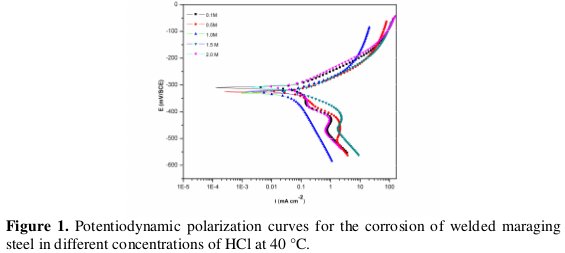
potentiodynamic polarization curves for the corrosion of welded maraging steel 
in different concentrations of HCl at 40 &deg;C are represented in <a href="#f1">Fig. 1</a>.</p>


    <p>&nbsp;</p>
<a name="f1">
<img src="/img/revistas/pea/v31n1/31n1a03f1.jpg">
    
<p>&nbsp;</p>


    <p>Similar plots were obtained at other temperatures also. It is seen from the <a href="#f1">Fig. 1</a> that the 
polarization curves are shifted to the high current density region as the 
concentration of HCl is increased, indicating the increase in the corrosion rate 
with the increase in HCl concentration.</p> 

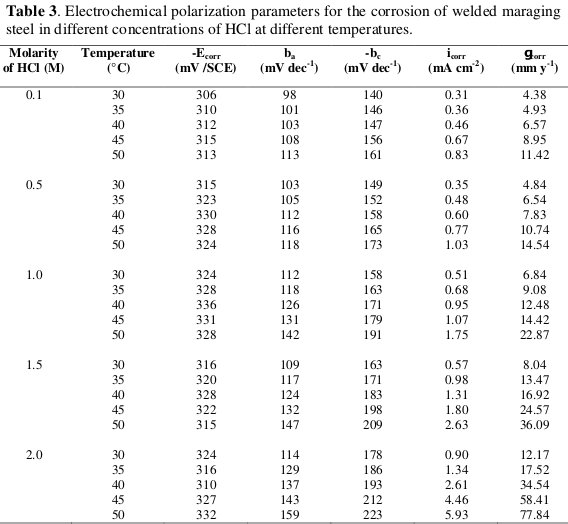
    <p>The potentiodynamic polarization parameters like corrosion potential (E<sub>corr</sub>), 
corrosion current (i<sub>corr</sub>), anodic and cathodic slopes (b<sub>a</sub> and b<sub>c</sub>) and corrosion rate 
(&nu;<sub>corr</sub>) were calculated from Tafel plots and are tabulated in <a href="#t3">Table 3</a>.</p>


    <p>&nbsp;</p>
<a name="t3">
<img src="/img/revistas/pea/v31n1/31n1a03t3.jpg">
    
<p>&nbsp;</p>


    ]]></body>
<body><![CDATA[<p>The corrosion rate was calculated using <a href="#e1">Equation 1</a>:</p>


    <p>&nbsp;</p>
<a name="e1">
<img src="/img/revistas/pea/v31n1/31n1a03e1.jpg">
    
<p>&nbsp;</p>


    <p>where 3270 is a constant that defines the unit of corrosion rate, icorr is the 
corrosion current density in A cm<sup>-2</sup>, &rho; is the density of the corroding material, 
8100 kg m<sup>-3</sup>, M is the atomic mass of the metal, and Z is the number of electrons 
transferred per metal atom [9].</p>

    <p>From the data summarized in <a href="#t3">Table 3</a> it is evident that the corrosion rate of 
welded maraging steel specimen increases with the increase in the concentration 
of hydrochloric acid in the solution.</p>

    <p>It is also observed from the results that the 
corrosion potential is shifted towards less negative values as the concentration of 
hydrochloric acid is increased.</p>

    <p>The corrosion of steel normally proceeds via two partial reactions in acid 
solutions. The partial anodic reaction involves the oxidation of metal and 
formation of soluble Fe<sup>2+</sup> ions, while the partial cathodic reaction involves the 
evolution of hydrogen gas [10].</p>

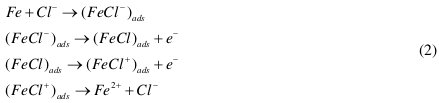
    <p>In hydrochloric acid, the following mechanism is proposed for the corrosion of 
iron [11]. According to this mechanism anodic dissolution of iron takes place as 
follows (<a href="#e2">Eq. 2</a>):</p>


    <p>&nbsp;</p>
<a name="e2">
<img src="/img/revistas/pea/v31n1/31n1a03e2.jpg">
    
<p>&nbsp;</p>


    ]]></body>
<body><![CDATA[<p>In a cathodic reaction, hydrogen evolution takes place as follows (<a href="#e3">Eq. 3</a>):</p>


    <p>&nbsp;</p>
<a name="e3">
<img src="/img/revistas/pea/v31n1/31n1a03e3.jpg">
    
<p>&nbsp;</p>


    <p><b><i>Electrochemical impedance spectroscopy</i></b></p>

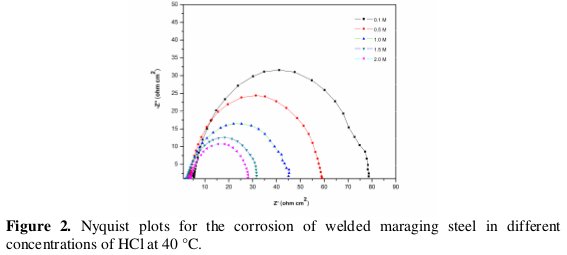
    <p>The Nyquist plots for the corrosion of the specimen in solutions of different 
concentrations of acid and at 40 &deg;C are shown in <a href="#f2">Fig. 2</a>.</p>


    <p>&nbsp;</p>
<a name="f2">
<img src="/img/revistas/pea/v31n1/31n1a03f2.jpg">
    
<p>&nbsp;</p>


    <p>Similar plots were obtained at other temperatures also. The impedance diagrams have an 
approximately semicircular appearance, with small distortions. The point where 
the semi-circle of the Nyquist plot intersects the real axis at high frequency (close 
to the origin) yields solution resistance (R<sub>s</sub>). The intercept on real axis at the 
other end of the semicircle (low frequency) gives the sum of solution resistance 
and the charge transfer resistance (R<sub>ct</sub>). Hence the charge transfer resistance 
value is simply the diameter of the semicircle [12]. The diagonal region between 
the high frequency and low frequency region has a negative slope due to the 
capacitive behaviour of the electrochemical double layer. 
The corrosion current density is calculated using the Stern Geary Equation (<a href="#e4">Eq. 4</a>):</p>


    <p>&nbsp;</p>
<a name="e4">
<img src="/img/revistas/pea/v31n1/31n1a03e4.jpg">
    
<p>&nbsp;</p>


    ]]></body>
<body><![CDATA[<p>From <a href="#f2">Fig. 2</a> it is clear that the diameter of the semicircle decreases with the 
increase in the concentration of HCl, indicating the decrease in Rct value and 
increase in corrosion rate. The fact that impedance diagrams have semicircular 
appearance shows that the corrosion of weld aged maraging steel is controlled by 
a charge transfer process and the mechanism of dissolution of metal in HCl is not 
altered with the change in the HCl concentration [14]. As seen from the figure, 
the Nyquist plots are not perfect semicircles. The deviation has been attributed to
frequency dispersion [15,16]. The depressed semicircles have a centre under the
real axis, and can be seen as depressed capacitive loops. Such phenomena often
correspond to surface heterogeneity which may be the result of surface
roughness, dislocations, distribution of the active sites or adsorption of molecules
[17].</p>

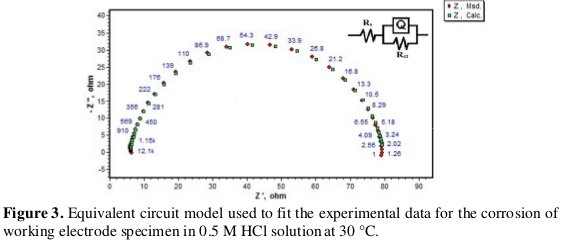
    <p>The results obtained can be interpreted in terms of the equivalent circuit of the
electrical double layer shown in <a href="#f3">Fig. 3</a>.</p>


    <p>&nbsp;</p>
<a name="f3">
<img src="/img/revistas/pea/v31n1/31n1a03f3.jpg">
    
<p>&nbsp;</p>


    <p>The circuit fitment was done by
ZSimpWin software of version 3.21. In the equivalent circuit, R<sub>s</sub> represents the
solution resistance and R<sub>ct</sub> the charge transfer resistance. The constant phase
element (Q<sub>dl</sub>) is substituted by the capacitive element to give a more accurate fit,
as most capacitive loops are depressed semi circles rather than regular semi
circles [18].</p>

    <p>The impedance of constant phase is given by the expression:</p>


    <p>&nbsp;</p>
<a name="e5">
<img src="/img/revistas/pea/v31n1/31n1a03e5.jpg">
    
<p>&nbsp;</p>


    <p>where Y<sub>0</sub> is a proportional factor, n has the meaning of a phase shift and 
j = (-1)<sup>1/2</sup>. The value of double layer capacitance (C<sub>dl</sub>) can be obtained from the
equation</p>


    <p>&nbsp;</p>
<a name="e6">
<img src="/img/revistas/pea/v31n1/31n1a03e6.jpg">
    
]]></body>
<body><![CDATA[<p>&nbsp;</p>


    <p>where, w is the frequency at which the imaginary part of the impedance has its
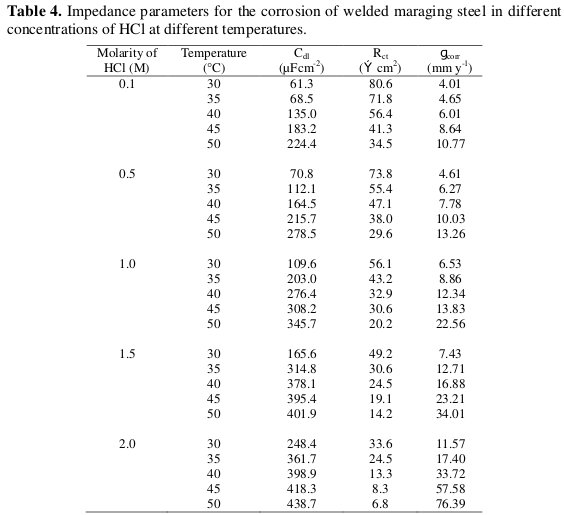
maximum [18]. The results of EIS measurement are summarized in <a href="#t4">Table 4</a>.</p>


    <p>&nbsp;</p>
<a name="t4">
<img src="/img/revistas/pea/v31n1/31n1a03t4.jpg">
    
<p>&nbsp;</p>


    <p>The results show that the charge transfer resistance (R<sub>ct</sub>) value decreases and the
double layer capacitance (C<sub>dl</sub>) increases with the increase in the concentration of
hydrochloric acid. The Nyquist plots obtained in the real system represent
general behaviour where the double layer on the interface of metal/solution does
not behave as a real capacitor. On the metal side electrons control the charge
distribution whereas on the solution side it is controlled by ions. As ions are
much larger than the electrons, the equivalent ions to the charge on the metal,
will occupy quite a large volume on the solution side of the double layer.</p>

    <p>Increase in the capacitance, which can result from an increase in local dielectric
constant and/or a decrease in the thickness of the electrical double layer, suggests
that the chloride molecules act by adsorption at the metal/solution interface [19].</p>


    <p><b><i>Effect of temperature</i></b></p>

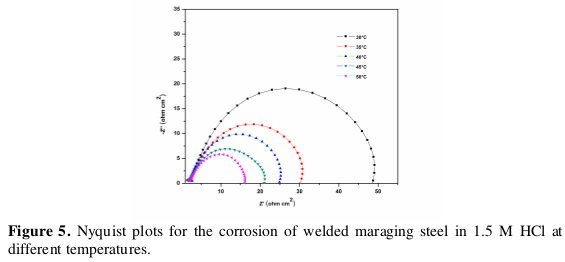
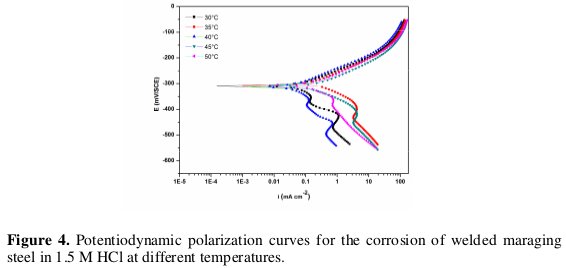
    <p>The effect of temperature on the corrosion rate of welded maraging steel was
studied by measuring the corrosion rate at different temperatures between 30 &deg;C -
50 &deg;C. <a href="#f4">Fig. 4</a> and <a href="#f5">Fig. 5</a> represent the potentiodynamic polarization curves and
Nyquist plots, respectively, at different temperatures for the corrosion of welded
maraging steel sample in 1 M HCl solution.</p>


    <p>&nbsp;</p>
<a name="f4">
<img src="/img/revistas/pea/v31n1/31n1a03f4.jpg">
    
<p>&nbsp;</p>
<a name="f5">
<img src="/img/revistas/pea/v31n1/31n1a03f5.jpg">
    
]]></body>
<body><![CDATA[<p>&nbsp;</p>


    <p>Similar plots were obtained in other
concentrations of solutions also. The Tafel polarization results and EIS results at
different temperatures are listed in <a href="#t3">Tables 3</a> and <a href="#t4">4</a>, respectively. 
From the <a href="#f4">Figs. 4</a> and <a href="#f5">5</a> and from the results in 
<a href="#t3">Tables 3</a> and <a href="#t4">4</a> it is seen that the corrosion rate
increases with the increase in temperature. This may be attributed to the fact that
the hydrogen evolution over potential decreases with the increase in temperature
that leads to the increase in cathodic reaction rate [20]. The values of b<sub>c</sub> and b<sub>a</sub>
change with the increase in acid concentration and also with the increase in
temperature, which indicates the influence of the acid concentration and
temperature on the kinetics of hydrogen evolution and metal dissolution.</p>

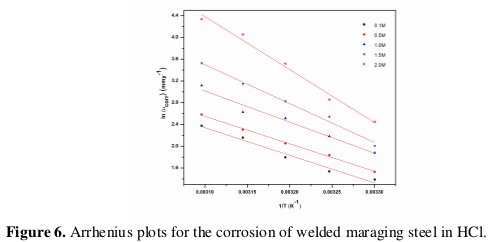
    <p>Activation energy (E<sub>a</sub>) for the corrosion process of welded maraging steel in
hydrochloric acid was calculated from the Arrhenius equation (<a href="#e7">Eq. 7</a>) [3,4]:</p>


    <p>&nbsp;</p>
<a name="e7">
<img src="/img/revistas/pea/v31n1/31n1a03e7.jpg">
    
<p>&nbsp;</p>


    <p>where B is a constant which depends on the metal type, and R is the universal gas
constant. The plot of ln(&nu;<sub>corr</sub>) versus reciprocal of absolute temperature (1/T)
gives a straight line whose slope = -Ea / R, from which the activation energy
values for the corrosion process were calculated. The Arrhenius plots for the
weld aged specimen are shown in <a href="#f6">Fig. 6</a>.</p>


    <p>&nbsp;</p>
<a name="f6">
<img src="/img/revistas/pea/v31n1/31n1a03f6.jpg">
    
<p>&nbsp;</p>


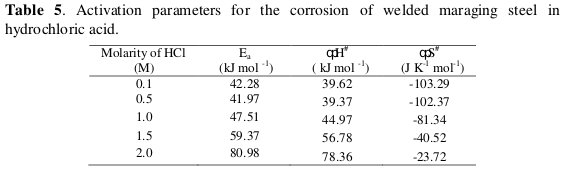
    <p>The enthalpy and entropy of activation (&Delta;H<sup>#</sup> &amp; &Delta;S<sup>#</sup>) were calculated from
transition state theory (<a href="#e8">Eq. 8</a>) [21] and these values are tabulated in <a href="#t5">Table 5</a>.</p>


    <p>&nbsp;</p>
<a name="e8">
<img src="/img/revistas/pea/v31n1/31n1a03e8.jpg">
    
]]></body>
<body><![CDATA[<p>&nbsp;</p>
<a name="t5">
<img src="/img/revistas/pea/v31n1/31n1a03t5.jpg">
    
<p>&nbsp;</p>


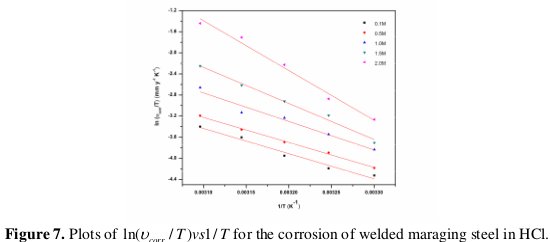
    <p>where h is Planck's constant, N is Avogadro's number and R is the ideal gas
constant. A plot of ln(&nu;<sub>corr</sub>/T) versus 1/T gives a straight line with slope = -&Delta;H<sup>#</sup>/R
and intercept = ln(R/Nh) + &Delta;S<sup>#</sup>/R. The plots of ln(&nu;<sub>corr</sub> /T) versus 1/T for the
corrosion of welded maraging steel in different concentrations of hydrochloric
acid are shown in <a href="#f7">Fig. 7</a>.</p>


    <p>&nbsp;</p>
<a name="f7">
<img src="/img/revistas/pea/v31n1/31n1a03f7.jpg">
    
<p>&nbsp;</p>


    <p>The activation parameters calculated are listed in <a href="#t5">Table 5</a>.</p>

    <p>The activation energy
values indicate that the corrosion of the alloy is controlled by surface reaction,
since the values of activation energy for the corrosion processes are greater than
20 kJ mol<sup>-1</sup> [22]. The entropy of activation is negative. This implies that the
activated complex in the rate-determining step represents association rather than
dissociation, indicating that a decrease in randomness takes place on going from
reactants to the activated complex [19].</p>


    <p><b><i>SEM and EDS examinations of the electrode surface</i></b></p>

    <p>The scanning electron microscope images were recorded to establish the
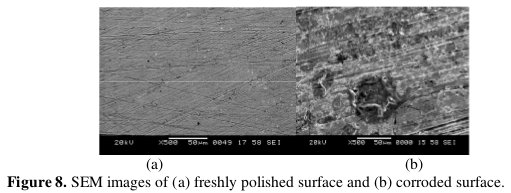
interaction of acid solution with the metal surface. The SEM image of a freshly
polished surface of welded maraging steel sample is given in <a href="#f8">Fig. 8(a)</a>, which
shows the uncorroded surface with a few scratches due to polishing.</p>


    <p>&nbsp;</p>
<a name="f8">
<img src="/img/revistas/pea/v31n1/31n1a03f8.jpg">
    
]]></body>
<body><![CDATA[<p>&nbsp;</p>


    <p><a href="#f8">Fig. 8(b)</a> shows the SEM image of welded maraging steel surface after immersed for 3 h in
2.0 M HCl. The SEM images reveal that the specimen not immersed in the acid
solutions is in a better condition having a smooth surface, while the metal surface
immersed in 2.0 M HCl is deteriorated due to the acid action. The corroded
surface shows detachment of particles from the surface.</p>

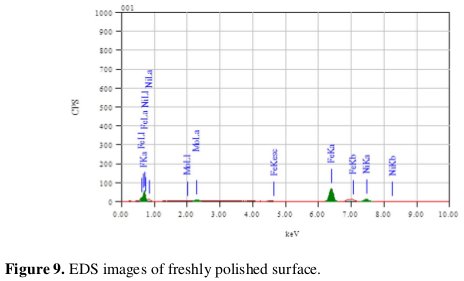
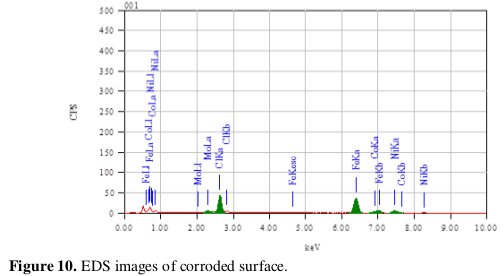
    <p>EDS survey spectra were used to determine which elements were present on the
specimen surface before and after exposure to the acid solution. <a href="#f9">Fig. 9</a> reveals
that fresh surface of the specimen with intense peak of Fe.</p>


    <p>&nbsp;</p>
<a name="f9">
<img src="/img/revistas/pea/v31n1/31n1a03f9.jpg">
    
<p>&nbsp;</p>


    <p>The spectrum of <a href="#f10">Fig. 10</a> shows that the Fe peaks are considerably suppressed relative to the fresh
specimen and the appearance of Cl peak.</p>


    <p>&nbsp;</p>
<a name="f10">
<img src="/img/revistas/pea/v31n1/31n1a03f10.jpg">
    
<p>&nbsp;</p>


    <p>The suppression of the Fe lines
indicates that the specimen has undergone corrosion in the presence of the
corrosive medium. The presence of Cl peak supports the participation of chloride
ions in the corrosion reaction as suggested in the mechanism.</p>


    <p>&nbsp;</p>
    ]]></body>
<body><![CDATA[<p><b>Conclusions</b></p>

    <p>From the above results and discussion, the main conclusions can be summarized
in the following points:</p>

    <p>1. The corrosion rate of welded maraging steel specimen in hydrochloric acid
medium is substantial and it was found that Rct value decreases while both Cdl
and icorr values increase with increasing HCl concentration.</p>

    <p>2. The corrosion rate of the working electrode is influenced by temperature and
concentration of hydrochloric acid medium. The corrosion rate of the specimen
under investigation increases with increase in solution temperature and
concentration of hydrochloric acid.</p>

    <p>3. The corrosion kinetics follows Arrhenius law.</p>

    <p>4. The results obtained from Tafel polarization curves and electrochemical
impedance spectroscopy are in reasonable agreement.</p>


    <p>&nbsp;</p>
    <p><b>References</b></p>

    <!-- ref --><p>1. Stiller K, Danoix F, Bostel A. Appl Surf Sci. 1996;94:326.    &nbsp;&nbsp;&nbsp;&nbsp;&nbsp;&nbsp;&nbsp;&nbsp;[&#160;<a href="javascript:void(0);" onclick="javascript: window.open('/scielo.php?script=sci_nlinks&ref=000121&pid=S0872-1904201300010000300001&lng=','','width=640,height=500,resizable=yes,scrollbars=1,menubar=yes,');">Links</a>&#160;]<!-- end-ref --></p>
    ]]></body>
<body><![CDATA[<!-- ref --><p>2. Adama CM, Travis RE. Weld J. 1964;43:193.    &nbsp;&nbsp;&nbsp;&nbsp;&nbsp;&nbsp;&nbsp;&nbsp;[&#160;<a href="javascript:void(0);" onclick="javascript: window.open('/scielo.php?script=sci_nlinks&ref=000123&pid=S0872-1904201300010000300002&lng=','','width=640,height=500,resizable=yes,scrollbars=1,menubar=yes,');">Links</a>&#160;]<!-- end-ref --></p>
    <p>3. Poornima T, J Nayak, Shetty AN. Int J Electrochem Sci. 2010;5:56.</p>
    <p>4. Poornima T, J Nayak, Shetty AN. Int J Electrochem Sci. 2011;41:223.</p>
    <!-- ref --><p>5. Rezek J, Klein IE, Yhalom J. Corros Sci. 1997;39:385.    &nbsp;&nbsp;&nbsp;&nbsp;&nbsp;&nbsp;&nbsp;&nbsp;[&#160;<a href="javascript:void(0);" onclick="javascript: window.open('/scielo.php?script=sci_nlinks&ref=000127&pid=S0872-1904201300010000300005&lng=','','width=640,height=500,resizable=yes,scrollbars=1,menubar=yes,');">Links</a>&#160;]<!-- end-ref --></p>
    <!-- ref --><p>6. Bellanger G, Rameau JJ. J Nucl Mater. 1996;228:24.    &nbsp;&nbsp;&nbsp;&nbsp;&nbsp;&nbsp;&nbsp;&nbsp;[&#160;<a href="javascript:void(0);" onclick="javascript: window.open('/scielo.php?script=sci_nlinks&ref=000129&pid=S0872-1904201300010000300006&lng=','','width=640,height=500,resizable=yes,scrollbars=1,menubar=yes,');">Links</a>&#160;]<!-- end-ref --></p>
    <!-- ref --><p>7. Bellanger G. J Nucl Mater. 1994;217:187.    &nbsp;&nbsp;&nbsp;&nbsp;&nbsp;&nbsp;&nbsp;&nbsp;[&#160;<a href="javascript:void(0);" onclick="javascript: window.open('/scielo.php?script=sci_nlinks&ref=000131&pid=S0872-1904201300010000300007&lng=','','width=640,height=500,resizable=yes,scrollbars=1,menubar=yes,');">Links</a>&#160;]<!-- end-ref --></p>
    ]]></body>
<body><![CDATA[<!-- ref --><p>8. Khaled K. Electrochim Acta. 2003;48:2493.    &nbsp;&nbsp;&nbsp;&nbsp;&nbsp;&nbsp;&nbsp;&nbsp;[&#160;<a href="javascript:void(0);" onclick="javascript: window.open('/scielo.php?script=sci_nlinks&ref=000133&pid=S0872-1904201300010000300008&lng=','','width=640,height=500,resizable=yes,scrollbars=1,menubar=yes,');">Links</a>&#160;]<!-- end-ref --></p>
    <!-- ref --><p>9. Fontana MG. Corrosion engineering. 3rd ed. Singapore: McGraw Hill; 1987. P. 173.    &nbsp;&nbsp;&nbsp;&nbsp;&nbsp;&nbsp;&nbsp;&nbsp;[&#160;<a href="javascript:void(0);" onclick="javascript: window.open('/scielo.php?script=sci_nlinks&ref=000135&pid=S0872-1904201300010000300009&lng=','','width=640,height=500,resizable=yes,scrollbars=1,menubar=yes,');">Links</a>&#160;]<!-- end-ref --></p>
    <!-- ref --><p>10. Kriaa A, Hamdi N, Jbali K, Tzinmann M. Corros Sci. 2009;51:668.    &nbsp;&nbsp;&nbsp;&nbsp;&nbsp;&nbsp;&nbsp;&nbsp;[&#160;<a href="javascript:void(0);" onclick="javascript: window.open('/scielo.php?script=sci_nlinks&ref=000137&pid=S0872-1904201300010000300010&lng=','','width=640,height=500,resizable=yes,scrollbars=1,menubar=yes,');">Links</a>&#160;]<!-- end-ref --></p>
    <!-- ref --><p>11. Kumar SA, Quraishi MA. Corros Sci. 2010;52:152.    &nbsp;&nbsp;&nbsp;&nbsp;&nbsp;&nbsp;&nbsp;&nbsp;[&#160;<a href="javascript:void(0);" onclick="javascript: window.open('/scielo.php?script=sci_nlinks&ref=000139&pid=S0872-1904201300010000300011&lng=','','width=640,height=500,resizable=yes,scrollbars=1,menubar=yes,');">Links</a>&#160;]<!-- end-ref --></p>
    <!-- ref --><p>12. Mansfeld F. Electrochim Acta. 1990;35:1533-1544.    &nbsp;&nbsp;&nbsp;&nbsp;&nbsp;&nbsp;&nbsp;&nbsp;[&#160;<a href="javascript:void(0);" onclick="javascript: window.open('/scielo.php?script=sci_nlinks&ref=000141&pid=S0872-1904201300010000300012&lng=','','width=640,height=500,resizable=yes,scrollbars=1,menubar=yes,');">Links</a>&#160;]<!-- end-ref --></p>
    ]]></body>
<body><![CDATA[<!-- ref --><p>13. Prabhu RA, Venkatesha TV, Shanbhag AV et al. Corros Sci. 2008;50:3356.    &nbsp;&nbsp;&nbsp;&nbsp;&nbsp;&nbsp;&nbsp;&nbsp;[&#160;<a href="javascript:void(0);" onclick="javascript: window.open('/scielo.php?script=sci_nlinks&ref=000143&pid=S0872-1904201300010000300013&lng=','','width=640,height=500,resizable=yes,scrollbars=1,menubar=yes,');">Links</a>&#160;]<!-- end-ref --></p>
    <!-- ref --><p>14. EL-Sayed A. J Appl Electrochem. 1997;27:89.    &nbsp;&nbsp;&nbsp;&nbsp;&nbsp;&nbsp;&nbsp;&nbsp;[&#160;<a href="javascript:void(0);" onclick="javascript: window.open('/scielo.php?script=sci_nlinks&ref=000145&pid=S0872-1904201300010000300014&lng=','','width=640,height=500,resizable=yes,scrollbars=1,menubar=yes,');">Links</a>&#160;]<!-- end-ref --></p>
    <!-- ref --><p>15. Amin AM, Khaled KF, Mohsen Q. Corros Sci. 2010;52:1684.    &nbsp;&nbsp;&nbsp;&nbsp;&nbsp;&nbsp;&nbsp;&nbsp;[&#160;<a href="javascript:void(0);" onclick="javascript: window.open('/scielo.php?script=sci_nlinks&ref=000147&pid=S0872-1904201300010000300015&lng=','','width=640,height=500,resizable=yes,scrollbars=1,menubar=yes,');">Links</a>&#160;]<!-- end-ref --></p>
    <!-- ref --><p>16. Mansfeld F, Kendig MW, Tsai S. Corrosion. 1982;38:570.    &nbsp;&nbsp;&nbsp;&nbsp;&nbsp;&nbsp;&nbsp;&nbsp;[&#160;<a href="javascript:void(0);" onclick="javascript: window.open('/scielo.php?script=sci_nlinks&ref=000149&pid=S0872-1904201300010000300016&lng=','','width=640,height=500,resizable=yes,scrollbars=1,menubar=yes,');">Links</a>&#160;]<!-- end-ref --></p>
    <!-- ref --><p>17. Larabi L, Harek Y, Traisnel M, Mansri. J Appl Electrochem. 2004;34:833.    &nbsp;&nbsp;&nbsp;&nbsp;&nbsp;&nbsp;&nbsp;&nbsp;[&#160;<a href="javascript:void(0);" onclick="javascript: window.open('/scielo.php?script=sci_nlinks&ref=000151&pid=S0872-1904201300010000300017&lng=','','width=640,height=500,resizable=yes,scrollbars=1,menubar=yes,');">Links</a>&#160;]<!-- end-ref --></p>
    ]]></body>
<body><![CDATA[<!-- ref --><p>18. Li WH, He Q, Zhang ST et al. J Appl Electrochem. 2008;38:289.    &nbsp;&nbsp;&nbsp;&nbsp;&nbsp;&nbsp;&nbsp;&nbsp;[&#160;<a href="javascript:void(0);" onclick="javascript: window.open('/scielo.php?script=sci_nlinks&ref=000153&pid=S0872-1904201300010000300018&lng=','','width=640,height=500,resizable=yes,scrollbars=1,menubar=yes,');">Links</a>&#160;]<!-- end-ref --></p>
    <!-- ref --><p>19. Tang Y, Chen Y, Yang W. J Appl Electrochem. 2008;38:1553.    &nbsp;&nbsp;&nbsp;&nbsp;&nbsp;&nbsp;&nbsp;&nbsp;[&#160;<a href="javascript:void(0);" onclick="javascript: window.open('/scielo.php?script=sci_nlinks&ref=000155&pid=S0872-1904201300010000300019&lng=','','width=640,height=500,resizable=yes,scrollbars=1,menubar=yes,');">Links</a>&#160;]<!-- end-ref --></p>
    <!-- ref --><p>20. Prabhu RA, Shanbhag AV, Venkatesha TV. J Appl Electrochem. 2007;37:491.    &nbsp;&nbsp;&nbsp;&nbsp;&nbsp;&nbsp;&nbsp;&nbsp;[&#160;<a href="javascript:void(0);" onclick="javascript: window.open('/scielo.php?script=sci_nlinks&ref=000157&pid=S0872-1904201300010000300020&lng=','','width=640,height=500,resizable=yes,scrollbars=1,menubar=yes,');">Links</a>&#160;]<!-- end-ref --></p>
    <!-- ref --><p>21. Abd Ei-Rehim SS, Ibrahim MAM, Khaled KF. J Appl Electrochem. 1999;29:593.    &nbsp;&nbsp;&nbsp;&nbsp;&nbsp;&nbsp;&nbsp;&nbsp;[&#160;<a href="javascript:void(0);" onclick="javascript: window.open('/scielo.php?script=sci_nlinks&ref=000159&pid=S0872-1904201300010000300021&lng=','','width=640,height=500,resizable=yes,scrollbars=1,menubar=yes,');">Links</a>&#160;]<!-- end-ref --></p>
    <!-- ref --><p>22. Bouklah M, Hammouti B, Benkaddour M, Benhadda T. J Appl Electrochem. 2005;35:1095.    &nbsp;&nbsp;&nbsp;&nbsp;&nbsp;&nbsp;&nbsp;&nbsp;[&#160;<a href="javascript:void(0);" onclick="javascript: window.open('/scielo.php?script=sci_nlinks&ref=000161&pid=S0872-1904201300010000300022&lng=','','width=640,height=500,resizable=yes,scrollbars=1,menubar=yes,');">Links</a>&#160;]<!-- end-ref --></p>


    ]]></body>
<body><![CDATA[<p>&nbsp;</p>
    <p><a name=0></a><sup><a href="#top">*</a></sup>Corresponding author. E-mail address: <a href="mailto:nityashreya@gmail.com">nityashreya@gmail.com</a></p>

    <p>Received 19 October 2012; accepted 23 January 2013</p>

    <p><a href="http://www.peacta.org" target="_blank">www.peacta.org</a> </p>


     ]]></body><back>
<ref-list>
<ref id="B1">
<label>1</label><nlm-citation citation-type="journal">
<person-group person-group-type="author">
<name>
<surname><![CDATA[Stiller]]></surname>
<given-names><![CDATA[K]]></given-names>
</name>
<name>
<surname><![CDATA[Danoix]]></surname>
<given-names><![CDATA[F]]></given-names>
</name>
<name>
<surname><![CDATA[Bostel]]></surname>
<given-names><![CDATA[A]]></given-names>
</name>
</person-group>
<source><![CDATA[Appl Surf Sci]]></source>
<year>1996</year>
<volume>94</volume>
<page-range>326</page-range></nlm-citation>
</ref>
<ref id="B2">
<label>2</label><nlm-citation citation-type="journal">
<person-group person-group-type="author">
<name>
<surname><![CDATA[Adama]]></surname>
<given-names><![CDATA[CM]]></given-names>
</name>
<name>
<surname><![CDATA[Travis]]></surname>
<given-names><![CDATA[RE]]></given-names>
</name>
</person-group>
<source><![CDATA[Weld J]]></source>
<year>1964</year>
<volume>43</volume>
<page-range>193</page-range></nlm-citation>
</ref>
<ref id="B3">
<label>3</label><nlm-citation citation-type="journal">
<person-group person-group-type="author">
<name>
<surname><![CDATA[Poornima]]></surname>
<given-names><![CDATA[T]]></given-names>
</name>
<name>
<surname><![CDATA[Nayak]]></surname>
<given-names><![CDATA[J]]></given-names>
</name>
<name>
<surname><![CDATA[Shetty]]></surname>
<given-names><![CDATA[AN]]></given-names>
</name>
</person-group>
<source><![CDATA[Int J Electrochem Sci]]></source>
<year>2010</year>
<volume>5</volume>
<page-range>56</page-range></nlm-citation>
</ref>
<ref id="B4">
<label>4</label><nlm-citation citation-type="journal">
<person-group person-group-type="author">
<name>
<surname><![CDATA[Poornima]]></surname>
<given-names><![CDATA[T]]></given-names>
</name>
<name>
<surname><![CDATA[Nayak]]></surname>
<given-names><![CDATA[J]]></given-names>
</name>
<name>
<surname><![CDATA[Shetty]]></surname>
<given-names><![CDATA[AN]]></given-names>
</name>
</person-group>
<source><![CDATA[Int J Electrochem Sci]]></source>
<year>2011</year>
<volume>41</volume>
<page-range>223</page-range></nlm-citation>
</ref>
<ref id="B5">
<label>5</label><nlm-citation citation-type="journal">
<person-group person-group-type="author">
<name>
<surname><![CDATA[Rezek]]></surname>
<given-names><![CDATA[J]]></given-names>
</name>
<name>
<surname><![CDATA[Klein]]></surname>
<given-names><![CDATA[IE]]></given-names>
</name>
<name>
<surname><![CDATA[Yhalom]]></surname>
<given-names><![CDATA[J]]></given-names>
</name>
</person-group>
<source><![CDATA[Corros Sci]]></source>
<year>1997</year>
<volume>39</volume>
<page-range>385</page-range></nlm-citation>
</ref>
<ref id="B6">
<label>6</label><nlm-citation citation-type="journal">
<person-group person-group-type="author">
<name>
<surname><![CDATA[Bellanger]]></surname>
<given-names><![CDATA[G]]></given-names>
</name>
<name>
<surname><![CDATA[Rameau]]></surname>
<given-names><![CDATA[JJ]]></given-names>
</name>
</person-group>
<source><![CDATA[J Nucl Mater]]></source>
<year>1996</year>
<volume>228</volume>
<page-range>24</page-range></nlm-citation>
</ref>
<ref id="B7">
<label>7</label><nlm-citation citation-type="journal">
<person-group person-group-type="author">
<name>
<surname><![CDATA[Bellanger]]></surname>
<given-names><![CDATA[G]]></given-names>
</name>
</person-group>
<source><![CDATA[J Nucl Mater]]></source>
<year>1994</year>
<volume>217</volume>
<page-range>187</page-range></nlm-citation>
</ref>
<ref id="B8">
<label>8</label><nlm-citation citation-type="journal">
<person-group person-group-type="author">
<name>
<surname><![CDATA[Khaled]]></surname>
<given-names><![CDATA[K]]></given-names>
</name>
</person-group>
<source><![CDATA[Electrochim Acta]]></source>
<year>2003</year>
<volume>48</volume>
<page-range>2493</page-range></nlm-citation>
</ref>
<ref id="B9">
<label>9</label><nlm-citation citation-type="book">
<person-group person-group-type="author">
<name>
<surname><![CDATA[Fontana]]></surname>
<given-names><![CDATA[M G]]></given-names>
</name>
</person-group>
<source><![CDATA[Corrosion engineering]]></source>
<year>1987</year>
<edition>3</edition>
<page-range>173</page-range><publisher-loc><![CDATA[Singapore ]]></publisher-loc>
<publisher-name><![CDATA[McGraw Hill]]></publisher-name>
</nlm-citation>
</ref>
<ref id="B10">
<label>10</label><nlm-citation citation-type="journal">
<person-group person-group-type="author">
<name>
<surname><![CDATA[Kriaa]]></surname>
<given-names><![CDATA[A]]></given-names>
</name>
<name>
<surname><![CDATA[Hamdi]]></surname>
<given-names><![CDATA[N]]></given-names>
</name>
<name>
<surname><![CDATA[Jbali]]></surname>
<given-names><![CDATA[K]]></given-names>
</name>
<name>
<surname><![CDATA[Tzinmann]]></surname>
<given-names><![CDATA[M]]></given-names>
</name>
</person-group>
<source><![CDATA[Corros Sci]]></source>
<year>2009</year>
<volume>51</volume>
<page-range>668</page-range></nlm-citation>
</ref>
<ref id="B11">
<label>11</label><nlm-citation citation-type="journal">
<person-group person-group-type="author">
<name>
<surname><![CDATA[Kumar]]></surname>
<given-names><![CDATA[SA]]></given-names>
</name>
<name>
<surname><![CDATA[Quraishi]]></surname>
<given-names><![CDATA[MA]]></given-names>
</name>
</person-group>
<source><![CDATA[Corros Sci]]></source>
<year>2010</year>
<volume>52</volume>
<page-range>152</page-range></nlm-citation>
</ref>
<ref id="B12">
<label>12</label><nlm-citation citation-type="journal">
<person-group person-group-type="author">
<name>
<surname><![CDATA[Mansfeld]]></surname>
<given-names><![CDATA[F]]></given-names>
</name>
</person-group>
<source><![CDATA[Electrochim Acta]]></source>
<year>1990</year>
<volume>35</volume>
<page-range>1533</page-range></nlm-citation>
</ref>
<ref id="B13">
<label>13</label><nlm-citation citation-type="journal">
<person-group person-group-type="author">
<name>
<surname><![CDATA[Prabhu]]></surname>
<given-names><![CDATA[RA]]></given-names>
</name>
<name>
<surname><![CDATA[Venkatesha]]></surname>
<given-names><![CDATA[TV]]></given-names>
</name>
<name>
<surname><![CDATA[Shanbhag]]></surname>
<given-names><![CDATA[AV]]></given-names>
</name>
</person-group>
<source><![CDATA[Corros Sci]]></source>
<year>2008</year>
<volume>50</volume>
<page-range>3356</page-range></nlm-citation>
</ref>
<ref id="B14">
<label>14</label><nlm-citation citation-type="journal">
<person-group person-group-type="author">
<name>
<surname><![CDATA[EL-Sayed]]></surname>
<given-names><![CDATA[A]]></given-names>
</name>
</person-group>
<source><![CDATA[J Appl Electrochem]]></source>
<year>1997</year>
<volume>27</volume>
<page-range>89</page-range></nlm-citation>
</ref>
<ref id="B15">
<label>15</label><nlm-citation citation-type="journal">
<person-group person-group-type="author">
<name>
<surname><![CDATA[Amin]]></surname>
<given-names><![CDATA[AM]]></given-names>
</name>
<name>
<surname><![CDATA[Khaled]]></surname>
<given-names><![CDATA[KF]]></given-names>
</name>
<name>
<surname><![CDATA[Mohsen]]></surname>
<given-names><![CDATA[Q]]></given-names>
</name>
</person-group>
<source><![CDATA[Corros Sci]]></source>
<year>2010</year>
<volume>52</volume>
<page-range>1684</page-range></nlm-citation>
</ref>
<ref id="B16">
<label>16</label><nlm-citation citation-type="journal">
<person-group person-group-type="author">
<name>
<surname><![CDATA[Mansfeld]]></surname>
<given-names><![CDATA[F]]></given-names>
</name>
<name>
<surname><![CDATA[Kendig]]></surname>
<given-names><![CDATA[MW]]></given-names>
</name>
<name>
<surname><![CDATA[Tsai]]></surname>
<given-names><![CDATA[S]]></given-names>
</name>
</person-group>
<source><![CDATA[Corrosion]]></source>
<year>1982</year>
<volume>38</volume>
<page-range>570</page-range></nlm-citation>
</ref>
<ref id="B17">
<label>17</label><nlm-citation citation-type="journal">
<person-group person-group-type="author">
<name>
<surname><![CDATA[Larabi]]></surname>
<given-names><![CDATA[L]]></given-names>
</name>
<name>
<surname><![CDATA[Harek]]></surname>
<given-names><![CDATA[Y]]></given-names>
</name>
<name>
<surname><![CDATA[Traisnel]]></surname>
<given-names><![CDATA[M]]></given-names>
</name>
<name>
<surname><![CDATA[Mansri]]></surname>
</name>
</person-group>
<source><![CDATA[J Appl Electrochem]]></source>
<year>2004</year>
<volume>34</volume>
<page-range>833</page-range></nlm-citation>
</ref>
<ref id="B18">
<label>18</label><nlm-citation citation-type="journal">
<person-group person-group-type="author">
<name>
<surname><![CDATA[Li]]></surname>
<given-names><![CDATA[WH]]></given-names>
</name>
<name>
<surname><![CDATA[He]]></surname>
<given-names><![CDATA[Q]]></given-names>
</name>
<name>
<surname><![CDATA[Zhang]]></surname>
<given-names><![CDATA[ST]]></given-names>
</name>
</person-group>
<source><![CDATA[J Appl Electrochem]]></source>
<year>2008</year>
<volume>38</volume>
<page-range>289</page-range></nlm-citation>
</ref>
<ref id="B19">
<label>19</label><nlm-citation citation-type="journal">
<person-group person-group-type="author">
<name>
<surname><![CDATA[Tang]]></surname>
<given-names><![CDATA[Y]]></given-names>
</name>
<name>
<surname><![CDATA[Chen]]></surname>
<given-names><![CDATA[Y]]></given-names>
</name>
<name>
<surname><![CDATA[Yang]]></surname>
<given-names><![CDATA[W]]></given-names>
</name>
</person-group>
<source><![CDATA[J Appl Electrochem]]></source>
<year>2008</year>
<volume>38</volume>
<page-range>1553</page-range></nlm-citation>
</ref>
<ref id="B20">
<label>20</label><nlm-citation citation-type="journal">
<person-group person-group-type="author">
<name>
<surname><![CDATA[Prabhu]]></surname>
<given-names><![CDATA[RA]]></given-names>
</name>
<name>
<surname><![CDATA[Shanbhag]]></surname>
<given-names><![CDATA[AV]]></given-names>
</name>
<name>
<surname><![CDATA[Venkatesha]]></surname>
<given-names><![CDATA[TV]]></given-names>
</name>
</person-group>
<source><![CDATA[J Appl Electrochem]]></source>
<year>2007</year>
<volume>37</volume>
<page-range>491</page-range></nlm-citation>
</ref>
<ref id="B21">
<label>21</label><nlm-citation citation-type="journal">
<person-group person-group-type="author">
<name>
<surname><![CDATA[Abd Ei-Rehim]]></surname>
<given-names><![CDATA[SS]]></given-names>
</name>
<name>
<surname><![CDATA[Ibrahim]]></surname>
<given-names><![CDATA[MAM]]></given-names>
</name>
<name>
<surname><![CDATA[Khaled]]></surname>
<given-names><![CDATA[KF]]></given-names>
</name>
</person-group>
<source><![CDATA[J Appl Electrochem]]></source>
<year>1999</year>
<volume>29</volume>
<page-range>59</page-range></nlm-citation>
</ref>
<ref id="B22">
<label>22</label><nlm-citation citation-type="journal">
<person-group person-group-type="author">
<name>
<surname><![CDATA[Bouklah]]></surname>
<given-names><![CDATA[M]]></given-names>
</name>
<name>
<surname><![CDATA[Hammouti]]></surname>
<given-names><![CDATA[B]]></given-names>
</name>
<name>
<surname><![CDATA[Benkaddour]]></surname>
<given-names><![CDATA[M]]></given-names>
</name>
<name>
<surname><![CDATA[Benhadda]]></surname>
<given-names><![CDATA[T]]></given-names>
</name>
</person-group>
<source><![CDATA[J Appl Electrochem]]></source>
<year>2005</year>
<volume>35</volume>
<page-range>1095</page-range></nlm-citation>
</ref>
</ref-list>
</back>
</article>