<?xml version="1.0" encoding="ISO-8859-1"?><article xmlns:mml="http://www.w3.org/1998/Math/MathML" xmlns:xlink="http://www.w3.org/1999/xlink" xmlns:xsi="http://www.w3.org/2001/XMLSchema-instance">
<front>
<journal-meta>
<journal-id>0872-1904</journal-id>
<journal-title><![CDATA[Portugaliae Electrochimica Acta]]></journal-title>
<abbrev-journal-title><![CDATA[Port. Electrochim. Acta]]></abbrev-journal-title>
<issn>0872-1904</issn>
<publisher>
<publisher-name><![CDATA[Sociedade Portuguesa de Electroquímica]]></publisher-name>
</publisher>
</journal-meta>
<article-meta>
<article-id>S0872-19042013000100004</article-id>
<article-id pub-id-type="doi">10.4152/pea.201301033</article-id>
<title-group>
<article-title xml:lang="en"><![CDATA[Corrosion Behaviour of SS316L in Artificial Blood Plasma in Presence of Amoxicillin]]></article-title>
</title-group>
<contrib-group>
<contrib contrib-type="author">
<name>
<surname><![CDATA[Mary]]></surname>
<given-names><![CDATA[S. John]]></given-names>
</name>
<xref ref-type="aff" rid="A01"/>
</contrib>
<contrib contrib-type="author">
<name>
<surname><![CDATA[Rajendran]]></surname>
<given-names><![CDATA[S.]]></given-names>
</name>
<xref ref-type="aff" rid="A02"/>
</contrib>
</contrib-group>
<aff id="A01">
<institution><![CDATA[,Loyola College Department of Chemistry ]]></institution>
<addr-line><![CDATA[Chennai Tamil Nadu]]></addr-line>
<country>India</country>
</aff>
<aff id="A02">
<institution><![CDATA[,RVS Nagar RVS School of Engineering & Technology Department of Chemistry]]></institution>
<addr-line><![CDATA[Dindigul Tamil Nadu]]></addr-line>
<country>India</country>
</aff>
<pub-date pub-type="pub">
<day>00</day>
<month>01</month>
<year>2013</year>
</pub-date>
<pub-date pub-type="epub">
<day>00</day>
<month>01</month>
<year>2013</year>
</pub-date>
<volume>31</volume>
<numero>1</numero>
<fpage>33</fpage>
<lpage>40</lpage>
<copyright-statement/>
<copyright-year/>
<self-uri xlink:href="http://scielo.pt/scielo.php?script=sci_arttext&amp;pid=S0872-19042013000100004&amp;lng=en&amp;nrm=iso"></self-uri><self-uri xlink:href="http://scielo.pt/scielo.php?script=sci_abstract&amp;pid=S0872-19042013000100004&amp;lng=en&amp;nrm=iso"></self-uri><self-uri xlink:href="http://scielo.pt/scielo.php?script=sci_pdf&amp;pid=S0872-19042013000100004&amp;lng=en&amp;nrm=iso"></self-uri><abstract abstract-type="short" xml:lang="en"><p><![CDATA[An investigation about the corrosion resistance of SS316L alloys in artificial blood plasma environments in presence and absence of amoxicillin has been carried out by using electrochemical techniques. Tested alloys included 18% Cr, 12% Ni, 2.5% Mo, < 0.03 C, balance iron, using artificial blood plasma solution. Electrochemical techniques included potentiodynamic polarization curves, linear polarization resistance and AC impedance spectroscopy. Different techniques have shown that generally speaking, SS316L alloys show a more corrosion resistance in artificial blood plasma in the presence of 100 ppm amoxicillin than in the presence of 50 ppm of amoxicillin and in the absence of amoxicillin. Their corrosion resistance is increased as the quantity of amoxicillin is increased in artificial blood plasma.]]></p></abstract>
<kwd-group>
<kwd lng="en"><![CDATA[SS316L]]></kwd>
<kwd lng="en"><![CDATA[artificial blood plasma]]></kwd>
<kwd lng="en"><![CDATA[amoxicillin]]></kwd>
<kwd lng="en"><![CDATA[corrosion]]></kwd>
</kwd-group>
</article-meta>
</front><body><![CDATA[ 

    <p><b>Corrosion Behaviour of SS316L in Artificial Blood Plasma in Presence of Amoxicillin</b></p>

    <p><b>S. John Mary<sup>1,<a href="#0">*<a/></sup> and S. Rajendran<sup>2</sup></b></p>

    <p><sup>1</sup><i> Department of Chemistry, Loyola College, Chennai, Tamil Nadu, India</i></p>

    <p><sup>2</sup><i> Department of Chemistry, RVS School of Engineering & Technology, RVS Nagar, Dindigul-624005, Tamil Nadu, India</i></p>


<!--     <p>&nbsp;</p>
    <p>doi: 10.4152/pea.201301033</p> -->


    <p>&nbsp;</p>
    <p><b>Abstract</b></p>

    <p>An investigation about the corrosion resistance of SS316L alloys in artificial blood 
plasma environments in presence and absence of amoxicillin has been carried out by 
using electrochemical techniques. Tested alloys included 18% Cr, 12% Ni, 2.5% Mo, 
&lt; 0.03 C, balance iron, using artificial blood plasma solution. Electrochemical 
techniques included potentiodynamic polarization curves, linear polarization resistance 
and AC impedance spectroscopy. Different techniques have shown that generally 
speaking, SS316L alloys show a more corrosion resistance in artificial blood plasma in 
the presence of 100 ppm amoxicillin than in the presence of 50 ppm of amoxicillin and 
in the absence of amoxicillin. Their corrosion resistance is increased as the quantity of 
amoxicillin is increased in artificial blood plasma.</p>

    ]]></body>
<body><![CDATA[<p><b><i>Keywords:</i></b> SS316L, artificial blood plasma, amoxicillin, corrosion.</p>


    <p>&nbsp;</p>
    <p><b>Introduction</b></p>

    <p>Amoxicillin is a N-S heterocyclic compound containing five oxygen atoms, three 
nitrogen atoms and one sulphur atom. Hence it is expected to act as a good 
inhibitor. Organic inhibitors decrease the corrosion rate by adsorbing on the 
metal surface and blocking the active sites by displacing water molecules and 
form a compact barrier film on the metal surface. Amoxicillin is an antibiotic 
with &pi;-electrons, hetero atoms, S, N and O. The molecule is high enough 
(molecular mass 365.4) and sufficiently planar to block more surface area (due to 
adsorption). These factors favour the interaction of amoxicillin with the metal 
[1]. SS316L alloys are the most commercially successful implantation material 
in biomedical. SS316L alloys are widely used as orthopedic implant materials in 
clinical practice; stainless steel is one of the representatives of metallic 
biomaterials. This is mainly due to their good corrosion resistant properties. The 
stainless steels typically used in medicine are austenitic stainless steels. These 
stainless steels contain 17-20% Cr, 13-15% Ni, 2-3% molybdenum and small 
amount of other elements. The notation "L" indicates that the steel has low 
carbon content (&lt; 0.03%) and is therefore not susceptible to intergranular 
corrosion; due to precipitation of Cr-carbides at the grain boundaries, stainless 
steel implants are used as temporary implants to help bone healing, as well as 
fixed implants such as artificial joints. In terms of corrosion resistance in the 
human body, stainless steels are inferior compared to cobalt, chromium and 
titanium alloys. However large amount of stainless steels are used for implant 
devices because they are less expensive than cobalt -chromium alloys, pure 
titanium and titanium alloys [2]. This study was designed to investigate the effect 
of SS316L in artificial blood plasma in presence of amoxicillin. People who have 
undergone implantation with weak immunity power are recommended by 
medical practitioners to take amoxicillin antibiotics to improve the immunity. 
By taking amoxicillin antibiotics orally increases the immunity level in our body. 
This study reveals whether the implantation material SS316L is affected or 
corroded due to the intake of amoxicillin. Different concentrations of the 
inhibitor (amoxicillin) were prepared and their inhibition efficiency in artificial 
blood plasma has been investigated.</p>


    <p>&nbsp;</p>
    <p><b>Experimental</b></p>

    <p><b><i>Preparation of specimens</i></b></p>

    <p>The metal specimen named SS316L has been chosen for the present study. The 
composition of SS 316L was (wt%) 18Cr, 12Ni, 2.5Mo, &lt;0.03C and the balance 
iron [3]; the specimens were polished to a mirror finish, degreased with 
trichloroethylene, and used for weight loss study and surface examination 
studies. For potentiodynamic polarization studies, SS316L encapsulated in 
Teflon, with an exposed cross section of 5 mm diameter, was used as the 
working electrode. The working electrode surface was polished to a mirror finish 
and was degreased with trichloroethylene.</p>


    <p><b><i>Solution preparation</i></b></p>

    <p>The chemical composition of the artificial blood plasma according to PN-EN ISO 
10993-15 standard (g/l distilled water) was NaCl 6.8, CaCl<sub>2</sub> 0.200, KCl 0.4, 
MgSO<sub>4</sub> 0.1, NaHCO<sub>3</sub> 2.2, Na<sub>2</sub>HPO<sub>4</sub> 0.126, NaH<sub>2</sub>PO<sub>4</sub> 0.026.</p>


    ]]></body>
<body><![CDATA[<p><b><i>Potentiodynamic polarization studies</i></b></p>

    <p>The polarization studies were carried out in a three-electrode cell assembly, using 
SS316L as the working electrode, platinum as the counter electrode and saturated 
calomel electrode (SCE) as the reference electrode. Electrochemical impedance 
and polarization curve measurements were achieved using H &amp; CH model CHI 
660A provided with iR compensation facility; polarization curve measurements 
were carried out at scan rate of 0.01 v/sec. The exposed area (1 cm<sup>2</sup>) was 
mechanically polished with a series of emery sheets of variable grade. The 
samples were thoroughly washed with double distilled water before insertion in 
the cell. During the polarization study, the scan rate (V/s) was 0.01; hold time at 
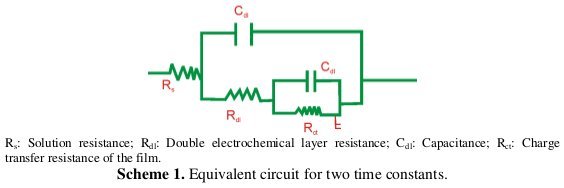
Ef(s) was zero and quit time (s) was 2. A three electrode cell assembly is shown 
in <a href="#s1">Scheme 1</a>.</p>


    <p>&nbsp;</p>
<a name="s1">
<img src="/img/revistas/pea/v31n1/31n1a04s1.jpg">
    
<p>&nbsp;</p>


    <p><b><i>AC impedance spectra</i></b></p>

    <p>AC impedance spectra were recorded in the same instrument used for 
polarization study using the same type of three electrode cell assembly. The real 
part Z' and imaginary part Z'' of the cell impedance were measured in Ohms for 
various frequencies. The charge transfer resistance (R<sub>t</sub>) and double layer 
capacitance (C<sub>dl</sub>) values were calculated.</p>


    <p>&nbsp;</p>
<a name="e1">
<img src="/img/revistas/pea/v31n1/31n1a04e1.jpg">
    
<p>&nbsp;</p>
<a name="e2">
<img src="/img/revistas/pea/v31n1/31n1a04e2.jpg">
    
<p>&nbsp;</p>


    <p>AC impedance spectra were recorded with initial E(v) = 0; high frequency (Hz) = 
1&times;10<sup>5</sup>; low frequency (Hz) = 10; amplitude (V) = 0.005; and quit time (s) = 2.</p>


    ]]></body>
<body><![CDATA[<p>&nbsp;</p>
    <p><b>Results and discussion</b></p>

    <p><b><i>Analysis of potentiodynamic polarization curves</i></b></p>

    <p>Polarization study has been used to confirm the formation of protective a film on 
the metal surface during the corrosion inhibition process [5]. If a protective film 
is formed on the metal surface, the linear polarization resistance (LPR) increases 
and the corrosion current value (Icorr) decreases.</p>

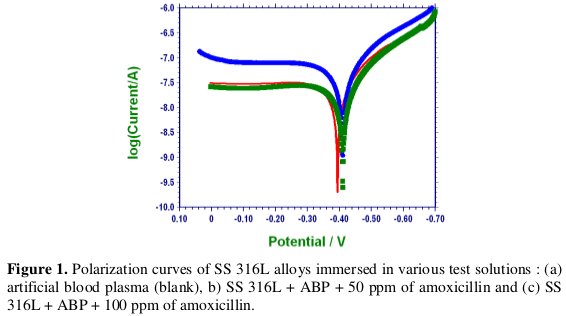
    <p>The potentiodynamic polarization curves of SS 316L immersed in artificial blood 
plasma in the absence and presence of amoxicillin are shown in <a href="#f1">Figs. 1(a)</a> to <a href="#f1">1(c)</a>.</p>


    <p>&nbsp;</p>
<a name="f1">
<img src="/img/revistas/pea/v31n1/31n1a04f1.jpg">
    
<p>&nbsp;</p>


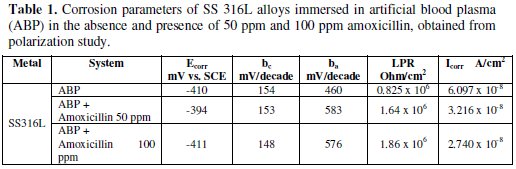
    <p>Corrosion parameters, namely corrosion potential, E<sub>corr</sub>, I<sub>corr</sub>, Tafel slopes, b<sub>a</sub>, b<sub>c</sub>, 
and LPR are given in the <a href="#t1">Table 1</a>.</p>


    <p>&nbsp;</p>
<a name="t1">
<img src="/img/revistas/pea/v31n1/31n1a04t1.jpg">
    
<p>&nbsp;</p>


    ]]></body>
<body><![CDATA[<p>When the SS 316L is immersed in artificial blood plasma in absence of 
amoxicillin the corrosion potential is -410 mV vs. SCE (<a href="#f1">Fig. 1(a)</a>). 
The LPR value is 0.825 &times; 10<sup>6</sup> Ohm cm<sup>2</sup> and the corrosion 
current (I<sub>corr</sub>) is 6.097 &times; 10<sup>-8</sup> A/cm<sup>2</sup>. 
The Tafel slopes (b<sub>c</sub> = 154 mV/decade, b<sub>a</sub> = 460 mV/decade) indicate that the 
rate of change of corrosion current with potential is much higher during the 
anodic polarization than during the cathodic polarization. During anodic 
polarization an oxide film is formed on the metal surface in presence of SS 316L.</p>

    <p>The polarization study reveals that the corrosion resistance of SS 316L in 
artificial blood plasma increases in presence of 50 ppm of amoxicillin. When SS 
316L is immersed in ABP in presence of 50 ppm of amoxicillin the corrosion 
potential is shifted from -410 to -394 mV vs. SCE <a href="#f1">Fig. 1(b)</a>. The Tafel slopes 
(b<sub>c</sub> = 153 mV/decade, b<sub>a</sub> = 583 mV/decade) indicate that the rate of change of 
corrosion current with potential is much higher during anodic polarization than 
during the cathodic polarization. It shows that in presence of amoxicillin it acts 
as better corrosion resistance than in absence of amoxicillin. Further the LPR 
value increases from 0.825&times;10<sup>6</sup> Ohm cm<sup>2</sup> to 1.64&times;10<sup>6</sup> Ohm cm<sup>2</sup>. The corrosion 
current (I<sub>corr</sub>) decreases from 6.097&times;10<sup>-8</sup> A/cm<sup>2</sup> to 3.216&times;10<sup>-8</sup> A/cm<sup>2</sup>. Thus the 
polarization study confirms the formation of a protective film on the metal 
surface.</p>

    <p>When 100 ppm of amoxicillin are added, the corrosion potential is increased 
from -410 (in absence of amoxicillin) and decreased from -394 (in presence of 50 
ppm of amoxicillin) to -411 mV vs. SCE <a href="#f1">Fig. 1(c)</a>. LPR value increases from 
0.825&times;10<sup>6</sup> (in absence of amoxicillin) and 1.64&times;10<sup>6</sup> (in presence of 50 ppm of 
amoxicillin) to 1.86&times;10<sup>6</sup> Ohm cm<sup>2</sup> and Icorr value decreases from 6.097&times;10<sup>-8</sup> 
(in absence of amoxicillin) and 3.216&times;10<sup>-8</sup> (in presence of 50 ppm of 
amoxicillin) to 2.740&times;10<sup>-8</sup> Ohm cm<sup>2</sup>. Thus the polarization study leads to the 
corrosion resistance of SS 316L in ABP in the following decreasing order:</p>

    <p>SS 316L + ABP + 100 ppm of amoxicillin &gt; SS 316L + ABP + 50 ppm of amoxicillin &gt; SS 316L + ABP</p>


    <p><b><i>AC impedance spectra</i></b></p>

    <p>AC impedance spectra have been used to confirm the formation of a protective 
film on the metal surface [6]. If a protective film is formed on the metal surface, 
charge transfer resistance (R<sub>t</sub>) increases, double layer capacitance value (C<sub>dl</sub>) 
decreases and the impedance log(z/Ohm) value increases [7,8].</p>

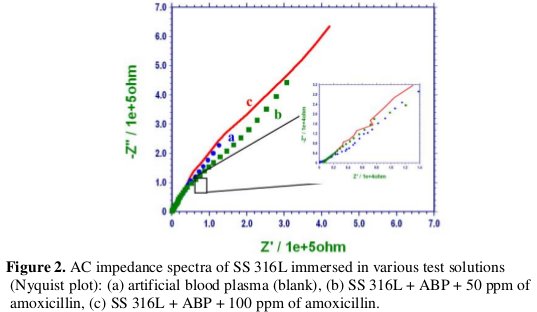
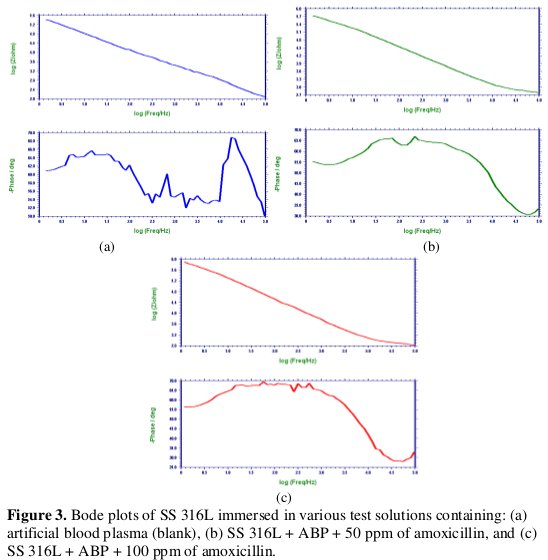
    <p>The AC impedance spectra of metal specimens immersed in artificial blood 
plasma in the absence and presence of 50 ppm and 100 ppm of amoxicillin are 
shown in <a href="#f2">Fig.2 (a,b,c)</a> (Nyquist plots) and <a href="#f3">Fig.3 (a,b,c)</a> (Bode plots).</p>


    <p>&nbsp;</p>
<a name="f2">
<img src="/img/revistas/pea/v31n1/31n1a04f2.jpg">
    
<p>&nbsp;</p>
<a name="f3">
<img src="/img/revistas/pea/v31n1/31n1a04f3.jpg">
    
<p>&nbsp;</p>


    ]]></body>
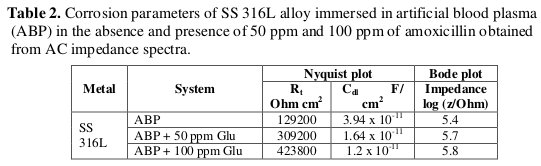
<body><![CDATA[<p>The AC impedance parameters namely charge transfer resistance (R<sub>t</sub>) and double 
layer capacitance (C<sub>dl</sub>) derived from Nyquist plots are given in <a href="#t2">Table 2</a>.</p>


    <p>&nbsp;</p>
<a name="t2">
<img src="/img/revistas/pea/v31n1/31n1a04t2.jpg">
    
<p>&nbsp;</p>


    <p>The impedance log (z/Ohm) values derived from Bode plots are given also in <a href="#t2">Table 2</a>.</p>


    <p><b><i>SS 316L immersed in artificial blood plasma in absence and in presence of amoxicillin</i></b></p>

    <p>When SS 316L is immersed in ABP in absence of amoxicillin, the charge 
transfer resistance R<sub>t</sub> is 129200 Ohm cm<sup>2</sup>. The double layer capacitance value is 
3.94&times;10<sup>-11</sup> F/cm<sup>2</sup> (<a href="#f2">Fig. 2(a)</a>). The impedance value is 5.4 (<a href="#f3">Fig. 3(a)</a>). Bode phase 
diagram on <a href="#f3">Fig. 3(a)</a> shows two time constants; a highly capacitive, typical of 
passive materials, suggests that the film formed on the alloy is more stable. The 
phase angle approaches 67&deg;. The equivalent circuit is shown in <a href="#s1">scheme 1</a> [9,10]. 
It is inferred that SS 316L is more corrosion resistant in ABP. The oxide layer 
formed on SS 316L is more compact and less fragile [9,10].</p>

    <p>When SS 316L is immersed in ABP containing 50 ppm amoxicillin, the charge 
transfer resistance R<sub>t</sub> increases from 129200 Ohm cm<sup>2</sup> to 309200 Ohm cm<sup>2</sup> 
<a href="#f2">Fig. 2(b)</a>. The C<sub>dl</sub> value decreases from 3.94&times;10<sup>-11</sup> F/cm<sup>-2</sup> to 1.64&times;10<sup>-11</sup> F/cm<sup>-2</sup>.</p>

    <p>Bode phase diagram shown in <a href="#f3">Fig. 3(b)</a> shows that the diameter of the semicircle 
is increased so the corrosion resistance is increased. Corrosion rate is decreased. 
This is further supported by the phase angle, which is 68&deg;. The impedance value 
log (z/Ohm) increases from 5.4 to 5.7 [11-13].</p>

    <p>When 100 ppm amoxicillin is added the R<sub>t</sub> value increases from 129200 (in 
absence of amoxicillin) and 309200 (in presence of 50 ppm of Amoxicillin) to 
423800 Ohm cm<sup>2</sup> <a href="#f2">Fig. 2(c)</a>. The Cdl value decreases from 3.94&times;10<sup>-11</sup> (in absence 
of amoxicillin) and 1.64&times;10<sup>-11</sup> (in presence of 50 ppm of amoxicillin) 
to 1.2&times;10<sup>-11</sup> F/cm<sup>2</sup>. The impedance value increases from 5.4 (in absence of amoxicillin) 
and 5.7 log(z/Ohm) (in presence of 50 ppm of amoxicillin) to 5.8 log(z/Ohm).</p>

    <p>Through the impedance Bode plot one can see that as the value of the frequency 
increases the impedance value decreases sharply being the slope of the straight 
line almost 0.5. This is a characteristic of a stable film formed on the surface of a 
metal during corrosion protection process. This is further supported by the phase 
angle of Bode plot. The value of the phase angle is 69&deg;. Thus AC impedance 
spectral study reveals that the corrosion resistance of SS 316L in ABP is in the 
following decreasing order:</p>
 
    ]]></body>
<body><![CDATA[<p>SS 316L + ABP + 100 ppm Amoxicillin &gt; SS 316L + 50 ppm Amoxicillin &gt; SS 316L + ABP</p>


    <p>&nbsp;</p>
    <p><b>References</b></p>

    <!-- ref --><p>1. Harikumar S, Karthikeyan S, Narayanan S. Int J Chem Tech Res. 2012;4:1077.    &nbsp;&nbsp;&nbsp;&nbsp;&nbsp;&nbsp;&nbsp;&nbsp;[&#160;<a href="javascript:void(0);" onclick="javascript: window.open('/scielo.php?script=sci_nlinks&ref=000066&pid=S0872-1904201300010000400001&lng=','','width=640,height=500,resizable=yes,scrollbars=1,menubar=yes,');">Links</a>&#160;]<!-- end-ref --></p>
    <!-- ref --><p>2. Talha Mohd, Behera CK, Sinha P. J Chem Pharm Res. 2012;4:203.    &nbsp;&nbsp;&nbsp;&nbsp;&nbsp;&nbsp;&nbsp;&nbsp;[&#160;<a href="javascript:void(0);" onclick="javascript: window.open('/scielo.php?script=sci_nlinks&ref=000068&pid=S0872-1904201300010000400002&lng=','','width=640,height=500,resizable=yes,scrollbars=1,menubar=yes,');">Links</a>&#160;]<!-- end-ref --></p>
    <!-- ref --><p>3. Gurapp I. Mater Characterization. 2002;49:7379.    &nbsp;&nbsp;&nbsp;&nbsp;&nbsp;&nbsp;&nbsp;&nbsp;[&#160;<a href="javascript:void(0);" onclick="javascript: window.open('/scielo.php?script=sci_nlinks&ref=000070&pid=S0872-1904201300010000400003&lng=','','width=640,height=500,resizable=yes,scrollbars=1,menubar=yes,');">Links</a>&#160;]<!-- end-ref --></p>
    <!-- ref --><p>4. Kajzer W, Krauze A, Walke W, Marciniak J. J Achiev Mater Manuf Eng. 2008;31.    &nbsp;&nbsp;&nbsp;&nbsp;&nbsp;&nbsp;&nbsp;&nbsp;[&#160;<a href="javascript:void(0);" onclick="javascript: window.open('/scielo.php?script=sci_nlinks&ref=000072&pid=S0872-1904201300010000400004&lng=','','width=640,height=500,resizable=yes,scrollbars=1,menubar=yes,');">Links</a>&#160;]<!-- end-ref --></p>
    <!-- ref --><p>5. Nazeer AA, Fouda AS, Ashno EA. J Mater Environ Sci. 2011;2:24.    &nbsp;&nbsp;&nbsp;&nbsp;&nbsp;&nbsp;&nbsp;&nbsp;[&#160;<a href="javascript:void(0);" onclick="javascript: window.open('/scielo.php?script=sci_nlinks&ref=000074&pid=S0872-1904201300010000400005&lng=','','width=640,height=500,resizable=yes,scrollbars=1,menubar=yes,');">Links</a>&#160;]<!-- end-ref --></p>
    <!-- ref --><p>6. Thangam YY, Kalanithi M, Anbarasi CM, Rajendran S. Arab J Sci Eng. 2009;34.    &nbsp;&nbsp;&nbsp;&nbsp;&nbsp;&nbsp;&nbsp;&nbsp;[&#160;<a href="javascript:void(0);" onclick="javascript: window.open('/scielo.php?script=sci_nlinks&ref=000076&pid=S0872-1904201300010000400006&lng=','','width=640,height=500,resizable=yes,scrollbars=1,menubar=yes,');">Links</a>&#160;]<!-- end-ref --></p>
    <!-- ref --><p>7. Abdullah M. Corrosion Sci. 2004;466:1981.    &nbsp;&nbsp;&nbsp;&nbsp;&nbsp;&nbsp;&nbsp;&nbsp;[&#160;<a href="javascript:void(0);" onclick="javascript: window.open('/scielo.php?script=sci_nlinks&ref=000078&pid=S0872-1904201300010000400007&lng=','','width=640,height=500,resizable=yes,scrollbars=1,menubar=yes,');">Links</a>&#160;]<!-- end-ref --></p>
    <!-- ref --><p>8. Rajendran S, Uma V, Krishnaveni A et al. Arab J Sci Eng. 2009;34.    &nbsp;&nbsp;&nbsp;&nbsp;&nbsp;&nbsp;&nbsp;&nbsp;[&#160;<a href="javascript:void(0);" onclick="javascript: window.open('/scielo.php?script=sci_nlinks&ref=000080&pid=S0872-1904201300010000400008&lng=','','width=640,height=500,resizable=yes,scrollbars=1,menubar=yes,');">Links</a>&#160;]<!-- end-ref --></p>
    <!-- ref --><p>9. Castaneda IE, Gonzalez-Rodriguez JG, Dominguez G et al. Int J Electrochem Sci. 2011;6:404-418.    &nbsp;&nbsp;&nbsp;&nbsp;&nbsp;&nbsp;&nbsp;&nbsp;[&#160;<a href="javascript:void(0);" onclick="javascript: window.open('/scielo.php?script=sci_nlinks&ref=000082&pid=S0872-1904201300010000400009&lng=','','width=640,height=500,resizable=yes,scrollbars=1,menubar=yes,');">Links</a>&#160;]<!-- end-ref --></p>
    <!-- ref --><p>10. Application note on Basics of Electrochemical impedance spectroscopy by Gamry Instruments.    &nbsp;&nbsp;&nbsp;&nbsp;&nbsp;&nbsp;&nbsp;&nbsp;[&#160;<a href="javascript:void(0);" onclick="javascript: window.open('/scielo.php?script=sci_nlinks&ref=000084&pid=S0872-1904201300010000400010&lng=','','width=640,height=500,resizable=yes,scrollbars=1,menubar=yes,');">Links</a>&#160;]<!-- end-ref --></p>
    <!-- ref --><p>11. Antony N, Sherine HB, Rajendran S. Arab J Sci Eng. 2010;35:41.    &nbsp;&nbsp;&nbsp;&nbsp;&nbsp;&nbsp;&nbsp;&nbsp;[&#160;<a href="javascript:void(0);" onclick="javascript: window.open('/scielo.php?script=sci_nlinks&ref=000086&pid=S0872-1904201300010000400011&lng=','','width=640,height=500,resizable=yes,scrollbars=1,menubar=yes,');">Links</a>&#160;]<!-- end-ref --></p>
    <!-- ref --><p>12. Rajendran S, Devi KM, Regis APP et al. Zastita Materijala. 2009;50:153.    &nbsp;&nbsp;&nbsp;&nbsp;&nbsp;&nbsp;&nbsp;&nbsp;[&#160;<a href="javascript:void(0);" onclick="javascript: window.open('/scielo.php?script=sci_nlinks&ref=000088&pid=S0872-1904201300010000400012&lng=','','width=640,height=500,resizable=yes,scrollbars=1,menubar=yes,');">Links</a>&#160;]<!-- end-ref --></p>
    <!-- ref --><p>13. Raji A, Rajendran S, Prabha PS et al. Zastita Materijala. 2009;50:131.    &nbsp;&nbsp;&nbsp;&nbsp;&nbsp;&nbsp;&nbsp;&nbsp;[&#160;<a href="javascript:void(0);" onclick="javascript: window.open('/scielo.php?script=sci_nlinks&ref=000090&pid=S0872-1904201300010000400013&lng=','','width=640,height=500,resizable=yes,scrollbars=1,menubar=yes,');">Links</a>&#160;]<!-- end-ref --></p>


    <p>&nbsp;</p>
    ]]></body>
<body><![CDATA[<p><b>Acknowledgement</b></p>

    <p>The authors are thankful to their respective management and to UGC for their 
encouragement and to Mr. S. Elango for his computer aided design.</p>


    <p>&nbsp;</p>
    <p><a name=0></a><sup><a href="#top">*</a></sup>Corresponding author. E-mail address: <a href="mailto:s_johnmary@yahoo.com">s_johnmary@yahoo.com</a></p>

    <p>Received 27 November 2012; accepted 12 February 2013</p>

    <p><a href="http://www.peacta.org" target="_blank">www.peacta.org</a> </p>


     ]]></body><back>
<ref-list>
<ref id="B1">
<label>1</label><nlm-citation citation-type="journal">
<person-group person-group-type="author">
<name>
<surname><![CDATA[Harikumar]]></surname>
<given-names><![CDATA[S]]></given-names>
</name>
<name>
<surname><![CDATA[Karthikeyan]]></surname>
<given-names><![CDATA[S]]></given-names>
</name>
<name>
<surname><![CDATA[Narayanan]]></surname>
<given-names><![CDATA[S]]></given-names>
</name>
</person-group>
<source><![CDATA[Int J Chem Tech Res]]></source>
<year>2012</year>
<volume>4</volume>
<page-range>1077</page-range></nlm-citation>
</ref>
<ref id="B2">
<label>2</label><nlm-citation citation-type="journal">
<person-group person-group-type="author">
<name>
<surname><![CDATA[Talha]]></surname>
<given-names><![CDATA[Mohd]]></given-names>
</name>
<name>
<surname><![CDATA[Behera]]></surname>
<given-names><![CDATA[C K]]></given-names>
</name>
<name>
<surname><![CDATA[Sinha]]></surname>
<given-names><![CDATA[P]]></given-names>
</name>
</person-group>
<source><![CDATA[J Chem Pharm Res]]></source>
<year>2012</year>
<volume>4</volume>
<page-range>203</page-range></nlm-citation>
</ref>
<ref id="B3">
<label>3</label><nlm-citation citation-type="journal">
<person-group person-group-type="author">
<name>
<surname><![CDATA[Gurapp]]></surname>
<given-names><![CDATA[I]]></given-names>
</name>
</person-group>
<source><![CDATA[Mater Characterization]]></source>
<year>2002</year>
<volume>49</volume>
<page-range>7379</page-range></nlm-citation>
</ref>
<ref id="B4">
<label>4</label><nlm-citation citation-type="journal">
<person-group person-group-type="author">
<name>
<surname><![CDATA[Kajzer]]></surname>
<given-names><![CDATA[W]]></given-names>
</name>
<name>
<surname><![CDATA[Krauze]]></surname>
<given-names><![CDATA[A]]></given-names>
</name>
<name>
<surname><![CDATA[Walke]]></surname>
<given-names><![CDATA[W]]></given-names>
</name>
<name>
<surname><![CDATA[Marciniak]]></surname>
<given-names><![CDATA[J]]></given-names>
</name>
</person-group>
<source><![CDATA[J Achiev Mater Manuf Eng]]></source>
<year>2008</year>
<page-range>31</page-range></nlm-citation>
</ref>
<ref id="B5">
<label>5</label><nlm-citation citation-type="journal">
<person-group person-group-type="author">
<name>
<surname><![CDATA[Nazeer]]></surname>
<given-names><![CDATA[A A]]></given-names>
</name>
<name>
<surname><![CDATA[Fouda]]></surname>
<given-names><![CDATA[A S]]></given-names>
</name>
<name>
<surname><![CDATA[Ashno]]></surname>
<given-names><![CDATA[E A]]></given-names>
</name>
</person-group>
<source><![CDATA[J Mater Environ Sci]]></source>
<year>2011</year>
<volume>2</volume>
<page-range>24</page-range></nlm-citation>
</ref>
<ref id="B6">
<label>6</label><nlm-citation citation-type="journal">
<person-group person-group-type="author">
<name>
<surname><![CDATA[Thangam]]></surname>
<given-names><![CDATA[Y Y]]></given-names>
</name>
<name>
<surname><![CDATA[Kalanithi]]></surname>
<given-names><![CDATA[M]]></given-names>
</name>
<name>
<surname><![CDATA[Anbarasi]]></surname>
<given-names><![CDATA[C M]]></given-names>
</name>
<name>
<surname><![CDATA[Rajendran]]></surname>
<given-names><![CDATA[S]]></given-names>
</name>
</person-group>
<source><![CDATA[Arab J Sci Eng]]></source>
<year>2009</year>
<page-range>34</page-range></nlm-citation>
</ref>
<ref id="B7">
<label>7</label><nlm-citation citation-type="journal">
<person-group person-group-type="author">
<name>
<surname><![CDATA[Abdullah]]></surname>
<given-names><![CDATA[M]]></given-names>
</name>
</person-group>
<source><![CDATA[Corrosion Sci]]></source>
<year>2004</year>
<volume>466</volume>
<page-range>1981</page-range></nlm-citation>
</ref>
<ref id="B8">
<label>8</label><nlm-citation citation-type="journal">
<person-group person-group-type="author">
<name>
<surname><![CDATA[Rajendran]]></surname>
<given-names><![CDATA[S]]></given-names>
</name>
<name>
<surname><![CDATA[Uma]]></surname>
<given-names><![CDATA[V]]></given-names>
</name>
<name>
<surname><![CDATA[Krishnaveni]]></surname>
<given-names><![CDATA[A]]></given-names>
</name>
</person-group>
<source><![CDATA[Arab J Sci Eng]]></source>
<year>2009</year>
<page-range>34</page-range></nlm-citation>
</ref>
<ref id="B9">
<label>9</label><nlm-citation citation-type="journal">
<person-group person-group-type="author">
<name>
<surname><![CDATA[Castaneda]]></surname>
<given-names><![CDATA[I E]]></given-names>
</name>
<name>
<surname><![CDATA[Gonzalez-Rodriguez]]></surname>
<given-names><![CDATA[J G]]></given-names>
</name>
<name>
<surname><![CDATA[Dominguez]]></surname>
<given-names><![CDATA[G]]></given-names>
</name>
</person-group>
<source><![CDATA[Int J Electrochem Sci]]></source>
<year>2011</year>
<volume>6</volume>
<page-range>404</page-range></nlm-citation>
</ref>
<ref id="B10">
<label>10</label><nlm-citation citation-type="book">
<source><![CDATA[Application note on Basics of Electrochemical impedance spectroscopy]]></source>
<year></year>
<publisher-name><![CDATA[Gamry Instruments]]></publisher-name>
</nlm-citation>
</ref>
<ref id="B11">
<label>11</label><nlm-citation citation-type="journal">
<person-group person-group-type="author">
<name>
<surname><![CDATA[Antony]]></surname>
<given-names><![CDATA[N]]></given-names>
</name>
<name>
<surname><![CDATA[Sherine]]></surname>
<given-names><![CDATA[H B]]></given-names>
</name>
<name>
<surname><![CDATA[Rajendran]]></surname>
<given-names><![CDATA[S]]></given-names>
</name>
</person-group>
<source><![CDATA[Arab J Sci Eng]]></source>
<year>2010</year>
<volume>35</volume>
<page-range>41</page-range></nlm-citation>
</ref>
<ref id="B12">
<label>12</label><nlm-citation citation-type="journal">
<person-group person-group-type="author">
<name>
<surname><![CDATA[Rajendran]]></surname>
<given-names><![CDATA[S]]></given-names>
</name>
<name>
<surname><![CDATA[Devi]]></surname>
<given-names><![CDATA[K M]]></given-names>
</name>
<name>
<surname><![CDATA[Regis]]></surname>
<given-names><![CDATA[A P P]]></given-names>
</name>
</person-group>
<source><![CDATA[Zastita Materijala]]></source>
<year>2009</year>
<volume>50</volume>
<page-range>153</page-range></nlm-citation>
</ref>
<ref id="B13">
<label>13</label><nlm-citation citation-type="journal">
<person-group person-group-type="author">
<name>
<surname><![CDATA[Raji]]></surname>
<given-names><![CDATA[A]]></given-names>
</name>
<name>
<surname><![CDATA[Rajendran]]></surname>
<given-names><![CDATA[S]]></given-names>
</name>
<name>
<surname><![CDATA[Prabha]]></surname>
<given-names><![CDATA[P S]]></given-names>
</name>
</person-group>
<source><![CDATA[Zastita Materijala]]></source>
<year>2009</year>
<volume>50</volume>
<page-range>131</page-range></nlm-citation>
</ref>
</ref-list>
</back>
</article>