<?xml version="1.0" encoding="ISO-8859-1"?><article xmlns:mml="http://www.w3.org/1998/Math/MathML" xmlns:xlink="http://www.w3.org/1999/xlink" xmlns:xsi="http://www.w3.org/2001/XMLSchema-instance">
<front>
<journal-meta>
<journal-id>0872-1904</journal-id>
<journal-title><![CDATA[Portugaliae Electrochimica Acta]]></journal-title>
<abbrev-journal-title><![CDATA[Port. Electrochim. Acta]]></abbrev-journal-title>
<issn>0872-1904</issn>
<publisher>
<publisher-name><![CDATA[Sociedade Portuguesa de Electroquímica]]></publisher-name>
</publisher>
</journal-meta>
<article-meta>
<article-id>S0872-19042013000100005</article-id>
<article-id pub-id-type="doi">10.4152/pea.201301041</article-id>
<title-group>
<article-title xml:lang="en"><![CDATA[Inhibition of Corrosion of Aluminium and its Alloys by Extracts of Green Inhibitors]]></article-title>
</title-group>
<contrib-group>
<contrib contrib-type="author">
<name>
<surname><![CDATA[Sangeetha]]></surname>
<given-names><![CDATA[M.]]></given-names>
</name>
<xref ref-type="aff" rid="A01"/>
</contrib>
<contrib contrib-type="author">
<name>
<surname><![CDATA[Rajendran]]></surname>
<given-names><![CDATA[S.]]></given-names>
</name>
<xref ref-type="aff" rid="A02"/>
</contrib>
<contrib contrib-type="author">
<name>
<surname><![CDATA[Sathiyabama]]></surname>
<given-names><![CDATA[J.]]></given-names>
</name>
<xref ref-type="aff" rid="A01"/>
</contrib>
<contrib contrib-type="author">
<name>
<surname><![CDATA[Krishnavenic]]></surname>
<given-names><![CDATA[A.]]></given-names>
</name>
<xref ref-type="aff" rid="A03"/>
</contrib>
</contrib-group>
<aff id="A01">
<institution><![CDATA[,GTN Arts College PG and Research Department of Chemistry ]]></institution>
<addr-line><![CDATA[Dindigul Tamil Nadu]]></addr-line>
<country>India</country>
</aff>
<aff id="A02">
<institution><![CDATA[,RVS School of Engineering and Technology Department of Chemistry Corrosion Research Centre]]></institution>
<addr-line><![CDATA[Dindigul ]]></addr-line>
<country>India</country>
</aff>
<aff id="A03">
<institution><![CDATA[,Yadava College Department of chemistry ]]></institution>
<addr-line><![CDATA[Madurai ]]></addr-line>
<country>India</country>
</aff>
<pub-date pub-type="pub">
<day>00</day>
<month>01</month>
<year>2013</year>
</pub-date>
<pub-date pub-type="epub">
<day>00</day>
<month>01</month>
<year>2013</year>
</pub-date>
<volume>31</volume>
<numero>1</numero>
<fpage>41</fpage>
<lpage>52</lpage>
<copyright-statement/>
<copyright-year/>
<self-uri xlink:href="http://scielo.pt/scielo.php?script=sci_arttext&amp;pid=S0872-19042013000100005&amp;lng=en&amp;nrm=iso"></self-uri><self-uri xlink:href="http://scielo.pt/scielo.php?script=sci_abstract&amp;pid=S0872-19042013000100005&amp;lng=en&amp;nrm=iso"></self-uri><self-uri xlink:href="http://scielo.pt/scielo.php?script=sci_pdf&amp;pid=S0872-19042013000100005&amp;lng=en&amp;nrm=iso"></self-uri><abstract abstract-type="short" xml:lang="en"><p><![CDATA[Aluminium is the most widely used non ferrous metal. It is very needful to prevent this metal from corrosion .Corrosion inhibitors are one of the widely used methods to control corrosion. The purpose of this paper is to make people aware of organic corrosion inhibitors. Organic inhibitors are mainly present in natural products. It has been found that plant extracts and natural products show inhibition efficiency up to 98%. They are also non-toxic, eco-friendly, very cheaper. In the present work, natural products are used at various conditions and their inhibition efficiency is calculated by different methods; they obey various adsorption isotherms; the protective films formed by the inhibitors are analyzed by techniques such as electrochemical methods, FTIR, HPLC-RP, SEM, EDS.]]></p></abstract>
<kwd-group>
<kwd lng="en"><![CDATA[aluminium]]></kwd>
<kwd lng="en"><![CDATA[corrosion inhibition]]></kwd>
<kwd lng="en"><![CDATA[plant extracts]]></kwd>
<kwd lng="en"><![CDATA[green inhibitors]]></kwd>
</kwd-group>
</article-meta>
</front><body><![CDATA[ 

    <p><b>Inhibition of Corrosion of Aluminium and its Alloys by Extracts of Green Inhibitors</b></p>

    <p><b>M. Sangeetha<sup>1,<a href="#0">*<a/></sup>, S. Rajendran<sup>1,2</sup>, J. Sathiyabama<sup>1</sup> and A. Krishnavenic<sup>3</sup></b></p>

    <p><sup>1</sup><i> PG and Research Department of Chemistry, GTN Arts College, Dindigul 624005, Tamil Nadu, India</i></p>

    <p><sup>2</sup><i> Corrosion Research Centre, Department of Chemistry, RVS School of Engineering and Technology, Dindigul 624005, India</i></p>

    <p><sup>3</sup><i> Department of chemistry, Yadava College, Madurai, India</i></p>


<!--     <p>&nbsp;</p>
    <p>doi: 10.4152/pea.201301041</p> -->


    <p>&nbsp;</p>
    <p><b>Abstract</b></p>

    ]]></body>
<body><![CDATA[<p>Aluminium is the most widely used non ferrous metal. It is very needful to prevent this 
metal from corrosion .Corrosion inhibitors are one of the widely used methods to 
control corrosion. The purpose of this paper is to make people aware of organic 
corrosion inhibitors. Organic inhibitors are mainly present in natural products. It has 
been found that plant extracts and natural products show inhibition efficiency up to 
98%. They are also non -toxic, eco-friendly, very cheaper. In the present work, natural 
products are used at various conditions and their inhibition efficiency is calculated by 
different methods; they obey various adsorption isotherms; the protective films formed 
by the inhibitors are analyzed by techniques such as electrochemical methods, FTIR, 
HPLC-RP, SEM, EDS.</p>

    <p><b><i>Keywords:</i></b> aluminium, corrosion inhibition, plant extracts, green inhibitors.</p>


    <p>&nbsp;</p>
    <p><b>Introduction</b></p>

    <p>Aluminium or aluminium is a silvery white member of the boron group of 
chemical elements. It has the symbol Al, and its atomic number is 13. It is not 
soluble in water under normal circumstances. Aluminium is the third most 
abundant element (after oxygen and silicon) and the most abundant metal in the 
Earth's crust. It makes up about 8% by weight of the Earth's solid surface. 
Aluminium metal is too reactive chemically to occur natively. Instead, it is found 
combined in over 270 different minerals [1].</p>

    <p>The chief ore of aluminium is bauxite. The metal was first produced in 1825 (in 
an impure form) by Danish physicist and chemist Hans Christian Orsted. 
Friedrich Wohler conducted a similar experiment in 1827 by mixing anhydrous 
aluminium chloride with potassium and yielded aluminium [2].</p>

    <p>Wohler is generally credited with isolating aluminium (Latin alumen, alum), but 
also Orsted can be listed as its discoverer [3]. Further, Pierre Berthier discovered 
aluminium in bauxite ore and successfully extracted it [4]. Charles Martin Hall of 
Ohio in the U.S. and Paul Heroult of France independently developed the Hall-Heroult 
electrolytic process that made extracting aluminium from minerals 
cheaper, being now the principal method used worldwide. Aluminium is a good 
thermal and electrical conductor, having 59% of the conductivity of copper, both 
thermal and electrical. Aluminium is capable of being a superconductor, with a 
superconducting critical temperature of 1.2 K and a critical magnetic field of 
about 100 Gauss (10 milliteslas) [5].</p>

    <p>Aluminium is the most widely used non-ferrous metal [6]. Global production of 
aluminium in 2005 was 31.9 million tonnes. It exceeded that of any other metal 
except iron (837.5 million tonnes) [7]. Forecast for 2012 is 42-45 million tons, 
driven by rising Chinese output [8]. The common aluminium foils and beverage 
cans are alloys of 92% to 99% aluminium [9].</p>

    <p>Aluminium is 100% recyclable without any loss of its natural qualities. In 
Europe aluminium experiences high rates of recycling, ranging from 42% of 
beverage cans, 85% of construction materials and 95% of transport vehicles [10]. 
Corrosion resistance can be excellent due to a thin surface layer of aluminium 
oxide that forms when the metal is exposed to air, effectively preventing further 
oxidation. The strongest aluminium alloys are less corrosion resistant due to 
galvanic reactions with alloyed copper [11]. This corrosion resistance is also 
often greatly reduced when many aqueous salts are present, particularly in the 
presence of dissimilar metals.</p>


    <p><b><i>Natural corrosion inhibitors</i></b></p>

    ]]></body>
<body><![CDATA[<p>Noor has used an aqueous extract of Hibiscus sabdariffa leaves for inhibiting the 
corrosion of aluminum in alkaline solutions [12]. Chemical and electrochemical 
measurements were applied to evaluate the potential of aqueous extract of 
Hibiscus sabdariffa leaves (AEHSL) for inhibiting the corrosion of Al in 0.5 M 
NaOH. It was found that the inhibition efficiency increases with the increase of 
AEHSL concentration. Electrochemical measurements revealed that AEHSL acts 
as a mixed-type inhibitor with an inhibition category that belongs to geometric 
blocking. Adsorption of inhibitor species was found to follow Langmuir and 
Dubinin-Radushkevich isotherm models and the ability of AEHSL species to be 
adsorbed physically on the Al surface was illustrated by Dubinin-Radushkevich 
isotherm parameters. The data obtained from chemical and electrochemical 
measurements are in reasonably good agreement. Physical adsorption mechanism 
of AEHSl species on Al surface in 0.5 M NaOH becomes clear cut, by following 
the trend of inhibitor adsorption with solution temperature. Good correlation 
between AEHSL water-soluble constituents and the suggested physical 
adsorption mechanism was obtained. Moreover, at a certain concentration of 
AEHSL (1.00 g L<sup>-1</sup>), the Al surface coverage increases with the increase of 
NaOH concentration up to 0.5 M after which limited decrease was obtained with 
further increase in NaOH concentration.</p>

    <p>Corrosion behaviour of aluminium in the presence of an aqueous extract of 
hibiscus rosa-sinensis has been evaluated by Rajendran et al. [13]. The inhibition 
efficiency (IE) of an aqueous extract of Hibiscus rosa-sinensis (white) in 
controlling corrosion of aluminium at pH 12 has been evaluated by weight loss 
method in the absence and presence of Zn<sup>2+</sup>. The formulation consisting of 8 mL 
flower extract (FE) and 50 ppm of Zn<sup>2+</sup> had 98% inhibition efficiency. 
Polarization study revealed that this formulation functioned as a cathodic 
inhibitor. AC impedance spectra revealed the presence of a protective film 
formed on the metal surface. FTIR spectra revealed that the protective film 
consisted of a complex formed between the active principle of the flower extract 
and Al<sup>3+</sup>.</p>

    <p>The corrosion inhibition of non toxic plant extract of Hibiscus Teterifa on the 
corrosion of chill cast Al-Zn-Mg alloy in 0.5 Molar solution of NaOH was 
studied using weight loss method [14]. The alloy of composition 4.5% Zn, 2% 
Mg and balance Al was chill cast at the Foundry Shop of the National 
Metallurgical Development Centre, Jos, Nigeria. After casting, the alloy was cut 
and machined to corrosion coupons and immersed into 0.5 M solution of NaOH 
containing varying concentrations of the inhibitor (5-20% v/v) at temperatures of 
30, 50 and 70 &deg;C, respectively. It was found that the adsorption of Hibiscus 
Teterifa could prevent this alloy from weight loss and the adsorption accorded 
with the Langmuir adsorption isotherm. Thermodynamic parameters such as 
adsorption heat and adsorption free energy were obtained from experimental 
data. The kinetic data activation energy at different concentrations of the 
inhibitor was calculated. The most suitable range of inhibitor concentration was 
discussed. The inhibitive action was satisfactorily explained by using both 
thermodynamic and kinetic models. The mechanism of inhibition is that of 
physical adsorption and the adsorbed molecules of the inhibitor lies on the 
surface of the alloy blocking the active corrosion sites on the alloy hence, 
lowering the corrosion rate.</p>

    <p>An interesting and efficient green corrosion inhibitor for aluminium from 
extracts of Chlomolaena odorata L. in acidic solution has been used by Obot and 
Obi-Egbedi [15]. The leaf extracts of Chromolaena odorata L. (LECO) has been 
studied as a possible source of green inhibitor for corrosion of aluminium in 2 M 
HCl using gasometric and thermometric techniques at 30 and 60 &deg;C. Results 
obtained showed that the LECO functioned as an excellent corrosion inhibitor for 
aluminium in the acidic environment. Inhibition efficiency increased with extract 
concentration but decreased with temperature. The adsorption of LECO on Al 
surface is in accord with Langmuir adsorption isotherm. Both kinetic and 
thermodynamic parameters governing the adsorption process were calculated and 
discussed. From the experimental results obtained, it can be concluded that 
LECO, which are biodegradable, environmentally benign, and are obtained from 
a renewable resource with minimal health and safety concerns have the potential 
to be a cost effective alternative to synthetic corrosion inhibitors. This study 
provides new information on the inhibiting characteristics of LECO extract under 
specified conditions. The environmentally friendly inhibitor could find possible 
applications in metal surface anodizing and surface coating in industries.</p>

    <p>The inhibition of corrosion of aluminum in hydrochloric acid solutions by the 
ethanolic extract of the leaves of Ananas sativum was studied using weight loss 
and hydrogen evolution methods [16]. It was found that the plant extract retarded 
the acid induced corrosion of aluminum. Inhibition efficiency increased with 
increasing concentration of the extract and temperature. Adsorption studies 
revealed that Langmuir adsorption isotherm is the best adsorption model 
applicable to the adsorption of A. sativum on aluminum surface. Activation 
parameters such as activation energies (Ea), activation enthalpy, and activation 
entropy were evaluated from the effect of temperature on the corrosion and 
inhibition processes.</p>

    <p>Synergistic and antagonistic effects of anions and ipomoea invulcrata as green 
corrosion inhibitor for aluminium dissolution in acidic medium have been 
investigated by Obot et al. [17]. The extract of Ipomoea invulcrata (IP) has been 
studied as a possible source of green inhibitor for corrosion of aluminium in 1 M 
HCl at 30-60 &deg;C using the conventional weight loss technique. The studies reveal 
that at constant acid concentration, the plant extract acts as an effective inhibitor 
for aluminium corrosion in acidic medium. Inhibition efficiency increases with 
concentration but decreases with increase in temperature and immersion time. 
The enhancement of inhibition efficiency of IP with the addition of KI and 
KSCN has also been studied. The apparent activation energy and the 
thermodynamic parameters governing the corrosion process have also been 
calculated. The adsorption of IP was in accord with the Langmuir adsorption 
isotherm at all the temperatures studied. The mechanism of physical adsorption is 
proposed for the inhibitory action of IP and is satisfactorily explained by both 
kinetic and thermodynamic parameters.</p>

    <p>Anticorrosion behaviour of zenthoxylum alatum extract in acidic media has been 
investigated by Chauhan [18]. The commercial non-ionic surfactant plant used as 
a medicine, namely Zenthoxylum alatum was tested as inhibitor for the corrosion 
of copper and aluminium in 0.1 M solution of HCl. Weight loss measurement 
and potentiometry polarization technique were used in this study. It was found 
that this compound acts as a good inhibitor for the acid corrosion of copper and 
aluminium; the inhibition efficiencies obtained by the two techniques were 
almost the same, and increased with increasing the concentration of the 
inhibitors. The polarization technique shows that the compound acts as an 
inhibitor. The inhibition action of the surfactant is interpreted in view of the 
adsorption on the metal surface making a barrier to mass and charge transfer. It 
was found that the adsorption of the compound follows Langmuir adsorption 
isotherm. The values of free energy of adsorption for them were calculated. It 
was found that the adsorption process is spontaneous and increases, for the 
different surfactant, in the same direction as the inhibition efficiency.</p>

    <p>The synergistic action caused by iodide ions on the corrosion inhibition of 
aluminium (Al) in 0.5 M HCl in the presence of Azadirachia Indica (AZI) plant 
extract has been investigated using potentiodynamic polarization and impedance 
techniques [19]. It is found that AZI extract inhibits the corrosion of aluminium 
in 0.5 M HCl. The inhibition efficiency increases with the increase in AZI extract 
concentration, until 24% v/v of AZI extract, then Inh.% is decreased with father 
increase in AZI extract concentration. The adsorption of this extract in the 
studied concentration is found to obey Frewendlish adsorption isotherm. The 
addition of iodide ions enhances the inhibition efficiency to a considerable 
extent. The increase in inhibition efficiency (IE) % values in presence of fixed 
concentration of iodide ions indicates that AZI extract forms an insoluble 
complex at lower AZI extract concentrations by undergoing a joint adsorption. 
But at higher concentrations of AZI extract, competitive adsorption is found 
between iodide ions and the formed complex leading to less (IE) %. The (IE) % 
further decreased in the presence of iodide ions with AZI extract than in presence 
of AZI extract alone at all studied iodide concentrations. The synergism 
parameter S&Theta; is defined and calculated from surface coverage values. Synergism 
parameters have been calculated by other researchers also to investigate the 
synergistic effect [20-24].</p>

    <p>Inhibition of aluminium corrosion in 2 M sodium hydroxide solution in the 
presence and absence of 0.5 M NaCl using damsissa (Ambrosia maritime, L.) 
extract has been studied employing different chemical and electrochemical 
techniques [25]. Chemical gasometry technique showed that addition of chloride 
ions or damsissa extract to sodium hydroxide solution decreases the volume of 
the hydrogen gas evolved. Potentiodynamic results manifested that chloride ion 
retard the anodic dissolution of aluminium, below the pitting potential, in sodium 
hydroxide solution. Damsissa extract, in presence or absence of chloride ion, 
influenced both the anodic dissolution of aluminium and the generated hydrogen 
gas at the cathode indicating that the extract behaved as a mixed-type inhibitor. 
The decrease in the observed limiting current with increasing damsissa extract 
concentration indicated that the anodic process is controlled by diffusion. 
Nyquist plots present two capacitive semicircles at higher and lower frequencies 
separated by an inductive loop at intermediate frequencies. The inductive loops 
were clarified by the occurrence of adsorbed intermediates on the surface. A 
proposed equivalent circuit was used to analyze the impedance spectra for 
aluminium in alkaline solutions. The results showed that the damsissa extract 
could serve as an effective inhibitor for the corrosion of aluminium in alkaline 
solutions. The impedance measurements verified the remarkable stability of the 
extracts during storage up to 35 days. Damsissa extract was found more effective 
in presence of chloride ions than in its absence. Inhibition was found to increase 
with increasing the concentration of the extract but decreases with increasing 
temperature. The associated activation parameters have been determined and 
discussed.</p>

    <p>Adsorption and corrosive inhibitive properties of Vigna unguiculata in alkaline 
and acidic media have been reported by Umoren et al. [26].The main objective of 
the work was to investigate the adsorption behaviour and inhibitive effect of 
Vigna unguiculata (VU) extract (agricultural waste material) for aluminium 
corrosion in 0.5 M NaOH and H<sub>2</sub>SO<sub>4</sub>. The inhibitive effect of the plant extract 
was assessed using weight loss method at 30 and 60 oC. The trend of inhibition 
efficiency with temperature was used to propose the mechanism of inhibition and 
type of adsorption. VU extract effectively inhibited aluminium corrosion in both 
alkaline and acidic media. Inhibition efficiency (I %) of the extract increased 
with increase in concentration of the extract and temperature. Inhibitor 
adsorption characteristics were approximated by Freundlich and Temkin 
adsorption isotherms at all the concentrations and temperatures studied. The 
phenomenon of chemical adsorption is proposed from the activation parameters 
obtained. Research limitations/implications - The mechanistic aspect of the 
corrosion inhibition can be better understood using electrochemical studies such 
as polarization and AC impedance spectra. The findings may be useful in metal 
surface anodizing and metal coating.</p>

    ]]></body>
<body><![CDATA[<p>The inhibition efficiency of an aqueous extract of garlic in controlling corrosion 
of aluminium immersed in sodium hydroxide solution at pH 11 and 12, in the 
absence and presence of Zn<sup>2+</sup>, was evaluated by the weight loss method [27]. At 
pH 11, the extract accelerated corrosion of aluminium in the absence and 
presence of Zn<sup>2+</sup>. The influences of N-cetyl-N,N,N-trimethylammonium bromide 
(CATB) (a biocide and a cationic surfactant) and immersion period on the 
inhibition efficiency were investigated. The influence of sodium sulphite, an 
oxygen scavenger, on the inhibition efficiency of the inhibitor system revealed 
that the transport of the inhibitor towards the metal surface plays a greater role 
than the removal of oxygen from the aqueous solution in determining the 
inhibition efficiency of the system. The protective film was analysed with the use 
of Fourier transform infrared spectra. Corrosion inhibition of aluminum in 
hydrochloric acid solutions by peepal (Ficus Religeosa) extracts has been 
evaluated by Chowdhary et al. [28]. Mass loss and thermometric methods have 
been used to study the inhibition of aluminum corrosion in HCl solutions by 
extracts of different parts of Peepal (Ficus Religeosa). Values of inhibition 
efficiency obtained by the two methods are in good agreement and are dependent 
upon the concentrations of the inhibitor and the acid.</p>

    <p>The corrosion inhibition of aluminium in HC1 in the presence of Carica papaya 
(CP) and Azadirachta indica (AI) at 30-40 &deg;C was studied using the weight loss, 
thermometric and hydrogen evolution techniques [29]. The inhibition efficiency 
(%I) increased with increase in concentration of the extracts and with increase in 
temperature. CP is a better inhibitor at 30 &deg;C, whereas AI is better at 40 &deg;C. CP 
and AI were found to obey Freundlich, Temkin and Flory-Huggins adsorption 
isotherms at all concentrations studied at 40 &deg;C. Phenomenon of chemical 
adsorption is proposed from the obtained Ea, &Delta;G<sub>ads</sub> and Q<sub>ads</sub> values calculated.</p>

    <p>Inhibition of aluminum corrosion using Opuntia extract has been investigated by 
EL-Etre [30]. The inhibitive action of the mucilage extracted from the modified 
stems of prickly pears, toward acid corrosion of aluminum, is tested using weight 
loss, thermometry, hydrogen evolution and polarization techniques. It was found 
that the extract acts as a good corrosion inhibitor for aluminum corrosion in 2.0 
M HCl solution. The inhibition action of the extract was discussed in view of 
Langmuir adsorption isotherm. It was found that the adsorption of the extract on 
aluminum surface is a spontaneous process. The inhibition efficiency (IE) 
increases as the extract concentration is increased. The effect of temperature on 
the IE was studied. It was found that the presence of extract increases the 
activation energy of the corrosion reaction. Moreover, the thermodynamic 
parameters of the adsorption process were calculated. It was found also that the 
Opuntia extract provides a good protection to aluminum against pitting corrosion 
in chloride ion containing solutions.</p>

    <p>Corrosion control by water-soluble extracts from leaves of economic plants has 
been studied by Rehan [31]. Water extracts from leaves of date palm, phoenix 
dactylifera, henna, Lawsonia inermis, and corn, Zea mays, were tested as 
corrosion inhibitors for steel, aluminum, copper and brass in acid chloride and 
sodium hydroxide solutions using weight loss, solution analysis and potential 
measurements. The inhibition action was found to critically depend on metal type 
and solution composition. Only, date palm and henna extracts were found highly 
effective in reducing corrosion rate of steel in acid chloride solutions and 
aluminum in sodium hydroxide solutions. The inhibition efficiency increased 
with increasing the concentration of the extract. The inhibition was interpreted in 
terms of chemisorption of some active ingredients in the leaves according to 
Temkin isotherm.</p>

    <p>Inhibition of corrosion of the Al-2.5Mg alloy by means of the third acidic 
phenolic subfraction of aqueous extract of Rosemary. Radosevic et al. have 
examined the possibility of inhibition of corrosion of the Al-2.5Mg alloy in 
deaerated w = 3 % NaCl solution at 25 &deg;C, by the means of the third acidic 
phenolic subfraction of the aqueous extract of Rosemary leaves [32]. The 
polyphenolic constituents were extracted from the plant material with water 
(maceration 6 h, room temperature). The raw extract was purified by means of 
diethyl ether. Fractionation into acidic and neutral phenolic compounds was 
carried out on Sep Pak C18 cartridges (Waters Associates, Milford, MA, USA). 
The ferulic acid was identified by its retention time, using the external standard 
method. The measurements were performed in the electrochemical glass cell of 
the usual type with a platinum counter electrode and a saturated calomel 
electrode in contact with working electrode via Luggin capillary. The additives 
were added in varying concentrations (from 1&times;10<sup>-6</sup> to 1&times;10<sup>-3</sup> mol dm<sup>-3</sup>) to the 
basic solution. Potentiodynamic polarization curves were produced using a 
potentiostat (PAR M273) with scanning rate of 2 mV s<sup>-1</sup>. Anodic and cathodic 
branches of the polarization curves were recorded and joined into a Tafel 
diagram. The least squares method was used to extrapolate Tafel straight lines 
and to determine the electrochemical parameters. High-pressure liquid 
chromatography in the reverse phase (HPLC-RP) has been used to examine the 
composition of the third subfraction and it has confirmed that it consists of 
ferulic acid. Experiments on the commercial ferulic acid were also made. The 
potentiodynamic polarization measurements suggest that ferulic acid is 
responsible for the inhibition action of the third acidic phenolic subfraction of the 
aqueous extract of rosemary. From the polarization curves may be deduced that 
the third acidic phenolic subfraction acts as a cathodic type corrosion inhibitor. 
The results have indicated that the inhibitor adsorbs on the alloy surface 
according to Freundlich adsorption isotherm, and the values obtained for the 
standard free energy of adsorption indicate physical adsorption.</p>

    <p>Economic losses due to corrosion are direct, as well as indirect and affect the 
economy of all the countries. Corrosion inhibitors are one of the widely used 
methods to control corrosion. Particular advantage of the corrosion inhibitor is 
that it can often be implemented or changed in the situation without disturbing 
the process. Due to toxic nature and high cost of some inhibitors currently in use 
it is nearly to develop environmentally acceptable and less expensive inhibitors. 
Natural products can be considered as a good source for this purpose. An 
evaluation of effective performance of seed extract of abrusprecatorius on 
corrosion inhibition of aluminium in sodium hydroxide at ambient temperature 
has been made by Rajalakshmi et al. [33]. Conventional weight loss and 
polarization measurement techniques were used for evaluation. Surface coverage 
values were tested graphically for suitable adsorption isotherms.</p>

    <p>Obot and Obi-Egbedi have reported the inhibitive action of the root of ginseng 
on aluminium corrosion in HCl solution using weight loss method at 30-60 &deg;C 
[34]. Results obtained showed that ginseng root functioned as an effective and 
excellent inhibitor in the acid medium. Corrosion rate increased both in the 
absence and presence of the inhibitor with increase in temperature. Corrosion 
rate was also found to decrease in the presence of the inhibitor compared to the 
free acid solution. Inhibition efficiency increases with increase in concentration 
of the inhibitor but decreases with increase in temperature, reaching a maximum 
of 93.1% at 30 &deg;C at 50 % v/v concentration of ginseng. Addition of iodide ions 
to the root extracts of ginseng enhances the inhibition efficiency considerably 
and the effect is more pronounced at higher temperatures. The adsorption of 
extract components onto the aluminium surface was found to be a spontaneous 
process and to follow the Freundlich adsorption isotherm. The free energies, 
enthalpy and entropy for the adsorption process as well as the energy of 
activation, enthalpy of activation and entropy of activation for the dissolution 
process were determined and discussed. A mechanism of physical adsorption of 
the root components on the surface of the metal is proposed for the inhibition 
behavior.</p>

    <p>SEM-EDS Characterization of Natural Products on Corrosion Inhibition of 
Al-Mg-Si Alloy has been studied by R. Rosliza and S. Izman [35] .The 
corrosion resistance of aluminum and its alloys is the subject of tremendous 
technological importance due to their increased industrial applications. The 
corrosion protections and the mechanism of corrosion inhibitions of natural 
products for an Al-Mg-Si alloy in seawater were investigated at room 
temperature. The surface morphology was studied by means of macro scale 
electrochemical techniques and localized microscopic methods, i.e., Scanning 
Electron Microscope (SEM) with associated elemental analysis by Energy 
Dispersive Spectrometer (EDS). SEM examinations provided morphological 
characterization of the surface of Al-Mg-Si alloy sample before and after 
immersion in seawater; meanwhile surface analytical techniques by the EDS 
allowed us to investigate detail the chemical composition of aluminum oxide 
layers. The experiments were performed with Al-Mg-Si alloy, immersed in a 5 
L beaker containing seawater with and without the natural products for 60 days at 
room temperature. The SEM results indicate that the natural products (natural 
honey, vanillin, and tapioca starch) absolutely inhibited the corrosion products on 
the specimen surfaces. They also protected the passive film from dissolution in 
seawater. The EDS spectra have determined carbonaceous, carbonyl, methoxy 
and hydroxyl groups as functional groups of natural products in the inhibition 
mechanism.</p>

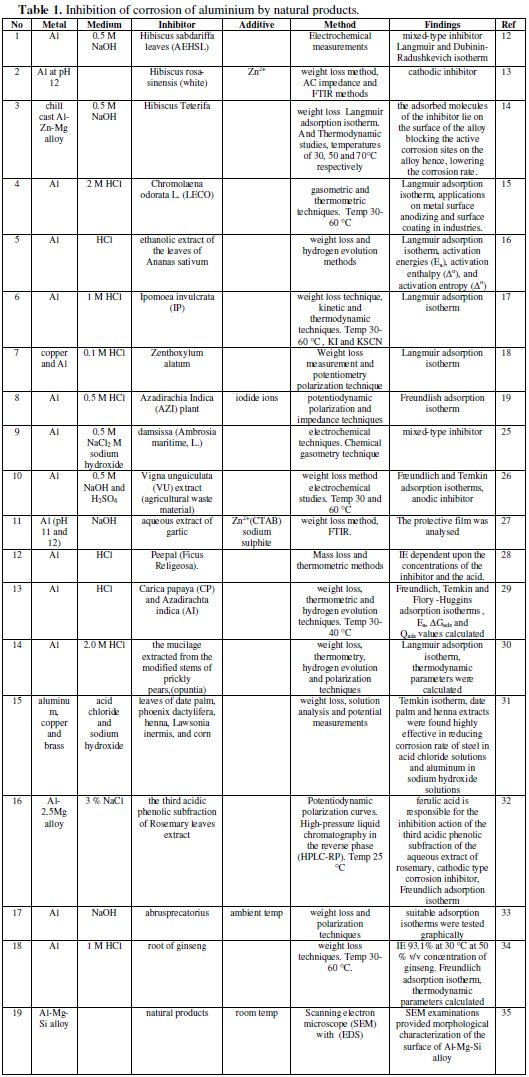
    <p>The use of natural products as corrosion inhibitors in preventing corrosion of 
aluminium, is summarized in <a href="#t1">Table 1</a>.</p>


    <p>&nbsp;</p>
<a name="t1">
<img src="/img/revistas/pea/v31n1/31n1a05t1.jpg">
    
]]></body>
<body><![CDATA[<p>&nbsp;</p>


    <p>&nbsp;</p>
    <p><b>References</b></p>

    <!-- ref --><p>1. Shakhashiri BZ. Science is Fun. 2007 Aug 28.    &nbsp;&nbsp;&nbsp;&nbsp;&nbsp;&nbsp;&nbsp;&nbsp;[&#160;<a href="javascript:void(0);" onclick="javascript: window.open('/scielo.php?script=sci_nlinks&ref=000046&pid=S0872-1904201300010000500001&lng=','','width=640,height=500,resizable=yes,scrollbars=1,menubar=yes,');">Links</a>&#160;]<!-- end-ref --></p>
    <!-- ref --><p>2. Bentor Y. Periodic Table: Aluminum. <a href="http://ChemicalElements.com" target="_blank">ChemicalElements.com</a>. 2007 Aug 11.    &nbsp;&nbsp;&nbsp;&nbsp;&nbsp;&nbsp;&nbsp;&nbsp;[&#160;<a href="javascript:void(0);" onclick="javascript: window.open('/scielo.php?script=sci_nlinks&ref=000048&pid=S0872-1904201300010000500002&lng=','','width=640,height=500,resizable=yes,scrollbars=1,menubar=yes,');">Links</a>&#160;]<!-- end-ref --></p>
    <!-- ref --><p>3. Berthier P. Today in Science History. 2007 Aug 11.    &nbsp;&nbsp;&nbsp;&nbsp;&nbsp;&nbsp;&nbsp;&nbsp;[&#160;<a href="javascript:void(0);" onclick="javascript: window.open('/scielo.php?script=sci_nlinks&ref=000050&pid=S0872-1904201300010000500003&lng=','','width=640,height=500,resizable=yes,scrollbars=1,menubar=yes,');">Links</a>&#160;]<!-- end-ref --></p>
    <!-- ref --><p>4. Deville HES-C. De l'aluminium, ses proprietes, sa fabrication. Paris; 1859.    &nbsp;&nbsp;&nbsp;&nbsp;&nbsp;&nbsp;&nbsp;&nbsp;[&#160;<a href="javascript:void(0);" onclick="javascript: window.open('/scielo.php?script=sci_nlinks&ref=000052&pid=S0872-1904201300010000500004&lng=','','width=640,height=500,resizable=yes,scrollbars=1,menubar=yes,');">Links</a>&#160;]<!-- end-ref --></p>
    <!-- ref --><p>5. Cochran JF, Mapother DE. Phys Rev. 1958;111:132.    &nbsp;&nbsp;&nbsp;&nbsp;&nbsp;&nbsp;&nbsp;&nbsp;[&#160;<a href="javascript:void(0);" onclick="javascript: window.open('/scielo.php?script=sci_nlinks&ref=000054&pid=S0872-1904201300010000500005&lng=','','width=640,height=500,resizable=yes,scrollbars=1,menubar=yes,');">Links</a>&#160;]<!-- end-ref --></p>
    <!-- ref --><p>6. Aluminium. Encyclopedia Britannica.    &nbsp;&nbsp;&nbsp;&nbsp;&nbsp;&nbsp;&nbsp;&nbsp;[&#160;<a href="javascript:void(0);" onclick="javascript: window.open('/scielo.php?script=sci_nlinks&ref=000056&pid=S0872-1904201300010000500006&lng=','','width=640,height=500,resizable=yes,scrollbars=1,menubar=yes,');">Links</a>&#160;]<!-- end-ref --></p>
    <!-- ref --><p>7. Hetherington LE, Brown TJ, Benham AJ et al. British Geological Survey; 2007.    &nbsp;&nbsp;&nbsp;&nbsp;&nbsp;&nbsp;&nbsp;&nbsp;[&#160;<a href="javascript:void(0);" onclick="javascript: window.open('/scielo.php?script=sci_nlinks&ref=000058&pid=S0872-1904201300010000500007&lng=','','width=640,height=500,resizable=yes,scrollbars=1,menubar=yes,');">Links</a>&#160;]<!-- end-ref --></p>
    <!-- ref --><p>8. Rising Chinese Costs to Support Aluminum Prices. Bloomberg News. 2009 Nov 23.    &nbsp;&nbsp;&nbsp;&nbsp;&nbsp;&nbsp;&nbsp;&nbsp;[&#160;<a href="javascript:void(0);" onclick="javascript: window.open('/scielo.php?script=sci_nlinks&ref=000060&pid=S0872-1904201300010000500008&lng=','','width=640,height=500,resizable=yes,scrollbars=1,menubar=yes,');">Links</a>&#160;]<!-- end-ref --></p>
    <!-- ref --><p>9. Millberg LS. How Products are Made. 2007 Aug 11.    &nbsp;&nbsp;&nbsp;&nbsp;&nbsp;&nbsp;&nbsp;&nbsp;[&#160;<a href="javascript:void(0);" onclick="javascript: window.open('/scielo.php?script=sci_nlinks&ref=000062&pid=S0872-1904201300010000500009&lng=','','width=640,height=500,resizable=yes,scrollbars=1,menubar=yes,');">Links</a>&#160;]<!-- end-ref --></p>
    <p>10. Reciclado del aluminio. <a href="http://www.aseral.es/recuperacion.htm" target="_blank">www.aseral.es/recuperacion.htm</a>.</p>
    <!-- ref --><p>11. Polmear IJ. Light alloys: metallurgy of the light metals. Arnold; 1995.    &nbsp;&nbsp;&nbsp;&nbsp;&nbsp;&nbsp;&nbsp;&nbsp;[&#160;<a href="javascript:void(0);" onclick="javascript: window.open('/scielo.php?script=sci_nlinks&ref=000065&pid=S0872-1904201300010000500011&lng=','','width=640,height=500,resizable=yes,scrollbars=1,menubar=yes,');">Links</a>&#160;]<!-- end-ref --></p>
    <!-- ref --><p>12. Noor EA. J Appl Electrochem. 2009;39:1465.    &nbsp;&nbsp;&nbsp;&nbsp;&nbsp;&nbsp;&nbsp;&nbsp;[&#160;<a href="javascript:void(0);" onclick="javascript: window.open('/scielo.php?script=sci_nlinks&ref=000067&pid=S0872-1904201300010000500012&lng=','','width=640,height=500,resizable=yes,scrollbars=1,menubar=yes,');">Links</a>&#160;]<!-- end-ref --></p>
    <!-- ref --><p>13. Rajendran S, Jeyasundari J, Usha P et al. Port Electrochim Acta. 2009;27:153.    &nbsp;&nbsp;&nbsp;&nbsp;&nbsp;&nbsp;&nbsp;&nbsp;[&#160;<a href="javascript:void(0);" onclick="javascript: window.open('/scielo.php?script=sci_nlinks&ref=000069&pid=S0872-1904201300010000500013&lng=','','width=640,height=500,resizable=yes,scrollbars=1,menubar=yes,');">Links</a>&#160;]<!-- end-ref --></p>
    <!-- ref --><p>14. Ayeni FA, Aigbodion VS. Eurasian Chemico-Technol J. 2007;9:91.    &nbsp;&nbsp;&nbsp;&nbsp;&nbsp;&nbsp;&nbsp;&nbsp;[&#160;<a href="javascript:void(0);" onclick="javascript: window.open('/scielo.php?script=sci_nlinks&ref=000071&pid=S0872-1904201300010000500014&lng=','','width=640,height=500,resizable=yes,scrollbars=1,menubar=yes,');">Links</a>&#160;]<!-- end-ref --></p>
    ]]></body>
<body><![CDATA[<!-- ref --><p>15. Obot IB, Obi-Egbedi NO. J Appl Electrochem. 2010;40:1977.    &nbsp;&nbsp;&nbsp;&nbsp;&nbsp;&nbsp;&nbsp;&nbsp;[&#160;<a href="javascript:void(0);" onclick="javascript: window.open('/scielo.php?script=sci_nlinks&ref=000073&pid=S0872-1904201300010000500015&lng=','','width=640,height=500,resizable=yes,scrollbars=1,menubar=yes,');">Links</a>&#160;]<!-- end-ref --></p>
    <!-- ref --><p>16. Ating EI, Umoren SA, Udousoro II et al. Green Chem Lett Rev. 2010;3:61.    &nbsp;&nbsp;&nbsp;&nbsp;&nbsp;&nbsp;&nbsp;&nbsp;[&#160;<a href="javascript:void(0);" onclick="javascript: window.open('/scielo.php?script=sci_nlinks&ref=000075&pid=S0872-1904201300010000500016&lng=','','width=640,height=500,resizable=yes,scrollbars=1,menubar=yes,');">Links</a>&#160;]<!-- end-ref --></p>
    <!-- ref --><p>17. Obot IB, Obi-Egbedi NO, Umoren SA, Ebenso EE. Int J Electrochem Sci. 2010;5:994.    &nbsp;&nbsp;&nbsp;&nbsp;&nbsp;&nbsp;&nbsp;&nbsp;[&#160;<a href="javascript:void(0);" onclick="javascript: window.open('/scielo.php?script=sci_nlinks&ref=000077&pid=S0872-1904201300010000500017&lng=','','width=640,height=500,resizable=yes,scrollbars=1,menubar=yes,');">Links</a>&#160;]<!-- end-ref --></p>
    <!-- ref --><p>18. Chauhan JS. Asian J Chem. 2009;21:1975.    &nbsp;&nbsp;&nbsp;&nbsp;&nbsp;&nbsp;&nbsp;&nbsp;[&#160;<a href="javascript:void(0);" onclick="javascript: window.open('/scielo.php?script=sci_nlinks&ref=000079&pid=S0872-1904201300010000500018&lng=','','width=640,height=500,resizable=yes,scrollbars=1,menubar=yes,');">Links</a>&#160;]<!-- end-ref --></p>
    <!-- ref --><p>19. Arab ST, Al-Turkustani AM, Al-Dhahiri RH. J Korean Chem Soc. 2008;52:281.    &nbsp;&nbsp;&nbsp;&nbsp;&nbsp;&nbsp;&nbsp;&nbsp;[&#160;<a href="javascript:void(0);" onclick="javascript: window.open('/scielo.php?script=sci_nlinks&ref=000081&pid=S0872-1904201300010000500019&lng=','','width=640,height=500,resizable=yes,scrollbars=1,menubar=yes,');">Links</a>&#160;]<!-- end-ref --></p>
    ]]></body>
<body><![CDATA[<!-- ref --><p>20. Njoku VO, Oguzie EE. Eur Corros Congress - EUROCORR. 2009;2:849.    &nbsp;&nbsp;&nbsp;&nbsp;&nbsp;&nbsp;&nbsp;&nbsp;[&#160;<a href="javascript:void(0);" onclick="javascript: window.open('/scielo.php?script=sci_nlinks&ref=000083&pid=S0872-1904201300010000500020&lng=','','width=640,height=500,resizable=yes,scrollbars=1,menubar=yes,');">Links</a>&#160;]<!-- end-ref --></p>
    <!-- ref --><p>21. Rajenderan S, Shanmugapriya S, Rajalakshmi T, Amal Raj AJ. Corrosion. 2005;61:685.    &nbsp;&nbsp;&nbsp;&nbsp;&nbsp;&nbsp;&nbsp;&nbsp;[&#160;<a href="javascript:void(0);" onclick="javascript: window.open('/scielo.php?script=sci_nlinks&ref=000085&pid=S0872-1904201300010000500021&lng=','','width=640,height=500,resizable=yes,scrollbars=1,menubar=yes,');">Links</a>&#160;]<!-- end-ref --></p>
    <!-- ref --><p>22. Kumar TE, Vishwanatham S, Udayabhanu G. Corrosion Eng Sci Tech. 2004;39:327.    &nbsp;&nbsp;&nbsp;&nbsp;&nbsp;&nbsp;&nbsp;&nbsp;[&#160;<a href="javascript:void(0);" onclick="javascript: window.open('/scielo.php?script=sci_nlinks&ref=000087&pid=S0872-1904201300010000500022&lng=','','width=640,height=500,resizable=yes,scrollbars=1,menubar=yes,');">Links</a>&#160;]<!-- end-ref --></p>
    <!-- ref --><p>23. Rajendran S, Agasta M, Bama devi R et al. Zastita Materijala. 2009;50:77.    &nbsp;&nbsp;&nbsp;&nbsp;&nbsp;&nbsp;&nbsp;&nbsp;[&#160;<a href="javascript:void(0);" onclick="javascript: window.open('/scielo.php?script=sci_nlinks&ref=000089&pid=S0872-1904201300010000500023&lng=','','width=640,height=500,resizable=yes,scrollbars=1,menubar=yes,');">Links</a>&#160;]<!-- end-ref --></p>
    <!-- ref --><p>24. Sherine HB, Nasser AJA, Rajendran S. J Electro Chem Soc India. 2009;58:30.    &nbsp;&nbsp;&nbsp;&nbsp;&nbsp;&nbsp;&nbsp;&nbsp;[&#160;<a href="javascript:void(0);" onclick="javascript: window.open('/scielo.php?script=sci_nlinks&ref=000091&pid=S0872-1904201300010000500024&lng=','','width=640,height=500,resizable=yes,scrollbars=1,menubar=yes,');">Links</a>&#160;]<!-- end-ref --></p>
    ]]></body>
<body><![CDATA[<!-- ref --><p>25. Abdel-Gaber AM, Khamis E, Abo-El Dahab H, Adeel, Sh. Mater Chem Phys. 2008;109:297.    &nbsp;&nbsp;&nbsp;&nbsp;&nbsp;&nbsp;&nbsp;&nbsp;[&#160;<a href="javascript:void(0);" onclick="javascript: window.open('/scielo.php?script=sci_nlinks&ref=000093&pid=S0872-1904201300010000500025&lng=','','width=640,height=500,resizable=yes,scrollbars=1,menubar=yes,');">Links</a>&#160;]<!-- end-ref --></p>
    <!-- ref --><p>26. Umoren SA, Obot IB, Akpabio LE, Etuk SE. Pigment Resin Tech. 2008;37:98.    &nbsp;&nbsp;&nbsp;&nbsp;&nbsp;&nbsp;&nbsp;&nbsp;[&#160;<a href="javascript:void(0);" onclick="javascript: window.open('/scielo.php?script=sci_nlinks&ref=000095&pid=S0872-1904201300010000500026&lng=','','width=640,height=500,resizable=yes,scrollbars=1,menubar=yes,');">Links</a>&#160;]<!-- end-ref --></p>
    <!-- ref --><p>27. Priya SL, Chitra A, Rajendran S, Anuradha K. Surf Eng. 2005;21:229.    &nbsp;&nbsp;&nbsp;&nbsp;&nbsp;&nbsp;&nbsp;&nbsp;[&#160;<a href="javascript:void(0);" onclick="javascript: window.open('/scielo.php?script=sci_nlinks&ref=000097&pid=S0872-1904201300010000500027&lng=','','width=640,height=500,resizable=yes,scrollbars=1,menubar=yes,');">Links</a>&#160;]<!-- end-ref --></p>
    <!-- ref --><p>28. Jain T, Chowdhary R, Arora P, Mathur SP. Bull Electrochem. 2005;21:23.    &nbsp;&nbsp;&nbsp;&nbsp;&nbsp;&nbsp;&nbsp;&nbsp;[&#160;<a href="javascript:void(0);" onclick="javascript: window.open('/scielo.php?script=sci_nlinks&ref=000099&pid=S0872-1904201300010000500028&lng=','','width=640,height=500,resizable=yes,scrollbars=1,menubar=yes,');">Links</a>&#160;]<!-- end-ref --></p>
    <!-- ref --><p>29. Ebenso EE, Ibok UJ, Ekpe UJ et al. Transactions SAEST. 2004;39:117.    &nbsp;&nbsp;&nbsp;&nbsp;&nbsp;&nbsp;&nbsp;&nbsp;[&#160;<a href="javascript:void(0);" onclick="javascript: window.open('/scielo.php?script=sci_nlinks&ref=000101&pid=S0872-1904201300010000500029&lng=','','width=640,height=500,resizable=yes,scrollbars=1,menubar=yes,');">Links</a>&#160;]<!-- end-ref --></p>
    ]]></body>
<body><![CDATA[<!-- ref --><p>30. El-Etre AY. Corrosion Sci. 2003;45:2485.    &nbsp;&nbsp;&nbsp;&nbsp;&nbsp;&nbsp;&nbsp;&nbsp;[&#160;<a href="javascript:void(0);" onclick="javascript: window.open('/scielo.php?script=sci_nlinks&ref=000103&pid=S0872-1904201300010000500030&lng=','','width=640,height=500,resizable=yes,scrollbars=1,menubar=yes,');">Links</a>&#160;]<!-- end-ref --></p>
    <!-- ref --><p>31. Rehan HH. Materialwissenschaft Werkstofftechnik. 2003;34:232.    &nbsp;&nbsp;&nbsp;&nbsp;&nbsp;&nbsp;&nbsp;&nbsp;[&#160;<a href="javascript:void(0);" onclick="javascript: window.open('/scielo.php?script=sci_nlinks&ref=000105&pid=S0872-1904201300010000500031&lng=','','width=640,height=500,resizable=yes,scrollbars=1,menubar=yes,');">Links</a>&#160;]<!-- end-ref --></p>
    <!-- ref --><p>32. Radosevic J, Kliskic M, Visekruna A. J Chem Chem Eng. 2001;50:537.    &nbsp;&nbsp;&nbsp;&nbsp;&nbsp;&nbsp;&nbsp;&nbsp;[&#160;<a href="javascript:void(0);" onclick="javascript: window.open('/scielo.php?script=sci_nlinks&ref=000107&pid=S0872-1904201300010000500032&lng=','','width=640,height=500,resizable=yes,scrollbars=1,menubar=yes,');">Links</a>&#160;]<!-- end-ref --></p>
    <!-- ref --><p>33. Rajalakshmi R, Subhashini S, Nanthini M, Srimathi M. Oriental J Chem. 2009;25:313.    &nbsp;&nbsp;&nbsp;&nbsp;&nbsp;&nbsp;&nbsp;&nbsp;[&#160;<a href="javascript:void(0);" onclick="javascript: window.open('/scielo.php?script=sci_nlinks&ref=000109&pid=S0872-1904201300010000500033&lng=','','width=640,height=500,resizable=yes,scrollbars=1,menubar=yes,');">Links</a>&#160;]<!-- end-ref --></p>
    <!-- ref --><p>34. Obot I.B, Obi-Egbedi NO. Int J Electrochem Sci. 2009;4:1277.    &nbsp;&nbsp;&nbsp;&nbsp;&nbsp;&nbsp;&nbsp;&nbsp;[&#160;<a href="javascript:void(0);" onclick="javascript: window.open('/scielo.php?script=sci_nlinks&ref=000111&pid=S0872-1904201300010000500034&lng=','','width=640,height=500,resizable=yes,scrollbars=1,menubar=yes,');">Links</a>&#160;]<!-- end-ref --></p>
    ]]></body>
<body><![CDATA[<!-- ref --><p>35. Rosliza R, Izman S. Protec Metals Phys Chem Surf. 2011;47:395.    &nbsp;&nbsp;&nbsp;&nbsp;&nbsp;&nbsp;&nbsp;&nbsp;[&#160;<a href="javascript:void(0);" onclick="javascript: window.open('/scielo.php?script=sci_nlinks&ref=000113&pid=S0872-1904201300010000500035&lng=','','width=640,height=500,resizable=yes,scrollbars=1,menubar=yes,');">Links</a>&#160;]<!-- end-ref --></p>


    <p>&nbsp;</p>
    <p><a name=0></a><sup><a href="#top">*</a></sup>Corresponding author. E-mail address: <a href="mailto:malathypush@yahoo.com">malathypush@yahoo.com</a></p>

    <p>Received 21 November 2012; accepted 20 February 2013</p>

    <p><a href="http://www.peacta.org" target="_blank">www.peacta.org</a> </p>


     ]]></body><back>
<ref-list>
<ref id="B1">
<label>1</label><nlm-citation citation-type="">
<person-group person-group-type="author">
<name>
<surname><![CDATA[Shakhashiri]]></surname>
<given-names><![CDATA[B Z]]></given-names>
</name>
</person-group>
<source><![CDATA[Science is Fun]]></source>
<year>2007</year>
<month> A</month>
<day>ug</day>
</nlm-citation>
</ref>
<ref id="B2">
<label>2</label><nlm-citation citation-type="">
<person-group person-group-type="author">
<name>
<surname><![CDATA[Bentor]]></surname>
<given-names><![CDATA[Y]]></given-names>
</name>
</person-group>
<source><![CDATA[Periodic Table: Aluminum]]></source>
<year>2007</year>
<month> A</month>
<day>ug</day>
</nlm-citation>
</ref>
<ref id="B3">
<label>3</label><nlm-citation citation-type="journal">
<person-group person-group-type="author">
<name>
<surname><![CDATA[Berthier]]></surname>
<given-names><![CDATA[P]]></given-names>
</name>
</person-group>
<source><![CDATA[Today in Science History]]></source>
<year>2007</year>
<month> A</month>
<day>ug</day>
</nlm-citation>
</ref>
<ref id="B4">
<label>4</label><nlm-citation citation-type="">
<person-group person-group-type="author">
<name>
<surname><![CDATA[Deville]]></surname>
<given-names><![CDATA[H E S-C]]></given-names>
</name>
</person-group>
<source><![CDATA[De l'aluminium, ses proprietes, sa fabrication]]></source>
<year>1859</year>
<publisher-loc><![CDATA[Paris ]]></publisher-loc>
</nlm-citation>
</ref>
<ref id="B5">
<label>5</label><nlm-citation citation-type="journal">
<person-group person-group-type="author">
<name>
<surname><![CDATA[Cochran]]></surname>
<given-names><![CDATA[J F]]></given-names>
</name>
<name>
<surname><![CDATA[Mapother]]></surname>
<given-names><![CDATA[D E]]></given-names>
</name>
</person-group>
<source><![CDATA[Phys Rev]]></source>
<year>1958</year>
<volume>111</volume>
<page-range>132</page-range></nlm-citation>
</ref>
<ref id="B6">
<label>6</label><nlm-citation citation-type="">
<source><![CDATA[Aluminium]]></source>
<year></year>
</nlm-citation>
</ref>
<ref id="B7">
<label>7</label><nlm-citation citation-type="journal">
<person-group person-group-type="author">
<name>
<surname><![CDATA[Hetherington]]></surname>
<given-names><![CDATA[L E]]></given-names>
</name>
<name>
<surname><![CDATA[Brown]]></surname>
<given-names><![CDATA[T J]]></given-names>
</name>
<name>
<surname><![CDATA[Benham]]></surname>
<given-names><![CDATA[A J]]></given-names>
</name>
</person-group>
<source><![CDATA[British Geological Survey]]></source>
<year>2007</year>
</nlm-citation>
</ref>
<ref id="B8">
<label>8</label><nlm-citation citation-type="">
<source><![CDATA[Rising Chinese Costs to Support Aluminum Prices]]></source>
<year>2009</year>
<month> N</month>
<day>ov</day>
</nlm-citation>
</ref>
<ref id="B9">
<label>9</label><nlm-citation citation-type="journal">
<person-group person-group-type="author">
<name>
<surname><![CDATA[Millberg]]></surname>
<given-names><![CDATA[L S]]></given-names>
</name>
</person-group>
<source><![CDATA[How Products are Made]]></source>
<year>2007</year>
<month> A</month>
<day>ug</day>
</nlm-citation>
</ref>
<ref id="B10">
<label>10</label><nlm-citation citation-type="">
<source><![CDATA[Reciclado del aluminio]]></source>
<year></year>
</nlm-citation>
</ref>
<ref id="B11">
<label>11</label><nlm-citation citation-type="book">
<person-group person-group-type="author">
<name>
<surname><![CDATA[Polmear]]></surname>
<given-names><![CDATA[I J]]></given-names>
</name>
</person-group>
<source><![CDATA[Light alloys: metallurgy of the light metals]]></source>
<year>1995</year>
<publisher-name><![CDATA[Arnold]]></publisher-name>
</nlm-citation>
</ref>
<ref id="B12">
<label>12</label><nlm-citation citation-type="journal">
<person-group person-group-type="author">
<name>
<surname><![CDATA[Noor]]></surname>
<given-names><![CDATA[E A]]></given-names>
</name>
</person-group>
<source><![CDATA[J Appl Electrochem]]></source>
<year>2009</year>
<volume>39</volume>
<page-range>1465</page-range></nlm-citation>
</ref>
<ref id="B13">
<label>13</label><nlm-citation citation-type="journal">
<person-group person-group-type="author">
<name>
<surname><![CDATA[Rajendran]]></surname>
<given-names><![CDATA[S]]></given-names>
</name>
<name>
<surname><![CDATA[Jeyasundari]]></surname>
<given-names><![CDATA[J]]></given-names>
</name>
<name>
<surname><![CDATA[Usha]]></surname>
<given-names><![CDATA[P]]></given-names>
</name>
</person-group>
<source><![CDATA[Port Electrochim Acta]]></source>
<year>2009</year>
<volume>27</volume>
<page-range>153</page-range></nlm-citation>
</ref>
<ref id="B14">
<label>14</label><nlm-citation citation-type="journal">
<person-group person-group-type="author">
<name>
<surname><![CDATA[Ayeni]]></surname>
<given-names><![CDATA[F A]]></given-names>
</name>
<name>
<surname><![CDATA[Aigbodion]]></surname>
<given-names><![CDATA[V S]]></given-names>
</name>
</person-group>
<source><![CDATA[Eurasian Chemico-Technol J]]></source>
<year>2007</year>
<volume>9</volume>
<page-range>91</page-range></nlm-citation>
</ref>
<ref id="B15">
<label>15</label><nlm-citation citation-type="journal">
<person-group person-group-type="author">
<name>
<surname><![CDATA[Obot]]></surname>
<given-names><![CDATA[I B]]></given-names>
</name>
<name>
<surname><![CDATA[Obi-Egbedi]]></surname>
<given-names><![CDATA[N O]]></given-names>
</name>
</person-group>
<source><![CDATA[J Appl Electrochem]]></source>
<year>2010</year>
<volume>40</volume>
<page-range>1977</page-range></nlm-citation>
</ref>
<ref id="B16">
<label>16</label><nlm-citation citation-type="journal">
<person-group person-group-type="author">
<name>
<surname><![CDATA[Ating]]></surname>
<given-names><![CDATA[E I]]></given-names>
</name>
<name>
<surname><![CDATA[Umoren]]></surname>
<given-names><![CDATA[S A]]></given-names>
</name>
<name>
<surname><![CDATA[Udousoro]]></surname>
<given-names><![CDATA[I I]]></given-names>
</name>
</person-group>
<source><![CDATA[Green Chem Lett Rev]]></source>
<year>2010</year>
<volume>3</volume>
<page-range>61</page-range></nlm-citation>
</ref>
<ref id="B17">
<label>17</label><nlm-citation citation-type="journal">
<person-group person-group-type="author">
<name>
<surname><![CDATA[Obot]]></surname>
<given-names><![CDATA[I B]]></given-names>
</name>
<name>
<surname><![CDATA[Obi-Egbedi]]></surname>
<given-names><![CDATA[N O]]></given-names>
</name>
<name>
<surname><![CDATA[Umoren]]></surname>
<given-names><![CDATA[S A]]></given-names>
</name>
<name>
<surname><![CDATA[Ebenso]]></surname>
<given-names><![CDATA[E E]]></given-names>
</name>
</person-group>
<source><![CDATA[Int J Electrochem Sci]]></source>
<year>2010</year>
<volume>5</volume>
<page-range>994</page-range></nlm-citation>
</ref>
<ref id="B18">
<label>18</label><nlm-citation citation-type="journal">
<person-group person-group-type="author">
<name>
<surname><![CDATA[Chauhan]]></surname>
<given-names><![CDATA[J S]]></given-names>
</name>
</person-group>
<source><![CDATA[Asian J Chem]]></source>
<year>2009</year>
<volume>21</volume>
<page-range>1975</page-range></nlm-citation>
</ref>
<ref id="B19">
<label>19</label><nlm-citation citation-type="journal">
<person-group person-group-type="author">
<name>
<surname><![CDATA[Arab]]></surname>
<given-names><![CDATA[S T]]></given-names>
</name>
<name>
<surname><![CDATA[Al-Turkustani]]></surname>
<given-names><![CDATA[A M]]></given-names>
</name>
<name>
<surname><![CDATA[Al-Dhahiri]]></surname>
<given-names><![CDATA[R H]]></given-names>
</name>
</person-group>
<source><![CDATA[J Korean Chem Soc]]></source>
<year>2008</year>
<volume>52</volume>
<page-range>281</page-range></nlm-citation>
</ref>
<ref id="B20">
<label>20</label><nlm-citation citation-type="">
<person-group person-group-type="author">
<name>
<surname><![CDATA[Njoku]]></surname>
<given-names><![CDATA[V O]]></given-names>
</name>
<name>
<surname><![CDATA[Oguzie]]></surname>
<given-names><![CDATA[E E]]></given-names>
</name>
</person-group>
<source><![CDATA[Eur Corros Congress - EUROCORR]]></source>
<year>2009</year>
<volume>2</volume>
<page-range>849</page-range></nlm-citation>
</ref>
<ref id="B21">
<label>21</label><nlm-citation citation-type="journal">
<person-group person-group-type="author">
<name>
<surname><![CDATA[Rajenderan]]></surname>
<given-names><![CDATA[S]]></given-names>
</name>
<name>
<surname><![CDATA[Shanmugapriya]]></surname>
<given-names><![CDATA[S]]></given-names>
</name>
<name>
<surname><![CDATA[Rajalakshmi]]></surname>
<given-names><![CDATA[T]]></given-names>
</name>
<name>
<surname><![CDATA[Amal Raj]]></surname>
<given-names><![CDATA[A J]]></given-names>
</name>
</person-group>
<source><![CDATA[Corrosion]]></source>
<year>2005</year>
<volume>61</volume>
<page-range>685</page-range></nlm-citation>
</ref>
<ref id="B22">
<label>22</label><nlm-citation citation-type="journal">
<person-group person-group-type="author">
<name>
<surname><![CDATA[Kumar]]></surname>
<given-names><![CDATA[T E]]></given-names>
</name>
<name>
<surname><![CDATA[Vishwanatham]]></surname>
<given-names><![CDATA[S]]></given-names>
</name>
<name>
<surname><![CDATA[Udayabhanu]]></surname>
<given-names><![CDATA[G]]></given-names>
</name>
</person-group>
<source><![CDATA[Corrosion Eng Sci Tech]]></source>
<year>2004</year>
<volume>39</volume>
<page-range>327</page-range></nlm-citation>
</ref>
<ref id="B23">
<label>23</label><nlm-citation citation-type="journal">
<person-group person-group-type="author">
<name>
<surname><![CDATA[Rajendran]]></surname>
<given-names><![CDATA[S]]></given-names>
</name>
<name>
<surname><![CDATA[Agasta]]></surname>
<given-names><![CDATA[M]]></given-names>
</name>
<name>
<surname><![CDATA[Bama Devi]]></surname>
<given-names><![CDATA[R]]></given-names>
</name>
</person-group>
<source><![CDATA[Zastita Materijala]]></source>
<year>2009</year>
<volume>50</volume>
<page-range>77</page-range></nlm-citation>
</ref>
<ref id="B24">
<label>24</label><nlm-citation citation-type="journal">
<person-group person-group-type="author">
<name>
<surname><![CDATA[Sherine]]></surname>
<given-names><![CDATA[H B]]></given-names>
</name>
<name>
<surname><![CDATA[Nasser]]></surname>
<given-names><![CDATA[A J A]]></given-names>
</name>
<name>
<surname><![CDATA[Rajendran]]></surname>
<given-names><![CDATA[S]]></given-names>
</name>
</person-group>
<source><![CDATA[J Electro Chem Soc India]]></source>
<year>2009</year>
<volume>58</volume>
<page-range>30</page-range></nlm-citation>
</ref>
<ref id="B25">
<label>25</label><nlm-citation citation-type="journal">
<person-group person-group-type="author">
<name>
<surname><![CDATA[Abdel-Gaber]]></surname>
<given-names><![CDATA[A M]]></given-names>
</name>
<name>
<surname><![CDATA[Khamis]]></surname>
<given-names><![CDATA[E]]></given-names>
</name>
<name>
<surname><![CDATA[Abo-El Dahab]]></surname>
<given-names><![CDATA[H]]></given-names>
</name>
<name>
<surname><![CDATA[Adeel]]></surname>
<given-names><![CDATA[S H]]></given-names>
</name>
</person-group>
<source><![CDATA[Mater Chem Phys]]></source>
<year>2008</year>
<volume>109</volume>
<page-range>297</page-range></nlm-citation>
</ref>
<ref id="B26">
<label>26</label><nlm-citation citation-type="journal">
<person-group person-group-type="author">
<name>
<surname><![CDATA[Umoren]]></surname>
<given-names><![CDATA[S A]]></given-names>
</name>
<name>
<surname><![CDATA[Obot]]></surname>
<given-names><![CDATA[I B]]></given-names>
</name>
<name>
<surname><![CDATA[Akpabio]]></surname>
<given-names><![CDATA[L E]]></given-names>
</name>
<name>
<surname><![CDATA[Etuk]]></surname>
<given-names><![CDATA[S E]]></given-names>
</name>
</person-group>
<source><![CDATA[Pigment Resin Tech]]></source>
<year>2008</year>
<volume>37</volume>
<page-range>98</page-range></nlm-citation>
</ref>
<ref id="B27">
<label>27</label><nlm-citation citation-type="journal">
<person-group person-group-type="author">
<name>
<surname><![CDATA[Priya]]></surname>
<given-names><![CDATA[S L]]></given-names>
</name>
<name>
<surname><![CDATA[Chitra]]></surname>
<given-names><![CDATA[A]]></given-names>
</name>
<name>
<surname><![CDATA[Rajendran]]></surname>
<given-names><![CDATA[S]]></given-names>
</name>
<name>
<surname><![CDATA[Anuradha]]></surname>
<given-names><![CDATA[K]]></given-names>
</name>
</person-group>
<source><![CDATA[Surf Eng]]></source>
<year>2005</year>
<volume>21</volume>
<page-range>229</page-range></nlm-citation>
</ref>
<ref id="B28">
<label>28</label><nlm-citation citation-type="journal">
<person-group person-group-type="author">
<name>
<surname><![CDATA[Jain]]></surname>
<given-names><![CDATA[T]]></given-names>
</name>
<name>
<surname><![CDATA[Chowdhary]]></surname>
<given-names><![CDATA[R]]></given-names>
</name>
<name>
<surname><![CDATA[Arora]]></surname>
<given-names><![CDATA[P]]></given-names>
</name>
<name>
<surname><![CDATA[Mathur]]></surname>
<given-names><![CDATA[S P]]></given-names>
</name>
</person-group>
<source><![CDATA[Bull Electrochem]]></source>
<year>2005</year>
<volume>21</volume>
<page-range>23</page-range></nlm-citation>
</ref>
<ref id="B29">
<label>29</label><nlm-citation citation-type="journal">
<person-group person-group-type="author">
<name>
<surname><![CDATA[Ebenso]]></surname>
<given-names><![CDATA[E E]]></given-names>
</name>
<name>
<surname><![CDATA[Ibok]]></surname>
<given-names><![CDATA[U J]]></given-names>
</name>
<name>
<surname><![CDATA[Ekpe]]></surname>
<given-names><![CDATA[U J]]></given-names>
</name>
</person-group>
<source><![CDATA[Transactions SAEST]]></source>
<year>2004</year>
<volume>39</volume>
<page-range>117</page-range></nlm-citation>
</ref>
<ref id="B30">
<label>30</label><nlm-citation citation-type="journal">
<person-group person-group-type="author">
<name>
<surname><![CDATA[El-Etre]]></surname>
<given-names><![CDATA[A Y]]></given-names>
</name>
</person-group>
<source><![CDATA[Corrosion Sci]]></source>
<year>2003</year>
<volume>45</volume>
<page-range>2485</page-range></nlm-citation>
</ref>
<ref id="B31">
<label>31</label><nlm-citation citation-type="journal">
<person-group person-group-type="author">
<name>
<surname><![CDATA[Rehan]]></surname>
<given-names><![CDATA[H H]]></given-names>
</name>
</person-group>
<source><![CDATA[Materialwissenschaft Werkstofftechnik]]></source>
<year>2003</year>
<volume>34</volume>
<page-range>232</page-range></nlm-citation>
</ref>
<ref id="B32">
<label>32</label><nlm-citation citation-type="journal">
<person-group person-group-type="author">
<name>
<surname><![CDATA[J]]></surname>
<given-names><![CDATA[Radosevic]]></given-names>
</name>
<name>
<surname><![CDATA[Kliskic]]></surname>
<given-names><![CDATA[M]]></given-names>
</name>
<name>
<surname><![CDATA[Visekruna]]></surname>
<given-names><![CDATA[A]]></given-names>
</name>
</person-group>
<source><![CDATA[J Chem Chem Eng]]></source>
<year>2001</year>
<volume>50</volume>
<page-range>537</page-range></nlm-citation>
</ref>
<ref id="B33">
<label>33</label><nlm-citation citation-type="journal">
<person-group person-group-type="author">
<name>
<surname><![CDATA[Rajalakshmi]]></surname>
<given-names><![CDATA[R]]></given-names>
</name>
<name>
<surname><![CDATA[Subhashini]]></surname>
<given-names><![CDATA[S]]></given-names>
</name>
<name>
<surname><![CDATA[Nanthini]]></surname>
<given-names><![CDATA[M]]></given-names>
</name>
<name>
<surname><![CDATA[Srimathi]]></surname>
<given-names><![CDATA[M]]></given-names>
</name>
</person-group>
<source><![CDATA[Oriental J Chem]]></source>
<year>2009</year>
<volume>25</volume>
<page-range>313</page-range></nlm-citation>
</ref>
<ref id="B34">
<label>34</label><nlm-citation citation-type="journal">
<person-group person-group-type="author">
<name>
<surname><![CDATA[Obot]]></surname>
<given-names><![CDATA[I B]]></given-names>
</name>
<name>
<surname><![CDATA[Obi-Egbedi]]></surname>
<given-names><![CDATA[N O]]></given-names>
</name>
</person-group>
<source><![CDATA[Int J Electrochem Sci]]></source>
<year>2009</year>
<volume>4</volume>
<page-range>1277</page-range></nlm-citation>
</ref>
<ref id="B35">
<label>35</label><nlm-citation citation-type="journal">
<person-group person-group-type="author">
<name>
<surname><![CDATA[Rosliza]]></surname>
<given-names><![CDATA[R]]></given-names>
</name>
<name>
<surname><![CDATA[Izman]]></surname>
<given-names><![CDATA[S]]></given-names>
</name>
</person-group>
<source><![CDATA[Protec Metals Phys Chem Surf]]></source>
<year>2011</year>
<volume>47</volume>
<page-range>395</page-range></nlm-citation>
</ref>
</ref-list>
</back>
</article>