<?xml version="1.0" encoding="ISO-8859-1"?><article xmlns:mml="http://www.w3.org/1998/Math/MathML" xmlns:xlink="http://www.w3.org/1999/xlink" xmlns:xsi="http://www.w3.org/2001/XMLSchema-instance">
<front>
<journal-meta>
<journal-id>0872-1904</journal-id>
<journal-title><![CDATA[Portugaliae Electrochimica Acta]]></journal-title>
<abbrev-journal-title><![CDATA[Port. Electrochim. Acta]]></abbrev-journal-title>
<issn>0872-1904</issn>
<publisher>
<publisher-name><![CDATA[Sociedade Portuguesa de Electroquímica]]></publisher-name>
</publisher>
</journal-meta>
<article-meta>
<article-id>S0872-19042013000200001</article-id>
<article-id pub-id-type="doi">10.4152/pea.201302053</article-id>
<title-group>
<article-title xml:lang="en"><![CDATA[Thermodynamic Study and Characterization by Electrochemical Technique of Pyrazole Derivatives as Corrosion Inhibitors for C38 Steel in Molar Hydrochloric Acid]]></article-title>
</title-group>
<contrib-group>
<contrib contrib-type="author">
<name>
<surname><![CDATA[El Ouali]]></surname>
<given-names><![CDATA[I.]]></given-names>
</name>
<xref ref-type="aff" rid="A01"/>
</contrib>
<contrib contrib-type="author">
<name>
<surname><![CDATA[Chetouani]]></surname>
<given-names><![CDATA[A.]]></given-names>
</name>
<xref ref-type="aff" rid="A02"/>
</contrib>
<contrib contrib-type="author">
<name>
<surname><![CDATA[Hammouti]]></surname>
<given-names><![CDATA[B.]]></given-names>
</name>
<xref ref-type="aff" rid="A01"/>
</contrib>
<contrib contrib-type="author">
<name>
<surname><![CDATA[Aouniti]]></surname>
<given-names><![CDATA[A.]]></given-names>
</name>
<xref ref-type="aff" rid="A01"/>
</contrib>
<contrib contrib-type="author">
<name>
<surname><![CDATA[Touzani]]></surname>
<given-names><![CDATA[R.]]></given-names>
</name>
<xref ref-type="aff" rid="A03"/>
</contrib>
<contrib contrib-type="author">
<name>
<surname><![CDATA[El Kadiria]]></surname>
<given-names><![CDATA[S.]]></given-names>
</name>
<xref ref-type="aff" rid="A01"/>
</contrib>
<contrib contrib-type="author">
<name>
<surname><![CDATA[Nlated]]></surname>
<given-names><![CDATA[S.]]></given-names>
</name>
<xref ref-type="aff" rid="A04"/>
</contrib>
</contrib-group>
<aff id="A01">
<institution><![CDATA[,Université Mohammed Premier Faculté des Sciences LCAE-URAC18]]></institution>
<addr-line><![CDATA[Oujda ]]></addr-line>
<country>Morocco</country>
</aff>
<aff id="A02">
<institution><![CDATA[,Centre Régionale des Métiers de l'Education et de Formation CRMEF, de la Régionale Orientale Laboratoire de Chimie Physique ]]></institution>
<addr-line><![CDATA[ ]]></addr-line>
<country>Morocco</country>
</aff>
<aff id="A03">
<institution><![CDATA[,Faculté Pluridisciplinaire Nador-Maroc Faculté des Sciences ]]></institution>
<addr-line><![CDATA[Oujda ]]></addr-line>
<country>Maroc</country>
</aff>
<aff id="A04">
<institution><![CDATA[,Université Bordeaux Institut des Sciences Moléculaires ]]></institution>
<addr-line><![CDATA[ ]]></addr-line>
<country>France</country>
</aff>
<pub-date pub-type="pub">
<day>00</day>
<month>03</month>
<year>2013</year>
</pub-date>
<pub-date pub-type="epub">
<day>00</day>
<month>03</month>
<year>2013</year>
</pub-date>
<volume>31</volume>
<numero>2</numero>
<fpage>53</fpage>
<lpage>78</lpage>
<copyright-statement/>
<copyright-year/>
<self-uri xlink:href="http://scielo.pt/scielo.php?script=sci_arttext&amp;pid=S0872-19042013000200001&amp;lng=en&amp;nrm=iso"></self-uri><self-uri xlink:href="http://scielo.pt/scielo.php?script=sci_abstract&amp;pid=S0872-19042013000200001&amp;lng=en&amp;nrm=iso"></self-uri><self-uri xlink:href="http://scielo.pt/scielo.php?script=sci_pdf&amp;pid=S0872-19042013000200001&amp;lng=en&amp;nrm=iso"></self-uri><abstract abstract-type="short" xml:lang="en"><p><![CDATA[The effect of synthesized 1,1'-propane-1,3-diylbis &#91;3-(chloromethyl)-5-methyl-1Hpyrazole&#93;, dimethyl 1,1'-butane-1,4-diylbis(5-methyl-1H-pyrazole-3-carboxylate) and 1,1'-butane-1,4-diylbis &#91;3-(chloromethyl)-5-methyl-1H-pyrazole&#93; on corrosion of C38 steel in hydrochloric acid solution has been investigated in the temperature range from 298 K to 328 K by weight loss, potentiodynamic polarization method and modelled with an equivalent electric circuit. All the compounds exhibited more than 90% anticorrosion activity, the highest is 96 % by 1,1'-butane-1,4-diylbis &#91;3-(chloromethyl)5- methyl-1H-pyrazole&#93;, and it has been shown that the inhibition efficiencies increased with the concentration of the inhibitors, remaining almost constant in a wide temperature range. Potentiodynamic polarization studies suggested that it is a predominance cathodic type. Nyquist plots showed depressed semicircles with their centre below the real axis. The adsorption on the C38 steel surface followed the Langmuir adsorption isotherm. The thermodynamic parameters for dissolution were investigated at different concentrations and temperature. The theoretical study by modelling the molecules of these inhibitors has been performed by considering the Density Functional Theory (DFT) using the Gaussian 03W suite of programs that can calculate the different quantum parameters such as E HOMO, E LUMO, &#916; E HOMO, E LUMO, and &#956; dipolar moment, allowing us to confirm the results found by the gravimetric and electrochemical methods.]]></p></abstract>
<kwd-group>
<kwd lng="en"><![CDATA[pyrazole]]></kwd>
<kwd lng="en"><![CDATA[impedance spectroscopy]]></kwd>
<kwd lng="en"><![CDATA[C38 steel]]></kwd>
<kwd lng="en"><![CDATA[corrosion]]></kwd>
<kwd lng="en"><![CDATA[equivalent electric circuit]]></kwd>
<kwd lng="en"><![CDATA[potentiodynamic polarization]]></kwd>
<kwd lng="en"><![CDATA[quantum theory]]></kwd>
</kwd-group>
</article-meta>
</front><body><![CDATA[ 

    <p><b>Thermodynamic Study and Characterization by Electrochemical Technique of Pyrazole Derivatives as 
Corrosion Inhibitors for C38 Steel in Molar Hydrochloric Acid</b></p>

    <p><b>I. El Ouali<sup>1</sup>, A. Chetouani<sup>1,2,<a href="#0">*<a/></sup>, B. Hammouti<sup>1</sup>, A. Aouniti<sup>1</sup>
, R. Touzani<sup>1,3</sup>, S. El Kadiria<sup>1</sup> and S. Nlated<sup>4</sup></b></p>

    <p><sup>1</sup><i> LCAE-URAC18, Facult&eacute; des Sciences, Universit&eacute; Mohammed Premier; BP.717, 60 000, Oujda Morocco</i></p>

    <p><sup>2</sup><i> Laboratoire de Chimie Physique, Centre R&eacute;gionale des M&eacute;tiers de l'Education et de Formation CRMEF, de la R&eacute;gionale Orientale, Morocco</i></p>

    <p><sup>3</sup><i> Facult&eacute; Pluridisciplinaire Nador-Maroc. Facult&eacute; des Sciences, Oujda-Maroc</i></p>

    <p><sup>4</sup><i> Institut des Sciences Mol&eacute;culaires, Universit&eacute; Bordeaux1-(UMR 5255 CNRS)-France</i></p>


<!--     <p>&nbsp;</p>
    <p>doi: 10.4152/pea.201302053</p> -->


    <p>&nbsp;</p>
    ]]></body>
<body><![CDATA[<p><b>Abstract</b></p>

    <p>The effect of synthesized 1,1'-propane-1,3-diylbis[3-(chloromethyl)-5-methyl-1Hpyrazole], 
dimethyl 1,1'-butane-1,4-diylbis(5-methyl-1H-pyrazole-3-carboxylate) and 
1,1'-butane-1,4-diylbis[3-(chloromethyl)-5-methyl-1H-pyrazole] on corrosion of C38 
steel in hydrochloric acid solution has been investigated in the temperature range from 
298 K to 328 K by weight loss, potentiodynamic polarization method and modelled 
with an equivalent electric circuit. All the compounds exhibited more than 90% 
anticorrosion activity, the highest is 96 % by 1,1'-butane-1,4-diylbis[3-(chloromethyl)5-
methyl-1H-pyrazole], and it has been shown that the inhibition efficiencies increased 
with the concentration of the inhibitors, remaining almost constant in a wide 
temperature range. Potentiodynamic polarization studies suggested that it is a 
predominance cathodic type. Nyquist plots showed depressed semicircles with their 
centre below the real axis. The adsorption on the C38 steel surface followed the 
Langmuir adsorption isotherm. The thermodynamic parameters for dissolution were 
investigated at different concentrations and temperature. The theoretical study by 
modelling the molecules of these inhibitors has been performed by considering the 
Density Functional Theory (DFT) using the Gaussian 03W suite of programs that can 
calculate the different quantum parameters such as E<sub>HOMO</sub>, E<sub>LUMO</sub>, &Delta; 
E<sub>HOMO</sub>, E<sub>LUMO</sub>, and &mu; dipolar moment, allowing us to confirm the results found by the gravimetric and 
electrochemical methods.</p>

    <p><b><i>Keywords:</i></b> pyrazole, impedance spectroscopy, C38 steel, corrosion, equivalent electric 
circuit, potentiodynamic polarization, quantum theory.</p>


    <p>&nbsp;</p>
    <p><b>Introduction</b></p>

    <p>Hydrochloric acid solutions are widely used for the pickling, cleaning, descaling 
and etching of mild steel [1-5]. Steel is widely used in various industries as 
structural materials. Its exposure to aggressive environments like concentrated 
acids, alkalis, salt solutions, etc., leads to its degradation. Inhibitors are often 
used to prevent metal dissolution as well as acid consumption [6-9].</p>

    <p>Considerable quantities of corrosion loss of steel occurs in acid medium and 
inhibitors for carbon steel corrosion find importance among other corrosive 
media. Acid inhibitors have wide applications in the industrial field as a 
component in pre-treatment composition, in cleaning solution for industrial 
equipment and in acidulations of oil wells and in petrochemical plants.</p>

    <p>The effect of organic compounds on the corrosion behaviour of metallic 
materials in aggressive solutions has been well documented 1,3-5,10-15]. It was 
found that the organic compounds are effective corrosion inhibitors due to their 
ability to form an adsorbed film on the metal surface. The efficiency of these 
organic corrosion inhibitors is related to the presence of polar functions with S, O 
or N atoms in the molecule, heterocyclic groups and &pi;-electrons [16-18].</p>

    <p>At the majority of cases of these bipyrazolic compounds the mechanism action of 
inhibitors is of great importance and depends on their formulation as well as on 
their rational use in various environments. The electronic characteristic of the 
adsorbate molecules, the solution chemical composition, the nature of metallic 
surface, the temperature of the reaction, the immersion time and the 
electrochemical potential at the metal-solution interface determine the adsorption 
degree and hence the inhibition efficiency [7-9,17,19-22].</p>

    <p>The corrosion inhibitors of steel are generally heterocyclic compounds. Some of 
these compounds have been synthesized for industrial, biological, and medicinal 
aims. Moreover, many N-heterocyclic compounds have been proved to be 
effective inhibitors in hydrochloric acid. Indeed, several triazoles [23-27], 
pyrazoles [3,4,8,9,20,28], imidazoles [29,30], pyridazines [16,18,31], etc., have 
been among the best known and the most studied inhibitors. Notwithstanding 
several structural similarities with some of the above mentioned compounds, the 
tetrazol [32,33] and indoline derivatives [34-37] have been scarcely studied as 
steel corrosion inhibitors.</p>

    ]]></body>
<body><![CDATA[<p>The use of bipyrazolic compounds and their derivatives as good inhibitors can be 
explained by the presence of atoms of nitrogen and oxygen in the molecule. 
These had a major effect on the inhibition efficiencies and consequently on the 
adsorption phenomenon on the metal surface, in addition to their large molecular 
surface which induces a widespread covering of the surface of the metal [7-9,1618,21,22,38-
43].</p>

    <p>Other work in our laboratory, realized a correlation between experimental 
efficiencies of inhibitors and the results of quantum chemical calculations, and 
constructed a composite index of some of the key quantum chemical parameters 
in order to characterize the inhibition performance of the tested molecules. The 
quantum calculations tend to correlate the effect of structural parameters of 
substituted pyrazolic compounds to their inhibition efficiencies of corrosion of 
steel in HCl solution. Molecular orbital calculations are performed looking for 
good theoretical parameters to characterize the inhibition property of the 
inhibitors, which will be helpful to gain insight into the mechanism of corrosion 
inhibition and then to simulate the adsorption mode of the inhibitor on the metal 
surface. Also, from the calculations we will try to explain which adsorption site 
is favoured to bind to the metal surface.</p>

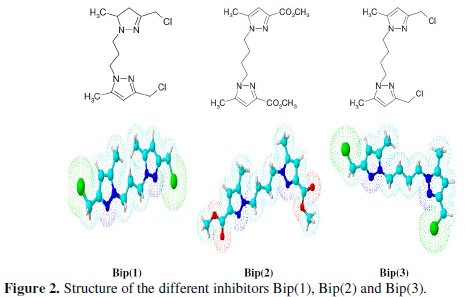
    <p>The objective of the present work is to study the inhibitive action of 1,1'propane-
1,3-diylbis[3-(chloromethyl)-5-methyl-1H-pyrazole] Bip(1), dimethyl 
1,1'-butane-1,4-diylbis(5-methyl-1H-pyrazole-3-carboxylate) Bip(2) and 1,1'butane-
1,4-diylbis[3-(chloromethyl)-5-methyl-1H-pyrazole] Bip(3) toward the 
corrosion of C38 steel in 1 M hydrochloric acid solution. Weight loss, 
potentiodynamic polarization method and modelling with an equivalent electric 
circuit were used to evaluate the inhibition efficiency of Bip (1), Bip (2) and Bip 
(3). The efficiencies of corrosion inhibitors and the global chemical reactivity 
related to some parameters, such as highest occupied molecular orbital energy 
(E<sub>HOMO</sub>), lowest unoccupied molecular orbital energy (E<sub>LUMO</sub>) and energy gap 
(&Delta;E), were calculated. All the calculations have been performed by considering 
the Density Functional Theory (DFT) using the GAUSSIAN03W suite of 
programs.</p>


    <p>&nbsp;</p>
    <p><b>Experimental</b></p>

    <p><b><i>Inhibitors</i></b></p>

    <p>The compounds 1,1'-propane-1,3-diylbis[3-(chloromethyl)-5-methyl-1Hpyrazole] 
Bip(1), dimethyl 1,1'-butane-1,4-diylbis(5-methyl-1H-pyrazole-3carboxylate) 
Bip(2) and 1,1'-butane-1,4-diylbis[3-(chloromethyl)-5-methyl-1Hpyrazole] 
Bip(3), tested as corrosion inhibitors, characterised by NMR and IR 
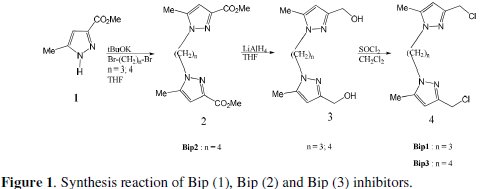
techniques, are prepared according to the literature procedure involving three 
steps starting from the (5-Methyl-1H-pyrazole-3-carboxylic acid methyl ester) as 
starting material (<a href="#f1">Fig. 1</a>).</p>


    <p>&nbsp;</p>
<a name="f1">
<img src="/img/revistas/pea/v31n2/31n2a01f1.jpg">
    
<p>&nbsp;</p>

    <p>This figure shows the operative method of synthesis: using 3-methoxycarbonyl5-
methyl pyrazole (1) as precursor, 1,3-bis(3'-methoxy-carbonyl-5'-methyl-1'pyrazolyl) 
propane (2) was prepared in THF in the presence of t-BuOK by 
alkylation with 1,3-dibromopropane. The corresponding dialcohol (3) was 
obtained by a reduction of (2) with LiAlH according to the literature procedure 
[44]. Chlorination was accomplished by dissolving the dialcohol (3) in 
SOCl<sub>2</sub> and stirring the solution overnight at room temperature to give the 
dichlorinated derivative (4) in almost quantitative yield. The reactions are shown 
in the <a href="#f1">Fig. 1</a> and the molecular formula of the inhibitors is shown in <a href="#f2">Fig. 2</a>.</p>


    ]]></body>
<body><![CDATA[<p>&nbsp;</p>
<a name="f2">
<img src="/img/revistas/pea/v31n2/31n2a01f2.jpg">
    
<p>&nbsp;</p>


    <p><b><i>Weight loss measurements</i></b></p>

    <p>The solution 1 M HCl was prepared by dilution of 37% HCl analytical grade 
with double distilled water. The test solutions have been freshly prepared before 
each experiment by adding the oil directly to the corrosive solution. Each test run 
after de-aerated by bubbling nitrogen. Gas bubbling is maintained prior and 
through the experiments. Experiments were carried out in triplicate to ensure the 
reproducibility. Coupons used for weight loss measurements were cut into (2 &times; 2 
&times; 0.08) cm<sup>3</sup> dimensions, being the composition of C38 steel given in <a href="#t1">Table 1</a>.</p>


    <p>&nbsp;</p>
<a name="t1">
<img src="/img/revistas/pea/v31n2/31n2a01t1.jpg">
    
<p>&nbsp;</p>


    <p>Prior to all measurements, the exposed area was mechanically abraded with 180, 
320, 800, 1200 grades of emery papers. The specimens were washed thoroughly 
with bidistilled water, degreased and dried with ethanol. Gravimetric 
measurements were carried out in a double walled glass cell equipped with a 
thermostated cooling condenser. The solution volume is 100 cm<sup>3</sup>. The immersion 
time for the weight loss is 6 h at 308 K. Inhibition efficiency (IE %) is calculated 
following <a href="#e1">equation 1</a>, where, C<sub>R</sub> and C<sub>R</sub><sup>0</sup> are the corrosion rates of C38 steel in 
the presence and absence of the organic compounds, respectively.</p>


    <p>&nbsp;</p>
<a name="e1">
<img src="/img/revistas/pea/v31n2/31n2a01e1.jpg">
    
<p>&nbsp;</p>


    <p>In order to investigate the effects of temperature on the inhibitor performance, 
some tests were carried out in a temperature range 313-353 K with 1 h 
immersion time for the weight loss.</p>


    ]]></body>
<body><![CDATA[<p><b><i>Electrochemical tests</i></b></p>

    <p>The electrochemical study was carried out using a potentiostat PGZ100 piloted 
by Volta master software. This potentiostat is connected to a cell with three 
electrode thermostats with double wall (Tacussel Standard CEC/TH). A saturated 
calomel electrode (SCE) and a platinum electrode were used as reference and 
auxiliary electrodes, respectively. The material used for constructing the working 
electrode was the same used for gravimetric measurements. The surface area 
exposed to the electrolyte is 1 cm<sup>2</sup>.</p>

    <p>Potentiodynamic polarization curves were plotted at a polarization scan rate of 1 
mV/s. Before all experiments, the potential was stabilized at free potential during 
30 min. The polarisation curves are obtained from -800 mV to -200 mV at 308 
K. The solution test has been achieved after de-aerated by bubbling nitrogen. Gas 
bubbling is maintained prior and through the experiments. The data in Tafel 
region have been processed for evaluating the corrosion kinetic parameters by 
plotting the polarization curves. In a large domain of the potential, the linear 
Tafel segments of the cathodic curves were extrapolated to the corresponding 
corrosion potentials to obtain the corrosion current values. The inhibition 
i<sub>corr</sub><sup>0</sup> i<sub>corr</sub> 
efficiency was evaluated using the relationship (<a href="#e2">2</a>), where and are the 
corrosion current density values without and with inhibitors, respectively.</p>


    <p>&nbsp;</p>
<a name="e2">
<img src="/img/revistas/pea/v31n2/31n2a01e2.jpg">
    
<p>&nbsp;</p>


    <p>The values of the degree of surface coverage (&theta;) have been obtained from 
polarization curves for various concentrations of the inhibitors. Here, &theta; 
can be given by <a href="#e3">equation 3</a>.</p>


    <p>&nbsp;</p>
<a name="e3">
<img src="/img/revistas/pea/v31n2/31n2a01e3.jpg">
    
<p>&nbsp;</p>


    <p>The electrochemical impedance spectroscopy (EIS) is a reliable and powerful 
technique to study the electric properties of the electrochemical systems. It is 
widely spread in various fields of research such as corrosion [1,5,45-47], 
characterization of the thin layers, and kinetics of electrode and batteries 
[3,4,14,48-50]. The principle of the realized electrochemical sensor bases on the 
measure of the impedance of an electrochemical cell by the technique of 
spectroscopy of impedance. This technique allows controlling the process of 
charges transfer in the interface electrode / electrolyte. Practically, the measure of 
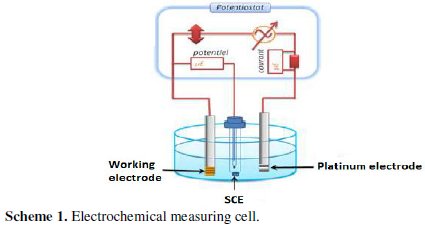
the impedance is made in a three electrodes cell: an indicator electrode, a 
reference electrode and an auxiliary electrode (<a href="#s1">scheme 1</a>).</p>


    <p>&nbsp;</p>
<a name="s1">
<img src="/img/revistas/pea/v31n2/31n2a01s1.jpg">
    
]]></body>
<body><![CDATA[<p>&nbsp;</p>


    <p>Indeed, a potential 
imposed with a sinusoidal disturbance of low amplitude, between the reference 
electrode and the indicator electrode, allows the measure of a current, of the same 
shape, generated between the indicator electrode and the auxiliary electrode. The 
report of the tension applied to the strength of moderate current defines the 
impedance of the electrochemical system. This impedance can be represented by 
an equivalent electric circuit according to the type of the system (faradic or not 
faradic system). In the case of faradic impedance, the surface of the electrode is 
partially or completely covered by a not insulating layer, or partially covered by 
an insulating layer capable of reacting with the redox couple, existing in the 
solution of measure. In that case, the moderate parameter is the resistance of 
transfer of charges; the impedimentary sensors show a sensibility more raised to 
the interaction of the ions. However, the redox species can have an effect on the 
stability and activity of the assembled electrode [51,52].</p>


    <p>The electrochemical impedance spectroscopy (EIS) measurements are carried out 
with an electrochemical system (Tacussel), which included a digital potentiostat 
model Volta lab PGZ100 computer at Ecorr after immersion in solution without 
bubbling. After the determination of the steady-state current at a corrosion 
potential, sine wave voltages (10 mV) peak to peak, at frequencies between 100 
kHz and 10 mHz, are superimposed on the rest potential. Computer programs 
automatically controlled the measurements performed at rest potentials after 0.5 
hour of exposure at 308 K. The impedance diagrams are given in the Nyquist 
representation. Experiments are repeated three times to ensure the 
reproducibility. To determine the impedance parameters of the C38 steel 
specimens in acidic solution, the measured impedance data were analyzed using 
Zview program based upon an electric equivalent circuit [21,53].</p>

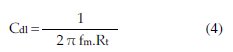
    <p>The charge transfer-resistance (R<sub>t</sub>) values were 
calculated from the difference in impedance at low and high frequencies [8,9,5456]. 
The double layer capacitance (C<sub>dl</sub>) was obtained at the frequency fm at 
which the imaginary component of the impedance is maximal (Z<sub>i,max</sub>) by 
<a href="#e4">equation 4</a>:</p>


    <p>&nbsp;</p>
<a name="e4">
<img src="/img/revistas/pea/v31n2/31n2a01e4.jpg">
    
<p>&nbsp;</p>


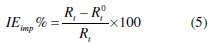
    <p>The inhibition efficiency of the inhibitors has been determined from <a href="#e5">equation 5</a>, 
where R<sub>t</sub><sup>0</sup> and R<sub>t</sub> are the charge transfer resistance values in the absence and in the 
presence of the inhibitors, respectively.</p>


    <p>&nbsp;</p>
<a name="e5">
<img src="/img/revistas/pea/v31n2/31n2a01e5.jpg">
    
<p>&nbsp;</p>


    <p><b><i>Theory and computational details</i></b></p>

    ]]></body>
<body><![CDATA[<p>DFT (density functional theory) methods were used in this study. These methods 
have become very popular in recent years because they can reach exactitude 
similar to other methods in less time being less expensive from the computational 
point of view. In agreement with the DFT results, energy of the fundamental state 
of a poly-electronic system can be expressed through the total electronic density, 
and in fact, the use of electronic density instead of wave function for calculating 
the energy constitutes the fundamental base of DFT [33,57-60]. All calculations 
were done by Gaussian 03W software, using the B3LYP functional and a 6-31G* 
basis set. The B3LYP, a version of DFT method, uses Becke's three-parameter 
functional (B3) and includes a mixture of HF with DFT exchange terms 
associated with the gradient corrected correlation functional of Lee, Yang, and 
Parr (LYP). The geometry of all species under investigation was determined by 
optimizing all geometrical variables without any symmetry constraints. Frontier 
molecular orbital's (HOMO and LUMO) may be used to predict the adsorption 
centres of the inhibitor molecule [54,61-63].</p>


    <p>&nbsp;</p>
    <p><b>Results and discussions</b></p>

    <p><b><i>Effect of concentration on the corrosion rate and inhibition efficiency</i></b></p>

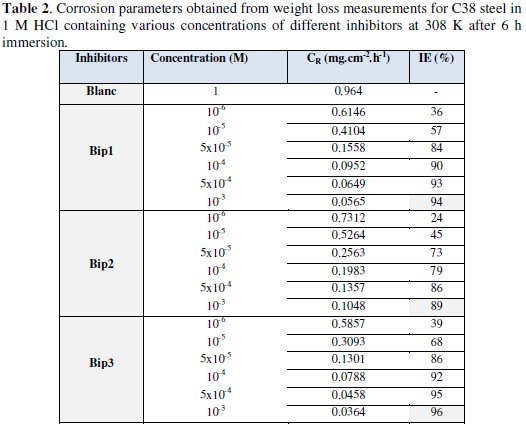
    <p>The values of inhibition efficiency percentage (%IE) and corrosion rate (CR) 
obtained from weight loss method at different concentrations at 308 K after 6 h 
of immersion period are summarized in <a href="#t2">Table 2</a>.</p>


    <p>&nbsp;</p>
<a name="t2">
<img src="/img/revistas/pea/v31n2/31n2a01t2.jpg">
    
<p>&nbsp;</p>


    <p>It has been found that 1,1'propane-
1,3-diylbis[3-(chloromethyl)-5-methyl-1H-pyrazole] Bip(1), dimethyl 
1,1'-butane-1,4-diylbis(5-methyl-1H-pyrazole-3-carboxylate) Bip(2) and 1,1'butane-
1,4-diylbis[3-(chloromethyl)-5-methyl-1H-pyrazole] Bip(3) compounds 
inhibit the corrosion of C38 steel in HCI solution, at all concentrations. It has 
also been observed that the corrosion rate decreased with the increase of the 
inhibitor concentration.</p>

    <p>IE% reaches a maximum of 94%, 89% and 96 % at 10<sup>-3</sup> mol/L for Bip1, Bip2 and 
Bip3, respectively. The plausible mechanism for corrosion inhibition of C38 steel 
in 1 M HCl by different inhibitors may be explained on the basis of the 
adsorption behaviour. The adsorption of the inhibitory molecules on the metal 
surface is described in several research papers [26,64-66].</p>

    <p>The adsorption of the Bip (1), Bip (2) and Bip (3) molecules could occur due to 
the formation of links between the d-orbital of the iron atoms, involving the 
displacement of water molecules from the metal surface, and the lone electron 
pairs. It was shown that the protective properties of such compounds depend 
upon their ability to reduce corrosion rate and are enhanced at higher electron 
densities around the nitrogen atoms specially [8,9,16,18,43].</p>


    ]]></body>
<body><![CDATA[<p>&nbsp;</p>
    <p><b><i>Influence of temperature</i></b></p>

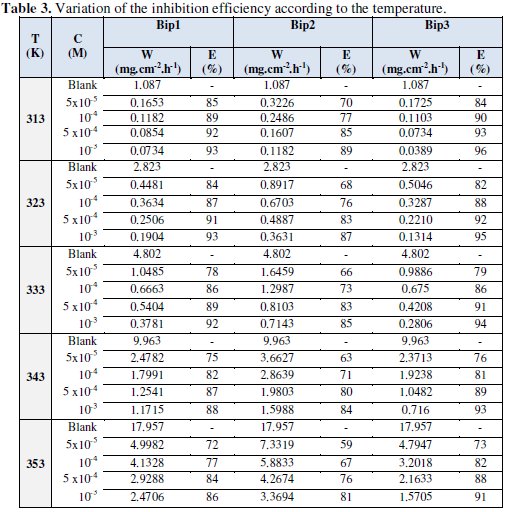
    <p>Gravimetric measurements were taken also at various temperatures (313-353 K) 
without and with 1,1'-propane-1,3-diylbis[3-(chloromethyl)-5-methyl-1Hpyrazole] 
Bip(1), dimethyl 1,1'-butane-1,4-diylbis(5-methyl-1H-pyrazole-3carboxylate) 
Bip(2) and 1,1'-butane-1,4-diylbis[3-(chloromethyl)-5-methyl-1Hpyrazole] 
Bip(3), inhibitors, during a period of one hour and at different 
concentrations; the corresponding results are given in <a href="#t3">Table 3</a>.</p>


    <p>&nbsp;</p>
<a name="t3">
<img src="/img/revistas/pea/v31n2/31n2a01t3.jpg">
    
<p>&nbsp;</p>


    <p>It is clear from <a href="#t3">Table 3</a> that the inhibition efficiencies increase with increasing 
the concentration and that the corrosion rate increases in absence and presence 
the different inhibitors, but rising the temperature in a domain (313-353 K), in 
the presence of the inhibitor at different concentration of Bip(1), Bip(2) and 
Bip(3), the inhibition efficiencies are almost independent upon the temperature; 
in the presence of blank solution the increase was more pronounced with the rise 
of temperature.</p>

    <p>We may conclude that 1,1'-propane-1,3-diylbis[3-(chloromethyl)-5-methyl-1Hpyrazole] 
Bip(1), dimethyl 1,1'-butane-1,4-diylbis(5-methyl-1H-pyrazole-3carboxylate) 
Bip(2) and 1,1'-butane-1,4-diylbis[3-(chloromethyl)-5-methyl-1Hpyrazole] 
Bip(3), are excellent inhibitors of C38 steel corrosion in 1 M HCl 
solution at high temperatures. E% reaches around 90% at 10<sup>-3</sup>M at different 
temperatures for 1, 1'-butane-1, 4-diylbis [3-(chloromethyl)-5-methyl-1Hpyrazole] 
Bip (3).</p>

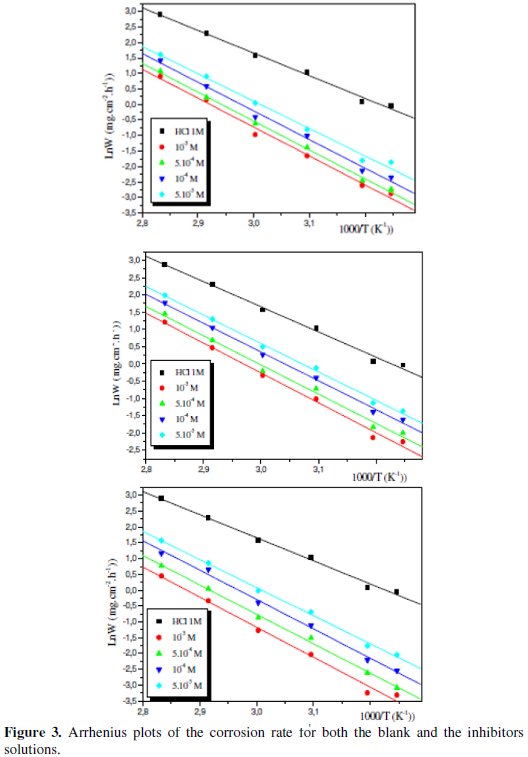
    <p><a href="#f3">Fig. 3</a> shows the Arrhenius plots for the corrosion rate for both the blank and the 
inhibitors solutions of Bip (1), Bip (2) and Bip (3).</p>


    <p>&nbsp;</p>
<a name="f3">
<img src="/img/revistas/pea/v31n2/31n2a01f3.jpg">
    
<p>&nbsp;</p>


    ]]></body>
<body><![CDATA[<p>The Arrhenius plots for C38 
steel corrosion rate were determined from the slopes of ln(W) versus 1000/T 
plots. <a href="#e6">Equation 6</a> can determine the apparent activation energies, where E<sub>a</sub> and 
E<sub>a</sub>' are the apparent activation energies with and without inhibitors, respectively:</p>


    <p>&nbsp;</p>
<a name="e6">
<img src="/img/revistas/pea/v31n2/31n2a01e6.jpg">
    
<p>&nbsp;</p>


    <p>It can be seen that the corrosion weight loss for C38 steel increases more rapidly 
with temperature in uninhibited solution than in inhibited solutions. This result 
confirms that the inhibitor acts as an efficient corrosion inhibitor in the range of 
temperature studied.</p>

    <p>The evolved hydrogen is produced by reduction of hydrochloric acid at various 
temperatures [9,55,56]. Inhibitors protect the metal by adsorbing onto the 
surface. The inhibitor molecules are adsorbed to a different extent at different 
types of surface sites and influence the anodic and cathodic reactions unequally 
[65,67-70]. Much research in our laboratory concluded that the adsorption of 
inhibitor molecules reduces the number of electrode reaction sites and thus 
inhibition becomes more predominant when the surface is covered with nearly a 
monolayer of the inhibitor [7-9,16-18,22,43].</p>

    <p>In 1,1'-propane-1,3-diylbis[3-(chloromethyl)-5-methyl-1H-pyrazole] Bip(1), 
dimethyl 1,1'-butane-1,4-diylbis(5-methyl-1H-pyrazole-3-carboxylate) Bip(2) 
and 1,1'-butane-1,4-diylbis[3-(chloromethyl)-5-methyl-1H-pyrazole] Bip(3) 
molecules, N and O atoms act as reaction centres leading to the formation of the 
film on the surface of the alloy. Bip (1), Bip (2) and Bip (3) are excellent 
inhibitors, having two polar atoms N and O. The cyclic provides also a high 
electron density and it has been found that the inhibitor efficiency increases with 
the electron density.</p>

    <p>An alternative formulation of Arrhenius equation is (<a href="#e7">7</a>):</p>


    <p>&nbsp;</p>
<a name="e7">
<img src="/img/revistas/pea/v31n2/31n2a01e7.jpg">
    
<p>&nbsp;</p>


    <p>where h is Plank's constant, N is Avogadro's number, &Delta;S<sub>a</sub><sup>0</sup> is the entropy of 
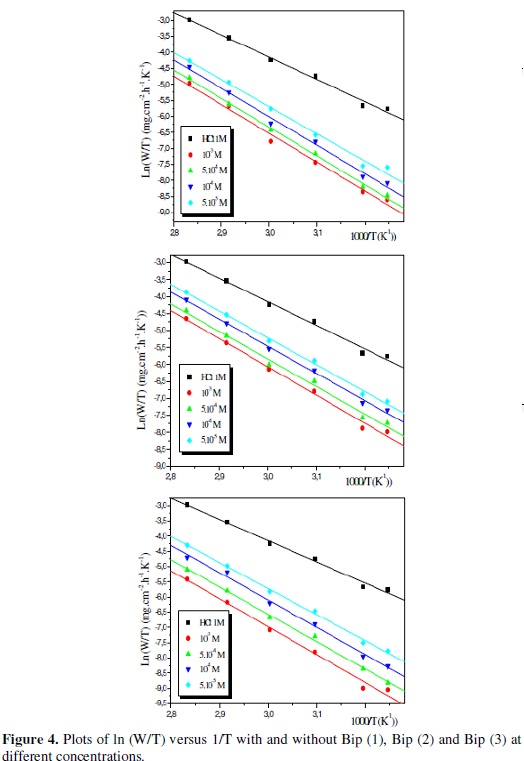
activation and &Delta;H<sub>a</sub><sup>0</sup> is the enthalpy of activation. <a href="#f4">Fig. 4</a> shows a plot of ln(W/T) 
against 1/T in the absence and presence of the inhibitors.</p>


    ]]></body>
<body><![CDATA[<p>&nbsp;</p>
<a name="f4">
<img src="/img/revistas/pea/v31n2/31n2a01f4.jpg">
    
<p>&nbsp;</p>


    <p>Straight lines are 
obtained with a slope of (-&Delta;H<sub>a</sub><sup>0</sup>/R) and an intercept of (Ln R/Nh + &Delta;S<sub>a</sub><sup>0</sup>/R) from 
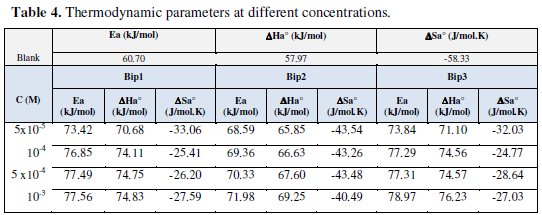
which the values of &Delta;H<sub>a</sub><sup>0</sup> and &Delta;S<sub>a</sub><sup>0</sup> are calculated (<a href="#t4">Table 4</a>):</p>


    <p>&nbsp;</p>
<a name="t4">
<img src="/img/revistas/pea/v31n2/31n2a01t4.jpg">
    
<p>&nbsp;</p>


    <p>The relationship 
between the activation energy E<sub>a</sub> and activation heat &Delta;H<sub>a</sub><sup>0</sup> against the 
concentration of the inhibitors is also listed in <a href="#t4">Table 4</a>.</p>

    <p>From the data obtained in 
this Table, it seems that E<sub>a</sub> and &Delta;H<sub>a</sub><sup>0</sup>
 vary in the same manner; these results agree 
ith those obtained in the literature [16] and they allow the verification of the 
known thermodynamic reaction between the E<sub>a</sub> and &Delta;H<sub>a</sub><sup>0</sup>:</p>


    <p>&nbsp;</p>
<a name="e8">
<img src="/img/revistas/pea/v31n2/31n2a01e8.jpg">
    
<p>&nbsp;</p>


    <p>Moreover, &Delta;H<sub>a</sub><sup>0</sup> values are more positive in 1 M HCl solutions containing the 
inhibitor than those obtained in the uninhibited solution. This observation is in 
agreement with the findings of other workers [16,25,56].</p>

    ]]></body>
<body><![CDATA[<p><a href="#t4">Table 4</a> presents the calculated values of E<sub>a</sub>, &Delta;S<sub>a</sub><sup>0</sup> 
and &Delta;H<sub>a</sub><sup>0</sup> in inhibited and 
uninhibited acid solutions. It is observed that the activation energy is higher in 
the presence of Bip(1), Bip(2) and Bip(3) inhibitors than in their absence. The 
negative slope of E<sub>a</sub>indicates the adsorption of inhibitor compounds on the 
electrode surface [7-9,22,32,43].</p>

    <p>Since the presence of the inhibitor causes a change almost of 15 kJ/mol, 10 
kJ/mol and 20 kJ/mol for Bip(1), Bip(2) and Bip(3) at 10<sup>-3</sup> M, respectively, in the 
values of the apparent activation energy, thus it indicates a change in the rate 
determining step brought about by the presence of the various chemical 
components at different concentrations.</p>

    <p>This means that the adsorption process takes place easily and the adsorption layer 
on C38 steel is stable. The value of activation energy (E<sub>a</sub>) that has been found is 
greater than that in the uninhibited solution. While the higher value of the 
activation energy of the process in an inhibitor's presence when compared to that 
in its absence is attributed to its physical adsorption. The physical adsorption is a 
result of electrostatic attraction between the charged metal surface and the 
charged species in the bulk of the solution. Adsorption of negatively charged 
species is facilitated if the metal surface is positively charged. Positively charged 
species can also protect the positively charged metal surface acting with a 
negatively charged intermediate, such as acid anions adsorbed on the metal 
surface [21,24-26,37,41,71-73].</p>

    <p>The values of &Delta;H<sub>a</sub><sup>0</sup> are reported in <a href="#t4">Table 4</a>. The heat of adsorption is known to be 
a good measure of the strength of adsorption on the surface. Thus, the positive 
sign of the enthalpy (&Delta;H<sub>a</sub><sup>0</sup>) reflects the endothermic nature of the C38 steel 
dissolution process and its values vary in the same way with the inhibitor 
concentration in acid solutions.</p>

    <p>On the other hand, values of &Delta;S<sub>a</sub><sup>0</sup> are more positive in acid solutions containing 
inhibitors than those obtained in the uninhibited solutions. This behaviour can be 
explained as a result of the replacement process of water molecules during 
adsorption of inhibitors on C38 steel surface. This observation is in agreement 
with the findings of other workers [7-9,22,56,74-76]. However, C38 steel 
corrosion in the free acid was characterized by the more negative &Delta;S<sub>a</sub><sup>0</sup> value 
which implies that the activation complex in the rate determining step required 
association rather than dissociation [8,9,21,41,56,74].</p>

    <p>Inspection of these data in <a href="#t4">Table 4</a> reveals that the &Delta;H<sub>a</sub><sup>0</sup>
 values for dissolution 
reaction of C38 steel in 1.0 M HCl in the presence of the inhibitor at different 
concentrations are higher than those in the absence of inhibitors. The positive 
signs of DH0a reflect the endothermic nature of the C38 steel dissolution process 
suggesting that the dissolution of C38 steel is slow in the presence of inhibitor.</p>


    <p>&nbsp;</p>
    <p><b><i>Potentiodynamic polarization measurements</i></b></p>

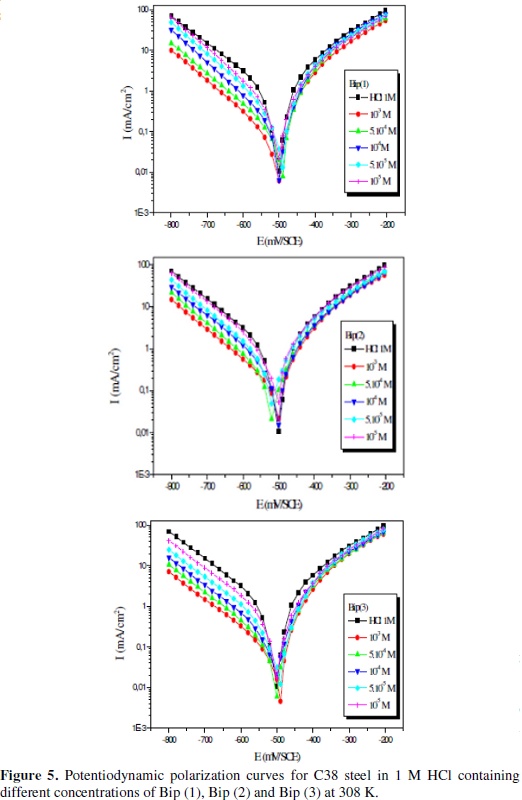
    <p>Polarization measurements were scrutinized in order to gain knowledge 
concerning the kinetics of the cathodic and anodic reactions. <a href="#f5">Fig. 5</a> shows 
cathodic and anodic polarization curves recorded for C38 steel in HCI solution in 
the absence and presence of various concentrations of Bip(1), Bip(2) and Bip(3).</p>


    <p>&nbsp;</p>
<a name="f5">
<img src="/img/revistas/pea/v31n2/31n2a01f5.jpg">
    
]]></body>
<body><![CDATA[<p>&nbsp;</p>


    <p>At first, when there is not enough Fe(inh)ads to cover the steel surface, owing to 
low concentration of the inhibitors or because the adsorption rate is slow, metal 
dissolution takes place at sites on the iron surface free of Fe(inh)ads. With a high 
inhibitor concentration, a compact and coherent inhibitor layers formed over the 
copper, which reduces chemical attacks on the metal [2,40,77,78]. The cathodic 
polarization curve may be attributed to the reduction reaction of H<sup>+</sup> at the 
metallic interface. The cathodic corrosion reaction (<a href="#e9">equation 9</a>) in de-aerated 
acidic chloride solution may be expressed as:</p>


    <p>&nbsp;</p>
<a name="e9">
<img src="/img/revistas/pea/v31n2/31n2a01e9.jpg">
    
<p>&nbsp;</p>


    <p>From <a href="#f5">Fig. 5</a> we can see that the addition of Bip(1), Bip(2) and Bip(3) inhibitors 
shifts the potential of the metal in the negative direction due to the decrease in 
the rate of the cathodic reaction [4,79,80].</p>

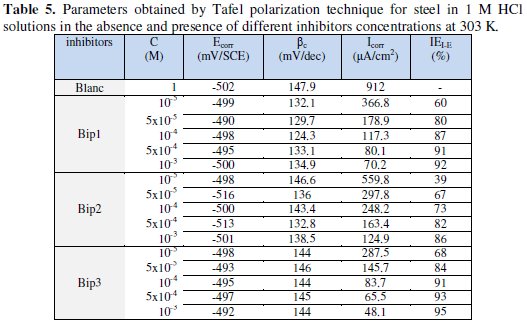
    <p>Corrosion parameters such as corrosion potential (E<sub>corr</sub>) and corrosion current 
density (I<sub>corr</sub>), in the presence of different concentrations of Bip(1), Bip(2) and 
Bip(3) were calculated from the potentiodynamic polarization curves and 
tabulated in <a href="#t5">Table 5</a>.</p>


    <p>&nbsp;</p>
<a name="t5">
<img src="/img/revistas/pea/v31n2/31n2a01t5.jpg">
    
<p>&nbsp;</p>


    <p>The linear Tafel segments of anodic and cathodic curves 
were extrapolated to corrosion potential to obtain corrosion current densities 
(Icorr). It is clear from <a href="#t5">Table 5</a> that the corrosion current densities I<sub>corr</sub> decrease 
with increasing the inhibitor concentration.</p>

    <p>All concentrations of Bip (1), Bip (2) and Bip (3) do not affect significantly Ecorr. 
It has been reported out that if the inhibition is due to the geometric blocking 
effect, the shift of corrosion potential will be negligible (&Delta;E<sub>corr</sub> will be zero) as 
the inhibitor is added to the solution [88,22,81-83]. The inhibition for this system 
cannot be caused by the active sites blocking effect, but may be due in the main 
to the geometric blocking effect. Positive values of IEI-E% indicated corrosion 
inhibition, and negative values showed corrosion acceleration [16,18,43,75,76].</p>

    ]]></body>
<body><![CDATA[<p>The parallel Tafel curves obtained indicate that hydrogen evolution reaction is 
activation controlled and the addition of Bip (1), Bip (2) and Bip (3) does not 
modify the mechanism of this process. Being weakly basic, Bip (1), Bip (2) and 
Bip (3), rapidly protonated in acid solutions, exist in their cationic form. Due to 
electrostatic attraction, the inhibitors are strongly adsorbed onto the electron-rich 
areas blocking the cathodic sites. This is in agreement with the increase of the 
cathodic effect over potential and shift of the steady corrosion potential to less 
noble direction in presence of inhibitors. Therefore it can also be said that these 
inhibitors act as cathodic inhibitors.</p>

    <p>The addition of Bip(1), Bip(2) and Bip(3) at different concentrations led to a 
decrease in the cathodic current densities, which was pronounced at 10<sup>-3</sup> M; its 
IE% value was maximum 91%, 89 % and 95%, respectively, for Bip(1), Bip(2) 
and Bip(3). From these data one can recognize distinctly higher inhibition of Bip 
(1), Bip (2) and Bip (3) for 10<sup>-3</sup> mol L<sup>-1</sup> concentration which is the optimum 
concentration ranking them as follows:</p>

    <p>Bip (3) > Bip (1) > Bip (2).</p>


    <p>&nbsp;</p>
    <p><b><i>Electrochemical impedance spectroscopy measurements</i></b></p>

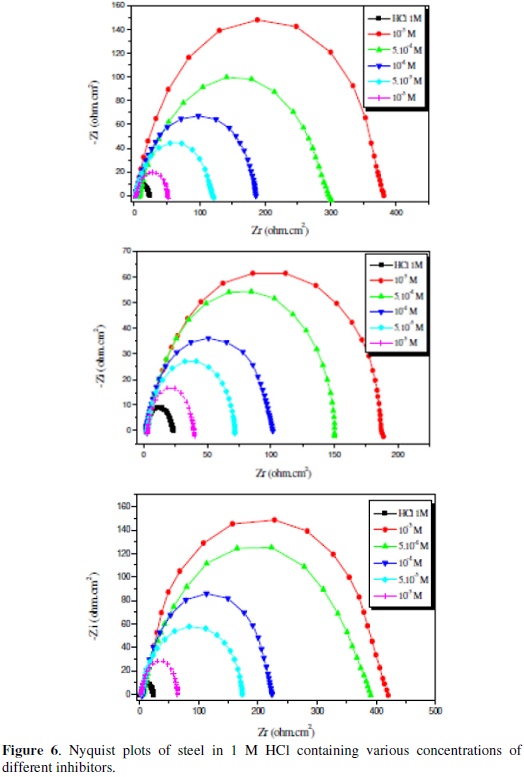
    <p>The representative Nyquist plots of C38 steel in 1 M HCl solution in the presence 
and absence of various concentrations of Bip (1), Bip (2) and Bip (3), are given 
in <a href="#f6">Fig. 6</a>.</p>


    <p>&nbsp;</p>
<a name="f6">
<img src="/img/revistas/pea/v31n2/31n2a01f6.jpg">
    
<p>&nbsp;</p>


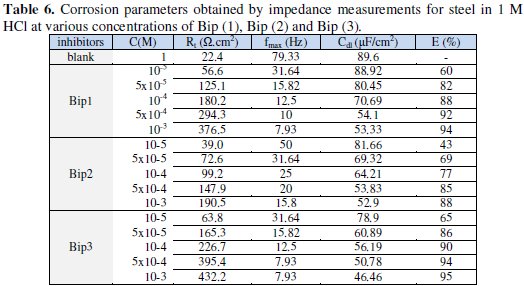
    <p>Various parameters such as charge-transfer resistance (R<sub>t</sub>), double layer 
capacitance (C<sub>dl</sub>) and fmax were obtained from impedance measurements and are 
shown in <a href="#t6">Table 6</a>.</p>


    <p>&nbsp;</p>
<a name="t6">
<img src="/img/revistas/pea/v31n2/31n2a01t6.jpg">
    
]]></body>
<body><![CDATA[<p>&nbsp;</p>


    <p>The impedance spectra exhibit one single depressed semicircle, and the diameter 
of the semicircle increases with the increase of the inhibitor concentration. The 
single semicircle indicates that the charge transfer takes place at the 
electrode/solution interface, the transfer process controls the corrosion reaction 
of steel and the presence of the inhibitor does not change the mechanism of steel 
dissolution [7-9,16-18,22,43]. The semicircles observed are depressed into the Zr 
(real axis) of Nyquist plot which is often referred to as frequency dispersion as a 
result of the no homogeneity or roughness of the metal surface [78,84-86].</p>

    <p>The fitted values are given in <a href="#t6">Table 6</a>, showing that with increase in 
concentration of Bip (1), Bip (2) and Bip (3), R<sub>t</sub> values increase prominently, 
while C<sub>dl</sub> values reduce. The values of Cdl to Bip (1), Bip (2) and Bip (3), are 
superior to those obtained for the control medium. This increase can be attributed 
to hydration of the film due to absorption of the electrolyte in the film [1618,22,43]. 
The Rt values increased with the inhibitor concentrations, mainly 
suggesting the formation of a protective layer on the electrode surface. This layer 
makes a barrier for mass and charge-transfer [87,88]. Since R<sub>t</sub> is inversely 
proportional to the corrosion rate, it can be used to calculate the inhibition 
efficiency.</p>

    <p>As shown in the <a href="#f6">Fig. 6</a>, the diameters of the spectres of impedance increase 
clearly with the increase of the inhibitor concentration in solution; all these 
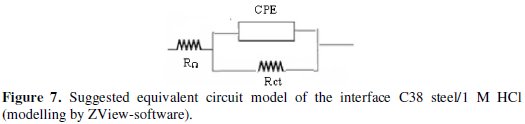
diagrams were modelled by using the equivalent circuit presented on the <a href="#f7">Fig. 7</a>.</p>


    <p>&nbsp;</p>
<a name="f7">
<img src="/img/revistas/pea/v31n2/31n2a01f7.jpg">
    
<p>&nbsp;</p>


    <p>The results in <a href="#t6">Table 6</a> can be interpreted in terms of the equivalent circuit of the 
electric double layer shown in <a href="#f7">Fig. 7</a>, which has been used previously to model 
the C38 steel-acid interface. This model is obtained using the ZView-software 
of modelling in order to determine the equivalent circuits from impedance data 
and Nyquist and Bode curves [48,89-95].</p>

    <p>The transfer function can be represented by a resistance R1 parallel to a capacitor 
C and in series to them an additional resistance R2, as expressed in <a href="#e10">equation 10</a>:</p>


    <p>&nbsp;</p>
<a name="e10">
<img src="/img/revistas/pea/v31n2/31n2a01e10.jpg">
    
<p>&nbsp;</p>


    ]]></body>
<body><![CDATA[<p>This transfer function is applicable to homogeneous systems with one time 
constant when the centre of the semicircle lies on the abscissa of the real part. It 
is evident that it cannot describe the observed depression of the capacitive loop 
and it is necessary to replace the capacitor by some element taking into account 
the frequency dispersion like the Constant Phase Element (CPE). This element is 
a generalised tool, which can reflect the exponential distribution of the 
parameters of the electrochemical reaction related to energetic barrier at charge 
and mass transfer [91,92].</p>

    <p>Such phenomena often correspond to surface heterogeneity which may be the 
result of surface roughness, dislocations, distribution of the active sites or 
adsorption of inhibitors [25,32]. In order to fit and analyze the EIS data, the 
equivalent circuit shown in <a href="#f7">Fig. 7</a> is selected.</p>

    <p>This circuit is generally used to 
describe the iron/acid interface model [21,91,92]. In this equivalent circuit, R<sub>t</sub> 
reflects the charge transfer resistance R<sub>1</sub>, R<sub>&Omega;</sub>
is the resistance of the solution R<sub>2</sub>, 
and CPE is a constant phase element which replaces the pure capacitor. The 
impedance function of the CPE is as follows (<a href="#e11">11</a>):</p>


    <p>&nbsp;</p>
<a name="e11">
<img src="/img/revistas/pea/v31n2/31n2a01e11.jpg">
    
<p>&nbsp;</p>


    <p>Y is the magnitude of the CPE and n an exponent related to the phase shift, both 
of them being frequency independent, and &omega; 
is the angular frequency. For whole 
numbers of n = 1, 0, -1, the CPE is reduced to the classical lumped elements 
capacitor (C), resistance (R) and inductance (L), respectively. The value of n = 
0.5 corresponds to the Warburg impedance (W). Other values of n approximately 
describe other types of frequency distribution behaviour of C, R, L or W with 
distributed parameters. In real iron/acid interface systems, the ideal capacitive 
behaviour is not observed due to roughness, or uneven current distributions on 
the electrode surface which results in frequency dispersion; therefore a CPE is 
usually used instead of a capacitance Cdl (double layer capacitance) to fit more 
accurately the impedance behaviour of the electrical double layer. The idealized 
capacitance (Cid) values can be described by the CPE parameter values Y and n 
using the following expression (<a href="#e12">12</a>) [21,96-98]:</p>


    <p>&nbsp;</p>
<a name="e12">
<img src="/img/revistas/pea/v31n2/31n2a01e12.jpg">
    
<p>&nbsp;</p>


    <p>&nbsp;</p>
    <p><b><i>Adsorption isotherm and thermodynamic parameters</i></b></p>

    ]]></body>
<body><![CDATA[<p>Basic information on the interaction between inhibitors and metal surface can be 
provided using the adsorption isotherms. The adsorption of an organic adsorbate 
at a metal-solution interface can occur as a result of substitution adsorption 
process between the organic molecules presented in the aqueous solution 
(Org<sub>(sol)</sub>), and the water molecules previously adsorbed on the metallic surface 
(H<sub>2</sub>O<sub>(ads)</sub>) (<a href="#e13">equation 13</a>) [20,40,99]:</p>


    <p>&nbsp;</p>
<a name="e13">
<img src="/img/revistas/pea/v31n2/31n2a01e13.jpg">
    
<p>&nbsp;</p>


    <p>where Org<sub>(sol)</sub> and Org<sub>(ads)</sub> are the organic species in the bulk solution and 
adsorbed one on the metallic surface, respectively, H<sub>2</sub>O<sub>(ads)</sub> is the water molecules 
adsorbed on the metallic surface and n is the size ratio representing the number 
of water molecules replaced by one organic adsorbate. In order to obtain the 
adsorption isotherm, the degree of surface coverage, &theta;, for different 
concentrations of inhibitor in 1.0 M HCl solutions has been evaluated by the 
following equation (<a href="#e14">14</a>), where w<sub>0</sub> and w<sub>i</sub> are the values of corrosion weight 
losses of C38 steel in uninhibited and inhibited solutions, respectively.</p>


    <p>&nbsp;</p>
<a name="e14">
<img src="/img/revistas/pea/v31n2/31n2a01e14.jpg">
    
<p>&nbsp;</p>


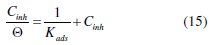
    <p>The &theta; values are calculated by the data of <a href="#t3">Table 3</a>. According to the Langmuir's 
isotherm, the surface coverage (&theta;) is related to the inhibitor concentration (C<sub>inh</sub>) by 
the following equation (<a href="#e15">15</a>), where K<sub>ads</sub> is the equilibrium constant of the inhibitor 
adsorption process [8,74,100]:</p>


    <p>&nbsp;</p>
<a name="e15">
<img src="/img/revistas/pea/v31n2/31n2a01e15.jpg">
    
<p>&nbsp;</p>


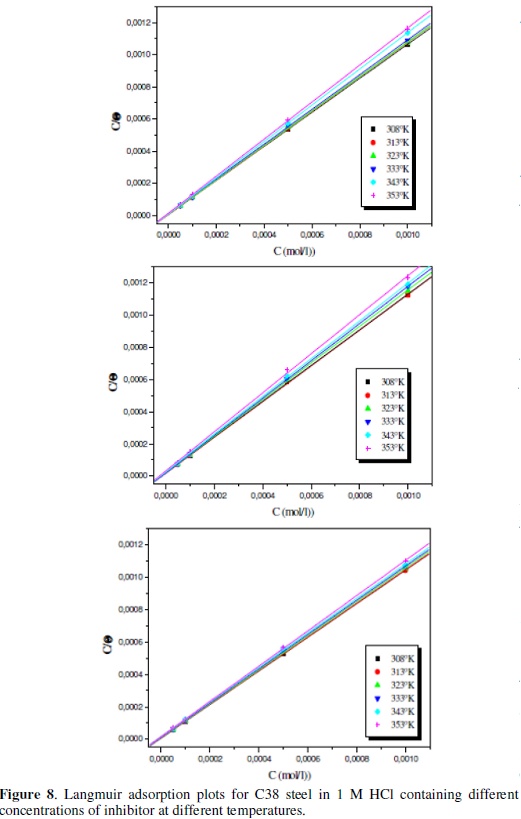
    <p>As seen from <a href="#f8">Fig. 8</a>, the plot of C<sub>inh</sub>/&theta; versus C<sub>inh</sub> yields a straight line with a 
correlation coefficient more than 0.9999, showing that the adsorption of these 
inhibitors in acidic solutions is fitted to Langmuir adsorption isotherm.</p>


    ]]></body>
<body><![CDATA[<p>&nbsp;</p>
<a name="f8">
<img src="/img/revistas/pea/v31n2/31n2a01f8.jpg">
    
<p>&nbsp;</p>


    <p>These results show that the inhibition of C38-steel in HCl solutions by new synthesis 
compound derivatives is an adsorptive process (<a href="#e13">equation 13</a>). This isotherm 
assumes that the adsorbed molecules occupy only one site and that there are no 
interactions between the adsorbed species. The K<sub>ads</sub> values can be calculated 
from the intercept lines on the C<sub>inh</sub>/&theta;-axis. This value is also related to the standard 
free energy of adsorption (&Delta;G<sup>0</sup><sub>ads</sub>), by the following equation (<a href="#e16">16</a>), where K<sub>ads</sub> is 
the adsorption equilibrium constant, &Delta;G<sup>0</sup><sub>ads</sub> is the standard free energy of 
adsorption, 55.5 is the concentration of water in the solution in mol dm<sup>-3</sup>, R is the 
universal gas constant and T is the absolute temperature in Kelvin:</p>


    <p>&nbsp;</p>
<a name="e16">
<img src="/img/revistas/pea/v31n2/31n2a01e16.jpg">
    
<p>&nbsp;</p>


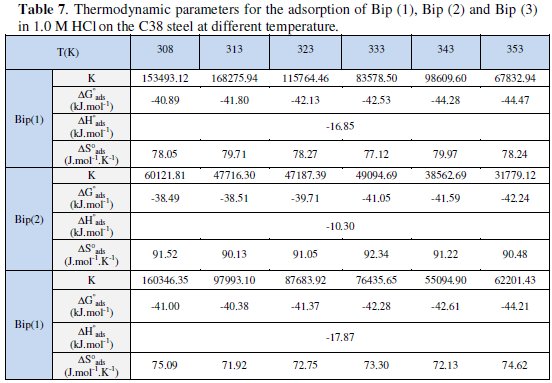
    <p>The values of K<sub>ads</sub> and &Delta;G<sup>0</sup><sub>ads</sub> for Bip(1), Bip(2) and Bip(3) in 1.0 M HCl 
solutions are given in <a href="#t7">Table 7</a>.</p>


    <p>&nbsp;</p>
<a name="t7">
<img src="/img/revistas/pea/v31n2/31n2a01t7.jpg">
    
<p>&nbsp;</p>


    <p>The negative sign of &Delta;G<sup>0</sup><sub>ads</sub> indicates that the 
inhibitors are spontaneously adsorbed on the metal surface [3,4,14,101,102]. 
Generally, the magnitude of &Delta;G<sup>0</sup><sub>ads</sub> is around -20 kJ mol<sup>-1</sup> or less negative, 
suggesting that an electrostatic interaction exists between the inhibitor and the 
charged metal surface (i.e. physisorption). Standard free energy of adsorption 
(&Delta;G<sup>0</sup><sub>ads</sub>) around -40 kJ mol<sup>-1</sup> or more negative indicates that a charge sharing or 
transferring from organic species to the metal surface occurs to form a coordinate 
type of bond (i.e. chemisorption) [68]. The calculated &Delta;G<sup>0</sup><sub>ads</sub> values for Bip(1), 
Bip(2) and Bip(3) in acid media show that an electrostatic interaction exists 
between the inhibitor and the charged metal surface while, as shown, 
chemisorption is more probable for Bip(1), Bip(2) and Bip(3). It should be 
mentioned that the higher values of K<sub>ads</sub> and &Delta;G<sup>0</sup><sub>ads</sub> refer to a higher adsorptive 
and thus a higher inhibiting effect.</p>

    <p>These results indicate also that the presence of the inhibitor increases the 
inhibition efficiency without change in adsorption mechanism. The extent of 
inhibition is directly related to the increase of the adsorption layer, which is a 
sensitive function of the molecular structure. Thermodynamically, &Delta;G<sup>0</sup><sub>ads</sub> 
is related to the standard enthalpy and entropy of the adsorption process, 
&Delta;H<sup>0</sup><sub>ads</sub> and &Delta;S<sup>0</sup><sub>ads</sub>, respectively, via <a href="#e17">equation (17)</a> [21,26,41]:</p>


    ]]></body>
<body><![CDATA[<p>&nbsp;</p>
<a name="e17">
<img src="/img/revistas/pea/v31n2/31n2a01e17.jpg">
    
<p>&nbsp;</p>


    <p>The standard enthalpy of adsorption (&Delta;H<sup>0</sup><sub>ads</sub>) can be calculated according to the 
Van't Hoff equation (<a href="#e18">18</a>):</p>


    <p>&nbsp;</p>
<a name="e18">
<img src="/img/revistas/pea/v31n2/31n2a01e18.jpg">
    
<p>&nbsp;</p>


    <p>Inspection of the data in <a href="#t7">Table 7</a>, shows that the values of &Delta;H<sup>0</sup><sub>ads</sub> by relation 
Van't Hoff, give the same results and their negative sign is usually characteristic 
of strong interaction and a highly efficient adsorption [7-9,16-18,22,43]. The 
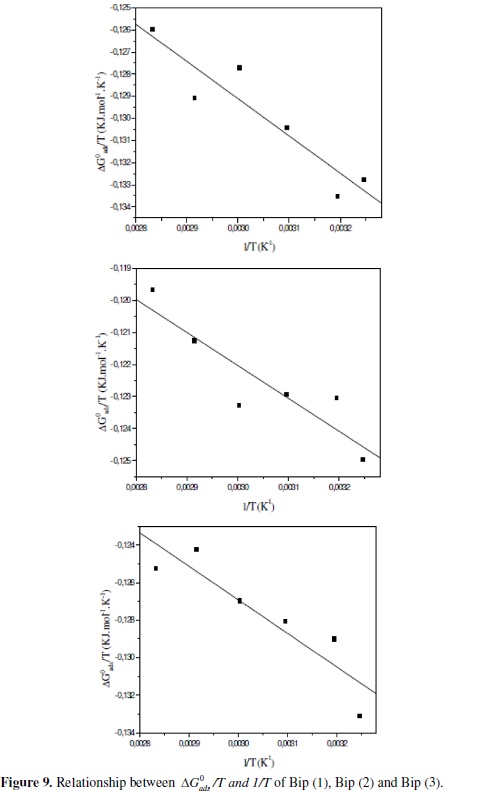
obtained values of &Delta;G<sup>0</sup><sub>ads</sub> show the regular dependence of &Delta;G<sup>0</sup><sub>ads</sub> 
on temperature (<a href="#t7">Table 7</a> and <a href="#f9">Fig. 9</a>), indicating a good correlation among thermodynamic 
parameters.</p>


    <p>&nbsp;</p>
<a name="f9">
<img src="/img/revistas/pea/v31n2/31n2a01f9.jpg">
    
<p>&nbsp;</p>


    <p>However, a limited decrease in the absolute value of &Delta;G<sup>0</sup><sub>ads</sub>
with an increase in temperature it was observed. This behaviour is explained by the fact 
that the adsorption is somewhat unfavourable with increasing experimental 
temperature, indicating that the physisorption has the major contribution while 
the chemisorption has the minor contribution in the inhibition mechanism 
[8,22,37,56,71,72].</p>

    <p>The negative sign of &Delta;H<sup>0</sup><sub>ads</sub> indicates that the adsorption of inhibitor molecules is 
an exothermic process. The value of &Delta;S<sup>0</sup><sub>ads</sub> is negative, meaning that the Bip(1), 
Bip(2) and Bip(3) molecules move freely in the bulk solution (are chaotic) before 
adsorption, while as adsorption progresses, the inhibitor molecules adsorbed onto 
the C38 steel surface become more orderly, resulting in a decrease in entropy [7
9,22,56,74,75]. This order may more probably be explained by the possibility of 
formation of a steel-inhibitor film on the metal surface [37,71,72,78].</p> 

    ]]></body>
<body><![CDATA[<p>In the present study, chemisorption is evident from the apparent activation 
energy of the corrosion, that is, lower in presence of Bip(1), Bip(2) and Bip(3), 
than in their absence, the inhibition efficiency, which is temperature independent 
and the large negative values of &Delta;G<sup>0</sup><sub>ads</sub>. Therefore, organic compounds may adsorb 
on a metal surface in the form of a neutral molecule via the chemisorption 
mechanism involving the sharing of electrons between the nitrogen atoms and 
iron. The covalent bond with the metal is most probably formed between the 
unpaired electrons of the N-atom [16,22,43].</p>


    <p>&nbsp;</p>
    <p><b><i>Theoretical calculations</i></b></p>

    <p>Quantum chemical methods have already proven to be very useful in determining 
the molecular structure as well as elucidating the electronic structure and 
reactivity [59]. Thus, it has become a common practice to carry out quantum 
chemical calculations in corrosion inhibition studies. The predicted properties of 
reasonable accuracy can be obtained from density functional theory (DFT) 
calculations [33,59,60]. Some quantum chemical parameters, which influence the 
electronic interaction between surface atoms and inhibitor, are the energy of the 
highest occupied molecular orbital (E<sub>HOMO</sub>), the energy of the lowest unoccupied 
molecular orbital (E<sub>LUMO</sub>), the energy gap E<sub>HOMO</sub> - E<sub>LUMO</sub> (&Delta;E), dipole moment 
(&mu;) and total energy (TE). All quantum chemical properties were obtained after 
geometric optimization with respect to all the nuclear coordinates using Kohn- 
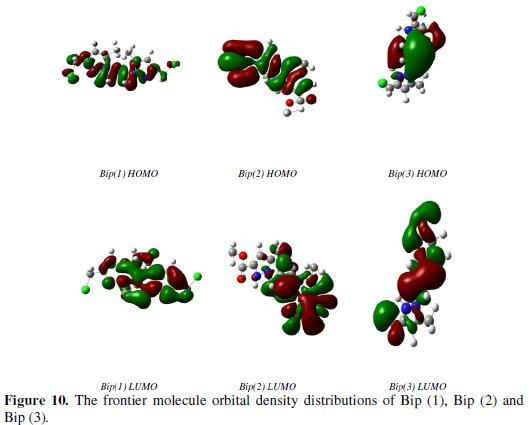
Sham approach at DFT level. The optimized structure of Bip(1), Bip(2) and 
Bip(3) compounds is shown in <a href="#f10">Fig. 10</a>.</p>


    <p>&nbsp;</p>
<a name="f10">
<img src="/img/revistas/pea/v31n2/31n2a01f10.jpg">
    
<p>&nbsp;</p>


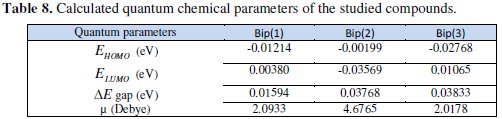
    <p>The computed quantum chemical properties such as energy of highest occupied 
molecular orbital (E<sub>HOMO</sub>), energy of lowest unoccupied molecular orbital 
(E<sub>LUMO</sub>), HOMO-LUMO energy gap (&Delta;E<sub>H-L</sub>) and dipole moment (&mu;) are 
summarized in the <a href="#t8">Table 8</a>.</p>


    <p>&nbsp;</p>
<a name="t8">
<img src="/img/revistas/pea/v31n2/31n2a01t8.jpg">
    
<p>&nbsp;</p>


    <p>As E<sub>HOMO</sub> is often associated with the electron donating ability of a molecule, 
high values of E<sub>HOMO</sub> are likely to indicate a tendency of the molecule to donate 
electrons to the appropriate acceptor molecules with low-energy, empty 
molecular orbital. Increasing values of E<sub>HOMO</sub> facilitate adsorption (and therefore 
inhibition) by influencing the transport process through the adsorbed layer. 
Therefore, the energy of the E<sub>LUMO</sub> indicates the ability of the molecule to accept 
electrons; hence these are the acceptor states. An explanation based on the 
highest occupied molecular orbital, HOMO, the lowest unoccupied molecular 
orbital, LUMO, and the energy gap between them (&Delta;E = E<sub>HOMO</sub> - E<sub>LUMO</sub>): E<sub>HOMO</sub> 
is often associated with the electron-donating ability of molecules whereas the 
E<sub>LUMO</sub> is associated with the electron accepting ability. Therefore, a high value of 
E<sub>HOMO</sub> indicates high tendency to donate electrons to the appropriate acceptor 
molecules with low empty molecular orbital energy. Likewise, a low value of 
E<sub>LUMO</sub> indicates high tendency to accept electrons from the metal surface. Lower 
values of the energy difference &Delta;E will cause higher inhibition efficiency 
because the energy to remove an electron from the last occupied orbital will be 
low [10,54,60,73]. On the other hand, the most widely used quantity to describe 
the polarity is the dipole moment of the molecule. Dipole moment is the measure 
of polarity of a polar covalent bond. It is defined as the product of charge on the 
atoms and the distance between the two bonded atoms. The total dipole moment, 
however, reflects only the global polarity of a molecule. For a complete molecule 
the total molecular dipole moment may be approximated as the vector sum of 
individual bond dipole moments. The theoretical study has shown that the dipole 
moment is well correlated with the inhibition efficiency (<a href="#f3">Fig. 3</a>). Indeed, the 
inhibition efficiency increases with increasing the dipole moment. Effectively, 
for the dipole moment (&mu;), lower values of &mu; will favour accumulation of the 
inhibitor in the surface layer.</p>

    ]]></body>
<body><![CDATA[<p>As we know, frontier orbital theory is useful in predicting the adsorption centres 
of the inhibitors responsible for the interaction with the surface metal atoms. The 
HOMO and the LUMO population of Bip (1), Bip (2) and Bip (3) were plotted 
and are shown in <a href="#f10">Fig. 10</a>.</p>

    <p>Analysis of this figure shows that the density of HOMO was distributed around 
the entire molecules. Moreover, the gap between the LUMO and HOMO energy 
levels of the molecule was another important factor that should be considered. It 
has been reported that excellent corrosion inhibitors are usually those organic 
compounds that do not only offer electrons to unoccupied orbital of the metal but 
also accept free electrons from the metal [58]. It is also well documented in 
literature that the higher the HOMO energy of the inhibitor, the greater its ability 
of offering electrons to unoccupied d-orbital of the metal, and the higher the 
corrosion inhibition efficiency.</p>

    <p>It is evident from <a href="#t8">Table 8</a> that Bip (1), Bip (2) and Bip (3) are the highest E<sub>HOMO</sub> 
in the neutral form. This confirms the experimental results that interaction 
between different inhibitors and C38 steel is electrostatic in nature. Inhibition of 
corrosion is generally interpreted by adsorption of inhibitor molecules onto the 
metal surface. Two modes of adsorption can be envisaged. The physical 
adsorption requires the interaction of electrically charged metal surface and 
charged species in the bulk of the solution. Chemisorption mode implies charge 
sharing or charge transfer from the inhibitor molecule to the vacant orbital's of 
metal having low energy.</p>

    <p>In this work, Bip(1), Bip(2) and Bip(3) showed good inhibitory effect against 
corrosion of steel in 1 M HCl. Bip(2) is considered more effective. The results 
obtained show that the compound Bip (3) has a higher &Delta;E<sub>gap</sub>. This parameter 
provides a measure for the stability of the formed film on the metal surface. The 
lower value of &Delta;E has, the higher stability is for the formed film.</p>

    <p>In addition, the lower the LUMO energy, the easier the acceptance of electrons 
from the metal surface, as the LUMO-HOMO energy gap decreased and the 
efficiency of inhibitor improved. It is clear from <a href="#t8">Table 8</a> that E<sub>LUMO</sub> of Bip(1), 
Bip(2) and Bip(3) exhibits the lowest, making the protonated form the most 
likely form for the interaction of steel with Bip(1), Bip(2) and Bip(3) molecules. 
Low values of the energy gap (&Delta;E) will provide good inhibition efficiencies, 
because the excitation energy to remove an electron from the last occupied 
orbital will be low. Lower values of dipole moment (&mu;) will favour accumulation 
of the inhibitor in the surface layer and therefore higher inhibition efficiency. The 
inhibition efficiency of the compounds depends on many major factors such as 
the number of adsorption active centres in the molecule and their charge density, 
molecule size, mode of adsorption, and formation of metallic film. The substitute 
effect on the steel inhibition of Bip(1), Bip(2) and Bip(3) will be rationalized 
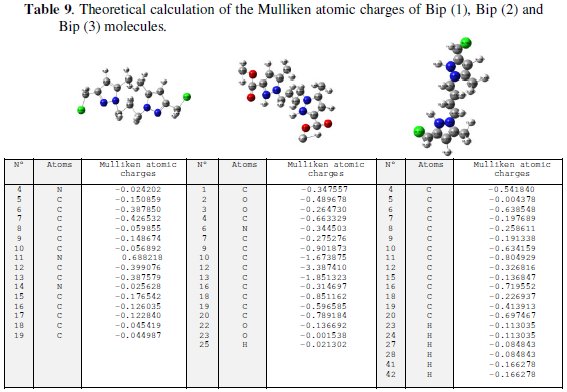
using global reactivity indexes, namely, Mulliken charge. The algebraic values 
of this quantity are given in <a href="#t9">Table 9</a> [10,54,73].</p>


    <p>&nbsp;</p>
<a name="t9">
<img src="/img/revistas/pea/v31n2/31n2a01t9.jpg">
    
<p>&nbsp;</p>


    <p>&nbsp;</p>
    <p><b>Conclusions</b></p>

    <p>&#9654; Results obtained from the experimental and theoretical data show that Bip (1), 
Bip (2) and Bip (3) act as effective inhibitors of steel corrosion in 1M HCl.</p>

    ]]></body>
<body><![CDATA[<p>&#9654;The corrosion process was inhibited by adsorption of the organic compound 
on the metallic surface and obeys the Langmuir adsorption isotherm.</p>

    <p>&#9654; Inhibition efficiency increases with increase in the concentration of the Bip 
(1), Bip (2) and Bip (3) but remaining constant with rise in temperature.</p>

    <p>&#9654; Polarisation measurements show that Bip (1), Bip (2) and Bip (3) act 
essentially as cathodic type inhibitors.</p>

    <p>&#9654; The inhibitor efficiencies determined by electrochemical polarisation, 
electrochemical impedance spectroscopy and by gravimetric methods are in 
good agreement.</p>

    <p>&#9654; Quantum chemical methods can conclude that the inhibitory efficiency 
depends on the structure and molecular of this inhibitors and the inhibition 
efficiency depends on many major factors such as the number of adsorption 
active centres in the molecule and their charge density, molecule size, mode of 
adsorption, and formation of metallic film.</p>


    <p>&nbsp;</p>
    <p><b>References</b></p>

    <!-- ref --><p>1. Afia L, Salghi R, Bammou L, et al. Acta Metallurgica Sinica-Engl Lett. 2012;25:10&nbsp;&nbsp;&nbsp;&nbsp;&nbsp;&nbsp;&nbsp;&nbsp;[&#160;<a href="javascript:void(0);" onclick="javascript: window.open('/scielo.php?script=sci_nlinks&ref=000210&pid=S0872-1904201300020000100001&lng=','','width=640,height=500,resizable=yes,scrollbars=1,menubar=yes,');">Links</a>&#160;]<!-- end-ref --><!-- ref --><p>2. Samide A, Tutunaru B, Negrila C, et al. Digest J Nanomater Biostruct. 2011;6:663.    &nbsp;&nbsp;&nbsp;&nbsp;&nbsp;&nbsp;&nbsp;&nbsp;[&#160;<a href="javascript:void(0);" onclick="javascript: window.open('/scielo.php?script=sci_nlinks&ref=000211&pid=S0872-1904201300020000100002&lng=','','width=640,height=500,resizable=yes,scrollbars=1,menubar=yes,');">Links</a>&#160;]<!-- end-ref --></p>
    ]]></body>
<body><![CDATA[<!-- ref --><p>3. Tebbji K, Aouniti A, Attayibat A, et al. Ind J Chem Tech. 2011;18:244.    &nbsp;&nbsp;&nbsp;&nbsp;&nbsp;&nbsp;&nbsp;&nbsp;[&#160;<a href="javascript:void(0);" onclick="javascript: window.open('/scielo.php?script=sci_nlinks&ref=000213&pid=S0872-1904201300020000100003&lng=','','width=640,height=500,resizable=yes,scrollbars=1,menubar=yes,');">Links</a>&#160;]<!-- end-ref --></p>
    <!-- ref --><p>4. Tebbji K, Oudda H, Hammouti, et al. Res Chem Intermediates. 2011;37:985.    &nbsp;&nbsp;&nbsp;&nbsp;&nbsp;&nbsp;&nbsp;&nbsp;[&#160;<a href="javascript:void(0);" onclick="javascript: window.open('/scielo.php?script=sci_nlinks&ref=000215&pid=S0872-1904201300020000100004&lng=','','width=640,height=500,resizable=yes,scrollbars=1,menubar=yes,');">Links</a>&#160;]<!-- end-ref --></p>
    <!-- ref --><p>5. Znini M, Bouklah M, Majidi L, et al. Int J Electrochem Sci. 2011;6:691.    &nbsp;&nbsp;&nbsp;&nbsp;&nbsp;&nbsp;&nbsp;&nbsp;[&#160;<a href="javascript:void(0);" onclick="javascript: window.open('/scielo.php?script=sci_nlinks&ref=000217&pid=S0872-1904201300020000100005&lng=','','width=640,height=500,resizable=yes,scrollbars=1,menubar=yes,');">Links</a>&#160;]<!-- end-ref --></p>
    <!-- ref --><p>6. Govindaraju KM, Gopi D, Kavitha L. J Appl Electrochem. 2009;39:2345.    &nbsp;&nbsp;&nbsp;&nbsp;&nbsp;&nbsp;&nbsp;&nbsp;[&#160;<a href="javascript:void(0);" onclick="javascript: window.open('/scielo.php?script=sci_nlinks&ref=000219&pid=S0872-1904201300020000100006&lng=','','width=640,height=500,resizable=yes,scrollbars=1,menubar=yes,');">Links</a>&#160;]<!-- end-ref --></p>
    <!-- ref --><p>7. Chetouani A, Hammouti B. Bull Electrochem. 2004;20:343.    &nbsp;&nbsp;&nbsp;&nbsp;&nbsp;&nbsp;&nbsp;&nbsp;[&#160;<a href="javascript:void(0);" onclick="javascript: window.open('/scielo.php?script=sci_nlinks&ref=000221&pid=S0872-1904201300020000100007&lng=','','width=640,height=500,resizable=yes,scrollbars=1,menubar=yes,');">Links</a>&#160;]<!-- end-ref --></p>
    ]]></body>
<body><![CDATA[<!-- ref --><p>8. Chetouani A, Hammouti B, Benhadda T, Daoudi M. Appl Surf Sci. 2005;249:375.    &nbsp;&nbsp;&nbsp;&nbsp;&nbsp;&nbsp;&nbsp;&nbsp;[&#160;<a href="javascript:void(0);" onclick="javascript: window.open('/scielo.php?script=sci_nlinks&ref=000223&pid=S0872-1904201300020000100008&lng=','','width=640,height=500,resizable=yes,scrollbars=1,menubar=yes,');">Links</a>&#160;]<!-- end-ref --></p>
    <!-- ref --><p>9. Chetouani A, Daoudi M, Hammouti B, et al. Corros Sci. 2006;48:2987.    &nbsp;&nbsp;&nbsp;&nbsp;&nbsp;&nbsp;&nbsp;&nbsp;[&#160;<a href="javascript:void(0);" onclick="javascript: window.open('/scielo.php?script=sci_nlinks&ref=000225&pid=S0872-1904201300020000100009&lng=','','width=640,height=500,resizable=yes,scrollbars=1,menubar=yes,');">Links</a>&#160;]<!-- end-ref --></p>
    <!-- ref --><p>10. Senhaji O, Taouil R, Skalli MK, et al. Int J Electrochem Sci. 2011;6:6290.    &nbsp;&nbsp;&nbsp;&nbsp;&nbsp;&nbsp;&nbsp;&nbsp;[&#160;<a href="javascript:void(0);" onclick="javascript: window.open('/scielo.php?script=sci_nlinks&ref=000227&pid=S0872-1904201300020000100010&lng=','','width=640,height=500,resizable=yes,scrollbars=1,menubar=yes,');">Links</a>&#160;]<!-- end-ref --></p>
    <!-- ref --><p>11. Thomas G, Hammouti N, Seitz A. J Shellfish Res. 2011;30:123.    &nbsp;&nbsp;&nbsp;&nbsp;&nbsp;&nbsp;&nbsp;&nbsp;[&#160;<a href="javascript:void(0);" onclick="javascript: window.open('/scielo.php?script=sci_nlinks&ref=000229&pid=S0872-1904201300020000100011&lng=','','width=640,height=500,resizable=yes,scrollbars=1,menubar=yes,');">Links</a>&#160;]<!-- end-ref --></p>
    <!-- ref --><p>12. Warad I, Azam M, Karama U, et al. J Molec Struct. 2011;1002:107.    &nbsp;&nbsp;&nbsp;&nbsp;&nbsp;&nbsp;&nbsp;&nbsp;[&#160;<a href="javascript:void(0);" onclick="javascript: window.open('/scielo.php?script=sci_nlinks&ref=000231&pid=S0872-1904201300020000100012&lng=','','width=640,height=500,resizable=yes,scrollbars=1,menubar=yes,');">Links</a>&#160;]<!-- end-ref --></p>
    ]]></body>
<body><![CDATA[<!-- ref --><p>13. Zarrouk A, Hammouti B, Touzani R, et al. Int J Electrochem Sci. 2011;6:4939.    &nbsp;&nbsp;&nbsp;&nbsp;&nbsp;&nbsp;&nbsp;&nbsp;[&#160;<a href="javascript:void(0);" onclick="javascript: window.open('/scielo.php?script=sci_nlinks&ref=000233&pid=S0872-1904201300020000100013&lng=','','width=640,height=500,resizable=yes,scrollbars=1,menubar=yes,');">Links</a>&#160;]<!-- end-ref --></p>
    <!-- ref --><p>14. Zarrouk A, Hammouti B, Zarrok H et al. Int J Electrochem Sci. 2011;6:6261.    &nbsp;&nbsp;&nbsp;&nbsp;&nbsp;&nbsp;&nbsp;&nbsp;[&#160;<a href="javascript:void(0);" onclick="javascript: window.open('/scielo.php?script=sci_nlinks&ref=000235&pid=S0872-1904201300020000100014&lng=','','width=640,height=500,resizable=yes,scrollbars=1,menubar=yes,');">Links</a>&#160;]<!-- end-ref --></p>
    <!-- ref --><p>15. Znini M, Majidi L, Laghchimi A, et al. Int J Electrochem Sci. 2011;6:5940.    &nbsp;&nbsp;&nbsp;&nbsp;&nbsp;&nbsp;&nbsp;&nbsp;[&#160;<a href="javascript:void(0);" onclick="javascript: window.open('/scielo.php?script=sci_nlinks&ref=000237&pid=S0872-1904201300020000100015&lng=','','width=640,height=500,resizable=yes,scrollbars=1,menubar=yes,');">Links</a>&#160;]<!-- end-ref --></p>
    <!-- ref --><p>16. Chetouani A, Hammouti B, Aouniti A, et al. Prog Org Coat. 2002;45:373.    &nbsp;&nbsp;&nbsp;&nbsp;&nbsp;&nbsp;&nbsp;&nbsp;[&#160;<a href="javascript:void(0);" onclick="javascript: window.open('/scielo.php?script=sci_nlinks&ref=000239&pid=S0872-1904201300020000100016&lng=','','width=640,height=500,resizable=yes,scrollbars=1,menubar=yes,');">Links</a>&#160;]<!-- end-ref --></p>
    <!-- ref --><p>17. Chetouani A, Hammouti B. Bull Electrochem. 2003;19:23.    &nbsp;&nbsp;&nbsp;&nbsp;&nbsp;&nbsp;&nbsp;&nbsp;[&#160;<a href="javascript:void(0);" onclick="javascript: window.open('/scielo.php?script=sci_nlinks&ref=000241&pid=S0872-1904201300020000100017&lng=','','width=640,height=500,resizable=yes,scrollbars=1,menubar=yes,');">Links</a>&#160;]<!-- end-ref --></p>
    ]]></body>
<body><![CDATA[<!-- ref --><p>18. Chetouani A, Aouniti A, Hammouti B, et al. Corros Sci. 2003;45:1675.    &nbsp;&nbsp;&nbsp;&nbsp;&nbsp;&nbsp;&nbsp;&nbsp;[&#160;<a href="javascript:void(0);" onclick="javascript: window.open('/scielo.php?script=sci_nlinks&ref=000243&pid=S0872-1904201300020000100018&lng=','','width=640,height=500,resizable=yes,scrollbars=1,menubar=yes,');">Links</a>&#160;]<!-- end-ref --></p>
    <!-- ref --><p>19. Zarrouk A, Warad I, Hammouti B, et al. Int J Electrochem Sci. 2010;5:1516.    &nbsp;&nbsp;&nbsp;&nbsp;&nbsp;&nbsp;&nbsp;&nbsp;[&#160;<a href="javascript:void(0);" onclick="javascript: window.open('/scielo.php?script=sci_nlinks&ref=000245&pid=S0872-1904201300020000100019&lng=','','width=640,height=500,resizable=yes,scrollbars=1,menubar=yes,');">Links</a>&#160;]<!-- end-ref --></p>
    <!-- ref --><p>20. Zerga B, Attayibat A, Sfaira M, et al. J Appl Electrochem. 2010;40:1575.    &nbsp;&nbsp;&nbsp;&nbsp;&nbsp;&nbsp;&nbsp;&nbsp;[&#160;<a href="javascript:void(0);" onclick="javascript: window.open('/scielo.php?script=sci_nlinks&ref=000247&pid=S0872-1904201300020000100020&lng=','','width=640,height=500,resizable=yes,scrollbars=1,menubar=yes,');">Links</a>&#160;]<!-- end-ref --></p>
    <!-- ref --><p>21. Bentiss F, Jama C, Mernari B, et al. Corros Sci. 2009;51:1628.    &nbsp;&nbsp;&nbsp;&nbsp;&nbsp;&nbsp;&nbsp;&nbsp;[&#160;<a href="javascript:void(0);" onclick="javascript: window.open('/scielo.php?script=sci_nlinks&ref=000249&pid=S0872-1904201300020000100021&lng=','','width=640,height=500,resizable=yes,scrollbars=1,menubar=yes,');">Links</a>&#160;]<!-- end-ref --></p>
    <!-- ref --><p>22. Chetouani C, Medjahed K, Sid-Lakhdar KE, et al. Corros Sci. 2004;46:2421.    &nbsp;&nbsp;&nbsp;&nbsp;&nbsp;&nbsp;&nbsp;&nbsp;[&#160;<a href="javascript:void(0);" onclick="javascript: window.open('/scielo.php?script=sci_nlinks&ref=000251&pid=S0872-1904201300020000100022&lng=','','width=640,height=500,resizable=yes,scrollbars=1,menubar=yes,');">Links</a>&#160;]<!-- end-ref --></p>
    ]]></body>
<body><![CDATA[<!-- ref --><p>23. Tadros AB, Abdelnabey BA. J Electroanal Chem. 1988;246:433.    &nbsp;&nbsp;&nbsp;&nbsp;&nbsp;&nbsp;&nbsp;&nbsp;[&#160;<a href="javascript:void(0);" onclick="javascript: window.open('/scielo.php?script=sci_nlinks&ref=000253&pid=S0872-1904201300020000100023&lng=','','width=640,height=500,resizable=yes,scrollbars=1,menubar=yes,');">Links</a>&#160;]<!-- end-ref --></p>
    <p>24. Mernari B, H El Attari, M Traisnel, et al. Corros Sci. 1998;40:391.</p>
    <!-- ref --><p>25. Bentiss F, Lagrenee M, Traisnel M, et al. J Appl Electrochem. 1999;29:1073.    &nbsp;&nbsp;&nbsp;&nbsp;&nbsp;&nbsp;&nbsp;&nbsp;[&#160;<a href="javascript:void(0);" onclick="javascript: window.open('/scielo.php?script=sci_nlinks&ref=000256&pid=S0872-1904201300020000100025&lng=','','width=640,height=500,resizable=yes,scrollbars=1,menubar=yes,');">Links</a>&#160;]<!-- end-ref --></p>
    <!-- ref --><p>26. Lebrini M, Traisnel M, Lagrenee M, et al. Corros Sci. 2008;50:473.    &nbsp;&nbsp;&nbsp;&nbsp;&nbsp;&nbsp;&nbsp;&nbsp;[&#160;<a href="javascript:void(0);" onclick="javascript: window.open('/scielo.php?script=sci_nlinks&ref=000258&pid=S0872-1904201300020000100026&lng=','','width=640,height=500,resizable=yes,scrollbars=1,menubar=yes,');">Links</a>&#160;]<!-- end-ref --></p>
    <!-- ref --><p>27. Tang YM, Chen Y, Yang WZ, et al. J Appl Electrochem. 2008;38:1553.    &nbsp;&nbsp;&nbsp;&nbsp;&nbsp;&nbsp;&nbsp;&nbsp;[&#160;<a href="javascript:void(0);" onclick="javascript: window.open('/scielo.php?script=sci_nlinks&ref=000260&pid=S0872-1904201300020000100027&lng=','','width=640,height=500,resizable=yes,scrollbars=1,menubar=yes,');">Links</a>&#160;]<!-- end-ref --></p>
    <!-- ref --><p>28. Cisse MB, Zerga B, El Kalai F, et al. Surf Rev Lett. 2011;18:303.    &nbsp;&nbsp;&nbsp;&nbsp;&nbsp;&nbsp;&nbsp;&nbsp;[&#160;<a href="javascript:void(0);" onclick="javascript: window.open('/scielo.php?script=sci_nlinks&ref=000262&pid=S0872-1904201300020000100028&lng=','','width=640,height=500,resizable=yes,scrollbars=1,menubar=yes,');">Links</a>&#160;]<!-- end-ref --></p>
    <!-- ref --><p>29. Ai JZ, Guo XP, Qu JE, et al. Colloids Surf A-Physicochem Eng Asp. 2006;281:147.    &nbsp;&nbsp;&nbsp;&nbsp;&nbsp;&nbsp;&nbsp;&nbsp;[&#160;<a href="javascript:void(0);" onclick="javascript: window.open('/scielo.php?script=sci_nlinks&ref=000264&pid=S0872-1904201300020000100029&lng=','','width=640,height=500,resizable=yes,scrollbars=1,menubar=yes,');">Links</a>&#160;]<!-- end-ref --></p>
    <!-- ref --><p>30. Wahyuningrum D, Achmad S, Syah YM, et al. Int J Electrochem Sci. 2008;3:154.    &nbsp;&nbsp;&nbsp;&nbsp;&nbsp;&nbsp;&nbsp;&nbsp;[&#160;<a href="javascript:void(0);" onclick="javascript: window.open('/scielo.php?script=sci_nlinks&ref=000266&pid=S0872-1904201300020000100030&lng=','','width=640,height=500,resizable=yes,scrollbars=1,menubar=yes,');">Links</a>&#160;]<!-- end-ref --></p>
    <!-- ref --><p>31. Zarrouk A, Chelfi T, Dafali A, et al. Int J Electrochem Sci. 2010;5:696.    &nbsp;&nbsp;&nbsp;&nbsp;&nbsp;&nbsp;&nbsp;&nbsp;[&#160;<a href="javascript:void(0);" onclick="javascript: window.open('/scielo.php?script=sci_nlinks&ref=000268&pid=S0872-1904201300020000100031&lng=','','width=640,height=500,resizable=yes,scrollbars=1,menubar=yes,');">Links</a>&#160;]<!-- end-ref --></p>
    <!-- ref --><p>32. Kertit S, Hammouti B. Appl Surf Sci. 1996;93:59.    &nbsp;&nbsp;&nbsp;&nbsp;&nbsp;&nbsp;&nbsp;&nbsp;[&#160;<a href="javascript:void(0);" onclick="javascript: window.open('/scielo.php?script=sci_nlinks&ref=000270&pid=S0872-1904201300020000100032&lng=','','width=640,height=500,resizable=yes,scrollbars=1,menubar=yes,');">Links</a>&#160;]<!-- end-ref --></p>
    <!-- ref --><p>33. Mihit M, Laarej K, El Makarim HA, et al. Arab J Chem. 2010;3:55.    &nbsp;&nbsp;&nbsp;&nbsp;&nbsp;&nbsp;&nbsp;&nbsp;[&#160;<a href="javascript:void(0);" onclick="javascript: window.open('/scielo.php?script=sci_nlinks&ref=000272&pid=S0872-1904201300020000100033&lng=','','width=640,height=500,resizable=yes,scrollbars=1,menubar=yes,');">Links</a>&#160;]<!-- end-ref --></p>
    <!-- ref --><p>34. Moretti G, Quartarone G, Tassan A, Zingales A. Electrochim Acta. 1996;41:1971.    &nbsp;&nbsp;&nbsp;&nbsp;&nbsp;&nbsp;&nbsp;&nbsp;[&#160;<a href="javascript:void(0);" onclick="javascript: window.open('/scielo.php?script=sci_nlinks&ref=000274&pid=S0872-1904201300020000100034&lng=','','width=640,height=500,resizable=yes,scrollbars=1,menubar=yes,');">Links</a>&#160;]<!-- end-ref --></p>
    <!-- ref --><p>35. Khaled KF. Mater Chem Phys. 2008;112:290.    &nbsp;&nbsp;&nbsp;&nbsp;&nbsp;&nbsp;&nbsp;&nbsp;[&#160;<a href="javascript:void(0);" onclick="javascript: window.open('/scielo.php?script=sci_nlinks&ref=000276&pid=S0872-1904201300020000100035&lng=','','width=640,height=500,resizable=yes,scrollbars=1,menubar=yes,');">Links</a>&#160;]<!-- end-ref --></p>
    <!-- ref --><p>36. Truc TA, Hang TTX, Oanh VK, et al. Surf Coat Tech. 2008;202:4945.    &nbsp;&nbsp;&nbsp;&nbsp;&nbsp;&nbsp;&nbsp;&nbsp;[&#160;<a href="javascript:void(0);" onclick="javascript: window.open('/scielo.php?script=sci_nlinks&ref=000278&pid=S0872-1904201300020000100036&lng=','','width=640,height=500,resizable=yes,scrollbars=1,menubar=yes,');">Links</a>&#160;]<!-- end-ref --></p>
    <!-- ref --><p>37. Dudukcu M. Mater Corros-Werk Korros. 2011;62:264.    &nbsp;&nbsp;&nbsp;&nbsp;&nbsp;&nbsp;&nbsp;&nbsp;[&#160;<a href="javascript:void(0);" onclick="javascript: window.open('/scielo.php?script=sci_nlinks&ref=000280&pid=S0872-1904201300020000100037&lng=','','width=640,height=500,resizable=yes,scrollbars=1,menubar=yes,');">Links</a>&#160;]<!-- end-ref --></p>
    <!-- ref --><p>38. Afia L, Salghi R, Bazzi E, et al. Int J Electrochem Sci. 2011;6:5918.    &nbsp;&nbsp;&nbsp;&nbsp;&nbsp;&nbsp;&nbsp;&nbsp;[&#160;<a href="javascript:void(0);" onclick="javascript: window.open('/scielo.php?script=sci_nlinks&ref=000282&pid=S0872-1904201300020000100038&lng=','','width=640,height=500,resizable=yes,scrollbars=1,menubar=yes,');">Links</a>&#160;]<!-- end-ref --></p>
    <!-- ref --><p>39. Bammou L, Mihit M, Salghi R, et al. Int J Electrochem Sci. 2011;6:1454.    &nbsp;&nbsp;&nbsp;&nbsp;&nbsp;&nbsp;&nbsp;&nbsp;[&#160;<a href="javascript:void(0);" onclick="javascript: window.open('/scielo.php?script=sci_nlinks&ref=000284&pid=S0872-1904201300020000100039&lng=','','width=640,height=500,resizable=yes,scrollbars=1,menubar=yes,');">Links</a>&#160;]<!-- end-ref --></p>
    <!-- ref --><p>40. Benabdellah M, Yahyi A, Dafali A, et al. Arab J Chem. 2011;4:243.    &nbsp;&nbsp;&nbsp;&nbsp;&nbsp;&nbsp;&nbsp;&nbsp;[&#160;<a href="javascript:void(0);" onclick="javascript: window.open('/scielo.php?script=sci_nlinks&ref=000286&pid=S0872-1904201300020000100040&lng=','','width=640,height=500,resizable=yes,scrollbars=1,menubar=yes,');">Links</a>&#160;]<!-- end-ref --></p>
    <!-- ref --><p>41. Bouanis FZ, Jama C, Traisnel M, Bentiss F. Corros Sci. 2010;52:3180.    &nbsp;&nbsp;&nbsp;&nbsp;&nbsp;&nbsp;&nbsp;&nbsp;[&#160;<a href="javascript:void(0);" onclick="javascript: window.open('/scielo.php?script=sci_nlinks&ref=000288&pid=S0872-1904201300020000100041&lng=','','width=640,height=500,resizable=yes,scrollbars=1,menubar=yes,');">Links</a>&#160;]<!-- end-ref --></p>
    <!-- ref --><p>42. Herrag L, Hammouti B, Elkadiri S, et al. Corros Sci. 2010;52:3042.    &nbsp;&nbsp;&nbsp;&nbsp;&nbsp;&nbsp;&nbsp;&nbsp;[&#160;<a href="javascript:void(0);" onclick="javascript: window.open('/scielo.php?script=sci_nlinks&ref=000290&pid=S0872-1904201300020000100042&lng=','','width=640,height=500,resizable=yes,scrollbars=1,menubar=yes,');">Links</a>&#160;]<!-- end-ref --></p>
    <!-- ref --><p>43. Chetouani A, Medjahed K, Benabadji KE, et al. Prog Org Coat. 2003;46:312.    &nbsp;&nbsp;&nbsp;&nbsp;&nbsp;&nbsp;&nbsp;&nbsp;[&#160;<a href="javascript:void(0);" onclick="javascript: window.open('/scielo.php?script=sci_nlinks&ref=000292&pid=S0872-1904201300020000100043&lng=','','width=640,height=500,resizable=yes,scrollbars=1,menubar=yes,');">Links</a>&#160;]<!-- end-ref --></p>
    <!-- ref --><p>44. Tao JC, Wu YJ, Song JY. Polyhedron 1999;18:1015.    &nbsp;&nbsp;&nbsp;&nbsp;&nbsp;&nbsp;&nbsp;&nbsp;[&#160;<a href="javascript:void(0);" onclick="javascript: window.open('/scielo.php?script=sci_nlinks&ref=000294&pid=S0872-1904201300020000100044&lng=','','width=640,height=500,resizable=yes,scrollbars=1,menubar=yes,');">Links</a>&#160;]<!-- end-ref --></p>
    <!-- ref --><p>45. Acevedo-Pena P, Gonzalez I. J Electrochem Soc. 2012;159:C101.    &nbsp;&nbsp;&nbsp;&nbsp;&nbsp;&nbsp;&nbsp;&nbsp;[&#160;<a href="javascript:void(0);" onclick="javascript: window.open('/scielo.php?script=sci_nlinks&ref=000296&pid=S0872-1904201300020000100045&lng=','','width=640,height=500,resizable=yes,scrollbars=1,menubar=yes,');">Links</a>&#160;]<!-- end-ref --></p>
    <!-- ref --><p>46. Yadav R, Fedkiw PS. J Electrochem Soc. 2012;159:B340.    &nbsp;&nbsp;&nbsp;&nbsp;&nbsp;&nbsp;&nbsp;&nbsp;[&#160;<a href="javascript:void(0);" onclick="javascript: window.open('/scielo.php?script=sci_nlinks&ref=000298&pid=S0872-1904201300020000100046&lng=','','width=640,height=500,resizable=yes,scrollbars=1,menubar=yes,');">Links</a>&#160;]<!-- end-ref --></p>
    <!-- ref --><p>47. Yahia SAA, Hamadou L, Kadri A, et al. J Electrochem Soc. 2012;159:K83.    &nbsp;&nbsp;&nbsp;&nbsp;&nbsp;&nbsp;&nbsp;&nbsp;[&#160;<a href="javascript:void(0);" onclick="javascript: window.open('/scielo.php?script=sci_nlinks&ref=000300&pid=S0872-1904201300020000100047&lng=','','width=640,height=500,resizable=yes,scrollbars=1,menubar=yes,');">Links</a>&#160;]<!-- end-ref --></p>
    <!-- ref --><p>48. Larios-Duran ER, Antano-Lopez R. J Electroanal Chem. 2011;658:10.    &nbsp;&nbsp;&nbsp;&nbsp;&nbsp;&nbsp;&nbsp;&nbsp;[&#160;<a href="javascript:void(0);" onclick="javascript: window.open('/scielo.php?script=sci_nlinks&ref=000302&pid=S0872-1904201300020000100048&lng=','','width=640,height=500,resizable=yes,scrollbars=1,menubar=yes,');">Links</a>&#160;]<!-- end-ref --></p>
    <!-- ref --><p>49. Manjunatha H, Mahesh KC, Suresh GS, Venkatesha TV. Electrochim Acta. 2011;56:1439.    &nbsp;&nbsp;&nbsp;&nbsp;&nbsp;&nbsp;&nbsp;&nbsp;[&#160;<a href="javascript:void(0);" onclick="javascript: window.open('/scielo.php?script=sci_nlinks&ref=000304&pid=S0872-1904201300020000100049&lng=','','width=640,height=500,resizable=yes,scrollbars=1,menubar=yes,');">Links</a>&#160;]<!-- end-ref --></p>
    <!-- ref --><p>50. Umoren SA, Li Y, Wang FH. J Appl Electrochem. 2011;41:307.    &nbsp;&nbsp;&nbsp;&nbsp;&nbsp;&nbsp;&nbsp;&nbsp;[&#160;<a href="javascript:void(0);" onclick="javascript: window.open('/scielo.php?script=sci_nlinks&ref=000306&pid=S0872-1904201300020000100050&lng=','','width=640,height=500,resizable=yes,scrollbars=1,menubar=yes,');">Links</a>&#160;]<!-- end-ref --></p>
    <!-- ref --><p>51. Virtanen S, Ives MB, Sproule GI, et al. Corros Sci. 1997;39:1897.    &nbsp;&nbsp;&nbsp;&nbsp;&nbsp;&nbsp;&nbsp;&nbsp;[&#160;<a href="javascript:void(0);" onclick="javascript: window.open('/scielo.php?script=sci_nlinks&ref=000308&pid=S0872-1904201300020000100051&lng=','','width=640,height=500,resizable=yes,scrollbars=1,menubar=yes,');">Links</a>&#160;]<!-- end-ref --></p>
    <!-- ref --><p>52. Bastos AC, Simoes AM, Gonzalez S, et al. Electrochem Comm. 2004;6:1212.    &nbsp;&nbsp;&nbsp;&nbsp;&nbsp;&nbsp;&nbsp;&nbsp;[&#160;<a href="javascript:void(0);" onclick="javascript: window.open('/scielo.php?script=sci_nlinks&ref=000310&pid=S0872-1904201300020000100052&lng=','','width=640,height=500,resizable=yes,scrollbars=1,menubar=yes,');">Links</a>&#160;]<!-- end-ref --></p>
    <!-- ref --><p>53. Dong TK, Kirchev A, Mattera F, et al. J Electrochem Soc. 2011;158:A326.    &nbsp;&nbsp;&nbsp;&nbsp;&nbsp;&nbsp;&nbsp;&nbsp;[&#160;<a href="javascript:void(0);" onclick="javascript: window.open('/scielo.php?script=sci_nlinks&ref=000312&pid=S0872-1904201300020000100053&lng=','','width=640,height=500,resizable=yes,scrollbars=1,menubar=yes,');">Links</a>&#160;]<!-- end-ref --></p>
    <!-- ref --><p>54. Laarej K, Bouachrine M, Radi S, et al. E-J Chem. 2010;7:419.    &nbsp;&nbsp;&nbsp;&nbsp;&nbsp;&nbsp;&nbsp;&nbsp;[&#160;<a href="javascript:void(0);" onclick="javascript: window.open('/scielo.php?script=sci_nlinks&ref=000314&pid=S0872-1904201300020000100054&lng=','','width=640,height=500,resizable=yes,scrollbars=1,menubar=yes,');">Links</a>&#160;]<!-- end-ref --></p>
    <!-- ref --><p>55. Barouni K, Bazzi L, Salghi R, et al. Mater Lett. 2008;62:3325.    &nbsp;&nbsp;&nbsp;&nbsp;&nbsp;&nbsp;&nbsp;&nbsp;[&#160;<a href="javascript:void(0);" onclick="javascript: window.open('/scielo.php?script=sci_nlinks&ref=000316&pid=S0872-1904201300020000100055&lng=','','width=640,height=500,resizable=yes,scrollbars=1,menubar=yes,');">Links</a>&#160;]<!-- end-ref --></p>
    <!-- ref --><p>56. Bouklah M, Attayibat A, Kertit S, et al. Appl Surf Sci. 2005;242:399.    &nbsp;&nbsp;&nbsp;&nbsp;&nbsp;&nbsp;&nbsp;&nbsp;[&#160;<a href="javascript:void(0);" onclick="javascript: window.open('/scielo.php?script=sci_nlinks&ref=000318&pid=S0872-1904201300020000100056&lng=','','width=640,height=500,resizable=yes,scrollbars=1,menubar=yes,');">Links</a>&#160;]<!-- end-ref --></p>
    <!-- ref --><p>57. Gao G, Liang CH. Electrochim Acta. 2007;52:4554.    &nbsp;&nbsp;&nbsp;&nbsp;&nbsp;&nbsp;&nbsp;&nbsp;[&#160;<a href="javascript:void(0);" onclick="javascript: window.open('/scielo.php?script=sci_nlinks&ref=000320&pid=S0872-1904201300020000100057&lng=','','width=640,height=500,resizable=yes,scrollbars=1,menubar=yes,');">Links</a>&#160;]<!-- end-ref --></p>
    <!-- ref --><p>58. Amin MA, Khaled KF, Mohsen Q, Arida HA. Corros Sci. 2010;52:1684.    &nbsp;&nbsp;&nbsp;&nbsp;&nbsp;&nbsp;&nbsp;&nbsp;[&#160;<a href="javascript:void(0);" onclick="javascript: window.open('/scielo.php?script=sci_nlinks&ref=000322&pid=S0872-1904201300020000100058&lng=','','width=640,height=500,resizable=yes,scrollbars=1,menubar=yes,');">Links</a>&#160;]<!-- end-ref --></p>
    <!-- ref --><p>59. Eddy NO, Awe FE, Gimba CE, et al. Int J Electrochem Sci. 2011;6:931.    &nbsp;&nbsp;&nbsp;&nbsp;&nbsp;&nbsp;&nbsp;&nbsp;[&#160;<a href="javascript:void(0);" onclick="javascript: window.open('/scielo.php?script=sci_nlinks&ref=000324&pid=S0872-1904201300020000100059&lng=','','width=640,height=500,resizable=yes,scrollbars=1,menubar=yes,');">Links</a>&#160;]<!-- end-ref --></p>
    <!-- ref --><p>60. Bouklah M, Harek H, Touzani R, et al. Arab J Chem. 2012;5:163.    &nbsp;&nbsp;&nbsp;&nbsp;&nbsp;&nbsp;&nbsp;&nbsp;[&#160;<a href="javascript:void(0);" onclick="javascript: window.open('/scielo.php?script=sci_nlinks&ref=000326&pid=S0872-1904201300020000100060&lng=','','width=640,height=500,resizable=yes,scrollbars=1,menubar=yes,');">Links</a>&#160;]<!-- end-ref --></p>
    <!-- ref --><p>61. Barouni K, Bazzi L, Albourine A. Ann Chim-Sci Mater. 2010;35:333.    &nbsp;&nbsp;&nbsp;&nbsp;&nbsp;&nbsp;&nbsp;&nbsp;[&#160;<a href="javascript:void(0);" onclick="javascript: window.open('/scielo.php?script=sci_nlinks&ref=000328&pid=S0872-1904201300020000100061&lng=','','width=640,height=500,resizable=yes,scrollbars=1,menubar=yes,');">Links</a>&#160;]<!-- end-ref --></p>
    <!-- ref --><p>62. Gece G, Bilgic S. Corros Sci. 2010;52:3435.    &nbsp;&nbsp;&nbsp;&nbsp;&nbsp;&nbsp;&nbsp;&nbsp;[&#160;<a href="javascript:void(0);" onclick="javascript: window.open('/scielo.php?script=sci_nlinks&ref=000330&pid=S0872-1904201300020000100062&lng=','','width=640,height=500,resizable=yes,scrollbars=1,menubar=yes,');">Links</a>&#160;]<!-- end-ref --></p>
    <!-- ref --><p>63. Gece G, Bilgic S, Turksen O. Mater Corros-Werk Korros. 2010;61:141.    &nbsp;&nbsp;&nbsp;&nbsp;&nbsp;&nbsp;&nbsp;&nbsp;[&#160;<a href="javascript:void(0);" onclick="javascript: window.open('/scielo.php?script=sci_nlinks&ref=000332&pid=S0872-1904201300020000100063&lng=','','width=640,height=500,resizable=yes,scrollbars=1,menubar=yes,');">Links</a>&#160;]<!-- end-ref --></p>
    <!-- ref --><p>64. Liu L, Li Y, Wang FH. J Mater Sci Tech. 2010;26:1.    &nbsp;&nbsp;&nbsp;&nbsp;&nbsp;&nbsp;&nbsp;&nbsp;[&#160;<a href="javascript:void(0);" onclick="javascript: window.open('/scielo.php?script=sci_nlinks&ref=000334&pid=S0872-1904201300020000100064&lng=','','width=640,height=500,resizable=yes,scrollbars=1,menubar=yes,');">Links</a>&#160;]<!-- end-ref --></p>
    <!-- ref --><p>65. Musa AY, Kadhum AAH, Mohamad AB, et al. J Central South Univ Tech. 2010;17:34.    &nbsp;&nbsp;&nbsp;&nbsp;&nbsp;&nbsp;&nbsp;&nbsp;[&#160;<a href="javascript:void(0);" onclick="javascript: window.open('/scielo.php?script=sci_nlinks&ref=000336&pid=S0872-1904201300020000100065&lng=','','width=640,height=500,resizable=yes,scrollbars=1,menubar=yes,');">Links</a>&#160;]<!-- end-ref --></p>
    <!-- ref --><p>66. Marichev VA. Electrochim Acta. 2008;53:6304.    &nbsp;&nbsp;&nbsp;&nbsp;&nbsp;&nbsp;&nbsp;&nbsp;[&#160;<a href="javascript:void(0);" onclick="javascript: window.open('/scielo.php?script=sci_nlinks&ref=000338&pid=S0872-1904201300020000100066&lng=','','width=640,height=500,resizable=yes,scrollbars=1,menubar=yes,');">Links</a>&#160;]<!-- end-ref --></p>
    <!-- ref --><p>67. Musa AY, Kadhum AAH, Mohamad AB, et al. Corros Sci. 2010;52:526.    &nbsp;&nbsp;&nbsp;&nbsp;&nbsp;&nbsp;&nbsp;&nbsp;[&#160;<a href="javascript:void(0);" onclick="javascript: window.open('/scielo.php?script=sci_nlinks&ref=000340&pid=S0872-1904201300020000100067&lng=','','width=640,height=500,resizable=yes,scrollbars=1,menubar=yes,');">Links</a>&#160;]<!-- end-ref --></p>
    <!-- ref --><p>68. Musa AY, Kadhum AAH, Takriff MS, et al. Corros Eng Sci Tech. 2010;45:163.    &nbsp;&nbsp;&nbsp;&nbsp;&nbsp;&nbsp;&nbsp;&nbsp;[&#160;<a href="javascript:void(0);" onclick="javascript: window.open('/scielo.php?script=sci_nlinks&ref=000342&pid=S0872-1904201300020000100068&lng=','','width=640,height=500,resizable=yes,scrollbars=1,menubar=yes,');">Links</a>&#160;]<!-- end-ref --></p>
    <!-- ref --><p>69. Pound BG. J Biomed Mater Res Part B-Appl Biomater. 2010;94B:287.    &nbsp;&nbsp;&nbsp;&nbsp;&nbsp;&nbsp;&nbsp;&nbsp;[&#160;<a href="javascript:void(0);" onclick="javascript: window.open('/scielo.php?script=sci_nlinks&ref=000344&pid=S0872-1904201300020000100069&lng=','','width=640,height=500,resizable=yes,scrollbars=1,menubar=yes,');">Links</a>&#160;]<!-- end-ref --></p>
    <!-- ref --><p>70. Ranjana, Banerjee R, Nandi MM. Ind J Chem Tech. 2010;17:176.    &nbsp;&nbsp;&nbsp;&nbsp;&nbsp;&nbsp;&nbsp;&nbsp;[&#160;<a href="javascript:void(0);" onclick="javascript: window.open('/scielo.php?script=sci_nlinks&ref=000346&pid=S0872-1904201300020000100070&lng=','','width=640,height=500,resizable=yes,scrollbars=1,menubar=yes,');">Links</a>&#160;]<!-- end-ref --></p>
    <!-- ref --><p>71. Doner A, Solmaz R, Ozcan M, Kardas G. Corros Sci. 2011;53:2902.    &nbsp;&nbsp;&nbsp;&nbsp;&nbsp;&nbsp;&nbsp;&nbsp;[&#160;<a href="javascript:void(0);" onclick="javascript: window.open('/scielo.php?script=sci_nlinks&ref=000348&pid=S0872-1904201300020000100071&lng=','','width=640,height=500,resizable=yes,scrollbars=1,menubar=yes,');">Links</a>&#160;]<!-- end-ref --></p>
    <!-- ref --><p>72. Doner A, Kardas G. Corros Sci. 2011;53:4223.    &nbsp;&nbsp;&nbsp;&nbsp;&nbsp;&nbsp;&nbsp;&nbsp;[&#160;<a href="javascript:void(0);" onclick="javascript: window.open('/scielo.php?script=sci_nlinks&ref=000350&pid=S0872-1904201300020000100072&lng=','','width=640,height=500,resizable=yes,scrollbars=1,menubar=yes,');">Links</a>&#160;]<!-- end-ref --></p>
    <!-- ref --><p>73. Mert BD, Mert ME, Kardas G, Yazici B. Corros Sci. 2011;53:4265.    &nbsp;&nbsp;&nbsp;&nbsp;&nbsp;&nbsp;&nbsp;&nbsp;[&#160;<a href="javascript:void(0);" onclick="javascript: window.open('/scielo.php?script=sci_nlinks&ref=000352&pid=S0872-1904201300020000100073&lng=','','width=640,height=500,resizable=yes,scrollbars=1,menubar=yes,');">Links</a>&#160;]<!-- end-ref --></p>
    <!-- ref --><p>74. Ouchrif A, Zegmout M, Hammouti B, et al. Prog Org Coat. 2005;53:292.    &nbsp;&nbsp;&nbsp;&nbsp;&nbsp;&nbsp;&nbsp;&nbsp;[&#160;<a href="javascript:void(0);" onclick="javascript: window.open('/scielo.php?script=sci_nlinks&ref=000354&pid=S0872-1904201300020000100074&lng=','','width=640,height=500,resizable=yes,scrollbars=1,menubar=yes,');">Links</a>&#160;]<!-- end-ref --></p>
    <!-- ref --><p>75. Zerfaoui M, Hammouti B, Oudda H, et al. Bull Electrochem. 2004;20:433.    &nbsp;&nbsp;&nbsp;&nbsp;&nbsp;&nbsp;&nbsp;&nbsp;[&#160;<a href="javascript:void(0);" onclick="javascript: window.open('/scielo.php?script=sci_nlinks&ref=000356&pid=S0872-1904201300020000100075&lng=','','width=640,height=500,resizable=yes,scrollbars=1,menubar=yes,');">Links</a>&#160;]<!-- end-ref --></p>
    <!-- ref --><p>76. Zerfaoui M, Oudda H, Hammouti B. et al.Prog Org Coat. 2004;51:134.    &nbsp;&nbsp;&nbsp;&nbsp;&nbsp;&nbsp;&nbsp;&nbsp;[&#160;<a href="javascript:void(0);" onclick="javascript: window.open('/scielo.php?script=sci_nlinks&ref=000358&pid=S0872-1904201300020000100076&lng=','','width=640,height=500,resizable=yes,scrollbars=1,menubar=yes,');">Links</a>&#160;]<!-- end-ref --></p>
    <!-- ref --><p>77. Vedalakshmi R, Gopaland KR, Palaniswamy N. Corros Eng Sci Tech. 2009;44:20.    &nbsp;&nbsp;&nbsp;&nbsp;&nbsp;&nbsp;&nbsp;&nbsp;[&#160;<a href="javascript:void(0);" onclick="javascript: window.open('/scielo.php?script=sci_nlinks&ref=000360&pid=S0872-1904201300020000100077&lng=','','width=640,height=500,resizable=yes,scrollbars=1,menubar=yes,');">Links</a>&#160;]<!-- end-ref --></p>
    <!-- ref --><p>78. Behpour M, Ghoreishi SM, Mohammadi N, Salavati-Niasari M. Corros Sci. 2011;53:3380.    &nbsp;&nbsp;&nbsp;&nbsp;&nbsp;&nbsp;&nbsp;&nbsp;[&#160;<a href="javascript:void(0);" onclick="javascript: window.open('/scielo.php?script=sci_nlinks&ref=000362&pid=S0872-1904201300020000100078&lng=','','width=640,height=500,resizable=yes,scrollbars=1,menubar=yes,');">Links</a>&#160;]<!-- end-ref --></p>
    <!-- ref --><p>79. Oguzie EE, Li Y, Wang FH. Electrochim Acta. 2007;53:909.    &nbsp;&nbsp;&nbsp;&nbsp;&nbsp;&nbsp;&nbsp;&nbsp;[&#160;<a href="javascript:void(0);" onclick="javascript: window.open('/scielo.php?script=sci_nlinks&ref=000364&pid=S0872-1904201300020000100079&lng=','','width=640,height=500,resizable=yes,scrollbars=1,menubar=yes,');">Links</a>&#160;]<!-- end-ref --></p>
    <!-- ref --><p>80. Fushimi K, Miyamoto K, Konno H. Electrochim Acta. 2010;55:7322.    &nbsp;&nbsp;&nbsp;&nbsp;&nbsp;&nbsp;&nbsp;&nbsp;[&#160;<a href="javascript:void(0);" onclick="javascript: window.open('/scielo.php?script=sci_nlinks&ref=000366&pid=S0872-1904201300020000100080&lng=','','width=640,height=500,resizable=yes,scrollbars=1,menubar=yes,');">Links</a>&#160;]<!-- end-ref --></p>
    <!-- ref --><p>81. El-Sayed AR. Denki Kagaku. 1998;66:176.    &nbsp;&nbsp;&nbsp;&nbsp;&nbsp;&nbsp;&nbsp;&nbsp;[&#160;<a href="javascript:void(0);" onclick="javascript: window.open('/scielo.php?script=sci_nlinks&ref=000368&pid=S0872-1904201300020000100081&lng=','','width=640,height=500,resizable=yes,scrollbars=1,menubar=yes,');">Links</a>&#160;]<!-- end-ref --></p>
    <!-- ref --><p>82. Kai W, Leu CJ, Wu YJ. Oxid Metals. 1998;50:89.    &nbsp;&nbsp;&nbsp;&nbsp;&nbsp;&nbsp;&nbsp;&nbsp;[&#160;<a href="javascript:void(0);" onclick="javascript: window.open('/scielo.php?script=sci_nlinks&ref=000370&pid=S0872-1904201300020000100082&lng=','','width=640,height=500,resizable=yes,scrollbars=1,menubar=yes,');">Links</a>&#160;]<!-- end-ref --></p>
    <!-- ref --><p>83. Kai W, Leu CT, Lee PY. Oxid Metals. 1996;46:185.    &nbsp;&nbsp;&nbsp;&nbsp;&nbsp;&nbsp;&nbsp;&nbsp;[&#160;<a href="javascript:void(0);" onclick="javascript: window.open('/scielo.php?script=sci_nlinks&ref=000372&pid=S0872-1904201300020000100083&lng=','','width=640,height=500,resizable=yes,scrollbars=1,menubar=yes,');">Links</a>&#160;]<!-- end-ref --></p>
    <!-- ref --><p>84. Shen CB, Wang SG, Yang HY, et al.Acta Phys-Chim Sinica. 2004;20:664.    &nbsp;&nbsp;&nbsp;&nbsp;&nbsp;&nbsp;&nbsp;&nbsp;[&#160;<a href="javascript:void(0);" onclick="javascript: window.open('/scielo.php?script=sci_nlinks&ref=000374&pid=S0872-1904201300020000100084&lng=','','width=640,height=500,resizable=yes,scrollbars=1,menubar=yes,');">Links</a>&#160;]<!-- end-ref --></p>
    <!-- ref --><p>85. Shen CB, Wang SG, Yang HY, et al. Corros Sci. 2006;48:1655.    &nbsp;&nbsp;&nbsp;&nbsp;&nbsp;&nbsp;&nbsp;&nbsp;[&#160;<a href="javascript:void(0);" onclick="javascript: window.open('/scielo.php?script=sci_nlinks&ref=000376&pid=S0872-1904201300020000100085&lng=','','width=640,height=500,resizable=yes,scrollbars=1,menubar=yes,');">Links</a>&#160;]<!-- end-ref --></p>
    <!-- ref --><p>86. Shen CB, Wang SG, Yang HY, et al. Electrochim Acta. 2007;52:3950.    &nbsp;&nbsp;&nbsp;&nbsp;&nbsp;&nbsp;&nbsp;&nbsp;[&#160;<a href="javascript:void(0);" onclick="javascript: window.open('/scielo.php?script=sci_nlinks&ref=000378&pid=S0872-1904201300020000100086&lng=','','width=640,height=500,resizable=yes,scrollbars=1,menubar=yes,');">Links</a>&#160;]<!-- end-ref --></p>
    <!-- ref --><p>87. Benabdellah M, Khaled KF, Hammouti B.,Mater Chem Phys. 2010;120:61.    &nbsp;&nbsp;&nbsp;&nbsp;&nbsp;&nbsp;&nbsp;&nbsp;[&#160;<a href="javascript:void(0);" onclick="javascript: window.open('/scielo.php?script=sci_nlinks&ref=000380&pid=S0872-1904201300020000100087&lng=','','width=640,height=500,resizable=yes,scrollbars=1,menubar=yes,');">Links</a>&#160;]<!-- end-ref --></p>
    <!-- ref --><p>88. Bouhrira K, Ouahiba F, Zerouali D, et al. E-J Chem. 2010;7:S35.    &nbsp;&nbsp;&nbsp;&nbsp;&nbsp;&nbsp;&nbsp;&nbsp;[&#160;<a href="javascript:void(0);" onclick="javascript: window.open('/scielo.php?script=sci_nlinks&ref=000382&pid=S0872-1904201300020000100088&lng=','','width=640,height=500,resizable=yes,scrollbars=1,menubar=yes,');">Links</a>&#160;]<!-- end-ref --></p>
    <!-- ref --><p>89. Harrington DA, van den Driessche P. Electrochim Acta. 2011;56:8005.    &nbsp;&nbsp;&nbsp;&nbsp;&nbsp;&nbsp;&nbsp;&nbsp;[&#160;<a href="javascript:void(0);" onclick="javascript: window.open('/scielo.php?script=sci_nlinks&ref=000384&pid=S0872-1904201300020000100089&lng=','','width=640,height=500,resizable=yes,scrollbars=1,menubar=yes,');">Links</a>&#160;]<!-- end-ref --></p>
    <!-- ref --><p>90. Nikonenko VV, Kozmai AE. Electrochim Acta. 2011;56:1262.    &nbsp;&nbsp;&nbsp;&nbsp;&nbsp;&nbsp;&nbsp;&nbsp;[&#160;<a href="javascript:void(0);" onclick="javascript: window.open('/scielo.php?script=sci_nlinks&ref=000386&pid=S0872-1904201300020000100090&lng=','','width=640,height=500,resizable=yes,scrollbars=1,menubar=yes,');">Links</a>&#160;]<!-- end-ref --></p>
    <!-- ref --><p>91. Norian KH. J Power Sources. 2011;196:5205.    &nbsp;&nbsp;&nbsp;&nbsp;&nbsp;&nbsp;&nbsp;&nbsp;[&#160;<a href="javascript:void(0);" onclick="javascript: window.open('/scielo.php?script=sci_nlinks&ref=000388&pid=S0872-1904201300020000100091&lng=','','width=640,height=500,resizable=yes,scrollbars=1,menubar=yes,');">Links</a>&#160;]<!-- end-ref --></p>
    <!-- ref --><p>92. Norian KH. J Power Sources. 2011;196:7812.    &nbsp;&nbsp;&nbsp;&nbsp;&nbsp;&nbsp;&nbsp;&nbsp;[&#160;<a href="javascript:void(0);" onclick="javascript: window.open('/scielo.php?script=sci_nlinks&ref=000390&pid=S0872-1904201300020000100092&lng=','','width=640,height=500,resizable=yes,scrollbars=1,menubar=yes,');">Links</a>&#160;]<!-- end-ref --></p>
    <!-- ref --><p>93. Norian KH. J Power Sources. 2011;196:2360.    &nbsp;&nbsp;&nbsp;&nbsp;&nbsp;&nbsp;&nbsp;&nbsp;[&#160;<a href="javascript:void(0);" onclick="javascript: window.open('/scielo.php?script=sci_nlinks&ref=000392&pid=S0872-1904201300020000100093&lng=','','width=640,height=500,resizable=yes,scrollbars=1,menubar=yes,');">Links</a>&#160;]<!-- end-ref --></p>
    <!-- ref --><p>94. Rahimian SK, Rayman S, White RE. J Power Sources. 2011;196:8450.    &nbsp;&nbsp;&nbsp;&nbsp;&nbsp;&nbsp;&nbsp;&nbsp;[&#160;<a href="javascript:void(0);" onclick="javascript: window.open('/scielo.php?script=sci_nlinks&ref=000394&pid=S0872-1904201300020000100094&lng=','','width=640,height=500,resizable=yes,scrollbars=1,menubar=yes,');">Links</a>&#160;]<!-- end-ref --></p>
    <!-- ref --><p>95. Hu XS, Li SB, Peng H. J Power Sources. 2012;198:359.    &nbsp;&nbsp;&nbsp;&nbsp;&nbsp;&nbsp;&nbsp;&nbsp;[&#160;<a href="javascript:void(0);" onclick="javascript: window.open('/scielo.php?script=sci_nlinks&ref=000396&pid=S0872-1904201300020000100095&lng=','','width=640,height=500,resizable=yes,scrollbars=1,menubar=yes,');">Links</a>&#160;]<!-- end-ref --></p>
    <!-- ref --><p>96. Keles H, Keles M, Dehri I, Serindag O. Mater Chem Phys. 2008;112:173.    &nbsp;&nbsp;&nbsp;&nbsp;&nbsp;&nbsp;&nbsp;&nbsp;[&#160;<a href="javascript:void(0);" onclick="javascript: window.open('/scielo.php?script=sci_nlinks&ref=000398&pid=S0872-1904201300020000100096&lng=','','width=640,height=500,resizable=yes,scrollbars=1,menubar=yes,');">Links</a>&#160;]<!-- end-ref --></p>
    <!-- ref --><p>97. Harrington SP, Wang F, Devine TM. Electrochim Acta. 2010;55:4092.    &nbsp;&nbsp;&nbsp;&nbsp;&nbsp;&nbsp;&nbsp;&nbsp;[&#160;<a href="javascript:void(0);" onclick="javascript: window.open('/scielo.php?script=sci_nlinks&ref=000400&pid=S0872-1904201300020000100097&lng=','','width=640,height=500,resizable=yes,scrollbars=1,menubar=yes,');">Links</a>&#160;]<!-- end-ref --></p>
    <!-- ref --><p>98. Shen CB, Wang SG, Yang HY et al. Appl Surf Sci. 2006;253:2118.    &nbsp;&nbsp;&nbsp;&nbsp;&nbsp;&nbsp;&nbsp;&nbsp;[&#160;<a href="javascript:void(0);" onclick="javascript: window.open('/scielo.php?script=sci_nlinks&ref=000402&pid=S0872-1904201300020000100098&lng=','','width=640,height=500,resizable=yes,scrollbars=1,menubar=yes,');">Links</a>&#160;]<!-- end-ref --></p>
    <!-- ref --><p>99. Hluchan V, Wheeler BL, Hackerman N. Werk Korros-Mater Corros. 1988;39:512.    &nbsp;&nbsp;&nbsp;&nbsp;&nbsp;&nbsp;&nbsp;&nbsp;[&#160;<a href="javascript:void(0);" onclick="javascript: window.open('/scielo.php?script=sci_nlinks&ref=000404&pid=S0872-1904201300020000100099&lng=','','width=640,height=500,resizable=yes,scrollbars=1,menubar=yes,');">Links</a>&#160;]<!-- end-ref --></p>
    <!-- ref --><p>100. Morad MS. J Appl Electrochem. 2005;35:889.    &nbsp;&nbsp;&nbsp;&nbsp;&nbsp;&nbsp;&nbsp;&nbsp;[&#160;<a href="javascript:void(0);" onclick="javascript: window.open('/scielo.php?script=sci_nlinks&ref=000406&pid=S0872-1904201300020000100100&lng=','','width=640,height=500,resizable=yes,scrollbars=1,menubar=yes,');">Links</a>&#160;]<!-- end-ref --></p>
    <!-- ref --><p>101. Das C. Ind J Chem Tech. 1996;3:259.    &nbsp;&nbsp;&nbsp;&nbsp;&nbsp;&nbsp;&nbsp;&nbsp;[&#160;<a href="javascript:void(0);" onclick="javascript: window.open('/scielo.php?script=sci_nlinks&ref=000408&pid=S0872-1904201300020000100101&lng=','','width=640,height=500,resizable=yes,scrollbars=1,menubar=yes,');">Links</a>&#160;]<!-- end-ref --></p>
    <!-- ref --><p>102. Benabdellah M, Tounsi A, Khaled KF, Hammouti B. Arab J Chem. 2011;4:17.    &nbsp;&nbsp;&nbsp;&nbsp;&nbsp;&nbsp;&nbsp;&nbsp;[&#160;<a href="javascript:void(0);" onclick="javascript: window.open('/scielo.php?script=sci_nlinks&ref=000410&pid=S0872-1904201300020000100102&lng=','','width=640,height=500,resizable=yes,scrollbars=1,menubar=yes,');">Links</a>&#160;]<!-- end-ref --></p>


    <p>&nbsp;</p>
    ]]></body>
<body><![CDATA[<p><a name=0></a><sup><a href="#top">*</a></sup>Corresponding author. 
E-mail address: <a href="mailto:ahmedchetouani70@hotmail.com">ahmedchetouani70@hotmail.com</a></p>

    <p>Received 25 November 2012; accepted 12 April 2013</p>

    <p><a href="http://www.peacta.org" target="_blank">www.peacta.org</a> </p>


     ]]></body><back>
<ref-list>
<ref id="B1">
<label>1</label><nlm-citation citation-type="journal">
<person-group person-group-type="author">
<name>
<surname><![CDATA[Afia]]></surname>
<given-names><![CDATA[L]]></given-names>
</name>
<name>
<surname><![CDATA[Salghi]]></surname>
<given-names><![CDATA[R]]></given-names>
</name>
<name>
<surname><![CDATA[Bammou]]></surname>
<given-names><![CDATA[L]]></given-names>
</name>
</person-group>
<source><![CDATA[Acta Metallurgica Sinica-Engl Lett]]></source>
<year>2012</year>
<volume>25</volume>
<page-range>10</page-range></nlm-citation>
</ref>
<ref id="B2">
<label>2</label><nlm-citation citation-type="journal">
<person-group person-group-type="author">
<name>
<surname><![CDATA[Samide]]></surname>
<given-names><![CDATA[A]]></given-names>
</name>
<name>
<surname><![CDATA[Tutunaru]]></surname>
<given-names><![CDATA[B]]></given-names>
</name>
<name>
<surname><![CDATA[Negrila]]></surname>
<given-names><![CDATA[C]]></given-names>
</name>
</person-group>
<source><![CDATA[Digest J Nanomater Biostruct]]></source>
<year>2011</year>
<volume>6</volume>
<page-range>663</page-range></nlm-citation>
</ref>
<ref id="B3">
<label>3</label><nlm-citation citation-type="journal">
<person-group person-group-type="author">
<name>
<surname><![CDATA[Tebbji]]></surname>
<given-names><![CDATA[K]]></given-names>
</name>
<name>
<surname><![CDATA[Aouniti]]></surname>
<given-names><![CDATA[A]]></given-names>
</name>
<name>
<surname><![CDATA[Attayibat]]></surname>
<given-names><![CDATA[A]]></given-names>
</name>
</person-group>
<source><![CDATA[Ind J Chem Tech]]></source>
<year>2011</year>
<volume>18</volume>
<page-range>244</page-range></nlm-citation>
</ref>
<ref id="B4">
<label>4</label><nlm-citation citation-type="journal">
<person-group person-group-type="author">
<name>
<surname><![CDATA[Tebbji]]></surname>
<given-names><![CDATA[K]]></given-names>
</name>
<name>
<surname><![CDATA[Oudda]]></surname>
<given-names><![CDATA[H]]></given-names>
</name>
<name>
<surname><![CDATA[Hammouti]]></surname>
</name>
</person-group>
<source><![CDATA[Res Chem Intermediates]]></source>
<year>2011</year>
<volume>37</volume>
<page-range>985</page-range></nlm-citation>
</ref>
<ref id="B5">
<label>5</label><nlm-citation citation-type="journal">
<person-group person-group-type="author">
<name>
<surname><![CDATA[Znini]]></surname>
<given-names><![CDATA[M]]></given-names>
</name>
<name>
<surname><![CDATA[Bouklah]]></surname>
<given-names><![CDATA[M]]></given-names>
</name>
<name>
<surname><![CDATA[Majidi]]></surname>
<given-names><![CDATA[L]]></given-names>
</name>
</person-group>
<source><![CDATA[Int J Electrochem Sci]]></source>
<year>2011</year>
<volume>6</volume>
<page-range>691</page-range></nlm-citation>
</ref>
<ref id="B6">
<label>6</label><nlm-citation citation-type="journal">
<person-group person-group-type="author">
<name>
<surname><![CDATA[Govindaraju]]></surname>
<given-names><![CDATA[K M]]></given-names>
</name>
<name>
<surname><![CDATA[Gopi]]></surname>
<given-names><![CDATA[D]]></given-names>
</name>
<name>
<surname><![CDATA[Kavitha]]></surname>
<given-names><![CDATA[L]]></given-names>
</name>
</person-group>
<source><![CDATA[J Appl Electrochem]]></source>
<year>2009</year>
<volume>39</volume>
<page-range>2345</page-range></nlm-citation>
</ref>
<ref id="B7">
<label>7</label><nlm-citation citation-type="journal">
<person-group person-group-type="author">
<name>
<surname><![CDATA[Chetouani]]></surname>
<given-names><![CDATA[A]]></given-names>
</name>
<name>
<surname><![CDATA[Hammouti]]></surname>
<given-names><![CDATA[B]]></given-names>
</name>
</person-group>
<source><![CDATA[Bull Electrochem]]></source>
<year>2004</year>
<volume>20</volume>
<page-range>343</page-range></nlm-citation>
</ref>
<ref id="B8">
<label>8</label><nlm-citation citation-type="journal">
<person-group person-group-type="author">
<name>
<surname><![CDATA[Chetouani]]></surname>
<given-names><![CDATA[A]]></given-names>
</name>
<name>
<surname><![CDATA[Hammouti]]></surname>
<given-names><![CDATA[B]]></given-names>
</name>
<name>
<surname><![CDATA[Benhadda]]></surname>
<given-names><![CDATA[T]]></given-names>
</name>
<name>
<surname><![CDATA[Daoudi]]></surname>
<given-names><![CDATA[M]]></given-names>
</name>
</person-group>
<source><![CDATA[Appl Surf Sci]]></source>
<year>2005</year>
<volume>249</volume>
<page-range>375</page-range></nlm-citation>
</ref>
<ref id="B9">
<label>9</label><nlm-citation citation-type="journal">
<person-group person-group-type="author">
<name>
<surname><![CDATA[Chetouani]]></surname>
<given-names><![CDATA[A]]></given-names>
</name>
<name>
<surname><![CDATA[Daoudi]]></surname>
<given-names><![CDATA[M]]></given-names>
</name>
<name>
<surname><![CDATA[Hammouti]]></surname>
<given-names><![CDATA[B]]></given-names>
</name>
</person-group>
<source><![CDATA[Corros Sci]]></source>
<year>2006</year>
<volume>48</volume>
<page-range>2987</page-range></nlm-citation>
</ref>
<ref id="B10">
<label>10</label><nlm-citation citation-type="journal">
<person-group person-group-type="author">
<name>
<surname><![CDATA[Senhaji]]></surname>
<given-names><![CDATA[O]]></given-names>
</name>
<name>
<surname><![CDATA[Taouil]]></surname>
<given-names><![CDATA[R]]></given-names>
</name>
<name>
<surname><![CDATA[Skalli]]></surname>
<given-names><![CDATA[M K]]></given-names>
</name>
</person-group>
<source><![CDATA[Int J Electrochem Sci]]></source>
<year>2011</year>
<volume>6</volume>
<page-range>6290</page-range></nlm-citation>
</ref>
<ref id="B11">
<label>11</label><nlm-citation citation-type="journal">
<person-group person-group-type="author">
<name>
<surname><![CDATA[Thomas]]></surname>
<given-names><![CDATA[G]]></given-names>
</name>
<name>
<surname><![CDATA[Hammouti]]></surname>
<given-names><![CDATA[N]]></given-names>
</name>
<name>
<surname><![CDATA[Seitz]]></surname>
<given-names><![CDATA[A]]></given-names>
</name>
</person-group>
<source><![CDATA[J Shellfish Res]]></source>
<year>2011</year>
<volume>30</volume>
<page-range>123</page-range></nlm-citation>
</ref>
<ref id="B12">
<label>12</label><nlm-citation citation-type="journal">
<person-group person-group-type="author">
<name>
<surname><![CDATA[Warad]]></surname>
<given-names><![CDATA[I]]></given-names>
</name>
<name>
<surname><![CDATA[Azam]]></surname>
<given-names><![CDATA[M]]></given-names>
</name>
<name>
<surname><![CDATA[Karama]]></surname>
<given-names><![CDATA[U]]></given-names>
</name>
</person-group>
<source><![CDATA[J Molec Struct]]></source>
<year>2011</year>
<volume>1002</volume>
<page-range>107</page-range></nlm-citation>
</ref>
<ref id="B13">
<label>13</label><nlm-citation citation-type="journal">
<person-group person-group-type="author">
<name>
<surname><![CDATA[Zarrouk]]></surname>
<given-names><![CDATA[A]]></given-names>
</name>
<name>
<surname><![CDATA[Hammouti]]></surname>
<given-names><![CDATA[B]]></given-names>
</name>
<name>
<surname><![CDATA[Touzani]]></surname>
<given-names><![CDATA[R]]></given-names>
</name>
</person-group>
<source><![CDATA[Int J Electrochem Sci]]></source>
<year>2011</year>
<volume>6</volume>
<page-range>4939</page-range></nlm-citation>
</ref>
<ref id="B14">
<label>14</label><nlm-citation citation-type="journal">
<person-group person-group-type="author">
<name>
<surname><![CDATA[Zarrouk]]></surname>
<given-names><![CDATA[A]]></given-names>
</name>
<name>
<surname><![CDATA[Hammouti]]></surname>
<given-names><![CDATA[B]]></given-names>
</name>
<name>
<surname><![CDATA[Zarrok]]></surname>
<given-names><![CDATA[H]]></given-names>
</name>
</person-group>
<source><![CDATA[Int J Electrochem Sci]]></source>
<year>2011</year>
<volume>6</volume>
<page-range>6261</page-range></nlm-citation>
</ref>
<ref id="B15">
<label>15</label><nlm-citation citation-type="journal">
<person-group person-group-type="author">
<name>
<surname><![CDATA[Znini]]></surname>
<given-names><![CDATA[M]]></given-names>
</name>
<name>
<surname><![CDATA[Majidi]]></surname>
<given-names><![CDATA[L]]></given-names>
</name>
<name>
<surname><![CDATA[Laghchimi]]></surname>
<given-names><![CDATA[A]]></given-names>
</name>
</person-group>
<source><![CDATA[Int J Electrochem Sci]]></source>
<year>2011</year>
<volume>6</volume>
<page-range>5940</page-range></nlm-citation>
</ref>
<ref id="B16">
<label>16</label><nlm-citation citation-type="journal">
<person-group person-group-type="author">
<name>
<surname><![CDATA[Chetouani]]></surname>
<given-names><![CDATA[A]]></given-names>
</name>
<name>
<surname><![CDATA[Hammouti]]></surname>
<given-names><![CDATA[B]]></given-names>
</name>
<name>
<surname><![CDATA[Aouniti]]></surname>
<given-names><![CDATA[A]]></given-names>
</name>
</person-group>
<source><![CDATA[Prog Org Coat]]></source>
<year>2002</year>
<volume>45</volume>
<page-range>373</page-range></nlm-citation>
</ref>
<ref id="B17">
<label>17</label><nlm-citation citation-type="journal">
<person-group person-group-type="author">
<name>
<surname><![CDATA[Chetouani]]></surname>
<given-names><![CDATA[A]]></given-names>
</name>
<name>
<surname><![CDATA[Hammouti]]></surname>
<given-names><![CDATA[B]]></given-names>
</name>
</person-group>
<source><![CDATA[Bull Electrochem]]></source>
<year>2003</year>
<volume>19</volume>
<page-range>23</page-range></nlm-citation>
</ref>
<ref id="B18">
<label>18</label><nlm-citation citation-type="journal">
<person-group person-group-type="author">
<name>
<surname><![CDATA[Chetouani]]></surname>
<given-names><![CDATA[A]]></given-names>
</name>
<name>
<surname><![CDATA[Aouniti]]></surname>
<given-names><![CDATA[A]]></given-names>
</name>
<name>
<surname><![CDATA[Hammouti]]></surname>
<given-names><![CDATA[B]]></given-names>
</name>
</person-group>
<source><![CDATA[Corros Sci]]></source>
<year>2003</year>
<volume>45</volume>
<page-range>1675</page-range></nlm-citation>
</ref>
<ref id="B19">
<label>19</label><nlm-citation citation-type="journal">
<person-group person-group-type="author">
<name>
<surname><![CDATA[Zarrouk]]></surname>
<given-names><![CDATA[A]]></given-names>
</name>
<name>
<surname><![CDATA[Warad]]></surname>
<given-names><![CDATA[I]]></given-names>
</name>
<name>
<surname><![CDATA[Hammouti]]></surname>
<given-names><![CDATA[B]]></given-names>
</name>
</person-group>
<source><![CDATA[Int J Electrochem Sci]]></source>
<year>2010</year>
<volume>5</volume>
<page-range>1516</page-range></nlm-citation>
</ref>
<ref id="B20">
<label>20</label><nlm-citation citation-type="journal">
<person-group person-group-type="author">
<name>
<surname><![CDATA[Zerga]]></surname>
<given-names><![CDATA[B]]></given-names>
</name>
<name>
<surname><![CDATA[Attayibat]]></surname>
<given-names><![CDATA[A]]></given-names>
</name>
<name>
<surname><![CDATA[Sfaira]]></surname>
<given-names><![CDATA[M]]></given-names>
</name>
</person-group>
<source><![CDATA[J Appl Electrochem]]></source>
<year>2010</year>
<volume>40</volume>
<page-range>1575</page-range></nlm-citation>
</ref>
<ref id="B21">
<label>21</label><nlm-citation citation-type="journal">
<person-group person-group-type="author">
<name>
<surname><![CDATA[Bentiss]]></surname>
<given-names><![CDATA[F]]></given-names>
</name>
<name>
<surname><![CDATA[Jama]]></surname>
<given-names><![CDATA[C]]></given-names>
</name>
<name>
<surname><![CDATA[Mernari]]></surname>
<given-names><![CDATA[B]]></given-names>
</name>
</person-group>
<source><![CDATA[Corros Sci]]></source>
<year>2009</year>
<volume>51</volume>
<page-range>1628</page-range></nlm-citation>
</ref>
<ref id="B22">
<label>22</label><nlm-citation citation-type="journal">
<person-group person-group-type="author">
<name>
<surname><![CDATA[Chetouani]]></surname>
<given-names><![CDATA[C]]></given-names>
</name>
<name>
<surname><![CDATA[Medjahed]]></surname>
<given-names><![CDATA[K]]></given-names>
</name>
<name>
<surname><![CDATA[Sid-Lakhdar]]></surname>
<given-names><![CDATA[K E]]></given-names>
</name>
</person-group>
<source><![CDATA[Corros Sci]]></source>
<year>2004</year>
<volume>46</volume>
<page-range>2421</page-range></nlm-citation>
</ref>
<ref id="B23">
<label>23</label><nlm-citation citation-type="journal">
<person-group person-group-type="author">
<name>
<surname><![CDATA[Tadros]]></surname>
<given-names><![CDATA[A B]]></given-names>
</name>
<name>
<surname><![CDATA[Abdelnabey]]></surname>
<given-names><![CDATA[B A]]></given-names>
</name>
</person-group>
<source><![CDATA[J Electroanal Chem]]></source>
<year>1988</year>
<volume>246</volume>
<page-range>433</page-range></nlm-citation>
</ref>
<ref id="B24">
<label>24</label><nlm-citation citation-type="journal">
<person-group person-group-type="author">
<name>
<surname><![CDATA[Mernari]]></surname>
<given-names><![CDATA[B]]></given-names>
</name>
<name>
<surname><![CDATA[El Attari]]></surname>
<given-names><![CDATA[H]]></given-names>
</name>
<name>
<surname><![CDATA[Traisnel]]></surname>
<given-names><![CDATA[M]]></given-names>
</name>
</person-group>
<source><![CDATA[Corros Sci]]></source>
<year>1998</year>
<volume>40</volume>
<page-range>391</page-range></nlm-citation>
</ref>
<ref id="B25">
<label>25</label><nlm-citation citation-type="journal">
<person-group person-group-type="author">
<name>
<surname><![CDATA[Bentiss]]></surname>
<given-names><![CDATA[F]]></given-names>
</name>
<name>
<surname><![CDATA[Lagrenee]]></surname>
<given-names><![CDATA[M]]></given-names>
</name>
<name>
<surname><![CDATA[Traisnel]]></surname>
<given-names><![CDATA[M]]></given-names>
</name>
</person-group>
<source><![CDATA[J Appl Electrochem]]></source>
<year>1999</year>
<volume>29</volume>
<page-range>1073</page-range></nlm-citation>
</ref>
<ref id="B26">
<label>26</label><nlm-citation citation-type="journal">
<person-group person-group-type="author">
<name>
<surname><![CDATA[Lebrini]]></surname>
<given-names><![CDATA[M]]></given-names>
</name>
<name>
<surname><![CDATA[Traisnel]]></surname>
<given-names><![CDATA[M]]></given-names>
</name>
<name>
<surname><![CDATA[Lagrenee]]></surname>
<given-names><![CDATA[M]]></given-names>
</name>
</person-group>
<source><![CDATA[Corros Sci]]></source>
<year>2008</year>
<volume>50</volume>
<page-range>473</page-range></nlm-citation>
</ref>
<ref id="B27">
<label>27</label><nlm-citation citation-type="journal">
<person-group person-group-type="author">
<name>
<surname><![CDATA[Tang]]></surname>
<given-names><![CDATA[Y M]]></given-names>
</name>
<name>
<surname><![CDATA[Chen]]></surname>
<given-names><![CDATA[Y]]></given-names>
</name>
<name>
<surname><![CDATA[Yang]]></surname>
<given-names><![CDATA[W Z]]></given-names>
</name>
</person-group>
<source><![CDATA[J Appl Electrochem]]></source>
<year>2008</year>
<volume>38</volume>
<page-range>1553</page-range></nlm-citation>
</ref>
<ref id="B28">
<label>28</label><nlm-citation citation-type="journal">
<person-group person-group-type="author">
<name>
<surname><![CDATA[Cisse]]></surname>
<given-names><![CDATA[MB]]></given-names>
</name>
<name>
<surname><![CDATA[Zerga]]></surname>
<given-names><![CDATA[B]]></given-names>
</name>
<name>
<surname><![CDATA[El Kalai]]></surname>
<given-names><![CDATA[F]]></given-names>
</name>
</person-group>
<source><![CDATA[Surf Rev Lett]]></source>
<year>2011</year>
<volume>18</volume>
<page-range>303</page-range></nlm-citation>
</ref>
<ref id="B29">
<label>29</label><nlm-citation citation-type="journal">
<person-group person-group-type="author">
<name>
<surname><![CDATA[Ai]]></surname>
<given-names><![CDATA[J Z]]></given-names>
</name>
<name>
<surname><![CDATA[Guo]]></surname>
<given-names><![CDATA[X P]]></given-names>
</name>
<name>
<surname><![CDATA[Qu]]></surname>
<given-names><![CDATA[J E]]></given-names>
</name>
</person-group>
<source><![CDATA[Colloids Surf A-Physicochem Eng Asp]]></source>
<year>2006</year>
<volume>281</volume>
<page-range>147</page-range></nlm-citation>
</ref>
<ref id="B30">
<label>30</label><nlm-citation citation-type="journal">
<person-group person-group-type="author">
<name>
<surname><![CDATA[Wahyuningrum]]></surname>
<given-names><![CDATA[D]]></given-names>
</name>
<name>
<surname><![CDATA[Achmad]]></surname>
<given-names><![CDATA[S]]></given-names>
</name>
<name>
<surname><![CDATA[Syah]]></surname>
<given-names><![CDATA[Y M]]></given-names>
</name>
</person-group>
<source><![CDATA[Int J Electrochem Sci]]></source>
<year>2008</year>
<volume>3</volume>
<page-range>154</page-range></nlm-citation>
</ref>
<ref id="B31">
<label>31</label><nlm-citation citation-type="journal">
<person-group person-group-type="author">
<name>
<surname><![CDATA[Zarrouk]]></surname>
<given-names><![CDATA[A]]></given-names>
</name>
<name>
<surname><![CDATA[Chelfi]]></surname>
<given-names><![CDATA[T]]></given-names>
</name>
<name>
<surname><![CDATA[Dafali]]></surname>
<given-names><![CDATA[A]]></given-names>
</name>
</person-group>
<source><![CDATA[Int J Electrochem Sci]]></source>
<year>2010</year>
<volume>5</volume>
<page-range>696</page-range></nlm-citation>
</ref>
<ref id="B32">
<label>32</label><nlm-citation citation-type="journal">
<person-group person-group-type="author">
<name>
<surname><![CDATA[Kertit]]></surname>
<given-names><![CDATA[S]]></given-names>
</name>
<name>
<surname><![CDATA[Hammouti]]></surname>
<given-names><![CDATA[B]]></given-names>
</name>
</person-group>
<source><![CDATA[Appl Surf Sci]]></source>
<year>1996</year>
<volume>93</volume>
<page-range>59</page-range></nlm-citation>
</ref>
<ref id="B33">
<label>33</label><nlm-citation citation-type="journal">
<person-group person-group-type="author">
<name>
<surname><![CDATA[Mihit]]></surname>
<given-names><![CDATA[M]]></given-names>
</name>
<name>
<surname><![CDATA[Laarej]]></surname>
<given-names><![CDATA[K]]></given-names>
</name>
<name>
<surname><![CDATA[El Makarim]]></surname>
<given-names><![CDATA[H A]]></given-names>
</name>
</person-group>
<source><![CDATA[Arab J Chem]]></source>
<year>2010</year>
<volume>3</volume>
<page-range>55</page-range></nlm-citation>
</ref>
<ref id="B34">
<label>34</label><nlm-citation citation-type="journal">
<person-group person-group-type="author">
<name>
<surname><![CDATA[Moretti]]></surname>
<given-names><![CDATA[G]]></given-names>
</name>
<name>
<surname><![CDATA[Quartarone]]></surname>
<given-names><![CDATA[G]]></given-names>
</name>
<name>
<surname><![CDATA[Tassan]]></surname>
<given-names><![CDATA[A]]></given-names>
</name>
<name>
<surname><![CDATA[Zingales]]></surname>
<given-names><![CDATA[A]]></given-names>
</name>
</person-group>
<source><![CDATA[Electrochim Acta]]></source>
<year>1996</year>
<volume>41</volume>
<page-range>1971</page-range></nlm-citation>
</ref>
<ref id="B35">
<label>35</label><nlm-citation citation-type="journal">
<person-group person-group-type="author">
<name>
<surname><![CDATA[Khaled]]></surname>
<given-names><![CDATA[K F]]></given-names>
</name>
</person-group>
<source><![CDATA[Mater Chem Phys]]></source>
<year>2008</year>
<volume>112</volume>
<page-range>290</page-range></nlm-citation>
</ref>
<ref id="B36">
<label>36</label><nlm-citation citation-type="journal">
<person-group person-group-type="author">
<name>
<surname><![CDATA[Truc]]></surname>
<given-names><![CDATA[T A]]></given-names>
</name>
<name>
<surname><![CDATA[Hang]]></surname>
<given-names><![CDATA[T T X]]></given-names>
</name>
<name>
<surname><![CDATA[Oanh]]></surname>
<given-names><![CDATA[V K]]></given-names>
</name>
</person-group>
<source><![CDATA[Surf Coat Tech]]></source>
<year>2008</year>
<volume>202</volume>
<page-range>4945</page-range></nlm-citation>
</ref>
<ref id="B37">
<label>37</label><nlm-citation citation-type="journal">
<person-group person-group-type="author">
<name>
<surname><![CDATA[Dudukcu]]></surname>
<given-names><![CDATA[M]]></given-names>
</name>
</person-group>
<source><![CDATA[Mater Corros-Werk Korros]]></source>
<year>2011</year>
<volume>62</volume>
<page-range>264</page-range></nlm-citation>
</ref>
<ref id="B38">
<label>38</label><nlm-citation citation-type="journal">
<person-group person-group-type="author">
<name>
<surname><![CDATA[Afia]]></surname>
<given-names><![CDATA[L]]></given-names>
</name>
<name>
<surname><![CDATA[Salghi]]></surname>
<given-names><![CDATA[R]]></given-names>
</name>
<name>
<surname><![CDATA[Bazzi]]></surname>
<given-names><![CDATA[E]]></given-names>
</name>
</person-group>
<source><![CDATA[Int J Electrochem Sci]]></source>
<year>2011</year>
<volume>6</volume>
<page-range>5918</page-range></nlm-citation>
</ref>
<ref id="B39">
<label>39</label><nlm-citation citation-type="journal">
<person-group person-group-type="author">
<name>
<surname><![CDATA[Bammou]]></surname>
<given-names><![CDATA[L]]></given-names>
</name>
<name>
<surname><![CDATA[Mihit]]></surname>
<given-names><![CDATA[M]]></given-names>
</name>
<name>
<surname><![CDATA[Salghi]]></surname>
<given-names><![CDATA[R]]></given-names>
</name>
</person-group>
<source><![CDATA[Int J Electrochem Sci]]></source>
<year>2011</year>
<volume>6</volume>
<page-range>1454</page-range></nlm-citation>
</ref>
<ref id="B40">
<label>40</label><nlm-citation citation-type="journal">
<person-group person-group-type="author">
<name>
<surname><![CDATA[Benabdellah]]></surname>
<given-names><![CDATA[M]]></given-names>
</name>
<name>
<surname><![CDATA[Yahyi]]></surname>
<given-names><![CDATA[A]]></given-names>
</name>
<name>
<surname><![CDATA[Dafali]]></surname>
<given-names><![CDATA[A]]></given-names>
</name>
</person-group>
<source><![CDATA[Arab J Chem]]></source>
<year>2011</year>
<volume>4</volume>
<page-range>243</page-range></nlm-citation>
</ref>
<ref id="B41">
<label>41</label><nlm-citation citation-type="journal">
<person-group person-group-type="author">
<name>
<surname><![CDATA[Bouanis]]></surname>
<given-names><![CDATA[F Z]]></given-names>
</name>
<name>
<surname><![CDATA[Jama]]></surname>
<given-names><![CDATA[C]]></given-names>
</name>
<name>
<surname><![CDATA[Traisnel]]></surname>
<given-names><![CDATA[M]]></given-names>
</name>
<name>
<surname><![CDATA[Bentiss]]></surname>
<given-names><![CDATA[F]]></given-names>
</name>
</person-group>
<source><![CDATA[Corros Sci]]></source>
<year>2010</year>
<volume>52</volume>
<page-range>3180</page-range></nlm-citation>
</ref>
<ref id="B42">
<label>42</label><nlm-citation citation-type="journal">
<person-group person-group-type="author">
<name>
<surname><![CDATA[Herrag]]></surname>
<given-names><![CDATA[L]]></given-names>
</name>
<name>
<surname><![CDATA[Hammouti]]></surname>
<given-names><![CDATA[B]]></given-names>
</name>
<name>
<surname><![CDATA[Elkadiri]]></surname>
<given-names><![CDATA[S]]></given-names>
</name>
</person-group>
<source><![CDATA[Corros Sci]]></source>
<year>2010</year>
<volume>52</volume>
<page-range>3042</page-range></nlm-citation>
</ref>
<ref id="B43">
<label>43</label><nlm-citation citation-type="journal">
<person-group person-group-type="author">
<name>
<surname><![CDATA[Chetouani]]></surname>
<given-names><![CDATA[A]]></given-names>
</name>
<name>
<surname><![CDATA[Medjahed]]></surname>
<given-names><![CDATA[K]]></given-names>
</name>
<name>
<surname><![CDATA[Benabadji]]></surname>
<given-names><![CDATA[K E]]></given-names>
</name>
</person-group>
<source><![CDATA[Prog Org Coat]]></source>
<year>2003</year>
<volume>46</volume>
<page-range>312</page-range></nlm-citation>
</ref>
<ref id="B44">
<label>44</label><nlm-citation citation-type="journal">
<person-group person-group-type="author">
<name>
<surname><![CDATA[Tao]]></surname>
<given-names><![CDATA[JC]]></given-names>
</name>
<name>
<surname><![CDATA[Wu]]></surname>
<given-names><![CDATA[Y J]]></given-names>
</name>
<name>
<surname><![CDATA[Song]]></surname>
<given-names><![CDATA[J Y]]></given-names>
</name>
</person-group>
<source><![CDATA[Polyhedron]]></source>
<year>1999</year>
<volume>18</volume>
<page-range>1015</page-range></nlm-citation>
</ref>
<ref id="B45">
<label>45</label><nlm-citation citation-type="journal">
<person-group person-group-type="author">
<name>
<surname><![CDATA[Acevedo-Pena]]></surname>
<given-names><![CDATA[P]]></given-names>
</name>
<name>
<surname><![CDATA[Gonzalez]]></surname>
<given-names><![CDATA[I]]></given-names>
</name>
</person-group>
<source><![CDATA[J Electrochem Soc]]></source>
<year>2012</year>
<volume>159</volume>
<page-range>C101</page-range></nlm-citation>
</ref>
<ref id="B46">
<label>46</label><nlm-citation citation-type="journal">
<person-group person-group-type="author">
<name>
<surname><![CDATA[Yadav]]></surname>
<given-names><![CDATA[R]]></given-names>
</name>
<name>
<surname><![CDATA[Fedkiw]]></surname>
<given-names><![CDATA[P S]]></given-names>
</name>
</person-group>
<source><![CDATA[J Electrochem Soc]]></source>
<year>2012</year>
<volume>159</volume>
<page-range>B340</page-range></nlm-citation>
</ref>
<ref id="B47">
<label>47</label><nlm-citation citation-type="journal">
<person-group person-group-type="author">
<name>
<surname><![CDATA[Yahia]]></surname>
<given-names><![CDATA[S A A]]></given-names>
</name>
<name>
<surname><![CDATA[Hamadou]]></surname>
<given-names><![CDATA[L]]></given-names>
</name>
<name>
<surname><![CDATA[Kadri]]></surname>
<given-names><![CDATA[A]]></given-names>
</name>
</person-group>
<source><![CDATA[J Electrochem Soc]]></source>
<year>2012</year>
<volume>159</volume>
<page-range>K83</page-range></nlm-citation>
</ref>
<ref id="B48">
<label>48</label><nlm-citation citation-type="journal">
<person-group person-group-type="author">
<name>
<surname><![CDATA[Larios-Duran]]></surname>
<given-names><![CDATA[E R]]></given-names>
</name>
<name>
<surname><![CDATA[Antano-Lopez]]></surname>
<given-names><![CDATA[R]]></given-names>
</name>
</person-group>
<source><![CDATA[J Electroanal Chem]]></source>
<year>2011</year>
<volume>658</volume>
<page-range>10</page-range></nlm-citation>
</ref>
<ref id="B49">
<label>49</label><nlm-citation citation-type="journal">
<person-group person-group-type="author">
<name>
<surname><![CDATA[Manjunatha]]></surname>
<given-names><![CDATA[H]]></given-names>
</name>
<name>
<surname><![CDATA[Mahesh]]></surname>
<given-names><![CDATA[K C]]></given-names>
</name>
<name>
<surname><![CDATA[Suresh]]></surname>
<given-names><![CDATA[GS]]></given-names>
</name>
<name>
<surname><![CDATA[Venkatesha]]></surname>
<given-names><![CDATA[T V]]></given-names>
</name>
</person-group>
<source><![CDATA[Electrochim Acta]]></source>
<year>2011</year>
<volume>56</volume>
<page-range>1439</page-range></nlm-citation>
</ref>
<ref id="B50">
<label>50</label><nlm-citation citation-type="journal">
<person-group person-group-type="author">
<name>
<surname><![CDATA[Umoren]]></surname>
<given-names><![CDATA[S A]]></given-names>
</name>
<name>
<surname><![CDATA[Li]]></surname>
<given-names><![CDATA[Y]]></given-names>
</name>
<name>
<surname><![CDATA[Wang]]></surname>
<given-names><![CDATA[F H]]></given-names>
</name>
</person-group>
<source><![CDATA[J Appl Electrochem]]></source>
<year>2011</year>
<volume>41</volume>
<page-range>307</page-range></nlm-citation>
</ref>
<ref id="B51">
<label>51</label><nlm-citation citation-type="journal">
<person-group person-group-type="author">
<name>
<surname><![CDATA[Virtanen]]></surname>
<given-names><![CDATA[S]]></given-names>
</name>
<name>
<surname><![CDATA[Ives]]></surname>
<given-names><![CDATA[MB]]></given-names>
</name>
<name>
<surname><![CDATA[Sproule]]></surname>
<given-names><![CDATA[GI]]></given-names>
</name>
</person-group>
<source><![CDATA[Corros Sci]]></source>
<year>1997</year>
<volume>39</volume>
<page-range>1897</page-range></nlm-citation>
</ref>
<ref id="B52">
<label>52</label><nlm-citation citation-type="journal">
<person-group person-group-type="author">
<name>
<surname><![CDATA[Bastos]]></surname>
<given-names><![CDATA[A C]]></given-names>
</name>
<name>
<surname><![CDATA[Simoes]]></surname>
<given-names><![CDATA[A M]]></given-names>
</name>
<name>
<surname><![CDATA[Gonzalez]]></surname>
<given-names><![CDATA[S]]></given-names>
</name>
</person-group>
<source><![CDATA[Electrochem Comm]]></source>
<year>2004</year>
<volume>6</volume>
<page-range>1212</page-range></nlm-citation>
</ref>
<ref id="B53">
<label>53</label><nlm-citation citation-type="journal">
<person-group person-group-type="author">
<name>
<surname><![CDATA[Dong]]></surname>
<given-names><![CDATA[T K]]></given-names>
</name>
<name>
<surname><![CDATA[Kirchev]]></surname>
<given-names><![CDATA[A]]></given-names>
</name>
<name>
<surname><![CDATA[Mattera]]></surname>
<given-names><![CDATA[F]]></given-names>
</name>
</person-group>
<source><![CDATA[J Electrochem Soc]]></source>
<year>2011</year>
<volume>158</volume>
<page-range>A326</page-range></nlm-citation>
</ref>
<ref id="B54">
<label>54</label><nlm-citation citation-type="journal">
<person-group person-group-type="author">
<name>
<surname><![CDATA[Laarej]]></surname>
<given-names><![CDATA[K]]></given-names>
</name>
<name>
<surname><![CDATA[Bouachrine]]></surname>
<given-names><![CDATA[M]]></given-names>
</name>
<name>
<surname><![CDATA[Radi]]></surname>
<given-names><![CDATA[S]]></given-names>
</name>
</person-group>
<source><![CDATA[E-J Chem]]></source>
<year>2010</year>
<volume>7</volume>
<page-range>419</page-range></nlm-citation>
</ref>
<ref id="B55">
<label>55</label><nlm-citation citation-type="journal">
<person-group person-group-type="author">
<name>
<surname><![CDATA[Barouni]]></surname>
<given-names><![CDATA[K]]></given-names>
</name>
<name>
<surname><![CDATA[Bazzi]]></surname>
<given-names><![CDATA[L]]></given-names>
</name>
<name>
<surname><![CDATA[Salghi]]></surname>
<given-names><![CDATA[R]]></given-names>
</name>
</person-group>
<source><![CDATA[Mater Lett]]></source>
<year>2008</year>
<volume>62</volume>
<page-range>3325</page-range></nlm-citation>
</ref>
<ref id="B56">
<label>56</label><nlm-citation citation-type="journal">
<person-group person-group-type="author">
<name>
<surname><![CDATA[Bouklah]]></surname>
<given-names><![CDATA[M]]></given-names>
</name>
<name>
<surname><![CDATA[Attayibat]]></surname>
<given-names><![CDATA[A]]></given-names>
</name>
<name>
<surname><![CDATA[Kertit]]></surname>
<given-names><![CDATA[S]]></given-names>
</name>
</person-group>
<source><![CDATA[Appl Surf Sci]]></source>
<year>2005</year>
<volume>242</volume>
<page-range>399</page-range></nlm-citation>
</ref>
<ref id="B57">
<label>57</label><nlm-citation citation-type="journal">
<person-group person-group-type="author">
<name>
<surname><![CDATA[Gao]]></surname>
<given-names><![CDATA[G]]></given-names>
</name>
<name>
<surname><![CDATA[Liang]]></surname>
<given-names><![CDATA[C H]]></given-names>
</name>
</person-group>
<source><![CDATA[Electrochim Acta]]></source>
<year>2007</year>
<volume>52</volume>
<page-range>4554</page-range></nlm-citation>
</ref>
<ref id="B58">
<label>58</label><nlm-citation citation-type="journal">
<person-group person-group-type="author">
<name>
<surname><![CDATA[Amin]]></surname>
<given-names><![CDATA[M A]]></given-names>
</name>
<name>
<surname><![CDATA[Khaled]]></surname>
<given-names><![CDATA[K F]]></given-names>
</name>
<name>
<surname><![CDATA[Mohsen]]></surname>
<given-names><![CDATA[Q]]></given-names>
</name>
<name>
<surname><![CDATA[Arida]]></surname>
<given-names><![CDATA[H A]]></given-names>
</name>
</person-group>
<source><![CDATA[Corros Sci]]></source>
<year>2010</year>
<volume>52</volume>
<page-range>1684</page-range></nlm-citation>
</ref>
<ref id="B59">
<label>59</label><nlm-citation citation-type="journal">
<person-group person-group-type="author">
<name>
<surname><![CDATA[Eddy]]></surname>
<given-names><![CDATA[N O]]></given-names>
</name>
<name>
<surname><![CDATA[Awe]]></surname>
<given-names><![CDATA[F E]]></given-names>
</name>
<name>
<surname><![CDATA[Gimba]]></surname>
<given-names><![CDATA[C E]]></given-names>
</name>
</person-group>
<source><![CDATA[Int J Electrochem Sci]]></source>
<year>2011</year>
<volume>6</volume>
<page-range>931</page-range></nlm-citation>
</ref>
<ref id="B60">
<label>60</label><nlm-citation citation-type="journal">
<person-group person-group-type="author">
<name>
<surname><![CDATA[Bouklah]]></surname>
<given-names><![CDATA[M]]></given-names>
</name>
<name>
<surname><![CDATA[Harek]]></surname>
<given-names><![CDATA[H]]></given-names>
</name>
<name>
<surname><![CDATA[Touzani]]></surname>
<given-names><![CDATA[R]]></given-names>
</name>
</person-group>
<source><![CDATA[Arab J Chem]]></source>
<year>2012</year>
<volume>5</volume>
<page-range>163</page-range></nlm-citation>
</ref>
<ref id="B61">
<label>61</label><nlm-citation citation-type="journal">
<person-group person-group-type="author">
<name>
<surname><![CDATA[Barouni]]></surname>
<given-names><![CDATA[K]]></given-names>
</name>
<name>
<surname><![CDATA[Bazzi]]></surname>
<given-names><![CDATA[L]]></given-names>
</name>
<name>
<surname><![CDATA[Albourine]]></surname>
<given-names><![CDATA[A]]></given-names>
</name>
</person-group>
<source><![CDATA[Ann Chim-Sci Mater]]></source>
<year>2010</year>
<volume>35</volume>
<page-range>333</page-range></nlm-citation>
</ref>
<ref id="B62">
<label>62</label><nlm-citation citation-type="journal">
<person-group person-group-type="author">
<name>
<surname><![CDATA[Gece]]></surname>
<given-names><![CDATA[G]]></given-names>
</name>
<name>
<surname><![CDATA[Bilgic]]></surname>
<given-names><![CDATA[S]]></given-names>
</name>
</person-group>
<source><![CDATA[Corros Sci]]></source>
<year>2010</year>
<volume>52</volume>
<page-range>3435</page-range></nlm-citation>
</ref>
<ref id="B63">
<label>63</label><nlm-citation citation-type="journal">
<person-group person-group-type="author">
<name>
<surname><![CDATA[Gece]]></surname>
<given-names><![CDATA[G]]></given-names>
</name>
<name>
<surname><![CDATA[Bilgic]]></surname>
<given-names><![CDATA[S]]></given-names>
</name>
<name>
<surname><![CDATA[Turksen]]></surname>
<given-names><![CDATA[O]]></given-names>
</name>
</person-group>
<source><![CDATA[Mater Corros-Werk Korros]]></source>
<year>2010</year>
<volume>61</volume>
<page-range>141</page-range></nlm-citation>
</ref>
<ref id="B64">
<label>64</label><nlm-citation citation-type="journal">
<person-group person-group-type="author">
<name>
<surname><![CDATA[Liu]]></surname>
<given-names><![CDATA[L]]></given-names>
</name>
<name>
<surname><![CDATA[Li]]></surname>
<given-names><![CDATA[Y]]></given-names>
</name>
<name>
<surname><![CDATA[Wang]]></surname>
<given-names><![CDATA[F H]]></given-names>
</name>
</person-group>
<source><![CDATA[J Mater Sci Tech]]></source>
<year>2010</year>
<volume>26</volume>
<page-range>1</page-range></nlm-citation>
</ref>
<ref id="B65">
<label>65</label><nlm-citation citation-type="journal">
<person-group person-group-type="author">
<name>
<surname><![CDATA[Musa]]></surname>
<given-names><![CDATA[A Y]]></given-names>
</name>
<name>
<surname><![CDATA[Kadhum]]></surname>
<given-names><![CDATA[A A H]]></given-names>
</name>
<name>
<surname><![CDATA[Mohamad]]></surname>
<given-names><![CDATA[A B]]></given-names>
</name>
</person-group>
<source><![CDATA[J Central South Univ Tech]]></source>
<year>2010</year>
<volume>17</volume>
<page-range>34</page-range></nlm-citation>
</ref>
<ref id="B66">
<label>66</label><nlm-citation citation-type="journal">
<person-group person-group-type="author">
<name>
<surname><![CDATA[Marichev]]></surname>
<given-names><![CDATA[V A]]></given-names>
</name>
</person-group>
<source><![CDATA[Electrochim Acta]]></source>
<year>2008</year>
<volume>53</volume>
<page-range>6304</page-range></nlm-citation>
</ref>
<ref id="B67">
<label>67</label><nlm-citation citation-type="journal">
<person-group person-group-type="author">
<name>
<surname><![CDATA[Musa]]></surname>
<given-names><![CDATA[A Y]]></given-names>
</name>
<name>
<surname><![CDATA[Kadhum]]></surname>
<given-names><![CDATA[A A H]]></given-names>
</name>
<name>
<surname><![CDATA[Mohamad]]></surname>
<given-names><![CDATA[A B]]></given-names>
</name>
</person-group>
<source><![CDATA[Corros Sci]]></source>
<year>2010</year>
<volume>52</volume>
<page-range>526</page-range></nlm-citation>
</ref>
<ref id="B68">
<label>68</label><nlm-citation citation-type="journal">
<person-group person-group-type="author">
<name>
<surname><![CDATA[Musa]]></surname>
<given-names><![CDATA[A Y]]></given-names>
</name>
<name>
<surname><![CDATA[Kadhum]]></surname>
<given-names><![CDATA[A A H]]></given-names>
</name>
<name>
<surname><![CDATA[Takriff]]></surname>
<given-names><![CDATA[MS]]></given-names>
</name>
</person-group>
<source><![CDATA[Corros Eng Sci Tech]]></source>
<year>2010</year>
<volume>45</volume>
<page-range>163</page-range></nlm-citation>
</ref>
<ref id="B69">
<label>69</label><nlm-citation citation-type="journal">
<person-group person-group-type="author">
<name>
<surname><![CDATA[Pound]]></surname>
<given-names><![CDATA[B G]]></given-names>
</name>
</person-group>
<source><![CDATA[J Biomed Mater Res Part B-Appl Biomater]]></source>
<year>2010</year>
<volume>94B</volume>
<page-range>287</page-range></nlm-citation>
</ref>
<ref id="B70">
<label>70</label><nlm-citation citation-type="journal">
<person-group person-group-type="author">
<name>
<surname><![CDATA[Ranjana]]></surname>
</name>
<name>
<surname><![CDATA[Banerjee]]></surname>
<given-names><![CDATA[R]]></given-names>
</name>
<name>
<surname><![CDATA[Nandi]]></surname>
<given-names><![CDATA[M M]]></given-names>
</name>
</person-group>
<source><![CDATA[Ind J Chem Tech]]></source>
<year>2010</year>
<volume>17</volume>
<page-range>176</page-range></nlm-citation>
</ref>
<ref id="B71">
<label>71</label><nlm-citation citation-type="journal">
<person-group person-group-type="author">
<name>
<surname><![CDATA[Doner]]></surname>
<given-names><![CDATA[A]]></given-names>
</name>
<name>
<surname><![CDATA[Solmaz]]></surname>
<given-names><![CDATA[R]]></given-names>
</name>
<name>
<surname><![CDATA[Ozcan]]></surname>
<given-names><![CDATA[M]]></given-names>
</name>
<name>
<surname><![CDATA[Kardas]]></surname>
<given-names><![CDATA[G]]></given-names>
</name>
</person-group>
<source><![CDATA[Corros Sci]]></source>
<year>2011</year>
<volume>53</volume>
<page-range>2902</page-range></nlm-citation>
</ref>
<ref id="B72">
<label>72</label><nlm-citation citation-type="journal">
<person-group person-group-type="author">
<name>
<surname><![CDATA[Doner]]></surname>
<given-names><![CDATA[A]]></given-names>
</name>
<name>
<surname><![CDATA[Kardas]]></surname>
<given-names><![CDATA[G]]></given-names>
</name>
</person-group>
<source><![CDATA[Corros Sci]]></source>
<year>2011</year>
<volume>53</volume>
<page-range>4223</page-range></nlm-citation>
</ref>
<ref id="B73">
<label>73</label><nlm-citation citation-type="journal">
<person-group person-group-type="author">
<name>
<surname><![CDATA[Mert]]></surname>
<given-names><![CDATA[B D]]></given-names>
</name>
<name>
<surname><![CDATA[Mert]]></surname>
<given-names><![CDATA[M E]]></given-names>
</name>
<name>
<surname><![CDATA[Kardas]]></surname>
<given-names><![CDATA[G]]></given-names>
</name>
<name>
<surname><![CDATA[Yazici]]></surname>
<given-names><![CDATA[B]]></given-names>
</name>
</person-group>
<source><![CDATA[Corros Sci]]></source>
<year>2011</year>
<volume>53</volume>
<page-range>4265</page-range></nlm-citation>
</ref>
<ref id="B74">
<label>74</label><nlm-citation citation-type="journal">
<person-group person-group-type="author">
<name>
<surname><![CDATA[Ouchrif]]></surname>
<given-names><![CDATA[A]]></given-names>
</name>
<name>
<surname><![CDATA[Zegmout]]></surname>
<given-names><![CDATA[M]]></given-names>
</name>
<name>
<surname><![CDATA[Hammouti]]></surname>
<given-names><![CDATA[B]]></given-names>
</name>
</person-group>
<source><![CDATA[Prog Org Coat]]></source>
<year>2005</year>
<volume>53</volume>
<page-range>292</page-range></nlm-citation>
</ref>
<ref id="B75">
<label>75</label><nlm-citation citation-type="journal">
<person-group person-group-type="author">
<name>
<surname><![CDATA[Zerfaoui]]></surname>
<given-names><![CDATA[M]]></given-names>
</name>
<name>
<surname><![CDATA[Hammouti]]></surname>
<given-names><![CDATA[B]]></given-names>
</name>
<name>
<surname><![CDATA[Oudda]]></surname>
<given-names><![CDATA[H]]></given-names>
</name>
</person-group>
<source><![CDATA[Bull Electrochem]]></source>
<year>2004</year>
<volume>20</volume>
<page-range>433</page-range></nlm-citation>
</ref>
<ref id="B76">
<label>76</label><nlm-citation citation-type="journal">
<person-group person-group-type="author">
<name>
<surname><![CDATA[Zerfaoui]]></surname>
<given-names><![CDATA[M]]></given-names>
</name>
<name>
<surname><![CDATA[Oudda]]></surname>
<given-names><![CDATA[H]]></given-names>
</name>
<name>
<surname><![CDATA[Hammouti]]></surname>
<given-names><![CDATA[B]]></given-names>
</name>
</person-group>
<source><![CDATA[Prog Org Coat]]></source>
<year>2004</year>
<volume>51</volume>
<page-range>134</page-range></nlm-citation>
</ref>
<ref id="B77">
<label>77</label><nlm-citation citation-type="journal">
<person-group person-group-type="author">
<name>
<surname><![CDATA[Vedalakshmi]]></surname>
<given-names><![CDATA[R]]></given-names>
</name>
<name>
<surname><![CDATA[Gopaland]]></surname>
<given-names><![CDATA[K R]]></given-names>
</name>
<name>
<surname><![CDATA[Palaniswamy]]></surname>
<given-names><![CDATA[N]]></given-names>
</name>
</person-group>
<source><![CDATA[Corros Eng Sci Tech]]></source>
<year>2009</year>
<volume>44</volume>
<page-range>20</page-range></nlm-citation>
</ref>
<ref id="B78">
<label>78</label><nlm-citation citation-type="journal">
<person-group person-group-type="author">
<name>
<surname><![CDATA[Behpour]]></surname>
<given-names><![CDATA[M]]></given-names>
</name>
<name>
<surname><![CDATA[Ghoreishi]]></surname>
<given-names><![CDATA[S M]]></given-names>
</name>
<name>
<surname><![CDATA[Mohammadi]]></surname>
<given-names><![CDATA[N]]></given-names>
</name>
<name>
<surname><![CDATA[Salavati-Niasari]]></surname>
<given-names><![CDATA[M]]></given-names>
</name>
</person-group>
<source><![CDATA[Corros Sci]]></source>
<year>2011</year>
<volume>53</volume>
<page-range>3380</page-range></nlm-citation>
</ref>
<ref id="B79">
<label>79</label><nlm-citation citation-type="journal">
<person-group person-group-type="author">
<name>
<surname><![CDATA[Oguzie]]></surname>
<given-names><![CDATA[E E]]></given-names>
</name>
<name>
<surname><![CDATA[Li]]></surname>
<given-names><![CDATA[Y]]></given-names>
</name>
<name>
<surname><![CDATA[Wang]]></surname>
<given-names><![CDATA[F H]]></given-names>
</name>
</person-group>
<source><![CDATA[Electrochim Acta]]></source>
<year>2007</year>
<volume>53</volume>
<page-range>909</page-range></nlm-citation>
</ref>
<ref id="B80">
<label>80</label><nlm-citation citation-type="journal">
<person-group person-group-type="author">
<name>
<surname><![CDATA[Fushimi]]></surname>
<given-names><![CDATA[K]]></given-names>
</name>
<name>
<surname><![CDATA[Miyamoto]]></surname>
<given-names><![CDATA[K]]></given-names>
</name>
<name>
<surname><![CDATA[Konno]]></surname>
<given-names><![CDATA[H]]></given-names>
</name>
</person-group>
<source><![CDATA[Electrochim Acta]]></source>
<year>2010</year>
<volume>55</volume>
<page-range>7322</page-range></nlm-citation>
</ref>
<ref id="B81">
<label>81</label><nlm-citation citation-type="journal">
<person-group person-group-type="author">
<name>
<surname><![CDATA[El-Sayed]]></surname>
<given-names><![CDATA[A R]]></given-names>
</name>
</person-group>
<source><![CDATA[Denki Kagaku]]></source>
<year>1998</year>
<volume>66</volume>
<page-range>176</page-range></nlm-citation>
</ref>
<ref id="B82">
<label>82</label><nlm-citation citation-type="journal">
<person-group person-group-type="author">
<name>
<surname><![CDATA[Kai]]></surname>
<given-names><![CDATA[W]]></given-names>
</name>
<name>
<surname><![CDATA[Leu]]></surname>
<given-names><![CDATA[C J]]></given-names>
</name>
<name>
<surname><![CDATA[Wu]]></surname>
<given-names><![CDATA[Y J]]></given-names>
</name>
</person-group>
<source><![CDATA[Oxid Metals]]></source>
<year>1998</year>
<volume>50</volume>
<page-range>89</page-range></nlm-citation>
</ref>
<ref id="B83">
<label>83</label><nlm-citation citation-type="journal">
<person-group person-group-type="author">
<name>
<surname><![CDATA[Kai]]></surname>
<given-names><![CDATA[W]]></given-names>
</name>
<name>
<surname><![CDATA[Leu]]></surname>
<given-names><![CDATA[C T]]></given-names>
</name>
<name>
<surname><![CDATA[Lee]]></surname>
<given-names><![CDATA[P Y]]></given-names>
</name>
</person-group>
<source><![CDATA[Oxid Metals]]></source>
<year>1996</year>
<volume>46</volume>
<page-range>185</page-range></nlm-citation>
</ref>
<ref id="B84">
<label>84</label><nlm-citation citation-type="journal">
<person-group person-group-type="author">
<name>
<surname><![CDATA[Shen]]></surname>
<given-names><![CDATA[C B]]></given-names>
</name>
<name>
<surname><![CDATA[Wang]]></surname>
<given-names><![CDATA[S G]]></given-names>
</name>
<name>
<surname><![CDATA[Yang]]></surname>
<given-names><![CDATA[H Y]]></given-names>
</name>
</person-group>
<source><![CDATA[Acta Phys-Chim Sinica]]></source>
<year>2004</year>
<volume>20</volume>
<page-range>664</page-range></nlm-citation>
</ref>
<ref id="B85">
<label>85</label><nlm-citation citation-type="journal">
<person-group person-group-type="author">
<name>
<surname><![CDATA[Shen]]></surname>
<given-names><![CDATA[C B]]></given-names>
</name>
<name>
<surname><![CDATA[Wang]]></surname>
<given-names><![CDATA[S G]]></given-names>
</name>
<name>
<surname><![CDATA[Yang]]></surname>
<given-names><![CDATA[H Y]]></given-names>
</name>
</person-group>
<source><![CDATA[Corros Sci]]></source>
<year>2006</year>
<volume>48</volume>
<page-range>1655</page-range></nlm-citation>
</ref>
<ref id="B86">
<label>86</label><nlm-citation citation-type="journal">
<person-group person-group-type="author">
<name>
<surname><![CDATA[Shen]]></surname>
<given-names><![CDATA[C B]]></given-names>
</name>
<name>
<surname><![CDATA[Wang]]></surname>
<given-names><![CDATA[S G]]></given-names>
</name>
<name>
<surname><![CDATA[Yang]]></surname>
<given-names><![CDATA[H Y]]></given-names>
</name>
</person-group>
<source><![CDATA[Electrochim Acta]]></source>
<year>2007</year>
<volume>52</volume>
<page-range>3950</page-range></nlm-citation>
</ref>
<ref id="B87">
<label>87</label><nlm-citation citation-type="">
<person-group person-group-type="author">
<name>
<surname><![CDATA[Benabdellah]]></surname>
<given-names><![CDATA[M]]></given-names>
</name>
<name>
<surname><![CDATA[Khaled]]></surname>
<given-names><![CDATA[K F]]></given-names>
</name>
<name>
<surname><![CDATA[Hammouti]]></surname>
<given-names><![CDATA[B]]></given-names>
</name>
</person-group>
<source><![CDATA[]]></source>
<year>2010</year>
<volume>120</volume>
<page-range>61</page-range></nlm-citation>
</ref>
<ref id="B88">
<label>88</label><nlm-citation citation-type="journal">
<person-group person-group-type="author">
<name>
<surname><![CDATA[Bouhrira]]></surname>
<given-names><![CDATA[K]]></given-names>
</name>
<name>
<surname><![CDATA[Ouahiba]]></surname>
<given-names><![CDATA[F]]></given-names>
</name>
<name>
<surname><![CDATA[Zerouali]]></surname>
<given-names><![CDATA[D]]></given-names>
</name>
</person-group>
<source><![CDATA[E-J Chem]]></source>
<year>2010</year>
<volume>7</volume>
<page-range>S35</page-range></nlm-citation>
</ref>
<ref id="B89">
<label>89</label><nlm-citation citation-type="journal">
<person-group person-group-type="author">
<name>
<surname><![CDATA[Harrington]]></surname>
<given-names><![CDATA[D A]]></given-names>
</name>
<name>
<surname><![CDATA[van den Driessche]]></surname>
<given-names><![CDATA[P]]></given-names>
</name>
</person-group>
<source><![CDATA[Electrochim Acta]]></source>
<year>2011</year>
<volume>56</volume>
<page-range>8005</page-range></nlm-citation>
</ref>
<ref id="B90">
<label>90</label><nlm-citation citation-type="journal">
<person-group person-group-type="author">
<name>
<surname><![CDATA[Nikonenko]]></surname>
<given-names><![CDATA[V V]]></given-names>
</name>
<name>
<surname><![CDATA[Kozmai]]></surname>
<given-names><![CDATA[A E]]></given-names>
</name>
</person-group>
<source><![CDATA[Electrochim Acta]]></source>
<year>2011</year>
<volume>56</volume>
<page-range>1262</page-range></nlm-citation>
</ref>
<ref id="B91">
<label>91</label><nlm-citation citation-type="journal">
<person-group person-group-type="author">
<name>
<surname><![CDATA[Norian]]></surname>
<given-names><![CDATA[K H]]></given-names>
</name>
</person-group>
<source><![CDATA[J Power Sources]]></source>
<year>2011</year>
<volume>196</volume>
<page-range>5205</page-range></nlm-citation>
</ref>
<ref id="B92">
<label>92</label><nlm-citation citation-type="journal">
<person-group person-group-type="author">
<name>
<surname><![CDATA[Norian]]></surname>
<given-names><![CDATA[K H]]></given-names>
</name>
</person-group>
<source><![CDATA[J Power Sources]]></source>
<year>2011</year>
<volume>196</volume>
<page-range>7812</page-range></nlm-citation>
</ref>
<ref id="B93">
<label>93</label><nlm-citation citation-type="journal">
<person-group person-group-type="author">
<name>
<surname><![CDATA[Norian]]></surname>
<given-names><![CDATA[K H]]></given-names>
</name>
</person-group>
<source><![CDATA[J Power Sources]]></source>
<year>2011</year>
<volume>196</volume>
<page-range>2360</page-range></nlm-citation>
</ref>
<ref id="B94">
<label>94</label><nlm-citation citation-type="journal">
<person-group person-group-type="author">
<name>
<surname><![CDATA[Rahimian]]></surname>
<given-names><![CDATA[S K]]></given-names>
</name>
<name>
<surname><![CDATA[Rayman]]></surname>
<given-names><![CDATA[S]]></given-names>
</name>
<name>
<surname><![CDATA[White]]></surname>
<given-names><![CDATA[R E]]></given-names>
</name>
</person-group>
<source><![CDATA[J Power Sources]]></source>
<year>2011</year>
<volume>196</volume>
<page-range>8450</page-range></nlm-citation>
</ref>
<ref id="B95">
<label>95</label><nlm-citation citation-type="journal">
<person-group person-group-type="author">
<name>
<surname><![CDATA[Hu]]></surname>
<given-names><![CDATA[X S]]></given-names>
</name>
<name>
<surname><![CDATA[Li]]></surname>
<given-names><![CDATA[S B]]></given-names>
</name>
<name>
<surname><![CDATA[Peng]]></surname>
<given-names><![CDATA[H]]></given-names>
</name>
</person-group>
<source><![CDATA[J Power Sources]]></source>
<year>2012</year>
<volume>198</volume>
<page-range>359</page-range></nlm-citation>
</ref>
<ref id="B96">
<label>96</label><nlm-citation citation-type="journal">
<person-group person-group-type="author">
<name>
<surname><![CDATA[Keles]]></surname>
<given-names><![CDATA[H]]></given-names>
</name>
<name>
<surname><![CDATA[Keles]]></surname>
<given-names><![CDATA[M]]></given-names>
</name>
<name>
<surname><![CDATA[Dehri]]></surname>
<given-names><![CDATA[I]]></given-names>
</name>
<name>
<surname><![CDATA[Serindag]]></surname>
<given-names><![CDATA[O]]></given-names>
</name>
</person-group>
<source><![CDATA[Mater Chem Phys]]></source>
<year>2008</year>
<volume>112</volume>
<page-range>173</page-range></nlm-citation>
</ref>
<ref id="B97">
<label>97</label><nlm-citation citation-type="journal">
<person-group person-group-type="author">
<name>
<surname><![CDATA[Harrington]]></surname>
<given-names><![CDATA[S P]]></given-names>
</name>
<name>
<surname><![CDATA[Wang]]></surname>
<given-names><![CDATA[F]]></given-names>
</name>
<name>
<surname><![CDATA[Devine]]></surname>
<given-names><![CDATA[T M]]></given-names>
</name>
</person-group>
<source><![CDATA[Electrochim Acta]]></source>
<year>2010</year>
<volume>55</volume>
<page-range>4092</page-range></nlm-citation>
</ref>
<ref id="B98">
<label>98</label><nlm-citation citation-type="journal">
<person-group person-group-type="author">
<name>
<surname><![CDATA[Shen]]></surname>
<given-names><![CDATA[C B]]></given-names>
</name>
<name>
<surname><![CDATA[Wang]]></surname>
<given-names><![CDATA[S G]]></given-names>
</name>
<name>
<surname><![CDATA[Yang]]></surname>
<given-names><![CDATA[H Y]]></given-names>
</name>
</person-group>
<source><![CDATA[Appl Surf Sci]]></source>
<year>2006</year>
<volume>253</volume>
<page-range>2118</page-range></nlm-citation>
</ref>
<ref id="B99">
<label>99</label><nlm-citation citation-type="journal">
<person-group person-group-type="author">
<name>
<surname><![CDATA[Hluchan]]></surname>
<given-names><![CDATA[V]]></given-names>
</name>
<name>
<surname><![CDATA[Wheeler]]></surname>
<given-names><![CDATA[B L]]></given-names>
</name>
<name>
<surname><![CDATA[Hackerman]]></surname>
<given-names><![CDATA[N]]></given-names>
</name>
</person-group>
<source><![CDATA[Werk Korros-Mater Corros]]></source>
<year>1988</year>
<volume>39</volume>
<page-range>512</page-range></nlm-citation>
</ref>
<ref id="B100">
<label>100</label><nlm-citation citation-type="journal">
<person-group person-group-type="author">
<name>
<surname><![CDATA[Morad]]></surname>
<given-names><![CDATA[M S]]></given-names>
</name>
</person-group>
<source><![CDATA[J Appl Electrochem]]></source>
<year>2005</year>
<volume>35</volume>
<page-range>889</page-range></nlm-citation>
</ref>
<ref id="B101">
<label>101</label><nlm-citation citation-type="journal">
<person-group person-group-type="author">
<name>
<surname><![CDATA[Das]]></surname>
<given-names><![CDATA[C]]></given-names>
</name>
</person-group>
<source><![CDATA[Ind J Chem Tech]]></source>
<year>1996</year>
<volume>3</volume>
<page-range>259</page-range></nlm-citation>
</ref>
<ref id="B102">
<label>102</label><nlm-citation citation-type="journal">
<person-group person-group-type="author">
<name>
<surname><![CDATA[Benabdellah]]></surname>
<given-names><![CDATA[M]]></given-names>
</name>
<name>
<surname><![CDATA[Tounsi]]></surname>
<given-names><![CDATA[A]]></given-names>
</name>
<name>
<surname><![CDATA[Khaled]]></surname>
<given-names><![CDATA[K F]]></given-names>
</name>
<name>
<surname><![CDATA[Hammouti]]></surname>
<given-names><![CDATA[B]]></given-names>
</name>
</person-group>
<source><![CDATA[Arab J Chem]]></source>
<year>2011</year>
<volume>4</volume>
<page-range>17</page-range></nlm-citation>
</ref>
</ref-list>
</back>
</article>