<?xml version="1.0" encoding="ISO-8859-1"?><article xmlns:mml="http://www.w3.org/1998/Math/MathML" xmlns:xlink="http://www.w3.org/1999/xlink" xmlns:xsi="http://www.w3.org/2001/XMLSchema-instance">
<front>
<journal-meta>
<journal-id>0872-1904</journal-id>
<journal-title><![CDATA[Portugaliae Electrochimica Acta]]></journal-title>
<abbrev-journal-title><![CDATA[Port. Electrochim. Acta]]></abbrev-journal-title>
<issn>0872-1904</issn>
<publisher>
<publisher-name><![CDATA[Sociedade Portuguesa de Electroquímica]]></publisher-name>
</publisher>
</journal-meta>
<article-meta>
<article-id>S0872-19042013000200002</article-id>
<article-id pub-id-type="doi">10.4152/pea.201302079</article-id>
<title-group>
<article-title xml:lang="en"><![CDATA[Physicochemical Study and Corrosion Inhibition Potential of Ficus tricopoda for Aluminium in Acidic Medium]]></article-title>
</title-group>
<contrib-group>
<contrib contrib-type="author">
<name>
<surname><![CDATA[Eddy]]></surname>
<given-names><![CDATA[N.O.]]></given-names>
</name>
<xref ref-type="aff" rid="A01"/>
</contrib>
<contrib contrib-type="author">
<name>
<surname><![CDATA[Ameh]]></surname>
<given-names><![CDATA[P.O.]]></given-names>
</name>
<xref ref-type="aff" rid="A01"/>
</contrib>
<contrib contrib-type="author">
<name>
<surname><![CDATA[Gwarzo]]></surname>
<given-names><![CDATA[M.Y.]]></given-names>
</name>
<xref ref-type="aff" rid="A01"/>
</contrib>
<contrib contrib-type="author">
<name>
<surname><![CDATA[Okopand]]></surname>
<given-names><![CDATA[I.J.]]></given-names>
</name>
<xref ref-type="aff" rid="A02"/>
</contrib>
<contrib contrib-type="author">
<name>
<surname><![CDATA[Dodo]]></surname>
<given-names><![CDATA[S.N.]]></given-names>
</name>
<xref ref-type="aff" rid="A01"/>
</contrib>
</contrib-group>
<aff id="A01">
<institution><![CDATA[,Ahmadu Bello University Department of Chemistry ]]></institution>
<addr-line><![CDATA[Zaria Kaduna State]]></addr-line>
<country>Nigeria</country>
</aff>
<aff id="A02">
<institution><![CDATA[,Akwa Ibom State University Department of Chemistry ]]></institution>
<addr-line><![CDATA[Mkpat Enin Akwa Ibom State]]></addr-line>
<country>Nigeria</country>
</aff>
<pub-date pub-type="pub">
<day>00</day>
<month>03</month>
<year>2013</year>
</pub-date>
<pub-date pub-type="epub">
<day>00</day>
<month>03</month>
<year>2013</year>
</pub-date>
<volume>31</volume>
<numero>2</numero>
<fpage>79</fpage>
<lpage>93</lpage>
<copyright-statement/>
<copyright-year/>
<self-uri xlink:href="http://scielo.pt/scielo.php?script=sci_arttext&amp;pid=S0872-19042013000200002&amp;lng=en&amp;nrm=iso"></self-uri><self-uri xlink:href="http://scielo.pt/scielo.php?script=sci_abstract&amp;pid=S0872-19042013000200002&amp;lng=en&amp;nrm=iso"></self-uri><self-uri xlink:href="http://scielo.pt/scielo.php?script=sci_pdf&amp;pid=S0872-19042013000200002&amp;lng=en&amp;nrm=iso"></self-uri><abstract abstract-type="short" xml:lang="en"><p><![CDATA[Gas chromatography mass spectrophotometer (GCMS) analysis of Ficus tricopoda gum indicated the presence of 4.75, 56.15, 32.10 and 7.00 % of camphene, sucrose, 2-methylene cholestan-3-ol and 7-hexadecenal, respectively. Several stretching and bending vibrations were observed in the Fourier transformed infra-red (FTIR) spectrum of the gum. Physicochemical examinations of the gum revealed that it is pale yellow in colour, mildly acidic, ionic and display characteristics of sour taste. The solubility of the gum in water was found to increase with increase in temperature. Knowledge of the chemical constitution of the gum (hence chemical structures of its constituents) was useful in predicting the corrosion inhibition potential of Ficus tricopoda (FT) gum. Consequently, the gum was found to be a good adsorption inhibitor for the corrosion of aluminum in solution of H2SO4. The adsorption of the gum (which, followed first order kinetic) was found to be endothermic at FT gum critical concentration of 0.3 g/L and exothermic at concentrations above the critical limit. The short coming of the Langmuir adsorption model in describing the existent of interaction between the molecules of the gum was complimented by the Frumkin and Dubinin-Radushkevich adsorption models. Calculated values of activation and free energies of activation indicated that the adsorption of Ficus tricopoda gum on Al surface exhibited both physical and chemical adsorption mechanism.]]></p></abstract>
<kwd-group>
<kwd lng="en"><![CDATA[corrosion]]></kwd>
<kwd lng="en"><![CDATA[aluminum]]></kwd>
<kwd lng="en"><![CDATA[inhibition]]></kwd>
<kwd lng="en"><![CDATA[Ficus tricopoda gum]]></kwd>
</kwd-group>
</article-meta>
</front><body><![CDATA[ 

    <p><b>Physicochemical Study and Corrosion Inhibition Potential of Ficus tricopoda for Aluminium in Acidic Medium</b></p>

    <p><b>N.O. Eddy<sup>1,2,<a href="#0">*<a/></sup>, P.O. Ameh<sup>1</sup>, M.Y. Gwarzo<sup>1</sup>, I.J. Okopand<sup>2</sup> and S.N. Dodo<sup>1</sup></b></p>

    <p><sup>1</sup><i> Department of Chemistry, Ahmadu Bello University, Zaria, Kaduna State, Nigeria</i></p>

    <p><sup>2</sup><i> Department of Chemistry, Akwa Ibom State University, Ikot Akpaeden. Mkpat Enin, Akwa Ibom State, Nigeria</i></p>


<!--     <p>&nbsp;</p>
    <p>doi: 10.4152/pea.201302079</p> -->


    <p>&nbsp;</p>
    <p><b>Abstract</b></p>

    <p>Gas chromatography mass spectrophotometer (GCMS) analysis of Ficus tricopoda gum 
indicated the presence of 4.75, 56.15, 32.10 and 7.00 % of camphene, sucrose, 2-methylene 
cholestan-3-ol and 7-hexadecenal, respectively. Several stretching and 
bending vibrations were observed in the Fourier transformed infra-red (FTIR) spectrum 
of the gum. Physicochemical examinations of the gum revealed that it is pale yellow in 
colour, mildly acidic, ionic and display characteristics of sour taste. The solubility of the 
gum in water was found to increase with increase in temperature. Knowledge of the 
chemical constitution of the gum (hence chemical structures of its constituents) was 
useful in predicting the corrosion inhibition potential of <i>Ficus tricopoda</i> (FT) gum. 
Consequently, the gum was found to be a good adsorption inhibitor for the corrosion of 
aluminum in solution of H<sub>2</sub>SO<sub>4</sub>. The adsorption of the gum (which, followed first order 
kinetic) was found to be endothermic at FT gum critical concentration of 0.3 g/L and 
exothermic at concentrations above the critical limit. The short coming of the Langmuir 
adsorption model in describing the existent of interaction between the molecules of the 
gum was complimented by the Frumkin and Dubinin-Radushkevich adsorption models. 
Calculated values of activation and free energies of activation indicated that the 
adsorption of <i>Ficus tricopoda</i> gum on Al surface exhibited both physical and chemical 
adsorption mechanism.</p>

    ]]></body>
<body><![CDATA[<p><b><i>Keywords:</i></b> corrosion, aluminum, inhibition, <i>Ficus tricopoda</i> gum.</p>


    <p>&nbsp;</p>
    <p><b>Introduction</b></p>

    <p>Corrosion inhibition is essential in combating the negative environmental and 
industrial impact of corrosion; being one of the most effective methods of 
preventing metal in petroleum, fertilizers, metallurgical and other industries, 
corrosion inhibition is concern with the use of chemical substances that can 
retard the rate of corrosion of a metal in contact with an aggressive medium [12]. 
Several researches have been successful in the discovery of broad ranges of 
inhibitors for the control of corrosion [3-5]. However, current challenges are 
based on utilization of inhibitors that are environmentally friendly, easy 
available, cost effective and biodegradable [6]. These conditions are hardly 
fulfilled by most inorganic inhibitors such as chromate and heavy metal rich 
compounds, hence current researches are directed towards the use of green 
inhibitors for the inhibition of the corrosion of metals [7-9]. On the list there are 
extracts of plant and animal and some gum exudates [10-17].</p>

    <p>Available literature revealed that most corrosion inhibitors are chosen through 
knowledge of their chemical structures [18]. Generally, organic compounds that 
contain either hetero atoms, aromatic ring, &pi;-electron, or long carbon chain are 
found to be effective corrosion inhibitors [19]. Therefore, the present study is 
aimed at investigating the physicochemical parameters of FT gum and its 
potential as a green inhibitor for the corrosion of aluminum in HCl medium.</p>


    <p>&nbsp;</p>
    <p><b>Materials and methods</b></p>

    <p>Samples of <i>Ficus tricopoda</i> (FT) gum were obtained as dried exudates from their 
parent trees grown at Samaru, Zaria in Sabon Gari LGA of Kaduna State of 
Nigeria. The outer bark of the tree was broken using a small axe. The cut was 
widened upward and downward and the gum formed was collected. The crude 
gum was purified through dissolution in cold distilled water. The solution was 
strained through muslin and centrifuged to obtain a small quantity of a dense gel. 
The straw coloured supernatant liquor obtained was separated and acidified to a 
pH of 2 with dilute hydrochloric acid. Ethyl alcohol was added until the liquor 
was 80 percent alcohol. The gum precipitated out was removed by centrifugation 
at a rate of 2000 revolution per minutes, washed with alcohol, ether and dried in 
a desiccator [20].</p> 


    <p>&nbsp;</p>
    <p><b><i>Determination of physicochemical properties of the gum</i></b></p>

    ]]></body>
<body><![CDATA[<p>The pH of the gum was determined using a pre calibrated Oklon pH meter. The 
solubility of the gum was determined in cooled and hot distilled water, acetone 
and chloroform using the method reported by Carter [21].</p> 


    <p>&nbsp;</p>
    <p><b><i>Corrosion studies</i></b></p>

    <p>Aluminum alloy sheet of composition (wt. %, as determined by quantiometric 
method) Mn (1.28), Pb (0.064), Zn (0.006), Ti (0.029), Cu (0.81), Si (0.381), Fe 
(0.57) and Al (96.65%) was used. The sheets were mechanically pressed and cut 
into different coupons, each of dimensions, 5 &times; 4 &times; 0.11 cm. Each coupon was 
degreased by washing with ethanol, cleaned with acetone and allowed to dry in 
the air before preservation in a desiccator. All reagents used for the study were 
analar grade and double distilled water was used for their preparation.</p>

    <p>Weight loss and hydrogen evolution experiments were carried out as reported 
elsewhere [18]. From weight loss measurements, inhibition efficiency, corrosion 
rate and degree of surface coverage were calculated using the following 
equations</p>


    <p>&nbsp;</p>
<a name="e1">
<img src="/img/revistas/pea/v31n2/31n2a02e1.jpg">
    
<p>&nbsp;</p>
<a name="e2">
<img src="/img/revistas/pea/v31n2/31n2a02e2.jpg">
    
<p>&nbsp;</p>
<a name="e3">
<img src="/img/revistas/pea/v31n2/31n2a02e3.jpg">
    
<p>&nbsp;</p>


    <p>where W<sub>1</sub> and W<sub>2</sub> are the weight losses (g) for aluminum in the presence and 
absence of the inhibitor, &theta; is the degree of surface coverage of the inhibitor, &Delta;W 
= W<sub>2</sub> - W<sub>1</sub>, A is the area of the aluminum coupon (in cm<sup>2</sup>), t is the period of 
immersion (in hours) and &Delta;W is the weight loss of aluminum after time, t. In 
gasometric experiment, the test solution was poured into the reaction vessel.</p> 

    ]]></body>
<body><![CDATA[<p>Upon the introduction of mild steel, the flask was quickly corked and the rise in 
volume of the paraffin due to hydrogen evolution was noted after every minute 
until a steady volume was observed. Inhibition efficiency was calculated as the 
quotient of the difference between the volume of hydrogen evolved by the blank 
and that of the test solution to the volume of hydrogen evolved by the blank.</p> 


    <p>&nbsp;</p>
    <p><b><i>FTIR analysis</i></b></p>

    <p>FTIR analysis of the gum was carried out and that of the corrosion products (in 
the absence and presence of the gum) were carried out using a Scimadzu FTIR8400S 
Fourier transform infra-red spectrophotometer. The sample was prepared 
in KBr and the analysis was carried out by scanning the sample through a wave 
number range of 400 to 4000 cm<sup>-1</sup>.</p> 


    <p>&nbsp;</p>
    <p><b><i>GCMS analysis</i></b></p>

    <p>GCMS analysis was carried out on a GC Clarus 500 Perkin Elmer system 
comprising of an AOC-20i auto-sampler and gas chromatograph interfaced to a 
mass spectrometer (GCMS) instrument employing the following conditions: 
column Elite-1 fused silica capillary column (30 &times; 0.25 mm ID &times; 1 &mu;M df, 
composed of 100 % dimethylpoly diloxane), operating in electron impact mode 
at 70 eV; helium (99.999 %) was used as carrier gas at a constant flow of 1 
mL/min and an injection volume of 0.5 Î¼L was employed (split ratio of 10:1) at 
an injector temperature of 250 &deg;C; ion-source temperature of 280 &deg;C. The oven 
temperature was programmed from 110 &deg;C (isothermal for 2 min), with an 
increase of 10 &deg;C/min, to 200 &deg;C, then 5 &deg;C/min to 280 &deg;C, ending with a 9 min 
isothermal at 280 &deg;C. Mass spectra were taken at 70 eV; a scan interval of 0.5 
seconds and fragments from 40 to 450 Da. Total GC running time was 36 min. 
Interpretation on mass spectrum GCMS was conducted using the database of the 
National Institute Standard and Technology (NIST) Abuja, having more than 
62,000 patterns. The spectrum of the unknown component was compared with 
the spectra of the known components stored in the NIST library. The name, 
molecular weight and structure of the components of the test materials were 
ascertained. The concentrations of the identified compounds were determined 
through area and height normalization.</p>


    <p>&nbsp;</p>
    <p><b>Results and discussions</b></p>

    <p><b><i>Physiochemical parameters of FT gum</i></b></p>

    ]]></body>
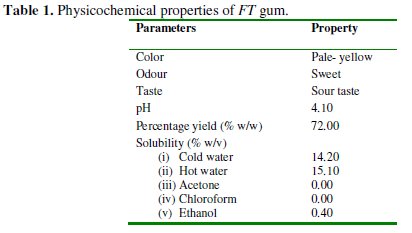
<body><![CDATA[<p><a href="#t1">Table 1</a> presents the physiochemical parameters of FT gum including colour, pH, 
percentage yield and solubility in various solvents.</p>


    <p>&nbsp;</p>
<a name="t1">
<img src="/img/revistas/pea/v31n2/31n2a02t1.jpg">
    
<p>&nbsp;</p>


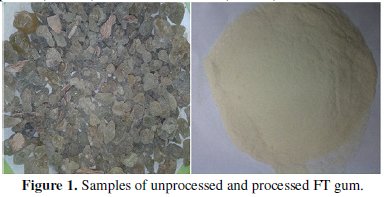
    <p>The gum is pale yellow in colour (<a href="#f1">Fig. 1</a>), it has a sour taste and a sweeten odor.</p>


    <p>&nbsp;</p>
<a name="f1">
<img src="/img/revistas/pea/v31n2/31n2a02f1.jpg">
    
<p>&nbsp;</p>


    <p>The measured pH of the 
gum (4.10) revealed that the gum is acidic and is characterized with a sour taste. 
The solubility of the FT gum in water tends to increase with increase in 
temperature, indicating that the heat given off in dissolving the gum is less than 
the heat required to break the gum apart. The net dissolution reaction is 
endothermic (energy required). Therefore, addition of more heat facilitates the 
dissolution of the gum by providing energy to break bonds within the gums. The 
gum was also found to be slightly soluble in ethanol but insoluble in acetone and 
chloroform. The solubility of the gum in ethanol may be due to the presence of 
polar and non-polar ends in ethanol, which made it to dissolve some polar and 
non-polar compounds. On the other hand, chloroform and acetone are non-polar 
solvents and as expected, non-polar compounds are soluble in non-polar solvent 
and vice versa. Hence FT gum is ionic and it is expected to be insoluble in 
chloroform and acetone.</p>


    <p>&nbsp;</p>
    <p><b><i>GCMS study of FT gum</i></b></p>

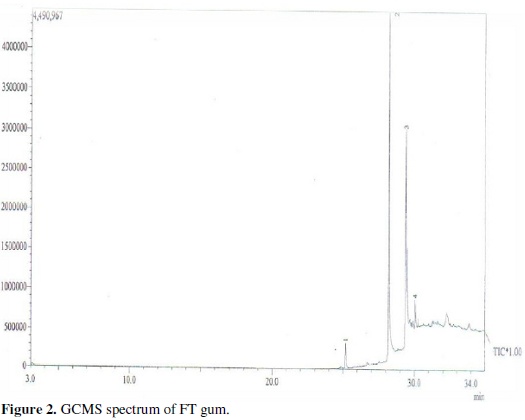
    <p><a href="#f2">Fig. 2</a> shows the GCMS spectrum of FT gum.</p>


    ]]></body>
<body><![CDATA[<p>&nbsp;</p>
<a name="f2">
<img src="/img/revistas/pea/v31n2/31n2a02f2.jpg">
    
<p>&nbsp;</p>


    <p>From the figure it can be seen that 
the spectrum of FT gum is characterized with four peaks. Since the area under 
the GCMS peak is proportional to the concentration, results obtained from area 
normalization were used to estimate the percentage concentrations of identified 
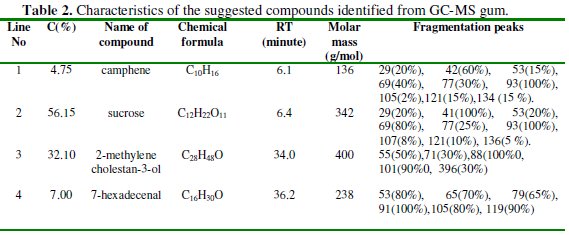
constituents of the gum, as presented in <a href="#t2">Table 2</a>.</p>


    <p>&nbsp;</p>
<a name="t2">
<img src="/img/revistas/pea/v31n2/31n2a02t2.jpg">
    
<p>&nbsp;</p>


    <p>The table also presents the 
various fragmentation peaks associated with each of the fraction, the 
corresponding retention time, molar mass and chemical formula of the identified 
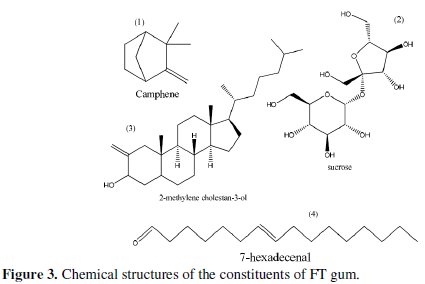
compounds. In <a href="#f3">Fig. 3</a>, chemical structures of the identified compounds are 
displayed.</p>


    <p>&nbsp;</p>
<a name="f3">
<img src="/img/revistas/pea/v31n2/31n2a02f3.jpg">
    
<p>&nbsp;</p>


    <p>The numbering on each of the structures corresponds to the peak 
number in the spectrum (<a href="#f2">Fig. 2</a>). The results obtained indicated that major 
components of FT gum are sucrose (56.15 %) and 2-methylene-3-ol (32.10 %), 
while camphene (4.75 %) and 7-hexadecenal (7.00 %) are its minor components.</p>


    <p>&nbsp;</p>
    ]]></body>
<body><![CDATA[<p><b><i>FTIR</i></b></p>

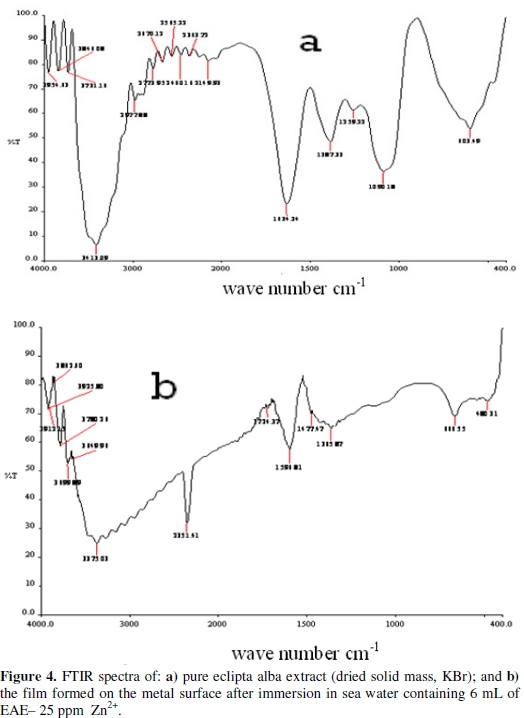
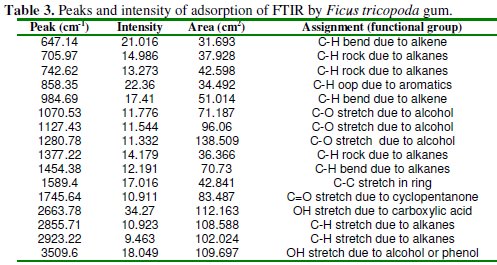
    <p><a href="#f4">Fig. 4</a> presents the FTIR spectrum of FT gum, while frequencies and peaks of IR 
adsorption by FT gum are presented in <a href="#t3">Table 3</a>.</p>


    <p>&nbsp;</p>
<a name="f4">
<img src="/img/revistas/pea/v31n2/31n2a02f4.jpg">
    
<p>&nbsp;</p>
<a name="t3">
<img src="/img/revistas/pea/v31n2/31n2a02t3.jpg">
    
<p>&nbsp;</p>


    <p>A close examination of the 
spectra shows that there are various peaks to the right of 300 cm<sup>-1</sup> indicating the 
presence of alkyl groups (in most organic compounds). A peak was also found to 
the left of 300 cm<sup>-1</sup>. This may be attributed to C=C bond due to camphene or 7-hexadecenal. 
The presence of sucrose in FT gum is correlated with the presence 
of cyclopentanone at 1745 cm<sup>-1</sup> and several OH vibrations. OH stretch due to 
alcohol was also found at 3509.60 cm<sup>-1</sup>. This may be due to the presence of 2-methylen 
cholestan-3-ol in the gum. C-H stretches due to alkanes were also 
found at 2856 and 2923 cm<sup>-1</sup>. Also at 1589 cm<sup>-1</sup>, C-C stretch due to ring was also 
significant in the spectrum. At peak frequencies of 1454.38 and 1377.22 cm<sup>-1</sup> , 
C-H bend and C-H rock due to alkanes were observed. Several C-O vibrations 
were also found between the wave number range of 1071 to 1281 cm<sup>-1</sup>. Finally, 
between the wave number range of 647 and 985 cm<sup>-1</sup>, C-H bend, C-H rock and 
C-H out of plane vibrations were eminent.</p>


    <p>&nbsp;</p>
    <p><b><i>Corrosion study</i></b></p>

    <p><i>Effect of FT gum on the corrosion of aluminum</i></p>

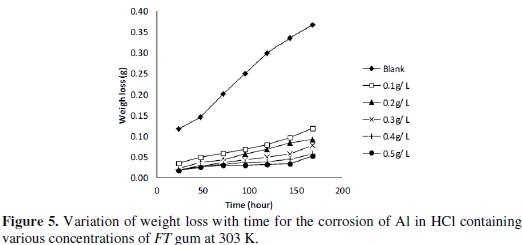
    <p><a href="#f5">Fig. 5</a> shows plots for the variation of weight loss with time for the corrosion of 
Al in 0.1 M of HCl containing various concentrations of FT gum at 303 and 333 K.</p>


    ]]></body>
<body><![CDATA[<p>&nbsp;</p>
<a name="f5">
<img src="/img/revistas/pea/v31n2/31n2a02f5.jpg">
    
<p>&nbsp;</p>


    <p>From the plots, it was deduced that weight loss of Al increases with increase 
in the period of contact but decreases with increasing concentration of FT gum. 
These imply that FT gum retarded the corrosion of Al in solution of HCl and that 
FT gum is an adsorption inhibitor for the corrosion of Al.</p> 

    <p>Weight loss of Al was also found to decrease with increase in temperature which 
also suggests that the corrosion rate of Al in solutions of HCl containing FT gum 
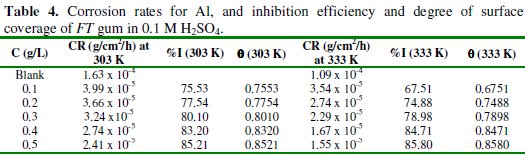
decreases with increase in temperature. In view of the observed trend, values of 
corrosion rate of Al and inhibition efficiency of various concentrations of FT 
gum at 303 and 333 K were calculated and are recorded in <a href="#t4">Table 4</a>.</p>


    <p>&nbsp;</p>
<a name="t4">
<img src="/img/revistas/pea/v31n2/31n2a02t4.jpg">
    
<p>&nbsp;</p>


    <p>The results obtained revealed that the inhibition efficiency of FT gum increases with 
increasing concentration and with increase in temperature at FT gum 
concentrations above 0.3 g/L. Based on literature, it can be inferred from the 
pattern of variation of inhibition efficiency with temperature, that two 
mechanisms of adsorption are possible. A physical adsorption mechanism 
applied when the inhibition efficiency decreases with increase in temperature, 
while a chemical adsorption mechanism applied when the inhibition efficiency 
decreases with increase in temperature [8]. From the calculated values of 
inhibition efficiency, it can be seen that the mechanisms of physical and chemical 
adsorption are clearly indicative at lower and higher concentrations of the 
inhibitors. Hence the mechanism of adsorption of FT gum on Al surface is
concentration and temperature dependent.</p>


    <p>&nbsp;</p>
    <p><i>Kinetic study</i></p>

    <p>Corrosion of most metals including aluminum has been confirmed to be a first 
order reaction [22]. Hence the rate of corrosion can be represented as follows 
[23],</p> 


    ]]></body>
<body><![CDATA[<p>&nbsp;</p>
<a name="e4">
<img src="/img/revistas/pea/v31n2/31n2a02e4.jpg">
    
<p>&nbsp;</p>


    <p>where [Al] is the concentration of Al, k<sub>1</sub> is the first order rate constant and t is the 
time or period of contact. Assuming the concentration of Al at time, t = 0 is 
denoted as [Al]<sub>0</sub> at time , t = 0 and at some other time, 't' as [Al]. Also, if x g of 
Al have reacted after time, t, then the concentration of Al at this time will be 
given as ([Al] - x). Integration of <a href="#e4">equation 4</a> within the limit, [Al]<sub>0</sub> and ([Al] - x) 
yields <a href="#e5">equation 5</a> and upon simplification, equations <a href="#e6">6</a> and <a href="#e7">7</a> were obtained</p> 


    <p>&nbsp;</p>
<a name="e5">
<img src="/img/revistas/pea/v31n2/31n2a02e5.jpg">
    
<p>&nbsp;</p>
<a name="e6">
<img src="/img/revistas/pea/v31n2/31n2a02e6.jpg">
    
<p>&nbsp;</p>
<a name="e7">
<img src="/img/revistas/pea/v31n2/31n2a02e7.jpg">
    
<p>&nbsp;</p>


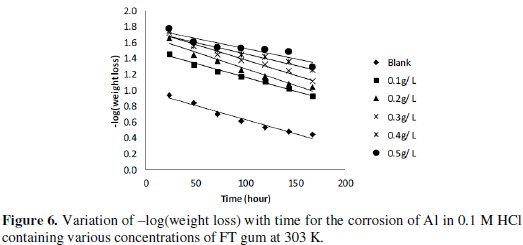
    <p>From <a href="#e7">equation 7</a>, a plot of -log(weight loss) versus time should be a straight line 
with slope and intercept equal to k<sub>1</sub>/2.303 and log[Al]<sub>0</sub>, respectively. <a href="#f6">Figure 6</a> 
presents plots for the variation of -log(weight loss) versus time for the corrosion 
of Al in solutions of HCl (plots obtained at 333 K are not shown).</p> 


    <p>&nbsp;</p>
<a name="f6">
<img src="/img/revistas/pea/v31n2/31n2a02f6.jpg">
    
<p>&nbsp;</p>


    ]]></body>
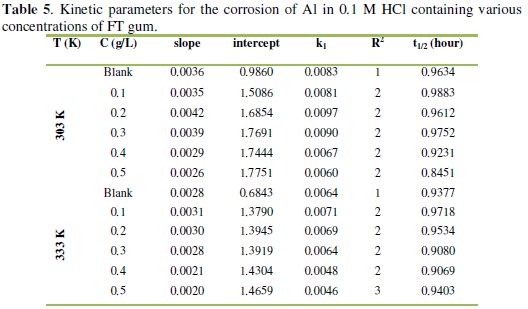
<body><![CDATA[<p>Values of R<sup>2</sup>, slopes and k<sub>1</sub> deduced from the plots are presented in <a href="#t5">Table 5</a>.</p> 


    <p>&nbsp;</p>
<a name="t5">
<img src="/img/revistas/pea/v31n2/31n2a02t5.jpg">
    
<p>&nbsp;</p>


    <p>The half-life of a first order reaction (t<sub>1/2</sub>) is related to the rate constant according to the following 
equation [22],</p> 


    <p>&nbsp;</p>
<a name="e8">
<img src="/img/revistas/pea/v31n2/31n2a02e8.jpg">
    
<p>&nbsp;</p>


    <p>From the results obtained (<a href="#t5">Table 5</a>), it is evident that the half-life for the inhibited 
reactions of Al in solutions of HCl is higher than those obtained for the blank indicating 
that FT gum has the tendency to increase the half-life of aluminum in solutions of HCl.</p>


    <p>&nbsp;</p>
    <p><i>Effect of temperature</i></p>

    <p>Effect of temperature on the adsorption of FT gum on mild steel was studied 
using the logarithm form of the Arrhenius equation (<a href="#e9">9</a>) [24]</p> 


    ]]></body>
<body><![CDATA[<p>&nbsp;</p>
<a name="e9">
<img src="/img/revistas/pea/v31n2/31n2a02e9.jpg">
    
<p>&nbsp;</p>


    <p>where CR<sub>1</sub> and CR<sub>2</sub> are the corrosion rates of aluminum in solution of HCl at the 
temperatures, T<sub>1</sub> (303 K) and T<sub>2</sub> (333 K), respectively, E<sub>a</sub> is the activation energy 
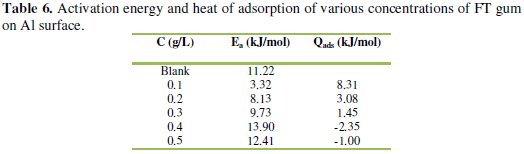
for the adsorption of FT gum on Al gum and R is the gas constant. Calculated 
values of the E<sub>a</sub> are shown in <a href="#t6">Table 6</a>.</p> 


    <p>&nbsp;</p>
<a name="t6">
<img src="/img/revistas/pea/v31n2/31n2a02t6.jpg">
    
<p>&nbsp;</p>


    <p>The activation energies are within the 
range of values expected for the mechanism of physical adsorption and tend to 
increase with increase in the concentration of FT gum. This implies that the 
mechanism of inhibition of Al corrosion by FT gum is concentration dependent.</p>

    <p>It is also significant to note that the activation energy calculated for the blank is 
higher than those calculated at FT gum concentrations of 0.1 to 0.3 g/L and vice 
versa. This implies that less energy is needed for the adsorption of the inhibitor 
compared to the corrosion of the metal. On the other hand, above FT gum 
concentration of 0.3 g/L, calculated values of the activation energy were higher 
than the corresponding value for the blank but lower than the threshold value 
required for chemisorption. This suggests that at this concentration, the diffusion 
of the inhibitor's molecules (and not the energy of activation) may be the rate 
limiting process.</p>


    <p>&nbsp;</p>
    <p><i>Thermodynamics and adsorption considerations</i></p>

    <p>Adsorption of FT gum on Al surface can be exothermic or endothermic 
depending on the reaction condition, the nature of FT gum's molecules and the 
mechanism of reaction. In order to calculate the heat of adsorption of FT gum on 
Al surface, an established thermodynamic equation was used [25]:</p> 


    ]]></body>
<body><![CDATA[<p>&nbsp;</p>
<a name="e10">
<img src="/img/revistas/pea/v31n2/31n2a02e10.jpg">
    
<p>&nbsp;</p>


    <p>where Q<sub>ads</sub> is the heat of adsorption of FT gum on Al surface, q<sub>1</sub> and q<sub>2</sub> are the 
degrees of surface coverage of the inhibitor at the temperatures, T<sub>1</sub> and T<sub>2</sub> (where 
T<sub>2</sub> &gt; T<sub>1</sub>) and R is the gas constant. Calculated values of Q<sub>ads</sub> (<a href="#t6">Table 6</a>) reflected 
endothermic reaction at FT gum concentrations of 0.1 to 0.3 g/L, but an 
exothermic one at concentrations above 0.3 g/L. This suggests that, above a 
critical concentration of 0.3 g/L, the mechanism of inhibition of Al corrosion by 
FT gum is altered between physisorption to chemisorption.</p> 

    <p>The adsorption characteristics of an organic corrosion inhibitor can be studied 
using the adsorption isotherm, whose general form can be written as follows 
[26],</p> 


    <p>&nbsp;</p>
<a name="e11">
<img src="/img/revistas/pea/v31n2/31n2a02e11.jpg">
    
<p>&nbsp;</p>


    <p>where f(&theta;, x) is the configurational factor which depends upon the physical 
model and the assumptions underlying the derivation of the isotherm, &theta;, the 
surface coverage, C, the inhibitor concentration in the electrolyte, 'x' is the size 
factor ratio, 'a' is the molecular interaction parameter and 'b' is the equilibrium 
constant of the adsorption process. In this study, calculated values of &theta; 
at various 
concentrations of the inhibitor were fitted into various adsorption isotherms 
including Langmuir, Temkin, Freundlich, Flory-Huggins, Bockris-Swinkels and 
Frumkin isotherms. The test indicated that the adsorption of FT gum best fitted 
the Langmuir and Frumkin adsorption isotherms.</p>

    <p>The Langmuir adsorption isotherm relates the degree of surface coverage to the 
concentration of the inhibitor according to the following equation [27],</p> 


    <p>&nbsp;</p>
<a name="e12">
<img src="/img/revistas/pea/v31n2/31n2a02e12.jpg">
    
<p>&nbsp;</p>


    ]]></body>
<body><![CDATA[<p>where &theta; is the degree of surface coverage of the inhibitor, C is the concentration 
of the inhibitor in the bulk electrolyte and b is the adsorption equilibrium 
constant. Simplification of <a href="#e11">equation 11</a> yields <a href="#e12">equation 12</a> and from the logarithm 
of both sides of <a href="#e12">equation 12</a>, <a href="#e13">equation 13</a> was obtained</p> 


    <p>&nbsp;</p>
<a name="e13">
<img src="/img/revistas/pea/v31n2/31n2a02e13.jpg">
    
<p>&nbsp;</p>
<a name="e14">
<img src="/img/revistas/pea/v31n2/31n2a02e14.jpg">
    
<p>&nbsp;</p>


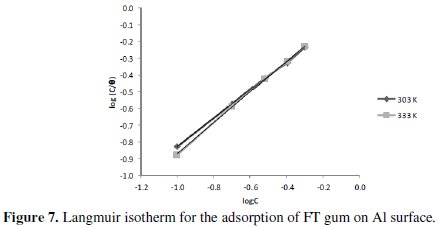
    <p>Plots of log(C/&theta;) versus log(b) gave straight lines and values of logb were estimated 
from intercepts of the plots (<a href="#f7">Fig. 7</a>).</p> 


    <p>&nbsp;</p>
<a name="f7">
<img src="/img/revistas/pea/v31n2/31n2a02f7.jpg">
    
<p>&nbsp;</p>


    <p>Also values of R<sup>2</sup> were very close to unity 
but slope values were not equal to unity as expected in the Langmuir model 
indicating the existence of interaction between the inhibitor's molecules.</p>

    <p>In order to account for the existence of molecular interaction, the Frumkin 
adsorption model was found to be applicable to the adsorption of FT gum on Al 
surface. The Frumkin adsorption isotherm can be expressed as follows [28],</p> 

    <p>&nbsp;</p>
<a name="e15">
<img src="/img/revistas/pea/v31n2/31n2a02e15.jpg">
    
]]></body>
<body><![CDATA[<p>&nbsp;</p>


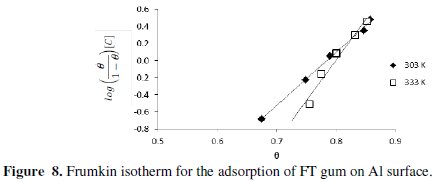
    <p>From <a href="#e14">equation 14</a>, a plot of ( &theta;/(1 - &theta;) )[C] 
versus &theta; should be linear if Frumkin isotherm is obeyed. <a href="#f8">Figure 8</a> 
shows the Frumkin isotherm for the adsorption of FT gum on Al surface.</p> 


    <p>&nbsp;</p>
<a name="f8">
<img src="/img/revistas/pea/v31n2/31n2a02f8.jpg">
    
<p>&nbsp;</p>


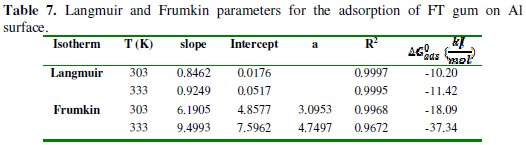
    <p>Frumkin adsorption parameters were also deduced from the 
plots and are presented in <a href="#t7">Table 7</a>.</p> 


    <p>&nbsp;</p>
<a name="t7">
<img src="/img/revistas/pea/v31n2/31n2a02t7.jpg">
    
<p>&nbsp;</p>


    <p>The results indicated that the interaction 
parameters are positive and tend to increase with increase in temperature, 
signifying the attractive behavior of the inhibitor and the possibility of 
chemisorption mechanism. The adsorption of FT gum on Al surface was also 
found to be consistent with the Dubinin-Radushkevich (D-RIM) adsorption 
isotherm, which can be expressed according to <a href="#e12">equation 12</a> [29],</p> 


    <p>&nbsp;</p>
<a name="e16">
<img src="/img/revistas/pea/v31n2/31n2a02e16.jpg">
    
<p>&nbsp;</p>


    ]]></body>
<body><![CDATA[<p>where q<sub>max</sub> is the maximum surface coverage and &sigma;
is the polany potential and can be estimated from the following equation,</p> 


    <p>&nbsp;</p>
<a name="e17">
<img src="/img/revistas/pea/v31n2/31n2a02e17.jpg">
    
<p>&nbsp;</p>


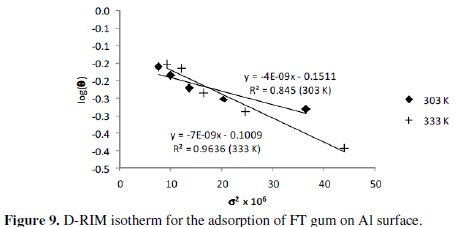
    <p>Straight lines were obtained from plots of ln(q) versus &sigma;<sup>2</sup> indicating the 
application of the D-RIM isotherm to the adsorption of FT gum on Al surface.</p> 

    <p>The constant 'a' and q<sub>max</sub> were estimated from the slope and intercept of the plot, 
respectively. The results obtained revealed that the value of 'a' at 303 K (i.e., 4 &times; 
10<sup>-9</sup>) is higher than the value at 333 K (7 &times; 10<sup>-9</sup>). Similar trend was observed for 
values of q<sub>max</sub> at 303 K (66.64) and 333 K (63.38), respectively. It has been 
found that the constant, 'a' is related to the mean adsorption energy (E) 
according to <a href="#e17">equation 17</a> [29]</p>


    <p>&nbsp;</p>
<a name="e18">
<img src="/img/revistas/pea/v31n2/31n2a02e18.jpg">
    
<p>&nbsp;</p>


    <p>Also, several studies have shown that E value less than 8 kJ/mol supports the 
mechanism of physical adsorption but E values greater than 8 kJ/mol are 
consistent with the mechanism of chemisorption. <a href="#f9">Figure 9</a> shows D-RIM isotherm 
for the adsorption of FT gum on Al surface.</p> 


    <p>&nbsp;</p>
<a name="f9">
<img src="/img/revistas/pea/v31n2/31n2a02f9.jpg">
    
<p>&nbsp;</p>


    ]]></body>
<body><![CDATA[<p>R<sup>2</sup> values for the plots were 0.8450 
and 0.9636, while E values were 11.18 and 8.55 kJ/mol. From the calculated 
results, chemisorption mechanism is significant in the inhibition of the corrosion 
of Al by FT gum.</p>

    <p>The free energy of adsorption of FT gum on Al surface was estimated using the 
Gibb-Helmoltz equation, which relates the adsorption equilibrium constant with 
the free energy of adsorption as follows [30 - 31],</p>


    <p>&nbsp;</p>
<a name="e19">
<img src="/img/revistas/pea/v31n2/31n2a02e19.jpg">
    
<p>&nbsp;</p>


    <p>where &Delta;G<sup>0</sup><sub>ads</sub> is the standard free energy of 
adsorption of FT gum on Al surface.</p>

    <p>Calculated values of &Delta;G<sup>0</sup><sub>ads</sub> and 'b' deduced from Langmuir and Frumkin 
isotherms are presented in <a href="#t7">Table 7</a>. From the results obtained, the free energies 
are negative, indicating that the adsorption of FT gum on mild steel surface is 
spontaneous. However, while free energy values obtained from the Langmuir 
isotherm point towards a physisorption mechanism, those from the Frumkin 
isotherm reflect chemisorption mechanism. Hence the adsorption of FT gum is 
characterized by the initial mechanism of physical adsorption and is succeeded 
by chemical adsorption mechanism. Generally, values of &Delta;G<sup>0</sup><sub>ads</sub> below - 20 
kJ/mol are consistent with the mechanism of charge transfer from the charged 
inhibitor to the charged metal surface, which supports physisorption, but &Delta;G<sup>0</sup><sub>ads</sub> 
values close to or above - 20 kJ/mol are consistent with the mechanism of 
chemical adsorption, which involves the transfer of electrons from the inhibitor's 
molecules to vacant d-orbital of the metal. From the present data, it is evident 
that the adsorption of FT gum on Al surface incorporated both mechanisms.</p>


    <p>&nbsp;</p>
    <p><b>Conclusions</b></p>

    <p>The results and findings of this study revealed that FT gum is a good inhibitor for 
the corrosion of Al in solution of HCl. The inhibition potential of the gum is 
concentration and temperature dependent.</p>

    <p>The adsorption of the gum is first order and is characterized by interchanging 
mechanism. Langmuir, Frumkin and Dubinin-Radushkevich adsorption 
isotherms are significant in describing the adsorption characteristics of the 
inhibitors.</p>

    ]]></body>
<body><![CDATA[<p>In view of the above, the use of FT gum as an inhibitor for the corrosion of Al in 
acidic medium is hereby recommended.</p>


    <p>&nbsp;</p>
    <p><b>References</b></p>

    <!-- ref --><p>1. El-Etre AY. Corros Sci. 2003;45:2485.    &nbsp;&nbsp;&nbsp;&nbsp;&nbsp;&nbsp;&nbsp;&nbsp;[&#160;<a href="javascript:void(0);" onclick="javascript: window.open('/scielo.php?script=sci_nlinks&ref=000166&pid=S0872-1904201300020000200001&lng=','','width=640,height=500,resizable=yes,scrollbars=1,menubar=yes,');">Links</a>&#160;]<!-- end-ref --></p>
    <!-- ref --><p>2. Bouklah M, Hammouti B. Port Electrochim Acta. 2006;24:457.    &nbsp;&nbsp;&nbsp;&nbsp;&nbsp;&nbsp;&nbsp;&nbsp;[&#160;<a href="javascript:void(0);" onclick="javascript: window.open('/scielo.php?script=sci_nlinks&ref=000168&pid=S0872-1904201300020000200002&lng=','','width=640,height=500,resizable=yes,scrollbars=1,menubar=yes,');">Links</a>&#160;]<!-- end-ref --></p>
    <!-- ref --><p>3. Singh DDN, Singh MM, Chaudhary RS, Agarwal CV. Electrochim Acta 1981;26:1051.    &nbsp;&nbsp;&nbsp;&nbsp;&nbsp;&nbsp;&nbsp;&nbsp;[&#160;<a href="javascript:void(0);" onclick="javascript: window.open('/scielo.php?script=sci_nlinks&ref=000170&pid=S0872-1904201300020000200003&lng=','','width=640,height=500,resizable=yes,scrollbars=1,menubar=yes,');">Links</a>&#160;]<!-- end-ref --></p>
    <!-- ref --><p>4. Mears RB, Eldredge GG. Ind Eng Chem. 1945;37:736.    &nbsp;&nbsp;&nbsp;&nbsp;&nbsp;&nbsp;&nbsp;&nbsp;[&#160;<a href="javascript:void(0);" onclick="javascript: window.open('/scielo.php?script=sci_nlinks&ref=000172&pid=S0872-1904201300020000200004&lng=','','width=640,height=500,resizable=yes,scrollbars=1,menubar=yes,');">Links</a>&#160;]<!-- end-ref --></p>
    <!-- ref --><p>5. Singh DDN, Chaudhary RS, Prakash B, Agrawal CV. Br Corros J. 1979;14:235.    &nbsp;&nbsp;&nbsp;&nbsp;&nbsp;&nbsp;&nbsp;&nbsp;[&#160;<a href="javascript:void(0);" onclick="javascript: window.open('/scielo.php?script=sci_nlinks&ref=000174&pid=S0872-1904201300020000200005&lng=','','width=640,height=500,resizable=yes,scrollbars=1,menubar=yes,');">Links</a>&#160;]<!-- end-ref --></p>
    <!-- ref --><p>6. Metikos-Hukovic M, Babic R, Grubac Z. J Appl Electrochem. 1998;28:433.    &nbsp;&nbsp;&nbsp;&nbsp;&nbsp;&nbsp;&nbsp;&nbsp;[&#160;<a href="javascript:void(0);" onclick="javascript: window.open('/scielo.php?script=sci_nlinks&ref=000176&pid=S0872-1904201300020000200006&lng=','','width=640,height=500,resizable=yes,scrollbars=1,menubar=yes,');">Links</a>&#160;]<!-- end-ref --></p>
    <!-- ref --><p>7. Amin M, Khaled KF, Mohsen Q, Arida A. Corros Sci. 2010;52:1684.    &nbsp;&nbsp;&nbsp;&nbsp;&nbsp;&nbsp;&nbsp;&nbsp;[&#160;<a href="javascript:void(0);" onclick="javascript: window.open('/scielo.php?script=sci_nlinks&ref=000178&pid=S0872-1904201300020000200007&lng=','','width=640,height=500,resizable=yes,scrollbars=1,menubar=yes,');">Links</a>&#160;]<!-- end-ref --></p>
    <!-- ref --><p>8. Ramananda SM, Sharma V, Singh G. Port Electrochim Acta. 2011;29:405.    &nbsp;&nbsp;&nbsp;&nbsp;&nbsp;&nbsp;&nbsp;&nbsp;[&#160;<a href="javascript:void(0);" onclick="javascript: window.open('/scielo.php?script=sci_nlinks&ref=000180&pid=S0872-1904201300020000200008&lng=','','width=640,height=500,resizable=yes,scrollbars=1,menubar=yes,');">Links</a>&#160;]<!-- end-ref --></p>
    <!-- ref --><p>9. Oguzie EE, Onuchukwu AI, Okafor PC, Ebenso EE. Pigment Resin Tech. 2006;35:63.    &nbsp;&nbsp;&nbsp;&nbsp;&nbsp;&nbsp;&nbsp;&nbsp;[&#160;<a href="javascript:void(0);" onclick="javascript: window.open('/scielo.php?script=sci_nlinks&ref=000182&pid=S0872-1904201300020000200009&lng=','','width=640,height=500,resizable=yes,scrollbars=1,menubar=yes,');">Links</a>&#160;]<!-- end-ref --></p>
    <p>10. A.M. Abdel-Gaber, B.A. Abd-El-Nabey, I.M. Sidahmed, et al. Corros Sci. 2006;48:2765.</p>
    <!-- ref --><p>11. Loto CA. Corros. Prev Control. 2001;48:38.    &nbsp;&nbsp;&nbsp;&nbsp;&nbsp;&nbsp;&nbsp;&nbsp;[&#160;<a href="javascript:void(0);" onclick="javascript: window.open('/scielo.php?script=sci_nlinks&ref=000185&pid=S0872-1904201300020000200011&lng=','','width=640,height=500,resizable=yes,scrollbars=1,menubar=yes,');">Links</a>&#160;]<!-- end-ref --></p>
    <!-- ref --><p>12. El-Etre AY. J Colloid Interf Sci. 2007;314:578.    &nbsp;&nbsp;&nbsp;&nbsp;&nbsp;&nbsp;&nbsp;&nbsp;[&#160;<a href="javascript:void(0);" onclick="javascript: window.open('/scielo.php?script=sci_nlinks&ref=000187&pid=S0872-1904201300020000200012&lng=','','width=640,height=500,resizable=yes,scrollbars=1,menubar=yes,');">Links</a>&#160;]<!-- end-ref --></p>
    <!-- ref --><p>13. Loto CA. Corros. Prev Control. 2003;50:43.    &nbsp;&nbsp;&nbsp;&nbsp;&nbsp;&nbsp;&nbsp;&nbsp;[&#160;<a href="javascript:void(0);" onclick="javascript: window.open('/scielo.php?script=sci_nlinks&ref=000189&pid=S0872-1904201300020000200013&lng=','','width=640,height=500,resizable=yes,scrollbars=1,menubar=yes,');">Links</a>&#160;]<!-- end-ref --></p>
    <!-- ref --><p>14. El-Etre AY. Appl Surf Sci. 2006;252:8521.    &nbsp;&nbsp;&nbsp;&nbsp;&nbsp;&nbsp;&nbsp;&nbsp;[&#160;<a href="javascript:void(0);" onclick="javascript: window.open('/scielo.php?script=sci_nlinks&ref=000191&pid=S0872-1904201300020000200014&lng=','','width=640,height=500,resizable=yes,scrollbars=1,menubar=yes,');">Links</a>&#160;]<!-- end-ref --></p>
    ]]></body>
<body><![CDATA[<!-- ref --><p>15. Umoren SA, Obot IB, Ebenso EE, Egbedi NO. Port Electrochim Acta 2008;26:199.    &nbsp;&nbsp;&nbsp;&nbsp;&nbsp;&nbsp;&nbsp;&nbsp;[&#160;<a href="javascript:void(0);" onclick="javascript: window.open('/scielo.php?script=sci_nlinks&ref=000193&pid=S0872-1904201300020000200015&lng=','','width=640,height=500,resizable=yes,scrollbars=1,menubar=yes,');">Links</a>&#160;]<!-- end-ref --></p>
    <!-- ref --><p>16. Eddy NO, Odiongenyi AO, Ameh PO, Ebenso EE. Int J Electrochem Sci. 2012;7:7425.    &nbsp;&nbsp;&nbsp;&nbsp;&nbsp;&nbsp;&nbsp;&nbsp;[&#160;<a href="javascript:void(0);" onclick="javascript: window.open('/scielo.php?script=sci_nlinks&ref=000195&pid=S0872-1904201300020000200016&lng=','','width=640,height=500,resizable=yes,scrollbars=1,menubar=yes,');">Links</a>&#160;]<!-- end-ref --></p>
    <!-- ref --><p>17. Eddy NO, Ameh PO, Gimba CE, Ebenso EE. Int J Electrochem Sci. 2011;6:5677.    &nbsp;&nbsp;&nbsp;&nbsp;&nbsp;&nbsp;&nbsp;&nbsp;[&#160;<a href="javascript:void(0);" onclick="javascript: window.open('/scielo.php?script=sci_nlinks&ref=000197&pid=S0872-1904201300020000200017&lng=','','width=640,height=500,resizable=yes,scrollbars=1,menubar=yes,');">Links</a>&#160;]<!-- end-ref --></p>
    <!-- ref --><p>18. Eddy NO, Ameh PO, Gimba CE, Ebenso EE. Int J Electrochem Sci. 2011;6:5815.    &nbsp;&nbsp;&nbsp;&nbsp;&nbsp;&nbsp;&nbsp;&nbsp;[&#160;<a href="javascript:void(0);" onclick="javascript: window.open('/scielo.php?script=sci_nlinks&ref=000199&pid=S0872-1904201300020000200018&lng=','','width=640,height=500,resizable=yes,scrollbars=1,menubar=yes,');">Links</a>&#160;]<!-- end-ref --></p>
    <!-- ref --><p>19. Dehri I, Ozcan M. Mater Chem Phys. 2006;98:316.    &nbsp;&nbsp;&nbsp;&nbsp;&nbsp;&nbsp;&nbsp;&nbsp;[&#160;<a href="javascript:void(0);" onclick="javascript: window.open('/scielo.php?script=sci_nlinks&ref=000201&pid=S0872-1904201300020000200019&lng=','','width=640,height=500,resizable=yes,scrollbars=1,menubar=yes,');">Links</a>&#160;]<!-- end-ref --></p>
    ]]></body>
<body><![CDATA[<!-- ref --><p>20. Ameh PO, Eddy NO, Gimba CE. Physiochemical and rheological studies on some natural polymers and their potentials as corrosion inhibitors. UK: Lambert Academic Publishing; 2012.    &nbsp;&nbsp;&nbsp;&nbsp;&nbsp;&nbsp;&nbsp;&nbsp;[&#160;<a href="javascript:void(0);" onclick="javascript: window.open('/scielo.php?script=sci_nlinks&ref=000203&pid=S0872-1904201300020000200020&lng=','','width=640,height=500,resizable=yes,scrollbars=1,menubar=yes,');">Links</a>&#160;]<!-- end-ref --></p>
    <!-- ref --><p>21. Carter SJ. Tutorial pharmacy: solution. Great Britain: Pitman Press; 2005.    &nbsp;&nbsp;&nbsp;&nbsp;&nbsp;&nbsp;&nbsp;&nbsp;[&#160;<a href="javascript:void(0);" onclick="javascript: window.open('/scielo.php?script=sci_nlinks&ref=000205&pid=S0872-1904201300020000200021&lng=','','width=640,height=500,resizable=yes,scrollbars=1,menubar=yes,');">Links</a>&#160;]<!-- end-ref --></p>
    <!-- ref --><p>22. Awe FE, Eddy NO. Amino acids as corrosion inhibitors: quantum and experimental studies. London, UK: Lambert Academic publishing; 2012.    &nbsp;&nbsp;&nbsp;&nbsp;&nbsp;&nbsp;&nbsp;&nbsp;[&#160;<a href="javascript:void(0);" onclick="javascript: window.open('/scielo.php?script=sci_nlinks&ref=000207&pid=S0872-1904201300020000200022&lng=','','width=640,height=500,resizable=yes,scrollbars=1,menubar=yes,');">Links</a>&#160;]<!-- end-ref --></p>
    <!-- ref --><p>23. Khaled KF. Corros Sci. 2010;52:2905.    &nbsp;&nbsp;&nbsp;&nbsp;&nbsp;&nbsp;&nbsp;&nbsp;[&#160;<a href="javascript:void(0);" onclick="javascript: window.open('/scielo.php?script=sci_nlinks&ref=000209&pid=S0872-1904201300020000200023&lng=','','width=640,height=500,resizable=yes,scrollbars=1,menubar=yes,');">Links</a>&#160;]<!-- end-ref --></p>
    <!-- ref --><p>24. Okafor PC, Ekpe UJ, Ebenso EE, et al. Bull Electrochem. 2005;21:347.    &nbsp;&nbsp;&nbsp;&nbsp;&nbsp;&nbsp;&nbsp;&nbsp;[&#160;<a href="javascript:void(0);" onclick="javascript: window.open('/scielo.php?script=sci_nlinks&ref=000211&pid=S0872-1904201300020000200024&lng=','','width=640,height=500,resizable=yes,scrollbars=1,menubar=yes,');">Links</a>&#160;]<!-- end-ref --></p>
    ]]></body>
<body><![CDATA[<!-- ref --><p>25. Elayyachy M, Hammouti B, El Idrissi A. Appl Surf Sci. 2005;249:176.    &nbsp;&nbsp;&nbsp;&nbsp;&nbsp;&nbsp;&nbsp;&nbsp;[&#160;<a href="javascript:void(0);" onclick="javascript: window.open('/scielo.php?script=sci_nlinks&ref=000213&pid=S0872-1904201300020000200025&lng=','','width=640,height=500,resizable=yes,scrollbars=1,menubar=yes,');">Links</a>&#160;]<!-- end-ref --></p>
    <!-- ref --><p>26. Morad MS, Kamal AM, El-Dean. Corros Sci. 2006;48:3398.    &nbsp;&nbsp;&nbsp;&nbsp;&nbsp;&nbsp;&nbsp;&nbsp;[&#160;<a href="javascript:void(0);" onclick="javascript: window.open('/scielo.php?script=sci_nlinks&ref=000215&pid=S0872-1904201300020000200026&lng=','','width=640,height=500,resizable=yes,scrollbars=1,menubar=yes,');">Links</a>&#160;]<!-- end-ref --></p>
    <!-- ref --><p>27. Behpour M, Ghoreishi SM, Khayatkashani M, Soltani N. Corros Sci. 2001;53:2489.    &nbsp;&nbsp;&nbsp;&nbsp;&nbsp;&nbsp;&nbsp;&nbsp;[&#160;<a href="javascript:void(0);" onclick="javascript: window.open('/scielo.php?script=sci_nlinks&ref=000217&pid=S0872-1904201300020000200027&lng=','','width=640,height=500,resizable=yes,scrollbars=1,menubar=yes,');">Links</a>&#160;]<!-- end-ref --></p>
    <!-- ref --><p>28. Gojic M. Corros Sci. 2002;43:919.    &nbsp;&nbsp;&nbsp;&nbsp;&nbsp;&nbsp;&nbsp;&nbsp;[&#160;<a href="javascript:void(0);" onclick="javascript: window.open('/scielo.php?script=sci_nlinks&ref=000219&pid=S0872-1904201300020000200028&lng=','','width=640,height=500,resizable=yes,scrollbars=1,menubar=yes,');">Links</a>&#160;]<!-- end-ref --></p>
    <!-- ref --><p>29. Noor EA. J Appl Electrochem. 2009;39:1465.    &nbsp;&nbsp;&nbsp;&nbsp;&nbsp;&nbsp;&nbsp;&nbsp;[&#160;<a href="javascript:void(0);" onclick="javascript: window.open('/scielo.php?script=sci_nlinks&ref=000221&pid=S0872-1904201300020000200029&lng=','','width=640,height=500,resizable=yes,scrollbars=1,menubar=yes,');">Links</a>&#160;]<!-- end-ref --></p>
    ]]></body>
<body><![CDATA[<!-- ref --><p>30. Dehri I, Ozcan M. Mater Chem Phys. 2006;98:316.    &nbsp;&nbsp;&nbsp;&nbsp;&nbsp;&nbsp;&nbsp;&nbsp;[&#160;<a href="javascript:void(0);" onclick="javascript: window.open('/scielo.php?script=sci_nlinks&ref=000223&pid=S0872-1904201300020000200030&lng=','','width=640,height=500,resizable=yes,scrollbars=1,menubar=yes,');">Links</a>&#160;]<!-- end-ref --></p>
    <!-- ref --><p>31. Popova A, Sokolova E, Raicheva S, Christov M. Corros Sci. 2003;45:33.    &nbsp;&nbsp;&nbsp;&nbsp;&nbsp;&nbsp;&nbsp;&nbsp;[&#160;<a href="javascript:void(0);" onclick="javascript: window.open('/scielo.php?script=sci_nlinks&ref=000225&pid=S0872-1904201300020000200031&lng=','','width=640,height=500,resizable=yes,scrollbars=1,menubar=yes,');">Links</a>&#160;]<!-- end-ref --></p>


    <p>&nbsp;</p>
    <p><a name=0></a><sup><a href="#top">*</a></sup>Corresponding author. E-mail address: <a href="mailto:nabukeddy@yahoo.com">nabukeddy@yahoo.com</a></p>

    <p>Received 24 November 2012; accepted 23 April 2013</p>

    <p><a href="http://www.peacta.org" target="_blank">www.peacta.org</a> </p>


     ]]></body><back>
<ref-list>
<ref id="B1">
<label>1</label><nlm-citation citation-type="journal">
<person-group person-group-type="author">
<name>
<surname><![CDATA[El-Etre]]></surname>
<given-names><![CDATA[A Y]]></given-names>
</name>
</person-group>
<source><![CDATA[Corros Sci]]></source>
<year>2003</year>
<volume>45</volume>
<page-range>2485</page-range></nlm-citation>
</ref>
<ref id="B2">
<label>2</label><nlm-citation citation-type="journal">
<person-group person-group-type="author">
<name>
<surname><![CDATA[Bouklah]]></surname>
<given-names><![CDATA[M]]></given-names>
</name>
<name>
<surname><![CDATA[Hammouti]]></surname>
<given-names><![CDATA[B]]></given-names>
</name>
</person-group>
<source><![CDATA[Port Electrochim Acta]]></source>
<year>2006</year>
<volume>24</volume>
<page-range>457</page-range></nlm-citation>
</ref>
<ref id="B3">
<label>3</label><nlm-citation citation-type="journal">
<person-group person-group-type="author">
<name>
<surname><![CDATA[D D N]]></surname>
<given-names><![CDATA[Singh]]></given-names>
</name>
<name>
<surname><![CDATA[Singh]]></surname>
<given-names><![CDATA[M M]]></given-names>
</name>
<name>
<surname><![CDATA[Chaudhary]]></surname>
<given-names><![CDATA[R S]]></given-names>
</name>
<name>
<surname><![CDATA[Agarwal]]></surname>
<given-names><![CDATA[C V]]></given-names>
</name>
</person-group>
<source><![CDATA[Electrochim Acta]]></source>
<year>1981</year>
<volume>26</volume>
<page-range>1051</page-range></nlm-citation>
</ref>
<ref id="B4">
<label>4</label><nlm-citation citation-type="journal">
<person-group person-group-type="author">
<name>
<surname><![CDATA[Mears]]></surname>
<given-names><![CDATA[R B]]></given-names>
</name>
<name>
<surname><![CDATA[Eldredge]]></surname>
<given-names><![CDATA[G G]]></given-names>
</name>
</person-group>
<source><![CDATA[Ind Eng Chem]]></source>
<year>1945</year>
<volume>37</volume>
<page-range>736</page-range></nlm-citation>
</ref>
<ref id="B5">
<label>5</label><nlm-citation citation-type="journal">
<person-group person-group-type="author">
<name>
<surname><![CDATA[Singh]]></surname>
<given-names><![CDATA[D D N]]></given-names>
</name>
<name>
<surname><![CDATA[Chaudhary]]></surname>
<given-names><![CDATA[R S]]></given-names>
</name>
<name>
<surname><![CDATA[Prakash]]></surname>
<given-names><![CDATA[B]]></given-names>
</name>
<name>
<surname><![CDATA[Agrawal]]></surname>
<given-names><![CDATA[C V]]></given-names>
</name>
</person-group>
<source><![CDATA[Br Corros J]]></source>
<year>1979</year>
<volume>14</volume>
<page-range>235</page-range></nlm-citation>
</ref>
<ref id="B6">
<label>6</label><nlm-citation citation-type="journal">
<person-group person-group-type="author">
<name>
<surname><![CDATA[Metikos-Hukovic]]></surname>
<given-names><![CDATA[M]]></given-names>
</name>
<name>
<surname><![CDATA[Babic]]></surname>
<given-names><![CDATA[R]]></given-names>
</name>
<name>
<surname><![CDATA[Grubac]]></surname>
<given-names><![CDATA[Z]]></given-names>
</name>
</person-group>
<source><![CDATA[J Appl Electrochem]]></source>
<year>1998</year>
<volume>28</volume>
<page-range>433</page-range></nlm-citation>
</ref>
<ref id="B7">
<label>7</label><nlm-citation citation-type="journal">
<person-group person-group-type="author">
<name>
<surname><![CDATA[Amin]]></surname>
<given-names><![CDATA[M]]></given-names>
</name>
<name>
<surname><![CDATA[Khaled]]></surname>
<given-names><![CDATA[K F]]></given-names>
</name>
<name>
<surname><![CDATA[Mohsen]]></surname>
<given-names><![CDATA[Q]]></given-names>
</name>
<name>
<surname><![CDATA[Arida]]></surname>
<given-names><![CDATA[A]]></given-names>
</name>
</person-group>
<source><![CDATA[Corros Sci]]></source>
<year>2010</year>
<volume>52</volume>
<page-range>1684</page-range></nlm-citation>
</ref>
<ref id="B8">
<label>8</label><nlm-citation citation-type="journal">
<person-group person-group-type="author">
<name>
<surname><![CDATA[Ramananda]]></surname>
<given-names><![CDATA[S M]]></given-names>
</name>
<name>
<surname><![CDATA[Sharma]]></surname>
<given-names><![CDATA[V]]></given-names>
</name>
<name>
<surname><![CDATA[Singh]]></surname>
<given-names><![CDATA[G]]></given-names>
</name>
</person-group>
<source><![CDATA[Port Electrochim Acta]]></source>
<year>2011</year>
<volume>29</volume>
<page-range>405</page-range></nlm-citation>
</ref>
<ref id="B9">
<label>9</label><nlm-citation citation-type="journal">
<person-group person-group-type="author">
<name>
<surname><![CDATA[Oguzie]]></surname>
<given-names><![CDATA[E E]]></given-names>
</name>
<name>
<surname><![CDATA[Onuchukwu]]></surname>
<given-names><![CDATA[A I]]></given-names>
</name>
<name>
<surname><![CDATA[Okafor]]></surname>
<given-names><![CDATA[P C]]></given-names>
</name>
<name>
<surname><![CDATA[Ebenso]]></surname>
<given-names><![CDATA[E E]]></given-names>
</name>
</person-group>
<source><![CDATA[Pigment Resin Tech]]></source>
<year>2006</year>
<volume>35</volume>
<page-range>63</page-range></nlm-citation>
</ref>
<ref id="B10">
<label>10</label><nlm-citation citation-type="journal">
<person-group person-group-type="author">
<name>
<surname><![CDATA[Abdel-Gaber]]></surname>
<given-names><![CDATA[A M]]></given-names>
</name>
<name>
<surname><![CDATA[Abd-El-Nabey]]></surname>
<given-names><![CDATA[B A]]></given-names>
</name>
<name>
<surname><![CDATA[Sidahmed]]></surname>
<given-names><![CDATA[I M]]></given-names>
</name>
</person-group>
<source><![CDATA[Corros Sci]]></source>
<year>2006</year>
<volume>48</volume>
<page-range>2765</page-range></nlm-citation>
</ref>
<ref id="B11">
<label>11</label><nlm-citation citation-type="journal">
<person-group person-group-type="author">
<name>
<surname><![CDATA[Loto]]></surname>
<given-names><![CDATA[C A]]></given-names>
</name>
</person-group>
<source><![CDATA[Corros. Prev Control]]></source>
<year>2001</year>
<volume>48</volume>
<page-range>38</page-range></nlm-citation>
</ref>
<ref id="B12">
<label>12</label><nlm-citation citation-type="journal">
<person-group person-group-type="author">
<name>
<surname><![CDATA[El-Etre]]></surname>
<given-names><![CDATA[A Y]]></given-names>
</name>
</person-group>
<source><![CDATA[J Colloid Interf Sci]]></source>
<year>2007</year>
<volume>314</volume>
<page-range>578</page-range></nlm-citation>
</ref>
<ref id="B13">
<label>13</label><nlm-citation citation-type="journal">
<person-group person-group-type="author">
<name>
<surname><![CDATA[Loto]]></surname>
<given-names><![CDATA[C A]]></given-names>
</name>
</person-group>
<source><![CDATA[Corros. Prev Control]]></source>
<year>2003</year>
<volume>50</volume>
<page-range>43</page-range></nlm-citation>
</ref>
<ref id="B14">
<label>14</label><nlm-citation citation-type="journal">
<person-group person-group-type="author">
<name>
<surname><![CDATA[El-Etre]]></surname>
<given-names><![CDATA[A Y]]></given-names>
</name>
</person-group>
<source><![CDATA[Appl Surf Sci]]></source>
<year>2006</year>
<volume>252</volume>
<page-range>8521</page-range></nlm-citation>
</ref>
<ref id="B15">
<label>15</label><nlm-citation citation-type="journal">
<person-group person-group-type="author">
<name>
<surname><![CDATA[Umoren]]></surname>
<given-names><![CDATA[S A]]></given-names>
</name>
<name>
<surname><![CDATA[Obot]]></surname>
<given-names><![CDATA[I B]]></given-names>
</name>
<name>
<surname><![CDATA[Ebenso]]></surname>
<given-names><![CDATA[E E]]></given-names>
</name>
<name>
<surname><![CDATA[Egbedi]]></surname>
<given-names><![CDATA[N O]]></given-names>
</name>
</person-group>
<source><![CDATA[Port Electrochim Acta]]></source>
<year>2008</year>
<volume>26</volume>
<page-range>199</page-range></nlm-citation>
</ref>
<ref id="B16">
<label>16</label><nlm-citation citation-type="journal">
<person-group person-group-type="author">
<name>
<surname><![CDATA[Eddy]]></surname>
<given-names><![CDATA[N O]]></given-names>
</name>
<name>
<surname><![CDATA[Odiongenyi]]></surname>
<given-names><![CDATA[A O]]></given-names>
</name>
<name>
<surname><![CDATA[Ameh]]></surname>
<given-names><![CDATA[P O]]></given-names>
</name>
<name>
<surname><![CDATA[Ebenso]]></surname>
<given-names><![CDATA[E E]]></given-names>
</name>
</person-group>
<source><![CDATA[Int J Electrochem Sci]]></source>
<year>2012</year>
<volume>7</volume>
<page-range>7425</page-range></nlm-citation>
</ref>
<ref id="B17">
<label>17</label><nlm-citation citation-type="journal">
<person-group person-group-type="author">
<name>
<surname><![CDATA[Eddy]]></surname>
<given-names><![CDATA[N O]]></given-names>
</name>
<name>
<surname><![CDATA[Ameh]]></surname>
<given-names><![CDATA[P O]]></given-names>
</name>
<name>
<surname><![CDATA[Gimba]]></surname>
<given-names><![CDATA[C E]]></given-names>
</name>
<name>
<surname><![CDATA[Ebenso]]></surname>
<given-names><![CDATA[E E]]></given-names>
</name>
</person-group>
<source><![CDATA[Int J Electrochem Sci]]></source>
<year>2011</year>
<volume>6</volume>
<page-range>5677</page-range></nlm-citation>
</ref>
<ref id="B18">
<label>18</label><nlm-citation citation-type="journal">
<person-group person-group-type="author">
<name>
<surname><![CDATA[Eddy]]></surname>
<given-names><![CDATA[N O]]></given-names>
</name>
<name>
<surname><![CDATA[Ameh]]></surname>
<given-names><![CDATA[P O]]></given-names>
</name>
<name>
<surname><![CDATA[Gimba]]></surname>
<given-names><![CDATA[C E]]></given-names>
</name>
<name>
<surname><![CDATA[Ebenso]]></surname>
<given-names><![CDATA[E E]]></given-names>
</name>
</person-group>
<source><![CDATA[Int J Electrochem Sci]]></source>
<year>2011</year>
<volume>6</volume>
<page-range>5815</page-range></nlm-citation>
</ref>
<ref id="B19">
<label>19</label><nlm-citation citation-type="journal">
<person-group person-group-type="author">
<name>
<surname><![CDATA[Dehri]]></surname>
<given-names><![CDATA[I]]></given-names>
</name>
<name>
<surname><![CDATA[Ozcan]]></surname>
<given-names><![CDATA[M]]></given-names>
</name>
</person-group>
<source><![CDATA[Mater Chem Phys]]></source>
<year>2006</year>
<volume>98</volume>
<page-range>316</page-range></nlm-citation>
</ref>
<ref id="B20">
<label>20</label><nlm-citation citation-type="book">
<person-group person-group-type="author">
<name>
<surname><![CDATA[Ameh]]></surname>
<given-names><![CDATA[P O]]></given-names>
</name>
<name>
<surname><![CDATA[Eddy]]></surname>
<given-names><![CDATA[N O]]></given-names>
</name>
<name>
<surname><![CDATA[Gimba]]></surname>
<given-names><![CDATA[C E]]></given-names>
</name>
</person-group>
<source><![CDATA[Physiochemical and rheological studies on some natural polymers and their potentials as corrosion inhibitors]]></source>
<year>2012</year>
<publisher-name><![CDATA[Lambert Academic Publishing]]></publisher-name>
</nlm-citation>
</ref>
<ref id="B21">
<label>21</label><nlm-citation citation-type="book">
<person-group person-group-type="author">
<name>
<surname><![CDATA[Carter]]></surname>
<given-names><![CDATA[S J]]></given-names>
</name>
</person-group>
<source><![CDATA[Tutorial pharmacy: solution]]></source>
<year>2005</year>
<publisher-name><![CDATA[Pitman Press]]></publisher-name>
</nlm-citation>
</ref>
<ref id="B22">
<label>22</label><nlm-citation citation-type="book">
<person-group person-group-type="author">
<name>
<surname><![CDATA[Awe]]></surname>
<given-names><![CDATA[F E]]></given-names>
</name>
<name>
<surname><![CDATA[Eddy]]></surname>
<given-names><![CDATA[N O]]></given-names>
</name>
</person-group>
<source><![CDATA[Amino acids as corrosion inhibitors: quantum and experimental studies]]></source>
<year>2012</year>
<publisher-loc><![CDATA[London ]]></publisher-loc>
<publisher-name><![CDATA[Lambert Academic publishing]]></publisher-name>
</nlm-citation>
</ref>
<ref id="B23">
<label>23</label><nlm-citation citation-type="journal">
<person-group person-group-type="author">
<name>
<surname><![CDATA[Khaled]]></surname>
<given-names><![CDATA[K F]]></given-names>
</name>
</person-group>
<source><![CDATA[Corros Sci]]></source>
<year>2010</year>
<volume>52</volume>
<page-range>2905</page-range></nlm-citation>
</ref>
<ref id="B24">
<label>24</label><nlm-citation citation-type="journal">
<person-group person-group-type="author">
<name>
<surname><![CDATA[Okafor]]></surname>
<given-names><![CDATA[P C]]></given-names>
</name>
<name>
<surname><![CDATA[Ekpe]]></surname>
<given-names><![CDATA[U J]]></given-names>
</name>
<name>
<surname><![CDATA[Ebenso]]></surname>
<given-names><![CDATA[E E]]></given-names>
</name>
</person-group>
<source><![CDATA[Bull Electrochem]]></source>
<year>2005</year>
<volume>21</volume>
<page-range>347</page-range></nlm-citation>
</ref>
<ref id="B25">
<label>25</label><nlm-citation citation-type="journal">
<person-group person-group-type="author">
<name>
<surname><![CDATA[Elayyachy]]></surname>
<given-names><![CDATA[M]]></given-names>
</name>
<name>
<surname><![CDATA[Hammouti]]></surname>
<given-names><![CDATA[B]]></given-names>
</name>
<name>
<surname><![CDATA[El Idrissi]]></surname>
<given-names><![CDATA[A]]></given-names>
</name>
</person-group>
<source><![CDATA[Appl Surf Sci]]></source>
<year>2005</year>
<volume>249</volume>
<page-range>176</page-range></nlm-citation>
</ref>
<ref id="B26">
<label>26</label><nlm-citation citation-type="journal">
<person-group person-group-type="author">
<name>
<surname><![CDATA[Morad]]></surname>
<given-names><![CDATA[M S]]></given-names>
</name>
<name>
<surname><![CDATA[Kamal]]></surname>
<given-names><![CDATA[A M]]></given-names>
</name>
<name>
<surname><![CDATA[El-Dean]]></surname>
</name>
</person-group>
<source><![CDATA[Corros Sci]]></source>
<year>2006</year>
<volume>48</volume>
<page-range>3398</page-range></nlm-citation>
</ref>
<ref id="B27">
<label>27</label><nlm-citation citation-type="journal">
<person-group person-group-type="author">
<name>
<surname><![CDATA[Behpour]]></surname>
<given-names><![CDATA[M]]></given-names>
</name>
<name>
<surname><![CDATA[Ghoreishi]]></surname>
<given-names><![CDATA[S M]]></given-names>
</name>
<name>
<surname><![CDATA[Khayatkashani]]></surname>
<given-names><![CDATA[M]]></given-names>
</name>
<name>
<surname><![CDATA[Soltani]]></surname>
<given-names><![CDATA[N]]></given-names>
</name>
</person-group>
<source><![CDATA[Corros Sci]]></source>
<year>2001</year>
<volume>53</volume>
<page-range>2489</page-range></nlm-citation>
</ref>
<ref id="B28">
<label>28</label><nlm-citation citation-type="journal">
<person-group person-group-type="author">
<name>
<surname><![CDATA[Gojic]]></surname>
<given-names><![CDATA[M]]></given-names>
</name>
</person-group>
<source><![CDATA[Corros Sci]]></source>
<year>2002</year>
<volume>43</volume>
<page-range>919</page-range></nlm-citation>
</ref>
<ref id="B29">
<label>29</label><nlm-citation citation-type="journal">
<person-group person-group-type="author">
<name>
<surname><![CDATA[Noor]]></surname>
<given-names><![CDATA[E A]]></given-names>
</name>
</person-group>
<source><![CDATA[J Appl Electrochem]]></source>
<year>2009</year>
<volume>39</volume>
<page-range>1465</page-range></nlm-citation>
</ref>
<ref id="B30">
<label>30</label><nlm-citation citation-type="journal">
<person-group person-group-type="author">
<name>
<surname><![CDATA[Dehri]]></surname>
<given-names><![CDATA[I]]></given-names>
</name>
<name>
<surname><![CDATA[Ozcan]]></surname>
<given-names><![CDATA[M]]></given-names>
</name>
</person-group>
<source><![CDATA[Mater Chem Phys]]></source>
<year>2006</year>
<volume>98</volume>
<page-range>316</page-range></nlm-citation>
</ref>
<ref id="B31">
<label>31</label><nlm-citation citation-type="journal">
<person-group person-group-type="author">
<name>
<surname><![CDATA[Popova]]></surname>
<given-names><![CDATA[A]]></given-names>
</name>
<name>
<surname><![CDATA[Sokolova]]></surname>
<given-names><![CDATA[E]]></given-names>
</name>
<name>
<surname><![CDATA[Raicheva]]></surname>
<given-names><![CDATA[S]]></given-names>
</name>
<name>
<surname><![CDATA[Christov]]></surname>
<given-names><![CDATA[M]]></given-names>
</name>
</person-group>
<source><![CDATA[Corros Sci]]></source>
<year>2003</year>
<volume>45</volume>
<page-range>33</page-range></nlm-citation>
</ref>
</ref-list>
</back>
</article>