<?xml version="1.0" encoding="ISO-8859-1"?><article xmlns:mml="http://www.w3.org/1998/Math/MathML" xmlns:xlink="http://www.w3.org/1999/xlink" xmlns:xsi="http://www.w3.org/2001/XMLSchema-instance">
<front>
<journal-meta>
<journal-id>0872-1904</journal-id>
<journal-title><![CDATA[Portugaliae Electrochimica Acta]]></journal-title>
<abbrev-journal-title><![CDATA[Port. Electrochim. Acta]]></abbrev-journal-title>
<issn>0872-1904</issn>
<publisher>
<publisher-name><![CDATA[Sociedade Portuguesa de Electroquímica]]></publisher-name>
</publisher>
</journal-meta>
<article-meta>
<article-id>S0872-19042013000200004</article-id>
<article-id pub-id-type="doi">10.4152/pea.201302107</article-id>
<title-group>
<article-title xml:lang="en"><![CDATA[Optimization of the Electrodeposition Conditions for Mercury Removal from Vegetal Biomass with Response Surface Methodology]]></article-title>
</title-group>
<contrib-group>
<contrib contrib-type="author">
<name>
<surname><![CDATA[Marrugo-Negrete]]></surname>
<given-names><![CDATA[J.J.]]></given-names>
</name>
<xref ref-type="aff" rid="A01"/>
</contrib>
<contrib contrib-type="author">
<name>
<surname><![CDATA[Pinedo-Hernández]]></surname>
<given-names><![CDATA[J.J.]]></given-names>
</name>
<xref ref-type="aff" rid="A01"/>
</contrib>
<contrib contrib-type="author">
<name>
<surname><![CDATA[Baeza-Reyes]]></surname>
<given-names><![CDATA[J.A.]]></given-names>
</name>
<xref ref-type="aff" rid="A02"/>
</contrib>
</contrib-group>
<aff id="A01">
<institution><![CDATA[,University of Córdoba Water, Applied and Environmental Chemistry Group ]]></institution>
<addr-line><![CDATA[Monteria ]]></addr-line>
<country>Colombia</country>
</aff>
<aff id="A02">
<institution><![CDATA[,Mexico's National Autonomous University Chemistry Faculty Department of Analytical Chemistry]]></institution>
<addr-line><![CDATA[ ]]></addr-line>
<country>México</country>
</aff>
<pub-date pub-type="pub">
<day>00</day>
<month>03</month>
<year>2013</year>
</pub-date>
<pub-date pub-type="epub">
<day>00</day>
<month>03</month>
<year>2013</year>
</pub-date>
<volume>31</volume>
<numero>2</numero>
<fpage>107</fpage>
<lpage>117</lpage>
<copyright-statement/>
<copyright-year/>
<self-uri xlink:href="http://scielo.pt/scielo.php?script=sci_arttext&amp;pid=S0872-19042013000200004&amp;lng=en&amp;nrm=iso"></self-uri><self-uri xlink:href="http://scielo.pt/scielo.php?script=sci_abstract&amp;pid=S0872-19042013000200004&amp;lng=en&amp;nrm=iso"></self-uri><self-uri xlink:href="http://scielo.pt/scielo.php?script=sci_pdf&amp;pid=S0872-19042013000200004&amp;lng=en&amp;nrm=iso"></self-uri><abstract abstract-type="short" xml:lang="en"><p><![CDATA[It was evaluated the technical viability of mercury removal by electrodeposition from vegetal biomass samples obtained from mining zones which had 10 &pm;0.3 &#956;g Hg g-1. Each sample was treated by mixed acid to destroy the organic matter and liberate the metal in its inorganic form for the later removal of Hg by means of a cell of electrolysis with a rotary electrode of copper as cathode. Mercury concentration was determined by Cold Vapor Atomic Absorption Spectrophotometry (CVAAS). Response surface methodology (RSM) was applied to evaluate the simple and combined effects of three independent parameters (voltage, time and concentration) on the removal efficiency and optimizing the operating conditions. Analysis of variance showed a high coefficient of determination (r² = 0.925) indicating that the second order regression model explains 92.5 % of the variability in results. The maximum efficiency of removal (91.2 %) predicted by the model was found for the initial concentration of 1.0 &#956;g mL-1, 66.6 mins and 34.3 V. Model Validation was carried out under the following conditions: 1.0 &#956;g mL-1, 60 mins and 30 V, which are close to the maximum efficiency with a removal percentage of 87.1 %.]]></p></abstract>
<kwd-group>
<kwd lng="en"><![CDATA[mercury]]></kwd>
<kwd lng="en"><![CDATA[biomass]]></kwd>
<kwd lng="en"><![CDATA[electrodeposition]]></kwd>
<kwd lng="en"><![CDATA[Response Surface Methodology (RSM)]]></kwd>
</kwd-group>
</article-meta>
</front><body><![CDATA[ 

    <p><b>Optimization of the Electrodeposition Conditions for Mercury Removal from Vegetal Biomass with Response Surface Methodology</b></p>

    <p><b>J.J. Marrugo-Negrete<sup>1</sup>, J.J. Pinedo-Hern&aacute;ndez<sup>1,<a href="#0">*<a/></sup> and J.A. Baeza-Reyes<sup>2</sup></b></p>

    <p><sup>1</sup><i> Water, Applied and Environmental Chemistry Group, University of C&oacute;rdoba, Cra 6 N&deg; 76-103 Monteria, Colombia</i></p>

    <p><sup>2</sup><i> Department of Analytical Chemistry, Chemistry Faculty, Mexico's National Autonomous University, C.P. 04510 M&eacute;xico</i></p>


<!--     <p>&nbsp;</p>
    <p>doi: 10.4152/pea.201302107</p> -->


    <p>&nbsp;</p>
    <p><b>Abstract</b></p>

    <p>It was evaluated the technical viability of mercury removal by electrodeposition from 
vegetal biomass samples obtained from mining zones which had 10&pm;0.3 &mu;g Hg g<sup>-1</sup>. Each 
sample was treated by mixed acid to destroy the organic matter and liberate the metal in 
its inorganic form for the later removal of Hg by means of a cell of electrolysis with a 
rotary electrode of copper as cathode. Mercury concentration was determined by Cold 
Vapor Atomic Absorption Spectrophotometry (CVAAS). Response surface 
methodology (RSM) was applied to evaluate the simple and combined effects of three 
independent parameters (voltage, time and concentration) on the removal efficiency and 
optimizing the operating conditions. Analysis of variance showed a high coefficient of 
determination (r<sup>2</sup> = 0.925) indicating that the second order regression model explains 
92.5 % of the variability in results. The maximum efficiency of removal (91.2 %) 
predicted by the model was found for the initial concentration of 1.0 &mu;g mL<sup>-1</sup>, 66.6 mins 
and 34.3 V. Model Validation was carried out under the following conditions: 1.0 &mu;g 
mL<sup>-1</sup>, 60 mins and 30 V, which are close to the maximum efficiency with a removal 
percentage of 87.1 %.</p>

    ]]></body>
<body><![CDATA[<p><b><i>Keywords:</i></b> mercury, biomass, electrodeposition, Response Surface Methodology (RSM).</p>


    <p>&nbsp;</p>
    <p><b>Introduction</b></p>

    <p>Mercury is one of the metals with high impact on the ecosystems and has been 
the object of innumerable studies achieved by investigators from several areas 
[1]. Mercury (Hg), as any other chemical element, cannot be either chemistry or 
biologically degraded [2]. This metal is released into the environment by both 
natural and anthropogenic sources; as a global pollutant it is ubiquitous in the 
planet; in addition mercury bioaccumulation and biomagnification occurs across 
trophic chain due to its persistence, leading to negative impacts on ecosystems 
and public health [3]. Plants have different natural properties what are ideal to be 
used for cleaning up air, soils and water bodies contaminated with heavy metals. 
Nowadays these properties are used to implement a known green technology 
system which is named phytoremediation [4]. In recent years, several studies 
have demonstrated the mercury removal potential from soil and water through 
plants [5-7]. Nevertheless, metals are not metabolized by plants but accumulate 
into their biomass which causes another environmental problem [8]. Literature 
mentions that biomass can be confined into sanitary fillings or used like compost 
[9-10], fact that is not advisable at all due to the high chance of release of that 
pollutant into the environment, what is subjected to the changes in environmental 
conditions. Drying, compaction and later incineration of the vegetal biomass 
have been suggested for recovering metals of high commercial value [11]. 
Nevertheless studies about this topic are still scarce [12]. An up to date review of 
the existing literature proved that the only study of electrochemical removal of 
metals from vegetal biomass with lead removal efficiencies between 93 and 95 % 
[13]; according to the results the application of electrochemical methods focused 
on removal or recovery of metals from contaminated vegetal biomass becomes 
necessary. The aim of this work was to evaluate the electrodeposition process of 
mercury removal from solutions obtained of contaminated vegetal biomass to 
different conditions of concentration, potential and time, optimizing the 
conditions of maximum removal efficiency by response surface methodology 
(RSM).</p>


    <p>&nbsp;</p>
    <p><b>Materials and methods</b></p>

    <p><b><i>Treatment of vegetal biomass</i></b></p>

    <p>Vegetal biomass used was Thalia geniculata. It came from the mining zone of 
Santa Cruz - department of Bolivar - Colombia, containing a concentration of 10 
&pm; 0.3 &mu;g Hg g<sup>-1</sup> dry weighted. Biomass was initially separated in foliage and 
roots, washed with distilled water, dried at 60 &deg;C during 72 h, crushed and 
ground to form a whole [14]. Biomass proportions of 12.5, 25.0 and 75.0 g were 
subjected to mixed acid digestion with H<sub>2</sub>SO<sub>4</sub> - HNO<sub>3</sub> (7:3) under controlled 
temperature water bath at 95 &deg;C for 1 h or up to complete the destruction of the 
vegetal material in order to eliminate the organic matter and liberate the metal in 
its inorganic form [15]. Once digestion was finished, the final volume of 
solutions was set at a capacity of 250 mL with distilled water; after that the 
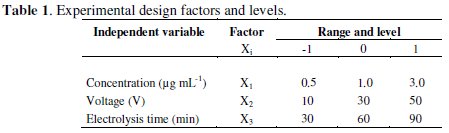
mercury concentration was measured in &mu;g mL<sup>-1</sup> units (<a href="#t1">Table 1</a>).</p>


    <p>&nbsp;</p>
<a name="t1">
<img src="/img/revistas/pea/v31n2/31n2a04t1.jpg">
    
<p>&nbsp;</p>


    ]]></body>
<body><![CDATA[<p>This solution 
was used later in the electrodeposition process. Hg concentrations were 
determined by Cold Vapor Atomic Absorption Spectrophotometry methods, 
adapted for analysis of plant samples and water [15-16]. Samples were analyzed 
in triplicate and concentrations were reported as &mu;g Hg mL<sup>-1</sup> (liquid matrix) and 
&mu;g Hg g<sup>-1</sup> (solid matrix).</p>


    <p>&nbsp;</p>
    <p><b><i>Experimental design</i></b></p>

    <p>Three factors were considered for developing the experiments: Hg concentration, 
applied potential and electrodeposition time. Percentage of mercury removal 
from solutions prepared with digested vegetal biomass was established as the 
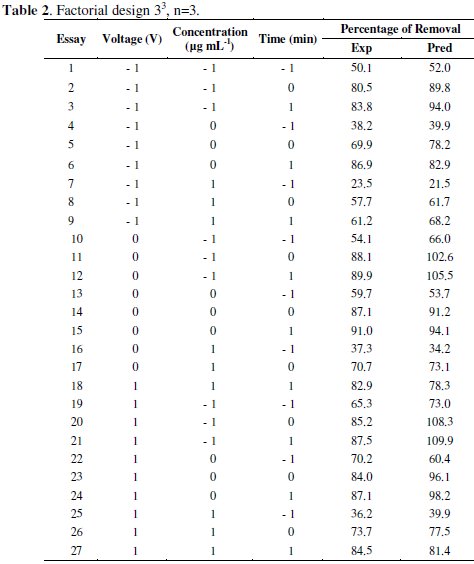
response variable. The experimental design consisted of three factors at three 
levels each one (<a href="#t1">Table 1</a>), which involved a completely random design with 
factorial structure 33 illustrated in <a href="#t2">Table 2</a> [17].</p>

    <p>&nbsp;</p>
<a name="t2">
<img src="/img/revistas/pea/v31n2/31n2a04t2.jpg">
    
<p>&nbsp;</p>


    <p>Levels of every factor were 
evaluated in triplicate, 81 essays in the whole process. With the purpose of 
evaluating matrix interferences for any other metal, independent 
electrodeposition essays were realized with synthetic solution of mercury 3.0 &mu;g 
mL<sup>-1</sup> to potentials of 10, 30 and 50 Volts, simulating the electrolytic media by 
means of mixed acid addition H<sub>2</sub>SO<sub>4</sub> - HNO<sub>3</sub> (7:3) as made in the digestion 
process.</p>

    <p>The percentage of mercury removal was evaluated by determining the decreasing 
of the initial mercury concentration into the biomass solution digested as a 
function of the electrodeposition time. The equation to calculate the removal 
efficiency in the experiments was:</p>


    <p>&nbsp;</p>
<a name="e1">
<img src="/img/revistas/pea/v31n2/31n2a04e1.jpg">
    
<p>&nbsp;</p>


    ]]></body>
<body><![CDATA[<p>where Cf : final Hg concentration ; Ci : initial Hg concentration.</p>


    <p>&nbsp;</p>
    <p><b><i>Electrodeposition cell</i></b></p>

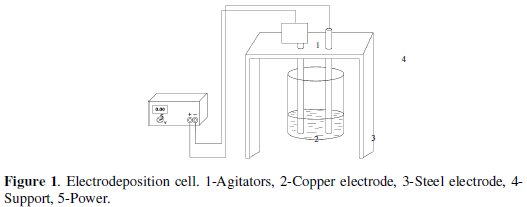
    <p>The experimental scheme is indicated in <a href="#f1">Fig. 1</a>.</p>


    <p>&nbsp;</p>
<a name="f1">
<img src="/img/revistas/pea/v31n2/31n2a04f1.jpg">
    
<p>&nbsp;</p>


    <p>The volume used for every essay 
was 250 mL of digested biomass, which were added into an electrodeposition 
cell made up by a cylindrical plastic container with the following dimensions: 5.0 
cm (height) per 8.4 cm (diameter), provided with a cylindrical rotary copper 
electrode (cathode) to 1600 RPM to provide agitation to the system, against to a 
steel electrode (anode) connected to a DC power supply -PHYWE 0-50V. 
Dimensions of the electrodes were: 15 cm (length) per 2.0 cm (diameter). 
Distance between electrodes was 6.0 cm. Entire submerged surface of every 
electrode was 31.4 cm<sup>2</sup>.</p>


    <p>&nbsp;</p>
    <p><b>Results and discussion</b></p>

    <p><b><i>Selection of the electrode material</i></b></p>

    ]]></body>
<body><![CDATA[<p>In this study copper was used as cathode for carrying out the electrodeposition 
process and recovering the solved mercury into the solution of digested biomass, 
since this element can form an amalgam with mercury by reduction of Hg<sup>2+</sup> to 
Hg<sup>0</sup> [18], due to the ion migration from the solution and its linkage to the 
electrode surface by electro reduction when sufficient potential difference is 
applied. The anode electrode material was the naturally inert or steady steel, 
which transfers and receives electrons in the solution to generate the electrolysis 
process [19]. When a cylindrical rotary electrode is used as a cathodic cell, it is 
named cell of rotary electrodes [20], in which the electrode rotation causes a 
permanent homogeneity, a controlled convective regime into the solution, more 
uniform electrode coverings and suitable ionic transport; all of that favors the 
changes from the cathode zone with the rest of the electrolyte, improving this 
way the metal deposition [21].</p>


    <p><b><i>Hg removal function of time, potential and concentration</i></b></p>

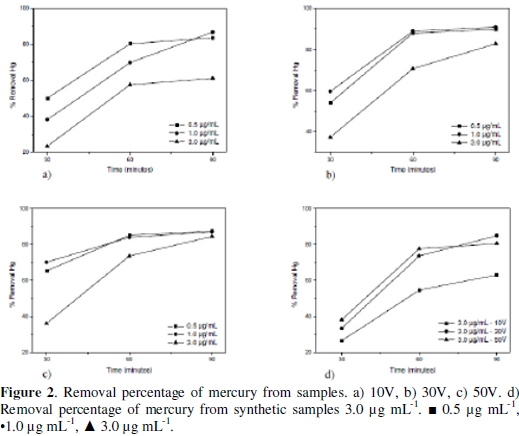
    <p>The mercury removal as a function of the time and applied potential for the 
different evaluated concentrations appears in the <a href="#f2">Fig. 2</a>.</p>


    <p>&nbsp;</p>
<a name="f2">
<img src="/img/revistas/pea/v31n2/31n2a04f2.jpg">
    
<p>&nbsp;</p>


    <p>When keeping a constant concentration when the potential increases, the removal efficiency gets higher in 
a lower electrodeposition time for every essay. Considering the potential 
variation at a constant concentration, it is observed that the response variable 
increases according to the time. When the electrodeposition process is evaluated 
in a synthetic sample of mercury of 3.0 &mu;g/mL to different potentials, (<a href="#f1">Fig. 1d</a>), 
the variable response behavior was similar to the one presented with samples, 
which indicates that there are no matrix interferences by another metal presence 
into the biomass sample able to affect the process. The efficiency of mercury 
removal in all the essays was high for an electrodeposition time of 90 min, 
despite that the initial Hg concentration and the applied potential between all 
essays were different. This result indicates that the electrodeposition process is 
efficient independently of the initial mercury concentration and applied potential 
for the concentration levels evaluated. The high percentage of mercury removal 
obtained is possibly owed to the high absorption rate of this element on the 
cathode surface, since it is able to form an amalgam with copper (Hg-Cu) when 
the reduction of Hg<sup>2+</sup> to Hg<sup>0</sup> in solution is presented [18].</p>


    <p><b><i>Optimization of the treatment conditions</i></b></p>

    <p>The effect of three electrochemical variables on mercury recovery: voltage, time 
and initial concentration were analyzed according to the completely randomized 
design with factorial structure 33 (<a href="#t2">Table 2</a>).</p>

    <p>The experimental design was used to 
determine simple and combined effects of operating variables on the efficiency 
of the mercury removal. The experimental data were fitted into a second order 
regression model. The second order regression model used to correlate dependent 
and independent variables was the following one:</p>


    <p>&nbsp;</p>
<a name="e2">
<img src="/img/revistas/pea/v31n2/31n2a04e2.jpg">
    
]]></body>
<body><![CDATA[<p>&nbsp;</p>


    <p>where y is the response variable of the removal efficiency, b<sub>0</sub> is a constant, b<sub>1</sub>, b<sub>2</sub> 
and b<sub>3</sub> are the regression coefficients of linear effects, b<sub>11</sub>, b<sub>22</sub> and b<sub>33</sub> are the 
second grade coefficients, and b<sub>12</sub>, b<sub>13</sub> and b<sub>23</sub> are the interaction coefficients.</p>

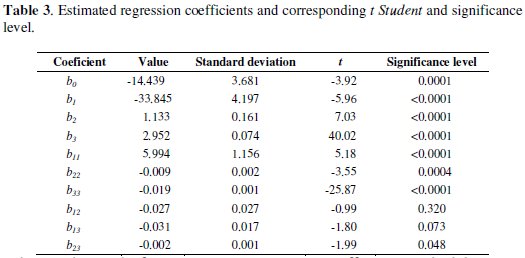
    <p><a href="#t3">Table 3</a> indicates the following values: regression coefficient, standard deviation, 
t and significance level.</p>


    <p>&nbsp;</p>
<a name="t3">
<img src="/img/revistas/pea/v31n2/31n2a04t3.jpg">
    
<p>&nbsp;</p>


    <p>These values allowed identifying the significant 
variables, to isolate the effects of the interference variables and to generate a 
second order regression model with the experimental results as a function of 
voltage, concentration and electrodeposition time. Linear factors (b<sub>1</sub>, b<sub>2</sub> 
and b<sub>3</sub>), quadratic factors (b<sub>11</sub>, b<sub>22</sub>, b<sub>33</sub>) 
and the interaction (b<sub>23</sub>) are significant at a level 
less than 5 %. Interactions between factors b<sub>12</sub> and b<sub>13</sub> were no significant for a 
significance level of 5 %. Therefore, concentration (coefficient b<sub>1</sub>), voltage 
(coefficient b<sub>2</sub>), electrolysis time (coefficient b<sub>3</sub>), interaction between voltage and 
time (coefficient b<sub>23</sub>) and the quadratic effect of all variables (coefficients b<sub>11</sub>, 
b<sub>22</sub>, b<sub>33</sub>) are the most influential factors. The application of RSM on the base of 
parameters estimation (<a href="#t3">Table 3</a>) generates the second order regression model, 
where the removal percentage (y) and the independent variables studied are 
related.</p>


    <p>&nbsp;</p>
<a name="e3">
<img src="/img/revistas/pea/v31n2/31n2a04e3.jpg">
    
<p>&nbsp;</p>


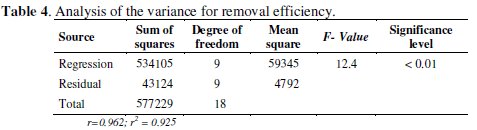
    <p>The analysis of variance (<a href="#t4">Table 4</a>) indicates that the predictive model assures in a 
representative way around 99 % of the experimental data, since the significance 
level calculated from the relation between mean square and regression was 
&lt; 0.01.</p>


    <p>&nbsp;</p>
<a name="t4">
<img src="/img/revistas/pea/v31n2/31n2a04t4.jpg">
    
]]></body>
<body><![CDATA[<p>&nbsp;</p>


    <p>As recommended in the literature, the coefficient of determination (r<sup>2</sup>) 
should be at least 75 % [17] to consider the possibility of using RSM. In this 
study case a high coefficient of determination (r<sup>2</sup> = 0.925) was obtained, which 
implies that 93 % of the variations in Hg removal efficiency are explained 
through independent variables, and 7 % of variations cannot be explained by the 
model.</p>

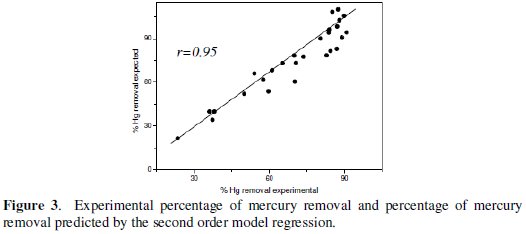
    <p>It is observed that the results of the second order regression model present 
significant correlations with the results obtained experimentally (r = 0.95, p = 0.01, 
n = 27; <a href="#f3">Fig. 3</a>).</p>


    <p>&nbsp;</p>
<a name="f3">
<img src="/img/revistas/pea/v31n2/31n2a04f3.jpg">
    
<p>&nbsp;</p>


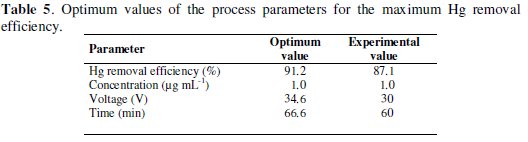
    <p>The model generates the optimum values for the maximum Hg 
removal efficiency as a function of concentration, voltage and time (<a href="#t5">Table 5</a>).</p>


    <p>&nbsp;</p>
<a name="t5">
<img src="/img/revistas/pea/v31n2/31n2a04t5.jpg">
    
<p>&nbsp;</p>


    <p>Significant differences were not observed (p &lt; 0.05) when a point near to the 
maximum response is compared to the corresponding experimental value what 
confirms that RSM can be used to optimize the process parameters.</p>

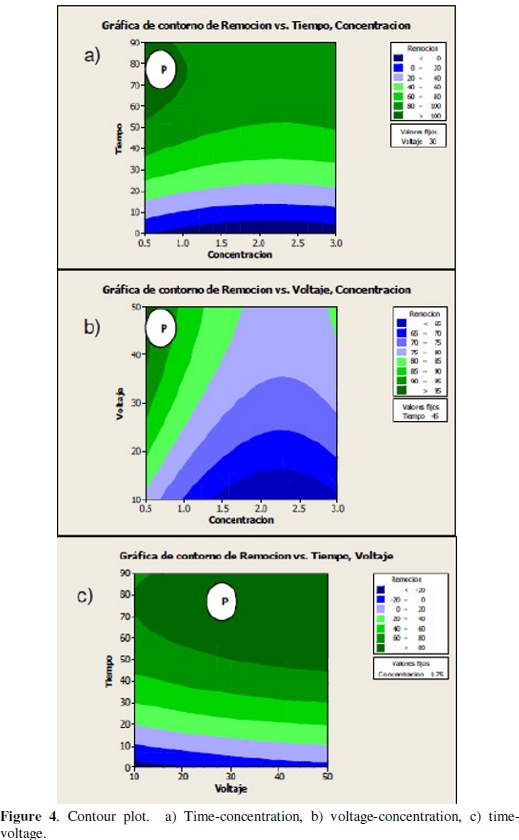
    <p>Later, to prove the significance of the model effects, the results were analyzed 
with the help of both plots: contour and their respective surface response for 
evaluating the interaction between variables. <a href="#f4">Figures 4a-c</a> shows the 
two-dimensional contour plots to facilitate the interpretation of interactions between 
variables.</p>


    ]]></body>
<body><![CDATA[<p>&nbsp;</p>
<a name="f4">
<img src="/img/revistas/pea/v31n2/31n2a04f4.jpg">
    
<p>&nbsp;</p>


    <p>Every color stripe contains an infinite number of the next kind of 
combinations: concentration-time, concentration-voltage, voltage-time, for which 
ones the average recovery predicted is in a certain range; for example, it is 
possible to observe that the stripe indicated with the letter P for every contour 
plot contains the combinations of the variables of interest, which can estimate the 
average recoveries between 80 %-100 %, 90 %-95 % and higher than 80 %.</p>

    <p>Either way the average response for a single point can be estimated by tracing the 
cut point between the interest coordinates or applying the regression equation, 
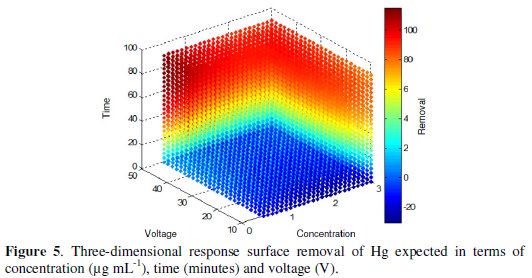
keeping constant a variable and manipulating other variables of interest. The 
response surface calculated on the basis of the model (<a href="#f5">Fig. 5</a>) allows visualizing 
the behavior of the response variable and indicates clearly the combination of 
levels of the factors that lead to a maximum value.</p>


    <p>&nbsp;</p>
<a name="f5">
<img src="/img/revistas/pea/v31n2/31n2a04f5.jpg">
    
<p>&nbsp;</p>


    <p>In this study it is observed 
that the best results are in the red region, where the interaction of the factors 
leads to results between 80 and 100 %.</p>


    <p>&nbsp;</p>
    <p><b>Conclusion</b></p>

    <p>Mercury electrodeposition by means of copper electrode as cathode is a 
technically viable alternative for the treatment of contaminated biomass. This 
study demonstrated that the response surface methodology is an adequate method 
to optimize the operation conditions and to maximize the mercury removal from 
digested vegetable biomass. The analysis of variance showed a high coefficient 
of determination (r<sup>2</sup> = 0.925) which guarantees a satisfactory adjustment of the 
second order regression model to the experimental information. The response 
surface and contour plots can be used for locating an optimum point. The applied 
electrochemical treatment allowed the removal of Hg in 87.1% under conditions 
of optimal electrodeposition: 30 V, 60 minutes and concentration of 1.0 &mu;g mL<sup>-1</sup>.</p>


    ]]></body>
<body><![CDATA[<p>&nbsp;</p>
    <p><b>References</b></p>

    <!-- ref --><p>1. Horvat M. Anal Bioanal Chem. 2002;374:981.    &nbsp;&nbsp;&nbsp;&nbsp;&nbsp;&nbsp;&nbsp;&nbsp;[&#160;<a href="javascript:void(0);" onclick="javascript: window.open('/scielo.php?script=sci_nlinks&ref=000085&pid=S0872-1904201300020000400001&lng=','','width=640,height=500,resizable=yes,scrollbars=1,menubar=yes,');">Links</a>&#160;]<!-- end-ref --></p>
    <!-- ref --><p>2. Sanchez JE, Sanz-Medel A. Talanta. 1998;47:509.    &nbsp;&nbsp;&nbsp;&nbsp;&nbsp;&nbsp;&nbsp;&nbsp;[&#160;<a href="javascript:void(0);" onclick="javascript: window.open('/scielo.php?script=sci_nlinks&ref=000087&pid=S0872-1904201300020000400002&lng=','','width=640,height=500,resizable=yes,scrollbars=1,menubar=yes,');">Links</a>&#160;]<!-- end-ref --></p>
    <!-- ref --><p>3. Boening WD. Chemosphere. 2000;40:1335.    &nbsp;&nbsp;&nbsp;&nbsp;&nbsp;&nbsp;&nbsp;&nbsp;[&#160;<a href="javascript:void(0);" onclick="javascript: window.open('/scielo.php?script=sci_nlinks&ref=000089&pid=S0872-1904201300020000400003&lng=','','width=640,height=500,resizable=yes,scrollbars=1,menubar=yes,');">Links</a>&#160;]<!-- end-ref --></p>
    <!-- ref --><p>4. Bennicelli R, Stepniewska Z, Banach A, et al. Chemosphere. 2004;55:141.    &nbsp;&nbsp;&nbsp;&nbsp;&nbsp;&nbsp;&nbsp;&nbsp;[&#160;<a href="javascript:void(0);" onclick="javascript: window.open('/scielo.php?script=sci_nlinks&ref=000091&pid=S0872-1904201300020000400004&lng=','','width=640,height=500,resizable=yes,scrollbars=1,menubar=yes,');">Links</a>&#160;]<!-- end-ref --></p>
    ]]></body>
<body><![CDATA[<!-- ref --><p>5. He YK, Sun JG, Feng XZ, et al. Cell Research. 2001;11:231.    &nbsp;&nbsp;&nbsp;&nbsp;&nbsp;&nbsp;&nbsp;&nbsp;[&#160;<a href="javascript:void(0);" onclick="javascript: window.open('/scielo.php?script=sci_nlinks&ref=000093&pid=S0872-1904201300020000400005&lng=','','width=640,height=500,resizable=yes,scrollbars=1,menubar=yes,');">Links</a>&#160;]<!-- end-ref --></p>
    <!-- ref --><p>6. Bizily SP, Rugh CL, Meagher RB. Nature Biotechnology. 2000;18:213.    &nbsp;&nbsp;&nbsp;&nbsp;&nbsp;&nbsp;&nbsp;&nbsp;[&#160;<a href="javascript:void(0);" onclick="javascript: window.open('/scielo.php?script=sci_nlinks&ref=000095&pid=S0872-1904201300020000400006&lng=','','width=640,height=500,resizable=yes,scrollbars=1,menubar=yes,');">Links</a>&#160;]<!-- end-ref --></p>
    <!-- ref --><p>7. Rugh CL, Wilde HD, Stack NM, et al. Proc Nat Acad Sci USA. 1996;93:3182.    &nbsp;&nbsp;&nbsp;&nbsp;&nbsp;&nbsp;&nbsp;&nbsp;[&#160;<a href="javascript:void(0);" onclick="javascript: window.open('/scielo.php?script=sci_nlinks&ref=000097&pid=S0872-1904201300020000400007&lng=','','width=640,height=500,resizable=yes,scrollbars=1,menubar=yes,');">Links</a>&#160;]<!-- end-ref --></p>
    <!-- ref --><p>8. Ehsan M, Molumeli PA, Espinosa VE, et al. J Appl Sci. 2007;7:2380.    &nbsp;&nbsp;&nbsp;&nbsp;&nbsp;&nbsp;&nbsp;&nbsp;[&#160;<a href="javascript:void(0);" onclick="javascript: window.open('/scielo.php?script=sci_nlinks&ref=000099&pid=S0872-1904201300020000400008&lng=','','width=640,height=500,resizable=yes,scrollbars=1,menubar=yes,');">Links</a>&#160;]<!-- end-ref --></p>
    <!-- ref --><p>9. Ghosh MS, Singh P. Asian J Energy Environ. 2005;6:214.    &nbsp;&nbsp;&nbsp;&nbsp;&nbsp;&nbsp;&nbsp;&nbsp;[&#160;<a href="javascript:void(0);" onclick="javascript: window.open('/scielo.php?script=sci_nlinks&ref=000101&pid=S0872-1904201300020000400009&lng=','','width=640,height=500,resizable=yes,scrollbars=1,menubar=yes,');">Links</a>&#160;]<!-- end-ref --></p>
    ]]></body>
<body><![CDATA[<p>10. Dushenkov V, Kumar AN, Motto H, eI. Raskin. Environ Sci Tech. 1995;29:1239.</p>
    <!-- ref --><p>11. Brooks RR, Chambers MF, Nicks LJ, Robinson BH. Trends in Plant Science. 1998;3:359.    &nbsp;&nbsp;&nbsp;&nbsp;&nbsp;&nbsp;&nbsp;&nbsp;[&#160;<a href="javascript:void(0);" onclick="javascript: window.open('/scielo.php?script=sci_nlinks&ref=000104&pid=S0872-1904201300020000400011&lng=','','width=640,height=500,resizable=yes,scrollbars=1,menubar=yes,');">Links</a>&#160;]<!-- end-ref --></p>
    <!-- ref --><p>12. Sas-Nowosieslska A, Kucharski R, Malkowski E, et al. Environ. Pollut. 2004;128:373.    &nbsp;&nbsp;&nbsp;&nbsp;&nbsp;&nbsp;&nbsp;&nbsp;[&#160;<a href="javascript:void(0);" onclick="javascript: window.open('/scielo.php?script=sci_nlinks&ref=000106&pid=S0872-1904201300020000400012&lng=','','width=640,height=500,resizable=yes,scrollbars=1,menubar=yes,');">Links</a>&#160;]<!-- end-ref --></p>
    <!-- ref --><p>13. Nunez-Lopez RA, Meas-Vong Y, Gama SC, et al. J Hazard Mater. 2008;154:623.    &nbsp;&nbsp;&nbsp;&nbsp;&nbsp;&nbsp;&nbsp;&nbsp;[&#160;<a href="javascript:void(0);" onclick="javascript: window.open('/scielo.php?script=sci_nlinks&ref=000108&pid=S0872-1904201300020000400013&lng=','','width=640,height=500,resizable=yes,scrollbars=1,menubar=yes,');">Links</a>&#160;]<!-- end-ref --></p>
    <!-- ref --><p>14. Romero Nunez SE, Marrugo Negrete JL, Arias Rios JE, et al. Water Air Soil Pollut. 2010;216:361.    &nbsp;&nbsp;&nbsp;&nbsp;&nbsp;&nbsp;&nbsp;&nbsp;[&#160;<a href="javascript:void(0);" onclick="javascript: window.open('/scielo.php?script=sci_nlinks&ref=000110&pid=S0872-1904201300020000400014&lng=','','width=640,height=500,resizable=yes,scrollbars=1,menubar=yes,');">Links</a>&#160;]<!-- end-ref --></p>
    <!-- ref --><p>15. Sadiq M, Zaidi T, Al-Mohana M. Bull Environ Contam Toxicology. 1991;47:335.    &nbsp;&nbsp;&nbsp;&nbsp;&nbsp;&nbsp;&nbsp;&nbsp;[&#160;<a href="javascript:void(0);" onclick="javascript: window.open('/scielo.php?script=sci_nlinks&ref=000112&pid=S0872-1904201300020000400015&lng=','','width=640,height=500,resizable=yes,scrollbars=1,menubar=yes,');">Links</a>&#160;]<!-- end-ref --></p>
    <!-- ref --><p>16. USEPA. Methods 245.1, 245.5 and 245.6 for determination of mercury in water and tissues. Cincinnati, Ohio: U.S. Environmental protection agency; 1994.    &nbsp;&nbsp;&nbsp;&nbsp;&nbsp;&nbsp;&nbsp;&nbsp;[&#160;<a href="javascript:void(0);" onclick="javascript: window.open('/scielo.php?script=sci_nlinks&ref=000114&pid=S0872-1904201300020000400016&lng=','','width=640,height=500,resizable=yes,scrollbars=1,menubar=yes,');">Links</a>&#160;]<!-- end-ref --></p>
    <!-- ref --><p>17. Montgomery DC. Design and analysis of experiments. Nebraska: John Wiley & Sons; 2000.    &nbsp;&nbsp;&nbsp;&nbsp;&nbsp;&nbsp;&nbsp;&nbsp;[&#160;<a href="javascript:void(0);" onclick="javascript: window.open('/scielo.php?script=sci_nlinks&ref=000116&pid=S0872-1904201300020000400017&lng=','','width=640,height=500,resizable=yes,scrollbars=1,menubar=yes,');">Links</a>&#160;]<!-- end-ref --></p>
    <!-- ref --><p>18. Huttencloh P, Roehl K, Czurda K. Environ. Sci. Technol. 2003;37:4269.    &nbsp;&nbsp;&nbsp;&nbsp;&nbsp;&nbsp;&nbsp;&nbsp;[&#160;<a href="javascript:void(0);" onclick="javascript: window.open('/scielo.php?script=sci_nlinks&ref=000118&pid=S0872-1904201300020000400018&lng=','','width=640,height=500,resizable=yes,scrollbars=1,menubar=yes,');">Links</a>&#160;]<!-- end-ref --></p>
    <!-- ref --><p>19. Djokic SS. Electrodeposition: Theory and Practice (Modern Aspects of Electrochemistry). Springer. (2010) 284-294.    &nbsp;&nbsp;&nbsp;&nbsp;&nbsp;&nbsp;&nbsp;&nbsp;[&#160;<a href="javascript:void(0);" onclick="javascript: window.open('/scielo.php?script=sci_nlinks&ref=000120&pid=S0872-1904201300020000400019&lng=','','width=640,height=500,resizable=yes,scrollbars=1,menubar=yes,');">Links</a>&#160;]<!-- end-ref --></p>
    <!-- ref --><p>20. Walsh F, Reade G. Analyst. 1994:119.    &nbsp;&nbsp;&nbsp;&nbsp;&nbsp;&nbsp;&nbsp;&nbsp;[&#160;<a href="javascript:void(0);" onclick="javascript: window.open('/scielo.php?script=sci_nlinks&ref=000122&pid=S0872-1904201300020000400020&lng=','','width=640,height=500,resizable=yes,scrollbars=1,menubar=yes,');">Links</a>&#160;]<!-- end-ref --></p>
    <p>21. Julve E. ElectrodeposiciÃ³n de metales. Fundamentos, operaciones e instalaciones. Grupo EMA-E.S.L. Espana; 2000. P.29-70.</p>


    <p>&nbsp;</p>
    <p><b>Acknowledgements</b></p>

    <p>The authors are grateful to the Colombian Institute for the development of science and 
technology "Francisco Jos&eacute; de Caldas" - COLCIENCIAS the financing of the project 
code 1112-489-25604 contract 472 Colciencias - Universidad de C&oacute;rdoba.</p>
 

    <p>&nbsp;</p>
    <p><a name=0></a><sup><a href="#top">*</a></sup>Corresponding author. E-mail address: <a href="mailto:josejph@hotmail.com">josejph@hotmail.com</a></p>

    <p>Received 3 December 2012; accepted 14 April 2013</p>

    <p><a href="http://www.peacta.org" target="_blank">www.peacta.org</a> </p>


     ]]></body><back>
<ref-list>
<ref id="B1">
<label>1</label><nlm-citation citation-type="journal">
<person-group person-group-type="author">
<name>
<surname><![CDATA[Horvat]]></surname>
<given-names><![CDATA[M]]></given-names>
</name>
</person-group>
<source><![CDATA[Anal Bioanal Chem]]></source>
<year>2002</year>
<volume>374</volume>
<page-range>981</page-range></nlm-citation>
</ref>
<ref id="B2">
<label>2</label><nlm-citation citation-type="journal">
<person-group person-group-type="author">
<name>
<surname><![CDATA[Sanchez]]></surname>
<given-names><![CDATA[J E]]></given-names>
</name>
<name>
<surname><![CDATA[Sanz-Medel]]></surname>
<given-names><![CDATA[A]]></given-names>
</name>
</person-group>
<source><![CDATA[Talanta]]></source>
<year>1998</year>
<volume>47</volume>
<page-range>509</page-range></nlm-citation>
</ref>
<ref id="B3">
<label>3</label><nlm-citation citation-type="journal">
<person-group person-group-type="author">
<name>
<surname><![CDATA[Boening]]></surname>
<given-names><![CDATA[W D]]></given-names>
</name>
</person-group>
<source><![CDATA[Chemosphere]]></source>
<year>2000</year>
<volume>40</volume>
<page-range>1335</page-range></nlm-citation>
</ref>
<ref id="B4">
<label>4</label><nlm-citation citation-type="journal">
<person-group person-group-type="author">
<name>
<surname><![CDATA[Bennicelli]]></surname>
<given-names><![CDATA[R]]></given-names>
</name>
<name>
<surname><![CDATA[Stepniewska]]></surname>
<given-names><![CDATA[Z]]></given-names>
</name>
<name>
<surname><![CDATA[Banach]]></surname>
<given-names><![CDATA[A]]></given-names>
</name>
</person-group>
<source><![CDATA[Chemosphere]]></source>
<year>2004</year>
<volume>55</volume>
<page-range>141</page-range></nlm-citation>
</ref>
<ref id="B5">
<label>5</label><nlm-citation citation-type="journal">
<person-group person-group-type="author">
<name>
<surname><![CDATA[He]]></surname>
<given-names><![CDATA[Y K]]></given-names>
</name>
<name>
<surname><![CDATA[Sun]]></surname>
<given-names><![CDATA[J G]]></given-names>
</name>
<name>
<surname><![CDATA[Feng]]></surname>
<given-names><![CDATA[X Z]]></given-names>
</name>
</person-group>
<source><![CDATA[Cell Research]]></source>
<year>2001</year>
<volume>11</volume>
<page-range>231</page-range></nlm-citation>
</ref>
<ref id="B6">
<label>6</label><nlm-citation citation-type="journal">
<person-group person-group-type="author">
<name>
<surname><![CDATA[Bizily]]></surname>
<given-names><![CDATA[S P]]></given-names>
</name>
<name>
<surname><![CDATA[Rugh]]></surname>
<given-names><![CDATA[C L]]></given-names>
</name>
<name>
<surname><![CDATA[Meagher]]></surname>
<given-names><![CDATA[R B]]></given-names>
</name>
</person-group>
<source><![CDATA[Nature Biotechnology]]></source>
<year>2000</year>
<volume>18</volume>
<page-range>213</page-range></nlm-citation>
</ref>
<ref id="B7">
<label>7</label><nlm-citation citation-type="journal">
<person-group person-group-type="author">
<name>
<surname><![CDATA[Rugh]]></surname>
<given-names><![CDATA[C L]]></given-names>
</name>
<name>
<surname><![CDATA[Wilde]]></surname>
<given-names><![CDATA[H D]]></given-names>
</name>
<name>
<surname><![CDATA[Stack]]></surname>
<given-names><![CDATA[N M]]></given-names>
</name>
</person-group>
<source><![CDATA[Proc Nat Acad Sci USA]]></source>
<year>1996</year>
<volume>93</volume>
<page-range>3182</page-range></nlm-citation>
</ref>
<ref id="B8">
<label>8</label><nlm-citation citation-type="journal">
<person-group person-group-type="author">
<name>
<surname><![CDATA[Ehsan]]></surname>
<given-names><![CDATA[M]]></given-names>
</name>
<name>
<surname><![CDATA[Molumeli]]></surname>
<given-names><![CDATA[P A]]></given-names>
</name>
<name>
<surname><![CDATA[Espinosa]]></surname>
<given-names><![CDATA[V E]]></given-names>
</name>
</person-group>
<source><![CDATA[J Appl Sci]]></source>
<year>2007</year>
<volume>7</volume>
<page-range>2380</page-range></nlm-citation>
</ref>
<ref id="B9">
<label>9</label><nlm-citation citation-type="journal">
<person-group person-group-type="author">
<name>
<surname><![CDATA[Ghosh]]></surname>
<given-names><![CDATA[M S]]></given-names>
</name>
<name>
<surname><![CDATA[Singh]]></surname>
<given-names><![CDATA[P]]></given-names>
</name>
</person-group>
<source><![CDATA[Asian J Energy Environ]]></source>
<year>2005</year>
<volume>6</volume>
<page-range>214</page-range></nlm-citation>
</ref>
<ref id="B10">
<label>10</label><nlm-citation citation-type="journal">
<person-group person-group-type="author">
<name>
<surname><![CDATA[Dushenkov]]></surname>
<given-names><![CDATA[V]]></given-names>
</name>
<name>
<surname><![CDATA[Kumar]]></surname>
<given-names><![CDATA[A N]]></given-names>
</name>
<name>
<surname><![CDATA[Motto]]></surname>
<given-names><![CDATA[H]]></given-names>
</name>
<name>
<surname><![CDATA[Raskin]]></surname>
<given-names><![CDATA[I]]></given-names>
</name>
</person-group>
<source><![CDATA[Environ Sci Tech]]></source>
<year>1995</year>
<volume>29</volume>
<page-range>1239</page-range></nlm-citation>
</ref>
<ref id="B11">
<label>11</label><nlm-citation citation-type="journal">
<person-group person-group-type="author">
<name>
<surname><![CDATA[Brooks]]></surname>
<given-names><![CDATA[R R]]></given-names>
</name>
<name>
<surname><![CDATA[Chambers]]></surname>
<given-names><![CDATA[M F]]></given-names>
</name>
<name>
<surname><![CDATA[Nicks]]></surname>
<given-names><![CDATA[L J]]></given-names>
</name>
<name>
<surname><![CDATA[Robinson]]></surname>
<given-names><![CDATA[B H]]></given-names>
</name>
</person-group>
<source><![CDATA[Trends in Plant Science]]></source>
<year>1998</year>
<volume>3</volume>
<page-range>359</page-range></nlm-citation>
</ref>
<ref id="B12">
<label>12</label><nlm-citation citation-type="journal">
<person-group person-group-type="author">
<name>
<surname><![CDATA[Sas-Nowosieslska]]></surname>
<given-names><![CDATA[A]]></given-names>
</name>
<name>
<surname><![CDATA[Kucharski]]></surname>
<given-names><![CDATA[R]]></given-names>
</name>
<name>
<surname><![CDATA[Malkowski]]></surname>
<given-names><![CDATA[E]]></given-names>
</name>
</person-group>
<source><![CDATA[Environ. Pollut]]></source>
<year>2004</year>
<volume>128</volume>
<page-range>373</page-range></nlm-citation>
</ref>
<ref id="B13">
<label>13</label><nlm-citation citation-type="journal">
<person-group person-group-type="author">
<name>
<surname><![CDATA[Nunez-Lopez]]></surname>
<given-names><![CDATA[R A]]></given-names>
</name>
<name>
<surname><![CDATA[Meas-Vong]]></surname>
<given-names><![CDATA[Y]]></given-names>
</name>
<name>
<surname><![CDATA[Gama]]></surname>
<given-names><![CDATA[S C]]></given-names>
</name>
</person-group>
<source><![CDATA[J Hazard Mater]]></source>
<year>2008</year>
<volume>154</volume>
<page-range>623</page-range></nlm-citation>
</ref>
<ref id="B14">
<label>14</label><nlm-citation citation-type="journal">
<person-group person-group-type="author">
<name>
<surname><![CDATA[Romero Nunez]]></surname>
<given-names><![CDATA[S E]]></given-names>
</name>
<name>
<surname><![CDATA[Marrugo Negrete]]></surname>
<given-names><![CDATA[J L]]></given-names>
</name>
<name>
<surname><![CDATA[Arias Rios]]></surname>
<given-names><![CDATA[J E]]></given-names>
</name>
</person-group>
<source><![CDATA[Water Air Soil Pollut]]></source>
<year>2010</year>
<volume>216</volume>
<page-range>361</page-range></nlm-citation>
</ref>
<ref id="B15">
<label>15</label><nlm-citation citation-type="journal">
<person-group person-group-type="author">
<name>
<surname><![CDATA[Sadiq]]></surname>
<given-names><![CDATA[M]]></given-names>
</name>
<name>
<surname><![CDATA[Zaidi]]></surname>
<given-names><![CDATA[T]]></given-names>
</name>
<name>
<surname><![CDATA[Al-Mohana]]></surname>
<given-names><![CDATA[M]]></given-names>
</name>
</person-group>
<source><![CDATA[Bull Environ Contam Toxicology]]></source>
<year>1991</year>
<volume>47</volume>
<page-range>335</page-range></nlm-citation>
</ref>
<ref id="B16">
<label>16</label><nlm-citation citation-type="book">
<source><![CDATA[USEPA. Methods 245.1, 245.5 and 245.6 for determination of mercury in water and tissues]]></source>
<year>1994</year>
<publisher-loc><![CDATA[Cincinnati^eOhio Ohio]]></publisher-loc>
<publisher-name><![CDATA[U.S. Environmental protection agency]]></publisher-name>
</nlm-citation>
</ref>
<ref id="B17">
<label>17</label><nlm-citation citation-type="book">
<person-group person-group-type="author">
<name>
<surname><![CDATA[Montgomery]]></surname>
<given-names><![CDATA[D C]]></given-names>
</name>
</person-group>
<source><![CDATA[Design and analysis of experiments]]></source>
<year>2000</year>
<publisher-loc><![CDATA[Nebraska ]]></publisher-loc>
<publisher-name><![CDATA[John Wiley & Sons]]></publisher-name>
</nlm-citation>
</ref>
<ref id="B18">
<label>18</label><nlm-citation citation-type="journal">
<person-group person-group-type="author">
<name>
<surname><![CDATA[Huttencloh]]></surname>
<given-names><![CDATA[P]]></given-names>
</name>
<name>
<surname><![CDATA[Roehl]]></surname>
<given-names><![CDATA[K]]></given-names>
</name>
<name>
<surname><![CDATA[Czurda]]></surname>
<given-names><![CDATA[K]]></given-names>
</name>
</person-group>
<source><![CDATA[Environ. Sci. Technol]]></source>
<year>2003</year>
<volume>37</volume>
<page-range>4269</page-range></nlm-citation>
</ref>
<ref id="B19">
<label>19</label><nlm-citation citation-type="book">
<person-group person-group-type="author">
<name>
<surname><![CDATA[Djokic]]></surname>
<given-names><![CDATA[S S]]></given-names>
</name>
</person-group>
<source><![CDATA[Electrodeposition: Theory and Practice]]></source>
<year>2010</year>
<page-range>284</page-range><publisher-name><![CDATA[Springer]]></publisher-name>
</nlm-citation>
</ref>
<ref id="B20">
<label>20</label><nlm-citation citation-type="journal">
<person-group person-group-type="author">
<name>
<surname><![CDATA[Walsh]]></surname>
<given-names><![CDATA[F]]></given-names>
</name>
<name>
<surname><![CDATA[Reade]]></surname>
<given-names><![CDATA[G]]></given-names>
</name>
</person-group>
<source><![CDATA[Analyst]]></source>
<year>1994</year>
<page-range>119</page-range></nlm-citation>
</ref>
<ref id="B21">
<label>21</label><nlm-citation citation-type="">
<person-group person-group-type="author">
<name>
<surname><![CDATA[Julve]]></surname>
<given-names><![CDATA[E]]></given-names>
</name>
</person-group>
<source><![CDATA[Electrodeposicion de metales. Fundamentos, operaciones e instalaciones]]></source>
<year>2000</year>
<page-range>29</page-range></nlm-citation>
</ref>
</ref-list>
</back>
</article>