<?xml version="1.0" encoding="ISO-8859-1"?><article xmlns:mml="http://www.w3.org/1998/Math/MathML" xmlns:xlink="http://www.w3.org/1999/xlink" xmlns:xsi="http://www.w3.org/2001/XMLSchema-instance">
<front>
<journal-meta>
<journal-id>0872-1904</journal-id>
<journal-title><![CDATA[Portugaliae Electrochimica Acta]]></journal-title>
<abbrev-journal-title><![CDATA[Port. Electrochim. Acta]]></abbrev-journal-title>
<issn>0872-1904</issn>
<publisher>
<publisher-name><![CDATA[Sociedade Portuguesa de Electroquímica]]></publisher-name>
</publisher>
</journal-meta>
<article-meta>
<article-id>S0872-19042013000200005</article-id>
<article-id pub-id-type="doi">10.4152/pea.201302119</article-id>
<title-group>
<article-title xml:lang="en"><![CDATA[Azo Dye Compounds as Corrosion Inhibitors for Dissolution of Mild Steel in Hydrochloric Acid Solution]]></article-title>
</title-group>
<contrib-group>
<contrib contrib-type="author">
<name>
<surname><![CDATA[Nagiub]]></surname>
<given-names><![CDATA[A.M.]]></given-names>
</name>
<xref ref-type="aff" rid="A01"/>
</contrib>
<contrib contrib-type="author">
<name>
<surname><![CDATA[Mahross]]></surname>
<given-names><![CDATA[M.H.]]></given-names>
</name>
<xref ref-type="aff" rid="A01"/>
</contrib>
<contrib contrib-type="author">
<name>
<surname><![CDATA[Khalil]]></surname>
<given-names><![CDATA[H.F.Y.]]></given-names>
</name>
<xref ref-type="aff" rid="A02"/>
</contrib>
<contrib contrib-type="author">
<name>
<surname><![CDATA[Mahran]]></surname>
<given-names><![CDATA[B.N.A.]]></given-names>
</name>
<xref ref-type="aff" rid="A03"/>
</contrib>
<contrib contrib-type="author">
<name>
<surname><![CDATA[Yehia]]></surname>
<given-names><![CDATA[M.M.]]></given-names>
</name>
<xref ref-type="aff" rid="A03"/>
</contrib>
<contrib contrib-type="author">
<name>
<surname><![CDATA[El-Sabbah]]></surname>
<given-names><![CDATA[M.M.B.]]></given-names>
</name>
<xref ref-type="aff" rid="A02"/>
</contrib>
</contrib-group>
<aff id="A01">
<institution><![CDATA[,Al-Azhar University Faculty of Science Chemistry Department]]></institution>
<addr-line><![CDATA[Assiut ]]></addr-line>
<country>Egypt</country>
</aff>
<aff id="A02">
<institution><![CDATA[,Al-Azhar University Faculty of Science Chemistry Department]]></institution>
<addr-line><![CDATA[Nasr ]]></addr-line>
<country>Egypt</country>
</aff>
<aff id="A03">
<institution><![CDATA[,National Water Research Center Laboratory for Environment Quality Monitoring ]]></institution>
<addr-line><![CDATA[ ]]></addr-line>
<country>Egypt</country>
</aff>
<pub-date pub-type="pub">
<day>00</day>
<month>03</month>
<year>2013</year>
</pub-date>
<pub-date pub-type="epub">
<day>00</day>
<month>03</month>
<year>2013</year>
</pub-date>
<volume>31</volume>
<numero>2</numero>
<fpage>119</fpage>
<lpage>139</lpage>
<copyright-statement/>
<copyright-year/>
<self-uri xlink:href="http://scielo.pt/scielo.php?script=sci_arttext&amp;pid=S0872-19042013000200005&amp;lng=en&amp;nrm=iso"></self-uri><self-uri xlink:href="http://scielo.pt/scielo.php?script=sci_abstract&amp;pid=S0872-19042013000200005&amp;lng=en&amp;nrm=iso"></self-uri><self-uri xlink:href="http://scielo.pt/scielo.php?script=sci_pdf&amp;pid=S0872-19042013000200005&amp;lng=en&amp;nrm=iso"></self-uri><abstract abstract-type="short" xml:lang="en"><p><![CDATA[The effect of some mono-, bis- and tris-azo dyes compounds on the dissolution of mild steel in 1.0 M HCl solution was studied using weight loss and potentiodynamic polarization measurements. The inhibition efficiency was found to increase with increasing concentration of the inhibitors and with decreasing temperature. The adsorption of different azo dyes on the mild steel surface obeys the Langmuir adsorption isotherm. Polarization studies indicate that the compounds used are mixed type inhibitors. The thermodynamic functions of adsorption processes were calculated from weight loss at different temperatures data and were used to analyze the inhibitor mechanism. The surface morphology of the mild steel specimens was evaluated using SEM and EDAX analysis. To provide an evidence for the formation of the complex, UV-VIS spectra of solutions were investigated. From previous results (I.E.%, &Delta;Gads, SEM, EDAX and UV-VIS spectra) are likely to get into the possiblity of configure the complex on the mild steel surface.]]></p></abstract>
<kwd-group>
<kwd lng="en"><![CDATA[azo dyes]]></kwd>
<kwd lng="en"><![CDATA[mild steel]]></kwd>
<kwd lng="en"><![CDATA[inhibitors]]></kwd>
<kwd lng="en"><![CDATA[surface morphology]]></kwd>
</kwd-group>
</article-meta>
</front><body><![CDATA[ 

    <p><b>Azo Dye Compounds as Corrosion Inhibitors for Dissolution of Mild Steel in Hydrochloric Acid Solution</b></p>

    <p><b>A.M. Nagiub<sup>1</sup>, M.H. Mahross<sup>1</sup>, H.F.Y. Khalil<sup>2</sup>, B.N.A. Mahran<sup>3</sup>, M.M. Yehia<sup>3</sup> and M.M.B. 
El-Sabbah<sup>2,<a href="#0">*<a/></sup></b></p>

    <p><sup>1</sup><i> Chemistry Department Faculty of Science, Al-Azhar University, Assiut , Egypt</i></p>

    <p><sup>2</sup><i> Chemistry Department Faculty of Science, Al-Azhar University, Nasr City, Egypt</i></p>

    <p><sup>3</sup><i> Laboratory for Environment Quality Monitoring, National Water Research Center, Egypt</i></p>


<!--     <p>&nbsp;</p>
    <p>doi: 10.4152/pea.201302119</p> -->


    <p>&nbsp;</p>
    <p><b>Abstract</b></p>

    ]]></body>
<body><![CDATA[<p>The effect of some mono-,bis -and tris-azo dyes compounds on the dissolution of mild 
steel in 1.0 M HCl solution was studied using weight loss and potentiodynamic 
polarization measurements. The inhibition efficiency was found to increase with 
increasing concentration of the inhibitors and with decreasing temperature. The 
adsorption of different azo dyes on the mild steel surface obeys the Langmuir 
adsorption isotherm. Polarization studies indicate that the compounds used are mixed 
type inhibitors. The thermodynamic functions of adsorption processes were calculated 
from weight loss at different temperatures data and were used to analyze the inhibitor 
mechanism. The surface morphology of the mild steel specimens was evaluated using 
SEM and EDAX analysis. To provide an evidence for the formation of the complex, 
UV-VIS spectra of solutions were investigated. From previous results (I.E.%, &Delta;G<sub>ads</sub>, 
SEM, EDAX and UV-VIS spectra) are likely to get into the possiblity of configure the 
complex on the mild steel surface.</p>

    <p><b><i>Keywords:</i></b> azo dyes, mild steel, inhibitors, surface morphology.</p>


    <p>&nbsp;</p>
    <p><b>Introduction</b></p>

    <p>Mild steel is an alloy of iron, which undergoes corrosion easily in acidic medium. 
Acidic solutions are extensively used in chemical laboratories and in several 
industrial processes such as acid pickling, acid cleaning, acid descaling and oil 
wet cleaning, etc. Also mild steel is used under different conditions in chemical 
and allied industries for handling alkaline, acid and salt solutions.</p>

    <p>Inhibitors are often added in industrial processes to secure metal dissolution from 
acid solutions. Authors show that organic compounds containing O, S and/or N 
atoms act as effective inhibitors [1-3]. These organic compounds adsorb on 
metallic surface and then decrease the corrosion rate [4-7]. It has been observed 
that adsorption depends mainly on certain physico-chemical properties of the 
inhibitor group, like functional groups, electron density at the donor atom, &pi;-orbital 
character, and the electronic structure of the molecule [8-10]. Azo 
compounds are the most widely used class of dyes due to their versatile 
application in various fields, such as the dyeing of textiles, and fibbers, to 
coloring of different materials, and high-technology areas, such as eletro-optical 
devices and ink-jet printers. Some studies have shown that the inhibition of the 
corrosion by organic dyes is mainly attributed to the formation of complex 
compounds between the metal-ions and the nitrogen of azo binding at the 
electrode surface [11-38].</p>

    <p>The objective of this study is to investigate the corrosion behavior of mild steel 
in 1.0 M HCl at different temperatures in the presence of some mono-,bis -and 
tris-azo dyes compounds by using weight loss, polarization resistance and Tafel 
polarization. The effects of temperature were also studied.</p>


    <p>&nbsp;</p>
    <p><b>Experimental</b></p>

    <p><b><i>Materials</i></b></p>

    ]]></body>
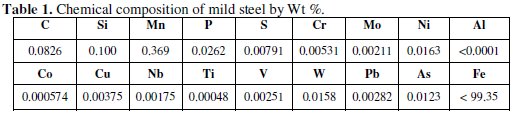
<body><![CDATA[<p>The mild steel specimens tested in the present study are in the form of sheet; the 
designation and analysis of the material is given in <a href="#t1">Table (1)</a>.</p>


    <p>&nbsp;</p>
<a name="t1">
<img src="/img/revistas/pea/v31n2/31n2a05t1.jpg">
    
<p>&nbsp;</p>


    <p>Before immersion the obvious electrodes in the test solution each of them is 
prepared by polishing with emery paper from 250 to 1200 grade to obtain a 
smooth surface, washed with distilled water and then degreased with acetone 
about 5 minutes, washed again with distilled water, then dried using filter papers.</p>


    <p>&nbsp;</p>
    <p><b><i>Selection and assessment of dyes used</i></b></p>

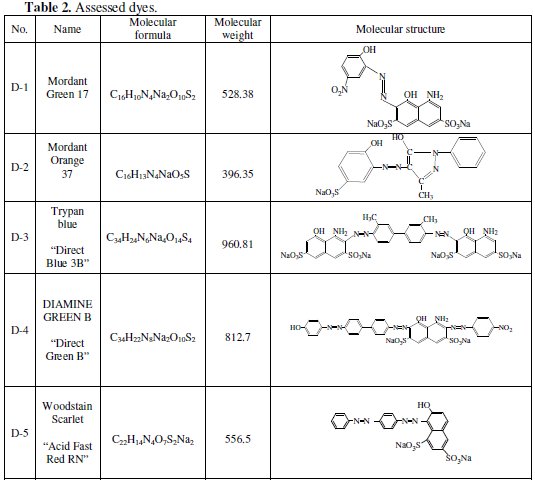
    <p>In the present work, some selected dyes were used to determine if there is a 
parallel structure-corrosion inhibition relationship for the corrosion of Fe in the 
acidic solution, and different concentrations of dyes at different temperatures. 
Characteristics of the dyes used are listed in <a href="#t2">Table (2)</a>.</p>


    <p>&nbsp;</p>
<a name="t2">
<img src="/img/revistas/pea/v31n2/31n2a05t2.jpg">
    
<p>&nbsp;</p>


    <p>&nbsp;</p>
    ]]></body>
<body><![CDATA[<p><b><i>Adopted techniques</i></b></p>

    <p>&nbsp;</p>
    <p><i>Weight loss measurements</i></p>

    <p>Weight loss measurements were carried out by weighing the mild steel 
specimens before and after immersion in 500 cm<sup>3</sup> acid solutions for different time 
intervals in the presence and absence of various concentrations of dyes. 
Experiments were also performed at temperature range (298-328 K) in 1.0 M 
HCl solutions. Duplicate experiments were performed in each case and the mean 
value of the weight loss was determined.</p>


    <p>&nbsp;</p>
    <p><i>Open circuit potential measurements (OCP)</i></p>

    <p>The potential of the mild steel electrode (working electrode) was measured 
against a saturated calomel electrode (SCE) (reference electrode) in 1.0 M HCl 
solution in absence and presence of different concentrations of the inhibitor.</p>


    <p>&nbsp;</p>
    <p><i>Potentiodynamic polarization measurements</i></p>

    <p>The electrochemical cell used in potentiodynamic polarization consists of three 
electrodes: working electrode (mild steel), reference electrode (saturated calomel 
electrode (SCE)) and platinum wire used as counter electrode. The exposed area 
of the working electrode to solution was (1 cm2). For the anodic and cathodic 
potentiodynamic polarization (Tafel plots) the entire potential scan was 
programmed to take place within &plusmn;250 mV of the corrosion potential. The 
measurements were conducted at scanning rate of 0.2 mV/s.</p>


    ]]></body>
<body><![CDATA[<p>&nbsp;</p>
    <p><i>Surface examinations techniques:</i></p>

    <p><u>I-Scanning Electron Microscope (SEM)</u></p>

    <p>The scanning electron microscope (SEM) is a type of electron microscope giving 
images of the sample surface by scanning it with a high-energy beam of electrons 
in a raster scan pattern. SEM images should confirm the electrode surface. The 
specimens have been rinsed before and after immersion in different solutions.</p>


    <p>&nbsp;</p>
    <p><u>II-Energy Dispersive X-ray Analysis (EDAX)</u></p>

    <p>EDAX is an analytical technique used for the elemental analysis or chemical 
characterization of a sample. The identification of the elements present in the 
surface of the specimens before and after immersion in different solutions will be 
performed using an energy dispersion X-ray analysis. This technique is used in 
conjunction with SEM.</p>


    <p>&nbsp;</p>
    <p><b>Results and discussion</b></p>

    <p><b><i>Weight loss measurements</i></b></p>

    ]]></body>
<body><![CDATA[<p>Weight loss of mild steel electrode was determined at various time intervals in 
absence and presence of different concentrations of mono-,bis-and tris azo-dyes. 
It is obvious that the weight-loss of mild steel electrode in the presence of 
different azo-dyes (D-1--D-5) varies linearly with time, being much lower than 
that obtained in blank solution. The linearity obtained indicates the absence of 
insoluble surface film during corrosion and the inhibitors were fast adsorbed onto 
the metal surface and, therefore, impeding the corrosion process [39]. The 
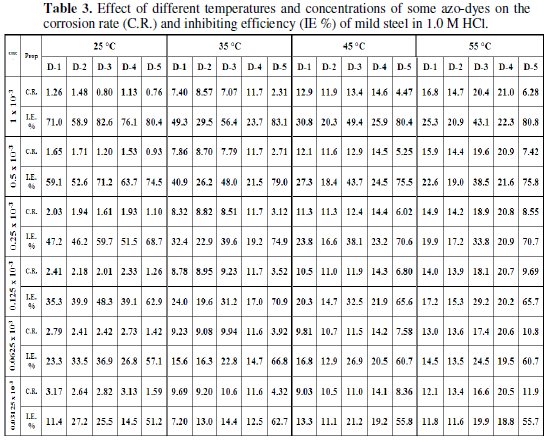
corrosion rate (C.R.), the inhibition efficiency (IE %) and the surface coverage 
(&theta;), that represent the weight of metal surface covered by inhibitor molecules, 
were calculated using the following equations:</p>


    <p>&nbsp;</p>
<a name="e1">
<img src="/img/revistas/pea/v31n2/31n2a05e1.jpg">
    
<p>&nbsp;</p>
<a name="e2">
<img src="/img/revistas/pea/v31n2/31n2a05e2.jpg">
    
<p>&nbsp;</p>


    <p>where (C.R.)<sub>free</sub> and (C.R.)<sub>inh</sub> are the corrosion rate in the absence and presence of 
inhibitors, respectively. The calculated values of (C.R.), I.E. % and &theta; for 
different inhibitors at 25 &deg;C are listed in <a href="#t3">Table (3)</a>.</p>


    <p>&nbsp;</p>
<a name="t3">
<img src="/img/revistas/pea/v31n2/31n2a05t3.jpg">
    
<p>&nbsp;</p>


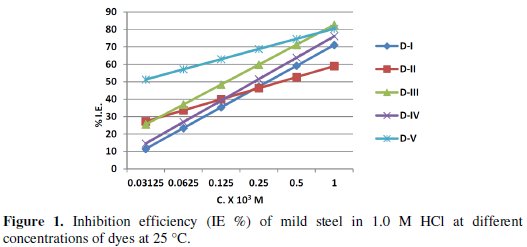
    <p><a href="#f1">Figure (1)</a> gives the evaluation of I.E. % of mild steel electrode as a function of 
concentrations of different inhibitors.</p>


    <p>&nbsp;</p>
<a name="f1">
<img src="/img/revistas/pea/v31n2/31n2a05f1.jpg">
    
<p>&nbsp;</p>


    ]]></body>
<body><![CDATA[<p>Inspection of the tabulated data and <a href="#f1">Fig. (1)</a>
revealed that the inhibition efficiency increases with an increase in inhibitor 
concentration. This behavior could be the attributed to increase of the number of 
adsorbed molecules at the metal surface [40].</p>

    <p>The inhibition action of different inhibitors can be explained by considering the 
following mechanism, where Fe (Inh)<sub>ads.</sub> is the intermediate [41]:</p>


    <p>&nbsp;</p>
<a name="s1">
<img src="/img/revistas/pea/v31n2/31n2a05s1.jpg">
    
<p>&nbsp;</p>


    <p>At first, when there is not enough Fe (Inh)<sub>ads.</sub> to cover the metal surface, because 
the inhibitors concentration is low or because the adsorption rate is slow, metal 
dissolution takes place in sites on the mild steel surface free of Fe (Inh)<sub>ads.</sub> With 
high inhibitor concentration, a compact and coherent inhibitor over filmed is 
formed on the mild steel which reduces chemical attacks on the metal.</p>

    <p>The values of the corrosion rate and inhibition efficiency for the different azodyes, 
<a href="#t3">Table 3</a> and <a href="#f1">Fig. (1)</a>, revealed that the decrease in corrosion rate and the 
increase in the inhibition efficiency are more significant for bis-and tris-azo 
compounds (D-3, D-4 and D-5), than the mono-azo ones (D-1 and D-2). This 
may be due to the larger size of bis-and tris-molecules as compared with that of 
the mono-azo ones, which allows covering more surface area of the metal. 
The decrease of the corrosion rate and increase of the inhibition efficiency follow 
the sequence:</p>

    <p>D-3(bis) &gt; D-5(bis) &gt; D-4(tris) &gt; D-1(mono) &gt; D-2(mono)</p>


    <p>&nbsp;</p>
    <p><b><i>Effect of temperature</i></b></p>

    <p>Values of C.R.,I.E.% and &theta; of mild steel determined in 1.0 M HCl solution in 
absence and in presence of different concentrations of each of the under testing 
azo-dyes at different temperatures(25-55 oC) are tabulated in <a href="#t3">Table (3)</a>. The data 
recorded indicated that the rate of corrosion of mild steel in 1.0 M HCl decreases 
with increase in the concentration of the inhibitor at all the temperatures studied 
and decreases with increase in temperature. Decrease in inhibition efficiency 
with the increase of the temperature may be attributed to increase in the solubility 
of the protective films and of any reaction products precipitated on the surface of 
the metal that may otherwise inhibit the reaction. Ergun et al. [42] have attributed 
the inhibition efficiency decrease with rise in temperature to be due to an 
enhanced effect of temperature on the dissolution process of steel in acidic media 
and / or the partial desorption of the inhibitor from the metal surface.</p>


    ]]></body>
<body><![CDATA[<p>&nbsp;</p>
    <p><b><i>Adsorption consideration</i></b></p>

    <p>In order to get a better understanding of the adsorption mode of the inhibitor on 
the metal surface, the data were tested graphically by fitting them to various 
isotherms to find the best isotherm which describes this study. The value of 
correlation coefficient (R<sup>2</sup>) was used to determine the best fit isotherm. Langmuir 
adsorption isotherm was found to fit well the experimental data. According to 
this isotherm, &theta; is related to the C and adsorption equilibrium constant K<sub>ads.</sub>, via 
the following equation [43]:</p>


    <p>&nbsp;</p>
<a name="e3">
<img src="/img/revistas/pea/v31n2/31n2a05e3.jpg">
    
<p>&nbsp;</p>


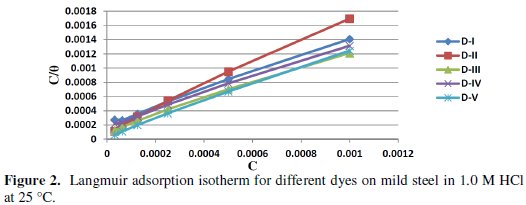
    <p>Using <a href="#e3">equation (3)</a>, plots of log (C/&theta;) versus C gave straight lines <a href="#f2">Fig. (2)</a>, with a 
slope of around unity confirming that the adsorption of different azo-dyes on 
mild steel surface in hydrochloric acid solution obeys the Langmuir adsorption 
isotherm at 25 &deg;C (similar data are obtained at different temperatures).</p>


    <p>&nbsp;</p>
<a name="f2">
<img src="/img/revistas/pea/v31n2/31n2a05f2.jpg">
    
<p>&nbsp;</p>


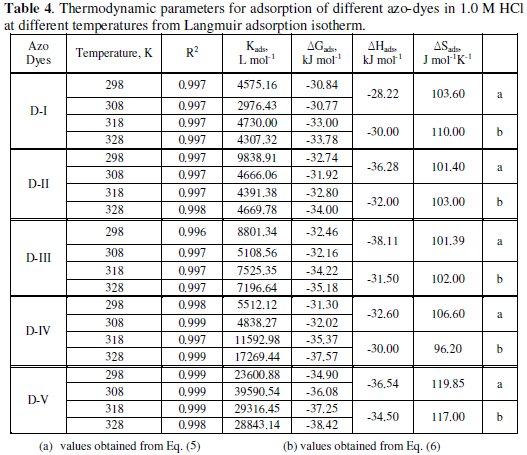
    <p>The values of Langmuir adsorption parameters obtained from the plots are recorded in 
<a href="#t4">Table (4)</a>.</p>


    <p>&nbsp;</p>
<a name="t4">
<img src="/img/revistas/pea/v31n2/31n2a05t4.jpg">
    
]]></body>
<body><![CDATA[<p>&nbsp;</p>


    <p>The results show that the slopes and R<sup>2</sup> values are very close to unity 
indicating strong adherence of the adsorbed inhibitors to the assumptions of 
Langmuir [44].</p>

    <p>The equilibrium constant of adsorption obtained from the slopes of the Langmuir 
isotherms was used to calculate the free energy for the adsorption of different 
azo-dyes on the surface of mild steel. The free energy of adsorption of different 
azo-dyes on the metal surface is related to the equilibrium constant of adsorption 
according to <a href="#e4">equation (4)</a>:</p>


    <p>&nbsp;</p>
<a name="e4">
<img src="/img/revistas/pea/v31n2/31n2a05e4.jpg">
    
<p>&nbsp;</p>


    <p>where R is the universal gas constant , &Delta;G<sub>ads.</sub>  is the free energy of adsorption and 
55.5 is the concentration of water in solution (mol L<sup>-1</sup>) [45].</p>

    <p>The enthalpy and entropy of adsorption (&Delta;H<sub>ads.</sub>  and &Delta;S<sub>ads.</sub> ) can be calculated using 
<a href="#e5">equation (5)</a>:</p>


    <p>&nbsp;</p>
<a name="e5">
<img src="/img/revistas/pea/v31n2/31n2a05e5.jpg">
    
<p>&nbsp;</p>


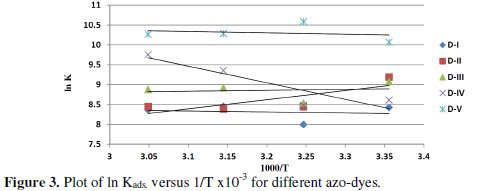
    <p>Using <a href="#e5">equation (5)</a>, the values of &Delta;H<sub>ads.</sub>  and &Delta;S<sub>ads.</sub>  were evaluated from the slope 
and intercept of plot ln K<sub>ads.</sub> versus 1 / T, <a href="#f3">Fig. (3)</a>.</p>


    ]]></body>
<body><![CDATA[<p>&nbsp;</p>
<a name="f3">
<img src="/img/revistas/pea/v31n2/31n2a05f3.jpg">
    
<p>&nbsp;</p>


    <p>The values of &Delta;G<sub>ads.</sub> , &Delta;H<sub>ads.</sub>  and 
&Delta;S<sub>ads.</sub>  are listed in <a href="#t4">Table (4)</a>.</p>

    <p>From the results, it is significant to note that the calculated values of &Delta;G<sub>ads.</sub>  are 
negative indicating that the adsorption is a spontaneous process. Generally, the 
values of &Delta;G<sub>ads.</sub>  around -20 KJ moL<sup>-1</sup> or lower are consistent with the electrostatic 
interaction between charged molecules and the charged metal surface 
(physisorption), while those around -40 KJ moL<sup>-1</sup> or more negative involve 
chemisorption [46]. In the present study, the values of &Delta;G<sub>ads.</sub>  ranged from (-30.84 
to -33.78), (-32.74 to -34.00), (-32.46 to -35.10), (-31.30 to -37.57) and (-34.90 to 
-38.42) for D-1 to D-5, respectively, at temperatures ranged from (25 to 55 &deg;C), 
which probably means that both physisorption and chemisorption are taking 
place.</p>

    <p>The values of &Delta;G<sub>ads</sub>  are positive in the adsorption process and this could be 
explained as follows:</p>

    <p>An adsorption isotherm describes the equilibrium between the concentration of 
certain species in the phase in which it is present and in the metal-electrolyte 
phase. So, adsorption equilibrium can be written as:</p>


    <p>&nbsp;</p>
<a name="s2">
<img src="/img/revistas/pea/v31n2/31n2a05s2.jpg">
    
<p>&nbsp;</p>


    <p>where ORG is the organic compound adsorbed and deadsorbed at the same speed 
on the metal surface. The adsorption phenomenon occurs in an aqueous solution 
containing the organic compound [ORG <sub>(aq)</sub>]. This involves the displacement of a 
certain number of water molecules (&chi;) by the organic compound which is 
adsorbed on the electrode surface [H2O <sub>(ads)</sub>].</p>

    <p>Ateya et al. [48] described this situation as the adsorption of the organic 
compound which is accompanied by the desorption of water molecules from the 
surface. Thus, while the adsorption process is believed to be exothermic and 
associated with a decrease in entropy of the solute, the opposite is true for the 
solvent. Therefore the gain in entropy that accompanies the substantial 
adsorption process is attributed to the increase in solvent entropy. 
The values of &Delta;H<sub>ads</sub> provide further information about the mechanism of 
corrosion inhibition. The endothermic adsorption process is ascribed 
unambiguously to chemisorption and an exothermic process may involve either 
physisorption or chemisorption or a combination of both [49]. In the present 
study, the obtained negative values of &Delta;H<sub>ads</sub> indicate a combination of both 
physisorption and chemisorption processes.</p>

    ]]></body>
<body><![CDATA[<p>The values of &Delta;H<sub>ads</sub> and &Delta;G<sub>ads</sub>  can also be calculated by using the following 
equation [37]:</p>


    <p>&nbsp;</p>
<a name="e6">
<img src="/img/revistas/pea/v31n2/31n2a05e6.jpg">
    
<p>&nbsp;</p>


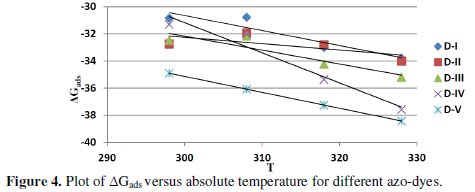
    <p>Using <a href="#e6">equation (6)</a>, the plot of &Delta;G<sub>ads.</sub> versus T gives a straight line (<a href="#f4">Fig. (4)</a>) with 
a slope of -&Delta;G<sub>ads</sub> and intercept of &Delta;H<sub>ads.</sub>.</p>


    <p>&nbsp;</p>
<a name="f4">
<img src="/img/revistas/pea/v31n2/31n2a05f4.jpg">
    
<p>&nbsp;</p>


    <p>The values obtained are well correlated 
with those obtained from <a href="#e5">equation (5)</a>.</p>


    <p>&nbsp;</p>
    <p><b><i>Thermodynamic consideration</i></b></p>

    <p>To investigate the mechanism of inhibition and to determine the activation 
energy of the corrosion process, weight loss of mild steel in 1.0 M HCl was 
determined at various temperatures (298-328 K) in the absence and presence of 
different concentrations of azo-dyes compounds.</p>

    ]]></body>
<body><![CDATA[<p>In an acidic solution the corrosion rate is related to temperature by the Arrhenius 
equation [50]:</p>


    <p>&nbsp;</p>
<a name="e7">
<img src="/img/revistas/pea/v31n2/31n2a05e7.jpg">
    
<p>&nbsp;</p>


    <p>where (C.R.) is the corrosion rate, E<sub>a</sub> is the apparent activation energy, R is the 
molar gas constant, T is the absolute temperature and A is the frequency factor.</p>

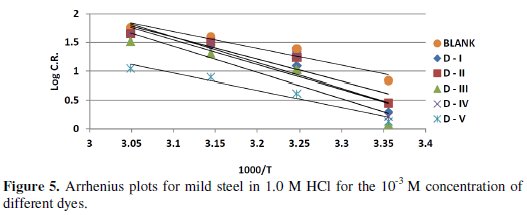
    <p><a href="#f5">Figure (5)</a> shows the plot of log C.R. versus 1/T.</p>


    <p>&nbsp;</p>
<a name="f5">
<img src="/img/revistas/pea/v31n2/31n2a05f5.jpg">
    
<p>&nbsp;</p>


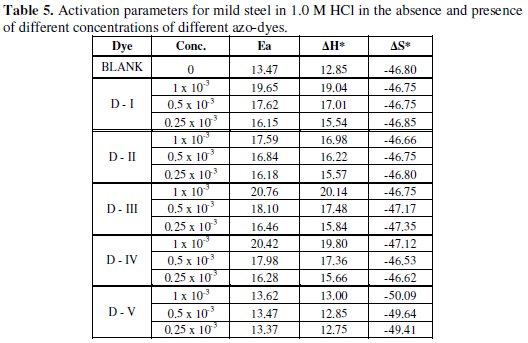
    <p>Linear plots were obtained for 
different azo-dyes compounds. The values of Ea were computed from the slope 
of the straight lines and are listed in <a href="#t5">Table (5)</a>.</p>


    <p>&nbsp;</p>
<a name="t5">
<img src="/img/revistas/pea/v31n2/31n2a05t5.jpg">
    
<p>&nbsp;</p>


    ]]></body>
<body><![CDATA[<p>It is clear from this table that E<sub>a</sub> 
values in presence of the azo-dyes are higher than in their absence. Inspection of 
these data reveals that the apparent activation energy Ea in HCl in the absence of 
azo dye compounds was 13.47 kJ /moL<sup>-1</sup>.</p>

    <p>Low activation energy means fast reaction, and high activation energy means 
slow reaction. High activation energy corresponds to a reaction rate that is very 
sensitive to temperature. Conversely small activation energy indicates a reaction 
rate that varies only slightly with the temperature. If reaction has zero activation 
energy, its rate is independent of temperature. In some cases, activation energy 
(E<sub>a</sub>) is found to be negative, which indicates that the rate decreases when 
temperature is raised and such behaviour is a signal that the reaction has a 
complex mechanism [30,51].</p>

    <p>Enthalpy and entropy of activation &Delta;H<sup>*</sup> and &Delta;S<sup>*</sup> were obtained by applying the 
transition state equation:</p>


    <p>&nbsp;</p>
<a name="e8">
<img src="/img/revistas/pea/v31n2/31n2a05e8.jpg">
    
<p>&nbsp;</p>
<a name="e9">
<img src="/img/revistas/pea/v31n2/31n2a05e9.jpg">
    
<p>&nbsp;</p>


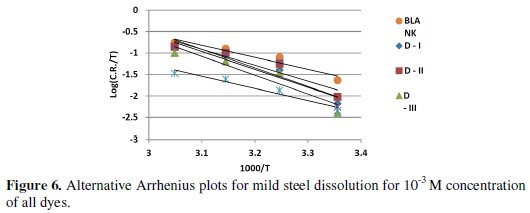
    <p>where h is the Plank's constant, N is the Avogadro's number, T is the absolute 
temperature and R is the universal gas constant. Plots log[C.R./T] as a function 
of 1/T were made in <a href="#f6">Fig. (6)</a>.</p>


    <p>&nbsp;</p>
<a name="f6">
<img src="/img/revistas/pea/v31n2/31n2a05f6.jpg">
    
<p>&nbsp;</p>


    <p>Straight lines were obtained with a slope of (-&Delta;H<sup>*</sup>/ 
RT) and an intercept of log[R/Nh] + (&Delta;S<sup>*</sup>/ R), being the values of &Delta;H<sup>*</sup> and &Delta;S<sup>*</sup> 
calculated, and listed in <a href="#t5">Table (5)</a>. While an endothermic adsorption process 
(&Delta;H<sup>*</sup> &gt; 0) is attributed unequivocally to chemisorption, an exothermic adsorption 
process (&Delta;H<sup>*</sup> &lt; 0) may involve either physisorption or chemisorption or a 
mixture of both processes [50]. In the present work, the positive sign of the 
activation enthalpy (&Delta;H<sup>*</sup>) reflects the endothermic nature of the steel dissolution 
process and that the dissolution of steel is difficult. The order of the phenomena 
ascribed by the negative values of (&Delta;S<sup>*</sup>), may probably be explained by the 
possibility of the formation of iron complex on the metal surface [17].</p>


    ]]></body>
<body><![CDATA[<p>&nbsp;</p>
    <p><b><i>Electrochemical techniques</i></b></p>

    <p><i>Open Circuit Potential measurements</i></p>

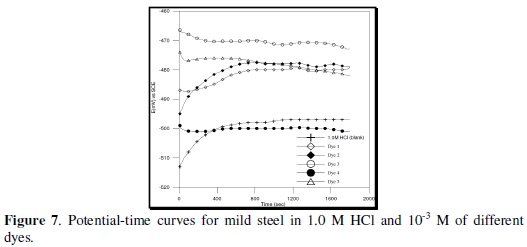
    <p>The open-circuit potential (OCP) for mild steel as a function of time in 1.0 M 
HCl in absence and in the presence of different concentrations of all under testing 
azo-dyes are studied.</p>

    <p>As revealed from inspection of curves, <a href="#f7">Fig. (7)</a>, the potential of the mild steel 
electrode is measured directly after immersion as the steady state potential varies 
with different concentrations of the used azo-dyes solutions (1.0 &times; 10<sup>-3</sup> -0.125 &times; 10<sup>-3</sup>).</p>


    <p>&nbsp;</p>
<a name="f7">
<img src="/img/revistas/pea/v31n2/31n2a05f7.jpg">
    
<p>&nbsp;</p>


    <p>In almost all azo-dye compounds, there is always a general tendency for 
the OCP to drift with time towards more stable values at which it tends to be 
stabilized after 30 minutes.</p>

    <p>Accordingly, the behavior can be classified into two different behaviors 
depending upon the mode of the variation of the steady state potentials with time 
and concentration of the test solutions.</p>

    <p>In the first behavior which is represented by the potential time curves of mild 
steel electrode in 1.0 M HCl containing different concentrations of D-1, D-2, D-3 
and D-5, there is always a general tendency for the immersion potential (E<sub>im</sub>) to 
shift from negative to the positive direction. The values of steady state potential 
(E<sub>ss</sub>) in this case are higher than the value in free acid.</p>

    ]]></body>
<body><![CDATA[<p>The second behavior, on the other hand, belongs to the azo-dye D-4 (which 
contains tris azo-group) where the values of steady state potential are lower than 
the value in free HCl solution. This behavior indicates that the first adsorbed 
molecules of the inhibitors are attached to the most active anodic sites. In 
contrast to some azo-dyes, there is some inhibition of the cathodic reaction 
probably due to steric hindrance of the combination of the adsorbed hydrogen 
atoms to form molecules.</p>


    <p>&nbsp;</p>
    <p><i>Potentiodynamic polarization measurements</i></p>

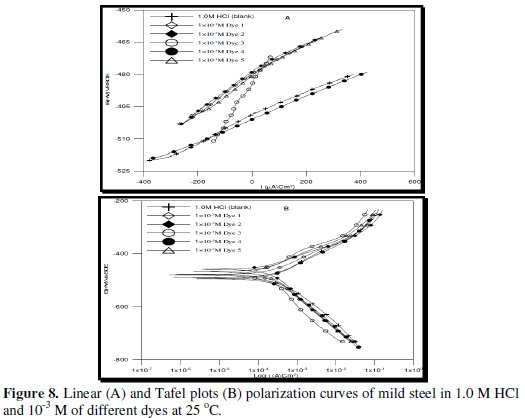
    <p><a href="#f8">Figure (8)</a> represents linear and Tafel polarization curves of 1.0 M HCl in 10<sup>-3</sup> M of 
different studies of dyes at room temperature.</p>


    <p>&nbsp;</p>
<a name="f8">
<img src="/img/revistas/pea/v31n2/31n2a05f8.jpg">
    
<p>&nbsp;</p>


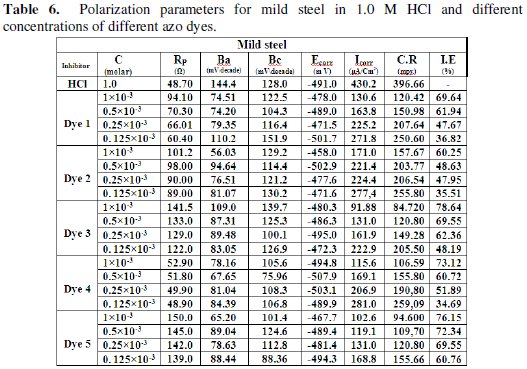
    <p>The corrosion kinetic parameters are tabulated in <a href="#t6">Table (6)</a>, showing that the 
polarization resistance (R<sub>p</sub>), Tafel slopes constants (&beta;<sub>a</sub>, &beta;<sub>c</sub>), corrosion potential 
(E<sub>corr</sub>), corrosion current density (I<sub>corr</sub>), corrosion rate (C.R.) and inhibition 
efficiencies (I.E.%) are function of the concentration of different azo-dyes.</p>


    <p>&nbsp;</p>
<a name="t6">
<img src="/img/revistas/pea/v31n2/31n2a05t6.jpg">
    
<p>&nbsp;</p>


    <p>An inspection of the results presented in <a href="#f8">Fig. (8)</a> and <a href="#t6">Table (6)</a> reveals that 
increasing the concentration of the additive dyes shows the following:</p>

    ]]></body>
<body><![CDATA[<p><b>(i)</b> It is clear that different dyes shifted both anodic and cathodic branches of 
polarization curves to lower values of current density indicating that all dyes 
act as mixed type inhibitors. The addition of different dyes to HCl solution 
reduces the anodic dissolution of mild steel and also retards the cathodic 
hydrogn evolution reaction.</p>

    <p><b>(ii)</b> The corrosion potential (E<sub>corr</sub>) shifted slightly to more positive values 
while the corrosion current (I<sub>corr</sub>) decreases with increasing the inhibitor 
concentration, indicating the inhibiting effect of these compounds.</p>

    <p><b>(iii)</b> The variable values of the cathodic Tafel slopes suggest that the inhibition 
action of such compounds occurs by simple blocking of the electrode surface 
area [52].</p>

    <p><b>(iv)</b> The obtained results indicated that azo-dyes compounds inhibit HCl 
corrosion of mild steel via their adsorption on both anodic and cathodic 
active sites without modifing the mechanism of corrosion reaction. This 
means that the adsorbed inhibitor molecules block the surface active sites 
and decrease the area available for hydrogn evolution and metal dissolution 
reactions [53].</p>

    <p><b>(v)</b> The (I.E.%) calculated was found to increase with increasing the azo-dyes 
concentrations.</p>

    <p>The inhibition achieved by these compounds decreases in the following sequence:</p>

    <p>D-3 &gt; D-5 &gt; D-4 &gt; D-1 &gt; D-2</p>

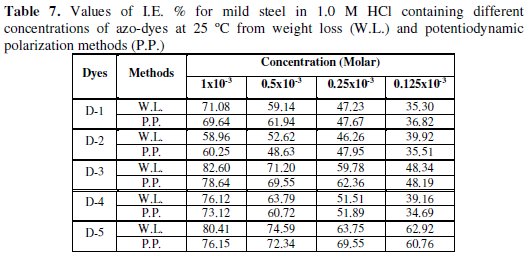
    <p>It is of interest to note that the values of (I.E.%) given by polarization are 
somewhat different from those obtained by weight-loss measurements as shown 
in <a href="#t7">Table 7</a>.</p>


    <p>&nbsp;</p>
<a name="t7">
<img src="/img/revistas/pea/v31n2/31n2a05t7.jpg">
    
<p>&nbsp;</p>


    ]]></body>
<body><![CDATA[<p>This difference can be attributed to the fact that the first method 
gives instantaneous corrosion rate, whereas the second method gives average 
corrosion rates.</p>

    <p>This difference may also be expected to arise because of the difference in the 
time required to form an adsorbed layer of inhibitor on metal surface that can 
inhibit corrosion [54].</p>


    <p>&nbsp;</p>
    <p><b><i>Surface morphology of the metal electrodes</i></b></p>

    <p>The scanning electron microscope images and energy dispersive X-ray 
analysis further supported the formation of a surface film by the inhibitors 
and their interaction with surface atoms of mild steel.</p>


    <p>&nbsp;</p>
    <p><i>Scanning Electron Microscope (SEM) analysis</i></p>

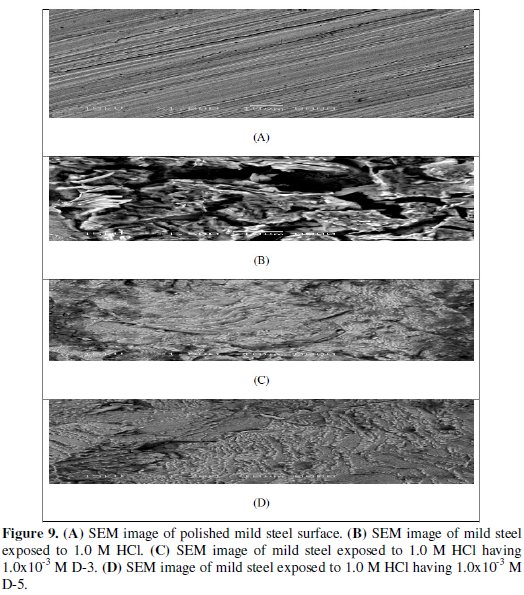
    <p><a href="#f9">Figure (9 A)</a> illustrates the morphology of the surface of polished mild steel 
electrode before exposure to corrosion media (blank).</p>


    <p>&nbsp;</p>
<a name="f9">
<img src="/img/revistas/pea/v31n2/31n2a05f9.jpg">
    
<p>&nbsp;</p>


    ]]></body>
<body><![CDATA[<p>The specimens were subjected to microscopic examination at &times; 1000. The 
micrograph shows a characteristic inclusion, which was probably an oxide 
inclusion. <a href="#f9">Figure (9 B)</a> shows SEM image of the surface of the studied mild steel 
electrode specimen after immersion in 1.0 M HCl solution for 24 h. The 
micrograph reveals that the surface was strongly damaged. The corroded areas 
are shown as black grooves in the specimen with gray and white zones, which 
correspond to the dandruff of iron oxide. It suggested an uncovered surface of 
metal electrode severally corroded. The highly oxidized phase has perhaps been 
formed in air when desiccated under no protection for the surface.</p>

    <p><a href="#f9">Figures (9 C and D)</a> show SEM images for the surface of another mild steel specimen 
after immersion for the same time interval in 1.0 M HCl solution containing 1.0 &times; 
10<sup>-3</sup> M from both dyes D-3 and D-5. The micrograph reveals that the inhibited 
metal surface is smoother than the uninhibited surface, a good protective film 
present on the metal surface. This confirms the highest inhibition effeciency of 
the inhibitors.</p>


    <p>&nbsp;</p>
    <p><i>Energy Dispersive X-ray analysis (EDAX)</i></p>

    <p>It is important to take into consideration the percentage of the elements present 
on the surface of the mild steel.</p>

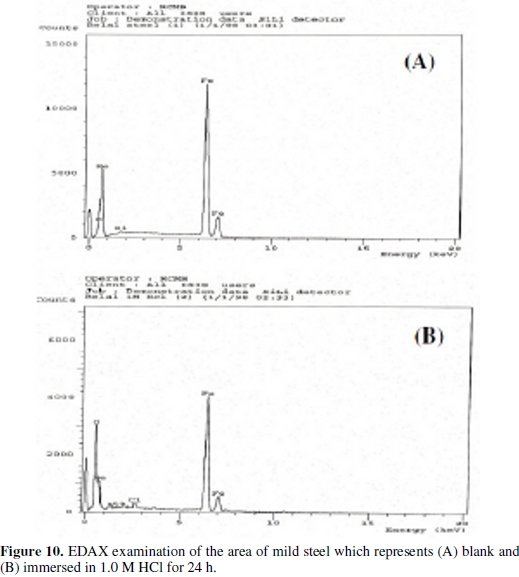
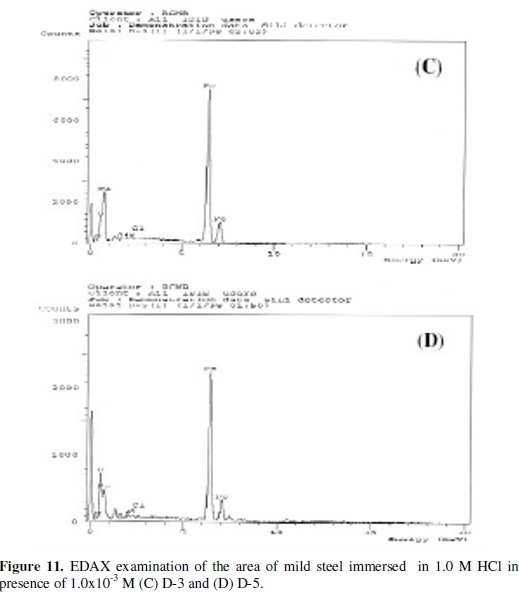
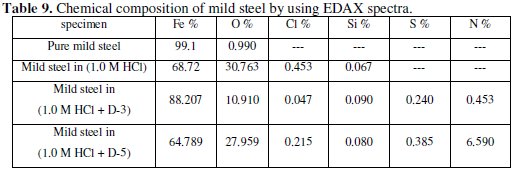
    <p>The EDAX analysis of the surface reveals the presence of oxygen and iron, 
suggesting therefore the presence of iron oxide / hydroxide, Figs. (<a href="#f10">10</a> and <a href="#f11">11</a>).</p>


    <p>&nbsp;</p>
<a name="f10">
<img src="/img/revistas/pea/v31n2/31n2a05f10.jpg">
    
<p>&nbsp;</p>
<a name="f11">
<img src="/img/revistas/pea/v31n2/31n2a05f11.jpg">
    
<p>&nbsp;</p>


    <p>The presence of the peaks of carbon, nitrogen, chloride, silicon and sulphur is 
explained by the adsorption of the inhibitors [D-3, D-5 and beet root extract] on 
the products of corrosion of the mild steel.</p>


    ]]></body>
<body><![CDATA[<p>&nbsp;</p>
    <p><b><i>Mechanism of inhibition</i></b></p>

    <p>The inhibition action of mono-,bis-and tris-azodyes towards the corrosion of mild 
steel in 1.0 M HCl could be attributed to several factors including the structure, 
the number and types of adsorption sites, the nature of the molecule, the metal 
surface, and the ability to form complexes.</p>

    <p>The results obtained in this study show the order of increase of I.E% of the 
compounds in solution and the extent of their ability to adsorb, hence protecting 
mild steel, as follows:</p>

    <p>Bis-azodye D-3(82.6%) and D-5 (80.41%) &gt; Tris-azodye D-4(76.12%) &gt; Mono-azodye D-1(71.08%) and D-2 (60.25%)</p>

    <p>The sequence may be attributed to the electronic structure of these compounds. 
The lone pairs of electrons on the S and N atoms are delocalized which stabilizes 
the compounds.</p>

    <p>The inhibition mechanism of the azo compounds under investigation is believed 
to be as a result of the complex formation between Fe<sup>2+</sup> and the azo compounds. 
The formed complex is adsorbed on the metal surface and thereby isolating the 
metal from further corroding attack.</p>

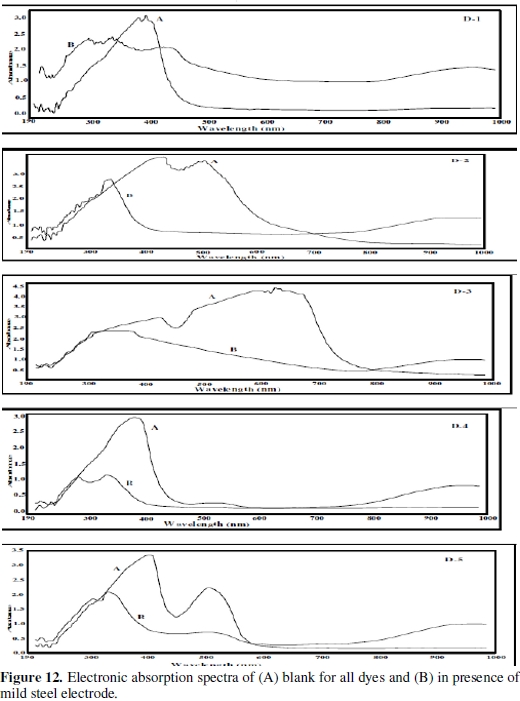
    <p>To provide an evidence for the formation of the complex, UV-VIS spectra of 
solutions in presence of 1.0 M HCl and different under test azo dyes in absence 
(blank) and in presence of mild steel sample were investigated.</p>

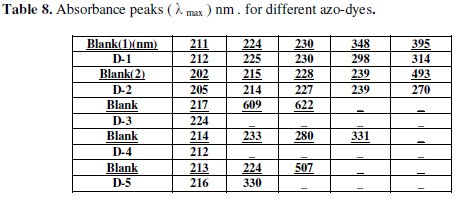
    <p>An inspection of the results presented in <a href="#f12">Fig.(12)</a> and <a href="#t8">Table (8)</a> reveals that the 
absorbance peaks in the visible region for all dyes decreased or disappeared after 
adsorption of the inhibitors on mild steel surface reducing the concentration of 
dyes.</p>


    <p>&nbsp;</p>
<a name="f12">
<img src="/img/revistas/pea/v31n2/31n2a05f12.jpg">
    
]]></body>
<body><![CDATA[<p>&nbsp;</p>
<a name="t8">
<img src="/img/revistas/pea/v31n2/31n2a05t8.jpg">
    
<p>&nbsp;</p>


    <p>Additionally, there are two significant peaks at lower wavelengthes after addition 
of dyes to mild steel electrode, which may indicate a new structure unit formed 
and the degradation of the original structure under test dyes [55].</p>

    <p>Previous results (I.E.%, &Delta;G<sub>ads</sub>, SEM, EDAX and UV-VIS spectra) are likely to 
get into the possiblity of configure the complex on the mild steel surface (<a href="#t9">Table (9)</a>).</p>


    <p>&nbsp;</p>
<a name="t9">
<img src="/img/revistas/pea/v31n2/31n2a05t9.jpg">
    
<p>&nbsp;</p>


    <p>&nbsp;</p>
    <p><b>Conclusions</b></p>

    <p>1 - The corrosion of mild steel in 1.0 M HCl is inhibited by the addition of some 
mono-, bis-, and tris-azo dyes compounds.</p>

    <p>2 - The inhibition efficiency increases with increase in the concentration of these 
compounds, but decreases with an increase in temperature.</p>

    ]]></body>
<body><![CDATA[<p>3 - The adsorption of the azo dye compounds on the mild steel surface in acid 
solution obeyed Langmuir adsorption isotherm.</p>

    <p>4 - The azo dye compounds influence both the cathodic and the anodic reactions 
in the HCl solution. This indicates that the additives act as mixed-type 
inhibitors.</p>

    <p>5 - Previous results (I.E.%, &Delta;G<sub>ads</sub>, SEM, EDAX and UV-VIS spectra) are likely 
to get into the possiblity of configure the complex on the mild steel surface.</p>


    <p>&nbsp;</p>
    <p><b>References</b></p>

    <!-- ref --><p>1. Bouklah M, Benchat N, Aouniti A, et al. Prog Org Coat. 2004;51:118.    &nbsp;&nbsp;&nbsp;&nbsp;&nbsp;&nbsp;&nbsp;&nbsp;[&#160;<a href="javascript:void(0);" onclick="javascript: window.open('/scielo.php?script=sci_nlinks&ref=000208&pid=S0872-1904201300020000500001&lng=','','width=640,height=500,resizable=yes,scrollbars=1,menubar=yes,');">Links</a>&#160;]<!-- end-ref --></p>
    <!-- ref --><p>2. Chetouani A, Hammouti B, Aouniti A, et al. Prog Org Coat. 2002;45:373.    &nbsp;&nbsp;&nbsp;&nbsp;&nbsp;&nbsp;&nbsp;&nbsp;[&#160;<a href="javascript:void(0);" onclick="javascript: window.open('/scielo.php?script=sci_nlinks&ref=000210&pid=S0872-1904201300020000500002&lng=','','width=640,height=500,resizable=yes,scrollbars=1,menubar=yes,');">Links</a>&#160;]<!-- end-ref --></p>
    <!-- ref --><p>3. Morad MS. Mater Chem Phys. 1999;60:188.    &nbsp;&nbsp;&nbsp;&nbsp;&nbsp;&nbsp;&nbsp;&nbsp;[&#160;<a href="javascript:void(0);" onclick="javascript: window.open('/scielo.php?script=sci_nlinks&ref=000212&pid=S0872-1904201300020000500003&lng=','','width=640,height=500,resizable=yes,scrollbars=1,menubar=yes,');">Links</a>&#160;]<!-- end-ref --></p>
    <!-- ref --><p>4. Bilgic S. Mater Chem Phys. 2002;70:52.    &nbsp;&nbsp;&nbsp;&nbsp;&nbsp;&nbsp;&nbsp;&nbsp;[&#160;<a href="javascript:void(0);" onclick="javascript: window.open('/scielo.php?script=sci_nlinks&ref=000214&pid=S0872-1904201300020000500004&lng=','','width=640,height=500,resizable=yes,scrollbars=1,menubar=yes,');">Links</a>&#160;]<!-- end-ref --></p>
    <!-- ref --><p>5. Bentiss F, Traisnel M, Lagrenee M. Corros Sci. 2000;42:127.    &nbsp;&nbsp;&nbsp;&nbsp;&nbsp;&nbsp;&nbsp;&nbsp;[&#160;<a href="javascript:void(0);" onclick="javascript: window.open('/scielo.php?script=sci_nlinks&ref=000216&pid=S0872-1904201300020000500005&lng=','','width=640,height=500,resizable=yes,scrollbars=1,menubar=yes,');">Links</a>&#160;]<!-- end-ref --></p>
    <p>6. Quraishi MA, Khan MAW, M. Ajmal M. et al. Corrosion 1997;53:475.</p>
    <!-- ref --><p>7. Khamis E. Corrosion. 1990;46:476.    &nbsp;&nbsp;&nbsp;&nbsp;&nbsp;&nbsp;&nbsp;&nbsp;[&#160;<a href="javascript:void(0);" onclick="javascript: window.open('/scielo.php?script=sci_nlinks&ref=000219&pid=S0872-1904201300020000500007&lng=','','width=640,height=500,resizable=yes,scrollbars=1,menubar=yes,');">Links</a>&#160;]<!-- end-ref --></p>
    <!-- ref --><p>8. Afidah A, Rahim E, Rocca J, et al. Corros Sci. 2007;49:402.    &nbsp;&nbsp;&nbsp;&nbsp;&nbsp;&nbsp;&nbsp;&nbsp;[&#160;<a href="javascript:void(0);" onclick="javascript: window.open('/scielo.php?script=sci_nlinks&ref=000221&pid=S0872-1904201300020000500008&lng=','','width=640,height=500,resizable=yes,scrollbars=1,menubar=yes,');">Links</a>&#160;]<!-- end-ref --></p>
    ]]></body>
<body><![CDATA[<!-- ref --><p>9. Fouda AS, Al-Sharawy AA, El-Katori EE. Desalination 2006;201:1.    &nbsp;&nbsp;&nbsp;&nbsp;&nbsp;&nbsp;&nbsp;&nbsp;[&#160;<a href="javascript:void(0);" onclick="javascript: window.open('/scielo.php?script=sci_nlinks&ref=000223&pid=S0872-1904201300020000500009&lng=','','width=640,height=500,resizable=yes,scrollbars=1,menubar=yes,');">Links</a>&#160;]<!-- end-ref --></p>
    <!-- ref --><p>10. Wang H-L, Fan H-B, Zheng J-S. Mater Chem Phys. 2002;77:655.    &nbsp;&nbsp;&nbsp;&nbsp;&nbsp;&nbsp;&nbsp;&nbsp;[&#160;<a href="javascript:void(0);" onclick="javascript: window.open('/scielo.php?script=sci_nlinks&ref=000225&pid=S0872-1904201300020000500010&lng=','','width=640,height=500,resizable=yes,scrollbars=1,menubar=yes,');">Links</a>&#160;]<!-- end-ref --></p>
    <!-- ref --><p>11. Tirbonodand F, Fiaud C. Corros Sci. 1978;18:139.    &nbsp;&nbsp;&nbsp;&nbsp;&nbsp;&nbsp;&nbsp;&nbsp;[&#160;<a href="javascript:void(0);" onclick="javascript: window.open('/scielo.php?script=sci_nlinks&ref=000227&pid=S0872-1904201300020000500011&lng=','','width=640,height=500,resizable=yes,scrollbars=1,menubar=yes,');">Links</a>&#160;]<!-- end-ref --></p>
    <!-- ref --><p>12. Elmorsi MA, Hassanein AM. Corros Sci. 1999;41:2337.    &nbsp;&nbsp;&nbsp;&nbsp;&nbsp;&nbsp;&nbsp;&nbsp;[&#160;<a href="javascript:void(0);" onclick="javascript: window.open('/scielo.php?script=sci_nlinks&ref=000229&pid=S0872-1904201300020000500012&lng=','','width=640,height=500,resizable=yes,scrollbars=1,menubar=yes,');">Links</a>&#160;]<!-- end-ref --></p>
    <!-- ref --><p>13. Abdallah M, Moustafa E. Ann Chim. 2004;94:601.    &nbsp;&nbsp;&nbsp;&nbsp;&nbsp;&nbsp;&nbsp;&nbsp;[&#160;<a href="javascript:void(0);" onclick="javascript: window.open('/scielo.php?script=sci_nlinks&ref=000231&pid=S0872-1904201300020000500013&lng=','','width=640,height=500,resizable=yes,scrollbars=1,menubar=yes,');">Links</a>&#160;]<!-- end-ref --></p>
    ]]></body>
<body><![CDATA[<!-- ref --><p>14. Makhlouf MT, Khalil HZ. J Chem Tech Biotechnol. 1987;38:89.    &nbsp;&nbsp;&nbsp;&nbsp;&nbsp;&nbsp;&nbsp;&nbsp;[&#160;<a href="javascript:void(0);" onclick="javascript: window.open('/scielo.php?script=sci_nlinks&ref=000233&pid=S0872-1904201300020000500014&lng=','','width=640,height=500,resizable=yes,scrollbars=1,menubar=yes,');">Links</a>&#160;]<!-- end-ref --></p>
    <!-- ref --><p>15. Talati JD, Daraji JM. J Indian Chem Soc. 1991;68:67.    &nbsp;&nbsp;&nbsp;&nbsp;&nbsp;&nbsp;&nbsp;&nbsp;[&#160;<a href="javascript:void(0);" onclick="javascript: window.open('/scielo.php?script=sci_nlinks&ref=000235&pid=S0872-1904201300020000500015&lng=','','width=640,height=500,resizable=yes,scrollbars=1,menubar=yes,');">Links</a>&#160;]<!-- end-ref --></p>
    <!-- ref --><p>16. Gomma KG, Wahdan HM. Mater Chem Phys. 1995;39:209.    &nbsp;&nbsp;&nbsp;&nbsp;&nbsp;&nbsp;&nbsp;&nbsp;[&#160;<a href="javascript:void(0);" onclick="javascript: window.open('/scielo.php?script=sci_nlinks&ref=000237&pid=S0872-1904201300020000500016&lng=','','width=640,height=500,resizable=yes,scrollbars=1,menubar=yes,');">Links</a>&#160;]<!-- end-ref --></p>
    <!-- ref --><p>17. Mourad MY, Seliman SA, Abd El-Metaal SM. Bull Soc Chim Fr. 1991;128:832.    &nbsp;&nbsp;&nbsp;&nbsp;&nbsp;&nbsp;&nbsp;&nbsp;[&#160;<a href="javascript:void(0);" onclick="javascript: window.open('/scielo.php?script=sci_nlinks&ref=000239&pid=S0872-1904201300020000500017&lng=','','width=640,height=500,resizable=yes,scrollbars=1,menubar=yes,');">Links</a>&#160;]<!-- end-ref --></p>
    <!-- ref --><p>18. Oguzie EE, Unaegbu C, Ogukwe CN, et al. Mater Chem Phys. 2004;84:363.    &nbsp;&nbsp;&nbsp;&nbsp;&nbsp;&nbsp;&nbsp;&nbsp;[&#160;<a href="javascript:void(0);" onclick="javascript: window.open('/scielo.php?script=sci_nlinks&ref=000241&pid=S0872-1904201300020000500018&lng=','','width=640,height=500,resizable=yes,scrollbars=1,menubar=yes,');">Links</a>&#160;]<!-- end-ref --></p>
    ]]></body>
<body><![CDATA[<!-- ref --><p>19. Oguzie EE. Mater Chem Phys. 2004;87:212.    &nbsp;&nbsp;&nbsp;&nbsp;&nbsp;&nbsp;&nbsp;&nbsp;[&#160;<a href="javascript:void(0);" onclick="javascript: window.open('/scielo.php?script=sci_nlinks&ref=000243&pid=S0872-1904201300020000500019&lng=','','width=640,height=500,resizable=yes,scrollbars=1,menubar=yes,');">Links</a>&#160;]<!-- end-ref --></p>
    <p>20. Oguzie EE, B.N. Okolue, E.E. Ebenso, et al. Mater Chem Phys. 2004;87:394.</p>
    <!-- ref --><p>21. Oguzie EE. Mater Lett. 2005;59:1076.    &nbsp;&nbsp;&nbsp;&nbsp;&nbsp;&nbsp;&nbsp;&nbsp;[&#160;<a href="javascript:void(0);" onclick="javascript: window.open('/scielo.php?script=sci_nlinks&ref=000246&pid=S0872-1904201300020000500021&lng=','','width=640,height=500,resizable=yes,scrollbars=1,menubar=yes,');">Links</a>&#160;]<!-- end-ref --></p>
    <!-- ref --><p>22. Oguzie EE, Onuoha GN, Onuchukwu AI. Mater Chem Phys. 2005;89:305.    &nbsp;&nbsp;&nbsp;&nbsp;&nbsp;&nbsp;&nbsp;&nbsp;[&#160;<a href="javascript:void(0);" onclick="javascript: window.open('/scielo.php?script=sci_nlinks&ref=000248&pid=S0872-1904201300020000500022&lng=','','width=640,height=500,resizable=yes,scrollbars=1,menubar=yes,');">Links</a>&#160;]<!-- end-ref --></p>
    <!-- ref --><p>23. Ebenso EE, Oguzie EE. Mater Lett. 2005;59:2163.    &nbsp;&nbsp;&nbsp;&nbsp;&nbsp;&nbsp;&nbsp;&nbsp;[&#160;<a href="javascript:void(0);" onclick="javascript: window.open('/scielo.php?script=sci_nlinks&ref=000250&pid=S0872-1904201300020000500023&lng=','','width=640,height=500,resizable=yes,scrollbars=1,menubar=yes,');">Links</a>&#160;]<!-- end-ref --></p>
    <!-- ref --><p>24. Jeyaraj T, Raja C, Paramasivam M, Jayapriya B. Trans SAEST. 2005;40:19.    &nbsp;&nbsp;&nbsp;&nbsp;&nbsp;&nbsp;&nbsp;&nbsp;[&#160;<a href="javascript:void(0);" onclick="javascript: window.open('/scielo.php?script=sci_nlinks&ref=000252&pid=S0872-1904201300020000500024&lng=','','width=640,height=500,resizable=yes,scrollbars=1,menubar=yes,');">Links</a>&#160;]<!-- end-ref --></p>
    <!-- ref --><p>25. Oguzie EE, Okolue BN, Ogukwe CE, Unaegbu C. Mater Lett. 2006;60:3376.    &nbsp;&nbsp;&nbsp;&nbsp;&nbsp;&nbsp;&nbsp;&nbsp;[&#160;<a href="javascript:void(0);" onclick="javascript: window.open('/scielo.php?script=sci_nlinks&ref=000254&pid=S0872-1904201300020000500025&lng=','','width=640,height=500,resizable=yes,scrollbars=1,menubar=yes,');">Links</a>&#160;]<!-- end-ref --></p>
    <!-- ref --><p>26. Assaf FH, Abou-Krish M, El-Shahawy AS, et al. Int J Electrochem Sci. 2007;2:169.    &nbsp;&nbsp;&nbsp;&nbsp;&nbsp;&nbsp;&nbsp;&nbsp;[&#160;<a href="javascript:void(0);" onclick="javascript: window.open('/scielo.php?script=sci_nlinks&ref=000256&pid=S0872-1904201300020000500026&lng=','','width=640,height=500,resizable=yes,scrollbars=1,menubar=yes,');">Links</a>&#160;]<!-- end-ref --></p>
    <!-- ref --><p>27. Al-Juaid SS. Port Electrochim Acta. 2007;25:363.    &nbsp;&nbsp;&nbsp;&nbsp;&nbsp;&nbsp;&nbsp;&nbsp;[&#160;<a href="javascript:void(0);" onclick="javascript: window.open('/scielo.php?script=sci_nlinks&ref=000258&pid=S0872-1904201300020000500027&lng=','','width=640,height=500,resizable=yes,scrollbars=1,menubar=yes,');">Links</a>&#160;]<!-- end-ref --></p>
    <!-- ref --><p>28. Sathiyabama J, Rajendran S, Selvi JA, Amalraj AJ. Ind J Chem Technol. 2008;15:462.    &nbsp;&nbsp;&nbsp;&nbsp;&nbsp;&nbsp;&nbsp;&nbsp;[&#160;<a href="javascript:void(0);" onclick="javascript: window.open('/scielo.php?script=sci_nlinks&ref=000260&pid=S0872-1904201300020000500028&lng=','','width=640,height=500,resizable=yes,scrollbars=1,menubar=yes,');">Links</a>&#160;]<!-- end-ref --></p>
    <!-- ref --><p>29. Abdallah M, Fouda AS, Shama SA, Afifi EA. Afr J Pure App Chem. 2008;2:83.    &nbsp;&nbsp;&nbsp;&nbsp;&nbsp;&nbsp;&nbsp;&nbsp;[&#160;<a href="javascript:void(0);" onclick="javascript: window.open('/scielo.php?script=sci_nlinks&ref=000262&pid=S0872-1904201300020000500029&lng=','','width=640,height=500,resizable=yes,scrollbars=1,menubar=yes,');">Links</a>&#160;]<!-- end-ref --></p>
    <!-- ref --><p>30. Ebenso EE, Alemu H, Umoren SA, Obot IB. Int J Electrochem Sci. 2008;3:1325.    &nbsp;&nbsp;&nbsp;&nbsp;&nbsp;&nbsp;&nbsp;&nbsp;[&#160;<a href="javascript:void(0);" onclick="javascript: window.open('/scielo.php?script=sci_nlinks&ref=000264&pid=S0872-1904201300020000500030&lng=','','width=640,height=500,resizable=yes,scrollbars=1,menubar=yes,');">Links</a>&#160;]<!-- end-ref --></p>
    <!-- ref --><p>31. Abboud Y, Abourriche A, Saffaj T, et al. Desalination. 2009;237:175.    &nbsp;&nbsp;&nbsp;&nbsp;&nbsp;&nbsp;&nbsp;&nbsp;[&#160;<a href="javascript:void(0);" onclick="javascript: window.open('/scielo.php?script=sci_nlinks&ref=000266&pid=S0872-1904201300020000500031&lng=','','width=640,height=500,resizable=yes,scrollbars=1,menubar=yes,');">Links</a>&#160;]<!-- end-ref --></p>
    <!-- ref --><p>32. Prabhu RA, Venkatesha TV, Shanbhag AV. J Iran. Chem Soc. 2009;6:353.    &nbsp;&nbsp;&nbsp;&nbsp;&nbsp;&nbsp;&nbsp;&nbsp;[&#160;<a href="javascript:void(0);" onclick="javascript: window.open('/scielo.php?script=sci_nlinks&ref=000268&pid=S0872-1904201300020000500032&lng=','','width=640,height=500,resizable=yes,scrollbars=1,menubar=yes,');">Links</a>&#160;]<!-- end-ref --></p>
    <!-- ref --><p>33. Ashassi-Sorkhabi H, Masoumi B, Ejbari P, Asghari E. J Appl Electrochem. 2009;39:1497.    &nbsp;&nbsp;&nbsp;&nbsp;&nbsp;&nbsp;&nbsp;&nbsp;[&#160;<a href="javascript:void(0);" onclick="javascript: window.open('/scielo.php?script=sci_nlinks&ref=000270&pid=S0872-1904201300020000500033&lng=','','width=640,height=500,resizable=yes,scrollbars=1,menubar=yes,');">Links</a>&#160;]<!-- end-ref --></p>
    <!-- ref --><p>34. Mabrouk EM, Shokry H, Abu Al-Naja KM. Chem Met All. 2011;4:98.    &nbsp;&nbsp;&nbsp;&nbsp;&nbsp;&nbsp;&nbsp;&nbsp;[&#160;<a href="javascript:void(0);" onclick="javascript: window.open('/scielo.php?script=sci_nlinks&ref=000272&pid=S0872-1904201300020000500034&lng=','','width=640,height=500,resizable=yes,scrollbars=1,menubar=yes,');">Links</a>&#160;]<!-- end-ref --></p>
    <!-- ref --><p>35. Benali O, Larabi L, Merah S, Harek Y. J Mater Environ Sci. 2011;2:39.    &nbsp;&nbsp;&nbsp;&nbsp;&nbsp;&nbsp;&nbsp;&nbsp;[&#160;<a href="javascript:void(0);" onclick="javascript: window.open('/scielo.php?script=sci_nlinks&ref=000274&pid=S0872-1904201300020000500035&lng=','','width=640,height=500,resizable=yes,scrollbars=1,menubar=yes,');">Links</a>&#160;]<!-- end-ref --></p>
    <!-- ref --><p>36. Onen AI, Maitera ON, Joseph J, Ebenso EE. Int J Electrochem. Sci. 2011;6:2884.    &nbsp;&nbsp;&nbsp;&nbsp;&nbsp;&nbsp;&nbsp;&nbsp;[&#160;<a href="javascript:void(0);" onclick="javascript: window.open('/scielo.php?script=sci_nlinks&ref=000276&pid=S0872-1904201300020000500036&lng=','','width=640,height=500,resizable=yes,scrollbars=1,menubar=yes,');">Links</a>&#160;]<!-- end-ref --></p>
    <!-- ref --><p>37. ShivaKumar SS, Mohana NK. Int J Electrochem Sci. 2012;7:1620.    &nbsp;&nbsp;&nbsp;&nbsp;&nbsp;&nbsp;&nbsp;&nbsp;[&#160;<a href="javascript:void(0);" onclick="javascript: window.open('/scielo.php?script=sci_nlinks&ref=000278&pid=S0872-1904201300020000500037&lng=','','width=640,height=500,resizable=yes,scrollbars=1,menubar=yes,');">Links</a>&#160;]<!-- end-ref --></p>
    <!-- ref --><p>38. Nabi SAA, Hussain AA. J Bas Res. 2012;38:125.    &nbsp;&nbsp;&nbsp;&nbsp;&nbsp;&nbsp;&nbsp;&nbsp;[&#160;<a href="javascript:void(0);" onclick="javascript: window.open('/scielo.php?script=sci_nlinks&ref=000280&pid=S0872-1904201300020000500038&lng=','','width=640,height=500,resizable=yes,scrollbars=1,menubar=yes,');">Links</a>&#160;]<!-- end-ref --></p>
    <!-- ref --><p>39. Alego VO, Hope GA, Flitt HJ, et al. Corros Sci. 1992;33:1719.    &nbsp;&nbsp;&nbsp;&nbsp;&nbsp;&nbsp;&nbsp;&nbsp;[&#160;<a href="javascript:void(0);" onclick="javascript: window.open('/scielo.php?script=sci_nlinks&ref=000282&pid=S0872-1904201300020000500039&lng=','','width=640,height=500,resizable=yes,scrollbars=1,menubar=yes,');">Links</a>&#160;]<!-- end-ref --></p>
    <!-- ref --><p>40. Sahin M, Bilgic S, Ylmaz M. Appl Surf Sci. 2002;195:1.    &nbsp;&nbsp;&nbsp;&nbsp;&nbsp;&nbsp;&nbsp;&nbsp;[&#160;<a href="javascript:void(0);" onclick="javascript: window.open('/scielo.php?script=sci_nlinks&ref=000284&pid=S0872-1904201300020000500040&lng=','','width=640,height=500,resizable=yes,scrollbars=1,menubar=yes,');">Links</a>&#160;]<!-- end-ref --></p>
    <!-- ref --><p>41. Zaafarany A, Abdallah M. Electrochem Sci. 2010;5:18.    &nbsp;&nbsp;&nbsp;&nbsp;&nbsp;&nbsp;&nbsp;&nbsp;[&#160;<a href="javascript:void(0);" onclick="javascript: window.open('/scielo.php?script=sci_nlinks&ref=000286&pid=S0872-1904201300020000500041&lng=','','width=640,height=500,resizable=yes,scrollbars=1,menubar=yes,');">Links</a>&#160;]<!-- end-ref --></p>
    <!-- ref --><p>42. Ergun U, Yuzer D, Emregul KC. Mater Chem Phys. 2008;109:492.    &nbsp;&nbsp;&nbsp;&nbsp;&nbsp;&nbsp;&nbsp;&nbsp;[&#160;<a href="javascript:void(0);" onclick="javascript: window.open('/scielo.php?script=sci_nlinks&ref=000288&pid=S0872-1904201300020000500042&lng=','','width=640,height=500,resizable=yes,scrollbars=1,menubar=yes,');">Links</a>&#160;]<!-- end-ref --></p>
    <!-- ref --><p>43. Langmuir I. J Am Chem Soc. 1947;39:1848.    &nbsp;&nbsp;&nbsp;&nbsp;&nbsp;&nbsp;&nbsp;&nbsp;[&#160;<a href="javascript:void(0);" onclick="javascript: window.open('/scielo.php?script=sci_nlinks&ref=000290&pid=S0872-1904201300020000500043&lng=','','width=640,height=500,resizable=yes,scrollbars=1,menubar=yes,');">Links</a>&#160;]<!-- end-ref --></p>
    <!-- ref --><p>44. Ali SA, Saeed MT, Rahman SU. Corros Sci. 2005;45:253.    &nbsp;&nbsp;&nbsp;&nbsp;&nbsp;&nbsp;&nbsp;&nbsp;[&#160;<a href="javascript:void(0);" onclick="javascript: window.open('/scielo.php?script=sci_nlinks&ref=000292&pid=S0872-1904201300020000500044&lng=','','width=640,height=500,resizable=yes,scrollbars=1,menubar=yes,');">Links</a>&#160;]<!-- end-ref --></p>
    <!-- ref --><p>45. Khamis E. Corrosion. 1990;46:476.    &nbsp;&nbsp;&nbsp;&nbsp;&nbsp;&nbsp;&nbsp;&nbsp;[&#160;<a href="javascript:void(0);" onclick="javascript: window.open('/scielo.php?script=sci_nlinks&ref=000294&pid=S0872-1904201300020000500045&lng=','','width=640,height=500,resizable=yes,scrollbars=1,menubar=yes,');">Links</a>&#160;]<!-- end-ref --></p>
    <!-- ref --><p>46. Bensajjay E, Alehyen S, El-Achouri M, Kertit S. Anti-Corros Meth Mater. 2003;50:402.    &nbsp;&nbsp;&nbsp;&nbsp;&nbsp;&nbsp;&nbsp;&nbsp;[&#160;<a href="javascript:void(0);" onclick="javascript: window.open('/scielo.php?script=sci_nlinks&ref=000296&pid=S0872-1904201300020000500046&lng=','','width=640,height=500,resizable=yes,scrollbars=1,menubar=yes,');">Links</a>&#160;]<!-- end-ref --></p>
    <!-- ref --><p>47. Kumar ET, Viswanatham S, Udayabhanu G. Corros Eng Sci Technol. 2004;39:327.    &nbsp;&nbsp;&nbsp;&nbsp;&nbsp;&nbsp;&nbsp;&nbsp;[&#160;<a href="javascript:void(0);" onclick="javascript: window.open('/scielo.php?script=sci_nlinks&ref=000298&pid=S0872-1904201300020000500047&lng=','','width=640,height=500,resizable=yes,scrollbars=1,menubar=yes,');">Links</a>&#160;]<!-- end-ref --></p>
    <!-- ref --><p>48. Ateya B, El-Anadouli B, El-Nizamy F. Corros Sci. 1984;24:509.    &nbsp;&nbsp;&nbsp;&nbsp;&nbsp;&nbsp;&nbsp;&nbsp;[&#160;<a href="javascript:void(0);" onclick="javascript: window.open('/scielo.php?script=sci_nlinks&ref=000300&pid=S0872-1904201300020000500048&lng=','','width=640,height=500,resizable=yes,scrollbars=1,menubar=yes,');">Links</a>&#160;]<!-- end-ref --></p>
    <!-- ref --><p>49. Ali SA, El-Shareef AM, Al-Ghamdi RF, Saeed MT. Corros Sci. 2005;47:2659.    &nbsp;&nbsp;&nbsp;&nbsp;&nbsp;&nbsp;&nbsp;&nbsp;[&#160;<a href="javascript:void(0);" onclick="javascript: window.open('/scielo.php?script=sci_nlinks&ref=000302&pid=S0872-1904201300020000500049&lng=','','width=640,height=500,resizable=yes,scrollbars=1,menubar=yes,');">Links</a>&#160;]<!-- end-ref --></p>
    <!-- ref --><p>50. Ebenso EE, Alemu H, Umoren SA, Olet IB. Int J Electrochem Sci. 2008;3:1325.    &nbsp;&nbsp;&nbsp;&nbsp;&nbsp;&nbsp;&nbsp;&nbsp;[&#160;<a href="javascript:void(0);" onclick="javascript: window.open('/scielo.php?script=sci_nlinks&ref=000304&pid=S0872-1904201300020000500050&lng=','','width=640,height=500,resizable=yes,scrollbars=1,menubar=yes,');">Links</a>&#160;]<!-- end-ref --></p>
    <!-- ref --><p>51. Umoren SA, Ebenso EE. Pigm Resin Technol. 2008;37:173.    &nbsp;&nbsp;&nbsp;&nbsp;&nbsp;&nbsp;&nbsp;&nbsp;[&#160;<a href="javascript:void(0);" onclick="javascript: window.open('/scielo.php?script=sci_nlinks&ref=000306&pid=S0872-1904201300020000500051&lng=','','width=640,height=500,resizable=yes,scrollbars=1,menubar=yes,');">Links</a>&#160;]<!-- end-ref --></p>
    <!-- ref --><p>52. Lj MV, Dragic DM. Corros Sci. 2002;44:1669.    &nbsp;&nbsp;&nbsp;&nbsp;&nbsp;&nbsp;&nbsp;&nbsp;[&#160;<a href="javascript:void(0);" onclick="javascript: window.open('/scielo.php?script=sci_nlinks&ref=000308&pid=S0872-1904201300020000500052&lng=','','width=640,height=500,resizable=yes,scrollbars=1,menubar=yes,');">Links</a>&#160;]<!-- end-ref --></p>
    <!-- ref --><p>53. El-Mahdi B, Mernari B, Traisnel M, et al. Mater Chem Phys. 2002;77:489.    &nbsp;&nbsp;&nbsp;&nbsp;&nbsp;&nbsp;&nbsp;&nbsp;[&#160;<a href="javascript:void(0);" onclick="javascript: window.open('/scielo.php?script=sci_nlinks&ref=000310&pid=S0872-1904201300020000500053&lng=','','width=640,height=500,resizable=yes,scrollbars=1,menubar=yes,');">Links</a>&#160;]<!-- end-ref --></p>
    <!-- ref --><p>54. Muralidharam S, Quraishi MA, Layer SVK. Corros Sci. 1995;37:1739.    &nbsp;&nbsp;&nbsp;&nbsp;&nbsp;&nbsp;&nbsp;&nbsp;[&#160;<a href="javascript:void(0);" onclick="javascript: window.open('/scielo.php?script=sci_nlinks&ref=000312&pid=S0872-1904201300020000500054&lng=','','width=640,height=500,resizable=yes,scrollbars=1,menubar=yes,');">Links</a>&#160;]<!-- end-ref --></p>
    <!-- ref --><p>55. Feng W, Nansheng D, Helin H. Chemosphere. 2000;41:1233.    &nbsp;&nbsp;&nbsp;&nbsp;&nbsp;&nbsp;&nbsp;&nbsp;[&#160;<a href="javascript:void(0);" onclick="javascript: window.open('/scielo.php?script=sci_nlinks&ref=000314&pid=S0872-1904201300020000500055&lng=','','width=640,height=500,resizable=yes,scrollbars=1,menubar=yes,');">Links</a>&#160;]<!-- end-ref --></p>


    <p>&nbsp;</p>
    <p><a name=0></a><sup><a href="#top">*</a></sup>Corresponding author. E-mail address: <a href="mailto:mmbel_sabbah@hotmail.com">mmbel_sabbah@hotmail.com</a></p>

    <p>Received 6 April 2013; accepted 30 April 2013</p>

    <p><a href="http://www.peacta.org" target="_blank">www.peacta.org</a> </p>


     ]]></body><back>
<ref-list>
<ref id="B1">
<label>1</label><nlm-citation citation-type="journal">
<person-group person-group-type="author">
<name>
<surname><![CDATA[Bouklah]]></surname>
<given-names><![CDATA[M]]></given-names>
</name>
<name>
<surname><![CDATA[Benchat]]></surname>
<given-names><![CDATA[N]]></given-names>
</name>
<name>
<surname><![CDATA[Aouniti]]></surname>
<given-names><![CDATA[A]]></given-names>
</name>
</person-group>
<source><![CDATA[Prog Org Coat]]></source>
<year>2004</year>
<volume>51</volume>
<page-range>118</page-range></nlm-citation>
</ref>
<ref id="B2">
<label>2</label><nlm-citation citation-type="journal">
<person-group person-group-type="author">
<name>
<surname><![CDATA[Chetouani]]></surname>
<given-names><![CDATA[A]]></given-names>
</name>
<name>
<surname><![CDATA[Hammouti]]></surname>
<given-names><![CDATA[B]]></given-names>
</name>
<name>
<surname><![CDATA[Aouniti]]></surname>
<given-names><![CDATA[A]]></given-names>
</name>
</person-group>
<source><![CDATA[Prog Org Coat]]></source>
<year>2002</year>
<volume>45</volume>
<page-range>373</page-range></nlm-citation>
</ref>
<ref id="B3">
<label>3</label><nlm-citation citation-type="journal">
<person-group person-group-type="author">
<name>
<surname><![CDATA[Morad]]></surname>
<given-names><![CDATA[M S]]></given-names>
</name>
</person-group>
<source><![CDATA[Mater Chem Phys]]></source>
<year>1999</year>
<volume>60</volume>
<page-range>188</page-range></nlm-citation>
</ref>
<ref id="B4">
<label>4</label><nlm-citation citation-type="journal">
<person-group person-group-type="author">
<name>
<surname><![CDATA[Bilgic]]></surname>
<given-names><![CDATA[S]]></given-names>
</name>
</person-group>
<source><![CDATA[Mater Chem Phys]]></source>
<year>2002</year>
<volume>70</volume>
<page-range>52</page-range></nlm-citation>
</ref>
<ref id="B5">
<label>5</label><nlm-citation citation-type="journal">
<person-group person-group-type="author">
<name>
<surname><![CDATA[Bentiss]]></surname>
<given-names><![CDATA[F]]></given-names>
</name>
<name>
<surname><![CDATA[Traisnel]]></surname>
<given-names><![CDATA[M]]></given-names>
</name>
<name>
<surname><![CDATA[Lagrenee]]></surname>
<given-names><![CDATA[M]]></given-names>
</name>
</person-group>
<source><![CDATA[Corros Sci]]></source>
<year>2000</year>
<volume>42</volume>
<page-range>127</page-range></nlm-citation>
</ref>
<ref id="B6">
<label>6</label><nlm-citation citation-type="journal">
<person-group person-group-type="author">
<name>
<surname><![CDATA[Quraishi]]></surname>
<given-names><![CDATA[M A]]></given-names>
</name>
<name>
<surname><![CDATA[Khan]]></surname>
<given-names><![CDATA[M A W]]></given-names>
</name>
<name>
<surname><![CDATA[Ajmal]]></surname>
<given-names><![CDATA[M]]></given-names>
</name>
</person-group>
<source><![CDATA[Corrosion]]></source>
<year>1997</year>
<volume>53</volume>
<page-range>475</page-range></nlm-citation>
</ref>
<ref id="B7">
<label>7</label><nlm-citation citation-type="journal">
<person-group person-group-type="author">
<name>
<surname><![CDATA[Khamis]]></surname>
<given-names><![CDATA[E]]></given-names>
</name>
</person-group>
<source><![CDATA[Corrosion]]></source>
<year>1990</year>
<volume>46</volume>
<page-range>476</page-range></nlm-citation>
</ref>
<ref id="B8">
<label>8</label><nlm-citation citation-type="journal">
<person-group person-group-type="author">
<name>
<surname><![CDATA[Afidah]]></surname>
<given-names><![CDATA[A]]></given-names>
</name>
<name>
<surname><![CDATA[Rahim]]></surname>
<given-names><![CDATA[E]]></given-names>
</name>
<name>
<surname><![CDATA[Rocca]]></surname>
<given-names><![CDATA[J]]></given-names>
</name>
</person-group>
<source><![CDATA[Corros Sci]]></source>
<year>2007</year>
<volume>49</volume>
<page-range>402</page-range></nlm-citation>
</ref>
<ref id="B9">
<label>9</label><nlm-citation citation-type="journal">
<person-group person-group-type="author">
<name>
<surname><![CDATA[Fouda]]></surname>
<given-names><![CDATA[A S]]></given-names>
</name>
<name>
<surname><![CDATA[Al-Sharawy]]></surname>
<given-names><![CDATA[A A]]></given-names>
</name>
<name>
<surname><![CDATA[El-Katori]]></surname>
<given-names><![CDATA[E E]]></given-names>
</name>
</person-group>
<source><![CDATA[Desalination]]></source>
<year>2006</year>
<volume>201</volume>
<page-range>1</page-range></nlm-citation>
</ref>
<ref id="B10">
<label>10</label><nlm-citation citation-type="journal">
<person-group person-group-type="author">
<name>
<surname><![CDATA[Wang]]></surname>
<given-names><![CDATA[H-L]]></given-names>
</name>
<name>
<surname><![CDATA[Fan]]></surname>
<given-names><![CDATA[H-B]]></given-names>
</name>
<name>
<surname><![CDATA[Zheng]]></surname>
<given-names><![CDATA[J-S]]></given-names>
</name>
</person-group>
<source><![CDATA[Mater Chem Phys]]></source>
<year>2002</year>
<volume>77</volume>
<page-range>655</page-range></nlm-citation>
</ref>
<ref id="B11">
<label>11</label><nlm-citation citation-type="journal">
<person-group person-group-type="author">
<name>
<surname><![CDATA[Tirbonodand]]></surname>
<given-names><![CDATA[F]]></given-names>
</name>
<name>
<surname><![CDATA[Fiaud]]></surname>
<given-names><![CDATA[C]]></given-names>
</name>
</person-group>
<source><![CDATA[Corros Sci]]></source>
<year>1978</year>
<volume>18</volume>
<page-range>139</page-range></nlm-citation>
</ref>
<ref id="B12">
<label>12</label><nlm-citation citation-type="journal">
<person-group person-group-type="author">
<name>
<surname><![CDATA[Elmorsi]]></surname>
<given-names><![CDATA[M A]]></given-names>
</name>
<name>
<surname><![CDATA[Hassanein]]></surname>
<given-names><![CDATA[A M]]></given-names>
</name>
</person-group>
<source><![CDATA[Corros Sci]]></source>
<year>1999</year>
<volume>41</volume>
<page-range>2337</page-range></nlm-citation>
</ref>
<ref id="B13">
<label>13</label><nlm-citation citation-type="journal">
<person-group person-group-type="author">
<name>
<surname><![CDATA[Abdallah]]></surname>
<given-names><![CDATA[M]]></given-names>
</name>
<name>
<surname><![CDATA[Moustafa]]></surname>
<given-names><![CDATA[E]]></given-names>
</name>
</person-group>
<source><![CDATA[Ann Chim]]></source>
<year>2004</year>
<volume>94</volume>
<page-range>601</page-range></nlm-citation>
</ref>
<ref id="B14">
<label>14</label><nlm-citation citation-type="journal">
<person-group person-group-type="author">
<name>
<surname><![CDATA[Makhlouf]]></surname>
<given-names><![CDATA[M T]]></given-names>
</name>
<name>
<surname><![CDATA[Khalil]]></surname>
<given-names><![CDATA[H Z]]></given-names>
</name>
</person-group>
<source><![CDATA[J Chem Tech Biotechnol]]></source>
<year>1987</year>
<volume>38</volume>
<page-range>89</page-range></nlm-citation>
</ref>
<ref id="B15">
<label>15</label><nlm-citation citation-type="journal">
<person-group person-group-type="author">
<name>
<surname><![CDATA[Talati]]></surname>
<given-names><![CDATA[J D]]></given-names>
</name>
<name>
<surname><![CDATA[Daraji]]></surname>
<given-names><![CDATA[J M]]></given-names>
</name>
</person-group>
<source><![CDATA[J Indian Chem Soc]]></source>
<year>1991</year>
<volume>68</volume>
<page-range>67</page-range></nlm-citation>
</ref>
<ref id="B16">
<label>16</label><nlm-citation citation-type="journal">
<person-group person-group-type="author">
<name>
<surname><![CDATA[Gomma]]></surname>
<given-names><![CDATA[K G]]></given-names>
</name>
<name>
<surname><![CDATA[Wahdan]]></surname>
<given-names><![CDATA[H M]]></given-names>
</name>
</person-group>
<source><![CDATA[Mater Chem Phys]]></source>
<year>1995</year>
<volume>39</volume>
<page-range>209</page-range></nlm-citation>
</ref>
<ref id="B17">
<label>17</label><nlm-citation citation-type="journal">
<person-group person-group-type="author">
<name>
<surname><![CDATA[Mourad]]></surname>
<given-names><![CDATA[M Y]]></given-names>
</name>
<name>
<surname><![CDATA[Seliman]]></surname>
<given-names><![CDATA[S A]]></given-names>
</name>
<name>
<surname><![CDATA[Abd El-Metaal]]></surname>
<given-names><![CDATA[S M]]></given-names>
</name>
</person-group>
<source><![CDATA[Bull Soc Chim Fr]]></source>
<year>1991</year>
<volume>128</volume>
<page-range>832</page-range></nlm-citation>
</ref>
<ref id="B18">
<label>18</label><nlm-citation citation-type="journal">
<person-group person-group-type="author">
<name>
<surname><![CDATA[Oguzie]]></surname>
<given-names><![CDATA[E E]]></given-names>
</name>
<name>
<surname><![CDATA[Unaegbu]]></surname>
<given-names><![CDATA[C]]></given-names>
</name>
<name>
<surname><![CDATA[Ogukwe]]></surname>
<given-names><![CDATA[C N]]></given-names>
</name>
</person-group>
<source><![CDATA[Mater Chem Phys]]></source>
<year>2004</year>
<volume>84</volume>
<page-range>363</page-range></nlm-citation>
</ref>
<ref id="B19">
<label>19</label><nlm-citation citation-type="journal">
<person-group person-group-type="author">
<name>
<surname><![CDATA[Oguzie]]></surname>
<given-names><![CDATA[E E]]></given-names>
</name>
</person-group>
<source><![CDATA[Mater Chem Phys]]></source>
<year>2004</year>
<volume>87</volume>
<page-range>212</page-range></nlm-citation>
</ref>
<ref id="B20">
<label>20</label><nlm-citation citation-type="journal">
<person-group person-group-type="author">
<name>
<surname><![CDATA[Oguzie]]></surname>
<given-names><![CDATA[E E]]></given-names>
</name>
<name>
<surname><![CDATA[Okolue]]></surname>
<given-names><![CDATA[B N]]></given-names>
</name>
<name>
<surname><![CDATA[Ebenso]]></surname>
<given-names><![CDATA[E E]]></given-names>
</name>
</person-group>
<source><![CDATA[Mater Chem Phys]]></source>
<year>2004</year>
<volume>87</volume>
<page-range>394</page-range></nlm-citation>
</ref>
<ref id="B21">
<label>21</label><nlm-citation citation-type="journal">
<person-group person-group-type="author">
<name>
<surname><![CDATA[Oguzie]]></surname>
<given-names><![CDATA[E E]]></given-names>
</name>
</person-group>
<source><![CDATA[Mater Lett]]></source>
<year>2005</year>
<volume>59</volume>
<page-range>1076</page-range></nlm-citation>
</ref>
<ref id="B22">
<label>22</label><nlm-citation citation-type="journal">
<person-group person-group-type="author">
<name>
<surname><![CDATA[Oguzie]]></surname>
<given-names><![CDATA[E E]]></given-names>
</name>
<name>
<surname><![CDATA[Onuoha]]></surname>
<given-names><![CDATA[G N]]></given-names>
</name>
<name>
<surname><![CDATA[Onuchukwu]]></surname>
<given-names><![CDATA[A I]]></given-names>
</name>
</person-group>
<source><![CDATA[Mater Chem Phys]]></source>
<year>2005</year>
<volume>89</volume>
<page-range>305</page-range></nlm-citation>
</ref>
<ref id="B23">
<label>23</label><nlm-citation citation-type="journal">
<person-group person-group-type="author">
<name>
<surname><![CDATA[Ebenso]]></surname>
<given-names><![CDATA[E E]]></given-names>
</name>
<name>
<surname><![CDATA[Oguzie]]></surname>
<given-names><![CDATA[E E]]></given-names>
</name>
</person-group>
<source><![CDATA[Mater Lett]]></source>
<year>2005</year>
<volume>59</volume>
<page-range>2163</page-range></nlm-citation>
</ref>
<ref id="B24">
<label>24</label><nlm-citation citation-type="journal">
<person-group person-group-type="author">
<name>
<surname><![CDATA[Jeyaraj]]></surname>
<given-names><![CDATA[T]]></given-names>
</name>
<name>
<surname><![CDATA[Raja]]></surname>
<given-names><![CDATA[C]]></given-names>
</name>
<name>
<surname><![CDATA[Paramasivam]]></surname>
<given-names><![CDATA[M]]></given-names>
</name>
<name>
<surname><![CDATA[Jayapriya]]></surname>
<given-names><![CDATA[B]]></given-names>
</name>
</person-group>
<source><![CDATA[Trans SAEST]]></source>
<year>2005</year>
<volume>40</volume>
<page-range>19</page-range></nlm-citation>
</ref>
<ref id="B25">
<label>25</label><nlm-citation citation-type="journal">
<person-group person-group-type="author">
<name>
<surname><![CDATA[Oguzie]]></surname>
<given-names><![CDATA[E E]]></given-names>
</name>
<name>
<surname><![CDATA[Okolue]]></surname>
<given-names><![CDATA[B N]]></given-names>
</name>
<name>
<surname><![CDATA[Ogukwe]]></surname>
<given-names><![CDATA[C E]]></given-names>
</name>
<name>
<surname><![CDATA[Unaegbu]]></surname>
<given-names><![CDATA[C]]></given-names>
</name>
</person-group>
<source><![CDATA[Mater Lett]]></source>
<year>2006</year>
<volume>60</volume>
<page-range>3376</page-range></nlm-citation>
</ref>
<ref id="B26">
<label>26</label><nlm-citation citation-type="journal">
<person-group person-group-type="author">
<name>
<surname><![CDATA[Assaf]]></surname>
<given-names><![CDATA[F H]]></given-names>
</name>
<name>
<surname><![CDATA[Abou-Krish]]></surname>
<given-names><![CDATA[M]]></given-names>
</name>
<name>
<surname><![CDATA[El-Shahawy]]></surname>
<given-names><![CDATA[A S]]></given-names>
</name>
</person-group>
<source><![CDATA[Int J Electrochem Sci]]></source>
<year>2007</year>
<volume>2</volume>
<page-range>169</page-range></nlm-citation>
</ref>
<ref id="B27">
<label>27</label><nlm-citation citation-type="journal">
<person-group person-group-type="author">
<name>
<surname><![CDATA[Al-Juaid]]></surname>
<given-names><![CDATA[S S]]></given-names>
</name>
</person-group>
<source><![CDATA[Port Electrochim Acta]]></source>
<year>2007</year>
<volume>25</volume>
<page-range>363</page-range></nlm-citation>
</ref>
<ref id="B28">
<label>28</label><nlm-citation citation-type="journal">
<person-group person-group-type="author">
<name>
<surname><![CDATA[Sathiyabama]]></surname>
<given-names><![CDATA[J]]></given-names>
</name>
<name>
<surname><![CDATA[Rajendran]]></surname>
<given-names><![CDATA[S]]></given-names>
</name>
<name>
<surname><![CDATA[Selvi]]></surname>
<given-names><![CDATA[J A]]></given-names>
</name>
<name>
<surname><![CDATA[Amalraj]]></surname>
<given-names><![CDATA[A J]]></given-names>
</name>
</person-group>
<source><![CDATA[Ind J Chem Technol]]></source>
<year>2008</year>
<volume>15</volume>
<page-range>462</page-range></nlm-citation>
</ref>
<ref id="B29">
<label>29</label><nlm-citation citation-type="journal">
<person-group person-group-type="author">
<name>
<surname><![CDATA[Abdallah]]></surname>
<given-names><![CDATA[M]]></given-names>
</name>
<name>
<surname><![CDATA[Fouda]]></surname>
<given-names><![CDATA[A S]]></given-names>
</name>
<name>
<surname><![CDATA[Shama]]></surname>
<given-names><![CDATA[S A]]></given-names>
</name>
<name>
<surname><![CDATA[Afifi]]></surname>
<given-names><![CDATA[E A]]></given-names>
</name>
</person-group>
<source><![CDATA[Afr J Pure App Chem]]></source>
<year>2008</year>
<volume>2</volume>
<page-range>83</page-range></nlm-citation>
</ref>
<ref id="B30">
<label>30</label><nlm-citation citation-type="journal">
<person-group person-group-type="author">
<name>
<surname><![CDATA[Ebenso]]></surname>
<given-names><![CDATA[E E]]></given-names>
</name>
<name>
<surname><![CDATA[Alemu]]></surname>
<given-names><![CDATA[H]]></given-names>
</name>
<name>
<surname><![CDATA[Umoren]]></surname>
<given-names><![CDATA[S A]]></given-names>
</name>
<name>
<surname><![CDATA[Obot]]></surname>
<given-names><![CDATA[I B]]></given-names>
</name>
</person-group>
<source><![CDATA[Int J Electrochem Sci]]></source>
<year>2008</year>
<volume>3</volume>
<page-range>1325</page-range></nlm-citation>
</ref>
<ref id="B31">
<label>31</label><nlm-citation citation-type="journal">
<person-group person-group-type="author">
<name>
<surname><![CDATA[Abboud]]></surname>
<given-names><![CDATA[Y]]></given-names>
</name>
<name>
<surname><![CDATA[Abourriche]]></surname>
<given-names><![CDATA[A]]></given-names>
</name>
<name>
<surname><![CDATA[Saffaj]]></surname>
<given-names><![CDATA[T]]></given-names>
</name>
</person-group>
<source><![CDATA[Desalination]]></source>
<year>2009</year>
<volume>237</volume>
<page-range>175</page-range></nlm-citation>
</ref>
<ref id="B32">
<label>32</label><nlm-citation citation-type="journal">
<person-group person-group-type="author">
<name>
<surname><![CDATA[Prabhu]]></surname>
<given-names><![CDATA[R A]]></given-names>
</name>
<name>
<surname><![CDATA[Venkatesha]]></surname>
<given-names><![CDATA[T V]]></given-names>
</name>
<name>
<surname><![CDATA[Shanbhag]]></surname>
<given-names><![CDATA[A V]]></given-names>
</name>
</person-group>
<source><![CDATA[J Iran. Chem Soc]]></source>
<year>2009</year>
<volume>6</volume>
<page-range>353</page-range></nlm-citation>
</ref>
<ref id="B33">
<label>33</label><nlm-citation citation-type="journal">
<person-group person-group-type="author">
<name>
<surname><![CDATA[Ashassi-Sorkhabi]]></surname>
<given-names><![CDATA[H]]></given-names>
</name>
<name>
<surname><![CDATA[Masoumi]]></surname>
<given-names><![CDATA[B]]></given-names>
</name>
<name>
<surname><![CDATA[Ejbari]]></surname>
<given-names><![CDATA[P]]></given-names>
</name>
<name>
<surname><![CDATA[Asghari]]></surname>
<given-names><![CDATA[E]]></given-names>
</name>
</person-group>
<source><![CDATA[J Appl Electrochem]]></source>
<year>2009</year>
<volume>39</volume>
<page-range>1497</page-range></nlm-citation>
</ref>
<ref id="B34">
<label>34</label><nlm-citation citation-type="journal">
<person-group person-group-type="author">
<name>
<surname><![CDATA[Mabrouk]]></surname>
<given-names><![CDATA[E M]]></given-names>
</name>
<name>
<surname><![CDATA[Shokry]]></surname>
<given-names><![CDATA[H]]></given-names>
</name>
<name>
<surname><![CDATA[Abu Al-Naja]]></surname>
<given-names><![CDATA[K M]]></given-names>
</name>
</person-group>
<source><![CDATA[Chem Met All]]></source>
<year>2011</year>
<volume>4</volume>
<page-range>98</page-range></nlm-citation>
</ref>
<ref id="B35">
<label>35</label><nlm-citation citation-type="journal">
<person-group person-group-type="author">
<name>
<surname><![CDATA[Benali]]></surname>
<given-names><![CDATA[O]]></given-names>
</name>
<name>
<surname><![CDATA[Larabi]]></surname>
<given-names><![CDATA[L]]></given-names>
</name>
<name>
<surname><![CDATA[Merah]]></surname>
<given-names><![CDATA[S]]></given-names>
</name>
<name>
<surname><![CDATA[Harek]]></surname>
<given-names><![CDATA[Y]]></given-names>
</name>
</person-group>
<source><![CDATA[J Mater Environ Sci]]></source>
<year>2011</year>
<volume>2</volume>
<page-range>39</page-range></nlm-citation>
</ref>
<ref id="B36">
<label>36</label><nlm-citation citation-type="journal">
<person-group person-group-type="author">
<name>
<surname><![CDATA[Onen]]></surname>
<given-names><![CDATA[A I]]></given-names>
</name>
<name>
<surname><![CDATA[Maitera]]></surname>
<given-names><![CDATA[O N]]></given-names>
</name>
<name>
<surname><![CDATA[Joseph]]></surname>
<given-names><![CDATA[J]]></given-names>
</name>
<name>
<surname><![CDATA[Ebenso]]></surname>
<given-names><![CDATA[E E]]></given-names>
</name>
</person-group>
<source><![CDATA[Int J Electrochem. Sci]]></source>
<year>2011</year>
<volume>6</volume>
<page-range>2884</page-range></nlm-citation>
</ref>
<ref id="B37">
<label>37</label><nlm-citation citation-type="journal">
<person-group person-group-type="author">
<name>
<surname><![CDATA[Shiva Kumar]]></surname>
<given-names><![CDATA[S S]]></given-names>
</name>
<name>
<surname><![CDATA[Mohana]]></surname>
<given-names><![CDATA[N K]]></given-names>
</name>
</person-group>
<source><![CDATA[Int J Electrochem Sci]]></source>
<year>2012</year>
<volume>7</volume>
<page-range>1620</page-range></nlm-citation>
</ref>
<ref id="B38">
<label>38</label><nlm-citation citation-type="journal">
<person-group person-group-type="author">
<name>
<surname><![CDATA[Nabi]]></surname>
<given-names><![CDATA[S A A]]></given-names>
</name>
<name>
<surname><![CDATA[Hussain]]></surname>
<given-names><![CDATA[A A]]></given-names>
</name>
</person-group>
<source><![CDATA[J Bas Res]]></source>
<year>2012</year>
<volume>38</volume>
<page-range>125</page-range></nlm-citation>
</ref>
<ref id="B39">
<label>39</label><nlm-citation citation-type="journal">
<person-group person-group-type="author">
<name>
<surname><![CDATA[Alego]]></surname>
<given-names><![CDATA[V O]]></given-names>
</name>
<name>
<surname><![CDATA[Hope]]></surname>
<given-names><![CDATA[G A]]></given-names>
</name>
<name>
<surname><![CDATA[Flitt]]></surname>
<given-names><![CDATA[H J]]></given-names>
</name>
</person-group>
<source><![CDATA[Corros Sci]]></source>
<year>1992</year>
<volume>33</volume>
<page-range>1719</page-range></nlm-citation>
</ref>
<ref id="B40">
<label>40</label><nlm-citation citation-type="journal">
<person-group person-group-type="author">
<name>
<surname><![CDATA[Sahin]]></surname>
<given-names><![CDATA[M]]></given-names>
</name>
<name>
<surname><![CDATA[Bilgic]]></surname>
<given-names><![CDATA[S]]></given-names>
</name>
<name>
<surname><![CDATA[Ylmaz]]></surname>
<given-names><![CDATA[M]]></given-names>
</name>
</person-group>
<source><![CDATA[Appl Surf Sci]]></source>
<year>2002</year>
<volume>195</volume>
<page-range>1</page-range></nlm-citation>
</ref>
<ref id="B41">
<label>41</label><nlm-citation citation-type="journal">
<person-group person-group-type="author">
<name>
<surname><![CDATA[Zaafarany]]></surname>
<given-names><![CDATA[A]]></given-names>
</name>
<name>
<surname><![CDATA[Abdallah]]></surname>
<given-names><![CDATA[M]]></given-names>
</name>
</person-group>
<source><![CDATA[Electrochem Sci]]></source>
<year>2010</year>
<volume>5</volume>
<page-range>18</page-range></nlm-citation>
</ref>
<ref id="B42">
<label>42</label><nlm-citation citation-type="journal">
<person-group person-group-type="author">
<name>
<surname><![CDATA[Ergun]]></surname>
<given-names><![CDATA[U]]></given-names>
</name>
<name>
<surname><![CDATA[Yuzer]]></surname>
<given-names><![CDATA[D]]></given-names>
</name>
<name>
<surname><![CDATA[Emregul]]></surname>
<given-names><![CDATA[K C]]></given-names>
</name>
</person-group>
<source><![CDATA[Mater Chem Phys]]></source>
<year>2008</year>
<volume>109</volume>
<page-range>492</page-range></nlm-citation>
</ref>
<ref id="B43">
<label>43</label><nlm-citation citation-type="journal">
<person-group person-group-type="author">
<name>
<surname><![CDATA[Langmuir]]></surname>
<given-names><![CDATA[I]]></given-names>
</name>
</person-group>
<source><![CDATA[J Am Chem Soc]]></source>
<year>1947</year>
<volume>39</volume>
<page-range>1848</page-range></nlm-citation>
</ref>
<ref id="B44">
<label>44</label><nlm-citation citation-type="journal">
<person-group person-group-type="author">
<name>
<surname><![CDATA[Ali]]></surname>
<given-names><![CDATA[S A]]></given-names>
</name>
<name>
<surname><![CDATA[Saeed]]></surname>
<given-names><![CDATA[M T]]></given-names>
</name>
<name>
<surname><![CDATA[Rahman]]></surname>
<given-names><![CDATA[S U]]></given-names>
</name>
</person-group>
<source><![CDATA[Corros Sci]]></source>
<year>2005</year>
<volume>45</volume>
<page-range>253</page-range></nlm-citation>
</ref>
<ref id="B45">
<label>45</label><nlm-citation citation-type="journal">
<person-group person-group-type="author">
<name>
<surname><![CDATA[Khamis]]></surname>
<given-names><![CDATA[E]]></given-names>
</name>
</person-group>
<source><![CDATA[Corrosion]]></source>
<year>1990</year>
<volume>46</volume>
<page-range>476</page-range></nlm-citation>
</ref>
<ref id="B46">
<label>46</label><nlm-citation citation-type="journal">
<person-group person-group-type="author">
<name>
<surname><![CDATA[Bensajjay]]></surname>
<given-names><![CDATA[E]]></given-names>
</name>
<name>
<surname><![CDATA[Alehyen]]></surname>
<given-names><![CDATA[S]]></given-names>
</name>
<name>
<surname><![CDATA[El-Achouri]]></surname>
<given-names><![CDATA[M]]></given-names>
</name>
<name>
<surname><![CDATA[Kertit]]></surname>
<given-names><![CDATA[S]]></given-names>
</name>
</person-group>
<source><![CDATA[Anti-Corros Meth Mater]]></source>
<year>2003</year>
<volume>50</volume>
<page-range>402</page-range></nlm-citation>
</ref>
<ref id="B47">
<label>47</label><nlm-citation citation-type="journal">
<person-group person-group-type="author">
<name>
<surname><![CDATA[Kumar]]></surname>
<given-names><![CDATA[E T]]></given-names>
</name>
<name>
<surname><![CDATA[Viswanatham]]></surname>
<given-names><![CDATA[S]]></given-names>
</name>
<name>
<surname><![CDATA[Udayabhanu]]></surname>
<given-names><![CDATA[G]]></given-names>
</name>
</person-group>
<source><![CDATA[Corros Eng Sci Technol]]></source>
<year>2004</year>
<volume>39</volume>
<page-range>327</page-range></nlm-citation>
</ref>
<ref id="B48">
<label>48</label><nlm-citation citation-type="journal">
<person-group person-group-type="author">
<name>
<surname><![CDATA[Ateya]]></surname>
<given-names><![CDATA[B]]></given-names>
</name>
<name>
<surname><![CDATA[El-Anadouli]]></surname>
<given-names><![CDATA[B]]></given-names>
</name>
<name>
<surname><![CDATA[El-Nizamy]]></surname>
<given-names><![CDATA[F]]></given-names>
</name>
</person-group>
<source><![CDATA[Corros Sci]]></source>
<year>1984</year>
<volume>24</volume>
<page-range>509</page-range></nlm-citation>
</ref>
<ref id="B49">
<label>49</label><nlm-citation citation-type="journal">
<person-group person-group-type="author">
<name>
<surname><![CDATA[Ali]]></surname>
<given-names><![CDATA[S A]]></given-names>
</name>
<name>
<surname><![CDATA[El-Shareef]]></surname>
<given-names><![CDATA[A M]]></given-names>
</name>
<name>
<surname><![CDATA[Al-Ghamdi]]></surname>
<given-names><![CDATA[R F]]></given-names>
</name>
<name>
<surname><![CDATA[Saeed]]></surname>
<given-names><![CDATA[M T]]></given-names>
</name>
</person-group>
<source><![CDATA[Corros Sci]]></source>
<year>2005</year>
<volume>47</volume>
<page-range>2659</page-range></nlm-citation>
</ref>
<ref id="B50">
<label>50</label><nlm-citation citation-type="journal">
<person-group person-group-type="author">
<name>
<surname><![CDATA[Ebenso]]></surname>
<given-names><![CDATA[E E]]></given-names>
</name>
<name>
<surname><![CDATA[Alemu]]></surname>
<given-names><![CDATA[H]]></given-names>
</name>
<name>
<surname><![CDATA[Umoren]]></surname>
<given-names><![CDATA[S A]]></given-names>
</name>
<name>
<surname><![CDATA[Olet]]></surname>
<given-names><![CDATA[I B]]></given-names>
</name>
</person-group>
<source><![CDATA[Int J Electrochem Sci]]></source>
<year>2008</year>
<volume>3</volume>
<page-range>1325</page-range></nlm-citation>
</ref>
<ref id="B51">
<label>51</label><nlm-citation citation-type="journal">
<person-group person-group-type="author">
<name>
<surname><![CDATA[Umoren]]></surname>
<given-names><![CDATA[S A]]></given-names>
</name>
<name>
<surname><![CDATA[Ebenso]]></surname>
<given-names><![CDATA[E E]]></given-names>
</name>
</person-group>
<source><![CDATA[Pigm Resin Technol]]></source>
<year>2008</year>
<volume>37</volume>
<page-range>173</page-range></nlm-citation>
</ref>
<ref id="B52">
<label>52</label><nlm-citation citation-type="journal">
<person-group person-group-type="author">
<name>
<surname><![CDATA[Lj]]></surname>
<given-names><![CDATA[M V]]></given-names>
</name>
<name>
<surname><![CDATA[Dragic]]></surname>
<given-names><![CDATA[D M]]></given-names>
</name>
</person-group>
<source><![CDATA[Corros Sci]]></source>
<year>2002</year>
<volume>44</volume>
<page-range>1669</page-range></nlm-citation>
</ref>
<ref id="B53">
<label>53</label><nlm-citation citation-type="journal">
<person-group person-group-type="author">
<name>
<surname><![CDATA[El-Mahdi]]></surname>
<given-names><![CDATA[B]]></given-names>
</name>
<name>
<surname><![CDATA[Mernari]]></surname>
<given-names><![CDATA[B]]></given-names>
</name>
<name>
<surname><![CDATA[Traisnel]]></surname>
<given-names><![CDATA[M]]></given-names>
</name>
</person-group>
<source><![CDATA[Mater Chem Phys]]></source>
<year>2002</year>
<volume>77</volume>
<page-range>489</page-range></nlm-citation>
</ref>
<ref id="B54">
<label>54</label><nlm-citation citation-type="journal">
<person-group person-group-type="author">
<name>
<surname><![CDATA[Muralidharam]]></surname>
<given-names><![CDATA[S]]></given-names>
</name>
<name>
<surname><![CDATA[Quraishi]]></surname>
<given-names><![CDATA[M A]]></given-names>
</name>
<name>
<surname><![CDATA[Layer]]></surname>
<given-names><![CDATA[S V K]]></given-names>
</name>
</person-group>
<source><![CDATA[Corros Sci]]></source>
<year>1995</year>
<volume>37</volume>
<page-range>1739</page-range></nlm-citation>
</ref>
<ref id="B55">
<label>55</label><nlm-citation citation-type="journal">
<person-group person-group-type="author">
<name>
<surname><![CDATA[Feng]]></surname>
<given-names><![CDATA[W]]></given-names>
</name>
<name>
<surname><![CDATA[Nansheng]]></surname>
<given-names><![CDATA[D]]></given-names>
</name>
<name>
<surname><![CDATA[Helin]]></surname>
<given-names><![CDATA[H]]></given-names>
</name>
</person-group>
<source><![CDATA[Chemosphere]]></source>
<year>2000</year>
<volume>41</volume>
<page-range>1233</page-range></nlm-citation>
</ref>
</ref-list>
</back>
</article>