<?xml version="1.0" encoding="ISO-8859-1"?><article xmlns:mml="http://www.w3.org/1998/Math/MathML" xmlns:xlink="http://www.w3.org/1999/xlink" xmlns:xsi="http://www.w3.org/2001/XMLSchema-instance">
<front>
<journal-meta>
<journal-id>0872-1904</journal-id>
<journal-title><![CDATA[Portugaliae Electrochimica Acta]]></journal-title>
<abbrev-journal-title><![CDATA[Port. Electrochim. Acta]]></abbrev-journal-title>
<issn>0872-1904</issn>
<publisher>
<publisher-name><![CDATA[Sociedade Portuguesa de Electroquímica]]></publisher-name>
</publisher>
</journal-meta>
<article-meta>
<article-id>S0872-19042013000300003</article-id>
<article-id pub-id-type="doi">10.4152/pea.201303165</article-id>
<title-group>
<article-title xml:lang="en"><![CDATA[Refuse Derived Energy-Tea Derived Boric Acid Activated Carbon as an Electrode Material for Electrochemical Capacitors]]></article-title>
</title-group>
<contrib-group>
<contrib contrib-type="author">
<name>
<surname><![CDATA[Kalyani]]></surname>
<given-names><![CDATA[P.]]></given-names>
</name>
<xref ref-type="aff" rid="A01"/>
</contrib>
<contrib contrib-type="author">
<name>
<surname><![CDATA[Anitha]]></surname>
<given-names><![CDATA[A.]]></given-names>
</name>
<xref ref-type="aff" rid="A02"/>
</contrib>
</contrib-group>
<aff id="A01">
<institution><![CDATA[,Thiagarajar College of Engineering Department of Chemistry ]]></institution>
<addr-line><![CDATA[Madurai Tamil Nadu]]></addr-line>
<country>India</country>
</aff>
<aff id="A02">
<institution><![CDATA[,SACS MAVMM Engineering College Department of Chemistry ]]></institution>
<addr-line><![CDATA[Madurai Tamil Nadu]]></addr-line>
<country>India</country>
</aff>
<pub-date pub-type="pub">
<day>00</day>
<month>05</month>
<year>2013</year>
</pub-date>
<pub-date pub-type="epub">
<day>00</day>
<month>05</month>
<year>2013</year>
</pub-date>
<volume>31</volume>
<numero>3</numero>
<fpage>165</fpage>
<lpage>174</lpage>
<copyright-statement/>
<copyright-year/>
<self-uri xlink:href="http://scielo.pt/scielo.php?script=sci_arttext&amp;pid=S0872-19042013000300003&amp;lng=en&amp;nrm=iso"></self-uri><self-uri xlink:href="http://scielo.pt/scielo.php?script=sci_abstract&amp;pid=S0872-19042013000300003&amp;lng=en&amp;nrm=iso"></self-uri><self-uri xlink:href="http://scielo.pt/scielo.php?script=sci_pdf&amp;pid=S0872-19042013000300003&amp;lng=en&amp;nrm=iso"></self-uri><abstract abstract-type="short" xml:lang="en"><p><![CDATA[Based on the energy form waste concepts we present here our results of the study of utilizing waste tea dust for preparing carbon, called the biocarbon. Tea dust after decocting has been selected as a low cost source of producing the carbon. Un-activated and activated carbons are produced by heating the tea waste around 250 °C for 2 h. For the first time, boric acid (H3BO3) has been reported through this work as a chemical agent for activating the selected biowaste. After physical characterization, the biocarbons have been tested in 3M KOH electrolyte solution for the possible application as electrodes in electrochemical double layer capacitors (EDLCs). Cyclic voltammetric studies with boric acid activated carbon of tea show slight improvement in the capacitance values over un-activated tea derived carbon. The study suggests that boric acid may be used as an activating agent for producing activated carbons.]]></p></abstract>
<kwd-group>
<kwd lng="en"><![CDATA[Energy form waste]]></kwd>
<kwd lng="en"><![CDATA[tea waste]]></kwd>
<kwd lng="en"><![CDATA[boric acid]]></kwd>
<kwd lng="en"><![CDATA[chemical activation]]></kwd>
<kwd lng="en"><![CDATA[activated carbon]]></kwd>
<kwd lng="en"><![CDATA[EDLC]]></kwd>
</kwd-group>
</article-meta>
</front><body><![CDATA[ 

    <p><b>Refuse Derived Energy-Tea Derived Boric Acid Activated Carbon as an Electrode Material for Electrochemical Capacitors</b></p>

    <p><b>P. Kalyani</b><sup><i>a</i>,<a href="#0">*<a/></sup> and <b>A. Anitha</b><sup><i>b</i></sup></b></p>

    <p><i><sup>a</sup> Department of Chemistry, Thiagarajar College of Engineering Madurai 625 015, Tamil Nadu, India</i></p>

    <p><i><sup>b</sup> Department of Chemistry, SACS MAVMM Engineering College Madurai 625 301, Tamil Nadu, India</i></p>


<!--     <p>&nbsp;</p>
    <p>doi: 10.4152/pea.201303165</p> -->


    <p>&nbsp;</p>
    <p><b>Abstract</b></p>
 
    <p>Based on the energy form waste concepts we present here our results of the study of 
utilizing waste tea dust for preparing carbon, called the biocarbon. Tea dust after 
decocting has been selected as a low cost source of producing the carbon. Un-activated 
and activated carbons are produced by heating the tea waste around 250  &deg;C for 2 h. For 
the first time, boric acid (H<sub>3</sub>BO<sub>3</sub>) has been reported through this work as a chemical 
agent for activating the selected biowaste. After physical characterization, the 
biocarbons have been tested in 3M KOH electrolyte solution for the possible application 
as electrodes in electrochemical double layer capacitors (EDLCs). Cyclic voltammetric 
studies with boric acid activated carbon of tea show slight improvement in the 
capacitance values over un-activated tea derived carbon. The study suggests that boric 
acid may be used as an activating agent for producing activated carbons.</p>

    ]]></body>
<body><![CDATA[<p><b><i>Keywords:</i></b> Energy form waste, tea waste, boric acid, chemical activation, activated 
carbon, EDLC.</p>


    <p>&nbsp;</p>
    <p><b>Introduction</b></p>

    <p>Biomass, the fourth largest energy source in the world, provides about 13% of 
world's energy demand [1]. Globally, biomass has an annual production of 220 
billion over-dry tons and India produces 350 million tons of bio waste per year 
[2]. A variety of biomass is being utilized as the cheap source of producing 
activated carbon powders. The biomass precursor, such as agricultural residue 
including oil-palm stone [3], pistachio-nut shells [4], candlenut shell [5], teak 
sawdust [6], fir wood [7], rice bran [8], and coffee endocarp [9] and rubber wood 
sawdust [10-11] and many more are the most potential candidates for carbon 
with interesting physical, chemical as well as electrochemical features. Needless 
to mention that carbon and its varieties find multifarious applications in 
domestic, industrial, pharmaceutical, electronics and energy sectors.</p>

    <p>Speaking of energy, electrochemical double-layer capacitors are promising high 
power technology with the ability to meet peak power demands, say for instance, 
in the fuel cell powered electric vehicles. Capacitors predominantly store energy 
by the accumulation of charges at electrodes by electrostatic forces [12], without 
relying on charge-transfer reactions like in the operation of conventional 
batteries. In supercapacitor devices the carbon electrodes contribute to a larger 
extent towards the total material cost [13] and hence the development of low-cost 
carbons with high specific energy and specific power is a key to the widespread 
application and commercialization of supercapacitors.</p>

    <p>A recent trend in carbon supercapacitor electrodes has been the use of biomass 
waste materials to produce activated carbons. Super capacitors with carbon 
electrodes derived from biomass such as seaweed biopolymers [14], waste coffee 
beans [15, 16], fir wood [17], corn grains [18], banana fibers [19], and sugar cane 
bagasse [20] have been reported. The choice of carbon precursor and activation 
conditions determine the electrochemical performance, with carbon surface area, 
pore-size distribution, electrical conductivity and the presence of 
electrochemically active surface functional groups all affecting double-layer 
capacitance.</p>

    <p>The aim of this investigation is to produce activated carbon from tea-refuse and 
to evaluate their potential as electrode materials in EDLC. For the first time, 
boric acid (H<sub>3</sub>BO<sub>3</sub>) has been reported through this work as a chemical agent for 
activation. Carbonization behavior, surface morphology and other physical 
characterization studies were carried out to compare the nature of the activated 
and the un-activated carbon samples.</p>


    <p>&nbsp;</p>
    <p><b>Experimental</b></p>

    <p><b><i>Preparation of bio carbon and activated carbon from tea dust refuse</i></b></p>

    ]]></body>
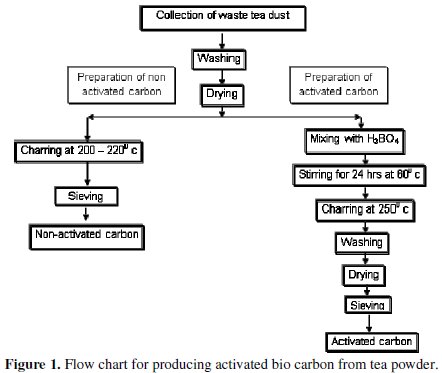
<body><![CDATA[<p>The tea refuse was collected from a local cafeteria and washed several times with 
hot distilled water. The raw material, now called the carbon precursor was dried 
overnight in an air oven, and then heat treated in a furnace at 250  &deg;C for 2 hours 
and finally ground to produce non-activated carbon. To prepare the activated 
carbon, the washed and dried tea powder refuse was treated with concentrated 
solution of boric acid in the weight ratio of 1:1 tea:boric acid. This solution was 
stirred well in a magnetic stirrer at 60  &deg;C for 24 hours and dried in an air oven 
and then heat treated in the furnace at 250  &deg;C for 2 hours. The heat treated sample 
was washed several times with DD water until the filtrate is neutral to pH and its 
conductivity is minimal. These tests ensure that boric acid and other ions which 
might be present are completely removed. This sample was dried, ground and 
sieved to uniform size of 250 mesh. The scheme of producing non-activated and 
activated bio carbon has been depicted in <a href="#f1">Fig. 1</a>.</p>


    <p>&nbsp;</p>
<a name="f1">
<img src="/img/revistas/pea/v31n3/31n3a03f1.jpg">
    
<p>&nbsp;</p>


    <p><b><i>Electrode preparation</i></b></p>

    <p>The electrodes for the electrochemical studies were fabricated by mixing 85 wt% 
of the bio carbon, 10 wt% activated charcoal powder and 5 wt% polyvinylidenefluoride 
dissolved in N-methyl 2-pyrrolidone (NMP) to form slurry. The slurry 
was painted to one circular end of area 1 cm<sup>2</sup> of a SS rod of 8 cm length with 2 
mg bio carbon loading on each of the electrodes. The rest of the electrode portion 
was masked with Teflon sleeves. The electrodes were kept in an oven at 80 &deg;C 
for 1 hour to remove the solvent NMP. The electrochemical measurements 
(cyclic voltammetry and electrochemical impedance analysis) were carried out in 
a three-electrode cell using bio carbon slurry coated on SS as the working 
electrode with a platinum wire and a saturated calomel electrode as the counter 
and the reference electrode, respectively. 3M KOH solution served as the 
electrolyte.</p>


    <p><b><i>Physical characterization and electrochemical tests</i></b></p>

    <p>Thermal degradation characteristics of the tea dust refuse were studied using 
thermogravimetry. Experiments were performed on a TGA-50 Analyzer. 2 mg of 
the sample were heated from room temperature to 450 &deg;C at a heating rate of 20 
&deg;C/min in air. The elemental analysis of the activated carbon was carried out 
using a Vario ELIII CHNS/O Analyzer. Powder X-ray diffraction patterns were 
recorded between 10&deg; and 80&deg; on an X'Pert Pro X-ray diffractometer with CuK&alpha; 
radiation source. The surface morphology of the un-activated and activated 
carbon was studied using an S-3000H model microscope. Cyclic voltammetry 
and electrochemical impedance spectroscopy (EIS) were carried out with a 
Zahner electrochemical measurement unit (IM6e, Zahner, Germany). A 
commercial activated charcoal powder (which was used for the fabrication of the 
electrode) was also evaluated through impedance and CV techniques in order to 
compare the electrochemical features of our samples.</p>


    <p>&nbsp;</p>
    <p><b>Results and discussion</b></p>

    <p><b><i>Thermal studies</i></b></p>

    ]]></body>
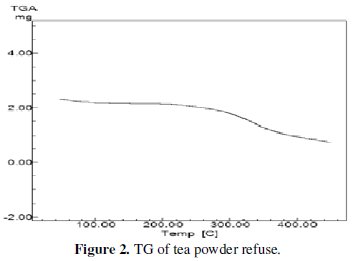
<body><![CDATA[<p>The TG of the tea dust revealed that major decomposition occurred between 220 
&deg;C-240 &deg;C, as shown in the <a href="#f2">Fig. 2</a>.</p>


    <p>&nbsp;</p>
<a name="f2">
<img src="/img/revistas/pea/v31n3/31n3a03f2.jpg">
    
<p>&nbsp;</p>


    <p>The weight loss around 68% may be due to the 
escape of decomposition products like moisture, CO<sub>2</sub>, oxides of nitrogen and 
volatile organic compounds.</p>


    <p><b><i>Elemental (CHNS) analysis</i></b></p>

    <p>The boric acid activated bio carbon sample was subjected to elemental analysis 
and observed to contain C: 67.923%, N: 6.791%, S: 0.375%, H: 3.179% and rest 
probably oxygen. Significant % of N, S & H in our sample shows the presence 
of various organic functional moieties. The presence of these elements may 
influence the electrochemical performance.</p>


    <p><b><i>Phase analysis</i></b></p>

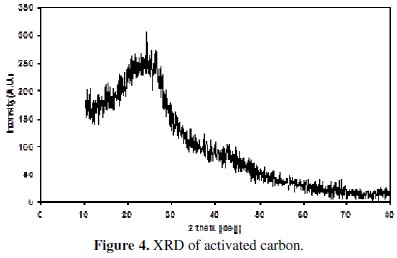
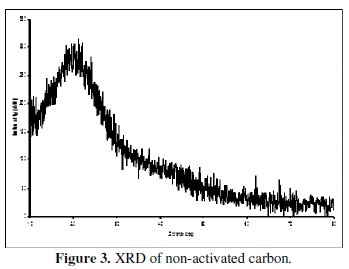
    <p>XRD patterns of the non-activated carbon and carbon powders activated by 
H<sub>3</sub>BO<sub>3</sub> are shown in the Figs. <a href="#f3">3</a> and <a href="#f4">4</a>.</p>


    <p>&nbsp;</p>
<a name="f3">
<img src="/img/revistas/pea/v31n3/31n3a03f3.jpg">
    
<p>&nbsp;</p>
<a name="f4">
<img src="/img/revistas/pea/v31n3/31n3a03f4.jpg">
    
]]></body>
<body><![CDATA[<p>&nbsp;</p>


    <p>The appearance of a broad peak between 
22 and 24&deg; in the XRD of the non-activated as well as in the activated carbon 
indicates the presence of carbon. The absence of extra peaks shows the absence 
of any other x-ray traceable compounds in the non-activated carbon sample, 
especially boric acid in the activated sample. It is interesting to note that the 
XRD of boric acid activated sample has not introduced any oxides of boron or 
any glass formation at the processing temperature of around 250 &deg;C, as this is 
evidenced from the absence of additional peaks. This is yet another factor to 
confirm that boric acid has been completely removed in our sample. It is also 
evident that all the three carbon samples are amorphous in nature.</p>


    <p><b><i>Scanning electron microscopic studies</i></b></p>

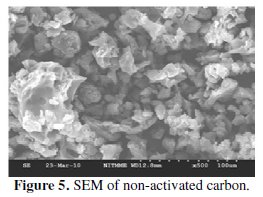
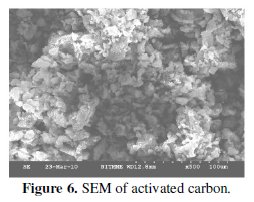
    <p>The surface morphology of the non-activated and activated carbon has been 
shown in Figs. <a href="#f5">5</a> and <a href="#f6">6</a> respectively.</p>


    <p>&nbsp;</p>
<a name="f5">
<img src="/img/revistas/pea/v31n3/31n3a03f5.jpg">
    
<p>&nbsp;</p>
<a name="f6">
<img src="/img/revistas/pea/v31n3/31n3a03f6.jpg">
    
<p>&nbsp;</p>


    <p>It is observed from the SEM results that the 
particles are compacted and also ununiformly distributed in both activated and 
non-activated samples. But a good network of interconnected particles and 
improved porosity are the observed physical features of the activated tea carbon. 
This feature may be reflected in the improved electrochemical behavior as will 
be discussed in the latter section of the article. Porosity and connectivity of 
particles are the required features for good electrochemical features of an 
electrode material applied in energy devices.</p>


    <p><b><i>Fourier Transform Infrared (FTIR) vibrational studies</i></b></p>

    <p>The electrochemical properties of activated carbon depend upon the porosity as 
well as the chemical reactivity of the functional groups at the carbon surface. 
Knowledge on surface functional groups would give insight to the 
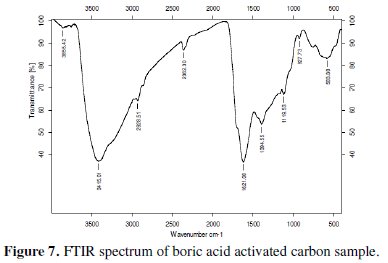
electrochemical properties of the activated carbon. FTIR data were collected for 
qualitative characterization of the surface functional groups of the boric acid 
activated sample and have been presented in <a href="#f7">Fig. 7</a>.</p>


    ]]></body>
<body><![CDATA[<p>&nbsp;</p>
<a name="f7">
<img src="/img/revistas/pea/v31n3/31n3a03f7.jpg">
    
<p>&nbsp;</p>


    <p>The FTIR spectrum of the tea carbon sample at 3402 cm<sup>-1</sup> indicates the presence 
of the -NH group. It may also indicate the presence of moisture. The -CH 
stretching in methylene group is detected at 2924 cm<sup>-1</sup>. The band at 1625 cm<sup>-1</sup> 
indicates -N-H stretching in amine compounds. The presence of methyl group 
was identified from the peak around 1383 cm<sup>-1</sup>. The band in the region 1159-1025 
cm<sup>-1</sup> indicates the presence of -O-H groups. As there is no evidence of 
appearance of extra or complexity of bands in the FTIR spectra of boric acid 
activated sample it is clear that activation with boric acid has not introduced any 
oxides of boron or glass formation.</p>


    <p><b><i>Impedance analysis</i></b></p>

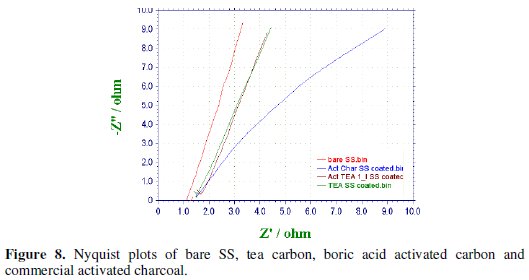
    <p>AC impedance data were collected for the bare SS electrode, non-activated, boric 
activated carbon and a commercial activated charcoal (for reference) in the 
frequency ranging from 10 Hz to 100 KHz with the superimposing AC signal of 
amplitude 5 mV. Nyquist plots for the four samples have been presented in <a href="#f8">Fig. 8</a>.</p>


    <p>&nbsp;</p>
<a name="f8">
<img src="/img/revistas/pea/v31n3/31n3a03f8.jpg">
    
<p>&nbsp;</p>


    <p>An analysis of the impedance plots shows the following trend in the impedance 
values observed though the variation is very slight. Nevertheless, this little 
difference in impedance is unambiguously due to the nature of the electrode 
material coated on the SS rod.</p>


    <p>&nbsp;</p>
<a name="e1">
<img src="/img/revistas/pea/v31n3/31n3a03e1.jpg">
    
<p>&nbsp;</p>


    ]]></body>
<body><![CDATA[<p>At this juncture it is difficult to calculate the capacitance of the samples though 
we can say that the emergence of the semicircle at higher frequencies is due to 
the building-up of charges in the double-layer, a fact which indicates that the 
prepared bio carbon samples might have capacitor behavior.</p>


    <p><b><i>Cyclic voltammetric studies</i></b></p>

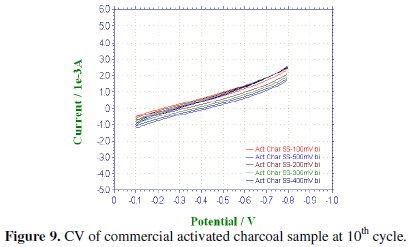
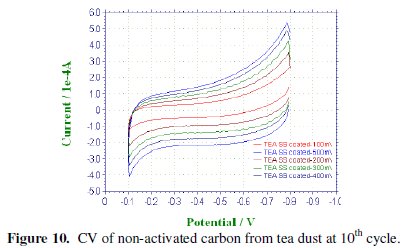
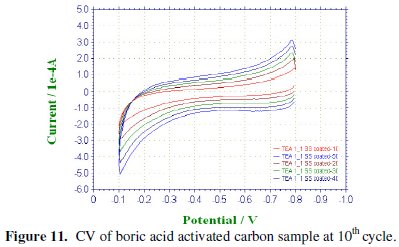
    <p>CV was recorded between -0.1 to -0.8 V at various scan rates viz., 100, 200, 300, 
400 &amp; 500 mV/sec for the commercial activated charcoal, non-activated and 
boric acid activated samples in order to calculate the capacitance values and 
hence to evaluate the better performing carbon sample(s). CV of the samples 
recorded at the end of the 10th cycle has been presented, respectively, in <a href="#f9">Figs. 9-11</a>.</p>


    <p>&nbsp;</p>
<a name="f9">
<img src="/img/revistas/pea/v31n3/31n3a03f9.jpg">
    
<p>&nbsp;</p>
<a name="f10">
<img src="/img/revistas/pea/v31n3/31n3a03f10.jpg">
    
<p>&nbsp;</p>
<a name="f11">
<img src="/img/revistas/pea/v31n3/31n3a03f11.jpg">
    
<p>&nbsp;</p>


    <p>There is a common trend of increasing current observed as the scan rate is 
increased from 100 to 500 mV/sec. This may be due to the fact that there would 
not be enough time for the charges to get dissipated when the electrode is 
scanned at a faster rate and hence charges would accumulate in the electrode-
electrolyte interface, thus increasing the current as well as the capacitance value. 
Nevertheless, it is to be mentioned that the increase in the current with scan rate 
in commercial charcoal sample is only slight and there is no charge build-up in 
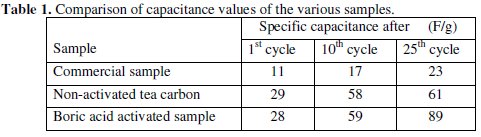
the potential range selected. Capacitance is a quantity which is dependant on the 
nature of the carbon electrode materials used, as evidenced from the capacitance 
values given in <a href="#t1">Table 1</a>.</p> 


    <p>&nbsp;</p>
<a name="t1">
<img src="/img/revistas/pea/v31n3/31n3a03t1.jpg">
    
<p>&nbsp;</p>


    ]]></body>
<body><![CDATA[<p>It is well proved that CV of an ideal capacitor features a rectangular shape. The 
absence of a rectangular shaped CV proves that the commercial sample which we 
have selected for comparing our samples may not be attractive as an electrode 
material in capacitor applications whereas in the tea carbon and in the boric acid 
activated samples the average current increase is high and found to be 
approximately the same.</p> 

    <p>Activated and non-activated samples both exhibit oblate or near rectangular 
shaped CV pattern to indicate the capacitive behavior in these samples. 
Capacitance values of the three samples at various cycles are compared in <a href="#t1">Table 1</a>. 
The specific capacitance of the boric acid activated sample was found to be 
around 89 F/g, which was slightly higher than the non-activated sample and very 
much higher than the commercial sample. The improvement in the capacitor 
behavior of the activated sample may be attributed to the physical nature of the 
sample powders activated with boric acid. It can thus be regarded that the boric 
acid activated tea carbon powders may be useful as an electrode material in 
capacitor applications. Thus the novelty of BORIC ACID as a chemical 
activating agent has been established through this work.</p> 

    <p>It should be remembered that the non-activated and the activated samples have 
been prepared under uncontrolled atmosphere. So the samples might contain 
organic functional groups (as evidenced from the elemental analysis report) or 
they might have got transformed to carbonyl groups, etc., during thermal 
processing and this might suppress the electrochemical behavior of the samples 
by and large. As an argument it is to be stated that if such organic groups are 
present then it would tend to react with the alkali electrolyte used in the studies 
and are likely to get accelerated under electrochemical conditions further.</p> 

    <p>Therefore, good electrochemical features may be expected if the samples were 
treated under flowing argon or nitrogen. Instrumental constrains have limited us 
to take up this project as of now.</p>


    <p>&nbsp;</p>
    <p><b>Conclusion</b></p>

    <p>Our preliminary studies may conclude that boric acid activated tea carbon 
powders might be exploited as an electrode material in capacitors. It is also 
evident that refuse can be a useful secondary source of energy-REFUSE 
DERIVED ENERGY!</p>


    <p>&nbsp;</p>
    <p><b>References</b></p>

    <!-- ref --><p>1. Hall DO, House J, Scrase I. Introduction in industrial uses of biomass energy. London: Taylor & Francis; 1999.    &nbsp;&nbsp;&nbsp;&nbsp;&nbsp;&nbsp;&nbsp;&nbsp;[&#160;<a href="javascript:void(0);" onclick="javascript: window.open('/scielo.php?script=sci_nlinks&ref=000082&pid=S0872-1904201300030000300001&lng=','','width=640,height=500,resizable=yes,scrollbars=1,menubar=yes,');">Links</a>&#160;]<!-- end-ref --></p>
    <!-- ref --><p>2. Hall DO, Rosillo-Calle F. Biomass resources other than wood. London: World Energy Council; 1998.    &nbsp;&nbsp;&nbsp;&nbsp;&nbsp;&nbsp;&nbsp;&nbsp;[&#160;<a href="javascript:void(0);" onclick="javascript: window.open('/scielo.php?script=sci_nlinks&ref=000084&pid=S0872-1904201300030000300002&lng=','','width=640,height=500,resizable=yes,scrollbars=1,menubar=yes,');">Links</a>&#160;]<!-- end-ref --></p>
    <!-- ref --><p>3. Guo J, Lua AC. Carbon. 2000;38:1985.    &nbsp;&nbsp;&nbsp;&nbsp;&nbsp;&nbsp;&nbsp;&nbsp;[&#160;<a href="javascript:void(0);" onclick="javascript: window.open('/scielo.php?script=sci_nlinks&ref=000086&pid=S0872-1904201300030000300003&lng=','','width=640,height=500,resizable=yes,scrollbars=1,menubar=yes,');">Links</a>&#160;]<!-- end-ref --></p>
    <!-- ref --><p>4. Yang T, Lua AC. J Colloid Interf Sci. 2003;267:408.    &nbsp;&nbsp;&nbsp;&nbsp;&nbsp;&nbsp;&nbsp;&nbsp;[&#160;<a href="javascript:void(0);" onclick="javascript: window.open('/scielo.php?script=sci_nlinks&ref=000088&pid=S0872-1904201300030000300004&lng=','','width=640,height=500,resizable=yes,scrollbars=1,menubar=yes,');">Links</a>&#160;]<!-- end-ref --></p>
    <!-- ref --><p>5. Turmuzi M, Daud WRW, Tasirin SM. Carbon. 2004;42:423.    &nbsp;&nbsp;&nbsp;&nbsp;&nbsp;&nbsp;&nbsp;&nbsp;[&#160;<a href="javascript:void(0);" onclick="javascript: window.open('/scielo.php?script=sci_nlinks&ref=000090&pid=S0872-1904201300030000300005&lng=','','width=640,height=500,resizable=yes,scrollbars=1,menubar=yes,');">Links</a>&#160;]<!-- end-ref --></p>
    <!-- ref --><p>6. Wu FC, Tseng RL, Hu CC, et al. J Power Sources. 2006;159:1532.    &nbsp;&nbsp;&nbsp;&nbsp;&nbsp;&nbsp;&nbsp;&nbsp;[&#160;<a href="javascript:void(0);" onclick="javascript: window.open('/scielo.php?script=sci_nlinks&ref=000092&pid=S0872-1904201300030000300006&lng=','','width=640,height=500,resizable=yes,scrollbars=1,menubar=yes,');">Links</a>&#160;]<!-- end-ref --></p>
    <!-- ref --><p>7. Suzuki RM, Andrade AD, Sousa JC. Bioresour Technol. 2007;98:1985.    &nbsp;&nbsp;&nbsp;&nbsp;&nbsp;&nbsp;&nbsp;&nbsp;[&#160;<a href="javascript:void(0);" onclick="javascript: window.open('/scielo.php?script=sci_nlinks&ref=000094&pid=S0872-1904201300030000300007&lng=','','width=640,height=500,resizable=yes,scrollbars=1,menubar=yes,');">Links</a>&#160;]<!-- end-ref --></p>
    <!-- ref --><p>8. Nabais JV, Carrott P, Carrott MMLR, et al. Bioresour Technol. 2008;99:7224.    &nbsp;&nbsp;&nbsp;&nbsp;&nbsp;&nbsp;&nbsp;&nbsp;[&#160;<a href="javascript:void(0);" onclick="javascript: window.open('/scielo.php?script=sci_nlinks&ref=000096&pid=S0872-1904201300030000300008&lng=','','width=640,height=500,resizable=yes,scrollbars=1,menubar=yes,');">Links</a>&#160;]<!-- end-ref --></p>
    <!-- ref --><p>9. Srinivasakannan C, Abu Bakar MZ. Biomass Bioenergy. 2004;27:89.    &nbsp;&nbsp;&nbsp;&nbsp;&nbsp;&nbsp;&nbsp;&nbsp;[&#160;<a href="javascript:void(0);" onclick="javascript: window.open('/scielo.php?script=sci_nlinks&ref=000098&pid=S0872-1904201300030000300009&lng=','','width=640,height=500,resizable=yes,scrollbars=1,menubar=yes,');">Links</a>&#160;]<!-- end-ref --></p>
    <!-- ref --><p>10. Kalavathy MH, Karthikeyan T, Rajgopal S. J Colloid Interf Sci. 2005;292:354.    &nbsp;&nbsp;&nbsp;&nbsp;&nbsp;&nbsp;&nbsp;&nbsp;[&#160;<a href="javascript:void(0);" onclick="javascript: window.open('/scielo.php?script=sci_nlinks&ref=000100&pid=S0872-1904201300030000300010&lng=','','width=640,height=500,resizable=yes,scrollbars=1,menubar=yes,');">Links</a>&#160;]<!-- end-ref --></p>
    <!-- ref --><p>11. Kumar BGP, Shivakamy K, Miranda LR. J Hazard Mater B. 2006;136:922.    &nbsp;&nbsp;&nbsp;&nbsp;&nbsp;&nbsp;&nbsp;&nbsp;[&#160;<a href="javascript:void(0);" onclick="javascript: window.open('/scielo.php?script=sci_nlinks&ref=000102&pid=S0872-1904201300030000300011&lng=','','width=640,height=500,resizable=yes,scrollbars=1,menubar=yes,');">Links</a>&#160;]<!-- end-ref --></p>
    <!-- ref --><p>12. Frackowiak E, Beguin F. Carbon. 2001;39:937.    &nbsp;&nbsp;&nbsp;&nbsp;&nbsp;&nbsp;&nbsp;&nbsp;[&#160;<a href="javascript:void(0);" onclick="javascript: window.open('/scielo.php?script=sci_nlinks&ref=000104&pid=S0872-1904201300030000300012&lng=','','width=640,height=500,resizable=yes,scrollbars=1,menubar=yes,');">Links</a>&#160;]<!-- end-ref --></p>
    <!-- ref --><p>13. Burke A. Electrochim Acta. 2007;53:1083.    &nbsp;&nbsp;&nbsp;&nbsp;&nbsp;&nbsp;&nbsp;&nbsp;[&#160;<a href="javascript:void(0);" onclick="javascript: window.open('/scielo.php?script=sci_nlinks&ref=000106&pid=S0872-1904201300030000300013&lng=','','width=640,height=500,resizable=yes,scrollbars=1,menubar=yes,');">Links</a>&#160;]<!-- end-ref --></p>
    <!-- ref --><p>14. Raymundo-Pinero E, Leroux F, Beguin F. Adv Mater. 2006;18:1877.    &nbsp;&nbsp;&nbsp;&nbsp;&nbsp;&nbsp;&nbsp;&nbsp;[&#160;<a href="javascript:void(0);" onclick="javascript: window.open('/scielo.php?script=sci_nlinks&ref=000108&pid=S0872-1904201300030000300014&lng=','','width=640,height=500,resizable=yes,scrollbars=1,menubar=yes,');">Links</a>&#160;]<!-- end-ref --></p>
    <!-- ref --><p>15. Rufford TE, Hulicova-Jurcakova D, Fiset E. Electrochem Commun. 2008;10:1594.    &nbsp;&nbsp;&nbsp;&nbsp;&nbsp;&nbsp;&nbsp;&nbsp;[&#160;<a href="javascript:void(0);" onclick="javascript: window.open('/scielo.php?script=sci_nlinks&ref=000110&pid=S0872-1904201300030000300015&lng=','','width=640,height=500,resizable=yes,scrollbars=1,menubar=yes,');">Links</a>&#160;]<!-- end-ref --></p>
    <!-- ref --><p>16. Rufford TE, Hulicova-Jurcakova D, Fiset E. Electrochem Commun. 2009;11:974.    &nbsp;&nbsp;&nbsp;&nbsp;&nbsp;&nbsp;&nbsp;&nbsp;[&#160;<a href="javascript:void(0);" onclick="javascript: window.open('/scielo.php?script=sci_nlinks&ref=000112&pid=S0872-1904201300030000300016&lng=','','width=640,height=500,resizable=yes,scrollbars=1,menubar=yes,');">Links</a>&#160;]<!-- end-ref --></p>
    <!-- ref --><p>17. Wu F-C, Tseng R-L, Hu C-C. J Power Sources. 2005;144:302.    &nbsp;&nbsp;&nbsp;&nbsp;&nbsp;&nbsp;&nbsp;&nbsp;[&#160;<a href="javascript:void(0);" onclick="javascript: window.open('/scielo.php?script=sci_nlinks&ref=000114&pid=S0872-1904201300030000300017&lng=','','width=640,height=500,resizable=yes,scrollbars=1,menubar=yes,');">Links</a>&#160;]<!-- end-ref --></p>
    <!-- ref --><p>18. Balathanigaimani MS, Wag-Guen S. Electrochem. Commun. 2008;10:868.    &nbsp;&nbsp;&nbsp;&nbsp;&nbsp;&nbsp;&nbsp;&nbsp;[&#160;<a href="javascript:void(0);" onclick="javascript: window.open('/scielo.php?script=sci_nlinks&ref=000116&pid=S0872-1904201300030000300018&lng=','','width=640,height=500,resizable=yes,scrollbars=1,menubar=yes,');">Links</a>&#160;]<!-- end-ref --></p>
    <!-- ref --><p>19. Subramanian V, Luo C, Stephan AM. J Phys Chem C. 2007;111:7527.    &nbsp;&nbsp;&nbsp;&nbsp;&nbsp;&nbsp;&nbsp;&nbsp;[&#160;<a href="javascript:void(0);" onclick="javascript: window.open('/scielo.php?script=sci_nlinks&ref=000118&pid=S0872-1904201300030000300019&lng=','','width=640,height=500,resizable=yes,scrollbars=1,menubar=yes,');">Links</a>&#160;]<!-- end-ref --></p>
    <!-- ref --><p>20. Konno K, Ohba Y, Onoe K, et al. Tanso. 2008;231:2&nbsp;&nbsp;&nbsp;&nbsp;&nbsp;&nbsp;&nbsp;&nbsp;[&#160;<a href="javascript:void(0);" onclick="javascript: window.open('/scielo.php?script=sci_nlinks&ref=000120&pid=S0872-1904201300030000300020&lng=','','width=640,height=500,resizable=yes,scrollbars=1,menubar=yes,');">Links</a>&#160;]<!-- end-ref --><p>&nbsp;</p>
    <p><b>Acknowledgement</b></p>

    ]]></body>
<body><![CDATA[<p>The authors thank The Management and The Principal of Thiagarajar College of 
Engineering, Madurai, for the encouragement to carry out this fundamental research. 
The authors extend their gratitude to the experts at various R &amp; D institutes for helping 
in instrumental characterization of the sample powders.</p>


    <p>&nbsp;</p>
    <p><a name=0></a><sup><a href="#top">*</a></sup>Corresponding author. 
E-mail address: <a href="mailto:pkalyani@tce.edu">pkalyani@tce.edu</a></p>

    <p>Received 14 Februry 2012; accepted 22 April 2013</p>

    <p><a href="http://www.peacta.org" target="_blank">www.peacta.org</a> </p>


     ]]></body><back>
<ref-list>
<ref id="B1">
<label>1</label><nlm-citation citation-type="book">
<person-group person-group-type="author">
<name>
<surname><![CDATA[Hall]]></surname>
<given-names><![CDATA[DO]]></given-names>
</name>
<name>
<surname><![CDATA[House]]></surname>
<given-names><![CDATA[J]]></given-names>
</name>
<name>
<surname><![CDATA[Scrase]]></surname>
<given-names><![CDATA[I]]></given-names>
</name>
</person-group>
<source><![CDATA[Introduction in industrial uses of biomass energy]]></source>
<year>1999</year>
<publisher-loc><![CDATA[London ]]></publisher-loc>
<publisher-name><![CDATA[Taylor & Francis]]></publisher-name>
</nlm-citation>
</ref>
<ref id="B2">
<label>2</label><nlm-citation citation-type="book">
<person-group person-group-type="author">
<name>
<surname><![CDATA[Hall]]></surname>
<given-names><![CDATA[DO]]></given-names>
</name>
<name>
<surname><![CDATA[Rosillo-Calle]]></surname>
<given-names><![CDATA[F]]></given-names>
</name>
</person-group>
<source><![CDATA[Biomass resources other than wood]]></source>
<year>1998</year>
<publisher-loc><![CDATA[London ]]></publisher-loc>
<publisher-name><![CDATA[World Energy Council]]></publisher-name>
</nlm-citation>
</ref>
<ref id="B3">
<label>3</label><nlm-citation citation-type="journal">
<person-group person-group-type="author">
<name>
<surname><![CDATA[Guo]]></surname>
<given-names><![CDATA[J]]></given-names>
</name>
<name>
<surname><![CDATA[Lua]]></surname>
<given-names><![CDATA[AC]]></given-names>
</name>
</person-group>
<source><![CDATA[Carbon]]></source>
<year>2000</year>
<volume>38</volume>
<page-range>1985</page-range></nlm-citation>
</ref>
<ref id="B4">
<label>4</label><nlm-citation citation-type="journal">
<person-group person-group-type="author">
<name>
<surname><![CDATA[Yang]]></surname>
<given-names><![CDATA[T]]></given-names>
</name>
<name>
<surname><![CDATA[Lua]]></surname>
<given-names><![CDATA[AC]]></given-names>
</name>
</person-group>
<source><![CDATA[J Colloid Interf Sci]]></source>
<year>2003</year>
<volume>267</volume>
<page-range>408</page-range></nlm-citation>
</ref>
<ref id="B5">
<label>5</label><nlm-citation citation-type="journal">
<person-group person-group-type="author">
<name>
<surname><![CDATA[Turmuzi]]></surname>
<given-names><![CDATA[M]]></given-names>
</name>
<name>
<surname><![CDATA[Daud]]></surname>
<given-names><![CDATA[WRW]]></given-names>
</name>
<name>
<surname><![CDATA[Tasirin]]></surname>
<given-names><![CDATA[SM]]></given-names>
</name>
</person-group>
<source><![CDATA[Carbon]]></source>
<year>2004</year>
<volume>42</volume>
<page-range>423</page-range></nlm-citation>
</ref>
<ref id="B6">
<label>6</label><nlm-citation citation-type="journal">
<person-group person-group-type="author">
<name>
<surname><![CDATA[Wu]]></surname>
<given-names><![CDATA[FC]]></given-names>
</name>
<name>
<surname><![CDATA[Tseng]]></surname>
<given-names><![CDATA[RL]]></given-names>
</name>
<name>
<surname><![CDATA[Hu]]></surname>
<given-names><![CDATA[CC]]></given-names>
</name>
</person-group>
<source><![CDATA[J Power Sources]]></source>
<year>2006</year>
<volume>159</volume>
<page-range>1532</page-range></nlm-citation>
</ref>
<ref id="B7">
<label>7</label><nlm-citation citation-type="journal">
<person-group person-group-type="author">
<name>
<surname><![CDATA[Suzuki]]></surname>
<given-names><![CDATA[RM]]></given-names>
</name>
<name>
<surname><![CDATA[Andrade]]></surname>
<given-names><![CDATA[AD]]></given-names>
</name>
<name>
<surname><![CDATA[Sousa]]></surname>
<given-names><![CDATA[JC]]></given-names>
</name>
</person-group>
<source><![CDATA[Bioresour Technol]]></source>
<year>2007</year>
<volume>98</volume>
<page-range>1985</page-range></nlm-citation>
</ref>
<ref id="B8">
<label>8</label><nlm-citation citation-type="journal">
<person-group person-group-type="author">
<name>
<surname><![CDATA[Nabais]]></surname>
<given-names><![CDATA[JV]]></given-names>
</name>
<name>
<surname><![CDATA[Carrott]]></surname>
<given-names><![CDATA[P]]></given-names>
</name>
<name>
<surname><![CDATA[Carrott]]></surname>
<given-names><![CDATA[MMLR]]></given-names>
</name>
</person-group>
<source><![CDATA[Bioresour Technol]]></source>
<year>2008</year>
<volume>99</volume>
<page-range>7224</page-range></nlm-citation>
</ref>
<ref id="B9">
<label>9</label><nlm-citation citation-type="journal">
<person-group person-group-type="author">
<name>
<surname><![CDATA[Srinivasakannan]]></surname>
<given-names><![CDATA[C]]></given-names>
</name>
<name>
<surname><![CDATA[Abu Bakar]]></surname>
<given-names><![CDATA[MZ]]></given-names>
</name>
</person-group>
<source><![CDATA[Biomass Bioenergy]]></source>
<year>2004</year>
<volume>27</volume>
<page-range>89</page-range></nlm-citation>
</ref>
<ref id="B10">
<label>10</label><nlm-citation citation-type="journal">
<person-group person-group-type="author">
<name>
<surname><![CDATA[Kalavathy]]></surname>
<given-names><![CDATA[MH]]></given-names>
</name>
<name>
<surname><![CDATA[Karthikeyan]]></surname>
<given-names><![CDATA[T]]></given-names>
</name>
<name>
<surname><![CDATA[Rajgopal]]></surname>
<given-names><![CDATA[S]]></given-names>
</name>
</person-group>
<source><![CDATA[J Colloid Interf Sci]]></source>
<year>2005</year>
<volume>292</volume>
<page-range>354</page-range></nlm-citation>
</ref>
<ref id="B11">
<label>11</label><nlm-citation citation-type="journal">
<person-group person-group-type="author">
<name>
<surname><![CDATA[Kumar]]></surname>
<given-names><![CDATA[BGP]]></given-names>
</name>
<name>
<surname><![CDATA[Shivakamy]]></surname>
<given-names><![CDATA[K]]></given-names>
</name>
<name>
<surname><![CDATA[Miranda]]></surname>
<given-names><![CDATA[LR]]></given-names>
</name>
</person-group>
<source><![CDATA[J Hazard Mater B]]></source>
<year>2006</year>
<volume>136</volume>
<page-range>922</page-range></nlm-citation>
</ref>
<ref id="B12">
<label>12</label><nlm-citation citation-type="journal">
<person-group person-group-type="author">
<name>
<surname><![CDATA[Frackowiak]]></surname>
<given-names><![CDATA[E]]></given-names>
</name>
<name>
<surname><![CDATA[Beguin]]></surname>
<given-names><![CDATA[F]]></given-names>
</name>
</person-group>
<source><![CDATA[Carbon]]></source>
<year>2001</year>
<volume>39</volume>
<page-range>937</page-range></nlm-citation>
</ref>
<ref id="B13">
<label>13</label><nlm-citation citation-type="journal">
<person-group person-group-type="author">
<name>
<surname><![CDATA[Burke]]></surname>
<given-names><![CDATA[A]]></given-names>
</name>
</person-group>
<source><![CDATA[Electrochim Acta]]></source>
<year>2007</year>
<volume>53</volume>
<page-range>1083</page-range></nlm-citation>
</ref>
<ref id="B14">
<label>14</label><nlm-citation citation-type="journal">
<person-group person-group-type="author">
<name>
<surname><![CDATA[Raymundo-Pinero]]></surname>
<given-names><![CDATA[E]]></given-names>
</name>
<name>
<surname><![CDATA[Leroux]]></surname>
<given-names><![CDATA[F]]></given-names>
</name>
<name>
<surname><![CDATA[Beguin]]></surname>
<given-names><![CDATA[F]]></given-names>
</name>
</person-group>
<source><![CDATA[Adv Mater]]></source>
<year>2006</year>
<volume>18</volume>
<page-range>1877</page-range></nlm-citation>
</ref>
<ref id="B15">
<label>15</label><nlm-citation citation-type="journal">
<person-group person-group-type="author">
<name>
<surname><![CDATA[Rufford]]></surname>
<given-names><![CDATA[TE]]></given-names>
</name>
<name>
<surname><![CDATA[Hulicova-Jurcakova]]></surname>
<given-names><![CDATA[D]]></given-names>
</name>
<name>
<surname><![CDATA[Fiset]]></surname>
<given-names><![CDATA[E]]></given-names>
</name>
</person-group>
<source><![CDATA[Electrochem Commun]]></source>
<year>2008</year>
<volume>10</volume>
<page-range>1594</page-range></nlm-citation>
</ref>
<ref id="B16">
<label>16</label><nlm-citation citation-type="journal">
<person-group person-group-type="author">
<name>
<surname><![CDATA[Rufford]]></surname>
<given-names><![CDATA[TE]]></given-names>
</name>
<name>
<surname><![CDATA[Hulicova-Jurcakova]]></surname>
<given-names><![CDATA[D]]></given-names>
</name>
<name>
<surname><![CDATA[Fiset]]></surname>
<given-names><![CDATA[E]]></given-names>
</name>
</person-group>
<source><![CDATA[Electrochem Commun]]></source>
<year>2009</year>
<volume>11</volume>
<page-range>974</page-range></nlm-citation>
</ref>
<ref id="B17">
<label>17</label><nlm-citation citation-type="journal">
<person-group person-group-type="author">
<name>
<surname><![CDATA[Wu]]></surname>
<given-names><![CDATA[F-C]]></given-names>
</name>
<name>
<surname><![CDATA[Tseng]]></surname>
<given-names><![CDATA[R-L]]></given-names>
</name>
<name>
<surname><![CDATA[Hu]]></surname>
<given-names><![CDATA[C-C]]></given-names>
</name>
</person-group>
<source><![CDATA[J Power Sources]]></source>
<year>2005</year>
<volume>144</volume>
<page-range>302</page-range></nlm-citation>
</ref>
<ref id="B18">
<label>18</label><nlm-citation citation-type="journal">
<person-group person-group-type="author">
<name>
<surname><![CDATA[Balathanigaimani]]></surname>
<given-names><![CDATA[MS]]></given-names>
</name>
<name>
<surname><![CDATA[Wag-Guen]]></surname>
<given-names><![CDATA[S]]></given-names>
</name>
</person-group>
<source><![CDATA[Electrochem. Commun]]></source>
<year>2008</year>
<volume>10</volume>
<page-range>868</page-range></nlm-citation>
</ref>
<ref id="B19">
<label>19</label><nlm-citation citation-type="journal">
<person-group person-group-type="author">
<name>
<surname><![CDATA[Subramanian]]></surname>
<given-names><![CDATA[V]]></given-names>
</name>
<name>
<surname><![CDATA[Luo]]></surname>
<given-names><![CDATA[C]]></given-names>
</name>
<name>
<surname><![CDATA[Stephan]]></surname>
<given-names><![CDATA[AM]]></given-names>
</name>
</person-group>
<source><![CDATA[J Phys Chem C]]></source>
<year>2007</year>
<volume>111</volume>
<page-range>7527</page-range></nlm-citation>
</ref>
<ref id="B20">
<label>20</label><nlm-citation citation-type="journal">
<person-group person-group-type="author">
<name>
<surname><![CDATA[Konno]]></surname>
<given-names><![CDATA[K]]></given-names>
</name>
<name>
<surname><![CDATA[Ohba]]></surname>
<given-names><![CDATA[Y]]></given-names>
</name>
<name>
<surname><![CDATA[Onoe]]></surname>
<given-names><![CDATA[K]]></given-names>
</name>
</person-group>
<source><![CDATA[Tanso]]></source>
<year>2008</year>
<volume>231</volume>
<page-range>2</page-range></nlm-citation>
</ref>
</ref-list>
</back>
</article>