<?xml version="1.0" encoding="ISO-8859-1"?><article xmlns:mml="http://www.w3.org/1998/Math/MathML" xmlns:xlink="http://www.w3.org/1999/xlink" xmlns:xsi="http://www.w3.org/2001/XMLSchema-instance">
<front>
<journal-meta>
<journal-id>0872-1904</journal-id>
<journal-title><![CDATA[Portugaliae Electrochimica Acta]]></journal-title>
<abbrev-journal-title><![CDATA[Port. Electrochim. Acta]]></abbrev-journal-title>
<issn>0872-1904</issn>
<publisher>
<publisher-name><![CDATA[Sociedade Portuguesa de Electroquímica]]></publisher-name>
</publisher>
</journal-meta>
<article-meta>
<article-id>S0872-19042013000400002</article-id>
<article-id pub-id-type="doi">10.4152/pea.201304207</article-id>
<title-group>
<article-title xml:lang="en"><![CDATA[Investigation of the Anodic Dissolution of Zinc in Sodium Chloride Electrolyte - A Green Process]]></article-title>
</title-group>
<contrib-group>
<contrib contrib-type="author">
<name>
<surname><![CDATA[Ismail]]></surname>
<given-names><![CDATA[Ibrahim M.]]></given-names>
</name>
<xref ref-type="aff" rid="A01"/>
</contrib>
<contrib contrib-type="author">
<name>
<surname><![CDATA[Abdel-Salam]]></surname>
<given-names><![CDATA[Omar E.]]></given-names>
</name>
<xref ref-type="aff" rid="A01"/>
</contrib>
<contrib contrib-type="author">
<name>
<surname><![CDATA[Ahmed]]></surname>
<given-names><![CDATA[Tamer S.]]></given-names>
</name>
<xref ref-type="aff" rid="A01"/>
</contrib>
<contrib contrib-type="author">
<name>
<surname><![CDATA[Soliman]]></surname>
<given-names><![CDATA[Ahmed]]></given-names>
</name>
<xref ref-type="aff" rid="A01"/>
</contrib>
<contrib contrib-type="author">
<name>
<surname><![CDATA[Khattab]]></surname>
<given-names><![CDATA[Ibrahim A.]]></given-names>
</name>
<xref ref-type="aff" rid="A02"/>
</contrib>
<contrib contrib-type="author">
<name>
<surname><![CDATA[Al-Ebrahim]]></surname>
<given-names><![CDATA[Meshaal F.]]></given-names>
</name>
<xref ref-type="aff" rid="A02"/>
</contrib>
</contrib-group>
<aff id="A01">
<institution><![CDATA[,Cairo University Faculty of Engineering Department of Chemical Engineering]]></institution>
<addr-line><![CDATA[Giza Egypt]]></addr-line>
</aff>
<aff id="A02">
<institution><![CDATA[,National Research Center  ]]></institution>
<addr-line><![CDATA[Giza Egypt]]></addr-line>
</aff>
<pub-date pub-type="pub">
<day>14</day>
<month>08</month>
<year>2013</year>
</pub-date>
<pub-date pub-type="epub">
<day>14</day>
<month>08</month>
<year>2013</year>
</pub-date>
<volume>31</volume>
<numero>4</numero>
<fpage>207</fpage>
<lpage>219</lpage>
<copyright-statement/>
<copyright-year/>
<self-uri xlink:href="http://scielo.pt/scielo.php?script=sci_arttext&amp;pid=S0872-19042013000400002&amp;lng=en&amp;nrm=iso"></self-uri><self-uri xlink:href="http://scielo.pt/scielo.php?script=sci_abstract&amp;pid=S0872-19042013000400002&amp;lng=en&amp;nrm=iso"></self-uri><self-uri xlink:href="http://scielo.pt/scielo.php?script=sci_pdf&amp;pid=S0872-19042013000400002&amp;lng=en&amp;nrm=iso"></self-uri><abstract abstract-type="short" xml:lang="en"><p><![CDATA[The anodic dissolution of zinc electrodes in sodium chloride aqueous solution has been investigated experimentally. The effects of application of polarity reversal (PR), ultrasonic (US) enhancement, stirring, current density (CD), concentration and pH of the supporting electrolyte, and temperature of the bath were studied. The results revealed that application of PR increased the dissolution of Zn but the current was low. However, the application of US enhancement led to higher zinc dissolution accompanied with higher current efficiency (CE). The combination of US enhancement and stirring led to more dissolution of zinc. Increasing the current density and concentration of NaCl increased the dissolution of zinc and the current efficiency was almost constant. On the other hand, pH of the bath did not play a significant effect on the amount of the dissolved zinc or current efficiency. It was also observed that increasing the temperature from 10 °C to 40 °C led to a significant increase in the mass of the dissolved zinc and CE; but the increase of temperature from 40 °C to 50 or 60 °C, however, did not have a significant effect.]]></p></abstract>
<kwd-group>
<kwd lng="en"><![CDATA[zinc]]></kwd>
<kwd lng="en"><![CDATA[electrolyte]]></kwd>
<kwd lng="en"><![CDATA[anodic dissolution]]></kwd>
<kwd lng="en"><![CDATA[green process]]></kwd>
</kwd-group>
</article-meta>
</front><body><![CDATA[ 


<!--     <p>&nbsp;</p>
    <p>doi: 10.4152/pea.201304207</p> -->


    <p><b>Investigation of the Anodic Dissolution of Zinc in Sodium Chloride Electrolyte - A Green Process</b></p>

    <p>
<b>Ibrahim M. Ismail</b><sup><i>a</i>,<a href="#0">*</a></sup>, <b>Omar E. Abdel-Salam</b><sup><i>a</i></sup>, 
<b>Tamer S. Ahmed</b><sup><i>a</i></sup>, <b>Ahmed Soliman</b><sup><i>a</i></sup></b>,
<b>Ibrahim A. Khattab</b><sup><i>b</i></sup> and <b>Meshaal F. Al-Ebrahim</b><sup><i>b</i></sup></b>
</p>

    <p><i><sup>a</sup> Department of Chemical Engineering, Faculty of Engineering, Cairo University, Giza, Egypt.</i></p>

    <p><i><sup>b</sup> National Research Center, Dokki, Giza, Egypt.</i></p>


    <p>&nbsp;</p>
    <p><b>Abstract</b></p>

    <p>The anodic dissolution of zinc electrodes in sodium chloride aqueous solution has been 
investigated experimentally. The effects of application of polarity reversal (PR), 
ultrasonic (US) enhancement, stirring, current density (CD), concentration and pH of 
the supporting electrolyte, and temperature of the bath were studied. The results 
revealed that application of PR increased the dissolution of Zn but the current was low. 
However, the application of US enhancement led to higher zinc dissolution 
accompanied with higher current efficiency (CE). The combination of US enhancement 
and stirring led to more dissolution of zinc. Increasing the current density and 
concentration of NaCl increased the dissolution of zinc and the current efficiency was 
almost constant. On the other hand, pH of the bath did not play a significant effect on 
the amount of the dissolved zinc or current efficiency. It was also observed that 
increasing the temperature from 10 &deg;C to 40 &deg;C led to a significant increase in the mass 
of the dissolved zinc and CE; but the increase of temperature from 40 &deg;C to 50 or 60 &deg;C, 
however, did not have a significant effect.</p>

    ]]></body>
<body><![CDATA[<p><b><i>Keywords:</i></b> zinc, electrolyte, anodic dissolution, green process.</p>

 
    <p>&nbsp;</p>
    <p><b>Introduction</b></p>

    <p>Inorganic metal compounds are very important in chemical industries especially, 
e.g., in plating industry, painting, pigments production, polishing materials 
production, cosmetics industries. Chemical dissolution of metals is considered as 
the most important step in the production of pure metal salts [1]. However, the 
use of active reagents currently utilized in the dissolution process has several 
disadvantages, such as: production of vapors or fumes, which requires 
complicated and troublesome trapping arrangements and neutralizations, 
extensive energy consumption, long time for metal dissolution, and the use of 
special materials of construction for equipment due to the strong corrosiveness of 
the dissolution medium. In order to overcome these disadvantages, electrolytic 
metal dissolution may introduce a realistic solution.</p>

    <p>The process of selective anodic dissolution of a metal does not have the 
disadvantages mentioned above. In essence, the metal is treated electrolytically 
as an anode, by utilizing a rapid-action electrolyte of a composition which is 
substantially independent of the duration of the operation of the dissolution. 
Several inorganic compounds may be produced by the above mentioned anodic 
dissolution process, such as zinc sulfate, zinc oxide, zinc chloride, copper sulfate, 
copper oxide, copper cyanide, nickel sulfate, etc. Each of these compounds has 
wide industrial applications [2].</p>

    <p>Zinc is ranked as the 23rd most common element in the earth's crust, amounting 
to 0.013%. However, it ranks fourth among the metals in worldwide production 
and consumption [3]. The uses of zinc can be divided into six major categories: 
(i) coatings; (ii) casting alloys; (iii) alloying element in brass and other alloys; 
(iv) wrought zinc alloys; (v) zinc oxide; and (vi) zinc chemicals [4]. The most 
important application of zinc is a coating for steel corrosion protection. In 
addition, zinc is an important component in paints, cosmetics, pharmaceuticals, 
storage batteries, electrical equipment and an endless list of other capital 
applications [5-7]. As a result of its importance, the zinc corrosion and 
electrochemistry have been studied extensively [8-19] and reviewed thoroughly 
up to year 1996 by Zhang [4]. Moreover, many investigations have been 
conducted to determine the kinetic and thermodynamic characteristics of zinc 
electrode system. Extensive bibliographies of this work appear in the literatures 
[10,16].</p>

    <p>The dissolution of zinc was studied extensively through the last four decades 
[8,18-50]. The anodic dissolution of zinc has been investigated in different 
electrolyte media. Some examples are: in potassium hydroxide solutions [22-29], 
in potassium hydroxide in presence of sodium metasilicate [30], in potassium 
hydroxide in presence of carbonate ions [31], in potassium hydroxide in presence 
of ZnO [32], in sodium hydroxide solutions [33-35], in sodium hydroxide in 
presence of sodium silicate and sodium tetraborate [13], in sodium hydroxide in 
presence of sulfur containing ions such as Na<sub>2</sub>SO<sub>4</sub>, Na<sub>2</sub>SO<sub>3</sub>, Na<sub>2</sub>S, 
Na<sub>2</sub>S<sub>2</sub>O<sub>3</sub> or NH<sub>4</sub>SCN [36], in saturated zinc sulfate solution [37], in aerated sodium sulfate 
solutions [38,39], in NH<sub>4</sub>Cl and/or NH<sub>4</sub>Cl/ZnCl<sub>2</sub> solutions [40,41], in NH<sub>4</sub>Cl + 
NiCl<sub>2</sub> and NH<sub>4</sub>Cl + NiCl<sub>2</sub> + ZnCl<sub>2</sub> electrolytes [42], in H<sub>3</sub>BO<sub>3</sub> / NH<sub>4</sub>Cl / Na<sub>2</sub>SO<sub>4</sub> 
[43], in aqueous-methanolic trichloracetic acid solutions [44], in ammoniacal 
ammonium chloride system [45], in potassium nitrate solution [46], in aqueous 
salt solutions such as Cl<sup>-</sup>, Br<sup>-</sup>, I<sup>-</sup>, 
Ac<sup>-</sup>, SO<sub>4</sub><sup>2-</sup> and NO3<sup>-</sup> [47], in sulfamic acidformamide 
solution [48], in EDTA solution [49], in sodium borate solutions with 
or without Na<sub>2</sub>SO<sub>4</sub>, Na<sub>2</sub>S<sub>2</sub>O<sub>3</sub> or Na<sub>2</sub>S as aggressive agents [50], solutions 
saturated with carbon dioxide under elevated pressure [51], and even in tap water 
[52].</p>

    <p>The corrosion and electrochemical studies of zinc dissolution in sodium chloride 
solutions have been investigated in the literatures [14,17-19]. For pH &gt; 12, a 
passive layer composed of zinc hydroxide and/or zinc oxide is formed on the 
surface of the zinc sample [19]. In an aerated acidic NaCl solution, the 
complexity of the layer formed on zinc sample exposed to NaCl media makes the 
corrosion mechanism of zinc difficult to be understood. It forms a complex layer 
composed from zinc oxide, zinc hydroxide and zinc hydroxide chloride or 
simonkolleite; Zn<sub>5</sub>(OH)<sub>8</sub>Cl<sub>2</sub>&bull;2H2O. The zinc hydroxide chloride and zinc oxide 
are the dominant corrosion products [53]. In ambient CO<sub>2</sub> levels, zinc hydroxide 
carbonate or hydrozincite; (Zn<sub>5</sub>(OH)<sub>6</sub>(CO<sub>3</sub>)<sub>2</sub>&bull;H<sub>2</sub>O were additionally observed 
[54], with the major compounds being zinc hydroxide chloride and zinc 
hydroxide carbonate [55].</p>

    <p>On the other hand, the chemical applications of ultrasound (US), 
"sonochemistry", has become an exciting new field of research during the past 
decades [56]. Moreover, the application of US in electrolytic cell has been 
reported to help in depassivation of the electrodes with a huge effect on the mass 
transport at the electrode surface [57].</p>

    <p>In order to design an industrial unit or even a pilot unit for the electrolytic 
production of zinc compounds, the operating conditions of the electrolytic anodic 
dissolution of the zinc metal sources of these compounds have to be thoroughly 
investigated. In this paper, the effects of the application of US and polarity 
reversal (PR) and other operating parameters such as current density, 
concentration of electrolyte, pH, temperature, and stirring on the anodic 
dissolution of zinc in NaCl are presented.</p>


    ]]></body>
<body><![CDATA[<p>&nbsp;</p>
    <p><b>Experimental</b></p>

    <p><b><i>Surface pretreatment</i></b></p>

    <p>All chemicals used in surface treatment were of analytically pure grades. Six 
operations were carried out on the surface of zinc substrate. These operations 
were: mechanical polishing with two different sand papers down to 4/0 grade, 
degreasing with solvent, degreasing with alkali solution, pickling, and chemical 
polishing. These operations were done in order to obtain high smooth surface 
free from oil, grease and scales and to avoid defects such as peeling, blistering, or 
poor distribution of the metal on the surface of the electrode. To remove grease, 
oils, waxes and fats introduced into the metal either from fabrication, stamping, 
pressing, or polishing, degreasing was done by using solvent cleaners and alkali 
soaking cleaners. Degreasing with solvent was accomplished using acetone, 
which possesses all the requirements necessary to ideal degreasing practices 
because of its ease of application and its great penetrating power. As for alkali 
soaking, we got a cleaner solution consisting of sodium hydroxide 50 g/L, 
sodium carbonate 20 g/L, trisodium phosphate 20 g/L, and sulfonic acid 2 g/L 
dissolved in bi-distilled. Degreasing was ensured by washing the metal with 
water, and the presence of a continuous unbroken film of water over the zinc 
substrate indicates the complete removal of greases.</p>

    <p>To remove oxides and scales, the zinc substrate was pickled with a solution 
consisting of 400 g/L nitric acid and 5 g/L hydrofluoric acid in bi-distilled water. 
Finally, to ensure smooth surface, the zinc substrates were chemically polished 
by immersing the substrates in 100 g/L oxalic acid solution and were allowed to 
boil for 5 minutes.</p>


    <p>&nbsp;</p>
    <p><b><i>Preparation of electrolyte solution</i></b></p>

    <p>All materials used in the electrolyte preparation for the anodic dissolution of zinc 
metal were of analytical grade. The sodium chloride supporting electrolyte was 
weighed and dissolved in bi-distilled water to the desired concentration and then 
pH adjustment was carried out to make the solution ready for the electrolysis 
process. Hydrochloric acid and sodium hydroxide were used for the pH 
adjustment. Zinc metal for the dissolution process was of high purity (99.99%). 
This zinc was imported from Germany.</p>


    <p>&nbsp;</p>
    <p><b><i>Experimental setup</i></b></p>

    ]]></body>
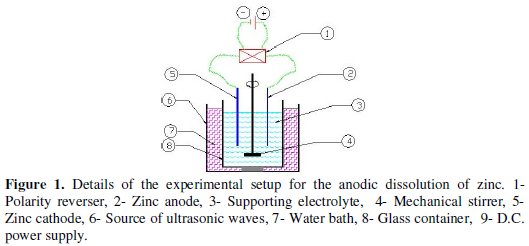
<body><![CDATA[<p><a href="#f1">Fig. 1</a> shows the inside details of the electrolytic cell.</p>


    <p>&nbsp;</p>
<a name="f1">
<img src="/img/revistas/pea/v31n4/31n4a02f1.jpg">
    
<p>&nbsp;</p>


    <p>The setup consisted of:</p>

    <p> - D.C. power supply: a regulated D. C. power source (Lodestar 8203) capable to 
supplying up to 10 A and 30 V was used to supply electric power. During each 
experiment the current could be kept constant by manual regulation.</p>

    <p> - Mechanical stirrer: had a fixed speed of 200 rpm.</p>

    <p> - Polarity reversal: a back-switch polarity reversal piece was used to reverse 
electrode polarity during the electrolysis process. The reversal time was adjusted 
manually.</p>

    <p> - pH meter: (type HI 8417 made by HANNA Instruments) of a resolution 0.01 
was used to measure the pH of the electrolyte solution.</p>


    <p>&nbsp;</p>
    <p><b><i>Experimental procedure</i></b></p>

    ]]></body>
<body><![CDATA[<p>The electrolysis cell was cleaned, washed and filled with the electrolyte to the 
desired level to ensure complete submerging of the electrodes. In this cell, zinc 
substrate was used as anode. During some experiments the direct current 
pathway was reversed to the opposite direction and consequently the cathode was 
made of zinc metal. The reversal of the polarity was expected to help in the 
prevention of the formation of a passive film on the surface of the anode. In 
addition, the use of US was expected to repel off the formed passive layer to the 
bulk of the solution. All of the above may minimize the current drop and 
maintain the current efficiency of the zinc dissolution as high as possible. The 
zinc substrate was weighed before and after each dissolution experiment and 
from the weight difference the weight of the dissolved zinc metal was 
determined.</p>


    <p>&nbsp;</p>
    <p><b>Results and discussion</b></p>

    <p><b><i>Anodic dissolution of Zn without the application of PR, US or stirring</i></b></p>

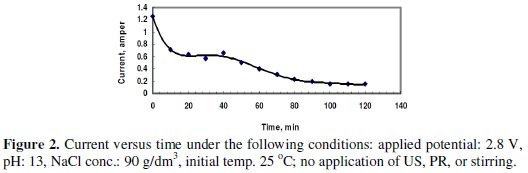
    <p><a href="#f2">Fig. 2</a> shows the change of the current passing in the cell at a potential of 2.8 V 
without the application of US, PR or stirring.</p>


    <p>&nbsp;</p>
<a name="f2">
<img src="/img/revistas/pea/v31n4/31n4a02f2.jpg">
    
<p>&nbsp;</p>


    <p>The electrolyte consisted of 90 
g/dm<sup>3</sup> (&sim;1.5 mole/L) sodium chloride solution. The pH was adjusted using 
sodium hydroxide to value of 13. The time of electrolysis was 120 minutes. The 
average current passing through the cell was calculated from the area under the 
curve divided by 120 minutes, as 0.436 A. The dissolved Zn was 1.0634 g, and 
the current efficiency (CE) was 99.94%. The high CE may be attributed to the 
small value of the average current passing at this potential, and the dissolution 
was significant at the early period after the application of potential. After this 
effective period, the passing current decreased due to the formation of the passive 
layer on the surface of the anode.</p>

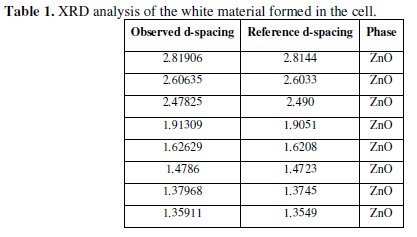
    <p>This layer was ZnO only as indicated by the results of X-Ray Diffraction 
(XRD). The analysis is shown in <a href="#t1">Table 1</a>.</p>


    <p>&nbsp;</p>
<a name="t1">
<img src="/img/revistas/pea/v31n4/31n4a02t1.jpg">
    
]]></body>
<body><![CDATA[<p>&nbsp;</p>


    <p>No trace of zinc hydroxide chloride 
was observed from the XRD data for the current passivation layer. Usually in the 
literature, for alkaline solutions, the passivation layer consists predominantly of 
zinc hydroxide chloride or zinc oxide [19,53].</p>


    <p>&nbsp;</p>
    <p><b><i>Effects of simultaneous application of PR, US and stirring</i></b></p>

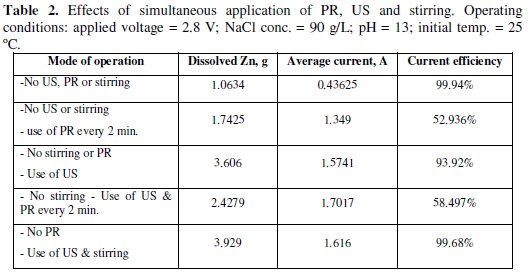
    <p>In <a href="#t2">Table 2</a>, the effects of simultaneous application of PR, US and stirring on the 
dissolved zinc and CE are presented.</p>


    <p>&nbsp;</p>
<a name="t2">
<img src="/img/revistas/pea/v31n4/31n4a02t2.jpg">
    
<p>&nbsp;</p>


    <p>These effects, especially using US, help in 
minimizing the effect of passivation [57]. In all experiments, the operating 
parameters were kept the same as indicated in the title of the table.</p>

    <p>When the polarity was reversed every 2 minutes, without the application of US 
enhancement or stirring, the mass of dissolved zinc was 1.7425 g and the average 
current was 1.349 A. Clearly, the application of polarity reversal led to more 
dissolution of zinc as the passing current was not steadily decreased, as in the 
case of <a href="#f2">Fig. 2</a>.</p>

    <p>This might be due to the smaller thickness of the solid layer 
formed at the surface of the anode by the effect of polarity reversal. However, the 
color of produced solid was slightly darker than the color of the solid produced in 
the run of <a href="#f2">Fig. 2</a>.</p>

    ]]></body>
<body><![CDATA[<p>At the end of the experiment, it was observed that a black layer was formed at the 
surface of the cathode. The formation of this black layer on zinc electrode was 
also reported by Cachet et al. [39]. When this layer was peeled off the cathode 
and left for some time in the atmospheric air, it was turned to light grey color. 
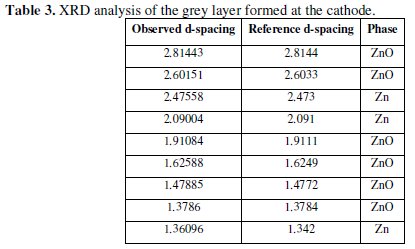
The result of XRD analysis of this grey powder shown in <a href="#t3">Table 3</a> indicated the 
presence of free zinc metal and zinc oxide.</p>


    <p>&nbsp;</p>
<a name="t3">
<img src="/img/revistas/pea/v31n4/31n4a02t3.jpg">
    
<p>&nbsp;</p>


    <p>The existence of zinc with zinc oxide 
was also observed by other investigator [58]. The CE was unexpectedly low and 
had a value of 52.94%. This low CE may be attributed to the fact that there was a 
time lag between the commencement of polarity reversal and the
recommencement of the dissolution process. During this time lag no gases were 
observed to evolve at the cathode.</p>

    <p>When US enhancement was only applied at the same operating conditions, the 
average current was 1.574 A, the dissolved Zn was 3.606 g, and the CE was 
93.92%. It was observed that at the end of the experiment the temperature of the 
bath increased to about 55 &deg;C in spite the initial temperature was about 25 &deg;C. 
Hence, the application of ultrasonic enhancement led to higher zinc dissolution 
accompanied with higher CE.</p>

    <p>Both US and PR every 2 minutes were applied while other operating parameters 
were kept constant. The average current was estimated as 1.702 A, dissolved Zn 
was 2.4279 g, and the CE was 58.497%. This indicates that the application of PR 
had a drawback effect on the dissolution process of Zn. This drawback effect 
may be a result of the time elapsed before the reaction got started after the 
reversing of polarity. It may be deduced that PR is not advantageous when used 
alone or when combined with US.</p>

    <p>Finally, during the application of the combination of US and stirring, the average 
current was 1.616 A, dissolved Zn was 3.929 g, and the CE was 99.68. However 
the powder was not as white as, for instance, the powder produced in the 
experiment of <a href="#f2">Fig. 2</a>. The rise in the temperature of the bath during the run of the 
experiment was also observed.</p>


    <p>&nbsp;</p>
    <p><b><i>Effect of Current Density (CD)</i></b></p>

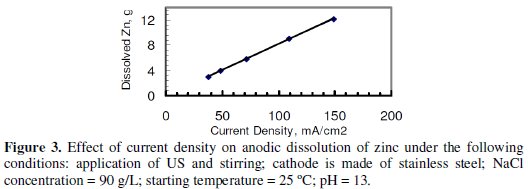
    <p><a href="#f3">Fig. 3</a> indicates that the mass of the dissolved zinc is increasing with the increase 
in CD.</p>


    ]]></body>
<body><![CDATA[<p>&nbsp;</p>
<a name="f3">
<img src="/img/revistas/pea/v31n4/31n4a02f3.jpg">
    
<p>&nbsp;</p>


    <p>It was not possible to increase CD beyond the largest value shown in the 
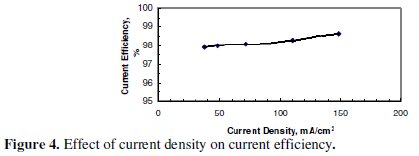
graph due to a limitation imposed by the power supply. <a href="#f4">Fig. 4</a>, however, indicates 
that no significant increase of CE was observed with the increase in CD under 
the conditions of <a href="#f3">Fig. 3</a>.</p>


    <p>&nbsp;</p>
<a name="f4">
<img src="/img/revistas/pea/v31n4/31n4a02f4.jpg">
    
<p>&nbsp;</p>


    <p>The CE is high enough to confirm that most of the 
electricity was used to dissolve zinc.</p>


    <p>&nbsp;</p>
    <p><b><i>Effect of supporting electrolyte concentration</i></b></p>

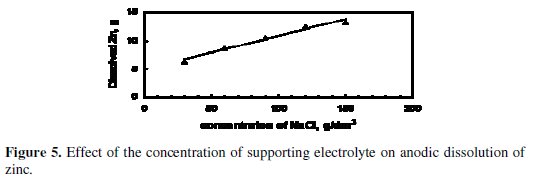
    <p><a href="#f5">Fig. 5</a> and <a href="#f6">6</a> illustrate the effect of concentration of the supporting electrolyte on 
the amount of dissolved Zinc and CE, respectively.</p>


    <p>&nbsp;</p>
<a name="f5">
<img src="/img/revistas/pea/v31n4/31n4a02f5.jpg">
    
]]></body>
<body><![CDATA[<p>&nbsp;</p>
<a name="f6">
<img src="/img/revistas/pea/v31n4/31n4a02f6.jpg">
    
<p>&nbsp;</p>


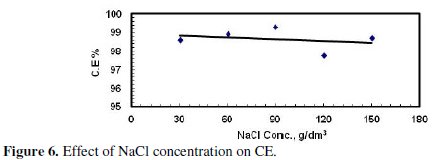
    <p>The experiments were 
performed under the following conditions: application of US, stainless steel 
cathode, pH = 13, starting applied potential = 5.5 V, and starting temperature = 
25 &deg;C. The amount of dissolved zinc, as shown in <a href="#f5">Fig. 5</a>, increased as the 
concentration of NaCl was increased from 30-150 g/dm<sup>3</sup>. This may be a result of 
the increased concentration of chloride ions, which are aggressive to the passive 
layer formed at the anode surface, with respect to hydroxide ions that are 
inhibitive ions, i.e., lead to the formation of the passive layer [4,17]. Therefore at 
high concentration of chloride ions, the breakdown of the passive layer is easier 
and new surface of zinc anode was subjected to dissolution [17].</p>

    <p>On the other hand the current efficiency was essentially the same and had a value 
around 98%, as shown in <a href="#f6">Fig. 6</a>. During these experiments it was observed that 
the passing current, i.e., the current density, increased with increasing the 
concentration of the supporting electrolyte at the same applied potential. This 
may be a result of the increase in conductivity of the electrolyte with increasing 
the concentration of NaCl.</p>


    <p>&nbsp;</p>
    <p><b><i>Effect of pH of the bath</i></b></p>

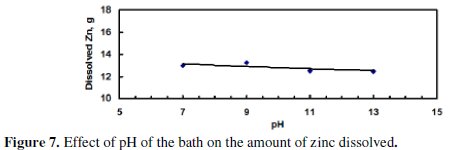
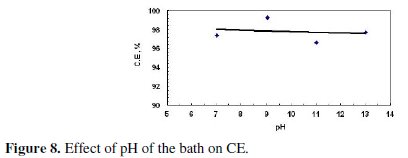
    <p>In order to investigate the effect of pH of the bath on the dissolution of zinc, four 
experiments were performed. Values of the pH of the bath were 7, 9, 11, and 13, 
while the following operating conditions were kept constant: concentration of 
NaCl = 120 g/dm<sup>3</sup>, applied potential = 5.5 V, application of US, stainless steel 
cathode, and time of electrolysis = 120 min.</p>

    <p><a href="#f7">Fig. 7</a> indicates that the dissolved zinc slightly decreased with increasing the pH 
of the bath.</p>


    <p>&nbsp;</p>
<a name="f7">
<img src="/img/revistas/pea/v31n4/31n4a02f7.jpg">
    
<p>&nbsp;</p>


    ]]></body>
<body><![CDATA[<p>This decrease may be a result of the amphoteric nature of the 
produced ZnO. <a href="#f8">Fig. 8</a> shows that the current efficiency was almost constant with 
increased pH.</p>


    <p>&nbsp;</p>
<a name="f8">
<img src="/img/revistas/pea/v31n4/31n4a02f8.jpg">
    
<p>&nbsp;</p>


    <p>These results indicate that the pH of the bath did not play a 
significant effect on the amount of the dissolved zinc or current efficiency at the 
range of pH covered. This may be approved by consulting Pourbaix diagram of 
zinc; as at the pH value of 7, zinc oxide starts to form at a potential of 0.8 V. The 
value of the potential, at which zinc oxide starts to form, decreases with 
increasing the pH. Since the following work was carried out at higher values of 
potential than 0.8 V, the effect of pH of the bath is minor.</p>


    <p>&nbsp;</p>
    <p><b><i>Effect of solution temperature</i></b></p>

    <p>During the performance of experiments with the application of US waves, it was 
observed that at the end of an experiment the temperature of the electrolyte raised 
to a higher value than the starting temperature, which was about 25 &deg;C. The final 
temperature was about 55 &deg;C when the applied voltage was 5.5 V. Therefore, it 
was necessary to investigate the effect of the temperature of the bath on anodic 
dissolution of zinc without the application of US waves.</p>

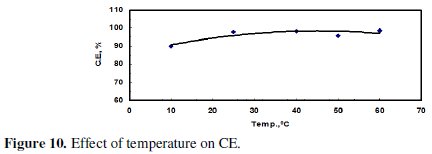
    <p>The electrolytic cell was placed in a water bath and the temperature was adjusted 
either by heating or cooling. Cooling was done by adding ice and the temperature 
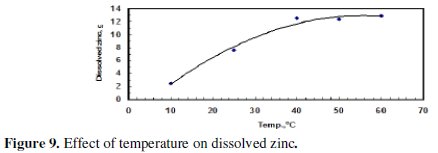
was closely monitored. <a href="#f9">Fig. 9</a> and <a href="#f10">10</a> indicate that both the amount of dissolved 
zinc and CE increased with increasing temperature being the larger effect on the 
mass of dissolved zinc.</p>


    <p>&nbsp;</p>
<a name="f9">
<img src="/img/revistas/pea/v31n4/31n4a02f9.jpg">
    
<p>&nbsp;</p>
<a name="f10">
<img src="/img/revistas/pea/v31n4/31n4a02f10.jpg">
    
]]></body>
<body><![CDATA[<p>&nbsp;</p>


    <p>Increasing the temperature from 10 &deg;C to 40 &deg;C led to a 
significant increase in the mass of the dissolved zinc; but the increase of 
temperature from 40 to 60 &deg;C, however, did not have a significant effect. This 
could be attributed to gas passivation.</p>


    <p>&nbsp;</p>
    <p><b>Conclusions</b></p>

    <p>1 - The application of polarity reversal led to more dissolution of zinc but the 
current efficiency was low.</p>

    <p>2 - The application of ultrasonic enhancement led to higher zinc dissolution 
accompanied with higher CE.</p>

    <p>3 - The combination of ultrasonic enhancement and stirring led to more 
dissolution of zinc.</p>

    <p>4 - Increasing the current density increased the dissolution of zinc and the current 
efficiency was almost constant.</p>

    <p>5 - Increasing concentration of NaCl increased the dissolution of zinc, the current 
efficiency was almost constant.</p>

    <p>6 - pH of the bath did not play a significant effect on the amount of the dissolved 
zinc or current efficiency.</p>

    ]]></body>
<body><![CDATA[<p>7 - Increasing the temperature from 10 &deg;C to 40 &deg;C led to a significant increase in 
the mass of the dissolved zinc and CE; however, the increase of temperature 
from 40 &deg;C to 60 &deg;C did not have a significant effect.</p>


    <p>&nbsp;</p>
    <p><b>References</b></p>

    <!-- ref --><p>1. Buchel K H, Moretto H-H, Woditsch P. Industrial inorganic chemistry. WILEY-VCH; 2000.    &nbsp;&nbsp;&nbsp;&nbsp;&nbsp;&nbsp;&nbsp;&nbsp;[&#160;<a href="javascript:void(0);" onclick="javascript: window.open('/scielo.php?script=sci_nlinks&ref=000116&pid=S0872-1904201300040000200001&lng=','','width=640,height=500,resizable=yes,scrollbars=1,menubar=yes,');">Links</a>&#160;]<!-- end-ref --></p>

    <!-- ref --><p>2. Patnaik P. Handbook of inorganic chemicals. McGraw Hill; 2003.    &nbsp;&nbsp;&nbsp;&nbsp;&nbsp;&nbsp;&nbsp;&nbsp;[&#160;<a href="javascript:void(0);" onclick="javascript: window.open('/scielo.php?script=sci_nlinks&ref=000118&pid=S0872-1904201300040000200002&lng=','','width=640,height=500,resizable=yes,scrollbars=1,menubar=yes,');">Links</a>&#160;]<!-- end-ref --></p>

    <!-- ref --><p>3. Buschow K H J, Cahn R, Flemings M, et al. Encyclopedia of materials science and technology. Pergamon Press; 2001. Vol. 7.    &nbsp;&nbsp;&nbsp;&nbsp;&nbsp;&nbsp;&nbsp;&nbsp;[&#160;<a href="javascript:void(0);" onclick="javascript: window.open('/scielo.php?script=sci_nlinks&ref=000120&pid=S0872-1904201300040000200003&lng=','','width=640,height=500,resizable=yes,scrollbars=1,menubar=yes,');">Links</a>&#160;]<!-- end-ref --></p>

    <!-- ref --><p>4. Zhang X G. Corrosion and electrochemistry of zinc. New York: Plenum Press; 1996.    &nbsp;&nbsp;&nbsp;&nbsp;&nbsp;&nbsp;&nbsp;&nbsp;[&#160;<a href="javascript:void(0);" onclick="javascript: window.open('/scielo.php?script=sci_nlinks&ref=000122&pid=S0872-1904201300040000200004&lng=','','width=640,height=500,resizable=yes,scrollbars=1,menubar=yes,');">Links</a>&#160;]<!-- end-ref --></p>

    <!-- ref --><p>5. Porter F C. Zinc handbook: properties, processing, and use in design. New York: Marcel Dekker, 1991.    &nbsp;&nbsp;&nbsp;&nbsp;&nbsp;&nbsp;&nbsp;&nbsp;[&#160;<a href="javascript:void(0);" onclick="javascript: window.open('/scielo.php?script=sci_nlinks&ref=000124&pid=S0872-1904201300040000200005&lng=','','width=640,height=500,resizable=yes,scrollbars=1,menubar=yes,');">Links</a>&#160;]<!-- end-ref --></p>

    <!-- ref --><p>6. Murphy M. Metal Finishing. 1996;94:26.    &nbsp;&nbsp;&nbsp;&nbsp;&nbsp;&nbsp;&nbsp;&nbsp;[&#160;<a href="javascript:void(0);" onclick="javascript: window.open('/scielo.php?script=sci_nlinks&ref=000126&pid=S0872-1904201300040000200006&lng=','','width=640,height=500,resizable=yes,scrollbars=1,menubar=yes,');">Links</a>&#160;]<!-- end-ref --></p>

    <!-- ref --><p>7. Murphy M. Metal Finishing. 1997;95:28.    &nbsp;&nbsp;&nbsp;&nbsp;&nbsp;&nbsp;&nbsp;&nbsp;[&#160;<a href="javascript:void(0);" onclick="javascript: window.open('/scielo.php?script=sci_nlinks&ref=000128&pid=S0872-1904201300040000200007&lng=','','width=640,height=500,resizable=yes,scrollbars=1,menubar=yes,');">Links</a>&#160;]<!-- end-ref --></p>

    <!-- ref --><p>8. Abd El-Aal E E. Anti-Corrosion Methods Mater. 1999;46:349.    &nbsp;&nbsp;&nbsp;&nbsp;&nbsp;&nbsp;&nbsp;&nbsp;[&#160;<a href="javascript:void(0);" onclick="javascript: window.open('/scielo.php?script=sci_nlinks&ref=000130&pid=S0872-1904201300040000200008&lng=','','width=640,height=500,resizable=yes,scrollbars=1,menubar=yes,');">Links</a>&#160;]<!-- end-ref --></p>

    <!-- ref --><p>9. El-Rehim S S A, El-Sherbini E E F, Amin M A. J Electroanalytical Chem. 2003;560:175.    &nbsp;&nbsp;&nbsp;&nbsp;&nbsp;&nbsp;&nbsp;&nbsp;[&#160;<a href="javascript:void(0);" onclick="javascript: window.open('/scielo.php?script=sci_nlinks&ref=000132&pid=S0872-1904201300040000200009&lng=','','width=640,height=500,resizable=yes,scrollbars=1,menubar=yes,');">Links</a>&#160;]<!-- end-ref --></p>

    <!-- ref --><p>10. Armstrong R D, Bell M F. The electrochemical behaviour of zinc in alkaline solution. In: Thirsk HR, editor. Electrochemistry. The Royal Society of 
Chemistry, 1974: pp. 1-17.    &nbsp;&nbsp;&nbsp;&nbsp;&nbsp;&nbsp;&nbsp;&nbsp;[&#160;<a href="javascript:void(0);" onclick="javascript: window.open('/scielo.php?script=sci_nlinks&ref=000134&pid=S0872-1904201300040000200010&lng=','','width=640,height=500,resizable=yes,scrollbars=1,menubar=yes,');">Links</a>&#160;]<!-- end-ref --></p>

    <!-- ref --><p>11. Besseyrias A, Dalard F, Rameau J J, et al. Corros Sci. 1997;39:1883.    &nbsp;&nbsp;&nbsp;&nbsp;&nbsp;&nbsp;&nbsp;&nbsp;[&#160;<a href="javascript:void(0);" onclick="javascript: window.open('/scielo.php?script=sci_nlinks&ref=000136&pid=S0872-1904201300040000200011&lng=','','width=640,height=500,resizable=yes,scrollbars=1,menubar=yes,');">Links</a>&#160;]<!-- end-ref --></p>

    <!-- ref --><p>12. Bounoughaz M, Salhi E, Benzine K, et al. J Mater Sci. 2003;38:1139.    &nbsp;&nbsp;&nbsp;&nbsp;&nbsp;&nbsp;&nbsp;&nbsp;[&#160;<a href="javascript:void(0);" onclick="javascript: window.open('/scielo.php?script=sci_nlinks&ref=000138&pid=S0872-1904201300040000200012&lng=','','width=640,height=500,resizable=yes,scrollbars=1,menubar=yes,');">Links</a>&#160;]<!-- end-ref --></p>

    <!-- ref --><p>13. Diomidis N, Celis J P. J Electrochem Soc. 2007;154:C711.    &nbsp;&nbsp;&nbsp;&nbsp;&nbsp;&nbsp;&nbsp;&nbsp;[&#160;<a href="javascript:void(0);" onclick="javascript: window.open('/scielo.php?script=sci_nlinks&ref=000140&pid=S0872-1904201300040000200013&lng=','','width=640,height=500,resizable=yes,scrollbars=1,menubar=yes,');">Links</a>&#160;]<!-- end-ref --></p>

    <!-- ref --><p>14. Flitt H J, Schweinsberg D P. Corros Sci. 2010;52:1905.    &nbsp;&nbsp;&nbsp;&nbsp;&nbsp;&nbsp;&nbsp;&nbsp;[&#160;<a href="javascript:void(0);" onclick="javascript: window.open('/scielo.php?script=sci_nlinks&ref=000142&pid=S0872-1904201300040000200014&lng=','','width=640,height=500,resizable=yes,scrollbars=1,menubar=yes,');">Links</a>&#160;]<!-- end-ref --></p>

    <!-- ref --><p>15. El Sherbini E E F, El Rehim S S A. Corros Sci. 2000;42:785.    &nbsp;&nbsp;&nbsp;&nbsp;&nbsp;&nbsp;&nbsp;&nbsp;[&#160;<a href="javascript:void(0);" onclick="javascript: window.open('/scielo.php?script=sci_nlinks&ref=000144&pid=S0872-1904201300040000200015&lng=','','width=640,height=500,resizable=yes,scrollbars=1,menubar=yes,');">Links</a>&#160;]<!-- end-ref --></p>

    <!-- ref --><p>16. McBreen J, Cairns E J. The zinc electrode. In: Gerischer H, Tobias CW, editors. Advances in electrochemistry and electrochemical engineering. 
New York: John Wiley &amp; Sons; 1978. p. 273.    &nbsp;&nbsp;&nbsp;&nbsp;&nbsp;&nbsp;&nbsp;&nbsp;[&#160;<a href="javascript:void(0);" onclick="javascript: window.open('/scielo.php?script=sci_nlinks&ref=000146&pid=S0872-1904201300040000200016&lng=','','width=640,height=500,resizable=yes,scrollbars=1,menubar=yes,');">Links</a>&#160;]<!-- end-ref --></p>

    <!-- ref --><p>17. Miao W, Cole I S, Neufeld A K, et al. J Electrochem Soc. 2007;154:C7.    &nbsp;&nbsp;&nbsp;&nbsp;&nbsp;&nbsp;&nbsp;&nbsp;[&#160;<a href="javascript:void(0);" onclick="javascript: window.open('/scielo.php?script=sci_nlinks&ref=000148&pid=S0872-1904201300040000200017&lng=','','width=640,height=500,resizable=yes,scrollbars=1,menubar=yes,');">Links</a>&#160;]<!-- end-ref --></p>

    <!-- ref --><p>18. Mouanga M, Bercot P. Corros Sci. 2010;52:3993.    &nbsp;&nbsp;&nbsp;&nbsp;&nbsp;&nbsp;&nbsp;&nbsp;[&#160;<a href="javascript:void(0);" onclick="javascript: window.open('/scielo.php?script=sci_nlinks&ref=000150&pid=S0872-1904201300040000200018&lng=','','width=640,height=500,resizable=yes,scrollbars=1,menubar=yes,');">Links</a>&#160;]<!-- end-ref --></p>

    <!-- ref --><p>19. Mouanga M, Bercot P, Rauch J Y. Corros Sci. 2010;52:3984.    &nbsp;&nbsp;&nbsp;&nbsp;&nbsp;&nbsp;&nbsp;&nbsp;[&#160;<a href="javascript:void(0);" onclick="javascript: window.open('/scielo.php?script=sci_nlinks&ref=000152&pid=S0872-1904201300040000200019&lng=','','width=640,height=500,resizable=yes,scrollbars=1,menubar=yes,');">Links</a>&#160;]<!-- end-ref --></p>

    <!-- ref --><p>20. Muralidharan V S, Rajagopalan K S. J Electroanal Chem Interfacial Electrochem. 1978;94:21.    &nbsp;&nbsp;&nbsp;&nbsp;&nbsp;&nbsp;&nbsp;&nbsp;[&#160;<a href="javascript:void(0);" onclick="javascript: window.open('/scielo.php?script=sci_nlinks&ref=000154&pid=S0872-1904201300040000200020&lng=','','width=640,height=500,resizable=yes,scrollbars=1,menubar=yes,');">Links</a>&#160;]<!-- end-ref --></p>

    <!-- ref --><p>21. Hampson N A, Herdman G A, Taylor R. J Electroanal Chem Interfacial Electrochem. 1970;25:9.    &nbsp;&nbsp;&nbsp;&nbsp;&nbsp;&nbsp;&nbsp;&nbsp;[&#160;<a href="javascript:void(0);" onclick="javascript: window.open('/scielo.php?script=sci_nlinks&ref=000156&pid=S0872-1904201300040000200021&lng=','','width=640,height=500,resizable=yes,scrollbars=1,menubar=yes,');">Links</a>&#160;]<!-- end-ref --></p>

    <!-- ref --><p>22. Bockris J O, Nagy Z, Danjanovic A. J Electrochem Soc. 1972:285.    &nbsp;&nbsp;&nbsp;&nbsp;&nbsp;&nbsp;&nbsp;&nbsp;[&#160;<a href="javascript:void(0);" onclick="javascript: window.open('/scielo.php?script=sci_nlinks&ref=000158&pid=S0872-1904201300040000200022&lng=','','width=640,height=500,resizable=yes,scrollbars=1,menubar=yes,');">Links</a>&#160;]<!-- end-ref --></p>

    <!-- ref --><p>23. Arise I, Fukunaka Y, McLarnon FR. J Electrochem Soc. 2006;153:A69.    &nbsp;&nbsp;&nbsp;&nbsp;&nbsp;&nbsp;&nbsp;&nbsp;[&#160;<a href="javascript:void(0);" onclick="javascript: window.open('/scielo.php?script=sci_nlinks&ref=000160&pid=S0872-1904201300040000200023&lng=','','width=640,height=500,resizable=yes,scrollbars=1,menubar=yes,');">Links</a>&#160;]<!-- end-ref --></p>

    <!-- ref --><p>24. Breiter M W. Electrochim Acta. 1971;16:1169.    &nbsp;&nbsp;&nbsp;&nbsp;&nbsp;&nbsp;&nbsp;&nbsp;[&#160;<a href="javascript:void(0);" onclick="javascript: window.open('/scielo.php?script=sci_nlinks&ref=000162&pid=S0872-1904201300040000200024&lng=','','width=640,height=500,resizable=yes,scrollbars=1,menubar=yes,');">Links</a>&#160;]<!-- end-ref --></p>

    <!-- ref --><p>25. Chang Y-C, Prentice G. J Electrochem Soc. 1989;136:3398.    &nbsp;&nbsp;&nbsp;&nbsp;&nbsp;&nbsp;&nbsp;&nbsp;[&#160;<a href="javascript:void(0);" onclick="javascript: window.open('/scielo.php?script=sci_nlinks&ref=000164&pid=S0872-1904201300040000200025&lng=','','width=640,height=500,resizable=yes,scrollbars=1,menubar=yes,');">Links</a>&#160;]<!-- end-ref --></p>

    <!-- ref --><p>26. Dirkse T P, Hampson N A. Electrochim Acta. 1972;17:387.    &nbsp;&nbsp;&nbsp;&nbsp;&nbsp;&nbsp;&nbsp;&nbsp;[&#160;<a href="javascript:void(0);" onclick="javascript: window.open('/scielo.php?script=sci_nlinks&ref=000166&pid=S0872-1904201300040000200026&lng=','','width=640,height=500,resizable=yes,scrollbars=1,menubar=yes,');">Links</a>&#160;]<!-- end-ref --></p>

    <!-- ref --><p>27. Dirkse T P, Hampson N A. Electrochim Acta. 1971;16:2049.    &nbsp;&nbsp;&nbsp;&nbsp;&nbsp;&nbsp;&nbsp;&nbsp;[&#160;<a href="javascript:void(0);" onclick="javascript: window.open('/scielo.php?script=sci_nlinks&ref=000168&pid=S0872-1904201300040000200027&lng=','','width=640,height=500,resizable=yes,scrollbars=1,menubar=yes,');">Links</a>&#160;]<!-- end-ref --></p>

    <p>28. J. Hendrikx, A. van der Putten, W. Visscheret al. The electrodeposition and dissolution of zinc and amalgamated zinc in alkaline 
solutions, Electrochim Acta. 1984;29:81.</p>

    <!-- ref --><p>29. Pyun S-I, Bae J-S, Park S-Y, et al. Corros Sci. 1994;36:827.    &nbsp;&nbsp;&nbsp;&nbsp;&nbsp;&nbsp;&nbsp;&nbsp;[&#160;<a href="javascript:void(0);" onclick="javascript: window.open('/scielo.php?script=sci_nlinks&ref=000171&pid=S0872-1904201300040000200029&lng=','','width=640,height=500,resizable=yes,scrollbars=1,menubar=yes,');">Links</a>&#160;]<!-- end-ref --></p>

    ]]></body>
<body><![CDATA[<!-- ref --><p>30. Chang Y-C. Electrochim Acta. 1996;41:2425.    &nbsp;&nbsp;&nbsp;&nbsp;&nbsp;&nbsp;&nbsp;&nbsp;[&#160;<a href="javascript:void(0);" onclick="javascript: window.open('/scielo.php?script=sci_nlinks&ref=000173&pid=S0872-1904201300040000200030&lng=','','width=640,height=500,resizable=yes,scrollbars=1,menubar=yes,');">Links</a>&#160;]<!-- end-ref --></p>

    <!-- ref --><p>31. Sato Y, Niki H, Takamura T. J Electrochem Soc. 1971;118:1269.    &nbsp;&nbsp;&nbsp;&nbsp;&nbsp;&nbsp;&nbsp;&nbsp;[&#160;<a href="javascript:void(0);" onclick="javascript: window.open('/scielo.php?script=sci_nlinks&ref=000175&pid=S0872-1904201300040000200031&lng=','','width=640,height=500,resizable=yes,scrollbars=1,menubar=yes,');">Links</a>&#160;]<!-- end-ref --></p>

    <!-- ref --><p>32. Powers R W, Breiter M W. J Electrochem Soc. 1969;116:719.    &nbsp;&nbsp;&nbsp;&nbsp;&nbsp;&nbsp;&nbsp;&nbsp;[&#160;<a href="javascript:void(0);" onclick="javascript: window.open('/scielo.php?script=sci_nlinks&ref=000177&pid=S0872-1904201300040000200032&lng=','','width=640,height=500,resizable=yes,scrollbars=1,menubar=yes,');">Links</a>&#160;]<!-- end-ref --></p>

    <!-- ref --><p>33. Armstrong R D, Bulman G M. J Electroanal Chem Interfacial Electrochem. 1970;25:121.    &nbsp;&nbsp;&nbsp;&nbsp;&nbsp;&nbsp;&nbsp;&nbsp;[&#160;<a href="javascript:void(0);" onclick="javascript: window.open('/scielo.php?script=sci_nlinks&ref=000179&pid=S0872-1904201300040000200033&lng=','','width=640,height=500,resizable=yes,scrollbars=1,menubar=yes,');">Links</a>&#160;]<!-- end-ref --></p>

    <!-- ref --><p>34. Assaf FH, El-Rehim SSA, Zaky AM. Brit Corros J. 2001;36:143.    &nbsp;&nbsp;&nbsp;&nbsp;&nbsp;&nbsp;&nbsp;&nbsp;[&#160;<a href="javascript:void(0);" onclick="javascript: window.open('/scielo.php?script=sci_nlinks&ref=000181&pid=S0872-1904201300040000200034&lng=','','width=640,height=500,resizable=yes,scrollbars=1,menubar=yes,');">Links</a>&#160;]<!-- end-ref --></p>

    ]]></body>
<body><![CDATA[<!-- ref --><p>35. Mokaddem M, Volovitch P, Ogle K. Electrochim Acta. 2010;55:7867.    &nbsp;&nbsp;&nbsp;&nbsp;&nbsp;&nbsp;&nbsp;&nbsp;[&#160;<a href="javascript:void(0);" onclick="javascript: window.open('/scielo.php?script=sci_nlinks&ref=000183&pid=S0872-1904201300040000200035&lng=','','width=640,height=500,resizable=yes,scrollbars=1,menubar=yes,');">Links</a>&#160;]<!-- end-ref --></p>

    <!-- ref --><p>36. El Rehim S S A, Fouad E E, El Wahab S M A, et al. J Electroanal Chem. 1996;401:113.    &nbsp;&nbsp;&nbsp;&nbsp;&nbsp;&nbsp;&nbsp;&nbsp;[&#160;<a href="javascript:void(0);" onclick="javascript: window.open('/scielo.php?script=sci_nlinks&ref=000185&pid=S0872-1904201300040000200036&lng=','','width=640,height=500,resizable=yes,scrollbars=1,menubar=yes,');">Links</a>&#160;]<!-- end-ref --></p>

    <!-- ref --><p>37. Schwabe K, Luck HB. Electrochim Acta. 1972;17:99.    &nbsp;&nbsp;&nbsp;&nbsp;&nbsp;&nbsp;&nbsp;&nbsp;[&#160;<a href="javascript:void(0);" onclick="javascript: window.open('/scielo.php?script=sci_nlinks&ref=000187&pid=S0872-1904201300040000200037&lng=','','width=640,height=500,resizable=yes,scrollbars=1,menubar=yes,');">Links</a>&#160;]<!-- end-ref --></p>

    <!-- ref --><p>38. Cachet C, Ganne F, Maurin G, et al. Electrochim Acta. 2001;47:509.    &nbsp;&nbsp;&nbsp;&nbsp;&nbsp;&nbsp;&nbsp;&nbsp;[&#160;<a href="javascript:void(0);" onclick="javascript: window.open('/scielo.php?script=sci_nlinks&ref=000189&pid=S0872-1904201300040000200038&lng=','','width=640,height=500,resizable=yes,scrollbars=1,menubar=yes,');">Links</a>&#160;]<!-- end-ref --></p>

    <!-- ref --><p>39. Cachet C, Ganne F, Joiret S, et al. Electrochim Acta. 2002;47:3409.    &nbsp;&nbsp;&nbsp;&nbsp;&nbsp;&nbsp;&nbsp;&nbsp;[&#160;<a href="javascript:void(0);" onclick="javascript: window.open('/scielo.php?script=sci_nlinks&ref=000191&pid=S0872-1904201300040000200039&lng=','','width=640,height=500,resizable=yes,scrollbars=1,menubar=yes,');">Links</a>&#160;]<!-- end-ref --></p>

    ]]></body>
<body><![CDATA[<!-- ref --><p>40. Cachet C, Wiart R. J Electroanal Chem. 1980;111:235.    &nbsp;&nbsp;&nbsp;&nbsp;&nbsp;&nbsp;&nbsp;&nbsp;[&#160;<a href="javascript:void(0);" onclick="javascript: window.open('/scielo.php?script=sci_nlinks&ref=000193&pid=S0872-1904201300040000200040&lng=','','width=640,height=500,resizable=yes,scrollbars=1,menubar=yes,');">Links</a>&#160;]<!-- end-ref --></p>

    <!-- ref --><p>41. Cachet C, Wiart R. J Electroanal Chem Interfacial Electrochem. 1981;129:103.    &nbsp;&nbsp;&nbsp;&nbsp;&nbsp;&nbsp;&nbsp;&nbsp;[&#160;<a href="javascript:void(0);" onclick="javascript: window.open('/scielo.php?script=sci_nlinks&ref=000195&pid=S0872-1904201300040000200041&lng=','','width=640,height=500,resizable=yes,scrollbars=1,menubar=yes,');">Links</a>&#160;]<!-- end-ref --></p>

    <!-- ref --><p>42. Velichenko A B, Portillo J, Sarret M, et al. Electrochim Acta. 1999;44:3377.    &nbsp;&nbsp;&nbsp;&nbsp;&nbsp;&nbsp;&nbsp;&nbsp;[&#160;<a href="javascript:void(0);" onclick="javascript: window.open('/scielo.php?script=sci_nlinks&ref=000197&pid=S0872-1904201300040000200042&lng=','','width=640,height=500,resizable=yes,scrollbars=1,menubar=yes,');">Links</a>&#160;]<!-- end-ref --></p>

    <!-- ref --><p>43. Gimenez-Romero D, GarcIa-Jareno J J, Vicente F. J Electroanal Chem. 2004;572:235.    &nbsp;&nbsp;&nbsp;&nbsp;&nbsp;&nbsp;&nbsp;&nbsp;[&#160;<a href="javascript:void(0);" onclick="javascript: window.open('/scielo.php?script=sci_nlinks&ref=000199&pid=S0872-1904201300040000200043&lng=','','width=640,height=500,resizable=yes,scrollbars=1,menubar=yes,');">Links</a>&#160;]<!-- end-ref --></p>

    <!-- ref --><p>44. Hefny M H, Babaqi A S, El-Basiouny M S, et al. Coll Czech Chem Comm. 1991;56:236.    &nbsp;&nbsp;&nbsp;&nbsp;&nbsp;&nbsp;&nbsp;&nbsp;[&#160;<a href="javascript:void(0);" onclick="javascript: window.open('/scielo.php?script=sci_nlinks&ref=000201&pid=S0872-1904201300040000200044&lng=','','width=640,height=500,resizable=yes,scrollbars=1,menubar=yes,');">Links</a>&#160;]<!-- end-ref --></p>

    ]]></body>
<body><![CDATA[<!-- ref --><p>45. Huajun Z, Zhenghai G, Jinhuan Z. Hydrometallurgy. 2007;89:369.    &nbsp;&nbsp;&nbsp;&nbsp;&nbsp;&nbsp;&nbsp;&nbsp;[&#160;<a href="javascript:void(0);" onclick="javascript: window.open('/scielo.php?script=sci_nlinks&ref=000203&pid=S0872-1904201300040000200045&lng=','','width=640,height=500,resizable=yes,scrollbars=1,menubar=yes,');">Links</a>&#160;]<!-- end-ref --></p>

    <!-- ref --><p>46. James W J, Straumanis M E, Reed J L. The Office of Naval Research. Technical Report n.10 (Contract No 2296 (03)); 1964.    &nbsp;&nbsp;&nbsp;&nbsp;&nbsp;&nbsp;&nbsp;&nbsp;[&#160;<a href="javascript:void(0);" onclick="javascript: window.open('/scielo.php?script=sci_nlinks&ref=000205&pid=S0872-1904201300040000200046&lng=','','width=640,height=500,resizable=yes,scrollbars=1,menubar=yes,');">Links</a>&#160;]<!-- end-ref --></p>

    <!-- ref --><p>47. Johnson J W, Son Y C, James W J. Corros Sci. 1971;11:153.    &nbsp;&nbsp;&nbsp;&nbsp;&nbsp;&nbsp;&nbsp;&nbsp;[&#160;<a href="javascript:void(0);" onclick="javascript: window.open('/scielo.php?script=sci_nlinks&ref=000207&pid=S0872-1904201300040000200047&lng=','','width=640,height=500,resizable=yes,scrollbars=1,menubar=yes,');">Links</a>&#160;]<!-- end-ref --></p>

    <!-- ref --><p>48. Menzies I A, Marshall G W, Gearey D, et al. J Electrochem Soc. 1970;117:849.    &nbsp;&nbsp;&nbsp;&nbsp;&nbsp;&nbsp;&nbsp;&nbsp;[&#160;<a href="javascript:void(0);" onclick="javascript: window.open('/scielo.php?script=sci_nlinks&ref=000209&pid=S0872-1904201300040000200048&lng=','','width=640,height=500,resizable=yes,scrollbars=1,menubar=yes,');">Links</a>&#160;]<!-- end-ref --></p>

    <!-- ref --><p>49. Stankovic S, Grgur B, Krstajic N. et al. J Serb Chem Soc. 2003;68:207.    &nbsp;&nbsp;&nbsp;&nbsp;&nbsp;&nbsp;&nbsp;&nbsp;[&#160;<a href="javascript:void(0);" onclick="javascript: window.open('/scielo.php?script=sci_nlinks&ref=000211&pid=S0872-1904201300040000200049&lng=','','width=640,height=500,resizable=yes,scrollbars=1,menubar=yes,');">Links</a>&#160;]<!-- end-ref --></p>

    ]]></body>
<body><![CDATA[<p>50. Abd El Aal E. Corros Sci. 2006;48:343.</p>

    <!-- ref --><p>51. Aliev Z M, Vladimirova M V, Kharlamova T A, et al. Russ J Appl Chem. 2002;75:50.    &nbsp;&nbsp;&nbsp;&nbsp;&nbsp;&nbsp;&nbsp;&nbsp;[&#160;<a href="javascript:void(0);" onclick="javascript: window.open('/scielo.php?script=sci_nlinks&ref=000214&pid=S0872-1904201300040000200051&lng=','','width=640,height=500,resizable=yes,scrollbars=1,menubar=yes,');">Links</a>&#160;]<!-- end-ref --></p>

    <!-- ref --><p>52. Rangel C M, Cruz L F. Corros Sci. 1992;33:1479.    &nbsp;&nbsp;&nbsp;&nbsp;&nbsp;&nbsp;&nbsp;&nbsp;[&#160;<a href="javascript:void(0);" onclick="javascript: window.open('/scielo.php?script=sci_nlinks&ref=000216&pid=S0872-1904201300040000200052&lng=','','width=640,height=500,resizable=yes,scrollbars=1,menubar=yes,');">Links</a>&#160;]<!-- end-ref --></p>

    <!-- ref --><p>53. Qu Q, Li L, Bai W, et al. Corros Sci. 2005;47:2832.    &nbsp;&nbsp;&nbsp;&nbsp;&nbsp;&nbsp;&nbsp;&nbsp;[&#160;<a href="javascript:void(0);" onclick="javascript: window.open('/scielo.php?script=sci_nlinks&ref=000218&pid=S0872-1904201300040000200053&lng=','','width=640,height=500,resizable=yes,scrollbars=1,menubar=yes,');">Links</a>&#160;]<!-- end-ref --></p>

    <!-- ref --><p>54. Kalinauskas P, Valsiunas I, Samuleviciene M, et al. Corros Sci. 2001;43:2083.    &nbsp;&nbsp;&nbsp;&nbsp;&nbsp;&nbsp;&nbsp;&nbsp;[&#160;<a href="javascript:void(0);" onclick="javascript: window.open('/scielo.php?script=sci_nlinks&ref=000220&pid=S0872-1904201300040000200054&lng=','','width=640,height=500,resizable=yes,scrollbars=1,menubar=yes,');">Links</a>&#160;]<!-- end-ref --></p>

    <!-- ref --><p>55. Chen Z Y, Persson D, Leygraf C. Corros Sci. 2008;50:111.    &nbsp;&nbsp;&nbsp;&nbsp;&nbsp;&nbsp;&nbsp;&nbsp;[&#160;<a href="javascript:void(0);" onclick="javascript: window.open('/scielo.php?script=sci_nlinks&ref=000222&pid=S0872-1904201300040000200055&lng=','','width=640,height=500,resizable=yes,scrollbars=1,menubar=yes,');">Links</a>&#160;]<!-- end-ref --></p>

    <!-- ref --><p>56. Suslick K S. Science. 1990;247:1439.    &nbsp;&nbsp;&nbsp;&nbsp;&nbsp;&nbsp;&nbsp;&nbsp;[&#160;<a href="javascript:void(0);" onclick="javascript: window.open('/scielo.php?script=sci_nlinks&ref=000224&pid=S0872-1904201300040000200056&lng=','','width=640,height=500,resizable=yes,scrollbars=1,menubar=yes,');">Links</a>&#160;]<!-- end-ref --></p>

    <!-- ref --><p>57. Compton R G, Eklund J C, Marken F, et al. Electrochimica Acta. 1997;42:2919.    &nbsp;&nbsp;&nbsp;&nbsp;&nbsp;&nbsp;&nbsp;&nbsp;[&#160;<a href="javascript:void(0);" onclick="javascript: window.open('/scielo.php?script=sci_nlinks&ref=000226&pid=S0872-1904201300040000200057&lng=','','width=640,height=500,resizable=yes,scrollbars=1,menubar=yes,');">Links</a>&#160;]<!-- end-ref --></p>

    <p>58. Amin M A. Electrochim Acta. 50 (2005) 1265.


    <p>&nbsp;</p>
    <p><a name=0></a><sup><a href="#top">*</a></sup>Corresponding author. E-mail address: <a href="mailto:dr_ismail@instruchem.org">dr_ismail@instruchem.org</a></p>

    <p>Received 30 January 2013; accepted 12 August 2013</p>

    <p><a href="http://www.peacta.org" target="_blank">www.peacta.org</a> </p>


    ]]></body>
<body><![CDATA[ ]]></body><back>
<ref-list>
<ref id="B1">
<label>1</label><nlm-citation citation-type="book">
<person-group person-group-type="author">
<name>
<surname><![CDATA[Buchel]]></surname>
<given-names><![CDATA[K H]]></given-names>
</name>
<name>
<surname><![CDATA[Moretto]]></surname>
<given-names><![CDATA[H-H]]></given-names>
</name>
<name>
<surname><![CDATA[Woditsch]]></surname>
<given-names><![CDATA[P]]></given-names>
</name>
</person-group>
<source><![CDATA[Industrial inorganic chemistry]]></source>
<year>2000</year>
<publisher-name><![CDATA[WILEY-VCH]]></publisher-name>
</nlm-citation>
</ref>
<ref id="B2">
<label>2</label><nlm-citation citation-type="book">
<person-group person-group-type="author">
<name>
<surname><![CDATA[Patnaik]]></surname>
<given-names><![CDATA[P]]></given-names>
</name>
</person-group>
<source><![CDATA[Handbook of inorganic chemicals]]></source>
<year>2003</year>
<publisher-name><![CDATA[McGraw Hill]]></publisher-name>
</nlm-citation>
</ref>
<ref id="B3">
<label>3</label><nlm-citation citation-type="book">
<person-group person-group-type="author">
<name>
<surname><![CDATA[Buschow]]></surname>
<given-names><![CDATA[K H J]]></given-names>
</name>
<name>
<surname><![CDATA[Cahn]]></surname>
<given-names><![CDATA[R]]></given-names>
</name>
<name>
<surname><![CDATA[Flemings]]></surname>
<given-names><![CDATA[M]]></given-names>
</name>
</person-group>
<source><![CDATA[Encyclopedia of materials science and technology]]></source>
<year>2001</year>
<volume>7</volume>
<publisher-name><![CDATA[Pergamon Press]]></publisher-name>
</nlm-citation>
</ref>
<ref id="B4">
<label>4</label><nlm-citation citation-type="book">
<person-group person-group-type="author">
<name>
<surname><![CDATA[Zhang]]></surname>
<given-names><![CDATA[X G]]></given-names>
</name>
</person-group>
<source><![CDATA[Corrosion and electrochemistry of zinc]]></source>
<year>1996</year>
<publisher-loc><![CDATA[New York ]]></publisher-loc>
<publisher-name><![CDATA[Plenum Press]]></publisher-name>
</nlm-citation>
</ref>
<ref id="B5">
<label>5</label><nlm-citation citation-type="book">
<person-group person-group-type="author">
<name>
<surname><![CDATA[Porter]]></surname>
<given-names><![CDATA[F C]]></given-names>
</name>
</person-group>
<source><![CDATA[Zinc handbook: properties, processing, and use in design]]></source>
<year>1991</year>
<publisher-loc><![CDATA[New York ]]></publisher-loc>
<publisher-name><![CDATA[Marcel Dekker]]></publisher-name>
</nlm-citation>
</ref>
<ref id="B6">
<label>6</label><nlm-citation citation-type="journal">
<person-group person-group-type="author">
<name>
<surname><![CDATA[Murphy]]></surname>
<given-names><![CDATA[M]]></given-names>
</name>
</person-group>
<source><![CDATA[Metal Finishing]]></source>
<year>1996</year>
<volume>94</volume>
<page-range>26</page-range></nlm-citation>
</ref>
<ref id="B7">
<label>7</label><nlm-citation citation-type="journal">
<person-group person-group-type="author">
<name>
<surname><![CDATA[Murphy]]></surname>
<given-names><![CDATA[M]]></given-names>
</name>
</person-group>
<source><![CDATA[Metal Finishing]]></source>
<year>1997</year>
<volume>95</volume>
<page-range>28</page-range></nlm-citation>
</ref>
<ref id="B8">
<label>8</label><nlm-citation citation-type="journal">
<person-group person-group-type="author">
<name>
<surname><![CDATA[Abd El-Aal]]></surname>
<given-names><![CDATA[E E]]></given-names>
</name>
</person-group>
<source><![CDATA[Anti-Corrosion Methods Mater]]></source>
<year>1999</year>
<volume>46</volume>
<page-range>349</page-range></nlm-citation>
</ref>
<ref id="B9">
<label>9</label><nlm-citation citation-type="journal">
<person-group person-group-type="author">
<name>
<surname><![CDATA[El-Rehim]]></surname>
<given-names><![CDATA[S S A]]></given-names>
</name>
<name>
<surname><![CDATA[El-Sherbini]]></surname>
<given-names><![CDATA[E E F]]></given-names>
</name>
<name>
<surname><![CDATA[Amin]]></surname>
<given-names><![CDATA[M A]]></given-names>
</name>
</person-group>
<source><![CDATA[J Electroanalytical Chem]]></source>
<year>2003</year>
<volume>560</volume>
<page-range>175</page-range></nlm-citation>
</ref>
<ref id="B10">
<label>10</label><nlm-citation citation-type="book">
<person-group person-group-type="author">
<name>
<surname><![CDATA[Armstrong]]></surname>
<given-names><![CDATA[R D]]></given-names>
</name>
<name>
<surname><![CDATA[Bell]]></surname>
<given-names><![CDATA[M F]]></given-names>
</name>
</person-group>
<source><![CDATA[The electrochemical behaviour of zinc in alkaline solution]]></source>
<year>1974</year>
<page-range>1-17</page-range><publisher-name><![CDATA[The Royal Society of Chemistry]]></publisher-name>
</nlm-citation>
</ref>
<ref id="B11">
<label>11</label><nlm-citation citation-type="journal">
<person-group person-group-type="author">
<name>
<surname><![CDATA[Besseyrias]]></surname>
<given-names><![CDATA[A]]></given-names>
</name>
<name>
<surname><![CDATA[Dalard]]></surname>
<given-names><![CDATA[F]]></given-names>
</name>
<name>
<surname><![CDATA[Rameau]]></surname>
<given-names><![CDATA[J J]]></given-names>
</name>
</person-group>
<source><![CDATA[Corros Sci]]></source>
<year>1997</year>
<volume>39</volume>
<page-range>1883</page-range></nlm-citation>
</ref>
<ref id="B12">
<label>12</label><nlm-citation citation-type="journal">
<person-group person-group-type="author">
<name>
<surname><![CDATA[Bounoughaz]]></surname>
<given-names><![CDATA[M]]></given-names>
</name>
<name>
<surname><![CDATA[Salhi]]></surname>
<given-names><![CDATA[E]]></given-names>
</name>
<name>
<surname><![CDATA[Benzine]]></surname>
<given-names><![CDATA[K]]></given-names>
</name>
</person-group>
<source><![CDATA[J Mater Sci]]></source>
<year>2003</year>
<volume>38</volume>
<page-range>1139</page-range></nlm-citation>
</ref>
<ref id="B13">
<label>13</label><nlm-citation citation-type="journal">
<person-group person-group-type="author">
<name>
<surname><![CDATA[Diomidis]]></surname>
<given-names><![CDATA[N]]></given-names>
</name>
<name>
<surname><![CDATA[Celis]]></surname>
<given-names><![CDATA[J P]]></given-names>
</name>
</person-group>
<source><![CDATA[J Electrochem Soc]]></source>
<year>2007</year>
<volume>154</volume>
<page-range>C711</page-range></nlm-citation>
</ref>
<ref id="B14">
<label>14</label><nlm-citation citation-type="journal">
<person-group person-group-type="author">
<name>
<surname><![CDATA[Flitt]]></surname>
<given-names><![CDATA[H J]]></given-names>
</name>
<name>
<surname><![CDATA[Schweinsberg]]></surname>
<given-names><![CDATA[D P]]></given-names>
</name>
</person-group>
<source><![CDATA[Corros Sci]]></source>
<year>2010</year>
<volume>52</volume>
<page-range>1905</page-range></nlm-citation>
</ref>
<ref id="B15">
<label>15</label><nlm-citation citation-type="journal">
<person-group person-group-type="author">
<name>
<surname><![CDATA[El Sherbini]]></surname>
<given-names><![CDATA[E E F]]></given-names>
</name>
<name>
<surname><![CDATA[El Rehim]]></surname>
<given-names><![CDATA[S S A]]></given-names>
</name>
</person-group>
<source><![CDATA[Corros Sci]]></source>
<year>2000</year>
<volume>42</volume>
<page-range>785</page-range></nlm-citation>
</ref>
<ref id="B16">
<label>16</label><nlm-citation citation-type="book">
<person-group person-group-type="author">
<name>
<surname><![CDATA[McBreen]]></surname>
<given-names><![CDATA[J]]></given-names>
</name>
<name>
<surname><![CDATA[Cairns]]></surname>
<given-names><![CDATA[E J]]></given-names>
</name>
</person-group>
<source><![CDATA[The zinc electrode]]></source>
<year>1978</year>
<page-range>273</page-range><publisher-loc><![CDATA[New York ]]></publisher-loc>
<publisher-name><![CDATA[John Wiley & Sons]]></publisher-name>
</nlm-citation>
</ref>
<ref id="B17">
<label>17</label><nlm-citation citation-type="journal">
<person-group person-group-type="author">
<name>
<surname><![CDATA[Miao]]></surname>
<given-names><![CDATA[W]]></given-names>
</name>
<name>
<surname><![CDATA[Cole]]></surname>
<given-names><![CDATA[I S]]></given-names>
</name>
<name>
<surname><![CDATA[Neufeld]]></surname>
<given-names><![CDATA[A K]]></given-names>
</name>
</person-group>
<source><![CDATA[J Electrochem Soc]]></source>
<year>2007</year>
<volume>154</volume>
<page-range>C7</page-range></nlm-citation>
</ref>
<ref id="B18">
<label>18</label><nlm-citation citation-type="journal">
<person-group person-group-type="author">
<name>
<surname><![CDATA[Mouanga]]></surname>
<given-names><![CDATA[M]]></given-names>
</name>
<name>
<surname><![CDATA[Bercot]]></surname>
<given-names><![CDATA[P]]></given-names>
</name>
</person-group>
<source><![CDATA[Corros Sci]]></source>
<year>2010</year>
<volume>52</volume>
<page-range>3993</page-range></nlm-citation>
</ref>
<ref id="B19">
<label>19</label><nlm-citation citation-type="journal">
<person-group person-group-type="author">
<name>
<surname><![CDATA[Mouanga]]></surname>
<given-names><![CDATA[M]]></given-names>
</name>
<name>
<surname><![CDATA[Bercot]]></surname>
<given-names><![CDATA[P]]></given-names>
</name>
<name>
<surname><![CDATA[Rauch]]></surname>
<given-names><![CDATA[J Y]]></given-names>
</name>
</person-group>
<source><![CDATA[Corros Sci]]></source>
<year>2010</year>
<volume>52</volume>
<page-range>3984</page-range></nlm-citation>
</ref>
<ref id="B20">
<label>20</label><nlm-citation citation-type="journal">
<person-group person-group-type="author">
<name>
<surname><![CDATA[Muralidharan]]></surname>
<given-names><![CDATA[V S]]></given-names>
</name>
<name>
<surname><![CDATA[Rajagopalan]]></surname>
<given-names><![CDATA[K S]]></given-names>
</name>
</person-group>
<source><![CDATA[J Electroanal Chem Interfacial Electrochem]]></source>
<year>1978</year>
<volume>94</volume>
<page-range>21</page-range></nlm-citation>
</ref>
<ref id="B21">
<label>21</label><nlm-citation citation-type="journal">
<person-group person-group-type="author">
<name>
<surname><![CDATA[Hampson]]></surname>
<given-names><![CDATA[N A]]></given-names>
</name>
<name>
<surname><![CDATA[Herdman]]></surname>
<given-names><![CDATA[G A]]></given-names>
</name>
<name>
<surname><![CDATA[Taylor]]></surname>
<given-names><![CDATA[R]]></given-names>
</name>
</person-group>
<source><![CDATA[J Electroanal Chem Interfacial Electrochem]]></source>
<year>1970</year>
<volume>25</volume>
<page-range>9</page-range></nlm-citation>
</ref>
<ref id="B22">
<label>22</label><nlm-citation citation-type="journal">
<person-group person-group-type="author">
<name>
<surname><![CDATA[Bockris]]></surname>
<given-names><![CDATA[J O]]></given-names>
</name>
<name>
<surname><![CDATA[Nagy]]></surname>
<given-names><![CDATA[Z]]></given-names>
</name>
<name>
<surname><![CDATA[Danjanovic]]></surname>
<given-names><![CDATA[A]]></given-names>
</name>
</person-group>
<source><![CDATA[J Electrochem Soc]]></source>
<year>1972</year>
<page-range>285</page-range></nlm-citation>
</ref>
<ref id="B23">
<label>23</label><nlm-citation citation-type="journal">
<person-group person-group-type="author">
<name>
<surname><![CDATA[Arise]]></surname>
<given-names><![CDATA[I]]></given-names>
</name>
<name>
<surname><![CDATA[Fukunaka]]></surname>
<given-names><![CDATA[Y]]></given-names>
</name>
<name>
<surname><![CDATA[McLarnon]]></surname>
<given-names><![CDATA[F R]]></given-names>
</name>
</person-group>
<source><![CDATA[J Electrochem Soc]]></source>
<year>2006</year>
<volume>153</volume>
<page-range>A69</page-range></nlm-citation>
</ref>
<ref id="B24">
<label>24</label><nlm-citation citation-type="journal">
<person-group person-group-type="author">
<name>
<surname><![CDATA[Breiter]]></surname>
<given-names><![CDATA[M W]]></given-names>
</name>
</person-group>
<source><![CDATA[Electrochim Acta]]></source>
<year>1971</year>
<volume>16</volume>
<page-range>1169</page-range></nlm-citation>
</ref>
<ref id="B25">
<label>25</label><nlm-citation citation-type="journal">
<person-group person-group-type="author">
<name>
<surname><![CDATA[Chang]]></surname>
<given-names><![CDATA[Y-C]]></given-names>
</name>
<name>
<surname><![CDATA[Prentice]]></surname>
<given-names><![CDATA[G]]></given-names>
</name>
</person-group>
<source><![CDATA[J Electrochem Soc]]></source>
<year>1989</year>
<volume>136</volume>
<page-range>3398</page-range></nlm-citation>
</ref>
<ref id="B26">
<label>26</label><nlm-citation citation-type="journal">
<person-group person-group-type="author">
<name>
<surname><![CDATA[Dirkse]]></surname>
<given-names><![CDATA[T P]]></given-names>
</name>
<name>
<surname><![CDATA[Hampson]]></surname>
<given-names><![CDATA[N A]]></given-names>
</name>
</person-group>
<source><![CDATA[Electrochim Acta]]></source>
<year>1972</year>
<volume>17</volume>
<page-range>387</page-range></nlm-citation>
</ref>
<ref id="B27">
<label>27</label><nlm-citation citation-type="journal">
<person-group person-group-type="author">
<name>
<surname><![CDATA[Dirkse]]></surname>
<given-names><![CDATA[T P]]></given-names>
</name>
<name>
<surname><![CDATA[Hampson]]></surname>
<given-names><![CDATA[N A]]></given-names>
</name>
</person-group>
<source><![CDATA[Electrochim Acta]]></source>
<year>1971</year>
<volume>16</volume>
<page-range>2049</page-range></nlm-citation>
</ref>
<ref id="B28">
<label>28</label><nlm-citation citation-type="journal">
<person-group person-group-type="author">
<name>
<surname><![CDATA[Hendrikx]]></surname>
<given-names><![CDATA[J]]></given-names>
</name>
<name>
<surname><![CDATA[van der Putten]]></surname>
<given-names><![CDATA[A]]></given-names>
</name>
<name>
<surname><![CDATA[Visscheret]]></surname>
<given-names><![CDATA[W]]></given-names>
</name>
</person-group>
<source><![CDATA[Electrochim Acta]]></source>
<year>1984</year>
<volume>29</volume>
<page-range>81</page-range></nlm-citation>
</ref>
<ref id="B29">
<label>29</label><nlm-citation citation-type="journal">
<person-group person-group-type="author">
<name>
<surname><![CDATA[Pyun]]></surname>
<given-names><![CDATA[S-I]]></given-names>
</name>
<name>
<surname><![CDATA[Bae]]></surname>
<given-names><![CDATA[J-S]]></given-names>
</name>
<name>
<surname><![CDATA[Park]]></surname>
<given-names><![CDATA[S-Y]]></given-names>
</name>
</person-group>
<source><![CDATA[Corros Sci]]></source>
<year>1994</year>
<volume>36</volume>
<page-range>827</page-range></nlm-citation>
</ref>
<ref id="B30">
<label>30</label><nlm-citation citation-type="journal">
<person-group person-group-type="author">
<name>
<surname><![CDATA[Chang]]></surname>
<given-names><![CDATA[Y-C]]></given-names>
</name>
</person-group>
<source><![CDATA[Electrochim Acta]]></source>
<year>1996</year>
<volume>41</volume>
<page-range>2425</page-range></nlm-citation>
</ref>
<ref id="B31">
<label>31</label><nlm-citation citation-type="journal">
<person-group person-group-type="author">
<name>
<surname><![CDATA[Sato]]></surname>
<given-names><![CDATA[Y]]></given-names>
</name>
<name>
<surname><![CDATA[Niki]]></surname>
<given-names><![CDATA[H]]></given-names>
</name>
<name>
<surname><![CDATA[Takamura]]></surname>
<given-names><![CDATA[T]]></given-names>
</name>
</person-group>
<source><![CDATA[J Electrochem Soc]]></source>
<year>1971</year>
<volume>118</volume>
<page-range>1269</page-range></nlm-citation>
</ref>
<ref id="B32">
<label>32</label><nlm-citation citation-type="journal">
<person-group person-group-type="author">
<name>
<surname><![CDATA[Powers]]></surname>
<given-names><![CDATA[R W]]></given-names>
</name>
<name>
<surname><![CDATA[Breiter]]></surname>
<given-names><![CDATA[M W]]></given-names>
</name>
</person-group>
<source><![CDATA[J Electrochem Soc]]></source>
<year>1969</year>
<volume>116</volume>
<page-range>719</page-range></nlm-citation>
</ref>
<ref id="B33">
<label>33</label><nlm-citation citation-type="journal">
<person-group person-group-type="author">
<name>
<surname><![CDATA[Armstrong]]></surname>
<given-names><![CDATA[R D]]></given-names>
</name>
<name>
<surname><![CDATA[Bulman]]></surname>
<given-names><![CDATA[G M]]></given-names>
</name>
</person-group>
<source><![CDATA[J Electroanal Chem Interfacial Electrochem]]></source>
<year>1970</year>
<volume>25</volume>
<page-range>121</page-range></nlm-citation>
</ref>
<ref id="B34">
<label>34</label><nlm-citation citation-type="journal">
<person-group person-group-type="author">
<name>
<surname><![CDATA[Assaf]]></surname>
<given-names><![CDATA[F H]]></given-names>
</name>
<name>
<surname><![CDATA[El-Rehim]]></surname>
<given-names><![CDATA[S S A]]></given-names>
</name>
<name>
<surname><![CDATA[Zaky]]></surname>
<given-names><![CDATA[A M]]></given-names>
</name>
</person-group>
<source><![CDATA[Brit Corros J]]></source>
<year>2001</year>
<volume>36</volume>
<page-range>143</page-range></nlm-citation>
</ref>
<ref id="B35">
<label>35</label><nlm-citation citation-type="journal">
<person-group person-group-type="author">
<name>
<surname><![CDATA[Mokaddem]]></surname>
<given-names><![CDATA[M]]></given-names>
</name>
<name>
<surname><![CDATA[Volovitch]]></surname>
<given-names><![CDATA[P]]></given-names>
</name>
<name>
<surname><![CDATA[Ogle]]></surname>
<given-names><![CDATA[K]]></given-names>
</name>
</person-group>
<source><![CDATA[Electrochim Acta]]></source>
<year>2010</year>
<volume>55</volume>
<page-range>7867</page-range></nlm-citation>
</ref>
<ref id="B36">
<label>36</label><nlm-citation citation-type="journal">
<person-group person-group-type="author">
<name>
<surname><![CDATA[El Rehim]]></surname>
<given-names><![CDATA[S S A]]></given-names>
</name>
<name>
<surname><![CDATA[Fouad]]></surname>
<given-names><![CDATA[E E]]></given-names>
</name>
<name>
<surname><![CDATA[El Wahab]]></surname>
<given-names><![CDATA[S M A]]></given-names>
</name>
</person-group>
<source><![CDATA[J Electroanal Chem]]></source>
<year>1996</year>
<volume>401</volume>
<page-range>113</page-range></nlm-citation>
</ref>
<ref id="B37">
<label>37</label><nlm-citation citation-type="journal">
<person-group person-group-type="author">
<name>
<surname><![CDATA[Schwabe]]></surname>
<given-names><![CDATA[K]]></given-names>
</name>
<name>
<surname><![CDATA[Luck]]></surname>
<given-names><![CDATA[H B]]></given-names>
</name>
</person-group>
<source><![CDATA[Electrochim Acta]]></source>
<year>1972</year>
<volume>17</volume>
<page-range>99</page-range></nlm-citation>
</ref>
<ref id="B38">
<label>38</label><nlm-citation citation-type="journal">
<person-group person-group-type="author">
<name>
<surname><![CDATA[Cachet]]></surname>
<given-names><![CDATA[C]]></given-names>
</name>
<name>
<surname><![CDATA[Ganne]]></surname>
<given-names><![CDATA[F]]></given-names>
</name>
<name>
<surname><![CDATA[Maurin]]></surname>
<given-names><![CDATA[G]]></given-names>
</name>
</person-group>
<source><![CDATA[Electrochim Acta]]></source>
<year>2001</year>
<volume>47</volume>
<page-range>509</page-range></nlm-citation>
</ref>
<ref id="B39">
<label>39</label><nlm-citation citation-type="journal">
<person-group person-group-type="author">
<name>
<surname><![CDATA[Cachet]]></surname>
<given-names><![CDATA[C]]></given-names>
</name>
<name>
<surname><![CDATA[Ganne]]></surname>
<given-names><![CDATA[F]]></given-names>
</name>
<name>
<surname><![CDATA[Joiret]]></surname>
<given-names><![CDATA[S]]></given-names>
</name>
</person-group>
<source><![CDATA[Electrochim Acta]]></source>
<year>2002</year>
<volume>47</volume>
<page-range>3409</page-range></nlm-citation>
</ref>
<ref id="B40">
<label>40</label><nlm-citation citation-type="journal">
<person-group person-group-type="author">
<name>
<surname><![CDATA[Cachet]]></surname>
<given-names><![CDATA[C]]></given-names>
</name>
<name>
<surname><![CDATA[Wiart]]></surname>
<given-names><![CDATA[R]]></given-names>
</name>
</person-group>
<source><![CDATA[J Electroanal Chem]]></source>
<year>1980</year>
<volume>111</volume>
<page-range>235</page-range></nlm-citation>
</ref>
<ref id="B41">
<label>41</label><nlm-citation citation-type="journal">
<person-group person-group-type="author">
<name>
<surname><![CDATA[Cachet]]></surname>
<given-names><![CDATA[C]]></given-names>
</name>
<name>
<surname><![CDATA[Wiart]]></surname>
<given-names><![CDATA[R]]></given-names>
</name>
</person-group>
<source><![CDATA[J Electroanal Chem Interfacial Electrochem]]></source>
<year>1981</year>
<volume>129</volume>
<page-range>103</page-range></nlm-citation>
</ref>
<ref id="B42">
<label>42</label><nlm-citation citation-type="journal">
<person-group person-group-type="author">
<name>
<surname><![CDATA[Velichenko]]></surname>
<given-names><![CDATA[A B]]></given-names>
</name>
<name>
<surname><![CDATA[Portillo]]></surname>
<given-names><![CDATA[J]]></given-names>
</name>
<name>
<surname><![CDATA[Sarret]]></surname>
<given-names><![CDATA[M]]></given-names>
</name>
</person-group>
<source><![CDATA[Electrochim Acta]]></source>
<year>1999</year>
<volume>44</volume>
<page-range>3377</page-range></nlm-citation>
</ref>
<ref id="B43">
<label>43</label><nlm-citation citation-type="journal">
<person-group person-group-type="author">
<name>
<surname><![CDATA[Gimenez-Romero]]></surname>
<given-names><![CDATA[D]]></given-names>
</name>
<name>
<surname><![CDATA[GarcIa-Jareno]]></surname>
<given-names><![CDATA[J J]]></given-names>
</name>
<name>
<surname><![CDATA[Vicente]]></surname>
<given-names><![CDATA[F]]></given-names>
</name>
</person-group>
<source><![CDATA[J Electroanal Chem]]></source>
<year>2004</year>
<volume>572</volume>
<page-range>235</page-range></nlm-citation>
</ref>
<ref id="B44">
<label>44</label><nlm-citation citation-type="journal">
<person-group person-group-type="author">
<name>
<surname><![CDATA[Hefny]]></surname>
<given-names><![CDATA[M H]]></given-names>
</name>
<name>
<surname><![CDATA[Babaqi]]></surname>
<given-names><![CDATA[A S]]></given-names>
</name>
<name>
<surname><![CDATA[El-Basiouny]]></surname>
<given-names><![CDATA[M S]]></given-names>
</name>
</person-group>
<source><![CDATA[Coll Czech Chem Comm]]></source>
<year>1991</year>
<volume>56</volume>
<page-range>236</page-range></nlm-citation>
</ref>
<ref id="B45">
<label>45</label><nlm-citation citation-type="journal">
<person-group person-group-type="author">
<name>
<surname><![CDATA[Huajun]]></surname>
<given-names><![CDATA[Z]]></given-names>
</name>
<name>
<surname><![CDATA[Zhenghai]]></surname>
<given-names><![CDATA[G]]></given-names>
</name>
<name>
<surname><![CDATA[Jinhuan]]></surname>
<given-names><![CDATA[Z]]></given-names>
</name>
</person-group>
<source><![CDATA[Hydrometallurgy]]></source>
<year>2007</year>
<volume>89</volume>
<page-range>369</page-range></nlm-citation>
</ref>
<ref id="B46">
<label>46</label><nlm-citation citation-type="">
<person-group person-group-type="author">
<name>
<surname><![CDATA[James]]></surname>
<given-names><![CDATA[W J]]></given-names>
</name>
<name>
<surname><![CDATA[Straumanis]]></surname>
<given-names><![CDATA[M E]]></given-names>
</name>
<name>
<surname><![CDATA[Reed]]></surname>
<given-names><![CDATA[J L]]></given-names>
</name>
</person-group>
<source><![CDATA[Technical Report n.10]]></source>
<year>1964</year>
</nlm-citation>
</ref>
<ref id="B47">
<label>47</label><nlm-citation citation-type="journal">
<person-group person-group-type="author">
<name>
<surname><![CDATA[Johnson]]></surname>
<given-names><![CDATA[J W]]></given-names>
</name>
<name>
<surname><![CDATA[Son]]></surname>
<given-names><![CDATA[Y C]]></given-names>
</name>
<name>
<surname><![CDATA[James]]></surname>
<given-names><![CDATA[W J]]></given-names>
</name>
</person-group>
<source><![CDATA[Corros Sci]]></source>
<year>1971</year>
<volume>11</volume>
<page-range>153</page-range></nlm-citation>
</ref>
<ref id="B48">
<label>48</label><nlm-citation citation-type="journal">
<person-group person-group-type="author">
<name>
<surname><![CDATA[Menzies]]></surname>
<given-names><![CDATA[I A]]></given-names>
</name>
<name>
<surname><![CDATA[Marshall]]></surname>
<given-names><![CDATA[G W]]></given-names>
</name>
<name>
<surname><![CDATA[Gearey]]></surname>
<given-names><![CDATA[D]]></given-names>
</name>
</person-group>
<source><![CDATA[J Electrochem Soc]]></source>
<year>1970</year>
<volume>117</volume>
<page-range>849</page-range></nlm-citation>
</ref>
<ref id="B49">
<label>49</label><nlm-citation citation-type="journal">
<person-group person-group-type="author">
<name>
<surname><![CDATA[Stankovic]]></surname>
<given-names><![CDATA[S]]></given-names>
</name>
<name>
<surname><![CDATA[Grgur]]></surname>
<given-names><![CDATA[B]]></given-names>
</name>
<name>
<surname><![CDATA[Krstajic]]></surname>
<given-names><![CDATA[N]]></given-names>
</name>
</person-group>
<source><![CDATA[J Serb Chem Soc]]></source>
<year>2003</year>
<volume>68</volume>
<page-range>207</page-range></nlm-citation>
</ref>
<ref id="B50">
<label>50</label><nlm-citation citation-type="journal">
<person-group person-group-type="author">
<name>
<surname><![CDATA[Abd El]]></surname>
<given-names><![CDATA[Al E]]></given-names>
</name>
</person-group>
<source><![CDATA[Corros Sci]]></source>
<year>2006</year>
<volume>48</volume>
<page-range>343</page-range></nlm-citation>
</ref>
<ref id="B51">
<label>51</label><nlm-citation citation-type="journal">
<person-group person-group-type="author">
<name>
<surname><![CDATA[Aliev]]></surname>
<given-names><![CDATA[Z M]]></given-names>
</name>
<name>
<surname><![CDATA[Vladimirova]]></surname>
<given-names><![CDATA[M V]]></given-names>
</name>
<name>
<surname><![CDATA[Kharlamova]]></surname>
<given-names><![CDATA[T A]]></given-names>
</name>
</person-group>
<source><![CDATA[Russ J Appl Chem]]></source>
<year>2002</year>
<volume>75</volume>
<page-range>50</page-range></nlm-citation>
</ref>
<ref id="B52">
<label>52</label><nlm-citation citation-type="journal">
<person-group person-group-type="author">
<name>
<surname><![CDATA[Rangel]]></surname>
<given-names><![CDATA[C M]]></given-names>
</name>
<name>
<surname><![CDATA[Cruz]]></surname>
<given-names><![CDATA[L F]]></given-names>
</name>
</person-group>
<source><![CDATA[Corros Sci]]></source>
<year>1992</year>
<volume>33</volume>
<page-range>1479</page-range></nlm-citation>
</ref>
<ref id="B53">
<label>53</label><nlm-citation citation-type="journal">
<person-group person-group-type="author">
<name>
<surname><![CDATA[Qu]]></surname>
<given-names><![CDATA[Q]]></given-names>
</name>
<name>
<surname><![CDATA[Li]]></surname>
<given-names><![CDATA[L]]></given-names>
</name>
<name>
<surname><![CDATA[Bai]]></surname>
<given-names><![CDATA[W]]></given-names>
</name>
</person-group>
<source><![CDATA[Corros Sci]]></source>
<year>2005</year>
<volume>47</volume>
<page-range>2832</page-range></nlm-citation>
</ref>
<ref id="B54">
<label>54</label><nlm-citation citation-type="journal">
<person-group person-group-type="author">
<name>
<surname><![CDATA[Kalinauskas]]></surname>
<given-names><![CDATA[P]]></given-names>
</name>
<name>
<surname><![CDATA[Valsiunas]]></surname>
<given-names><![CDATA[I]]></given-names>
</name>
<name>
<surname><![CDATA[Samuleviciene]]></surname>
<given-names><![CDATA[M]]></given-names>
</name>
</person-group>
<source><![CDATA[Corros Sci]]></source>
<year>2001</year>
<volume>43</volume>
<page-range>2083</page-range></nlm-citation>
</ref>
<ref id="B55">
<label>55</label><nlm-citation citation-type="journal">
<person-group person-group-type="author">
<name>
<surname><![CDATA[Chen]]></surname>
<given-names><![CDATA[Z Y]]></given-names>
</name>
<name>
<surname><![CDATA[Persson]]></surname>
<given-names><![CDATA[D]]></given-names>
</name>
<name>
<surname><![CDATA[Leygraf]]></surname>
<given-names><![CDATA[C]]></given-names>
</name>
</person-group>
<source><![CDATA[Corros Sci]]></source>
<year>2008</year>
<volume>50</volume>
<page-range>111</page-range></nlm-citation>
</ref>
<ref id="B56">
<label>56</label><nlm-citation citation-type="journal">
<person-group person-group-type="author">
<name>
<surname><![CDATA[Suslick]]></surname>
<given-names><![CDATA[K S]]></given-names>
</name>
</person-group>
<source><![CDATA[Science]]></source>
<year>1990</year>
<volume>247</volume>
<page-range>1439</page-range></nlm-citation>
</ref>
<ref id="B57">
<label>57</label><nlm-citation citation-type="journal">
<person-group person-group-type="author">
<name>
<surname><![CDATA[Compton]]></surname>
<given-names><![CDATA[R G]]></given-names>
</name>
<name>
<surname><![CDATA[Eklund]]></surname>
<given-names><![CDATA[J C]]></given-names>
</name>
<name>
<surname><![CDATA[Marken]]></surname>
<given-names><![CDATA[F]]></given-names>
</name>
</person-group>
<source><![CDATA[Electrochimica Acta]]></source>
<year>1997</year>
<volume>42</volume>
<page-range>2919</page-range></nlm-citation>
</ref>
<ref id="B58">
<label>58</label><nlm-citation citation-type="journal">
<person-group person-group-type="author">
<name>
<surname><![CDATA[Amin]]></surname>
<given-names><![CDATA[M A]]></given-names>
</name>
</person-group>
<source><![CDATA[Electrochim Acta]]></source>
<year>2005</year>
<volume>50</volume>
<page-range>1265</page-range></nlm-citation>
</ref>
</ref-list>
</back>
</article>