<?xml version="1.0" encoding="ISO-8859-1"?><article xmlns:mml="http://www.w3.org/1998/Math/MathML" xmlns:xlink="http://www.w3.org/1999/xlink" xmlns:xsi="http://www.w3.org/2001/XMLSchema-instance">
<front>
<journal-meta>
<journal-id>0872-1904</journal-id>
<journal-title><![CDATA[Portugaliae Electrochimica Acta]]></journal-title>
<abbrev-journal-title><![CDATA[Port. Electrochim. Acta]]></abbrev-journal-title>
<issn>0872-1904</issn>
<publisher>
<publisher-name><![CDATA[Sociedade Portuguesa de Electroquímica]]></publisher-name>
</publisher>
</journal-meta>
<article-meta>
<article-id>S0872-19042013000400003</article-id>
<article-id pub-id-type="doi">10.4152/pea.201304221</article-id>
<title-group>
<article-title xml:lang="en"><![CDATA[Inhibition of Copper Corrosion in 2 M HNO3 by the Essential Oil of Thyme Morocco]]></article-title>
</title-group>
<contrib-group>
<contrib contrib-type="author">
<name>
<surname><![CDATA[Houbairi]]></surname>
<given-names><![CDATA[S.]]></given-names>
</name>
<xref ref-type="aff" rid="A01"/>
</contrib>
<contrib contrib-type="author">
<name>
<surname><![CDATA[Essahli]]></surname>
<given-names><![CDATA[M.]]></given-names>
</name>
<xref ref-type="aff" rid="A01"/>
</contrib>
<contrib contrib-type="author">
<name>
<surname><![CDATA[Lamiri]]></surname>
<given-names><![CDATA[A.]]></given-names>
</name>
<xref ref-type="aff" rid="A01"/>
</contrib>
</contrib-group>
<aff id="A01">
<institution><![CDATA[,University Hassan 1st Faculty of Science and Techniques Laboratory of Applied Chemistry and Environment]]></institution>
<addr-line><![CDATA[Settat ]]></addr-line>
<country>Morocco</country>
</aff>
<pub-date pub-type="pub">
<day>14</day>
<month>08</month>
<year>2013</year>
</pub-date>
<pub-date pub-type="epub">
<day>14</day>
<month>08</month>
<year>2013</year>
</pub-date>
<volume>31</volume>
<numero>4</numero>
<fpage>221</fpage>
<lpage>233</lpage>
<copyright-statement/>
<copyright-year/>
<self-uri xlink:href="http://scielo.pt/scielo.php?script=sci_arttext&amp;pid=S0872-19042013000400003&amp;lng=en&amp;nrm=iso"></self-uri><self-uri xlink:href="http://scielo.pt/scielo.php?script=sci_abstract&amp;pid=S0872-19042013000400003&amp;lng=en&amp;nrm=iso"></self-uri><self-uri xlink:href="http://scielo.pt/scielo.php?script=sci_pdf&amp;pid=S0872-19042013000400003&amp;lng=en&amp;nrm=iso"></self-uri><abstract abstract-type="short" xml:lang="en"><p><![CDATA[The main objective of this work is to study the behavior of copper corrosion in nitric acid medium (2 M) for the evaluation and comparison of the corrosive power of the essential oil of Thymus Satureoides. To do this, we used weight loss and polarization techniques. The results show that the recovery rate of copper corrosion decreases in the presence of the essential oil tested. In a second step, we performed tests on the major component of the oil and the results obtained showed that the activity of the essential oil of thyme is clearly not related to it's major constituent. On the other hand, it is clear from this study that the inhibition efficiency increases with the concentration of inhibitors to reach 89.04% at 1200 ppm for the essential oil of thyme and 69.72% at 1600 ppm for borneol. The adsorption isotherm and the activation energy were also determined.]]></p></abstract>
<kwd-group>
<kwd lng="en"><![CDATA[copper]]></kwd>
<kwd lng="en"><![CDATA[corrosion]]></kwd>
<kwd lng="en"><![CDATA[inhibition]]></kwd>
<kwd lng="en"><![CDATA[essential oil of Thymus Satureoides]]></kwd>
<kwd lng="en"><![CDATA[natural inhibitor]]></kwd>
</kwd-group>
</article-meta>
</front><body><![CDATA[ 


<!--     <p>&nbsp;</p>
    <p>doi: 10.4152/pea.201304221</p> -->


    <p><b>Inhibition of Copper Corrosion in 2 M HNO<sub>3</sub> by the Essential Oil of Thyme Morocco</b></p>

    <p>
<b>S. Houbairi</b><sup><i>a</i>,<a href="#0">*</a></sup> 
, <b>M. Essahli</b><sup><i>a</i></sup>
 and <b>A. Lamiri</b><sup><i>a</i></sup>
</p>

    <p><i> University Hassan 1st, Faculty of Science and Techniques, Laboratory of Applied Chemistry and Environment, B.P. 577, Settat, Morocco.</i></p>


    <p>&nbsp;</p>
    <p><b>Abstract</b></p>

    <p>The main objective of this work is to study the behavior of copper corrosion in nitric 
acid medium (2 M) for the evaluation and comparison of the corrosive power of the 
essential oil of Thymus Satureoides. To do this, we used weight loss and polarization 
techniques. The results show that the recovery rate of copper corrosion decreases in the 
presence of the essential oil tested. In a second step, we performed tests on the major 
component of the oil and the results obtained showed that the activity of the essential oil 
of thyme is clearly not related to it's major constituent. On the other hand, it is clear 
from this study that the inhibition efficiency increases with the concentration of 
inhibitors to reach 89.04% at 1200 ppm for the essential oil of thyme and 69.72% at 
1600 ppm for borneol. The adsorption isotherm and the activation energy were also 
determined.</p>

    <p><b><i>Keywords:</i></b> copper, corrosion, inhibition, essential oil of Thymus Satureoides, natural inhibitor.</p>


    ]]></body>
<body><![CDATA[<p>&nbsp;</p>
    <p><b>Introduction</b></p>

    <p>Corrosion is due to an electrochemical or chemical action of the environment on 
metals and alloys. This has important implications in various fields, especially in 
industries. Replacement of corroded parts, accidents and pollution risks are 
frequent events which sometimes have severe economic impacts.</p>

    <p>Corrosion inhibitors constitute means of protection against metal corrosion. They 
have the distinction of being the only intervention in the corrosive environment, 
making it a control method easy and inexpensive to implement. For fifty years, 
numerous studies on these compounds have led to offer products or mixtures of 
specific products corresponding to the given corrosion systems (metal-corrosive 
environment couple). Each case of corrosion, however, remains a special one. In 
general, for each material there is a family of inhibitors conducive to a 
satisfactory corrosion protection.</p>

    <p>In the case of copper, several studies have examined the behavior of this metal 
and its alloys in aggressive media in the presence of organic inhibitors containing 
hetero atoms [1-7].</p>

    <p>However, these products are generally obtained by chemical synthesis and 
therefore have a negative impact on the environment. This has led many 
researchers around the world to use new non-polluting natural molecules to the 
environment.</p>

    <p>In addition, several studies have been made to study the inhibitory effect of 
various natural substances against the corrosion of materials, particularly in the 
steel industry: oil of wormwood [8-9-10], eucalyptus [11], aqueous extracts of 
coffee [12], the essence of black cumin [13], aqueous extracts of fruit peel [14], 
extract Khillah [15] pulegone [16], oil of L. angustifolia Lavender [17], essential 
oil of cedar [18], rosemary [19], limonene [20]. The encouraging results obtained 
by natural compounds as inhibitors of steel corrosion in acidic solutions led us to 
consider other natural substances against corrosion of copper.</p>

    <p>The aim of this study is to compare the inhibitory effect of essential oil of thyme 
on the corrosion of copper in 2 M HNO<sub>3</sub> and search the compound responsible 
for the activity obtained by gravimetric measurements and polarization.</p>


    <p>&nbsp;</p>
    <p><b>Experimental conditions</b></p>

    ]]></body>
<body><![CDATA[<p><b><i>Inhibitor</i></b></p>

    <p><i>Extraction of the essential oil</i></p>

    <p>The essential oil was obtained by steam distillation of water using a Clevengertype 
distiller for 2 hours and 30 minutes. The yield of essential oil of Thymus 
Satureoides is 1.1%. The essential oil yield was calculated on the basis of the dry 
matter.</p>

    <p>After extraction, a portion of the oil was used for analysis of the chemical 
composition; the other part was used for tests of anti-corrosion activity. The oil, 
after extraction, was recovered and stored in a dark bottle at 4 &deg;C before use. 
The borneol was provided by the company SOMAPROL.</p>


    <p><i>Study of the chemical composition and identification of compounds</i></p>

    <p>The thyme essential oil was analyzed by gas phase chromatography coupled with 
mass spectrometry.</p>


    <p>&nbsp;</p>
    <p><b><i>Corrosive solution</i></b></p>

    <p>A 2 M HNO<sub>3</sub> nitric acid solution obtained by diluting concentrated acid 67% 
brand SIGMA-ALDRICH with distilled water has been used. The environment is 
not deaerated.</p>


    <p>&nbsp;</p>
    ]]></body>
<body><![CDATA[<p><b><i>Gravimetric tests</i></b></p>

    <p>Gravimetric tests were performed maintaining the desired temperature of the 
electrolyte with a thermostat brand FRIGITHERM with an error of de 0.1 &deg;C. 
The electrolyte volume was 30 mL. The samples have rectangular form with 
surface areas of 9.6 cm<sup>2</sup> with an error of 2 mm. Prior to measurements, they 
undergo a mechanical polishing with abrasive paper of up to 1200 increasing 
size, followed by degreasing with acetone, washing with distilled water and 
drying in air. Each value of the gravimetric test is the average of at least three 
tests.</p>


    <p>&nbsp;</p>
    <p><b><i>Electrochemical measurements</i></b></p>

    <p>The electrochemical experiments were performed in a pyrex cell with three 
electrodes: copper (1 cm 2) as working electrode, platinum as an auxiliary 
electrode and a saturated calomel electrode, SCE, as a reference electrode. 
The current-potential curve is obtained by operating in potentiodynamic mode; 
the potential applied to the sample varies continuously with a scanning rate of 30 
mV / min. We chose a relatively low rate of scanning so as to remain in a quasi-
stationary regime. The measurements are performed with an assembly 
comprising a PGZ100 potentiostat-galvanostat, associated with "voltamaster4" 
software. Before curve plot, the working electrode is maintained at a potential of 
-800 mV for 15 minutes. The tests were carried out maintaining the temperature 
at 25 &deg;C &pm; 0.1 &deg;C of the electrolyte with a thermostat FRIGITHERM mark.</p>


    <p>&nbsp;</p>
    <p><b>Results and discussion</b></p>

    <p><b><i>Analyzing the chemical composition of the essential oil</i></b></p>

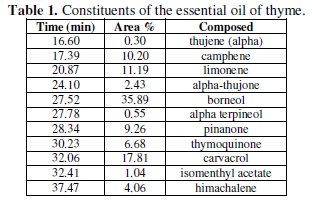
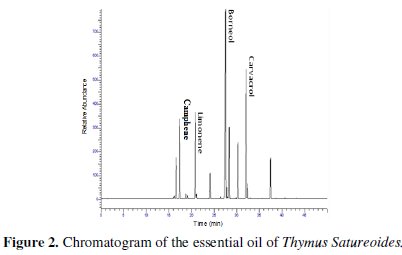
    <p>The essential oil of thyme Thymus Satureoides belongs to the botanical family 
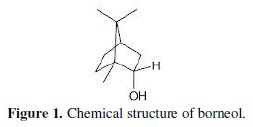
lipped and has the following major components: borneol (35.9%) (<a href="#f1">Fig. 1</a>), 
carvacrol (17.8%), camphene (10.2%), &alpha;-thujone (2.4%) and &alpha;-terpineol (0.6%).</p>


    <p>&nbsp;</p>
<a name="f1">
<img src="/img/revistas/pea/v31n4/31n4a03f1.jpg">
    
]]></body>
<body><![CDATA[<p>&nbsp;</p>


    <p>Analysis of the chemical composition of the essential oil was performed by gas 
chromatography coupled with mass spectrometry. The chromatogram obtained is 
shown in <a href="#f2">Fig. 2</a> the retention times and the relative percentages of the various 
constituents of the essential oil are shown in <a href="#t1">Table 1</a>.</p>


    <p>&nbsp;</p>
<a name="f2">
<img src="/img/revistas/pea/v31n4/31n4a03f2.jpg">
    
<p>&nbsp;</p>
<a name="t1">
<img src="/img/revistas/pea/v31n4/31n4a03t1.jpg">
    
<p>&nbsp;</p>

 
    <p><b><i>Weight loss measurement</i></b></p>

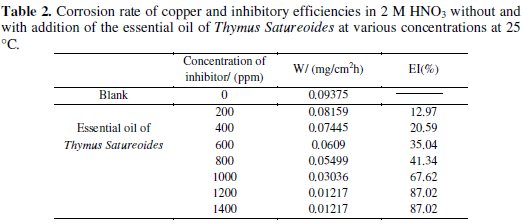
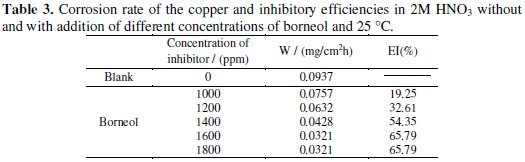
    <p>The corrosion rate of the copper is determined by weight loss measurement after 
1 hour immersion in 2 M HNO<sub>3</sub> with and without addition of inhibitors at 
different concentrations. The inhibition efficiency (IE %) of the compounds is 
calculated from the following equation:</p>


    <p>&nbsp;</p>
<a name="e1">
<img src="/img/revistas/pea/v31n4/31n4a03e1.jpg">
    
<p>&nbsp;</p>

 
    <p>where W<sub>0</sub> and W are, respectively, the corrosion rates of copper in 2 M HNO<sub>3</sub> 
without and with addition of the compound tested. The results of the study are 
summarized in <a href="#t2">Table 2</a> for the case of essential oil and in <a href="#t3">Table 3</a> for the case of 
borneol.</p>


    ]]></body>
<body><![CDATA[<p>&nbsp;</p>
<a name="t2">
<img src="/img/revistas/pea/v31n4/31n4a03t2.jpg">
    
<p>&nbsp;</p>
<a name="t3">
<img src="/img/revistas/pea/v31n4/31n4a03t3.jpg">
    
<p>&nbsp;</p>

 
    <p>From analysis of the two tables, we can see that the increase of the concentration 
of the inhibitors is accompanied by a decrease in the corrosion rate. This 
decrease is significant even at low concentrations (600 ppm) for the essential oil. 
The inhibition efficiency reached 87.02% at 1200 ppm for the essential oil of 
Thymus Satureoides, and 65.79% at 1600 ppm for the major product (borneol) of 
this essential oil. Hence we can say that the inhibitory effect of the essential oil 
of Thymus Satureoides is not due to its main chemical component (borneol) 
alone, but to a synergy between its different chemical compounds.</p>

    <p>This decrease in corrosion rate (w) of copper is probably due to the adsorption of 
these compounds on the metal surface [21]. This behavior could be attributed to 
the strong interaction of the inhibitors with the metal surface [22].</p>


    <p>&nbsp;</p>
    <p><b><i>Electrochemical measurements</i></b></p>

    <p><i>Case of the essential oil of Thymus Satureoides</i></p>

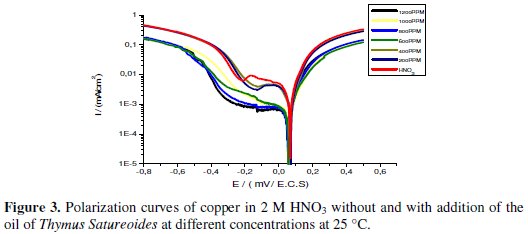
    <p>The polarization behavior of copper in 2 M HNO<sub>3</sub> with and without addition of 
the inhibitor is shown in <a href="#f3">Fig. 3</a>.</p>


    <p>&nbsp;</p>
<a name="f3">
<img src="/img/revistas/pea/v31n4/31n4a03f3.jpg">
    
]]></body>
<body><![CDATA[<p>&nbsp;</p>

 
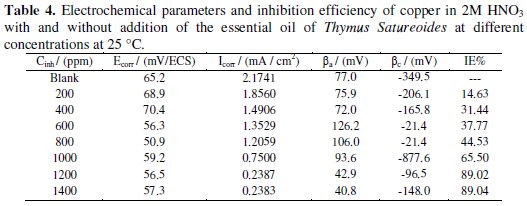
    <p>The electrochemical parameters, values of 
corrosion current (I<sub>corr</sub>), corrosion potential (E<sub>corr</sub>), cathodic Tafel slope (&beta;<sub>c</sub>), 
anodic Tafel slope (&beta;<sub>a</sub>) and the efficiency of inhibition (IE %) are given in <a href="#t4">Table 4</a>.</p>


    <p>&nbsp;</p>
<a name="t4">
<img src="/img/revistas/pea/v31n4/31n4a03t4.jpg">
    
<p>&nbsp;</p>

 
    <p>The inhibition efficiency IE% of the compounds tested is defined by the 
following equation:</p>


    <p>&nbsp;</p>
<a name="e2">
<img src="/img/revistas/pea/v31n4/31n4a03e2.jpg">
    
<p>&nbsp;</p>

 
    <p>where I<sub>corr</sub> and I'<sub>corr</sub>, respectively, represent corrosion current densities 
determined by extrapolation of the straight Tafel corrosion potential without and 
with addition of the inhibitor.</p>

    <p>Examination of <a href="#f3">Fig. 3</a> and <a href="#t4">Table 4</a> allows us to conclude that the addition of the 
tested compound causes a slight shift of the corrosion potential but with a 
tendency towards the cathode values. This displacement is accompanied by a net 
decrease of the densities of anodic and cathodic current which is more marked 
when the concentration of the inhibitor increases until a critical concentration at 
which the value of 0.2387 mA / cm<sup>2</sup> is obtained, corresponding to an efficiency 
of 89.02%.</p>

    <p>This decrease of the current can be explained by the inhibiting action of this 
inhibitor, caused by the adsorption of the chemical compounds of the essential oil 
on the surface of the active electrode sites, creating a barrier that slows the 
dissolution of copper in the anodic sites and the release of hydrogen by blocking 
the hydrogen reduction at the cathodic sites.</p>

    ]]></body>
<body><![CDATA[<p>This result suggests that the reaction mechanism is virtually unaffected by the 
addition of the inhibitor. In the light of these results we noted the mixed nature of 
the inhibitor used with predominant cathodic effectiveness [23].</p>


    <p>&nbsp;</p>
    <p><i>Case of borneol</i></p>

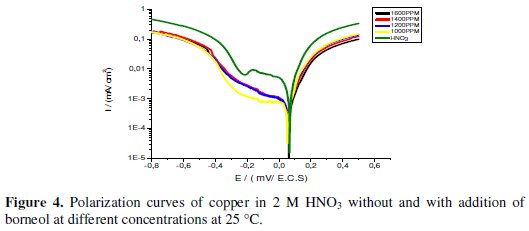
    <p>The polarization behavior of copper in 2 M HNO<sub>3</sub> with and without addition of 
the inhibitor is shown in <a href="#f4">Fig. 4</a>.</p>


    <p>&nbsp;</p>
<a name="f4">
<img src="/img/revistas/pea/v31n4/31n4a03f4.jpg">
    
<p>&nbsp;</p>

 
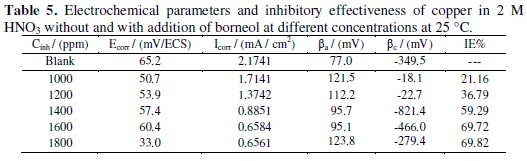
    <p>The electrochemical parameters, values of 
corrosion current (I<sub>corr</sub>), corrosion potential (E<sub>corr</sub>), cathodic Tafel slope (&beta;c), 
anodic Tafel slope (&beta;a) and the efficiency of inhibition (IE %) are given in <a href="#t5">Table 5</a>.</p>


    <p>&nbsp;</p>
<a name="t5">
<img src="/img/revistas/pea/v31n4/31n4a03t5.jpg">
    
<p>&nbsp;</p>

 
    <p>The analysis of <a href="#f4">Fig. 4</a> and <a href="#t5">Table 5</a> shows that the addition of this inhibitor results 
in a slight shift of the corrosion potential with a tendency towards cathodic 
values. This shift accompanied by a decrease in the cathodic and anodic current 
is due to the inhibitory action of a mixed character of borneol. And the inhibition 
efficiency calculated by electrochemical measurement of the essential oil 
(Thymus Satureoides 89.02% to 1200 ppm) is higher than that measured in the 
presence of its major product alone (69.72% borneol to 1600 ppm).</p>

    ]]></body>
<body><![CDATA[<p>Following these findings, we note that the results relating to gravimetric 
measurements and those relating to electrochemical measurements are in good 
agreement.</p>


    <p>&nbsp;</p>
    <p><b><i>Adsorption isotherms</i></b></p>

    <p>The adsorption isotherms are very important for understanding the mechanism of 
the electrochemical reactions of metals [24]. Knowledge of the type of 
adsorption and the determination of the thermodynamic parameters 
characterizing the adsorption often helps to elucidate the mode of action of these 
inhibitors.</p>

    <p>The most frequently used isotherms are Langmuir, Frumkin and Temkin ones [25].</p>

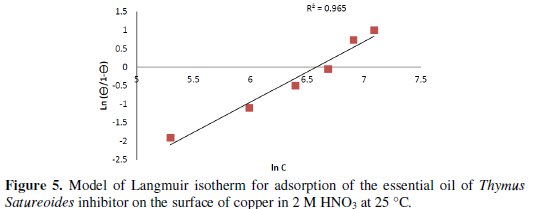
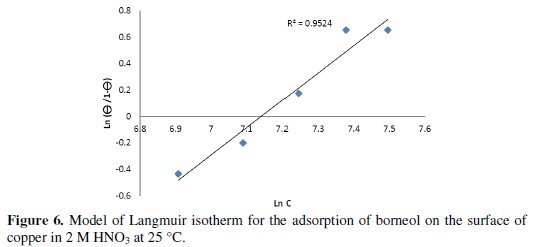
    <p>The recovery rate (&Theta;) at different concentrations for the inhibitors tested in 2 M 
HNO<sub>3</sub> was assessed from measurements of weight loss.</p>

    <p>The curve representing ln (&Theta; / &Theta;-1) as a function of ln [C], where C is the 
concentration of the inhibitor, is a straight line (<a href="#f5">Fig. 5</a>) for the essential oil of 
Thymus satureoides, and (<a href="#f6">Fig. 6</a>) for borneol, indicating that the adsorption of the 
two inhibitors on the surface of the copper plate is made according to the 
Langmuir model:</p>


    <p>&nbsp;</p>
<a name="e3">
<img src="/img/revistas/pea/v31n4/31n4a03e3.jpg">
    
<p>&nbsp;</p>
<a name="f5">
<img src="/img/revistas/pea/v31n4/31n4a03f5.jpg">
    
<p>&nbsp;</p>
<a name="f6">
<img src="/img/revistas/pea/v31n4/31n4a03f6.jpg">
    
]]></body>
<body><![CDATA[<p>&nbsp;</p>

 
    <p>
 
    <p>The strong correlation (R<sup>2</sup> = 0.965 for the essential oil of Thymus Satureoides 
and R<sup>2</sup> = 0.952 for borneol) for the plot of the Langmuir adsorption isotherm 
tested inhibitors confirms the validity of this approach.</p>

    <p>Based on the Langmuir isotherm model, it is possible to approach to the 
representation of adsorption phenomena, which is based on three assumptions, 
explaining that the adsorption is localized and does not give rise to the formation 
of a monolayer, and all sites are equivalent and the surface is uniform, and that 
there is no interaction between the adsorbed molecules. This allows to consider a 
constant adsorption energy [25].</p>


    <p>&nbsp;</p>
    <p><b><i>Effect of temperature</i></b></p>

    <p>It is well known that increasing the temperature always aggravates the problem 
of corrosion in the absence of an effective inhibitor which must necessarily be 
stable and resistant to both the increase in the concentration of the acid and the 
rise of temperature.</p>

    <p>The study of the influence of temperature on the rate of inhibition leads to 
several information including the mechanism of inhibition and activation energy. 
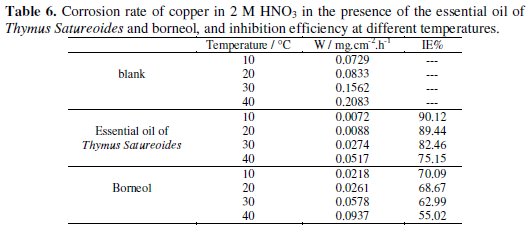
Given the importance of this factor, we conducted trials of weight loss of copper 
in 2 M HNO<sub>3</sub> with the addition of the essential oil of Thymus satureoides and of 
borneol at different temperatures between 10 and 40 &deg;C. The values of the rate 
corrosion and inhibitory efficacy as a function of temperature are given in <a href="#t6">Table 6</a>.</p>


    <p>&nbsp;</p>
<a name="t6">
<img src="/img/revistas/pea/v31n4/31n4a03t6.jpg">
    
<p>&nbsp;</p>

 
    ]]></body>
<body><![CDATA[<p>The overall results showed that the corrosion rate of copper increases with 
temperature. However, the inhibition efficiency is changing in the opposite 
direction for the two cases. This implies that these inhibitors are adsorbed on the 
substrate by electrostatic bonds (weak bonds). This type of temperature-sensitive 
links cannot fight effectively against corrosion when the temperature increases 
[26].</p>

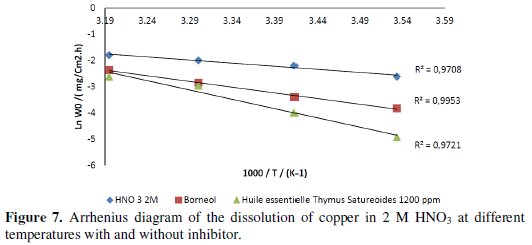
    <p>In the case of the acid corrosion, many authors [27] use of the Arrhenius equation 
to account for the effect of temperature (T) on the rate of corrosion and therefore 
believe that the logarithm of the rate of corrosion W is a linear function of T<sup>-1</sup>. 
We can calculate the activation energy from the following relationship:</p>


    <p>&nbsp;</p>
<a name="e4">
<img src="/img/revistas/pea/v31n4/31n4a03e4.jpg">
    
<p>&nbsp;</p>

 
    <p>and</p>


    <p>&nbsp;</p>
<a name="e5">
<img src="/img/revistas/pea/v31n4/31n4a03e5.jpg">
    
<p>&nbsp;</p>

 
    <p>where K and K' are constants (Arrhenius pre-exponential parameter), and the E<sub>a</sub> 
and E'<sub>a</sub> activation energies, respectively in the absence and presence of the 
inhibitor.</p>

    <p><a href="#f7">Fig. 7</a> shows the Arrhenius plot of coordinates in the corrosion rate of copper in 
HNO<sub>3</sub> in the absence and presence of the essential oil of Thymus satureoides at 
1200 ppm and at 1600 ppm of borneol.</p>


    <p>&nbsp;</p>
<a name="f7">
<img src="/img/revistas/pea/v31n4/31n4a03f7.jpg">
    
]]></body>
<body><![CDATA[<p>&nbsp;</p>

 
    <p>The variation of the logarithm of the corrosion rate as a function of T<sup>-1</sup> in the 
three cases (<a href="#f7">Fig. 7</a>) provides lines showing that Arrhenius law is enforced. The 
values of the activation energy obtained from straight lines are given in <a href="#t7">Table 7</a>.</p>


    <p>&nbsp;</p>
<a name="t7">
<img src="/img/revistas/pea/v31n4/31n4a03t7.jpg">
    
<p>&nbsp;</p>


    <p>From the results of <a href="#t7">Table 7</a> it is clear that in the presence of each of the two 
inhibitors tested in solution, Ea increases. It is observed that the activation energy 
increases with the addition of the inhibitor for the two inhibitors tested, while the 
IE% decreases as the temperature increases. This behavior is reported as a 
characteristic phenomenon of physisorption inhibition to the metal surface. The 
recovery rate, lower at higher temperatures, suggests that at these temperatures 
the rate of destruction of the film physically adsorbed increases faster than its 
rate of formation.</p>

    <p>This phenomenon can also be explained by the fact that the process of corrosion 
of copper in the presence of the inhibitor does not depend only on the reaction 
that takes place on the surface of bare metal, but also on the dissemination of 
Cu<sup>2+</sup> ions through the layer of the adsorbed inhibitor [26-27].</p>

    <p>The value of activation energy derived from the Arrhenius straight is 19.66 
kJ.mol<sup>-1</sup> in the absence of the inhibitor; this value is in agreement with the 
literature [28], and at a concentration of 1200 ppm for essential oil and 1600 ppm 
for borneol, i.e., when the rate of recovery is maximum, the value of the 
activation energy in the presence of this oil is 58.93 kJ.mol<sup>-1</sup>, while it is only 
36.21 kJ mol<sup>-1</sup> for borneol alone. This confirms that the physical adsorption of 
the essential oil of Thymus Satureoides is stronger than that of borneol, noting 
that its action is due to a synergy of its chemical compounds and the formation of 
a more adherent surface film thus making it more effective than that formed in 
the presence of its major constituent alone.</p>


    <p>&nbsp;</p>
    <p><b>General discussion</b></p>

    <p>Addition of this inhibitor in a corrosive nitric medium (2 M), results in a 
significant reduction of the corrosion rate.</p>

    ]]></body>
<body><![CDATA[<p>Moreover, the hydrogen overvoltage may decrease or increase depending on the 
nature of the metal, the electrolyte, and polarization conditions [29]. In this case 
the hydrogen overvoltage of copper is much greater in the presence of the 
inhibitor.</p>

    <p>The essential oil of thyme can thus be considered among the inhibitors of 
corrosion which provoke the increase in the overvoltage of hydrogen [30], 
leading to the blockage of the cathodic reduction of hydrogen.</p>

    <p>Furthermore, the influence of the inhibitor on the nobility of the corrosion 
potential is due to the acceleration of the formation of the protective layer into 
the nitric acid medium.</p>

    <p>The comparison of electrochemical results obtained in this study shows that the 
addition of the essential oil of Thymus Satureoides has a more pronounced effect 
than that of its major constituent, borneol alone.</p>

    <p>Also, we found that the maximum efficiency of 89.02% is achieved at 1200 ppm 
of the total oil, while it is only 69.72% at a higher concentration of 1600 ppm in 
the case of borneol.</p>

    <p>Moreover, with the same concentrations, the corrosion current in the presence of 
borneol decreases to a value of 0.6561 mA/cm<sup>2</sup>, remaining a value much higher 
than that obtained with the total essential oil which is in the order of 0.2383 
mA/cm<sup>2</sup>.</p>

    <p>Regarding the Tafel slopes, in the presence of inhibitors, their values change, but 
this does not necessarily mean a change in the mechanism of the reaction. 
Indeed, when the recovery rate increases with the inhibitor concentration, the 
active sites electrode is reduced and the adsorbed film may have an ohmic 
behavior, which is manifested by a change in the value of &beta;c and &beta;a. 
So while having a good corrosion inhibiting efficiency which slows down the 
corrosion process, the reduction of nitric acid, the release of hydrogen and the 
dissolving of copper following the same mechanism takes place in the absence of 
the inhibitor at the free sites of the metal.[29]</p>


    <p>&nbsp;</p>
    <p><b>Conclusions</b></p>

    <p>Based on the above results, the following conclusions can be drawn:</p>

    ]]></body>
<body><![CDATA[<p>&bull; The essential oil of Thymus Satureoides proved to be an effective inhibitor for 
the corrosion of copper in 2M HNO<sub>3</sub>. The study also showed that this activity 
is mainly due to a synergy between the chemicals constituting the Thymus 
Satureoides oil, and not just to its major constituent (borneol) alone.</p>

    <p>&bull; The effectiveness of inhibitors increases with the inhibitor concentration to 
reach 89.02% at 1200 ppm for the essential oil of Thymus Satureoides, and 
69.72% at 1600 ppm for the major constituent alone.</p>

    <p>&bull; The displacement of the value of the corrosion potential with electrochemical 
results shows that the inhibitors tested act as mixed type inhibitors with 
predominant cathodic effectiveness for the essential oil.</p>

    <p>&bull; The increase in temperature affects the inhibitory efficacy, as it decreases with 
the temperature increase.</p>

    <p>&bull; The two inhibitors are physisorbed onto the surface of copper according to the 
Langmuir isotherm model.</p>


    <p>&nbsp;</p>
    <p><b>References</b></p>

    <!-- ref --><p>1. Fouda A S, Gomah S, Moussa M N. Corr Prot Mater. 2003;22:21.    &nbsp;&nbsp;&nbsp;&nbsp;&nbsp;&nbsp;&nbsp;&nbsp;[&#160;<a href="javascript:void(0);" onclick="javascript: window.open('/scielo.php?script=sci_nlinks&ref=000140&pid=S0872-1904201300040000300001&lng=','','width=640,height=500,resizable=yes,scrollbars=1,menubar=yes,');">Links</a>&#160;]<!-- end-ref --></p>

    <!-- ref --><p>2. Lee W J. Mater Sci Eng A. 2003;348:217.    &nbsp;&nbsp;&nbsp;&nbsp;&nbsp;&nbsp;&nbsp;&nbsp;[&#160;<a href="javascript:void(0);" onclick="javascript: window.open('/scielo.php?script=sci_nlinks&ref=000142&pid=S0872-1904201300040000300002&lng=','','width=640,height=500,resizable=yes,scrollbars=1,menubar=yes,');">Links</a>&#160;]<!-- end-ref --></p>

    <!-- ref --><p>3. Mostafa H A, Zaghloul E I, Moussa M N. Port Electrochim Acta. 2002;20:63.    &nbsp;&nbsp;&nbsp;&nbsp;&nbsp;&nbsp;&nbsp;&nbsp;[&#160;<a href="javascript:void(0);" onclick="javascript: window.open('/scielo.php?script=sci_nlinks&ref=000144&pid=S0872-1904201300040000300003&lng=','','width=640,height=500,resizable=yes,scrollbars=1,menubar=yes,');">Links</a>&#160;]<!-- end-ref --></p>

    <!-- ref --><p>4. Mostafa H A, El-Maskoud S A A, Moussa M N H. Port Electrochim Acta. 2001;19:109.    &nbsp;&nbsp;&nbsp;&nbsp;&nbsp;&nbsp;&nbsp;&nbsp;[&#160;<a href="javascript:void(0);" onclick="javascript: window.open('/scielo.php?script=sci_nlinks&ref=000146&pid=S0872-1904201300040000300004&lng=','','width=640,height=500,resizable=yes,scrollbars=1,menubar=yes,');">Links</a>&#160;]<!-- end-ref --></p>

    <!-- ref --><p>5. El-Maskoud S A A, El-Shafei A A, Mostafa H A, et al. Mater Corros. 1992;46:468.    &nbsp;&nbsp;&nbsp;&nbsp;&nbsp;&nbsp;&nbsp;&nbsp;[&#160;<a href="javascript:void(0);" onclick="javascript: window.open('/scielo.php?script=sci_nlinks&ref=000148&pid=S0872-1904201300040000300005&lng=','','width=640,height=500,resizable=yes,scrollbars=1,menubar=yes,');">Links</a>&#160;]<!-- end-ref --></p>

    <!-- ref --><p>6. Chakraborty S B, Bandyopadhyay T K, Chaudhuri S R. Bull Electrochem. 1992;8:111.    &nbsp;&nbsp;&nbsp;&nbsp;&nbsp;&nbsp;&nbsp;&nbsp;[&#160;<a href="javascript:void(0);" onclick="javascript: window.open('/scielo.php?script=sci_nlinks&ref=000150&pid=S0872-1904201300040000300006&lng=','','width=640,height=500,resizable=yes,scrollbars=1,menubar=yes,');">Links</a>&#160;]<!-- end-ref --></p>

    <!-- ref --><p>7. Fouda A S, Mohamed A K. J Electrochem Soc India. 1990;39:244.    &nbsp;&nbsp;&nbsp;&nbsp;&nbsp;&nbsp;&nbsp;&nbsp;[&#160;<a href="javascript:void(0);" onclick="javascript: window.open('/scielo.php?script=sci_nlinks&ref=000152&pid=S0872-1904201300040000300007&lng=','','width=640,height=500,resizable=yes,scrollbars=1,menubar=yes,');">Links</a>&#160;]<!-- end-ref --></p>

    <!-- ref --><p>8. Benabdellah M, Benkaddour M, Hammouti B, et al. Appl Surf Sci. 2006;252:6212.    &nbsp;&nbsp;&nbsp;&nbsp;&nbsp;&nbsp;&nbsp;&nbsp;[&#160;<a href="javascript:void(0);" onclick="javascript: window.open('/scielo.php?script=sci_nlinks&ref=000154&pid=S0872-1904201300040000300008&lng=','','width=640,height=500,resizable=yes,scrollbars=1,menubar=yes,');">Links</a>&#160;]<!-- end-ref --></p>

    <!-- ref --><p>9. Bouyanzer A, Hammouti B. Pigment Resin Tech. 2004;33:287.    &nbsp;&nbsp;&nbsp;&nbsp;&nbsp;&nbsp;&nbsp;&nbsp;[&#160;<a href="javascript:void(0);" onclick="javascript: window.open('/scielo.php?script=sci_nlinks&ref=000156&pid=S0872-1904201300040000300009&lng=','','width=640,height=500,resizable=yes,scrollbars=1,menubar=yes,');">Links</a>&#160;]<!-- end-ref --></p>

    <!-- ref --><p>10. Ouachikh O, Bouyanzer A, Bouklah M, et al. Surf Rev Lett. 2009;16:49.    &nbsp;&nbsp;&nbsp;&nbsp;&nbsp;&nbsp;&nbsp;&nbsp;[&#160;<a href="javascript:void(0);" onclick="javascript: window.open('/scielo.php?script=sci_nlinks&ref=000158&pid=S0872-1904201300040000300010&lng=','','width=640,height=500,resizable=yes,scrollbars=1,menubar=yes,');">Links</a>&#160;]<!-- end-ref --></p>

    <!-- ref --><p>11. Bouyanzer A, Majidi L, Hammouti B. Bull Electrochem. 2006;22:321.    &nbsp;&nbsp;&nbsp;&nbsp;&nbsp;&nbsp;&nbsp;&nbsp;[&#160;<a href="javascript:void(0);" onclick="javascript: window.open('/scielo.php?script=sci_nlinks&ref=000160&pid=S0872-1904201300040000300011&lng=','','width=640,height=500,resizable=yes,scrollbars=1,menubar=yes,');">Links</a>&#160;]<!-- end-ref --></p>

    <!-- ref --><p>12. Torres V V, Amado R S, Sa C F, et al. Corros Sci. 2011;53:2385.    &nbsp;&nbsp;&nbsp;&nbsp;&nbsp;&nbsp;&nbsp;&nbsp;[&#160;<a href="javascript:void(0);" onclick="javascript: window.open('/scielo.php?script=sci_nlinks&ref=000162&pid=S0872-1904201300040000300012&lng=','','width=640,height=500,resizable=yes,scrollbars=1,menubar=yes,');">Links</a>&#160;]<!-- end-ref --></p>

    <!-- ref --><p>13. Abdallah M, Al Karanee S O, Fatah A A A. Chem Eng Comm. 2010;197:1446.    &nbsp;&nbsp;&nbsp;&nbsp;&nbsp;&nbsp;&nbsp;&nbsp;[&#160;<a href="javascript:void(0);" onclick="javascript: window.open('/scielo.php?script=sci_nlinks&ref=000164&pid=S0872-1904201300040000300013&lng=','','width=640,height=500,resizable=yes,scrollbars=1,menubar=yes,');">Links</a>&#160;]<!-- end-ref --></p>

    <!-- ref --><p>14. Rocha J, Gomes J C P, Elia E. Corros Sci. 2010;52:2341.    &nbsp;&nbsp;&nbsp;&nbsp;&nbsp;&nbsp;&nbsp;&nbsp;[&#160;<a href="javascript:void(0);" onclick="javascript: window.open('/scielo.php?script=sci_nlinks&ref=000166&pid=S0872-1904201300040000300014&lng=','','width=640,height=500,resizable=yes,scrollbars=1,menubar=yes,');">Links</a>&#160;]<!-- end-ref --></p>

    <!-- ref --><p>15. El-Etre A Y, Khillah. Appl Surf Sci. 2006;252:8521.    &nbsp;&nbsp;&nbsp;&nbsp;&nbsp;&nbsp;&nbsp;&nbsp;[&#160;<a href="javascript:void(0);" onclick="javascript: window.open('/scielo.php?script=sci_nlinks&ref=000168&pid=S0872-1904201300040000300015&lng=','','width=640,height=500,resizable=yes,scrollbars=1,menubar=yes,');">Links</a>&#160;]<!-- end-ref --></p>

    <!-- ref --><p>16. Faska Z, Bellioua A, Bouklah M, et al. Monatsh Chem. 2008;139:1417.    &nbsp;&nbsp;&nbsp;&nbsp;&nbsp;&nbsp;&nbsp;&nbsp;[&#160;<a href="javascript:void(0);" onclick="javascript: window.open('/scielo.php?script=sci_nlinks&ref=000170&pid=S0872-1904201300040000300016&lng=','','width=640,height=500,resizable=yes,scrollbars=1,menubar=yes,');">Links</a>&#160;]<!-- end-ref --></p>

    <!-- ref --><p>17. Halambek J, Berkovic K, Vorkapic-Furac J. Corros Sci. 2010;52:3978.    &nbsp;&nbsp;&nbsp;&nbsp;&nbsp;&nbsp;&nbsp;&nbsp;[&#160;<a href="javascript:void(0);" onclick="javascript: window.open('/scielo.php?script=sci_nlinks&ref=000172&pid=S0872-1904201300040000300017&lng=','','width=640,height=500,resizable=yes,scrollbars=1,menubar=yes,');">Links</a>&#160;]<!-- end-ref --></p>

    <!-- ref --><p>18. Bouyanzer A, Majid L, Hammouti B. Phys Chem News. 2007;37:70.    &nbsp;&nbsp;&nbsp;&nbsp;&nbsp;&nbsp;&nbsp;&nbsp;[&#160;<a href="javascript:void(0);" onclick="javascript: window.open('/scielo.php?script=sci_nlinks&ref=000174&pid=S0872-1904201300040000300018&lng=','','width=640,height=500,resizable=yes,scrollbars=1,menubar=yes,');">Links</a>&#160;]<!-- end-ref --></p>

    <!-- ref --><p>19. Bendahou M, Benabdellah M, Hammouti B. Pigment Resin Tech. 2006;95.    &nbsp;&nbsp;&nbsp;&nbsp;&nbsp;&nbsp;&nbsp;&nbsp;[&#160;<a href="javascript:void(0);" onclick="javascript: window.open('/scielo.php?script=sci_nlinks&ref=000176&pid=S0872-1904201300040000300019&lng=','','width=640,height=500,resizable=yes,scrollbars=1,menubar=yes,');">Links</a>&#160;]<!-- end-ref --></p>

    <!-- ref --><p>20. Chaieb E, Bouyanzer A, Hammouti B, et al. Acta Phys Chim Sin. 2009;25.    &nbsp;&nbsp;&nbsp;&nbsp;&nbsp;&nbsp;&nbsp;&nbsp;[&#160;<a href="javascript:void(0);" onclick="javascript: window.open('/scielo.php?script=sci_nlinks&ref=000178&pid=S0872-1904201300040000300020&lng=','','width=640,height=500,resizable=yes,scrollbars=1,menubar=yes,');">Links</a>&#160;]<!-- end-ref --></p>

    <!-- ref --><p>21. Muralidharan S, Phani K L N, Pitchumani S, et al. J Electrochem Soc. 1995;142:1478.    &nbsp;&nbsp;&nbsp;&nbsp;&nbsp;&nbsp;&nbsp;&nbsp;[&#160;<a href="javascript:void(0);" onclick="javascript: window.open('/scielo.php?script=sci_nlinks&ref=000180&pid=S0872-1904201300040000300021&lng=','','width=640,height=500,resizable=yes,scrollbars=1,menubar=yes,');">Links</a>&#160;]<!-- end-ref --></p>

    <!-- ref --><p>22. Chaudhary R S, Sharma S. Indian J Chem Technol. 1999;6:202.    &nbsp;&nbsp;&nbsp;&nbsp;&nbsp;&nbsp;&nbsp;&nbsp;[&#160;<a href="javascript:void(0);" onclick="javascript: window.open('/scielo.php?script=sci_nlinks&ref=000182&pid=S0872-1904201300040000300022&lng=','','width=640,height=500,resizable=yes,scrollbars=1,menubar=yes,');">Links</a>&#160;]<!-- end-ref --></p>

    <!-- ref --><p>23. Fouda A S, Wahed H A. Arab J Chem. 2011.    &nbsp;&nbsp;&nbsp;&nbsp;&nbsp;&nbsp;&nbsp;&nbsp;[&#160;<a href="javascript:void(0);" onclick="javascript: window.open('/scielo.php?script=sci_nlinks&ref=000184&pid=S0872-1904201300040000300023&lng=','','width=640,height=500,resizable=yes,scrollbars=1,menubar=yes,');">Links</a>&#160;]<!-- end-ref --></p>

    <!-- ref --><p>24. Hackerman N, McCafferty E. Proceedings of the 5th International Congress on Metallic Corrosion. Houston, TX; 1974. p. 542.    &nbsp;&nbsp;&nbsp;&nbsp;&nbsp;&nbsp;&nbsp;&nbsp;[&#160;<a href="javascript:void(0);" onclick="javascript: window.open('/scielo.php?script=sci_nlinks&ref=000186&pid=S0872-1904201300040000300024&lng=','','width=640,height=500,resizable=yes,scrollbars=1,menubar=yes,');">Links</a>&#160;]<!-- end-ref --></p>

    <!-- ref --><p>25. Bilgic S, Caliskan N. Appl Surf Sci. 1999;152:107.    &nbsp;&nbsp;&nbsp;&nbsp;&nbsp;&nbsp;&nbsp;&nbsp;[&#160;<a href="javascript:void(0);" onclick="javascript: window.open('/scielo.php?script=sci_nlinks&ref=000188&pid=S0872-1904201300040000300025&lng=','','width=640,height=500,resizable=yes,scrollbars=1,menubar=yes,');">Links</a>&#160;]<!-- end-ref --></p>

    <!-- ref --><p>26. Fouda A S, Mohamed A K. J Electrochem Soc India. 1990;39:244.    &nbsp;&nbsp;&nbsp;&nbsp;&nbsp;&nbsp;&nbsp;&nbsp;[&#160;<a href="javascript:void(0);" onclick="javascript: window.open('/scielo.php?script=sci_nlinks&ref=000190&pid=S0872-1904201300040000300026&lng=','','width=640,height=500,resizable=yes,scrollbars=1,menubar=yes,');">Links</a>&#160;]<!-- end-ref --></p>

    <!-- ref --><p>27. Fiala A. These d'etat. Universite Mentouri-Constantine; 2007.    &nbsp;&nbsp;&nbsp;&nbsp;&nbsp;&nbsp;&nbsp;&nbsp;[&#160;<a href="javascript:void(0);" onclick="javascript: window.open('/scielo.php?script=sci_nlinks&ref=000192&pid=S0872-1904201300040000300027&lng=','','width=640,height=500,resizable=yes,scrollbars=1,menubar=yes,');">Links</a>&#160;]<!-- end-ref --></p>

    <!-- ref --><p>28. Mostafa A B. Corros Prevention Control. 1980; 70.    &nbsp;&nbsp;&nbsp;&nbsp;&nbsp;&nbsp;&nbsp;&nbsp;[&#160;<a href="javascript:void(0);" onclick="javascript: window.open('/scielo.php?script=sci_nlinks&ref=000194&pid=S0872-1904201300040000300028&lng=','','width=640,height=500,resizable=yes,scrollbars=1,menubar=yes,');">Links</a>&#160;]<!-- end-ref --></p>

    <!-- ref --><p>29. L'hydrogene dans les aciers. <a href="http://thesis.sangoru.com/these_docs/I_hydrogen_LR_these.pdf" target="_blank">http://thesis.sangoru.com/these_docs/I_hydrogen_LR_these.pdf</a>.    &nbsp;&nbsp;&nbsp;&nbsp;&nbsp;&nbsp;&nbsp;&nbsp;[&#160;<a href="javascript:void(0);" onclick="javascript: window.open('/scielo.php?script=sci_nlinks&ref=000196&pid=S0872-1904201300040000300029&lng=','','width=640,height=500,resizable=yes,scrollbars=1,menubar=yes,');">Links</a>&#160;]<!-- end-ref --></p>

    <!-- ref --><p>30. Schmidt R. Presses polytechniques et universitaires romandes. 1999.    &nbsp;&nbsp;&nbsp;&nbsp;&nbsp;&nbsp;&nbsp;&nbsp;[&#160;<a href="javascript:void(0);" onclick="javascript: window.open('/scielo.php?script=sci_nlinks&ref=000198&pid=S0872-1904201300040000300030&lng=','','width=640,height=500,resizable=yes,scrollbars=1,menubar=yes,');">Links</a>&#160;]<!-- end-ref --></p>

    <!-- ref --><p>31. Etude cinetique. <a href="http://sotofab.free.fr/theseIII.html" target="_blank">http://sotofab.free.fr/theseIII.html</a>.    &nbsp;&nbsp;&nbsp;&nbsp;&nbsp;&nbsp;&nbsp;&nbsp;[&#160;<a href="javascript:void(0);" onclick="javascript: window.open('/scielo.php?script=sci_nlinks&ref=000200&pid=S0872-1904201300040000300031&lng=','','width=640,height=500,resizable=yes,scrollbars=1,menubar=yes,');">Links</a>&#160;]<!-- end-ref --></p>

    <!-- ref --><p>32. Bilel M. These d'etat. Universite Mentouri-Constantine; 2011.    &nbsp;&nbsp;&nbsp;&nbsp;&nbsp;&nbsp;&nbsp;&nbsp;[&#160;<a href="javascript:void(0);" onclick="javascript: window.open('/scielo.php?script=sci_nlinks&ref=000202&pid=S0872-1904201300040000300032&lng=','','width=640,height=500,resizable=yes,scrollbars=1,menubar=yes,');">Links</a>&#160;]<!-- end-ref --></p>


    <p>&nbsp;</p>
    <p><a name=0></a><sup><a href="#top">*</a></sup>Corresponding author. E-mail address: <a href="mailto:sara.houbairi@gmail.com">sara.houbairi@gmail.com</a></p>

    <p>Received 30 July 2013; accepted 31 August 2013</p>

    <p><a href="http://www.peacta.org" target="_blank">www.peacta.org</a></p>


     ]]></body><back>
<ref-list>
<ref id="B1">
<label>1</label><nlm-citation citation-type="journal">
<person-group person-group-type="author">
<name>
<surname><![CDATA[Fouda]]></surname>
<given-names><![CDATA[A S]]></given-names>
</name>
<name>
<surname><![CDATA[Gomah]]></surname>
<given-names><![CDATA[S]]></given-names>
</name>
<name>
<surname><![CDATA[Moussa]]></surname>
<given-names><![CDATA[M N]]></given-names>
</name>
</person-group>
<source><![CDATA[Corr Prot Mater]]></source>
<year>2003</year>
<volume>22</volume>
<page-range>21</page-range></nlm-citation>
</ref>
<ref id="B2">
<label>2</label><nlm-citation citation-type="journal">
<person-group person-group-type="author">
<name>
<surname><![CDATA[Lee]]></surname>
<given-names><![CDATA[W J]]></given-names>
</name>
</person-group>
<source><![CDATA[Mater Sci Eng A]]></source>
<year>2003</year>
<volume>348</volume>
<page-range>217</page-range></nlm-citation>
</ref>
<ref id="B3">
<label>3</label><nlm-citation citation-type="journal">
<person-group person-group-type="author">
<name>
<surname><![CDATA[Mostafa]]></surname>
<given-names><![CDATA[H A]]></given-names>
</name>
<name>
<surname><![CDATA[Zaghloul]]></surname>
<given-names><![CDATA[E I]]></given-names>
</name>
<name>
<surname><![CDATA[Moussa]]></surname>
<given-names><![CDATA[M N]]></given-names>
</name>
</person-group>
<source><![CDATA[Port Electrochim Acta]]></source>
<year>2002</year>
<volume>20</volume>
<page-range>63</page-range></nlm-citation>
</ref>
<ref id="B4">
<label>4</label><nlm-citation citation-type="journal">
<person-group person-group-type="author">
<name>
<surname><![CDATA[Mostafa]]></surname>
<given-names><![CDATA[H A]]></given-names>
</name>
<name>
<surname><![CDATA[El-Maskoud]]></surname>
<given-names><![CDATA[S A A]]></given-names>
</name>
<name>
<surname><![CDATA[Moussa]]></surname>
<given-names><![CDATA[M N H]]></given-names>
</name>
</person-group>
<source><![CDATA[Port Electrochim Acta]]></source>
<year>2001</year>
<volume>19</volume>
<page-range>109</page-range></nlm-citation>
</ref>
<ref id="B5">
<label>5</label><nlm-citation citation-type="journal">
<person-group person-group-type="author">
<name>
<surname><![CDATA[El-Maskoud]]></surname>
<given-names><![CDATA[S A A]]></given-names>
</name>
<name>
<surname><![CDATA[El-Shafei]]></surname>
<given-names><![CDATA[A A]]></given-names>
</name>
<name>
<surname><![CDATA[Mostafa]]></surname>
<given-names><![CDATA[H A]]></given-names>
</name>
</person-group>
<source><![CDATA[Mater Corros]]></source>
<year>1992</year>
<volume>46</volume>
<page-range>468</page-range></nlm-citation>
</ref>
<ref id="B6">
<label>6</label><nlm-citation citation-type="journal">
<person-group person-group-type="author">
<name>
<surname><![CDATA[Chakraborty]]></surname>
<given-names><![CDATA[S B]]></given-names>
</name>
<name>
<surname><![CDATA[Bandyopadhyay]]></surname>
<given-names><![CDATA[T K]]></given-names>
</name>
<name>
<surname><![CDATA[Chaudhuri]]></surname>
<given-names><![CDATA[S R]]></given-names>
</name>
</person-group>
<source><![CDATA[Bull Electrochem]]></source>
<year>1992</year>
<volume>8</volume>
<page-range>111</page-range></nlm-citation>
</ref>
<ref id="B7">
<label>7</label><nlm-citation citation-type="journal">
<person-group person-group-type="author">
<name>
<surname><![CDATA[Fouda]]></surname>
<given-names><![CDATA[A S]]></given-names>
</name>
<name>
<surname><![CDATA[Mohamed]]></surname>
<given-names><![CDATA[A K]]></given-names>
</name>
</person-group>
<source><![CDATA[J Electrochem Soc India]]></source>
<year>1990</year>
<volume>39</volume>
<page-range>244</page-range></nlm-citation>
</ref>
<ref id="B8">
<label>8</label><nlm-citation citation-type="journal">
<person-group person-group-type="author">
<name>
<surname><![CDATA[Benabdellah]]></surname>
<given-names><![CDATA[M]]></given-names>
</name>
<name>
<surname><![CDATA[Benkaddour]]></surname>
<given-names><![CDATA[M]]></given-names>
</name>
<name>
<surname><![CDATA[Hammouti]]></surname>
<given-names><![CDATA[B]]></given-names>
</name>
</person-group>
<source><![CDATA[Appl Surf Sci]]></source>
<year>2006</year>
<volume>252</volume>
<page-range>6212</page-range></nlm-citation>
</ref>
<ref id="B9">
<label>9</label><nlm-citation citation-type="journal">
<person-group person-group-type="author">
<name>
<surname><![CDATA[Bouyanzer]]></surname>
<given-names><![CDATA[A]]></given-names>
</name>
<name>
<surname><![CDATA[Hammouti]]></surname>
<given-names><![CDATA[B]]></given-names>
</name>
</person-group>
<source><![CDATA[Pigment Resin Tech]]></source>
<year>2004</year>
<volume>33</volume>
<page-range>287</page-range></nlm-citation>
</ref>
<ref id="B10">
<label>10</label><nlm-citation citation-type="journal">
<person-group person-group-type="author">
<name>
<surname><![CDATA[Ouachikh]]></surname>
<given-names><![CDATA[O]]></given-names>
</name>
<name>
<surname><![CDATA[Bouyanzer]]></surname>
<given-names><![CDATA[A]]></given-names>
</name>
<name>
<surname><![CDATA[Bouklah]]></surname>
<given-names><![CDATA[M]]></given-names>
</name>
</person-group>
<source><![CDATA[Surf Rev Lett]]></source>
<year>2009</year>
<volume>16</volume>
<page-range>49</page-range></nlm-citation>
</ref>
<ref id="B11">
<label>11</label><nlm-citation citation-type="journal">
<person-group person-group-type="author">
<name>
<surname><![CDATA[Bouyanzer]]></surname>
<given-names><![CDATA[A]]></given-names>
</name>
<name>
<surname><![CDATA[Majidi]]></surname>
<given-names><![CDATA[L]]></given-names>
</name>
<name>
<surname><![CDATA[Hammouti]]></surname>
<given-names><![CDATA[B]]></given-names>
</name>
</person-group>
<source><![CDATA[Bull Electrochem]]></source>
<year>2006</year>
<volume>22</volume>
<page-range>321</page-range></nlm-citation>
</ref>
<ref id="B12">
<label>12</label><nlm-citation citation-type="journal">
<person-group person-group-type="author">
<name>
<surname><![CDATA[Torres]]></surname>
<given-names><![CDATA[V V]]></given-names>
</name>
<name>
<surname><![CDATA[Amado]]></surname>
<given-names><![CDATA[R S]]></given-names>
</name>
<name>
<surname><![CDATA[Sa]]></surname>
<given-names><![CDATA[C F]]></given-names>
</name>
</person-group>
<source><![CDATA[Corros Sci]]></source>
<year>2011</year>
<volume>53</volume>
<page-range>2385</page-range></nlm-citation>
</ref>
<ref id="B13">
<label>13</label><nlm-citation citation-type="journal">
<person-group person-group-type="author">
<name>
<surname><![CDATA[Abdallah]]></surname>
<given-names><![CDATA[M]]></given-names>
</name>
<name>
<surname><![CDATA[Al Karanee]]></surname>
<given-names><![CDATA[S O]]></given-names>
</name>
<name>
<surname><![CDATA[Fatah]]></surname>
<given-names><![CDATA[A A A]]></given-names>
</name>
</person-group>
<source><![CDATA[Chem Eng Comm]]></source>
<year>2010</year>
<volume>197</volume>
<page-range>1446</page-range></nlm-citation>
</ref>
<ref id="B14">
<label>14</label><nlm-citation citation-type="journal">
<person-group person-group-type="author">
<name>
<surname><![CDATA[Rocha]]></surname>
<given-names><![CDATA[J]]></given-names>
</name>
<name>
<surname><![CDATA[Gomes]]></surname>
<given-names><![CDATA[J C P]]></given-names>
</name>
<name>
<surname><![CDATA[Elia]]></surname>
<given-names><![CDATA[E]]></given-names>
</name>
</person-group>
<source><![CDATA[Corros Sci]]></source>
<year>2010</year>
<volume>52</volume>
<page-range>2341</page-range></nlm-citation>
</ref>
<ref id="B15">
<label>15</label><nlm-citation citation-type="journal">
<person-group person-group-type="author">
<name>
<surname><![CDATA[El-Etre]]></surname>
<given-names><![CDATA[A Y]]></given-names>
</name>
<name>
<surname><![CDATA[Khillah]]></surname>
</name>
</person-group>
<source><![CDATA[Appl Surf Sci]]></source>
<year>2006</year>
<volume>252</volume>
<page-range>8521</page-range></nlm-citation>
</ref>
<ref id="B16">
<label>16</label><nlm-citation citation-type="journal">
<person-group person-group-type="author">
<name>
<surname><![CDATA[Faska]]></surname>
<given-names><![CDATA[Z]]></given-names>
</name>
<name>
<surname><![CDATA[Bellioua]]></surname>
<given-names><![CDATA[A]]></given-names>
</name>
<name>
<surname><![CDATA[Bouklah]]></surname>
<given-names><![CDATA[M]]></given-names>
</name>
</person-group>
<source><![CDATA[Monatsh Chem]]></source>
<year>2008</year>
<volume>139</volume>
<page-range>1417</page-range></nlm-citation>
</ref>
<ref id="B17">
<label>17</label><nlm-citation citation-type="journal">
<person-group person-group-type="author">
<name>
<surname><![CDATA[Halambek]]></surname>
<given-names><![CDATA[J]]></given-names>
</name>
<name>
<surname><![CDATA[Berkovic]]></surname>
<given-names><![CDATA[K]]></given-names>
</name>
<name>
<surname><![CDATA[Vorkapic-Furac]]></surname>
<given-names><![CDATA[J]]></given-names>
</name>
</person-group>
<source><![CDATA[Corros Sci]]></source>
<year>2010</year>
<volume>52</volume>
<page-range>3978</page-range></nlm-citation>
</ref>
<ref id="B18">
<label>18</label><nlm-citation citation-type="journal">
<person-group person-group-type="author">
<name>
<surname><![CDATA[Bouyanzer]]></surname>
<given-names><![CDATA[A]]></given-names>
</name>
<name>
<surname><![CDATA[Majid]]></surname>
<given-names><![CDATA[L]]></given-names>
</name>
<name>
<surname><![CDATA[Hammouti]]></surname>
<given-names><![CDATA[B]]></given-names>
</name>
</person-group>
<source><![CDATA[Phys Chem News]]></source>
<year>2007</year>
<volume>37</volume>
<page-range>70</page-range></nlm-citation>
</ref>
<ref id="B19">
<label>19</label><nlm-citation citation-type="journal">
<person-group person-group-type="author">
<name>
<surname><![CDATA[Bendahou]]></surname>
<given-names><![CDATA[M]]></given-names>
</name>
<name>
<surname><![CDATA[Benabdellah]]></surname>
<given-names><![CDATA[M]]></given-names>
</name>
<name>
<surname><![CDATA[Hammouti]]></surname>
<given-names><![CDATA[B]]></given-names>
</name>
</person-group>
<source><![CDATA[Pigment Resin Tech]]></source>
<year>2006</year>
<page-range>95</page-range></nlm-citation>
</ref>
<ref id="B20">
<label>20</label><nlm-citation citation-type="journal">
<person-group person-group-type="author">
<name>
<surname><![CDATA[Chaieb]]></surname>
<given-names><![CDATA[E]]></given-names>
</name>
<name>
<surname><![CDATA[Bouyanzer]]></surname>
<given-names><![CDATA[A]]></given-names>
</name>
<name>
<surname><![CDATA[Hammouti]]></surname>
<given-names><![CDATA[B]]></given-names>
</name>
</person-group>
<source><![CDATA[Acta Phys Chim Sin]]></source>
<year>2009</year>
<page-range>25</page-range></nlm-citation>
</ref>
<ref id="B21">
<label>21</label><nlm-citation citation-type="journal">
<person-group person-group-type="author">
<name>
<surname><![CDATA[Muralidharan]]></surname>
<given-names><![CDATA[S]]></given-names>
</name>
<name>
<surname><![CDATA[Phani]]></surname>
<given-names><![CDATA[K L N]]></given-names>
</name>
<name>
<surname><![CDATA[Pitchumani]]></surname>
<given-names><![CDATA[S]]></given-names>
</name>
</person-group>
<source><![CDATA[J Electrochem Soc]]></source>
<year>1995</year>
<volume>142</volume>
<page-range>1478</page-range></nlm-citation>
</ref>
<ref id="B22">
<label>22</label><nlm-citation citation-type="journal">
<person-group person-group-type="author">
<name>
<surname><![CDATA[Chaudhary]]></surname>
<given-names><![CDATA[R S]]></given-names>
</name>
<name>
<surname><![CDATA[Sharma]]></surname>
<given-names><![CDATA[S]]></given-names>
</name>
</person-group>
<source><![CDATA[Indian J Chem Technol]]></source>
<year>1999</year>
<volume>6</volume>
<page-range>202</page-range></nlm-citation>
</ref>
<ref id="B23">
<label>23</label><nlm-citation citation-type="journal">
<person-group person-group-type="author">
<name>
<surname><![CDATA[Fouda]]></surname>
<given-names><![CDATA[A S]]></given-names>
</name>
<name>
<surname><![CDATA[Wahed]]></surname>
<given-names><![CDATA[H A]]></given-names>
</name>
</person-group>
<source><![CDATA[Arab J Chem]]></source>
<year>2011</year>
</nlm-citation>
</ref>
<ref id="B24">
<label>24</label><nlm-citation citation-type="confpro">
<person-group person-group-type="author">
<name>
<surname><![CDATA[Hackerman]]></surname>
<given-names><![CDATA[N]]></given-names>
</name>
<name>
<surname><![CDATA[McCafferty]]></surname>
<given-names><![CDATA[E]]></given-names>
</name>
</person-group>
<source><![CDATA[]]></source>
<year></year>
<conf-name><![CDATA[ 5th International Congress on Metallic Corrosion]]></conf-name>
<conf-date>1974</conf-date>
<conf-loc>Houston TX</conf-loc>
</nlm-citation>
</ref>
<ref id="B25">
<label>25</label><nlm-citation citation-type="journal">
<person-group person-group-type="author">
<name>
<surname><![CDATA[Bilgic]]></surname>
<given-names><![CDATA[S]]></given-names>
</name>
<name>
<surname><![CDATA[Caliskan]]></surname>
<given-names><![CDATA[N]]></given-names>
</name>
</person-group>
<source><![CDATA[Appl Surf Sci]]></source>
<year>1999</year>
<volume>152</volume>
<page-range>107</page-range></nlm-citation>
</ref>
<ref id="B26">
<label>26</label><nlm-citation citation-type="journal">
<person-group person-group-type="author">
<name>
<surname><![CDATA[Fouda]]></surname>
<given-names><![CDATA[A S]]></given-names>
</name>
<name>
<surname><![CDATA[Mohamed]]></surname>
<given-names><![CDATA[A K]]></given-names>
</name>
</person-group>
<source><![CDATA[J Electrochem Soc India]]></source>
<year>1990</year>
<volume>39</volume>
<page-range>244</page-range></nlm-citation>
</ref>
<ref id="B27">
<label>27</label><nlm-citation citation-type="">
<person-group person-group-type="author">
<name>
<surname><![CDATA[Fiala]]></surname>
<given-names><![CDATA[A]]></given-names>
</name>
</person-group>
<source><![CDATA[]]></source>
<year>2007</year>
</nlm-citation>
</ref>
<ref id="B28">
<label>28</label><nlm-citation citation-type="journal">
<person-group person-group-type="author">
<name>
<surname><![CDATA[Mostafa]]></surname>
<given-names><![CDATA[A B]]></given-names>
</name>
</person-group>
<source><![CDATA[Corros Prevention Control]]></source>
<year>1980</year>
<page-range>70</page-range></nlm-citation>
</ref>
<ref id="B29">
<label>29</label><nlm-citation citation-type="">
<source><![CDATA[L'hydrogene dans les aciers]]></source>
<year></year>
</nlm-citation>
</ref>
<ref id="B30">
<label>30</label><nlm-citation citation-type="">
<person-group person-group-type="author">
<name>
<surname><![CDATA[Schmidt]]></surname>
<given-names><![CDATA[R]]></given-names>
</name>
</person-group>
<source><![CDATA[Presses polytechniques et universitaires romandes]]></source>
<year>1999</year>
</nlm-citation>
</ref>
<ref id="B31">
<label>31</label><nlm-citation citation-type="">
<source><![CDATA[Etude cinetique]]></source>
<year></year>
</nlm-citation>
</ref>
<ref id="B32">
<label>32</label><nlm-citation citation-type="">
<person-group person-group-type="author">
<name>
<surname><![CDATA[Bilel]]></surname>
<given-names><![CDATA[M]]></given-names>
</name>
</person-group>
<source><![CDATA[]]></source>
<year>2011</year>
</nlm-citation>
</ref>
</ref-list>
</back>
</article>