<?xml version="1.0" encoding="ISO-8859-1"?><article xmlns:mml="http://www.w3.org/1998/Math/MathML" xmlns:xlink="http://www.w3.org/1999/xlink" xmlns:xsi="http://www.w3.org/2001/XMLSchema-instance">
<front>
<journal-meta>
<journal-id>0872-1904</journal-id>
<journal-title><![CDATA[Portugaliae Electrochimica Acta]]></journal-title>
<abbrev-journal-title><![CDATA[Port. Electrochim. Acta]]></abbrev-journal-title>
<issn>0872-1904</issn>
<publisher>
<publisher-name><![CDATA[Sociedade Portuguesa de Electroquímica]]></publisher-name>
</publisher>
</journal-meta>
<article-meta>
<article-id>S0872-19042013000400004</article-id>
<article-id pub-id-type="doi">10.4152/pea.201304235</article-id>
<title-group>
<article-title xml:lang="en"><![CDATA[Corrosion Prevention of Aluminium in 1 M HCl by Surface Deposition of Nickel Titanate]]></article-title>
</title-group>
<contrib-group>
<contrib contrib-type="author">
<name>
<surname><![CDATA[Beenakumari]]></surname>
<given-names><![CDATA[K.S.]]></given-names>
</name>
<xref ref-type="aff" rid="A01"/>
</contrib>
</contrib-group>
<aff id="A01">
<institution><![CDATA[,All Saints' College Department of Chemistry ]]></institution>
<addr-line><![CDATA[Kerala ]]></addr-line>
<country>India</country>
</aff>
<pub-date pub-type="pub">
<day>14</day>
<month>08</month>
<year>2013</year>
</pub-date>
<pub-date pub-type="epub">
<day>14</day>
<month>08</month>
<year>2013</year>
</pub-date>
<volume>31</volume>
<numero>4</numero>
<fpage>221</fpage>
<lpage>233</lpage>
<copyright-statement/>
<copyright-year/>
<self-uri xlink:href="http://scielo.pt/scielo.php?script=sci_arttext&amp;pid=S0872-19042013000400004&amp;lng=en&amp;nrm=iso"></self-uri><self-uri xlink:href="http://scielo.pt/scielo.php?script=sci_abstract&amp;pid=S0872-19042013000400004&amp;lng=en&amp;nrm=iso"></self-uri><self-uri xlink:href="http://scielo.pt/scielo.php?script=sci_pdf&amp;pid=S0872-19042013000400004&amp;lng=en&amp;nrm=iso"></self-uri><abstract abstract-type="short" xml:lang="en"><p><![CDATA[A different approach for protecting the aluminium in 1M HCl is done by strengthening the surface oxide film of aluminium with nickel titanate particles. Weight loss methods, open circuit potential measurements and polarization techniques are used to measure the corrosion behaviour of aluminium samples. The corrosion rate of nickel titanate deposited aluminium shows lower values compared to pure aluminium in HCl medium. The intermixing of aluminium oxide with nickel titanate enhances the corrosion resistance property of the aluminium oxide layer on the surface of aluminium and thereby reduces the coulombic and non-coulombic loss of metal.]]></p></abstract>
<kwd-group>
<kwd lng="en"><![CDATA[aluminium]]></kwd>
<kwd lng="en"><![CDATA[corrosion]]></kwd>
<kwd lng="en"><![CDATA[nickel titanate]]></kwd>
<kwd lng="en"><![CDATA[HCl]]></kwd>
<kwd lng="en"><![CDATA[polarization]]></kwd>
</kwd-group>
</article-meta>
</front><body><![CDATA[ 


<!--     <p>&nbsp;</p>
    <p>doi: 10.4152/pea.201304235</p> -->


    <p><b>Corrosion Prevention of Aluminium in 1 M HCl by Surface Deposition of Nickel Titanate</b></p>

    <p><b>K.S. Beenakumari</b><sup><a href="#0">*</a></sup></p>

    <p><i> Department of Chemistry, All Saints' College, Thiruvananthapuram, Kerala, 695007 - India</i></p>


    <p>&nbsp;</p>
    <p><b>Abstract</b></p>

    <p>A different approach for protecting the aluminium in 1M HCl is done by strengthening 
the surface oxide film of aluminium with nickel titanate particles. Weight loss methods, 
open circuit potential measurements and polarization techniques are used to measure the 
corrosion behaviour of aluminium samples. The corrosion rate of nickel titanate 
deposited aluminium shows lower values compared to pure aluminium in HCl medium. 
The intermixing of aluminium oxide with nickel titanate enhances the corrosion 
resistance property of the aluminium oxide layer on the surface of aluminium and 
thereby reduces the coulombic and non-coulombic loss of metal.</p>

    <p><b><i>Keywords:</i></b> aluminium, corrosion, nickel titanate, HCl, polarization.</p>


    ]]></body>
<body><![CDATA[<p>&nbsp;</p>
    <p><b>Introduction</b></p>

    <p>Aluminum and its alloys are widely used in industries and domestic applications 
due to lightweight, high thermal and electrical conductivity [1-4]. Aluminium is 
always associated with a passive oxide film on its surface [5-7]. The kinetics of 
aluminium dissolution is reduced by the presence of the oxide film [8]. The 
protective film is broken either by the attack of chloride ions in the solution or by 
the action of strong alkaline solutions [8-11]. There are many techniques to 
prevent the corrosion of aluminium in hydrochloric acid solution and the 
common method is the use of corrosion inhibitors [3, 5, 10-12]. The majority of 
corrosion inhibitors are synthetic chemicals. They are toxic in nature, very 
expensive, and non-degradable. A different approach is applied to protect the 
aluminium in chloride environment by strengthening the surface oxide film by 
depositing nickel titanate particles. In literature, nickel titanate coatings are used 
to reduce friction and wear in high temperature applications [13-17]. The nickel 
titanate coatings provide resistant against oxidizing atmospheres [17, 18]. The 
nickel titanate particles were prepared by co-precipitation method from a solution 
containing both nickel and titanium ions. The co-precipitation techniques have 
many advantages over other techniques like combustion method, such as 
homogeneity in the phase of reactant, stoichiometric control, high purity and ease 
of processing [19, 20]. The nickel titanate particle precipitated by coprecipitation 
method is simultaneously deposited on aluminium surfaces by 
dipping the pre-treated aluminium specimen in the nickel titanate preparation 
bath.</p>


    <p>&nbsp;</p>
    <p><b>Experimental</b></p>

    <p>The substrate selected was aluminium plate of purity 98.1%. Rectangular strips 
of size 5 cm &times; 2 cm &times; 1 cm were cut from aluminium plate. These strips were 
abraded with fine emery papers, degreased with ethanol, washed with water and 
dried. For preparing NiTiO<sub>3</sub>, nickel chloride and titanium tetrachloride were used 
as the starting material. TiCl<sub>4</sub> (0.2 mol) and NiCl<sub>2</sub> (0.2 mol) are respectively 
dissolved in 1000 mL of distilled water. An aqueous solution containing ions of 
titanium and nickel in an equimolar ratio is prepared by admixing 100 mL TiCl<sub>4</sub> 
solution and 100 mL of NiCl<sub>2</sub> solution (solution 1). A mixed solution is prepared 
by admixing 20 mL of 30% H<sub>2</sub>O<sub>2</sub> solution, 15 mL of 28% aqueous ammonia 
solution, and rest of distilled water (solution 2). The aluminium specimen 
prepared after pre-treatment procedure was immersed in solution1. The mixed 
solution (solution 2) is added at a rate of 10 mL per minute to the aqueous 
solution containing ions of titanium and nickel in an equimolar ratio (solution 1 
with mild steel specimen) with stirring to precipitate of nickel titanate on metal 
surface. The specimen is then dried and kept in desiccators. 
Cathodic and anodic polarization studies were carried out by using self made tri 
electrode assembly. Aluminium electrode (surface area 1 cm<sup>2</sup>) immersed in 1 M 
HCl acts as working electrode, stainless steel (SS 316 L) (surface area 20 cm<sup>2</sup>) 
acts as counter electrode. A Saturated Calomel Electrodes (SCE) served as the 
reference electrode for measuring the potential of the working electrode. A 
rheostat was used to adjust the resistance in the circuit and multimeters are used 
to measure current and voltage. The open circuit potential was measured as V vs. 
SCE. 
X-ray diffraction studies were carried out for the corrosion product of the metal 
samples by using CuK&alpha; 
radiation (Rigaku XRD instrument). Average crystalline 
size was calculated using Scherer equation. The corrosion rate is measured by 
using the conventional weight loss method by taking the difference in weight of 
the specimen before and after immersion in 1 M HCl solution. Corrosion rate 
was calculated using the equation</p>


    <p>&nbsp;</p>
<a name="e1">
<img src="/img/revistas/pea/v31n4/31n4a04e1.jpg">
    
<p>&nbsp;</p>


    <p>W is the weight loss of metal in milligram, d is the density expressed in grams 
per cube centimeters (g/cm<sup>3</sup>), A is the specimen area in inch<sup>2</sup> and T is the 
exposure time in hours.</p>


    <p>&nbsp;</p>
    ]]></body>
<body><![CDATA[<p><b>Results and discussion</b></p>

    <p><b><i>Electrochemical measurements</i></b></p>

    <p><b><i>OCP decay</i></b></p>
 
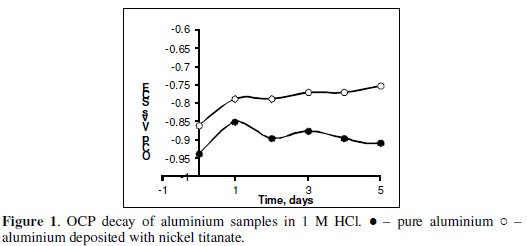
    <p>The open circuit potential (OCP) variation of the aluminium electrodes is shown 
in <a href="#f1">Fig. 1</a>.</p>


    <p>&nbsp;</p>
<a name="f1">
<img src="/img/revistas/pea/v31n4/31n4a04f1.jpg">
    
<p>&nbsp;</p>


    <p>The OCP values for nickel titanate deposited aluminium samples are found to be 
more anodic compared to pure aluminium specimen. The OCP values for nickel 
titanate coated aluminium retain its anodic behavior even after 5 days of 
immersion in 1 M HCl. The nickel titanate deposited on the aluminium enhances 
the resistance of the oxide layer on the aluminium and thereby shifting the 
potential to passive regions (anodic). The steady anodic OCP values for nickel 
titanate coated electrode reveals the adherence of nickel titanate on the surface of 
aluminium even after the prolonged exposure of metal in acid medium.</p>


    <p><b><i>Polarization resistance</i></b></p>
 
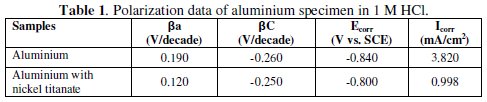
    <p>The polarization data of the electrode immersed in 1 M HCl solution is given in 
<a href="#t1">Table 1</a>.</p>


    <p>&nbsp;</p>
<a name="t1">
<img src="/img/revistas/pea/v31n4/31n4a04t1.jpg">
    
]]></body>
<body><![CDATA[<p>&nbsp;</p>


    <p>The extent of polarization of aluminium with nickel titanate was lower 
than that of pure aluminium. Impregnation of nickel titanate shifts the slope of 
both anodic and cathodic polarization and thereby decreasing the corrosion 
current density (i<sub>corr</sub>) and increasing the polarization resistance of the metal. 
Polarization resistance is directly proportional to the surface resistivity of the 
metal when the metal is in contact with the electrolyte medium. Hence the 
resistance of the aluminium oxide layer is improved by the incorporation of 
nickel titanate.</p>


    <p>&nbsp;</p>
    <p><b><i>Corrosion rate measurements</i></b></p>
 
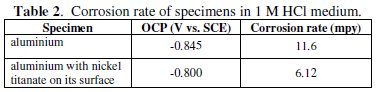
    <p>The corrosion rate of aluminium with and without incorporation of nickel titanate 
in 1 M HCl is given in <a href="#t2">Table 2</a>.</p>


    <p>&nbsp;</p>
<a name="t2">
<img src="/img/revistas/pea/v31n4/31n4a04t2.jpg">
    
<p>&nbsp;</p>


    <p>The corrosion rate of nickel titanate incorporated 
aluminium in 1 M HCl shows lower value compared to pure aluminium metal. 
This is due to the strengthening of the oxide film on the surface of aluminum by 
nickel titanate and thereby reduces the ionic and non-ionic dissolution of 
aluminium.</p>


    <p>&nbsp;</p>
    <p><b><i>XRD analysis</i></b></p>

    ]]></body>
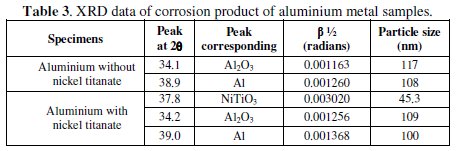
<body><![CDATA[<p>The extent of surface interaction of nickel titanate with aluminium oxide can be 
revealed only by XRD analysis. <a href="#t3">Table 3</a> shows the XRD data of corrosion 
product scratched from the aluminium surface (with and without incorporation of 
nickel titanate) after exposure in 1 M HCl for 1 day.</p>


    <p>&nbsp;</p>
<a name="t3">
<img src="/img/revistas/pea/v31n4/31n4a04t3.jpg">
    
<p>&nbsp;</p>


    <p>The XRD analysis reveals 
the presence of nickel titanate, aluminium oxide and aluminium on the 
aluminium electrode coated with nickel titanate. This shows the strong 
interaction and intermixing of aluminium oxide and nickel titanate on the surface 
of aluminium. This modified aluminium oxide layer enhances the corrosion 
prevention of aluminium in chloride environment.</p>


    <p>&nbsp;</p>
    <p><b>Conclusion</b></p>

    <p>A new method of corrosion prevention of aluminium in 1 M HCl was developed 
by depositing nickel titanate particles on the surface of aluminium. The nickel 
titanate particles were prepared by co-precipitation method from an aqueous 
solution containing ions of titanium and nickel, to an aqueous alkaline solution 
containing hydrogen peroxide and these nickel titanate particles produced were 
in-situ deposited on aluminium surfaces. The intermixing of nickel titanate with 
aluminium oxide on the surface of aluminium enhances the corrosion resistance 
property of the oxide layer on the surface of aluminium and thereby preventing 
the coulombic and non-coulombic loss of metal.</p>


    <p>&nbsp;</p>
    <p><b>References</b></p>

    <!-- ref --><p>1. Li X, Nie X, Wang L, Nothwood DO. Surf Sci Coat Tech. 2005;200:1994.    &nbsp;&nbsp;&nbsp;&nbsp;&nbsp;&nbsp;&nbsp;&nbsp;[&#160;<a href="javascript:void(0);" onclick="javascript: window.open('/scielo.php?script=sci_nlinks&ref=000052&pid=S0872-1904201300040000400001&lng=','','width=640,height=500,resizable=yes,scrollbars=1,menubar=yes,');">Links</a>&#160;]<!-- end-ref --></p>

    <!-- ref --><p>2. Sherif EM, Park S. Electrochim Acta. 2006;51:1313.    &nbsp;&nbsp;&nbsp;&nbsp;&nbsp;&nbsp;&nbsp;&nbsp;[&#160;<a href="javascript:void(0);" onclick="javascript: window.open('/scielo.php?script=sci_nlinks&ref=000054&pid=S0872-1904201300040000400002&lng=','','width=640,height=500,resizable=yes,scrollbars=1,menubar=yes,');">Links</a>&#160;]<!-- end-ref --></p>

    <!-- ref --><p>3. Ali AN, Foaud N. J Mater Environ Sci. 2012;3:917.    &nbsp;&nbsp;&nbsp;&nbsp;&nbsp;&nbsp;&nbsp;&nbsp;[&#160;<a href="javascript:void(0);" onclick="javascript: window.open('/scielo.php?script=sci_nlinks&ref=000056&pid=S0872-1904201300040000400003&lng=','','width=640,height=500,resizable=yes,scrollbars=1,menubar=yes,');">Links</a>&#160;]<!-- end-ref --></p>

    <!-- ref --><p>4. Desai PS, Vashi RT. Ind J Chem Tech. 2010;17:50.    &nbsp;&nbsp;&nbsp;&nbsp;&nbsp;&nbsp;&nbsp;&nbsp;[&#160;<a href="javascript:void(0);" onclick="javascript: window.open('/scielo.php?script=sci_nlinks&ref=000058&pid=S0872-1904201300040000400004&lng=','','width=640,height=500,resizable=yes,scrollbars=1,menubar=yes,');">Links</a>&#160;]<!-- end-ref --></p>

    <p>5. Burleigh TD, T Smith A. J Electrochem. Soc. 1992;139:2799.</p>

    <!-- ref --><p>6. Lee EJ, Pyun SJ. Corros Sci. 1995;37:157.    &nbsp;&nbsp;&nbsp;&nbsp;&nbsp;&nbsp;&nbsp;&nbsp;[&#160;<a href="javascript:void(0);" onclick="javascript: window.open('/scielo.php?script=sci_nlinks&ref=000061&pid=S0872-1904201300040000400006&lng=','','width=640,height=500,resizable=yes,scrollbars=1,menubar=yes,');">Links</a>&#160;]<!-- end-ref --></p>

    ]]></body>
<body><![CDATA[<!-- ref --><p>7. Rethinnagiri V, Jeyaprakash P, Arunkumar M, et al. Adv App Sci Res. 2012;3:1718.    &nbsp;&nbsp;&nbsp;&nbsp;&nbsp;&nbsp;&nbsp;&nbsp;[&#160;<a href="javascript:void(0);" onclick="javascript: window.open('/scielo.php?script=sci_nlinks&ref=000063&pid=S0872-1904201300040000400007&lng=','','width=640,height=500,resizable=yes,scrollbars=1,menubar=yes,');">Links</a>&#160;]<!-- end-ref --></p>

    <!-- ref --><p>8. Amin MA, EI-Rehim SSA, El-Sherbini EEF, et al. Corros Sci. 2009;51:658.    &nbsp;&nbsp;&nbsp;&nbsp;&nbsp;&nbsp;&nbsp;&nbsp;[&#160;<a href="javascript:void(0);" onclick="javascript: window.open('/scielo.php?script=sci_nlinks&ref=000065&pid=S0872-1904201300040000400008&lng=','','width=640,height=500,resizable=yes,scrollbars=1,menubar=yes,');">Links</a>&#160;]<!-- end-ref --></p>

    <!-- ref --><p>9. Albert IJ, Kulandainathan M, Ganesan MA, et al. J Appl Electrochem. 1989;19:547.    &nbsp;&nbsp;&nbsp;&nbsp;&nbsp;&nbsp;&nbsp;&nbsp;[&#160;<a href="javascript:void(0);" onclick="javascript: window.open('/scielo.php?script=sci_nlinks&ref=000067&pid=S0872-1904201300040000400009&lng=','','width=640,height=500,resizable=yes,scrollbars=1,menubar=yes,');">Links</a>&#160;]<!-- end-ref --></p>

    <!-- ref --><p>10. Nisancioglu K, Holtan H. Electrochim Acta. 1979;24:1229.    &nbsp;&nbsp;&nbsp;&nbsp;&nbsp;&nbsp;&nbsp;&nbsp;[&#160;<a href="javascript:void(0);" onclick="javascript: window.open('/scielo.php?script=sci_nlinks&ref=000069&pid=S0872-1904201300040000400010&lng=','','width=640,height=500,resizable=yes,scrollbars=1,menubar=yes,');">Links</a>&#160;]<!-- end-ref --></p>

    <!-- ref --><p>11. El-Etre AY. Corros Sci. 2003;45:2485.    &nbsp;&nbsp;&nbsp;&nbsp;&nbsp;&nbsp;&nbsp;&nbsp;[&#160;<a href="javascript:void(0);" onclick="javascript: window.open('/scielo.php?script=sci_nlinks&ref=000071&pid=S0872-1904201300040000400011&lng=','','width=640,height=500,resizable=yes,scrollbars=1,menubar=yes,');">Links</a>&#160;]<!-- end-ref --></p>

    ]]></body>
<body><![CDATA[<!-- ref --><p>12. James AO, Oforka NC, Abiola OK. Bull.Electrochem. 2006;22:111.    &nbsp;&nbsp;&nbsp;&nbsp;&nbsp;&nbsp;&nbsp;&nbsp;[&#160;<a href="javascript:void(0);" onclick="javascript: window.open('/scielo.php?script=sci_nlinks&ref=000073&pid=S0872-1904201300040000400012&lng=','','width=640,height=500,resizable=yes,scrollbars=1,menubar=yes,');">Links</a>&#160;]<!-- end-ref --></p>

    <!-- ref --><p>13. Singh RS, Ansari TH, Singh RA, et al. Mater Chem Phys.1995;50:173.    &nbsp;&nbsp;&nbsp;&nbsp;&nbsp;&nbsp;&nbsp;&nbsp;[&#160;<a href="javascript:void(0);" onclick="javascript: window.open('/scielo.php?script=sci_nlinks&ref=000075&pid=S0872-1904201300040000400013&lng=','','width=640,height=500,resizable=yes,scrollbars=1,menubar=yes,');">Links</a>&#160;]<!-- end-ref --></p>

    <!-- ref --><p>14. Taylor DJ, Fleg PF, Page RA. Thin Solid Films. 2002;408:104.    &nbsp;&nbsp;&nbsp;&nbsp;&nbsp;&nbsp;&nbsp;&nbsp;[&#160;<a href="javascript:void(0);" onclick="javascript: window.open('/scielo.php?script=sci_nlinks&ref=000077&pid=S0872-1904201300040000400014&lng=','','width=640,height=500,resizable=yes,scrollbars=1,menubar=yes,');">Links</a>&#160;]<!-- end-ref --></p>

    <!-- ref --><p>15. Murughan AV, Samuel V, Navale SC, et al. Mater Lett. 2006;60:1791.    &nbsp;&nbsp;&nbsp;&nbsp;&nbsp;&nbsp;&nbsp;&nbsp;[&#160;<a href="javascript:void(0);" onclick="javascript: window.open('/scielo.php?script=sci_nlinks&ref=000079&pid=S0872-1904201300040000400015&lng=','','width=640,height=500,resizable=yes,scrollbars=1,menubar=yes,');">Links</a>&#160;]<!-- end-ref --></p>

    <!-- ref --><p>16. Lerch M, Boysen H, Nerder R, et al. J Phys Chem Sol.1992;53:1153.    &nbsp;&nbsp;&nbsp;&nbsp;&nbsp;&nbsp;&nbsp;&nbsp;[&#160;<a href="javascript:void(0);" onclick="javascript: window.open('/scielo.php?script=sci_nlinks&ref=000081&pid=S0872-1904201300040000400016&lng=','','width=640,height=500,resizable=yes,scrollbars=1,menubar=yes,');">Links</a>&#160;]<!-- end-ref --></p>

    ]]></body>
<body><![CDATA[<!-- ref --><p>17. Marcilly C, Courty P, Delmon BJ. J Am Ceram Soc. 1970;53:56.    &nbsp;&nbsp;&nbsp;&nbsp;&nbsp;&nbsp;&nbsp;&nbsp;[&#160;<a href="javascript:void(0);" onclick="javascript: window.open('/scielo.php?script=sci_nlinks&ref=000083&pid=S0872-1904201300040000400017&lng=','','width=640,height=500,resizable=yes,scrollbars=1,menubar=yes,');">Links</a>&#160;]<!-- end-ref --></p>

    <!-- ref --><p>18. Page RA, Blanchard-Ardid CR, Wei W. J Mater Sci.1988;23:946.    &nbsp;&nbsp;&nbsp;&nbsp;&nbsp;&nbsp;&nbsp;&nbsp;[&#160;<a href="javascript:void(0);" onclick="javascript: window.open('/scielo.php?script=sci_nlinks&ref=000085&pid=S0872-1904201300040000400018&lng=','','width=640,height=500,resizable=yes,scrollbars=1,menubar=yes,');">Links</a>&#160;]<!-- end-ref --></p>

    <!-- ref --><p>19. Beenakumari KS. J Exp Nano Sci. 2013;8:213.    &nbsp;&nbsp;&nbsp;&nbsp;&nbsp;&nbsp;&nbsp;&nbsp;[&#160;<a href="javascript:void(0);" onclick="javascript: window.open('/scielo.php?script=sci_nlinks&ref=000087&pid=S0872-1904201300040000400019&lng=','','width=640,height=500,resizable=yes,scrollbars=1,menubar=yes,');">Links</a>&#160;]<!-- end-ref --></p>

    <!-- ref --><p>20. Beenakumari KS. Mater Sci Res Ind. 2009;6:235.    &nbsp;&nbsp;&nbsp;&nbsp;&nbsp;&nbsp;&nbsp;&nbsp;[&#160;<a href="javascript:void(0);" onclick="javascript: window.open('/scielo.php?script=sci_nlinks&ref=000089&pid=S0872-1904201300040000400020&lng=','','width=640,height=500,resizable=yes,scrollbars=1,menubar=yes,');">Links</a>&#160;]<!-- end-ref --></p>


    <p>&nbsp;</p>
    <p><a name=0></a><sup><a href="#top">*</a></sup>Corresponding author. E-mail address: <a href="mailto:beenagireesh@yahoo.co.uk">beenagireesh@yahoo.co.uk</a></p>

    ]]></body>
<body><![CDATA[<p>Received 17 January 2013; accepted 27 August 2013</p>

    <p><a href="http://www.peacta.org" target="_blank">www.peacta.org</a> </p>


     ]]></body><back>
<ref-list>
<ref id="B1">
<label>1</label><nlm-citation citation-type="journal">
<person-group person-group-type="author">
<name>
<surname><![CDATA[Li]]></surname>
<given-names><![CDATA[X]]></given-names>
</name>
<name>
<surname><![CDATA[Nie]]></surname>
<given-names><![CDATA[X]]></given-names>
</name>
<name>
<surname><![CDATA[Wang]]></surname>
<given-names><![CDATA[L]]></given-names>
</name>
<name>
<surname><![CDATA[Nothwood]]></surname>
<given-names><![CDATA[D O]]></given-names>
</name>
</person-group>
<source><![CDATA[Surf Sci Coat Tech]]></source>
<year>2005</year>
<volume>200</volume>
<page-range>1994</page-range></nlm-citation>
</ref>
<ref id="B2">
<label>2</label><nlm-citation citation-type="journal">
<person-group person-group-type="author">
<name>
<surname><![CDATA[Sherif]]></surname>
<given-names><![CDATA[E M]]></given-names>
</name>
<name>
<surname><![CDATA[Park]]></surname>
<given-names><![CDATA[S]]></given-names>
</name>
</person-group>
<source><![CDATA[Electrochim Acta]]></source>
<year>2006</year>
<volume>51</volume>
<page-range>1313</page-range></nlm-citation>
</ref>
<ref id="B3">
<label>3</label><nlm-citation citation-type="journal">
<person-group person-group-type="author">
<name>
<surname><![CDATA[Ali]]></surname>
<given-names><![CDATA[A N]]></given-names>
</name>
<name>
<surname><![CDATA[Foaud]]></surname>
<given-names><![CDATA[N]]></given-names>
</name>
</person-group>
<source><![CDATA[J Mater Environ Sci]]></source>
<year>2012</year>
<volume>3</volume>
<page-range>917</page-range></nlm-citation>
</ref>
<ref id="B4">
<label>4</label><nlm-citation citation-type="journal">
<person-group person-group-type="author">
<name>
<surname><![CDATA[Desai]]></surname>
<given-names><![CDATA[P S]]></given-names>
</name>
<name>
<surname><![CDATA[Vashi]]></surname>
<given-names><![CDATA[R T]]></given-names>
</name>
</person-group>
<source><![CDATA[Ind J Chem Tech]]></source>
<year>2010</year>
<volume>17</volume>
<page-range>50</page-range></nlm-citation>
</ref>
<ref id="B5">
<label>5</label><nlm-citation citation-type="journal">
<person-group person-group-type="author">
<name>
<surname><![CDATA[Burleigh]]></surname>
<given-names><![CDATA[T D]]></given-names>
</name>
<name>
<surname><![CDATA[Smith]]></surname>
<given-names><![CDATA[A T]]></given-names>
</name>
</person-group>
<source><![CDATA[J Electrochem. Soc]]></source>
<year>1992</year>
<volume>139</volume>
<page-range>2799</page-range></nlm-citation>
</ref>
<ref id="B6">
<label>6</label><nlm-citation citation-type="journal">
<person-group person-group-type="author">
<name>
<surname><![CDATA[Lee]]></surname>
<given-names><![CDATA[E J]]></given-names>
</name>
<name>
<surname><![CDATA[Pyun]]></surname>
<given-names><![CDATA[S J]]></given-names>
</name>
</person-group>
<source><![CDATA[Corros Sci]]></source>
<year>1995</year>
<volume>37</volume>
<page-range>157</page-range></nlm-citation>
</ref>
<ref id="B7">
<label>7</label><nlm-citation citation-type="journal">
<person-group person-group-type="author">
<name>
<surname><![CDATA[Rethinnagiri]]></surname>
<given-names><![CDATA[V]]></given-names>
</name>
<name>
<surname><![CDATA[Jeyaprakash]]></surname>
<given-names><![CDATA[P]]></given-names>
</name>
<name>
<surname><![CDATA[Arunkumar]]></surname>
<given-names><![CDATA[M]]></given-names>
</name>
</person-group>
<source><![CDATA[Adv App Sci Res]]></source>
<year>2012</year>
<volume>3</volume>
<page-range>1718</page-range></nlm-citation>
</ref>
<ref id="B8">
<label>8</label><nlm-citation citation-type="journal">
<person-group person-group-type="author">
<name>
<surname><![CDATA[Amin]]></surname>
<given-names><![CDATA[M A]]></given-names>
</name>
<name>
<surname><![CDATA[EI-Rehim]]></surname>
<given-names><![CDATA[S S A]]></given-names>
</name>
<name>
<surname><![CDATA[El-Sherbini]]></surname>
<given-names><![CDATA[E E F]]></given-names>
</name>
</person-group>
<source><![CDATA[Corros Sci]]></source>
<year>2009</year>
<volume>51</volume>
<page-range>658</page-range></nlm-citation>
</ref>
<ref id="B9">
<label>9</label><nlm-citation citation-type="journal">
<person-group person-group-type="author">
<name>
<surname><![CDATA[Albert]]></surname>
<given-names><![CDATA[I J]]></given-names>
</name>
<name>
<surname><![CDATA[Kulandainathan]]></surname>
<given-names><![CDATA[M]]></given-names>
</name>
<name>
<surname><![CDATA[Ganesan]]></surname>
<given-names><![CDATA[M A]]></given-names>
</name>
</person-group>
<source><![CDATA[J Appl Electrochem]]></source>
<year>1989</year>
<volume>19</volume>
<page-range>547</page-range></nlm-citation>
</ref>
<ref id="B10">
<label>10</label><nlm-citation citation-type="journal">
<person-group person-group-type="author">
<name>
<surname><![CDATA[Nisancioglu]]></surname>
<given-names><![CDATA[K]]></given-names>
</name>
<name>
<surname><![CDATA[Holtan]]></surname>
<given-names><![CDATA[H]]></given-names>
</name>
</person-group>
<source><![CDATA[Electrochim Acta]]></source>
<year>1979</year>
<volume>24</volume>
<page-range>1229</page-range></nlm-citation>
</ref>
<ref id="B11">
<label>11</label><nlm-citation citation-type="journal">
<person-group person-group-type="author">
<name>
<surname><![CDATA[El-Etre]]></surname>
<given-names><![CDATA[A Y]]></given-names>
</name>
</person-group>
<source><![CDATA[Corros Sci]]></source>
<year>2003</year>
<volume>45</volume>
<page-range>2485</page-range></nlm-citation>
</ref>
<ref id="B12">
<label>12</label><nlm-citation citation-type="journal">
<person-group person-group-type="author">
<name>
<surname><![CDATA[James]]></surname>
<given-names><![CDATA[A O]]></given-names>
</name>
<name>
<surname><![CDATA[Oforka]]></surname>
<given-names><![CDATA[N C]]></given-names>
</name>
<name>
<surname><![CDATA[Abiola]]></surname>
<given-names><![CDATA[O K]]></given-names>
</name>
</person-group>
<source><![CDATA[Bull.Electrochem]]></source>
<year>2006</year>
<volume>22</volume>
<page-range>111</page-range></nlm-citation>
</ref>
<ref id="B13">
<label>13</label><nlm-citation citation-type="journal">
<person-group person-group-type="author">
<name>
<surname><![CDATA[Singh]]></surname>
<given-names><![CDATA[R S]]></given-names>
</name>
<name>
<surname><![CDATA[Ansari]]></surname>
<given-names><![CDATA[T H]]></given-names>
</name>
<name>
<surname><![CDATA[Singh]]></surname>
<given-names><![CDATA[R A]]></given-names>
</name>
</person-group>
<source><![CDATA[Mater Chem Phys]]></source>
<year>1995</year>
<volume>50</volume>
<page-range>173</page-range></nlm-citation>
</ref>
<ref id="B14">
<label>14</label><nlm-citation citation-type="journal">
<person-group person-group-type="author">
<name>
<surname><![CDATA[Taylor]]></surname>
<given-names><![CDATA[D J]]></given-names>
</name>
<name>
<surname><![CDATA[Fleg]]></surname>
<given-names><![CDATA[P F]]></given-names>
</name>
<name>
<surname><![CDATA[Page]]></surname>
<given-names><![CDATA[R A]]></given-names>
</name>
</person-group>
<source><![CDATA[Thin Solid Films]]></source>
<year>2002</year>
<volume>408</volume>
<page-range>104</page-range></nlm-citation>
</ref>
<ref id="B15">
<label>15</label><nlm-citation citation-type="journal">
<person-group person-group-type="author">
<name>
<surname><![CDATA[Murughan]]></surname>
<given-names><![CDATA[A V]]></given-names>
</name>
<name>
<surname><![CDATA[Samuel]]></surname>
<given-names><![CDATA[V]]></given-names>
</name>
<name>
<surname><![CDATA[Navale]]></surname>
<given-names><![CDATA[S C]]></given-names>
</name>
</person-group>
<source><![CDATA[Mater Lett]]></source>
<year>2006</year>
<volume>60</volume>
<page-range>1791</page-range></nlm-citation>
</ref>
<ref id="B16">
<label>16</label><nlm-citation citation-type="journal">
<person-group person-group-type="author">
<name>
<surname><![CDATA[Lerch]]></surname>
<given-names><![CDATA[M]]></given-names>
</name>
<name>
<surname><![CDATA[Boysen]]></surname>
<given-names><![CDATA[H]]></given-names>
</name>
<name>
<surname><![CDATA[Nerder]]></surname>
<given-names><![CDATA[R]]></given-names>
</name>
</person-group>
<source><![CDATA[J Phys Chem Sol]]></source>
<year>1992</year>
<volume>53</volume>
<page-range>1153</page-range></nlm-citation>
</ref>
<ref id="B17">
<label>17</label><nlm-citation citation-type="journal">
<person-group person-group-type="author">
<name>
<surname><![CDATA[Marcilly]]></surname>
<given-names><![CDATA[C]]></given-names>
</name>
<name>
<surname><![CDATA[Courty]]></surname>
<given-names><![CDATA[P]]></given-names>
</name>
<name>
<surname><![CDATA[Delmon]]></surname>
<given-names><![CDATA[B J]]></given-names>
</name>
</person-group>
<source><![CDATA[J Am Ceram Soc]]></source>
<year>1970</year>
<volume>53</volume>
<page-range>56</page-range></nlm-citation>
</ref>
<ref id="B18">
<label>18</label><nlm-citation citation-type="journal">
<person-group person-group-type="author">
<name>
<surname><![CDATA[Page]]></surname>
<given-names><![CDATA[R A]]></given-names>
</name>
<name>
<surname><![CDATA[Blanchard-Ardid]]></surname>
<given-names><![CDATA[C R]]></given-names>
</name>
<name>
<surname><![CDATA[Wei]]></surname>
<given-names><![CDATA[W]]></given-names>
</name>
</person-group>
<source><![CDATA[J Mater Sci]]></source>
<year>1988</year>
<volume>23</volume>
<page-range>946</page-range></nlm-citation>
</ref>
<ref id="B19">
<label>19</label><nlm-citation citation-type="journal">
<person-group person-group-type="author">
<name>
<surname><![CDATA[Beenakumari]]></surname>
<given-names><![CDATA[K S]]></given-names>
</name>
</person-group>
<source><![CDATA[J Exp Nano Sci]]></source>
<year>2013</year>
<volume>8</volume>
<page-range>213</page-range></nlm-citation>
</ref>
<ref id="B20">
<label>20</label><nlm-citation citation-type="journal">
<person-group person-group-type="author">
<name>
<surname><![CDATA[Beenakumari]]></surname>
<given-names><![CDATA[K S]]></given-names>
</name>
</person-group>
<source><![CDATA[Mater Sci Res Ind]]></source>
<year>2009</year>
<volume>6</volume>
<page-range>235</page-range></nlm-citation>
</ref>
</ref-list>
</back>
</article>