<?xml version="1.0" encoding="ISO-8859-1"?><article xmlns:mml="http://www.w3.org/1998/Math/MathML" xmlns:xlink="http://www.w3.org/1999/xlink" xmlns:xsi="http://www.w3.org/2001/XMLSchema-instance">
<front>
<journal-meta>
<journal-id>0872-1904</journal-id>
<journal-title><![CDATA[Portugaliae Electrochimica Acta]]></journal-title>
<abbrev-journal-title><![CDATA[Port. Electrochim. Acta]]></abbrev-journal-title>
<issn>0872-1904</issn>
<publisher>
<publisher-name><![CDATA[Sociedade Portuguesa de Electroquímica]]></publisher-name>
</publisher>
</journal-meta>
<article-meta>
<article-id>S0872-19042013000500002</article-id>
<article-id pub-id-type="doi">10.4152/pea.201305257</article-id>
<title-group>
<article-title xml:lang="en"><![CDATA[Application of Ti/Pt/&#946;-PbO2 Anodes in the Degradation of DR80 Azo Dye]]></article-title>
</title-group>
<contrib-group>
<contrib contrib-type="author">
<name>
<surname><![CDATA[Florêncio]]></surname>
<given-names><![CDATA[J.]]></given-names>
</name>
<xref ref-type="aff" rid="A01"/>
<xref ref-type="aff" rid="A02"/>
</contrib>
<contrib contrib-type="author">
<name>
<surname><![CDATA[Pacheco]]></surname>
<given-names><![CDATA[M.J.]]></given-names>
</name>
<xref ref-type="aff" rid="A01"/>
</contrib>
<contrib contrib-type="author">
<name>
<surname><![CDATA[Lopes]]></surname>
<given-names><![CDATA[A.]]></given-names>
</name>
<xref ref-type="aff" rid="A01"/>
<xref ref-type="aff" rid="A02"/>
</contrib>
<contrib contrib-type="author">
<name>
<surname><![CDATA[Ciríaco]]></surname>
<given-names><![CDATA[L.]]></given-names>
</name>
<xref ref-type="aff" rid="A01"/>
</contrib>
</contrib-group>
<aff id="A01">
<institution><![CDATA[,UMTP  ]]></institution>
<addr-line><![CDATA[ ]]></addr-line>
</aff>
<aff id="A02">
<institution><![CDATA[,University of Beira Interior Department of Chemistry ]]></institution>
<addr-line><![CDATA[Covilhã ]]></addr-line>
<country>Portugal</country>
</aff>
<pub-date pub-type="pub">
<day>08</day>
<month>10</month>
<year>2013</year>
</pub-date>
<pub-date pub-type="epub">
<day>08</day>
<month>10</month>
<year>2013</year>
</pub-date>
<volume>31</volume>
<numero>5</numero>
<fpage>257</fpage>
<lpage>264</lpage>
<copyright-statement/>
<copyright-year/>
<self-uri xlink:href="http://scielo.pt/scielo.php?script=sci_arttext&amp;pid=S0872-19042013000500002&amp;lng=en&amp;nrm=iso"></self-uri><self-uri xlink:href="http://scielo.pt/scielo.php?script=sci_abstract&amp;pid=S0872-19042013000500002&amp;lng=en&amp;nrm=iso"></self-uri><self-uri xlink:href="http://scielo.pt/scielo.php?script=sci_pdf&amp;pid=S0872-19042013000500002&amp;lng=en&amp;nrm=iso"></self-uri><abstract abstract-type="short" xml:lang="en"><p><![CDATA[This study describes the application of a Ti/Pt/PbO2 electrode as photoanode in the degradation of the dye Direct Red 80 (DR80). The electrode was prepared by platinization of a titanium substrate, followed by electrodeposition of a PbO2 layer. The presence of &#946;-PbO2 phase was confirmed by X-ray diffraction. DR80 degradation tests were performed by different techniques, namely, photolysis, photocatalysis, electrocatalysis and photoelectrocatalysis. The best colour removals were obtained in the photoelectrocatalysis assays and were higher than 85% for 5.0 and 12.5 mg L-1 dye initial concentration and about 72% for 25.0 mg L-1 DR80 initial concentration, after applying a current intensity of 5 mA for 6 hours. At a DR80 initial concentration of 25.0 mg L-1 , the best absorbance removals were obtained in the photoelectrocatalytic assays, with a current intensity of 50 mA, which led to a colour removal of 100% after 4 hours. Photolysis and photocatalysis presented similar colour removals that were 62, 26 and 18% for the initial concentrations of 5, 12.5 and 25 mg L-1, respectively.]]></p></abstract>
<kwd-group>
<kwd lng="en"><![CDATA[Ti/Pt/&#946;-PbO2 anode]]></kwd>
<kwd lng="en"><![CDATA[anodic oxidation]]></kwd>
<kwd lng="en"><![CDATA[DR80]]></kwd>
<kwd lng="en"><![CDATA[photoelectrocatalysis]]></kwd>
</kwd-group>
</article-meta>
</front><body><![CDATA[ 

<!--     <p>&nbsp;</p>
    <p>doi: 10.4152/pea.201305257</p> -->

    <p><b>Application of Ti/Pt/&beta; bbb&beta;-PbO<sub>2</sub> Anodes in the Degradation of DR80 Azo Dye</b></p>

    <p><b>J. Flor&ecirc;ncio</b>, <b>M.J. Pacheco</b>, <b>A. Lopes</b> and <b>L. Cir&iacute;aco</b><sup><a href="#0">*</a></sup></p>

    <p><i> UMTP and Department of Chemistry, University of Beira Interior, 6201-001 Covilh&atilde;, Portugal</i></p>


    <p>&nbsp;</p>
    <p><b>Abstract</b></p>

    <p>This study describes the application of a Ti/Pt/PbO<sub>2</sub> electrode as photoanode in the 
degradation of the dye Direct Red 80 (DR80). The electrode was prepared by 
platinization of a titanium substrate, followed by electrodeposition of a PbO<sub>2</sub> layer. The 
presence of &beta;-PbO<sub>2</sub> phase was confirmed by X-ray diffraction. 
DR80 degradation tests were performed by different techniques, namely, photolysis, 
photocatalysis, electrocatalysis and photoelectrocatalysis. The best colour removals 
were obtained in the photoelectrocatalysis assays and were higher than 85% for 5.0 and 
12.5 mg L<sup>-1</sup> dye initial concentration and about 72% for 25.0 mg L<sup>-1</sup> DR80 initial 
concentration, after applying a current intensity of 5 mA for 6 hours. At a DR80 initial 
concentration of 25.0 mg L<sup>-1</sup> , the best absorbance removals were obtained in the 
photoelectrocatalytic assays, with a current intensity of 50 mA, which led to a colour 
removal of 100% after 4 hours. Photolysis and photocatalysis presented similar colour 
removals that were 62, 26 and 18% for the initial concentrations of 5, 12.5 and 25 mg 
L<sup>-1</sup>, respectively.</p>

    <p><b><i>Keywords:</i></b> Ti/Pt/&beta;-PbO<sub>2</sub> anode; anodic oxidation; DR80; photoelectrocatalysis.</p>


    ]]></body>
<body><![CDATA[<p>&nbsp;</p>
    <p><b>Introduction</b></p>

    <p>The untreated effluents from several industries, such as textile, printing paper, 
food processing and cosmetic manufacturing, present high level of pollutants and 
colour. Essentially, this is due to the presence of dyes, most of them from the azo 
dyes group, with the general formula R<sub>1</sub>-N = N-R<sub>2</sub> [1-3]. Therefore, effluents 
from those industries are responsible for the dissemination of these 
environmental pollutants. These dyes, besides contaminating the natural aquifer 
resources with persistent organic pollutants, which may be toxic to aquatic fauna 
and flora, also give them colour, thus preventing light penetration and natural 
photosynthetic processes of the native organisms.</p>

    <p>A representative azo dye, possessing 4 azo bonds, is the direct red dye DR80. Its 
degradation was already performed using non-biological processes, such as 
anodic and photocatalytic oxidation, with good results [3,4]. For the complex 
effluents containing dyes, these advanced oxidation processes (AOPs) can be a 
suitable alternative to conventional technologies. In fact, these processes are 
capable of producing highly oxidizing species, like hydroxyl radicals, and can be 
an efficient treatment for waters and wastewaters. There are various techniques 
among the AOPs for the processing of contaminated waters [4-12], and anodic 
oxidation can be an efficient option for pollutant's degradation [3,5,6,11-22]. 
However, the performance of the anode depends strongly on the electrode 
material [3,5,13-19] as well as on the experimental conditions [20-22]. Many 
electrode materials have been tested: noble metals, different forms of carbon, 
boron-doped diamond (BDD) and metal oxides. In the class of metal oxides, 
PbO<sub>2</sub> is among those already tested as anodes for pollutant's oxidation [13-18]. 
Besides its ability as anode, PbO<sub>2</sub> presents band gap energy of 1.4 eV that allows 
its application as photocatalyst. This anode has already been used with solar light 
with success in the photomineralization of oxalic acid and phenols [23,24] and 
with UV light (365 nm) in mineralization selectivity studies of different 
compounds [25]. In this latter study, its performance was compared with that of 
TiO<sub>2</sub> and the authors have concluded that PbO<sub>2</sub> can be used to photomineralise 
only some phenols, in contrast to TiO<sub>2</sub> that does not show selectivity towards the 
different organic compounds.</p>

    <p>In this work, the use of PbO<sub>2</sub> as photocatalytic material for the degradation of 
solutions containing a model tetra azo dye, direct red 80, was tested, using UV 
light with a wavelength of 254 nm. In order to enhance the PbO<sub>2</sub> catalytic effect, 
degradation assays were electrochemically assisted with low intensity currents.</p>


    <p>&nbsp;</p>
    <p><b>Experimental</b></p>

    <p><b><i>Chemicals</i></b></p>

    <p>Ti/Pt/PbO<sub>2</sub> electrodes were prepared from titanium foil (99.7%, Sigma-Aldrich), 
H<sub>2</sub>PtCl<sub>6</sub> (99.9%, Sigma-Aldrich), HCl (Merck, 37%), sodium dodecyl sulphate 
(Sigma-Aldrich, 99%), HNO3 (65%, Merck) and Pb(NO3)2 (99%, Sigma-Aldrich).</p>

    <p>The chemicals used as model pollutant and as electrolyte were DR80 (25%, 
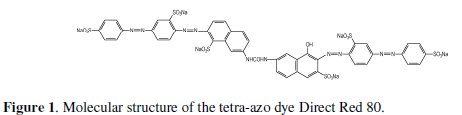
Aldrich) and sodium sulfate (99%, Merck), respectively. The molecular structure 
of the DR80 is shown in <a href="#f1">Fig. 1</a>.</p>


    ]]></body>
<body><![CDATA[<p>&nbsp;</p>
<a name="f1">
<img src="/img/revistas/pea/v31n5/31n5a02f1.jpg">
    
<p>&nbsp;</p>


    <p><b><i>Electrode preparation and characterization</i></b></p>

    <p>The electrode preparation was carried out according to literature in three steps 
[15,16]: pretreatment of the titanium substrate, followed by platinization with 
H<sub>2</sub>PtCl<sub>6</sub> and posterior electrodeposition of PbO<sub>2</sub>. 
The Ti/Pt/PbO<sub>2</sub> electrode structure was characterized by X-ray powder 
diffraction (XRD), at room temperature, by means of a Rigaku DMAXIII/C 
diffractometer, using Cu K radiation (&lambda; = 0.15406 nm) and working at 30 kV/40 
mA. The diffraction patterns were collected between 2&theta; 20 and 80&deg;, with a 0.02&deg; 
step, and acquisition time of 2 s per step. The morphology of the prepared 
electrodes was characterized by scanning electron microscopy (SEM) with a 
Hitachi (S-2700)/Oxford (60-74) system operating at 20 keV.</p>

    <p>The electrochemical characterization was performed by cyclic voltammetric 
measurements with a potentiostat/galvanostat VoltaLab PGZ 301, in a one-
compartment cell, with a 4 cm<sup>2</sup> Ti/Pt/PbO<sub>2</sub> electrode as the working electrode, a 4 
cm<sup>2</sup> platinum plate as the counter electrode and a commercial saturated Ag/AgCl, 
KCl<sub>sat</sub> electrode as the reference electrode. Voltammograms were recorded at 
scan rates between 10 and 100 mV s<sup>-1</sup> in 0.035 M Na<sub>2</sub>SO<sub>4</sub> aqueous solution 
without and with DR80 concentrations of 1 g L<sup>-1</sup>.</p>


    <p>&nbsp;</p>
    <p><b><i>Degradation assays</i></b></p>

    <p>The degradation of DR80 solutions was performed using aqueous solutions with 
different initial dye concentrations, namely 5.0, 12.5 and 25.0 mg L<sup>-1</sup>, containing 
Na<sub>2</sub>SO<sub>4</sub> (5 g L<sup>-1</sup>) as background electrolyte. Four different techniques were used 
in the study, photolysis, photocatalysis, electrocatalysis and photoelectrocatalysis. 
In the photo-assisted assays, radiation was provided by an immersed 
UV lamp, of 7 W, that emits a radiation with a wavelength of 254 nm. All the 
assays were performed at 25 &deg;C, in a thermostatized system with stirring, and the 
processed solution volume was 200 mL.</p>

    <p>For all DR80 concentrations tested, the electrocatalysis and photoelectrocatalysis 
assays were performed applying a current intensity of 5 mA, using a 
potentiostat/galvanostat VoltaLab PGZ 301 and a one-compartment three-electrode cell. 
The anode was a Ti/Pt/PbO<sub>2</sub> electrode and the cathode a stainless 
steel foil, being the geometric area of both electrodes 20 cm<sup>2</sup>.</p>

    <p>For the initial concentration of 25 mg L<sup>-1</sup>, tests applying a current intensity of 50 
mA were also performed.</p>

    ]]></body>
<body><![CDATA[<p>The DR80 degradation was monitored by two techniques, UV-Vis absorption 
spectrophotometry, using a Shimatzu UV-1800 spectrophotometer, and total 
organic carbon (TOC) determinations, using a Shimadzu TOC-VCPH/CPN 
analyzer.</p>


    <p>&nbsp;</p>
    <p><b>Results and discussion</b></p>

    <p><b><i>Electrode characterization</i></b></p>

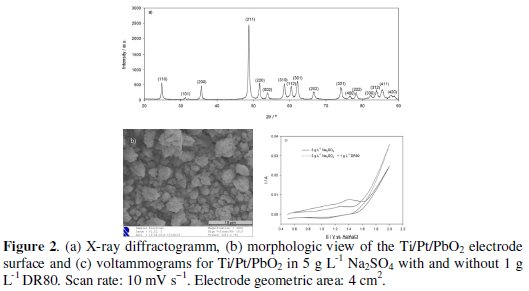
    <p><a href="#f2">Fig. 2a</a> shows the X-ray diffractogram of the electrode surface.</p>


    <p>&nbsp;</p>
<a name="f2">
<img src="/img/revistas/pea/v31n5/31n5a02f2.jpg">
    
<p>&nbsp;</p>


    <p>The diffraction 
lines were indexed according to JCPDS ICDS data (PDF #41-1492) and the 
presence of the &beta;-PbO<sub>2</sub> phase was confirmed. The morphology of the electrode 
surface is also presented in <a href="#f2">Fig. 2b</a>, where a compact coating can be observed, 
with 1 &mu;m granules, being some of them aggregated.</p>


    <p>In <a href="#f2">Fig. 2c</a>, voltammograms for the systems electrolyte and electrolyte+DR80 are 
presented. The two consecutive anodic peaks observed in both systems 
correspond to the partial oxidation of Pb<sup>2+</sup> surface atoms to Pband then to Pb<sup>4+</sup>[26]. 
There are no other peaks besides these, showing that any DR80 oxidation 
reaction happens for potentials in the oxygen evolution zone (higher than 1.5 V 
vs. Ag|AgCl, KClsat). In the electrodegradation assays, the current intensities of 5 
mA and 50 mA correspond to an applied potential of 1.5 V and 2.0 V vs. 
Ag|AgCl, KClsat, meaning that DR80 oxidation was performed in the oxygen 
evolution region, where HO<sup>&bull;</sup> radicals can be formed. <a href="#f2">Fig. 2c</a> also shows a 
decrease in the current intensity when the azo dye is added to the electrolyte 
solution that must be due to a partial passivation of the electrode surface for 
potential lower than the oxygen evolution potential.</p>


    <p>&nbsp;</p>
    ]]></body>
<body><![CDATA[<p><b><i>Degradation assays</i></b></p>

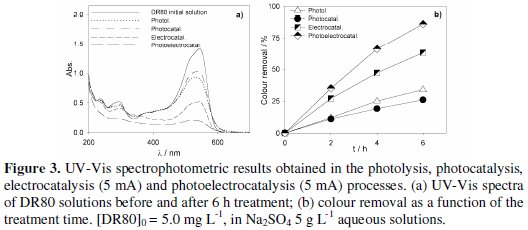
    <p><a href="#f3">Fig. 3 to 5</a> present the spectrophotometric results obtained for the assays 
performed with initial DR80 concentrations of, respectively, 5.0, 12.5 and 25.0 
mg L<sup>-1</sup>.</p>


    <p>&nbsp;</p>
<a name="f3">
<img src="/img/revistas/pea/v31n5/31n5a02f3.jpg">
    
<p>&nbsp;</p>
<a name="f4">
<img src="/img/revistas/pea/v31n5/31n5a02f4.jpg">
    
<p>&nbsp;</p>
<a name="f5">
<img src="/img/revistas/pea/v31n5/31n5a02f5.jpg">
    
<p>&nbsp;</p>


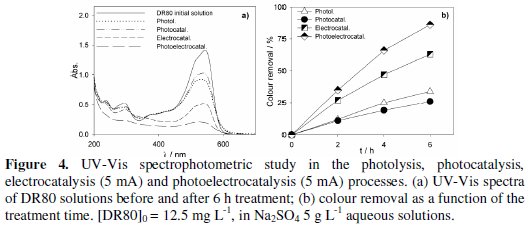
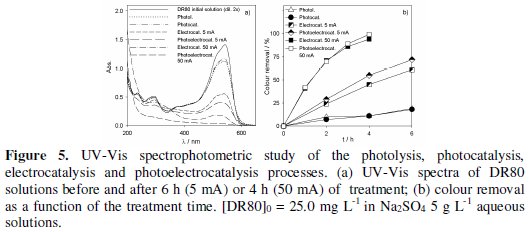
    <p>The absorption spectra of the DR80 initial solutions at the different 
concentrations used are shown in <a href="#f3">Fig. 3a</a>, <a href="#f4">4a</a> and <a href="#f5">5a</a>. They are characterized by 
one band in the visible region, at about 538 nm, due to the absorption of the azo 
bond conjugated with the aromatic rings, and bands in the UV region, attributed 
to the absorptions of benzenic and naphthalenic rings [27]. By analyzing the 
spectra of the samples taken after 6 hours of treatment, for all the degradation 
processes studied, it can be seen that the decay in the absorbance at 538 nm is 
always faster than those in the UV region. This means that the azo bond, 
responsible for the absorption in the visible region, is the first to be broken. In the 
case of photoelectrocatalysis, after 6 hours of treatment, the spectra profile is 
different, since the DR80 characteristic bands almost disappear, which means 
that not only the azo bonds were broken but the opening of the aromatic rings 
also occurred.</p>

    <p>For the lowest DR80 concentration studied (<a href="#f3">Fig. 3</a>), after 6 hours degradation 
assays, 73% colour removal was obtained with photolysis and with 
electrocatalysis, and 88% with photoelectrocatalysis at 5 mA.</p>

    <p>For DR80 initial concentration of 12.5 mg L<sup>-1</sup> (<a href="#f4">Fig. 4</a>), the relative order of 
colour removals did not change, i.e., the best results were also obtained in the 
photoelectrocatalysis (86%) and the lowest in the photocatalysis (26%). Actually, 
photocatalysis presented a poorer performance than photolysis. Apparently, the 
PbO<sub>2</sub> film does not present photocatalytic activity for the radiation used and, in 
fact, it seems to prevent the dispersion of the radiation in the solution. In spite of 
the absorbance removal percentage results presented in <a href="#f5">Fig. 5</a> seem worst than 
those in <a href="#f4">Fig. 4</a>, this is only due to the different initial DR80 concentrations used, 
since equal absorbance removals in percentage represents double absolute 
absorbance removal in the case of the assay performed with the highest 
concentration.</p>

    <p>For the highest DR80 concentration studied, 25.0 mg L<sup>-1</sup> (<a href="#f5">Fig. 5b</a>), after 6 hours 
assay's duration the reductions in absorbance at 538 nm for the different applied 
processes were the following: photolysis/photocatalysis -18%; electrocatalysis at 
5 mA -61%; photoelectrocatalysis at 5 mA -72%. However, when a 50 mA 
current intensity was imposed in the photoelectrocatalytic assay, instead of 5 mA, 
a faster decolourisation of the solution was observed and, after 4 h of treatment 
the colour removal was complete. For this applied current intensity, the absence 
of bands in the UV region of the spectrum presented in <a href="#f5">Fig. 5a</a> proves that the 
benzenic and naftalenic rings opening occurs almost completely. With the 
applied current intensity of 5 mA, even after 6 hours there was still a residual 
colour. This difference in absorbance removals with the applied current intensity 
must be due to an indirect oxidation process, mediated by hydroxyl radicals, 
formed when the applied current exceeds the limiting current for the DR80 
concentration under study, i.e., when the process is definitively controlled by 
mass transfer.</p>

    ]]></body>
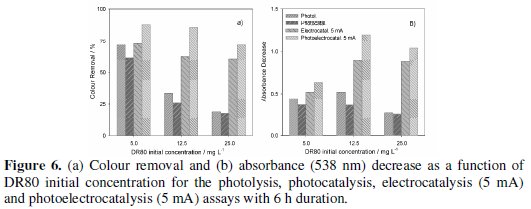
<body><![CDATA[<p><a href="#f6">Fig. 6</a> presents a comparative study of DR80 degradation by photolysis, 
photocatalysis, electrocatalysis (5 mA) and photoelectrocatalysis (5 mA) after 6 
hours of treatment, for the three DR80 initial concentrations studied.</p>


    <p>&nbsp;</p>
<a name="f6">
<img src="/img/revistas/pea/v31n5/31n5a02f6.jpg">
    
<p>&nbsp;</p>


    <p>Experimental data show that for the lowest concentration, the UV irradiation can 
have a positive effect on the degradation of the dye and decolourisations of 72% 
were attained. However, when DR80 concentration increases to 25 mg L<sup>-1</sup>, the 
colour removal expressed in terms of percentage is very low, around 19%. But if 
the absolute absorbance removals are compared, as in <a href="#f6">Fig. 6b</a>, it can be seen that 
this value does not vary too much with the initial concentration. Thus, for the 
highest DR80 initial concentration tested the UV irradiation contribution is low, 
being the application of an electrical current more favourable. In fact, in the 
photoassisted electrochemical process, even for the highest DR80 initial 
concentration, a 72% of colour removal was achieved.</p>

    <p>In all the assays of photolysis and photocatalysis, for equal initial concentration 
similar results were attained, being the photocatalytic effect of the electrode not 
detected in this study, probably because the radiation used was not the most 
adequate to stimulate the PbO<sub>2</sub> catalytic effect.</p>

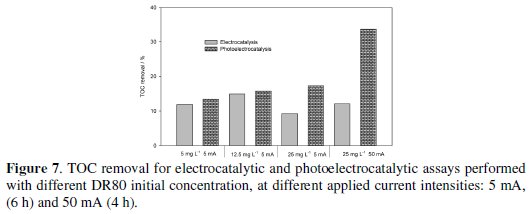
    <p>Regarding TOC removals, even after 6 hours of treatment the DR80 degradations 
by photolysis and photocatalysis do not present any significant mineralization. In 
<a href="#f7">Fig. 7</a> the TOC removals for electro and photoelectrocatalytic processes are 
presented.</p>


    <p>&nbsp;</p>
<a name="f7">
<img src="/img/revistas/pea/v31n5/31n5a02f7.jpg">
    
<p>&nbsp;</p>


    <p>The best removals were always observed for the photoelectrocatalytic 
processes, and were 20% and 30%, for 6 h assay run at 5 mA and 4 h assay run at 
50 mA, respectively. The absolute TOC removals increase with DR80 initial 
concentration, showing the importance of the mass transfer process.</p>


    <p>&nbsp;</p>
    ]]></body>
<body><![CDATA[<p><b>Conclusions</b></p>

    <p>From the comparative study of DR80 degradation by photolysis and 
photocatalysis, with PbO<sub>2</sub> catalyst, and electrocatalysis and photoelectrocatalysis, 
using a PbO<sub>2</sub> photoanode, the following conclusions can be drawn:</p>

    <p>&bull; The degradation of the DR80 dye molecules can be achieved using PbO<sub>2</sub> 
photoanodes. The first step of the degradation mechanism must be the 
breaking of the azo bond, since the absorbance decreases during the processes 
without significant reduction in the TOC content of the solutions, meaning that 
mineralization is very poor.</p>

    <p>&bull; The photolysis effect is important for the lowest DR80 initial concentration 
studied, but for higher concentrations the effect of current intensity is 
predominant.</p>

    <p>&bull; The best colour removals, higher than 85%, were obtained in 
photoelectrocatalysis assays, with 5.0 and 12.5 mg L<sup>-1</sup> DR80 initial 
concentration, at 5 mA, after 6 hours.</p>

    <p>&bull; For the DR80 initial concentration of 25.0 mg L<sup>-1</sup>, a complete colour removal 
was obtained in the photoelectrocatalysis tests, after 4 hours at a current 
intensity of 50 mA. The best TOC removal (30%) was also obtained for this 
assay.</p>


    <p>&nbsp;</p>
    <p><b>References</b></p>

    <!-- ref --><p>1. Zollinger H. Color chemistry, synthesis. Properties and applications of organic dyes and pigments. New York: VCH Publishers; 1991.    &nbsp;&nbsp;&nbsp;&nbsp;&nbsp;&nbsp;&nbsp;&nbsp;[&#160;<a href="javascript:void(0);" onclick="javascript: window.open('/scielo.php?script=sci_nlinks&ref=000071&pid=S0872-1904201300050000200001&lng=','','width=640,height=500,resizable=yes,scrollbars=1,menubar=yes,');">Links</a>&#160;]<!-- end-ref --></p>

    ]]></body>
<body><![CDATA[<!-- ref --><p>2. Hao O J, Kim H, Chiang P-C. Crit Rev Environ Sci Technol. 2000;30:449-505.    &nbsp;&nbsp;&nbsp;&nbsp;&nbsp;&nbsp;&nbsp;&nbsp;[&#160;<a href="javascript:void(0);" onclick="javascript: window.open('/scielo.php?script=sci_nlinks&ref=000073&pid=S0872-1904201300050000200002&lng=','','width=640,height=500,resizable=yes,scrollbars=1,menubar=yes,');">Links</a>&#160;]<!-- end-ref --></p>

    <!-- ref --><p>3. Pacheco M J, Ciriaco M L F, Lopes A, et al. Port Electrochim Acta. 2006;24:273-282.    &nbsp;&nbsp;&nbsp;&nbsp;&nbsp;&nbsp;&nbsp;&nbsp;[&#160;<a href="javascript:void(0);" onclick="javascript: window.open('/scielo.php?script=sci_nlinks&ref=000075&pid=S0872-1904201300050000200003&lng=','','width=640,height=500,resizable=yes,scrollbars=1,menubar=yes,');">Links</a>&#160;]<!-- end-ref --></p>

    <!-- ref --><p>4. Mahmoodi N M, Arami M, Limaee N Y, et al. Chem Eng J. 2005;112:191-196.    &nbsp;&nbsp;&nbsp;&nbsp;&nbsp;&nbsp;&nbsp;&nbsp;[&#160;<a href="javascript:void(0);" onclick="javascript: window.open('/scielo.php?script=sci_nlinks&ref=000077&pid=S0872-1904201300050000200004&lng=','','width=640,height=500,resizable=yes,scrollbars=1,menubar=yes,');">Links</a>&#160;]<!-- end-ref --></p>

    <!-- ref --><p>5. Panizza M, Cerisola G. Electrochim Acta. 2003;48:3491-3497.    &nbsp;&nbsp;&nbsp;&nbsp;&nbsp;&nbsp;&nbsp;&nbsp;[&#160;<a href="javascript:void(0);" onclick="javascript: window.open('/scielo.php?script=sci_nlinks&ref=000079&pid=S0872-1904201300050000200005&lng=','','width=640,height=500,resizable=yes,scrollbars=1,menubar=yes,');">Links</a>&#160;]<!-- end-ref --></p>

    <!-- ref --><p>6. Panizza M, Cerisola G. Electrochim Acta. 2004;49:3221-3226.    &nbsp;&nbsp;&nbsp;&nbsp;&nbsp;&nbsp;&nbsp;&nbsp;[&#160;<a href="javascript:void(0);" onclick="javascript: window.open('/scielo.php?script=sci_nlinks&ref=000081&pid=S0872-1904201300050000200006&lng=','','width=640,height=500,resizable=yes,scrollbars=1,menubar=yes,');">Links</a>&#160;]<!-- end-ref --></p>

    ]]></body>
<body><![CDATA[<!-- ref --><p>7. Konstantinou I K, Albanis T A. Appl Catal B-Environ. 2004;49:1-14.    &nbsp;&nbsp;&nbsp;&nbsp;&nbsp;&nbsp;&nbsp;&nbsp;[&#160;<a href="javascript:void(0);" onclick="javascript: window.open('/scielo.php?script=sci_nlinks&ref=000083&pid=S0872-1904201300050000200007&lng=','','width=640,height=500,resizable=yes,scrollbars=1,menubar=yes,');">Links</a>&#160;]<!-- end-ref --></p>

    <!-- ref --><p>8. Akpan U G, Hameed B H. J Hazard Mater. 2009;170:520-529.    &nbsp;&nbsp;&nbsp;&nbsp;&nbsp;&nbsp;&nbsp;&nbsp;[&#160;<a href="javascript:void(0);" onclick="javascript: window.open('/scielo.php?script=sci_nlinks&ref=000085&pid=S0872-1904201300050000200008&lng=','','width=640,height=500,resizable=yes,scrollbars=1,menubar=yes,');">Links</a>&#160;]<!-- end-ref --></p>

    <!-- ref --><p>9. Soutsas K, Karayannis V, Poulios I, et al. Desalination. 2010;250:345-350.    &nbsp;&nbsp;&nbsp;&nbsp;&nbsp;&nbsp;&nbsp;&nbsp;[&#160;<a href="javascript:void(0);" onclick="javascript: window.open('/scielo.php?script=sci_nlinks&ref=000087&pid=S0872-1904201300050000200009&lng=','','width=640,height=500,resizable=yes,scrollbars=1,menubar=yes,');">Links</a>&#160;]<!-- end-ref --></p>

    <!-- ref --><p>10. Tehrani-Bagha A R, Mahmoodi N M, Menger F M. Desalination. 2010;260:34-38.    &nbsp;&nbsp;&nbsp;&nbsp;&nbsp;&nbsp;&nbsp;&nbsp;[&#160;<a href="javascript:void(0);" onclick="javascript: window.open('/scielo.php?script=sci_nlinks&ref=000089&pid=S0872-1904201300050000200010&lng=','','width=640,height=500,resizable=yes,scrollbars=1,menubar=yes,');">Links</a>&#160;]<!-- end-ref --></p>

    <!-- ref --><p>11. Kariyajjanavar P, Jogttappa N, Nayaka Y A. J Hazard Mater. 2011;190:952-961.    &nbsp;&nbsp;&nbsp;&nbsp;&nbsp;&nbsp;&nbsp;&nbsp;[&#160;<a href="javascript:void(0);" onclick="javascript: window.open('/scielo.php?script=sci_nlinks&ref=000091&pid=S0872-1904201300050000200011&lng=','','width=640,height=500,resizable=yes,scrollbars=1,menubar=yes,');">Links</a>&#160;]<!-- end-ref --></p>

    ]]></body>
<body><![CDATA[<!-- ref --><p>12. Raghu S, Lee C W, Chellammal S, et al. J Hazard Mater. 2009;171:748-754.    &nbsp;&nbsp;&nbsp;&nbsp;&nbsp;&nbsp;&nbsp;&nbsp;[&#160;<a href="javascript:void(0);" onclick="javascript: window.open('/scielo.php?script=sci_nlinks&ref=000093&pid=S0872-1904201300050000200012&lng=','','width=640,height=500,resizable=yes,scrollbars=1,menubar=yes,');">Links</a>&#160;]<!-- end-ref --></p>

    <!-- ref --><p>13. Ciriaco L, Anjo C, Correia J, et al. Electrochim Acta. 2009;54:1464-1472.    &nbsp;&nbsp;&nbsp;&nbsp;&nbsp;&nbsp;&nbsp;&nbsp;[&#160;<a href="javascript:void(0);" onclick="javascript: window.open('/scielo.php?script=sci_nlinks&ref=000095&pid=S0872-1904201300050000200013&lng=','','width=640,height=500,resizable=yes,scrollbars=1,menubar=yes,');">Links</a>&#160;]<!-- end-ref --></p>

    <!-- ref --><p>14. Martinez-Huitle C A, Quiroz M A, Comninellis C, et al. Electrochim Acta 2004;50:949-956.    &nbsp;&nbsp;&nbsp;&nbsp;&nbsp;&nbsp;&nbsp;&nbsp;[&#160;<a href="javascript:void(0);" onclick="javascript: window.open('/scielo.php?script=sci_nlinks&ref=000097&pid=S0872-1904201300050000200014&lng=','','width=640,height=500,resizable=yes,scrollbars=1,menubar=yes,');">Links</a>&#160;]<!-- end-ref --></p>

    <!-- ref --><p>15. Andrade L S, Ruotolo L A M, Rocha-Filho R M, et al. Chemosphere. 2007;66:2035-2043.    &nbsp;&nbsp;&nbsp;&nbsp;&nbsp;&nbsp;&nbsp;&nbsp;[&#160;<a href="javascript:void(0);" onclick="javascript: window.open('/scielo.php?script=sci_nlinks&ref=000099&pid=S0872-1904201300050000200015&lng=','','width=640,height=500,resizable=yes,scrollbars=1,menubar=yes,');">Links</a>&#160;]<!-- end-ref --></p>

    <!-- ref --><p>16. Andrade L S, Tasso T T, Silva D L, et al. Electrochim Acta. 2009;54:2024-2030.    &nbsp;&nbsp;&nbsp;&nbsp;&nbsp;&nbsp;&nbsp;&nbsp;[&#160;<a href="javascript:void(0);" onclick="javascript: window.open('/scielo.php?script=sci_nlinks&ref=000101&pid=S0872-1904201300050000200016&lng=','','width=640,height=500,resizable=yes,scrollbars=1,menubar=yes,');">Links</a>&#160;]<!-- end-ref --></p>

    ]]></body>
<body><![CDATA[<!-- ref --><p>17. Hmani E, Samet Y, Abdelhedi R. Diam Relat Mat. 2012;30:1-8.    &nbsp;&nbsp;&nbsp;&nbsp;&nbsp;&nbsp;&nbsp;&nbsp;[&#160;<a href="javascript:void(0);" onclick="javascript: window.open('/scielo.php?script=sci_nlinks&ref=000103&pid=S0872-1904201300050000200017&lng=','','width=640,height=500,resizable=yes,scrollbars=1,menubar=yes,');">Links</a>&#160;]<!-- end-ref --></p>

    <!-- ref --><p>18. Aquino J M, Pereira G F, Rocha-Filho R C, et al. J Hazard Mat. 2011;192:1275-1282.    &nbsp;&nbsp;&nbsp;&nbsp;&nbsp;&nbsp;&nbsp;&nbsp;[&#160;<a href="javascript:void(0);" onclick="javascript: window.open('/scielo.php?script=sci_nlinks&ref=000105&pid=S0872-1904201300050000200018&lng=','','width=640,height=500,resizable=yes,scrollbars=1,menubar=yes,');">Links</a>&#160;]<!-- end-ref --></p>

    <!-- ref --><p>19. Zhou M, Sarkka H, Sillanpaa M, Sep. Purif. Technol. 2011;78:290-297.    &nbsp;&nbsp;&nbsp;&nbsp;&nbsp;&nbsp;&nbsp;&nbsp;[&#160;<a href="javascript:void(0);" onclick="javascript: window.open('/scielo.php?script=sci_nlinks&ref=000107&pid=S0872-1904201300050000200019&lng=','','width=640,height=500,resizable=yes,scrollbars=1,menubar=yes,');">Links</a>&#160;]<!-- end-ref --></p>

    <!-- ref --><p>20. Aquino J M, Rodrigo M A, Rocha-Filha R C, et al. Chem Eng J. 2012;184:221-227.    &nbsp;&nbsp;&nbsp;&nbsp;&nbsp;&nbsp;&nbsp;&nbsp;[&#160;<a href="javascript:void(0);" onclick="javascript: window.open('/scielo.php?script=sci_nlinks&ref=000109&pid=S0872-1904201300050000200020&lng=','','width=640,height=500,resizable=yes,scrollbars=1,menubar=yes,');">Links</a>&#160;]<!-- end-ref --></p>

    <!-- ref --><p>21. Cruz-Gonzalez K, Torres-Lopez O, Garcia-Leon A M, et al. Desalination 2012;286:63-68.    &nbsp;&nbsp;&nbsp;&nbsp;&nbsp;&nbsp;&nbsp;&nbsp;[&#160;<a href="javascript:void(0);" onclick="javascript: window.open('/scielo.php?script=sci_nlinks&ref=000111&pid=S0872-1904201300050000200021&lng=','','width=640,height=500,resizable=yes,scrollbars=1,menubar=yes,');">Links</a>&#160;]<!-- end-ref --></p>

    ]]></body>
<body><![CDATA[<!-- ref --><p>22. Tsantaki E, Velegraki T, Katsaounis A, et al. J Hazard Mat. 2012;207:91-96.    &nbsp;&nbsp;&nbsp;&nbsp;&nbsp;&nbsp;&nbsp;&nbsp;[&#160;<a href="javascript:void(0);" onclick="javascript: window.open('/scielo.php?script=sci_nlinks&ref=000113&pid=S0872-1904201300050000200022&lng=','','width=640,height=500,resizable=yes,scrollbars=1,menubar=yes,');">Links</a>&#160;]<!-- end-ref --></p>

    <!-- ref --><p>23. Karunakaran C, Dhanalakshmi R. Sol Energy Mater Sol Cells. 2008;92:588-593.    &nbsp;&nbsp;&nbsp;&nbsp;&nbsp;&nbsp;&nbsp;&nbsp;[&#160;<a href="javascript:void(0);" onclick="javascript: window.open('/scielo.php?script=sci_nlinks&ref=000115&pid=S0872-1904201300050000200023&lng=','','width=640,height=500,resizable=yes,scrollbars=1,menubar=yes,');">Links</a>&#160;]<!-- end-ref --></p>

    <!-- ref --><p>24. Karunakaran C, Dhanalakshmi R. Sol Energy Mater Sol Cells. 2008;92:1315-1321.    &nbsp;&nbsp;&nbsp;&nbsp;&nbsp;&nbsp;&nbsp;&nbsp;[&#160;<a href="javascript:void(0);" onclick="javascript: window.open('/scielo.php?script=sci_nlinks&ref=000117&pid=S0872-1904201300050000200024&lng=','','width=640,height=500,resizable=yes,scrollbars=1,menubar=yes,');">Links</a>&#160;]<!-- end-ref --></p>

    <!-- ref --><p>25. Karunakaran C, Dhanalakshmi R. Cent Eur J Chem. 2009;7:134-137.    &nbsp;&nbsp;&nbsp;&nbsp;&nbsp;&nbsp;&nbsp;&nbsp;[&#160;<a href="javascript:void(0);" onclick="javascript: window.open('/scielo.php?script=sci_nlinks&ref=000119&pid=S0872-1904201300050000200025&lng=','','width=640,height=500,resizable=yes,scrollbars=1,menubar=yes,');">Links</a>&#160;]<!-- end-ref --></p>

    <!-- ref --><p>26. Songa S, Zhana L, Hea Z, et al. J Hazard Mat. 2010;175:614-621.    &nbsp;&nbsp;&nbsp;&nbsp;&nbsp;&nbsp;&nbsp;&nbsp;[&#160;<a href="javascript:void(0);" onclick="javascript: window.open('/scielo.php?script=sci_nlinks&ref=000121&pid=S0872-1904201300050000200026&lng=','','width=640,height=500,resizable=yes,scrollbars=1,menubar=yes,');">Links</a>&#160;]<!-- end-ref --></p>

    ]]></body>
<body><![CDATA[<!-- ref --><p>27. Silverstein R, Bassler G, Morril T. Spectrometric identification of organic compounds. 4th ed. New York: Jonh Wiley and Sons, Inc.; 1981.    &nbsp;&nbsp;&nbsp;&nbsp;&nbsp;&nbsp;&nbsp;&nbsp;[&#160;<a href="javascript:void(0);" onclick="javascript: window.open('/scielo.php?script=sci_nlinks&ref=000123&pid=S0872-1904201300050000200027&lng=','','width=640,height=500,resizable=yes,scrollbars=1,menubar=yes,');">Links</a>&#160;]<!-- end-ref --></p>


    <p>&nbsp;</p>
    <p><a name=0></a><sup><a href="#top">*</a></sup>Corresponding author. E-mail address: <a href="mailto:lciriaco@ubi.pt">lciriaco@ubi.pt</a></p>

    <p>Received 12 July 2013; accepted 31 October 2013</p>

    <p><a href="http://www.peacta.org" target="_blank">www.peacta.org</a> </p>


     ]]></body><back>
<ref-list>
<ref id="B1">
<label>1</label><nlm-citation citation-type="book">
<person-group person-group-type="author">
<name>
<surname><![CDATA[Zollinger]]></surname>
<given-names><![CDATA[H]]></given-names>
</name>
</person-group>
<source><![CDATA[Color chemistry, synthesis. Properties and applications of organic dyes and pigments]]></source>
<year>1991</year>
<publisher-loc><![CDATA[New York ]]></publisher-loc>
<publisher-name><![CDATA[VCH Publishers]]></publisher-name>
</nlm-citation>
</ref>
<ref id="B2">
<label>2</label><nlm-citation citation-type="journal">
<person-group person-group-type="author">
<name>
<surname><![CDATA[Hao]]></surname>
<given-names><![CDATA[O J]]></given-names>
</name>
<name>
<surname><![CDATA[Kim]]></surname>
<given-names><![CDATA[H]]></given-names>
</name>
<name>
<surname><![CDATA[Chiang]]></surname>
<given-names><![CDATA[P-C]]></given-names>
</name>
</person-group>
<source><![CDATA[Crit Rev Environ Sci Technol]]></source>
<year>2000</year>
<volume>30</volume>
<page-range>449-505</page-range></nlm-citation>
</ref>
<ref id="B3">
<label>3</label><nlm-citation citation-type="journal">
<person-group person-group-type="author">
<name>
<surname><![CDATA[Pacheco]]></surname>
<given-names><![CDATA[M J]]></given-names>
</name>
<name>
<surname><![CDATA[Ciriaco]]></surname>
<given-names><![CDATA[M L F]]></given-names>
</name>
<name>
<surname><![CDATA[Lopes]]></surname>
<given-names><![CDATA[A]]></given-names>
</name>
</person-group>
<source><![CDATA[Port Electrochim Acta]]></source>
<year>2006</year>
<volume>24</volume>
<page-range>273-282</page-range></nlm-citation>
</ref>
<ref id="B4">
<label>4</label><nlm-citation citation-type="journal">
<person-group person-group-type="author">
<name>
<surname><![CDATA[Mahmoodi]]></surname>
<given-names><![CDATA[N M]]></given-names>
</name>
<name>
<surname><![CDATA[Arami]]></surname>
<given-names><![CDATA[M]]></given-names>
</name>
<name>
<surname><![CDATA[Limaee]]></surname>
<given-names><![CDATA[N Y]]></given-names>
</name>
</person-group>
<source><![CDATA[Chem Eng J]]></source>
<year>2005</year>
<volume>112</volume>
<page-range>191-196</page-range></nlm-citation>
</ref>
<ref id="B5">
<label>5</label><nlm-citation citation-type="journal">
<person-group person-group-type="author">
<name>
<surname><![CDATA[Panizza]]></surname>
<given-names><![CDATA[M]]></given-names>
</name>
<name>
<surname><![CDATA[Cerisola]]></surname>
<given-names><![CDATA[G]]></given-names>
</name>
</person-group>
<source><![CDATA[Electrochim Acta]]></source>
<year>2003</year>
<volume>48</volume>
<page-range>3491-3497</page-range></nlm-citation>
</ref>
<ref id="B6">
<label>6</label><nlm-citation citation-type="journal">
<person-group person-group-type="author">
<name>
<surname><![CDATA[Panizza]]></surname>
<given-names><![CDATA[M]]></given-names>
</name>
<name>
<surname><![CDATA[Cerisola]]></surname>
<given-names><![CDATA[G]]></given-names>
</name>
</person-group>
<source><![CDATA[Electrochim Acta]]></source>
<year>2004</year>
<volume>49</volume>
<page-range>3221-3226</page-range></nlm-citation>
</ref>
<ref id="B7">
<label>7</label><nlm-citation citation-type="journal">
<person-group person-group-type="author">
<name>
<surname><![CDATA[Konstantinou]]></surname>
<given-names><![CDATA[I K]]></given-names>
</name>
<name>
<surname><![CDATA[Albanis]]></surname>
<given-names><![CDATA[T A]]></given-names>
</name>
</person-group>
<source><![CDATA[Appl Catal B-Environ]]></source>
<year>2004</year>
<volume>49</volume>
<page-range>1-14</page-range></nlm-citation>
</ref>
<ref id="B8">
<label>8</label><nlm-citation citation-type="journal">
<person-group person-group-type="author">
<name>
<surname><![CDATA[Akpan]]></surname>
<given-names><![CDATA[U G]]></given-names>
</name>
<name>
<surname><![CDATA[Hameed]]></surname>
<given-names><![CDATA[B H]]></given-names>
</name>
</person-group>
<source><![CDATA[J Hazard Mater]]></source>
<year>2009</year>
<volume>170</volume>
<page-range>520-529</page-range></nlm-citation>
</ref>
<ref id="B9">
<label>9</label><nlm-citation citation-type="journal">
<person-group person-group-type="author">
<name>
<surname><![CDATA[Soutsas]]></surname>
<given-names><![CDATA[K]]></given-names>
</name>
<name>
<surname><![CDATA[Karayannis]]></surname>
<given-names><![CDATA[V]]></given-names>
</name>
<name>
<surname><![CDATA[Poulios]]></surname>
<given-names><![CDATA[I]]></given-names>
</name>
</person-group>
<source><![CDATA[Desalination]]></source>
<year>2010</year>
<volume>250</volume>
<page-range>345-350</page-range></nlm-citation>
</ref>
<ref id="B10">
<label>10</label><nlm-citation citation-type="journal">
<person-group person-group-type="author">
<name>
<surname><![CDATA[Tehrani-Bagha]]></surname>
<given-names><![CDATA[A R]]></given-names>
</name>
<name>
<surname><![CDATA[Mahmoodi]]></surname>
<given-names><![CDATA[N M]]></given-names>
</name>
<name>
<surname><![CDATA[Menger]]></surname>
<given-names><![CDATA[F M]]></given-names>
</name>
</person-group>
<source><![CDATA[Desalination]]></source>
<year>2010</year>
<volume>260</volume>
<page-range>34-38</page-range></nlm-citation>
</ref>
<ref id="B11">
<label>11</label><nlm-citation citation-type="journal">
<person-group person-group-type="author">
<name>
<surname><![CDATA[Kariyajjanavar]]></surname>
<given-names><![CDATA[P]]></given-names>
</name>
<name>
<surname><![CDATA[Jogttappa]]></surname>
<given-names><![CDATA[N]]></given-names>
</name>
<name>
<surname><![CDATA[Nayaka]]></surname>
<given-names><![CDATA[Y A]]></given-names>
</name>
</person-group>
<source><![CDATA[J Hazard Mater]]></source>
<year>2011</year>
<volume>190</volume>
<page-range>952-961</page-range></nlm-citation>
</ref>
<ref id="B12">
<label>12</label><nlm-citation citation-type="journal">
<person-group person-group-type="author">
<name>
<surname><![CDATA[Raghu]]></surname>
<given-names><![CDATA[S]]></given-names>
</name>
<name>
<surname><![CDATA[Lee]]></surname>
<given-names><![CDATA[C W]]></given-names>
</name>
<name>
<surname><![CDATA[Chellammal]]></surname>
<given-names><![CDATA[S]]></given-names>
</name>
</person-group>
<source><![CDATA[J Hazard Mater]]></source>
<year>2009</year>
<volume>171</volume>
<page-range>748-754</page-range></nlm-citation>
</ref>
<ref id="B13">
<label>13</label><nlm-citation citation-type="journal">
<person-group person-group-type="author">
<name>
<surname><![CDATA[Ciriaco]]></surname>
<given-names><![CDATA[L]]></given-names>
</name>
<name>
<surname><![CDATA[Anjo]]></surname>
<given-names><![CDATA[C]]></given-names>
</name>
<name>
<surname><![CDATA[Correia]]></surname>
<given-names><![CDATA[J]]></given-names>
</name>
</person-group>
<source><![CDATA[Electrochim Acta]]></source>
<year>2009</year>
<volume>54</volume>
<page-range>1464-1472</page-range></nlm-citation>
</ref>
<ref id="B14">
<label>14</label><nlm-citation citation-type="journal">
<person-group person-group-type="author">
<name>
<surname><![CDATA[Martinez-Huitle]]></surname>
<given-names><![CDATA[C A]]></given-names>
</name>
<name>
<surname><![CDATA[Quiroz]]></surname>
<given-names><![CDATA[M A]]></given-names>
</name>
<name>
<surname><![CDATA[Comninellis]]></surname>
<given-names><![CDATA[C]]></given-names>
</name>
</person-group>
<source><![CDATA[Electrochim Acta]]></source>
<year>2004</year>
<volume>50</volume>
<page-range>949-956</page-range></nlm-citation>
</ref>
<ref id="B15">
<label>15</label><nlm-citation citation-type="journal">
<person-group person-group-type="author">
<name>
<surname><![CDATA[Andrade]]></surname>
<given-names><![CDATA[L S]]></given-names>
</name>
<name>
<surname><![CDATA[Ruotolo]]></surname>
<given-names><![CDATA[L A M]]></given-names>
</name>
<name>
<surname><![CDATA[Rocha-Filho]]></surname>
<given-names><![CDATA[R M]]></given-names>
</name>
</person-group>
<source><![CDATA[Chemosphere]]></source>
<year>2007</year>
<volume>66</volume>
<page-range>2035-2043</page-range></nlm-citation>
</ref>
<ref id="B16">
<label>16</label><nlm-citation citation-type="journal">
<person-group person-group-type="author">
<name>
<surname><![CDATA[Andrade]]></surname>
<given-names><![CDATA[L S]]></given-names>
</name>
<name>
<surname><![CDATA[Tasso]]></surname>
<given-names><![CDATA[T T]]></given-names>
</name>
<name>
<surname><![CDATA[Silva]]></surname>
<given-names><![CDATA[D L]]></given-names>
</name>
</person-group>
<source><![CDATA[Electrochim Acta]]></source>
<year>2009</year>
<volume>54</volume>
<page-range>2024-2030</page-range></nlm-citation>
</ref>
<ref id="B17">
<label>17</label><nlm-citation citation-type="journal">
<person-group person-group-type="author">
<name>
<surname><![CDATA[Hmani]]></surname>
<given-names><![CDATA[E]]></given-names>
</name>
<name>
<surname><![CDATA[Samet]]></surname>
<given-names><![CDATA[Y]]></given-names>
</name>
<name>
<surname><![CDATA[Abdelhedi]]></surname>
<given-names><![CDATA[R]]></given-names>
</name>
</person-group>
<source><![CDATA[Diam Relat Mat]]></source>
<year>2012</year>
<volume>30</volume>
<page-range>1-8</page-range></nlm-citation>
</ref>
<ref id="B18">
<label>18</label><nlm-citation citation-type="journal">
<person-group person-group-type="author">
<name>
<surname><![CDATA[Aquino]]></surname>
<given-names><![CDATA[J M]]></given-names>
</name>
<name>
<surname><![CDATA[Pereira]]></surname>
<given-names><![CDATA[G F]]></given-names>
</name>
<name>
<surname><![CDATA[Rocha-Filho]]></surname>
<given-names><![CDATA[R C]]></given-names>
</name>
</person-group>
<source><![CDATA[J Hazard Mat]]></source>
<year>2011</year>
<volume>192</volume>
<page-range>1275-1282</page-range></nlm-citation>
</ref>
<ref id="B19">
<label>19</label><nlm-citation citation-type="journal">
<person-group person-group-type="author">
<name>
<surname><![CDATA[Zhou]]></surname>
<given-names><![CDATA[M]]></given-names>
</name>
<name>
<surname><![CDATA[Sarkka]]></surname>
<given-names><![CDATA[H]]></given-names>
</name>
<name>
<surname><![CDATA[Sillanpaa]]></surname>
<given-names><![CDATA[M]]></given-names>
</name>
</person-group>
<source><![CDATA[Sep. Purif. Technol]]></source>
<year>2011</year>
<volume>78</volume>
<page-range>290-297</page-range></nlm-citation>
</ref>
<ref id="B20">
<label>20</label><nlm-citation citation-type="journal">
<person-group person-group-type="author">
<name>
<surname><![CDATA[Aquino]]></surname>
<given-names><![CDATA[J M]]></given-names>
</name>
<name>
<surname><![CDATA[Rodrigo]]></surname>
<given-names><![CDATA[M A]]></given-names>
</name>
<name>
<surname><![CDATA[Rocha-Filha]]></surname>
<given-names><![CDATA[R C]]></given-names>
</name>
</person-group>
<source><![CDATA[Chem Eng J]]></source>
<year>2012</year>
<volume>184</volume>
<page-range>221-227</page-range></nlm-citation>
</ref>
<ref id="B21">
<label>21</label><nlm-citation citation-type="journal">
<person-group person-group-type="author">
<name>
<surname><![CDATA[Cruz-Gonzalez]]></surname>
<given-names><![CDATA[K]]></given-names>
</name>
<name>
<surname><![CDATA[Torres-Lopez]]></surname>
<given-names><![CDATA[O]]></given-names>
</name>
<name>
<surname><![CDATA[Garcia-Leon]]></surname>
<given-names><![CDATA[A M]]></given-names>
</name>
</person-group>
<source><![CDATA[Desalination]]></source>
<year>2012</year>
<volume>286</volume>
<page-range>63-68</page-range></nlm-citation>
</ref>
<ref id="B22">
<label>22</label><nlm-citation citation-type="journal">
<person-group person-group-type="author">
<name>
<surname><![CDATA[Tsantaki]]></surname>
<given-names><![CDATA[E]]></given-names>
</name>
<name>
<surname><![CDATA[Velegraki]]></surname>
<given-names><![CDATA[T]]></given-names>
</name>
<name>
<surname><![CDATA[Katsaounis]]></surname>
<given-names><![CDATA[A]]></given-names>
</name>
</person-group>
<source><![CDATA[J Hazard Mat]]></source>
<year>2012</year>
<volume>207</volume>
<page-range>91-96</page-range></nlm-citation>
</ref>
<ref id="B23">
<label>23</label><nlm-citation citation-type="journal">
<person-group person-group-type="author">
<name>
<surname><![CDATA[Karunakaran]]></surname>
<given-names><![CDATA[C]]></given-names>
</name>
<name>
<surname><![CDATA[Dhanalakshmi]]></surname>
<given-names><![CDATA[R]]></given-names>
</name>
</person-group>
<source><![CDATA[Sol Energy Mater Sol Cells]]></source>
<year>2008</year>
<volume>92</volume>
<page-range>588-593</page-range></nlm-citation>
</ref>
<ref id="B24">
<label>24</label><nlm-citation citation-type="journal">
<person-group person-group-type="author">
<name>
<surname><![CDATA[Karunakaran]]></surname>
<given-names><![CDATA[C]]></given-names>
</name>
<name>
<surname><![CDATA[Dhanalakshmi]]></surname>
<given-names><![CDATA[R]]></given-names>
</name>
</person-group>
<source><![CDATA[Sol Energy Mater Sol Cells]]></source>
<year>2008</year>
<volume>92</volume>
<page-range>1315-1321</page-range></nlm-citation>
</ref>
<ref id="B25">
<label>25</label><nlm-citation citation-type="journal">
<person-group person-group-type="author">
<name>
<surname><![CDATA[Karunakaran]]></surname>
<given-names><![CDATA[C]]></given-names>
</name>
<name>
<surname><![CDATA[Dhanalakshmi]]></surname>
<given-names><![CDATA[R]]></given-names>
</name>
</person-group>
<source><![CDATA[Cent Eur J Chem]]></source>
<year>2009</year>
<volume>7</volume>
<page-range>134-137</page-range></nlm-citation>
</ref>
<ref id="B26">
<label>26</label><nlm-citation citation-type="journal">
<person-group person-group-type="author">
<name>
<surname><![CDATA[Songa]]></surname>
<given-names><![CDATA[S]]></given-names>
</name>
<name>
<surname><![CDATA[Zhana]]></surname>
<given-names><![CDATA[L]]></given-names>
</name>
<name>
<surname><![CDATA[Hea]]></surname>
<given-names><![CDATA[Z]]></given-names>
</name>
</person-group>
<source><![CDATA[J Hazard Mat]]></source>
<year>2010</year>
<volume>175</volume>
<page-range>614-621</page-range></nlm-citation>
</ref>
<ref id="B27">
<label>27</label><nlm-citation citation-type="book">
<person-group person-group-type="author">
<name>
<surname><![CDATA[Silverstein]]></surname>
<given-names><![CDATA[R]]></given-names>
</name>
<name>
<surname><![CDATA[Bassler]]></surname>
<given-names><![CDATA[G]]></given-names>
</name>
<name>
<surname><![CDATA[Morril]]></surname>
<given-names><![CDATA[T]]></given-names>
</name>
</person-group>
<source><![CDATA[Spectrometric identification of organic compounds]]></source>
<year>1981</year>
<edition>4</edition>
<publisher-loc><![CDATA[New York ]]></publisher-loc>
<publisher-name><![CDATA[Jonh Wiley and Sons]]></publisher-name>
</nlm-citation>
</ref>
</ref-list>
</back>
</article>