<?xml version="1.0" encoding="ISO-8859-1"?><article xmlns:mml="http://www.w3.org/1998/Math/MathML" xmlns:xlink="http://www.w3.org/1999/xlink" xmlns:xsi="http://www.w3.org/2001/XMLSchema-instance">
<front>
<journal-meta>
<journal-id>0872-1904</journal-id>
<journal-title><![CDATA[Portugaliae Electrochimica Acta]]></journal-title>
<abbrev-journal-title><![CDATA[Port. Electrochim. Acta]]></abbrev-journal-title>
<issn>0872-1904</issn>
<publisher>
<publisher-name><![CDATA[Sociedade Portuguesa de Electroquímica]]></publisher-name>
</publisher>
</journal-meta>
<article-meta>
<article-id>S0872-19042013000500004</article-id>
<article-id pub-id-type="doi">10.4152/pea.201305277</article-id>
<title-group>
<article-title xml:lang="en"><![CDATA[Corrosion Protection of Hot Dip Galvanized Steel in Mortar]]></article-title>
</title-group>
<contrib-group>
<contrib contrib-type="author">
<name>
<surname><![CDATA[Figueira]]></surname>
<given-names><![CDATA[Rita M.]]></given-names>
</name>
<xref ref-type="aff" rid="A01"/>
</contrib>
<contrib contrib-type="author">
<name>
<surname><![CDATA[Pereira]]></surname>
<given-names><![CDATA[Elsa V.]]></given-names>
</name>
<xref ref-type="aff" rid="A01"/>
</contrib>
<contrib contrib-type="author">
<name>
<surname><![CDATA[Silva]]></surname>
<given-names><![CDATA[Carlos J.R.]]></given-names>
</name>
<xref ref-type="aff" rid="A02"/>
</contrib>
<contrib contrib-type="author">
<name>
<surname><![CDATA[Salta]]></surname>
<given-names><![CDATA[Maria M.]]></given-names>
</name>
<xref ref-type="aff" rid="A01"/>
</contrib>
</contrib-group>
<aff id="A01">
<institution><![CDATA[,Laboratório Nacional de Engenharia Civil  ]]></institution>
<addr-line><![CDATA[Lisboa ]]></addr-line>
<country>Portugal</country>
</aff>
<aff id="A02">
<institution><![CDATA[,Universidade do Minho Centro de Química ]]></institution>
<addr-line><![CDATA[Braga ]]></addr-line>
<country>Portugal</country>
</aff>
<pub-date pub-type="pub">
<day>08</day>
<month>10</month>
<year>2013</year>
</pub-date>
<pub-date pub-type="epub">
<day>08</day>
<month>10</month>
<year>2013</year>
</pub-date>
<volume>31</volume>
<numero>5</numero>
<fpage>277</fpage>
<lpage>287</lpage>
<copyright-statement/>
<copyright-year/>
<self-uri xlink:href="http://scielo.pt/scielo.php?script=sci_arttext&amp;pid=S0872-19042013000500004&amp;lng=en&amp;nrm=iso"></self-uri><self-uri xlink:href="http://scielo.pt/scielo.php?script=sci_abstract&amp;pid=S0872-19042013000500004&amp;lng=en&amp;nrm=iso"></self-uri><self-uri xlink:href="http://scielo.pt/scielo.php?script=sci_pdf&amp;pid=S0872-19042013000500004&amp;lng=en&amp;nrm=iso"></self-uri><abstract abstract-type="short" xml:lang="en"><p><![CDATA[Corrosion of steel in concrete is one of the major causes of structure degradation, requiring expensive maintenance. The using of hot dip galvanized steel (HDGS) has been recognized as one effective measure to increase the service life of reinforced concrete structures in marine environmental. However, HDGS corrodes in contact with high alkaline environment of fresh concrete. Although this initial corrosion process allows the formation of a protecting layer barrier, the corrosion that occurs initially is harmful and chromate conversion layers are usually used to prevent it. Due to toxicity of Cr(VI), these kinds of pre-treatments have been forbidden and hybrid coatings have been proposed as alternatives &#91;1-3&#93;. To evaluate the performance of these coatings, beyond the laboratory characterization, in situ tests in real conditions should be performed. An electrochemical system to measure the macrocell current density (i gal) was designed to evaluate the degradation of HDGS coated samples with different organic-inorganic hybrid films, embedded in mortar during 70 days, using an automatic data acquisition system. This system revealed to be feasible and highly sensitive to coatings degradation. Also, allow distinguishing different hybrid coatings with different thicknesses.]]></p></abstract>
<kwd-group>
<kwd lng="en"><![CDATA[Corrosion]]></kwd>
<kwd lng="en"><![CDATA[Galvanized steel]]></kwd>
<kwd lng="en"><![CDATA[Protection]]></kwd>
<kwd lng="en"><![CDATA[Gel coating]]></kwd>
<kwd lng="en"><![CDATA[Sol-gel]]></kwd>
</kwd-group>
</article-meta>
</front><body><![CDATA[ 

<!--     <p>&nbsp;</p>
    <p>doi: 10.4152/pea.201305277</p> -->

    <p><b>Corrosion Protection of Hot Dip Galvanized Steel in Mortar</b></p>

    <p><b>Rita M. Figueira</b><sup><i>a,b</i>,<a href="#0">*</a></sup>, <b>Elsa V. Pereira</b><sup><i>a</i></sup>, <b>Carlos J.R. Silva</b><sup><i>b</i></sup></b>, <b>Maria M. Salta</b><sup><i>a</i></sup></p>

    <p><i><sup>a</sup> LNEC - Laborat&oacute;rio Nacional de Engenharia Civil, Lisboa, Portugal</i></p>

    <p><i><sup>b</sup> Centro de Qu&iacute;mica, Universidade do Minho, Braga, Portugal</i></p>


    <p>&nbsp;</p>
    <p><b>Abstract</b></p>

    <p>Corrosion of steel in concrete is one of the major causes of structure degradation, 
requiring expensive maintenance. The using of hot dip galvanized steel (HDGS) has 
been recognized as one effective measure to increase the service life of reinforced 
concrete structures in marine environmental. However, HDGS corrodes in contact with 
high alkaline environment of fresh concrete. Although this initial corrosion process 
allows the formation of a protecting layer barrier, the corrosion that occurs initially is 
harmful and chromate conversion layers are usually used to prevent it.</p>

    ]]></body>
<body><![CDATA[<p>Due to toxicity of Cr(VI), these kinds of pre-treatments have been forbidden and hybrid 
coatings have been proposed as alternatives [1-3]. To evaluate the performance of these 
coatings, beyond the laboratory characterization, in situ tests in real conditions should 
be performed.</p>

    <p>An electrochemical system to measure the macrocell current density (i<sub>gal</sub>) was designed 
to evaluate the degradation of HDGS coated samples with different organic-inorganic 
hybrid films, embedded in mortar during 70 days, using an automatic data acquisition 
system.</p>

    <p>This system revealed to be feasible and highly sensitive to coatings degradation. Also, 
allow distinguishing different hybrid coatings with different thicknesses.</p>

    <p><b><i>Keywords:</i></b> Corrosion; Galvanized steel, Protection, Gel coating, Sol-gel.</p>


    <p>&nbsp;</p>
    <p><b>Introduction</b></p>

    <p>To minimize the risk of corrosion of reinforced concrete structures (RCS) it 
should be ensured that the concrete covering the metallic reinforcement parts is 
of an adequate thickness and possesses a high quality, with a proper mixing ratio, 
good compaction and curing. However, the physical barrier of protection 
provided by the concrete cover is not perfect. Due to the porous concrete 
structure, resulting from imperfections of concreting and curing processes, the 
diffusion/transport of aggressive species towards the interface steel/concrete is 
enabled. The conjugation of these factors may cause rupture of the film 
passivation and initiate rusting of steel originating failure in reinforced concrete 
structures. However, premature failure in RCS by reinforcement corrosion in 
aggressive environments, especially structures exposed to marine environments, 
might be mitigated if the reinforcing steel is hot dip galvanized [4-7]. The zinc 
coating on rebars embedded in concrete acts as a physical barrier avoiding direct 
contact between the coated reinforcing steel and the aggressive environment. 
Deposited zinc acts as sacrificial anode protecting the steel against corrosion and 
the zinc corrosion products provide a sealing effect on zinc coating due to 
discontinuities. Moreover, galvanized reinforcing steel can withstand exposure 
to chloride ion concentrations several times higher (at least 4 to 5 times) than the 
chloride level, that causes corrosion in steel reinforcement.</p>

    <p>While steel in concrete typically depassivates at a pH below 11.5, galvanized 
reinforcement can remain passivated at a lower pH, thereby offering additional 
substantial protection against the effects of concrete carbonation. The 
combination of these factors: carbonation resistance and chloride tolerance are 
commonly accepted as the basis for superior performance of galvanized 
reinforcement compared to steel reinforcement. In addition, zinc corrosion 
products occupy a smaller volume than those produced from iron causing slight 
or no disruption in the surrounding concrete. Yeomans also confirmed that the 
zinc corrosion products are powdery and non-adherent making them capable of 
migrating from the surface of the galvanized reinforcement into the concrete 
matrix, reducing the likelihood of zinc corrosion-induced spalling of the 
concrete.</p>

    <p>The cathodic reaction from water hydrolysis with hydrogen evolution, in contact 
with high alkaline environments, such as concrete, takes place, producing a 
continuous dissolution of the metal until the solution becomes oversaturated by 
these ions that precipitate as Zn(OH)<sub>2</sub> or ZnO. In order to avoid those reactions 
the cement must contains at least 100 ppm of chromates in the final concrete mix 
or the hot-dip galvanized bars must be previously passivated with a chromate 
conversion layer to minimize the evolution of hydrogen during the reaction 
between zinc and fresh concrete [9-15].</p>

    <p>The high corrosion resistance offered by the use of chromate films is endorsed to 
the presence of Cr<sup>6+</sup> and Cr<sup>3+</sup>. Chromate and similar hexavalent chromium 
compounds are among the most common substances used as inhibitors and are 
commonly incorporated in anticorrosive pre-treatments of a wide range of metals 
and alloys, such as steels, aluminium alloys, copper, lead and others. The original 
reason behind the use of chromate treatments on galvanized steel is to avoid the 
formation of wet storage stain during the first six weeks after galvanizing, in 
particular to reduce the formation of excessive amounts of zinc oxide and zinc 
hydroxide during that period, and reduce the consequent release of hydrogen gas. 
The reaction of zinc with the concrete ceases in a few days and gives just 
sufficient corrosion products to ensure a strong and reliable bond to the concrete 
when fully hardened.</p>

    ]]></body>
<body><![CDATA[<p>Although the chromium-based compounds improve the corrosion resistance of 
zinc and minimize the hydrogen evolution, their application is heavily regulated 
by most environmental legislation due to their carcinogenic effects. Research 
efforts are being made to replace chromates and produce new ecological 
compounds and processes aiming good corrosion resistance, adhesion, and 
fatigue resistance, reliability and quality control performances. Besides some 
commercial available products, research developments involve a better 
understanding of these coatings performance beyond the laboratory scale, so in 
situ tests (in real RCS conditions) are currently performed and feasible systems 
being developed.</p>

    <p>As well documented by several authors [16-23] electrochemical techniques (i.e. 
half-cell potential measurements, polarization resistance, potentiostatic and 
galvanostatic transients perturbations, electrochemical impedance spectroscopy, 
noise analysis, multielectrode systems, etc.) offer several advantages for 
reinforcement corrosion monitoring. Schiessl and Raupach in 1992 developed a 
sensor to be implemented inside concrete during the construction. The developed 
sensor device involves the paring of a non-oxidable metal electrode, usually 
stainless steel, with the steel rebars used to build the construction structure, 
allowing measuring the galvanic current created when construction steel 
depassivates by action of the aggressive agents (local acidification, carbonation, 
ingress of chloride ions and/or depletion of O<sub>2</sub>). Installing these sensors on 
critical points of the concrete structure together with an appropriate data 
acquisition and communication systems is possible a real-time RCS monitoring. 
Detecting or predicting the instant wherein the construction steel depassivates 
[26-27], makes possible to plan the necessary maintenance interventions in order 
to minimize the involved costs.</p>

    <p>In the present work is described an electrochemical system based on Schiessl 
and Raupach studies. The main purpose of the paper is to evaluate the response 
of the designed electrochemical system when coated with different OIH and not 
to evaluate the barrier properties of the coatings.</p>

    <p>This system was tested under laboratory conditions to assess the system response 
to the degradation of HDGS coated with different OIH films embedded in 
mortar. The developed cells allow assessing and monitoring the behavior of 
HDGS protective coatings with time when in contact with mortar. The results 
show that the designed system implemented is suitable to evaluate the in situ 
degradation of HDGS coated with different OIH films embedded in concrete.</p>


    <p>&nbsp;</p>
    <p><b>Experimental</b></p>

    <p><b><i>Reagents</i></b></p>

    <p>The OIH gel matrices were prepared following a well-established methodology 
described elsewhere [28-30]. Two sets of four different structural types of 
ureasilicate OIH gel matrices were prepared by a reaction between the isocyanate 
group of the derived siloxane (ICPTES) with four different di-amino 
functionalized polyether (Jeffamine<sup>&reg;</sup> D-400, Jeffamine<sup>&reg;</sup> ED-600, ED-900 and 
ED-2000, hereafter generically referred as Jeffamines) with different molecular 
weights, with and without incorporated Cr(III) ions, obtained by adding the 
correspondent salt aqueous solutions with a concentration of 0.01M. All the used 
Jeffamines and the functionalized siloxane (3-isocyanate propyltriethoxysilane) 
were stored protected from light and used as supplied. Ethanol (EtOH, absolute 
98 %, Riedel-de-Haen), citric acid monohydrate (Merck), and chromium (III) 
nitrate nanohydrate (Aldrich) were also used as received. Ultra-pure water 
(0.055-0.060 &mu;S/cm) obtained from a Purelab Ultra System (Elga) was used. 
HDGS metal plates commercially available were used, with 5.0&times;1.0&times;0.1 (in cm) 
and with a Zn average thickness of 16 &mu;m on both sides.</p>


    <p>&nbsp;</p>
    <p><b><i>Preparation of HGDS coated samples</i></b></p>

    ]]></body>
<body><![CDATA[<p>HDGS coating samples were prepared by dipping HDGS metal plates, used as 
received and previously degreased with acetone, in the synthesized mixture at a 
withdrawal speed of 10 mm min<sup>-1</sup> without residence time using a dip coater 
(Nima, model DC Small) and subsequently placed in an incubator-compressor 
(ICP-400, Memmert) and kept at 40 &deg;C for about two weeks. Two sets of coated 
HDGS samples were produced, by one and three dip steps process. The 
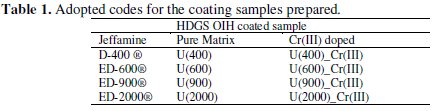
identification of the different prepared samples is in <a href="#t1">Table 1</a>.</p>


    <p>&nbsp;</p>
<a name="t1">
<img src="/img/revistas/pea/v31n5/31n5a04t1.jpg">
    
<p>&nbsp;</p>


    <p>&nbsp;</p>
    <p><b><i>Preparation of mortar</i></b></p>

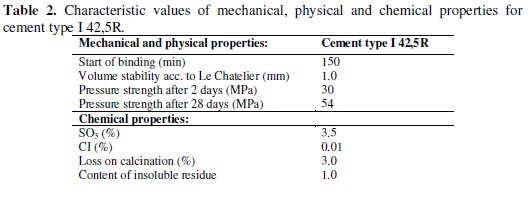
    <p>The corrosion behavior of HDGS coated with the different OIH coatings were 
studied in mortar that was prepared according to EN 196-1 standard using 
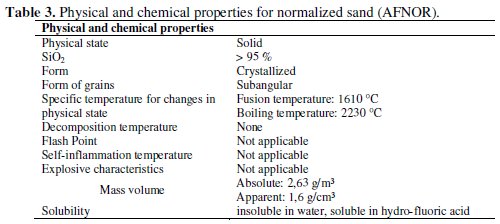
cement type I 42,5R (<a href="#t2">Table 2</a>), distilled water and normalized sand (AFNOR) 
(<a href="#t3">Table 3</a>) with a weight ratio of 6:2:1 (sand:cement:water).</p>


    <p>&nbsp;</p>
<a name="t2">
<img src="/img/revistas/pea/v31n5/31n5a04t2.jpg">
    
<p>&nbsp;</p>
<a name="t3">
<img src="/img/revistas/pea/v31n5/31n5a04t3.jpg">
    
<p>&nbsp;</p>


    <p>&nbsp;</p>
    ]]></body>
<body><![CDATA[<p><b><i>Electrochemical studies</i></b></p>

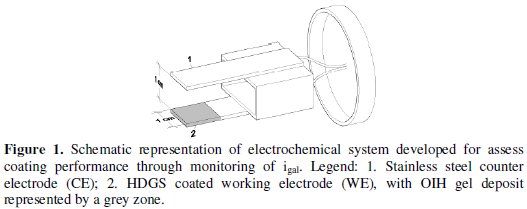
    <p>To assess the reliability of the electrochemical system, macrocell current density 
(i<sub>gal</sub>) measurement was performed using a system based on two electrodes 
(parallel rectangular metal plates with 5.0&times;1.0&times;0.1 cm), as shown in <a href="#f1">Fig. 1</a>.</p>


    <p>&nbsp;</p>
<a name="f1">
<img src="/img/revistas/pea/v31n5/31n5a04f1.jpg">
    
<p>&nbsp;</p>


    <p>The working electrode (WE) was a HDGS plate, also with two cm<sup>2</sup> of area, and 
coated as described in section ''Preparation of HGDS coated samples''. The grey 
area in <a href="#f1">Fig. 1</a> represents the OIH coating on HDGS. The counter electrode (CE) 
was a stainless steel (SS, type 316L) plate with an active surface section of 2 
cm<sup>2</sup>. The edges of both of the electrodes plates, as well the non-active area and 
connecting zones were protected with a two-component epoxy resin (Araldite<sup>&reg;</sup>). 
The set of the two electrodes was fixed in plastic lids that fit in a 100 mL 
polyethylene flask (Normax). For comparison purposes, cells using a HDGS WE 
without any OIH coating were prepared to be used as reference (hereafter 
referred generically as control cells).</p>

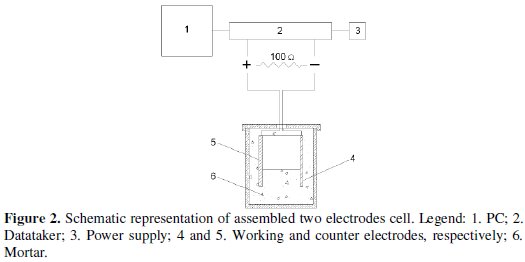
    <p>To assemble the electrochemical cells used to measure igal, 120&pm;10 g of fresh 
mortar was transferred to each 100 mL PE flask where the electrodes were 
immersed and the flask closed (mortar was prepared according to section 2.3 and 
immediately used). Using an automatic data acquisition system (Datataker 
DT505, series 3), the i<sub>gal</sub> measurement of the prepared cells were performed 
through reading the potential difference to the terminals (shunted with a 100 &Omega; 
resistor vide <a href="#f2">Fig. 2</a>) immediately after being embedded in fresh mortar.</p>


    <p>&nbsp;</p>
<a name="f2">
<img src="/img/revistas/pea/v31n5/31n5a04f2.jpg">
    
<p>&nbsp;</p>


    <p>Measurements were performed with a periodicity of 1 minute at the first seven 
days, and at each 5 minutes during the remaining time until the record was 
completed, at the 74th day.</p>


    <p>&nbsp;</p>
    ]]></body>
<body><![CDATA[<p><b><i>Stereoscopic Microscopy</i></b></p>

    <p>The HDGS surfaces were thoroughly examined in the laboratory using a zoom 
stereomicroscope system (Olympus SZH).</p>


    <p>&nbsp;</p>
    <p><b><i>Scanning electron microscopy (SEM/EDS)</i></b></p>

    <p>The morphology of the OIH sol-gel coatings surface applied on HDGS 
specimens were performed with scanning electron microscope (SEM, JEOL 
JSM-6400) coupled with an EDS detector (Inca-xSight Oxford Instruments), and 
the surface of specimens were covered with an ultrathin coating of gold 
deposited by sputter coating. The SEM/EDS studies of the HDGS coated samples 
were performed on the substrate before and after being in contact with mortar 
after 74 days. After the essay was completed, the hardened cementitious 
materials were thoroughly broken to release the HDGS specimens and allow 
SEM/EDS observations.</p>


    <p>&nbsp;</p>
    <p><b>Results and discussion</b></p>

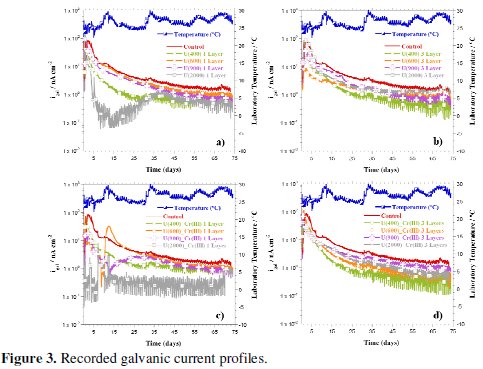
    <p><a href="#f3">Fig. 3</a> shows the macrocell current density (igal) response collected from the 
different prepared electrochemical cells involving the HDGS coated samples and 
the control cell during 74 days 0.</p>


    <p>&nbsp;</p>
<a name="f3">
<img src="/img/revistas/pea/v31n5/31n5a04f3.jpg">
    
<p>&nbsp;</p>


    ]]></body>
<body><![CDATA[<p>The high values of i<sub>gal</sub> recorded for the first days of contact with the fresh mortar 
are due to zinc corrosion, that in the presence of high alkaline environments it 
corrodes. Nevertheless, the coated samples tend to lower values when 
compared to control sample. The obtained evolution of cell current density with 
time shows a profile that is dependent on OIH coating matrix, the presence of 
Cr(III) ions and the number of dipping steps. Globally the measured current 
density decreases along the contact time showing in the 74<sup>th</sup> day an average value 
that is about two orders of magnitude lower than the initially observed. Cells 
based on one layer coated HDGS samples reveal a very noisy behavior 
comparatively with samples with a coating produced by three dipping steps.</p>

    <p>As shown, the i<sub>gal</sub> cell values are sensitive to the external laboratory temperature 
variation and to the composition and number of OIH deposited (one and three) 
layers. The collected data make possible to distinguish between the different used 
OIH coatings as the output response changes with the coating composition and 
with the presence or absence of inhibitor (Cr(III)). It was also observed that the 
uncoated HDGS specimen shows the higher current density values among the all 
set of tested macrocells.</p>

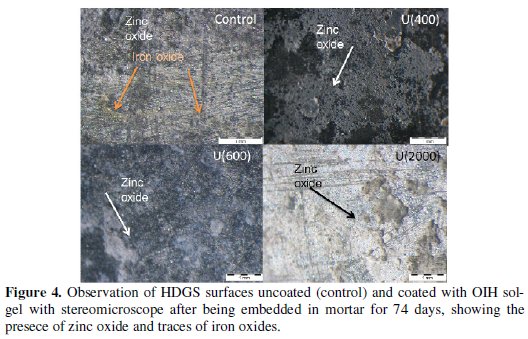
    <p><a href="#f4">Fig. 4</a> shows the images obtained with a stereomicroscope for the uncoated 
HDGS (control) and for HDGS coated by one dip step for U(400), U(600) and 
U(2000).</p>


    <p>&nbsp;</p>
<a name="f4">
<img src="/img/revistas/pea/v31n5/31n5a04f4.jpg">
    
<p>&nbsp;</p>


    <p>The stereomicroscope images that show to be less attacked by the 
electrolyte correspond to cells where lower values of i<sub>gal</sub> data were recorded. 
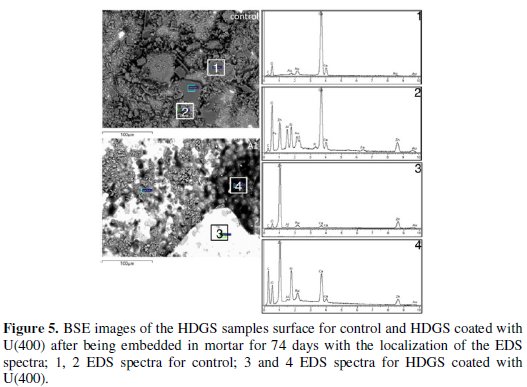
<a href="#f5">Fig. 5</a> shows the SEM images and EDS spectra obtained for the control and for 
HDGS coated with U(400) by one dip step.</p>


    <p>&nbsp;</p>
<a name="f5">
<img src="/img/revistas/pea/v31n5/31n5a04f5.jpg">
    
<p>&nbsp;</p>


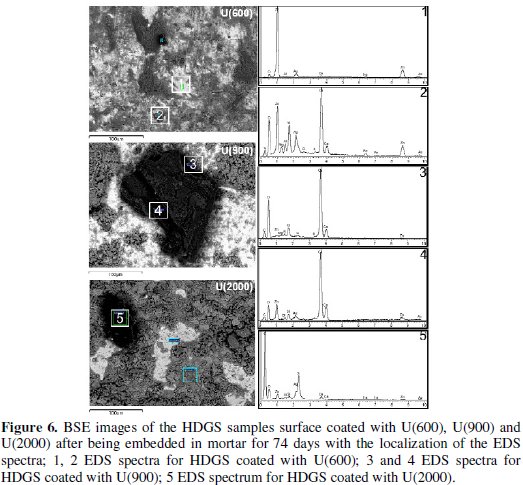
    <p><a href="#f6">Fig. 6</a> shows the SEM images and EDS spectra obtained for HDGS coated with 
U(600), U(900) and U(2000) by one dip step.</p>


    <p>&nbsp;</p>
<a name="f6">
<img src="/img/revistas/pea/v31n5/31n5a04f6.jpg">
    
]]></body>
<body><![CDATA[<p>&nbsp;</p>


    <p>From the analysis of the collected set of images obtained by SEM, it can be 
concluded that the surface of uncoated HDGS sample (control cell) reveals the 
most severe damages among all that were exposed to mortar. The obtained 
results from EDS analysis reveal the presence of iron peaks. These results are in 
agreement with i<sub>gal</sub> data and with stereomicroscope images.</p>

    <p>The topic of this paper is to evaluate the response and the behavior of the 
electrochemical system when testing different OIH coatings. It was observed that 
the HDGS coated samples do not show to be similarly affected by the corrosive 
action of mortar components and depend on the OIH coating applied, as observed 
in stereomicroscope images displayed in <a href="#f4">Fig. 4</a>. The EDS correspondent spectra 
show the presence of carbon and silicon on the surface indicating that the applied 
coating preserved their initial form. The information obtained by these two 
techniques confirms that the barrier stability and efficiency of the OIH gel 
coating contribute to minimize the recorded current density and consequently 
minimize the extent of HDGS corrosion process. The results obtained show that 
the electrochemical system is reliable and suitable to evaluate the behavior of the 
OIH coatings.</p>


    <p>&nbsp;</p>
    <p><b>Conclusions</b></p>

    <p>The analysis of the results obtained by optical and SEM/EDS of the WE of the 
disassembled cells show to be consistent with the data obtained by the 
electrochemical technique. The behavior of coated HDGS samples revealed to be 
highly sensitive to the OIH coatings composition allowing distinguishing 
between the distinct coatings with different thicknesses. The collected data also 
allow concluding that presence of Cr(III) ions within the OIH gel matrix 
contributes to mitigate the corrosion process in the first instances of contact with 
fresh concrete.</p>

    <p>The results show that the developed system allows to distinguish with high 
reliability OIH sol-gel coatings using the same matrix with slight variations like 
doping with inhibitor (Cr(III)). The system revealed to be highly sensitive to the 
external temperature variation since when the temperature increases the i<sub>gal</sub> data 
also increase. The designed system implemented seems to be suitable to evaluate 
the in situ degradation of HDGS coated with different OIH films embedded in 
concrete.</p>

    <p>Future studies should be performed in situ in order to evaluate the output 
response to the presence of aggressive agents such as local acidification, 
carbonation, ingress of chloride ions and/or depletion of O<sub>2</sub>.</p>


    <p>&nbsp;</p>
    <p><b>References</b></p>

    ]]></body>
<body><![CDATA[<!-- ref --><p>1. Figueira R B, Silva C J R, Pereira E V, et al. Proceedings of Electrochemistry 2012 - Fundamental and Engineering Needs for Sustainable Development; 2012 Sep 17-19; Munchen, Germany; 2012.    &nbsp;&nbsp;&nbsp;&nbsp;&nbsp;&nbsp;&nbsp;&nbsp;[&#160;<a href="javascript:void(0);" onclick="javascript: window.open('/scielo.php?script=sci_nlinks&ref=000083&pid=S0872-1904201300050000400001&lng=','','width=640,height=500,resizable=yes,scrollbars=1,menubar=yes,');">Links</a>&#160;]<!-- end-ref --></p>

    <!-- ref --><p>2. Qian M, Soutar A M, Tan X H, et al. Thin Solid Films. 2009;517:5237-5242.    &nbsp;&nbsp;&nbsp;&nbsp;&nbsp;&nbsp;&nbsp;&nbsp;[&#160;<a href="javascript:void(0);" onclick="javascript: window.open('/scielo.php?script=sci_nlinks&ref=000085&pid=S0872-1904201300050000400002&lng=','','width=640,height=500,resizable=yes,scrollbars=1,menubar=yes,');">Links</a>&#160;]<!-- end-ref --></p>

    <!-- ref --><p>3. Pepe A, Galliano P, Aparicio M, et al. Surf Coat Tech. 2006;200:34863491.    &nbsp;&nbsp;&nbsp;&nbsp;&nbsp;&nbsp;&nbsp;&nbsp;[&#160;<a href="javascript:void(0);" onclick="javascript: window.open('/scielo.php?script=sci_nlinks&ref=000087&pid=S0872-1904201300050000400003&lng=','','width=640,height=500,resizable=yes,scrollbars=1,menubar=yes,');">Links</a>&#160;]<!-- end-ref --></p>

    <!-- ref --><p>4. Porter F C. Corrosion resistance of zinc and zinc alloys. New York, 1994. p.438.    &nbsp;&nbsp;&nbsp;&nbsp;&nbsp;&nbsp;&nbsp;&nbsp;[&#160;<a href="javascript:void(0);" onclick="javascript: window.open('/scielo.php?script=sci_nlinks&ref=000089&pid=S0872-1904201300050000400004&lng=','','width=640,height=500,resizable=yes,scrollbars=1,menubar=yes,');">Links</a>&#160;]<!-- end-ref --></p>

    <!-- ref --><p>5. Sanchez M, Alonso M C, Cecilio P, et al. Cement Concrete Comp. 2006;28:256-266.    &nbsp;&nbsp;&nbsp;&nbsp;&nbsp;&nbsp;&nbsp;&nbsp;[&#160;<a href="javascript:void(0);" onclick="javascript: window.open('/scielo.php?script=sci_nlinks&ref=000091&pid=S0872-1904201300050000400005&lng=','','width=640,height=500,resizable=yes,scrollbars=1,menubar=yes,');">Links</a>&#160;]<!-- end-ref --></p>

    ]]></body>
<body><![CDATA[<!-- ref --><p>6. Tittarelli F, Bellezze T. Corros Sci. 2010;52:978-983.    &nbsp;&nbsp;&nbsp;&nbsp;&nbsp;&nbsp;&nbsp;&nbsp;[&#160;<a href="javascript:void(0);" onclick="javascript: window.open('/scielo.php?script=sci_nlinks&ref=000093&pid=S0872-1904201300050000400006&lng=','','width=640,height=500,resizable=yes,scrollbars=1,menubar=yes,');">Links</a>&#160;]<!-- end-ref --></p>

    <!-- ref --><p>7. Recio F J, Alonso M C, Gaillet L, et al. Corros Sci. 2011;53:2853-2860.    &nbsp;&nbsp;&nbsp;&nbsp;&nbsp;&nbsp;&nbsp;&nbsp;[&#160;<a href="javascript:void(0);" onclick="javascript: window.open('/scielo.php?script=sci_nlinks&ref=000095&pid=S0872-1904201300050000400007&lng=','','width=640,height=500,resizable=yes,scrollbars=1,menubar=yes,');">Links</a>&#160;]<!-- end-ref --></p>

    <!-- ref --><p>8. Yeomans S R. Galvanized steel reinforcement in Concrete. Amsterdam: Elsevier; 2004. Chapter 1.    &nbsp;&nbsp;&nbsp;&nbsp;&nbsp;&nbsp;&nbsp;&nbsp;[&#160;<a href="javascript:void(0);" onclick="javascript: window.open('/scielo.php?script=sci_nlinks&ref=000097&pid=S0872-1904201300050000400008&lng=','','width=640,height=500,resizable=yes,scrollbars=1,menubar=yes,');">Links</a>&#160;]<!-- end-ref --></p>

    <!-- ref --><p>9. Roetheli BE, Cox GL, Littreal WB. Met Alloys. 1932;3:73-76.    &nbsp;&nbsp;&nbsp;&nbsp;&nbsp;&nbsp;&nbsp;&nbsp;[&#160;<a href="javascript:void(0);" onclick="javascript: window.open('/scielo.php?script=sci_nlinks&ref=000099&pid=S0872-1904201300050000400009&lng=','','width=640,height=500,resizable=yes,scrollbars=1,menubar=yes,');">Links</a>&#160;]<!-- end-ref --></p>

    <!-- ref --><p>10. Macias A, Andrade C. Brit Corros J. 1982;22:113-118.    &nbsp;&nbsp;&nbsp;&nbsp;&nbsp;&nbsp;&nbsp;&nbsp;[&#160;<a href="javascript:void(0);" onclick="javascript: window.open('/scielo.php?script=sci_nlinks&ref=000101&pid=S0872-1904201300050000400010&lng=','','width=640,height=500,resizable=yes,scrollbars=1,menubar=yes,');">Links</a>&#160;]<!-- end-ref --></p>

    ]]></body>
<body><![CDATA[<p>11. Shams El Din A M, Adb El Wahab F M, Abd El Haleem S M, Werkst. Korros. 24 (1973) 389-384.</p>

    <!-- ref --><p>12. Liebau F, Amel-Zadeh A. Kistall und Technick. 1972;7:221-227.    &nbsp;&nbsp;&nbsp;&nbsp;&nbsp;&nbsp;&nbsp;&nbsp;[&#160;<a href="javascript:void(0);" onclick="javascript: window.open('/scielo.php?script=sci_nlinks&ref=000104&pid=S0872-1904201300050000400012&lng=','','width=640,height=500,resizable=yes,scrollbars=1,menubar=yes,');">Links</a>&#160;]<!-- end-ref --></p>

    <!-- ref --><p>13. Vorkapic L Z, Drazic D M, Despic A R. J Electrochem Soc. 1974;121:1385-1392.    &nbsp;&nbsp;&nbsp;&nbsp;&nbsp;&nbsp;&nbsp;&nbsp;[&#160;<a href="javascript:void(0);" onclick="javascript: window.open('/scielo.php?script=sci_nlinks&ref=000106&pid=S0872-1904201300050000400013&lng=','','width=640,height=500,resizable=yes,scrollbars=1,menubar=yes,');">Links</a>&#160;]<!-- end-ref --></p>

    <!-- ref --><p>14. Lieber W, Gebauer J. Zement-kalk-Gips. 1970;4:161-164.    &nbsp;&nbsp;&nbsp;&nbsp;&nbsp;&nbsp;&nbsp;&nbsp;[&#160;<a href="javascript:void(0);" onclick="javascript: window.open('/scielo.php?script=sci_nlinks&ref=000108&pid=S0872-1904201300050000400014&lng=','','width=640,height=500,resizable=yes,scrollbars=1,menubar=yes,');">Links</a>&#160;]<!-- end-ref --></p>

    <!-- ref --><p>15. Tan Z Q, Hansson C M. Corros Sci. 2008;50:2512-2522.    &nbsp;&nbsp;&nbsp;&nbsp;&nbsp;&nbsp;&nbsp;&nbsp;[&#160;<a href="javascript:void(0);" onclick="javascript: window.open('/scielo.php?script=sci_nlinks&ref=000110&pid=S0872-1904201300050000400015&lng=','','width=640,height=500,resizable=yes,scrollbars=1,menubar=yes,');">Links</a>&#160;]<!-- end-ref --></p>

    <!-- ref --><p>16. Elsener B. Mater Sci Forum. 1995;192:857-866.    &nbsp;&nbsp;&nbsp;&nbsp;&nbsp;&nbsp;&nbsp;&nbsp;[&#160;<a href="javascript:void(0);" onclick="javascript: window.open('/scielo.php?script=sci_nlinks&ref=000112&pid=S0872-1904201300050000400016&lng=','','width=640,height=500,resizable=yes,scrollbars=1,menubar=yes,');">Links</a>&#160;]<!-- end-ref --></p>

    <!-- ref --><p>17. Yoo J H, Park Z T, Kim J G, et al. Cem Concr Res. 2003;33:2057-2062.    &nbsp;&nbsp;&nbsp;&nbsp;&nbsp;&nbsp;&nbsp;&nbsp;[&#160;<a href="javascript:void(0);" onclick="javascript: window.open('/scielo.php?script=sci_nlinks&ref=000114&pid=S0872-1904201300050000400017&lng=','','width=640,height=500,resizable=yes,scrollbars=1,menubar=yes,');">Links</a>&#160;]<!-- end-ref --></p>

    <!-- ref --><p>18. McCarter W J, Vennesland O. Constr Build Mater. 2004;18:351-358.    &nbsp;&nbsp;&nbsp;&nbsp;&nbsp;&nbsp;&nbsp;&nbsp;[&#160;<a href="javascript:void(0);" onclick="javascript: window.open('/scielo.php?script=sci_nlinks&ref=000116&pid=S0872-1904201300050000400018&lng=','','width=640,height=500,resizable=yes,scrollbars=1,menubar=yes,');">Links</a>&#160;]<!-- end-ref --></p>

    <!-- ref --><p>19. Song H W, Saraswathy V. Int J Electrochem Sci. 2007;2:1-28.    &nbsp;&nbsp;&nbsp;&nbsp;&nbsp;&nbsp;&nbsp;&nbsp;[&#160;<a href="javascript:void(0);" onclick="javascript: window.open('/scielo.php?script=sci_nlinks&ref=000118&pid=S0872-1904201300050000400019&lng=','','width=640,height=500,resizable=yes,scrollbars=1,menubar=yes,');">Links</a>&#160;]<!-- end-ref --></p>

    <!-- ref --><p>20. Islam M, Daily S F. J ASTM Int. 2006;3:1546-1557.    &nbsp;&nbsp;&nbsp;&nbsp;&nbsp;&nbsp;&nbsp;&nbsp;[&#160;<a href="javascript:void(0);" onclick="javascript: window.open('/scielo.php?script=sci_nlinks&ref=000120&pid=S0872-1904201300050000400020&lng=','','width=640,height=500,resizable=yes,scrollbars=1,menubar=yes,');">Links</a>&#160;]<!-- end-ref --></p>

    <!-- ref --><p>21. Leelalerkiet V, Shimizu T, Tomoda Y, et al. J Adv Concr Technol. 2005;3:137-147.    &nbsp;&nbsp;&nbsp;&nbsp;&nbsp;&nbsp;&nbsp;&nbsp;[&#160;<a href="javascript:void(0);" onclick="javascript: window.open('/scielo.php?script=sci_nlinks&ref=000122&pid=S0872-1904201300050000400021&lng=','','width=640,height=500,resizable=yes,scrollbars=1,menubar=yes,');">Links</a>&#160;]<!-- end-ref --></p>

    <!-- ref --><p>22. Smulko J M, Darowicki K, Zielinski A. Russ J Electrochem. 2006;42:548-552.    &nbsp;&nbsp;&nbsp;&nbsp;&nbsp;&nbsp;&nbsp;&nbsp;[&#160;<a href="javascript:void(0);" onclick="javascript: window.open('/scielo.php?script=sci_nlinks&ref=000124&pid=S0872-1904201300050000400022&lng=','','width=640,height=500,resizable=yes,scrollbars=1,menubar=yes,');">Links</a>&#160;]<!-- end-ref --></p>

    <!-- ref --><p>23. Andrade C, Alonso C. Constr Build Mater. 1996;10:315-328.    &nbsp;&nbsp;&nbsp;&nbsp;&nbsp;&nbsp;&nbsp;&nbsp;[&#160;<a href="javascript:void(0);" onclick="javascript: window.open('/scielo.php?script=sci_nlinks&ref=000126&pid=S0872-1904201300050000400023&lng=','','width=640,height=500,resizable=yes,scrollbars=1,menubar=yes,');">Links</a>&#160;]<!-- end-ref --></p>

    <p>24. Schiessl P, Raupach M. Concrete Int. July:52-55.</p>

    <!-- ref --><p>25. ASTM G109-07: Standard test method for determining effects of chemical admixtures on corrosion of embedded steel reinforcement in concrete exposed to chloride environments. In: Annual book of ASTM standards. 03.02.2007.    &nbsp;&nbsp;&nbsp;&nbsp;&nbsp;&nbsp;&nbsp;&nbsp;[&#160;<a href="javascript:void(0);" onclick="javascript: window.open('/scielo.php?script=sci_nlinks&ref=000129&pid=S0872-1904201300050000400025&lng=','','width=640,height=500,resizable=yes,scrollbars=1,menubar=yes,');">Links</a>&#160;]<!-- end-ref --></p>

    <!-- ref --><p>26. Pereira E V, Figueira R B, Salta M M, et al. Sensors. 2009;9:8391.    &nbsp;&nbsp;&nbsp;&nbsp;&nbsp;&nbsp;&nbsp;&nbsp;[&#160;<a href="javascript:void(0);" onclick="javascript: window.open('/scielo.php?script=sci_nlinks&ref=000131&pid=S0872-1904201300050000400026&lng=','','width=640,height=500,resizable=yes,scrollbars=1,menubar=yes,');">Links</a>&#160;]<!-- end-ref --></p>

    ]]></body>
<body><![CDATA[<!-- ref --><p>27. Pereira E V. Monitoriza&ccedil;&atilde;o da corros&atilde;o no bet&atilde;o armado. PhD Thesis. Lisbon: University of Lisbon; 2004.    &nbsp;&nbsp;&nbsp;&nbsp;&nbsp;&nbsp;&nbsp;&nbsp;[&#160;<a href="javascript:void(0);" onclick="javascript: window.open('/scielo.php?script=sci_nlinks&ref=000133&pid=S0872-1904201300050000400027&lng=','','width=640,height=500,resizable=yes,scrollbars=1,menubar=yes,');">Links</a>&#160;]<!-- end-ref --></p>

    <!-- ref --><p>28. Boev V I, Soloviev A, Silva C J R, et al. J Sol-Gel Sci Tech. 2007;41:223.    &nbsp;&nbsp;&nbsp;&nbsp;&nbsp;&nbsp;&nbsp;&nbsp;[&#160;<a href="javascript:void(0);" onclick="javascript: window.open('/scielo.php?script=sci_nlinks&ref=000135&pid=S0872-1904201300050000400028&lng=','','width=640,height=500,resizable=yes,scrollbars=1,menubar=yes,');">Links</a>&#160;]<!-- end-ref --></p>

    <!-- ref --><p>29. Moreira S D F C, Silva C J R, Prado L A S A, et al. J Polym Sci Pol Phys. 2012;50:492.    &nbsp;&nbsp;&nbsp;&nbsp;&nbsp;&nbsp;&nbsp;&nbsp;[&#160;<a href="javascript:void(0);" onclick="javascript: window.open('/scielo.php?script=sci_nlinks&ref=000137&pid=S0872-1904201300050000400029&lng=','','width=640,height=500,resizable=yes,scrollbars=1,menubar=yes,');">Links</a>&#160;]<!-- end-ref --></p>

    <!-- ref --><p>30. Figueira R B, Silva C J R, Pereira E V, et al. J Electrochem.Soc. 2013;160:C467.    &nbsp;&nbsp;&nbsp;&nbsp;&nbsp;&nbsp;&nbsp;&nbsp;[&#160;<a href="javascript:void(0);" onclick="javascript: window.open('/scielo.php?script=sci_nlinks&ref=000139&pid=S0872-1904201300050000400030&lng=','','width=640,height=500,resizable=yes,scrollbars=1,menubar=yes,');">Links</a>&#160;]<!-- end-ref --></p>

    <!-- ref --><p>31. European Committee for Standardization, BS EN 196-1. 2005.    &nbsp;&nbsp;&nbsp;&nbsp;&nbsp;&nbsp;&nbsp;&nbsp;[&#160;<a href="javascript:void(0);" onclick="javascript: window.open('/scielo.php?script=sci_nlinks&ref=000141&pid=S0872-1904201300050000400031&lng=','','width=640,height=500,resizable=yes,scrollbars=1,menubar=yes,');">Links</a>&#160;]<!-- end-ref --></p>


    ]]></body>
<body><![CDATA[<p>&nbsp;</p>
    <p><b>Acknowledgements</b></p>

    <p>The authors would like to gratefully acknowledge the financial support from Funda&ccedil;&atilde;o 
para a Ci&ecirc;ncia e Tecnologia (FCT) for the PhD grant SFRH/BD/62601/2009 and the 
financial support by Centro de Qu&iacute;mica [project F-COMP-01-0124-FEDER-022716 
(ref. FCT Pest-C/Qui/UI0686/2011)-FEDER-COMPETE]. The authors would also like 
to thank Hugo Marques Gomes for assisting in the schematic representations.</p>
 

    <p>&nbsp;</p>
    <p><a name=0></a><sup><a href="#top">*</a></sup>Corresponding author. E-mail address: <a href="mailto:rmfigueira@lnec.pt">rmfigueira@lnec.pt</a></p>

    <p>Received 31 July 2013; accepted 31 October 2013</p>

    <p><a href="http://www.peacta.org" target="_blank">www.peacta.org</a> </p>


     ]]></body><back>
<ref-list>
<ref id="B1">
<label>1</label><nlm-citation citation-type="confpro">
<person-group person-group-type="author">
<name>
<surname><![CDATA[Figueira]]></surname>
<given-names><![CDATA[R B]]></given-names>
</name>
<name>
<surname><![CDATA[Silva]]></surname>
<given-names><![CDATA[C J R]]></given-names>
</name>
<name>
<surname><![CDATA[Pereira]]></surname>
<given-names><![CDATA[E V]]></given-names>
</name>
</person-group>
<source><![CDATA[]]></source>
<year></year>
<conf-name><![CDATA[ Fundamental and Engineering Needs for Sustainable Development]]></conf-name>
<conf-date>2012</conf-date>
<conf-loc>Munchen </conf-loc>
</nlm-citation>
</ref>
<ref id="B2">
<label>2</label><nlm-citation citation-type="journal">
<person-group person-group-type="author">
<name>
<surname><![CDATA[Qian]]></surname>
<given-names><![CDATA[M]]></given-names>
</name>
<name>
<surname><![CDATA[Soutar]]></surname>
<given-names><![CDATA[A M]]></given-names>
</name>
<name>
<surname><![CDATA[Tan]]></surname>
<given-names><![CDATA[X H]]></given-names>
</name>
</person-group>
<source><![CDATA[Thin Solid Films]]></source>
<year>2009</year>
<volume>517</volume>
<page-range>5237-5242</page-range></nlm-citation>
</ref>
<ref id="B3">
<label>3</label><nlm-citation citation-type="journal">
<person-group person-group-type="author">
<name>
<surname><![CDATA[Pepe]]></surname>
<given-names><![CDATA[A]]></given-names>
</name>
<name>
<surname><![CDATA[Galliano]]></surname>
<given-names><![CDATA[P]]></given-names>
</name>
<name>
<surname><![CDATA[Aparicio]]></surname>
<given-names><![CDATA[M]]></given-names>
</name>
</person-group>
<source><![CDATA[Surf Coat Tech]]></source>
<year>2006</year>
<volume>200</volume>
<page-range>3486-3491</page-range></nlm-citation>
</ref>
<ref id="B4">
<label>4</label><nlm-citation citation-type="">
<person-group person-group-type="author">
<name>
<surname><![CDATA[Porter]]></surname>
<given-names><![CDATA[F C]]></given-names>
</name>
</person-group>
<source><![CDATA[Corrosion resistance of zinc and zinc alloys]]></source>
<year>1994</year>
<page-range>438</page-range><publisher-loc><![CDATA[New York ]]></publisher-loc>
</nlm-citation>
</ref>
<ref id="B5">
<label>5</label><nlm-citation citation-type="journal">
<person-group person-group-type="author">
<name>
<surname><![CDATA[Sanchez]]></surname>
<given-names><![CDATA[M]]></given-names>
</name>
<name>
<surname><![CDATA[Alonso]]></surname>
<given-names><![CDATA[M C]]></given-names>
</name>
<name>
<surname><![CDATA[Cecilio]]></surname>
<given-names><![CDATA[P]]></given-names>
</name>
</person-group>
<source><![CDATA[Cement Concrete Comp]]></source>
<year>2006</year>
<volume>28</volume>
<page-range>256-266</page-range></nlm-citation>
</ref>
<ref id="B6">
<label>6</label><nlm-citation citation-type="journal">
<person-group person-group-type="author">
<name>
<surname><![CDATA[Tittarelli]]></surname>
<given-names><![CDATA[F]]></given-names>
</name>
<name>
<surname><![CDATA[Bellezze]]></surname>
<given-names><![CDATA[T]]></given-names>
</name>
</person-group>
<source><![CDATA[Corros Sci]]></source>
<year>2010</year>
<volume>52</volume>
<page-range>978-983</page-range></nlm-citation>
</ref>
<ref id="B7">
<label>7</label><nlm-citation citation-type="journal">
<person-group person-group-type="author">
<name>
<surname><![CDATA[Recio]]></surname>
<given-names><![CDATA[F J]]></given-names>
</name>
<name>
<surname><![CDATA[Alonso]]></surname>
<given-names><![CDATA[M C]]></given-names>
</name>
<name>
<surname><![CDATA[Gaillet]]></surname>
<given-names><![CDATA[L]]></given-names>
</name>
</person-group>
<source><![CDATA[Corros Sci]]></source>
<year>2011</year>
<volume>53</volume>
<page-range>2853-2860</page-range></nlm-citation>
</ref>
<ref id="B8">
<label>8</label><nlm-citation citation-type="book">
<person-group person-group-type="author">
<name>
<surname><![CDATA[Yeomans]]></surname>
<given-names><![CDATA[S R]]></given-names>
</name>
</person-group>
<source><![CDATA[Galvanized steel reinforcement in Concrete]]></source>
<year>2004</year>
<publisher-loc><![CDATA[Amsterdam ]]></publisher-loc>
<publisher-name><![CDATA[Elsevier]]></publisher-name>
</nlm-citation>
</ref>
<ref id="B9">
<label>9</label><nlm-citation citation-type="journal">
<person-group person-group-type="author">
<name>
<surname><![CDATA[Roetheli]]></surname>
<given-names><![CDATA[B E]]></given-names>
</name>
<name>
<surname><![CDATA[Cox]]></surname>
<given-names><![CDATA[G L]]></given-names>
</name>
<name>
<surname><![CDATA[Littreal]]></surname>
<given-names><![CDATA[W B]]></given-names>
</name>
</person-group>
<source><![CDATA[Met Alloys]]></source>
<year>1932</year>
<volume>3</volume>
<page-range>73-76</page-range></nlm-citation>
</ref>
<ref id="B10">
<label>10</label><nlm-citation citation-type="journal">
<person-group person-group-type="author">
<name>
<surname><![CDATA[Macias]]></surname>
<given-names><![CDATA[A]]></given-names>
</name>
<name>
<surname><![CDATA[Andrade]]></surname>
<given-names><![CDATA[C]]></given-names>
</name>
</person-group>
<source><![CDATA[Brit Corros J]]></source>
<year>1982</year>
<volume>22</volume>
<page-range>113-118</page-range></nlm-citation>
</ref>
<ref id="B11">
<label>11</label><nlm-citation citation-type="journal">
<person-group person-group-type="author">
<name>
<surname><![CDATA[Shams El Din]]></surname>
<given-names><![CDATA[A M]]></given-names>
</name>
<name>
<surname><![CDATA[Adb El Wahab]]></surname>
<given-names><![CDATA[F M]]></given-names>
</name>
<name>
<surname><![CDATA[Abd El Haleem]]></surname>
<given-names><![CDATA[S M]]></given-names>
</name>
</person-group>
<source><![CDATA[Werkst. Korros]]></source>
<year>1973</year>
<volume>24</volume>
<page-range>389-384</page-range></nlm-citation>
</ref>
<ref id="B12">
<label>12</label><nlm-citation citation-type="journal">
<person-group person-group-type="author">
<name>
<surname><![CDATA[Liebau]]></surname>
<given-names><![CDATA[F]]></given-names>
</name>
<name>
<surname><![CDATA[Amel-Zadeh]]></surname>
<given-names><![CDATA[A]]></given-names>
</name>
</person-group>
<source><![CDATA[Kistall und Technick]]></source>
<year>1972</year>
<volume>7</volume>
<page-range>221-227</page-range></nlm-citation>
</ref>
<ref id="B13">
<label>13</label><nlm-citation citation-type="journal">
<person-group person-group-type="author">
<name>
<surname><![CDATA[Vorkapic]]></surname>
<given-names><![CDATA[L Z]]></given-names>
</name>
<name>
<surname><![CDATA[Drazic]]></surname>
<given-names><![CDATA[D M]]></given-names>
</name>
<name>
<surname><![CDATA[Despic]]></surname>
<given-names><![CDATA[A R]]></given-names>
</name>
</person-group>
<source><![CDATA[J Electrochem Soc]]></source>
<year>1974</year>
<volume>121</volume>
<page-range>1385-1392</page-range></nlm-citation>
</ref>
<ref id="B14">
<label>14</label><nlm-citation citation-type="journal">
<person-group person-group-type="author">
<name>
<surname><![CDATA[Lieber]]></surname>
<given-names><![CDATA[W]]></given-names>
</name>
<name>
<surname><![CDATA[Gebauer]]></surname>
<given-names><![CDATA[J]]></given-names>
</name>
</person-group>
<source><![CDATA[Zement-kalk-Gips]]></source>
<year>1970</year>
<volume>4</volume>
<page-range>161-164</page-range></nlm-citation>
</ref>
<ref id="B15">
<label>15</label><nlm-citation citation-type="journal">
<person-group person-group-type="author">
<name>
<surname><![CDATA[Tan]]></surname>
<given-names><![CDATA[Z Q]]></given-names>
</name>
<name>
<surname><![CDATA[Hansson]]></surname>
<given-names><![CDATA[C M]]></given-names>
</name>
</person-group>
<source><![CDATA[Corros Sci]]></source>
<year>2008</year>
<volume>50</volume>
<page-range>2512-2522</page-range></nlm-citation>
</ref>
<ref id="B16">
<label>16</label><nlm-citation citation-type="journal">
<person-group person-group-type="author">
<name>
<surname><![CDATA[Elsener]]></surname>
<given-names><![CDATA[B]]></given-names>
</name>
</person-group>
<source><![CDATA[Mater Sci Forum]]></source>
<year>1995</year>
<volume>192</volume>
<page-range>857-866</page-range></nlm-citation>
</ref>
<ref id="B17">
<label>17</label><nlm-citation citation-type="journal">
<person-group person-group-type="author">
<name>
<surname><![CDATA[Yoo]]></surname>
<given-names><![CDATA[J H]]></given-names>
</name>
<name>
<surname><![CDATA[Park]]></surname>
<given-names><![CDATA[Z T]]></given-names>
</name>
<name>
<surname><![CDATA[Kim]]></surname>
<given-names><![CDATA[J G]]></given-names>
</name>
</person-group>
<source><![CDATA[Cem Concr Res]]></source>
<year>2003</year>
<volume>33</volume>
<page-range>2057-2062</page-range></nlm-citation>
</ref>
<ref id="B18">
<label>18</label><nlm-citation citation-type="journal">
<person-group person-group-type="author">
<name>
<surname><![CDATA[McCarter]]></surname>
<given-names><![CDATA[W J]]></given-names>
</name>
<name>
<surname><![CDATA[Vennesland]]></surname>
<given-names><![CDATA[O]]></given-names>
</name>
</person-group>
<source><![CDATA[Constr Build Mater]]></source>
<year>2004</year>
<volume>18</volume>
<page-range>351-358</page-range></nlm-citation>
</ref>
<ref id="B19">
<label>19</label><nlm-citation citation-type="journal">
<person-group person-group-type="author">
<name>
<surname><![CDATA[Song]]></surname>
<given-names><![CDATA[H W]]></given-names>
</name>
<name>
<surname><![CDATA[Saraswathy]]></surname>
<given-names><![CDATA[V]]></given-names>
</name>
</person-group>
<source><![CDATA[Int J Electrochem Sci]]></source>
<year>2007</year>
<volume>2</volume>
<page-range>1-28</page-range></nlm-citation>
</ref>
<ref id="B20">
<label>20</label><nlm-citation citation-type="journal">
<person-group person-group-type="author">
<name>
<surname><![CDATA[Islam]]></surname>
<given-names><![CDATA[M]]></given-names>
</name>
<name>
<surname><![CDATA[Daily]]></surname>
<given-names><![CDATA[S F]]></given-names>
</name>
</person-group>
<source><![CDATA[J ASTM Int]]></source>
<year>2006</year>
<volume>3</volume>
<page-range>1546-1557</page-range></nlm-citation>
</ref>
<ref id="B21">
<label>21</label><nlm-citation citation-type="journal">
<person-group person-group-type="author">
<name>
<surname><![CDATA[Leelalerkiet]]></surname>
<given-names><![CDATA[V]]></given-names>
</name>
<name>
<surname><![CDATA[Shimizu]]></surname>
<given-names><![CDATA[T]]></given-names>
</name>
<name>
<surname><![CDATA[Tomoda]]></surname>
<given-names><![CDATA[Y]]></given-names>
</name>
</person-group>
<source><![CDATA[J Adv Concr Technol]]></source>
<year>2005</year>
<volume>3</volume>
<page-range>137-147</page-range></nlm-citation>
</ref>
<ref id="B22">
<label>22</label><nlm-citation citation-type="journal">
<person-group person-group-type="author">
<name>
<surname><![CDATA[Smulko]]></surname>
<given-names><![CDATA[J M]]></given-names>
</name>
<name>
<surname><![CDATA[Darowicki]]></surname>
<given-names><![CDATA[K]]></given-names>
</name>
<name>
<surname><![CDATA[Zielinski]]></surname>
<given-names><![CDATA[A]]></given-names>
</name>
</person-group>
<source><![CDATA[Russ J Electrochem]]></source>
<year>2006</year>
<volume>42</volume>
<page-range>548-552</page-range></nlm-citation>
</ref>
<ref id="B23">
<label>23</label><nlm-citation citation-type="journal">
<person-group person-group-type="author">
<name>
<surname><![CDATA[Andrade]]></surname>
<given-names><![CDATA[C]]></given-names>
</name>
<name>
<surname><![CDATA[Alonso]]></surname>
<given-names><![CDATA[C]]></given-names>
</name>
</person-group>
<source><![CDATA[Constr Build Mater]]></source>
<year>1996</year>
<volume>10</volume>
<page-range>315-328</page-range></nlm-citation>
</ref>
<ref id="B24">
<label>24</label><nlm-citation citation-type="journal">
<person-group person-group-type="author">
<name>
<surname><![CDATA[Schiessl]]></surname>
<given-names><![CDATA[P]]></given-names>
</name>
<name>
<surname><![CDATA[Raupach]]></surname>
<given-names><![CDATA[M]]></given-names>
</name>
</person-group>
<source><![CDATA[Concrete Int]]></source>
<year>1992</year>
<volume>7</volume>
<page-range>52-55</page-range></nlm-citation>
</ref>
<ref id="B25">
<label>25</label><nlm-citation citation-type="">
<source><![CDATA[ASTM G109-07: Standard test method for determining effects of chemical admixtures on corrosion of embedded steel reinforcement in concrete exposed to chloride environments]]></source>
<year>03.0</year>
<month>2.</month>
<day>20</day>
</nlm-citation>
</ref>
<ref id="B26">
<label>26</label><nlm-citation citation-type="journal">
<person-group person-group-type="author">
<name>
<surname><![CDATA[Pereira]]></surname>
<given-names><![CDATA[E V]]></given-names>
</name>
<name>
<surname><![CDATA[Figueira]]></surname>
<given-names><![CDATA[R B]]></given-names>
</name>
<name>
<surname><![CDATA[Salta]]></surname>
<given-names><![CDATA[M M]]></given-names>
</name>
</person-group>
<source><![CDATA[Sensors]]></source>
<year>2009</year>
<volume>9</volume>
<page-range>83-91</page-range></nlm-citation>
</ref>
<ref id="B27">
<label>27</label><nlm-citation citation-type="">
<person-group person-group-type="author">
<name>
<surname><![CDATA[Pereira]]></surname>
<given-names><![CDATA[E V]]></given-names>
</name>
</person-group>
<source><![CDATA[Monitorização da corrosão no betão armado]]></source>
<year></year>
</nlm-citation>
</ref>
<ref id="B28">
<label>28</label><nlm-citation citation-type="journal">
<person-group person-group-type="author">
<name>
<surname><![CDATA[Boev]]></surname>
<given-names><![CDATA[V I]]></given-names>
</name>
<name>
<surname><![CDATA[Soloviev]]></surname>
<given-names><![CDATA[A]]></given-names>
</name>
<name>
<surname><![CDATA[Silva]]></surname>
<given-names><![CDATA[C J R]]></given-names>
</name>
</person-group>
<source><![CDATA[J Sol-Gel Sci Tech]]></source>
<year>2007</year>
<volume>41</volume>
<page-range>223</page-range></nlm-citation>
</ref>
<ref id="B29">
<label>29</label><nlm-citation citation-type="journal">
<person-group person-group-type="author">
<name>
<surname><![CDATA[Moreira]]></surname>
<given-names><![CDATA[S D F C]]></given-names>
</name>
<name>
<surname><![CDATA[Silva]]></surname>
<given-names><![CDATA[C J R]]></given-names>
</name>
<name>
<surname><![CDATA[Prado]]></surname>
<given-names><![CDATA[L A S A]]></given-names>
</name>
</person-group>
<source><![CDATA[J Polym Sci Pol Phys]]></source>
<year>2012</year>
<volume>50</volume>
<page-range>492</page-range></nlm-citation>
</ref>
<ref id="B30">
<label>30</label><nlm-citation citation-type="journal">
<person-group person-group-type="author">
<name>
<surname><![CDATA[Figueira]]></surname>
<given-names><![CDATA[R B]]></given-names>
</name>
<name>
<surname><![CDATA[Silva]]></surname>
<given-names><![CDATA[C J R]]></given-names>
</name>
<name>
<surname><![CDATA[Pereira]]></surname>
<given-names><![CDATA[E V]]></given-names>
</name>
</person-group>
<source><![CDATA[J Electrochem.Soc]]></source>
<year>2013</year>
<volume>160</volume>
<page-range>C467</page-range></nlm-citation>
</ref>
<ref id="B31">
<label>31</label><nlm-citation citation-type="">
<collab>European Committee for Standardization</collab>
<source><![CDATA[BS EN 196-1]]></source>
<year>2005</year>
</nlm-citation>
</ref>
</ref-list>
</back>
</article>