<?xml version="1.0" encoding="ISO-8859-1"?><article xmlns:mml="http://www.w3.org/1998/Math/MathML" xmlns:xlink="http://www.w3.org/1999/xlink" xmlns:xsi="http://www.w3.org/2001/XMLSchema-instance">
<front>
<journal-meta>
<journal-id>0872-1904</journal-id>
<journal-title><![CDATA[Portugaliae Electrochimica Acta]]></journal-title>
<abbrev-journal-title><![CDATA[Port. Electrochim. Acta]]></abbrev-journal-title>
<issn>0872-1904</issn>
<publisher>
<publisher-name><![CDATA[Sociedade Portuguesa de Electroquímica]]></publisher-name>
</publisher>
</journal-meta>
<article-meta>
<article-id>S0872-19042013000600003</article-id>
<article-id pub-id-type="doi">10.4152/pea.201306297</article-id>
<title-group>
<article-title xml:lang="en"><![CDATA[Suppressing of Irreversible Capacity in Lithium-ion Batteries]]></article-title>
</title-group>
<contrib-group>
<contrib contrib-type="author">
<name>
<surname><![CDATA[Libich]]></surname>
<given-names><![CDATA[Jiri]]></given-names>
</name>
<xref ref-type="aff" rid="A01"/>
</contrib>
<contrib contrib-type="author">
<name>
<surname><![CDATA[Vondrak]]></surname>
<given-names><![CDATA[Jiri]]></given-names>
</name>
<xref ref-type="aff" rid="A01"/>
</contrib>
<contrib contrib-type="author">
<name>
<surname><![CDATA[Sedlarikova]]></surname>
<given-names><![CDATA[Marie]]></given-names>
</name>
<xref ref-type="aff" rid="A01"/>
</contrib>
<contrib contrib-type="author">
<name>
<surname><![CDATA[Maca]]></surname>
<given-names><![CDATA[Josef]]></given-names>
</name>
<xref ref-type="aff" rid="A01"/>
</contrib>
<contrib contrib-type="author">
<name>
<surname><![CDATA[Frk]]></surname>
<given-names><![CDATA[Martin]]></given-names>
</name>
<xref ref-type="aff" rid="A01"/>
</contrib>
</contrib-group>
<aff id="A01">
<institution><![CDATA[,Brno University of Technology Faculty of Electrical Engineering and Communication Department of Electrical and Electronic Technology]]></institution>
<addr-line><![CDATA[Brno Technicka ]]></addr-line>
<country>Czech Republic</country>
</aff>
<pub-date pub-type="pub">
<day>11</day>
<month>11</month>
<year>2013</year>
</pub-date>
<pub-date pub-type="epub">
<day>11</day>
<month>11</month>
<year>2013</year>
</pub-date>
<volume>31</volume>
<numero>6</numero>
<fpage>297</fpage>
<lpage>306</lpage>
<copyright-statement/>
<copyright-year/>
<self-uri xlink:href="http://scielo.pt/scielo.php?script=sci_arttext&amp;pid=S0872-19042013000600003&amp;lng=en&amp;nrm=iso"></self-uri><self-uri xlink:href="http://scielo.pt/scielo.php?script=sci_abstract&amp;pid=S0872-19042013000600003&amp;lng=en&amp;nrm=iso"></self-uri><self-uri xlink:href="http://scielo.pt/scielo.php?script=sci_pdf&amp;pid=S0872-19042013000600003&amp;lng=en&amp;nrm=iso"></self-uri><abstract abstract-type="short" xml:lang="en"><p><![CDATA[The article deals with preparing of lithiated graphite material. The lithiated graphite material can be used as active electrode material in lithium-ion batteries. Most of the commercially produced lithium-ion batteries have the negative electrode based on graphite. The capacity losses which are caused by irreversible capacity of graphite may reduce the potential capacity of the battery from 15 % up to 45 %. These losses arise on negative electrode interphase (solid graphite electrode and liquid electrolyte), where during the formation process is created the SEI (Solid-Electrolyte Interphase) layer. The layer is composed from lithium atoms and the decomposition products of electrolyte solvents. The SEI layer is indispensable for correct function of lithium-ion battery. In this article are presented experimental methods for synthesis of lithiated graphite material. The article describes the three concepts of preparing lithiated material and its using like a precursor for preparing of negative electrode. The first method is based on using n-butyllithium (C4H9Li) reagent, its behaviour as the donor of lithium atoms, and graphite acts as the acceptor of lithium atoms. The second concept follows the first one only with adding an ionic compound to graphite, in our case FeCl3. The last concept presents the electroless lithiation process, which is based on different electrochemical potential between lithium and graphite.]]></p></abstract>
<kwd-group>
<kwd lng="en"><![CDATA[lithium]]></kwd>
<kwd lng="en"><![CDATA[graphite]]></kwd>
<kwd lng="en"><![CDATA[irreversible capacity]]></kwd>
<kwd lng="en"><![CDATA[lithiation process]]></kwd>
</kwd-group>
</article-meta>
</front><body><![CDATA[    <!--     <p>&nbsp;</p>     <p>doi: 10.4152/pea.201306297</p> -->       <p><b>Suppressing of Irreversible Capacity in Lithium-ion Batteries</b></p>      <p><b>Jiri Libich</b><sup><a href="#0">*</a></sup>, <b>Jiri Vondrak</b>, <b>Marie Sedlarikova</b>,  <b>Josef Maca</b>, <b>Martin Frk</b></p>      <p><i> Department of Electrical and Electronic Technology, The Faculty of Electrical Engineering and  Communication, Brno University of Technology, Brno Technicka 3058/10 616 00, Czech Republic</i></p>      <p>&nbsp;</p>     <p><b>Abstract</b></p>      <p>The article deals with preparing of lithiated graphite material. The lithiated graphite  material can be used as active electrode material in lithium-ion batteries. Most of the  commercially produced lithium-ion batteries have the negative electrode based on  graphite. The capacity losses which are caused by irreversible capacity of graphite may  reduce the potential capacity of the battery from 15 % up to 45 %. These losses arise on  negative electrode interphase (solid graphite electrode and liquid electrolyte), where  during the formation process is created the SEI (Solid-Electrolyte Interphase) layer. The  layer is composed from lithium atoms and the decomposition products of electrolyte  solvents. The SEI layer is indispensable for correct function of lithium-ion battery. In  this article are presented experimental methods for synthesis of lithiated graphite  material. The article describes the three concepts of preparing lithiated material and its  using like a precursor for preparing of negative electrode. The first method is based on  using n-butyllithium (C<sub>4</sub>H<sub>9</sub>Li) reagent, its behaviour as the donor of lithium atoms, and  graphite acts as the acceptor of lithium atoms. The second concept follows the first one  only with adding an ionic compound to graphite, in our case FeCl<sub>3</sub>. The last concept  presents the electroless lithiation process, which is based on different electrochemical  potential between lithium and graphite.</p>      <p><b><i>Keywords:</i></b> lithium, graphite, irreversible capacity, lithiation process.</p>       ]]></body>
<body><![CDATA[<p>&nbsp;</p>     <p><b>Introduction</b></p>      <p>The capacity losses, which are caused by irreversible capacity of graphite, arise  on negative electrode between the first and second charge-discharge cycles.  During the first charging two redox reactions occur among lithium cations (Li<sup>+</sup>)  and molecules of solvent. These reactions proceed on the electrode surface; the  magnitude of the losses depends on the specific surface area of the graphite  material. These reactions lead to origin of SEI layer. The layer is comprised from  the products of redox reactions, for example Li<sub>2</sub>CO<sub>3</sub>, LiO<sub>2</sub>,  C<sub>2</sub>H<sub>4</sub>, CO<sub>3</sub><sup>2-</sup> and the  other inorganic and organic compounds. The exact composition of SEI layer  depends on the kind of solvents which are used, being the widely used a mixture  of dimethyl carbonate (DMC) and ethylene carbonate (EC). In our experiments  we have used the mixture of DMC and EC in a ratio of 50 wt% to 50 wt%. SEI  layer has got a specific conductive property: it works like a membrane that is  transparent for lithium atoms but for electrons is nonconductive. This  characteristic property of SEI layer provides to lithium-ion batteries very low  self-discharge rate.</p>      <p>In our research we have used two types of crystalline graphite: natural and  expanded graphite (see main properties in <a href="#t1">Table 1</a>).</p>      <p>&nbsp;</p> <a name="t1"> <img src="/img/revistas/pea/v31n6/31n6a03t1.jpg">     
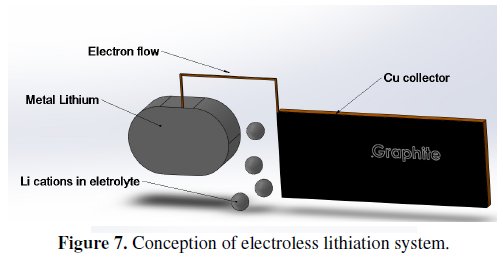
<p>&nbsp;</p>      <p>These two graphite types  represent the most widely used materials for negative electrode in lithium-ion  batteries. Our idea is to prepare a graphite electrode that already contains lithium  atoms before the first charging cycle. These lithium atoms can be used and  consumed to SEI layer creation. The lithium atoms which are in graphite are used  in the first and second charge-discharge cycles. The entire capacity of positive  electrode is preserved and its lithium atoms can be used for charge transfer  [2,8,9,11,12].</p>       <p>&nbsp;</p>     <p><b>Experimental setup</b></p>      <p>Our work is divided into three parts which describe three different lithiation  methods. The first part presents the experiment process, where n-butyllithium  reagent as donor of lithium atoms is used. The measurements showed, despite  our hypothesis, that n-butyllithium is now able to reduce graphite material, i.e.,  inserting lithium atoms among graphite sheets. The second part of our research is  based on the results obtained in the first part. In this experiment we have used the  ionic compound FeCl<sub>3</sub> as lithium attractor. Along with our assumption, the ionic  molecule had tear off the lithium atom from butyl chain. The separated lithium  atom should be easier inserted or bonded to the graphite structure. The third part  performs a special lithiation process that is based on conductive contention  between the graphite electrode and metal lithium. If the graphite electrode is  dipped in an aprotic electrolyte together with the metal lithium, we get a half-cell  with an electrochemical potential of approximately 2.5 V. This way, the prepared  half-cell can be connected via outer conductor; if this is done, the electric current  begins to flow through the conductor. Based on the electrochemical potential of  the cell, the lithium cations are transported through the electrolyte to graphite  electrode where they are reduced from outer circuit. In this case, we call it  electroless lithiation process [1,5,3,7].</p>       ]]></body>
<body><![CDATA[<p>&nbsp;</p>     <p><b><i>Manufacturing process</i></b></p>      <p>This section describes the steps of manufacturing process which were used to  preparing lithiated graphite. The manufacturing process is focused on doping  graphite by lithium ions. The lithiated graphite material served as precursor for  preparing the final graphite electrode. All steps were carried out under inert  atmosphere of argon. The n-butyllithium reagent used in our experiments  contains 2.5 molar concentration of n-butyllithium dissolved in n-hexane. An  electrolyte containing 1 molar concentration of LiPF6 salt was used in all the  experiments [13,14].</p>       <p>&nbsp;</p>     <p><i>A. Lithiation with help of n-butyllithium</i></p>      <p>1. Graphite material was dried at a temperature of 150 &deg;C for 12 hours in a  vacuum chamber. This step is necessary to remove the residual moisture from  graphite. The n-butyllithium is very reactive with water.</p>      <p>2. Addition of the n-butyllithium reagent into the graphite. The molar ratio was  calculated: one Li atom per six carbon atoms - LiC<sub>6</sub>.</p>      <p>3. The mixture of n-butyllithium and graphite was stirred for 24 hours under  room temperature.</p>      <p>4. Following up the prior stirring step, the mixture was filtered. The lithiated  graphite blend was purged using n-hexane solvent in order to remove its nbutyllithium  residues. The mixture is stirred with n-hexane for 6 hours.</p>      <p>5. After the purging step, the mixture was a second time filtered. Now, the  lithiated graphite is in its final state (precursor for preparing the testing electrode)  and it should not contain any residues.</p>       ]]></body>
<body><![CDATA[<p>&nbsp;</p>     <p><i>B. Lithiation with help of n-butyllithium and iron(III) chloride (FeCl<sub>3</sub>) attractor</i></p>      <p>1. Graphite material was dried at a temperature of 150 &deg;C for 12 hours in a  vacuum chamber.</p>      <p>2. The FeCl<sub>3</sub> compound has been dried in a vacuum chamber at a temperature of  150 &deg;C for 24 hours. It is very important to remove the residual moisture from  FeCl<sub>3</sub> powder.</p>      <p>3. Both dried components (graphite and FeCl<sub>3</sub>) were mixed together in an exact  ratio. The ratios were calculated as follows: one hexagonal unit (C6) of graphite  per one FeCl<sub>3</sub> molecule. The two ratios of the components were prepared as  follows:</p>      <p>- first ratio, ten carbon atoms per one FeCl<sub>3</sub> molecule, ratio 10:1.</p>      <p>- second ratio, six carbon atoms per one FeCl<sub>3</sub> molecule, ratio 6:1.  Each composition ratio was stirred with n-hexane for 24 hours, this process  making the composition more homogeneous.</p>      <p>4. The mixture that contains the exact ratio of graphite/FeCl<sub>3</sub> and n-hexane was  filtered and dried in order to remove n-hexane solvent.</p>      <p>5. Addition of the n-butyllithium reagent into the mixture. The molar ratio was  calculated: one Li atom per six carbon atoms - LiC<sub>6</sub>. The following process steps  are the same as in paragraph A, point 3 (above).</p>       <p>&nbsp;</p>     ]]></body>
<body><![CDATA[<p><i>C. Electroless lithiation process</i></p>      <p>1. Graphite material was dried at a temperature of 150 &deg;C for 12 hours in a  vacuum chamber.</p>      <p>2. The negative electrode was prepared from the dried graphite material. For  improving of material properties, 10 wt% of binder (polyvinylidenefluoride -  PVDF) were added to the graphite material.</p>      <p>3. Electrode material was coated onto copper foil (thickness 35 &mu;m) and was  sintered at the temperature of 50 &deg;C for 24 hours.</p>      <p>4. The prepared electrode was connected to the system that is shown in <a href="#f7">Fig. 7</a>.  During this step, the electrode material was reduced by lithium ions for 48 hours,  from the potential of 2.5 V up to 100 mV.</p>      <p>5. In the last stage of this process, the electrode material was stripped off from  the copper collector and dried out under room temperature. This lithiated  material was used like a precursor for preparing the testing electrode.</p>       <p>&nbsp;</p>     <p><b>Experimental results</b></p>      <p>In our experiments we have used two types of graphite: expanded graphite  (manufacturer Bochemie, a.s.) and natural graphite - COND CR5995  (manufacturer Graphite Tyn.). The main parameters of each graphite type are  listed in <a href="#t1">Table 1</a>.</p>       <p>&nbsp;</p>     ]]></body>
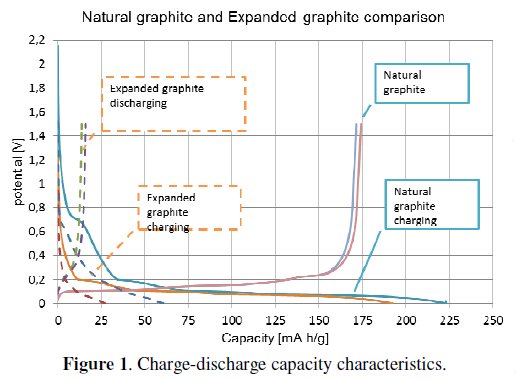
<body><![CDATA[<p><b><i>Graphite lithiation with help of n-butyllithium</i></b></p>      <p>This section deals with preparing negative electrodes from prelithiated graphite.  These electrodes were made for experimental and measurement purposes. The  manufacturing process begins from the precursor (lithiated graphite material),  which was obtained by lithiation process, as quoted above.</p>      <p>Through the manufacturing steps, we have got the lithiated graphite material in  powder form. The lithiated graphite powder was mixed with PVDF binder. The  binder was calculated as 10wt% of lithiated graphite material and must be  dissolved in N-methyl-2-pyrrolidone (NMP) solvent. The electrode mixture was  stirred for 24 hours. After stirring the blend (mixture) was coated on a copper foil  (thickness 35 &mu;m). The wet thickness of the coated layer was 80 &mu;m; in the next  step the coated blend was sintered for 12 hours at the temperature of 50 &deg;C. As  final step of the electrode manufacturing process small rounded electrodes with  18 mm diameter were cut off. These electrodes were pressed by a pressure of 2  tons per cm<sup>2</sup>. The electrodes were subsequently measured on a potentiostat  /galvanostat instrument in a half-cell system. Arrangement of the electrodes was  as follows: working electrode (WE) connecting to analysed electrode, counter  electrode (CE) was represented by metal lithium. At the beginning of the two  types of graphite were measured and compared, before being used in our  experiments (see <a href="#f1">Fig. 1</a>).</p>      <p>&nbsp;</p> <a name="f1"> <img src="/img/revistas/pea/v31n6/31n6a03f1.jpg">     
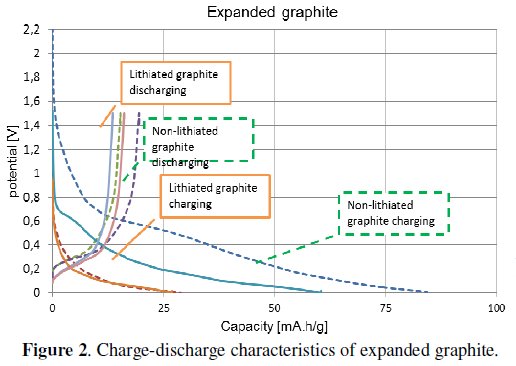
<p>&nbsp;</p>      <p>The graph displayed in <a href="#f2">Fig. 2</a> shows measured  characteristics of expanded graphite.</p>      <p>&nbsp;</p> <a name="f2"> <img src="/img/revistas/pea/v31n6/31n6a03f2.jpg">     
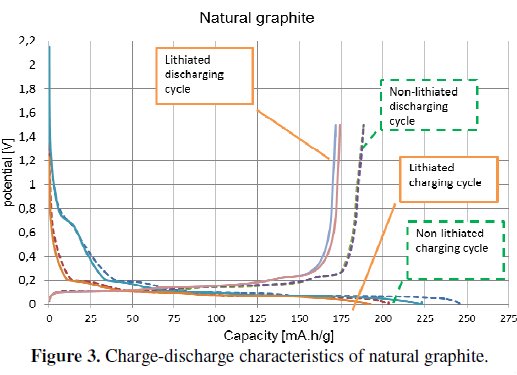
<p>&nbsp;</p>      <p>The graph compares the characteristics of  lithiated and non-lithiated material. The electrode which was made from nonlithiated  material (dashed curve) has got about 20% higher capacity than the  lithiated one (solid line).</p>      <p>The graph presented in <a href="#f3">Fig. 3</a> shows the measured characteristics of natural  graphite.</p>      ]]></body>
<body><![CDATA[<p>&nbsp;</p> <a name="f3"> <img src="/img/revistas/pea/v31n6/31n6a03f3.jpg">     
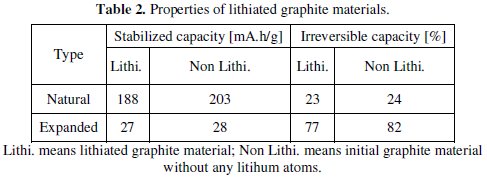
<p>&nbsp;</p>      <p>The electrode which was made from non-lithiated material (dashed  curve) has higher capacity than the lithiated one (solid line), as in the previous  case. Natural graphite has not got the difference of capacity as big as in the case  of the expanded graphite [1,4].</p>      <p>The both types of graphite electrodes (lithiated and non-lithiated) have got  approximately similar irreversible capacity. The non-lithiated natural graphite  material has an irreversible capacity of around the 24 %, and the lithiated one has  an irreversible capacity of around 23 %, see <a href="#f3">Fig. 3</a>. The more noticeable  difference can be seen in the case of expanded graphite, <a href="#f2">Fig. 2</a>. The non-lithiated  electrode material has an irreversible capacity of around 82 %, and the lithiated  electrode material has around 77 %. The summarized results are listed in <a href="#t2">Table 2</a>.</p>      <p>&nbsp;</p> <a name="t2"> <img src="/img/revistas/pea/v31n6/31n6a03t2.jpg">     
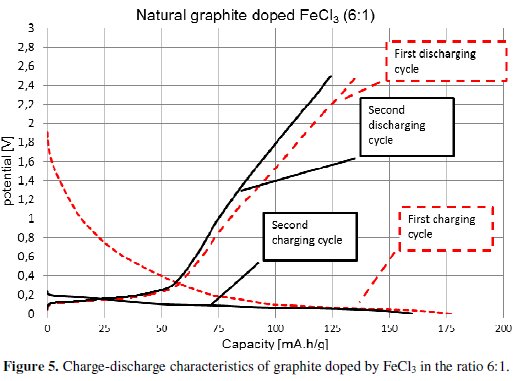
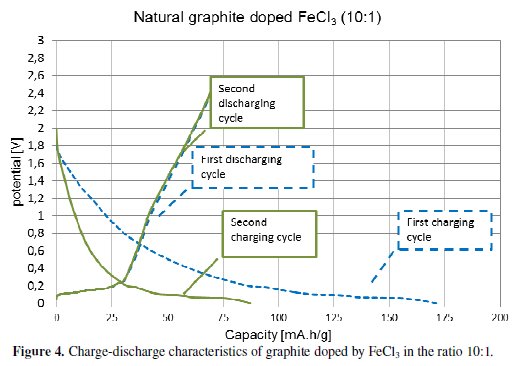
<p>&nbsp;</p>       <p>&nbsp;</p>     <p><b><i>Graphite doped with iron(III) chloride (FeCl<sub>3</sub>)</i></b></p>      <p>The experiments presented in this section are based on the results obtained in the  previous section (Graphite lithiation with help of n-butyllithium). In <a href="#t2">Table 2</a> it is  clearly seen the poor capacity characteristics of expanded graphite; the following  experiments were carried out with natural graphite CR 5995 provided by  Graphite Tyn company. In terms of irreversible capacity, only a slight difference  between lithiated and non-lithiated graphite material was observed. There is a  missing intercalation reaction between n-butyllithium reagent and the graphite  material.</p>      <p>In the other experiments the ionic compound iron(III) chloride (FeCl<sub>3</sub>) was used.  FeCl<sub>3</sub> belongs to halides group. Halides are binary compounds, of which one part  is a halogen atom and the other part is an element which is more electropositive.  The halide group contains the significant compounds copper(II) chloride (CuCl<sub>2</sub>),  manganese(II) chloride (MnCl<sub>2</sub>) and cobalt(II) chloride (CoCl<sub>2</sub>). All of these  compounds are suitable for using in a lithiation process. We have decided to use  FeCl<sub>3</sub> due to its three chloride atoms which cause partial distribution of the  charge [3,4]. The manufacturing process of the electrode material has been  previously described. It was coated on a copper foil with the addition of a binder.  The manufacturing process of the electrodes is the same as described in previous  the case. The electrodes were subsequently measured on a potentiostat  /galvanostat instrument (Bio-Logic) in a half-cell system. The measured  characteristics are displayed in <a href="#f4">Fig. 4</a> and <a href="#f5">Fig. 5</a>.</p>      ]]></body>
<body><![CDATA[<p>&nbsp;</p> <a name="f4"> <img src="/img/revistas/pea/v31n6/31n6a03f4.jpg">     
<p>&nbsp;</p>      <p>&nbsp;</p> <a name="f5"> <img src="/img/revistas/pea/v31n6/31n6a03f5.jpg">     
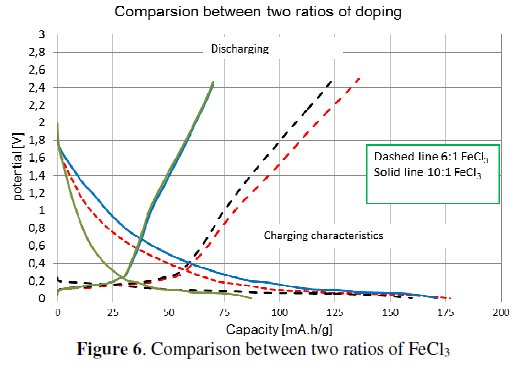
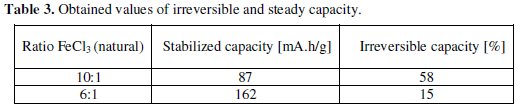
<p>&nbsp;</p>      <p>The obtained results show the capacity characteristics of the measured  specimens. The electrode material with the ratio 10:1 (ten carbon atoms per one  atom of FeCl<sub>3</sub>) has lower stable capacity (around 85 mA.h/g) and higher  irreversible capacity (58 %) than the electrode material with the ratio 6:1, see  <a href="#f4">Fig. 4</a>. The material with the ratio 6:1 has a stable capacity of around 160  mA.h/g, and an irreversible capacity of 15 %, see <a href="#f4">Fig. 4</a>. This marked difference  of the material characteristics is evident from <a href="#f6">Fig. 6</a> and <a href="#t3">Table 3</a>.</p>      <p>&nbsp;</p> <a name="f6"> <img src="/img/revistas/pea/v31n6/31n6a03f6.jpg">     
<p>&nbsp;</p>      <p>&nbsp;</p> <a name="t3"> <img src="/img/revistas/pea/v31n6/31n6a03t3.jpg">     
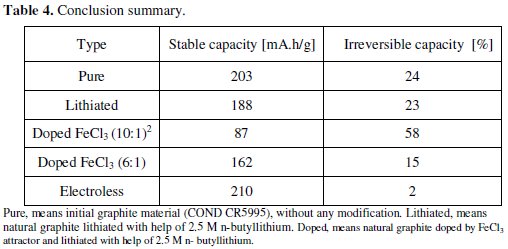
<p>&nbsp;</p>      <p>The differences of capacity characteristics are displayed in <a href="#f6">Fig. 6</a>. Measured  results of that experiment are given in <a href="#t3">Table 3</a> and <a href="#t4">Table 4</a>.</p>      ]]></body>
<body><![CDATA[<p>&nbsp;</p> <a name="t4"> <img src="/img/revistas/pea/v31n6/31n6a03t4.jpg">     
<p>&nbsp;</p>      <p>Pure, means initial graphite material (COND CR5995), without any modification. Lithiated, means  natural graphite lithiated with help of 2.5 M n-butyllithium. Doped, means natural graphite doped by FeCl<sub>3</sub>  attractor and lithiated with help of 2.5 M n-butyllithium.</p>       <p>&nbsp;</p>     <p><b><i>Electroless lithiation process</i></b></p>      <p>The previous experiments give only a small improving of the irreversible  capacity as well as of the material characteristics. There is only negligible  improvement of irreversible capacity along with steady material capacity. This  third section deals with the simple lithiation method that is based on the potential  of the electrochemical cell. The electrochemical potential is formed between the  graphite electrode (material based on graphite with additives that is plated on the  copper collector) and the electrode from metal lithium [6,7,10]. This half-cell is  connected through a wire that serves as outer conductor of electron (see <a href="#f7">Fig. 7</a>).</p>      <p>&nbsp;</p> <a name="f7"> <img src="/img/revistas/pea/v31n6/31n6a03f7.jpg">     
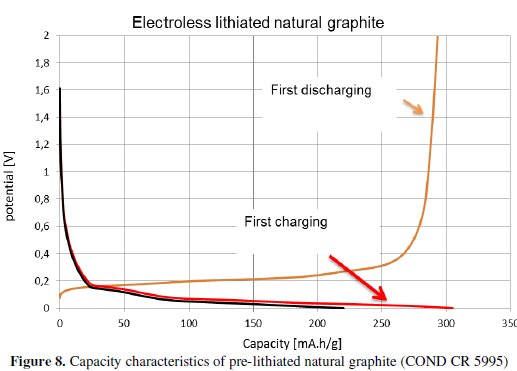
<p>&nbsp;</p>      <p>The system presented in <a href="#f7">Fig. 7</a> was used in our process of electrode material  manufacturing. As an electrolyte it was used 1 M concentration of LiClO<sub>4</sub> salt  (dissolved in a mixture of DMC and EC, as described above). This way, the  prepared material was coated by the electrode collector, following the steps  described formerly. Capacity characteristics obtained from pre-lithiated graphite  are shown in <a href="#f8">Fig. 8</a>.</p>      <p>&nbsp;</p> <a name="f8"> <img src="/img/revistas/pea/v31n6/31n6a03f8.jpg">     
]]></body>
<body><![CDATA[<p>&nbsp;</p>      <p>The values of irreversible and steady capacity, measured with the help of the  electroless lithiation process, brought significant improvement. This lithiation  process fully saturated the graphite structure by lithium atoms. These atoms are  used during the electrode formation (they are consumed in the development of  the SEI layer on the heterogeneous interphase electrode/electrolyte); also, they  prepare the positions inside the graphite structure for the other lithium atoms in  the subsequent charge-discharge cycles.</p>       <p>&nbsp;</p>     <p><b>Conclusions</b></p>      <p>In the first part of our experimental work (Graphite lithiation with help of nbutyllithium)  we describe the lithiation process with the help of n-butyllithium  reagent. In the experiments two graphite kinds were used: expanded and natural  (CR5995) graphite, see <a href="#t1">Table 1</a>. <a href="#f2">Fig. 2</a> and <a href="#f3">Fig. 3</a> show the comparison between  lithiated and non-lithiated materials. The expanded graphite shows decrease of  capacity which can be caused by the sheet distances extension occurred during  the lithiation process. The expanded graphite was taken out from other  experiments due to its small and high irreversible capacity, see <a href="#f1">Fig. 1</a>. The  natural graphite does not show this marked difference at capacity characteristics.  The irreversible capacity of natural graphite was slightly improved from 24 % to  23 %. The n-butyllithium is a too feeble reduction agent for graphite. The Li<sup>+</sup>  atoms are not able to separate from n-butyl chain and intercalating to graphite.  The second part of our work (Graphite doped by iron(III) chloride (FeCl<sub>3</sub>)) uses  the iron(III) chloride ionic compound like a lithium attractor. Obtained results are  listed in <a href="#t3">Table 3</a>. The most suitable ratio of iron(III) chloride is 1:6, i.e., one  molecule of FeCl<sub>3</sub> per six carbon atoms (similar as non-stoichiometric compound  LiC<sub>6</sub>). This experiment with ionic compound got decreasing of irreversible  capacity from 24 % to 15 %.</p>      <p>The last part of our work (Electroless lithiation process) brought the expected  characteristics, see <a href="#f8">Fig. 8</a>. The irreversible capacity of natural graphite decreased  from 24 % to 2 %.</p>      <p>The overall results are summarized and compared in <a href="#t4">Table 4</a>. Our experiments  confirm that the idea of irreversible capacity decreasing by using pre-lithiated  graphite material works. The electroless lithiation method for preparing pre lithiated electrode material is theme to discussion. Its utilization and application  in commercial area can be difficult but it can bring higher capacities and better  characteristic of lithium-ion batteries.</p>       <p>&nbsp;</p>     <p><b>References</b></p>      <!-- ref --><p>1. Yazami R. Synthetic Met. 1987;20:383-386.    &nbsp;&nbsp;&nbsp;&nbsp;&nbsp;&nbsp;&nbsp;&nbsp;[&#160;<a href="javascript:void(0);" onclick="javascript: window.open('/scielo.php?script=sci_nlinks&ref=000102&pid=S0872-1904201300060000300001&lng=','','width=640,height=500,resizable=yes,scrollbars=1,menubar=yes,');">Links</a>&#160;]<!-- end-ref --></p>      <!-- ref --><p>2. Zhao L, Watanabe I, Doi T, et al. J Power Sources. 2006;161:1275-1280.    &nbsp;&nbsp;&nbsp;&nbsp;&nbsp;&nbsp;&nbsp;&nbsp;[&#160;<a href="javascript:void(0);" onclick="javascript: window.open('/scielo.php?script=sci_nlinks&ref=000104&pid=S0872-1904201300060000300002&lng=','','width=640,height=500,resizable=yes,scrollbars=1,menubar=yes,');">Links</a>&#160;]<!-- end-ref --></p>      <!-- ref --><p>3. Dines MB. Mater Res Bull. 1975;10:287-291.    &nbsp;&nbsp;&nbsp;&nbsp;&nbsp;&nbsp;&nbsp;&nbsp;[&#160;<a href="javascript:void(0);" onclick="javascript: window.open('/scielo.php?script=sci_nlinks&ref=000106&pid=S0872-1904201300060000300003&lng=','','width=640,height=500,resizable=yes,scrollbars=1,menubar=yes,');">Links</a>&#160;]<!-- end-ref --></p>      <!-- ref --><p>4. Yazami R. Synthetic Met. 1983;7:169-176.    &nbsp;&nbsp;&nbsp;&nbsp;&nbsp;&nbsp;&nbsp;&nbsp;[&#160;<a href="javascript:void(0);" onclick="javascript: window.open('/scielo.php?script=sci_nlinks&ref=000108&pid=S0872-1904201300060000300004&lng=','','width=640,height=500,resizable=yes,scrollbars=1,menubar=yes,');">Links</a>&#160;]<!-- end-ref --></p>      <!-- ref --><p>5. Hung CC. Carbon. 1995;33:315-322.    &nbsp;&nbsp;&nbsp;&nbsp;&nbsp;&nbsp;&nbsp;&nbsp;[&#160;<a href="javascript:void(0);" onclick="javascript: window.open('/scielo.php?script=sci_nlinks&ref=000110&pid=S0872-1904201300060000300005&lng=','','width=640,height=500,resizable=yes,scrollbars=1,menubar=yes,');">Links</a>&#160;]<!-- end-ref --></p>      <!-- ref --><p>6. Ratnakumar BV, Smart MC, Surampudi S. J Power Sources. 2001;9798:137-139.    &nbsp;&nbsp;&nbsp;&nbsp;&nbsp;&nbsp;&nbsp;&nbsp;[&#160;<a href="javascript:void(0);" onclick="javascript: window.open('/scielo.php?script=sci_nlinks&ref=000112&pid=S0872-1904201300060000300006&lng=','','width=640,height=500,resizable=yes,scrollbars=1,menubar=yes,');">Links</a>&#160;]<!-- end-ref --></p>      <!-- ref --><p>7. Sang-Pil K, Adri CT, Van D. et al. J Power Sources. 2011;196:8590-8597.    &nbsp;&nbsp;&nbsp;&nbsp;&nbsp;&nbsp;&nbsp;&nbsp;[&#160;<a href="javascript:void(0);" onclick="javascript: window.open('/scielo.php?script=sci_nlinks&ref=000114&pid=S0872-1904201300060000300007&lng=','','width=640,height=500,resizable=yes,scrollbars=1,menubar=yes,');">Links</a>&#160;]<!-- end-ref --></p>      <!-- ref --><p>8. Smart MC, Ratnakumar BV, Surampudi S, et al. J Electrochem Soc. 1999;146:3963-3969.    &nbsp;&nbsp;&nbsp;&nbsp;&nbsp;&nbsp;&nbsp;&nbsp;[&#160;<a href="javascript:void(0);" onclick="javascript: window.open('/scielo.php?script=sci_nlinks&ref=000116&pid=S0872-1904201300060000300008&lng=','','width=640,height=500,resizable=yes,scrollbars=1,menubar=yes,');">Links</a>&#160;]<!-- end-ref --></p>      <!-- ref --><p>9. Sivakkumar SR, Pandolfo AG. Electrochim Acta. 2012;65:280-287.    &nbsp;&nbsp;&nbsp;&nbsp;&nbsp;&nbsp;&nbsp;&nbsp;[&#160;<a href="javascript:void(0);" onclick="javascript: window.open('/scielo.php?script=sci_nlinks&ref=000118&pid=S0872-1904201300060000300009&lng=','','width=640,height=500,resizable=yes,scrollbars=1,menubar=yes,');">Links</a>&#160;]<!-- end-ref --></p>      <!-- ref --><p>10. Holzapfel M, Martinent A. J Electroanal Chem. 2003;546:41-50.    &nbsp;&nbsp;&nbsp;&nbsp;&nbsp;&nbsp;&nbsp;&nbsp;[&#160;<a href="javascript:void(0);" onclick="javascript: window.open('/scielo.php?script=sci_nlinks&ref=000120&pid=S0872-1904201300060000300010&lng=','','width=640,height=500,resizable=yes,scrollbars=1,menubar=yes,');">Links</a>&#160;]<!-- end-ref --></p>      <!-- ref --><p>11. Huang S, Fan F, Li J, et al. Acta Mater. 2013;61:4354-4364.    &nbsp;&nbsp;&nbsp;&nbsp;&nbsp;&nbsp;&nbsp;&nbsp;[&#160;<a href="javascript:void(0);" onclick="javascript: window.open('/scielo.php?script=sci_nlinks&ref=000122&pid=S0872-1904201300060000300011&lng=','','width=640,height=500,resizable=yes,scrollbars=1,menubar=yes,');">Links</a>&#160;]<!-- end-ref --></p>      <!-- ref --><p>12. Malmgren S, Ciosek K, Lindblad R, et al. Electrochim Acta. 2013;105:8391.    &nbsp;&nbsp;&nbsp;&nbsp;&nbsp;&nbsp;&nbsp;&nbsp;[&#160;<a href="javascript:void(0);" onclick="javascript: window.open('/scielo.php?script=sci_nlinks&ref=000124&pid=S0872-1904201300060000300012&lng=','','width=640,height=500,resizable=yes,scrollbars=1,menubar=yes,');">Links</a>&#160;]<!-- end-ref --></p>      <!-- ref --><p>13. Wang HY, Wang FM. J Power Sources. 2013;233:1-5.    &nbsp;&nbsp;&nbsp;&nbsp;&nbsp;&nbsp;&nbsp;&nbsp;[&#160;<a href="javascript:void(0);" onclick="javascript: window.open('/scielo.php?script=sci_nlinks&ref=000126&pid=S0872-1904201300060000300013&lng=','','width=640,height=500,resizable=yes,scrollbars=1,menubar=yes,');">Links</a>&#160;]<!-- end-ref --></p>      <!-- ref --><p>14. Swiatowska J, Lair V, Pereira-Nabais C, et al. Appl Surf Sci. 2011;257:9110-9119.    &nbsp;&nbsp;&nbsp;&nbsp;&nbsp;&nbsp;&nbsp;&nbsp;[&#160;<a href="javascript:void(0);" onclick="javascript: window.open('/scielo.php?script=sci_nlinks&ref=000128&pid=S0872-1904201300060000300014&lng=','','width=640,height=500,resizable=yes,scrollbars=1,menubar=yes,');">Links</a>&#160;]<!-- end-ref --></p>       <p>&nbsp;</p>     <p><b>Acknowledgements</b></p>      <p>This work was supported by the project Support for human resources and transfer of  knowledge in conditions of international cooperation of research teams  CZ.1.07/2.3.00/20.0103, Grant Agency of Czech Republic, Project P102/10/2091  (Increase the safety of lithium-ion batteries) and specific research FEKT-S-11-7  (Materials and technologies for electronics).</p>       ]]></body>
<body><![CDATA[<p>&nbsp;</p>     <p><a name=0></a><sup><a href="#top">*</a></sup>Corresponding author. E-mail address: <a href="mailto:xlibic00@stud.feec.vutbr.cz">xlibic00@stud.feec.vutbr.cz</a></p>      <p>Received 1 July 2013; accepted 23 December 2013</p>      <p><a href="http://www.peacta.org" target="_blank">www.peacta.org</a> </p>        ]]></body><back>
<ref-list>
<ref id="B1">
<label>1</label><nlm-citation citation-type="journal">
<person-group person-group-type="author">
<name>
<surname><![CDATA[Yazami]]></surname>
<given-names><![CDATA[R]]></given-names>
</name>
</person-group>
<source><![CDATA[Synthetic Met]]></source>
<year>1987</year>
<volume>20</volume>
<page-range>383-386</page-range></nlm-citation>
</ref>
<ref id="B2">
<label>2</label><nlm-citation citation-type="journal">
<person-group person-group-type="author">
<name>
<surname><![CDATA[Zhao]]></surname>
<given-names><![CDATA[L]]></given-names>
</name>
<name>
<surname><![CDATA[Watanabe]]></surname>
<given-names><![CDATA[I]]></given-names>
</name>
<name>
<surname><![CDATA[Doi]]></surname>
<given-names><![CDATA[T]]></given-names>
</name>
</person-group>
<source><![CDATA[J Power Sources]]></source>
<year>2006</year>
<volume>161</volume>
<page-range>1275-1280</page-range></nlm-citation>
</ref>
<ref id="B3">
<label>3</label><nlm-citation citation-type="journal">
<person-group person-group-type="author">
<name>
<surname><![CDATA[Dines]]></surname>
<given-names><![CDATA[M B]]></given-names>
</name>
</person-group>
<source><![CDATA[Mater Res Bull]]></source>
<year>1975</year>
<volume>10</volume>
<page-range>287-291</page-range></nlm-citation>
</ref>
<ref id="B4">
<label>4</label><nlm-citation citation-type="journal">
<person-group person-group-type="author">
<name>
<surname><![CDATA[Yazami]]></surname>
<given-names><![CDATA[R]]></given-names>
</name>
</person-group>
<source><![CDATA[Synthetic Met]]></source>
<year>1983</year>
<volume>7</volume>
<page-range>169-176</page-range></nlm-citation>
</ref>
<ref id="B5">
<label>5</label><nlm-citation citation-type="journal">
<person-group person-group-type="author">
<name>
<surname><![CDATA[Hung]]></surname>
<given-names><![CDATA[C C]]></given-names>
</name>
</person-group>
<source><![CDATA[Carbon]]></source>
<year>1995</year>
<volume>33</volume>
<page-range>315-322</page-range></nlm-citation>
</ref>
<ref id="B6">
<label>6</label><nlm-citation citation-type="journal">
<person-group person-group-type="author">
<name>
<surname><![CDATA[Ratnakumar]]></surname>
<given-names><![CDATA[B V]]></given-names>
</name>
<name>
<surname><![CDATA[Smart]]></surname>
<given-names><![CDATA[M C]]></given-names>
</name>
<name>
<surname><![CDATA[Surampudi]]></surname>
<given-names><![CDATA[S]]></given-names>
</name>
</person-group>
<source><![CDATA[J Power Sources]]></source>
<year>2001</year>
<volume>97-98</volume>
<page-range>137-139</page-range></nlm-citation>
</ref>
<ref id="B7">
<label>7</label><nlm-citation citation-type="journal">
<person-group person-group-type="author">
<name>
<surname><![CDATA[Sang-Pil]]></surname>
<given-names><![CDATA[K]]></given-names>
</name>
<name>
<surname><![CDATA[Adri]]></surname>
<given-names><![CDATA[C T]]></given-names>
</name>
<name>
<surname><![CDATA[Van]]></surname>
<given-names><![CDATA[D]]></given-names>
</name>
</person-group>
<source><![CDATA[J Power Sources]]></source>
<year>2011</year>
<volume>196</volume>
<page-range>8590-8597</page-range></nlm-citation>
</ref>
<ref id="B8">
<label>8</label><nlm-citation citation-type="journal">
<person-group person-group-type="author">
<name>
<surname><![CDATA[Smart]]></surname>
<given-names><![CDATA[M C]]></given-names>
</name>
<name>
<surname><![CDATA[Ratnakumar]]></surname>
<given-names><![CDATA[B V]]></given-names>
</name>
<name>
<surname><![CDATA[Surampudi]]></surname>
<given-names><![CDATA[S]]></given-names>
</name>
</person-group>
<source><![CDATA[J Electrochem Soc]]></source>
<year>1999</year>
<volume>146</volume>
<page-range>3963-3969</page-range></nlm-citation>
</ref>
<ref id="B9">
<label>9</label><nlm-citation citation-type="journal">
<person-group person-group-type="author">
<name>
<surname><![CDATA[Sivakkumar]]></surname>
<given-names><![CDATA[S R]]></given-names>
</name>
<name>
<surname><![CDATA[Pandolfo]]></surname>
<given-names><![CDATA[A G]]></given-names>
</name>
</person-group>
<source><![CDATA[Electrochim Acta]]></source>
<year>2012</year>
<volume>65</volume>
<page-range>280-287</page-range></nlm-citation>
</ref>
<ref id="B10">
<label>10</label><nlm-citation citation-type="journal">
<person-group person-group-type="author">
<name>
<surname><![CDATA[Holzapfel]]></surname>
<given-names><![CDATA[M]]></given-names>
</name>
<name>
<surname><![CDATA[Martinent]]></surname>
<given-names><![CDATA[A]]></given-names>
</name>
</person-group>
<source><![CDATA[J Electroanal Chem]]></source>
<year>2003</year>
<volume>546</volume>
<page-range>41-50</page-range></nlm-citation>
</ref>
<ref id="B11">
<label>11</label><nlm-citation citation-type="journal">
<person-group person-group-type="author">
<name>
<surname><![CDATA[Huang]]></surname>
<given-names><![CDATA[S]]></given-names>
</name>
<name>
<surname><![CDATA[Fan]]></surname>
<given-names><![CDATA[F]]></given-names>
</name>
<name>
<surname><![CDATA[Li]]></surname>
<given-names><![CDATA[J]]></given-names>
</name>
</person-group>
<source><![CDATA[Acta Mater]]></source>
<year>2013</year>
<volume>61</volume>
<page-range>4354-4364</page-range></nlm-citation>
</ref>
<ref id="B12">
<label>12</label><nlm-citation citation-type="journal">
<person-group person-group-type="author">
<name>
<surname><![CDATA[Malmgren]]></surname>
<given-names><![CDATA[S]]></given-names>
</name>
<name>
<surname><![CDATA[Ciosek]]></surname>
<given-names><![CDATA[K]]></given-names>
</name>
<name>
<surname><![CDATA[Lindblad]]></surname>
<given-names><![CDATA[R]]></given-names>
</name>
</person-group>
<source><![CDATA[Electrochim Acta]]></source>
<year>2013</year>
<volume>105</volume>
<page-range>8391</page-range></nlm-citation>
</ref>
<ref id="B13">
<label>13</label><nlm-citation citation-type="journal">
<person-group person-group-type="author">
<name>
<surname><![CDATA[Wang]]></surname>
<given-names><![CDATA[H Y]]></given-names>
</name>
<name>
<surname><![CDATA[Wang]]></surname>
<given-names><![CDATA[F M]]></given-names>
</name>
</person-group>
<source><![CDATA[J Power Sources]]></source>
<year>2013</year>
<volume>233</volume>
<page-range>1-5</page-range></nlm-citation>
</ref>
<ref id="B14">
<label>14</label><nlm-citation citation-type="journal">
<person-group person-group-type="author">
<name>
<surname><![CDATA[Swiatowska]]></surname>
<given-names><![CDATA[J]]></given-names>
</name>
<name>
<surname><![CDATA[Lair]]></surname>
<given-names><![CDATA[V]]></given-names>
</name>
<name>
<surname><![CDATA[Pereira-Nabais]]></surname>
<given-names><![CDATA[C]]></given-names>
</name>
</person-group>
<source><![CDATA[Appl Surf Sci]]></source>
<year>2011</year>
<volume>257</volume>
<page-range>9110-9119</page-range></nlm-citation>
</ref>
</ref-list>
</back>
</article>