<?xml version="1.0" encoding="ISO-8859-1"?><article xmlns:mml="http://www.w3.org/1998/Math/MathML" xmlns:xlink="http://www.w3.org/1999/xlink" xmlns:xsi="http://www.w3.org/2001/XMLSchema-instance">
<front>
<journal-meta>
<journal-id>0872-1904</journal-id>
<journal-title><![CDATA[Portugaliae Electrochimica Acta]]></journal-title>
<abbrev-journal-title><![CDATA[Port. Electrochim. Acta]]></abbrev-journal-title>
<issn>0872-1904</issn>
<publisher>
<publisher-name><![CDATA[Sociedade Portuguesa de Electroquímica]]></publisher-name>
</publisher>
</journal-meta>
<article-meta>
<article-id>S0872-19042013000600004</article-id>
<article-id pub-id-type="doi">10.4152/pea.201306307</article-id>
<title-group>
<article-title xml:lang="en"><![CDATA[EIS Study of Amine Cured Epoxy-silica-zirconia Sol-gel Coatings for Corrosion Protection of the Aluminium Alloy EN AW 6063]]></article-title>
</title-group>
<contrib-group>
<contrib contrib-type="author">
<name>
<surname><![CDATA[Fontinha]]></surname>
<given-names><![CDATA[I. Rute]]></given-names>
</name>
<xref ref-type="aff" rid="A01"/>
</contrib>
<contrib contrib-type="author">
<name>
<surname><![CDATA[Salta]]></surname>
<given-names><![CDATA[M. Manuela]]></given-names>
</name>
<xref ref-type="aff" rid="A01"/>
</contrib>
<contrib contrib-type="author">
<name>
<surname><![CDATA[Zheludkevich]]></surname>
<given-names><![CDATA[Mikhail L]]></given-names>
</name>
<xref ref-type="aff" rid="A02"/>
</contrib>
<contrib contrib-type="author">
<name>
<surname><![CDATA[Ferreira]]></surname>
<given-names><![CDATA[Mário G.S.]]></given-names>
</name>
<xref ref-type="aff" rid="A02"/>
</contrib>
</contrib-group>
<aff id="A01">
<institution><![CDATA[,Laboratório Nacional de Engenharia Civil  ]]></institution>
<addr-line><![CDATA[Lisboa ]]></addr-line>
<country>Portugal</country>
</aff>
<aff id="A02">
<institution><![CDATA[,Universidade de Aveiro Departamento de Engenharia de Materiais e Cerâmica CICECO]]></institution>
<addr-line><![CDATA[Aveiro ]]></addr-line>
<country>Portugal</country>
</aff>
<pub-date pub-type="pub">
<day>11</day>
<month>11</month>
<year>2013</year>
</pub-date>
<pub-date pub-type="epub">
<day>11</day>
<month>11</month>
<year>2013</year>
</pub-date>
<volume>31</volume>
<numero>6</numero>
<fpage>307</fpage>
<lpage>319</lpage>
<copyright-statement/>
<copyright-year/>
<self-uri xlink:href="http://scielo.pt/scielo.php?script=sci_arttext&amp;pid=S0872-19042013000600004&amp;lng=en&amp;nrm=iso"></self-uri><self-uri xlink:href="http://scielo.pt/scielo.php?script=sci_abstract&amp;pid=S0872-19042013000600004&amp;lng=en&amp;nrm=iso"></self-uri><self-uri xlink:href="http://scielo.pt/scielo.php?script=sci_pdf&amp;pid=S0872-19042013000600004&amp;lng=en&amp;nrm=iso"></self-uri><abstract abstract-type="short" xml:lang="en"><p><![CDATA[The organic-inorganic hybrid sol-gel films, the structure of which comprises interconnected inorganic and organic networks have been reported as an environmentally friendly anti-corrosion pre-treatment for several metals, including aluminium alloys. In this paper, an epoxy-silica-zirconia hybrid sol-gel coating was synthesized from glycidoxypropyltrimethoxysilane (GPTMS) and zirconium npropoxide (TPOZ) precursors and applied to EN AW-6063 alloy by dip-coating. To promote the organic network formation through the epoxy group polymerization at room temperature, two types of amine crosslinkers were added during synthesis: diethylenetriamine (DETA), in different concentrations, and a tri-functional aminosilane. The evolution of the curing process and the corrosion behaviour of the coated aluminium alloy specimens were evaluated by Electrochemical Impedance Spectroscopy (EIS) in 0.5 M NaCl. The morphology and surface chemistry of the hybrid coatings were characterized by Energy Dispersive Spectroscopy (EDS) coupled with Scanning Electron Microscopy (SEM) and by Fourier Transform Infrared Spectroscopy (FTIR). The results obtained revealed that the sol-gel coatings with lower amine ratios required longer curing times, but showed the best anticorrosive performance with time. The increase in amine concentration has led to a more cross linked organic network, resulting in higher initial coatings resistance; however it has turned coatings more hydrophilic, prone to rapid degradation in water.]]></p></abstract>
<kwd-group>
<kwd lng="en"><![CDATA[sol-gel hybrid coating]]></kwd>
<kwd lng="en"><![CDATA[silane]]></kwd>
<kwd lng="en"><![CDATA[corrosion]]></kwd>
<kwd lng="en"><![CDATA[EIS]]></kwd>
<kwd lng="en"><![CDATA[aluminium]]></kwd>
</kwd-group>
</article-meta>
</front><body><![CDATA[ 


<!--     <p>&nbsp;</p>
    <p>doi: 10.4152/pea.201306307</p> -->


    <p><b>EIS Study of Amine Cured Epoxy-silica-zirconia Sol-gel Coatings for Corrosion Protection of the Aluminium Alloy EN AW 6063</b></p>

    <p>
<b>I. Rute Fontinha</b><sup><i>a</i>,<a href="#0">*</a></sup>
, <b>M. Manuela Salta</b><sup><i>a</i></sup>
, <b>Mikhail L. Zheludkevich</b><sup><i>b</i></sup></b>
 and <b>M&aacute;rio G.S. Ferreira</b><sup><i>b</i></sup>
</p>

    <p><i><sup>a</sup> LNEC - Laborat&oacute;rio Nacional de Engenharia Civil, Lisboa, Portugal</i></p>

    <p><i><sup>b</sup> UA - Universidade de Aveiro, CICECO, Departamento de Engenharia de Materiais e Cer&acirc;mica, Aveiro, Portugal</i></p>

    <p>&nbsp;</p>
    <p><b>Abstract</b></p>

    <p>The organic-inorganic hybrid sol-gel films, the structure of which comprises 
interconnected inorganic and organic networks have been reported as an 
environmentally friendly anti-corrosion pre-treatment for several metals, including 
aluminium alloys. In this paper, an epoxy-silica-zirconia hybrid sol-gel coating was 
synthesized from glycidoxypropyltrimethoxysilane (GPTMS) and zirconium npropoxide 
(TPOZ) precursors and applied to EN AW-6063 alloy by dip-coating. To 
promote the organic network formation through the epoxy group polymerization at 
room temperature, two types of amine crosslinkers were added during synthesis: 
diethylenetriamine (DETA), in different concentrations, and a tri-functional aminosilane. 
The evolution of the curing process and the corrosion behaviour of the coated 
aluminium alloy specimens were evaluated by Electrochemical Impedance 
Spectroscopy (EIS) in 0.5 M NaCl. The morphology and surface chemistry of the 
hybrid coatings were characterized by Energy Dispersive Spectroscopy (EDS) coupled 
with Scanning Electron Microscopy (SEM) and by Fourier Transform Infrared 
Spectroscopy (FTIR). The results obtained revealed that the sol-gel coatings with lower 
amine ratios required longer curing times, but showed the best anticorrosive 
performance with time. The increase in amine concentration has led to a more cross 
linked organic network, resulting in higher initial coatings resistance; however it has 
turned coatings more hydrophilic, prone to rapid degradation in water.</p>

    ]]></body>
<body><![CDATA[<p><b><i>Keywords:</i></b> sol-gel hybrid coating, silane, corrosion, EIS, aluminium.</p>


    <p>&nbsp;</p>
    <p><b>Introduction</b></p>

    <p>The aluminium alloys offer a unique combination of properties such as good 
mechanical resistance with a high strength to weight ratio, design flexibility and 
good corrosion resistance due to the spontaneous oxide layer formed on their 
surface, allied to a cradle-to-cradle life cycle. These properties make them widely 
used in several industries, including the building industry, which consumes 
around 30% of the aluminium products in Western Europe [1], in particular, 
those of 6000 series alloys. This type of alloys present good corrosion resistance 
in mild corrosive environments; however, develops pitting in marine highly 
polluted environments. Therefore, to fulfil long term service life requirements 
and to reduce maintenance needs, keeping an appropriate aesthetic appearance, 
aluminium building components are often organically coated which requires 
alloy surface pre-treatment and a conversion layer to improve adhesion. This pretreatment 
is often based on toxic Cr(VI) which, since 2007, has been under great 
restrictions due to environmental concerns, and should be banned from pretreatment 
industry in Europe until September of 2017 [2]. It could be estimated 
from European Aluminium Association data that around 1.12 Mton of aluminium 
alloys were powder coated in Europe, in 2011, mostly for building applications. 
This shows the importance of the development of a chromium-free technology 
for the aluminium pre-treatment industry. Presently, there are already several 
alternative pre-treatments in use; however, they lack the anticorrosive action of 
the Cr(VI) compounds.</p>

    <p>Organic-inorganic hybrid silane based sol-gel coatings have been reported as a 
promising environmentally friendly alternative to Cr(VI) conversion layers for 
several metals, since they, not only exhibit barrier effect and compatibility with 
organic coatings, but also have the ability to incorporate corrosion inhibitors [3-12]. 
These types of coatings present combined mechanical and chemical 
properties typical of inorganic ceramics and of organic polymers. Among these, 
the epoxy-silane based hybrid sol-gel coatings are of particular interest due to the 
increased properties of flexibility, density and functional compatibility with 
organic coatings, achieved as a result of the epoxide organic group present [5,7-15]. 
During the synthesis of these coatings occurs simultaneously the formation 
of an organic network through epoxide rings opening and polymerization, and of 
an inorganic siloxane network through the hydrolysis and subsequent 
condensation of the silicon alkoxide groups [16]. Uncatalysed organic 
polymerization usually requires elevated temperature to complete the process. 
However, by the addition of amine crosslinking agents it is possible to promote 
the organic network formation at low temperature [17], with inherent energy 
savings.</p>

    <p>The corrosion behaviour of amine-cured epoxy-silane sol-gel coatings has been 
studied by different authors [14,15,17-22]. The diethylenetriamine (DETA) is 
one of the most common epoxy crosslinkers used and an optimum amine 
concentration in terms of the best anticorrosive properties achieved by the 
coatings was reported by Vreugdenhil et al. [18] and by Davis et al. [17] of, 
respectively, 1.3 and 1 relative to the molar ratio ''epoxy group/amine reactive 
hydrogen''. Khramov et al. [19] also studied epoxy-silane sol-gel coatings 
crosslinked with amino-silanes and found significant improvement in these 
coatings corrosion performance in comparison to those of DETA crosslinked 
ones. In another study involving the addition of amino-silane crosslinkers [20], 
the above optimum molar ratio found ranged between 1 and 1.5. The aminosilanes 
present the advantage of contributing also to the inorganic network 
formation. Besides amino-silanes, other amines have been studied as alternative 
to DETA like di-amines of longer carbon chain [15] or branched amines [21,22], 
the resultant coatings showed better corrosion protection properties compared to 
those derived from formulations containing DETA as crosslinking agent. 
The epoxy-silane based coatings curing process (by heating or by the addition of 
crosslinking agents) is determinant for the establishment of both inorganic and 
organic networks of these hybrid coatings and should be appropriate to the 
precursors used in their synthesis. All the studies referred are focused on solely 
silane derived sol-gel coatings. In this work, a zirconium alkoxide precursor is 
used in addition to the epoxy-silane one to produce the hybrid sol-gel coating for 
corrosion protection of the aluminium alloy EN AW 6063. This type of sol-gel 
coatings usually is thermally cured [7,16]. The aim of this work is to study the 
corrosion properties of epoxy-silica-zirconia hybrid sol-gel coatings cured at 
room temperature by the addition of amine crosslinkers. Therefore, in the present 
work, epoxy-silica-zirconia hybrid sol-gel coatings were synthesized from 
glycidoxypropyltrimethoxysilane (GPTMS) and zirconium n-propoxide (TPOZ) 
precursors, applied to the aluminium alloy by dip-coating and cured at room 
temperature using two types of amine crosslinkers: diethylenetriamine (DETA), 
in different concentrations (GPTMS/amine-Hreactive molar ratios: 1.5 and 1), and a 
tri-functional amino-silane in that molar ratio of 1. A sol-gel coating prepared 
from the same precursors but without amine addition was also synthesized for 
comparison. The evolution of the curing process and the corrosion behaviour of 
the hybrid coated aluminium alloy specimens were evaluated by Electrochemical 
Impedance Spectroscopy (EIS). The morphology and surface chemistry of the 
hybrid coatings were also characterized by Energy Dispersive Spectroscopy 
(EDS) coupled to Scanning Electron Microscopy (SEM) and by Fourier 
Transform Infrared Spectroscopy (FTIR).</p>


    <p>&nbsp;</p>
    <p><b>Experimental</b></p>

    <p><b><i>Reagents and materials</i></b></p>

    <p>Glycidoxypropyltrimethoxysilane (GPTMS), zirconium n-propoxide (TPOZ) 
70% in propanol, 2-propanol, ethylacetoacetate, diethylenetriamine (DETA) and 
3-[2-(2-aminoethylamino)ethylamino]propyl-trimethoxysilane (3A) were 
purchased from Aldrich and used as received. Nitric acid (65%, Merk) was used 
to acidify the water solution used to promote hydrolysis. Ultra-pure water (0.055
0.060 &mu;S/cm) obtained from a Purelab Ultra System (Elga) was used. 
Aluminium test specimens, 3 cm &times; 7 cm &times; 1.1 cm, of commercial EN AW 6063 
alloy [23] were used. Before coating deposition, the aluminium alloy samples 
were degreased with ethanol and then cleaned by immersion in an alkaline 
aqueous solution containing 50 g/L of P3 Almeco 18C (Henkel) for 10 min at 60 
&deg;C, followed by immersion in a 20% (wt) HNO3 solution for 15 min and finally 
rinsed with deionized water.</p>

    ]]></body>
<body><![CDATA[<p>&nbsp;</p>
    <p><b><i>Sol-gel synthesis and coating deposition</i></b></p>

    <p>The hybrid coating was synthesized from GPTMS and TPOZ precursors, based 
on the procedure described in [7], hydrolyzed separately, under acidic conditions 
at room temperature. The organo-siloxano sol was obtained by mixing GPTMS 
in 2-propanol (1:1 volume ratio) with diluted nitric acid and stirring it for 30 
minutes. The inorganic sol was prepared by addition of TPOZ (70% in 2propanol) 
to the complexing agent ethylacetoacetate (1:1 volume ratio), stirring it 
for 20 minutes, and then, diluted nitric acid was added and stirring was extended 
for another 60 minutes. After this time, the two sols were mixed and stirred for 1 
h, followed by 1 h ageing at room temperature. The amine crosslinking agent was 
added to the hybrid sol ten minutes prior coating the aluminium samples. The 
amount of amine added was calculated to yield a GPTMS/amine-Hreactive molar 
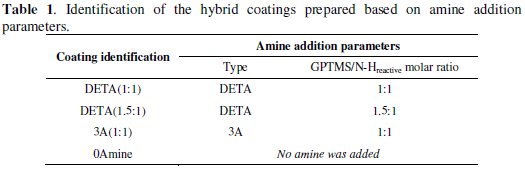
ratio of 1 and 1.5 for DETA, and of 1 for the amino-silane 3A. One coating was 
prepared without amine addition for comparison. The Zr/Si molar ratio in each 
final coating is 0.26. <a href="#t1">Table 1</a> resumes the different coatings prepared and 
respective identification.</p>

    <p>&nbsp;</p>
<a name="t1">
<img src="/img/revistas/pea/v31n6/31n6a04t1.jpg">
    
<p>&nbsp;</p>

    <p>The sol-gel coatings were applied to the previously cleaned aluminium EN AW 
6063 alloy samples, by dipping and withdrawal at a speed of 18 cm/min, after a 
residence time of 100 s, using a dip-coater (Nima, model DC Small). After 
coating, the aluminium samples were left to dry at room temperature for 24 h (or 
72 h in the case of the coating prepared without amine) and then stored in a 
desiccator before testing.</p>


    <p>&nbsp;</p>
    <p><b>Experimental techniques</b></p>

    <p>The evolution of the curing process and corrosion behaviour of the different 
aluminium alloy coated samples was evaluated by Electrochemical Impedance 
Spectroscopy (EIS) in neutral 0.5 M NaCl solution. The EIS tests were 
performed at room temperature, in a Faraday cage, with the solution exposed to 
air, with a Gamry Potentiostat REF600-06704, in the frequency range of 100 
kHz-10 mHz, applying a 10 mV sinusoidal perturbation at OCP, with 10 to 7 
points per decade logarithmically distributed. The test area was 1.34 cm<sup>2</sup>. A 
three-electrode cell was used, with a saturated calomel electrode (SCE) as 
reference, a platinum wire as counter-electrode and the coated aluminium alloy 
sample as working electrode. Two to four replicates were tested for each coating 
type. Gamry Echem Analyst software version 5.3 was used for impedance curves 
fitting to the appropriate equivalent circuits.</p>

    <p>Surface coatings observation and chemical elemental analysis were carried out 
before immersion with a JEOL JSM-6400 scanning electron microscope with a 
coupled EDS detector (Inca-xSight, Oxford Instruments). Coatings chemical 
structure was carried out by specular reflectance Fourier Transform Infrared 
(FTIR) spectroscopy with a Nicolet Magna IR-550 spectrometer, between 4000- 
450 cm<sup>-1</sup> wavelengths, with a 4 cm<sup>-1</sup> resolution.</p>


    ]]></body>
<body><![CDATA[<p>&nbsp;</p>
    <p><b>Results and discussion</b></p>

    <p><b><i>Coatings surface characterization by SEM/EDS</i></b></p>

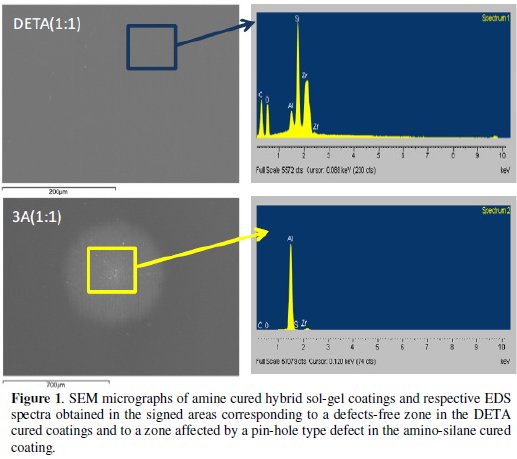
    <p>SEM observations of the hybrid sol-gel coatings synthesized revealed a very 
smooth homogeneous, crack-free surface for all coatings. However, there are a 
few pinhole-like defects which are more noticeable in the amino-silane (3A) 
cured coating. <a href="#f1">Figure 1</a> shows an example of one of these coating defects on an 
aluminium sample with the 3A cured coating in comparison with a defect-free 
surface of a DETA cured coated sample.</p>

    <p>&nbsp;</p>
<a name="f1">
<img src="/img/revistas/pea/v31n6/31n6a04f1.jpg">
    
<p>&nbsp;</p>

    <p>The EDS spectra presented in <a href="#f1">Fig. 1</a> 
reveal that in the defect area, the hybrid sol-gel coating is almost absent. 
Consequently, these areas may suffer early corrosion processes.</p>

    <p>The results of several elemental chemical composition analysis by EDS carried 
out in the different synthesized hybrid coatings surface on defect-free areas 
indicate the following Al/Si ratios: 3A(1:1)-0.01; DETA(1:1)-0.2; 0Amine-0.8. 
Higher Al/Si ratios suggest higher coating thickness.</p>


    <p>&nbsp;</p>
    <p><b><i>Coatings chemical structure characterization by FTIR</i></b></p>

    ]]></body>
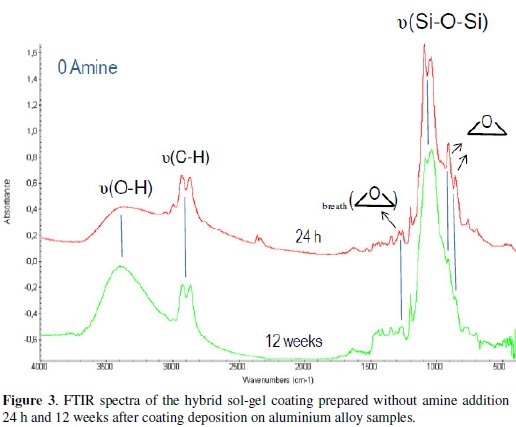
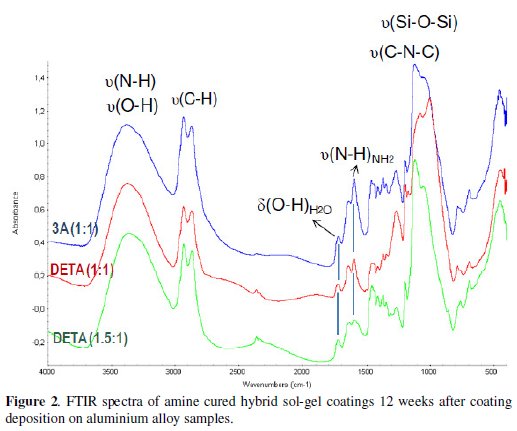
<body><![CDATA[<p><a href="#f2">Figs. 2</a> and <a href="#f3">3</a> display, respectively, the FTIR spectra obtained for the different 
amine cured hybrid coatings and for the hybrid coating prepared without amine.</p>

    <p>&nbsp;</p>
<a name="f2">
<img src="/img/revistas/pea/v31n6/31n6a04f2.jpg">
    
<p>&nbsp;</p>
<a name="f3">
<img src="/img/revistas/pea/v31n6/31n6a04f3.jpg">
    
<p>&nbsp;</p>

    <p>FTIR peak/band assignment was done based on the literature.</p>

    <p>The FTIR spectra relative to the amine cured hybrid coatings (<a href="#f2">Fig. 2</a>) were 
obtained 12 weeks after coating deposition on aluminium samples. These spectra 
exhibit practically the same peaks/bands although with some differences on their 
relative intensity. The band in the 3700-3100 cm<sup>-1</sup> range is related with the 
presence of OH groups (from hydrolysis products, alcohol residuals and absorbed 
water) [16,24,26] and with primary and secondary N-H groups that also absorb in 
this range [18,22,27]. The peaks at 2931 cm<sup>-1</sup> and 2870 cm<sup>-1</sup> are assigned to C-H 
stretching vibration bands in the alkyl groups [16,26] and also to N-H vibrations 
[18]. The intermediate band at 1640 cm<sup>-1</sup> is attributed to the bending vibration of 
water molecules absorbed [12,22]. The peak near 1600 cm<sup>-1</sup>, more notorious in 
the high amine cured coatings DETA(1:1) and 3A(1:1), can be assigned to N-H 
deformation modes in the -NH2 group, indicating that some unreacted 
crosslinking agent was left [18,22]. These groups add hydrophilicity to the 
coatings, confirmed by the presence of the absorbed water band. The intense 
peaks in the 1120-1010 cm<sup>-1</sup> range are characteristic of vibration bands of Si-O-
Si bonds [6,11,16,24-26] of the inorganic network, but the intense peak at 1120 
cm<sup>-1</sup> can also be assigned to the stretching vibrations of C-N-C bonds, namely, 
those formed in the organic polymerization reactions [18]. Thus, the extent of the 
inorganic network crosslinking is difficult to ascertain in the amine cured epoxysilane 
sol-gel coatings since the Si-O-Si band can be overlapped by the C-N-C 
band. The increased absorption observed below 800 cm-1 is also due to primary 
and secondary N-H groups.</p>

    <p>The epoxy ring characteristic absorption bands, namely the band at 1250 cm<sup>-1</sup> 
(ring breathing), and the small peaks at 909 cm<sup>-1</sup> (antisymmetric stretching) and 
at 856 cm<sup>-1</sup> [16,18,22] that are visible in the hybrid coating prepared without 
amine addition spectra (<a href="#f3">Fig. 3</a>), are not visible in the amine cured coatings FTIR 
spectra, suggesting an extensive organic network formation. The small band at 
1270 cm<sup>-1</sup>, more intense in the high amine coating formulations is attributed to 
the stretching vibrations of C-O bond [27,28] in the ether, present in the opened 
epoxy ring products.</p>

    <p>The FTIR spectra relative to the 0Amine coating (<a href="#f3">Fig. 3</a>) were obtained 24 hours 
and 12 weeks after coating deposition on aluminium samples. The main peaks 
visible in both spectra are the ones related with the siloxane bonds (Si-O-Si), 
between 1100 cm<sup>-1</sup> and 1050 cm<sup>-1</sup>, showing that the inorganic network should be 
well established at room temperature only 24 h after deposition, in opposition to 
the organic network, as evidenced by the presence of the epoxy ring absorption 
peaks. These peaks are less noticeable in the FTIR spectrum obtained after 12 
weeks ageing, showing that the polymerization reactions involved in the organic 
network establishment proceed with time, although in a very slow rate. The 
inorganic network should have also improved with time, becoming more cross 
linked, as shown by the widening of the siloxane absorption band and the shifting 
of its maximum peak towards lower wavelengths [16]. The small peak at 1197 
cm<sup>-1</sup> near siloxane band in both spectra could be assigned to the stretching 
vibrations of Si-C bond [26].</p>

    <p>The FTIR analysis results show that the amine addition was essential to achieve a 
higher extension of organic network formation in the hybrid coatings when 
compared to the coating prepared without amine. However, there is the risk of 
such extended organic network may imposing some constraints to the inorganic 
network formation due to geometrical reasons [17]. FTIR analyses have also 
indicated that some unreacted N-H groups are left in all amine cured coatings, 
what suggests that this crosslinking agent might be in excess. In this study a 
zirconium alkoxide was used as sol-gel precursor. Being a Lewis acid it also has 
the ability to catalyse epoxy ring opening reactions [16,29], reducing the number 
of epoxy rings available to react with amines. Therefore less amine than the 
amount added (calculated based on stoichiometric needs) would be necessary, 
justifying the unreacted N-H groups present in the sol-gel coating even after 12 
weeks.</p>


    <p>&nbsp;</p>
    ]]></body>
<body><![CDATA[<p><b><i>Electrochemical evaluation of coatings by EIS</i></b></p>

    <p>To evaluate the corrosion behaviour, hybrid sol-gel coated aluminium samples 
were immersed in a 0.5 M NaCl solution for 15 days and EIS measurements were 
carried out during the immersion period. Before that, EIS measurements were 
carried out after 1 hour immersion in the same chloride solution at different times 
elapsed after coating deposition (curing time) to assess the evolution of the 
coatings' cure with time in terms of their barrier properties.</p>


    <p><i>Evolution of cure with time</i></p>

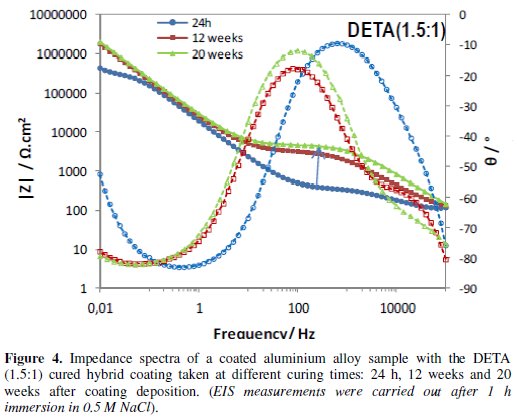
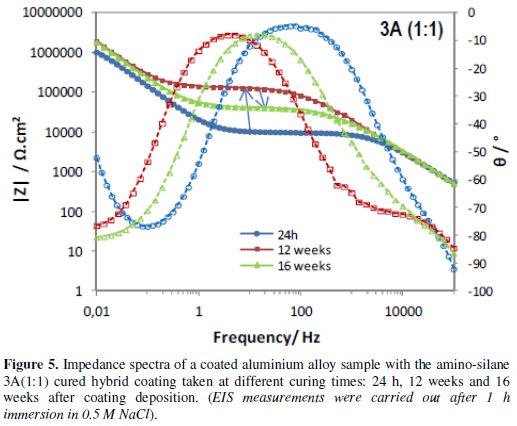
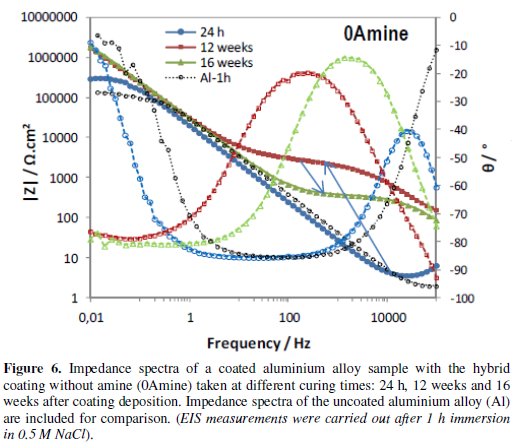
    <p><a href="#f4">Figs. 4 to 6</a> show the impedance spectra obtained at different curing times for the 
aluminium alloy samples coated with the two types of amine (DETA, 3A) cured 
hybrid coatings and for the one without amine (0Amine).</p>

    <p>&nbsp;</p>
<a name="f4">
<img src="/img/revistas/pea/v31n6/31n6a04f4.jpg">
    
<p>&nbsp;</p>
<a name="f5">
<img src="/img/revistas/pea/v31n6/31n6a04f5.jpg">
    
<p>&nbsp;</p>
<a name="f6">
<img src="/img/revistas/pea/v31n6/31n6a04f6.jpg">
    
<p>&nbsp;</p>

    <p>The impedance spectra 
of the uncoated aluminium alloy (Al) are included for comparison. At each 
curing time, EIS measurements were carried out after 1 h immersion in 0.5 M 
NaCl.</p>

    <p>The EIS spectra obtained for the amine (DETA, 3A) cured coatings from the 24 
hours curing time (<a href="#f4">Fig. 4</a> and <a href="#f5">5</a>) always present two time constants, which can 
be associated to the capacitive contribution of the sol-gel coating (in the 104 Hz-105 Hz 
range) and of the intermediate oxide layer (at &sim;0.1 Hz) [7]. This 
intermediate oxide layer, constituted by Al-O-Si and Al-O-Zr bonds, results from 
condensation reactions between Zr-OH and Si-OH groups with Al-OH groups of 
the native oxide layer present in the metal surface [5,16]. Between the two 
capacitive regions, a resistive plateau can be observed in the 1 Hz -100 Hz range, 
associated to the coating resistance [7]. Its position at high impedance modulus 
indicates that these coatings present barrier properties 24 h after coating 
deposition. The same, however, does not apply to the coating prepared without 
amine addition, which EIS spectra (<a href="#f6">Fig. 6</a>) obtained 24 h after coating deposition 
present only one broad time constant similar to the spectra obtained for the 
aluminium alloy sample without coating. In both cases, this relaxation process 
results only from the capacitance of the native oxide layer present in this type of 
alloy [30]. The absence coating impedance response indicates that the sol-gel 
coating does not have yet barrier properties, probably because the time elapsed 
was insufficient to complete the condensation reactions involved in the formation 
of the inorganic network, as also as to complete the reactions involved in the 
polymerization of the functional epoxy group necessary to establish the organic 
network, what is coherent with the FTIR analysis results. For longer curing 
times, EIS spectra already exhibit both capacitive and resistive contributions of 
the sol-gel coating, similarly to what was observed for the amine cured coatings. 
The 0Amine coating resistive plateau, however, is positioned at lower impedance 
values than for the amine cured coatings, indicating inferior barrier properties. 
According to EIS measurements all coatings improve barrier properties with time 
until 12 weeks, as the hybrid network becomes more crosslinked. For longer 
curing times (16 or 20 weeks) the amino-silane cured coating and the one 
prepared without anime suffer some kind of degradation, leading to a decrease in 
their barrier properties.</p>


    ]]></body>
<body><![CDATA[<p><i>Evolution of anticorrosive properties</i></p>

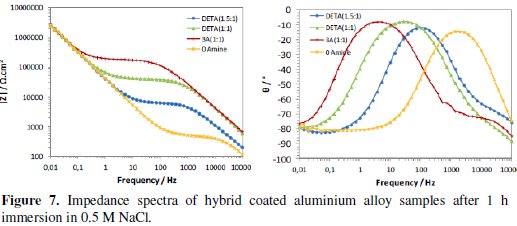
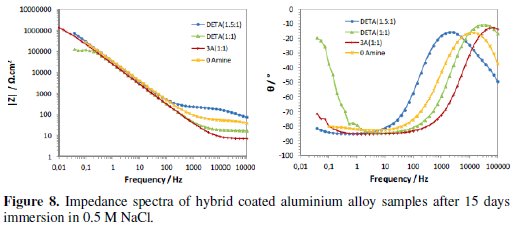
    <p>The continuous immersion in the 0.5 M NaCl solution started after the times used 
to evaluate the curing process (16 to 20 weeks after coating deposition). <a href="#f7">Figs. 7</a> 
and <a href="#f8">8</a> present the typical impedance spectra obtained at the beginning and at the 
end of the immersion time (15 days) in the chloride solution, for the coated 
aluminium EN AW 6063 alloy samples with amine cured coatings and with the 
coating prepared without amine addition (0Amine).</p>

    <p>&nbsp;</p>
<a name="f7">
<img src="/img/revistas/pea/v31n6/31n6a04f7.jpg">
    
<p>&nbsp;</p>
<a name="f8">
<img src="/img/revistas/pea/v31n6/31n6a04f8.jpg">
    
<p>&nbsp;</p>

    <p>Initially the two time 
constants associated to the sol-gel coating at medium-high frequencies and to the 
intermediate oxide layer at low frequencies are visible (<a href="#f7">Fig. 7</a>). The relative 
position of the resistive plateau associated to the coating resistance in terms of 
impedance modulus value allows the ranking of the different coatings' barrier 
properties: the amino-silane cured coating is the one with the best barrier 
properties and the coating prepared without amine addition has the worst ones. 
No signs of corrosion activity were visible in the EIS spectra obtained for this 
short immersion time.</p>

    <p>With immersion time, the EIS spectra of all coatings evidence a marked decrease 
in the impedance at medium-high frequencies range (104Hz-10Hz), showing a 
great loss of sol-gel coatings' barrier properties, more pronounced for those with 
higher amine ratios, especially the amino-silane (3A) cured coating (<a href="#f8">Fig. 8</a>). This 
decay is caused by water and chloride ions penetration into coating, hence, these 
two coatings should be more hydrophilic than the other two, what is in 
accordance with FTIR analysis results. At the end of the immersion time in the 
chloride solution, the DETA(1.5:1) cured coating is the only one showing some 
barrier ability.</p>

    <p>The differences in the impedance response of the different sol-gel coated samples 
at the end of immersion time are also visible in the impedance spectra at low 
frequencies (&lt;0.1 Hz), namely, in the lay-out of the phase angle curves (<a href="#f8">Fig. 8</a>). 
Impedance response in this frequency region is related to the intermediate oxide 
layer properties and the onset of corrosion processes. The increase of the phase 
angle observed in the EIS spectra of the coatings with higher amine content 
suggests a less capacitive (thus more resistive) behaviour of this layer, also 
meaning that these two coatings are less corrosion resistant.</p>

    <p>On the whole, the EIS corrosion evaluation indicates the DETA(1.5:1) cure 
coating as the one with best anticorrosive properties, followed by the coating 
prepared without amine addition. In spite of its initial lower barrier properties, 
the 0Amine coating was less affected by immersion in the chloride solution and 
showed better corrosion protective ability than the higher amine cured coatings. 
The amino-silane (3A) cured coating initially presented the highest barrier 
properties, probably due to a more crosslinked organic and inorganic networks 
leading to a higher coating thickness (as estimated by the SEM/EDS analysis), 
but suffered the fastest degradation with immersion and at the end has practically 
lost its barrier ability. The same was observed for the DETA(1:1) cured coating. 
These coatings are the ones with the higher amine content that, according to 
FTIR analysis results, was not fully consumed in the epoxy ring opening 
reactions, what has turned these coatings more hydrophilic, thus prone to rapid 
degradation in water.</p>

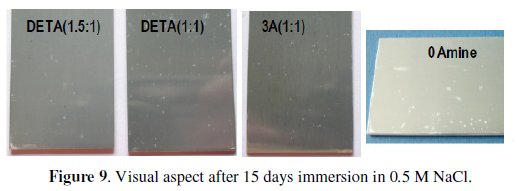
    <p>The EIS results are coherent with visual observation of the immersed coated 
aluminium alloy samples displayed in the photos taken after immersion in the 
chloride solution (<a href="#f9">Fig. 9</a>).</p>

    ]]></body>
<body><![CDATA[<p>&nbsp;</p>
<a name="f9">
<img src="/img/revistas/pea/v31n6/31n6a04f9.jpg">
    
<p>&nbsp;</p>

    <p>The high amine content coatings exhibit more pin-hole 
type defects, evidenced by the whitish stains resultant from the metallic substrate 
oxidation and incipient pitting corrosion development. These coatings also 
became yellowish with immersion time (not perceptible in the photos) what is a 
sign of their chemical degradation.</p>


    <p>&nbsp;</p>
    <p><b>Conclusions</b></p>

    <p>Epoxy-zirconia-silica sol-gel coatings were synthesized, deposited on aluminium 
EN AW 6063 alloy samples and cured at room temperature by the addition of 
amine crosslinking agents. The results obtained revealed that these coatings 
achieve appropriate barrier properties 24 h after coating deposition. Furthermore, 
these barrier properties improve significantly for longer curing times (12 weeks), 
showing that the curing process takes several weeks to complete. 
It was observed that the amount of amine added influenced the coatings 
protective properties, namely, their barrier properties. The ones with less amine 
require longer times to finish cure, but once cured, show the best anticorrosive 
performance with time. The best corrosion performance was achieved by a 
coating cured with DETA added in the GPTMS/N-Hreac molar ratio of 1.5:1. 
It was found that amine additions in the GPTMS/N-Hreac molar ratio of 1:1 were 
excessive, possibly because the zirconium alkoxide present in the coatings 
lowered the number of epoxy rings available to react. The amine in excess turned 
coatings more hydrophilic, which was detrimental to long term coating 
anticorrosive efficacy, as evidenced by the EIS results.</p>


    <p>&nbsp;</p>
    <p><b>References</b></p>

    <!-- ref --><p>1. European Aluminium Association, Annual Report 2010 - Activity Report, EAA, 2011.    &nbsp;&nbsp;&nbsp;&nbsp;&nbsp;&nbsp;&nbsp;&nbsp;[&#160;<a href="javascript:void(0);" onclick="javascript: window.open('/scielo.php?script=sci_nlinks&ref=000081&pid=S0872-1904201300060000400001&lng=','','width=640,height=500,resizable=yes,scrollbars=1,menubar=yes,');">Links</a>&#160;]<!-- end-ref --></p>

    ]]></body>
<body><![CDATA[<!-- ref --><p>2. Meirsschaut S. ESTAL and the Challenges to the Surface Treatment on Aluminium as a result of European Legislation, ESTAL Congress Preparing Aluminium for the Future, Krakow, Poland, 25th-27th September, 2013.    &nbsp;&nbsp;&nbsp;&nbsp;&nbsp;&nbsp;&nbsp;&nbsp;[&#160;<a href="javascript:void(0);" onclick="javascript: window.open('/scielo.php?script=sci_nlinks&ref=000083&pid=S0872-1904201300060000400002&lng=','','width=640,height=500,resizable=yes,scrollbars=1,menubar=yes,');">Links</a>&#160;]<!-- end-ref --></p>

    <!-- ref --><p>3. Twite RL, Bierwagen GP. Prog Org Coat. 1998;33:91-100.    &nbsp;&nbsp;&nbsp;&nbsp;&nbsp;&nbsp;&nbsp;&nbsp;[&#160;<a href="javascript:void(0);" onclick="javascript: window.open('/scielo.php?script=sci_nlinks&ref=000085&pid=S0872-1904201300060000400003&lng=','','width=640,height=500,resizable=yes,scrollbars=1,menubar=yes,');">Links</a>&#160;]<!-- end-ref --></p>

    <!-- ref --><p>4. Palanivel V, Zhu D, van Ooij WJ. Prog Org Coat. 2003;47:384-392.    &nbsp;&nbsp;&nbsp;&nbsp;&nbsp;&nbsp;&nbsp;&nbsp;[&#160;<a href="javascript:void(0);" onclick="javascript: window.open('/scielo.php?script=sci_nlinks&ref=000087&pid=S0872-1904201300060000400004&lng=','','width=640,height=500,resizable=yes,scrollbars=1,menubar=yes,');">Links</a>&#160;]<!-- end-ref --></p>

    <!-- ref --><p>5. Zheludkevich ML, Salvado IMM, Ferreira MGS. J Mater Chem. 2005;15:5099-5111.    &nbsp;&nbsp;&nbsp;&nbsp;&nbsp;&nbsp;&nbsp;&nbsp;[&#160;<a href="javascript:void(0);" onclick="javascript: window.open('/scielo.php?script=sci_nlinks&ref=000089&pid=S0872-1904201300060000400005&lng=','','width=640,height=500,resizable=yes,scrollbars=1,menubar=yes,');">Links</a>&#160;]<!-- end-ref --></p>

    <!-- ref --><p>6. Rosero-Navarro NC, Pellice SA, Castro Y, et al. Surf Coat Tech. 2009;203:1897-1903.    &nbsp;&nbsp;&nbsp;&nbsp;&nbsp;&nbsp;&nbsp;&nbsp;[&#160;<a href="javascript:void(0);" onclick="javascript: window.open('/scielo.php?script=sci_nlinks&ref=000091&pid=S0872-1904201300060000400006&lng=','','width=640,height=500,resizable=yes,scrollbars=1,menubar=yes,');">Links</a>&#160;]<!-- end-ref --></p>

    ]]></body>
<body><![CDATA[<!-- ref --><p>7. Zheludkevich ML, Serra R, Montemor MF, et al. Electrochim Acta. 2005;51:208-217.    &nbsp;&nbsp;&nbsp;&nbsp;&nbsp;&nbsp;&nbsp;&nbsp;[&#160;<a href="javascript:void(0);" onclick="javascript: window.open('/scielo.php?script=sci_nlinks&ref=000093&pid=S0872-1904201300060000400007&lng=','','width=640,height=500,resizable=yes,scrollbars=1,menubar=yes,');">Links</a>&#160;]<!-- end-ref --></p>

    <!-- ref --><p>8. Raps D, Hack T, Wehr J, et al. Corros Sci. 2009;51:1012-1021.    &nbsp;&nbsp;&nbsp;&nbsp;&nbsp;&nbsp;&nbsp;&nbsp;[&#160;<a href="javascript:void(0);" onclick="javascript: window.open('/scielo.php?script=sci_nlinks&ref=000095&pid=S0872-1904201300060000400008&lng=','','width=640,height=500,resizable=yes,scrollbars=1,menubar=yes,');">Links</a>&#160;]<!-- end-ref --></p>

    <!-- ref --><p>9. Fedel M, Olivier M, Poelman M, et al. Prog Org Coat. 2009;66:118-128.    &nbsp;&nbsp;&nbsp;&nbsp;&nbsp;&nbsp;&nbsp;&nbsp;[&#160;<a href="javascript:void(0);" onclick="javascript: window.open('/scielo.php?script=sci_nlinks&ref=000097&pid=S0872-1904201300060000400009&lng=','','width=640,height=500,resizable=yes,scrollbars=1,menubar=yes,');">Links</a>&#160;]<!-- end-ref --></p>

    <!-- ref --><p>10. Lamaka SV, Zheludkevich ML, Yasakau KA, et al. Prog Org Coat. 2007;58:127-135.    &nbsp;&nbsp;&nbsp;&nbsp;&nbsp;&nbsp;&nbsp;&nbsp;[&#160;<a href="javascript:void(0);" onclick="javascript: window.open('/scielo.php?script=sci_nlinks&ref=000099&pid=S0872-1904201300060000400010&lng=','','width=640,height=500,resizable=yes,scrollbars=1,menubar=yes,');">Links</a>&#160;]<!-- end-ref --></p>

    <!-- ref --><p>11. Tavandashti NP, Sanjabi S. Prog Org Coat. 2010;69:384-391.    &nbsp;&nbsp;&nbsp;&nbsp;&nbsp;&nbsp;&nbsp;&nbsp;[&#160;<a href="javascript:void(0);" onclick="javascript: window.open('/scielo.php?script=sci_nlinks&ref=000101&pid=S0872-1904201300060000400011&lng=','','width=640,height=500,resizable=yes,scrollbars=1,menubar=yes,');">Links</a>&#160;]<!-- end-ref --></p>

    ]]></body>
<body><![CDATA[<!-- ref --><p>12. Alvarez P, Colazzo A, Hernandez M, et al. Prog Org Coat. 2010;67:152-160.    &nbsp;&nbsp;&nbsp;&nbsp;&nbsp;&nbsp;&nbsp;&nbsp;[&#160;<a href="javascript:void(0);" onclick="javascript: window.open('/scielo.php?script=sci_nlinks&ref=000103&pid=S0872-1904201300060000400012&lng=','','width=640,height=500,resizable=yes,scrollbars=1,menubar=yes,');">Links</a>&#160;]<!-- end-ref --></p>

    <!-- ref --><p>13. Feng Z, Liu Y, Thompson GE, et al. Electrochim Acta. 2010;55:3518-3527.    &nbsp;&nbsp;&nbsp;&nbsp;&nbsp;&nbsp;&nbsp;&nbsp;[&#160;<a href="javascript:void(0);" onclick="javascript: window.open('/scielo.php?script=sci_nlinks&ref=000105&pid=S0872-1904201300060000400013&lng=','','width=640,height=500,resizable=yes,scrollbars=1,menubar=yes,');">Links</a>&#160;]<!-- end-ref --></p>

    <!-- ref --><p>14. Gupta G, Pathak SS, Khana AS. Prog Org Coat. 2012;74:106-114.    &nbsp;&nbsp;&nbsp;&nbsp;&nbsp;&nbsp;&nbsp;&nbsp;[&#160;<a href="javascript:void(0);" onclick="javascript: window.open('/scielo.php?script=sci_nlinks&ref=000107&pid=S0872-1904201300060000400014&lng=','','width=640,height=500,resizable=yes,scrollbars=1,menubar=yes,');">Links</a>&#160;]<!-- end-ref --></p>

    <!-- ref --><p>15. Metroke TL, Kachurina O, Knobbe ET. Prog Org Coat. 2002;44:295-305.    &nbsp;&nbsp;&nbsp;&nbsp;&nbsp;&nbsp;&nbsp;&nbsp;[&#160;<a href="javascript:void(0);" onclick="javascript: window.open('/scielo.php?script=sci_nlinks&ref=000109&pid=S0872-1904201300060000400015&lng=','','width=640,height=500,resizable=yes,scrollbars=1,menubar=yes,');">Links</a>&#160;]<!-- end-ref --></p>

    <!-- ref --><p>16. Oliver MS, Blohowiak KY, Dauskardt RH. J Sol-Gel Sci Techn. 2010;55:360-368.    &nbsp;&nbsp;&nbsp;&nbsp;&nbsp;&nbsp;&nbsp;&nbsp;[&#160;<a href="javascript:void(0);" onclick="javascript: window.open('/scielo.php?script=sci_nlinks&ref=000111&pid=S0872-1904201300060000400016&lng=','','width=640,height=500,resizable=yes,scrollbars=1,menubar=yes,');">Links</a>&#160;]<!-- end-ref --></p>

    ]]></body>
<body><![CDATA[<!-- ref --><p>17. Davis SR, Brough AR, Atkinson A. J Non-Cryst Solids. 2003;315:197-205.    &nbsp;&nbsp;&nbsp;&nbsp;&nbsp;&nbsp;&nbsp;&nbsp;[&#160;<a href="javascript:void(0);" onclick="javascript: window.open('/scielo.php?script=sci_nlinks&ref=000113&pid=S0872-1904201300060000400017&lng=','','width=640,height=500,resizable=yes,scrollbars=1,menubar=yes,');">Links</a>&#160;]<!-- end-ref --></p>

    <!-- ref --><p>18. Vreugdenhil AJ, Balbyshev VN, Donley MS. J Coating Technol. 2001;73:35-43.    &nbsp;&nbsp;&nbsp;&nbsp;&nbsp;&nbsp;&nbsp;&nbsp;[&#160;<a href="javascript:void(0);" onclick="javascript: window.open('/scielo.php?script=sci_nlinks&ref=000115&pid=S0872-1904201300060000400018&lng=','','width=640,height=500,resizable=yes,scrollbars=1,menubar=yes,');">Links</a>&#160;]<!-- end-ref --></p>

    <!-- ref --><p>19. Khramov AN, Balbyshev VN, Voevodin NN, et al. Prog Org Coat. 2003;47:207-213.    &nbsp;&nbsp;&nbsp;&nbsp;&nbsp;&nbsp;&nbsp;&nbsp;[&#160;<a href="javascript:void(0);" onclick="javascript: window.open('/scielo.php?script=sci_nlinks&ref=000117&pid=S0872-1904201300060000400019&lng=','','width=640,height=500,resizable=yes,scrollbars=1,menubar=yes,');">Links</a>&#160;]<!-- end-ref --></p>

    <!-- ref --><p>20. Pathak SS, Khanna AS. Prog Org Coat. 2008;62:409-416.    &nbsp;&nbsp;&nbsp;&nbsp;&nbsp;&nbsp;&nbsp;&nbsp;[&#160;<a href="javascript:void(0);" onclick="javascript: window.open('/scielo.php?script=sci_nlinks&ref=000119&pid=S0872-1904201300060000400020&lng=','','width=640,height=500,resizable=yes,scrollbars=1,menubar=yes,');">Links</a>&#160;]<!-- end-ref --></p>

    <!-- ref --><p>21. Pathak SS, Khanna AS, Sinha TJM. Prog Org Coat. 2007;60:211-218.    &nbsp;&nbsp;&nbsp;&nbsp;&nbsp;&nbsp;&nbsp;&nbsp;[&#160;<a href="javascript:void(0);" onclick="javascript: window.open('/scielo.php?script=sci_nlinks&ref=000121&pid=S0872-1904201300060000400021&lng=','','width=640,height=500,resizable=yes,scrollbars=1,menubar=yes,');">Links</a>&#160;]<!-- end-ref --></p>

    ]]></body>
<body><![CDATA[<!-- ref --><p>22. Roussi E, Tsetsekou A, Tsiourvas D, et al. Surf Interface Anal. 2010;42:299-305.    &nbsp;&nbsp;&nbsp;&nbsp;&nbsp;&nbsp;&nbsp;&nbsp;[&#160;<a href="javascript:void(0);" onclick="javascript: window.open('/scielo.php?script=sci_nlinks&ref=000123&pid=S0872-1904201300060000400022&lng=','','width=640,height=500,resizable=yes,scrollbars=1,menubar=yes,');">Links</a>&#160;]<!-- end-ref --></p>

    <!-- ref --><p>23. EN 573-3 -Aluminium and aluminium alloys -Chemical composition and form of wrought products -Part 3:Chemical composition, (2003) CEN, Brussels.    &nbsp;&nbsp;&nbsp;&nbsp;&nbsp;&nbsp;&nbsp;&nbsp;[&#160;<a href="javascript:void(0);" onclick="javascript: window.open('/scielo.php?script=sci_nlinks&ref=000125&pid=S0872-1904201300060000400023&lng=','','width=640,height=500,resizable=yes,scrollbars=1,menubar=yes,');">Links</a>&#160;]<!-- end-ref --></p>

    <!-- ref --><p>24. Ivanova Y, Gerganova TS, Dimitriev Y, et al. Thin Solid Films. 2006;515:271-278.    &nbsp;&nbsp;&nbsp;&nbsp;&nbsp;&nbsp;&nbsp;&nbsp;[&#160;<a href="javascript:void(0);" onclick="javascript: window.open('/scielo.php?script=sci_nlinks&ref=000127&pid=S0872-1904201300060000400024&lng=','','width=640,height=500,resizable=yes,scrollbars=1,menubar=yes,');">Links</a>&#160;]<!-- end-ref --></p>

    <!-- ref --><p>25. Bae J-Y, Yang SC, Jin JH, et al. J Sol-Gel Sci Techn. 2011;58:114-120.    &nbsp;&nbsp;&nbsp;&nbsp;&nbsp;&nbsp;&nbsp;&nbsp;[&#160;<a href="javascript:void(0);" onclick="javascript: window.open('/scielo.php?script=sci_nlinks&ref=000129&pid=S0872-1904201300060000400025&lng=','','width=640,height=500,resizable=yes,scrollbars=1,menubar=yes,');">Links</a>&#160;]<!-- end-ref --></p>

    <!-- ref --><p>26. An infrared Spectroscopy Atlas for the Coatings Industry - 4th Ed., Vols. I and II, D. R. Brezinski Ed., Federation of Societies for Coatings Technology, Philadelphia, 1991.    &nbsp;&nbsp;&nbsp;&nbsp;&nbsp;&nbsp;&nbsp;&nbsp;[&#160;<a href="javascript:void(0);" onclick="javascript: window.open('/scielo.php?script=sci_nlinks&ref=000131&pid=S0872-1904201300060000400026&lng=','','width=640,height=500,resizable=yes,scrollbars=1,menubar=yes,');">Links</a>&#160;]<!-- end-ref --></p>

    ]]></body>
<body><![CDATA[<!-- ref --><p>27. Giresh KB, Jena KK, Allauddin S, et al. Prog Org Coat. 2010;68:165-172.    &nbsp;&nbsp;&nbsp;&nbsp;&nbsp;&nbsp;&nbsp;&nbsp;[&#160;<a href="javascript:void(0);" onclick="javascript: window.open('/scielo.php?script=sci_nlinks&ref=000133&pid=S0872-1904201300060000400027&lng=','','width=640,height=500,resizable=yes,scrollbars=1,menubar=yes,');">Links</a>&#160;]<!-- end-ref --></p>

    <p>28. Pantoja M, DÄ±az-Benito B, Velasco F, et al. Appl Surf Sci. 2009;255:6386-6390.</p>

    <!-- ref --><p>29. Hoebbel D, Nacken M, Schmidt H. J Sol-Gel Sci Techn. 2000;19:305-309.    &nbsp;&nbsp;&nbsp;&nbsp;&nbsp;&nbsp;&nbsp;&nbsp;[&#160;<a href="javascript:void(0);" onclick="javascript: window.open('/scielo.php?script=sci_nlinks&ref=000136&pid=S0872-1904201300060000400029&lng=','','width=640,height=500,resizable=yes,scrollbars=1,menubar=yes,');">Links</a>&#160;]<!-- end-ref --></p>

    <!-- ref --><p>30. Zheludkevich ML, Poznyak SK, Rodrigues LM, et al. Corros Sci. 2010;52:602-611.    &nbsp;&nbsp;&nbsp;&nbsp;&nbsp;&nbsp;&nbsp;&nbsp;[&#160;<a href="javascript:void(0);" onclick="javascript: window.open('/scielo.php?script=sci_nlinks&ref=000138&pid=S0872-1904201300060000400030&lng=','','width=640,height=500,resizable=yes,scrollbars=1,menubar=yes,');">Links</a>&#160;]<!-- end-ref --></p>


    <p>&nbsp;</p>
    <p><a name=0></a><sup><a href="#top">*</a></sup>Corresponding author. E-mail address: <a href="mailto:rfontinha@lnec.pt">rfontinha@lnec.pt</a></p>

    <p>Received 3 December 2013; accepted 30 December 2013</p>

    ]]></body>
<body><![CDATA[<p><a href="http://www.peacta.org" target="_blank">www.peacta.org</a> </p>


     ]]></body><back>
<ref-list>
<ref id="B1">
<label>1</label><nlm-citation citation-type="">
<collab>European Aluminium Association</collab>
<source><![CDATA[Annual Report 2010 - Activity Report]]></source>
<year>2011</year>
</nlm-citation>
</ref>
<ref id="B2">
<label>2</label><nlm-citation citation-type="confpro">
<person-group person-group-type="author">
<name>
<surname><![CDATA[Meirsschaut]]></surname>
<given-names><![CDATA[S]]></given-names>
</name>
</person-group>
<source><![CDATA[]]></source>
<year></year>
<conf-name><![CDATA[ ESTAL and the Challenges to the Surface Treatment on Aluminium as a result of European Legislation]]></conf-name>
<conf-date>2013</conf-date>
<conf-loc>Krakow </conf-loc>
</nlm-citation>
</ref>
<ref id="B3">
<label>3</label><nlm-citation citation-type="journal">
<person-group person-group-type="author">
<name>
<surname><![CDATA[Twite]]></surname>
<given-names><![CDATA[R L]]></given-names>
</name>
<name>
<surname><![CDATA[Bierwagen]]></surname>
<given-names><![CDATA[G P]]></given-names>
</name>
</person-group>
<source><![CDATA[Prog Org Coat]]></source>
<year>1998</year>
<volume>33</volume>
<page-range>91-100</page-range></nlm-citation>
</ref>
<ref id="B4">
<label>4</label><nlm-citation citation-type="journal">
<person-group person-group-type="author">
<name>
<surname><![CDATA[Palanivel]]></surname>
<given-names><![CDATA[V]]></given-names>
</name>
<name>
<surname><![CDATA[Zhu]]></surname>
<given-names><![CDATA[D]]></given-names>
</name>
<name>
<surname><![CDATA[van Ooij]]></surname>
<given-names><![CDATA[W J]]></given-names>
</name>
</person-group>
<source><![CDATA[Prog Org Coat]]></source>
<year>2003</year>
<volume>47</volume>
<page-range>384-392</page-range></nlm-citation>
</ref>
<ref id="B5">
<label>5</label><nlm-citation citation-type="journal">
<person-group person-group-type="author">
<name>
<surname><![CDATA[Zheludkevich]]></surname>
<given-names><![CDATA[M L]]></given-names>
</name>
<name>
<surname><![CDATA[Salvado]]></surname>
<given-names><![CDATA[I M M]]></given-names>
</name>
<name>
<surname><![CDATA[Ferreira]]></surname>
<given-names><![CDATA[M G S]]></given-names>
</name>
</person-group>
<source><![CDATA[J Mater Chem]]></source>
<year>2005</year>
<volume>15</volume>
<page-range>5099-5111</page-range></nlm-citation>
</ref>
<ref id="B6">
<label>6</label><nlm-citation citation-type="journal">
<person-group person-group-type="author">
<name>
<surname><![CDATA[Rosero-Navarro]]></surname>
<given-names><![CDATA[N C]]></given-names>
</name>
<name>
<surname><![CDATA[Pellice]]></surname>
<given-names><![CDATA[S A]]></given-names>
</name>
<name>
<surname><![CDATA[Castro]]></surname>
<given-names><![CDATA[Y]]></given-names>
</name>
</person-group>
<source><![CDATA[Surf Coat Tech]]></source>
<year>2009</year>
<volume>203</volume>
<page-range>1897-1903</page-range></nlm-citation>
</ref>
<ref id="B7">
<label>7</label><nlm-citation citation-type="journal">
<person-group person-group-type="author">
<name>
<surname><![CDATA[Zheludkevich]]></surname>
<given-names><![CDATA[M L]]></given-names>
</name>
<name>
<surname><![CDATA[Serra]]></surname>
<given-names><![CDATA[R]]></given-names>
</name>
<name>
<surname><![CDATA[Montemor]]></surname>
<given-names><![CDATA[M F]]></given-names>
</name>
</person-group>
<source><![CDATA[Electrochim Acta]]></source>
<year>2005</year>
<volume>51</volume>
<page-range>208-217</page-range></nlm-citation>
</ref>
<ref id="B8">
<label>8</label><nlm-citation citation-type="journal">
<person-group person-group-type="author">
<name>
<surname><![CDATA[Raps]]></surname>
<given-names><![CDATA[D]]></given-names>
</name>
<name>
<surname><![CDATA[Hack]]></surname>
<given-names><![CDATA[T]]></given-names>
</name>
<name>
<surname><![CDATA[Wehr]]></surname>
<given-names><![CDATA[J]]></given-names>
</name>
</person-group>
<source><![CDATA[Corros Sci]]></source>
<year>2009</year>
<volume>51</volume>
<page-range>1012-1021</page-range></nlm-citation>
</ref>
<ref id="B9">
<label>9</label><nlm-citation citation-type="journal">
<person-group person-group-type="author">
<name>
<surname><![CDATA[Fedel]]></surname>
<given-names><![CDATA[M]]></given-names>
</name>
<name>
<surname><![CDATA[Olivier]]></surname>
<given-names><![CDATA[M]]></given-names>
</name>
<name>
<surname><![CDATA[Poelman]]></surname>
<given-names><![CDATA[M]]></given-names>
</name>
</person-group>
<source><![CDATA[Prog Org Coat]]></source>
<year>2009</year>
<volume>66</volume>
<page-range>118-128</page-range></nlm-citation>
</ref>
<ref id="B10">
<label>10</label><nlm-citation citation-type="journal">
<person-group person-group-type="author">
<name>
<surname><![CDATA[Lamaka]]></surname>
<given-names><![CDATA[S V]]></given-names>
</name>
<name>
<surname><![CDATA[Zheludkevich]]></surname>
<given-names><![CDATA[M L]]></given-names>
</name>
<name>
<surname><![CDATA[Yasakau]]></surname>
<given-names><![CDATA[K A]]></given-names>
</name>
</person-group>
<source><![CDATA[Prog Org Coat]]></source>
<year>2007</year>
<volume>58</volume>
<page-range>127-135</page-range></nlm-citation>
</ref>
<ref id="B11">
<label>11</label><nlm-citation citation-type="journal">
<person-group person-group-type="author">
<name>
<surname><![CDATA[Tavandashti]]></surname>
<given-names><![CDATA[N P]]></given-names>
</name>
<name>
<surname><![CDATA[Sanjabi]]></surname>
<given-names><![CDATA[S]]></given-names>
</name>
</person-group>
<source><![CDATA[Prog Org Coat]]></source>
<year>2010</year>
<volume>69</volume>
<page-range>384-391</page-range></nlm-citation>
</ref>
<ref id="B12">
<label>12</label><nlm-citation citation-type="journal">
<person-group person-group-type="author">
<name>
<surname><![CDATA[Alvarez]]></surname>
<given-names><![CDATA[P]]></given-names>
</name>
<name>
<surname><![CDATA[Colazzo]]></surname>
<given-names><![CDATA[A]]></given-names>
</name>
<name>
<surname><![CDATA[Hernandez]]></surname>
<given-names><![CDATA[M]]></given-names>
</name>
</person-group>
<source><![CDATA[Prog Org Coat]]></source>
<year>2010</year>
<volume>67</volume>
<page-range>152-160</page-range></nlm-citation>
</ref>
<ref id="B13">
<label>13</label><nlm-citation citation-type="journal">
<person-group person-group-type="author">
<name>
<surname><![CDATA[Feng]]></surname>
<given-names><![CDATA[Z]]></given-names>
</name>
<name>
<surname><![CDATA[Liu]]></surname>
<given-names><![CDATA[Y]]></given-names>
</name>
<name>
<surname><![CDATA[Thompson]]></surname>
<given-names><![CDATA[G E]]></given-names>
</name>
</person-group>
<source><![CDATA[Electrochim Acta]]></source>
<year>2010</year>
<volume>55</volume>
<page-range>3518-3527</page-range></nlm-citation>
</ref>
<ref id="B14">
<label>14</label><nlm-citation citation-type="journal">
<person-group person-group-type="author">
<name>
<surname><![CDATA[Gupta]]></surname>
<given-names><![CDATA[G]]></given-names>
</name>
<name>
<surname><![CDATA[Pathak]]></surname>
<given-names><![CDATA[S S]]></given-names>
</name>
<name>
<surname><![CDATA[Khana]]></surname>
<given-names><![CDATA[A S]]></given-names>
</name>
</person-group>
<source><![CDATA[Prog Org Coat]]></source>
<year>2012</year>
<volume>74</volume>
<page-range>106-114</page-range></nlm-citation>
</ref>
<ref id="B15">
<label>15</label><nlm-citation citation-type="journal">
<person-group person-group-type="author">
<name>
<surname><![CDATA[Metroke]]></surname>
<given-names><![CDATA[T L]]></given-names>
</name>
<name>
<surname><![CDATA[Kachurina]]></surname>
<given-names><![CDATA[O]]></given-names>
</name>
<name>
<surname><![CDATA[Knobbe]]></surname>
<given-names><![CDATA[E T]]></given-names>
</name>
</person-group>
<source><![CDATA[Prog Org Coat]]></source>
<year>2002</year>
<volume>44</volume>
<page-range>295-305</page-range></nlm-citation>
</ref>
<ref id="B16">
<label>16</label><nlm-citation citation-type="journal">
<person-group person-group-type="author">
<name>
<surname><![CDATA[Oliver]]></surname>
<given-names><![CDATA[M S]]></given-names>
</name>
<name>
<surname><![CDATA[Blohowiak]]></surname>
<given-names><![CDATA[K Y]]></given-names>
</name>
<name>
<surname><![CDATA[Dauskardt]]></surname>
<given-names><![CDATA[R H]]></given-names>
</name>
</person-group>
<source><![CDATA[J Sol-Gel Sci Techn]]></source>
<year>2010</year>
<volume>55</volume>
<page-range>360-368</page-range></nlm-citation>
</ref>
<ref id="B17">
<label>17</label><nlm-citation citation-type="journal">
<person-group person-group-type="author">
<name>
<surname><![CDATA[Davis]]></surname>
<given-names><![CDATA[S R]]></given-names>
</name>
<name>
<surname><![CDATA[Brough]]></surname>
<given-names><![CDATA[A R]]></given-names>
</name>
<name>
<surname><![CDATA[Atkinson]]></surname>
<given-names><![CDATA[A]]></given-names>
</name>
</person-group>
<source><![CDATA[J Non-Cryst Solids]]></source>
<year>2003</year>
<volume>315</volume>
<page-range>197-205</page-range></nlm-citation>
</ref>
<ref id="B18">
<label>18</label><nlm-citation citation-type="journal">
<person-group person-group-type="author">
<name>
<surname><![CDATA[Vreugdenhil]]></surname>
<given-names><![CDATA[A J]]></given-names>
</name>
<name>
<surname><![CDATA[Balbyshev]]></surname>
<given-names><![CDATA[V N]]></given-names>
</name>
<name>
<surname><![CDATA[Donley]]></surname>
<given-names><![CDATA[M S]]></given-names>
</name>
</person-group>
<source><![CDATA[J Coating Technol]]></source>
<year>2001</year>
<volume>73</volume>
<page-range>35-43</page-range></nlm-citation>
</ref>
<ref id="B19">
<label>19</label><nlm-citation citation-type="journal">
<person-group person-group-type="author">
<name>
<surname><![CDATA[Khramov]]></surname>
<given-names><![CDATA[A N]]></given-names>
</name>
<name>
<surname><![CDATA[Balbyshev]]></surname>
<given-names><![CDATA[V N]]></given-names>
</name>
<name>
<surname><![CDATA[Voevodin]]></surname>
<given-names><![CDATA[N N]]></given-names>
</name>
</person-group>
<source><![CDATA[Prog Org Coat]]></source>
<year>2003</year>
<volume>47</volume>
<page-range>207-213</page-range></nlm-citation>
</ref>
<ref id="B20">
<label>20</label><nlm-citation citation-type="journal">
<person-group person-group-type="author">
<name>
<surname><![CDATA[Pathak]]></surname>
<given-names><![CDATA[S S]]></given-names>
</name>
<name>
<surname><![CDATA[Khanna]]></surname>
<given-names><![CDATA[A S]]></given-names>
</name>
</person-group>
<source><![CDATA[Prog Org Coat]]></source>
<year>2008</year>
<volume>62</volume>
<page-range>409-416</page-range></nlm-citation>
</ref>
<ref id="B21">
<label>21</label><nlm-citation citation-type="journal">
<person-group person-group-type="author">
<name>
<surname><![CDATA[Pathak]]></surname>
<given-names><![CDATA[S S]]></given-names>
</name>
<name>
<surname><![CDATA[Khanna]]></surname>
<given-names><![CDATA[A S]]></given-names>
</name>
<name>
<surname><![CDATA[Sinha]]></surname>
<given-names><![CDATA[T J M]]></given-names>
</name>
</person-group>
<source><![CDATA[Prog Org Coat]]></source>
<year>2007</year>
<volume>60</volume>
<page-range>211-218</page-range></nlm-citation>
</ref>
<ref id="B22">
<label>22</label><nlm-citation citation-type="journal">
<person-group person-group-type="author">
<name>
<surname><![CDATA[Roussi]]></surname>
<given-names><![CDATA[E]]></given-names>
</name>
<name>
<surname><![CDATA[Tsetsekou]]></surname>
<given-names><![CDATA[A]]></given-names>
</name>
<name>
<surname><![CDATA[Tsiourvas]]></surname>
<given-names><![CDATA[D]]></given-names>
</name>
</person-group>
<source><![CDATA[Surf Interface Anal]]></source>
<year>2010</year>
<volume>42</volume>
<page-range>299-305</page-range></nlm-citation>
</ref>
<ref id="B23">
<label>23</label><nlm-citation citation-type="">
<source><![CDATA[Aluminium and aluminium alloys -Chemical composition and form of wrought products: Part 3:Chemical composition]]></source>
<year>2003</year>
<volume>EN 573-3</volume>
<publisher-loc><![CDATA[Brussels ]]></publisher-loc>
</nlm-citation>
</ref>
<ref id="B24">
<label>24</label><nlm-citation citation-type="journal">
<person-group person-group-type="author">
<name>
<surname><![CDATA[Ivanova]]></surname>
<given-names><![CDATA[Y]]></given-names>
</name>
<name>
<surname><![CDATA[Gerganova]]></surname>
<given-names><![CDATA[T S]]></given-names>
</name>
<name>
<surname><![CDATA[Dimitriev]]></surname>
<given-names><![CDATA[Y]]></given-names>
</name>
</person-group>
<source><![CDATA[Thin Solid Films]]></source>
<year>2006</year>
<volume>515</volume>
<page-range>271-278</page-range></nlm-citation>
</ref>
<ref id="B25">
<label>25</label><nlm-citation citation-type="journal">
<person-group person-group-type="author">
<name>
<surname><![CDATA[Bae]]></surname>
<given-names><![CDATA[J-Y]]></given-names>
</name>
<name>
<surname><![CDATA[Yang]]></surname>
<given-names><![CDATA[S C]]></given-names>
</name>
<name>
<surname><![CDATA[Jin]]></surname>
<given-names><![CDATA[J H]]></given-names>
</name>
</person-group>
<source><![CDATA[J Sol-Gel Sci Techn]]></source>
<year>2011</year>
<volume>58</volume>
<page-range>114-120</page-range></nlm-citation>
</ref>
<ref id="B26">
<label>26</label><nlm-citation citation-type="">
<collab>Federation of Societies for Coatings Technology</collab>
<source><![CDATA[An infrared Spectroscopy Atlas for the Coatings Industry]]></source>
<year>1991</year>
<volume>Vols. I and II</volume>
<edition>4</edition>
<publisher-loc><![CDATA[Philadelphia ]]></publisher-loc>
</nlm-citation>
</ref>
<ref id="B27">
<label>27</label><nlm-citation citation-type="journal">
<person-group person-group-type="author">
<name>
<surname><![CDATA[Giresh]]></surname>
<given-names><![CDATA[K B]]></given-names>
</name>
<name>
<surname><![CDATA[Jena]]></surname>
<given-names><![CDATA[K K]]></given-names>
</name>
<name>
<surname><![CDATA[Allauddin]]></surname>
<given-names><![CDATA[S]]></given-names>
</name>
</person-group>
<source><![CDATA[Prog Org Coat]]></source>
<year>2010</year>
<volume>68</volume>
<page-range>165-172</page-range></nlm-citation>
</ref>
<ref id="B28">
<label>28</label><nlm-citation citation-type="journal">
<person-group person-group-type="author">
<name>
<surname><![CDATA[Pantoja]]></surname>
<given-names><![CDATA[M]]></given-names>
</name>
<name>
<surname><![CDATA[Diaz-Benito]]></surname>
<given-names><![CDATA[B]]></given-names>
</name>
<name>
<surname><![CDATA[Velasco]]></surname>
<given-names><![CDATA[F]]></given-names>
</name>
</person-group>
<source><![CDATA[Appl Surf Sci]]></source>
<year>2009</year>
<volume>255</volume>
<page-range>6386-6390</page-range></nlm-citation>
</ref>
<ref id="B29">
<label>29</label><nlm-citation citation-type="journal">
<person-group person-group-type="author">
<name>
<surname><![CDATA[Hoebbel]]></surname>
<given-names><![CDATA[D]]></given-names>
</name>
<name>
<surname><![CDATA[Nacken]]></surname>
<given-names><![CDATA[M]]></given-names>
</name>
<name>
<surname><![CDATA[Schmidt]]></surname>
<given-names><![CDATA[H]]></given-names>
</name>
</person-group>
<source><![CDATA[J Sol-Gel Sci Techn]]></source>
<year>2000</year>
<volume>19</volume>
<page-range>305-309</page-range></nlm-citation>
</ref>
<ref id="B30">
<label>30</label><nlm-citation citation-type="journal">
<person-group person-group-type="author">
<name>
<surname><![CDATA[Zheludkevich]]></surname>
<given-names><![CDATA[M L]]></given-names>
</name>
<name>
<surname><![CDATA[Poznyak]]></surname>
<given-names><![CDATA[S K]]></given-names>
</name>
<name>
<surname><![CDATA[Rodrigues]]></surname>
<given-names><![CDATA[L M]]></given-names>
</name>
</person-group>
<source><![CDATA[Corros Sci]]></source>
<year>2010</year>
<volume>52</volume>
<page-range>602-611</page-range></nlm-citation>
</ref>
</ref-list>
</back>
</article>