<?xml version="1.0" encoding="ISO-8859-1"?><article xmlns:mml="http://www.w3.org/1998/Math/MathML" xmlns:xlink="http://www.w3.org/1999/xlink" xmlns:xsi="http://www.w3.org/2001/XMLSchema-instance">
<front>
<journal-meta>
<journal-id>0872-1904</journal-id>
<journal-title><![CDATA[Portugaliae Electrochimica Acta]]></journal-title>
<abbrev-journal-title><![CDATA[Port. Electrochim. Acta]]></abbrev-journal-title>
<issn>0872-1904</issn>
<publisher>
<publisher-name><![CDATA[Sociedade Portuguesa de Electroquímica]]></publisher-name>
</publisher>
</journal-meta>
<article-meta>
<article-id>S0872-19042014000100001</article-id>
<article-id pub-id-type="doi">10.4152/pea.201401001</article-id>
<title-group>
<article-title xml:lang="en"><![CDATA[Phenolic and non-Phenolic Fractions of the Olive Oil Mill Wastewaters as Corrosion Inhibitor for Steel in HCl medium]]></article-title>
</title-group>
<contrib-group>
<contrib contrib-type="author">
<name>
<surname><![CDATA[Bouknana]]></surname>
<given-names><![CDATA[D]]></given-names>
</name>
<xref ref-type="aff" rid="A01"/>
<xref ref-type="aff" rid="A02"/>
</contrib>
<contrib contrib-type="author">
<name>
<surname><![CDATA[Hammouti]]></surname>
<given-names><![CDATA[B]]></given-names>
</name>
<xref ref-type="aff" rid="A01"/>
<xref ref-type="aff" rid="A03"/>
</contrib>
<contrib contrib-type="author">
<name>
<surname><![CDATA[Messali]]></surname>
<given-names><![CDATA[M]]></given-names>
</name>
<xref ref-type="aff" rid="A04"/>
</contrib>
<contrib contrib-type="author">
<name>
<surname><![CDATA[Aouniti]]></surname>
<given-names><![CDATA[A]]></given-names>
</name>
<xref ref-type="aff" rid="A01"/>
</contrib>
<contrib contrib-type="author">
<name>
<surname><![CDATA[Sbaa]]></surname>
<given-names><![CDATA[M]]></given-names>
</name>
<xref ref-type="aff" rid="A02"/>
</contrib>
</contrib-group>
<aff id="A01">
<institution><![CDATA[,Université Mohammed Premier Faculté des Sciences d'Oujda LCAE-URAC18]]></institution>
<addr-line><![CDATA[Oujda ]]></addr-line>
<country>Morocco</country>
</aff>
<aff id="A02">
<institution><![CDATA[,Université Mohammed Premier Faculté des Sciences d'Oujda COSTE]]></institution>
<addr-line><![CDATA[Oujda ]]></addr-line>
<country>Morocco</country>
</aff>
<aff id="A03">
<institution><![CDATA[,King Saud University College of Science Department of Chemistry]]></institution>
<addr-line><![CDATA[Riaydh ]]></addr-line>
<country>Saudi Arabia</country>
</aff>
<aff id="A04">
<institution><![CDATA[,Taibah University Faculty of Science Chemistry Department]]></institution>
<addr-line><![CDATA[Al Madinah Al Mounawara ]]></addr-line>
<country>Saudi Arabia</country>
</aff>
<pub-date pub-type="pub">
<day>00</day>
<month>01</month>
<year>2014</year>
</pub-date>
<pub-date pub-type="epub">
<day>00</day>
<month>01</month>
<year>2014</year>
</pub-date>
<volume>32</volume>
<numero>1</numero>
<fpage>1</fpage>
<lpage>19</lpage>
<copyright-statement/>
<copyright-year/>
<self-uri xlink:href="http://scielo.pt/scielo.php?script=sci_arttext&amp;pid=S0872-19042014000100001&amp;lng=en&amp;nrm=iso"></self-uri><self-uri xlink:href="http://scielo.pt/scielo.php?script=sci_abstract&amp;pid=S0872-19042014000100001&amp;lng=en&amp;nrm=iso"></self-uri><self-uri xlink:href="http://scielo.pt/scielo.php?script=sci_pdf&amp;pid=S0872-19042014000100001&amp;lng=en&amp;nrm=iso"></self-uri><abstract abstract-type="short" xml:lang="en"><p><![CDATA[The effect of the phenolic (OOMW-Ph) and non-phenolic (OOMW-NPh) fractions of the extract of olive oil mill wastewaters was evaluated as corrosion inhibitor of steel in molar hydrochloric using weight loss measurements and electrochemical polarisation. The results obtained reveal that the referred compounds reduce the corrosion rate. The inhibiting action increases with the concentration of the extract compounds to attain 88.9% and 89.1% of OOMW-Ph and OOMW-NPh, respectively. The increase in temperature leads to a decrease in the inhibition efficiency of the compounds in the temperature range 303 at 333 K. The adsorption isotherm of the inhibitors on the steel surface has been determined. The thermodynamic data of activation and adsorption are determined as well. The phenolic compound (bioactive) most abundant in OOMW extracts is hydroxytyrosol (4 -(2-hydroxyethyl) -1, 2-benzenediol), playing an important role in the effect of the anti-corrosion, either alone or in synergy with other two compounds (tyrosol and oleuropein (4 -(2-hydroxyethyl) phenol) which are present with considerable amounts.]]></p></abstract>
<kwd-group>
<kwd lng="en"><![CDATA[phenolic fraction]]></kwd>
<kwd lng="en"><![CDATA[non-phenolic fraction]]></kwd>
<kwd lng="en"><![CDATA[extract of olive oil mill wastewaters]]></kwd>
<kwd lng="en"><![CDATA[inhibition]]></kwd>
<kwd lng="en"><![CDATA[corrosion]]></kwd>
<kwd lng="en"><![CDATA[steel]]></kwd>
<kwd lng="en"><![CDATA[acid]]></kwd>
<kwd lng="en"><![CDATA[hydroxytyrosol]]></kwd>
<kwd lng="en"><![CDATA[oleuropein]]></kwd>
<kwd lng="en"><![CDATA[tyrosol]]></kwd>
</kwd-group>
</article-meta>
</front><body><![CDATA[ 

<!---     <p>&nbsp;</p>
    <p>doi: 10.4152/pea.201401001</p> -->

    <p><b>Phenolic and non-Phenolic Fractions of the Olive Oil Mill Wastewaters as Corrosion Inhibitor for Steel in HCl medium </b></p>

    <p>
<b>D. Bouknana</b><sup><i>a,b</i></sup>
, <b>B. Hammouti</b><sup><i>a,c,<a href="#0">*</a></i></sup>
, <b>M. Messali</b><sup><i>d</i></sup></b>
, <b>A. Aouniti</b><sup><i>a</i></sup></b>
 and <b>M. Sbaa</b><sup><i>b</i></sup>
</p>

    <p><i><sup>a</sup> LCAE-URAC18, Facult&eacute; des Sciences d'Oujda, Universit&eacute; Mohammed Premier, BP 4808, 60046 Oujda, Morocco</i></p>

    <p><i><sup>b</sup> COSTE, Facult&eacute; des Sciences d'Oujda, Universit&eacute; Mohammed Premier, BP 4808, 60046 Oujda, Morocco</i></p>

    <p><i><sup>c</sup> Department of Chemistry, College of Science, King Saud University, B.O. 2455, Riaydh 11451, Saudi Arabia</i></p>

    <p><i><sup>d</sup> Chemistry Department, Faculty of Science, Taibah University, Al Madinah Al Mounawara, 30002 Saudi Arabia</i></p>

    <p>&nbsp;</p>
    ]]></body>
<body><![CDATA[<p><b>Abstract</b></p>

    <p>The effect of the phenolic (OOMW-Ph) and non-phenolic (OOMW-NPh) fractions of 
the extract of olive oil mill wastewaters was evaluated as corrosion inhibitor of steel in 
molar hydrochloric using weight loss measurements and electrochemical polarisation. 
The results obtained reveal that the referred compounds reduce the corrosion rate. The 
inhibiting action increases with the concentration of the extract compounds to attain 
88.9% and 89.1% of OOMW-Ph and OOMW-NPh, respectively. The increase in 
temperature leads to a decrease in the inhibition efficiency of the compounds in the 
temperature range 303 at 333 K. The adsorption isotherm of the inhibitors on the steel 
surface has been determined. The thermodynamic data of activation and adsorption are 
determined as well.</p> 

    <p>The phenolic compound (bioactive) most abundant in OOMW extracts is 
hydroxytyrosol (4 -(2-hydroxyethyl) -1, 2-benzenediol), playing an important role in 
the effect of the anti-corrosion, either alone or in synergy with other two compounds 
(tyrosol and oleuropein (4 -(2-hydroxyethyl) phenol) which are present with 
considerable amounts.</p> 

    <p><b><i>Keywords:</i></b> phenolic fraction, non-phenolic fraction, extract of olive oil mill wastewaters, inhibition, corrosion, steel, acid, hydroxytyrosol, oleuropein, tyrosol.</p>


    <p>&nbsp;</p>
    <p><b>Introduction</b></p>

    <p>The industrial sector is strongly affected by corrosion which can cause waste of 
raw materials and energy, creates accidents with serious consequences, and 
contributes to the pollution of the natural environment [1]. Among various 
methods of protection, the use of inhibitors which play an important role in the 
fight against corrosion, protecting and mitigating strategies to reduce the rate of 
dissolution of metals [2], that is to say, to reduce the rate of either anodic 
oxidation or cathodic reduction or both, the organic compounds containing hetero 
atoms (N, O, P or S) are effective corrosion inhibitors for corrosion of various 
some synthetic corrosion inhibitors have been identified to be toxic and non-ecofriendly 
[11-12], due to the several negative effects they have caused in the 
environment [13]. The toxic effect does not only affect living organisms, but also 
poisons the environment [14]. Thus, search for eco-friendly and non-toxic 
corrosion inhibitors of natural sources has been considered to be more important 
and desirable [15]. On account of its availability in the main producing countries 
of olive oil, and its effectiveness in the struggle against corrosion, olive oil mill 
wastewater may replace synthetic inhibitors that are known by their toxic effects 
[16]. The results of the antI<sub>corr</sub>osion effect obtained from olive oil mill 
wastewater [16], encouraged us to test the extracts of phenolic and non-phenolic 
fractions. To the best of our knowledge, there is no report of the effect of the 
addition of the extract of the olive oil mill wastewater on the corrosion of C38 
steel alloy in HCl solution.</p>

    <p>Important quantities of phenolic wastes are produced from several industrial 
processes in Mediterranean countries each year during the season of production 
of olive oil. Olive mill wastewater (OMW) is a natural source with high amounts 
of bioactive substances with attractive properties [17], such as polyphenolic 
mixtures (4-10 g.L<sup>-1</sup>) with different molecular weights [18].</p>

    <p>The olive fruit is very rich in phenolic compounds. Enzymatic and/or chemical 
reactions occurring along the olive oil extraction process result in several 
modifications of the phenolic compounds. The hydrolysis of the glycosidic bonds 
and the opening of secoiridoids ring are commonly reported [19-20]. The 
phenolic fraction of OMW is extremely complex, as demonstrated by several 
authors such as [17, 21-24]; many compounds are still unidentified, and more 
than twenty biphenyl have been identified recently via LC-MS-MS techniques, 
including, cinnamic acid derivatives (such as caffeic, coumaric and ferulic acid), 
benzoic acid derivatives (such as protocatechuic, hydrobenzoic, vanillic and 
gallic acid) and &beta;-3,4-dihydroxyphenyl ethanol derivatives (such as p-tyrosol and 
hydroxytyrosol [22, 25-29]. After the olive oil extraction process, only 1 to 2% 
of the total phenolic contents of the olive fruit passes in the oil phase, while the 
most part of the olive phenols, about 98% , in fact remain in the wastewater and 
also in solid wastes. In olive mill waste (OMW) (approximately 53%) and in the 
pomace (approximately 45%) [30-34], hydroxytyrosol, tyrosol, oleuropein and 
caffeic acid are the major phenolic components [17].</p>

    <p>The objective of this research is to determine and compare the anti-corrosive 
effect for both phenolic and non-phenolic fractions of olive oil mill wastewater 
(OOMW) as inhibitor of corrosion of steel in an acid medium (HCl 1 M). The 
electrochemical behavior of C38 steel in HCl medium in the absence and 
presence of OOMW was studied by gravimetric and electrochemical techniques 
such as potentiodynamic polarization, linear polarization and impedance 
spectroscopy (EIS). The effect of temperature is also studied; it was also the aim 
of this study to test the experimental data with several adsorption isotherms at 
different temperatures to determine the standard free energy (E<sub>a</sub>) of the 
adsorption process and get more information about the mode of inhibitor 
adsorption on the electrode surface (adsorption isotherm).</p>


    ]]></body>
<body><![CDATA[<p>&nbsp;</p>
    <p><b>Experimental details</b></p>

    <p><b><i>Samples and materials</i></b></p>

    <p>The aggressive solution (1 M HCl) was prepared by dilution of analytical grade 
37% HCl with bidistilled water; steel samples containing 0.09 % P, 0.38 % Si, 
0.01 % Al, 0.05 % Mn, 0.21 % C, 0.05 % S and the remainder iron were used; 
prior to all measurements, the steel samples have been polished with different 
emery papers up to 1200 grade, washed thoroughly with bidistilled water, 
degreased, and dried with ethanol acetone.</p>

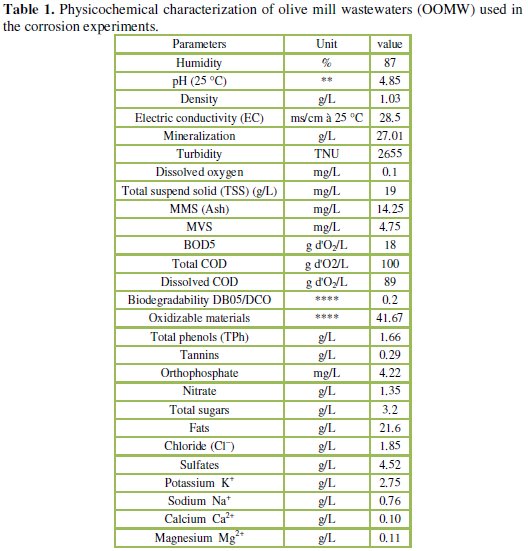
    <p>The olive oil mill wastewaters (OOMW) samples used in this study were taken 
from a three phase olive mill located in the region of Taourirt, eastern of 
Morocco. The sample of OOMW has been obtained from olives well ripened, 
collected in November 2013. The effluent was subject to several consecutive 
filtrations to remove most of the suspended solids (TSS) and its main properties 
are given in <a href="#t1">Table 1</a>.</p>

    <p>&nbsp;</p>
<a name="t1">
<img src="/img/revistas/pea/v32n1/32n1a01t1.jpg">
    
<p>&nbsp;</p>

    <p>Gravimetric measurements are carried out in a double walled glass cell equipped 
with a thermostatic cooling condenser. The solution volume is 100 cm3. The steel 
specimens used have a rectangular form (2 cm &times; 1.8 cm &times; 0.3 cm). 
Electrochemical trends are carried out in a conventional three electrode 
cylindrical glass cell. The working electrode, in the form of a disc cut from steel, 
has a geometric area of 1 cm<sup>2</sup>. A saturated calomel electrode (SCE) and a 
platinum electrode are used as reference and auxiliary electrodes, respectively. 
The temperature is thermostatically controlled at 308 K. The polarisation curves 
are recorded with a potentiostat type EG and G 273, at a scan rate of 30mV/min. 
The steel electrode was maintained at corrosion potential for 30 min and 
thereafter pre-polarised at - 800 mV for 10 min. The potential was swept to 
anodic potentials. The test solution is de-aerated for 30 min in the cell with pure 
nitrogen which is maintained throughout the experiments</p>


    <p><b><i>Extraction of phenolic compounds from OMWW</i></b></p>

    <p>Several protocols have been developed for extract the phenolic compounds from 
olive oil mill wastewaters (OOMW). They are different from each other by the 
complexity of the protocol used and efficiency; liquid-liquid extraction was 
chosen for its simplicity and convenience [17]. The liquid-liquid extraction of the 
samples of olive mill waste water from its transformation with continuous olive 
ethyl acetate was carried out according to the protocol described by [35], but 
modified to meet our objective in the study of corrosion; 50 mL of (OMWW) 
centrifuged for 30 min at 4600 rpm in order to remove the total suspend solid 
(TSS) have been used; the supernatant was acidified to pH 2 with HCl and 
washed with hexane in order to remove the lipid fraction; the mixture was 
vigorously shaken and centrifuged for 30 min at 4600 rpm; the phases were 
separated and the washing was repeated successively three times; extraction of 
phenolic compounds was then carried out with ethyl acetate: 20 mL of the 
OMWW samples preventively washed were mixed with 10 mL of ethyl acetate; 
the mixture was vigorously shaken and centrifuged for 30 min at 4600 rpm; the 
phases were separated and the extraction was repeated successively three times. 
The ethyl acetate was evaporated under vacuum, the dry residue was dissolved in 
10 mL of water bidistilled and this solution was used for study of the corrosion in 
1 M HCl medium.</p>


    ]]></body>
<body><![CDATA[<p><b><i>Extraction yield</i></b></p>

    <p>The extraction yield is calculated by the formula given by Falleh et al. [36], <a href="#e1">Eq. (1)</a>:</p>

    <p>&nbsp;</p>
<a name="e1">
<img src="/img/revistas/pea/v32n1/32n1a01e1.jpg">
    
<p>&nbsp;</p>

    <p>where R is the yield %, M<sub>extract</sub> is the mass of the extract after evaporation of 
the solvent in mg, and M<sub>sample</sub> is the dry mass of the plant sample in mg; 
Niaounakis &amp; Halvadakis reported the phenolic extraction yield was equal to 1- 
2% of wastewater [34]: we reached the extraction yield of 1.7%.</p>


    <p><b><i>Dosage of the polyphenols</i></b></p>

    <p>The total phenol content of olive oil mill wastewaters was determined 
calorimetrically using the Folin-Ciocalteu reagent [37]. An aliquot of the sample 
of the olive oil mill wastewaters standard was diluted, then mixed with the Folin- 
Ciocalteu reagent and 1 mL of a sodium carbonate saturated solution. The final 
solution was left in the dark for 1 h, after which the absorbance of the solution 
was measured at 725 nm and compared against a blank prepared following the 
same protocol but without any sample. A range of gallic acid concentrations from 
0.0005 to 0.02 g/mL was used to prepare the calibration curves; total phenol 
values were expressed as gallic acid equivalents mg/L.</p>


    <p>&nbsp;</p>
    <p><b>Results and discussion</b></p>

    <p><b><i>Weight loss measurements</i></b></p>

    ]]></body>
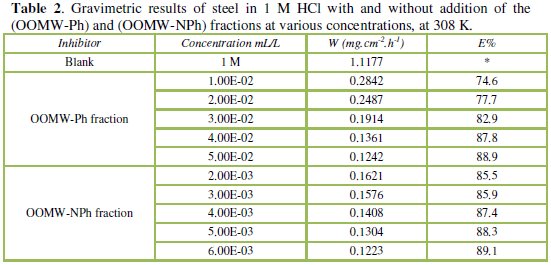
<body><![CDATA[<p><a href="#t2">Table 2</a> resumes the corrosion rate obtained in 1 M HCl (W<sup>0</sup><sub>corr</sub>) and at various 
contents of the phenolic fraction (OOMW-Ph) and the non-phenolic fraction 
(OOMW-NPh) of the extract of olive oil mill wastewaters (W<sub>corr</sub>) determined at 
308 K after 6h of immersion rate; the inhibition efficiencies E<sub>w</sub> were determined 
by the relation (<a href="#e2">Eq. (2)</a>):</p>

    <p>&nbsp;</p>
<a name="e2">
<img src="/img/revistas/pea/v32n1/32n1a01e2.jpg">
    
<p>&nbsp;</p>

    <p>W<sub>corr</sub> and W<sup>0</sup><sub>corr</sub> are the corrosion rates of steel with and without (OOMW-Ph) 
and (OOMW-NPh) fractions of olive oil mill wastewaters, respectively.</p>

    <p>&nbsp;</p>
<a name="t2">
<img src="/img/revistas/pea/v32n1/32n1a01t2.jpg">
    
<p>&nbsp;</p>

    <p>The additions of both phenolic and non-phenolic fractions reduce the corrosion 
rate in HCl solution. The inhibitory effect increases with the increase of fractions 
concentration; E% reaches a maximum of 88.9 % at 5.10<sup>-2</sup> mL/L and 89.1% at 
6.10<sup>-3</sup> mL/L for (OOMW-Ph) fraction and (OOMW-NPh) fraction, respectively. 
The effectiveness of the (OOMW-Ph) and (OOMW-NPh) fractions is due to the 
presence of heteroatoms such as N, O, S. Because, on the one hand, the 
physicochemical composition of olive oil mill wastewater is rich in organic 
matter, and secondly, even if the phenolic compound, that is rich in heteroatoms, 
is isolated, the non-phenolic fraction is still rich in these compounds as protein 
fraction. However, we can classify two fractions tested according to the 
efficiency of growth inhibition as follows: (OOMW-Ph)< (OOMW-NPh).</p>

    <p>Finally, we can conclude that both phenolic and non-phenolic fractions of olive 
oil mill wastewaters extract are good inhibitors of corrosion of steel in 1 M HCl. 
The non-phenolic fraction achieves high efficiencies even at low concentrations. 
Therefore, this fraction also contains components playing the role corrosion. If 
we compare the effectiveness of two fractions for the same concentrations, we 
can say, in general, that the phenolic fraction participates with 15 to 20 % in the 
corrosive effect of olives oil mill wastewaters.</p>


    <p><b><i>Electrochemical polarisation measurements</i></b></p>

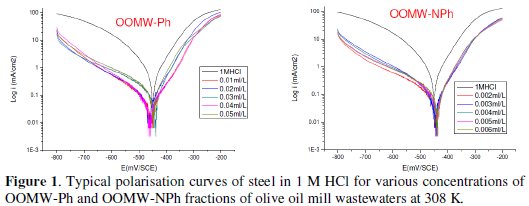
    <p>The cathodic and anodic polarization curves of C38 steel in 1 M HCl in the 
absence and presence of both phenolic (OOMW-Ph) and non-phenolic fractions 
(OOMW-NPh) of olive oil mill wastewaters (OOMW) at different 
concentrations, at 308 K, are presented in <a href="#f1">Fig. 1</a>.</p>

    ]]></body>
<body><![CDATA[<p>&nbsp;</p>
<a name="f1">
<img src="/img/revistas/pea/v32n1/32n1a01f1.jpg">
    
<p>&nbsp;</p>

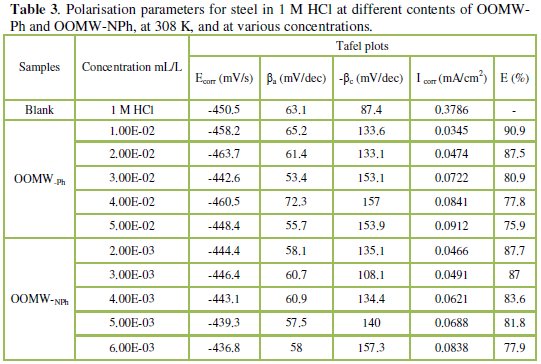
    <p><a href="#t3">Table 3</a> gives the values of corrosion current (I<sub>corr</sub>), corrosion potential (E<sub>corr</sub>), and 
cathodic Tafel slope (&beta;c) for both phenolic and non-phenolic fractions of olive oil 
mill wastewaters in 1 M HCl.</p>

    <p>&nbsp;</p>
<a name="t3">
<img src="/img/revistas/pea/v32n1/32n1a01t3.jpg">
    
<p>&nbsp;</p>

    <p>In the case of polarisation method, the <a href="#e3">relation (3)</a> 
determines the inhibition efficiency (E %):</p>

    <p>&nbsp;</p>
<a name="e3">
<img src="/img/revistas/pea/v32n1/32n1a01e3.jpg">
    
<p>&nbsp;</p>

    <p>I<sup>0</sup><sub>corr</sub> and I<sub>corr</sub> are the uninhibited and inhibited corrosion current densities, 
respectively, determined by extrapolation of the cathodic Tafel lines to corrosion 
potential.</p>

    <p>The recording of the anodic and cathodic polarization curves has been conducted 
to obtain information about the action of the inhibitor on the partial corrosion 
processes; the examination of <a href="#f1">Fig.1</a> and <a href="#t3">Table 3</a> shows that the addition of 
OOMW-Ph and OOMW-NPh fractions decreases the current density. The 
decrease is more pronounced with the increase of the inhibitor concentration; 
Tafel plots indicate that the mechanism of hydrogen reduction is activation 
control; the presence of OOMW does not affect the anodic Tafel slope, indicating 
that the mechanism of H<sup>+</sup> oxidation is not modified with the OOMW-Ph and 
OOMW-NPh concentration.</p>

    ]]></body>
<body><![CDATA[<p>The polarization curves of steel in molar HCl with and without the phenolic and 
non-phenolic fractions of the olive mill wastewaters show that the addition of the 
inhibitor decreases low the anodic current densities in the studied domain of 
potential for the phenolic fraction (OOMW-Ph), but not for non-phenolic 
fraction (OOMW-NPh). It could be concluded that the presence of OOMW don't 
affect the anodic dissolution of steel. The mode of action for phenolic fraction is 
slightly but significantly anode-cathode, that is to say, slightly mixed, but for the 
non-phenolic fraction the mode of action of the inhibitor is perfectly cathodic. 
The inhibition efficiency reaches 90.9 % at 10<sup>-2</sup> mL/L concentration and 87.7 % 
at 2.10<sup>-3</sup>mL/L of OOMW-Ph and OOMW-NPh, respectively, This phenomenon 
is interpreted by the adsorption of both fractions on steel surface leading to the 
increase of the surface coverage, &theta;, defined by E% / 100. E% increases with the 
compound concentration. We may conclude that OOMW-Ph and OOMW-NPh 
are effective inhibitors of steel corrosion in molar HCl.</p>


    <p><b><i>Electrochemical impedance spectroscopy measurements (EIS)</i></b></p>

    <p>The corrosion behavior of steel in acidic solution 1 M HCl in the absence and 
presence of the phenolic fraction (OOMW-Ph) and non-phenolic fraction 
(OOMW-NPh) of olive mill wastewater was also investigated by (EIS) method, 
at 308 K, after 30 min of immersion.</p>

    <p>The inhibition efficiency can be calculated by the following formula, <a href="#e4">eq. (4)</a>:</p>

    <p>&nbsp;</p>
<a name="e4">
<img src="/img/revistas/pea/v32n1/32n1a01e4.jpg">
    
<p>&nbsp;</p>

    <p>where R<sub>t</sub>  and R<sup>0</sup><sub>t</sub> are the charge transfer resistances in inhibited and uninhibited 
solutions, respectively.</p>

    <p>The values of the polarization resistance were calculated by subtracting the high 
frequency intersection from the low frequency intersection [38]; double layer 
capacitance values were obtained at maximum frequency (fm), at which the 
imaginary component of the Nyquist plot is a maximum, and calculated using <a href="#e5">eq. (5)</a>:</p>

    <p>&nbsp;</p>
<a name="e5">
<img src="/img/revistas/pea/v32n1/32n1a01e5.jpg">
    
<p>&nbsp;</p>

    ]]></body>
<body><![CDATA[<p>with C<sub>dl</sub> double layer capacitance (&mu;F.cm<sup>-2</sup>), fm maximum frequency (Hz), and R<sub>t</sub>  
charge transfer resistance (&Omega;.cm 2).</p>

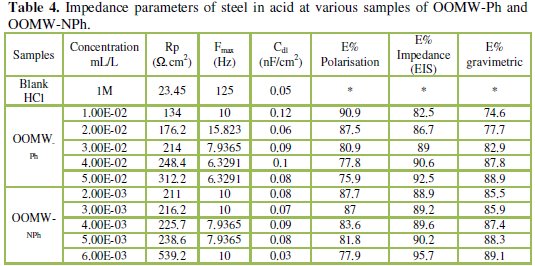
    <p>The impedance parameters derived from these investigations are listed in the <a href="#t4">Table 4</a>.</p>

    <p>&nbsp;</p>
<a name="t4">
<img src="/img/revistas/pea/v32n1/32n1a01t4.jpg">
    
<p>&nbsp;</p>

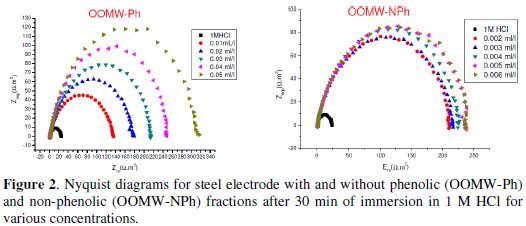
    <p>It is visible from <a href="#f2">Fig. 2</a> that the obtained impedance diagrams for both phenolic 
and non-phenolic fractions of olive oil mill wastewaters have a semi-circular 
appearance, indicating that a charge transfer process mainly controls the 
corrosion of steel [39].</p>

    <p>&nbsp;</p>
<a name="f2">
<img src="/img/revistas/pea/v32n1/32n1a01f2.jpg">
    
<p>&nbsp;</p>

    <p>In fact, the presence of phenolic and non-phenolic 
fractions enhances the value of the transfer resistance in acidic solution; EIS 
study shows that both fractions tested are efficient inhibitors. 
The general shape of the curves is almost similar for both fractions; the shape is 
maintained throughout the whole concentration, indicating that almost no change 
in the corrosion mechanism occurred due to the inhibitor addition [40]; R<sub>t</sub>  values 
increased with the increase of the concentration of the OOMW-Ph and OOMW-
NPh fractions of olive oil mill wastewaters. The results obtained from the 
polarization technique in acidic solution were in good agreement with those 
obtained from the electrochemical impedance spectroscopy (EIS). Also, 
inhibition efficiency values obtained from the gravimetric method agree with 
those obtained from the Tafel extrapolation (<a href="#t4">Table 4</a>).</p>


    <p><b><i>Effect of temperature</i></b></p>

    <p><i>Weight loss, corrosion rates and inhibition efficiency</i></p>

    ]]></body>
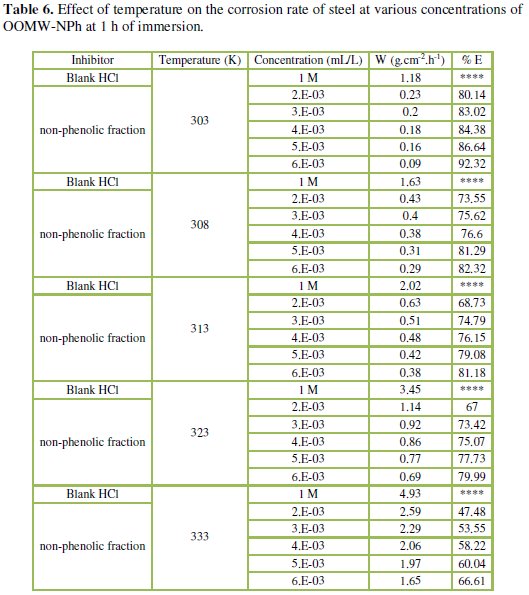
<body><![CDATA[<p>The composition of the medium and its temperature are essential parameters 
affecting the phenomenon of corrosion. The effect of the absence and presence of 
both phenolic and non-phenolic fractions (OOMW-Ph and OOMW-NPh) of the 
olive oil mill wastewaters tested at various concentrations during 1 h of 
immersion on the corrosion of steel in 1 M HCl solution was studied by using 
weight-loss method from 303 K to 333 K. The inhibition efficiency Ew(%) is 
calculated at various concentrations as follows (<a href="#e6">Eq. (6)</a>).</p>

    <p>&nbsp;</p>
<a name="e6">
<img src="/img/revistas/pea/v32n1/32n1a01e6.jpg">
    
<p>&nbsp;</p>

    <p>where both W<sub>corr</sub> and W<sup>0</sup><sub>corr</sub> are the corrosion rate of steel in 1 M HCl in the 
absence and presence of OOMW-Ph and OOMW-NPh inhibitors, respectively.</p>

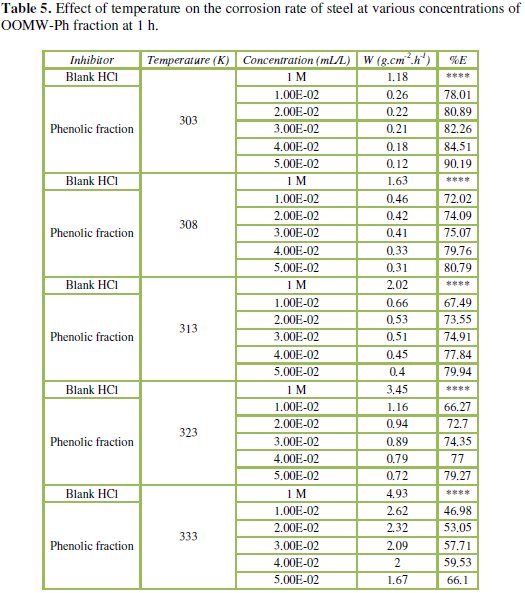
    <p>The corresponding data are shown in <a href="#t5">Tables 5</a> and <a href="#t6">6</a>.</p>

    <p>&nbsp;</p>
<a name="t5">
<img src="/img/revistas/pea/v32n1/32n1a01t5.jpg">
    
<p>&nbsp;</p>
<a name="t6">
<img src="/img/revistas/pea/v32n1/32n1a01t6.jpg">
    
<p>&nbsp;</p>

    <p>Results in <a href="#t5">Tables 5</a> and <a href="#t6">6</a> show that the corrosion rates of steel in 1 M HCl are 
lower in the presence of both phenolic and non-phenolic fractions of the olive oil 
mill wastewaters compared to the blank acid solution; also, the corrosion rate 
increases with increase in temperature with the highest values obtained at 333 K; 
the inhibition efficiency decreases with increasing temperature, indicating that at 
higher temperatures, dissolution of steel predominates on inhibitor adsorption. 
E% is still significant even at high temperature (66.1% for phenolic fraction at a 
concentration of 5.00E-02 mL/L, and 66.6% for the non-phenolic fraction a 
concentration of 6.00E-03 mL/L at 333 K); this suggests possible desorption of 
some of the adsorbed inhibitors from the metal surface at higher temperatures. 
Such behavior shows that the additive was physically adsorbed on the metal 
surface [40-42]. Corrosion inhibition is initiated by the displacement of adsorbed 
water molecules by the bioactive species presented specially in the phenolic 
fraction such as hydroxytyrosol and tyrosol, leading to specific adsorption on the 
metal surface [43].</p>


    <p><b><i>Thermodynamic parameters</i></b></p>

    ]]></body>
<body><![CDATA[<p>To calculate activation thermodynamic parameters of the corrosion reaction at 
various temperatures (303-333 K) in the presence and absence of various 
concentrations of the phenolic and non-phenolic fractions of olive oil mill 
wastewaters at 1 h of immersion, such as the energy E<sub>a</sub>, the entropy &Delta;S<sup>0</sup><sub>ads</sub> and 
the enthalpy &Delta;H<sup>0</sup><sub>ads</sub> of activation, Arrhenius <a href="#e7">Eq. (7-8)</a> and its alternative 
formulation called transition state <a href="#e9">Eq. (9-10)</a> were used [44-45].</p>

    <p>&nbsp;</p>
<a name="e7">
<img src="/img/revistas/pea/v32n1/32n1a01e7.jpg">
    
<p>&nbsp;</p>
<a name="e8">
<img src="/img/revistas/pea/v32n1/32n1a01e8.jpg">
    
<p>&nbsp;</p>
<a name="e9">
<img src="/img/revistas/pea/v32n1/32n1a01e9.jpg">
    
<p>&nbsp;</p>
<a name="e10">
<img src="/img/revistas/pea/v32n1/32n1a01e10.jpg">
    
<p>&nbsp;</p>

    <p>where T is the absolute temperature, K is a constant, E<sub>a</sub> is the apparent activation 
corrosion energy, R is the universal gas constant, h is Plank's constant, N is Avogadro's number, 
&Delta;S<sup>0</sup><sub>a</sub> is the entropy of activation and &Delta;H<sup>0</sup><sub>a</sub> is the enthalpy of 
activation.</p>

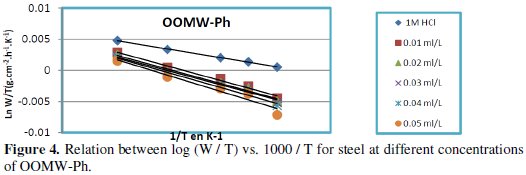
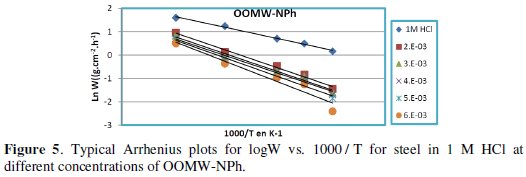
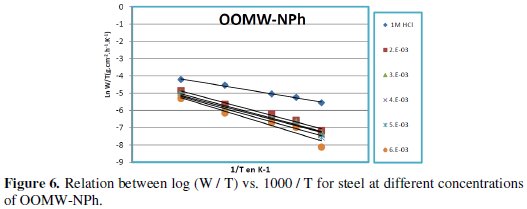
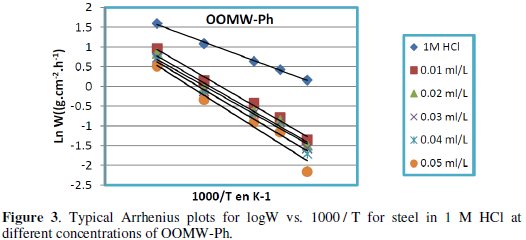
    <p><a href="#f3">Fig. 3-6</a> show the Arrhenius plots for mild steel corrosion in 1 M HCl in the 
absence and presence of different concentrations of phenolic and non-phenolic 
fractions.</p>

    <p>&nbsp;</p>
<a name="f3">
<img src="/img/revistas/pea/v32n1/32n1a01f3.jpg">
    
<p>&nbsp;</p>
<a name="f4">
<img src="/img/revistas/pea/v32n1/32n1a01f4.jpg">
    
]]></body>
<body><![CDATA[<p>&nbsp;</p>
<a name="f5">
<img src="/img/revistas/pea/v32n1/32n1a01f5.jpg">
    
<p>&nbsp;</p>
<a name="f6">
<img src="/img/revistas/pea/v32n1/32n1a01f6.jpg">
    
<p>&nbsp;</p>

    <p>The activation energy E<sub>a</sub> is calculated from the slope of the plots of 
Ln(W<sub>corr</sub>) vs. 1/T [<a href="#f3">Fig. 3</a> and <a href="#f5">5</a>] for both phenolic and non-phenolic fractions. 
Plots of Ln(W<sub>corr</sub>/T) vs. 1/T give a straight line with a slope of &Delta;H<sup>0</sup>/R and an 
intercept of (Log(R/Nh) + &Delta;S<sup>0</sup>/R), as shown in [<a href="#f4">Fig. 4</a> and <a href="#f6">6</a>]; the values of E<sub>a</sub>, 
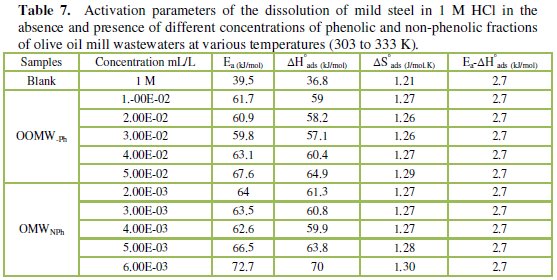
&Delta;H<sup>0</sup> and &Delta;S<sup>0</sup> are listed in <a href="#t7">Table 7</a>.</p>

    <p>&nbsp;</p>
<a name="t7">
<img src="/img/revistas/pea/v32n1/32n1a01t7.jpg">
    
<p>&nbsp;</p>

    <p>Inspection of the data shows that the 
activation energy is higher in the presence of both phenolic and non-phenolic 
fractions of the olive oil mill wastewaters than in its absence; the increase in E<sub>a</sub> 
with phenolic and non-phenolic fractions concentration as shown in <a href="#t7">Table 7</a> is 
typical of a physisorption mechanism [46]. The decrease of the OOMW-Ph and 
OOMW-NPh efficiencies with temperature rise leading to a higher value of Ea, 
when compared to that in an uninhibited acid, is interpreted as an indication for 
an electrostatic character of the inhibitor's adsorption [47]. But E<sub>a</sub> variation is 
not the unique parameter to affirm such mode of adsorption; free adsorption 
enthalpy &Delta;G<sup>0</sup><sub>ads</sub> and enthalpy &Delta;H<sup>0</sup><sub>ads</sub>, 
must also be considered. The positive values of &Delta;H<sup>0</sup><sub>ads</sub> both in the 
absence and presence of additives of both phenolic and non-phenolic fractions indicate the 
endothermic nature of the activation process [48].</p>

    <p>It is also seen in the tables that E<sub>a</sub> and &Delta;H<sup>0</sup><sub>ads</sub> vary in the same manner; however, 
the values of &Delta;H<sup>0</sup><sub>ads</sub> are lower than those of E<sub>a</sub>. Also, the entropy &Delta;S<sup>0</sup> increases 
more positively with the presence of the inhibitor than in the presence of the non-
inhibited one. This reflects the formation of an ordered stable layer of the 
inhibitor on the steel surface [49]. From the previous data, we can conclude that 
OOMW-Ph is an effective inhibitor. This phenomenon is often interpreted with 
physical character and formation of an adsorption film of electrostatic character 
[50].</p>


    <p><b><i>Adsorption isotherm</i></b></p>

    <p>The adsorption isotherms are usually used to describe the adsorption process, 
which is dependent on electronic properties of the inhibitor, the nature of the 
metal surface, the temperature, and the steric effects of different degrees site 
activity [51]. The establishment of adsorption isotherms that describe the 
adsorption of a corrosion inhibitor can provide important information to the 
nature of the metal-inhibitor interaction. Adsorption of the phenolic fraction 
occurs as the interaction energy between molecule and metal surface is higher 
than that between the water molecule and the metal surface [52].</p>

    ]]></body>
<body><![CDATA[<p>In order to obtain the adsorption isotherm, the degree of surface coverage (&Theta;) for 
various concentrations of the phenolic fraction has been calculated at a 
temperature range from 303 to 333 K from the weight loss measurements. The 
results obtained for OOMW-Ph in 1 M HCl solution fit well Langmuir 
adsorption isotherm given by <a href="#e11">Eq. (11)</a> [53-54]:</p>

    <p>&nbsp;</p>
<a name="e11">
<img src="/img/revistas/pea/v32n1/32n1a01e11.jpg">
    
<p>&nbsp;</p>

    <p>where &theta; is the degree of surface coverage, C<sub>inh</sub> is the inhibitor concentration in 
the electrolyte, and K<sub>ads</sub> is the equilibrium constant of the adsorption process and 
is related to the standard Gibbs energy of adsorption, &Delta;G<sup>0</sup><sub>ads</sub>, according to <a href="#e12">Eqs. (12-15)</a> [55]:</p>

    <p>&nbsp;</p>
<a name="e12">
<img src="/img/revistas/pea/v32n1/32n1a01e12.jpg">
    
<p>&nbsp;</p>
<a name="e13">
<img src="/img/revistas/pea/v32n1/32n1a01e13.jpg">
    
<p>&nbsp;</p>
<a name="e14">
<img src="/img/revistas/pea/v32n1/32n1a01e14.jpg">
    
<p>&nbsp;</p>
<a name="e15">
<img src="/img/revistas/pea/v32n1/32n1a01e15.jpg">
    
<p>&nbsp;</p>

    <p>where R is the universal gas constant and T is the absolute temperature; the value 
55.5 in the above equation is the concentration of water in solution in mol/L. 
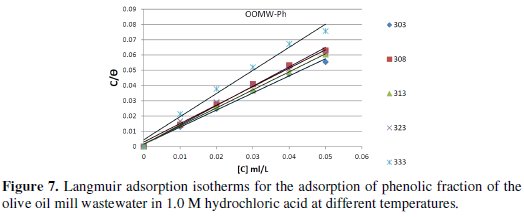
The plot of C<sub>inh</sub>/&theta; vs. C<sub>inh</sub> gave a straight line with an intercept of 1 K<sup>-1</sup>; the 
Langmuir adsorption isotherms for the adsorption of inhibitor (OOMW-Ph) on 
the steel surface are shown in <a href="#f7">Fig. 7</a>.</p>

    ]]></body>
<body><![CDATA[<p>&nbsp;</p>
<a name="f7">
<img src="/img/revistas/pea/v32n1/32n1a01f7.jpg">
    
<p>&nbsp;</p>

    <p>The strong correlation shows that the phenolic fraction tested was adsorbed on 
the steel surface electrode according to the Langmuir isotherm [56]. 
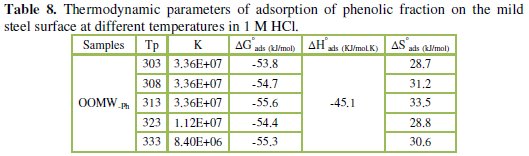
The values of &Delta;G<sub>ads</sub> are all negative indicating that the phenolic fraction is 
strongly adsorbed on the steel surface [57]. The negative values of &Delta;G<sub>ads</sub> indicate 
that the adsorption is spontaneous [58]. When the absolute value of &Delta;G<sub>ads</sub> is 
higher than 40 kJ /mol, the adsorption could be seen as chemisorption. In this 
process, the covalent bond is formed by the charge sharing or transferring from 
the inhibitor molecules to the metal surface [59-60]; the calculated K values are 
shown in <a href="#t8">Table 8</a>, suggesting the formation for the phenolic fraction of a 
chemisorbed film on the surface of the steel [61]; the phenolic fraction is 
adsorbed on the surface of steel according to Langmuir isotherm with interaction 
between the adsorbed molecules.</p>

    <p>&nbsp;</p>
<a name="t8">
<img src="/img/revistas/pea/v32n1/32n1a01t8.jpg">
    
<p>&nbsp;</p>

    <p>Comparison of the inhibition efficiencies obtained by gravimetric method for the 
two phenolic and non-phenolic fractions (88.9 %) OOMW-Ph and OOMW-NPh 
(89.1 %) reveals that we assist really to an intermolecular synergistic effect. In 
addition to the principal active constituent, the extracts contain other heterocyclic 
compounds as well. Therefore it is recommended not to determine &Delta;G<sub>ads</sub> values 
in such situations [62].</p>


    <p><i>Non-phenolic fraction (OOMW-NPh)</i></p>

    <p>From the results of this research, it should be noted that an extract of olive oil 
mill wastewaters is complex and therefore it is always higher than the pure 
phenolic compound. Non-identified compounds as other phenolic compounds, 
proteins, amino acids, and sugars, are present in substantial quantities of low 
potential of the reinforcing heavier molecules such as hydroxytyrosol. 
Anticorrosive compounds, whatever their content, mode in a reaction cell (olive 
fruit) in olive oil by-product mill wastewaters, do not act independently; they 
interact in redox equilibria involving regeneration of new compounds with very 
large quantities in the case of hydroxytyrosol whatsoever coming from the 
hydrolysis of oleuropein or secoiridoid derivatives.</p>


    <p><i>Phenolic fraction (OOMW-Ph)</i></p>

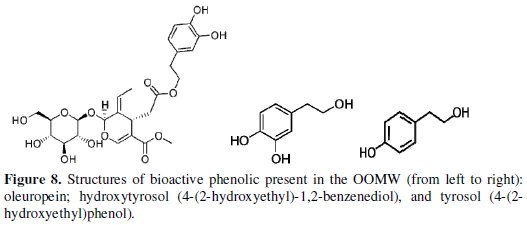
    <p>The most abundant phenol in olives is oleuropein, formed from elenolic acid, 
glucose and hydroxytyrosol [31; 63-67]. During the olive ripening, oleuropein 
decreases, while its free components increase. In the ripe olive, hydroxytyrosol is 
present in quantities ranging from 1 to 3 g per 100 g<sup>-1</sup> of dried weight [68-70] 
while oleuropein is fully transformed. In the extract OMWW oleuropein was 
present only in traces. This fact was foreseeable, as a very small amount of 
oleuropein is generally present in olive mill wastewaters, because enzymatic 
reactions degrade during olive ripening or processing [67]; the most abundant 
phenolic compound present in the OMWW extracts resulted to be 
hydroxytyrosol, which is formed as a result both of hydrolysis of oleuropein 
during oil extraction [71] and of acid hydrolysis of secoiridoid derivatives caused 
by the addition of HCl to the OMWW. In general, [72] the major phenolic 
compounds of olive oil mill wastewater contain hydroxytyrosol (70.93%) and 
tyrosol (16.55%), and the minor one contains, respectively, homovanillyl 
alcohol, protocatechuic acid, caffeic acid, 4-hydroxybenzoic acid, vanillic acid 
and 3,4-dihydroxyphenylglycol. Similar composition from OMW was 
determined by several authors [35; 67; 73].</p>

    ]]></body>
<body><![CDATA[<p>From one liter of OMWW it is possible to obtain an extract containing 1.2 g of 
hydroxytyrosol and about 0.4 g of flavonoids, which in turn can be fractionated 
with the consequent production of 1 g of purified hydroxytyrosol (87% of the 
total amount in the extract) from one liter of OMWW [35].</p>

    <p><a href="#f8">Fig. 8</a> shows the most bioactive of phenolic content presented in the olive oil mill 
wastewaters..</p>

    <p>&nbsp;</p>
<a name="f8">
<img src="/img/revistas/pea/v32n1/32n1a01f8.jpg">
    
<p>&nbsp;</p>


    <p>&nbsp;</p>
    <p><b>Conclusions</b></p>

    <p>From the overall experimental results the following conclusions can be deduced: 
The phenolic and non-phenolic fractions of the olive oil mill wastewaters are 
efficient inhibitors for the corrosion of steel in 1 M HCl.</p>

    <p>The inhibition efficiency of both OOMW-Ph and OOMW-NPh increases with 
the concentration to attain a maximum value of 88.9% at the concentration 0.05 
mL/L, and 89.1% at the concentration of 0.006 mL/L of phenolic and non-
phenolic fractions, respectively.</p>

    <p>OOMW-Ph and OOMW-NPh act as cathodic inhibitors by modifying the 
hydrogen reduction mechanism.</p>

    <p>The inhibition efficiency of both fractions decreases with the rise of temperature. 
The perfect valorisation of olive oil extraction products (Olive Oil Mill 
Wastewaters) requires treatment of the extracted fraction.</p>


    ]]></body>
<body><![CDATA[<p>&nbsp;</p>
    <p><b>References</b></p>

    <!-- ref --><p>1. Landolt D. Presse Polytechniques et Universitaire Ramandes. 1993;12:20.    &nbsp;&nbsp;&nbsp;&nbsp;&nbsp;&nbsp;&nbsp;&nbsp;[&#160;<a href="javascript:void(0);" onclick="javascript: window.open('/scielo.php?script=sci_nlinks&ref=000145&pid=S0872-1904201400010000100001&lng=','','width=640,height=500,resizable=yes,scrollbars=1,menubar=yes,');">Links</a>&#160;]<!-- end-ref --></p>

    <!-- ref --><p>2. Hausler R. Corrosion Chemistry. ACS Symp Series, Am Chem Soc. 1979; 262.    &nbsp;&nbsp;&nbsp;&nbsp;&nbsp;&nbsp;&nbsp;&nbsp;[&#160;<a href="javascript:void(0);" onclick="javascript: window.open('/scielo.php?script=sci_nlinks&ref=000147&pid=S0872-1904201400010000100002&lng=','','width=640,height=500,resizable=yes,scrollbars=1,menubar=yes,');">Links</a>&#160;]<!-- end-ref --></p>

    <!-- ref --><p>3. Ivanov ES. Metallurgiia, Moscow. 1986;175.    &nbsp;&nbsp;&nbsp;&nbsp;&nbsp;&nbsp;&nbsp;&nbsp;[&#160;<a href="javascript:void(0);" onclick="javascript: window.open('/scielo.php?script=sci_nlinks&ref=000149&pid=S0872-1904201400010000100003&lng=','','width=640,height=500,resizable=yes,scrollbars=1,menubar=yes,');">Links</a>&#160;]<!-- end-ref --></p>

    <!-- ref --><p>4. Ammar IA, El Khorafi FM. WerkstsfKorros. 1973; 24:702.    &nbsp;&nbsp;&nbsp;&nbsp;&nbsp;&nbsp;&nbsp;&nbsp;[&#160;<a href="javascript:void(0);" onclick="javascript: window.open('/scielo.php?script=sci_nlinks&ref=000151&pid=S0872-1904201400010000100004&lng=','','width=640,height=500,resizable=yes,scrollbars=1,menubar=yes,');">Links</a>&#160;]<!-- end-ref --></p>

    ]]></body>
<body><![CDATA[<!-- ref --><p>5. Abed Y, Hammouti B, Taleb M, et al. Trans SAEST. 2002;37:92.    &nbsp;&nbsp;&nbsp;&nbsp;&nbsp;&nbsp;&nbsp;&nbsp;[&#160;<a href="javascript:void(0);" onclick="javascript: window.open('/scielo.php?script=sci_nlinks&ref=000153&pid=S0872-1904201400010000100005&lng=','','width=640,height=500,resizable=yes,scrollbars=1,menubar=yes,');">Links</a>&#160;]<!-- end-ref --></p>

    <!-- ref --><p>6. Abed Y, Kissi M, Hammouti B, et al. Prog Org Coat. 2004; 50: 144.    &nbsp;&nbsp;&nbsp;&nbsp;&nbsp;&nbsp;&nbsp;&nbsp;[&#160;<a href="javascript:void(0);" onclick="javascript: window.open('/scielo.php?script=sci_nlinks&ref=000155&pid=S0872-1904201400010000100006&lng=','','width=640,height=500,resizable=yes,scrollbars=1,menubar=yes,');">Links</a>&#160;]<!-- end-ref --></p>

    <!-- ref --><p>7. Putilova LN, Balezin SA, Barrinik VP. New York: Pergamon Press; 1960.    &nbsp;&nbsp;&nbsp;&nbsp;&nbsp;&nbsp;&nbsp;&nbsp;[&#160;<a href="javascript:void(0);" onclick="javascript: window.open('/scielo.php?script=sci_nlinks&ref=000157&pid=S0872-1904201400010000100007&lng=','','width=640,height=500,resizable=yes,scrollbars=1,menubar=yes,');">Links</a>&#160;]<!-- end-ref --></p>

    <!-- ref --><p>8. Tan YJ, Bailey S, Kinsella BB. Corros Sci. 1996;38:1545.    &nbsp;&nbsp;&nbsp;&nbsp;&nbsp;&nbsp;&nbsp;&nbsp;[&#160;<a href="javascript:void(0);" onclick="javascript: window.open('/scielo.php?script=sci_nlinks&ref=000159&pid=S0872-1904201400010000100008&lng=','','width=640,height=500,resizable=yes,scrollbars=1,menubar=yes,');">Links</a>&#160;]<!-- end-ref --></p>

    <!-- ref --><p>9. Jovancicevic V, Ramachandran S, Prince P. Corrosion. 1999;55:449.    &nbsp;&nbsp;&nbsp;&nbsp;&nbsp;&nbsp;&nbsp;&nbsp;[&#160;<a href="javascript:void(0);" onclick="javascript: window.open('/scielo.php?script=sci_nlinks&ref=000161&pid=S0872-1904201400010000100009&lng=','','width=640,height=500,resizable=yes,scrollbars=1,menubar=yes,');">Links</a>&#160;]<!-- end-ref --></p>

    ]]></body>
<body><![CDATA[<!-- ref --><p>10. Bentiss F, Triasnel M, Vezin H, et al. Corros Sci. 2003;45:371.    &nbsp;&nbsp;&nbsp;&nbsp;&nbsp;&nbsp;&nbsp;&nbsp;[&#160;<a href="javascript:void(0);" onclick="javascript: window.open('/scielo.php?script=sci_nlinks&ref=000163&pid=S0872-1904201400010000100010&lng=','','width=640,height=500,resizable=yes,scrollbars=1,menubar=yes,');">Links</a>&#160;]<!-- end-ref --></p>

    <!-- ref --><p>11. Saji VS. Recent Patents on Corrosion Science. 2010;2:6.    &nbsp;&nbsp;&nbsp;&nbsp;&nbsp;&nbsp;&nbsp;&nbsp;[&#160;<a href="javascript:void(0);" onclick="javascript: window.open('/scielo.php?script=sci_nlinks&ref=000165&pid=S0872-1904201400010000100011&lng=','','width=640,height=500,resizable=yes,scrollbars=1,menubar=yes,');">Links</a>&#160;]<!-- end-ref --></p>

    <!-- ref --><p>12. Sangeetha M, Rajendran S, Muthumegala TS, et al. Zastita Materijala. 2011;52:3.    &nbsp;&nbsp;&nbsp;&nbsp;&nbsp;&nbsp;&nbsp;&nbsp;[&#160;<a href="javascript:void(0);" onclick="javascript: window.open('/scielo.php?script=sci_nlinks&ref=000167&pid=S0872-1904201400010000100012&lng=','','width=640,height=500,resizable=yes,scrollbars=1,menubar=yes,');">Links</a>&#160;]<!-- end-ref --></p>

    <!-- ref --><p>13. Broussard G, Bramantit O, Marchese FM. Occup Med. 1997;47:337.    &nbsp;&nbsp;&nbsp;&nbsp;&nbsp;&nbsp;&nbsp;&nbsp;[&#160;<a href="javascript:void(0);" onclick="javascript: window.open('/scielo.php?script=sci_nlinks&ref=000169&pid=S0872-1904201400010000100013&lng=','','width=640,height=500,resizable=yes,scrollbars=1,menubar=yes,');">Links</a>&#160;]<!-- end-ref --></p>

    <!-- ref --><p>14. Eddy NO, Ebenso EE. Afr J Pure Appl Chem. 2008;2:46.    &nbsp;&nbsp;&nbsp;&nbsp;&nbsp;&nbsp;&nbsp;&nbsp;[&#160;<a href="javascript:void(0);" onclick="javascript: window.open('/scielo.php?script=sci_nlinks&ref=000171&pid=S0872-1904201400010000100014&lng=','','width=640,height=500,resizable=yes,scrollbars=1,menubar=yes,');">Links</a>&#160;]<!-- end-ref --></p>

    ]]></body>
<body><![CDATA[<!-- ref --><p>15. Raja PB, Sethuraman MG. Mater Lett. 2008;62:113.    &nbsp;&nbsp;&nbsp;&nbsp;&nbsp;&nbsp;&nbsp;&nbsp;[&#160;<a href="javascript:void(0);" onclick="javascript: window.open('/scielo.php?script=sci_nlinks&ref=000173&pid=S0872-1904201400010000100015&lng=','','width=640,height=500,resizable=yes,scrollbars=1,menubar=yes,');">Links</a>&#160;]<!-- end-ref --></p>

    <!-- ref --><p>16. Bouknana D, Hammouti B, Bouyenzer A, et al. J Chem Pharm Res. 2013,5:1179.    &nbsp;&nbsp;&nbsp;&nbsp;&nbsp;&nbsp;&nbsp;&nbsp;[&#160;<a href="javascript:void(0);" onclick="javascript: window.open('/scielo.php?script=sci_nlinks&ref=000175&pid=S0872-1904201400010000100016&lng=','','width=640,height=500,resizable=yes,scrollbars=1,menubar=yes,');">Links</a>&#160;]<!-- end-ref --></p>

    <!-- ref --><p>17. Obied HK, Allen MS, Bedgood DR, et al. J Agric Food Chem. 2005;53:823.    &nbsp;&nbsp;&nbsp;&nbsp;&nbsp;&nbsp;&nbsp;&nbsp;[&#160;<a href="javascript:void(0);" onclick="javascript: window.open('/scielo.php?script=sci_nlinks&ref=000177&pid=S0872-1904201400010000100017&lng=','','width=640,height=500,resizable=yes,scrollbars=1,menubar=yes,');">Links</a>&#160;]<!-- end-ref --></p>

    <!-- ref --><p>18. Hamdi M. Appl Biochem Biotech. 1992;37:155.    &nbsp;&nbsp;&nbsp;&nbsp;&nbsp;&nbsp;&nbsp;&nbsp;[&#160;<a href="javascript:void(0);" onclick="javascript: window.open('/scielo.php?script=sci_nlinks&ref=000179&pid=S0872-1904201400010000100018&lng=','','width=640,height=500,resizable=yes,scrollbars=1,menubar=yes,');">Links</a>&#160;]<!-- end-ref --></p>

    <!-- ref --><p>19. Caruso D, Colombo R, Patelli R, et al. J Agric Food Chem. 2000;48:1182.    &nbsp;&nbsp;&nbsp;&nbsp;&nbsp;&nbsp;&nbsp;&nbsp;[&#160;<a href="javascript:void(0);" onclick="javascript: window.open('/scielo.php?script=sci_nlinks&ref=000181&pid=S0872-1904201400010000100019&lng=','','width=640,height=500,resizable=yes,scrollbars=1,menubar=yes,');">Links</a>&#160;]<!-- end-ref --></p>

    ]]></body>
<body><![CDATA[<!-- ref --><p>20. Obied HK, Bedgood Jr, Prenzler PD, et al. Anal Chim Acta. 2007;603:176.    &nbsp;&nbsp;&nbsp;&nbsp;&nbsp;&nbsp;&nbsp;&nbsp;[&#160;<a href="javascript:void(0);" onclick="javascript: window.open('/scielo.php?script=sci_nlinks&ref=000183&pid=S0872-1904201400010000100020&lng=','','width=640,height=500,resizable=yes,scrollbars=1,menubar=yes,');">Links</a>&#160;]<!-- end-ref --></p>

    <!-- ref --><p>21. Artajo LS, Romero MP, Motilva MJ. J Sci Food Agric. 2006;86:518.    &nbsp;&nbsp;&nbsp;&nbsp;&nbsp;&nbsp;&nbsp;&nbsp;[&#160;<a href="javascript:void(0);" onclick="javascript: window.open('/scielo.php?script=sci_nlinks&ref=000185&pid=S0872-1904201400010000100021&lng=','','width=640,height=500,resizable=yes,scrollbars=1,menubar=yes,');">Links</a>&#160;]<!-- end-ref --></p>

    <!-- ref --><p>22. Mulinacci N, Romani A, Galardi C, et al. J Agric Food Chem. 2001;49:3509.    &nbsp;&nbsp;&nbsp;&nbsp;&nbsp;&nbsp;&nbsp;&nbsp;[&#160;<a href="javascript:void(0);" onclick="javascript: window.open('/scielo.php?script=sci_nlinks&ref=000187&pid=S0872-1904201400010000100022&lng=','','width=640,height=500,resizable=yes,scrollbars=1,menubar=yes,');">Links</a>&#160;]<!-- end-ref --></p>

    <!-- ref --><p>23. El Hadrami A, Belaqziz M, El Hassni M, et al. J Agron. 2004;3:247.    &nbsp;&nbsp;&nbsp;&nbsp;&nbsp;&nbsp;&nbsp;&nbsp;[&#160;<a href="javascript:void(0);" onclick="javascript: window.open('/scielo.php?script=sci_nlinks&ref=000189&pid=S0872-1904201400010000100023&lng=','','width=640,height=500,resizable=yes,scrollbars=1,menubar=yes,');">Links</a>&#160;]<!-- end-ref --></p>

    <!-- ref --><p>24. Bianco A, Buiarelli F, Cartoni G, et al. J Sep Sci. 2003;26:417.    &nbsp;&nbsp;&nbsp;&nbsp;&nbsp;&nbsp;&nbsp;&nbsp;[&#160;<a href="javascript:void(0);" onclick="javascript: window.open('/scielo.php?script=sci_nlinks&ref=000191&pid=S0872-1904201400010000100024&lng=','','width=640,height=500,resizable=yes,scrollbars=1,menubar=yes,');">Links</a>&#160;]<!-- end-ref --></p>

    ]]></body>
<body><![CDATA[<!-- ref --><p>25. Sayadi S, Allouche N, Jaoka M, et al. Process Biochem. 2000;35:725.    &nbsp;&nbsp;&nbsp;&nbsp;&nbsp;&nbsp;&nbsp;&nbsp;[&#160;<a href="javascript:void(0);" onclick="javascript: window.open('/scielo.php?script=sci_nlinks&ref=000193&pid=S0872-1904201400010000100025&lng=','','width=640,height=500,resizable=yes,scrollbars=1,menubar=yes,');">Links</a>&#160;]<!-- end-ref --></p>

    <!-- ref --><p>26. Lesage-Meesen L, Navarro D, Maunier S, et al. Food Chem. 2001;75:501.    &nbsp;&nbsp;&nbsp;&nbsp;&nbsp;&nbsp;&nbsp;&nbsp;[&#160;<a href="javascript:void(0);" onclick="javascript: window.open('/scielo.php?script=sci_nlinks&ref=000195&pid=S0872-1904201400010000100026&lng=','','width=640,height=500,resizable=yes,scrollbars=1,menubar=yes,');">Links</a>&#160;]<!-- end-ref --></p>

    <!-- ref --><p>27. Esti M, Cinquanta L, La Notte E. J Agric Food Chem. 1998;46:32.    &nbsp;&nbsp;&nbsp;&nbsp;&nbsp;&nbsp;&nbsp;&nbsp;[&#160;<a href="javascript:void(0);" onclick="javascript: window.open('/scielo.php?script=sci_nlinks&ref=000197&pid=S0872-1904201400010000100027&lng=','','width=640,height=500,resizable=yes,scrollbars=1,menubar=yes,');">Links</a>&#160;]<!-- end-ref --></p>

    <!-- ref --><p>28. Romani A, Mulinacci N, Pinelli P, et al. J Agric Food Chem. 1999;47:946.    &nbsp;&nbsp;&nbsp;&nbsp;&nbsp;&nbsp;&nbsp;&nbsp;[&#160;<a href="javascript:void(0);" onclick="javascript: window.open('/scielo.php?script=sci_nlinks&ref=000199&pid=S0872-1904201400010000100028&lng=','','width=640,height=500,resizable=yes,scrollbars=1,menubar=yes,');">Links</a>&#160;]<!-- end-ref --></p>

    <!-- ref --><p>29. Savarese M, De Marco E, Sacchi R. Food Chem. 2007;105:761.    &nbsp;&nbsp;&nbsp;&nbsp;&nbsp;&nbsp;&nbsp;&nbsp;[&#160;<a href="javascript:void(0);" onclick="javascript: window.open('/scielo.php?script=sci_nlinks&ref=000201&pid=S0872-1904201400010000100029&lng=','','width=640,height=500,resizable=yes,scrollbars=1,menubar=yes,');">Links</a>&#160;]<!-- end-ref --></p>

    ]]></body>
<body><![CDATA[<!-- ref --><p>30. Rodis PS, Karathanos VT, Mantzavinou A. J Agric Food Chem. 2002;50:596.    &nbsp;&nbsp;&nbsp;&nbsp;&nbsp;&nbsp;&nbsp;&nbsp;[&#160;<a href="javascript:void(0);" onclick="javascript: window.open('/scielo.php?script=sci_nlinks&ref=000203&pid=S0872-1904201400010000100030&lng=','','width=640,height=500,resizable=yes,scrollbars=1,menubar=yes,');">Links</a>&#160;]<!-- end-ref --></p>

    <!-- ref --><p>31. Tuck KL, Hayball PJ. J Nutr Biochem. 2002;13:636.    &nbsp;&nbsp;&nbsp;&nbsp;&nbsp;&nbsp;&nbsp;&nbsp;[&#160;<a href="javascript:void(0);" onclick="javascript: window.open('/scielo.php?script=sci_nlinks&ref=000205&pid=S0872-1904201400010000100031&lng=','','width=640,height=500,resizable=yes,scrollbars=1,menubar=yes,');">Links</a>&#160;]<!-- end-ref --></p>

    <!-- ref --><p>32. De Leonardis A, Macciola V, Lembo G, et al. Food Chem. 2007;100:998.    &nbsp;&nbsp;&nbsp;&nbsp;&nbsp;&nbsp;&nbsp;&nbsp;[&#160;<a href="javascript:void(0);" onclick="javascript: window.open('/scielo.php?script=sci_nlinks&ref=000207&pid=S0872-1904201400010000100032&lng=','','width=640,height=500,resizable=yes,scrollbars=1,menubar=yes,');">Links</a>&#160;]<!-- end-ref --></p>

    <!-- ref --><p>33. Di Giovacchino L, Sestili S, Di Vincenzo D. Eur J Lipid Sci Tech. 2002;104:587.    &nbsp;&nbsp;&nbsp;&nbsp;&nbsp;&nbsp;&nbsp;&nbsp;[&#160;<a href="javascript:void(0);" onclick="javascript: window.open('/scielo.php?script=sci_nlinks&ref=000209&pid=S0872-1904201400010000100033&lng=','','width=640,height=500,resizable=yes,scrollbars=1,menubar=yes,');">Links</a>&#160;]<!-- end-ref --></p>

    <p>34. Niaounakis M, Halvadakis CP. In Olive-mill waste management, Literature review and patent survey.Atene: Typothito-George Dardanos waste management serie 5. 2004.</p>

    <!-- ref --><p>35. De Marco E, Savarese M, Paduano A, et al. Food Chem. 2007;104:858.    &nbsp;&nbsp;&nbsp;&nbsp;&nbsp;&nbsp;&nbsp;&nbsp;[&#160;<a href="javascript:void(0);" onclick="javascript: window.open('/scielo.php?script=sci_nlinks&ref=000212&pid=S0872-1904201400010000100035&lng=','','width=640,height=500,resizable=yes,scrollbars=1,menubar=yes,');">Links</a>&#160;]<!-- end-ref --></p>

    <!-- ref --><p>36. Falleh H, Ksouri R, Chaieb K, et al. Compt Rend Biol. 2008;331:372.    &nbsp;&nbsp;&nbsp;&nbsp;&nbsp;&nbsp;&nbsp;&nbsp;[&#160;<a href="javascript:void(0);" onclick="javascript: window.open('/scielo.php?script=sci_nlinks&ref=000214&pid=S0872-1904201400010000100036&lng=','','width=640,height=500,resizable=yes,scrollbars=1,menubar=yes,');">Links</a>&#160;]<!-- end-ref --></p>

    <!-- ref --><p>37. Ryan D, Robardo K, Lavee S. Int J Food Sci Tech. 1999;34:265.    &nbsp;&nbsp;&nbsp;&nbsp;&nbsp;&nbsp;&nbsp;&nbsp;[&#160;<a href="javascript:void(0);" onclick="javascript: window.open('/scielo.php?script=sci_nlinks&ref=000216&pid=S0872-1904201400010000100037&lng=','','width=640,height=500,resizable=yes,scrollbars=1,menubar=yes,');">Links</a>&#160;]<!-- end-ref --></p>

    <!-- ref --><p>38. Elachouri M, Infante MR, Izquerdo F, et al. Corros Sci. 2001;43:19.    &nbsp;&nbsp;&nbsp;&nbsp;&nbsp;&nbsp;&nbsp;&nbsp;[&#160;<a href="javascript:void(0);" onclick="javascript: window.open('/scielo.php?script=sci_nlinks&ref=000218&pid=S0872-1904201400010000100038&lng=','','width=640,height=500,resizable=yes,scrollbars=1,menubar=yes,');">Links</a>&#160;]<!-- end-ref --></p>

    <!-- ref --><p>39. Rosliza R, Wan Nik WB, Senin H B. Mater Chem Phys. 2008;107:281.    &nbsp;&nbsp;&nbsp;&nbsp;&nbsp;&nbsp;&nbsp;&nbsp;[&#160;<a href="javascript:void(0);" onclick="javascript: window.open('/scielo.php?script=sci_nlinks&ref=000220&pid=S0872-1904201400010000100039&lng=','','width=640,height=500,resizable=yes,scrollbars=1,menubar=yes,');">Links</a>&#160;]<!-- end-ref --></p>

    <!-- ref --><p>40. Oguzie E E , Onuchukwu A I. Corros Rev. 2007;25:355.    &nbsp;&nbsp;&nbsp;&nbsp;&nbsp;&nbsp;&nbsp;&nbsp;[&#160;<a href="javascript:void(0);" onclick="javascript: window.open('/scielo.php?script=sci_nlinks&ref=000222&pid=S0872-1904201400010000100040&lng=','','width=640,height=500,resizable=yes,scrollbars=1,menubar=yes,');">Links</a>&#160;]<!-- end-ref --></p>

    <!-- ref --><p>41. Afia L, Salghi R, Bammou L, et al. J Saudi Chem Soc. 2011.    &nbsp;&nbsp;&nbsp;&nbsp;&nbsp;&nbsp;&nbsp;&nbsp;[&#160;<a href="javascript:void(0);" onclick="javascript: window.open('/scielo.php?script=sci_nlinks&ref=000224&pid=S0872-1904201400010000100041&lng=','','width=640,height=500,resizable=yes,scrollbars=1,menubar=yes,');">Links</a>&#160;]<!-- end-ref --></p>

    <!-- ref --><p>42. Abboud Y, Abourriche, Saffaj T, et al. Desalination. 2009;237:175.    &nbsp;&nbsp;&nbsp;&nbsp;&nbsp;&nbsp;&nbsp;&nbsp;[&#160;<a href="javascript:void(0);" onclick="javascript: window.open('/scielo.php?script=sci_nlinks&ref=000226&pid=S0872-1904201400010000100042&lng=','','width=640,height=500,resizable=yes,scrollbars=1,menubar=yes,');">Links</a>&#160;]<!-- end-ref --></p>

    <!-- ref --><p>43. Solmaz R, Kardas G, Yazici B, et al. Colloids Surf. A: Physicochem Eng Asp. 2008;312:7.    &nbsp;&nbsp;&nbsp;&nbsp;&nbsp;&nbsp;&nbsp;&nbsp;[&#160;<a href="javascript:void(0);" onclick="javascript: window.open('/scielo.php?script=sci_nlinks&ref=000228&pid=S0872-1904201400010000100043&lng=','','width=640,height=500,resizable=yes,scrollbars=1,menubar=yes,');">Links</a>&#160;]<!-- end-ref --></p>

    <!-- ref --><p>44. O'M Bockris J, Reddy A K N. Modern Electrochemistry. New York: Plenum Press; 1977. Vol 2.    &nbsp;&nbsp;&nbsp;&nbsp;&nbsp;&nbsp;&nbsp;&nbsp;[&#160;<a href="javascript:void(0);" onclick="javascript: window.open('/scielo.php?script=sci_nlinks&ref=000230&pid=S0872-1904201400010000100044&lng=','','width=640,height=500,resizable=yes,scrollbars=1,menubar=yes,');">Links</a>&#160;]<!-- end-ref --></p>

    <!-- ref --><p>45. Gadallah A G, Abd El-Rahman H A, AbouRomia M M. J Appl Electrochem. 1988;18:532.    &nbsp;&nbsp;&nbsp;&nbsp;&nbsp;&nbsp;&nbsp;&nbsp;[&#160;<a href="javascript:void(0);" onclick="javascript: window.open('/scielo.php?script=sci_nlinks&ref=000232&pid=S0872-1904201400010000100045&lng=','','width=640,height=500,resizable=yes,scrollbars=1,menubar=yes,');">Links</a>&#160;]<!-- end-ref --></p>

    <!-- ref --><p>46. Obot I B, Obi-Egbedi N O, Eseola A O. Ind Eng Chem Res. 2011;50:2098.    &nbsp;&nbsp;&nbsp;&nbsp;&nbsp;&nbsp;&nbsp;&nbsp;[&#160;<a href="javascript:void(0);" onclick="javascript: window.open('/scielo.php?script=sci_nlinks&ref=000234&pid=S0872-1904201400010000100046&lng=','','width=640,height=500,resizable=yes,scrollbars=1,menubar=yes,');">Links</a>&#160;]<!-- end-ref --></p>

    <p>47. A Popova, Corros Sci. 2007;49:2144.</p>

    <!-- ref --><p>48. Bouklah M, Hammouti B, Lagrenee M, et al. Corros Sci. 2006;48:2831.    &nbsp;&nbsp;&nbsp;&nbsp;&nbsp;&nbsp;&nbsp;&nbsp;[&#160;<a href="javascript:void(0);" onclick="javascript: window.open('/scielo.php?script=sci_nlinks&ref=000237&pid=S0872-1904201400010000100048&lng=','','width=640,height=500,resizable=yes,scrollbars=1,menubar=yes,');">Links</a>&#160;]<!-- end-ref --></p>

    <!-- ref --><p>49. Yurt A, Balaban A, Kandemir S U, et al. Mater Chem Phys. 2004;85:420.    &nbsp;&nbsp;&nbsp;&nbsp;&nbsp;&nbsp;&nbsp;&nbsp;[&#160;<a href="javascript:void(0);" onclick="javascript: window.open('/scielo.php?script=sci_nlinks&ref=000239&pid=S0872-1904201400010000100049&lng=','','width=640,height=500,resizable=yes,scrollbars=1,menubar=yes,');">Links</a>&#160;]<!-- end-ref --></p>

    <!-- ref --><p>50. Popova A, Sokolova E, Raicheva S, et al. Corros Sci. 2003;45:33.    &nbsp;&nbsp;&nbsp;&nbsp;&nbsp;&nbsp;&nbsp;&nbsp;[&#160;<a href="javascript:void(0);" onclick="javascript: window.open('/scielo.php?script=sci_nlinks&ref=000241&pid=S0872-1904201400010000100050&lng=','','width=640,height=500,resizable=yes,scrollbars=1,menubar=yes,');">Links</a>&#160;]<!-- end-ref --></p>

    ]]></body>
<body><![CDATA[<!-- ref --><p>51. Yaunyuan F, Shenhao C, Wenjuan G, et al. J Electroanal Chem. 2007;602:115.    &nbsp;&nbsp;&nbsp;&nbsp;&nbsp;&nbsp;&nbsp;&nbsp;[&#160;<a href="javascript:void(0);" onclick="javascript: window.open('/scielo.php?script=sci_nlinks&ref=000243&pid=S0872-1904201400010000100051&lng=','','width=640,height=500,resizable=yes,scrollbars=1,menubar=yes,');">Links</a>&#160;]<!-- end-ref --></p>

    <!-- ref --><p>52. Moretti G, Quartarone G, Tassan A, et al. Mater Corros. 1994;45:641.    &nbsp;&nbsp;&nbsp;&nbsp;&nbsp;&nbsp;&nbsp;&nbsp;[&#160;<a href="javascript:void(0);" onclick="javascript: window.open('/scielo.php?script=sci_nlinks&ref=000245&pid=S0872-1904201400010000100052&lng=','','width=640,height=500,resizable=yes,scrollbars=1,menubar=yes,');">Links</a>&#160;]<!-- end-ref --></p>

    <!-- ref --><p>53. Doner A, Solmaz R, Ozcan M, et al. Corros Sci. 2011;53:2902.    &nbsp;&nbsp;&nbsp;&nbsp;&nbsp;&nbsp;&nbsp;&nbsp;[&#160;<a href="javascript:void(0);" onclick="javascript: window.open('/scielo.php?script=sci_nlinks&ref=000247&pid=S0872-1904201400010000100053&lng=','','width=640,height=500,resizable=yes,scrollbars=1,menubar=yes,');">Links</a>&#160;]<!-- end-ref --></p>

    <!-- ref --><p>54. Sanatkumar B S, Nayak J, Shetty A N. J Coat Technol Res. 2011;4:1.    &nbsp;&nbsp;&nbsp;&nbsp;&nbsp;&nbsp;&nbsp;&nbsp;[&#160;<a href="javascript:void(0);" onclick="javascript: window.open('/scielo.php?script=sci_nlinks&ref=000249&pid=S0872-1904201400010000100054&lng=','','width=640,height=500,resizable=yes,scrollbars=1,menubar=yes,');">Links</a>&#160;]<!-- end-ref --></p>

    <!-- ref --><p>55. Elayyachy M, El Idrissi A, Hammouti B. Corros Sci. 2006;48:2470.    &nbsp;&nbsp;&nbsp;&nbsp;&nbsp;&nbsp;&nbsp;&nbsp;[&#160;<a href="javascript:void(0);" onclick="javascript: window.open('/scielo.php?script=sci_nlinks&ref=000251&pid=S0872-1904201400010000100055&lng=','','width=640,height=500,resizable=yes,scrollbars=1,menubar=yes,');">Links</a>&#160;]<!-- end-ref --></p>

    ]]></body>
<body><![CDATA[<!-- ref --><p>56. Mora N, Cano E, Polo J L, et al. Corros Sci. 2004;46:563.    &nbsp;&nbsp;&nbsp;&nbsp;&nbsp;&nbsp;&nbsp;&nbsp;[&#160;<a href="javascript:void(0);" onclick="javascript: window.open('/scielo.php?script=sci_nlinks&ref=000253&pid=S0872-1904201400010000100056&lng=','','width=640,height=500,resizable=yes,scrollbars=1,menubar=yes,');">Links</a>&#160;]<!-- end-ref --></p>

    <!-- ref --><p>57. Talati J D, Gandhi D K. Corros Sci. 1983;23:1315.    &nbsp;&nbsp;&nbsp;&nbsp;&nbsp;&nbsp;&nbsp;&nbsp;[&#160;<a href="javascript:void(0);" onclick="javascript: window.open('/scielo.php?script=sci_nlinks&ref=000255&pid=S0872-1904201400010000100057&lng=','','width=640,height=500,resizable=yes,scrollbars=1,menubar=yes,');">Links</a>&#160;]<!-- end-ref --></p>

    <!-- ref --><p>58. Chu A K P, Sukawa A J. J Electrochem Soc. 1969;116:1188.    &nbsp;&nbsp;&nbsp;&nbsp;&nbsp;&nbsp;&nbsp;&nbsp;[&#160;<a href="javascript:void(0);" onclick="javascript: window.open('/scielo.php?script=sci_nlinks&ref=000257&pid=S0872-1904201400010000100058&lng=','','width=640,height=500,resizable=yes,scrollbars=1,menubar=yes,');">Links</a>&#160;]<!-- end-ref --></p>

    <!-- ref --><p>59. Szlarska-Smialowska Z. Corros Sci. 1978;18:953.    &nbsp;&nbsp;&nbsp;&nbsp;&nbsp;&nbsp;&nbsp;&nbsp;[&#160;<a href="javascript:void(0);" onclick="javascript: window.open('/scielo.php?script=sci_nlinks&ref=000259&pid=S0872-1904201400010000100059&lng=','','width=640,height=500,resizable=yes,scrollbars=1,menubar=yes,');">Links</a>&#160;]<!-- end-ref --></p>

    <!-- ref --><p>60. Yurt A, Ulutas S, Dal H. Appl Surf Sci. 2006;253:919.    &nbsp;&nbsp;&nbsp;&nbsp;&nbsp;&nbsp;&nbsp;&nbsp;[&#160;<a href="javascript:void(0);" onclick="javascript: window.open('/scielo.php?script=sci_nlinks&ref=000261&pid=S0872-1904201400010000100060&lng=','','width=640,height=500,resizable=yes,scrollbars=1,menubar=yes,');">Links</a>&#160;]<!-- end-ref --></p>

    ]]></body>
<body><![CDATA[<!-- ref --><p>61. Villamil R F V, Corio P, Rubin J C, et al. J Electroanal Chem. 2002;535:75.    &nbsp;&nbsp;&nbsp;&nbsp;&nbsp;&nbsp;&nbsp;&nbsp;[&#160;<a href="javascript:void(0);" onclick="javascript: window.open('/scielo.php?script=sci_nlinks&ref=000263&pid=S0872-1904201400010000100061&lng=','','width=640,height=500,resizable=yes,scrollbars=1,menubar=yes,');">Links</a>&#160;]<!-- end-ref --></p>

    <!-- ref --><p>62. Benali O, Benmehdi H, Hasnaoui O, et al. J Mater Environ Sci. 2013;4:127.    &nbsp;&nbsp;&nbsp;&nbsp;&nbsp;&nbsp;&nbsp;&nbsp;[&#160;<a href="javascript:void(0);" onclick="javascript: window.open('/scielo.php?script=sci_nlinks&ref=000265&pid=S0872-1904201400010000100062&lng=','','width=640,height=500,resizable=yes,scrollbars=1,menubar=yes,');">Links</a>&#160;]<!-- end-ref --></p>

    <!-- ref --><p>63. Gariboldi P, Jommi G, Verrotta L. Phytochemistry. 1986;25:865.    &nbsp;&nbsp;&nbsp;&nbsp;&nbsp;&nbsp;&nbsp;&nbsp;[&#160;<a href="javascript:void(0);" onclick="javascript: window.open('/scielo.php?script=sci_nlinks&ref=000267&pid=S0872-1904201400010000100063&lng=','','width=640,height=500,resizable=yes,scrollbars=1,menubar=yes,');">Links</a>&#160;]<!-- end-ref --></p>

    <!-- ref --><p>64. Panizzi L, Scarpati M L, Oriente E G. Gazz Chim Ital.1960;90:1449.    &nbsp;&nbsp;&nbsp;&nbsp;&nbsp;&nbsp;&nbsp;&nbsp;[&#160;<a href="javascript:void(0);" onclick="javascript: window.open('/scielo.php?script=sci_nlinks&ref=000269&pid=S0872-1904201400010000100064&lng=','','width=640,height=500,resizable=yes,scrollbars=1,menubar=yes,');">Links</a>&#160;]<!-- end-ref --></p>

    <!-- ref --><p>65. Servili M, Baldioli M, Selvaggini R, et al. J Am Oil Chem Soc. 1999;76:873.    &nbsp;&nbsp;&nbsp;&nbsp;&nbsp;&nbsp;&nbsp;&nbsp;[&#160;<a href="javascript:void(0);" onclick="javascript: window.open('/scielo.php?script=sci_nlinks&ref=000271&pid=S0872-1904201400010000100065&lng=','','width=640,height=500,resizable=yes,scrollbars=1,menubar=yes,');">Links</a>&#160;]<!-- end-ref --></p>

    ]]></body>
<body><![CDATA[<!-- ref --><p>66. Soler-Rivas C, Espin J C, Wichers H J. J Sci Food Agric. 2000;80:1013.    &nbsp;&nbsp;&nbsp;&nbsp;&nbsp;&nbsp;&nbsp;&nbsp;[&#160;<a href="javascript:void(0);" onclick="javascript: window.open('/scielo.php?script=sci_nlinks&ref=000273&pid=S0872-1904201400010000100066&lng=','','width=640,height=500,resizable=yes,scrollbars=1,menubar=yes,');">Links</a>&#160;]<!-- end-ref --></p>

    <!-- ref --><p>67. De Leonardis A, Macciola V, Lembo G, et al. Food Chem. 2007;100:998.    &nbsp;&nbsp;&nbsp;&nbsp;&nbsp;&nbsp;&nbsp;&nbsp;[&#160;<a href="javascript:void(0);" onclick="javascript: window.open('/scielo.php?script=sci_nlinks&ref=000275&pid=S0872-1904201400010000100067&lng=','','width=640,height=500,resizable=yes,scrollbars=1,menubar=yes,');">Links</a>&#160;]<!-- end-ref --></p>

    <!-- ref --><p>68. Amiot M T, Fleuriet A, Macheix J T. J Agric Food Chem. 1986;34:823.    &nbsp;&nbsp;&nbsp;&nbsp;&nbsp;&nbsp;&nbsp;&nbsp;[&#160;<a href="javascript:void(0);" onclick="javascript: window.open('/scielo.php?script=sci_nlinks&ref=000277&pid=S0872-1904201400010000100068&lng=','','width=640,height=500,resizable=yes,scrollbars=1,menubar=yes,');">Links</a>&#160;]<!-- end-ref --></p>

    <!-- ref --><p>69. Amiot M T, Fleuriet A, Macheix J T. Photochemistry. 1989;28:67.    &nbsp;&nbsp;&nbsp;&nbsp;&nbsp;&nbsp;&nbsp;&nbsp;[&#160;<a href="javascript:void(0);" onclick="javascript: window.open('/scielo.php?script=sci_nlinks&ref=000279&pid=S0872-1904201400010000100069&lng=','','width=640,height=500,resizable=yes,scrollbars=1,menubar=yes,');">Links</a>&#160;]<!-- end-ref --></p>

    <!-- ref --><p>70. Romero C, Brenes M, Garcia P, et al. J Agric Food Chem. 2002;50:3835.    &nbsp;&nbsp;&nbsp;&nbsp;&nbsp;&nbsp;&nbsp;&nbsp;[&#160;<a href="javascript:void(0);" onclick="javascript: window.open('/scielo.php?script=sci_nlinks&ref=000281&pid=S0872-1904201400010000100070&lng=','','width=640,height=500,resizable=yes,scrollbars=1,menubar=yes,');">Links</a>&#160;]<!-- end-ref --></p>

    ]]></body>
<body><![CDATA[<!-- ref --><p>71. Capasso R, Evidente A, Visca C. Agrochimica. 1994;38:165.    &nbsp;&nbsp;&nbsp;&nbsp;&nbsp;&nbsp;&nbsp;&nbsp;[&#160;<a href="javascript:void(0);" onclick="javascript: window.open('/scielo.php?script=sci_nlinks&ref=000283&pid=S0872-1904201400010000100071&lng=','','width=640,height=500,resizable=yes,scrollbars=1,menubar=yes,');">Links</a>&#160;]<!-- end-ref --></p>

    <!-- ref --><p>72. Kallel M, Belaid C, Mechichi T, et al. Chem Eng J. 2009;150: 391-395.    &nbsp;&nbsp;&nbsp;&nbsp;&nbsp;&nbsp;&nbsp;&nbsp;[&#160;<a href="javascript:void(0);" onclick="javascript: window.open('/scielo.php?script=sci_nlinks&ref=000285&pid=S0872-1904201400010000100072&lng=','','width=640,height=500,resizable=yes,scrollbars=1,menubar=yes,');">Links</a>&#160;]<!-- end-ref --></p>

    <!-- ref --><p>73. Khoufi S, Aloui F, Sayadi S. J Hazard Mater. 2008;151:531.    &nbsp;&nbsp;&nbsp;&nbsp;&nbsp;&nbsp;&nbsp;&nbsp;[&#160;<a href="javascript:void(0);" onclick="javascript: window.open('/scielo.php?script=sci_nlinks&ref=000287&pid=S0872-1904201400010000100073&lng=','','width=640,height=500,resizable=yes,scrollbars=1,menubar=yes,');">Links</a>&#160;]<!-- end-ref --></p>


    <p>&nbsp;</p>
    <p><b>Acknowledgements</b></p>

    <p>The authors extend their sincere appreciation to the Deanship of Scientific Research at 
King Saud University for funding the work through the research group project No. 
RGP-VPP-089.</p>


    <p>&nbsp;</p>
    ]]></body>
<body><![CDATA[<p><a name=0></a><sup><a href="#top">*</a></sup>Corresponding author. E-mail address: <a href="mailto:hammoutib@gmail.com">hammoutib@gmail.com</a></p>

    <p>Received 4 February 2014; accepted 27 February 2014</p>

    <p><a href="http://www.peacta.org" target="_blank">www.peacta.org</a> </p>


     ]]></body><back>
<ref-list>
<ref id="B1">
<label>1</label><nlm-citation citation-type="">
<person-group person-group-type="author">
<name>
<surname><![CDATA[Landolt]]></surname>
<given-names><![CDATA[D]]></given-names>
</name>
</person-group>
<source><![CDATA[Presse Polytechniques et Universitaire Ramandes]]></source>
<year>1993</year>
<volume>12</volume>
<page-range>20</page-range></nlm-citation>
</ref>
<ref id="B2">
<label>2</label><nlm-citation citation-type="book">
<person-group person-group-type="author">
<name>
<surname><![CDATA[Hausler]]></surname>
<given-names><![CDATA[R]]></given-names>
</name>
</person-group>
<source><![CDATA[]]></source>
<year>1979</year>
<volume>262</volume>
<publisher-name><![CDATA[Am Chem Soc]]></publisher-name>
</nlm-citation>
</ref>
<ref id="B3">
<label>3</label><nlm-citation citation-type="journal">
<person-group person-group-type="author">
<name>
<surname><![CDATA[Ivanov]]></surname>
<given-names><![CDATA[E S]]></given-names>
</name>
</person-group>
<source><![CDATA[Metallurgiia, Moscow]]></source>
<year>1986</year>
<volume>175</volume>
</nlm-citation>
</ref>
<ref id="B4">
<label>4</label><nlm-citation citation-type="journal">
<person-group person-group-type="author">
<name>
<surname><![CDATA[Ammar]]></surname>
<given-names><![CDATA[I A]]></given-names>
</name>
<name>
<surname><![CDATA[El Khorafi]]></surname>
<given-names><![CDATA[F M]]></given-names>
</name>
</person-group>
<source><![CDATA[Werkstsf Korros]]></source>
<year>1973</year>
<volume>24</volume>
<page-range>702</page-range></nlm-citation>
</ref>
<ref id="B5">
<label>5</label><nlm-citation citation-type="journal">
<person-group person-group-type="author">
<name>
<surname><![CDATA[Abed]]></surname>
<given-names><![CDATA[Y]]></given-names>
</name>
<name>
<surname><![CDATA[Hammouti]]></surname>
<given-names><![CDATA[B]]></given-names>
</name>
<name>
<surname><![CDATA[Taleb]]></surname>
<given-names><![CDATA[M]]></given-names>
</name>
</person-group>
<source><![CDATA[Trans SAEST]]></source>
<year>2002</year>
<volume>37</volume>
<page-range>92</page-range></nlm-citation>
</ref>
<ref id="B6">
<label>6</label><nlm-citation citation-type="journal">
<person-group person-group-type="author">
<name>
<surname><![CDATA[Abed]]></surname>
<given-names><![CDATA[Y]]></given-names>
</name>
<name>
<surname><![CDATA[Kissi]]></surname>
<given-names><![CDATA[M]]></given-names>
</name>
<name>
<surname><![CDATA[Hammouti]]></surname>
<given-names><![CDATA[B]]></given-names>
</name>
</person-group>
<source><![CDATA[Prog Org Coat]]></source>
<year>2004</year>
<volume>50</volume>
<page-range>144</page-range></nlm-citation>
</ref>
<ref id="B7">
<label>7</label><nlm-citation citation-type="book">
<person-group person-group-type="author">
<name>
<surname><![CDATA[Putilova]]></surname>
<given-names><![CDATA[L N]]></given-names>
</name>
<name>
<surname><![CDATA[Balezin]]></surname>
<given-names><![CDATA[S A]]></given-names>
</name>
<name>
<surname><![CDATA[Barrinik]]></surname>
<given-names><![CDATA[V P]]></given-names>
</name>
</person-group>
<source><![CDATA[]]></source>
<year>1960</year>
<publisher-loc><![CDATA[New York ]]></publisher-loc>
<publisher-name><![CDATA[Pergamon Press]]></publisher-name>
</nlm-citation>
</ref>
<ref id="B8">
<label>8</label><nlm-citation citation-type="journal">
<person-group person-group-type="author">
<name>
<surname><![CDATA[Tan]]></surname>
<given-names><![CDATA[Y J]]></given-names>
</name>
<name>
<surname><![CDATA[Bailey]]></surname>
<given-names><![CDATA[S]]></given-names>
</name>
<name>
<surname><![CDATA[Kinsella]]></surname>
<given-names><![CDATA[B B]]></given-names>
</name>
</person-group>
<source><![CDATA[Corros Sci]]></source>
<year>1996</year>
<volume>38</volume>
<page-range>1545</page-range></nlm-citation>
</ref>
<ref id="B9">
<label>9</label><nlm-citation citation-type="journal">
<person-group person-group-type="author">
<name>
<surname><![CDATA[Jovancicevic]]></surname>
<given-names><![CDATA[V]]></given-names>
</name>
<name>
<surname><![CDATA[Ramachandran]]></surname>
<given-names><![CDATA[S]]></given-names>
</name>
<name>
<surname><![CDATA[Prince]]></surname>
<given-names><![CDATA[P]]></given-names>
</name>
</person-group>
<source><![CDATA[Corrosion]]></source>
<year>1999</year>
<volume>55</volume>
<page-range>449</page-range></nlm-citation>
</ref>
<ref id="B10">
<label>10</label><nlm-citation citation-type="journal">
<person-group person-group-type="author">
<name>
<surname><![CDATA[Bentiss]]></surname>
<given-names><![CDATA[F]]></given-names>
</name>
<name>
<surname><![CDATA[Triasnel]]></surname>
<given-names><![CDATA[M]]></given-names>
</name>
<name>
<surname><![CDATA[Vezin]]></surname>
<given-names><![CDATA[H]]></given-names>
</name>
</person-group>
<source><![CDATA[Corros Sci]]></source>
<year>2003</year>
<volume>45</volume>
<page-range>371</page-range></nlm-citation>
</ref>
<ref id="B11">
<label>11</label><nlm-citation citation-type="">
<person-group person-group-type="author">
<name>
<surname><![CDATA[Saji]]></surname>
<given-names><![CDATA[V S]]></given-names>
</name>
</person-group>
<source><![CDATA[Recent Patents on Corrosion Science]]></source>
<year>2010</year>
<volume>2</volume>
<page-range>6</page-range></nlm-citation>
</ref>
<ref id="B12">
<label>12</label><nlm-citation citation-type="journal">
<person-group person-group-type="author">
<name>
<surname><![CDATA[Sangeetha]]></surname>
<given-names><![CDATA[M]]></given-names>
</name>
<name>
<surname><![CDATA[Rajendran]]></surname>
<given-names><![CDATA[S]]></given-names>
</name>
<name>
<surname><![CDATA[Muthumegala]]></surname>
<given-names><![CDATA[T S]]></given-names>
</name>
</person-group>
<source><![CDATA[Zastita Materijala]]></source>
<year>2011</year>
<volume>52</volume>
<page-range>3</page-range></nlm-citation>
</ref>
<ref id="B13">
<label>13</label><nlm-citation citation-type="journal">
<person-group person-group-type="author">
<name>
<surname><![CDATA[Broussard]]></surname>
<given-names><![CDATA[G]]></given-names>
</name>
<name>
<surname><![CDATA[Bramantit]]></surname>
<given-names><![CDATA[O]]></given-names>
</name>
<name>
<surname><![CDATA[Marchese]]></surname>
<given-names><![CDATA[F M]]></given-names>
</name>
</person-group>
<source><![CDATA[Occup Med]]></source>
<year>1997</year>
<volume>47</volume>
<page-range>337</page-range></nlm-citation>
</ref>
<ref id="B14">
<label>14</label><nlm-citation citation-type="journal">
<person-group person-group-type="author">
<name>
<surname><![CDATA[Eddy]]></surname>
<given-names><![CDATA[N O]]></given-names>
</name>
<name>
<surname><![CDATA[Ebenso]]></surname>
<given-names><![CDATA[E E]]></given-names>
</name>
</person-group>
<source><![CDATA[Afr J Pure Appl Chem]]></source>
<year>2008</year>
<volume>2</volume>
<page-range>46</page-range></nlm-citation>
</ref>
<ref id="B15">
<label>15</label><nlm-citation citation-type="journal">
<person-group person-group-type="author">
<name>
<surname><![CDATA[Raja]]></surname>
<given-names><![CDATA[P B]]></given-names>
</name>
<name>
<surname><![CDATA[Sethuraman]]></surname>
<given-names><![CDATA[M G]]></given-names>
</name>
</person-group>
<source><![CDATA[Mater Lett]]></source>
<year>2008</year>
<volume>62</volume>
<page-range>113</page-range></nlm-citation>
</ref>
<ref id="B16">
<label>16</label><nlm-citation citation-type="journal">
<person-group person-group-type="author">
<name>
<surname><![CDATA[Bouknana]]></surname>
<given-names><![CDATA[D]]></given-names>
</name>
<name>
<surname><![CDATA[Hammouti]]></surname>
<given-names><![CDATA[B]]></given-names>
</name>
<name>
<surname><![CDATA[Bouyenzer]]></surname>
<given-names><![CDATA[A]]></given-names>
</name>
</person-group>
<source><![CDATA[J Chem Pharm Res]]></source>
<year>2013</year>
<volume>5</volume>
<page-range>1179</page-range></nlm-citation>
</ref>
<ref id="B17">
<label>17</label><nlm-citation citation-type="journal">
<person-group person-group-type="author">
<name>
<surname><![CDATA[Obied]]></surname>
<given-names><![CDATA[H K]]></given-names>
</name>
<name>
<surname><![CDATA[Allen]]></surname>
<given-names><![CDATA[M S]]></given-names>
</name>
<name>
<surname><![CDATA[Bedgood]]></surname>
<given-names><![CDATA[D R]]></given-names>
</name>
</person-group>
<source><![CDATA[J Agric Food Chem]]></source>
<year>2005</year>
<volume>53</volume>
<page-range>823</page-range></nlm-citation>
</ref>
<ref id="B18">
<label>18</label><nlm-citation citation-type="journal">
<person-group person-group-type="author">
<name>
<surname><![CDATA[Hamdi]]></surname>
<given-names><![CDATA[M]]></given-names>
</name>
</person-group>
<source><![CDATA[Appl Biochem Biotech]]></source>
<year>1992</year>
<volume>37</volume>
<page-range>155</page-range></nlm-citation>
</ref>
<ref id="B19">
<label>19</label><nlm-citation citation-type="journal">
<person-group person-group-type="author">
<name>
<surname><![CDATA[Caruso]]></surname>
<given-names><![CDATA[D]]></given-names>
</name>
<name>
<surname><![CDATA[Colombo]]></surname>
<given-names><![CDATA[R]]></given-names>
</name>
<name>
<surname><![CDATA[Patelli]]></surname>
<given-names><![CDATA[R]]></given-names>
</name>
</person-group>
<source><![CDATA[J Agric Food Chem]]></source>
<year>2000</year>
<volume>48</volume>
<page-range>1182</page-range></nlm-citation>
</ref>
<ref id="B20">
<label>20</label><nlm-citation citation-type="journal">
<person-group person-group-type="author">
<name>
<surname><![CDATA[Obied]]></surname>
<given-names><![CDATA[H K]]></given-names>
</name>
<name>
<surname><![CDATA[Bedgood]]></surname>
<given-names><![CDATA[Jr]]></given-names>
</name>
<name>
<surname><![CDATA[Prenzler]]></surname>
<given-names><![CDATA[P D]]></given-names>
</name>
</person-group>
<source><![CDATA[Anal Chim Acta]]></source>
<year>2007</year>
<volume>603</volume>
<page-range>176</page-range></nlm-citation>
</ref>
<ref id="B21">
<label>21</label><nlm-citation citation-type="journal">
<person-group person-group-type="author">
<name>
<surname><![CDATA[Artajo]]></surname>
<given-names><![CDATA[L S]]></given-names>
</name>
<name>
<surname><![CDATA[Romero]]></surname>
<given-names><![CDATA[M P]]></given-names>
</name>
<name>
<surname><![CDATA[Motilva]]></surname>
<given-names><![CDATA[M J]]></given-names>
</name>
</person-group>
<source><![CDATA[J Sci Food Agric]]></source>
<year>2006</year>
<volume>86</volume>
<page-range>518</page-range></nlm-citation>
</ref>
<ref id="B22">
<label>22</label><nlm-citation citation-type="journal">
<person-group person-group-type="author">
<name>
<surname><![CDATA[Mulinacci]]></surname>
<given-names><![CDATA[N]]></given-names>
</name>
<name>
<surname><![CDATA[Romani]]></surname>
<given-names><![CDATA[A]]></given-names>
</name>
<name>
<surname><![CDATA[Galardi]]></surname>
<given-names><![CDATA[C]]></given-names>
</name>
</person-group>
<source><![CDATA[J Agric Food Chem]]></source>
<year>2001</year>
<volume>49</volume>
<page-range>3509</page-range></nlm-citation>
</ref>
<ref id="B23">
<label>23</label><nlm-citation citation-type="journal">
<person-group person-group-type="author">
<name>
<surname><![CDATA[El Hadrami]]></surname>
<given-names><![CDATA[A]]></given-names>
</name>
<name>
<surname><![CDATA[Belaqziz]]></surname>
<given-names><![CDATA[M]]></given-names>
</name>
<name>
<surname><![CDATA[El Hassni]]></surname>
<given-names><![CDATA[M]]></given-names>
</name>
</person-group>
<source><![CDATA[J Agron]]></source>
<year>2004</year>
<volume>3</volume>
<page-range>247</page-range></nlm-citation>
</ref>
<ref id="B24">
<label>24</label><nlm-citation citation-type="journal">
<person-group person-group-type="author">
<name>
<surname><![CDATA[Bianco]]></surname>
<given-names><![CDATA[A]]></given-names>
</name>
<name>
<surname><![CDATA[Buiarelli]]></surname>
<given-names><![CDATA[F]]></given-names>
</name>
<name>
<surname><![CDATA[Cartoni]]></surname>
<given-names><![CDATA[G]]></given-names>
</name>
</person-group>
<source><![CDATA[J Sep Sci]]></source>
<year>2003</year>
<volume>26</volume>
<page-range>417</page-range></nlm-citation>
</ref>
<ref id="B25">
<label>25</label><nlm-citation citation-type="journal">
<person-group person-group-type="author">
<name>
<surname><![CDATA[Sayadi]]></surname>
<given-names><![CDATA[S]]></given-names>
</name>
<name>
<surname><![CDATA[Allouche]]></surname>
<given-names><![CDATA[N]]></given-names>
</name>
<name>
<surname><![CDATA[Jaoka]]></surname>
<given-names><![CDATA[M]]></given-names>
</name>
</person-group>
<source><![CDATA[Process Biochem]]></source>
<year>2000</year>
<volume>35</volume>
<page-range>725</page-range></nlm-citation>
</ref>
<ref id="B26">
<label>26</label><nlm-citation citation-type="journal">
<person-group person-group-type="author">
<name>
<surname><![CDATA[Lesage-Meesen]]></surname>
<given-names><![CDATA[L]]></given-names>
</name>
<name>
<surname><![CDATA[Navarro]]></surname>
<given-names><![CDATA[D]]></given-names>
</name>
<name>
<surname><![CDATA[Maunier]]></surname>
<given-names><![CDATA[S]]></given-names>
</name>
</person-group>
<source><![CDATA[Food Chem]]></source>
<year>2001</year>
<volume>75</volume>
<page-range>501</page-range></nlm-citation>
</ref>
<ref id="B27">
<label>27</label><nlm-citation citation-type="journal">
<person-group person-group-type="author">
<name>
<surname><![CDATA[Esti]]></surname>
<given-names><![CDATA[M]]></given-names>
</name>
<name>
<surname><![CDATA[Cinquanta]]></surname>
<given-names><![CDATA[L]]></given-names>
</name>
<name>
<surname><![CDATA[La Notte]]></surname>
<given-names><![CDATA[E]]></given-names>
</name>
</person-group>
<source><![CDATA[J Agric Food Chem]]></source>
<year>1998</year>
<volume>46</volume>
<page-range>32</page-range></nlm-citation>
</ref>
<ref id="B28">
<label>28</label><nlm-citation citation-type="journal">
<person-group person-group-type="author">
<name>
<surname><![CDATA[Romani]]></surname>
<given-names><![CDATA[A]]></given-names>
</name>
<name>
<surname><![CDATA[Mulinacci]]></surname>
<given-names><![CDATA[N]]></given-names>
</name>
<name>
<surname><![CDATA[Pinelli]]></surname>
<given-names><![CDATA[P]]></given-names>
</name>
</person-group>
<source><![CDATA[J Agric Food Chem]]></source>
<year>1999</year>
<volume>47</volume>
<page-range>946</page-range></nlm-citation>
</ref>
<ref id="B29">
<label>29</label><nlm-citation citation-type="journal">
<person-group person-group-type="author">
<name>
<surname><![CDATA[Savarese]]></surname>
<given-names><![CDATA[M]]></given-names>
</name>
<name>
<surname><![CDATA[De Marco]]></surname>
<given-names><![CDATA[E]]></given-names>
</name>
<name>
<surname><![CDATA[Sacchi]]></surname>
<given-names><![CDATA[R]]></given-names>
</name>
</person-group>
<source><![CDATA[Food Chem]]></source>
<year>2007</year>
<volume>105</volume>
<page-range>761</page-range></nlm-citation>
</ref>
<ref id="B30">
<label>30</label><nlm-citation citation-type="journal">
<person-group person-group-type="author">
<name>
<surname><![CDATA[Rodis]]></surname>
<given-names><![CDATA[P S]]></given-names>
</name>
<name>
<surname><![CDATA[Karathanos]]></surname>
<given-names><![CDATA[V T]]></given-names>
</name>
<name>
<surname><![CDATA[Mantzavinou]]></surname>
<given-names><![CDATA[A]]></given-names>
</name>
</person-group>
<source><![CDATA[J Agric Food Chem]]></source>
<year>2002</year>
<volume>50</volume>
<page-range>596</page-range></nlm-citation>
</ref>
<ref id="B31">
<label>31</label><nlm-citation citation-type="journal">
<person-group person-group-type="author">
<name>
<surname><![CDATA[Tuck]]></surname>
<given-names><![CDATA[K L]]></given-names>
</name>
<name>
<surname><![CDATA[Hayball]]></surname>
<given-names><![CDATA[P J]]></given-names>
</name>
</person-group>
<source><![CDATA[J Nutr Biochem]]></source>
<year>2002</year>
<volume>13</volume>
<page-range>636</page-range></nlm-citation>
</ref>
<ref id="B32">
<label>32</label><nlm-citation citation-type="journal">
<person-group person-group-type="author">
<name>
<surname><![CDATA[De Leonardis]]></surname>
<given-names><![CDATA[A]]></given-names>
</name>
<name>
<surname><![CDATA[Macciola]]></surname>
<given-names><![CDATA[V]]></given-names>
</name>
<name>
<surname><![CDATA[Lembo]]></surname>
<given-names><![CDATA[G]]></given-names>
</name>
</person-group>
<source><![CDATA[Food Chem]]></source>
<year>2007</year>
<volume>100</volume>
<page-range>998</page-range></nlm-citation>
</ref>
<ref id="B33">
<label>33</label><nlm-citation citation-type="journal">
<person-group person-group-type="author">
<name>
<surname><![CDATA[Di Giovacchino]]></surname>
<given-names><![CDATA[L]]></given-names>
</name>
<name>
<surname><![CDATA[Sestili]]></surname>
<given-names><![CDATA[S]]></given-names>
</name>
<name>
<surname><![CDATA[Di Vincenzo]]></surname>
<given-names><![CDATA[D]]></given-names>
</name>
</person-group>
<source><![CDATA[Eur J Lipid Sci Tech]]></source>
<year>2002</year>
<volume>104</volume>
<page-range>587</page-range></nlm-citation>
</ref>
<ref id="B34">
<label>34</label><nlm-citation citation-type="">
<person-group person-group-type="author">
<name>
<surname><![CDATA[Niaounakis]]></surname>
<given-names><![CDATA[M]]></given-names>
</name>
<name>
<surname><![CDATA[Halvadakis]]></surname>
<given-names><![CDATA[C P]]></given-names>
</name>
</person-group>
<source><![CDATA[Olive-mill waste management]]></source>
<year>2004</year>
</nlm-citation>
</ref>
<ref id="B35">
<label>35</label><nlm-citation citation-type="journal">
<person-group person-group-type="author">
<name>
<surname><![CDATA[De Marco]]></surname>
<given-names><![CDATA[E]]></given-names>
</name>
<name>
<surname><![CDATA[Savarese]]></surname>
<given-names><![CDATA[M]]></given-names>
</name>
<name>
<surname><![CDATA[Paduano]]></surname>
<given-names><![CDATA[A]]></given-names>
</name>
</person-group>
<source><![CDATA[Food Chem]]></source>
<year>2007</year>
<volume>104</volume>
<page-range>858</page-range></nlm-citation>
</ref>
<ref id="B36">
<label>36</label><nlm-citation citation-type="journal">
<person-group person-group-type="author">
<name>
<surname><![CDATA[Falleh]]></surname>
<given-names><![CDATA[H]]></given-names>
</name>
<name>
<surname><![CDATA[Ksouri]]></surname>
<given-names><![CDATA[R]]></given-names>
</name>
<name>
<surname><![CDATA[Chaieb]]></surname>
<given-names><![CDATA[K]]></given-names>
</name>
</person-group>
<source><![CDATA[Compt Rend Biol]]></source>
<year>2008</year>
<volume>331</volume>
<page-range>372</page-range></nlm-citation>
</ref>
<ref id="B37">
<label>37</label><nlm-citation citation-type="journal">
<person-group person-group-type="author">
<name>
<surname><![CDATA[Ryan]]></surname>
<given-names><![CDATA[D]]></given-names>
</name>
<name>
<surname><![CDATA[Robardo]]></surname>
<given-names><![CDATA[K]]></given-names>
</name>
<name>
<surname><![CDATA[Lavee]]></surname>
<given-names><![CDATA[S]]></given-names>
</name>
</person-group>
<source><![CDATA[Int J Food Sci Tech]]></source>
<year>1999</year>
<volume>34</volume>
<page-range>265</page-range></nlm-citation>
</ref>
<ref id="B38">
<label>38</label><nlm-citation citation-type="journal">
<person-group person-group-type="author">
<name>
<surname><![CDATA[Elachouri]]></surname>
<given-names><![CDATA[M]]></given-names>
</name>
<name>
<surname><![CDATA[Infante]]></surname>
<given-names><![CDATA[M R]]></given-names>
</name>
<name>
<surname><![CDATA[Izquerdo]]></surname>
<given-names><![CDATA[F]]></given-names>
</name>
</person-group>
<source><![CDATA[Corros Sci]]></source>
<year>2001</year>
<volume>43</volume>
<page-range>19</page-range></nlm-citation>
</ref>
<ref id="B39">
<label>39</label><nlm-citation citation-type="journal">
<person-group person-group-type="author">
<name>
<surname><![CDATA[Rosliza]]></surname>
<given-names><![CDATA[R]]></given-names>
</name>
<name>
<surname><![CDATA[Wan Nik]]></surname>
<given-names><![CDATA[W B]]></given-names>
</name>
<name>
<surname><![CDATA[Senin]]></surname>
<given-names><![CDATA[H B]]></given-names>
</name>
</person-group>
<source><![CDATA[Mater Chem Phys]]></source>
<year>2008</year>
<volume>107</volume>
<page-range>281</page-range></nlm-citation>
</ref>
<ref id="B40">
<label>40</label><nlm-citation citation-type="journal">
<person-group person-group-type="author">
<name>
<surname><![CDATA[Oguzie]]></surname>
<given-names><![CDATA[E E]]></given-names>
</name>
<name>
<surname><![CDATA[Onuchukwu]]></surname>
<given-names><![CDATA[A I]]></given-names>
</name>
</person-group>
<source><![CDATA[Corros Rev]]></source>
<year>2007</year>
<volume>25</volume>
<page-range>355</page-range></nlm-citation>
</ref>
<ref id="B41">
<label>41</label><nlm-citation citation-type="journal">
<person-group person-group-type="author">
<name>
<surname><![CDATA[Afia]]></surname>
<given-names><![CDATA[L]]></given-names>
</name>
<name>
<surname><![CDATA[Salghi]]></surname>
<given-names><![CDATA[R]]></given-names>
</name>
<name>
<surname><![CDATA[Bammou]]></surname>
<given-names><![CDATA[L]]></given-names>
</name>
</person-group>
<source><![CDATA[J Saudi Chem Soc]]></source>
<year>2011</year>
</nlm-citation>
</ref>
<ref id="B42">
<label>42</label><nlm-citation citation-type="journal">
<person-group person-group-type="author">
<name>
<surname><![CDATA[Abboud]]></surname>
<given-names><![CDATA[Y]]></given-names>
</name>
<name>
<surname><![CDATA[Abourriche]]></surname>
</name>
<name>
<surname><![CDATA[Saffaj]]></surname>
<given-names><![CDATA[T]]></given-names>
</name>
</person-group>
<source><![CDATA[Desalination]]></source>
<year>2009</year>
<volume>237</volume>
<page-range>175</page-range></nlm-citation>
</ref>
<ref id="B43">
<label>43</label><nlm-citation citation-type="journal">
<person-group person-group-type="author">
<name>
<surname><![CDATA[Solmaz]]></surname>
<given-names><![CDATA[R]]></given-names>
</name>
<name>
<surname><![CDATA[Kardas]]></surname>
<given-names><![CDATA[G]]></given-names>
</name>
<name>
<surname><![CDATA[Yazici]]></surname>
<given-names><![CDATA[B]]></given-names>
</name>
</person-group>
<source><![CDATA[Colloids Surf. A: Physicochem Eng Asp]]></source>
<year>2008</year>
<volume>312</volume>
<page-range>7</page-range></nlm-citation>
</ref>
<ref id="B44">
<label>44</label><nlm-citation citation-type="book">
<person-group person-group-type="author">
<name>
<surname><![CDATA[O'M Bockris]]></surname>
<given-names><![CDATA[J]]></given-names>
</name>
<name>
<surname><![CDATA[Reddy]]></surname>
<given-names><![CDATA[A K N]]></given-names>
</name>
</person-group>
<source><![CDATA[Modern Electrochemistry]]></source>
<year>1977</year>
<volume>2</volume>
<publisher-loc><![CDATA[New York ]]></publisher-loc>
<publisher-name><![CDATA[Plenum Press]]></publisher-name>
</nlm-citation>
</ref>
<ref id="B45">
<label>45</label><nlm-citation citation-type="journal">
<person-group person-group-type="author">
<name>
<surname><![CDATA[Gadallah]]></surname>
<given-names><![CDATA[A G]]></given-names>
</name>
<name>
<surname><![CDATA[Abd El-Rahman]]></surname>
<given-names><![CDATA[H A]]></given-names>
</name>
<name>
<surname><![CDATA[AbouRomia]]></surname>
<given-names><![CDATA[M M]]></given-names>
</name>
</person-group>
<source><![CDATA[J Appl Electrochem]]></source>
<year>1988</year>
<volume>18</volume>
<page-range>532</page-range></nlm-citation>
</ref>
<ref id="B46">
<label>46</label><nlm-citation citation-type="journal">
<person-group person-group-type="author">
<name>
<surname><![CDATA[Obot]]></surname>
<given-names><![CDATA[I B]]></given-names>
</name>
<name>
<surname><![CDATA[Obi-Egbedi]]></surname>
<given-names><![CDATA[N O]]></given-names>
</name>
<name>
<surname><![CDATA[Eseola]]></surname>
<given-names><![CDATA[A O]]></given-names>
</name>
</person-group>
<source><![CDATA[Ind Eng Chem Res]]></source>
<year>2011</year>
<volume>50</volume>
<page-range>2098</page-range></nlm-citation>
</ref>
<ref id="B47">
<label>47</label><nlm-citation citation-type="journal">
<person-group person-group-type="author">
<name>
<surname><![CDATA[Popova]]></surname>
<given-names><![CDATA[A]]></given-names>
</name>
</person-group>
<source><![CDATA[Corros Sci]]></source>
<year>2007</year>
<volume>49</volume>
<page-range>2144</page-range></nlm-citation>
</ref>
<ref id="B48">
<label>48</label><nlm-citation citation-type="journal">
<person-group person-group-type="author">
<name>
<surname><![CDATA[Bouklah]]></surname>
<given-names><![CDATA[M]]></given-names>
</name>
<name>
<surname><![CDATA[Hammouti]]></surname>
<given-names><![CDATA[B]]></given-names>
</name>
<name>
<surname><![CDATA[Lagrenee]]></surname>
<given-names><![CDATA[M]]></given-names>
</name>
</person-group>
<source><![CDATA[Corros Sci]]></source>
<year>2006</year>
<volume>48</volume>
<page-range>2831</page-range></nlm-citation>
</ref>
<ref id="B49">
<label>49</label><nlm-citation citation-type="journal">
<person-group person-group-type="author">
<name>
<surname><![CDATA[Yurt]]></surname>
<given-names><![CDATA[A]]></given-names>
</name>
<name>
<surname><![CDATA[Balaban]]></surname>
<given-names><![CDATA[A]]></given-names>
</name>
<name>
<surname><![CDATA[Kandemir]]></surname>
<given-names><![CDATA[S U]]></given-names>
</name>
</person-group>
<source><![CDATA[Mater Chem Phys]]></source>
<year>2004</year>
<volume>85</volume>
<page-range>420</page-range></nlm-citation>
</ref>
<ref id="B50">
<label>50</label><nlm-citation citation-type="journal">
<person-group person-group-type="author">
<name>
<surname><![CDATA[Popova]]></surname>
<given-names><![CDATA[A]]></given-names>
</name>
<name>
<surname><![CDATA[Sokolova]]></surname>
<given-names><![CDATA[E]]></given-names>
</name>
<name>
<surname><![CDATA[Raicheva]]></surname>
<given-names><![CDATA[S]]></given-names>
</name>
</person-group>
<source><![CDATA[Corros Sci]]></source>
<year>2003</year>
<volume>45</volume>
<page-range>33</page-range></nlm-citation>
</ref>
<ref id="B51">
<label>51</label><nlm-citation citation-type="journal">
<person-group person-group-type="author">
<name>
<surname><![CDATA[Yaunyuan]]></surname>
<given-names><![CDATA[F]]></given-names>
</name>
<name>
<surname><![CDATA[Shenhao]]></surname>
<given-names><![CDATA[C]]></given-names>
</name>
<name>
<surname><![CDATA[Wenjuan]]></surname>
<given-names><![CDATA[G]]></given-names>
</name>
</person-group>
<source><![CDATA[J Electroanal Chem]]></source>
<year>2007</year>
<volume>602</volume>
<page-range>115</page-range></nlm-citation>
</ref>
<ref id="B52">
<label>52</label><nlm-citation citation-type="journal">
<person-group person-group-type="author">
<name>
<surname><![CDATA[Moretti]]></surname>
<given-names><![CDATA[G]]></given-names>
</name>
<name>
<surname><![CDATA[Quartarone]]></surname>
<given-names><![CDATA[G]]></given-names>
</name>
<name>
<surname><![CDATA[Tassan]]></surname>
<given-names><![CDATA[A]]></given-names>
</name>
</person-group>
<source><![CDATA[Mater Corros]]></source>
<year>1994</year>
<volume>45</volume>
<page-range>641</page-range></nlm-citation>
</ref>
<ref id="B53">
<label>53</label><nlm-citation citation-type="journal">
<person-group person-group-type="author">
<name>
<surname><![CDATA[Doner]]></surname>
<given-names><![CDATA[A]]></given-names>
</name>
<name>
<surname><![CDATA[Solmaz]]></surname>
<given-names><![CDATA[R]]></given-names>
</name>
<name>
<surname><![CDATA[Ozcan]]></surname>
<given-names><![CDATA[M]]></given-names>
</name>
</person-group>
<source><![CDATA[Corros Sci]]></source>
<year>2011</year>
<volume>53</volume>
<page-range>2902</page-range></nlm-citation>
</ref>
<ref id="B54">
<label>54</label><nlm-citation citation-type="journal">
<person-group person-group-type="author">
<name>
<surname><![CDATA[Sanatkumar]]></surname>
<given-names><![CDATA[B S]]></given-names>
</name>
<name>
<surname><![CDATA[Nayak]]></surname>
<given-names><![CDATA[J]]></given-names>
</name>
<name>
<surname><![CDATA[Shetty]]></surname>
<given-names><![CDATA[A N]]></given-names>
</name>
</person-group>
<source><![CDATA[J Coat Technol Res]]></source>
<year>2011</year>
<volume>4</volume>
<page-range>1</page-range></nlm-citation>
</ref>
<ref id="B55">
<label>55</label><nlm-citation citation-type="journal">
<person-group person-group-type="author">
<name>
<surname><![CDATA[Elayyachy]]></surname>
<given-names><![CDATA[M]]></given-names>
</name>
<name>
<surname><![CDATA[El Idrissi]]></surname>
<given-names><![CDATA[A]]></given-names>
</name>
<name>
<surname><![CDATA[Hammouti]]></surname>
<given-names><![CDATA[B]]></given-names>
</name>
</person-group>
<source><![CDATA[Corros Sci]]></source>
<year>2006</year>
<volume>48</volume>
<page-range>2470</page-range></nlm-citation>
</ref>
<ref id="B56">
<label>56</label><nlm-citation citation-type="journal">
<person-group person-group-type="author">
<name>
<surname><![CDATA[Mora]]></surname>
<given-names><![CDATA[N]]></given-names>
</name>
<name>
<surname><![CDATA[Cano]]></surname>
<given-names><![CDATA[E]]></given-names>
</name>
<name>
<surname><![CDATA[Polo]]></surname>
<given-names><![CDATA[J L]]></given-names>
</name>
</person-group>
<source><![CDATA[Corros Sci]]></source>
<year>2004</year>
<volume>46</volume>
<page-range>563</page-range></nlm-citation>
</ref>
<ref id="B57">
<label>57</label><nlm-citation citation-type="journal">
<person-group person-group-type="author">
<name>
<surname><![CDATA[Talati]]></surname>
<given-names><![CDATA[J D]]></given-names>
</name>
<name>
<surname><![CDATA[Gandhi]]></surname>
<given-names><![CDATA[D K]]></given-names>
</name>
</person-group>
<source><![CDATA[Corros Sci]]></source>
<year>1983</year>
<volume>23</volume>
<page-range>1315</page-range></nlm-citation>
</ref>
<ref id="B58">
<label>58</label><nlm-citation citation-type="journal">
<person-group person-group-type="author">
<name>
<surname><![CDATA[Chu]]></surname>
<given-names><![CDATA[A K P]]></given-names>
</name>
<name>
<surname><![CDATA[Sukawa]]></surname>
<given-names><![CDATA[A J]]></given-names>
</name>
</person-group>
<source><![CDATA[J Electrochem Soc]]></source>
<year>1969</year>
<volume>116</volume>
<page-range>1188</page-range></nlm-citation>
</ref>
<ref id="B59">
<label>59</label><nlm-citation citation-type="journal">
<person-group person-group-type="author">
<name>
<surname><![CDATA[Szlarska-Smialowska]]></surname>
<given-names><![CDATA[Z]]></given-names>
</name>
</person-group>
<source><![CDATA[Corros Sci]]></source>
<year>1978</year>
<volume>18</volume>
<page-range>953</page-range></nlm-citation>
</ref>
<ref id="B60">
<label>60</label><nlm-citation citation-type="journal">
<person-group person-group-type="author">
<name>
<surname><![CDATA[Yurt]]></surname>
<given-names><![CDATA[A]]></given-names>
</name>
<name>
<surname><![CDATA[Ulutas]]></surname>
<given-names><![CDATA[S]]></given-names>
</name>
<name>
<surname><![CDATA[Dal]]></surname>
<given-names><![CDATA[H]]></given-names>
</name>
</person-group>
<source><![CDATA[Appl Surf Sci]]></source>
<year>2006</year>
<volume>253</volume>
<page-range>919</page-range></nlm-citation>
</ref>
<ref id="B61">
<label>61</label><nlm-citation citation-type="journal">
<person-group person-group-type="author">
<name>
<surname><![CDATA[Villamil]]></surname>
<given-names><![CDATA[R F V]]></given-names>
</name>
<name>
<surname><![CDATA[Corio]]></surname>
<given-names><![CDATA[P]]></given-names>
</name>
<name>
<surname><![CDATA[Rubin]]></surname>
<given-names><![CDATA[J C]]></given-names>
</name>
</person-group>
<source><![CDATA[J Electroanal Chem]]></source>
<year>2002</year>
<volume>535</volume>
<page-range>75</page-range></nlm-citation>
</ref>
<ref id="B62">
<label>62</label><nlm-citation citation-type="journal">
<person-group person-group-type="author">
<name>
<surname><![CDATA[Benali]]></surname>
<given-names><![CDATA[O]]></given-names>
</name>
<name>
<surname><![CDATA[Benmehdi]]></surname>
<given-names><![CDATA[H]]></given-names>
</name>
<name>
<surname><![CDATA[Hasnaoui]]></surname>
<given-names><![CDATA[O]]></given-names>
</name>
</person-group>
<source><![CDATA[J Mater Environ Sci]]></source>
<year>2013</year>
<volume>4</volume>
<page-range>127</page-range></nlm-citation>
</ref>
<ref id="B63">
<label>63</label><nlm-citation citation-type="journal">
<person-group person-group-type="author">
<name>
<surname><![CDATA[Gariboldi]]></surname>
<given-names><![CDATA[P]]></given-names>
</name>
<name>
<surname><![CDATA[Jommi]]></surname>
<given-names><![CDATA[G]]></given-names>
</name>
<name>
<surname><![CDATA[Verrotta]]></surname>
<given-names><![CDATA[L]]></given-names>
</name>
</person-group>
<source><![CDATA[Phytochemistry]]></source>
<year>1986</year>
<volume>25</volume>
<page-range>865</page-range></nlm-citation>
</ref>
<ref id="B64">
<label>64</label><nlm-citation citation-type="journal">
<person-group person-group-type="author">
<name>
<surname><![CDATA[Panizzi]]></surname>
<given-names><![CDATA[L]]></given-names>
</name>
<name>
<surname><![CDATA[Scarpati]]></surname>
<given-names><![CDATA[M L]]></given-names>
</name>
<name>
<surname><![CDATA[Oriente]]></surname>
<given-names><![CDATA[E G]]></given-names>
</name>
</person-group>
<source><![CDATA[Gazz Chim Ital]]></source>
<year>1960</year>
<volume>90</volume>
<page-range>1449</page-range></nlm-citation>
</ref>
<ref id="B65">
<label>65</label><nlm-citation citation-type="journal">
<person-group person-group-type="author">
<name>
<surname><![CDATA[Servili]]></surname>
<given-names><![CDATA[M]]></given-names>
</name>
<name>
<surname><![CDATA[Baldioli]]></surname>
<given-names><![CDATA[M]]></given-names>
</name>
<name>
<surname><![CDATA[Selvaggini]]></surname>
<given-names><![CDATA[R]]></given-names>
</name>
</person-group>
<source><![CDATA[J Am Oil Chem Soc]]></source>
<year>1999</year>
<volume>76</volume>
<page-range>873</page-range></nlm-citation>
</ref>
<ref id="B66">
<label>66</label><nlm-citation citation-type="journal">
<person-group person-group-type="author">
<name>
<surname><![CDATA[Soler-Rivas]]></surname>
<given-names><![CDATA[C]]></given-names>
</name>
<name>
<surname><![CDATA[Espin]]></surname>
<given-names><![CDATA[J C]]></given-names>
</name>
<name>
<surname><![CDATA[Wichers]]></surname>
<given-names><![CDATA[H J]]></given-names>
</name>
</person-group>
<source><![CDATA[J Sci Food Agric]]></source>
<year>2000</year>
<volume>80</volume>
<page-range>1013</page-range></nlm-citation>
</ref>
<ref id="B67">
<label>67</label><nlm-citation citation-type="journal">
<person-group person-group-type="author">
<name>
<surname><![CDATA[De Leonardis]]></surname>
<given-names><![CDATA[A]]></given-names>
</name>
<name>
<surname><![CDATA[Macciola]]></surname>
<given-names><![CDATA[V]]></given-names>
</name>
<name>
<surname><![CDATA[Lembo]]></surname>
<given-names><![CDATA[G]]></given-names>
</name>
</person-group>
<source><![CDATA[Food Chem]]></source>
<year>2007</year>
<volume>100</volume>
<page-range>998</page-range></nlm-citation>
</ref>
<ref id="B68">
<label>68</label><nlm-citation citation-type="journal">
<person-group person-group-type="author">
<name>
<surname><![CDATA[Amiot]]></surname>
<given-names><![CDATA[M T]]></given-names>
</name>
<name>
<surname><![CDATA[Fleuriet]]></surname>
<given-names><![CDATA[A]]></given-names>
</name>
<name>
<surname><![CDATA[Macheix]]></surname>
<given-names><![CDATA[J T]]></given-names>
</name>
</person-group>
<source><![CDATA[J Agric Food Chem]]></source>
<year>1986</year>
<volume>34</volume>
<page-range>823</page-range></nlm-citation>
</ref>
<ref id="B69">
<label>69</label><nlm-citation citation-type="journal">
<person-group person-group-type="author">
<name>
<surname><![CDATA[Amiot]]></surname>
<given-names><![CDATA[M T]]></given-names>
</name>
<name>
<surname><![CDATA[Fleuriet]]></surname>
<given-names><![CDATA[A]]></given-names>
</name>
<name>
<surname><![CDATA[Macheix]]></surname>
<given-names><![CDATA[J T]]></given-names>
</name>
</person-group>
<source><![CDATA[Photochemistry]]></source>
<year>1989</year>
<volume>28</volume>
<page-range>67</page-range></nlm-citation>
</ref>
<ref id="B70">
<label>70</label><nlm-citation citation-type="journal">
<person-group person-group-type="author">
<name>
<surname><![CDATA[Romero]]></surname>
<given-names><![CDATA[C]]></given-names>
</name>
<name>
<surname><![CDATA[Brenes]]></surname>
<given-names><![CDATA[M]]></given-names>
</name>
<name>
<surname><![CDATA[Garcia]]></surname>
<given-names><![CDATA[P]]></given-names>
</name>
</person-group>
<source><![CDATA[J Agric Food Chem]]></source>
<year>2002</year>
<volume>50</volume>
<page-range>3835</page-range></nlm-citation>
</ref>
<ref id="B71">
<label>71</label><nlm-citation citation-type="journal">
<person-group person-group-type="author">
<name>
<surname><![CDATA[Capasso]]></surname>
<given-names><![CDATA[R]]></given-names>
</name>
<name>
<surname><![CDATA[Evidente]]></surname>
<given-names><![CDATA[A]]></given-names>
</name>
<name>
<surname><![CDATA[Visca]]></surname>
<given-names><![CDATA[C]]></given-names>
</name>
</person-group>
<source><![CDATA[Agrochimica]]></source>
<year>1994</year>
<volume>38</volume>
<page-range>165</page-range></nlm-citation>
</ref>
<ref id="B72">
<label>72</label><nlm-citation citation-type="journal">
<person-group person-group-type="author">
<name>
<surname><![CDATA[Kallel]]></surname>
<given-names><![CDATA[M]]></given-names>
</name>
<name>
<surname><![CDATA[Belaid]]></surname>
<given-names><![CDATA[C]]></given-names>
</name>
<name>
<surname><![CDATA[Mechichi]]></surname>
<given-names><![CDATA[T]]></given-names>
</name>
</person-group>
<source><![CDATA[Chem Eng J]]></source>
<year>2009</year>
<volume>150</volume>
<page-range>391</page-range></nlm-citation>
</ref>
<ref id="B73">
<label>73</label><nlm-citation citation-type="journal">
<person-group person-group-type="author">
<name>
<surname><![CDATA[Khoufi]]></surname>
<given-names><![CDATA[S]]></given-names>
</name>
<name>
<surname><![CDATA[Aloui]]></surname>
<given-names><![CDATA[F]]></given-names>
</name>
<name>
<surname><![CDATA[Sayadi]]></surname>
<given-names><![CDATA[S]]></given-names>
</name>
</person-group>
<source><![CDATA[J Hazard Mater]]></source>
<year>2008</year>
<volume>151</volume>
<page-range>531</page-range></nlm-citation>
</ref>
</ref-list>
</back>
</article>