<?xml version="1.0" encoding="ISO-8859-1"?><article xmlns:mml="http://www.w3.org/1998/Math/MathML" xmlns:xlink="http://www.w3.org/1999/xlink" xmlns:xsi="http://www.w3.org/2001/XMLSchema-instance">
<front>
<journal-meta>
<journal-id>0872-1904</journal-id>
<journal-title><![CDATA[Portugaliae Electrochimica Acta]]></journal-title>
<abbrev-journal-title><![CDATA[Port. Electrochim. Acta]]></abbrev-journal-title>
<issn>0872-1904</issn>
<publisher>
<publisher-name><![CDATA[Sociedade Portuguesa de Electroquímica]]></publisher-name>
</publisher>
</journal-meta>
<article-meta>
<article-id>S0872-19042014000100005</article-id>
<article-id pub-id-type="doi">10.4152/pea.201401065</article-id>
<title-group>
<article-title xml:lang="en"><![CDATA[Removal of Lead from Industrial Wastewater Using Flow-by-Porous Electrode]]></article-title>
</title-group>
<contrib-group>
<contrib contrib-type="author">
<name>
<surname><![CDATA[Abdel-Salam]]></surname>
<given-names><![CDATA[Omar E]]></given-names>
</name>
<xref ref-type="aff" rid="A01"/>
</contrib>
<contrib contrib-type="author">
<name>
<surname><![CDATA[Ismail]]></surname>
<given-names><![CDATA[Ibrahim M]]></given-names>
</name>
<xref ref-type="aff" rid="A01"/>
</contrib>
<contrib contrib-type="author">
<name>
<surname><![CDATA[Soliman]]></surname>
<given-names><![CDATA[Ahmed]]></given-names>
</name>
<xref ref-type="aff" rid="A01"/>
</contrib>
<contrib contrib-type="author">
<name>
<surname><![CDATA[Afify]]></surname>
<given-names><![CDATA[Ahmed A]]></given-names>
</name>
<xref ref-type="aff" rid="A01"/>
</contrib>
<contrib contrib-type="author">
<name>
<surname><![CDATA[Aly]]></surname>
<given-names><![CDATA[Hanaa M]]></given-names>
</name>
<xref ref-type="aff" rid="A02"/>
</contrib>
</contrib-group>
<aff id="A01">
<institution><![CDATA[,Cairo University Chemical Engineering Department ]]></institution>
<addr-line><![CDATA[Giza ]]></addr-line>
<country>Egypt</country>
</aff>
<aff id="A02">
<institution><![CDATA[,National Research Center Chemical Engineering & Pilot Plant Department ]]></institution>
<addr-line><![CDATA[Dokki ]]></addr-line>
<country>Egypt</country>
</aff>
<pub-date pub-type="pub">
<day>00</day>
<month>01</month>
<year>2014</year>
</pub-date>
<pub-date pub-type="epub">
<day>00</day>
<month>01</month>
<year>2014</year>
</pub-date>
<volume>32</volume>
<numero>1</numero>
<fpage>65</fpage>
<lpage>75</lpage>
<copyright-statement/>
<copyright-year/>
<self-uri xlink:href="http://scielo.pt/scielo.php?script=sci_arttext&amp;pid=S0872-19042014000100005&amp;lng=en&amp;nrm=iso"></self-uri><self-uri xlink:href="http://scielo.pt/scielo.php?script=sci_abstract&amp;pid=S0872-19042014000100005&amp;lng=en&amp;nrm=iso"></self-uri><self-uri xlink:href="http://scielo.pt/scielo.php?script=sci_pdf&amp;pid=S0872-19042014000100005&amp;lng=en&amp;nrm=iso"></self-uri><abstract abstract-type="short" xml:lang="en"><p><![CDATA[Lead present in several industrial wastes has deleterious effects on the quality of water. Cathodic deposition has been considered as one of the suitable means for lead removal. Experiments were carried out using a lab-scale electrochemical cell incorporating flow- by porous graphite electrodes at steady state conditions. The effects of flow rate, current density, lead influent concentration and pH, on lead removal efficiency, current efficiency, lead removal rates, and cell potential, were investigated. It was found that the maximum removal efficiency (97.75%) was obtained at flow rate (100 mL/min), for initial concentration (40 mg/L), with a residual concentration (0.9 mg/L) and maximum current efficiency of (60.7%). In addition, the recovery of lead from wastewater was investigated.]]></p></abstract>
<kwd-group>
<kwd lng="en"><![CDATA[cathodic deposition]]></kwd>
<kwd lng="en"><![CDATA[flow-by porous electrode]]></kwd>
<kwd lng="en"><![CDATA[current efficiency]]></kwd>
<kwd lng="en"><![CDATA[removal efficiency]]></kwd>
</kwd-group>
</article-meta>
</front><body><![CDATA[ 

<!--     <p>&nbsp;</p>
    <p>doi: 10.4152/pea.201401065</p> -->

    <p><b>Removal of Lead from Industrial Wastewater Using Flow-by-Porous Electrode</b></p>

    <p>
<b>Omar E. Abdel-Salam</b><sup><i>a</i></sup>
, <b>Ibrahim M. Ismail</b><sup><i>a</i>,<a href="#0">*</a></sup>
, <b>Ahmed Soliman</b><sup><i>a</i></sup></b>
, <b>Ahmed A. Afify</b><sup><i>a</i></sup></b>
 and <b>Hanaa M. Aly</b><sup><i>b</i></sup>
</p>

    <p><i><sup>a</sup> Chemical Engineering Department, Cairo University, Giza, Egypt</i></p>

    <p><i><sup>b</sup> Chemical Engineering &amp; Pilot Plant Department, National Research Center, Dokki, Egypt</i></p>


    <p>&nbsp;</p>
    <p><b>Abstract</b></p>

    <p>Lead present in several industrial wastes has deleterious effects on the quality of water. 
Cathodic deposition has been considered as one of the suitable means for lead removal. 
Experiments were carried out using a lab-scale electrochemical cell incorporating flow-
by porous graphite electrodes at steady state conditions. The effects of flow rate, current 
density, lead influent concentration and pH, on lead removal efficiency, current 
efficiency, lead removal rates, and cell potential, were investigated. It was found that 
the maximum removal efficiency (97.75%) was obtained at flow rate (100 mL/min), for 
initial concentration (40 mg/L), with a residual concentration (0.9 mg/L) and maximum 
current efficiency of (60.7%). In addition, the recovery of lead from wastewater was 
investigated.</p>

    ]]></body>
<body><![CDATA[<p><b><i>Keywords:</i></b> cathodic deposition; flow-by porous electrode; current efficiency; removal efficiency.</p>


    <p>&nbsp;</p>
    <p><b>Introduction</b></p>

    <p>Heavy metal pollution is an environmental problem of worldwide concern. 
Heavy metals released into the environment have been increasing continuously 
as a result of industrial activities and technological development [1].</p>

    <p>Important toxic metals, i.e., lead (Pb), cadmium (Cd), zinc (Zn), and copper (Cu) 
find their way to the water bodies through industrial wastewater streams [2]. The 
release of large quantities of heavy metals into the natural environment, e.g., 
irrigation of agricultural fields by using sewages has resulted in a number of 
environmental problems [3] and due to their non-biodegradability and 
persistence, can accumulate in the environment elements such as in food chain, 
and thus may pose a significant danger to human health [4]. Pb heads the list of 
environmental threats because, even at extremely low concentrations, it has been 
shown to cause brain damage in children [5].</p>

    <p>A number of techniques have been used to remove the metal ions from 
wastewater effluents; including chemical precipitation [6], ion exchange process 
[7-17], electrolytic methods [18-20], adsorption onto activated carbon [21, 22], 
low cost adsorbents such as kaolin, bentonite, blast furnace slag and fly ash [23 ], 
ion imprinted polymer (IIP) [24-26], organic-based ligand precipitation [26], 
membrane and reverse osmosis processes [28]. The industrial utilization of these 
methods has been found to be limited, because of the high capital and operating 
costs and/or the ineffectiveness in meeting stringent effluent standards. 
The environmental sciences have experienced enormous progress in the last 
several years. The necessity of planning the rational use of energy and water 
resources has provided a challenge to the applied sciences and engineering to 
develop new technologies, new processes and new materials for pollution 
prevention and control. This is also a consequence of the increasing legal 
pressures that are forcing industry to accept responsibility for waste treatment or 
storage in an attempt to minimize pollution.</p>

    <p>The increasing use of electrochemical technologies in a variety of applications 
such as synthesis [29], energy storage and environmental treatment is due, among 
other reasons, to the utilization of porous materials as three dimensional 
electrodes in the design of electrochemical reactors [30]. One of the main 
advantages of this kind of electrode derives from the fact that it can provide high 
specific surface area as well as high mass transfer rate. It is optimal to operate the 
porous electrode at the maximum rates everywhere within the bed. This is an 
ultimate goal in operating a flow-through porous electrode. However, porous 
electrodes frequently operate with non-uniform reaction rates, resulting in lower 
extents of utilization of the bed [31].</p>

    <p>Flow-by porous electrode works as flow-through porous electrode, but the 
difference between them is that the electric current flows perpendicular to that of 
the electrolyte (in case of flow-by). Previous results show that the flow-by 
configuration is superior, because the system yields a greater return on 
investment, and also offers the operational flexibility of variable flow rate and 
conversion [32].</p>

    <p>Alkire and Ng [33, 34] have modeled the cylindrical geometry of the flow-by 
configuration. Their model, which was specifically applied to metal-ion removal, 
assumed two-dimensional concentration variations in the absence of axial 
diffusion and dispersion and complete Butler-Volmer kinetics.</p>

    <p>Ju Chung and Pak [35] concluded that the electrochemical reactors incorporating 
flow-by porous electrodes can provide a powerful method in metal recycling. In 
cathodic reaction, metal ions are reduced and deposited on the porous electrode. 
Therefore, several types of electrochemical cells can be used to remove the metal 
from wastewater, especially in small-scale industries operating in communal 
areas where there is a need to find easy and reliable methods for wastewater 
treatment [35]. Porous materials such as carbon and graphite felt have been used 
as electrodes in various electrolysis cells, because of their high specific surface 
area and high conductivity [36]. Such materials have also been successfully 
employed for lead ion removal from dilute solutions. The key parameters for the 
removal of metal ions from wastewater streams are the current density and flow 
velocity [36].</p>

    ]]></body>
<body><![CDATA[<p>The use of flow-by porous electrodes for the treatment of industrial wastewater 
has been studied by Pletcher and Ponce de Leon [37]. In their work, the removal 
of lead ions from aqueous solution of lead nitrate at pH of 2 has been 
investigated in a cell with a reticulated vitreous carbon cathode. 
There remains a high level of interest in technology for removing lead from 
effluents, waters and process streams to level &tt; 1 ppm. In the present work, 
different cell dimensions, different flow rates, porosity of the electrode bed and 
steady state case will be investigated.</p>


    <p>&nbsp;</p>
    <p><b>Materials and methods</b></p>

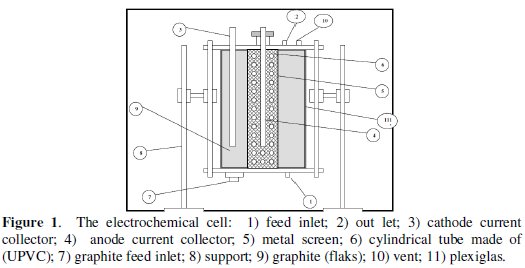
    <p>The main part of the experimental apparatus used is the electrochemical cell is 
shown in <a href="#f1">Fig. 1</a>.</p>

    <p>&nbsp;</p>
<a name="f1">
<img src="/img/revistas/pea/v32n1/32n1a05f1.jpg">
    
<p>&nbsp;</p>

    <p>It is consisted of two co-axial Plexiglas cylinders with 10 and 
20 cm inner diameters fixed to end flanges. The anode is contained in the inner 
cylinder, whereas the cathode is contained in the annular space between the two 
cylinders. The feed solution entered through an opening at the bottom of the cell 
and flow. The outlet of the flow was located at the upper flange of the cell. Two 
stainless steel rods (D = 8 mm, L = 400 mm) were used as current collectors. A 
vent was also located at the top flange for the release of accumulating gases. 
Graphite powder passing sieve no. 16 and retained on sieve no. 200 was added to 
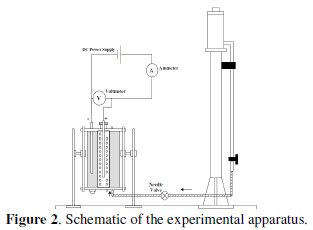
the cell and used to fill each compartment. The cell current was supplied by a DC 
power type farneII LT30-2. Cell current and potential were measured using 
multimeters types M3800 and DT 830, respectively. The feed solution was 
supplied from a constant head tank 20 liter in volume placed at 2 meters above 
the base of the cell. The flow through the bed was by gravity and was controlled 
by a needle valve. The flow rates were determined by using a graduated cylinder 
to collect certain volume of the effluent in a given time. The samples were taken 
after two times of the residence time, as suggested previously by Leon and 
Pletcher [37], to ensure that steady state conditions are reached. A schematic of 
the experimental setup is shown in <a href="#f2">Fig. 2</a>.</p>

    <p>&nbsp;</p>
<a name="f2">
<img src="/img/revistas/pea/v32n1/32n1a05f2.jpg">
    
<p>&nbsp;</p>

    <p>Experiments were carried out using different solutions. Solution (a): 0.5 M 
NaNO<sub>3</sub> contains 5 mg/L lead, as Pb(NO<sub>3</sub>)<sub>2</sub>; solution (b): 0.5 M NaNO<sub>3</sub> 
contains 20 mg/L lead, as Pb(NO<sub>3</sub>)<sub>2</sub>; solution (c): 0.5 M NaNO<sub>3</sub> contains 40 
mg/L lead, as Pb(NO<sub>3</sub>)<sub>2</sub>. All solutions were prepared from annular grade 
chemicals and were dissolved in de-ionized water. In all cases, pH was adjusted 
at 2, 4, and 6, respectively, by using nitric acid (68% conc.). The pH was 
measured by a pH-meter Schott CG710. The lead concentration in the effluent 
was determined by an atomic absorption spectrophotometer model (GBC 902). 
Standard spectrosol 1000 Pb(II) solution was used for the calibration.</p>


    ]]></body>
<body><![CDATA[<p>&nbsp;</p>
    <p><b>Results and discussion</b></p>

    <p>The effects of flow rate, initial concentration, feed, pH, and cell current density 
on, lead removal efficiency, current efficiency, and cell potential are described 
and discussed below.</p>


    <p><b><i>Effect of flow rate on the removal rate</i></b></p>

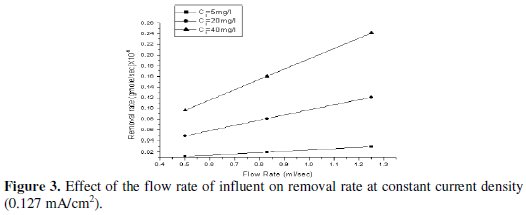
    <p>Removal rate (R) is the rate of lead ion deposition on the surface of cathode per 
second, and it is calculated from the equation:</p>

    <p>&nbsp;</p>
<a name="e1">
<img src="/img/revistas/pea/v32n1/32n1a05e1.jpg">
    
<p>&nbsp;</p>

    <p>where Q is the flow rate, C<sub>i</sub> and C<sub>o</sub> are the lead concentration of influent and 
effluent respectively. The relation between the feed flow rate and the removal 
rate of lead at constant concentration is illustrated in <a href="#f3">Fig. 3</a>.</p>

    <p>&nbsp;</p>
<a name="f3">
<img src="/img/revistas/pea/v32n1/32n1a05f3.jpg">
    
<p>&nbsp;</p>

    ]]></body>
<body><![CDATA[<p>These results indicate 
that the removal rate increases as the feed flow rate increases, and they are in 
good agreement with Newman [1975], who observed that the removal process at 
this concentration level is mass transfer controlled.</p>


    <p><b><i>Effect of the flow rate on removal efficiency of lead</i></b></p>

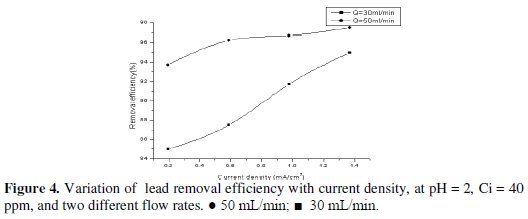
    <p>Removal efficiency is defined as the percentage of lead in the influent solution 
which is removed at the cathode. <a href="#f4">Fig. 4</a> shows the influence of the flow rate on 
the removal efficiency.</p>

    <p>&nbsp;</p>
<a name="f4">
<img src="/img/revistas/pea/v32n1/32n1a05f4.jpg">
    
<p>&nbsp;</p>

    <p>It is obvious that when the flow rate increases at the same 
current density, for the same initial concentration the removal efficiency 
increases. This observation is explained by the fact that high flow rate increases 
the mass transfer coefficient, which in turn increases the amount of lead 
deposited on the surface of the cathode. Similar results were obtained by 
Sarfarazi and Ghoroghchian [38] during the study of the removal of copper on 
carbon flow-by electrode.</p>


    <p><b><i>Effect of initial concentration on the removal rate</i></b></p>

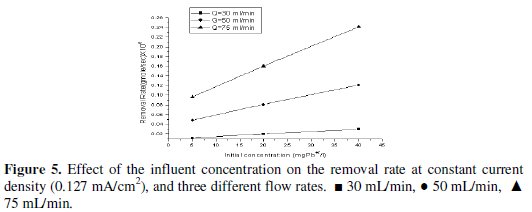
    <p>The effect of the inlet concentration on the removal rate of lead at cell current 
density of 0.127 mA/cm<sup>2</sup> is shown in <a href="#f5">Fig. 5</a>.</p>

    <p>&nbsp;</p>
<a name="f5">
<img src="/img/revistas/pea/v32n1/32n1a05f5.jpg">
    
<p>&nbsp;</p>

    ]]></body>
<body><![CDATA[<p>It is observed that the removal rate 
increases with increasing the initial concentration. This result supported the 
previously concluded fact that the removal process is mass-transfer controlled.</p>


    <p><b><i>Effect of initial concentration on the removal efficiency of lead</i></b></p>

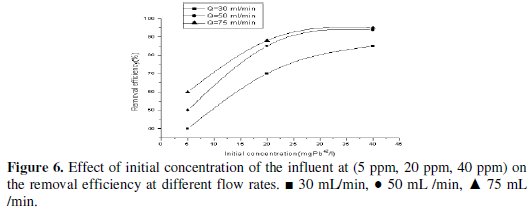
    <p><a href="#f6">Fig. 6</a> shows the influence of lead concentration on the removal efficiency. It is 
clear that as the initial concentration increases the removal efficiency increases.</p>

    <p>&nbsp;</p>
<a name="f6">
<img src="/img/revistas/pea/v32n1/32n1a05f6.jpg">
    
<p>&nbsp;</p>


    <p><b><i>Effect of pH on removal rate and removal efficiency</i></b></p>

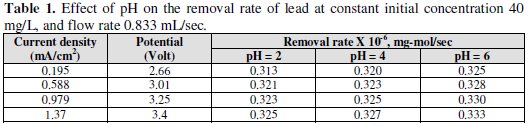
    <p>The effect of pH of influent on the removal rate was studied as lower pH is 
expected to increase the rate of hydrogen evolution. The data, obtained and 
shown in <a href="#t1">Table 1</a>, indicate that at the same current density the removal rate 
decreases with decrease in pH.</p>

    <p>&nbsp;</p>
<a name="t1">
<img src="/img/revistas/pea/v32n1/32n1a05t1.jpg">
    
<p>&nbsp;</p>

    <p>This is explained by the fact that, at lower pH, the 
rate of hydrogen evolution increases. This is expected to decrease the fraction of 
current available for lead removal but, because of the increase in mass-transfer 
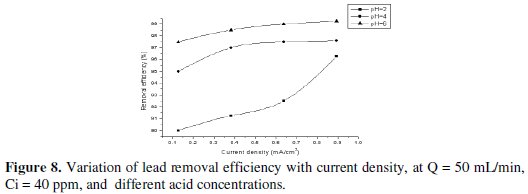
coefficient with hydrogen evolution, this effect is less pronounced. However, at 
higher potential and lower pH the main reaction was proton reduction, producing 
hydrogen which accumulates on the carbon felt surface and therefore interferes 
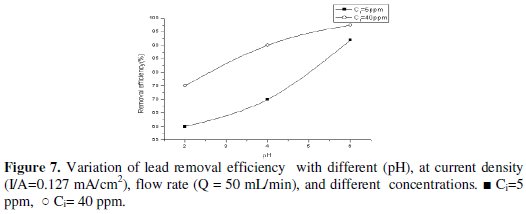
with the deposition of lead ion. For this reason, the removal efficiency increases 
with slightly increase in pH, as shown in <a href="#f7">Figs. 7</a> and <a href="#f8">8</a>.</p>

    ]]></body>
<body><![CDATA[<p>&nbsp;</p>
<a name="f7">
<img src="/img/revistas/pea/v32n1/32n1a05f7.jpg">
    
<p>&nbsp;</p>
<a name="f8">
<img src="/img/revistas/pea/v32n1/32n1a05f8.jpg">
    
<p>&nbsp;</p>


    <p><b><i>Effect of applied current on current efficiency</i></b></p>

    <p>At the surface of the cathode, the lead deposition may be accompanied by a 
hydrogen evolution. The individual contribution of each reaction is given by its 
current efficiency and may be calculated by Faraday's law. The current efficiency 
was calculated from the following:</p>

    <p>% Current efficiency = current equivalent to the deposition rate of lead / total cell 
current x 100%</p>

    <p>where, the current equivalent to the deposition rate of lead, I, 
was calculated from the relation:</p>

    <p>&nbsp;</p>
<a name="e2">
<img src="/img/revistas/pea/v32n1/32n1a05e2.jpg">
    
<p>&nbsp;</p>

    <p>where I is the electric current, F is Faraday's constant = 96500 coulombs/gequivalent, 
n is the number of electrons in the electrode reaction, R is the flow 
rate (mL/sec) and C<sub>i</sub>, C<sub>o</sub> are influent and effluent concentration of lead in (g-mol/
mL).</p>

    ]]></body>
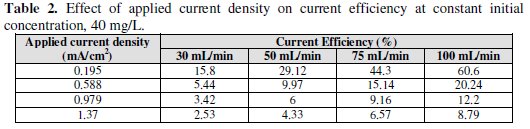
<body><![CDATA[<p><a href="#t2">Table 2</a> shows the effect of applied current density on current efficiency at 
constant initial lead concentration of 40 mg/L, and at different flow rate and 
constant pH of inlet solution (pH = 2).</p>

    <p>&nbsp;</p>
<a name="t2">
<img src="/img/revistas/pea/v32n1/32n1a05t2.jpg">
    
<p>&nbsp;</p>

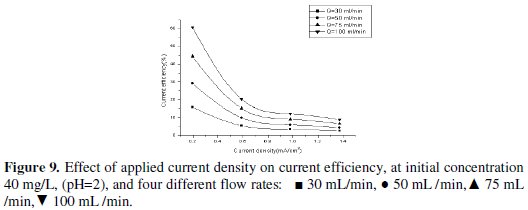
    <p>From <a href="#f9">Fig. 9</a> it is obvious that the current efficiency decreases as applied current 
density increases.</p>

    <p>&nbsp;</p>
<a name="f9">
<img src="/img/revistas/pea/v32n1/32n1a05f9.jpg">
    
<p>&nbsp;</p>

    <p>The current efficiency reaches a maximum value of 60.6% at 
0.195 mA/cm<sup>2</sup> current density for feed flow rate of 100 mL/min. When the 
applied current density was increased, the cathodic current efficiency 
significantly decreased. This indicates that the parallel reaction of hydrogen 
evolution increases on the surface of the cathode with the increase in current 
density. Similarly, Sarfarazi and Ghoroghchian [1994], observed that the current 
efficiency for copper precipitation on flow-by porous electrode has the same 
trend. Also, it is clear that as the flow rate increases, the current efficiency 
increases. It is understandable that at the same total charge consumed, when the 
flow rate increases the charge used in forming product will increase and then the 
current efficiency will also increase. Our results substantiated by the fact that as 
the applied current density increased to high value, lead ions are reduced so fast 
that they are limited on the surface of the cathode, then parallel reactions such as 
the formation of hydrogen gas increase and therefore, the cathodic current 
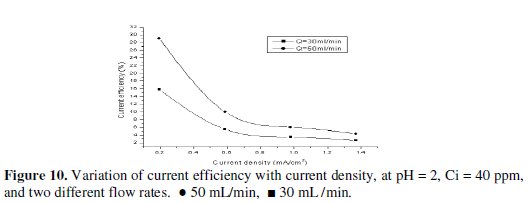
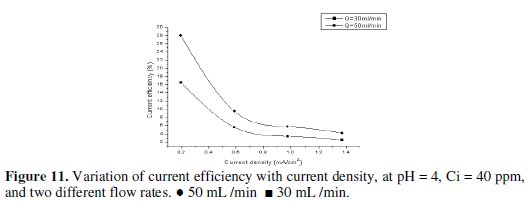
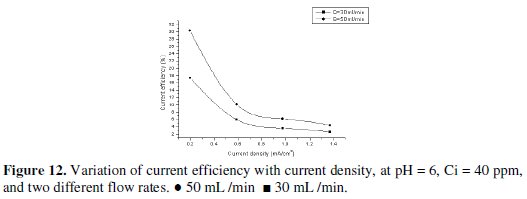
efficiency decreases. From <a href="#f10">Figs. 10</a>, <a href="#f11">11</a> and <a href="#f12">12</a> we can see the effect of applied 
current density on current efficiency at different acid concentrations.</p>

    <p>&nbsp;</p>
<a name="f10">
<img src="/img/revistas/pea/v32n1/32n1a05f10.jpg">
    
<p>&nbsp;</p>
<a name="f11">
<img src="/img/revistas/pea/v32n1/32n1a05f11.jpg">
    
<p>&nbsp;</p>
<a name="f12">
<img src="/img/revistas/pea/v32n1/32n1a05f12.jpg">
    
]]></body>
<body><![CDATA[<p>&nbsp;</p>

    <p>Based on the above discussed results, it can be concluded that the optimum 
operating conditions were the flow rate (100 mL/min), pH of inlet solution equal 
(6), and initial concentration of lead (40 mg/L). 

Recovery of lead 

During the deposition process, the current distribution over the bed is not 
uniform. Therefore, it is expected that most of the lead is depositing on the lower 
part of the bed. However, during the reversal of the polarity and the use of a rod 
of lead as cathode, we can recover the lead in pure state. This also can be 
achieved by burning the graphite which contains lead at 400 &deg;C, which is enough 
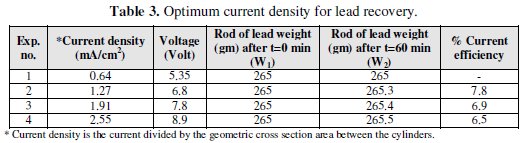
to completely oxidize the graphite. <a href="#t3">Table 3</a> shows that the optimum current 
density for lead recovery.</p>

    <p>&nbsp;</p>
<a name="t3">
<img src="/img/revistas/pea/v32n1/32n1a05t3.jpg">
    
<p>&nbsp;</p>

    <p>From these results, the optimum current density for 
lead recovery is 1.27 mA/cm<sup>2</sup>.</p>

    <p><a href="#t4">Table 4</a> shows that the weight of lead is decreased after recovery.</p>

    <p>&nbsp;</p>
<a name="t4">
<img src="/img/revistas/pea/v32n1/32n1a05t4.jpg">
    
<p>&nbsp;</p>

    <p>This can be 
explained as during the reversal of the polarity, little amount of lead is leached at 
first, followed by increasing leaching rate of lead as dissolution process that took 
place over entire bed.</p>


    <p>&nbsp;</p>
    ]]></body>
<body><![CDATA[<p><b>Conclusions</b></p>

    <p>This study generated important information on the optimal conditions of several 
variables that influence the electrochemical cell incorporating flow-by porous 
graphite electrodes. The maximum removal efficiency and current efficiency 
were obtained at a flow rate of 100 mL/min, for initial concentration 40 mg/L, 
with a current density of 0.195 mA/cm<sup>2</sup>, 97.75% and 60.7%, respectively, with a 
residual concentration of 0.9 mg/L. Removal efficiency slightly decreases with 
the decrease in pH. This is due to the fact that, at lower pH, the main reaction is 
hydrogen evolution which accumulates on the cathode bed surface and therefore 
interferes with the deposition of lead.</p>


    <p>&nbsp;</p>
    <p><b>References</b></p>

    <!-- ref --><p>1. Bahadir T, Bakan G, Altas L, et al. Enzyme and Microbial Tech. 2007;41:98.    &nbsp;&nbsp;&nbsp;&nbsp;&nbsp;&nbsp;&nbsp;&nbsp;[&#160;<a href="javascript:void(0);" onclick="javascript: window.open('/scielo.php?script=sci_nlinks&ref=000097&pid=S0872-1904201400010000500001&lng=','','width=640,height=500,resizable=yes,scrollbars=1,menubar=yes,');">Links</a>&#160;]<!-- end-ref --></p>

    <!-- ref --><p>2. Mahvi A H, Naghipour D, Vaezi F, et al. Am J Appl Sci. 2008;2:372.    &nbsp;&nbsp;&nbsp;&nbsp;&nbsp;&nbsp;&nbsp;&nbsp;[&#160;<a href="javascript:void(0);" onclick="javascript: window.open('/scielo.php?script=sci_nlinks&ref=000099&pid=S0872-1904201400010000500002&lng=','','width=640,height=500,resizable=yes,scrollbars=1,menubar=yes,');">Links</a>&#160;]<!-- end-ref --></p>

    <!-- ref --><p>3. Murugesan G S, Sathishkumar M, Swaminathan K. Bioresour Tech. 2006;97:483.    &nbsp;&nbsp;&nbsp;&nbsp;&nbsp;&nbsp;&nbsp;&nbsp;[&#160;<a href="javascript:void(0);" onclick="javascript: window.open('/scielo.php?script=sci_nlinks&ref=000101&pid=S0872-1904201400010000500003&lng=','','width=640,height=500,resizable=yes,scrollbars=1,menubar=yes,');">Links</a>&#160;]<!-- end-ref --></p>

    ]]></body>
<body><![CDATA[<!-- ref --><p>4. Ahmedna M, Marshall W E, Husseiny A A, et al. Water Res. 2014;38:1062.    &nbsp;&nbsp;&nbsp;&nbsp;&nbsp;&nbsp;&nbsp;&nbsp;[&#160;<a href="javascript:void(0);" onclick="javascript: window.open('/scielo.php?script=sci_nlinks&ref=000103&pid=S0872-1904201400010000500004&lng=','','width=640,height=500,resizable=yes,scrollbars=1,menubar=yes,');">Links</a>&#160;]<!-- end-ref --></p>

    <!-- ref --><p>5. Kobya M, Demirbas E, Senturk E, et al. Bioresour Tech. 2005;96:1518.    &nbsp;&nbsp;&nbsp;&nbsp;&nbsp;&nbsp;&nbsp;&nbsp;[&#160;<a href="javascript:void(0);" onclick="javascript: window.open('/scielo.php?script=sci_nlinks&ref=000105&pid=S0872-1904201400010000500005&lng=','','width=640,height=500,resizable=yes,scrollbars=1,menubar=yes,');">Links</a>&#160;]<!-- end-ref --></p>

    <!-- ref --><p>6. Anderson J R, Weiss C O. Method for precipitation of heavy metal sulphides. Patent, USA; 1973.    &nbsp;&nbsp;&nbsp;&nbsp;&nbsp;&nbsp;&nbsp;&nbsp;[&#160;<a href="javascript:void(0);" onclick="javascript: window.open('/scielo.php?script=sci_nlinks&ref=000107&pid=S0872-1904201400010000500006&lng=','','width=640,height=500,resizable=yes,scrollbars=1,menubar=yes,');">Links</a>&#160;]<!-- end-ref --></p>

    <!-- ref --><p>7. Smara A, Delimi R, Chainet E, et al. Sep Purif Tech. 2007;57:103.    &nbsp;&nbsp;&nbsp;&nbsp;&nbsp;&nbsp;&nbsp;&nbsp;[&#160;<a href="javascript:void(0);" onclick="javascript: window.open('/scielo.php?script=sci_nlinks&ref=000109&pid=S0872-1904201400010000500007&lng=','','width=640,height=500,resizable=yes,scrollbars=1,menubar=yes,');">Links</a>&#160;]<!-- end-ref --></p>

    <!-- ref --><p>8. Metcalf I, Eddy. Wastewater Engineering Treatment and Reuse. 4th ed. New York:McGraw Hill,;2003.    &nbsp;&nbsp;&nbsp;&nbsp;&nbsp;&nbsp;&nbsp;&nbsp;[&#160;<a href="javascript:void(0);" onclick="javascript: window.open('/scielo.php?script=sci_nlinks&ref=000111&pid=S0872-1904201400010000500008&lng=','','width=640,height=500,resizable=yes,scrollbars=1,menubar=yes,');">Links</a>&#160;]<!-- end-ref --></p>

    ]]></body>
<body><![CDATA[<!-- ref --><p>9. Nogami M, Ismail I M, Yamaguchi M, et al. J Solid State Chem. 2003;171:353.    &nbsp;&nbsp;&nbsp;&nbsp;&nbsp;&nbsp;&nbsp;&nbsp;[&#160;<a href="javascript:void(0);" onclick="javascript: window.open('/scielo.php?script=sci_nlinks&ref=000113&pid=S0872-1904201400010000500009&lng=','','width=640,height=500,resizable=yes,scrollbars=1,menubar=yes,');">Links</a>&#160;]<!-- end-ref --></p>

    <!-- ref --><p>10. Ismail I M, Nogami M, Suzuki K. Trans Egyptian Soc Chem Eng. 2004;30:383.    &nbsp;&nbsp;&nbsp;&nbsp;&nbsp;&nbsp;&nbsp;&nbsp;[&#160;<a href="javascript:void(0);" onclick="javascript: window.open('/scielo.php?script=sci_nlinks&ref=000115&pid=S0872-1904201400010000500010&lng=','','width=640,height=500,resizable=yes,scrollbars=1,menubar=yes,');">Links</a>&#160;]<!-- end-ref --></p>

    <!-- ref --><p>11. Abd El-Rahman K M, El-Sourougy M R, Abdel-Monem N M, et al. J Nuclear Radiochem Sci. 2006;7:21.    &nbsp;&nbsp;&nbsp;&nbsp;&nbsp;&nbsp;&nbsp;&nbsp;[&#160;<a href="javascript:void(0);" onclick="javascript: window.open('/scielo.php?script=sci_nlinks&ref=000117&pid=S0872-1904201400010000500011&lng=','','width=640,height=500,resizable=yes,scrollbars=1,menubar=yes,');">Links</a>&#160;]<!-- end-ref --></p>

    <!-- ref --><p>12. Ismail I M, El-Sourougy M R, Abdel Moneim N, et al. Solvent Extr Ion Exch 2002;20:589.    &nbsp;&nbsp;&nbsp;&nbsp;&nbsp;&nbsp;&nbsp;&nbsp;[&#160;<a href="javascript:void(0);" onclick="javascript: window.open('/scielo.php?script=sci_nlinks&ref=000119&pid=S0872-1904201400010000500012&lng=','','width=640,height=500,resizable=yes,scrollbars=1,menubar=yes,');">Links</a>&#160;]<!-- end-ref --></p>

    <!-- ref --><p>13. Ismail I M, El-Sourougy M R, Abdel Moneim N, et al. J Radioanal Nucl Chem 1999;240:59.    &nbsp;&nbsp;&nbsp;&nbsp;&nbsp;&nbsp;&nbsp;&nbsp;[&#160;<a href="javascript:void(0);" onclick="javascript: window.open('/scielo.php?script=sci_nlinks&ref=000121&pid=S0872-1904201400010000500013&lng=','','width=640,height=500,resizable=yes,scrollbars=1,menubar=yes,');">Links</a>&#160;]<!-- end-ref --></p>

    ]]></body>
<body><![CDATA[<!-- ref --><p>14. Ismail I M, El-Sourougy M R, Abdel Moneim N, et al. J Radioanal Nucl Chem 1998;237:97.    &nbsp;&nbsp;&nbsp;&nbsp;&nbsp;&nbsp;&nbsp;&nbsp;[&#160;<a href="javascript:void(0);" onclick="javascript: window.open('/scielo.php?script=sci_nlinks&ref=000123&pid=S0872-1904201400010000500014&lng=','','width=640,height=500,resizable=yes,scrollbars=1,menubar=yes,');">Links</a>&#160;]<!-- end-ref --></p>

    <!-- ref --><p>15. Ismail I M, Nogami M, Suzuki K. Solvent Extr Ion Exch 2003;21:465.    &nbsp;&nbsp;&nbsp;&nbsp;&nbsp;&nbsp;&nbsp;&nbsp;[&#160;<a href="javascript:void(0);" onclick="javascript: window.open('/scielo.php?script=sci_nlinks&ref=000125&pid=S0872-1904201400010000500015&lng=','','width=640,height=500,resizable=yes,scrollbars=1,menubar=yes,');">Links</a>&#160;]<!-- end-ref --></p>

    <!-- ref --><p>16. Ismail I M, Nogami M, Suzuki K. Sep Purif Technol. 2003;31:231.    &nbsp;&nbsp;&nbsp;&nbsp;&nbsp;&nbsp;&nbsp;&nbsp;[&#160;<a href="javascript:void(0);" onclick="javascript: window.open('/scielo.php?script=sci_nlinks&ref=000127&pid=S0872-1904201400010000500016&lng=','','width=640,height=500,resizable=yes,scrollbars=1,menubar=yes,');">Links</a>&#160;]<!-- end-ref --></p>

    <!-- ref --><p>17. Ismail I M, El-Sourougy M R, Abdel Moneim N, et al. Separation of Caesium and Cobalt from Contaminated Waste Water Using Potassium Nickel Hexacyanoferrate Complex. Proceedings of the International Symposium on Future Issues of Research on Science and TechnologyFirst`97. Tokyo, Japan;1997&nbsp;&nbsp;&nbsp;&nbsp;&nbsp;&nbsp;&nbsp;&nbsp;[&#160;<a href="javascript:void(0);" onclick="javascript: window.open('/scielo.php?script=sci_nlinks&ref=000129&pid=S0872-1904201400010000500017&lng=','','width=640,height=500,resizable=yes,scrollbars=1,menubar=yes,');">Links</a>&#160;]<!-- end-ref --><p>18. Ismail M, Soliman A, Abdel-Monem N, et al. Nickel Removal from Electroplating Waste Water Using Stand alone and Electrically-Assisted Ion Exchange Process. Int J Env Sci Tech. Accepted for publication.</p>

    <!-- ref --><p>19. Peters W R, White E T, Carole Y K, et al. J Water Pollut Control Fed 1986;58:481.    &nbsp;&nbsp;&nbsp;&nbsp;&nbsp;&nbsp;&nbsp;&nbsp;[&#160;<a href="javascript:void(0);" onclick="javascript: window.open('/scielo.php?script=sci_nlinks&ref=000131&pid=S0872-1904201400010000500019&lng=','','width=640,height=500,resizable=yes,scrollbars=1,menubar=yes,');">Links</a>&#160;]<!-- end-ref --></p>

    ]]></body>
<body><![CDATA[<!-- ref --><p>20. Sadrzadeh M, Mohammadi T, Ivakpour J, et al. Chem Eng J. 2008;144:431.    &nbsp;&nbsp;&nbsp;&nbsp;&nbsp;&nbsp;&nbsp;&nbsp;[&#160;<a href="javascript:void(0);" onclick="javascript: window.open('/scielo.php?script=sci_nlinks&ref=000133&pid=S0872-1904201400010000500020&lng=','','width=640,height=500,resizable=yes,scrollbars=1,menubar=yes,');">Links</a>&#160;]<!-- end-ref --></p>

    <!-- ref --><p>21. Patterson J. Industrial Wastewater Treatment Technology. 2nd ed. Boston:Butterworth Publisher;1985.    &nbsp;&nbsp;&nbsp;&nbsp;&nbsp;&nbsp;&nbsp;&nbsp;[&#160;<a href="javascript:void(0);" onclick="javascript: window.open('/scielo.php?script=sci_nlinks&ref=000135&pid=S0872-1904201400010000500021&lng=','','width=640,height=500,resizable=yes,scrollbars=1,menubar=yes,');">Links</a>&#160;]<!-- end-ref --></p>

    <!-- ref --><p>22. Kazemipour M, Ansari M, Tajrobehkar Sh, et al. J Hazard Mater. 2008;150:322-327.    &nbsp;&nbsp;&nbsp;&nbsp;&nbsp;&nbsp;&nbsp;&nbsp;[&#160;<a href="javascript:void(0);" onclick="javascript: window.open('/scielo.php?script=sci_nlinks&ref=000137&pid=S0872-1904201400010000500022&lng=','','width=640,height=500,resizable=yes,scrollbars=1,menubar=yes,');">Links</a>&#160;]<!-- end-ref --></p>

    <!-- ref --><p>23. Mishraa P C, Patel R K. J Hazard Mater. 2009;168:319-325&nbsp;&nbsp;&nbsp;&nbsp;&nbsp;&nbsp;&nbsp;&nbsp;[&#160;<a href="javascript:void(0);" onclick="javascript: window.open('/scielo.php?script=sci_nlinks&ref=000139&pid=S0872-1904201400010000500023&lng=','','width=640,height=500,resizable=yes,scrollbars=1,menubar=yes,');">Links</a>&#160;]<!-- end-ref --><!-- ref --><p>24. Alizadeh T, Amjadi S. J Hazard Mater. 2011;190:451.    &nbsp;&nbsp;&nbsp;&nbsp;&nbsp;&nbsp;&nbsp;&nbsp;[&#160;<a href="javascript:void(0);" onclick="javascript: window.open('/scielo.php?script=sci_nlinks&ref=000140&pid=S0872-1904201400010000500024&lng=','','width=640,height=500,resizable=yes,scrollbars=1,menubar=yes,');">Links</a>&#160;]<!-- end-ref --></p>

    <!-- ref --><p>25. Liua Y, Liub Z, Gaoa J, et al. J Hazard Mater. 2011;186:197.    &nbsp;&nbsp;&nbsp;&nbsp;&nbsp;&nbsp;&nbsp;&nbsp;[&#160;<a href="javascript:void(0);" onclick="javascript: window.open('/scielo.php?script=sci_nlinks&ref=000142&pid=S0872-1904201400010000500025&lng=','','width=640,height=500,resizable=yes,scrollbars=1,menubar=yes,');">Links</a>&#160;]<!-- end-ref --></p>

    <!-- ref --><p>26. Khajeha M, Heidarib Z S, Sanchoolia E. Chem Eng J. 2011;166:1158.    &nbsp;&nbsp;&nbsp;&nbsp;&nbsp;&nbsp;&nbsp;&nbsp;[&#160;<a href="javascript:void(0);" onclick="javascript: window.open('/scielo.php?script=sci_nlinks&ref=000144&pid=S0872-1904201400010000500026&lng=','','width=640,height=500,resizable=yes,scrollbars=1,menubar=yes,');">Links</a>&#160;]<!-- end-ref --></p>

    <!-- ref --><p>27. Esalah J, Husein M M. Sep Sci Technol. 2008;43:3461.    &nbsp;&nbsp;&nbsp;&nbsp;&nbsp;&nbsp;&nbsp;&nbsp;[&#160;<a href="javascript:void(0);" onclick="javascript: window.open('/scielo.php?script=sci_nlinks&ref=000146&pid=S0872-1904201400010000500027&lng=','','width=640,height=500,resizable=yes,scrollbars=1,menubar=yes,');">Links</a>&#160;]<!-- end-ref --></p>

    <!-- ref --><p>28. Winfield B A. Water Res. 1979;13:561.    &nbsp;&nbsp;&nbsp;&nbsp;&nbsp;&nbsp;&nbsp;&nbsp;[&#160;<a href="javascript:void(0);" onclick="javascript: window.open('/scielo.php?script=sci_nlinks&ref=000148&pid=S0872-1904201400010000500028&lng=','','width=640,height=500,resizable=yes,scrollbars=1,menubar=yes,');">Links</a>&#160;]<!-- end-ref --></p>

    <!-- ref --><p>29. Ismail I M, Abdel-Salam O E, Ahmed T S, et al. Port Electrochim Acta. 2013; 31:207.    &nbsp;&nbsp;&nbsp;&nbsp;&nbsp;&nbsp;&nbsp;&nbsp;[&#160;<a href="javascript:void(0);" onclick="javascript: window.open('/scielo.php?script=sci_nlinks&ref=000150&pid=S0872-1904201400010000500029&lng=','','width=640,height=500,resizable=yes,scrollbars=1,menubar=yes,');">Links</a>&#160;]<!-- end-ref --></p>

    <!-- ref --><p>30. Gonzalez-Garcia J, Bonete P, Exposito E, et al. J Mater Chem. 1999;9:419.    &nbsp;&nbsp;&nbsp;&nbsp;&nbsp;&nbsp;&nbsp;&nbsp;[&#160;<a href="javascript:void(0);" onclick="javascript: window.open('/scielo.php?script=sci_nlinks&ref=000152&pid=S0872-1904201400010000500030&lng=','','width=640,height=500,resizable=yes,scrollbars=1,menubar=yes,');">Links</a>&#160;]<!-- end-ref --></p>

    <!-- ref --><p>31. Saleh M M. J Phys Chem B. 2004;108:13419.    &nbsp;&nbsp;&nbsp;&nbsp;&nbsp;&nbsp;&nbsp;&nbsp;[&#160;<a href="javascript:void(0);" onclick="javascript: window.open('/scielo.php?script=sci_nlinks&ref=000154&pid=S0872-1904201400010000500031&lng=','','width=640,height=500,resizable=yes,scrollbars=1,menubar=yes,');">Links</a>&#160;]<!-- end-ref --></p>

    <p>32. Joseph B, Arthur S, Kushner. Water and Waste Control for the Plating Shop. 3rd ed. Cincinnati, Ohio: Gardner Publications Inc;1997.</p>

    <!-- ref --><p>33. Alkire R, Ng P K. J Electrochem Soc. 1974;121:95.    &nbsp;&nbsp;&nbsp;&nbsp;&nbsp;&nbsp;&nbsp;&nbsp;[&#160;<a href="javascript:void(0);" onclick="javascript: window.open('/scielo.php?script=sci_nlinks&ref=000157&pid=S0872-1904201400010000500033&lng=','','width=640,height=500,resizable=yes,scrollbars=1,menubar=yes,');">Links</a>&#160;]<!-- end-ref --></p>

    <!-- ref --><p>34. Alkire R, Ng P K. J Electrochem Soc. 1977;124:1220.    &nbsp;&nbsp;&nbsp;&nbsp;&nbsp;&nbsp;&nbsp;&nbsp;[&#160;<a href="javascript:void(0);" onclick="javascript: window.open('/scielo.php?script=sci_nlinks&ref=000159&pid=S0872-1904201400010000500034&lng=','','width=640,height=500,resizable=yes,scrollbars=1,menubar=yes,');">Links</a>&#160;]<!-- end-ref --></p>

    <!-- ref --><p>35. Daewon P, Dowon Ch, Jeh B J. Water Res. 2011;35:57.    &nbsp;&nbsp;&nbsp;&nbsp;&nbsp;&nbsp;&nbsp;&nbsp;[&#160;<a href="javascript:void(0);" onclick="javascript: window.open('/scielo.php?script=sci_nlinks&ref=000161&pid=S0872-1904201400010000500035&lng=','','width=640,height=500,resizable=yes,scrollbars=1,menubar=yes,');">Links</a>&#160;]<!-- end-ref --></p>

    ]]></body>
<body><![CDATA[<!-- ref --><p>36. EL-Deab M S, Saleh M M, EL-Anadouli B E, et al. J Electrochem Soc. 1999;146:208.    &nbsp;&nbsp;&nbsp;&nbsp;&nbsp;&nbsp;&nbsp;&nbsp;[&#160;<a href="javascript:void(0);" onclick="javascript: window.open('/scielo.php?script=sci_nlinks&ref=000163&pid=S0872-1904201400010000500036&lng=','','width=640,height=500,resizable=yes,scrollbars=1,menubar=yes,');">Links</a>&#160;]<!-- end-ref --></p>

    <!-- ref --><p>37. Ponce de Leon C, Pletcher D. Electrochim Acta. 1996;41:533.    &nbsp;&nbsp;&nbsp;&nbsp;&nbsp;&nbsp;&nbsp;&nbsp;[&#160;<a href="javascript:void(0);" onclick="javascript: window.open('/scielo.php?script=sci_nlinks&ref=000165&pid=S0872-1904201400010000500037&lng=','','width=640,height=500,resizable=yes,scrollbars=1,menubar=yes,');">Links</a>&#160;]<!-- end-ref --></p>

    <!-- ref --><p>38. Sarfarazi F, Ghoroghchian J. Microchem J. 1994;33:43.    &nbsp;&nbsp;&nbsp;&nbsp;&nbsp;&nbsp;&nbsp;&nbsp;[&#160;<a href="javascript:void(0);" onclick="javascript: window.open('/scielo.php?script=sci_nlinks&ref=000167&pid=S0872-1904201400010000500038&lng=','','width=640,height=500,resizable=yes,scrollbars=1,menubar=yes,');">Links</a>&#160;]<!-- end-ref --></p>


    <p>&nbsp;</p>
    <p><a name=0></a><sup><a href="#top">*</a></sup>Corresponding author. E-mail address: <a href="mailto:dr_ismail@icem-group.org">dr_ismail@icem-group.org</a></p>

    <p>Received 24 February 2014; accepted 27 February 2014</p>

    <p><a href="http://www.peacta.org" target="_blank">www.peacta.org</a> </p>


    ]]></body>
<body><![CDATA[ ]]></body><back>
<ref-list>
<ref id="B1">
<label>1</label><nlm-citation citation-type="journal">
<person-group person-group-type="author">
<name>
<surname><![CDATA[Bahadir]]></surname>
<given-names><![CDATA[T]]></given-names>
</name>
<name>
<surname><![CDATA[Bakan]]></surname>
<given-names><![CDATA[G]]></given-names>
</name>
<name>
<surname><![CDATA[Altas]]></surname>
<given-names><![CDATA[L]]></given-names>
</name>
</person-group>
<source><![CDATA[Enzyme and Microbial Tech]]></source>
<year>2007</year>
<volume>41</volume>
<page-range>98</page-range></nlm-citation>
</ref>
<ref id="B2">
<label>2</label><nlm-citation citation-type="journal">
<person-group person-group-type="author">
<name>
<surname><![CDATA[Mahvi]]></surname>
<given-names><![CDATA[A H]]></given-names>
</name>
<name>
<surname><![CDATA[Naghipour]]></surname>
<given-names><![CDATA[D]]></given-names>
</name>
<name>
<surname><![CDATA[Vaezi]]></surname>
<given-names><![CDATA[F]]></given-names>
</name>
</person-group>
<source><![CDATA[Am J Appl Sci]]></source>
<year>2008</year>
<volume>2</volume>
<page-range>372</page-range></nlm-citation>
</ref>
<ref id="B3">
<label>3</label><nlm-citation citation-type="journal">
<person-group person-group-type="author">
<name>
<surname><![CDATA[Murugesan]]></surname>
<given-names><![CDATA[G S]]></given-names>
</name>
<name>
<surname><![CDATA[Sathishkumar]]></surname>
<given-names><![CDATA[M]]></given-names>
</name>
<name>
<surname><![CDATA[Swaminathan]]></surname>
<given-names><![CDATA[K]]></given-names>
</name>
</person-group>
<source><![CDATA[Bioresour Tech]]></source>
<year>2006</year>
<volume>97</volume>
<page-range>483</page-range></nlm-citation>
</ref>
<ref id="B4">
<label>4</label><nlm-citation citation-type="journal">
<person-group person-group-type="author">
<name>
<surname><![CDATA[Ahmedna]]></surname>
<given-names><![CDATA[M]]></given-names>
</name>
<name>
<surname><![CDATA[Marshall]]></surname>
<given-names><![CDATA[W E]]></given-names>
</name>
<name>
<surname><![CDATA[Husseiny]]></surname>
<given-names><![CDATA[A A]]></given-names>
</name>
</person-group>
<source><![CDATA[Water Res]]></source>
<year>2014</year>
<volume>38</volume>
<page-range>1062</page-range></nlm-citation>
</ref>
<ref id="B5">
<label>5</label><nlm-citation citation-type="journal">
<person-group person-group-type="author">
<name>
<surname><![CDATA[Kobya]]></surname>
<given-names><![CDATA[M]]></given-names>
</name>
<name>
<surname><![CDATA[Demirbas]]></surname>
<given-names><![CDATA[E]]></given-names>
</name>
<name>
<surname><![CDATA[Senturk]]></surname>
<given-names><![CDATA[E]]></given-names>
</name>
</person-group>
<source><![CDATA[Bioresour Tech]]></source>
<year>2005</year>
<volume>96</volume>
<page-range>1518</page-range></nlm-citation>
</ref>
<ref id="B6">
<label>6</label><nlm-citation citation-type="">
<person-group person-group-type="author">
<name>
<surname><![CDATA[Anderson]]></surname>
<given-names><![CDATA[J R]]></given-names>
</name>
<name>
<surname><![CDATA[Weiss]]></surname>
<given-names><![CDATA[C O]]></given-names>
</name>
</person-group>
<source><![CDATA[Method for precipitation of heavy metal sulphides]]></source>
<year>1973</year>
</nlm-citation>
</ref>
<ref id="B7">
<label>7</label><nlm-citation citation-type="journal">
<person-group person-group-type="author">
<name>
<surname><![CDATA[Smara]]></surname>
<given-names><![CDATA[A]]></given-names>
</name>
<name>
<surname><![CDATA[Delimi]]></surname>
<given-names><![CDATA[R]]></given-names>
</name>
<name>
<surname><![CDATA[Chainet]]></surname>
<given-names><![CDATA[E]]></given-names>
</name>
</person-group>
<source><![CDATA[Sep Purif Tech]]></source>
<year>2007</year>
<volume>57</volume>
<page-range>103</page-range></nlm-citation>
</ref>
<ref id="B8">
<label>8</label><nlm-citation citation-type="book">
<person-group person-group-type="author">
<name>
<surname><![CDATA[Metcalf]]></surname>
<given-names><![CDATA[I]]></given-names>
</name>
<name>
<surname><![CDATA[Eddy]]></surname>
</name>
</person-group>
<source><![CDATA[Wastewater Engineering Treatment and Reuse]]></source>
<year>2003</year>
<edition>4</edition>
<publisher-loc><![CDATA[New York ]]></publisher-loc>
<publisher-name><![CDATA[McGraw Hill]]></publisher-name>
</nlm-citation>
</ref>
<ref id="B9">
<label>9</label><nlm-citation citation-type="journal">
<person-group person-group-type="author">
<name>
<surname><![CDATA[Nogami]]></surname>
<given-names><![CDATA[M]]></given-names>
</name>
<name>
<surname><![CDATA[Ismail]]></surname>
<given-names><![CDATA[I M]]></given-names>
</name>
<name>
<surname><![CDATA[Yamaguchi]]></surname>
<given-names><![CDATA[M]]></given-names>
</name>
</person-group>
<source><![CDATA[J Solid State Chem]]></source>
<year>2003</year>
<volume>171</volume>
<page-range>353</page-range></nlm-citation>
</ref>
<ref id="B10">
<label>10</label><nlm-citation citation-type="journal">
<person-group person-group-type="author">
<name>
<surname><![CDATA[Ismail]]></surname>
<given-names><![CDATA[I M]]></given-names>
</name>
<name>
<surname><![CDATA[Nogami]]></surname>
<given-names><![CDATA[M]]></given-names>
</name>
<name>
<surname><![CDATA[Suzuki]]></surname>
<given-names><![CDATA[K]]></given-names>
</name>
</person-group>
<source><![CDATA[Trans Egyptian Soc Chem Eng]]></source>
<year>2004</year>
<volume>30</volume>
<page-range>383</page-range></nlm-citation>
</ref>
<ref id="B11">
<label>11</label><nlm-citation citation-type="journal">
<person-group person-group-type="author">
<name>
<surname><![CDATA[Abd El-Rahman]]></surname>
<given-names><![CDATA[K M]]></given-names>
</name>
<name>
<surname><![CDATA[El-Sourougy]]></surname>
<given-names><![CDATA[M R]]></given-names>
</name>
<name>
<surname><![CDATA[Abdel-Monem]]></surname>
<given-names><![CDATA[N M]]></given-names>
</name>
</person-group>
<source><![CDATA[J Nuclear Radiochem Sci]]></source>
<year>2006</year>
<volume>7</volume>
<page-range>21</page-range></nlm-citation>
</ref>
<ref id="B12">
<label>12</label><nlm-citation citation-type="journal">
<person-group person-group-type="author">
<name>
<surname><![CDATA[Ismail]]></surname>
<given-names><![CDATA[I M]]></given-names>
</name>
<name>
<surname><![CDATA[El-Sourougy]]></surname>
<given-names><![CDATA[M R]]></given-names>
</name>
<name>
<surname><![CDATA[Abdel Moneim]]></surname>
<given-names><![CDATA[N]]></given-names>
</name>
</person-group>
<source><![CDATA[Solvent Extr Ion Exch]]></source>
<year>2002</year>
<volume>20</volume>
<page-range>589</page-range></nlm-citation>
</ref>
<ref id="B13">
<label>13</label><nlm-citation citation-type="journal">
<person-group person-group-type="author">
<name>
<surname><![CDATA[Ismail]]></surname>
<given-names><![CDATA[I M]]></given-names>
</name>
<name>
<surname><![CDATA[El-Sourougy]]></surname>
<given-names><![CDATA[M R]]></given-names>
</name>
<name>
<surname><![CDATA[Abdel Moneim]]></surname>
<given-names><![CDATA[N]]></given-names>
</name>
</person-group>
<source><![CDATA[J Radioanal Nucl Chem]]></source>
<year>1999</year>
<volume>240</volume>
<page-range>59</page-range></nlm-citation>
</ref>
<ref id="B14">
<label>14</label><nlm-citation citation-type="journal">
<person-group person-group-type="author">
<name>
<surname><![CDATA[Ismail]]></surname>
<given-names><![CDATA[I M]]></given-names>
</name>
<name>
<surname><![CDATA[El-Sourougy]]></surname>
<given-names><![CDATA[M R]]></given-names>
</name>
<name>
<surname><![CDATA[Abdel Moneim]]></surname>
<given-names><![CDATA[N]]></given-names>
</name>
</person-group>
<source><![CDATA[J Radioanal Nucl Chem]]></source>
<year>1998</year>
<volume>237</volume>
<page-range>97</page-range></nlm-citation>
</ref>
<ref id="B15">
<label>15</label><nlm-citation citation-type="journal">
<person-group person-group-type="author">
<name>
<surname><![CDATA[Ismail]]></surname>
<given-names><![CDATA[I M]]></given-names>
</name>
<name>
<surname><![CDATA[Nogami]]></surname>
<given-names><![CDATA[M]]></given-names>
</name>
<name>
<surname><![CDATA[Suzuki]]></surname>
<given-names><![CDATA[K]]></given-names>
</name>
</person-group>
<source><![CDATA[Solvent Extr Ion Exch]]></source>
<year>2003</year>
<volume>21</volume>
<page-range>465</page-range></nlm-citation>
</ref>
<ref id="B16">
<label>16</label><nlm-citation citation-type="journal">
<person-group person-group-type="author">
<name>
<surname><![CDATA[Ismail]]></surname>
<given-names><![CDATA[I M]]></given-names>
</name>
<name>
<surname><![CDATA[Nogami]]></surname>
<given-names><![CDATA[M]]></given-names>
</name>
<name>
<surname><![CDATA[Suzuki]]></surname>
<given-names><![CDATA[K]]></given-names>
</name>
</person-group>
<source><![CDATA[Sep Purif Technol]]></source>
<year>2003</year>
<volume>31</volume>
<page-range>231</page-range></nlm-citation>
</ref>
<ref id="B17">
<label>17</label><nlm-citation citation-type="confpro">
<person-group person-group-type="author">
<name>
<surname><![CDATA[Ismail]]></surname>
<given-names><![CDATA[I M]]></given-names>
</name>
<name>
<surname><![CDATA[El-Sourougy]]></surname>
<given-names><![CDATA[M R]]></given-names>
</name>
<name>
<surname><![CDATA[Abdel Moneim]]></surname>
<given-names><![CDATA[N]]></given-names>
</name>
</person-group>
<article-title xml:lang="en"><![CDATA[Separation of Caesium and Cobalt from Contaminated Waste Water Using Potassium Nickel Hexacyanoferrate Complex]]></article-title>
<source><![CDATA[]]></source>
<year></year>
<conf-name><![CDATA[ International Symposium on Future Issues of Research on Science and TechnologyFirst`97]]></conf-name>
<conf-date>1997</conf-date>
<conf-loc>Tokyo </conf-loc>
</nlm-citation>
</ref>
<ref id="B18">
<label>18</label><nlm-citation citation-type="journal">
<person-group person-group-type="author">
<name>
<surname><![CDATA[Ismail]]></surname>
<given-names><![CDATA[M]]></given-names>
</name>
<name>
<surname><![CDATA[Soliman]]></surname>
<given-names><![CDATA[A]]></given-names>
</name>
<name>
<surname><![CDATA[Abdel-Monem]]></surname>
<given-names><![CDATA[N]]></given-names>
</name>
</person-group>
<source><![CDATA[Int J Env Sci Tech]]></source>
<year></year>
</nlm-citation>
</ref>
<ref id="B19">
<label>19</label><nlm-citation citation-type="journal">
<person-group person-group-type="author">
<name>
<surname><![CDATA[Peters]]></surname>
<given-names><![CDATA[W R]]></given-names>
</name>
<name>
<surname><![CDATA[White]]></surname>
<given-names><![CDATA[E T]]></given-names>
</name>
<name>
<surname><![CDATA[Carole]]></surname>
<given-names><![CDATA[Y K]]></given-names>
</name>
</person-group>
<source><![CDATA[J Water Pollut Control Fed]]></source>
<year>1986</year>
<volume>58</volume>
<page-range>481</page-range></nlm-citation>
</ref>
<ref id="B20">
<label>20</label><nlm-citation citation-type="journal">
<person-group person-group-type="author">
<name>
<surname><![CDATA[Sadrzadeh]]></surname>
<given-names><![CDATA[M]]></given-names>
</name>
<name>
<surname><![CDATA[Mohammadi]]></surname>
<given-names><![CDATA[T]]></given-names>
</name>
<name>
<surname><![CDATA[Ivakpour]]></surname>
<given-names><![CDATA[J]]></given-names>
</name>
</person-group>
<source><![CDATA[Chem Eng J]]></source>
<year>2008</year>
<volume>144</volume>
<page-range>431</page-range></nlm-citation>
</ref>
<ref id="B21">
<label>21</label><nlm-citation citation-type="book">
<person-group person-group-type="author">
<name>
<surname><![CDATA[Patterson]]></surname>
<given-names><![CDATA[J]]></given-names>
</name>
</person-group>
<source><![CDATA[Industrial Wastewater Treatment Technology]]></source>
<year>1985</year>
<edition>2</edition>
<publisher-loc><![CDATA[Boston ]]></publisher-loc>
<publisher-name><![CDATA[Butterworth Publisher]]></publisher-name>
</nlm-citation>
</ref>
<ref id="B22">
<label>22</label><nlm-citation citation-type="journal">
<person-group person-group-type="author">
<name>
<surname><![CDATA[Kazemipour]]></surname>
<given-names><![CDATA[M]]></given-names>
</name>
<name>
<surname><![CDATA[Ansari]]></surname>
<given-names><![CDATA[M]]></given-names>
</name>
<name>
<surname><![CDATA[Tajrobehkar]]></surname>
<given-names><![CDATA[Sh]]></given-names>
</name>
</person-group>
<source><![CDATA[J Hazard Mater]]></source>
<year>2008</year>
<volume>150</volume>
<page-range>322</page-range></nlm-citation>
</ref>
<ref id="B23">
<label>23</label><nlm-citation citation-type="journal">
<person-group person-group-type="author">
<name>
<surname><![CDATA[Mishraa]]></surname>
<given-names><![CDATA[P C]]></given-names>
</name>
<name>
<surname><![CDATA[Patel]]></surname>
<given-names><![CDATA[R K]]></given-names>
</name>
</person-group>
<source><![CDATA[J Hazard Mater]]></source>
<year>2009</year>
<volume>168</volume>
<page-range>319</page-range></nlm-citation>
</ref>
<ref id="B24">
<label>24</label><nlm-citation citation-type="journal">
<person-group person-group-type="author">
<name>
<surname><![CDATA[Alizadeh]]></surname>
<given-names><![CDATA[T]]></given-names>
</name>
<name>
<surname><![CDATA[Amjadi]]></surname>
<given-names><![CDATA[S]]></given-names>
</name>
</person-group>
<source><![CDATA[J Hazard Mater]]></source>
<year>2011</year>
<volume>190</volume>
<page-range>451</page-range></nlm-citation>
</ref>
<ref id="B25">
<label>25</label><nlm-citation citation-type="journal">
<person-group person-group-type="author">
<name>
<surname><![CDATA[Liua]]></surname>
<given-names><![CDATA[Y]]></given-names>
</name>
<name>
<surname><![CDATA[Liub]]></surname>
<given-names><![CDATA[Z]]></given-names>
</name>
<name>
<surname><![CDATA[Gaoa]]></surname>
<given-names><![CDATA[J]]></given-names>
</name>
</person-group>
<source><![CDATA[J Hazard Mater]]></source>
<year>2011</year>
<volume>186</volume>
<page-range>197</page-range></nlm-citation>
</ref>
<ref id="B26">
<label>26</label><nlm-citation citation-type="journal">
<person-group person-group-type="author">
<name>
<surname><![CDATA[Khajeha]]></surname>
<given-names><![CDATA[M]]></given-names>
</name>
<name>
<surname><![CDATA[Heidarib]]></surname>
<given-names><![CDATA[Z S]]></given-names>
</name>
<name>
<surname><![CDATA[Sanchoolia]]></surname>
<given-names><![CDATA[E]]></given-names>
</name>
</person-group>
<source><![CDATA[Chem Eng J]]></source>
<year>2011</year>
<volume>166</volume>
<page-range>1158</page-range></nlm-citation>
</ref>
<ref id="B27">
<label>27</label><nlm-citation citation-type="journal">
<person-group person-group-type="author">
<name>
<surname><![CDATA[Esalah]]></surname>
<given-names><![CDATA[J]]></given-names>
</name>
<name>
<surname><![CDATA[Husein]]></surname>
<given-names><![CDATA[M M]]></given-names>
</name>
</person-group>
<source><![CDATA[Sep Sci Technol]]></source>
<year>2008</year>
<volume>43</volume>
<page-range>3461</page-range></nlm-citation>
</ref>
<ref id="B28">
<label>28</label><nlm-citation citation-type="journal">
<person-group person-group-type="author">
<name>
<surname><![CDATA[Winfield]]></surname>
<given-names><![CDATA[B A]]></given-names>
</name>
</person-group>
<source><![CDATA[Water Res]]></source>
<year>1979</year>
<volume>13</volume>
<page-range>561</page-range></nlm-citation>
</ref>
<ref id="B29">
<label>29</label><nlm-citation citation-type="journal">
<person-group person-group-type="author">
<name>
<surname><![CDATA[Ismail]]></surname>
<given-names><![CDATA[I M]]></given-names>
</name>
<name>
<surname><![CDATA[Abdel-Salam]]></surname>
<given-names><![CDATA[O E]]></given-names>
</name>
<name>
<surname><![CDATA[Ahmed]]></surname>
<given-names><![CDATA[T S]]></given-names>
</name>
</person-group>
<source><![CDATA[Port Electrochim Acta]]></source>
<year>2013</year>
<volume>31</volume>
<page-range>207</page-range></nlm-citation>
</ref>
<ref id="B30">
<label>30</label><nlm-citation citation-type="journal">
<person-group person-group-type="author">
<name>
<surname><![CDATA[Gonzalez-Garcia]]></surname>
<given-names><![CDATA[J]]></given-names>
</name>
<name>
<surname><![CDATA[Bonete]]></surname>
<given-names><![CDATA[P]]></given-names>
</name>
<name>
<surname><![CDATA[Exposito]]></surname>
<given-names><![CDATA[E]]></given-names>
</name>
</person-group>
<source><![CDATA[J Mater Chem]]></source>
<year>1999</year>
<volume>9</volume>
<page-range>419</page-range></nlm-citation>
</ref>
<ref id="B31">
<label>31</label><nlm-citation citation-type="journal">
<person-group person-group-type="author">
<name>
<surname><![CDATA[Saleh]]></surname>
<given-names><![CDATA[M M]]></given-names>
</name>
</person-group>
<source><![CDATA[J Phys Chem B]]></source>
<year>2004</year>
<volume>108</volume>
<page-range>13419</page-range></nlm-citation>
</ref>
<ref id="B32">
<label>32</label><nlm-citation citation-type="book">
<person-group person-group-type="author">
<name>
<surname><![CDATA[Joseph]]></surname>
<given-names><![CDATA[B]]></given-names>
</name>
<name>
<surname><![CDATA[Kushner]]></surname>
<given-names><![CDATA[A S]]></given-names>
</name>
</person-group>
<source><![CDATA[Water and Waste Control for the Plating Shop]]></source>
<year>1997</year>
<edition>3</edition>
<publisher-loc><![CDATA[Cincinnati^eOhio Ohio]]></publisher-loc>
<publisher-name><![CDATA[Gardner Publications Inc]]></publisher-name>
</nlm-citation>
</ref>
<ref id="B33">
<label>33</label><nlm-citation citation-type="journal">
<person-group person-group-type="author">
<name>
<surname><![CDATA[Alkire]]></surname>
<given-names><![CDATA[R]]></given-names>
</name>
<name>
<surname><![CDATA[Ng]]></surname>
<given-names><![CDATA[P K]]></given-names>
</name>
</person-group>
<source><![CDATA[J Electrochem Soc]]></source>
<year>1974</year>
<volume>121</volume>
<page-range>95</page-range></nlm-citation>
</ref>
<ref id="B34">
<label>34</label><nlm-citation citation-type="journal">
<person-group person-group-type="author">
<name>
<surname><![CDATA[Alkire]]></surname>
<given-names><![CDATA[R]]></given-names>
</name>
<name>
<surname><![CDATA[Ng]]></surname>
<given-names><![CDATA[P K]]></given-names>
</name>
</person-group>
<source><![CDATA[J Electrochem Soc]]></source>
<year>1977</year>
<volume>124</volume>
<page-range>1220</page-range></nlm-citation>
</ref>
<ref id="B35">
<label>35</label><nlm-citation citation-type="journal">
<person-group person-group-type="author">
<name>
<surname><![CDATA[Daewon]]></surname>
<given-names><![CDATA[P]]></given-names>
</name>
<name>
<surname><![CDATA[Dowon]]></surname>
<given-names><![CDATA[Ch]]></given-names>
</name>
<name>
<surname><![CDATA[Jeh]]></surname>
<given-names><![CDATA[B J]]></given-names>
</name>
</person-group>
<source><![CDATA[Water Res]]></source>
<year>2011</year>
<volume>35</volume>
<page-range>57</page-range></nlm-citation>
</ref>
<ref id="B36">
<label>36</label><nlm-citation citation-type="journal">
<person-group person-group-type="author">
<name>
<surname><![CDATA[EL-Deab]]></surname>
<given-names><![CDATA[M S]]></given-names>
</name>
<name>
<surname><![CDATA[Saleh]]></surname>
<given-names><![CDATA[M M]]></given-names>
</name>
<name>
<surname><![CDATA[EL-Anadouli]]></surname>
<given-names><![CDATA[B E]]></given-names>
</name>
</person-group>
<source><![CDATA[J Electrochem Soc]]></source>
<year>1999</year>
<volume>146</volume>
<page-range>208</page-range></nlm-citation>
</ref>
<ref id="B37">
<label>37</label><nlm-citation citation-type="journal">
<person-group person-group-type="author">
<name>
<surname><![CDATA[Ponce de Leon]]></surname>
<given-names><![CDATA[C]]></given-names>
</name>
<name>
<surname><![CDATA[Pletcher]]></surname>
<given-names><![CDATA[D]]></given-names>
</name>
</person-group>
<source><![CDATA[Electrochim Acta]]></source>
<year>1996</year>
<volume>41</volume>
<page-range>533</page-range></nlm-citation>
</ref>
<ref id="B38">
<label>38</label><nlm-citation citation-type="journal">
<person-group person-group-type="author">
<name>
<surname><![CDATA[Sarfarazi]]></surname>
<given-names><![CDATA[F]]></given-names>
</name>
<name>
<surname><![CDATA[Ghoroghchian]]></surname>
<given-names><![CDATA[J]]></given-names>
</name>
</person-group>
<source><![CDATA[Microchem J]]></source>
<year>1994</year>
<volume>33</volume>
<page-range>43</page-range></nlm-citation>
</ref>
</ref-list>
</back>
</article>