<?xml version="1.0" encoding="ISO-8859-1"?><article xmlns:mml="http://www.w3.org/1998/Math/MathML" xmlns:xlink="http://www.w3.org/1999/xlink" xmlns:xsi="http://www.w3.org/2001/XMLSchema-instance">
<front>
<journal-meta>
<journal-id>0872-1904</journal-id>
<journal-title><![CDATA[Portugaliae Electrochimica Acta]]></journal-title>
<abbrev-journal-title><![CDATA[Port. Electrochim. Acta]]></abbrev-journal-title>
<issn>0872-1904</issn>
<publisher>
<publisher-name><![CDATA[Sociedade Portuguesa de Electroquímica]]></publisher-name>
</publisher>
</journal-meta>
<article-meta>
<article-id>S0872-19042014000200002</article-id>
<article-id pub-id-type="doi">10.4152/pea.201402109</article-id>
<title-group>
<article-title xml:lang="en"><![CDATA[A Combined Experimental and Theoretical Investigation on Pyrazolone Derivative as Corrosion Inhibitor for Mild Steel in 0.5 M Sulphuric Acid Media]]></article-title>
</title-group>
<contrib-group>
<contrib contrib-type="author">
<name>
<surname><![CDATA[Nalini]]></surname>
<given-names><![CDATA[D]]></given-names>
</name>
<xref ref-type="aff" rid="A01"/>
</contrib>
<contrib contrib-type="author">
<name>
<surname><![CDATA[Kohilah]]></surname>
<given-names><![CDATA[K. S]]></given-names>
</name>
<xref ref-type="aff" rid="A01"/>
</contrib>
<contrib contrib-type="author">
<name>
<surname><![CDATA[Ramkumar]]></surname>
<given-names><![CDATA[Sowmya]]></given-names>
</name>
<xref ref-type="aff" rid="A01"/>
</contrib>
</contrib-group>
<aff id="A01">
<institution><![CDATA[,PSGR Krishnammal College for Women Department of Chemistry ]]></institution>
<addr-line><![CDATA[Tamil Nadu ]]></addr-line>
<country>India</country>
</aff>
<pub-date pub-type="pub">
<day>00</day>
<month>03</month>
<year>2014</year>
</pub-date>
<pub-date pub-type="epub">
<day>00</day>
<month>03</month>
<year>2014</year>
</pub-date>
<volume>32</volume>
<numero>2</numero>
<fpage>109</fpage>
<lpage>123</lpage>
<copyright-statement/>
<copyright-year/>
<self-uri xlink:href="http://scielo.pt/scielo.php?script=sci_arttext&amp;pid=S0872-19042014000200002&amp;lng=en&amp;nrm=iso"></self-uri><self-uri xlink:href="http://scielo.pt/scielo.php?script=sci_abstract&amp;pid=S0872-19042014000200002&amp;lng=en&amp;nrm=iso"></self-uri><self-uri xlink:href="http://scielo.pt/scielo.php?script=sci_pdf&amp;pid=S0872-19042014000200002&amp;lng=en&amp;nrm=iso"></self-uri><abstract abstract-type="short" xml:lang="en"><p><![CDATA[The inhibition action of the Pyrazolone Derivative (PYR) on the corrosion of mild steel in 0.5 M sulphuric acid was investigated by weight loss, polarization, impedance and SEM. Results obtained revealed that PYR performed excellently as corrosion inhibitor with efficiency of 91% at 11 ppm at 298 K. Its adsorption on mild steel obeys Langmuir and Temkin isotherm. Polarization curves indicate that PYR behaves as mixed type. The value of &#916;G°ads indicates the spontaneous physisorption of PYR. The SEM results confirm the presence of a protective surface layer over the mild steel surface. The reactivity of the compound was analysed through theoretical calculation.]]></p></abstract>
<kwd-group>
<kwd lng="en"><![CDATA[acid corrosion]]></kwd>
<kwd lng="en"><![CDATA[mild steel]]></kwd>
<kwd lng="en"><![CDATA[pyrazolone]]></kwd>
<kwd lng="en"><![CDATA[theoretical studies]]></kwd>
<kwd lng="en"><![CDATA[sulphuric acid medium]]></kwd>
</kwd-group>
</article-meta>
</front><body><![CDATA[ 

<!--     <p>&nbsp;</p>
    <p>doi: 10.4152/pea.201402109</p> -->

    <p><b>A Combined Experimental and Theoretical Investigation on Pyrazolone Derivative as Corrosion Inhibitor for Mild Steel in 0.5 M Sulphuric Acid Media</b></p>

    <p>
<b>D. Nalini</b><sup><a href="#0">*</a></sup>
, <b>K. S. Kohilah</b>
 and <b>Sowmya Ramkumar</b>
</p>

    <p><i> Department of Chemistry, PSGR Krishnammal College for Women Coimbatore - 641 004, Tamil Nadu, India</i></p>


    <p>&nbsp;</p>
    <p><b>Abstract</b></p>

    <p>The inhibition action of the Pyrazolone Derivative (PYR) on the corrosion of mild steel 
in 0.5 M sulphuric acid was investigated by weight loss, polarization, impedance and 
SEM. Results obtained revealed that PYR performed excellently as corrosion inhibitor 
with efficiency of 91% at 11 ppm at 298 K. Its adsorption on mild steel obeys 
Langmuir and Temkin isotherm. Polarization curves indicate that PYR behaves as 
mixed type. The value of &Delta;G&deg;<sub>ads</sub> indicates the spontaneous physisorption of PYR. The 
SEM results confirm the presence of a protective surface layer over the mild steel 
surface. The reactivity of the compound was analysed through theoretical calculation.</p>

    <p><b><i>Keywords:</i></b> acid corrosion, mild steel, pyrazolone, theoretical studies, sulphuric acid medium.</p>


    ]]></body>
<body><![CDATA[<p>&nbsp;</p>
    <p><b>Nomenclature</b></p>

    <p>Substituted pyrazolone derivative: PYR; 0.5 molar sulphuric acid: 0.5 M H<sub>2</sub>SO<sub>4</sub>; 
mild steel: MS; parts per million: ppm; inhibitor concentration: Conc (ppm by 
weight); temperature: T (K); degree of surface coverage: &theta;; inhibitor efficiency: 
&eta; (%); corrosion rate: R (g m<sup>-2</sup> h<sup>-1</sup>); mills per year: mpy; activation energy: Ea 
(kJ/mol); free energy of adsorption: &Delta;G&deg;<sub>ads</sub> (kJ/mol); heat of adsorption: &Delta;H&deg; 
(kJ/mol); entropy of adsorption: &Delta;S&deg; (Jmol/K); correlation coefficient: R<sup>2</sup>; 
Electrochemical Impedance Spectroscopy: EIS; charge transfer resistance: R<sub>ct</sub>
(ohms); double layer capacitance: C<sub>dl</sub> (farads); corrosion potential: E<sub>corr</sub> (mV vs. 
SCE); corrosion current: I<sub>corr</sub> (in &mu;A/cm<sup>2</sup>); micro amperes per centimetre square: 
&mu;A/cm<sup>2</sup>; cathodic Tafel slope: bc (in mV/dec); anodic Tafel slope: ba (mV/dec); 
decades: dec; Scanning Electron Microscopy: SEM ; milli volt: mV; Parametric 
Method 6: PM6; Parametric Method 7: PM7; electron volt: eV; Ionisation 
Potential: IP (V); Energy of the Highest Occupied Molecular Orbital: E<sub>HOMO</sub> 
(eV); Energy of the Lowest Unoccupied Molecular Orbital: E<sub>LUMO</sub> (eV); Energy 
gap between LUMO and HOMO: &Delta;E (eV).</p>


    <p>&nbsp;</p>
    <p><b>Introduction</b></p>

    <p>Acid solutions are widely used for industrial cleaning, oil well acidification and 
pickling. The corrosion of mild steel in such an environment is a fundamental 
academic and industrial concern which has received a considerable amount of 
attention in recent years due to its vast applications in all fields of engineering. 
To reduce these corrosion problems, a variety of inhibitive procedures have been 
tried so far. Among them, well known and highly studied inhibitors include 
organic compounds containing nitrogen, sulphate and oxygen atoms [1-10]. A 
perusal of the literature on acid corrosion inhibitors reveals that these organic 
molecules can adsorb on the metal surface through the hetero atom (such as 
nitrogen, oxygen, sulphur and phosphorous), multiple bonds or aromatic rings 
and block the active sites thereby decreasing the corrosion rate [11-15]. It has 
been observed that the adsorption of the organic molecule depends mainly on the 
electronic and structural properties of the inhibitor molecule such as functional 
group, steric factor, aromaticity, electron density on the donor atoms and 
orbital character of the donating electron [16-18]. Quantum chemical methods 
play a significant role in solving this problem [19-22]. R.S. Abdel Hameed et al. 
[23], investigated 5-chloro-1-phenyl-3-methyl pyrazolo-4-methinethiosemicarbazone 
as corrosion inhibitors for carbon steel in HCl by chemical and 
electrochemical method. L. Herrag et al. [24] evaluated the effect of 1-{[benzyl(
2-cyano-ethyl)-amino]-methyl}-5-methyl-1H-pyrazole-3-carboxylic acid 
methyl ester and 1-{[benzyl-(2-cyano-ethyl)-amino]-methyl}-5-methyl-1Hpyrazole-
3-carboxylic acid ethyl ester as corrosion inhibitors for steel in molar 
hydrochloric acid using weight loss measurements and electrochemical 
polarisation technique.</p>

    <p>With these ideas, in the present work electrochemical and non-electrochemical 
techniques were used to investigate the inhibitive action of the synthesised 
substituted pyrazolone derivative (PYR) on the corrosion on MS, with respect to 
inhibitor concentration and temperature, in 0.5 M sulphuric acid medium. The 
thermodynamic parameters for both dissolution and adsorption processes were 
calculated and discussed. Quantum chemical calculation was used to explain the 
experimental results obtained in this study and also to give a further insight to the 
inhibitive action of PYR on the MS surface.</p>


    <p>&nbsp;</p>
    <p><b>Materials and methods</b></p>

    <p><b><i>Materials used</i></b></p>

    ]]></body>
<body><![CDATA[<p><i>Synthesis of inhibitors</i></p>

    <p>Substituted pyrazolone derivative (PYR) has been chosen as inhibitor for the 
present investigation. The synthesis of PYR involves two stages.</p>

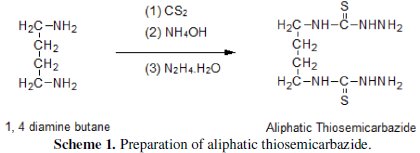
    <p><i>Stage I: preparation of aliphatic thiosemicarbazide</i></p> 

About 0.1 mole of the 1,4-diamine butane was dissolved in 50 mL of 95 % 
ethanol, and 20 mL of NH4OH were added to it. After cooling the reaction 
mixture below 30 &deg;C, 8 mL of CS2 were added slowly for 15 minutes with 
constant shaking. After complete addition of CS2, the solution was allowed to 
stand for an hour. Then about 20 mL of 50 % solution of hydrazine hydrate were 
added. The mixture was warmed gently and kept overnight. The product obtained 
was washed, filtered and recrystallized from ethanol (<a href="#s1">scheme 1</a>).</p>

    <p>&nbsp;</p>
<a name="s1">
<img src="/img/revistas/pea/v32n2/32n2a02s1.jpg">
    
<p>&nbsp;</p>

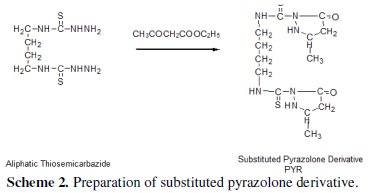
    <p><i>Stage II: preparation of substituted pyrazolone derivative</i></p> 

0.1 mole of the aliphatic thiosemicarbazide was heated with 0.1 mole of ethyl 
acetoacetate for 4-6 hours. The product obtained was isolated from ether and 
recrystallized from ethanol (<a href="#s2">scheme 2</a>).</p>

    <p>&nbsp;</p>
<a name="s2">
<img src="/img/revistas/pea/v32n2/32n2a02s2.jpg">
    
<p>&nbsp;</p>

    <p>The concentration range employed was 3 ppm to 11 ppm by weight of PYR. 
Rectangular MS (composition: 0.09% P, 0.38% Si, 0.01% Al, 0.05% Mn, 0.21% 
C, 0.05% S and the reminder Fe) strips of the working surface area 3.5 &times; 1.5 cm<sup>2</sup> 
were used for weight loss studies and for electrochemical measurement were 
used MS rods of area 1 cm<sup>2</sup> isolated with Teflon tape. 0.5 M H<sub>2</sub>SO<sub>4</sub> solution was 
prepared by the dilution of analytical grade H<sub>2</sub>SO<sub>4</sub> with double distilled water. 
The experiments were performed in 0.5 M H<sub>2</sub>SO<sub>4</sub> without and with the presence 
of the inhibitor following the ASTM Standard procedure [25].</p>


    <p><b><i>Methods used for corrosion study</i></b></p>

    ]]></body>
<body><![CDATA[<p><i>Weight loss studies</i></p>

    <p>Weight loss measurements were carried out by weighing the MS plates in 
triplicate before and after complete immersion in 100 mL of acid solution for 3 
hours in the absence and presence of inhibitors of various concentrations. From 
the initial and final weight of the plate, the weight loss was calculated from 
which the degree of coverage (&theta;), inhibition efficiency (&eta;<sub>W</sub> %), corrosion rate 
were calculated. The same procedure was carried out at different elevated 
temperatures (313 K, 323 K, 333 K and 343 K) using a thermostat to study the 
influence of temperature on the inhibitive effect of PYR.</p>


    <p><i>Electrochemical methods</i></p>

    <p>Electrochemical Impedance Spectroscopy (EIS) and potentiodynamic 
polarization were conducted in an electrochemical measurement unit 
(COMPACT STAT 10V; 30 Ma, IVIUM Model Parstat 2723, Advanced 
electrochemical system) to study the electrochemical behaviour of corrosion 
inhibition of PYR. The EIS measurements were made over a frequency range of 
10 KHz to 0.01 MHz with signal amplitude of 25 mV. The Tafel polarization 
measurements were made after EIS for a potential range of -100 mV to +100 mV 
with respect to open circuit potential, at a scan rate of 1.66 mV/sec. The I<sub>corr</sub>, 
E<sub>corr</sub>, R<sub>ct</sub>C<sub>dl</sub>and the Tafel slopes values were obtained from the data using the 
corresponding ''Corr view'' and ''Z view'' Software from which the 
corresponding inhibition efficiency &eta;<sub>P</sub> % and &eta;<sub>R<sub>ct</sub></sub>% were calculated 
electrochemically.</p>


    <p><i>Surface morphology</i></p>

    <p>The surface morphology of the exposed metal was studied using a Scanning 
Electron Microscope (SEM) in the absence and presence of the PYR. The SEM 
instrument used for analysis was JEOL made JSM 6390 model. The MS plates 
were immersed in a blank 0.5 M H<sub>2</sub>SO<sub>4</sub> as well as in 11 ppm inhibited acid 
solution for 3 hours. Then, the plates were removed, rinsed with distilled water 
and air dried and the surface morphology was studied.</p>


    <p><i>Quantum chemical studies</i></p>

    <p>Theoretical calculations for the &eta; 
% of PYR in acid media were carried out using 
MOPAC Software. The quantum chemical parameters were computed for two 
different Hamiltonians, namely, Parametric Method 6 (PM6) and Parametric 
Method 7 (PM7). The optimized molecular structures and HOMO surfaces were 
visualized using chemcraft. Some electronic properties such as Energy of the 
Highest Occupied Molecular Orbital (E<sub>HOMO</sub>), Energy of the Lowest Unoccupied 
Molecular Orbital (E<sub>LUMO</sub>), Energy Gap (&Delta;E) between LUMO and HOMO, 
ionization potential, hardness and softness and electronegativity on the backbone 
of the atoms for PYR molecules were determined.</p>


    <p>&nbsp;</p>
    <p><b>Results and discussion</b></p>

    ]]></body>
<body><![CDATA[<p><b><i>Weight loss studies</i></b></p>

    <p><i>Effect of concentration of the inhibitor on inhibition efficiency</i></p>

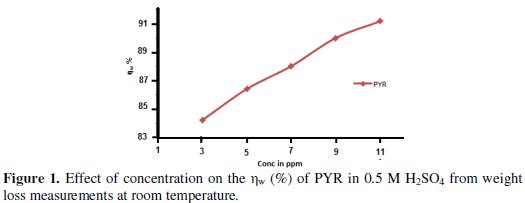
    <p><a href="#f1">Fig. 1</a> gives the variation of inhibition efficiency with inhibitor concentration of 
mild steel in 0.5 M H<sub>2</sub>SO<sub>4</sub> solution containing PYR at room temperature.</p>

    <p>&nbsp;</p>
<a name="f1">
<img src="/img/revistas/pea/v32n2/32n2a02f1.jpg">
    
<p>&nbsp;</p>

    <p>It has been observed that there is a decrease in the loss in weight of MS plates with 
increasing the concentration of the inhibitor. This behaviour can be attributed to 
the increase in the number of adsorbed PYR molecules on MS surface via the 
lone pair of electrons on the hetero atoms (O, N &amp; S), blocking the active sites of 
acid attack and thereby protecting the metal from corrosion [26]. Thus it has been 
concluded that the corrosion inhibition of these compounds is due to the presence 
of heteroatoms (O, N, S). A maximum efficiency of 91.17% was obtained at 11 
ppm for 3 h immersion period.</p>


    <p><i>Effect of temperature</i></p>

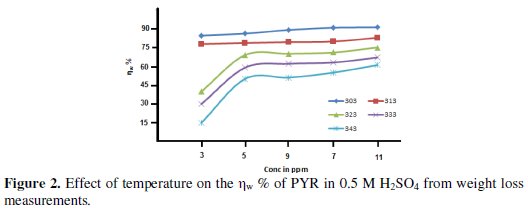
    <p>The effect of temperature on the corrosion behaviour of mild steel in acid 
medium in the presence of various concentrations of PYR is investigated by 
weight loss trends in the temperature range 303 - 343 K and the results are 
depicted in <a href="#f2">Fig. 2</a>.</p>

    <p>&nbsp;</p>
<a name="f2">
<img src="/img/revistas/pea/v32n2/32n2a02f2.jpg">
    
<p>&nbsp;</p>

    ]]></body>
<body><![CDATA[<p>As stays evident from the figure, the &eta;<sub>W</sub> % of PYR is inversely 
proportional to the temperature. This may be explained as follows: adsorption 
and desorption of the inhibitor molecule continuously occur at the metal surface 
and the equilibrium exists between these two processes at a particular 
temperature. With the increase of temperature, this equilibrium is shifted, leading 
to higher desorption rate than adsorption until equilibrium is again established at 
different value. This explains the low inhibition efficiency at higher temperature 
[27]. Thus, increase in temperature decreases the inhibition process and the 
highest &eta;<sub>W</sub> % obtained is reached at 303 K for 11 ppm which is to be 91.17% in 
0.5 M H<sub>2</sub>SO<sub>4</sub> medium.</p>


    <p><i>Adsorption isotherms</i></p>

    <p>The interaction between the PYR and the MS surface can be described by the 
adsorption isotherms which help in determining the mechanism of the organo 
electrochemical reaction [28]. The most frequently used isotherms are 
Langmuir, Frumkin, Temkin, Flory-Huggins, Freundlich, Dhar-Flory-Huggin, 
El-Awady, Bockris-Swinkels.</p>

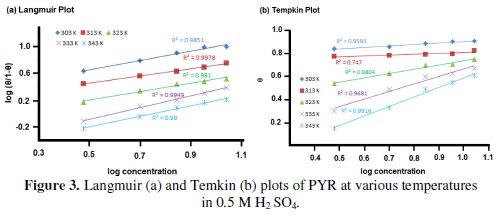
    <p>In this study, Langmuir and Temkin isotherms were found to be suitable for the 
experimental findings. Langmuir adsorption equation relates the degree of the 
surface coverage to the concentration of the inhibitor according to <a href="#e1">equation (1)</a></p>

    <p>&nbsp;</p>
<a name="e1">
<img src="/img/revistas/pea/v32n2/32n2a02e1.jpg">
    
<p>&nbsp;</p>

    <p>Temkin isotherm is formulated as in <a href="#e2">equation (2)</a></p>

    <p>&nbsp;</p>
<a name="e2">
<img src="/img/revistas/pea/v32n2/32n2a02e2.jpg">
    
<p>&nbsp;</p>

    <p>where C is the inhibitor concentration, <i>k</i> the adsorption equilibrium 
constant and &theta; is the surface coverage calculated from weight loss measurements for various 
concentrations at different temperature (<a href="#f3">Fig. 3</a>).</p>

    ]]></body>
<body><![CDATA[<p>&nbsp;</p>
<a name="f3">
<img src="/img/revistas/pea/v32n2/32n2a02f3.jpg">
    
<p>&nbsp;</p>

    <p>The values of R<sup>2</sup> were 
very close to unity indicating strong adherence of adsorption obeying the 
Langmuir and Temkin adsorption isotherms. The fit of the experimental data to 
these isotherms provides evidence for the role of adsorption in the observed 
inhibitive effect of PYR.</p>


    <p><i>Kinetic parameters</i></p>

    <p>The kinetic parameter of the system under consideration was evaluated from 
weight loss measurements at different temperatures. Activation energy (Ea) of 
corrosion reaction was calculated from the Arrhenius equation</p>

    <p>&nbsp;</p>
<a name="e3">
<img src="/img/revistas/pea/v32n2/32n2a02e3.jpg">
    
<p>&nbsp;</p>

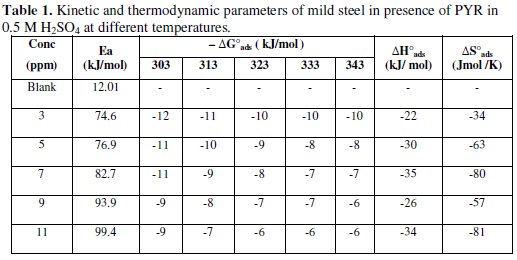
    <p>The plot of log corrosion rate against 1/T gave straight lines from which Ea was 
calculated and tabulated in <a href="#t1">Table 1</a>.</p>

    <p>&nbsp;</p>
<a name="t1">
<img src="/img/revistas/pea/v32n2/32n2a02t1.jpg">
    
<p>&nbsp;</p>

    ]]></body>
<body><![CDATA[<p>From the table it is apparent that the 
activation energy (Ea) of MS in 0.5 M H<sub>2</sub>SO<sub>4</sub> is only 12.01 kJ/mol, but in the 
presence of PYR molecules, higher activation energies are observed. The 
increase in Ea is proportional to the inhibitor concentration. It is also indicated 
that the whole process is controlled by surface reaction as the energy of 
activation for the corrosion process is over 20 kJ/mol [29]. This means that the 
adsorption of PYR on MS surface leads to the formation of a barrier layer that 
retards the metal activity in the electrochemical reactions of corrosion. Szauer 
and Brand explained that the increase in activation energy can be attributed to an 
appreciable decrease in the adsorption of the inhibitor on the MS with increase in 
the temperature and thE<sub>corr</sub>esponding increase in corrosion rate noted is due to 
the fact that greater area of metal is exposed to the acid media.</p>


    <p><i>Thermodynamic parameters</i></p>

    <p>Thermodynamic parameters such as &Delta;G&deg;<sub>ads</sub>, &Delta;H&deg;<sub>ads</sub> and &Delta;S&deg;<sub>ads</sub> were calculated 
from the temperature study results. The Gibbs free energy of adsorption &Delta;G&deg;<sub>ads</sub> at 
different temperature was derived from the Langmuir plot using the relationship [30]</p>

    <p>&nbsp;</p>
<a name="e4">
<img src="/img/revistas/pea/v32n2/32n2a02e4.jpg">
    
<p>&nbsp;</p>
<a name="e5">
<img src="/img/revistas/pea/v32n2/32n2a02e5.jpg">
    
<p>&nbsp;</p>

    <p>The enthalpy of adsorption &Delta;H&deg;<sub>ads</sub> and entropy of adsorption &Delta;S&deg;<sub>ads</sub> were obtained 
from the slope and intercept of the plot of &Delta;G&deg;<sub>ads</sub> against T according to the basic 
thermodynamic equation:</p>

    <p>&nbsp;</p>
<a name="e6">
<img src="/img/revistas/pea/v32n2/32n2a02e6.jpg">
    
<p>&nbsp;</p>

    <p>and the values are tabulated in <a href="#t1">Table 1</a>.</p>

    ]]></body>
<body><![CDATA[<p>Generally, the values of &Delta;G&deg;<sub>ads</sub> up to -20 kJ/mol are consistent with electrostatic 
interaction between the charged molecules and the charged metal surface 
(physical adsorption), while those more negative than -40 kJ/mol involve charge 
sharing or transfer from the inhibitor molecule to the metal surface 
(chemisorption). The calculated &Delta;G&deg;<sub>ads</sub> values for PYR in 0.5 M H<sub>2</sub>SO<sub>4</sub> are less 
than -20 kJ/mol, indicating that PYR is physically adsorbed on the metal surface. 
The negative value of &Delta;G&deg;<sub>ads</sub> shows a strong interaction of PYR molecules and 
spontaneous adsorption on the MS surface.</p>

    <p>The negative sign of &Delta;H&deg;<sub>ads</sub> indicates that the spontaneous adsorption process is 
exothermic in nature. Generally, an exothermic adsorption process signifies 
either physisorption or chemisorption, while an endothermic process is attributed 
to chemisorption [31]. Typically, the enthalpy of physisorption is lower than -41 
kJ/mol, while the enthalpy of chemisorption approaches 100 kJ/mol. In the 
present study, the absolute value of enthalpy is in the range -20 to -35 kJ/mol 
suggesting physical adsorption.</p>

    <p>The &Delta;S&deg;<sub>ads</sub> values in the presence of inhibitor are large and negative meaning a 
decrease in disordering on going from reactants to the metal adsorbed species.</p>


    <p><b><i>Electrochemical studies</i></b></p>

    <p><i>Electrochemical impedance spectroscopy studies</i></p>

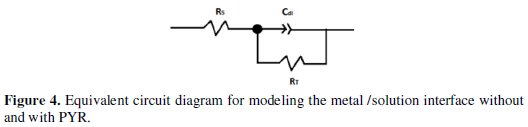
    <p>To determine the impedance parameters of PYR in these solutions, the measured 
impedance data were analyzed based on the equivalent circuit given in <a href="#f4">Fig. 4</a>.</p>

    <p>&nbsp;</p>
<a name="f4">
<img src="/img/revistas/pea/v32n2/32n2a02f4.jpg">
    
<p>&nbsp;</p>

    <p>The circuit consists of the double layer capacitance (C<sub>dl</sub>) in parallel to the charge 
transfer resistance (R<sub>ct</sub>). To obtain C<sub>dl</sub>, the frequency (f<sub>max</sub>) at which the 
imaginary component of the impedance is maximal was found and used in 
<a href="#e7">equation (7)</a>:</p>

    <p>&nbsp;</p>
<a name="e7">
<img src="/img/revistas/pea/v32n2/32n2a02e7.jpg">
    
]]></body>
<body><![CDATA[<p>&nbsp;</p>

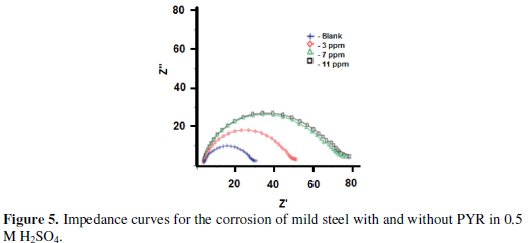
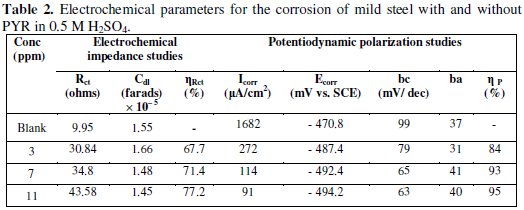
    <p>The inhibition efficiency of PYR was evaluated by R<sub>ct</sub>, C<sub>dl</sub> and maximum phase 
angle (&theta;max) of the impedance. The existence of semicircle in the Nyquist plot 
(<a href="#f5">Fig. 5</a>) indicates that the corrosion of mild steel in presence of PYR is mainly 
controlled by a charge transfer process.</p>

    <p>&nbsp;</p>
<a name="f5">
<img src="/img/revistas/pea/v32n2/32n2a02f5.jpg">
    
<p>&nbsp;</p>

    <p>The more densely packed the layer of the 
inhibitor, larger is the diameter of the semicircle in the Nyquist plot which results 
in higher R<sub>ct</sub>and lower C<sub>dl</sub>values. Almost there was a gradual increase in the 
diameter of each semicircle of the Nyquist plot with increase in the concentration 
from 3 to 11 ppm. Results of the present work (<a href="#t2">Table 2</a>) showed that the values 
of R<sub>ct</sub>increase with increasing PYR concentration, while the C<sub>dl</sub> values tend to 
decrease.</p>

    <p>&nbsp;</p>
<a name="t2">
<img src="/img/revistas/pea/v32n2/32n2a02t2.jpg">
    
<p>&nbsp;</p>

    <p>The double layer between the charged metal surface and the solution is 
considered as an electrical capacitor. The adsorption of PYR on the electrode 
surface decreases its electrical capacity which is attributed to the formation of a 
protective layer on the electrode surface. This indicates that the inhibitor does not 
alter the electro chemical reaction responsible for corrosion, but inhibits 
corrosion primarily through its adsorption on the metal surface [32]. The 
thickness of the protective layer increases with increase in the concentration of 
the inhibitor as more PYR molecule get electrostatically adsorbed on the metal 
surface resulting in a noticeable decrease in the C<sub>dl</sub>. This trend is in accordance 
with the Helmholtz model given by <a href="#e8">equation (8)</a>:</p>

    <p>&nbsp;</p>
<a name="e8">
<img src="/img/revistas/pea/v32n2/32n2a02e8.jpg">
    
<p>&nbsp;</p>

    ]]></body>
<body><![CDATA[<p>where d is the thickness of the protective layer, &epsilon; the dielectric constant of the 
medium, &epsilon;&deg; the vacuum permittivity and A is the effective surface area of the 
electrode.</p>

    <p>The R<sub>ct</sub> values were used to calculate the inhibition efficiency of PYR at different 
concentrations using <a href="#e9">equation (9)</a></p>

    <p>&nbsp;</p>
<a name="e9">
<img src="/img/revistas/pea/v32n2/32n2a02e9.jpg">
    
<p>&nbsp;</p>

    <p>where R&deg;<sub>ct</sub> and R<sub>ct</sub> are the charge transfer resistance for uninhibited and inhibited 
solutions, respectively. It is apparent that the inhibition efficiency increases with 
increasing the concentration of the inhibitor. The results obtained from 
impedance are comparable and runs parallel with those obtained from 
potentiodynamic polarization and weight loss measurements [33].</p>


    <p><i>Potentiodynamic polarization studies</i></p>

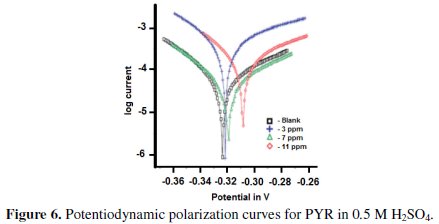
    <p>Potentiodynamic polarization curves for MS in acid medium without and with 
different concentrations of the PYR are shown in <a href="#f6">Fig. 6</a>.</p>

    <p>&nbsp;</p>
<a name="f6">
<img src="/img/revistas/pea/v32n2/32n2a02f6.jpg">
    
<p>&nbsp;</p>

    <p>the corrosion kinetic 
parameters such as E<sub>corr</sub>, I<sub>corr</sub>, b<sub>c</sub>, b<sub>a</sub> 
and &eta;<sub>P</sub> % obtained from potentiodynamic 
polarization studies are listed in <a href="#t2">Table 2</a>. the corrosion current density values 
decrease from 1685 &mu;A/cm<sup>2</sup> to 91 &mu;A/cm<sup>2</sup> for the addition of 11 ppm of PYR 
resulting in 95% of inhibition efficiency. The increase in the inhibitor 
concentration decreases the I<sub>corr</sub> values. E<sub>corr</sub>, b<sub>a</sub> and b<sub>c</sub> values do not change 
appreciably with the addition of the inhibitor, indicating that the inhibitor is not 
interfering with the anodic dissolution or cathodic hydrogen evolution reaction 
independently but acts as a mixed type of inhibitor. The above results signify that 
the inhibition mechanism occurs by simply blocking the available anodic and 
cathodic sites on the MS surface [34].</p>


    ]]></body>
<body><![CDATA[<p><b><i>Surface morphology</i></b></p>

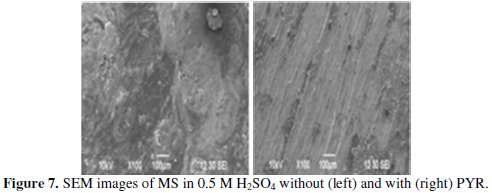
    <p><a href="#f7">Fig. 7</a> shows the SEM photograph of the steel surface in uninhibited and 
inhibited solution in 0.5 M H<sub>2</sub>SO<sub>4</sub>.</p>

    <p>&nbsp;</p>
<a name="f7">
<img src="/img/revistas/pea/v32n2/32n2a02f7.jpg">
    
<p>&nbsp;</p>

    <p>The SEM photographs of the uninhibited MS 
sample showed large pit and crevices. These pits and crevices were developed 
during the corrosion of mild steel in acid medium. In <a href="#f7">Fig. 7b</a> the sample did not 
show any pits or crevices in highly acidic medium containing 11 ppm of PYR for 
the same immersion period. A smoother surface is seen in the presence of PYR 
of 11 ppm concentration in comparison with the blank [35]. Thus PYR has a 
stronger adherence towards the metal surface and it is resistant to corrosion in 
acidic medium. Moreover, this indicates the formation of a barrier coating of 
PYR molecule on the metal surface.</p>


    <p><b><i>Quantum chemical studies</i></b></p>

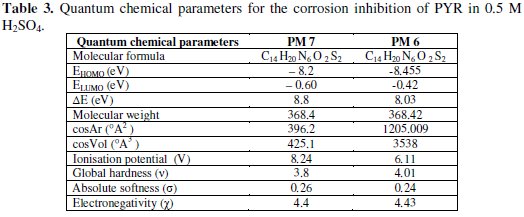
    <p>Quantum chemical study can be used to obtain information about the electronic 
interactions of the PYR molecules with the metal surface and pre-selection of 
new inhibitors on the basis of empirical knowledge [36]. The study reports the 
correlation between the observed inhibition efficiency of PYR used as corrosion 
inhibitor with its calculated quantum chemical parameters (<a href="#t3">Table 3</a>).</p>

    <p>&nbsp;</p>
<a name="t3">
<img src="/img/revistas/pea/v32n2/32n2a02t3.jpg">
    
<p>&nbsp;</p>

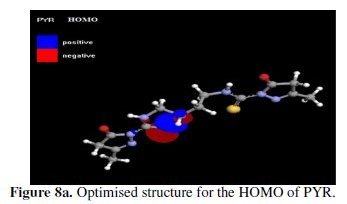
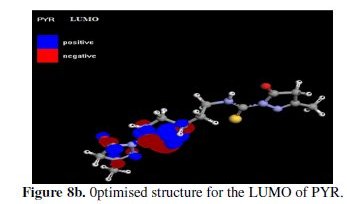
    <p><a href="#f8a">Fig. 8a</a> and <a href="#f8b">8b</a> shows the optimized geometry, HOMO density distribution and 
LUMO density distribution for PYR.</p>

    ]]></body>
<body><![CDATA[<p>&nbsp;</p>
<a name="f8a">
<img src="/img/revistas/pea/v32n2/32n2a02f8a.jpg">
    
<p>&nbsp;</p>
<a name="f8b">
<img src="/img/revistas/pea/v32n2/32n2a02f8b.jpg">
    
<p>&nbsp;</p>

    <p>The inhibitor layer has been related to the 
electronic structure of the molecule. The charge and orientation of the inhibitor 
molecule at the metal surface help in predicting the adsorption centre of the 
inhibitor molecule [37].</p>


    <p><i>Frontier molecular orbital energies (E<sub>HOMO</sub> and E<sub>LUMO</sub>)</i></p>

    <p>The frontier molecules orbital energies (i.e.), E<sub>HOMO</sub> and E<sub>LUMO</sub>, are significant 
parameters for the prediction of the reactivity of a chemical species. E<sub>HOMO</sub> is 
associated with the electron donating ability of a molecule as the E<sub>LUMO</sub> indicates 
the ability of the molecule to accept electrons [38-40]. The increasing values of 
E<sub>HOMO</sub> facilitate the adsorption of the PYR on MS surface as the E<sub>LUMO</sub> decreases 
in a similar order. Smaller the &Delta;E value greater is the inhibitive action. Here the 
lower value of &Delta;E also agrees with the excellent inhibition efficiency of PYR on 
MS surface in 0.5 M H<sub>2</sub>SO<sub>4</sub>.</p>


    <p><i>Global hardness and absolute softness</i></p>

    <p>Literature reveals that the larger energy gap indicates the low reactivity as the 
energy gap is related to the softness and hardness of a molecule. A soft molecule 
is more reactive than a hard molecule. The low value of absolute softness (&sigma;) for 
PYR suggests it to be a strong inhibitor for MS surface [41].</p>


    <p><i>Electronegativity</i></p>

    <p>Electronegativity (&chi;) is a chemical property that describes the ability of a 
molecule to attract electrons towards itself in a covalent bond. The result deduced 
indicates that the electron flow will happen from the molecule with the low 
electronegativity towards that of a higher value. The best inhibitor of PYR is 
attributed to its low electronegativity.</p>

    ]]></body>
<body><![CDATA[<p>The inhibitor efficiency increases as the molecular weight, molecular volume and 
molecular area of the molecules increase, due to the increase of the contact area 
between the molecule and the surface [42-46]. Small ionization energy indicates 
high reactivity of the atoms and molecules. Hereby, the theoretical values also 
justify the experimental results.</p>


    <p><b><i>Mechanism of inhibition</i></b></p>

    <p>Corrosion protection of mild steel in 0.5 M H<sub>2</sub>SO<sub>4</sub> solution by PYR can be 
explained on the basis of molecular adsorption. Electrochemical and SEM 
analysis clearly reveals the formation of a protective barrier of PYR molecules 
which are strongly adsorbed on the mild steel surface. Electro chemical results 
showed that PYR protects MS from corrosion by controlling both the anodic and 
cathodic reactions. The adsorption on the anodic sites occurs through the lone 
pair of electrons on the hetero atoms thereby decreasing the anodic dissolution of 
metal by interacting with the empty d orbitals of the metal. In acidic medium, 
the PYR molecules exist as protonated species. Iron in acid medium is negatively 
charged and the existence of protonated species acts as anchoring site which can 
adsorb on the cathodic sites on the metal thereby reducing the hydrogen 
evolution [47-50]. Moreover, from the HOMO structure, the electro donating 
ability of the compound is localized on the nitrogen atoms which can be 
protonated in acid medium. These sites are the preferred sites of absorption on 
the metal surface. Thus theoretical studies also confirm the experimental results.</p>


    <p>&nbsp;</p>
    <p><b>Conclusion</b></p>

    <p>The following conclusions are derived from the present work on PYR as 
corrosion inhibitor for mild steel in 0.5 M H<sub>2</sub>SO<sub>4</sub> over certain range of 
concentration at various temperatures by non-electro chemical, electro chemical 
and quantum chemical studies.</p>

    <p>&bull; The inhibition efficiency increases with increase in the concentration of these 
inhibitors but decreases with rise in temperature. The inhibitive action of PYR 
is due to the presence of heteroatoms (O, N, S).</p>

    <p>&bull; The adsorption of PYR on the metal surface follows Langmuir and Temkin 
adsorption isotherms. The phenomenon of physisorption is proposed from the 
calculated thermodynamic parameters although the values are slightly 
intermediate.</p>

    <p>&bull; The activation energy (Ea) is higher for inhibited acids than for the uninhibited 
acids confirming that the studied pyrazolone derivative is a good inhibitor.</p>

    <p>&bull; The Tafel constants obtained from potentiodynamic polarization curves indicate 
that PYR is of mixed type inhibitor.</p>

    ]]></body>
<body><![CDATA[<p>&bull; The SEM results confirm the presence of a protective surface layer over the MS 
surface.</p>

    <p>&bull; Theoretical findings reveal a good prediction of the inhibition efficiency which 
co-relates with the experimental results.</p>

    <p>Thus, the conclusion from all the carried out studies, i.e., weight loss 
measurement, thermodynamic value, activation energy, electro chemical 
parameters, SEM and quantum chemical investigation, clearly affirm the physical 
adsorption of PYR on the MS surface. The comprehensive discourse presented 
concludes that the pyrazolone derivatives fulfil the basic requirements for 
consideration as an efficient corrosion inhibitor.</p>


    <p>&nbsp;</p>
    <p><b>References</b></p>

    <!-- ref --><p>1. Sykes JM. Br Corros J. 1990;25:175.    &nbsp;&nbsp;&nbsp;&nbsp;&nbsp;&nbsp;&nbsp;&nbsp;[&#160;<a href="javascript:void(0);" onclick="javascript: window.open('/scielo.php?script=sci_nlinks&ref=000148&pid=S0872-1904201400020000200001&lng=','','width=640,height=500,resizable=yes,scrollbars=1,menubar=yes,');">Links</a>&#160;]<!-- end-ref --> </p>

    <!-- ref --><p>2. Nuynth N, Bottle SE, Notoya T, et al. Corros Sci. 2002;44:2583.    &nbsp;&nbsp;&nbsp;&nbsp;&nbsp;&nbsp;&nbsp;&nbsp;[&#160;<a href="javascript:void(0);" onclick="javascript: window.open('/scielo.php?script=sci_nlinks&ref=000150&pid=S0872-1904201400020000200002&lng=','','width=640,height=500,resizable=yes,scrollbars=1,menubar=yes,');">Links</a>&#160;]<!-- end-ref --></p>

    <!-- ref --><p>3. Ozcan M, Dehri I, Erbil M. Appl Surf Sci. 2004;236:155.    &nbsp;&nbsp;&nbsp;&nbsp;&nbsp;&nbsp;&nbsp;&nbsp;[&#160;<a href="javascript:void(0);" onclick="javascript: window.open('/scielo.php?script=sci_nlinks&ref=000152&pid=S0872-1904201400020000200003&lng=','','width=640,height=500,resizable=yes,scrollbars=1,menubar=yes,');">Links</a>&#160;]<!-- end-ref --></p>

    <!-- ref --><p>4. Wong HI, Fan I, Zheng J. Mater Chem Phys. 2004;77:655.    &nbsp;&nbsp;&nbsp;&nbsp;&nbsp;&nbsp;&nbsp;&nbsp;[&#160;<a href="javascript:void(0);" onclick="javascript: window.open('/scielo.php?script=sci_nlinks&ref=000154&pid=S0872-1904201400020000200004&lng=','','width=640,height=500,resizable=yes,scrollbars=1,menubar=yes,');">Links</a>&#160;]<!-- end-ref --></p>

    <!-- ref --><p>5. Larabi L, Harek Y, Traisnel M, et al. J Appl Electrochem. 2004;34:833.    &nbsp;&nbsp;&nbsp;&nbsp;&nbsp;&nbsp;&nbsp;&nbsp;[&#160;<a href="javascript:void(0);" onclick="javascript: window.open('/scielo.php?script=sci_nlinks&ref=000156&pid=S0872-1904201400020000200005&lng=','','width=640,height=500,resizable=yes,scrollbars=1,menubar=yes,');">Links</a>&#160;]<!-- end-ref --></p>

    <!-- ref --><p>6. Khaled KF. Appl Surf Sci. 2004;230:307.    &nbsp;&nbsp;&nbsp;&nbsp;&nbsp;&nbsp;&nbsp;&nbsp;[&#160;<a href="javascript:void(0);" onclick="javascript: window.open('/scielo.php?script=sci_nlinks&ref=000158&pid=S0872-1904201400020000200006&lng=','','width=640,height=500,resizable=yes,scrollbars=1,menubar=yes,');">Links</a>&#160;]<!-- end-ref --></p>

    <!-- ref --><p>7. Herek Y, Larabi L. Kem Ind. 2004;53:55.    &nbsp;&nbsp;&nbsp;&nbsp;&nbsp;&nbsp;&nbsp;&nbsp;[&#160;<a href="javascript:void(0);" onclick="javascript: window.open('/scielo.php?script=sci_nlinks&ref=000160&pid=S0872-1904201400020000200007&lng=','','width=640,height=500,resizable=yes,scrollbars=1,menubar=yes,');">Links</a>&#160;]<!-- end-ref --></p>

    <!-- ref --><p>8. Babic K, Samardzija, Khaled KF, et al. Appl Surf Sci. 2005;240:327.    &nbsp;&nbsp;&nbsp;&nbsp;&nbsp;&nbsp;&nbsp;&nbsp;[&#160;<a href="javascript:void(0);" onclick="javascript: window.open('/scielo.php?script=sci_nlinks&ref=000162&pid=S0872-1904201400020000200008&lng=','','width=640,height=500,resizable=yes,scrollbars=1,menubar=yes,');">Links</a>&#160;]<!-- end-ref --></p>

    <!-- ref --><p>9. Frignami A, Monticelli C, Brunoro G, et al. Br Corros J. 1987;22:103.    &nbsp;&nbsp;&nbsp;&nbsp;&nbsp;&nbsp;&nbsp;&nbsp;[&#160;<a href="javascript:void(0);" onclick="javascript: window.open('/scielo.php?script=sci_nlinks&ref=000164&pid=S0872-1904201400020000200009&lng=','','width=640,height=500,resizable=yes,scrollbars=1,menubar=yes,');">Links</a>&#160;]<!-- end-ref --></p>

    <!-- ref --><p>10. Chetouani A, Hammouti B, Aounti A, et al. Prog Org Coat. 2002;45:373.    &nbsp;&nbsp;&nbsp;&nbsp;&nbsp;&nbsp;&nbsp;&nbsp;[&#160;<a href="javascript:void(0);" onclick="javascript: window.open('/scielo.php?script=sci_nlinks&ref=000166&pid=S0872-1904201400020000200010&lng=','','width=640,height=500,resizable=yes,scrollbars=1,menubar=yes,');">Links</a>&#160;]<!-- end-ref --></p>

    <!-- ref --><p>11. Benerjee G, Malhotra SN. Corros. 1992;48:10.    &nbsp;&nbsp;&nbsp;&nbsp;&nbsp;&nbsp;&nbsp;&nbsp;[&#160;<a href="javascript:void(0);" onclick="javascript: window.open('/scielo.php?script=sci_nlinks&ref=000168&pid=S0872-1904201400020000200011&lng=','','width=640,height=500,resizable=yes,scrollbars=1,menubar=yes,');">Links</a>&#160;]<!-- end-ref --></p>

    <!-- ref --><p>12. El-Sayed A. J Appl Electrochem. 1997;27:193.    &nbsp;&nbsp;&nbsp;&nbsp;&nbsp;&nbsp;&nbsp;&nbsp;[&#160;<a href="javascript:void(0);" onclick="javascript: window.open('/scielo.php?script=sci_nlinks&ref=000170&pid=S0872-1904201400020000200012&lng=','','width=640,height=500,resizable=yes,scrollbars=1,menubar=yes,');">Links</a>&#160;]<!-- end-ref --></p>

    <!-- ref --><p>13. Rengamani S, Muralidharan S, Kulandainathan MA, et al. J Appl Electrochem. 1994;24:355.    &nbsp;&nbsp;&nbsp;&nbsp;&nbsp;&nbsp;&nbsp;&nbsp;[&#160;<a href="javascript:void(0);" onclick="javascript: window.open('/scielo.php?script=sci_nlinks&ref=000172&pid=S0872-1904201400020000200013&lng=','','width=640,height=500,resizable=yes,scrollbars=1,menubar=yes,');">Links</a>&#160;]<!-- end-ref --></p>

    <!-- ref --><p>14. Agarwal R., Namboodhiri TKG. J Appl Electrochem. 1992;22:383.    &nbsp;&nbsp;&nbsp;&nbsp;&nbsp;&nbsp;&nbsp;&nbsp;[&#160;<a href="javascript:void(0);" onclick="javascript: window.open('/scielo.php?script=sci_nlinks&ref=000174&pid=S0872-1904201400020000200014&lng=','','width=640,height=500,resizable=yes,scrollbars=1,menubar=yes,');">Links</a>&#160;]<!-- end-ref --></p>

    <!-- ref --><p>15. Fiaud C, Harch A, Mallouh D, et al. Corros Sci. 1993;35:1437.    &nbsp;&nbsp;&nbsp;&nbsp;&nbsp;&nbsp;&nbsp;&nbsp;[&#160;<a href="javascript:void(0);" onclick="javascript: window.open('/scielo.php?script=sci_nlinks&ref=000176&pid=S0872-1904201400020000200015&lng=','','width=640,height=500,resizable=yes,scrollbars=1,menubar=yes,');">Links</a>&#160;]<!-- end-ref --></p>

    <!-- ref --><p>16. Khamis E. Corros. 1990;46:476.    &nbsp;&nbsp;&nbsp;&nbsp;&nbsp;&nbsp;&nbsp;&nbsp;[&#160;<a href="javascript:void(0);" onclick="javascript: window.open('/scielo.php?script=sci_nlinks&ref=000178&pid=S0872-1904201400020000200016&lng=','','width=640,height=500,resizable=yes,scrollbars=1,menubar=yes,');">Links</a>&#160;]<!-- end-ref --></p>

    <!-- ref --><p>17. Stupnisek-Lisac E, Podbrscek S. J Appl Electrochem. 1994;24:779.    &nbsp;&nbsp;&nbsp;&nbsp;&nbsp;&nbsp;&nbsp;&nbsp;[&#160;<a href="javascript:void(0);" onclick="javascript: window.open('/scielo.php?script=sci_nlinks&ref=000180&pid=S0872-1904201400020000200017&lng=','','width=640,height=500,resizable=yes,scrollbars=1,menubar=yes,');">Links</a>&#160;]<!-- end-ref --></p>

    <!-- ref --><p>18. Granese SL. Corros. 1988;44:322.    &nbsp;&nbsp;&nbsp;&nbsp;&nbsp;&nbsp;&nbsp;&nbsp;[&#160;<a href="javascript:void(0);" onclick="javascript: window.open('/scielo.php?script=sci_nlinks&ref=000182&pid=S0872-1904201400020000200018&lng=','','width=640,height=500,resizable=yes,scrollbars=1,menubar=yes,');">Links</a>&#160;]<!-- end-ref --></p>

    <!-- ref --><p>19. Growcock FB. Corros. 1989;45:1003.    &nbsp;&nbsp;&nbsp;&nbsp;&nbsp;&nbsp;&nbsp;&nbsp;[&#160;<a href="javascript:void(0);" onclick="javascript: window.open('/scielo.php?script=sci_nlinks&ref=000184&pid=S0872-1904201400020000200019&lng=','','width=640,height=500,resizable=yes,scrollbars=1,menubar=yes,');">Links</a>&#160;]<!-- end-ref --></p>

    <!-- ref --><p>20. Lukovis I, Shaban A, Kalman E. Corros. 1997;53:915.    &nbsp;&nbsp;&nbsp;&nbsp;&nbsp;&nbsp;&nbsp;&nbsp;[&#160;<a href="javascript:void(0);" onclick="javascript: window.open('/scielo.php?script=sci_nlinks&ref=000186&pid=S0872-1904201400020000200020&lng=','','width=640,height=500,resizable=yes,scrollbars=1,menubar=yes,');">Links</a>&#160;]<!-- end-ref --></p>

    <!-- ref --><p>21. Lukovis I, Shaban A, Kalman E. Russ J Electrochem. 2003:177.    &nbsp;&nbsp;&nbsp;&nbsp;&nbsp;&nbsp;&nbsp;&nbsp;[&#160;<a href="javascript:void(0);" onclick="javascript: window.open('/scielo.php?script=sci_nlinks&ref=000188&pid=S0872-1904201400020000200021&lng=','','width=640,height=500,resizable=yes,scrollbars=1,menubar=yes,');">Links</a>&#160;]<!-- end-ref --></p>

    <!-- ref --><p>22. Bentiss F, Lagrenee M, Vezin H, et al Corros Sci. 2003;45:371.    &nbsp;&nbsp;&nbsp;&nbsp;&nbsp;&nbsp;&nbsp;&nbsp;[&#160;<a href="javascript:void(0);" onclick="javascript: window.open('/scielo.php?script=sci_nlinks&ref=000190&pid=S0872-1904201400020000200022&lng=','','width=640,height=500,resizable=yes,scrollbars=1,menubar=yes,');">Links</a>&#160;]<!-- end-ref --></p>

    <!-- ref --><p>23. Abdel Hameed AS, Al-Shafy HI, Abul Magd AS, et al. J Mater Environ Sci. 2012;32:294-305.    &nbsp;&nbsp;&nbsp;&nbsp;&nbsp;&nbsp;&nbsp;&nbsp;[&#160;<a href="javascript:void(0);" onclick="javascript: window.open('/scielo.php?script=sci_nlinks&ref=000192&pid=S0872-1904201400020000200023&lng=','','width=640,height=500,resizable=yes,scrollbars=1,menubar=yes,');">Links</a>&#160;]<!-- end-ref --></p>

    <!-- ref --><p>24. Herrag L, Chetouani A, Elkadiri S, et al. Port Electrochim Acta. 2008;26:211.    &nbsp;&nbsp;&nbsp;&nbsp;&nbsp;&nbsp;&nbsp;&nbsp;[&#160;<a href="javascript:void(0);" onclick="javascript: window.open('/scielo.php?script=sci_nlinks&ref=000194&pid=S0872-1904201400020000200024&lng=','','width=640,height=500,resizable=yes,scrollbars=1,menubar=yes,');">Links</a>&#160;]<!-- end-ref --></p>

    <!-- ref --><p>25. ASTM - G - 12, ''Wear and Erosion: Metal Corrosion'', Annual book of ASTM standard, ASTm, West Conshohocken, PA. 1996:30-37.    &nbsp;&nbsp;&nbsp;&nbsp;&nbsp;&nbsp;&nbsp;&nbsp;[&#160;<a href="javascript:void(0);" onclick="javascript: window.open('/scielo.php?script=sci_nlinks&ref=000196&pid=S0872-1904201400020000200025&lng=','','width=640,height=500,resizable=yes,scrollbars=1,menubar=yes,');">Links</a>&#160;]<!-- end-ref --></p>

    <!-- ref --><p>26. Al-Mutairi AA, El-Baih FEM, Al-Hazimi HM. J Saudi Chem Soc. 2010;14:287.    &nbsp;&nbsp;&nbsp;&nbsp;&nbsp;&nbsp;&nbsp;&nbsp;[&#160;<a href="javascript:void(0);" onclick="javascript: window.open('/scielo.php?script=sci_nlinks&ref=000198&pid=S0872-1904201400020000200026&lng=','','width=640,height=500,resizable=yes,scrollbars=1,menubar=yes,');">Links</a>&#160;]<!-- end-ref --></p>

    <!-- ref --><p>27. Shivakumar SS, Mohana KN. Int J Electrochem Sci. 2012;7:1620.    &nbsp;&nbsp;&nbsp;&nbsp;&nbsp;&nbsp;&nbsp;&nbsp;[&#160;<a href="javascript:void(0);" onclick="javascript: window.open('/scielo.php?script=sci_nlinks&ref=000200&pid=S0872-1904201400020000200027&lng=','','width=640,height=500,resizable=yes,scrollbars=1,menubar=yes,');">Links</a>&#160;]<!-- end-ref --></p>

    <!-- ref --><p>28. Damaski BB, Petri AO, Batraktov B. Adsorption of organic compounds on electrodes. new York:Plenum Press; 1972.    &nbsp;&nbsp;&nbsp;&nbsp;&nbsp;&nbsp;&nbsp;&nbsp;[&#160;<a href="javascript:void(0);" onclick="javascript: window.open('/scielo.php?script=sci_nlinks&ref=000202&pid=S0872-1904201400020000200028&lng=','','width=640,height=500,resizable=yes,scrollbars=1,menubar=yes,');">Links</a>&#160;]<!-- end-ref --></p>

    <!-- ref --><p>29. Eddy NO, Ebenso EE, Ibok UJ. J Appl Electrochem. 2010;40:445.    &nbsp;&nbsp;&nbsp;&nbsp;&nbsp;&nbsp;&nbsp;&nbsp;[&#160;<a href="javascript:void(0);" onclick="javascript: window.open('/scielo.php?script=sci_nlinks&ref=000204&pid=S0872-1904201400020000200029&lng=','','width=640,height=500,resizable=yes,scrollbars=1,menubar=yes,');">Links</a>&#160;]<!-- end-ref --></p>

    <!-- ref --><p>30. Nalini D, Rajalakshmi R, Subhashini S. e-J Chem. 2011;8:671.    &nbsp;&nbsp;&nbsp;&nbsp;&nbsp;&nbsp;&nbsp;&nbsp;[&#160;<a href="javascript:void(0);" onclick="javascript: window.open('/scielo.php?script=sci_nlinks&ref=000206&pid=S0872-1904201400020000200030&lng=','','width=640,height=500,resizable=yes,scrollbars=1,menubar=yes,');">Links</a>&#160;]<!-- end-ref --></p>

    <!-- ref --><p>31. Firdhouse MJ, Nalini D. J Chem. 2013:9.    &nbsp;&nbsp;&nbsp;&nbsp;&nbsp;&nbsp;&nbsp;&nbsp;[&#160;<a href="javascript:void(0);" onclick="javascript: window.open('/scielo.php?script=sci_nlinks&ref=000208&pid=S0872-1904201400020000200031&lng=','','width=640,height=500,resizable=yes,scrollbars=1,menubar=yes,');">Links</a>&#160;]<!-- end-ref --></p>

    <!-- ref --><p>32. Loto RT, Loto CA, Popoola API, et al. Int J Phy Sci. 2012;7:213.    &nbsp;&nbsp;&nbsp;&nbsp;&nbsp;&nbsp;&nbsp;&nbsp;[&#160;<a href="javascript:void(0);" onclick="javascript: window.open('/scielo.php?script=sci_nlinks&ref=000210&pid=S0872-1904201400020000200032&lng=','','width=640,height=500,resizable=yes,scrollbars=1,menubar=yes,');">Links</a>&#160;]<!-- end-ref --></p>

    <!-- ref --><p>33. Alaoui LM, Hammouti B, Bellaouchou A, et al. Der Pharma Chemica. 2011;3:353.    &nbsp;&nbsp;&nbsp;&nbsp;&nbsp;&nbsp;&nbsp;&nbsp;[&#160;<a href="javascript:void(0);" onclick="javascript: window.open('/scielo.php?script=sci_nlinks&ref=000212&pid=S0872-1904201400020000200033&lng=','','width=640,height=500,resizable=yes,scrollbars=1,menubar=yes,');">Links</a>&#160;]<!-- end-ref --></p>

    <!-- ref --><p>34. Bhandari H, Srivastav R, Choudhary V, et al. Thin Solid Films. 2010;519:1031.    &nbsp;&nbsp;&nbsp;&nbsp;&nbsp;&nbsp;&nbsp;&nbsp;[&#160;<a href="javascript:void(0);" onclick="javascript: window.open('/scielo.php?script=sci_nlinks&ref=000214&pid=S0872-1904201400020000200034&lng=','','width=640,height=500,resizable=yes,scrollbars=1,menubar=yes,');">Links</a>&#160;]<!-- end-ref --></p>

    <!-- ref --><p>35. Ebenso EE, Obot IB. Int J Electrochem Sci. 2010;5:2012.    &nbsp;&nbsp;&nbsp;&nbsp;&nbsp;&nbsp;&nbsp;&nbsp;[&#160;<a href="javascript:void(0);" onclick="javascript: window.open('/scielo.php?script=sci_nlinks&ref=000216&pid=S0872-1904201400020000200035&lng=','','width=640,height=500,resizable=yes,scrollbars=1,menubar=yes,');">Links</a>&#160;]<!-- end-ref --></p>

    <!-- ref --><p>36. Eddy NO, Ebenso EE. Int J Electrochem Sci. 2010;5:731.    &nbsp;&nbsp;&nbsp;&nbsp;&nbsp;&nbsp;&nbsp;&nbsp;[&#160;<a href="javascript:void(0);" onclick="javascript: window.open('/scielo.php?script=sci_nlinks&ref=000218&pid=S0872-1904201400020000200036&lng=','','width=640,height=500,resizable=yes,scrollbars=1,menubar=yes,');">Links</a>&#160;]<!-- end-ref --></p>

    <!-- ref --><p>37. Praveen BM, Venkatesha TV. Int J Electrochem Sci. 2009;4:258.    &nbsp;&nbsp;&nbsp;&nbsp;&nbsp;&nbsp;&nbsp;&nbsp;[&#160;<a href="javascript:void(0);" onclick="javascript: window.open('/scielo.php?script=sci_nlinks&ref=000220&pid=S0872-1904201400020000200037&lng=','','width=640,height=500,resizable=yes,scrollbars=1,menubar=yes,');">Links</a>&#160;]<!-- end-ref --></p>

    <!-- ref --><p>38. Noor EA, Al-Moubaraki AH. Int J Electrochem Sci. 2008;3:806.    &nbsp;&nbsp;&nbsp;&nbsp;&nbsp;&nbsp;&nbsp;&nbsp;[&#160;<a href="javascript:void(0);" onclick="javascript: window.open('/scielo.php?script=sci_nlinks&ref=000222&pid=S0872-1904201400020000200038&lng=','','width=640,height=500,resizable=yes,scrollbars=1,menubar=yes,');">Links</a>&#160;]<!-- end-ref --></p>

    <!-- ref --><p>39. Eddy NO, Odoemelam SA, Mbaba AJ. Africa J Pure Appl Chem. 2008;2:132.    &nbsp;&nbsp;&nbsp;&nbsp;&nbsp;&nbsp;&nbsp;&nbsp;[&#160;<a href="javascript:void(0);" onclick="javascript: window.open('/scielo.php?script=sci_nlinks&ref=000224&pid=S0872-1904201400020000200039&lng=','','width=640,height=500,resizable=yes,scrollbars=1,menubar=yes,');">Links</a>&#160;]<!-- end-ref --></p>

    <!-- ref --><p>40. Laarej K, Bouachrine M, Radi S, et al. e-J Chem. 2010;7:419.    &nbsp;&nbsp;&nbsp;&nbsp;&nbsp;&nbsp;&nbsp;&nbsp;[&#160;<a href="javascript:void(0);" onclick="javascript: window.open('/scielo.php?script=sci_nlinks&ref=000226&pid=S0872-1904201400020000200040&lng=','','width=640,height=500,resizable=yes,scrollbars=1,menubar=yes,');">Links</a>&#160;]<!-- end-ref --></p>

    <p>41. Obi-Egbed NO, Obot IB, M.I. El-Khaiary MI, et al. Int J Electrochem Sci. 2011;6:5649.</p>

    <!-- ref --><p>42. Tripathi R, Chaturvedi A, Upadhayay RK. Res J Chem Sci. 2012;2:18.    &nbsp;&nbsp;&nbsp;&nbsp;&nbsp;&nbsp;&nbsp;&nbsp;[&#160;<a href="javascript:void(0);" onclick="javascript: window.open('/scielo.php?script=sci_nlinks&ref=000229&pid=S0872-1904201400020000200042&lng=','','width=640,height=500,resizable=yes,scrollbars=1,menubar=yes,');">Links</a>&#160;]<!-- end-ref --></p>

    <!-- ref --><p>43. Khaled KF. Mat Chem Phys. 2010;124:760.    &nbsp;&nbsp;&nbsp;&nbsp;&nbsp;&nbsp;&nbsp;&nbsp;[&#160;<a href="javascript:void(0);" onclick="javascript: window.open('/scielo.php?script=sci_nlinks&ref=000231&pid=S0872-1904201400020000200043&lng=','','width=640,height=500,resizable=yes,scrollbars=1,menubar=yes,');">Links</a>&#160;]<!-- end-ref --></p>

    ]]></body>
<body><![CDATA[<!-- ref --><p>44. Singh AK, Quarishi MA. Corros Sci. 2010;52:152.    &nbsp;&nbsp;&nbsp;&nbsp;&nbsp;&nbsp;&nbsp;&nbsp;[&#160;<a href="javascript:void(0);" onclick="javascript: window.open('/scielo.php?script=sci_nlinks&ref=000233&pid=S0872-1904201400020000200044&lng=','','width=640,height=500,resizable=yes,scrollbars=1,menubar=yes,');">Links</a>&#160;]<!-- end-ref --></p>

    <!-- ref --><p>45. Khaled KF. Corros Sci. 2010;52:3225.    &nbsp;&nbsp;&nbsp;&nbsp;&nbsp;&nbsp;&nbsp;&nbsp;[&#160;<a href="javascript:void(0);" onclick="javascript: window.open('/scielo.php?script=sci_nlinks&ref=000235&pid=S0872-1904201400020000200045&lng=','','width=640,height=500,resizable=yes,scrollbars=1,menubar=yes,');">Links</a>&#160;]<!-- end-ref --></p>

    <!-- ref --><p>46. Bentiss F, Labrini M, Vezin H, et al. Corros Sci. 2009;51:2165.    &nbsp;&nbsp;&nbsp;&nbsp;&nbsp;&nbsp;&nbsp;&nbsp;[&#160;<a href="javascript:void(0);" onclick="javascript: window.open('/scielo.php?script=sci_nlinks&ref=000237&pid=S0872-1904201400020000200046&lng=','','width=640,height=500,resizable=yes,scrollbars=1,menubar=yes,');">Links</a>&#160;]<!-- end-ref --></p>

    <!-- ref --><p>47. Mansfeild F. Corros. 1981;37:3001.    &nbsp;&nbsp;&nbsp;&nbsp;&nbsp;&nbsp;&nbsp;&nbsp;[&#160;<a href="javascript:void(0);" onclick="javascript: window.open('/scielo.php?script=sci_nlinks&ref=000239&pid=S0872-1904201400020000200047&lng=','','width=640,height=500,resizable=yes,scrollbars=1,menubar=yes,');">Links</a>&#160;]<!-- end-ref --></p>

    <!-- ref --><p>48. Murakawa T, Hackerman N. Corros Sci. 1964;4:387.    &nbsp;&nbsp;&nbsp;&nbsp;&nbsp;&nbsp;&nbsp;&nbsp;[&#160;<a href="javascript:void(0);" onclick="javascript: window.open('/scielo.php?script=sci_nlinks&ref=000241&pid=S0872-1904201400020000200048&lng=','','width=640,height=500,resizable=yes,scrollbars=1,menubar=yes,');">Links</a>&#160;]<!-- end-ref --></p>

    ]]></body>
<body><![CDATA[<!-- ref --><p>49. Donalhue FM, Nobe K. J Electrochem Soc. 1965;112:886.    &nbsp;&nbsp;&nbsp;&nbsp;&nbsp;&nbsp;&nbsp;&nbsp;[&#160;<a href="javascript:void(0);" onclick="javascript: window.open('/scielo.php?script=sci_nlinks&ref=000243&pid=S0872-1904201400020000200049&lng=','','width=640,height=500,resizable=yes,scrollbars=1,menubar=yes,');">Links</a>&#160;]<!-- end-ref --></p>

    <!-- ref --><p>50. Larabi L, Benali O, Mekelleche SM, et al. Appl Surf Sci. 2006;253:1371.    &nbsp;&nbsp;&nbsp;&nbsp;&nbsp;&nbsp;&nbsp;&nbsp;[&#160;<a href="javascript:void(0);" onclick="javascript: window.open('/scielo.php?script=sci_nlinks&ref=000245&pid=S0872-1904201400020000200050&lng=','','width=640,height=500,resizable=yes,scrollbars=1,menubar=yes,');">Links</a>&#160;]<!-- end-ref --></p>


    <p>&nbsp;</p>
    <p><a name=0></a><sup><a href="#top">*</a></sup>Corresponding author. E-mail address: <a href="mailto:nalinichemistry@gmail.com">nalinichemistry@gmail.com</a></p>

    <p>Received 5 December 2013; accepted 23 April 2014</p>

    <p><a href="http://www.peacta.org" target="_blank">www.peacta.org</a> </p>


     ]]></body><back>
<ref-list>
<ref id="B1">
<label>1</label><nlm-citation citation-type="journal">
<person-group person-group-type="author">
<name>
<surname><![CDATA[Sykes]]></surname>
<given-names><![CDATA[J M]]></given-names>
</name>
</person-group>
<source><![CDATA[Br Corros J]]></source>
<year>1990</year>
<volume>25</volume>
<page-range>175</page-range></nlm-citation>
</ref>
<ref id="B2">
<label>2</label><nlm-citation citation-type="journal">
<person-group person-group-type="author">
<name>
<surname><![CDATA[Nuynth]]></surname>
<given-names><![CDATA[N]]></given-names>
</name>
<name>
<surname><![CDATA[Bottle]]></surname>
<given-names><![CDATA[S E]]></given-names>
</name>
<name>
<surname><![CDATA[Notoya]]></surname>
<given-names><![CDATA[T]]></given-names>
</name>
</person-group>
<source><![CDATA[Corros Sci]]></source>
<year>2002</year>
<volume>44</volume>
<page-range>2583</page-range></nlm-citation>
</ref>
<ref id="B3">
<label>3</label><nlm-citation citation-type="journal">
<person-group person-group-type="author">
<name>
<surname><![CDATA[Ozcan]]></surname>
<given-names><![CDATA[M]]></given-names>
</name>
<name>
<surname><![CDATA[Dehri]]></surname>
<given-names><![CDATA[I]]></given-names>
</name>
<name>
<surname><![CDATA[Erbil]]></surname>
<given-names><![CDATA[M]]></given-names>
</name>
</person-group>
<source><![CDATA[Appl Surf Sci]]></source>
<year>2004</year>
<volume>236</volume>
<page-range>155</page-range></nlm-citation>
</ref>
<ref id="B4">
<label>4</label><nlm-citation citation-type="journal">
<person-group person-group-type="author">
<name>
<surname><![CDATA[Wong]]></surname>
<given-names><![CDATA[H I]]></given-names>
</name>
<name>
<surname><![CDATA[Fan]]></surname>
<given-names><![CDATA[I]]></given-names>
</name>
<name>
<surname><![CDATA[Zheng]]></surname>
<given-names><![CDATA[J]]></given-names>
</name>
</person-group>
<source><![CDATA[Mater Chem Phys]]></source>
<year>2004</year>
<volume>77</volume>
<page-range>655</page-range></nlm-citation>
</ref>
<ref id="B5">
<label>5</label><nlm-citation citation-type="journal">
<person-group person-group-type="author">
<name>
<surname><![CDATA[Larabi]]></surname>
<given-names><![CDATA[L]]></given-names>
</name>
<name>
<surname><![CDATA[Harek]]></surname>
<given-names><![CDATA[Y]]></given-names>
</name>
<name>
<surname><![CDATA[Traisnel]]></surname>
<given-names><![CDATA[M]]></given-names>
</name>
</person-group>
<source><![CDATA[J Appl Electrochem]]></source>
<year>2004</year>
<volume>34</volume>
<page-range>833</page-range></nlm-citation>
</ref>
<ref id="B6">
<label>6</label><nlm-citation citation-type="journal">
<person-group person-group-type="author">
<name>
<surname><![CDATA[Khaled]]></surname>
<given-names><![CDATA[K F]]></given-names>
</name>
</person-group>
<source><![CDATA[Appl Surf Sci]]></source>
<year>2004</year>
<volume>230</volume>
<page-range>307</page-range></nlm-citation>
</ref>
<ref id="B7">
<label>7</label><nlm-citation citation-type="journal">
<person-group person-group-type="author">
<name>
<surname><![CDATA[Herek]]></surname>
<given-names><![CDATA[Y]]></given-names>
</name>
<name>
<surname><![CDATA[Larabi]]></surname>
<given-names><![CDATA[L]]></given-names>
</name>
</person-group>
<source><![CDATA[Kem Ind]]></source>
<year>2004</year>
<volume>53</volume>
<page-range>55</page-range></nlm-citation>
</ref>
<ref id="B8">
<label>8</label><nlm-citation citation-type="journal">
<person-group person-group-type="author">
<name>
<surname><![CDATA[Babic]]></surname>
<given-names><![CDATA[K]]></given-names>
</name>
<name>
<surname><![CDATA[Samardzija]]></surname>
</name>
<name>
<surname><![CDATA[Khaled]]></surname>
<given-names><![CDATA[K F]]></given-names>
</name>
</person-group>
<source><![CDATA[Appl Surf Sci]]></source>
<year>2005</year>
<volume>240</volume>
<page-range>327</page-range></nlm-citation>
</ref>
<ref id="B9">
<label>9</label><nlm-citation citation-type="journal">
<person-group person-group-type="author">
<name>
<surname><![CDATA[Frignami]]></surname>
<given-names><![CDATA[A]]></given-names>
</name>
<name>
<surname><![CDATA[Monticelli]]></surname>
<given-names><![CDATA[C]]></given-names>
</name>
<name>
<surname><![CDATA[Brunoro]]></surname>
<given-names><![CDATA[G]]></given-names>
</name>
</person-group>
<source><![CDATA[Br Corros J]]></source>
<year>1987</year>
<volume>22</volume>
<page-range>103</page-range></nlm-citation>
</ref>
<ref id="B10">
<label>10</label><nlm-citation citation-type="journal">
<person-group person-group-type="author">
<name>
<surname><![CDATA[Chetouani]]></surname>
<given-names><![CDATA[A]]></given-names>
</name>
<name>
<surname><![CDATA[Hammouti]]></surname>
<given-names><![CDATA[B]]></given-names>
</name>
<name>
<surname><![CDATA[Aounti]]></surname>
<given-names><![CDATA[A]]></given-names>
</name>
</person-group>
<source><![CDATA[Prog Org Coat]]></source>
<year>2002</year>
<volume>45</volume>
<page-range>373</page-range></nlm-citation>
</ref>
<ref id="B11">
<label>11</label><nlm-citation citation-type="journal">
<person-group person-group-type="author">
<name>
<surname><![CDATA[Benerjee]]></surname>
<given-names><![CDATA[G]]></given-names>
</name>
<name>
<surname><![CDATA[Malhotra]]></surname>
<given-names><![CDATA[S N]]></given-names>
</name>
</person-group>
<source><![CDATA[Corros]]></source>
<year>1992</year>
<volume>48</volume>
<page-range>10</page-range></nlm-citation>
</ref>
<ref id="B12">
<label>12</label><nlm-citation citation-type="journal">
<person-group person-group-type="author">
<name>
<surname><![CDATA[El-Sayed]]></surname>
<given-names><![CDATA[A]]></given-names>
</name>
</person-group>
<source><![CDATA[J Appl Electrochem]]></source>
<year>1997</year>
<volume>27</volume>
<page-range>193</page-range></nlm-citation>
</ref>
<ref id="B13">
<label>13</label><nlm-citation citation-type="journal">
<person-group person-group-type="author">
<name>
<surname><![CDATA[Rengamani]]></surname>
<given-names><![CDATA[S]]></given-names>
</name>
<name>
<surname><![CDATA[Muralidharan]]></surname>
<given-names><![CDATA[S]]></given-names>
</name>
<name>
<surname><![CDATA[Kulandainathan]]></surname>
<given-names><![CDATA[M A]]></given-names>
</name>
</person-group>
<source><![CDATA[J Appl Electrochem]]></source>
<year>1994</year>
<volume>24</volume>
<page-range>355</page-range></nlm-citation>
</ref>
<ref id="B14">
<label>14</label><nlm-citation citation-type="journal">
<person-group person-group-type="author">
<name>
<surname><![CDATA[Agarwal]]></surname>
<given-names><![CDATA[R]]></given-names>
</name>
<name>
<surname><![CDATA[Namboodhiri]]></surname>
<given-names><![CDATA[T K G]]></given-names>
</name>
</person-group>
<source><![CDATA[J Appl Electrochem]]></source>
<year>1992</year>
<volume>22</volume>
<page-range>383</page-range></nlm-citation>
</ref>
<ref id="B15">
<label>15</label><nlm-citation citation-type="journal">
<person-group person-group-type="author">
<name>
<surname><![CDATA[Fiaud]]></surname>
<given-names><![CDATA[C]]></given-names>
</name>
<name>
<surname><![CDATA[Harch]]></surname>
<given-names><![CDATA[A]]></given-names>
</name>
<name>
<surname><![CDATA[Mallouh]]></surname>
<given-names><![CDATA[D]]></given-names>
</name>
</person-group>
<source><![CDATA[Corros Sci]]></source>
<year>1993</year>
<volume>35</volume>
<page-range>1437</page-range></nlm-citation>
</ref>
<ref id="B16">
<label>16</label><nlm-citation citation-type="journal">
<person-group person-group-type="author">
<name>
<surname><![CDATA[Khamis]]></surname>
<given-names><![CDATA[E]]></given-names>
</name>
</person-group>
<source><![CDATA[Corros]]></source>
<year>1990</year>
<volume>46</volume>
<page-range>476</page-range></nlm-citation>
</ref>
<ref id="B17">
<label>17</label><nlm-citation citation-type="journal">
<person-group person-group-type="author">
<name>
<surname><![CDATA[Stupnisek-Lisac]]></surname>
<given-names><![CDATA[E]]></given-names>
</name>
<name>
<surname><![CDATA[Podbrscek]]></surname>
<given-names><![CDATA[S]]></given-names>
</name>
</person-group>
<source><![CDATA[J Appl Electrochem]]></source>
<year>1994</year>
<volume>24</volume>
<page-range>779</page-range></nlm-citation>
</ref>
<ref id="B18">
<label>18</label><nlm-citation citation-type="journal">
<person-group person-group-type="author">
<name>
<surname><![CDATA[Granese]]></surname>
<given-names><![CDATA[S L]]></given-names>
</name>
</person-group>
<source><![CDATA[Corros]]></source>
<year>1988</year>
<volume>44</volume>
<page-range>322</page-range></nlm-citation>
</ref>
<ref id="B19">
<label>19</label><nlm-citation citation-type="journal">
<person-group person-group-type="author">
<name>
<surname><![CDATA[Growcock]]></surname>
<given-names><![CDATA[F B]]></given-names>
</name>
</person-group>
<source><![CDATA[Corros]]></source>
<year>1989</year>
<volume>45</volume>
<page-range>1003</page-range></nlm-citation>
</ref>
<ref id="B20">
<label>20</label><nlm-citation citation-type="journal">
<person-group person-group-type="author">
<name>
<surname><![CDATA[Lukovis]]></surname>
<given-names><![CDATA[I]]></given-names>
</name>
<name>
<surname><![CDATA[Shaban]]></surname>
<given-names><![CDATA[A]]></given-names>
</name>
<name>
<surname><![CDATA[Kalman]]></surname>
<given-names><![CDATA[E]]></given-names>
</name>
</person-group>
<source><![CDATA[Corros]]></source>
<year>1997</year>
<volume>53</volume>
<page-range>915</page-range></nlm-citation>
</ref>
<ref id="B21">
<label>21</label><nlm-citation citation-type="journal">
<person-group person-group-type="author">
<name>
<surname><![CDATA[Lukovis]]></surname>
<given-names><![CDATA[I]]></given-names>
</name>
<name>
<surname><![CDATA[Shaban]]></surname>
<given-names><![CDATA[A]]></given-names>
</name>
<name>
<surname><![CDATA[Kalman]]></surname>
<given-names><![CDATA[E]]></given-names>
</name>
</person-group>
<source><![CDATA[Russ J Electrochem]]></source>
<year>2003</year>
<page-range>177</page-range></nlm-citation>
</ref>
<ref id="B22">
<label>22</label><nlm-citation citation-type="journal">
<person-group person-group-type="author">
<name>
<surname><![CDATA[Bentiss]]></surname>
<given-names><![CDATA[F]]></given-names>
</name>
<name>
<surname><![CDATA[Lagrenee]]></surname>
<given-names><![CDATA[M]]></given-names>
</name>
<name>
<surname><![CDATA[Vezin]]></surname>
<given-names><![CDATA[H]]></given-names>
</name>
</person-group>
<source><![CDATA[Corros Sci]]></source>
<year>2003</year>
<volume>45</volume>
<page-range>371</page-range></nlm-citation>
</ref>
<ref id="B23">
<label>23</label><nlm-citation citation-type="journal">
<person-group person-group-type="author">
<name>
<surname><![CDATA[Abdel Hameed]]></surname>
<given-names><![CDATA[A S]]></given-names>
</name>
<name>
<surname><![CDATA[Al-Shafy]]></surname>
<given-names><![CDATA[H I]]></given-names>
</name>
<name>
<surname><![CDATA[Abul Magd]]></surname>
<given-names><![CDATA[A S]]></given-names>
</name>
</person-group>
<source><![CDATA[J Mater Environ Sci]]></source>
<year>2012</year>
<volume>32</volume>
<page-range>294</page-range></nlm-citation>
</ref>
<ref id="B24">
<label>24</label><nlm-citation citation-type="journal">
<person-group person-group-type="author">
<name>
<surname><![CDATA[Herrag]]></surname>
<given-names><![CDATA[L]]></given-names>
</name>
<name>
<surname><![CDATA[Chetouani]]></surname>
<given-names><![CDATA[A]]></given-names>
</name>
<name>
<surname><![CDATA[Elkadiri]]></surname>
<given-names><![CDATA[S]]></given-names>
</name>
</person-group>
<source><![CDATA[Port Electrochim Acta]]></source>
<year>2008</year>
<volume>26</volume>
<page-range>211</page-range></nlm-citation>
</ref>
<ref id="B25">
<label>25</label><nlm-citation citation-type="book">
<source><![CDATA[Wear and Erosion: Metal Corrosion']]></source>
<year>1996</year>
<page-range>30</page-range><publisher-loc><![CDATA[PA ]]></publisher-loc>
<publisher-name><![CDATA[West Conshohocken]]></publisher-name>
</nlm-citation>
</ref>
<ref id="B26">
<label>26</label><nlm-citation citation-type="journal">
<person-group person-group-type="author">
<name>
<surname><![CDATA[Al-Mutairi]]></surname>
<given-names><![CDATA[A A]]></given-names>
</name>
<name>
<surname><![CDATA[El-Baih]]></surname>
<given-names><![CDATA[F E M]]></given-names>
</name>
<name>
<surname><![CDATA[Al-Hazimi]]></surname>
<given-names><![CDATA[H M]]></given-names>
</name>
</person-group>
<source><![CDATA[J Saudi Chem Soc]]></source>
<year>2010</year>
<volume>14</volume>
<page-range>287</page-range></nlm-citation>
</ref>
<ref id="B27">
<label>27</label><nlm-citation citation-type="journal">
<person-group person-group-type="author">
<name>
<surname><![CDATA[Shivakumar]]></surname>
<given-names><![CDATA[S S]]></given-names>
</name>
<name>
<surname><![CDATA[Mohana]]></surname>
<given-names><![CDATA[K N]]></given-names>
</name>
</person-group>
<source><![CDATA[Int J Electrochem Sci]]></source>
<year>2012</year>
<volume>7</volume>
<page-range>1620</page-range></nlm-citation>
</ref>
<ref id="B28">
<label>28</label><nlm-citation citation-type="book">
<person-group person-group-type="author">
<name>
<surname><![CDATA[Damaski]]></surname>
<given-names><![CDATA[B B]]></given-names>
</name>
<name>
<surname><![CDATA[Petri]]></surname>
<given-names><![CDATA[A O]]></given-names>
</name>
<name>
<surname><![CDATA[Batraktov]]></surname>
<given-names><![CDATA[B]]></given-names>
</name>
</person-group>
<source><![CDATA[Adsorption of organic compounds on electrodes]]></source>
<year>1972</year>
<publisher-loc><![CDATA[New York ]]></publisher-loc>
<publisher-name><![CDATA[Plenum Press]]></publisher-name>
</nlm-citation>
</ref>
<ref id="B29">
<label>29</label><nlm-citation citation-type="journal">
<person-group person-group-type="author">
<name>
<surname><![CDATA[Eddy]]></surname>
<given-names><![CDATA[N O]]></given-names>
</name>
<name>
<surname><![CDATA[Ebenso]]></surname>
<given-names><![CDATA[E E]]></given-names>
</name>
<name>
<surname><![CDATA[Ibok]]></surname>
<given-names><![CDATA[U J]]></given-names>
</name>
</person-group>
<source><![CDATA[J Appl Electrochem]]></source>
<year>2010</year>
<volume>40</volume>
<page-range>445</page-range></nlm-citation>
</ref>
<ref id="B30">
<label>30</label><nlm-citation citation-type="journal">
<person-group person-group-type="author">
<name>
<surname><![CDATA[Nalini]]></surname>
<given-names><![CDATA[D]]></given-names>
</name>
<name>
<surname><![CDATA[Rajalakshmi]]></surname>
<given-names><![CDATA[R]]></given-names>
</name>
<name>
<surname><![CDATA[Subhashini]]></surname>
<given-names><![CDATA[S]]></given-names>
</name>
</person-group>
<source><![CDATA[e-J Chem]]></source>
<year>2011</year>
<volume>8</volume>
<page-range>671</page-range></nlm-citation>
</ref>
<ref id="B31">
<label>31</label><nlm-citation citation-type="journal">
<person-group person-group-type="author">
<name>
<surname><![CDATA[Firdhouse]]></surname>
<given-names><![CDATA[M J]]></given-names>
</name>
<name>
<surname><![CDATA[Nalini]]></surname>
<given-names><![CDATA[D]]></given-names>
</name>
</person-group>
<source><![CDATA[J Chem]]></source>
<year>2013</year>
<page-range>9</page-range></nlm-citation>
</ref>
<ref id="B32">
<label>32</label><nlm-citation citation-type="journal">
<person-group person-group-type="author">
<name>
<surname><![CDATA[Loto]]></surname>
<given-names><![CDATA[R T]]></given-names>
</name>
<name>
<surname><![CDATA[Loto]]></surname>
<given-names><![CDATA[C A]]></given-names>
</name>
<name>
<surname><![CDATA[Popoola]]></surname>
<given-names><![CDATA[A P I]]></given-names>
</name>
</person-group>
<source><![CDATA[Int J Phy Sci]]></source>
<year>2012</year>
<volume>7</volume>
<page-range>213</page-range></nlm-citation>
</ref>
<ref id="B33">
<label>33</label><nlm-citation citation-type="journal">
<person-group person-group-type="author">
<name>
<surname><![CDATA[Alaoui]]></surname>
<given-names><![CDATA[L M]]></given-names>
</name>
<name>
<surname><![CDATA[Hammouti]]></surname>
<given-names><![CDATA[B]]></given-names>
</name>
<name>
<surname><![CDATA[Bellaouchou]]></surname>
<given-names><![CDATA[A]]></given-names>
</name>
</person-group>
<source><![CDATA[Der Pharma Chemica]]></source>
<year>2011</year>
<volume>3</volume>
<page-range>353</page-range></nlm-citation>
</ref>
<ref id="B34">
<label>34</label><nlm-citation citation-type="journal">
<person-group person-group-type="author">
<name>
<surname><![CDATA[Bhandari]]></surname>
<given-names><![CDATA[H]]></given-names>
</name>
<name>
<surname><![CDATA[Srivastav]]></surname>
<given-names><![CDATA[R]]></given-names>
</name>
<name>
<surname><![CDATA[Choudhary]]></surname>
<given-names><![CDATA[V]]></given-names>
</name>
</person-group>
<source><![CDATA[Thin Solid Films]]></source>
<year>2010</year>
<volume>519</volume>
<page-range>1031</page-range></nlm-citation>
</ref>
<ref id="B35">
<label>35</label><nlm-citation citation-type="journal">
<person-group person-group-type="author">
<name>
<surname><![CDATA[Ebenso]]></surname>
<given-names><![CDATA[E E]]></given-names>
</name>
<name>
<surname><![CDATA[Obot]]></surname>
<given-names><![CDATA[I B]]></given-names>
</name>
</person-group>
<source><![CDATA[Int J Electrochem Sci]]></source>
<year>2010</year>
<volume>5</volume>
<page-range>2012</page-range></nlm-citation>
</ref>
<ref id="B36">
<label>36</label><nlm-citation citation-type="journal">
<person-group person-group-type="author">
<name>
<surname><![CDATA[Eddy]]></surname>
<given-names><![CDATA[N O]]></given-names>
</name>
<name>
<surname><![CDATA[Ebenso]]></surname>
<given-names><![CDATA[E E]]></given-names>
</name>
</person-group>
<source><![CDATA[Int J Electrochem Sci]]></source>
<year>2010</year>
<volume>5</volume>
<page-range>731</page-range></nlm-citation>
</ref>
<ref id="B37">
<label>37</label><nlm-citation citation-type="journal">
<person-group person-group-type="author">
<name>
<surname><![CDATA[Praveen]]></surname>
<given-names><![CDATA[B M]]></given-names>
</name>
<name>
<surname><![CDATA[Venkatesha]]></surname>
<given-names><![CDATA[T V]]></given-names>
</name>
</person-group>
<source><![CDATA[Int J Electrochem Sci]]></source>
<year>2009</year>
<volume>4</volume>
<page-range>258</page-range></nlm-citation>
</ref>
<ref id="B38">
<label>38</label><nlm-citation citation-type="journal">
<person-group person-group-type="author">
<name>
<surname><![CDATA[Noor]]></surname>
<given-names><![CDATA[E A]]></given-names>
</name>
<name>
<surname><![CDATA[Al-Moubaraki]]></surname>
<given-names><![CDATA[A H]]></given-names>
</name>
</person-group>
<source><![CDATA[Int J Electrochem Sci]]></source>
<year>2008</year>
<volume>3</volume>
<page-range>806</page-range></nlm-citation>
</ref>
<ref id="B39">
<label>39</label><nlm-citation citation-type="journal">
<person-group person-group-type="author">
<name>
<surname><![CDATA[Eddy]]></surname>
<given-names><![CDATA[N O]]></given-names>
</name>
<name>
<surname><![CDATA[Odoemelam]]></surname>
<given-names><![CDATA[S A]]></given-names>
</name>
<name>
<surname><![CDATA[Mbaba]]></surname>
<given-names><![CDATA[A J]]></given-names>
</name>
</person-group>
<source><![CDATA[Africa J Pure Appl Chem]]></source>
<year>2008</year>
<volume>2</volume>
<page-range>132</page-range></nlm-citation>
</ref>
<ref id="B40">
<label>40</label><nlm-citation citation-type="journal">
<person-group person-group-type="author">
<name>
<surname><![CDATA[Laarej]]></surname>
<given-names><![CDATA[K]]></given-names>
</name>
<name>
<surname><![CDATA[Bouachrine]]></surname>
<given-names><![CDATA[M]]></given-names>
</name>
<name>
<surname><![CDATA[Radi]]></surname>
<given-names><![CDATA[S]]></given-names>
</name>
</person-group>
<source><![CDATA[e-J Chem]]></source>
<year>2010</year>
<volume>7</volume>
<page-range>419</page-range></nlm-citation>
</ref>
<ref id="B41">
<label>41</label><nlm-citation citation-type="journal">
<person-group person-group-type="author">
<name>
<surname><![CDATA[Obi-Egbed]]></surname>
<given-names><![CDATA[N O]]></given-names>
</name>
<name>
<surname><![CDATA[Obot]]></surname>
<given-names><![CDATA[I B]]></given-names>
</name>
<name>
<surname><![CDATA[El-Khaiary]]></surname>
<given-names><![CDATA[M I]]></given-names>
</name>
</person-group>
<source><![CDATA[Int J Electrochem Sci]]></source>
<year>2011</year>
<volume>6</volume>
<page-range>5649</page-range></nlm-citation>
</ref>
<ref id="B42">
<label>42</label><nlm-citation citation-type="journal">
<person-group person-group-type="author">
<name>
<surname><![CDATA[Tripathi]]></surname>
<given-names><![CDATA[R]]></given-names>
</name>
<name>
<surname><![CDATA[Chaturvedi]]></surname>
<given-names><![CDATA[A]]></given-names>
</name>
<name>
<surname><![CDATA[Upadhayay]]></surname>
<given-names><![CDATA[R K]]></given-names>
</name>
</person-group>
<source><![CDATA[Res J Chem Sci]]></source>
<year>2012</year>
<volume>2</volume>
<page-range>18</page-range></nlm-citation>
</ref>
<ref id="B43">
<label>43</label><nlm-citation citation-type="journal">
<person-group person-group-type="author">
<name>
<surname><![CDATA[Khaled]]></surname>
<given-names><![CDATA[K F]]></given-names>
</name>
</person-group>
<source><![CDATA[Mat Chem Phys]]></source>
<year>2010</year>
<volume>124</volume>
<page-range>760</page-range></nlm-citation>
</ref>
<ref id="B44">
<label>44</label><nlm-citation citation-type="journal">
<person-group person-group-type="author">
<name>
<surname><![CDATA[Singh]]></surname>
<given-names><![CDATA[A K]]></given-names>
</name>
<name>
<surname><![CDATA[Quarishi]]></surname>
<given-names><![CDATA[M A]]></given-names>
</name>
</person-group>
<source><![CDATA[Corros Sci]]></source>
<year>2010</year>
<volume>52</volume>
<page-range>152</page-range></nlm-citation>
</ref>
<ref id="B45">
<label>45</label><nlm-citation citation-type="journal">
<person-group person-group-type="author">
<name>
<surname><![CDATA[Khaled]]></surname>
<given-names><![CDATA[K F]]></given-names>
</name>
</person-group>
<source><![CDATA[Corros Sci]]></source>
<year>2010</year>
<volume>52</volume>
<page-range>3225</page-range></nlm-citation>
</ref>
<ref id="B46">
<label>46</label><nlm-citation citation-type="journal">
<person-group person-group-type="author">
<name>
<surname><![CDATA[Bentiss]]></surname>
<given-names><![CDATA[F]]></given-names>
</name>
<name>
<surname><![CDATA[Labrini]]></surname>
<given-names><![CDATA[M]]></given-names>
</name>
<name>
<surname><![CDATA[Vezin]]></surname>
<given-names><![CDATA[H]]></given-names>
</name>
</person-group>
<source><![CDATA[Corros Sci]]></source>
<year>2009</year>
<volume>51</volume>
<page-range>2165</page-range></nlm-citation>
</ref>
<ref id="B47">
<label>47</label><nlm-citation citation-type="journal">
<person-group person-group-type="author">
<name>
<surname><![CDATA[Mansfeild]]></surname>
<given-names><![CDATA[F]]></given-names>
</name>
</person-group>
<source><![CDATA[Corros]]></source>
<year>1981</year>
<volume>37</volume>
<page-range>3001</page-range></nlm-citation>
</ref>
<ref id="B48">
<label>48</label><nlm-citation citation-type="journal">
<person-group person-group-type="author">
<name>
<surname><![CDATA[Murakawa]]></surname>
<given-names><![CDATA[T]]></given-names>
</name>
<name>
<surname><![CDATA[Hackerman]]></surname>
<given-names><![CDATA[N]]></given-names>
</name>
</person-group>
<source><![CDATA[Corros Sci]]></source>
<year>1964</year>
<volume>4</volume>
<page-range>387</page-range></nlm-citation>
</ref>
<ref id="B49">
<label>49</label><nlm-citation citation-type="journal">
<person-group person-group-type="author">
<name>
<surname><![CDATA[Donalhue]]></surname>
<given-names><![CDATA[F M]]></given-names>
</name>
<name>
<surname><![CDATA[Nobe]]></surname>
<given-names><![CDATA[K]]></given-names>
</name>
</person-group>
<source><![CDATA[J Electrochem Soc]]></source>
<year>1965</year>
<volume>112</volume>
<page-range>886</page-range></nlm-citation>
</ref>
<ref id="B50">
<label>50</label><nlm-citation citation-type="journal">
<person-group person-group-type="author">
<name>
<surname><![CDATA[Larabi]]></surname>
<given-names><![CDATA[L]]></given-names>
</name>
<name>
<surname><![CDATA[Benali]]></surname>
<given-names><![CDATA[O]]></given-names>
</name>
<name>
<surname><![CDATA[Mekelleche]]></surname>
<given-names><![CDATA[S M]]></given-names>
</name>
</person-group>
<source><![CDATA[Appl Surf Sci]]></source>
<year>2006</year>
<volume>253</volume>
<page-range>1371</page-range></nlm-citation>
</ref>
</ref-list>
</back>
</article>