<?xml version="1.0" encoding="ISO-8859-1"?><article xmlns:mml="http://www.w3.org/1998/Math/MathML" xmlns:xlink="http://www.w3.org/1999/xlink" xmlns:xsi="http://www.w3.org/2001/XMLSchema-instance">
<front>
<journal-meta>
<journal-id>0872-1904</journal-id>
<journal-title><![CDATA[Portugaliae Electrochimica Acta]]></journal-title>
<abbrev-journal-title><![CDATA[Port. Electrochim. Acta]]></abbrev-journal-title>
<issn>0872-1904</issn>
<publisher>
<publisher-name><![CDATA[Sociedade Portuguesa de Electroquímica]]></publisher-name>
</publisher>
</journal-meta>
<article-meta>
<article-id>S0872-19042014000200003</article-id>
<article-id pub-id-type="doi">10.4152/pea.201402125</article-id>
<title-group>
<article-title xml:lang="en"><![CDATA[Removal of Boron from the Bittern Solution of Lake Qarun Water by Electrically Assisted Ion Exchange]]></article-title>
</title-group>
<contrib-group>
<contrib contrib-type="author">
<name>
<surname><![CDATA[Ismail]]></surname>
<given-names><![CDATA[Ibrahim]]></given-names>
</name>
<xref ref-type="aff" rid="A01"/>
</contrib>
<contrib contrib-type="author">
<name>
<surname><![CDATA[Abdel-Salam]]></surname>
<given-names><![CDATA[Omar]]></given-names>
</name>
<xref ref-type="aff" rid="A01"/>
</contrib>
<contrib contrib-type="author">
<name>
<surname><![CDATA[Barakat]]></surname>
<given-names><![CDATA[Fatma]]></given-names>
</name>
<xref ref-type="aff" rid="A01"/>
</contrib>
<contrib contrib-type="author">
<name>
<surname><![CDATA[Fateen]]></surname>
<given-names><![CDATA[Seif]]></given-names>
</name>
<xref ref-type="aff" rid="A01"/>
</contrib>
<contrib contrib-type="author">
<name>
<surname><![CDATA[Soliman]]></surname>
<given-names><![CDATA[Ahmed]]></given-names>
</name>
<xref ref-type="aff" rid="A01"/>
</contrib>
<contrib contrib-type="author">
<name>
<surname><![CDATA[Nogami]]></surname>
<given-names><![CDATA[Masanobu]]></given-names>
</name>
<xref ref-type="aff" rid="A02"/>
</contrib>
</contrib-group>
<aff id="A01">
<institution><![CDATA[,Cairo University Faculty of Engineering Department of Chemical Engineering]]></institution>
<addr-line><![CDATA[Giza ]]></addr-line>
<country>Egypt</country>
</aff>
<aff id="A02">
<institution><![CDATA[,Kinki University Faculty of Science and Engineering Department of Electric and Electronic Engineering]]></institution>
<addr-line><![CDATA[Osaka ]]></addr-line>
<country>Japan</country>
</aff>
<pub-date pub-type="pub">
<day>00</day>
<month>03</month>
<year>2014</year>
</pub-date>
<pub-date pub-type="epub">
<day>00</day>
<month>03</month>
<year>2014</year>
</pub-date>
<volume>32</volume>
<numero>2</numero>
<fpage>125</fpage>
<lpage>136</lpage>
<copyright-statement/>
<copyright-year/>
<self-uri xlink:href="http://scielo.pt/scielo.php?script=sci_arttext&amp;pid=S0872-19042014000200003&amp;lng=en&amp;nrm=iso"></self-uri><self-uri xlink:href="http://scielo.pt/scielo.php?script=sci_abstract&amp;pid=S0872-19042014000200003&amp;lng=en&amp;nrm=iso"></self-uri><self-uri xlink:href="http://scielo.pt/scielo.php?script=sci_pdf&amp;pid=S0872-19042014000200003&amp;lng=en&amp;nrm=iso"></self-uri><abstract abstract-type="short" xml:lang="en"><p><![CDATA[In this study, we investigated the use of ion exchange processes using a chelating resin, Diaion CRB02 for the removal of boron from the bittern solution left after the extraction of sodium sulfate and sodium chloride from the water of Lake Qarun, located in Egypt. The effects of parameters such as the initial boron concentration and the pH value on the breakthrough volume were studied using boric acid as the synthetic simulant of the bittern solution. The breakthrough capacity was shown to be directly proportional to the height of the resin bed and inversely proportional to the initial boron concentration and the feed flow rate. In addition, the optimum pH for boron removal was found to be 10. An electrically assisted process, which had been found to be effective for a strongly acidic cation exchange resin, was also applied to the ion exchange by taking the electric current as a parameter. However, no remarkable effect was observed, which may result from the difference in the function group between an ion exchange resin using electrostatic attractive force and a chelating resin using complex formation.]]></p></abstract>
<kwd-group>
<kwd lng="en"><![CDATA[boron removal]]></kwd>
<kwd lng="en"><![CDATA[ion exchange]]></kwd>
<kwd lng="en"><![CDATA[water purification]]></kwd>
<kwd lng="en"><![CDATA[electrically-assisted ion exchange]]></kwd>
<kwd lng="en"><![CDATA[Lake Qarun]]></kwd>
</kwd-group>
</article-meta>
</front><body><![CDATA[ 

<!--     <p>&nbsp;</p>
    <p>doi: 10.4152/pea.201402125</p> -->

    <p><b>Removal of Boron from the Bittern Solution of Lake Qarun Water by Electrically Assisted Ion Exchange</b></p>

    <p>
<b>Ibrahim Ismail</b><sup><i>a</i>,<a href="#0">*</a></sup>
, <b>Omar Abdel-Salam</b><sup><i>a</i></sup>
, <b>Fatma Barakat</b><sup><i>a</i></sup></b>
, <b>Seif Fateen</b><sup><i>a</i></sup></b>
, <b>Ahmed Soliman</b><sup><i>a</i></sup></b>
 and <b>Masanobu Nogami</b><sup><i>b</i></sup>
</p>

    <p><i><sup>a</sup> Department of Chemical Engineering, Faculty of Engineering, Cairo University, Giza, Egypt</i></p>

    <p><i><sup>b</sup> Department of Electric and Electronic Engineering, Faculty of Science and Engineering, 
Kinki University, 3-4-1 Kowakae, Higashi-Osaka, Osaka 577-8502, Japan</i></p>


    <p>&nbsp;</p>
    <p><b>Abstract</b></p>

    <p>In this study, we investigated the use of ion exchange processes using a chelating resin, 
Diaion CRB02 for the removal of boron from the bittern solution left after the 
extraction of sodium sulfate and sodium chloride from the water of Lake Qarun, located 
in Egypt. The effects of parameters such as the initial boron concentration and the pH 
value on the breakthrough volume were studied using boric acid as the synthetic 
simulant of the bittern solution. The breakthrough capacity was shown to be directly 
proportional to the height of the resin bed and inversely proportional to the initial boron 
concentration and the feed flow rate. In addition, the optimum pH for boron removal 
was found to be 10. An electrically assisted process, which had been found to be 
effective for a strongly acidic cation exchange resin, was also applied to the ion 
exchange by taking the electric current as a parameter. However, no remarkable effect 
was observed, which may result from the difference in the function group between an 
ion exchange resin using electrostatic attractive force and a chelating resin using 
complex formation.</p>

    ]]></body>
<body><![CDATA[<p><b><i>Keywords:</i></b> boron removal, ion exchange, water purification, electrically-assisted ion 
exchange, Lake Qarun.</p>


    <p>&nbsp;</p>
    <p><b>Introduction</b></p>

    <p>The natural borate content of groundwater and surface water is usually small. 
The borate content of surface water can be significantly increased as a result of 
sewage discharges, because borate compounds are ingredients of domestic 
washing detergents. Naturally-occurring boron is present in groundwater 
primarily as a result of leaching from rocks and soils containing borates and 
borosilicates.</p>

    <p>Concentrations of boron in groundwater differ widely in the range from 0.3 to 
100 mg dm<sup>-3</sup>. The majority of the earth's boron occurs in the oceans, with an 
average concentration of 4.5 mg dm<sup>-3</sup> . The amount of boron in fresh water 
depends on such factors as the geochemical nature of the drainage area, 
proximity to marine coastal regions, and inputs from industrial and municipal 
effluents. Boron concentrations in fresh surface water range from 0.001 to 2 mg dm<sup>-3</sup>
in Europe, with mean values typically below 0.6 mg dm<sup>-3</sup>. Similar 
concentration ranges have been reported for water bodies within Pakistan, 
Russia, and Turkey, from 0.01 to 7 mg dm<sup>-3</sup>, with most values below 0.5 mg dm<sup>-3</sup>.
 Concentrations ranges up to 0.01 mg dm<sup>-3</sup> in Japan and up to 0.3 mg dm<sup>-3</sup> in 
South Africa surface waters [1-7].</p>

    <p>Boron is an essential plant nutrient, although concentrations higher than 1.0 mg 
dm<sup>-3</sup> in soil can cause marginal and tip necrosis in leaves as well as poor overall 
growth performance. Boron concentration levels as low as 0.8 mg dm<sup>-3</sup> can cause 
the same symptoms to appear in plants that are particularly sensitive to boron in 
the soil. Nearly all plants, even those somewhat tolerant of boron in the soil, will 
show at least some symptoms of boron toxicity when boron in the soil is greater 
than 1.8 mg dm<sup>-3</sup>. When boron in the soil exceeds 2.0 mg dm<sup>-3</sup>, few plants will 
perform well. As an ultra-trace element, boron is necessary for the optimal health 
of animals, although its physiological role in animals is poorly understood. 
Lake Qarun is the third largest lake in Egypt and is located in the protected area 
of Fayoum oasis in the south west of Cairo. It is a saltwater lake, where its total 
salt content used to increase over years due to several reasons. To save it from 
the Dead Sea destiny, to improve its environment and to save its fish biota 
through extracting the dissolved valuable economic salts, i.e., anhydrous sodium 
sulfate, sodium chloride and magnesium sulfate, EMISAL, a public Egyptian 
company, was established in 1984. Magnesium sulfate is recovered from the 
bittern solution left after the extraction of sodium sulfate and sodium chloride.</p>

    <p>Boron included in the Lake Qarun water affects the efficiency of the extraction 
process of magnesium salts and accordingly the quality of the extracted 
magnesium salts. Boron is electrolyzed when a magnesium chloride electrolyte 
prepared from brine concentrate contains boron or a boron compound in 
proportions equivalent to as little as from 15 to 60 mg dm<sup>-3</sup>. In this case, the 
magnesium metal does not coalesce readily but tends to form discrete globules 
dispersed in the cell melt which lowers the cell current efficiencies. Significant 
amounts of magnesium metal are lost in the cell smut through the process. Thus, 
for the production of magnesium metal on industrial scale, the magnesium 
chloride electrolyte should be substantially free of boron, or the level of boron in 
the electrolyte should be reduced sufficiently so that its adverse effects on the 
coalescence of the magnesium metal and cell efficiencies are minimized. As 
mentioned above, removal of boron from the bittern solution of Lake Qarun 
water is of great importance not only from the environmental aspect but also 
from the improvement of the quality of magnesium salts as the product.</p>

    <p>Several methods have been suggested for reducing the boron concentration in 
water to an acceptable limit [8]. Among these methods, electrodialysis [9,10] 
electrocoagulation [11] , adsorption on different beds [12,13,14] , adsorption 
membrane filtration (AMF) [8,15,16] reverse osmosis (RO) [17,18,19], ion 
exchange [20,21,22] and hybrid ion exchange-membrane process [23,24] seem to 
be the most common. A review of the removal of boron from water was recently 
published [25].</p>

    <p>Ion exchange material can be grouped into five general categories: strong acid, 
weak acid, strong base, weak base, and chelating resin which is used in this 
study. Chelating resins have special functional groups containing two or more 
electron donor atoms that can form coordinate bonds with a single metal atom. 
Classes of chelating functional groups of industrial importance are phosphonic 
acids, amino compounds, carboxylic acids and sulfur compounds. It has been 
reported that chelating resins containing N-methylglucamine as the functional 
group are selective for boron [20, 21].</p>

    <p>Electrochemical ion exchange (EIX) is an advanced ion exchange process, where 
an exchange material has been incorporated into electrochemical system. EIX is 
controlled by the application of an electrode potential between the EIX electrode 
and a counter electrode. The combination of the EIX electrode and the counter 
electrode comprises the EIX cell with various configurations. Current 
applications of EIX have been focused on the nuclear industry, where it is 
important not only to keep the concentration of radio nuclides below authorized 
limits, but also to minimize the overall volume of any produced waste. What is 
unique in EIX is that the exchange process is controlled electrochemically. The 
use of chemicals for regeneration is, therefore, limited and it is expected to 
achieve large volume reduction factors since elution can be carried out within a 
single bed volume [26].</p>

    ]]></body>
<body><![CDATA[<p>In the present study, removal of boron from the bittern solution left after the 
extraction of sodium sulfate and sodium chloride from Lake Qarun water was 
investigated by ion exchange processes, and the applicability of EIX was also 
investigated.</p>


    <p>&nbsp;</p>
    <p><b>Experimental</b></p>

    <p><b><i>Materials</i></b></p>

    <p>Diaion CRB02 (Mitsubishi Chemical Company), a chelating resin with Nmethylglucamine 
as the functional group, was used for the removal of boron. The 
bittern solution was supplied from EMISAL Company. The total dissolved solid, 
TDS, and chemical composition were analyzed by TDS meter and GBC 902 
atomic absorption, respectively. This bittern solution was taken from the solar 
evaporation ponds in EMISAL Company, which were originally fed by Lake 
Qarun water without any purification or pre-treatment processes. Boric acid was 
used as the potential synthetic simulant of the bittern solution, considering the 
adsorption mechanism of boron by CRB02. Hydrochloric acid, sodium hydroxide 
and distilled water were used for regeneration of the resin.</p>


    <p><b><i>Ion exchange experiments</i></b></p>

    <p>Standalone ion exchange experiments were performed using a lab-scale ion 
exchange column of 2 cm internal diameter. Boric acid solutions were used to 
perform these experiments. The effects of different parameters on the 
breakthrough volume were investigated. These parameters were the initial boron 
concentration (100, 140 and 200 mg dm<sup>-3</sup>), the feed flow rate (3, 4 and 5 
cm<sup>3</sup>/min), the height of the resin bed (3, 5 and 7 cm), and the pH value (5, 7, 9, 
10 and 11).</p>

    <p>As described above, the bittern solution is so likely to contain some solid and 
organic impurities that it would damage the resin and cause severe fouling, if it is 
fed directly to the ion exchange column. Based on previous ion exchange trails 
conducted by EMISAL Company, the direct application of the ion exchange 
system was considered inappropriate due to strong fouling. In this study, 
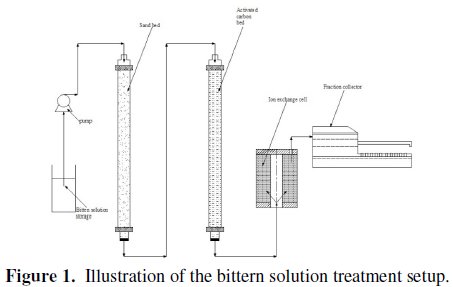
therefore, for the treatment of the bittern solution, it was first filtered through a 
sand bed followed by an activated carbon bed, as shown in <a href="#f1">Fig. 1</a>.</p>

    <p>&nbsp;</p>
<a name="f1">
<img src="/img/revistas/pea/v32n2/32n2a03f1.jpg">
    
<p>&nbsp;</p>

    ]]></body>
<body><![CDATA[<p>After filtration, the solution was pumped after the pH adjustment to the ion exchange 
column whose bed height was 12 cm with a flow rate of 5 cm<sup>3</sup>/min. The 
breakthrough curve of this solution was compared with the breakthrough curve of 
a synthetic solution with the same boron concentration (magnesium free 
solution).</p>


    <p><b><i>Electrically-assisted ion exchange experiments</i></b></p>

    <p>The electrically-assisted ion exchange experiments were performed using two 
platinum electrodes. The working electrode acts as the anode and the counter 
electrode acts as the cathode. The electrochemical cell consists of the following 
items:</p>

    <p>(i) outer cylindrical electrode from platinum, 1.5 cm inner diameter with 
thickness of 0.1 cm and 10 cm height, which acts as an anode with total 
surface area of about 47 cm<sup>2</sup>;</p>

    <p>(ii) inner cylindrical electrode from platinum, 0.8 cm inner diameter with 
thickness of 0.2 cm and 10 cm height, which acts as a cathode with total 
surface area of about 31 cm<sup>2</sup>;</p>

    <p>(iii) cell filled with 6.5 g of CRB02.</p>

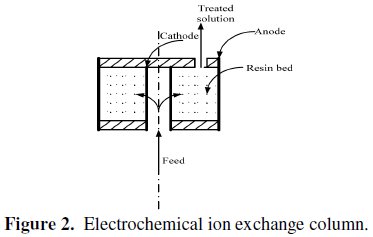
    <p>In this process, the synthetic boron solution was pumped through the cell and the 
electrical current was applied. The feed flowed from the bottom of the bed inside 
the perforated inner electrode, then through the resin in the annulus space 
between the two electrodes. The treated solution came out of the top of the cell. 
The schematic diagram shown in <a href="#f2">Fig. 2</a> represents the EIX column.</p>

    <p>&nbsp;</p>
<a name="f2">
<img src="/img/revistas/pea/v32n2/32n2a03f2.jpg">
    
<p>&nbsp;</p>

    <p>The current 
value was adjusted using a DC power supply (0.5, 1 and 1.5 A) to investigate the 
effect of electrical current on the breakthrough volume.</p>


    ]]></body>
<body><![CDATA[<p><b><i>Regeneration of resin</i></b></p>

    <p>Generally, regeneration process consists of two main steps, i.e., boron release 
using acid, such as HCl and H2SO4, and neutralization using basic reagent, 
typically, NaOH. The boron loaded onto the resin, after breakthrough 
experiment, was eluted with 5% HCl solution. The resin was then brought back 
to its original form using 5% NaOH solution [27].</p>


    <p><b><i>Analysis of boron</i></b></p>

    <p>Concentrations of boron in the effluent stream were analyzed 
spectrophotometrically using the carmine acid method (&lambda;<sub>max</sub>: 585 nm) as 
described by [28].</p>


    <p>&nbsp;</p>
    <p><b>Results and discussion</b></p>

    <p><b><i>Nature of bittern solutions</i></b></p>

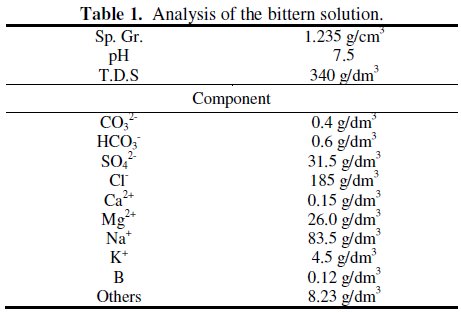
    <p>The results of the analysis of the bittern solution are shown in <a href="#t1">Table 1</a>.</p>

    <p>&nbsp;</p>
<a name="t1">
<img src="/img/revistas/pea/v32n2/32n2a03t1.jpg">
    
<p>&nbsp;</p>

    ]]></body>
<body><![CDATA[<p>As can be seen, the solution consists of many kinds of components, including T.D.S.. The 
boron concentration is found to be 120 mg dm<sup>-3</sup>. It is known that, in aqueous 
solutions, dissolved boron is present as several species, depending on the 
concentration of boron and pH. At low boron concentrations (&leq; 290 mg dm<sup>-3</sup>), 
dissolved boron is mainly found as the mononuclear boron species, B(OH)<sub>3</sub> 
and/or B(OH)<sub>4</sub><sup>-</sup>, while abundance of other polynuclear ions are negligible [29]. 
At higher concentrations, polynuclear boron species such as B<sub>2</sub>O(OH)<sub>6</sub><sup>2-</sup> or those 
incorporating B3O3 rings such as B<sub>3</sub>O<sub>3</sub>(OH)<sub>4</sub><sup>-</sup>, 
B<sub>4</sub>O<sub>5</sub>(OH)<sub>4</sub><sup>2-</sup>, and B<sub>5</sub>O<sub>6</sub>(OH)<sub>4</sub><sup>-</sup> are 
formed with an increase in pH [30]. These facts suggest that only the 
mononuclear species B(OH)<sub>3</sub> and B(OH)<sub>4</sub><sup>-</sup> are expected to be present in the 
bittern solution and that boric acid could be used as a synthetic simulant of the 
bittern solution.</p>

    <p>In our preliminary study, the kinetics of the process of boron removal by CRB02 
using boric acid by batch mode operations was studied and the equilibrium halftime 
for boron removal was found to be between 20 and 30 min. Moreover, a 
good fitting to the sorption mechanism described by pseudo-second-order 
mechanism was obtained. This agrees with the previous reports by [27, 31].</p>


    <p><b><i>Ion exchange system</i></b></p>

    <p><i>Effect of initial boron concentration on breakthrough volume</i></p>

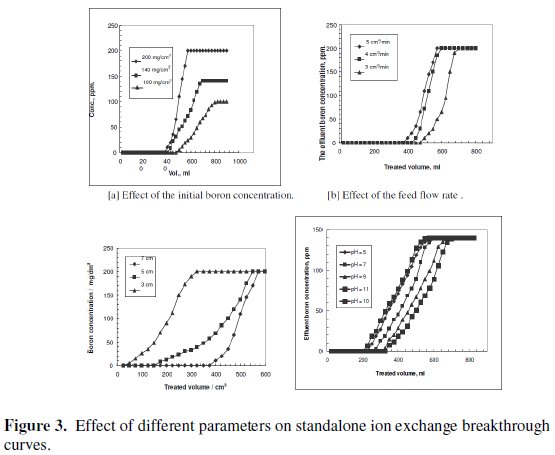
    <p>The treated volume at the breakthrough point increases when the initial boron 
concentration decreases, as shown in <a href="#f3">Fig. 3[a]</a>.</p>

    <p>&nbsp;</p>
<a name="f3">
<img src="/img/revistas/pea/v32n2/32n2a03f3.jpg">
    
<p>&nbsp;</p>

    <p>Since the chelating resin used as 
the exchange fixed bed was of fixed amount and capacity, it removed a fixed 
amount of boron ions. Thus, increasing the initial boron concentration in the feed 
decreases the volume treated at the breakthrough point.</p>


    <p><i>Effect of feed flow rate on breakthrough volume</i></p>

    <p>The increase in the flow rate decreases the volume treated at the breakthrough 
point, as depicted in <a href="#f3">Fig. 3[b]</a>. The capability of chelating resin to remove boron 
ions from influent solution decreased as a result of the increase in the feed flow 
rate, due to the decrease in the residence time. This agrees with the results 
previously reported for boron removal by Dowex (XUS 43594.00) resin [24] and 
by CRB02 [32].</p>


    ]]></body>
<body><![CDATA[<p><i>Effect of resin bed height on breakthrough volume</i></p>

    <p>The increase in the resin bed height increases the volume treated at the 
breakthrough point, as shown in <a href="#f3">Fig. 3[c]</a>. The higher the resin bed, the more the 
resin quantity, hence, the more active sites capable of removing boron ions. 
These results agree with those obtained using another chelating resin, Amberlite 
IRA 743. The performance of boron removal by this resin increased upon 
increasing the batch ratio of resin to boron, and decreasing the initial 
concentration of boron in the solution [33].</p>


    <p><i>Effect of pH value on breakthrough volume</i></p>

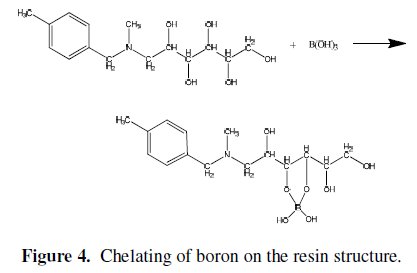
    <p>The adsorption of boron by the chelating resin with N-methylglucamine as the 
functional group is in principle achieved by the complexation. CRB02 could be 
described as a macroporous and crosslinked polystyrene resin functionalized with 
N-methyl-D-glucamine (1-amino-1-deoxy-D-glucitol; NMG) group. Boric acid 
reacts with compounds possessing multihydroxyl groups, namely polyols, to 
form a variety of borate esters, in accordance with <a href="#e1">Eq. (1)</a></p>

    <p>&nbsp;</p>
<a name="e1">
<img src="/img/revistas/pea/v32n2/32n2a03e1.jpg">
    
<p>&nbsp;</p>

    <p>where R is a hydrocarbon group. The formed esters rapidly dissociate to release 
protons. Thus, the amount of acidification produced upon the addition of the 
polyols is proportional to the extent of ester formation, which is used for 
monitoring the reaction. The stability of the borate complex formed strongly 
depends on the type of diol used. A strong complex is formed when the diol used 
involves the hydroxyl groups oriented in such a way that they accurately match 
the structural parameters required by the tetrahedrally-coordinated boron. The 
functional group of CRB02 has a tertiary amine end and a polyol end, and the 
adsorption of boric acid by CRB02 is represented as shown in <a href="#f4">Fig. 4</a>.</p>

    <p>&nbsp;</p>
<a name="f4">
<img src="/img/revistas/pea/v32n2/32n2a03f4.jpg">
    
<p>&nbsp;</p>

    <p>The role of 
the tertiary amine in the functional group is to neutralize the proton brought by 
the formation of tetra borate complex. Amine protonation shown in <a href="#e2">Eq. (2)</a> is 
critical to prevent the decrease of pH by proton released from the dissociation of 
borate esters.</p>

    ]]></body>
<body><![CDATA[<p>&nbsp;</p>
<a name="e2">
<img src="/img/revistas/pea/v32n2/32n2a03e2.jpg">
    
<p>&nbsp;</p>

    <p>As far as hydroxyl groups are concerned, there are 5 hydroxyl groups in Nmethyl-
D-glucamine. This allows the formation of a strong complex with boron 
and improves the possibility of complexation by offering several sites for boron. 
The optimum pH value for boron removal is found to be 10, as shown in <a href="#f3">Fig. 3[d]</a>. 
It has been reported that the optimum pH values for boron removal are 
different from one resin to another, ranging from 8.5 to 9.5 [34, 35]. The removal 
process and reactivity of boron in solutions were influenced by pH in a 
significant way. The pH value is an important control parameter for boron 
removal process. The amount of boron adsorbed depends on the distribution of 
B(OH)<sub>3</sub> and B(OH)<sub>4</sub><sup>-</sup> which are controlled by the pH value of the solution. Boric 
acid is a very weak acid with a pKa value of 9.2. At a lower pH than 7, boron is 
present in its non-dissociated form (boric acid) and at a pH higher than 10.5, it is 
present in the dissociated borate form. The exact percentage of boric acid and 
borate in any aqueous system is basically dependent on pH. The monovalent 
anion of borate, B(OH)<sub>4</sub><sup>-</sup>, dominates at higher pH while non-ionized boric acid 
B(OH)<sub>3</sub> at lower pH. The dissociation of boric acid in water can be described as 
follows:</p>

    <p>&nbsp;</p>
<a name="e3">
<img src="/img/revistas/pea/v32n2/32n2a03e3.jpg">
    
<p>&nbsp;</p>

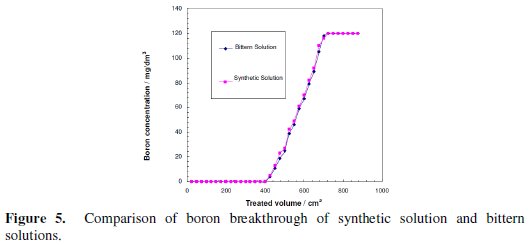
    <p>The breakthrough properties of the real bittern solution and the synthetic 
simulant solution adjusted at pH=10 using sodium hydroxide were compared. As 
depicted in <a href="#f5">Fig. 5</a>, the breakthrough curves of the two solutions are almost 
identical.</p>

    <p>&nbsp;</p>
<a name="f5">
<img src="/img/revistas/pea/v32n2/32n2a03f5.jpg">
    
<p>&nbsp;</p>

    <p>This indicates that CRB02 is not affected by the presence of any other 
ions in the solution.</p>


    <p><i>Electrically-assisted ion exchange system</i></p>

    ]]></body>
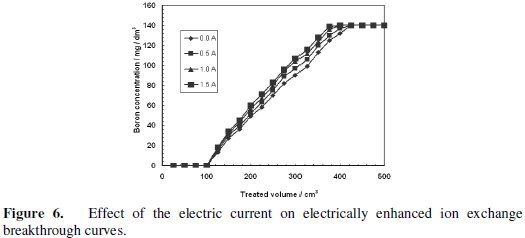
<body><![CDATA[<p>The breakthrough curves are slightly affected by the application of the electrical 
current, as shown in <a href="#f6">Fig. 6</a>.</p>

    <p>&nbsp;</p>
<a name="f6">
<img src="/img/revistas/pea/v32n2/32n2a03f6.jpg">
    
<p>&nbsp;</p>

    <p>However, the application of the electrical current 
does not affect the breakthrough point in a remarkable way. In case of nickel 
removal using electrically assisted ion exchange process, where Purolite C150S 
strong acid cation exchange resin was utilized, the application of the electrical 
current remarkably affected the breakthrough point. Namely, applying the 
electrical potential enhanced the nickel removal at breakthrough point by 12.7% 
and 2.5% at the flow rates of 240 and 500 cm<sup>3</sup>/h, respectively. Moreover, the 
sorption of Cs by nickel hexacano ferrate, NiHCF, ESIX process was also a 
successful application for the electrical assisted ion exchange process [36]. This 
discrepancy in electric current effect on boron removal by CRB02 and nickel 
removal by Purolite C150S and Cs removal by nickel hexacano ferrate ESIX 
process may be attributed to the difference in the sorption mechanism resulting 
from the difference in the function between an ion exchange resin using 
electrostatic attractive force and a chelating resin using complex formation. 
According to the mechanism shown by Rassat et al. for electrically assisted ion 
exchange uptake, the negative electron charges applied electrically to the ion 
exchange layer in the working cathode are the main driving force for the 
enhancement process. This negative electron reduces the Fe(III) atom in the 
NiHCF and creates an electrical field attracted the Cs ion towards the cathode. In 
case of nickel sorption by Purolite C150S, the electrical field attracted the Ni 
ions toward the working electrode as well and enhanced the sorption process. In 
our current case and according to the boron uptake mechanism by CRB02 shown 
in <a href="#f4">Fig. 4</a>, boron atom is attached to two oxygen atoms from the resin and another 
two oxygen atoms from the hydroxyl groups through chelating mechanism. 
Therefore, the boron atom has so high electron densities, which minimizes the 
effect of the cathodic potential applied to it. The coordination of the boron atom 
in solution with different hydroxyl negative groups also minimizes the effect of 
the electric field applied to the system. Based on these findings, it is not 
recommended to use chelating resins in electrically assisted ion exchange 
processes.</p>


    <p><i>Regeneration of resin</i></p>

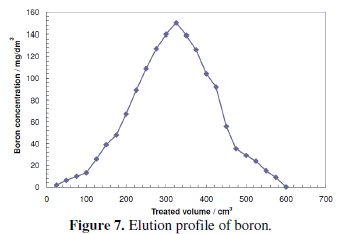
    <p><a href="#f7">Fig. 7</a> shows the boron concentration in the effluent solution as a function of HCl 
volume.</p>

    <p>&nbsp;</p>
<a name="f7">
<img src="/img/revistas/pea/v32n2/32n2a03f7.jpg">
    
<p>&nbsp;</p>

    <p>Badruk et al. achieved 100% elution of boron from loaded CRB02 resin 
using HCl [32, 37], compared the breakthrough capacity of the boron removal 
process after regeneration by three different methods and clarified that 
regeneration with H2SO4 followed by NaOH gives an increased resin adsorption 
capacity in comparison to regeneration with H2SO4 solely. This can be explained 
by the fact that the gross uniformity of the chemical potential of the resin is 
improved by NaOH. Although the resin used in his experiment is not CRB02, 
Rohm and Haas Amberlite IRA 743, it has the same N-methylglucamine function 
group like CRB02, which allows us to expect the same performance.</p>


    <p>&nbsp;</p>
    ]]></body>
<body><![CDATA[<p><b>Conclusions</b></p>

    <p>The performance of the chelating resin, Diaion CRB02, was investigated under 
different operating conditions. The breakthrough volume was found to be 
inversely proportional to the initial boron concentration and the feed flow rate 
and directly proportional to the height of the resin bed. The optimum pH value 
was found to be 10. The application of the electrical current was found to be of 
no remarkable effect on the breakthrough volume due to the chelating 
mechanism of the resin function group. Based on this, it is not recommended to 
use chelating resins in electrically assisted ion exchange processes. The system 
was utilized successfully for the removal of boron from the bittern solution of 
EMISAL Company.</p>


    <p>&nbsp;</p>
    <p><b>References</b></p>

    <!-- ref --><p>1. Nielsen F H, Gallagher S K, Johnson L K, et al. J Trace Elem Exp Med. 1992;5:237.    &nbsp;&nbsp;&nbsp;&nbsp;&nbsp;&nbsp;&nbsp;&nbsp;[&#160;<a href="javascript:void(0);" onclick="javascript: window.open('/scielo.php?script=sci_nlinks&ref=000097&pid=S0872-1904201400020000300001&lng=','','width=640,height=500,resizable=yes,scrollbars=1,menubar=yes,');">Links</a>&#160;]<!-- end-ref --></p>

    <p>2. Penland J G, Dietary boron, brain function, and cognitive performance, Environ Health Perspect. 1994;102:65.</p>

    <!-- ref --><p>3. Price C J, Strong P L, Marr M C, et al. Toxicol Sci. 1996;32:179.    &nbsp;&nbsp;&nbsp;&nbsp;&nbsp;&nbsp;&nbsp;&nbsp;[&#160;<a href="javascript:void(0);" onclick="javascript: window.open('/scielo.php?script=sci_nlinks&ref=000100&pid=S0872-1904201400020000300003&lng=','','width=640,height=500,resizable=yes,scrollbars=1,menubar=yes,');">Links</a>&#160;]<!-- end-ref --></p>

    <!-- ref --><p>4. WHO Library Cataloguing in Publication Data Boron. Environmental Health Criteria; 204. 1996.    &nbsp;&nbsp;&nbsp;&nbsp;&nbsp;&nbsp;&nbsp;&nbsp;[&#160;<a href="javascript:void(0);" onclick="javascript: window.open('/scielo.php?script=sci_nlinks&ref=000102&pid=S0872-1904201400020000300004&lng=','','width=640,height=500,resizable=yes,scrollbars=1,menubar=yes,');">Links</a>&#160;]<!-- end-ref --></p>

    <!-- ref --><p>5. Argust P. Biol Trace Elem. 1998;66:131.    &nbsp;&nbsp;&nbsp;&nbsp;&nbsp;&nbsp;&nbsp;&nbsp;[&#160;<a href="javascript:void(0);" onclick="javascript: window.open('/scielo.php?script=sci_nlinks&ref=000104&pid=S0872-1904201400020000300005&lng=','','width=640,height=500,resizable=yes,scrollbars=1,menubar=yes,');">Links</a>&#160;]<!-- end-ref --></p>

    <!-- ref --><p>6. Rayner-Canham G. Descriptive inorganic chemistry. MacMillan;2003.    &nbsp;&nbsp;&nbsp;&nbsp;&nbsp;&nbsp;&nbsp;&nbsp;[&#160;<a href="javascript:void(0);" onclick="javascript: window.open('/scielo.php?script=sci_nlinks&ref=000106&pid=S0872-1904201400020000300006&lng=','','width=640,height=500,resizable=yes,scrollbars=1,menubar=yes,');">Links</a>&#160;]<!-- end-ref --></p>

    <!-- ref --><p>7. Kotz J C, Treichel P M, Townsend J R. Chemistry &amp; chemical reactivity. Cengage Learning;2011.    &nbsp;&nbsp;&nbsp;&nbsp;&nbsp;&nbsp;&nbsp;&nbsp;[&#160;<a href="javascript:void(0);" onclick="javascript: window.open('/scielo.php?script=sci_nlinks&ref=000108&pid=S0872-1904201400020000300007&lng=','','width=640,height=500,resizable=yes,scrollbars=1,menubar=yes,');">Links</a>&#160;]<!-- end-ref --></p>

    <!-- ref --><p>8. Bryjak M, Wolska J, Soroko I, et al. Desalination. 2009;241:127.    &nbsp;&nbsp;&nbsp;&nbsp;&nbsp;&nbsp;&nbsp;&nbsp;[&#160;<a href="javascript:void(0);" onclick="javascript: window.open('/scielo.php?script=sci_nlinks&ref=000110&pid=S0872-1904201400020000300008&lng=','','width=640,height=500,resizable=yes,scrollbars=1,menubar=yes,');">Links</a>&#160;]<!-- end-ref --></p>

    <!-- ref --><p>9. Turek M, Bandura B, Dydo P. Desalination. 2008;223:17.    &nbsp;&nbsp;&nbsp;&nbsp;&nbsp;&nbsp;&nbsp;&nbsp;[&#160;<a href="javascript:void(0);" onclick="javascript: window.open('/scielo.php?script=sci_nlinks&ref=000112&pid=S0872-1904201400020000300009&lng=','','width=640,height=500,resizable=yes,scrollbars=1,menubar=yes,');">Links</a>&#160;]<!-- end-ref --></p>

    <!-- ref --><p>10. Banasiak L J, Schafer A I. J Membr Sci. 2009;334:101.    &nbsp;&nbsp;&nbsp;&nbsp;&nbsp;&nbsp;&nbsp;&nbsp;[&#160;<a href="javascript:void(0);" onclick="javascript: window.open('/scielo.php?script=sci_nlinks&ref=000114&pid=S0872-1904201400020000300010&lng=','','width=640,height=500,resizable=yes,scrollbars=1,menubar=yes,');">Links</a>&#160;]<!-- end-ref --></p>

    <!-- ref --><p>11. Yilmaz AE , Boncukcuo R, Kocakerim M M, et al. J Hazard Mater. 2008;153:146.    &nbsp;&nbsp;&nbsp;&nbsp;&nbsp;&nbsp;&nbsp;&nbsp;[&#160;<a href="javascript:void(0);" onclick="javascript: window.open('/scielo.php?script=sci_nlinks&ref=000116&pid=S0872-1904201400020000300011&lng=','','width=640,height=500,resizable=yes,scrollbars=1,menubar=yes,');">Links</a>&#160;]<!-- end-ref --></p>

    <!-- ref --><p>12. Choi W W, Chen K Y. Environ Sci Technol. 1979;13:189.    &nbsp;&nbsp;&nbsp;&nbsp;&nbsp;&nbsp;&nbsp;&nbsp;[&#160;<a href="javascript:void(0);" onclick="javascript: window.open('/scielo.php?script=sci_nlinks&ref=000118&pid=S0872-1904201400020000300012&lng=','','width=640,height=500,resizable=yes,scrollbars=1,menubar=yes,');">Links</a>&#160;]<!-- end-ref --></p>

    <!-- ref --><p>13. KOse T E, Demiral H, Ozturk N. Desalination Water Treat. 2011;29:1.    &nbsp;&nbsp;&nbsp;&nbsp;&nbsp;&nbsp;&nbsp;&nbsp;[&#160;<a href="javascript:void(0);" onclick="javascript: window.open('/scielo.php?script=sci_nlinks&ref=000120&pid=S0872-1904201400020000300013&lng=','','width=640,height=500,resizable=yes,scrollbars=1,menubar=yes,');">Links</a>&#160;]<!-- end-ref --></p>

    <!-- ref --><p>14. Kipcak I, Ozdemir M. Chem Eng J. 2012;189-190:68.    &nbsp;&nbsp;&nbsp;&nbsp;&nbsp;&nbsp;&nbsp;&nbsp;[&#160;<a href="javascript:void(0);" onclick="javascript: window.open('/scielo.php?script=sci_nlinks&ref=000122&pid=S0872-1904201400020000300014&lng=','','width=640,height=500,resizable=yes,scrollbars=1,menubar=yes,');">Links</a>&#160;]<!-- end-ref --></p>

    <!-- ref --><p>15. Bryjak M, Wolska J, Kabay N. Desalination. 2008;223:57.    &nbsp;&nbsp;&nbsp;&nbsp;&nbsp;&nbsp;&nbsp;&nbsp;[&#160;<a href="javascript:void(0);" onclick="javascript: window.open('/scielo.php?script=sci_nlinks&ref=000124&pid=S0872-1904201400020000300015&lng=','','width=640,height=500,resizable=yes,scrollbars=1,menubar=yes,');">Links</a>&#160;]<!-- end-ref --></p>

    <!-- ref --><p>16. Oo M H, Song L. Desalination. 2009;246:605.    &nbsp;&nbsp;&nbsp;&nbsp;&nbsp;&nbsp;&nbsp;&nbsp;[&#160;<a href="javascript:void(0);" onclick="javascript: window.open('/scielo.php?script=sci_nlinks&ref=000126&pid=S0872-1904201400020000300016&lng=','','width=640,height=500,resizable=yes,scrollbars=1,menubar=yes,');">Links</a>&#160;]<!-- end-ref --></p>

    <!-- ref --><p>17. Prats D, Chillon-Arias M F, Rodriguez-Pastor M. Desalination. 2000;128:269.    &nbsp;&nbsp;&nbsp;&nbsp;&nbsp;&nbsp;&nbsp;&nbsp;[&#160;<a href="javascript:void(0);" onclick="javascript: window.open('/scielo.php?script=sci_nlinks&ref=000128&pid=S0872-1904201400020000300017&lng=','','width=640,height=500,resizable=yes,scrollbars=1,menubar=yes,');">Links</a>&#160;]<!-- end-ref --></p>

    <!-- ref --><p>18. Hyung H, Kim J H. J Membr Sci. 2006;286:269.    &nbsp;&nbsp;&nbsp;&nbsp;&nbsp;&nbsp;&nbsp;&nbsp;[&#160;<a href="javascript:void(0);" onclick="javascript: window.open('/scielo.php?script=sci_nlinks&ref=000130&pid=S0872-1904201400020000300018&lng=','','width=640,height=500,resizable=yes,scrollbars=1,menubar=yes,');">Links</a>&#160;]<!-- end-ref --></p>

    <!-- ref --><p>19. Oner S G, Kabay N. Desalination, 2011;283:10.    &nbsp;&nbsp;&nbsp;&nbsp;&nbsp;&nbsp;&nbsp;&nbsp;[&#160;<a href="javascript:void(0);" onclick="javascript: window.open('/scielo.php?script=sci_nlinks&ref=000132&pid=S0872-1904201400020000300019&lng=','','width=640,height=500,resizable=yes,scrollbars=1,menubar=yes,');">Links</a>&#160;]<!-- end-ref --></p>

    <!-- ref --><p>20. Senkal B F, Bicak N. React Funct Polym. 2003;55:27.    &nbsp;&nbsp;&nbsp;&nbsp;&nbsp;&nbsp;&nbsp;&nbsp;[&#160;<a href="javascript:void(0);" onclick="javascript: window.open('/scielo.php?script=sci_nlinks&ref=000134&pid=S0872-1904201400020000300020&lng=','','width=640,height=500,resizable=yes,scrollbars=1,menubar=yes,');">Links</a>&#160;]<!-- end-ref --></p>

    <!-- ref --><p>21. Jacob C. Desalination. 2007;205:47.    &nbsp;&nbsp;&nbsp;&nbsp;&nbsp;&nbsp;&nbsp;&nbsp;[&#160;<a href="javascript:void(0);" onclick="javascript: window.open('/scielo.php?script=sci_nlinks&ref=000136&pid=S0872-1904201400020000300021&lng=','','width=640,height=500,resizable=yes,scrollbars=1,menubar=yes,');">Links</a>&#160;]<!-- end-ref --></p>

    <!-- ref --><p>22. Samatya S, Tuncel S A, Kabay N. Desalination. 2014. In press.    &nbsp;&nbsp;&nbsp;&nbsp;&nbsp;&nbsp;&nbsp;&nbsp;[&#160;<a href="javascript:void(0);" onclick="javascript: window.open('/scielo.php?script=sci_nlinks&ref=000138&pid=S0872-1904201400020000300022&lng=','','width=640,height=500,resizable=yes,scrollbars=1,menubar=yes,');">Links</a>&#160;]<!-- end-ref --></p>

    <!-- ref --><p>23. Guo W S, Shim W G, Vigneswaran S, et al. J Membr Sci. 2005;247:65.    &nbsp;&nbsp;&nbsp;&nbsp;&nbsp;&nbsp;&nbsp;&nbsp;[&#160;<a href="javascript:void(0);" onclick="javascript: window.open('/scielo.php?script=sci_nlinks&ref=000140&pid=S0872-1904201400020000300023&lng=','','width=640,height=500,resizable=yes,scrollbars=1,menubar=yes,');">Links</a>&#160;]<!-- end-ref --></p>

    <!-- ref --><p>24. Ipek I Y, Kabay N, Yuksel M, et al. Chem Eng Comm. 2008;196:277.    &nbsp;&nbsp;&nbsp;&nbsp;&nbsp;&nbsp;&nbsp;&nbsp;[&#160;<a href="javascript:void(0);" onclick="javascript: window.open('/scielo.php?script=sci_nlinks&ref=000142&pid=S0872-1904201400020000300024&lng=','','width=640,height=500,resizable=yes,scrollbars=1,menubar=yes,');">Links</a>&#160;]<!-- end-ref --></p>

    <!-- ref --><p>25. Wang B, Guo X, Bai P. Colloids Surf A: Physicochem Eng Asp. 2014;444:338.    &nbsp;&nbsp;&nbsp;&nbsp;&nbsp;&nbsp;&nbsp;&nbsp;[&#160;<a href="javascript:void(0);" onclick="javascript: window.open('/scielo.php?script=sci_nlinks&ref=000144&pid=S0872-1904201400020000300025&lng=','','width=640,height=500,resizable=yes,scrollbars=1,menubar=yes,');">Links</a>&#160;]<!-- end-ref --></p>

    <!-- ref --><p>26. Bridger N J, Jones C P, Neville M D. J Chem Technol Biotechnol. 1991;50:469.    &nbsp;&nbsp;&nbsp;&nbsp;&nbsp;&nbsp;&nbsp;&nbsp;[&#160;<a href="javascript:void(0);" onclick="javascript: window.open('/scielo.php?script=sci_nlinks&ref=000146&pid=S0872-1904201400020000300026&lng=','','width=640,height=500,resizable=yes,scrollbars=1,menubar=yes,');">Links</a>&#160;]<!-- end-ref --></p>

    <!-- ref --><p>27. Kabay N, Sarp S, Yuksel M, et al. Desalination. 2008;223:49.    &nbsp;&nbsp;&nbsp;&nbsp;&nbsp;&nbsp;&nbsp;&nbsp;[&#160;<a href="javascript:void(0);" onclick="javascript: window.open('/scielo.php?script=sci_nlinks&ref=000148&pid=S0872-1904201400020000300027&lng=','','width=640,height=500,resizable=yes,scrollbars=1,menubar=yes,');">Links</a>&#160;]<!-- end-ref --></p>

    <!-- ref --><p>28. Hatcher J T, Wilcox L V. Analyt Chem. 1950;22:567.    &nbsp;&nbsp;&nbsp;&nbsp;&nbsp;&nbsp;&nbsp;&nbsp;[&#160;<a href="javascript:void(0);" onclick="javascript: window.open('/scielo.php?script=sci_nlinks&ref=000150&pid=S0872-1904201400020000300028&lng=','','width=640,height=500,resizable=yes,scrollbars=1,menubar=yes,');">Links</a>&#160;]<!-- end-ref --></p>

    <!-- ref --><p>29. Su C, Suarez D L. Environ Sci Techn. 1995;29:302.    &nbsp;&nbsp;&nbsp;&nbsp;&nbsp;&nbsp;&nbsp;&nbsp;[&#160;<a href="javascript:void(0);" onclick="javascript: window.open('/scielo.php?script=sci_nlinks&ref=000152&pid=S0872-1904201400020000300029&lng=','','width=640,height=500,resizable=yes,scrollbars=1,menubar=yes,');">Links</a>&#160;]<!-- end-ref --></p>

    <!-- ref --><p>30. Power P P, Woods W G. Plant Soil. 1997;193:1.    &nbsp;&nbsp;&nbsp;&nbsp;&nbsp;&nbsp;&nbsp;&nbsp;[&#160;<a href="javascript:void(0);" onclick="javascript: window.open('/scielo.php?script=sci_nlinks&ref=000154&pid=S0872-1904201400020000300030&lng=','','width=640,height=500,resizable=yes,scrollbars=1,menubar=yes,');">Links</a>&#160;]<!-- end-ref --></p>

    <!-- ref --><p>31. Kabay N, Sarp S, Yuksel M, et al. React Funct Polym. 2007;67:1643.    &nbsp;&nbsp;&nbsp;&nbsp;&nbsp;&nbsp;&nbsp;&nbsp;[&#160;<a href="javascript:void(0);" onclick="javascript: window.open('/scielo.php?script=sci_nlinks&ref=000156&pid=S0872-1904201400020000300031&lng=','','width=640,height=500,resizable=yes,scrollbars=1,menubar=yes,');">Links</a>&#160;]<!-- end-ref --></p>

    <!-- ref --><p>32. Badruk M, Kabay N, Demircioglu M, et al. Sep Sci Technol. 1999;34:2981.    &nbsp;&nbsp;&nbsp;&nbsp;&nbsp;&nbsp;&nbsp;&nbsp;[&#160;<a href="javascript:void(0);" onclick="javascript: window.open('/scielo.php?script=sci_nlinks&ref=000158&pid=S0872-1904201400020000300032&lng=','','width=640,height=500,resizable=yes,scrollbars=1,menubar=yes,');">Links</a>&#160;]<!-- end-ref --></p>

    <!-- ref --><p>33. Simonnot M O, Castel C, Nicolai M, et al. Water Res. 2000;34:109.    &nbsp;&nbsp;&nbsp;&nbsp;&nbsp;&nbsp;&nbsp;&nbsp;[&#160;<a href="javascript:void(0);" onclick="javascript: window.open('/scielo.php?script=sci_nlinks&ref=000160&pid=S0872-1904201400020000300033&lng=','','width=640,height=500,resizable=yes,scrollbars=1,menubar=yes,');">Links</a>&#160;]<!-- end-ref --></p>

    <!-- ref --><p>34. Boncukcuo lu R, Yllmaz A E, Kocakerim M M, et al. Desalination. 2004;160:159.    &nbsp;&nbsp;&nbsp;&nbsp;&nbsp;&nbsp;&nbsp;&nbsp;[&#160;<a href="javascript:void(0);" onclick="javascript: window.open('/scielo.php?script=sci_nlinks&ref=000162&pid=S0872-1904201400020000300034&lng=','','width=640,height=500,resizable=yes,scrollbars=1,menubar=yes,');">Links</a>&#160;]<!-- end-ref --></p>

    <!-- ref --><p>35. Ozturk N, KOse T E. Desalination. 2008;227:233.    &nbsp;&nbsp;&nbsp;&nbsp;&nbsp;&nbsp;&nbsp;&nbsp;[&#160;<a href="javascript:void(0);" onclick="javascript: window.open('/scielo.php?script=sci_nlinks&ref=000164&pid=S0872-1904201400020000300035&lng=','','width=640,height=500,resizable=yes,scrollbars=1,menubar=yes,');">Links</a>&#160;]<!-- end-ref --></p>

    <!-- ref --><p>36. Rassat S D, Sukamto J H, Orth R J, et al. Sep Purif Technol. 1999;15:207.    &nbsp;&nbsp;&nbsp;&nbsp;&nbsp;&nbsp;&nbsp;&nbsp;[&#160;<a href="javascript:void(0);" onclick="javascript: window.open('/scielo.php?script=sci_nlinks&ref=000166&pid=S0872-1904201400020000300036&lng=','','width=640,height=500,resizable=yes,scrollbars=1,menubar=yes,');">Links</a>&#160;]<!-- end-ref --></p>

    <!-- ref --><p>37. Nadav N. Desalination. 1999;124:131.    &nbsp;&nbsp;&nbsp;&nbsp;&nbsp;&nbsp;&nbsp;&nbsp;[&#160;<a href="javascript:void(0);" onclick="javascript: window.open('/scielo.php?script=sci_nlinks&ref=000168&pid=S0872-1904201400020000300037&lng=','','width=640,height=500,resizable=yes,scrollbars=1,menubar=yes,');">Links</a>&#160;]<!-- end-ref --></p>


    <p>&nbsp;</p>
    <p><b>Acknowledgements</b></p>

    <p>The authors would like to acknowledge EMISAL Company for their support and 
the supply of the bittern solution.</p>


    ]]></body>
<body><![CDATA[<p>&nbsp;</p>
    <p><a name=0></a><sup><a href="#top">*</a></sup>Corresponding author. E-mail address: <a href="mailto:dr_ismail@instruchem.org">dr_ismail@instruchem.org</a></p>

    <p>Received 27 February 2014; accepted 17 April 2014</p>

    <p><a href="http://www.peacta.org" target="_blank">www.peacta.org</a> </p>


     ]]></body><back>
<ref-list>
<ref id="B1">
<label>1</label><nlm-citation citation-type="journal">
<person-group person-group-type="author">
<name>
<surname><![CDATA[Nielsen]]></surname>
<given-names><![CDATA[F H]]></given-names>
</name>
<name>
<surname><![CDATA[Gallagher]]></surname>
<given-names><![CDATA[S K]]></given-names>
</name>
<name>
<surname><![CDATA[Johnson]]></surname>
<given-names><![CDATA[L K]]></given-names>
</name>
</person-group>
<source><![CDATA[J Trace Elem Exp Med]]></source>
<year>1992</year>
<volume>5</volume>
<page-range>237</page-range></nlm-citation>
</ref>
<ref id="B2">
<label>2</label><nlm-citation citation-type="journal">
<person-group person-group-type="author">
<name>
<surname><![CDATA[Penland]]></surname>
<given-names><![CDATA[J G]]></given-names>
</name>
</person-group>
<source><![CDATA[Environ Health Perspect]]></source>
<year>1994</year>
<volume>102</volume>
<page-range>65</page-range></nlm-citation>
</ref>
<ref id="B3">
<label>3</label><nlm-citation citation-type="journal">
<person-group person-group-type="author">
<name>
<surname><![CDATA[Price]]></surname>
<given-names><![CDATA[C J]]></given-names>
</name>
<name>
<surname><![CDATA[Strong]]></surname>
<given-names><![CDATA[P L]]></given-names>
</name>
<name>
<surname><![CDATA[Marr]]></surname>
<given-names><![CDATA[M C]]></given-names>
</name>
</person-group>
<source><![CDATA[Toxicol Sci]]></source>
<year>1996</year>
<volume>32</volume>
<page-range>179</page-range></nlm-citation>
</ref>
<ref id="B4">
<label>4</label><nlm-citation citation-type="">
<collab>WHO</collab>
<source><![CDATA[Environmental Health Criteria]]></source>
<year>1996</year>
<volume>204</volume>
</nlm-citation>
</ref>
<ref id="B5">
<label>5</label><nlm-citation citation-type="journal">
<person-group person-group-type="author">
<name>
<surname><![CDATA[Argust]]></surname>
<given-names><![CDATA[P]]></given-names>
</name>
</person-group>
<source><![CDATA[Biol Trace Elem]]></source>
<year>1998</year>
<volume>66</volume>
<page-range>131</page-range></nlm-citation>
</ref>
<ref id="B6">
<label>6</label><nlm-citation citation-type="book">
<person-group person-group-type="author">
<name>
<surname><![CDATA[Rayner-Canham]]></surname>
<given-names><![CDATA[G]]></given-names>
</name>
</person-group>
<source><![CDATA[Descriptive inorganic chemistry]]></source>
<year>2003</year>
<publisher-name><![CDATA[MacMillan]]></publisher-name>
</nlm-citation>
</ref>
<ref id="B7">
<label>7</label><nlm-citation citation-type="book">
<person-group person-group-type="author">
<name>
<surname><![CDATA[Kotz]]></surname>
<given-names><![CDATA[J C]]></given-names>
</name>
<name>
<surname><![CDATA[Treichel]]></surname>
<given-names><![CDATA[P M]]></given-names>
</name>
<name>
<surname><![CDATA[Townsend]]></surname>
<given-names><![CDATA[J R]]></given-names>
</name>
</person-group>
<source><![CDATA[Chemistry & chemical reactivity]]></source>
<year>2011</year>
<publisher-name><![CDATA[Cengage Learning]]></publisher-name>
</nlm-citation>
</ref>
<ref id="B8">
<label>8</label><nlm-citation citation-type="journal">
<person-group person-group-type="author">
<name>
<surname><![CDATA[Bryjak]]></surname>
<given-names><![CDATA[M]]></given-names>
</name>
<name>
<surname><![CDATA[Wolska]]></surname>
<given-names><![CDATA[J]]></given-names>
</name>
<name>
<surname><![CDATA[Soroko]]></surname>
<given-names><![CDATA[I]]></given-names>
</name>
</person-group>
<source><![CDATA[Desalination]]></source>
<year>2009</year>
<volume>241</volume>
<page-range>127</page-range></nlm-citation>
</ref>
<ref id="B9">
<label>9</label><nlm-citation citation-type="journal">
<person-group person-group-type="author">
<name>
<surname><![CDATA[Turek]]></surname>
<given-names><![CDATA[M]]></given-names>
</name>
<name>
<surname><![CDATA[Bandura]]></surname>
<given-names><![CDATA[B]]></given-names>
</name>
<name>
<surname><![CDATA[Dydo]]></surname>
<given-names><![CDATA[P]]></given-names>
</name>
</person-group>
<source><![CDATA[Desalination]]></source>
<year>2008</year>
<volume>223</volume>
<page-range>17</page-range></nlm-citation>
</ref>
<ref id="B10">
<label>10</label><nlm-citation citation-type="journal">
<person-group person-group-type="author">
<name>
<surname><![CDATA[Banasiak]]></surname>
<given-names><![CDATA[L J]]></given-names>
</name>
<name>
<surname><![CDATA[Schafer]]></surname>
<given-names><![CDATA[A I]]></given-names>
</name>
</person-group>
<source><![CDATA[J Membr Sci]]></source>
<year>2009</year>
<volume>334</volume>
<page-range>101</page-range></nlm-citation>
</ref>
<ref id="B11">
<label>11</label><nlm-citation citation-type="journal">
<person-group person-group-type="author">
<name>
<surname><![CDATA[Yilmaz]]></surname>
<given-names><![CDATA[A E]]></given-names>
</name>
<name>
<surname><![CDATA[Boncukcuo]]></surname>
<given-names><![CDATA[R]]></given-names>
</name>
<name>
<surname><![CDATA[Kocakerim]]></surname>
<given-names><![CDATA[M M]]></given-names>
</name>
</person-group>
<source><![CDATA[J Hazard Mater]]></source>
<year>2008</year>
<volume>153</volume>
<page-range>146</page-range></nlm-citation>
</ref>
<ref id="B12">
<label>12</label><nlm-citation citation-type="journal">
<person-group person-group-type="author">
<name>
<surname><![CDATA[Choi]]></surname>
<given-names><![CDATA[W W]]></given-names>
</name>
<name>
<surname><![CDATA[Chen]]></surname>
<given-names><![CDATA[K Y]]></given-names>
</name>
</person-group>
<source><![CDATA[Environ Sci Technol]]></source>
<year>1979</year>
<volume>13</volume>
<page-range>189</page-range></nlm-citation>
</ref>
<ref id="B13">
<label>13</label><nlm-citation citation-type="journal">
<person-group person-group-type="author">
<name>
<surname><![CDATA[Kose]]></surname>
<given-names><![CDATA[T E]]></given-names>
</name>
<name>
<surname><![CDATA[Demiral]]></surname>
<given-names><![CDATA[H]]></given-names>
</name>
<name>
<surname><![CDATA[Ozturk]]></surname>
<given-names><![CDATA[N]]></given-names>
</name>
</person-group>
<source><![CDATA[Desalination Water Treat]]></source>
<year>2011</year>
<volume>29</volume>
<page-range>1</page-range></nlm-citation>
</ref>
<ref id="B14">
<label>14</label><nlm-citation citation-type="journal">
<person-group person-group-type="author">
<name>
<surname><![CDATA[Kipcak]]></surname>
<given-names><![CDATA[I]]></given-names>
</name>
<name>
<surname><![CDATA[Ozdemir]]></surname>
<given-names><![CDATA[M]]></given-names>
</name>
</person-group>
<source><![CDATA[Chem Eng J]]></source>
<year>2012</year>
<volume>189-190</volume>
<page-range>68</page-range></nlm-citation>
</ref>
<ref id="B15">
<label>15</label><nlm-citation citation-type="journal">
<person-group person-group-type="author">
<name>
<surname><![CDATA[Bryjak]]></surname>
<given-names><![CDATA[M]]></given-names>
</name>
<name>
<surname><![CDATA[Wolska]]></surname>
<given-names><![CDATA[J]]></given-names>
</name>
<name>
<surname><![CDATA[Kabay]]></surname>
<given-names><![CDATA[N]]></given-names>
</name>
</person-group>
<source><![CDATA[Desalination]]></source>
<year>2008</year>
<volume>223</volume>
<page-range>57</page-range></nlm-citation>
</ref>
<ref id="B16">
<label>16</label><nlm-citation citation-type="journal">
<person-group person-group-type="author">
<name>
<surname><![CDATA[Oo]]></surname>
<given-names><![CDATA[M H]]></given-names>
</name>
<name>
<surname><![CDATA[Song]]></surname>
<given-names><![CDATA[L]]></given-names>
</name>
</person-group>
<source><![CDATA[Desalination]]></source>
<year>2009</year>
<volume>246</volume>
<page-range>605</page-range></nlm-citation>
</ref>
<ref id="B17">
<label>17</label><nlm-citation citation-type="journal">
<person-group person-group-type="author">
<name>
<surname><![CDATA[Prats]]></surname>
<given-names><![CDATA[D]]></given-names>
</name>
<name>
<surname><![CDATA[Chillon-Arias]]></surname>
<given-names><![CDATA[M F]]></given-names>
</name>
<name>
<surname><![CDATA[Rodriguez-Pastor]]></surname>
<given-names><![CDATA[M]]></given-names>
</name>
</person-group>
<source><![CDATA[Desalination]]></source>
<year>2000</year>
<volume>128</volume>
<page-range>269</page-range></nlm-citation>
</ref>
<ref id="B18">
<label>18</label><nlm-citation citation-type="journal">
<person-group person-group-type="author">
<name>
<surname><![CDATA[Hyung]]></surname>
<given-names><![CDATA[H]]></given-names>
</name>
<name>
<surname><![CDATA[Kim]]></surname>
<given-names><![CDATA[J H]]></given-names>
</name>
</person-group>
<source><![CDATA[J Membr Sci]]></source>
<year>2006</year>
<volume>286</volume>
<page-range>269</page-range></nlm-citation>
</ref>
<ref id="B19">
<label>19</label><nlm-citation citation-type="journal">
<person-group person-group-type="author">
<name>
<surname><![CDATA[Oner]]></surname>
<given-names><![CDATA[S G]]></given-names>
</name>
<name>
<surname><![CDATA[Kabay]]></surname>
<given-names><![CDATA[N]]></given-names>
</name>
</person-group>
<source><![CDATA[Desalination]]></source>
<year>2011</year>
<volume>283</volume>
<page-range>10</page-range></nlm-citation>
</ref>
<ref id="B20">
<label>20</label><nlm-citation citation-type="journal">
<person-group person-group-type="author">
<name>
<surname><![CDATA[Senkal]]></surname>
<given-names><![CDATA[B F]]></given-names>
</name>
<name>
<surname><![CDATA[Bicak]]></surname>
<given-names><![CDATA[N]]></given-names>
</name>
</person-group>
<source><![CDATA[React Funct Polym]]></source>
<year>2003</year>
<volume>55</volume>
<page-range>27</page-range></nlm-citation>
</ref>
<ref id="B21">
<label>21</label><nlm-citation citation-type="journal">
<person-group person-group-type="author">
<name>
<surname><![CDATA[Jacob]]></surname>
<given-names><![CDATA[C]]></given-names>
</name>
</person-group>
<source><![CDATA[Desalination]]></source>
<year>2007</year>
<volume>205</volume>
<page-range>47</page-range></nlm-citation>
</ref>
<ref id="B22">
<label>22</label><nlm-citation citation-type="journal">
<person-group person-group-type="author">
<name>
<surname><![CDATA[Samatya]]></surname>
<given-names><![CDATA[S]]></given-names>
</name>
<name>
<surname><![CDATA[Tuncel]]></surname>
<given-names><![CDATA[S A]]></given-names>
</name>
<name>
<surname><![CDATA[Kabay]]></surname>
<given-names><![CDATA[N]]></given-names>
</name>
</person-group>
<source><![CDATA[Desalination]]></source>
<year>2014</year>
</nlm-citation>
</ref>
<ref id="B23">
<label>23</label><nlm-citation citation-type="journal">
<person-group person-group-type="author">
<name>
<surname><![CDATA[Guo]]></surname>
<given-names><![CDATA[W S]]></given-names>
</name>
<name>
<surname><![CDATA[Shim]]></surname>
<given-names><![CDATA[W G]]></given-names>
</name>
<name>
<surname><![CDATA[Vigneswaran]]></surname>
<given-names><![CDATA[S]]></given-names>
</name>
</person-group>
<source><![CDATA[J Membr Sci]]></source>
<year>2005</year>
<volume>247</volume>
<page-range>65</page-range></nlm-citation>
</ref>
<ref id="B24">
<label>24</label><nlm-citation citation-type="journal">
<person-group person-group-type="author">
<name>
<surname><![CDATA[Ipek]]></surname>
<given-names><![CDATA[I Y]]></given-names>
</name>
<name>
<surname><![CDATA[Kabay]]></surname>
<given-names><![CDATA[N]]></given-names>
</name>
<name>
<surname><![CDATA[Yuksel]]></surname>
<given-names><![CDATA[M]]></given-names>
</name>
</person-group>
<source><![CDATA[Chem Eng Comm]]></source>
<year>2008</year>
<volume>196</volume>
<page-range>277</page-range></nlm-citation>
</ref>
<ref id="B25">
<label>25</label><nlm-citation citation-type="journal">
<person-group person-group-type="author">
<name>
<surname><![CDATA[Wang]]></surname>
<given-names><![CDATA[B]]></given-names>
</name>
<name>
<surname><![CDATA[Guo]]></surname>
<given-names><![CDATA[X]]></given-names>
</name>
<name>
<surname><![CDATA[Bai]]></surname>
<given-names><![CDATA[P]]></given-names>
</name>
</person-group>
<source><![CDATA[Colloids Surf A: Physicochem Eng Asp]]></source>
<year>2014</year>
<volume>444</volume>
<page-range>338</page-range></nlm-citation>
</ref>
<ref id="B26">
<label>26</label><nlm-citation citation-type="journal">
<person-group person-group-type="author">
<name>
<surname><![CDATA[Bridger]]></surname>
<given-names><![CDATA[N J]]></given-names>
</name>
<name>
<surname><![CDATA[Jones]]></surname>
<given-names><![CDATA[C P]]></given-names>
</name>
<name>
<surname><![CDATA[Neville]]></surname>
<given-names><![CDATA[M D]]></given-names>
</name>
</person-group>
<source><![CDATA[J Chem Technol Biotechnol]]></source>
<year>1991</year>
<volume>50</volume>
<page-range>469</page-range></nlm-citation>
</ref>
<ref id="B27">
<label>27</label><nlm-citation citation-type="journal">
<person-group person-group-type="author">
<name>
<surname><![CDATA[Kabay]]></surname>
<given-names><![CDATA[N]]></given-names>
</name>
<name>
<surname><![CDATA[Sarp]]></surname>
<given-names><![CDATA[S]]></given-names>
</name>
<name>
<surname><![CDATA[Yuksel]]></surname>
<given-names><![CDATA[M]]></given-names>
</name>
</person-group>
<source><![CDATA[Desalination]]></source>
<year>2008</year>
<volume>223</volume>
<page-range>49</page-range></nlm-citation>
</ref>
<ref id="B28">
<label>28</label><nlm-citation citation-type="journal">
<person-group person-group-type="author">
<name>
<surname><![CDATA[Hatcher]]></surname>
<given-names><![CDATA[J T]]></given-names>
</name>
<name>
<surname><![CDATA[Wilcox]]></surname>
<given-names><![CDATA[L V]]></given-names>
</name>
</person-group>
<source><![CDATA[Analyt Chem]]></source>
<year>1950</year>
<volume>22</volume>
<page-range>567</page-range></nlm-citation>
</ref>
<ref id="B29">
<label>29</label><nlm-citation citation-type="journal">
<person-group person-group-type="author">
<name>
<surname><![CDATA[Su]]></surname>
<given-names><![CDATA[C]]></given-names>
</name>
<name>
<surname><![CDATA[Suarez]]></surname>
<given-names><![CDATA[D L]]></given-names>
</name>
</person-group>
<source><![CDATA[Environ Sci Techn]]></source>
<year>1995</year>
<volume>29</volume>
<page-range>302</page-range></nlm-citation>
</ref>
<ref id="B30">
<label>30</label><nlm-citation citation-type="journal">
<person-group person-group-type="author">
<name>
<surname><![CDATA[Power]]></surname>
<given-names><![CDATA[P P]]></given-names>
</name>
<name>
<surname><![CDATA[Woods]]></surname>
<given-names><![CDATA[W G]]></given-names>
</name>
</person-group>
<source><![CDATA[Plant Soil]]></source>
<year>1997</year>
<volume>193</volume>
<page-range>1</page-range></nlm-citation>
</ref>
<ref id="B31">
<label>31</label><nlm-citation citation-type="journal">
<person-group person-group-type="author">
<name>
<surname><![CDATA[Kabay]]></surname>
<given-names><![CDATA[N]]></given-names>
</name>
<name>
<surname><![CDATA[Sarp]]></surname>
<given-names><![CDATA[S]]></given-names>
</name>
<name>
<surname><![CDATA[Yuksel]]></surname>
<given-names><![CDATA[M]]></given-names>
</name>
</person-group>
<source><![CDATA[React Funct Polym]]></source>
<year>2007</year>
<volume>67</volume>
<page-range>1643</page-range></nlm-citation>
</ref>
<ref id="B32">
<label>32</label><nlm-citation citation-type="journal">
<person-group person-group-type="author">
<name>
<surname><![CDATA[Badruk]]></surname>
<given-names><![CDATA[M]]></given-names>
</name>
<name>
<surname><![CDATA[Kabay]]></surname>
<given-names><![CDATA[N]]></given-names>
</name>
<name>
<surname><![CDATA[Demircioglu]]></surname>
<given-names><![CDATA[M]]></given-names>
</name>
</person-group>
<source><![CDATA[Sep Sci Technol]]></source>
<year>1999</year>
<volume>34</volume>
<page-range>2981</page-range></nlm-citation>
</ref>
<ref id="B33">
<label>33</label><nlm-citation citation-type="journal">
<person-group person-group-type="author">
<name>
<surname><![CDATA[Simonnot]]></surname>
<given-names><![CDATA[M O]]></given-names>
</name>
<name>
<surname><![CDATA[Castel]]></surname>
<given-names><![CDATA[C]]></given-names>
</name>
<name>
<surname><![CDATA[Nicolai]]></surname>
<given-names><![CDATA[M]]></given-names>
</name>
</person-group>
<source><![CDATA[Water Res]]></source>
<year>2000</year>
<volume>34</volume>
<page-range>109</page-range></nlm-citation>
</ref>
<ref id="B34">
<label>34</label><nlm-citation citation-type="journal">
<person-group person-group-type="author">
<name>
<surname><![CDATA[Boncukcuo lu]]></surname>
<given-names><![CDATA[R]]></given-names>
</name>
<name>
<surname><![CDATA[Yllmaz]]></surname>
<given-names><![CDATA[A E]]></given-names>
</name>
<name>
<surname><![CDATA[Kocakerim]]></surname>
<given-names><![CDATA[M M]]></given-names>
</name>
</person-group>
<source><![CDATA[Desalination]]></source>
<year>2004</year>
<volume>160</volume>
<page-range>159</page-range></nlm-citation>
</ref>
<ref id="B35">
<label>35</label><nlm-citation citation-type="journal">
<person-group person-group-type="author">
<name>
<surname><![CDATA[Ozturk]]></surname>
<given-names><![CDATA[N]]></given-names>
</name>
<name>
<surname><![CDATA[Kose]]></surname>
<given-names><![CDATA[T E]]></given-names>
</name>
</person-group>
<source><![CDATA[Desalination]]></source>
<year>2008</year>
<volume>227</volume>
<page-range>233</page-range></nlm-citation>
</ref>
<ref id="B36">
<label>36</label><nlm-citation citation-type="journal">
<person-group person-group-type="author">
<name>
<surname><![CDATA[Rassat]]></surname>
<given-names><![CDATA[S D]]></given-names>
</name>
<name>
<surname><![CDATA[Sukamto]]></surname>
<given-names><![CDATA[J H]]></given-names>
</name>
<name>
<surname><![CDATA[Orth]]></surname>
<given-names><![CDATA[R J]]></given-names>
</name>
</person-group>
<source><![CDATA[Sep Purif Technol]]></source>
<year>1999</year>
<volume>15</volume>
<page-range>207</page-range></nlm-citation>
</ref>
<ref id="B37">
<label>37</label><nlm-citation citation-type="journal">
<person-group person-group-type="author">
<name>
<surname><![CDATA[Nadav]]></surname>
<given-names><![CDATA[N]]></given-names>
</name>
</person-group>
<source><![CDATA[Desalination]]></source>
<year>1999</year>
<volume>124</volume>
<page-range>131</page-range></nlm-citation>
</ref>
</ref-list>
</back>
</article>