<?xml version="1.0" encoding="ISO-8859-1"?><article xmlns:mml="http://www.w3.org/1998/Math/MathML" xmlns:xlink="http://www.w3.org/1999/xlink" xmlns:xsi="http://www.w3.org/2001/XMLSchema-instance">
<front>
<journal-meta>
<journal-id>0872-1904</journal-id>
<journal-title><![CDATA[Portugaliae Electrochimica Acta]]></journal-title>
<abbrev-journal-title><![CDATA[Port. Electrochim. Acta]]></abbrev-journal-title>
<issn>0872-1904</issn>
<publisher>
<publisher-name><![CDATA[Sociedade Portuguesa de Electroquímica]]></publisher-name>
</publisher>
</journal-meta>
<article-meta>
<article-id>S0872-19042014000200005</article-id>
<article-id pub-id-type="doi">10.4152/pea.201402157</article-id>
<title-group>
<article-title xml:lang="en"><![CDATA[Cashew Nut Testa Tannin: Assessing its Effects on the Corrosion of Aluminium in HCl]]></article-title>
</title-group>
<contrib-group>
<contrib contrib-type="author">
<name>
<surname><![CDATA[Nnaji]]></surname>
<given-names><![CDATA[Nnaemeka J. N]]></given-names>
</name>
<xref ref-type="aff" rid="A01"/>
</contrib>
<contrib contrib-type="author">
<name>
<surname><![CDATA[Obi-Egbedi]]></surname>
<given-names><![CDATA[Nelson O]]></given-names>
</name>
<xref ref-type="aff" rid="A02"/>
</contrib>
<contrib contrib-type="author">
<name>
<surname><![CDATA[Okoye]]></surname>
<given-names><![CDATA[Chukwuma O. B]]></given-names>
</name>
<xref ref-type="aff" rid="A03"/>
</contrib>
</contrib-group>
<aff id="A01">
<institution><![CDATA[,Federal University Ndufu Alaike Ikwo Department of Chemistry/Biochemistry/Molecular Biology ]]></institution>
<addr-line><![CDATA[ , Ebonyi State]]></addr-line>
<country>Nigeria</country>
</aff>
<aff id="A02">
<institution><![CDATA[,University of Ibadan Department of Chemistry ]]></institution>
<addr-line><![CDATA[ Oyo State]]></addr-line>
<country>Nigeria</country>
</aff>
<aff id="A03">
<institution><![CDATA[,University of Nigeria Department of Pure and Industrial Chemistry ]]></institution>
<addr-line><![CDATA[Nsukka Enugu State]]></addr-line>
<country>Nigeria</country>
</aff>
<pub-date pub-type="pub">
<day>00</day>
<month>03</month>
<year>2014</year>
</pub-date>
<pub-date pub-type="epub">
<day>00</day>
<month>03</month>
<year>2014</year>
</pub-date>
<volume>32</volume>
<numero>2</numero>
<fpage>157</fpage>
<lpage>182</lpage>
<copyright-statement/>
<copyright-year/>
<self-uri xlink:href="http://scielo.pt/scielo.php?script=sci_arttext&amp;pid=S0872-19042014000200005&amp;lng=en&amp;nrm=iso"></self-uri><self-uri xlink:href="http://scielo.pt/scielo.php?script=sci_abstract&amp;pid=S0872-19042014000200005&amp;lng=en&amp;nrm=iso"></self-uri><self-uri xlink:href="http://scielo.pt/scielo.php?script=sci_pdf&amp;pid=S0872-19042014000200005&amp;lng=en&amp;nrm=iso"></self-uri><abstract abstract-type="short" xml:lang="en"><p><![CDATA[Cashew nut testa tannin (CASTAN) has been found to inhibit the corrosion of aluminium in hydrochloric acid solutions using gravimetric, thermometric and UV/visible spectrophotometric techniques. CASTAN inhibition was by adsorption on aluminium following Temkin isotherm in 0.1 M HCl and Langmuir isotherm in 0.5 M and 2.0 M HCl at 303 Kelvin. Physical adsorption on aluminium has been proposed in studied HCl solutions; therefore, CASTAN is a cathodic inhibitor. Earlier reports (1) showed CASTAN to contain quercetin, azaleatin, catechin, epicatechin, cyanidin and delphinidin. However, UV/visible spectrophotometric analysis of CASTAN in ethanol reveals quercetin as its major component. This work therefore investigated the correlation between computed molecular parameters and inhibitive properties of CASTAN and adsorption sites on its components. Calculated quantum chemical parameters namely: E HOMO (highest occupied molecular orbital energy), E LUMO (lowest unoccupied molecular orbital energy), energy gap (&#916;E) and dipole moment ( &#956; ) suggest that CASTAN is a soft inhibitor and it's components inhibited aluminium corrosion in protonated forms. Calculated Mulliken charges implicated some electron rich sites, namely: the aromatic and conjugated C=C, C=O and O-H as adsorption sites on the inhibitor molecules. Proposed kinetic model reveals complex reaction mechanism, parallel reactions, for aluminium corrosion inhibition by CASTAN.]]></p></abstract>
<kwd-group>
<kwd lng="en"><![CDATA[cashew nut testa]]></kwd>
<kwd lng="en"><![CDATA[cathodic and soft inhibitor]]></kwd>
<kwd lng="en"><![CDATA[corrosion inhibition]]></kwd>
<kwd lng="en"><![CDATA[quantum chemical calculations]]></kwd>
<kwd lng="en"><![CDATA[parallel reactions]]></kwd>
<kwd lng="en"><![CDATA[Nnaji's inhibition constant]]></kwd>
</kwd-group>
</article-meta>
</front><body><![CDATA[   <!--     <p>&nbsp;</p>     <p>doi: 10.4152/pea.201402157</p> -->      <p><b>Cashew Nut Testa Tannin: Assessing its Effects on the Corrosion of Aluminium in HCl</b></p>      <p> <b>Nnaemeka J. N. Nnaji</b><sup><i>a</i>,<a href="#0">*</a></sup> , <b>Nelson O. Obi-Egbedi</b><sup><i>b</i></sup>  and <b>Chukwuma O. B. Okoye</b><sup><i>c</i></sup> </p>      <p><i><sup>a</sup> Department of Chemistry/Biochemistry/Molecular Biology, Federal University Ndufu Alaike Ikwo, Ebonyi State-Nigeria</i></p>      <p><i><sup>b</sup> Department of Chemistry, University of Ibadan, Oyo State-Nigeria</i></p>      <p><i><sup>c</sup> Department of Pure and Industrial Chemistry, University of Nigeria, Nsukka, Enugu State-Nigeria</i></p>       <p>&nbsp;</p>     <p><b>Abstract</b></p>      ]]></body>
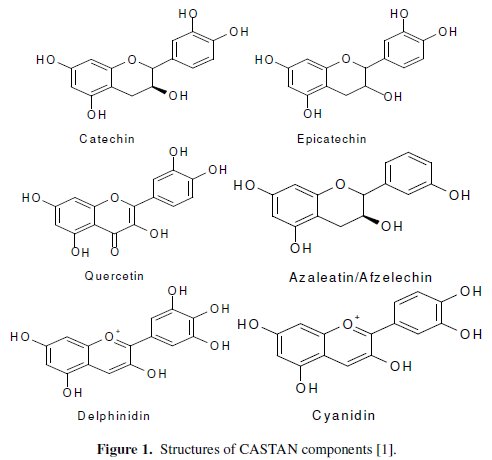
<body><![CDATA[<p>Cashew nut testa tannin [CASTAN] has been found to inhibit the corrosion of  aluminium in hydrochloric acid solutions using gravimetric, thermometric and  UV/visible spectrophotometric techniques. CASTAN inhibition was by adsorption on  aluminium following Temkin isotherm in 0.1 M HCl and Langmuir isotherm in 0.5 M  and 2.0 M HCl at 303 Kelvin. Physical adsorption on aluminium has been proposed in  studied HCl solutions; therefore, CASTAN is a cathodic inhibitor. Earlier reports [1]  showed CASTAN to contain quercetin, azaleatin, catechin, epicatechin, cyanidin and  delphinidin. However, UV/visible spectrophotometric analysis of CASTAN in ethanol  reveals quercetin as its major component. This work therefore investigated the  correlation between computed molecular parameters and inhibitive properties of  CASTAN and adsorption sites on its components. Calculated quantum chemical  parameters namely: E<sub>HOMO</sub> (highest occupied molecular orbital energy), E<sub>LUMO</sub> (lowest  unoccupied molecular orbital energy), energy gap (&Delta;E) and dipole moment  ( &mu; ) suggest that CASTAN is a soft inhibitor and it's components inhibited aluminium corrosion in  protonated forms. Calculated Mulliken charges implicated some electron rich sites,  namely: the aromatic and conjugated C=C, C=O and O-H as adsorption sites on the  inhibitor molecules. Proposed kinetic model reveals complex reaction mechanism,  parallel reactions, for aluminium corrosion inhibition by CASTAN.</p>      <p><b><i>Keywords:</i></b> cashew nut testa; cathodic and soft inhibitor; corrosion inhibition; quantum  chemical calculations; parallel reactions; Nnaji's inhibition constant.</p>       <p>&nbsp;</p>     <p><b>Introduction</b></p>      <p>Electrochemistry can be described as a branch of chemistry concerned with the  properties and interactions of electron transfers involved in chemical processes.  A typical electrochemical process is one which involves the interaction of a  metal, like aluminium, with its environment. This interaction causes the  interacting (reacting) aluminium to deteriorate such that its chemical composition  and properties change. This deterioration is known as corrosion [2].</p>      <p>But for some types of high temperature corrosion, all forms of corrosion occur by  electrochemical processes [2]. An example is the dissolution of aluminium in  hydrochloric acid which normally dissolves and corrodes away [2, 3].</p>      <p>In industries, aluminum has found wide usage particularly in a variety of  aggressive and corrosion service environment [4]. Somehow, aluminium resists  corrosion in these aggressive environments by the formation of a compact and  strongly adherent film majorly composed of Al2O3, Al(OH)3 and AlO.OH on the  surface [5, 6]. Regrettably, continued exposure of aluminium to these aggressive  and corrosive environments causes the protection of aluminium by this thin film  to fail. The failure of this film to protect aluminium has been attributed to the  presence and concentrations of anions like Cl<sup>-</sup> [6, 7].</p>      <p>A practical, efficient and effective method of improving the longevity of  aluminium after the failure of the formed thin film to protect it from corroding is  by the use of corrosion inhibitor [8]. The mechanism of protecting aluminium in  aggressive and corrosive environments has been reported to be by adsorption of  corrosion inhibitors on the surface of aluminium [6, 8-10]. Works [4-6, 8, 9, 11]  have shown that natural products derivable from agricultural byproducts inhibit  aluminium corrosion. In fact, tannins have been demonstrated [12] to be good  replacements for standard corrosion inhibitors. The major reasons are that unlike  these standard corrosion inhibitors, tannins (as natural products) are  environmentally friendly, easily available and cheap alternative corrosion  inhibitors.</p>      <p>In the eastern parts of Nigeria, cashew trees abound and so are the nuts. The testa  of the nuts, an outer covering of the cashew nuts (usually consisting disposal  problems), are known to contain flavanoids [1]. As shown in <a href="#f1">Fig. 1</a>, contained  flavanoids possess electron rich centers known to inhibit metal corrosion [4, 6, 8, 10]  namely: aromatic C=C, C=O and O-H. Electron rich sites possessed by  CASTAN components, known to inhibit metal corrosion, led to its use in this  study.</p>      <p>&nbsp;</p> <a name="f1"> <img src="/img/revistas/pea/v32n2/32n2a05f1.jpg">     
]]></body>
<body><![CDATA[<p>&nbsp;</p>      <p>To understand the mechanisms by which corrosion inhibitors adsorb on  aluminium, adsorption isotherms have been used. Commonest amongst these  adsorption isotherms are: Langmuir, Freundlich, Temkin and El-Awady  isotherms [6, 9-11, 13-15]. To ensure that the appropriate adsorption model was  chosen, the chi-square (&chi;<sup>2</sup>) statistic has been used to analyze how well the tested  adsorption models (Langmuir, Freundlich, Temkin and El-Awady) fit  experimental data.</p>      <p>Determination of molecular structures and unraveling the correlations between  molecular structures and reactivity have become possible using quantum  chemical methods [14]. Routinely therefore, quantum chemical calculations have  found extensive usage in corrosion inhibition studies. Recently, quantum  chemical approach has been used to predict electron rich centers/sites of  molecules which on adsorption onto metal surfaces, help to decrease the rate of  metal corrosion in aggressive environments [14, 15]. As such, sites containing  &pi;-electrons and lone pair of electrons on double and triple bonds, and heteroatoms  (nitrogen, oxygen and sulphur) respectively, have been implicated.  This work therefore presents and demonstrates a good understanding of  aluminium corrosion inhibition in hydrochloric acid solutions by CASTAN. This  was achieved using statistical tools (&chi;<sup>2</sup>, analysis of variance (ANOVA) and  regression) to analyze obtained experimental data. In addition, this present effort  proposes a new mechanism for the kinetics of corrosion inhibition of aluminium  in hydrochloric acid solutions.</p>       <p>&nbsp;</p>     <p><b>Theory</b></p>      <p>The dissolution of aluminium in hydrochloric acid can be represented by the  following reaction</p>      <p>&nbsp;</p> <a name="e1"> <img src="/img/revistas/pea/v32n2/32n2a05e1.jpg">     
<p>&nbsp;</p>      <p>This aluminium dissolution, represented by <a href="#e1">eq. (1)</a>, can be described by anodic  and cathodic controlled reactions respectively represented by <a href="#e2">eq. (2)</a> and <a href="#e3">(3)</a></p>      <p>&nbsp;</p> <a name="e2"> <img src="/img/revistas/pea/v32n2/32n2a05e2.jpg">     
]]></body>
<body><![CDATA[<p>&nbsp;</p> <a name="e3"> <img src="/img/revistas/pea/v32n2/32n2a05e3.jpg">     
<p>&nbsp;</p>      <p>The presence of Cl<sup>-</sup> ions (from HCl), increases the rate at which aluminium  corrodes [6, 7, 16] causing the combination of Cl<sup>-</sup> ions with Al (III) ions to form  aluminium chloride, as shown below</p>      <p>&nbsp;</p> <a name="e4"> <img src="/img/revistas/pea/v32n2/32n2a05e4.jpg">     
<p>&nbsp;</p>      <p>This process represented by <a href="#e4">eq. (4)</a>, releases electrons which cause H<sup>+</sup> ions to be  chemically reduced to hydrogen gas, as shown in <a href="#e3">eq. (3)</a>.</p>      <p>There are sacrificial substances known as corrosion inhibitors, which retard the  rate at which aluminium corrodes by decreasing the rate(s) at which the anodic  and/or cathodic controlled reactions of <a href="#e2">eq. (2)</a> and <a href="#e3">(3)</a> occur [4, 6, 15, 17-19].</p>      <p>Frontier orbital theory suggests that corrosion inhibitors retard metal corrosion  effectively if electrons can easily be released (and quantitatively too) by the  inhibitors, from their highest occupied molecular orbitals (HOMOs) [20, 21]. It is  believed that these HOMOs are possessed by rich electron sites on the inhibitors  such as: unsaturation (aromatic centers, C=C, C=O, N=O and the likes) and  heteroatoms (oxygen, nitrogen, sulphur and the likes) [4, 6, 15, 17-19].  Inhibitors are believed to protonate in aqueous solutions [22], therefore, it  follows that these inhibitors polarize and have their dipole moment values  increased. This is true considering that the dipole moment has a relationship with  (orientation) polarization (P<sub>o</sub>) as shown below [23]</p>      <p>&nbsp;</p> <a name="e5"> <img src="/img/revistas/pea/v32n2/32n2a05e5.jpg">     
<p>&nbsp;</p>      ]]></body>
<body><![CDATA[<p>where &mu; is (permanent) the dipole moment, N is Avogadro's number, k is  Boltzmann's constant and T is temperature in Kelvin. <a href="#e5">Eq. (5)</a> suggests that  orientation polarization of a molecule is proportional to the square of its dipole  moment. That is</p>      <p>&nbsp;</p> <a name="e6"> <img src="/img/revistas/pea/v32n2/32n2a05e6.jpg">     
<p>&nbsp;</p>      <p>But the product of (electronic) charge quantity (q) and charge separation (r) gives  dipole moment, for a linear molecule, whose vector quantity property allows the  determination of the dipole moment for a polyatomic molecule by vector addition  [23]. It follows therefore that high dipole moments imply the ease at which  molecules can (be) polarize (d) and high electronic charges possessed.  The frontier orbital theory and the dipole moment confer on the polyatomic  inhibitor molecule excess negative charges distributed around them, allowing  polarizability, better coverage and adsorption. Therefore, inhibitor molecules  with different electronegative elements will have increased surface coverage  effects on aluminium surface due to large dipole moments. Also, required drifts  of electrons from the inhibitor to the electrochemical aluminium corrosion  process will contribute effectively to retarding the rate at which the corrosion  process occurs.</p>       <p>&nbsp;</p>     <p><b>Materials and methods</b></p>      <p><b><i>Extraction and characterization of CASTAN</i></b></p>      <p>Cashew nut testa used was collected from a local market near Nsukka and air  dried. The air dried cashew nut testa was ground to powder, extracted with 70%  aqueous acetone and filtered using Buckner funnel and vacuum pump. Obtained  dark filtrate was air dried to give a light brown solid-CASTAN.  Infrared spectrum of CASTAN was obtained on a Shimadzu FTIR-8400S  infrared spectrophotometer using potassium bromide of spectroscopic grade at  the Analytical Unit of NARICT, Zaria, in Kaduna State of Nigeria.  UV-Visible spectrum of CASTAN was obtained using JENWAY 6405  spectrophotometer inter-phased with a computer.</p>       <p><b><i>Materials</i></b></p>      <p>Pure aluminum sheet of type AA 1060 (0.042 cm guage) was purchased from  EAST CHASE and TOTS Aluminium Nigeria limited, Ohodo in Enugu State.  Each sheet was mechanically press cut into 4 cm &times; 5 cm coupons. The specimen  were used as supplied without further polishing, but were degreased in absolute  ethanol, dried in acetone, weighed and stored in a moisture free desiccator prior  to use in corrosion studies. The concentrations of CASTAN prepared and used in  the study were 0.1-0.5 g/L. Acetone and concentrated HCl were of BDH-AnalaR  grades purchased from BHD, Poole, England. Distilled was prepared at the  National Centre for Equipment Maintenance and Development (NCEMD),  University of Nigeria, Nsukka, Enugu State.</p>       ]]></body>
<body><![CDATA[<p><b><i>Methods</i></b></p>      <p><i>Gravimetric measurements</i></p>      <p>Clean weighed aluminium coupons were immersed completely in twelve 250 mL  beakers containing 100 mL corrodent and various concentrations of inhibitors.  The beakers were placed in a thermostated oven maintained at 30 &deg;C, 40 &deg;C, and  50 &deg;C, respectively, at different times. The coupons were retrieved at 1 hour, 2  hours, 3 hours and 5 hours interval progressively for 11 hours, scrubbed with  bristle brush in distilled water at room temperature, dried in acetone and  weighed. The differences in weight of the coupons were taken as the weight loss,  which was used to compute the corrosion rate given by [15, 16]:</p>      <p>&nbsp;</p> <a name="e7"> <img src="/img/revistas/pea/v32n2/32n2a05e7.jpg">     
<p>&nbsp;</p>      <p>where J<sub>1</sub> and J<sub>2</sub> are the masses of the specimen before and after corrosion,  respectively, A is the total area of the specimen and t is the corrosion time.  The inhibition efficiencies (%I) of inhibitors, inhibitors and KI solution mixtures  were calculated using [15, 16]:</p>      <p>&nbsp;</p> <a name="e8"> <img src="/img/revistas/pea/v32n2/32n2a05e8.jpg">     
<p>&nbsp;</p>      <p>where C<sub>0</sub> and C<sub>1</sub> are the corrosion rates for aluminum in the absence and  presence of inhibitor, respectively, in HCl solution at the same temperature. The  degree of surface coverage (&theta;), is given by the equation [15, 16]:</p>      <p>&nbsp;</p> <a name="e9"> <img src="/img/revistas/pea/v32n2/32n2a05e9.jpg">     
]]></body>
<body><![CDATA[<p>&nbsp;</p>       <p><i>Thermometric measurements</i></p>      <p>All experiments were initially carried out at room temperature (30 &pm;  1 &deg;C). The variations in temperature with time as aluminum dissolves in 2 M HCl were  monitored at two minutes intervals with inhibitor (0.1 - 0.5 w/v %) and without  inhibitor using mercury in glass thermometer (0-100 &deg;C) to the nearest &pm;  0.05 &deg;C.</p>      <p>This method allowed for the evaluation of the reaction number (RN), defined as</p>      <p>&nbsp;</p> <a name="e10"> <img src="/img/revistas/pea/v32n2/32n2a05e10.jpg">     
<p>&nbsp;</p>      <p>where T<sub>m</sub> and T<sub>i</sub> are maximum and initial temperatures of the system,  respectively, and t is the time taken to reach the maximum temperature.</p>      <p>The inhibition efficiency (%I) was evaluated from percentage reduction in the  reaction number, thus [15]:</p>      <p>&nbsp;</p> <a name="e11"> <img src="/img/revistas/pea/v32n2/32n2a05e11.jpg">     
<p>&nbsp;</p>      ]]></body>
<body><![CDATA[<p>where RN<sub>aq</sub> is the reaction number in the absence of inhibitors and RN<sub>in</sub> is the  reaction number in the presence of inhibitor. The degree of surface coverage (&theta;)  is given by <a href="#e12">eq. (12)</a> [15]:</p>      <p>&nbsp;</p> <a name="e12"> <img src="/img/revistas/pea/v32n2/32n2a05e12.jpg">     
<p>&nbsp;</p>       <p><i>Quantum chemical calculation</i></p>      <p>Full geometry optimization of the inhibitor (CASTAN) was carried out using  density functional theory (DFT). B3LYP, a version of the DFT method that uses  Becke's three-parameter (B3) functional and includes a mixture of HF with DFT  exchange terms associated with the gradient corrected correlation functional of  Lee, Yang, and Parr (LYP) was used for the quantum chemical calculations [22,  24] . Full geometry optimization of the inhibitor was carried out at the B3LYP  using 6-31G* basis set level incorporated in the Spartan '06 V112 program  package. A number of quantum molecular properties for CASTAN components  (neutral and protonated) in aqueous media, such as Mulliken charges on atoms,  E<sub>HOMO</sub>, E<sub>LUMO</sub>, energy gap (&Delta;E) and dipole moment, were determined.</p>       <p><i>Statistical analysis</i></p>      <p>In a situation where there are K groups (K &geq; 2), the ANOVA technique becomes  appropriate and maintains the type one error rate at the pre-established alpha  level [13, 14].</p>       <p>Experimental and calculated values of &theta;  were compared using chi-square statistic  according to the following [25]:</p>      <p>&nbsp;</p> <a name="e13"> <img src="/img/revistas/pea/v32n2/32n2a05e13.jpg">     
<p>&nbsp;</p>      ]]></body>
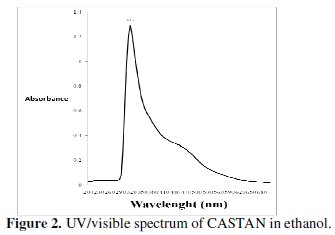
<body><![CDATA[<p>where &theta;<sub>exp</sub> and &theta;<sub>cal</sub>  are experimental and theoretical/calculated surface coverage  values, respectively, and &chi;<sup>2</sup> is chi-square statistic.</p>      <p>The effects of three factors, namely: (i) temperature, (ii) HCl concentration, and  (iii) inhibitor (CASTAN) concentration on inhibition efficiency were  investigated and the data were statistically analysed using SPSS version 16.  A simple linear regression, with one independent variable, was performed to  determine how much theoretical/calculated surface coverage (&theta;<sub>cal</sub>) values (from  chosen adsorption isotherm models) account/predict experimentally obtained  surface coverage (&theta;<sub>exp</sub>) values.</p>       <p>&nbsp;</p>     <p><b>Results and discussions</b></p>      <p><b><i>FTIR and UV/visible spectrophotometric measurements</i></b></p>      <p>The IR signals/frequencies of the aqueous acetone extract of cashew nut testa are  shown in our previous work [26]. Two absorption bands appear around 3435 cm<sup>-1</sup>  corresponding to O-H absorptions. Signals around 3435 cm<sup>-1</sup> and 3213 cm<sup>-1</sup> and 3213 cm<sup>-1</sup> that are most likely due to vibrations of O-H. The assignments  were because these absorptions have absorbance values of about 0.602 are  also due to NH2 stretching of primary amines and/or proteins. Vibration seen at  1616 cm<sup>-1</sup> has been attributed to C=O. Aromatic vibrations show signals at 1522  cm<sup>-1</sup> and 1452 cm<sup>-1</sup>. Absorption signal at 1359 cm<sup>-1</sup> is due to the presence of  condensed tannins. A signal which corresponds to C-C appears around 1230 cm<sup>-1</sup>.  Signals which appear at 1125 cmand 1044 cmsuggest the presence of C-O  (stretching) absorptions. Broad absorption signals which centered around 813  cm<sup>-1</sup> and 643 cm<sup>-1</sup> indicate the presence of substituted aromatic rings. These  assignments are consistent with those found in literature [1, 27, 28].</p>      <p><a href="#f2">Fig. 2</a> presents the UV/visible spectrum of CASTAN in ethanol.</p>      <p>&nbsp;</p> <a name="f2"> <img src="/img/revistas/pea/v32n2/32n2a05f2.jpg">     
<p>&nbsp;</p>      <p>UV/visible spectroscopy has been found useful in the identification of the nature of  vegetable tannins [29]. Therefore, the UV/visible spectrum of CASTAN in  ethanol shows a 'sharp' peak at 315 nm and a broad (or shoulder) peak around  420-480 nm, hence, characteristic of condensed tannins [29, 30]. Wavelength  range of 300-400 nm is related to conjugated system between ring B and  carbonyl of ring C for band I (cinnamoyl), and band II (benzoyl) located in the  wavelength range of 240-300 nm is related to conjugated system between ring A  and carbonyl of ring C, hence, quercetin implicated [31]. <a href="#f1">Fig. 1</a> presents  CASTAN components and reveals that quercetin alone conforms with the  UV/visible description cinnamoyl and benzoyl bands, therefore, it can be  concluded that quercetin is the major component of CASTAN.</p>      ]]></body>
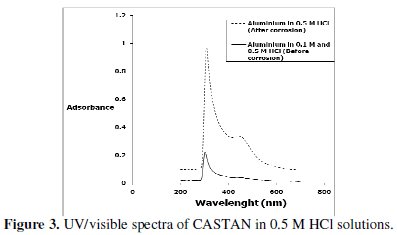
<body><![CDATA[<p><a href="#f3">Fig. 3</a> presents the UV/visible spectrum of CASTAN in 0.5 M HCl solutions  before and after aluminium corrosion.</p>      <p>&nbsp;</p> <a name="f3"> <img src="/img/revistas/pea/v32n2/32n2a05f3.jpg">     
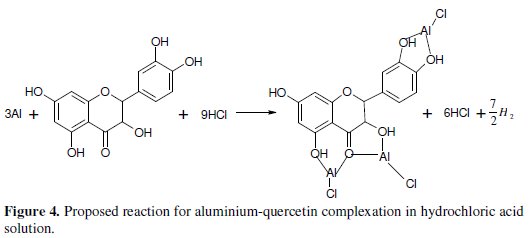
<p>&nbsp;</p>      <p>It has been demonstrated [32] that natural organic matter absorption  in the ultraviolet region is of n-&pi;* transition that  reveals the presence of aromatic C=O and O-H, whereas n-&pi;* transitions at  longer wavelengths suggest that, C=C signals absorb weakly. <a href="#f3">Figure 3</a> reveals  two absorptions in the spectra of 0.5 M HCl solutions containing CASTAN  before and after aluminium immersion. After 11 hours, the shape of the two  absorptions remained significantly unchanged. However, after corrosion, these  peaks had increased intensities suggesting that aromatic C=C, C=O and O-H took  part in the adsorption-corrosion inhibition processes. These suggest that  CASTAN adsorption on aluminium took place through the aromatic rings and  phenolic functional groups of CASTAN components.</p>      <p>The adsorption of (monochromatic) light is a suitable technique for identification  of complex ions [33]. Changes in the position of the absorption maxima and in  the value of absorbance indicate the formation of a complex between two species  in solution [34]. To confirm therefore the formation of CASTAN-Al complex,  uv/visible absorption spectra obtained from 0.5 M HCl solution containing  CASTAN before and after 11 hours of corrosion are shown in <a href="#f3">Fig. 3</a>. This is  indicative that [ CASTAN - Al<sup>3+</sup> ] complexes formed via &pi;-electrons of aromatic  C=C and n-electrons of C=O and O-H sites on CASTAN in 0.5 M HCl solution.  Also, the formation of [ CASTAN - Al<sup>3+</sup> ] complexes caused increases in values of  absorbance for CASTAN spectrum after 11 hours as presented. The variations in  absorbance values, support the existence of [ CASTAN - Al<sup>3+</sup> ] complex formation  via &pi;-electron rich sites of aromatic C=C, conjugated aromatic polyphenols,  hydroxyl and carbonyl sites on CASTAN. Physisorption has been proposed  because the shape of the spectra did not change significantly after 11 hours [35,  36]. Spectroscopic data suggest that quercetin can chelate cations through both 3hydroxy- 4-carbonyl and the 3',4'-dihydroxyl chelation sites [37, 38], and by  quantum chemical studies, chelation is through the 5-hydroxy-4-keto site [39].  Therefore, using quercetin as an example, <a href="#f4">Fig. 4</a> presents the adsorption sites on  CASTAN components by physisorption on aluminium.</p>      <p>&nbsp;</p> <a name="f4"> <img src="/img/revistas/pea/v32n2/32n2a05f4.jpg">     
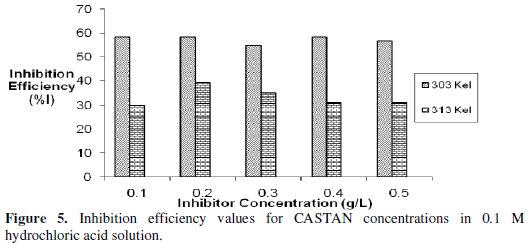
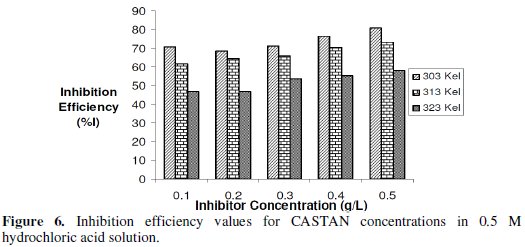
<p>&nbsp;</p>       <p><b><i>Gravimetric measurement</i></b></p>      <p>Gravimetric (or weight loss) technique was used to study the corrosion rate of  aluminium in the absence and presence of CASTAN at 30 &deg;C -50 &deg;C.  From the obtained corrosion rates, the inhibition efficiency (I%) values were  calculated using <a href="#e8">eq. (8)</a>. The values of inhibition efficiency gotten from  gravimetric measurements at different CASTAN concentrations, at different  temperatures (30 &deg;C - 50 &deg;C) and in 0.1 M and 0.5 M HCl solutions, are presented  in <a href="#f5">Fig. 5</a> and <a href="#f6">6</a>.</p>      <p>&nbsp;</p> <a name="f5"> <img src="/img/revistas/pea/v32n2/32n2a05f5.jpg">     
]]></body>
<body><![CDATA[<p>&nbsp;</p> <a name="f6"> <img src="/img/revistas/pea/v32n2/32n2a05f6.jpg">     
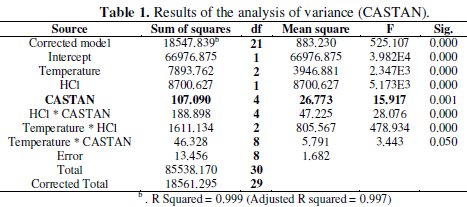
<p>&nbsp;</p>      <p><a href="#f6">Fig. 6</a> shows that I% for CASTAN attains the highest value of  80.7% corresponding to the highest CASTAN concentration for 0.5 M HCl at  30 &deg;C. For 0.1 M HCl solutions, I% generally decrease with increase in CASTAN  concentration and also decrease with increase in temperature. In contrast, 0.5 M  HCl solutions gave I% values which increase with increase in CASTAN  concentration but decrease with increase in temperature. These suggest that the  number of adsorbed CASTAN molecules decreases as the temperature increase,  therefore, lead to a decrease in I% values calculated. Therefore, physisorption of  CASTAN on aluminium in 0.1 M and 0.5 M HCl solutions account for the  decrease in inhibition efficiency of CASTAN with increase in temperature.</p>      <p>Analysis of variance (ANOVA) results presented in <a href="#t1">Table 1</a> reveal that  significant difference existed in inhibition efficiencies at different: temperatures,  corrodent (HCl) concentrations; and significant difference existed in inhibition  efficiencies for/due to corrodent (HCl) concentration and temperature  interactions.</p>      <p>&nbsp;</p> <a name="t1"> <img src="/img/revistas/pea/v32n2/32n2a05t1.jpg">     
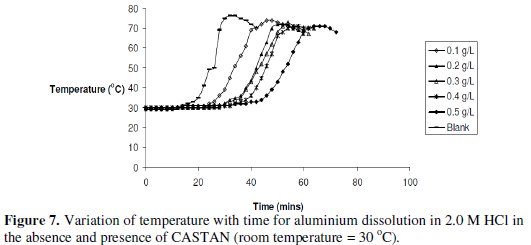
<p>&nbsp;</p>      <p>These suggest that the differences observed in <a href="#f5">Fig. 5</a> and <a href="#f6">6</a> are  statistically significant.</p>       <p><b><i>Thermometric measurement</i></b></p>      <p>The variations of temperature with time for the dissolutions of aluminium in 2 M  HCl at various CASTAN concentrations and without CASTAN are presented in  <a href="#f7">Fig. 7</a>.</p>      <p>&nbsp;</p> <a name="f7"> <img src="/img/revistas/pea/v32n2/32n2a05f7.jpg">     
]]></body>
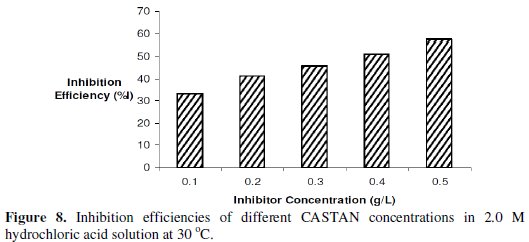
<body><![CDATA[<p>&nbsp;</p>      <p>Observations can be made that the times to attain maximum temperature  increased for systems containing CASTAN.</p>      <p>Inhibition efficiencies of CASTAN in 2 M HCl are shown in <a href="#f8">Fig. 8</a> and suggest  that aluminium corrosion inhibition by CASTAN increases with increase in  CASTAN concentration in 2.0 M HCl.</p>       <p><b><i>Adsorption considerations</i></b></p>      <p>Adsorption of CASTAN largely is dependent on: the nature of the metal surface  and the charge on the metal surface; nature of corrodent and particularly the  anion specie/moiety; corrosion process temperature; and the electrochemical  potential at the solution-interface [5].</p>      <p>CASTAN components (cyanidin, delphinidin, quercetin, azaleatin, catechin and  epicatechin) reveal that CASTAN possesses aromatic centers and structural  features (size and steric arrangements) from flavonoid skeletons, rich electron  densities from oxygen atoms of the ketonic and phenolic functional groups of  anthocyanins.</p>      <p>The establishment of adsorption isotherm models which explain/describe the  adsorption of an inhibitor can provide vital clues to the nature of the metal- inhibitor interaction(s). Therefore, in order to elucidate the nature of adsorption  of CASTAN on aluminium in HCl solutions, adsorption isotherms describing the  adsorption processes were determined.</p>      <p>The commonly used linearised adsorption isotherms are [6, 9-11, 13-15]:  Langmuir model (<a href="#e14">eq. (14)</a>); Freundlich model (<a href="#e15">eq. (15)</a>);  Temkin model (<a href="#e16">eq. (16)</a>); and El-Awady model (<a href="#e17">eq. (17)</a>).  Respectively they are represented thus:</p>      <p>&nbsp;</p> <a name="e14"> <img src="/img/revistas/pea/v32n2/32n2a05e14.jpg">     
<p>&nbsp;</p> <a name="e15"> <img src="/img/revistas/pea/v32n2/32n2a05e15.jpg">     
]]></body>
<body><![CDATA[<p>&nbsp;</p> <a name="e16"> <img src="/img/revistas/pea/v32n2/32n2a05e16.jpg">     
<p>&nbsp;</p> <a name="e17"> <img src="/img/revistas/pea/v32n2/32n2a05e17.jpg">     
<p>&nbsp;</p>      <p>where K<sub>L</sub>, K<sub>f</sub>, K<sub>T</sub> and K<sub>EL</sub> are adsorption capacity values obtained from  Langmuir, Freundlich, Temkin and El-Awady isotherm models, respectively.  Also, 1/n is Freundlich constant, 'f' is the Frumkin lateral interaction factor  related to Temkin heterogeneity 'a' (f = -2a) and Y is the El-Awady constant  which is characteristic of the number of active sites on the aluminium surface.</p>      <p>Plots of <a href="#e14">eq. (14)-(17)</a> were performed using Microsoft Excel package of 2003  version. From the intercepts of these plots, adsorption capacity values were  obtained and used to determine free energy of adsorption [13] by the following  relationship</p>      <p>&nbsp;</p> <a name="e18"> <img src="/img/revistas/pea/v32n2/32n2a05e18.jpg">     
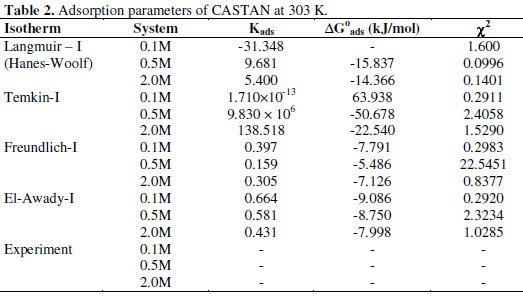
<p>&nbsp;</p>      <p>where K<sub>ads</sub> is any of the adsorption capacity values from <a href="#e14">eq. (14)-(17)</a>. Calculated  adsorption capacity values and free energy of adsorption are presented in <a href="#t2">Table 2</a>.</p>      <p>&nbsp;</p> <a name="t2"> <img src="/img/revistas/pea/v32n2/32n2a05t2.jpg">     
<p>&nbsp;</p>      ]]></body>
<body><![CDATA[<p>Using chi-square statistic, experimentally and theoretically determined surface  coverage values were compared. Presented in <a href="#t2">Table 2</a> are values of calculated &chi;<sup>2</sup>  from which the lowest value reveals the isotherm that fits &chi;<sup>2</sup>  experimental/adsorption data well. From the calculated value, it was  concluded that Temkin adsorption isotherm gave the best fit for 0.1 M HCl  systems and Langmuir adsorption isotherm fitted the data for 0.5 M and 2.0 M  HCl systems well at 30 &deg;C.</p>      <p><a href="#e19">Eq. (19)</a> represents the obtained data plots for Temkin adsorption isotherm that  fitted adsorption data for 0.1 M HCl solutions.</p>      <p>&nbsp;</p> <a name="e19"> <img src="/img/revistas/pea/v32n2/32n2a05e19.jpg">     
<p>&nbsp;</p>      <p>Using Microsoft Excel package 2003, plots of Temkin adsorption  isotherm with experimental data at 30 &deg;C are given as <a href="#e19">eq. (19)</a></p>      <p>Comparing <a href="#e16">eq. (16)</a> and <a href="#e19">(19)</a>, a slope of -0.0136 corresponds to 1/f and when  compared with (1/f)lnK<sub>T</sub>, gives K<sub>T</sub> value of 1.710&times;10<sup>-13</sup>. The K<sub>T</sub> value denotes  the strength between adsorption and adsorbent such that small K<sub>T</sub> value implies  weak interaction (physical adsorption otherwise known as physisorption). The  value of 1/f is negative and reveals that repulsive forces exist among CASTAN  molecules and aluminium surface [10], hence, adsorption effectiveness was  reduced and consequently, inhibition of aluminium in HCl was compromised. In  fact, it is most likely that repulsive interactions between layers of adsorbed  CASTAN components such as cyanidin and delphinidin exist. The positive  charges on cyanidin and delphinidin molecules are most likely responsible for  repulsion between CASTAN and aluminium which led to poor adsorption and  consequently decreased inhibition.</p>      <p>For 0.5 M HCl solutions, adsorption data fitted well into <a href="#e20">eq. (20)</a> at 30 &deg;C from  which the following equation was obtained:</p>      <p>&nbsp;</p> <a name="e20"> <img src="/img/revistas/pea/v32n2/32n2a05e20.jpg">     
<p>&nbsp;</p>      <p>The plot represents Langmuir adsorption isotherm. It is true that if the coefficient  of determination (R<sup>2</sup>) has a very high value, a slope of 0.1903 deviates from the  predicted value of unity from <a href="#e14">eq. (14)</a>. Therefore, lateral or vertical adsorption  mode/mechanism by CASTAN components is proposed; consequently,  interactions of CASTAN molecules on aluminium are such that high chemical  adsorption or heavy physisorption must have occurred. Another possibility is that  the aluminium surface is characterized by non similar (heterogeneous) adsorption  sites. In contrast, earlier adsorption studies by Langmuir [31] posited that surface  adsorption sites are similar (homogeneous) for adsorbents from which plots of  adsorption data gave values of unity and therefore favour chemisorption. For the  fact that physisorption was proposed earlier (section ''Gravimetric  measurement''), consequently, these adsorbing CASTAN molecules (adsorbates)  would interact with themselves, and multilayer coverage by adsorbing molecules  is expected, otherwise, aluminium surface is characterized with/by heterogeneous  (non similar) adsorption sites.</p>      ]]></body>
<body><![CDATA[<p>In the same vein for 2.0 M HCl solutions, adsorption data fitted well into <a href="#e21">eq. (21)</a>  at 30 &deg;C from which the following equation was obtained:</p>      <p>&nbsp;</p> <a name="e21"> <img src="/img/revistas/pea/v32n2/32n2a05e21.jpg">     
<p>&nbsp;</p>      <p>Though the coefficient of determination (R<sup>2</sup>) is very high, the value of slope of  0.1442 deviates from the predicted value of unity from <a href="#e14">eq. (14)</a>. This suggests  that interactions of CASTAN molecules on aluminium involve high chemical  adsorption or heavy physical adsorption. In fact, low K<sub>L</sub> value of 5.400 reveals  physisorption of CASTAN on aluminium. Physisorption mechanism is further  confirmed by comparing calculated free energy values shown in <a href="#t2">Table 2</a>. Free  energy value of -14.366 KJ/mol is not up to -40 kJ/mol and therefore suggests  physisorption of CASTAN on aluminium in 2.0 HCl [13].</p>      <p>The conclusion therefore is that physical adsorption mechanisms took place in  0.1 M, 0.5 M and 2.0 M HCl solutions for the adsorption of CASTAN on  aluminium. Oguzie [14] reported earlier that corrosion inhibitors which  physisorb on metals are cathodic inhibitors. CASTAN has been shown to  physisorb on aluminium in HCl solutions, therefore, it is a cathodic inhibitor. It  suggests therefore that aluminium corrosion inhibition by CASTAN is such that  its presence in HCl slows down the rate at which hydrogen gas evolves in the  corrosion processes as <a href="#e3">eq. (3)</a> presents.</p>       <p><b><i>Statistical analysis</i></b></p>      <p>Regression analysis is a correlation based statistical technique for making  predictions. It allows one variable to be predicted from another/other variable(s)  based on the correlation between the variable. As such, the technique models the  relationship between variables to give a structural model known as the regression  model [25].</p>      <p>Here the simple linear regression was used to determine how much theoretical  surface coverage (&theta;<sub>cal</sub>) values (from adsorption isotherm models) account/predict  experimentally obtained surface coverage (&theta;<sub>exp</sub>) values. The linear <a href="#e19">eq. (19)</a> was  taken to represent the regression models developed for &theta;<sub>cal</sub> and &theta;<sub>exp</sub> values from</p>      <p>&nbsp;</p> <a name="e22"> <img src="/img/revistas/pea/v32n2/32n2a05e22.jpg">     
<p>&nbsp;</p>      ]]></body>
<body><![CDATA[<p>where Y is the experimental surface coverage value, X is the theoretical surface  coverage value, 'a' is the regression constant and 'b' is the regression coefficient.  Two 'normal' equations were generated and solved simultaneously to determine  the regression constant and regression coefficient values. These 'normal'  equations generated are represented thus</p>      <p>&nbsp;</p> <a name="e23"> <img src="/img/revistas/pea/v32n2/32n2a05e23.jpg">     
<p>&nbsp;</p> <a name="e24"> <img src="/img/revistas/pea/v32n2/32n2a05e24.jpg">     
<p>&nbsp;</p>      <p>where N represents the number of &theta;<sub>exp</sub> values and &Sigma;  represents summation.</p>      <p>For 0.1 M HCl systems, substituting appropriately into <a href="#e23">eq. (23)</a> and <a href="#e24">(24)</a>, and  solving simultaneously, b = 0.5 and a = 0.3644 to give a regression model</p>      <p>&nbsp;</p> <a name="e25"> <img src="/img/revistas/pea/v32n2/32n2a05e25.jpg">     
<p>&nbsp;</p>      <p>Using <a href="#e26">eq. (26)</a>, the standard error (SE<sub>y</sub>) of estimate (regression model) was</p>      <p>&nbsp;</p> <a name="e26"> <img src="/img/revistas/pea/v32n2/32n2a05e26.jpg">     
]]></body>
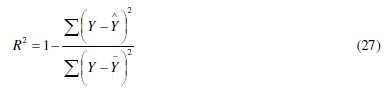
<body><![CDATA[<p>&nbsp;</p>      <p>The calculated SEy at 95% confidence level gave &pm; 0.0253. Considering the  prediction from <a href="#e22">eq. (22)</a>, the SE<sub>y</sub> measures the error in the predicted surface  coverage values ( Y ) for 0.1 M HCl systems.</p>      <p>Furthermore, to account for how much of the &theta;exp  values accounted for by theregression model, the coefficient of  determination (R<sup>2</sup>) was calculated using <a href="#e27">eq. (27)</a> [40].</p>      <p>&nbsp;</p> <a name="e27"> <img src="/img/revistas/pea/v32n2/32n2a05e27.jpg">     
<p>&nbsp;</p>      <p>where Y is the mean value of the experimental surface coverage values. From <a href="#e25">eq. (25)</a>,  R<sup>2</sup> value of 0.1589 (about 15.89%) was calculated. R<sup>2</sup> value suggests that  about 15.89% of the experimental surface coverage values were accounted for by  the theoretical surface coverage values obtained from the Temkin adsorption  model. The calculated low R<sup>2</sup> value can be attributed to the fact that from the  regression statistic, the Temkin adsorption model does not account for the  experimental surface coverage values well. In contrast, this model seems to give  the best fit to adsorption data from the tested adsorption models from chi-square  and standard error statistics.</p>      <p>For 0.5 M HCl systems, substituting appropriately into <a href="#e23">eq. (23)</a> and <a href="#e24">(24)</a>, and  solving simultaneously, the following regression parameters were determined: b  = 0.2573 and a = 0.5543 to give a regression model</p>      <p>&nbsp;</p> <a name="e28"> <img src="/img/revistas/pea/v32n2/32n2a05e28.jpg">     
<p>&nbsp;</p>      <p>Using <a href="#e26">eq. (26)</a>, the standard error of estimate (regression model) was calculated  to give standard Error (SE<sub>y</sub>) value of &pm; 0.0622 at 95% confidence level.</p>      ]]></body>
<body><![CDATA[<p>Considering the prediction from <a href="#e26">eq. (26)</a>, the SEy measures the error in the  predicted surface coverage values ( Y ) for 0.5 M HCl systems.</p>      <p>Furthermore, to account for how much of the &theta;<sub>exp</sub> values were accounted for by  the Langmuir model, the coefficient of determination (R<sup>2</sup>) was calculated using  <a href="#e27">eq. (27)</a>. From <a href="#e27">equation (27)</a>, R<sup>2</sup> value of 0.4886 (about 48.86%) was calculated.  R<sup>2</sup> value suggests that about 48.86% of the experimental surface coverage values  were accounted for by the theoretical surface coverage values obtained from the  Langmuir adsorption model. Comparing results obtained from 0.1 M systems  with those of 0.5 M systems, 0.5 M systems were accounted for more than 0.1 M  systems.</p>      <p>For 2.0 M HCl systems, substituting appropriately into <a href="#e23">eq. (23)</a> and <a href="#e24">(24)</a>), and  solving simultaneously, b = 0.5924 and a = 0.1146 to give a regression model</p>      <p>&nbsp;</p> <a name="e29"> <img src="/img/revistas/pea/v32n2/32n2a05e29.jpg">     
<p>&nbsp;</p>      <p>Using <a href="#e26">eq. (26)</a>, the standard error of estimate (regression model) was calculated  to give standard Error (SE<sub>y</sub>) value of &pm; 0.03403 at 95% confidence level.  Considering the prediction from <a href="#e26">eq. (26)</a>, the SE<sub>y</sub> measures the error in the  predicted surface coverage values ( Y ) for 2.0 M HCl systems.</p>      <p>Furthermore, to account for how much of the &theta;<sub>exp</sub> values accounted for by the  Langmuir adsorption model, the coefficient of determination (R<sup>2</sup>) was calculated  using <a href="#e27">eq. (27)</a>. From <a href="#e27">eq. (27)</a>, R<sup>2</sup> value of 0.9557 (about 95.57%) was calculated.  R<sup>2</sup> value suggests that about 95.57% of the experimental surface coverage values  were accounted for by the theoretical surface coverage values obtained from the  Langmuir adsorption model. Comparing results obtained from 0.1 M and 0.5 M  systems with those of 2.0 M systems, 2.0 M systems were accounted for most  than 0.1 and 0.5 M systems.</p>      <p>Regression studies were done because linear adsorption isotherms give good  results [9] in adsorption studies. However, the uses of linear adsorption models  (<a href="#e14">eq. (14)-(17)</a>) have come under criticisms on the basis that they introduce errors  from the linearisations of the adsorption models [41, 42]. The fact that the  adsorption models are non-linear, consequently fitting them to adsorption data  require: special optimization programs [41]; availability of these programs or  softwares; and expertise to make use of them. It is therefore necessary that the  linearised versions of the non-linear adsorption isotherms (<a href="#e14">eq. (14)-(17)</a>) are tried  out.</p>      <p>Now, one may insist that the use of the linear forms of adsorption isotherms does  not give good results as compared to results obtained from non-linear adsorption  isotherms. Scientifically (or mathematically) speaking, chi-square and regression  statistics are powerful tools (techniques) of performing error analysis of data.  Therefore, R<sup>2</sup> values of 15.89%, 48.86% and 95.57% representing correlation  coefficients for &theta;<sub>exp</sub> and &theta;<sub>cal</sub>, respectively, for 0.1 M, 0.5 M and 2.0 M HCl  systems, suggest that the form of adsorption isotherm used (linear or non-linear)  is not the only factor affecting how well adsorption mechanism can be explained.  Excellent R<sup>2</sup> value for 2.0 M HCl systems supports our claim. We suggest  therefore that the type (or nature) of adsorption, also affects how well existing  adsorption isotherms/models can explain adsorption processes!</p>       <p><b><i>Temperature effect of CASTAN adsorption on aluminium in HCl solutions</i></b></p>      ]]></body>
<body><![CDATA[<p>The temperature stability of CASTAN as aluminum corrosion inhibitor in  hydrochloric acid solutions was studied. Usually, the Arrhenius plots of <a href="#e30">eq. (30)</a>  come handy [13], as such, kinetic/thermodynamic parameters can be obtained  therefrom.</p>      <p>&nbsp;</p> <a name="e30"> <img src="/img/revistas/pea/v32n2/32n2a05e30.jpg">     
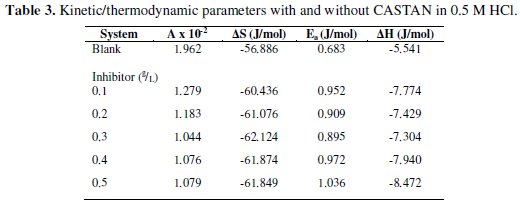
<p>&nbsp;</p>      <p>Calculated corrosion rates (Ccorr) of aluminium in 0.1 M and 0.5 M  HCl solutions at 30 &deg;C - 50 &deg;C were used to make the Arrhenius plots. The values  of frequency factor (A) and activation energy (Ea) were determined from  Arrhenius plots of <a href="#e30">eq. (30)</a>. Respectively, A and Ea were gotten from intercepts  and slopes of <a href="#e30">eq. (30)</a> plots and presented in <a href="#t3">Table 3</a>.</p>      <p>&nbsp;</p> <a name="t3"> <img src="/img/revistas/pea/v32n2/32n2a05t3.jpg">     
<p>&nbsp;</p>      <p><a href="#t3">Table 3</a> shows that in 0.1 M  HCl and 0.5 M HCl solutions, the frequency factor values for aluminium  dissolution are higher for blank solutions than those solutions containing various  concentrations of CASTAN. These are evidences for good inhibition efficiency  exhibited by CASTAN [14]. Activation energy values obtained from slopes of  <a href="#e30">eq. (30)</a> plots for 0.1 M and 0.5 M HCl blanks are lower than values obtained for  systems containing CASTAN. These also confirm what was observed in the  laboratory: the presence of CASTAN, prolonged the longevity of aluminium in  0.1 M and 0.5 M HCl solutions.</p>       <p><b><i>Kinetics of CASTAN adsorption on aluminium in HCl</i></b></p>      <p>The major reaction that explains aluminium corrosion in hydrochloric acid can be  represented, as shown in <a href="#e1">eq. (1)</a>. In the absence of CASTAN, but in the presence  of air and moisture, the formation of oxide films has been reported. These oxide  films (Al<sub>2</sub>O<sub>3</sub>, Al(OH)<sub>3</sub> and AlO.OH) have been reported to decrease the rate at  which aluminum corrodes [5, 6]. Reaction pathways that account for the  formation of these aluminum compounds can be represented thus:</p>      <p>&nbsp;</p> <a name="e31"> <img src="/img/revistas/pea/v32n2/32n2a05e31.jpg">     
]]></body>
<body><![CDATA[<p>&nbsp;</p> <a name="e32"> <img src="/img/revistas/pea/v32n2/32n2a05e32.jpg">     
<p>&nbsp;</p> <a name="e33"> <img src="/img/revistas/pea/v32n2/32n2a05e33.jpg">     
<p>&nbsp;</p>      <p>Regrettably, the presence of anions such as Cl-breakdown the passivity of  aluminium; therefore, the protection of aluminium enjoys fails. The addition of  corrosion inhibition becomes vital for continued aluminium protection. The  presence of an inhibitor therefore brings about the production of other corrosion  products and the chemistry of this process can be presented as:</p>      <p>&nbsp;</p> <a name="e34"> <img src="/img/revistas/pea/v32n2/32n2a05e34.jpg">     
<p>&nbsp;</p>      <p>It is clear that for the corrosion inhibition process, <a href="#e31">eq. (31)-(34)</a> occur; therefore,  the corrosion inhibition process is a complex reaction type. To account for these  reactions (that is the complexity of corrosion), we propose that parallel reactions  occur in such a way that <a href="#e1">eq. (1)</a> is the main reaction in the corrosion process. The  side reactions involve <a href="#e31">eq. (31)-(33)</a> for corrosion process without inhibitor and  <a href="#e31">eq. (31)-(34)</a> for corrosion process with inhibitor present.  A general expression representing parallel reactions is</p>      <p>&nbsp;</p> <a name="e35"> <img src="/img/revistas/pea/v32n2/32n2a05e35.jpg">     
<p>&nbsp;</p> <a name="e36"> <img src="/img/revistas/pea/v32n2/32n2a05e36.jpg">     
<p>&nbsp;</p>      ]]></body>
<body><![CDATA[<p>where [Al.Inh] represents Al<sub>2</sub>O<sub>3</sub>, Al(OH)<sub>3</sub> and AlO.OH in the absence of the  inhibitor and [Al.CASTAN] in the presence of CASTAN, k<sub>1</sub> is rate constant for  the dissolution of aluminium, k<sub>2</sub> is the unimolecular rate constant for  decomposition of activated complex, and Kc the proportionality constant for the  formation of activated complex.</p>      <p>From gravimetric measurements, the reaction rate constant, k<sub>1</sub>, can be determined  from the following differential rate law</p>      <p>&nbsp;</p> <a name="e37"> <img src="/img/revistas/pea/v32n2/32n2a05e37.jpg">     
<p>&nbsp;</p>      <p>Rearranging <a href="#e37">eq. (37)</a> gives</p>      <p>&nbsp;</p> <a name="e38"> <img src="/img/revistas/pea/v32n2/32n2a05e38.jpg">     
<p>&nbsp;</p>      <p>Solving <a href="#e38">eq. (38)</a> gives</p>      <p>&nbsp;</p> <a name="e39"> <img src="/img/revistas/pea/v32n2/32n2a05e39.jpg">     
<p>&nbsp;</p>      ]]></body>
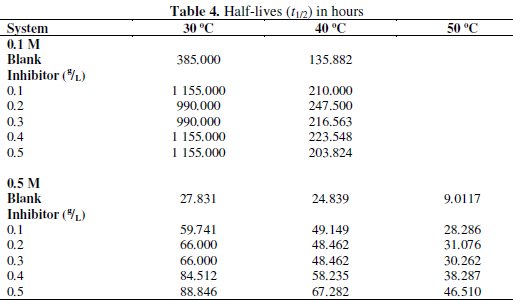
<body><![CDATA[<p>where [Al]<sub>0</sub> is the weight of aluminium coupon before corrosion, [Al] is the  weight of aluminium at different time intervals during corrosion, t is the time  involved. From the slopes of <a href="#e39">eq. (39)</a> plots, k<sub>1</sub> was calculated. Substituting k<sub>1</sub>  values into <a href="#e40">eq. (40)</a> enabled the determinations of half-lives (t<sub>1</sub>/2) for the various  corrosion processes.</p>      <p>&nbsp;</p> <a name="e40"> <img src="/img/revistas/pea/v32n2/32n2a05e40.jpg">     
<p>&nbsp;</p>      <p>In chemistry, reactions are thought to progress when reactants possess enough  energy (activation energy) to react and form products. Consequently, these  reactants acquire energy to form an activated complex which then decomposes  into products. This can be illustrated thus:</p>      <p>&nbsp;</p> <a name="e41"> <img src="/img/revistas/pea/v32n2/32n2a05e41.jpg">     
<p>&nbsp;</p>      <p>From the foregoing, the aluminium corrosion inhibition by inhibitor (CASTAN)  can therefore be represented by <a href="#e42">eq. (42)</a>.</p>      <p>&nbsp;</p> <a name="e42"> <img src="/img/revistas/pea/v32n2/32n2a05e42.jpg">     
<p>&nbsp;</p>      <p>From <a href="#e42">eq. (42)</a>, an overall rate for the  corrosion process can be written as given below where k is the  overall rate constant for the dissolution of aluminium. A rate  equation for the production of activated complex can be expressed  mathematically assuming that the reactants are in equilibrium with the activated  complex (as shown in <a href="#e41">eq. (41)</a>).</p>      ]]></body>
<body><![CDATA[<p>&nbsp;</p> <a name="e43"> <img src="/img/revistas/pea/v32n2/32n2a05e43.jpg">     
<p>&nbsp;</p> <a name="e44"> <img src="/img/revistas/pea/v32n2/32n2a05e44.jpg">     
<p>&nbsp;</p> <a name="e45"> <img src="/img/revistas/pea/v32n2/32n2a05e45.jpg">     
<p>&nbsp;</p>      <p>Comparing <a href="#e44">eq. (44)</a> and <a href="#e45">(45)</a> reveals that,  K<sub>C</sub> = K<sub>C<sub>1</sub></sub> / K<sub>C<sub>- 1</sub></sub> ,  hence its name, proportionality constant.</p>      <p>From the unimolecular decomposition of the activated complex shown by <a href="#e36">eq. (36)</a>,  another rate equation can be written as</p>      <p>&nbsp;</p> <a name="e46"> <img src="/img/revistas/pea/v32n2/32n2a05e46.jpg">     
<p>&nbsp;</p> <a name="e47"> <img src="/img/revistas/pea/v32n2/32n2a05e47.jpg">     
<p>&nbsp;</p>      <p>Close observation of <a href="#e36">eq. (36)</a> clearly shows that the corrosion process goes  through two major steps: formation of activated complex and decomposition of  activated complex. These two major steps gave rise to expressions <a href="#e43">(43)</a> and <a href="#e47">(47)</a>.  Therefore, equating the overall rate equation represented by <a href="#e43">eq. (43)</a> and <a href="#e47">eq. (47)</a>  which represent the corrosion steps, the following equation was obtained:</p>      ]]></body>
<body><![CDATA[<p>&nbsp;</p> <a name="e48"> <img src="/img/revistas/pea/v32n2/32n2a05e48.jpg">     
<p>&nbsp;</p>      <p>This obviously makes the overall rate constant, k, be related thus</p>      <p>&nbsp;</p> <a name="e49"> <img src="/img/revistas/pea/v32n2/32n2a05e49.jpg">     
<p>&nbsp;</p>      <p>The overall rate constant is also known as the bimolecular rate constant for the  corrosion inhibition process involving reaction between aluminium and  CASTAN. The proportionality constant (K<sub>C</sub>) has relationship with the  unimolecular rate constant (k<sub>1</sub>) thus [43]:</p>      <p>&nbsp;</p> <a name="e50"> <img src="/img/revistas/pea/v32n2/32n2a05e50.jpg">     
<p>&nbsp;</p>      <p>The proportionality constant has been shown to have the following expression  [43, 44]</p>      <p>&nbsp;</p> <a name="e51"> <img src="/img/revistas/pea/v32n2/32n2a05e51.jpg">     
]]></body>
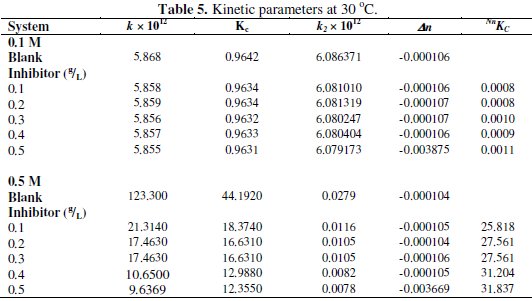
<body><![CDATA[<p>&nbsp;</p>      <p><a href="#e51">Eq. (51)</a> was used to calculate K<sub>C</sub> values.  Substituting K<sub>C</sub> values into <a href="#e50">eq. (50)</a>, k<sub>1</sub>  values were calculated. The values of k were also calculated from <a href="#e51">eq. (51)</a> after  substituting values for k<sub>1</sub> and K<sub>C</sub>.</p>      <p>A close observation of <a href="#e1">eq. (1)</a> reveals that hydrogen is given off during  aluminium corrosion in HCl. Assuming ideal gas behaviour for the hydrogen gas  evolved, <a href="#e52">eq. (52)</a> gives a relationship between heat of CASTAN adsorption on  aluminium and energy of activation in HCl solutions [44].</p>      <p>&nbsp;</p> <a name="e52"> <img src="/img/revistas/pea/v32n2/32n2a05e52.jpg">     
<p>&nbsp;</p>      <p>where &Delta;n is the number of moles of hydrogen gas evolved. Values of &Delta;n were  calculated and presented in <a href="#t4">Tables 4</a> and <a href="#t5">5</a>.</p>      <p>&nbsp;</p> <a name="t4"> <img src="/img/revistas/pea/v32n2/32n2a05t4.jpg">     
<p>&nbsp;</p> <a name="t5"> <img src="/img/revistas/pea/v32n2/32n2a05t5.jpg">     
<p>&nbsp;</p>      <p><a href="#t4">Tables 4</a> and <a href="#t5">5</a> present complex reaction kinetic parameters, in the presence and  absence of CASTAN, calculated from kinetic data. It is expected that more  negative &Delta;n value should favour better corrosion inhibition whereas more  positive value should favour aluminium corrosion. From <a href="#t5">Table 5</a>, therefore, &Delta;n  values for 0.5 M HCl solutions are more positive than for 0.1 M HCl solutions,  suggesting that aluminium corroded more in 0.5 M HCl solution.</p>      ]]></body>
<body><![CDATA[<p><a href="#t4">Table 4</a> presents values of half-lives and it was observed that values for 0.1 M  HCl were higher/larger than for 0.5 M HCl, suggesting that CASTAN inhibited  aluminium corrosion better in 0.1 M HCl than in 0.5 M HCl.</p>       <p><b><i>Thermodynamics of CASTAN adsorption on aluminium in HCl</i></b></p>      <p>Thermodynamic model is an important tool to study the mechanism of inhibition  on the corrosion of metals [13, 15]; therefore, a thermodynamic model was  chosen/selected so that complete understanding of the CASTAN inhibition  mechanism on aluminium corrosion would be possible.</p>      <p>Free energy of adsorption for CASTAN adsorption on aluminum was obtained  using <a href="#e34">eq. (34)</a> [13, 14]. The free energy of adsorption values, &Delta;G<sub>ads</sub>, which can  characterize the interaction of CASTAN on metal surface [15], were calculated  and presented in <a href="#t2">Table 2</a>. The negative values of &Delta;G<sub>ads</sub> suggest the spontaneity of  adsorption processes and stability of the adsorbed layer on the aluminium surface  [10]. Usually, the values of &Delta;G<sub>ads</sub> around -20 kJ/mol (and lower magnitude) are  consistent with physisorption and those around -40 kJ/mol (and higher  magnitude) involve chemisorptions [13].</p>      <p>The well-known thermodynamic adsorption parameters-free energy of  adsorption (&Delta;G<sub>ads</sub>), heat of adsorption (&Delta;H<sub>ads</sub>)  and entropy of adsorption (&Delta;S<sub>ads</sub>),  were determined. Values of &Delta;G<sub>ads</sub> were calculated using <a href="#e15">eq. (15)</a> and plotted  against temperature (T) using a thermodynamic expression, as shown below:</p>      <p>&nbsp;</p> <a name="e53"> <img src="/img/revistas/pea/v32n2/32n2a05e53.jpg">     
<p>&nbsp;</p>      <p>On careful observation, one identifies that <a href="#e53">eq. (53)</a> is similar to a straight line  equation such that the intercepts gotten from the plots represent &Delta;H<sub>ads</sub>. The  values of &Delta;H<sub>ads</sub> thus obtained were introduced into <a href="#e53">eq. (53)</a> therefore allowing the  calculations of DSads. Calculated thermodynamic parameters are presented in  <a href="#t3">Table 3</a>.</p>      <p>Calculated negative values of &Delta;G<sub>ads</sub> (presented in <a href="#t2">Table 2</a>) indicate that CASTAN  adsorption on aluminium in HCl solutions is spontaneous. In addition, negative  &Delta;H<sub>ads</sub> values are suggestive of exothermic adsorption processes by CASTAN on  aluminium in HCl solutions. From values of &Delta;H<sub>ads</sub> in <a href="#t3">Table 3</a> which are not up to  -40 kJmol<sup>-1</sup>, CASTAN adsorption processes on aluminium in HCl solutions are  indicative of physical adsorption.</p>       <p><b><i>Quantum chemical studies</i></b></p>      ]]></body>
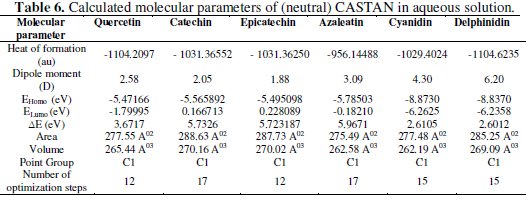
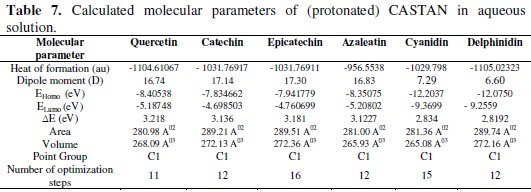
<body><![CDATA[<p>In this work, quantum chemical calculations using DFT were used to explain the  experimental results obtained and to further give insight into the inhibition action  of CASTAN on aluminium surface. In acidic environment the inhibitors also  interact with the acidic solution leading to the possibility of co-existence of both  protonated and non protonated species of the inhibitor components. In such  cases, it is interesting to investigate the preferred species to interact with the  metal surface and to study the influence of protonation on the molecular  structures and the molecular properties of the inhibitor components. The possible  sites for protonation as determined by quantum chemical calculations are the  heteroatoms (hydroxyl groups) present in each CASTAN component. The results  of the quantum chemical calculations on the different possible sites for  protonation suggest that the preferred sites for protonation are: O3 (azaleatin) and  O7 (quercetin). These are the sites that are less sterically hindered which can  allow protonation. <a href="#t6">Tables 6</a> and <a href="#t7">7</a> show the calculated quantum chemical  properties for CASTAN components (epicatechin, catechin, azaleatin, cyanidin,  quercetin and delphinidin).</p>      <p>&nbsp;</p> <a name="t6"> <img src="/img/revistas/pea/v32n2/32n2a05t6.jpg">     
<p>&nbsp;</p> <a name="t7"> <img src="/img/revistas/pea/v32n2/32n2a05t7.jpg">     
<p>&nbsp;</p>      <p>Frontier orbital theory holds that reactivity of molecules often occurs on the  highest occupied molecular orbital (HOMO) and lowest unoccupied molecular  orbital (LUMO). Therefore, E<sub>HOMO</sub> and E<sub>LUMO</sub> determine how the molecule  interacts with other species because HOMO is the outermost (higher energy)  orbital, and acts as the electron donor, hence, is directly related to the ionization  potential, while LUMO is the innermost (lowest energy) orbital and acts as the  electron acceptor, hence, related to the electron affinity [46]. Higher E<sub>HOMO</sub>  values indicate a tendency of CASTAN molecules to donate electrons to  appropriate acceptor molecules with low energy or empty 3p orbitals of  aluminium to form coordinate bond. Lower E<sub>LUMO</sub> values suggest stronger  electron accepting abilities of CASTAN molecules and ensure electron back- donation bonding with its anti-bonding orbitals.</p>      <p><a href="#t7">Table 7</a> shows lower E<sub>LUMO</sub> values for protonated (epicatechin, catechin,  azaleatin, cyanidin, quercetin and delphinidin) structures than those of the neutral  forms, therefore revealing that the adsorption of CASTAN onto aluminium was  such that its components exist in protonated forms in hydrochloric acid solutions.  Low E<sub>LUMO</sub> values imply high electron affinity [46]; therefore, values of E<sub>LUMO</sub>  for cyanidin and delphinidin in neutral and protonated forms are lowest, hence,  they have high electron affinities. These explain why the increased presence  causes a decrease in CASTAN inhibition efficiency in 0.1 M HCl solutions. As  reported by Abdallah et al. [47], negative E<sub>HOMO</sub> values suggest physisorption.</p>      <p>Presented in <a href="#t6">Tables 6</a> and <a href="#t7">7</a>  are negative E<sub>HOMO</sub> values for CASTAN molecules  (neutral and protonated) suggesting physisorption onto aluminium in HCl. The  difference between E<sub>HOMO</sub> and E<sub>LUMO</sub> is the energy gap  ( &Delta;E ) as shown below [36, 37, 45].</p>      <p>&nbsp;</p> <a name="e54"> <img src="/img/revistas/pea/v32n2/32n2a05e54.jpg">     
<p>&nbsp;</p>      <p>It is an important stability index [48] such that large &Delta;E values imply high  stability for the molecule in chemical reactions. Smaller &Delta;E values imply low  stability, hence, more reactivity for the molecule in chemical reactions [46, 49].  The most widely used quantity to describe the polarity is the dipole moment of  the molecule [50].</p>      ]]></body>
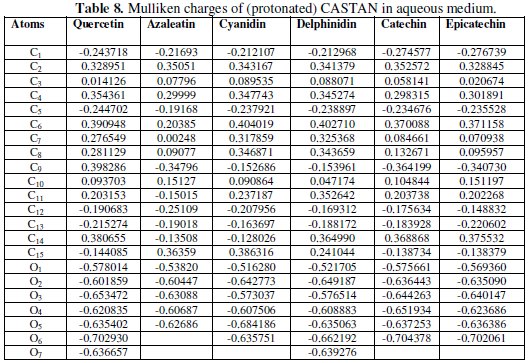
<body><![CDATA[<p>Dipole moment is another molecular parameter which correlates the adsorption  of inhibitors on metal surfaces [46]. <a href="#t7">Table 7</a> reveals higher dipole moment values  for protonated CASTAN components than their neutral forms and these suggest  that aluminium corrosion inhibition exhibited by CASTAN was feasible in  hydrochloric acid solutions due to adsorption of CASTAN molecules on  aluminium in their protonated forms. According to Dwivedi and Misra [51], a  molecule with high dipole moment has low energy gap ( &Delta;E ), therefore, its  chemical reactivity is high; can be easily polarized; has low kinetic stability; and  is a soft molecule.</p>      <p>Mulliken charges of the atoms of CASTAN molecules are shown in <a href="#t8">Table 8</a>.</p>      <p>&nbsp;</p> <a name="t8"> <img src="/img/revistas/pea/v32n2/32n2a05t8.jpg">     
<p>&nbsp;</p>      <p>Reports [22, 45, 46] stand that the more the negative charge of the atom, the  more the ease for the atom to donate its electrons to the vacant orbitals of the  metal, therefore, the most probable adsorption site. For example, <a href="#t8">Table 8</a> shows  that: C1, C5, C12, C13, C15, O1, O2, O3, O4, O5, O6 and O7 are the atoms with  excess negative charges (neutral and protonated quercetin); and C1, C5, C9, C12,  C13, O1, O2, O3, O4, O5, O6 and O7 are the atoms with excess negative charges  (neutral and protonated delphinidin). These suggest that the availability of  electron density and excess negative charges on the atoms are enough/capable of  adsorbing on aluminium surface; therefore, adsorption of CASTAN molecules on  aluminium most likely took place through the aromatic rings and phenolic  functional groups of CASTAN.</p>      <p>Values of quantum chemical parameters (E<sub>HOMO</sub>, E<sub>LUMO</sub>, &Delta;E ,  and dipole moment) suggest that CASTAN is a good corrosion inhibitor in HCl and this  corresponds to experimental inhibition values presented in <a href="#f5">Fig. 5</a>,  <a href="#f6">6</a> and <a href="#f8">8</a>.</p>      <p>&nbsp;</p> <a name="f8"> <img src="/img/revistas/pea/v32n2/32n2a05f8.jpg">     
<p>&nbsp;</p>        <p>&nbsp;</p>     <p><b>Conclusion</b></p>      ]]></body>
<body><![CDATA[<p>Infrared spectroscopy reveals the presence of functional groups consistent with  structures like quercetin, a component of CASTAN. UV/visible  spectrophotometry reveals that the functional groups of CASTAN components,  which absorbed on aluminium and resulted to inhibition of aluminium corrosion  in HCl are: conjugated aromatic polyphenols, aromatic conjugated C=C and  C=O.</p>      <p>CASTAN has been demonstrated to inhibit aluminium corrosion in 0.1 M, 0.5 M  and 2.0 M HCl. It is such that CASTAN inhibition efficiency increases as its  concentration increased in 0.5 M and 2.0 M HCl, but in 0.1M HCl, it generally  decreases as its concentration increased. Increasing corrosion temperature was  found to decrease the inhibitive performance of CASTAN and this suggests that  inhibitive performance of CASTAN adsorbs on aluminium in HCl by  physisorption, hence, a cathodic inhibitor.</p>      <p>Furthermore, adsorption studies show that the Temkin isotherm approximates the  adsorption mechanism of CASTAN on aluminium in 0.1 M HCl at 30 &deg;C. The  Langmuir isotherm has been discovered to explain the adsorption mechanism of  CASTAN on aluminium in 0.5 M and 2.0 M HCl at 30 &deg;C.</p>      <p>Calculated quantum chemical parameters further suggest that CASTAN  physisorbed on aluminium through aromatic C=C, C=O and O-H sites of its  components in protonated forms.</p>       <p>&nbsp;</p>     <p><b>References</b></p>      <!-- ref --><p>1. Ukoha P O, Ejikeme P M, Maju C C. J Am Leather Chem Asso. 2010;106:242.    &nbsp;&nbsp;&nbsp;&nbsp;&nbsp;&nbsp;&nbsp;&nbsp;[&#160;<a href="javascript:void(0);" onclick="javascript: window.open('/scielo.php?script=sci_nlinks&ref=000289&pid=S0872-1904201400020000500001&lng=','','width=640,height=500,resizable=yes,scrollbars=1,menubar=yes,');">Links</a>&#160;]<!-- end-ref --></p>      <!-- ref --><p>2. Jacobson G A. The AMPTIAC Quarterly. 2009;7:39.    &nbsp;&nbsp;&nbsp;&nbsp;&nbsp;&nbsp;&nbsp;&nbsp;[&#160;<a href="javascript:void(0);" onclick="javascript: window.open('/scielo.php?script=sci_nlinks&ref=000291&pid=S0872-1904201400020000500002&lng=','','width=640,height=500,resizable=yes,scrollbars=1,menubar=yes,');">Links</a>&#160;]<!-- end-ref --></p>      ]]></body>
<body><![CDATA[<!-- ref --><p>3. Fontana M G, Green N D. Corrosion engineering. 2nd. ed. USA:McGraw-Hill; 1978.    &nbsp;&nbsp;&nbsp;&nbsp;&nbsp;&nbsp;&nbsp;&nbsp;[&#160;<a href="javascript:void(0);" onclick="javascript: window.open('/scielo.php?script=sci_nlinks&ref=000293&pid=S0872-1904201400020000500003&lng=','','width=640,height=500,resizable=yes,scrollbars=1,menubar=yes,');">Links</a>&#160;]<!-- end-ref --></p>      <!-- ref --><p>4. Oguzie E E. Corros Sci. 2007;49:1527.    &nbsp;&nbsp;&nbsp;&nbsp;&nbsp;&nbsp;&nbsp;&nbsp;[&#160;<a href="javascript:void(0);" onclick="javascript: window.open('/scielo.php?script=sci_nlinks&ref=000295&pid=S0872-1904201400020000500004&lng=','','width=640,height=500,resizable=yes,scrollbars=1,menubar=yes,');">Links</a>&#160;]<!-- end-ref --></p>      <!-- ref --><p>5. Mishra A K, Balasubramaniam K. Mater Chem Phys. 2007;103:358.    &nbsp;&nbsp;&nbsp;&nbsp;&nbsp;&nbsp;&nbsp;&nbsp;[&#160;<a href="javascript:void(0);" onclick="javascript: window.open('/scielo.php?script=sci_nlinks&ref=000297&pid=S0872-1904201400020000500005&lng=','','width=640,height=500,resizable=yes,scrollbars=1,menubar=yes,');">Links</a>&#160;]<!-- end-ref --></p>      <!-- ref --><p>6. El-Etre A Y. Corros Sci. 2003;45:2485.    &nbsp;&nbsp;&nbsp;&nbsp;&nbsp;&nbsp;&nbsp;&nbsp;[&#160;<a href="javascript:void(0);" onclick="javascript: window.open('/scielo.php?script=sci_nlinks&ref=000299&pid=S0872-1904201400020000500006&lng=','','width=640,height=500,resizable=yes,scrollbars=1,menubar=yes,');">Links</a>&#160;]<!-- end-ref --></p>      <!-- ref --><p>7. Leckie H P, Uhlig H H. J Electrochem Soc. 1966;113:1262.    &nbsp;&nbsp;&nbsp;&nbsp;&nbsp;&nbsp;&nbsp;&nbsp;[&#160;<a href="javascript:void(0);" onclick="javascript: window.open('/scielo.php?script=sci_nlinks&ref=000301&pid=S0872-1904201400020000500007&lng=','','width=640,height=500,resizable=yes,scrollbars=1,menubar=yes,');">Links</a>&#160;]<!-- end-ref --></p>      ]]></body>
<body><![CDATA[<!-- ref --><p>8. James A O, Akaranta O. Afri J Pure Appl Chem. 2009;3:262.    &nbsp;&nbsp;&nbsp;&nbsp;&nbsp;&nbsp;&nbsp;&nbsp;[&#160;<a href="javascript:void(0);" onclick="javascript: window.open('/scielo.php?script=sci_nlinks&ref=000303&pid=S0872-1904201400020000500008&lng=','','width=640,height=500,resizable=yes,scrollbars=1,menubar=yes,');">Links</a>&#160;]<!-- end-ref --></p>      <!-- ref --><p>9. Nnaji N J, Obi-Egbedi N O, Nnabugwu M A. Int J Chem Sci. 2012;10:182.    &nbsp;&nbsp;&nbsp;&nbsp;&nbsp;&nbsp;&nbsp;&nbsp;[&#160;<a href="javascript:void(0);" onclick="javascript: window.open('/scielo.php?script=sci_nlinks&ref=000305&pid=S0872-1904201400020000500009&lng=','','width=640,height=500,resizable=yes,scrollbars=1,menubar=yes,');">Links</a>&#160;]<!-- end-ref --></p>      <!-- ref --><p>10. Okafor P C, Ikpi M E, Uwah I E, et al. Corros Sci. 2008;50:2310.    &nbsp;&nbsp;&nbsp;&nbsp;&nbsp;&nbsp;&nbsp;&nbsp;[&#160;<a href="javascript:void(0);" onclick="javascript: window.open('/scielo.php?script=sci_nlinks&ref=000307&pid=S0872-1904201400020000500010&lng=','','width=640,height=500,resizable=yes,scrollbars=1,menubar=yes,');">Links</a>&#160;]<!-- end-ref --></p>      <!-- ref --><p>11. Umoren S A, Ogbobe O, Ebenso E E. Trans SAEST 2006;41:98.    &nbsp;&nbsp;&nbsp;&nbsp;&nbsp;&nbsp;&nbsp;&nbsp;[&#160;<a href="javascript:void(0);" onclick="javascript: window.open('/scielo.php?script=sci_nlinks&ref=000309&pid=S0872-1904201400020000500011&lng=','','width=640,height=500,resizable=yes,scrollbars=1,menubar=yes,');">Links</a>&#160;]<!-- end-ref --></p>      <!-- ref --><p>12. Rahim A A, Rocca E, Steinmetz J, et al. Corros Sci. 2007;49:402.    &nbsp;&nbsp;&nbsp;&nbsp;&nbsp;&nbsp;&nbsp;&nbsp;[&#160;<a href="javascript:void(0);" onclick="javascript: window.open('/scielo.php?script=sci_nlinks&ref=000311&pid=S0872-1904201400020000500012&lng=','','width=640,height=500,resizable=yes,scrollbars=1,menubar=yes,');">Links</a>&#160;]<!-- end-ref --></p>      ]]></body>
<body><![CDATA[<!-- ref --><p>13. Noor E A. Int J Electrochem Sci. 2007;2:996.    &nbsp;&nbsp;&nbsp;&nbsp;&nbsp;&nbsp;&nbsp;&nbsp;[&#160;<a href="javascript:void(0);" onclick="javascript: window.open('/scielo.php?script=sci_nlinks&ref=000313&pid=S0872-1904201400020000500013&lng=','','width=640,height=500,resizable=yes,scrollbars=1,menubar=yes,');">Links</a>&#160;]<!-- end-ref --></p>      <!-- ref --><p>14. Obi-Egbedi N O, Essien K E, Obot I B. J Comput Method Mol Design. 2011;1:26.    &nbsp;&nbsp;&nbsp;&nbsp;&nbsp;&nbsp;&nbsp;&nbsp;[&#160;<a href="javascript:void(0);" onclick="javascript: window.open('/scielo.php?script=sci_nlinks&ref=000315&pid=S0872-1904201400020000500014&lng=','','width=640,height=500,resizable=yes,scrollbars=1,menubar=yes,');">Links</a>&#160;]<!-- end-ref --></p>      <!-- ref --><p>15. Obot I B, Obi-Egbedi NO , Umoren S A. Int J Electrochem Sci. 2009;4:863.    &nbsp;&nbsp;&nbsp;&nbsp;&nbsp;&nbsp;&nbsp;&nbsp;[&#160;<a href="javascript:void(0);" onclick="javascript: window.open('/scielo.php?script=sci_nlinks&ref=000317&pid=S0872-1904201400020000500015&lng=','','width=640,height=500,resizable=yes,scrollbars=1,menubar=yes,');">Links</a>&#160;]<!-- end-ref --></p>      <!-- ref --><p>16. Nnaji N J N, Okoye C O B, Obi-Egbedi N O, et al. Int J Electrochem Sci. 2013;8:1735.    &nbsp;&nbsp;&nbsp;&nbsp;&nbsp;&nbsp;&nbsp;&nbsp;[&#160;<a href="javascript:void(0);" onclick="javascript: window.open('/scielo.php?script=sci_nlinks&ref=000319&pid=S0872-1904201400020000500016&lng=','','width=640,height=500,resizable=yes,scrollbars=1,menubar=yes,');">Links</a>&#160;]<!-- end-ref --></p>      <!-- ref --><p>17. Arora P, Kumar S, Sharma M K, et al. E-J Chem. 2007;4:450.    &nbsp;&nbsp;&nbsp;&nbsp;&nbsp;&nbsp;&nbsp;&nbsp;[&#160;<a href="javascript:void(0);" onclick="javascript: window.open('/scielo.php?script=sci_nlinks&ref=000321&pid=S0872-1904201400020000500017&lng=','','width=640,height=500,resizable=yes,scrollbars=1,menubar=yes,');">Links</a>&#160;]<!-- end-ref --></p>      ]]></body>
<body><![CDATA[<!-- ref --><p>18. Umoren S A, Obot I B, Ebenso E E, et al. Port Electrochim Acta. 2008;26:199.    &nbsp;&nbsp;&nbsp;&nbsp;&nbsp;&nbsp;&nbsp;&nbsp;[&#160;<a href="javascript:void(0);" onclick="javascript: window.open('/scielo.php?script=sci_nlinks&ref=000323&pid=S0872-1904201400020000500018&lng=','','width=640,height=500,resizable=yes,scrollbars=1,menubar=yes,');">Links</a>&#160;]<!-- end-ref --></p>      <!-- ref --><p>19. Elawady G Y, El-Said I A, Fouda A S. Int J Electrochem Sci. 2008;3:177.    &nbsp;&nbsp;&nbsp;&nbsp;&nbsp;&nbsp;&nbsp;&nbsp;[&#160;<a href="javascript:void(0);" onclick="javascript: window.open('/scielo.php?script=sci_nlinks&ref=000325&pid=S0872-1904201400020000500019&lng=','','width=640,height=500,resizable=yes,scrollbars=1,menubar=yes,');">Links</a>&#160;]<!-- end-ref --></p>      <!-- ref --><p>20. Ju H, Li Y. Corr Sci. 2007:49:4185.    &nbsp;&nbsp;&nbsp;&nbsp;&nbsp;&nbsp;&nbsp;&nbsp;[&#160;<a href="javascript:void(0);" onclick="javascript: window.open('/scielo.php?script=sci_nlinks&ref=000327&pid=S0872-1904201400020000500020&lng=','','width=640,height=500,resizable=yes,scrollbars=1,menubar=yes,');">Links</a>&#160;]<!-- end-ref --></p>      <!-- ref --><p>21. Li Y, Zhao P, Liang Q, et al. Appl Surf Sci. 2005;252:1245.    &nbsp;&nbsp;&nbsp;&nbsp;&nbsp;&nbsp;&nbsp;&nbsp;[&#160;<a href="javascript:void(0);" onclick="javascript: window.open('/scielo.php?script=sci_nlinks&ref=000329&pid=S0872-1904201400020000500021&lng=','','width=640,height=500,resizable=yes,scrollbars=1,menubar=yes,');">Links</a>&#160;]<!-- end-ref --></p>      <!-- ref --><p>22. Ezeoke A U, Adeyemi O G, Akerele O A, et al. Int J Electrochem Sci. 2012;7:534.    &nbsp;&nbsp;&nbsp;&nbsp;&nbsp;&nbsp;&nbsp;&nbsp;[&#160;<a href="javascript:void(0);" onclick="javascript: window.open('/scielo.php?script=sci_nlinks&ref=000331&pid=S0872-1904201400020000500022&lng=','','width=640,height=500,resizable=yes,scrollbars=1,menubar=yes,');">Links</a>&#160;]<!-- end-ref --></p>      ]]></body>
<body><![CDATA[<!-- ref --><p>23. Atkins P W, de Paula J. Physical chemistry. 9th edition. New York:W.H. Freeman & Company;2010.    &nbsp;&nbsp;&nbsp;&nbsp;&nbsp;&nbsp;&nbsp;&nbsp;[&#160;<a href="javascript:void(0);" onclick="javascript: window.open('/scielo.php?script=sci_nlinks&ref=000333&pid=S0872-1904201400020000500023&lng=','','width=640,height=500,resizable=yes,scrollbars=1,menubar=yes,');">Links</a>&#160;]<!-- end-ref --></p>      <!-- ref --><p>24. Shao Y, Molnar L F, Jung Y, et al. Phys Chem Chem Phys. 2006;8:3172.    &nbsp;&nbsp;&nbsp;&nbsp;&nbsp;&nbsp;&nbsp;&nbsp;[&#160;<a href="javascript:void(0);" onclick="javascript: window.open('/scielo.php?script=sci_nlinks&ref=000335&pid=S0872-1904201400020000500024&lng=','','width=640,height=500,resizable=yes,scrollbars=1,menubar=yes,');">Links</a>&#160;]<!-- end-ref --></p>      <!-- ref --><p>25. Nworgu B G. Educational research-Basic issues &amp; methodology. 2nd. ed. Nsukka:University Trust Publishers;2006.    &nbsp;&nbsp;&nbsp;&nbsp;&nbsp;&nbsp;&nbsp;&nbsp;[&#160;<a href="javascript:void(0);" onclick="javascript: window.open('/scielo.php?script=sci_nlinks&ref=000337&pid=S0872-1904201400020000500025&lng=','','width=640,height=500,resizable=yes,scrollbars=1,menubar=yes,');">Links</a>&#160;]<!-- end-ref --></p>      <!-- ref --><p>26. Nnaji N J N, Ani J U, Aneke L E, et al. J Ind Engr Chem. 2013;20:1930.    &nbsp;&nbsp;&nbsp;&nbsp;&nbsp;&nbsp;&nbsp;&nbsp;[&#160;<a href="javascript:void(0);" onclick="javascript: window.open('/scielo.php?script=sci_nlinks&ref=000339&pid=S0872-1904201400020000500026&lng=','','width=640,height=500,resizable=yes,scrollbars=1,menubar=yes,');">Links</a>&#160;]<!-- end-ref --></p>      <!-- ref --><p>27. Ukoha P O, Oparah E N, Maju C C. J Chem Soc Nig. 2005;30:53.    &nbsp;&nbsp;&nbsp;&nbsp;&nbsp;&nbsp;&nbsp;&nbsp;[&#160;<a href="javascript:void(0);" onclick="javascript: window.open('/scielo.php?script=sci_nlinks&ref=000341&pid=S0872-1904201400020000500027&lng=','','width=640,height=500,resizable=yes,scrollbars=1,menubar=yes,');">Links</a>&#160;]<!-- end-ref --></p>      ]]></body>
<body><![CDATA[<!-- ref --><p>28. Furniss B S, Hannaford A J, Smith P W G, et al. Vogel's Textbook of Practical Organic  Chemistry. 5th. ed. Essex:Longman Group;1989.    &nbsp;&nbsp;&nbsp;&nbsp;&nbsp;&nbsp;&nbsp;&nbsp;[&#160;<a href="javascript:void(0);" onclick="javascript: window.open('/scielo.php?script=sci_nlinks&ref=000343&pid=S0872-1904201400020000500028&lng=','','width=640,height=500,resizable=yes,scrollbars=1,menubar=yes,');">Links</a>&#160;]<!-- end-ref --></p>      <!-- ref --><p>29. Nakagawa K, Sugita M. J Soc Leather Technol Chem. 1999;83:261.    &nbsp;&nbsp;&nbsp;&nbsp;&nbsp;&nbsp;&nbsp;&nbsp;[&#160;<a href="javascript:void(0);" onclick="javascript: window.open('/scielo.php?script=sci_nlinks&ref=000345&pid=S0872-1904201400020000500029&lng=','','width=640,height=500,resizable=yes,scrollbars=1,menubar=yes,');">Links</a>&#160;]<!-- end-ref --></p>      <!-- ref --><p>30. Heneczkowski M, Kopacz M, Nowak D, et al. Acta Pol Pharm. 2001;58:415.    &nbsp;&nbsp;&nbsp;&nbsp;&nbsp;&nbsp;&nbsp;&nbsp;[&#160;<a href="javascript:void(0);" onclick="javascript: window.open('/scielo.php?script=sci_nlinks&ref=000347&pid=S0872-1904201400020000500030&lng=','','width=640,height=500,resizable=yes,scrollbars=1,menubar=yes,');">Links</a>&#160;]<!-- end-ref --></p>      <!-- ref --><p>31. Dehghan G, Khoshkam Z. Food Chem. 2012;131:422.    &nbsp;&nbsp;&nbsp;&nbsp;&nbsp;&nbsp;&nbsp;&nbsp;[&#160;<a href="javascript:void(0);" onclick="javascript: window.open('/scielo.php?script=sci_nlinks&ref=000349&pid=S0872-1904201400020000500031&lng=','','width=640,height=500,resizable=yes,scrollbars=1,menubar=yes,');">Links</a>&#160;]<!-- end-ref --></p>      <!-- ref --><p>32. Chen J, Gu B, LeBoeuf E J, et al. Chemosphere. 2002;48:59.    &nbsp;&nbsp;&nbsp;&nbsp;&nbsp;&nbsp;&nbsp;&nbsp;[&#160;<a href="javascript:void(0);" onclick="javascript: window.open('/scielo.php?script=sci_nlinks&ref=000351&pid=S0872-1904201400020000500032&lng=','','width=640,height=500,resizable=yes,scrollbars=1,menubar=yes,');">Links</a>&#160;]<!-- end-ref --></p>      ]]></body>
<body><![CDATA[<!-- ref --><p>33. Zhongqi H, Jingdong M C, Wayne H, et al. Biol Fertil Soils. 2009;45:609.    &nbsp;&nbsp;&nbsp;&nbsp;&nbsp;&nbsp;&nbsp;&nbsp;[&#160;<a href="javascript:void(0);" onclick="javascript: window.open('/scielo.php?script=sci_nlinks&ref=000353&pid=S0872-1904201400020000500033&lng=','','width=640,height=500,resizable=yes,scrollbars=1,menubar=yes,');">Links</a>&#160;]<!-- end-ref --></p>      <!-- ref --><p>34. Abboud Y, Abourriche A, Saffaj T, et al. Mater Chem Phys. 2007;105:1.    &nbsp;&nbsp;&nbsp;&nbsp;&nbsp;&nbsp;&nbsp;&nbsp;[&#160;<a href="javascript:void(0);" onclick="javascript: window.open('/scielo.php?script=sci_nlinks&ref=000355&pid=S0872-1904201400020000500034&lng=','','width=640,height=500,resizable=yes,scrollbars=1,menubar=yes,');">Links</a>&#160;]<!-- end-ref --></p>      <!-- ref --><p>35. Abboud Y, Abourriche A, Saffaj T, et al. Desalination 2009;237:175.    &nbsp;&nbsp;&nbsp;&nbsp;&nbsp;&nbsp;&nbsp;&nbsp;[&#160;<a href="javascript:void(0);" onclick="javascript: window.open('/scielo.php?script=sci_nlinks&ref=000357&pid=S0872-1904201400020000500035&lng=','','width=640,height=500,resizable=yes,scrollbars=1,menubar=yes,');">Links</a>&#160;]<!-- end-ref --></p>      <!-- ref --><p>36. Obi-Egbedi N O, Obot I B. Corros Sci. 2011;53:263.    &nbsp;&nbsp;&nbsp;&nbsp;&nbsp;&nbsp;&nbsp;&nbsp;[&#160;<a href="javascript:void(0);" onclick="javascript: window.open('/scielo.php?script=sci_nlinks&ref=000359&pid=S0872-1904201400020000500036&lng=','','width=640,height=500,resizable=yes,scrollbars=1,menubar=yes,');">Links</a>&#160;]<!-- end-ref --></p>      <!-- ref --><p>37. Obi-Egbedi N O, Obot I B, Mohammad I E. J Mol Struct. 2011;1002:86.    &nbsp;&nbsp;&nbsp;&nbsp;&nbsp;&nbsp;&nbsp;&nbsp;[&#160;<a href="javascript:void(0);" onclick="javascript: window.open('/scielo.php?script=sci_nlinks&ref=000361&pid=S0872-1904201400020000500037&lng=','','width=640,height=500,resizable=yes,scrollbars=1,menubar=yes,');">Links</a>&#160;]<!-- end-ref --></p>      ]]></body>
<body><![CDATA[<!-- ref --><p>38. Cornard J P, Merlin J C. J Inorg Biochem. 2002;92:19.    &nbsp;&nbsp;&nbsp;&nbsp;&nbsp;&nbsp;&nbsp;&nbsp;[&#160;<a href="javascript:void(0);" onclick="javascript: window.open('/scielo.php?script=sci_nlinks&ref=000363&pid=S0872-1904201400020000500038&lng=','','width=640,height=500,resizable=yes,scrollbars=1,menubar=yes,');">Links</a>&#160;]<!-- end-ref --></p>      <!-- ref --><p>39. Shaofang S, Weijun C, Wei C, et al. THEOCHEM. 2008;860:40.    &nbsp;&nbsp;&nbsp;&nbsp;&nbsp;&nbsp;&nbsp;&nbsp;[&#160;<a href="javascript:void(0);" onclick="javascript: window.open('/scielo.php?script=sci_nlinks&ref=000365&pid=S0872-1904201400020000500039&lng=','','width=640,height=500,resizable=yes,scrollbars=1,menubar=yes,');">Links</a>&#160;]<!-- end-ref --></p>      <!-- ref --><p>40. Anyadike R N C. Statistical methods for the social and environmental sciences. Ibadan:Spectrum Books Limited; 2009.    &nbsp;&nbsp;&nbsp;&nbsp;&nbsp;&nbsp;&nbsp;&nbsp;[&#160;<a href="javascript:void(0);" onclick="javascript: window.open('/scielo.php?script=sci_nlinks&ref=000367&pid=S0872-1904201400020000500040&lng=','','width=640,height=500,resizable=yes,scrollbars=1,menubar=yes,');">Links</a>&#160;]<!-- end-ref --></p>      <!-- ref --><p>41. Adhistya E P, Dayang R A R, Dhanapal P D D. IEEE. 2010:941.    &nbsp;&nbsp;&nbsp;&nbsp;&nbsp;&nbsp;&nbsp;&nbsp;[&#160;<a href="javascript:void(0);" onclick="javascript: window.open('/scielo.php?script=sci_nlinks&ref=000369&pid=S0872-1904201400020000500041&lng=','','width=640,height=500,resizable=yes,scrollbars=1,menubar=yes,');">Links</a>&#160;]<!-- end-ref --></p>      <!-- ref --><p>42. Subramanyam B, Das A. Int J Environ Sci Tech. 2009;6:635.    &nbsp;&nbsp;&nbsp;&nbsp;&nbsp;&nbsp;&nbsp;&nbsp;[&#160;<a href="javascript:void(0);" onclick="javascript: window.open('/scielo.php?script=sci_nlinks&ref=000371&pid=S0872-1904201400020000500042&lng=','','width=640,height=500,resizable=yes,scrollbars=1,menubar=yes,');">Links</a>&#160;]<!-- end-ref --></p>      ]]></body>
<body><![CDATA[<!-- ref --><p>43. Sharma K K, Sharma L K. A Textbook of Physical Chemistry. 4th revised edn. New Delhi:Vikas Publishing House PVT Ltd.;1999.    &nbsp;&nbsp;&nbsp;&nbsp;&nbsp;&nbsp;&nbsp;&nbsp;[&#160;<a href="javascript:void(0);" onclick="javascript: window.open('/scielo.php?script=sci_nlinks&ref=000373&pid=S0872-1904201400020000500043&lng=','','width=640,height=500,resizable=yes,scrollbars=1,menubar=yes,');">Links</a>&#160;]<!-- end-ref --></p>      <!-- ref --><p>44. Okafor E C. Physical chemistry-Fundamentals. Enugu:Snaap Press Ltd.; 2004.    &nbsp;&nbsp;&nbsp;&nbsp;&nbsp;&nbsp;&nbsp;&nbsp;[&#160;<a href="javascript:void(0);" onclick="javascript: window.open('/scielo.php?script=sci_nlinks&ref=000375&pid=S0872-1904201400020000500044&lng=','','width=640,height=500,resizable=yes,scrollbars=1,menubar=yes,');">Links</a>&#160;]<!-- end-ref --></p>      <!-- ref --><p>45. Obi-Egbedi N O, Obot I B, Mohammad I E. J Mol Struct. 2011;1002:86.    &nbsp;&nbsp;&nbsp;&nbsp;&nbsp;&nbsp;&nbsp;&nbsp;[&#160;<a href="javascript:void(0);" onclick="javascript: window.open('/scielo.php?script=sci_nlinks&ref=000377&pid=S0872-1904201400020000500045&lng=','','width=640,height=500,resizable=yes,scrollbars=1,menubar=yes,');">Links</a>&#160;]<!-- end-ref --></p>      <!-- ref --><p>46. Gece G. Corros Sci. 2008;50:2981.    &nbsp;&nbsp;&nbsp;&nbsp;&nbsp;&nbsp;&nbsp;&nbsp;[&#160;<a href="javascript:void(0);" onclick="javascript: window.open('/scielo.php?script=sci_nlinks&ref=000379&pid=S0872-1904201400020000500046&lng=','','width=640,height=500,resizable=yes,scrollbars=1,menubar=yes,');">Links</a>&#160;]<!-- end-ref --></p>      <!-- ref --><p>47. Abdallah M, Helal E A, Fouda A S. Corros Sci. 2006;48:1639.    &nbsp;&nbsp;&nbsp;&nbsp;&nbsp;&nbsp;&nbsp;&nbsp;[&#160;<a href="javascript:void(0);" onclick="javascript: window.open('/scielo.php?script=sci_nlinks&ref=000381&pid=S0872-1904201400020000500047&lng=','','width=640,height=500,resizable=yes,scrollbars=1,menubar=yes,');">Links</a>&#160;]<!-- end-ref --></p>      ]]></body>
<body><![CDATA[<!-- ref --><p>48. Lewis D F V, Ioannides C, Parke D V. Xenobiotica. 1994;24:401.    &nbsp;&nbsp;&nbsp;&nbsp;&nbsp;&nbsp;&nbsp;&nbsp;[&#160;<a href="javascript:void(0);" onclick="javascript: window.open('/scielo.php?script=sci_nlinks&ref=000383&pid=S0872-1904201400020000500048&lng=','','width=640,height=500,resizable=yes,scrollbars=1,menubar=yes,');">Links</a>&#160;]<!-- end-ref --></p>      <!-- ref --><p>49. Pearson R G. J Org Chem. 1989;54:1423.    &nbsp;&nbsp;&nbsp;&nbsp;&nbsp;&nbsp;&nbsp;&nbsp;[&#160;<a href="javascript:void(0);" onclick="javascript: window.open('/scielo.php?script=sci_nlinks&ref=000385&pid=S0872-1904201400020000500049&lng=','','width=640,height=500,resizable=yes,scrollbars=1,menubar=yes,');">Links</a>&#160;]<!-- end-ref --></p>      <!-- ref --><p>50. Kikuchi O. Quant Struct-Act Relat. 1987;6:179.    &nbsp;&nbsp;&nbsp;&nbsp;&nbsp;&nbsp;&nbsp;&nbsp;[&#160;<a href="javascript:void(0);" onclick="javascript: window.open('/scielo.php?script=sci_nlinks&ref=000387&pid=S0872-1904201400020000500050&lng=','','width=640,height=500,resizable=yes,scrollbars=1,menubar=yes,');">Links</a>&#160;]<!-- end-ref --></p>      <!-- ref --><p>51. Dwivedi A, Misra N. Der Pharma Chem. 2010;2:58.    &nbsp;&nbsp;&nbsp;&nbsp;&nbsp;&nbsp;&nbsp;&nbsp;[&#160;<a href="javascript:void(0);" onclick="javascript: window.open('/scielo.php?script=sci_nlinks&ref=000389&pid=S0872-1904201400020000500051&lng=','','width=640,height=500,resizable=yes,scrollbars=1,menubar=yes,');">Links</a>&#160;]<!-- end-ref --></p>       <p>&nbsp;</p>     <p><a name=0></a><sup><a href="#top">*</a></sup>Corresponding author. E-mail address: <a href="mailto:joemeks4u@yahoo.com">joemeks4u@yahoo.com</a></p>      ]]></body>
<body><![CDATA[<p>Received 20 December 2013; accepted 17 April 2014</p>      <p><a href="http://www.peacta.org" target="_blank">www.peacta.org</a> </p>        ]]></body><back>
<ref-list>
<ref id="B1">
<label>1</label><nlm-citation citation-type="journal">
<person-group person-group-type="author">
<name>
<surname><![CDATA[Ukoha]]></surname>
<given-names><![CDATA[P O]]></given-names>
</name>
<name>
<surname><![CDATA[Ejikeme]]></surname>
<given-names><![CDATA[P M]]></given-names>
</name>
<name>
<surname><![CDATA[Maju]]></surname>
<given-names><![CDATA[C C]]></given-names>
</name>
</person-group>
<source><![CDATA[J Am Leather Chem Asso]]></source>
<year>2010</year>
<volume>106</volume>
<page-range>242</page-range></nlm-citation>
</ref>
<ref id="B2">
<label>2</label><nlm-citation citation-type="journal">
<person-group person-group-type="author">
<name>
<surname><![CDATA[Jacobson]]></surname>
<given-names><![CDATA[G A]]></given-names>
</name>
</person-group>
<source><![CDATA[The AMPTIAC Quarterly]]></source>
<year>2009</year>
<volume>7</volume>
<page-range>39</page-range></nlm-citation>
</ref>
<ref id="B3">
<label>3</label><nlm-citation citation-type="book">
<person-group person-group-type="author">
<name>
<surname><![CDATA[Fontana]]></surname>
<given-names><![CDATA[M G]]></given-names>
</name>
<name>
<surname><![CDATA[Green]]></surname>
<given-names><![CDATA[N D]]></given-names>
</name>
</person-group>
<source><![CDATA[Corrosion engineering]]></source>
<year>1978</year>
<edition>2nd. ed</edition>
<publisher-name><![CDATA[McGraw-Hill]]></publisher-name>
</nlm-citation>
</ref>
<ref id="B4">
<label>4</label><nlm-citation citation-type="journal">
<person-group person-group-type="author">
<name>
<surname><![CDATA[Oguzie]]></surname>
<given-names><![CDATA[E E]]></given-names>
</name>
</person-group>
<source><![CDATA[Corros Sci]]></source>
<year>2007</year>
<volume>49</volume>
<page-range>1527</page-range></nlm-citation>
</ref>
<ref id="B5">
<label>5</label><nlm-citation citation-type="journal">
<person-group person-group-type="author">
<name>
<surname><![CDATA[Mishra]]></surname>
<given-names><![CDATA[A K]]></given-names>
</name>
<name>
<surname><![CDATA[Balasubramaniam]]></surname>
<given-names><![CDATA[K]]></given-names>
</name>
</person-group>
<source><![CDATA[Mater Chem Phys]]></source>
<year>2007</year>
<volume>103</volume>
<page-range>358</page-range></nlm-citation>
</ref>
<ref id="B6">
<label>6</label><nlm-citation citation-type="">
<person-group person-group-type="author">
<name>
<surname><![CDATA[El-Etre]]></surname>
<given-names><![CDATA[A Y]]></given-names>
</name>
</person-group>
<source><![CDATA[]]></source>
<year>2003</year>
<volume>45</volume>
<page-range>2485</page-range></nlm-citation>
</ref>
<ref id="B7">
<label>7</label><nlm-citation citation-type="journal">
<person-group person-group-type="author">
<name>
<surname><![CDATA[Leckie]]></surname>
<given-names><![CDATA[H P]]></given-names>
</name>
<name>
<surname><![CDATA[Uhlig]]></surname>
<given-names><![CDATA[H H]]></given-names>
</name>
</person-group>
<source><![CDATA[J Electrochem Soc]]></source>
<year>1966</year>
<volume>113</volume>
<page-range>1262</page-range></nlm-citation>
</ref>
<ref id="B8">
<label>8</label><nlm-citation citation-type="journal">
<person-group person-group-type="author">
<name>
<surname><![CDATA[James]]></surname>
<given-names><![CDATA[A O]]></given-names>
</name>
<name>
<surname><![CDATA[Akaranta]]></surname>
<given-names><![CDATA[O]]></given-names>
</name>
</person-group>
<source><![CDATA[Afri J Pure Appl Chem]]></source>
<year>2009</year>
<volume>3</volume>
<page-range>262</page-range></nlm-citation>
</ref>
<ref id="B9">
<label>9</label><nlm-citation citation-type="journal">
<person-group person-group-type="author">
<name>
<surname><![CDATA[Nnaji]]></surname>
<given-names><![CDATA[N J]]></given-names>
</name>
<name>
<surname><![CDATA[Obi-Egbedi]]></surname>
<given-names><![CDATA[N O]]></given-names>
</name>
<name>
<surname><![CDATA[Nnabugwu]]></surname>
<given-names><![CDATA[M A]]></given-names>
</name>
</person-group>
<source><![CDATA[Int J Chem Sci]]></source>
<year>2012</year>
<volume>10</volume>
<page-range>182</page-range></nlm-citation>
</ref>
<ref id="B10">
<label>10</label><nlm-citation citation-type="journal">
<person-group person-group-type="author">
<name>
<surname><![CDATA[Okafor]]></surname>
<given-names><![CDATA[P C]]></given-names>
</name>
<name>
<surname><![CDATA[Ikpi]]></surname>
<given-names><![CDATA[M E]]></given-names>
</name>
<name>
<surname><![CDATA[Uwah]]></surname>
<given-names><![CDATA[I E]]></given-names>
</name>
</person-group>
<source><![CDATA[Corros Sci]]></source>
<year>2008</year>
<volume>50</volume>
<page-range>2310</page-range></nlm-citation>
</ref>
<ref id="B11">
<label>11</label><nlm-citation citation-type="journal">
<person-group person-group-type="author">
<name>
<surname><![CDATA[Umoren]]></surname>
<given-names><![CDATA[S A]]></given-names>
</name>
<name>
<surname><![CDATA[Ogbobe]]></surname>
<given-names><![CDATA[O]]></given-names>
</name>
<name>
<surname><![CDATA[Ebenso]]></surname>
<given-names><![CDATA[E E]]></given-names>
</name>
</person-group>
<source><![CDATA[Trans SAEST]]></source>
<year>2006</year>
<volume>41</volume>
<page-range>98</page-range></nlm-citation>
</ref>
<ref id="B12">
<label>12</label><nlm-citation citation-type="journal">
<person-group person-group-type="author">
<name>
<surname><![CDATA[Rahim]]></surname>
<given-names><![CDATA[A A]]></given-names>
</name>
<name>
<surname><![CDATA[Rocca]]></surname>
<given-names><![CDATA[E]]></given-names>
</name>
<name>
<surname><![CDATA[Steinmetz]]></surname>
<given-names><![CDATA[J]]></given-names>
</name>
<name>
<surname><![CDATA[et]]></surname>
<given-names><![CDATA[al]]></given-names>
</name>
</person-group>
<source><![CDATA[Corros Sci]]></source>
<year>2007</year>
<volume>49</volume>
<page-range>402</page-range></nlm-citation>
</ref>
<ref id="B13">
<label>13</label><nlm-citation citation-type="journal">
<person-group person-group-type="author">
<name>
<surname><![CDATA[Noor]]></surname>
<given-names><![CDATA[E A]]></given-names>
</name>
</person-group>
<source><![CDATA[Int J Electrochem Sci]]></source>
<year>2007</year>
<volume>2</volume>
<page-range>996</page-range></nlm-citation>
</ref>
<ref id="B14">
<label>14</label><nlm-citation citation-type="journal">
<person-group person-group-type="author">
<name>
<surname><![CDATA[Obi-Egbedi]]></surname>
<given-names><![CDATA[N O]]></given-names>
</name>
<name>
<surname><![CDATA[Essien]]></surname>
<given-names><![CDATA[K E]]></given-names>
</name>
<name>
<surname><![CDATA[Obot]]></surname>
<given-names><![CDATA[I B]]></given-names>
</name>
</person-group>
<source><![CDATA[J Comput Method Mol Design]]></source>
<year>2011</year>
<volume>1</volume>
<page-range>26</page-range></nlm-citation>
</ref>
<ref id="B15">
<label>15</label><nlm-citation citation-type="journal">
<person-group person-group-type="author">
<name>
<surname><![CDATA[Obot]]></surname>
<given-names><![CDATA[I B]]></given-names>
</name>
<name>
<surname><![CDATA[Obi-Egbedi]]></surname>
<given-names><![CDATA[N O]]></given-names>
</name>
<name>
<surname><![CDATA[Umoren]]></surname>
<given-names><![CDATA[S A]]></given-names>
</name>
</person-group>
<source><![CDATA[Int J Electrochem Sci]]></source>
<year>2009</year>
<volume>4</volume>
<page-range>863</page-range></nlm-citation>
</ref>
<ref id="B16">
<label>16</label><nlm-citation citation-type="journal">
<person-group person-group-type="author">
<name>
<surname><![CDATA[Nnaji]]></surname>
<given-names><![CDATA[N J N]]></given-names>
</name>
<name>
<surname><![CDATA[Okoye]]></surname>
<given-names><![CDATA[C O B]]></given-names>
</name>
<name>
<surname><![CDATA[Obi-Egbedi]]></surname>
<given-names><![CDATA[N O]]></given-names>
</name>
</person-group>
<source><![CDATA[Int J Electrochem Sci]]></source>
<year>2013</year>
<volume>8</volume>
<page-range>1735</page-range></nlm-citation>
</ref>
<ref id="B17">
<label>17</label><nlm-citation citation-type="journal">
<person-group person-group-type="author">
<name>
<surname><![CDATA[Arora]]></surname>
<given-names><![CDATA[P]]></given-names>
</name>
<name>
<surname><![CDATA[Kumar]]></surname>
<given-names><![CDATA[S]]></given-names>
</name>
<name>
<surname><![CDATA[Sharma]]></surname>
<given-names><![CDATA[M K]]></given-names>
</name>
</person-group>
<source><![CDATA[E-J Chem]]></source>
<year>2007</year>
<volume>4</volume>
<page-range>450</page-range></nlm-citation>
</ref>
<ref id="B18">
<label>18</label><nlm-citation citation-type="journal">
<person-group person-group-type="author">
<name>
<surname><![CDATA[Umoren]]></surname>
<given-names><![CDATA[S A]]></given-names>
</name>
<name>
<surname><![CDATA[Obot]]></surname>
<given-names><![CDATA[I B]]></given-names>
</name>
<name>
<surname><![CDATA[Ebenso]]></surname>
<given-names><![CDATA[E E]]></given-names>
</name>
</person-group>
<source><![CDATA[Port Electrochim Acta]]></source>
<year>2008</year>
<volume>26</volume>
<page-range>199</page-range></nlm-citation>
</ref>
<ref id="B19">
<label>19</label><nlm-citation citation-type="journal">
<person-group person-group-type="author">
<name>
<surname><![CDATA[Elawady]]></surname>
<given-names><![CDATA[G Y]]></given-names>
</name>
<name>
<surname><![CDATA[El-Said]]></surname>
<given-names><![CDATA[I A]]></given-names>
</name>
<name>
<surname><![CDATA[Fouda]]></surname>
<given-names><![CDATA[A S]]></given-names>
</name>
</person-group>
<source><![CDATA[Int J Electrochem Sci]]></source>
<year>2008</year>
<volume>3</volume>
<page-range>177</page-range></nlm-citation>
</ref>
<ref id="B20">
<label>20</label><nlm-citation citation-type="journal">
<person-group person-group-type="author">
<name>
<surname><![CDATA[Ju]]></surname>
<given-names><![CDATA[H]]></given-names>
</name>
<name>
<surname><![CDATA[Li]]></surname>
<given-names><![CDATA[Y]]></given-names>
</name>
</person-group>
<source><![CDATA[Corr Sci]]></source>
<year>2007</year>
<volume>49</volume>
<page-range>4185</page-range></nlm-citation>
</ref>
<ref id="B21">
<label>21</label><nlm-citation citation-type="journal">
<person-group person-group-type="author">
<name>
<surname><![CDATA[Li]]></surname>
<given-names><![CDATA[Y]]></given-names>
</name>
<name>
<surname><![CDATA[Zhao]]></surname>
<given-names><![CDATA[P]]></given-names>
</name>
<name>
<surname><![CDATA[Liang]]></surname>
<given-names><![CDATA[Q]]></given-names>
</name>
</person-group>
<source><![CDATA[Appl Surf Sci]]></source>
<year>2005</year>
<volume>252</volume>
<page-range>1245</page-range></nlm-citation>
</ref>
<ref id="B22">
<label>22</label><nlm-citation citation-type="journal">
<person-group person-group-type="author">
<name>
<surname><![CDATA[Ezeoke]]></surname>
<given-names><![CDATA[A U]]></given-names>
</name>
<name>
<surname><![CDATA[Adeyemi]]></surname>
<given-names><![CDATA[O G]]></given-names>
</name>
<name>
<surname><![CDATA[Akerele]]></surname>
<given-names><![CDATA[O A]]></given-names>
</name>
</person-group>
<source><![CDATA[Int J Electrochem Sci]]></source>
<year>2012</year>
<volume>7</volume>
<page-range>534</page-range></nlm-citation>
</ref>
<ref id="B23">
<label>23</label><nlm-citation citation-type="book">
<person-group person-group-type="author">
<name>
<surname><![CDATA[Atkins]]></surname>
<given-names><![CDATA[P W]]></given-names>
</name>
<name>
<surname><![CDATA[de Paula]]></surname>
<given-names><![CDATA[J]]></given-names>
</name>
</person-group>
<source><![CDATA[Physical chemistry]]></source>
<year>2010</year>
<edition>9th edition</edition>
<publisher-loc><![CDATA[New York ]]></publisher-loc>
<publisher-name><![CDATA[W.H. Freeman & Company]]></publisher-name>
</nlm-citation>
</ref>
<ref id="B24">
<label>24</label><nlm-citation citation-type="journal">
<person-group person-group-type="author">
<name>
<surname><![CDATA[Shao]]></surname>
<given-names><![CDATA[Y]]></given-names>
</name>
<name>
<surname><![CDATA[Molnar]]></surname>
<given-names><![CDATA[L F]]></given-names>
</name>
<name>
<surname><![CDATA[Jung]]></surname>
<given-names><![CDATA[Y]]></given-names>
</name>
</person-group>
<source><![CDATA[Phys Chem Chem Phys]]></source>
<year>2006</year>
<volume>8</volume>
<page-range>3172</page-range></nlm-citation>
</ref>
<ref id="B25">
<label>25</label><nlm-citation citation-type="book">
<person-group person-group-type="author">
<name>
<surname><![CDATA[Nworgu]]></surname>
<given-names><![CDATA[B G]]></given-names>
</name>
</person-group>
<source><![CDATA[Educational research-Basic issues & methodology]]></source>
<year>2006</year>
<edition>2nd. ed</edition>
<publisher-loc><![CDATA[Nsukka ]]></publisher-loc>
<publisher-name><![CDATA[University Trust Publishers]]></publisher-name>
</nlm-citation>
</ref>
<ref id="B26">
<label>26</label><nlm-citation citation-type="journal">
<person-group person-group-type="author">
<name>
<surname><![CDATA[Nnaji]]></surname>
<given-names><![CDATA[N J N]]></given-names>
</name>
<name>
<surname><![CDATA[Ani]]></surname>
<given-names><![CDATA[J U]]></given-names>
</name>
<name>
<surname><![CDATA[Aneke]]></surname>
<given-names><![CDATA[L E]]></given-names>
</name>
</person-group>
<source><![CDATA[J Ind Engr Chem]]></source>
<year>2013</year>
<volume>20</volume>
<page-range>1930</page-range></nlm-citation>
</ref>
<ref id="B27">
<label>27</label><nlm-citation citation-type="journal">
<person-group person-group-type="author">
<name>
<surname><![CDATA[Ukoha]]></surname>
<given-names><![CDATA[P O]]></given-names>
</name>
<name>
<surname><![CDATA[Oparah]]></surname>
<given-names><![CDATA[E N]]></given-names>
</name>
<name>
<surname><![CDATA[Maju]]></surname>
<given-names><![CDATA[C C]]></given-names>
</name>
</person-group>
<source><![CDATA[J Chem Soc Nig]]></source>
<year>2005</year>
<volume>30</volume>
<page-range>53</page-range></nlm-citation>
</ref>
<ref id="B28">
<label>28</label><nlm-citation citation-type="book">
<person-group person-group-type="author">
<name>
<surname><![CDATA[Furniss]]></surname>
<given-names><![CDATA[B S]]></given-names>
</name>
<name>
<surname><![CDATA[Hannaford]]></surname>
<given-names><![CDATA[A J]]></given-names>
</name>
<name>
<surname><![CDATA[Smith]]></surname>
<given-names><![CDATA[P W G]]></given-names>
</name>
</person-group>
<source><![CDATA[Vogel's Textbook of Practical Organic Chemistry]]></source>
<year>1989</year>
<edition>5th. ed</edition>
<publisher-loc><![CDATA[Essex ]]></publisher-loc>
<publisher-name><![CDATA[Longman Group]]></publisher-name>
</nlm-citation>
</ref>
<ref id="B29">
<label>29</label><nlm-citation citation-type="journal">
<person-group person-group-type="author">
<name>
<surname><![CDATA[Nakagawa]]></surname>
<given-names><![CDATA[K]]></given-names>
</name>
<name>
<surname><![CDATA[Sugita]]></surname>
<given-names><![CDATA[M]]></given-names>
</name>
</person-group>
<source><![CDATA[J Soc Leather Technol Chem]]></source>
<year>1999</year>
<volume>83</volume>
<page-range>261</page-range></nlm-citation>
</ref>
<ref id="B30">
<label>30</label><nlm-citation citation-type="journal">
<person-group person-group-type="author">
<name>
<surname><![CDATA[Heneczkowski]]></surname>
<given-names><![CDATA[M]]></given-names>
</name>
<name>
<surname><![CDATA[Kopacz]]></surname>
<given-names><![CDATA[M]]></given-names>
</name>
<name>
<surname><![CDATA[Nowak]]></surname>
<given-names><![CDATA[D]]></given-names>
</name>
</person-group>
<source><![CDATA[Acta Pol Pharm]]></source>
<year>2001</year>
<volume>58</volume>
<page-range>415</page-range></nlm-citation>
</ref>
<ref id="B31">
<label>31</label><nlm-citation citation-type="journal">
<person-group person-group-type="author">
<name>
<surname><![CDATA[Dehghan]]></surname>
<given-names><![CDATA[G]]></given-names>
</name>
<name>
<surname><![CDATA[Khoshkam]]></surname>
<given-names><![CDATA[Z]]></given-names>
</name>
</person-group>
<source><![CDATA[Food Chem]]></source>
<year>2012</year>
<volume>131</volume>
<page-range>422</page-range></nlm-citation>
</ref>
<ref id="B32">
<label>32</label><nlm-citation citation-type="journal">
<person-group person-group-type="author">
<name>
<surname><![CDATA[Chen]]></surname>
<given-names><![CDATA[J]]></given-names>
</name>
<name>
<surname><![CDATA[Gu]]></surname>
<given-names><![CDATA[B]]></given-names>
</name>
<name>
<surname><![CDATA[LeBoeuf]]></surname>
<given-names><![CDATA[E J]]></given-names>
</name>
</person-group>
<source><![CDATA[Chemosphere]]></source>
<year>2002</year>
<volume>48</volume>
<page-range>59</page-range></nlm-citation>
</ref>
<ref id="B33">
<label>33</label><nlm-citation citation-type="journal">
<person-group person-group-type="author">
<name>
<surname><![CDATA[Zhongqi]]></surname>
<given-names><![CDATA[H]]></given-names>
</name>
<name>
<surname><![CDATA[Jingdong]]></surname>
<given-names><![CDATA[M C]]></given-names>
</name>
<name>
<surname><![CDATA[Wayne]]></surname>
<given-names><![CDATA[H]]></given-names>
</name>
</person-group>
<source><![CDATA[Biol Fertil Soils]]></source>
<year>2009</year>
<volume>45</volume>
<page-range>609</page-range></nlm-citation>
</ref>
<ref id="B34">
<label>34</label><nlm-citation citation-type="journal">
<person-group person-group-type="author">
<name>
<surname><![CDATA[Abboud]]></surname>
<given-names><![CDATA[Y]]></given-names>
</name>
<name>
<surname><![CDATA[Abourriche]]></surname>
<given-names><![CDATA[A]]></given-names>
</name>
<name>
<surname><![CDATA[Saffaj]]></surname>
<given-names><![CDATA[T]]></given-names>
</name>
</person-group>
<source><![CDATA[Mater Chem Phys]]></source>
<year>2007</year>
<volume>105</volume>
<page-range>1</page-range></nlm-citation>
</ref>
<ref id="B35">
<label>35</label><nlm-citation citation-type="journal">
<person-group person-group-type="author">
<name>
<surname><![CDATA[Abboud]]></surname>
<given-names><![CDATA[Y]]></given-names>
</name>
<name>
<surname><![CDATA[Abourriche]]></surname>
<given-names><![CDATA[A]]></given-names>
</name>
<name>
<surname><![CDATA[Saffaj]]></surname>
<given-names><![CDATA[T]]></given-names>
</name>
</person-group>
<source><![CDATA[Desalination]]></source>
<year>2009</year>
<volume>237</volume>
<page-range>175</page-range></nlm-citation>
</ref>
<ref id="B36">
<label>36</label><nlm-citation citation-type="journal">
<person-group person-group-type="author">
<name>
<surname><![CDATA[Obi-Egbedi]]></surname>
<given-names><![CDATA[N O]]></given-names>
</name>
<name>
<surname><![CDATA[Obot]]></surname>
<given-names><![CDATA[I B]]></given-names>
</name>
</person-group>
<source><![CDATA[Corros Sci]]></source>
<year>2011</year>
<volume>53</volume>
<page-range>263</page-range></nlm-citation>
</ref>
<ref id="B37">
<label>37</label><nlm-citation citation-type="journal">
<person-group person-group-type="author">
<name>
<surname><![CDATA[Obi-Egbedi]]></surname>
<given-names><![CDATA[N O]]></given-names>
</name>
<name>
<surname><![CDATA[Obot]]></surname>
<given-names><![CDATA[I B]]></given-names>
</name>
<name>
<surname><![CDATA[Mohammad]]></surname>
<given-names><![CDATA[I E]]></given-names>
</name>
</person-group>
<source><![CDATA[J Mol Struct]]></source>
<year>2011</year>
<volume>1002</volume>
<page-range>86</page-range></nlm-citation>
</ref>
<ref id="B38">
<label>38</label><nlm-citation citation-type="journal">
<person-group person-group-type="author">
<name>
<surname><![CDATA[Cornard]]></surname>
<given-names><![CDATA[J P]]></given-names>
</name>
<name>
<surname><![CDATA[Merlin]]></surname>
<given-names><![CDATA[J C]]></given-names>
</name>
</person-group>
<source><![CDATA[J Inorg Biochem]]></source>
<year>2002</year>
<volume>92</volume>
<page-range>19</page-range></nlm-citation>
</ref>
<ref id="B39">
<label>39</label><nlm-citation citation-type="journal">
<person-group person-group-type="author">
<name>
<surname><![CDATA[Shaofang]]></surname>
<given-names><![CDATA[S]]></given-names>
</name>
<name>
<surname><![CDATA[Weijun]]></surname>
<given-names><![CDATA[C]]></given-names>
</name>
<name>
<surname><![CDATA[Wei]]></surname>
<given-names><![CDATA[C]]></given-names>
</name>
</person-group>
<source><![CDATA[THEOCHEM]]></source>
<year>2008</year>
<volume>860</volume>
<page-range>40</page-range></nlm-citation>
</ref>
<ref id="B40">
<label>40</label><nlm-citation citation-type="book">
<person-group person-group-type="author">
<name>
<surname><![CDATA[Anyadike]]></surname>
<given-names><![CDATA[R N C]]></given-names>
</name>
</person-group>
<source><![CDATA[Statistical methods for the social and environmental sciences]]></source>
<year>2009</year>
<publisher-loc><![CDATA[Ibadan ]]></publisher-loc>
<publisher-name><![CDATA[Spectrum Books Limited]]></publisher-name>
</nlm-citation>
</ref>
<ref id="B41">
<label>41</label><nlm-citation citation-type="journal">
<person-group person-group-type="author">
<name>
<surname><![CDATA[Adhistya]]></surname>
<given-names><![CDATA[E P]]></given-names>
</name>
<name>
<surname><![CDATA[Dayang]]></surname>
<given-names><![CDATA[R A R]]></given-names>
</name>
<name>
<surname><![CDATA[Dhanapal]]></surname>
<given-names><![CDATA[P D D]]></given-names>
</name>
</person-group>
<source><![CDATA[IEEE]]></source>
<year>2010</year>
<page-range>941</page-range></nlm-citation>
</ref>
<ref id="B42">
<label>42</label><nlm-citation citation-type="journal">
<person-group person-group-type="author">
<name>
<surname><![CDATA[Subramanyam]]></surname>
<given-names><![CDATA[B]]></given-names>
</name>
<name>
<surname><![CDATA[Das]]></surname>
<given-names><![CDATA[A]]></given-names>
</name>
</person-group>
<source><![CDATA[Int J Environ Sci Tech]]></source>
<year>2009</year>
<volume>6</volume>
<page-range>635</page-range></nlm-citation>
</ref>
<ref id="B43">
<label>43</label><nlm-citation citation-type="book">
<person-group person-group-type="author">
<name>
<surname><![CDATA[Sharma]]></surname>
<given-names><![CDATA[K K]]></given-names>
</name>
<name>
<surname><![CDATA[Sharma]]></surname>
<given-names><![CDATA[L K]]></given-names>
</name>
</person-group>
<source><![CDATA[A Textbook of Physical Chemistry]]></source>
<year>1999</year>
<edition>4th revised edn</edition>
<publisher-loc><![CDATA[New Delhi ]]></publisher-loc>
<publisher-name><![CDATA[Vikas Publishing House PVT Ltd]]></publisher-name>
</nlm-citation>
</ref>
<ref id="B44">
<label>44</label><nlm-citation citation-type="book">
<person-group person-group-type="author">
<name>
<surname><![CDATA[Okafor]]></surname>
<given-names><![CDATA[E C]]></given-names>
</name>
</person-group>
<source><![CDATA[Physical chemistry-Fundamentals]]></source>
<year>2004</year>
<publisher-loc><![CDATA[Enugu ]]></publisher-loc>
<publisher-name><![CDATA[Snaap Press Ltd.]]></publisher-name>
</nlm-citation>
</ref>
<ref id="B45">
<label>45</label><nlm-citation citation-type="journal">
<person-group person-group-type="author">
<name>
<surname><![CDATA[Obi-Egbedi]]></surname>
<given-names><![CDATA[N O]]></given-names>
</name>
<name>
<surname><![CDATA[Obot]]></surname>
<given-names><![CDATA[I B]]></given-names>
</name>
<name>
<surname><![CDATA[Mohammad]]></surname>
<given-names><![CDATA[I E]]></given-names>
</name>
</person-group>
<source><![CDATA[J Mol Struct]]></source>
<year>2011</year>
<volume>1002</volume>
<page-range>86</page-range></nlm-citation>
</ref>
<ref id="B46">
<label>46</label><nlm-citation citation-type="journal">
<person-group person-group-type="author">
<name>
<surname><![CDATA[Gece]]></surname>
<given-names><![CDATA[G]]></given-names>
</name>
</person-group>
<source><![CDATA[Corros Sci]]></source>
<year>2008</year>
<volume>50</volume>
<page-range>2981</page-range></nlm-citation>
</ref>
<ref id="B47">
<label>47</label><nlm-citation citation-type="journal">
<person-group person-group-type="author">
<name>
<surname><![CDATA[Abdallah]]></surname>
<given-names><![CDATA[M]]></given-names>
</name>
<name>
<surname><![CDATA[Helal]]></surname>
<given-names><![CDATA[E A]]></given-names>
</name>
<name>
<surname><![CDATA[Fouda]]></surname>
<given-names><![CDATA[A S]]></given-names>
</name>
</person-group>
<source><![CDATA[Corros Sci]]></source>
<year>2006</year>
<volume>48</volume>
<page-range>1639</page-range></nlm-citation>
</ref>
<ref id="B48">
<label>48</label><nlm-citation citation-type="journal">
<person-group person-group-type="author">
<name>
<surname><![CDATA[Lewis]]></surname>
<given-names><![CDATA[D F V]]></given-names>
</name>
<name>
<surname><![CDATA[Ioannides]]></surname>
<given-names><![CDATA[C]]></given-names>
</name>
<name>
<surname><![CDATA[Parke]]></surname>
<given-names><![CDATA[D V]]></given-names>
</name>
</person-group>
<source><![CDATA[Xenobiotica]]></source>
<year>1994</year>
<volume>24</volume>
<page-range>401</page-range></nlm-citation>
</ref>
<ref id="B49">
<label>49</label><nlm-citation citation-type="journal">
<person-group person-group-type="author">
<name>
<surname><![CDATA[Pearson]]></surname>
<given-names><![CDATA[R G]]></given-names>
</name>
</person-group>
<source><![CDATA[J Org Chem]]></source>
<year>1989</year>
<volume>54</volume>
<page-range>1423</page-range></nlm-citation>
</ref>
<ref id="B50">
<label>50</label><nlm-citation citation-type="journal">
<person-group person-group-type="author">
<name>
<surname><![CDATA[Kikuchi]]></surname>
<given-names><![CDATA[O]]></given-names>
</name>
</person-group>
<source><![CDATA[Quant Struct-Act Relat]]></source>
<year>1987</year>
<volume>6</volume>
<page-range>179</page-range></nlm-citation>
</ref>
<ref id="B51">
<label>51</label><nlm-citation citation-type="journal">
<person-group person-group-type="author">
<name>
<surname><![CDATA[Dwivedi]]></surname>
<given-names><![CDATA[A]]></given-names>
</name>
<name>
<surname><![CDATA[Misra]]></surname>
<given-names><![CDATA[N]]></given-names>
</name>
</person-group>
<source><![CDATA[Der Pharma Chem]]></source>
<year>2010</year>
<volume>2</volume>
<page-range>58</page-range></nlm-citation>
</ref>
</ref-list>
</back>
</article>