<?xml version="1.0" encoding="ISO-8859-1"?><article xmlns:mml="http://www.w3.org/1998/Math/MathML" xmlns:xlink="http://www.w3.org/1999/xlink" xmlns:xsi="http://www.w3.org/2001/XMLSchema-instance">
<front>
<journal-meta>
<journal-id>0872-1904</journal-id>
<journal-title><![CDATA[Portugaliae Electrochimica Acta]]></journal-title>
<abbrev-journal-title><![CDATA[Port. Electrochim. Acta]]></abbrev-journal-title>
<issn>0872-1904</issn>
<publisher>
<publisher-name><![CDATA[Sociedade Portuguesa de Electroquímica]]></publisher-name>
</publisher>
</journal-meta>
<article-meta>
<article-id>S0872-19042014000300001</article-id>
<article-id pub-id-type="doi">10.4152/pea.201403183</article-id>
<title-group>
<article-title xml:lang="en"><![CDATA[Physicochemical Characterization and Corrosion Inhibition Potential of Ficus Benjamina (FB) Gum for Aluminum in 0.1 M H2SO4]]></article-title>
</title-group>
<contrib-group>
<contrib contrib-type="author">
<name>
<surname><![CDATA[Eddy]]></surname>
<given-names><![CDATA[Nnabuk O.]]></given-names>
</name>
<xref ref-type="aff" rid="A01"/>
<xref ref-type="aff" rid="A02"/>
</contrib>
<contrib contrib-type="author">
<name>
<surname><![CDATA[Ameh]]></surname>
<given-names><![CDATA[Paul O.]]></given-names>
</name>
<xref ref-type="aff" rid="A01"/>
</contrib>
<contrib contrib-type="author">
<name>
<surname><![CDATA[Odiongenyi]]></surname>
<given-names><![CDATA[Anduang O.]]></given-names>
</name>
<xref ref-type="aff" rid="A02"/>
</contrib>
</contrib-group>
<aff id="A01">
<institution><![CDATA[,Ahmadu Bello University Department of Chemistry ]]></institution>
<addr-line><![CDATA[ Zaria Kaduna State]]></addr-line>
<country>Nigeria</country>
</aff>
<aff id="A02">
<institution><![CDATA[,Akwa Ibom State University Department of Chemistry ]]></institution>
<addr-line><![CDATA[ Akwa Ibom State]]></addr-line>
<country>Nigeria</country>
</aff>
<pub-date pub-type="pub">
<day>00</day>
<month>05</month>
<year>2014</year>
</pub-date>
<pub-date pub-type="epub">
<day>00</day>
<month>05</month>
<year>2014</year>
</pub-date>
<volume>32</volume>
<numero>3</numero>
<fpage>183</fpage>
<lpage>197</lpage>
<copyright-statement/>
<copyright-year/>
<self-uri xlink:href="http://scielo.pt/scielo.php?script=sci_arttext&amp;pid=S0872-19042014000300001&amp;lng=en&amp;nrm=iso"></self-uri><self-uri xlink:href="http://scielo.pt/scielo.php?script=sci_abstract&amp;pid=S0872-19042014000300001&amp;lng=en&amp;nrm=iso"></self-uri><self-uri xlink:href="http://scielo.pt/scielo.php?script=sci_pdf&amp;pid=S0872-19042014000300001&amp;lng=en&amp;nrm=iso"></self-uri><abstract abstract-type="short" xml:lang="en"><p><![CDATA[Examination of the physical (colour, odour, pH, solubility in various solvents) and chemical (GCMS and FTIR) characteristics of Ficus benjamina gum revealed that the gum is yellowish in colour, mildly acidic and ionic in nature. Major constituents of the gums were found to be sucrose and d-glucose, which constituted 60.92 % of their chemical constituents, while various carboxylic acids &#91;(albietic acid (1.00%), hexadecanoic acid (4.41 %), 9-octadecanoic acid (1.00 %), octadecanoic acid (3.01 %), oleic acid (0.10 %), octadecanoic acid (9.12 %) and 6,13-pentacenequinone (20.43 %)&#93; accounted for the remaining constituents. Functional groups identified in the gum were found to be those typical for other carbohydrates. From the knowledge of the chemical structures of compounds that constitute the gum, the corrosion inhibition potentials of the gum were ascertained and from weight loss analysis, the gum was found to be an active inhibitor against the corrosion of aluminum in solutions of tetraoxosulphate (VI) acid. The gum acted as an adsorption inhibitor that favours the mechanism of chemical adsorption and supported the Frumkin and Dubinin-Radushkevich adsorption models.]]></p></abstract>
<kwd-group>
<kwd lng="en"><![CDATA[Ficus benjamina gum]]></kwd>
<kwd lng="en"><![CDATA[physicochemical characteristics]]></kwd>
<kwd lng="en"><![CDATA[corrosion inhibition]]></kwd>
</kwd-group>
</article-meta>
</front><body><![CDATA[   <!--     <p>&nbsp;</p>     <p>doi: 10.4152/pea.201403183</p> -->      <p><b>Physicochemical Characterization and Corrosion Inhibition Potential of Ficus Benjamina (FB) Gum for Aluminum in 0.1 M H<sub>2</sub>SO<sub>4</sub></b></p>      <p> <b>Nnabuk O. Eddy</b><sup><i>a,b</i>,<a href="#0">*</a></sup> , <b>Paul O. Ameh</b><sup><i>a</i></sup> , <b>Anduang O. Odiongenyi</b><sup><i>b</i></sup></b> </p>      <p><i><sup>a</sup> Department of Chemistry, Ahmadu Bello University, Zaria Kaduna State, Nigeria</i></p>      <p><i><sup>b</sup> Department of Chemistry, Akwa Ibom State University, Ikot Akpaeden, Mkpat Enin, Akwa Ibom State, Nigeria</i></p>       <p>&nbsp;</p>     <p><b>Abstract</b></p>      <p>Examination of the physical (colour, odour, pH, solubility in various solvents) and  chemical (GCMS and FTIR) characteristics of Ficus benjamina gum revealed that the  gum is yellowish in colour, mildly acidic and ionic in nature. Major constituents of the  gums were found to be sucrose and d-glucose, which constituted 60.92 % of their  chemical constituents, while various carboxylic acids [(albietic acid (1.00%),  hexadecanoic acid (4.41 %), 9-octadecanoic acid (1.00 %), octadecanoic acid (3.01 %),  oleic acid (0.10 %), octadecanoic acid (9.12 %) and 6,13-pentacenequinone (20.43 %)]  accounted for the remaining constituents. Functional groups identified in the gum were  found to be those typical for other carbohydrates. From the knowledge of the chemical  structures of compounds that constitute the gum, the corrosion inhibition potentials of  the gum were ascertained and from weight loss analysis, the gum was found to be an  active inhibitor against the corrosion of aluminum in solutions of tetraoxosulphate (VI)  acid. The gum acted as an adsorption inhibitor that favours the mechanism of chemical  adsorption and supported the Frumkin and Dubinin-Radushkevich adsorption models.</p>      ]]></body>
<body><![CDATA[<p><b><i>Keywords:</i></b> Ficus benjamina gum, physicochemical characteristics and corrosion inhibition.</p>       <p>&nbsp;</p>     <p><b>Introduction</b></p>      <p>Industrial revolution over the past centuries has provoked increase in the use of  metals and their alloys for the fabrication of several installations. Some processes  (such as acid wash, prickling and etching) within the oil, fertilizer, metallurgical  and other industries expose metallic components to corrosion [1]. In view of this,  several steps have been taken to protect metals against corrosion, but one of the  best options involves the use of inhibitors [2,3]. Inhibitors are substances which,  when present in minute quantity, are able to retard the corrosion of metal through  the mechanism of adsorption [4].</p>      <p>Most of the suitable and documented corrosion inhibitors for metals are  heterocyclic compounds [5-9] such as carbozones, quinolones, amines, amino  acids, carbohydrates, polymers, plant extracts, chromates, etc. [10-13]. Of  significant interest is the use of extract of plants and animals because they are  natural, less toxic, biodegradable and easily accessible compared to those that are  not ecofriendly [14].</p>      <p>The use of plant products as corrosion inhibitors is justified by the phytochemical  components of the plant, some of which have chemical structures that meet the  requirements needed for corrosion inhibition [15]. Exudates gums from plants  have proven to be viable as corrosion inhibitors because they offer large  adsorption sites, they are biodegradable, less toxic and can easily be gotten from  gum bearing plants. Some of the gums that have been found to be good corrosion  inhibitors include Khaya ivorensis gum exudate [16], Daniella Oliverri gum  [17], Guar gum [18], Commiphora pedunculata gum [19], Ferula assa-foetida  and Dorema ammoniacum gum exudates [20], Acacia seyal var. [14], Anogessius  leocarpus gum [11], Ficus tricopoda [21], Ficus platyphylla gum [22] and  Raphia hookeri gum [23]. Literature is however scanty on the use of Ficus  benjamina gum as a corrosion inhibitor. Therefore, the present study is aimed at  carrying out physicochemical, GCMS and FTIR analysis of FB gum and to  investigate the corrosion inhibition potential of the gum.</p>       <p>&nbsp;</p>     <p><b>Materials and methods</b></p>      <p>A sample of FB gum was tapped from the Ficus specie of the plant in Kanya  Babba village, located in Babura Local Government arE<sub>a</sub> of Jigawa state,  Nigeria. The crude sample of the gum was purified using the method described  by Eddy et al., [17].</p>       <p><b><i>Physicochemical analysis</i></b></p>      ]]></body>
<body><![CDATA[<p>The pH of the gum was determined using a pre calibrated Oklon pH meter. The  solubility of the gum was determined in cooled and hot distilled water, acetone  and chloroform using the method reported by Carter (2005) [24].</p>       <p><b><i>FTIR analysis</i></b></p>      <p>FTIR analysis of the gum and that of the corrosion products (in the absence and  presence of the gum) were carried out using a Scimadzu FTIR-8400S Fourier  transform infra-red spectrophotometer. The sample was prepared in KBr and the  analysis was carried out by scanning the sample through a wave number range of  400 to 4000 cm<sup>-1</sup>.</p>       <p><b><i>GC-MS analysis</i></b></p>      <p>GC-MS analysis was carried out on a GC Clarus 500 Perkin Elmer system  comprising of a AOC-20i auto-sampler and gas chromatograph interfaced to a  mass spectrometer (GC-MS) instrument employing the following conditions:  column Elite-1 fused silica capillary column (30 x 0.25 mm ID x 1 Î¼M df,  composed of 100 % dimethylpoly diloxane), operating in electron impact mode  at 70 eV; helium (99.99 %) was used as carrier gas at a constant flow of 1  mL/min and an injection volume of 0.5 Î¼I was employed (split ratio of 10:1);  injector temperature 250 &deg;C; ion-source temperature of 280 &deg;C. The oven  temperature was programmed from 110 &deg;C (isothermal for 2 min), with an  increase of 10 &deg;C/min, to 200 &deg;C, then 5 Â°C/min to 280 &deg;C, ending with a 9 min  isothermal at 280 &deg;C. Mass spectra were taken at 70 eV; a scan interval of 0.5  seconds and fragments from 40 to 450 Da. Total GC running time was 36 min.  Interpretation on mass spectrum GC-MS was conducted using the database of  National Institute Standard and Technology (NIST) Abuja, having more than 62  000 patterns. The spectrum of the unknown component was compared with the  spectrum of the known components stored in the NIST library. The name,  molecular weight and structure of the components of the test materials were  ascertained. The concentrations of the identified compounds were determined  through arE<sub>a</sub> and height normalization.</p>       <p><b><i>Corrosion studies</i></b></p>      <p>Aluminum alloy sheet of composition (wt. %, as determined by quantiometric  method) Mn (1.28), Pb (0.064), Zn (0.006), Ti (0.029), Cu (0.81), Si (0.381), Fe  (0.57), and Al (96.65%) was used for the study. The sheet was mechanically  pressed cut into different coupons, each of dimension, 5x4x0.11 cm. Each  coupon was degreased by washing with ethanol, cleaned with acetone and  allowed to dry in the air before preservation in a desiccator. All reagents used for  the study were analar grade and double distilled water was used for their  preparation.</p>      <p>Weight loss experiments were carried out as reported elsewhere [10]. From  weight loss measurements, inhibition efficiency, corrosion rate and degree of  surface coverage were calculated using the following equations</p>      <p>&nbsp;</p> <a name="e1"> <img src="/img/revistas/pea/v32n3/32n3a01e1.jpg">     
<p>&nbsp;</p> <a name="e2"> <img src="/img/revistas/pea/v32n3/32n3a01e2.jpg">     
]]></body>
<body><![CDATA[<p>&nbsp;</p> <a name="e3"> <img src="/img/revistas/pea/v32n3/32n3a01e3.jpg">     
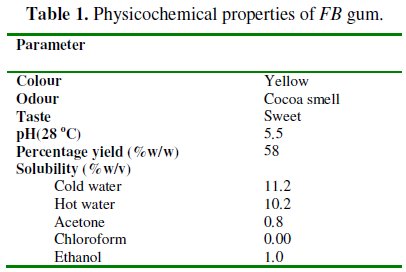
<p>&nbsp;</p>      <p>where W<sub>1</sub> and W<sub>2</sub> are the weight losses (g) for aluminum in the presence and  absence of the inhibitor, &Theta; is the degree of surface coverage of the inhibitor, &Delta;W  = W<sub>1</sub> - W<sub>2</sub>, A is the arE<sub>a</sub> of the aluminum coupon (in cm<sup>2</sup>), t is the period of  immersion (in hours) and &Delta;W is the weight loss of aluminum after time, t.</p>       <p>&nbsp;</p>     <p><b>Results and discussion</b></p>      <p><b><i>Physicochemical parameters of Ficus benjamina gum</i></b></p>      <p>Physicochemical parameters of FB gum are presented in <a href="#t1">Table 1</a>.</p>      <p>&nbsp;</p> <a name="t1"> <img src="/img/revistas/pea/v32n3/32n3a01t1.jpg">     
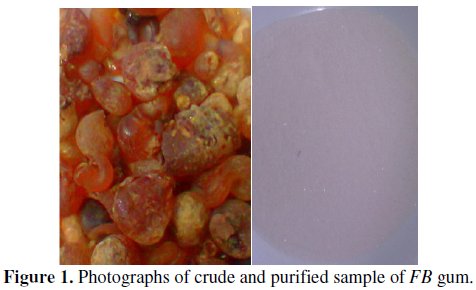
<p>&nbsp;</p>      <p>From the results obtained, it was found that FB gum is yellowish in colour (<a href="#f1">Fig. 1</a>).</p>      ]]></body>
<body><![CDATA[<p>&nbsp;</p> <a name="f1"> <img src="/img/revistas/pea/v32n3/32n3a01f1.jpg">     
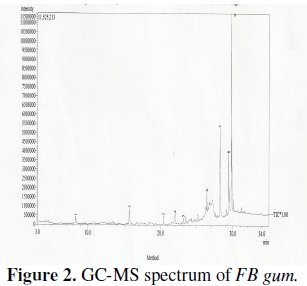
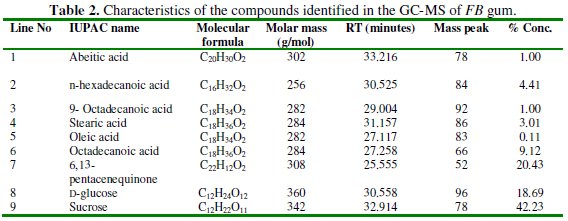
<p>&nbsp;</p>      <p>It has a sweet taste and exhibited an odour similar to that of cocoa. The gum is mildly  acidic with a pH of 5.5. After purification, gum yield of 55 % was obtained. FB  gum is ionic, soluble in cold and hot water. The solubility of the gum was found  to decrease with increase in temperature. The gum is sparingly soluble in acetone  and ethanol but insoluble in chloroform.</p>       <p><b><i>GC-MS and FTIR studies</i></b></p>      <p>The GCMS spectrum of FB gum is presented in <a href="#f2">Fig. 2</a> while <a href="#t2">Table 2</a> presents  information deduced from the spectrum.</p>      <p>&nbsp;</p> <a name="f2"> <img src="/img/revistas/pea/v32n3/32n3a01f2.jpg">     
<p>&nbsp;</p> <a name="t2"> <img src="/img/revistas/pea/v32n3/32n3a01t2.jpg">     
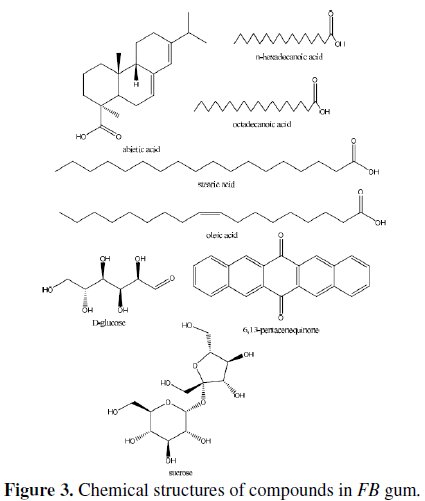
<p>&nbsp;</p>      <p>Names of identified compounds, chemical formula, molar mass and concentrations (gotten through arE<sub>a</sub>  normalization) are also presented in <a href="#t2">Table 2</a>, while the chemical structures of  these compounds are also presented in <a href="#f3">Fig. 3</a>.</p>      <p>&nbsp;</p> <a name="f3"> <img src="/img/revistas/pea/v32n3/32n3a01f3.jpg">     
]]></body>
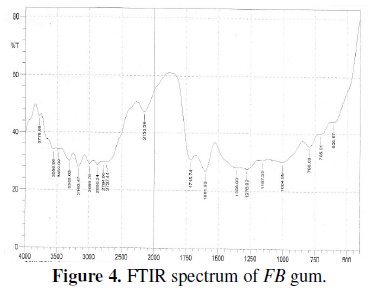
<body><![CDATA[<p>&nbsp;</p>      <p>The spectrum revealed nine peaks, identified between the retention time range of 25.56 to 33.21 minutes. The  identified compounds included, albietic acid (1.00%), hexadecanoic acid (4.41  %), 9-octadecanoic acid (1.00 %), octadecanoic acid (3.01 %), oleic acid (0.10  %), octadecanoic acid (9.12 %), 6,13-pentacenequinone (20.43 %), d glucose  (18.69 %) and sucrose (42.23 %). From the above results, it can be seen that the  dominant component of FB gum is carbohydrate (i.e., sucrose and d-glucose),  constituting 60.92 % of the entire samples. Other samples were carboxylic acids  indicating that, like other exudate gum, FB gum is rich in polysaccharides and  carboxylic acids.</p>      <p><a href="#f4">Fig. 4</a> presents the FTIR spectrum of FB gum.</p>      <p>&nbsp;</p> <a name="f4"> <img src="/img/revistas/pea/v32n3/32n3a01f4.jpg">     
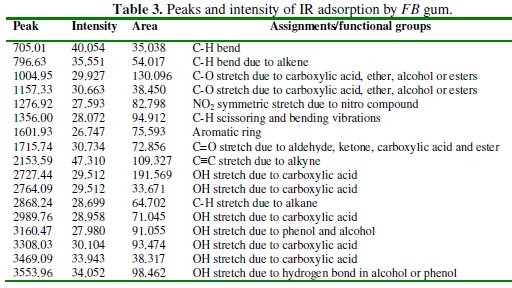
<p>&nbsp;</p>      <p>Peaks and frequencies of adsorption deduced from the spectrum as well as assigned bonds/functional  groups are recorded in <a href="#t3">Table 3</a>.</p>      <p>&nbsp;</p> <a name="t3"> <img src="/img/revistas/pea/v32n3/32n3a01t3.jpg">     
<p>&nbsp;</p>      <p>From the results obtained, it is evident that  several stretches and vibrations, typical for polysaccharides are found in the  FTIR spectrum of FB gum. These included OH stretches and vibrations due to  carboxylic acids at 2727.44 and 2764.09, 2989.24, 3308.03 and 3469.09 cm<sup>-1</sup>,  OH stretch due to alcohol or phenol was found at 3160.47. C-H stretch due to  alkane at 2868.24 cm<sup>-1</sup>, C-H scissoring and bending vibrations at 1356.00 cm<sup>-1</sup>,  C=O stretch due to aldehyde, ketone, ester and carboxylic acid, N-H stretch at  3308.03 and 3469.09, C-O vibration due to carboxylic acid and alcohol at  1004.95 cm<sup>-1</sup>. The presence of an aromatic ring at 1601 cm<sup>-1</sup> was also observed.</p>       <p><b><i>Corrosion inhibition study</i></b></p>      ]]></body>
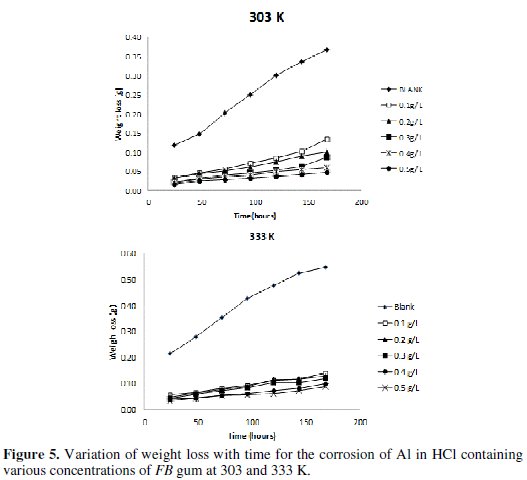
<body><![CDATA[<p><b><i>Effect of Ficus benjamina gum on the corrosion of Al</i></b></p>      <p><a href="#f5">Fig. 5</a> shows the variation of weight loss with time for the corrosion of Al in  solution of HCl containing various concentrations of FB gum at 303 and 333 K,  respectively.</p>      <p>&nbsp;</p> <a name="f5"> <img src="/img/revistas/pea/v32n3/32n3a01f5.jpg">     
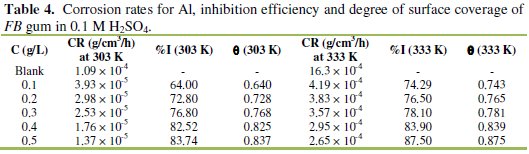
<p>&nbsp;</p>      <p>It is evident from the figures that the weight loss of mild steel  increases with increase in the period of contact, but decreases with increase in the  concentration of FB gum. These observations indicated that FB gum inhibited the  corrosion of mild steel by reducing its rate of corrosion and that the inhibition  efficiency of FB gum increases with increase in its concentration. Therefore, FB  gum is an adsorption inhibitor, characterized by increase in inhibition efficiency  with concentration [25].</p>      <p>It was also found that the corrosion rate of Al in the presence of the inhibitor  (<a href="#t4">Table 4</a>) decreases with increase in temperature, while its inhibition efficiency  increases with increase in temperature, indicating that the adsorption of FB gum  on the surface of Al supported the mechanism of chemical adsorption.</p>      <p>&nbsp;</p> <a name="t4"> <img src="/img/revistas/pea/v32n3/32n3a01t4.jpg">     
<p>&nbsp;</p>      <p>Chemisorption mechanism is characterized by increase in the extent of  adsorption with temperature as oppose to physisorption mechanism, which  compromises with decrease in the extent of adsorption with temperature [6].</p>       <p><b><i>Kinetic study</i></b></p>      ]]></body>
<body><![CDATA[<p>It has been found that most corrosion reactions are first order indicating that it  follows a model, that can be represented as follows [17],</p>      <p>&nbsp;</p> <a name="e4"> <img src="/img/revistas/pea/v32n3/32n3a01e4.jpg">     
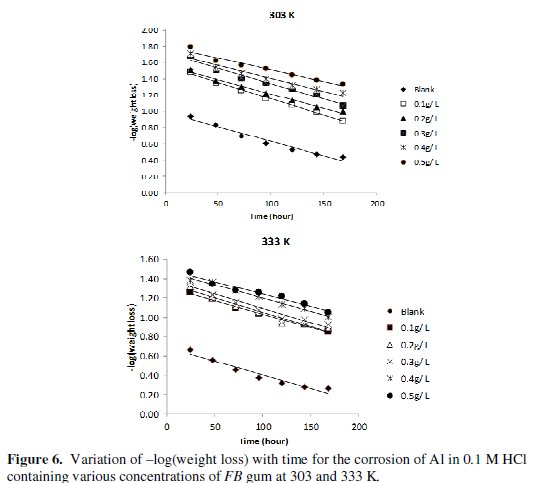
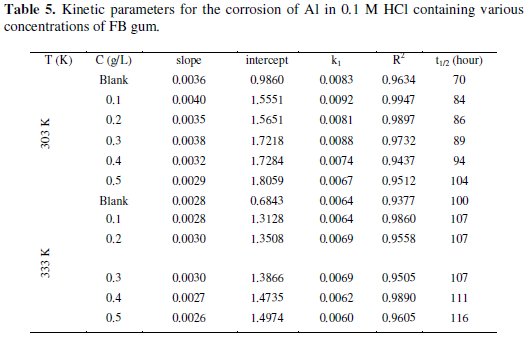
<p>&nbsp;</p>      <p>where t is the period of contact and k<sub>1</sub> is the first order rate constant. Also, for a  first order reaction, the half-life (t<sub>1/2</sub>) is related to the rate constant thus, t<sub>1/2</sub> =  0.693/k<sub>1</sub>. <a href="#f6">Fig. 6</a> shows plots for the variation of â€“log(weight loss) with time for  the corrosion of Al in the absence and presence of FB gum as an inhibitor (at 303  and 333 K).</p>      <p>&nbsp;</p> <a name="f6"> <img src="/img/revistas/pea/v32n3/32n3a01f6.jpg">     
<p>&nbsp;</p>      <p>The plots revealed excellent correlation (R2 &asymp; 1) indicating the  application of <a href="#e4">eq. 4</a> to the corrosion of Al (in the absence and presence of FG  gum). Values of k<sub>1</sub> and t<sub>1/2</sub> deduced from the slope of the plots are presented in  <a href="#t5">Table 5</a>.</p>      <p>&nbsp;</p> <a name="t5"> <img src="/img/revistas/pea/v32n3/32n3a01t5.jpg">     
<p>&nbsp;</p>      <p>The half-lives for solutions containing various concentrations of FB  gum are higher than that of the blank and were found to increase with increasing  the concentration. Therefore, FG gum is a good inhibitor for the corrosion of Al.</p>       ]]></body>
<body><![CDATA[<p><b><i>Effect of temperature</i></b></p>      <p>Activation energies for the corrosion of aluminum in the absence and in the  presence of FB gum were estimated using the logarithm form of the Arrhenius  equation, which can be expressed as follows [12],</p>      <p>&nbsp;</p> <a name="e5"> <img src="/img/revistas/pea/v32n3/32n3a01e5.jpg">     
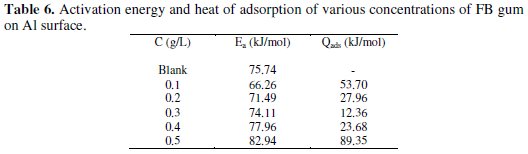
<p>&nbsp;</p>      <p>where CR<sub>1</sub> and CR<sub>2</sub> are the corrosion rates of mild steel at the temperatures  T<sub>1</sub> (303 K) and T<sub>2</sub> (333 K), respectively, E<sub>a</sub> is the activation energy, and R is the  gas constant. Values of E<sub>a</sub> calculated from <a href="#e5">eq. 5</a> are recorded in <a href="#t5">Table 5</a>. From  the results obtained, values of E<sub>a</sub> ranged from 66.26 to 82.94 kJ/mol and are  relatively comparable to the threshold value (80 kJ/mol) expected for the  mechanism of chemical adsorption. Generally, lower values of E<sub>a</sub> indicate a  tendency towards physisorption mechanism, while higher values of E<sub>a</sub> points  towards chemisorption mechanism. The present results suggest that the  adsorption of FG gum on the surface of Al must have first proceeded through the  mechanism of physical adsorption and was succeeded by chemisorption  mechanism.</p>       <p><b><i>Thermodynamic/adsorption considerations</i></b></p>      <p>The heat of adsorption of FB gum on Al surface was calculated using the  following equation [22]</p>      <p>&nbsp;</p> <a name="e6"> <img src="/img/revistas/pea/v32n3/32n3a01e6.jpg">     
<p>&nbsp;</p>      <p>where R is the universal gas constant, &theta;2 and &theta;1 are the degree of surface  coverage at the temperatures T<sub>1</sub> (303 K) and T<sub>2</sub> (333 K), respectively. Calculated  values of Q<sub>ads</sub> for various concentrations of FB gum are also presented in <a href="#t5">Table 5</a>. The adsorption enthalpies are positive for all concentrations of FB gum  indicating that the adsorption of FB gum on the surface of Al is endothermic.  Adsorption isotherms are useful in studying the adsorption characteristics of  corrosion inhibitors and were established by fitting the data obtained for degree  of surface coverage into various adsorption models, including the Langmuir,  Frumkin, Hill de-Boer, Parsons, Temkin, Flory-Huggin, Freundlich, Dhar-Flory- Huggin, kinetic/thermodynamic model of El-Awady et al. and Bockris Swinkels.  The general form of an equation representing adsorption isotherms can be written  as follows [26]</p>      ]]></body>
<body><![CDATA[<p>&nbsp;</p> <a name="e7"> <img src="/img/revistas/pea/v32n3/32n3a01e7.jpg">     
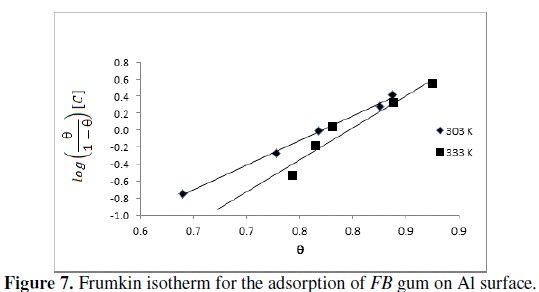
<p>&nbsp;</p>      <p>where f(&Theta;, x) is the configurational factor which depends upon the physical  model and the assumptions underlying the derivation of the isotherm, &Theta;  is the degree of surface coverage, C is the concentration of the inhibitor in the bulk  electrolyte, x is the size factor ratio, 'a' is the molecular interaction parameter  and 'b' is the equilibrium constant of the adsorption process. In this study,  adsorption of FB gum was found to agree with the Frumkin adsorption model  (<a href="#e8">eq. 8</a>),</p>      <p>&nbsp;</p> <a name="e8"> <img src="/img/revistas/pea/v32n3/32n3a01e8.jpg">     
<p>&nbsp;</p>      <p>where &Theta; is the degree of surface coverage, C is the concentration of the  adsorbate, b is the adsorption coefficient which represents the adsorptiondesorption  equilibrium constant and 'a' is the interaction parameter. From <a href="#e8">eq. 8</a>,  a plot of log(&Theta;/(1-&Theta;))[C] versus &Theta; should be linear if Frumkin isotherm is obeyed.</p>      <p><a href="#f7">Fig.7</a> shows the Frumkin isotherm for the adsorption of FB gum on the surface of  aluminum.</p>      <p>&nbsp;</p> <a name="f7"> <img src="/img/revistas/pea/v32n3/32n3a01f7.jpg">     
<p>&nbsp;</p>      <p>Adsorption parameters deduced from the plots are presented in <a href="#t6">Table 6</a>.</p>      ]]></body>
<body><![CDATA[<p>&nbsp;</p> <a name="t6"> <img src="/img/revistas/pea/v32n3/32n3a01t6.jpg">     
<p>&nbsp;</p>      <p>The results revealed that the adsorption of FB gum on Al surface fitted the  Frumkin model excellently (R<sup>2</sup> = 0.9967 and 0.9381 at 303 and 333 K,  respectively). The results also revealed that the interaction parameter (a = 2.8 and  3.8 at 303 and 333 K) is positive and increases with temperature, hence there is  attraction between the adsorbed inhibitor's molecules and the extent of attraction  increases with increase in temperature.</p>      <p>The equilibrium constant of adsorption, 'b', derived from the Frumkin model is  related to the standard free energy of adsorption according to <a href="#e9">eq. 9</a> [26],</p>      <p>&nbsp;</p> <a name="e9"> <img src="/img/revistas/pea/v32n3/32n3a01e9.jpg">     
<p>&nbsp;</p>      <p>where &Delta;G<sup>0</sup><sub>ads</sub> is the standard free energy of adsorption of FB gum on Al surface,  55.55 is the molar concentration of water in the acid solution, R is the gas  constant, and T is the absolute temperature. In this study, calculated values of  were -35.10 and -45.15 kJ/mol at 303 and 333 K. Although the free energy  value at 303 K is slightly less than the threshold value (-40 kJ/mol), the  calculated free energies nevertheless fail to support the mechanism of electron  transfer from the inhibitor to a vacant d-orbital in the metal surface. The data also  suggest that at lower temperature, the mechanism of physical adsorption was  apparent while chemisorption dominated at higher temperature.</p>      <p>In order to confirm the mechanism of adsorption of FB gum on the surface of Al,  the experimental data were also fitted into the Dubinin-Radushkevich isotherm  model (D-RIM), expressed in <a href="#e10">eq. 10</a> [27]</p>      <p>&nbsp;</p> <a name="e10"> <img src="/img/revistas/pea/v32n3/32n3a01e10.jpg">     
<p>&nbsp;</p>      ]]></body>
<body><![CDATA[<p>where &Theta;<sub>max</sub> is the maximum surface coverage and &delta; (Polany potential) can be  correlated as:</p>      <p>&nbsp;</p> <a name="e11"> <img src="/img/revistas/pea/v32n3/32n3a01e11.jpg">     
<p>&nbsp;</p>      <p>The constant 'a' gives the mean adsorption energy, E<sub>ads</sub>, i.e., E<sub>ads</sub> = 1/(2a)<sup>0.5</sup>, R is  the gas constant and T is the absolute temperature. The transfer energy (E<sub>ads</sub>) of 1  mol of adsorbate from infinity (bulk solution) to the surface of the adsorbent is  an index for predicting the mechanism of adsorption of the inhibitor. When E<sub>ads</sub>  is less than 8 kJ/mol, a physical adsorption mechanism is upheld and vice versa.  The fitness of the data was excellent (R<sup>2</sup> = 0.9616 and 0.8555 at 303 and 333 K)  and calculated values of E<sub>ads</sub> were 10.00 and 10.50 kJ/mol at 303 and 333 K,  respectively. This supports the mechanism of chemical adsorption as proposed  earlier. Values of &Theta;<sub>max</sub> were calculated as 0.9148 and 0.9308 at 303 and 333 K,  respectively, indicating that the maximum theoretical coverage for FB gum onto  Al surface at 303 and 333 K corresponded to inhibition efficiencies of 91.48 and  93.08 %, respectively. The observed theoretical trend (i.e., increase in inhibition  efficiency with temperature) shows slight deviation from the maximum inhibition  efficiencies obtained from the experiments suggesting that these values may be  attainable at higher concentrations (i.e., C &gt; 0.5 g/L of FB gum) and not within  the range of concentrations used in the present study. Nevertheless, the observed  trend also supports the mechanism of chemical adsorption.</p>       <p><b><i>Mechanism of inhibition</i></b></p>      <p>The corrosion of Al in aqueous solution is a function of the concentration of  anions in the system. HCl is a strong acid and can ionize to produce chloride ion,  which can attack Al metal. The mechanism for the inhibition of the corrosion of  aluminum in solution of HCl is similar to that proposed by Ford et al. [28-29]  and is presented in <a href="#e12">eq. 12 to 15</a></p>      <p>&nbsp;</p> <a name="e12"> <img src="/img/revistas/pea/v32n3/32n3a01e12.jpg">     
<p>&nbsp;</p> <a name="e13"> <img src="/img/revistas/pea/v32n3/32n3a01e13.jpg">     
<p>&nbsp;</p> <a name="e14"> <img src="/img/revistas/pea/v32n3/32n3a01e14.jpg">     
<p>&nbsp;</p> <a name="e15"> <img src="/img/revistas/pea/v32n3/32n3a01e15.jpg">     
]]></body>
<body><![CDATA[<p>&nbsp;</p>      <p>The controlling step in the metal dissolution is the complexation reaction  between the hydrated cation and the anion (<a href="#e15">Eq. 15</a>), which is feasible in the  presence of chloride ions generated by ionization of HCl. Adsorption of the  inhibitor on the surface of the metal will reduce the surface area available for  anodic and cathodic reactions. According to Khaled [30], organic molecules  inhibit corrosion by adsorption at the metal/solution interface and the adsorption  depends on the molecule's chemical composition, the temperature and the  electrochemical potential at the metal/solution interface. In case of aluminum  surface, the solvent H<sub>2</sub>O molecules could also adsorb on the aluminum oxide  surface forming hydroxylated sites, orhydroxide layers at the surface (<a href="#e13">Eq. 13</a> and  <a href="#e14">14</a>), that impart a pH-dependent surface charge. The polar hydroxyl groups may  cause the surface to attract and physically adsorb a single or several additional  layers of polar water molecules. In acidic solution, the positively charged surface  sites will electrostatically attract any anions present in solution, and replications.  FB gum may be adsorbed on the aluminum oxide surface in four different ways  [30]:</p>      <p>i. Electrostatic interaction between a negatively charged surface, which is  provided by adsorbed chloride ion and the positively charged/protonated inhibitor,</p>      <p>ii. interaction of unshared electron pairs in the inhibitor's molecule with the  aluminum surface,</p>      <p>iii. interaction of  &pi;-electron(s) with aluminum surface,  iv. a combination of the (i-iii) types.</p>      <p>Efficient adsorption is the one that arises from interaction between  &pi;-electron(s)  or hetero atom(s) in the FB gum molecule. Chemical adsorption seems to be the  most important type of interaction between the Al<sub>2</sub>O<sub>3</sub> surface and FB molecules.  Here, the adsorbed species are in contact with the Al<sub>2</sub>O<sub>3</sub> surface. In this process,  a coordinated bond that involves the electron transfer from the inhibitor system  towards the metallic surface is formed. The electron-transfer may be facilitated  by lone pair of electrons in the inhibitor and the availability of  &pi;-electrons due to  the presence of double bonds or aromatic rings in its structure. Moreover, there is  a great possibility that adsorption may also take place via hydrogen bond  formation between the Xâ€“H linkage (X may be hetero atom) in some of the  constituents of FB gum and the oxygen atoms of the aluminum oxide/aluminum  hydroxide surface species. This type of adsorption should be more prevalent for  protonated X-atom(s), because the positive charge on the X-atom may be  conductive to the formation of hydrogen bonds. Unprotonated X-atoms may also  be adsorbed by direct chemisorption, as mentioned previously, or by hydrogen  bonding to a surface oxidized species. The extent of adsorption by the respective  modes depends on the nature of the metal surface. A good inhibitor must have  strong affinity for the bare metal atoms. The requirement is different in case of  aluminum; a compact passive oxide film is always present on the electrode  surface, where hydrogen bond formation accounts for most of the inhibition  action. An effective inhibitor is one that forms hydrogen bonds easily with the  oxidized surface.</p>       <p>&nbsp;</p>     <p><b>Conclusion</b></p>      <p>From the experimental results obtained in the present study, the following  conclusion may be drawn</p>      <p>1. Ficus benjamina gum is yellowish odourless, mild acidic and ionic.</p>      ]]></body>
<body><![CDATA[<p>2. The chemical constituents of  Ficus benjamina include albietic acid (1.00%),  hexadecanoic acid (4.41 %), 9-octadecanoic acid (1.00 %), octadecanoic acid  (3.01 %), oleic acid (0.10 %), octadecanoic acid (9.12 %), 6,13pentacenequinone  (20.43 %), d glucose (18.69 %) and sucrose (42.23 %).</p>      <p>3. Ficus benjamina has been found to be a good adsorption inhibitor. Its  inhibition proceeded via the mechanism of physical adsorption (the reasons  are inhibition efficiency decrease with increasing temperature, E<sub>a</sub> and &Delta;G<sup>0</sup><sub>ads</sub>  values were lower than the threshold values of 80 and -40 KJ/mol, and it was  best described by Langmuir adsorption model.</p>      <p>4. Inhibition of mild steel by Ficus benjamina gum occurred through synergistic  adsorption of the various components of the gums hence the formation of  multiple adsorption layer is proposed.</p>       <p>&nbsp;</p>     <p><b>References</b></p>      <!-- ref --><p>1. Arora P, Kumar S, Sharma MK et al. E J Chem. 2007;4:450.    &nbsp;&nbsp;&nbsp;&nbsp;&nbsp;&nbsp;&nbsp;&nbsp;[&#160;<a href="javascript:void(0);" onclick="javascript: window.open('/scielo.php?script=sci_nlinks&ref=000138&pid=S0872-1904201400030000100001&lng=','','width=640,height=500,resizable=yes,scrollbars=1,menubar=yes,');">Links</a>&#160;]<!-- end-ref --></p>      <!-- ref --><p>2. Ghasemi Z, Tizpar A. Appl Surf Sci. 2006;252:3667.    &nbsp;&nbsp;&nbsp;&nbsp;&nbsp;&nbsp;&nbsp;&nbsp;[&#160;<a href="javascript:void(0);" onclick="javascript: window.open('/scielo.php?script=sci_nlinks&ref=000140&pid=S0872-1904201400030000100002&lng=','','width=640,height=500,resizable=yes,scrollbars=1,menubar=yes,');">Links</a>&#160;]<!-- end-ref --></p>      <!-- ref --><p>3. Elayyoubi S B, Hammouti S, Kertit HO et al. Rev Met Paris. 2004;2:153.    &nbsp;&nbsp;&nbsp;&nbsp;&nbsp;&nbsp;&nbsp;&nbsp;[&#160;<a href="javascript:void(0);" onclick="javascript: window.open('/scielo.php?script=sci_nlinks&ref=000142&pid=S0872-1904201400030000100003&lng=','','width=640,height=500,resizable=yes,scrollbars=1,menubar=yes,');">Links</a>&#160;]<!-- end-ref --></p>      <!-- ref --><p>4. Rani B E A, Basu B B. Int J Corros. 2012;Article ID 380217.    &nbsp;&nbsp;&nbsp;&nbsp;&nbsp;&nbsp;&nbsp;&nbsp;[&#160;<a href="javascript:void(0);" onclick="javascript: window.open('/scielo.php?script=sci_nlinks&ref=000144&pid=S0872-1904201400030000100004&lng=','','width=640,height=500,resizable=yes,scrollbars=1,menubar=yes,');">Links</a>&#160;]<!-- end-ref --></p>      <!-- ref --><p>5. Ita B I. Bull Electrochem. 2005;21:219323.    &nbsp;&nbsp;&nbsp;&nbsp;&nbsp;&nbsp;&nbsp;&nbsp;[&#160;<a href="javascript:void(0);" onclick="javascript: window.open('/scielo.php?script=sci_nlinks&ref=000146&pid=S0872-1904201400030000100005&lng=','','width=640,height=500,resizable=yes,scrollbars=1,menubar=yes,');">Links</a>&#160;]<!-- end-ref --></p>      <!-- ref --><p>6. Ita B I. Proccurement Chem Soc Nig. 2004;10.    &nbsp;&nbsp;&nbsp;&nbsp;&nbsp;&nbsp;&nbsp;&nbsp;[&#160;<a href="javascript:void(0);" onclick="javascript: window.open('/scielo.php?script=sci_nlinks&ref=000148&pid=S0872-1904201400030000100006&lng=','','width=640,height=500,resizable=yes,scrollbars=1,menubar=yes,');">Links</a>&#160;]<!-- end-ref --></p>      <!-- ref --><p>7. Ita B I. Bull Electrochem. 2004;20:363.    &nbsp;&nbsp;&nbsp;&nbsp;&nbsp;&nbsp;&nbsp;&nbsp;[&#160;<a href="javascript:void(0);" onclick="javascript: window.open('/scielo.php?script=sci_nlinks&ref=000150&pid=S0872-1904201400030000100007&lng=','','width=640,height=500,resizable=yes,scrollbars=1,menubar=yes,');">Links</a>&#160;]<!-- end-ref --></p>      <!-- ref --><p>8. Ita B I, Offiong OE. Mater Chem Phys. 1997;51:203.    &nbsp;&nbsp;&nbsp;&nbsp;&nbsp;&nbsp;&nbsp;&nbsp;[&#160;<a href="javascript:void(0);" onclick="javascript: window.open('/scielo.php?script=sci_nlinks&ref=000152&pid=S0872-1904201400030000100008&lng=','','width=640,height=500,resizable=yes,scrollbars=1,menubar=yes,');">Links</a>&#160;]<!-- end-ref --></p>      <!-- ref --><p>9. Fang J, Li J. J Mol Struct. 2002;593:179.    &nbsp;&nbsp;&nbsp;&nbsp;&nbsp;&nbsp;&nbsp;&nbsp;[&#160;<a href="javascript:void(0);" onclick="javascript: window.open('/scielo.php?script=sci_nlinks&ref=000154&pid=S0872-1904201400030000100009&lng=','','width=640,height=500,resizable=yes,scrollbars=1,menubar=yes,');">Links</a>&#160;]<!-- end-ref --></p>      <!-- ref --><p>10. Eddy N O, Awe F E, Siaka A A, et al. Int J Electrochem Sci. 2011;6: 4316.    &nbsp;&nbsp;&nbsp;&nbsp;&nbsp;&nbsp;&nbsp;&nbsp;[&#160;<a href="javascript:void(0);" onclick="javascript: window.open('/scielo.php?script=sci_nlinks&ref=000156&pid=S0872-1904201400030000100010&lng=','','width=640,height=500,resizable=yes,scrollbars=1,menubar=yes,');">Links</a>&#160;]<!-- end-ref --></p>      <!-- ref --><p>11. Eddy N O, Ameh P O, Gimba C E, et al. Int J Electrochem Sci. 2011;6:5815.    &nbsp;&nbsp;&nbsp;&nbsp;&nbsp;&nbsp;&nbsp;&nbsp;[&#160;<a href="javascript:void(0);" onclick="javascript: window.open('/scielo.php?script=sci_nlinks&ref=000158&pid=S0872-1904201400030000100011&lng=','','width=640,height=500,resizable=yes,scrollbars=1,menubar=yes,');">Links</a>&#160;]<!-- end-ref --></p>      <!-- ref --><p>12. Ameh P O, Magaji L, Salihu T. Afr J Pure Appl Chem. 2012;6:100.    &nbsp;&nbsp;&nbsp;&nbsp;&nbsp;&nbsp;&nbsp;&nbsp;[&#160;<a href="javascript:void(0);" onclick="javascript: window.open('/scielo.php?script=sci_nlinks&ref=000160&pid=S0872-1904201400030000100012&lng=','','width=640,height=500,resizable=yes,scrollbars=1,menubar=yes,');">Links</a>&#160;]<!-- end-ref --></p>      <!-- ref --><p>13. Umoren S A, Obot I B, Ebenso E E. E J Chem. 2008;5:355.    &nbsp;&nbsp;&nbsp;&nbsp;&nbsp;&nbsp;&nbsp;&nbsp;[&#160;<a href="javascript:void(0);" onclick="javascript: window.open('/scielo.php?script=sci_nlinks&ref=000162&pid=S0872-1904201400030000100013&lng=','','width=640,height=500,resizable=yes,scrollbars=1,menubar=yes,');">Links</a>&#160;]<!-- end-ref --></p>      <!-- ref --><p>14. Buchweishaija J, Mhinzi G S. Electrochim Acta. 2008;26:257.    &nbsp;&nbsp;&nbsp;&nbsp;&nbsp;&nbsp;&nbsp;&nbsp;[&#160;<a href="javascript:void(0);" onclick="javascript: window.open('/scielo.php?script=sci_nlinks&ref=000164&pid=S0872-1904201400030000100014&lng=','','width=640,height=500,resizable=yes,scrollbars=1,menubar=yes,');">Links</a>&#160;]<!-- end-ref --></p>      <!-- ref --><p>15. Oguzie E E, Enenebeaku C K, Akalezi C O, et al. J Colloid Interf Sci. 2010;349:283.    &nbsp;&nbsp;&nbsp;&nbsp;&nbsp;&nbsp;&nbsp;&nbsp;[&#160;<a href="javascript:void(0);" onclick="javascript: window.open('/scielo.php?script=sci_nlinks&ref=000166&pid=S0872-1904201400030000100015&lng=','','width=640,height=500,resizable=yes,scrollbars=1,menubar=yes,');">Links</a>&#160;]<!-- end-ref --></p>      <!-- ref --><p> 16. Ameh P O. Int J Modern Chem. 2012;2:28.    &nbsp;&nbsp;&nbsp;&nbsp;&nbsp;&nbsp;&nbsp;&nbsp;[&#160;<a href="javascript:void(0);" onclick="javascript: window.open('/scielo.php?script=sci_nlinks&ref=000168&pid=S0872-1904201400030000100016&lng=','','width=640,height=500,resizable=yes,scrollbars=1,menubar=yes,');">Links</a>&#160;]<!-- end-ref --></p>      <!-- ref --><p>17. Eddy N O, Odiongenyi A O, Ameh P O, et al. Int J Electrochem Sci. 2012;7:7425.    &nbsp;&nbsp;&nbsp;&nbsp;&nbsp;&nbsp;&nbsp;&nbsp;[&#160;<a href="javascript:void(0);" onclick="javascript: window.open('/scielo.php?script=sci_nlinks&ref=000170&pid=S0872-1904201400030000100017&lng=','','width=640,height=500,resizable=yes,scrollbars=1,menubar=yes,');">Links</a>&#160;]<!-- end-ref --></p>      <!-- ref --><p>18. Abdallah M. Port Electrochim Acta . 2004;22:161.    &nbsp;&nbsp;&nbsp;&nbsp;&nbsp;&nbsp;&nbsp;&nbsp;[&#160;<a href="javascript:void(0);" onclick="javascript: window.open('/scielo.php?script=sci_nlinks&ref=000172&pid=S0872-1904201400030000100018&lng=','','width=640,height=500,resizable=yes,scrollbars=1,menubar=yes,');">Links</a>&#160;]<!-- end-ref --></p>      <!-- ref --><p>19. Ameh P O, Eddy N O. Res Chem Intermed. 2014;40:2641.    &nbsp;&nbsp;&nbsp;&nbsp;&nbsp;&nbsp;&nbsp;&nbsp;[&#160;<a href="javascript:void(0);" onclick="javascript: window.open('/scielo.php?script=sci_nlinks&ref=000174&pid=S0872-1904201400030000100019&lng=','','width=640,height=500,resizable=yes,scrollbars=1,menubar=yes,');">Links</a>&#160;]<!-- end-ref --></p>      <!-- ref --><p>20. Behpour M, Ghoreishi S M, Khayatkashani M, et al. Corros Sci. 2011;53:2489.    &nbsp;&nbsp;&nbsp;&nbsp;&nbsp;&nbsp;&nbsp;&nbsp;[&#160;<a href="javascript:void(0);" onclick="javascript: window.open('/scielo.php?script=sci_nlinks&ref=000176&pid=S0872-1904201400030000100020&lng=','','width=640,height=500,resizable=yes,scrollbars=1,menubar=yes,');">Links</a>&#160;]<!-- end-ref --></p>      <!-- ref --><p>21. Eddy N O, Ameh P O, Gwarzo M Y, et al. Port Electrochim Acta. 2013;31:79.    &nbsp;&nbsp;&nbsp;&nbsp;&nbsp;&nbsp;&nbsp;&nbsp;[&#160;<a href="javascript:void(0);" onclick="javascript: window.open('/scielo.php?script=sci_nlinks&ref=000178&pid=S0872-1904201400030000100021&lng=','','width=640,height=500,resizable=yes,scrollbars=1,menubar=yes,');">Links</a>&#160;]<!-- end-ref --></p>      <!-- ref --><p>22. Eddy N O, Ameh P O, Gimba C E, et al. Int J Electrochem Sci. 2012;7:5677.    &nbsp;&nbsp;&nbsp;&nbsp;&nbsp;&nbsp;&nbsp;&nbsp;[&#160;<a href="javascript:void(0);" onclick="javascript: window.open('/scielo.php?script=sci_nlinks&ref=000180&pid=S0872-1904201400030000100022&lng=','','width=640,height=500,resizable=yes,scrollbars=1,menubar=yes,');">Links</a>&#160;]<!-- end-ref --></p>      <!-- ref --><p>23. Umoren S A, Ebenso E E. Pigment and Resin Technology. 2008;37:173.    &nbsp;&nbsp;&nbsp;&nbsp;&nbsp;&nbsp;&nbsp;&nbsp;[&#160;<a href="javascript:void(0);" onclick="javascript: window.open('/scielo.php?script=sci_nlinks&ref=000182&pid=S0872-1904201400030000100023&lng=','','width=640,height=500,resizable=yes,scrollbars=1,menubar=yes,');">Links</a>&#160;]<!-- end-ref --></p>      <!-- ref --><p>24. Carter S J. Tutorial Pharmacy: Solution. Great Britain:Pitman Press;2005.    &nbsp;&nbsp;&nbsp;&nbsp;&nbsp;&nbsp;&nbsp;&nbsp;[&#160;<a href="javascript:void(0);" onclick="javascript: window.open('/scielo.php?script=sci_nlinks&ref=000184&pid=S0872-1904201400030000100024&lng=','','width=640,height=500,resizable=yes,scrollbars=1,menubar=yes,');">Links</a>&#160;]<!-- end-ref --></p>      <!-- ref --><p>25. Chetounani A, Hammouti B, Benkaddour M. Pigment Resin Technol. 2004;33:26.    &nbsp;&nbsp;&nbsp;&nbsp;&nbsp;&nbsp;&nbsp;&nbsp;[&#160;<a href="javascript:void(0);" onclick="javascript: window.open('/scielo.php?script=sci_nlinks&ref=000186&pid=S0872-1904201400030000100025&lng=','','width=640,height=500,resizable=yes,scrollbars=1,menubar=yes,');">Links</a>&#160;]<!-- end-ref --></p>      <!-- ref --><p>26. Eddy N O. Port Electrochim Acta. 2009;27:579.    &nbsp;&nbsp;&nbsp;&nbsp;&nbsp;&nbsp;&nbsp;&nbsp;[&#160;<a href="javascript:void(0);" onclick="javascript: window.open('/scielo.php?script=sci_nlinks&ref=000188&pid=S0872-1904201400030000100026&lng=','','width=640,height=500,resizable=yes,scrollbars=1,menubar=yes,');">Links</a>&#160;]<!-- end-ref --></p>      <!-- ref --><p>27. Khadom A A, Yaro A S, Musa A Y, et al. J Korean Chem Soc. 2012;56:406.    &nbsp;&nbsp;&nbsp;&nbsp;&nbsp;&nbsp;&nbsp;&nbsp;[&#160;<a href="javascript:void(0);" onclick="javascript: window.open('/scielo.php?script=sci_nlinks&ref=000190&pid=S0872-1904201400030000100027&lng=','','width=640,height=500,resizable=yes,scrollbars=1,menubar=yes,');">Links</a>&#160;]<!-- end-ref --></p>      <!-- ref --><p>28. Ford F P, Burstein G T, Hoar T P. J Electrochem Soc. 1980;127:1325.    &nbsp;&nbsp;&nbsp;&nbsp;&nbsp;&nbsp;&nbsp;&nbsp;[&#160;<a href="javascript:void(0);" onclick="javascript: window.open('/scielo.php?script=sci_nlinks&ref=000192&pid=S0872-1904201400030000100028&lng=','','width=640,height=500,resizable=yes,scrollbars=1,menubar=yes,');">Links</a>&#160;]<!-- end-ref --></p>      <!-- ref --><p>29. Foley R T T, Nguyen H. J Electrochem Soc. 1982;129:464.    &nbsp;&nbsp;&nbsp;&nbsp;&nbsp;&nbsp;&nbsp;&nbsp;[&#160;<a href="javascript:void(0);" onclick="javascript: window.open('/scielo.php?script=sci_nlinks&ref=000194&pid=S0872-1904201400030000100029&lng=','','width=640,height=500,resizable=yes,scrollbars=1,menubar=yes,');">Links</a>&#160;]<!-- end-ref --></p>      <!-- ref --><p>30. Khaled K F. Corros Sci. 2010;52:2905.    &nbsp;&nbsp;&nbsp;&nbsp;&nbsp;&nbsp;&nbsp;&nbsp;[&#160;<a href="javascript:void(0);" onclick="javascript: window.open('/scielo.php?script=sci_nlinks&ref=000196&pid=S0872-1904201400030000100030&lng=','','width=640,height=500,resizable=yes,scrollbars=1,menubar=yes,');">Links</a>&#160;]<!-- end-ref --></p>       <p>&nbsp;</p>     <p><a name=0></a><sup><a href="#top">*</a></sup>Corresponding author. E-mail address: <a href="mailto:nabukeddy@yahoo.com">nabukeddy@yahoo.com</a></p>      <p>Received 20 December 2013; accepted 10 May 2014</p>      <p><a href="http://www.peacta.org" target="_blank">www.peacta.org</a> </p>        ]]></body><back>
<ref-list>
<ref id="B1">
<label>1</label><nlm-citation citation-type="">
<source><![CDATA[]]></source>
<year></year>
</nlm-citation>
</ref>
<ref id="B2">
<label>2</label><nlm-citation citation-type="journal">
<person-group person-group-type="author">
<name>
<surname><![CDATA[Ghasemi]]></surname>
<given-names><![CDATA[Z]]></given-names>
</name>
<name>
<surname><![CDATA[Tizpar]]></surname>
<given-names><![CDATA[A]]></given-names>
</name>
</person-group>
<source><![CDATA[Appl Surf Sci]]></source>
<year>2006</year>
<volume>252</volume>
<page-range>3667</page-range></nlm-citation>
</ref>
<ref id="B3">
<label>3</label><nlm-citation citation-type="journal">
<person-group person-group-type="author">
<name>
<surname><![CDATA[Elayyoubi]]></surname>
<given-names><![CDATA[S B]]></given-names>
</name>
<name>
<surname><![CDATA[Hammouti]]></surname>
<given-names><![CDATA[S]]></given-names>
</name>
<name>
<surname><![CDATA[Kertit]]></surname>
<given-names><![CDATA[H O]]></given-names>
</name>
</person-group>
<source><![CDATA[Rev Met Paris]]></source>
<year>2004</year>
<volume>2</volume>
<page-range>153</page-range></nlm-citation>
</ref>
<ref id="B4">
<label>4</label><nlm-citation citation-type="journal">
<person-group person-group-type="author">
<name>
<surname><![CDATA[Rani]]></surname>
<given-names><![CDATA[B E A]]></given-names>
</name>
<name>
<surname><![CDATA[Basu]]></surname>
<given-names><![CDATA[B B]]></given-names>
</name>
</person-group>
<source><![CDATA[Int J Corros]]></source>
<year>2012</year>
</nlm-citation>
</ref>
<ref id="B5">
<label>5</label><nlm-citation citation-type="journal">
<person-group person-group-type="author">
<name>
<surname><![CDATA[Ita]]></surname>
<given-names><![CDATA[B I]]></given-names>
</name>
</person-group>
<source><![CDATA[Bull Electrochem]]></source>
<year>2005</year>
<volume>21</volume>
<page-range>219323</page-range></nlm-citation>
</ref>
<ref id="B6">
<label>6</label><nlm-citation citation-type="journal">
<person-group person-group-type="author">
<name>
<surname><![CDATA[Ita]]></surname>
<given-names><![CDATA[B I]]></given-names>
</name>
</person-group>
<source><![CDATA[Proccurement Chem Soc Nig]]></source>
<year>2004</year>
<page-range>10</page-range></nlm-citation>
</ref>
<ref id="B7">
<label>7</label><nlm-citation citation-type="journal">
<person-group person-group-type="author">
<name>
<surname><![CDATA[Ita]]></surname>
<given-names><![CDATA[B I]]></given-names>
</name>
</person-group>
<source><![CDATA[Bull Electrochem]]></source>
<year>2004</year>
<volume>20</volume>
<page-range>363</page-range></nlm-citation>
</ref>
<ref id="B8">
<label>8</label><nlm-citation citation-type="journal">
<person-group person-group-type="author">
<name>
<surname><![CDATA[Ita]]></surname>
<given-names><![CDATA[B I]]></given-names>
</name>
<name>
<surname><![CDATA[Offiong]]></surname>
<given-names><![CDATA[O E]]></given-names>
</name>
</person-group>
<source><![CDATA[Mater Chem Phys]]></source>
<year>1997</year>
<volume>51</volume>
<page-range>203</page-range></nlm-citation>
</ref>
<ref id="B9">
<label>9</label><nlm-citation citation-type="journal">
<person-group person-group-type="author">
<name>
<surname><![CDATA[Fang]]></surname>
<given-names><![CDATA[J]]></given-names>
</name>
<name>
<surname><![CDATA[Li]]></surname>
<given-names><![CDATA[J]]></given-names>
</name>
</person-group>
<source><![CDATA[J Mol Struct]]></source>
<year>2002</year>
<volume>593</volume>
<page-range>179</page-range></nlm-citation>
</ref>
<ref id="B10">
<label>10</label><nlm-citation citation-type="journal">
<person-group person-group-type="author">
<name>
<surname><![CDATA[Eddy]]></surname>
<given-names><![CDATA[N O]]></given-names>
</name>
<name>
<surname><![CDATA[Awe]]></surname>
<given-names><![CDATA[F E]]></given-names>
</name>
<name>
<surname><![CDATA[Siaka]]></surname>
<given-names><![CDATA[A A]]></given-names>
</name>
</person-group>
<source><![CDATA[Int J Electrochem Sci]]></source>
<year>2011</year>
<volume>6</volume>
<page-range>4316</page-range></nlm-citation>
</ref>
<ref id="B11">
<label>11</label><nlm-citation citation-type="journal">
<person-group person-group-type="author">
<name>
<surname><![CDATA[Eddy]]></surname>
<given-names><![CDATA[N O]]></given-names>
</name>
<name>
<surname><![CDATA[Ameh]]></surname>
<given-names><![CDATA[P O]]></given-names>
</name>
<name>
<surname><![CDATA[Gimba]]></surname>
<given-names><![CDATA[C E]]></given-names>
</name>
</person-group>
<source><![CDATA[Int J Electrochem Sci]]></source>
<year>2011</year>
<volume>6</volume>
<page-range>5815</page-range></nlm-citation>
</ref>
<ref id="B12">
<label>12</label><nlm-citation citation-type="journal">
<person-group person-group-type="author">
<name>
<surname><![CDATA[Ameh]]></surname>
<given-names><![CDATA[P O]]></given-names>
</name>
<name>
<surname><![CDATA[Magaji]]></surname>
<given-names><![CDATA[L]]></given-names>
</name>
<name>
<surname><![CDATA[Salihu]]></surname>
<given-names><![CDATA[T]]></given-names>
</name>
</person-group>
<source><![CDATA[Afr J Pure Appl Chem]]></source>
<year>2012</year>
<volume>6</volume>
<page-range>100</page-range></nlm-citation>
</ref>
<ref id="B13">
<label>13</label><nlm-citation citation-type="journal">
<person-group person-group-type="author">
<name>
<surname><![CDATA[Umoren]]></surname>
<given-names><![CDATA[S A]]></given-names>
</name>
<name>
<surname><![CDATA[Obot]]></surname>
<given-names><![CDATA[I B]]></given-names>
</name>
<name>
<surname><![CDATA[Ebenso]]></surname>
<given-names><![CDATA[E E]]></given-names>
</name>
</person-group>
<source><![CDATA[E J Chem]]></source>
<year>2008</year>
<volume>5</volume>
<page-range>355</page-range></nlm-citation>
</ref>
<ref id="B14">
<label>14</label><nlm-citation citation-type="journal">
<person-group person-group-type="author">
<name>
<surname><![CDATA[Buchweishaija]]></surname>
<given-names><![CDATA[J]]></given-names>
</name>
<name>
<surname><![CDATA[Mhinzi]]></surname>
<given-names><![CDATA[G S]]></given-names>
</name>
</person-group>
<source><![CDATA[Electrochim Acta]]></source>
<year>2008</year>
<volume>26</volume>
<page-range>257</page-range></nlm-citation>
</ref>
<ref id="B15">
<label>15</label><nlm-citation citation-type="journal">
<person-group person-group-type="author">
<name>
<surname><![CDATA[Oguzie]]></surname>
<given-names><![CDATA[E E]]></given-names>
</name>
<name>
<surname><![CDATA[Enenebeaku]]></surname>
<given-names><![CDATA[C K]]></given-names>
</name>
<name>
<surname><![CDATA[Akalezi]]></surname>
<given-names><![CDATA[C O]]></given-names>
</name>
</person-group>
<source><![CDATA[J Colloid Interf Sci]]></source>
<year>2010</year>
<volume>349</volume>
<page-range>283</page-range></nlm-citation>
</ref>
<ref id="B16">
<label>16</label><nlm-citation citation-type="journal">
<person-group person-group-type="author">
<name>
<surname><![CDATA[Ameh]]></surname>
<given-names><![CDATA[P O]]></given-names>
</name>
</person-group>
<source><![CDATA[Int J Modern Chem]]></source>
<year>2012</year>
<volume>2</volume>
<page-range>28</page-range></nlm-citation>
</ref>
<ref id="B17">
<label>17</label><nlm-citation citation-type="journal">
<person-group person-group-type="author">
<name>
<surname><![CDATA[Eddy]]></surname>
<given-names><![CDATA[N O]]></given-names>
</name>
<name>
<surname><![CDATA[Odiongenyi]]></surname>
<given-names><![CDATA[A O]]></given-names>
</name>
<name>
<surname><![CDATA[Ameh]]></surname>
<given-names><![CDATA[P O]]></given-names>
</name>
</person-group>
<source><![CDATA[Int J Electrochem Sci]]></source>
<year>2012</year>
<volume>7</volume>
<page-range>7425</page-range></nlm-citation>
</ref>
<ref id="B18">
<label>18</label><nlm-citation citation-type="journal">
<person-group person-group-type="author">
<name>
<surname><![CDATA[Abdallah]]></surname>
<given-names><![CDATA[M]]></given-names>
</name>
</person-group>
<source><![CDATA[Port Electrochim Acta]]></source>
<year>2004</year>
<volume>22</volume>
<page-range>161</page-range></nlm-citation>
</ref>
<ref id="B19">
<label>19</label><nlm-citation citation-type="journal">
<person-group person-group-type="author">
<name>
<surname><![CDATA[Ameh]]></surname>
<given-names><![CDATA[P O]]></given-names>
</name>
<name>
<surname><![CDATA[Eddy]]></surname>
<given-names><![CDATA[N O]]></given-names>
</name>
</person-group>
<source><![CDATA[Res Chem Intermed]]></source>
<year>2014</year>
<volume>40</volume>
<page-range>2641</page-range></nlm-citation>
</ref>
<ref id="B20">
<label>20</label><nlm-citation citation-type="journal">
<person-group person-group-type="author">
<name>
<surname><![CDATA[Behpour]]></surname>
<given-names><![CDATA[M]]></given-names>
</name>
<name>
<surname><![CDATA[Ghoreishi]]></surname>
<given-names><![CDATA[S M]]></given-names>
</name>
<name>
<surname><![CDATA[Khayatkashani]]></surname>
<given-names><![CDATA[M]]></given-names>
</name>
</person-group>
<source><![CDATA[Corros Sci]]></source>
<year>2011</year>
<volume>53</volume>
<page-range>2489</page-range></nlm-citation>
</ref>
<ref id="B21">
<label>21</label><nlm-citation citation-type="journal">
<person-group person-group-type="author">
<name>
<surname><![CDATA[Eddy]]></surname>
<given-names><![CDATA[N O]]></given-names>
</name>
<name>
<surname><![CDATA[Ameh]]></surname>
<given-names><![CDATA[P O]]></given-names>
</name>
<name>
<surname><![CDATA[Gwarzo]]></surname>
<given-names><![CDATA[M Y]]></given-names>
</name>
</person-group>
<source><![CDATA[Port Electrochim Acta]]></source>
<year>2013</year>
<volume>31</volume>
<page-range>79</page-range></nlm-citation>
</ref>
<ref id="B22">
<label>22</label><nlm-citation citation-type="journal">
<person-group person-group-type="author">
<name>
<surname><![CDATA[Eddy]]></surname>
<given-names><![CDATA[N O]]></given-names>
</name>
<name>
<surname><![CDATA[Ameh]]></surname>
<given-names><![CDATA[P O]]></given-names>
</name>
<name>
<surname><![CDATA[Gimba]]></surname>
<given-names><![CDATA[C E]]></given-names>
</name>
</person-group>
<source><![CDATA[Int J Electrochem Sci]]></source>
<year>2012</year>
<volume>7</volume>
<page-range>5677</page-range></nlm-citation>
</ref>
<ref id="B23">
<label>23</label><nlm-citation citation-type="journal">
<person-group person-group-type="author">
<name>
<surname><![CDATA[Umoren]]></surname>
<given-names><![CDATA[S A]]></given-names>
</name>
<name>
<surname><![CDATA[Ebenso]]></surname>
<given-names><![CDATA[E E]]></given-names>
</name>
</person-group>
<source><![CDATA[Pigment and Resin Technology]]></source>
<year>2008</year>
<volume>37</volume>
<page-range>173</page-range></nlm-citation>
</ref>
<ref id="B24">
<label>24</label><nlm-citation citation-type="book">
<person-group person-group-type="author">
<name>
<surname><![CDATA[Carter]]></surname>
<given-names><![CDATA[S J]]></given-names>
</name>
</person-group>
<source><![CDATA[Tutorial Pharmacy: Solution]]></source>
<year>2005</year>
<publisher-name><![CDATA[Pitman Press]]></publisher-name>
</nlm-citation>
</ref>
<ref id="B25">
<label>25</label><nlm-citation citation-type="journal">
<person-group person-group-type="author">
<name>
<surname><![CDATA[Chetounani]]></surname>
<given-names><![CDATA[A]]></given-names>
</name>
<name>
<surname><![CDATA[Hammouti]]></surname>
<given-names><![CDATA[B]]></given-names>
</name>
<name>
<surname><![CDATA[Benkaddour]]></surname>
<given-names><![CDATA[M]]></given-names>
</name>
</person-group>
<source><![CDATA[Pigment Resin Technol]]></source>
<year>2004</year>
<volume>33</volume>
<page-range>26</page-range></nlm-citation>
</ref>
<ref id="B26">
<label>26</label><nlm-citation citation-type="journal">
<person-group person-group-type="author">
<name>
<surname><![CDATA[Eddy]]></surname>
<given-names><![CDATA[N O]]></given-names>
</name>
</person-group>
<source><![CDATA[Port Electrochim Acta]]></source>
<year>2009</year>
<volume>27</volume>
<page-range>579</page-range></nlm-citation>
</ref>
<ref id="B27">
<label>27</label><nlm-citation citation-type="journal">
<person-group person-group-type="author">
<name>
<surname><![CDATA[Khadom]]></surname>
<given-names><![CDATA[A A]]></given-names>
</name>
<name>
<surname><![CDATA[Yaro]]></surname>
<given-names><![CDATA[A S]]></given-names>
</name>
<name>
<surname><![CDATA[Musa]]></surname>
<given-names><![CDATA[A Y]]></given-names>
</name>
</person-group>
<source><![CDATA[J Korean Chem Soc]]></source>
<year>2012</year>
<volume>56</volume>
<page-range>406</page-range></nlm-citation>
</ref>
<ref id="B28">
<label>28</label><nlm-citation citation-type="journal">
<person-group person-group-type="author">
<name>
<surname><![CDATA[Ford]]></surname>
<given-names><![CDATA[F P]]></given-names>
</name>
<name>
<surname><![CDATA[Burstein]]></surname>
<given-names><![CDATA[G T]]></given-names>
</name>
<name>
<surname><![CDATA[Hoar]]></surname>
<given-names><![CDATA[T P]]></given-names>
</name>
</person-group>
<source><![CDATA[J Electrochem Soc]]></source>
<year>1980</year>
<volume>127</volume>
<page-range>1325</page-range></nlm-citation>
</ref>
<ref id="B29">
<label>29</label><nlm-citation citation-type="journal">
<person-group person-group-type="author">
<name>
<surname><![CDATA[Foley]]></surname>
<given-names><![CDATA[R T T]]></given-names>
</name>
<name>
<surname><![CDATA[Nguyen]]></surname>
<given-names><![CDATA[H]]></given-names>
</name>
</person-group>
<source><![CDATA[J Electrochem Soc]]></source>
<year>1982</year>
<volume>129</volume>
<page-range>464</page-range></nlm-citation>
</ref>
<ref id="B30">
<label>30</label><nlm-citation citation-type="journal">
<person-group person-group-type="author">
<name>
<surname><![CDATA[Khaled]]></surname>
<given-names><![CDATA[K F]]></given-names>
</name>
</person-group>
<source><![CDATA[Corros Sci]]></source>
<year>2010</year>
<volume>52</volume>
<page-range>2905</page-range></nlm-citation>
</ref>
</ref-list>
</back>
</article>