<?xml version="1.0" encoding="ISO-8859-1"?><article xmlns:mml="http://www.w3.org/1998/Math/MathML" xmlns:xlink="http://www.w3.org/1999/xlink" xmlns:xsi="http://www.w3.org/2001/XMLSchema-instance">
<front>
<journal-meta>
<journal-id>0872-1904</journal-id>
<journal-title><![CDATA[Portugaliae Electrochimica Acta]]></journal-title>
<abbrev-journal-title><![CDATA[Port. Electrochim. Acta]]></abbrev-journal-title>
<issn>0872-1904</issn>
<publisher>
<publisher-name><![CDATA[Sociedade Portuguesa de Electroquímica]]></publisher-name>
</publisher>
</journal-meta>
<article-meta>
<article-id>S0872-19042014000300002</article-id>
<article-id pub-id-type="doi">10.4152/pea.201403199</article-id>
<title-group>
<article-title xml:lang="en"><![CDATA[Electrochemical Performance of Phyllanthus Muellerianus on the Corrosion of Concrete Steel-reinforcement in Industrial/Microbial Simulating-environment]]></article-title>
</title-group>
<contrib-group>
<contrib contrib-type="author">
<name>
<surname><![CDATA[Okeniyi]]></surname>
<given-names><![CDATA[Joshua O.]]></given-names>
</name>
<xref ref-type="aff" rid="A01"/>
</contrib>
<contrib contrib-type="author">
<name>
<surname><![CDATA[Loto]]></surname>
<given-names><![CDATA[Cleophas A.]]></given-names>
</name>
<xref ref-type="aff" rid="A01"/>
</contrib>
<contrib contrib-type="author">
<name>
<surname><![CDATA[Popoola]]></surname>
<given-names><![CDATA[Abimbola P. I.]]></given-names>
</name>
<xref ref-type="aff" rid="A02"/>
</contrib>
</contrib-group>
<aff id="A01">
<institution><![CDATA[,Covenant University Mechanical Engineering Department ]]></institution>
<addr-line><![CDATA[Ota ]]></addr-line>
<country>Nigeria</country>
</aff>
<aff id="A02">
<institution><![CDATA[,Tshwane University of Technology Chemical, Metallurgical and Materials Engineering Department ]]></institution>
<addr-line><![CDATA[Pretoria ]]></addr-line>
<country>South Africa</country>
</aff>
<pub-date pub-type="pub">
<day>00</day>
<month>05</month>
<year>2014</year>
</pub-date>
<pub-date pub-type="epub">
<day>00</day>
<month>05</month>
<year>2014</year>
</pub-date>
<volume>32</volume>
<numero>3</numero>
<fpage>199</fpage>
<lpage>211</lpage>
<copyright-statement/>
<copyright-year/>
<self-uri xlink:href="http://scielo.pt/scielo.php?script=sci_arttext&amp;pid=S0872-19042014000300002&amp;lng=en&amp;nrm=iso"></self-uri><self-uri xlink:href="http://scielo.pt/scielo.php?script=sci_abstract&amp;pid=S0872-19042014000300002&amp;lng=en&amp;nrm=iso"></self-uri><self-uri xlink:href="http://scielo.pt/scielo.php?script=sci_pdf&amp;pid=S0872-19042014000300002&amp;lng=en&amp;nrm=iso"></self-uri><abstract abstract-type="short" xml:lang="en"><p><![CDATA[Electrochemical monitoring techniques were employed in this study to assess anticorrosion performance of Phyllanthus muellerianus leaf-extract on concrete steel- reinforcement in 0.5 M H2SO4, used for simulating industrial/microbial environment. For this, steel-reinforced concretes admixed with different concentrations of the natural plant leaf-extract were partially immersed in the acidic test-solution and subjected to electrochemical monitoring of corrosion potential, corrosion current and corrosion rate. Test responses analysed as per ASTM G16-95 R04, showed that the corrosion rate correlated, r = 84.93%, ANOVA p-value = 0.0403, with the leaf-extract concentration admixed in concrete and the ratio of the standard deviation of potential to the standard deviation of current. These identified the 0.3333% Phyllanthus muellerianus (per weight of cement) with optimum effectiveness at inhibiting steel-reinforcement corrosion both by the experimental model, &#951; = 91.66 & pm;2.51%, and by the prediction from the correlation fitting model, &#951; = 85.54 & pm;14.44%. Fittings of both the experimental and the predicted data followed the Flory-Huggins and the Frumkin adsorption isotherms which suggest prevalent mechanism of physical adsorption (physisorption) of the extract on steel-rebar surface. These support the use of Phyllanthus muellerianus as environmentally-friendly admixture for inhibiting concrete steel-reinforcement corrosion in the industrial/microbial service-environment.]]></p></abstract>
<kwd-group>
<kwd lng="en"><![CDATA[steel-rebar corrosion in acidic environment]]></kwd>
<kwd lng="en"><![CDATA[environmentally-friendly inhibitor]]></kwd>
<kwd lng="en"><![CDATA[correlation fitting analysis]]></kwd>
<kwd lng="en"><![CDATA[inhibition efficiency]]></kwd>
<kwd lng="en"><![CDATA[adsorption isotherm]]></kwd>
</kwd-group>
</article-meta>
</front><body><![CDATA[   <!--     <p>&nbsp;</p>     <p>doi: 10.4152/pea.201403199</p> -->      <p><b>Electrochemical Performance of Phyllanthus Muellerianus on the Corrosion of Concrete Steel-reinforcement in Industrial/Microbial Simulating-environment</b></p>      <p> <b>Joshua O. Okeniyi</b><sup><i>a</i>,<a href="#0">*</a></sup> , <b>Cleophas A. Loto</b><sup><i>a,b</i></sup>  and <b>Abimbola P. I. Popoola</b><sup><i>b</i></sup> </p>      <p><i><sup>a</sup> Mechanical Engineering Department, Covenant University, Ota, Nigeria</i></p>      <p><i><sup>b</sup> Chemical, Metallurgical and Materials Engineering Department, Tshwane University of Technology, Pretoria, South Africa</i></p>       <p>&nbsp;</p>     <p><b>Abstract</b></p>      <p>Electrochemical monitoring techniques were employed in this study to assess  anticorrosion performance of Phyllanthus muellerianus leaf-extract on concrete steel- reinforcement in 0.5 M H<sub>2</sub>SO<sub>4</sub>, used for simulating industrial/microbial environment.  For this, steel-reinforced concretes admixed with different concentrations of the natural  plant leaf-extract were partially immersed in the acidic test-solution and subjected to  electrochemical monitoring of corrosion potential, corrosion current and corrosion rate.  Test responses analysed as per ASTM G16-95 R04, showed that the corrosion rate  correlated, r = 84.93%, ANOVA p-value = 0.0403, with the leaf-extract concentration  admixed in concrete and the ratio of the standard deviation of potential to the standard  deviation of current. These identified the 0.3333% Phyllanthus muellerianus (per  weight of cement) with optimum effectiveness at inhibiting steel-reinforcement  corrosion both by the experimental model, &eta; = 91.66&pm;2.51%, and by the prediction from  the correlation fitting model, &eta; = 85.54&pm;14.44%. Fittings of both the experimental and  the predicted data followed the Flory-Huggins and the Frumkin adsorption isotherms  which suggest prevalent mechanism of physical adsorption (physisorption) of the  extract on steel-rebar surface. These support the use of Phyllanthus muellerianus as  environmentally-friendly admixture for inhibiting concrete steel-reinforcement  corrosion in the industrial/microbial service-environment.</p>      ]]></body>
<body><![CDATA[<p><b><i>Keywords:</i></b> steel-rebar corrosion in acidic environment; environmentally-friendly  inhibitor; correlation fitting analysis; inhibition efficiency; adsorption isotherm.</p>       <p>&nbsp;</p>     <p><b>Introduction</b></p>      <p>Corrosion of steel-reinforcement in concrete is a major problem affecting the  structural integrity of building structures and infrastructures, for which steel reinforced concrete, due to its versatility, low cost and ease of manufacture,  remained the material of choice globally [1-3]. Normally, steel reinforcement  (steel-rebar) embedment in concrete is protected by a layer of thin oxide film in  the highly alkaline concrete pore at pH &amp;gt; 12 [1,4-6]. However, aggressive  acidifying agents of the environment lower pH in concrete, thereby breaking the  passive oxide layer, and render concrete steel-rebar susceptible to corrosion  degradation. Acidifying agents of the environment include sulphuric acid from  acid rain and wastewater in industrial environments [3,7-9] and from sulphur  reducing microbial activities in sewage environments [10-12]. Acidic sulphate  from these sources attacks concrete, forms volume expansive products and an  electrochemical cell of corroding steel-reinforcement that could eventually  culminate, if unchecked, in the collapse of the steel-reinforced concrete structure  [3,5,11].</p>      <p>In many studies, the use of corrosion inhibitors as admixtures in concrete has  been identified as an easy and effective technique for mitigating corrosion  degradation of steel reinforced concrete in acidic sulphate environment [4,89,13].  However, the chromate and nitrite based compounds that had been found  as effective inhibitors of steel-rebar corrosion in these studies suffer the setbacks  of limitation and restriction on the usage of the substances due to their toxicity  and environmental hazardousness [14-16]. Apart from the toxicity and  hazardousness to the environmental ecosystem, these inorganic, synthetic  chemical inhibitors also hardly fulfil the important conditions of easy availability  and cost effectiveness [17,18]. These necessitate search for environmentally- friendly, easily available, cost effective and green alternatives for addressing the  problems of corrosion degradation of steel reinforced concrete in the acidic  sulphate environment.</p>      <p>Leaves of Phyllanthus muellerianus are traditionally employed for wound  healing in Western Africa [19] and the extract from these leaves has been  identified with antiplasmodial activity (suitability for treatment of malaria) and  low toxicity in literature [20]. However, while leaf-extract of Phyllanthus amarus  has been employed for inhibiting carbon steel corrosion in Cl<sup>-</sup> solution, no  experiment has studied the inhibition effect of Phyllanthus muellerianus on  concrete steel-reinforcement corrosion in acidic sulphate medium. This paper,  therefore, studies the electrochemical performance of Phyllanthus muellerianus  leaf-extract admixture on the corrosion of steel-reinforcement in concrete  immersed in sulphuric-acid test-solution, for simulating industrial/microbial  environment.</p>       <p>&nbsp;</p>     <p><b>Experimental</b></p>      <p><b><i>Preparation of Phyllanthus muellerianus leaf-extract</i></b></p>      <p>Leaves of Phyllanthus muellerianus (<i>P. muellerianus</i>) Euphorbiaceae were dried  under shade and blended into powder [21]. The blended powder was wrapped in  a Whatman filter paper placed in a condenser equipped soxhlet extractor using  methanol (CH<sub>3</sub>OH) as solvent [22] for obtaining the plant extract solution. This  solution was then concentrated over water bath and the pasty remainder was used  as inhibitor in the present study.</p>       ]]></body>
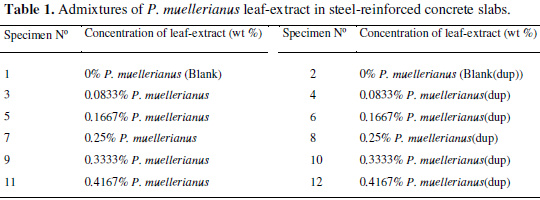
<body><![CDATA[<p><b><i>Steel reinforced concrete samples</i></b></p>      <p>Steel-reinforcement used in the study is of 12 mm diameter. This deformed steel- rebar has the elemental composition: 0.273% C, 0.780% Mn, 0.403% Si, 0.240%  Cu, 0.142% Cr, 0.109% Ni, 0.039% P, 0.037% S, 0.016% Mo, 0.0086% Co,  0.0083% Nb, 0.0063% Sn, 0.0037% Ce, 0.0032% V and the balance Fe. The  rebar was cut into 190 mm steel rods for the corrosion experiment. Surface  preparations for each of these rods were as per ASTM G109-99a [23], including  surface grinding by different grades of abrasive paper, pickling in 10% H<sub>2</sub>SO<sub>4</sub>,  rinsing and cleaning in ultrasonic cleaner, degreasing in acetone and drying with  warm air stream. 150 mm of each steel rod were centrally embedded in 100 mm  &times; 100 mm &times; 200 mm concrete slab, while the remaining 40 mm protrusion was  used as connector for the electrochemical monitoring methods used in the study.  This remaining protrusion of steel-rebar was painted with glossy paint after  casting of each steel-reinforced concrete slabs.</p>      <p>Slabs of steel-reinforced concretes, having 0.5 water cement ratio [3], were cast  in duplicates, according to the replication design suggested by Haynie [24], and  for this, six concrete block duplicates were cast, with each duplicate admixed  with similar <i>P. muellerianus</i> concentrations. These totalled twelve concrete block  specimens. The duplicated samples were admixed with <i>P. muellerianus</i> leaf- extract concentrations that vary from 0%, for the duplicated blank samples, in  increments of 0.0833% (i.e., a part by weight of <i>P. muellerianus</i> in 1200 parts by  weight of cement) up to 0.4167%. These admixture designs in concrete block  samples are presented in <a href="#t1">Table 1</a> and in this table it is shown that the duplicate  sample for each concentration was tagged ''(dup)''.</p>      <p>&nbsp;</p> <a name="t1"> <img src="/img/revistas/pea/v32n3/32n3a02t1.jpg">     
<p>&nbsp;</p>       <p><b><i>Setup of corrosion test-samples</i></b></p>      <p>The steel reinforced concretes for the electrochemical experiment were partially  immersed, longitudinally, in plastic bowls containing 0.5 M H<sub>2</sub>SO<sub>4</sub>, as per  standard procedures in studies for simulating industrial/microbial environment  [7,10]. This corrosive test-solution was made up to just below the steel reinforcement protrusion on the concrete but without touching the rebar, and was  replenished to this level every three weeks for maintaining the corrosive  environment [15,25].</p>       <p><b><i>Electrochemical monitoring experiment</i></b></p>      <p>Measurements of corrosion test-data were obtained from the concrete samples  first, in five days interval for 40 days and thereafter in seven days interval for the  following four weeks (totalling 68-day experimental period), through use of  electrochemical test-techniques [26-27]. The electrochemical test-techniques  employed in the study include:</p>      <p>(1) Half-cell potential (HCP) measurements versus Cu/CuSO<sub>4</sub> electrode (CSE),  Model 8-A, Tinker &amp; Rasor&reg;, using a high impedance digital multimeter  conforming to ASTM C876-91 R99 [5,13,27-28].</p>      ]]></body>
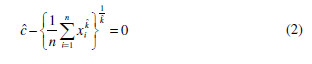
<body><![CDATA[<p>(2) Electrochemical cell current (ECC) measurements, versus CSE using zero  resistance ammeter (ZRA), Model ZM3P (Corrosion Service&reg;) [29-31].</p>      <p>(3) Corrosion rate (CR) measurements from linear polarization resistance  using the three-electrode LPR Data Logger, Model MS1500L (Metal  Samples&reg;) [29]. This instrument which gave direct readout of CR in mpy  unit was connected, for measurements, to the steel-reinforced concrete  specimen according to standard procedure in literature [15,26,29].</p>       <p><b><i>Statistical analysis of measured corrosion test-data</i></b></p>      <p>As per ASTM G16-95 R04 [32], measured corrosion test-data were subjected to  the Normal and the Weibull distribution fittings to which the compatibility of the  scatter of the test-data was also studied using the Kolmogorov-Smirnov  goodness-of-fit (K-S GoF) statistics [33-34]. The expression for estimating the  Normal mean, &mu;, and the Normal standard deviation, &sigma;, is well known. However,  estimation of the Weibull shape (k) and scale (c) parameters, required for  obtaining the Weibull mean, &mu;<sub>W</sub>, and standard deviation, &sigma;<sub>W</sub>, employed the  combined fixed point iterative-Aitken &Delta;<sup>2</sup> procedures [4] for solving the  maximum likelihood equations:</p>      <p>&nbsp;</p> <a name="e1"> <img src="/img/revistas/pea/v32n3/32n3a02e1.jpg">     
<p>&nbsp;</p> <a name="e2"> <img src="/img/revistas/pea/v32n3/32n3a02e2.jpg">     
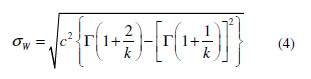
<p>&nbsp;</p>       <p>So that the unbiased estimated values of k and c from <a href="#e1">Equation (1)</a> and <a href="#e2">Equation (2)</a>  were then used for computing Weibull mean (&mu;<sub>W</sub>) and standard deviation (&sigma;<sub>W</sub>)  from [13,35-37]:</p>      <p>&nbsp;</p> <a name="e3"> <img src="/img/revistas/pea/v32n3/32n3a02e3.jpg">     
<p>&nbsp;</p> <a name="e4"> <img src="/img/revistas/pea/v32n3/32n3a02e4.jpg">     
]]></body>
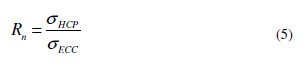
<body><![CDATA[<p>&nbsp;</p>        <p><b><i>Noise resistance (Rn) modelling</i></b></p>      <p>Requisite estimations, from the descriptive statistics exhibiting better  compatibility with the scatter of the HCP and the ECC test-data were used for the  ratio of the standard deviations of the corrosion potential and corrosion current,  the noise resistance (Rn) as [26-27,31,38-39]:</p>      <p>&nbsp;</p> <a name="e5"> <img src="/img/revistas/pea/v32n3/32n3a02e5.jpg">     
<p>&nbsp;</p>        <p><b><i>Surface coverage and inhibition efficiency modelling</i></b></p>      <p>In similar manner, requisite estimation from the descriptive statistics exhibiting  better compatibility with the scatter of the CR test-data were used for mean CR  values employed for surface coverage (&theta;) and inhibition efficiency (&eta;) modelling.  These were obtained, for each admixed <i>P. muellerianus</i> concentration in concrete  relative to the blank concrete sample, by [15,17,29,40]:</p>      <p>&nbsp;</p> <a name="e6"> <img src="/img/revistas/pea/v32n3/32n3a02e6.jpg">     
<p>&nbsp;</p> <a name="e7"> <img src="/img/revistas/pea/v32n3/32n3a02e7.jpg">     
<p>&nbsp;</p>        ]]></body>
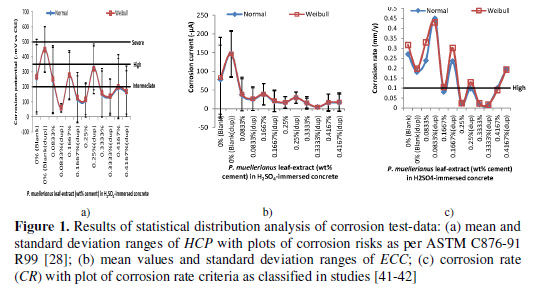
<body><![CDATA[<p>&nbsp;</p>     <p><b>Results and discussion</b></p>      <p><b><i>Test-results from the distribution fitting analysis of corrosion test-data</i></b></p>      <p>The mean values of corrosion test-responses obtained from the statistical  distribution fittings, by the Normal and by the Weibull distributions, of the  measurements of corrosion test-data of HCP, ECC and CR were plotted in <a href="#f1">Fig. 1</a>.</p>      <p>&nbsp;</p> <a name="f1"> <img src="/img/revistas/pea/v32n3/32n3a02f1.jpg">     
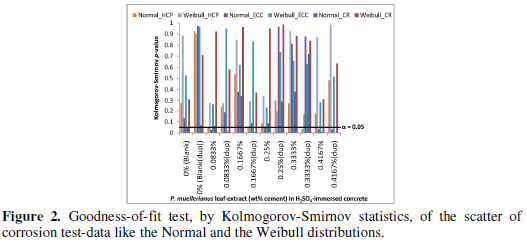
<p>&nbsp;</p>      <p>The standard deviations from the mean values of the HCP were included in <a href="#f1">Fig. 1(a)</a>  and of the ECC measurements were included in <a href="#f1">Fig. 1(b)</a>. Also, linear plots  for directly interpreting corrosion risk as per ASTM C876-91 R99 [26-28] were  included in <a href="#f1">Fig. 1(a)</a>, following the practice in Zamora et al. [5], and linear plot  for directly interpreting corrosion rate, as classified in studies [41-42], was  included in <a href="#f1">Fig. 1(c)</a>.</p>      <p>The plots in <a href="#f1">Fig. 1(a) and 1(b)</a> showed that the concrete samples, especially the  blank samples with 0 g <i>P. muellerianus</i> admixtures, exhibited wide ranges of  corrosion potential and corrosion current noise. The fluctuations in corrosion  test-data readings responsible for this form of variations find similarities with  fluctuations in corrosion potential measurements reported in other studies  [5,11,13,36-37].</p>      <p>Also, while similar pattern of Normal and Weibull mean values of HCP and ECC  test-data could be observed in <a href="#f1">Fig. 1(a) and 1(b)</a>, the Weibull mean values of CR  in <a href="#f1">Fig. 1(c)</a> exhibited many instances of over-predicting the Normal mean values  of CR. The observable exception to this includes the duplicate (i.e. dup) sample  of 0.0833% <i>P. muellerianus</i> and the 0.4167% <i>P. muellerianus</i> admixed sample  that exhibited Normal mean values of CR that over-predicted their Weibull mean  values of CR. These discrepancies in mean value estimations, which could also  be observed in the deviation ranges of the HCP and the ECC, by the distribution  functions necessitate ascertaining the statistics for describing the scatter of  corrosion test-data as per ASTM G16-95 R04 [32].</p>      <p>For this, the results of the goodness-of-fit test by the Kolmogorov-Smirnov  statistics of the scatter of corrosion test-data like the Normal and Weibull  distributions are shown in <a href="#f2">Fig. 2</a>.</p>      ]]></body>
<body><![CDATA[<p>&nbsp;</p> <a name="f2"> <img src="/img/revistas/pea/v32n3/32n3a02f2.jpg">     
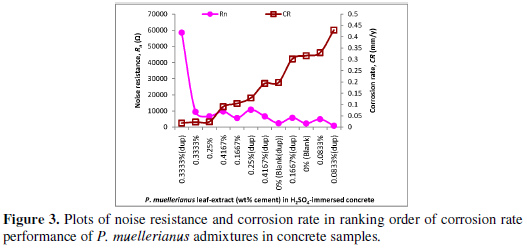
<p>&nbsp;</p>      <p>Also shown in the figure was the linear plot of &alpha; = 0.05 for  direct identification of the test-data scatter of corrosion test-variable  that distributed like the Normal distribution and/or the Weibull distribution  function. Thus, it could be identified from <a href="#f2">Fig. 2</a> that the scatter of the HCP test- data of two samples, ECC test-data of four samples and the CR test-data of five  samples, totalling eleven datasets of corrosion test-variables, were not distributed  like the Normal distribution. The p-values of the Kolmogorov-Smirnov statistics  for the Normal distribution fittings of these samples were less than 0.05.  According to ASTM G16-95 R04, using analysis of the techniques developed for  the Normal distribution, e.g., mean and standard deviation evaluations, for the  datasets of these test-data that distributed in another manner can lead to grossly  erroneous conclusion. In contrast, <a href="#f2">Fig. 2</a> showed that the p-values of the  Kolmogorov-Smirnov statistics for the Weibull distribution fittings of the test- data of corrosion test-variables for all the concrete samples in this study were  greater than 0.05. This implies that all the datasets of corrosion test-variables in  the study distributed like the Weibull distribution, thus identifying the analysis  techniques developed for the Weibull distribution as suitable for describing the  corrosion test-data and for detailing <i>P. muellerianus</i> performance.</p>        <p><b><i>Correlation fittings and analysis of corrosion rate and noise resistance</i></b></p>      <p>By the scatter of the test-data of corrosion test-variable from all the samples like  the Weibull distribution, the evaluation of the noise resistance, Rn in <a href="#e5">Equation (5)</a>  , employed the ratio of the Weibull standard deviation of HCP (mV) to the  Weibull standard deviation of ECC (mA). <a href="#f3">Fig. 3</a> showed the plotting of the  evaluations of this ratio, Rn, and the corrosion rate in ranking order of corrosion  rate from the samples of steel-reinforced concrete immersed in the corrosive test- medium in the study.</p>      <p>&nbsp;</p> <a name="f3"> <img src="/img/revistas/pea/v32n3/32n3a02f3.jpg">     
<p>&nbsp;</p>      <p>This figure generally showed that the sample with the  higher-valued Rn was attended with low corrosion rate, while the sample with the  lower-valued Rn exhibited high corrosion rate, which finds agreement with Kelly  et al. [38] where Rn values tracked linear polarisation resistance. These forms of  results engender suggestions of the existence of relationship between the  experimental data of corrosion rate and the noise resistance.</p>      <p>Based on these, several correlation fitting model applications to the corrosion  rate, CR, and the noise resistance, Rn, as well as the <i>P. muellerianus</i> leaf-extract  concentration, C, were investigated before obtaining the relationship between  these quantities in the form:</p>      <p>&nbsp;</p> <a name="e8"> <img src="/img/revistas/pea/v32n3/32n3a02e8.jpg">     
]]></body>
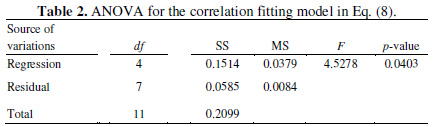
<body><![CDATA[<p>&nbsp;</p>      <p>For the fitting performance of <a href="#e8">Eq.(8)</a>, the correlation coefficient, r = 84.93%. The  analysis of variance (ANOVA) of this fitting model, see <a href="#t2">Table 2</a>, showed that the  ANOVA p-value = 0.0403 for the fitting model.</p>      <p>&nbsp;</p> <a name="t2"> <img src="/img/revistas/pea/v32n3/32n3a02t2.jpg">     
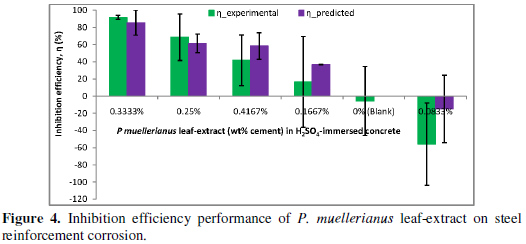
<p>&nbsp;</p>      <p>This ANOVA p-value implies  that it cannot be rejected that there is statistically significant relationship between  the correlated dependent variable, CR, and the independent variables, Rn and C  within 95% confidence interval.</p>        <p><b><i>Inhibition efficiency and adsorption isotherm models</i></b></p>      <p>Inhibition efficiency, from the use of <a href="#e7">Eq. (7)</a> for the experimental CR and the  predicted CR from the correlation fitting model, which were then averaged  between the duplicate samples, are presented, in ranking order of <i>P. muellerianus</i>  performance, in <a href="#f4">Fig. 4</a>.</p>      <p>&nbsp;</p> <a name="f4"> <img src="/img/revistas/pea/v32n3/32n3a02f4.jpg">     
<p>&nbsp;</p>      <p>The figure showed that though there were over- predictions by one model over the other, the experimental still agreed with the  predicted model in effectiveness ranking of <i>P. muellerianus</i> performance at  inhibiting steel-reinforcement corrosion in the acidic sulphate medium.  Both models identified the 0.3333% <i>P. muellerianus</i> leaf-extract concentration  admixed in concrete with optimum inhibition efficiency performance, &eta;  = 91.65&pm;2.51 (experimental) or &eta; = 85.54&pm;14.44 (predicted) at inhibiting concrete  steel-reinforcement corrosion. This was followed in experimental and predicted  ranking order of effectiveness performance by the 0.25%, the 0.4167% and the  0.1667% <i>P. muellerianus</i> admixture concentrations, that all exhibited positive  effectiveness at inhibiting steel-rebar corrosion in the medium. However, the  0.0833% <i>P. muellerianus</i> admixture portrayed negative inhibition efficiency, &eta;  = -55.86&pm;48.09% (experimental) or -14.93&pm;39.26% (predicted) which indicated  that the admixture rather aggravated, rather than inhibited, steel-reinforcement  corrosion. This bear suggestion of the 0.0833% <i>P. muellerianus</i> admixture as  representing inadequate quantity of admixture concentration which studies  [41,43] posited as being potent with significantly intense corrosion attack rather  corrosion inhibition in corrosive system. These constitute reasons the reported  works in literature [41,43] identified needs for the use of suitable concentration,  i.e. sufficient quantity, of inhibitor for attaining effective corrosion inhibition and  avoiding corrosion aggravation of steel-rebar in the requisite corrosive system.</p>      ]]></body>
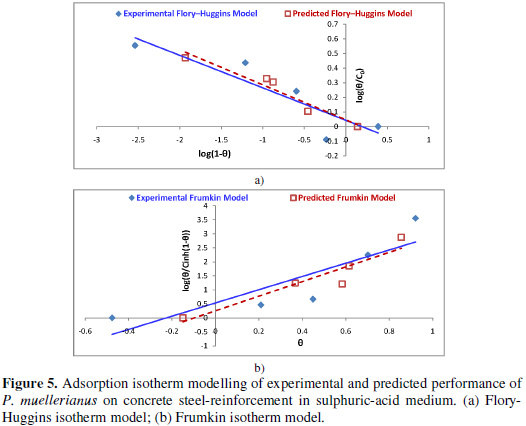
<body><![CDATA[<p>The surface coverage, <a href="#e6">Equation (6)</a>, applied to the experimental and predicted  models were subjected to different adsorption isotherms such as the Langmuir,  Flory-Huggins, Frumkin and Freundlich isotherms. Among these, the  experimental and predicted models followed the Flory-Huggins [44-45] and the  Frumkin [17,40] isotherms given respectively as:</p>      <p>&nbsp;</p> <a name="e9"> <img src="/img/revistas/pea/v32n3/32n3a02e9.jpg">     
<p>&nbsp;</p> <a name="e10"> <img src="/img/revistas/pea/v32n3/32n3a02e10.jpg">     
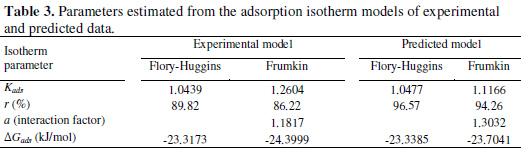
<p>&nbsp;</p>      <p>where KFH and KFrum are, respectively, the equilibrium constants of the Flory- Huggins and Frumkin desorption-adsorption process, n<sub>FH</sub> is the Flory-Huggins  model exponent and a is the Frumkin model of lateral interaction factor  describing strength of attractive behaviour. <a href="#f5">Fig. 5</a> shows the plots of the Flory- Huggins, <a href="#f5">Fig. 5(a)</a>, and of the Frumkin, <a href="#f5">Fig. 5(b)</a>, isotherm fittings of the  experimental and the predicted models, while <a href="#t3">Table 3</a> presents important  parameters estimated from the isotherm models.</p>      <p>&nbsp;</p> <a name="f5"> <img src="/img/revistas/pea/v32n3/32n3a02f5.jpg">     
<p>&nbsp;</p> <a name="t3"> <img src="/img/revistas/pea/v32n3/32n3a02t3.jpg">     
<p>&nbsp;</p>      <p>These parameters include estimation of the free energy of adsorption,  &Delta;G<sup>0</sup><sub>ads</sub>, using Gibbs-Helmotz equation [17,45]:</p>      <p>&nbsp;</p> <a name="e11"> <img src="/img/revistas/pea/v32n3/32n3a02e11.jpg">     
]]></body>
<body><![CDATA[<p>&nbsp;</p>      <p>The Flory-Huggins and the Frumkin fittings of adsorption isotherm were better  correlated with the predicted model, for which respective correlation coefficient,  r<sub>FH</sub> = 96.57% and r<sub>Frum</sub> = 94.26%, than with the experimental model for which,  r<sub>FH</sub> = 89.82% and r<sub>Frum</sub> = 86.22%. In spite of this, and the fact that the  equilibrium constant from the Frumkin isotherm were slightly higher than that of  agreed in the negative &Delta;G<sup>0</sup><sub>ads</sub> that were greater than -40 kJ/mol. The negative  &Delta;G<sup>0</sup><sub>ads</sub> values suggest spontaneity of the adsorption process and stability of the  adsorbed layer on the rebar surface, while greater than -40 kJ/mol values of  &Delta;G<sup>0</sup><sub>ads</sub> in the modelled fittings indicated predominance of physical adsorption or  physisorption [45]. The positive values of the lateral interaction factor, the  Frumkin a-values in the experimental and the predicted models, bear indications  that the adsorption energy is increased by the lateral attraction between the  molecules in the adsorbed layer [40].</p>      <p>The results constitute reasons supporting the use of <i>P. muellerianus</i> leaf-extract  as environmentally-friendly admixture for inhibiting reinforcing steel corrosion  in steel-reinforced concrete designed for the microbial/industrial service- environment..</p>       <p>&nbsp;</p>     <p><b>Conclusions</b></p>      <p>Electrochemical techniques have been employed for studying the performance of  <i>P. muellerianus</i> leaf-extract on the corrosion of concrete steel-reinforcement in  0.5 M H<sub>2</sub>SO<sub>4</sub> simulating industrial/microbial environment. From this study, the  following conclusions could be drawn:</p>      <p>- The Weibull distribution describes the scatter of corrosion test data better than  the Normal distribution at &alpha; = 0.05 level of significance as per the Kolmogorov- Smirnov test-statistics, thus supporting the use of the Weibull distribution model  for detailing admixture performance at inhibiting steel-reinforcement corrosion  in the test-solution;</p>      <p>- The noise resistance tracks the corrosion rate from the linear polarisation  resistance instrument in the present study environment and experimental  conditions, whereby high noise resistance was attended with low corrosion rate,  in agreement with what is obtained in literature;</p>      <p>- The corrosion rate of the concrete steel-reinforcement correlated with the  function of the <i>P. muellerianus</i> leaf extract concentration admixed in concrete  and the noise resistance, that is the ratio of the standard deviation of potential to  the standard deviation of current are: (correlation coefficient r = 84.93%;  ANOVA p-value = 0.0403);</p>      <p>- The best inhibition efficiency at inhibiting the concrete steel-reinforcement  corrosion was exhibited by the 0.3333% <i>P. muellerianus</i> leaf-extract admixture  (per weight of cement), both from the experimental model where &eta; =  91.66&pm;2.51%, and from the predicted model from the correlation fitting where &eta;  = 85.54&pm;14.44%;</p>      ]]></body>
<body><![CDATA[<p>- Adsorption isotherm modelling showed that the experimental and the predicted  data followed the Flory-Huggins and the Frumkin models with respective  correlation coefficient of r<sub>FH</sub> = 89.82% and r<sub>Frum</sub> = 86.22% (experimental) and  r<sub>FH</sub> = 96.57% and r<sub>Frum</sub> = 94.26% (predicted) and both of which suggest the  prevalent mechanism of physical adsorption (physisorption) of the extract on the  steel-rebar surface;</p>      <p>- These experimental and predicted performances support, in agreement, the use  of <i>P. muellerianus</i> leaf-extract admixture as an eco-friendly inhibitor of steel- reinforcement corrosion in steel-reinforced concretes designed for the  industrial/microbial service-environments.</p>       <p>&nbsp;</p>     <p><b>References</b></p>      <!-- ref --><p>1. Shi X, Xie N, Fortune K, et al. Construct Build Mater. 2012;30:125-138.    &nbsp;&nbsp;&nbsp;&nbsp;&nbsp;&nbsp;&nbsp;&nbsp;[&#160;<a href="javascript:void(0);" onclick="javascript: window.open('/scielo.php?script=sci_nlinks&ref=000107&pid=S0872-1904201400030000200001&lng=','','width=640,height=500,resizable=yes,scrollbars=1,menubar=yes,');">Links</a>&#160;]<!-- end-ref --></p>      <!-- ref --><p>2. Reyna SLR, Vidales JMM, Tiburcio CG, et al. Port Electrochim Acta. 2010;28:153-164.    &nbsp;&nbsp;&nbsp;&nbsp;&nbsp;&nbsp;&nbsp;&nbsp;[&#160;<a href="javascript:void(0);" onclick="javascript: window.open('/scielo.php?script=sci_nlinks&ref=000109&pid=S0872-1904201400030000200002&lng=','','width=640,height=500,resizable=yes,scrollbars=1,menubar=yes,');">Links</a>&#160;]<!-- end-ref --></p>      <!-- ref --><p>3. Baltazar MA, Almeraya-Calderon F, Carmona VO, et al. Port Electrochim Acta. 2004;22:335-344.    &nbsp;&nbsp;&nbsp;&nbsp;&nbsp;&nbsp;&nbsp;&nbsp;[&#160;<a href="javascript:void(0);" onclick="javascript: window.open('/scielo.php?script=sci_nlinks&ref=000111&pid=S0872-1904201400030000200003&lng=','','width=640,height=500,resizable=yes,scrollbars=1,menubar=yes,');">Links</a>&#160;]<!-- end-ref --></p>      ]]></body>
<body><![CDATA[<!-- ref --><p>4. Okeniyi JO, Oladele IO, Ambrose IJ, et al. J Cent South Univ. 2013;20:3697-3714.    &nbsp;&nbsp;&nbsp;&nbsp;&nbsp;&nbsp;&nbsp;&nbsp;[&#160;<a href="javascript:void(0);" onclick="javascript: window.open('/scielo.php?script=sci_nlinks&ref=000113&pid=S0872-1904201400030000200004&lng=','','width=640,height=500,resizable=yes,scrollbars=1,menubar=yes,');">Links</a>&#160;]<!-- end-ref --></p>      <!-- ref --><p>5. Zamora MAB, Mendoza DN, Zamora HH, et al. Port Electrochim Acta. 2009;27:237-246.    &nbsp;&nbsp;&nbsp;&nbsp;&nbsp;&nbsp;&nbsp;&nbsp;[&#160;<a href="javascript:void(0);" onclick="javascript: window.open('/scielo.php?script=sci_nlinks&ref=000115&pid=S0872-1904201400030000200005&lng=','','width=640,height=500,resizable=yes,scrollbars=1,menubar=yes,');">Links</a>&#160;]<!-- end-ref --></p>      <!-- ref --><p>6. Tam CT, Lim HB, Sisomphon K. The IES J Part A: Civ Struct Eng. 2008;1:146-153.    &nbsp;&nbsp;&nbsp;&nbsp;&nbsp;&nbsp;&nbsp;&nbsp;[&#160;<a href="javascript:void(0);" onclick="javascript: window.open('/scielo.php?script=sci_nlinks&ref=000117&pid=S0872-1904201400030000200006&lng=','','width=640,height=500,resizable=yes,scrollbars=1,menubar=yes,');">Links</a>&#160;]<!-- end-ref --></p>      <!-- ref --><p>7. Gerengi H, Kocak Y, Jazdzewska A, et al. Construct Build Mater. 2013;49:471-477.    &nbsp;&nbsp;&nbsp;&nbsp;&nbsp;&nbsp;&nbsp;&nbsp;[&#160;<a href="javascript:void(0);" onclick="javascript: window.open('/scielo.php?script=sci_nlinks&ref=000119&pid=S0872-1904201400030000200007&lng=','','width=640,height=500,resizable=yes,scrollbars=1,menubar=yes,');">Links</a>&#160;]<!-- end-ref --></p>      <!-- ref --><p>8. Tang Y, Zhang G, Zuo Y. Construct Build Mater. 2012;28:327-332.    &nbsp;&nbsp;&nbsp;&nbsp;&nbsp;&nbsp;&nbsp;&nbsp;[&#160;<a href="javascript:void(0);" onclick="javascript: window.open('/scielo.php?script=sci_nlinks&ref=000121&pid=S0872-1904201400030000200008&lng=','','width=640,height=500,resizable=yes,scrollbars=1,menubar=yes,');">Links</a>&#160;]<!-- end-ref --></p>      ]]></body>
<body><![CDATA[<!-- ref --><p>9. Tommaselli MAG, Mariano NA, Kuri SE. Construct Build Mater. 2009;23:328-333.    &nbsp;&nbsp;&nbsp;&nbsp;&nbsp;&nbsp;&nbsp;&nbsp;[&#160;<a href="javascript:void(0);" onclick="javascript: window.open('/scielo.php?script=sci_nlinks&ref=000123&pid=S0872-1904201400030000200009&lng=','','width=640,height=500,resizable=yes,scrollbars=1,menubar=yes,');">Links</a>&#160;]<!-- end-ref --></p>      <!-- ref --><p>10. Shing CK, Wu CML, Chen JWJ, et al. HKIE Trans. 2012;19:8-16.    &nbsp;&nbsp;&nbsp;&nbsp;&nbsp;&nbsp;&nbsp;&nbsp;[&#160;<a href="javascript:void(0);" onclick="javascript: window.open('/scielo.php?script=sci_nlinks&ref=000125&pid=S0872-1904201400030000200010&lng=','','width=640,height=500,resizable=yes,scrollbars=1,menubar=yes,');">Links</a>&#160;]<!-- end-ref --></p>      <!-- ref --><p>11. Okeniyi JO, Omotosho OA, Ajayi OO, et al. Asian J Appl Sci. 2012;5:132143.    &nbsp;&nbsp;&nbsp;&nbsp;&nbsp;&nbsp;&nbsp;&nbsp;[&#160;<a href="javascript:void(0);" onclick="javascript: window.open('/scielo.php?script=sci_nlinks&ref=000127&pid=S0872-1904201400030000200011&lng=','','width=640,height=500,resizable=yes,scrollbars=1,menubar=yes,');">Links</a>&#160;]<!-- end-ref --></p>      <!-- ref --><p>12. Wei S, Sanchez M, Trejo D, et al. Int Biodeterior Biodegrad. 2010;64:748754.    &nbsp;&nbsp;&nbsp;&nbsp;&nbsp;&nbsp;&nbsp;&nbsp;[&#160;<a href="javascript:void(0);" onclick="javascript: window.open('/scielo.php?script=sci_nlinks&ref=000129&pid=S0872-1904201400030000200012&lng=','','width=640,height=500,resizable=yes,scrollbars=1,menubar=yes,');">Links</a>&#160;]<!-- end-ref --></p>      <!-- ref --><p>13. Okeniyi JO, Omotosho OA, Ajayi OO, et al. Construct Build Mater. 2014;50:448-456.    &nbsp;&nbsp;&nbsp;&nbsp;&nbsp;&nbsp;&nbsp;&nbsp;[&#160;<a href="javascript:void(0);" onclick="javascript: window.open('/scielo.php?script=sci_nlinks&ref=000131&pid=S0872-1904201400030000200013&lng=','','width=640,height=500,resizable=yes,scrollbars=1,menubar=yes,');">Links</a>&#160;]<!-- end-ref --></p>      ]]></body>
<body><![CDATA[<!-- ref --><p>14. Shi JJ, Sun W. Cem Concr Compos. 2014;45:166-175.    &nbsp;&nbsp;&nbsp;&nbsp;&nbsp;&nbsp;&nbsp;&nbsp;[&#160;<a href="javascript:void(0);" onclick="javascript: window.open('/scielo.php?script=sci_nlinks&ref=000133&pid=S0872-1904201400030000200014&lng=','','width=640,height=500,resizable=yes,scrollbars=1,menubar=yes,');">Links</a>&#160;]<!-- end-ref --></p>      <!-- ref --><p>15. Okeniyi JO, Omoniyi OM, Okpala SO, et al. Eur J Environ Civ Eng. 2013;17:398-416.    &nbsp;&nbsp;&nbsp;&nbsp;&nbsp;&nbsp;&nbsp;&nbsp;[&#160;<a href="javascript:void(0);" onclick="javascript: window.open('/scielo.php?script=sci_nlinks&ref=000135&pid=S0872-1904201400030000200015&lng=','','width=640,height=500,resizable=yes,scrollbars=1,menubar=yes,');">Links</a>&#160;]<!-- end-ref --></p>      <!-- ref --><p>16. Fu JJ, Li SN, Cao LH, et al. J Mater Sci. 2010;45:979-986.    &nbsp;&nbsp;&nbsp;&nbsp;&nbsp;&nbsp;&nbsp;&nbsp;[&#160;<a href="javascript:void(0);" onclick="javascript: window.open('/scielo.php?script=sci_nlinks&ref=000137&pid=S0872-1904201400030000200016&lng=','','width=640,height=500,resizable=yes,scrollbars=1,menubar=yes,');">Links</a>&#160;]<!-- end-ref --></p>      <!-- ref --><p>17. Eddy NO, Ameh PO, Gwarzo MY, et al. Port Electrochim Acta. 2013;31:79-93.    &nbsp;&nbsp;&nbsp;&nbsp;&nbsp;&nbsp;&nbsp;&nbsp;[&#160;<a href="javascript:void(0);" onclick="javascript: window.open('/scielo.php?script=sci_nlinks&ref=000139&pid=S0872-1904201400030000200017&lng=','','width=640,height=500,resizable=yes,scrollbars=1,menubar=yes,');">Links</a>&#160;]<!-- end-ref --></p>      <!-- ref --><p>18. Johnsirani V, Sathiyabama J, Rajendran S, et al. Port Electrochim Acta. 2013;31:95-106.    &nbsp;&nbsp;&nbsp;&nbsp;&nbsp;&nbsp;&nbsp;&nbsp;[&#160;<a href="javascript:void(0);" onclick="javascript: window.open('/scielo.php?script=sci_nlinks&ref=000141&pid=S0872-1904201400030000200018&lng=','','width=640,height=500,resizable=yes,scrollbars=1,menubar=yes,');">Links</a>&#160;]<!-- end-ref --></p>      ]]></body>
<body><![CDATA[<!-- ref --><p>19. Agyare C, Lechtenberg M, Deters A, et al. Phytomedicine. 2011;18:617.    &nbsp;&nbsp;&nbsp;&nbsp;&nbsp;&nbsp;&nbsp;&nbsp;[&#160;<a href="javascript:void(0);" onclick="javascript: window.open('/scielo.php?script=sci_nlinks&ref=000143&pid=S0872-1904201400030000200019&lng=','','width=640,height=500,resizable=yes,scrollbars=1,menubar=yes,');">Links</a>&#160;]<!-- end-ref --></p>      <!-- ref --><p>20. Zirihi GN, Mambu L, Guede-Guina F, et al. J Ethnopharmacol. 2005;98:281.    &nbsp;&nbsp;&nbsp;&nbsp;&nbsp;&nbsp;&nbsp;&nbsp;[&#160;<a href="javascript:void(0);" onclick="javascript: window.open('/scielo.php?script=sci_nlinks&ref=000145&pid=S0872-1904201400030000200020&lng=','','width=640,height=500,resizable=yes,scrollbars=1,menubar=yes,');">Links</a>&#160;]<!-- end-ref --></p>      <!-- ref --><p>21. Obi-Egbedi NO, Obot IB, Umoren SA. Arab J Chem. 2012;5:361.    &nbsp;&nbsp;&nbsp;&nbsp;&nbsp;&nbsp;&nbsp;&nbsp;[&#160;<a href="javascript:void(0);" onclick="javascript: window.open('/scielo.php?script=sci_nlinks&ref=000147&pid=S0872-1904201400030000200021&lng=','','width=640,height=500,resizable=yes,scrollbars=1,menubar=yes,');">Links</a>&#160;]<!-- end-ref --></p>      <!-- ref --><p>22. Hameurlaine S, Gherraf N, Benmnine A, et al. J Chem Pharm Res. 2010;2:819.    &nbsp;&nbsp;&nbsp;&nbsp;&nbsp;&nbsp;&nbsp;&nbsp;[&#160;<a href="javascript:void(0);" onclick="javascript: window.open('/scielo.php?script=sci_nlinks&ref=000149&pid=S0872-1904201400030000200022&lng=','','width=640,height=500,resizable=yes,scrollbars=1,menubar=yes,');">Links</a>&#160;]<!-- end-ref --></p>      <!-- ref --><p>23. ASTM G109-99a. Standard test method for determining the effects of chemical admixtures on the corrosion of embedded steel reinforcement in concrete exposed to chloride environments. West Conshohocken PA:ASTM International.    &nbsp;&nbsp;&nbsp;&nbsp;&nbsp;&nbsp;&nbsp;&nbsp;[&#160;<a href="javascript:void(0);" onclick="javascript: window.open('/scielo.php?script=sci_nlinks&ref=000151&pid=S0872-1904201400030000200023&lng=','','width=640,height=500,resizable=yes,scrollbars=1,menubar=yes,');">Links</a>&#160;]<!-- end-ref --></p>      ]]></body>
<body><![CDATA[<!-- ref --><p>24. Haynie FH. In: Corrosion Tests and Standards: Application and Interpretation. 2nd Edition. Baboian R. (ed). West Conshohocken  PA:ASTM International;2005. p. 83.    &nbsp;&nbsp;&nbsp;&nbsp;&nbsp;&nbsp;&nbsp;&nbsp;[&#160;<a href="javascript:void(0);" onclick="javascript: window.open('/scielo.php?script=sci_nlinks&ref=000153&pid=S0872-1904201400030000200024&lng=','','width=640,height=500,resizable=yes,scrollbars=1,menubar=yes,');">Links</a>&#160;]<!-- end-ref --></p>      <!-- ref --><p>25. Muralidharan S, Saraswathy V, Nima SPM, et al. Mater Chem Phy. 2004;86:298.    &nbsp;&nbsp;&nbsp;&nbsp;&nbsp;&nbsp;&nbsp;&nbsp;[&#160;<a href="javascript:void(0);" onclick="javascript: window.open('/scielo.php?script=sci_nlinks&ref=000155&pid=S0872-1904201400030000200025&lng=','','width=640,height=500,resizable=yes,scrollbars=1,menubar=yes,');">Links</a>&#160;]<!-- end-ref --></p>      <!-- ref --><p>26. Song HW, Saraswathy V. Int J Electrochem Sci. 2007;2:1.    &nbsp;&nbsp;&nbsp;&nbsp;&nbsp;&nbsp;&nbsp;&nbsp;[&#160;<a href="javascript:void(0);" onclick="javascript: window.open('/scielo.php?script=sci_nlinks&ref=000157&pid=S0872-1904201400030000200026&lng=','','width=640,height=500,resizable=yes,scrollbars=1,menubar=yes,');">Links</a>&#160;]<!-- end-ref --></p>      <p>27. Mendoza DN, Almeraya-CalderÃ³n F, MejÃ­a JR, et al. Port Electrochim Acta. 2004;22:305-320.</p>      <!-- ref --><p>28. ASTM C876-91 R99. Standard test method for half-cell potentials of uncoated reinforcing steel in concrete. West Conshohocken PA:ASTM  International.    &nbsp;&nbsp;&nbsp;&nbsp;&nbsp;&nbsp;&nbsp;&nbsp;[&#160;<a href="javascript:void(0);" onclick="javascript: window.open('/scielo.php?script=sci_nlinks&ref=000160&pid=S0872-1904201400030000200028&lng=','','width=640,height=500,resizable=yes,scrollbars=1,menubar=yes,');">Links</a>&#160;]<!-- end-ref --></p>      <!-- ref --><p>29. Okeniyi JO, Ambrose IJ, Oladele IO, et al. Int J Electrochem Sci. 2013;8:10758-10771.    &nbsp;&nbsp;&nbsp;&nbsp;&nbsp;&nbsp;&nbsp;&nbsp;[&#160;<a href="javascript:void(0);" onclick="javascript: window.open('/scielo.php?script=sci_nlinks&ref=000162&pid=S0872-1904201400030000200029&lng=','','width=640,height=500,resizable=yes,scrollbars=1,menubar=yes,');">Links</a>&#160;]<!-- end-ref --></p>      <!-- ref --><p>30. Sastri VS. Green Corrosion Inhibitors: Theory and Practice. Hoboken,New Jersey:John Wiley &amp; Sons Inc.;2011.    &nbsp;&nbsp;&nbsp;&nbsp;&nbsp;&nbsp;&nbsp;&nbsp;[&#160;<a href="javascript:void(0);" onclick="javascript: window.open('/scielo.php?script=sci_nlinks&ref=000164&pid=S0872-1904201400030000200030&lng=','','width=640,height=500,resizable=yes,scrollbars=1,menubar=yes,');">Links</a>&#160;]<!-- end-ref --></p>      <!-- ref --><p>31. Eden DA. in Uhlig's Corrosion Handbook. 2nd Edition. Revie RW. (ed). New York:John Wiley &amp; Sons Inc.;2000. p. 1227.    &nbsp;&nbsp;&nbsp;&nbsp;&nbsp;&nbsp;&nbsp;&nbsp;[&#160;<a href="javascript:void(0);" onclick="javascript: window.open('/scielo.php?script=sci_nlinks&ref=000166&pid=S0872-1904201400030000200031&lng=','','width=640,height=500,resizable=yes,scrollbars=1,menubar=yes,');">Links</a>&#160;]<!-- end-ref --></p>      <!-- ref --><p>32. ASTM G16-95 R04. Standard Guide for Applying Statistics to Analysis of Corrosion Data. West Conshohocken PA:ASTM International;2004.    &nbsp;&nbsp;&nbsp;&nbsp;&nbsp;&nbsp;&nbsp;&nbsp;[&#160;<a href="javascript:void(0);" onclick="javascript: window.open('/scielo.php?script=sci_nlinks&ref=000168&pid=S0872-1904201400030000200032&lng=','','width=640,height=500,resizable=yes,scrollbars=1,menubar=yes,');">Links</a>&#160;]<!-- end-ref --></p>      <!-- ref --><p>33. Okeniyi JO, Okeniyi ET. J Stat Comput Simul. 2012;82:1727-1741.    &nbsp;&nbsp;&nbsp;&nbsp;&nbsp;&nbsp;&nbsp;&nbsp;[&#160;<a href="javascript:void(0);" onclick="javascript: window.open('/scielo.php?script=sci_nlinks&ref=000170&pid=S0872-1904201400030000200033&lng=','','width=640,height=500,resizable=yes,scrollbars=1,menubar=yes,');">Links</a>&#160;]<!-- end-ref --></p>      <!-- ref --><p>34. Roberge PR. in ASM Handbook. Corrosion: Fundamentals, Testing, and Protection. Cramer SD, Covino Jr BS. (eds). Vol. 13A. Materials Park,  OH:ASM International;2003. p. 425.    &nbsp;&nbsp;&nbsp;&nbsp;&nbsp;&nbsp;&nbsp;&nbsp;[&#160;<a href="javascript:void(0);" onclick="javascript: window.open('/scielo.php?script=sci_nlinks&ref=000172&pid=S0872-1904201400030000200034&lng=','','width=640,height=500,resizable=yes,scrollbars=1,menubar=yes,');">Links</a>&#160;]<!-- end-ref --></p>      <!-- ref --><p>35. Ajayi OO, Fagbenle RO, Katende J, et al. Int J Energ Environ Eng. 2013;4:1-15.    &nbsp;&nbsp;&nbsp;&nbsp;&nbsp;&nbsp;&nbsp;&nbsp;[&#160;<a href="javascript:void(0);" onclick="javascript: window.open('/scielo.php?script=sci_nlinks&ref=000174&pid=S0872-1904201400030000200035&lng=','','width=640,height=500,resizable=yes,scrollbars=1,menubar=yes,');">Links</a>&#160;]<!-- end-ref --></p>      <!-- ref --><p>36. Omotosho OA, Okeniyi JO, Ajayi OO, et al. Int J Environ Sci. 2012;2:2346-2359.    &nbsp;&nbsp;&nbsp;&nbsp;&nbsp;&nbsp;&nbsp;&nbsp;[&#160;<a href="javascript:void(0);" onclick="javascript: window.open('/scielo.php?script=sci_nlinks&ref=000176&pid=S0872-1904201400030000200036&lng=','','width=640,height=500,resizable=yes,scrollbars=1,menubar=yes,');">Links</a>&#160;]<!-- end-ref --></p>      <!-- ref --><p>37. Omotosho OA, Loto CA, Ajayi OO, et al. Agric Eng Int: CIGR J. 2011;13:1-17.    &nbsp;&nbsp;&nbsp;&nbsp;&nbsp;&nbsp;&nbsp;&nbsp;[&#160;<a href="javascript:void(0);" onclick="javascript: window.open('/scielo.php?script=sci_nlinks&ref=000178&pid=S0872-1904201400030000200037&lng=','','width=640,height=500,resizable=yes,scrollbars=1,menubar=yes,');">Links</a>&#160;]<!-- end-ref --></p>      <!-- ref --><p>38. Kelly RG, Inman ME, Hudson JL. in Electrochemical Noise Measurement for Corrosion Applications: ASTM STP 1277. Kearns JR, Scully JR,  Roberge PR, (eds). West Conshohocken, PA:ASTM International;1996. p. 101.    &nbsp;&nbsp;&nbsp;&nbsp;&nbsp;&nbsp;&nbsp;&nbsp;[&#160;<a href="javascript:void(0);" onclick="javascript: window.open('/scielo.php?script=sci_nlinks&ref=000180&pid=S0872-1904201400030000200038&lng=','','width=640,height=500,resizable=yes,scrollbars=1,menubar=yes,');">Links</a>&#160;]<!-- end-ref --></p>      <!-- ref --><p>39. Nunez-Jaquez RE, Gaona-Tiburcio C, Uruchurtu-Chavarin J. et al. Port Electrochim Acta. 2005;23:111-121.    &nbsp;&nbsp;&nbsp;&nbsp;&nbsp;&nbsp;&nbsp;&nbsp;[&#160;<a href="javascript:void(0);" onclick="javascript: window.open('/scielo.php?script=sci_nlinks&ref=000182&pid=S0872-1904201400030000200039&lng=','','width=640,height=500,resizable=yes,scrollbars=1,menubar=yes,');">Links</a>&#160;]<!-- end-ref --></p>      <!-- ref --><p>40. Singh MR, Bhrara K, Singh G. Port Electrochim Acta. 2008;26:479-492.    &nbsp;&nbsp;&nbsp;&nbsp;&nbsp;&nbsp;&nbsp;&nbsp;[&#160;<a href="javascript:void(0);" onclick="javascript: window.open('/scielo.php?script=sci_nlinks&ref=000184&pid=S0872-1904201400030000200040&lng=','','width=640,height=500,resizable=yes,scrollbars=1,menubar=yes,');">Links</a>&#160;]<!-- end-ref --></p>      <!-- ref --><p>41. Soylev TA, Richardson MG. Construct Build Mater. 2008;22:609-622.    &nbsp;&nbsp;&nbsp;&nbsp;&nbsp;&nbsp;&nbsp;&nbsp;[&#160;<a href="javascript:void(0);" onclick="javascript: window.open('/scielo.php?script=sci_nlinks&ref=000186&pid=S0872-1904201400030000200041&lng=','','width=640,height=500,resizable=yes,scrollbars=1,menubar=yes,');">Links</a>&#160;]<!-- end-ref --></p>      <!-- ref --><p>42. Millard SG, Law D, Bungey JH, et al. NDT&amp;E Int. 2001;34:409-417.    &nbsp;&nbsp;&nbsp;&nbsp;&nbsp;&nbsp;&nbsp;&nbsp;[&#160;<a href="javascript:void(0);" onclick="javascript: window.open('/scielo.php?script=sci_nlinks&ref=000188&pid=S0872-1904201400030000200042&lng=','','width=640,height=500,resizable=yes,scrollbars=1,menubar=yes,');">Links</a>&#160;]<!-- end-ref --></p>      <!-- ref --><p>43. Vaysburd AM, Emmons PH. Cem Concr Compos. 2004;26:255-263.    &nbsp;&nbsp;&nbsp;&nbsp;&nbsp;&nbsp;&nbsp;&nbsp;[&#160;<a href="javascript:void(0);" onclick="javascript: window.open('/scielo.php?script=sci_nlinks&ref=000190&pid=S0872-1904201400030000200043&lng=','','width=640,height=500,resizable=yes,scrollbars=1,menubar=yes,');">Links</a>&#160;]<!-- end-ref --></p>      <!-- ref --><p>44. Foo KY, Hameed BH. Chem Eng J. 2010;156:2-10.    &nbsp;&nbsp;&nbsp;&nbsp;&nbsp;&nbsp;&nbsp;&nbsp;[&#160;<a href="javascript:void(0);" onclick="javascript: window.open('/scielo.php?script=sci_nlinks&ref=000192&pid=S0872-1904201400030000200044&lng=','','width=640,height=500,resizable=yes,scrollbars=1,menubar=yes,');">Links</a>&#160;]<!-- end-ref --></p>      <!-- ref --><p>45. Eddy NO, Mamza PAP. Port Electrochim Acta. 2009;27:443-456.    &nbsp;&nbsp;&nbsp;&nbsp;&nbsp;&nbsp;&nbsp;&nbsp;[&#160;<a href="javascript:void(0);" onclick="javascript: window.open('/scielo.php?script=sci_nlinks&ref=000194&pid=S0872-1904201400030000200045&lng=','','width=640,height=500,resizable=yes,scrollbars=1,menubar=yes,');">Links</a>&#160;]<!-- end-ref --></p>       <p>&nbsp;</p>     <p><a name=0></a><sup><a href="#top">*</a></sup>Corresponding author. E-mail address: <a href="mailto:joshua.okeniyi@covenantuniversity.edu.ng">joshua.okeniyi@covenantuniversity.edu.ng</a></p>      <p>Received 22 February 2014; accepted 23 June 2014</p>      <p><a href="http://www.peacta.org" target="_blank">www.peacta.org</a> </p>        ]]></body><back>
<ref-list>
<ref id="B1">
<label>1</label><nlm-citation citation-type="journal">
<person-group person-group-type="author">
<name>
<surname><![CDATA[Shi]]></surname>
<given-names><![CDATA[X]]></given-names>
</name>
<name>
<surname><![CDATA[Xie]]></surname>
<given-names><![CDATA[N]]></given-names>
</name>
<name>
<surname><![CDATA[Fortune]]></surname>
<given-names><![CDATA[K]]></given-names>
</name>
</person-group>
<source><![CDATA[Construct Build Mater]]></source>
<year>2012</year>
<volume>30</volume>
<page-range>125</page-range></nlm-citation>
</ref>
<ref id="B2">
<label>2</label><nlm-citation citation-type="journal">
<person-group person-group-type="author">
<name>
<surname><![CDATA[Reyna]]></surname>
<given-names><![CDATA[S L R]]></given-names>
</name>
<name>
<surname><![CDATA[Vidales]]></surname>
<given-names><![CDATA[J M M]]></given-names>
</name>
<name>
<surname><![CDATA[Tiburcio]]></surname>
<given-names><![CDATA[C G]]></given-names>
</name>
</person-group>
<source><![CDATA[Port Electrochim Acta]]></source>
<year>2010</year>
<volume>28</volume>
<page-range>153</page-range></nlm-citation>
</ref>
<ref id="B3">
<label>3</label><nlm-citation citation-type="journal">
<person-group person-group-type="author">
<name>
<surname><![CDATA[Baltazar]]></surname>
<given-names><![CDATA[M A]]></given-names>
</name>
<name>
<surname><![CDATA[Almeraya-Calderon]]></surname>
<given-names><![CDATA[F]]></given-names>
</name>
<name>
<surname><![CDATA[Carmona]]></surname>
<given-names><![CDATA[V O]]></given-names>
</name>
</person-group>
<source><![CDATA[Port Electrochim Acta]]></source>
<year>2004</year>
<volume>22</volume>
<page-range>335</page-range></nlm-citation>
</ref>
<ref id="B4">
<label>4</label><nlm-citation citation-type="journal">
<person-group person-group-type="author">
<name>
<surname><![CDATA[Okeniyi]]></surname>
<given-names><![CDATA[J O]]></given-names>
</name>
<name>
<surname><![CDATA[Oladele]]></surname>
<given-names><![CDATA[I O]]></given-names>
</name>
<name>
<surname><![CDATA[Ambrose]]></surname>
<given-names><![CDATA[I J]]></given-names>
</name>
</person-group>
<source><![CDATA[J Cent South Univ]]></source>
<year>2013</year>
<volume>20</volume>
<page-range>3697</page-range></nlm-citation>
</ref>
<ref id="B5">
<label>5</label><nlm-citation citation-type="journal">
<person-group person-group-type="author">
<name>
<surname><![CDATA[Zamora]]></surname>
<given-names><![CDATA[M A B]]></given-names>
</name>
<name>
<surname><![CDATA[Mendoza]]></surname>
<given-names><![CDATA[D N]]></given-names>
</name>
<name>
<surname><![CDATA[Zamora]]></surname>
<given-names><![CDATA[H H]]></given-names>
</name>
</person-group>
<source><![CDATA[Port Electrochim Acta]]></source>
<year>2009</year>
<volume>27</volume>
<page-range>237</page-range></nlm-citation>
</ref>
<ref id="B6">
<label>6</label><nlm-citation citation-type="journal">
<person-group person-group-type="author">
<name>
<surname><![CDATA[Tam]]></surname>
<given-names><![CDATA[C T]]></given-names>
</name>
<name>
<surname><![CDATA[Lim]]></surname>
<given-names><![CDATA[H B]]></given-names>
</name>
<name>
<surname><![CDATA[Sisomphon]]></surname>
<given-names><![CDATA[K]]></given-names>
</name>
</person-group>
<source><![CDATA[The IES J Part A: Civ Struct Eng]]></source>
<year>2008</year>
<volume>1</volume>
<page-range>146</page-range></nlm-citation>
</ref>
<ref id="B7">
<label>7</label><nlm-citation citation-type="journal">
<person-group person-group-type="author">
<name>
<surname><![CDATA[Gerengi]]></surname>
<given-names><![CDATA[H]]></given-names>
</name>
<name>
<surname><![CDATA[Kocak]]></surname>
<given-names><![CDATA[Y]]></given-names>
</name>
<name>
<surname><![CDATA[Jazdzewska]]></surname>
<given-names><![CDATA[A]]></given-names>
</name>
</person-group>
<source><![CDATA[Construct Build Mater]]></source>
<year>2013</year>
<volume>49</volume>
<page-range>471</page-range></nlm-citation>
</ref>
<ref id="B8">
<label>8</label><nlm-citation citation-type="journal">
<person-group person-group-type="author">
<name>
<surname><![CDATA[Tang]]></surname>
<given-names><![CDATA[Y]]></given-names>
</name>
<name>
<surname><![CDATA[Zhang]]></surname>
<given-names><![CDATA[G]]></given-names>
</name>
<name>
<surname><![CDATA[Zuo]]></surname>
<given-names><![CDATA[Y]]></given-names>
</name>
</person-group>
<source><![CDATA[Construct Build Mater]]></source>
<year>2012</year>
<volume>28</volume>
<page-range>327</page-range></nlm-citation>
</ref>
<ref id="B9">
<label>9</label><nlm-citation citation-type="journal">
<person-group person-group-type="author">
<name>
<surname><![CDATA[Tommaselli]]></surname>
<given-names><![CDATA[M A G]]></given-names>
</name>
<name>
<surname><![CDATA[Mariano]]></surname>
<given-names><![CDATA[N A]]></given-names>
</name>
<name>
<surname><![CDATA[Kuri]]></surname>
<given-names><![CDATA[S E]]></given-names>
</name>
</person-group>
<source><![CDATA[Construct Build Mater]]></source>
<year>2009</year>
<volume>23</volume>
<page-range>328</page-range></nlm-citation>
</ref>
<ref id="B10">
<label>10</label><nlm-citation citation-type="journal">
<person-group person-group-type="author">
<name>
<surname><![CDATA[Shing]]></surname>
<given-names><![CDATA[C K]]></given-names>
</name>
<name>
<surname><![CDATA[Wu]]></surname>
<given-names><![CDATA[C M L]]></given-names>
</name>
<name>
<surname><![CDATA[Chen]]></surname>
<given-names><![CDATA[J W J]]></given-names>
</name>
</person-group>
<source><![CDATA[HKIE Trans]]></source>
<year>2012</year>
<volume>19</volume>
<page-range>8</page-range></nlm-citation>
</ref>
<ref id="B11">
<label>11</label><nlm-citation citation-type="journal">
<person-group person-group-type="author">
<name>
<surname><![CDATA[Okeniyi]]></surname>
<given-names><![CDATA[J O]]></given-names>
</name>
<name>
<surname><![CDATA[Omotosho]]></surname>
<given-names><![CDATA[O A]]></given-names>
</name>
<name>
<surname><![CDATA[Ajayi]]></surname>
<given-names><![CDATA[O O]]></given-names>
</name>
</person-group>
<source><![CDATA[Asian J Appl Sci]]></source>
<year>2012</year>
<volume>5</volume>
<page-range>132</page-range></nlm-citation>
</ref>
<ref id="B12">
<label>12</label><nlm-citation citation-type="journal">
<person-group person-group-type="author">
<name>
<surname><![CDATA[Wei]]></surname>
<given-names><![CDATA[S]]></given-names>
</name>
<name>
<surname><![CDATA[Sanchez]]></surname>
<given-names><![CDATA[M]]></given-names>
</name>
<name>
<surname><![CDATA[Trejo]]></surname>
<given-names><![CDATA[D]]></given-names>
</name>
</person-group>
<source><![CDATA[Int Biodeterior Biodegrad]]></source>
<year>2010</year>
<volume>64</volume>
<page-range>748</page-range></nlm-citation>
</ref>
<ref id="B13">
<label>13</label><nlm-citation citation-type="journal">
<person-group person-group-type="author">
<name>
<surname><![CDATA[Okeniyi]]></surname>
<given-names><![CDATA[J O]]></given-names>
</name>
<name>
<surname><![CDATA[Omotosho]]></surname>
<given-names><![CDATA[O A]]></given-names>
</name>
<name>
<surname><![CDATA[Ajayi]]></surname>
<given-names><![CDATA[O O]]></given-names>
</name>
</person-group>
<source><![CDATA[Construct Build Mater]]></source>
<year>2014</year>
<volume>50</volume>
<page-range>448</page-range></nlm-citation>
</ref>
<ref id="B14">
<label>14</label><nlm-citation citation-type="journal">
<person-group person-group-type="author">
<name>
<surname><![CDATA[Shi]]></surname>
<given-names><![CDATA[J J]]></given-names>
</name>
<name>
<surname><![CDATA[Sun]]></surname>
<given-names><![CDATA[W]]></given-names>
</name>
</person-group>
<source><![CDATA[Cem Concr Compos]]></source>
<year>2014</year>
<volume>45</volume>
<page-range>166</page-range></nlm-citation>
</ref>
<ref id="B15">
<label>15</label><nlm-citation citation-type="journal">
<person-group person-group-type="author">
<name>
<surname><![CDATA[Okeniyi]]></surname>
<given-names><![CDATA[J O]]></given-names>
</name>
<name>
<surname><![CDATA[Omoniyi]]></surname>
<given-names><![CDATA[O M]]></given-names>
</name>
<name>
<surname><![CDATA[Okpala]]></surname>
<given-names><![CDATA[S O]]></given-names>
</name>
</person-group>
<source><![CDATA[Eur J Environ Civ Eng]]></source>
<year>2013</year>
<volume>17</volume>
<page-range>398</page-range></nlm-citation>
</ref>
<ref id="B16">
<label>16</label><nlm-citation citation-type="journal">
<person-group person-group-type="author">
<name>
<surname><![CDATA[Fu]]></surname>
<given-names><![CDATA[J J]]></given-names>
</name>
<name>
<surname><![CDATA[Li]]></surname>
<given-names><![CDATA[S N]]></given-names>
</name>
<name>
<surname><![CDATA[Cao]]></surname>
<given-names><![CDATA[L H]]></given-names>
</name>
</person-group>
<source><![CDATA[J Mater Sci]]></source>
<year>2010</year>
<volume>45</volume>
<page-range>979</page-range></nlm-citation>
</ref>
<ref id="B17">
<label>17</label><nlm-citation citation-type="journal">
<person-group person-group-type="author">
<name>
<surname><![CDATA[Eddy]]></surname>
<given-names><![CDATA[N O]]></given-names>
</name>
<name>
<surname><![CDATA[Ameh]]></surname>
<given-names><![CDATA[P O]]></given-names>
</name>
<name>
<surname><![CDATA[Gwarzo]]></surname>
<given-names><![CDATA[M Y]]></given-names>
</name>
</person-group>
<source><![CDATA[Port Electrochim Acta]]></source>
<year></year>
<volume>31</volume>
<page-range>79</page-range></nlm-citation>
</ref>
<ref id="B18">
<label>18</label><nlm-citation citation-type="journal">
<person-group person-group-type="author">
<name>
<surname><![CDATA[Johnsirani]]></surname>
<given-names><![CDATA[V]]></given-names>
</name>
<name>
<surname><![CDATA[Sathiyabama]]></surname>
<given-names><![CDATA[J]]></given-names>
</name>
<name>
<surname><![CDATA[Rajendran]]></surname>
<given-names><![CDATA[S]]></given-names>
</name>
</person-group>
<source><![CDATA[Port Electrochim Acta]]></source>
<year>2013</year>
<volume>31</volume>
<page-range>95</page-range></nlm-citation>
</ref>
<ref id="B19">
<label>19</label><nlm-citation citation-type="journal">
<person-group person-group-type="author">
<name>
<surname><![CDATA[Agyare]]></surname>
<given-names><![CDATA[C]]></given-names>
</name>
<name>
<surname><![CDATA[Lechtenberg]]></surname>
<given-names><![CDATA[M]]></given-names>
</name>
<name>
<surname><![CDATA[Deters]]></surname>
<given-names><![CDATA[A]]></given-names>
</name>
</person-group>
<source><![CDATA[Phytomedicine]]></source>
<year>2011</year>
<volume>18</volume>
<page-range>617</page-range></nlm-citation>
</ref>
<ref id="B20">
<label>20</label><nlm-citation citation-type="journal">
<person-group person-group-type="author">
<name>
<surname><![CDATA[Zirihi]]></surname>
<given-names><![CDATA[G N]]></given-names>
</name>
<name>
<surname><![CDATA[Mambu]]></surname>
<given-names><![CDATA[L]]></given-names>
</name>
<name>
<surname><![CDATA[Guede-Guina]]></surname>
<given-names><![CDATA[F]]></given-names>
</name>
</person-group>
<source><![CDATA[J Ethnopharmacol]]></source>
<year>2005</year>
<volume>98</volume>
<page-range>281</page-range></nlm-citation>
</ref>
<ref id="B21">
<label>21</label><nlm-citation citation-type="journal">
<person-group person-group-type="author">
<name>
<surname><![CDATA[Obi-Egbedi]]></surname>
<given-names><![CDATA[N O]]></given-names>
</name>
<name>
<surname><![CDATA[Obot]]></surname>
<given-names><![CDATA[I B]]></given-names>
</name>
<name>
<surname><![CDATA[Umoren]]></surname>
<given-names><![CDATA[S A]]></given-names>
</name>
</person-group>
<source><![CDATA[Arab J Chem]]></source>
<year>2012</year>
<volume>5</volume>
<page-range>361</page-range></nlm-citation>
</ref>
<ref id="B22">
<label>22</label><nlm-citation citation-type="journal">
<person-group person-group-type="author">
<name>
<surname><![CDATA[Hameurlaine]]></surname>
<given-names><![CDATA[S]]></given-names>
</name>
<name>
<surname><![CDATA[Gherraf]]></surname>
<given-names><![CDATA[N]]></given-names>
</name>
<name>
<surname><![CDATA[Benmnine]]></surname>
<given-names><![CDATA[A]]></given-names>
</name>
</person-group>
<source><![CDATA[J Chem Pharm Res]]></source>
<year>2010</year>
<volume>2</volume>
<page-range>819</page-range></nlm-citation>
</ref>
<ref id="B23">
<label>23</label><nlm-citation citation-type="book">
<source><![CDATA[Standard test method for determining the effects of chemical admixtures on the corrosion of embedded steel reinforcement in concrete exposed to chloride environments]]></source>
<year></year>
<publisher-loc><![CDATA[West Conshohocken^ePA PA]]></publisher-loc>
<publisher-name><![CDATA[ASTM International]]></publisher-name>
</nlm-citation>
</ref>
<ref id="B24">
<label>24</label><nlm-citation citation-type="book">
<person-group person-group-type="author">
<name>
<surname><![CDATA[Haynie]]></surname>
<given-names><![CDATA[F H]]></given-names>
</name>
</person-group>
<source><![CDATA[]]></source>
<year>2005</year>
<edition>2</edition>
<page-range>83</page-range><publisher-loc><![CDATA[West Conshohocken^ePA PA]]></publisher-loc>
<publisher-name><![CDATA[ASTM International]]></publisher-name>
</nlm-citation>
</ref>
<ref id="B25">
<label>25</label><nlm-citation citation-type="journal">
<person-group person-group-type="author">
<name>
<surname><![CDATA[Muralidharan]]></surname>
<given-names><![CDATA[S]]></given-names>
</name>
<name>
<surname><![CDATA[Saraswathy]]></surname>
<given-names><![CDATA[V]]></given-names>
</name>
<name>
<surname><![CDATA[Nima]]></surname>
<given-names><![CDATA[S P M]]></given-names>
</name>
</person-group>
<source><![CDATA[Mater Chem Phy]]></source>
<year>2004</year>
<volume>86</volume>
<page-range>298</page-range></nlm-citation>
</ref>
<ref id="B26">
<label>26</label><nlm-citation citation-type="journal">
<person-group person-group-type="author">
<name>
<surname><![CDATA[Song]]></surname>
<given-names><![CDATA[H W]]></given-names>
</name>
<name>
<surname><![CDATA[Saraswathy]]></surname>
<given-names><![CDATA[V]]></given-names>
</name>
</person-group>
<source><![CDATA[Int J Electrochem Sci]]></source>
<year>2007</year>
<volume>2</volume>
<page-range>1</page-range></nlm-citation>
</ref>
<ref id="B27">
<label>27</label><nlm-citation citation-type="">
<source><![CDATA[]]></source>
<year></year>
</nlm-citation>
</ref>
<ref id="B28">
<label>28</label><nlm-citation citation-type="book">
<source><![CDATA[Standard test method for half-cell potentials of uncoated reinforcing steel in concrete]]></source>
<year></year>
<publisher-loc><![CDATA[West Conshohocken^ePA PA]]></publisher-loc>
<publisher-name><![CDATA[ASTM International]]></publisher-name>
</nlm-citation>
</ref>
<ref id="B29">
<label>29</label><nlm-citation citation-type="journal">
<person-group person-group-type="author">
<name>
<surname><![CDATA[Okeniyi]]></surname>
<given-names><![CDATA[J O]]></given-names>
</name>
<name>
<surname><![CDATA[Ambrose]]></surname>
<given-names><![CDATA[I J]]></given-names>
</name>
<name>
<surname><![CDATA[Oladele]]></surname>
<given-names><![CDATA[I O]]></given-names>
</name>
</person-group>
<source><![CDATA[Int J Electrochem Sci]]></source>
<year>2013</year>
<volume>8</volume>
<page-range>10758</page-range></nlm-citation>
</ref>
<ref id="B30">
<label>30</label><nlm-citation citation-type="book">
<person-group person-group-type="author">
<name>
<surname><![CDATA[Sastri]]></surname>
<given-names><![CDATA[V S]]></given-names>
</name>
</person-group>
<source><![CDATA[Green Corrosion Inhibitors: Theory and Practice]]></source>
<year>2011</year>
<publisher-loc><![CDATA[Hoboken^eNew Jersey New Jersey]]></publisher-loc>
<publisher-name><![CDATA[John Wiley & Sons Inc]]></publisher-name>
</nlm-citation>
</ref>
<ref id="B31">
<label>31</label><nlm-citation citation-type="book">
<person-group person-group-type="author">
<name>
<surname><![CDATA[Eden]]></surname>
<given-names><![CDATA[D A]]></given-names>
</name>
</person-group>
<source><![CDATA[Uhlig's Corrosion Handbook]]></source>
<year>2000</year>
<edition>2</edition>
<page-range>1227</page-range><publisher-loc><![CDATA[New York ]]></publisher-loc>
<publisher-name><![CDATA[John Wiley & Sons Inc]]></publisher-name>
</nlm-citation>
</ref>
<ref id="B32">
<label>32</label><nlm-citation citation-type="book">
<source><![CDATA[Standard Guide for Applying Statistics to Analysis of Corrosion Data]]></source>
<year>2004</year>
<publisher-loc><![CDATA[West Conshohocken^ePA PA]]></publisher-loc>
<publisher-name><![CDATA[ASTM International]]></publisher-name>
</nlm-citation>
</ref>
<ref id="B33">
<label>33</label><nlm-citation citation-type="journal">
<person-group person-group-type="author">
<name>
<surname><![CDATA[Okeniyi]]></surname>
<given-names><![CDATA[J O]]></given-names>
</name>
<name>
<surname><![CDATA[Okeniyi]]></surname>
<given-names><![CDATA[E T]]></given-names>
</name>
</person-group>
<source><![CDATA[J Stat Comput Simul]]></source>
<year>2012</year>
<volume>82</volume>
<page-range>1727</page-range></nlm-citation>
</ref>
<ref id="B34">
<label>34</label><nlm-citation citation-type="book">
<person-group person-group-type="author">
<name>
<surname><![CDATA[Roberge]]></surname>
<given-names><![CDATA[P R]]></given-names>
</name>
</person-group>
<source><![CDATA[Corrosion: Fundamentals, Testing, and Protection]]></source>
<year>2003</year>
<volume>13A</volume>
<page-range>425</page-range><publisher-loc><![CDATA[Materials Park^eOH OH]]></publisher-loc>
<publisher-name><![CDATA[ASM International]]></publisher-name>
</nlm-citation>
</ref>
<ref id="B35">
<label>35</label><nlm-citation citation-type="journal">
<person-group person-group-type="author">
<name>
<surname><![CDATA[Ajayi]]></surname>
<given-names><![CDATA[O O]]></given-names>
</name>
<name>
<surname><![CDATA[Fagbenle]]></surname>
<given-names><![CDATA[R O]]></given-names>
</name>
<name>
<surname><![CDATA[Katende]]></surname>
<given-names><![CDATA[J]]></given-names>
</name>
</person-group>
<source><![CDATA[Int J Energ Environ Eng]]></source>
<year>2013</year>
<volume>4</volume>
<page-range>1</page-range></nlm-citation>
</ref>
<ref id="B36">
<label>36</label><nlm-citation citation-type="journal">
<person-group person-group-type="author">
<name>
<surname><![CDATA[Omotosho]]></surname>
<given-names><![CDATA[O A]]></given-names>
</name>
<name>
<surname><![CDATA[Okeniyi]]></surname>
<given-names><![CDATA[J O]]></given-names>
</name>
<name>
<surname><![CDATA[Ajayi]]></surname>
<given-names><![CDATA[O O]]></given-names>
</name>
</person-group>
<source><![CDATA[Int J Environ Sci]]></source>
<year>2012</year>
<volume>2</volume>
<page-range>2346</page-range></nlm-citation>
</ref>
<ref id="B37">
<label>37</label><nlm-citation citation-type="journal">
<person-group person-group-type="author">
<name>
<surname><![CDATA[Omotosho]]></surname>
<given-names><![CDATA[O A]]></given-names>
</name>
<name>
<surname><![CDATA[Loto]]></surname>
<given-names><![CDATA[C A]]></given-names>
</name>
<name>
<surname><![CDATA[Ajayi]]></surname>
<given-names><![CDATA[O O]]></given-names>
</name>
</person-group>
<source><![CDATA[Agric Eng Int: CIGR J]]></source>
<year>2011</year>
<volume>13</volume>
<page-range>1</page-range></nlm-citation>
</ref>
<ref id="B38">
<label>38</label><nlm-citation citation-type="book">
<person-group person-group-type="author">
<name>
<surname><![CDATA[Kelly]]></surname>
<given-names><![CDATA[R G]]></given-names>
</name>
<name>
<surname><![CDATA[Inman]]></surname>
<given-names><![CDATA[M E]]></given-names>
</name>
<name>
<surname><![CDATA[Hudson]]></surname>
<given-names><![CDATA[J L]]></given-names>
</name>
</person-group>
<source><![CDATA[Electrochemical Noise Measurement for Corrosion Applications]]></source>
<year>1996</year>
<page-range>101</page-range><publisher-loc><![CDATA[West Conshohocken^ePA PA]]></publisher-loc>
<publisher-name><![CDATA[ASTM International]]></publisher-name>
</nlm-citation>
</ref>
<ref id="B39">
<label>39</label><nlm-citation citation-type="journal">
<person-group person-group-type="author">
<name>
<surname><![CDATA[Nunez-Jaquez]]></surname>
<given-names><![CDATA[R E]]></given-names>
</name>
<name>
<surname><![CDATA[Gaona-Tiburcio]]></surname>
<given-names><![CDATA[C]]></given-names>
</name>
<name>
<surname><![CDATA[Uruchurtu-Chavarin]]></surname>
<given-names><![CDATA[J]]></given-names>
</name>
</person-group>
<source><![CDATA[Port Electrochim Acta]]></source>
<year>2005</year>
<volume>23</volume>
<page-range>111</page-range></nlm-citation>
</ref>
<ref id="B40">
<label>40</label><nlm-citation citation-type="journal">
<person-group person-group-type="author">
<name>
<surname><![CDATA[Singh]]></surname>
<given-names><![CDATA[M R]]></given-names>
</name>
<name>
<surname><![CDATA[Bhrara]]></surname>
<given-names><![CDATA[K]]></given-names>
</name>
<name>
<surname><![CDATA[Singh]]></surname>
<given-names><![CDATA[G]]></given-names>
</name>
</person-group>
<source><![CDATA[Port Electrochim Acta]]></source>
<year>2008</year>
<volume>26</volume>
<page-range>479</page-range></nlm-citation>
</ref>
<ref id="B41">
<label>41</label><nlm-citation citation-type="journal">
<person-group person-group-type="author">
<name>
<surname><![CDATA[Soylev]]></surname>
<given-names><![CDATA[T A]]></given-names>
</name>
<name>
<surname><![CDATA[Richardson]]></surname>
<given-names><![CDATA[M G]]></given-names>
</name>
</person-group>
<source><![CDATA[Construct Build Mater]]></source>
<year>2008</year>
<volume>22</volume>
<page-range>609</page-range></nlm-citation>
</ref>
<ref id="B42">
<label>42</label><nlm-citation citation-type="journal">
<person-group person-group-type="author">
<name>
<surname><![CDATA[Millard]]></surname>
<given-names><![CDATA[S G]]></given-names>
</name>
<name>
<surname><![CDATA[Law]]></surname>
<given-names><![CDATA[D]]></given-names>
</name>
<name>
<surname><![CDATA[Bungey]]></surname>
<given-names><![CDATA[J H]]></given-names>
</name>
</person-group>
<source><![CDATA[NDT & E Int]]></source>
<year>2001</year>
<volume>34</volume>
<page-range>409</page-range></nlm-citation>
</ref>
<ref id="B43">
<label>43</label><nlm-citation citation-type="journal">
<person-group person-group-type="author">
<name>
<surname><![CDATA[Vaysburd]]></surname>
<given-names><![CDATA[A M]]></given-names>
</name>
<name>
<surname><![CDATA[Emmons]]></surname>
<given-names><![CDATA[P H]]></given-names>
</name>
</person-group>
<source><![CDATA[Cem Concr Compos]]></source>
<year>2004</year>
<volume>26</volume>
<page-range>255</page-range></nlm-citation>
</ref>
<ref id="B44">
<label>44</label><nlm-citation citation-type="journal">
<person-group person-group-type="author">
<name>
<surname><![CDATA[Foo]]></surname>
<given-names><![CDATA[K Y]]></given-names>
</name>
<name>
<surname><![CDATA[Hameed]]></surname>
<given-names><![CDATA[B H]]></given-names>
</name>
</person-group>
<source><![CDATA[Chem Eng J]]></source>
<year>2010</year>
<volume>156</volume>
<page-range>2</page-range></nlm-citation>
</ref>
<ref id="B45">
<label>45</label><nlm-citation citation-type="journal">
<person-group person-group-type="author">
<name>
<surname><![CDATA[Eddy]]></surname>
<given-names><![CDATA[N O]]></given-names>
</name>
<name>
<surname><![CDATA[Mamza]]></surname>
<given-names><![CDATA[P A P]]></given-names>
</name>
</person-group>
<source><![CDATA[Port Electrochim Acta]]></source>
<year>2009</year>
<volume>27</volume>
<page-range>443</page-range></nlm-citation>
</ref>
</ref-list>
</back>
</article>