<?xml version="1.0" encoding="ISO-8859-1"?><article xmlns:mml="http://www.w3.org/1998/Math/MathML" xmlns:xlink="http://www.w3.org/1999/xlink" xmlns:xsi="http://www.w3.org/2001/XMLSchema-instance">
<front>
<journal-meta>
<journal-id>0872-1904</journal-id>
<journal-title><![CDATA[Portugaliae Electrochimica Acta]]></journal-title>
<abbrev-journal-title><![CDATA[Port. Electrochim. Acta]]></abbrev-journal-title>
<issn>0872-1904</issn>
<publisher>
<publisher-name><![CDATA[Sociedade Portuguesa de Electroquímica]]></publisher-name>
</publisher>
</journal-meta>
<article-meta>
<article-id>S0872-19042014000300004</article-id>
<article-id pub-id-type="doi">10.4152/pea.201403233</article-id>
<title-group>
<article-title xml:lang="en"><![CDATA[Effect of Operating Parameters on Electrochemical Degradation of Alizarin Red S on Pt and BDD Electrodes]]></article-title>
</title-group>
<contrib-group>
<contrib contrib-type="author">
<name>
<surname><![CDATA[El Jamal]]></surname>
<given-names><![CDATA[M. M.]]></given-names>
</name>
<xref ref-type="aff" rid="A01"/>
</contrib>
<contrib contrib-type="author">
<name>
<surname><![CDATA[Mousaoui]]></surname>
<given-names><![CDATA[A. M.]]></given-names>
</name>
<xref ref-type="aff" rid="A01"/>
</contrib>
<contrib contrib-type="author">
<name>
<surname><![CDATA[Naoufal]]></surname>
<given-names><![CDATA[D. M.]]></given-names>
</name>
<xref ref-type="aff" rid="A01"/>
</contrib>
<contrib contrib-type="author">
<name>
<surname><![CDATA[Tabbara]]></surname>
<given-names><![CDATA[M. A.]]></given-names>
</name>
<xref ref-type="aff" rid="A02"/>
</contrib>
<contrib contrib-type="author">
<name>
<surname><![CDATA[El Zant]]></surname>
<given-names><![CDATA[A. A.]]></given-names>
</name>
<xref ref-type="aff" rid="A03"/>
</contrib>
</contrib-group>
<aff id="A01">
<institution><![CDATA[,Lebanese University Faculty of Sciences (I) Inorganic and Organometallic Coordination Chemistry Laboratory (LCIO)]]></institution>
<addr-line><![CDATA[El Hadath ]]></addr-line>
<country>Lebanon</country>
</aff>
<aff id="A02">
<institution><![CDATA[,Lebanese University Faculty of Engineering (III) ]]></institution>
<addr-line><![CDATA[El Hadath ]]></addr-line>
<country>Lebanon</country>
</aff>
<aff id="A03">
<institution><![CDATA[,Lebanese University Faculty of Sciences (III) ]]></institution>
<addr-line><![CDATA[Tripoli ]]></addr-line>
<country>Lebanon</country>
</aff>
<pub-date pub-type="pub">
<day>00</day>
<month>05</month>
<year>2014</year>
</pub-date>
<pub-date pub-type="epub">
<day>00</day>
<month>05</month>
<year>2014</year>
</pub-date>
<volume>32</volume>
<numero>3</numero>
<fpage>233</fpage>
<lpage>242</lpage>
<copyright-statement/>
<copyright-year/>
<self-uri xlink:href="http://scielo.pt/scielo.php?script=sci_arttext&amp;pid=S0872-19042014000300004&amp;lng=en&amp;nrm=iso"></self-uri><self-uri xlink:href="http://scielo.pt/scielo.php?script=sci_abstract&amp;pid=S0872-19042014000300004&amp;lng=en&amp;nrm=iso"></self-uri><self-uri xlink:href="http://scielo.pt/scielo.php?script=sci_pdf&amp;pid=S0872-19042014000300004&amp;lng=en&amp;nrm=iso"></self-uri><abstract abstract-type="short" xml:lang="en"><p><![CDATA[The degradation of Alizarin Red S by electro-generated species using Pt and BDD electrodes was performed. The results were explained by the generation of OH•; radical, S2O8(2-) at BDD electrode and active chlorine species at Pt electrode. The slow degradation is affected by the current density, initial pH, temperature, initial dye concentration and the nature of the supporting electrolyte. However, the ionic strength showed a negligible effect on both electrodes. In the presence of KCl, the intermediates produced during the degradation are similar at both electrodes. In the presence of sulfate (at BDD electrode), the rate and the mechanism of the degradation are different from those in the presence of KCl. TOC analysis showed total mineralization of AR S.]]></p></abstract>
<kwd-group>
<kwd lng="en"><![CDATA[BDD electrode]]></kwd>
<kwd lng="en"><![CDATA[Pt electrode]]></kwd>
<kwd lng="en"><![CDATA[Alizarin Red S]]></kwd>
<kwd lng="en"><![CDATA[Electrodegradation]]></kwd>
</kwd-group>
</article-meta>
</front><body><![CDATA[ 

<!--     <p>&nbsp;</p>
    <p>doi: 10.4152/pea.201403233</p> -->

    <p><b>Effect of Operating Parameters on Electrochemical Degradation of Alizarin Red S on Pt and BDD Electrodes</b></p>

    <p>
<b>M. M. El Jamal</b><sup><i>a</i>,<a href="#0">*</a></sup>
, <b>A. M. Mousaoui</b><sup><i>a</i></sup>
, <b>D. M. Naoufal</b><sup><i>a</i></sup>
, <b>M. A. Tabbara</b><sup><i>b</i></sup>
 and <b>A. A. El Zant</b><sup><i>c</i></sup>
</p>

    <p><i><sup>a</sup> Inorganic and Organometallic Coordination Chemistry Laboratory (LCIO), Faculty of Sciences (I), Lebanese University, Hariri Campus, El Hadath, Lebanon</i></p>

    <p><i><sup>b</sup> Faculty of Engineering (III), Lebanese University, Hariri Campus El Hadath, Lebanon</i></p>

    <p><i><sup>c</sup> Faculty of Sciences (III), Lebanese University, Tripoli, Lebanon</i></p>


    <p>&nbsp;</p>
    <p><b>Abstract</b></p>

    ]]></body>
<body><![CDATA[<p>The degradation of Alizarin Red S by electro-generated species using Pt and BDD 
electrodes was performed. The results were explained by the generation of OH<sup>&bull;</sup>; radical, 
S<sub>2</sub>O<sub>8</sub><sup>2-</sup> at BDD electrode and active chlorine species at Pt electrode. The slow degradation 
is affected by the current density, initial pH, temperature, initial dye concentration and 
the nature of the supporting electrolyte. However, the ionic strength showed a negligible 
effect on both electrodes. In the presence of KCl, the intermediates produced during the 
degradation are similar at both electrodes. In the presence of sulfate (at BDD electrode), 
the rate and the mechanism of the degradation are different from those in the presence 
of KCl. TOC analysis showed total mineralization of AR S.</p>

    <p><b><i>Keywords:</i></b> BDD electrode; Pt electrode; Alizarin Red S; Electrodegradation.</p>


    <p>&nbsp;</p>
    <p><b>Introduction</b></p>

    <p>The textile and paper industries produce dye pollutants that are becoming a major 
source of environmental contamination. One of the problems of textile 
wastewater in addition to toxic and carcinogenic nature is the color of the 
effluent. It depletes sunlight penetration which reduces the photosynthetic 
activity in aquatic plants, thereby having undesirable impact on their growth. The 
more common chemical classes of dyes employed at industrial scale are the azo, 
xanthene, triphenyl methyl and anthraquinone dyes. Alizarin Red S was chosen 
as a model compound of anthraquinone dyes because it is used in textile dyeing 
since early antiquity. Alizarin Red S is used as stain microscopy, acid-base 
indicator, in determination of calcium in biological cell [1] and fluoride in 
aqueous solution [2]. The removal of dyes like Alizarin Red S is a necessary 
environmental process.</p>

    <p>Biological treatments and physicochemical processes such as adsorption, 
filtration, coagulation/ flocculation, photocatalysis and electrocoagulation have 
been used to remove dyes from water [3-5]. 
Oxidative electrochemical processes are among the new technologies for the 
treatment of wastewaters, particularly when they are charged with toxic and 
bioresistant compounds.</p>

    <p>Anodic oxidation is an advanced oxidation process with many advantages 
compared to other known chemical and photochemical ones. 
The mineralization of pollutants via anodic oxidation involves the direct and 
indirect electrochemical oxidation [6-8, 24]. In indirect oxidation, the reaction 
between the oxidant (Cl<sub>2</sub>, OH<sup>&bull;</sup><sub>solution</sub>) and the dye occurred in the bulk of the 
solution, as in the case with Pt electrode [9-11] and BDD electrode [24], whereas 
in direct oxidation, the reaction between the oxidant (OH<sup>&bull;</sup><sub>ads</sub>) and the dye 
occurred at the surface of the electrode, as in the case with BDD electrode [12]. 
The efficiency of the electrochemical oxidation of dyes is a function of the 
electrode and the supporting electrolyte [11-18]. Many electrode materials have 
been tested: noble metals, different forms of carbon, BDD and metal oxides [9]. 
BDD electrode which is the boundary of the new electrode materials technology 
provides total mineralization of different organic dyes due to the generation of 
OH<sup>&bull;</sup> and SO<sub>4</sub><sup>&bull;-</sup> [12, 13, 15, 16]. BDD electrode possesses interesting properties 
such as an inert surface with low adsorption properties, considerable corrosion 
stability and an extremely wide potential window in aqueous medium. Also high 
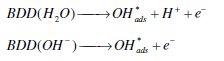
O<sub>2</sub> overvoltage is another characteristic of BDD anode. The generation of 
OH<sup>&bull;</sup><sub>ads</sub> at the anode surface from oxidation of aqueous solution occurred as 
follows [17]:</p>

    <p>&nbsp;</p>
<a name="e1">
<img src="/img/revistas/pea/v32n3/32n3a04e1.jpg">
    
<p>&nbsp;</p>

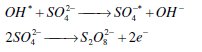
    <p>The generation of SO<sub>4</sub><sup>&bull;-</sup> and S<sub>2</sub>O<sub>8</sub><sup>2-</sup> in aqueous solution of sulfate could be 
represented as follows [18, 19]:</p>

    ]]></body>
<body><![CDATA[<p>&nbsp;</p>
<a name="e2">
<img src="/img/revistas/pea/v32n3/32n3a04e2.jpg">
    
<p>&nbsp;</p>

    <p>Many studies have been carried out to investigate the degradation of AR S on 
BDD electrode [12, 20, 21], on graphite-felt cathode [22], and on activated 
carbon fiber anode [23]. Also the removal of AR S has been studied by electro-
Fenton process using a gas-diffusion cathode [24].</p>

    <p>Nevertheless, to the best of our knowledge, the effect of the operating parameters 
on electrochemical degradation of AR S on BDD and Pt electrodes has not been 
studied deeply in literature. Thus, it is of interest to study the effect of some 
experimental parameters such as pH, temperature, current intensity, and others, 
on the degradation of Alizarin Red S with Pt and BDD anodes.</p>


    <p>&nbsp;</p>
    <p><b>Experimental</b></p>

    <p>Alizarin Red S was purchased from BDH company (C<sub>14</sub>H<sub>7</sub>O<sub>7</sub>NaS, MW: 342.26 
g). In order to study the degradation of the dye with Pt and BDD electrodes, 100 
mgL<sup>-1</sup> of AR S solution were prepared in distilled water. The concentration of the 
dye in the reaction mixture was selected in such a way that the absorbance of the 
dye followed Beer's law. The majority of the experiments were done at 293 K, in 
the presence of 12 mg L<sup>-1</sup> of AR S, 0.06 M KCl or 0.06 M sulfate, at pH 1.7 (by 
addition of H<sub>2</sub>SO<sub>4</sub>), and 10 mA, with a total volume equal to 90 mL. Experiments 
were carried out in a single combined electrolytic cell. The distance between the 
anode and the cathode was 5 cm. The electrolysis was done in Chrono-
Amperostat, type CEAMD-6, from Taccusel. The Pt electrodes are wires (l:15 
mm, d:1.5 mm) from Taccusel (France) and the immersed part of the BDD 
electrodes are bipolar plates (30&times;25&times;2 mm) from NeoCoaT (Switzerland). 
In order to determine the degradation rate of the dye and the effect of the 
experimental parameters, the UV-Vis spectra of the solution were recorded on a 
double beam UV-Visible Specord 200 spectrophotometer (Analytic Jena, AG 
Germany) at various times of the electrolysis. Schott Gerate CG 819 pH-meter 
was used to measure pH. TOC of initial and treated solutions was determined 
with a FormacsHT CA-16 TOC/TN Analyser, Skalar. The experimental 
parameters studied are the concentration of dye, the initial pH, the nature and the 
concentration of the strong electrolyte, the intensity of the current, the ionic 
strength, and the temperature.</p>


    <p>&nbsp;</p>
    <p><b>Results and discussions</b></p>

    <p><b><i>Electrolysis with Pt/Pt electrodes</i></b></p>

    ]]></body>
<body><![CDATA[<p><i>Visible spectroscopy analysis</i></p>

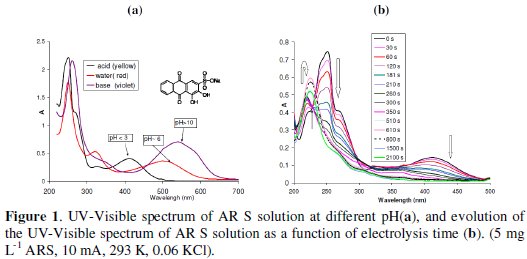
    <p>The chemical structure and UV-visible spectrum of ARS is given in <a href="#f1">Fig. 1a</a>.</p>

    <p>&nbsp;</p>
<a name="f1">
<img src="/img/revistas/pea/v32n3/32n3a04f1.jpg">
    
<p>&nbsp;</p>

    <p>The degradation of AR S was not observed in the presence of sulfate at any pH and 
even at high current (50 mA). No direct or indirect reaction of the dye at Pt 
electrode. However, in the presence of 0.06 M KCl (at pH 1.7, 10 mA), 12 mg 
L<sup>-1</sup> of AR S &sim;12 min was sufficient for total discoloration (<a href="#f1">Fig. 1b</a>), but a longer 
time is needed for total degradation (&sim;12 h). At Pt electrode the sulfate is not 
electroactive, whereas the chloride can be oxidized to Cl<sub>2</sub>, which in turn oxidizes 
AR S, and discolors it. The time required for total discoloration or degradation 
was a function of the operational parameters which will be discussed later. 
In acidic medium, the acidic form of AR S (yellow color) predominates. It 
presents one broad band with &lambda;<sub>max</sub> at 412 nm (due to quinonoid &pi; 
-&pi;* transition), a strong narrow band at 254 nm due to &pi;-&pi;* transition in the benzoid system 
(characteristic band of anthraquinone [25-27], and a shoulder at 222 nm and 270 
nm (<a href="#f1">Fig. 1</a>). The electron-attracting substituent (-HSO<sub>3</sub><sup>-</sup>) does not appreciably 
alter the absorption spectrum of anthraquinone. During the electrolysis, the bands 
at 412, 270, and at 254 nm decrease, but in the first period, the shoulder at 222 
nm increases with a small red shift (228 nm), then begins to decrease. The 
increase in the absorbance at 222 nm is due probably to the formation of phthalic, 
and benzoic acid (&lambda;<sub>max</sub> &sim; 222 nm) [21, 27, 28], since benzene and phthalic acid 
are the reactants used to prepare anthraquinone by Friedel Crafts reaction. These 
intermediates (which have negligible absorbance at 254 nm with respect to that 
of AR S) are the result of the cleavage at the C-C bond in the central ring near 
the C=O) [27]. We observed also an isobestic point at 230 nm during the first 
period of electrolysis.</p>

    <p>The addition of AR S solution to a freshly saturated solution with electrogenerated 
chlorine species leads to a sudden discoloration, and to a partial 
degradation of AR S. This means that the discoloration of AR S by chlorine 
species is very fast (direct oxidation). Therefore, the measure of the absorbance 
at 412 nm vs. time is not compatible (within the experimental conditions) for the 
determination of the order of the reaction. As the band at 254 nm is more intense 
and more indicative concerning the AR S degradation, this band was selected to 
have an idea about the degradation rate.</p>

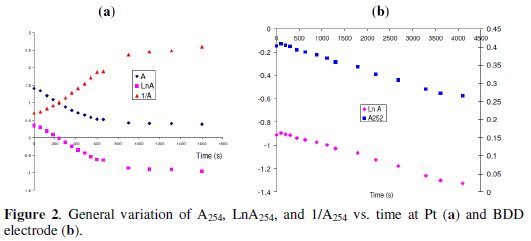
    <p>The degradation at Pt electrode did not follow a simple order, since the functions 
A<sub>254</sub>, ln A<sub>254</sub> and that of 1/A<sub>254</sub> did not remain linear with time (<a href="#f2">Fig. 2a</a>).</p>

    <p>&nbsp;</p>
<a name="f2">
<img src="/img/revistas/pea/v32n3/32n3a04f2.jpg">
    
<p>&nbsp;</p>

    <p>For this reason, the constant (k<sub>obs</sub>) is defined as the slope of the linear part of the 
functions listed above vs. time (it gives a good estimation of the degradation 
rate). Concerning the linear part of these functions, there is competition between 
order zero and order one, but in general, order one is the best order whatever the 
conditions of the experiments (pH, temperature,...).</p>


    ]]></body>
<body><![CDATA[<p><b><i>Effect of AR S concentration</i></b></p>

    <p>The effect of AR S concentration is studied at 10 mA, 0.06 M KCl, and 293 K 
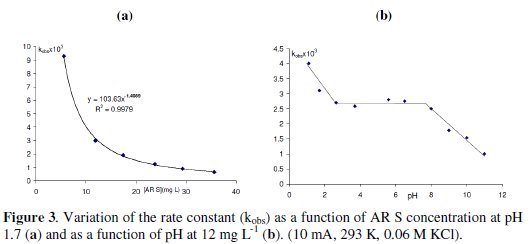
and 5 mg L<sup>-1</sup> &leq; [AR S] &leq; 35 mg L<sup>-1</sup>. The degradation rate constant (k<sub>obs</sub>) increases 
from 0.64&times;10<sup>-3</sup> to 9&times;10<sup>-3</sup> with the decrease of the dye concentration from 35 mg L<sup>-1</sup>
to 5 mg L<sup>-1</sup>. A similar behavior is observed with others dyes [14, 22]. The 
relation between k<sub>obs</sub> and the concentration of AR S (mg L<sup>-1</sup>) is not linear (k<sub>obs</sub> 
&times;10<sup>3</sup>: 104 &times; [AR S]<sup>-1.41</sup>, R: 0.998) (<a href="#f3">Fig. 3a</a>).</p>

    <p>&nbsp;</p>
<a name="f3">
<img src="/img/revistas/pea/v32n3/32n3a04f3.jpg">
    
<p>&nbsp;</p>

    <p>The increase in the initial AR S concentration increases the chlorine species needed for total degradation. Under 
the same operating conditions, the amounts of generated OH<sup>&bull;</sup> should be similar, 
the ratio of the number of moles of AR S/ number of moles of OH<sup>&bull;</sup> produced by 
a second, increases with the increase of AR S concentration in the medium, 
leading to a decrease in the degradation efficiency (decrease in k<sub>obs</sub>).</p>

    <p>It is well understood that pH is one of the important factors that affect the 
performance of the electrochemical process. AR S has acid-base property, so the 
general shape of the spectrum and the absorbance of the dye is a function of the 
pH of the solution (<a href="#f1">Fig. 1a</a>). The pKa of the two phenolic hydroxyl groups in AR 
S are 5.49 and 10.85 [31]. The acidic form (yellow) presents two maxima at 254 
and 412 nm (A<sub>254</sub>: 0.056&times; [AR S] in mg L<sup>-1</sup> , R<sup>2</sup>: 0.998). The monoacidic form 
(red) presents three maxima at 254, 324 and 506 nm (A<sub>254</sub>: 0.07 &times; [AR S] in mg 
L<sup>-1</sup>, R<sup>2</sup>: 0.997), and the basic form (violet) presents two maxima at 262 and 540 
nm [30] (<a href="#f1">Fig. 1a</a>).</p>

    <p>The oxidant strength of chlorine is also a function of pH. Electrolysis at different 
initial pH (pH<sub>0</sub>) shows that the degradation rate constant (k<sub>obs</sub>) varies linearly for 
pH lower than 2 and higher than 8, but remained constant between these two 
values (<a href="#f3">Fig. 3b</a>).</p>


    <p><b><i>Effect of KCl concentration</i></b></p>

    <p>The effect of KCl concentration on the degradation rate was undertaken in the 
following conditions: 0 M &leq; [KCl] &leq; 0.11 M, 12 mg L<sup>-1</sup> of AR S, pH<sub>0</sub>: 1.7, 293 
K, with 10 mA. The degradation increases linearly with the increase in KCl 
concentration (k<sub>obs</sub> &times; 10<sup>3</sup>: 27.3 &times; [KCl] (M), R<sup>2</sup>: 0.98). The reason is that more 
amount of chlorine/hypochlorite will be generated while increasing the chloride 
concentration due to increased mass transport of chloride ions to the anode 
surface [10]. This result confirms the discoloration and the degradation of the 
organic compounds via the electro-generated halide species [15, 16].</p>


    <p><b><i>Effect of ionic strength</i></b></p>

    ]]></body>
<body><![CDATA[<p>The effect of the ionic strength on the degradation rate was investigated with 12 
mg L<sup>-1</sup> of AR S, at pH<sub>0</sub>: 1.7, 0.06 M KCl, at 10 mA, and by varying the 
concentration of Na<sub>2</sub>SO<sub>4</sub> from 0.03 M to 0.2 M (spectator ions in the medium). 
The amount of chlorine species produced in these experiments is constant since 
the KCl concentration is hold constant. The results obtained showed no effect of 
the ionic strength on the degradation rate (k<sub>obs</sub> &sim; constant). The effect of this 
parameter is negligible, may be because the dye and the oxidants (HOCl, Cl<sub>2</sub>) are 
both neutral at the pH of the experiment (pH<sub>0</sub>: 1.7). Similar results are obtained 
with the xanthene dyes [15, 16].</p>


    <p><b><i>Effect of current intensity</i></b></p>

    <p>Current intensity is an important parameter in electrolysis. The generation of 
chlorine species by electrolysis was done in acidic medium (pH<sub>0</sub>: 1.7) in presence 
of 12 mgL<sup>-1</sup> of AR S and 0.06 M KCl, at several constant currents ranging from 2 
mA to 20 mA. As expected, the degradation rate constant increases linearly with 
the increase of the current intensity (k<sub>obs</sub>: 1.05&times;10<sup>-4</sup> &times; I(mA), R<sup>2</sup>: 0.98). The 
increase in the degradation rate is related to the increase in the production rate of 
chlorine species. Similar results are obtained with other compounds [14, 15, 16, 29].</p>


    <p><b><i>Effect of temperature</i></b></p>

    <p>In general, any increase in temperature decreases the solubility of Cl<sub>2</sub> in water 
and therefore decreases the discoloration rate constant of the dyes [10, 16]. The 
effect of the temperature on the degradation rate was investigated with 6 mg L<sup>-1</sup> 
of AR S, pH<sub>0</sub>: 1.7, 10 mA, and 0.06 M KCl. For the range of temperature 
between 280 and 303 K, k<sub>obs</sub> decreases linearly with the increase of temperature 
(k<sub>obs</sub> : -2.8&times;10<sup>-4</sup> &times; T(K) + 0.085, R<sup>2</sup>: 0.97).</p>


    <p><b><i>Electrolysis with BDD/BDD electrodes</i></b></p>

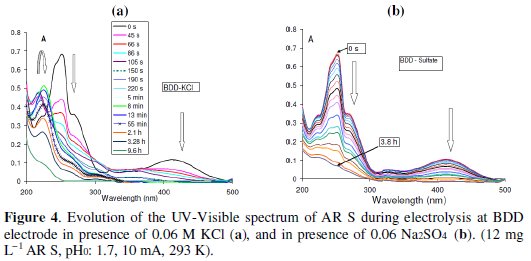
    <p>In the presence of KCl, the replacement of the Pt electrode by the BDD electrode 
gave approximately the same intermediate compounds since the evolution of the 
UV-visible spectra at BDD electrode are similar to those obtained with Pt 
electrode (<a href="#f4">Fig. 4a</a>, <a href="#f1">Fig. 1b</a>).</p>

    <p>&nbsp;</p>
<a name="f4">
<img src="/img/revistas/pea/v32n3/32n3a04f4.jpg">
    
<p>&nbsp;</p>

    <p>The slope of the function A<sub>254</sub> and that of ln(A<sub>254</sub>) vs. 
time decrease during the electrolysis time as was the case with Pt electrode (<a href="#f2">Fig. 2a</a>). 
The value of k<sub>obs</sub> is &sim; equal to that obtained with Pt electrode. The behaviors 
of BDD and Pt electrode are similar because Cl<sub>2</sub> is generated at the surface of the 
two electrodes.</p>

    ]]></body>
<body><![CDATA[<p>In the presence of sulfate, the slope of the function A<sub>254</sub> and that of ln(A<sub>254</sub>) vs. 
time remain constant during the electrolysis time (<a href="#f2">Fig. 2b</a>). There is a strong 
competition between zero order and one, and basing on the R2 value, the order of 
the degradation is rather zero, but to facilitate the comparison between the Pt and 
BDD electrodes, order one is selected [32]:</p>

    <p>&nbsp;</p>
<a name="e3">
<img src="/img/revistas/pea/v32n3/32n3a04e3.jpg">
    
<p>&nbsp;</p>

    <p>Order one is also observed by other authors [12, 32]. The degradation rate 
constant (k<sub>app</sub>) in the presence of sulfate is slower than those in the presence of 
chloride (k<sub>obs</sub>), but the overall degradation rate is faster with sulfate (<a href="#f4">Fig. 4a, 4b</a>).
In the presence of sulfate, the electrolysis has the advantage to break down the 
dye directly into small compounds having absorbance below 200 nm.</p>

    <p>Apparently, there is not formation of intermediates such as phthalic and benzoic 
acid, since there is decrease in the whole spectrum (<a href="#f4">Fig. 4a, 4b</a>). The degradation 
mechanism in this case is different from that with chloride, but the overall 
reaction in both cases (Pt, BDD) can be written as follows:</p>

    <p>&nbsp;</p>
<a name="e4">
<img src="/img/revistas/pea/v32n3/32n3a04e4.jpg">
    
<p>&nbsp;</p>

    <p>The addition of the AR S solution after electrolysis for 3 h did not lead to a 
decrease in A<sub>254</sub> so no reaction between solution OH and the dye 
(no indirect oxidation of the dye at BDD electrode).</p>

    <p>The increase in the AR S concentration has a moderate effect on the rate 
constant. The increase in ARS concentration from 5 mg L<sup>-1</sup> to 20 mg L<sup>-1</sup> 
decreases the rate constant from 1.37&times;10<sup>-4</sup> to 0.73&times;10<sup>-4</sup>, respectively. The 
decrease is not linear (k<sub>app</sub> &times; 10<sup>4</sup>: 2.7&times;[AR S]<sup>-0.45</sup>, R<sup>2</sup>:0.988). Similar effect is 
observed with other organic compounds on BDD electrode [33-35]. The increase 
in the sulfate concentration from 0.04 M to 0.12 M has negligible effect on the 
degradation rate constant (k<sub>app</sub><sup>-</sup>: 9.1 &times; 10<sup>-5</sup>). 
The independency of the rate constant with this parameter has already been observed with other organic compounds 
[15, 16, 18]. The behaviors of the two electrodes toward the AR S concentration 
and the ionic force are similar.</p>

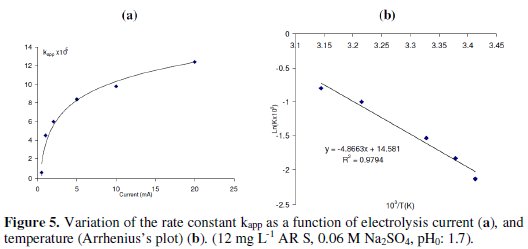
    <p>The increase in the current intensity from 0.5 mA to 20 mA increases the 
degradation rate constant from 0.55 &times; 10<sup>-5</sup> to 12 &times; 10<sup>-5</sup> (<a href="#f5">Fig. 5a</a>).</p>

    ]]></body>
<body><![CDATA[<p>&nbsp;</p>
<a name="f5">
<img src="/img/revistas/pea/v32n3/32n3a04f5.jpg">
    
<p>&nbsp;</p>

    <p>The non-linearity between the rate constant and the current can be explained as follows: with the 
increase of current, the part of OH<sup>&bull;</sup> consumed by a side reaction increases, 
leading to a decrease in k<sub>obs</sub> with respect to the value expected from the linear 
relation.</p>

    <p>Acidic medium has a moderate effect on the degradation rate constant. For the 
same experimental conditions, the rate constant decreases from 2.40&times;10<sup>-4</sup> to 
1.31&times;10<sup>-4</sup>, when the pH increases from 1.3 to 5.6. After that it remained constant. 
TOC analysis of AR S solution (12 mg L<sup>-1</sup> ) before and after 3.5 h of electrolysis 
(at 318 K) shows a decrease in TOC value from 4.4 mg L<sup>-1</sup> to 0 mg L<sup>-1</sup>. The 
comparison between the UV spectra and TOC analysis showed that a longer time 
is needed to have total mineralization than to have transparent spectrum in the 
UV (aliphatic carboxylic acids have absorbances below 200 nm). Similar result 
is obtained with higher AR S concentration [12].</p>

    <p>Finally, the increase in temperature increases the degradation rate because the 
reaction between AR S and OH<sup>&bull;</sup> becomes faster. Similar effect is observed with 
other organic compounds on BDD electrode [33-35]. Total transparency is 
obtained after 1.5 h at 318 K, while at 293 K, 4 h are needed (12 mg L<sup>-1</sup> , 10 mA, 
pH: 1.7). k<sub>app</sub> increases three times when the temperature increases from 293 K 
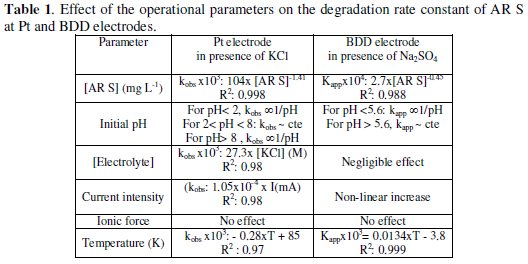
to 318 K. The effects of the different parameters on the electro degradation of 
AR S are summarized in <a href="#t1">Table 1</a>.</p>

    <p>&nbsp;</p>
<a name="t1">
<img src="/img/revistas/pea/v32n3/32n3a04t1.jpg">
    
<p>&nbsp;</p>

    <p>The activation energy E<sub>a</sub> value deduced from Arrhenius's plot is 40 kJ mol<sup>-1</sup> 
(Ln(k<sub>obs</sub>) = 4.87&times;10<sup>3</sup>/T + 7.67 , R<sup>2</sup>: 0.979 ) (<a href="#f5">Fig. 5b</a>). 
Also the activation enthalpy (&Delta;H<sup>&Dagger;</sup>) and the activation entropy (&Delta;S<sup>&Dagger;</sup>) deduced from Eyring equation are 37.8 kJ mol<sup>-1</sup> and -0.19 kJ mol<sup>-1</sup> K<sup>-1</sup> respectively. ( Ln(k/T) = -4.56&times;10<sup>3</sup>/T + 0.95 , R<sup>2</sup>: 0.98). The free activation enthalpy (&Delta;G<sup>&Dagger;</sup>) is equal to 94.4 kJ moL<sup>-1</sup> (at 298 K).</p>


    <p>&nbsp;</p>
    <p><b>Conclusion</b></p>

    ]]></body>
<body><![CDATA[<p>At BDD electrode, the mineralization of AR S in the presence of sulfate is faster 
than in the presence of KCl, but the discoloration is slower. In the presence of 
chloride, the behaviors of the BDD and Pt electrodes with respect to the 
degradation rate and degradation mechanism are similar. The increase of the 
current intensity, the dye concentration, and the ionic force on BDD electrode (in 
the presence of sulfate) and on Pt electrode (in the presence of KCl) follow the 
same attitudes, but their behaviors with respect to the temperature are opposite. 
TOC analysis confirms total mineralization of the dye on BDD electrode.</p>


    <p>&nbsp;</p>
    <p><b>References</b></p>

    <!-- ref --><p>1. Miller JH, Kotenko JL. Stain Technol. 1987;62:237.    &nbsp;&nbsp;&nbsp;&nbsp;&nbsp;&nbsp;&nbsp;&nbsp;[&#160;<a href="javascript:void(0);" onclick="javascript: window.open('/scielo.php?script=sci_nlinks&ref=000086&pid=S0872-1904201400030000400001&lng=','','width=640,height=500,resizable=yes,scrollbars=1,menubar=yes,');">Links</a>&#160;]<!-- end-ref --></p>

    <!-- ref --><p>2. Sathish RS, Ravi KM, Nageswara RG, et al. Spectrochim Acta A Mol Biomol Spectrosc. 2007;66:457.    &nbsp;&nbsp;&nbsp;&nbsp;&nbsp;&nbsp;&nbsp;&nbsp;[&#160;<a href="javascript:void(0);" onclick="javascript: window.open('/scielo.php?script=sci_nlinks&ref=000088&pid=S0872-1904201400030000400002&lng=','','width=640,height=500,resizable=yes,scrollbars=1,menubar=yes,');">Links</a>&#160;]<!-- end-ref --></p>

    <!-- ref --><p>3. Rafatullah M, Sulaiman O, Hashima R, et al. J Hazard Mat. 2010;177:70.    &nbsp;&nbsp;&nbsp;&nbsp;&nbsp;&nbsp;&nbsp;&nbsp;[&#160;<a href="javascript:void(0);" onclick="javascript: window.open('/scielo.php?script=sci_nlinks&ref=000090&pid=S0872-1904201400030000400003&lng=','','width=640,height=500,resizable=yes,scrollbars=1,menubar=yes,');">Links</a>&#160;]<!-- end-ref --></p>

    <!-- ref --><p>4. Perez-Estrada LA, Aguera A, Hernando MD, et al. Chemosphere. 2008;70:2068.    &nbsp;&nbsp;&nbsp;&nbsp;&nbsp;&nbsp;&nbsp;&nbsp;[&#160;<a href="javascript:void(0);" onclick="javascript: window.open('/scielo.php?script=sci_nlinks&ref=000092&pid=S0872-1904201400030000400004&lng=','','width=640,height=500,resizable=yes,scrollbars=1,menubar=yes,');">Links</a>&#160;]<!-- end-ref --></p>

    <!-- ref --><p>5. Ashour E, Ahmed A-M, Al-Mesha AS, et al. Int J Cur Micobl Ap Sci. 2013;2:359.    &nbsp;&nbsp;&nbsp;&nbsp;&nbsp;&nbsp;&nbsp;&nbsp;[&#160;<a href="javascript:void(0);" onclick="javascript: window.open('/scielo.php?script=sci_nlinks&ref=000094&pid=S0872-1904201400030000400005&lng=','','width=640,height=500,resizable=yes,scrollbars=1,menubar=yes,');">Links</a>&#160;]<!-- end-ref --></p>

    <!-- ref --><p>6. Wu M, Zhao G, Li M, et al. J Haz Mat. 2009;163:26.    &nbsp;&nbsp;&nbsp;&nbsp;&nbsp;&nbsp;&nbsp;&nbsp;[&#160;<a href="javascript:void(0);" onclick="javascript: window.open('/scielo.php?script=sci_nlinks&ref=000096&pid=S0872-1904201400030000400006&lng=','','width=640,height=500,resizable=yes,scrollbars=1,menubar=yes,');">Links</a>&#160;]<!-- end-ref --></p>

    <!-- ref --><p>7. Abu Ghalwaa N M, Abdel-Latif M S. J Iranian Chem Soc. 2005;2:238.    &nbsp;&nbsp;&nbsp;&nbsp;&nbsp;&nbsp;&nbsp;&nbsp;[&#160;<a href="javascript:void(0);" onclick="javascript: window.open('/scielo.php?script=sci_nlinks&ref=000098&pid=S0872-1904201400030000400007&lng=','','width=640,height=500,resizable=yes,scrollbars=1,menubar=yes,');">Links</a>&#160;]<!-- end-ref --></p>

    <p>8. Santos V, MorÃ£o A, Pacheco M-J, et al. J Environ Eng Manag. 2008;18:193.</p>

    <!-- ref --><p>9. Panizza M, Barbucci A, Ricotti R, et al. Sep Purif Technol. 2007;54:382.    &nbsp;&nbsp;&nbsp;&nbsp;&nbsp;&nbsp;&nbsp;&nbsp;[&#160;<a href="javascript:void(0);" onclick="javascript: window.open('/scielo.php?script=sci_nlinks&ref=000101&pid=S0872-1904201400030000400009&lng=','','width=640,height=500,resizable=yes,scrollbars=1,menubar=yes,');">Links</a>&#160;]<!-- end-ref --></p>

    ]]></body>
<body><![CDATA[<!-- ref --><p>10. Rajkumar D, Jong GK. J Haz Mat. 2006;B136:203.    &nbsp;&nbsp;&nbsp;&nbsp;&nbsp;&nbsp;&nbsp;&nbsp;[&#160;<a href="javascript:void(0);" onclick="javascript: window.open('/scielo.php?script=sci_nlinks&ref=000103&pid=S0872-1904201400030000400010&lng=','','width=640,height=500,resizable=yes,scrollbars=1,menubar=yes,');">Links</a>&#160;]<!-- end-ref --></p>

    <!-- ref --><p>11. El Hajj Hassan MA, El Jamal MM. Port Electrochim Acta. 2012;30:351.    &nbsp;&nbsp;&nbsp;&nbsp;&nbsp;&nbsp;&nbsp;&nbsp;[&#160;<a href="javascript:void(0);" onclick="javascript: window.open('/scielo.php?script=sci_nlinks&ref=000105&pid=S0872-1904201400030000400011&lng=','','width=640,height=500,resizable=yes,scrollbars=1,menubar=yes,');">Links</a>&#160;]<!-- end-ref --></p>

    <!-- ref --><p>12. Ammar S, Asma M, Oturan N, et al. Curr Org Chem. 2012;16:1978.    &nbsp;&nbsp;&nbsp;&nbsp;&nbsp;&nbsp;&nbsp;&nbsp;[&#160;<a href="javascript:void(0);" onclick="javascript: window.open('/scielo.php?script=sci_nlinks&ref=000107&pid=S0872-1904201400030000400012&lng=','','width=640,height=500,resizable=yes,scrollbars=1,menubar=yes,');">Links</a>&#160;]<!-- end-ref --></p>

    <!-- ref --><p>13. Peralta-Hernandez J M, Mendez-Tovar M, Guerra-Sanchez R, et al. Int J Electrochem. 2012;15:4316.    &nbsp;&nbsp;&nbsp;&nbsp;&nbsp;&nbsp;&nbsp;&nbsp;[&#160;<a href="javascript:void(0);" onclick="javascript: window.open('/scielo.php?script=sci_nlinks&ref=000109&pid=S0872-1904201400030000400013&lng=','','width=640,height=500,resizable=yes,scrollbars=1,menubar=yes,');">Links</a>&#160;]<!-- end-ref --></p>

    <!-- ref --><p>14. Zaviska F, Drogui P, Blais J-F, et al. J Appl Electrochem. 2009;39:2397.    &nbsp;&nbsp;&nbsp;&nbsp;&nbsp;&nbsp;&nbsp;&nbsp;[&#160;<a href="javascript:void(0);" onclick="javascript: window.open('/scielo.php?script=sci_nlinks&ref=000111&pid=S0872-1904201400030000400014&lng=','','width=640,height=500,resizable=yes,scrollbars=1,menubar=yes,');">Links</a>&#160;]<!-- end-ref --></p>

    ]]></body>
<body><![CDATA[<!-- ref --><p>15. Tabarra MA, Mallah HA, El Jamal MM. J Chem Technol Metall (Sofia). 2014;49:12.    &nbsp;&nbsp;&nbsp;&nbsp;&nbsp;&nbsp;&nbsp;&nbsp;[&#160;<a href="javascript:void(0);" onclick="javascript: window.open('/scielo.php?script=sci_nlinks&ref=000113&pid=S0872-1904201400030000400015&lng=','','width=640,height=500,resizable=yes,scrollbars=1,menubar=yes,');">Links</a>&#160;]<!-- end-ref --></p>

    <!-- ref --><p>16. Mallah HA, Naoufal DM, Safa AI, et al. Port Electrochim Acta. 2013;31:185.    &nbsp;&nbsp;&nbsp;&nbsp;&nbsp;&nbsp;&nbsp;&nbsp;[&#160;<a href="javascript:void(0);" onclick="javascript: window.open('/scielo.php?script=sci_nlinks&ref=000115&pid=S0872-1904201400030000400016&lng=','','width=640,height=500,resizable=yes,scrollbars=1,menubar=yes,');">Links</a>&#160;]<!-- end-ref --></p>

    <!-- ref --><p>17. Enache TA, Chiorcea-Paquim A-M, Fatibello-Filho O, et al. Electrochem Comm. 2009;11:1342.    &nbsp;&nbsp;&nbsp;&nbsp;&nbsp;&nbsp;&nbsp;&nbsp;[&#160;<a href="javascript:void(0);" onclick="javascript: window.open('/scielo.php?script=sci_nlinks&ref=000117&pid=S0872-1904201400030000400017&lng=','','width=640,height=500,resizable=yes,scrollbars=1,menubar=yes,');">Links</a>&#160;]<!-- end-ref --></p>

    <!-- ref --><p>18. Alencar de Souza RB, Martins Ruotolo LA. Int J Electrochem Sci. 2013;8:643.    &nbsp;&nbsp;&nbsp;&nbsp;&nbsp;&nbsp;&nbsp;&nbsp;[&#160;<a href="javascript:void(0);" onclick="javascript: window.open('/scielo.php?script=sci_nlinks&ref=000119&pid=S0872-1904201400030000400018&lng=','','width=640,height=500,resizable=yes,scrollbars=1,menubar=yes,');">Links</a>&#160;]<!-- end-ref --></p>

    <!-- ref --><p>19. Serra A, Domenech X, Peral J, et al. J Environ Eng Manag. 2008;18:173.    &nbsp;&nbsp;&nbsp;&nbsp;&nbsp;&nbsp;&nbsp;&nbsp;[&#160;<a href="javascript:void(0);" onclick="javascript: window.open('/scielo.php?script=sci_nlinks&ref=000121&pid=S0872-1904201400030000400019&lng=','','width=640,height=500,resizable=yes,scrollbars=1,menubar=yes,');">Links</a>&#160;]<!-- end-ref --></p>

    ]]></body>
<body><![CDATA[<!-- ref --><p>20. Ahmadi MF, Bensalah N, Gadri AL. Dyes Pigments 2007;73:86.    &nbsp;&nbsp;&nbsp;&nbsp;&nbsp;&nbsp;&nbsp;&nbsp;[&#160;<a href="javascript:void(0);" onclick="javascript: window.open('/scielo.php?script=sci_nlinks&ref=000123&pid=S0872-1904201400030000400020&lng=','','width=640,height=500,resizable=yes,scrollbars=1,menubar=yes,');">Links</a>&#160;]<!-- end-ref --></p>

    <!-- ref --><p>21. Abdessamad NH, Akrout H, Hamdaoui G, et al. Chemosphere. 2013;93:1309.    &nbsp;&nbsp;&nbsp;&nbsp;&nbsp;&nbsp;&nbsp;&nbsp;[&#160;<a href="javascript:void(0);" onclick="javascript: window.open('/scielo.php?script=sci_nlinks&ref=000125&pid=S0872-1904201400030000400021&lng=','','width=640,height=500,resizable=yes,scrollbars=1,menubar=yes,');">Links</a>&#160;]<!-- end-ref --></p>

    <!-- ref --><p>22. Panizza M, Oturan MA. Electrochimica Acta. 2011;56:7084.    &nbsp;&nbsp;&nbsp;&nbsp;&nbsp;&nbsp;&nbsp;&nbsp;[&#160;<a href="javascript:void(0);" onclick="javascript: window.open('/scielo.php?script=sci_nlinks&ref=000127&pid=S0872-1904201400030000400022&lng=','','width=640,height=500,resizable=yes,scrollbars=1,menubar=yes,');">Links</a>&#160;]<!-- end-ref --></p>

    <!-- ref --><p>23. Yi F, Chen S, Yuan C. J Haz Mat. 2008;157:79.    &nbsp;&nbsp;&nbsp;&nbsp;&nbsp;&nbsp;&nbsp;&nbsp;[&#160;<a href="javascript:void(0);" onclick="javascript: window.open('/scielo.php?script=sci_nlinks&ref=000129&pid=S0872-1904201400030000400023&lng=','','width=640,height=500,resizable=yes,scrollbars=1,menubar=yes,');">Links</a>&#160;]<!-- end-ref --></p>

    <!-- ref --><p>24. Panizza M, Cerisola G. Water Res. 2009;43:339.    &nbsp;&nbsp;&nbsp;&nbsp;&nbsp;&nbsp;&nbsp;&nbsp;[&#160;<a href="javascript:void(0);" onclick="javascript: window.open('/scielo.php?script=sci_nlinks&ref=000131&pid=S0872-1904201400030000400024&lng=','','width=640,height=500,resizable=yes,scrollbars=1,menubar=yes,');">Links</a>&#160;]<!-- end-ref --></p>

    ]]></body>
<body><![CDATA[<!-- ref --><p>25. El Ezaby MS, Salem TM, Zewail AH, et al. Chem Soc B. 1970;1923.    &nbsp;&nbsp;&nbsp;&nbsp;&nbsp;&nbsp;&nbsp;&nbsp;[&#160;<a href="javascript:void(0);" onclick="javascript: window.open('/scielo.php?script=sci_nlinks&ref=000133&pid=S0872-1904201400030000400025&lng=','','width=640,height=500,resizable=yes,scrollbars=1,menubar=yes,');">Links</a>&#160;]<!-- end-ref --></p>

    <!-- ref --><p>26. Markovic Z, Manojlovic N, Zlatanovic S. J. Serb Soc Comput Mechanics. 2008;2:73.    &nbsp;&nbsp;&nbsp;&nbsp;&nbsp;&nbsp;&nbsp;&nbsp;[&#160;<a href="javascript:void(0);" onclick="javascript: window.open('/scielo.php?script=sci_nlinks&ref=000135&pid=S0872-1904201400030000400026&lng=','','width=640,height=500,resizable=yes,scrollbars=1,menubar=yes,');">Links</a>&#160;]<!-- end-ref --></p>

    <!-- ref --><p>27. Wang A, Wu C-H, Biehl E. ARKIVOC. 2002;80.    &nbsp;&nbsp;&nbsp;&nbsp;&nbsp;&nbsp;&nbsp;&nbsp;[&#160;<a href="javascript:void(0);" onclick="javascript: window.open('/scielo.php?script=sci_nlinks&ref=000137&pid=S0872-1904201400030000400027&lng=','','width=640,height=500,resizable=yes,scrollbars=1,menubar=yes,');">Links</a>&#160;]<!-- end-ref --></p>

    <!-- ref --><p>28. Liu U, Wu T, Zhao J, et al. Environ Sci Technol. 1999;33:2081.    &nbsp;&nbsp;&nbsp;&nbsp;&nbsp;&nbsp;&nbsp;&nbsp;[&#160;<a href="javascript:void(0);" onclick="javascript: window.open('/scielo.php?script=sci_nlinks&ref=000139&pid=S0872-1904201400030000400028&lng=','','width=640,height=500,resizable=yes,scrollbars=1,menubar=yes,');">Links</a>&#160;]<!-- end-ref --></p>

    <!-- ref --><p>29. Gao J, Yu J, Lu Q, et al. Dyes and Pigments 2008;76:47.    &nbsp;&nbsp;&nbsp;&nbsp;&nbsp;&nbsp;&nbsp;&nbsp;[&#160;<a href="javascript:void(0);" onclick="javascript: window.open('/scielo.php?script=sci_nlinks&ref=000141&pid=S0872-1904201400030000400029&lng=','','width=640,height=500,resizable=yes,scrollbars=1,menubar=yes,');">Links</a>&#160;]<!-- end-ref --></p>

    ]]></body>
<body><![CDATA[<!-- ref --><p>30. Turcanu A, Bechtold T. Dyes Pigments. 2011;91:324.    &nbsp;&nbsp;&nbsp;&nbsp;&nbsp;&nbsp;&nbsp;&nbsp;[&#160;<a href="javascript:void(0);" onclick="javascript: window.open('/scielo.php?script=sci_nlinks&ref=000143&pid=S0872-1904201400030000400030&lng=','','width=640,height=500,resizable=yes,scrollbars=1,menubar=yes,');">Links</a>&#160;]<!-- end-ref --></p>

    <!-- ref --><p>31. Cordoba A, Magario I, Ferreira ML. J Molec Catalysis A: Chem. 2012;355:44.    &nbsp;&nbsp;&nbsp;&nbsp;&nbsp;&nbsp;&nbsp;&nbsp;[&#160;<a href="javascript:void(0);" onclick="javascript: window.open('/scielo.php?script=sci_nlinks&ref=000145&pid=S0872-1904201400030000400031&lng=','','width=640,height=500,resizable=yes,scrollbars=1,menubar=yes,');">Links</a>&#160;]<!-- end-ref --></p>

    <!-- ref --><p>32. Khataee A, Khataee A, Fathinia M, et al. J Ind Eng Chem. 2013;19:1890.    &nbsp;&nbsp;&nbsp;&nbsp;&nbsp;&nbsp;&nbsp;&nbsp;[&#160;<a href="javascript:void(0);" onclick="javascript: window.open('/scielo.php?script=sci_nlinks&ref=000147&pid=S0872-1904201400030000400032&lng=','','width=640,height=500,resizable=yes,scrollbars=1,menubar=yes,');">Links</a>&#160;]<!-- end-ref --></p>

    <!-- ref --><p>33. El Mouden OI, Errami M, Salghi R, et al. J Chem Pharm Res. 2012;4:3437.    &nbsp;&nbsp;&nbsp;&nbsp;&nbsp;&nbsp;&nbsp;&nbsp;[&#160;<a href="javascript:void(0);" onclick="javascript: window.open('/scielo.php?script=sci_nlinks&ref=000149&pid=S0872-1904201400030000400033&lng=','','width=640,height=500,resizable=yes,scrollbars=1,menubar=yes,');">Links</a>&#160;]<!-- end-ref --></p>

    <!-- ref --><p>34. Chen T-S, Kuo Y-M, Chen J-L, et al. Int J Electrochem Sci. 2013;8:7625.    &nbsp;&nbsp;&nbsp;&nbsp;&nbsp;&nbsp;&nbsp;&nbsp;[&#160;<a href="javascript:void(0);" onclick="javascript: window.open('/scielo.php?script=sci_nlinks&ref=000151&pid=S0872-1904201400030000400034&lng=','','width=640,height=500,resizable=yes,scrollbars=1,menubar=yes,');">Links</a>&#160;]<!-- end-ref --></p>

    ]]></body>
<body><![CDATA[<!-- ref --><p>35. Chen T-S, Huang K-L. Int J Electrochem Sci. 2013;8: 6343.    &nbsp;&nbsp;&nbsp;&nbsp;&nbsp;&nbsp;&nbsp;&nbsp;[&#160;<a href="javascript:void(0);" onclick="javascript: window.open('/scielo.php?script=sci_nlinks&ref=000153&pid=S0872-1904201400030000400035&lng=','','width=640,height=500,resizable=yes,scrollbars=1,menubar=yes,');">Links</a>&#160;]<!-- end-ref --></p>


    <p>&nbsp;</p>
    <p><a name=0></a><sup><a href="#top">*</a></sup>Corresponding author. E-mail address: <a href="mailto:mjamal@ul.edu.lb">mjamal@ul.edu.lb</a></p>

    <p>Received 13 June 2014; accepted 28 June 2014</p>

    <p><a href="http://www.peacta.org" target="_blank">www.peacta.org</a> </p>


     ]]></body><back>
<ref-list>
<ref id="B1">
<label>1</label><nlm-citation citation-type="journal">
<person-group person-group-type="author">
<name>
<surname><![CDATA[Miller]]></surname>
<given-names><![CDATA[J H]]></given-names>
</name>
<name>
<surname><![CDATA[Kotenko]]></surname>
<given-names><![CDATA[J L]]></given-names>
</name>
</person-group>
<source><![CDATA[Stain Technol]]></source>
<year>1987</year>
<volume>62</volume>
<page-range>237</page-range></nlm-citation>
</ref>
<ref id="B2">
<label>2</label><nlm-citation citation-type="journal">
<person-group person-group-type="author">
<name>
<surname><![CDATA[Sathish]]></surname>
<given-names><![CDATA[R S]]></given-names>
</name>
<name>
<surname><![CDATA[Ravi]]></surname>
<given-names><![CDATA[K M]]></given-names>
</name>
<name>
<surname><![CDATA[Nageswara]]></surname>
<given-names><![CDATA[R G]]></given-names>
</name>
</person-group>
<source><![CDATA[Spectrochim Acta A Mol Biomol Spectrosc]]></source>
<year>2007</year>
<volume>66</volume>
<page-range>457</page-range></nlm-citation>
</ref>
<ref id="B3">
<label>3</label><nlm-citation citation-type="journal">
<person-group person-group-type="author">
<name>
<surname><![CDATA[Rafatullah]]></surname>
<given-names><![CDATA[M]]></given-names>
</name>
<name>
<surname><![CDATA[Sulaiman]]></surname>
<given-names><![CDATA[O]]></given-names>
</name>
<name>
<surname><![CDATA[Hashima]]></surname>
<given-names><![CDATA[R]]></given-names>
</name>
</person-group>
<source><![CDATA[J Hazard Mat]]></source>
<year>2010</year>
<volume>177</volume>
<page-range>70</page-range></nlm-citation>
</ref>
<ref id="B4">
<label>4</label><nlm-citation citation-type="journal">
<person-group person-group-type="author">
<name>
<surname><![CDATA[Perez-Estrada]]></surname>
<given-names><![CDATA[L A]]></given-names>
</name>
<name>
<surname><![CDATA[Aguera]]></surname>
<given-names><![CDATA[A]]></given-names>
</name>
<name>
<surname><![CDATA[Hernando]]></surname>
<given-names><![CDATA[M D]]></given-names>
</name>
</person-group>
<source><![CDATA[Chemosphere]]></source>
<year>2008</year>
<volume>70</volume>
<page-range>2068</page-range></nlm-citation>
</ref>
<ref id="B5">
<label>5</label><nlm-citation citation-type="journal">
<person-group person-group-type="author">
<name>
<surname><![CDATA[Ashour]]></surname>
<given-names><![CDATA[E]]></given-names>
</name>
<name>
<surname><![CDATA[Ahmed]]></surname>
<given-names><![CDATA[A-M]]></given-names>
</name>
<name>
<surname><![CDATA[Al-Mesha]]></surname>
<given-names><![CDATA[A S]]></given-names>
</name>
</person-group>
<source><![CDATA[Int J Cur Micobl Ap Sci]]></source>
<year>2013</year>
<volume>2</volume>
<page-range>359</page-range></nlm-citation>
</ref>
<ref id="B6">
<label>6</label><nlm-citation citation-type="journal">
<person-group person-group-type="author">
<name>
<surname><![CDATA[Wu]]></surname>
<given-names><![CDATA[M]]></given-names>
</name>
<name>
<surname><![CDATA[Zhao]]></surname>
<given-names><![CDATA[G]]></given-names>
</name>
<name>
<surname><![CDATA[Li]]></surname>
<given-names><![CDATA[M]]></given-names>
</name>
</person-group>
<source><![CDATA[J Haz Mat]]></source>
<year>2009</year>
<volume>163</volume>
<page-range>26</page-range></nlm-citation>
</ref>
<ref id="B7">
<label>7</label><nlm-citation citation-type="journal">
<person-group person-group-type="author">
<name>
<surname><![CDATA[Abu Ghalwaa]]></surname>
<given-names><![CDATA[N M]]></given-names>
</name>
<name>
<surname><![CDATA[Abdel-Latif]]></surname>
<given-names><![CDATA[M S]]></given-names>
</name>
</person-group>
<source><![CDATA[J Iranian Chem Soc]]></source>
<year>2005</year>
<volume>2</volume>
<page-range>238</page-range></nlm-citation>
</ref>
<ref id="B8">
<label>8</label><nlm-citation citation-type="journal">
<person-group person-group-type="author">
<name>
<surname><![CDATA[Santos]]></surname>
<given-names><![CDATA[V]]></given-names>
</name>
<name>
<surname><![CDATA[Morao]]></surname>
<given-names><![CDATA[A]]></given-names>
</name>
<name>
<surname><![CDATA[Pacheco]]></surname>
<given-names><![CDATA[M-J]]></given-names>
</name>
</person-group>
<source><![CDATA[J Environ Eng Manag]]></source>
<year>2008</year>
<volume>18</volume>
<page-range>193</page-range></nlm-citation>
</ref>
<ref id="B9">
<label>9</label><nlm-citation citation-type="journal">
<person-group person-group-type="author">
<name>
<surname><![CDATA[Panizza]]></surname>
<given-names><![CDATA[M]]></given-names>
</name>
<name>
<surname><![CDATA[Barbucci]]></surname>
<given-names><![CDATA[A]]></given-names>
</name>
<name>
<surname><![CDATA[Ricotti]]></surname>
<given-names><![CDATA[R]]></given-names>
</name>
</person-group>
<source><![CDATA[Sep Purif Technol]]></source>
<year>2007</year>
<volume>54</volume>
<page-range>382</page-range></nlm-citation>
</ref>
<ref id="B10">
<label>10</label><nlm-citation citation-type="journal">
<person-group person-group-type="author">
<name>
<surname><![CDATA[Rajkumar]]></surname>
<given-names><![CDATA[D]]></given-names>
</name>
<name>
<surname><![CDATA[Jong]]></surname>
<given-names><![CDATA[G K]]></given-names>
</name>
</person-group>
<source><![CDATA[J Haz Mat]]></source>
<year>2006</year>
<volume>B136</volume>
<page-range>203</page-range></nlm-citation>
</ref>
<ref id="B11">
<label>11</label><nlm-citation citation-type="journal">
<person-group person-group-type="author">
<name>
<surname><![CDATA[El Hajj Hassan]]></surname>
<given-names><![CDATA[M A]]></given-names>
</name>
<name>
<surname><![CDATA[El Jamal]]></surname>
<given-names><![CDATA[M M]]></given-names>
</name>
</person-group>
<source><![CDATA[Port Electrochim Acta]]></source>
<year>2012</year>
<volume>30</volume>
<page-range>351</page-range></nlm-citation>
</ref>
<ref id="B12">
<label>12</label><nlm-citation citation-type="journal">
<person-group person-group-type="author">
<name>
<surname><![CDATA[Ammar]]></surname>
<given-names><![CDATA[S]]></given-names>
</name>
<name>
<surname><![CDATA[Asma]]></surname>
<given-names><![CDATA[M]]></given-names>
</name>
<name>
<surname><![CDATA[Oturan]]></surname>
<given-names><![CDATA[N]]></given-names>
</name>
</person-group>
<source><![CDATA[Curr Org Chem]]></source>
<year>2012</year>
<volume>16</volume>
<page-range>1978</page-range></nlm-citation>
</ref>
<ref id="B13">
<label>13</label><nlm-citation citation-type="journal">
<person-group person-group-type="author">
<name>
<surname><![CDATA[Peralta-Hernandez]]></surname>
<given-names><![CDATA[J M]]></given-names>
</name>
<name>
<surname><![CDATA[Mendez-Tovar]]></surname>
<given-names><![CDATA[M]]></given-names>
</name>
<name>
<surname><![CDATA[Guerra-Sanchez]]></surname>
<given-names><![CDATA[R]]></given-names>
</name>
</person-group>
<source><![CDATA[Int J Electrochem]]></source>
<year>2012</year>
<volume>15</volume>
<page-range>4316</page-range></nlm-citation>
</ref>
<ref id="B14">
<label>14</label><nlm-citation citation-type="journal">
<person-group person-group-type="author">
<name>
<surname><![CDATA[Zaviska]]></surname>
<given-names><![CDATA[F]]></given-names>
</name>
<name>
<surname><![CDATA[Drogui]]></surname>
<given-names><![CDATA[P]]></given-names>
</name>
<name>
<surname><![CDATA[Blais]]></surname>
<given-names><![CDATA[J-F]]></given-names>
</name>
</person-group>
<source><![CDATA[J Appl Electrochem]]></source>
<year>2009</year>
<volume>39</volume>
<page-range>2397</page-range></nlm-citation>
</ref>
<ref id="B15">
<label>15</label><nlm-citation citation-type="journal">
<person-group person-group-type="author">
<name>
<surname><![CDATA[Tabarra]]></surname>
<given-names><![CDATA[M A]]></given-names>
</name>
<name>
<surname><![CDATA[Mallah]]></surname>
<given-names><![CDATA[H A]]></given-names>
</name>
<name>
<surname><![CDATA[El Jamal]]></surname>
<given-names><![CDATA[M M]]></given-names>
</name>
</person-group>
<source><![CDATA[J Chem Technol Metall (Sofia)]]></source>
<year>2014</year>
<volume>49</volume>
<page-range>12</page-range></nlm-citation>
</ref>
<ref id="B16">
<label>16</label><nlm-citation citation-type="journal">
<person-group person-group-type="author">
<name>
<surname><![CDATA[Mallah]]></surname>
<given-names><![CDATA[H A]]></given-names>
</name>
<name>
<surname><![CDATA[Naoufal]]></surname>
<given-names><![CDATA[D M]]></given-names>
</name>
<name>
<surname><![CDATA[Safa]]></surname>
<given-names><![CDATA[A I]]></given-names>
</name>
</person-group>
<source><![CDATA[Port Electrochim Acta]]></source>
<year>2013</year>
<volume>31</volume>
<page-range>185</page-range></nlm-citation>
</ref>
<ref id="B17">
<label>17</label><nlm-citation citation-type="journal">
<person-group person-group-type="author">
<name>
<surname><![CDATA[Enache]]></surname>
<given-names><![CDATA[T A]]></given-names>
</name>
<name>
<surname><![CDATA[Chiorcea-Paquim]]></surname>
<given-names><![CDATA[A-M]]></given-names>
</name>
<name>
<surname><![CDATA[Fatibello-Filho]]></surname>
<given-names><![CDATA[O]]></given-names>
</name>
</person-group>
<source><![CDATA[Electrochem Comm]]></source>
<year>2009</year>
<volume>11</volume>
<page-range>1342</page-range></nlm-citation>
</ref>
<ref id="B18">
<label>18</label><nlm-citation citation-type="journal">
<person-group person-group-type="author">
<name>
<surname><![CDATA[Alencar de Souza]]></surname>
<given-names><![CDATA[R B]]></given-names>
</name>
<name>
<surname><![CDATA[Martins Ruotolo]]></surname>
<given-names><![CDATA[L A]]></given-names>
</name>
</person-group>
<source><![CDATA[Int J Electrochem Sci]]></source>
<year>2013</year>
<volume>8</volume>
<page-range>643</page-range></nlm-citation>
</ref>
<ref id="B19">
<label>19</label><nlm-citation citation-type="journal">
<person-group person-group-type="author">
<name>
<surname><![CDATA[Serra]]></surname>
<given-names><![CDATA[A]]></given-names>
</name>
<name>
<surname><![CDATA[Domenech]]></surname>
<given-names><![CDATA[X]]></given-names>
</name>
<name>
<surname><![CDATA[Peral]]></surname>
<given-names><![CDATA[J]]></given-names>
</name>
</person-group>
<source><![CDATA[J Environ Eng Manag]]></source>
<year>2008</year>
<volume>18</volume>
<page-range>173</page-range></nlm-citation>
</ref>
<ref id="B20">
<label>20</label><nlm-citation citation-type="journal">
<person-group person-group-type="author">
<name>
<surname><![CDATA[Ahmadi]]></surname>
<given-names><![CDATA[M F]]></given-names>
</name>
<name>
<surname><![CDATA[Bensalah]]></surname>
<given-names><![CDATA[N]]></given-names>
</name>
<name>
<surname><![CDATA[Gadri]]></surname>
<given-names><![CDATA[A L]]></given-names>
</name>
</person-group>
<source><![CDATA[Dyes Pigments]]></source>
<year>2007</year>
<volume>73</volume>
<page-range>86</page-range></nlm-citation>
</ref>
<ref id="B21">
<label>21</label><nlm-citation citation-type="journal">
<person-group person-group-type="author">
<name>
<surname><![CDATA[Abdessamad]]></surname>
<given-names><![CDATA[N H]]></given-names>
</name>
<name>
<surname><![CDATA[Akrout]]></surname>
<given-names><![CDATA[H]]></given-names>
</name>
<name>
<surname><![CDATA[Hamdaoui]]></surname>
<given-names><![CDATA[G]]></given-names>
</name>
</person-group>
<source><![CDATA[Chemosphere]]></source>
<year>2013</year>
<volume>93</volume>
<page-range>1309</page-range></nlm-citation>
</ref>
<ref id="B22">
<label>22</label><nlm-citation citation-type="journal">
<person-group person-group-type="author">
<name>
<surname><![CDATA[Panizza]]></surname>
<given-names><![CDATA[M]]></given-names>
</name>
<name>
<surname><![CDATA[Oturan]]></surname>
<given-names><![CDATA[M A]]></given-names>
</name>
</person-group>
<source><![CDATA[Electrochimica Acta]]></source>
<year>2011</year>
<volume>56</volume>
<page-range>7084</page-range></nlm-citation>
</ref>
<ref id="B23">
<label>23</label><nlm-citation citation-type="journal">
<person-group person-group-type="author">
<name>
<surname><![CDATA[Yi]]></surname>
<given-names><![CDATA[F]]></given-names>
</name>
<name>
<surname><![CDATA[Chen]]></surname>
<given-names><![CDATA[S]]></given-names>
</name>
<name>
<surname><![CDATA[Yuan]]></surname>
<given-names><![CDATA[C]]></given-names>
</name>
</person-group>
<source><![CDATA[J Haz Mat]]></source>
<year>2008</year>
<volume>157</volume>
<page-range>79</page-range></nlm-citation>
</ref>
<ref id="B24">
<label>24</label><nlm-citation citation-type="journal">
<person-group person-group-type="author">
<name>
<surname><![CDATA[Panizza]]></surname>
<given-names><![CDATA[M]]></given-names>
</name>
<name>
<surname><![CDATA[Cerisola]]></surname>
<given-names><![CDATA[G]]></given-names>
</name>
</person-group>
<source><![CDATA[Water Res]]></source>
<year>2009</year>
<volume>43</volume>
<page-range>339</page-range></nlm-citation>
</ref>
<ref id="B25">
<label>25</label><nlm-citation citation-type="journal">
<person-group person-group-type="author">
<name>
<surname><![CDATA[El Ezaby]]></surname>
<given-names><![CDATA[M S]]></given-names>
</name>
<name>
<surname><![CDATA[Salem]]></surname>
<given-names><![CDATA[T M]]></given-names>
</name>
<name>
<surname><![CDATA[Zewail]]></surname>
<given-names><![CDATA[A H]]></given-names>
</name>
</person-group>
<source><![CDATA[Chem Soc B]]></source>
<year>1970</year>
<page-range>1923</page-range></nlm-citation>
</ref>
<ref id="B26">
<label>26</label><nlm-citation citation-type="journal">
<person-group person-group-type="author">
<name>
<surname><![CDATA[Markovic]]></surname>
<given-names><![CDATA[Z]]></given-names>
</name>
<name>
<surname><![CDATA[Manojlovic]]></surname>
<given-names><![CDATA[N]]></given-names>
</name>
<name>
<surname><![CDATA[Zlatanovic]]></surname>
<given-names><![CDATA[S]]></given-names>
</name>
</person-group>
<source><![CDATA[J. Serb Soc Comput Mechanics]]></source>
<year>2008</year>
<volume>2</volume>
<page-range>73</page-range></nlm-citation>
</ref>
<ref id="B27">
<label>27</label><nlm-citation citation-type="journal">
<person-group person-group-type="author">
<name>
<surname><![CDATA[Wang]]></surname>
<given-names><![CDATA[A]]></given-names>
</name>
<name>
<surname><![CDATA[Wu]]></surname>
<given-names><![CDATA[C-H]]></given-names>
</name>
<name>
<surname><![CDATA[Biehl]]></surname>
<given-names><![CDATA[E]]></given-names>
</name>
</person-group>
<source><![CDATA[ARKIVOC]]></source>
<year>2002</year>
<page-range>80</page-range></nlm-citation>
</ref>
<ref id="B28">
<label>28</label><nlm-citation citation-type="journal">
<person-group person-group-type="author">
<name>
<surname><![CDATA[Liu]]></surname>
<given-names><![CDATA[U]]></given-names>
</name>
<name>
<surname><![CDATA[Wu]]></surname>
<given-names><![CDATA[T]]></given-names>
</name>
<name>
<surname><![CDATA[Zhao]]></surname>
<given-names><![CDATA[J]]></given-names>
</name>
</person-group>
<source><![CDATA[Environ Sci Technol]]></source>
<year>1999</year>
<volume>33</volume>
<page-range>2081</page-range></nlm-citation>
</ref>
<ref id="B29">
<label>29</label><nlm-citation citation-type="journal">
<person-group person-group-type="author">
<name>
<surname><![CDATA[Gao]]></surname>
<given-names><![CDATA[J]]></given-names>
</name>
<name>
<surname><![CDATA[Yu]]></surname>
<given-names><![CDATA[J]]></given-names>
</name>
<name>
<surname><![CDATA[Lu]]></surname>
<given-names><![CDATA[Q]]></given-names>
</name>
</person-group>
<source><![CDATA[Dyes and Pigments]]></source>
<year>2008</year>
<volume>76</volume>
<page-range>47</page-range></nlm-citation>
</ref>
<ref id="B30">
<label>30</label><nlm-citation citation-type="journal">
<person-group person-group-type="author">
<name>
<surname><![CDATA[Turcanu]]></surname>
<given-names><![CDATA[A]]></given-names>
</name>
<name>
<surname><![CDATA[Bechtold]]></surname>
<given-names><![CDATA[T]]></given-names>
</name>
</person-group>
<source><![CDATA[Dyes Pigments]]></source>
<year>2011</year>
<volume>91</volume>
<page-range>324</page-range></nlm-citation>
</ref>
<ref id="B31">
<label>31</label><nlm-citation citation-type="journal">
<person-group person-group-type="author">
<name>
<surname><![CDATA[Cordoba]]></surname>
<given-names><![CDATA[A]]></given-names>
</name>
<name>
<surname><![CDATA[Magario]]></surname>
<given-names><![CDATA[I]]></given-names>
</name>
<name>
<surname><![CDATA[Ferreira]]></surname>
<given-names><![CDATA[M L]]></given-names>
</name>
</person-group>
<source><![CDATA[J Molec Catalysis A: Chem]]></source>
<year>2012</year>
<volume>355</volume>
<page-range>44</page-range></nlm-citation>
</ref>
<ref id="B32">
<label>32</label><nlm-citation citation-type="journal">
<person-group person-group-type="author">
<name>
<surname><![CDATA[Khataee]]></surname>
<given-names><![CDATA[A]]></given-names>
</name>
<name>
<surname><![CDATA[Khataee]]></surname>
<given-names><![CDATA[A]]></given-names>
</name>
<name>
<surname><![CDATA[Fathinia]]></surname>
<given-names><![CDATA[M]]></given-names>
</name>
</person-group>
<source><![CDATA[J Ind Eng Chem]]></source>
<year>2013</year>
<volume>19</volume>
<page-range>1890</page-range></nlm-citation>
</ref>
<ref id="B33">
<label>33</label><nlm-citation citation-type="journal">
<person-group person-group-type="author">
<name>
<surname><![CDATA[El Mouden]]></surname>
<given-names><![CDATA[O I]]></given-names>
</name>
<name>
<surname><![CDATA[Errami]]></surname>
<given-names><![CDATA[M]]></given-names>
</name>
<name>
<surname><![CDATA[Salghi]]></surname>
<given-names><![CDATA[R]]></given-names>
</name>
</person-group>
<source><![CDATA[J Chem Pharm Res]]></source>
<year>2012</year>
<volume>4</volume>
<page-range>3437</page-range></nlm-citation>
</ref>
<ref id="B34">
<label>34</label><nlm-citation citation-type="journal">
<person-group person-group-type="author">
<name>
<surname><![CDATA[Chen]]></surname>
<given-names><![CDATA[T-S]]></given-names>
</name>
<name>
<surname><![CDATA[Kuo]]></surname>
<given-names><![CDATA[Y-M]]></given-names>
</name>
<name>
<surname><![CDATA[Chen]]></surname>
<given-names><![CDATA[J-L]]></given-names>
</name>
</person-group>
<source><![CDATA[Int J Electrochem Sci]]></source>
<year>2013</year>
<volume>8</volume>
<page-range>7625</page-range></nlm-citation>
</ref>
<ref id="B35">
<label>35</label><nlm-citation citation-type="journal">
<person-group person-group-type="author">
<name>
<surname><![CDATA[Chen]]></surname>
<given-names><![CDATA[T-S]]></given-names>
</name>
<name>
<surname><![CDATA[Huang]]></surname>
<given-names><![CDATA[K-L]]></given-names>
</name>
</person-group>
<source><![CDATA[Int J Electrochem Sci]]></source>
<year>2013</year>
<volume>8</volume>
<page-range>6343</page-range></nlm-citation>
</ref>
</ref-list>
</back>
</article>