<?xml version="1.0" encoding="ISO-8859-1"?><article xmlns:mml="http://www.w3.org/1998/Math/MathML" xmlns:xlink="http://www.w3.org/1999/xlink" xmlns:xsi="http://www.w3.org/2001/XMLSchema-instance">
<front>
<journal-meta>
<journal-id>0872-1904</journal-id>
<journal-title><![CDATA[Portugaliae Electrochimica Acta]]></journal-title>
<abbrev-journal-title><![CDATA[Port. Electrochim. Acta]]></abbrev-journal-title>
<issn>0872-1904</issn>
<publisher>
<publisher-name><![CDATA[Sociedade Portuguesa de Electroquímica]]></publisher-name>
</publisher>
</journal-meta>
<article-meta>
<article-id>S0872-19042014000300005</article-id>
<article-id pub-id-type="doi">10.4152/pea.201403243</article-id>
<title-group>
<article-title xml:lang="en"><![CDATA[Environmental Application of the BaPb0.9Sb0.1O3 Perovskite: Guaiacol Electrodegradation]]></article-title>
</title-group>
<contrib-group>
<contrib contrib-type="author">
<name>
<surname><![CDATA[Rodrigues]]></surname>
<given-names><![CDATA[A.]]></given-names>
</name>
<xref ref-type="aff" rid="A01"/>
</contrib>
<contrib contrib-type="author">
<name>
<surname><![CDATA[Pereira]]></surname>
<given-names><![CDATA[J.]]></given-names>
</name>
<xref ref-type="aff" rid="A01"/>
</contrib>
<contrib contrib-type="author">
<name>
<surname><![CDATA[Ciríaco]]></surname>
<given-names><![CDATA[L.]]></given-names>
</name>
<xref ref-type="aff" rid="A01"/>
</contrib>
<contrib contrib-type="author">
<name>
<surname><![CDATA[Lopes]]></surname>
<given-names><![CDATA[A.]]></given-names>
</name>
<xref ref-type="aff" rid="A01"/>
</contrib>
<contrib contrib-type="author">
<name>
<surname><![CDATA[Pacheco]]></surname>
<given-names><![CDATA[M. J.]]></given-names>
</name>
<xref ref-type="aff" rid="A01"/>
</contrib>
</contrib-group>
<aff id="A01">
<institution><![CDATA[,University of Beira Interior FibEnTech/MTP and Department of Chemistry ]]></institution>
<addr-line><![CDATA[Covilhã ]]></addr-line>
<country>Portugal</country>
</aff>
<pub-date pub-type="pub">
<day>00</day>
<month>05</month>
<year>2014</year>
</pub-date>
<pub-date pub-type="epub">
<day>00</day>
<month>05</month>
<year>2014</year>
</pub-date>
<volume>32</volume>
<numero>3</numero>
<fpage>243</fpage>
<lpage>252</lpage>
<copyright-statement/>
<copyright-year/>
<self-uri xlink:href="http://scielo.pt/scielo.php?script=sci_arttext&amp;pid=S0872-19042014000300005&amp;lng=en&amp;nrm=iso"></self-uri><self-uri xlink:href="http://scielo.pt/scielo.php?script=sci_abstract&amp;pid=S0872-19042014000300005&amp;lng=en&amp;nrm=iso"></self-uri><self-uri xlink:href="http://scielo.pt/scielo.php?script=sci_pdf&amp;pid=S0872-19042014000300005&amp;lng=en&amp;nrm=iso"></self-uri><abstract abstract-type="short" xml:lang="en"><p><![CDATA[The perovskite BaPb0.9Sb0.1O3 was prepared through the ceramic route and, after being chemical, structural and electrochemically characterized, it was used in the electrochemical oxidation of guaiacol, using Na2SO4 as electrolyte, at current densities of 5 and 10 mA cm-2 and initial guaiacol concentrations of 50, 100 and 200 mg L-1 . The guaiacol degradation was followed by UV-Visible absorbance measurements, Chemical Oxygen Demand (COD) tests and Dissolved Organic Carbon (DOC) analysis. The combustion efficiency was also determined. Results have shown COD removals between 40 and 85 % and DOC removals from 34 to 66 % after 120 h assays. The absolute COD and DOC removals increase with guaiacol initial concentration and applied current density. The mineralization tendency, measured as the combustion efficiency, was maximum for the applied current density of 10 mA cm-2 and a guaiacol initial concentration of 200 mg L-1.]]></p></abstract>
<kwd-group>
<kwd lng="en"><![CDATA[Electrochemical degradation]]></kwd>
<kwd lng="en"><![CDATA[Guaiacol]]></kwd>
<kwd lng="en"><![CDATA[Perovskite]]></kwd>
<kwd lng="en"><![CDATA[BaPb0.9Sb0.1O3]]></kwd>
</kwd-group>
</article-meta>
</front><body><![CDATA[   <!--     <p>&nbsp;</p>     <p>doi: 10.4152/pea.201403243</p> -->      <p><b>Environmental Application of the BaPb<sub>0.9</sub>Sb<sub>0.1</sub>O<sub>3</sub> Perovskite: Guaiacol Electrodegradation</b></p>      <p> <b>A. Rodrigues</b> , <b>J. Pereira</b> , <b>L. Cir&iacute;aco</b> , <b>A. Lopes</b>  and <b>M. J. Pacheco</b><sup><a href="#0">*</a></sup> </p>      <p><i> FibEnTech/MTP and Department of Chemistry, University of Beira Interior, 6201-001 Covilh&atilde;, Portugal</i></p>       <p>&nbsp;</p>     <p><b>Abstract</b></p>      <p>The perovskite BaPb<sub>0.9</sub>Sb<sub>0.1</sub>O<sub>3</sub> was prepared through the ceramic route and, after being  chemical, structural and electrochemically characterized, it was used in the  electrochemical oxidation of guaiacol, using Na2SO4 as electrolyte, at current densities  of 5 and 10 mA cm<sup>-2</sup> and initial guaiacol concentrations of 50, 100 and 200 mg L<sup>-1</sup> .  The guaiacol degradation was followed by UV-Visible absorbance measurements,  Chemical Oxygen Demand (COD) tests and Dissolved Organic Carbon (DOC) analysis.  The combustion efficiency was also determined.</p>      <p>Results have shown COD removals between 40 and 85 % and DOC removals from 34  to 66 % after 120 h assays. The absolute COD and DOC removals increase with  guaiacol initial concentration and applied current density. The mineralization tendency,  measured as the combustion efficiency, was maximum for the applied current density of  10 mA cm<sup>-2</sup> and a guaiacol initial concentration of 200 mg L<sup>-1</sup>.</p>      ]]></body>
<body><![CDATA[<p><b><i>Keywords:</i></b> Electrochemical degradation; Guaiacol; Perovskite; BaPb<sub>0.9</sub>Sb<sub>0.1</sub>O<sub>3</sub>.</p>       <p>&nbsp;</p>     <p><b>Introduction</b></p>      <p>The denomination perovskite was first given to calcium titanium oxide mineral  species with the chemical formula CaTiO<sub>3</sub>. Nowadays, it is considered perovskite  any material that adopts the same structure as CaTiO<sub>3</sub>, with the general formula  ABX<sub>3</sub>, where A is a large cation, which can be a rare earth, an alkaline or  alkaline-earth metal, B a smaller cation, usually a transition metal, and X is a  chalcogen or a halogen anion.</p>      <p>Metallic oxides that present perovskite like structure ABO<sub>3</sub> are very promising in  terms of technological applications, namely as electrode materials [1,2]. In the  last years, many of these oxides have been used in solid fuel cells applications, as  anodes, cathodes or even as solid electrolyte [3,4]. Several perovskites were also  applied as electrode materials for electrocatalysis in the anodic evolution of O<sub>2</sub>  and Cl<sub>2</sub>, since they have high electrochemical stability in basic solutions and  suitable electrical conductivity [5-7]. These characteristics can make them also  potentially good anode materials to be used in the oxidation of organic  compounds [8-10].</p>      <p>Perovskite oxides can allow significant partial substitution of the B cation by a  similar one, as in the case of the BaPb<sub>1-x</sub>Sb<sub>x</sub>O<sub>3</sub> family, that presents solubility up  to x&leq;0.3 [10-12]. From this perovskite family, the BaPb<sub>0.9</sub>Sb<sub>0.1</sub>O<sub>3</sub> was already  used as anode in the eletrodegradation of three azo dyes [8]. In this study, almost  total color removal was attained and the highest chemical oxygen demand (COD)  and total organic carbon removals obtained were 70 and 40%, respectively. In a  recent publication, BaPb<sub>1-x</sub>Sb<sub>x</sub>O<sub>3</sub> electrodes were prepared for x=0.0, 0.1, 0.2 and  0.3 and used as anode material in the electrochemical degradation of the tetra-azo  dye Direct Red 80 [10]. All the oxides lead to complete color removal, but the  highest COD removal was obtained with the BaPbO<sub>3</sub>. However, in order to  reduce energetic costs it is crucial that the anode material presents suitable  conductivity, and, according to Yasukawa et al. [12], in the BaPb<sub>1-x</sub>Sb<sub>x</sub>O<sub>3</sub>  perovskite family with different Pb/Sb ratios the perovskite BaPb<sub>0.9</sub>Sb<sub>0.1</sub>O<sub>3</sub> is the  oxide that presents higher conductivity. Thus, in this work, this perovskite was  chosen to be used as anode material for the degradation of an organic pollutant,  the guaiacol, to evaluate the potential application of this electrode material in the  electrochemical treatment of lignin derived compounds rejected in the effluents  of pulp and paper industries.</p>      <p>Guaiacol is a phenolic natural lignin product, first isolated from Guaiac resin.  Among the harmful organic compounds, the phenolic compounds have deserved  a special attention because of their toxicity and the frequency that they appear in  industrial wastewaters, namely in the pulp and paper industries [13,14]. The one- electron oxidation product of guaiacol is a dimmer that absorbs at 470 nm [15].  In the presence of an excess of dimmers, guaiacol can undergo polymerisation,  making its degradation more difficult.</p>      <p>Guaiacol electrodegradation was already performed by anodic oxidation, with  very good results, using as anode a boron-doped diamond electrode [16]. A  similar compound, 4-chloro-guaiacol, was also the target of a successful  electrochemical degradation study, using as anode material PbO<sub>2</sub> [17]. In fact,  electrochemical methods offer a promising alternative as tertiary treatments to  complement biological processes, with the advantage of being environmental  compatible, due to the fact that the main reagent is the electron [18, 19]. These  methods, when properly scaled, allow the conversion of organic compounds into  less toxic substances or their complete mineralization. Due to this,  electrochemical oxidation of aqueous solutions containing non-biodegradable  phenolic compounds has been extensively studied [16, 20-25].</p>       <p>&nbsp;</p>     <p><b>Experimental</b></p>      ]]></body>
<body><![CDATA[<p><b><i>Electrodes preparation</i></b></p>      <p>The BaPb<sub>0.9</sub>Sb<sub>0.1</sub>O<sub>3</sub> powder samples were prepared by conventional solid-state  reaction [12]. Stoichiometric amounts of BaCO<sub>3</sub> (Merck, +99%), PbO<sub>2</sub> (Riedel- Haen, +99%) and Sb<sub>2</sub>O<sub>3</sub> (Merck, +99%) were mixed and grounded in an agate  mortar and heated at 1123 K, in a tubular furnace (Carbolite, model STF 16/75,  equipped with a temperature controller Eurotherm 808), for 48 h; intermediate  regrinding and posterior heating for 12 h was carried out. The samples  crystallographic structures were characterized by X-ray powder diffraction  (XRD). The XRD patterns were collected on a Rigaku, model DMAX III/C with  automatic data acquisition (APD Philips v3.5B), equipped with a  monochromatized Cu k<sub>&aplha;</sub> radiation (l= 0.15406 nm), operating at 40 mA and 30  kV. The recording conditions were 2&theta; between 10 and 90&deg; at a scanning rate of  1.2 &deg;/min.</p>      <p>The powders morphological characterization was done by scanning electron  microscopy (SEM) using a Hitachi, model S2700, operating at 20 keV. The  samples were previously coated with gold.</p>      <p>The perovskite disc electrodes were prepared by pressing the powders into 1.3  cm<sup>2</sup> geometric area pellets, which were sintered at the synthesis temperature, for  12 hours. The ohmic contacts were done gluing a silver disc (with a welded  copper wire) to the pellet with a silver epoxy resin. This device was mounted at  the bottom of a cylindrical glass tube and sealed with epoxy resin, thus avoiding  any contact between the solution and the silver disc or the copper wire.</p>       <p><b><i>Cyclic voltammetry measurements</i></b></p>      <p>Cyclic voltammetry (CV) studies were carried out in a three electrodes cell with  an Ag/AgCl,KClsat reference electrode, a Pt wire counter electrode and a  perovskite pellet working electrode. Solutions of 5 g L<sup>-1</sup> Na2SO4 were used, in  the absence and in the presence of different guaiacol contents, and were  deaerated with bubbling N2. The cell was connected to a potentiostat/galvanostat  Voltalab, 40 model PGZ301. The voltammograms were recorded in the potential  region from -0.5 to 2.5 V, at a potential sweep rate of 20 mV s<sup>-1</sup>.</p>       <p><b><i>Electrodegradation experiments</i></b></p>      <p>The electrochemical treatments were performed in a one-compartment cell using  a power supply (GW Lab DC, model: GPS-3030D). The perovskite electrode  disc was used as anode and a platinum foil, with 2 cm<sup>2</sup> geometric area, as  cathode. Four different electrodes were used randomly in the assays that were run  in triplicate. All anodic oxidations assays were performed in galvanostatic  conditions, with applied current densities of 5 and 10 mA cm<sup>-2</sup> and the treatment  duration was 120 hours. The guaiacol (Aldrich, +98 %) concentrations studied  were 50, 100 and 200 mg L<sup>-1</sup>. As the paper industry effluents usually present high  sulphate content, sodium sulphate (Merck, +99 %) with a concentration of 5 g L<sup>-1</sup>  was chosen as electrolyte.</p>      <p>The electrodegradation assays were monitored by UV-visible absorption  spectrophotometry, using a Shimatzu UV-1800 spectrophotometer. The trend of  the oxidation was monitored by COD determinations using the closed reflux  titrimetric method, according to standard procedures [26] and, in order to follow  the mineralization index of organic compounds, the Dissolved Organic Carbon  (DOC) content was also measured using a Shimadzu TOC analyzer, model TOC-VCPH.</p>       <p>&nbsp;</p>     ]]></body>
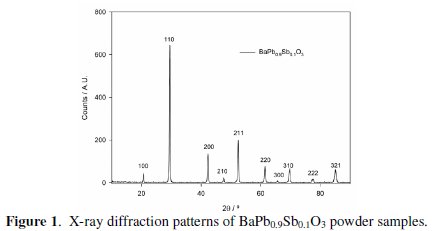
<body><![CDATA[<p><b>Results and discussion</b></p>      <p><b><i>Structural and morphological characterization of the powder samples and electrodes</i></b></p>      <p><a href="#f1">Fig. 1</a> presents the diffraction patterns obtained for  the BaPb<sub>0.9</sub>Sb<sub>0.1</sub>O<sub>3</sub> powder samples.</p>      <p>&nbsp;</p> <a name="f1"> <img src="/img/revistas/pea/v32n3/32n3a05f1.jpg">     
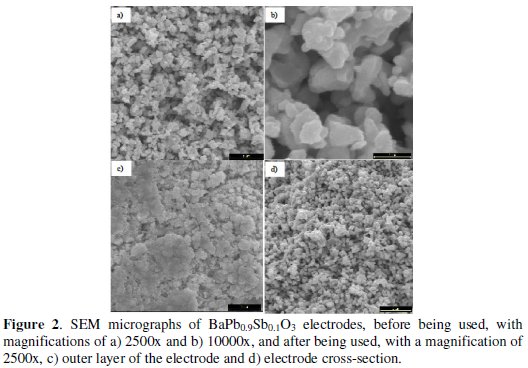
<p>&nbsp;</p>      <p>Considering BaPbO<sub>3</sub> patterns, no extra diffraction lines were observed  for the BaPb<sub>0.9</sub>Sb<sub>0.1</sub>O<sub>3</sub> sample, indicating the presence of a single phase material,  as expected due to the solubility of Sb in this perovskite family (up to x=0.3)  [10,12]. Using the programme UnitCell [27], it was concluded that the  substitution of 10% of Pb by Sb does not change the cell parameter, which  remains a=0.4265 nm, like BaPbO<sub>3</sub>.</p>      <p>Electrodes morphological characterization shows a homogeneous surface with  the crystallite dimensions of approximately 0.3 &mu;m (<a href="#f2">Fig. 2, a and b</a>).</p>      <p>&nbsp;</p> <a name="f2"> <img src="/img/revistas/pea/v32n3/32n3a05f2.jpg">     
<p>&nbsp;</p>      <p>The morphological characterization of the electrodes surface was also performed after  having been used in the electrodegradation assays (<a href="#f2">Fig. 2c</a>). Although the  surface of the used material still presents a compact look, without evidence of  disaggregation, a smoothness in the surface can be observed, probably due to  some abrasion. However, the material in the interior of the electrode pellet still  keeps the morphological characteristics of the original material (<a href="#f2">Fig. 2, a and  d</a>).</p>       ]]></body>
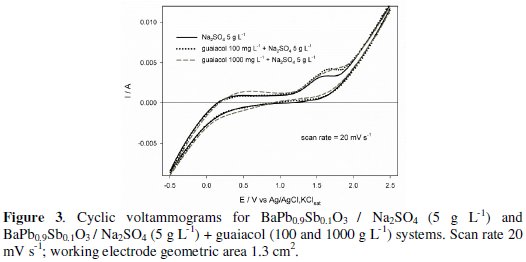
<body><![CDATA[<p><b><i>Voltammetric studies</i></b></p>      <p>The BaPb<sub>0.9</sub>Sb<sub>0.1</sub>O<sub>3</sub> pellets were used as anodes in voltammetric studies  performed in sodium sulphate aqueous solutions with and without guaiacol. <a href="#f3">Fig. 3</a>  shows representative curves for both systems.</p>      <p>&nbsp;</p> <a name="f3"> <img src="/img/revistas/pea/v32n3/32n3a05f3.jpg">     
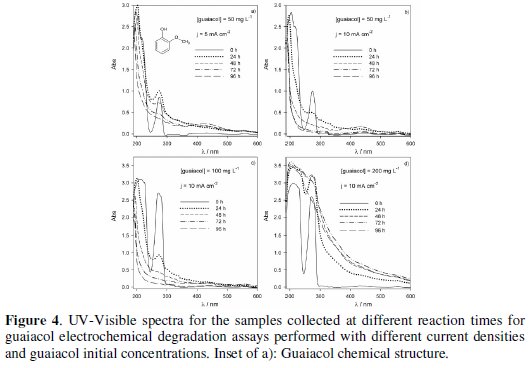
<p>&nbsp;</p>      <p>It can be seen that, in the  absence of guaiacol the system presents electrochemical stability for a wide  range of potentials, between 0 and 1.5 V vs. Ag/AgCl, KCl<sub>sat</sub>. Just before oxygen  evolution, a shoulder appears, which was assigned to the oxidation of the  sulphate to the persulphate, in solution, on the basis of the calculated equilibrium  potential for this process at pH=7 (1.724 V vs. Ag/AgCl ) [28]. In the presence of  100 mg L<sup>-1</sup>guaiacol, the voltammetric pattern is similar between -0.5 V and 1.5  V. However, near the electrolyte oxidation it can be seen an increase in the  anodic peak current intensity that can be due to a simultaneous guaiacol  oxidation. When a higher guaiacol concentration was used (1000 mg L<sup>-1</sup>), an  extra anodic peak near 0.5 V appears due to the guaiacol oxidation with  polymerisation, which consequently decreases the second peak intensity due to a  partial passivation of the electrode's surface. The guaiacol oxidation can occur  before oxygen evolution but with low efficiency, due to electrode's passivation.  So, in the degradation assays high current densities were applied (5 and 10 mA  cm<sup>-2</sup>) to guarantee oxygen evolution, thus avoiding electrodes' passivation.</p>       <p><b><i>Electrodegradation assays</i></b></p>      <p><a href="#f4">Fig. 4</a> presents the UV-Vis spectra for the samples collected at different reaction  times in the electrodegradation assays performed at different experimental  conditions.</p>      <p>&nbsp;</p> <a name="f4"> <img src="/img/revistas/pea/v32n3/32n3a05f4.jpg">     
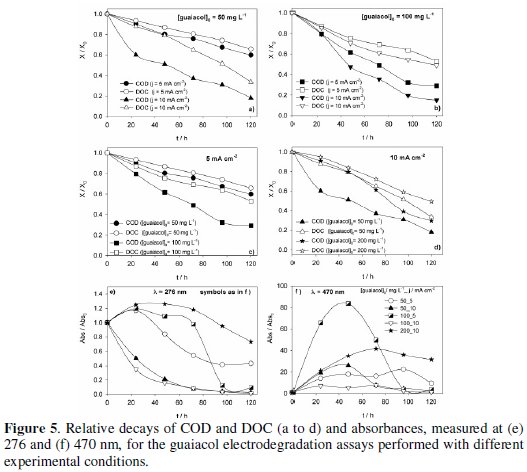
<p>&nbsp;</p>      <p>The spectrum of the initial solution presents a band, in the UV region,  at 276 nm, characteristic of the aromatic compounds. Depending on the ratio  guaiacol concentration/applied current density there is an increase or a decrease  of the absorbance of the solution at this wavelength. The increase in absorbance  was not expected, since there is always a gradual guaiacol degradation in time, as  observed by COD and DOC simultaneous decays (<a href="#f5">Fig. 5, a to d</a>).</p>      ]]></body>
<body><![CDATA[<p>&nbsp;</p> <a name="f5"> <img src="/img/revistas/pea/v32n3/32n3a05f5.jpg">     
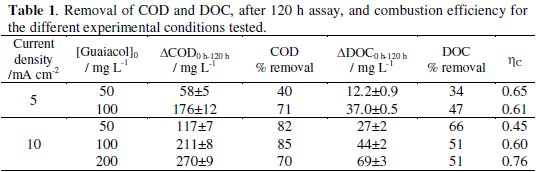
<p>&nbsp;</p>      <p>It is due to the formation of products with very low solubility that promote the turbidity of the  solutions. This effect is more pronounced when the ratio guaiacol  concentration/applied current density is higher, because there are less electrons  available for guaiacol complete oxidation and the dimmers resulting from the  one-electron guaiacol oxidation are formed with higher concentration [15]. The  evidence of these dimmers formation is the increase, in the first part of the  assays, of the absorbance measured at 470 nm, followed by a decrease, when the  guaiacol concentration decreases.</p>      <p>The relative COD and DOC decays for the different experimental conditions  assayed (<a href="#f5">Fig. 5</a>) show a regular removal of the organic load from the solutions.  There is an increase in COD and DOC decays with the increase in current  density, for equal initial guaiacol concentration (<a href="#f5">Fig. 5, a and b</a>). There is also an  increase in that parameters decay with concentration, for the assays performed  with 5 mA cm<sup>-2</sup> (<a href="#f5">Fig. 5c</a>). The influence of the concentration at 10 mA cm<sup>-2</sup>  applied current density is not clear in <a href="#f5">Fig. 5d</a>. However, from the data presented  in <a href="#t1">Table 1</a>, of the absolute removals of COD and DOC at different experimental  conditions, after 120 hours run, it can be inferred that an increase in the initial  concentration also led to an increase in COD and DOC removals.</p>      <p>&nbsp;</p> <a name="t1"> <img src="/img/revistas/pea/v32n3/32n3a05t1.jpg">     
<p>&nbsp;</p>      <p>The analysis of the results regarding the controlling step of the degradation is not  straightforward. If the process was diffusion controlled, COD removals should be  independent of the applied current density. On the other hand, if the process had  a kinetic control, an increase in concentration would not lead to an increase in  COD removal. Thus, the behaviour presented by the system in response to any  increase in guaiacol concentration or in current density is typical from processes  where the indirect oxidation is an important factor. In fact, all the assays were  performed at current densities where oxygen evolution is occurring, since 5 mA  cm<sup>-2</sup> corresponds to a current intensity of 6.5 mA (see <a href="#f3">Fig. 3</a>), thus allowing the  formation of hydroxyl radicals. The chemical reactivity of the hydroxyl radicals  is strongly connected with their interaction with the metal oxide (MO<sub>x</sub>) surface.</p>      <p>Oxides in which the oxidation state of the metals are the highest possible, the  interaction of the radicals with the surface of the oxide is weaker (non-active  electrodes) making them more reactive and encouraging mineralization. On the  contrary, if the metals are not in the maximum oxidation state (active electrode),  the chemical bond formed between the radical and the metal oxide active sites  leads to the formation of the intermediate MO<sub>x+1</sub>, less reactive towards the  pollutant [29]. In the case of BaPb<sub>0.9</sub>Sb<sub>0.1</sub>O<sub>3</sub>, although there is evidence that Pb  and Sb are mainly in the highest oxidation states [11] (non-active anode), some  active sites may not be completely oxidized [30], leading to the formation of the  less reactive intermediate MOx+1 and to the conversion of the organic pollutants  over their mineralization. Moreover, taking into account the CV analysis, the role  in the guaiacol oxidation by the persulphate ion, formed by sulphate oxidation,  cannot be excluded.</p>      <p>The relative variation of the absorbance measured at 276 and 470 nm is presented  in <a href="#f5">Fig. 5</a>, e and f, respectively. The turbidity of the solution, related with the  formation of dimmers, increases for high initial concentration/current density  ratios.</p>      <p>To evaluate the influence of the experimental conditions on the extension of the  guaiacol mineralization, the combustion efficiency, &eta;<sub>c</sub>, which relates the removal  of carbon from the solution (mineralization) with the oxidation state of the  organic compounds in solution (conversion), was calculated according to the  model developed by Pacheco et al. [16]:</p>      ]]></body>
<body><![CDATA[<p>&nbsp;</p> <a name="e1"> <img src="/img/revistas/pea/v32n3/32n3a05e1.jpg">     
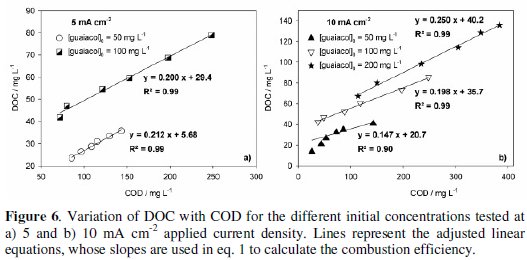
<p>&nbsp;</p>      <p>where DOC is in mg L<sup>-1</sup>, COD is in mg L<sup>-1</sup>, n is the number of electrons  transferred to the electrode in the complete combustion of the organic pollutant  molecule (<a href="#e2">eq. 2</a>), x is the number of carbon atoms in the organic compound and  is the slope of the DOC vs. COD plot.</p>      <p>&nbsp;</p> <a name="e2"> <img src="/img/revistas/pea/v32n3/32n3a05e2.jpg">     
<p>&nbsp;</p>      <p>The DOC vs. COD plots are presented in <a href="#f6">Fig. 6</a> and, substituting these slopes on  <a href="#e1">eq. 1</a>, the combustion efficiency for the different assays can be determined.</p>      <p>&nbsp;</p> <a name="f6"> <img src="/img/revistas/pea/v32n3/32n3a05f6.jpg">     
<p>&nbsp;</p>      <p>Results are presented in <a href="#t1">Table 1</a>, showing that high initial concentration/current  density ratios promote combustion, whereas low initial concentration/current  density ratios promote conversion. This last conclusion is evident in <a href="#f6">Fig. 6</a>,  where for an initial guaiacol concentration of 50 mg L<sup>-1</sup> and a current density of  10 mA cm<sup>-2</sup> the DOC vs. COD plot only presents a linear regression for the first  part of the assay, pointing towards the existence of different products in the  second part of the assay.</p>        <p>&nbsp;</p>     ]]></body>
<body><![CDATA[<p><b>Conclusions</b></p>      <p>BaPb<sub>0.9</sub>Sb<sub>0.1</sub>O<sub>3</sub> perovskite oxides prepared by ceramic route presented an X-ray  diffraction pattern similar to the perovskite BaPbO<sub>3</sub>, indicating the presence of a  single phase material.</p>      <p>The electrodegradation of guaiacol using BaPb<sub>0.9</sub>Sb<sub>0.1</sub>O<sub>3</sub> as anode material was  performed with good organic load removal, being the highest absolute COD and  DOC removals obtained for the assays performed at the highest current density  and initial guaiacol concentration. This perovskite has shown very good  mechanical stability, even at the applied current density of 10 mA cm<sup>-2</sup>, since no  breakdown of the electrode crystallites was observed.</p>      <p>Combustion efficiencies between 0.45 and 0.76 were attained, being the highest  value obtained for an initial guaiacol concentration of 200 mg L<sup>-1</sup> and an applied  current density of 10 mA cm<sup>-2</sup>.</p>       <p>&nbsp;</p>     <p><b>References</b></p>      <!-- ref --><p>1. Bockris JO'M, Otagawa T. J Electrochem Soc. 1984;131:290.    &nbsp;&nbsp;&nbsp;&nbsp;&nbsp;&nbsp;&nbsp;&nbsp;[&#160;<a href="javascript:void(0);" onclick="javascript: window.open('/scielo.php?script=sci_nlinks&ref=000079&pid=S0872-1904201400030000500001&lng=','','width=640,height=500,resizable=yes,scrollbars=1,menubar=yes,');">Links</a>&#160;]<!-- end-ref --></p>      <!-- ref --><p>2. Balej J. Int J Hydrog Energy. 1985;10:89.    &nbsp;&nbsp;&nbsp;&nbsp;&nbsp;&nbsp;&nbsp;&nbsp;[&#160;<a href="javascript:void(0);" onclick="javascript: window.open('/scielo.php?script=sci_nlinks&ref=000081&pid=S0872-1904201400030000500002&lng=','','width=640,height=500,resizable=yes,scrollbars=1,menubar=yes,');">Links</a>&#160;]<!-- end-ref --></p>      ]]></body>
<body><![CDATA[<!-- ref --><p>3. Amado R S, Malta L F B, Garrido F M S, et al. Quim Nova. 2007;30:189.    &nbsp;&nbsp;&nbsp;&nbsp;&nbsp;&nbsp;&nbsp;&nbsp;[&#160;<a href="javascript:void(0);" onclick="javascript: window.open('/scielo.php?script=sci_nlinks&ref=000083&pid=S0872-1904201400030000500003&lng=','','width=640,height=500,resizable=yes,scrollbars=1,menubar=yes,');">Links</a>&#160;]<!-- end-ref --></p>      <!-- ref --><p>4. Yu T, Mao X, Ma G. J Alloy Comp. 2014;608:30.    &nbsp;&nbsp;&nbsp;&nbsp;&nbsp;&nbsp;&nbsp;&nbsp;[&#160;<a href="javascript:void(0);" onclick="javascript: window.open('/scielo.php?script=sci_nlinks&ref=000085&pid=S0872-1904201400030000500004&lng=','','width=640,height=500,resizable=yes,scrollbars=1,menubar=yes,');">Links</a>&#160;]<!-- end-ref --></p>      <!-- ref --><p>5. Krishtalik LI. Electrochim Acta. 1981;26:329.    &nbsp;&nbsp;&nbsp;&nbsp;&nbsp;&nbsp;&nbsp;&nbsp;[&#160;<a href="javascript:void(0);" onclick="javascript: window.open('/scielo.php?script=sci_nlinks&ref=000087&pid=S0872-1904201400030000500005&lng=','','width=640,height=500,resizable=yes,scrollbars=1,menubar=yes,');">Links</a>&#160;]<!-- end-ref --></p>      <!-- ref --><p>6. Ciriaco M L F, Pereira M I S, Nunes M R, et al. Port Electrochim Acta. 1999;17:149.    &nbsp;&nbsp;&nbsp;&nbsp;&nbsp;&nbsp;&nbsp;&nbsp;[&#160;<a href="javascript:void(0);" onclick="javascript: window.open('/scielo.php?script=sci_nlinks&ref=000089&pid=S0872-1904201400030000500006&lng=','','width=640,height=500,resizable=yes,scrollbars=1,menubar=yes,');">Links</a>&#160;]<!-- end-ref --></p>      <!-- ref --><p>7. Ciriaco M L F, Pereira M I S, Nunes M R, et al. J Solid State Electrochem. 2001;5:495.    &nbsp;&nbsp;&nbsp;&nbsp;&nbsp;&nbsp;&nbsp;&nbsp;[&#160;<a href="javascript:void(0);" onclick="javascript: window.open('/scielo.php?script=sci_nlinks&ref=000091&pid=S0872-1904201400030000500007&lng=','','width=640,height=500,resizable=yes,scrollbars=1,menubar=yes,');">Links</a>&#160;]<!-- end-ref --></p>      ]]></body>
<body><![CDATA[<!-- ref --><p>8. Pacheco MJ, Ciriaco M L F, Lopes A, et al. Port Electrochim Acta. 2006;24:273.    &nbsp;&nbsp;&nbsp;&nbsp;&nbsp;&nbsp;&nbsp;&nbsp;[&#160;<a href="javascript:void(0);" onclick="javascript: window.open('/scielo.php?script=sci_nlinks&ref=000093&pid=S0872-1904201400030000500008&lng=','','width=640,height=500,resizable=yes,scrollbars=1,menubar=yes,');">Links</a>&#160;]<!-- end-ref --></p>      <!-- ref --><p>9. Zhang L, Nie Y, Hu C, et al. Appl Catal B-Environ. 2012;125:418.    &nbsp;&nbsp;&nbsp;&nbsp;&nbsp;&nbsp;&nbsp;&nbsp;[&#160;<a href="javascript:void(0);" onclick="javascript: window.open('/scielo.php?script=sci_nlinks&ref=000095&pid=S0872-1904201400030000500009&lng=','','width=640,height=500,resizable=yes,scrollbars=1,menubar=yes,');">Links</a>&#160;]<!-- end-ref --></p>      <!-- ref --><p>10. Pacheco M J, Regalado F, Santos D, et al. J Electrochem Soc. 2014;161:H474.    &nbsp;&nbsp;&nbsp;&nbsp;&nbsp;&nbsp;&nbsp;&nbsp;[&#160;<a href="javascript:void(0);" onclick="javascript: window.open('/scielo.php?script=sci_nlinks&ref=000097&pid=S0872-1904201400030000500010&lng=','','width=640,height=500,resizable=yes,scrollbars=1,menubar=yes,');">Links</a>&#160;]<!-- end-ref --></p>      <p>11. EibschÃ¼tz M, Reiff W M, Cava R J, et al. Appl Phys Lett. 1990;56:2339.</p>      <!-- ref --><p>12. Yasukawa M, Kadota A, Maruta M, et al. Solid State Commun. 2002;124:49.    &nbsp;&nbsp;&nbsp;&nbsp;&nbsp;&nbsp;&nbsp;&nbsp;[&#160;<a href="javascript:void(0);" onclick="javascript: window.open('/scielo.php?script=sci_nlinks&ref=000100&pid=S0872-1904201400030000500012&lng=','','width=640,height=500,resizable=yes,scrollbars=1,menubar=yes,');">Links</a>&#160;]<!-- end-ref --></p>      <!-- ref --><p>13. Paula M, Van S, Young L Y. Appl Environ Microbiol. 1998;64:2432.    &nbsp;&nbsp;&nbsp;&nbsp;&nbsp;&nbsp;&nbsp;&nbsp;[&#160;<a href="javascript:void(0);" onclick="javascript: window.open('/scielo.php?script=sci_nlinks&ref=000102&pid=S0872-1904201400030000500013&lng=','','width=640,height=500,resizable=yes,scrollbars=1,menubar=yes,');">Links</a>&#160;]<!-- end-ref --></p>      <!-- ref --><p>14. Sharma N, Gupta VC. Int J Chem Eng Appl. 2012;3:182.    &nbsp;&nbsp;&nbsp;&nbsp;&nbsp;&nbsp;&nbsp;&nbsp;[&#160;<a href="javascript:void(0);" onclick="javascript: window.open('/scielo.php?script=sci_nlinks&ref=000104&pid=S0872-1904201400030000500014&lng=','','width=640,height=500,resizable=yes,scrollbars=1,menubar=yes,');">Links</a>&#160;]<!-- end-ref --></p>      <!-- ref --><p>15. Doerge D R, Divi R L, Churchwell M I. Anal Biochem. 1997;250:10.    &nbsp;&nbsp;&nbsp;&nbsp;&nbsp;&nbsp;&nbsp;&nbsp;[&#160;<a href="javascript:void(0);" onclick="javascript: window.open('/scielo.php?script=sci_nlinks&ref=000106&pid=S0872-1904201400030000500015&lng=','','width=640,height=500,resizable=yes,scrollbars=1,menubar=yes,');">Links</a>&#160;]<!-- end-ref --></p>      <!-- ref --><p>16. Pacheco M J, Morao A, Lopes A, et al. Electrochim Acta. 2007;53:629.    &nbsp;&nbsp;&nbsp;&nbsp;&nbsp;&nbsp;&nbsp;&nbsp;[&#160;<a href="javascript:void(0);" onclick="javascript: window.open('/scielo.php?script=sci_nlinks&ref=000108&pid=S0872-1904201400030000500016&lng=','','width=640,height=500,resizable=yes,scrollbars=1,menubar=yes,');">Links</a>&#160;]<!-- end-ref --></p>      <!-- ref --><p>17. Samet Y, Elaoud SC, Ammar S, et al. J Hazard Mat. B. 2006;138:614.    &nbsp;&nbsp;&nbsp;&nbsp;&nbsp;&nbsp;&nbsp;&nbsp;[&#160;<a href="javascript:void(0);" onclick="javascript: window.open('/scielo.php?script=sci_nlinks&ref=000110&pid=S0872-1904201400030000500017&lng=','','width=640,height=500,resizable=yes,scrollbars=1,menubar=yes,');">Links</a>&#160;]<!-- end-ref --></p>      <!-- ref --><p>18. Panizza M, Cerisola G. Electrochim Acta. 2005;51:191.    &nbsp;&nbsp;&nbsp;&nbsp;&nbsp;&nbsp;&nbsp;&nbsp;[&#160;<a href="javascript:void(0);" onclick="javascript: window.open('/scielo.php?script=sci_nlinks&ref=000112&pid=S0872-1904201400030000500018&lng=','','width=640,height=500,resizable=yes,scrollbars=1,menubar=yes,');">Links</a>&#160;]<!-- end-ref --></p>      <!-- ref --><p>19. Panizza M, Cerisola G. Water Res. 2009;43:339.    &nbsp;&nbsp;&nbsp;&nbsp;&nbsp;&nbsp;&nbsp;&nbsp;[&#160;<a href="javascript:void(0);" onclick="javascript: window.open('/scielo.php?script=sci_nlinks&ref=000114&pid=S0872-1904201400030000500019&lng=','','width=640,height=500,resizable=yes,scrollbars=1,menubar=yes,');">Links</a>&#160;]<!-- end-ref --></p>      <!-- ref --><p>20. Comninellis Ch, Pulgarin C. J Appl Electrochem. 1991;21:703.    &nbsp;&nbsp;&nbsp;&nbsp;&nbsp;&nbsp;&nbsp;&nbsp;[&#160;<a href="javascript:void(0);" onclick="javascript: window.open('/scielo.php?script=sci_nlinks&ref=000116&pid=S0872-1904201400030000500020&lng=','','width=640,height=500,resizable=yes,scrollbars=1,menubar=yes,');">Links</a>&#160;]<!-- end-ref --></p>      <!-- ref --><p>21. Comninellis Ch, Pulgarin C. J Appl Electrochem. 1993;23:108.    &nbsp;&nbsp;&nbsp;&nbsp;&nbsp;&nbsp;&nbsp;&nbsp;[&#160;<a href="javascript:void(0);" onclick="javascript: window.open('/scielo.php?script=sci_nlinks&ref=000118&pid=S0872-1904201400030000500021&lng=','','width=640,height=500,resizable=yes,scrollbars=1,menubar=yes,');">Links</a>&#160;]<!-- end-ref --></p>      <!-- ref --><p>22. Pannizza M, Michaud P-A, Cerisola G, et al. Electrochem Commun. 2001;3:336.    &nbsp;&nbsp;&nbsp;&nbsp;&nbsp;&nbsp;&nbsp;&nbsp;[&#160;<a href="javascript:void(0);" onclick="javascript: window.open('/scielo.php?script=sci_nlinks&ref=000120&pid=S0872-1904201400030000500022&lng=','','width=640,height=500,resizable=yes,scrollbars=1,menubar=yes,');">Links</a>&#160;]<!-- end-ref --></p>      <!-- ref --><p>23. Iniesta J, Michaud P A, Panizza M, et al. Electrochim Acta. 2001;46:3573.    &nbsp;&nbsp;&nbsp;&nbsp;&nbsp;&nbsp;&nbsp;&nbsp;[&#160;<a href="javascript:void(0);" onclick="javascript: window.open('/scielo.php?script=sci_nlinks&ref=000122&pid=S0872-1904201400030000500023&lng=','','width=640,height=500,resizable=yes,scrollbars=1,menubar=yes,');">Links</a>&#160;]<!-- end-ref --></p>      <!-- ref --><p>24. Morao A, Lopes A, Pessoa de Amorim M T, et al. Electrochim Acta. 2004;49:1587.    &nbsp;&nbsp;&nbsp;&nbsp;&nbsp;&nbsp;&nbsp;&nbsp;[&#160;<a href="javascript:void(0);" onclick="javascript: window.open('/scielo.php?script=sci_nlinks&ref=000124&pid=S0872-1904201400030000500024&lng=','','width=640,height=500,resizable=yes,scrollbars=1,menubar=yes,');">Links</a>&#160;]<!-- end-ref --></p>      <!-- ref --><p>25. Canizares P, Lobato J, Paz R, et al. Water Res. 2005;39:2687.    &nbsp;&nbsp;&nbsp;&nbsp;&nbsp;&nbsp;&nbsp;&nbsp;[&#160;<a href="javascript:void(0);" onclick="javascript: window.open('/scielo.php?script=sci_nlinks&ref=000126&pid=S0872-1904201400030000500025&lng=','','width=640,height=500,resizable=yes,scrollbars=1,menubar=yes,');">Links</a>&#160;]<!-- end-ref --></p>      <!-- ref --><p>26. Eaton A, Clesceri L, Greenberg A. Standard methods for examination of water and wastewater. 19 th Edition. 1995.    &nbsp;&nbsp;&nbsp;&nbsp;&nbsp;&nbsp;&nbsp;&nbsp;[&#160;<a href="javascript:void(0);" onclick="javascript: window.open('/scielo.php?script=sci_nlinks&ref=000128&pid=S0872-1904201400030000500026&lng=','','width=640,height=500,resizable=yes,scrollbars=1,menubar=yes,');">Links</a>&#160;]<!-- end-ref --></p>      <!-- ref --><p>27. Holland T J B, Redfern S A T. Unicell, computer program developed at the University of Cambridge.1995.    &nbsp;&nbsp;&nbsp;&nbsp;&nbsp;&nbsp;&nbsp;&nbsp;[&#160;<a href="javascript:void(0);" onclick="javascript: window.open('/scielo.php?script=sci_nlinks&ref=000130&pid=S0872-1904201400030000500027&lng=','','width=640,height=500,resizable=yes,scrollbars=1,menubar=yes,');">Links</a>&#160;]<!-- end-ref --></p>      <!-- ref --><p>28. Pourbaix M. Atlas d'equilibres electrochimiques a 25 &deg;C. 1er Ed. Paris:Gauthier-Villars &amp; Cie Editeur; 1963.    &nbsp;&nbsp;&nbsp;&nbsp;&nbsp;&nbsp;&nbsp;&nbsp;[&#160;<a href="javascript:void(0);" onclick="javascript: window.open('/scielo.php?script=sci_nlinks&ref=000132&pid=S0872-1904201400030000500028&lng=','','width=640,height=500,resizable=yes,scrollbars=1,menubar=yes,');">Links</a>&#160;]<!-- end-ref --></p>      <!-- ref --><p>29. Simond O, Schaller V, Comninellis C. Electrochim Acta. 1997;42:2009&nbsp;&nbsp;&nbsp;&nbsp;&nbsp;&nbsp;&nbsp;&nbsp;[&#160;<a href="javascript:void(0);" onclick="javascript: window.open('/scielo.php?script=sci_nlinks&ref=000134&pid=S0872-1904201400030000500029&lng=','','width=640,height=500,resizable=yes,scrollbars=1,menubar=yes,');">Links</a>&#160;]<!-- end-ref --><!-- ref --><p>30. Cava R J, Batlogg B, Espinosa G P, et al. Nature. 1989;339:291.    &nbsp;&nbsp;&nbsp;&nbsp;&nbsp;&nbsp;&nbsp;&nbsp;[&#160;<a href="javascript:void(0);" onclick="javascript: window.open('/scielo.php?script=sci_nlinks&ref=000135&pid=S0872-1904201400030000500030&lng=','','width=640,height=500,resizable=yes,scrollbars=1,menubar=yes,');">Links</a>&#160;]<!-- end-ref --></p>       <p>&nbsp;</p>     <p><b>Acknowledgements</b></p>      <p>Financial support from Funda&ccedil;&atilde;o para a Ci&ecirc;ncia e a Tecnologia, FCT, for the project  PEst-OE/CTM/UI0195/2011 and for the grant awarded to A. Rodrigues, is gratefully  acknowledged.</p>       <p>&nbsp;</p>     <p><a name=0></a><sup><a href="#top">*</a></sup>Corresponding author. E-mail address: <a href="mailto:mjap@ubi.pt">mjap@ubi.pt</a></p>      <p>Received 28 May 2014; accepted 28 June 2014</p>      ]]></body>
<body><![CDATA[<p><a href="http://www.peacta.org" target="_blank">www.peacta.org</a> </p>        ]]></body><back>
<ref-list>
<ref id="B1">
<label>1</label><nlm-citation citation-type="">
<source><![CDATA[]]></source>
<year></year>
</nlm-citation>
</ref>
<ref id="B2">
<label>2</label><nlm-citation citation-type="journal">
<person-group person-group-type="author">
<name>
<surname><![CDATA[Balej]]></surname>
<given-names><![CDATA[J]]></given-names>
</name>
</person-group>
<source><![CDATA[Int J Hydrog Energy]]></source>
<year>1985</year>
<volume>10</volume>
<page-range>89</page-range></nlm-citation>
</ref>
<ref id="B3">
<label>3</label><nlm-citation citation-type="journal">
<person-group person-group-type="author">
<name>
<surname><![CDATA[Amado]]></surname>
<given-names><![CDATA[R S]]></given-names>
</name>
<name>
<surname><![CDATA[Malta]]></surname>
<given-names><![CDATA[L F B]]></given-names>
</name>
<name>
<surname><![CDATA[Garrido]]></surname>
<given-names><![CDATA[F M S]]></given-names>
</name>
</person-group>
<source><![CDATA[Quim Nova]]></source>
<year>2007</year>
<volume>30</volume>
<page-range>189</page-range></nlm-citation>
</ref>
<ref id="B4">
<label>4</label><nlm-citation citation-type="journal">
<person-group person-group-type="author">
<name>
<surname><![CDATA[Yu]]></surname>
<given-names><![CDATA[T]]></given-names>
</name>
<name>
<surname><![CDATA[Mao]]></surname>
<given-names><![CDATA[X]]></given-names>
</name>
<name>
<surname><![CDATA[Ma]]></surname>
<given-names><![CDATA[G]]></given-names>
</name>
</person-group>
<source><![CDATA[J Alloy Comp]]></source>
<year>2014</year>
<volume>608</volume>
<page-range>30</page-range></nlm-citation>
</ref>
<ref id="B5">
<label>5</label><nlm-citation citation-type="journal">
<person-group person-group-type="author">
<name>
<surname><![CDATA[Krishtalik]]></surname>
<given-names><![CDATA[L I]]></given-names>
</name>
</person-group>
<source><![CDATA[Electrochim Acta]]></source>
<year>1981</year>
<volume>26</volume>
<page-range>329</page-range></nlm-citation>
</ref>
<ref id="B6">
<label>6</label><nlm-citation citation-type="journal">
<person-group person-group-type="author">
<name>
<surname><![CDATA[Ciriaco]]></surname>
<given-names><![CDATA[M L F]]></given-names>
</name>
<name>
<surname><![CDATA[Pereira]]></surname>
<given-names><![CDATA[M I S]]></given-names>
</name>
<name>
<surname><![CDATA[Nunes]]></surname>
<given-names><![CDATA[M R]]></given-names>
</name>
</person-group>
<source><![CDATA[Port Electrochim Acta]]></source>
<year>1999</year>
<volume>17</volume>
<page-range>149</page-range></nlm-citation>
</ref>
<ref id="B7">
<label>7</label><nlm-citation citation-type="journal">
<person-group person-group-type="author">
<name>
<surname><![CDATA[Ciriaco]]></surname>
<given-names><![CDATA[M L F]]></given-names>
</name>
<name>
<surname><![CDATA[Pereira]]></surname>
<given-names><![CDATA[M I S]]></given-names>
</name>
<name>
<surname><![CDATA[Nunes]]></surname>
<given-names><![CDATA[M R]]></given-names>
</name>
</person-group>
<source><![CDATA[J Solid State Electrochem]]></source>
<year>2001</year>
<volume>5</volume>
<page-range>495</page-range></nlm-citation>
</ref>
<ref id="B8">
<label>8</label><nlm-citation citation-type="journal">
<person-group person-group-type="author">
<name>
<surname><![CDATA[Pacheco]]></surname>
<given-names><![CDATA[M J]]></given-names>
</name>
<name>
<surname><![CDATA[Ciriaco]]></surname>
<given-names><![CDATA[M L F]]></given-names>
</name>
<name>
<surname><![CDATA[Lopes]]></surname>
<given-names><![CDATA[A]]></given-names>
</name>
</person-group>
<source><![CDATA[Port Electrochim Acta]]></source>
<year>2006</year>
<volume>24</volume>
<page-range>273</page-range></nlm-citation>
</ref>
<ref id="B9">
<label>9</label><nlm-citation citation-type="journal">
<person-group person-group-type="author">
<name>
<surname><![CDATA[Zhang]]></surname>
<given-names><![CDATA[L]]></given-names>
</name>
<name>
<surname><![CDATA[Nie]]></surname>
<given-names><![CDATA[Y]]></given-names>
</name>
<name>
<surname><![CDATA[Hu]]></surname>
<given-names><![CDATA[C]]></given-names>
</name>
</person-group>
<source><![CDATA[Appl Catal B-Environ]]></source>
<year>2012</year>
<volume>125</volume>
<page-range>418</page-range></nlm-citation>
</ref>
<ref id="B10">
<label>10</label><nlm-citation citation-type="journal">
<person-group person-group-type="author">
<name>
<surname><![CDATA[Pacheco]]></surname>
<given-names><![CDATA[M J]]></given-names>
</name>
<name>
<surname><![CDATA[Regalado]]></surname>
<given-names><![CDATA[F]]></given-names>
</name>
<name>
<surname><![CDATA[Santos]]></surname>
<given-names><![CDATA[D]]></given-names>
</name>
</person-group>
<source><![CDATA[J Electrochem Soc]]></source>
<year>2014</year>
<volume>161</volume>
<page-range>H474</page-range></nlm-citation>
</ref>
<ref id="B11">
<label>11</label><nlm-citation citation-type="journal">
<person-group person-group-type="author">
<name>
<surname><![CDATA[Eibschutz]]></surname>
<given-names><![CDATA[M]]></given-names>
</name>
<name>
<surname><![CDATA[Reiff]]></surname>
<given-names><![CDATA[W M]]></given-names>
</name>
<name>
<surname><![CDATA[Cava]]></surname>
<given-names><![CDATA[R J]]></given-names>
</name>
</person-group>
<source><![CDATA[Appl Phys Lett]]></source>
<year>1990</year>
<volume>56</volume>
<page-range>2339</page-range></nlm-citation>
</ref>
<ref id="B12">
<label>12</label><nlm-citation citation-type="journal">
<person-group person-group-type="author">
<name>
<surname><![CDATA[Yasukawa]]></surname>
<given-names><![CDATA[M]]></given-names>
</name>
<name>
<surname><![CDATA[Kadota]]></surname>
<given-names><![CDATA[A]]></given-names>
</name>
<name>
<surname><![CDATA[Maruta]]></surname>
<given-names><![CDATA[M]]></given-names>
</name>
</person-group>
<source><![CDATA[Solid State Commun]]></source>
<year>2002</year>
<volume>124</volume>
<page-range>49</page-range></nlm-citation>
</ref>
<ref id="B13">
<label>13</label><nlm-citation citation-type="journal">
<person-group person-group-type="author">
<name>
<surname><![CDATA[Paula]]></surname>
<given-names><![CDATA[M]]></given-names>
</name>
<name>
<surname><![CDATA[Van]]></surname>
<given-names><![CDATA[S]]></given-names>
</name>
<name>
<surname><![CDATA[Young]]></surname>
<given-names><![CDATA[L Y]]></given-names>
</name>
</person-group>
<source><![CDATA[Appl Environ Microbiol]]></source>
<year>1998</year>
<volume>64</volume>
<page-range>2432</page-range></nlm-citation>
</ref>
<ref id="B14">
<label>14</label><nlm-citation citation-type="journal">
<person-group person-group-type="author">
<name>
<surname><![CDATA[Sharma]]></surname>
<given-names><![CDATA[N]]></given-names>
</name>
<name>
<surname><![CDATA[Gupta]]></surname>
<given-names><![CDATA[V C]]></given-names>
</name>
</person-group>
<source><![CDATA[Int J Chem Eng Appl]]></source>
<year>2012</year>
<volume>3</volume>
<page-range>182</page-range></nlm-citation>
</ref>
<ref id="B15">
<label>15</label><nlm-citation citation-type="journal">
<person-group person-group-type="author">
<name>
<surname><![CDATA[Doerge]]></surname>
<given-names><![CDATA[D R]]></given-names>
</name>
<name>
<surname><![CDATA[Divi]]></surname>
<given-names><![CDATA[R L]]></given-names>
</name>
<name>
<surname><![CDATA[Churchwell]]></surname>
<given-names><![CDATA[M I]]></given-names>
</name>
</person-group>
<source><![CDATA[Anal Biochem]]></source>
<year>1997</year>
<volume>250</volume>
<page-range>10</page-range></nlm-citation>
</ref>
<ref id="B16">
<label>16</label><nlm-citation citation-type="journal">
<person-group person-group-type="author">
<name>
<surname><![CDATA[Pacheco]]></surname>
<given-names><![CDATA[M J]]></given-names>
</name>
<name>
<surname><![CDATA[Morao]]></surname>
<given-names><![CDATA[A]]></given-names>
</name>
<name>
<surname><![CDATA[Lopes]]></surname>
<given-names><![CDATA[A]]></given-names>
</name>
</person-group>
<source><![CDATA[Electrochim Acta]]></source>
<year>2007</year>
<volume>53</volume>
<page-range>629</page-range></nlm-citation>
</ref>
<ref id="B17">
<label>17</label><nlm-citation citation-type="journal">
<person-group person-group-type="author">
<name>
<surname><![CDATA[Samet]]></surname>
<given-names><![CDATA[Y]]></given-names>
</name>
<name>
<surname><![CDATA[Elaoud]]></surname>
<given-names><![CDATA[S C]]></given-names>
</name>
<name>
<surname><![CDATA[Ammar]]></surname>
<given-names><![CDATA[S]]></given-names>
</name>
</person-group>
<source><![CDATA[J Hazard Mat. B]]></source>
<year>2006</year>
<volume>138</volume>
<page-range>614</page-range></nlm-citation>
</ref>
<ref id="B18">
<label>18</label><nlm-citation citation-type="journal">
<person-group person-group-type="author">
<name>
<surname><![CDATA[Panizza]]></surname>
<given-names><![CDATA[M]]></given-names>
</name>
<name>
<surname><![CDATA[Cerisola]]></surname>
<given-names><![CDATA[G]]></given-names>
</name>
</person-group>
<source><![CDATA[Electrochim Acta]]></source>
<year>2005</year>
<volume>51</volume>
<page-range>191</page-range></nlm-citation>
</ref>
<ref id="B19">
<label>19</label><nlm-citation citation-type="journal">
<person-group person-group-type="author">
<name>
<surname><![CDATA[Panizza]]></surname>
<given-names><![CDATA[M]]></given-names>
</name>
<name>
<surname><![CDATA[Cerisola]]></surname>
<given-names><![CDATA[G]]></given-names>
</name>
</person-group>
<source><![CDATA[Water Res]]></source>
<year>2009</year>
<volume>43</volume>
<page-range>339</page-range></nlm-citation>
</ref>
<ref id="B20">
<label>20</label><nlm-citation citation-type="journal">
<person-group person-group-type="author">
<name>
<surname><![CDATA[Comninellis]]></surname>
<given-names><![CDATA[Ch]]></given-names>
</name>
<name>
<surname><![CDATA[Pulgarin]]></surname>
<given-names><![CDATA[C]]></given-names>
</name>
</person-group>
<source><![CDATA[J Appl Electrochem]]></source>
<year>1991</year>
<volume>21</volume>
<page-range>703</page-range></nlm-citation>
</ref>
<ref id="B21">
<label>21</label><nlm-citation citation-type="journal">
<person-group person-group-type="author">
<name>
<surname><![CDATA[Comninellis]]></surname>
<given-names><![CDATA[Ch]]></given-names>
</name>
<name>
<surname><![CDATA[Pulgarin]]></surname>
<given-names><![CDATA[C]]></given-names>
</name>
</person-group>
<source><![CDATA[J Appl Electrochem]]></source>
<year>1993</year>
<volume>23</volume>
<page-range>108</page-range></nlm-citation>
</ref>
<ref id="B22">
<label>22</label><nlm-citation citation-type="journal">
<person-group person-group-type="author">
<name>
<surname><![CDATA[Pannizza]]></surname>
<given-names><![CDATA[M]]></given-names>
</name>
<name>
<surname><![CDATA[Michaud]]></surname>
<given-names><![CDATA[P-A]]></given-names>
</name>
<name>
<surname><![CDATA[Cerisola]]></surname>
<given-names><![CDATA[G]]></given-names>
</name>
</person-group>
<source><![CDATA[Electrochem Commun]]></source>
<year>2001</year>
<volume>3</volume>
<page-range>336</page-range></nlm-citation>
</ref>
<ref id="B23">
<label>23</label><nlm-citation citation-type="journal">
<person-group person-group-type="author">
<name>
<surname><![CDATA[Iniesta]]></surname>
<given-names><![CDATA[J]]></given-names>
</name>
<name>
<surname><![CDATA[Michaud]]></surname>
<given-names><![CDATA[P A]]></given-names>
</name>
<name>
<surname><![CDATA[Panizza]]></surname>
<given-names><![CDATA[M]]></given-names>
</name>
</person-group>
<source><![CDATA[Electrochim Acta]]></source>
<year>2001</year>
<volume>46</volume>
<page-range>3573</page-range></nlm-citation>
</ref>
<ref id="B24">
<label>24</label><nlm-citation citation-type="journal">
<person-group person-group-type="author">
<name>
<surname><![CDATA[Morao]]></surname>
<given-names><![CDATA[A]]></given-names>
</name>
<name>
<surname><![CDATA[Lopes]]></surname>
<given-names><![CDATA[A]]></given-names>
</name>
<name>
<surname><![CDATA[Pessoa de Amorim]]></surname>
<given-names><![CDATA[M T]]></given-names>
</name>
</person-group>
<source><![CDATA[Electrochim Acta]]></source>
<year>2004</year>
<volume>49</volume>
<page-range>1587</page-range></nlm-citation>
</ref>
<ref id="B25">
<label>25</label><nlm-citation citation-type="journal">
<person-group person-group-type="author">
<name>
<surname><![CDATA[Canizares]]></surname>
<given-names><![CDATA[P]]></given-names>
</name>
<name>
<surname><![CDATA[Lobato]]></surname>
<given-names><![CDATA[J]]></given-names>
</name>
<name>
<surname><![CDATA[Paz]]></surname>
<given-names><![CDATA[R]]></given-names>
</name>
</person-group>
<source><![CDATA[Water Res]]></source>
<year>2005</year>
<volume>39</volume>
<page-range>2687</page-range></nlm-citation>
</ref>
<ref id="B26">
<label>26</label><nlm-citation citation-type="">
<person-group person-group-type="author">
<name>
<surname><![CDATA[Eaton]]></surname>
<given-names><![CDATA[A]]></given-names>
</name>
<name>
<surname><![CDATA[Clesceri]]></surname>
<given-names><![CDATA[L]]></given-names>
</name>
<name>
<surname><![CDATA[Greenberg]]></surname>
<given-names><![CDATA[A]]></given-names>
</name>
</person-group>
<source><![CDATA[Standard methods for examination of water and wastewater]]></source>
<year>1995</year>
<edition>19</edition>
</nlm-citation>
</ref>
<ref id="B27">
<label>27</label><nlm-citation citation-type="">
<person-group person-group-type="author">
<name>
<surname><![CDATA[Holland]]></surname>
<given-names><![CDATA[T J B]]></given-names>
</name>
<name>
<surname><![CDATA[Redfern]]></surname>
<given-names><![CDATA[S A T]]></given-names>
</name>
</person-group>
<source><![CDATA[Unicell, computer program developed at the University of Cambridge]]></source>
<year>1995</year>
</nlm-citation>
</ref>
<ref id="B28">
<label>28</label><nlm-citation citation-type="book">
<person-group person-group-type="author">
<name>
<surname><![CDATA[Pourbaix]]></surname>
<given-names><![CDATA[M]]></given-names>
</name>
</person-group>
<source><![CDATA[Atlas d'equilibres electrochimiques a 25 °C]]></source>
<year>1963</year>
<edition>1</edition>
<publisher-loc><![CDATA[Paris ]]></publisher-loc>
<publisher-name><![CDATA[Gauthier-Villars & Cie Editeur]]></publisher-name>
</nlm-citation>
</ref>
<ref id="B29">
<label>29</label><nlm-citation citation-type="journal">
<person-group person-group-type="author">
<name>
<surname><![CDATA[Simond]]></surname>
<given-names><![CDATA[O]]></given-names>
</name>
<name>
<surname><![CDATA[Schaller]]></surname>
<given-names><![CDATA[V]]></given-names>
</name>
<name>
<surname><![CDATA[Comninellis]]></surname>
<given-names><![CDATA[C]]></given-names>
</name>
</person-group>
<source><![CDATA[Electrochim Acta]]></source>
<year>1997</year>
<volume>42</volume>
<page-range>2009</page-range></nlm-citation>
</ref>
<ref id="B30">
<label>30</label><nlm-citation citation-type="journal">
<person-group person-group-type="author">
<name>
<surname><![CDATA[Cava]]></surname>
<given-names><![CDATA[R J]]></given-names>
</name>
<name>
<surname><![CDATA[Batlogg]]></surname>
<given-names><![CDATA[B]]></given-names>
</name>
<name>
<surname><![CDATA[Espinosa]]></surname>
<given-names><![CDATA[G P]]></given-names>
</name>
</person-group>
<source><![CDATA[Nature]]></source>
<year>1989</year>
<volume>339</volume>
<page-range>291</page-range></nlm-citation>
</ref>
</ref-list>
</back>
</article>