<?xml version="1.0" encoding="ISO-8859-1"?><article xmlns:mml="http://www.w3.org/1998/Math/MathML" xmlns:xlink="http://www.w3.org/1999/xlink" xmlns:xsi="http://www.w3.org/2001/XMLSchema-instance">
<front>
<journal-meta>
<journal-id>0872-1904</journal-id>
<journal-title><![CDATA[Portugaliae Electrochimica Acta]]></journal-title>
<abbrev-journal-title><![CDATA[Port. Electrochim. Acta]]></abbrev-journal-title>
<issn>0872-1904</issn>
<publisher>
<publisher-name><![CDATA[Sociedade Portuguesa de Electroquímica]]></publisher-name>
</publisher>
</journal-meta>
<article-meta>
<article-id>S0872-19042014000400002</article-id>
<article-id pub-id-type="doi">10.4152/pea.201404259</article-id>
<title-group>
<article-title xml:lang="en"><![CDATA[Nano Analyses of Adsorbed Film onto Carbon Steel]]></article-title>
</title-group>
<contrib-group>
<contrib contrib-type="author">
<name>
<surname><![CDATA[Kasilingam]]></surname>
<given-names><![CDATA[T]]></given-names>
</name>
<xref ref-type="aff" rid="A01"/>
</contrib>
<contrib contrib-type="author">
<name>
<surname><![CDATA[Thangavelu]]></surname>
<given-names><![CDATA[C]]></given-names>
</name>
<xref ref-type="aff" rid="A02"/>
</contrib>
<contrib contrib-type="author">
<name>
<surname><![CDATA[Palanivela]]></surname>
<given-names><![CDATA[V]]></given-names>
</name>
<xref ref-type="aff" rid="A01"/>
</contrib>
</contrib-group>
<aff id="A01">
<institution><![CDATA[,Periyar E. V. R. College (Autonomous) PG & Research Department of Chemistry ]]></institution>
<addr-line><![CDATA[Tamilnadu ]]></addr-line>
<country>India</country>
</aff>
<aff id="A02">
<institution><![CDATA[,Govt. Arts College for Women Department of Chemistry ]]></institution>
<addr-line><![CDATA[Tamilnadu ]]></addr-line>
<country>India</country>
</aff>
<pub-date pub-type="pub">
<day>00</day>
<month>07</month>
<year>2014</year>
</pub-date>
<pub-date pub-type="epub">
<day>00</day>
<month>07</month>
<year>2014</year>
</pub-date>
<volume>32</volume>
<numero>4</numero>
<fpage>259</fpage>
<lpage>270</lpage>
<copyright-statement/>
<copyright-year/>
<self-uri xlink:href="http://scielo.pt/scielo.php?script=sci_arttext&amp;pid=S0872-19042014000400002&amp;lng=en&amp;nrm=iso"></self-uri><self-uri xlink:href="http://scielo.pt/scielo.php?script=sci_abstract&amp;pid=S0872-19042014000400002&amp;lng=en&amp;nrm=iso"></self-uri><self-uri xlink:href="http://scielo.pt/scielo.php?script=sci_pdf&amp;pid=S0872-19042014000400002&amp;lng=en&amp;nrm=iso"></self-uri><abstract abstract-type="short" xml:lang="en"><p><![CDATA[The inhibition performance of a non-oxidising surfactant, namely cetyl trimethyl ammonium bromide (CTAB), and its co-adsorption behaviour with zinc ion on carbon steel in well water was studied by potentiodynamic polarization, electrochemical impedance spectroscopy (EIS), weight loss, as well as atomic force microscopy (AFM) and scanning electron microscopy. Results indicated that the formulation acted as an anodic inhibitor. Adsorption of the used inhibitor led to a reduction in the double layer capacitance and an increase in the charge transfer resistance. A synergistic effect was also observed for the studied inhibitor with Zn2+ in weight loss measurements and electrochemical studies.]]></p></abstract>
<kwd-group>
<kwd lng="en"><![CDATA[Weight loss]]></kwd>
<kwd lng="en"><![CDATA[Electrochemical studies]]></kwd>
<kwd lng="en"><![CDATA[AFM]]></kwd>
<kwd lng="en"><![CDATA[SEM]]></kwd>
</kwd-group>
</article-meta>
</front><body><![CDATA[ 

<!--     <p>&nbsp;</p>
    <p>doi: 10.4152/pea.201404259</p> -->

    <p><b>Nano Analyses of Adsorbed Film onto Carbon Steel</b></p>

    <p>
<b>T. Kasilingam</b><sup><i>a</i>,<a href="#0">*</a></sup>
, <b>C. Thangavelu</b><sup><i>b</i></sup>
 and <b>V. Palanivela</b><sup><i>a</i></sup>
</p>

    <p><i><sup>a</sup> PG &amp; Research Department of Chemistry, Periyar E. V. R. College (Autonomous), Tiruchirappalli, Tamilnadu, India</i></p>

    <p><i><sup>b</sup> Department of Chemistry, Govt. Arts College for Women, Nilakkottai, Dindugul, Tamilnadu, India</i></p>


    <p>&nbsp;</p>
    <p><b>Abstract</b></p>

    <p>The inhibition performance of a non-oxidising surfactant, namely cetyl trimethyl 
ammonium bromide (CTAB), and its co-adsorption behaviour with zinc ion on carbon 
steel in well water was studied by potentiodynamic polarization, electrochemical 
impedance spectroscopy (EIS), weight loss, as well as atomic force microscopy (AFM) 
and scanning electron microscopy. Results indicated that the formulation acted as an 
anodic inhibitor. Adsorption of the used inhibitor led to a reduction in the double layer 
capacitance and an increase in the charge transfer resistance. A synergistic effect was 
also observed for the studied inhibitor with Zn<sup>2+</sup> in weight loss measurements and 
electrochemical studies.</p>

    ]]></body>
<body><![CDATA[<p><b><i>Keywords:</i></b> Weight loss, Electrochemical studies, AFM, SEM.</p>


    <p>&nbsp;</p>
    <p><b>Introduction</b></p>

    <p>A district heating system provides high temperature for the inhabitants of large 
cities [1]. There are many advantages from a district heating system, including 
increased energy and performance efficiencies achieved through implementing 
advanced equipment and maintaining them professionally, reduced life cycle 
costs, and augmented control over environmental impacts [2,3]. A district heating 
system has three main elements: the heat sources, the distribution system and the 
customer interfaces [4]. District heating system and corrosion of the pipelines are 
relevant issues. The customer interface uses well water, therefore quite extensive 
corrosion of steel and iron occurs, even after lime treatment [5]. There will be 
numerous problems such as corrosion of pipelines, space heating networks, and 
other equipment of the systems. All these disadvantages dramatically reduce the 
service time of the whole district heating system [6]. Many methods such as 
coating [7], phosphating [8], anodic or cathodic controls [9] and use of inhibitors 
[10] are adopted to minimize the corrosion problems. Among them only the use 
of inhibitors is convenient and economic [11-13].</p>

    <p>Surfactant corrosion inhibitors have many advantages such as high inhibition 
efficiency, low price, low toxicity, and simple production. Surfactants are 
molecules composed of a polar hydrophilic group, the ''head'', attached to a 
non-polar hydrophobic group, the ''tail''. Generally, in aqueous solution the 
inhibitory action of surfactant molecules may also be due to physical 
(electrostatic) adsorption or chemisorption onto the metallic surface, depending 
on the charge of the solid surface and the free energy change of transferring a 
hydrocarbon chain from water to the solid surface.</p>

    <p>The adsorption of a surfactant markedly changes the corrosion resisting property 
of a metal. For these reasons, studying the relation between adsorption and 
corrosion inhibition is significantly important [14-23]. Somewhat recently, the 
corresponding research has also demonstrated that quaternary ammonium salt 
surfactants are efficient corrosion inhibitors for iron and steel [24-29].</p>

    <p>This article investigates the inhibition of corrosion of carbon steel in well water 
using CTAB and Zn<sup>2+</sup> by using different techniques. The effectiveness of the 
formulation is explained on the basis of electrochemical parameters obtained 
from Tafel and Nyquist curves. In the present work the use of Scanning Electron 
Microscopy has been made to obtain a clear understanding of the protective film 
onto carbon steel surface without and with an inhibitor formulation.</p>


    <p>&nbsp;</p>
    <p><b>Experimental details</b></p>

    <p><b><i>Materials</i></b></p>

    ]]></body>
<body><![CDATA[<p>The composition of carbon steel used for corrosion inhibition studies was (Wt 
%): 0.026% S, 0.06% P, 0.4% Mn, 0.1% C and balance being Fe. The specimens 
of size 1.0 cm &times; 4.0 cm &times; 0.2 cm were press cut from the carbon steel sheet, were 
machined and abraded with a series of emery papers. This was followed by 
rinsing in acetone and bidistilled water and finally dried in air. Before any 
experiment, the substrates were treated as described and freshly used with no 
further storage. The inhibitors CTAB, molecular mass 364.45g mol<sup>-1</sup>, Zn<sup>2+</sup> ions 
were used as received.</p>

    <p>A stock solution of 1000 ppm of CTAB was prepared with bidistilled water and 
the desired concentration was obtained by appropriate dilution. The 
concentration of CTAB used for the study ranges from 10 to 150 ppm. All 
solutions were prepared using well water (Tiruchirappalli, Tamil Nadu, India). 
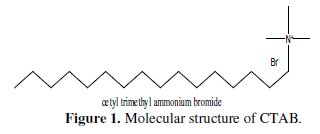
The study was carried out at room temperature. The molecular structure of 
CTAB is given in <a href="#f1">Fig. 1</a>.</p>


    <p>&nbsp;</p>
<a name="f1">
<img src="/img/revistas/pea/v32n4/32n4a02f1.jpg">
    
<p>&nbsp;</p>


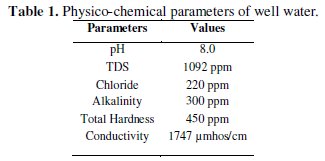
    <p>The chosen environmental well water and its physicochemical 
parameters are given in <a href="#t1">Table 1</a>.</p>


    <p>&nbsp;</p>
<a name="t1">
<img src="/img/revistas/pea/v32n4/32n4a02t1.jpg">
    
<p>&nbsp;</p>


    <p><b><i>Weight-loss measurements</i></b></p>

    <p>The freshly prepared carbon steel specimens were suspended in 150 mL beakers
containing 100 mL of test solution maintained at room temperature with the aid
of glass rods and hooks. The weight loss taken was the difference between the
weight at a given time and the original weight of the specimens. The
measurements were carried out for the uninhibited solution and the solution
containing CTAB and CTAB - Zn<sup>2+</sup> mixture. Weight loss experiments were
performed for the duration of seven days. The specimens were immersed in
triplicate and the average corrosion rate was calculated.</p>

    <p>These uncertainties or RSD for three replicate measurements were less than 5%.</p>

    ]]></body>
<body><![CDATA[<p>The corrosion rates (C<sub>R</sub>) were determined using the equation:</p>


    <p>&nbsp;</p>
<a name="e1">
<img src="/img/revistas/pea/v32n4/32n4a02e1.jpg">
    
<p>&nbsp;</p>


    <p>where W = corrosion weight loss of carbon steel (mg); A = area of the coupon 
(cm<sup>2</sup>); T = exposure time (h); D = density of the carbon steel (g cm<sup>-3</sup>).</p>

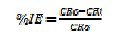
    <p>The inhibition efficiency (IE) of CTAB and Zn<sup>2+</sup> mixture was calculated by 
using the following equation:</p>


    <p>&nbsp;</p>
<a name="e2">
<img src="/img/revistas/pea/v32n4/32n4a02e2.jpg">
    
<p>&nbsp;</p>


    <p>where CRo = corrosion rate of carbon steel in the absence of the inhibitor; CRi = 
corrosion rate of carbon steel in the presence of the inhibitor.</p>


    <p><b><i>Surface analysis by FTIR spectroscopy</i></b></p>

    <p>After the immersion period of one day in various environments, the specimens 
were taken out of the test solution and dried. The film formed on the surface was 
scratched carefully and it was thoroughly mixed so as to make it uniform 
throughout. FTIR spectrum of the powder (KBr Pellets) was recorded using a 
Perkin-elmer-1600 FTIR spectrophotometer with resolving power of 4 cm<sup>-1</sup>.</p>


    ]]></body>
<body><![CDATA[<p><b><i>Electrochemical studies</i></b></p>

    <p>Both the potentiodynamic polarization studies and electrochemical impedance 
spectroscopic (EIS) studies were carried out using the electrochemical 
workstation model CHI-760d and the experimental data were analysed by using 
the electrochemical software (Version: 12.22.0.0).</p>

    <p>The measurements were conducted in a conventional three electrode cylindrical 
glass cell with a platinum electrode as auxiliary electrode and a saturated calomel 
electrode as reference electrode.</p>

    <p>The working electrode was carbon steel embedded in epoxy resin of 
polytetrafluoroethylene so that the flat surface of 1 cm 2 was the only surface 
exposed to the electrolyte. The three electrodes set up was immersed in a control 
solution of volume 100 mL both in the absence and presence of the inhibitors 
formulations and allowed to attain a stable open circuit potential (OCP). The pH 
values of the solution were adjusted to 7.0 and the solutions were unstirred 
during the experiments.</p>

    <p>Polarization curves were recorded in the potential range of -750 to -150 mV with 
a resolution of 2 mV. The curves were recorded in the dynamic scan mode with a 
scan rate of 2 mV s<sup>-1</sup> in the current range of -20 mA to +20 mA. The Ohmic drop 
compensation has been made during the studies. The corrosion potential (E<sub>corr</sub>), 
corrosion current (I<sub>corr</sub>), anodic Tafel slope (&beta;a) and cathodic Tafel slope (&beta;c) 
were obtained by extrapolation of anodic and cathodic regions of the Tafel plots. 
The inhibition efficiency (IEp) values were calculated from the Icorr values using 
the equation</p>


    <p>&nbsp;</p>
<a name="e3">
<img src="/img/revistas/pea/v32n4/32n4a02e3.jpg">
    
<p>&nbsp;</p>


    <p>where I<sub>corr</sub> and I'<sub>corr</sub> are the corrosion current densities in case of control and 
inhibited solutions, respectively.</p>

    <p>Electrochemical impedance spectra in the form of Nyquist plots were recorded at 
OCP in the frequency range from 60 KHz to 10 MHz with 4 to 10 steps per 
decade. A sine wave, with 10 mV amplitude, was used to perturb the system. The 
impedance parameters viz., charge transfer resistance (Rct), double layer 
capacitance (Cdl) were obtained from the Nyquist plots. The inhibition 
efficiencies (IEi) were calculated using the equation,</p>


    <p>&nbsp;</p>
<a name="e4">
<img src="/img/revistas/pea/v32n4/32n4a02e4.jpg">
    
]]></body>
<body><![CDATA[<p>&nbsp;</p>


    <p>where R<sub>ct</sub> and R'<sub>ct</sub> are the charge transfer resistance values in the absence and 
presence of the inhibitor, respectively.</p>


    <p><b><i>Scanning Electron Microscopy</i></b></p>

    <p>The surface morphology of the corroded steel sample surface in the presence and 
absence of the inhibitors was studied using SEM (Model: TESCAN vega3 USA). 
To study the surface morphology of carbon steel, polished specimens prior to 
initiation of any corrosion reaction, were examined in optical microscope to find 
out any surface defect, such as prior noticeable irregularities like cracks, etc. 
Only those specimens, which had a smooth pit-free surface, were subjected to 
immersion. The specimens were immersed for 24h at 30 &deg;C. After completion of 
the tests the specimens were thoroughly washed with bidistilled water and dried 
and then subjected to SEM examination.</p>


    <p><b><i>Atomic Force Microscopy (AFM)</i></b></p>

    <p>Atomic force microscopy is a powerful method for the gathering of roughness 
statistics from a variety of surfaces. This exciting new technique allows the 
surface to be imaged at higher resolutions and accuracies than ever before. The 
protective films are examined for a scanned area. AFM is becoming an accepted 
technique of roughness investigation [30-33].</p>

    <p>All the AFM images were recorded on a Pico SPM2100 AFM instrument 
operating in contact mode in air. The scan size of all the AFM images are 40 &mu;m 
&times; 40 &mu;m and 5 &mu;m &times; 5 &mu;m areas at a scan rate of 0.20(Hz) lines per second.</p>


    <p>&nbsp;</p>
    <p><b>Results and discussion</b></p>

    <p><b><i>Weight-loss measurements</i></b></p>

    ]]></body>
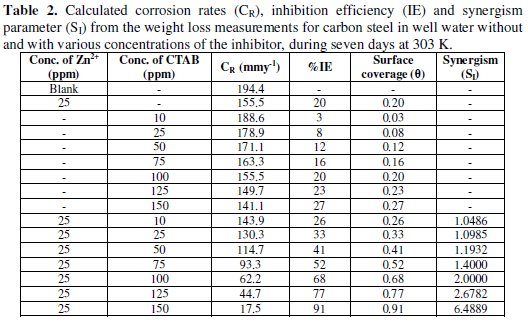
<body><![CDATA[<p><a href="#t2">Table 2</a> shows corrosion rates, inhibition efficiencies and synergism parameters 
of the carbon steel determined by the weight loss tests in well water without and 
with an inhibitor, and in 25 ppm Zn<sup>2+</sup> inhibitor + CTAB different concentrations 
during seven days at 303 K.</p>


    <p>&nbsp;</p>
<a name="t2">
<img src="/img/revistas/pea/v32n4/32n4a02t2.jpg">
    
<p>&nbsp;</p>


    <p>It can be observed that the addition of the inhibitor suppressed effectively the 
carbon steel corrosion in well water. The inhibition efficiency increased with 
increasing concentrations of the inhibitor and also increases the synergism 
parameter and then reached the maximum value when the inhibitor concentration 
was 150 ppm CTAB, indicating that the inhibition effect depends on the amount 
of the inhibitor. This trend can be attributed to an increase in the adsorption 
amount of inhibitor onto carbon steel surface with increasing inhibitor 
concentrations, separating the carbon steel surface from the corrosion medium 
and retarding corrosion via forming an inhibitor adsorption film. 
Besides, it can be seen from <a href="#t2">Table 2</a> that after addition of Zn<sup>2+</sup> ions into the well 
water with 150 ppm CTAB, corrosion rates decreased significantly in 
comparison with singular inhibitor in well water, as well as the inhibition 
efficiency increased. For example, when 25 ppm Zn<sup>2+</sup> was added into the well 
water containing 150 ppm CTAB, the corrosion rate reduced from 141.1 mm y<sup>-1</sup> 
to 17.5 mm y<sup>-1</sup> . Accordingly, the percentage of inhibition efficiency increased 
from 27% to 91%. These results suggest that there is a synergistic effect between 
inhibitor molecules and Zn<sup>2+</sup> ion synergism parameter (S<sub>I</sub>) [34,35] values shown 
in <a href="#t2">Table 2</a>. This is defined as,</p>


    <p>&nbsp;</p>
<a name="e5">
<img src="/img/revistas/pea/v32n4/32n4a02e5.jpg">
    
<p>&nbsp;</p>


    <p>where I<sub>1+2</sub> = (I<sub>1</sub> + I<sub>2</sub>)-(I<sub>1</sub> &times; I<sub>2</sub>); I<sub>1</sub> = surface coverage of inhibitors (CTAB); I<sub>2</sub> = surface coverage of inhibitors (Zn<sup>2+</sup>); I'<sub>1+2</sub>
 = combined surface coverage of inhibitors (CTAB) and (Zn<sup>2+</sup>).</p>


    <p><b><i>Polarization study</i></b></p>

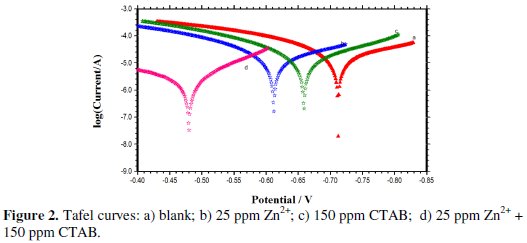
    <p><a href="#f2">Fig. 2</a> shows the Tafel curves of carbon steel in well water without and with an 
inhibitor, respectively.</p>


    <p>&nbsp;</p>
<a name="f2">
<img src="/img/revistas/pea/v32n4/32n4a02f2.jpg">
    
]]></body>
<body><![CDATA[<p>&nbsp;</p>


    <p>The Tafel curve for the (CTAB + Zn<sup>2+</sup>) inhibitor 
formulation indicates a shift of the corrosion potential toward a more positive 
value potential compared toward with the blank assess (from -712 mV to -480 
mV). This corrosion potential shift was a result of the anodic inhibition effect of 
the inhibitor formulation. The anode Tafel curve obtained with the inhibitor 
indicates a greater trend toward passivity than without the inhibitor. Also, the 
cathodic zone showed the limiting current decreased for oxygen reduction. 
However, according to the corrosion potential the inhibitor formulation tended 
toward the anode inhibition.</p>

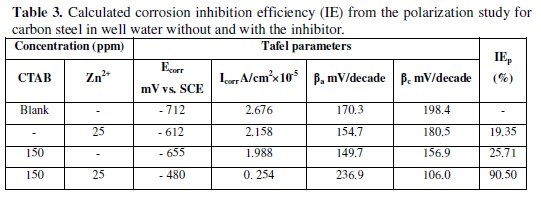
    <p>From the Tafel curves, the corrosion current density (icorr) was determined by the 
Tafel extrapolation method; they were (2.676 A cm<sup>-2</sup>) (without) and 0.254 A cm<sup>-2</sup> 
(with), respectively. The corrosion current density in well water decreased 
gradually with the inhibitor. The inhibition efficiency (IEpol %) of the inhibitor 
formulation for the corrosion of carbon steel was calculated using icorr [36].</p>

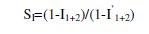
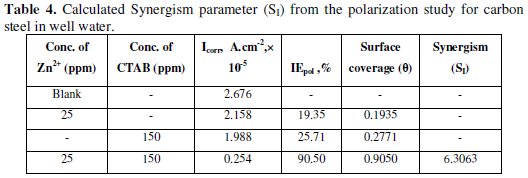
    <p>The synergism parameters (S<sub>I</sub>) of the inhibitor formulation were calculated using 
the equation given below:</p>


    <p>&nbsp;</p>
<a name="e6">
<img src="/img/revistas/pea/v32n4/32n4a02e6.jpg">
    
<p>&nbsp;</p>


    <p>where I<sub>1+2</sub> = (I<sub>1</sub> + I<sub>2</sub>)-(I<sub>1</sub> &times; I<sub>1</sub>); I<sub>1</sub> = surface coverage of inhibitors (CTAB); I<sub>2</sub> = surface coverage of inhibitors (Zn<sup>2+</sup>); I'<sub>1+2</sub> = combined surface coverage of 
inhibitors (CTAB) and (Zn<sup>2+</sup>).</p>

    <p><a href="#t3">Table 3</a> and <a href="#t4">Table 4</a> show the calculated results of inhibition efficiency and 
synergism results corroborating the results of the weight loss measurement and 
electrochemical impedance studies.</p>


    <p>&nbsp;</p>
<a name="t3">
<img src="/img/revistas/pea/v32n4/32n4a02t3.jpg">
    
<p>&nbsp;</p>
<a name="t4">
<img src="/img/revistas/pea/v32n4/32n4a02t4.jpg">
    
]]></body>
<body><![CDATA[<p>&nbsp;</p>


    <p><b><i>AC impedance</i></b></p>

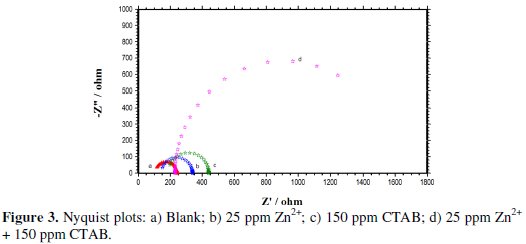
    <p><a href="#f3">Fig. 3</a> shows the Nyquist plots for carbon steel in well water with and without the 
inhibitor of OCP.</p>


    <p>&nbsp;</p>
<a name="f3">
<img src="/img/revistas/pea/v32n4/32n4a02f3.jpg">
    
<p>&nbsp;</p>


    <p>It can be observed that the impedance reaction of the electrode 
was significantly changed after the addition of co-adsorption of the inhibitor in 
the blank solution. In comparison with the blank solution, in the presence of the 
inhibitor, the diameters of the semi-circles in Nyquist plots increased with 
addition of co-adsorption inhibitor.</p>

    <p>These results indicate that the impedance of the carbon steel electrode increased 
with addition of co-adsorption of the inhibitor, consequently resulting in an 
increase in inhibition effect, and that the carbon steel corrosion was effectively 
retarded due to the formation of a protective film onto the metal surface. In 
addition, the impedance spectra did not present semi circles; this phenomenon 
can be attributed to the frequency dispersion [37-38].</p>

    <p>It is also evident that the Nyquist plots are composed of two slightly depressed 
capacitive loops: the one at the high frequencies can be attributed to the charge 
transfer resistance (R<sub>ct</sub>), and to the double layer capacitance (C<sub>dl</sub>). The fitted 
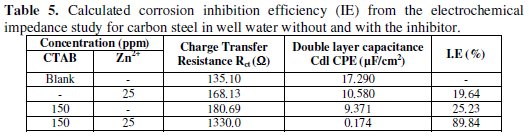
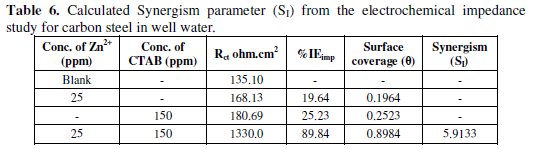
electrochemical parameters are listed in <a href="#t5">Tables 5</a> and <a href="#t6">6</a>.</p>


    <p>&nbsp;</p>
<a name="t5">
<img src="/img/revistas/pea/v32n4/32n4a02t5.jpg">
    
<p>&nbsp;</p>
<a name="t6">
<img src="/img/revistas/pea/v32n4/32n4a02t6.jpg">
    
]]></body>
<body><![CDATA[<p>&nbsp;</p>


    <p>It is apparent from these 
tables that by increasing addition of co-adsorption of the inhibitor, the C<sub>dl</sub> value 
tended to decrease, whereas the R<sub>ct</sub> value increased. The significant decreased in 
the capacitance values can be ascribed to a decrease in the dielectric constant or 
an increase in the double electric layer thickness due to the adsorption of the 
inhibitor molecule onto the carbon steel surface [39]. The results as obtained by 
electrochemical impedance studies are consistent with the results of the 
polarization study and weight loss measurements.</p>


    <p><b><i>FTIR Spectra</i></b></p>

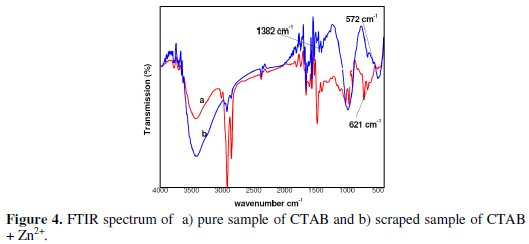
    <p>FTIR spectra were recorded to understand the interaction of inhibitor molecules 
with the metal surface [40-43]. The FTIR spectrum of pure CTAB is shown in 
<a href="#f4">Fig 4a</a>.</p>


    <p>&nbsp;</p>
<a name="f4">
<img src="/img/revistas/pea/v32n4/32n4a02f4.jpg">
    
<p>&nbsp;</p>


    <p>The C-Br stretching frequency of the cetyl trimethyl ammonium bromide 
appears at 621 cm<sup>-1</sup>. The FTIR spectrum of the protective film formed onto the 
carbon steel surface after immersion in the solution containing 25 ppm Zn<sup>2+</sup> and 
150 ppm CTAB is shown in <a href="#f4">Fig 4b</a>. The C-Br stretching frequency of CTAB 
shifted from 621 cm<sup>-1</sup> to 572 cm<sup>-1</sup>.</p>

    <p>These results revealed that the C-Br coordinated with Fe<sup>2+</sup> on the anodic mode of 
the metal surface also resulted in the formation of Fe<sup>2+</sup>-CTAB complex. The 
peak appearing at 1382 cm<sup>-1</sup> is due to Zn(OH)2 formed on the cathodic regions 
of the metal surface.</p>


    <p><b><i>Evidence of surface</i></b></p>

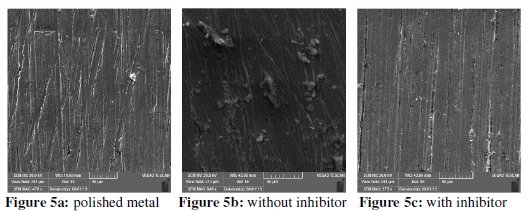
    <p>In order to further confirm the corrosion resistance ability of the formulation as a 
good corrosion inhibitor in well water, the surface morphology of carbon steel in 
well water without and with the inhibitor Zn<sup>2+</sup> + CTAB for one day exposure 
(<a href="#f5">Fig. 5</a>) was investigated using scanning electron microscope (SEM).</p>


    ]]></body>
<body><![CDATA[<p>&nbsp;</p>
<a name="f5">
<img src="/img/revistas/pea/v32n4/32n4a02f5.jpg">
    
<p>&nbsp;</p>


    <p><a href="#f5">Fig. 5a</a>: polished metal surface before immersion, good surface properties; 
<a href="#f5">Fig. 5b</a> demonstrates strongly damaged metal surface in the absence of the inhibitor 
formulation, due to dissolution of the metal in the bulk of the environment. The 
surface is highly porous with large uneven oxides formed over it. Nevertheless, 
from <a href="#f5">Fig. 5c</a> the dissolution rate of carbon steel suppressed and smoother surface 
was observed due to formation of a protective film onto the metal surface when 
compared to the treated one without the inhibitor in well water. This 
phenomenon showed that the presence of a protective film can protect the carbon 
steel surface from corrosion efficiently.</p>


    <p><b><i>Atomic force microscopy</i></b></p>

    <p>AFM is a powerful technique to probe the surface morphology at nano-to micro-
scale and has developed into a new option to study the influence of inhibitor 
formulations on the generation and progress of the corrosion at the metal/solution 
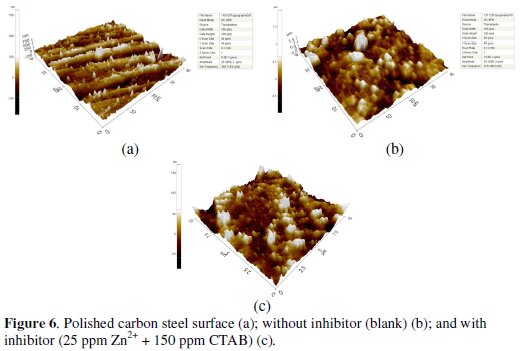
interface. The three dimensional AFM morphologies for polished carbon steel 
surface immersed in without and with an inhibitor formulation are shown in <a href="#f6">Fig. 6</a>.</p>


    <p>&nbsp;</p>
<a name="f6">
<img src="/img/revistas/pea/v32n4/32n4a02f6.jpg">
    
<p>&nbsp;</p>


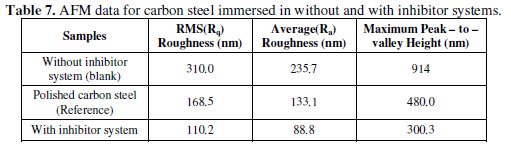
    <p>The root mean square (rms) roughness measurements were carried out for 
polished carbon steel, uninhibited and inhibited carbon steel surface. The vertical 
lines in the polished carbon steel sample are due to the fine scratches obtained 
during the polishing process [44]. The rms roughness and maximum peak - to 
peak height data's suggest the carbon steel surface immersed in well water has a 
greater surface roughness than the inhibited metal surface (<a href="#t7">Table 7</a>).</p>


    <p>&nbsp;</p>
<a name="t7">
<img src="/img/revistas/pea/v32n4/32n4a02t7.jpg">
    
<p>&nbsp;</p>


    ]]></body>
<body><![CDATA[<p>The presence of inhibitor formulation in well water significantly reduces to 88.8 nm, 
when compared with 235.7 nm and 133.1 nm of carbon steel surface immersed in 
well water and polished carbon steel surface. These parameters confirm that the 
surface appears smoother; the smoothness of the surface is due to the formation 
of a protective film of (CTAB + Zn<sup>2+</sup>) on the metal surface thereby inhibiting the 
corrosion of carbon steel.</p>


    <p>&nbsp;</p>
    <p><b>Conclusions</b></p>

    <p>The following conclusions are drawn from the present study:</p>

    <p>1. The formulation (Zn<sup>2+</sup> + CTAB) was found to be a good inhibitor for carbon 
steel in well water.</p>

    <p>2. Inhibition efficiency (91%) obtained from weight loss data and synergism 
parameter is comparable with those obtained from polarization and AC 
impedance measurements and they are in good agreement.</p>

    <p>3. Tafel curves revealed that the formulation is an anodic inhibitor.</p>

    <p>4. FTIR spectra show that the protective film consists of F<sup>2+</sup>-CTAB complex 
and Zn(OH)<sub>2</sub> and oxides of Fe. Nyquist curves indicate that a protective film is 
formed onto the metal surface.</p>

    <p>5. SEM and AFM studies support that the inhibitor molecules form a good 
protective film onto the metal surface.</p>


    <p>&nbsp;</p>
    ]]></body>
<body><![CDATA[<p><b>References</b></p>

    <!-- ref --><p>1. Choi SY, Yoo KY, Lee JB, et al. Appl Therm Eng. 2010;30:2067.    &nbsp;&nbsp;&nbsp;&nbsp;&nbsp;&nbsp;&nbsp;&nbsp;[&#160;<a href="javascript:void(0);" onclick="javascript: window.open('/scielo.php?script=sci_nlinks&ref=000124&pid=S0872-1904201400040000200001&lng=','','width=640,height=500,resizable=yes,scrollbars=1,menubar=yes,');">Links</a>&#160;]<!-- end-ref --></p>

    <!-- ref --><p>2. Ghafghazi S, Sowlati T, Sokhansanj. S, et al. Appl Energy. 2010;87:1134.    &nbsp;&nbsp;&nbsp;&nbsp;&nbsp;&nbsp;&nbsp;&nbsp;[&#160;<a href="javascript:void(0);" onclick="javascript: window.open('/scielo.php?script=sci_nlinks&ref=000126&pid=S0872-1904201400040000200002&lng=','','width=640,height=500,resizable=yes,scrollbars=1,menubar=yes,');">Links</a>&#160;]<!-- end-ref --></p>

    <!-- ref --><p>3. Harvey D. A Handbook on Low Energy Buildings and District Energy Systems: Fundamentals, Techniques and Examples. London: Earthscan Publications; 2006.    &nbsp;&nbsp;&nbsp;&nbsp;&nbsp;&nbsp;&nbsp;&nbsp;[&#160;<a href="javascript:void(0);" onclick="javascript: window.open('/scielo.php?script=sci_nlinks&ref=000128&pid=S0872-1904201400040000200003&lng=','','width=640,height=500,resizable=yes,scrollbars=1,menubar=yes,');">Links</a>&#160;]<!-- end-ref --></p>

    <!-- ref --><p>4. Skagestad B, Mildenstein P. District Heating and Cooling Connection Handbook. IEA District Heating and Cooling; 1999.    &nbsp;&nbsp;&nbsp;&nbsp;&nbsp;&nbsp;&nbsp;&nbsp;[&#160;<a href="javascript:void(0);" onclick="javascript: window.open('/scielo.php?script=sci_nlinks&ref=000130&pid=S0872-1904201400040000200004&lng=','','width=640,height=500,resizable=yes,scrollbars=1,menubar=yes,');">Links</a>&#160;]<!-- end-ref --></p>

    <!-- ref --><p>5. Cohen M. J Electrochem Soc. 1946;89:11.    &nbsp;&nbsp;&nbsp;&nbsp;&nbsp;&nbsp;&nbsp;&nbsp;[&#160;<a href="javascript:void(0);" onclick="javascript: window.open('/scielo.php?script=sci_nlinks&ref=000132&pid=S0872-1904201400040000200005&lng=','','width=640,height=500,resizable=yes,scrollbars=1,menubar=yes,');">Links</a>&#160;]<!-- end-ref --></p>

    <!-- ref --><p>6. Eliseev K. District Heating System in Finland and Russia. Mikkeli University of Applied Sciences; 2011.    &nbsp;&nbsp;&nbsp;&nbsp;&nbsp;&nbsp;&nbsp;&nbsp;[&#160;<a href="javascript:void(0);" onclick="javascript: window.open('/scielo.php?script=sci_nlinks&ref=000134&pid=S0872-1904201400040000200006&lng=','','width=640,height=500,resizable=yes,scrollbars=1,menubar=yes,');">Links</a>&#160;]<!-- end-ref --></p>

    <!-- ref --><p>7. Galliano, Landolt FD. Prog Org Coat. 2002;44:217.    &nbsp;&nbsp;&nbsp;&nbsp;&nbsp;&nbsp;&nbsp;&nbsp;[&#160;<a href="javascript:void(0);" onclick="javascript: window.open('/scielo.php?script=sci_nlinks&ref=000136&pid=S0872-1904201400040000200007&lng=','','width=640,height=500,resizable=yes,scrollbars=1,menubar=yes,');">Links</a>&#160;]<!-- end-ref --></p>

    <!-- ref --><p>8. Lin B, Lu J, Kong G. Surf Coat Technol. 2008;202:1831.    &nbsp;&nbsp;&nbsp;&nbsp;&nbsp;&nbsp;&nbsp;&nbsp;[&#160;<a href="javascript:void(0);" onclick="javascript: window.open('/scielo.php?script=sci_nlinks&ref=000138&pid=S0872-1904201400040000200008&lng=','','width=640,height=500,resizable=yes,scrollbars=1,menubar=yes,');">Links</a>&#160;]<!-- end-ref --></p>

    <!-- ref --><p>9. Kim JG, Kim YW. Corros Sci. 2001;43:2011.    &nbsp;&nbsp;&nbsp;&nbsp;&nbsp;&nbsp;&nbsp;&nbsp;[&#160;<a href="javascript:void(0);" onclick="javascript: window.open('/scielo.php?script=sci_nlinks&ref=000140&pid=S0872-1904201400040000200009&lng=','','width=640,height=500,resizable=yes,scrollbars=1,menubar=yes,');">Links</a>&#160;]<!-- end-ref --></p>

    <!-- ref --><p>10. El-Etre AY, Abdallah M. Corros Sci. 2000;42:731.    &nbsp;&nbsp;&nbsp;&nbsp;&nbsp;&nbsp;&nbsp;&nbsp;[&#160;<a href="javascript:void(0);" onclick="javascript: window.open('/scielo.php?script=sci_nlinks&ref=000142&pid=S0872-1904201400040000200010&lng=','','width=640,height=500,resizable=yes,scrollbars=1,menubar=yes,');">Links</a>&#160;]<!-- end-ref --></p>

    <!-- ref --><p>11. Rezenfeld IL. Corrosion Inhibitors. New York: McGraw-Hill; 1981.    &nbsp;&nbsp;&nbsp;&nbsp;&nbsp;&nbsp;&nbsp;&nbsp;[&#160;<a href="javascript:void(0);" onclick="javascript: window.open('/scielo.php?script=sci_nlinks&ref=000144&pid=S0872-1904201400040000200011&lng=','','width=640,height=500,resizable=yes,scrollbars=1,menubar=yes,');">Links</a>&#160;]<!-- end-ref --></p>

    <!-- ref --><p>12. Boffardi BP. Metals Handbook: Corrosion. 9th ed. Vol. 13. OH: American Society for Metals, Metals Park; 1987.    &nbsp;&nbsp;&nbsp;&nbsp;&nbsp;&nbsp;&nbsp;&nbsp;[&#160;<a href="javascript:void(0);" onclick="javascript: window.open('/scielo.php?script=sci_nlinks&ref=000146&pid=S0872-1904201400040000200012&lng=','','width=640,height=500,resizable=yes,scrollbars=1,menubar=yes,');">Links</a>&#160;]<!-- end-ref --></p>

    <!-- ref --><p>13. Ali MR, Mustafa CM, Habib M. J Sci Res. 2009;1:82.    &nbsp;&nbsp;&nbsp;&nbsp;&nbsp;&nbsp;&nbsp;&nbsp;[&#160;<a href="javascript:void(0);" onclick="javascript: window.open('/scielo.php?script=sci_nlinks&ref=000148&pid=S0872-1904201400040000200013&lng=','','width=640,height=500,resizable=yes,scrollbars=1,menubar=yes,');">Links</a>&#160;]<!-- end-ref --></p>

    <!-- ref --><p>14. Badawi AM, Hegazy MA, El-Sawy AA, et al. Mater Chem Phys. 2010;124:458.    &nbsp;&nbsp;&nbsp;&nbsp;&nbsp;&nbsp;&nbsp;&nbsp;[&#160;<a href="javascript:void(0);" onclick="javascript: window.open('/scielo.php?script=sci_nlinks&ref=000150&pid=S0872-1904201400040000200014&lng=','','width=640,height=500,resizable=yes,scrollbars=1,menubar=yes,');">Links</a>&#160;]<!-- end-ref --></p>

    <!-- ref --><p>15. Bastidas JM, Pinilla P, Polo JL, et al. Corros Sci. 2003;45:427.    &nbsp;&nbsp;&nbsp;&nbsp;&nbsp;&nbsp;&nbsp;&nbsp;[&#160;<a href="javascript:void(0);" onclick="javascript: window.open('/scielo.php?script=sci_nlinks&ref=000152&pid=S0872-1904201400040000200015&lng=','','width=640,height=500,resizable=yes,scrollbars=1,menubar=yes,');">Links</a>&#160;]<!-- end-ref --></p>

    <!-- ref --><p>16. Stipnisek-Lisac E, Gazivoda A, Madzarac M. Electrochim Acta. 2002;47:4189.    &nbsp;&nbsp;&nbsp;&nbsp;&nbsp;&nbsp;&nbsp;&nbsp;[&#160;<a href="javascript:void(0);" onclick="javascript: window.open('/scielo.php?script=sci_nlinks&ref=000154&pid=S0872-1904201400040000200016&lng=','','width=640,height=500,resizable=yes,scrollbars=1,menubar=yes,');">Links</a>&#160;]<!-- end-ref --></p>

    <!-- ref --><p>17. Sahin M, Bilgic S, Yilmaz H. Appl Surf Sci. 2002;195:1.    &nbsp;&nbsp;&nbsp;&nbsp;&nbsp;&nbsp;&nbsp;&nbsp;[&#160;<a href="javascript:void(0);" onclick="javascript: window.open('/scielo.php?script=sci_nlinks&ref=000156&pid=S0872-1904201400040000200017&lng=','','width=640,height=500,resizable=yes,scrollbars=1,menubar=yes,');">Links</a>&#160;]<!-- end-ref --></p>

    <!-- ref --><p>18. Sing DN, Dey AK. Corrosion. 1993;49:594.    &nbsp;&nbsp;&nbsp;&nbsp;&nbsp;&nbsp;&nbsp;&nbsp;[&#160;<a href="javascript:void(0);" onclick="javascript: window.open('/scielo.php?script=sci_nlinks&ref=000158&pid=S0872-1904201400040000200018&lng=','','width=640,height=500,resizable=yes,scrollbars=1,menubar=yes,');">Links</a>&#160;]<!-- end-ref --></p>

    <!-- ref --><p>19. Banerjee G, Mahotra SN. Corrosion. 1992;48:10.    &nbsp;&nbsp;&nbsp;&nbsp;&nbsp;&nbsp;&nbsp;&nbsp;[&#160;<a href="javascript:void(0);" onclick="javascript: window.open('/scielo.php?script=sci_nlinks&ref=000160&pid=S0872-1904201400040000200019&lng=','','width=640,height=500,resizable=yes,scrollbars=1,menubar=yes,');">Links</a>&#160;]<!-- end-ref --></p>

    <!-- ref --><p>20. Arab ST, Noor EA. Corrosion. 1993;49:122.    &nbsp;&nbsp;&nbsp;&nbsp;&nbsp;&nbsp;&nbsp;&nbsp;[&#160;<a href="javascript:void(0);" onclick="javascript: window.open('/scielo.php?script=sci_nlinks&ref=000162&pid=S0872-1904201400040000200020&lng=','','width=640,height=500,resizable=yes,scrollbars=1,menubar=yes,');">Links</a>&#160;]<!-- end-ref --></p>

    <!-- ref --><p>21. Raspi LA. Nickel Corros. 1993;49:821.    &nbsp;&nbsp;&nbsp;&nbsp;&nbsp;&nbsp;&nbsp;&nbsp;[&#160;<a href="javascript:void(0);" onclick="javascript: window.open('/scielo.php?script=sci_nlinks&ref=000164&pid=S0872-1904201400040000200021&lng=','','width=640,height=500,resizable=yes,scrollbars=1,menubar=yes,');">Links</a>&#160;]<!-- end-ref --></p>

    <!-- ref --><p>22. Chen Y, Wang Y, Zhang G. Daily Chem Ind. 1986;2:56.    &nbsp;&nbsp;&nbsp;&nbsp;&nbsp;&nbsp;&nbsp;&nbsp;[&#160;<a href="javascript:void(0);" onclick="javascript: window.open('/scielo.php?script=sci_nlinks&ref=000166&pid=S0872-1904201400040000200022&lng=','','width=640,height=500,resizable=yes,scrollbars=1,menubar=yes,');">Links</a>&#160;]<!-- end-ref --></p>

    <!-- ref --><p>23. Shi L, Song H. Daily Chem Ind. 1987;1:9.    &nbsp;&nbsp;&nbsp;&nbsp;&nbsp;&nbsp;&nbsp;&nbsp;[&#160;<a href="javascript:void(0);" onclick="javascript: window.open('/scielo.php?script=sci_nlinks&ref=000168&pid=S0872-1904201400040000200023&lng=','','width=640,height=500,resizable=yes,scrollbars=1,menubar=yes,');">Links</a>&#160;]<!-- end-ref --></p>

    <!-- ref --><p>24. Wang XM, Yang HY, Wang FH. Corros Sci. 2011;53:113.    &nbsp;&nbsp;&nbsp;&nbsp;&nbsp;&nbsp;&nbsp;&nbsp;[&#160;<a href="javascript:void(0);" onclick="javascript: window.open('/scielo.php?script=sci_nlinks&ref=000170&pid=S0872-1904201400040000200024&lng=','','width=640,height=500,resizable=yes,scrollbars=1,menubar=yes,');">Links</a>&#160;]<!-- end-ref --></p>

    <!-- ref --><p>25. Wang XM, Yang HY, Wang FH. Corros Sci. 2010;52:1268.    &nbsp;&nbsp;&nbsp;&nbsp;&nbsp;&nbsp;&nbsp;&nbsp;[&#160;<a href="javascript:void(0);" onclick="javascript: window.open('/scielo.php?script=sci_nlinks&ref=000172&pid=S0872-1904201400040000200025&lng=','','width=640,height=500,resizable=yes,scrollbars=1,menubar=yes,');">Links</a>&#160;]<!-- end-ref --></p>

    <!-- ref --><p>26. Qiu LG, Wu Y, Wang YM, et al. Corros Sci. 2008;50:576.    &nbsp;&nbsp;&nbsp;&nbsp;&nbsp;&nbsp;&nbsp;&nbsp;[&#160;<a href="javascript:void(0);" onclick="javascript: window.open('/scielo.php?script=sci_nlinks&ref=000174&pid=S0872-1904201400040000200026&lng=','','width=640,height=500,resizable=yes,scrollbars=1,menubar=yes,');">Links</a>&#160;]<!-- end-ref --></p>

    <!-- ref --><p>27. Saleh MM, Atia AA. J Appl Electrochem. 2006;36:899.    &nbsp;&nbsp;&nbsp;&nbsp;&nbsp;&nbsp;&nbsp;&nbsp;[&#160;<a href="javascript:void(0);" onclick="javascript: window.open('/scielo.php?script=sci_nlinks&ref=000176&pid=S0872-1904201400040000200027&lng=','','width=640,height=500,resizable=yes,scrollbars=1,menubar=yes,');">Links</a>&#160;]<!-- end-ref --></p>

    <!-- ref --><p>28. Hegazy MA. Corros Sci. 2009;51:2610.    &nbsp;&nbsp;&nbsp;&nbsp;&nbsp;&nbsp;&nbsp;&nbsp;[&#160;<a href="javascript:void(0);" onclick="javascript: window.open('/scielo.php?script=sci_nlinks&ref=000178&pid=S0872-1904201400040000200028&lng=','','width=640,height=500,resizable=yes,scrollbars=1,menubar=yes,');">Links</a>&#160;]<!-- end-ref --></p>

    <!-- ref --><p>29. Huang W, Zhao J. Col Surf A. 2006;278:246.    &nbsp;&nbsp;&nbsp;&nbsp;&nbsp;&nbsp;&nbsp;&nbsp;[&#160;<a href="javascript:void(0);" onclick="javascript: window.open('/scielo.php?script=sci_nlinks&ref=000180&pid=S0872-1904201400040000200029&lng=','','width=640,height=500,resizable=yes,scrollbars=1,menubar=yes,');">Links</a>&#160;]<!-- end-ref --></p>

    <!-- ref --><p>30. Dumas Ph, Butffakhreddine B, Am C, et al. Europhys Lett. 1993;22:717.    &nbsp;&nbsp;&nbsp;&nbsp;&nbsp;&nbsp;&nbsp;&nbsp;[&#160;<a href="javascript:void(0);" onclick="javascript: window.open('/scielo.php?script=sci_nlinks&ref=000182&pid=S0872-1904201400040000200030&lng=','','width=640,height=500,resizable=yes,scrollbars=1,menubar=yes,');">Links</a>&#160;]<!-- end-ref --></p>

    <!-- ref --><p>31. Bennett JM, Jahannir J, Podlesny JC, et al. Appl Opt. 1995;43:213.    &nbsp;&nbsp;&nbsp;&nbsp;&nbsp;&nbsp;&nbsp;&nbsp;[&#160;<a href="javascript:void(0);" onclick="javascript: window.open('/scielo.php?script=sci_nlinks&ref=000184&pid=S0872-1904201400040000200031&lng=','','width=640,height=500,resizable=yes,scrollbars=1,menubar=yes,');">Links</a>&#160;]<!-- end-ref --></p>

    <!-- ref --><p>32. Duparre A, Kaiser N, Truckenbrodi H, et al. Proceedings of SPIE. 1993;1995:181.    &nbsp;&nbsp;&nbsp;&nbsp;&nbsp;&nbsp;&nbsp;&nbsp;[&#160;<a href="javascript:void(0);" onclick="javascript: window.open('/scielo.php?script=sci_nlinks&ref=000186&pid=S0872-1904201400040000200032&lng=','','width=640,height=500,resizable=yes,scrollbars=1,menubar=yes,');">Links</a>&#160;]<!-- end-ref --></p>

    <!-- ref --><p>33. Amra C, Deumie C, Torricini D, et al. Proceedings of SPIE. 1994;2253:614.    &nbsp;&nbsp;&nbsp;&nbsp;&nbsp;&nbsp;&nbsp;&nbsp;[&#160;<a href="javascript:void(0);" onclick="javascript: window.open('/scielo.php?script=sci_nlinks&ref=000188&pid=S0872-1904201400040000200033&lng=','','width=640,height=500,resizable=yes,scrollbars=1,menubar=yes,');">Links</a>&#160;]<!-- end-ref --></p>

    <!-- ref --><p>34. Aramaki K, Hackerman N. J Electrochem Soc. 1969;116:568.    &nbsp;&nbsp;&nbsp;&nbsp;&nbsp;&nbsp;&nbsp;&nbsp;[&#160;<a href="javascript:void(0);" onclick="javascript: window.open('/scielo.php?script=sci_nlinks&ref=000190&pid=S0872-1904201400040000200034&lng=','','width=640,height=500,resizable=yes,scrollbars=1,menubar=yes,');">Links</a>&#160;]<!-- end-ref --></p>

    <!-- ref --><p>35. Larabi L, Harek Y, Traisnel M, et al. J Appl Electrochem. 2004;34:833.    &nbsp;&nbsp;&nbsp;&nbsp;&nbsp;&nbsp;&nbsp;&nbsp;[&#160;<a href="javascript:void(0);" onclick="javascript: window.open('/scielo.php?script=sci_nlinks&ref=000192&pid=S0872-1904201400040000200035&lng=','','width=640,height=500,resizable=yes,scrollbars=1,menubar=yes,');">Links</a>&#160;]<!-- end-ref --></p>

    <!-- ref --><p>36. Touhami F, Aouniti A, Abed Y, et al. Corros Sci. 2000;42:929.    &nbsp;&nbsp;&nbsp;&nbsp;&nbsp;&nbsp;&nbsp;&nbsp;[&#160;<a href="javascript:void(0);" onclick="javascript: window.open('/scielo.php?script=sci_nlinks&ref=000194&pid=S0872-1904201400040000200036&lng=','','width=640,height=500,resizable=yes,scrollbars=1,menubar=yes,');">Links</a>&#160;]<!-- end-ref --></p>

    <!-- ref --><p>37. Juttner K. Electrochem Acta. 1990;35:1501.    &nbsp;&nbsp;&nbsp;&nbsp;&nbsp;&nbsp;&nbsp;&nbsp;[&#160;<a href="javascript:void(0);" onclick="javascript: window.open('/scielo.php?script=sci_nlinks&ref=000196&pid=S0872-1904201400040000200037&lng=','','width=640,height=500,resizable=yes,scrollbars=1,menubar=yes,');">Links</a>&#160;]<!-- end-ref --></p>

    <!-- ref --><p>38. Muralidharam S, Phani KLN, Pitchumani S, et al. J Electrochem Soc. 1995;142:1478.    &nbsp;&nbsp;&nbsp;&nbsp;&nbsp;&nbsp;&nbsp;&nbsp;[&#160;<a href="javascript:void(0);" onclick="javascript: window.open('/scielo.php?script=sci_nlinks&ref=000198&pid=S0872-1904201400040000200038&lng=','','width=640,height=500,resizable=yes,scrollbars=1,menubar=yes,');">Links</a>&#160;]<!-- end-ref --></p>

    <!-- ref --><p>39. Popova A, Sokolova E, Raicheva S, et al. Corros Sci. 2003;45:33.    &nbsp;&nbsp;&nbsp;&nbsp;&nbsp;&nbsp;&nbsp;&nbsp;[&#160;<a href="javascript:void(0);" onclick="javascript: window.open('/scielo.php?script=sci_nlinks&ref=000200&pid=S0872-1904201400040000200039&lng=','','width=640,height=500,resizable=yes,scrollbars=1,menubar=yes,');">Links</a>&#160;]<!-- end-ref --></p>

    <!-- ref --><p>40. Selvi ST, Raman V, Rajendran N. J Appl Electrochem. 2003;33:1175.    &nbsp;&nbsp;&nbsp;&nbsp;&nbsp;&nbsp;&nbsp;&nbsp;[&#160;<a href="javascript:void(0);" onclick="javascript: window.open('/scielo.php?script=sci_nlinks&ref=000202&pid=S0872-1904201400040000200040&lng=','','width=640,height=500,resizable=yes,scrollbars=1,menubar=yes,');">Links</a>&#160;]<!-- end-ref --></p>

    <!-- ref --><p>41. Thangavelu C, Patric Raymond P, Rajendran S, et al. Asian J Research Chem. 2011;4:402.    &nbsp;&nbsp;&nbsp;&nbsp;&nbsp;&nbsp;&nbsp;&nbsp;[&#160;<a href="javascript:void(0);" onclick="javascript: window.open('/scielo.php?script=sci_nlinks&ref=000204&pid=S0872-1904201400040000200041&lng=','','width=640,height=500,resizable=yes,scrollbars=1,menubar=yes,');">Links</a>&#160;]<!-- end-ref --></p>

    <!-- ref --><p>42. Thangavelu C, Umarani M, Sekar M, et al. RASAYAN J Chem. 2011;4:245.    &nbsp;&nbsp;&nbsp;&nbsp;&nbsp;&nbsp;&nbsp;&nbsp;[&#160;<a href="javascript:void(0);" onclick="javascript: window.open('/scielo.php?script=sci_nlinks&ref=000206&pid=S0872-1904201400040000200042&lng=','','width=640,height=500,resizable=yes,scrollbars=1,menubar=yes,');">Links</a>&#160;]<!-- end-ref --></p>

    <!-- ref --><p>43. Thangavelu C, Patric Raymond P, Rajendran S, et al. Asian J Research Chem. 2011;4:1033.    &nbsp;&nbsp;&nbsp;&nbsp;&nbsp;&nbsp;&nbsp;&nbsp;[&#160;<a href="javascript:void(0);" onclick="javascript: window.open('/scielo.php?script=sci_nlinks&ref=000208&pid=S0872-1904201400040000200043&lng=','','width=640,height=500,resizable=yes,scrollbars=1,menubar=yes,');">Links</a>&#160;]<!-- end-ref --></p>

    <!-- ref --><p>44. Kleber C, Hilfrich U, Schreiner M. Appl Surf Sci. 2007;253:3712.    &nbsp;&nbsp;&nbsp;&nbsp;&nbsp;&nbsp;&nbsp;&nbsp;[&#160;<a href="javascript:void(0);" onclick="javascript: window.open('/scielo.php?script=sci_nlinks&ref=000210&pid=S0872-1904201400040000200044&lng=','','width=640,height=500,resizable=yes,scrollbars=1,menubar=yes,');">Links</a>&#160;]<!-- end-ref --></p>


    <p>&nbsp;</p>
    ]]></body>
<body><![CDATA[<p><a name=0></a><sup><a href="#top">*</a></sup>Corresponding author. E-mail address: <a href="mailto:thavankasi@gmail.com">thavankasi@gmail.com</a></p>

    <p>Received 30 July 2014; accepted 23 August 2014</p>

    <p><a href="http://www.peacta.org" target="_blank">www.peacta.org</a> </p>


     ]]></body><back>
<ref-list>
<ref id="B1">
<label>1</label><nlm-citation citation-type="journal">
<person-group person-group-type="author">
<name>
<surname><![CDATA[Choi]]></surname>
<given-names><![CDATA[SY]]></given-names>
</name>
<name>
<surname><![CDATA[Yoo]]></surname>
<given-names><![CDATA[KY]]></given-names>
</name>
<name>
<surname><![CDATA[Lee]]></surname>
<given-names><![CDATA[JB]]></given-names>
</name>
</person-group>
<source><![CDATA[Appl Therm Eng]]></source>
<year>2010</year>
<volume>30</volume>
<page-range>2067</page-range></nlm-citation>
</ref>
<ref id="B2">
<label>2</label><nlm-citation citation-type="journal">
<person-group person-group-type="author">
<name>
<surname><![CDATA[Ghafghazi]]></surname>
<given-names><![CDATA[S]]></given-names>
</name>
<name>
<surname><![CDATA[Sowlati]]></surname>
<given-names><![CDATA[T]]></given-names>
</name>
<name>
<surname><![CDATA[Sokhansanj]]></surname>
<given-names><![CDATA[S]]></given-names>
</name>
</person-group>
<source><![CDATA[Appl Energy]]></source>
<year>2010</year>
<volume>87</volume>
<page-range>1134</page-range></nlm-citation>
</ref>
<ref id="B3">
<label>3</label><nlm-citation citation-type="book">
<person-group person-group-type="author">
<name>
<surname><![CDATA[Harvey]]></surname>
<given-names><![CDATA[D]]></given-names>
</name>
</person-group>
<source><![CDATA[A Handbook on Low Energy Buildings and District Energy Systems: Fundamentals, Techniques and Examples]]></source>
<year>2006</year>
<publisher-loc><![CDATA[London ]]></publisher-loc>
<publisher-name><![CDATA[Earthscan Publications]]></publisher-name>
</nlm-citation>
</ref>
<ref id="B4">
<label>4</label><nlm-citation citation-type="">
<person-group person-group-type="author">
<name>
<surname><![CDATA[Skagestad]]></surname>
<given-names><![CDATA[B]]></given-names>
</name>
<name>
<surname><![CDATA[Mildenstein]]></surname>
<given-names><![CDATA[P]]></given-names>
</name>
</person-group>
<source><![CDATA[District Heating and Cooling Connection Handbook]]></source>
<year>1999</year>
</nlm-citation>
</ref>
<ref id="B5">
<label>5</label><nlm-citation citation-type="journal">
<person-group person-group-type="author">
<name>
<surname><![CDATA[Cohen]]></surname>
<given-names><![CDATA[M]]></given-names>
</name>
</person-group>
<source><![CDATA[J Electrochem Soc]]></source>
<year>1946</year>
<volume>89</volume>
<page-range>11</page-range></nlm-citation>
</ref>
<ref id="B6">
<label>6</label><nlm-citation citation-type="">
<person-group person-group-type="author">
<name>
<surname><![CDATA[Eliseev]]></surname>
<given-names><![CDATA[K]]></given-names>
</name>
</person-group>
<source><![CDATA[District Heating System in Finland and Russia]]></source>
<year>2011</year>
</nlm-citation>
</ref>
<ref id="B7">
<label>7</label><nlm-citation citation-type="journal">
<person-group person-group-type="author">
<name>
<surname><![CDATA[Galliano]]></surname>
</name>
<name>
<surname><![CDATA[Landolt]]></surname>
<given-names><![CDATA[FD]]></given-names>
</name>
</person-group>
<source><![CDATA[Prog Org Coat]]></source>
<year>2002</year>
<volume>44</volume>
<page-range>217</page-range></nlm-citation>
</ref>
<ref id="B8">
<label>8</label><nlm-citation citation-type="journal">
<person-group person-group-type="author">
<name>
<surname><![CDATA[Lin]]></surname>
<given-names><![CDATA[B]]></given-names>
</name>
<name>
<surname><![CDATA[Lu]]></surname>
<given-names><![CDATA[J]]></given-names>
</name>
<name>
<surname><![CDATA[Kong]]></surname>
<given-names><![CDATA[G]]></given-names>
</name>
</person-group>
<source><![CDATA[Surf Coat Technol]]></source>
<year>2008</year>
<volume>202</volume>
<page-range>1831</page-range></nlm-citation>
</ref>
<ref id="B9">
<label>9</label><nlm-citation citation-type="journal">
<person-group person-group-type="author">
<name>
<surname><![CDATA[Kim]]></surname>
<given-names><![CDATA[JG]]></given-names>
</name>
<name>
<surname><![CDATA[Kim]]></surname>
<given-names><![CDATA[YW]]></given-names>
</name>
</person-group>
<source><![CDATA[Corros Sci]]></source>
<year>2001</year>
<volume>43</volume>
<page-range>2011</page-range></nlm-citation>
</ref>
<ref id="B10">
<label>10</label><nlm-citation citation-type="journal">
<person-group person-group-type="author">
<name>
<surname><![CDATA[El-Etre]]></surname>
<given-names><![CDATA[AY]]></given-names>
</name>
<name>
<surname><![CDATA[Abdallah]]></surname>
<given-names><![CDATA[M]]></given-names>
</name>
</person-group>
<source><![CDATA[Corros Sci]]></source>
<year>2000</year>
<numero>42</numero>
<issue>42</issue>
<page-range>731</page-range></nlm-citation>
</ref>
<ref id="B11">
<label>11</label><nlm-citation citation-type="">
<person-group person-group-type="author">
<name>
<surname><![CDATA[Rezenfeld]]></surname>
<given-names><![CDATA[IL]]></given-names>
</name>
</person-group>
<source><![CDATA[Corrosion Inhibitors]]></source>
<year>1981</year>
<publisher-loc><![CDATA[New York^eMcGraw-Hill McGraw-Hill]]></publisher-loc>
</nlm-citation>
</ref>
<ref id="B12">
<label>12</label><nlm-citation citation-type="book">
<person-group person-group-type="author">
<name>
<surname><![CDATA[Boffardi]]></surname>
<given-names><![CDATA[BP]]></given-names>
</name>
</person-group>
<source><![CDATA[Metals Handbook: Corrosion]]></source>
<year>1987</year>
<volume>13</volume>
<edition>9</edition>
<publisher-loc><![CDATA[Metals Park ]]></publisher-loc>
<publisher-name><![CDATA[American Society for Metals]]></publisher-name>
</nlm-citation>
</ref>
<ref id="B13">
<label>13</label><nlm-citation citation-type="journal">
<person-group person-group-type="author">
<name>
<surname><![CDATA[Ali]]></surname>
<given-names><![CDATA[MR]]></given-names>
</name>
<name>
<surname><![CDATA[Mustafa]]></surname>
<given-names><![CDATA[CM]]></given-names>
</name>
<name>
<surname><![CDATA[Habib]]></surname>
<given-names><![CDATA[M]]></given-names>
</name>
</person-group>
<source><![CDATA[J Sci Res]]></source>
<year>2009</year>
<volume>1</volume>
<page-range>82</page-range></nlm-citation>
</ref>
<ref id="B14">
<label>14</label><nlm-citation citation-type="journal">
<person-group person-group-type="author">
<name>
<surname><![CDATA[Badawi]]></surname>
<given-names><![CDATA[AM]]></given-names>
</name>
<name>
<surname><![CDATA[Hegazy]]></surname>
<given-names><![CDATA[MA]]></given-names>
</name>
<name>
<surname><![CDATA[El-Sawy]]></surname>
<given-names><![CDATA[AA]]></given-names>
</name>
</person-group>
<source><![CDATA[Mater Chem Phys]]></source>
<year>2010</year>
<volume>124</volume>
<page-range>458</page-range></nlm-citation>
</ref>
<ref id="B15">
<label>15</label><nlm-citation citation-type="journal">
<person-group person-group-type="author">
<name>
<surname><![CDATA[Bastidas]]></surname>
<given-names><![CDATA[JM]]></given-names>
</name>
<name>
<surname><![CDATA[Pinilla]]></surname>
<given-names><![CDATA[P]]></given-names>
</name>
<name>
<surname><![CDATA[Polo]]></surname>
<given-names><![CDATA[JL]]></given-names>
</name>
</person-group>
<source><![CDATA[Corros Sci]]></source>
<year>2003</year>
<volume>45</volume>
<page-range>427</page-range></nlm-citation>
</ref>
<ref id="B16">
<label>16</label><nlm-citation citation-type="journal">
<person-group person-group-type="author">
<name>
<surname><![CDATA[Stipnisek-Lisac]]></surname>
<given-names><![CDATA[E]]></given-names>
</name>
<name>
<surname><![CDATA[Gazivoda]]></surname>
<given-names><![CDATA[A]]></given-names>
</name>
<name>
<surname><![CDATA[Madzarac]]></surname>
<given-names><![CDATA[M]]></given-names>
</name>
</person-group>
<source><![CDATA[Electrochim Acta]]></source>
<year>2002</year>
<volume>47</volume>
<page-range>4189</page-range></nlm-citation>
</ref>
<ref id="B17">
<label>17</label><nlm-citation citation-type="journal">
<person-group person-group-type="author">
<name>
<surname><![CDATA[Sahin]]></surname>
<given-names><![CDATA[M]]></given-names>
</name>
<name>
<surname><![CDATA[Bilgic]]></surname>
<given-names><![CDATA[S]]></given-names>
</name>
<name>
<surname><![CDATA[Yilmaz]]></surname>
<given-names><![CDATA[H]]></given-names>
</name>
</person-group>
<source><![CDATA[Appl Surf Sci]]></source>
<year>2002</year>
<volume>195</volume>
<page-range>1</page-range></nlm-citation>
</ref>
<ref id="B18">
<label>18</label><nlm-citation citation-type="journal">
<person-group person-group-type="author">
<name>
<surname><![CDATA[Sing]]></surname>
<given-names><![CDATA[DN]]></given-names>
</name>
<name>
<surname><![CDATA[Dey]]></surname>
<given-names><![CDATA[AK]]></given-names>
</name>
</person-group>
<source><![CDATA[Corrosion]]></source>
<year>1993</year>
<volume>49</volume>
<page-range>594</page-range></nlm-citation>
</ref>
<ref id="B19">
<label>19</label><nlm-citation citation-type="journal">
<person-group person-group-type="author">
<name>
<surname><![CDATA[Banerjee]]></surname>
<given-names><![CDATA[G]]></given-names>
</name>
<name>
<surname><![CDATA[Mahotra]]></surname>
<given-names><![CDATA[SN]]></given-names>
</name>
</person-group>
<source><![CDATA[Corrosion]]></source>
<year>1992</year>
<volume>48</volume>
<page-range>10</page-range></nlm-citation>
</ref>
<ref id="B20">
<label>20</label><nlm-citation citation-type="journal">
<person-group person-group-type="author">
<name>
<surname><![CDATA[Arab]]></surname>
<given-names><![CDATA[ST]]></given-names>
</name>
<name>
<surname><![CDATA[Noor]]></surname>
<given-names><![CDATA[EA]]></given-names>
</name>
</person-group>
<source><![CDATA[Corrosion]]></source>
<year>1993</year>
<volume>49</volume>
<page-range>122</page-range></nlm-citation>
</ref>
<ref id="B21">
<label>21</label><nlm-citation citation-type="journal">
<person-group person-group-type="author">
<name>
<surname><![CDATA[Raspi]]></surname>
<given-names><![CDATA[LA]]></given-names>
</name>
</person-group>
<source><![CDATA[Nickel Corros]]></source>
<year>1993</year>
<volume>49</volume>
<page-range>821</page-range></nlm-citation>
</ref>
<ref id="B22">
<label>22</label><nlm-citation citation-type="journal">
<person-group person-group-type="author">
<name>
<surname><![CDATA[Chen]]></surname>
<given-names><![CDATA[Y]]></given-names>
</name>
<name>
<surname><![CDATA[Wang]]></surname>
<given-names><![CDATA[Y]]></given-names>
</name>
<name>
<surname><![CDATA[Zhang]]></surname>
<given-names><![CDATA[G]]></given-names>
</name>
</person-group>
<source><![CDATA[Daily Chem Ind]]></source>
<year>1986</year>
<volume>2</volume>
<page-range>56</page-range></nlm-citation>
</ref>
<ref id="B23">
<label>23</label><nlm-citation citation-type="journal">
<person-group person-group-type="author">
<name>
<surname><![CDATA[Shi]]></surname>
<given-names><![CDATA[L]]></given-names>
</name>
<name>
<surname><![CDATA[Song]]></surname>
<given-names><![CDATA[H]]></given-names>
</name>
</person-group>
<source><![CDATA[Daily Chem Ind]]></source>
<year>1987</year>
<volume>1</volume>
<page-range>9</page-range></nlm-citation>
</ref>
<ref id="B24">
<label>24</label><nlm-citation citation-type="journal">
<person-group person-group-type="author">
<name>
<surname><![CDATA[Wang]]></surname>
<given-names><![CDATA[XM]]></given-names>
</name>
<name>
<surname><![CDATA[Yang]]></surname>
<given-names><![CDATA[HY]]></given-names>
</name>
<name>
<surname><![CDATA[Wang]]></surname>
<given-names><![CDATA[FH]]></given-names>
</name>
</person-group>
<source><![CDATA[Corros Sci]]></source>
<year>2011</year>
<volume>53</volume>
<page-range>113</page-range></nlm-citation>
</ref>
<ref id="B25">
<label>25</label><nlm-citation citation-type="journal">
<person-group person-group-type="author">
<name>
<surname><![CDATA[Wang]]></surname>
<given-names><![CDATA[XM]]></given-names>
</name>
<name>
<surname><![CDATA[Yang]]></surname>
<given-names><![CDATA[HY]]></given-names>
</name>
<name>
<surname><![CDATA[Wang]]></surname>
<given-names><![CDATA[FH]]></given-names>
</name>
</person-group>
<source><![CDATA[Corros Sci]]></source>
<year>2010</year>
<volume>52</volume>
<page-range>1268</page-range></nlm-citation>
</ref>
<ref id="B26">
<label>26</label><nlm-citation citation-type="journal">
<person-group person-group-type="author">
<name>
<surname><![CDATA[Qiu]]></surname>
<given-names><![CDATA[LG]]></given-names>
</name>
<name>
<surname><![CDATA[Wu]]></surname>
<given-names><![CDATA[Y]]></given-names>
</name>
<name>
<surname><![CDATA[Wang]]></surname>
<given-names><![CDATA[YM]]></given-names>
</name>
</person-group>
<source><![CDATA[Corros Sci]]></source>
<year>2008</year>
<volume>50</volume>
<page-range>576</page-range></nlm-citation>
</ref>
<ref id="B27">
<label>27</label><nlm-citation citation-type="journal">
<person-group person-group-type="author">
<name>
<surname><![CDATA[Saleh]]></surname>
<given-names><![CDATA[MM]]></given-names>
</name>
<name>
<surname><![CDATA[Atia]]></surname>
<given-names><![CDATA[AA]]></given-names>
</name>
</person-group>
<source><![CDATA[J Appl Electrochem]]></source>
<year>2006</year>
<volume>36</volume>
<page-range>899</page-range></nlm-citation>
</ref>
<ref id="B28">
<label>28</label><nlm-citation citation-type="journal">
<person-group person-group-type="author">
<name>
<surname><![CDATA[Hegazy]]></surname>
<given-names><![CDATA[MA]]></given-names>
</name>
</person-group>
<source><![CDATA[Corros Sci]]></source>
<year>2009</year>
<volume>51</volume>
<page-range>2610</page-range></nlm-citation>
</ref>
<ref id="B29">
<label>29</label><nlm-citation citation-type="journal">
<person-group person-group-type="author">
<name>
<surname><![CDATA[Huang]]></surname>
<given-names><![CDATA[W]]></given-names>
</name>
<name>
<surname><![CDATA[Zhao]]></surname>
<given-names><![CDATA[J]]></given-names>
</name>
</person-group>
<source><![CDATA[Col Surf A]]></source>
<year>2006</year>
<volume>278</volume>
<page-range>246</page-range></nlm-citation>
</ref>
<ref id="B30">
<label>30</label><nlm-citation citation-type="journal">
<person-group person-group-type="author">
<name>
<surname><![CDATA[Dumas]]></surname>
<given-names><![CDATA[Ph]]></given-names>
</name>
<name>
<surname><![CDATA[Butffakhreddine]]></surname>
<given-names><![CDATA[B]]></given-names>
</name>
<name>
<surname><![CDATA[Am]]></surname>
<given-names><![CDATA[C]]></given-names>
</name>
</person-group>
<source><![CDATA[Europhys Lett]]></source>
<year>1993</year>
<volume>22</volume>
<page-range>717</page-range></nlm-citation>
</ref>
<ref id="B31">
<label>31</label><nlm-citation citation-type="journal">
<person-group person-group-type="author">
<name>
<surname><![CDATA[Bennett]]></surname>
<given-names><![CDATA[JM]]></given-names>
</name>
<name>
<surname><![CDATA[Jahannir]]></surname>
<given-names><![CDATA[J]]></given-names>
</name>
<name>
<surname><![CDATA[Podlesny]]></surname>
<given-names><![CDATA[JC]]></given-names>
</name>
</person-group>
<source><![CDATA[Appl Opt]]></source>
<year>1995</year>
<volume>43</volume>
<page-range>213</page-range></nlm-citation>
</ref>
<ref id="B32">
<label>32</label><nlm-citation citation-type="journal">
<person-group person-group-type="author">
<name>
<surname><![CDATA[Duparre]]></surname>
<given-names><![CDATA[A]]></given-names>
</name>
<name>
<surname><![CDATA[Kaiser]]></surname>
<given-names><![CDATA[N]]></given-names>
</name>
<name>
<surname><![CDATA[Truckenbrodi]]></surname>
<given-names><![CDATA[H]]></given-names>
</name>
</person-group>
<source><![CDATA[Proceedings of SPIE]]></source>
<year>1993</year>
<volume>1995</volume>
<page-range>181</page-range></nlm-citation>
</ref>
<ref id="B33">
<label>33</label><nlm-citation citation-type="journal">
<person-group person-group-type="author">
<name>
<surname><![CDATA[Amra]]></surname>
<given-names><![CDATA[C]]></given-names>
</name>
<name>
<surname><![CDATA[Deumie]]></surname>
<given-names><![CDATA[C]]></given-names>
</name>
<name>
<surname><![CDATA[Torricini]]></surname>
<given-names><![CDATA[D]]></given-names>
</name>
</person-group>
<source><![CDATA[Proceedings of SPIE]]></source>
<year>1994</year>
<volume>2253</volume>
<page-range>614</page-range></nlm-citation>
</ref>
<ref id="B34">
<label>34</label><nlm-citation citation-type="journal">
<person-group person-group-type="author">
<name>
<surname><![CDATA[Aramaki]]></surname>
<given-names><![CDATA[K]]></given-names>
</name>
<name>
<surname><![CDATA[Hackerman]]></surname>
<given-names><![CDATA[N]]></given-names>
</name>
</person-group>
<source><![CDATA[J Electrochem Soc]]></source>
<year>1969</year>
<volume>116</volume>
<page-range>568</page-range></nlm-citation>
</ref>
<ref id="B35">
<label>35</label><nlm-citation citation-type="journal">
<person-group person-group-type="author">
<name>
<surname><![CDATA[Larabi]]></surname>
<given-names><![CDATA[L]]></given-names>
</name>
<name>
<surname><![CDATA[Harek]]></surname>
<given-names><![CDATA[Y]]></given-names>
</name>
<name>
<surname><![CDATA[Traisnel]]></surname>
<given-names><![CDATA[M]]></given-names>
</name>
</person-group>
<source><![CDATA[J Appl Electrochem]]></source>
<year>2004</year>
<volume>34</volume>
<page-range>833</page-range></nlm-citation>
</ref>
<ref id="B36">
<label>36</label><nlm-citation citation-type="journal">
<person-group person-group-type="author">
<name>
<surname><![CDATA[Touhami]]></surname>
<given-names><![CDATA[F]]></given-names>
</name>
<name>
<surname><![CDATA[Aouniti]]></surname>
<given-names><![CDATA[A]]></given-names>
</name>
<name>
<surname><![CDATA[Abed]]></surname>
<given-names><![CDATA[Y]]></given-names>
</name>
</person-group>
<source><![CDATA[Corros Sci]]></source>
<year>2000</year>
<volume>42</volume>
<page-range>929</page-range></nlm-citation>
</ref>
<ref id="B37">
<label>37</label><nlm-citation citation-type="journal">
<person-group person-group-type="author">
<name>
<surname><![CDATA[Juttner]]></surname>
<given-names><![CDATA[K]]></given-names>
</name>
</person-group>
<source><![CDATA[Electrochem Acta]]></source>
<year>1990</year>
<volume>35</volume>
<page-range>1501</page-range></nlm-citation>
</ref>
<ref id="B38">
<label>38</label><nlm-citation citation-type="journal">
<person-group person-group-type="author">
<name>
<surname><![CDATA[Muralidharam]]></surname>
<given-names><![CDATA[S]]></given-names>
</name>
<name>
<surname><![CDATA[Phani]]></surname>
<given-names><![CDATA[KLN]]></given-names>
</name>
<name>
<surname><![CDATA[Pitchumani]]></surname>
<given-names><![CDATA[S]]></given-names>
</name>
</person-group>
<source><![CDATA[J Electrochem Soc]]></source>
<year>1995</year>
<volume>142</volume>
<page-range>1478</page-range></nlm-citation>
</ref>
<ref id="B39">
<label>39</label><nlm-citation citation-type="journal">
<person-group person-group-type="author">
<name>
<surname><![CDATA[Popova]]></surname>
<given-names><![CDATA[A]]></given-names>
</name>
<name>
<surname><![CDATA[Sokolova]]></surname>
<given-names><![CDATA[E]]></given-names>
</name>
<name>
<surname><![CDATA[Raicheva]]></surname>
<given-names><![CDATA[S]]></given-names>
</name>
</person-group>
<source><![CDATA[Corros Sci]]></source>
<year>2003</year>
<volume>45</volume>
<page-range>33</page-range></nlm-citation>
</ref>
<ref id="B40">
<label>40</label><nlm-citation citation-type="journal">
<person-group person-group-type="author">
<name>
<surname><![CDATA[Selvi]]></surname>
<given-names><![CDATA[ST]]></given-names>
</name>
<name>
<surname><![CDATA[Raman]]></surname>
<given-names><![CDATA[V]]></given-names>
</name>
<name>
<surname><![CDATA[Rajendran]]></surname>
<given-names><![CDATA[N]]></given-names>
</name>
</person-group>
<source><![CDATA[J Appl Electrochem]]></source>
<year>2003</year>
<volume>33</volume>
<page-range>1175</page-range></nlm-citation>
</ref>
<ref id="B41">
<label>41</label><nlm-citation citation-type="journal">
<person-group person-group-type="author">
<name>
<surname><![CDATA[Thangavelu]]></surname>
<given-names><![CDATA[C]]></given-names>
</name>
<name>
<surname><![CDATA[Patric Raymond]]></surname>
<given-names><![CDATA[P]]></given-names>
</name>
<name>
<surname><![CDATA[Rajendran]]></surname>
<given-names><![CDATA[S]]></given-names>
</name>
</person-group>
<source><![CDATA[Asian J Research Chem]]></source>
<year>2011</year>
<volume>4</volume>
<page-range>402</page-range></nlm-citation>
</ref>
<ref id="B42">
<label>42</label><nlm-citation citation-type="journal">
<person-group person-group-type="author">
<name>
<surname><![CDATA[Thangavelu]]></surname>
<given-names><![CDATA[C]]></given-names>
</name>
<name>
<surname><![CDATA[Umarani]]></surname>
<given-names><![CDATA[M]]></given-names>
</name>
<name>
<surname><![CDATA[Sekar]]></surname>
<given-names><![CDATA[M]]></given-names>
</name>
</person-group>
<source><![CDATA[RASAYAN J Chem]]></source>
<year>2011</year>
<volume>4</volume>
<page-range>245</page-range></nlm-citation>
</ref>
<ref id="B43">
<label>43</label><nlm-citation citation-type="journal">
<person-group person-group-type="author">
<name>
<surname><![CDATA[Thangavelu]]></surname>
<given-names><![CDATA[C]]></given-names>
</name>
<name>
<surname><![CDATA[Patric Raymond]]></surname>
<given-names><![CDATA[P]]></given-names>
</name>
<name>
<surname><![CDATA[Rajendran]]></surname>
<given-names><![CDATA[S]]></given-names>
</name>
</person-group>
<source><![CDATA[Asian J Research Chem]]></source>
<year>2011</year>
<volume>4</volume>
<page-range>1033</page-range></nlm-citation>
</ref>
<ref id="B44">
<label>44</label><nlm-citation citation-type="journal">
<person-group person-group-type="author">
<name>
<surname><![CDATA[Kleber]]></surname>
<given-names><![CDATA[C]]></given-names>
</name>
<name>
<surname><![CDATA[Hilfrich]]></surname>
<given-names><![CDATA[U]]></given-names>
</name>
<name>
<surname><![CDATA[Schreiner]]></surname>
<given-names><![CDATA[M]]></given-names>
</name>
</person-group>
<source><![CDATA[Appl Surf Sci]]></source>
<year>2007</year>
<volume>253</volume>
<page-range>3712</page-range></nlm-citation>
</ref>
</ref-list>
</back>
</article>