<?xml version="1.0" encoding="ISO-8859-1"?><article xmlns:mml="http://www.w3.org/1998/Math/MathML" xmlns:xlink="http://www.w3.org/1999/xlink" xmlns:xsi="http://www.w3.org/2001/XMLSchema-instance">
<front>
<journal-meta>
<journal-id>0872-1904</journal-id>
<journal-title><![CDATA[Portugaliae Electrochimica Acta]]></journal-title>
<abbrev-journal-title><![CDATA[Port. Electrochim. Acta]]></abbrev-journal-title>
<issn>0872-1904</issn>
<publisher>
<publisher-name><![CDATA[Sociedade Portuguesa de Electroquímica]]></publisher-name>
</publisher>
</journal-meta>
<article-meta>
<article-id>S0872-19042014000400003</article-id>
<article-id pub-id-type="doi">10.4152/pea.201404271</article-id>
<title-group>
<article-title xml:lang="en"><![CDATA[Corrosion Inhibition of Carbon Steel in Hydrochloric Acid Solution by Mentha Pulegium Extract]]></article-title>
</title-group>
<contrib-group>
<contrib contrib-type="author">
<name>
<surname><![CDATA[Khadraoui]]></surname>
<given-names><![CDATA[A]]></given-names>
</name>
<xref ref-type="aff" rid="A01"/>
</contrib>
<contrib contrib-type="author">
<name>
<surname><![CDATA[Khelifa]]></surname>
<given-names><![CDATA[A]]></given-names>
</name>
<xref ref-type="aff" rid="A01"/>
</contrib>
<contrib contrib-type="author">
<name>
<surname><![CDATA[Boutoumi]]></surname>
<given-names><![CDATA[H]]></given-names>
</name>
<xref ref-type="aff" rid="A01"/>
</contrib>
<contrib contrib-type="author">
<name>
<surname><![CDATA[Mettai]]></surname>
<given-names><![CDATA[B]]></given-names>
</name>
<xref ref-type="aff" rid="A02"/>
</contrib>
<contrib contrib-type="author">
<name>
<surname><![CDATA[Karzazi]]></surname>
<given-names><![CDATA[Y]]></given-names>
</name>
<xref ref-type="aff" rid="A03"/>
<xref ref-type="aff" rid="A04"/>
</contrib>
<contrib contrib-type="author">
<name>
<surname><![CDATA[Hammouti]]></surname>
<given-names><![CDATA[B]]></given-names>
</name>
<xref ref-type="aff" rid="A03"/>
</contrib>
</contrib-group>
<aff id="A01">
<institution><![CDATA[,Université de Blida I Faculté de Technologie Département de Génie des Procédés]]></institution>
<addr-line><![CDATA[Blida ]]></addr-line>
<country>Algérie</country>
</aff>
<aff id="A02">
<institution><![CDATA[,Centre de Recherche et Développement  ]]></institution>
<addr-line><![CDATA[Alger ]]></addr-line>
<country>Algérie</country>
</aff>
<aff id="A03">
<institution><![CDATA[,University Mohammed Premier Faculty of Sciences LACE-URAC18]]></institution>
<addr-line><![CDATA[Oujda ]]></addr-line>
<country>Morocco</country>
</aff>
<aff id="A04">
<institution><![CDATA[,University Mohammed Premier National School of Engineering and Applied Sciences ]]></institution>
<addr-line><![CDATA[ENSA Al Hoceima ]]></addr-line>
<country>Morocco</country>
</aff>
<pub-date pub-type="pub">
<day>00</day>
<month>07</month>
<year>2014</year>
</pub-date>
<pub-date pub-type="epub">
<day>00</day>
<month>07</month>
<year>2014</year>
</pub-date>
<volume>32</volume>
<numero>4</numero>
<fpage>271</fpage>
<lpage>280</lpage>
<copyright-statement/>
<copyright-year/>
<self-uri xlink:href="http://scielo.pt/scielo.php?script=sci_arttext&amp;pid=S0872-19042014000400003&amp;lng=en&amp;nrm=iso"></self-uri><self-uri xlink:href="http://scielo.pt/scielo.php?script=sci_abstract&amp;pid=S0872-19042014000400003&amp;lng=en&amp;nrm=iso"></self-uri><self-uri xlink:href="http://scielo.pt/scielo.php?script=sci_pdf&amp;pid=S0872-19042014000400003&amp;lng=en&amp;nrm=iso"></self-uri><abstract abstract-type="short" xml:lang="en"><p><![CDATA[The inhibition effect of Mentha pulegium extract (MPE) on the acid corrosion of carbon steel in 1 M HCl solution was investigated using weight loss, potentiodynamic polarisation, and electrochemical impedance spectroscopy. The results show that the Mentha pulegium extract is a good inhibitor, and that the inhibition efficiency depends on the concentration of the plant extract. Efficiency is higher than 88 % for 33% Mentha pulegium extract. Polarization measurements also show that Mentha pulegium extract is a good mixed inhibitor. The remarkable inhibition efficiency of MPE was discussed in terms of blocking of the electrode surface by adsorption of inhibitor molecules through active centres. Mentha pulegium extract is adsorbed on the carbon steel surface according to the Temkin adsorption model. The effect of temperature on the corrosion behaviour of carbon steel in 1 M HCl with addition of 33% MPE was studied in the temperature range 308-338 K. SEM also confirmed the adsorption of MPE on carbon steel surface.]]></p></abstract>
<kwd-group>
<kwd lng="en"><![CDATA[Mentha pulegium]]></kwd>
<kwd lng="en"><![CDATA[Green Inhibitor]]></kwd>
<kwd lng="en"><![CDATA[Adsorption]]></kwd>
<kwd lng="en"><![CDATA[SEM]]></kwd>
<kwd lng="en"><![CDATA[Carbon steel]]></kwd>
</kwd-group>
</article-meta>
</front><body><![CDATA[ 

<!--     <p>&nbsp;</p>
    <p>doi: 10.4152/pea.201404271</p> -->

    <p><b>Corrosion Inhibition of Carbon Steel in Hydrochloric Acid Solution by Mentha Pulegium Extract</b></p>

    <p>
<b>A. Khadraoui</b><sup><i>a</i>,<a href="#0">*</a></sup>
, <b>A. Khelifa</b><sup><i>a</i></sup>
, <b>H. Boutoumi</b><sup><i>a</i></sup></b>
, <b>B. Mettai</b><sup><i>b</i></sup></b>
, <b>Y. Karzazi</b><sup><i>c,d</i></sup></b>
 and <b>B Hammouti</b><sup><i>c</i></sup>
</p>

    <p><i><sup>a</sup> Laboratoire de G&eacute;nie chimique, D&eacute;partement de G&eacute;nie des Proc&eacute;d&eacute;s, Facult&eacute; de Technologie, Universit&eacute; de Blida I, BP 270, Route de Soumaa, 09000, Blida, Alg&eacute;rie</i></p>

    <p><i><sup>b</sup> Centre de Recherche et D&eacute;veloppement, BP 194, Bouchaoui, 16000, Alger, Alg&eacute;rie</i></p>

    <p><i><sup>b</sup> LACE-URAC18, Faculty of Sciences, University Mohammed Premier, B.P. 4808, 60046 Oujda, Morocco</i></p>

    <p><i><sup>b</sup> National School of Engineering and Applied Sciences, University Mohammed Premier, B.P. 3, 32003 Sidi Bouafif, ENSA Al Hoceima, Morocco</i></p>


    <p>&nbsp;</p>
    ]]></body>
<body><![CDATA[<p><b>Abstract</b></p>

    <p>The inhibition effect of Mentha pulegium extract (MPE) on the acid corrosion of carbon 
steel in 1 M HCl solution was investigated using weight loss, potentiodynamic 
polarisation, and electrochemical impedance spectroscopy. The results show that the 
Mentha pulegium extract is a good inhibitor, and that the inhibition efficiency depends 
on the concentration of the plant extract. Efficiency is higher than 88 % for 33% Mentha 
pulegium extract. Polarization measurements also show that Mentha pulegium extract is 
a good mixed inhibitor. The remarkable inhibition efficiency of MPE was discussed in 
terms of blocking of the electrode surface by adsorption of inhibitor molecules through 
active centres. Mentha pulegium extract is adsorbed on the carbon steel surface 
according to the Temkin adsorption model. The effect of temperature on the corrosion 
behaviour of carbon steel in 1 M HCl with addition of 33% MPE was studied in the 
temperature range 308-338 K. SEM also confirmed the adsorption of MPE on carbon 
steel surface.</p>

    <p><b><i>Keywords:</i></b> Mentha pulegium; Green Inhibitor; Adsorption; SEM; Carbon steel.</p>


    <p>&nbsp;</p>
    <p><b>Introduction</b></p>

    <p>Natural products were previously used as corrosion inhibitors for different metals 
in various environments [1, 2] and their optimum concentrations were reported.</p>

    <p>The obtained data showed that plant extracts could serve as effective corrosion 
inhibitors and they have become important because they are environmentally 
acceptable, readily available and renewable sources for a wide range of needed 
inhibitors. Plant extracts are viewed as an incredibly rich source of naturally 
synthesized chemical compounds that can be extracted by simple procedures 
with low cost. The extracts from the leaves, seeds, heartwood, bark, roots and 
fruits of plants have been reported to inhibit metallic corrosion in acidic media 
[3-5].</p>

    <p>It has been established that the inhibitory actions of plant extracts are due to the 
presence of some organic compounds such as saponin, tannin, alkaloid, steroids, 
glycosides, and amino acids [6-10]. Most of these compounds have centers for &pi;-electrons 
and functional groups which provide electrons that facilitate the 
adsorption of the inhibitor on the metal surface. Also, the presence of hetero 
atoms such as N, P, O, and S enhances the adsorption (which is the initial 
mechanism of inhibition) of the inhibitor on the metal surface [11-22]. 
In Algeria, collection of medicinal and aromatic plants to extract, after 
distillation, essential oils for the manufacture of cosmetics, pharmaceuticals as 
well as flavors for food products, is a virgin field. The distillation of plants is 
sufficiently known, but remains largely untapped, despite the availability in 
Algeria of large tracts of forests and fields, whose territory covers important 
plant resources distributed on the coasts, plains, mountains, steppes, the Sahara 
and around water points.</p>

    <p>Mentha pulegium can be used as a corrosion inhibitor for carbon steel. It is a 
native and perennial aromatic herb of the Mediterranean region, but it is widely 
growing in many parts of the world in temperate and tropical countries; Mentha 
pulegium is a species of flowering plant in the family Lamiaceae. The leaves 
exhibit a very strong fragrance similar to spearmint. It is a traditional culinary 
herb, folk remedy, and abortifacient. Mentha pulegium are sources of diverse 
classes of natural compounds such as flavonoids, alkaloids, essential oils [23]. 
In the present work, the inhibitive action of Mentha pulegium extract (MPE) as a 
cheap, eco-friendly and naturally occurring substance on the corrosion behavior 
of carbon steel in 1 M HCl has been investigated through weight loss 
measurements, potentiodynamic polarization and electrochemical impedance 
spectroscopy (EIS) methods and surface analyses.</p>


    <p>&nbsp;</p>
    ]]></body>
<body><![CDATA[<p><b>Experimental procedure</b></p>

    <p><b><i>Plant collection and extraction</i></b></p>

    <p>Mentha pulegium was collected during June 2009 in Ain-defla, north Algeria, at 
280 m altitude. The aerial parts of the plant were air-dried in the laboratory at 
room temperature. Stock solutions of the plant extract were prepared by 
extracting weighed amounts of the powder of the dried leaves for 3 days in 1 M 
HCl (Merck) at 298 K with continuous agitation. The solution was filtered and 
stored.</p>

    <p>The filtrates from both acid extractions had a reddish-brown appearance. From 
the stock solutions, inhibitor test solutions were prepared in the concentration 
range 1-50 % (v/v).</p>


    <p><b><i>Weight loss measurementsn</i></b></p>

    <p>Coupons cut into (2 &times; 1.5 &times; 0.2) cm<sup>3</sup> dimensions having composition (0.13% C, 
0.32% Si, 0.64% Mn, 0.15% Cu, 0.012% S, 0.01% P, 0.038% Al, 0.081% Cr, 
0.011% Mo, 0.083% Ni, 0.01% V and Fe balance) are used for weight loss 
measurements. Prior to all measurements, the exposed area was mechanically 
abraded with 280, 400, 600, 800, 1200 grades of emery papers. The specimens 
are washed thoroughly with bidistilled water, degreased and dried with ethanol 
before being weighed and immersed in 60 mL of the corrosive medium. The 
immersion time for the weight loss measurements was 6 hours at 298 K.</p>


    <p><b><i>Electrochemical tests</i></b></p>

    <p>The electrochemical study was carried out using an EG&amp;G potensiostat/ 
galvanostat (PAR 273A) piloted by CORR III software. This potentiostat is 
connected to a cell, with three electrodes, thermostats with double wall. A 
saturated calomel electrode (SCE) and a platinum electrode were used as 
reference and auxiliary electrodes, respectively. The material used for 
constructing the working electrode was the same used for gravimetric 
measurements. The surface area exposed to the electrolyte is 0.64 cm<sup>2</sup>. 
Potentiodynamic polarization curves were plotted at a polarization scan rate of 
1 mV/s. Before all experiments, the potential was stabilized at free potential 
during 30 min. The polarization curves are obtained from -750 mV to 250mV 
at 298 K. The solution test has been done after de-aerated by bubbling 
nitrogen. Gas bubbling is maintained prior and through the experiments. The 
data in Tafel region have been processed for evaluation corrosion kinetic 
parameters by plotting the polarization curves. The linear Tafel segments, in a 
large domain of potential, of the cathodic curves were extrapolated to the 
corresponding corrosion potentials to obtain the corrosion current values. 
The electrochemical impedance spectroscopy (EIS) measurements are 
carried out with the Analyzer of function of transfer model 5210, piloted by 
Powersuite software. After the determination of the steady-state current at a 
corrosion potential, sine wave voltage (10 mV) peak to peak, at frequencies 
between 100 kHz and 10 mHz are superimposed on the rest potential. 
Computer programs automatically controlled the measurements performed at 
rest potentials after 30 min of exposure at 298 K. The impedance diagrams 
are given in the Nyquist representation. Experiments are repeated three times 
to ensure the reproducibility.</p>


    <p>&nbsp;</p>
    <p><b>Results and discussion</b></p>

    ]]></body>
<body><![CDATA[<p><b><i>Gravimetric measurements</i></b></p>

    <p>The effect of the addition of Mentha pulegium extract (MPE) tested at different 
concentrations on the corrosion of carbon steel in 1 M HCl solution was studied 
using weight-loss method at 298 K after 6 h of immersion period. Inhibition 
efficiency E (%) is calculated as follows:</p>


    <p>&nbsp;</p>
<a name="e1">
<img src="/img/revistas/pea/v32n4/32n4a03e1.jpg">
    
<p>&nbsp;</p>


    <p>where W<sub>corr</sub> and W'<sub>corr</sub> are the corrosion rate of carbon steel in 1 M HCl in 
absence and presence of the inhibitor, respectively.</p>

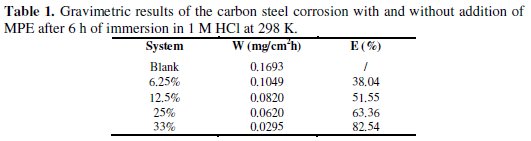
    <p><a href="#t1">Table 1</a> gives values of the rate of corrosion (mg cm<sup>-2</sup> h<sup>-1</sup>) and inhibition 
efficiency (E %) for corrosion of carbon steel in 1 M HCl in the presence of 
mentha pulegium extract as green inhibitor at different concentrations.</p>


    <p>&nbsp;</p>
<a name="t1">
<img src="/img/revistas/pea/v32n4/32n4a03t1.jpg">
    
<p>&nbsp;</p>


    <p>From <a href="#t1">Table 1</a>, it's clear that the corrosion rate of carbon steel in the blank is 
higher in comparison with the blank containing MPE. The W decreased when the 
concentration of inhibitors increased. The addition of 6.25% mentha pulegium 
extract into the aggressive medium reduces the corrosion rate by 38 %, reaching 
82.54 % with the addition of 33% of mentha pulegium extract. The inhibition 
efficiency of mentha pulegium extracts increases as a function of their 
concentration. This result suggests that an increase in extract concentration 
increases the number of inhibitor molecules adsorbed onto the carbon steel 
surface and reduces the surface area that is available for the direct acid attack on 
the metal surface.</p>


    <p><b><i>Polarization curves</i></b></p>

    ]]></body>
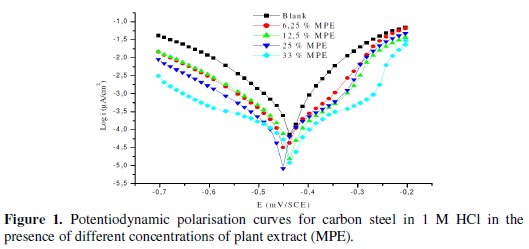
<body><![CDATA[<p>Potentiodynamic polarization curves of carbon steel in molar HCl in the absence 
and presence of MPE at different concentrations at 298 K are presented in <a href="#f1">Fig. 1</a>.</p>


    <p>&nbsp;</p>
<a name="f1">
<img src="/img/revistas/pea/v32n4/32n4a03f1.jpg">
    
<p>&nbsp;</p>


    <p>From this figure, it can be seen that with the increase of the extract 
concentrations, both anodic and cathodic currents were inhibited. This result 
shows that the addition of the Mentha pulegium inhibitor reduced anodic 
dissolution and also retarded the hydrogen evolution reaction.</p>

    <p>In addition, the parallel cathodic Tafel curves in <a href="#f1">Fig. 1</a> show that the hydrogen 
evolution is activation controlled, and the reduction mechanism is not affected by 
the presence of the plant extract [24].</p>

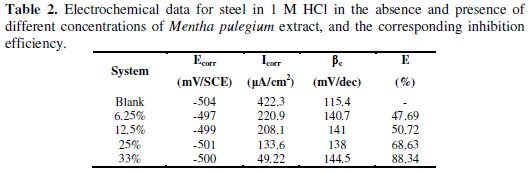
    <p><a href="#t2">Table 2</a> shows the fitting results of the polarization curves obtained.</p>


    <p>&nbsp;</p>
<a name="t2">
<img src="/img/revistas/pea/v32n4/32n4a03t2.jpg">
    
<p>&nbsp;</p>


    <p>Other electrochemical parameters and the inhibition efficiencies of the extract can be 
determined from the corrosion current densities (I<sub>corr</sub>) with and without inhibitors, 
which are also presented in <a href="#t2">Table 2</a>.</p>

    <p>In this case, the inhibition efficiency is defined as follows:</p>


    ]]></body>
<body><![CDATA[<p>&nbsp;</p>
<a name="e2">
<img src="/img/revistas/pea/v32n4/32n4a03e2.jpg">
    
<p>&nbsp;</p>


    <p>where I<sub>corr</sub> and I'<sub>corr</sub> are current densities in absence and presence of MPE, 
respectively. We noted that Icorr and I'corr were calculated from the intersection of 
cathodic and anodic Tafel lines.</p>

    <p>The inspection of results in <a href="#t2">Table 2</a> indicates that the inhibition efficiency of the 
Mentha pulegium extract is 88%; the free corrosion potential determined after 30 
mn of immersion does not change in the presence of the green inhibitor; thus, it 
can be classified as a mixed-type inhibitor in 1 M HCl.</p>


    <p><b><i>Electrochemical impedance spectroscopy measurements</i></b></p>

    <p>EIS has been shown to be a powerful tool to study the corrosion processes of 
metals in different environments and to characterize the inhibition ability of a 
corrosion inhibitor, which is related to the charge transfer resistance (R<sub>t</sub>). The 
double-layer capacitance (C<sub>dl</sub>) can also be used to determine the inhibition 
ability. The inhibition performance of an organic or natural substance on a metal 
surface depends not only on the chemical structure of the organic substance and 
the nature of the metal, but also on the experimental conditions such as the 
immersion time and the concentration of the adsorbent.</p>

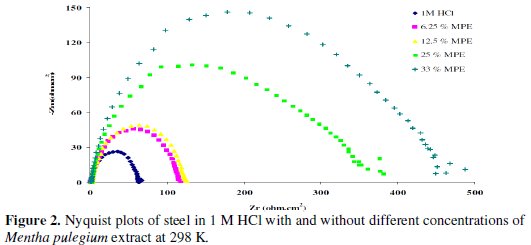
    <p>The corrosion behavior of carbon steel, in acidic solution with and without 
Mentha pulegium extract, is also investigated by electrochemical impedance 
spectroscopy (EIS) measurements at 298 K (<a href="#f2">Fig. 2</a>).</p>


    <p>&nbsp;</p>
<a name="f2">
<img src="/img/revistas/pea/v32n4/32n4a03f2.jpg">
    
<p>&nbsp;</p>


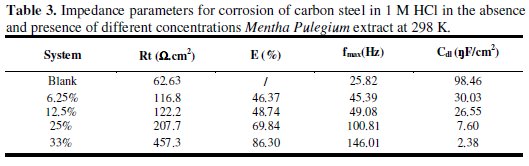
    <p>The electrochemical impedance parameters derived from these investigations are 
mentioned in <a href="#t3">Table 3</a>.</p>


    ]]></body>
<body><![CDATA[<p>&nbsp;</p>
<a name="t3">
<img src="/img/revistas/pea/v32n4/32n4a03t3.jpg">
    
<p>&nbsp;</p>


    <p>The inhibition efficiency got from the charge transfer resistance is calculated by:</p>


    <p>&nbsp;</p>
<a name="e3">
<img src="/img/revistas/pea/v32n4/32n4a03e3.jpg">
    
<p>&nbsp;</p>


    <p>where Rt and R0t are the charge transfer resistances in inhibited and uninhibited 
solutions respectively.</p>

    <p>The charge transfer resistance (R<sub>t</sub>) values are calculated from the difference in 
impedance at lower and higher frequencies, as suggested by Tsuru et al. [25].</p>

    <p>As it can be seen from <a href="#f2">Fig. 2</a>, impedance diagrams show a semi-circular 
appearance, indicating that a charge transfer process mainly controls the 
corrosion of carbon steel. From the impedance data, we notice an increase in the 
charge transfer resistance and decrease of the double layer capacitance with 
increasing the inhibitor concentration, indicating that Mentha pulegium extract 
inhibits the corrosion rate of carbon steel by an adsorption mechanism. 
Therefore, the decrease in the Cdl value can be attributed to a decrease in the 
local dielectric constant and/or an increase in the thickness of the electrical 
double layer, suggesting that the inhibitor molecules act by adsorption at the 
metal/solution interface as a consequence of the replacement of water molecules 
by the inhibitor molecules [26].</p>

    <p>A comparison may be made between the inhibition efficiency E (%) values 
obtained by different methods (weight loss and electrochemical methods).We can 
see that whatever the method used, no significant changes are observed in E (%) 
values. We can then conclude that there is a good agreement with the three 
methods used in this investigation at all tested concentrations and that the acid 
extract of Mentha pulegium acts as green inhibitor for acid corrosion of carbon 
steel.</p>


    <p><b><i>Adsorption considerations</i></b></p>

    ]]></body>
<body><![CDATA[<p>Adsorption isotherm is necessary in studying the mechanism of adsorption and 
also the adsorption characteristics of the inhibitor.</p>

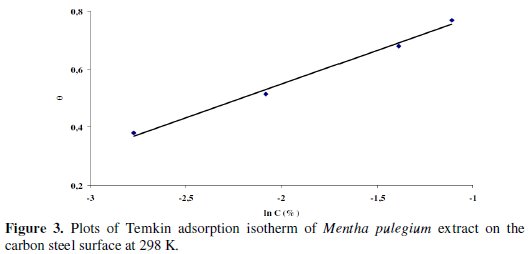
    <p>In order to obtain the isotherm, coverage &Theta; as a function of MPE concentration 
must be obtained being &Theta; is the ratio E (%)/100. Several isotherms were tested, 
such as Langmuir, Temkin, Frumkin, etc., to well fit experiments data.</p>

    <p><a href="#f3">Fig. 3</a> shows the variation of &Theta; against the logarithm of the Mentha pulegium 
extract concentration.</p>


    <p>&nbsp;</p>
<a name="f3">
<img src="/img/revistas/pea/v32n4/32n4a03f3.jpg">
    
<p>&nbsp;</p>


    <p>The data fit a straight line, with a slope nearly equal to 
unity, indicating that these compounds adsorb according to Temkin adsorption 
isotherm. The linear correlation coefficient is 0.993, close to unity.</p>

    <p>The Temkin isotherm equation is:</p>


    <p>&nbsp;</p>
<a name="e4">
<img src="/img/revistas/pea/v32n4/32n4a03e4.jpg">
    
<p>&nbsp;</p>


    <p>where C is the Mentha pulegium extract concentration and Kads the equilibrium 
constant of the adsorption process.</p>


    ]]></body>
<body><![CDATA[<p><b><i>Effect of temperature</i></b></p>

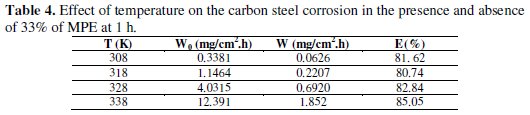
    <p>The effect of temperature on the corrosion parameters of carbon steel in free and 
inhibited solutions of 1 M HCl was studied using weight loss measurements 
during 1 hour in the temperature range 308-338 K; the corresponding results are 
summarised in <a href="#t4">Table 4</a>.</p>


    <p>&nbsp;</p>
<a name="t4">
<img src="/img/revistas/pea/v32n4/32n4a03t4.jpg">
    
<p>&nbsp;</p>


    <p>The data in <a href="#t4">Table 4</a> indicate that the acid attacks were inhibited by addition of 
33% of Mentha pulegium extract. But the increase in corrosion rate is more 
pronounced with the rise of temperature for the uninhibited acid solution. The 
presence of the inhibitor leads to decrease of the corrosion rate. E% depends 
upon the temperature and increases with it.</p>


    <p><b><i>Activation energy calculations</i></b></p>

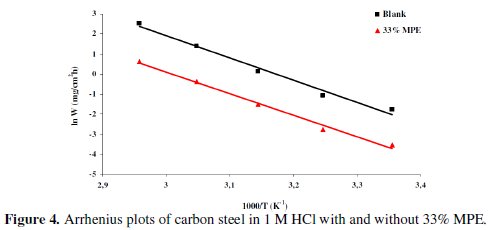
    <p>The change of the corrosion rate in presence and absence of 33% of Mentha 
pulegium extract was plotted against temperature for calculation of the activation 
energy (<a href="#f4">Fig. 4</a>).</p>


    <p>&nbsp;</p>
<a name="f4">
<img src="/img/revistas/pea/v32n4/32n4a03f4.jpg">
    
<p>&nbsp;</p>


    <p>The apparent activation energies (E<sub>a</sub>) for the corrosion process in absence and 
presence of the inhibitor were evaluated from the Arrhenius equation:</p>


    ]]></body>
<body><![CDATA[<p>&nbsp;</p>
<a name="e5">
<img src="/img/revistas/pea/v32n4/32n4a03e5.jpg">
    
<p>&nbsp;</p>


    <p>The effects of MPE increase the energy of activation and reduce the surface 
available for corrosion [27]. Addition of plant extracts at 33% in 1 M HCl 
decreases the activation energy from 92.41 to 89.32 kJ mol<sup>-1</sup>. This diminution 
may be attributed to the change in the mechanism of the corrosion process in the 
presence of adsorbed inhibitor molecules [28, 29]. The lower value of the 
activation energy of the process in the inhibitor's presence when compared to 
that in its absence is attributed to its chemisorptions [30-32].</p>


    <p><b><i>Scanning Electron Microscopy (SEM)</i></b></p>

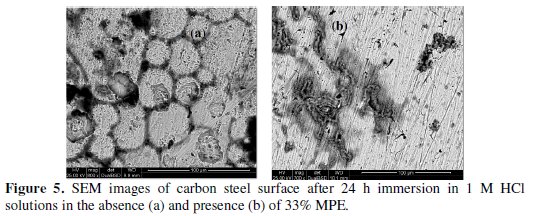
    <p>SEM images were recorded to investigate the changes occurred on the surface of 
the carbon steel samples after 24 h immersion in 1 M HCl solution in the absence 
and presence of the inhibitor. <a href="#f5">Fig. 5 (a)</a> presents the micrograph obtained for a 
carbon steel sample after exposure to blank solution, while <a href="#f5">Fig. 5 (b)</a> presents the 
surface morphology of carbon steel specimens immersed in 1 M HCl medium 
containing 33% of Mentha pulegium extract.</p>


    <p>&nbsp;</p>
<a name="f5">
<img src="/img/revistas/pea/v32n4/32n4a03f5.jpg">
    
<p>&nbsp;</p>


    <p>As can be seen from <a href="#f5">Fig. 5 (a)</a>, carbon steel surface in the uninhibited solution is 
severely damaged and rough due to an aggressive attack of the corroding 
medium. <a href="#f5">Fig. 5 (b)</a> reveals that the corrosion marks on the inhibited samples 
decrease in presence of Mentha pulegium extract which also attests the inhibition 
ability and adsorption of the inhibitor on the carbon steel surface. Moreover the 
parallel lines on the carbon steel surface can be attributed to polishing scratches.</p>


    <p>&nbsp;</p>
    <p><b>Conclusion</b></p>

    ]]></body>
<body><![CDATA[<p>In this study, corrosion inhibition efficiency of Mentha pulegium extract (MPE), 
in 1 M HCl medium was determined by weight loss, potentiodynamic 
polarisation and electrochemical techniques. Results evidenced that this green 
inhibitor showed excellent performance (more than 88% at 33%) as corrosion 
inhibitor. It inhibits through adsorption process and was found to follow Timkin 
adsorption isotherm.</p>

    <p>Impedance studies revealed that the inhibitor reduced the corrosion rate by 
increasing the resistance of the system. Potentiodynamic polarization studies 
confirmed that the inhibitor acted through a mixed type of corrosion inhibition 
mechanism.</p>

    <p>From SEM images, it can be deducted that the carbon steel surface became 
smoother in the presence of Mentha pulegium extract which had a positive effect 
on the corrosion properties of carbon steel.</p>


    <p>&nbsp;</p>
    <p><b>References</b></p>

    <!-- ref --><p>1. Khadraoui A, Khelifa A. Res Chem Intermed. 2013;39:937.    &nbsp;&nbsp;&nbsp;&nbsp;&nbsp;&nbsp;&nbsp;&nbsp;[&#160;<a href="javascript:void(0);" onclick="javascript: window.open('/scielo.php?script=sci_nlinks&ref=000108&pid=S0872-1904201400040000300001&lng=','','width=640,height=500,resizable=yes,scrollbars=1,menubar=yes,');">Links</a>&#160;]<!-- end-ref --></p>

    <!-- ref --><p>2. Khadraoui A, Khelifa A, Hamitouche H, et al. Res Chem Intermed. 2014;40:961.    &nbsp;&nbsp;&nbsp;&nbsp;&nbsp;&nbsp;&nbsp;&nbsp;[&#160;<a href="javascript:void(0);" onclick="javascript: window.open('/scielo.php?script=sci_nlinks&ref=000110&pid=S0872-1904201400040000300002&lng=','','width=640,height=500,resizable=yes,scrollbars=1,menubar=yes,');">Links</a>&#160;]<!-- end-ref --></p>

    <!-- ref --><p>3. Okafor PC, Ekpe UJ, Ebenso EE, et al. Bull Electrochem. 2005;21:347.    &nbsp;&nbsp;&nbsp;&nbsp;&nbsp;&nbsp;&nbsp;&nbsp;[&#160;<a href="javascript:void(0);" onclick="javascript: window.open('/scielo.php?script=sci_nlinks&ref=000112&pid=S0872-1904201400040000300003&lng=','','width=640,height=500,resizable=yes,scrollbars=1,menubar=yes,');">Links</a>&#160;]<!-- end-ref --></p>

    <!-- ref --><p>4. El-Etre AY, Abdallah M, El-Tantawy ZE. Corros Sci. 2005;47:385.    &nbsp;&nbsp;&nbsp;&nbsp;&nbsp;&nbsp;&nbsp;&nbsp;[&#160;<a href="javascript:void(0);" onclick="javascript: window.open('/scielo.php?script=sci_nlinks&ref=000114&pid=S0872-1904201400040000300004&lng=','','width=640,height=500,resizable=yes,scrollbars=1,menubar=yes,');">Links</a>&#160;]<!-- end-ref --></p>

    <!-- ref --><p>5. Khadraoui A, Khelifa A, Touafri L, et al. J Mater Environ Sci. 2013;4:663.    &nbsp;&nbsp;&nbsp;&nbsp;&nbsp;&nbsp;&nbsp;&nbsp;[&#160;<a href="javascript:void(0);" onclick="javascript: window.open('/scielo.php?script=sci_nlinks&ref=000116&pid=S0872-1904201400040000300005&lng=','','width=640,height=500,resizable=yes,scrollbars=1,menubar=yes,');">Links</a>&#160;]<!-- end-ref --></p>

    <!-- ref --><p>6. Oguzie EE, Onuchukwu AI, Okafor PC, et al. Pigment Resin Tech. 2006;35:63.    &nbsp;&nbsp;&nbsp;&nbsp;&nbsp;&nbsp;&nbsp;&nbsp;[&#160;<a href="javascript:void(0);" onclick="javascript: window.open('/scielo.php?script=sci_nlinks&ref=000118&pid=S0872-1904201400040000300006&lng=','','width=640,height=500,resizable=yes,scrollbars=1,menubar=yes,');">Links</a>&#160;]<!-- end-ref --></p>

    <!-- ref --><p>7. Ebenso EE. Mater Chem Phys. 2003;78:58.    &nbsp;&nbsp;&nbsp;&nbsp;&nbsp;&nbsp;&nbsp;&nbsp;[&#160;<a href="javascript:void(0);" onclick="javascript: window.open('/scielo.php?script=sci_nlinks&ref=000120&pid=S0872-1904201400040000300007&lng=','','width=640,height=500,resizable=yes,scrollbars=1,menubar=yes,');">Links</a>&#160;]<!-- end-ref --></p>

    <!-- ref --><p>8. Ebenso EE, Ekpe UJ, Umoren S, et al. J Corros Sci Technol. 2004;1:22.    &nbsp;&nbsp;&nbsp;&nbsp;&nbsp;&nbsp;&nbsp;&nbsp;[&#160;<a href="javascript:void(0);" onclick="javascript: window.open('/scielo.php?script=sci_nlinks&ref=000122&pid=S0872-1904201400040000300008&lng=','','width=640,height=500,resizable=yes,scrollbars=1,menubar=yes,');">Links</a>&#160;]<!-- end-ref --></p>

    <!-- ref --><p>9. Ebenso EE, Ekpe UJ, Umoren S, et al. J. Corros. Sci. Techol. 2004;1:96.    &nbsp;&nbsp;&nbsp;&nbsp;&nbsp;&nbsp;&nbsp;&nbsp;[&#160;<a href="javascript:void(0);" onclick="javascript: window.open('/scielo.php?script=sci_nlinks&ref=000124&pid=S0872-1904201400040000300009&lng=','','width=640,height=500,resizable=yes,scrollbars=1,menubar=yes,');">Links</a>&#160;]<!-- end-ref --></p>

    <!-- ref --><p>10. Oguzie EE, Okolue BN, Ogukwe CE, et al. J Corros Sci Technol. 2004;1:88.    &nbsp;&nbsp;&nbsp;&nbsp;&nbsp;&nbsp;&nbsp;&nbsp;[&#160;<a href="javascript:void(0);" onclick="javascript: window.open('/scielo.php?script=sci_nlinks&ref=000126&pid=S0872-1904201400040000300010&lng=','','width=640,height=500,resizable=yes,scrollbars=1,menubar=yes,');">Links</a>&#160;]<!-- end-ref --></p>

    <!-- ref --><p>11. Saleh RM, Ismail AA, El Hosary AH. Br Corros J. 1982;17:131.    &nbsp;&nbsp;&nbsp;&nbsp;&nbsp;&nbsp;&nbsp;&nbsp;[&#160;<a href="javascript:void(0);" onclick="javascript: window.open('/scielo.php?script=sci_nlinks&ref=000128&pid=S0872-1904201400040000300011&lng=','','width=640,height=500,resizable=yes,scrollbars=1,menubar=yes,');">Links</a>&#160;]<!-- end-ref --></p>

    <!-- ref --><p>12. Srivatsava K, Srivatsava P. Br Corros J. 1981;16:221.    &nbsp;&nbsp;&nbsp;&nbsp;&nbsp;&nbsp;&nbsp;&nbsp;[&#160;<a href="javascript:void(0);" onclick="javascript: window.open('/scielo.php?script=sci_nlinks&ref=000130&pid=S0872-1904201400040000300012&lng=','','width=640,height=500,resizable=yes,scrollbars=1,menubar=yes,');">Links</a>&#160;]<!-- end-ref --></p>

    <!-- ref --><p>13. Khadraoui A, Khelifa A, Boutoumi H, et al. Int. J. Electrochem. Sci. 2014;9:3334.    &nbsp;&nbsp;&nbsp;&nbsp;&nbsp;&nbsp;&nbsp;&nbsp;[&#160;<a href="javascript:void(0);" onclick="javascript: window.open('/scielo.php?script=sci_nlinks&ref=000132&pid=S0872-1904201400040000300013&lng=','','width=640,height=500,resizable=yes,scrollbars=1,menubar=yes,');">Links</a>&#160;]<!-- end-ref --></p>

    <!-- ref --><p>14. Putilova N, Balezin SA, Barannik VP. Metallic Corrosion Inhibitors. Oxford: London Pergamon Press; 1960.    &nbsp;&nbsp;&nbsp;&nbsp;&nbsp;&nbsp;&nbsp;&nbsp;[&#160;<a href="javascript:void(0);" onclick="javascript: window.open('/scielo.php?script=sci_nlinks&ref=000134&pid=S0872-1904201400040000300014&lng=','','width=640,height=500,resizable=yes,scrollbars=1,menubar=yes,');">Links</a>&#160;]<!-- end-ref --></p>

    <!-- ref --><p>15. Ammar IA, El Khorafi FM. Werkstsf &amp; Korros. 1973;24:702.    &nbsp;&nbsp;&nbsp;&nbsp;&nbsp;&nbsp;&nbsp;&nbsp;[&#160;<a href="javascript:void(0);" onclick="javascript: window.open('/scielo.php?script=sci_nlinks&ref=000136&pid=S0872-1904201400040000300015&lng=','','width=640,height=500,resizable=yes,scrollbars=1,menubar=yes,');">Links</a>&#160;]<!-- end-ref --></p>

    <!-- ref --><p>16. Abed Y, Kissi M, Hammouti B, et al. Prog Org Coat. 2004;50:144.    &nbsp;&nbsp;&nbsp;&nbsp;&nbsp;&nbsp;&nbsp;&nbsp;[&#160;<a href="javascript:void(0);" onclick="javascript: window.open('/scielo.php?script=sci_nlinks&ref=000138&pid=S0872-1904201400040000300016&lng=','','width=640,height=500,resizable=yes,scrollbars=1,menubar=yes,');">Links</a>&#160;]<!-- end-ref --></p>

    <!-- ref --><p>17. Khamis E, Al-Andis N. Mat-wiss u werkstofftech. 2002;33:550.    &nbsp;&nbsp;&nbsp;&nbsp;&nbsp;&nbsp;&nbsp;&nbsp;[&#160;<a href="javascript:void(0);" onclick="javascript: window.open('/scielo.php?script=sci_nlinks&ref=000140&pid=S0872-1904201400040000300017&lng=','','width=640,height=500,resizable=yes,scrollbars=1,menubar=yes,');">Links</a>&#160;]<!-- end-ref --></p>

    <!-- ref --><p>18. El-Etre AY. Corros Sci. 1998;40:1845.    &nbsp;&nbsp;&nbsp;&nbsp;&nbsp;&nbsp;&nbsp;&nbsp;[&#160;<a href="javascript:void(0);" onclick="javascript: window.open('/scielo.php?script=sci_nlinks&ref=000142&pid=S0872-1904201400040000300018&lng=','','width=640,height=500,resizable=yes,scrollbars=1,menubar=yes,');">Links</a>&#160;]<!-- end-ref --></p>

    <!-- ref --><p>19. El-Etre AY, Abdallah M. Corros Sci. 2000;42:731.    &nbsp;&nbsp;&nbsp;&nbsp;&nbsp;&nbsp;&nbsp;&nbsp;[&#160;<a href="javascript:void(0);" onclick="javascript: window.open('/scielo.php?script=sci_nlinks&ref=000144&pid=S0872-1904201400040000300019&lng=','','width=640,height=500,resizable=yes,scrollbars=1,menubar=yes,');">Links</a>&#160;]<!-- end-ref --></p>

    <!-- ref --><p>20. Parikh KS, Joshi KJ. Trans SAEST. 2004;39:29.    &nbsp;&nbsp;&nbsp;&nbsp;&nbsp;&nbsp;&nbsp;&nbsp;[&#160;<a href="javascript:void(0);" onclick="javascript: window.open('/scielo.php?script=sci_nlinks&ref=000146&pid=S0872-1904201400040000300020&lng=','','width=640,height=500,resizable=yes,scrollbars=1,menubar=yes,');">Links</a>&#160;]<!-- end-ref --></p>

    <!-- ref --><p>21. Sathiyanathan RAL, Maruthamuthu S, Selvanayagam M, et al. Ind J Chem Tech. 2005;12:356.    &nbsp;&nbsp;&nbsp;&nbsp;&nbsp;&nbsp;&nbsp;&nbsp;[&#160;<a href="javascript:void(0);" onclick="javascript: window.open('/scielo.php?script=sci_nlinks&ref=000148&pid=S0872-1904201400040000300021&lng=','','width=640,height=500,resizable=yes,scrollbars=1,menubar=yes,');">Links</a>&#160;]<!-- end-ref --></p>

    <!-- ref --><p>22. Chetouani A, Hammouti B. Bull Electrochem. 2003;19:23.    &nbsp;&nbsp;&nbsp;&nbsp;&nbsp;&nbsp;&nbsp;&nbsp;[&#160;<a href="javascript:void(0);" onclick="javascript: window.open('/scielo.php?script=sci_nlinks&ref=000150&pid=S0872-1904201400040000300022&lng=','','width=640,height=500,resizable=yes,scrollbars=1,menubar=yes,');">Links</a>&#160;]<!-- end-ref --></p>

    <!-- ref --><p>23. Bouyanzer A, Hammouti B, Majidi L. Mater Letters. 2006;60:2840.    &nbsp;&nbsp;&nbsp;&nbsp;&nbsp;&nbsp;&nbsp;&nbsp;[&#160;<a href="javascript:void(0);" onclick="javascript: window.open('/scielo.php?script=sci_nlinks&ref=000152&pid=S0872-1904201400040000300023&lng=','','width=640,height=500,resizable=yes,scrollbars=1,menubar=yes,');">Links</a>&#160;]<!-- end-ref --></p>

    <!-- ref --><p>24. Kertit S, Hammouti B. Appl Surf Sci. 1996;93:59.    &nbsp;&nbsp;&nbsp;&nbsp;&nbsp;&nbsp;&nbsp;&nbsp;[&#160;<a href="javascript:void(0);" onclick="javascript: window.open('/scielo.php?script=sci_nlinks&ref=000154&pid=S0872-1904201400040000300024&lng=','','width=640,height=500,resizable=yes,scrollbars=1,menubar=yes,');">Links</a>&#160;]<!-- end-ref --></p>

    <!-- ref --><p>25. Tsuru T, Haruyama S, Gijutsu B. J Jpn Soc Corros Eng. 1978;27:573.    &nbsp;&nbsp;&nbsp;&nbsp;&nbsp;&nbsp;&nbsp;&nbsp;[&#160;<a href="javascript:void(0);" onclick="javascript: window.open('/scielo.php?script=sci_nlinks&ref=000156&pid=S0872-1904201400040000300025&lng=','','width=640,height=500,resizable=yes,scrollbars=1,menubar=yes,');">Links</a>&#160;]<!-- end-ref --></p>

    <!-- ref --><p>26. Benalli O, Larabi L, Traisnel M, et al. Appl Surf Sci. 2007; 253:6130.    &nbsp;&nbsp;&nbsp;&nbsp;&nbsp;&nbsp;&nbsp;&nbsp;[&#160;<a href="javascript:void(0);" onclick="javascript: window.open('/scielo.php?script=sci_nlinks&ref=000158&pid=S0872-1904201400040000300026&lng=','','width=640,height=500,resizable=yes,scrollbars=1,menubar=yes,');">Links</a>&#160;]<!-- end-ref --></p>

    <!-- ref --><p>27. Antropov LI. Corros Sci. 1967;7:607.    &nbsp;&nbsp;&nbsp;&nbsp;&nbsp;&nbsp;&nbsp;&nbsp;[&#160;<a href="javascript:void(0);" onclick="javascript: window.open('/scielo.php?script=sci_nlinks&ref=000160&pid=S0872-1904201400040000300027&lng=','','width=640,height=500,resizable=yes,scrollbars=1,menubar=yes,');">Links</a>&#160;]<!-- end-ref --></p>

    <!-- ref --><p>28. El Ouali I, Hammouti B, Aouniti A, et al. J Mater Environ Sci. 2010;1:1.    &nbsp;&nbsp;&nbsp;&nbsp;&nbsp;&nbsp;&nbsp;&nbsp;[&#160;<a href="javascript:void(0);" onclick="javascript: window.open('/scielo.php?script=sci_nlinks&ref=000162&pid=S0872-1904201400040000300028&lng=','','width=640,height=500,resizable=yes,scrollbars=1,menubar=yes,');">Links</a>&#160;]<!-- end-ref --></p>

    <!-- ref --><p>29. Bouklah M, Hammouti B, LagreneÂ´e M, et al. Corros Sci. 2006;48:2831.    &nbsp;&nbsp;&nbsp;&nbsp;&nbsp;&nbsp;&nbsp;&nbsp;[&#160;<a href="javascript:void(0);" onclick="javascript: window.open('/scielo.php?script=sci_nlinks&ref=000164&pid=S0872-1904201400040000300029&lng=','','width=640,height=500,resizable=yes,scrollbars=1,menubar=yes,');">Links</a>&#160;]<!-- end-ref --></p>

    <!-- ref --><p>30. Popova A, Christov M, Raicheva S, et al. Corros Sci. 2004;46:1333.    &nbsp;&nbsp;&nbsp;&nbsp;&nbsp;&nbsp;&nbsp;&nbsp;[&#160;<a href="javascript:void(0);" onclick="javascript: window.open('/scielo.php?script=sci_nlinks&ref=000166&pid=S0872-1904201400040000300030&lng=','','width=640,height=500,resizable=yes,scrollbars=1,menubar=yes,');">Links</a>&#160;]<!-- end-ref --></p>

    <!-- ref --><p>31. Chaieb E, Bouyanzer A, Hammouti B, et al. Appl. Surf. Sci. 2005;246:199.    &nbsp;&nbsp;&nbsp;&nbsp;&nbsp;&nbsp;&nbsp;&nbsp;[&#160;<a href="javascript:void(0);" onclick="javascript: window.open('/scielo.php?script=sci_nlinks&ref=000168&pid=S0872-1904201400040000300031&lng=','','width=640,height=500,resizable=yes,scrollbars=1,menubar=yes,');">Links</a>&#160;]<!-- end-ref --></p>

    <!-- ref --><p>32. Khadraoui, Khelifa A. Boutoumi H. et al. Nat Prod Res. 2014;28:1206.    &nbsp;&nbsp;&nbsp;&nbsp;&nbsp;&nbsp;&nbsp;&nbsp;[&#160;<a href="javascript:void(0);" onclick="javascript: window.open('/scielo.php?script=sci_nlinks&ref=000170&pid=S0872-1904201400040000300032&lng=','','width=640,height=500,resizable=yes,scrollbars=1,menubar=yes,');">Links</a>&#160;]<!-- end-ref --></p>


    <p>&nbsp;</p>
    ]]></body>
<body><![CDATA[<p><a name=0></a><sup><a href="#top">*</a></sup>Corresponding author. E-mail address: <a href="mailto:hammoutib@gmail.com">hammoutib@gmail.com</a></p>

    <p>Received 15 June 2014; accepted 21 August 2014</p>

    <p><a href="http://www.peacta.org" target="_blank">www.peacta.org</a> </p>


     ]]></body><back>
<ref-list>
<ref id="B1">
<label>1</label><nlm-citation citation-type="journal">
<person-group person-group-type="author">
<name>
<surname><![CDATA[Khadraoui]]></surname>
<given-names><![CDATA[A]]></given-names>
</name>
<name>
<surname><![CDATA[Khelifa]]></surname>
<given-names><![CDATA[A]]></given-names>
</name>
</person-group>
<source><![CDATA[Res Chem Intermed]]></source>
<year>2013</year>
<volume>39</volume>
<page-range>937</page-range></nlm-citation>
</ref>
<ref id="B2">
<label>2</label><nlm-citation citation-type="journal">
<person-group person-group-type="author">
<name>
<surname><![CDATA[Khadraoui]]></surname>
<given-names><![CDATA[A]]></given-names>
</name>
<name>
<surname><![CDATA[Khelifa]]></surname>
<given-names><![CDATA[A]]></given-names>
</name>
<name>
<surname><![CDATA[Hamitouche]]></surname>
<given-names><![CDATA[H]]></given-names>
</name>
</person-group>
<source><![CDATA[Res Chem Intermed]]></source>
<year>2014</year>
<volume>40</volume>
<page-range>961</page-range></nlm-citation>
</ref>
<ref id="B3">
<label>3</label><nlm-citation citation-type="journal">
<person-group person-group-type="author">
<name>
<surname><![CDATA[Okafor]]></surname>
<given-names><![CDATA[PC]]></given-names>
</name>
<name>
<surname><![CDATA[Ekpe]]></surname>
<given-names><![CDATA[UJ]]></given-names>
</name>
<name>
<surname><![CDATA[Ebenso]]></surname>
<given-names><![CDATA[EE]]></given-names>
</name>
</person-group>
<source><![CDATA[Bull Electrochem]]></source>
<year>2005</year>
<volume>21</volume>
<page-range>347</page-range></nlm-citation>
</ref>
<ref id="B4">
<label>4</label><nlm-citation citation-type="journal">
<person-group person-group-type="author">
<name>
<surname><![CDATA[El-Etre]]></surname>
<given-names><![CDATA[AY]]></given-names>
</name>
<name>
<surname><![CDATA[Abdallah]]></surname>
<given-names><![CDATA[M]]></given-names>
</name>
<name>
<surname><![CDATA[El-Tantawy]]></surname>
<given-names><![CDATA[ZE]]></given-names>
</name>
</person-group>
<source><![CDATA[Corros Sci]]></source>
<year>2005</year>
<volume>47</volume>
<page-range>385</page-range></nlm-citation>
</ref>
<ref id="B5">
<label>5</label><nlm-citation citation-type="journal">
<person-group person-group-type="author">
<name>
<surname><![CDATA[Khadraoui]]></surname>
<given-names><![CDATA[A]]></given-names>
</name>
<name>
<surname><![CDATA[Khelifa]]></surname>
<given-names><![CDATA[A]]></given-names>
</name>
<name>
<surname><![CDATA[Touafri]]></surname>
<given-names><![CDATA[L]]></given-names>
</name>
</person-group>
<source><![CDATA[J Mater Environ Sci]]></source>
<year>2013</year>
<volume>4</volume>
<page-range>663</page-range></nlm-citation>
</ref>
<ref id="B6">
<label>6</label><nlm-citation citation-type="journal">
<person-group person-group-type="author">
<name>
<surname><![CDATA[Oguzie]]></surname>
<given-names><![CDATA[EE]]></given-names>
</name>
<name>
<surname><![CDATA[Onuchukwu]]></surname>
<given-names><![CDATA[AI]]></given-names>
</name>
<name>
<surname><![CDATA[Okafor]]></surname>
<given-names><![CDATA[PC]]></given-names>
</name>
</person-group>
<source><![CDATA[Pigment Resin Tech]]></source>
<year>2006</year>
<volume>35</volume>
<page-range>63</page-range></nlm-citation>
</ref>
<ref id="B7">
<label>7</label><nlm-citation citation-type="journal">
<person-group person-group-type="author">
<name>
<surname><![CDATA[Ebenso]]></surname>
<given-names><![CDATA[EE]]></given-names>
</name>
</person-group>
<source><![CDATA[Mater Chem Phys]]></source>
<year>2003</year>
<volume>78</volume>
<page-range>58</page-range></nlm-citation>
</ref>
<ref id="B8">
<label>8</label><nlm-citation citation-type="journal">
<person-group person-group-type="author">
<name>
<surname><![CDATA[Ebenso]]></surname>
<given-names><![CDATA[EE]]></given-names>
</name>
<name>
<surname><![CDATA[Ekpe]]></surname>
<given-names><![CDATA[UJ]]></given-names>
</name>
<name>
<surname><![CDATA[Umoren]]></surname>
<given-names><![CDATA[S]]></given-names>
</name>
</person-group>
<source><![CDATA[J Corros Sci Technol]]></source>
<year>2004</year>
<volume>1</volume>
<page-range>22</page-range></nlm-citation>
</ref>
<ref id="B9">
<label>9</label><nlm-citation citation-type="journal">
<person-group person-group-type="author">
<name>
<surname><![CDATA[Ebenso]]></surname>
<given-names><![CDATA[EE]]></given-names>
</name>
<name>
<surname><![CDATA[Ekpe]]></surname>
<given-names><![CDATA[UJ]]></given-names>
</name>
<name>
<surname><![CDATA[Umoren]]></surname>
<given-names><![CDATA[S]]></given-names>
</name>
</person-group>
<source><![CDATA[J. Corros. Sci. Techol]]></source>
<year>2004</year>
<volume>1</volume>
<page-range>96</page-range></nlm-citation>
</ref>
<ref id="B10">
<label>10</label><nlm-citation citation-type="journal">
<person-group person-group-type="author">
<name>
<surname><![CDATA[Oguzie]]></surname>
<given-names><![CDATA[EE]]></given-names>
</name>
<name>
<surname><![CDATA[Okolue]]></surname>
<given-names><![CDATA[BN]]></given-names>
</name>
<name>
<surname><![CDATA[Ogukwe]]></surname>
<given-names><![CDATA[CE]]></given-names>
</name>
</person-group>
<source><![CDATA[J Corros Sci Technol]]></source>
<year>2004</year>
<volume>1</volume>
<page-range>88</page-range></nlm-citation>
</ref>
<ref id="B11">
<label>11</label><nlm-citation citation-type="journal">
<person-group person-group-type="author">
<name>
<surname><![CDATA[Saleh]]></surname>
<given-names><![CDATA[RM]]></given-names>
</name>
<name>
<surname><![CDATA[Ismail]]></surname>
<given-names><![CDATA[AA]]></given-names>
</name>
<name>
<surname><![CDATA[El-Hosary]]></surname>
<given-names><![CDATA[AH]]></given-names>
</name>
</person-group>
<source><![CDATA[Br Corros J]]></source>
<year>1982</year>
<volume>17</volume>
<page-range>131</page-range></nlm-citation>
</ref>
<ref id="B12">
<label>12</label><nlm-citation citation-type="journal">
<person-group person-group-type="author">
<name>
<surname><![CDATA[Srivatsava]]></surname>
<given-names><![CDATA[K]]></given-names>
</name>
<name>
<surname><![CDATA[Srivatsava]]></surname>
<given-names><![CDATA[P]]></given-names>
</name>
</person-group>
<source><![CDATA[Br Corros J]]></source>
<year>1981</year>
<volume>16</volume>
<page-range>221</page-range></nlm-citation>
</ref>
<ref id="B13">
<label>13</label><nlm-citation citation-type="journal">
<person-group person-group-type="author">
<name>
<surname><![CDATA[Khadraoui]]></surname>
<given-names><![CDATA[A]]></given-names>
</name>
<name>
<surname><![CDATA[Khelifa]]></surname>
<given-names><![CDATA[A]]></given-names>
</name>
<name>
<surname><![CDATA[Boutoumi]]></surname>
<given-names><![CDATA[H]]></given-names>
</name>
</person-group>
<source><![CDATA[Int. J. Electrochem. Sci]]></source>
<year>2014</year>
<volume>9</volume>
<page-range>3334</page-range></nlm-citation>
</ref>
<ref id="B14">
<label>14</label><nlm-citation citation-type="book">
<person-group person-group-type="author">
<name>
<surname><![CDATA[Putilova]]></surname>
<given-names><![CDATA[N]]></given-names>
</name>
<name>
<surname><![CDATA[Balezin]]></surname>
<given-names><![CDATA[SA]]></given-names>
</name>
<name>
<surname><![CDATA[Barannik]]></surname>
<given-names><![CDATA[VP]]></given-names>
</name>
</person-group>
<source><![CDATA[Metallic Corrosion Inhibitors]]></source>
<year>1960</year>
<publisher-loc><![CDATA[Oxford ]]></publisher-loc>
<publisher-name><![CDATA[London Pergamon Press]]></publisher-name>
</nlm-citation>
</ref>
<ref id="B15">
<label>15</label><nlm-citation citation-type="journal">
<person-group person-group-type="author">
<name>
<surname><![CDATA[Ammar]]></surname>
<given-names><![CDATA[IA]]></given-names>
</name>
<name>
<surname><![CDATA[El-Khorafi]]></surname>
<given-names><![CDATA[FM]]></given-names>
</name>
</person-group>
<source><![CDATA[Werkstsf & Korros]]></source>
<year>1973</year>
<volume>24</volume>
<page-range>702</page-range></nlm-citation>
</ref>
<ref id="B16">
<label>16</label><nlm-citation citation-type="journal">
<person-group person-group-type="author">
<name>
<surname><![CDATA[Abed]]></surname>
<given-names><![CDATA[Y]]></given-names>
</name>
<name>
<surname><![CDATA[Kissi]]></surname>
<given-names><![CDATA[M]]></given-names>
</name>
<name>
<surname><![CDATA[Hammouti]]></surname>
<given-names><![CDATA[B]]></given-names>
</name>
</person-group>
<source><![CDATA[Prog Org Coat]]></source>
<year>2004</year>
<volume>50</volume>
<page-range>144</page-range></nlm-citation>
</ref>
<ref id="B17">
<label>17</label><nlm-citation citation-type="journal">
<person-group person-group-type="author">
<name>
<surname><![CDATA[Khamis]]></surname>
<given-names><![CDATA[E]]></given-names>
</name>
<name>
<surname><![CDATA[Al-Andis]]></surname>
<given-names><![CDATA[N]]></given-names>
</name>
</person-group>
<source><![CDATA[Mat-wiss u werkstofftech]]></source>
<year>2002</year>
<volume>33</volume>
<page-range>550</page-range></nlm-citation>
</ref>
<ref id="B18">
<label>18</label><nlm-citation citation-type="journal">
<person-group person-group-type="author">
<name>
<surname><![CDATA[El-Etre]]></surname>
<given-names><![CDATA[AY]]></given-names>
</name>
</person-group>
<source><![CDATA[Corros Sci]]></source>
<year>1998</year>
<volume>40</volume>
<page-range>1845</page-range></nlm-citation>
</ref>
<ref id="B19">
<label>19</label><nlm-citation citation-type="journal">
<person-group person-group-type="author">
<name>
<surname><![CDATA[El-Etre]]></surname>
<given-names><![CDATA[AY]]></given-names>
</name>
<name>
<surname><![CDATA[Abdallah]]></surname>
<given-names><![CDATA[M]]></given-names>
</name>
</person-group>
<source><![CDATA[Corros Sci]]></source>
<year>2000</year>
<volume>42</volume>
<page-range>731</page-range></nlm-citation>
</ref>
<ref id="B20">
<label>20</label><nlm-citation citation-type="journal">
<person-group person-group-type="author">
<name>
<surname><![CDATA[Parikh]]></surname>
<given-names><![CDATA[KS]]></given-names>
</name>
<name>
<surname><![CDATA[Joshi]]></surname>
<given-names><![CDATA[KJ]]></given-names>
</name>
</person-group>
<source><![CDATA[Trans SAEST]]></source>
<year>2004</year>
<volume>39</volume>
<page-range>29</page-range></nlm-citation>
</ref>
<ref id="B21">
<label>21</label><nlm-citation citation-type="journal">
<person-group person-group-type="author">
<name>
<surname><![CDATA[Sathiyanathan]]></surname>
<given-names><![CDATA[RAL]]></given-names>
</name>
<name>
<surname><![CDATA[Maruthamuthu]]></surname>
<given-names><![CDATA[S]]></given-names>
</name>
<name>
<surname><![CDATA[Selvanayagam]]></surname>
<given-names><![CDATA[M]]></given-names>
</name>
</person-group>
<source><![CDATA[Ind J Chem Tech]]></source>
<year>2005</year>
<volume>12</volume>
<page-range>356</page-range></nlm-citation>
</ref>
<ref id="B22">
<label>22</label><nlm-citation citation-type="journal">
<person-group person-group-type="author">
<name>
<surname><![CDATA[Chetouani]]></surname>
<given-names><![CDATA[A]]></given-names>
</name>
<name>
<surname><![CDATA[Hammouti]]></surname>
<given-names><![CDATA[B]]></given-names>
</name>
</person-group>
<source><![CDATA[Bull Electrochem]]></source>
<year>2003</year>
<volume>19</volume>
<page-range>23</page-range></nlm-citation>
</ref>
<ref id="B23">
<label>23</label><nlm-citation citation-type="journal">
<person-group person-group-type="author">
<name>
<surname><![CDATA[Bouyanzer]]></surname>
<given-names><![CDATA[A]]></given-names>
</name>
<name>
<surname><![CDATA[Hammouti]]></surname>
<given-names><![CDATA[B]]></given-names>
</name>
<name>
<surname><![CDATA[Majidi]]></surname>
<given-names><![CDATA[L]]></given-names>
</name>
</person-group>
<source><![CDATA[Mater Letters]]></source>
<year>2006</year>
<volume>60</volume>
<page-range>2840</page-range></nlm-citation>
</ref>
<ref id="B24">
<label>24</label><nlm-citation citation-type="journal">
<person-group person-group-type="author">
<name>
<surname><![CDATA[Kertit]]></surname>
<given-names><![CDATA[S]]></given-names>
</name>
<name>
<surname><![CDATA[Hammouti]]></surname>
<given-names><![CDATA[B]]></given-names>
</name>
</person-group>
<source><![CDATA[Appl Surf Sci]]></source>
<year>1996</year>
<volume>93</volume>
<page-range>59</page-range></nlm-citation>
</ref>
<ref id="B25">
<label>25</label><nlm-citation citation-type="journal">
<person-group person-group-type="author">
<name>
<surname><![CDATA[Tsuru]]></surname>
<given-names><![CDATA[T]]></given-names>
</name>
<name>
<surname><![CDATA[Haruyama]]></surname>
<given-names><![CDATA[S]]></given-names>
</name>
<name>
<surname><![CDATA[Gijutsu]]></surname>
<given-names><![CDATA[B]]></given-names>
</name>
</person-group>
<source><![CDATA[J Jpn Soc Corros Eng]]></source>
<year>1978</year>
<volume>27</volume>
<page-range>573</page-range></nlm-citation>
</ref>
<ref id="B26">
<label>26</label><nlm-citation citation-type="journal">
<person-group person-group-type="author">
<name>
<surname><![CDATA[Benalli]]></surname>
<given-names><![CDATA[O]]></given-names>
</name>
<name>
<surname><![CDATA[Larabi]]></surname>
<given-names><![CDATA[L]]></given-names>
</name>
<name>
<surname><![CDATA[Traisnel]]></surname>
<given-names><![CDATA[M]]></given-names>
</name>
</person-group>
<source><![CDATA[Appl Surf Sci]]></source>
<year>2007</year>
<volume>253</volume>
<page-range>6130</page-range></nlm-citation>
</ref>
<ref id="B27">
<label>27</label><nlm-citation citation-type="journal">
<person-group person-group-type="author">
<name>
<surname><![CDATA[Antropov]]></surname>
<given-names><![CDATA[LI]]></given-names>
</name>
</person-group>
<source><![CDATA[Corros Sci]]></source>
<year>1967</year>
<volume>7</volume>
<page-range>607</page-range></nlm-citation>
</ref>
<ref id="B28">
<label>28</label><nlm-citation citation-type="journal">
<person-group person-group-type="author">
<name>
<surname><![CDATA[El-Ouali]]></surname>
<given-names><![CDATA[I]]></given-names>
</name>
<name>
<surname><![CDATA[Hammouti]]></surname>
<given-names><![CDATA[B]]></given-names>
</name>
<name>
<surname><![CDATA[Aouniti]]></surname>
<given-names><![CDATA[A]]></given-names>
</name>
</person-group>
<source><![CDATA[J Mater Environ Sci]]></source>
<year>2010</year>
<volume>1</volume>
<page-range>1</page-range></nlm-citation>
</ref>
<ref id="B29">
<label>29</label><nlm-citation citation-type="journal">
<person-group person-group-type="author">
<name>
<surname><![CDATA[Bouklah]]></surname>
<given-names><![CDATA[M]]></given-names>
</name>
<name>
<surname><![CDATA[Hammouti]]></surname>
<given-names><![CDATA[B]]></given-names>
</name>
<name>
<surname><![CDATA[Lagrenee]]></surname>
<given-names><![CDATA[M]]></given-names>
</name>
</person-group>
<source><![CDATA[Corros Sci]]></source>
<year>2006</year>
<volume>48</volume>
<page-range>2831</page-range></nlm-citation>
</ref>
<ref id="B30">
<label>30</label><nlm-citation citation-type="journal">
<person-group person-group-type="author">
<name>
<surname><![CDATA[Popova]]></surname>
<given-names><![CDATA[A]]></given-names>
</name>
<name>
<surname><![CDATA[Christov]]></surname>
<given-names><![CDATA[M]]></given-names>
</name>
<name>
<surname><![CDATA[Raicheva]]></surname>
<given-names><![CDATA[S]]></given-names>
</name>
</person-group>
<source><![CDATA[Corros Sci]]></source>
<year>2004</year>
<volume>46</volume>
<page-range>1333</page-range></nlm-citation>
</ref>
<ref id="B31">
<label>31</label><nlm-citation citation-type="journal">
<person-group person-group-type="author">
<name>
<surname><![CDATA[Chaieb]]></surname>
<given-names><![CDATA[E]]></given-names>
</name>
<name>
<surname><![CDATA[Bouyanzer]]></surname>
<given-names><![CDATA[A]]></given-names>
</name>
<name>
<surname><![CDATA[Hammouti]]></surname>
<given-names><![CDATA[B]]></given-names>
</name>
</person-group>
<source><![CDATA[Appl. Surf. Sci]]></source>
<year>2005</year>
<volume>246</volume>
<page-range>199</page-range></nlm-citation>
</ref>
<ref id="B32">
<label>32</label><nlm-citation citation-type="journal">
<person-group person-group-type="author">
<name>
<surname><![CDATA[Khadraoui]]></surname>
</name>
<name>
<surname><![CDATA[Khelifa]]></surname>
<given-names><![CDATA[A]]></given-names>
</name>
<name>
<surname><![CDATA[Boutoumi]]></surname>
<given-names><![CDATA[H]]></given-names>
</name>
</person-group>
<source><![CDATA[Nat Prod Res]]></source>
<year>2014</year>
<volume>28</volume>
<page-range>1206</page-range></nlm-citation>
</ref>
</ref-list>
</back>
</article>