<?xml version="1.0" encoding="ISO-8859-1"?><article xmlns:mml="http://www.w3.org/1998/Math/MathML" xmlns:xlink="http://www.w3.org/1999/xlink" xmlns:xsi="http://www.w3.org/2001/XMLSchema-instance">
<front>
<journal-meta>
<journal-id>0872-1904</journal-id>
<journal-title><![CDATA[Portugaliae Electrochimica Acta]]></journal-title>
<abbrev-journal-title><![CDATA[Port. Electrochim. Acta]]></abbrev-journal-title>
<issn>0872-1904</issn>
<publisher>
<publisher-name><![CDATA[Sociedade Portuguesa de Electroquímica]]></publisher-name>
</publisher>
</journal-meta>
<article-meta>
<article-id>S0872-19042014000400004</article-id>
<article-id pub-id-type="doi">10.4152/pea.201404281</article-id>
<title-group>
<article-title xml:lang="en"><![CDATA[Bilayers Polypyrrole Coatings for Corrosion Protection of SAE 4140 Steel]]></article-title>
</title-group>
<contrib-group>
<contrib contrib-type="author">
<name>
<surname><![CDATA[Lehr]]></surname>
<given-names><![CDATA[I.L.]]></given-names>
</name>
<xref ref-type="aff" rid="A01"/>
</contrib>
<contrib contrib-type="author">
<name>
<surname><![CDATA[Saidman]]></surname>
<given-names><![CDATA[S.B.]]></given-names>
</name>
<xref ref-type="aff" rid="A01"/>
</contrib>
</contrib-group>
<aff id="A01">
<institution><![CDATA[,Universidad Nacional del Sur Dept. de Ingeniería Química Instituto de Ingeniería Electroquímica y Corrosión]]></institution>
<addr-line><![CDATA[Bahía Blanca ]]></addr-line>
<country>Argentina</country>
</aff>
<pub-date pub-type="pub">
<day>00</day>
<month>07</month>
<year>2014</year>
</pub-date>
<pub-date pub-type="epub">
<day>00</day>
<month>07</month>
<year>2014</year>
</pub-date>
<volume>32</volume>
<numero>4</numero>
<fpage>281</fpage>
<lpage>293</lpage>
<copyright-statement/>
<copyright-year/>
<self-uri xlink:href="http://scielo.pt/scielo.php?script=sci_arttext&amp;pid=S0872-19042014000400004&amp;lng=en&amp;nrm=iso"></self-uri><self-uri xlink:href="http://scielo.pt/scielo.php?script=sci_abstract&amp;pid=S0872-19042014000400004&amp;lng=en&amp;nrm=iso"></self-uri><self-uri xlink:href="http://scielo.pt/scielo.php?script=sci_pdf&amp;pid=S0872-19042014000400004&amp;lng=en&amp;nrm=iso"></self-uri><abstract abstract-type="short" xml:lang="en"><p><![CDATA[In this study polypyrrole (PPy) bilayers films were electrodeposited onto SAE 4140 steel. The inner layer was electropolymerized in the presence of molibdate and nitrate and the outer layer in a solution containing sodium bis (2-ethylhexyl) sulfosuccinate (AOT). The electrosynthesis was done under potentiostatic conditions. The corrosion protection properties of the films were examined in sodium chloride solution by open circuit measurements, linear polarization and electrochemical impedance spectroscopy (EIS). The bilayer coatings present an improved anticorrosive performance with respect to single PPy films.]]></p></abstract>
<kwd-group>
<kwd lng="en"><![CDATA[Polypyrrole]]></kwd>
<kwd lng="en"><![CDATA[Bilayers]]></kwd>
<kwd lng="en"><![CDATA[Molybdate]]></kwd>
<kwd lng="en"><![CDATA[AOT]]></kwd>
<kwd lng="en"><![CDATA[Anticorrosive properties]]></kwd>
<kwd lng="en"><![CDATA[SAE 4140 steel]]></kwd>
</kwd-group>
</article-meta>
</front><body><![CDATA[   <!--     <p>&nbsp;</p>     <p>doi: 10.4152/pea.201404281</p> -->      <p><b>Bilayers Polypyrrole Coatings for Corrosion Protection of SAE 4140 Steel</b></p>      <p> <b>I.L. Lehr</b> and <b>S.B. Saidman</b><sup><a href="#0">*</a></sup> </p>      <p><i> Instituto de Ingenier&iacute;a Electroqu&iacute;mica y Corrosi&oacute;n (INIEC), Dept. de Ingenier&iacute;a  Qu&iacute;mica, Universidad Nacional del Sur, Av. Alem 1253, 8000 Bah&iacute;a Blanca, Argentina</i></p>       <p>&nbsp;</p>     <p><b>Abstract</b></p>      <p>In this study polypyrrole (PPy) bilayers films were electrodeposited onto SAE 4140  steel. The inner layer was electropolymerized in the presence of molibdate and nitrate  and the outer layer in a solution containing sodium bis (2-ethylhexyl) sulfosuccinate  (AOT). The electrosynthesis was done under potentiostatic conditions. The corrosion  protection properties of the films were examined in sodium chloride solution by open  circuit measurements, linear polarization and electrochemical impedance spectroscopy  (EIS). The bilayer coatings present an improved anticorrosive performance with respect  to single PPy films.</p>      <p><b><i>Keywords:</i></b> Polypyrrole; Bilayers; Molybdate; AOT; Anticorrosive properties; SAE 4140 steel.</p>       ]]></body>
<body><![CDATA[<p>&nbsp;</p>     <p><b>Introduction</b></p>      <p>It has been demonstrated that the use of conducting polymers can provide  corrosion protection for metallic substrates. Several studies have reported that the  electrodeposition of polypyrrole (PPy) films on pure iron [1,2], mild steel [3-5]  or stainless steel [6] can effectively inhibit the corrosion of these materials. On  the other hand several works have investigated the performance of PPy bilayer  coatings electrosynthesized on mild or carbon steel. It has been reported, for  example, the electrosynthesis of an inner layer constituted by PPy films doped  with phosphomolybdate ions which stabilize the passive oxide film [7,8]. The  outer PPy film was doped with anions such as naphthalenedisulfonate  dihydroxynaphthalenedisulfonate, anthraquinonedisulfonate or dodecylsulfate [7,  8]. The top layer impedes the ingress of chloride ions, and thus, the bilayers  provide better protection than a single PPy coating. Deslouis et al. have also  informed that PPy bilayers electroformed films in presence of potassium  tetraoxalate (inner film) and sodium dodecyl sulfate (outer film) can keep the  iron passive for a long time without showing signs of corrosion [9]. On the other  hand, the electrodeposition of other polymers such as polyaniline [10,11] or  polyphenol [12] onto steel electrodes previously coated with PPy can improve  the anticorrosive properties with respect to a single film.</p>      <p>In previous works, we showed that the AOT as dopant agent plays a dual role of  dopant and surfactant in the electropolymerization process [13-15]. The presence  of this surfactant in the electrodeposition solution improved the efficiency of the  process and the characteristics of the conducting polymers. Moreover, some  studies have informed that the polymer formed in alkaline solution of molybdate  and nitrate has good inhibition efficiency on the corrosion of 316L stainless steel  in 0.15 M NaCl solution [16]. This protection is associated with a combination  of factors such as the corrosion inhibition character of molybdate and nitrate, the  fixed negative charge of molybdate in the polymer, the galvanic interaction  between the polymer and the steel and the greater stability of the oxide formed  at pH 12.</p>      <p>In this paper we present results on the electrodeposition of PPy bilayers onto  SAE 4140 steel. The objective was to combine the properties of single PPy films  in a unique coating. In this regard, PPy film was electrosynthesized in the  presence of molybdate and nitrate as inner layer and the outer film was formed  by PPy doped with AOT. The influence of different parameters on the  anticorrosive performance of PPy bilayers was analized. The characterization of  the films was done using electrochemical techniques and SEM/EDX. For  comparative purposes, the anticorrosive behavior was also checked for single  PPy films and uncoated SAE 4140 steel.</p>       <p>&nbsp;</p>     <p><b>Experimental</b></p>      <p><b><i>Chemicals and materials</i></b></p>      <p>All chemicals were reagent grade and solutions were made in twice distilled  water. Pyrrole was purchased from Across Organics and it was freshly distilled  under reduced pressure before use. In order to avoid the slow hydrolysis of AOT  all the measurements were done with freshly prepared samples.</p>      <p>SAE 4140 steel rods embedded in a Teflon holder with an exposed area of 0.070  cm<sup>2</sup> were used as working electrodes. Before each experiment, the exposed  surfaces were polished to a 1000 grit finish using SiC, then degreased with  acetone and washed with triply distilled water. All the potentials were measured  against a saturated calomel electrode (SCE) and a platinum sheet was used as a  counter electrode.</p>        ]]></body>
<body><![CDATA[<p><b><i>Instrumentation</i></b></p>      <p>The cell was a 20 cm3 Metrohm measuring cell. Electrochemical measurements  were done using a potentiostat-galvanostat PAR 273A and VoltaLab40  Potentiostat PGZ301. The frequency used for the impedance measurements was  changed from 100 kHz to 10 mHz, and the signal amplitude was 10 mV.</p>      <p>A dual stage ISI DS 130 SEM and an EDAX 9600 quantitative energy dispersive  X-ray analyzer were used to examine the electrode surface characteristics.  Wavelength dispersive X-ray spectroscopy (WDS) was performed using a JEOL  8900 Electron Probe Microanalyzer to verify the successful incorporation of  molybdenum and sulfur into the films.</p>      <p>The elemental analysis was carried out with an atomic emission spectrometer  with inductively coupled plasma (ICP-AES), Shimadzu's simultaneous ECPE9000,  according to the EPA 200.7 method.</p>      <p>Electrical conductivity was measured by Two-Probe Method using a homemade  device and film adhesion was tested measuring the force necessary to peeloff the  film using a Scotch&reg; MagicTM double coated Tape 810 (3M) and a Mecmesin  basic force gauge (BFG 50N).</p>        <p><b><i>Electrosynthesis and characterization of coatings</i></b></p>      <p>Electropolymerization of the bilayers was performed as follows:</p>      <p><i>-BiPPy-pH 8 coatings</i></p>     <p>The inner layer was electrodeposited onto SAE 4140 steel at 0.9 V for 600 s in a  solution containing 0.70 M MoO<sub>4</sub><sup>2-</sup>, 0.25 M NO<sub>3</sub><sup>-</sup> and 0.50 M Py, pH 8, and the  outer layer was electroformed at 1 V during 1200 s in a solution containing 0.05  M AOT and 0.1 M Py, pH 6.</p>       <p><i>-BiPPy-pH 8 coatings</i></p>     ]]></body>
<body><![CDATA[<p>The inner layer was electrodeposited onto SAE 4140 steel at 0.9 V for 400 s in a  solution containing 0.70 M MoO<sub>4</sub><sup>2-</sup>, 0.25 M NO<sub>3</sub><sup>-</sup> and 0.50 M Py, pH 12, and the  outer layer was electroformed at 1 V during 260 s in a solution containing 0.05  M AOT and 0.1 M Py, pH 6.</p>       <p><i>-Inverted bilayer coating</i></p>     <p>PPy bilayers were deposited with an inverted order of single PPy films. The inner  layer was electrodeposited onto SAE 4140 steel at 1 V during 1200 s in a  solution containing 0.05 M AOT and 0.1 M Py, pH 6, and the outer layer was  electroformed at 0.9 V for 600 s in a solution containing 0.70 M MoO<sub>4</sub><sup>2-</sup>, 0.25 M  NO<sub>3</sub><sup>-</sup> and 0.50 M Py, pH 8.</p>       <p>PPy single films were electrodeposited onto SAE 4140 steel by employing the  same electrodeposition charge that corresponded to the bilayers, in order to  compare the anticorrosion performance of the different coatings:</p>       <p><i>-PPy-MoO<sub>4</sub><sup>2-</sup>NO<sub>3</sub><sup>-</sup> pH8 coating</i></p>     <p>The film was electrosynthesized at 0.9 V for 1500 s in a solution containing 0.70  M MoO<sub>4</sub><sup>2-</sup>, 0.25 M NO<sub>3</sub><sup>-</sup> and 0.50 M Py, pH 8.</p>       <p><i>-PPy-MoO<sub>4</sub><sup>2-</sup>NO<sub>3</sub><sup>-</sup> pH12 coating</i></p>     <p>The film was electropolymerized at 0.9 V for 1500 s in a solution containing 0.70  M MoO<sub>4</sub><sup>2-</sup>, 0.25 M NO<sub>3</sub><sup>-</sup> and 0.50 M Py, pH 12.</p>       <p><i>-PPy-AOT coating</i></p>     <p>The film was electrodeposited at 1 V during 1800 s in a solution containing 0.05  M AOT and 0.1 M Py, pH 6.</p>       ]]></body>
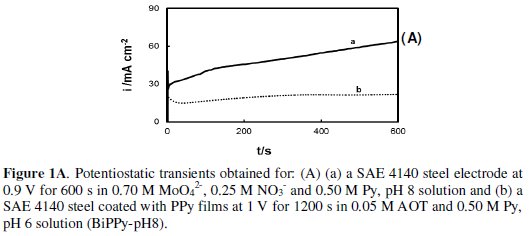
<body><![CDATA[<p>The corrosion performance was investigated in 0.5 M NaCl solution by a  potentiodynamic method, by the variation of the open circuit potential (OCP) as a  function of time and by electrochemical impedance spectroscopy (EIS). The  electrodes were allowed to equilibrate at the fixed voltage before the ac  measurements.</p>       <p>The Tafel tests were carried out by polarizing from cathodic to anodic potentials  with respect to the open circuit potential at 0.001 Vs-1 in an aerated 0.5 M NaCl  solution. Estimation of corrosion parameters was realized by the Tafel  extrapolation method. The extrapolation of anodic and/or cathodic lines for  charge transfer controlled reactions gives the corrosion current density (i<sub>corr</sub>) at  the corrosion potential (E<sub>corr</sub>). All experiments were conducted after the steady- state Ecorr was attained, which normally took 1 h after immersion in the solution.  Each set of experiments was repeated two to four times to ensure reproducibility.</p>       <p>&nbsp;</p>     <p><b>Results and discussion</b></p>      <p><b><i>Electrodeposition of PPy bilayers</i></b></p>      <p>Uniform and adherent PPy bilayers were obtained by a potentiostatic method.  The inner layer was electrodeposited onto SAE 4140 steel at 0.9 V for 600 s in a  solution containing 0.70 M MoO<sub>4</sub><sup>2-</sup>, 0.25 M NO<sub>3</sub><sup>-</sup> and 0.50 M Py  at pH 8 (<a href="#f1a">Fig. 1A, curve a</a>).</p>      <p>&nbsp;</p> <a name="f1a"> <img src="/img/revistas/pea/v32n4/32n4a04f1a.jpg">     
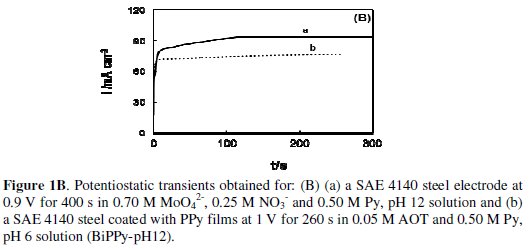
<p>&nbsp;</p>      <p>Initially, the magnitude of the current decreases, which is  associated with oxide growth and, after this stage, the formation of the polymer  starts. The coated electrode was rinsed with tridistilled water before being  immersed in the electrochemical cell for the electrodeposition of the second film  of PPy. This outer layer was electroformed at 1 V during 1200 s in a solution  containing 0.05 M AOT and 0.1 M Py at pH 6 (<a href="#f1a">Fig. 1A, curve b</a>). For simplicity  purposes this bilayer is called BiPPy-pH8.</p>      <p>The charge consumed during the electrosynthesis of the outer PPy film is  approximately 20 percent of the charge involved in the electroformation of the  PPy coating doped with AOT onto uncoated steel, which is obviously due to the  presence of the inner film. When the inner PPy film is obtained in a solution  containing 0.70 M MoO<sub>4</sub><sup>2-</sup>, 0.25 M NO<sub>3</sub><sup>-</sup> and 0.50 M Py but at pH 12, the charge  involved in the electrosynthesis of the polymer is twice than that employed at pH  8 (<a href="#f1b">Fig. 1B, curve a</a>).</p>      ]]></body>
<body><![CDATA[<p>&nbsp;</p> <a name="f1b"> <img src="/img/revistas/pea/v32n4/32n4a04f1b.jpg">     
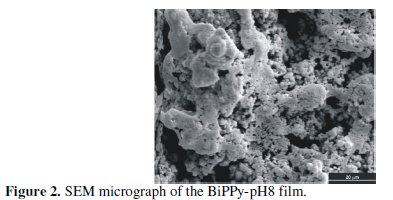
<p>&nbsp;</p>      <p>For simplicity purposes this bilayer is called BiPPy-pH12.  The charge involved in the formation of the outer layer is about four times higher  than the one employed for the other bilayer (<a href="#f1b">Fig. 1B, curve b</a>).</p>      <p>The SEM image of the BiPPy-pH8 film shows the typical granular structure of  PPy (<a href="#f2">Fig. 2</a>).</p>      <p>&nbsp;</p> <a name="f2"> <img src="/img/revistas/pea/v32n4/32n4a04f2.jpg">     
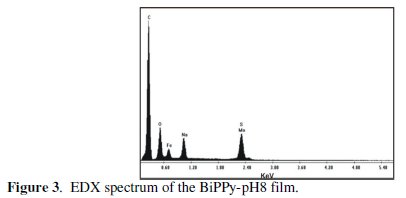
<p>&nbsp;</p>      <p>A gelatinous film in some areas was observed around the polymer.  It was postulated that this gel-like material is a mixed NaAOT-Fe(AOT)3  lamellar mesophase [17].</p>      <p>EDX analysis established the presence of sulfur and molybdenum, indicating that  both AOT and molybdate are incorporated into the polymer matrix (<a href="#f3">Fig. 3</a>).</p>      <p>&nbsp;</p> <a name="f3"> <img src="/img/revistas/pea/v32n4/32n4a04f3.jpg">     
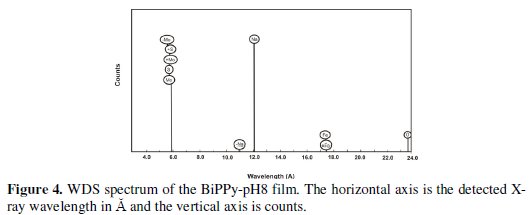
<p>&nbsp;</p>      ]]></body>
<body><![CDATA[<p>Semi-quantitative elemental analysis showed that the amount of sulfur is  nearly twice as that of molybdenum which may be associated with the depth of  the analysis. This result was verified by wavelength dispersive X-ray  spectroscopy (WDS) (<a href="#f4">Fig. 4</a>).</p>      <p>&nbsp;</p> <a name="f4"> <img src="/img/revistas/pea/v32n4/32n4a04f4.jpg">     
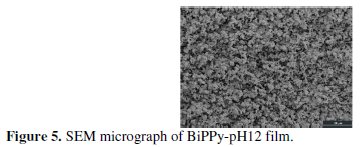
<p>&nbsp;</p>      <p>The coating electrosynthesized in a pH 12 solution (BiPPy-pH12) also shows the  typical granular structure with similar grain sizes of those found for BiPPy-pH8  coating, although with a more homogeneous distribution (<a href="#f5">Fig. 5</a>).</p>      <p>&nbsp;</p> <a name="f5"> <img src="/img/revistas/pea/v32n4/32n4a04f5.jpg">     
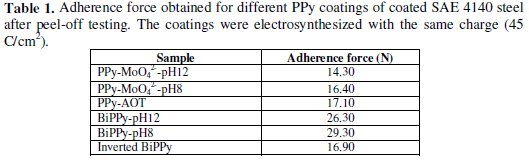
<p>&nbsp;</p>      <p>The adhesion force, so called pull-off force, of the different coatings is informed  in <a href="#t1">Table 1</a> in order to compare them.</p>      <p>&nbsp;</p> <a name="t1"> <img src="/img/revistas/pea/v32n4/32n4a04t1.jpg">     
<p>&nbsp;</p>      <p>The necessary force to peel-off the films  had the same order of magnitude, being the BiPPy-pH8 coating the most  adherent. However, all coatings could be removed only by mechanical polishing.</p>        ]]></body>
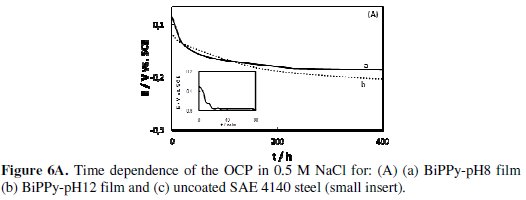
<body><![CDATA[<p><b><i>Anticorrosive properties of bilayers</i></b></p>      <p><a href="#f6a">Fig. 6</a> shows the variation of the open circuit potential (OCP) as a function of  time in 0.5 M NaCl.</p>      <p>&nbsp;</p> <a name="f6a"> <img src="/img/revistas/pea/v32n4/32n4a04f6a.jpg">     
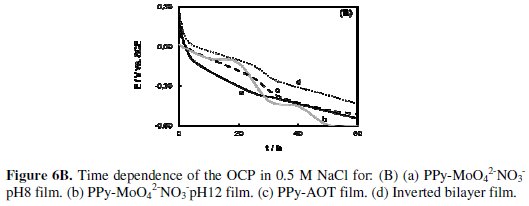
<p>&nbsp;</p>      <p>Usually, this procedure is used to evaluate the degree of  corrosion protection attained after covering the substrate with the conducting  polymer. When the coating is not sufficiently protective the pitting potential of  the uncovered electrode (-0.56 V) is inevitably reached (<a href="#f6a">Fig. 6A</a>, small insert).</p>      <p>The initial OCP value for PPy BiPPy-pH8 was 0.20 V (<a href="#f6a">Fig. 6A, curve a</a>). Then,  the OCP decreases until around - 0.15 V where it remains for approximately two  weeks. After 30 days of immersion, the OCP value is approximately - 0.45 V.  This potential value was still nobler than that for the uncoated electrode. A  similar response was obtained for BiPPy-pH12 although in this case the  corrosion potential of the uncoated steel is reached faster (<a href="#f6a">Fig. 6A, curve b</a>).</p>      <p>For comparative purpose, the behavior of single PPy films (PPy doped with  molybdate and nitrate (PPy-MoO<sub>4</sub><sup>2-</sup>NO<sub>3</sub><sup>-</sup>pH8  and PPy-MoO<sub>4</sub><sup>2-</sup>NO<sub>3</sub><sup>-</sup>pH12) and  PPy doped with AOT (PPy-AOT)) are also presented (<a href="#f6b">Fig. 6 B</a>).</p>      <p>&nbsp;</p> <a name="f6b"> <img src="/img/revistas/pea/v32n4/32n4a04f6b.jpg">     
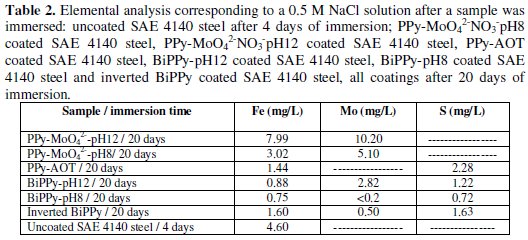
<p>&nbsp;</p>      <p>The performance of the PPy bilayer with an inverted order of the single layers  (inverted bilayer) is also included in the same figure. The protection time for all  these coatings is shorter compared to that of the bilayers. The potential  corresponding to the bare electrode is attained in these cases after about two days  of immersion in the chloride solution. These results indicate that the PPy bilayer  is a very efficient barrier for protecting the steel against corrosion.  In order to confirm the improvement in the corrosion protection of the steel, the  Fe quantity released under OCP conditions in 0.5 M NaCl solution during 20  days of immersion was analyzed and compared (<a href="#t2">Table 2</a>).</p>      ]]></body>
<body><![CDATA[<p>&nbsp;</p> <a name="t2"> <img src="/img/revistas/pea/v32n4/32n4a04t2.jpg">     
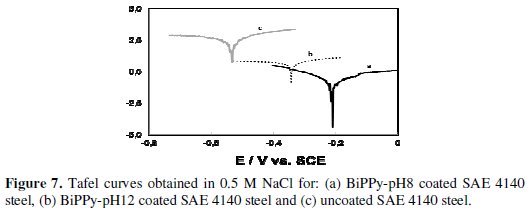
<p>&nbsp;</p>      <p>In the case of the bare  substrate the immersion time was shorter (96 h). The quantity of Fe released was  low when the substrate was coated with the bilayer coatings, corroborating a  better performance even after a long exposure time. The concentrations of Mo  and S in solution were also analyzed. The obtained results corroborate that both  anions are incorporated in the bilayers and they also indicate the bilayers  provided the best protection. More particularly, the formation of PPy-AOT film  on top of PPy-MoO<sub>4</sub><sup>2-</sup>NO<sub>3</sub><sup>-</sup>pH8 coating seems to block the pores of the inner  layer and consequently prevents chloride ingress.</p>      <p>Tafel plots of the PPy bilayers (BiPPy-pH8 and BiPPy-pH12) and uncoated SAE  4140 steel are presented in <a href="#f7">Fig. 7</a>.</p>      <p>&nbsp;</p> <a name="f7"> <img src="/img/revistas/pea/v32n4/32n4a04f7.jpg">     
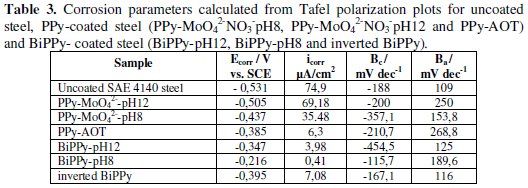
<p>&nbsp;</p>      <p>Estimation of the corrosion parameters (E<sub>corr</sub>,  cathodic (Bc) and anodic (Ba) Tafel slopes and corrosion current (i<sub>corr</sub>)) are  reported in <a href="#t3">Table 3</a> for all coatings studied.</p>      <p>&nbsp;</p> <a name="t3"> <img src="/img/revistas/pea/v32n4/32n4a04t3.jpg">     
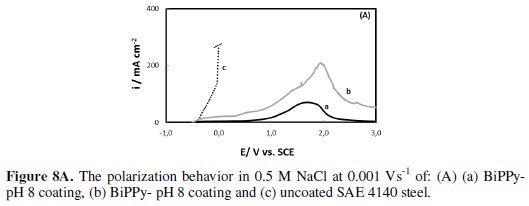
<p>&nbsp;</p>      <p>The i<sub>corr</sub> values measured for the steel  covered with PPy coatings are significantly lower than those of the bare steel.  However, this decrease is more noticeable for the bilayers being their icorr two and  three orders of magnitude lower than that of the uncoated substrate. BiPPy-pH8  coating presents the lowest corrosion rate with respect to the other films.  The polarization curves for the SAE 4140 electrode covered by PPy bilayers and  the uncoated steel in NaCl solution are presented in <a href="#f8a">Fig. 8A</a>.</p>      ]]></body>
<body><![CDATA[<p>&nbsp;</p> <a name="f8a"> <img src="/img/revistas/pea/v32n4/32n4a04f8a.jpg">     
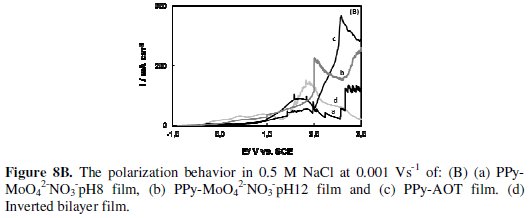
<p>&nbsp;</p>      <p>The curves for  single PPy films and for the inverted bilayer are also shown (<a href="#f8b">Fig. 8B</a>).</p>      <p>&nbsp;</p> <a name="f8b"> <img src="/img/revistas/pea/v32n4/32n4a04f8b.jpg">     
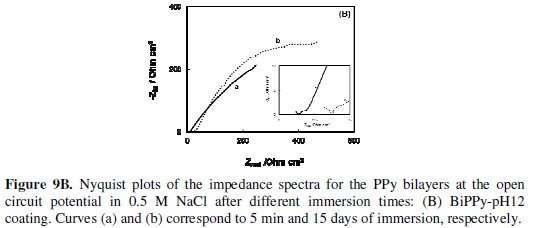
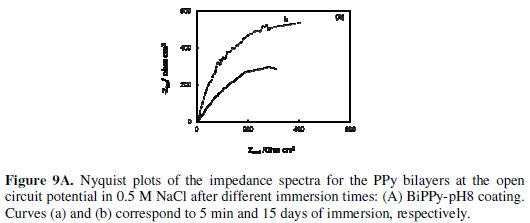
<p>&nbsp;</p>      <p>By comparing the polarization curves, it is evident that BiPPy-pH8 coating provides  a significant improvement in the corrosion resistance. The corresponding curve  initially exhibits low current densities (<a href="#f8a">Fig. 8A, curve a</a>), indicating that the  corrosion reaction of SAE 4140 steel is retarded by the presence of the bilayer. A  current peak is observed at more positive potentials.</p>      <p>The anodic peak current increases with the thickness of the inner film, indicating  that this peak is associated with the oxidation of the polymer. Moreover, the  sample was subjected to 3 V without showing signs of corrosion. At this stage  the chloride solution did not present the typical yellow coloration indicative of  iron dissolution. A similar curve was obtained for the BiPPy-pH12 coating, but  higher current densities with small oscillations were registered in this case  (<a href="#f8a">Fig. 8A, curve b</a>). At the end of the potential scan, a yellow coloration denoting iron  dissolution was observed.</p>      <p>The single PPy films show current oscillations and a significant increase in the  current density at potentials above 1.5 V denotes the onset of pitting corrosion.</p>      <p>The curve obtained for the inverted bilayer exhibited current oscillations which  were more noticeable at the end of the scanning. In both cases, a yellow  coloration could be distinguished in the chloride solution.</p>      <p>EIS mesurements were conducted to evaluate the anticorrosive performace of PPy coatings at different immersion times in aerated 0.5 M NaCl solution.  <a href="#f9a">Figs. 9A</a> and <a href="#f9b">9B</a> shows the Nyquist diagrams for PPy bilayers.</p>      ]]></body>
<body><![CDATA[<p>&nbsp;</p> <a name="f9a"> <img src="/img/revistas/pea/v32n4/32n4a04f9a.jpg">     
<p>&nbsp;</p> <a name="f9b"> <img src="/img/revistas/pea/v32n4/32n4a04f9b.jpg">     
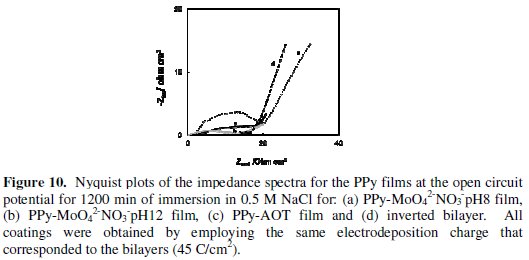
<p>&nbsp;</p>      <p>At the beginning of immersion of BiPPy-pH8 coatings the impedance spectrum presents a large depressed semicircle indicating that the process is controlled by charge transfer reaction (<a href="#f9a">Fig. 9A, curve a</a>) while the impedance response of the BiPPy-pH12 film shows two incomplete semicircles (<a href="#f9b">Fig. 9B, curve a</a>). According to several authors, the semicircle at high frequencies can be explained by considering the charge transfer resistance against iron (substrate) dissolution in parallel with electrical double layer capacitance [18,19]. As exposure times increases, in both cases the responses were similar to that obtained initially but the semicircle diameter increases (<a href="#f9a">Fig. 9A</a> and <a href="#f9b">9B</a>, curve b). At this stage the OCP values were close at - 0.20 V although the OCP value for BiPPy-pH8 is slightly more positive. An increase in the total impedance for the BiPPy-pH8 coating compared to the BiPP- pH12 film which also corroborates the better protective properties.</p>      <p>The impedance responses of the single PPy films and inverted bilayer were  presented in <a href="#f10">Fig. 10</a>.</p>      <p>&nbsp;</p> <a name="f10"> <img src="/img/revistas/pea/v32n4/32n4a04f10.jpg">     
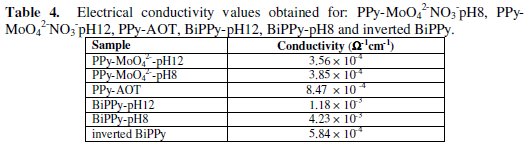
<p>&nbsp;</p>      <p>A remarkable difference in the Nyquist plots compared to  the spectra obtained for the bilayer films is the decrease in the total impedance.  Furthermore there is a noticeable change in the impedance spectrum shape  (kinetic control type). Particularly, when the OCP values are close to the  corrosion potential of uncoated steel, a diffusional impedance dominated the  response for single PPy films and inverted bilayers but with different slopes  magnitudes. The lineal portion can be related to diffusion of corrosive species  through the pores of film [20]. These results corroborate that the top coat reduces  the permeability and water mobility within the coating improving the corrosion  performance significantly.</p>      <p>Several studies have reported the relationship between the anticorrosive  properties, the morphology and the electrical conductivity of conducting  polymers [10-21,22]. It has been concluded that an open structure presents low  conductivity values and that these films provide less corrosion protection. It has  been postulated that the anticorrosive properties provided by conducting  polymers are related to the galvanic interaction between the metallic substrate  and the coating [23]. The polymer has the ability to oxidize the metallic substrate  ensuring the presence of the passive film [24]. Then, the conductive state of the  polymer is a fundamental requirement. Moreover, it has been informed that the  presence of an anionic surfactant has positive effect on the conductivity of PPy  [25,26]. The electrical conductivity of all the coatings was determined and their  values are shown in <a href="#t4">Table 4</a> in order to evaluate and compare them.</p>      <p>&nbsp;</p> <a name="t4"> <img src="/img/revistas/pea/v32n4/32n4a04t4.jpg">     
]]></body>
<body><![CDATA[<p>&nbsp;</p>      <p>The higher  conductivity corresponds to the BiPPy-pH8 coating which also shows the more  compact structure. This result is consistent with the anticorrosive performance  obtained for this coating.</p>      <p>It can be stated that the considerable increase in corrosion resistance obtained by  bilayers coatings is associated with the combination of the characteristics of each  individual layer. This outstanding anticorrosive performance can be attributed to  the combination of the following factors: i) the presence of molybdate in the  matrix of the inner layer, which not only acts as dopant but also as a corrosion  inhibitor, and ii) the presence of AOT as an immobilized dopant in the outer  layer due to its large size. Besides the improvement in the barrier properties  should be considered. The growth of PPy-AOT film on the PPy-MoO<sub>4</sub><sup>2-</sup>NO<sub>3</sub><sup>-</sup>pH8  coating reduces the film porosity and hence the water mobility through the pores,  resulting in better protection for longer periods with respect to single PPy films,  inverted bilayers and BiPPy-pH12. As the immersion time increases, the water  up taking process begins to be noticeable. This event implies that the amount of  electrolyte solution held by coating increases causing a larger surface area to be  exposed to corrosion. No surface defects were observed for the BiPPy-pH8  coatings after removing the electrode at the end of the measurements, indicating  that the bilayers have a low porosity. Moreover it should also be considered that  the corrosion products could provide protection by covering the surface and  sealing the open pores.</p>       <p>&nbsp;</p>     <p><b>Conclusions</b></p>      <p>Adherent and compact PPy bilayers films were obtained by a potentiostatic  technique on SAE 4140 steel. The corrosion performance of bilayers is superior  to that of single PPy films. The improvement in the anticorrosive properties is  associated with the combination of characteristics of the single PPy films. These  characteristics include the presence of the molybdate which acts as an inhibitor in  the inner layer and the role of AOT as immobilized dopant in the outer layer. The  growth of PPy-AOT film on top of PPy-MoO<sub>4</sub><sup>2-</sup>NO<sub>3</sub><sup>-</sup>pH8 coating reduces the  inner film porosity and hence the water mobility through the pores. PPy bilayers  provide protection against the SAE 4140 steel corrosion by both anodic  protection and a barrier effect. BiPPy-pH 8 coating was the most effective for  corrosion prevention of SAE 4140 steel.</p>       <p>&nbsp;</p>     <p><b>References</b></p>      <!-- ref --><p>1. Grgur BN, Krstaji NV, Vojnovi MV, et al. Prog Org Coat. 1998;33:1.    &nbsp;&nbsp;&nbsp;&nbsp;&nbsp;&nbsp;&nbsp;&nbsp;[&#160;<a href="javascript:void(0);" onclick="javascript: window.open('/scielo.php?script=sci_nlinks&ref=000121&pid=S0872-1904201400040000400001&lng=','','width=640,height=500,resizable=yes,scrollbars=1,menubar=yes,');">Links</a>&#160;]<!-- end-ref --></p>      ]]></body>
<body><![CDATA[<!-- ref --><p>2. Paliwoda-Porebska G, Stratmann M, Rohwerder M, et al. Corros Sci. 2005;47:3216.    &nbsp;&nbsp;&nbsp;&nbsp;&nbsp;&nbsp;&nbsp;&nbsp;[&#160;<a href="javascript:void(0);" onclick="javascript: window.open('/scielo.php?script=sci_nlinks&ref=000123&pid=S0872-1904201400040000400002&lng=','','width=640,height=500,resizable=yes,scrollbars=1,menubar=yes,');">Links</a>&#160;]<!-- end-ref --></p>      <!-- ref --><p>3. Herrasti P, Recio FJ, Ocon P, et al. Prog Org Coat. 2005;54:285.    &nbsp;&nbsp;&nbsp;&nbsp;&nbsp;&nbsp;&nbsp;&nbsp;[&#160;<a href="javascript:void(0);" onclick="javascript: window.open('/scielo.php?script=sci_nlinks&ref=000125&pid=S0872-1904201400040000400003&lng=','','width=640,height=500,resizable=yes,scrollbars=1,menubar=yes,');">Links</a>&#160;]<!-- end-ref --></p>      <!-- ref --><p>4. Koene L, Hamer WJ, de Wit JHW. J Appl Electrochem. 2006;36:545.    &nbsp;&nbsp;&nbsp;&nbsp;&nbsp;&nbsp;&nbsp;&nbsp;[&#160;<a href="javascript:void(0);" onclick="javascript: window.open('/scielo.php?script=sci_nlinks&ref=000127&pid=S0872-1904201400040000400004&lng=','','width=640,height=500,resizable=yes,scrollbars=1,menubar=yes,');">Links</a>&#160;]<!-- end-ref --></p>      <!-- ref --><p>5. Hosseini MG, Sabouri M, Shahrabi T. Prog Org Coat. 2007;60:178.    &nbsp;&nbsp;&nbsp;&nbsp;&nbsp;&nbsp;&nbsp;&nbsp;[&#160;<a href="javascript:void(0);" onclick="javascript: window.open('/scielo.php?script=sci_nlinks&ref=000129&pid=S0872-1904201400040000400005&lng=','','width=640,height=500,resizable=yes,scrollbars=1,menubar=yes,');">Links</a>&#160;]<!-- end-ref --></p>      <!-- ref --><p>6. Zhang T, Zeng CL. Electrochim Acta. 2005;50:4721.    &nbsp;&nbsp;&nbsp;&nbsp;&nbsp;&nbsp;&nbsp;&nbsp;[&#160;<a href="javascript:void(0);" onclick="javascript: window.open('/scielo.php?script=sci_nlinks&ref=000131&pid=S0872-1904201400040000400006&lng=','','width=640,height=500,resizable=yes,scrollbars=1,menubar=yes,');">Links</a>&#160;]<!-- end-ref --></p>      ]]></body>
<body><![CDATA[<!-- ref --><p>7. Kowalski D, Ueda M, Ohtsuka T. Corros Sci. 2007;49:1635.    &nbsp;&nbsp;&nbsp;&nbsp;&nbsp;&nbsp;&nbsp;&nbsp;[&#160;<a href="javascript:void(0);" onclick="javascript: window.open('/scielo.php?script=sci_nlinks&ref=000133&pid=S0872-1904201400040000400007&lng=','','width=640,height=500,resizable=yes,scrollbars=1,menubar=yes,');">Links</a>&#160;]<!-- end-ref --></p>      <!-- ref --><p>8. Kowalski D, Ueda M, Ohtsuka T. Corros Sci. 2007;49:3442.    &nbsp;&nbsp;&nbsp;&nbsp;&nbsp;&nbsp;&nbsp;&nbsp;[&#160;<a href="javascript:void(0);" onclick="javascript: window.open('/scielo.php?script=sci_nlinks&ref=000135&pid=S0872-1904201400040000400008&lng=','','width=640,height=500,resizable=yes,scrollbars=1,menubar=yes,');">Links</a>&#160;]<!-- end-ref --></p>      <!-- ref --><p>9. Hien NTL, Garcia B, Pailleret A, et al. Electrochim Acta. 2005;50:1747.    &nbsp;&nbsp;&nbsp;&nbsp;&nbsp;&nbsp;&nbsp;&nbsp;[&#160;<a href="javascript:void(0);" onclick="javascript: window.open('/scielo.php?script=sci_nlinks&ref=000137&pid=S0872-1904201400040000400009&lng=','','width=640,height=500,resizable=yes,scrollbars=1,menubar=yes,');">Links</a>&#160;]<!-- end-ref --></p>      <!-- ref --><p>10. Tan C, Blackwood DJ. Corros Sci. 2003;45:545.    &nbsp;&nbsp;&nbsp;&nbsp;&nbsp;&nbsp;&nbsp;&nbsp;[&#160;<a href="javascript:void(0);" onclick="javascript: window.open('/scielo.php?script=sci_nlinks&ref=000139&pid=S0872-1904201400040000400010&lng=','','width=640,height=500,resizable=yes,scrollbars=1,menubar=yes,');">Links</a>&#160;]<!-- end-ref --></p>      <!-- ref --><p>11. Hasanov R, Bilgic S. Prog Org Coat. 2009;64:435.    &nbsp;&nbsp;&nbsp;&nbsp;&nbsp;&nbsp;&nbsp;&nbsp;[&#160;<a href="javascript:void(0);" onclick="javascript: window.open('/scielo.php?script=sci_nlinks&ref=000141&pid=S0872-1904201400040000400011&lng=','','width=640,height=500,resizable=yes,scrollbars=1,menubar=yes,');">Links</a>&#160;]<!-- end-ref --></p>      ]]></body>
<body><![CDATA[<!-- ref --><p>12. Tuken T, Arslan G, Yazici B, et al. Corros Sci. 2004;46:2743.    &nbsp;&nbsp;&nbsp;&nbsp;&nbsp;&nbsp;&nbsp;&nbsp;[&#160;<a href="javascript:void(0);" onclick="javascript: window.open('/scielo.php?script=sci_nlinks&ref=000143&pid=S0872-1904201400040000400012&lng=','','width=640,height=500,resizable=yes,scrollbars=1,menubar=yes,');">Links</a>&#160;]<!-- end-ref --></p>      <!-- ref --><p>13. Lehr IL, Saidman SB. Mater Chem Phys. 2006;100: 262.    &nbsp;&nbsp;&nbsp;&nbsp;&nbsp;&nbsp;&nbsp;&nbsp;[&#160;<a href="javascript:void(0);" onclick="javascript: window.open('/scielo.php?script=sci_nlinks&ref=000145&pid=S0872-1904201400040000400013&lng=','','width=640,height=500,resizable=yes,scrollbars=1,menubar=yes,');">Links</a>&#160;]<!-- end-ref --></p>      <!-- ref --><p>14. Lehr IL, Saidman SB. Corros Sci. 2007;49:2210-2225.    &nbsp;&nbsp;&nbsp;&nbsp;&nbsp;&nbsp;&nbsp;&nbsp;[&#160;<a href="javascript:void(0);" onclick="javascript: window.open('/scielo.php?script=sci_nlinks&ref=000147&pid=S0872-1904201400040000400014&lng=','','width=640,height=500,resizable=yes,scrollbars=1,menubar=yes,');">Links</a>&#160;]<!-- end-ref --></p>      <!-- ref --><p>15. Flamini DO, Saidman SB. Electrochim Acta. 2010;55:3727.    &nbsp;&nbsp;&nbsp;&nbsp;&nbsp;&nbsp;&nbsp;&nbsp;[&#160;<a href="javascript:void(0);" onclick="javascript: window.open('/scielo.php?script=sci_nlinks&ref=000149&pid=S0872-1904201400040000400015&lng=','','width=640,height=500,resizable=yes,scrollbars=1,menubar=yes,');">Links</a>&#160;]<!-- end-ref --></p>      <!-- ref --><p>16. Gonzalez MB, Saidman SB. J Colloid Interf Sci. 2007;306:323.    &nbsp;&nbsp;&nbsp;&nbsp;&nbsp;&nbsp;&nbsp;&nbsp;[&#160;<a href="javascript:void(0);" onclick="javascript: window.open('/scielo.php?script=sci_nlinks&ref=000151&pid=S0872-1904201400040000400016&lng=','','width=640,height=500,resizable=yes,scrollbars=1,menubar=yes,');">Links</a>&#160;]<!-- end-ref --></p>      ]]></body>
<body><![CDATA[<!-- ref --><p>18. Ocon P, Cristobal A, Herrasti P, et al. Corros Sci. 2005;47:649.    &nbsp;&nbsp;&nbsp;&nbsp;&nbsp;&nbsp;&nbsp;&nbsp;[&#160;<a href="javascript:void(0);" onclick="javascript: window.open('/scielo.php?script=sci_nlinks&ref=000153&pid=S0872-1904201400040000400017&lng=','','width=640,height=500,resizable=yes,scrollbars=1,menubar=yes,');">Links</a>&#160;]<!-- end-ref --></p>      <!-- ref --><p>19. Fenelon A, Breslin C. Surf Coat Tech. 2005;190:264.    &nbsp;&nbsp;&nbsp;&nbsp;&nbsp;&nbsp;&nbsp;&nbsp;[&#160;<a href="javascript:void(0);" onclick="javascript: window.open('/scielo.php?script=sci_nlinks&ref=000155&pid=S0872-1904201400040000400018&lng=','','width=640,height=500,resizable=yes,scrollbars=1,menubar=yes,');">Links</a>&#160;]<!-- end-ref --></p>      <!-- ref --><p>20. Tuken T, Tansug G, Yazici B, et al. Surf Coat Tech. 2007;202:146.    &nbsp;&nbsp;&nbsp;&nbsp;&nbsp;&nbsp;&nbsp;&nbsp;[&#160;<a href="javascript:void(0);" onclick="javascript: window.open('/scielo.php?script=sci_nlinks&ref=000157&pid=S0872-1904201400040000400019&lng=','','width=640,height=500,resizable=yes,scrollbars=1,menubar=yes,');">Links</a>&#160;]<!-- end-ref --></p>      <!-- ref --><p>21. Olad A, Barati M, Shirmohammadi H. Prog Org Coat. 2011;72:599.    &nbsp;&nbsp;&nbsp;&nbsp;&nbsp;&nbsp;&nbsp;&nbsp;[&#160;<a href="javascript:void(0);" onclick="javascript: window.open('/scielo.php?script=sci_nlinks&ref=000159&pid=S0872-1904201400040000400020&lng=','','width=640,height=500,resizable=yes,scrollbars=1,menubar=yes,');">Links</a>&#160;]<!-- end-ref --></p>      <!-- ref --><p>22. Lehr IL, Saidman SB. Prog Org Coat. 2013;76:1586.    &nbsp;&nbsp;&nbsp;&nbsp;&nbsp;&nbsp;&nbsp;&nbsp;[&#160;<a href="javascript:void(0);" onclick="javascript: window.open('/scielo.php?script=sci_nlinks&ref=000161&pid=S0872-1904201400040000400021&lng=','','width=640,height=500,resizable=yes,scrollbars=1,menubar=yes,');">Links</a>&#160;]<!-- end-ref --></p>      ]]></body>
<body><![CDATA[<!-- ref --><p>23. Biallozor S, Kupniewska A. Synth Met. 2005;155:443.    &nbsp;&nbsp;&nbsp;&nbsp;&nbsp;&nbsp;&nbsp;&nbsp;[&#160;<a href="javascript:void(0);" onclick="javascript: window.open('/scielo.php?script=sci_nlinks&ref=000163&pid=S0872-1904201400040000400022&lng=','','width=640,height=500,resizable=yes,scrollbars=1,menubar=yes,');">Links</a>&#160;]<!-- end-ref --></p>      <!-- ref --><p>24. Hermas AA. Corros Sci 2008;50:2498.    &nbsp;&nbsp;&nbsp;&nbsp;&nbsp;&nbsp;&nbsp;&nbsp;[&#160;<a href="javascript:void(0);" onclick="javascript: window.open('/scielo.php?script=sci_nlinks&ref=000165&pid=S0872-1904201400040000400023&lng=','','width=640,height=500,resizable=yes,scrollbars=1,menubar=yes,');">Links</a>&#160;]<!-- end-ref --></p>      <!-- ref --><p>25. Stejskal J, Omastova M, Fedorova S, et al. Polymer. 2003;44:1353.    &nbsp;&nbsp;&nbsp;&nbsp;&nbsp;&nbsp;&nbsp;&nbsp;[&#160;<a href="javascript:void(0);" onclick="javascript: window.open('/scielo.php?script=sci_nlinks&ref=000167&pid=S0872-1904201400040000400024&lng=','','width=640,height=500,resizable=yes,scrollbars=1,menubar=yes,');">Links</a>&#160;]<!-- end-ref --></p>      <!-- ref --><p>26. Kudoh Y. Synth Met. 1996;79:17.    &nbsp;&nbsp;&nbsp;&nbsp;&nbsp;&nbsp;&nbsp;&nbsp;[&#160;<a href="javascript:void(0);" onclick="javascript: window.open('/scielo.php?script=sci_nlinks&ref=000169&pid=S0872-1904201400040000400025&lng=','','width=640,height=500,resizable=yes,scrollbars=1,menubar=yes,');">Links</a>&#160;]<!-- end-ref --></p>       <p>&nbsp;</p>     <p><b>Acknowledgement</b></p>      ]]></body>
<body><![CDATA[<p>CONICET, ANPCYT and Universidad Nacional del Sur, Bah&iacute;a Blanca, Argentina are  acknowledged for financial support.</p>       <p>&nbsp;</p>     <p><a name=0></a><sup><a href="#top">*</a></sup>Corresponding author. E-mail address: <a href="mailto:ssaidman@criba.edu.ar">ssaidman@criba.edu.ar</a></p>      <p>Received 16 July 2014; accepted 25 August 2014</p>      <p><a href="http://www.peacta.org" target="_blank">www.peacta.org</a> </p>        ]]></body><back>
<ref-list>
<ref id="B1">
<label>1</label><nlm-citation citation-type="journal">
<person-group person-group-type="author">
<name>
<surname><![CDATA[Grgur]]></surname>
<given-names><![CDATA[BN]]></given-names>
</name>
<name>
<surname><![CDATA[Krstaji]]></surname>
<given-names><![CDATA[NV]]></given-names>
</name>
<name>
<surname><![CDATA[Vojnovi]]></surname>
<given-names><![CDATA[MV]]></given-names>
</name>
</person-group>
<source><![CDATA[Prog Org Coat]]></source>
<year>1998</year>
<volume>33</volume>
<page-range>1</page-range></nlm-citation>
</ref>
<ref id="B2">
<label>2</label><nlm-citation citation-type="journal">
<person-group person-group-type="author">
<name>
<surname><![CDATA[Paliwoda-Porebska]]></surname>
<given-names><![CDATA[G]]></given-names>
</name>
<name>
<surname><![CDATA[Stratmann]]></surname>
<given-names><![CDATA[M]]></given-names>
</name>
<name>
<surname><![CDATA[Rohwerder]]></surname>
<given-names><![CDATA[M]]></given-names>
</name>
</person-group>
<source><![CDATA[Corros Sci]]></source>
<year>2005</year>
<volume>47</volume>
<page-range>3216</page-range></nlm-citation>
</ref>
<ref id="B3">
<label>3</label><nlm-citation citation-type="journal">
<person-group person-group-type="author">
<name>
<surname><![CDATA[Herrasti]]></surname>
<given-names><![CDATA[P]]></given-names>
</name>
<name>
<surname><![CDATA[Recio]]></surname>
<given-names><![CDATA[FJ]]></given-names>
</name>
<name>
<surname><![CDATA[Ocon]]></surname>
<given-names><![CDATA[P]]></given-names>
</name>
</person-group>
<source><![CDATA[Prog Org Coat]]></source>
<year>2005</year>
<volume>54</volume>
<page-range>285</page-range></nlm-citation>
</ref>
<ref id="B4">
<label>4</label><nlm-citation citation-type="journal">
<person-group person-group-type="author">
<name>
<surname><![CDATA[Koene]]></surname>
<given-names><![CDATA[L]]></given-names>
</name>
<name>
<surname><![CDATA[Hamer]]></surname>
<given-names><![CDATA[WJ]]></given-names>
</name>
<name>
<surname><![CDATA[de Wit]]></surname>
<given-names><![CDATA[JHW]]></given-names>
</name>
</person-group>
<source><![CDATA[J Appl Electrochem]]></source>
<year>2006</year>
<volume>36</volume>
<page-range>545</page-range></nlm-citation>
</ref>
<ref id="B5">
<label>5</label><nlm-citation citation-type="journal">
<person-group person-group-type="author">
<name>
<surname><![CDATA[Hosseini]]></surname>
<given-names><![CDATA[MG]]></given-names>
</name>
<name>
<surname><![CDATA[Sabouri]]></surname>
<given-names><![CDATA[M]]></given-names>
</name>
<name>
<surname><![CDATA[Shahrabi]]></surname>
<given-names><![CDATA[T]]></given-names>
</name>
</person-group>
<source><![CDATA[Prog Org Coat]]></source>
<year>2007</year>
<volume>60</volume>
<page-range>178</page-range></nlm-citation>
</ref>
<ref id="B6">
<label>6</label><nlm-citation citation-type="journal">
<person-group person-group-type="author">
<name>
<surname><![CDATA[Zhang]]></surname>
<given-names><![CDATA[T]]></given-names>
</name>
<name>
<surname><![CDATA[Zeng]]></surname>
<given-names><![CDATA[CL]]></given-names>
</name>
</person-group>
<source><![CDATA[Electrochim Acta]]></source>
<year>2005</year>
<volume>50</volume>
<page-range>4721</page-range></nlm-citation>
</ref>
<ref id="B7">
<label>7</label><nlm-citation citation-type="journal">
<person-group person-group-type="author">
<name>
<surname><![CDATA[Kowalski]]></surname>
<given-names><![CDATA[D]]></given-names>
</name>
<name>
<surname><![CDATA[Ueda]]></surname>
<given-names><![CDATA[M]]></given-names>
</name>
<name>
<surname><![CDATA[Ohtsuka]]></surname>
<given-names><![CDATA[T]]></given-names>
</name>
</person-group>
<source><![CDATA[Corros Sci]]></source>
<year>2007</year>
<volume>49</volume>
<page-range>1635</page-range></nlm-citation>
</ref>
<ref id="B8">
<label>8</label><nlm-citation citation-type="journal">
<person-group person-group-type="author">
<name>
<surname><![CDATA[Kowalski]]></surname>
<given-names><![CDATA[D]]></given-names>
</name>
<name>
<surname><![CDATA[Ueda]]></surname>
<given-names><![CDATA[M]]></given-names>
</name>
<name>
<surname><![CDATA[Ohtsuka]]></surname>
<given-names><![CDATA[T]]></given-names>
</name>
</person-group>
<source><![CDATA[Corros Sci]]></source>
<year>2007</year>
<volume>49</volume>
<page-range>3442</page-range></nlm-citation>
</ref>
<ref id="B9">
<label>9</label><nlm-citation citation-type="journal">
<person-group person-group-type="author">
<name>
<surname><![CDATA[Hien]]></surname>
<given-names><![CDATA[NTL]]></given-names>
</name>
<name>
<surname><![CDATA[Garcia]]></surname>
<given-names><![CDATA[B]]></given-names>
</name>
<name>
<surname><![CDATA[Pailleret]]></surname>
<given-names><![CDATA[A]]></given-names>
</name>
</person-group>
<source><![CDATA[Electrochim Acta]]></source>
<year>2005</year>
<volume>50</volume>
<page-range>1747</page-range></nlm-citation>
</ref>
<ref id="B10">
<label>10</label><nlm-citation citation-type="journal">
<person-group person-group-type="author">
<name>
<surname><![CDATA[Tan]]></surname>
<given-names><![CDATA[C]]></given-names>
</name>
<name>
<surname><![CDATA[Blackwood]]></surname>
<given-names><![CDATA[DJ]]></given-names>
</name>
</person-group>
<source><![CDATA[Corros Sci]]></source>
<year>2003</year>
<volume>45</volume>
<page-range>545</page-range></nlm-citation>
</ref>
<ref id="B11">
<label>11</label><nlm-citation citation-type="journal">
<person-group person-group-type="author">
<name>
<surname><![CDATA[Hasanov]]></surname>
<given-names><![CDATA[R]]></given-names>
</name>
<name>
<surname><![CDATA[Bilgic]]></surname>
<given-names><![CDATA[S]]></given-names>
</name>
</person-group>
<source><![CDATA[Prog Org Coat]]></source>
<year>2009</year>
<volume>64</volume>
<page-range>435</page-range></nlm-citation>
</ref>
<ref id="B12">
<label>12</label><nlm-citation citation-type="journal">
<person-group person-group-type="author">
<name>
<surname><![CDATA[Tuken]]></surname>
<given-names><![CDATA[T]]></given-names>
</name>
<name>
<surname><![CDATA[Arslan]]></surname>
<given-names><![CDATA[G]]></given-names>
</name>
<name>
<surname><![CDATA[Yazici]]></surname>
<given-names><![CDATA[B]]></given-names>
</name>
</person-group>
<source><![CDATA[Corros Sci]]></source>
<year>2004</year>
<volume>46</volume>
<page-range>2743</page-range></nlm-citation>
</ref>
<ref id="B13">
<label>13</label><nlm-citation citation-type="journal">
<person-group person-group-type="author">
<name>
<surname><![CDATA[Lehr]]></surname>
<given-names><![CDATA[IL]]></given-names>
</name>
<name>
<surname><![CDATA[Saidman]]></surname>
<given-names><![CDATA[SB]]></given-names>
</name>
</person-group>
<source><![CDATA[Mater Chem Phys]]></source>
<year>2006</year>
<volume>100</volume>
<page-range>262</page-range></nlm-citation>
</ref>
<ref id="B14">
<label>14</label><nlm-citation citation-type="journal">
<person-group person-group-type="author">
<name>
<surname><![CDATA[Lehr]]></surname>
<given-names><![CDATA[IL]]></given-names>
</name>
<name>
<surname><![CDATA[Saidman]]></surname>
<given-names><![CDATA[SB]]></given-names>
</name>
</person-group>
<source><![CDATA[Corros Sci]]></source>
<year>2007</year>
<volume>49</volume>
<page-range>2210</page-range></nlm-citation>
</ref>
<ref id="B15">
<label>15</label><nlm-citation citation-type="journal">
<person-group person-group-type="author">
<name>
<surname><![CDATA[Flamini]]></surname>
<given-names><![CDATA[DO]]></given-names>
</name>
<name>
<surname><![CDATA[Saidman]]></surname>
<given-names><![CDATA[SB]]></given-names>
</name>
</person-group>
<source><![CDATA[Electrochim Acta]]></source>
<year>2010</year>
<volume>55</volume>
<page-range>3727</page-range></nlm-citation>
</ref>
<ref id="B16">
<label>16</label><nlm-citation citation-type="journal">
<person-group person-group-type="author">
<name>
<surname><![CDATA[Gonzalez]]></surname>
<given-names><![CDATA[MB]]></given-names>
</name>
<name>
<surname><![CDATA[Saidman]]></surname>
<given-names><![CDATA[SB]]></given-names>
</name>
</person-group>
<source><![CDATA[J Colloid Interf Sci]]></source>
<year>2007</year>
<volume>306</volume>
<page-range>323</page-range></nlm-citation>
</ref>
<ref id="B17">
<label>18</label><nlm-citation citation-type="journal">
<person-group person-group-type="author">
<name>
<surname><![CDATA[Ocon]]></surname>
<given-names><![CDATA[P]]></given-names>
</name>
<name>
<surname><![CDATA[Cristobal]]></surname>
<given-names><![CDATA[A]]></given-names>
</name>
<name>
<surname><![CDATA[Herrasti]]></surname>
<given-names><![CDATA[P]]></given-names>
</name>
</person-group>
<source><![CDATA[Corros Sci]]></source>
<year>2005</year>
<volume>47</volume>
<page-range>649</page-range></nlm-citation>
</ref>
<ref id="B18">
<label>19</label><nlm-citation citation-type="journal">
<person-group person-group-type="author">
<name>
<surname><![CDATA[Fenelon]]></surname>
<given-names><![CDATA[A]]></given-names>
</name>
<name>
<surname><![CDATA[Breslin]]></surname>
<given-names><![CDATA[C]]></given-names>
</name>
</person-group>
<source><![CDATA[Surf Coat Tech]]></source>
<year>2005</year>
<volume>190</volume>
<page-range>264</page-range></nlm-citation>
</ref>
<ref id="B19">
<label>20</label><nlm-citation citation-type="journal">
<person-group person-group-type="author">
<name>
<surname><![CDATA[Tuken]]></surname>
<given-names><![CDATA[T]]></given-names>
</name>
<name>
<surname><![CDATA[Tansug]]></surname>
<given-names><![CDATA[G]]></given-names>
</name>
<name>
<surname><![CDATA[Yazici]]></surname>
<given-names><![CDATA[B]]></given-names>
</name>
</person-group>
<source><![CDATA[Surf Coat Tech]]></source>
<year>2007</year>
<volume>202</volume>
<page-range>146</page-range></nlm-citation>
</ref>
<ref id="B20">
<label>21</label><nlm-citation citation-type="journal">
<person-group person-group-type="author">
<name>
<surname><![CDATA[Olad]]></surname>
<given-names><![CDATA[A]]></given-names>
</name>
<name>
<surname><![CDATA[Barati]]></surname>
<given-names><![CDATA[M]]></given-names>
</name>
<name>
<surname><![CDATA[Shirmohammadi]]></surname>
<given-names><![CDATA[H]]></given-names>
</name>
</person-group>
<source><![CDATA[Prog Org Coat]]></source>
<year>2011</year>
<volume>72</volume>
<page-range>599</page-range></nlm-citation>
</ref>
<ref id="B21">
<label>22</label><nlm-citation citation-type="journal">
<person-group person-group-type="author">
<name>
<surname><![CDATA[Lehr]]></surname>
<given-names><![CDATA[IL]]></given-names>
</name>
<name>
<surname><![CDATA[Saidman]]></surname>
<given-names><![CDATA[SB]]></given-names>
</name>
</person-group>
<source><![CDATA[Prog Org Coat]]></source>
<year>2013</year>
<volume>76</volume>
<page-range>1586</page-range></nlm-citation>
</ref>
<ref id="B22">
<label>23</label><nlm-citation citation-type="journal">
<person-group person-group-type="author">
<name>
<surname><![CDATA[Biallozor]]></surname>
<given-names><![CDATA[S]]></given-names>
</name>
<name>
<surname><![CDATA[Kupniewska]]></surname>
<given-names><![CDATA[A]]></given-names>
</name>
</person-group>
<source><![CDATA[Synth Met]]></source>
<year>2005</year>
<volume>155</volume>
<page-range>443</page-range></nlm-citation>
</ref>
<ref id="B23">
<label>24</label><nlm-citation citation-type="journal">
<person-group person-group-type="author">
<name>
<surname><![CDATA[Hermas]]></surname>
<given-names><![CDATA[AA]]></given-names>
</name>
</person-group>
<source><![CDATA[Corros Sci]]></source>
<year>2008</year>
<volume>50</volume>
<page-range>2498</page-range></nlm-citation>
</ref>
<ref id="B24">
<label>25</label><nlm-citation citation-type="journal">
<person-group person-group-type="author">
<name>
<surname><![CDATA[Stejskal]]></surname>
<given-names><![CDATA[J]]></given-names>
</name>
<name>
<surname><![CDATA[Omastova]]></surname>
<given-names><![CDATA[M]]></given-names>
</name>
<name>
<surname><![CDATA[Fedorova]]></surname>
<given-names><![CDATA[S]]></given-names>
</name>
</person-group>
<source><![CDATA[Polymer]]></source>
<year>2003</year>
<volume>44</volume>
<page-range>1353</page-range></nlm-citation>
</ref>
<ref id="B25">
<label>26</label><nlm-citation citation-type="journal">
<person-group person-group-type="author">
<name>
<surname><![CDATA[Kudoh]]></surname>
<given-names><![CDATA[Y]]></given-names>
</name>
</person-group>
<source><![CDATA[Synth Met]]></source>
<year>1996</year>
<volume>79</volume>
<page-range>17</page-range></nlm-citation>
</ref>
</ref-list>
</back>
</article>