<?xml version="1.0" encoding="ISO-8859-1"?><article xmlns:mml="http://www.w3.org/1998/Math/MathML" xmlns:xlink="http://www.w3.org/1999/xlink" xmlns:xsi="http://www.w3.org/2001/XMLSchema-instance">
<front>
<journal-meta>
<journal-id>0872-1904</journal-id>
<journal-title><![CDATA[Portugaliae Electrochimica Acta]]></journal-title>
<abbrev-journal-title><![CDATA[Port. Electrochim. Acta]]></abbrev-journal-title>
<issn>0872-1904</issn>
<publisher>
<publisher-name><![CDATA[Sociedade Portuguesa de Electroquímica]]></publisher-name>
</publisher>
</journal-meta>
<article-meta>
<article-id>S0872-19042014000600002</article-id>
<article-id pub-id-type="doi">10.4152/pea.201406381</article-id>
<title-group>
<article-title xml:lang="en"><![CDATA[Chemical Composition and Inhibitory Effect of the Essential Oil from Lippia Citriodora Irrigated by Wastewater on the Alkaline Corrosion of Aluminum]]></article-title>
</title-group>
<contrib-group>
<contrib contrib-type="author">
<name>
<surname><![CDATA[Bensabah]]></surname>
<given-names><![CDATA[F]]></given-names>
</name>
<xref ref-type="aff" rid="A01"/>
</contrib>
<contrib contrib-type="author">
<name>
<surname><![CDATA[Essahli]]></surname>
<given-names><![CDATA[M]]></given-names>
</name>
<xref ref-type="aff" rid="A01"/>
</contrib>
<contrib contrib-type="author">
<name>
<surname><![CDATA[Lamiri]]></surname>
<given-names><![CDATA[A]]></given-names>
</name>
<xref ref-type="aff" rid="A01"/>
</contrib>
<contrib contrib-type="author">
<name>
<surname><![CDATA[Naja]]></surname>
<given-names><![CDATA[J]]></given-names>
</name>
<xref ref-type="aff" rid="A01"/>
</contrib>
</contrib-group>
<aff id="A01">
<institution><![CDATA[,University Hassan 1 Faculty of Science and Techniques Laboratory of Applied Chemistry and Environment]]></institution>
<addr-line><![CDATA[Settat ]]></addr-line>
<country>Morocco</country>
</aff>
<pub-date pub-type="pub">
<day>00</day>
<month>11</month>
<year>2014</year>
</pub-date>
<pub-date pub-type="epub">
<day>00</day>
<month>11</month>
<year>2014</year>
</pub-date>
<volume>32</volume>
<numero>6</numero>
<fpage>381</fpage>
<lpage>393</lpage>
<copyright-statement/>
<copyright-year/>
<self-uri xlink:href="http://scielo.pt/scielo.php?script=sci_arttext&amp;pid=S0872-19042014000600002&amp;lng=en&amp;nrm=iso"></self-uri><self-uri xlink:href="http://scielo.pt/scielo.php?script=sci_abstract&amp;pid=S0872-19042014000600002&amp;lng=en&amp;nrm=iso"></self-uri><self-uri xlink:href="http://scielo.pt/scielo.php?script=sci_pdf&amp;pid=S0872-19042014000600002&amp;lng=en&amp;nrm=iso"></self-uri><abstract abstract-type="short" xml:lang="en"><p><![CDATA[The objective of this study is the valorization of the essential oil (EO) of Lippia citriodora irrigated by urban wastewater from the city of Settat-Morocco. We have tested it as a corrosion inhibitor of aluminum in 0.1 M Na2CO3 using polarization method, weight loss, and EIS measurements. The inhibition efficiency of lippia citriodora oil was calculated and compared. We found good agreement between the referred methods. The results obtained revealed that the tested inhibitor reduces differently the kinetic of the corrosion process of aluminum. Its efficiency increases with the concentration and attained 90.33% at 1800 ppm. The effect of temperature on the corrosion behaviour of aluminum in 0.1 M Na2CO3 was also studied in the range 283 K and 313 K. The thermodynamic data of activation were determined. The analysis of Lippia citriodora oil, obtained by hydro-distillation, using gas chromatography (GC), showed that the major components are neral 13.85%, geranial 14.06% and limonene 28.32%.]]></p></abstract>
<kwd-group>
<kwd lng="en"><![CDATA[Corrosion inhibition]]></kwd>
<kwd lng="en"><![CDATA[aluminum]]></kwd>
<kwd lng="en"><![CDATA[Lippia citriodora]]></kwd>
<kwd lng="en"><![CDATA[Essential oil]]></kwd>
<kwd lng="en"><![CDATA[Wastewater]]></kwd>
</kwd-group>
</article-meta>
</front><body><![CDATA[   <!--     <p>&nbsp;</p>     <p>doi: 10.4152/pea.201406381</p> -->      <p><b>Chemical Composition and Inhibitory Effect of the Essential Oil from Lippia Citriodora Irrigated by Wastewater on the  Alkaline Corrosion of Aluminum</b></p>      <p> <b>F. Bensabah</b><sup><a href="#0">*</a></sup> , <b>M. Essahli</b> , <b>A. Lamiri</b>  and <b>J. Naja</b> </p>      <p><i> University Hassan 1, Faculty of Science and Techniques, Laboratory of Applied Chemistry and Environment, B.P. 577, Settat, Morocco</i></p>       <p>&nbsp;</p>     <p><b>Abstract</b></p>      <p>The objective of this study is the valorization of the essential oil (EO) of Lippia  citriodora irrigated by urban wastewater from the city of Settat-Morocco. We have  tested it as a corrosion inhibitor of aluminum in 0.1 M Na<sub>2</sub>CO<sub>3</sub> using polarization  method, weight loss, and EIS measurements. The inhibition efficiency of lippia  citriodora oil was calculated and compared. We found good agreement between the  referred methods. The results obtained revealed that the tested inhibitor reduces  differently the kinetic of the corrosion process of aluminum. Its efficiency increases  with the concentration and attained 90.33% at 1800 ppm. The effect of temperature on  the corrosion behaviour of aluminum in 0.1 M Na<sub>2</sub>CO<sub>3</sub> was also studied in the range  283 K and 313 K. The thermodynamic data of activation were determined. The analysis  of Lippia citriodora oil, obtained by hydro-distillation, using gas chromatography (GC),  showed that the major components are neral 13.85%, geranial 14.06% and limonene  28.32%.</p>      <p><b><i>Keywords:</i></b> Corrosion inhibition; aluminum; Lippia citriodora; Essential oil and Wastewater.</p>       ]]></body>
<body><![CDATA[<p>&nbsp;</p>     <p><b>Introduction</b></p>      <p>Aluminium is used extensively for the protection, storage and preparation of food  and beverages. Aluminium can be rolled into ultra-thin foils which are light,  strong and have unique barrier and insulation qualities to preserve food,  cosmetics and pharmaceutical products, and protect from ultra-violet light,  odours and bacteria. It resists to corrosion and it can be recycled many times with  no loss of quality or properties. It is easy to sterilize for food and medical  applications. The wide spread application of aluminium is attributed to its  excellent properties like corrosion resistance, electrical and thermal conductivity,  reflectivity and lightness. It also shows excellent mechanical properties at  cryogenic temperatures [1, 2].</p>      <p>The corrosion behaviour of aluminium in natural water depends on the nature  and chemical composition of the water. Several works have been devoted to  study the inhibition of aluminium by inorganic ions [3-12]. However, the  majority of the reported works are focussed on chloride containing solutions  because of their highly aggressive nature and their widespread occurrence in  natural and plant environments [13-15]. A survey of the literature reveals that no  systematic work has been devoted to the effect of the addition of metallic cations  on the corrosion behaviour of aluminium alloys in media containing chlorides,  sulphates or bicarbonates.</p>      <p>Also, we have found that the Mentha Spicata irrigated by wastewater has been a  good corrosion inhibitor of aluminum in acidic solution 1 M HCl [16]. However,  to the best of our knowledge, lippia citriodora irrigated by wastewater has not  been used as a corrosion inhibitor for aluminum.</p>      <p>The aim of the present work is to test extracts of Lippia citriodora oil as  inhibitors for the alkaline corrosion of aluminum and to discuss their inhibition  mechanism.</p>       <p>&nbsp;</p>     <p><b>Experimental part</b></p>      <p><b><i>Plant material</i></b></p>      <p>Plantation has been made in May 2009 in experimental plots located in the  Faculty of Sciences and Technics of Settat-Morocco (FSTS). Irrigation was  done with the urban wastewater purified by lagoons from the city of Settat- Morocco. Harvests have been handmade. The quality of the essential oils was  also determined using dried leaves of Lippia citriodora.</p>       ]]></body>
<body><![CDATA[<p><b><i>Water quality irrigation</i></b></p>      <p>The physico-chemical parameters (temperature, pH and conductivity) were  measured in situ by means of a mercury thermometer (1/10 &deg;C), a portable pH  meter Lutron (pH-206) and a conductivity meter HANNA (HI-8733 with a  margin of error of 2%). In the laboratory, the waters were analyzed for major  ions (Ca<sup>2+</sup>, Mg<sup>2+</sup>, NH4<sup>+</sup>, Cl<sup>-</sup>, SO<sub>4</sub><sup>2-</sup>  and HCO<sub>3</sub><sup>-</sup>) and the nutritive salts. Chlorides  and alkalinity were determined by titration (Appendix Table; Rodier 1996). The  analysis of metallic trace elements was carried out by the ICP technique.</p>       <p><b><i>Extraction of lippia citriodora essential oil</i></b></p>      <p>The distillation apparatus consisted of a heating cap, a 1.5 L extraction flask,  a cooling system and a receiver for hydrodistillate. Thirty grams of dried  plant leaves and 800 mL of water were used, and the distillation was carried  out for 3 hours after the mixture reached boiling at 100 &deg;C. Hydrodistillation  repetitions were done at least in duplicate depending on the availability of the  spearmint leaves. The essential oil obtained was dried under anhydrous  sodium sulfate and stored at 4 &deg;C in the dark. After extraction, essential oil  has been divided into two parts: one was used for chemical analysis, while  the second was used to study the inhibitory tests.</p>       <p><b><i>Gas chromatography-mass spectrometry</i></b></p>      <p>The essential oil was characterized using a gas chromatograph Trace GC Ultra  equipped with an auto injector (Triplus) directly interfaced with a mass  spectrophotometer with a flame ionization detector (Pdains Q). Capillary column  was DB-5 (5% of diphenyl and 95% of dimethylpolysiloxane), 30 m in length,  and 0.25 mm thickness. Separation conditions were: 25 &deg;C for 2 min, 25-200 &deg;C  at 4 &deg;C/min, and 180-300 &deg;C at 40 &deg;C/min. Temperature of the injector was 220  &deg;C. The volume injected was 0.1 &mu;L. The carrier gas was helium with a flow rate  of 1.4 mL.min<sup>-1</sup>. The oil constituents were identified by comparison of their  retention indices and their mass spectra with those of authentic samples.  Quantitative analysis (in percent) was performed by peak area measurement.</p>       <p><b><i>Weight loss tests</i></b></p>      <p>Distilled water and Na<sub>2</sub>CO<sub>3</sub> were used for preparing aggressive solutions. Prior to  all measurements, the aluminum samples were polished with different emery  papers up to 1200 grade, washed thoroughly with distilled water, degreased with  acetone and drying at room temperature. The solution volume was 30 mL. The  used aluminum specimens had a rectangular form, with a surface area of 7.5 cm<sup>2</sup>.  The immersion time for the weight loss was 1 h at 25 &deg;C. After the corrosion test,  the specimen of aluminum was carefully washed in distilled water, dried and then  weighed.</p>      <p>The rinse removed loose segments of the film of the corroded samples. Duplicate  experiments were performed in each case and the mean value of the weight loss  was reported. Weight loss allowed us to calculate the mean corrosion rate as  expressed in mg.cm<sup>-2</sup>.h<sup>-1</sup>.</p>       <p><b><i>Rp, polarisation and EIS measurements</i></b></p>      ]]></body>
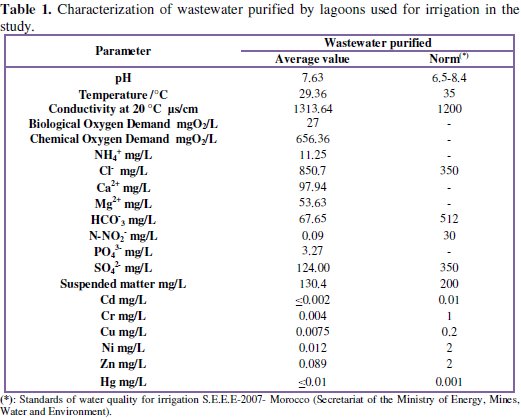
<body><![CDATA[<p>Electrochemical measurements were carried out in a conventional three-electrode  electrolysis cylindrical Pyrex glass cell. The working electrode (WE) in the form  of disc cut from aluminum has a geometric area of 1 cm<sup>2</sup>. A saturated calomel  electrode (SCE) and a disc platinum electrode were used respectively as  reference and auxiliary electrodes. The temperature was thermostatically  controlled at 25 &deg;C. The WE was abraded with different emery papers up to 1200  grade, degreased with acetone, and rinsed with distilled water before use.  Running on a compatible computer, the Voltab Master4 Software communicates  with Instruments potentiostat-galvanostat model PGZ100 at a scan rate of 20  mV/sec. Before recording the polarization curves, the working electrode is  maintained for 10 min to E<sub>corr</sub>. The resulting current is plotted as a function of  the potential. Polarization resistance (Rp) values were obtained from the current  potential plot. The scan rate was 10 mV/sec. The electrochemical impedance  spectroscopy (EIS) was performed with an electrochemical system which  includes a potentiostat Volta PGZ 100 connected with the computer, being the  working electrode in alunimium with a circular form of 1 cm<sup>2</sup>.  Frequencies between 100 kHz and 10 mHz were superimposed on the corrosion  potential. The impedance diagrams are given in the Nyquist representation.  Values of Rt and Cdl were obtained from Nyquist plots.</p>       <p>&nbsp;</p>     <p><b>Results and discussion</b></p>      <p><b><i>Physicochemical analysis of irrigation water</i></b></p>      <p>Throughout the experiment, the chemical composition of this water source of  irrigation has been determined and is detailed in <a href="#t1">Table 1</a>.</p>       <p>&nbsp;</p> <a name="t1"> <img src="/img/revistas/pea/v32n6/32n6a02t1.jpg">     
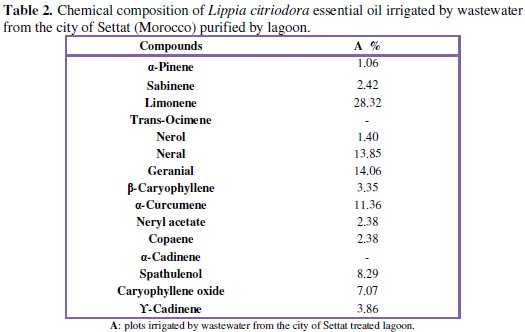
<p>&nbsp;</p>       <p>The gravity irrigation  of the planting is done 1 day / 3 sources, and water was analyzed at each  irrigation. Wastewater physico-chemical analyzes showed that the chemical  oxygen demand is high and the concentration of Cl -ion exceeds the standard  because urban water is responsible by chloride ions. Other physico-chemical  parameters meet the standards as metallic trace elements.</p>       <p><b><i>Chemical composition of Lippia citriodora essential oil</i></b></p>      <p>The GC-MS analyzes of Lippia citriodora essential oil irrigated by urban  wastewater purified by lagoons from the city of Settat-Morocco are presented in  the <a href="#t2">Table 2</a>.</p>       ]]></body>
<body><![CDATA[<p>&nbsp;</p> <a name="t2"> <img src="/img/revistas/pea/v32n6/32n6a02t2.jpg">     
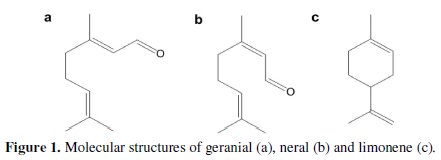
<p>&nbsp;</p>       <p>Lippia citriodora of Morocco still contains as main composition: limonene  (28,32%), neral (13,85%) and geranial (14,06%) (<a href="#f1">Fig. 1</a>).</p>       <p>&nbsp;</p> <a name="f1"> <img src="/img/revistas/pea/v32n6/32n6a02f1.jpg">     
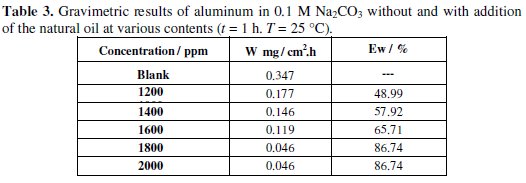
<p>&nbsp;</p>       <p>However, our results  did not show the presence of p-cymene, camphor and thymol, which have been  mentioned in other studies concerning L. citriodora [17, 18].</p>      <p>The corrosion rate (W<sub>corr</sub>) of aluminum in 0.1 M Na<sub>2</sub>CO<sub>3</sub> solution at various  contents of the natural oil tested was determined after 1 h of immersion period at  25 &deg;C. Values of corrosion rates and inhibition efficiencies are given in <a href="#t3">Table 3</a>.</p>       <p>&nbsp;</p> <a name="t3"> <img src="/img/revistas/pea/v32n6/32n6a02t3.jpg">     
<p>&nbsp;</p>       <p>In the case of the weight loss method, the inhibition efficiency (Ew %) was  determined by the following relation:</p>       ]]></body>
<body><![CDATA[<p>&nbsp;</p> <a name="e1"> <img src="/img/revistas/pea/v32n6/32n6a02e1.jpg">     
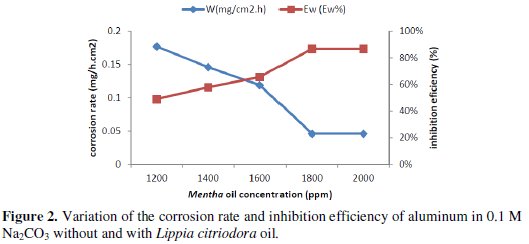
<p>&nbsp;</p>       <p>where W<sub>corr</sub> and W<sub>corr(inh)</sub> are the corrosion rates of aluminum in the absence and  presence of the oil, respectively.</p>      <p>The analysis of these results (<a href="#t3">Table 3</a> and <a href="#f2">Fig. 2</a>) shows clearly that the corrosion  rate decreases (W (mg/h.cm<sup>2</sup>) while the inhibition efficiency (Ew (%)) increases  with increasing inhibitor concentration, reaching a maximum value of 86.74 % at  a concentration of 1800 ppm.</p>       <p>&nbsp;</p> <a name="f2"> <img src="/img/revistas/pea/v32n6/32n6a02f2.jpg">     
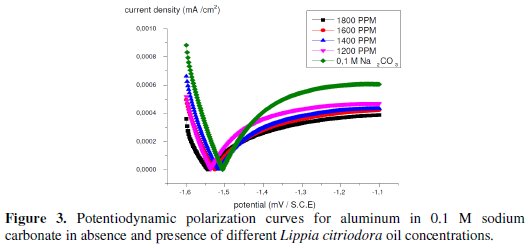
<p>&nbsp;</p>       <p>This behaviour can be attributed to the increase of  the surface covered &theta; (Ew % /100) and this probably is due to the adsorption of  natural compounds on the surface of the metal as the inhibitor concentration  increases. We can conclude that Lippia oil is a good corrosion inhibitor for  aluminum in 0.1 M Na<sub>2</sub>CO<sub>3</sub> solution.</p>       <p><b><i>Polarisation measurements</i></b></p>      <p>Current-potential characteristics resulting from cathodic and anodic polarisation  curves of aluminum in 0.1 molar sodium carbonate at various concentrations of  the tested Lippia citriodora oil are evaluated (<a href="#f3">Fig. 3</a>).</p>       <p>&nbsp;</p> <a name="f3"> <img src="/img/revistas/pea/v32n6/32n6a02f3.jpg">     
]]></body>
<body><![CDATA[<p>&nbsp;</p>       <p><a href="#t4">Table 4</a> collects the corrosion kinetic parameters such as E<sub>corr</sub>, I<sub>corr</sub>, &beta;c, and &beta;a  obtained from potentiodynamic polarization curves for aluminum in 0.1M  Na<sub>2</sub>CO<sub>3</sub> containing different concentrations of Lippia citriodora oil.</p>       <p>&nbsp;</p> <a name="t4"> <img src="/img/revistas/pea/v32n6/32n6a02t4.jpg">     
<p>&nbsp;</p>       <p>In the case of polarization method the following relation determines the inhibition efficiency  (EI %):</p>       <p>&nbsp;</p> <a name="e2"> <img src="/img/revistas/pea/v32n6/32n6a02e2.jpg">     
<p>&nbsp;</p>       <p>where I<sub>corr</sub> and I<sub>corr(inh)</sub> are the corrosion current density values without and with  the inhibitor, respectively.</p>      <p><a href="#f3">Fig. 3</a> represents the anodic and cathodic polarization curves for aluminum in 0.1  M sodium carbonate in absence and presence of different concentrations of  Lippia citriodora oil. As seen, from this figure the Lippia citriodora oil inhibits  both cathodic and anodic parts of the polarization curves.</p>      <p><a href="#t4">Table 4</a> shows the electrochemical polarization parameters, where the corrosion  current density, (I<sub>corr</sub>), was calculated from the intersection of the anodic and  cathodic Tafel lines, corrosion potential (E<sub>corr</sub>), corrosion current density and  anodic and cathodic Tafel line slopes (&beta;a, and &beta;c) for different concentrations of  Lippia citriodora oil. The data revealed that, for all concentrations under study,  the corrosion current density, that is directly proportional to corrosion rate,  decreases with increasing the Lippia citriodora oil concentration.</p>      ]]></body>
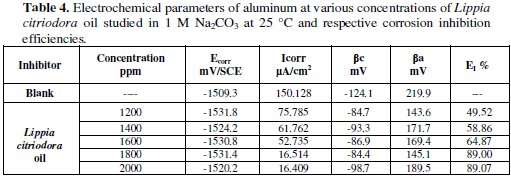
<body><![CDATA[<p>The values of E<sub>corr</sub> shifted slightly to less positive potentials with increasing the  concentration of Lippia citriodora oil. The values of the anodic Tafel line slope  (&beta;a) in presence of the extracts show higher values probably due to the effect of  diffusion process.</p>      <p>The data in <a href="#t4">Table 4</a> also show that the oil of Lippia citriodora inhibits corrosion  of the aluminum in the basic medium and that the efficiency reaches about 89%  at a concentration of 1800 ppm in oil".</p>       <p><b><i>Electrochemical impedance spectroscopy (EIS)</i></b></p>      <p>The corrosion behaviour of aluminum in 0.1 molar sodium carbonate, in the  absence and presence of Lippia citriodora oil, is also investigated by  electrochemical impedance spectroscopy (EIS) at 25 &deg;C. The charge-transfer  resistance (Rt) values are calculated from the difference in impedance at lower  and higher frequencies, as suggested by Tsuru et al. [19]. The double layer  capacitance (Cdl) and the frequency at which the imaginary component of the  impedance is maximal (-Zmax) are found as represented in equation:</p>       <p>&nbsp;</p> <a name="e3"> <img src="/img/revistas/pea/v32n6/32n6a02e3.jpg">     
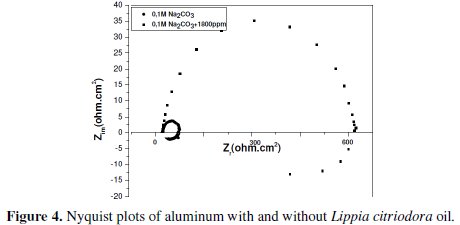
<p>&nbsp;</p>       <p>Impedance diagrams are obtained for the frequency range 100 KHz - 10 mHz for  aluminum in 0.1 molar sodium carbonate in the presence and absence of Lippia  citriodora oil. Nyquist plots for aluminum in 1 M Na<sub>2</sub>CO<sub>3</sub> and in 1800 ppm  concentration of Lippia citriodora oil are presented in <a href="#f4">Fig. 4</a>.</p>       <p>&nbsp;</p> <a name="f4"> <img src="/img/revistas/pea/v32n6/32n6a02f4.jpg">     
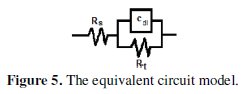
<p>&nbsp;</p>       <p>The Nyquist impedance plots explain that the impedance response consists of a  capacitive semicircle followed by an inductive loop, indicating that the  dissolution process occurs under activation control. The inductive loop is  generally attributed to the adsorption of the species resulting from metal  dissolution and hydrogen adsorption [20]. The impedance spectra for different  Nyquist plots were analyzed by fitting the experimental data to a simple  equivalent circuit model (<a href="#f5">Fig. 5</a>) which includes the solution resistance, Rs, and  the double layer capacitance, Cdl, which is placed in parallel to charge the  transfer resistance element, Rt.</p>       ]]></body>
<body><![CDATA[<p>&nbsp;</p> <a name="f5"> <img src="/img/revistas/pea/v32n6/32n6a02f5.jpg">     
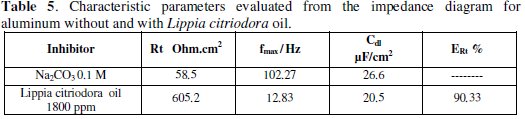
<p>&nbsp;</p>       <p>The Rt value is a measure of electron transfer  across the surface and is inversely proportional to the corrosion rate.</p>      <p><a href="#t5">Table 5</a> presents values of charge transfer resistance, Rt, double-layer  capacitance, Cdl, and fmax derived from Nyquist plots and inhibition efficiency;</p>       <p>&nbsp;</p> <a name="t5"> <img src="/img/revistas/pea/v32n6/32n6a02t5.jpg">     
<p>&nbsp;</p>       <p>the inhibition efficiency gotten from the charge-transfer resistance is calculated  by the following relation:</p>       <p>&nbsp;</p> <a name="e4"> <img src="/img/revistas/pea/v32n6/32n6a02e4.jpg">     
<p>&nbsp;</p>       <p>Rt and R't are the charge-transfer resistance values without and with inhibitor,  respectively.</p>      ]]></body>
<body><![CDATA[<p>Increasing Rt values with the concentration of the oil suggests decrease of the  corrosion rate, since the Rt value is a measure of electron transfer across the  surface, and inversely proportional to the corrosion rate. The decrease in the Cdl  values could be attributed to the adsorption of the chemical constituents of the  extracts at the metal surface [21].</p>      <p>The tabulated data also indicate that Lippia citriodora oil has considerable effect  for the corrosion of aluminum in 0.1 M Na<sub>2</sub>CO<sub>3</sub> solution.  As seen, the inhibition efficiency of the Lippia citriodora oil is arranged  according to <a href="#t6">Table 6</a>. The data show that there is a considerable agreement  between the data obtained from the three techniques: weight loss, polarization,  and EIS.</p>      <p>&nbsp;</p> <a name="t6"> <img src="/img/revistas/pea/v32n6/32n6a02t6.jpg">     
<p>&nbsp;</p>     <p><b><i>Mechanism of corrosion of aluminum in alkaline solutions</i></b></p>      <p><i>a) Anodic reaction (dissolution of aluminum):</i></p>      <p>The anodic potentiodynamic polarization curves of aluminum in 0.1 M Na<sub>2</sub>CO<sub>3</sub>  in absence or in presence of the Lippia citriodora oil show a limiting current,  indicating that the dissolution of aluminum is controlled by the diffusion of  Al(OH)4-or AlO2-from the surface of the metal to the bulk of solution. Then the  anodic dissolution of aluminum can be represented as:</p>       <p>&nbsp;</p> <a name="e5"> <img src="/img/revistas/pea/v32n6/32n6a02e5.jpg">     
<p>&nbsp;</p> <a name="e6"> <img src="/img/revistas/pea/v32n6/32n6a02e6.jpg">     
<p>&nbsp;</p>       ]]></body>
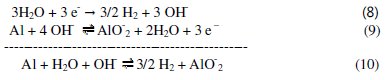
<body><![CDATA[<p><i>b) Cathodic reaction (reduction of water):</i></p>      <p>The cathodic polarization curve of aluminum in 0.1 M Na<sub>2</sub>CO<sub>3</sub> in absence or in  presence of the Lippia citriodora oil shows Tafel behavior, indicating that the  reduction process is controlled by charge transfer and can be represented by:</p>       <p>&nbsp;</p> <a name="e7"> <img src="/img/revistas/pea/v32n6/32n6a02e7.jpg">     
<p>&nbsp;</p>       <p><i>c) Overall corrosion reaction:</i></p>      <p>The impedance spectroscopy data of aluminum 0.1 M Na<sub>2</sub>CO<sub>3</sub> in absence or in  presence of the Lippia citriodora oil measured at the equilibrium potential  indicated that the corrosion of aluminum is controlled by charge transfer. This  means that the reduction of water at cathodic areas is the slow step of corrosion  of aluminum. The equation corresponding to the overall reaction of corrosion of  aluminum in 0.1 M Na<sub>2</sub>CO<sub>3</sub> solution can be obtained if <a href="#e7">eq. (7)</a> is multiplied by 3  and then added to <a href="#e8">eq. (9)</a>:</p>       <p>&nbsp;</p> <a name="e8"> <img src="/img/revistas/pea/v32n6/32n6a02e8.jpg">     
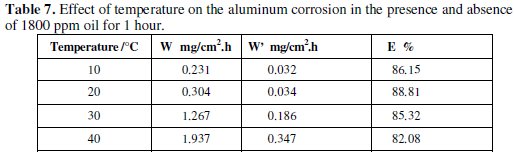
<p>&nbsp;</p>       <p><i>Effect of temperature</i></p>      <p>The effect of temperature on the corrosion behaviour of aluminum in 0.1 M  Na<sub>2</sub>CO<sub>3</sub> containing the inhibitor at a concentration of 1800 ppm is studied in the  temperature range 10-40 &deg;C using weight loss measurements. <a href="#t7">Table 7</a> regroups  the corresponding obtained results.</p>       ]]></body>
<body><![CDATA[<p>&nbsp;</p> <a name="t7"> <img src="/img/revistas/pea/v32n6/32n6a02t7.jpg">     
<p>&nbsp;</p>       <p>It is obvious that the corrosion rate increases both in the uninhibited and inhibited  alkaline solution with the rise of temperature. The presence of the inhibitor leads  to the decrease of the corrosion rate, E%, which decreases with the increase of  temperature.</p>      <p>The following relation can determine the apparent activation energy:</p>       <p>&nbsp;</p> <a name="e11"> <img src="/img/revistas/pea/v32n6/32n6a02e11.jpg">     
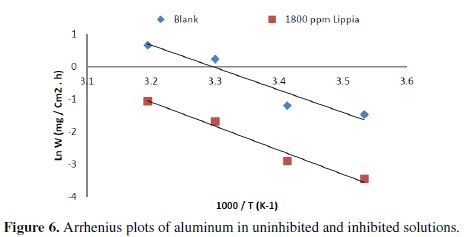
<p>&nbsp;</p>       <p>W'<sub>corr</sub> and W<sub>corr</sub> are the corrosion rates of aluminum with and without inhibitor,  respectively. E'<sub>a</sub> and E<sub>a</sub> are the apparent activation energies in the presence and  absence of the inhibitor, respectively.</p>      <p>Arrhenius plots for the corrosion rates of aluminum are shown in <a href="#f6">Fig. 6</a>.</p>       <p>&nbsp;</p> <a name="f6"> <img src="/img/revistas/pea/v32n6/32n6a02f6.jpg">     
<p>&nbsp;</p>       ]]></body>
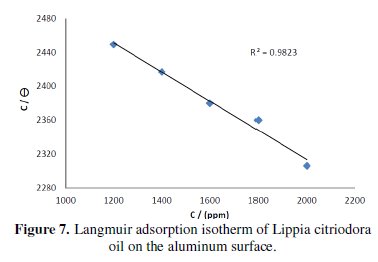
<body><![CDATA[<p>The calculated values of activation energies from the slopes are 48.55 and 112.32  kJ/mol for blank and with the addition of 1800 ppm of Lippia citriodora oil,  respectively.</p>      <p>It is found that the activation energy increases in the presence of the inhibitor.  Furthermore, the decrease of E% is explained due to the physisorption of the  inhibitor molecule on the steel surface [22]. The lower value of Ea of the  corrosion process in the inhibitor's presence when compared to that in its absence  is attributed to its chemisorption [23].</p>       <p><i>Adsorption isotherm</i></p>      <p>The dependence of the fraction of the surface covered &theta;  obtained by the ratio  E%/100 as a function of the oil concentration (C) was graphically fitted for  Langmuir, Temkin and Frumkin adsorption isotherms. <a href="#f7">Fig. 7</a> shows the  dependence of C/&theta; as a function of the oil concentration.</p>       <p>&nbsp;</p> <a name="f7"> <img src="/img/revistas/pea/v32n6/32n6a02f7.jpg">     
<p>&nbsp;</p>       <p>The curve obtained  clearly shows that the data fit well with Langmuir adsorption isotherm and this  was found to be the best description of the adsorption behaviour of the studied  inhibitor, which obeys:</p>       <p>&nbsp;</p> <a name="e12"> <img src="/img/revistas/pea/v32n6/32n6a02e12.jpg">     
<p>&nbsp;</p>       <p>C is the inhibitor concentration; &theta; is the fraction of the surface covered, Kads is  the adsorption coefficient.</p>      ]]></body>
<body><![CDATA[<p>The literature shows that the adsorption of heterocyclic compounds occurs with  the aromatic rings mostly perpendicular with respect to the metal surface at low  concentration, but at elevated inhibitor concentration the molecules are  reoriented to the parallel mode [23]. Besides, the adsorption phenomenon may be  made by carvone as the principal constituent of the essential oil of Lippia  citriodora. But as the natural oil contains so many components, the inhibitory  action may also be due to synergistic intermolecular of the active molecules of  this oil [24].</p>       <p>&nbsp;</p>     <p><b>Conclusions</b></p>      <p>From the overall experimental results the following conclusions can be deduced:</p>      <p>- chemical analysis showed limonene, neral and geranial as major  components of Lippia citriodora essential oil;</p>      <p>- Lippia citriodora oil acts as good inhibitor for the corrosion of aluminum in 0.1  Na<sub>2</sub>CO<sub>3</sub> medium;</p>      <p>- the inhibition efficiency of Lippia citriodora oil increases with concentration to  attain 90.33% at 1800 ppm;</p>      <p>- the inhibition efficiency of Lippia citriodora oil decreases with the rise of  temperature;</p>      <p>- the Lippia citriodora essential oil acts on aluminum surface as a mixed  inhibitor through a physisorption mechanism.</p>       <p>&nbsp;</p>     ]]></body>
<body><![CDATA[<p><b>References</b></p>      <!-- ref --><p>1. Hunter M S, Fowle P. J Electrochem Soc. 1956;103:482.    &nbsp;&nbsp;&nbsp;&nbsp;&nbsp;&nbsp;&nbsp;&nbsp;[&#160;<a href="javascript:void(0);" onclick="javascript: window.open('/scielo.php?script=sci_nlinks&ref=000144&pid=S0872-1904201400060000200001&lng=','','width=640,height=500,resizable=yes,scrollbars=1,menubar=yes,');">Links</a>&#160;]<!-- end-ref --></p>      <!-- ref --><p>2. Fontana M G, Greene N D. Corrosion Engineering. McGraw-Hill; 1978.    &nbsp;&nbsp;&nbsp;&nbsp;&nbsp;&nbsp;&nbsp;&nbsp;[&#160;<a href="javascript:void(0);" onclick="javascript: window.open('/scielo.php?script=sci_nlinks&ref=000146&pid=S0872-1904201400060000200002&lng=','','width=640,height=500,resizable=yes,scrollbars=1,menubar=yes,');">Links</a>&#160;]<!-- end-ref --></p>      <!-- ref --><p>3. Bazzi L, Kertit S, Hamdani M. Corrosion. 1995;51:811.    &nbsp;&nbsp;&nbsp;&nbsp;&nbsp;&nbsp;&nbsp;&nbsp;[&#160;<a href="javascript:void(0);" onclick="javascript: window.open('/scielo.php?script=sci_nlinks&ref=000148&pid=S0872-1904201400060000200003&lng=','','width=640,height=500,resizable=yes,scrollbars=1,menubar=yes,');">Links</a>&#160;]<!-- end-ref --></p>      <!-- ref --><p>4. Bazzi L, Kertit S, Hamdani M. J Chim Phys. 1995;92:1612.    &nbsp;&nbsp;&nbsp;&nbsp;&nbsp;&nbsp;&nbsp;&nbsp;[&#160;<a href="javascript:void(0);" onclick="javascript: window.open('/scielo.php?script=sci_nlinks&ref=000150&pid=S0872-1904201400060000200004&lng=','','width=640,height=500,resizable=yes,scrollbars=1,menubar=yes,');">Links</a>&#160;]<!-- end-ref --></p>      <!-- ref --><p>5. Bazzi L, Kertit S, Hamdani M. J Chim Phys. 1997;94:93.    &nbsp;&nbsp;&nbsp;&nbsp;&nbsp;&nbsp;&nbsp;&nbsp;[&#160;<a href="javascript:void(0);" onclick="javascript: window.open('/scielo.php?script=sci_nlinks&ref=000152&pid=S0872-1904201400060000200005&lng=','','width=640,height=500,resizable=yes,scrollbars=1,menubar=yes,');">Links</a>&#160;]<!-- end-ref --></p>      <!-- ref --><p>6. Bazzi L, Kertit S, Hamdani M. Bull Electrochem. 1998;14:34.    &nbsp;&nbsp;&nbsp;&nbsp;&nbsp;&nbsp;&nbsp;&nbsp;[&#160;<a href="javascript:void(0);" onclick="javascript: window.open('/scielo.php?script=sci_nlinks&ref=000154&pid=S0872-1904201400060000200006&lng=','','width=640,height=500,resizable=yes,scrollbars=1,menubar=yes,');">Links</a>&#160;]<!-- end-ref --></p>      <!-- ref --><p>7. Mosheir W C, Davis G D, Aheran K. Corros Sci. 1987;27:785.    &nbsp;&nbsp;&nbsp;&nbsp;&nbsp;&nbsp;&nbsp;&nbsp;[&#160;<a href="javascript:void(0);" onclick="javascript: window.open('/scielo.php?script=sci_nlinks&ref=000156&pid=S0872-1904201400060000200007&lng=','','width=640,height=500,resizable=yes,scrollbars=1,menubar=yes,');">Links</a>&#160;]<!-- end-ref --></p>      <!-- ref --><p>8. Salghi R, Bazzi L, Hammouti B, et al. Ann Chim Mater. 2000;25:593.    &nbsp;&nbsp;&nbsp;&nbsp;&nbsp;&nbsp;&nbsp;&nbsp;[&#160;<a href="javascript:void(0);" onclick="javascript: window.open('/scielo.php?script=sci_nlinks&ref=000158&pid=S0872-1904201400060000200008&lng=','','width=640,height=500,resizable=yes,scrollbars=1,menubar=yes,');">Links</a>&#160;]<!-- end-ref --></p>      <!-- ref --><p>9. Bazzi L, Kertit S, Hamdani M. Rev Metal Sci Gen Mater. 1994;12:1835.    &nbsp;&nbsp;&nbsp;&nbsp;&nbsp;&nbsp;&nbsp;&nbsp;[&#160;<a href="javascript:void(0);" onclick="javascript: window.open('/scielo.php?script=sci_nlinks&ref=000160&pid=S0872-1904201400060000200009&lng=','','width=640,height=500,resizable=yes,scrollbars=1,menubar=yes,');">Links</a>&#160;]<!-- end-ref --></p>      <!-- ref --><p>10. Salghi R, Bazzi L, Zaafrani M. Acta Chim Slov. 2003;50:491.    &nbsp;&nbsp;&nbsp;&nbsp;&nbsp;&nbsp;&nbsp;&nbsp;[&#160;<a href="javascript:void(0);" onclick="javascript: window.open('/scielo.php?script=sci_nlinks&ref=000162&pid=S0872-1904201400060000200010&lng=','','width=640,height=500,resizable=yes,scrollbars=1,menubar=yes,');">Links</a>&#160;]<!-- end-ref --></p>      <!-- ref --><p>11. Bazzi L, Salghi R, Bouchtart A, et al. Rev Metal Sci Gen Mater. 2002;2:189.    &nbsp;&nbsp;&nbsp;&nbsp;&nbsp;&nbsp;&nbsp;&nbsp;[&#160;<a href="javascript:void(0);" onclick="javascript: window.open('/scielo.php?script=sci_nlinks&ref=000164&pid=S0872-1904201400060000200011&lng=','','width=640,height=500,resizable=yes,scrollbars=1,menubar=yes,');">Links</a>&#160;]<!-- end-ref --></p>      <!-- ref --><p>12. Bazzi L, Salghi R, El Alami Z, et al. Can J Chem. 2002;80:106.    &nbsp;&nbsp;&nbsp;&nbsp;&nbsp;&nbsp;&nbsp;&nbsp;[&#160;<a href="javascript:void(0);" onclick="javascript: window.open('/scielo.php?script=sci_nlinks&ref=000166&pid=S0872-1904201400060000200012&lng=','','width=640,height=500,resizable=yes,scrollbars=1,menubar=yes,');">Links</a>&#160;]<!-- end-ref --></p>      <!-- ref --><p>13. Nguyen T H, Foley RT. J Electrochem Soc. 1979;126:1855.    &nbsp;&nbsp;&nbsp;&nbsp;&nbsp;&nbsp;&nbsp;&nbsp;[&#160;<a href="javascript:void(0);" onclick="javascript: window.open('/scielo.php?script=sci_nlinks&ref=000168&pid=S0872-1904201400060000200013&lng=','','width=640,height=500,resizable=yes,scrollbars=1,menubar=yes,');">Links</a>&#160;]<!-- end-ref --></p>      <!-- ref --><p>14. Berzins A, Lowson R T, Mirams K J. Aust J Chem. 1977;30:1891.    &nbsp;&nbsp;&nbsp;&nbsp;&nbsp;&nbsp;&nbsp;&nbsp;[&#160;<a href="javascript:void(0);" onclick="javascript: window.open('/scielo.php?script=sci_nlinks&ref=000170&pid=S0872-1904201400060000200014&lng=','','width=640,height=500,resizable=yes,scrollbars=1,menubar=yes,');">Links</a>&#160;]<!-- end-ref --></p>      <!-- ref --><p>15. Lowson R T. Aust J Chem. 1978;31:943.    &nbsp;&nbsp;&nbsp;&nbsp;&nbsp;&nbsp;&nbsp;&nbsp;[&#160;<a href="javascript:void(0);" onclick="javascript: window.open('/scielo.php?script=sci_nlinks&ref=000172&pid=S0872-1904201400060000200015&lng=','','width=640,height=500,resizable=yes,scrollbars=1,menubar=yes,');">Links</a>&#160;]<!-- end-ref --></p>      <!-- ref --><p>16. Bensabah F, Houbairi S, Essahli M, et al. Port Electrochim Acta. 2013;31:195.    &nbsp;&nbsp;&nbsp;&nbsp;&nbsp;&nbsp;&nbsp;&nbsp;[&#160;<a href="javascript:void(0);" onclick="javascript: window.open('/scielo.php?script=sci_nlinks&ref=000174&pid=S0872-1904201400060000200016&lng=','','width=640,height=500,resizable=yes,scrollbars=1,menubar=yes,');">Links</a>&#160;]<!-- end-ref --></p>      <!-- ref --><p>17. Kim N-S, Lee D-S. J Sep Sci. 2004;27:96.    &nbsp;&nbsp;&nbsp;&nbsp;&nbsp;&nbsp;&nbsp;&nbsp;[&#160;<a href="javascript:void(0);" onclick="javascript: window.open('/scielo.php?script=sci_nlinks&ref=000176&pid=S0872-1904201400060000200017&lng=','','width=640,height=500,resizable=yes,scrollbars=1,menubar=yes,');">Links</a>&#160;]<!-- end-ref --></p>      <!-- ref --><p>18. Zygadlo J A, Lamarque A L, Maestri D M, et al. J Essent Oil Res. 1994;6:407.    &nbsp;&nbsp;&nbsp;&nbsp;&nbsp;&nbsp;&nbsp;&nbsp;[&#160;<a href="javascript:void(0);" onclick="javascript: window.open('/scielo.php?script=sci_nlinks&ref=000178&pid=S0872-1904201400060000200018&lng=','','width=640,height=500,resizable=yes,scrollbars=1,menubar=yes,');">Links</a>&#160;]<!-- end-ref --></p>      <!-- ref --><p>19. Tsuru T, Haruyama S, Gijutsu B. J Jpn Soc Corros Eng. 1978;27:573.    &nbsp;&nbsp;&nbsp;&nbsp;&nbsp;&nbsp;&nbsp;&nbsp;[&#160;<a href="javascript:void(0);" onclick="javascript: window.open('/scielo.php?script=sci_nlinks&ref=000180&pid=S0872-1904201400060000200019&lng=','','width=640,height=500,resizable=yes,scrollbars=1,menubar=yes,');">Links</a>&#160;]<!-- end-ref --></p>      <!-- ref --><p>20. Dehri Y, Erbil M. Corros Sci. 2000;42:969.    &nbsp;&nbsp;&nbsp;&nbsp;&nbsp;&nbsp;&nbsp;&nbsp;[&#160;<a href="javascript:void(0);" onclick="javascript: window.open('/scielo.php?script=sci_nlinks&ref=000182&pid=S0872-1904201400060000200020&lng=','','width=640,height=500,resizable=yes,scrollbars=1,menubar=yes,');">Links</a>&#160;]<!-- end-ref --></p>      <!-- ref --><p>21. Aramaki K, Hagiwara M, Nishihara H. Corros Sci. 1987;5:487.    &nbsp;&nbsp;&nbsp;&nbsp;&nbsp;&nbsp;&nbsp;&nbsp;[&#160;<a href="javascript:void(0);" onclick="javascript: window.open('/scielo.php?script=sci_nlinks&ref=000184&pid=S0872-1904201400060000200021&lng=','','width=640,height=500,resizable=yes,scrollbars=1,menubar=yes,');">Links</a>&#160;]<!-- end-ref --></p>      <!-- ref --><p>22. Dahmani M, Et-Touhami A, Al-Deyab SS, et al. Int J Electrochem Sci. 2010;5:1060.    &nbsp;&nbsp;&nbsp;&nbsp;&nbsp;&nbsp;&nbsp;&nbsp;[&#160;<a href="javascript:void(0);" onclick="javascript: window.open('/scielo.php?script=sci_nlinks&ref=000186&pid=S0872-1904201400060000200022&lng=','','width=640,height=500,resizable=yes,scrollbars=1,menubar=yes,');">Links</a>&#160;]<!-- end-ref --></p>      <!-- ref --><p>23. Zarrouk A, Warad I, Hammouti B, et al. Int J Electrochem Sci. 2010;5:1516.    &nbsp;&nbsp;&nbsp;&nbsp;&nbsp;&nbsp;&nbsp;&nbsp;[&#160;<a href="javascript:void(0);" onclick="javascript: window.open('/scielo.php?script=sci_nlinks&ref=000188&pid=S0872-1904201400060000200023&lng=','','width=640,height=500,resizable=yes,scrollbars=1,menubar=yes,');">Links</a>&#160;]<!-- end-ref --></p>      <!-- ref --><p>24. Bockris J O M, Young B. J Electrochem Soc. 1999;138:2237.    &nbsp;&nbsp;&nbsp;&nbsp;&nbsp;&nbsp;&nbsp;&nbsp;[&#160;<a href="javascript:void(0);" onclick="javascript: window.open('/scielo.php?script=sci_nlinks&ref=000190&pid=S0872-1904201400060000200024&lng=','','width=640,height=500,resizable=yes,scrollbars=1,menubar=yes,');">Links</a>&#160;]<!-- end-ref --></p>       <p>&nbsp;</p>     ]]></body>
<body><![CDATA[<p><a name=0></a><sup><a href="#top">*</a></sup>Corresponding author. E-mail address: <a href="mailto:bensabah_fati@yahoo.fr">bensabah_fati@yahoo.fr</a></p>      <p>Received 6 February 2014; accepted 17 November 2014</p>      <p><a href="http://www.peacta.org" target="_blank">www.peacta.org</a> </p>        ]]></body><back>
<ref-list>
<ref id="B1">
<label>1</label><nlm-citation citation-type="journal">
<person-group person-group-type="author">
<name>
<surname><![CDATA[Hunter]]></surname>
<given-names><![CDATA[M S]]></given-names>
</name>
<name>
<surname><![CDATA[Fowle]]></surname>
<given-names><![CDATA[P]]></given-names>
</name>
</person-group>
<source><![CDATA[J Electrochem Soc]]></source>
<year>1956</year>
<volume>103</volume>
<page-range>482</page-range></nlm-citation>
</ref>
<ref id="B2">
<label>2</label><nlm-citation citation-type="book">
<person-group person-group-type="author">
<name>
<surname><![CDATA[Fontana]]></surname>
<given-names><![CDATA[M G]]></given-names>
</name>
<name>
<surname><![CDATA[Greene]]></surname>
<given-names><![CDATA[N D]]></given-names>
</name>
</person-group>
<source><![CDATA[Corrosion Engineering]]></source>
<year>1978</year>
<publisher-name><![CDATA[McGraw-Hill]]></publisher-name>
</nlm-citation>
</ref>
<ref id="B3">
<label>3</label><nlm-citation citation-type="journal">
<person-group person-group-type="author">
<name>
<surname><![CDATA[Bazzi]]></surname>
<given-names><![CDATA[L]]></given-names>
</name>
<name>
<surname><![CDATA[Kertit]]></surname>
<given-names><![CDATA[S]]></given-names>
</name>
<name>
<surname><![CDATA[Hamdani]]></surname>
<given-names><![CDATA[M]]></given-names>
</name>
</person-group>
<source><![CDATA[Corrosion]]></source>
<year>1995</year>
<volume>51</volume>
<page-range>811</page-range></nlm-citation>
</ref>
<ref id="B4">
<label>4</label><nlm-citation citation-type="journal">
<person-group person-group-type="author">
<name>
<surname><![CDATA[Bazzi]]></surname>
<given-names><![CDATA[L]]></given-names>
</name>
<name>
<surname><![CDATA[Kertit]]></surname>
<given-names><![CDATA[S]]></given-names>
</name>
<name>
<surname><![CDATA[Hamdani]]></surname>
<given-names><![CDATA[M]]></given-names>
</name>
</person-group>
<source><![CDATA[J Chim Phys]]></source>
<year>1995</year>
<volume>92</volume>
<page-range>1612</page-range></nlm-citation>
</ref>
<ref id="B5">
<label>5</label><nlm-citation citation-type="journal">
<person-group person-group-type="author">
<name>
<surname><![CDATA[Bazzi]]></surname>
<given-names><![CDATA[L]]></given-names>
</name>
<name>
<surname><![CDATA[Kertit]]></surname>
<given-names><![CDATA[S]]></given-names>
</name>
<name>
<surname><![CDATA[Hamdani]]></surname>
<given-names><![CDATA[M]]></given-names>
</name>
</person-group>
<source><![CDATA[J Chim Phys]]></source>
<year>1997</year>
<volume>94</volume>
<page-range>93</page-range></nlm-citation>
</ref>
<ref id="B6">
<label>6</label><nlm-citation citation-type="journal">
<person-group person-group-type="author">
<name>
<surname><![CDATA[Bazzi]]></surname>
<given-names><![CDATA[L]]></given-names>
</name>
<name>
<surname><![CDATA[Kertit]]></surname>
<given-names><![CDATA[S]]></given-names>
</name>
<name>
<surname><![CDATA[Hamdani]]></surname>
<given-names><![CDATA[M]]></given-names>
</name>
</person-group>
<source><![CDATA[Bull Electrochem]]></source>
<year>1998</year>
<volume>14</volume>
<page-range>34</page-range></nlm-citation>
</ref>
<ref id="B7">
<label>7</label><nlm-citation citation-type="journal">
<person-group person-group-type="author">
<name>
<surname><![CDATA[Mosheir]]></surname>
<given-names><![CDATA[W C]]></given-names>
</name>
<name>
<surname><![CDATA[Davis]]></surname>
<given-names><![CDATA[G D]]></given-names>
</name>
<name>
<surname><![CDATA[Aheran]]></surname>
<given-names><![CDATA[K]]></given-names>
</name>
</person-group>
<source><![CDATA[Corros Sci]]></source>
<year>1987</year>
<volume>27</volume>
<page-range>785</page-range></nlm-citation>
</ref>
<ref id="B8">
<label>8</label><nlm-citation citation-type="journal">
<person-group person-group-type="author">
<name>
<surname><![CDATA[Salghi]]></surname>
<given-names><![CDATA[R]]></given-names>
</name>
<name>
<surname><![CDATA[Bazzi]]></surname>
<given-names><![CDATA[L]]></given-names>
</name>
<name>
<surname><![CDATA[Hammouti]]></surname>
<given-names><![CDATA[B]]></given-names>
</name>
</person-group>
<source><![CDATA[Ann Chim Mater]]></source>
<year>2000</year>
<volume>25</volume>
<page-range>593</page-range></nlm-citation>
</ref>
<ref id="B9">
<label>9</label><nlm-citation citation-type="journal">
<person-group person-group-type="author">
<name>
<surname><![CDATA[Bazzi]]></surname>
<given-names><![CDATA[L]]></given-names>
</name>
<name>
<surname><![CDATA[Kertit]]></surname>
<given-names><![CDATA[S]]></given-names>
</name>
<name>
<surname><![CDATA[Hamdani]]></surname>
<given-names><![CDATA[M]]></given-names>
</name>
</person-group>
<source><![CDATA[Rev Metal Sci Gen Mater]]></source>
<year>1994</year>
<volume>12</volume>
<page-range>1835</page-range></nlm-citation>
</ref>
<ref id="B10">
<label>10</label><nlm-citation citation-type="journal">
<person-group person-group-type="author">
<name>
<surname><![CDATA[Salghi]]></surname>
<given-names><![CDATA[R]]></given-names>
</name>
<name>
<surname><![CDATA[Bazzi]]></surname>
<given-names><![CDATA[L]]></given-names>
</name>
<name>
<surname><![CDATA[Zaafrani]]></surname>
<given-names><![CDATA[M]]></given-names>
</name>
</person-group>
<source><![CDATA[Acta Chim Slov]]></source>
<year>2003</year>
<volume>50</volume>
<page-range>491</page-range></nlm-citation>
</ref>
<ref id="B11">
<label>11</label><nlm-citation citation-type="journal">
<person-group person-group-type="author">
<name>
<surname><![CDATA[Bazzi]]></surname>
<given-names><![CDATA[L]]></given-names>
</name>
<name>
<surname><![CDATA[Salghi]]></surname>
<given-names><![CDATA[R]]></given-names>
</name>
<name>
<surname><![CDATA[Bouchtart]]></surname>
<given-names><![CDATA[A]]></given-names>
</name>
</person-group>
<source><![CDATA[Rev Metal Sci Gen Mater]]></source>
<year>2002</year>
<volume>2</volume>
<page-range>189</page-range></nlm-citation>
</ref>
<ref id="B12">
<label>12</label><nlm-citation citation-type="journal">
<person-group person-group-type="author">
<name>
<surname><![CDATA[Bazzi]]></surname>
<given-names><![CDATA[L]]></given-names>
</name>
<name>
<surname><![CDATA[Salghi]]></surname>
<given-names><![CDATA[R]]></given-names>
</name>
<name>
<surname><![CDATA[El Alami]]></surname>
<given-names><![CDATA[Z]]></given-names>
</name>
</person-group>
<source><![CDATA[Can J Chem]]></source>
<year>2002</year>
<volume>80</volume>
<page-range>106</page-range></nlm-citation>
</ref>
<ref id="B13">
<label>13</label><nlm-citation citation-type="journal">
<person-group person-group-type="author">
<name>
<surname><![CDATA[Nguyen]]></surname>
<given-names><![CDATA[T H]]></given-names>
</name>
<name>
<surname><![CDATA[Foley]]></surname>
<given-names><![CDATA[R T]]></given-names>
</name>
</person-group>
<source><![CDATA[J Electrochem Soc]]></source>
<year>1979</year>
<volume>126</volume>
<page-range>1855</page-range></nlm-citation>
</ref>
<ref id="B14">
<label>14</label><nlm-citation citation-type="journal">
<person-group person-group-type="author">
<name>
<surname><![CDATA[Berzins]]></surname>
<given-names><![CDATA[A]]></given-names>
</name>
<name>
<surname><![CDATA[Lowson]]></surname>
<given-names><![CDATA[R T]]></given-names>
</name>
<name>
<surname><![CDATA[Mirams]]></surname>
<given-names><![CDATA[K J]]></given-names>
</name>
</person-group>
<source><![CDATA[Aust J Chem]]></source>
<year>1977</year>
<volume>30</volume>
<page-range>1891</page-range></nlm-citation>
</ref>
<ref id="B15">
<label>15</label><nlm-citation citation-type="journal">
<person-group person-group-type="author">
<name>
<surname><![CDATA[Lowson]]></surname>
<given-names><![CDATA[R T]]></given-names>
</name>
</person-group>
<source><![CDATA[Aust J Chem]]></source>
<year>1978</year>
<volume>31</volume>
<page-range>943</page-range></nlm-citation>
</ref>
<ref id="B16">
<label>16</label><nlm-citation citation-type="journal">
<person-group person-group-type="author">
<name>
<surname><![CDATA[Bensabah]]></surname>
<given-names><![CDATA[F]]></given-names>
</name>
<name>
<surname><![CDATA[Houbairi]]></surname>
<given-names><![CDATA[S]]></given-names>
</name>
<name>
<surname><![CDATA[Essahli]]></surname>
<given-names><![CDATA[M]]></given-names>
</name>
</person-group>
<source><![CDATA[Port Electrochim Acta]]></source>
<year>2013</year>
<volume>31</volume>
<page-range>195</page-range></nlm-citation>
</ref>
<ref id="B17">
<label>17</label><nlm-citation citation-type="journal">
<person-group person-group-type="author">
<name>
<surname><![CDATA[Kim]]></surname>
<given-names><![CDATA[N-S]]></given-names>
</name>
<name>
<surname><![CDATA[Lee]]></surname>
<given-names><![CDATA[D-S]]></given-names>
</name>
</person-group>
<source><![CDATA[J Sep Sci]]></source>
<year>2004</year>
<volume>27</volume>
<page-range>96</page-range></nlm-citation>
</ref>
<ref id="B18">
<label>18</label><nlm-citation citation-type="journal">
<person-group person-group-type="author">
<name>
<surname><![CDATA[Zygadlo]]></surname>
<given-names><![CDATA[J A]]></given-names>
</name>
<name>
<surname><![CDATA[Lamarque]]></surname>
<given-names><![CDATA[A L]]></given-names>
</name>
<name>
<surname><![CDATA[Maestri]]></surname>
<given-names><![CDATA[D M]]></given-names>
</name>
</person-group>
<source><![CDATA[J Essent Oil Res]]></source>
<year>1994</year>
<volume>6</volume>
<page-range>407</page-range></nlm-citation>
</ref>
<ref id="B19">
<label>19</label><nlm-citation citation-type="journal">
<person-group person-group-type="author">
<name>
<surname><![CDATA[Tsuru]]></surname>
<given-names><![CDATA[T]]></given-names>
</name>
<name>
<surname><![CDATA[Haruyama]]></surname>
<given-names><![CDATA[S]]></given-names>
</name>
<name>
<surname><![CDATA[Gijutsu]]></surname>
<given-names><![CDATA[B]]></given-names>
</name>
</person-group>
<source><![CDATA[J Jpn Soc Corros Eng]]></source>
<year>1978</year>
<volume>27</volume>
<page-range>573</page-range></nlm-citation>
</ref>
<ref id="B20">
<label>20</label><nlm-citation citation-type="journal">
<person-group person-group-type="author">
<name>
<surname><![CDATA[Dehri]]></surname>
<given-names><![CDATA[Y]]></given-names>
</name>
<name>
<surname><![CDATA[Erbil]]></surname>
<given-names><![CDATA[M]]></given-names>
</name>
</person-group>
<source><![CDATA[Corros Sci]]></source>
<year>2000</year>
<volume>42</volume>
<page-range>969</page-range></nlm-citation>
</ref>
<ref id="B21">
<label>21</label><nlm-citation citation-type="journal">
<person-group person-group-type="author">
<name>
<surname><![CDATA[Aramaki]]></surname>
<given-names><![CDATA[K]]></given-names>
</name>
<name>
<surname><![CDATA[Hagiwara]]></surname>
<given-names><![CDATA[M]]></given-names>
</name>
<name>
<surname><![CDATA[Nishihara]]></surname>
<given-names><![CDATA[H]]></given-names>
</name>
</person-group>
<source><![CDATA[Corros Sci]]></source>
<year>1987</year>
<volume>5</volume>
<page-range>487</page-range></nlm-citation>
</ref>
<ref id="B22">
<label>22</label><nlm-citation citation-type="journal">
<person-group person-group-type="author">
<name>
<surname><![CDATA[Dahmani]]></surname>
<given-names><![CDATA[M]]></given-names>
</name>
<name>
<surname><![CDATA[Et-Touhami]]></surname>
<given-names><![CDATA[A]]></given-names>
</name>
<name>
<surname><![CDATA[Al-Deyab]]></surname>
<given-names><![CDATA[S S]]></given-names>
</name>
</person-group>
<source><![CDATA[Int J Electrochem Sci]]></source>
<year>2010</year>
<volume>5</volume>
<page-range>1060</page-range></nlm-citation>
</ref>
<ref id="B23">
<label>23</label><nlm-citation citation-type="journal">
<person-group person-group-type="author">
<name>
<surname><![CDATA[Zarrouk]]></surname>
<given-names><![CDATA[A]]></given-names>
</name>
<name>
<surname><![CDATA[Warad]]></surname>
<given-names><![CDATA[I]]></given-names>
</name>
<name>
<surname><![CDATA[Hammouti]]></surname>
<given-names><![CDATA[B]]></given-names>
</name>
</person-group>
<source><![CDATA[Int J Electrochem Sci]]></source>
<year>2010</year>
<volume>5</volume>
<page-range>1516</page-range></nlm-citation>
</ref>
<ref id="B24">
<label>24</label><nlm-citation citation-type="journal">
<person-group person-group-type="author">
<name>
<surname><![CDATA[Bockris]]></surname>
<given-names><![CDATA[J O M]]></given-names>
</name>
<name>
<surname><![CDATA[Young]]></surname>
<given-names><![CDATA[B]]></given-names>
</name>
</person-group>
<source><![CDATA[J Electrochem Soc]]></source>
<year>1999</year>
<volume>138</volume>
<page-range>2237</page-range></nlm-citation>
</ref>
</ref-list>
</back>
</article>