<?xml version="1.0" encoding="ISO-8859-1"?><article xmlns:mml="http://www.w3.org/1998/Math/MathML" xmlns:xlink="http://www.w3.org/1999/xlink" xmlns:xsi="http://www.w3.org/2001/XMLSchema-instance">
<front>
<journal-meta>
<journal-id>0872-1904</journal-id>
<journal-title><![CDATA[Portugaliae Electrochimica Acta]]></journal-title>
<abbrev-journal-title><![CDATA[Port. Electrochim. Acta]]></abbrev-journal-title>
<issn>0872-1904</issn>
<publisher>
<publisher-name><![CDATA[Sociedade Portuguesa de Electroquímica]]></publisher-name>
</publisher>
</journal-meta>
<article-meta>
<article-id>S0872-19042014000600004</article-id>
<article-id pub-id-type="doi">10.4152/pea.201406405</article-id>
<title-group>
<article-title xml:lang="en"><![CDATA[Insights into the Electrochemistry of the Deposition of Boron from KCl-KF-NaBF4 Melt]]></article-title>
</title-group>
<contrib-group>
<contrib contrib-type="author">
<name>
<surname><![CDATA[Pala]]></surname>
<given-names><![CDATA[Rahul]]></given-names>
</name>
<xref ref-type="aff" rid="A01"/>
</contrib>
<contrib contrib-type="author">
<name>
<surname><![CDATA[Anthonysamy]]></surname>
<given-names><![CDATA[S.]]></given-names>
</name>
<xref ref-type="aff" rid="A02"/>
</contrib>
</contrib-group>
<aff id="A01">
<institution><![CDATA[,Central University of Rajasthan School of Chemical Sciences & Pharmacy Department of Chemistry]]></institution>
<addr-line><![CDATA[Bandarsindri Kishangarh]]></addr-line>
<country>India</country>
</aff>
<aff id="A02">
<institution><![CDATA[,Indira Gandhi Centre for Atomic Research Materials Chemistry Division ]]></institution>
<addr-line><![CDATA[Kalpakkam ]]></addr-line>
<country>India</country>
</aff>
<pub-date pub-type="pub">
<day>00</day>
<month>11</month>
<year>2014</year>
</pub-date>
<pub-date pub-type="epub">
<day>00</day>
<month>11</month>
<year>2014</year>
</pub-date>
<volume>32</volume>
<numero>6</numero>
<fpage>405</fpage>
<lpage>415</lpage>
<copyright-statement/>
<copyright-year/>
<self-uri xlink:href="http://scielo.pt/scielo.php?script=sci_arttext&amp;pid=S0872-19042014000600004&amp;lng=en&amp;nrm=iso"></self-uri><self-uri xlink:href="http://scielo.pt/scielo.php?script=sci_abstract&amp;pid=S0872-19042014000600004&amp;lng=en&amp;nrm=iso"></self-uri><self-uri xlink:href="http://scielo.pt/scielo.php?script=sci_pdf&amp;pid=S0872-19042014000600004&amp;lng=en&amp;nrm=iso"></self-uri><abstract abstract-type="short" xml:lang="en"><p><![CDATA[Electrochemical reduction of boron from boron containing fluoroborate species present in KCl (81.54 mol%)-KF (18.45 mol%)-NaBF4 (1.67 × 10⁻⁴ mol cm-3) melt on a platinum electrode was studied by cyclic voltammetry and chronoamperometry. These studies were carried out over the temperature range 1073 - 1123 K. Boron-containing electroactive species is shown to reduce quasi-reversibly at low scan rates (v < 0.1 V s-1) and irreversibly at higher scan rates (v &gt; 0.1 V s-1) through a single-step three-electron process (B(III) + 3e- &#8594; B). The transfer and diffusion coefficients of the electroactive species were measured for sodium fluoroborate in KCl-KF melt over the temperature range 1073 - 1123 K.]]></p></abstract>
<kwd-group>
<kwd lng="en"><![CDATA[Sodium fluoroborate]]></kwd>
<kwd lng="en"><![CDATA[Cyclic voltammetry]]></kwd>
<kwd lng="en"><![CDATA[Chronoamperometry]]></kwd>
<kwd lng="en"><![CDATA[Diffusion coefficient]]></kwd>
<kwd lng="en"><![CDATA[Melt]]></kwd>
</kwd-group>
</article-meta>
</front><body><![CDATA[ 

<!--     <p>&nbsp;</p>
    <p>doi: 10.4152/pea.201406405</p> -->

    <p><b>Insights into the Electrochemistry of the Deposition of Boron from KCl-KF-NaBF<sub>4</sub> Melt</b></p>

    <p>
<b>Rahul Pala</b><sup><i>a</i>,<a href="#0">*</a></sup>
 and <b>S. Anthonysamy</b><sup><i>b</i></sup>
</p>

    <p><i><sup>a</sup> Department of Chemistry, School of Chemical Sciences &amp; Pharmacy, Central University of Rajasthan, Bandarsindri, Kishangarh 305 817, India</i></p>

    <p><i><sup>b</sup> Materials Chemistry Division, Indira Gandhi Centre for Atomic Research, Kalpakkam 603 102, India</i></p>


    <p>&nbsp;</p>
    <p><b>Abstract</b></p>

    <p>Electrochemical reduction of boron from boron containing fluoroborate species present 
in KCl (81.54 mol%)-KF (18.45 mol%)-NaBF<sub>4</sub> (1.67 &times; 10<sup>-4</sup> mol cm<sup>-3</sup>) melt on a platinum 
electrode was studied by cyclic voltammetry and chronoamperometry. These studies 
were carried out over the temperature range 1073 - 1123 K. Boron-containing 
electroactive species is shown to reduce quasi-reversibly at low scan rates (v 
&lt; 0.1 V s<sup>-1</sup>) 
and irreversibly at higher scan rates (v &gt; 0.1 V s<sup>-1</sup>) through a single-step three-electron 
process (B(III) + 3e<sup>-</sup> &rarr; B). The transfer and diffusion coefficients of the electroactive 
species were measured for sodium fluoroborate in KCl-KF melt over the temperature 
range 1073 - 1123 K.</p>

    ]]></body>
<body><![CDATA[<p><b><i>Keywords:</i></b> Sodium fluoroborate; Cyclic voltammetry; Chronoamperometry; Diffusion 
coefficient; Melt.</p>


    <p>&nbsp;</p>
    <p><b>Introduction</b></p>

    <p>Boron carbide containing boron enriched in <sup>10</sup>B isotope (67 at.%) will be used in 
the control rods of the Indian Prototype Fast Breeder Reactor (PFBR) [1]. An 
indigenous process developed for fabricating high-density boron carbide pellets 
for this application envisages the synthesis of boron carbide from enriched boron 
by reacting it with carbon [2]. A high temperature (1073 K) molten salt 
electrolysis process was developed for the synthesis of high purity boron [3 -5] 
suitable for control rod application in fast reactors. The electrolyte employed is a 
melt comprising KCl (72.96 mol %), KBF<sub>4</sub> (11.04 mol %) and KF (16 mol %) 
[3]. In order to have a more fundamental insight into the process with different 
melt compositions, a detailed experimental programme is currently being 
pursued at the Indira Gandhi Centre for Atomic Research (IGCAR), Kalpakkam, 
India. The electrochemistry of KCl-KF-KBF<sub>4</sub> (1.6 &TIMES; 10<sup>-4</sup> to 7.73 &times; 10<sup>-4</sup>) melts has 
been reported in our previous study [5]. A systematic study on boron deposition 
from other alkali metal fluoroborates in KCl-KF melt has not been reported yet. 
The electrochemistry of boron is being studied since 1925 due to its nuclear and 
non-nuclear industrial applications [6 -9]. Researchers have studied 
electrodeposition of elemental boron from various boron containing melts [10 22]. 
In this context fluoroborate containing melts have been extensively studied 
[23 -30]. The reduction of B(III) in NaCl-KCl-MBF<sub>4</sub> (M = Na and K) melts was 
studied by Taranenko et al. [25]. The concentration of MBF<sub>4</sub> in these melts 
varied from 3 &times; 10<sup>-5</sup> to 8 &times; 10<sup>-4</sup> mol cm<sup>-3</sup>. The voltammograms were recorded on a 
glassy carbon electrode at 973 K. The reduction potential of B from B(III), with 
respect to an Ag/AgCl reference electrode, involving a single-step three-electron 
transfer process, was reported by these authors. The decrease in concentration of 
the electrochemically active species in the melt with time was reported to be due 
to chemical reaction of tetrafluoroborate with the chloride melt and (or) by the 
thermal decomposition of tetrafluoroborate. According to Danek et al. [31], the 
dissolution of KBF<sub>4</sub> in MCl (M = Li, Na, K) melts was proposed to follow the 
following exchange reactions:</p>


    <p>&nbsp;</p>
<a name="e1">
<img src="/img/revistas/pea/v32n6/32n6a04e1.jpg">
    
<p>&nbsp;</p>


    <p>The KBCl4 thus formed decomposes according to <a href="#e2">Eqn. (2)</a>.</p>


    <p>&nbsp;</p>
<a name="e2">
<img src="/img/revistas/pea/v32n6/32n6a04e2.jpg">
    
<p>&nbsp;</p>


    <p>The stability of BF<sub>4</sub><sup>-</sup> anions in molten alkali chlorides was reported to increase as 
LiCl &lt; NaCl &lt; KCl due to the strong polarizing effect of the cation (Li<sup>+</sup> &gt; Na<sup>+</sup> &gt; 
K<sup>+</sup>) [25]. Decomposition of BF<sub>4</sub><sup>-</sup> ions was not observed in NaCl and KCl melt 
system. It was assumed that MBF<sub>4</sub> thermally decomposed to gaseous BF<sub>3</sub> 
according to <a href="#e3">Eqn. (3)</a>.</p>


    ]]></body>
<body><![CDATA[<p>&nbsp;</p>
<a name="e3">
<img src="/img/revistas/pea/v32n6/32n6a04e3.jpg">
    
<p>&nbsp;</p>


    <p>Thermodynamic analysis substantiated that the addition of F -ions to the chloride 
melts shifted the equilibrium of <a href="#e1">Eqns. (1)</a> and <a href="#e3">(3)</a> to the left and consequently 
suppressed the decomposition of the electrochemically active species. Thus 
chloride-fluoride supporting electrolyte was better suited compared to pure 
chloride melts for the electrodeposition of boron.</p>

    <p>The aim of the present work is to investigate the electrochemical reduction of 
boron containing electroactive species in KCl-KF-NaBF<sub>4</sub> melt and evaluate the 
kinetic parameters of the electroreduction process. Transient electrochemical 
techniques such as cyclic voltammetry and chronoamperometry have been used 
in the present study.</p>


    <p>&nbsp;</p>
    <p><b>Experimental</b></p>

    <p><b><i>Materials</i></b></p>

    <p>KCl (99.5 % purity) and KF (99 % purity) were supplied by M/s. Loba Chemie 
Pvt. Ltd., Mumbai, India. NaBF<sub>4</sub> (&gt; 98% purity) was obtained from M/s. Sigma 
Aldrich, USA. High-density (1.85 g cm-3) graphite was procured from M/s. Pure 
Components Pvt. Ltd., Pondicherry, India. Platinum wire (1 mm dia, 99.99% 
purity) was procured from M/s. Sevantilal Mahasukhlal, Mumbai, India. Inconel 
600 (99.9% purity) which formed the structural material of the electrochemical 
cell was supplied by M/s. Kalapurna Engineering, Mumbai, India.</p>


    <p><b><i>Electrochemical studies</i></b></p>

    <p>Voltammetric studies were carried out over the temperature range 1073-1123 
K. The electrochemical cell described elsewhere [5] was operated under argon 
during the measurement. The experiments were conducted using a three-
electrode assembly. A high-density graphite crucible served as the container for 
the electrolyte as well as the auxiliary electrode. Platinum wire (1 mm diameter) 
served as the working electrode. The surface area of the Pt electrode dipped in 
the electrolyte was kept constant at 0.23 cm 2 for each measurement. The 
potentials were measured against an Ag/AgCl reference electrode developed in 
our laboratory [32]. The voltammograms were measured using the 
electrochemical workstation Autolab (PGSTAT 302N) equipped with an IF 030 
interface.</p>


    ]]></body>
<body><![CDATA[<p><b><i>Chronoamperometric studies</i></b></p>

    <p>Chronoamperometric measurements were carried out employing a platinum 
electrode (0.23 cm<sup>2</sup> area) by applying potentials ranging from -0.88 to -0.85 V 
for a short duration of 5 s for the KCl (81.54 mol%)-KF (18.45 mol%) melt with 
NaBF<sub>4</sub> (1.67 &times; 10<sup>-4</sup> mol cm<sup>-3</sup>) over the temperature range 1073-1123 K. 
Chronoamperograms were also measured using an Autolab (PGSTAT 302N) 
equipped with an IF 030 interface.</p>


    <p><b><i>Analysis of boron in the melt</i></b></p>

    <p>After the completion of the voltammetric scans, melt samples were withdrawn 
from the cell and analyzed. About 10 mg of the solidified melt were dissolved in 
10 mL of 0.02 N HNO3. The solution was then analyzed for its boron content by 
inductively coupled plasma mass spectrometer (ICP-MS, Model: Elan 250, M/s. 
Sciex, Toronto, Canada) after suitable dilution. These measurements had a 
standard deviation of about 3 to 5% of the reported value.</p>


    <p>&nbsp;</p>
    <p><b>Results and discussion</b></p>

    <p><b><i>Cyclic voltammetry</i></b></p>

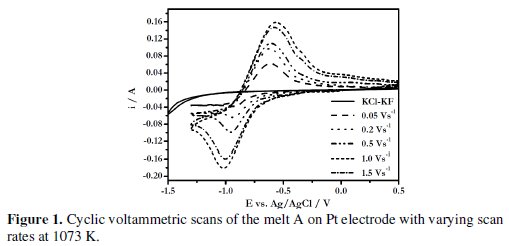
    <p>The cyclic voltammograms (CV) of the melt KCl (81.54 mol%)-KF (18.45 
mol%)-NaBF<sub>4</sub> (1.67 &times; 10<sup>-4</sup> mol cm<sup>-3</sup>) (designated as melt A) were recorded over 
the temperature range 1073 - 1123 K. Typical cyclic voltammograms of this melt 
at various scan rates (0.05 - 2.0 V s<sup>-1</sup>) are shown in <a href="#f1">Fig. 1</a>.</p>


    <p>&nbsp;</p>
<a name="f1">
<img src="/img/revistas/pea/v32n6/32n6a04f1.jpg">
    
<p>&nbsp;</p>


    ]]></body>
<body><![CDATA[<p>It is seen that the 
cathodic peak shifts to a more negative potential and the anodic peak shifts to a 
more positive potential with increasing scan rates. In addition, the peak current 
increases with increase in scan rate.</p>

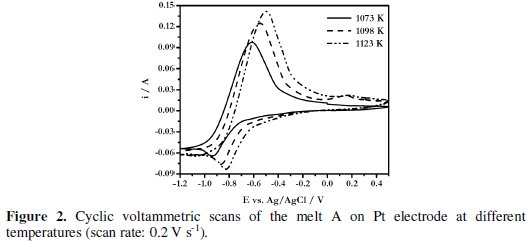
    <p><a href="#f2">Fig. 2</a> shows the CVs of the melt A at 1073, 1098 and 1123 K.</p>


    <p>&nbsp;</p>
<a name="f2">
<img src="/img/revistas/pea/v32n6/32n6a04f2.jpg">
    
<p>&nbsp;</p>


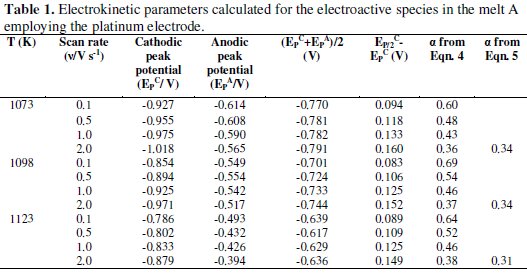
    <p>The cathodic 
(E<sub>P</sub><sup>C</sup>) and anodic (E<sub>P</sub><sup>A</sup>) peak potentials of the electroactive species as well as the 
average of the cathodic and anodic peak potentials, (E<sub>P</sub><sup>C</sup> + 
E<sub>P</sub><sup>A</sup>)/2, of this melt at 
different temperatures are given in <a href="#t1">Table 1</a>.</p>


    <p>&nbsp;</p>
<a name="t1">
<img src="/img/revistas/pea/v32n6/32n6a04t1.jpg">
    
<p>&nbsp;</p>


    <p>It is observed that the cathodic and 
anodic peak potentials are shifted to less negative values (<a href="#f2">Fig. 2</a>) and the average 
values increase with increase in temperature (<a href="#t1">Table 1</a>). It is also observed that the 
magnitude of E<sub>P/2</sub><sup>C</sup> - E<sub>P</sub><sup>C</sup> (E<sub>P/2</sub><sup>C</sup> is cathodic half-peak potential), 
is larger than the value required for the reversible process of formation of an insoluble substance 
(0.071/n)V at 1073 K where, n is the number of electrons transferred for the 
reduction process) [33, 34] indicating that the reduction of boron species on 
platinum electrode from KCl-KF-NaBF<sub>4</sub> melt is not reversible.</p>

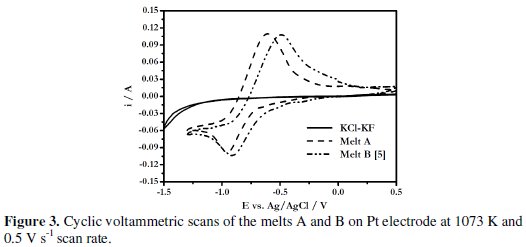
    <p>The reduction potential of boron from boron containing electroactive species in 
the melt A was found to be more negative compared to that of melt KCl (81.54 
mol%)-KF (18.45 mol%)-KBF<sub>4</sub> (1.6 &times; 10<sup>-4</sup> mol cm<sup>-3</sup>) (designated as melt B) [5] 
(<a href="#f3">Fig. 3</a>).</p>


    <p>&nbsp;</p>
<a name="f3">
<img src="/img/revistas/pea/v32n6/32n6a04f3.jpg">
    
]]></body>
<body><![CDATA[<p>&nbsp;</p>


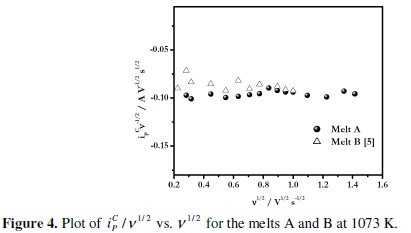
    <p><a href="#f4">Fig. 4</a> shows the plot of i<sub>P</sub><sup>C</sup>/v<sup>1/2</sup> 
vs. v<sup>1/2</sup> where, i<sub>P</sub><sup>C</sup> is the cathodic peak current 
and v is the scan rate.</p>


    <p>&nbsp;</p>
<a name="f4">
<img src="/img/revistas/pea/v32n6/32n6a04f4.jpg">
    
<p>&nbsp;</p>


    <p>It is observed from these plots that for the melt A at 1073 
K, the i<sub>P</sub><sup>C</sup>/v<sup>1/2</sup> values remain almost constant at polarization rate range of 0.05 to 
2 V s<sup>-1</sup>. This suggests that the process of electrodeposition of boron on Pt 
electrode is not complicated by chemical reactions as suggested by Tsiklauri et 
al. [35, 36]. In addition the electrodeposit is not adsorbed at the electrode surface. 
A similar behaviour was observed for the melts NaCl-KCl-KBF<sub>4</sub> [24] and melt B 
[5]. Thus it can be inferred that the electrodeposition of boron from alkali metal 
fluoroborate containing KCl-KF melts is not complicated by chemical reactions. 
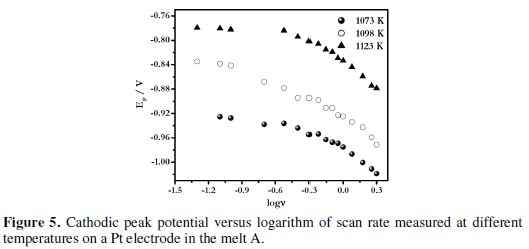
The variation of E<sub>P</sub><sup>C</sup> with the logarithm of scan rate, log(v), at different 
temperatures for melt A is shown in <a href="#f5">Fig. 5</a>.</p>


    <p>&nbsp;</p>
<a name="f5">
<img src="/img/revistas/pea/v32n6/32n6a04f5.jpg">
    
<p>&nbsp;</p>


    <p>As seen from the figure, the cathodic peak potential varies linearly with log(v). 
These observations indicate that the 
reduction of electroactive boron species on platinum electrode is quasi-reversible 
at low scan rates (v &lt; 0.1 Vs<sup>-1</sup>) and irreversible at higher scan rates (&gt; 0.1 V s<sup>-1</sup>).</p>

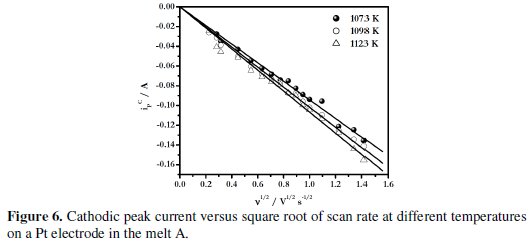
    <p>The variation of the cathodic peak current, i<sub>P</sub><sup>C</sup>, with the square root of scan rate, 
v<sup>1/2</sup>, at different temperatures for the melt A is shown in <a href="#f6">Fig. 6</a>.</p>


    <p>&nbsp;</p>
<a name="f6">
<img src="/img/revistas/pea/v32n6/32n6a04f6.jpg">
    
]]></body>
<body><![CDATA[<p>&nbsp;</p>


    <p>The linear relationship between i<sub>P</sub><sup>C</sup> and v<sup>1/2</sup>, 
as observed from these figures indicates that the 
process is diffusion controlled.</p>


    <p><b><i>Calculation of transfer coefficient</i></b></p>

    <p>The value of &alpha;n<sub>&alpha;</sub> (where &alpha; is the transfer 
coefficient and n<sub>&alpha;</sub> is the number of 
electrons transferred for the reduction process in the rate determining step) can 
be determined from the equation given by Matsuda and Ayabe (<a href="#e4">Eqn. 4</a>) [37, 38].</p>


    <p>&nbsp;</p>
<a name="e4">
<img src="/img/revistas/pea/v32n6/32n6a04e4.jpg">
    
<p>&nbsp;</p>


    <p>where, R is the molar gas constant, T is the absolute temperature and F is the 
Faraday constant.</p>


    <p>The &alpha;n<sub>&alpha;</sub> 
also can be evaluated from the following equation [33].</p>


    <p>&nbsp;</p>
<a name="e5">
<img src="/img/revistas/pea/v32n6/32n6a04e5.jpg">
    
<p>&nbsp;</p>


    ]]></body>
<body><![CDATA[<p>where &Delta;E<sub>P</sub><sup>C</sup>/&Delta;log(v) is determined from the slope of E<sub>P</sub><sup>C</sup> vs. log(v) 
plots.</p>

    <p>The transfer coefficients calculated from <a href="#e4">Eqns. (4)</a> and <a href="#e5">(5)</a> for the melt A are given 
in <a href="#t1">Table 1</a>. For the melt A at 1073, 1098 and 1123 K the transfer coefficients 
were found to vary from 0.60 - 0.36, 0.37 - 0.69 and 0.64 - 0.38, respectively. 
By using <a href="#e5">Eqn. (5)</a> the transfer coefficients for the melt A were found to vary 
from 0.34 - 0.31. The typical transfer coefficient values signify that the process 
is irreversible. Similar inference has also been drawn for the melt B reported in 
our previous study [5].</p>


    <p><b><i>Diffusion coefficients</i></b></p>

    <p>The diffusion coefficient of the electroactive species can be measured by 
chronoamperometry using Cottrell equation (<a href="#e6">Eqn. (6)</a>) [33].</p>


    <p>&nbsp;</p>
<a name="e6">
<img src="/img/revistas/pea/v32n6/32n6a04e6.jpg">
    
<p>&nbsp;</p>


    <p>where A is the electrode area in cm<sup>2</sup>, C<sub>0</sub><sup>*</sup> is the concentration of B(III) ion in mol 
cm<sup>-3</sup>, D<sub>0</sub> is the diffusion coefficient in cm<sup>2</sup> s<sup>-1</sup>, F is the Faraday constant, i is the 
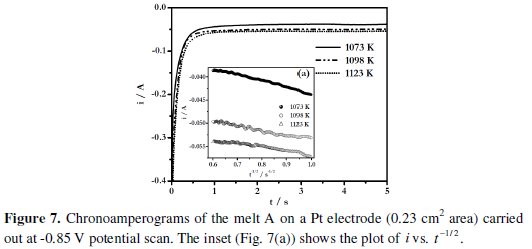
current in amperes and t is the transition time in s. Typical chronoamperograms 
of the melt A employing Pt electrode are shown in <a href="#f7">Fig. 7</a>.</p>


    <p>&nbsp;</p>
<a name="f7">
<img src="/img/revistas/pea/v32n6/32n6a04f7.jpg">
    
<p>&nbsp;</p>


    <p>A linear variation of i with t<sup>-1/2</sup> is observed as shown in <a href="#f7">Fig. 7(a)</a>.</p>

    ]]></body>
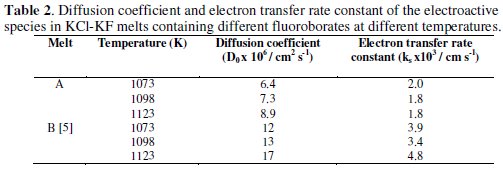
<body><![CDATA[<p>This indicates that the reduction of boron containing electroactive species in 
these melts is diffusion controlled. The diffusion coefficients of the electroactive 
species in the melt A were found to be 6.4 &times; 10<sup>-6</sup> cm<sup>2</sup> s<sup>-1</sup> 
at 1073 K (<a href="#t2">Table 2</a>).</p>


    <p>&nbsp;</p>
<a name="t2">
<img src="/img/revistas/pea/v32n6/32n6a04t2.jpg">
    
<p>&nbsp;</p>


    <p>Also, typical diffusion coefficient values for different alkali metal fluoroborate 
containing melt system at different temperatures are presented in <a href="#t2">Table 2</a>.</p>

    <p>A comparative study of D<sub>0</sub> values of the boron containing electroactive species 
from different alkali metal fluoroborates in KCl-KF melt shows 
that D<sub>0</sub><sup>NaBF<sub>4</sub></sup> &lt; D<sub>0</sub><sup>KBF<sub>4</sub></sup>. 
According to Stokes-Einstein equation (<a href="#e7">Eqn. (7)</a>), the 
diffusion coefficient of a species is inversely proportional to its solvodynamic 
radius ( r<sub>s</sub> ).</p>


    <p>&nbsp;</p>
<a name="e7">
<img src="/img/revistas/pea/v32n6/32n6a04e7.jpg">
    
<p>&nbsp;</p>


    <p>where k is the Boltzmann constant, C is a constant and &eta; is the absolute or bulk 
viscosity of the solvent. It is surmised that the solvodynamic radius ( r<sub>s</sub> ) of the 
boron containing electroactive species varies as 
r<sub>s</sub><sup>NaBF<sub>4</sub></sup> &gt; r<sub>s</sub><sup>KBF<sub>4</sub></sup> in KCl-KF melt 
containing different alkali metal fluoroborates.</p>


    <p><b><i>Electron transfer rate constant</i></b></p>

    <p>Klingler and Kochi [39] derived an expression (<a href="#e8">Eqn. (8)</a>) for obtaining the 
electron transfer rate constant ( k<sub>s</sub> ) by assuming that the electron-transfer reaction 
is irreversible.</p>


    ]]></body>
<body><![CDATA[<p>&nbsp;</p>
<a name="e8">
<img src="/img/revistas/pea/v32n6/32n6a04e8.jpg">
    
<p>&nbsp;</p>


    <p>By using the above equation the electron transfer rate constants for the 
irreversible electrode process for sodium fluoroborate in KCl-KF melt over the 
temperature range 1073 to 1123 K were calculated. The ks values obtained by 

substituting the &alpha;n<sub>&alpha;</sub> 
values derived from <a href="#e4">Eqn. (4)</a> at 1 V s<sup>-1</sup> scan rate 
and D<sub>0</sub> from <a href="#e6">Eqn. (6)</a> are presented in <a href="#t2">Table 2</a>. 
These values indicate sluggish electron 
transfer kinetics due to the fact that the oxidized boron (fluoro-chloro complex of 
boron) and the reduced boron (elemental boron) are structurally dissimilar and 
the activation barrier for the redox process is large.</p>


    <p><b><i>Apparent surface resistance</i></b></p>

    <p>Polyakova et al. [34] reported that the broadening of the cathodic peak in CV 
occurred due to the ohmic control of deposition of boron. These authors 
presented linear plots of peak current and peak potentials against the square root 
of scan rate and concluded that a surface boron film formed on the electrode 
rendered the process to be controlled by ohmic resistance.</p>

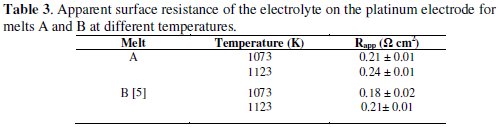
    <p>The ''apparent surface resistance'' ( R<sub>app</sub> ) of the electrolyte in the pores of the 
boron film covering the electrode can be obtained from the reciprocal of the 
slope of peak current density ( j<sub>P</sub> ) vs. peak potential ( E<sub>P</sub> ) plots, as reported by 
Polyakova et al. [34]. The plots for cathodic peak current density vs. cathodic 
peak potential for the melt A show a linear behavior. The values of 
R<sub>app</sub> calculated for different fluoroborates in KCl-KF melt at different 
temperatures are presented in <a href="#t3">Table 3</a>.</p>


    <p>&nbsp;</p>
<a name="t3">
<img src="/img/revistas/pea/v32n6/32n6a04t3.jpg">
    
<p>&nbsp;</p>


    <p>It is observed (<a href="#t3">Table 3</a>) that the R<sub>app</sub> values 
decrease with increase in temperature. Polyakova et al. [34] reported a higher 

value of R<sub>app</sub> (3.3 &Omega; cm<sup>2</sup> at 973 K) in the melt 
LiF-NaF-KF-KBF<sub>4</sub> (15.9 &times; 10<sup>-2</sup> mol%). In our 
earlier study on the melt B, the R<sub>app</sub> (0.18 &pm; 0.02 &Omega; cm<sup>2</sup> at 1073 K) 
was found to be of similar magnitude [5]. Thus R<sub>app</sub> was found to be independent 
of the nature of alkali metal fluoroborate in KCl-KF melt. The typical resistance 
values obtained (<a href="#t3">Table 3</a>) in our present study are very small and it is surmised 
that the effect of resistance on CVs is negligible and it does not quite affect the 
determination of &alpha; values from the cyclic voltammetric scans.</p>


    <p>&nbsp;</p>
    ]]></body>
<body><![CDATA[<p><b>Conclusions</b></p>

    <p>The electrochemical reduction of B(III) + 3e &rarr; B in KCl (81.54 mol%)-KF 
(18.45 mol%)-NaBF<sub>4</sub> (1.67 &times; 10<sup>-4</sup> mol cm<sup>-3</sup>) melt on a Pt electrode was studied by 
cyclic voltammetry over the temperature range 1073 to 1123 K. It is inferred that 
at a sweep rate of v &lt; 0.1 V s<sup>-1</sup> the electroreduction is quasireversible and at v &gt; 
0.1 Vs<sup>-1</sup>, both the diffusion of electroactive species and the electron transfer play 
a role in the reduction process. It is established that the reduction of B(III) to B 
occurs by a single-step three-electron process. Using chronoamperometry, the 
diffusion coefficients of the boron containing electroactive species (B(III)) were 
calculated for the sodium fluoroborate melt system and it was found that 
D<sub>0</sub><sup>NaBF<sub>4</sub></sup> &lt; D<sub>0</sub><sup>KBF<sub>4</sub></sup>. 
The values of &alpha; and R<sub>app</sub> were found to be independent of the 
nature of alkali metal fluoroborate in KCl-KF melt.</p>


    <p>&nbsp;</p>
    <p><b>References</b></p>

    <!-- ref --><p>1. Babu V R, Govindarajan S, Chetal S C. Proc. of Seminar on Inherent Engineered Safety Aspects of PFBR Design. Kalpakkam, India: IGCAR; 
1996.    &nbsp;&nbsp;&nbsp;&nbsp;&nbsp;&nbsp;&nbsp;&nbsp;[&#160;<a href="javascript:void(0);" onclick="javascript: window.open('/scielo.php?script=sci_nlinks&ref=000107&pid=S0872-1904201400060000400001&lng=','','width=640,height=500,resizable=yes,scrollbars=1,menubar=yes,');">Links</a>&#160;]<!-- end-ref --></p>

    <!-- ref --><p>2. Suri A K, Subramanian C, Sonber J K. et al. Int Mater Rev. 2010;55:4.    &nbsp;&nbsp;&nbsp;&nbsp;&nbsp;&nbsp;&nbsp;&nbsp;[&#160;<a href="javascript:void(0);" onclick="javascript: window.open('/scielo.php?script=sci_nlinks&ref=000109&pid=S0872-1904201400060000400002&lng=','','width=640,height=500,resizable=yes,scrollbars=1,menubar=yes,');">Links</a>&#160;]<!-- end-ref --></p>

    <!-- ref --><p>3. Jain A, Anthonysamy S, Ananthasivan K, et al. Mater Charact. 2008;59:890.    &nbsp;&nbsp;&nbsp;&nbsp;&nbsp;&nbsp;&nbsp;&nbsp;[&#160;<a href="javascript:void(0);" onclick="javascript: window.open('/scielo.php?script=sci_nlinks&ref=000111&pid=S0872-1904201400060000400003&lng=','','width=640,height=500,resizable=yes,scrollbars=1,menubar=yes,');">Links</a>&#160;]<!-- end-ref --></p>

    ]]></body>
<body><![CDATA[<!-- ref --><p>4. Pal R, Ananthasivan K, Anthonysamy S, et al. Electrochim Acta. 2012;61:165.    &nbsp;&nbsp;&nbsp;&nbsp;&nbsp;&nbsp;&nbsp;&nbsp;[&#160;<a href="javascript:void(0);" onclick="javascript: window.open('/scielo.php?script=sci_nlinks&ref=000113&pid=S0872-1904201400060000400004&lng=','','width=640,height=500,resizable=yes,scrollbars=1,menubar=yes,');">Links</a>&#160;]<!-- end-ref --></p>

    <!-- ref --><p>5. Pal R, Anthonysamy S, Ganesan V. J Electrochem Soc. 2012;159:F157.    &nbsp;&nbsp;&nbsp;&nbsp;&nbsp;&nbsp;&nbsp;&nbsp;[&#160;<a href="javascript:void(0);" onclick="javascript: window.open('/scielo.php?script=sci_nlinks&ref=000115&pid=S0872-1904201400060000400005&lng=','','width=640,height=500,resizable=yes,scrollbars=1,menubar=yes,');">Links</a>&#160;]<!-- end-ref --></p>

    <!-- ref --><p>6. Brotherton R J, Steinberg H. Progress in Boron Chemistry. Pergamon Press Inc; 1970. Vol. 2.    &nbsp;&nbsp;&nbsp;&nbsp;&nbsp;&nbsp;&nbsp;&nbsp;[&#160;<a href="javascript:void(0);" onclick="javascript: window.open('/scielo.php?script=sci_nlinks&ref=000117&pid=S0872-1904201400060000400006&lng=','','width=640,height=500,resizable=yes,scrollbars=1,menubar=yes,');">Links</a>&#160;]<!-- end-ref --></p>

    <!-- ref --><p>7. Matkovich V I. Boron and Refractory Borides. Berlin: Springer Verlag; 1977.    &nbsp;&nbsp;&nbsp;&nbsp;&nbsp;&nbsp;&nbsp;&nbsp;[&#160;<a href="javascript:void(0);" onclick="javascript: window.open('/scielo.php?script=sci_nlinks&ref=000119&pid=S0872-1904201400060000400007&lng=','','width=640,height=500,resizable=yes,scrollbars=1,menubar=yes,');">Links</a>&#160;]<!-- end-ref --></p>

    <!-- ref --><p>8. Subramanian C, Suri A K. Metal Mater Processes. 2004;16:39.    &nbsp;&nbsp;&nbsp;&nbsp;&nbsp;&nbsp;&nbsp;&nbsp;[&#160;<a href="javascript:void(0);" onclick="javascript: window.open('/scielo.php?script=sci_nlinks&ref=000121&pid=S0872-1904201400060000400008&lng=','','width=640,height=500,resizable=yes,scrollbars=1,menubar=yes,');">Links</a>&#160;]<!-- end-ref --></p>

    ]]></body>
<body><![CDATA[<!-- ref --><p>9. Davidson M G, Hughes A K, Marder T B, et al. Contemporary Boron Chemistry. Cambridge: Royal Society of Chemistry; 2000.    &nbsp;&nbsp;&nbsp;&nbsp;&nbsp;&nbsp;&nbsp;&nbsp;[&#160;<a href="javascript:void(0);" onclick="javascript: window.open('/scielo.php?script=sci_nlinks&ref=000123&pid=S0872-1904201400060000400009&lng=','','width=640,height=500,resizable=yes,scrollbars=1,menubar=yes,');">Links</a>&#160;]<!-- end-ref --></p>

    <!-- ref --><p>10. Kahlenberg H H. Trans Am Electrochem Soc. 1925;47:23.    &nbsp;&nbsp;&nbsp;&nbsp;&nbsp;&nbsp;&nbsp;&nbsp;[&#160;<a href="javascript:void(0);" onclick="javascript: window.open('/scielo.php?script=sci_nlinks&ref=000125&pid=S0872-1904201400060000400010&lng=','','width=640,height=500,resizable=yes,scrollbars=1,menubar=yes,');">Links</a>&#160;]<!-- end-ref --></p>

    <!-- ref --><p>11. Andrieux L. Ann Chem Phys. 1929;12:432.    &nbsp;&nbsp;&nbsp;&nbsp;&nbsp;&nbsp;&nbsp;&nbsp;[&#160;<a href="javascript:void(0);" onclick="javascript: window.open('/scielo.php?script=sci_nlinks&ref=000127&pid=S0872-1904201400060000400011&lng=','','width=640,height=500,resizable=yes,scrollbars=1,menubar=yes,');">Links</a>&#160;]<!-- end-ref --></p>

    <!-- ref --><p>12. Andrieux L, Deiss W. Bull Soc Chim. 1955;838.    &nbsp;&nbsp;&nbsp;&nbsp;&nbsp;&nbsp;&nbsp;&nbsp;[&#160;<a href="javascript:void(0);" onclick="javascript: window.open('/scielo.php?script=sci_nlinks&ref=000129&pid=S0872-1904201400060000400012&lng=','','width=640,height=500,resizable=yes,scrollbars=1,menubar=yes,');">Links</a>&#160;]<!-- end-ref --></p>

    <!-- ref --><p>13. Cooper H S. US Patent. 1951;2572248.    &nbsp;&nbsp;&nbsp;&nbsp;&nbsp;&nbsp;&nbsp;&nbsp;[&#160;<a href="javascript:void(0);" onclick="javascript: window.open('/scielo.php?script=sci_nlinks&ref=000131&pid=S0872-1904201400060000400013&lng=','','width=640,height=500,resizable=yes,scrollbars=1,menubar=yes,');">Links</a>&#160;]<!-- end-ref --></p>

    ]]></body>
<body><![CDATA[<!-- ref --><p>14. Cooper H S. US Patent. 1951;2572249.    &nbsp;&nbsp;&nbsp;&nbsp;&nbsp;&nbsp;&nbsp;&nbsp;[&#160;<a href="javascript:void(0);" onclick="javascript: window.open('/scielo.php?script=sci_nlinks&ref=000133&pid=S0872-1904201400060000400014&lng=','','width=640,height=500,resizable=yes,scrollbars=1,menubar=yes,');">Links</a>&#160;]<!-- end-ref --></p>

    <!-- ref --><p>15. Russel S, Young F A, Kellner J D. US Patent. 1974;3843497.    &nbsp;&nbsp;&nbsp;&nbsp;&nbsp;&nbsp;&nbsp;&nbsp;[&#160;<a href="javascript:void(0);" onclick="javascript: window.open('/scielo.php?script=sci_nlinks&ref=000135&pid=S0872-1904201400060000400015&lng=','','width=640,height=500,resizable=yes,scrollbars=1,menubar=yes,');">Links</a>&#160;]<!-- end-ref --></p>

    <!-- ref --><p>16. Murphy N F, Tinsley R S. US Patent. 1958;2848396.    &nbsp;&nbsp;&nbsp;&nbsp;&nbsp;&nbsp;&nbsp;&nbsp;[&#160;<a href="javascript:void(0);" onclick="javascript: window.open('/scielo.php?script=sci_nlinks&ref=000137&pid=S0872-1904201400060000400016&lng=','','width=640,height=500,resizable=yes,scrollbars=1,menubar=yes,');">Links</a>&#160;]<!-- end-ref --></p>

    <!-- ref --><p>17. Uchiyama A A, Stern D R, McKenna Q H. US Patent. 1960;2940911.    &nbsp;&nbsp;&nbsp;&nbsp;&nbsp;&nbsp;&nbsp;&nbsp;[&#160;<a href="javascript:void(0);" onclick="javascript: window.open('/scielo.php?script=sci_nlinks&ref=000139&pid=S0872-1904201400060000400017&lng=','','width=640,height=500,resizable=yes,scrollbars=1,menubar=yes,');">Links</a>&#160;]<!-- end-ref --></p>

    <!-- ref --><p>18. Stern D R, McKenna Q H. US Patent. 1959;2892762.    &nbsp;&nbsp;&nbsp;&nbsp;&nbsp;&nbsp;&nbsp;&nbsp;[&#160;<a href="javascript:void(0);" onclick="javascript: window.open('/scielo.php?script=sci_nlinks&ref=000141&pid=S0872-1904201400060000400018&lng=','','width=640,height=500,resizable=yes,scrollbars=1,menubar=yes,');">Links</a>&#160;]<!-- end-ref --></p>

    ]]></body>
<body><![CDATA[<!-- ref --><p>19. Ellis R B. US Patent. 1957;2810683.    &nbsp;&nbsp;&nbsp;&nbsp;&nbsp;&nbsp;&nbsp;&nbsp;[&#160;<a href="javascript:void(0);" onclick="javascript: window.open('/scielo.php?script=sci_nlinks&ref=000143&pid=S0872-1904201400060000400019&lng=','','width=640,height=500,resizable=yes,scrollbars=1,menubar=yes,');">Links</a>&#160;]<!-- end-ref --></p>

    <!-- ref --><p>20. Nies N P, Fajans E W, Thomas L L, et al. US Patent. 1958;2832730.    &nbsp;&nbsp;&nbsp;&nbsp;&nbsp;&nbsp;&nbsp;&nbsp;[&#160;<a href="javascript:void(0);" onclick="javascript: window.open('/scielo.php?script=sci_nlinks&ref=000145&pid=S0872-1904201400060000400020&lng=','','width=640,height=500,resizable=yes,scrollbars=1,menubar=yes,');">Links</a>&#160;]<!-- end-ref --></p>

    <!-- ref --><p>21. Nair K U, Bose D K, Gupta C K. Miner Process Extractive Metall Rev. 1992;9:283.    &nbsp;&nbsp;&nbsp;&nbsp;&nbsp;&nbsp;&nbsp;&nbsp;[&#160;<a href="javascript:void(0);" onclick="javascript: window.open('/scielo.php?script=sci_nlinks&ref=000147&pid=S0872-1904201400060000400021&lng=','','width=640,height=500,resizable=yes,scrollbars=1,menubar=yes,');">Links</a>&#160;]<!-- end-ref --></p>

    <!-- ref --><p>22. Miller G T. J Electrochem Soc. 1959;106:815.    &nbsp;&nbsp;&nbsp;&nbsp;&nbsp;&nbsp;&nbsp;&nbsp;[&#160;<a href="javascript:void(0);" onclick="javascript: window.open('/scielo.php?script=sci_nlinks&ref=000149&pid=S0872-1904201400060000400022&lng=','','width=640,height=500,resizable=yes,scrollbars=1,menubar=yes,');">Links</a>&#160;]<!-- end-ref --></p>

    <!-- ref --><p>23. Brookes H C, Gibson P S, Hills G J, et al. Trans Inst Met Finish. 1976;54:191.    &nbsp;&nbsp;&nbsp;&nbsp;&nbsp;&nbsp;&nbsp;&nbsp;[&#160;<a href="javascript:void(0);" onclick="javascript: window.open('/scielo.php?script=sci_nlinks&ref=000151&pid=S0872-1904201400060000400023&lng=','','width=640,height=500,resizable=yes,scrollbars=1,menubar=yes,');">Links</a>&#160;]<!-- end-ref --></p>

    ]]></body>
<body><![CDATA[<!-- ref --><p>24. Kuznetsov S A. Russ J Electrochem. 1996;32:763.    &nbsp;&nbsp;&nbsp;&nbsp;&nbsp;&nbsp;&nbsp;&nbsp;[&#160;<a href="javascript:void(0);" onclick="javascript: window.open('/scielo.php?script=sci_nlinks&ref=000153&pid=S0872-1904201400060000400024&lng=','','width=640,height=500,resizable=yes,scrollbars=1,menubar=yes,');">Links</a>&#160;]<!-- end-ref --></p>

    <!-- ref --><p>25. Taranenko V I, Zarutskii I V, Shapoval V. et al. Electrochim Acta. 1992;37:263.    &nbsp;&nbsp;&nbsp;&nbsp;&nbsp;&nbsp;&nbsp;&nbsp;[&#160;<a href="javascript:void(0);" onclick="javascript: window.open('/scielo.php?script=sci_nlinks&ref=000155&pid=S0872-1904201400060000400025&lng=','','width=640,height=500,resizable=yes,scrollbars=1,menubar=yes,');">Links</a>&#160;]<!-- end-ref --></p>

    <!-- ref --><p>26. Kellner J D. J. Electrochem Soc. 1973;120:713.    &nbsp;&nbsp;&nbsp;&nbsp;&nbsp;&nbsp;&nbsp;&nbsp;[&#160;<a href="javascript:void(0);" onclick="javascript: window.open('/scielo.php?script=sci_nlinks&ref=000157&pid=S0872-1904201400060000400026&lng=','','width=640,height=500,resizable=yes,scrollbars=1,menubar=yes,');">Links</a>&#160;]<!-- end-ref --></p>

    <!-- ref --><p>27. Makyta M, Matiasovsky K, Fellner P. Electrochim Acta. 1984;29:1653.    &nbsp;&nbsp;&nbsp;&nbsp;&nbsp;&nbsp;&nbsp;&nbsp;[&#160;<a href="javascript:void(0);" onclick="javascript: window.open('/scielo.php?script=sci_nlinks&ref=000159&pid=S0872-1904201400060000400027&lng=','','width=640,height=500,resizable=yes,scrollbars=1,menubar=yes,');">Links</a>&#160;]<!-- end-ref --></p>

    <!-- ref --><p>28. Akashi K, Egami I. Seisan-Kenkyu. 1963;15:427.    &nbsp;&nbsp;&nbsp;&nbsp;&nbsp;&nbsp;&nbsp;&nbsp;[&#160;<a href="javascript:void(0);" onclick="javascript: window.open('/scielo.php?script=sci_nlinks&ref=000161&pid=S0872-1904201400060000400028&lng=','','width=640,height=500,resizable=yes,scrollbars=1,menubar=yes,');">Links</a>&#160;]<!-- end-ref --></p>

    ]]></body>
<body><![CDATA[<!-- ref --><p>29. Newkirk A E. Elemental Boron. In: Adams RM, editor. Boron, Metallo-
Boron Compounds and Boranes. new York. Interscience Publishers; 1964. Pp. 301-371.    &nbsp;&nbsp;&nbsp;&nbsp;&nbsp;&nbsp;&nbsp;&nbsp;[&#160;<a href="javascript:void(0);" onclick="javascript: window.open('/scielo.php?script=sci_nlinks&ref=000163&pid=S0872-1904201400060000400029&lng=','','width=640,height=500,resizable=yes,scrollbars=1,menubar=yes,');">Links</a>&#160;]<!-- end-ref --></p>

    <!-- ref --><p>30. Kenkyujo S. Japanese Patent. 1966;6243.    &nbsp;&nbsp;&nbsp;&nbsp;&nbsp;&nbsp;&nbsp;&nbsp;[&#160;<a href="javascript:void(0);" onclick="javascript: window.open('/scielo.php?script=sci_nlinks&ref=000165&pid=S0872-1904201400060000400030&lng=','','width=640,height=500,resizable=yes,scrollbars=1,menubar=yes,');">Links</a>&#160;]<!-- end-ref --></p>

    <!-- ref --><p>31. Danek V, Votava I, Matiasovsky K. Chem Zvesti. 1976;30:377.    &nbsp;&nbsp;&nbsp;&nbsp;&nbsp;&nbsp;&nbsp;&nbsp;[&#160;<a href="javascript:void(0);" onclick="javascript: window.open('/scielo.php?script=sci_nlinks&ref=000167&pid=S0872-1904201400060000400031&lng=','','width=640,height=500,resizable=yes,scrollbars=1,menubar=yes,');">Links</a>&#160;]<!-- end-ref --></p>

    <!-- ref --><p>32. Pal R, Ananthasivan K, Anthonysamy S et al. Electrochim Acta. 2011;56:4276.    &nbsp;&nbsp;&nbsp;&nbsp;&nbsp;&nbsp;&nbsp;&nbsp;[&#160;<a href="javascript:void(0);" onclick="javascript: window.open('/scielo.php?script=sci_nlinks&ref=000169&pid=S0872-1904201400060000400032&lng=','','width=640,height=500,resizable=yes,scrollbars=1,menubar=yes,');">Links</a>&#160;]<!-- end-ref --></p>

    <!-- ref --><p>33. Bard A J, Faulkner L R. Electrochemical Methods: Fundamentals and Applications. New York: Wiley; 1980.    &nbsp;&nbsp;&nbsp;&nbsp;&nbsp;&nbsp;&nbsp;&nbsp;[&#160;<a href="javascript:void(0);" onclick="javascript: window.open('/scielo.php?script=sci_nlinks&ref=000171&pid=S0872-1904201400060000400033&lng=','','width=640,height=500,resizable=yes,scrollbars=1,menubar=yes,');">Links</a>&#160;]<!-- end-ref --></p>

    ]]></body>
<body><![CDATA[<!-- ref --><p>34. Polyakova L P, Bukatova G A, Polyakov E G, et al. J Electrochem Soc. 1996;143:3178.    &nbsp;&nbsp;&nbsp;&nbsp;&nbsp;&nbsp;&nbsp;&nbsp;[&#160;<a href="javascript:void(0);" onclick="javascript: window.open('/scielo.php?script=sci_nlinks&ref=000173&pid=S0872-1904201400060000400034&lng=','','width=640,height=500,resizable=yes,scrollbars=1,menubar=yes,');">Links</a>&#160;]<!-- end-ref --></p>

    <!-- ref --><p>35. Tsiklauri OG, Shapoval VI, Avaliani ASh, et al. Ionnye rasplavy I tverdye 
elektrolity (Ionic Melts and Solid Electrolytes). 1986;1:47.    &nbsp;&nbsp;&nbsp;&nbsp;&nbsp;&nbsp;&nbsp;&nbsp;[&#160;<a href="javascript:void(0);" onclick="javascript: window.open('/scielo.php?script=sci_nlinks&ref=000175&pid=S0872-1904201400060000400035&lng=','','width=640,height=500,resizable=yes,scrollbars=1,menubar=yes,');">Links</a>&#160;]<!-- end-ref --></p>

    <!-- ref --><p>36. Tsiklauri O G, Avaliani A Sh, Bairammashvili I A. Soobshch Acad Nauk Gruz SSR. 1989;134:133.    &nbsp;&nbsp;&nbsp;&nbsp;&nbsp;&nbsp;&nbsp;&nbsp;[&#160;<a href="javascript:void(0);" onclick="javascript: window.open('/scielo.php?script=sci_nlinks&ref=000177&pid=S0872-1904201400060000400036&lng=','','width=640,height=500,resizable=yes,scrollbars=1,menubar=yes,');">Links</a>&#160;]<!-- end-ref --></p>

    <!-- ref --><p>37. Matsuda H, Ayabe Y. Z Electrochem. 1955;59:494.    &nbsp;&nbsp;&nbsp;&nbsp;&nbsp;&nbsp;&nbsp;&nbsp;[&#160;<a href="javascript:void(0);" onclick="javascript: window.open('/scielo.php?script=sci_nlinks&ref=000179&pid=S0872-1904201400060000400037&lng=','','width=640,height=500,resizable=yes,scrollbars=1,menubar=yes,');">Links</a>&#160;]<!-- end-ref --></p>

    <!-- ref --><p>38. Golovin V A, Dobrenkov G A, Trans. Kazan. Khim.-Tekhnol. Inst. 1965;34:202.    &nbsp;&nbsp;&nbsp;&nbsp;&nbsp;&nbsp;&nbsp;&nbsp;[&#160;<a href="javascript:void(0);" onclick="javascript: window.open('/scielo.php?script=sci_nlinks&ref=000181&pid=S0872-1904201400060000400038&lng=','','width=640,height=500,resizable=yes,scrollbars=1,menubar=yes,');">Links</a>&#160;]<!-- end-ref --></p>

    ]]></body>
<body><![CDATA[<!-- ref --><p>39. Klingler R J, Kochi J K, J. Phys. Chem. 1981;85:1731.    &nbsp;&nbsp;&nbsp;&nbsp;&nbsp;&nbsp;&nbsp;&nbsp;[&#160;<a href="javascript:void(0);" onclick="javascript: window.open('/scielo.php?script=sci_nlinks&ref=000183&pid=S0872-1904201400060000400039&lng=','','width=640,height=500,resizable=yes,scrollbars=1,menubar=yes,');">Links</a>&#160;]<!-- end-ref --></p>


    <p>&nbsp;</p>
    <p><b>Acknowledgements</b></p>

    <p>The authors are grateful to Mr. R. K. Prabhu for carrying out the ICP-MS 
analysis.</p>


    <p>&nbsp;</p>
    <p><a name=0></a><sup><a href="#top">*</a></sup>Corresponding author. E-mail address: <a href="mailto:rahul.pal@curaj.ac.in">rahul.pal@curaj.ac.in</a></p>

    <p>Received 4 August 2014; accepted 2 December 2014</p>

    <p><a href="http://www.peacta.org" target="_blank">www.peacta.org</a> </p>


     ]]></body><back>
<ref-list>
<ref id="B1">
<label>1</label><nlm-citation citation-type="book">
<person-group person-group-type="author">
<name>
<surname><![CDATA[Babu]]></surname>
<given-names><![CDATA[V R]]></given-names>
</name>
<name>
<surname><![CDATA[Govindarajan]]></surname>
<given-names><![CDATA[S]]></given-names>
</name>
</person-group>
<source><![CDATA[Chetal S C. Proc. of Seminar on Inherent Engineered Safety Aspects of PFBR Design. Kalpakkam]]></source>
<year>1996</year>
<publisher-name><![CDATA[IGCAR]]></publisher-name>
</nlm-citation>
</ref>
<ref id="B2">
<label>2</label><nlm-citation citation-type="journal">
<person-group person-group-type="author">
<name>
<surname><![CDATA[Suri]]></surname>
<given-names><![CDATA[A K]]></given-names>
</name>
<name>
<surname><![CDATA[Subramanian]]></surname>
<given-names><![CDATA[C]]></given-names>
</name>
<name>
<surname><![CDATA[Sonber]]></surname>
<given-names><![CDATA[J K]]></given-names>
</name>
</person-group>
<source><![CDATA[Int Mater Rev]]></source>
<year>2010</year>
<volume>55</volume>
<page-range>4</page-range></nlm-citation>
</ref>
<ref id="B3">
<label>3</label><nlm-citation citation-type="journal">
<person-group person-group-type="author">
<name>
<surname><![CDATA[Jain]]></surname>
<given-names><![CDATA[A]]></given-names>
</name>
<name>
<surname><![CDATA[Anthonysamy]]></surname>
<given-names><![CDATA[S]]></given-names>
</name>
<name>
<surname><![CDATA[Ananthasivan]]></surname>
<given-names><![CDATA[K]]></given-names>
</name>
</person-group>
<source><![CDATA[Mater Charact]]></source>
<year>2008</year>
<volume>59</volume>
<page-range>890</page-range></nlm-citation>
</ref>
<ref id="B4">
<label>4</label><nlm-citation citation-type="journal">
<person-group person-group-type="author">
<name>
<surname><![CDATA[Pal]]></surname>
<given-names><![CDATA[R]]></given-names>
</name>
<name>
<surname><![CDATA[Ananthasivan]]></surname>
<given-names><![CDATA[K]]></given-names>
</name>
<name>
<surname><![CDATA[Anthonysamy]]></surname>
<given-names><![CDATA[S]]></given-names>
</name>
</person-group>
<source><![CDATA[Electrochim Acta]]></source>
<year>2012</year>
<volume>61</volume>
<page-range>165</page-range></nlm-citation>
</ref>
<ref id="B5">
<label>5</label><nlm-citation citation-type="journal">
<person-group person-group-type="author">
<name>
<surname><![CDATA[Pal]]></surname>
<given-names><![CDATA[R]]></given-names>
</name>
<name>
<surname><![CDATA[Anthonysamy]]></surname>
<given-names><![CDATA[S]]></given-names>
</name>
<name>
<surname><![CDATA[Ganesan]]></surname>
<given-names><![CDATA[V]]></given-names>
</name>
</person-group>
<source><![CDATA[J Electrochem Soc]]></source>
<year>2012</year>
<volume>159</volume>
<page-range>F157</page-range></nlm-citation>
</ref>
<ref id="B6">
<label>6</label><nlm-citation citation-type="book">
<person-group person-group-type="author">
<name>
<surname><![CDATA[Brotherton]]></surname>
<given-names><![CDATA[R J]]></given-names>
</name>
<name>
<surname><![CDATA[Steinberg]]></surname>
<given-names><![CDATA[H]]></given-names>
</name>
</person-group>
<source><![CDATA[Progress in Boron Chemistry]]></source>
<year>1970</year>
<volume>2</volume>
<publisher-name><![CDATA[Pergamon Press Inc]]></publisher-name>
</nlm-citation>
</ref>
<ref id="B7">
<label>7</label><nlm-citation citation-type="book">
<person-group person-group-type="author">
<name>
<surname><![CDATA[Matkovich]]></surname>
<given-names><![CDATA[V I]]></given-names>
</name>
</person-group>
<source><![CDATA[Boron and Refractory Borides]]></source>
<year>1977</year>
<publisher-loc><![CDATA[Berlin ]]></publisher-loc>
<publisher-name><![CDATA[Springer Verlag]]></publisher-name>
</nlm-citation>
</ref>
<ref id="B8">
<label>8</label><nlm-citation citation-type="journal">
<person-group person-group-type="author">
<name>
<surname><![CDATA[Subramanian]]></surname>
<given-names><![CDATA[C]]></given-names>
</name>
<name>
<surname><![CDATA[Suri]]></surname>
<given-names><![CDATA[A K]]></given-names>
</name>
</person-group>
<source><![CDATA[Metal Mater Processes]]></source>
<year>2004</year>
<volume>16</volume>
<page-range>39</page-range></nlm-citation>
</ref>
<ref id="B9">
<label>9</label><nlm-citation citation-type="book">
<person-group person-group-type="author">
<name>
<surname><![CDATA[Davidson]]></surname>
<given-names><![CDATA[M G]]></given-names>
</name>
<name>
<surname><![CDATA[Hughes]]></surname>
<given-names><![CDATA[A K]]></given-names>
</name>
<name>
<surname><![CDATA[Marder]]></surname>
<given-names><![CDATA[T B]]></given-names>
</name>
</person-group>
<source><![CDATA[Contemporary Boron Chemistry]]></source>
<year>2000</year>
<publisher-loc><![CDATA[Cambridge ]]></publisher-loc>
<publisher-name><![CDATA[Royal Society of Chemistry]]></publisher-name>
</nlm-citation>
</ref>
<ref id="B10">
<label>10</label><nlm-citation citation-type="journal">
<person-group person-group-type="author">
<name>
<surname><![CDATA[Kahlenberg]]></surname>
<given-names><![CDATA[H H]]></given-names>
</name>
</person-group>
<source><![CDATA[Trans Am Electrochem Soc]]></source>
<year>1925</year>
<volume>47</volume>
<page-range>23</page-range></nlm-citation>
</ref>
<ref id="B11">
<label>11</label><nlm-citation citation-type="journal">
<person-group person-group-type="author">
<name>
<surname><![CDATA[Andrieux]]></surname>
<given-names><![CDATA[L]]></given-names>
</name>
</person-group>
<source><![CDATA[Ann Chem Phys]]></source>
<year>1929</year>
<volume>12</volume>
<page-range>432</page-range></nlm-citation>
</ref>
<ref id="B12">
<label>12</label><nlm-citation citation-type="journal">
<person-group person-group-type="author">
<name>
<surname><![CDATA[Andrieux]]></surname>
<given-names><![CDATA[L]]></given-names>
</name>
<name>
<surname><![CDATA[Deiss]]></surname>
<given-names><![CDATA[W]]></given-names>
</name>
</person-group>
<source><![CDATA[Bull Soc Chim]]></source>
<year>1955</year>
<page-range>838</page-range></nlm-citation>
</ref>
<ref id="B13">
<label>13</label><nlm-citation citation-type="">
<person-group person-group-type="author">
<name>
<surname><![CDATA[Cooper]]></surname>
<given-names><![CDATA[H S]]></given-names>
</name>
</person-group>
<source><![CDATA[]]></source>
<year></year>
</nlm-citation>
</ref>
<ref id="B14">
<label>14</label><nlm-citation citation-type="">
<person-group person-group-type="author">
<name>
<surname><![CDATA[Cooper]]></surname>
<given-names><![CDATA[H S]]></given-names>
</name>
</person-group>
<source><![CDATA[]]></source>
<year></year>
</nlm-citation>
</ref>
<ref id="B15">
<label>15</label><nlm-citation citation-type="">
<person-group person-group-type="author">
<name>
<surname><![CDATA[Russel]]></surname>
<given-names><![CDATA[S]]></given-names>
</name>
<name>
<surname><![CDATA[Young]]></surname>
<given-names><![CDATA[F A]]></given-names>
</name>
<name>
<surname><![CDATA[Kellner]]></surname>
<given-names><![CDATA[J D]]></given-names>
</name>
</person-group>
<source><![CDATA[]]></source>
<year></year>
</nlm-citation>
</ref>
<ref id="B16">
<label>16</label><nlm-citation citation-type="">
<person-group person-group-type="author">
<name>
<surname><![CDATA[Murphy]]></surname>
<given-names><![CDATA[N F]]></given-names>
</name>
<name>
<surname><![CDATA[Tinsley]]></surname>
<given-names><![CDATA[R S]]></given-names>
</name>
</person-group>
<source><![CDATA[]]></source>
<year></year>
</nlm-citation>
</ref>
<ref id="B17">
<label>17</label><nlm-citation citation-type="">
<person-group person-group-type="author">
<name>
<surname><![CDATA[Uchiyama]]></surname>
<given-names><![CDATA[A A]]></given-names>
</name>
<name>
<surname><![CDATA[Stern]]></surname>
<given-names><![CDATA[D R]]></given-names>
</name>
<name>
<surname><![CDATA[McKenna]]></surname>
<given-names><![CDATA[Q H]]></given-names>
</name>
</person-group>
<source><![CDATA[]]></source>
<year></year>
</nlm-citation>
</ref>
<ref id="B18">
<label>18</label><nlm-citation citation-type="">
<person-group person-group-type="author">
<name>
<surname><![CDATA[Stern]]></surname>
<given-names><![CDATA[D R]]></given-names>
</name>
<name>
<surname><![CDATA[McKenna]]></surname>
<given-names><![CDATA[Q H]]></given-names>
</name>
</person-group>
<source><![CDATA[]]></source>
<year></year>
</nlm-citation>
</ref>
<ref id="B19">
<label>19</label><nlm-citation citation-type="">
<person-group person-group-type="author">
<name>
<surname><![CDATA[Ellis]]></surname>
<given-names><![CDATA[R B]]></given-names>
</name>
</person-group>
<source><![CDATA[]]></source>
<year></year>
</nlm-citation>
</ref>
<ref id="B20">
<label>20</label><nlm-citation citation-type="">
<person-group person-group-type="author">
<name>
<surname><![CDATA[Nies]]></surname>
<given-names><![CDATA[N P]]></given-names>
</name>
<name>
<surname><![CDATA[Fajans]]></surname>
<given-names><![CDATA[E W]]></given-names>
</name>
<name>
<surname><![CDATA[Thomas]]></surname>
<given-names><![CDATA[L L]]></given-names>
</name>
</person-group>
<source><![CDATA[]]></source>
<year></year>
</nlm-citation>
</ref>
<ref id="B21">
<label>21</label><nlm-citation citation-type="journal">
<person-group person-group-type="author">
<name>
<surname><![CDATA[Nair]]></surname>
<given-names><![CDATA[K U]]></given-names>
</name>
<name>
<surname><![CDATA[Bose]]></surname>
<given-names><![CDATA[D K]]></given-names>
</name>
<name>
<surname><![CDATA[Gupta]]></surname>
<given-names><![CDATA[C K]]></given-names>
</name>
</person-group>
<source><![CDATA[Miner Process Extractive Metall Rev]]></source>
<year>1992</year>
<volume>9</volume>
<page-range>283</page-range></nlm-citation>
</ref>
<ref id="B22">
<label>22</label><nlm-citation citation-type="journal">
<person-group person-group-type="author">
<name>
<surname><![CDATA[Miller]]></surname>
<given-names><![CDATA[G T]]></given-names>
</name>
</person-group>
<source><![CDATA[J Electrochem Soc]]></source>
<year>1959</year>
<volume>106</volume>
<page-range>815</page-range></nlm-citation>
</ref>
<ref id="B23">
<label>23</label><nlm-citation citation-type="journal">
<person-group person-group-type="author">
<name>
<surname><![CDATA[Brookes]]></surname>
<given-names><![CDATA[H C]]></given-names>
</name>
<name>
<surname><![CDATA[Gibson]]></surname>
<given-names><![CDATA[P S]]></given-names>
</name>
<name>
<surname><![CDATA[Hills]]></surname>
<given-names><![CDATA[G J]]></given-names>
</name>
</person-group>
<source><![CDATA[Trans Inst Met Finish]]></source>
<year>1976</year>
<volume>54</volume>
<page-range>191</page-range></nlm-citation>
</ref>
<ref id="B24">
<label>24</label><nlm-citation citation-type="journal">
<person-group person-group-type="author">
<name>
<surname><![CDATA[Kuznetsov]]></surname>
<given-names><![CDATA[S A]]></given-names>
</name>
</person-group>
<source><![CDATA[Russ J Electrochem]]></source>
<year>1996</year>
<volume>32</volume>
<page-range>763</page-range></nlm-citation>
</ref>
<ref id="B25">
<label>25</label><nlm-citation citation-type="journal">
<person-group person-group-type="author">
<name>
<surname><![CDATA[Taranenko]]></surname>
<given-names><![CDATA[V I]]></given-names>
</name>
<name>
<surname><![CDATA[Zarutskii]]></surname>
<given-names><![CDATA[I V]]></given-names>
</name>
<name>
<surname><![CDATA[Shapoval]]></surname>
<given-names><![CDATA[V]]></given-names>
</name>
</person-group>
<source><![CDATA[Electrochim Acta]]></source>
<year>1992</year>
<volume>37</volume>
<page-range>263</page-range></nlm-citation>
</ref>
<ref id="B26">
<label>26</label><nlm-citation citation-type="journal">
<person-group person-group-type="author">
<name>
<surname><![CDATA[Kellner]]></surname>
<given-names><![CDATA[J D]]></given-names>
</name>
</person-group>
<source><![CDATA[J. Electrochem Soc]]></source>
<year>1973</year>
<volume>120</volume>
<page-range>713</page-range></nlm-citation>
</ref>
<ref id="B27">
<label>27</label><nlm-citation citation-type="journal">
<person-group person-group-type="author">
<name>
<surname><![CDATA[Makyta]]></surname>
<given-names><![CDATA[M]]></given-names>
</name>
<name>
<surname><![CDATA[Matiasovsky]]></surname>
<given-names><![CDATA[K]]></given-names>
</name>
<name>
<surname><![CDATA[Fellner]]></surname>
<given-names><![CDATA[P]]></given-names>
</name>
</person-group>
<source><![CDATA[Electrochim Acta]]></source>
<year>1984</year>
<volume>29</volume>
<page-range>1653</page-range></nlm-citation>
</ref>
<ref id="B28">
<label>28</label><nlm-citation citation-type="journal">
<person-group person-group-type="author">
<name>
<surname><![CDATA[Akashi]]></surname>
<given-names><![CDATA[K]]></given-names>
</name>
<name>
<surname><![CDATA[Egami]]></surname>
<given-names><![CDATA[I]]></given-names>
</name>
</person-group>
<source><![CDATA[Seisan-Kenkyu]]></source>
<year>1963</year>
<volume>15</volume>
<page-range>427</page-range></nlm-citation>
</ref>
<ref id="B29">
<label>29</label><nlm-citation citation-type="book">
<person-group person-group-type="author">
<name>
<surname><![CDATA[Newkirk]]></surname>
<given-names><![CDATA[A E]]></given-names>
</name>
</person-group>
<source><![CDATA[Elemental Boron]]></source>
<year>1964</year>
<page-range>301-371</page-range><publisher-loc><![CDATA[New York ]]></publisher-loc>
<publisher-name><![CDATA[Interscience Publishers]]></publisher-name>
</nlm-citation>
</ref>
<ref id="B30">
<label>30</label><nlm-citation citation-type="">
<person-group person-group-type="author">
<name>
<surname><![CDATA[Kenkyujo]]></surname>
<given-names><![CDATA[S]]></given-names>
</name>
</person-group>
<source><![CDATA[]]></source>
<year></year>
</nlm-citation>
</ref>
<ref id="B31">
<label>31</label><nlm-citation citation-type="journal">
<person-group person-group-type="author">
<name>
<surname><![CDATA[Danek]]></surname>
<given-names><![CDATA[V]]></given-names>
</name>
<name>
<surname><![CDATA[Votava]]></surname>
<given-names><![CDATA[I]]></given-names>
</name>
<name>
<surname><![CDATA[Matiasovsky]]></surname>
<given-names><![CDATA[K]]></given-names>
</name>
</person-group>
<source><![CDATA[Chem Zvesti]]></source>
<year>1976</year>
<volume>30</volume>
<page-range>377</page-range></nlm-citation>
</ref>
<ref id="B32">
<label>32</label><nlm-citation citation-type="journal">
<person-group person-group-type="author">
<name>
<surname><![CDATA[Pal]]></surname>
<given-names><![CDATA[R]]></given-names>
</name>
<name>
<surname><![CDATA[Ananthasivan]]></surname>
<given-names><![CDATA[K]]></given-names>
</name>
<name>
<surname><![CDATA[Anthonysamy]]></surname>
<given-names><![CDATA[S]]></given-names>
</name>
</person-group>
<source><![CDATA[Electrochim Acta]]></source>
<year>2011</year>
<volume>56</volume>
<page-range>4276</page-range></nlm-citation>
</ref>
<ref id="B33">
<label>33</label><nlm-citation citation-type="book">
<person-group person-group-type="author">
<name>
<surname><![CDATA[Bard]]></surname>
<given-names><![CDATA[A J]]></given-names>
</name>
<name>
<surname><![CDATA[Faulkner]]></surname>
<given-names><![CDATA[L R]]></given-names>
</name>
</person-group>
<source><![CDATA[Electrochemical Methods: Fundamentals and Applications]]></source>
<year>1980</year>
<publisher-loc><![CDATA[New York ]]></publisher-loc>
<publisher-name><![CDATA[Wiley]]></publisher-name>
</nlm-citation>
</ref>
<ref id="B34">
<label>34</label><nlm-citation citation-type="journal">
<person-group person-group-type="author">
<name>
<surname><![CDATA[Polyakova]]></surname>
<given-names><![CDATA[L P]]></given-names>
</name>
<name>
<surname><![CDATA[Bukatova]]></surname>
<given-names><![CDATA[G A]]></given-names>
</name>
<name>
<surname><![CDATA[Polyakov]]></surname>
<given-names><![CDATA[E G]]></given-names>
</name>
</person-group>
<source><![CDATA[J Electrochem Soc]]></source>
<year>1996</year>
<volume>143</volume>
<page-range>3178</page-range></nlm-citation>
</ref>
<ref id="B35">
<label>35</label><nlm-citation citation-type="journal">
<person-group person-group-type="author">
<name>
<surname><![CDATA[Tsiklauri]]></surname>
<given-names><![CDATA[O G]]></given-names>
</name>
<name>
<surname><![CDATA[Shapoval]]></surname>
<given-names><![CDATA[V I]]></given-names>
</name>
<name>
<surname><![CDATA[Avaliani]]></surname>
<given-names><![CDATA[A Sh]]></given-names>
</name>
</person-group>
<source><![CDATA[Ionnye rasplavy I tverdye elektrolity (Ionic Melts and Solid Electrolytes)]]></source>
<year>1986</year>
<volume>1</volume>
<page-range>47</page-range></nlm-citation>
</ref>
<ref id="B36">
<label>36</label><nlm-citation citation-type="journal">
<person-group person-group-type="author">
<name>
<surname><![CDATA[Tsiklauri]]></surname>
<given-names><![CDATA[O G]]></given-names>
</name>
<name>
<surname><![CDATA[Avaliani]]></surname>
<given-names><![CDATA[A Sh]]></given-names>
</name>
<name>
<surname><![CDATA[Bairammashvili]]></surname>
<given-names><![CDATA[I A]]></given-names>
</name>
</person-group>
<source><![CDATA[Soobshch Acad Nauk Gruz SSR]]></source>
<year>1989</year>
<volume>134</volume>
<page-range>133</page-range></nlm-citation>
</ref>
<ref id="B37">
<label>37</label><nlm-citation citation-type="journal">
<person-group person-group-type="author">
<name>
<surname><![CDATA[Matsuda]]></surname>
<given-names><![CDATA[H]]></given-names>
</name>
<name>
<surname><![CDATA[Ayabe]]></surname>
<given-names><![CDATA[Y]]></given-names>
</name>
</person-group>
<source><![CDATA[Z Electrochem]]></source>
<year>1955</year>
<volume>59</volume>
<page-range>494</page-range></nlm-citation>
</ref>
<ref id="B38">
<label>38</label><nlm-citation citation-type="journal">
<person-group person-group-type="author">
<name>
<surname><![CDATA[Golovin]]></surname>
<given-names><![CDATA[V A]]></given-names>
</name>
<name>
<surname><![CDATA[Dobrenkov]]></surname>
<given-names><![CDATA[G A]]></given-names>
</name>
</person-group>
<source><![CDATA[Trans. Kazan. Khim.-Tekhnol. Inst]]></source>
<year>1965</year>
<volume>34</volume>
<page-range>202</page-range></nlm-citation>
</ref>
<ref id="B39">
<label>39</label><nlm-citation citation-type="journal">
<person-group person-group-type="author">
<name>
<surname><![CDATA[Klingler]]></surname>
<given-names><![CDATA[R J]]></given-names>
</name>
<name>
<surname><![CDATA[Kochi]]></surname>
<given-names><![CDATA[J K]]></given-names>
</name>
</person-group>
<source><![CDATA[J. Phys. Chem]]></source>
<year>1981</year>
<volume>85</volume>
<page-range>1731</page-range></nlm-citation>
</ref>
</ref-list>
</back>
</article>