<?xml version="1.0" encoding="ISO-8859-1"?><article xmlns:mml="http://www.w3.org/1998/Math/MathML" xmlns:xlink="http://www.w3.org/1999/xlink" xmlns:xsi="http://www.w3.org/2001/XMLSchema-instance">
<front>
<journal-meta>
<journal-id>0872-1904</journal-id>
<journal-title><![CDATA[Portugaliae Electrochimica Acta]]></journal-title>
<abbrev-journal-title><![CDATA[Port. Electrochim. Acta]]></abbrev-journal-title>
<issn>0872-1904</issn>
<publisher>
<publisher-name><![CDATA[Sociedade Portuguesa de Electroquímica]]></publisher-name>
</publisher>
</journal-meta>
<article-meta>
<article-id>S0872-19042014000600005</article-id>
<article-id pub-id-type="doi">10.4152/pea.201406417</article-id>
<title-group>
<article-title xml:lang="en"><![CDATA[Experimental and Theoretical Evaluation on the Effect of the Terminal Side Chain of a Polymeric Surfactant on the Inhibition Efficiency of Aluminum Corrosion in Acid Medium]]></article-title>
</title-group>
<contrib-group>
<contrib contrib-type="author">
<name>
<surname><![CDATA[Sayyah]]></surname>
<given-names><![CDATA[S. M.]]></given-names>
</name>
<xref ref-type="aff" rid="A01"/>
</contrib>
<contrib contrib-type="author">
<name>
<surname><![CDATA[El-Deeb]]></surname>
<given-names><![CDATA[M. M.]]></given-names>
</name>
<xref ref-type="aff" rid="A01"/>
<xref ref-type="aff" rid="A02"/>
</contrib>
<contrib contrib-type="author">
<name>
<surname><![CDATA[Abd El-Rehim]]></surname>
<given-names><![CDATA[S. S.]]></given-names>
</name>
<xref ref-type="aff" rid="A03"/>
</contrib>
<contrib contrib-type="author">
<name>
<surname><![CDATA[Ghanem]]></surname>
<given-names><![CDATA[R. A.]]></given-names>
</name>
<xref ref-type="aff" rid="A04"/>
</contrib>
<contrib contrib-type="author">
<name>
<surname><![CDATA[Mohamed]]></surname>
<given-names><![CDATA[S. M.]]></given-names>
</name>
<xref ref-type="aff" rid="A01"/>
</contrib>
</contrib-group>
<aff id="A01">
<institution><![CDATA[,Beni Suef University Faculty of Science Chemistry Department]]></institution>
<addr-line><![CDATA[Beni Suef ]]></addr-line>
<country>Egypt</country>
</aff>
<aff id="A02">
<institution><![CDATA[,Ha'il University Faculty of Science Chemistry Department]]></institution>
<addr-line><![CDATA[Ha'il ]]></addr-line>
<country>Saudia Arabia</country>
</aff>
<aff id="A03">
<institution><![CDATA[,Ain Shams University Faculty of Science Chemistry Department]]></institution>
<addr-line><![CDATA[Abasia ]]></addr-line>
<country>Egypt</country>
</aff>
<aff id="A04">
<institution><![CDATA[,University of A-al-Bayt Department of Chemistry ]]></institution>
<addr-line><![CDATA[Mafraq ]]></addr-line>
<country>Jordan</country>
</aff>
<pub-date pub-type="pub">
<day>00</day>
<month>11</month>
<year>2014</year>
</pub-date>
<pub-date pub-type="epub">
<day>00</day>
<month>11</month>
<year>2014</year>
</pub-date>
<volume>32</volume>
<numero>6</numero>
<fpage>417</fpage>
<lpage>429</lpage>
<copyright-statement/>
<copyright-year/>
<self-uri xlink:href="http://scielo.pt/scielo.php?script=sci_arttext&amp;pid=S0872-19042014000600005&amp;lng=en&amp;nrm=iso"></self-uri><self-uri xlink:href="http://scielo.pt/scielo.php?script=sci_abstract&amp;pid=S0872-19042014000600005&amp;lng=en&amp;nrm=iso"></self-uri><self-uri xlink:href="http://scielo.pt/scielo.php?script=sci_pdf&amp;pid=S0872-19042014000600005&amp;lng=en&amp;nrm=iso"></self-uri><abstract abstract-type="short" xml:lang="en"><p><![CDATA[Inhibition effect of poly 3-dodecyloxy aniline polymeric surfactant (PC12H) on the corrosion of aluminum in 0.5 M HCl solution was investigated using potentiodynamic polarization technique under different experimental conditions. Inhibition efficiency and thermodynamic functions for dissolution and adsorption of PC12H are compared with Poly 3-(dodecyloxy sulfonic acid) aniline (PC12SO3H) to explain the effect of terminal side chain on the corrosion protection. Data show that the presence of -SO3H as a terminal group in PC12SO3H decreases the inhibition efficiency from 88.7%, in case of PC12H, to 55.1% in case of PC12SO3H. Quantum chemical calculations were performed on PC12H and PC12SO3H to investigate the relationship between the molecular structures and their inhibition efficiencies.]]></p></abstract>
<kwd-group>
<kwd lng="en"><![CDATA[Corrosion]]></kwd>
<kwd lng="en"><![CDATA[Polymers]]></kwd>
<kwd lng="en"><![CDATA[Electrochemical Techniques]]></kwd>
<kwd lng="en"><![CDATA[Adsorption]]></kwd>
<kwd lng="en"><![CDATA[Thermodynamic Properties]]></kwd>
<kwd lng="en"><![CDATA[Computational Techniques]]></kwd>
</kwd-group>
</article-meta>
</front><body><![CDATA[   <!--     <p>&nbsp;</p>     <p>doi: 10.4152/pea.201406417</p> -->      <p><b>Experimental and Theoretical Evaluation on the Effect of the  Terminal Side Chain of a Polymeric Surfactant on the  Inhibition Efficiency of Aluminum Corrosion  in Acid Medium</b></p>      <p> <b>S. M. Sayyah</b><sup><i>a</i>,<a href="#0">*</a></sup> , <b>M. M. El-Deeb</b><sup><i>a,b</i></sup> , <b>S. S. Abd El-Rehim</b><sup><i>c</i></sup> , <b>R.A. Ghanem</b><sup><i>d</i></sup>  and <b>S.M. Mohamed</b><sup><i>s</i></sup> </p>      <p><i><sup>a</sup> Polymer Research Lab., Chemistry Department, Faculty of Science, Beni Suef University, 62514 Beni Suef, Egypt</i></p>      <p><i><sup>b</sup> Chemistry Department, Faculty of Science, Ha'il University, P. Box 2440, 81451 Ha'il, Saudia Arabia</i></p>      <p><i><sup>c</sup> Chemistry Department, Faculty of Science, Ain Shams University, Abasia, Egypt</i></p>      <p><i><sup>d</sup> Department of Chemistry, University of A-al-Bayt,P.O. Box 130040, Mafraq 25113, Jordan</i></p>       <p>&nbsp;</p>     ]]></body>
<body><![CDATA[<p><b>Abstract</b></p>      <p>Inhibition effect of poly 3-dodecyloxy aniline polymeric surfactant (PC<sub>12</sub>H) on the  corrosion of aluminum in 0.5 M HCl solution was investigated using potentiodynamic  polarization technique under different experimental conditions. Inhibition efficiency and  thermodynamic functions for dissolution and adsorption of PC<sub>12</sub>H are compared with  Poly 3-(dodecyloxy sulfonic acid) aniline (PC<sub>12</sub>SO<sub>3</sub>H) to explain the effect of terminal  side chain on the corrosion protection. Data show that the presence of -SO<sub>3</sub>H as a  terminal group in PC<sub>12</sub>SO<sub>3</sub>H decreases the inhibition efficiency from 88.7%, in case of  PC<sub>12</sub>H, to 55.1% in case of PC<sub>12</sub>SO<sub>3</sub>H. Quantum chemical calculations were performed  on PC<sub>12</sub>H and PC<sub>12</sub>SO<sub>3</sub>H to investigate the relationship between the molecular  structures and their inhibition efficiencies.</p>      <p><b><i>Keywords:</i></b> Corrosion, Polymers, Electrochemical Techniques, Adsorption,  Thermodynamic Properties, Computational Techniques.</p>       <p>&nbsp;</p>     <p><b>Introduction</b></p>      <p>Corrosion inhibitors play a very important role in protecting metals and alloys.  Aluminum has a remarkable economic and industrial importance owing to its low  cost, light weight, high thermal and electrical conductivity. The most important  feature of aluminum is its corrosion resistance due to the formation of a  protective film on its surface upon its exposure to atmosphere or water [1].  Several authors [2-4] studied the corrosion of aluminum and their inhibition by  organic inhibitors in acid solutions. Various surfactants as 1, 1-(laurly amido)  propyl ammonium chloride are being studied as a corrosion inhibitor for pure  aluminum in acid media [5-6]. Many of organic compounds as electroactiveconducting  polymers [7-10], carboxylic organic acids [11, 12], fatty acids [13],  dicyandiamide and some of its related compounds [14], hydrazine compounds  [15], triazole and thiazole derivatives [16], were also found to inhibit the  corrosion of aluminum.</p>      <p>Sayyah et al. [17, 18] studied the inhibition effect of the series of the prepared  monomeric surfactants and their analog polymers with different hydrophilic side  chain length on the corrosion of aluminum in acid medium. Results indicate that  the hydrophilic side chain has remarkable influence on the inhibition efficiency  of the prepared surfactants and the inhibition efficiency increases in both  monomeric and polymeric surfactants as the length of the side chain increases.  Effect of 3-(10-sodiumsulfonate decyloxy) aniline monomeric surfactant and its  analog polymer on the corrosion of aluminum in 0.5 M HCl was studied [19].  The results indicate that the inhibition occurs through the adsorption of surfactant  molecules on the aluminum surface as well as the inhibition efficiency increases  with increasing the inhibitor concentrations, and decreases with raising the  temperature.</p>      <p>Quantum chemistry calculations have been widely used to evaluate the inhibition  performance of corrosion inhibitors, which can quantitatively study the  relationship between inhibition efficiency and molecular reactivity [20-22]. With  this method, the capability of inhibitor molecules to donate or accept electrons  can be predicted with analysis of the global reactivity parameters, such as energy  gap between HOMO and LUMO, chemical potential, hardness, softness, dipole  moment, and electrophilicity index, etc.</p>      <p>Zhang et al. [23] studied the corrosion inhibition of four 1-R-2-undecylimidazoline  compounds for carbon steel by quantum chemistry and molecular  mechanics methods. Results indicate that the hydrophilic groups (R) affect on the  molecular reactivity, binding strength between self-assembled monolayer and Fe  surface, and compactness of the inhibitor.</p>      <p>The present study aims to investigate the inhibition effect of poly 3-dodecyloxy  aniline polymeric surfactant (PC<sub>12</sub>H) on the corrosion of aluminum in 0.5 M HCl  solution using potentiodynamic polarization techniques, as well as the inhibition  efficiency and thermodynamic functions for dissolution and adsorption of PC<sub>12</sub>H  are compared with our previous data for PC<sub>12</sub>SO<sub>3</sub>H to explain the effect of the  terminal side chain on the corrosion protection of these two compounds.  Quantum chemical calculations were performed on PC<sub>12</sub>H and PC<sub>12</sub>SO<sub>3</sub>H to  determine the relationship between the molecular structures and their inhibition  efficiencies.</p>       ]]></body>
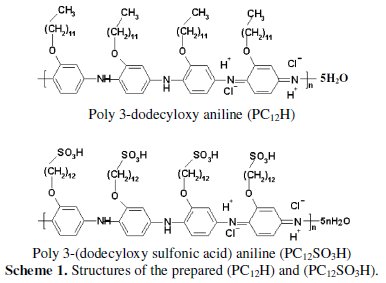
<body><![CDATA[<p>&nbsp;</p>     <p><b>Experimental</b></p>      <p><b><i>Materials</i></b></p>      <p>Poly 3-dodecyloxy aniline (PC<sub>12</sub>H) and poly 3-(dodecyloxy sulfonic acid) aniline  (PC<sub>12</sub>SO<sub>3</sub>H) have been prepared by Sayyah et al. [18, 24] and the structures are  given in <a href="#s1">scheme (1)</a>.</p>       <p>&nbsp;</p> <a name="s1"> <img src="/img/revistas/pea/v32n6/32n6a05s1.jpg">     
<p>&nbsp;</p>       <p>Concentrated hydrochloric acid is chemically a pure grade product provided by  Prolabo-Chemical Co., (U.K.). Bi-distilled water is used to prepare all solutions.</p>       <p><b><i>Potentiodynamic polarization measurements</i></b></p>      <p>Working electrode is made of aluminum metal provided by the Egyptian  Aluminum Company, Naga Hammadi, Egypt, which has the following chemical  composition (wt%): 99.57% Al, 0.31% Fe, 0.07% Si, 0.015% Ti, 0.0016 %Zn,  0.0003% Cr, 0.0019% Mg, 0.0021% Mn and 0.0007% Cu.</p>      <p>The rod is axially embedded in Araldite holder to offer an active flat disc shaped  of surface area 0.785 cm2. Prior to each experiment, the working electrode was  polished successively with fine emery paper. The polished metal surface was  rinsed with acetone and distilled water before dipping it into the electrolytic cell.  A platinum wire was used as the counter electrode and a saturated calomel  electrode as a reference electrode to which all potentials are referred.  Electrochemical experiments were performed using a Wenking PGS95,  Potentiostat /Galvanostat connected to a PC computer. Current potential curves  (I-E) are recorded with a computer software (ECT). Experiments were carried out  by changing the electrode potential automatically from the starting potential  towards more positive values using scan rate of 25 mV s<sup>-1</sup> till the end of the  experiments.</p>       ]]></body>
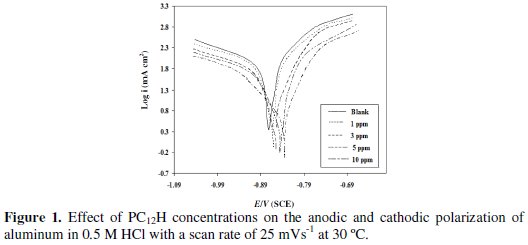
<body><![CDATA[<p><b><i>Computational techniques</i></b></p>      <p>Quantum chemical calculations were conducted with hyperchem 8.0 and Chem  Bio3D Ultra software. The 3D structure of the inhibitor molecules was  constructed with the build module implemented in HyperChem 8.0 software  package and subsequently, optimized using molecular mechanics calculations,  MM+ force field implemented in both software packages. The MM+ force field  is an extension of MM2; force field refers to both an interatomic potential  functional form and its relative parameters. Interatomic potentials are  mathematical functions used to describe the potential energy of a statistical  mechanical model formed by a system of particles. MM2 was developed  primarily for conformational analysis of hydrocarbons and other small organic  molecules. Calculations of the inhibitor molecules were accomplished by MM+.  Frontier orbital's distribution, energy of optimized structure, bond length and  bond angle were also obtained. On the other hand, analysis of the electrostatic  potential surfaces (ESP) of the two compounds was made using the semi- empirical ZINDO method using Argus Lab 4 software.</p>       <p>&nbsp;</p>     <p><b>Results and discussion</b></p>      <p><b><i>Potentiodynamic polarization measurement</i></b></p>      <p><a href="#f1">Fig. 1</a> shows Tafel polarization curves of aluminum in 0.5 M HCl solution in the  absence and presence of different concentrations of PC<sub>12</sub>H at 30 &deg;C with a scan  rate of 25 mVs<sup>-1</sup>.</p>       <p>&nbsp;</p> <a name="f1"> <img src="/img/revistas/pea/v32n6/32n6a05f1.jpg">     
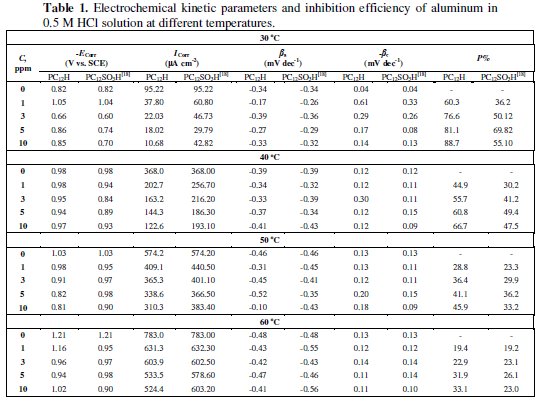
<p>&nbsp;</p>       <p>The electrochemical kinetic parameters, including Tafel  constants for both cathodic (&beta;c) and anodic (&beta;a) reactions, the corrosion current  densities (I<sub>corr</sub>) and the corrosion potentials (Ecorr), were obtained and are listed in  <a href="#t1">Table 1</a>, and are compared with the data that we have obtained in our previous  work in case of PC<sub>12</sub>SO<sub>3</sub>H [18].</p>       <p>&nbsp;</p> <a name="t1"> <img src="/img/revistas/pea/v32n6/32n6a05t1.jpg">     
]]></body>
<body><![CDATA[<p>&nbsp;</p>       <p>The inhibition efficiency (P%) was calculated  according to <a href="#e1">Eq. (1)</a> and is depicted in <a href="#t1">Table 1</a>.</p>       <p>&nbsp;</p> <a name="e1"> <img src="/img/revistas/pea/v32n6/32n6a05e1.jpg">     
<p>&nbsp;</p>       <p>where (I<sub>corr</sub>)<sub>0</sub> and (I<sub>corr</sub>) are the corrosion current densities in the absence and  presence of inhibitor surfactants, respectively. Results indicate that the corrosion  current density decreases with an increase in the inhibitor concentrations for both  polymeric surfactants and the lowest value of 10.68 &mu;A cm<sup>-2</sup> (P% = 88.7) is  obtained with PC<sub>12</sub>H, indicating that PC<sub>12</sub>H is more effective corrosion inhibitor  than PC<sub>12</sub>SO<sub>3</sub>H.</p>      <p>In acidic solutions, the anodic process of corrosion is the passage of metal ions  from the metal surface into the solution, while the principle of cathodic process is  the discharge of hydrogen ions to produce hydrogen gas, and the inhibitor may  affect either one or both of the anodic and cathodic processes [25]. When the  change in the Ecorr value is greater than 85 mV, a compound can be recognized as  an anodic or cathodic type inhibitor [26].</p>      <p>Inspections of these data reveal that the presence of PC<sub>12</sub>H and PC<sub>12</sub>SO<sub>3</sub>H shifts  the corrosion potential (Ecorr) towards less negative values, indicating that the  studied polymeric surfactants act predominantly as an anodic type inhibitor, and  thus, the polymeric surfactant inhibitors are probably adsorbed on the anodic part  of the aluminum surface and form a barrier layer of adsorbed molecules that  separates the metal from direct contact with the corrosion medium. The  adsorption behavior is attributed to the presence of electrostatic interaction  between the adsorption centers of the surfactant polymer inhibitors and the metal  surface.</p>      <p>It is found that the maximum inhibition efficiency of PC<sub>12</sub>H (P%=88.7) is higher  than that of PC<sub>12</sub> SO<sub>3</sub>H (P%=55.1), Although, the two compounds have the same  number of carbon atoms in the alkyl chain but the difference in the protection can  be attributed to the terminal group; the presence of CH3 as a terminal group in  PC<sub>12</sub>H decreases the repulsion between the inhibitor and the negatively charged  aluminum surface and allows a closed layer from the inhibitor to be adsorbed  more easily on aluminum surface and hence increasing the inhibition efficiency.  These results are in a good agreement with the results obtained from the  theoretical calculations.</p>      <p>The effect of temperature on the corrosion of aluminum in 0.5 M HCl solution in  the absence and presence of 10 ppm of PC<sub>12</sub>H and PC<sub>12</sub>SO<sub>3</sub>H [18] with scan rate  of 25 mVs<sup>-1</sup> was studied and the electrochemical kinetic parameters are tabulated  in <a href="#t1">Table 1</a>. It is observed that the corrosion current densities (I<sub>corr</sub>) in the  absence and presence of both inhibitors increase with increasing the temperature.  Such results declared that the rate of corrosion of aluminum enhanced with  increasing the temperature. The inhibition efficiency (P%) of both PC<sub>12</sub>H and  PC<sub>12</sub>SO<sub>3</sub>H was calculated at different temperatures and is given in <a href="#t1">Table 1</a>.  It has been reported [17 - 19] that, for acid corrosion of metals, the logarithm of  the corrosion rate is a linear function with 1/T (following Arrhenius equation  type)</p>       <p>&nbsp;</p> <a name="e2"> <img src="/img/revistas/pea/v32n6/32n6a05e2.jpg">     
]]></body>
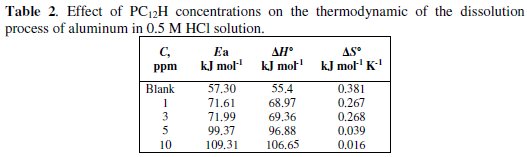
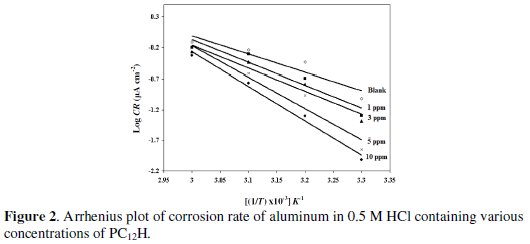
<body><![CDATA[<p>&nbsp;</p>       <p>where Ea is the apparent activation energy, R is the universal gas constant and A  is the Arrhenius pre-exponential factor. The logarithm of the corrosion rate was  plotted against 1/T (c.f. <a href="#f2">Fig. 2</a>) for each concentration and the values of (Ea) have  been calculated and tabulated in <a href="#t2">Table 2</a>.</p>       <p>&nbsp;</p> <a name="f2"> <img src="/img/revistas/pea/v32n6/32n6a05f2.jpg">     
<p>&nbsp;</p> <a name="t2"> <img src="/img/revistas/pea/v32n6/32n6a05t2.jpg">     
<p>&nbsp;</p>       <p>An alternative formula of the Arrhenius  equation is the transition state equation:</p>       <p>&nbsp;</p> <a name="e3"> <img src="/img/revistas/pea/v32n6/32n6a05e3.jpg">     
<p>&nbsp;</p>       <p>where h is the Planck's constant, N is the Avogadro's number, &Delta;S<sup>0</sup>  is the entropy of the activation, and &Delta;H<sup>0</sup>  is the enthalpy of activation. The plot of log  (Corrosion Rate / T) vs. 1/T gives a straight line with a slope of (-&Delta;H<sup>0</sup>/2.303R),  from which the values of &Delta;H<sup>0</sup>  are calculated and listed in <a href="#t2">Table 2</a>.</p>      <p>It is obvious that the value of Ea is higher in the presence of both PC<sub>12</sub>H and  PC<sub>12</sub>SO<sub>3</sub>H when compared with the blank and the value in case of PC<sub>12</sub>H (10  ppm) is 109.31 kJ mol<sup>-1</sup>, while it is 76.2 kJ mol<sup>-1</sup> [18] in the case of PC<sub>12</sub>SO<sub>3</sub>H  (10 ppm), which agrees with our results indicating that PC<sub>12</sub>H is more effective  corrosion inhibitor than PC<sub>12</sub>SO<sub>3</sub>H. Furthermore, with increasing the  concentrations of both the polymeric surfactant inhibitors, the activation energies  increase and the inhibition efficiency decreases; this behavior is attributed to an  appreciable decrease in the adsorption process of the inhibitors on the metal  surface with increasing the temperature [27,28]. A decrease in inhibition  efficiencies (P%) with increasing the temperature, with analogous increase in  corrosion activation energy (Ea) in the presence of the inhibitors compared to  their absence is a good evidence of the physical adsorption mechanism [27,29].  &Delta;H<sup>0</sup>  for the corrosion of Al in the presence of PC<sub>12</sub>H and PC<sub>12</sub>SO<sub>3</sub>H is higher  than that of blank solution and increases with an increase in the inhibitors  concentrations, indicating that more energy barrier for the corrosion reaction in  the presence of the inhibitor is attained and this energy barrier of corrosion  reaction increases as the concentration of the inhibitor increases.</p>       ]]></body>
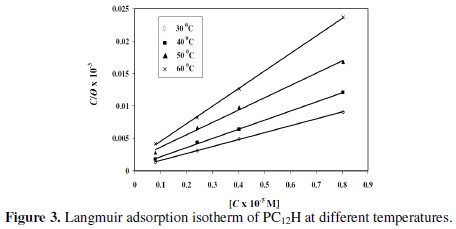
<body><![CDATA[<p><b><i>Adsorption isotherm</i></b></p>      <p>In order to get more information about the mode of adsorption of the inhibitors  on the metal surface at different temperatures, the obtained data have been tested  with several adsorption isotherms. Experimental data were fitted into Langmuir  adsorption isotherm as shown in <a href="#f3">Fig. 3</a>.</p>       <p>&nbsp;</p> <a name="f3"> <img src="/img/revistas/pea/v32n6/32n6a05f3.jpg">     
<p>&nbsp;</p>       <p>The adsorption isotherm relationship is  represented by the following equation [18, 19]:</p>       <p>&nbsp;</p> <a name="e4"> <img src="/img/revistas/pea/v32n6/32n6a05e4.jpg">     
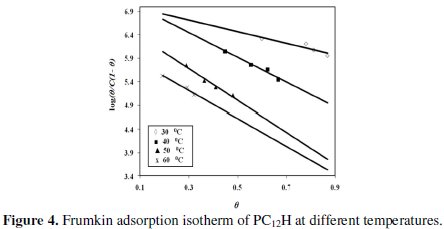
<p>&nbsp;</p>       <p>Values of Ci are the concentration of the inhibitor in bulk solution, &theta;  is the surface coverage (&theta; = P/100) and k<sub>ads</sub> is the adsorption equilibrium constant.</p>      <p>Frumkin isotherm [18, 19] was also found to fit well with the obtained  experimental data, as represented in <a href="#f4">Fig. 4</a>.</p>       <p>&nbsp;</p> <a name="f4"> <img src="/img/revistas/pea/v32n6/32n6a05f4.jpg">     
]]></body>
<body><![CDATA[<p>&nbsp;</p>       <p>The adsorption isotherm relationship  of Frumkin is represented by the following equation:</p>       <p>&nbsp;</p> <a name="e5"> <img src="/img/revistas/pea/v32n6/32n6a05e5.jpg">     
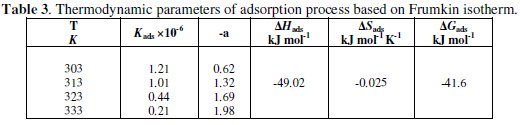
<p>&nbsp;</p>       <p>where (a) is the lateral interaction term describing the molecular interactions in  the adsorption layer and the heterogeneity of the surface and is a measure for the  steepness of the adsorption isotherm. It may be positive or negative values. The  more positive value of (a), the steeper is the adsorption isotherm.</p>      <p>The apparent thermodynamic parameters (&Delta;H<sub>ads</sub> and &Delta;S<sub>ads</sub>) for the surfactant  adsorption on the aluminum surface in 0.5 M HCl at different temperatures were  determined from the slopes and intercepts of the lines of log k<sub>ads</sub> vs. 1/T plots  using the following equation [18,19]:</p>       <p>&nbsp;</p> <a name="e6"> <img src="/img/revistas/pea/v32n6/32n6a05e6.jpg">     
<p>&nbsp;</p>       <p>where &Delta;H<sub>ads</sub> and &Delta;S<sub>ads</sub> are the enthalpy and entropy of the adsorption process,  respectively. Values (k<sub>ads</sub>), (&Delta;H<sub>ads</sub>), (&Delta;S<sub>ads</sub>) and (&Delta;G<sub>ads</sub>) were obtained and listed  in <a href="#t3">Table 3</a>.</p>       <p>&nbsp;</p> <a name="t3"> <img src="/img/revistas/pea/v32n6/32n6a05t3.jpg">     
]]></body>
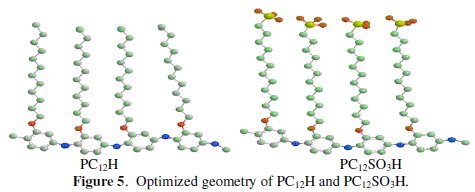
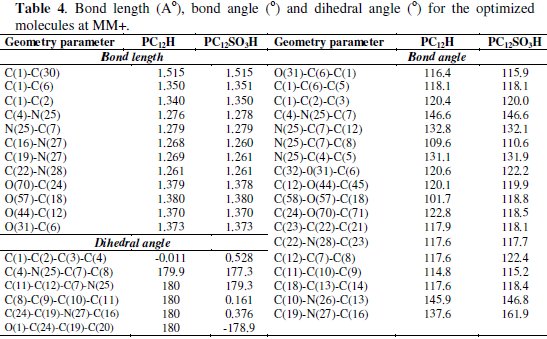
<body><![CDATA[<p>&nbsp;</p>       <p>The calculated values of &Delta;G<sub>ads</sub> in case of PC<sub>12</sub>H (-41.6 kJ mol<sup>-1</sup>) and  in case of PC<sub>12</sub>SO<sub>3</sub>H (-36.45 kJ mol<sup>-1</sup>[18]) are close to -40 kJ mol<sup>-1</sup>; this reflects  electrostatic interaction between the inhibitor and the charged metal surface and  this adsorption process is described as physical adsorption [30]. These data are  also in a good agreement with the data obtained from the thermodynamic  activation parameters.</p>       <p><b><i>Quantum Chemical Calculation</i></b></p>      <p><i>Molecular Reactivity</i></p>      <p>The optimized geometries of PC<sub>12</sub>H and PC<sub>12</sub>SO<sub>3</sub>H are shown in <a href="#f5">Fig. 5</a> as well as  bond lengths, bond angles and dihedral angles are tabulated in <a href="#t4">Table 4</a>.</p>       <p>&nbsp;</p> <a name="f5"> <img src="/img/revistas/pea/v32n6/32n6a05f5.jpg">     
<p>&nbsp;</p> <a name="t4"> <img src="/img/revistas/pea/v32n6/32n6a05t4.jpg">     
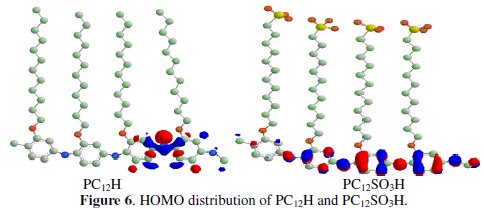
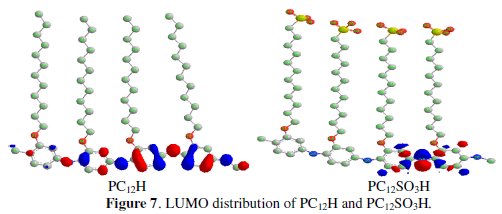
<p>&nbsp;</p>       <p>Electronic behavior of PC<sub>12</sub>H and PC<sub>12</sub>SO<sub>3</sub>H was studied to explain the electron  donor/acceptor properties of these compounds. The effectiveness of a particular  donor/acceptor can be assessed by computation of certain quantum chemical  parameters such as the energy of the highest occupied molecular orbital (E<sub>HOMO</sub>),  the energy of the lowest unoccupied molecular orbital (E<sub>LUMO</sub>) and LUMO-  HOMO gap (E<sub>LUMO</sub> - E<sub>HOMO</sub>). E<sub>HOMO</sub> is a quantum chemical descriptor, which is  often associated with the electron donating ability of the molecule.  High value of E<sub>HOMO</sub> indicates the tendency of a molecule to donate electrons to  an appropriate acceptor molecule with empty molecular orbitals. Therefore, the  energy of E<sub>LUMO</sub> indicates the ability of a molecule to accept electrons. On the  other hand, values of energy gap (&Delta;E = E<sub>LUMO</sub> - E<sub>HOMO</sub>) are the measure of  excitation energy to remove an electron from the last occupied molecular orbital.  Hence, an increase in the values of E<sub>HOMO</sub> can facilitate the disposition of the  molecule to donate orbital electrons to an appropriate acceptor and decrease in  E<sub>LUMO</sub> is an indication of strong interaction with the metal [27].</p>      <p><a href="#f6">Figs. 6</a> and <a href="#f7">7</a> represent the highest occupied molecular orbital (HOMO) and  lowest occupied molecular orbital (LUMO) for PC<sub>12</sub>H and PC<sub>12</sub>SO<sub>3</sub>H,  respectively.</p>       ]]></body>
<body><![CDATA[<p>&nbsp;</p> <a name="f6"> <img src="/img/revistas/pea/v32n6/32n6a05f6.jpg">     
<p>&nbsp;</p> <a name="f7"> <img src="/img/revistas/pea/v32n6/32n6a05f7.jpg">     
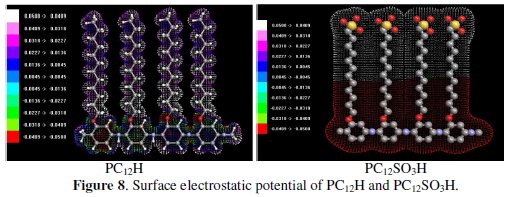
<p>&nbsp;</p>       <p>It could be seen that the frontier molecular orbitals of two  compounds are generally located on the head group that be preferentially  adsorbed onto the metal surface as active sites. It can be observed that HOMO  energy of PC<sub>12</sub>H and PC<sub>12</sub>SO<sub>3</sub>H is -6.275 and -6.278 eV, respectively. These  results indicate that the electron donating behaviour of these compounds follows  the order PC<sub>12</sub>H &gt; PC<sub>12</sub>SO<sub>3</sub>H. On the other hand, the LUMO energies of PC<sub>12</sub>H  and PC<sub>12</sub>SO<sub>3</sub>H are -5.016 and -4.864 eV, respectively, which indicates that the  capability of accepting electrons of the studied compounds follows the order  PC<sub>12</sub>H &gt; PC<sub>12</sub>SO<sub>3</sub>H.</p>      <p>Low value of energy gap (&Delta;E) leads to easier polarization of the molecule and  greater adsorption on the surface. Thus, a small &Delta;E of PC<sub>12</sub>H (1.259 eV)  facilitates its adsorption on aluminum metal and enhances its inhibition  efficiency (P%=88.7) compared with PC<sub>12</sub>SO<sub>3</sub>H (P%= 55.1). This behaviour is  in a good agreement with the results obtained from the polarization  measurements.</p>       <p><i>Electrostatic potential surface</i></p>      <p>Electrostatic potential surface generally provides information regarding the  chemical reactivity of a molecule. The electrostatic potential generated in the  space around a molecule by the charge distribution is helpful to understand how  much electrophilic or nucleophilic the molecular species is.</p>      <p><a href="#f8">Fig. 8</a> represents the electrostatic potential map for PC<sub>12</sub>H and PC<sub>12</sub>SO<sub>3</sub>H.</p>       <p>&nbsp;</p> <a name="f8"> <img src="/img/revistas/pea/v32n6/32n6a05f8.jpg">     
<p>&nbsp;</p>       ]]></body>
<body><![CDATA[<p>Results show that PC<sub>12</sub>SO<sub>3</sub>H has a more negative charge than PC<sub>12</sub>H, therefore,  the electrophilicity of PC<sub>12</sub>H is higher than that of PC<sub>12</sub>SO<sub>3</sub>H. These results  explain the good electrostatic attraction between PC<sub>12</sub>H and the negatively  charged aluminum surface and thus, the higher adsorption and inhibition  efficiency for PC<sub>12</sub>H compared with that of PC<sub>12</sub>SO<sub>3</sub>H. These theoretical  calculations are in a good agreement with the experimental results.</p>       <p>&nbsp;</p>     <p><b>Conclusions</b></p>      <p>&bull; The terminal side chain has a great effect on the inhibition efficiency of the  studied polymeric surfactants.</p>      <p>&bull; Inhibition efficiency of PC<sub>12</sub>H is higher than that of PC<sub>12</sub>SO<sub>3</sub>H.</p>      <p>&bull; Inhibition efficiency increases with increasing the inhibitor concentrations but  decreases with raising the temperature.</p>      <p>&bull; Physical adsorption was suggested for both polymeric surfactant inhibitors.</p>      <p>&bull; Langmuir and Frumkin isotherms are found to fit the adsorption of the studied  compounds.</p>      <p>&bull; Quantum chemical calculations and the electrostatic potential surface explain  the effect of the terminal side chain on the inhibition efficiency for both studied  polymeric surfactant compounds.</p>       <p>&nbsp;</p>     ]]></body>
<body><![CDATA[<p><b>References</b></p>      <!-- ref --><p>1. Sorkhabi H A, Ghasemi Z, Seifzadeh D. Appl Surf Sci. 2005;247:408.    &nbsp;&nbsp;&nbsp;&nbsp;&nbsp;&nbsp;&nbsp;&nbsp;[&#160;<a href="javascript:void(0);" onclick="javascript: window.open('/scielo.php?script=sci_nlinks&ref=000114&pid=S0872-1904201400060000500001&lng=','','width=640,height=500,resizable=yes,scrollbars=1,menubar=yes,');">Links</a>&#160;]<!-- end-ref --></p>      <!-- ref --><p>2. Maayta A K, Al-Rawashdeh N A. Corros Sci. 2004;46:1129.    &nbsp;&nbsp;&nbsp;&nbsp;&nbsp;&nbsp;&nbsp;&nbsp;[&#160;<a href="javascript:void(0);" onclick="javascript: window.open('/scielo.php?script=sci_nlinks&ref=000116&pid=S0872-1904201400060000500002&lng=','','width=640,height=500,resizable=yes,scrollbars=1,menubar=yes,');">Links</a>&#160;]<!-- end-ref --></p>      <!-- ref --><p>3. Branzoi V, Golgovici F, Branzoi F. Mater Chem Phys. 2002;78:122.    &nbsp;&nbsp;&nbsp;&nbsp;&nbsp;&nbsp;&nbsp;&nbsp;[&#160;<a href="javascript:void(0);" onclick="javascript: window.open('/scielo.php?script=sci_nlinks&ref=000118&pid=S0872-1904201400060000500003&lng=','','width=640,height=500,resizable=yes,scrollbars=1,menubar=yes,');">Links</a>&#160;]<!-- end-ref --></p>      <!-- ref --><p>4. Sherif E M, Park S M. Electrochim Acta 2006;51:1313.    &nbsp;&nbsp;&nbsp;&nbsp;&nbsp;&nbsp;&nbsp;&nbsp;[&#160;<a href="javascript:void(0);" onclick="javascript: window.open('/scielo.php?script=sci_nlinks&ref=000120&pid=S0872-1904201400060000500004&lng=','','width=640,height=500,resizable=yes,scrollbars=1,menubar=yes,');">Links</a>&#160;]<!-- end-ref --></p>      <!-- ref --><p>5. Abd El Rehim S S, Hassan H, Amin M. Mater Chem Phys. 2002;78:337.    &nbsp;&nbsp;&nbsp;&nbsp;&nbsp;&nbsp;&nbsp;&nbsp;[&#160;<a href="javascript:void(0);" onclick="javascript: window.open('/scielo.php?script=sci_nlinks&ref=000122&pid=S0872-1904201400060000500005&lng=','','width=640,height=500,resizable=yes,scrollbars=1,menubar=yes,');">Links</a>&#160;]<!-- end-ref --></p>      <!-- ref --><p>6. Zhao T, Mu G. Corros Sci. 1999;41:1937.    &nbsp;&nbsp;&nbsp;&nbsp;&nbsp;&nbsp;&nbsp;&nbsp;[&#160;<a href="javascript:void(0);" onclick="javascript: window.open('/scielo.php?script=sci_nlinks&ref=000124&pid=S0872-1904201400060000500006&lng=','','width=640,height=500,resizable=yes,scrollbars=1,menubar=yes,');">Links</a>&#160;]<!-- end-ref --></p>      <!-- ref --><p>7. Perucki M, Chandrasekhar P. Synth Met. 2001;119:385.    &nbsp;&nbsp;&nbsp;&nbsp;&nbsp;&nbsp;&nbsp;&nbsp;[&#160;<a href="javascript:void(0);" onclick="javascript: window.open('/scielo.php?script=sci_nlinks&ref=000126&pid=S0872-1904201400060000500007&lng=','','width=640,height=500,resizable=yes,scrollbars=1,menubar=yes,');">Links</a>&#160;]<!-- end-ref --></p>      <!-- ref --><p>8. Breslin C, Fenelon A, Conroy K. Mater Des. 2005;26:233.    &nbsp;&nbsp;&nbsp;&nbsp;&nbsp;&nbsp;&nbsp;&nbsp;[&#160;<a href="javascript:void(0);" onclick="javascript: window.open('/scielo.php?script=sci_nlinks&ref=000128&pid=S0872-1904201400060000500008&lng=','','width=640,height=500,resizable=yes,scrollbars=1,menubar=yes,');">Links</a>&#160;]<!-- end-ref --></p>      <!-- ref --><p>9. Gelling V J, Wiest M M, Tallman D E, et al. Prog Org Coat. 2001;43:149.    &nbsp;&nbsp;&nbsp;&nbsp;&nbsp;&nbsp;&nbsp;&nbsp;[&#160;<a href="javascript:void(0);" onclick="javascript: window.open('/scielo.php?script=sci_nlinks&ref=000130&pid=S0872-1904201400060000500009&lng=','','width=640,height=500,resizable=yes,scrollbars=1,menubar=yes,');">Links</a>&#160;]<!-- end-ref --></p>      <!-- ref --><p>10. Epstein A J, Smallfield J A, Guan H, et al. Synth Met. 1999;102:1374.    &nbsp;&nbsp;&nbsp;&nbsp;&nbsp;&nbsp;&nbsp;&nbsp;[&#160;<a href="javascript:void(0);" onclick="javascript: window.open('/scielo.php?script=sci_nlinks&ref=000132&pid=S0872-1904201400060000500010&lng=','','width=640,height=500,resizable=yes,scrollbars=1,menubar=yes,');">Links</a>&#160;]<!-- end-ref --></p>      <!-- ref --><p>11. Muller B. Corros Sci. 2004;46:159.    &nbsp;&nbsp;&nbsp;&nbsp;&nbsp;&nbsp;&nbsp;&nbsp;[&#160;<a href="javascript:void(0);" onclick="javascript: window.open('/scielo.php?script=sci_nlinks&ref=000134&pid=S0872-1904201400060000500011&lng=','','width=640,height=500,resizable=yes,scrollbars=1,menubar=yes,');">Links</a>&#160;]<!-- end-ref --></p>      <!-- ref --><p>12. Bereket G, Yurt A. Corros Sci. 2001;43:1179.    &nbsp;&nbsp;&nbsp;&nbsp;&nbsp;&nbsp;&nbsp;&nbsp;[&#160;<a href="javascript:void(0);" onclick="javascript: window.open('/scielo.php?script=sci_nlinks&ref=000136&pid=S0872-1904201400060000500012&lng=','','width=640,height=500,resizable=yes,scrollbars=1,menubar=yes,');">Links</a>&#160;]<!-- end-ref --></p>      <!-- ref --><p>13. Foad El-Shebini E E, Abd-El-Wahab S M, Deyab M A. Mater Chem Phys. 2003;82:631.    &nbsp;&nbsp;&nbsp;&nbsp;&nbsp;&nbsp;&nbsp;&nbsp;[&#160;<a href="javascript:void(0);" onclick="javascript: window.open('/scielo.php?script=sci_nlinks&ref=000138&pid=S0872-1904201400060000500013&lng=','','width=640,height=500,resizable=yes,scrollbars=1,menubar=yes,');">Links</a>&#160;]<!-- end-ref --></p>      <!-- ref --><p>14. Maitra A, Barua S. Corros Sci. 1974;14:587.    &nbsp;&nbsp;&nbsp;&nbsp;&nbsp;&nbsp;&nbsp;&nbsp;[&#160;<a href="javascript:void(0);" onclick="javascript: window.open('/scielo.php?script=sci_nlinks&ref=000140&pid=S0872-1904201400060000500014&lng=','','width=640,height=500,resizable=yes,scrollbars=1,menubar=yes,');">Links</a>&#160;]<!-- end-ref --></p>      <!-- ref --><p>15. Moussa M N, Taha F I, Gouda M A, et al. Corros Sci. 1976;16:379.    &nbsp;&nbsp;&nbsp;&nbsp;&nbsp;&nbsp;&nbsp;&nbsp;[&#160;<a href="javascript:void(0);" onclick="javascript: window.open('/scielo.php?script=sci_nlinks&ref=000142&pid=S0872-1904201400060000500015&lng=','','width=640,height=500,resizable=yes,scrollbars=1,menubar=yes,');">Links</a>&#160;]<!-- end-ref --></p>      <!-- ref --><p>16. Zheludkevich M L, Yasakau K A, Poznyak S, et al. Corros Sci. 2004;47:3368.    &nbsp;&nbsp;&nbsp;&nbsp;&nbsp;&nbsp;&nbsp;&nbsp;[&#160;<a href="javascript:void(0);" onclick="javascript: window.open('/scielo.php?script=sci_nlinks&ref=000144&pid=S0872-1904201400060000500016&lng=','','width=640,height=500,resizable=yes,scrollbars=1,menubar=yes,');">Links</a>&#160;]<!-- end-ref --></p>      <!-- ref --><p>17. Sayyah S M, Abd El-Rehim S S, El-Deeb M M, et al. Egypt J Chem. 2012;55:583.    &nbsp;&nbsp;&nbsp;&nbsp;&nbsp;&nbsp;&nbsp;&nbsp;[&#160;<a href="javascript:void(0);" onclick="javascript: window.open('/scielo.php?script=sci_nlinks&ref=000146&pid=S0872-1904201400060000500017&lng=','','width=640,height=500,resizable=yes,scrollbars=1,menubar=yes,');">Links</a>&#160;]<!-- end-ref --></p>      <!-- ref --><p>18. El-Deeb M M, Sayyah S M, Abd El-Rehim S S, et al. Arab J Chem. In press.    <a href="http://dx.doi.org/10.1016/j.arabjc.2013.09.018" target="_blank">http://dx.doi.org/10.1016/j.arabjc.2013.09.018</a>.    &nbsp;&nbsp;&nbsp;&nbsp;&nbsp;&nbsp;&nbsp;&nbsp;[&#160;<a href="javascript:void(0);" onclick="javascript: window.open('/scielo.php?script=sci_nlinks&ref=000148&pid=S0872-1904201400060000500018&lng=','','width=640,height=500,resizable=yes,scrollbars=1,menubar=yes,');">Links</a>&#160;]<!-- end-ref --></p>      <!-- ref --><p>19. El-Deeb M M, Mohamed S M. J Appl Polym Sci. 2011;122:3030.    &nbsp;&nbsp;&nbsp;&nbsp;&nbsp;&nbsp;&nbsp;&nbsp;[&#160;<a href="javascript:void(0);" onclick="javascript: window.open('/scielo.php?script=sci_nlinks&ref=000150&pid=S0872-1904201400060000500019&lng=','','width=640,height=500,resizable=yes,scrollbars=1,menubar=yes,');">Links</a>&#160;]<!-- end-ref --></p>      <!-- ref --><p>20. Camacho R L, Montiel E, Jayanthi N, et al. Chem Phys Lett. 2010;485:142.    &nbsp;&nbsp;&nbsp;&nbsp;&nbsp;&nbsp;&nbsp;&nbsp;[&#160;<a href="javascript:void(0);" onclick="javascript: window.open('/scielo.php?script=sci_nlinks&ref=000152&pid=S0872-1904201400060000500020&lng=','','width=640,height=500,resizable=yes,scrollbars=1,menubar=yes,');">Links</a>&#160;]<!-- end-ref --></p>      <!-- ref --><p>21. Musa A Y, Mohamed A, Kadhum A H, et al. J Ind Eng Chem. 2012;18:551.    &nbsp;&nbsp;&nbsp;&nbsp;&nbsp;&nbsp;&nbsp;&nbsp;[&#160;<a href="javascript:void(0);" onclick="javascript: window.open('/scielo.php?script=sci_nlinks&ref=000154&pid=S0872-1904201400060000500021&lng=','','width=640,height=500,resizable=yes,scrollbars=1,menubar=yes,');">Links</a>&#160;]<!-- end-ref --></p>      <!-- ref --><p>22. Danaee I, Ghasemi O, Rashed G R, et al. J Mol Struct. 2013;1035:247.    &nbsp;&nbsp;&nbsp;&nbsp;&nbsp;&nbsp;&nbsp;&nbsp;[&#160;<a href="javascript:void(0);" onclick="javascript: window.open('/scielo.php?script=sci_nlinks&ref=000156&pid=S0872-1904201400060000500022&lng=','','width=640,height=500,resizable=yes,scrollbars=1,menubar=yes,');">Links</a>&#160;]<!-- end-ref --></p>      <!-- ref --><p>23. Zhang J, Qiao G, Hu S, et al. Corros Sci. 2011;53:147.    &nbsp;&nbsp;&nbsp;&nbsp;&nbsp;&nbsp;&nbsp;&nbsp;[&#160;<a href="javascript:void(0);" onclick="javascript: window.open('/scielo.php?script=sci_nlinks&ref=000158&pid=S0872-1904201400060000500023&lng=','','width=640,height=500,resizable=yes,scrollbars=1,menubar=yes,');">Links</a>&#160;]<!-- end-ref --></p>      <!-- ref --><p>24. Sayyah S M, El-Salam H M A, Azzam E M. Inter J Polym Mat. 2006;55:1075.    &nbsp;&nbsp;&nbsp;&nbsp;&nbsp;&nbsp;&nbsp;&nbsp;[&#160;<a href="javascript:void(0);" onclick="javascript: window.open('/scielo.php?script=sci_nlinks&ref=000160&pid=S0872-1904201400060000500024&lng=','','width=640,height=500,resizable=yes,scrollbars=1,menubar=yes,');">Links</a>&#160;]<!-- end-ref --></p>      <!-- ref --><p>25. Saliyana V R, Adhikari A V. Corros Sci. 2008;50:55.    &nbsp;&nbsp;&nbsp;&nbsp;&nbsp;&nbsp;&nbsp;&nbsp;[&#160;<a href="javascript:void(0);" onclick="javascript: window.open('/scielo.php?script=sci_nlinks&ref=000162&pid=S0872-1904201400060000500025&lng=','','width=640,height=500,resizable=yes,scrollbars=1,menubar=yes,');">Links</a>&#160;]<!-- end-ref --></p>      <!-- ref --><p>26. Musa A Y, Jalgham R T, Mohamed A.Corros Sci. 2012;56:176.    &nbsp;&nbsp;&nbsp;&nbsp;&nbsp;&nbsp;&nbsp;&nbsp;[&#160;<a href="javascript:void(0);" onclick="javascript: window.open('/scielo.php?script=sci_nlinks&ref=000164&pid=S0872-1904201400060000500026&lng=','','width=640,height=500,resizable=yes,scrollbars=1,menubar=yes,');">Links</a>&#160;]<!-- end-ref --></p>      <!-- ref --><p>27. Obot I B, Obi-Egbedi N O. Curr Appl Phys. 2011;11:382.    &nbsp;&nbsp;&nbsp;&nbsp;&nbsp;&nbsp;&nbsp;&nbsp;[&#160;<a href="javascript:void(0);" onclick="javascript: window.open('/scielo.php?script=sci_nlinks&ref=000166&pid=S0872-1904201400060000500027&lng=','','width=640,height=500,resizable=yes,scrollbars=1,menubar=yes,');">Links</a>&#160;]<!-- end-ref --></p>      <!-- ref --><p>28. Saleh M M, Atia A A.J Appl Electrochem. 2006; 36:899.    &nbsp;&nbsp;&nbsp;&nbsp;&nbsp;&nbsp;&nbsp;&nbsp;[&#160;<a href="javascript:void(0);" onclick="javascript: window.open('/scielo.php?script=sci_nlinks&ref=000168&pid=S0872-1904201400060000500028&lng=','','width=640,height=500,resizable=yes,scrollbars=1,menubar=yes,');">Links</a>&#160;]<!-- end-ref --></p>      <!-- ref --><p>29. Obot I B, Obi-Egbedi N O. Corros Sci. 2010;52:198.    &nbsp;&nbsp;&nbsp;&nbsp;&nbsp;&nbsp;&nbsp;&nbsp;[&#160;<a href="javascript:void(0);" onclick="javascript: window.open('/scielo.php?script=sci_nlinks&ref=000170&pid=S0872-1904201400060000500029&lng=','','width=640,height=500,resizable=yes,scrollbars=1,menubar=yes,');">Links</a>&#160;]<!-- end-ref --></p>      <!-- ref --><p>30. Abd-El-Rehim S S, Sayyah S M, El-Deeb M M, et al. Mater Chem Phys. 2010;123:20.    &nbsp;&nbsp;&nbsp;&nbsp;&nbsp;&nbsp;&nbsp;&nbsp;[&#160;<a href="javascript:void(0);" onclick="javascript: window.open('/scielo.php?script=sci_nlinks&ref=000172&pid=S0872-1904201400060000500030&lng=','','width=640,height=500,resizable=yes,scrollbars=1,menubar=yes,');">Links</a>&#160;]<!-- end-ref --></p>       <p>&nbsp;</p>     <p><a name=0></a><sup><a href="#top">*</a></sup>Corresponding author. E-mail address: <a href="mailto:smsayyah@hotmail.com">smsayyah@hotmail.com</a></p>      <p>Received 15 October 2014; accepted 25 October 2014</p>      <p><a href="http://www.peacta.org" target="_blank">www.peacta.org</a> </p>        ]]></body><back>
<ref-list>
<ref id="B1">
<label>1</label><nlm-citation citation-type="journal">
<person-group person-group-type="author">
<name>
<surname><![CDATA[Sorkhabi]]></surname>
<given-names><![CDATA[H A]]></given-names>
</name>
<name>
<surname><![CDATA[Ghasemi]]></surname>
<given-names><![CDATA[Z]]></given-names>
</name>
<name>
<surname><![CDATA[Seifzadeh]]></surname>
<given-names><![CDATA[D]]></given-names>
</name>
</person-group>
<source><![CDATA[Appl Surf Sci]]></source>
<year>2005</year>
<volume>247</volume>
<page-range>408</page-range></nlm-citation>
</ref>
<ref id="B2">
<label>2</label><nlm-citation citation-type="journal">
<person-group person-group-type="author">
<name>
<surname><![CDATA[Maayta]]></surname>
<given-names><![CDATA[A K]]></given-names>
</name>
<name>
<surname><![CDATA[Al-Rawashdeh]]></surname>
<given-names><![CDATA[N A]]></given-names>
</name>
</person-group>
<source><![CDATA[Corros Sci]]></source>
<year>2004</year>
<volume>46</volume>
<page-range>1129</page-range></nlm-citation>
</ref>
<ref id="B3">
<label>3</label><nlm-citation citation-type="journal">
<person-group person-group-type="author">
<name>
<surname><![CDATA[Branzoi]]></surname>
<given-names><![CDATA[V]]></given-names>
</name>
<name>
<surname><![CDATA[Golgovici]]></surname>
<given-names><![CDATA[F]]></given-names>
</name>
<name>
<surname><![CDATA[Branzoi]]></surname>
<given-names><![CDATA[F]]></given-names>
</name>
</person-group>
<source><![CDATA[Mater Chem Phys]]></source>
<year>2002</year>
<volume>78</volume>
<page-range>122</page-range></nlm-citation>
</ref>
<ref id="B4">
<label>4</label><nlm-citation citation-type="journal">
<person-group person-group-type="author">
<name>
<surname><![CDATA[Sherif]]></surname>
<given-names><![CDATA[E M]]></given-names>
</name>
<name>
<surname><![CDATA[Park]]></surname>
<given-names><![CDATA[S M]]></given-names>
</name>
</person-group>
<source><![CDATA[Electrochim Acta]]></source>
<year>2006</year>
<volume>51</volume>
<page-range>1313</page-range></nlm-citation>
</ref>
<ref id="B5">
<label>5</label><nlm-citation citation-type="journal">
<person-group person-group-type="author">
<name>
<surname><![CDATA[Abd El Rehim]]></surname>
<given-names><![CDATA[S S]]></given-names>
</name>
<name>
<surname><![CDATA[Hassan]]></surname>
<given-names><![CDATA[H]]></given-names>
</name>
<name>
<surname><![CDATA[Amin]]></surname>
<given-names><![CDATA[M]]></given-names>
</name>
</person-group>
<source><![CDATA[Mater Chem Phys]]></source>
<year>2002</year>
<volume>78</volume>
<page-range>337</page-range></nlm-citation>
</ref>
<ref id="B6">
<label>6</label><nlm-citation citation-type="journal">
<person-group person-group-type="author">
<name>
<surname><![CDATA[Zhao]]></surname>
<given-names><![CDATA[T]]></given-names>
</name>
<name>
<surname><![CDATA[Mu]]></surname>
<given-names><![CDATA[G]]></given-names>
</name>
</person-group>
<source><![CDATA[Corros Sci]]></source>
<year>1999</year>
<volume>41</volume>
<page-range>1937</page-range></nlm-citation>
</ref>
<ref id="B7">
<label>7</label><nlm-citation citation-type="journal">
<person-group person-group-type="author">
<name>
<surname><![CDATA[Perucki]]></surname>
<given-names><![CDATA[M]]></given-names>
</name>
<name>
<surname><![CDATA[Chandrasekhar]]></surname>
<given-names><![CDATA[P]]></given-names>
</name>
</person-group>
<source><![CDATA[Synth Met]]></source>
<year>2001</year>
<volume>119</volume>
<page-range>385</page-range></nlm-citation>
</ref>
<ref id="B8">
<label>8</label><nlm-citation citation-type="journal">
<person-group person-group-type="author">
<name>
<surname><![CDATA[Breslin]]></surname>
<given-names><![CDATA[C]]></given-names>
</name>
<name>
<surname><![CDATA[Fenelon]]></surname>
<given-names><![CDATA[A]]></given-names>
</name>
<name>
<surname><![CDATA[Conroy]]></surname>
<given-names><![CDATA[K]]></given-names>
</name>
</person-group>
<source><![CDATA[Mater Des]]></source>
<year>2005</year>
<volume>26</volume>
<page-range>233</page-range></nlm-citation>
</ref>
<ref id="B9">
<label>9</label><nlm-citation citation-type="journal">
<person-group person-group-type="author">
<name>
<surname><![CDATA[Gelling]]></surname>
<given-names><![CDATA[V J]]></given-names>
</name>
<name>
<surname><![CDATA[Wiest]]></surname>
<given-names><![CDATA[M M]]></given-names>
</name>
<name>
<surname><![CDATA[Tallman]]></surname>
<given-names><![CDATA[D E]]></given-names>
</name>
</person-group>
<source><![CDATA[Prog Org Coat]]></source>
<year>2001</year>
<volume>43</volume>
<page-range>149</page-range></nlm-citation>
</ref>
<ref id="B10">
<label>10</label><nlm-citation citation-type="journal">
<person-group person-group-type="author">
<name>
<surname><![CDATA[Epstein]]></surname>
<given-names><![CDATA[A J]]></given-names>
</name>
<name>
<surname><![CDATA[Smallfield]]></surname>
<given-names><![CDATA[J A]]></given-names>
</name>
<name>
<surname><![CDATA[Guan]]></surname>
<given-names><![CDATA[H]]></given-names>
</name>
</person-group>
<source><![CDATA[Synth Met]]></source>
<year>1999</year>
<volume>102</volume>
<page-range>1374</page-range></nlm-citation>
</ref>
<ref id="B11">
<label>11</label><nlm-citation citation-type="journal">
<person-group person-group-type="author">
<name>
<surname><![CDATA[Muller]]></surname>
<given-names><![CDATA[B]]></given-names>
</name>
</person-group>
<source><![CDATA[Corros Sci]]></source>
<year>2004</year>
<volume>46</volume>
<page-range>159</page-range></nlm-citation>
</ref>
<ref id="B12">
<label>12</label><nlm-citation citation-type="journal">
<person-group person-group-type="author">
<name>
<surname><![CDATA[Bereket]]></surname>
<given-names><![CDATA[G]]></given-names>
</name>
<name>
<surname><![CDATA[Yurt]]></surname>
<given-names><![CDATA[A]]></given-names>
</name>
</person-group>
<source><![CDATA[Corros Sci]]></source>
<year>2001</year>
<volume>43</volume>
<page-range>1179</page-range></nlm-citation>
</ref>
<ref id="B13">
<label>13</label><nlm-citation citation-type="journal">
<person-group person-group-type="author">
<name>
<surname><![CDATA[Foad El-Shebini]]></surname>
<given-names><![CDATA[E E]]></given-names>
</name>
<name>
<surname><![CDATA[Abd-El-Wahab]]></surname>
<given-names><![CDATA[S M]]></given-names>
</name>
<name>
<surname><![CDATA[Deyab]]></surname>
<given-names><![CDATA[M A]]></given-names>
</name>
</person-group>
<source><![CDATA[Mater Chem Phys]]></source>
<year>2003</year>
<volume>82</volume>
<page-range>631</page-range></nlm-citation>
</ref>
<ref id="B14">
<label>14</label><nlm-citation citation-type="journal">
<person-group person-group-type="author">
<name>
<surname><![CDATA[Maitra]]></surname>
<given-names><![CDATA[A]]></given-names>
</name>
<name>
<surname><![CDATA[Barua]]></surname>
<given-names><![CDATA[S]]></given-names>
</name>
</person-group>
<source><![CDATA[Corros Sci]]></source>
<year>1974</year>
<volume>14</volume>
<page-range>587</page-range></nlm-citation>
</ref>
<ref id="B15">
<label>15</label><nlm-citation citation-type="journal">
<person-group person-group-type="author">
<name>
<surname><![CDATA[Moussa]]></surname>
<given-names><![CDATA[M N]]></given-names>
</name>
<name>
<surname><![CDATA[Taha]]></surname>
<given-names><![CDATA[F I]]></given-names>
</name>
<name>
<surname><![CDATA[Gouda]]></surname>
<given-names><![CDATA[M A]]></given-names>
</name>
</person-group>
<source><![CDATA[Corros Sci]]></source>
<year>1976</year>
<volume>16</volume>
<page-range>379</page-range></nlm-citation>
</ref>
<ref id="B16">
<label>16</label><nlm-citation citation-type="journal">
<person-group person-group-type="author">
<name>
<surname><![CDATA[Zheludkevich]]></surname>
<given-names><![CDATA[M L]]></given-names>
</name>
<name>
<surname><![CDATA[Yasakau]]></surname>
<given-names><![CDATA[K A]]></given-names>
</name>
<name>
<surname><![CDATA[Poznyak]]></surname>
<given-names><![CDATA[S]]></given-names>
</name>
</person-group>
<source><![CDATA[Corros Sci]]></source>
<year>2004</year>
<volume>47</volume>
<page-range>3368</page-range></nlm-citation>
</ref>
<ref id="B17">
<label>17</label><nlm-citation citation-type="journal">
<person-group person-group-type="author">
<name>
<surname><![CDATA[Sayyah]]></surname>
<given-names><![CDATA[S M]]></given-names>
</name>
<name>
<surname><![CDATA[Abd El-Rehim]]></surname>
<given-names><![CDATA[S S]]></given-names>
</name>
<name>
<surname><![CDATA[El-Deeb]]></surname>
<given-names><![CDATA[M M]]></given-names>
</name>
</person-group>
<source><![CDATA[Egypt J Chem]]></source>
<year>2012</year>
<volume>55</volume>
<page-range>583</page-range></nlm-citation>
</ref>
<ref id="B18">
<label>18</label><nlm-citation citation-type="journal">
<person-group person-group-type="author">
<name>
<surname><![CDATA[El-Deeb]]></surname>
<given-names><![CDATA[M M]]></given-names>
</name>
<name>
<surname><![CDATA[Sayyah]]></surname>
<given-names><![CDATA[S M]]></given-names>
</name>
<name>
<surname><![CDATA[Abd El-Rehim]]></surname>
<given-names><![CDATA[S S]]></given-names>
</name>
</person-group>
<source><![CDATA[Arab J Chem]]></source>
<year></year>
</nlm-citation>
</ref>
<ref id="B19">
<label>19</label><nlm-citation citation-type="journal">
<person-group person-group-type="author">
<name>
<surname><![CDATA[El-Deeb]]></surname>
<given-names><![CDATA[M M]]></given-names>
</name>
<name>
<surname><![CDATA[Mohamed]]></surname>
<given-names><![CDATA[S M]]></given-names>
</name>
</person-group>
<source><![CDATA[J Appl Polym Sci]]></source>
<year>2011</year>
<volume>122</volume>
<page-range>3030</page-range></nlm-citation>
</ref>
<ref id="B20">
<label>20</label><nlm-citation citation-type="journal">
<person-group person-group-type="author">
<name>
<surname><![CDATA[Camacho]]></surname>
<given-names><![CDATA[R L]]></given-names>
</name>
<name>
<surname><![CDATA[Montiel]]></surname>
<given-names><![CDATA[E]]></given-names>
</name>
<name>
<surname><![CDATA[Jayanthi]]></surname>
<given-names><![CDATA[N]]></given-names>
</name>
</person-group>
<source><![CDATA[Chem Phys Lett]]></source>
<year>2010</year>
<volume>485</volume>
<page-range>142</page-range></nlm-citation>
</ref>
<ref id="B21">
<label>21</label><nlm-citation citation-type="journal">
<person-group person-group-type="author">
<name>
<surname><![CDATA[Musa]]></surname>
<given-names><![CDATA[A Y]]></given-names>
</name>
<name>
<surname><![CDATA[Mohamed]]></surname>
<given-names><![CDATA[A]]></given-names>
</name>
<name>
<surname><![CDATA[Kadhum]]></surname>
<given-names><![CDATA[A H]]></given-names>
</name>
</person-group>
<source><![CDATA[J Ind Eng Chem]]></source>
<year>2012</year>
<volume>18</volume>
<page-range>551</page-range></nlm-citation>
</ref>
<ref id="B22">
<label>22</label><nlm-citation citation-type="journal">
<person-group person-group-type="author">
<name>
<surname><![CDATA[Danaee]]></surname>
<given-names><![CDATA[I]]></given-names>
</name>
<name>
<surname><![CDATA[Ghasemi]]></surname>
<given-names><![CDATA[O]]></given-names>
</name>
<name>
<surname><![CDATA[Rashed]]></surname>
<given-names><![CDATA[G R]]></given-names>
</name>
</person-group>
<source><![CDATA[J Mol Struct]]></source>
<year>2013</year>
<volume>1035</volume>
<page-range>247</page-range></nlm-citation>
</ref>
<ref id="B23">
<label>23</label><nlm-citation citation-type="journal">
<person-group person-group-type="author">
<name>
<surname><![CDATA[Zhang]]></surname>
<given-names><![CDATA[J]]></given-names>
</name>
<name>
<surname><![CDATA[Qiao]]></surname>
<given-names><![CDATA[G]]></given-names>
</name>
<name>
<surname><![CDATA[Hu]]></surname>
<given-names><![CDATA[S]]></given-names>
</name>
</person-group>
<source><![CDATA[Corros Sci]]></source>
<year>2011</year>
<volume>53</volume>
<page-range>147</page-range></nlm-citation>
</ref>
<ref id="B24">
<label>24</label><nlm-citation citation-type="journal">
<person-group person-group-type="author">
<name>
<surname><![CDATA[Sayyah]]></surname>
<given-names><![CDATA[S M]]></given-names>
</name>
<name>
<surname><![CDATA[El-Salam]]></surname>
<given-names><![CDATA[H M A]]></given-names>
</name>
<name>
<surname><![CDATA[Azzam]]></surname>
<given-names><![CDATA[E M]]></given-names>
</name>
</person-group>
<source><![CDATA[Inter J Polym Mat]]></source>
<year>2006</year>
<volume>55</volume>
<page-range>1075</page-range></nlm-citation>
</ref>
<ref id="B25">
<label>25</label><nlm-citation citation-type="journal">
<person-group person-group-type="author">
<name>
<surname><![CDATA[Saliyana]]></surname>
<given-names><![CDATA[V R]]></given-names>
</name>
<name>
<surname><![CDATA[Adhikari]]></surname>
<given-names><![CDATA[A V]]></given-names>
</name>
</person-group>
<source><![CDATA[Corros Sci]]></source>
<year>2008</year>
<volume>50</volume>
<page-range>55</page-range></nlm-citation>
</ref>
<ref id="B26">
<label>26</label><nlm-citation citation-type="journal">
<person-group person-group-type="author">
<name>
<surname><![CDATA[Musa]]></surname>
<given-names><![CDATA[A Y]]></given-names>
</name>
<name>
<surname><![CDATA[Jalgham]]></surname>
<given-names><![CDATA[R T]]></given-names>
</name>
<name>
<surname><![CDATA[Mohamed]]></surname>
<given-names><![CDATA[A]]></given-names>
</name>
</person-group>
<source><![CDATA[Corros Sci]]></source>
<year>2012</year>
<volume>56</volume>
<page-range>176</page-range></nlm-citation>
</ref>
<ref id="B27">
<label>27</label><nlm-citation citation-type="journal">
<person-group person-group-type="author">
<name>
<surname><![CDATA[Obot]]></surname>
<given-names><![CDATA[I B]]></given-names>
</name>
<name>
<surname><![CDATA[Obi-Egbedi]]></surname>
<given-names><![CDATA[N O]]></given-names>
</name>
</person-group>
<source><![CDATA[Curr Appl Phys]]></source>
<year>2011</year>
<volume>11</volume>
<page-range>382</page-range></nlm-citation>
</ref>
<ref id="B28">
<label>28</label><nlm-citation citation-type="journal">
<person-group person-group-type="author">
<name>
<surname><![CDATA[Saleh]]></surname>
<given-names><![CDATA[M M]]></given-names>
</name>
<name>
<surname><![CDATA[Atia]]></surname>
<given-names><![CDATA[A A]]></given-names>
</name>
</person-group>
<source><![CDATA[J Appl Electrochem]]></source>
<year>2006</year>
<volume>36</volume>
<page-range>899</page-range></nlm-citation>
</ref>
<ref id="B29">
<label>29</label><nlm-citation citation-type="journal">
<person-group person-group-type="author">
<name>
<surname><![CDATA[Obot]]></surname>
<given-names><![CDATA[I B]]></given-names>
</name>
<name>
<surname><![CDATA[Obi-Egbedi]]></surname>
<given-names><![CDATA[N O]]></given-names>
</name>
</person-group>
<source><![CDATA[Corros Sci]]></source>
<year>2010</year>
<volume>52</volume>
<page-range>198</page-range></nlm-citation>
</ref>
<ref id="B30">
<label>30</label><nlm-citation citation-type="journal">
<person-group person-group-type="author">
<name>
<surname><![CDATA[Abd-El-Rehim]]></surname>
<given-names><![CDATA[S S]]></given-names>
</name>
<name>
<surname><![CDATA[Sayyah]]></surname>
<given-names><![CDATA[S M]]></given-names>
</name>
<name>
<surname><![CDATA[El-Deeb]]></surname>
<given-names><![CDATA[M M]]></given-names>
</name>
</person-group>
<source><![CDATA[Mater Chem Phys]]></source>
<year>2010</year>
<volume>123</volume>
<page-range>20</page-range></nlm-citation>
</ref>
</ref-list>
</back>
</article>