<?xml version="1.0" encoding="ISO-8859-1"?><article xmlns:mml="http://www.w3.org/1998/Math/MathML" xmlns:xlink="http://www.w3.org/1999/xlink" xmlns:xsi="http://www.w3.org/2001/XMLSchema-instance">
<front>
<journal-meta>
<journal-id>0872-1904</journal-id>
<journal-title><![CDATA[Portugaliae Electrochimica Acta]]></journal-title>
<abbrev-journal-title><![CDATA[Port. Electrochim. Acta]]></abbrev-journal-title>
<issn>0872-1904</issn>
<publisher>
<publisher-name><![CDATA[Sociedade Portuguesa de Electroquímica]]></publisher-name>
</publisher>
</journal-meta>
<article-meta>
<article-id>S0872-19042015000100002</article-id>
<article-id pub-id-type="doi">10.4152/pea.201501001</article-id>
<title-group>
<article-title xml:lang="en"><![CDATA[Effect of Alkaline Etching on the Inhibition of the Acidic Corrosion of Aluminum by Lupine Extract]]></article-title>
</title-group>
<contrib-group>
<contrib contrib-type="author">
<name>
<surname><![CDATA[Abd-El-Naby]]></surname>
<given-names><![CDATA[B. A.]]></given-names>
</name>
<xref ref-type="aff" rid="A01"/>
</contrib>
<contrib contrib-type="author">
<name>
<surname><![CDATA[Abdullatef]]></surname>
<given-names><![CDATA[O. A.]]></given-names>
</name>
<xref ref-type="aff" rid="A02"/>
</contrib>
<contrib contrib-type="author">
<name>
<surname><![CDATA[El-Kshlan]]></surname>
<given-names><![CDATA[H. M.]]></given-names>
</name>
<xref ref-type="aff" rid="A03"/>
</contrib>
<contrib contrib-type="author">
<name>
<surname><![CDATA[Khamis]]></surname>
<given-names><![CDATA[E.]]></given-names>
</name>
<xref ref-type="aff" rid="A04"/>
</contrib>
<contrib contrib-type="author">
<name>
<surname><![CDATA[Abd-El-Fatahc]]></surname>
<given-names><![CDATA[M. A.]]></given-names>
</name>
<xref ref-type="aff" rid="A03"/>
</contrib>
</contrib-group>
<aff id="A01">
<institution><![CDATA[,Alexandria University Faculty of Science Chemistry Department]]></institution>
<addr-line><![CDATA[Alexandria ]]></addr-line>
<country>Egypt</country>
</aff>
<aff id="A02">
<institution><![CDATA[,Pharos University Faculty of Pharmacy ]]></institution>
<addr-line><![CDATA[Alexandria ]]></addr-line>
<country>Egypt</country>
</aff>
<aff id="A03">
<institution><![CDATA[,Alexandria University Faculty of Education ]]></institution>
<addr-line><![CDATA[Alexandria ]]></addr-line>
<country>Egypt</country>
</aff>
<aff id="A04">
<institution><![CDATA[,City of Scientific Research & Technological Applications  ]]></institution>
<addr-line><![CDATA[Alexandria ]]></addr-line>
<country>Egypt</country>
</aff>
<pub-date pub-type="pub">
<day>00</day>
<month>01</month>
<year>2015</year>
</pub-date>
<pub-date pub-type="epub">
<day>00</day>
<month>01</month>
<year>2015</year>
</pub-date>
<volume>33</volume>
<numero>1</numero>
<fpage>1</fpage>
<lpage>11</lpage>
<copyright-statement/>
<copyright-year/>
<self-uri xlink:href="http://scielo.pt/scielo.php?script=sci_arttext&amp;pid=S0872-19042015000100002&amp;lng=en&amp;nrm=iso"></self-uri><self-uri xlink:href="http://scielo.pt/scielo.php?script=sci_abstract&amp;pid=S0872-19042015000100002&amp;lng=en&amp;nrm=iso"></self-uri><self-uri xlink:href="http://scielo.pt/scielo.php?script=sci_pdf&amp;pid=S0872-19042015000100002&amp;lng=en&amp;nrm=iso"></self-uri><abstract abstract-type="short" xml:lang="en"><p><![CDATA[The inhibitive effect of Lupine extract on the corrosion of etched and non-etched aluminum in aqueous solution of 0.1 M HCl was investigated at 30 °C by potentiodynamic polarization, electrochemical impedance spectroscopy (EIS) and optical microscopic techniques. Potentiodynamic polarization curves indicated that Lupine extract acts as anodic type inhibitor. EIS measurements showed that the charge transfer resistance and consequently the inhibition efficiency increase with increasing concentration of Lupine. The experimental data indicated that Lupine is more efficient as inhibitor for the acid corrosion of non-etched aluminum. The inhibitive effect of the extract was assumed to occur via adsorption of active ingredients of the extract on the metal surface. Theoretical fitting of the data to the Kinetic-thermodynamic model were tested to clarify the nature of adsorption. The optical micrographs obtained after surface pre-treatment show that alkaline etching reveals the surface to be porous-like in structure and both the acid and extract have limited effect on the size of pores.]]></p></abstract>
<kwd-group>
<kwd lng="en"><![CDATA[corrosion]]></kwd>
<kwd lng="en"><![CDATA[adsorption]]></kwd>
<kwd lng="en"><![CDATA[etching]]></kwd>
<kwd lng="en"><![CDATA[electrochemical techniques]]></kwd>
<kwd lng="en"><![CDATA[optical microscopy]]></kwd>
</kwd-group>
</article-meta>
</front><body><![CDATA[ 

<!--     <p>&nbsp;</p>
    <p>doi: 10.4152/pea.201501001</p> -->

    <p><b>Effect of Alkaline Etching on the Inhibition of the Acidic Corrosion of Aluminum by Lupine Extract</b></p>

    <p>
<b>B. A. Abd-El-Naby</b><sup><i>a</i></sup>
, <b>O. A. Abdullatef</b><sup><i>b</i>,<a href="#0">*</a></sup>
, <b>H. M. El-Kshlan</b><sup><i>c</i></sup>
, <b>E. Khamis</b><sup><i>d</i></sup>
 and <b>M. A. Abd-El-Fatahc</b><sup><i>c</i></sup>
</p>

    <p><i><sup>a</sup> Faculty of Science, Chemistry Department, Alexandria University, P.O.Box 426, Alexandria 21321, Egypt</i></p>

    <p><i><sup>b</sup> Pharos University, Faculty of Pharmacy, Kanal Elmahmodia Street, Smoha, Alexandria, Egypt</i></p>

    <p><i><sup>c</sup> Faculty of Education, Alexandria University, Alexandria, Egypt</i></p>

    <p><i><sup>d</sup> City of Scientific Research &amp; Technological Applications, New Borg El-Arab City, P.O. Box: 21934 Alexandria, Egypt</i></p>


    <p>&nbsp;</p>
    ]]></body>
<body><![CDATA[<p><b>Abstract</b></p>

    <p>The inhibitive effect of Lupine extract on the corrosion of etched and non-etched 
aluminum in aqueous solution of 0.1 M HCl was investigated at 30 &deg;C by 
potentiodynamic polarization, electrochemical impedance spectroscopy (EIS) and 
optical microscopic techniques. Potentiodynamic polarization curves indicated that 
Lupine extract acts as anodic type inhibitor. EIS measurements showed that the charge 
transfer resistance and consequently the inhibition efficiency increase with increasing 
concentration of Lupine. The experimental data indicated that Lupine is more efficient 
as inhibitor for the acid corrosion of non-etched aluminum. The inhibitive effect of the 
extract was assumed to occur via adsorption of active ingredients of the extract on the 
metal surface. Theoretical fitting of the data to the Kinetic-thermodynamic model were 
tested to clarify the nature of adsorption. The optical micrographs obtained after surface 
pre-treatment show that alkaline etching reveals the surface to be porous-like in 
structure and both the acid and extract have limited effect on the size of pores.</p>

    <p><b><i>Keywords:</i></b> corrosion, adsorption, etching, electrochemical techniques, optical microscopy.</p>


    <p>&nbsp;</p>
    <p><b>Introduction</b></p>

    <p>Aluminum is an important metal because of its corrosion resistance due to the
presence of a thin, adherent and protective oxide film. Aluminum and its alloys
are widely used in many industries such as reaction vessels, pipes, machinery and 
chemical batteries. Hydrochloric acid solutions are used for pickling, chemical 
and electrochemical etching of aluminum. Corrosion inhibitors for aluminum 
should be used, because the solubility of the oxide film increases, above and 
below pH 4-9 range [1] and aluminum exhibits uniform attack. Inhibitors are 
used to prevent metal dissolution. Most of the efficient acid inhibitors are organic 
compounds that contain mainly nitrogen, sulphur or oxygen atoms in their 
structure. Although there is a large number of organic compounds, developing 
new organic corrosion inhibitors is always under study [2-4]. However, many of 
these inhibitors are toxic and expensive. Therefore, the investigation of new ecofriendly 
inhibitors is essential to get over this problem, and it has been addressing 
toward the goal of using cheap, effective compounds at a low or ''zero'' 
environmental impact. Plant extracts are low-cost and biodegradable, and so the 
study of plant extracts as corrosion inhibitors has received more and more 
attention due to both economic and environmental benefits [5]. In 1972, El 
Hosary et al. [6] reported that the aqueous extract of Hibiscus subdariffa was a 
good inhibitor for aluminum in 2.0 M HCl. Recently, some plant extracts of 
Vernonia amygdalina [7], Ocimum basilicum [8], Opuntia [9], Sansevieria 
Trifasciata [10] and Raphia hookeri [11] have been studied as corrosion 
inhibitors for aluminum in HCl solution. The inhibition efficiency of these 
inhibitors is normally due to the presence in their composition of complex 
organic species such as tannins, alkaloids, nitrogen bases, carbohydrates, amino 
acids and proteins.</p>

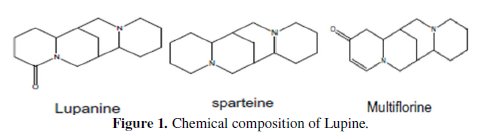
    <p>Seeds of lupine contain up to 50% proteins, 20% lipids and 5% quinolizidine 
alkaloids. Analysis of the alkaloid contents by gas chromatography clarified that 
lupanine was the most abundant quinolizidine alkaloids; multiflorine, albine and 
sparteine were also present [12, 13]. Effect of lupine on the corrosion of steel in 
0.5 M Na<sub>2</sub>SO<sub>4</sub> solution free from and containing 0.01 or 0.1 M NaCl was 
examined by potentiodynamic and electrochemical impedance spectroscopy 
techniques. Potentiodynamic polarization curves measurements indicated that 
lupine extract behaves as an anodic type inhibitor [14]. Effect of lupine on the 
corrosion of zinc in neutral, alkaline and acidic media was examined by 
potentiodynamic and electrochemical impedance spectroscopy techniques. 
Nyquist impedance plots showed that the charge transfer resistance and 
consequently the inhibition efficiency increase with increasing concentration of 
lupine [15-17].</p>

    <p>Many chemical compositions are always used for chemical and electrochemical 
etching and pickling of aluminum. Higher caustic concentrations and 
temperatures accelerate the pickling process of aluminum but as a result, the 
pickled surface becomes rougher. Strongly corroding cleaners, usually on the 
basis of caustic soda, are applied if there is a thick oxide skin, or if much 
degreasing has to be done. Hardly corroding or non-corroding cleaners based on 
silicates and carbonates are used if there are only small amounts of grease or oil 
on the aluminum surface [18]. The aim of this work is to study: (1) the inhibition 
characteristics of Lupine extract for the acidic corrosion of aluminum and (2) the 
effect of alkaline etching on the inhibition efficiency of the extract.</p>


    <p>&nbsp;</p>
    <p><b>Experimental</b></p>

    ]]></body>
<body><![CDATA[<p><b><i>Electrochemical tests</i></b></p>

    <p>Electrochemical impedance and polarization curves measurements were achieved 
using ACM 604 Instrument. The frequency range for EIS measurements was 
0.01 &le; f &le;  3 &times; 10<sup>4</sup> Hz with applied potential signal amplitude of 10 mV around 
the rest potential. Polarization curves measurements were carried out at scan rate 
20 mV/min. The data were obtained in a three electrode mode; graphite rod and 
saturated calomel electrode were used as counter and reference electrodes. The 
specimens used for constructing the working electrode were aluminum rods that 
had the following chemical composition (wt. %): Al 99.687; Mn 0.001; Zn 
0.001; Ni 0.001; Ti 0.003; Fe 0.171; Si 0.135; Cu 0.001. The aluminum samples 
were fixed in poly tetrafluoro ethylene (PTFE) rods by an epoxy resin in such a 
way that only one surface was left uncovered. The exposed area (0.786 cm<sup>2</sup>) was 
mechanically polished with a series of emery papers of variable grades, the 
samples were then washed thoroughly with distilled water followed by analytical 
grade ethanol and finally with distilled water, just before insertion in the cell. 
Measurements were done at 30 &deg;C.</p>


    <p><b><i>Optical microscopic examination</i></b></p>

    <p>Optical micrographs have been taken by using an Euromex optical microscope 
with color video camera that is connected to a personal computer.</p>


    <p><b><i>Alkaline etching solution</i></b></p>

    <p>Etching process is carried out after electrodes polishing. The alkaline solution 
used for etching is composed of 15 g.L<sup>-1</sup> Na<sub>2</sub>CO<sub>3</sub> + 15 
g.L<sup>-1</sup> Na<sub>3</sub>PO<sub>4</sub> [19]. It was 
conducted at 80-85 &deg;C for 30 seconds. This was followed by rinsing with distilled 
water and drying prior to immersion in the polarization cell.</p>


    <p><b><i>Plants</i></b></p>

    <p>Lupine was used in this study as a natural inhibitor. Lupine is used for treatment 
of anorexia and diabetes. Its chemical composition is represented in <a href="#f1">Fig. 1</a>.</p>


    <p>&nbsp;</p>
<a name="f1">
<img src="/img/revistas/pea/v33n1/33n1a02f1.jpg">
    
<p>&nbsp;</p>


    ]]></body>
<body><![CDATA[<p><b><i>Preparation of lupine extract</i></b></p>

    <p>Stock solution of Lupine was extracted by refluxing 5 g of the dry material in 
250 mL distilled water for one hour. The refluxed solution was filtrated to 
remove any contamination. The concentration of the stock solution was 
calculated in g.L<sup>-1</sup> by heating till dryness 5 mL of the stock solution and reweight 
after drying. The concentration of the stock solution was expressed in terms of 
ppm.</p>


    <p><b><i>Preparation of the test solutions</i></b></p>

    <p>Double distilled water and analytical reagent-grade HCl (37 %) were used for 
preparing solutions. Prior each experiment, 1.0 M HCl is added to an appropriate 
volume of the stock solution of the lupine extract and double distilled water to 
obtain solution of 0.1 M HCl and the required concentration of the extract.</p>


    <p>&nbsp;</p>
    <p><b>Results and discussion</b></p>

    <p>The effect of lupine as corrosion inhibitor for etched and non-etched aluminum 
in 0.1 M solution of HCl has been studied using potentiodynamic polarization, 
electrochemical impedance spectroscopy and optical microscopy techniques.</p>


    <p><b><i>Potentiodynamic polarization results</i></b></p>

    <p><a href="#f2">Fig. 2</a> shows the influence of lupine on the polarization curves of non-etched 
aluminum in 0.1 M HCl solution; it was found to be similar to that obtained for 
non-etched aluminum.</p>


    <p>&nbsp;</p>
<a name="f2">
<img src="/img/revistas/pea/v33n1/33n1a02f2.jpg">
    
]]></body>
<body><![CDATA[<p>&nbsp;</p>


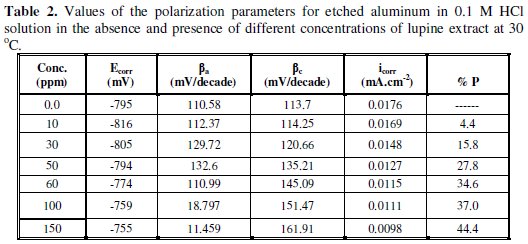
    <p>The values of the corrosion current density (i<sub>corr</sub>) for the etched and non-etched 
aluminum without and with the inhibitor were determined by the extrapolation of 
cathodic and anodic Tafel lines to the corrosion potential (E<sub>corr</sub>). It is clear from 
the potentiodynamic polarization curves that the anodic curves showed activation 
behavior followed by break down potential E<sub>b</sub> in absence and presence of the 
plant extract, indicating pitting corrosion as a result of the aggressive attack of 
Cl<sup>-</sup> anions. Halides, particularly chloride ions, are destructive to passivity and 
usually should be avoided whenever it is essential that passivity be retained. 
Passivity is broken down by chloride ions at point or local areas. The local areas 
of active metal become anodes in cells, and the cathodes of which are large areas 
of passive metal. Passivity breakdown and initiation of pitting are evident by a 
sudden increase in the current density at Eb [20]. The anodic polarization curves 
show that the presence of the extract leads to a shift in the value of Eb to more 
noble values. This means that the extract retards the pitting corrosion of 
aluminum. The potentiodynamic polarization parameters and the inhibition 
efficiency % P, which is calculated by the following equation:</p>


    <p>&nbsp;</p>
<a name="e1">
<img src="/img/revistas/pea/v33n1/33n1a02e1.jpg">
    
<p>&nbsp;</p>


    <p>are presented in <a href="#t1">Tables 1</a> and <a href="#t2">2</a>.</p>


    <p>&nbsp;</p>
<a name="t1">
<img src="/img/revistas/pea/v33n1/33n1a02t1.jpg">
    
<p>&nbsp;</p>
<a name="t2">
<img src="/img/revistas/pea/v33n1/33n1a02t2.jpg">
    
<p>&nbsp;</p>


    <p>It can be seen that the presence of lupine shifts the corrosion potential (E<sub>corr</sub>) 
towards less negative values, indicating that this extract acts predominantly as an 
anodic inhibitor. Consequently, the adsorption of the extract ingredients is more 
likely acting at the anodic sites. The data in <a href="#t1">tables 1</a> and <a href="#t2">2</a> exhibited that the 
corrosion current density (i<sub>corr</sub>) decreases, and the inhibition efficiency increases 
as the concentration of plant extract is increased. The slope of the cathodic Tafel 
line (&beta;<sub>c</sub>) remains almost unchanged upon addition of the extract, indicating that 
the cathodic reaction which is the reduction of hydrogen ions not affected by the 
presence of extract and this step is controlled by charge transfer. On the other 
hand, the slope of the anodic Tafel line (&beta;<sub>a</sub>) in presence of lupine, for both etched 
and non-etched aluminum, decreases by increasing the extract concentration and 
a large decrease is shown in presence of high concentrations of the extract. This 
behavior indicates that the oxidation of aluminum in absence and presence of 
small concentrations of the extract is charge transfer controlled and the Tafel 
equation is applicable, while, in presence of high extract concentrations, 
oxidation of aluminum is controlled by the pitting corrosion and Tafel equation is 
not applicable.</p>


    <p><b><i>Electrochemical impedance spectroscopy results</i></b></p>

    ]]></body>
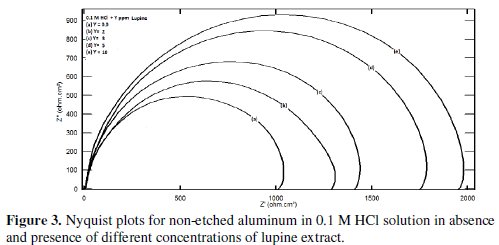
<body><![CDATA[<p><a href="#f3">Fig. 3</a> represents Nyquist plots for non-etched aluminum in 0.1 M HCl solution 
in the absence and presence of different concentrations of lupine extract.</p>


    <p>&nbsp;</p>
<a name="f3">
<img src="/img/revistas/pea/v33n1/33n1a02f3.jpg">
    
<p>&nbsp;</p>


    <p>The influence of lupine on the Nyquist plots of etched aluminum in 0.1 M HCl 
solution was found to be similar to that obtained for non-etched aluminum. The 
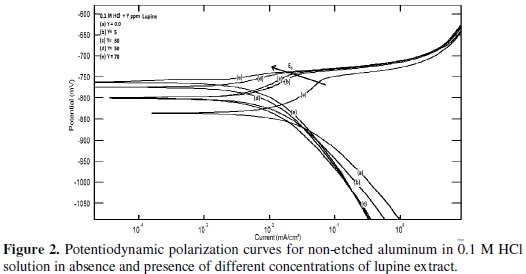
figure manifested only one capacitive semicircle. The diameter of the semicircle 
increases with increasing the extract concentration. The impedance spectra for 
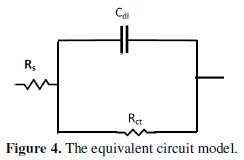
different Nyquist plots were analyzed by fitting the experimental data using 
Zsimpwin program to a simple equivalent circuit model represented in <a href="#f4">Fig. 4</a>.</p>


    <p>&nbsp;</p>
<a name="f4">
<img src="/img/revistas/pea/v33n1/33n1a02f4.jpg">
    
<p>&nbsp;</p>


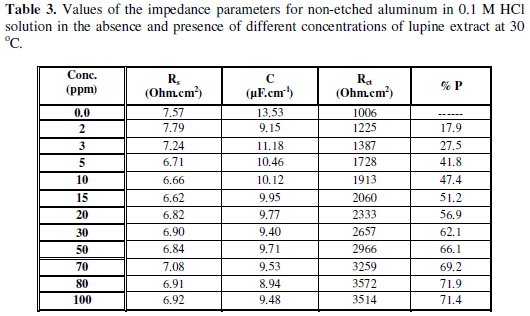
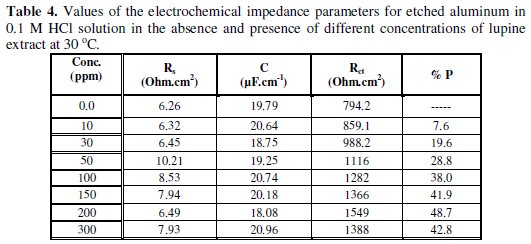
    <p>The equivalent circuit model includes the solution resistance Rs and the double 
layer capacitance Cdl which is placed in parallel to the charge transfer resistance 
element Rct. The values of the electrochemical parameters and the inhibition 
efficiency (% P) obtained from EIS for etched and non-etched aluminum in 0.1 
M HCl solutions containing different lupine extract concentrations are given in 
<a href="#t3">Tables 3</a> and <a href="#t4">4</a>.</p>


    <p>&nbsp;</p>
<a name="t3">
<img src="/img/revistas/pea/v33n1/33n1a02t3.jpg">
    
<p>&nbsp;</p>
<a name="t4">
<img src="/img/revistas/pea/v33n1/33n1a02t4.jpg">
    
<p>&nbsp;</p>


    ]]></body>
<body><![CDATA[<p>Inhibition efficiency was calculated from impedance 
measurements using the relation:</p>


    <p>&nbsp;</p>
<a name="e2">
<img src="/img/revistas/pea/v33n1/33n1a02e2.jpg">
    
<p>&nbsp;</p>


    <p>where R<sub>ct0</sub> and R<sub>ct</sub> are the charge transfer resistances in the absence and presence 
of different extracts, respectively.</p>

    <p>The results show that R<sub>ct</sub> values for etched and non-etched aluminum increase 
with increasing the lupine extract concentration. The increase of R<sub>ct</sub> values 
suggests the formation of a protective layer on the electrode surface. This layer 
acts as a barrier for mass and charge transfer [21-23]. The capacitance of the 
double layer Cdl decreases with increasing the concentration of the extract in the 
case of non-etched aluminum and not affected by the presence or the 
concentration of the extract in the case of etched aluminum; this can be explained 
due to the weak adsorption of extract ingredients in the case of etched aluminum.</p>


    <p><b><i>Adsorption mechanism</i></b></p>

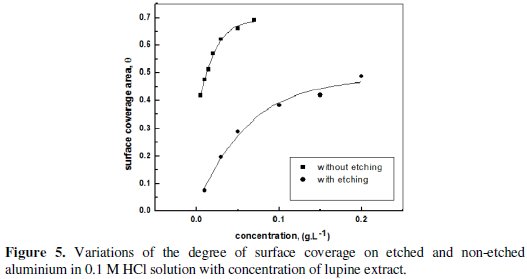
    <p>The nature of the adsorption process of the extract on the etched and non-etched 
aluminum metal surface was essential to our knowledge of their inhibition action 
to corrosion. The variation of degree of surface coverage &theta; 
with concentration of lupine plant extract is shown in <a href="#f5">Fig. 5</a>.</p>


    <p>&nbsp;</p>
<a name="f5">
<img src="/img/revistas/pea/v33n1/33n1a02f5.jpg">
    
<p>&nbsp;</p>


    <p>This plot is characterized by an initial 
steeply rising part indicating the formation of a mono-layer adsorbate film on the 
aluminum surface. At high concentrations, the inhibitory effect was constant 
suggesting complete saturation of the surface by the inhibitor molecules. 
The action of adsorptive inhibitors was studied by Elawady et al. [24] under 
pseudo zero order conditions and the mathematical expression was given as:</p>


    ]]></body>
<body><![CDATA[<p>&nbsp;</p>
<a name="e3">
<img src="/img/revistas/pea/v33n1/33n1a02e3.jpg">
    
<p>&nbsp;</p>


    <p>where &theta; is the degree of surface coverage by the inhibitor, (1-&theta;) is the fraction of 
the surface available for medium attack, y is the number of inhibitor molecules 
occupying one active site. The value, 1/y represents the number of active sites of 
the surface occupied by one inhibitor molecule. Value of 1/y less than unity 
implies the formation of multilayer of the inhibitor on the surface of the metal. 
However, values of 1/y greater than unity indicate that a given inhibitor molecule 
will occupy more than one active site [25]. The binding constant K 
corresponding to that obtained from the adsorption isotherm curve fitting is given 
by:</p>


    <p>&nbsp;</p>
<a name="e4">
<img src="/img/revistas/pea/v33n1/33n1a02e4.jpg">
    
<p>&nbsp;</p>


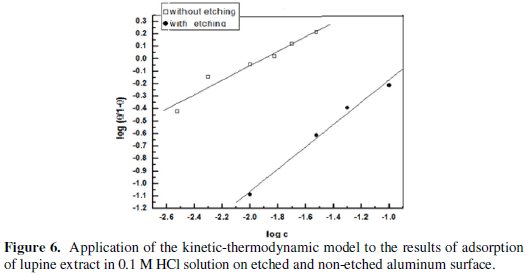
    <p><a href="#f6">Fig. 6</a> shows the application of the kinetic-thermodynamic model to the results of 
adsorption of the extract on etched and non-etched aluminum surface.</p>


    <p>&nbsp;</p>
<a name="f6">
<img src="/img/revistas/pea/v33n1/33n1a02f6.jpg">
    
<p>&nbsp;</p>


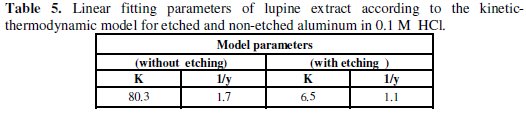
    <p>The kinetic-thermodynamic model was found to fit the data of lupine plant 
extract for both etched and non-etched aluminum in 0.1 M HCl and the linear 
fitting parameters are given in <a href="#t5">Table 5</a>.</p>


    <p>&nbsp;</p>
<a name="t5">
<img src="/img/revistas/pea/v33n1/33n1a02t5.jpg">
    
]]></body>
<body><![CDATA[<p>&nbsp;</p>


    <p>The number of active sites occupied by a 
single inhibitor molecule, 1/y, was nearly equal to one for etched aluminum, 
indicating that each inhibitor molecule can occupy only one active site on the 
aluminum surface, while 1/y were more than one for non-etched aluminum, 
indicating that each inhibitor molecule can occupy more than one active site on 
the aluminum surface. The numerical values of K indicate that there is a strong 
adsorption of the lupine active ingredients on to the non-etched aluminum 
surface compared to the etched aluminum.</p>


    <p><b><i>Optical microscopic results</i></b></p>

    <p>Optical microscopy studies of the etched and non-etched aluminum surface in 
absence and presence of Lupine extract in 0.1 M HCl are seen in <a href="#f7">Fig. 7</a>.</p>


    <p>&nbsp;</p>
<a name="f7">
<img src="/img/revistas/pea/v33n1/33n1a02f7.jpg">
    
<p>&nbsp;</p>


    <p>A(a, b, c) and B(a, b, c), where A for the non-etched aluminum surface and B for the 
etched one, "a" before dipping in acid, "b" after dipping in 0.1 M HCl for one 
hour and "c" after dipping in 0.1 M HCl containing 50 ppm of lupine extract for 
one hour. The magnification was 40 times. The surface photographs for non-
etched aluminum (A) have clearly visible polishing marks on the surface either 
before or after dipping in acid free or acid containing the extract. The 
photographs obtained after surface pre-treatment by alkaline etching (B) 
indicated that the etching process reveals the surface to be porous-like in 
structure and both the acid and extract has limited effect on the size of pores.</p>

    <p>These results indicate that the number of the active sites of the etched aluminum 
surface is less than those for non-etched one [26]. The photographs (C) indicate 
that the extract can adsorb on the metal surface in the case of non-etched 
aluminum. This argument explains the data obtained from the polarization and 
impedance measurements which indicate that the inhibition efficiency and the 
value of the binding constant K of the extract is higher in the case of non-etched 
aluminum.</p>


    <p>&nbsp;</p>
    <p><b>Conclusions</b></p>

    ]]></body>
<body><![CDATA[<p>Lupine extract can be used as corrosion inhibitor for aluminum in 0.1 M HCl. 
Polarization and impedance results showed that lupine is more effective as 
inhibitor for non-etched compared to etched aluminum.</p>

    <p>Fitting the data of adsorption of lupine at etched and non-etched aluminum 
surface in 0.1 M HCl to the kinetic-thermodynamic model shows stronger 
adsorption of the inhibitor at the non-etched aluminum surface compared to the 
etched aluminum.</p>

    <p>The optical photographs of aluminum obtained after alkaline etching indicated 
that the etching process reveals the surface of aluminum to be porous like in 
structure and decrease the number of active sites. This explains the lower 
efficiency of lupine as inhibitor to the acidic corrosion of etched aluminum.</p>


    <p>&nbsp;</p>
    <p><b>References</b></p>

    <!-- ref --><p>1. Pourbaix M. Atlas of electrochemical equilibria in aqueous solutions. New York: Pergamon Press; 1966.    &nbsp;&nbsp;&nbsp;&nbsp;&nbsp;&nbsp;&nbsp;&nbsp;[&#160;<a href="javascript:void(0);" onclick="javascript: window.open('/scielo.php?script=sci_nlinks&ref=000098&pid=S0872-1904201500010000200001&lng=','','width=640,height=500,resizable=yes,scrollbars=1,menubar=yes,');">Links</a>&#160;]<!-- end-ref --></p>

    <!-- ref --><p>2. Dessai M N, Dessai MB, Shah CB, et al. Corros Sci. 1986;26:827.    &nbsp;&nbsp;&nbsp;&nbsp;&nbsp;&nbsp;&nbsp;&nbsp;[&#160;<a href="javascript:void(0);" onclick="javascript: window.open('/scielo.php?script=sci_nlinks&ref=000100&pid=S0872-1904201500010000200002&lng=','','width=640,height=500,resizable=yes,scrollbars=1,menubar=yes,');">Links</a>&#160;]<!-- end-ref --></p>

    <!-- ref --><p>3. Abd El-Maksoud S A. Corros Sci. 2002;44:803.    &nbsp;&nbsp;&nbsp;&nbsp;&nbsp;&nbsp;&nbsp;&nbsp;[&#160;<a href="javascript:void(0);" onclick="javascript: window.open('/scielo.php?script=sci_nlinks&ref=000102&pid=S0872-1904201500010000200003&lng=','','width=640,height=500,resizable=yes,scrollbars=1,menubar=yes,');">Links</a>&#160;]<!-- end-ref --></p>

    <!-- ref --><p>4. Ajmal M, Mideen A S, Quraishi M A. Corros Sci. 1994;36:79.    &nbsp;&nbsp;&nbsp;&nbsp;&nbsp;&nbsp;&nbsp;&nbsp;[&#160;<a href="javascript:void(0);" onclick="javascript: window.open('/scielo.php?script=sci_nlinks&ref=000104&pid=S0872-1904201500010000200004&lng=','','width=640,height=500,resizable=yes,scrollbars=1,menubar=yes,');">Links</a>&#160;]<!-- end-ref --></p>

    <!-- ref --><p>5. Raja P B, Sethuraman M G. Mater Lett. 2008;62:113.    &nbsp;&nbsp;&nbsp;&nbsp;&nbsp;&nbsp;&nbsp;&nbsp;[&#160;<a href="javascript:void(0);" onclick="javascript: window.open('/scielo.php?script=sci_nlinks&ref=000106&pid=S0872-1904201500010000200005&lng=','','width=640,height=500,resizable=yes,scrollbars=1,menubar=yes,');">Links</a>&#160;]<!-- end-ref --></p>

    <!-- ref --><p>6. El Hosary A A, Saleh R M, Shams El Din A M. Corros Sci. 1972;12:897.    &nbsp;&nbsp;&nbsp;&nbsp;&nbsp;&nbsp;&nbsp;&nbsp;[&#160;<a href="javascript:void(0);" onclick="javascript: window.open('/scielo.php?script=sci_nlinks&ref=000108&pid=S0872-1904201500010000200006&lng=','','width=640,height=500,resizable=yes,scrollbars=1,menubar=yes,');">Links</a>&#160;]<!-- end-ref --></p>

    <!-- ref --><p>7. Avwiri G O, Lgho F O. Mater Lett. 2003;57:3705.    &nbsp;&nbsp;&nbsp;&nbsp;&nbsp;&nbsp;&nbsp;&nbsp;[&#160;<a href="javascript:void(0);" onclick="javascript: window.open('/scielo.php?script=sci_nlinks&ref=000110&pid=S0872-1904201500010000200007&lng=','','width=640,height=500,resizable=yes,scrollbars=1,menubar=yes,');">Links</a>&#160;]<!-- end-ref --></p>

    <!-- ref --><p>8. Oguzie E E, Onuchukwu A I, Okafor P C, et al. Pig Resin Techn. 2006;35:63.    &nbsp;&nbsp;&nbsp;&nbsp;&nbsp;&nbsp;&nbsp;&nbsp;[&#160;<a href="javascript:void(0);" onclick="javascript: window.open('/scielo.php?script=sci_nlinks&ref=000112&pid=S0872-1904201500010000200008&lng=','','width=640,height=500,resizable=yes,scrollbars=1,menubar=yes,');">Links</a>&#160;]<!-- end-ref --></p>

    <!-- ref --><p>9. El-Etre A Y. Corros Sci. 2003;45:2485.    &nbsp;&nbsp;&nbsp;&nbsp;&nbsp;&nbsp;&nbsp;&nbsp;[&#160;<a href="javascript:void(0);" onclick="javascript: window.open('/scielo.php?script=sci_nlinks&ref=000114&pid=S0872-1904201500010000200009&lng=','','width=640,height=500,resizable=yes,scrollbars=1,menubar=yes,');">Links</a>&#160;]<!-- end-ref --></p>

    <!-- ref --><p>10. Oguzie E E. Corros Sci. 2007;49:1527.    &nbsp;&nbsp;&nbsp;&nbsp;&nbsp;&nbsp;&nbsp;&nbsp;[&#160;<a href="javascript:void(0);" onclick="javascript: window.open('/scielo.php?script=sci_nlinks&ref=000116&pid=S0872-1904201500010000200010&lng=','','width=640,height=500,resizable=yes,scrollbars=1,menubar=yes,');">Links</a>&#160;]<!-- end-ref --></p>

    <!-- ref --><p>11. Umoren S A, Obot I B, Ebenso E E, et al. Desalination. 2009;247:561.    &nbsp;&nbsp;&nbsp;&nbsp;&nbsp;&nbsp;&nbsp;&nbsp;[&#160;<a href="javascript:void(0);" onclick="javascript: window.open('/scielo.php?script=sci_nlinks&ref=000118&pid=S0872-1904201500010000200011&lng=','','width=640,height=500,resizable=yes,scrollbars=1,menubar=yes,');">Links</a>&#160;]<!-- end-ref --></p>

    <!-- ref --><p>12. Vega R, Gutierrez M P, Sanz C, et al. Ind Crop Prod. 1996;5:141.    &nbsp;&nbsp;&nbsp;&nbsp;&nbsp;&nbsp;&nbsp;&nbsp;[&#160;<a href="javascript:void(0);" onclick="javascript: window.open('/scielo.php?script=sci_nlinks&ref=000120&pid=S0872-1904201500010000200012&lng=','','width=640,height=500,resizable=yes,scrollbars=1,menubar=yes,');">Links</a>&#160;]<!-- end-ref --></p>

    <!-- ref --><p>13. Tsiodras S, Shin R K, Christian M, et al. Ann Emerg Med. 1999;33:715.    &nbsp;&nbsp;&nbsp;&nbsp;&nbsp;&nbsp;&nbsp;&nbsp;[&#160;<a href="javascript:void(0);" onclick="javascript: window.open('/scielo.php?script=sci_nlinks&ref=000122&pid=S0872-1904201500010000200013&lng=','','width=640,height=500,resizable=yes,scrollbars=1,menubar=yes,');">Links</a>&#160;]<!-- end-ref --></p>

    <!-- ref --><p>14. Abdel-Gaber A M, Abdel-Nabey B A, Saadawy M. Mater Corros. 2012;63:161.    &nbsp;&nbsp;&nbsp;&nbsp;&nbsp;&nbsp;&nbsp;&nbsp;[&#160;<a href="javascript:void(0);" onclick="javascript: window.open('/scielo.php?script=sci_nlinks&ref=000124&pid=S0872-1904201500010000200014&lng=','','width=640,height=500,resizable=yes,scrollbars=1,menubar=yes,');">Links</a>&#160;]<!-- end-ref --></p>

    <!-- ref --><p>15. Abdel-Naby B A, Abdullatef O A, Abdel-Gaber A M, et al. Int J Electrochem Sci. 2012;7:5864.    &nbsp;&nbsp;&nbsp;&nbsp;&nbsp;&nbsp;&nbsp;&nbsp;[&#160;<a href="javascript:void(0);" onclick="javascript: window.open('/scielo.php?script=sci_nlinks&ref=000126&pid=S0872-1904201500010000200015&lng=','','width=640,height=500,resizable=yes,scrollbars=1,menubar=yes,');">Links</a>&#160;]<!-- end-ref --></p>

    <!-- ref --><p>16. Abdel-Naby B A, Abdullatef O A, Abdel-Gaber A M, et al. Int J Electrochem Sci. 2014;9:1163.    &nbsp;&nbsp;&nbsp;&nbsp;&nbsp;&nbsp;&nbsp;&nbsp;[&#160;<a href="javascript:void(0);" onclick="javascript: window.open('/scielo.php?script=sci_nlinks&ref=000128&pid=S0872-1904201500010000200016&lng=','','width=640,height=500,resizable=yes,scrollbars=1,menubar=yes,');">Links</a>&#160;]<!-- end-ref --></p>

    <!-- ref --><p>17. Abdullatef O A, Shaker M A, Esmail G. Bull Fac Sci Alex Univ. 2013;48. Accepted.    &nbsp;&nbsp;&nbsp;&nbsp;&nbsp;&nbsp;&nbsp;&nbsp;[&#160;<a href="javascript:void(0);" onclick="javascript: window.open('/scielo.php?script=sci_nlinks&ref=000130&pid=S0872-1904201500010000200017&lng=','','width=640,height=500,resizable=yes,scrollbars=1,menubar=yes,');">Links</a>&#160;]<!-- end-ref --></p>

    <!-- ref --><p>18. Hegazy M A, Badawi A M, Abd El Rehim S S, et al. Corros Sci.2013;69:110.    &nbsp;&nbsp;&nbsp;&nbsp;&nbsp;&nbsp;&nbsp;&nbsp;[&#160;<a href="javascript:void(0);" onclick="javascript: window.open('/scielo.php?script=sci_nlinks&ref=000132&pid=S0872-1904201500010000200018&lng=','','width=640,height=500,resizable=yes,scrollbars=1,menubar=yes,');">Links</a>&#160;]<!-- end-ref --></p>

    <!-- ref --><p>19. El-Hosary A A, Saleh M R, Shams El-Din A M. Corros Sci. 1972;12:897.    &nbsp;&nbsp;&nbsp;&nbsp;&nbsp;&nbsp;&nbsp;&nbsp;[&#160;<a href="javascript:void(0);" onclick="javascript: window.open('/scielo.php?script=sci_nlinks&ref=000134&pid=S0872-1904201500010000200019&lng=','','width=640,height=500,resizable=yes,scrollbars=1,menubar=yes,');">Links</a>&#160;]<!-- end-ref --></p>

    <!-- ref --><p>20. Amin M A, Abd El Rehim S S, El-Lithya A S. Corros Sci. 2010;52:3099.    &nbsp;&nbsp;&nbsp;&nbsp;&nbsp;&nbsp;&nbsp;&nbsp;[&#160;<a href="javascript:void(0);" onclick="javascript: window.open('/scielo.php?script=sci_nlinks&ref=000136&pid=S0872-1904201500010000200020&lng=','','width=640,height=500,resizable=yes,scrollbars=1,menubar=yes,');">Links</a>&#160;]<!-- end-ref --></p>

    <!-- ref --><p>21. Safak S, Duran B, Yurt A, et al. Corros Sci. 2012;54:251.    &nbsp;&nbsp;&nbsp;&nbsp;&nbsp;&nbsp;&nbsp;&nbsp;[&#160;<a href="javascript:void(0);" onclick="javascript: window.open('/scielo.php?script=sci_nlinks&ref=000138&pid=S0872-1904201500010000200021&lng=','','width=640,height=500,resizable=yes,scrollbars=1,menubar=yes,');">Links</a>&#160;]<!-- end-ref --></p>

    <!-- ref --><p>22. Khaled K F. Mater Chem Phys. 2008;112:290.    &nbsp;&nbsp;&nbsp;&nbsp;&nbsp;&nbsp;&nbsp;&nbsp;[&#160;<a href="javascript:void(0);" onclick="javascript: window.open('/scielo.php?script=sci_nlinks&ref=000140&pid=S0872-1904201500010000200022&lng=','','width=640,height=500,resizable=yes,scrollbars=1,menubar=yes,');">Links</a>&#160;]<!-- end-ref --></p>

    <!-- ref --><p>23. Behpour M, Ghoreishi S M, Mohammadi N, et al. Corros Sci. 2010;52:4046.    &nbsp;&nbsp;&nbsp;&nbsp;&nbsp;&nbsp;&nbsp;&nbsp;[&#160;<a href="javascript:void(0);" onclick="javascript: window.open('/scielo.php?script=sci_nlinks&ref=000142&pid=S0872-1904201500010000200023&lng=','','width=640,height=500,resizable=yes,scrollbars=1,menubar=yes,');">Links</a>&#160;]<!-- end-ref --></p>

    <!-- ref --><p>24. El-Awady A A, Aziz S G. Electochem Soc. 1992;139:2149.    &nbsp;&nbsp;&nbsp;&nbsp;&nbsp;&nbsp;&nbsp;&nbsp;[&#160;<a href="javascript:void(0);" onclick="javascript: window.open('/scielo.php?script=sci_nlinks&ref=000144&pid=S0872-1904201500010000200024&lng=','','width=640,height=500,resizable=yes,scrollbars=1,menubar=yes,');">Links</a>&#160;]<!-- end-ref --></p>

    <!-- ref --><p>25. El-Awady A, Abd El-Nabey B A, Aziz G, et al. Int J Chem. 1990:1169.    &nbsp;&nbsp;&nbsp;&nbsp;&nbsp;&nbsp;&nbsp;&nbsp;[&#160;<a href="javascript:void(0);" onclick="javascript: window.open('/scielo.php?script=sci_nlinks&ref=000146&pid=S0872-1904201500010000200025&lng=','','width=640,height=500,resizable=yes,scrollbars=1,menubar=yes,');">Links</a>&#160;]<!-- end-ref --></p>

    <!-- ref --><p>26. Emregul K C, Aksut A A. Corros Sci. 2000;42:2051.    &nbsp;&nbsp;&nbsp;&nbsp;&nbsp;&nbsp;&nbsp;&nbsp;[&#160;<a href="javascript:void(0);" onclick="javascript: window.open('/scielo.php?script=sci_nlinks&ref=000148&pid=S0872-1904201500010000200026&lng=','','width=640,height=500,resizable=yes,scrollbars=1,menubar=yes,');">Links</a>&#160;]<!-- end-ref --></p>

    <p>&nbsp;</p>
    <p><a name=0></a><sup><a href="#top">*</a></sup>Corresponding author. E-mail address: <a href="mailto:ossama_abdullatef@yahoo.com">ossama_abdullatef@yahoo.com</a></p>

    <p>Received 23 September 2014; accepted 15 February 2015</p>

    ]]></body>
<body><![CDATA[<p><a href="http://www.peacta.org" target="_blank">www.peacta.org</a> </p>


     ]]></body><back>
<ref-list>
<ref id="B1">
<label>1</label><nlm-citation citation-type="book">
<person-group person-group-type="author">
<name>
<surname><![CDATA[Pourbaix]]></surname>
<given-names><![CDATA[M]]></given-names>
</name>
</person-group>
<source><![CDATA[Atlas of electrochemical equilibria in aqueous solutions]]></source>
<year>1966</year>
<publisher-loc><![CDATA[New York ]]></publisher-loc>
<publisher-name><![CDATA[Pergamon Press]]></publisher-name>
</nlm-citation>
</ref>
<ref id="B2">
<label>2</label><nlm-citation citation-type="journal">
<person-group person-group-type="author">
<name>
<surname><![CDATA[Dessai]]></surname>
<given-names><![CDATA[M N]]></given-names>
</name>
<name>
<surname><![CDATA[Dessai]]></surname>
<given-names><![CDATA[M B]]></given-names>
</name>
<name>
<surname><![CDATA[Shah]]></surname>
<given-names><![CDATA[C B]]></given-names>
</name>
</person-group>
<source><![CDATA[Corros Sci]]></source>
<year>1986</year>
<volume>26</volume>
<page-range>827</page-range></nlm-citation>
</ref>
<ref id="B3">
<label>3</label><nlm-citation citation-type="journal">
<person-group person-group-type="author">
<name>
<surname><![CDATA[Abd El-Maksoud]]></surname>
<given-names><![CDATA[S A]]></given-names>
</name>
</person-group>
<source><![CDATA[Corros Sci]]></source>
<year>2002</year>
<volume>44</volume>
<page-range>803</page-range></nlm-citation>
</ref>
<ref id="B4">
<label>4</label><nlm-citation citation-type="journal">
<person-group person-group-type="author">
<name>
<surname><![CDATA[Ajmal]]></surname>
<given-names><![CDATA[M]]></given-names>
</name>
<name>
<surname><![CDATA[Mideen]]></surname>
<given-names><![CDATA[A S]]></given-names>
</name>
<name>
<surname><![CDATA[Quraishi]]></surname>
<given-names><![CDATA[M A]]></given-names>
</name>
</person-group>
<source><![CDATA[Corros Sci]]></source>
<year>1994</year>
<volume>36</volume>
<page-range>79</page-range></nlm-citation>
</ref>
<ref id="B5">
<label>5</label><nlm-citation citation-type="journal">
<person-group person-group-type="author">
<name>
<surname><![CDATA[Raja]]></surname>
<given-names><![CDATA[P B]]></given-names>
</name>
<name>
<surname><![CDATA[Sethuraman]]></surname>
<given-names><![CDATA[M G]]></given-names>
</name>
</person-group>
<source><![CDATA[Mater Lett]]></source>
<year>2008</year>
<volume>62</volume>
<page-range>113</page-range></nlm-citation>
</ref>
<ref id="B6">
<label>6</label><nlm-citation citation-type="journal">
<person-group person-group-type="author">
<name>
<surname><![CDATA[El Hosary]]></surname>
<given-names><![CDATA[A A]]></given-names>
</name>
<name>
<surname><![CDATA[Saleh]]></surname>
<given-names><![CDATA[R M]]></given-names>
</name>
<name>
<surname><![CDATA[Shams El Din]]></surname>
<given-names><![CDATA[A M]]></given-names>
</name>
</person-group>
<source><![CDATA[Corros Sci]]></source>
<year>1972</year>
<volume>12</volume>
<page-range>897</page-range></nlm-citation>
</ref>
<ref id="B7">
<label>7</label><nlm-citation citation-type="journal">
<person-group person-group-type="author">
<name>
<surname><![CDATA[Avwiri]]></surname>
<given-names><![CDATA[G O]]></given-names>
</name>
<name>
<surname><![CDATA[Lgho]]></surname>
<given-names><![CDATA[F O]]></given-names>
</name>
</person-group>
<source><![CDATA[Mater Lett]]></source>
<year>2003</year>
<volume>57</volume>
<page-range>3705</page-range></nlm-citation>
</ref>
<ref id="B8">
<label>8</label><nlm-citation citation-type="journal">
<person-group person-group-type="author">
<name>
<surname><![CDATA[Oguzie]]></surname>
<given-names><![CDATA[E E]]></given-names>
</name>
<name>
<surname><![CDATA[Onuchukwu]]></surname>
<given-names><![CDATA[A I]]></given-names>
</name>
<name>
<surname><![CDATA[Okafor]]></surname>
<given-names><![CDATA[P C]]></given-names>
</name>
</person-group>
<source><![CDATA[Pig Resin Techn]]></source>
<year>2006</year>
<volume>35</volume>
<page-range>63</page-range></nlm-citation>
</ref>
<ref id="B9">
<label>9</label><nlm-citation citation-type="journal">
<person-group person-group-type="author">
<name>
<surname><![CDATA[El-Etre]]></surname>
<given-names><![CDATA[A Y]]></given-names>
</name>
</person-group>
<source><![CDATA[Corros Sci]]></source>
<year>2003</year>
<volume>45</volume>
<page-range>2485</page-range></nlm-citation>
</ref>
<ref id="B10">
<label>10</label><nlm-citation citation-type="journal">
<person-group person-group-type="author">
<name>
<surname><![CDATA[Oguzie]]></surname>
<given-names><![CDATA[E E]]></given-names>
</name>
</person-group>
<source><![CDATA[Corros Sci]]></source>
<year>2007</year>
<volume>49</volume>
<page-range>1527</page-range></nlm-citation>
</ref>
<ref id="B11">
<label>11</label><nlm-citation citation-type="journal">
<person-group person-group-type="author">
<name>
<surname><![CDATA[Umoren]]></surname>
<given-names><![CDATA[S A]]></given-names>
</name>
<name>
<surname><![CDATA[Obot]]></surname>
<given-names><![CDATA[I B]]></given-names>
</name>
<name>
<surname><![CDATA[Ebenso]]></surname>
<given-names><![CDATA[E E]]></given-names>
</name>
</person-group>
<source><![CDATA[Desalination]]></source>
<year>2009</year>
<volume>247</volume>
<page-range>561</page-range></nlm-citation>
</ref>
<ref id="B12">
<label>12</label><nlm-citation citation-type="journal">
<person-group person-group-type="author">
<name>
<surname><![CDATA[Vega]]></surname>
<given-names><![CDATA[R]]></given-names>
</name>
<name>
<surname><![CDATA[Gutierrez]]></surname>
<given-names><![CDATA[M P]]></given-names>
</name>
<name>
<surname><![CDATA[Sanz]]></surname>
<given-names><![CDATA[C]]></given-names>
</name>
</person-group>
<source><![CDATA[Ind Crop Prod]]></source>
<year>1996</year>
<volume>5</volume>
<page-range>141</page-range></nlm-citation>
</ref>
<ref id="B13">
<label>13</label><nlm-citation citation-type="journal">
<person-group person-group-type="author">
<name>
<surname><![CDATA[Tsiodras]]></surname>
<given-names><![CDATA[S]]></given-names>
</name>
<name>
<surname><![CDATA[Shin]]></surname>
<given-names><![CDATA[R K]]></given-names>
</name>
<name>
<surname><![CDATA[Christian]]></surname>
<given-names><![CDATA[M]]></given-names>
</name>
</person-group>
<source><![CDATA[Ann Emerg Med]]></source>
<year>1999</year>
<volume>33</volume>
<page-range>715</page-range></nlm-citation>
</ref>
<ref id="B14">
<label>14</label><nlm-citation citation-type="journal">
<person-group person-group-type="author">
<name>
<surname><![CDATA[Abdel-Gaber]]></surname>
<given-names><![CDATA[A M]]></given-names>
</name>
<name>
<surname><![CDATA[Abdel-Nabey]]></surname>
<given-names><![CDATA[B A]]></given-names>
</name>
<name>
<surname><![CDATA[Saadawy]]></surname>
<given-names><![CDATA[M]]></given-names>
</name>
</person-group>
<source><![CDATA[Mater Corros]]></source>
<year>2012</year>
<volume>63</volume>
<page-range>161</page-range></nlm-citation>
</ref>
<ref id="B15">
<label>15</label><nlm-citation citation-type="journal">
<person-group person-group-type="author">
<name>
<surname><![CDATA[Abdel-Naby]]></surname>
<given-names><![CDATA[B A]]></given-names>
</name>
<name>
<surname><![CDATA[Abdullatef]]></surname>
<given-names><![CDATA[O A]]></given-names>
</name>
<name>
<surname><![CDATA[Abdel-Gaber]]></surname>
<given-names><![CDATA[A M]]></given-names>
</name>
</person-group>
<source><![CDATA[Int J Electrochem Sci]]></source>
<year>2012</year>
<volume>7</volume>
<page-range>5864</page-range></nlm-citation>
</ref>
<ref id="B16">
<label>16</label><nlm-citation citation-type="journal">
<person-group person-group-type="author">
<name>
<surname><![CDATA[Abdel-Naby]]></surname>
<given-names><![CDATA[B A]]></given-names>
</name>
<name>
<surname><![CDATA[Abdullatef]]></surname>
<given-names><![CDATA[O A]]></given-names>
</name>
<name>
<surname><![CDATA[Abdel-Gaber]]></surname>
<given-names><![CDATA[A M]]></given-names>
</name>
</person-group>
<source><![CDATA[Int J Electrochem Sci]]></source>
<year>2014</year>
<volume>9</volume>
<page-range>1163</page-range></nlm-citation>
</ref>
<ref id="B17">
<label>17</label><nlm-citation citation-type="journal">
<person-group person-group-type="author">
<name>
<surname><![CDATA[Abdullatef]]></surname>
<given-names><![CDATA[O A]]></given-names>
</name>
<name>
<surname><![CDATA[Shaker]]></surname>
<given-names><![CDATA[M A]]></given-names>
</name>
<name>
<surname><![CDATA[Esmail]]></surname>
<given-names><![CDATA[G]]></given-names>
</name>
</person-group>
<source><![CDATA[Bull Fac Sci Alex Univ]]></source>
<year>2013</year>
<volume>48</volume>
</nlm-citation>
</ref>
<ref id="B18">
<label>18</label><nlm-citation citation-type="journal">
<person-group person-group-type="author">
<name>
<surname><![CDATA[Hegazy]]></surname>
<given-names><![CDATA[M A]]></given-names>
</name>
<name>
<surname><![CDATA[Badawi]]></surname>
<given-names><![CDATA[A M]]></given-names>
</name>
<name>
<surname><![CDATA[Abd El Rehim]]></surname>
<given-names><![CDATA[S S]]></given-names>
</name>
</person-group>
<source><![CDATA[Corros Sci]]></source>
<year>2013</year>
<volume>69</volume>
<page-range>110</page-range></nlm-citation>
</ref>
<ref id="B19">
<label>19</label><nlm-citation citation-type="journal">
<person-group person-group-type="author">
<name>
<surname><![CDATA[El-Hosary]]></surname>
<given-names><![CDATA[A A]]></given-names>
</name>
<name>
<surname><![CDATA[Saleh]]></surname>
<given-names><![CDATA[M R]]></given-names>
</name>
<name>
<surname><![CDATA[Shams El-Din]]></surname>
<given-names><![CDATA[A M]]></given-names>
</name>
</person-group>
<source><![CDATA[Corros Sci]]></source>
<year>1972</year>
<volume>12</volume>
<page-range>897</page-range></nlm-citation>
</ref>
<ref id="B20">
<label>20</label><nlm-citation citation-type="journal">
<person-group person-group-type="author">
<name>
<surname><![CDATA[Amin]]></surname>
<given-names><![CDATA[M A]]></given-names>
</name>
<name>
<surname><![CDATA[Abd El Rehim]]></surname>
<given-names><![CDATA[S S]]></given-names>
</name>
<name>
<surname><![CDATA[El-Lithya]]></surname>
<given-names><![CDATA[A S]]></given-names>
</name>
</person-group>
<source><![CDATA[Corros Sci]]></source>
<year>2010</year>
<volume>52</volume>
<page-range>3099</page-range></nlm-citation>
</ref>
<ref id="B21">
<label>21</label><nlm-citation citation-type="journal">
<person-group person-group-type="author">
<name>
<surname><![CDATA[Safak]]></surname>
<given-names><![CDATA[S]]></given-names>
</name>
<name>
<surname><![CDATA[Duran]]></surname>
<given-names><![CDATA[B]]></given-names>
</name>
<name>
<surname><![CDATA[Yurt]]></surname>
<given-names><![CDATA[A]]></given-names>
</name>
</person-group>
<source><![CDATA[Corros Sci]]></source>
<year>2012</year>
<volume>54</volume>
<page-range>251</page-range></nlm-citation>
</ref>
<ref id="B22">
<label>22</label><nlm-citation citation-type="journal">
<person-group person-group-type="author">
<name>
<surname><![CDATA[Khaled]]></surname>
<given-names><![CDATA[K F]]></given-names>
</name>
</person-group>
<source><![CDATA[Mater Chem Phys]]></source>
<year>2008</year>
<volume>112</volume>
<page-range>290</page-range></nlm-citation>
</ref>
<ref id="B23">
<label>23</label><nlm-citation citation-type="journal">
<person-group person-group-type="author">
<name>
<surname><![CDATA[Behpour]]></surname>
<given-names><![CDATA[M]]></given-names>
</name>
<name>
<surname><![CDATA[Ghoreishi]]></surname>
<given-names><![CDATA[S M]]></given-names>
</name>
<name>
<surname><![CDATA[Mohammadi]]></surname>
<given-names><![CDATA[N]]></given-names>
</name>
</person-group>
<source><![CDATA[Corros Sci]]></source>
<year>2010</year>
<volume>52</volume>
<page-range>4046</page-range></nlm-citation>
</ref>
<ref id="B24">
<label>24</label><nlm-citation citation-type="journal">
<person-group person-group-type="author">
<name>
<surname><![CDATA[El-Awady]]></surname>
<given-names><![CDATA[A A]]></given-names>
</name>
<name>
<surname><![CDATA[Aziz]]></surname>
<given-names><![CDATA[S G]]></given-names>
</name>
</person-group>
<source><![CDATA[Electochem Soc]]></source>
<year>1992</year>
<volume>139</volume>
<page-range>2149</page-range></nlm-citation>
</ref>
<ref id="B25">
<label>25</label><nlm-citation citation-type="journal">
<person-group person-group-type="author">
<name>
<surname><![CDATA[El-Awady]]></surname>
<given-names><![CDATA[A]]></given-names>
</name>
<name>
<surname><![CDATA[Abd El-Nabey]]></surname>
<given-names><![CDATA[B A]]></given-names>
</name>
<name>
<surname><![CDATA[Aziz]]></surname>
<given-names><![CDATA[G]]></given-names>
</name>
</person-group>
<source><![CDATA[Int J Chem]]></source>
<year>1990</year>
<page-range>1169</page-range></nlm-citation>
</ref>
<ref id="B26">
<label>26</label><nlm-citation citation-type="journal">
<person-group person-group-type="author">
<name>
<surname><![CDATA[Emregul]]></surname>
<given-names><![CDATA[K C]]></given-names>
</name>
<name>
<surname><![CDATA[Aksut]]></surname>
<given-names><![CDATA[A A]]></given-names>
</name>
</person-group>
<source><![CDATA[Corros Sci]]></source>
<year>2000</year>
<volume>42</volume>
<page-range>2051</page-range></nlm-citation>
</ref>
</ref-list>
</back>
</article>