<?xml version="1.0" encoding="ISO-8859-1"?><article xmlns:mml="http://www.w3.org/1998/Math/MathML" xmlns:xlink="http://www.w3.org/1999/xlink" xmlns:xsi="http://www.w3.org/2001/XMLSchema-instance">
<front>
<journal-meta>
<journal-id>0872-1904</journal-id>
<journal-title><![CDATA[Portugaliae Electrochimica Acta]]></journal-title>
<abbrev-journal-title><![CDATA[Port. Electrochim. Acta]]></abbrev-journal-title>
<issn>0872-1904</issn>
<publisher>
<publisher-name><![CDATA[Sociedade Portuguesa de Electroquímica]]></publisher-name>
</publisher>
</journal-meta>
<article-meta>
<article-id>S0872-19042015000100005</article-id>
<article-id pub-id-type="doi">10.4152/pea.201501035</article-id>
<title-group>
<article-title xml:lang="en"><![CDATA[Thermodynamic Characterization of Metal Dissolution and Adsorption of Polyvinyl Alcohol-Grafted Poly(Acrylamide-Vinyl Sulfonate) on Mild Steel in Hydrochloric Acid]]></article-title>
</title-group>
<contrib-group>
<contrib contrib-type="author">
<name>
<surname><![CDATA[Geethanjali]]></surname>
<given-names><![CDATA[R.]]></given-names>
</name>
<xref ref-type="aff" rid="A01"/>
</contrib>
<contrib contrib-type="author">
<name>
<surname><![CDATA[Subhashini]]></surname>
<given-names><![CDATA[S.]]></given-names>
</name>
<xref ref-type="aff" rid="A02"/>
</contrib>
</contrib-group>
<aff id="A01">
<institution><![CDATA[,Avinashilingam Institute for Home Science and Higher Education for Women Department of Chemistry Research Scholar]]></institution>
<addr-line><![CDATA[Coimbatore ]]></addr-line>
<country>India</country>
</aff>
<aff id="A02">
<institution><![CDATA[,Avinashilingam Institute for Home Science and Higher Education for Women Department of Chemistry ]]></institution>
<addr-line><![CDATA[Coimbatore ]]></addr-line>
<country>India</country>
</aff>
<pub-date pub-type="pub">
<day>00</day>
<month>01</month>
<year>2015</year>
</pub-date>
<pub-date pub-type="epub">
<day>00</day>
<month>01</month>
<year>2015</year>
</pub-date>
<volume>33</volume>
<numero>1</numero>
<fpage>35</fpage>
<lpage>48</lpage>
<copyright-statement/>
<copyright-year/>
<self-uri xlink:href="http://scielo.pt/scielo.php?script=sci_arttext&amp;pid=S0872-19042015000100005&amp;lng=en&amp;nrm=iso"></self-uri><self-uri xlink:href="http://scielo.pt/scielo.php?script=sci_abstract&amp;pid=S0872-19042015000100005&amp;lng=en&amp;nrm=iso"></self-uri><self-uri xlink:href="http://scielo.pt/scielo.php?script=sci_pdf&amp;pid=S0872-19042015000100005&amp;lng=en&amp;nrm=iso"></self-uri><abstract abstract-type="short" xml:lang="en"><p><![CDATA[The corrosion inhibition of mild steel in hydrochloric acid by polyvinyl alcohol-gpoly( acrylamide-vinyl sulfonate) has been studied by weight loss and electrochemical methods (AC impedance and DC polarisation) techniques in the temperature range of 303 - 343 K. The inhibitor was found to provide an excellent efficiency of more than 90 %. Various adsorption isotherms have been employed for fitting the obtained results to confirm the mode of adsorption of the grafted terpolymer on mild steel. Thermodynamic parameters of adsorption such as equilibrium constant, Gibbs free energy, adsorption heat and adsorption entropy were evaluated and discussed. Various parameters that determine the kinetics of mild steel dissolution such as activation energy, enthalpy and entropy were also calculated. Results obtained from various techniques were comparable and suggest that the terpolymer follows chemical adsorption mode for inhibition.]]></p></abstract>
<kwd-group>
<kwd lng="en"><![CDATA[Acryalmide]]></kwd>
<kwd lng="en"><![CDATA[Activation]]></kwd>
<kwd lng="en"><![CDATA[Acryl terpolymer]]></kwd>
<kwd lng="en"><![CDATA[Adsorption]]></kwd>
<kwd lng="en"><![CDATA[AFM]]></kwd>
<kwd lng="en"><![CDATA[enthalpy]]></kwd>
<kwd lng="en"><![CDATA[entropy]]></kwd>
<kwd lng="en"><![CDATA[free energy]]></kwd>
<kwd lng="en"><![CDATA[PVA]]></kwd>
<kwd lng="en"><![CDATA[HCl]]></kwd>
<kwd lng="en"><![CDATA[Mild steel]]></kwd>
<kwd lng="en"><![CDATA[Vinyl sulfonic acid]]></kwd>
</kwd-group>
</article-meta>
</front><body><![CDATA[ 

<!--     <p>&nbsp;</p>
    <p>doi: 10.4152/pea.201501035</p> -->

    <p><b>Thermodynamic Characterization of Metal Dissolution and Adsorption of Polyvinyl Alcohol-Grafted 
Poly(Acrylamide-Vinyl Sulfonate) on Mild Steel in Hydrochloric Acid</b></p>

    <p>
<b>R. Geethanjali</b><sup><i>a</i>,<a href="#0">*</a></sup>
 and <b>S. Subhashini</b><sup><i>b</i></sup>
</p>

    <p><i><sup>a</sup> Research Scholar, Department of Chemistry, Avinashilingam Institute for Home Science and Higher Education for Women, Coimbatore, India</i></p>

    <p><i><sup>b</sup> Department of Chemistry, Avinashilingam Institute for Home Science and Higher Education for Women, Coimbatore, India</i></p>


    <p>&nbsp;</p>
    <p><b>Abstract</b></p>

    <p>The corrosion inhibition of mild steel in hydrochloric acid by polyvinyl alcohol-gpoly(
acrylamide-vinyl sulfonate) has been studied by weight loss and electrochemical 
methods (AC impedance and DC polarisation) techniques in the temperature range of 
303 - 343 K. The inhibitor was found to provide an excellent efficiency of more than 90 
%. Various adsorption isotherms have been employed for fitting the obtained results to 
confirm the mode of adsorption of the grafted terpolymer on mild steel. 
Thermodynamic parameters of adsorption such as equilibrium constant, Gibbs free 
energy, adsorption heat and adsorption entropy were evaluated and discussed. Various 
parameters that determine the kinetics of mild steel dissolution such as activation 
energy, enthalpy and entropy were also calculated. Results obtained from various 
techniques were comparable and suggest that the terpolymer follows chemical 
adsorption mode for inhibition.</p>

    ]]></body>
<body><![CDATA[<p><b><i>Keywords:</i></b> Acryalmide, Activation, Acryl terpolymer, Adsorption, AFM, enthalpy, 
entropy, free energy, PVA, HCl, Mild steel, Vinyl sulfonic acid.</p>


    <p>&nbsp;</p>
    <p><b>Introduction</b></p>

    <p>The severity of the corrosion process is determined decisively by the physical 
and chemical conditions that prevail at the interface of the metal. The use of less 
active metals for industrial equipment is not economically significant, and hence 
use of low cost active metals such as mild steel (MS) is preferred. But these 
metals when exposed to corrosive environments undergo different forms of 
corrosion. Corrosion of metals in acid accompanied with high temperatures is 
more aggressive, and hence quantitative understanding of the corrosion rate in 
such conditions would facilitate an accurate assessment of risk factors associated 
with it. Hydrochloric acid pickling is usually carried out at temperatures up to 60 
&deg;C and sulphuric acid pickling is carried out at temperatures up to 90 &deg;C [1]. Use 
of organic compounds containing N, S and O as corrosion inhibitors is reducing 
due to concern about environmental protection from the global viewpoint. Hence 
the use of drugs, plant extracts, and natural and synthetic water soluble polymers 
is preferred for corrosion inhibition. Water soluble polymers are widely used 
owing to their low cost, availability, simple design and synthesis procedures and 
reduced toxicity. Polymers were found to be effective inhibitors because a single 
polymeric molecule can displace several water molecules from the metal surface 
thereby providing effective surface coverage area, and the presence of multiple 
adsorption sites makes desorption of inhibitors a slower process [2]. The idea of 
polymerizing/blending/compositing stems from the fact of introducing multiple 
adsorption sites or inculcate special functional groups that render properties like 
solubility, degradability, and processability. Recently, some grafted polymers 
were reported as corrosion inhibitor like water based acrylic terpolymer [3], 
PVA-based terpolymer [4], PVA-grafted amino acid [5,6] and so on. This paper 
focuses on the use of water soluble polymers as corrosion inhibitors for MS in 
hydrochloric acid medium. The water soluble polymer used for the present work 
is a grafted terpolymer having Polyvinyl alcohol (PVA) backbone grafted with 
poly(acrylamide-co-vinyl sulfonate) polymers. The terpolymer PVA-AAm-VSA 
is tailored such that it accommodates the necessary hetero atoms like N, S and O. 
The metal corrosion occurs through electrochemical reaction at metal/solution 
interface, and hence it is ideal to study the corrosion reactions by electrochemical 
experiments along with the conventional weight loss techniques. Moreover 
electrochemical experiments provide authentic results in a minimal period, and 
hence in this study, corrosion inhibition behaviour of the grafted terpolymer on 
mild steel in hydrochloric acid medium is also measured electrochemically at 
various temperatures ranging from 303 K-343 K. To date, the nature of 
adsorption films formed in the corrosion inhibition draws an aesthetic attention 
and consideration as it strongly supports the mechanism of inhibition. 
Confirming this assertion this paper presents a detailed study on adsorption and 
kinetic modelling through both weight loss and electrochemical techniques.</p>


    <p>&nbsp;</p>
    <p><b>Experimental</b></p>

    <p><b><i>Inhibitors</i></b></p>

    <p>The terpolymer PVA-AAm-VSA was synthesized by free radical polymerization 
of the PVA and monomers acrylamide and vinyl sulfonic acid sodium salt in 
distilled water [4]. PVA (2.5 g; mol wt. 140 000), acrylamide (1 g), and vinyl 
sulfonic acid sodium salt (1.5 g) were dissolved in 80 mL of water. The whole 
reaction mixture was purged with nitrogen gas for half-an-hour. 10 mL of sodium 
dodecyl sulfonate solution (0.03 g) were mixed into the reaction solution. Then, 
0.273 g of potassium persulfate were dissolved in 10 mL water and added as an 
oxidant initiator. The reaction was allowed to continue for 3 hours. Then the 
reaction mixture was added to five-fold volume of acetone to precipitate the 
product. The product was dried under vacuum for 24 hours and utilized for 
further studies. Total yield = 94 %.</p>


    <p><b><i>Material preparation</i></b></p>

    <p>The present studies were conducted by shearing the commercially available mild 
steel (MS) strips into 5 cm &times; 1 cm &times; 2 mm for immersion studies, and were cut 
into 1 cm<sup>2</sup> coupons fixed to a brass rod for all electrochemical studies. The MS 
strips were found to have the following composition: C-0.106 %, Mn-0.196 %, 
P-0.027 %, Cr-0.022 %, S-0.016 %, Ni-0.012 %, Si-0.006 %, Mo-0.003 %, and 
remainder Fe. Analar grade hydrochloric acid (Merck) was used for preparation 
of corrosive medium.cWeight loss studies were conducted by immersing the MS strips in triplicates in 
100 mL of 1 M HCl solution with and without various concentrations of the 
inhibitor (0.03-0.45 wt.%) at various temperatures (303-343 K) for Â½ an hour. 
The strips were taken out and neutralized with NaHCO3. The samples were 
cleaned to remove corrosion products, dried, and reweighed. All the experiments 
were carried out based on ASTM G31 standard procedure.</p>

    ]]></body>
<body><![CDATA[<p>Electrochemical measurement unit containing a Potentiostat/Galvanostat (model 
Solartron 1280 B) connected to a personal computer with the softwares Corrware 
and Zplot was used for electrochemical experiments. A saturated calomel 
electrode (SCE) and a platinum electrode were used as reference and counter 
electrode, respectively. The working electrode was polished with different grades 
of emery paper, rinsed with distilled water, dried and then immediately inserted 
into the glass cell that contained 100 mL of electrolyte solution. The electrode 
was kept immersed for 15 minutes in 1 M HCl before starting the measurement 
to attain steady state. Polarization studies were carried out from anodic potential 
of -0.1 V to cathodic potential of -1 V with respect to the corrosion potential at a 
sweep rate of 2 mV/s. The corrosion current densities (I<sub>corr</sub>) were determined 
from the intersection point of cathodic and anodic Tafel lines.</p>

    <p>Electrochemical impedance measurements were carried out using AC amplitude 
of 10 mV at frequency sweep from 20 kHz to 0.1 Hz. The data were collected by 
using Z plot software and interpreted with Z view software. The Stern-Geary 
equation for kinetics is used to determine the best-fit value of ba, bc, E<sub>corr</sub> and 
I<sub>corr</sub>. All the experiments were conducted at 303 K-343 K at aerated atmosphere.</p>


    <p><b><i>Surface analysis</i></b></p>

    <p>Mild steel strips were immersed in inhibited (0.45 wt.% inhibitor) and 
uninhibited solution for 6 hours. Then the specimens were cleaned with distilled 
water, dried, and analysed by AFM instrument (A.P.E research, model A100, 
Italy).</p>


    <p>&nbsp;</p>
    <p><b>Results</b></p>

    <p><b><i>Effect of temperature-weight loss method</i></b></p>

    <p>The effect of temperature on the inhibited acid-metal is highly complex because 
many changes that occur on the metal surface such as rapid etching, 
adsorption/desorption of inhibitor, and inhibitor may itself undergo 
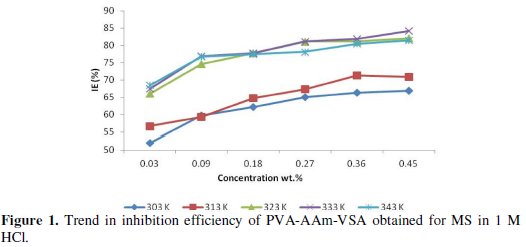
decomposition or rearrangement. <a href="#f1">Fig. 1</a> shows the trend in inhibition efficiency of 
PVA-AAm-VSA on mild steel against inhibitor concentration in 1 M HCl at 303 
K-343 K respectively.</p>


    <p>&nbsp;</p>
<a name="f1">
<img src="/img/revistas/pea/v33n1/33n1a05f1.jpg">
    
<p>&nbsp;</p>


    ]]></body>
<body><![CDATA[<p>This figure reveals that the IE gradually increased in the 
temperature domain range of 303-333 K (68 % to 85 % for 0.45 wt.% of 
inhibitor) and then slightly decreases at 343 K. This fact can be explained on the 
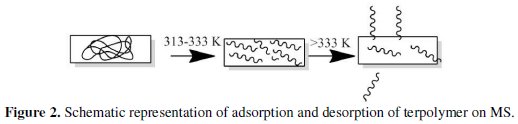
basis of structural orientation (<a href="#f2">Fig. 2</a>) according to Fares et al. [7] and 
Chamovska et al. [8].</p>


    <p>&nbsp;</p>
<a name="f2">
<img src="/img/revistas/pea/v33n1/33n1a05f2.jpg">
    
<p>&nbsp;</p>


    <p>At lower temperatures coiled structure of the polymer 
chains covers the surface and prevents the metal dissolution. But at temperatures 
from 313-333 K, the long chains of the coiled structure could have broken into 
small segments but still providing better efficiency. At temperatures greater than 
333 K, the short chains could have started desorbing from the metal surface and 
consequently IE starts decreasing, because increase in temperature stimulates the 
kinetic energy of the metal surface which adversely affects the adsorption 
process. Hence the adsorption-desorption equilibrium is shifted more towards the 
desorption process [2] and the electrode surface is more roughened owing to the 
enhanced corrosion.</p>


    <p><b><i>Effect of temperature-potentiodynamic polarisation method</i></b></p>

    <p><a href="#f3">Fig. 3a</a> shows the polarisation curves obtained for optimum concentration of 
PVA-AAm-VSA at 303 K - 343 K and the corresponding electrochemical 
parameters such as corrosion potential (E<sub>corr</sub>), corrosion current (I<sub>corr</sub>) and 
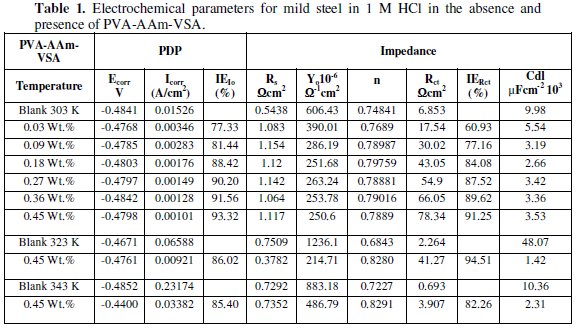
inhibitor efficiency IE<sub>Icorr</sub> are given in <a href="#t1">Table 1</a>.</p>


    <p>&nbsp;</p>
<a name="f3">
<img src="/img/revistas/pea/v33n1/33n1a05f3.jpg">
    
<p>&nbsp;</p>
<a name="t1">
<img src="/img/revistas/pea/v33n1/33n1a05t1.jpg">
    
<p>&nbsp;</p>


    <p>The inhibition efficiency of terpolymer is calculated by using corrosion current 
density using the following formula:</p>


    ]]></body>
<body><![CDATA[<p>&nbsp;</p>
<a name="e1">
<img src="/img/revistas/pea/v33n1/33n1a05e1.jpg">
    
<p>&nbsp;</p>


    <p>where I<sup>0</sup><sub>corr</sub> and I<sub>corr</sub> are the corrosion current density obtained for uninhibited 
solution and inhibited solution, respectively. The polarisation plot shows that 
PVA-AAm-VSA suppressed both metal dissolution (anodic) and hydrogen 
evolution (cathodic) reaction, indicating the mixed type of inhibition. Moreover, 
the Tafel lines are parallel in nature suggesting the activation-controlled type 
hydrogen evolution reaction [9]. The displacement in the E<sub>corr</sub> values is less than 
85 mV which is an indication of mixed type inhibitory action of the inhibitors. 
Also the E<sub>corr</sub> values shifts to positive direction which is an indication that 
inhibitor molecules are more adsorbed on the anodic sites, resulting in an 
inhibition of the anodic reactions [10]. Inspection of <a href="#t1">Table 1</a> reveals that there is 
a definite decrease in corrosion current with the addition of inhibitor. This shows 
the decrease in anodic current density with increase in inhibitor concentration, as 
the inhibitor addition obstructs the sites responsible for corrosion [11,12]. 
Increase in the inhibition efficiency with respect to temperature is due to the 
increased adsorption of inhibitor on the metal surface, and decrease in inhibition 
efficiency at higher temperatures is due to the detachment of the inhibitor film 
formed on the metal surface [12].</p>


    <p><b><i>Effect of temperature-AC impedance method</i></b></p>

    <p>EIS results are more reliable because the measurements were done close to the 
corrosion potential and it is considered as non-destructive test due to the small 
magnitude of the applied potential, i.e. 5 mV. This small perturbation of the 
corrosion potential minimizes the surface modification and errors associated with 
large deviations from the electrochemical equilibrium [13]. Solution resistance 
(R<sub>s</sub>), charge transfer resistance (R<sub>ct</sub>) and double layer capacitance (C<sub>dl</sub>) were 
determined from EIS and they are listed in <a href="#t1">Table 1</a>. The IE was determined using 
the charge transfer resistance values through the following equation:</p>


    <p>&nbsp;</p>
<a name="e2">
<img src="/img/revistas/pea/v33n1/33n1a05e2.jpg">
    
<p>&nbsp;</p>


    <p>where R<sup>0</sup><sub>ct</sub> and R<sub>ct</sub> are the electrochemical parameters obtained for uninhibited 
solution and inhibited solution, respectively.</p>

    <p><a href="#f3">Fig. 3b</a> is the Nyquist representation for corrosion of MS in the presence and 
absence of PVA-AAm-VSA at various temperatures. The impedance obtained at 
303 K and 313 K was larger and then the size gradually decreased with increase 
in temperature. This fact can be attributed to the better adsorption ability of the 
inhibitor initially at lower temperatures. With increase in temperature the 
adsorbed film started desorbing leading to decrease in impedance size. The 
Nyquist plot appears as single capacitive semicircles with their center depressed 
onto the real axis [14,15] being this effect named as dispersing effect [16]. Hence 
the circuit (<a href="#f3">Fig. 3b</a> inset) used for fitting the data should be expressed in terms of 
a constant phase element (CPE), because the use of CPE is generally required 
due to the distribution of relaxation time as a result of the inhomogeneity, 
roughness, adsorption or diffusion at micro and nano level of the metal surface 
[17]. CPE is defined as</p>


    <p>&nbsp;</p>
<a name="e3">
<img src="/img/revistas/pea/v33n1/33n1a05e3.jpg">
    
]]></body>
<body><![CDATA[<p>&nbsp;</p>


    <p>where Z<sub>CPE</sub> is impedance of CPE; Y<sub>0</sub> is a proportional factor, &omega; 
is the angular frequency (in rad/s), j<sup>2</sup> = -1 is the imaginary number and n is the CPE exponent.</p>

    <p>Double layer capacitance associated with the CPE element is calculated from Rct 
using the following formula:</p>


    <p>&nbsp;</p>
<a name="e4">
<img src="/img/revistas/pea/v33n1/33n1a05e4.jpg">
    
<p>&nbsp;</p>


    <p>where n can be related to non-uniform current distribution, distribution of 
reaction rates and roughness of electrode surface. The values of n can 
differentiate the type of the circuit element involved. When n=0, Y<sub>0</sub>=Resistance; 
n=1;Y<sub>0</sub>=Capacitance; n=-1;Y<sub>0</sub>=Inductance; n=0.5;Y<sub>0</sub>=Warburg impedance [18]. 
However, when n is a medium value between them, it may indicate a relative and 
integrated influence by the above factors, no longer a simple resistance, 
capacitance or diffusive element [19].</p>

    <p>The charge transfer resistance values increase with increase in inhibitor 
concentration which can be a result of slower corroding system [20]. At the same 
time Y<sub>0</sub> decreased indicating that increasing the inhibitor concentration decreased 
the corrosion rate. The decrease in C<sub>dl</sub> values occurs as a result of reduction of 
local dielectric constant and/or by increase in the thickness of the electrical 
double layer [21]. This can be related to the fact of adsorption of the inhibitor 
molecules at the metal/solution interface. In other words, decrease in Cdl values 
with increasing inhibitor concentration ensures surface coverage of the metal by 
inhibitor film. The obtained n values are in the range of 0.5 &le; n &le; 1, which is 
again an evidence for the surface roughness and other parameters [22]. The IE 
values calculated from the R<sub>ct</sub> values show that the concentration of the inhibitor 
has a positive influence on IE and the temperature has a negative influence on the 
IE. The aforementioned fact is tenable to the adsorption and desorption of 
inhibitors, respectively.</p>


    <p><b><i>Adsorption considerations</i></b></p>

    <p><i>Thermodynamic adsorption parameters</i></p>

    <p>In order to gain a detailed insight on inhibition of mild steel corrosion by the 
inhibitor molecules, various adsorption isotherms were designed as they provide 
information about molecular interactions between the inhibitor molecules and 
active sites of the metal [20]. The surface coverage &theta; is calculated from the 
inhibition efficiency acquired from weight loss (IE<sub>WL</sub>) and electrochemical 
studies (IEI<sub>corr</sub> and IE<sub>Rct</sub>). An attempt was made to fit the surface coverage values 
onto various isotherms, namely Langmuir, Temkin, El-Awady, Freundlich, 
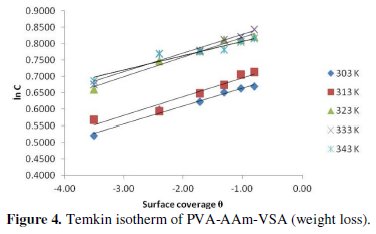
Flory-Huggins, Frumkin and Bockris-Swinkles. The data were found to be well 
fitted in the Temkin isotherm with regression values close to unity and the 
Temkin adsorption isotherm equation is represented as [23,24]</p>


    ]]></body>
<body><![CDATA[<p>&nbsp;</p>
<a name="e5">
<img src="/img/revistas/pea/v33n1/33n1a05e5.jpg">
    
<p>&nbsp;</p>


    <p>where 'a' is called the molecular interaction parameter, which can be negative or 
positive, &theta; is the surface coverage, K is the adsorption equilibrium constant and 
C is the concentration of the inhibitor in wt.%. Positive values of 'a' relate to the 
attractive forces and negative values of 'a' relate to the repulsive forces that exist 
between adsorbed inhibitor molecules. When -2a is represented as 'f' which 
describes the heterogeneity that prevail between the molecular interactions in the 
adsorption layer and the heterogeneity of the metal surface, Temkin equation can 
be represented in the transformed form as shown here.</p>


    <p>&nbsp;</p>
<a name="e6">
<img src="/img/revistas/pea/v33n1/33n1a05e6.jpg">
    
<p>&nbsp;</p>


    <p>A plot of &theta; vs. ln C (<a href="#f4">Fig. 4</a>) gave straight lines with regression values almost 
equal to unity.</p>


    <p>&nbsp;</p>
<a name="f4">
<img src="/img/revistas/pea/v33n1/33n1a05f4.jpg">
    
<p>&nbsp;</p>


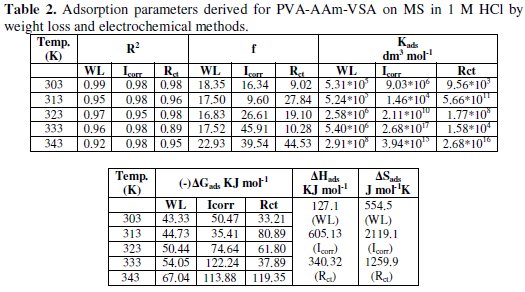
    <p>The parameters including 'f' and 'K' were calculated from the 
slope and intercept, respectively, and are presented in <a href="#t2">Table 2</a>.</p>


    <p>&nbsp;</p>
<a name="t2">
<img src="/img/revistas/pea/v33n1/33n1a05t2.jpg">
    
]]></body>
<body><![CDATA[<p>&nbsp;</p>


    <p>The validity of 
Temkin's isotherm is basically an evidence for the chemisorptive nature of 
adsorption. Since the obtained f values are greater than 0, it can be assumed that 
the adsorbed inhibitor molecules suffer repulsive forces among themselves [24, 
25]. As far as the adsorptive equilibrium constant is concerned, they tend to 
increase with increasing temperature, which supports the stronger adsorption 
leading to chemisorption. The thermodynamic free energy of adsorption can be 
calculated using the following equation using the deduced K values</p>


    <p>&nbsp;</p>
<a name="e7">
<img src="/img/revistas/pea/v33n1/33n1a05e7.jpg">
    
<p>&nbsp;</p>


    <p>where C<sub>H2O</sub> is the molar concentration of water expressed in g/L, R is the molar 
gas constant J/mol/K and T is the temperature in K. From the plot of ln Kads vs. 
1/T, the adsorption enthalpy &Delta;H<sub>ads</sub> and adsorption entropy &Delta;S<sub>ads</sub> can be calculated 
from the slope and intercept, respectively, using the Vant Hoff's equation [9, 26]</p>


    <p>&nbsp;</p>
<a name="e8">
<img src="/img/revistas/pea/v33n1/33n1a05e8.jpg">
    
<p>&nbsp;</p>


    <p>Also the increase in K values indicates the strength of the adsorption between 
inhibitor molecules and metal. In this study, K values increase proportionally 
with temperature which is attributable to the effective adsorption of the inhibitor 
[24-28].</p>

    <p>Generally, free energy values of 20 kJ mol<sup>-1</sup> or less are correlated to the 
physisorption that occur through electrostatic interaction between charged 
molecules and charged metal surface; the free energy values of more than 40 kJ 
mol<sup>-1</sup> or more are related to the chemisorption that involves charge sharing or 
transfer from the inhibitor molecules to the metal surface to form a coordinate 
covalent bond [29-31]. In the present study, the negative values of &Delta;G indicate 
the spontaneity of the adsorption process and the magnitude of &Delta;G values was 
found to be more than 40 kJ mol<sup>-1</sup> as obtained for weight loss studies, and can be 
attributed to chemical adsorption of the terpolymeric inhibitor. The magnitude of 
&Delta;G values obtained from electrochemical measurements was in the range of 50 - 120 
kJ mol<sup>-1</sup> which also shows the strong chemisorption of the inhibitor. 
Moreover the &Delta;G values increase with increasing temperature, which is due to 
the fact of strong chemisorption at higher temperatures.</p>

    <p>The positive values of &Delta;H for PVA-AAm-VSA can be related to the fact of 
endothermic adsorption. As a contrary to the observations from the literature, 
positive values of &Delta;H are associated with the positive entropy. This may be 
pertained to the following reason: polymers are generally larger molecules, and 
the terpolymer under investigation is a bigger macromolecule with hetero atoms 
like N, S and O. Hence, before getting adsorbed onto the metal surface, the 
macromolecule has to orient itself in the solution state to extend the bonding with 
the metal surface. This process requires some energy which could overly the 
exothermic energy of ions that tend to attach to the surface. However, the total 
enthalpy of the system is an algebraic sum of adsorption enthalpy and desorption 
enthalpy. Hence, desorption of water molecules becomes implicitly an 
endothermic process resulting a positive enthalpy for the whole system. The 
positive entropy is explained by Singh and Quraishi [32] and Wang et al. [33] as 
follows: Adsorption of inhibitors from the aqueous solution is considered as 
quasi-substitution process between the organic compound in the aqueous phase 
and water molecules at the mild steel surface. The adsorption of inhibitors on 
metal surface takes place at the cost of desorption of water molecules. The total 
entropy is calculated as algebraic sum of adsorption of organic inhibitor 
molecules and desorption of water molecules. So the gain in entropy is related 
with the solvent entropy. That is from the solvent side, the disorderliness 
increases resulting in increased entropy.</p>


    ]]></body>
<body><![CDATA[<p><b><i>Thermodynamic activation parameters</i></b></p>

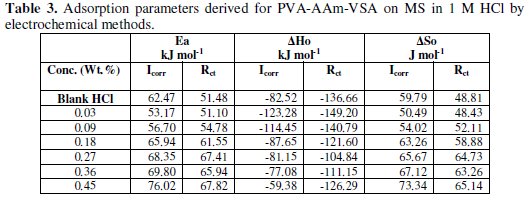
    <p>The effect of temperature on the inhibited-acid metal is highly complex, because 
many changes occur on the metal surface such as rapid etching, desorption of 
inhibitor or the inhibitor itself may undergo decomposition [34]. The 
thermodynamic parameters for dissolution of mild steel were calculated using the 
change in corrosion rate values obtained from the electrochemical (I<sub>corr</sub> from 
polarisation and I<sub>corr</sub> from impedance) values at 303-343 K and are depicted in 
<a href="#t3">Table 3</a>.</p>


    <p>&nbsp;</p>
<a name="t3">
<img src="/img/revistas/pea/v33n1/33n1a05t3.jpg">
    
<p>&nbsp;</p>


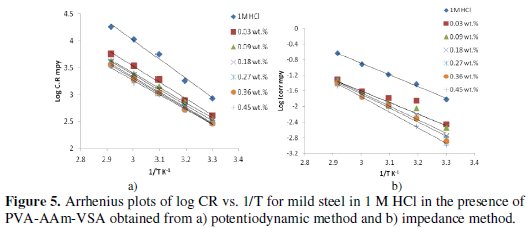
    <p>Activation energy (Ea) value for mild steel dissolution was calculated 
from the slope of Arrhenius plot (log I<sub>corr</sub> vs. 1/T: <a href="#f5">Fig. 5a and 5b</a>) using the 
following equation.</p>


    <p>&nbsp;</p>
<a name="e9">
<img src="/img/revistas/pea/v33n1/33n1a05e9.jpg">
    
<p>&nbsp;</p>
<a name="f5">
<img src="/img/revistas/pea/v33n1/33n1a05f5.jpg">
    
<p>&nbsp;</p>


    <p>where R is the general gas constant expressed in J/K/mol, T is the absolute 
temperature in K and &lambda; is the Arrhenius pre-exponential factor. CR is the rate of 
metal dissolution which is directly related to corrosion current density (I<sub>corr</sub>) and 
hence I<sub>corr</sub> is used for calculations.</p>

    <p>I<sub>corr</sub> is calculated from Rct using the following formula [21]:</p>


    ]]></body>
<body><![CDATA[<p>&nbsp;</p>
<a name="e10">
<img src="/img/revistas/pea/v33n1/33n1a05e10.jpg">
    
<p>&nbsp;</p>


    <p>where R is the general gas constant expressed in J/K/mol, T is the absolute 
temperature, and Rct is the charge transfer resistance. The calculated values for 
the activation energy for blank HCl are found to be around 62 and 50 kJ mol<sup>-1</sup> 
from electrochemical method which is consistent with the values reported in 
literatures, i.e., 50 - 100 kJ mol<sup>-1</sup>[35].</p>

    <p>The values of Ea are higher than that of the blank and increase with increase in 
concentration. This is tenable to the fact of increase in the energy barrier of the 
corrosion reaction occurring at the steel surface. Also the change in the Ea 
values is considered as a change in corrosion mechanism when the inhibitor 
molecules are adsorbed on the surface [36].</p>

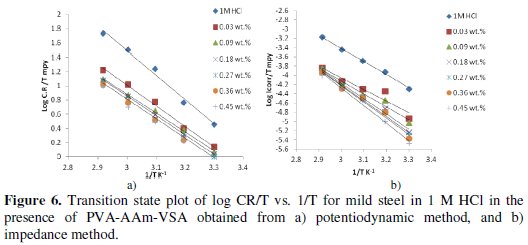
    <p>The transition state plot of log I<sub>corr</sub>/T 
vs. 1/T (<a href="#f6">Fig. 6a and 6b</a>) was constructed to find out the enthalpy of activation 
&Delta;H<sup>0</sup> from the slope (-&Delta;H<sup>0</sup>/R) 
and &Delta;S<sup>0</sup> from the intercept ([ln (R/Nh)R(&Delta;S<sup>0</sup>/R)]), 
using the following equation:</p>


    <p>&nbsp;</p>
<a name="e11">
<img src="/img/revistas/pea/v33n1/33n1a05e11.jpg">
    
<p>&nbsp;</p>
<a name="f6">
<img src="/img/revistas/pea/v33n1/33n1a05f6.jpg">
    
<p>&nbsp;</p>


    <p>where h is the Planck's constant, N is the Avogadro's number, R is the general 
gas constant expressed in J/K/mol. The values &Delta;H in the presence of inhibitors 
are larger than in absence of inhibitor.</p>

    <p>Positive values of &Delta;Ho reflect the endothermic nature of the metal dissolution 
process, which is attributed to the slower dissolution of mild steel in the presence 
of the inhibitor than in the absence. Large negative values of &Delta;So are observed for 
both the inhibited and uninhibited solution, however the values obtained for the 
blank are more positive which depicts the increased disorderliness during metal 
dissolution. For inhibited solution, the disorderliness decreases in terms of more 
negative values of entropy. This suggests that the activated complex in the rate 
determining step is mainly association rather than dissociation [37], more 
precisely decreases in disorderliness while proceeding to the activated complex 
formation [38]. This also suggests that the inhibition process is primarily 
enthalpy controlled [39].</p>


    ]]></body>
<body><![CDATA[<p><b><i>Atomic force microscopic investigation</i></b></p>

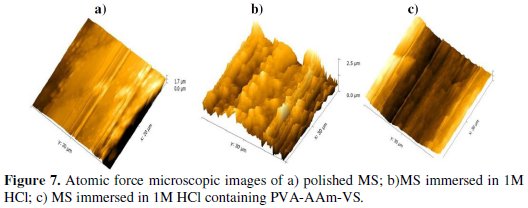
    <p>Morphological analysis of the surfaces of the mild steel were carried out by AFM 
in the range 0 to 50 &mu;m at room temperature after immersion in different test 
solutions for 6 h. Three-dimensional AFM images of mild steel, mild steel 
immersed in 1 M HCl and mild steel immersed in 1 M HCl containing PVAAAm-
VSA are shown in <a href="#f7">Fig. 7</a>.</p>


    <p>&nbsp;</p>
<a name="f7">
<img src="/img/revistas/pea/v33n1/33n1a05f7.jpg">
    
<p>&nbsp;</p>


    <p>The roughness parameter (Ra) and root mean 
square roughness (Rms) were calculated using the software called Gwyddion.</p>

    <p>Nano to micro scale level has emerged as contemporary choice for investigating 
the influence of inhibitors on the metal surface [40]. The integrity and persistence 
of inhibitor films formed on the metal surface is of paramount importance in the 
corrosion inhibition studies. The AFM technique reveals the extent of inhibitor 
film adsorption on the MS surface in terms of calculating the roughness 
parameter and through 3D images of the surface. The roughness parameter given 
in the table has the following order:</p>

    <p>Polished MS &lt; PVA-AAm-VSA &lt; Corroded MS</p>

    <p>In the absence of the inhibitors, the surface of the film shows several mountain 
like formations that correspond to rough surface [41].The Ra and Rms 
corresponding to the MS corroded in blank HCl are 0.567 &mu;m and 0.693 &mu;m, 
which are very higher than the roughness parameters obtained for inhibited 
surfaces. However this roughness is reduced to 0.313 &mu;m and 0.401 &mu;m in the 
presence of the inhibitor which shows the protected surface of the mild steel by 
the terpolymeric inhibitor.</p>


    <p>&nbsp;</p>
    <p><b>Conclusion</b></p>

    ]]></body>
<body><![CDATA[<p>The following results can be drawn from this study: 
PVA-AAm-VSA was found to provide higher inhibition efficiency of 83 % at 
333 K from weight loss studies. In the electrochemical process, the inhibitor was 
found to affect both the anodic and cathodic processes. The surface coverage 
values derived from both the techniques were found to follow Temkin isotherm 
model. The calculated thermodynamic parameters of adsorption confirmed the 
chemical nature of adsorption of the inhibitor. The temperature dependency of 
the corrosion process was altered by the inhibitor addition. The activation energy 
of the inhibited solution was found to be greater than the blank HCl. 
Thermodynamic and adsorption characterization by weight loss, DC polarisation 
and AC impedance were found to be in good agreement.</p>


    <p>&nbsp;</p>
    <p><b>References</b></p>

    <!-- ref --><p>1. Schmitt G. Br Corros J. 1984;19:165.    &nbsp;&nbsp;&nbsp;&nbsp;&nbsp;&nbsp;&nbsp;&nbsp;[&#160;<a href="javascript:void(0);" onclick="javascript: window.open('/scielo.php?script=sci_nlinks&ref=000116&pid=S0872-1904201500010000500001&lng=','','width=640,height=500,resizable=yes,scrollbars=1,menubar=yes,');">Links</a>&#160;]<!-- end-ref --></p>

    <!-- ref --><p>2. Umoren S, Li Y, Wang F. Corros Sci. 2010;52:1777.    &nbsp;&nbsp;&nbsp;&nbsp;&nbsp;&nbsp;&nbsp;&nbsp;[&#160;<a href="javascript:void(0);" onclick="javascript: window.open('/scielo.php?script=sci_nlinks&ref=000118&pid=S0872-1904201500010000500002&lng=','','width=640,height=500,resizable=yes,scrollbars=1,menubar=yes,');">Links</a>&#160;]<!-- end-ref --></p>

    <!-- ref --><p>3. Azghandi M V, Davoodi A, Farzi G A, et al. Corros Sci. 2012;64:44.    &nbsp;&nbsp;&nbsp;&nbsp;&nbsp;&nbsp;&nbsp;&nbsp;[&#160;<a href="javascript:void(0);" onclick="javascript: window.open('/scielo.php?script=sci_nlinks&ref=000120&pid=S0872-1904201500010000500003&lng=','','width=640,height=500,resizable=yes,scrollbars=1,menubar=yes,');">Links</a>&#160;]<!-- end-ref --></p>

    <!-- ref --><p>4. Geethanjali R, Subhashini S. Res J Rec Sci. 2014;3:170.    &nbsp;&nbsp;&nbsp;&nbsp;&nbsp;&nbsp;&nbsp;&nbsp;[&#160;<a href="javascript:void(0);" onclick="javascript: window.open('/scielo.php?script=sci_nlinks&ref=000122&pid=S0872-1904201500010000500004&lng=','','width=640,height=500,resizable=yes,scrollbars=1,menubar=yes,');">Links</a>&#160;]<!-- end-ref --></p>

    <!-- ref --><p>5. Subhashini S, Sabirneeza A A F. Proceedings of the World Congress on Engineering and Computer Science. 2011;II:19.    &nbsp;&nbsp;&nbsp;&nbsp;&nbsp;&nbsp;&nbsp;&nbsp;[&#160;<a href="javascript:void(0);" onclick="javascript: window.open('/scielo.php?script=sci_nlinks&ref=000124&pid=S0872-1904201500010000500005&lng=','','width=640,height=500,resizable=yes,scrollbars=1,menubar=yes,');">Links</a>&#160;]<!-- end-ref --></p>

    <!-- ref --><p>6. Sabirneeza A A F, Subhashini S, Rajalakshmi R. Mater Corros. 2011:1.    &nbsp;&nbsp;&nbsp;&nbsp;&nbsp;&nbsp;&nbsp;&nbsp;[&#160;<a href="javascript:void(0);" onclick="javascript: window.open('/scielo.php?script=sci_nlinks&ref=000126&pid=S0872-1904201500010000500006&lng=','','width=640,height=500,resizable=yes,scrollbars=1,menubar=yes,');">Links</a>&#160;]<!-- end-ref --></p>

    <!-- ref --><p>7. Fares M M, Maayta A K, Al-qudah M M. Corros Sci. 2012;60:112.    &nbsp;&nbsp;&nbsp;&nbsp;&nbsp;&nbsp;&nbsp;&nbsp;[&#160;<a href="javascript:void(0);" onclick="javascript: window.open('/scielo.php?script=sci_nlinks&ref=000128&pid=S0872-1904201500010000500007&lng=','','width=640,height=500,resizable=yes,scrollbars=1,menubar=yes,');">Links</a>&#160;]<!-- end-ref --></p>

    <!-- ref --><p>8. Chamovska D, Cvetkovska M, Grchev T. J Serb Chem Soc. 2007;72:687.    &nbsp;&nbsp;&nbsp;&nbsp;&nbsp;&nbsp;&nbsp;&nbsp;[&#160;<a href="javascript:void(0);" onclick="javascript: window.open('/scielo.php?script=sci_nlinks&ref=000130&pid=S0872-1904201500010000500008&lng=','','width=640,height=500,resizable=yes,scrollbars=1,menubar=yes,');">Links</a>&#160;]<!-- end-ref --></p>

    <!-- ref --><p>9. Bentiss F, Traisnel M, Lagrenee M. J Appl Surf Sci. 1999:237.    &nbsp;&nbsp;&nbsp;&nbsp;&nbsp;&nbsp;&nbsp;&nbsp;[&#160;<a href="javascript:void(0);" onclick="javascript: window.open('/scielo.php?script=sci_nlinks&ref=000132&pid=S0872-1904201500010000500009&lng=','','width=640,height=500,resizable=yes,scrollbars=1,menubar=yes,');">Links</a>&#160;]<!-- end-ref --></p>

    <!-- ref --><p>10. Mistry B M, Jauhari S. Chem Eng Comm. 2014:37.    &nbsp;&nbsp;&nbsp;&nbsp;&nbsp;&nbsp;&nbsp;&nbsp;[&#160;<a href="javascript:void(0);" onclick="javascript: window.open('/scielo.php?script=sci_nlinks&ref=000134&pid=S0872-1904201500010000500010&lng=','','width=640,height=500,resizable=yes,scrollbars=1,menubar=yes,');">Links</a>&#160;]<!-- end-ref --></p>

    <!-- ref --><p>11. Rehim S S A, Hazzazi O A, Amin M A, et al. Corros Sci. 2008;50:2258.    &nbsp;&nbsp;&nbsp;&nbsp;&nbsp;&nbsp;&nbsp;&nbsp;[&#160;<a href="javascript:void(0);" onclick="javascript: window.open('/scielo.php?script=sci_nlinks&ref=000136&pid=S0872-1904201500010000500011&lng=','','width=640,height=500,resizable=yes,scrollbars=1,menubar=yes,');">Links</a>&#160;]<!-- end-ref --></p>

    <!-- ref --><p>12. Olivares-Xometl O, Likhanova N V, Dominguez-Aguilar M A, et al. Mater Chem Phys. 2008;110:344.    &nbsp;&nbsp;&nbsp;&nbsp;&nbsp;&nbsp;&nbsp;&nbsp;[&#160;<a href="javascript:void(0);" onclick="javascript: window.open('/scielo.php?script=sci_nlinks&ref=000138&pid=S0872-1904201500010000500012&lng=','','width=640,height=500,resizable=yes,scrollbars=1,menubar=yes,');">Links</a>&#160;]<!-- end-ref --></p>

    <!-- ref --><p>13. Orazem M E, Tribollet B. Electrochemical impedance spectroscopy. Hoboken: John Wiley &amp; Sons; 2008.    &nbsp;&nbsp;&nbsp;&nbsp;&nbsp;&nbsp;&nbsp;&nbsp;[&#160;<a href="javascript:void(0);" onclick="javascript: window.open('/scielo.php?script=sci_nlinks&ref=000140&pid=S0872-1904201500010000500013&lng=','','width=640,height=500,resizable=yes,scrollbars=1,menubar=yes,');">Links</a>&#160;]<!-- end-ref --></p>

    <!-- ref --><p>14. Popova A, Raicheva S, Sokolova E, et al. Langmuir. 1996;12:2083.    &nbsp;&nbsp;&nbsp;&nbsp;&nbsp;&nbsp;&nbsp;&nbsp;[&#160;<a href="javascript:void(0);" onclick="javascript: window.open('/scielo.php?script=sci_nlinks&ref=000142&pid=S0872-1904201500010000500014&lng=','','width=640,height=500,resizable=yes,scrollbars=1,menubar=yes,');">Links</a>&#160;]<!-- end-ref --></p>

    <!-- ref --><p>15. Lebrini M, Lagrenee M, Vezin H, et al. Corros Sci. 2007;49:2254.    &nbsp;&nbsp;&nbsp;&nbsp;&nbsp;&nbsp;&nbsp;&nbsp;[&#160;<a href="javascript:void(0);" onclick="javascript: window.open('/scielo.php?script=sci_nlinks&ref=000144&pid=S0872-1904201500010000500015&lng=','','width=640,height=500,resizable=yes,scrollbars=1,menubar=yes,');">Links</a>&#160;]<!-- end-ref --></p>

    <!-- ref --><p>16. MacCafferty E. Corros Sci. 1997;39:243.    &nbsp;&nbsp;&nbsp;&nbsp;&nbsp;&nbsp;&nbsp;&nbsp;[&#160;<a href="javascript:void(0);" onclick="javascript: window.open('/scielo.php?script=sci_nlinks&ref=000146&pid=S0872-1904201500010000500016&lng=','','width=640,height=500,resizable=yes,scrollbars=1,menubar=yes,');">Links</a>&#160;]<!-- end-ref --></p>

    <!-- ref --><p>17. Navvaro-Flores E, Chong Z, Omanovic S. J Mol Catal A: Chem. 2005;226:179.    &nbsp;&nbsp;&nbsp;&nbsp;&nbsp;&nbsp;&nbsp;&nbsp;[&#160;<a href="javascript:void(0);" onclick="javascript: window.open('/scielo.php?script=sci_nlinks&ref=000148&pid=S0872-1904201500010000500017&lng=','','width=640,height=500,resizable=yes,scrollbars=1,menubar=yes,');">Links</a>&#160;]<!-- end-ref --></p>

    <!-- ref --><p>18. Oldham K B. Electrochem Comm. 2004;6:210.    &nbsp;&nbsp;&nbsp;&nbsp;&nbsp;&nbsp;&nbsp;&nbsp;[&#160;<a href="javascript:void(0);" onclick="javascript: window.open('/scielo.php?script=sci_nlinks&ref=000150&pid=S0872-1904201500010000500018&lng=','','width=640,height=500,resizable=yes,scrollbars=1,menubar=yes,');">Links</a>&#160;]<!-- end-ref --></p>

    <!-- ref --><p>19. Lu Y, Wang W, Xu H, et al. Corros Sci. 2010;52:780.    &nbsp;&nbsp;&nbsp;&nbsp;&nbsp;&nbsp;&nbsp;&nbsp;[&#160;<a href="javascript:void(0);" onclick="javascript: window.open('/scielo.php?script=sci_nlinks&ref=000152&pid=S0872-1904201500010000500019&lng=','','width=640,height=500,resizable=yes,scrollbars=1,menubar=yes,');">Links</a>&#160;]<!-- end-ref --></p>

    <!-- ref --><p>20. Khaled K F. Electrochim Acta, 2003;48:2493.    &nbsp;&nbsp;&nbsp;&nbsp;&nbsp;&nbsp;&nbsp;&nbsp;[&#160;<a href="javascript:void(0);" onclick="javascript: window.open('/scielo.php?script=sci_nlinks&ref=000154&pid=S0872-1904201500010000500020&lng=','','width=640,height=500,resizable=yes,scrollbars=1,menubar=yes,');">Links</a>&#160;]<!-- end-ref --></p>

    <!-- ref --><p>21. Soltani N, Tavakkoli N, Khayatkashani M, et al. Corros Sci. 2012;62:122.    &nbsp;&nbsp;&nbsp;&nbsp;&nbsp;&nbsp;&nbsp;&nbsp;[&#160;<a href="javascript:void(0);" onclick="javascript: window.open('/scielo.php?script=sci_nlinks&ref=000156&pid=S0872-1904201500010000500021&lng=','','width=640,height=500,resizable=yes,scrollbars=1,menubar=yes,');">Links</a>&#160;]<!-- end-ref --></p>

    <!-- ref --><p>22. Benedeti A V, Sumodjo P T A, Nobe K, et al. Electrochim Acta. 1995;40:2657.    &nbsp;&nbsp;&nbsp;&nbsp;&nbsp;&nbsp;&nbsp;&nbsp;[&#160;<a href="javascript:void(0);" onclick="javascript: window.open('/scielo.php?script=sci_nlinks&ref=000158&pid=S0872-1904201500010000500022&lng=','','width=640,height=500,resizable=yes,scrollbars=1,menubar=yes,');">Links</a>&#160;]<!-- end-ref --></p>

    <!-- ref --><p>23. Abd El Rehim S S, Ibrahim M A M, Khalid K F. Mater Chem Phys. 2001;70:268.    &nbsp;&nbsp;&nbsp;&nbsp;&nbsp;&nbsp;&nbsp;&nbsp;[&#160;<a href="javascript:void(0);" onclick="javascript: window.open('/scielo.php?script=sci_nlinks&ref=000160&pid=S0872-1904201500010000500023&lng=','','width=640,height=500,resizable=yes,scrollbars=1,menubar=yes,');">Links</a>&#160;]<!-- end-ref --></p>

    <!-- ref --><p>24. Li X, Deng S, Fu H, et al. Corros Sci. 2008;50:3599.    &nbsp;&nbsp;&nbsp;&nbsp;&nbsp;&nbsp;&nbsp;&nbsp;[&#160;<a href="javascript:void(0);" onclick="javascript: window.open('/scielo.php?script=sci_nlinks&ref=000162&pid=S0872-1904201500010000500024&lng=','','width=640,height=500,resizable=yes,scrollbars=1,menubar=yes,');">Links</a>&#160;]<!-- end-ref --></p>

    <!-- ref --><p>25. Ali SA, El-Shareef A M, Al-Ghamdi R F, et al. Corros Sci. 2005;47:2659.    &nbsp;&nbsp;&nbsp;&nbsp;&nbsp;&nbsp;&nbsp;&nbsp;[&#160;<a href="javascript:void(0);" onclick="javascript: window.open('/scielo.php?script=sci_nlinks&ref=000164&pid=S0872-1904201500010000500025&lng=','','width=640,height=500,resizable=yes,scrollbars=1,menubar=yes,');">Links</a>&#160;]<!-- end-ref --></p>

    <!-- ref --><p>26. Durnie W, Marco R D, Jefferson A, et al. J Electrochem Soc. 1999;146:1751.    &nbsp;&nbsp;&nbsp;&nbsp;&nbsp;&nbsp;&nbsp;&nbsp;[&#160;<a href="javascript:void(0);" onclick="javascript: window.open('/scielo.php?script=sci_nlinks&ref=000166&pid=S0872-1904201500010000500026&lng=','','width=640,height=500,resizable=yes,scrollbars=1,menubar=yes,');">Links</a>&#160;]<!-- end-ref --></p>

    <!-- ref --><p>27. Stoyanova A E, Sokolova E I, Baicheva S N. Corros Sci. 1997;39:1595.    &nbsp;&nbsp;&nbsp;&nbsp;&nbsp;&nbsp;&nbsp;&nbsp;[&#160;<a href="javascript:void(0);" onclick="javascript: window.open('/scielo.php?script=sci_nlinks&ref=000168&pid=S0872-1904201500010000500027&lng=','','width=640,height=500,resizable=yes,scrollbars=1,menubar=yes,');">Links</a>&#160;]<!-- end-ref --></p>

    <!-- ref --><p>28. Amin M A, Abd El Rehim S S, Abdel-Fatah H T M. Corros Sci. 2009;51:882.    &nbsp;&nbsp;&nbsp;&nbsp;&nbsp;&nbsp;&nbsp;&nbsp;[&#160;<a href="javascript:void(0);" onclick="javascript: window.open('/scielo.php?script=sci_nlinks&ref=000170&pid=S0872-1904201500010000500028&lng=','','width=640,height=500,resizable=yes,scrollbars=1,menubar=yes,');">Links</a>&#160;]<!-- end-ref --></p>

    <!-- ref --><p>29. Donahue F M, Nobe K. J Electrochem Soc. 1965;112:886.    &nbsp;&nbsp;&nbsp;&nbsp;&nbsp;&nbsp;&nbsp;&nbsp;[&#160;<a href="javascript:void(0);" onclick="javascript: window.open('/scielo.php?script=sci_nlinks&ref=000172&pid=S0872-1904201500010000500029&lng=','','width=640,height=500,resizable=yes,scrollbars=1,menubar=yes,');">Links</a>&#160;]<!-- end-ref --></p>

    <!-- ref --><p>30. Kamis E, Bellucci F, Latanision R M, et al. Corrosion. 1991;47:677.    &nbsp;&nbsp;&nbsp;&nbsp;&nbsp;&nbsp;&nbsp;&nbsp;[&#160;<a href="javascript:void(0);" onclick="javascript: window.open('/scielo.php?script=sci_nlinks&ref=000174&pid=S0872-1904201500010000500030&lng=','','width=640,height=500,resizable=yes,scrollbars=1,menubar=yes,');">Links</a>&#160;]<!-- end-ref --></p>

    <!-- ref --><p>31. Solmaz R, Kardas G, Culha M, et al. Electrochim Acta. 2008:53.    &nbsp;&nbsp;&nbsp;&nbsp;&nbsp;&nbsp;&nbsp;&nbsp;[&#160;<a href="javascript:void(0);" onclick="javascript: window.open('/scielo.php?script=sci_nlinks&ref=000176&pid=S0872-1904201500010000500031&lng=','','width=640,height=500,resizable=yes,scrollbars=1,menubar=yes,');">Links</a>&#160;]<!-- end-ref --></p>

    <!-- ref --><p>32. Singh A K, Quraishi M A. Mater Chem Phys. 2010;123:666.    &nbsp;&nbsp;&nbsp;&nbsp;&nbsp;&nbsp;&nbsp;&nbsp;[&#160;<a href="javascript:void(0);" onclick="javascript: window.open('/scielo.php?script=sci_nlinks&ref=000178&pid=S0872-1904201500010000500032&lng=','','width=640,height=500,resizable=yes,scrollbars=1,menubar=yes,');">Links</a>&#160;]<!-- end-ref --></p>

    <!-- ref --><p>33. Wang X, Yang H, Wang F. Corros Sci. 2010;52:1268.    &nbsp;&nbsp;&nbsp;&nbsp;&nbsp;&nbsp;&nbsp;&nbsp;[&#160;<a href="javascript:void(0);" onclick="javascript: window.open('/scielo.php?script=sci_nlinks&ref=000180&pid=S0872-1904201500010000500033&lng=','','width=640,height=500,resizable=yes,scrollbars=1,menubar=yes,');">Links</a>&#160;]<!-- end-ref --></p>

    <!-- ref --><p>34. Riggs O, Hurd I R, Ray M. Corrosion 1967;23:252.    &nbsp;&nbsp;&nbsp;&nbsp;&nbsp;&nbsp;&nbsp;&nbsp;[&#160;<a href="javascript:void(0);" onclick="javascript: window.open('/scielo.php?script=sci_nlinks&ref=000182&pid=S0872-1904201500010000500034&lng=','','width=640,height=500,resizable=yes,scrollbars=1,menubar=yes,');">Links</a>&#160;]<!-- end-ref --></p>

    <!-- ref --><p>35. Negm N A, Elkholy Y M, Zahran M K, et al. Corros Sci. 2010;52:3523.    &nbsp;&nbsp;&nbsp;&nbsp;&nbsp;&nbsp;&nbsp;&nbsp;[&#160;<a href="javascript:void(0);" onclick="javascript: window.open('/scielo.php?script=sci_nlinks&ref=000184&pid=S0872-1904201500010000500035&lng=','','width=640,height=500,resizable=yes,scrollbars=1,menubar=yes,');">Links</a>&#160;]<!-- end-ref --></p>

    <!-- ref --><p>36. Ali S A, El-Shareef A M, Al-Ghamdi R F, et al. Corros Sci. 2005;47:2659.    &nbsp;&nbsp;&nbsp;&nbsp;&nbsp;&nbsp;&nbsp;&nbsp;[&#160;<a href="javascript:void(0);" onclick="javascript: window.open('/scielo.php?script=sci_nlinks&ref=000186&pid=S0872-1904201500010000500036&lng=','','width=640,height=500,resizable=yes,scrollbars=1,menubar=yes,');">Links</a>&#160;]<!-- end-ref --></p>

    <!-- ref --><p>37. Abdallah M. Corros Sci. 2003;45:2705.    &nbsp;&nbsp;&nbsp;&nbsp;&nbsp;&nbsp;&nbsp;&nbsp;[&#160;<a href="javascript:void(0);" onclick="javascript: window.open('/scielo.php?script=sci_nlinks&ref=000188&pid=S0872-1904201500010000500037&lng=','','width=640,height=500,resizable=yes,scrollbars=1,menubar=yes,');">Links</a>&#160;]<!-- end-ref --></p>

    <!-- ref --><p>38. Hamed E. Mater Chem Phys. 2010;121:70.    &nbsp;&nbsp;&nbsp;&nbsp;&nbsp;&nbsp;&nbsp;&nbsp;[&#160;<a href="javascript:void(0);" onclick="javascript: window.open('/scielo.php?script=sci_nlinks&ref=000190&pid=S0872-1904201500010000500038&lng=','','width=640,height=500,resizable=yes,scrollbars=1,menubar=yes,');">Links</a>&#160;]<!-- end-ref --></p>

    <!-- ref --><p>39. Ashassi-Sorkhabi H, Ghasemi Z, Seifzadeh D. Appl Surf Sci. 2005;249:408.    &nbsp;&nbsp;&nbsp;&nbsp;&nbsp;&nbsp;&nbsp;&nbsp;[&#160;<a href="javascript:void(0);" onclick="javascript: window.open('/scielo.php?script=sci_nlinks&ref=000192&pid=S0872-1904201500010000500039&lng=','','width=640,height=500,resizable=yes,scrollbars=1,menubar=yes,');">Links</a>&#160;]<!-- end-ref --></p>

    <!-- ref --><p>40. Xianghong L, Guannan M. Appl Surf Sci. 2005;252:1254.    &nbsp;&nbsp;&nbsp;&nbsp;&nbsp;&nbsp;&nbsp;&nbsp;[&#160;<a href="javascript:void(0);" onclick="javascript: window.open('/scielo.php?script=sci_nlinks&ref=000194&pid=S0872-1904201500010000500040&lng=','','width=640,height=500,resizable=yes,scrollbars=1,menubar=yes,');">Links</a>&#160;]<!-- end-ref --></p>

    <!-- ref --><p>41. Quraishi M A, Shukla S K. Mater Chem Phys. 2009;113:685.    &nbsp;&nbsp;&nbsp;&nbsp;&nbsp;&nbsp;&nbsp;&nbsp;[&#160;<a href="javascript:void(0);" onclick="javascript: window.open('/scielo.php?script=sci_nlinks&ref=000196&pid=S0872-1904201500010000500041&lng=','','width=640,height=500,resizable=yes,scrollbars=1,menubar=yes,');">Links</a>&#160;]<!-- end-ref --></p>


    <p>&nbsp;</p>
    <p><b>Acknowledgement</b></p>

    <p>One of the authors, R.Geethanjali thanks Tamil Nadu State Council for Science and 
Technology for catalysing and financially supporting the research work under RFRS 
scheme.</p>


    <p>&nbsp;</p>
    <p><a name=0></a><sup><a href="#top">*</a></sup>Corresponding author. E-mail address: <a href="mailto:anjalirajj@gmail.com">anjalirajj@gmail.com</a></p>

    ]]></body>
<body><![CDATA[<p>Received 8 February 2015; accepted 23 February 2015</p>

    <p><a href="http://www.peacta.org" target="_blank">www.peacta.org</a> </p>


     ]]></body><back>
<ref-list>
<ref id="B1">
<label>1</label><nlm-citation citation-type="journal">
<person-group person-group-type="author">
<name>
<surname><![CDATA[Schmitt]]></surname>
<given-names><![CDATA[G]]></given-names>
</name>
</person-group>
<source><![CDATA[Br Corros J]]></source>
<year>1984</year>
<volume>19</volume>
<page-range>165</page-range></nlm-citation>
</ref>
<ref id="B2">
<label>2</label><nlm-citation citation-type="journal">
<person-group person-group-type="author">
<name>
<surname><![CDATA[Umoren]]></surname>
<given-names><![CDATA[S]]></given-names>
</name>
<name>
<surname><![CDATA[Li]]></surname>
<given-names><![CDATA[Y]]></given-names>
</name>
<name>
<surname><![CDATA[Wang]]></surname>
<given-names><![CDATA[F]]></given-names>
</name>
</person-group>
<source><![CDATA[Corros Sci]]></source>
<year>2010</year>
<volume>52</volume>
<page-range>1777</page-range></nlm-citation>
</ref>
<ref id="B3">
<label>3</label><nlm-citation citation-type="journal">
<person-group person-group-type="author">
<name>
<surname><![CDATA[Azghandi]]></surname>
<given-names><![CDATA[M V]]></given-names>
</name>
<name>
<surname><![CDATA[Davoodi]]></surname>
<given-names><![CDATA[A]]></given-names>
</name>
<name>
<surname><![CDATA[Farzi]]></surname>
<given-names><![CDATA[G A]]></given-names>
</name>
</person-group>
<source><![CDATA[Corros Sci]]></source>
<year>2012</year>
<volume>64</volume>
<page-range>44</page-range></nlm-citation>
</ref>
<ref id="B4">
<label>4</label><nlm-citation citation-type="journal">
<person-group person-group-type="author">
<name>
<surname><![CDATA[Geethanjali]]></surname>
<given-names><![CDATA[R]]></given-names>
</name>
<name>
<surname><![CDATA[Subhashini]]></surname>
<given-names><![CDATA[S]]></given-names>
</name>
</person-group>
<source><![CDATA[Res J Rec Sci]]></source>
<year>2014</year>
<volume>3</volume>
<page-range>170</page-range></nlm-citation>
</ref>
<ref id="B5">
<label>5</label><nlm-citation citation-type="confpro">
<person-group person-group-type="author">
<name>
<surname><![CDATA[Subhashini]]></surname>
<given-names><![CDATA[S]]></given-names>
</name>
<name>
<surname><![CDATA[Sabirneeza]]></surname>
<given-names><![CDATA[A A F]]></given-names>
</name>
</person-group>
<source><![CDATA[]]></source>
<year></year>
<volume>II</volume>
<conf-name><![CDATA[ Proceedings of the World Congress on Engineering and Computer Science]]></conf-name>
<conf-date>2011</conf-date>
<conf-loc> </conf-loc>
<page-range>19</page-range></nlm-citation>
</ref>
<ref id="B6">
<label>6</label><nlm-citation citation-type="journal">
<person-group person-group-type="author">
<name>
<surname><![CDATA[Sabirneeza]]></surname>
<given-names><![CDATA[A A F]]></given-names>
</name>
<name>
<surname><![CDATA[Subhashini]]></surname>
<given-names><![CDATA[S]]></given-names>
</name>
<name>
<surname><![CDATA[Rajalakshmi]]></surname>
<given-names><![CDATA[R]]></given-names>
</name>
</person-group>
<source><![CDATA[Mater Corros]]></source>
<year>2011</year>
<page-range>1</page-range></nlm-citation>
</ref>
<ref id="B7">
<label>7</label><nlm-citation citation-type="journal">
<person-group person-group-type="author">
<name>
<surname><![CDATA[Fares]]></surname>
<given-names><![CDATA[M M]]></given-names>
</name>
<name>
<surname><![CDATA[Maayta]]></surname>
<given-names><![CDATA[A K]]></given-names>
</name>
<name>
<surname><![CDATA[Al-Qudah]]></surname>
<given-names><![CDATA[M M]]></given-names>
</name>
</person-group>
<source><![CDATA[Corros Sci]]></source>
<year>2012</year>
<volume>60</volume>
<page-range>112</page-range></nlm-citation>
</ref>
<ref id="B8">
<label>8</label><nlm-citation citation-type="journal">
<person-group person-group-type="author">
<name>
<surname><![CDATA[Chamovska]]></surname>
<given-names><![CDATA[D]]></given-names>
</name>
<name>
<surname><![CDATA[Cvetkovska]]></surname>
<given-names><![CDATA[M]]></given-names>
</name>
<name>
<surname><![CDATA[Grchev]]></surname>
<given-names><![CDATA[T]]></given-names>
</name>
</person-group>
<source><![CDATA[J Serb Chem Soc]]></source>
<year>2007</year>
<volume>72</volume>
<page-range>687</page-range></nlm-citation>
</ref>
<ref id="B9">
<label>9</label><nlm-citation citation-type="journal">
<person-group person-group-type="author">
<name>
<surname><![CDATA[Bentiss]]></surname>
<given-names><![CDATA[F]]></given-names>
</name>
<name>
<surname><![CDATA[Traisnel]]></surname>
<given-names><![CDATA[M]]></given-names>
</name>
<name>
<surname><![CDATA[Lagrenee]]></surname>
<given-names><![CDATA[M]]></given-names>
</name>
</person-group>
<source><![CDATA[J Appl Surf Sci]]></source>
<year>1999</year>
<page-range>237</page-range></nlm-citation>
</ref>
<ref id="B10">
<label>10</label><nlm-citation citation-type="journal">
<person-group person-group-type="author">
<name>
<surname><![CDATA[Mistry]]></surname>
<given-names><![CDATA[B M]]></given-names>
</name>
<name>
<surname><![CDATA[Jauhari]]></surname>
<given-names><![CDATA[S]]></given-names>
</name>
</person-group>
<source><![CDATA[Chem Eng Comm]]></source>
<year>2014</year>
<page-range>37</page-range></nlm-citation>
</ref>
<ref id="B11">
<label>11</label><nlm-citation citation-type="journal">
<person-group person-group-type="author">
<name>
<surname><![CDATA[Rehim]]></surname>
<given-names><![CDATA[S S A]]></given-names>
</name>
<name>
<surname><![CDATA[Hazzazi]]></surname>
<given-names><![CDATA[O A]]></given-names>
</name>
<name>
<surname><![CDATA[Amin]]></surname>
<given-names><![CDATA[M A]]></given-names>
</name>
</person-group>
<source><![CDATA[Corros Sci]]></source>
<year>2008</year>
<volume>50</volume>
<page-range>2258</page-range></nlm-citation>
</ref>
<ref id="B12">
<label>12</label><nlm-citation citation-type="journal">
<person-group person-group-type="author">
<name>
<surname><![CDATA[Olivares-Xometl]]></surname>
<given-names><![CDATA[O]]></given-names>
</name>
<name>
<surname><![CDATA[Likhanova]]></surname>
<given-names><![CDATA[N V]]></given-names>
</name>
<name>
<surname><![CDATA[Dominguez-Aguilar]]></surname>
<given-names><![CDATA[M A]]></given-names>
</name>
</person-group>
<source><![CDATA[Mater Chem Phys]]></source>
<year>2008</year>
<volume>110</volume>
<page-range>344</page-range></nlm-citation>
</ref>
<ref id="B13">
<label>13</label><nlm-citation citation-type="book">
<person-group person-group-type="author">
<name>
<surname><![CDATA[Orazem]]></surname>
<given-names><![CDATA[M E]]></given-names>
</name>
<name>
<surname><![CDATA[Tribollet]]></surname>
<given-names><![CDATA[B]]></given-names>
</name>
</person-group>
<source><![CDATA[Electrochemical impedance spectroscopy]]></source>
<year>2008</year>
<publisher-loc><![CDATA[Hoboken ]]></publisher-loc>
<publisher-name><![CDATA[John Wiley & Sons]]></publisher-name>
</nlm-citation>
</ref>
<ref id="B14">
<label>14</label><nlm-citation citation-type="journal">
<person-group person-group-type="author">
<name>
<surname><![CDATA[Popova]]></surname>
<given-names><![CDATA[A]]></given-names>
</name>
<name>
<surname><![CDATA[Raicheva]]></surname>
<given-names><![CDATA[S]]></given-names>
</name>
<name>
<surname><![CDATA[Sokolova]]></surname>
<given-names><![CDATA[E]]></given-names>
</name>
</person-group>
<source><![CDATA[Langmuir]]></source>
<year>1996</year>
<volume>12</volume>
<page-range>2083</page-range></nlm-citation>
</ref>
<ref id="B15">
<label>15</label><nlm-citation citation-type="journal">
<person-group person-group-type="author">
<name>
<surname><![CDATA[Lebrini]]></surname>
<given-names><![CDATA[M]]></given-names>
</name>
<name>
<surname><![CDATA[Lagrenee]]></surname>
<given-names><![CDATA[M]]></given-names>
</name>
<name>
<surname><![CDATA[Vezin]]></surname>
<given-names><![CDATA[H]]></given-names>
</name>
</person-group>
<source><![CDATA[Corros Sci]]></source>
<year>2007</year>
<volume>49</volume>
<page-range>2254</page-range></nlm-citation>
</ref>
<ref id="B16">
<label>16</label><nlm-citation citation-type="journal">
<person-group person-group-type="author">
<name>
<surname><![CDATA[MacCafferty]]></surname>
<given-names><![CDATA[E]]></given-names>
</name>
</person-group>
<source><![CDATA[Corros Sci]]></source>
<year>1997</year>
<volume>39</volume>
<page-range>243</page-range></nlm-citation>
</ref>
<ref id="B17">
<label>17</label><nlm-citation citation-type="journal">
<person-group person-group-type="author">
<name>
<surname><![CDATA[Navvaro-Flores]]></surname>
<given-names><![CDATA[E]]></given-names>
</name>
<name>
<surname><![CDATA[Chong]]></surname>
<given-names><![CDATA[Z]]></given-names>
</name>
<name>
<surname><![CDATA[Omanovic]]></surname>
<given-names><![CDATA[S]]></given-names>
</name>
</person-group>
<source><![CDATA[J Mol Catal A: Chem]]></source>
<year>2005</year>
<volume>226</volume>
<page-range>179</page-range></nlm-citation>
</ref>
<ref id="B18">
<label>18</label><nlm-citation citation-type="journal">
<person-group person-group-type="author">
<name>
<surname><![CDATA[Oldham]]></surname>
<given-names><![CDATA[K B]]></given-names>
</name>
</person-group>
<source><![CDATA[Electrochem Comm]]></source>
<year>2004</year>
<volume>6</volume>
<page-range>210</page-range></nlm-citation>
</ref>
<ref id="B19">
<label>19</label><nlm-citation citation-type="journal">
<person-group person-group-type="author">
<name>
<surname><![CDATA[Lu]]></surname>
<given-names><![CDATA[Y]]></given-names>
</name>
<name>
<surname><![CDATA[Wang]]></surname>
<given-names><![CDATA[W]]></given-names>
</name>
<name>
<surname><![CDATA[Xu]]></surname>
<given-names><![CDATA[H]]></given-names>
</name>
</person-group>
<source><![CDATA[Corros Sci]]></source>
<year>2010</year>
<volume>52</volume>
<page-range>780</page-range></nlm-citation>
</ref>
<ref id="B20">
<label>20</label><nlm-citation citation-type="journal">
<person-group person-group-type="author">
<name>
<surname><![CDATA[Khaled]]></surname>
<given-names><![CDATA[K F]]></given-names>
</name>
</person-group>
<source><![CDATA[Electrochim Acta]]></source>
<year>2003</year>
<volume>48</volume>
<page-range>2493</page-range></nlm-citation>
</ref>
<ref id="B21">
<label>21</label><nlm-citation citation-type="journal">
<person-group person-group-type="author">
<name>
<surname><![CDATA[Soltani]]></surname>
<given-names><![CDATA[N]]></given-names>
</name>
<name>
<surname><![CDATA[Tavakkoli]]></surname>
<given-names><![CDATA[N]]></given-names>
</name>
<name>
<surname><![CDATA[Khayatkashani]]></surname>
<given-names><![CDATA[M]]></given-names>
</name>
</person-group>
<source><![CDATA[Corros Sci]]></source>
<year>2012</year>
<volume>62</volume>
<page-range>122</page-range></nlm-citation>
</ref>
<ref id="B22">
<label>22</label><nlm-citation citation-type="journal">
<person-group person-group-type="author">
<name>
<surname><![CDATA[Benedeti]]></surname>
<given-names><![CDATA[A V]]></given-names>
</name>
<name>
<surname><![CDATA[Sumodjo]]></surname>
<given-names><![CDATA[P T A]]></given-names>
</name>
<name>
<surname><![CDATA[Nobe]]></surname>
<given-names><![CDATA[K]]></given-names>
</name>
</person-group>
<source><![CDATA[Electrochim Acta]]></source>
<year>1995</year>
<volume>40</volume>
<page-range>2657</page-range></nlm-citation>
</ref>
<ref id="B23">
<label>23</label><nlm-citation citation-type="journal">
<person-group person-group-type="author">
<name>
<surname><![CDATA[Abd El Rehim]]></surname>
<given-names><![CDATA[S S]]></given-names>
</name>
<name>
<surname><![CDATA[Ibrahim]]></surname>
<given-names><![CDATA[M A M]]></given-names>
</name>
<name>
<surname><![CDATA[Khalid]]></surname>
<given-names><![CDATA[K F]]></given-names>
</name>
</person-group>
<source><![CDATA[Mater Chem Phys]]></source>
<year>2001</year>
<volume>70</volume>
<page-range>268</page-range></nlm-citation>
</ref>
<ref id="B24">
<label>24</label><nlm-citation citation-type="journal">
<person-group person-group-type="author">
<name>
<surname><![CDATA[Li]]></surname>
<given-names><![CDATA[X]]></given-names>
</name>
<name>
<surname><![CDATA[Deng]]></surname>
<given-names><![CDATA[S]]></given-names>
</name>
<name>
<surname><![CDATA[Fu]]></surname>
<given-names><![CDATA[H]]></given-names>
</name>
</person-group>
<source><![CDATA[Corros Sci]]></source>
<year>2008</year>
<volume>50</volume>
<page-range>3599</page-range></nlm-citation>
</ref>
<ref id="B25">
<label>25</label><nlm-citation citation-type="journal">
<person-group person-group-type="author">
<name>
<surname><![CDATA[Ali]]></surname>
<given-names><![CDATA[S A]]></given-names>
</name>
<name>
<surname><![CDATA[El-Shareef]]></surname>
<given-names><![CDATA[A M]]></given-names>
</name>
<name>
<surname><![CDATA[Al-Ghamdi]]></surname>
<given-names><![CDATA[R F]]></given-names>
</name>
</person-group>
<source><![CDATA[Corros Sci]]></source>
<year>2005</year>
<volume>47</volume>
<page-range>2659</page-range></nlm-citation>
</ref>
<ref id="B26">
<label>26</label><nlm-citation citation-type="journal">
<person-group person-group-type="author">
<name>
<surname><![CDATA[Durnie]]></surname>
<given-names><![CDATA[W]]></given-names>
</name>
<name>
<surname><![CDATA[Marco]]></surname>
<given-names><![CDATA[R D]]></given-names>
</name>
<name>
<surname><![CDATA[Jefferson]]></surname>
<given-names><![CDATA[A]]></given-names>
</name>
</person-group>
<source><![CDATA[J Electrochem Soc]]></source>
<year>1999</year>
<volume>146</volume>
<page-range>1751</page-range></nlm-citation>
</ref>
<ref id="B27">
<label>27</label><nlm-citation citation-type="journal">
<person-group person-group-type="author">
<name>
<surname><![CDATA[Stoyanova]]></surname>
<given-names><![CDATA[A E]]></given-names>
</name>
<name>
<surname><![CDATA[Sokolova]]></surname>
<given-names><![CDATA[E I]]></given-names>
</name>
<name>
<surname><![CDATA[Baicheva]]></surname>
<given-names><![CDATA[S N]]></given-names>
</name>
</person-group>
<source><![CDATA[Corros Sci]]></source>
<year>1997</year>
<volume>39</volume>
<page-range>1595</page-range></nlm-citation>
</ref>
<ref id="B28">
<label>28</label><nlm-citation citation-type="journal">
<person-group person-group-type="author">
<name>
<surname><![CDATA[Amin]]></surname>
<given-names><![CDATA[M A]]></given-names>
</name>
<name>
<surname><![CDATA[Abd El Rehim]]></surname>
<given-names><![CDATA[S S]]></given-names>
</name>
<name>
<surname><![CDATA[Abdel-Fatah]]></surname>
<given-names><![CDATA[H T M]]></given-names>
</name>
</person-group>
<source><![CDATA[Corros Sci]]></source>
<year>2009</year>
<volume>51</volume>
<page-range>882</page-range></nlm-citation>
</ref>
<ref id="B29">
<label>29</label><nlm-citation citation-type="journal">
<person-group person-group-type="author">
<name>
<surname><![CDATA[Donahue]]></surname>
<given-names><![CDATA[F M]]></given-names>
</name>
<name>
<surname><![CDATA[Nobe]]></surname>
<given-names><![CDATA[K]]></given-names>
</name>
</person-group>
<source><![CDATA[J Electrochem Soc]]></source>
<year>1965</year>
<volume>112</volume>
<page-range>886</page-range></nlm-citation>
</ref>
<ref id="B30">
<label>30</label><nlm-citation citation-type="journal">
<person-group person-group-type="author">
<name>
<surname><![CDATA[Kamis]]></surname>
<given-names><![CDATA[E]]></given-names>
</name>
<name>
<surname><![CDATA[Bellucci]]></surname>
<given-names><![CDATA[F]]></given-names>
</name>
<name>
<surname><![CDATA[Latanision]]></surname>
<given-names><![CDATA[R M]]></given-names>
</name>
</person-group>
<source><![CDATA[Corrosion]]></source>
<year>1991</year>
<volume>47</volume>
<page-range>677</page-range></nlm-citation>
</ref>
<ref id="B31">
<label>31</label><nlm-citation citation-type="journal">
<person-group person-group-type="author">
<name>
<surname><![CDATA[Solmaz]]></surname>
<given-names><![CDATA[R]]></given-names>
</name>
<name>
<surname><![CDATA[Kardas]]></surname>
<given-names><![CDATA[G]]></given-names>
</name>
<name>
<surname><![CDATA[Culha]]></surname>
<given-names><![CDATA[M]]></given-names>
</name>
</person-group>
<source><![CDATA[Electrochim Acta]]></source>
<year>2008</year>
<volume>53</volume>
</nlm-citation>
</ref>
<ref id="B32">
<label>32</label><nlm-citation citation-type="journal">
<person-group person-group-type="author">
<name>
<surname><![CDATA[Singh]]></surname>
<given-names><![CDATA[A K]]></given-names>
</name>
<name>
<surname><![CDATA[Quraishi]]></surname>
<given-names><![CDATA[M A]]></given-names>
</name>
</person-group>
<source><![CDATA[Mater Chem Phys]]></source>
<year>2010</year>
<volume>123</volume>
<page-range>666</page-range></nlm-citation>
</ref>
<ref id="B33">
<label>33</label><nlm-citation citation-type="journal">
<person-group person-group-type="author">
<name>
<surname><![CDATA[Wang]]></surname>
<given-names><![CDATA[X]]></given-names>
</name>
<name>
<surname><![CDATA[Yang]]></surname>
<given-names><![CDATA[H]]></given-names>
</name>
<name>
<surname><![CDATA[Wang]]></surname>
<given-names><![CDATA[F]]></given-names>
</name>
</person-group>
<source><![CDATA[Corros Sci]]></source>
<year>2010</year>
<volume>52</volume>
<page-range>1268</page-range></nlm-citation>
</ref>
<ref id="B34">
<label>34</label><nlm-citation citation-type="journal">
<person-group person-group-type="author">
<name>
<surname><![CDATA[Riggs]]></surname>
<given-names><![CDATA[O]]></given-names>
</name>
<name>
<surname><![CDATA[Hurd]]></surname>
<given-names><![CDATA[I R]]></given-names>
</name>
<name>
<surname><![CDATA[Ray]]></surname>
<given-names><![CDATA[M]]></given-names>
</name>
</person-group>
<source><![CDATA[Corrosion]]></source>
<year>1967</year>
<volume>23</volume>
<page-range>252</page-range></nlm-citation>
</ref>
<ref id="B35">
<label>35</label><nlm-citation citation-type="journal">
<person-group person-group-type="author">
<name>
<surname><![CDATA[Negm]]></surname>
<given-names><![CDATA[N A]]></given-names>
</name>
<name>
<surname><![CDATA[Elkholy]]></surname>
<given-names><![CDATA[Y M]]></given-names>
</name>
<name>
<surname><![CDATA[Zahran]]></surname>
<given-names><![CDATA[M K]]></given-names>
</name>
</person-group>
<source><![CDATA[Corros Sci]]></source>
<year>2010</year>
<volume>52</volume>
<page-range>3523</page-range></nlm-citation>
</ref>
<ref id="B36">
<label>36</label><nlm-citation citation-type="journal">
<person-group person-group-type="author">
<name>
<surname><![CDATA[Ali]]></surname>
<given-names><![CDATA[S A]]></given-names>
</name>
<name>
<surname><![CDATA[El-Shareef]]></surname>
<given-names><![CDATA[A M]]></given-names>
</name>
<name>
<surname><![CDATA[Al-Ghamdi]]></surname>
<given-names><![CDATA[R F]]></given-names>
</name>
</person-group>
<source><![CDATA[Corros Sci]]></source>
<year>2005</year>
<volume>47</volume>
<page-range>2659</page-range></nlm-citation>
</ref>
<ref id="B37">
<label>37</label><nlm-citation citation-type="journal">
<person-group person-group-type="author">
<name>
<surname><![CDATA[Abdallah]]></surname>
<given-names><![CDATA[M]]></given-names>
</name>
</person-group>
<source><![CDATA[Corros Sci]]></source>
<year>2003</year>
<volume>45</volume>
<page-range>2705</page-range></nlm-citation>
</ref>
<ref id="B38">
<label>38</label><nlm-citation citation-type="journal">
<person-group person-group-type="author">
<name>
<surname><![CDATA[Hamed]]></surname>
<given-names><![CDATA[E]]></given-names>
</name>
</person-group>
<source><![CDATA[Mater Chem Phys]]></source>
<year>2010</year>
<volume>121</volume>
<page-range>70</page-range></nlm-citation>
</ref>
<ref id="B39">
<label>39</label><nlm-citation citation-type="journal">
<person-group person-group-type="author">
<name>
<surname><![CDATA[Ashassi-Sorkhabi]]></surname>
<given-names><![CDATA[H]]></given-names>
</name>
<name>
<surname><![CDATA[Ghasemi]]></surname>
<given-names><![CDATA[Z]]></given-names>
</name>
<name>
<surname><![CDATA[Seifzadeh]]></surname>
<given-names><![CDATA[D]]></given-names>
</name>
</person-group>
<source><![CDATA[Appl Surf Sci]]></source>
<year>2005</year>
<volume>249</volume>
<page-range>408</page-range></nlm-citation>
</ref>
<ref id="B40">
<label>40</label><nlm-citation citation-type="journal">
<person-group person-group-type="author">
<name>
<surname><![CDATA[Xianghong]]></surname>
<given-names><![CDATA[L]]></given-names>
</name>
<name>
<surname><![CDATA[Guannan]]></surname>
<given-names><![CDATA[M]]></given-names>
</name>
</person-group>
<source><![CDATA[Appl Surf Sci]]></source>
<year>2005</year>
<volume>252</volume>
<page-range>1254</page-range></nlm-citation>
</ref>
<ref id="B41">
<label>41</label><nlm-citation citation-type="journal">
<person-group person-group-type="author">
<name>
<surname><![CDATA[Quraishi]]></surname>
<given-names><![CDATA[M A]]></given-names>
</name>
<name>
<surname><![CDATA[Shukla]]></surname>
<given-names><![CDATA[S K]]></given-names>
</name>
</person-group>
<source><![CDATA[Mater Chem Phys]]></source>
<year>2009</year>
<volume>113</volume>
<page-range>685</page-range></nlm-citation>
</ref>
</ref-list>
</back>
</article>