<?xml version="1.0" encoding="ISO-8859-1"?><article xmlns:mml="http://www.w3.org/1998/Math/MathML" xmlns:xlink="http://www.w3.org/1999/xlink" xmlns:xsi="http://www.w3.org/2001/XMLSchema-instance">
<front>
<journal-meta>
<journal-id>0872-1904</journal-id>
<journal-title><![CDATA[Portugaliae Electrochimica Acta]]></journal-title>
<abbrev-journal-title><![CDATA[Port. Electrochim. Acta]]></abbrev-journal-title>
<issn>0872-1904</issn>
<publisher>
<publisher-name><![CDATA[Sociedade Portuguesa de Electroquímica]]></publisher-name>
</publisher>
</journal-meta>
<article-meta>
<article-id>S0872-19042015000200002</article-id>
<article-id pub-id-type="doi">10.4152/pea.201502085</article-id>
<title-group>
<article-title xml:lang="en"><![CDATA[Investigation of Corrosion Inhibition Efficiency of Some Synthesized Water Soluble Terpolymers on N-80 Steel in HCl, NaCl and Simulated Oil Well Water]]></article-title>
</title-group>
<contrib-group>
<contrib contrib-type="author">
<name>
<surname><![CDATA[Geethanjali]]></surname>
<given-names><![CDATA[R.]]></given-names>
</name>
<xref ref-type="aff" rid="A01"/>
</contrib>
<contrib contrib-type="author">
<name>
<surname><![CDATA[Subhashini]]></surname>
<given-names><![CDATA[S.]]></given-names>
</name>
<xref ref-type="aff" rid="A01"/>
</contrib>
</contrib-group>
<aff id="A01">
<institution><![CDATA[,Avinashilingam Institute for Home Science and Higher Education for Women Department of Chemistry ]]></institution>
<addr-line><![CDATA[Coimbatore ]]></addr-line>
<country>India</country>
</aff>
<pub-date pub-type="pub">
<day>00</day>
<month>03</month>
<year>2015</year>
</pub-date>
<pub-date pub-type="epub">
<day>00</day>
<month>03</month>
<year>2015</year>
</pub-date>
<volume>33</volume>
<numero>2</numero>
<fpage>85</fpage>
<lpage>104</lpage>
<copyright-statement/>
<copyright-year/>
<self-uri xlink:href="http://scielo.pt/scielo.php?script=sci_arttext&amp;pid=S0872-19042015000200002&amp;lng=en&amp;nrm=iso"></self-uri><self-uri xlink:href="http://scielo.pt/scielo.php?script=sci_abstract&amp;pid=S0872-19042015000200002&amp;lng=en&amp;nrm=iso"></self-uri><self-uri xlink:href="http://scielo.pt/scielo.php?script=sci_pdf&amp;pid=S0872-19042015000200002&amp;lng=en&amp;nrm=iso"></self-uri><abstract abstract-type="short" xml:lang="en"><p><![CDATA[Five different water soluble terpolymers, namely polyvinyl alcohol-g-poly(acrylamidevinylsulfonate), polyvinyl alcohol-g-poly(acrylic acid-vinylsulfonate), polyvinyl alcohol-g-poly(acrylamide-vinyl benzene sulfonate), polyvinyl alcohol-g-poly(acrylic acid-vinyl benzene sulfonate) and polyvinyl alcohol-g-poly(vinylsulfonate-vinyl benzene sulfonate), have been designed, developed and tested for their efficacy to control N-80 steel corrosion in 10 % HCl, 3.5 % NaCl and simulated well water. The terpolymer characterization was carried out by FTIR. The inhibitors were tested by potentiodynamic and impedance techniques. The inhibitors were also tested in static and dynamic conditions at 55&pm;5 °C, for 6 hours immersion period by weight loss method. Acrylamide terpolymers rendered the best inhibition efficiency in all the studied systems. The results provided a preliminary validation of the inhibitor such that they can be optimised and used for corrosion in oil and gas industries.]]></p></abstract>
<kwd-group>
<kwd lng="en"><![CDATA[N-80 steel]]></kwd>
<kwd lng="en"><![CDATA[HCl]]></kwd>
<kwd lng="en"><![CDATA[NaCl]]></kwd>
<kwd lng="en"><![CDATA[Simulated well water]]></kwd>
<kwd lng="en"><![CDATA[Dynamic Wheel test]]></kwd>
<kwd lng="en"><![CDATA[Polyvinyl alcohol]]></kwd>
<kwd lng="en"><![CDATA[Polyacrylamide]]></kwd>
<kwd lng="en"><![CDATA[Polyacrylic acid]]></kwd>
<kwd lng="en"><![CDATA[Vinyl sulphonate]]></kwd>
<kwd lng="en"><![CDATA[p-vinyl benzene sulphonate]]></kwd>
</kwd-group>
</article-meta>
</front><body><![CDATA[ 

<!--     <p>&nbsp;</p>
    <p>doi: 10.4152/pea.201502085</p> -->

    <p><b>Investigation of Corrosion Inhibition Efficiency of Some 
Synthesized Water Soluble Terpolymers on N-80 Steel in HCl, 
NaCl and Simulated Oil Well Water</b></p>

    <p>
<b>R. Geethanjali</b><sup><a href="#0">*</a></sup>
 and <b>S. Subhashini</b>
</p>

    <p><i> Department of Chemistry, Avinashilingam Institute for Home Science and Higher Education for Women, Coimbatore, India</i></p>


    <p>&nbsp;</p>
    <p><b>Abstract</b></p>

    <p>Five different water soluble terpolymers, namely polyvinyl alcohol-g-poly(acrylamidevinylsulfonate), 
polyvinyl alcohol-g-poly(acrylic acid-vinylsulfonate), polyvinyl 
alcohol-g-poly(acrylamide-vinyl benzene sulfonate), polyvinyl alcohol-g-poly(acrylic 
acid-vinyl benzene sulfonate) and polyvinyl alcohol-g-poly(vinylsulfonate-vinyl 
benzene sulfonate), have been designed, developed and tested for their efficacy to 
control N-80 steel corrosion in 10 % HCl, 3.5 % NaCl and simulated well water. The 
terpolymer characterization was carried out by FTIR. The inhibitors were tested by 
potentiodynamic and impedance techniques. The inhibitors were also tested in static and 
dynamic conditions at 55&pm;5 &deg;C, for 6 hours immersion period by weight loss method. 
Acrylamide terpolymers rendered the best inhibition efficiency in all the studied 
systems. The results provided a preliminary validation of the inhibitor such that they 
can be optimised and used for corrosion in oil and gas industries.</p>

    <p><b><i>Keywords:</i></b> N-80 steel, HCl, NaCl, Simulated well water, Dynamic Wheel test, 
Polyvinyl alcohol, Polyacrylamide, Polyacrylic acid, Vinyl sulphonate, p-vinyl 
benzene sulphonate.</p>


    ]]></body>
<body><![CDATA[<p>&nbsp;</p>
    <p><b>Introduction</b></p>

    <p>As most of the oil field operations are carried out in aggressive environments, the 
spell of corrosion is inevitable. Corrosion problems occur in the petroleum 
industry in at least three general areas: (1) production, (2) transportation and 
storage, and (3) refinery operations. Surface pipelines, downhole tubing, 
pressure vessels, and storage tanks in oil and gas production are subject to 
internal corrosion by water, which is enhanced by the presence of carbon dioxide 
(sweet corrosion) and hydrogen sulphide (sour corrosion) in the gas phase. 
Acidization is a process of combination of hydraulic fracturing combined with 
matrix acidizing [1]. Scale removal of oil well reservoirs are carried out with 10-15 
% HCl at temperatures up to 60 &deg;C in order to remove carbonated minerals 
and iron oxides [2]. The well reservoirs mainly contain carbon dioxide, hydrogen 
sulfide, oxygen (dissolved), chlorides, bicarbonates, sulfates and sulfur, etc., 
which are well known corrodants. Further, oil well stimulation usually employs 
aggressive acid solutions like HCl, HF, acetic, formic, sulfamic and chloroacetic 
acids, depending on the nature of the rocks present [3]. For most of the cases 
hydrochloric acid founds to be effective in dissolving the plugging of the oil 
wells, because it forms metal chlorides which dissolve rapidly when compared to 
phosphates, sulphates and nitrates. N80, X-60 and API X65 type steel are used 
for the casing and tubing materials of the oil wells which are subjected to severe 
internal corrosion. The internal corrosion mitigation is costly because of very 
difficult inspection and mitigation methods. So use of inhibitors could be an 
efficient way to combat and tame corrosion internally. The use of corrosion-
resistant alloys is currently limited by the high initial capital investment 
associated with these materials. The development of lower alloy, less expensive 
corrosion-resistant alloys, particularly for offshore applications, would increase 
reliability of the major arteries. This development will be inexorably linked to the 
commodity price of oil.</p>

    <p>Several organic and inorganic inhibitors are used for corrosion mitigation studies, 
for example, chromates, phosphates, acetylenic alcohols, aromatic &alpha;,&beta; unsaturated 
aldehydes, &alpha;-alkenyl phenones, nitrogen and sulfur containing 
heterocyclic compounds, quaternary ammonium salts and condensation products 
of carbonyls and amines [4-11]. Acetylenic alcohols were preferred inhibitors for 
acid matrixization but their use is limited because they produce toxic gases 
during the treatment and contaminates the soil and water where they have been 
used. Since most of the organic and inorganic inhibitors are insoluble in aqueous 
solutions, they are dissolved in organic solvents. Concerns of environmental 
safety issues usually disclaim this practice, and hence corrosion/scale inhibitors 
soluble in aqueous solutions are highly preferred. Hence water soluble polymeric 
corrosion inhibitors can be the best alternative to fix the issue. Very few reports 
are available in the literature on water soluble polymers as corrosion inhibitors 
for oil well tubing and casing material in harsh environments. Finsagar et al. 
studied the effectiveness of polyethyleneimines of different molecular weights as 
corrosion inhibitors for AISI 430 [12] and ASTM 420 [13] stainless steel in near-
neutral chloride media. Gao et al. [14] reported that the high inhibition efficiency 
of some acetylenic alcohols with a-alkenylphenones and &alpha;,&beta;-unsaturated 
aldehydes is due to the surface polymerization during acid environmentally 
benign, easily degradable and suitable for use in both acidic and neutral media. 
Polymers have large surface area, thereby assuring uniform adsorption on the 
metal surface by forming an intact protective film. Moreover water soluble 
polymers of the present study are composed of polyvinyl alcohol, 
polyacrylamide, polyacrylic acid, polyvinyl sulfonate and polyvinyl benzene 
sulfonate, which are known eco-friendly and bio compatible polymers. This 
paper describes an attempt made to evaluate the inhibitory action of the 
synthesized water dispersible grafted terpolymers as inhibitor for N-80 casing 
material under various harsh environments like HCl, NaCl and simulated oil well 
water.</p>


    <p>&nbsp;</p>
    <p><b>Experimental</b></p>

    <p><b><i>Synthesis</i></b></p>

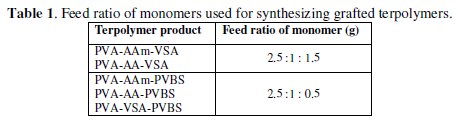
    <p>The feed ratio of reactants for synthesis of each grafted terpolymer is listed in 
<a href="#t1">Table 1</a>.</p>


    <p>&nbsp;</p>
<a name="t1">
<img src="/img/revistas/pea/v33n2/33n2a02t1.jpg">
    
<p>&nbsp;</p>


    ]]></body>
<body><![CDATA[<p>PVA (2.5 g; mol wt. 140,000), acrylamide/acrylic acid (1 g), and vinyl 
sulfonic acid sodium salt (1.5 g)/ p-vinyl sulfonic acid sodium salt (0.5 g) were 
dissolved in 80 mL of water. The whole reaction mixture was purged with 
nitrogen gas for half-an-hour. 10 mL of sodium dodecyl sulfonate solution (0.03 
g) were mixed into the reaction solution. The redox initiator pair potassium 
persulfate and 0.01 M of TEMED was added slowly to the reaction mixture in 
order to initiate the polymerization reaction. The reaction was allowed to 
continue for 3 hours. After 3 hours, the reaction mixture was added to five-fold 
volume of acetone and the final product was precipitated. The products were 
washed with acetone/water mixture to remove the unreacted monomers and 
homopolymers, dried under vacuum for 24 hours and utilized for further studies. 
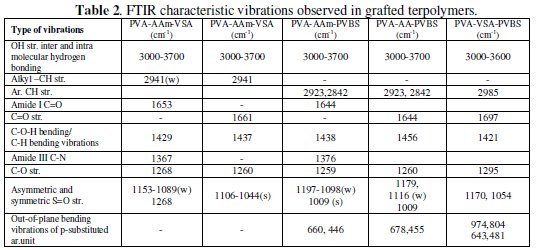
The terpolymer formation was confirmed from the FTIR characteristic vibrations 
<a href="#t2">(Table 2)</a>.</p>


    <p>&nbsp;</p>
<a name="t2">
<img src="/img/revistas/pea/v33n2/33n2a02t2.jpg">
    
<p>&nbsp;</p>


    <p><b><i>Materials</i></b></p>

    <p>Rectangular steel coupons with the size of 5 &times;1 &times; 0.3 cm were cut from the N-80 
steel casings (kindly supplied by ONGC) for static and dynamic weight loss 
studies, and with the size of 1.0 &times; 1.0&times; 0.3 cm electrode for electrochemical 
studies. N-80 steel used for the study contains the following composition: C 
(0.31 %), S (0.008 %), P (0.010 %),Si (0.19 %), Mn (0.92 %), Cr (0.20 %), and 
remaining of Fe. Corrosive solutions were 10 % HCl, 3.5 % NaCl and simulated 
oil well water prepared according to the procedure described by Azghandi et al. 
2012 [15]: 3.5 wt. % NaCl, 0.305 wt. % calcium chloride and 0.186 wt. % 
magnesium chloride hexahydrate were dissolved in water. 100 ppm of H2S were 
produced in the solution in-situ by adding 0.067 g of Na2S and 0.4 mL of HCl 
just before closing the bottles for studies. All the solutions were prepared with 
distilled water. The inhibitor stock solutions were prepared by dissolving 3 wt.% 
of each terpolymer in distilled water.</p>


    <p><b><i>Electrochemical studies</i></b></p>

    <p>The electrochemical measurements were carried out using a three-electrode cell 
assembly comprising of a saturated calomel electrode (reference), a platinum 
electrode (counter) and N-80 metal coupon as working electrode. The metallic 
coupons were dipped in three different media at 55&pm;5 &deg;C. Before each 
experiment, open circuit potential was measured for 1/2 hour in order to reach a 
steady state. Potentiodynamic polarisation was performed with a sweep rate of 2 
mV/s in the range of -0.1 V to -1 V with respect to the corrosion potential.</p>

    <p>Various corrosion kinetic parameters such as corrosion current density 
(I<sub>corr</sub>), corrosion potential (E<sub>corr</sub>), anodic and cathodic Tafel slopes (b<sub>a</sub> and b<sub>c</sub>) 
were obtained. Corrosion current density was measured from the 
intersection point obtained by the extrapolation of Tafel lines.</p>

    <p>The impedance measurement was performed using AC signals with 10 mV 
amplitude for the frequency range from 100 kHz to 0.01 Hz at corrosion 
potential. Solatron electrochemical analyzer model (1280 B) interfaced with IBM 
computer along with Corrware and Z plot softwares were used for data 
acquisition and analysis. EIS Analyzer software was used to fit the experimental 
results of EIS measurements using the appropriate equivalent circuit.</p>

    <p>The inhibition efficiency was calculated from corrosion current I<sub>corr</sub>, and Rct 
using the following relations.</p>


    ]]></body>
<body><![CDATA[<p>&nbsp;</p>
<a name="e1">
<img src="/img/revistas/pea/v33n2/33n2a02e1.jpg">
    
<p>&nbsp;</p>
<a name="e2">
<img src="/img/revistas/pea/v33n2/33n2a02e2.jpg">
    
<p>&nbsp;</p>


    <p>I<sup>0</sup><sub>corr</sub> and I<sub>corr</sub> are the corrosion current densities of uninhibited and inhibited 
solutions respectively. R<sub>ct</sub> and R<sup>0</sup><sub>ct</sub> are the charge transfer resistances of inhibited 
and uninhibited solutions, respectively.</p>


    <p><b><i>Gravimetric tests</i></b></p>

    <p>Before each test, N-80 steel coupons were degreased using xylene, followed by 
cleaning with water and acetone. Then the coupons were wiped using 
isopropanol to get a glassy finish. The cleaned metals were dried by wiping with 
a soft tissue and stored in a desiccator for an hour. All the tests were performed 
based on the ASTM standards G1, G170, NACE ID 182, item no. 24007 &amp; 
ONGC corporate specification for oil field chemicals.</p>


    <p><i>Static tests</i></p>

    <p>Corrosion rates were evaluated by exposing N-80 steel coupons to preheated 10 
% HCl/ 3.5 % NaCl/simulated well water for 6 hours at atmospheric pressure 
without and with 0.6 wt.% of inhibitors. The temperature was maintained at 55&pm;5 
&deg;C.</p>


    <p><i>Dynamic tests</i></p>

    <p>Similarly, the polymeric inhibitors were tested under dynamic conditions. 
Dynamic tests were performed using the Wheel test apparatus in R&amp;D laboratory 
of ONGC, Mumbai. Wheel test is widely used for assessment of the inhibitor 
film persistency during corrosion studies. The test solutions were filled in capped 
bottles, in which the weighed metal coupons were tied to the cap using a nylon 
thread. The bottles were placed tightly in the compartments of wheel test 
apparatus and the wheel was rotated using a motor at 55&pm;5 &deg;C for 6 hours at 
rotation speed of 25 rpm. After each test, the coupons were dipped in Clark's 
solution and rinsed with water thoroughly to remove any corrosion deposits. A 
final acetone wash was given before reweighing.</p>


    ]]></body>
<body><![CDATA[<p>&nbsp;</p>
    <p><b>Results and discussion</b></p>

    <p><b><i>Potentiodynamic polarisation</i></b></p>

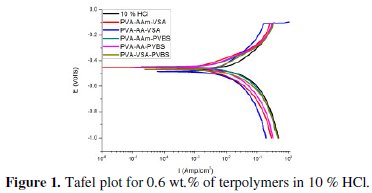
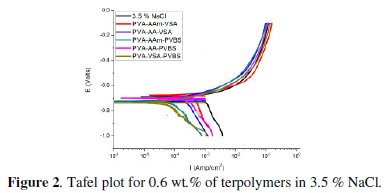
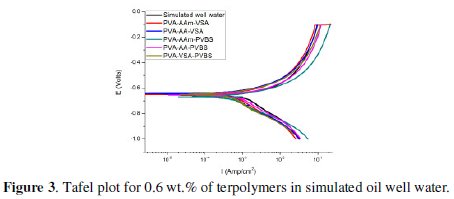
    <p>The anodic and cathodic polarisation curves for N-80 steel in absence and 
presence of 0.6 wt.% of each inhibitor in HCl, 3.5 % NaCl and simulated 
petroleum corrosive solution are shown in <a href="#f1">Figs. 1</a>, 
<a href="#f2">2</a> and <a href="#f3">3</a>.</p>


    <p>&nbsp;</p>
<a name="f1">
<img src="/img/revistas/pea/v33n2/33n2a02f1.jpg">
    
<p>&nbsp;</p>
<a name="f2">
<img src="/img/revistas/pea/v33n2/33n2a02f2.jpg">
    
<p>&nbsp;</p>
<a name="f3">
<img src="/img/revistas/pea/v33n2/33n2a02f3.jpg">
    
<p>&nbsp;</p>


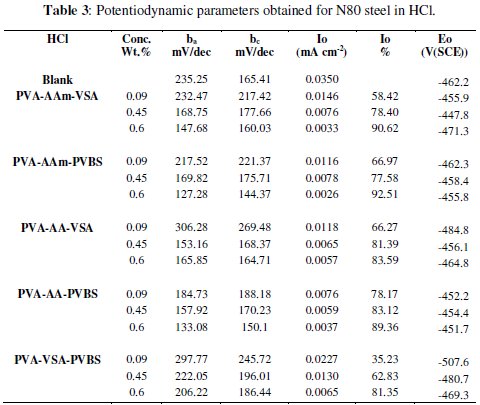
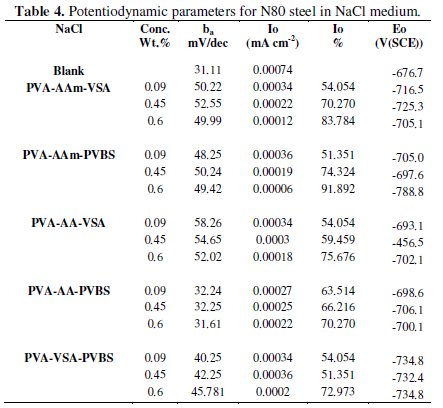
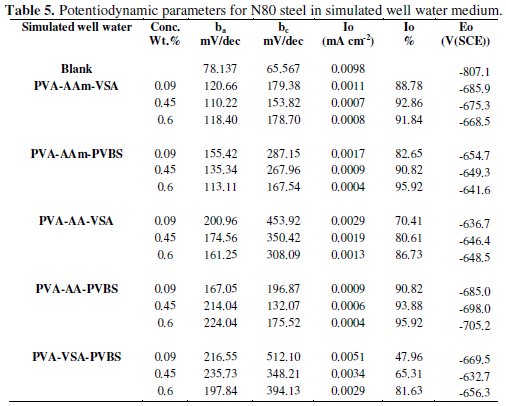
    <p>The intersection point 
of Tafel regions gives the corrosion current density (I<sub>corr</sub>). The obtained 
polarisation parameters b<sub>a</sub>, b<sub>c</sub>, I<sub>corr</sub> and E<sub>corr</sub> in the different media are given in 
<a href="#t3">Tables 3-5</a>.</p>


    <p>&nbsp;</p>
<a name="t3">
<img src="/img/revistas/pea/v33n2/33n2a02t3.jpg">
    
]]></body>
<body><![CDATA[<p>&nbsp;</p>
<a name="t4">
<img src="/img/revistas/pea/v33n2/33n2a02t4.jpg">
    
<p>&nbsp;</p>
<a name="t5">
<img src="/img/revistas/pea/v33n2/33n2a02t5.jpg">
    
<p>&nbsp;</p>


    <p><i>Potentiodynamic polarisation in HCl</i></p>

    <p>In the polarisation curves obtained from HCl medium, both the anodic and 
cathodic regions are shifted to lower corrosion current density region on inhibitor 
addition. This indicates that terpolymer compounds are adsorbed on the metal 
surface rendering inhibition effect. The Tafel curves are quite parallel in nature 
indicating that the hydrogen evolution is activation controlled and the mechanism 
is not altered after addition of the inhibitor [16]. The variation in the Tafel slopes 
is an indication of change in reaction kinetics. The addition of inhibitor 
diminishes the Tafel slope values when compared to that of blank HCl. This is 
because when the anodic and cathodic regions are polarized, the reaction kinetics 
speed up in inhibited solution when compared to that of blank. Since the 
inhibitors in HCl medium influence both the cathodic and anodic reactions, the 
inhibitors can be concluded to be of mixed-type [17,18]. The change in the 
corrosion potential is less than 85 mV which again proves mixed type inhibition 
[19]. It can also be explained that the inhibitor basically reduces the surface area 
prone to corrosion reaction and neither alters the reaction process of anode nor 
cathode. The inspection of the results in the Table indicates that terpolymers 
decrease the corrosion current density in the studied range of concentrations 
providing a maximum inhibition in the range of 80-92 % for 0.6 wt. % 
concentration of the respective inhibitors. A maximum IE of 92 % and 90 % is 
obtained for PVA-AAm-PVBS and PVA-AAm-VSA respectively, followed by 
PVA-AA-PVBS, PVA-AA-VSA and PVA-VSA-PVBS.</p>


    <p><i>Potentiodynamic polarisation in 3.5 % NaCl</i></p>

    <p>The polarisation curves obtained for N-80 steel in 3.5 % NaCl clearly show 
trans-active, passive and trans-passive characteristics which is in agreement with 
the curves obtained for NaCl medium in literature [20,21]. The addition of the 
terpolymers makes the corrosion potential E<sub>corr</sub> to remain constant/ shift slightly 
in the negative direction, simultaneously reducing both the anodic and cathodic 
current densities. The inhibition of both anodic and cathodic reactions along with 
minimal change in corrosion potential values to that of blank is an indication of 
change in the inhibition mechanism in neutral medium, i.e., the inhibitor's usual 
function of blocking active sites is changed to geometric blocking effect in the 
presence of the corrosion products [11]. However, since the shift in the E<sub>corr</sub> 
values is not more than 85 mV, the inhibitor can be considered only as of the 
mixed type. As far as the Tafel slopes are considered, accurate evaluation of the 
Tafel slopes is not possible as the polarisation curve does not exhibit a linear 
Tafel region. In that case, corrosion rate can be determined by considering either 
anodic or cathodic region alone. In the absence of oxygen, the dominant reaction 
is H<sup>+</sup> ion reduction because of the high H<sup>+</sup> ion concentration. In the presence of 
oxygen the dominant reaction is however the oxygen reduction which is a multi 
electron reaction involving various intermediates. Due to the slow diffusion of 
oxidizing species, potentiodynamic polarisation can act to shorten the linear 
cathodic region. Sometimes linearity may entirely disappear, then cathodic 
reaction will be under combined activation and diffusion control at E<sub>corr</sub> [22,23]. 
Hence cathodic region cannot be considered for evaluation of corrosion current.</p>

    <p>So, anodic region is preferred for the evaluation of the corrosion current and 
Tafel slopes (b<sub>a</sub>) [24] and are listed in <a href="#t4">Table 4</a>. The curvature of the anodic 
region can be attributed to the deposition of corrosion products. 
The I<sub>corr</sub> values are significantly reduced upon the addition of inhibitor in all 
cases furnishing a maximum IE in the range of 50-91 % for 0.6 wt.% 
concentration of the inhibitors. These effects could be due to the adsorption of 
long chains of the terpolymer inhibitor onto the metal surface thus producing a 
barrier film and consequently minimizing the anodic metal dissolution and 
cathodic hydrogen evolution. The IE calculated from the I<sub>corr</sub> values for 0.6 wt.% 
inhibitor concentration has the following trend: PVA-AAm-PVBS &gt; PVA-AAm-
VSa &gt; PVA-AA-VSA &gt; PVA-VSA-PVBS &gt; PVA-AA-PVBS.</p>


    <p><i>Potentiodynamic polarisation in simulated oil well water</i></p>

    <p>The polarisation curves obtained for N-80 steel in simulated oil well water show 
that, the addition of the terpolymers shifts the corrosion potential (E<sub>corr</sub>) to noble 
directions. The presence of sulphide ions in sodium chloride medium increases 
the acidity of the solution due to local acidification caused by iron sulphide 
formation. This non-protective iron sulphide film is responsible for corrosion 
attack of metal in blank solution. In this case the cathodic region shows a normal 
Tafel behaviour because the reduction of oxygen is not a dominant reaction [25] 
as that occurring in 3.5 % NaCl medium. This shift in E<sub>corr</sub> values is more than 85 
mV in positive direction which indicates that the terpolymers are predominantly 
an anodic inhibitor. The large transition in the E<sub>corr</sub> values is related to the active 
site blocking effect of the inhibitor. The anodic curve for the N-80 steel in 
simulated water exhibits distinct regions, which are the active dissolution 
(apparent Tafel region) and the transition region. The curvature in the anodic 
branch can be attributed to the film formation. Both the Tafel slopes were 
enhanced with respect to blank, indicating that the inhibitors suppressed both the 
anodic and cathodic processes and behave as mixed-type inhibitors with 
predominant action on anodic areas [26]. The corrosion current densities were 
calculated by extrapolation of anodic and cathodic Tafel lines. From <a href="#t6">Table 6</a>, it is 
evident that I<sub>corr</sub> decreases from 0.0098 mA/cm<sup>2</sup> in blank to range of 0.004 0.0029 
mA/cm<sup>2</sup> in inhibited acid.</p>


    ]]></body>
<body><![CDATA[<p>&nbsp;</p>
<a name="t6">
<img src="/img/revistas/pea/v33n2/33n2a02t6.jpg">
    
<p>&nbsp;</p>


    <p>The IE rendered by the terpolymers in 
simulated oil well water was found to follow the same trend as that of HCl 
medium.</p>


    <p><b><i>Impedance spectroscopy</i></b></p>

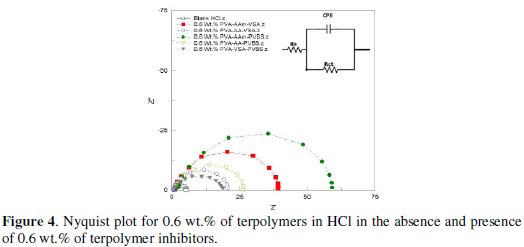
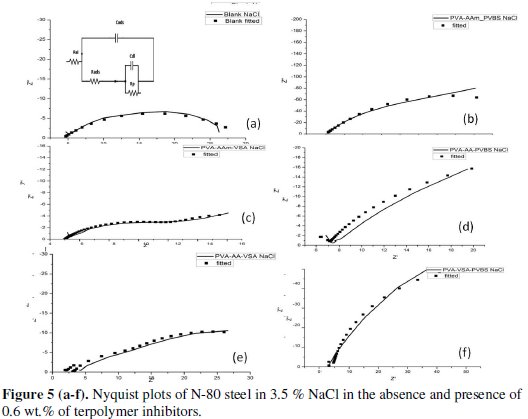
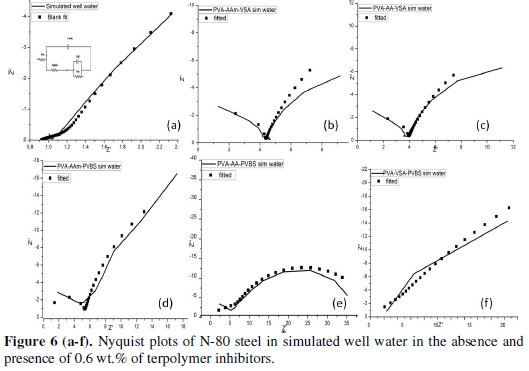
    <p><a href="#f4">Fig.4-6</a> show the Nyquist plots for N80 steel in 10 % HCl, 3.5 % NaCl and 
simulated well water in the presence and absence of 0.6 wt. % of the PVA-AAm-
VSA, PVA-AA-VSA, PVA-AAm-PVBS, PVA-AA-PVBS and PVA-VSAPVBS, 
generated at 55&pm;5 &deg;C.</p>


    <p>&nbsp;</p>
<a name="f4">
<img src="/img/revistas/pea/v33n2/33n2a02f4.jpg">
    
<p>&nbsp;</p>
<a name="f5">
<img src="/img/revistas/pea/v33n2/33n2a02f5.jpg">
    
<p>&nbsp;</p>
<a name="f6">
<img src="/img/revistas/pea/v33n2/33n2a02f6.jpg">
    
<p>&nbsp;</p>


    <p>The equivalent circuit models used for fitting data 
are presented as inset in the respective Nyquist plots. This pure electric model 
can verify or rule out mechanistic models and enable the calculation of numerical 
values corresponding to the physical and/or chemical properties of the 
electrochemical system under investigation. The data acquired by fitting the 
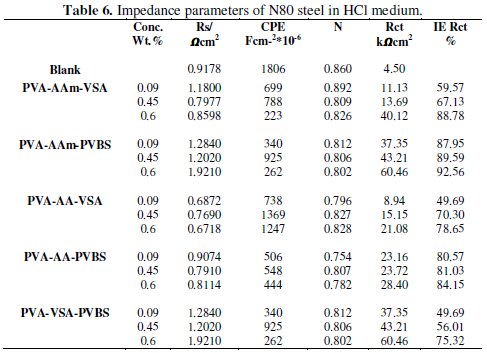
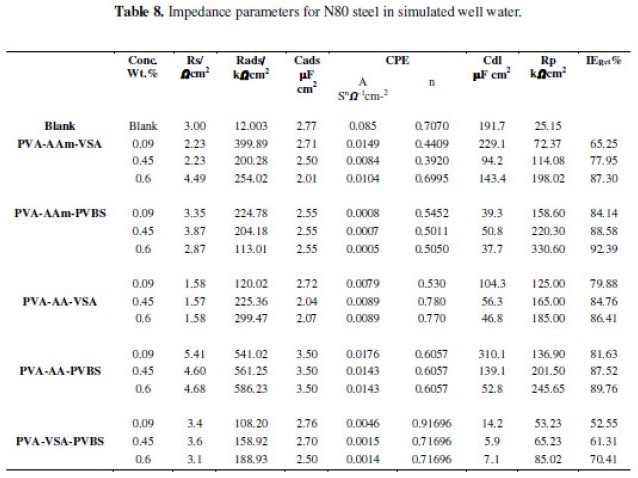
equivalent circuit for all the systems are listed in <a href="#t6">Tables 6</a>, <a href="#t7">7</a> 
and <a href="#t8">8</a>.</p>


    ]]></body>
<body><![CDATA[<p>&nbsp;</p>
<a name="t7">
<img src="/img/revistas/pea/v33n2/33n2a02t7.jpg">
    
<p>&nbsp;</p>
<a name="t8">
<img src="/img/revistas/pea/v33n2/33n2a02t8.jpg">
    
<p>&nbsp;</p>


    <p><i>Impedance analysis in HCl</i></p>

    <p>For iron dissolution in acid, the equivalent circuit is designed with a resistor and 
capacitor in parallel with each other. Three types of resistances can be taken into 
account: solution resistance, polarisation resistance and charge transfer 
resistance. Solution resistance is the ionic solution resistance which depends 
upon ionic concentration, type of ions, temperature and geometry of the area in 
which current is carried. The interface of the metal in the electrolyte is 
envisioned as the space that exists between array of ions on the electrode surface 
and array of solvated ions away from the surface. The two arrays of ions can 
store charge in themselves and act as a capacitor element. The capacitance thus 
generated is called the double layer capacitance, C<sub>dl</sub>. The double layer capacitor 
can also lead to a resistor providing charge transfer resistance, as the charge is 
transferred during the metal dissolution. The Nyquist plot for Randle's cell 
consisting of the above elements is always a semicircle. The solution resistance 
can be determined from the real axis value at the high frequency intercept. This is 
the intercept near the origin of the plot. The low frequency region gives us the 
sum of solution resistance and polarisation resistance.</p>

    <p><a href="#f4">Fig. 4</a> shows the impedance response of 0.6 wt.% of each inhibitor on N80 steel 
in 10 % HCl. The impedance diagram consists of a single semicircle indicating a 
single charge transfer reaction. The shape of the semicircle is depressed in nature 
from high to medium frequency region which is an indication of micro-roughness 
and other inhomogeneties of the working electrode during the reaction [27]. 
Nevertheless, introduction of the inhibitors increases the diameter of the 
capacitive semicircle with respect to corrosion mitigating capability of the 
inhibitor. The values of Rct in the presence of inhibitors are higher than in their 
absence, indicating the formation of protective film on the metal/solution 
interface [28]. The Cdl values were calculated at the frequency fmax, at which the 
imaginary component of the impedance is maximal (Z'') by the following 
equation:</p>


    <p>&nbsp;</p>
<a name="e3">
<img src="/img/revistas/pea/v33n2/33n2a02e3.jpg">
    
<p>&nbsp;</p>


    <p>But the double layer capacitance (C<sub>dl</sub>) value is affected by certain imperfections 
of the surface, and this effect is simulated via a constant phase element (CPE). 
The Cdl value is calculated using the following formula:</p>


    <p>&nbsp;</p>
<a name="e4">
<img src="/img/revistas/pea/v33n2/33n2a02e4.jpg">
    
]]></body>
<body><![CDATA[<p>&nbsp;</p>


    <p>It is worth mentioning that the parameter n quantifies different physical 
phenomena like surface in-homogeneities in the form of surface roughness, 
adsorption of inhibitor, and pores in the adsorbed layer and so on. CPE can 
correspond to resistor (when n=0), capacitor (when n =1), inductor (when n=-1) 
and Warburg impedance (when n=0.5). In this case, n value is close to unity 
representing that the CPE is a capacitor element [29].</p>

    <p>The addition of polymeric inhibitors obviously increased the values of Rct and 
lowered the values of double layer capacitance. The constant phase elements 
(CPEs) with their n values close to unity represent double layer capacitors with 
some pores [30]. When the value of n ranges between 0.74 and 0.86, it can be an 
indication of the charge transfer process controlling the dissolution mechanism 
[29].</p>

    <p>The decrease in CPEs with increase in inhibitor concentrations is expected as an 
effect of coverage of the charged surfaces and thereby reduction of capacitive 
effects [31]. Singh et al. 2010 [32] and Bentiss et al. 2000 [33] explain that 
decrease in Cdl values is probably an effect of decrease in local dielectric constant 
and/or an increase in the thickness of the inhibitor layer on metal/solution 
interface. The decrease in the effective surface area which acts as a place for 
charging is also a reason for decrease in Cdl. The IE calculated from the Rct 
values shows that maximum IE is rendered by acrylamide terpolymers followed 
by acrylic acid terpolymers and sulfonate polymers.</p>


    <p><i>Impedance analysis in 3.5 % NaCl and simulated oil well water</i></p>

    <p>Observation of the <a href="#f5">Figs. 5(a-f)</a> shows that the diameter of the semicircles is higher 
(from high frequency to low frequency region) for the inhibited solution when 
compared to that of the blank solution, indicating the formation of a protective 
film or reduction in corrosion rate after the addition of inhibitors. The Nyquist 
plots for NaCl reflect unduly an elongated semicircle indicating that there is a 
dispersion of time constants, i.e., the elongated semicircle can be considered as 
two overlapping semicircles. This high frequency semicircle is associated with 
the dielectric property of the film whereas the low frequency semicircle is 
attributed to the diffusion process. The flattened Nyquist plots reveal that there is 
formation of corrosion products and/or incrustation, hence the corrosion process 
at the low frequency region can be assumed to be controlled by diffusion [34]. 
The change in the shape of the impedance plots among the investigated polymers 
reveals the difference in the protective layer formed by the inhibitors, which is 
reinforced on the charge transfer surface layer [15]. Various resistances may 
operate in the neutral corrosion reactions that include charge transfer resistance 
Rct, diffuse layer resistance Rd, resistance of film Rf and resistance created by 
accumulated species Ra. The total resistance of the system is taken as Rp; Rp = Rct + 
Rd + Ra + Rf. The IE calculated from the Rct values for 0.6 wt.% inhibitor 
concentration has the following trend: PVA-AAm-PVBS &gt; PVA-AA-VSA &gt; PVA-AAm-VSA &gt; 
PVA-AA-PVBS &gt; PVA-VSA-PVBS.</p>

    <p>The Nyquist plot obtained for simulated well water (<a href="#f6">Figs. 6(a-f)</a>) shows a straight 
line at the high frequency region and an unduly elongated semicircle at the low 
frequency region. The low frequency region in the real axis is attributed to the 
total resistance, i.e., sum of electronic resistance of the active material, contact 
resistance with the current collector, and electrolyte resistance. The straight line 
in the low frequency region is an indication of diffusion-controlled process. The 
straight lines appear with slopes of 45-90&deg; indicating diffusive resistance of the 
electrolyte in electrode pores and the cation diffusion in the host materials [35]. 
The slope of the straight line is larger for the inhibitor added solution when 
compared with that of blank simulated well water solution which denotes a lower 
diffusive resistance of the electrode after inhibitor addition.</p>

    <p>The circuit used for fitting NaCl/simulated well water contains elements that can 
be described as follows: R<sub>ads</sub>/C<sub>ads</sub> is the high frequency time constant attributed to 
the adsorption of the inhibitor and R<sub>p</sub>/C<sub>dl</sub> is the low frequency time constant 
attributed to the defect sites where charge transfer processes take place [15,21]. 
This situation arises when the charge transfer resistance for anion exchange is 
larger than the relaxation of cations at the surface of the film [36]. The data 
presented in <a href="#t7">Tables 7</a> and <a href="#t8">8</a> reveal that progressive addition of polymeric 
inhibitors obviously increased the values of Rp and inhibition efficiency 
calculated from Rp and lowered the values of double layer capacitance 
corresponding to the high-frequency semicircle. The decrease in C<sub>dl</sub> values is 
due to the adsorption of the inhibitor on the electrode surface. The IE rendered by 
the terpolymers in simulated oil well water was found to follow the same trend as 
that of HCl medium.</p>


    <p><b><i>Weight loss</i></b></p>

    <p>The persistency of the inhibitor action is a vital aspect in assessing the efficiency 
of an inhibitor. During the application of inhibitors in oil and gas wells and 
flowlines, continuous supply of an inhibitor may not be possible. When the 
inhibitor is applied at a low concentration continuously it is cumbersome to meet 
the adequate requirement throughout the pipeline [37]. Hence, persistency of 
inhibitive action can therefore be considered as a primary criterion for evaluation 
of inhibitors, and in the present study it is carried out under static and dynamic 
conditions by weight loss method. From the electrochemical studies, it can be 
observed that a maximum inhibition efficiency (IE) was obtained for the highest 
concentration (0.6 wt.%) of the inhibitors under investigation. Hence 0.6 wt.% 
was fixed as optimum inhibitor concentration and further evaluation of corrosion 
protection efficiency was carried out under static and dynamic conditions. 
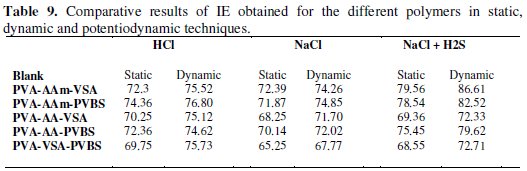
<a href="#t7">Table 7</a> collects the IE obtained for five grafted terpolymers on N80 steel under static 
and dynamic conditions. The values of IE obtained under static conditions are 
lesser than that obtained for dynamic conditions. This can be attributed to the 
following reasons:</p>

    ]]></body>
<body><![CDATA[<p>1. The easy adsorption of inhibitor molecules on the metal surface even in short 
contact time, i.e., in dynamic conditions the metal comes in contact with the 
inhibitor solution in gradual intervals during each rotation.</p>

    <p>2. The splashing force of the inhibitor solution could have also helped the 
adsorption of the inhibitors.</p>

    <p>3. The persistency of the adsorbed molecules on the surface which also shows 
the chemisorption of the inhibitor molecules.</p>

    <p>As far as the corrosive media are concerned, the inhibitors were found to work 
well in simulated well water followed by HCl and NaCl. Sulphuric acid is 
formed in simulated well water by reaction of H2S with the dissolved oxygen. 
The sulphur-containing compounds generally work well in sulphuric acid 
medium thus imparting a highest efficiency [38, 39]. All the inhibitors under 
investigation contain sulphur which could have contributed to the highest 
inhibition in simulated well water. The highest efficiency is however observed 
for inhibitors containing acrylamide along with sulfonate. The inhibition 
efficiency is slightly reduced in HCl medium. In HCl medium the adsorption of 
inhibitors predominantly occurs through electrostatic interaction with the 
chloride ions on the metal surface. This electrostatic interaction could have been 
reduced at the studied temperature (60 &deg;C). In 3.5 % NaCl solution, due to weak 
electrostatic interactions, the inhibition efficiency is smaller than the others. 
From these observations, the inhibition efficiency of the terpolymers can be 
related to the hetero atom population and their interaction with the metal which 
will be discussed in detail the forthcoming section.</p>


    <p><b><i>Mechanism</i></b></p>

    <p>The adsorption process is affected by many factors including chemical structure 
of the inhibitor, hetero atom population, total charges present and their 
distribution over the inhibitor molecule. A corrosion inhibitor actually functions 
by reacting with the metal ion that is newly produced in the corrosive medium, 
but in a plane very near or on the metal surface [40]. The adsorption can be 
physical or chemical in nature. Four types of adsorption may take place by the 
inhibitor molecules at the metal-solution interface [41]:</p>

    <p>&bull; electrostatic attraction between the charged molecules and the charged metal;</p>

    <p>&bull; interaction of uncharged electron pairs in the molecule with the metal;</p>

    <p>&bull; interaction of p electrons with the metal, and </p>

    <p>&bull; combination of 1 and 3.</p>

    ]]></body>
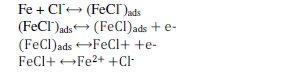
<body><![CDATA[<p>As far as the metal surface is considered, it undergoes following types of 
reactions in different corrosive media. The anodic reaction of iron in HCl is 
given by Solamaz et al. (2011) [42].</p>


    <p>&nbsp;</p>
<a name="m1">
<img src="/img/revistas/pea/v33n2/33n2a02m1.jpg">
    
<p>&nbsp;</p>


    <p>The cathodic hydrogen dissolution is given as follows</p>


    <p>&nbsp;</p>
<a name="m2">
<img src="/img/revistas/pea/v33n2/33n2a02m2.jpg">
    
<p>&nbsp;</p>


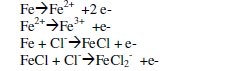
    <p>The corrosion of iron in neutral or saline media is given as [43,44]:</p>


    <p>&nbsp;</p>
<a name="m3">
<img src="/img/revistas/pea/v33n2/33n2a02m3.jpg">
    
<p>&nbsp;</p>


    <p>Meanwhile, iron develops oxide layers that partially protect the surface being 
attacked by chloride ions. It was also found that iron could develop nine different 
types of oxide phases on their surfaces. The oxide formation occurs according to 
the following equations</p>


    ]]></body>
<body><![CDATA[<p>&nbsp;</p>
<a name="m4">
<img src="/img/revistas/pea/v33n2/33n2a02m4.jpg">
    
<p>&nbsp;</p>


    <p>The chemical reaction proposed for iron dissolution in neutral media containing 
hydrogen sulphide is shown below.</p>


    <p>&nbsp;</p>
<a name="m5">
<img src="/img/revistas/pea/v33n2/33n2a02m5.jpg">
    
<p>&nbsp;</p>


    <p>It is also assumed that iron dissolution does not occur immediately, before which 
a fast oxidation of solid iron occurs and transforms directly into iron sulphide. 
Then the iron sulphide is strongly adhered on the metal surface, but still this 
mechanism is under question including the role of various factors that influence 
the formation of different types of sulphide products.</p>

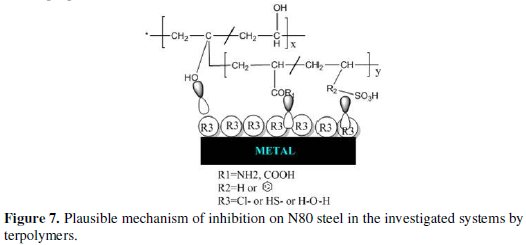
    <p>The terpolymer under investigation has electron rich centres that aid in 
adsorption of the inhibitors, as given in <a href="#f7">Fig. 7</a>.</p>


    <p>&nbsp;</p>
<a name="f7">
<img src="/img/revistas/pea/v33n2/33n2a02f7.jpg">
    
<p>&nbsp;</p>


    <p>In the present study, 
polyacrylamide (cationic) polymeric inhibitors probably adsorb by electrostatic 
interaction between the positively charged nitrogen atom (N<sup>+</sup>) and the negatively 
charged metal surface. The metal surface becomes negative charged due to the 
adsorption of chloride ions from HCl/NaCl and HS-ions from simulated well 
water. This prevents any H<sup>+</sup> getting nearer to the metal surface [45,46]. The 
COO<sup>-</sup> anions of polyacrylic acid polymers, and SO<sub>3</sub><sup>-</sup> anions of sulfonate 
polymers electrostatically form linkages with the positive sites of the metal. All 
the investigated polymers have hydrophilic segments in which the lone electron 
pairs of the oxygen atoms form coordinate bonds with the empty orbitals of iron 
atoms. The inhibitive effect can also be due to the formation of bonds between 
the empty d-orbital of iron atoms and the lone pair of electrons present in the N, 
O and S atoms of the whole terpolymer [47,48]. The protective ability of the 
sulphur compounds is governed by the fact of greater polarization of C-S bonds 
[49].</p>

    ]]></body>
<body><![CDATA[<p>The PVBS polymers also get attracted to the metal surface through the &pi; 
electrons on the benzene ring. While the &pi; orbital of the inhibitor molecule 
donates electrons to the empty orbital of the metal atom, there is also possibility 
of &pi;* orbital to accept electrons from the metal orbital thereby forming feedback 
bonds [50].</p>

    <p>A hydrophobic, dense and defect-free monolayer is formed by the neighbouring 
alkyl chains through van der Walls' forces, which acts as a barrier between the 
metal surface and the corrosive environment, thereby protecting the iron surface 
from corrosion [51,52]. It is worth mentioning the metal chelating property of the 
polychelatogen poly(acrylic acid-co-vinyl sulfonic acid) discussed by Rivas et al. 
(2003) [52], which further supports the inhibitive mechanism of polyacrylic acid 
containing terpolymers through complex formation. These complexes might be 
adsorbed on the steel surface through van der Walls' forces and forms a barrier 
layer to prevent from corrosion. Depending upon the population of hetero atoms, 
pi bonds, unshared electron pair and electrostatic charges, the order of inhibition 
of the terpolymers obtained in different techniques is well in agreement with the 
order as shown below.</p>

    <p>PVA-AAm-PVBS(O+N+S+phenl moiety) &gt; PVA-AAm-VSA (O+N+S) &gt; PVAAA-
PVBS (O+S+phenyl moiety) &gt; PVA-AA-VSA (O+S) &gt; PVA-VSA-PVBS 
(O+S+phenyl moiety).</p>


    <p>&nbsp;</p>
    <p><b>Conclusions</b></p>

    <p>Among the five terpolymers investigated, acrylamide terpolymers were found to 
be effective in controlling the corrosion of different media. The potentiodynamic 
polarisation study shows that the corrosion currents are minimized by the 
addition of the inhibitor. The IE was well pronounced in simulated oil well water 
followed by HCl and 3.5% NaCl. The inhibitors action persistency analysed by 
static and dynamic weight loss method shows that the inhibitor action is 
persistent in dynamic conditions (<a href="#t9">Table 9</a>).</p>


    <p>&nbsp;</p>
<a name="t9">
<img src="/img/revistas/pea/v33n2/33n2a02t9.jpg">
    
<p>&nbsp;</p>


    <p>Hence the inhibitors can be optimized 
and recommended for usage in oil wells containing sour corrosion problems.</p> 


    <p>&nbsp;</p>
    ]]></body>
<body><![CDATA[<p><b>References</b></p>

    <!-- ref --><p>1. Williams D A, Holifield P K, Looney J R, et al. US Patent 5209859. 1993.    &nbsp;&nbsp;&nbsp;&nbsp;&nbsp;&nbsp;&nbsp;&nbsp;[&#160;<a href="javascript:void(0);" onclick="javascript: window.open('/scielo.php?script=sci_nlinks&ref=000134&pid=S0872-1904201500020000200001&lng=','','width=640,height=500,resizable=yes,scrollbars=1,menubar=yes,');">Links</a>&#160;]<!-- end-ref --></p>

    <!-- ref --><p>2. Baddini S P, Cardoso E, Hollauer J A, et al. Electrochim Acta. 2007;53:434.    &nbsp;&nbsp;&nbsp;&nbsp;&nbsp;&nbsp;&nbsp;&nbsp;[&#160;<a href="javascript:void(0);" onclick="javascript: window.open('/scielo.php?script=sci_nlinks&ref=000136&pid=S0872-1904201500020000200002&lng=','','width=640,height=500,resizable=yes,scrollbars=1,menubar=yes,');">Links</a>&#160;]<!-- end-ref --></p>

    <!-- ref --><p>3. Sherif E S M. Ind Eng Chem Res. 2013;52:14507.    &nbsp;&nbsp;&nbsp;&nbsp;&nbsp;&nbsp;&nbsp;&nbsp;[&#160;<a href="javascript:void(0);" onclick="javascript: window.open('/scielo.php?script=sci_nlinks&ref=000138&pid=S0872-1904201500020000200003&lng=','','width=640,height=500,resizable=yes,scrollbars=1,menubar=yes,');">Links</a>&#160;]<!-- end-ref --></p>

    <!-- ref --><p>4. Quraishi M A, Jamal D. 2001;71:202.    &nbsp;&nbsp;&nbsp;&nbsp;&nbsp;&nbsp;&nbsp;&nbsp;[&#160;<a href="javascript:void(0);" onclick="javascript: window.open('/scielo.php?script=sci_nlinks&ref=000140&pid=S0872-1904201500020000200004&lng=','','width=640,height=500,resizable=yes,scrollbars=1,menubar=yes,');">Links</a>&#160;]<!-- end-ref --></p>

    <!-- ref --><p>5. Haldar N, Shukla H S, Udhayabhanu G. Ind J Chem Technol. 2012;19:173.    &nbsp;&nbsp;&nbsp;&nbsp;&nbsp;&nbsp;&nbsp;&nbsp;[&#160;<a href="javascript:void(0);" onclick="javascript: window.open('/scielo.php?script=sci_nlinks&ref=000142&pid=S0872-1904201500020000200005&lng=','','width=640,height=500,resizable=yes,scrollbars=1,menubar=yes,');">Links</a>&#160;]<!-- end-ref --></p>

    <!-- ref --><p>6. Prakash D, Singh R K, Kumari R. Ind J Chem Technol. 2006;13:555.    &nbsp;&nbsp;&nbsp;&nbsp;&nbsp;&nbsp;&nbsp;&nbsp;[&#160;<a href="javascript:void(0);" onclick="javascript: window.open('/scielo.php?script=sci_nlinks&ref=000144&pid=S0872-1904201500020000200006&lng=','','width=640,height=500,resizable=yes,scrollbars=1,menubar=yes,');">Links</a>&#160;]<!-- end-ref --></p>

    <!-- ref --><p>7. Amosa M K, Mohammed I A, Yaro S A, et al. NAFTA. 2010;61:239.    &nbsp;&nbsp;&nbsp;&nbsp;&nbsp;&nbsp;&nbsp;&nbsp;[&#160;<a href="javascript:void(0);" onclick="javascript: window.open('/scielo.php?script=sci_nlinks&ref=000146&pid=S0872-1904201500020000200007&lng=','','width=640,height=500,resizable=yes,scrollbars=1,menubar=yes,');">Links</a>&#160;]<!-- end-ref --></p>

    <!-- ref --><p>8. Khaled K F, Int J Electrochem Sci. 2008;8:462.    &nbsp;&nbsp;&nbsp;&nbsp;&nbsp;&nbsp;&nbsp;&nbsp;[&#160;<a href="javascript:void(0);" onclick="javascript: window.open('/scielo.php?script=sci_nlinks&ref=000148&pid=S0872-1904201500020000200008&lng=','','width=640,height=500,resizable=yes,scrollbars=1,menubar=yes,');">Links</a>&#160;]<!-- end-ref --></p>

    <!-- ref --><p>9. Growcock F B, Lopp U R. Corros Sci. 1988;28:397.    &nbsp;&nbsp;&nbsp;&nbsp;&nbsp;&nbsp;&nbsp;&nbsp;[&#160;<a href="javascript:void(0);" onclick="javascript: window.open('/scielo.php?script=sci_nlinks&ref=000150&pid=S0872-1904201500020000200009&lng=','','width=640,height=500,resizable=yes,scrollbars=1,menubar=yes,');">Links</a>&#160;]<!-- end-ref --></p>

    <!-- ref --><p>10. Zeng H, Zhao S X, Li Y W. Corrosion inhibition and antibacterial effects of 
copolymer NIPAM-co-BPCP on N80 steel panel. Academy of life science 
and chemistry, Xinjiang Normal University, Urumugi-830054; 2009.    &nbsp;&nbsp;&nbsp;&nbsp;&nbsp;&nbsp;&nbsp;&nbsp;[&#160;<a href="javascript:void(0);" onclick="javascript: window.open('/scielo.php?script=sci_nlinks&ref=000152&pid=S0872-1904201500020000200010&lng=','','width=640,height=500,resizable=yes,scrollbars=1,menubar=yes,');">Links</a>&#160;]<!-- end-ref --></p>

    <!-- ref --><p>11. Okafor P C, Liu C B, Liu X., et al. J Solid State Electrochem. 2009;14:1367.    &nbsp;&nbsp;&nbsp;&nbsp;&nbsp;&nbsp;&nbsp;&nbsp;[&#160;<a href="javascript:void(0);" onclick="javascript: window.open('/scielo.php?script=sci_nlinks&ref=000154&pid=S0872-1904201500020000200011&lng=','','width=640,height=500,resizable=yes,scrollbars=1,menubar=yes,');">Links</a>&#160;]<!-- end-ref --></p>

    <!-- ref --><p>12. Finsgar M, Fassbender S, Hirth S et al. Mater Chem Phys. 2009;116:198.    &nbsp;&nbsp;&nbsp;&nbsp;&nbsp;&nbsp;&nbsp;&nbsp;[&#160;<a href="javascript:void(0);" onclick="javascript: window.open('/scielo.php?script=sci_nlinks&ref=000156&pid=S0872-1904201500020000200012&lng=','','width=640,height=500,resizable=yes,scrollbars=1,menubar=yes,');">Links</a>&#160;]<!-- end-ref --></p>

    <!-- ref --><p>13. Finsgar M, Fassbender S, Nicolini F, et al. Corros Sci. 2009;51:525.    &nbsp;&nbsp;&nbsp;&nbsp;&nbsp;&nbsp;&nbsp;&nbsp;[&#160;<a href="javascript:void(0);" onclick="javascript: window.open('/scielo.php?script=sci_nlinks&ref=000158&pid=S0872-1904201500020000200013&lng=','','width=640,height=500,resizable=yes,scrollbars=1,menubar=yes,');">Links</a>&#160;]<!-- end-ref --></p>

    <!-- ref --><p>14. Gao J, Weng Y, Salitanate S, et al. Petrol Sci. 2009;6:201.    &nbsp;&nbsp;&nbsp;&nbsp;&nbsp;&nbsp;&nbsp;&nbsp;[&#160;<a href="javascript:void(0);" onclick="javascript: window.open('/scielo.php?script=sci_nlinks&ref=000160&pid=S0872-1904201500020000200014&lng=','','width=640,height=500,resizable=yes,scrollbars=1,menubar=yes,');">Links</a>&#160;]<!-- end-ref --></p>

    <!-- ref --><p>15. Azghandi M V, Davoodi A, Farzi G A, et al. Corros Sci. 2012;64:44.    &nbsp;&nbsp;&nbsp;&nbsp;&nbsp;&nbsp;&nbsp;&nbsp;[&#160;<a href="javascript:void(0);" onclick="javascript: window.open('/scielo.php?script=sci_nlinks&ref=000162&pid=S0872-1904201500020000200015&lng=','','width=640,height=500,resizable=yes,scrollbars=1,menubar=yes,');">Links</a>&#160;]<!-- end-ref --></p>

    <!-- ref --><p>16. Bentiss F, Jama C, Mernari B, et al. Corros Sci. 2009;51:1628.    &nbsp;&nbsp;&nbsp;&nbsp;&nbsp;&nbsp;&nbsp;&nbsp;[&#160;<a href="javascript:void(0);" onclick="javascript: window.open('/scielo.php?script=sci_nlinks&ref=000164&pid=S0872-1904201500020000200016&lng=','','width=640,height=500,resizable=yes,scrollbars=1,menubar=yes,');">Links</a>&#160;]<!-- end-ref --></p>

    <!-- ref --><p>17. Azghandi M V, Davoodi A, Farzi G A, et al. Metallurgical Mater Trans A. 2013;44:5493.    &nbsp;&nbsp;&nbsp;&nbsp;&nbsp;&nbsp;&nbsp;&nbsp;[&#160;<a href="javascript:void(0);" onclick="javascript: window.open('/scielo.php?script=sci_nlinks&ref=000166&pid=S0872-1904201500020000200017&lng=','','width=640,height=500,resizable=yes,scrollbars=1,menubar=yes,');">Links</a>&#160;]<!-- end-ref --></p>

    <!-- ref --><p>18. Tao Z, Zhang S, Li W, et al. Corros Sci. 2009;51:2588.    &nbsp;&nbsp;&nbsp;&nbsp;&nbsp;&nbsp;&nbsp;&nbsp;[&#160;<a href="javascript:void(0);" onclick="javascript: window.open('/scielo.php?script=sci_nlinks&ref=000168&pid=S0872-1904201500020000200018&lng=','','width=640,height=500,resizable=yes,scrollbars=1,menubar=yes,');">Links</a>&#160;]<!-- end-ref --></p>

    <!-- ref --><p>19. Zhang G, Chena C, Lub M, et al. Mater Chem Phys. 2007;105:331.    &nbsp;&nbsp;&nbsp;&nbsp;&nbsp;&nbsp;&nbsp;&nbsp;[&#160;<a href="javascript:void(0);" onclick="javascript: window.open('/scielo.php?script=sci_nlinks&ref=000170&pid=S0872-1904201500020000200019&lng=','','width=640,height=500,resizable=yes,scrollbars=1,menubar=yes,');">Links</a>&#160;]<!-- end-ref --></p>

    <p>20. Arora A, Pandey S K. SPE International, SPE. 2012;155211:1.</p>

    ]]></body>
<body><![CDATA[<!-- ref --><p>21. Geethanjali R, Sabirneeza A A F, Subhashini S. Ind J Mat Sci. 2014;Article ID 356075:1-9.    &nbsp;&nbsp;&nbsp;&nbsp;&nbsp;&nbsp;&nbsp;&nbsp;[&#160;<a href="javascript:void(0);" onclick="javascript: window.open('/scielo.php?script=sci_nlinks&ref=000173&pid=S0872-1904201500020000200021&lng=','','width=640,height=500,resizable=yes,scrollbars=1,menubar=yes,');">Links</a>&#160;]<!-- end-ref --></p>

    <!-- ref --><p>22. Amin M A, EI-Rehim S S A, El-Sherbini E E F, et al. Corros Sci. 2009;51:658.    &nbsp;&nbsp;&nbsp;&nbsp;&nbsp;&nbsp;&nbsp;&nbsp;[&#160;<a href="javascript:void(0);" onclick="javascript: window.open('/scielo.php?script=sci_nlinks&ref=000175&pid=S0872-1904201500020000200022&lng=','','width=640,height=500,resizable=yes,scrollbars=1,menubar=yes,');">Links</a>&#160;]<!-- end-ref --></p>

    <!-- ref --><p>23. Alhajj J N, Reda M R. Corros Sci. 1993;34:1899.    &nbsp;&nbsp;&nbsp;&nbsp;&nbsp;&nbsp;&nbsp;&nbsp;[&#160;<a href="javascript:void(0);" onclick="javascript: window.open('/scielo.php?script=sci_nlinks&ref=000177&pid=S0872-1904201500020000200023&lng=','','width=640,height=500,resizable=yes,scrollbars=1,menubar=yes,');">Links</a>&#160;]<!-- end-ref --></p>

    <!-- ref --><p>24. Khaled K F. Corros Sci. 2010;52:2905.    &nbsp;&nbsp;&nbsp;&nbsp;&nbsp;&nbsp;&nbsp;&nbsp;[&#160;<a href="javascript:void(0);" onclick="javascript: window.open('/scielo.php?script=sci_nlinks&ref=000179&pid=S0872-1904201500020000200024&lng=','','width=640,height=500,resizable=yes,scrollbars=1,menubar=yes,');">Links</a>&#160;]<!-- end-ref --></p>

    <!-- ref --><p>25. Rahmouni K, Keddam M, Srhiri A, et al. Corros Sci. 2005;47:3249.    &nbsp;&nbsp;&nbsp;&nbsp;&nbsp;&nbsp;&nbsp;&nbsp;[&#160;<a href="javascript:void(0);" onclick="javascript: window.open('/scielo.php?script=sci_nlinks&ref=000181&pid=S0872-1904201500020000200025&lng=','','width=640,height=500,resizable=yes,scrollbars=1,menubar=yes,');">Links</a>&#160;]<!-- end-ref --></p>

    ]]></body>
<body><![CDATA[<!-- ref --><p>26. Vishwanatham S, Haldar N. Corros Sci. 2008;50:2999.    &nbsp;&nbsp;&nbsp;&nbsp;&nbsp;&nbsp;&nbsp;&nbsp;[&#160;<a href="javascript:void(0);" onclick="javascript: window.open('/scielo.php?script=sci_nlinks&ref=000183&pid=S0872-1904201500020000200026&lng=','','width=640,height=500,resizable=yes,scrollbars=1,menubar=yes,');">Links</a>&#160;]<!-- end-ref --></p>

    <!-- ref --><p>27. Ostovari A, Hoseinieh S M, Peikari M, et al. Corros Sci. 2009;51:1935.    &nbsp;&nbsp;&nbsp;&nbsp;&nbsp;&nbsp;&nbsp;&nbsp;[&#160;<a href="javascript:void(0);" onclick="javascript: window.open('/scielo.php?script=sci_nlinks&ref=000185&pid=S0872-1904201500020000200027&lng=','','width=640,height=500,resizable=yes,scrollbars=1,menubar=yes,');">Links</a>&#160;]<!-- end-ref --></p>

    <!-- ref --><p>28. Rosliza R, Wan Nik W B, Senin H B. Mater Chem Phys. 2008;107:281.    &nbsp;&nbsp;&nbsp;&nbsp;&nbsp;&nbsp;&nbsp;&nbsp;[&#160;<a href="javascript:void(0);" onclick="javascript: window.open('/scielo.php?script=sci_nlinks&ref=000187&pid=S0872-1904201500020000200028&lng=','','width=640,height=500,resizable=yes,scrollbars=1,menubar=yes,');">Links</a>&#160;]<!-- end-ref --></p>

    <!-- ref --><p>29. Wanying L, Ambrish S, Yuanhua L, et al. Int J Electrochem Sci. 2014;9:5574.    &nbsp;&nbsp;&nbsp;&nbsp;&nbsp;&nbsp;&nbsp;&nbsp;[&#160;<a href="javascript:void(0);" onclick="javascript: window.open('/scielo.php?script=sci_nlinks&ref=000189&pid=S0872-1904201500020000200029&lng=','','width=640,height=500,resizable=yes,scrollbars=1,menubar=yes,');">Links</a>&#160;]<!-- end-ref --></p>

    <!-- ref --><p>30. Sherif E M, Park S-M. Corros Sci. 2006;48:4065.    &nbsp;&nbsp;&nbsp;&nbsp;&nbsp;&nbsp;&nbsp;&nbsp;[&#160;<a href="javascript:void(0);" onclick="javascript: window.open('/scielo.php?script=sci_nlinks&ref=000191&pid=S0872-1904201500020000200030&lng=','','width=640,height=500,resizable=yes,scrollbars=1,menubar=yes,');">Links</a>&#160;]<!-- end-ref --></p>

    ]]></body>
<body><![CDATA[<!-- ref --><p>31. Khaled K F. Mater Chem Phy. 2008;112:104.    &nbsp;&nbsp;&nbsp;&nbsp;&nbsp;&nbsp;&nbsp;&nbsp;[&#160;<a href="javascript:void(0);" onclick="javascript: window.open('/scielo.php?script=sci_nlinks&ref=000193&pid=S0872-1904201500020000200031&lng=','','width=640,height=500,resizable=yes,scrollbars=1,menubar=yes,');">Links</a>&#160;]<!-- end-ref --></p>

    <!-- ref --><p>32. Singh A K, Quraishi M A. Corros Sci. 2010;52:152.    &nbsp;&nbsp;&nbsp;&nbsp;&nbsp;&nbsp;&nbsp;&nbsp;[&#160;<a href="javascript:void(0);" onclick="javascript: window.open('/scielo.php?script=sci_nlinks&ref=000195&pid=S0872-1904201500020000200032&lng=','','width=640,height=500,resizable=yes,scrollbars=1,menubar=yes,');">Links</a>&#160;]<!-- end-ref --></p>

    <!-- ref --><p>33. Bentiss F, Traisnel M, Lagrenee M. Corros Sci. 2000;42:127.    &nbsp;&nbsp;&nbsp;&nbsp;&nbsp;&nbsp;&nbsp;&nbsp;[&#160;<a href="javascript:void(0);" onclick="javascript: window.open('/scielo.php?script=sci_nlinks&ref=000197&pid=S0872-1904201500020000200033&lng=','','width=640,height=500,resizable=yes,scrollbars=1,menubar=yes,');">Links</a>&#160;]<!-- end-ref --></p>

    <!-- ref --><p>34. Perez E J, Cabrera-Sierra R, Gonzalez I, et al. Corros Sci. 2007;49:3580.    &nbsp;&nbsp;&nbsp;&nbsp;&nbsp;&nbsp;&nbsp;&nbsp;[&#160;<a href="javascript:void(0);" onclick="javascript: window.open('/scielo.php?script=sci_nlinks&ref=000199&pid=S0872-1904201500020000200034&lng=','','width=640,height=500,resizable=yes,scrollbars=1,menubar=yes,');">Links</a>&#160;]<!-- end-ref --></p>

    <!-- ref --><p>35. Feliu S, Galvan J C, Feliu Jr S. et al. Corros Sci. 1993;35:1351.    &nbsp;&nbsp;&nbsp;&nbsp;&nbsp;&nbsp;&nbsp;&nbsp;[&#160;<a href="javascript:void(0);" onclick="javascript: window.open('/scielo.php?script=sci_nlinks&ref=000201&pid=S0872-1904201500020000200035&lng=','','width=640,height=500,resizable=yes,scrollbars=1,menubar=yes,');">Links</a>&#160;]<!-- end-ref --></p>

    ]]></body>
<body><![CDATA[<!-- ref --><p>36. Venugopal A, Raja V S. Corros Sci. 1997;39:2053.    &nbsp;&nbsp;&nbsp;&nbsp;&nbsp;&nbsp;&nbsp;&nbsp;[&#160;<a href="javascript:void(0);" onclick="javascript: window.open('/scielo.php?script=sci_nlinks&ref=000203&pid=S0872-1904201500020000200036&lng=','','width=640,height=500,resizable=yes,scrollbars=1,menubar=yes,');">Links</a>&#160;]<!-- end-ref --></p>

    <!-- ref --><p>37. Tan Y J, Bailey S, Kinsella B. Corros Sci. 1996;38:1545.    &nbsp;&nbsp;&nbsp;&nbsp;&nbsp;&nbsp;&nbsp;&nbsp;[&#160;<a href="javascript:void(0);" onclick="javascript: window.open('/scielo.php?script=sci_nlinks&ref=000205&pid=S0872-1904201500020000200037&lng=','','width=640,height=500,resizable=yes,scrollbars=1,menubar=yes,');">Links</a>&#160;]<!-- end-ref --></p>

    <!-- ref --><p>38. Loto R T, Loto C A, Popoola A P I. J Mater Env Sci. 2012;3:885.    &nbsp;&nbsp;&nbsp;&nbsp;&nbsp;&nbsp;&nbsp;&nbsp;[&#160;<a href="javascript:void(0);" onclick="javascript: window.open('/scielo.php?script=sci_nlinks&ref=000207&pid=S0872-1904201500020000200038&lng=','','width=640,height=500,resizable=yes,scrollbars=1,menubar=yes,');">Links</a>&#160;]<!-- end-ref --></p>

    <!-- ref --><p>39. Shen C B, Wang S G, Yang H Y, et al. Corros Sci. 2006;48:1655.    &nbsp;&nbsp;&nbsp;&nbsp;&nbsp;&nbsp;&nbsp;&nbsp;[&#160;<a href="javascript:void(0);" onclick="javascript: window.open('/scielo.php?script=sci_nlinks&ref=000209&pid=S0872-1904201500020000200039&lng=','','width=640,height=500,resizable=yes,scrollbars=1,menubar=yes,');">Links</a>&#160;]<!-- end-ref --></p>

    <!-- ref --><p>40. Ebenso E E, Ekpe U J, Ita B I, et al. Mater Chem Phys. 1999;60:79.    &nbsp;&nbsp;&nbsp;&nbsp;&nbsp;&nbsp;&nbsp;&nbsp;[&#160;<a href="javascript:void(0);" onclick="javascript: window.open('/scielo.php?script=sci_nlinks&ref=000211&pid=S0872-1904201500020000200040&lng=','','width=640,height=500,resizable=yes,scrollbars=1,menubar=yes,');">Links</a>&#160;]<!-- end-ref --></p>

    ]]></body>
<body><![CDATA[<!-- ref --><p>41. Shokry H, Yuasa M, Sekine I, et al. Corros Sci. 1998;40:2173.    &nbsp;&nbsp;&nbsp;&nbsp;&nbsp;&nbsp;&nbsp;&nbsp;[&#160;<a href="javascript:void(0);" onclick="javascript: window.open('/scielo.php?script=sci_nlinks&ref=000213&pid=S0872-1904201500020000200041&lng=','','width=640,height=500,resizable=yes,scrollbars=1,menubar=yes,');">Links</a>&#160;]<!-- end-ref --></p>

    <!-- ref --><p>42. Solmaz R, Altunbas E, Kardas G. Mater Chem Phy. 2011;125:796.    &nbsp;&nbsp;&nbsp;&nbsp;&nbsp;&nbsp;&nbsp;&nbsp;[&#160;<a href="javascript:void(0);" onclick="javascript: window.open('/scielo.php?script=sci_nlinks&ref=000215&pid=S0872-1904201500020000200042&lng=','','width=640,height=500,resizable=yes,scrollbars=1,menubar=yes,');">Links</a>&#160;]<!-- end-ref --></p>

    <!-- ref --><p>43. Sherif E-S M, Erasmus R M, Comins J D. Electrochim Acta. 2010;55:3657.    &nbsp;&nbsp;&nbsp;&nbsp;&nbsp;&nbsp;&nbsp;&nbsp;[&#160;<a href="javascript:void(0);" onclick="javascript: window.open('/scielo.php?script=sci_nlinks&ref=000217&pid=S0872-1904201500020000200043&lng=','','width=640,height=500,resizable=yes,scrollbars=1,menubar=yes,');">Links</a>&#160;]<!-- end-ref --></p>

    <!-- ref --><p>44. Sherif E-S M. Ind Eng Chem Res. 2013;52:14507.    &nbsp;&nbsp;&nbsp;&nbsp;&nbsp;&nbsp;&nbsp;&nbsp;[&#160;<a href="javascript:void(0);" onclick="javascript: window.open('/scielo.php?script=sci_nlinks&ref=000219&pid=S0872-1904201500020000200044&lng=','','width=640,height=500,resizable=yes,scrollbars=1,menubar=yes,');">Links</a>&#160;]<!-- end-ref --></p>

    <!-- ref --><p>45. Shen C B, Wang S G, Yang H Y, et al. Corros Sci. 2006;48:1655.    &nbsp;&nbsp;&nbsp;&nbsp;&nbsp;&nbsp;&nbsp;&nbsp;[&#160;<a href="javascript:void(0);" onclick="javascript: window.open('/scielo.php?script=sci_nlinks&ref=000221&pid=S0872-1904201500020000200045&lng=','','width=640,height=500,resizable=yes,scrollbars=1,menubar=yes,');">Links</a>&#160;]<!-- end-ref --></p>

    ]]></body>
<body><![CDATA[<!-- ref --><p>46. Migahed M A, Mohamed H M, Al-Sabagh A M. Mater Chem Phy. 2003;80:169.    &nbsp;&nbsp;&nbsp;&nbsp;&nbsp;&nbsp;&nbsp;&nbsp;[&#160;<a href="javascript:void(0);" onclick="javascript: window.open('/scielo.php?script=sci_nlinks&ref=000223&pid=S0872-1904201500020000200046&lng=','','width=640,height=500,resizable=yes,scrollbars=1,menubar=yes,');">Links</a>&#160;]<!-- end-ref --></p>

    <!-- ref --><p>47. Chandra B V, Quraishi M A, Ebenso E E. Int J Electrochem Sci. 2014;9:5537.    &nbsp;&nbsp;&nbsp;&nbsp;&nbsp;&nbsp;&nbsp;&nbsp;[&#160;<a href="javascript:void(0);" onclick="javascript: window.open('/scielo.php?script=sci_nlinks&ref=000225&pid=S0872-1904201500020000200047&lng=','','width=640,height=500,resizable=yes,scrollbars=1,menubar=yes,');">Links</a>&#160;]<!-- end-ref --></p>

    <!-- ref --><p>48. Appa Rao B V, Iqbal Y M, Sreedhar B. Corros Sci. 2009;51:1441.    &nbsp;&nbsp;&nbsp;&nbsp;&nbsp;&nbsp;&nbsp;&nbsp;[&#160;<a href="javascript:void(0);" onclick="javascript: window.open('/scielo.php?script=sci_nlinks&ref=000227&pid=S0872-1904201500020000200048&lng=','','width=640,height=500,resizable=yes,scrollbars=1,menubar=yes,');">Links</a>&#160;]<!-- end-ref --></p>

    <!-- ref --><p>49. Oguzie E E. Mater Chem Phys. 2004;87:212.    &nbsp;&nbsp;&nbsp;&nbsp;&nbsp;&nbsp;&nbsp;&nbsp;[&#160;<a href="javascript:void(0);" onclick="javascript: window.open('/scielo.php?script=sci_nlinks&ref=000229&pid=S0872-1904201500020000200049&lng=','','width=640,height=500,resizable=yes,scrollbars=1,menubar=yes,');">Links</a>&#160;]<!-- end-ref --></p>

    <!-- ref --><p>50. Behpour M, Ghoreishi SM, Soltani N, et al. Corros Sci. 2008;50:2172.    &nbsp;&nbsp;&nbsp;&nbsp;&nbsp;&nbsp;&nbsp;&nbsp;[&#160;<a href="javascript:void(0);" onclick="javascript: window.open('/scielo.php?script=sci_nlinks&ref=000231&pid=S0872-1904201500020000200050&lng=','','width=640,height=500,resizable=yes,scrollbars=1,menubar=yes,');">Links</a>&#160;]<!-- end-ref --></p>

    ]]></body>
<body><![CDATA[<!-- ref --><p>51. Ren Y, Luo Y, Zhang K, et al. Corros Sci. 2008;50:3147.    &nbsp;&nbsp;&nbsp;&nbsp;&nbsp;&nbsp;&nbsp;&nbsp;[&#160;<a href="javascript:void(0);" onclick="javascript: window.open('/scielo.php?script=sci_nlinks&ref=000233&pid=S0872-1904201500020000200051&lng=','','width=640,height=500,resizable=yes,scrollbars=1,menubar=yes,');">Links</a>&#160;]<!-- end-ref --></p>

    <!-- ref --><p>52. Rivas BL, Nicolas SL. J App Polym Sci. 2003;88:1698.    &nbsp;&nbsp;&nbsp;&nbsp;&nbsp;&nbsp;&nbsp;&nbsp;[&#160;<a href="javascript:void(0);" onclick="javascript: window.open('/scielo.php?script=sci_nlinks&ref=000235&pid=S0872-1904201500020000200052&lng=','','width=640,height=500,resizable=yes,scrollbars=1,menubar=yes,');">Links</a>&#160;]<!-- end-ref --></p>


    <p>&nbsp;</p>
    <p><b>Acknowledgement</b></p>

    <p>One of the authors, Geethanjali. R, thanks 'Tamil Nadu state council for science and 
technology, Government of TamilNadu' for catalyzing and financially supporting the 
research work, and R&amp;D labs of IOGPT and RRL of ONGC Mumbai, for carrying out 
dynamic studies.</p>


    <p>&nbsp;</p>
    <p><a name=0></a><sup><a href="#top">*</a></sup>Corresponding author. E-mail address: <a href="mailto:anjalirajj@gmail.com">anjalirajj@gmail.com</a></p>

    <p>Received 26 March 2015; accepted 23 April 2015</p>

    ]]></body>
<body><![CDATA[<p><a href="http://www.peacta.org" target="_blank">www.peacta.org</a> </p>


     ]]></body><back>
<ref-list>
<ref id="B1">
<label>1</label><nlm-citation citation-type="">
<person-group person-group-type="author">
<name>
<surname><![CDATA[Williams]]></surname>
<given-names><![CDATA[D A]]></given-names>
</name>
<name>
<surname><![CDATA[Holifield]]></surname>
<given-names><![CDATA[P K]]></given-names>
</name>
<name>
<surname><![CDATA[Looney]]></surname>
<given-names><![CDATA[J R]]></given-names>
</name>
</person-group>
<source><![CDATA[]]></source>
<year></year>
</nlm-citation>
</ref>
<ref id="B2">
<label>2</label><nlm-citation citation-type="journal">
<person-group person-group-type="author">
<name>
<surname><![CDATA[Baddini]]></surname>
<given-names><![CDATA[S P]]></given-names>
</name>
<name>
<surname><![CDATA[Cardoso]]></surname>
<given-names><![CDATA[E]]></given-names>
</name>
<name>
<surname><![CDATA[Hollauer]]></surname>
<given-names><![CDATA[J A]]></given-names>
</name>
</person-group>
<source><![CDATA[Electrochim Acta]]></source>
<year>2007</year>
<volume>53</volume>
<page-range>434</page-range></nlm-citation>
</ref>
<ref id="B3">
<label>3</label><nlm-citation citation-type="journal">
<person-group person-group-type="author">
<name>
<surname><![CDATA[Sherif]]></surname>
<given-names><![CDATA[E S M]]></given-names>
</name>
</person-group>
<source><![CDATA[Ind Eng Chem Res]]></source>
<year>2013</year>
<volume>52</volume>
<page-range>14507</page-range></nlm-citation>
</ref>
<ref id="B4">
<label>4</label><nlm-citation citation-type="journal">
<person-group person-group-type="author">
<name>
<surname><![CDATA[Quraishi]]></surname>
<given-names><![CDATA[M A]]></given-names>
</name>
</person-group>
<source><![CDATA[Jamal D]]></source>
<year>2001</year>
<volume>71</volume>
<page-range>202</page-range></nlm-citation>
</ref>
<ref id="B5">
<label>5</label><nlm-citation citation-type="journal">
<person-group person-group-type="author">
<name>
<surname><![CDATA[Haldar]]></surname>
<given-names><![CDATA[N]]></given-names>
</name>
<name>
<surname><![CDATA[Shukla]]></surname>
<given-names><![CDATA[H S]]></given-names>
</name>
<name>
<surname><![CDATA[Udhayabhanu]]></surname>
<given-names><![CDATA[G]]></given-names>
</name>
</person-group>
<source><![CDATA[Ind J Chem Technol]]></source>
<year>2012</year>
<volume>19</volume>
<page-range>173</page-range></nlm-citation>
</ref>
<ref id="B6">
<label>6</label><nlm-citation citation-type="journal">
<person-group person-group-type="author">
<name>
<surname><![CDATA[Prakash]]></surname>
<given-names><![CDATA[D]]></given-names>
</name>
<name>
<surname><![CDATA[Singh]]></surname>
<given-names><![CDATA[R K]]></given-names>
</name>
<name>
<surname><![CDATA[Kumari]]></surname>
<given-names><![CDATA[R]]></given-names>
</name>
</person-group>
<source><![CDATA[Ind J Chem Technol]]></source>
<year>2006</year>
<volume>13</volume>
<page-range>555</page-range></nlm-citation>
</ref>
<ref id="B7">
<label>7</label><nlm-citation citation-type="journal">
<person-group person-group-type="author">
<name>
<surname><![CDATA[Amosa]]></surname>
<given-names><![CDATA[M K]]></given-names>
</name>
<name>
<surname><![CDATA[Mohammed]]></surname>
<given-names><![CDATA[I A]]></given-names>
</name>
<name>
<surname><![CDATA[Yaro]]></surname>
<given-names><![CDATA[S A]]></given-names>
</name>
</person-group>
<source><![CDATA[NAFTA]]></source>
<year>2010</year>
<volume>61</volume>
<page-range>239</page-range></nlm-citation>
</ref>
<ref id="B8">
<label>8</label><nlm-citation citation-type="journal">
<person-group person-group-type="author">
<name>
<surname><![CDATA[Khaled]]></surname>
<given-names><![CDATA[K F]]></given-names>
</name>
</person-group>
<source><![CDATA[Int J Electrochem Sci]]></source>
<year>2008</year>
<volume>8</volume>
<page-range>462</page-range></nlm-citation>
</ref>
<ref id="B9">
<label>9</label><nlm-citation citation-type="journal">
<person-group person-group-type="author">
<name>
<surname><![CDATA[Growcock]]></surname>
<given-names><![CDATA[F B]]></given-names>
</name>
<name>
<surname><![CDATA[Lopp]]></surname>
<given-names><![CDATA[U R]]></given-names>
</name>
</person-group>
<source><![CDATA[Corros Sci]]></source>
<year>1988</year>
<volume>28</volume>
<page-range>397</page-range></nlm-citation>
</ref>
<ref id="B10">
<label>10</label><nlm-citation citation-type="book">
<person-group person-group-type="author">
<name>
<surname><![CDATA[Zeng]]></surname>
<given-names><![CDATA[H]]></given-names>
</name>
<name>
<surname><![CDATA[Zhao]]></surname>
<given-names><![CDATA[S X]]></given-names>
</name>
<name>
<surname><![CDATA[Li]]></surname>
<given-names><![CDATA[Y W]]></given-names>
</name>
</person-group>
<source><![CDATA[Corrosion inhibition and antibacterial effects of copolymer NIPAM-co-BPCP on N80 steel panel]]></source>
<year>2009</year>
<publisher-loc><![CDATA[Urumugi ]]></publisher-loc>
<publisher-name><![CDATA[Xinjiang Normal University]]></publisher-name>
</nlm-citation>
</ref>
<ref id="B11">
<label>11</label><nlm-citation citation-type="journal">
<person-group person-group-type="author">
<name>
<surname><![CDATA[Okafor]]></surname>
<given-names><![CDATA[P C]]></given-names>
</name>
<name>
<surname><![CDATA[Liu]]></surname>
<given-names><![CDATA[C B]]></given-names>
</name>
<name>
<surname><![CDATA[Liu]]></surname>
<given-names><![CDATA[X]]></given-names>
</name>
</person-group>
<source><![CDATA[J Solid State Electrochem]]></source>
<year>2009</year>
<volume>14</volume>
<page-range>1367</page-range></nlm-citation>
</ref>
<ref id="B12">
<label>12</label><nlm-citation citation-type="journal">
<person-group person-group-type="author">
<name>
<surname><![CDATA[Finsgar]]></surname>
<given-names><![CDATA[M]]></given-names>
</name>
<name>
<surname><![CDATA[Fassbender]]></surname>
<given-names><![CDATA[S]]></given-names>
</name>
<name>
<surname><![CDATA[Hirth]]></surname>
<given-names><![CDATA[S]]></given-names>
</name>
</person-group>
<source><![CDATA[Mater Chem Phys]]></source>
<year>2009</year>
<volume>116</volume>
<page-range>198</page-range></nlm-citation>
</ref>
<ref id="B13">
<label>13</label><nlm-citation citation-type="journal">
<person-group person-group-type="author">
<name>
<surname><![CDATA[Finsgar]]></surname>
<given-names><![CDATA[M]]></given-names>
</name>
<name>
<surname><![CDATA[Fassbender]]></surname>
<given-names><![CDATA[S]]></given-names>
</name>
<name>
<surname><![CDATA[Nicolini]]></surname>
<given-names><![CDATA[F]]></given-names>
</name>
</person-group>
<source><![CDATA[Corros Sci]]></source>
<year>2009</year>
<volume>51</volume>
<page-range>525</page-range></nlm-citation>
</ref>
<ref id="B14">
<label>14</label><nlm-citation citation-type="journal">
<person-group person-group-type="author">
<name>
<surname><![CDATA[Gao]]></surname>
<given-names><![CDATA[J]]></given-names>
</name>
<name>
<surname><![CDATA[Weng]]></surname>
<given-names><![CDATA[Y]]></given-names>
</name>
<name>
<surname><![CDATA[Salitanate]]></surname>
<given-names><![CDATA[S]]></given-names>
</name>
</person-group>
<source><![CDATA[Petrol Sci]]></source>
<year>2009</year>
<volume>6</volume>
<page-range>201</page-range></nlm-citation>
</ref>
<ref id="B15">
<label>15</label><nlm-citation citation-type="journal">
<person-group person-group-type="author">
<name>
<surname><![CDATA[Azghandi]]></surname>
<given-names><![CDATA[M V]]></given-names>
</name>
<name>
<surname><![CDATA[Davoodi]]></surname>
<given-names><![CDATA[A]]></given-names>
</name>
<name>
<surname><![CDATA[Farzi]]></surname>
<given-names><![CDATA[G A]]></given-names>
</name>
</person-group>
<source><![CDATA[Corros Sci]]></source>
<year>2012</year>
<volume>64</volume>
<page-range>44</page-range></nlm-citation>
</ref>
<ref id="B16">
<label>16</label><nlm-citation citation-type="journal">
<person-group person-group-type="author">
<name>
<surname><![CDATA[Bentiss]]></surname>
<given-names><![CDATA[F]]></given-names>
</name>
<name>
<surname><![CDATA[Jama]]></surname>
<given-names><![CDATA[C]]></given-names>
</name>
<name>
<surname><![CDATA[Mernari]]></surname>
<given-names><![CDATA[B]]></given-names>
</name>
</person-group>
<source><![CDATA[Corros Sci]]></source>
<year>2009</year>
<volume>51</volume>
<page-range>1628</page-range></nlm-citation>
</ref>
<ref id="B17">
<label>17</label><nlm-citation citation-type="journal">
<person-group person-group-type="author">
<name>
<surname><![CDATA[Azghandi]]></surname>
<given-names><![CDATA[M V]]></given-names>
</name>
<name>
<surname><![CDATA[Davoodi]]></surname>
<given-names><![CDATA[A]]></given-names>
</name>
<name>
<surname><![CDATA[Farzi]]></surname>
<given-names><![CDATA[G A]]></given-names>
</name>
</person-group>
<source><![CDATA[Metallurgical Mater Trans A]]></source>
<year>2013</year>
<volume>44</volume>
<page-range>5493</page-range></nlm-citation>
</ref>
<ref id="B18">
<label>18</label><nlm-citation citation-type="journal">
<person-group person-group-type="author">
<name>
<surname><![CDATA[Tao]]></surname>
<given-names><![CDATA[Z]]></given-names>
</name>
<name>
<surname><![CDATA[Zhang]]></surname>
<given-names><![CDATA[S]]></given-names>
</name>
<name>
<surname><![CDATA[Li]]></surname>
<given-names><![CDATA[W]]></given-names>
</name>
</person-group>
<source><![CDATA[Corros Sci]]></source>
<year>2009</year>
<volume>51</volume>
<page-range>2588</page-range></nlm-citation>
</ref>
<ref id="B19">
<label>19</label><nlm-citation citation-type="journal">
<person-group person-group-type="author">
<name>
<surname><![CDATA[Zhang]]></surname>
<given-names><![CDATA[G]]></given-names>
</name>
<name>
<surname><![CDATA[Chena]]></surname>
<given-names><![CDATA[C]]></given-names>
</name>
<name>
<surname><![CDATA[Lub]]></surname>
<given-names><![CDATA[M]]></given-names>
</name>
</person-group>
<source><![CDATA[Mater Chem Phys]]></source>
<year>2007</year>
<volume>105</volume>
<page-range>331</page-range></nlm-citation>
</ref>
<ref id="B20">
<label>20</label><nlm-citation citation-type="journal">
<person-group person-group-type="author">
<name>
<surname><![CDATA[Arora]]></surname>
<given-names><![CDATA[A]]></given-names>
</name>
<name>
<surname><![CDATA[Pandey]]></surname>
<given-names><![CDATA[S K]]></given-names>
</name>
</person-group>
<source><![CDATA[SPE International]]></source>
<year>2012</year>
<volume>155211</volume>
<page-range>1</page-range></nlm-citation>
</ref>
<ref id="B21">
<label>21</label><nlm-citation citation-type="journal">
<person-group person-group-type="author">
<name>
<surname><![CDATA[Geethanjali]]></surname>
<given-names><![CDATA[R]]></given-names>
</name>
<name>
<surname><![CDATA[Sabirneeza]]></surname>
<given-names><![CDATA[A A F]]></given-names>
</name>
<name>
<surname><![CDATA[Subhashini]]></surname>
<given-names><![CDATA[S]]></given-names>
</name>
</person-group>
<source><![CDATA[Ind J Mat Sci]]></source>
<year>2014</year>
</nlm-citation>
</ref>
<ref id="B22">
<label>22</label><nlm-citation citation-type="journal">
<person-group person-group-type="author">
<name>
<surname><![CDATA[Amin]]></surname>
<given-names><![CDATA[M A]]></given-names>
</name>
<name>
<surname><![CDATA[EI-Rehim]]></surname>
<given-names><![CDATA[S S A]]></given-names>
</name>
<name>
<surname><![CDATA[El-Sherbini]]></surname>
<given-names><![CDATA[E E F]]></given-names>
</name>
</person-group>
<source><![CDATA[Corros Sci]]></source>
<year>2009</year>
<volume>51</volume>
<page-range>658</page-range></nlm-citation>
</ref>
<ref id="B23">
<label>23</label><nlm-citation citation-type="journal">
<person-group person-group-type="author">
<name>
<surname><![CDATA[Alhajj]]></surname>
<given-names><![CDATA[J N]]></given-names>
</name>
<name>
<surname><![CDATA[Reda]]></surname>
<given-names><![CDATA[M R]]></given-names>
</name>
</person-group>
<source><![CDATA[Corros Sci]]></source>
<year>1993</year>
<volume>34</volume>
<page-range>1899</page-range></nlm-citation>
</ref>
<ref id="B24">
<label>24</label><nlm-citation citation-type="journal">
<person-group person-group-type="author">
<name>
<surname><![CDATA[Khaled]]></surname>
<given-names><![CDATA[K F]]></given-names>
</name>
</person-group>
<source><![CDATA[Corros Sci]]></source>
<year>2010</year>
<volume>52</volume>
<page-range>2905</page-range></nlm-citation>
</ref>
<ref id="B25">
<label>25</label><nlm-citation citation-type="journal">
<person-group person-group-type="author">
<name>
<surname><![CDATA[Rahmouni]]></surname>
<given-names><![CDATA[K]]></given-names>
</name>
<name>
<surname><![CDATA[Keddam]]></surname>
<given-names><![CDATA[M]]></given-names>
</name>
<name>
<surname><![CDATA[Srhiri]]></surname>
<given-names><![CDATA[A]]></given-names>
</name>
</person-group>
<source><![CDATA[Corros Sci]]></source>
<year>2005</year>
<volume>47</volume>
<page-range>3249</page-range></nlm-citation>
</ref>
<ref id="B26">
<label>26</label><nlm-citation citation-type="journal">
<person-group person-group-type="author">
<name>
<surname><![CDATA[Vishwanatham]]></surname>
<given-names><![CDATA[S]]></given-names>
</name>
<name>
<surname><![CDATA[Haldar]]></surname>
<given-names><![CDATA[N]]></given-names>
</name>
</person-group>
<source><![CDATA[Corros Sci]]></source>
<year>2008</year>
<volume>50</volume>
<page-range>2999</page-range></nlm-citation>
</ref>
<ref id="B27">
<label>27</label><nlm-citation citation-type="journal">
<person-group person-group-type="author">
<name>
<surname><![CDATA[Ostovari]]></surname>
<given-names><![CDATA[A]]></given-names>
</name>
<name>
<surname><![CDATA[Hoseinieh]]></surname>
<given-names><![CDATA[S M]]></given-names>
</name>
<name>
<surname><![CDATA[Peikari]]></surname>
<given-names><![CDATA[M]]></given-names>
</name>
</person-group>
<source><![CDATA[Corros Sci]]></source>
<year>2009</year>
<volume>51</volume>
<page-range>1935</page-range></nlm-citation>
</ref>
<ref id="B28">
<label>28</label><nlm-citation citation-type="journal">
<person-group person-group-type="author">
<name>
<surname><![CDATA[Rosliza]]></surname>
<given-names><![CDATA[R]]></given-names>
</name>
<name>
<surname><![CDATA[Wan Nik]]></surname>
<given-names><![CDATA[W B]]></given-names>
</name>
<name>
<surname><![CDATA[Senin]]></surname>
<given-names><![CDATA[H B]]></given-names>
</name>
</person-group>
<source><![CDATA[Mater Chem Phys]]></source>
<year>2008</year>
<volume>107</volume>
<page-range>281</page-range></nlm-citation>
</ref>
<ref id="B29">
<label>29</label><nlm-citation citation-type="journal">
<person-group person-group-type="author">
<name>
<surname><![CDATA[Wanying]]></surname>
<given-names><![CDATA[L]]></given-names>
</name>
<name>
<surname><![CDATA[Ambrish]]></surname>
<given-names><![CDATA[S]]></given-names>
</name>
<name>
<surname><![CDATA[Yuanhua]]></surname>
<given-names><![CDATA[L]]></given-names>
</name>
</person-group>
<source><![CDATA[Int J Electrochem Sci]]></source>
<year>2014</year>
<volume>9</volume>
<page-range>5574</page-range></nlm-citation>
</ref>
<ref id="B30">
<label>30</label><nlm-citation citation-type="journal">
<person-group person-group-type="author">
<name>
<surname><![CDATA[Sherif]]></surname>
<given-names><![CDATA[E M]]></given-names>
</name>
<name>
<surname><![CDATA[Park]]></surname>
<given-names><![CDATA[S-M]]></given-names>
</name>
</person-group>
<source><![CDATA[Corros Sci]]></source>
<year>2006</year>
<volume>48</volume>
<page-range>4065</page-range></nlm-citation>
</ref>
<ref id="B31">
<label>31</label><nlm-citation citation-type="journal">
<person-group person-group-type="author">
<name>
<surname><![CDATA[Khaled]]></surname>
<given-names><![CDATA[K F]]></given-names>
</name>
</person-group>
<source><![CDATA[Mater Chem Phy]]></source>
<year>2008</year>
<volume>112</volume>
<page-range>104</page-range></nlm-citation>
</ref>
<ref id="B32">
<label>32</label><nlm-citation citation-type="journal">
<person-group person-group-type="author">
<name>
<surname><![CDATA[Singh]]></surname>
<given-names><![CDATA[A K]]></given-names>
</name>
<name>
<surname><![CDATA[Quraishi]]></surname>
<given-names><![CDATA[M A]]></given-names>
</name>
</person-group>
<source><![CDATA[Corros Sci]]></source>
<year>2010</year>
<volume>52</volume>
<page-range>152</page-range></nlm-citation>
</ref>
<ref id="B33">
<label>33</label><nlm-citation citation-type="journal">
<person-group person-group-type="author">
<name>
<surname><![CDATA[Bentiss]]></surname>
<given-names><![CDATA[F]]></given-names>
</name>
<name>
<surname><![CDATA[Traisnel]]></surname>
<given-names><![CDATA[M]]></given-names>
</name>
<name>
<surname><![CDATA[Lagrenee]]></surname>
<given-names><![CDATA[M]]></given-names>
</name>
</person-group>
<source><![CDATA[Corros Sci]]></source>
<year>2000</year>
<volume>42</volume>
<page-range>127</page-range></nlm-citation>
</ref>
<ref id="B34">
<label>34</label><nlm-citation citation-type="journal">
<person-group person-group-type="author">
<name>
<surname><![CDATA[Perez]]></surname>
<given-names><![CDATA[E J]]></given-names>
</name>
<name>
<surname><![CDATA[Cabrera-Sierra]]></surname>
<given-names><![CDATA[R]]></given-names>
</name>
<name>
<surname><![CDATA[Gonzalez]]></surname>
<given-names><![CDATA[I]]></given-names>
</name>
</person-group>
<source><![CDATA[Corros Sci]]></source>
<year>2007</year>
<volume>49</volume>
<page-range>3580</page-range></nlm-citation>
</ref>
<ref id="B35">
<label>35</label><nlm-citation citation-type="journal">
<person-group person-group-type="author">
<name>
<surname><![CDATA[Feliu]]></surname>
<given-names><![CDATA[S]]></given-names>
</name>
<name>
<surname><![CDATA[Galvan]]></surname>
<given-names><![CDATA[J C]]></given-names>
</name>
<name>
<surname><![CDATA[Feliu]]></surname>
<given-names><![CDATA[Jr S]]></given-names>
</name>
</person-group>
<source><![CDATA[Corros Sci]]></source>
<year>1993</year>
<volume>35</volume>
<page-range>1351</page-range></nlm-citation>
</ref>
<ref id="B36">
<label>36</label><nlm-citation citation-type="journal">
<person-group person-group-type="author">
<name>
<surname><![CDATA[Venugopal]]></surname>
<given-names><![CDATA[A]]></given-names>
</name>
<name>
<surname><![CDATA[Raja]]></surname>
<given-names><![CDATA[V S]]></given-names>
</name>
</person-group>
<source><![CDATA[Corros Sci]]></source>
<year>1997</year>
<volume>39</volume>
<page-range>2053</page-range></nlm-citation>
</ref>
<ref id="B37">
<label>37</label><nlm-citation citation-type="journal">
<person-group person-group-type="author">
<name>
<surname><![CDATA[Tan]]></surname>
<given-names><![CDATA[Y J]]></given-names>
</name>
<name>
<surname><![CDATA[Bailey]]></surname>
<given-names><![CDATA[S]]></given-names>
</name>
<name>
<surname><![CDATA[Kinsella]]></surname>
<given-names><![CDATA[B]]></given-names>
</name>
</person-group>
<source><![CDATA[Corros Sci]]></source>
<year>1996</year>
<volume>38</volume>
<page-range>1545</page-range></nlm-citation>
</ref>
<ref id="B38">
<label>38</label><nlm-citation citation-type="journal">
<person-group person-group-type="author">
<name>
<surname><![CDATA[Loto]]></surname>
<given-names><![CDATA[R T]]></given-names>
</name>
<name>
<surname><![CDATA[Loto]]></surname>
<given-names><![CDATA[C A]]></given-names>
</name>
<name>
<surname><![CDATA[Popoola]]></surname>
<given-names><![CDATA[A P I]]></given-names>
</name>
</person-group>
<source><![CDATA[J Mater Env Sci]]></source>
<year>2012</year>
<volume>3</volume>
<page-range>885</page-range></nlm-citation>
</ref>
<ref id="B39">
<label>39</label><nlm-citation citation-type="journal">
<person-group person-group-type="author">
<name>
<surname><![CDATA[Shen]]></surname>
<given-names><![CDATA[C B]]></given-names>
</name>
<name>
<surname><![CDATA[Wang]]></surname>
<given-names><![CDATA[S G]]></given-names>
</name>
<name>
<surname><![CDATA[Yang]]></surname>
<given-names><![CDATA[H Y]]></given-names>
</name>
</person-group>
<source><![CDATA[Corros Sci]]></source>
<year>2006</year>
<volume>48</volume>
<page-range>1655</page-range></nlm-citation>
</ref>
<ref id="B40">
<label>40</label><nlm-citation citation-type="journal">
<person-group person-group-type="author">
<name>
<surname><![CDATA[Ebenso]]></surname>
<given-names><![CDATA[E E]]></given-names>
</name>
<name>
<surname><![CDATA[Ekpe]]></surname>
<given-names><![CDATA[U J]]></given-names>
</name>
<name>
<surname><![CDATA[Ita]]></surname>
<given-names><![CDATA[B I]]></given-names>
</name>
</person-group>
<source><![CDATA[Mater Chem Phys]]></source>
<year>1999</year>
<volume>60</volume>
<page-range>79</page-range></nlm-citation>
</ref>
<ref id="B41">
<label>41</label><nlm-citation citation-type="journal">
<person-group person-group-type="author">
<name>
<surname><![CDATA[Shokry]]></surname>
<given-names><![CDATA[H]]></given-names>
</name>
<name>
<surname><![CDATA[Yuasa]]></surname>
<given-names><![CDATA[M]]></given-names>
</name>
<name>
<surname><![CDATA[Sekine]]></surname>
<given-names><![CDATA[I]]></given-names>
</name>
</person-group>
<source><![CDATA[Corros Sci]]></source>
<year>1998</year>
<volume>40</volume>
<page-range>2173</page-range></nlm-citation>
</ref>
<ref id="B42">
<label>42</label><nlm-citation citation-type="journal">
<person-group person-group-type="author">
<name>
<surname><![CDATA[Solmaz]]></surname>
<given-names><![CDATA[R]]></given-names>
</name>
<name>
<surname><![CDATA[Altunbas]]></surname>
<given-names><![CDATA[E]]></given-names>
</name>
<name>
<surname><![CDATA[Kardas]]></surname>
<given-names><![CDATA[G]]></given-names>
</name>
</person-group>
<source><![CDATA[Mater Chem Phy]]></source>
<year>2011</year>
<volume>125</volume>
<page-range>796</page-range></nlm-citation>
</ref>
<ref id="B43">
<label>43</label><nlm-citation citation-type="journal">
<person-group person-group-type="author">
<name>
<surname><![CDATA[Sherif]]></surname>
<given-names><![CDATA[E-S M]]></given-names>
</name>
<name>
<surname><![CDATA[Erasmus]]></surname>
<given-names><![CDATA[R M]]></given-names>
</name>
<name>
<surname><![CDATA[Comins]]></surname>
<given-names><![CDATA[J D]]></given-names>
</name>
</person-group>
<source><![CDATA[Electrochim Acta]]></source>
<year>2010</year>
<volume>55</volume>
<page-range>3657</page-range></nlm-citation>
</ref>
<ref id="B44">
<label>44</label><nlm-citation citation-type="journal">
<person-group person-group-type="author">
<name>
<surname><![CDATA[Sherif]]></surname>
<given-names><![CDATA[E-S M]]></given-names>
</name>
</person-group>
<source><![CDATA[Ind Eng Chem Res]]></source>
<year>2013</year>
<volume>52</volume>
<page-range>14507</page-range></nlm-citation>
</ref>
<ref id="B45">
<label>45</label><nlm-citation citation-type="journal">
<person-group person-group-type="author">
<name>
<surname><![CDATA[Shen]]></surname>
<given-names><![CDATA[C B]]></given-names>
</name>
<name>
<surname><![CDATA[Wang]]></surname>
<given-names><![CDATA[S G]]></given-names>
</name>
<name>
<surname><![CDATA[Yang]]></surname>
<given-names><![CDATA[H Y]]></given-names>
</name>
</person-group>
<source><![CDATA[Corros Sci]]></source>
<year>2006</year>
<volume>48</volume>
<page-range>1655</page-range></nlm-citation>
</ref>
<ref id="B46">
<label>46</label><nlm-citation citation-type="journal">
<person-group person-group-type="author">
<name>
<surname><![CDATA[Migahed]]></surname>
<given-names><![CDATA[M A]]></given-names>
</name>
<name>
<surname><![CDATA[Mohamed]]></surname>
<given-names><![CDATA[H M]]></given-names>
</name>
<name>
<surname><![CDATA[Al-Sabagh]]></surname>
<given-names><![CDATA[A M]]></given-names>
</name>
</person-group>
<source><![CDATA[Mater Chem Phy]]></source>
<year>2003</year>
<volume>80</volume>
<page-range>169</page-range></nlm-citation>
</ref>
<ref id="B47">
<label>47</label><nlm-citation citation-type="journal">
<person-group person-group-type="author">
<name>
<surname><![CDATA[Chandra]]></surname>
<given-names><![CDATA[B V]]></given-names>
</name>
<name>
<surname><![CDATA[Quraishi]]></surname>
<given-names><![CDATA[M A]]></given-names>
</name>
<name>
<surname><![CDATA[Ebenso]]></surname>
<given-names><![CDATA[E E]]></given-names>
</name>
</person-group>
<source><![CDATA[Int J Electrochem Sci]]></source>
<year>2014</year>
<volume>9</volume>
<page-range>5537</page-range></nlm-citation>
</ref>
<ref id="B48">
<label>48</label><nlm-citation citation-type="journal">
<person-group person-group-type="author">
<name>
<surname><![CDATA[Appa Rao]]></surname>
<given-names><![CDATA[B V]]></given-names>
</name>
<name>
<surname><![CDATA[Iqbal]]></surname>
<given-names><![CDATA[Y M]]></given-names>
</name>
<name>
<surname><![CDATA[Sreedhar]]></surname>
<given-names><![CDATA[B]]></given-names>
</name>
</person-group>
<source><![CDATA[Corros Sci]]></source>
<year>2009</year>
<volume>51</volume>
<page-range>1441</page-range></nlm-citation>
</ref>
<ref id="B49">
<label>49</label><nlm-citation citation-type="journal">
<person-group person-group-type="author">
<name>
<surname><![CDATA[Oguzie]]></surname>
<given-names><![CDATA[E E]]></given-names>
</name>
</person-group>
<source><![CDATA[Mater Chem Phys]]></source>
<year>2004</year>
<volume>87</volume>
<page-range>212</page-range></nlm-citation>
</ref>
<ref id="B50">
<label>50</label><nlm-citation citation-type="journal">
<person-group person-group-type="author">
<name>
<surname><![CDATA[Behpour]]></surname>
<given-names><![CDATA[M]]></given-names>
</name>
<name>
<surname><![CDATA[Ghoreishi]]></surname>
<given-names><![CDATA[S M]]></given-names>
</name>
<name>
<surname><![CDATA[Soltani]]></surname>
<given-names><![CDATA[N]]></given-names>
</name>
</person-group>
<source><![CDATA[Corros Sci]]></source>
<year>2008</year>
<volume>50</volume>
<page-range>2172</page-range></nlm-citation>
</ref>
<ref id="B51">
<label>51</label><nlm-citation citation-type="journal">
<person-group person-group-type="author">
<name>
<surname><![CDATA[Ren]]></surname>
<given-names><![CDATA[Y]]></given-names>
</name>
<name>
<surname><![CDATA[Luo]]></surname>
<given-names><![CDATA[Y]]></given-names>
</name>
<name>
<surname><![CDATA[Zhang]]></surname>
<given-names><![CDATA[K]]></given-names>
</name>
</person-group>
<source><![CDATA[Corros Sci]]></source>
<year>2008</year>
<volume>50</volume>
<page-range>3147</page-range></nlm-citation>
</ref>
<ref id="B52">
<label>52</label><nlm-citation citation-type="journal">
<person-group person-group-type="author">
<name>
<surname><![CDATA[Rivas]]></surname>
<given-names><![CDATA[B L]]></given-names>
</name>
<name>
<surname><![CDATA[Nicolas]]></surname>
<given-names><![CDATA[S L]]></given-names>
</name>
</person-group>
<source><![CDATA[J App Polym Sci]]></source>
<year>2003</year>
<volume>88</volume>
<page-range>1698</page-range></nlm-citation>
</ref>
</ref-list>
</back>
</article>