<?xml version="1.0" encoding="ISO-8859-1"?><article xmlns:mml="http://www.w3.org/1998/Math/MathML" xmlns:xlink="http://www.w3.org/1999/xlink" xmlns:xsi="http://www.w3.org/2001/XMLSchema-instance">
<front>
<journal-meta>
<journal-id>0872-1904</journal-id>
<journal-title><![CDATA[Portugaliae Electrochimica Acta]]></journal-title>
<abbrev-journal-title><![CDATA[Port. Electrochim. Acta]]></abbrev-journal-title>
<issn>0872-1904</issn>
<publisher>
<publisher-name><![CDATA[Sociedade Portuguesa de Electroquímica]]></publisher-name>
</publisher>
</journal-meta>
<article-meta>
<article-id>S0872-19042015000300001</article-id>
<article-id pub-id-type="doi">10.4152/pea.201503137</article-id>
<title-group>
<article-title xml:lang="en"><![CDATA[Electrochemical Evaluation of Linseed Oil as Environment-friendly Inhibitor for Corrosion of Steel in HCl Solution]]></article-title>
</title-group>
<contrib-group>
<contrib contrib-type="author">
<name>
<surname><![CDATA[Afia]]></surname>
<given-names><![CDATA[L]]></given-names>
</name>
<xref ref-type="aff" rid="A01"/>
</contrib>
<contrib contrib-type="author">
<name>
<surname><![CDATA[Salghi]]></surname>
<given-names><![CDATA[R]]></given-names>
</name>
<xref ref-type="aff" rid="A01"/>
</contrib>
<contrib contrib-type="author">
<name>
<surname><![CDATA[Benali]]></surname>
<given-names><![CDATA[O]]></given-names>
</name>
<xref ref-type="aff" rid="A02"/>
</contrib>
<contrib contrib-type="author">
<name>
<surname><![CDATA[Jodeh]]></surname>
<given-names><![CDATA[S]]></given-names>
</name>
<xref ref-type="aff" rid="A03"/>
</contrib>
<contrib contrib-type="author">
<name>
<surname><![CDATA[Warad]]></surname>
<given-names><![CDATA[I]]></given-names>
</name>
<xref ref-type="aff" rid="A03"/>
</contrib>
<contrib contrib-type="author">
<name>
<surname><![CDATA[Ebensod]]></surname>
<given-names><![CDATA[E]]></given-names>
</name>
<xref ref-type="aff" rid="A04"/>
</contrib>
<contrib contrib-type="author">
<name>
<surname><![CDATA[Hammoutie]]></surname>
<given-names><![CDATA[B]]></given-names>
</name>
<xref ref-type="aff" rid="A05"/>
</contrib>
</contrib-group>
<aff id="A01">
<institution><![CDATA[,Ibn Zohr University ENSA Laboratory of Environmental Engineering and Biotechnology]]></institution>
<addr-line><![CDATA[Agadir ]]></addr-line>
<country>Morocco</country>
</aff>
<aff id="A02">
<institution><![CDATA[,Dr. Tahar Moulay University of Saida Faculty of Sciences Department of Biology]]></institution>
<addr-line><![CDATA[ ]]></addr-line>
<country>Algeria</country>
</aff>
<aff id="A03">
<institution><![CDATA[,An-Najah National University Department of Chemistry ]]></institution>
<addr-line><![CDATA[Nablus ]]></addr-line>
<country>Palestine</country>
</aff>
<aff id="A04">
<institution><![CDATA[,North-West University (Mafikeng Campus) Faculty of Agriculture, Science and Technology Material Science Innovation & Modelling (MaSIM) Research Focus Area]]></institution>
<addr-line><![CDATA[Mmabatho ]]></addr-line>
<country>South Africa</country>
</aff>
<aff id="A05">
<institution><![CDATA[,University of Mohammed Premier Faculty of Science LCAE-URAC 18]]></institution>
<addr-line><![CDATA[Oujda ]]></addr-line>
<country>Morocco</country>
</aff>
<pub-date pub-type="pub">
<day>00</day>
<month>05</month>
<year>2015</year>
</pub-date>
<pub-date pub-type="epub">
<day>00</day>
<month>05</month>
<year>2015</year>
</pub-date>
<volume>33</volume>
<numero>3</numero>
<fpage>137</fpage>
<lpage>152</lpage>
<copyright-statement/>
<copyright-year/>
<self-uri xlink:href="http://scielo.pt/scielo.php?script=sci_arttext&amp;pid=S0872-19042015000300001&amp;lng=en&amp;nrm=iso"></self-uri><self-uri xlink:href="http://scielo.pt/scielo.php?script=sci_abstract&amp;pid=S0872-19042015000300001&amp;lng=en&amp;nrm=iso"></self-uri><self-uri xlink:href="http://scielo.pt/scielo.php?script=sci_pdf&amp;pid=S0872-19042015000300001&amp;lng=en&amp;nrm=iso"></self-uri><abstract abstract-type="short" xml:lang="en"><p><![CDATA[The effect of linseed oil (LO) on the corrosion of carbon steel in 1 M HCl solution was investigated using potentiodynamic polarization, electrochemical impedance spectroscopy (EIS) technique and weight loss measurements. The inhibiting action increases with the concentration of the tested inhibitor. The highest efficiency (98.2%) is obtained at 3g/L of LO. The influence of temperature on the corrosion behavior of carbon steel in 1 M HCl, with the addition of LO was also studied. The obtained data from EIS measurements were analyzed to model the corrosion inhibition process through an appropriate equivalent circuit model; a constant phase element (CPE) has been used. Polarization measurements show also that LO acts as a good mixed inhibitor. The inhibition process is attributed to the formation of an adsorbed film of the inhibitor on the metal surface which protects the metal against corrosion. LO is adsorbed on the steel surface according to a Langmuir isotherm adsorption model. The results obtained showed that the linseed oil could serve as an effective green inhibitor of the corrosion of carbon steel in hydrochloric acid medium.]]></p></abstract>
<kwd-group>
<kwd lng="en"><![CDATA[corrosion]]></kwd>
<kwd lng="en"><![CDATA[carbon steel]]></kwd>
<kwd lng="en"><![CDATA[inhibition]]></kwd>
<kwd lng="en"><![CDATA[linseed oil]]></kwd>
</kwd-group>
</article-meta>
</front><body><![CDATA[ 

<!--     <p>&nbsp;</p>
    <p>doi: 10.4152/pea.201503137</p> -->

    <p><b>Electrochemical Evaluation of Linseed Oil as Environment-friendly Inhibitor for Corrosion of Steel in HCl Solution</b></p>

    <p>
<b>L. Afia</b><sup><i>a</i></sup>
, <b>R. Salghi</b><sup><i>a</i>,<a href="#0">*</a></sup>
, <b>O. Benali</b><sup><i>b</i></sup>
, <b>S. Jodeh</b><sup><i>c</i></sup>
, <b>I. Warad</b><sup><i>c</i></sup>
, <b>E. Ebensod</b><sup><i>d</i></sup>
 and <b>B. Hammoutie</b><sup><i>e</i></sup>
</p> 

    <p><i><sup>a</sup> Laboratory of Environmental Engineering and Biotechnology, ENSA, Ibn Zohr University, P.O. Box 1136, 80000 Agadir, Morocco</i></p>

    <p><i><sup>b</sup> Department of Biology, Faculty of Sciences, Dr. Tahar Moulay University of Saida, Algeria</i></p>

    <p><i><sup>c</sup> Department of Chemistry, An-Najah National University, P. O. Box 7, Nablus, Palestine</i></p>

    <p><i><sup>d</sup> Material Science Innovation &amp; Modelling (MaSIM) Research Focus Area, Faculty of 
Agriculture, Science and Technology, North-West University (Mafikeng Campus), 
Private Bag X2046, Mmabatho 2735, South Africa</i></p>

    <p><i><sup>e</sup> LCAE-URAC 18, Faculty of Science, University of Mohammed Premier, P.O. Box 717 60000 Oujda, Morocco</i></p>


    ]]></body>
<body><![CDATA[<p>&nbsp;</p>
    <p><b>Abstract</b></p>

    <p>The effect of linseed oil (LO) on the corrosion of carbon steel in 1 M HCl solution was 
investigated using potentiodynamic polarization, electrochemical impedance 
spectroscopy (EIS) technique and weight loss measurements. The inhibiting action 
increases with the concentration of the tested inhibitor. The highest efficiency (98.2%) 
is obtained at 3g/L of LO. The influence of temperature on the corrosion behavior of 
carbon steel in 1 M HCl, with the addition of LO was also studied. The obtained data 
from EIS measurements were analyzed to model the corrosion inhibition process 
through an appropriate equivalent circuit model; a constant phase element (CPE) has 
been used. Polarization measurements show also that LO acts as a good mixed 
inhibitor. The inhibition process is attributed to the formation of an adsorbed film of 
the inhibitor on the metal surface which protects the metal against corrosion. LO is 
adsorbed on the steel surface according to a Langmuir isotherm adsorption model. The 
results obtained showed that the linseed oil could serve as an effective green inhibitor 
of the corrosion of carbon steel in hydrochloric acid medium.</p>

    <p><b><i>Keywords:</i></b> corrosion, carbon steel, inhibition, linseed oil.</p>


    <p>&nbsp;</p>
    <p><b>Introduction</b></p>

    <p>The study of corrosion inhibition of steel using a green inhibitor in acidic media 
containing HCl or H2SO4 in particular, is one of the challenging topics of the 
current research in various industries involving chemical cleaning, descaling, 
pickling, acid oil-well acidizing, etc. [1-5]. Due to the aggressiveness of these 
acids a substantial economic loss is suffered by the concerned industries resulting 
from rapid corrosion of metallic parts. Inhibitors are generally used in these 
processes to control metal dissolution as well as the consumption of acid [6, 7]. 
However, most of the conventional inhibitors that were developed to combat this 
endemic problem are highly toxic to human beings and have the potential to 
degrade the environment. Recent studies on green inhibitors have shown that 
they are more effective and highly environmentally benign compared to organic 
and inorganic inhibitors used in chemical and petrochemical industries. Among 
the natural products, plant extracts find a prominent place. The abundant 
phytochemical constituents of plant extracts possess considerable potential as 
inexpensive, non toxic and renewable sources of a wide range of organic 
chemicals of industrial significance. Moreover, they are also biodegradable in 
nature. The use of these natural products such as extracted compounds from 
leaves or seeds as corrosion inhibitors has been widely reported by a number of 
publications such as: Argan oils and extracts [8-13], Schinopsis lorentzii [14], 
Oxandra asbecki [15], Argemone mexicana [16], Neolamarckia cadamba [17], 
Justicia gendarussa [18], Aloe vera [19], Marigold flower [20], Bambusa 
Arundinacea leaves [21], antibacterial drugs [22], Jasminum nudiflorum Lindl. 
leaves [23], vanillin [24], Gum Arabic [25], polysaccharid [26], adhatoda vasica 
[27], rotula aquatica lour. [28], petersianthus macrocarpus [29], Chamaerops 
humilis [30].</p>

    <p>This study represents helpful efforts to investigate a new biodegradable 
compound derived from linseed seeds as inhibitor for corrosion of steel in 1 M 
HCl solution, by weight loss, potentiodynamic polarization, and electrochemical 
impedance spectroscopy (EIS) methods.</p>


    <p>&nbsp;</p>
    <p><b>Experimental methods</b></p>

    ]]></body>
<body><![CDATA[<p><b><i>Plant collection and essential oil extraction</i></b></p>

    <p>The oil subjected to study was the organic virgin linseed oil obtained by cold 
pressing of linseed seeds, acquired in a local supermarket in Agadir/Morocco. 
Linseed seeds are cleaned, dried in umbra and cold pressing by hydraulic press 
without any use of chemicals or solvents. Once this pressure is made, the linseed 
oil is then filtered and stored absolutely safe from light and heat to prevent 
rancidity.</p>


    <p><b><i>Solutions preparation</i></b></p>

    <p>The 1 M HCl solution was prepared by dilution of analytical-grade 37 % HCl 
with double-distilled water. Test solutions were freshly prepared before each 
experiment, by adding the oil directly to the corrosive solution. Experiments 
were conducted in triplicate to enable determination of reproducibility.</p>


    <p><b><i>Fatty acid methyl esters composition</i></b></p>

    <p>The analysis performed for the purpose of this study were carried out in the 
laboratory of the Autonomous Establishment of Control and Coordination of 
Export which applies the official methods of analysis for the determination of 
fatty acid methyl esters (FAME) in oil [31-33]. The fatty acid methyl esters were 
analyzed with an Agilent Technologies 6890N gas chromatograph equipped with 
a capillary column (30 m &times; 0.32 mm; Supelco, Bellefonte, PA, USA) and flame 
ionization detection. The column was programmed to increase from 135 to 160 
&deg;C at 2 &deg;C/min and from 160 to 205 &deg;C at 1.5 &deg;C/min; the detection temperature 
was maintained at 220 &deg;C, injector temperature 220 &deg;C. The vector gas was 
helium at a pressure of 5520 Pa. Peaks were identified by comparing retention 
times with those of standard fatty acid methyl esters.</p>


    <p><b><i>Weight loss measurements</i></b></p>

    <p>Coupons cut into 2 &times; 2 &times; 0.08 cm<sup>3</sup> dimensions having composition (0.179% C, 
0.165% Si, 0.439% Mn, 0.203% Cu, 0.034% S and Fe balance) are used for 
weight loss measurements. Prior to all measurements, the exposed area was 
mechanically abraded with 180, 320, 800 grades of emery papers. The specimens 
are washed thoroughly with bidistilled water, degreased and dried with ethanol. 
Gravimetric measurements are carried out in a double walled glass cell equipped 
with a thermostated cooling condenser. The solution volume is 80 cm<sup>3</sup>. The 
immersion time for the weight loss is 8 h at 298 K.</p>


    <p><b><i>Electrochemical tests</i></b></p>

    <p>The electrochemical study was carried out using a potentiostat PGZ100 piloted 
by Voltamaster software. This potentiostat is connected to a cell with three 
electrode thermostats with double wall (Tacussel Standard CEC/TH). A saturated 
calomel electrode (SCE) and a platinum electrode were used as reference and 
auxiliary electrodes, respectively. The material used for constructing the working 
electrode was the same used for gravimetric measurements. The surface area 
exposed to the electrolyte is 0.56 cm<sup>2</sup>. Potentiodynamic polarization curves were 
plotted at a polarization scan rate of 0.5 mV/s. Before all experiments, the 
potential was stabilized at free potential during 30 min. The polarisation 
curves are obtained from -700 mV to -300 mV at 298 K. The solution test is 
thereafter de-aerated by bubbling nitrogen. Gas bubbling is maintained prior and 
through the experiments. In order to investigate the effects of temperature and 
immersion time on the inhibitor performance, some tests were carried out in the 
temperature range 298-328 K. The electrochemical impedance spectroscopy 
(EIS) measurements are carried out with the electrochemical system 
(Tacussel), which included a digital potentiostat model Voltalab PGZ100 
computer at E<sub>corr</sub> after immersion in solution without bubbling. After the 
determination of the steady-state current at a corrosion potential, sine wave 
voltage (10 mV) peak to peak, at frequencies between 100 kHz and 10 mHz 
are superimposed on the rest potential. Computer programs automatically 
controlled the measurements performed at rest potentials after 30 min of 
exposure at 298 K. The impedance diagrams are given in the Nyquist 
representation. Experiments are repeated three times to ensure the 
reproducibility.</p>


    ]]></body>
<body><![CDATA[<p>&nbsp;</p>
    <p><b>Results and discussion</b></p>

    <p><b><i>Linseed oil analysis</i></b></p>

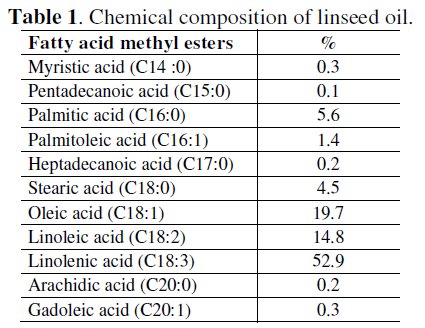
    <p>The analysis of linseed oil allowed the identification of 12 components which 
accounted for fatty acid methyl esters (<a href="#t1">Table 1</a>).</p>


    <p>&nbsp;</p>
<a name="t1">
<img src="/img/revistas/pea/v33n3/33n3a01t1.jpg">
    
<p>&nbsp;</p>


    <p>As seen in <a href="#t1">Table 1</a>, the main 
constituents were linolenic acid (52.9 %), oleic acid (19.7 %) and linoleic acid 
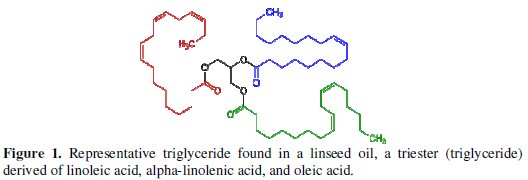
(14.8 %). As a result linseed oil is a triglyceride (<a href="#f1">Fig. 1</a>), like other fats, and 
distinctive oil for its unusually large amount of &alpha;-linolenic acid, which has a 
distinctive reaction with oxygen in air.</p>


    <p>&nbsp;</p>
<a name="f1">
<img src="/img/revistas/pea/v33n3/33n3a01f1.jpg">
    
<p>&nbsp;</p>


    <p><i><b>Effect of concentration</b></i></p>

    ]]></body>
<body><![CDATA[<p><i>Polarization curves</i></p>

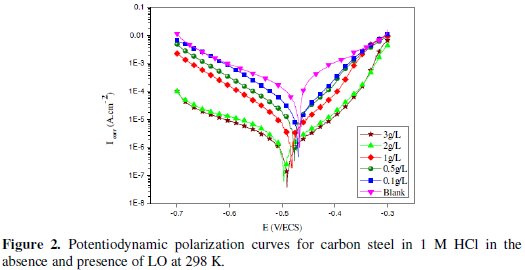
    <p>Potentiodynamic polarisation curves of carbon steel in 1 M HCl in the absence 
and presence of LO at different concentrations at 298 K are presented in <a href="#f2">Fig. 2</a>.</p>


    <p>&nbsp;</p>
<a name="f2">
<img src="/img/revistas/pea/v33n3/33n3a01f2.jpg">
    
<p>&nbsp;</p>


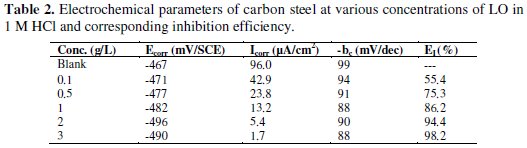
    <p>The corrosion parameters including corrosion current densities (I<sub>corr</sub>), corrosion 
potential (E<sub>corr</sub>), cathodic Tafel slope (b<sub>c</sub>), anodic Tafel slop (b<sub>a</sub>) and inhibition 
efficiency (EI %) are listed in <a href="#t2">Table 2</a>.</p>


    <p>&nbsp;</p>
<a name="t2">
<img src="/img/revistas/pea/v33n3/33n3a01t2.jpg">
    
<p>&nbsp;</p>


    <p>In this case, the inhibition efficiency is defined as follows:</p>


    <p>&nbsp;</p>
<a name="e1">
<img src="/img/revistas/pea/v33n3/33n3a01e1.jpg">
    
<p>&nbsp;</p>


    ]]></body>
<body><![CDATA[<p>where I<sub>corr</sub> and I<sup>'</sup><sub>corr</sub> are current density in absence and presence of LO, 
respectively.</p>

    <p>We noted that I<sub>corr</sub> and I<sup>'</sup><sub>corr</sub> were calculated from the intersection of cathodic and 
anodic Tafel lines. The visual examination of polarization curves depicted in <a href="#f2">Fig. 2</a>, 
reveals that the corrosion current density decreased as the concentration of 
inhibitor increased. Addition of LO to acid media affected both cathodic and 
anodic branches of the potentiodynamic polarization curves. However, corrosion 
potential shifted to negative direction more markedly. Generally, if the 
displacement in E<sub>corr</sub> is higher than 85 mV with respect to E<sub>corr</sub> in uninhibited 
solution, the inhibitor can be seen as of a cathodic or anodic type [40-41]. In our 
study the maximum displacement is 29 mV, which indicates that LO acts as a 
mixed-type inhibitor at 298 K. This shows that the effect of the inhibitor on the 
cathodic reaction is more observable than on the anodic reaction.</p>

    <p>As it can be seen from <a href="#t2">Table 2</a>, inhibition efficiency values increased from 
55.4% to 98.2% with the increment of LO concentration. An increase in inhibitor 
concentration up to 3g/L didn't increase the EI. These results also show that LO 
acts as an effective inhibitor. It is noted that, the modes of the inhibition effect 
are classified into three categories [34, 36-41]: geometric blocking effect of 
adsorbed inhibitive species, active sites blocking effect by adsorbed inhibitive 
species, and electrocatalytic effect of the inhibitor or its reaction products. It has 
been discussed in the case of the first mode that inhibition effect comes from the 
reduction of the reaction area on the surface of the corroding metal, whereas for 
the other two modes the inhibition effects are due to the changes in the average 
activation energy barriers of the anodic and cathodic reactions of the corrosion 
process. The cathodic Tafel constant values (b<sub>c</sub>) did not change significantly, 
which suggests that the inhibition is most probably caused by a geometric 
blocking effect of the adsorbed inhibitive species on the surface corroding metal.</p>

    <p>The parallel cathodic Tafel lines (<a href="#f2">Fig. 2</a>) suggested that the addition of inhibitors 
to the 1 M HCl solution does not modify the hydrogen evolution mechanism and 
the reduction of H<sup>+</sup> ions at the mild steel surface which occurs mainly through a 
charge transfer mechanism [42].</p>


    <p><i><b>Electrochemical impedance spectroscopy measurements</b></i></p>

    <p>Electrochemical impedance spectroscopy is a rapid and convenient method for 
investigation of protective properties of organic inhibitors on metals. More 
reliable results can be obtained by this method, since it does not disturb the 
double layer at the metal/ solution interface [43]. Consequently, EIS is specially 
a useful method to follow the evaluation of the inhibitor-metal system over time 
[44].</p>

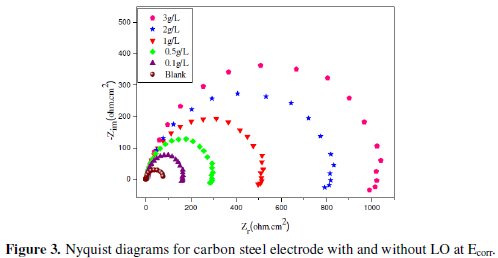
    <p><a href="#f3">Fig. 3</a> shows the Nyquist plots for carbon steel in 1 M HCl solution in the 
absence and presence of different concentrations of LO at 298 K.</p>


    <p>&nbsp;</p>
<a name="f3">
<img src="/img/revistas/pea/v33n3/33n3a01f3.jpg">
    
<p>&nbsp;</p>


    <p>The obtained Nyquist impedance diagrams in most cases do not show perfect semicircles, 
generally attributed to the frequency dispersion as a result of roughness and 
inhomogenates of the electrode surface. The data reveal that each impedance 
diagram consists of a large capacitive loop with low frequencies dispersion 
(inductive arc). The shape is maintained throughout the whole concentrations, 
indicating that almost no change in the corrosion mechanism occurred due to the 
inhibitor addition [45].</p>

    ]]></body>
<body><![CDATA[<p>In such cases, the parallel combination of double layer capacitance and charge 
transfer resistance which are in series with the solution resistance, particularly in 
the presence of an efficient inhibitor, is found to be an inadequate approach for 
modelling the interface. The use of the constant phase element (CPE) can be an 
effective way to represent the frequency dependence of non-ideal capacitive 
behavior, for example, corrosion of irregular and heterogeneous solid surfaces. 
The circuit consists of a constant phase element (CPE) Q, in parallel with a 
resistor Rt The use of CPE-type impedance has been extensively described in 
[46-47]:</p>


    <p>&nbsp;</p>
<a name="e2">
<img src="/img/revistas/pea/v33n3/33n3a01e2.jpg">
    
<p>&nbsp;</p>


    <p>The above equation provides information about the degree of non-ideality in the 
capacitance behavior. Its value makes it possible to differentiate between the 
behavior of an ideal capacitor (n = 1) and of a CPE (n &lt; 1). Considering that a 
CPE may be considered as a parallel combination of a pure capacitor and a 
resistor that is inversely proportional to the angular frequency, the value of 
capacitance, C<sub>dl</sub>, can thus be calculated for a parallel circuit composed of a CPE 
(Q) and a resistor (Rt), according to the following formula [48-49]:</p>


    <p>&nbsp;</p>
<a name="e3">
<img src="/img/revistas/pea/v33n3/33n3a01e3.jpg">
    
<p>&nbsp;</p>


    <p>The impedance spectra with one capacitive loop were analyzed by using the 
circuit in <a href="#f4">Fig. 4</a> [50, 51], and the double layer capacitance (C<sub>dl</sub>) was calculated in 
terms of <a href="#e3">Eq. 3</a>.</p>


    <p>&nbsp;</p>
<a name="f4">
<img src="/img/revistas/pea/v33n3/33n3a01f4.jpg">
    
<p>&nbsp;</p>


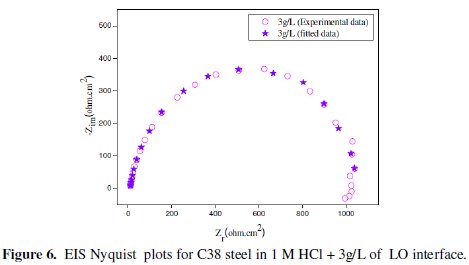
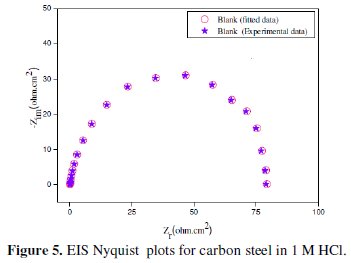
    <p>As an example, <a href="#f5">Figs. 5</a> and <a href="#f6">6</a> correspond to the fitted plots for EIS experiment 
data using the electric circuit of <a href="#f4">Fig. 4</a> in the absence and presence of 3g/L of LO, 
respectively.</p>


    ]]></body>
<body><![CDATA[<p>&nbsp;</p>
<a name="f5">
<img src="/img/revistas/pea/v33n3/33n3a01f5.jpg">
    
<p>&nbsp;</p>
<a name="f6">
<img src="/img/revistas/pea/v33n3/33n3a01f6.jpg">
    
<p>&nbsp;</p>


    <p>As it can be seen from <a href="#f5">Figs. 5</a> and <a href="#f6">6</a>, the calculated data based on the equivalent 
circuit given in <a href="#f4">Fig. 4</a> fit very well to the experimental data, and the fitted results 
follow the same way as the experimental ones, with an average error of about 
0.01 % in all the cases. This indicates that the equivalent circuit used to model 
the systems under investigation is the most appropriate one.</p>

    <p>R<sub>t</sub> values were simultaneously determined by analysis of the complex-plane 
impedance plots and the equivalent circuit model and the results are very similar 
with insignificant changes.</p>

    <p>The inhibition efficiency can be calculated by the following formula:</p>


    <p>&nbsp;</p>
<a name="e4">
<img src="/img/revistas/pea/v33n3/33n3a01e4.jpg">
    
<p>&nbsp;</p>


    <p>where R<sub>t</sub> and R<sup>0</sup><sub>t</sub> are the charge transfer resistances in inhibited and uninhibited 
solutions, respectively.</p>

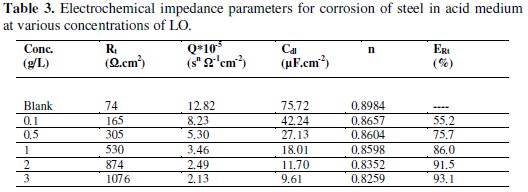
    <p>The electrochemical impedance parameters derived from these investigations are 
mentioned in <a href="#t3">Table 3</a>.</p>


    ]]></body>
<body><![CDATA[<p>&nbsp;</p>
<a name="t3">
<img src="/img/revistas/pea/v33n3/33n3a01t3.jpg">
    
<p>&nbsp;</p>


    <p>The corresponding electrochemical parameters given in <a href="#t3">Table 3</a> reveal that the Rt 
values increased as the concentration of inhibitor increased. This effect becomes 
more pronounced at higher LO concentration. This increase in the diameter of the 
Nyquist semicircle (Rt values), including the corresponding increase in the 
magnitude of the phase angle peaks in inhibited solutions, points toward 
improved corrosion resistance due to the corrosion-inhibiting action of LO. On 
the other hand, the values of double-layer capacitance C<sub>dl</sub> decreased with 
increasing the inhibitor concentration. This situation was the result of increasing 
surface coverage by the inhibitor, which led to an increase in EI to reach 93.1% at 
3g/L of LO.</p>

    <p>The decrease of ''n'' values by the increase of the inhibitor concentration can be 
interpreted as an evidence for steel surface adsorption of molecules [52]. The 
increment in polarization resistances and inhibition efficiency values and the 
decrease in CPE values by increasing of LO concentration may be attributed to 
the increase in the number of adsorbed organic molecules onto carbon steel 
surface [53, 54].</p>

    <p>The results obtained from the polarization technique in acidic solution were in 
good agreement with those obtained from the electrochemical impedance 
spectroscopy (EIS) with a small variation.</p>


    <p><i><b>Weight loss, corrosion rates and inhibition efficiency</b></i></p>

    <p>The effect of the addition of LO tested at different concentrations on the 
corrosion of steel in 1 M HCl solution was studied by using weight-loss at 298 K.</p>

    <p>Inhibition efficiency Ew (%) is calculated as follows:</p>


    <p>&nbsp;</p>
<a name="e5">
<img src="/img/revistas/pea/v33n3/33n3a01e5.jpg">
    
<p>&nbsp;</p>


    ]]></body>
<body><![CDATA[<p>where W<sub>corr</sub> and W'<sub>corr</sub> are the corrosion rate of carbon steel in 1 M HCl in 
absence and presence of the inhibitor, respectively.</p>

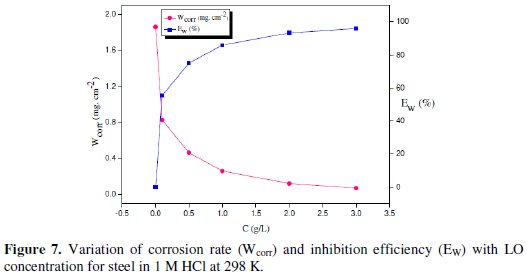
    <p><a href="#f7">Fig. 7</a> illustrates the variation of the corrosion rate and inhibition efficiency with 
concentration of inhibitor.</p>


    <p>&nbsp;</p>
<a name="f7">
<img src="/img/revistas/pea/v33n3/33n3a01f7.jpg">
    
<p>&nbsp;</p>


    <p>Indeed, <a href="#f7">Fig. 7</a> shows that the corrosion rate values of carbon steel decrease when 
the inhibitor concentration increases, while Ew (%) values of LO increases 
reaching a maximum value. This behavior can be attributed to the increase of the 
surface covered, &theta;, and to the adsorption of phytochemical components of the LO 
onto the carbon steel surface resulting in the blocking of the reaction sites, and 
protecting this surface from the attack of the corrosion active ions in the acid 
medium. Consequently, we can conclude that LO is a good corrosion inhibitor 
for carbon steel in a 1 M HCl solution.</p>

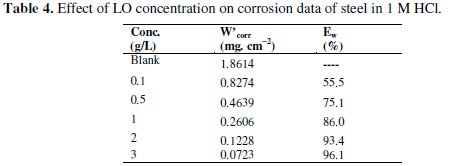
    <p><a href="#t4">Table 4</a> regroups the results of weight loss of steel in 1 M HCl with and without 
the addition of various concentrations of the LO.</p>


    <p>&nbsp;</p>
<a name="t4">
<img src="/img/revistas/pea/v33n3/33n3a01t4.jpg">
    
<p>&nbsp;</p>


    <p>The results in the <a href="#t4">Table 4</a> clearly revealed that the corrosion rate values in 1.0 M 
HCl solution containing LO, decreased as the concentration of the inhibitor 
increased. This result is due to the fact that the adsorption amount and coverage 
of inhibitor on steel surface increases with inhibitor concentration. The highest 
inhibition efficiency of 96.1% was obtained at 3g/L of LO. This result suggests 
that increase in inhibitor concentration increases the number of molecules 
adsorbed onto the steel surface and reduces the surface area that is available for 
the direct acid attack on the metal surface. The results obtained from weight loss 
are in good agreement with electrochemical studies.</p>


    <p><i><b>Effect of temperature</b></i></p>

    ]]></body>
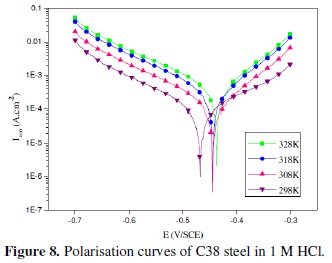
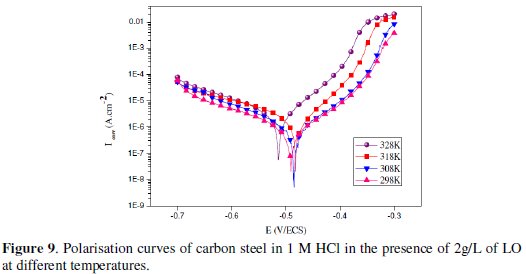
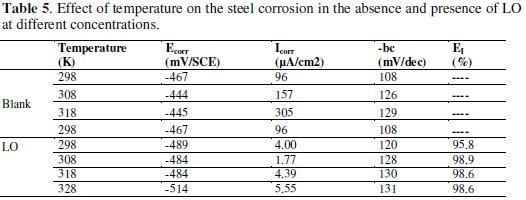
<body><![CDATA[<p>Temperature has a great effect on the corrosion phenomenon. Generally, the 
corrosion rate increases with the rise of the temperature. For this purpose, we 
made potentiostatic polarization in the range of temperature 298 to 328 K, in the 
absence and presence of LO at 2g/L. The corresponding data are shown in 
<a href="#f8">Figs. 8</a>, <a href="#f9">9</a> and <a href="#t5">Table 5</a>.</p>


    <p>&nbsp;</p>
<a name="f8">
<img src="/img/revistas/pea/v33n3/33n3a01f8.jpg">
    
<p>&nbsp;</p>
<a name="f9">
<img src="/img/revistas/pea/v33n3/33n3a01f9.jpg">
    
<p>&nbsp;</p>
<a name="t5">
<img src="/img/revistas/pea/v33n3/33n3a01t5.jpg">
    
<p>&nbsp;</p>


    <p>The results obtained from polarization curves show in 
<a href="#f8">Figs. 8</a> and <a href="#f9">9</a> a decrease in 
current density and an increase in EI (%) with increasing temperature. Generally, 
the reduction of the inhibition efficiency with increasing temperature may be 
explained by the fact that the time lag between the process of adsorption and 
desorption of the inhibitor molecules over the metal surface is becoming shorter 
with increasing temperature [55]. Hence, the metal surface remains exposed to 
the acid environment for a longer period, thereby increasing the rate of corrosion 
with increasing temperature especially for the blank solution. The adsorption 
characteristics between carbon steel surface and LO molecules were not affected 
by rising the temperature. At higher temperatures, the calculated current density 
values of LO were lower than those of the blank solution and have decreased 
with temperature elevation and the inhibition efficiency values were stable even 
at 328 K. The nearly constant efficiency of the inhibitors in the temperature 
range studied can be considered as the slight change in the nature of the 
adsorption mode: physisorption of the inhibitor is dominant in the temperature 
range studied, while chemisorption accompanied by physisorption can occur 
slightly with increasing the temperature. Consequently, this compound can be 
regarded as temperature-independent inhibitor.</p>

    <p>The activation energies of corrosion process in free and inhibited acid were 
calculated using Arrhenius equation:</p>


    <p>&nbsp;</p>
<a name="e6">
<img src="/img/revistas/pea/v33n3/33n3a01e6.jpg">
    
<p>&nbsp;</p>


    <p>where A is Arrhenius factor, Ea is the apparent activation corrosion energy, R is 
the perfect gas constant and T the absolute temperature.</p>

    ]]></body>
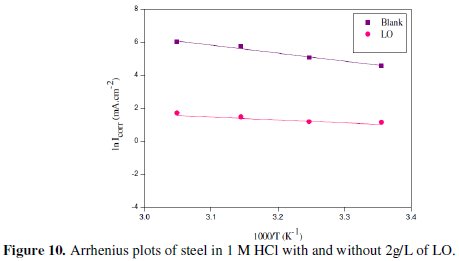
<body><![CDATA[<p>Plotting (log I<sub>corr</sub>) versus 1/T gives straight lines, as revealed from 
<a href="#f10">Fig. 10</a>.</p>


    <p>&nbsp;</p>
<a name="f10">
<img src="/img/revistas/pea/v33n3/33n3a01f10.jpg">
    
<p>&nbsp;</p>


    <p>The activation energy values obtained are 14.82 and 44.23 kJ/mol for 2g/L of LO 
and free acid, respectively. The temperature dependence of the inhibiting effect 
and the comparison of the values of the apparent activation energy of the 
corrosion process in the absence and presence of the inhibitor can provide further 
evidence [56-57] concerning the mechanism of the inhibiting action. The 
decrease of the inhibitor efficiency with temperature rising, which refers to a 
higher value of Ea, when compared to that in acid media without an inhibitor, is 
explained as an indication for an electrostatic character of the inhibitor's 
adorption. The lower value of Ea in an inhibited solution when compared to an 
uninhibited one shows that chemisorption bond between the inhibitor and the 
metal is highly probable [58]. Activation energy, Ea, values in the table are very 
lower for inhibited solution than for the uninhibited media, indicating a high 
inhibitive action of the additives by increasing energy barrier for the corrosion 
process, emphasizing chemisorption bond between the inhibitor and the carbon 
steel surface (chemisorption).</p>

    <p>Kinetic parameters, such as enthalpy and entropy of corrosion process, may be 
evaluated from the effect of temperature. An alternative formulation of Arrhenius 
equation is (<a href="#e7">7</a>) [59]:</p>


    <p>&nbsp;</p>
<a name="e7">
<img src="/img/revistas/pea/v33n3/33n3a01e7.jpg">
    
<p>&nbsp;</p>


    <p>where N is the Avogadro's number, h the Plank's constant, R is the perfect gas 
constant, &Delta;S* and &Delta;H* the entropy and enthalpy of activation, respectively.</p>

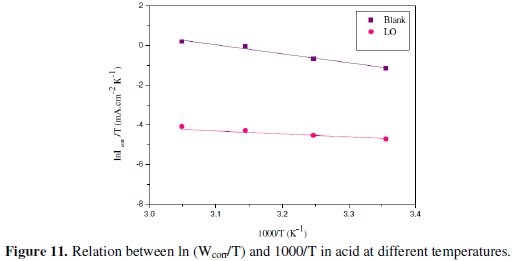
    <p><a href="#f11">Fig. 11</a> shows a plot of ln(I<sub>corr</sub>/T) against 1/T for LO.</p>


    <p>&nbsp;</p>
<a name="f11">
<img src="/img/revistas/pea/v33n3/33n3a01f11.jpg">
    
]]></body>
<body><![CDATA[<p>&nbsp;</p>


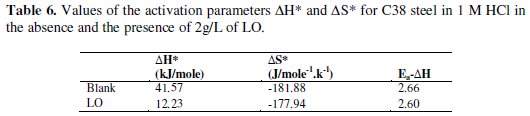
    <p>Straight lines are obtained 
with a slope of (-&Delta;H*/R) and an intercept of (ln R/Nh + &Delta;S*/R) from which the 
values of &Delta;H* and &Delta;S*, respectively, are calculated (<a href="#t6">Table 6</a>).</p>


    <p>&nbsp;</p>
<a name="t6">
<img src="/img/revistas/pea/v33n3/33n3a01t6.jpg">
    
<p>&nbsp;</p>


    <p>The positive signs of &Delta;H* reflect the endothermic nature of the steel dissolution 
process. It is obvious that the activation energy strongly increases in the presence 
of the inhibitor.</p>

    <p>The negative value of entropy &Delta;S* in the presence of the inhibitor implies that 
the activated complex in the rate determining step represents an association 
rather than a dissociation step, meaning that an increase in disordering takes 
place on going from reactants to the activated complex [60].</p>


    <p><i><b>adsorption isotherm</b></i></p>

    <p>Basic information dealing with the interaction between the inhibitor molecules 
and the metal surface can be provided by the adsorption isotherm [61]. The 
understanding of isotherms that describe the adsorption behavior of a corrosion 
inhibitor is an important part of the present work, as this can provide information 
to the nature of the interaction between metal and inhibitor. In the present study 
several adsorption isotherms were tested and the Langmuir adsorption isotherm 
was found to provide best description of the adsorption behaviour of the 
investigated inhibitor. The Langmuir isotherm is given by the equation [62]:</p>


    <p>&nbsp;</p>
<a name="e8">
<img src="/img/revistas/pea/v33n3/33n3a01e8.jpg">
    
<p>&nbsp;</p>
<a name="e9">
<img src="/img/revistas/pea/v33n3/33n3a01e9.jpg">
    
]]></body>
<body><![CDATA[<p>&nbsp;</p>


    <p>where C is the inhibitor concentration, &theta; the fraction of the surface covered 
determined by E/100, K the equilibrium constant, &Delta;G<sub>ads</sub> the standard free energy 
of adsorption reaction, R the universal gas constant, T the thermodynamic 
temperature and the value of 55.5 is the concentration of water in the solution in 
mol/L.</p>

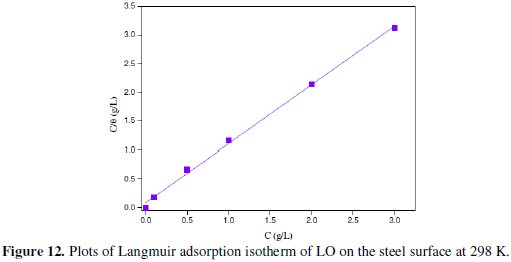
    <p><a href="#f12">Fig. 12</a> shows the dependence of the ratio C/ &theta; as a function of C.</p>


    <p>&nbsp;</p>
<a name="f12">
<img src="/img/revistas/pea/v33n3/33n3a01f12.jpg">
    
<p>&nbsp;</p>


    <p>The straight line observed on plotting C/ &theta; against C (<a href="#f12">Fig. 12</a>) with a correlation 
coefficient higher than 0.999 suggested that the Langmuir adsorption isotherm 
fits best with the experimental data. The slope value being very near to unity 
(1.05) further confirms the validity of Langmuir adsorption isotherm.</p>


    <p>&nbsp;</p>
    <p><b>Conclusions</b></p>

    <p>The following results can be drawn from this study:</p>

    <p>- The major constituents of linseed oil were linolenic, oleic and linoleic acid.</p>

    ]]></body>
<body><![CDATA[<p>- Linseed oil acts as an excellent mixed inhibitor without modifying the hydrogen 
reduction mechanism.</p>

    <p>- The inhibition efficiency increases with increased LO concentration to attain a 
maximum value of 98.8% at 3g/L.</p>

    <p>- The LO provides good inhibition of the corrosion of carbon steel in normal 
hydrochloric acid medium.</p>

    <p>- The data obtained from the three different methods (potentiodynamic 
polarisation, EIS and weight loss) are in good agreement.</p>

    <p>- The inhibition efficiency of LO is independent of the temperature.</p>

    <p>- Langmuir adsorption isotherm exhibited the best fit to the experimental data.</p>


    <p>&nbsp;</p>
    <p><b>References</b></p>

    <!-- ref --><p>1. Oguzie E E. Corros Sci. 2008;50:2993.    &nbsp;&nbsp;&nbsp;&nbsp;&nbsp;&nbsp;&nbsp;&nbsp;[&#160;<a href="javascript:void(0);" onclick="javascript: window.open('/scielo.php?script=sci_nlinks&ref=000151&pid=S0872-1904201500030000100001&lng=','','width=640,height=500,resizable=yes,scrollbars=1,menubar=yes,');">Links</a>&#160;]<!-- end-ref --></p>

    ]]></body>
<body><![CDATA[<!-- ref --><p>2. Bentrah H, Rahali Y, Chala A. Corros Sci. 2014;82:426.    &nbsp;&nbsp;&nbsp;&nbsp;&nbsp;&nbsp;&nbsp;&nbsp;[&#160;<a href="javascript:void(0);" onclick="javascript: window.open('/scielo.php?script=sci_nlinks&ref=000153&pid=S0872-1904201500030000100002&lng=','','width=640,height=500,resizable=yes,scrollbars=1,menubar=yes,');">Links</a>&#160;]<!-- end-ref --></p>

    <!-- ref --><p>3. Ostovari A, Hoseinieh S M, Peikari M, et al. Corros Sci. 2009;51:1935.    &nbsp;&nbsp;&nbsp;&nbsp;&nbsp;&nbsp;&nbsp;&nbsp;[&#160;<a href="javascript:void(0);" onclick="javascript: window.open('/scielo.php?script=sci_nlinks&ref=000155&pid=S0872-1904201500030000100003&lng=','','width=640,height=500,resizable=yes,scrollbars=1,menubar=yes,');">Links</a>&#160;]<!-- end-ref --></p>

    <!-- ref --><p>4. Torres V V, Amado RS, Sa CF, et al. Corros Sci. 2011;53:2385.    &nbsp;&nbsp;&nbsp;&nbsp;&nbsp;&nbsp;&nbsp;&nbsp;[&#160;<a href="javascript:void(0);" onclick="javascript: window.open('/scielo.php?script=sci_nlinks&ref=000157&pid=S0872-1904201500030000100004&lng=','','width=640,height=500,resizable=yes,scrollbars=1,menubar=yes,');">Links</a>&#160;]<!-- end-ref --></p>

    <!-- ref --><p>5. Banerjee S, Srivastava V, Singh MM. Corros Sci. 2012;59:35.    &nbsp;&nbsp;&nbsp;&nbsp;&nbsp;&nbsp;&nbsp;&nbsp;[&#160;<a href="javascript:void(0);" onclick="javascript: window.open('/scielo.php?script=sci_nlinks&ref=000159&pid=S0872-1904201500030000100005&lng=','','width=640,height=500,resizable=yes,scrollbars=1,menubar=yes,');">Links</a>&#160;]<!-- end-ref --></p>

    <!-- ref --><p>6. Hosseini M G, Ehteshamzadeh M, Shahrabi T. Electrochim Acta. 2007;52:3680.    &nbsp;&nbsp;&nbsp;&nbsp;&nbsp;&nbsp;&nbsp;&nbsp;[&#160;<a href="javascript:void(0);" onclick="javascript: window.open('/scielo.php?script=sci_nlinks&ref=000161&pid=S0872-1904201500030000100006&lng=','','width=640,height=500,resizable=yes,scrollbars=1,menubar=yes,');">Links</a>&#160;]<!-- end-ref --></p>

    ]]></body>
<body><![CDATA[<!-- ref --><p>7. Fan H B, Fu C Y, Wang H L, et al. Br Corros J. 2002;37:122.    &nbsp;&nbsp;&nbsp;&nbsp;&nbsp;&nbsp;&nbsp;&nbsp;[&#160;<a href="javascript:void(0);" onclick="javascript: window.open('/scielo.php?script=sci_nlinks&ref=000163&pid=S0872-1904201500030000100007&lng=','','width=640,height=500,resizable=yes,scrollbars=1,menubar=yes,');">Links</a>&#160;]<!-- end-ref --></p>

    <!-- ref --><p>8. Afia L, Salghi R, Zarrouk A, et al. Trans Indian Inst Met. 2013;66:43.    &nbsp;&nbsp;&nbsp;&nbsp;&nbsp;&nbsp;&nbsp;&nbsp;[&#160;<a href="javascript:void(0);" onclick="javascript: window.open('/scielo.php?script=sci_nlinks&ref=000165&pid=S0872-1904201500030000100008&lng=','','width=640,height=500,resizable=yes,scrollbars=1,menubar=yes,');">Links</a>&#160;]<!-- end-ref --></p>

    <!-- ref --><p>9. Afia L, Salghi R, Zarrouk A, et al. Port Electrochim Acta. 2012;30:267.    &nbsp;&nbsp;&nbsp;&nbsp;&nbsp;&nbsp;&nbsp;&nbsp;[&#160;<a href="javascript:void(0);" onclick="javascript: window.open('/scielo.php?script=sci_nlinks&ref=000167&pid=S0872-1904201500030000100009&lng=','','width=640,height=500,resizable=yes,scrollbars=1,menubar=yes,');">Links</a>&#160;]<!-- end-ref --></p>

    <!-- ref --><p>10. Afia L, Salghi R, Bazzi El, et al. Res Chem Intermed.2012;38:1707.    &nbsp;&nbsp;&nbsp;&nbsp;&nbsp;&nbsp;&nbsp;&nbsp;[&#160;<a href="javascript:void(0);" onclick="javascript: window.open('/scielo.php?script=sci_nlinks&ref=000169&pid=S0872-1904201500030000100010&lng=','','width=640,height=500,resizable=yes,scrollbars=1,menubar=yes,');">Links</a>&#160;]<!-- end-ref --></p>

    <!-- ref --><p>11. Afia L, Salghi R, Bammou L, et al. Acta Metall Sin. 2012;25:10.    &nbsp;&nbsp;&nbsp;&nbsp;&nbsp;&nbsp;&nbsp;&nbsp;[&#160;<a href="javascript:void(0);" onclick="javascript: window.open('/scielo.php?script=sci_nlinks&ref=000171&pid=S0872-1904201500030000100011&lng=','','width=640,height=500,resizable=yes,scrollbars=1,menubar=yes,');">Links</a>&#160;]<!-- end-ref --></p>

    ]]></body>
<body><![CDATA[<!-- ref --><p>12. Afia L, Salghi R, Bammou L, et al. J Saudi Chem Soc. 2014:18.    &nbsp;&nbsp;&nbsp;&nbsp;&nbsp;&nbsp;&nbsp;&nbsp;[&#160;<a href="javascript:void(0);" onclick="javascript: window.open('/scielo.php?script=sci_nlinks&ref=000173&pid=S0872-1904201500030000100012&lng=','','width=640,height=500,resizable=yes,scrollbars=1,menubar=yes,');">Links</a>&#160;]<!-- end-ref --></p>

    <!-- ref --><p>13. Afia L, Salghi R, Bazzi El, et al. Int J Electrochem Sci. 2011;6:5918.    &nbsp;&nbsp;&nbsp;&nbsp;&nbsp;&nbsp;&nbsp;&nbsp;[&#160;<a href="javascript:void(0);" onclick="javascript: window.open('/scielo.php?script=sci_nlinks&ref=000175&pid=S0872-1904201500030000100013&lng=','','width=640,height=500,resizable=yes,scrollbars=1,menubar=yes,');">Links</a>&#160;]<!-- end-ref --></p>

    <!-- ref --><p>14. Gerengi H, Sahin H I. Ind Eng Chem Res. 2012;51:780.    &nbsp;&nbsp;&nbsp;&nbsp;&nbsp;&nbsp;&nbsp;&nbsp;[&#160;<a href="javascript:void(0);" onclick="javascript: window.open('/scielo.php?script=sci_nlinks&ref=000177&pid=S0872-1904201500030000100014&lng=','','width=640,height=500,resizable=yes,scrollbars=1,menubar=yes,');">Links</a>&#160;]<!-- end-ref --></p>

    <!-- ref --><p>15. Lebrini M, Robert F, Lecante A, et al. Corros Sci. 2011;53:687.    &nbsp;&nbsp;&nbsp;&nbsp;&nbsp;&nbsp;&nbsp;&nbsp;[&#160;<a href="javascript:void(0);" onclick="javascript: window.open('/scielo.php?script=sci_nlinks&ref=000179&pid=S0872-1904201500030000100015&lng=','','width=640,height=500,resizable=yes,scrollbars=1,menubar=yes,');">Links</a>&#160;]<!-- end-ref --></p>

    <!-- ref --><p>16. Gopalji S K, Shukla P, Dwivedi S, et al. Ind Eng Chem Res. 2011;50:11954.    &nbsp;&nbsp;&nbsp;&nbsp;&nbsp;&nbsp;&nbsp;&nbsp;[&#160;<a href="javascript:void(0);" onclick="javascript: window.open('/scielo.php?script=sci_nlinks&ref=000181&pid=S0872-1904201500030000100016&lng=','','width=640,height=500,resizable=yes,scrollbars=1,menubar=yes,');">Links</a>&#160;]<!-- end-ref --></p>

    ]]></body>
<body><![CDATA[<!-- ref --><p>17. Raja P B, Qureshi A K, Rahim A A, et al. Corros Sci. 2013;69:292.    &nbsp;&nbsp;&nbsp;&nbsp;&nbsp;&nbsp;&nbsp;&nbsp;[&#160;<a href="javascript:void(0);" onclick="javascript: window.open('/scielo.php?script=sci_nlinks&ref=000183&pid=S0872-1904201500030000100017&lng=','','width=640,height=500,resizable=yes,scrollbars=1,menubar=yes,');">Links</a>&#160;]<!-- end-ref --></p>

    <!-- ref --><p>18. Satapathy A K, Gunasekaran G, Sahoo S C, et al. Corros Sci. 2009;51:2848.    &nbsp;&nbsp;&nbsp;&nbsp;&nbsp;&nbsp;&nbsp;&nbsp;[&#160;<a href="javascript:void(0);" onclick="javascript: window.open('/scielo.php?script=sci_nlinks&ref=000185&pid=S0872-1904201500030000100018&lng=','','width=640,height=500,resizable=yes,scrollbars=1,menubar=yes,');">Links</a>&#160;]<!-- end-ref --></p>

    <!-- ref --><p>19. Abiola O K, James A O, Corros Sci. 2010;52:661.    &nbsp;&nbsp;&nbsp;&nbsp;&nbsp;&nbsp;&nbsp;&nbsp;[&#160;<a href="javascript:void(0);" onclick="javascript: window.open('/scielo.php?script=sci_nlinks&ref=000187&pid=S0872-1904201500030000100019&lng=','','width=640,height=500,resizable=yes,scrollbars=1,menubar=yes,');">Links</a>&#160;]<!-- end-ref --></p>

    <!-- ref --><p>20. Singh M M. Corros Sci. 2014;85:352.    &nbsp;&nbsp;&nbsp;&nbsp;&nbsp;&nbsp;&nbsp;&nbsp;[&#160;<a href="javascript:void(0);" onclick="javascript: window.open('/scielo.php?script=sci_nlinks&ref=000189&pid=S0872-1904201500030000100020&lng=','','width=640,height=500,resizable=yes,scrollbars=1,menubar=yes,');">Links</a>&#160;]<!-- end-ref --></p>

    <!-- ref --><p>21. Asipita S A, Ismail M, Muhd Zaimi A M, et al. J Clean Product. 2014;67:139.    &nbsp;&nbsp;&nbsp;&nbsp;&nbsp;&nbsp;&nbsp;&nbsp;[&#160;<a href="javascript:void(0);" onclick="javascript: window.open('/scielo.php?script=sci_nlinks&ref=000191&pid=S0872-1904201500030000100021&lng=','','width=640,height=500,resizable=yes,scrollbars=1,menubar=yes,');">Links</a>&#160;]<!-- end-ref --></p>

    ]]></body>
<body><![CDATA[<!-- ref --><p>22. Golestani Gh, Shahidi M, Ghazanfari D. Appl Surf Sci. 2014;308:347.    &nbsp;&nbsp;&nbsp;&nbsp;&nbsp;&nbsp;&nbsp;&nbsp;[&#160;<a href="javascript:void(0);" onclick="javascript: window.open('/scielo.php?script=sci_nlinks&ref=000193&pid=S0872-1904201500030000100022&lng=','','width=640,height=500,resizable=yes,scrollbars=1,menubar=yes,');">Links</a>&#160;]<!-- end-ref --></p>

    <!-- ref --><p>23. Shuduan D, Xianghong L. Corros Sci. 2012;64:253.    &nbsp;&nbsp;&nbsp;&nbsp;&nbsp;&nbsp;&nbsp;&nbsp;[&#160;<a href="javascript:void(0);" onclick="javascript: window.open('/scielo.php?script=sci_nlinks&ref=000195&pid=S0872-1904201500030000100023&lng=','','width=640,height=500,resizable=yes,scrollbars=1,menubar=yes,');">Links</a>&#160;]<!-- end-ref --></p>

    <!-- ref --><p>24. Negm N A, Zaki M F, Said M M, et al. Corros Sci. 2011;53:4233.    &nbsp;&nbsp;&nbsp;&nbsp;&nbsp;&nbsp;&nbsp;&nbsp;[&#160;<a href="javascript:void(0);" onclick="javascript: window.open('/scielo.php?script=sci_nlinks&ref=000197&pid=S0872-1904201500030000100024&lng=','','width=640,height=500,resizable=yes,scrollbars=1,menubar=yes,');">Links</a>&#160;]<!-- end-ref --></p>

    <!-- ref --><p>25. Bentrah H, Rahali Y, Chala A. Corros Sci. 2014;82:426.    &nbsp;&nbsp;&nbsp;&nbsp;&nbsp;&nbsp;&nbsp;&nbsp;[&#160;<a href="javascript:void(0);" onclick="javascript: window.open('/scielo.php?script=sci_nlinks&ref=000199&pid=S0872-1904201500030000100025&lng=','','width=640,height=500,resizable=yes,scrollbars=1,menubar=yes,');">Links</a>&#160;]<!-- end-ref --></p>

    <!-- ref --><p>26. Banerjee S, Srivastava V, Singh M M. Corros Sci. 2012;59:35.    &nbsp;&nbsp;&nbsp;&nbsp;&nbsp;&nbsp;&nbsp;&nbsp;[&#160;<a href="javascript:void(0);" onclick="javascript: window.open('/scielo.php?script=sci_nlinks&ref=000201&pid=S0872-1904201500030000100026&lng=','','width=640,height=500,resizable=yes,scrollbars=1,menubar=yes,');">Links</a>&#160;]<!-- end-ref --></p>

    ]]></body>
<body><![CDATA[<!-- ref --><p>27. Ramananda S M. J Mater Environ Sci. 2013;4:117.    &nbsp;&nbsp;&nbsp;&nbsp;&nbsp;&nbsp;&nbsp;&nbsp;[&#160;<a href="javascript:void(0);" onclick="javascript: window.open('/scielo.php?script=sci_nlinks&ref=000203&pid=S0872-1904201500030000100027&lng=','','width=640,height=500,resizable=yes,scrollbars=1,menubar=yes,');">Links</a>&#160;]<!-- end-ref --></p>

    <!-- ref --><p>28. Vijayakumari B, Sasikala V, Radha S R, et al. Pharmace Sci. 2013;2:6371.    &nbsp;&nbsp;&nbsp;&nbsp;&nbsp;&nbsp;&nbsp;&nbsp;[&#160;<a href="javascript:void(0);" onclick="javascript: window.open('/scielo.php?script=sci_nlinks&ref=000205&pid=S0872-1904201500030000100028&lng=','','width=640,height=500,resizable=yes,scrollbars=1,menubar=yes,');">Links</a>&#160;]<!-- end-ref --></p>

    <!-- ref --><p>29. Akalezi C O, Enenebaku C K, Oguzie E E. J Mater Environ Sci. 2013;4:217.    &nbsp;&nbsp;&nbsp;&nbsp;&nbsp;&nbsp;&nbsp;&nbsp;[&#160;<a href="javascript:void(0);" onclick="javascript: window.open('/scielo.php?script=sci_nlinks&ref=000207&pid=S0872-1904201500030000100029&lng=','','width=640,height=500,resizable=yes,scrollbars=1,menubar=yes,');">Links</a>&#160;]<!-- end-ref --></p>

    <!-- ref --><p>30. Benali O, Benmehdi H, Hasnaoui O, et al. J Mater Environ Sci. 2013;4:127.    &nbsp;&nbsp;&nbsp;&nbsp;&nbsp;&nbsp;&nbsp;&nbsp;[&#160;<a href="javascript:void(0);" onclick="javascript: window.open('/scielo.php?script=sci_nlinks&ref=000209&pid=S0872-1904201500030000100030&lng=','','width=640,height=500,resizable=yes,scrollbars=1,menubar=yes,');">Links</a>&#160;]<!-- end-ref --></p>

    <!-- ref --><p>31. Bligh E G, Dyer W J. Can J Biochem Physio. 1959;137:911.    &nbsp;&nbsp;&nbsp;&nbsp;&nbsp;&nbsp;&nbsp;&nbsp;[&#160;<a href="javascript:void(0);" onclick="javascript: window.open('/scielo.php?script=sci_nlinks&ref=000211&pid=S0872-1904201500030000100031&lng=','','width=640,height=500,resizable=yes,scrollbars=1,menubar=yes,');">Links</a>&#160;]<!-- end-ref --></p>

    ]]></body>
<body><![CDATA[<!-- ref --><p>32. DGF, Deutsche Einheitsmethoden zur Untersuchung von Fetten, Fettprodukten, Tensiden und verwandten Stoffen. Stuttgart: Wissenschaftliche Verlagsgesellschaft; 2008.    &nbsp;&nbsp;&nbsp;&nbsp;&nbsp;&nbsp;&nbsp;&nbsp;[&#160;<a href="javascript:void(0);" onclick="javascript: window.open('/scielo.php?script=sci_nlinks&ref=000213&pid=S0872-1904201500030000100032&lng=','','width=640,height=500,resizable=yes,scrollbars=1,menubar=yes,');">Links</a>&#160;]<!-- end-ref --></p>

    <!-- ref --><p>33. Balz M, Schulte E, Thier H P. Sci Technology. 1992;94:209.    &nbsp;&nbsp;&nbsp;&nbsp;&nbsp;&nbsp;&nbsp;&nbsp;[&#160;<a href="javascript:void(0);" onclick="javascript: window.open('/scielo.php?script=sci_nlinks&ref=000215&pid=S0872-1904201500030000100033&lng=','','width=640,height=500,resizable=yes,scrollbars=1,menubar=yes,');">Links</a>&#160;]<!-- end-ref --></p>

    <!-- ref --><p>34. Li X H, Deng S D, Fu H. Corros Sci. 2009;51:1344.    &nbsp;&nbsp;&nbsp;&nbsp;&nbsp;&nbsp;&nbsp;&nbsp;[&#160;<a href="javascript:void(0);" onclick="javascript: window.open('/scielo.php?script=sci_nlinks&ref=000217&pid=S0872-1904201500030000100034&lng=','','width=640,height=500,resizable=yes,scrollbars=1,menubar=yes,');">Links</a>&#160;]<!-- end-ref --></p>

    <!-- ref --><p>35.  Ferreira E S, Giancomelli C, Giacomelli F C, et al. Mater Chem Phys. 2004;83:129.    &nbsp;&nbsp;&nbsp;&nbsp;&nbsp;&nbsp;&nbsp;&nbsp;[&#160;<a href="javascript:void(0);" onclick="javascript: window.open('/scielo.php?script=sci_nlinks&ref=000219&pid=S0872-1904201500030000100035&lng=','','width=640,height=500,resizable=yes,scrollbars=1,menubar=yes,');">Links</a>&#160;]<!-- end-ref --></p>

    <!-- ref --><p>36. Li X, Deng S, Fu H. Corros Sci. 2011;53:302.    &nbsp;&nbsp;&nbsp;&nbsp;&nbsp;&nbsp;&nbsp;&nbsp;[&#160;<a href="javascript:void(0);" onclick="javascript: window.open('/scielo.php?script=sci_nlinks&ref=000221&pid=S0872-1904201500030000100036&lng=','','width=640,height=500,resizable=yes,scrollbars=1,menubar=yes,');">Links</a>&#160;]<!-- end-ref --></p>

    ]]></body>
<body><![CDATA[<!-- ref --><p>37. Lagrenee M, Mernari B, Bouanis M, et al. Corros Sci. 2002;44:573.    &nbsp;&nbsp;&nbsp;&nbsp;&nbsp;&nbsp;&nbsp;&nbsp;[&#160;<a href="javascript:void(0);" onclick="javascript: window.open('/scielo.php?script=sci_nlinks&ref=000223&pid=S0872-1904201500030000100037&lng=','','width=640,height=500,resizable=yes,scrollbars=1,menubar=yes,');">Links</a>&#160;]<!-- end-ref --></p>

    <!-- ref --><p>38. Ferreira E S, Giancomelli C, Giacomelli F C, et al. Mater Chem Phys. 2004;83:129.    &nbsp;&nbsp;&nbsp;&nbsp;&nbsp;&nbsp;&nbsp;&nbsp;[&#160;<a href="javascript:void(0);" onclick="javascript: window.open('/scielo.php?script=sci_nlinks&ref=000225&pid=S0872-1904201500030000100038&lng=','','width=640,height=500,resizable=yes,scrollbars=1,menubar=yes,');">Links</a>&#160;]<!-- end-ref --></p>

    <!-- ref --><p>39. Behpour M, Ghoreishi S M, Khayatkashani M, et al. Corros Sci. 2011;53:2489.    &nbsp;&nbsp;&nbsp;&nbsp;&nbsp;&nbsp;&nbsp;&nbsp;[&#160;<a href="javascript:void(0);" onclick="javascript: window.open('/scielo.php?script=sci_nlinks&ref=000227&pid=S0872-1904201500030000100039&lng=','','width=640,height=500,resizable=yes,scrollbars=1,menubar=yes,');">Links</a>&#160;]<!-- end-ref --></p>

    <!-- ref --><p>40. Okafor P C, Zheng Y. Corros Sci. 2009;51:850.    &nbsp;&nbsp;&nbsp;&nbsp;&nbsp;&nbsp;&nbsp;&nbsp;[&#160;<a href="javascript:void(0);" onclick="javascript: window.open('/scielo.php?script=sci_nlinks&ref=000229&pid=S0872-1904201500030000100040&lng=','','width=640,height=500,resizable=yes,scrollbars=1,menubar=yes,');">Links</a>&#160;]<!-- end-ref --></p>

    <!-- ref --><p>41. Ahamad I, Prasad R. Corros Sci. 2010;52:933.    &nbsp;&nbsp;&nbsp;&nbsp;&nbsp;&nbsp;&nbsp;&nbsp;[&#160;<a href="javascript:void(0);" onclick="javascript: window.open('/scielo.php?script=sci_nlinks&ref=000231&pid=S0872-1904201500030000100041&lng=','','width=640,height=500,resizable=yes,scrollbars=1,menubar=yes,');">Links</a>&#160;]<!-- end-ref --></p>

    ]]></body>
<body><![CDATA[<!-- ref --><p>42. Fuchs-Godec R. Electrochim Acta 2007;52:4974.    &nbsp;&nbsp;&nbsp;&nbsp;&nbsp;&nbsp;&nbsp;&nbsp;[&#160;<a href="javascript:void(0);" onclick="javascript: window.open('/scielo.php?script=sci_nlinks&ref=000233&pid=S0872-1904201500030000100042&lng=','','width=640,height=500,resizable=yes,scrollbars=1,menubar=yes,');">Links</a>&#160;]<!-- end-ref --></p>

    <!-- ref --><p>43. Elayyachy M, Elkodadi M, Aouniti A, et al. Mater Chem Phys. 2005;93:281.    &nbsp;&nbsp;&nbsp;&nbsp;&nbsp;&nbsp;&nbsp;&nbsp;[&#160;<a href="javascript:void(0);" onclick="javascript: window.open('/scielo.php?script=sci_nlinks&ref=000235&pid=S0872-1904201500030000100043&lng=','','width=640,height=500,resizable=yes,scrollbars=1,menubar=yes,');">Links</a>&#160;]<!-- end-ref --></p>

    <!-- ref --><p>44. Bayol E, Kayakirilmaz K, Erbil M. Mater Chem Phys. 2007;104:74.    &nbsp;&nbsp;&nbsp;&nbsp;&nbsp;&nbsp;&nbsp;&nbsp;[&#160;<a href="javascript:void(0);" onclick="javascript: window.open('/scielo.php?script=sci_nlinks&ref=000237&pid=S0872-1904201500030000100044&lng=','','width=640,height=500,resizable=yes,scrollbars=1,menubar=yes,');">Links</a>&#160;]<!-- end-ref --></p>

    <!-- ref --><p>45. Erbil M. Chim Acta Turc. 1988;1:59.    &nbsp;&nbsp;&nbsp;&nbsp;&nbsp;&nbsp;&nbsp;&nbsp;[&#160;<a href="javascript:void(0);" onclick="javascript: window.open('/scielo.php?script=sci_nlinks&ref=000239&pid=S0872-1904201500030000100045&lng=','','width=640,height=500,resizable=yes,scrollbars=1,menubar=yes,');">Links</a>&#160;]<!-- end-ref --></p>

    <!-- ref --><p>46. Solmaz R, Kardas G, Yazici B, et al. Colloids Surf A. 2008;312:7.    &nbsp;&nbsp;&nbsp;&nbsp;&nbsp;&nbsp;&nbsp;&nbsp;[&#160;<a href="javascript:void(0);" onclick="javascript: window.open('/scielo.php?script=sci_nlinks&ref=000241&pid=S0872-1904201500030000100046&lng=','','width=640,height=500,resizable=yes,scrollbars=1,menubar=yes,');">Links</a>&#160;]<!-- end-ref --></p>

    ]]></body>
<body><![CDATA[<!-- ref --><p>47. Merah S, Larabi L, Benali O, et al. Pig Res Tech. 2008;37:291.    &nbsp;&nbsp;&nbsp;&nbsp;&nbsp;&nbsp;&nbsp;&nbsp;[&#160;<a href="javascript:void(0);" onclick="javascript: window.open('/scielo.php?script=sci_nlinks&ref=000243&pid=S0872-1904201500030000100047&lng=','','width=640,height=500,resizable=yes,scrollbars=1,menubar=yes,');">Links</a>&#160;]<!-- end-ref --></p>

    <!-- ref --><p>48. Ma H, Chen S, Yin B, et al. Corros Sci. 2003;45:867.    &nbsp;&nbsp;&nbsp;&nbsp;&nbsp;&nbsp;&nbsp;&nbsp;[&#160;<a href="javascript:void(0);" onclick="javascript: window.open('/scielo.php?script=sci_nlinks&ref=000245&pid=S0872-1904201500030000100048&lng=','','width=640,height=500,resizable=yes,scrollbars=1,menubar=yes,');">Links</a>&#160;]<!-- end-ref --></p>

    <!-- ref --><p>49. McCafferty E. Corros Sci. 1997;39:243.    &nbsp;&nbsp;&nbsp;&nbsp;&nbsp;&nbsp;&nbsp;&nbsp;[&#160;<a href="javascript:void(0);" onclick="javascript: window.open('/scielo.php?script=sci_nlinks&ref=000247&pid=S0872-1904201500030000100049&lng=','','width=640,height=500,resizable=yes,scrollbars=1,menubar=yes,');">Links</a>&#160;]<!-- end-ref --></p>

    <!-- ref --><p>50. Morad M S. Corros Sci. 2000;42:1313.    &nbsp;&nbsp;&nbsp;&nbsp;&nbsp;&nbsp;&nbsp;&nbsp;[&#160;<a href="javascript:void(0);" onclick="javascript: window.open('/scielo.php?script=sci_nlinks&ref=000249&pid=S0872-1904201500030000100050&lng=','','width=640,height=500,resizable=yes,scrollbars=1,menubar=yes,');">Links</a>&#160;]<!-- end-ref --></p>

    <!-- ref --><p>51. Amin MA, Khaled K F. Corros Sci. 2010;52:1194.    &nbsp;&nbsp;&nbsp;&nbsp;&nbsp;&nbsp;&nbsp;&nbsp;[&#160;<a href="javascript:void(0);" onclick="javascript: window.open('/scielo.php?script=sci_nlinks&ref=000251&pid=S0872-1904201500030000100051&lng=','','width=640,height=500,resizable=yes,scrollbars=1,menubar=yes,');">Links</a>&#160;]<!-- end-ref --></p>

    ]]></body>
<body><![CDATA[<!-- ref --><p>52. Surme Y, Gurten A A, Bayol E. Prot Met Phys Chem. 2011;47:117.    &nbsp;&nbsp;&nbsp;&nbsp;&nbsp;&nbsp;&nbsp;&nbsp;[&#160;<a href="javascript:void(0);" onclick="javascript: window.open('/scielo.php?script=sci_nlinks&ref=000253&pid=S0872-1904201500030000100052&lng=','','width=640,height=500,resizable=yes,scrollbars=1,menubar=yes,');">Links</a>&#160;]<!-- end-ref --></p>

    <!-- ref --><p>53. Bayol E, Gurten T, Gurten A A, et al. Chem Phys. 2008;112:624.    &nbsp;&nbsp;&nbsp;&nbsp;&nbsp;&nbsp;&nbsp;&nbsp;[&#160;<a href="javascript:void(0);" onclick="javascript: window.open('/scielo.php?script=sci_nlinks&ref=000255&pid=S0872-1904201500030000100053&lng=','','width=640,height=500,resizable=yes,scrollbars=1,menubar=yes,');">Links</a>&#160;]<!-- end-ref --></p>

    <!-- ref --><p>54. Noor E A, Al-Moubaraki A H. Mater Chem Phys. 2008;110:145.    &nbsp;&nbsp;&nbsp;&nbsp;&nbsp;&nbsp;&nbsp;&nbsp;[&#160;<a href="javascript:void(0);" onclick="javascript: window.open('/scielo.php?script=sci_nlinks&ref=000257&pid=S0872-1904201500030000100054&lng=','','width=640,height=500,resizable=yes,scrollbars=1,menubar=yes,');">Links</a>&#160;]<!-- end-ref --></p>

    <!-- ref --><p>55. Bensajjay E, Alehyen S, El Achouri M, et al. Anti-Corros Meth Mater. 2003;50:402.    &nbsp;&nbsp;&nbsp;&nbsp;&nbsp;&nbsp;&nbsp;&nbsp;[&#160;<a href="javascript:void(0);" onclick="javascript: window.open('/scielo.php?script=sci_nlinks&ref=000259&pid=S0872-1904201500030000100055&lng=','','width=640,height=500,resizable=yes,scrollbars=1,menubar=yes,');">Links</a>&#160;]<!-- end-ref --></p>

    <!-- ref --><p>56. Ivanov E S. Inhibitors for Metal Corrosion in Acid Media. Moscow:Metallurgy;1986.    &nbsp;&nbsp;&nbsp;&nbsp;&nbsp;&nbsp;&nbsp;&nbsp;[&#160;<a href="javascript:void(0);" onclick="javascript: window.open('/scielo.php?script=sci_nlinks&ref=000261&pid=S0872-1904201500030000100056&lng=','','width=640,height=500,resizable=yes,scrollbars=1,menubar=yes,');">Links</a>&#160;]<!-- end-ref --></p>

    ]]></body>
<body><![CDATA[<!-- ref --><p>57. Zerga B, Attayibat A, Sfaira M, et al. J Appl Electrochem. 2010;40:1575.    &nbsp;&nbsp;&nbsp;&nbsp;&nbsp;&nbsp;&nbsp;&nbsp;[&#160;<a href="javascript:void(0);" onclick="javascript: window.open('/scielo.php?script=sci_nlinks&ref=000263&pid=S0872-1904201500030000100057&lng=','','width=640,height=500,resizable=yes,scrollbars=1,menubar=yes,');">Links</a>&#160;]<!-- end-ref --></p>

    <!-- ref --><p>58. Abd-El-Rehim SS, Refaey S A M, Taha F, et al. J Appl Electrochem. 2001;31:429.    &nbsp;&nbsp;&nbsp;&nbsp;&nbsp;&nbsp;&nbsp;&nbsp;[&#160;<a href="javascript:void(0);" onclick="javascript: window.open('/scielo.php?script=sci_nlinks&ref=000265&pid=S0872-1904201500030000100058&lng=','','width=640,height=500,resizable=yes,scrollbars=1,menubar=yes,');">Links</a>&#160;]<!-- end-ref --></p>

    <!-- ref --><p>59. Guan N M, Xueming L, Fei L. Mater Chem Phys. 2004;86:59.    &nbsp;&nbsp;&nbsp;&nbsp;&nbsp;&nbsp;&nbsp;&nbsp;[&#160;<a href="javascript:void(0);" onclick="javascript: window.open('/scielo.php?script=sci_nlinks&ref=000267&pid=S0872-1904201500030000100059&lng=','','width=640,height=500,resizable=yes,scrollbars=1,menubar=yes,');">Links</a>&#160;]<!-- end-ref --></p>

    <!-- ref --><p>60. Noor E A, Al-Moubaraki A H. Mater Chem Phys. 2008;110:145.    &nbsp;&nbsp;&nbsp;&nbsp;&nbsp;&nbsp;&nbsp;&nbsp;[&#160;<a href="javascript:void(0);" onclick="javascript: window.open('/scielo.php?script=sci_nlinks&ref=000269&pid=S0872-1904201500030000100060&lng=','','width=640,height=500,resizable=yes,scrollbars=1,menubar=yes,');">Links</a>&#160;]<!-- end-ref --></p>

    <!-- ref --><p>61. Bouklah M, Hammouti B, Lagrenee M, et al. Corros Sci. 2006;48:2831.    &nbsp;&nbsp;&nbsp;&nbsp;&nbsp;&nbsp;&nbsp;&nbsp;[&#160;<a href="javascript:void(0);" onclick="javascript: window.open('/scielo.php?script=sci_nlinks&ref=000271&pid=S0872-1904201500030000100061&lng=','','width=640,height=500,resizable=yes,scrollbars=1,menubar=yes,');">Links</a>&#160;]<!-- end-ref --></p>

    ]]></body>
<body><![CDATA[<!-- ref --><p>62. Langmuir I. J Am Chem Soc. 1947;39:1848.    &nbsp;&nbsp;&nbsp;&nbsp;&nbsp;&nbsp;&nbsp;&nbsp;[&#160;<a href="javascript:void(0);" onclick="javascript: window.open('/scielo.php?script=sci_nlinks&ref=000273&pid=S0872-1904201500030000100062&lng=','','width=640,height=500,resizable=yes,scrollbars=1,menubar=yes,');">Links</a>&#160;]<!-- end-ref --></p>


    <p>&nbsp;</p>
    <p><a name=0></a><sup><a href="#top">*</a></sup>Corresponding author. E-mail address: <a href="mailto:r.salghi@uiz.ac.ma">r.salghi@uiz.ac.ma</a></p>

    <p>Received 28 May 2015; accepted 25 June 2015</p>

    <p><a href="http://www.peacta.org" target="_blank">www.peacta.org</a> </p>


     ]]></body><back>
<ref-list>
<ref id="B1">
<label>1</label><nlm-citation citation-type="journal">
<person-group person-group-type="author">
<name>
<surname><![CDATA[Oguzie]]></surname>
<given-names><![CDATA[E E]]></given-names>
</name>
</person-group>
<source><![CDATA[Corros Sci]]></source>
<year>2008</year>
<volume>50</volume>
<page-range>2993</page-range></nlm-citation>
</ref>
<ref id="B2">
<label>2</label><nlm-citation citation-type="journal">
<person-group person-group-type="author">
<name>
<surname><![CDATA[Bentrah]]></surname>
<given-names><![CDATA[H]]></given-names>
</name>
<name>
<surname><![CDATA[Rahali]]></surname>
<given-names><![CDATA[Y]]></given-names>
</name>
<name>
<surname><![CDATA[Chala]]></surname>
<given-names><![CDATA[A]]></given-names>
</name>
</person-group>
<source><![CDATA[Corros Sci]]></source>
<year>2014</year>
<volume>82</volume>
<page-range>426</page-range></nlm-citation>
</ref>
<ref id="B3">
<label>3</label><nlm-citation citation-type="journal">
<person-group person-group-type="author">
<name>
<surname><![CDATA[Ostovari]]></surname>
<given-names><![CDATA[A]]></given-names>
</name>
<name>
<surname><![CDATA[Hoseinieh]]></surname>
<given-names><![CDATA[S M]]></given-names>
</name>
<name>
<surname><![CDATA[Peikari]]></surname>
<given-names><![CDATA[M]]></given-names>
</name>
</person-group>
<source><![CDATA[Corros Sci]]></source>
<year>2009</year>
<volume>51</volume>
<page-range>1935</page-range></nlm-citation>
</ref>
<ref id="B4">
<label>4</label><nlm-citation citation-type="journal">
<person-group person-group-type="author">
<name>
<surname><![CDATA[Torres]]></surname>
<given-names><![CDATA[V V]]></given-names>
</name>
<name>
<surname><![CDATA[Amado]]></surname>
<given-names><![CDATA[R S]]></given-names>
</name>
<name>
<surname><![CDATA[Sa]]></surname>
<given-names><![CDATA[C F]]></given-names>
</name>
</person-group>
<source><![CDATA[Corros Sci]]></source>
<year>2011</year>
<volume>53</volume>
<page-range>2385</page-range></nlm-citation>
</ref>
<ref id="B5">
<label>5</label><nlm-citation citation-type="journal">
<person-group person-group-type="author">
<name>
<surname><![CDATA[Banerjee]]></surname>
<given-names><![CDATA[S]]></given-names>
</name>
<name>
<surname><![CDATA[Srivastava]]></surname>
<given-names><![CDATA[V]]></given-names>
</name>
<name>
<surname><![CDATA[Singh]]></surname>
<given-names><![CDATA[M M]]></given-names>
</name>
</person-group>
<source><![CDATA[Corros Sci]]></source>
<year>2012</year>
<volume>59</volume>
<page-range>35</page-range></nlm-citation>
</ref>
<ref id="B6">
<label>6</label><nlm-citation citation-type="journal">
<person-group person-group-type="author">
<name>
<surname><![CDATA[Hosseini]]></surname>
<given-names><![CDATA[M G]]></given-names>
</name>
<name>
<surname><![CDATA[Ehteshamzadeh]]></surname>
<given-names><![CDATA[M]]></given-names>
</name>
<name>
<surname><![CDATA[Shahrabi]]></surname>
<given-names><![CDATA[T]]></given-names>
</name>
</person-group>
<source><![CDATA[Electrochim Acta]]></source>
<year>2007</year>
<volume>52</volume>
<page-range>3680</page-range></nlm-citation>
</ref>
<ref id="B7">
<label>7</label><nlm-citation citation-type="journal">
<person-group person-group-type="author">
<name>
<surname><![CDATA[Fan]]></surname>
<given-names><![CDATA[H B]]></given-names>
</name>
<name>
<surname><![CDATA[Fu]]></surname>
<given-names><![CDATA[C Y]]></given-names>
</name>
<name>
<surname><![CDATA[Wang]]></surname>
<given-names><![CDATA[H L]]></given-names>
</name>
</person-group>
<source><![CDATA[Br Corros J]]></source>
<year>2002</year>
<volume>37</volume>
<page-range>122</page-range></nlm-citation>
</ref>
<ref id="B8">
<label>8</label><nlm-citation citation-type="journal">
<person-group person-group-type="author">
<name>
<surname><![CDATA[Afia]]></surname>
<given-names><![CDATA[L]]></given-names>
</name>
<name>
<surname><![CDATA[Salghi]]></surname>
<given-names><![CDATA[R]]></given-names>
</name>
<name>
<surname><![CDATA[Zarrouk]]></surname>
<given-names><![CDATA[A]]></given-names>
</name>
</person-group>
<source><![CDATA[Trans Indian Inst Met]]></source>
<year>2013</year>
<volume>66</volume>
<page-range>43</page-range></nlm-citation>
</ref>
<ref id="B9">
<label>9</label><nlm-citation citation-type="journal">
<person-group person-group-type="author">
<name>
<surname><![CDATA[Afia]]></surname>
<given-names><![CDATA[L]]></given-names>
</name>
<name>
<surname><![CDATA[Salghi]]></surname>
<given-names><![CDATA[R]]></given-names>
</name>
<name>
<surname><![CDATA[Zarrouk]]></surname>
<given-names><![CDATA[A]]></given-names>
</name>
</person-group>
<source><![CDATA[Port Electrochim Acta]]></source>
<year>2012</year>
<volume>30</volume>
<page-range>267</page-range></nlm-citation>
</ref>
<ref id="B10">
<label>10</label><nlm-citation citation-type="journal">
<person-group person-group-type="author">
<name>
<surname><![CDATA[Afia]]></surname>
<given-names><![CDATA[L]]></given-names>
</name>
<name>
<surname><![CDATA[Salghi]]></surname>
<given-names><![CDATA[R]]></given-names>
</name>
<name>
<surname><![CDATA[Bazzi]]></surname>
<given-names><![CDATA[El]]></given-names>
</name>
</person-group>
<source><![CDATA[Res Chem Intermed]]></source>
<year>2012</year>
<volume>38</volume>
<page-range>1707</page-range></nlm-citation>
</ref>
<ref id="B11">
<label>11</label><nlm-citation citation-type="journal">
<person-group person-group-type="author">
<name>
<surname><![CDATA[Afia]]></surname>
<given-names><![CDATA[L]]></given-names>
</name>
<name>
<surname><![CDATA[Salghi]]></surname>
<given-names><![CDATA[R]]></given-names>
</name>
<name>
<surname><![CDATA[Bammou]]></surname>
<given-names><![CDATA[L]]></given-names>
</name>
</person-group>
<source><![CDATA[Acta Metall Sin]]></source>
<year>2012</year>
<volume>25</volume>
<page-range>10</page-range></nlm-citation>
</ref>
<ref id="B12">
<label>12</label><nlm-citation citation-type="journal">
<person-group person-group-type="author">
<name>
<surname><![CDATA[Afia]]></surname>
<given-names><![CDATA[L]]></given-names>
</name>
<name>
<surname><![CDATA[Salghi]]></surname>
<given-names><![CDATA[R]]></given-names>
</name>
<name>
<surname><![CDATA[Bammou]]></surname>
<given-names><![CDATA[L]]></given-names>
</name>
</person-group>
<source><![CDATA[J Saudi Chem Soc]]></source>
<year>2014</year>
<page-range>18</page-range></nlm-citation>
</ref>
<ref id="B13">
<label>13</label><nlm-citation citation-type="journal">
<person-group person-group-type="author">
<name>
<surname><![CDATA[Afia]]></surname>
<given-names><![CDATA[L]]></given-names>
</name>
<name>
<surname><![CDATA[Salghi]]></surname>
<given-names><![CDATA[R]]></given-names>
</name>
<name>
<surname><![CDATA[Bazzi]]></surname>
<given-names><![CDATA[El]]></given-names>
</name>
</person-group>
<source><![CDATA[Int J Electrochem Sci]]></source>
<year>2011</year>
<volume>6</volume>
<page-range>5918</page-range></nlm-citation>
</ref>
<ref id="B14">
<label>14</label><nlm-citation citation-type="journal">
<person-group person-group-type="author">
<name>
<surname><![CDATA[Gerengi]]></surname>
<given-names><![CDATA[H]]></given-names>
</name>
<name>
<surname><![CDATA[Sahin]]></surname>
<given-names><![CDATA[H I]]></given-names>
</name>
</person-group>
<source><![CDATA[Ind Eng Chem Res]]></source>
<year>2012</year>
<volume>51</volume>
<page-range>780</page-range></nlm-citation>
</ref>
<ref id="B15">
<label>15</label><nlm-citation citation-type="journal">
<person-group person-group-type="author">
<name>
<surname><![CDATA[Lebrini]]></surname>
<given-names><![CDATA[M]]></given-names>
</name>
<name>
<surname><![CDATA[Robert]]></surname>
<given-names><![CDATA[F]]></given-names>
</name>
<name>
<surname><![CDATA[Lecante]]></surname>
<given-names><![CDATA[A]]></given-names>
</name>
</person-group>
<source><![CDATA[Corros Sci]]></source>
<year>2011</year>
<volume>53</volume>
<page-range>687</page-range></nlm-citation>
</ref>
<ref id="B16">
<label>16</label><nlm-citation citation-type="journal">
<person-group person-group-type="author">
<name>
<surname><![CDATA[Gopalji]]></surname>
<given-names><![CDATA[S K]]></given-names>
</name>
<name>
<surname><![CDATA[Shukla]]></surname>
<given-names><![CDATA[P]]></given-names>
</name>
<name>
<surname><![CDATA[Dwivedi]]></surname>
<given-names><![CDATA[S]]></given-names>
</name>
</person-group>
<source><![CDATA[Ind Eng Chem Res]]></source>
<year>2011</year>
<volume>50</volume>
<page-range>11954</page-range></nlm-citation>
</ref>
<ref id="B17">
<label>17</label><nlm-citation citation-type="journal">
<person-group person-group-type="author">
<name>
<surname><![CDATA[Raja]]></surname>
<given-names><![CDATA[P B]]></given-names>
</name>
<name>
<surname><![CDATA[Qureshi]]></surname>
<given-names><![CDATA[A K]]></given-names>
</name>
<name>
<surname><![CDATA[Rahim]]></surname>
<given-names><![CDATA[A A]]></given-names>
</name>
</person-group>
<source><![CDATA[Corros Sci]]></source>
<year>2013</year>
<volume>69</volume>
<page-range>292</page-range></nlm-citation>
</ref>
<ref id="B18">
<label>18</label><nlm-citation citation-type="journal">
<person-group person-group-type="author">
<name>
<surname><![CDATA[Satapathy]]></surname>
<given-names><![CDATA[A K]]></given-names>
</name>
<name>
<surname><![CDATA[Gunasekaran]]></surname>
<given-names><![CDATA[G]]></given-names>
</name>
<name>
<surname><![CDATA[Sahoo]]></surname>
<given-names><![CDATA[S C]]></given-names>
</name>
</person-group>
<source><![CDATA[Corros Sci]]></source>
<year>2009</year>
<volume>51</volume>
<page-range>2848</page-range></nlm-citation>
</ref>
<ref id="B19">
<label>19</label><nlm-citation citation-type="journal">
<person-group person-group-type="author">
<name>
<surname><![CDATA[Abiola]]></surname>
<given-names><![CDATA[O K]]></given-names>
</name>
<name>
<surname><![CDATA[James]]></surname>
<given-names><![CDATA[A O]]></given-names>
</name>
</person-group>
<source><![CDATA[Corros Sci]]></source>
<year>2010</year>
<volume>52</volume>
<page-range>661</page-range></nlm-citation>
</ref>
<ref id="B20">
<label>20</label><nlm-citation citation-type="journal">
<person-group person-group-type="author">
<name>
<surname><![CDATA[Singh]]></surname>
<given-names><![CDATA[M M]]></given-names>
</name>
</person-group>
<source><![CDATA[Corros Sci]]></source>
<year>2014</year>
<volume>85</volume>
<page-range>352</page-range></nlm-citation>
</ref>
<ref id="B21">
<label>21</label><nlm-citation citation-type="journal">
<person-group person-group-type="author">
<name>
<surname><![CDATA[Asipita]]></surname>
<given-names><![CDATA[S A]]></given-names>
</name>
<name>
<surname><![CDATA[Ismail]]></surname>
<given-names><![CDATA[M]]></given-names>
</name>
<name>
<surname><![CDATA[Muhd Zaimi]]></surname>
<given-names><![CDATA[A M]]></given-names>
</name>
</person-group>
<source><![CDATA[J Clean Product]]></source>
<year>2014</year>
<volume>67</volume>
<page-range>139</page-range></nlm-citation>
</ref>
<ref id="B22">
<label>22</label><nlm-citation citation-type="journal">
<person-group person-group-type="author">
<name>
<surname><![CDATA[Golestani]]></surname>
<given-names><![CDATA[Gh]]></given-names>
</name>
<name>
<surname><![CDATA[Shahidi]]></surname>
<given-names><![CDATA[M]]></given-names>
</name>
<name>
<surname><![CDATA[Ghazanfari]]></surname>
<given-names><![CDATA[D]]></given-names>
</name>
</person-group>
<source><![CDATA[Appl Surf Sci]]></source>
<year>2014</year>
<volume>308</volume>
<page-range>347</page-range></nlm-citation>
</ref>
<ref id="B23">
<label>23</label><nlm-citation citation-type="journal">
<person-group person-group-type="author">
<name>
<surname><![CDATA[Shuduan]]></surname>
<given-names><![CDATA[D]]></given-names>
</name>
<name>
<surname><![CDATA[Xianghong]]></surname>
<given-names><![CDATA[L]]></given-names>
</name>
</person-group>
<source><![CDATA[Corros Sci]]></source>
<year>2012</year>
<volume>64</volume>
<page-range>253</page-range></nlm-citation>
</ref>
<ref id="B24">
<label>24</label><nlm-citation citation-type="journal">
<person-group person-group-type="author">
<name>
<surname><![CDATA[Negm]]></surname>
<given-names><![CDATA[N A]]></given-names>
</name>
<name>
<surname><![CDATA[Zaki]]></surname>
<given-names><![CDATA[M F]]></given-names>
</name>
<name>
<surname><![CDATA[Said]]></surname>
<given-names><![CDATA[M M]]></given-names>
</name>
</person-group>
<source><![CDATA[Corros Sci]]></source>
<year>2011</year>
<volume>53</volume>
<page-range>4233</page-range></nlm-citation>
</ref>
<ref id="B25">
<label>25</label><nlm-citation citation-type="journal">
<person-group person-group-type="author">
<name>
<surname><![CDATA[Bentrah]]></surname>
<given-names><![CDATA[H]]></given-names>
</name>
<name>
<surname><![CDATA[Rahali]]></surname>
<given-names><![CDATA[Y]]></given-names>
</name>
<name>
<surname><![CDATA[Chala]]></surname>
<given-names><![CDATA[A]]></given-names>
</name>
</person-group>
<source><![CDATA[Corros Sci]]></source>
<year>2014</year>
<volume>82</volume>
<page-range>426</page-range></nlm-citation>
</ref>
<ref id="B26">
<label>26</label><nlm-citation citation-type="journal">
<person-group person-group-type="author">
<name>
<surname><![CDATA[Banerjee]]></surname>
<given-names><![CDATA[S]]></given-names>
</name>
<name>
<surname><![CDATA[Srivastava]]></surname>
<given-names><![CDATA[V]]></given-names>
</name>
<name>
<surname><![CDATA[Singh]]></surname>
<given-names><![CDATA[M M]]></given-names>
</name>
</person-group>
<source><![CDATA[Corros Sci]]></source>
<year>2012</year>
<volume>59</volume>
<page-range>35</page-range></nlm-citation>
</ref>
<ref id="B27">
<label>27</label><nlm-citation citation-type="journal">
<person-group person-group-type="author">
<name>
<surname><![CDATA[Ramananda]]></surname>
<given-names><![CDATA[S M]]></given-names>
</name>
</person-group>
<source><![CDATA[J Mater Environ Sci]]></source>
<year>2013</year>
<volume>4</volume>
<page-range>117</page-range></nlm-citation>
</ref>
<ref id="B28">
<label>28</label><nlm-citation citation-type="journal">
<person-group person-group-type="author">
<name>
<surname><![CDATA[Vijayakumari]]></surname>
<given-names><![CDATA[B]]></given-names>
</name>
<name>
<surname><![CDATA[Sasikala]]></surname>
<given-names><![CDATA[V]]></given-names>
</name>
<name>
<surname><![CDATA[Radha]]></surname>
<given-names><![CDATA[S R]]></given-names>
</name>
</person-group>
<source><![CDATA[Pharmace Sci]]></source>
<year>2013</year>
<volume>2</volume>
<page-range>6371</page-range></nlm-citation>
</ref>
<ref id="B29">
<label>29</label><nlm-citation citation-type="journal">
<person-group person-group-type="author">
<name>
<surname><![CDATA[Akalezi]]></surname>
<given-names><![CDATA[C O]]></given-names>
</name>
<name>
<surname><![CDATA[Enenebaku]]></surname>
<given-names><![CDATA[C K]]></given-names>
</name>
<name>
<surname><![CDATA[Oguzie]]></surname>
<given-names><![CDATA[E E]]></given-names>
</name>
</person-group>
<source><![CDATA[J Mater Environ Sci]]></source>
<year>2013</year>
<volume>4</volume>
<page-range>217</page-range></nlm-citation>
</ref>
<ref id="B30">
<label>30</label><nlm-citation citation-type="journal">
<person-group person-group-type="author">
<name>
<surname><![CDATA[Benali]]></surname>
<given-names><![CDATA[O]]></given-names>
</name>
<name>
<surname><![CDATA[Benmehdi]]></surname>
<given-names><![CDATA[H]]></given-names>
</name>
<name>
<surname><![CDATA[Hasnaoui]]></surname>
<given-names><![CDATA[O]]></given-names>
</name>
</person-group>
<source><![CDATA[J Mater Environ Sci]]></source>
<year>2013</year>
<volume>4</volume>
<page-range>127</page-range></nlm-citation>
</ref>
<ref id="B31">
<label>31</label><nlm-citation citation-type="journal">
<person-group person-group-type="author">
<name>
<surname><![CDATA[Bligh]]></surname>
<given-names><![CDATA[E G]]></given-names>
</name>
<name>
<surname><![CDATA[Dyer]]></surname>
<given-names><![CDATA[W J]]></given-names>
</name>
</person-group>
<source><![CDATA[Can J Biochem Physio]]></source>
<year>1959</year>
<volume>137</volume>
<page-range>911</page-range></nlm-citation>
</ref>
<ref id="B32">
<label>32</label><nlm-citation citation-type="book">
<collab>DGF</collab>
<source><![CDATA[Deutsche Einheitsmethoden zur Untersuchung von Fetten, Fettprodukten, Tensiden und verwandten Stoffen]]></source>
<year>2008</year>
<publisher-loc><![CDATA[Stuttgart ]]></publisher-loc>
<publisher-name><![CDATA[Wissenschaftliche Verlagsgesellschaft]]></publisher-name>
</nlm-citation>
</ref>
<ref id="B33">
<label>33</label><nlm-citation citation-type="journal">
<person-group person-group-type="author">
<name>
<surname><![CDATA[Balz]]></surname>
<given-names><![CDATA[M]]></given-names>
</name>
<name>
<surname><![CDATA[Schulte]]></surname>
<given-names><![CDATA[E]]></given-names>
</name>
<name>
<surname><![CDATA[Thier]]></surname>
<given-names><![CDATA[H P]]></given-names>
</name>
</person-group>
<source><![CDATA[Sci Technology]]></source>
<year>1992</year>
<volume>94</volume>
<page-range>209</page-range></nlm-citation>
</ref>
<ref id="B34">
<label>34</label><nlm-citation citation-type="journal">
<person-group person-group-type="author">
<name>
<surname><![CDATA[Li]]></surname>
<given-names><![CDATA[X H]]></given-names>
</name>
<name>
<surname><![CDATA[Deng]]></surname>
<given-names><![CDATA[S D]]></given-names>
</name>
<name>
<surname><![CDATA[Fu]]></surname>
<given-names><![CDATA[H]]></given-names>
</name>
</person-group>
<source><![CDATA[Corros Sci]]></source>
<year>2009</year>
<volume>51</volume>
<page-range>1344</page-range></nlm-citation>
</ref>
<ref id="B35">
<label>35</label><nlm-citation citation-type="journal">
<person-group person-group-type="author">
<name>
<surname><![CDATA[Ferreira]]></surname>
<given-names><![CDATA[E S]]></given-names>
</name>
<name>
<surname><![CDATA[Giancomelli]]></surname>
<given-names><![CDATA[C]]></given-names>
</name>
<name>
<surname><![CDATA[Giacomelli]]></surname>
<given-names><![CDATA[F C]]></given-names>
</name>
</person-group>
<source><![CDATA[Mater Chem Phys]]></source>
<year>2004</year>
<volume>83</volume>
<page-range>129</page-range></nlm-citation>
</ref>
<ref id="B36">
<label>36</label><nlm-citation citation-type="journal">
<person-group person-group-type="author">
<name>
<surname><![CDATA[Li]]></surname>
<given-names><![CDATA[X]]></given-names>
</name>
<name>
<surname><![CDATA[Deng]]></surname>
<given-names><![CDATA[S]]></given-names>
</name>
<name>
<surname><![CDATA[Fu]]></surname>
<given-names><![CDATA[H]]></given-names>
</name>
</person-group>
<source><![CDATA[Corros Sci]]></source>
<year>2011</year>
<volume>53</volume>
<page-range>302</page-range></nlm-citation>
</ref>
<ref id="B37">
<label>37</label><nlm-citation citation-type="journal">
<person-group person-group-type="author">
<name>
<surname><![CDATA[Lagrenee]]></surname>
<given-names><![CDATA[M]]></given-names>
</name>
<name>
<surname><![CDATA[Mernari]]></surname>
<given-names><![CDATA[B]]></given-names>
</name>
<name>
<surname><![CDATA[Bouanis]]></surname>
<given-names><![CDATA[M]]></given-names>
</name>
</person-group>
<source><![CDATA[Corros Sci]]></source>
<year>2002</year>
<volume>44</volume>
<page-range>573</page-range></nlm-citation>
</ref>
<ref id="B38">
<label>38</label><nlm-citation citation-type="journal">
<person-group person-group-type="author">
<name>
<surname><![CDATA[Ferreira]]></surname>
<given-names><![CDATA[E S]]></given-names>
</name>
<name>
<surname><![CDATA[Giancomelli]]></surname>
<given-names><![CDATA[C]]></given-names>
</name>
<name>
<surname><![CDATA[Giacomelli]]></surname>
<given-names><![CDATA[F C]]></given-names>
</name>
</person-group>
<source><![CDATA[Mater Chem Phys]]></source>
<year>2004</year>
<volume>83</volume>
<page-range>129</page-range></nlm-citation>
</ref>
<ref id="B39">
<label>39</label><nlm-citation citation-type="journal">
<person-group person-group-type="author">
<name>
<surname><![CDATA[Behpour]]></surname>
<given-names><![CDATA[M]]></given-names>
</name>
<name>
<surname><![CDATA[Ghoreishi]]></surname>
<given-names><![CDATA[S M]]></given-names>
</name>
<name>
<surname><![CDATA[Khayatkashani]]></surname>
<given-names><![CDATA[M]]></given-names>
</name>
</person-group>
<source><![CDATA[Corros Sci]]></source>
<year>2011</year>
<volume>53</volume>
<page-range>2489</page-range></nlm-citation>
</ref>
<ref id="B40">
<label>40</label><nlm-citation citation-type="journal">
<person-group person-group-type="author">
<name>
<surname><![CDATA[Okafor]]></surname>
<given-names><![CDATA[P C]]></given-names>
</name>
<name>
<surname><![CDATA[Zheng]]></surname>
<given-names><![CDATA[Y]]></given-names>
</name>
</person-group>
<source><![CDATA[Corros Sci]]></source>
<year>2009</year>
<volume>51</volume>
<page-range>850</page-range></nlm-citation>
</ref>
<ref id="B41">
<label>41</label><nlm-citation citation-type="journal">
<person-group person-group-type="author">
<name>
<surname><![CDATA[Ahamad]]></surname>
<given-names><![CDATA[I]]></given-names>
</name>
<name>
<surname><![CDATA[Prasad]]></surname>
<given-names><![CDATA[R]]></given-names>
</name>
</person-group>
<source><![CDATA[Corros Sci]]></source>
<year>2010</year>
<volume>52</volume>
<page-range>933</page-range></nlm-citation>
</ref>
<ref id="B42">
<label>42</label><nlm-citation citation-type="journal">
<person-group person-group-type="author">
<name>
<surname><![CDATA[Fuchs-Godec]]></surname>
<given-names><![CDATA[R]]></given-names>
</name>
</person-group>
<source><![CDATA[Electrochim Acta]]></source>
<year>2007</year>
<volume>52</volume>
<page-range>4974</page-range></nlm-citation>
</ref>
<ref id="B43">
<label>43</label><nlm-citation citation-type="journal">
<person-group person-group-type="author">
<name>
<surname><![CDATA[Elayyachy]]></surname>
<given-names><![CDATA[M]]></given-names>
</name>
<name>
<surname><![CDATA[Elkodadi]]></surname>
<given-names><![CDATA[M]]></given-names>
</name>
<name>
<surname><![CDATA[Aouniti]]></surname>
<given-names><![CDATA[A]]></given-names>
</name>
</person-group>
<source><![CDATA[Mater Chem Phys]]></source>
<year>2005</year>
<volume>93</volume>
<page-range>281</page-range></nlm-citation>
</ref>
<ref id="B44">
<label>44</label><nlm-citation citation-type="journal">
<person-group person-group-type="author">
<name>
<surname><![CDATA[Bayol]]></surname>
<given-names><![CDATA[E]]></given-names>
</name>
<name>
<surname><![CDATA[Kayakirilmaz]]></surname>
<given-names><![CDATA[K]]></given-names>
</name>
<name>
<surname><![CDATA[Erbil]]></surname>
<given-names><![CDATA[M]]></given-names>
</name>
</person-group>
<source><![CDATA[Mater Chem Phys]]></source>
<year>2007</year>
<volume>104</volume>
<page-range>74</page-range></nlm-citation>
</ref>
<ref id="B45">
<label>45</label><nlm-citation citation-type="journal">
<person-group person-group-type="author">
<name>
<surname><![CDATA[Erbil]]></surname>
<given-names><![CDATA[M]]></given-names>
</name>
</person-group>
<source><![CDATA[Chim Acta Turc]]></source>
<year>1988</year>
<volume>1</volume>
<page-range>59</page-range></nlm-citation>
</ref>
<ref id="B46">
<label>46</label><nlm-citation citation-type="journal">
<person-group person-group-type="author">
<name>
<surname><![CDATA[Solmaz]]></surname>
<given-names><![CDATA[R]]></given-names>
</name>
<name>
<surname><![CDATA[Kardas]]></surname>
<given-names><![CDATA[G]]></given-names>
</name>
<name>
<surname><![CDATA[Yazici]]></surname>
<given-names><![CDATA[B]]></given-names>
</name>
</person-group>
<source><![CDATA[Colloids Surf A]]></source>
<year>2008</year>
<volume>312</volume>
<page-range>7</page-range></nlm-citation>
</ref>
<ref id="B47">
<label>47</label><nlm-citation citation-type="journal">
<person-group person-group-type="author">
<name>
<surname><![CDATA[Merah]]></surname>
<given-names><![CDATA[S]]></given-names>
</name>
<name>
<surname><![CDATA[Larabi]]></surname>
<given-names><![CDATA[L]]></given-names>
</name>
<name>
<surname><![CDATA[Benali]]></surname>
<given-names><![CDATA[O]]></given-names>
</name>
</person-group>
<source><![CDATA[Pig Res Tech]]></source>
<year>2008</year>
<volume>37</volume>
<page-range>291</page-range></nlm-citation>
</ref>
<ref id="B48">
<label>48</label><nlm-citation citation-type="journal">
<person-group person-group-type="author">
<name>
<surname><![CDATA[Ma]]></surname>
<given-names><![CDATA[H]]></given-names>
</name>
<name>
<surname><![CDATA[Chen]]></surname>
<given-names><![CDATA[S]]></given-names>
</name>
<name>
<surname><![CDATA[Yin]]></surname>
<given-names><![CDATA[B]]></given-names>
</name>
</person-group>
<source><![CDATA[Corros Sci]]></source>
<year>2003</year>
<volume>45</volume>
<page-range>867</page-range></nlm-citation>
</ref>
<ref id="B49">
<label>49</label><nlm-citation citation-type="journal">
<person-group person-group-type="author">
<name>
<surname><![CDATA[McCafferty]]></surname>
<given-names><![CDATA[E]]></given-names>
</name>
</person-group>
<source><![CDATA[Corros Sci]]></source>
<year>1997</year>
<volume>39</volume>
<page-range>243</page-range></nlm-citation>
</ref>
<ref id="B50">
<label>50</label><nlm-citation citation-type="journal">
<person-group person-group-type="author">
<name>
<surname><![CDATA[Morad]]></surname>
<given-names><![CDATA[M S]]></given-names>
</name>
</person-group>
<source><![CDATA[Corros Sci]]></source>
<year>2000</year>
<volume>42</volume>
<page-range>1313</page-range></nlm-citation>
</ref>
<ref id="B51">
<label>51</label><nlm-citation citation-type="journal">
<person-group person-group-type="author">
<name>
<surname><![CDATA[Amin]]></surname>
<given-names><![CDATA[M A]]></given-names>
</name>
<name>
<surname><![CDATA[Khaled]]></surname>
<given-names><![CDATA[K F]]></given-names>
</name>
</person-group>
<source><![CDATA[Corros Sci]]></source>
<year>2010</year>
<volume>52</volume>
<page-range>1194</page-range></nlm-citation>
</ref>
<ref id="B52">
<label>52</label><nlm-citation citation-type="journal">
<person-group person-group-type="author">
<name>
<surname><![CDATA[Surme]]></surname>
<given-names><![CDATA[Y]]></given-names>
</name>
<name>
<surname><![CDATA[Gurten]]></surname>
<given-names><![CDATA[A A]]></given-names>
</name>
<name>
<surname><![CDATA[Bayol]]></surname>
<given-names><![CDATA[E]]></given-names>
</name>
</person-group>
<source><![CDATA[Prot Met Phys Chem]]></source>
<year>2011</year>
<volume>47</volume>
<page-range>117</page-range></nlm-citation>
</ref>
<ref id="B53">
<label>53</label><nlm-citation citation-type="journal">
<person-group person-group-type="author">
<name>
<surname><![CDATA[Bayol]]></surname>
<given-names><![CDATA[E]]></given-names>
</name>
<name>
<surname><![CDATA[Gurten]]></surname>
<given-names><![CDATA[T]]></given-names>
</name>
<name>
<surname><![CDATA[Gurten]]></surname>
<given-names><![CDATA[A A]]></given-names>
</name>
</person-group>
<source><![CDATA[Chem Phys]]></source>
<year>2008</year>
<volume>112</volume>
<page-range>624</page-range></nlm-citation>
</ref>
<ref id="B54">
<label>54</label><nlm-citation citation-type="journal">
<person-group person-group-type="author">
<name>
<surname><![CDATA[Noor]]></surname>
<given-names><![CDATA[E A]]></given-names>
</name>
<name>
<surname><![CDATA[Al-Moubaraki]]></surname>
<given-names><![CDATA[A H]]></given-names>
</name>
</person-group>
<source><![CDATA[Mater Chem Phys]]></source>
<year>2008</year>
<volume>110</volume>
<page-range>145</page-range></nlm-citation>
</ref>
<ref id="B55">
<label>55</label><nlm-citation citation-type="journal">
<person-group person-group-type="author">
<name>
<surname><![CDATA[Bensajjay]]></surname>
<given-names><![CDATA[E]]></given-names>
</name>
<name>
<surname><![CDATA[Alehyen]]></surname>
<given-names><![CDATA[S]]></given-names>
</name>
<name>
<surname><![CDATA[El Achouri]]></surname>
<given-names><![CDATA[M]]></given-names>
</name>
</person-group>
<source><![CDATA[Anti-Corros Meth Mater]]></source>
<year>2003</year>
<volume>50</volume>
<page-range>402</page-range></nlm-citation>
</ref>
<ref id="B56">
<label>56</label><nlm-citation citation-type="">
<person-group person-group-type="author">
<name>
<surname><![CDATA[Ivanov]]></surname>
<given-names><![CDATA[E S]]></given-names>
</name>
</person-group>
<source><![CDATA[Inhibitors for Metal Corrosion in Acid Media]]></source>
<year>1986</year>
<publisher-loc><![CDATA[Moscow ]]></publisher-loc>
</nlm-citation>
</ref>
<ref id="B57">
<label>57</label><nlm-citation citation-type="journal">
<person-group person-group-type="author">
<name>
<surname><![CDATA[Zerga]]></surname>
<given-names><![CDATA[B]]></given-names>
</name>
<name>
<surname><![CDATA[Attayibat]]></surname>
<given-names><![CDATA[A]]></given-names>
</name>
<name>
<surname><![CDATA[Sfaira]]></surname>
<given-names><![CDATA[M]]></given-names>
</name>
</person-group>
<source><![CDATA[J Appl Electrochem]]></source>
<year>2010</year>
<volume>40</volume>
<page-range>1575</page-range></nlm-citation>
</ref>
<ref id="B58">
<label>58</label><nlm-citation citation-type="journal">
<person-group person-group-type="author">
<name>
<surname><![CDATA[Abd-El-Rehim]]></surname>
<given-names><![CDATA[S S]]></given-names>
</name>
<name>
<surname><![CDATA[Refaey]]></surname>
<given-names><![CDATA[S A M]]></given-names>
</name>
<name>
<surname><![CDATA[Taha]]></surname>
<given-names><![CDATA[F]]></given-names>
</name>
</person-group>
<source><![CDATA[J Appl Electrochem]]></source>
<year>2001</year>
<volume>31</volume>
<page-range>429</page-range></nlm-citation>
</ref>
<ref id="B59">
<label>59</label><nlm-citation citation-type="journal">
<person-group person-group-type="author">
<name>
<surname><![CDATA[Guan]]></surname>
<given-names><![CDATA[N M]]></given-names>
</name>
<name>
<surname><![CDATA[Xueming]]></surname>
<given-names><![CDATA[L]]></given-names>
</name>
<name>
<surname><![CDATA[Fei]]></surname>
<given-names><![CDATA[L]]></given-names>
</name>
</person-group>
<source><![CDATA[Mater Chem Phys]]></source>
<year>2004</year>
<volume>86</volume>
<page-range>59</page-range></nlm-citation>
</ref>
<ref id="B60">
<label>60</label><nlm-citation citation-type="journal">
<person-group person-group-type="author">
<name>
<surname><![CDATA[Noor]]></surname>
<given-names><![CDATA[E A]]></given-names>
</name>
<name>
<surname><![CDATA[Al-Moubaraki]]></surname>
<given-names><![CDATA[A H]]></given-names>
</name>
</person-group>
<source><![CDATA[Mater Chem Phys]]></source>
<year>2008</year>
<volume>110</volume>
<page-range>145</page-range></nlm-citation>
</ref>
<ref id="B61">
<label>61</label><nlm-citation citation-type="journal">
<person-group person-group-type="author">
<name>
<surname><![CDATA[Bouklah]]></surname>
<given-names><![CDATA[M]]></given-names>
</name>
<name>
<surname><![CDATA[Hammouti]]></surname>
<given-names><![CDATA[B]]></given-names>
</name>
<name>
<surname><![CDATA[Lagrenee]]></surname>
<given-names><![CDATA[M]]></given-names>
</name>
</person-group>
<source><![CDATA[Corros Sci]]></source>
<year>2006</year>
<volume>48</volume>
<page-range>2831</page-range></nlm-citation>
</ref>
<ref id="B62">
<label>62</label><nlm-citation citation-type="journal">
<person-group person-group-type="author">
<name>
<surname><![CDATA[Langmuir]]></surname>
<given-names><![CDATA[I]]></given-names>
</name>
</person-group>
<source><![CDATA[J Am Chem Soc]]></source>
<year>1947</year>
<volume>39</volume>
<page-range>1848</page-range></nlm-citation>
</ref>
</ref-list>
</back>
</article>