<?xml version="1.0" encoding="ISO-8859-1"?><article xmlns:mml="http://www.w3.org/1998/Math/MathML" xmlns:xlink="http://www.w3.org/1999/xlink" xmlns:xsi="http://www.w3.org/2001/XMLSchema-instance">
<front>
<journal-meta>
<journal-id>0872-1904</journal-id>
<journal-title><![CDATA[Portugaliae Electrochimica Acta]]></journal-title>
<abbrev-journal-title><![CDATA[Port. Electrochim. Acta]]></abbrev-journal-title>
<issn>0872-1904</issn>
<publisher>
<publisher-name><![CDATA[Sociedade Portuguesa de Electroquímica]]></publisher-name>
</publisher>
</journal-meta>
<article-meta>
<article-id>S0872-19042015000400001</article-id>
<article-id pub-id-type="doi">10.4152/pea.201504201</article-id>
<title-group>
<article-title xml:lang="en"><![CDATA[Electrochemical Properties of Robson Type Macrocyclic Dicopper(II) Complexes]]></article-title>
</title-group>
<contrib-group>
<contrib contrib-type="author">
<name>
<surname><![CDATA[Alegria]]></surname>
<given-names><![CDATA[Elisabete C. B. A.]]></given-names>
</name>
<xref ref-type="aff" rid="A01"/>
</contrib>
<contrib contrib-type="author">
<name>
<surname><![CDATA[Anbu]]></surname>
<given-names><![CDATA[Sellamuthu]]></given-names>
</name>
<xref ref-type="aff" rid="A02"/>
</contrib>
<contrib contrib-type="author">
<name>
<surname><![CDATA[Martins]]></surname>
<given-names><![CDATA[Luisa M. D. R. S.]]></given-names>
</name>
<xref ref-type="aff" rid="A02"/>
</contrib>
<contrib contrib-type="author">
<name>
<surname><![CDATA[Pombeiro]]></surname>
<given-names><![CDATA[Armando J. L.]]></given-names>
</name>
<xref ref-type="aff" rid="A02"/>
</contrib>
</contrib-group>
<aff id="A01">
<institution><![CDATA[,Instituto Politecnico de Lisboa ISEL-Instituto Superior de Engenharia de Lisboa Chemical Engineering Department]]></institution>
<addr-line><![CDATA[Lisboa ]]></addr-line>
<country>Portugal</country>
</aff>
<aff id="A02">
<institution><![CDATA[,Universidade de Lisboa Instituto Superior Tecnico Centro de Quimica Estrutural]]></institution>
<addr-line><![CDATA[Lisboa ]]></addr-line>
<country>Portugal</country>
</aff>
<pub-date pub-type="pub">
<day>00</day>
<month>07</month>
<year>2015</year>
</pub-date>
<pub-date pub-type="epub">
<day>00</day>
<month>07</month>
<year>2015</year>
</pub-date>
<volume>33</volume>
<numero>4</numero>
<fpage>201</fpage>
<lpage>207</lpage>
<copyright-statement/>
<copyright-year/>
<self-uri xlink:href="http://scielo.pt/scielo.php?script=sci_arttext&amp;pid=S0872-19042015000400001&amp;lng=en&amp;nrm=iso"></self-uri><self-uri xlink:href="http://scielo.pt/scielo.php?script=sci_abstract&amp;pid=S0872-19042015000400001&amp;lng=en&amp;nrm=iso"></self-uri><self-uri xlink:href="http://scielo.pt/scielo.php?script=sci_pdf&amp;pid=S0872-19042015000400001&amp;lng=en&amp;nrm=iso"></self-uri><abstract abstract-type="short" xml:lang="en"><p><![CDATA[The redox properties of the 1,10-phenanthroline containing Robson type symmetrical macrocyclic dicopper(II) complex &#91;Cu2L(H2O.phen)2&#93;(ClO4)2 1 (L = &#956;-11,23-dimethyl3,7,15,19- tetraazatricyclo-&#91;19.3.1.18 19,13,21&#93; heptacosa-1(24),2,7,9,11,13(26), 14,19,21(25),22-decaene-25,26-diolate) and of its dicopper(II) precursor &#91;Cu2L(H2O)2&#93;(ClO4)2 2 have been investigated by cyclic voltammetry and controlled potential electrolysis in different organic solvents. They exhibit two consecutive reversible one-electron reductions assigned to the CuII CuII &#8594; CuI CuII &#8594; CuI CuI cathodic processes. The results suggest that, in solution, phenanthroline does not coordinate to the metal in complex 1, but its H-bonding interaction with the water ligands can be preserved.]]></p></abstract>
<kwd-group>
<kwd lng="en"><![CDATA[Robson type macrocyclic dicopper(II) complexes]]></kwd>
<kwd lng="en"><![CDATA[1,10-phenanthroline]]></kwd>
<kwd lng="en"><![CDATA[cyclic voltammetry]]></kwd>
<kwd lng="en"><![CDATA[controlled potential electrolysis]]></kwd>
</kwd-group>
</article-meta>
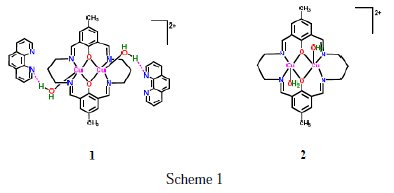
</front><body><![CDATA[   <!--     <p>&nbsp;</p>     <p>doi: 10.4152/pea.201504201</p> -->      <p><b>Electrochemical Properties of Robson Type Macrocyclic Dicopper(II) Complexes</b></p>      <p> <b>Elisabete C. B. A. Alegria</b><sup><i>a,b</i>,<a href="#0">*</a></sup> , <b>Sellamuthu Anbu</b><sup><i>b</i></sup> , <b>Luisa M.D.R.S. Martinsa</b><sup><i>b</i></sup>  and <b>Armando J.L. Pombeiro</b><sup><i>b</i>,<a href="#0a">*</a></sup> </p>      <p><i><sup>a</sup> Chemical Engineering Department, ISEL-Instituto Superior de Engenharia de Lisboa, Instituto  Politecnico de Lisboa, 1959-007 Lisboa, Portugal</i></p>      <p><i><sup>b</sup> Centro de Quimica Estrutural, Instituto Superior Tecnico, Universidade de Lisboa, Av. Rovisco  Pais, 1049-001 Lisboa, Portugal</i></p>       <p>&nbsp;</p>     <p><b>Abstract</b></p>      <p>The redox properties of the 1,10-phenanthroline containing Robson type symmetrical  macrocyclic dicopper(II) complex [Cu2L(H2O.phen)2](ClO4)2 <b>1</b> (L = &mu;-11,23-dimethyl3,7,15,19- tetraazatricyclo-[19.3.1.18 19,13,21] heptacosa-1(24),2,7,9,11,13(26),  14,19,21(25),22-decaene-25,26-diolate) and of its dicopper(II) precursor  [Cu2L(H2O)2](ClO4)2 <b>2</b> have been investigated by cyclic voltammetry and controlled  potential electrolysis in different organic solvents. They exhibit two consecutive  reversible one-electron reductions assigned to the  Cu<sup>II</sup>Cu<sup>II</sup> &rarr; Cu<sup>I</sup>Cu<sup>II</sup> &rarr; Cu<sup>I</sup>Cu<sup>I</sup>  cathodic processes. The results suggest that, in solution, phenanthroline does not  coordinate to the metal in complex 1, but its H-bonding interaction with the water  ligands can be preserved.</p>      ]]></body>
<body><![CDATA[<p><b><i>Keywords:</i></b> Robson type macrocyclic dicopper(II) complexes, 1,10-phenanthroline,  cyclic voltammetry, controlled potential electrolysis.</p>       <p>&nbsp;</p>     <p><b>Introduction</b></p>      <p>The presence of metal-binding sites in DNA structure makes it a good target for  metal-containing drugs, since it plays a central role in replication, transcription  and regulation of genes [1-3].</p>      <p>Over the past few decades, several phenanthroline based mononuclear Cu(II)  complexes were synthesized and their interactions with DNA and cytotoxic  activities [1-3] were reported. These works are mainly limited to mononuclear  complexes and very few studies on dinuclear complexes with metal ions in close  proximity were reported to date [4,5]. Recently, some of us synthesized  phenanthroline based dicopper(II) complexes, which strongly bind to DNA and  also regulate apoptosis [6,7]. In this context, a novel phenanthroline containing  Robson type symmetrical macrocyclic dicopper(II) complex  [Cu2L(H2O.phen)2](ClO4)2 <b>1</b> was obtained by reacting the reported Robson type  macrocyclic precursor dicopper(II) complex [Cu2L(H2O)2](ClO4)2 <b>2</b> and 1,10-phenanthroline  in ethanol [8]. X-ray crystallography reveals that, in the solid  state, 1,10-phenantroline nitrogens interact with the copper(II) centres through H- bonds with the coordinated water. However, analytical, UV-vis, ESI-MS and  EPR spectral data suggest that the 1,10-phenanthroline molecules are replacing  the coordinated water molecules in <b>2</b>, affording a 1,10-phenanthroline  coordinated macrocyclic dicopper(II) complex in solution with a different metal  coordination geometry. Nevertheless, this matter has not been fully clarified [8].  The catalytic activity of complexes <b>1</b> and <b>2</b> towards the hydrolysis of 4-  nitrophenyl phosphate, DNA binding, cleavage and preliminary anticancer  properties was studied [8]. Complex <b>1</b> displays better DNA binding and  significant cleavage activity than <b>2</b>. The influence of the phenanthroline moiety  on the phosphate hydrolysis, DNA binding, cleavage and anticancer properties of  complex <b>1</b> has also been studied. The dicopper(II) complexes <b>1</b> and <b>2</b> showed  cytotoxicity in human cervical HeLa cancer cells, giving IC50 values of 15.82 and  79.41 &mu;M, respectively. Antiproliferative effect of <b>1</b> and <b>2</b> were confirmed by  Trypan blue Exclusive assay and lactate dehydrogenase level in HeLa cancer cell  lysate and content media [8].</p>      <p>Herein we report the electrochemical properties of complexes <b>1</b> and <b>2</b> using  cyclic voltammetry (CV) and controlled potential electrolysis (CPE) techniques,  aiming also to further contribute to clarify the structure of <b>1</b> in solution, namely  the eventual replacement (or not) of the water ligands by phenanthroline  molecules.</p>       <p>&nbsp;</p>     <p><b>Results and discussion</b></p>      <p>The redox properties of the compounds [Cu2L(H2O.phen)2](ClO4)2 <b>1</b> and  [Cu2L(H2O)2](ClO4)2 <b>2</b> (<a href="#s1">Scheme 1</a>) have been investigated by cyclic  voltammetry (CV), at a Pt electrode, in various organic solvents, using a 0.2 M  [nBu4N][BF4] solution, at 25 &deg;C.</p>       <p>&nbsp;</p> <a name="s1"> <img src="/img/revistas/pea/v33n4/33n4a01s1.jpg">     
]]></body>
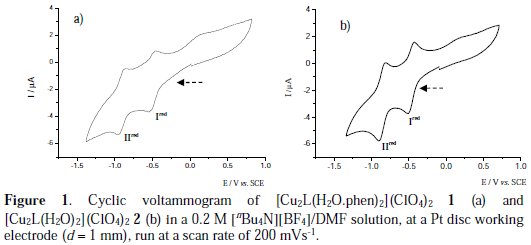
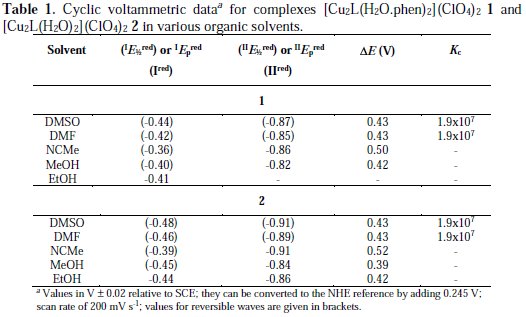
<body><![CDATA[<p>&nbsp;</p>       <p>Results are summarized in <a href="#t1">Table 1</a> and <a href="#f1">Fig. 1</a>.</p>       <p>&nbsp;</p> <a name="t1"> <img src="/img/revistas/pea/v33n4/33n4a01t1.jpg">     
<p>&nbsp;</p> <a name="f1"> <img src="/img/revistas/pea/v33n4/33n4a01f1.jpg">     
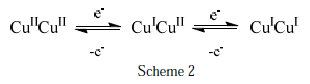
<p>&nbsp;</p>       <p>The cyclic voltammograms of these dicopper(II) complexes exhibit a first single- electron reversible (in DMSO, DMF, NCMe and MeOH) or irreversible (in  EtOH) reduction wave (see wave <b>I<sup>red</sup></b>, <a href="#f1">Fig. 1</a>,  for <b>1</b> and <b>2</b> in DMF, <a href="#t1">Table 1</a>) and,  at a lower potential, a second single-electron reversible (in DMSO and DMF) or  irreversible (in NCMe, MeOH and EtOH) reduction (see wave <b>II<sup>red</sup></b>, <a href="#f1">Fig. 1</a>, for <b>1</b>  and <b>2</b> in DMF), at the reduction potential values given in <a href="#t1">Table 1</a>  (<sup>I</sup>E<sup>red</sup><sub>p</sub> in the  range from -0.36 to -0.48 V vs. SCE, and  <sup>II</sup>E<sup>red</sup><sub>p</sub> between -0.82 and -0.91 V vs. SCE).</p>      <p>The occurrence of single-electron reductions (<b>I<sup>red</sup></b> and <b>II<sup>red</sup></b>) has been confirmed  by exhaustive controlled potential electrolysis (CPE) at a potential slightly  cathodic to that of the peak potential of wave <b>I<sup>red</sup></b> or <b>II<sup>red</sup></b>. CPE at any of the  reduction waves corresponds to a charge consumption of 1 F/mole of complex.</p>      <p>The above observations can be rationalized, for reversible waves, by <a href="#s2">Scheme 2</a>,  involving the stepwise Cu<sup>II</sup> &rarr; Cu<sup>I</sup> reduction of one Cu centre to form a mixed- valence Cu<sup>II</sup>Cu<sup>I</sup> species (wave Ired) followed by the reduction of the second Cu  centre to yield the corresponding Cu<sup>I</sup>Cu<sup>I</sup> complexes (wave <b>II<sup>red</sup></b>).</p>       <p>&nbsp;</p> <a name="s2"> <img src="/img/revistas/pea/v33n4/33n4a01s2.jpg">     
<p>&nbsp;</p>       ]]></body>
<body><![CDATA[<p>No oxidation has been detected, for any of the complexes, by a first anodic  sweep without a previous reduction scan, indicating that neither a metal centred  nor a ligand-centred oxidation is observed.</p>      <p>The electrochemical behaviour of the symmetrical macrocyclic dicopper(II)  complexes <b>1</b> and <b>2</b> is consistent with that previously reported for other related  symmetrical and unsymmetrical binuclear copper(II) complexes [9,10].</p>      <p>Comparison of the Cu<sup>II</sup>/Cu<sup>I</sup> redox potentials in various solvents showed a good  correlation between half-wave potentials and the solvent electron pair donation  ability, being the most negative potential recorded in DMSO and DMF and the  less negative in NCMe [11,12], as observed in the present study.</p>      <p>The observation of the two distinct reduction waves <b>I<sup>red</sup></b> and <b>II<sup>red</sup></b> is indicative of  an electronic communication between the two metals, which is reflected on the  half-wave potential difference and the comproportionation constant Kc i.e. the  equilibrium constant of reaction (<a href="#e1">eq. 1</a>), which is given by the expression  Kc = exp(|n1E<sup>o</sup>1 - n2E<sup>o</sup>2|F/RT) = exp(|n1E<sup>o</sup>1 - n2E<sup>o</sup>2|/25.69) (at 298 K, with E<sup>o</sup> in mV)  [13].</p>       <p>&nbsp;</p> <a name="e1"> <img src="/img/revistas/pea/v33n4/33n4a01e1.jpg">     
<p>&nbsp;</p>       <p>In our case, for the reversible processes, n1= n2 = 1 electron,  |E<sup>o</sup>1 - E<sup>o</sup>2| =  |<sup>I</sup>E<sub>1/2</sub><sup>ox</sup> - <sup>II</sup>E<sub>1/2</sub><sup>ox</sup>| =  430 mV (<a href="#t1">Table 1</a>),  leading to the high value of Kc = 1.9 &times; 10<sup>7</sup>,  indicative of a Robin-Day class III system [14,15]. This shows a strong  electronic interaction between the two metals, via the bridging groups and a high  stabilization of the mixed-valence Cu<sup>I</sup>Cu<sup>II</sup> state.  The comproportionation constant value observed for our bimetallic copper  complexes <b>1</b> and <b>2</b> is in the range of the Kc values observed for other Robson  type macrocyclic dicopper(II) complexes (5.1&times;10<sup>7</sup> &lt; Kc &lt; 2.4&times;10<sup>12</sup>) [16,17].  Comparing the Kc value obtained for the system under study with the one for  other bimetallic systems studied by us, we can conclude, for example, that the  interaction between the copper centres in 1 and 2 (Kc = 1.9 &times; 10<sup>7</sup>, in DMf or  DMSO) is stronger than that observed between molybdenum centres, via  bridging pyridylpyrazolate groups, in [cis-{Mo(Î·3-allyl)(CO)2(&mu;  2-pypz)}]2 (Kc = 1.2 &times; 10<sup>6</sup>, in CH2Cl2) [18] or between iron centres in the dinuclear iron(II)hydride  complex with a bridging nitrile [{FeH(dppe)2}2(m-LL)][BF4]2 (LL =  NCCH=CHCN; dppe = Ph2PCH2CH2PPh2) (Kc = 1.6 &times; 10<sup>3</sup>, in CH2Cl2) [19].</p>      <p>Although <b>1</b> and <b>2</b> exhibit almost identical reduction potentials (the differences  are only of ca. 0.04~0.05 V), there appears to occur a minor systematic  difference.</p>      <p>The less very slightly cathodic reduction potential of [Cu2L(H2O.phen)2](ClO4)2  <b>1</b>, in all organic solvents used in this study, in comparison with that of the parent  [Cu2L(H2O)2](ClO4)2 <b>2</b>, indicates a slightly lower electron-donor character of the  ligands present in <b>1</b> relatively to those present in <b>2</b>. This behaviour is in  agreement with the expected [20] effect in solution of H-bond interaction, in <b>1</b>, of  the 1,10-phenanthroline molecules with the water ligands as revealed by X-ray  crystallography of <b>1</b> in the solid state [8].</p>      <p>Moreover, such a minor difference of reduction potentials between <b>1</b> and <b>2</b> is not  consistent with the replacement, in solution, of the ligated water in <b>1</b> by  phenanthroline ligands, in contrast to what some spectroscopies studies [8] have  suggested.</p>      ]]></body>
<body><![CDATA[<p>In fact, considering the markedly higher value of the electrochemical Lever EL  parameter (the higher this value, the weaker is the ligand electron-donor  character) [21-24] for 1,10-phenanthroline (EL = 0.26 vs. NHE) in comparison  with that of H2O (0.04 vs. NHE), a considerably less cathodic reduction potential  would be expected for <b>1</b>, more significant than that observed.</p>      <p>Hence, our electrochemical results are consistent with the possible preservation  in solution of the interaction of 1,10-phenanthroline with copper(II) through the  coordinated water molecules, and disagree with its direct coordination to the  metal.</p>      <p>This study could also provide an opportunity to estimate the EL ligand parameter  for the new Robson type macrocyclic ligand &mu;-11,23-dimethyl-3,7,15,19tetraazatricyclo-[ 19.3.1.19,13,21]heptacosa-1(24),2,7,9,11,13(26),14,19,21(25),  22-decaene-25,26-diol (L) by applying the Lever Equation (<a href="#e2">eq. 2</a>) [24], which  relates linearly the redox potential (E in V vs. the standard hydrogen electrode  (SHE)) of an octahedral complex with the sum (SEL) of the EL ligand  parameters for all the ligands (2-electron donors, assuming additive  contributions).</p>       <p>&nbsp;</p> <a name="e2"> <img src="/img/revistas/pea/v33n4/33n4a01e2.jpg">     
<p>&nbsp;</p>       <p>However, the slope (SM) and the intercept (IM), which are dependent upon the  metal, redox couple, spin state and stereochemistry [24], are not know for the  present redox couples and therefore the determination of the EL ligand parameter  was precluded.</p>       <p>&nbsp;</p>     <p><b>Experimental</b></p>      <p>The electrochemical experiments were performed on an EG&amp;G PAR 273A  potentiostat/galvanostat connected to a personal computer through a GPIB  interface. Cyclic voltammetry (CV) studies for 1 and 2 were undertaken in 0.2 M  [nBu4N][BF4]/(DMSO, DMF, NCMe, MeOH or EtOH), at a platinum disc  working electrode (d = 0.5 mm) and at room temperature. Controlled-potential  electrolyses (CPE) were carried out in electrolyte solutions with the above  mentioned composition, in a three-electrode H-type cell. The compartments were  separated by a sintered glass frit and equipped with platinum gauze working and  counter electrodes. For both CV and CPE experiments, a Luggin capillary  connected to a silver wire pseudo-reference electrode was used to control the  working electrode potential. A Pt wire was employed as the counter-electrode for  the CV cell. The CPE experiments were monitored regularly by cyclic  voltammetry, thus assuring no significant potential drift during the electrolyses.  The solutions were saturated with N2 by bubbling this gas before each run, and  the redox potentials of the complexes were measured by CV in the presence of  ferrocene as the internal standard, and their values are quoted relative to the SCE  by using the [Fe(&eta;5-C5H5)2]<sup>0/+</sup> redox couple (E<sub>1/2</sub><sup>ox</sup> = 0.45V vs. SCE for NCMe,  MeOH; E<sub>1/2</sub><sup>ox</sup> = 0.48V vs. SCE for DMF, E<sub>1/2</sub><sup>ox</sup> = 0.48V vs. SCE for DMSO)  [25,26].</p>       <p>&nbsp;</p>     ]]></body>
<body><![CDATA[<p><b>References</b></p>      <!-- ref --><p>1. Ramakrishnan S, Rajendiran V, Palaniandavar M, et al. Inorg Chem. 2009;48:1309.    &nbsp;&nbsp;&nbsp;&nbsp;&nbsp;&nbsp;&nbsp;&nbsp;[&#160;<a href="javascript:void(0);" onclick="javascript: window.open('/scielo.php?script=sci_nlinks&ref=000054&pid=S0872-1904201500040000100001&lng=','','width=640,height=500,resizable=yes,scrollbars=1,menubar=yes,');">Links</a>&#160;]<!-- end-ref --></p>      <!-- ref --><p>2. Ramakrishnan S, Shakthipriya D, Suresh E, et al. Inorg Chem. 2011;50:6458.    &nbsp;&nbsp;&nbsp;&nbsp;&nbsp;&nbsp;&nbsp;&nbsp;[&#160;<a href="javascript:void(0);" onclick="javascript: window.open('/scielo.php?script=sci_nlinks&ref=000056&pid=S0872-1904201500040000100002&lng=','','width=640,height=500,resizable=yes,scrollbars=1,menubar=yes,');">Links</a>&#160;]<!-- end-ref --></p>      <!-- ref --><p>3. Goswami T K, Chakravarthi V S K B, Roy M, et al. Inorg Chem. 2011;50:8452.    &nbsp;&nbsp;&nbsp;&nbsp;&nbsp;&nbsp;&nbsp;&nbsp;[&#160;<a href="javascript:void(0);" onclick="javascript: window.open('/scielo.php?script=sci_nlinks&ref=000058&pid=S0872-1904201500040000100003&lng=','','width=640,height=500,resizable=yes,scrollbars=1,menubar=yes,');">Links</a>&#160;]<!-- end-ref --></p>      <!-- ref --><p>4. Lim M H, Lau I H, Barton J K. Inorg Chem. 2007;46:9528.    &nbsp;&nbsp;&nbsp;&nbsp;&nbsp;&nbsp;&nbsp;&nbsp;[&#160;<a href="javascript:void(0);" onclick="javascript: window.open('/scielo.php?script=sci_nlinks&ref=000060&pid=S0872-1904201500040000100004&lng=','','width=640,height=500,resizable=yes,scrollbars=1,menubar=yes,');">Links</a>&#160;]<!-- end-ref --></p>      <!-- ref --><p>5. Tjioe L, Joshi T, Forsyth C M, et al. Inorg Chem. 2012;51:939.    &nbsp;&nbsp;&nbsp;&nbsp;&nbsp;&nbsp;&nbsp;&nbsp;[&#160;<a href="javascript:void(0);" onclick="javascript: window.open('/scielo.php?script=sci_nlinks&ref=000062&pid=S0872-1904201500040000100005&lng=','','width=640,height=500,resizable=yes,scrollbars=1,menubar=yes,');">Links</a>&#160;]<!-- end-ref --></p>      <!-- ref --><p>6. Anbu S, Kandaswamy M. Inorg Chim Acta. 2012;385:45.    &nbsp;&nbsp;&nbsp;&nbsp;&nbsp;&nbsp;&nbsp;&nbsp;[&#160;<a href="javascript:void(0);" onclick="javascript: window.open('/scielo.php?script=sci_nlinks&ref=000064&pid=S0872-1904201500040000100006&lng=','','width=640,height=500,resizable=yes,scrollbars=1,menubar=yes,');">Links</a>&#160;]<!-- end-ref --></p>      <!-- ref --><p>7. Anbu S, Kandaswamy M, Kamalraj S, et al. Dalton Trans. 2011;40:7310.    &nbsp;&nbsp;&nbsp;&nbsp;&nbsp;&nbsp;&nbsp;&nbsp;[&#160;<a href="javascript:void(0);" onclick="javascript: window.open('/scielo.php?script=sci_nlinks&ref=000066&pid=S0872-1904201500040000100007&lng=','','width=640,height=500,resizable=yes,scrollbars=1,menubar=yes,');">Links</a>&#160;]<!-- end-ref --></p>      <!-- ref --><p>8. Anbu S, Killivalavan A, Alegria E C B A, et al. J Coord Chem. 2013;66:3989.    &nbsp;&nbsp;&nbsp;&nbsp;&nbsp;&nbsp;&nbsp;&nbsp;[&#160;<a href="javascript:void(0);" onclick="javascript: window.open('/scielo.php?script=sci_nlinks&ref=000068&pid=S0872-1904201500040000100008&lng=','','width=640,height=500,resizable=yes,scrollbars=1,menubar=yes,');">Links</a>&#160;]<!-- end-ref --></p>      <!-- ref --><p>9. Anbu S, Suthakaran M K P, Murugan V, et al. J Inorg Biochem. 2009;103:401.    &nbsp;&nbsp;&nbsp;&nbsp;&nbsp;&nbsp;&nbsp;&nbsp;[&#160;<a href="javascript:void(0);" onclick="javascript: window.open('/scielo.php?script=sci_nlinks&ref=000070&pid=S0872-1904201500040000100009&lng=','','width=640,height=500,resizable=yes,scrollbars=1,menubar=yes,');">Links</a>&#160;]<!-- end-ref --></p>      <!-- ref --><p>10. Okawa H, Tadokoro M, Aratake Y, et al. J Chem Soc, Dalton Trans. 1993;253.    &nbsp;&nbsp;&nbsp;&nbsp;&nbsp;&nbsp;&nbsp;&nbsp;[&#160;<a href="javascript:void(0);" onclick="javascript: window.open('/scielo.php?script=sci_nlinks&ref=000072&pid=S0872-1904201500040000100010&lng=','','width=640,height=500,resizable=yes,scrollbars=1,menubar=yes,');">Links</a>&#160;]<!-- end-ref --></p>      <!-- ref --><p>11. (a) Mayer U., Gutmann V. Struct Bonding. 1972;12:113.    &nbsp;&nbsp;&nbsp;&nbsp;&nbsp;&nbsp;&nbsp;&nbsp;[&#160;<a href="javascript:void(0);" onclick="javascript: window.open('/scielo.php?script=sci_nlinks&ref=000074&pid=S0872-1904201500040000100011&lng=','','width=640,height=500,resizable=yes,scrollbars=1,menubar=yes,');">Links</a>&#160;]<!-- end-ref --><!-- ref --> (b) Marcus Y. J Solution Chem. 1984;13:599.    &nbsp;&nbsp;&nbsp;&nbsp;&nbsp;&nbsp;&nbsp;&nbsp;[&#160;<a href="javascript:void(0);" onclick="javascript: window.open('/scielo.php?script=sci_nlinks&ref=000075&pid=S0872-1904201500040000100012&lng=','','width=640,height=500,resizable=yes,scrollbars=1,menubar=yes,');">Links</a>&#160;]<!-- end-ref --></p>      <!-- ref --><p>12. Taraszewska J, Zieba K, Kowalski J, et al. Electrochim Acta. 2007;52:3556.    &nbsp;&nbsp;&nbsp;&nbsp;&nbsp;&nbsp;&nbsp;&nbsp;[&#160;<a href="javascript:void(0);" onclick="javascript: window.open('/scielo.php?script=sci_nlinks&ref=000077&pid=S0872-1904201500040000100013&lng=','','width=640,height=500,resizable=yes,scrollbars=1,menubar=yes,');">Links</a>&#160;]<!-- end-ref --></p>      <!-- ref --><p>13. Richardson D E, Taube H. Inorg Chem. 1981;20:1278.    &nbsp;&nbsp;&nbsp;&nbsp;&nbsp;&nbsp;&nbsp;&nbsp;[&#160;<a href="javascript:void(0);" onclick="javascript: window.open('/scielo.php?script=sci_nlinks&ref=000079&pid=S0872-1904201500040000100014&lng=','','width=640,height=500,resizable=yes,scrollbars=1,menubar=yes,');">Links</a>&#160;]<!-- end-ref --></p>      <!-- ref --><p>14. Robin M B, Day P. Adv Inorg Chem Radiochem. 1967;10:247.    &nbsp;&nbsp;&nbsp;&nbsp;&nbsp;&nbsp;&nbsp;&nbsp;[&#160;<a href="javascript:void(0);" onclick="javascript: window.open('/scielo.php?script=sci_nlinks&ref=000081&pid=S0872-1904201500040000100015&lng=','','width=640,height=500,resizable=yes,scrollbars=1,menubar=yes,');">Links</a>&#160;]<!-- end-ref --></p>      ]]></body>
<body><![CDATA[<!-- ref --><p>15. Brunschwig B S, Creutz C, Sutin N. Chem Soc Rev. 2002;31:168.    &nbsp;&nbsp;&nbsp;&nbsp;&nbsp;&nbsp;&nbsp;&nbsp;[&#160;<a href="javascript:void(0);" onclick="javascript: window.open('/scielo.php?script=sci_nlinks&ref=000083&pid=S0872-1904201500040000100016&lng=','','width=640,height=500,resizable=yes,scrollbars=1,menubar=yes,');">Links</a>&#160;]<!-- end-ref --></p>      <!-- ref --><p>16. (a) Mohanta S, Baitalik S, Dutta S K, et al. Polyhedron. 1998;17:2669.    &nbsp;&nbsp;&nbsp;&nbsp;&nbsp;&nbsp;&nbsp;&nbsp;[&#160;<a href="javascript:void(0);" onclick="javascript: window.open('/scielo.php?script=sci_nlinks&ref=000085&pid=S0872-1904201500040000100017&lng=','','width=640,height=500,resizable=yes,scrollbars=1,menubar=yes,');">Links</a>&#160;]<!-- end-ref --><!-- ref -->  (b) Mandal S K, Nag K. J Chem Soc, Dalton Trans. 1884;2141.    &nbsp;&nbsp;&nbsp;&nbsp;&nbsp;&nbsp;&nbsp;&nbsp;[&#160;<a href="javascript:void(0);" onclick="javascript: window.open('/scielo.php?script=sci_nlinks&ref=000086&pid=S0872-1904201500040000100018&lng=','','width=640,height=500,resizable=yes,scrollbars=1,menubar=yes,');">Links</a>&#160;]<!-- end-ref --><!-- ref -->  (c) Mohanta S K, Nanda K K, Werner R, et al. Inorg Chem. 1997;36:4656.    &nbsp;&nbsp;&nbsp;&nbsp;&nbsp;&nbsp;&nbsp;&nbsp;[&#160;<a href="javascript:void(0);" onclick="javascript: window.open('/scielo.php?script=sci_nlinks&ref=000087&pid=S0872-1904201500040000100019&lng=','','width=640,height=500,resizable=yes,scrollbars=1,menubar=yes,');">Links</a>&#160;]<!-- end-ref --></p>      <!-- ref --><p>17. Zhan S, Miao Y, Li P, et al. Transition Met Chem. 1996;24:311.    &nbsp;&nbsp;&nbsp;&nbsp;&nbsp;&nbsp;&nbsp;&nbsp;[&#160;<a href="javascript:void(0);" onclick="javascript: window.open('/scielo.php?script=sci_nlinks&ref=000089&pid=S0872-1904201500040000100020&lng=','','width=640,height=500,resizable=yes,scrollbars=1,menubar=yes,');">Links</a>&#160;]<!-- end-ref --></p>      <!-- ref --><p>18. Arroyo M, Miguel D, Villafane F, et al. J Chem Soc, Dalton Trans. 2012;41:7017.    &nbsp;&nbsp;&nbsp;&nbsp;&nbsp;&nbsp;&nbsp;&nbsp;[&#160;<a href="javascript:void(0);" onclick="javascript: window.open('/scielo.php?script=sci_nlinks&ref=000091&pid=S0872-1904201500040000100021&lng=','','width=640,height=500,resizable=yes,scrollbars=1,menubar=yes,');">Links</a>&#160;]<!-- end-ref --></p>      ]]></body>
<body><![CDATA[<!-- ref --><p>19. Venancio A I F, Kuznetsov M L, Guedes da Silva M F C, et al. Inorg Chem. 2002;41:6456.    &nbsp;&nbsp;&nbsp;&nbsp;&nbsp;&nbsp;&nbsp;&nbsp;[&#160;<a href="javascript:void(0);" onclick="javascript: window.open('/scielo.php?script=sci_nlinks&ref=000093&pid=S0872-1904201500040000100022&lng=','','width=640,height=500,resizable=yes,scrollbars=1,menubar=yes,');">Links</a>&#160;]<!-- end-ref --></p>      <!-- ref --><p>20. Carvalho M F N N, Galvao A M, Pombeiro A J L. J Chem Soc, Dalton Trans. 2000;3393.    &nbsp;&nbsp;&nbsp;&nbsp;&nbsp;&nbsp;&nbsp;&nbsp;[&#160;<a href="javascript:void(0);" onclick="javascript: window.open('/scielo.php?script=sci_nlinks&ref=000095&pid=S0872-1904201500040000100023&lng=','','width=640,height=500,resizable=yes,scrollbars=1,menubar=yes,');">Links</a>&#160;]<!-- end-ref --></p>      <!-- ref --><p>21. Guedes da Silva M F C, Pombeiro A J L. Electrochim Acta 2012;82:478.    &nbsp;&nbsp;&nbsp;&nbsp;&nbsp;&nbsp;&nbsp;&nbsp;[&#160;<a href="javascript:void(0);" onclick="javascript: window.open('/scielo.php?script=sci_nlinks&ref=000097&pid=S0872-1904201500040000100024&lng=','','width=640,height=500,resizable=yes,scrollbars=1,menubar=yes,');">Links</a>&#160;]<!-- end-ref --></p>      <!-- ref --><p>22. Pombeiro A J L. Eur J Inorg Chem. 2007;1473.    &nbsp;&nbsp;&nbsp;&nbsp;&nbsp;&nbsp;&nbsp;&nbsp;[&#160;<a href="javascript:void(0);" onclick="javascript: window.open('/scielo.php?script=sci_nlinks&ref=000099&pid=S0872-1904201500040000100025&lng=','','width=640,height=500,resizable=yes,scrollbars=1,menubar=yes,');">Links</a>&#160;]<!-- end-ref --></p>      <!-- ref --><p>23. Pombeiro A J L. J Organometal Chem. 2005;690:6021.    &nbsp;&nbsp;&nbsp;&nbsp;&nbsp;&nbsp;&nbsp;&nbsp;[&#160;<a href="javascript:void(0);" onclick="javascript: window.open('/scielo.php?script=sci_nlinks&ref=000101&pid=S0872-1904201500040000100026&lng=','','width=640,height=500,resizable=yes,scrollbars=1,menubar=yes,');">Links</a>&#160;]<!-- end-ref --></p>      ]]></body>
<body><![CDATA[<!-- ref --><p>24. (a) Lever A B P. Inorg Chem. 1991;30:1980.    &nbsp;&nbsp;&nbsp;&nbsp;&nbsp;&nbsp;&nbsp;&nbsp;[&#160;<a href="javascript:void(0);" onclick="javascript: window.open('/scielo.php?script=sci_nlinks&ref=000103&pid=S0872-1904201500040000100027&lng=','','width=640,height=500,resizable=yes,scrollbars=1,menubar=yes,');">Links</a>&#160;]<!-- end-ref --><!-- ref -->  (b) Lever A B P. Inorg Chem. 1990;29:1271.    &nbsp;&nbsp;&nbsp;&nbsp;&nbsp;&nbsp;&nbsp;&nbsp;[&#160;<a href="javascript:void(0);" onclick="javascript: window.open('/scielo.php?script=sci_nlinks&ref=000104&pid=S0872-1904201500040000100028&lng=','','width=640,height=500,resizable=yes,scrollbars=1,menubar=yes,');">Links</a>&#160;]<!-- end-ref -->  (c) <a href="http://www.chem.yorku.ca/profs/lever/elparameter98.htm" target="_blank">http://www.chem.yorku.ca/profs/lever/elparameter98.htm</a>.</p>      <!-- ref --><p>25. Pombeiro A J L, Guedes da Silva M F C, Lemos M A N D A. Coord Chem Rev. 2001;219:53.    &nbsp;&nbsp;&nbsp;&nbsp;&nbsp;&nbsp;&nbsp;&nbsp;[&#160;<a href="javascript:void(0);" onclick="javascript: window.open('/scielo.php?script=sci_nlinks&ref=000106&pid=S0872-1904201500040000100029&lng=','','width=640,height=500,resizable=yes,scrollbars=1,menubar=yes,');">Links</a>&#160;]<!-- end-ref --></p>      <!-- ref --><p>26. Silva M E N P R A, Pombeiro A J L, Frausto da Silva J J R, et al. J Organometal Chem. 1991;421:75-90.    &nbsp;&nbsp;&nbsp;&nbsp;&nbsp;&nbsp;&nbsp;&nbsp;[&#160;<a href="javascript:void(0);" onclick="javascript: window.open('/scielo.php?script=sci_nlinks&ref=000108&pid=S0872-1904201500040000100030&lng=','','width=640,height=500,resizable=yes,scrollbars=1,menubar=yes,');">Links</a>&#160;]<!-- end-ref --></p>       <p>&nbsp;</p>     <p><b>Acknowledgements</b></p>      <p>This work has been partially supported by the Funda&ccedil;&atilde;o para a Ci&ecirc;ncia e a  Tecnologia (FCT), Portugal, including the postdoctoral fellowship  SFRH/BPD/76451/2011 (attributed to S.A.) and the project  UID/QUI/00100/2013.</p>      ]]></body>
<body><![CDATA[<p>&nbsp;</p>     <p><a name=0></a><sup><a href="#top">*</a></sup>Corresponding author. E-mail address: <a href="mailto:ebastos@deq.isel.ipl.pt">ebastos@deq.isel.ipl.pt</a></p>     <p><a name=0a></a><sup><a href="#top">*</a></sup>Corresponding author. E-mail address: <a href="mailto:pombeiro@ist.utl.pt">pombeiro@ist.utl.pt</a></p>       <p>Received 22 July 2015; accepted 22 August 2015</p>      <p><a href="http://www.peacta.org" target="_blank">www.peacta.org</a> </p>        ]]></body><back>
<ref-list>
<ref id="B1">
<label>1</label><nlm-citation citation-type="journal">
<person-group person-group-type="author">
<name>
<surname><![CDATA[Ramakrishnan]]></surname>
<given-names><![CDATA[S]]></given-names>
</name>
<name>
<surname><![CDATA[Rajendiran]]></surname>
<given-names><![CDATA[V]]></given-names>
</name>
<name>
<surname><![CDATA[Palaniandavar]]></surname>
<given-names><![CDATA[M]]></given-names>
</name>
</person-group>
<source><![CDATA[Inorg Chem]]></source>
<year>2009</year>
<volume>48</volume>
<page-range>1309</page-range></nlm-citation>
</ref>
<ref id="B2">
<label>2</label><nlm-citation citation-type="journal">
<person-group person-group-type="author">
<name>
<surname><![CDATA[Ramakrishnan]]></surname>
<given-names><![CDATA[S]]></given-names>
</name>
<name>
<surname><![CDATA[Shakthipriya]]></surname>
<given-names><![CDATA[D]]></given-names>
</name>
<name>
<surname><![CDATA[Suresh]]></surname>
<given-names><![CDATA[E]]></given-names>
</name>
</person-group>
<source><![CDATA[Inorg Chem]]></source>
<year>2011</year>
<volume>50</volume>
<page-range>6458</page-range></nlm-citation>
</ref>
<ref id="B3">
<label>3</label><nlm-citation citation-type="journal">
<person-group person-group-type="author">
<name>
<surname><![CDATA[Goswami]]></surname>
<given-names><![CDATA[T K]]></given-names>
</name>
<name>
<surname><![CDATA[Chakravarthi]]></surname>
<given-names><![CDATA[V S K B]]></given-names>
</name>
<name>
<surname><![CDATA[Roy]]></surname>
<given-names><![CDATA[M]]></given-names>
</name>
</person-group>
<source><![CDATA[Inorg Chem]]></source>
<year>2011</year>
<volume>50</volume>
<page-range>8452</page-range></nlm-citation>
</ref>
<ref id="B4">
<label>4</label><nlm-citation citation-type="journal">
<person-group person-group-type="author">
<name>
<surname><![CDATA[Lim]]></surname>
<given-names><![CDATA[M H]]></given-names>
</name>
<name>
<surname><![CDATA[Lau]]></surname>
<given-names><![CDATA[I H]]></given-names>
</name>
<name>
<surname><![CDATA[Barton]]></surname>
<given-names><![CDATA[J K]]></given-names>
</name>
</person-group>
<source><![CDATA[Inorg Chem]]></source>
<year>2007</year>
<volume>46</volume>
<page-range>9528</page-range></nlm-citation>
</ref>
<ref id="B5">
<label>5</label><nlm-citation citation-type="journal">
<person-group person-group-type="author">
<name>
<surname><![CDATA[Tjioe]]></surname>
<given-names><![CDATA[L]]></given-names>
</name>
<name>
<surname><![CDATA[Joshi]]></surname>
<given-names><![CDATA[T]]></given-names>
</name>
<name>
<surname><![CDATA[Forsyth]]></surname>
<given-names><![CDATA[C M]]></given-names>
</name>
</person-group>
<source><![CDATA[Inorg Chem]]></source>
<year>2012</year>
<volume>51</volume>
<page-range>939</page-range></nlm-citation>
</ref>
<ref id="B6">
<label>6</label><nlm-citation citation-type="journal">
<person-group person-group-type="author">
<name>
<surname><![CDATA[Anbu]]></surname>
<given-names><![CDATA[S]]></given-names>
</name>
<name>
<surname><![CDATA[Kandaswamy]]></surname>
<given-names><![CDATA[M]]></given-names>
</name>
</person-group>
<source><![CDATA[Inorg Chim Acta]]></source>
<year>2012</year>
<volume>385</volume>
<page-range>45</page-range></nlm-citation>
</ref>
<ref id="B7">
<label>7</label><nlm-citation citation-type="journal">
<person-group person-group-type="author">
<name>
<surname><![CDATA[Anbu]]></surname>
<given-names><![CDATA[S]]></given-names>
</name>
<name>
<surname><![CDATA[Kandaswamy]]></surname>
<given-names><![CDATA[M]]></given-names>
</name>
<name>
<surname><![CDATA[Kamalraj]]></surname>
<given-names><![CDATA[S]]></given-names>
</name>
</person-group>
<source><![CDATA[Dalton Trans]]></source>
<year>2011</year>
<volume>40</volume>
<page-range>7310</page-range></nlm-citation>
</ref>
<ref id="B8">
<label>8</label><nlm-citation citation-type="journal">
<person-group person-group-type="author">
<name>
<surname><![CDATA[Anbu]]></surname>
<given-names><![CDATA[S]]></given-names>
</name>
<name>
<surname><![CDATA[Killivalavan]]></surname>
<given-names><![CDATA[A]]></given-names>
</name>
<name>
<surname><![CDATA[Alegria]]></surname>
<given-names><![CDATA[E C B A]]></given-names>
</name>
</person-group>
<source><![CDATA[J Coord Chem]]></source>
<year>2013</year>
<volume>66</volume>
<page-range>3989</page-range></nlm-citation>
</ref>
<ref id="B9">
<label>9</label><nlm-citation citation-type="journal">
<person-group person-group-type="author">
<name>
<surname><![CDATA[Anbu]]></surname>
<given-names><![CDATA[S]]></given-names>
</name>
<name>
<surname><![CDATA[Suthakaran]]></surname>
<given-names><![CDATA[M K P]]></given-names>
</name>
<name>
<surname><![CDATA[Murugan]]></surname>
<given-names><![CDATA[V]]></given-names>
</name>
</person-group>
<source><![CDATA[J Inorg Biochem]]></source>
<year>2009</year>
<volume>103</volume>
<page-range>401</page-range></nlm-citation>
</ref>
<ref id="B10">
<label>10</label><nlm-citation citation-type="journal">
<person-group person-group-type="author">
<name>
<surname><![CDATA[Okawa]]></surname>
<given-names><![CDATA[H]]></given-names>
</name>
<name>
<surname><![CDATA[Tadokoro]]></surname>
<given-names><![CDATA[M]]></given-names>
</name>
<name>
<surname><![CDATA[Aratake]]></surname>
<given-names><![CDATA[Y]]></given-names>
</name>
</person-group>
<source><![CDATA[J Chem Soc, Dalton Trans]]></source>
<year>1993</year>
<page-range>253</page-range></nlm-citation>
</ref>
<ref id="B11">
<label>11</label><nlm-citation citation-type="journal">
<person-group person-group-type="author">
<name>
<surname><![CDATA[Mayer]]></surname>
<given-names><![CDATA[U]]></given-names>
</name>
<name>
<surname><![CDATA[Gutmann]]></surname>
<given-names><![CDATA[V]]></given-names>
</name>
</person-group>
<source><![CDATA[Struct Bonding]]></source>
<year>1972</year>
<volume>12</volume>
<page-range>113</page-range></nlm-citation>
</ref>
<ref id="B12">
<nlm-citation citation-type="journal">
<person-group person-group-type="author">
<name>
<surname><![CDATA[Marcus]]></surname>
<given-names><![CDATA[Y]]></given-names>
</name>
</person-group>
<source><![CDATA[J Solution Chem]]></source>
<year>1984</year>
<volume>13</volume>
<page-range>599</page-range></nlm-citation>
</ref>
<ref id="B13">
<label>12</label><nlm-citation citation-type="journal">
<person-group person-group-type="author">
<name>
<surname><![CDATA[Taraszewska]]></surname>
<given-names><![CDATA[J]]></given-names>
</name>
<name>
<surname><![CDATA[Zieba]]></surname>
<given-names><![CDATA[K]]></given-names>
</name>
<name>
<surname><![CDATA[Kowalski]]></surname>
<given-names><![CDATA[J]]></given-names>
</name>
</person-group>
<source><![CDATA[Electrochim Acta]]></source>
<year>2007</year>
<volume>52</volume>
<page-range>3556</page-range></nlm-citation>
</ref>
<ref id="B14">
<label>13</label><nlm-citation citation-type="journal">
<person-group person-group-type="author">
<name>
<surname><![CDATA[Richardson]]></surname>
<given-names><![CDATA[D E]]></given-names>
</name>
<name>
<surname><![CDATA[Taube]]></surname>
<given-names><![CDATA[H]]></given-names>
</name>
</person-group>
<source><![CDATA[Inorg Chem]]></source>
<year>1981</year>
<volume>20</volume>
<page-range>1278</page-range></nlm-citation>
</ref>
<ref id="B15">
<label>14</label><nlm-citation citation-type="journal">
<person-group person-group-type="author">
<name>
<surname><![CDATA[Robin]]></surname>
<given-names><![CDATA[M B]]></given-names>
</name>
<name>
<surname><![CDATA[Day]]></surname>
<given-names><![CDATA[P]]></given-names>
</name>
</person-group>
<source><![CDATA[Adv Inorg Chem Radiochem]]></source>
<year>1967</year>
<volume>10</volume>
<page-range>247</page-range></nlm-citation>
</ref>
<ref id="B16">
<label>15</label><nlm-citation citation-type="journal">
<person-group person-group-type="author">
<name>
<surname><![CDATA[Brunschwig]]></surname>
<given-names><![CDATA[B S]]></given-names>
</name>
<name>
<surname><![CDATA[Creutz]]></surname>
<given-names><![CDATA[C]]></given-names>
</name>
<name>
<surname><![CDATA[Sutin]]></surname>
<given-names><![CDATA[N]]></given-names>
</name>
</person-group>
<source><![CDATA[Chem Soc Rev]]></source>
<year>2002</year>
<volume>31</volume>
<page-range>168</page-range></nlm-citation>
</ref>
<ref id="B17">
<label>16</label><nlm-citation citation-type="journal">
<person-group person-group-type="author">
<name>
<surname><![CDATA[Mohanta]]></surname>
<given-names><![CDATA[S]]></given-names>
</name>
<name>
<surname><![CDATA[Baitalik]]></surname>
<given-names><![CDATA[S]]></given-names>
</name>
<name>
<surname><![CDATA[Dutta]]></surname>
<given-names><![CDATA[S K]]></given-names>
</name>
</person-group>
<source><![CDATA[Polyhedron]]></source>
<year>1998</year>
<volume>17</volume>
<page-range>2669</page-range></nlm-citation>
</ref>
<ref id="B18">
<nlm-citation citation-type="journal">
<person-group person-group-type="author">
<name>
<surname><![CDATA[Mandal]]></surname>
<given-names><![CDATA[S K]]></given-names>
</name>
<name>
<surname><![CDATA[Nag]]></surname>
<given-names><![CDATA[K]]></given-names>
</name>
</person-group>
<source><![CDATA[J Chem Soc, Dalton Trans]]></source>
<year>1884</year>
<page-range>2141</page-range></nlm-citation>
</ref>
<ref id="B19">
<nlm-citation citation-type="journal">
<person-group person-group-type="author">
<name>
<surname><![CDATA[Mohanta]]></surname>
<given-names><![CDATA[S K]]></given-names>
</name>
<name>
<surname><![CDATA[Nanda]]></surname>
<given-names><![CDATA[K K]]></given-names>
</name>
<name>
<surname><![CDATA[Werner]]></surname>
<given-names><![CDATA[R]]></given-names>
</name>
</person-group>
<source><![CDATA[Inorg Chem]]></source>
<year>1997</year>
<volume>36</volume>
<page-range>4656</page-range></nlm-citation>
</ref>
<ref id="B20">
<label>17</label><nlm-citation citation-type="journal">
<person-group person-group-type="author">
<name>
<surname><![CDATA[Zhan]]></surname>
<given-names><![CDATA[S]]></given-names>
</name>
<name>
<surname><![CDATA[Miao]]></surname>
<given-names><![CDATA[Y]]></given-names>
</name>
<name>
<surname><![CDATA[Li]]></surname>
<given-names><![CDATA[P]]></given-names>
</name>
</person-group>
<source><![CDATA[Transition Met Chem]]></source>
<year>1996</year>
<volume>24</volume>
<page-range>311</page-range></nlm-citation>
</ref>
<ref id="B21">
<label>18</label><nlm-citation citation-type="journal">
<person-group person-group-type="author">
<name>
<surname><![CDATA[Arroyo]]></surname>
<given-names><![CDATA[M]]></given-names>
</name>
<name>
<surname><![CDATA[Miguel]]></surname>
<given-names><![CDATA[D]]></given-names>
</name>
<name>
<surname><![CDATA[Villafane]]></surname>
<given-names><![CDATA[F]]></given-names>
</name>
</person-group>
<source><![CDATA[J Chem Soc, Dalton Trans]]></source>
<year>2012</year>
<volume>41</volume>
<page-range>7017</page-range></nlm-citation>
</ref>
<ref id="B22">
<label>19</label><nlm-citation citation-type="journal">
<person-group person-group-type="author">
<name>
<surname><![CDATA[Venancio]]></surname>
<given-names><![CDATA[A I F]]></given-names>
</name>
<name>
<surname><![CDATA[Kuznetsov]]></surname>
<given-names><![CDATA[M L]]></given-names>
</name>
<name>
<surname><![CDATA[Guedes da Silva]]></surname>
<given-names><![CDATA[M F C]]></given-names>
</name>
</person-group>
<source><![CDATA[Inorg Chem]]></source>
<year>2002</year>
<volume>41</volume>
<page-range>6456</page-range></nlm-citation>
</ref>
<ref id="B23">
<label>20</label><nlm-citation citation-type="journal">
<person-group person-group-type="author">
<name>
<surname><![CDATA[Carvalho]]></surname>
<given-names><![CDATA[M F N N]]></given-names>
</name>
<name>
<surname><![CDATA[Galvao]]></surname>
<given-names><![CDATA[A M]]></given-names>
</name>
<name>
<surname><![CDATA[Pombeiro]]></surname>
<given-names><![CDATA[A J L]]></given-names>
</name>
</person-group>
<source><![CDATA[J Chem Soc, Dalton Trans]]></source>
<year>2000</year>
<page-range>3393</page-range></nlm-citation>
</ref>
<ref id="B24">
<label>21</label><nlm-citation citation-type="journal">
<person-group person-group-type="author">
<name>
<surname><![CDATA[Guedes da Silva]]></surname>
<given-names><![CDATA[M F C]]></given-names>
</name>
<name>
<surname><![CDATA[Pombeiro]]></surname>
<given-names><![CDATA[A J L]]></given-names>
</name>
</person-group>
<source><![CDATA[Electrochim Acta]]></source>
<year>2012</year>
<volume>82</volume>
<page-range>478</page-range></nlm-citation>
</ref>
<ref id="B25">
<label>22</label><nlm-citation citation-type="journal">
<person-group person-group-type="author">
<name>
<surname><![CDATA[Pombeiro]]></surname>
<given-names><![CDATA[A J L]]></given-names>
</name>
</person-group>
<source><![CDATA[Eur J Inorg Chem]]></source>
<year>2007</year>
<page-range>1473</page-range></nlm-citation>
</ref>
<ref id="B26">
<label>23</label><nlm-citation citation-type="journal">
<person-group person-group-type="author">
<name>
<surname><![CDATA[Pombeiro]]></surname>
<given-names><![CDATA[A J L]]></given-names>
</name>
</person-group>
<source><![CDATA[J Organometal Chem]]></source>
<year>2005</year>
<volume>690</volume>
<page-range>6021</page-range></nlm-citation>
</ref>
<ref id="B27">
<label>24</label><nlm-citation citation-type="journal">
<person-group person-group-type="author">
<name>
<surname><![CDATA[Lever]]></surname>
<given-names><![CDATA[A B P]]></given-names>
</name>
</person-group>
<source><![CDATA[Inorg Chem]]></source>
<year>1991</year>
<volume>30</volume>
<page-range>1980</page-range></nlm-citation>
</ref>
<ref id="B28">
<nlm-citation citation-type="journal">
<person-group person-group-type="author">
<name>
<surname><![CDATA[Lever]]></surname>
<given-names><![CDATA[A B P]]></given-names>
</name>
</person-group>
<source><![CDATA[Inorg Chem]]></source>
<year>1990</year>
<volume>29</volume>
<page-range>1271</page-range></nlm-citation>
</ref>
<ref id="B29">
<label>25</label><nlm-citation citation-type="journal">
<person-group person-group-type="author">
<name>
<surname><![CDATA[Pombeiro]]></surname>
<given-names><![CDATA[A J L]]></given-names>
</name>
<name>
<surname><![CDATA[Guedes da Silva]]></surname>
<given-names><![CDATA[M F C]]></given-names>
</name>
<name>
<surname><![CDATA[Lemos]]></surname>
<given-names><![CDATA[M A N D A]]></given-names>
</name>
</person-group>
<source><![CDATA[Coord Chem Rev]]></source>
<year>2001</year>
<volume>219</volume>
<page-range>53</page-range></nlm-citation>
</ref>
<ref id="B30">
<label>26</label><nlm-citation citation-type="journal">
<person-group person-group-type="author">
<name>
<surname><![CDATA[Silva]]></surname>
<given-names><![CDATA[M E N P R A]]></given-names>
</name>
<name>
<surname><![CDATA[Pombeiro]]></surname>
<given-names><![CDATA[A J L]]></given-names>
</name>
<name>
<surname><![CDATA[Frausto da Silva]]></surname>
<given-names><![CDATA[J J R]]></given-names>
</name>
</person-group>
<source><![CDATA[J Organometal Chem]]></source>
<year>1991</year>
<volume>421</volume>
<page-range>75</page-range></nlm-citation>
</ref>
</ref-list>
</back>
</article>